Monday, April 30, 2007

Mumia Abu-Jamal Update: Appeal Hearing May 17; Nation Ad Campaign, etc.

Download The Nation ad: http://freemumia.org

Funds needed for the ad! See below

Dear Friends of Mumia,

This is an urgent appeal for funds to cover the cost of a full-page ad scheduled for publication in The Nation magazine. The add will appear two weeks before the scheduled May 17 oral arguments before the U.S. Court of Appeals for the Third Circuit.

The ad will raise funds for Mumia's legal and political defense. Initiated by The Mobilization to Free Mumia Abu-Jamal, it is the product of the joint effort of five Mumia solidarity organizations. The sponsors are listed and the text is self-explanatory. In the event that you cannot open the pdf file, we have included the ad in straight text below.

As you will note, we have secured a list of nationally prominent ad signers, from Harry Belafonte, Angela Davis and Alice Walker to Danny Glover, Howard Zinn, Lynne Stewart, Michael Ratner and several others.

A few days ago Mumia's lead attorney, Robert R. Bryan announced two important court victories. The first was a decision by the U.S. Court of Appeals to grant an additional hour to the time for oral presentations on May 17. This means that Mumia's attorneys will have a full hour, thus allowing time for the NAACP Legal Defense Fund and the National Lawyers Guild attorneys to present the material in their amicus curiae briefs in support of Mumia's central arguments.

Second, the same court rejected a motion by Pennsylvania prosecutors to recuse (remove) the entire Court of Appeals for the Third Circuit. The motion's spurious argument were, according to Robert R. Bryan, a cover to circumvent what is considered the second most liberal circuit court in the country and move the proceedings to a more conservative jurisdiction.

These two victories set the stage for the May 17 oral arguments and the mass demonstrations in Philadelphia and San Francisco on that date.

The Nation ad has all the details about these two critical demonstrations. As always, the Mobilization to Free Mumia believes that Mumia's life and freedom rests in our continued capacity to mobilize in massive numbers to make the price of Mumia's continued incarceration impossible.

Building the mass movement for Mumia coupled with the continuing battles in the legal arena are the best way to win the historic victory that Mumia's freedom will represent.

Please contribute generously to the publication of the ad. Note that the pdf file contains the two-color ad in the format prepared for The Nation: http://freemumia.org

In solidarity,

Laura Herrera and Jeff Mackler, Co-coordinators
The Mobilization to Free Mumia Abu-Jamal
415-255-1085
http://freemumia.org

[Note: "help 'em fry the n----r" is misspelled only to avoid email profanity filters that would prevent this message from reaching some recipients if the text were to be copied for email distribution]
Download the following ad here: http://freemumia.org
--------------------------------------------

ONE COURT DECISION:
EXECUTION OR THE ROAD TO FREEDOM

Stand with Mumia Abu-Jamal May 17 in Philadelphia

On May 17, 2007 Mumia Abu-Jamal's lead attorney, Robert R. Bryan, will present oral arguments to the U.S. Court of Appeals for the Third Circuit in Philadelphia. Despite a mountain of evidence of his innocence, a U.S. criminal "justice" system saturated with race and class bias has reduced his case to just four issues: exclusion of Blacks from the jury panel, racial bias, improper instructions to the jury regarding the death penalty and prosecutorial misconduct.

In a 1982 frame-up trial that has been condemned by groups and individuals including Amnesty International, the European Parliament, the NAACP, the National Lawyers Guild, President Nelson Mandela of South Africa, President Jacques Chirac of France, the Congressional Black Caucus, hundreds of U.S. and international trade unions and the Detroit, San Francisco, and Paris, France city councils, Mumia was falsely convicted of the murder of a Philadelphia police officer.

Six eyewitnesses stated that the real killer fled the murder scene while Mumia himself was found near dead next to the slain police officer. Critical evidence of Mumia's innocence was destroyed or withheld. "Witnesses" never at the murder scene were coerced to state that they were present. Police distorted events and material evidence at the murder scene. Mumia himself was excluded from the majority of his own trial.

Mumia was the victim of a political frame-up. He is an award-winning journalist, whose widely-respected social commentaries are today broadcast on 124 radio stations. In 1981, as a radio commentator and President of the Philadelphia Association of Black Journalists, he was a leading human rights critic of the Philadelphia Police Department, many of whose officers had been indicted and convicted on charges of corruption, witness intimidation and the planting of evidence.

Mumia's judge, Albert Sabo, was overheard by court stenographer, Terri Maurer Carter, to say in his antechambers about Mumia, "Yeah, and I'm going to help 'em fry the n----r."

Mumia has been on death row nearly 25 years. He has become a worldwide symbol in the fight against the barbaric and racist death penalty. Pennsylvania authorities seek, for the third time, to impose the death penalty and murder Mumia by lethal injection. We must make the political price of this execution and continued incarceration too high to pay. We stand with Mumia as he fights for his legal right to a new trial and for his life and freedom.

Join us in Philadelphia on Thursday, May 17, 9:30 am at the U.S. Courthouse, 6th and Market Streets, Philadelphia. On the East Coast call: 215-476-8812. On the West Coast, we mobilize at the U.S. Court of Appeals Building, 7th Street and Mission, San Francisco, 4-6 pm. Call: 415-255-1085

Pam Africa; Ed Asner; Harry Belafonte; Heidi Boghosian, Exec. Dir, *National Lawyers Guild; Angela Davis; Hari Dillon, President, Vanguard Public Foundation; Eve Ensler; Bill Fletcher Jr., Co-founder, *Center for Labor Renewal; Danny Glover; Frances Goldin; Rick Halperin, President, *Texas Coalition to Abolish the Death Penalty; Dolores Huerta; Barbara Lubin, Dir., *Middle East Children's Alliance; Jeff Mackler; Robbie Meeropol, Exec. Dir., *Rosenberg Fund for Children; Michael Ratner, President, *Center for Constitutional Rights; Lynne Stewart; Alice Walker; Cornel West; Howard Zinn *Organization listed for identification purposes only.

CONTRIBUTE TO THE EFFORT TO SAVE MUMIA'S LIFE!

Please make checks payable to: Mobilization to Free Mumia Abu-Jamal, 298 Valencia Street, San Francisco, CA 94103. - http://www.freemumia.org http://www.alerts@freemumia.org

____ Enclosed is my contribution of: ___ $1,000; ___$500; ___$250; ___
$100; ___ $50; ___ $25; ___other, to help pay for the cost of this ad and for Mumia's legal and political defense.

Name (Print) ________________________________________

Organization (if any): _________________ Title: ________________

Address: __________________ City: _____________ Zip: ___

Phone: _____ - ________ email: _________________________

Sponsors: The Mobilization to Free Mumia Abu-Jamal (Northern California); International Concerned Family and Friends of Mumia Abu-Jamal; Free Mumia Abu-Jamal Coalition (NYC); Chicago Committee to Free Mumia Abu-Jamal;
Educators for Mumia Abu-Jamal


OUR THANK YOU TO YOU!

On Tuesday, April 24th hundreds gathered at the American Friends Service Committee in Philadelphia on Mumia's birthday to mobilize for his highly anticipated oral arguments scheduled for May 17th. We would like to thank and congratulate all who came, including Danny Glover, Sgt. DeLacy Davis, Linn Washington Jr., Harold Wilson, Lynne Stewart and others, to show their uncompromising support as they did so in the face of a large FOP protest and building police terror which has resulted in death threats and extreme intimidation throughout the last few weeks. Your continued support is recognized and appreciated.

1. New publication from Journalists for Mumia
2. Journalists for Mumia’s coverage of April 24 in Philly
3. AWOL reports on April 24 in Philly
4. Chicago Event May 7 for Mumia!
1. ********PLEASE SPREAD THIS ANNOUNCEMENT FAR AND WIDE, so that the issues in Mumia's current bid for a new trial can be accurately presented, despite the long history of mainstream media bias!*********

The newly formed “Journalists for Mumia” is announcing the release of both our newspaper and our new website: Abu-Jamal-News.com

For the first time in the United States, we have published a newly discovered crime scene photo from December 9, 1981, that clearly documents police manipulation of the scene. View this photo on page five of this PDF version of our newspaper that has just been released:

http://www.abu-jamal-news.com/docs/ajn1.pdf

Because the 1981 crime scene photo taken by Pedro Polakoff is copyrighted, please do not reproduce the photo (at least for now). Please just share the photo by passing along the PDF file for viewing.

Journalists for Mumia has been formed to challenge the long history of media bias against Abu-Jamal’s case for a new trial. Through our print newspaper and website we are providing independent, non-sectarian, up-to-date news on the case.

The two feature articles of our first issue, written by Journalists for Mumia co-founders Michael Schiffmann and Hans Bennett, are expanded versions of articles by Bennett that appeared in the November 2006 edition of Z Magazine and other publications.

Mumia’s Battle in the Courtroom presents the facts directly relevant to the May 17 oral arguments. In contrast, Race Against Death presents the explosive new evidence in Schiffmann’s book with the same title that can only be presented at a new trial for Abu-Jamal.

Our cover story is a new interview with attorney Robert R. Bryan, and we are also featuring a new article by respected Philadelphia journalist Linn Washington, Imus Isn’t the Only Issue to Address which details the most recent FOP intimidation of Abu-Jamal supporters.

Our next issue will focus on both the movement in support of Abu-Jamal and the current right-wing campaign to execute him. Stay tuned and please visit our new website.

Sincerely,

Michael Schiffmann mikschiff@t-online.de

Hans Bennett hbjournalist@gmail.com

Abu-Jamal-News.com

Journalists for Mumia Abu-Jamal
po box 30770, Philadelphia, PA, 19104

2. Hello,

I am writing to share my report from yesterday’s event for Mumia here in Philadelphia. Right now, the feature is on the Philly IMC, and I will be submitting it as a feature for the global IMC site. Lots of different stuff in here, so please spread this around as much as possible in these crucial weeks leading up to Mumia’s oral arguments on May 17.

Best,
Hans Bennett
Abu-Jamal-News.com

Link here for full article:

http://www.phillyimc.org/en/2007/04/38914.shtml

I am pasting the text of the article in below, but just in case the embedded links don’t come through on the email, PLEASE BE SURE AND CLICK ON THE LINK BELOW TO GO DIRECTLY TO THE PHILLY IMC WEBSITE, because on there are lots of links, including audio from Linn Washington, Sonia Sanchez, Ramona Africa, and an awesome speech comparing the FOP to the Ku Klux Klan from Sgt. DeLacy Davis, from Black Cops Against Police Brutality.

Also be sure and check out this NYPD website that talks about “Bitch Slapping” the Mumia Event a few weeks ago that was forced to change locations:

http://p066.ezboard.com/NY-Mumia-Hip-Hop-Benefit-Rally-Gets-Bitch-Slapped/fnypdrant64609frm1.show
MessagetopicID=60100.topic

Link here for full article:
http://www.phillyimc.org/en/2007/04/38914.shtml

Mumia Abu-Jamal Rally on April 24 Spotlights May 17 Oral Arguments

On April 24 in Philadelphia, hundreds gathered to support black death-row journalist Mumia Abu-Jamal, who was convicted of killing white Philadelphia police officer Daniel Faulkner in a 1982 trial that Amnesty International has deemed unfair (see report).

At noon, supporters organized a “Honk for Mumia” at City Hall (photos), then in the evening, supporters gathered a few blocks away, for a guest speakers and a viewing of Framing an Execution. Guest speakers included Danny Glover, Sonia Sanchez, Linn Washington, Jr., Ramona Africa, and Sgt. DeLacy Davis of Black Cops Against Police Brutality.

April 24 also marked the release of a new website and newspaper published by "Journalists for Mumia," unveiling for the first time in the US, a newly discovered crime scene photo from Dec. 9, 1981 that reveals police manipulation of ballistics evidence. The photo has already been published in the new German book on Mumia’s case (see review and interview).

The April 24 events publicized the upcoming oral arguments before the federal Third Circuit Court of Appeals in Philadelphia on May 17, for which, supporters are organizing a mass demonstration (flier). The court will consider four different issues that have been certified for appeal, and then decide whether to grant a new trial, affirm the life sentence, or re-instate the death sentence (KAOS radio show).

After the May 17 date was set for oral arguments, the Philadelphia DA filed a motion asking the entire Third Circuit Court to recuse itself from the case. Mumia’s attorney felt the DA’s move was meant to delay the hearings, and to move the case to a more conservative circuit. On April 20, the court ruled in favor of Abu-Jamal in two ways. The court (1) ruled against the recusal and (2) agreed to give each side one full hour to present their arguments.

The evening event at the Friends Center (a few blocks from City Hall) was met by over a hundred police officers protesting the event for Mumia, which was a culmination of recent intimidation tactics by the Fraternal Order of Police.

A benefit event in New York City had to change locations after extensive NYPD harassment. An NYPD website later boasted that the rally was "Bitch Slapped." Then, the April 24 event in Philadelphia had to change locations after police intimidation, as documented by journalist Linn Washington , who noted that the “anti-Abu-Jamal barrage of emails and telephone calls unleashed on the Clef Club included declarations perilously close to terroristic threats.”

The Fraternal Order of Police and their allies have continued to target the French cities that have honored Mumia. In 2003 he was declared an honorary citizen of Paris—the first time since Pablo Picasso was similarly honored in the 1970s. Then last year on April 24, the Paris suburb St. Denis named a major street after Abu-Jamal. Located in the Cristino Garcia District of the city (named after an anti-Franco Spanish Republican), Rue Mumia Abu-Jamal leads directly to the largest sports arena in Europe: “Nelson Mandela Stadium.”

Government resolutions were passed condemning France, criminal charges were filed against the French cities, and the FOP has continued to harass representatives that did not vote for the anti-Mumia resolutions.

In response, Mumia supporters have launched several campaigns: faxing letters for Mumia to U.S. House of Reps, circulating a letter demanding that John Conyers of the U.S. House Committee on the Judiciary open formal hearings to reconsider the House Resolution, and contacting Donald Payne (recently harassed by the FOP) to thank him for not voting for the resolution.

Also, two new academic papers have been written on Mumia by Tameka L. Cage and Paul Robeson Ford.
Related links: December IMC feature on Mumia, Philly Journalist’s series on Mumia, Trial Transcripts on Anti-Mumia Site, Mumia on Alberto Gonzales, Prison Radio archive of Mumia essays, Educators for Mumia, NYC Free Mumia Coalition
Homepage:: http://Abu-Jamal-News.com

3. AWOL’s report http://awol.objector.org/april24.07.html
4. In Chicago:
Free Mumia!! Sunday May 6th
Cafe Catedral
2500 S. Christiana
6pm-9pm
$5 Donation-No one Refused

HecOne: MC/Poet
JamOne: Human Beat Box
Los Vicios de Papa: Ska/Reggae fusion
Dj Vextrux: World Beat
123 Bomberos: Afro-Puertorican music
Poets: Edith Bucio & Danette Sokacich

Detroit May Day Actions Update: Catholic Leaders Issue Statement Supporting Immigrant Rights

Catholic Leaders Issue Statement in Support of Immigration Reform

Mass Demonstration and Rally to be Held on May in southwest Detroit

For Release April 29, 2007 Archdiocese: Ned McGrath (w) 313-237-5943 | (h) 313-886-4114 LUUM (Latinos Unidos/United de
Michigan): Rosendo Delgado 313-887-1849

Bishop Flores to Meet with Media

Michigan Bishops Issue Statement on Federal Immigration Legislation With immigration reform front and center in this weekend’s news (Sunday Free Press, 4A) and with demonstrations planned in Detroit and across the country for Tuesday, May 1, the Roman Catholic bishops of Michigan have issued a statement affirming the rights of immigrant workers.

For more information on the May Day Rally & March in Detroit log on to http://mecawi.org . The event will start at Patton Park on West Vernor and Woodmere beginning at 10:00 a.m. There will be a march to Clark Park for a rally with music and community speakers.

Signed by the seven diocesan bishops of Michigan and issued by the Michigan Catholic Conference, the public policy voice in the state, the statement proposes that the laws of the United States conform to three principles:

1. Immigration legislation should permit the prompt reunification of families.

2. Immigration legislation should open a path toward legalization of undocumented workers currently living and working in the United States.

3. Immigration legislation should create an efficient system for the future entrance of temporary workers as well as permanent legal residents. Detroit Auxiliary Bishop Daniel Flores met with media representatives to discuss federal immigration legislation and the Michigan Bishops’ Statement at 5:15 p.m. on Sunday, April 29, in the sun room of Holy Redeemer Church, 1721 Junction, Detroit.

The sun room connects Holy Redeemer rectory with the church and is accessible through the garden. To reach it, park on Junction and walk past the bell tower to the little garden behind the tower. The walkway in the garden leads to the sun room.

In his remarks to the media and in a homily at a Mass following the briefing, Bishop Flores related Catholic social teaching on the immigration issue with Tuesday’s feast of St. Joseph the Worker.

English and Spanish versions of the statement are available for download at
http://www.miccatholicconference.org

Statement of Roman Catholic Bishops of Michigan
on Federal Immigration Legislation

April 29, 2007

We, the Roman Catholic Bishops of the state of Michigan, wish to add our voices to the ongoing public debate regarding the rights and responsibilities of immigrants, particularly those of Hispanic descent. As shepherds who understand the needs of our people, we speak in communion with all the Bishops of our nation. We also build on the long-standing social justice tradition of our Church, a tradition which teaches the dignity of every person and our responsibility to work against any injustices which would compromise the dignity of immigrants, especially workers and their families.

For the sake of justice toward immigrant laborers, we propose that the laws of our nation should conform to the following principles:

1. Immigration legislation should permit the prompt reunification of families. Our current immigration system imposes an unbearable burden upon the families of many immigrants. Spouses and minor children of permanent residents working in the United States often wait eight years in order to receive a visa necessary for the reunification of the family. The law itself places workers in the position of having to make an impossible choice: they must choose between immigrating to the United States without documentation and, therefore, without the protection of their rights or working within the legal system but at the expense of an indefinite separation from their families.

2. Immigration legislation should open a path toward the legalization of undocumented workers currently living and working in the United States. The economy of the United States enjoys the benefits of immigrant workers but without providing recognition of their dignity as workers. Legalization should not impose intolerable burdens on workers—such as severe monetary sanctions and family separations.

3. Immigration legislation should create an efficient system for the future entrance of temporary workers as well as permanent legal residents. Justice requires that immigrant workers have the same benefits, salaries, and labor protections enjoyed by other American workers. Immigration reform should facilitate the unity of families and allow workers the possibility of secure movement from the United States to the land of their birth. While the Church recognizes the importance of secure borders, such concerns can be addressed without jeopardizing good and respectful working relationships among employers and employees, whether they are from the United States or from another country.

We invite everyone—Catholics and non-Catholics alike—to take an active part in the promotion of a just and realistic reform of the immigration system in the United States. We ought to make known to our representatives in Congress the urgency of this problem with hopes that they will, this year, arrive at a real solution.

On May 1, we celebrate the feast of Saint Joseph the Worker. We look to Saint Joseph as the husband of Mary, the Virgin Mother of God, the guardian of the child Jesus and a humble laborer, a carpenter. As St. Matthew’s Gospel reminds us, the Holy Family knew firsthand the experience of migrant peoples; they also modeled the dignity of human labor and the sanctity of family living. As we celebrate this feast and many gather around the world to affirm the dignity and rights of workers, in a special way, we join our
voices with those of the Hispanic immigrant workers. We thank God for their presence and gifts, and pledge to work together with all people of goodwill for the recognition of
their civic rights.

His Eminence Adam Cardinal Maida
Most Reverend Patrick R. Cooney Archbishop of Detroit Diocese of Gaylord Most Reverend Walter A. Hurley
Most Reverend James A. Murray Diocese of Grand Rapids
Diocese of Kalamazoo Most Reverend Carl F. Mengeling
Most Reverend Alexander K. Sample Diocese of Lansing
Diocese of Marquette Most Reverend Robert J. Carlson
Diocese of Saginaw

Sunday, April 29, 2007

Malians Complete Elections For President

Monday April 30, 7:16 AM

Polls close in Mali for new president

AFP

Voters in Mali cast their ballots Sunday in elections widely tipped to result in triumph for incumbent president Amadou Toumani Toure, despite opposition claims of fraud.

Eight candidates were vying for the top job in one of Africa's vast but impoverished country which has made rare but significant democratic strides in the past decade and a half.

After 10 hours of peaceful balloting, voting stations closed in the west African country's fourth successive democratic presidential vote since the ouster 16 years ago of a dictatorial military regime.

Toure is a former general who ousted dictator Moussa Traore in 1991 and who installed a multi-party system before stepping aside in 1992. Ten years later he returned to the political scene, stood for presidential elections and won eaily.

The 58-year-old does not have a political party but enjoys the backing of two large coalitions and a myriad of small parties, including the Tuareg ex-rebels who once waged a separatist war in the northeast.

Among Toure's rivals in the poll is key opposition figure Ibrahim Boubacar Keita, a former prime minister and head of the national assembly.

"We have had an inkling of fraud, of which we await confirmation," claimed Djiguiba Keita spokesman of the main opposition coalition, the Front for Democracy and the Republic (FDR).

A former cabinet minister and now opposition politician Tiebile Drame of the Party for National Revival (PARENA) claimed "widespread fraud" in the polls, but did not elaborate.

No incident was reported either in the run-up to the elections or during actual polling itself.

Some 1,000 poll observers were posted across the vast 1,2 million square kilometres (478,800 square miles) partly desert country locked in heart of west Africa.

Casting his ballot, Toure urged peaceful polling.

"My wish is that the elections go well, that Malians vote peacefully and freely," he said.

Turnout was high in the first few hours of voting but slowed mainly due to searing heat, according to polling officers.

"The general impression is that voter abstention was slightly less this year than in preceding two rounds," said Gerard Latortue, Haiti's former Prime Minister who is heading the OIF organisation of French speaking countries team of observers, told AFP.

"All has gone well according to what our teams have observed, no incident has been reported," said Latortue.

National electoral commission chief Fodie Toure expected voter turnout to be better than in 2002.

Observers has earlier feared the vote could be marked by voter apathy after fewer than two-thirds of the roughly 6.8 million eligible voters bothered to collect their electoral cards.

Summing up the mood of relaxed ambivalence, taxi driver Camara said voting "serves no purpose ... because democracy is now well established in this country."

In the last elections in 2002 and 1997, voter turnout in the former French colony fell under 25 percent.

Around 600,000 Malians in the diaspora also voted.

First results were expected to start trickling in Monday but full results should be ready around Wednesday or Thursday, given the huge size of the country, which lies on the edge of the Sahara desert.

Despite being the third largest gold-producer in Africa after South Africa and Ghana, Mali is the world's third poorest country, according to the United Nations.

The majority of its 13.5 million people live in rural areas.

Mali gained independence from France in 1960, and was led by president Modibo Keita until he was overthrown in 1968 by Traore, who ruled for 23 years.


Mali votes to elect new president

Voters in Mali have been to the polls in presidential elections contested by eight candidates.

President Amadou Toumani Toure - who is seeking a second and final five-year term - was seen as a clear favourite.

Although officially running as an independent, he was backed by more than 30 parties in the West African nation.

Opposition candidates say the voters' list favours the incumbent, accusing Mr Toure's supporters of using state assets to fund his electoral campaign.

The strongest opposition challenger is Ibrahim Boubacar Keita, the president of Mali's national assembly and former prime minister who came third in the 2002 poll.

Early results are not expected until Monday.

Cotton farmers

Part of Mr Toure's popularity stems from the fact that he played a leading role in ending military dictatorship with a coup 16 years ago, says the BBC's West Africa correspondent Will Ross.

Turnout was expected to be low as many voters did not picked up their registration cards.

Mali is Africa's third largest gold producer but the vast majority of the country's 14 million people live off the land, our correspondent says.

The plight of the cotton farmers had been a key election issue, he says.

Analysts hope the elections will go some way to boost democracy in the region, especially after the widely criticised polls in Nigeria, our correspondent says.

One African human rights organisation has said that democracy seems to be losing steam.

If no candidate gets an absolute majority in the first round, the two top candidates will compete in a run-off in two week's time.

Story from BBC NEWS:
http://news.bbc.co.uk/go/pr/fr/-/2/hi/africa/6604795.stm
Published: 2007/04/29 20:03:19 GMT


Monday April 30, 2:16 AM

Mali votes for new president

AFP

Malians voted on Sunday in presidential elections expected to hand the incumbent a second five-year term and boost the poverty-stricken west African country's democratic credentials.

After nearly 10 hours of peaceful balloting voting stations were due to close in the west African country's fourth successive democratic presidential vote since the ouster 16 years ago of a dictatorial military regime.

Amadou Toumani Toure, who won praise for restoring civilian rule after he led a military takeover in the early 1990s, is seeking a new term as an independent candidate.

The former general ousted dictator Moussa Traore in 1991 and installed a multi-party system before stepping aside in 1992. Ten years later he stood for presidential elections and won hands down.

Toure, 58, does not have a political party but enjoys the backing of two large coalitions and a myriad of small parties, including the Tuareg ex-rebels who once waged a separatist war in the northeast.

He is facing seven other candidates, the most credible being key opposition figure Ibrahim Boubacar Keita, a former prime minister and head of the national assembly.

For the first time in the history of this mainly Muslim country a female candidate is among the presidential hopefuls. Sidibe Aminata Diallo, 50, is a professor in town planning at the university of Bamako and has previously worked for UNESCO.

A former cabinet minister and now opposition politician Tiebile Drame of the Party for National Revival (PARENA) claimed "widespread fraud" in the polls, but did not elaborate.

Toure had earlier urged peaceful polling as he cast his ballot at an airforce school in the capital Bamako.

"My wish is that the elections go well, that Malians vote peacefully and freely," he said.

Turnout was high in the first few hours of voting in the capital but slowed mainly due to searing heat, according to polling officers.

"All has gone well according to what our teams have observed, no incident has been reported," said former Haitian prime minister Gerard Latortue, an observer with the OIF organisation of French-speaking countries.

National electoral commission chief Fodie Toure expected voter turnout to be better than in 2002.

"In 2002 we had a turnout rate of between 10 and 15 percent by midday, (but) this year we have exceeded that," he told AFP without providing details.

Observers fear the election could be marked by voter apathy after fewer than two-thirds of the roughly 6.8 million eligible voters bothered to collect their identification cards.

Summing up the mood of relaxed ambivalence, taxi driver Camara said voting "serves no purpose ... because democracy is now well established in this country."

In the last elections in 2002 and 1997, voter turnout in the former French colony fell under 25 percent.

Some 19,000 polling stations had been set up in this vast, partly desert African country.

Around 600,000 Malians living outside the country, half of them in nearby Ivory Coast, are taking part in the vote, officials said.

More than 1,000 international observers were present for the vote.

Final results are expected on Wednesday or Thursday.

Despite being the third largest gold-producer in Africa after South Africa and Ghana, Mali is the world's third poorest country, according to the United Nations.

The majority of its 13.5 million people live in rural areas.

Mali gained independence from France in 1960, and was led by president Modibo Keita until he was overthrown in 1968 by Traore, who ruled for 23 years.

Malian Elections on Sunday: Incumbent President Amadou Toumani Toure Expected to Win

Mali heads to the polls

Mali's system of consensus government means Toure has the backing of more than 30 parties

Mali heads to the polls on Sunday to vote in presidential elections in which the incumbent, Amadou Toumani Toure, is expected to win a second five-year term.

Voters will cast their ballots at 20,000 polling stations to choose between eight candidates hoping to be elected leader of the vast and impoverished African country.

Popularly known by his initials "ATT", Toure has centred his campaign on continuing a development programme which has already created roads and basic facilities for remote villages.

"We have not done everything but we have learned over the past five years what is possible," he said on the eve of the vote.

"We can go much further. And if Malians so wish, we would like to do so."

Popular figure

Campaigning has generally been good-humoured and low-key, with battered minibuses doing the rounds and youths hanging off them chanting "ATT" or "IBK", the initials of Toure's main rival and the president of the national assembly, Ibrahim Boubacar Keita.

Toure first seized power in a 1991 coup and won international acclaim for handing over to an elected president the following year.

Dubbed "The Soldier of Malian Democracy" he then retired from the army and was elected head of state in 2002, maintaining a favourable reputation among donors and investors ever since.

Consensus

Turnout in Malian elections has traditionally been low due to high levels of illiteracy.

Many voters in some rural areas also have to walk long distances to cast their ballots.

Mali's unusual style of consensus government, under which Toure has the backing of more than 30 political parties, also means many voters feel the outcome is almost inevitable.

But some opposition supporters hope a low turnout may work against the incumbent, forcing the elections to a second round if he fails to win more than 50 percent of the vote.

"ATT has not resolved all the country's problems. There is still a lot of youth unemployment," Cheikh Oumar Kouyate, a 27-year-old, unemployed accountancy graduate, said.

Source: Agencies


Mali voters elect new president

Voters in Mali are going to the polls in presidential elections contested by eight candidates.

President Amadou Toumani Toure - who is seeking a second and final five-year term - is seen as a clear favourite.

Although officially running as an independent, he is backed by more than 30 parties in the West African nation.

Opposition candidates say the voters' list favours the incumbent, accusing Mr Toure's supporters of using state assets to fund his electoral campaign.

The strongest opposition challenger is Ibrahim Boubacar Keita, the president of Mali's national assembly and former prime minister who came third in the 2002 poll.

Cotton farmers

Part of Mr Toure's popularity stems from the fact that he played a leading role in ending military dictatorship with a coup 16 years ago, says the BBC's West Africa correspondent Will Ross.

He says turnout is likely to be low as many voters have not picked up their registration cards.

Nearly 1,000 international and local observers are expected to monitor the polls.

Mali is Africa's third largest gold producer but the vast majority of the country's 14 million people live off the land, our correspondent says.

The plight of the cotton farmers had been a key election issue, he says.

Analysts hope the elections will go some way to boost democracy in the region, especially after the widely criticised polls in Nigeria, our correspondent says.

One African human rights organisation has said that democracy seems to be losing steam.

If no candidate gets an absolute majority in the first round, the two top candidates will compete in a run-off in two week's time.

Story from BBC NEWS:
http://news.bbc.co.uk/go/pr/fr/-/2/hi/africa/6604795.stm
Published: 2007/04/29 03:26:07 GMT


A Presidential Election That Breaks With Tradition

Inter Press Service (Johannesburg)
April 24, 2007
By Almahady Cissé
Bamako

When Malians queue to cast ballots in presidential elections Sunday, they will be participating in a poll with a difference: for the first time ever, a woman will be amongst the candidates voters have to choose between.

Sidibé Aminata Diallo is representing the Movement for Environmental Education and Sustainable Development (Rassemblement pour l'éducation à l'environnement et au développement durable). A lecturer and specialist researcher in land management, she teaches at the Faculty of Economic Sciences and Management at the University of Bamako, Mali's capital.

"I want to develop policies that leave behind theoretical debates to deal concretely with the real problems of Malians," she told IPS, noting that while environmental degradation in Mali was serious, it had been "only marginally raised in electoral debates".

"My motivation stems from this indifference. Our development must be based on balanced ecosystems," Diallo added. "Mali will have to make important environmental choices during the next five years, taking into account the fragility of its ecosystem in the regions of the north as well as in the south."

Her priorities include halting deforestation in the vast West African country, of which large parts -- particularly in the north -- are already desert. Campaigning under the slogan 'Development must be sustainable for present and future generations', Diallo also wants to push for policies that promote renewable energy sources, research alternative ways of dealing with urban pollution -- and improve health conditions.

It's a strategy that isn't winning over everyone.

"She just wants to get herself noticed, and perhaps win a Nobel Prize for her defence of the environment," says Aliou Koné, a young, unemployed law graduate in Bamako -- possibly in reference to Kenyan politician Wangari Maathai, who won the Nobel Peace Prize in 2004 for her efforts to protect human rights and the environment.

"We want concrete proposals from her on unemployment and poverty. The environment comes after all this."

Diallo may not even be able to count on a constituency that some could assume was hers for the taking: women.

For the moment, the Co-ordinated Women's Associations and NGOs of Mali (Coordination des associations et ONG féminines du Mali, CAFO) is providing her with limited support -- this after she pledged to promote women's rights if elected, in addition to working for protection of the environment.

"It's the first time in Mali that a woman is aspiring to the top office," Fatim Maïga, in charge of gender issues at CAFO, told IPS, noting that for "symbolic reasons" and because she'd taken up the challenge, Aminata Diallo deserved the support of women.

But Coulibaly Fanta Kéita, another CAFO activist, is sceptical about Diallo's chances: "Malian women, for the most part, will vote for the outgoing president, Amadou Toumani Touré, because of what he has done for women -- notably (introducing) free Caesarean deliveries, anti-retrovirals and low cost housing."

Some 10,000 people now receive anti-retroviral treatment (estimates on the website of the Joint United Nations Programme for HIV/AIDS put the number of adults infected with HIV in Mali at about 110,000). Under Touré, who hopes to return to office for a second five-year term, about 3,500 low cost housing units have been built.

Kéita forms part of a group of women that organised collections amongst women to pay Touré's election registration fee of about 20,000 dollars.

In addition to overcoming scepticism, Diallo also has to do battle with custom.

"Mali is a patriarchal society, and men take a dim view of women having positions of leadership and responsibility. (But) it's just a question of time (before) attitudes change," Alhassane Maïga, a sociologist based in Bamako, told IPS.

"Before, it was inconceivable to send girls to school. But we have today, in Mali, women managers, heads of business, ministers, and even heads of households."

Notes Ousmane Coulibaly, a politician and member of the Alliance for Democracy and Progress (Alliance pour la démocratie et le progrès), "This (Diallo's candidacy) shows the maturity of our democracy. A woman president, for me, could be a good thing."

"We must reckon with women (being part of the political process) from now on."

The Alliance is supporting Touré, even though the president is running as an independent.

Eight candidates will contest the Apr. 29 election. In the event that none wins a majority of votes in this poll, a second ballot will take place May 13 between the two candidates who obtain the highest number of votes in the first round of polling.

Saturday, April 28, 2007

American & British Governments Say They Will Work With Nigerian President-Elect Umaru Musa Yar'Adua

UK,US: We’ll Support Yar’Adua

04.29.2007
Nigeria ThisDay

Britain and the United States of America at the weekend indicated their readiness to work with the President-elect, Umaru Musa Yar'Adua to foster the country's development.

While Britain spoke through the leader of its House of Lords, Baroness Valerie Amos, the United States in a statement by the Department of States stated that it is "prepared to work with Nigeria's next administration in building upon our excellent bilateral relations and to continue the promotion of peace and security throughout Africa."

Amos, at a lecture titled "Better Future in Africa," organised by the Oxford and Cambridge Club of Nigeria in Lagos said: "Nigerians should not expect a perfect election, but what is important is that the country is moving forward in terms of democratic development.''

She advised Nigerians to always think positively of their elected leaders.

Amos, who is also a cabinet minister, said the British Government had been collaborating with African leaders, particularly in the strengthening of the education sector in the various countries.

"If we think we can put money into the development of the education sector of some African countries that we consider should be able to effectively access them, the British Government would certainly go for it," she said.

To this end, she identified Tanzania as one of the beneficiaries of such funding. The baroness, however, advised African leaders to focus more on education. "Do as best as you can to educate your people," she advised.

The US statement, entitled "Nigeria's Elections'', was signed by the State Department's deputy spokesman Tom Casey and made available to the News Agency of Nigeria (NAN) in New York on Saturday.

"We also look forward to helping it implement international recommendations for improving the preparation, administration and conduct of future elections in Nigeria," it said.

It, however, expressed regrets that Nigeria missed an opportunity to strengthen an element of its democracy through "a sound electoral process''.

"Analysis of the process by most international observers does not conform to what Nigeria's national electoral commission has reported and there are credible reports of malfeasance and vote rigging in some constituencies," it added.

"The scope of violence that occurred also was regrettable.

Overall, the process was seriously flawed. In spite of these significant shortcomings, the commitment of ordinary Nigerians to democracy remains noteworthy.''

The U.S. government praised those Nigerians who adhered to the democratic process by exercising their right to vote.

It, therefore, urged all Nigerians to eschew violence or any other extra-constitutional actions that would foster insecurity and hamper political dialogue.

"We also commend those political party leaders who are urging their supporters to remain calm and peaceful notwithstanding disappointment with the conduct of the election,'' the statement stated.

"A peaceful, constitutional, and civilian-controlled resolution of challenges to the electoral results is vital for the growth of democracy in Nigeria.

"Whatever the outcome of legal challenges to the electoral results, we are encouraged that on May 29 Nigeria will experience its first civilian-to-civilian transfer of power," he said.

The US government's official position as represented by the State Department's statement contradicted the campaign by Senator Russ Feingold, Chairman of Foreign Relations Sub-committee on Africa that want Nigeria's Yar'Adua not to be recognised by the US.

Senator Feingold in a statement released to the media by his office yesterday said “Obasanjo’s leadership over the last eight years has been called into question by the failure of efforts to reform Nigeria’s electoral system and combat political corruption.

"The Administration should not legitimise this election as doing so would undermine our commitment to good governance and transparency, and to building strong democracies,.

“What could have been an historic election in Nigeria was instead a disappointing repeat of the past. Nigerian polls were marred by widespread reports of fraud, irregularities, intimidation, and violence.

“I commend the hard work of international and local monitors, who rejected this election and recognised the numerous flaws that have undermined any credible democratic process,” the Senator said.


President-elect to form unity govt

From Alifa Daniel and Nkechi Onyedika, Abuja
Nigerian Guardian

THE president-elect, Umaru Musa Yar'Adua, may not have used the words, but his mood was that of "no victor, no vanquished."

Though he may not have received congratulatory messages from his co-contestants on his victory, he was optimistic last night that some would reach out to him soon, while he too hoped to do the same.

The president-elect has also pledged to form a government of national unity.

At a world press conference yesterday in Abuja, Yar'Adua, who was flanked by party officials, some out-going governors and governors-elect, described the election and his victory as a most historic day in the nation's democratic journey. He observed that in accepting the people's verdict, he was most humbled and challenged by the enormous responsibility bestowed on him.

Beaming with smiles and egged on by an applauding group of public office holders and jobbers, Yar'Adua stressed that with God on his side and the unequivocal support of Nigerians, his administration would make a remarkable success.

Before Yar'Adua entered the conference hall of the Peoples Democratic Party (PDP) headquarters, Legacy House, and as the rains poured, the Director-General of the National Agency for Food and Drugs Administration and Control (NAFDAC), Prof. Dora Akunyili, declared: "Who says God is not God? At the end of the day, our labours were not in vain."

Yar'Adua extended hands of fellowship to opponents who contested the election with him, urging them to forget their differences and join hands with him to build a proud and great nation.

His words: "The contest has come and gone, so must our differences be over in the course of building our dear nation. I wish to thank my opponents in the presidential election. You are all respected Nigerians and leaders in your own right. I do believe that your participating in the exercise was driven by a strong faith in Nigeria and your belief that you have what it takes to move Nigeria to the next level. And, I want all Nigerians belonging to other political parties to join hands with the PDP to work hard in order to move this country ahead. We have a great task, and we need all hands on deck."

He commended Nigerians and party faithful, stressing that their commitment, courage and abiding faith in the Nigeria project made his victory possible.

He said: "On behalf of the Vice President-elect and I, I express our profound gratitude to all Nigerians for their unprecedented support expressed through their votes as released by the Independent National Electoral Commission (INEC) cutting across all barriers, ethnic, religious, political, age and gender. It is our utmost hope that this translates into sustained support for our dream of national development."

Yar'Adua urged all Nigerians to join hands with his administration to put the country on a solid foundation which, he said, the present administration had laid towards achieving the collective goal of leaving for the future generation a Nigeria that is better, stronger, more peaceful, more secure and more prosperous.

The president-elect pledged that his government would tackle the Niger Delta issue in a holistic manner by embarking on overall development of the region, in conjunction with all stakeholders in the area as well as address all criminal activities throughout the country.

Yar'Adua pledged to discharge his duty with utmost responsibility and sense of duty, adding that he would be guided by absolute adherence to the Nigerian Constitution and the manifesto of the ruling PDP.

On the proposed protest by the opposition members who have rejected the results of the election, Yar'Adua said: " I have not heard of any protests across the length and breath of the country, so it is really not for me. I did not conduct the election. People have their own opinions; everybody expressed an opinion; other people believe this is one of the best elections this country ever conducted. Opinions differ and we are having a democracy and everybody and anybody, individuals and groups are free to express their opinion. That is what I think."

Several bottles of champagne and wine were brought into the conference hall after the president-elect concluded his briefing.


Victorious Yar'Adua Reaches Out to Opposition

The Nation (Nairobi)
April 24, 2007

By Njeri Rugene
Abuja

Nigerian President-elect Umaru Musa Yar'Adua has extended an olive branch to his two bitter rivals and announced plans to form a government of national unity.

Referring to key opposition rivals Muhammadu Buhari and Atiku Abubakar as "my gracious brothers" the soft spoken devout Muslim said his ruling Peoples Democratic Party (PDP) had a history of working with other parties in a government of national unity, and he was calling upon the losers to join his new administration.

"The contest has come and gone. So should our differences. You are all respectable and respected leaders of Nigeria. You have what it takes to move Nigeria to the next level of development. With the elections now behind us, I urge you to join hands with us as we seek to build our country," he said.

His gesture of reaching out to the opposition was widely seen as a move to assert his independence, in the face of criticism he would be an Obasanjo puppet.

The 56-year-old outgoing Katsina governor has in many occasions during the campaigns been forced to shrug off the criticism, arguing he was his own man and he intended to remain as such through out his four year term.

At the news conference he called on Monday night to thank Nigerians for giving him "this unprecedented support" Mr Yar'Adua appealed to Nigerians to allow for a healing process, to cure the country from major politically instigated ethnic and political differences in the last few years.

"Our collective goal is to leave a legacy - to build a prosperous, secure and better Nigeria for our children. We have a great task ahead and we need all hands, " he said, acknowledging that the task of leading Nigeria was "an enormous responsibility."


AC Sweeps Polls in Lagos

Daily Champion (Lagos)
April 24, 2007
Lagos

ACTION Congress (AC) swept the National Assembly election yesterday as it won all the 18 Federal Constituencies seats and the only senatorial seat declared.

Announcing the result, the Independent National Electoral Commission Resident Electoral Commission (REC), Mr. Solomon Adedeji Soyebi, said Senator Olorunimbe Adeleke Mumora won the Lagos East senatorial seat with 117,124 votes while Senatorial candidate of the Peoples Democratic Party (PDP), Chief Lanre Rasaq, came second with 92,949.

However, election to the House of Representatives in seven Federal Constituencies are to be rerun on Thursday.

According to Mr Soyebi, House of Representatives election in Ifako-Ijaiye was cancelled for the non inclusion of the name of the Democratic Peoples Alliacne (DPA) candidate's name and their party logo on the ballot paper.

He said the election would be held on Thursday together with those of Etiosa, Ibeju-Lekki, Kosofe, Ojo, and Amuwo-Odofun, stressing that the elections could not hold inthose councils due to the omission of parties logos or candidates' names or both.

He said the senatorial election in Lagos West and central would also hold on Thursday.

While adjudging the exercise as successful and violence free, the REC insisted that those parties or candidates that felt aggrieved with outcome of the election, should fee free to go to the Election Petition Tribunal.

However, the agent of the PDP , Chief Babatinde Daramola said the party would issue a statement after collating the results obtained from the entire wards in Lagos by their agents, stressing that they would contest the governorship election at the Election Petition Tribunal.


Atiku Remains VP

Daily Champion (Lagos)
April 24, 2007
By Malachy Uzendu
Abuja

Supreme Court yesterday ruled that President Olusegun Obasanjo has no constitutional powers to remove Vice-President Atiku Abubakar except by a method prescribed by the constitution.

The court also ruled that Alhaji Abubakar shall complete his tenure and only vacate office on May 29, 2007 .The court in arriving at the verdict also dismissed federal government's appeal against Atiku's continued stay in office and affirmed the earlier decision of the Court of Appeal which had declared that neither the President nor the ruling Peoples Democratic Party (PDP) has the power to declare Atiku's seat vacant.

Full panel of seven justices of the apex court in a lead judgment presented by Justice Olufemi Akintan said that it has no powers to remove Atiku whom it maintained can only be impeached by the National Assembly or through other constitutionally prescribed means.

Justice Akintan's lead judgment was read by Justice Ikechi Ogbuagu yesterday. Owing to the absence of Justice Akintan from the court for undisclosed reasons.

To arrive at this judgment, the court noted that the office of the Vice President was creation of the 1999 constitution, stressing that the appointment/removal of a serving Vice President was specified under the constitution.

Justice Akintan stated that despite political party affiliation, both the Vice President and the president should maintain the same (official) relationship while their tenure lasted. "I believe that the President and the Vice should maintain the same relationship through out their duration. The (Atiku's) term has not expired and he (Atiku) can not be removed from office except by impeachment by the National Assembly" "I hereby dismiss the appeal and affirm the judgment of the court below" Justice Akintan and other justices ruled concurrently.

By this verdict, the protracted legal tussle over Atiku's seat, had been laid to rest paving way for him to join the Action Congress (AC) from his former party the PDP and still remain in office with the president with whom he went into office in the same party.

Atiku's continued stay in office as Vice-President became controversial sequel to his defection from ruling PDP to the Action Congress (AC) through which he contested the April 21 presidential poll .Reacting to the judgment yesterday, Dr. Alex Izinyon (SAN), leading counsel to the Vice President expressed gratitude to the court stating that the decision vindicated the position of his client ."The judgment has vindicated our client.

The Supreme Court declared that it has no powers to order him out of office, " he stated.

On the other hand, Mr. Bankole Akomolafe from Afe Babalola
(SAN) chambers, who are counsel to the federal government in the matter said that both the court and the parties counsel did their best in determining the position of law in that respect.

Immediately Atiku decamped to the AC, government moved to remove him through the statements credited to Mallam Uba Sani, the president's Special Adviser on Public Affairs, promoting the Vice-President to run to the court seeking an interpretation of the constitutional interpretation on his tenure of office.

Libyan Leader Muammar Gaddafi Cautions West About Sudan

Gaddafi cautions West over Darfur

By Salah Sarrar
April 28, 2007

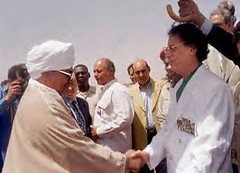
TRIPOLI (Reuters) - Libyan leader Muammar Gaddafi cautioned the West on Saturday over involvement in the standoff in Sudan's western Darfur region and restated his opposition to international peacekeepers.

Gaddafi made the remarks as he welcomed international envoys to Libya for talks on Darfur, where four years of fighting between rebels, government forces and Arab Janjaweed militia have killed at least 200,000 people and displaced some 2.5 million, creating one of the world's worst humanitarian crises.

"My advice to the world, after this conference and finding solutions to the issue, is to ignore the disputing parties if they don't respond to these solutions," Gaddafi told the envoys from the United Nations, African Union (AU), United States and a string of Western and African countries.

"I call on (the world) not to finance them materially and to stop supporting them and not to send international forces," he said as he received the officials in his home town of Sirte.

Gaddafi styles himself as an African nationalist seeking African solutions to the continent's problems without relying on the West. His opposition to international peacekeepers is strongly at odds with the stance of the United States, which blames Sudan for what it says is genocide in Darfur.

Along with Britain, Washington demands Sudan accept a combined AU and United Nations force of more than 20,000 troops and police or face international sanctions that could include a complete arms embargo.

So far Khartoum has agreed to accept just 3,500 U.N. military and police personnel on top of the existing AU force of about 5,000 that is badly overstretched.

LATE-NIGHT TALKS

After meeting Gaddafi in Sirte, about 310 miles east of Tripoli, delegates returned to a hotel in the capital and began talks there late on Saturday chaired by Libya's Africa minister Ali Treiki.

A Western diplomat said the talks would leave aside the divisive peacekeeping issue and focus on trying to bring together a welter of separate initiatives on Darfur in "a process vigorously led by the AU and the U.N."

Political progress has been made much harder by the fact the Darfur rebels themselves are split. A peace deal in May last year was signed by only one of three rebel factions.

Treiki said a mechanism was needed to first bring together the neighboring countries affected by the conflict -- Sudan, Libya, Chad and Eritrea -- and then the Sudanese factions which had not signed the peace deal.

He said a meeting with the parties that had not signed should happen in the next three weeks, without specifying where.

In his earlier comments, Gaddafi was critical of the rebels.

"I see that the rebel side in the region is the one which endeavors to implicate the world in this issue," he said. "It is not in the interest of the world to intervene in an issue in which one of the parties doesn't want a solution."

The Darfur conflict has spilled over into Chad, which is housing some 200,000 refugees. Libya has been trying to broker a peace deal between Sudan and Chad. The two countries support each other's rebels.

The Tripoli talks, due to end on Sunday, bring together special Darfur envoys from the U.N., AU, the United States, European Union and Britain, and ministers or officials from Sudan, Eritrea, Chad, Egypt, France, Canada, Norway and Russia.

(Writing and additional reporting by Mark Trevelyan)

Thursday, April 26, 2007

Somalia News: Battles Rage in Mogadishu; Thousands Flee

Battles rage in Somalia

27 April 2007

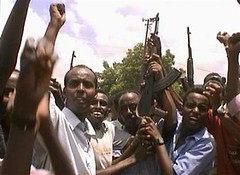
MOGADISHU--Ethiopian tanks supporting the Somali government pounded insurgent positions in Mogadishu yesterday in an escalation of the nine-day offensive and the prime minister said "most fighting" was over.

Ali Mohamed Gedi said allied Somali-Ethiopian troops were now working to clear "pockets of resistance" in a second week of fighting, which locals say has killed some 300 people, mostly civilians, and emptied large parts of the city.

"Most of the fighting in Mogadishu is now over. The government has captured a lot of territory where the insurgents were," Gedi told a news conference.

Artillery and machinegun fire could still be heard in northern parts of the devastated coastal capital.

Gedi urged clan militia and foreign jihadists in fighting the government, to return home and stay there until his administration could incorporate them into a new national army.


http://www.themoscowtimes.com/stories/2007/04/27/251.html
Friday, April 27, 2007

Ethiopian Shells Hit Mogadishu

By Salad Duhul
The Associated Press

MOGADISHU, Somalia -- Ethiopian tanks and artillery shelled an insurgent stronghold in northern Mogadishu on Thursday, as cease-fire talks floundered and rumors spread that a top Islamic rebel had arrived in the capital.

The heavy-weapons fire was in support of Somali government troops attempting to clear insurgents from a neighborhood known for housing Islamic radicals. A missile slammed through the roof of a nearby children's hospital packed with wounded civilians late Wednesday.

Leaders from the Hawiye clan were expected to meet again Thursday with Ethiopian army officers to negotiate a cease-fire. A clan leader who attended the meeting said the Ethiopian officers wanted the elders to hand over fighters from the Council of Islamic Courts military wing, the Shabab.

The Shabab, which the United States accuses of having ties to al-Qaida, has taken credit for a string of suicide bombings against Ethiopian troops.

The leader who attended the meeting, but asked not to be identified because of the sensitivity of the talks, said the elders denied any knowledge about the Shabab or al-Qaida suspects believed to be in the country.

Meanwhile, bodyguards linked to a top Islamic extremist, Sheik Hassan Dahir Aweys, arrived in Mogadishu on Wednesday, sparking rumors that Aweys and other Shabab leaders were leading the fighting against the Somali and Ethiopian troops.

Most members of the courts' leadership have either fled the country, or been in hiding since Ethiopia intervened in December to prop up the government.

The shell that hit the children's hospital on Wednesday exploded in a ward housing 20 to 30 wounded adults, said Wilhelm Huber, regional director for SOS Children's Villages.

The children had been evacuated earlier when shells hit the compound, Huber said.

Five missiles hit the grounds in the lunchtime attack, but only one hit a ward, Huber said. He said people were injured, but he did not have details due to the chaotic situation.

"What is happening now cannot go on," he said from Nairobi, Kenya, where he is based. He said he did not believe the hospital had been deliberately targeted, but that the shell clearly had come from government forces because of the direction of the missiles.

"People are desperate," Huber said. "This is a tragic situation."

Somali government officials were not immediately available for comment.

The Council of Islamic Courts ruled much of southern Somalia for six relatively peaceful months in 2006 before being ousted by Somali troops and their Ethiopian allies, along with U.S. special forces. Radicals in the council rejected a secular government and have been accused of having ties to al-Qaida.

Rights groups say more than 350 people have been killed in eight straight days of fighting.

The United Nations says more than 340,000 of Mogadishu's 2 million residents have fled since February.


Thousands flee as shelling by Ethiopian tanks kills hundreds of civilians in Somali capital

Chris McGreal, Africa correspondent
Friday April 27, 2007
Guardian

The Somali capital Mogadishu suffered some of the heaviest bombardment in nine days of fighting yesterday, as Ethiopian tanks supporting the interim government shelled new areas of the city despite a claim by the Somali prime minister to have routed Islamist insurgents.

The Ethiopian assault has killed several hundred people, many of them civilians harmed by indiscriminate shelling that has destroyed homes and shops, and forced tens of thousands to flee the city as it spread to previously relatively peaceful parts of Mogadishu. Corpses lie scattered on the streets because it is too dangerous to collect them.

More than 1,000 people were killed in an earlier round of fighting last month. More than a third of the civilian population - some 340,000 people - have fled in the past three months.

The UN humanitarian affairs chief, Sir John Holmes, yesterday accused all those involved of war crimes.

"The rules of humanitarian law are being flouted by all sides ... all factions are equally guilty of indiscriminate violence in a civilian area," he said. "Civilians in Mogadishu are paying an intolerable price for the absence of political progress and dialogue and the failure of all parties to abide by the rules of warfare."

Refugees are camped on the outskirts of the city, with water, food and medicine growing scarcer. About 600 have died of cholera and other diseases.

"At least half the capital is deserted, slowly turning it into a ghost city," the UN refugee agency said.

The interim Somali government said the 20,000-strong Ethiopian force fighting on its behalf, with 5,000 Somali troops playing a lesser role, will keep up the offensive until fighters with the Council of Islamic Courts are defeated. The council ruled Mogadishu and much of southern Somalia for six months last year until overthrown by the Ethiopian army with US backing.

Somalia's prime minister, Ali Mohamed Gedi, yesterday claimed to have defeated the Islamist forces. "We have won the fighting against the insurgents," he told Associated Press. "Most of the fighting in Mogadishu is now over. The government has captured a lot of territory where the insurgents were."

But critics say Somalia has become a battleground for Ethiopia's foreign agenda and Washington's "war on terror" that will do little to bring long term stability.

The Islamic Courts government was popular in Mogadishu after bringing relative order and driving out clan warlords responsible for 16 years of death and mayhem. But the US believed it looked too much like the Taliban, with its ban on music and dancing and the qat narcotic, and that it was sympathetic to al-Qaida.

Washington encouraged the Ethiopian military - at the "invitation" of Somalia's interim national government which was so unpopular it was unable to remain in Mogadishu - to invade and oust the Islamic Courts administration. The new Somali government includes some of the warlords who previously caused so much destruction.

A report by the Royal Institute of International Affairs said that US and Ethiopian strategic interests in supporting a weak and factionalised government that is far less popular than the Islamic Courts administration are an obstacle, not a contribution, to rebuilding Somalia.

"In an uncomfortably familiar pattern, genuine multilateral concern to support the reconstruction and rehabilitation of Somalia has been hijacked by unilateral actors - especially Ethiopia and the United States," it said.

As always in Somalia, the conflict is also being driven by money through weapons smuggling and business interests.

Ethiopian forces were to have been replaced by African Union peacekeepers, but only 1,200 of the AU's promised 8,000 troops have arrived in Somalia.


Somalia: Ethiopian forces intercept weapons

Thu. April 26, 2007 02:31 pm.
By Mohamed Abdi Farah

(SomaliNet) The Ethiopian forces in Beledwein, provincial capital of Hiran region in central Somalia intercepted two trucks carrying weapons towards the capital, Mogadishu, sources say on Thursday.

Witnesses say that the Ethiopian forces stationed in Janda-Kundishe checkpoint, outside of Beledwein confiscated the weapons including explosives like anti-tanks mines.

It is still unclear whether the weapons were for sale or they wre sent to insurgents fighting in the capital with the Ethiopians.

It is the second time the Ethiopian forces in the region sized illegal weapons.


SOMALIA: Kismayo fighting forces civilians to flee camps

Internally displaced people are all along the road leading to the port city of Kismayo

NAIROBI, 24 April 2007 (IRIN) - Fighting between different clans serving in Somali's interim government in the port city of Kismayo had forced displaced persons living in camps to flee again, sources said.

Many internally displaced families in the Faanole neighbourhood of the city abandoned their camps as fighting broke out on Monday. Some set up temporary shelters away from the area and others headed towards the Kenyan border. At least 25 people reportedly died in the town.

Kismayo is 500km south of the capital, Mogadishu. A local journalist, who declined to be named, said the Majeerteen militia - of President Abdullahi Yusuf’s Darod sub-clan - had been pushed out of the city by the Marehan - also of the Darod sub-clan, to which the Defence Minister Barre Hiirale belongs - and was now camped outside the city.

However, Ahmed Abdi Umar, the deputy governor of Lower Juba - of which Kismayo is the regional capital - downplayed the displacement. Many people, he added, were already returning home, adding that no displaced people had gone towards the Kenyan border. "They moved to other areas within the city for safety," he said.

According to other sources, tension had been building between the two groups over power-sharing within the administration. "It just boiled over yesterday [Monday]," said a business source. The two groups, he added, had been forced to merge into one army unit, but later disintegrated into clan militias.

Muhammad Ahmed, a local journalist, said Kismayo was still tense. Many businesses had not opened for business on Tuesday.

Meanwhile, Mogadishu entered the sixth day of fighting between Ethiopian-backed government troops and insurgents on Tuesday.

The fighting occurred mostly in the north of the city, according to a local source. He said shelling by Ethiopian and government forces on the north Mogadishu neighbourhoods of Jamhuriya and Towfiiq, insurgent strongholds, was continuing.

The insurgents comprise the remnants of the Union of Islamic Courts and Hawiye (the dominant clan in the city) militias, who are opposed to the transitional government and the presence of Ethiopian forces.

Meanwhile, the United Nations Secretary-General Ban Ki-moon on Monday called for an end to the violence in Somalia.

"The Secretary-General is gravely concerned about the continuing heavy fighting in Mogadishu, which has reportedly killed more than 250 people and forced more than 320,000 from their homes in the past six days alone," spokeswoman Michèle Montas told reporters in New York.

All parties to the conflict and the international community must work to initiate an all-inclusive peace process to avoid clan warfare in south-central Somalia.

Ban called on the parties to "immediately cease all hostilities and to facilitate access for the delivery of urgently needed humanitarian assistance", renewing his call for an urgent resumption of political dialogue.

Separately, the Norwegian Refugee Council (NRC) urged the UN Security Council and the international community to work for an immediate cessation of hostilities in Mogadishu to secure humanitarian access to displaced populations.

"All parties to the conflict and the international community must work to initiate an all-inclusive peace process to avoid clan warfare in south-central Somalia," NRC’s International Director, Jens Mjaugedal said ahead of a Council meeting on Somalia due on Tuesday.

A Tribute to Dr. Kwame Nkrumah on the 35th Anniversary of His Transition

A Tribute To Kwame Nkrumah On The 35th Anniversary of His Death

By Abayomi Azikiwe, Editor
Pan-African News Wire

Editorial Review, April 27,(PANW)--Twenty-six years ago today in 1972, Dr. Kwame Nkrumah, the founder and leader of the African independence movement and the foremost advocate of Pan-Africanism during his time, died in Bucharest, Romania after a long bout with cancer. Nkrumah was the first head of state of an independent post-colonial nation in Africa south of the sahara, after he led the nation of Ghana to its national liberation under the direction of the Convention Peoples Party in 1957.

Educated at the Historically Black College of Lincoln University in Pennsylvania, Nkrumah became involved in the Pan-African movement in the United States during the 1930s and 1940s as a leading member of the African Students Association (ASA), the Council on African Affairs (CAA) as well as other organizations. After leaving the United States at the conclusion of World War II in 1945, he played a leading role in the convening of the historic Fifth Pan-African Congress in Manchester, England-a gathering which is credited with laying the foundation for the mass struggles for independence during the 1940s and 1950s.

It was during his stay in England between 1945-47, that he collaborated with George Padmore of Trinidad, a veteran activist in the international communist movement and a journalist who wrote extensively on African affairs.

Nkrumah was offered a position with the United Gold Coast
Convention (UGCC) as an organizer in late 1947 and made a critical
decision to return to the Gold Coast (later known as Ghana) to assist in the anti-colonial struggle that was intensifying in the aftermath of World War II.

After being imprisoned with other leaders of the UGCC for
supposedly inciting unrest among WWII veterans, workers and farmers in the colony, he gained widespread popularity among the people who responded enthusiastically to his militant and fiery approach to the burgeoining anti-imperialist movement. After forming the Committee on Youth Organization (CYO) which became the best organized segment of the UGCC, Nkrumah was later isolated from the top leadership of the Convention, who objected to his demands for immediate political independence for the Gold Coast.

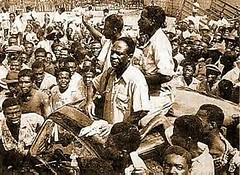
On June 12, 1949, Nkrumah and the CYO formed the Convention Peoples Party in Accra at a mass gathering of tens of thousands of people, who were prepared to launch a mass struggle for the abolition of British colonial rule in the Gold Coast. During this same period, Nkrumah formed links with other anti-colonial and Pan-African organizations that were operating in the other colonies of west Africa. When the CPP called for a Positive Action Campaign in early 1950, leading to massive strikes and rebellion throughout the colony, he was imprisoned by the colonial authorities for sedition. However, the executive members of the CPP continued to press for the total independence of the colony, eventually creating the conditions for a popular election in 1951, that the CPP won overwhelmingly.

In February of 1951, Nkrumah was released from prison in Ghana and appointed Leader of Government Business in a transitional arrangement that eventually led to the independence of Ghana on March 6, 1957.

At the independence gathering on March 6, Nkrumah declared that the independence of Ghana was meaningless unless it was directly linked with the total liberation of the continent. This statement made by Prime Minister Nkrumah served as the cornerstone of Ghanaian foreign policy during his tenure as leader of the country.

George Padmore became the official advisor on African affairs and was placed in charge of the Bureau of African Affairs, whose task it was to assist other national liberation movements on the continent in their efforts to win political independence.

In April of 1958, the First Conference of Independent African States was convened, with eight nation-states as participants. This gathering broke down the colonially imposed divisions between Africa north and south of the sahara.

Later that same year in December, the first All-African Peoples
Conference was held in Accra, which brought together 62 national liberation movements from all over the continent as well as representation from Africans in the United States. It was at this conference in December of 1958, that Patrice Lumumba of Congo became an internationally recognized leader of the anti-colonial struggle in that Belgian colony.

Challenges of the National Independence Movement

By 1960, the independence movement had gained tremendous influence throughout Africa, resulting in the emergence of many new nation-states on the continent. That same year, Ghana became a republic and adopted its own constitution making Nkrumah the president of the government.

However, there arose fissures within the leadership of the CPP over which direction the new state would take in regard to its economic and social policies. Many of Nkrumah's colleagues who had been instrumental in the struggle for independence, were not committed to his long term goals of Pan-Africanism and Socialism.

Consequently, many of the programmatic initiatives launched by the CPP government were stifled by the class aspirations of many of the state and party officials who were non-committal in regard to a total revolutionary transformation of Ghanaian society and the African continent as a whole. By September of 1961, massive labor unrest occured throughout the country while Nkrumah was travelling in Eastern Europe, which was then allied with the Soviet Union.

In the aftermath of the 1961 crisis, massive purges took place within the CPP against those who were considered to the right of the new government policies related to the adoption of scientific socialism inside the country. Later in August of 1962, an assassination attempt was carried out against Nkrumah in the north of the country, where he was nearly killed by a bomb.

As a result of this incident,a new round of purges took place
where many of those considered as the left wing of the CPP, such as
vice-chairman of the ruling party, Tawio Adamafio, were sacked and later arrested and charged with being co-conspirators in the assassination attempt against Nkrumah. After 1962, the leadership of the CPP became more focused around Nkrumah as a personality while the government moved more towards the adoption of a one- party state model of political control.

These developments were taking place in conjunction with other activities launched by opposition parties, whose strength had been curtailed by the Preventive Detention Act of 1958, that was designed to halt other plots aimed at assassination and destabilization of the new state in the aftermath of independence.

By 1964, the First Republic of Ghana had held an election that mandated the adoption of the one-party state form of government. During this period, the CPP was attempting to restructure the economy of the country from its dependence on trade and investment with the capitalist world.

This proved to be a formidable task due to the legacy of colonialism in the country and the relative weakness of the Soviet Bloc and China in regard to their ability to provide economic assistance to newly
independent African states. Although the realization of an United States of Africa was the principle foreign policy objective of the CPP
government, the majority of African states during this period were not
willing to lessen their ties to the former colonial powers in lieu of
greater linkages with the progressive states on the continent.

Nkrumah in 1963 identified neo-colonialism as the major impediment to the genuine liberation of Africa. At the founding meeting of the Organization of African Unity (OAU) in Addis Ababa, Ethiopia, he released his book entitled, "Africa Must Unite", which provided a proposal for the adoption of a continental union government as the only means of countering the development of a new form colonialism on the continent.

At the OAU conference in Egypt during July of 1964, Nkrumah pleaded for the adoption of an United States of Africa by the heads of state. This proposal was not accepted despite the apparent problems associated with the legacy of colonialism on the continent. The Congo crisis and the economic stagnation of many of the newly independent states illustrated that the these nations were not viable as economic and political entities.

At the 1965 OAU Summit held in Accra, many of the head of states from other nations did not attend because of their opposition to the foreign policy of the CPP government. At this conference in late 1965, Nkrumah issued his book entitled, "Neo-Colonialism: The Last Stage of Imperialism", which condemned the United States as the principle imperialist power behind the new form of hegemonic rule which was designed to maintain western control over the newly independent states in Africa and throughout the so-called developing world.

This book so infuriated the American government that G.M. Williams, the United States Undersecretary of State for African Affairs wrote a memorandum of protest to Ghana embassy in Washington, D.C. saying that Nkrumah was working in contravention to the interest of the American government in Africa.

Just four months after the release of this book on Neo-Colonialism,
Nkrumah was overthrown by a coup d'etat led by lower level military
officers and police in Ghana. This coup was backed by the American
government and the imperialist world in general, who percieved Nkrumah's policies as a threat to the economic and political interests of the western powers.

Nkrumah was out of the country at the time of the coup, enroute to North Vietnam on a mission to bring about a peace settlement in the United States war against the people of South-east Asia. During a stop over in China, Nkrumah was informed by the governmental officials there that a military and police coup had taken place inside of Ghana.

Aborting his mission to Vietnam, he returned to Africa via the Soviet Union and Egypt,where he eventually settled in Guinea-Conakry. Nkrumah remained in Guinea until he was flown to Romania to undergo treatment for cancer in 1971.

During this period after the coup (1966-1971) he continued to write on the history of Africa and the revolutionary movement for Pan-Africanism and world socialism.

The Contributions of Kwame Nkrumah

Despite the coup against Nkrumah on February 24, 1966 in Ghana, his legacy in Africa and throughout the African world continues. His views on the necessity of coordinated guerrilla warfare to liberate Africa was realized in the sub-continent during the 1970s and 1980s, when the settler-colonial regimes of Rhodesia and eventually South Africa were defeated.

The role of Cuba in the liberation and security of Angola was clearly in line with the notions advocated by Nkrumah, which upheld the view that until settler colonialism was destroyed, the entire continent of Africa would not be secure.

Even though the realization of a United States of Africa is still
far away, this issue continues to be discussed broadly on the continent and in the Diaspora. In Ghana, Nkrumah's legacy was utilized in both a positive and negative manner by the successive regimes that took power after his departure. These regimes are compelled to use his image and legacy, despite their refusal to adopt the CPP program in its totality.

In the United States and throughout the Diaspora, a greater identification with Africa has occured over the last thirty years. The African community in America and the Caribbean played an instrumental role in the solidarity struggle with the national liberation movements in Southern Africa during the 1980s and 1990s. Nkrumah's views on the necessity of African unity have been prophetic in light of the continuing underdevelopment of the continent and the phenomena of domestic neo-colonialism in the United States and the Caribbean.

Consequently, the legacy of Nkrumah is still relevant to the present day struggle of African peoples around the world.

A greater understanding of his ideas and activities can only benefit the present efforts to create an African world that is genuinely independent and self-determined.

====================================================
Articles published by the Pan-African News Wire may be freely ciruculated for non-profit educational and research purposes. We request that the original source of these articles be cited when reproduced. Distribution for profit is prohibited without the expressed consent of the Pan-African News Wire.

Wednesday, April 25, 2007

Dr. Kwame Nkrumah: Opening Address of the First Meeting of the Editorial Board of the Encyclopaedia Africana

PANW Editor's Note: April 27 represents the 35th anniversary of the transition of Osagyefo Dr. Kwame Nkrumah, the founder of the Convention People's Party and the modern state of Ghana. The following article is reprinted in commemoration of the monumental legacy of President Nkrumah, who is the contemporary architect of Pan-Africanism and a major tactician within the African Revolution.
--------------------------------------------------------------------------------
Speech at the Opening Session of the
First Meeting of the Editorial Board of the
Encyclopaedia Africana

On September 24, 1964 At the University of Ghana
Osagyefo Dr Kwame Nkrumah

Distinguished members of the Editorial Board of the Encyclopaedia Africana, Ladies and Gentlemen:

It is a great pleasure and privilege for me to inaugurate this first meeting of the Editorial Board of the Encyclopaedia Africana. The presence on this Board here today of representatives from all parts of the Continent of Africa is yet another token of the African cultural renaissance which is manifesting itself side by side with the political resurgence of the African Continent. I must also confess, distinguished guests, that today I feel a great sense of relief and joy to think that at long last a first significant step has been taken towards the positive realisation and consummation of a long cherished dream.

Years ago, I felt that Africa needs to buttress her unimpeachable claim to political independence with parallel efforts to expose to the world the bases of her rich culture and civilisation through the medium of a scholarly Encyclopaedia. I therefore invited W.E.B. DuBois of blessed memory to come to Ghana to help us establish the framework for this great natural heritage. Dr. DuBois was happy to come to Ghana in the very evening of his life to embark upon this task; he took Ghanaian citizenship, and immediately plunged headlong into the stupendous work of setting out the general aims of this project and securing the interest and support of eminent scholars throughout Africa for its realisation. To him this was an exciting state of affairs to produce such an Encyclopaedia.

It is perhaps not without significance that DuBois should have had to wait until the very sunset of his life to find and receive encouragement and support for this project, not in the abundance of the United States, but rather in an Africa liberated from the cramping and oppressive conditions of colonial rule.

In taking upon ourselves this great responsibility for Africa, we are reminded of an old Roman saying: "Semper aliquid novi ex Africa." Africa had a noble past which astounded even the ancient Roman world with its great surprises. Yet, it was only much later, after a millennium and a half of African history that we are now busily engaged in reconstructing for all the world to know, that racial exploitation and imperialist domination deliberately fostered a new and monstrous mythology of race which nourished the popular but unfounded image of Africa as the "Dark Continent." In other words, a Continent whose inhabitants were without any past history, any contribution to world civilization, or any hope of future development - except by the grace of foreign tutelage!

It is unfortunate that men of learning and men of affairs in Europe and America from a century ago down to yesterday, have spent much valuable time to establish this unscientific and ridiculous notion of African inferiority. A European author declared that "the history of civilization on the continent begins, as concerns its inhabitants, with Mohammedan invasion" and that African is poorer in recorded history than can be imagined.

Even the Eleventh Edition of the Encyclopaedia Britannica also declared: "Africa, with the exception of the lower Nile Valley and what is known as Roman Africa is, so far as its native inhabitants are concerned, a continent practically without history and possessing no records from which such history may be conducted ..... the Negro (referring to the black man) is essentially the child of the moment and his memory, both tribal and individual, is very short," And "if Ancient Egypt and Ethiopia be excluded, the story of Africa is largely a record of the doings of its Asiatic and European conquerors and colonizers."

And here I want to sound a note of caution about the term "Negro." I hope that in the record of the Encyclopaedia Africana the term "Negro", whatever meaning or connotation has been given to it, will not find a place, except perhaps in a specific article proving its opprobrious origin and redundancy. I would like that people of African descent and Africans in general should be described as black men, or Africans. I personally would like to be referred to as a black man, African or Ghanaian, not referred to as a "Negro".

It would be long to attempt to survey this field of malicious distortion against Africa. But this would be a useless and unprofitable venture, and I am sure that your Editorial Board would not suffer this pointless waster of valuable time. But listen a while to Leo Frobenius in his Voice of Africa: "The ruins of the mighty past lie slumbering within the bosom of the earth but are glorified in the memory of men who live beneath the sun." He dwells on the "god-like strength of memory in those who lived before the advent of the written word" and he continues: "Every archaeologist can quote examples from the nations of the North. But who would imagine that the Negro Race (here again referring to the black race) of Africa possessed an equally retentive mind for its store of ancient monuments."

It may be argued, however, that this sort of view about Africa is dying out, and we may be accused of whipping a dying horse. It is also true that, particularly in the years since World War II, there has been a marked improvement in much of the writing by non-Africans on Africa and there are today a number of writers and scholars who have made signal contributions to African historiography. Nevertheless, it is to be doubted if the popular image of the so-called Dark Continent has been much affected by the widening horizon of knowledge of Africa. The fact is that the powerful forces which seek to block the advance of the 280 millions of Africans to a place of full equality in the world community and which strive to maintain neo-colonialist or even overt colonial domination and white supremacy rule in Africa, find it in their interest to perpetuate the mythology of racial inferiority.

Thus it is not simple ignorance of Africa, but deliberate disparagement of the continent and its people that Africanists and the Encyclopaedia Africana must contend with. The foulest intellectual rubbish ever invented by man is that of racial superiority and inferiority. We know now, of course, that this distortion and fabrication of the image of man was invented by the apostles of imperialism to salve their conscience and justify their political, cultural and economic domination of Africa.

I understand that through the medium of the Information Report, published periodically by the Encyclopaedia Africana Secretariat, have appeared expressions of support and pledges of co-operation in the work of this great project from numerous eminent scholars. And I am particularly happy that among those who have expressed their endorsement of our work are distinguished scholars in the United States, the Soviet Union, China, India, Britain and other countries outside Africa.

I am sure the members of the Editorial Board share my appreciation of this world-wide support of the idea of an Encyclopaedia Africana. However, it is of course only logical that an encyclopaedia work on Africa should be produced in Africa, under the direction and editorship of Africans, and with the maximum participation of African scholars in all countries.

While I believe that no contribution to the projected Encyclopaedia should be rejected solely and simply because the author happens to be non-African, there are surely valid reasons why the maximum participation of African scholars themselves should be aimed at. Let me illustrate this point with an example from a book published just fifty years ago by George W. Ellis, an Afro-American who served from 1901 to 1910 as Secretary of the United States diplomatic mission in Liberia. From this study came his book, Negro Culture in West Africa, published in 1914. In the Preface to this work Ellis tells how he had sought to widen his knowledge of Africa, before coming to Liberia, by the diligent study of encyclopaedias, geographies, and works of ethnology and anthropology, only to find that much of this information was "unsupported by the facts" and gave a picture "substantially different" from the character of African life which he himself found in West Africa. Acknowledge the services of European authors such as Harry Johnston, Lady Lugard and others, Ellis stated that to him "it seems more necessary and imperative that the African should explain his own culture, and interpret his own thought and soul life, if the complete truth is to be given to the other races of the earth."

But there were already men in West Africa who had blazed a significant trail in this direction: Edward Wilmot Blyden, Joseph Casely Hayford and John Mensah Sarbah. Many other Africans in preceding generations helped to lay the basis of our present efforts to project a new African image of Africa. One thinks of such figures as James Africanus B. Horton and his "A vindication of the African Race". (1868) and of Carl Reindorf, Attoh Ahumah, Anthony William Amu, Samuel Johnson of Oyo, Blaise Diagne, Herbert Macaulay and others in West Africa, of Duse Mohammed Effendi of the Sudan, Lewanika of Barotseland, Apolo Kagwa of Buganda, and leaders such as JohnTengo Jabavu, Solomon T. Plaatje, and Clements Kedalie in South Africa.

And let us not forget the important contributions of others in the New World, for example, the sons of Africa in Haiti such as Antenor Firmin and Dr. Jean Price-Mars, and others in the United States such as Alexander Crummell, Carter G. Woodson and our own Dr. DuBois.

All of those whose names I have mentioned believed in and urged the necessity of writing about Africa from the point of view of African interests and African assumptions and concepts - and not from the point of view of Europeans or others who have quite different interests, assumptions and concepts, whether conscious or unconscious. This is precisely what we mean when we say that the Encyclopaedia Africana must be frankly Afro-centric in its interpretation of African history and of the social and cultural institutions of the African and people of African descent everywhere.

It is to be hoped, therefore, that the work on the Encyclopaedia Africana may provide both the forum and the motivation for the development of a virile and salutary new trend in the writing of African history, writing which will rank in scholarship with any other historiography, but which will also be based upon a frame of reference that is independently African, and will lead the way in independent thinking about Africa and its problems.

I am anxious that I should not be misunderstood in my emphasis on an Afro-centric point of view for the Encyclopaedia Africana. There are some who will say that this implies simply reversing the faults and distortions of the colonialist minded writers on Africa, painting everything white that they pictured as black, and everything black that they pictured as white.

I should like to assure our guests, the members of the Editorial Board, that that is in no sense my conception of what the Encyclopaedia Africana should be. Most certainly it must and will set the record straight on many points of African history and culture. But it will do this not simply on the basis of assertion backed by nothing more than emotion, but rather on the foundation of first-class scholarship linked with the passion for scientific truth.

It will not romanticize or idealize the African past, it will not gloss over African failings weaknesses and foibles, or endeavour to demonstrate that Africans are endowed with either greater virtues or lesser vices that the rest of mankind. There is undoubtedly considerable evidence of much that is noble and glorious in our African past; there is no need to gild the Lily nor to try to hide that which is ignoble. But here again it is a question of whose standards and values you are applying in assessing something as noble or ignoble, and I maintain that the Encyclopaedia Africana must reject non-African value-judgments of things African.

It is true that despite the great advances made during the last twenty years in the various disciplines of African studies, so much of Africa's history has yet to be unearthed, scientifically analysed, and fully comprehended. This sometimes gives rise to the question whether enough is yet known to undertake at this time the compilation of an encyclopaedia of the sort envisaged. Those who entertain such hesitation and doubt only expose the extent of their ignorance about Africa's great past.

Before the colonial era in Africa, Europeans had had many encounters with Africans on the cross-roads of history. They had married into African royal families, received Africans into their courts as ambassadors and social equals, and their writers had depicted African characters as great heroes in their literature. In common with the rest of mankind Africans made extensive use of cereals, they learnt the art of raising cattle, adapted metal tools and weapons to their own use, and, to quote Basil Davidson, "undertook mining and smelting and forging on a continental scale, borrowed crops from other lands, introduced soil conservation, discovered the medicinal value of a host of herbs and plants, and worked out their own explanations of mankind and the universe. All this had happened before the first ships set forth from Europe."

Let me give another quotation even at the risk of boring you, this time from Leo Frobenius again, a well-known historian who made 17 expeditions into Africa, North, East, West and South, in order to learn at first hand of the culture of the African peoples. Frobenius makes a basic statement in his book African Civilisation, which unfortunately has not yet been translated into English. Doubtless, there is reason why no complete translation has yet been made. From a limited translation made by Anna Malise Graves, I quote: "When they, European navigators, arrived in the Gulf of Guinea and landed at Ouidah in Dahomey, the captains were greatly astonished to find streets well laid out, bordered on either side for several leagues with two rows of trees, and men clad in richly coloured garments of their own weaving. Further south in the kingdom of the Congo, a swarming crowd dressed in silk and velvet, great states well ordered and down to the most minute details, powerful rulers, flourishing industries, civilised to the manner of their bones. And the condition of the countries on the eastern coast, Mozambique, for instance, was quite the same. The revelations of the navigators from 15th to the 17th century gave incontrovertible proofs that Africa stretching south from the edge of the Sahara desert was still in full flower - the flower of harmonious and well-ordered civilisations. And this fine flowering the European conquistadors or conquerors annihilated as far as they penetrated into the country."

Indeed, the history of Africa goes back into the dim recesses of time and antiquity. There are even scientists in our time who are beginning to claim that Africa was the very cradle of mankind. The fossil remains of man discovered by Dr. L.S.B. Leakey in Tanganyika have been dated by scientific processes as one and three-quarter million (1,750,000) years old.

From the head waters of the Nile in Tanganyika let us move swiftly to its mouth on the Mediterranean Sea and the Isthmus of Suez where the great civilization of Egypt was fostered for thousands of years down to the Christian era. There, as we all know, man rose to the phenomenal heights of statecraft, science and religion and the excellence of the arts. Evidence from language, religion, astronomy, folklore and divine kinship, as well as geographical and physical proximity, confirms the basic African origin of this Egyptian cultural eminence.

This great flowering of the mind in Africa was unfortunately scorched by the ravages of the slave trade which encouraged extensive destruction through tribal warfare. Close upon this set in the evil of colonisation and the deliberate effort, to which I have already referred, of painting the African black and backward as a valid justification for colonial rule.

I have endeavoured to touch on some of these questions only as a means of making a clear case for justifying our attempts to provide Africa with an Encyclopaedia portraying vividly the glory of Africa's great past.

I should now like to say just a few words on the vital question of how this great undertaking is to be carried through to completion. I must say at the outset that a broad policy having been laid down, the precise plans for achieving it must be left to the Editorial Board and its staff of competent experts. My purpose is only to call attention to the underlying principle - the principle of Pan-African co-operation - which I believe to be indispensable in any concrete plans of work on the Encyclopaedia.

As you are aware, the preparatory work on this project has been carried forward for a little more than two years by a Secretariat here in Accra, functioning under the aegis of the Ghana Academy of Sciences. This Secretariat has not been content to work in isolation; it has been continually active in establishing contacts with scholars and institutions throughout Africa and abroad. A motion declaring "that all African countries should contribute to the work of the Secretariat" was unanimously adopted at a Conference on the Encyclopaedia Africana attended by some150 persons from Africa and elsewhere in December, 1962. Soon thereafter, the Secretariat undertook the establishment of Co-operating Committees of scholars in various African countries.

The Secretary of the Secretariat, Dr. W. A. Hunton, met with several of these Committees during a tour which he made in East and North Africa some months ago. Following this came the nominations by the Co-operating Committees of their respective representatives to serve on the Editorial Board of the Encyclopaedia. In this way the basis, at least, of Pan-African co-operation in this work has been established.

The members of the Editorial Board now have before them the Secretariat's detailed prospectus of what the Encyclopaedia Africana should contain and how the material should be presented. This is merely a blueprint of what is to be constructed. The Editorial Board members are asked to examine this blueprint with great care, proposing whatever alterations they consider would result in a more perfect plan for the Encyclopaedia. Once this has been agreed upon, the stage will have been set for the play to begin - that is to say, for the work of preparing and assembling the Encyclopaedia articles to commence.

I sincerely trust that the deliberations of the Editorial Board at this first meeting will successfully hit that mark. The progress of the work from that point on will depend in the first instance, as I see it, on the degree of whole-hearted and effectively organised support that can be procured from African scholars in all countries, from the many institutes of African studies and research agencies of various kinds which are to be found today throughout our continent, and from the various independent African governments which are ready to provide the fullest measure of financial support for this work. So far, the financial burden has been borne by the Government of Ghana alone.

As I have already stated, I have no specific proposals to present with regard to these matters. But I am convinced that the task is not insuperable. The fact that we have advanced this far in accomplishing, almost single-handed, the formation of a Pan-African Editorial Board of the Encyclopaedia Africana augurs success in the further stages of the work. I trust this project will be welcomed by all the African Heads of State, and will have the full support of the Organisation of African Unity. We must now think in terms of continental political unity in everything we do for Africa. Without such cohesion and unity none of us can survive the intrigues and divisive forces of the imperialists and neo-colonialists. The work of this Encyclopaedia Africana will take us one further step towards the great objective to which we are dedicated - a Continental Union Government of Africa.

Speaking on behalf of the Government of the Republic of Ghana and as Chancellor of our Universities, I can assure the members of the Editorial Board that work on this Encyclopaedia will have the fullest co-operation of our Universities, learned societies and research institutions in Ghana, as well as the financial support of the Government of Ghana.

Distinguished scholars and members of the Editorial Board of the Encyclopaedia Africana, on behalf of the Government and people of Ghana and on my own behalf, I extend a warm welcome to you. May this your first meeting mark the auspicious beginning of your work in a great undertaking for the benefit of mankind

Zimbabwe: Journalists Must Defend Revolution; $10 Million Deal With Chinese Firm

Journalists must defend revolution

Courtesy of the Zimbabwe Herald

THIS is the last of a two-part series in which STEPHEN MPOFU looks at Western media onslaught on progressive states and the role of journalists in defending the national interests

THE problem with the liberation movements now in power in the four countries in question is that they appear to have concentrated on training fighters to win a war without having more writers trained to defend the revolution.

Some of the few journalists who also bore arms have systematically been frustrated then hounded out of the system and into oblivion by those who regarded them as immovable obstacles in efforts to have their personal star, rather than a country’s image brightened up.

As a result, a correspondent swoops on the capital of an African country, happens to get into an airport pub, buys a thirst–quencher (beer) and sips it with his ears cocked. He picks up a conversation between locals, which appeals to him, drains his glass and leaves the pub with a "scoop" which he files back home immediately.

Or, at his hotel bar, he buys a "working beer" and listens to inebriated locals discussing national affairs with their guard lowered. Another story hot from the African pot, he tells himself and rushes off to send it back home to a gullible audience.

Is it any wonder then that African leaders have often complained against some stories by Western correspondents?

The reasons why the correspondents in question report the way they sometimes do on Africa can be summed up into two, first the Libertarian or Free Press theory also considers lies as facts or truth. Secondly, the Western Press is not so much concerned with truth all of the time as it is with validating a long-held belief in the West that nothing good comes out of Africa other than raw materials.

To make matters worse, this writer lived in exile for many years before Zimbabwe’s independence and travelled to several African countries that had already gained their freedom.

In some of those countries, it became clear that government leaders accorded Western correspondents express access into their palaces where the journalists had exclusive interviews while local journalists settled for the whey.

It was as though these leaders wanted to impress their former colonisers with: "See! We can rule just as well as you did."

The local media, left to scrounge for a best-selling story, ran the gauntlet of mischief-makers, often with a costly price on both their reputation and their coffers.

In many countries, young journalists were thrown into the fray after older and mostly white journalists quit because they saw the blacks as intruding into a profession that had been their preserve. This situation does not make the picture any brighter.

For them, their country came into creation on Independence Day, so they do not know, or do so vaguely, about the arduous road that the country travelled right up to the day of Uhuru.

This became particularly problematic in countries where blood was shed, because if one does not know the past, one cannot relate it to the present or the future for generations to understand and appreciate the importance of independence and sovereignty.

Some of the older, black journalists who remained in the profession still leave in the skin of the racist whites who tutored them.

While this may be so, credit must go to the division of Mass Communication at Harare Polytechnic that has been the premier journalist training institution in Zimbabwe after independence. Today many of its journalism graduates are in senior editorial positions in both the print and the electronic media.

However, the training of journalists at university level leaves a great deal to be desired. This communicologist once supervised several undergraduates on attachment from a certain university, while still working as a newspaper editor and was shocked to discover that the internees could hardly write an intro in journalese when they first arrived at the newspaper.

An editor of a leading Harare newspaper had this to say about journalism attachment students from another university, "they learn how to write a story in our newsroom".

An editor of another newspaper recently remarked that the English of an internment from yet another university was "appalling."

It is also known that some journalism graduates of another Zimbabwean university have opted for public relations work in the private sector because they could not stand the heat in the newsroom, the professional kitchen.

A major contributory factor to all this would appear to be that some of the local universities teach "media studies" which do not adequately prepare the students for careers in journalism.

For instance, some of the media studies graduates who did their attachment under this writer eventually took up posts as lecturers at local universities in some cases even teaching working journalists with previous training at college.

It boggles the mind because these are the people who are supposed to produce scintillating piece of journalism because of their high academic level. Do our universities produce learned or merely educated graduates?

What is worse, the programmes at the universities exclude courses in social sciences such as sociology, politics, psychology and economics or languages with which they must work.

The other problem is that no screening of students takes place to enrol those with a natural bent because journalism is the "right profession for the right person."

It surprises no one, therefore, if the journalists concerned are easily swept off their feet on a road flooded with deceptive and destructive enemy propaganda.

Journalism sits on a tripod as an art, a science and humanity. Therefore, the institutions concerned, the University of Zimbabwe, Midlands State University and the National University of Science and Technology might wish without an equivocation, to undertake a thoroughgoing revamp of the courses offered in the training of journalists.

If this is not done the training programmes under question will continue to resemble visibility programmes offered by foreign donors. Training at university costs, a lot of money that should, therefore, not be seen to be spent on window dressing courses.

It will be inappropriate not to laud NUST that has afforded some of its lecturers from the department of journalism and media studies opportunities to acquire higher degrees abroad, which guarantees the institution with better products in future.

Mention must be made at this juncture of the role that African governments must play in empowering the continent’s journalists to do their work much more effectively than has been the case to date.

African leaders are on record individually and severally as often exhorting the continent’s media workers to become the "first line" or "front line" of the defence of their country.

These leaders should put their money where their mouth is by helping the journalists to know their continent and their leaders better since soldiers cannot effectively defend their country if they are ignorant of its terrain as well as its leaders.

Journalists in some countries have never gone beyond their national borders, so how can they be expected to effectively and factually write in defence of countries either in their region or further away about which they know very little?

For instance, not many journalists knew that the Democratic Republic of Congo did not have democratic elections for 45 years until last year because of instability instigated by foreign powers intent on exploiting that country’s vast mineral resources.

Governments and private media houses might find it necessary, therefore, to organise jointly or individually tours of countries within our region to start with, for journalists to acquaint themselves with the people, the resources and the politics in those countries so that their reports will be true and authoritative.

If that is done, say in Sadc, Comesa and Ecowas and then have the journalists visit the different regional economic areas, there will be a wide spread of knowledge exchanged between and among the journalists themselves and leaders within those areas.

Also, political leaders and journalists in those economic groupings as well as at the African Union can engage in dialogue on an equal basis after completing business at their summits.

This can further enhance the knowledge and understanding of journalists about their leaders and their continent so that they can offer the necessary defence against external enemy machinations.

It can be done as demonstrated at SAID’99 (Southern Africa International Dialogue) at the Victoria Falls. During their deliberations, the political leaders from the region including Jerry Rawlings then Ghana’s president, met with journalists at a hotel where the journalists fired volley after volley at the leaders who returned "fire", and at the end of their exchange no one on either side had been mortally wounded.

If anything, each side had come to understand and appreciate the role of the other with any distrust or suspicion allayed or suspended for as long as the dialogue echoed in their ears.

It is obvious, therefore, that if the media and leaders on the African continent work together for the good of individual countries and of the continent as a whole, detractors will find it difficult to sow seeds of disunity and destruction on the continent.

This article will be incomplete if it did not make a daring yet not inappropriate claim that the Almighty breathed among them the solidarity that the Sadc leaders declared with Zimbabwe.

Many God-fearing and loving Zimbabweans had been praying long and hard for divine intervention. If a nation humbles itself before God, especially when under siege as is Zimbabwe is at present, God’s power is made perfect in the people’s weakness.

--Stephen Mpofu is a former Zimpapers editor who, in 1984, went to the University of Cambridge as a Nuffield Press Fellow and did research in International Relations.


Zim, Chinese firms in US$10m deal

From Farai Dzirutwe in Nanjing, China
Zimbabwe Herald

THE country’s agricultural sector is poised for another boost after a local firm, Saltlakes Holdings, yesterday completed negotiations to purchase more than 500 utility trucks from a leading Chinese manufacturer, Yuejin Motor Group.

Officials from the two firms accented to the deal, worth an estimated US$10 million, after a three-hour meeting in the eastern Chinese city.

This development paves the way for the importation of five and eight-tonne trucks for distribution to Zimbabwean farmers in the next few months.

Prior to the delivery of the main consignment of the trucks, YMG will deliver several sample units which will be used to test adaptability to the Zimbabwean climate and road conditions.

The vehicles are, however, likely to pass the test after national power supplier, Zesa Holdings, took delivery of 100 trucks from the same company more than two years ago. YMG also cleared Saltlakes to have exclusive dealership of Yuejin trucks in Zimbabwe.

"After a meeting with a delegation from Saltlakes Holdings, Zimbabwe on April 25, 2007, Yuejin Motor Group Import and Export Company Limited hereby authorises Saltlakes Holdings to sell Yuejin trucks and related spares in Zimbabwe," read a statement released by the company, which is wholly-owned by the Chinese government.

Saltlakes Holdings’ tractors and implements division manager, Mr Amos Matimba, said the trucks will first be distributed to farmers enlisted under the company’s tobacco outgrower scheme before they are rolled out to other farmers.

"All things being equal, we expect the samples to be shipped next month while the first batch of the vehicles should arrive in July. We toured the assembly plant today and we were very impressed by quality of the main components used to assemble the trucks.

"From a technical point of view, the trucks are strong and should be suitable for the Zimbabwean terrain. An expert in the Ministry of Agriculture, Engineer Machiwana, also certified the vehicles suitable for Zimbabwe after he accompanied us during our first tour late last year," said Mr Matimba.

He said his company was encouraging youths and female farmers to join the company’s tobacco outgrower scheme to benefit from the trucks scheme.

Beneficiaries would pay for the vehicles over a three-year period with the instalments being debited from their tobacco sales revenue.

"The recipients will initially be those farmers we have contracted under our outgrower scheme but we will spread this facility to other farmers," said Mr Matimba.

YMG, a subsidiary of Nanjing Automobile Corporation, is one of China’s biggest vehicle manufacturers and operates seven plants across the country.

The holding company also manufactures and assembles Iveco, Fiat and Rover vehicles. Sixty percent of its 16 000-strong workforce were formerly employed by the now defunct British Rover Group.

YMG officials said they would in future, consider engaging their Zimbabwean partner in a vehicle assembly venture.

"Depending on the growth of the Southern African market we will seriously consider setting up a car assembly in Zimbabwe and we will be supplying the completely knocked down kits," said a YMG official.

Tuesday, April 24, 2007

Rebellion, Crises and Social Transformation: The Detroit Upheaval of July 1967 & Its International Context

Rebellion, Crises and Social Transformation: The Detroit Upheaval of July 1967, Global Connections

Note: Published below are comments developed by the Editor of the Pan-African News Wire, Abayomi Azikiwe, for the Oral History Conference examining the 40th anniversary of the July 1967 rebellion in Detroit. The conference was held on April 20-21 and featured a bus tour of the area where the rebellion started.

In addition, the "Hands Off Assata" campaign screened "Eyes on the Rainbow", a documentary film by Gloria Rolando on the former Black Panther Party member, Assata Shakur, now living in revolutionary Cuba after being granted political asylum during the 1980s.

As moderator of the panel discussion on the "International Context & Connections, the PANW Editor delivered some of the observations listed below. Members of the panel were: Gloria Aneb House, Charles Simmons and W.F. Santiago-Valles. The overall conference was entitled: "1967 Detroit Rebellion, Lessons Learned".

The conference organizing committee was composed of the panelist listed above along with Malik Yakini, Sandra Simmons, Ebony Roberts, Monica White, Ahmed Rahman, Ron Scott, John C. Williams, Stephen Ward and Melvin Peters.
--------------------------------------------------------------------------------------------

Rebellion, Crises and Social Transformation: The Detroit Upheaval of 1967 and Its Connections to the International Struggle Against Racial Capitalism and Imperialism

What happened to Detroit in July of 1967 was not an isolated incident

By Abayomi Azikiwe, Editor
Pan-African News Wire

Introduction

On July 23, 2007, the city of Detroit will commemorate the fortieth anniversary of the Great Rebellion of 1967. It will not be surprising that the corporate media will label this series of events as a “riot” in an effort to minimize its significance and to strip the upheaval of that year from its political and social significance. Yet, when the five days of confrontations with police and national guard troops, the shopping for free, arson attacks on businesses as well as sniping are placed within the context of what was taking place around the United States and the world at that time, it will shed much light on the fact that the so-called “Detroit Riots” were in fact an act of mass rebellion very much connected to the global struggle against racial capitalism, neo-colonialism and imperialism.

The city of Detroit had experienced a consistent growth in African immigration from the pre-World War I period right through the late 1960s when the rebellion took place. The city had been a central destination point during the period of slavery for the Underground Railroad being located right across the river from Canada. With the industrialization of the city during the early 20th century, Detroit became a magnet for the influx of labor from the black belt regions of the south where Africans were fleeing from the wretched conditions of sharecropping and tenant farming that were enforced with Jim Crow laws, lynchings, mass poverty and landlessness. Consequently, when Henry Ford and other industrialists offered increased salaries for the labor of African workers, many people made the trek to Detroit with the aim of increasing their living standards and enhancing their opportunities for greater personal and political freedom.

However, the city of Detroit was always a focal point for racial exploitation, segregation, tension and unrest. Dating back to the disturbances of 1833 and 1863, the city has been noted for its periodic outburst of violence and rebellion. During World War II there were two historic incidents that illustrated the problems associated with large-scale African migration within the context of labor exploitation and white intolerance. The efforts by whites to keep Africans out of the Sojourner Truth Homes on the east side laid the basis in many ways for the so-called “Race Riot” of 1943. The 1943 racial clashes are often attributed to the competition for housing and access to public accommodations in the city. In June of 1943, white mobs chased, attacked and murdered African men and women in the streets along Woodward Avenue and in other sections of the city. In response Africans destroyed white-owned businesses in their communities and set up self-defense patrols that would not allow whites in their communities.

The corporate media at the time attributed the so-called “Race Riot” to the behavior and attitudes of young zoot suit wearing African-American youth who carried knifes and flaunted laws related to segregation and the white-dominated caste system prevalent in Detroit at the time. In the aftermath of World War II, the city adopted a massive urban renewal program that set out to remove large sections of the African community on the city’s east side. The major areas affected were known as “Black Bottom” and “Paradise Valley”, where African-Americans had established, as a result of residential and labor segregation, viable communities with small businesses, social clubs and religious institutions. By the early 1960, the communities on the east side were devastated. The main business district along St. Antoine and Hasting Streets were destroyed in order to make way for the Chrysler Freeway which transported whites to the burgeoning suburbs and outlying areas of the city. Of course the growing electoral political power that resulted from the large scale immigration during World War II and its immediate aftermath was suspected by the African community as the major reason behind the mass dislocation.

Beginning in the aftermath of World War II, African-American families began to move into the areas around 12th Street, 14th Street, Linwood, Dexter, etc. This area had been dominated by Jewish-Americans who had earlier moved from the Paradise Valley area that Africans had populated beginning with the increased migration during and after World War I. The transformation of this community took place very rapidly. In fact some apartments, flats and single home sub-divisions were racially changed within weeks. By the middle years of the 1950s the Virginia Park community and its environs became virtually all-black neighborhoods. As a result of the lack of political representation within city government, with the exception of one City Councilman, Mr. Patrick, who was elected in 1957, African-Americans felt disenfranchised by the municipal authorities.

A neighborhood which was characterized by its sturdy and well-built apartments, flats and single-homes soon deteriorated and by 1960 the Virginia Park Community organization held a forum asking the question as to whether 12th Street was becoming another skid row. Despite the fact that the neighborhood was virtually all-African, the majority of merchants and many of the landlords remained Jewish-American. The community soon began to complain about the problems associated with poor city services and the refusal of the local merchants to re-invest in the community and to assist in its upkeep. By 1963, the racial tensions in the city had reached a major crossroad. In that year, the Detroit Council for Human Rights (DCHR) was formed under the leadership of the late Rev. C. L. Franklin, pastor of New Bethel Baptist Church. New Bethel had been located in the heart of Paradise Valley on Hastings and Willis during the late 1940s through 1961, when it was ordered demolished as part of the so-called Detroit Urban Renewal Plan.

The DCHR in conjunction with the Group on Advanced Leadership (GOAL) formed by Richard Henry, Milton Henry, the Reverend Albert Cleage of the Central Congregational United Church of Christ among others, organized the June 23, 1963, “Walk to Freedom” down Woodward Avenue. The demonstration, which invited Dr. Martin Luther King, Jr. as the keynote speaker and march leader, drew approximately 200,000 people, and became the first real mass demonstration for social justice and civil rights in the United States. The June 23, 1963 march represented a milestone in the history of Detroit as well. The fact is that the established labor and civil rights leadership had to run and catch up with the momentum tapped into by Rev. Franklin, Rev. Cleage and the organizers of the march. The political dynamics surrounding the evolution of the march and the development of the Detroit Council for Human Rights requires much more attention than this discussion will allow. Suffice it to say that the attitudes of the masses of workers and poor in Detroit were becoming more difficult to contain by the city’s power structure. The march down Woodward Avenue set the stage for the March on Washington on August 28, 1963. Dr. King had delivered his “I Have a Dream” speech initially here in Detroit at Cobo Hall on June 23. The speech was later released as an album by Motown Records. Nonetheless, the popular version is the one that is canonized by the corporate media delivered at the Lincoln Memorial.

What is interesting about the rebellion of 1967 is that many had felt that because of the relatively affluent character of African-Americans in Detroit: their greater access to homeownership, quality housing, industrial jobs, and an educated middle-class composed of professionals and business-owners, that no large-scale rebellion would take place. The events of August 1966 on the city’s east side, known as the “Kercheval Incident” was contained and defused, was utilized as proof that the city would not explode as New York had in 1964 and Watts in 1965 or as Chicago had in 1966. However, these predictions proved false with the rebellion erupting on July 23, 1967 becoming the largest and most deadly in United States history.

Background on the International Dimensions of the African-American Question

The African struggle against slavery, racial exploitation and national oppression has always been international. Africans were brought here for the sole purpose of slavery beginning in the 17th century. Some of the earliest institutions formed by Africans in North America were self-identified as efforts to reclaim their national historical and cultural identity. Hence the First African Baptist Church of the late 18th century in the southeast region of the country and the African Methodist Episcopal Church formed during the late 18th and early 19th centuries in the northeast illustrated that despite the period of slavery blacks still identified themselves as Africans.

It has been well documented that during the slave period there were many revolts that took various forms of expression. This phenomena has been written about by historians such as CLR James (A History of Negro Revolt, 1938), Herbert Aptheker (American Negro Slave Revolts, 1943) and WEB Dubois (John Brown, 1909,; Black Reconstruction, 1935). The Pan-African Conference movement was began in Chicago in 1893 with such people in the leadership as Bishop Henry McNeal Turner. This Pan-African movement continued with conferences held in England in 1900 under the direction of Trinidadian Henry Sylvester Williams with WEB DuBois and other African-Americans playing a prominent role. In the aftermath of World War I, the Pan-African movement was revived with WEB DuBois organizing a Congress in Paris in 1919 with other leaders from the African world including Addie W. Hunton, who had gone to France during the War to work with African-American servicemen suffering under deplorable conditions.

Of course the Garvey Movement, the Universal Negro Improvement Association (UNIA), founded in Jamaica and re-located in New York, reached its zenith during the 1920s with millions of members and supporters, its Negro World newspaper and its establishment of chapters throughout the world including the African continent. The work of George Padmore through the Communist International sought to establish a Pan-African workers movement during the late 1920s and early 1930s. Padmore in his classic work: “The Life and Struggles of Negro Toilers” (1931) chronicled the international plight of African peoples on the continent and in the Diaspora. With the Italian invasion of Abyssinia in 1935, thousands of Africans rebelled against Italian merchants in Harlem and sought to travel to East Africa in order to fight to save Africa from Mussolini’s fascist regime.

In the aftermath of World War II, the Fifth Pan-African Congress at Manchester was organized by George Padmore, Kwame Nkrumah and WEB Dubois setting the stage for the post-war struggles for national independence, civil rights, black power and pan-africanism. When the United Nations was formed in 1945, the National Association for the Advancement of Colored People (NAACP) and the National Negro Congress sought to utilize the new international body as a mechanism for raising the question of the plight of African people in the United States. WEB Dubois, who had rejoined the Association in 1944, conducted research for a publication to expose the hypocrisy of the US as a purported champion of human rights around the world. As a result of these efforts to bring the plight of African-Americans before the United Nations, a serious split developed with the Association by 1948. The Civil Rights Congress under Attorney William Patterson and Paul Robeson did eventually present a petition entitled “We Charge Genocide,” in 1951 to the United Nations.

During this period, the so-called anti-communist witch hunts were in full swing. Organizations like the NAACP were forced to expel anyone who did not pledge full allegiance to the United States. Organizations such as the Civil Rights Congress that presented the “We Charge Genocide” petition and the Council on African Affairs were driven out of existence as a result of government repression. The leadership of this wing of the movement was persecuted: driven underground, economically sanctioned, vilified in the press, put on trial and imprisoned. Even WEB Dubois was brought before the federal courts for being a foreign agent. Although he was acquitted of these spurious charges, his passport was confiscated and he was eventually isolated by certain intellectual and political circles.

It was only the resurgence of the civil rights movement of the late 1950s and early 1960s that really broke the back of McCarthyism and anti-communist hysteria. In addition, the advent of Malcolm X as the national spokesperson of the Nation of Islam, liberated the speech of the African-American people. When Malcolm X broke with the Nation of Islam in March of 1964, he openly declared that his aim was to merge the struggles of Africans in the Diaspora with those taking place on the continent.

In the founding address for the Organization of Afro-American Unity (OAAU) delivered on June 28, 1964, Malcolm stated that:
“Just ten years ago on the African continent, our people were colonized. They were suffering all forms of colonization, oppression, exploitation, degradation, humiliation, discrimination, and every other kind of –ation. And in a short time, they have gained more independence, more recognition, more respect as human being than you and I have. And you and I live in a country which is supposed to be the citadel of education, freedom, justice, democracy, and all of those other pretty-sounding words.
So it was our intention to try and find out what it was our African brothers were doing to get results, so that you and I could study what they had done and perhaps gain from that study or benefit from their experiences. And my traveling over there was designed to help find out how. "

In the city of Detroit the ideological struggle within the civil rights movement was intensifying. After the huge march down Woodward Avenue on June 23, 1963, a split eventually arose within the Detroit Council for Human Rights between Rev. C.L. Franklin and the Henry brothers along with Rev. Albert Cleage. One major issue over which disagreement arose was support for the newly-formed Freedom Now Party that sought to run independent African-American candidates for political office. In November of 1963 both the Group on Advanced Leadership (GOAL) led by Cleage and the Henry brothers and DCHR under the direction of Franklin held separate conferences in the city. The most notable of course was the Negro Grassroots Leadership Conference that took place at King Solomon’s Baptist Church on the city’s west side. Malcolm X delivered his famous “Message to the Grassroots” speech, which in a sense represented his last will and testament to the Nation of Islam. In this speech Malcolm questioned the commitment to non-violence on the part of the Civil Rights Movement. He also said that “If you are afraid of black nationalism, you are afraid of revolution.” This was a open challenge to the wing of the movement led by Dr. King, Rev. C.L. Franklin, Cong. Adam Clayton Powell and others.

In 1964, Attorney Milton Henry traveled to Egypt on behalf of the Afro-American Broadcasting Corporation, an independent media group which hosted a radio program over the black-owned W-CHB, in order to cover Malcolm X’s visit to the Organization of African Unity’s (OAU) second annual summit. Malcolm’s aim was to lobby African leaders and seek their support for bringing the plight of African-Americans before the United Nations. This was an effort to re-kindle the work done earlier by the NAACP and the Civil Rights Congress during the late 1940s and early 1950s.

In a letter from Malcolm X written from Cairo dated August 29, 1964, he stated that:
“You must realize that what I am trying to do is very dangerous, because it is a direct threat to the entire international system of racist exploitation. It is a threat to discrimination in all its international forms. Therefore, if I die or am killed before making it back to the States, you can rest assured that what I’ve already set in motion will never be stopped. The foundation has been laid and no one can hardly undo it. Our problem has been internationalized. The results of what I am doing will materialize in the future and then all of you will be able to see why it is necessary for me to be here this long and what I was laying the foundation for while here.” (Taken from “By Any Means Necessary,” Pathfinder Press, 1970).

Soul Serenade*: The Role of International Affairs in 1967

There were other developments in the international community that had a tremendous impact on organizations based inside the United States that had played a leadership role within the civil rights and black power movements. The escalation of the war in Vietnam propelled Dr. Martin Luther King, Jr. to take public position against the American involvement in southeast Asia. King had been reticent to take such a stand prior to the spring of 1967. Although his wife Coretta had participated in the national march against the war organized by the Students for a Democratic Society in April of 1965, King personally did not participate. He had made statements against the war and its role in deflecting attention away from the struggle for civil rights and so-called “war on poverty,’ but it was not until April 4, 1967 in his speech at Riverside Church in New York City that he clearly articulated his views on the war and its relationship to the struggle against racism and poverty in the United States.

Of course the Student Nonviolent Coordinating Committee (SNCC) had come out against the war with a statement issued on January 4, 1966. This statement read in part that:
“The Student Nonviolent Coordinating Committee has a right and a responsibility to dissent with United States foreign policy on an issue when it sees fit. The Student Nonviolent Coordinating Committee now states its opposition to United States involvement in Vietnam on these grounds:
We believe the United States government has been deceptive in its claims of concern for freedom of the Vietnamese people, just as the government has been deceptive in claiming concern for the freedom of colored people in such other countries as the Dominican Republic, the Congo, South Africa, Rhodesia and in the United States itself…
"We therefore encourage those Americans who prefer to use their energy in building democratic forms within this country. We believe that work in the civil rights movement and with other human relations organizations is a valid alternative to the draft. We urge all Americans to seek this alternative, knowing full well that it may cost them lives—as painfully as in Vietnam.” (Taken from The Making of Black Revolutionaries: A Personal Account, James Forman, Macmillan Company, 1972, pp. 445-446).

Another major issue that arose during June of 1967 was the outbreak of the so-called “Six Day War” between the State of Israel and Egypt along with other Arab countries. Various civil rights organizations were pressured to come out in support of Israel. However, SNCC generated a tremendous amount of controversy when it took a position in opposition to the Zionist State in support of Egypt and the Palestinians. James Forman, who had been executive secretary of SNCC between 1961-1966 had taken the position of International Affairs Director of the organization. In his book entitled: “The Making of Black Revolutionaries: A Personal Account” he points out that during the war the Guinean Ambassador to the United Nations, Maroof Askar, had summoned him and the leadership of the Congress of Racial Equality (CORE) to their Mission in New York. Ambassador Maroof had told both organizations that the radical African nations as well as others, were coming out in support of Egypt and the Arab states in the conflict. Forman states that the CORE leaders conveyed to the Guinean Ambassador that CORE had not taken a position on the conflict because it felt the organization could not sustain the reaction to such a position by the pro-Israeli forces in the United States. However, during this period, SNCC published its newsletter containing an article by Ethel Minor which seemed to take a position in support of Egypt and the Palestinians.

According to Forman: “When I returned from Africa to the United States in August, I found SNCC under violent attack by many Jews and Zionists. During my absence, SNCC had published a newsletter revealing a pro-Arab position. It was not an official statement of SNCC’s stand on the conflict, but a series of questions and some cartoons which indicated support for the Palestinian guerrillas. The material had been hastily edited and questions were not framed to make the kind of educational presentation desirable—especially for the black movement.
“At the same time, the newsletter was not in my opinion anti-semitic. Futhermore, Ralph Featherstone, program secretary of SNCC, had held a press conference at which he clarified SNCC’s position on the Arab-Israeli dispute. But none of this really mattered to some. SNCC had come out in support of the Arabs, as far as the Zionists were concerned, and that was enough.” (Forman, p. 496).

In addition to the sharpening ideological and political struggles surrounding the United States foreign policy in Vietnam and the Middle-East, the role of revolutionary movement in Latin America had been a serious focus of concern for many years. The Cuban Revolution had presented a model of social transformation and development which posed a direct challenge to the racist capitalist system in the US. Under the chairmanship of Stokely Carmichael, the Student Nonviolent Coordinating Committee sought to form alliances with the Puerto Rican independence movement as well as Latino communities inside the territorial boundaries of the United States. In early 1967, Carmichael traveled to Puerto Rico and made statements in support of the national liberation struggle there as well as SNCC’s opposition to the war in Vietnam.

Later that year in July of 1967, after Carmichael had stepped down as chair and turned over control to H. Rap Brown, he traveled to Cuba to participate in the First Conference of the Organization of Latin American Solidarity. During his speech at this gathering, which was attended by President Fidel Castro, Carmichael made statements pledging unconditional support and solidarity with revolutionary forces in Latin American and around the world.

In his speech, which was reprinted in “Stokely Speaks: From Black Power to Pan-Africanism”, he states in part that:
“The struggle we are engaged in is international. We know very well that what happens in Vietnam affects our struggle here and what we do affects the struggle of the Vietnamese people. This is even more apparent when we look at ourselves not as African-Americans of the United States, but as African-Americans of the Americas. At the present moment, the power structure has sown the seeds of hate and discord between African-Americans and Spanish-speaking people in large cities where they live. In the state of California, African-Americans and Spanish-speaking people together comprise almost 50 per cent of the population, yet the two view each other with suspicion and, sometimes, outright hostility. We recognize this as the old trick of ‘divide and conquer’ and we are working to see that it does not succeed this time. Last week Puerto Ricans and blacks took the streets together in New York City to fight against the police—which demonstrates success in this area. Our destiny cannot be separated from the destiny of the Spanish-speaking people in the United States and of the Americas. Our victory will not be achieved unless they celebrate their liberation side by side with us, for it is not their struggle, but our struggle together. We have already pledged ourselves to do what we are asked to do to aid the struggle for the independence of Puerto Rico, to free it from domination by U.S. business and military interests; and we look upon Cuba as a shinning example of hope in our hemisphere. We do not view our struggle as being contained within the boundaries of the United States as they are defined by present-day maps—instead, we look to the day when a true United States of America will extend from Tierra del Fuego to Alaska, when those formerly oppressed will stand together, a liberated people.” (Carmichael, Lawrence-Hill Books, 1971, 2007, pp. 104-105)

Around this same time period, James Forman and Howard Moore attended the International Seminar on Apartheid, Racism and Colonialism in Southern Africa held in Kitwe, Zambia. The conference was sponsored by the United Nations and provided an excellent opportunity for Africans in the region as well as those from the United States to articulate a clear position against colonialism and imperialism. In his address, which was delivered during the same period as the rebellion in Detroit was taking place, Forman spoke to the solidarity among African-Americans with liberation struggles on the African continent. In his position paper Forman stated in part that:
“Afro-Americans have watched with sympathy and concern the struggle against apartheid and white-settler domination in eastern and southern Africa over the past twenty years. We rejoiced with all freedom-loving people when the victory was won in Kenya. Today, we express our solidarity with the Freedom Fighters who languish in prisons and detention camps of southern Africa awaiting the day when the heroic efforts of those who are still free to fight will wipe out these inhumanities of man to man once and for all, and place the destiny and welfare of the people in their own hands.
“It is only natural that we in SNCC should be deeply concerned over the course and outcome of this struggle, for our own members have been engaged for seven years in struggle against a particularly vicious form of apartheid that has existed for centuries in the United States. We can understand South Africa because we have seen the inside of the jails of Mississippi and Alabama and have been herded behind barbed wire enclosures, attacked by police dogs, and set upon with electric prods—the American equivalent of the sjambok. There is no difference between the sting of the being called ‘kaffir’ in South Africa and a ‘nigger’ in the U.S.A. The cells of Robin Island and the Birmingham jail look the same on the inside. As the vanguard of the struggle against racism against racism in America, SNCC is not unfamiliar with the problems of southern Africa.
“SNCC has never visualized the struggle for human rights in America in isolation from the worldwide struggle for human rights. It was inevitable that a time would come when it would formally declare itself, as it did this year, a ‘Human Rights Organization interested not only in Human Rights in the United States but throughout the world,’ and would apply to the United Nations for status as an affiliated non-governmental organization. SNCC has made it clear by recorded vote at its May 1967 conference that: ‘It encourages and supports the liberation struggles against colonialism, racism and economic exploitation wherever these conditions exist, and that those nations that assume a position of positive non-alignment express a point of view most consistent with its own views. Therefore, although our names indicates the original form of our struggle, we do not foreclose other forms of struggle….’ The organization’s participation in this conference is evidence of its desire to render intensified support to the fight against racism, apartheid and white-settler domination on the continent of Africa.” (Forman, pp. 486-487).

With these developments in the summer of 1967, the struggle of Africans inside the United States was clearly connected to the overall world struggle against colonialism, neo-colonialism and imperialism. The leadership of the most advanced organizations at the time period saw these links as being primary in waging a successful struggle against national oppression and economic exploitation. The rebellions were not riots because they reflected the people’s resistance to injustice and repression. This legacy of resistance could be traced back to the period of slavery, where flight and rebellion was a constant occurrence. How would this struggle be carried forward in the midst of the rebellion? Would Africans seek reforms from the system or demand a complete revolution to transform the character of the state and the economy within the United States? Or would there be a combination of waging struggles for reforms that could potentially strengthen the people in preparation for a fundamental change in society? These were some of the questions that needed addressing during the summer of 1967 and its immediate aftermath.

Inner City Voices: ‘I Just Wanna Testify’ **

When the rebellion erupted in Detroit on July 23, 1967 it was part and parcel of a consistent pattern that had been evolving over the last several summers since 1963. The mass demonstrations of the spring and summer of 1963 in Birmingham and other areas of the south and north heightened the sense of community and shared commitment for advancing the status of African-Americans. In Birmingham that Spring a violent response from the African community erupted during the period when police used repressive tactics aimed at halting the demonstrations to desegregate public accommodations and businesses in that southern city. In 1964 rebellions erupted in New York City, Rochester and other cities on the east coast. Of course the Watts rebellion of August 1965 raised the stakes to even higher levels with the dispatching of National Guard units into Los Angeles to put down the upheaval.

In June of 1966 the Black Power slogan, which arose out of the cotton fields of the Delta Mississippi region during the ‘March Against Fear,’ became the rallying cry of the masses of youth and working people both in the south, the west coast and the north. That year even more urban rebellions erupted across the United States with outbreaks in the Hough Section of Cleveland in May and on the west side of Chicago in July. The rebellions in Chicago were closely intertwined with the citywide Freedom Movement that sought to desegregate neighborhoods and to improve housing conditions in African-American communities. When Dr. Martin Luther King, Jr. moved to a housing project in Chicago and declared that the northern cities would now be a key focus of the next phase of the civil rights struggle in the aftermath of the passage of the Civil Rights Act of 1964 and the Voting Rights Act of 1965, the so-called “white backlash” unfolded.

When Mayor Richard Daley, Sr. dismissed the moderate demands of the Chicago Freedom Movement, the masses erupted and rebelled for four days on the west side of the city. The city administration blamed King and the civil rights movement for raising the expectation of the African masses to unrealistic heights and consequently frustration would set in after immediate progress would not be forthcoming. There is a certain logic to this allegation based upon the rapid development of historical and social processes during the middle and late years of the 1960s. In a matter of a few years the African masses went from seeing no potential relief from institutionalized racism, segregation and national oppression to the mass movement of hundreds of thousands of people in support of full equality and political power. This was coupled with the overall international situation. As Malcolm X observed, as well as others, the African nations were making rapid advances in their national liberation struggles and served as a source of inspiration to Africans in the United States.

According to the National Advisory Commission on Civil Disorder, during 1967 over 160 urban rebellions took place throughout the United States. Prior to the rebellion in Detroit, violence erupted in Newark, New Jersey on July 12. New Jersey had been a center of urban rebellion since the summer of 1964. A widespread rebellion beginning on July 12 prompted the dispatching of the National Guard once again in an American city. Other cities throughout the state also went up in flames with mass looting and sniping. In the aftermath of the Newark Rebellion, a National Black Power Conference was held which drew people from throughout the United States. Broad sections of the African-American movement gathered and grappled with the question of what strategies would take the struggle forward amid mass rebellion and increasing repression on the part of the Johnson Administration, which was caught in a military quagmire in Vietnam facing growing casualties and tactical defeats on the ground.

Sherman Adams wrote in the October 20, 1967 issue of the “Inner-City Voice” that the National Black Power Conference in Newark was a watershed in the ideological developments of the time period. Adams says in his article, which was published in the aftermath of the rebellion, that:
“The conference was clearly not just a small, secret meeting of burning eyed radicals, but a gathering of over 1,000 registered delegates from 38 states, representing a broad cross-section of Black America. There were old women from Rochester on welfare, Mississippi cotton pickers, municipal judges, Black Muslims, Black Catholics, broken down ex-boxers, Black Republicans, and a police captain from Harlem.
“Every major black organization in the US was represented: H. Rap Brown of SNCC, Floyd McKissick of CORE, Watts’ nationalist leader Ron Karenga, Dr. Martin Luther King’s top troubleshooter Rev. Jesse Jackson, and representatives from the Urban League, were all official delegates. The delegates emphasized the role of black Americans in the international struggle for human rights, a theme which earlier was developed by the late Malcolm X.
“A black manifesto was issued condemning the aggressive U.S. policy in Vietnam, Cuba and other foreign countries. Part of the manifesto read:
‘Black people in America allowed themselves to become the tool of policies of white supremacy. It is evident that it is in our own interest to develop and propagate a philosophy of blackness as a social psychological, political, cultural and economic directive.
‘…that blacks in America, Asia, Africa, and Latin America stand at the crossroads to either expanding revolution, or ruthless extermination.
“At about 4:30 p.m. on the first day of the Conference Ralph Featherstone, program director of SNCC, whispered in my ear, ‘We are going for the revolution.’ Within ten minutes a nervous anxiety had spread through the crowd. Ralph stood up and asked to be heard; Dr. Wright granted him the floor. The young SNCC field worker said: ‘In order that our black brothers in Newark have not died in vain, I have a resolution I want to read:
‘Whereas freedom and all of the rights conferred upon men has been the unshakable foundation of all societies ever since civilization were known and whereas man in his uncompromising struggle to be free has fought and died for centuries in rebellions, riots, insurrections, uprisings, revolts, crusades, revolutions and wars;
‘Whereas the tree of freedom has been succored by the blood of such warriors as the Americans who died in the Revolutionary War, the French who stormed the Bastille, and the Asians and African battles against colonialism through insurrection;
‘Whereas the nation of black people which lives in the United States is determined it too will join the endless legion of Freedom Fighters by the fighting and dying for their freedom.
‘Be it resolved that this National Conference on Black Power on July 20, 1967 hereby goes on record as strongly endorsing the black revolution. Further, that it proclaim its approval of the rebellions in cities from Watts to Newark as necessary to achieve nationhood.
“Mr. Featherstone, in addition, stated that black people should pledge their loyalty and resources to their brothers in black ghettoes who carry the fury of the black revolution on their shoulders. The resolution was adopted on the spot amidst shouting and cheering. It seemed as though everyone at the Conference, regardless of his political stripe, was concerned about the black rebellion and the reaction of the white power structure.” (ICV, October 20, 1967, p. 4).

These efforts to transform the urban rebellions into revolutionary insurrection was paramount in the minds of the most advanced elements in the Black Power movement in the United States. The Johnson administration and others within the Congress and the intelligence community sought to stifle these efforts through the intensification of the Counter-Intelligence Program (COINTELPRO) that specifically targeted the most active organizations and leaders with both the civil rights and black power tendencies in the African-American political spectrum. One question that arose in government circles was whether the rebellion were planned or derived from a national conspiracy? In June of 1967 several members of the Revolutionary Action Movement (RAM) were arrested and charged with a conspiracy to assassinate civil rights leaders such as Roy Wilkins of the NAACP and Whitney Young of the National Urban League. RAM leaders issued a statement dismissing such allegations and stating that the arrest were part of a government plot to contain and isolate the militant wing of the movement from the African-American community as a whole.

July 23, 1967 and Its Aftermath: ‘You Set the Scene’ ***

During the early morning hours of July 23, the vice squad unit of the Detroit Police Department 10th Precinct staged a raid at the United Civic League for Community Action offices located on 12th Street between Clairmount and Atkinson on the city’s west side. The police had been notorious for raiding social gatherings in the African-American community under the guise of shutting down illegal drinking establishments known as “blind pigs.”

The area around 12th Street at the time was inhabited by tens of thousands of people, many of them youth and young adults. 12th Street had a reputation as a business strip where both legal and illegal activity coexisted in a equilibrium that served the immediate interests of those who lived and visited this community. For example, people could hear music in storefront bars and clubs, they could order soul food at restaurants such as Carl’s or they could purchase clothing and furniture at the various small businesses on the strip.

Record stores sold the latest hits and pawn shops provided opportunities for people to get quick cash for jewelry and other items. Just north and west of the 12th Street area, enclaves of middle-class and working class neighborhoods existed where African-American factory workers, business people and professional lived in close proximity to the working poor, welfare recipients and those involved in the informal economy.

During this time period prior to the rebellion, the city administration under Mayor Jerome Cavanaugh, a young urbane politician who was likened to John F. Kennedy, had gained political office in 1961 with widespread support within the African-American community. In 1965 he was re-elected and his administration fostered the notion of Detroit being a "model city" where people were too busy to engage in the type of civil disorder that took place in other cities around the country. African-Americans had access to industrial jobs within union shops. They had some representation within the United Auto Workers (UAW) during this time period. Although their position within the leadership was subordinated and even marginalized, the African-American membership within organized labor was proportionately higher than in many other areas of the urbanized northern and western cities.

The fact that Detroit exploded on July 23 proved that the so-called "Great Society" and "Anti-Poverty" programs established by the Johnson Administration and its political allies were an abysmal failure. With the passage of national civil rights legislation, Africans were receiving a lot less than what had been desired with the completion of these legislative processes. Therefore, the response to the continuing oppression of African people not only alarmed the status-quo but set the ruling class on a course to suppress the rising militancy in the communities across the country.

Efforts aimed at neutralizing the growing consciousness of the African masses sought to contain the rebellions through intensified government repression and also economic efforts to meet the immediate need for employment and advancement within the labor market. However, the administrations preoccupation with the war in Vietnam and its unwillingness to allow genuine self-determination and political power within African communities doomed these policy initiatives to ineffectiveness and evisceration.

From the standpoint of the evolving political consciousness of African-Americans, many people who had been involved in the protracted struggles during the early and middle years of the 1960s, concluded that any genuine social movement aimed at reform or more structural changes in the power relationships prevalent in the society would have to be led by African-Americans. Because it was the African-American people that had initiated the decisive phase of the civil rights movement during the 1950s and early 1960s that shattered McCarthyism and anti-communist hysteria. In addition, the African-American people had advanced their struggle to encompass urban rebellion and the call for black power which not only impacted the political thinking within the United States, but created the atmosphere where pride in a people's culture and national identity flourished.

As a result of these ideological and philosophical developments, a view of democracy, coalition building and styles of work, altered the way in which Africans and European-Americans interacted in a political context. People began to demand that Africans who participated in multi-racial projects have proportional representation and that they should be in a position to exercise veto power over whites no matter how well-meaning and purportedly committed to social change. In other words, it would be the African-American people and their organizations who acted as the vanguard of any real movement for reform and fundamental social transformation in the United States.

One example where this view of proportional representative democracy was revealed, took place at the National Conference for a New Politics which was held during Labor Day weekend at Palmer House in Chicago, Illinois. Forman said of the NCNP that:
"At the huge gathering held by the National Conference for a New Politics on Labor Day weekend of 1967, the issues of self-determination, imperialism, and the role of whites erupted and became traumatic for many. The Arab-Israeli War had already created its conflicts. The increasing insistence of black people that our struggle was against the United States Government, and linked to the worldwide struggle against imperialism in general, upset many of the old arrangements between whites and blacks. The growing awareness that black people must assume leadership in the revolutionary struggle in the United States had also displaced the former power and social relationships." (Forman, p. 496).

Judy Watts in the Inner City Voice wrote on the NCNP from the perspective of the simultaneously held Black Convention in Chicago. She conveys that:
"Many black people were lured to the National Conference on New Politics convention at Chicago's Palmer House because an appeal to attend, signed by several leading black militants, was released to the press by the NCNP. Upon arriving in Chicago, we discovered that not only had some of these leaders denied signing any such appeal, but black people had been almost totally excluded from the decision-making processes and preparations for the convention.
"Seeing that black people were only being used to make the NCNP look radical and integrated, a number of Chicago Afro-Americans made plans to provide an alternative, a Black People's Convention which would really serve the interests of our people. All Afro-Americans, both residents of Chicago and those traveling to the NCNP conference were invited and urged to attend the Black People's Convention, which was held at Christ Methodist Church.
"Solidarity between Africans and Afro-Americans was best expressed by representatives of the Pan-African Student Conference and by James Forman who recently returned from Africa. A revolutionary African poet who was a member of the Zimbabwe African People's Union received a standing ovation for his poems dedicated to Malcolm X and the black people of America.
"It was brought out by the African speakers that Africans are very much aware of their brothers and sisters in America, despite the lies and distortions used by the imperialist powers to keep them divided."

This notion of proportional representative democracy and the vanguard role of Africans in America was also reflected during the visit of SNCC Chairman H. Rap Brown to Detroit on August 27, 1967. Brown had been under intense pressure from both the state of Maryland and the federal government. He was associated by the corporate media with the wave of urban rebellions sweeping the United States. His anticipated visit to Detroit was shrouded in an apprehensive cloud where there were doubts about Brown's ability to appear in the city just one month after the rebellion. He did arrive and spoke to thousands of people from atop the Dexter Theater located on Dexter and Burlingame on the city's west side, an area severely affected by the rebellion.

John Cosby, Jr. in the Inner City Voice quoted Brown as saying:
"You see brothers and siters we were brought here to work. Now machines have replaced us, and whitey can operate them.... You have been replaced, dig it? The man don't need you anymore. You've outlasted your usefulness, Chump."
"The man's solution for us has to do with thirteen concentration camps, which Brown said are now being prepared in his words 'for people sitting next to you.'"

On that same day SNCC sent a letter to Oliver Tambo (the then acting president of the African National Congress) pledging moral support and other help as the liberation movements ask for it. According to Brown in a statement published in the November 16, 1967 issue of the Inner City Voice:
"In our letter we stated that in the United States were are this day, Sunday 27th of August, 1967, calling on black people not to buy new General Motors cars for the year 1968. We are fully aware that General Motors is a heavy investor in South Africa and the profits from exploited labor of our brothers in South Africa makes this company even richer.
"We are making this appeal in the city of Detroit, the state of Michigan, where General Motors has its main plants. While we are aware there are other United States companies operating in South Africa, we believe by calling for a selective boycott of 1968 General Motors cars we may in some small manner assist the struggle for the armed liberation of South Africa. We hope by this action to pressure the United States capitalists to withdraw their investments before we see the sorry sight of the United States government sending troops, some of whom will be Negroes, to support the white racist regime in South Africa and to protect the white American citizens and their dollars.
"Remember that the struggle against racism, colonialism and apartheid is an indivisible struggle. Armed revolutionary action is occuring throughout southern Africa--Mozambique, Angola, Rhodesia, South Africa and South West Africa. This issue will soon be brought before the Security Council of the United Nations and even the General Assembly. Do not stand aloof from the debates. Dress in your national African dress, go to the United Nations, hear and participate in the discussion. Too long we as Africans in the United States have failed to show solidarity with our African brothers on the continent. We the Overseas Africans must realize that we can do something and our presence at the United Nations is an expression of solidarity which is important for the morale of the brothers fighting the guerrilla war in Southern Africa." (Inner City Voice, November 16, 1967, p. 10).

Conclusion

What we must conclude from these concrete examples of the internationalization of the pan-african struggle in 1967 is that the developments in Detroit and other cities around the country did not take place within a political vacuum. Those who seek to describe the events of July 23, 1967 and the days, weeks, months and even years afterwards as a "riot" or some other criminal abberation with no real lasting social significance, are attempting to obliterate key aspects of the collective consciousness of African people and others who cherish human liberation and social justice. It is an attempt by the historical enemies of the African struggle to distort the future prospects for building revolutionary movements that transform concrete realities in which people live and struggle.

The collection and reflection upon these historical processes will assist in providing younger and future generations with the intellectual and political ammunition to wage the continuing battles for genuine liberation and social transformation. These efforts will contribute further clarity in the ongoing intersection of the struggle of Africans in the western hemisphere with the movements against neo-colonialism and imperialism around the world.

Therefore it is up to the African people themselves to research, chronicle, evaluate, write, publish and disseminate their historical analyses of the events of 1967 and their significance. It is this challenge that the Detroit Oral History Project must assume with vigor and persistence. Oppressed people cannot afford the luxury of others, no matter how well-meaning or not well-meaning they may be, to dominate the way in which their history is presented and interpreted.
-----------------------------------------------------------------------------------------
*"Soul Serenade"--Taken from Aretha Franklin's first album on Atlantic Records, "I've Never Loved a Man The Way I Love You,", Issued in March 1967.
**"I Just Wanna Testify"--A hit by the Parliaments played over radio during the summer of 1967.
***"You Set the Scene"--From the classic Athur Lee and Love album: Forever Changes, issued in 1967.
-----------------------------------------------------------------------------------------
--------------------------------------------------------------------------------------------
Abayomi Azikiwe is the Editor of the Pan-African News Wire. His articles have appeared in various publications and on many different web site throughout the United States and the world.
--------------------------------------------------------------------------------------------

Somali Update: Bombers Attack US-backed Occupation Forces

Bombers targets Ethiopian troops in Somalia

MOGADISHU (Reuters) - An attacker detonated a suicide car bomb on Tuesday at an Ethiopian military base near the Somali capital Mogadishu, witnesses said, but it was not immediately clear if there were any other casualties.

"I saw the Ethiopian soldiers shouting at this car to stop, then it exploded," said Abdi Hassan, a local resident who was at the former ranch in Afgooye, 30 km (19 miles) west of Mogadishu.

The blast sent thick black smoke pouring into the sky above the small farming town, where tens of thousands of Mogadishu residents are sheltering after a week of fighting in the city.

Hassan said he saw Ethiopian soldiers running from the scene of the explosion, but that he thought there were few casualties because most of the troops were inside a building at the base.

"It did not look like it caused much damage," he said.

Local officials and a human rights group say more than 250 people have been killed in Mogadishu by seven days of battles between allied Somali-Ethiopian troops and Islamist insurgents.

This article: http://news.scotsman.com/latest.cfmid=632982007


Fighting Goes On in the Capital for the Sixth Straight Day

Shabelle Media Network (Mogadishu)
April 24, 2007
By Aweys Osman Yusuf
Mogadishu

The situation in the areas where the fighting between the Somali government forces backed by Ethiopian troops and insurgents is reportedly calm Tuesday although the sounds of sporadic gun fire and rocket explosions could be heard in the volatile city of Mogadishu.

More than 35 people, most of them civilians, were killed in yesterday's mortar and rocket exchanges alone. Shabelle reporter, Hirabe, in the north of the capital where the fighting still rages infrequently says shelling halted around 7:30 PM local time last night.

"Jamhuriah, a neighborhood in north Mogadishu was the worst area hit by more than 50 rockets fired by Ethiopian troops based in the presidential palace and former Somalia Defense Ministry in south of the capital," Hirabe said.

In a news conference held in Mogadishu Monday, the country's Prime Minister, Ali Mohammed Gedi, said the battle continues between government troops backed by Ethiopian troops and international terrorists linked to "al-Qaeda".

"The Somali national forces supported by Ethiopian and the African Union troops successfully seized explosives and weapons that would be used by the terrorists. The Ugandan troops captured anti-aircraft missiles from the outskirt of Mogadishu international airport. The terrorists were planning to shoot down airplanes. Until we wipe out the terrorists from Somalia, the fighting will go on," said Mr. Gedi.

The prime minister's remarks were, however, contradicted by the spokesman of Mogadishu's major Hawiye clan, Ahmed Derie, who said the prime minister spoke pointlessly. "He repeatedly used the word 'terrorists', which makes no sense when it comes to the real situation in Mogadishu. The rebel forces fighting with the government and Ethiopian troops in the capital are from Hawiye clan and they are clearly opposing the presence of the merciless Ethiopian troops in the country," he said.

Mr. Derie also admitted that a ceasefire deal which was being brokered by the clan leaders ended in failure.

"The Ethiopian officers failed to positively respond to a ceasefire agreement the clan leaders and other Somali traditional elders were trying to create between the Ethiopians and Somalis fighting in the capital, but I assure you now that the effort remained unsuccessful," he told Shabelle on Tuesday morning after he contacted the station.

Meanwhile More than 16 people were killed and dozens more were wounded in the port city of Kismayu, 500 km south of the capital Mogadishu, Monday after a heavy gun battle between two rival clans, within the Somali government, took place in the town.

Shabelle reporter in Kismayu, Mohammed Ahmed, said the fighting stopped around 2:00 PM local time as the town fell into the hands of Marehan militias.

Marehan clan accused rival clan, Majegten that it invaded the town. In a press conference the clan held in Kismayu yesterday after the fight, the clan leaders said they were still in support of the transitional government, but would not allow that rival clan, Mjegten, to be in control of the resourceful city.

Somalia's Defense Minister, Col. Barre Aden Shire Hirale, hails from Marehan clan, while Somalia president, Abdulahi Yusuf Ahmed, hails from Majegten.


Ethiopia attack 'leaves 74 dead'

Gunmen have killed at least 74 people in an attack on an oil field in Ethiopia's remote Somali region, the Ethiopian government says.

Sixty-five Ethiopians and nine Chinese oil workers were killed in the incident early on Tuesday, an adviser to the prime minister told the BBC.

Besides those killed, seven Chinese workers were taken captive, he said.

A spokesman for the separatist group, the Ogaden National Liberation Front, said it had launched the attack.

The clashes took place at an oil field in Abole, a small town about 120km (75 miles) from the regional capital, Jijiga.

"We have warned the Chinese government and the Ethiopian government that... they don't have a right to drill there," an ONLF spokesman in London, Abdirahman Mahdihe, told the BBC's Focus on Africa programme.

"Unfortunately nobody heeds our warning and we have to defend our territorial integrity," he said.

Berekat Simon, an adviser to Prime Minister Meles Zenawi, said the attack was "a cold blood killing, a massacre. It is a terrorist act."

Fire fight

A Chinese oil worker said about 200 gunmen attacked the field.

The workers were employed by the Zhongyuan Petroleum Exploration Bureau, part of China Petroleum and Chemical Corporation, China's Xinhua news agency reported.

Gunmen briefly took control of the field after a 50-minute fire fight with soldiers protecting it, Xu Shuang, a manager for the oil group, told the agency.

In recent years, China has been working to increase its influence and investment in Africa as it looks to secure energy supplies for the future.

The Somali region - known locally as the Ogaden - is known for its often violent clan politics, the BBC's Amber Henshaw reports from Addis Ababa.

The ONLF has in the past made threats against foreign companies working with the Ethiopian government to exploit the region's natural resources.

The ONLF has been waging a low-level insurgency with the aim of breaking away from Ethiopia.

The incident will also step up tensions in the region which borders Somalia - where there are often clashes between Ethiopian troops and Islamists, our correspondent adds.

Did you witness the attack in the Ogaden region? If you can relate your experience or have any photos, please use the email form below. If you would be willing to speak to the BBC, please include a phone number.

Story from BBC NEWS:
http://news.bbc.co.uk/go/pr/fr//1/hi/world/africa/6588055.stm
Published: 2007/04/24 15:12:52 GMT


200 killed in fresh flare-up in Somalia

DPA
Mogadishu/Nairobi

At least 200 people have been killed in five days of fighting in the Somali capital Mogadishu, reports said on Sunday.

Corpses remained strewn in the streets, many of them decapitated and decomposing, and the sounds of gun battles and mortar-shelling rocked the seaside capital, just days after the UN warned of a looming humanitarian crisis.

At least 500 people have been wounded in this week's flare-up.

"My brother was on his cell phone talking with me. He and other people were trying to leave the village as two rockets landed at their place. They are all dead," Ahmed Ulusow, a father of six, told Somali news agency Shabelle.

"The number of people who were wounded by stray bullets and explosions of rockets are increasingly being admitted and the hospital is overwhelmingly full because there are more patients than the hospital can manage," director of Medina hospital Dahir Dhere told mediapersons.

More than 320,000 Mogadishu residents have fled the capital, according to the UN's refugee agency UNHCR, effectively emptying the city of one third of its estimated 1 million people.

A similar few days of fighting earlier in April left up to 1,000 people killed and was labelled the worst fighting in 15 years by aid agencies.

Somalia has been without effective central rule since the 1991 ouster of dictator Mohammed Siad Barre by warlords, which plunged the country into anarchy.

The Islamists, who ruled most of the country for the last half of 2006, brought some stability to the lawless nation, but that was disrupted by an Ethiopian-backed and US-blessed assault by the transitional Government over the New Year.


Artillery, Mortars Shake Somali Capital in Fifth Day of Fighting

By VOA News
22 April 2007

Explosions and heavy gunfire shook Somalia's capital Sunday, as Ethiopian and Somali government troops battled insurgents for the fifth straight day.

The fighting wounded at least four people and prompted more Mogadishu residents to flee the city for safer areas.

A local human rights group, Elman Human Rights Organization, says the violence that flared up Wednesday has killed at least 168 people, including 55 people Saturday.

Residents say the death toll could be higher because many bodies remain on the streets in areas cut off by the fighting.

Somali interim Prime Minister Ali Mohamed Gedi said Saturday the fighting will continue until the Islamists are defeated. He also denied reports that Somali and Ethiopian troops are fighting clan-based militiamen in Mogadishu, insisting the battle is only against al-Qaida-linked terrorists.

Ethiopian troops helped Somalia's interim government drive the Islamists from power in Mogadishu late last year. Insurgents began attacking government and Ethiopian targets soon thereafter. The violence has prompted hundreds of thousands of Mogadishu residents to leave the city.

Some information for this report was provided by AFP, AP and Reuters.


Somalia: Mogadishu hospitals in dire situation

Sun. April 22, 2007 09:59 am

(SomaliNet) Doctors and other officials of the few Mogadishu hospitals that are accepting war victims say the situation is at the breaking point with no or little medical supplies. These private hospitals work round the clock to save as many people as possible but their brave and humanitarian work is strained by overwhelming number of war casualties and lack of enough medical supplies. Doctors and nurses along with other hospital employees risked their lives and decided to stay and work while artillery shells are hitting nearby houses. One of the hospitals was hit earlier in the fighting.

All hospitals are now overcrowded and new arrivals are being treated in hallways while shelling seems endless. This war, one of the worst in Somalia may last for months.

United Nation’s UNDP Somalia and other relief agencies are following the influx of new refugees from Mogadishu. However, the most urgent help is needed inside Mogadishu where civilians are being slaughtered and dismembered by artillery and anti-aircraft shells. Many people who could survive if properly treated are dying for bleeding and other injuries every day.

Mogadishu sea and air ports are in the hands of the federal government and can be used by relief agencies to help the suffering victims of this bloody war.

The prime minister said yesterday that all Somalia airports are open for relief supplies and the government is willing to work with relief agencies.


Tue 24 Apr 2007

Somalia burns - but does anyone care?

By Andrew Cawthorne - Analysis

NAIROBI (Reuters) - The carnage and suffering in Somalia may be the worst in more than a decade -- but you'd hardly know it from your nightly news.

For a mix of reasons, from public fatigue at another African conflict to international diplomatic divisions and frustration, a war slaughtering civilians and creating a huge refugee crisis has failed to grab world attention or stir global players.

"There is a massive tragedy unfolding in Mogadishu, but from the world's silence, you would think it's Christmas," said the head of a Mogadishu political think-tank, who declined to be named because of the precarious security situation in Somalia.

Somalis caught up in Mogadishu's worst violence for 16 years are painfully aware of their place on the global agenda.

"Nobody cares about Somalia, even if we die in our millions," said Abdirahman Ali, a 29-year-old father-of-two who works as a security guard in Mogadishu.

Liban Ibrahim, a 30-year-old bus driver in the Somali capital, said: "The world does not care about our plight. The United Nations is busy issuing statements when innocent civilians are dying every day."

The latest flare-up followed a U.S.-backed Ethiopian-Somali government New Year offensive that ended the Islamists' six-month rule of Mogadishu.

In the past month, local officials and activists say nearly 1,300 people have died in fighting between government troops and their Ethiopian allies on the one side, and Islamists with disgruntled Hawiye clan fighters on the other.

Aid agencies have sounded the alarm over an exodus of 321,000 refugees from Mogadishu, and there have been appeals for calm from the United Nations and the Arab League. But nothing like the sort of global mobilisation or concern that would normally accompany events of such magnitude, analysts say.

"In Washington, of course, people are too tied up with Iraq and their own impending elections to pay any attention to yet more news of Somalis killing each other," said a Nairobi-based Western diplomat who asked not to be named.

"And if they do have a snippet of time for Africa, it's only Darfur because of the international dimensions that has taken and the power of the lobbyists," the diplomat added.

INTERNATIONAL DIVISIONS

Media practicalities are playing their part.

Mogadishu is too dangerous for most Western journalists, while Arab broadcaster Al Jazeera has been shut down. So the news comes largely from a handful of brave locals filing to international news agencies.

Images to shock the conscience are everywhere -- corpses on the street, shattered buildings, wounded babies, refugees under trees, hospital corridors full of blood and screams.

But they are, in large, not getting out because of the dangers of capturing such footage and the few cameramen there.

"The world's media are far away. That's definitely part of the problem," Ali Iman Sharmarke, co-owner of Somali broadcaster HornAfrik, told Reuters.

"But also, the political actors just aren't talking about it. Maybe they believe Somalis have brought this on themselves and deserve it."

Rather than wilful disdain, however, it is splits over what to do with Somalia that are paralysing the world's response.

The West broadly supports the government, but is uneasy at its failure to reach out to Islamists and the Hawiye. There are tensions between the United States and Europe over the degree of support to the government and its Ethiopian backers.

Some Arab nations are accused of sending arms to the Islamists. And in the Horn, Eritrea has just pulled out of the regional body IGAD which it feels is bowing to Ethiopian interests over Somalia.

GLOBAL "EMBARRASSMENT"

Michael Weinstein, a U.S. expert on Somalia at Purdue University, said the international community had tied itself up by backing a government without a broad national constituency.

President Abdullahi Yusuf's administration was set up at internationally endorsed peace talks in Kenya in 2004 in the 14th attempt to restore central rule so Somalia since 1991.

"For the major (world) leaders, there is a tremendous embarrassment over Somalia," he said. "They have committed themselves to supporting the interim government -- a government that has no broad legitimacy, a failing government.

"This is the heart of the problem. ... But Western leaders can't back out now, so of course they have 100 percent no interest in bringing global attention to Somalia.

"There is no doubt that Somalia has been shoved aside by major media outlets and global leaders, and the Somali diaspora is left crying in the wilderness."

Additional reporting by Guled Mohamed, Jeremy Clarke
http://news.scotsman.com/latest.cfm?id=632972007

DCAPB Calls on Community Leaders to Halt "Aggressive Panhandling" Ordinance

Halt the New "Aggressive Panhandling" Oridinance That Will Disproportionately Affect Detroit's Growing Poor and Homeless Population

Dear Community Leader,

The Detroit City Council on Thursday, April 26, 2007, will be considering an amendment to the City Charter that would allow the initiation of an aggressive panhandling ordinance. The City currently has ordinances and state statutes that cover disorderly conduct, loitering and assault. This provision addresses what the Council is considering. This proposed law would disproportionately and adversely impact the homeless, (“displaced workers”) who represent a growing group in Detroit during these depressed times.

Most of those who are homeless are veterans and the mentally ill who are in need of care and not consequence. We do not want to allow police officers to engage in enforcement activities, which give wide latitude for potential confrontation. Many of these homeless (“displaced workers”) are African American who have been targeted enough during the current economic downturn.

We ask that your organization send a supporting letter to our organization’s effort to stop this regressive legislation. Please send correspondence to the members of the Detroit City Council prior to Thursday, April 26, 2007. Their contact information is below.

Also, join us in the Council Chamber of the Whole on Thursday, April 26th at 9:00 a.m.

For more information contact us by the phone number or email address listed below.

Yours In Unity,

DCAPB
Contact:
Ron Scott 313.587.6466
DetCoalition@sbcglobal.net

/TC

THE DETROIT CITY COUNCIL
Contact Information

Council President
Kenneth V. Cockrel Jr.
1340 Coleman A. Young Municipal Center
2 Woodward Ave
Detroit, MI 48226
(313) 224-4505 (office)
(313) 224-0367 (fax)
E-mail: CockrelK.CNCL.Council@kcockrel.ci.detroit.mi.us
Contact Person: John C. Clark

Council President Pro Tempore
Monica Conyers
1340 Coleman A. Young Municipal Center
2 Woodward Ave
Detroit, MI 48226
(313) 224-4530 (office)
(313) 224- 2011 (fax)
Contact
Chief of Staff, Sam Riddle
email: riddles@cncl.ci.detroit.mi.us
Ellen

Council Member
JoAnn Watson
1340 Coleman A. Young Municipal Center (CAYMC)
2 Woodward Ave
Detroit, MI 48226
(313) 224-4535 (office)
(313) 224-1524 (fax)
E-mail: WatsonJ@cncl.ci.detroit.mi.us
Contact Person: Sandra Epps or Ms. Blake

Council Member
Sheila M. Cockrel
1340 Coleman A. Young Municipal Center
2 Woodward Ave
Detroit, MI 48226
(313) 224-1337 (office)
(313) 224-0369 (fax)
E-mail: S-Cockrel_mb@ckrl.ci.detroit.mi.us
Contact Person: LaWanda Hails Ruffin

Council Member
Barbara-Rose Collins
1340 Coleman A. Young Municipal Center
2 Woodward Ave
Detroit, MI 48226
(313) 224-1298(office)
(313) 224-0372(fax)
E-mail: Collins_MB@cncl.ci.detroit.mi.us
Contact Person: Renee Baker

Council Member
Kwame Kenyatta
1340 Coleman A. Young Municipal Center
2 Woodward Ave
Detroit, MI 48226
(313) 224-1198(office)
(313) 224-1684(fax)
E-mail: K-Kenyatta_MB@cncl.ci.detroit.mi.us
Contact Person: Marcia Venson

Council Member
Alberta Tinsley-Talabi
1340 Coleman A. Young Municipal Center
2 Woodward Ave
Detroit, MI 48226
(313) 224-1645 (office)
(313) 224-1787 (fax)
E-mail: A_Talabi_mb@atwpo.ci.detroit.mi.us
Contact Person: Dorotha Hannah
Council Member
Martha Reeves
1340 Coleman A. Young Municipal Center
2 Woodward Ave
Detroit, MI 48226
(313) 224-4510(office)
(313) 224-0230(fax)
E-mail: m-reeves_MB@cncl.ci.detroit.mi.us
Contact Person:
Council Member
Brenda Jones

1340 Coleman A. Young Municipal Center
2 Woodward Ave
Detroit, MI 48226
(313) 224-1245 (office)
(313) 224- 4095(fax)
E-mail: Bjones_MB@cncl.ci.detroit.mi.us
Contact Person: Thea White

Democratic Republic of Congo at 'Critical Juncture' Says Deputy Secretary General

KINSHASA 22 April 2007 Sapa-AFP

DR CONGO AT 'CRITICAL JUNCTURE': UN

The Democratic Republic of Congo is at a "critical juncture,"
eight months after the country's landmark elections, UN Deputy
Secretary General Asha-Rose Migiro said during a visit on Sunday.

"Now that the government is in place, the challenge is for the
Congolese people to realise the benefits of the great sacrifices that they made in the cause of peace," Migiro told journalists at the start of a three-day trip to Kinshasa.

Last year an arduous three-year post-war transition culminated
in the massive central African country's first democratic vote
since independence in 1960.

During a visit to Kinshasa in January, United Nations Secretary General Ban Ki-moon hailed the progress made in DRC, but emphasised that "much more needs to be done."

Migiro on Sunday said DRC had made more progress since then, but stressed that the government needed to work with the opposition if true democracy was to be established in the country.

"As far as the secretary general is concerned, he would like to see that the process of democratisation takes root, and in order for this process to take root, there has to be a working together between government and the opposition," she said.

Tensions have been running high since government troops clashed with opposition leader and failed presidential candidate Jean-Pierre Bemba's guard last month, leaving between 200 and 500 people dead.

Following the clashes, which were sparked by plans to integrate Bemba's guards into the army, his opposition Congolese Liberation Movement (MLC) walked out of parliament over security concerns.

Bemba has since flown to Portugal, officially for medical
treatment.

Migiro was set to meet with President Joseph Kabila and Prime
Minister Antoine Gizenga on Monday morning, before meeting with national assembly president Vital Kamerhe.

Migiro, a former Tanzanian foreign minister, insisted Sunday
that "the stability of the DRC is not only important for the Congo itself but also for the region."

Migiro was to leave Kinshasa Wednesday morning for Brazzaville, where she was scheduled to participate in a UN Development Programme (UNDP) meeting on Africa.

Monday, April 23, 2007

Mumia Abu-Jamal Birthday Celebration---Federal Court Will Hear Appeal

Mumia Abu-Jamal Birthday Celebration--Federal Court Will Hear Appeal

TOMORROW, TUESDAY APRIL 24

Join us in celebrating Mumia's birthday by fighting for his release! His final appeal is May 17! Come together tomorrow to strategize for this milestone in Mumia's case!

Ring around City Hall, noon, Philadelphia City Hall, HONK FOR MUMIA!

5:30 pm Doors open American Friends Service Center (AFSC), 15th and Cherry Sts., Philadelphia

6 pm AFSC, Showing of "Framing of an Execution," narrated by Danny Glover

7:30 pm Panel Presentation with Danny Glover, Harold Wilson, Ron Hampton, Sonia Sanchez, Linn Washington, Ramona Africa, DeLacy Davis, and Michael Coard.


April 20, 2007

Dear Friends,

Just an hour ago, Abu-Jamal News (the new news format just hot off the press edited by the equally new outfit “Journalists for Mumia”) was informed by Mumia’s lead attorney Robert R. Bryan that the 3rd Circuit Court of Appeals in Philadelphia has
1) ruled against the prosecution’s motion that the court recuse itself and
2) given the opposing sides each an extra half hour for their arguments, meaning that both defense and prosecution will have one hour instead of only 30 minutes at the May 17 hearing.

On April 20, 2007, Robert told us via e-mail: “We won on both of my motions [i.e., the defense motion opposing the recusal and the defense motion for more time for arguments at the hearing, MS]. In denying the disqualification of the Third Circuit, the court adopted my argument. Even though I will try to get out more detail over the weekend, you may send out the news.”

This doesn’t tell us yet whether the court’s final decision re Mumia will indeed be just, but it’s great news all the same.

So let’s continue our struggle for life, liberty, and justice for Mumia – and all the many others who are still denied their basic human rights!

With best greetings from AJN,
Hans Bennett & Michael Schiffmann
J4M (Journalists for Mumia)
Reach us via
Hans Bennett:
destroycapitalism@hotmail.com
Michael Schiffmann:
mikschiff@t-online.de

http://www.iht.com/articles/ap/2007/04/20/america/NA-GEN-US-Mumia-Abu-Jamal.php

Appeals court will hear Abu-Jamal case

The Associated Press
Friday, April 20, 2007

PHILADELPHIA: A federal appeals court said Friday it will not step down from the death-row case of former Black Panther and radio reporter Mumia Abu-Jamal, paving the way for a key hearing next month.

Abu-Jamal, a popular figure among activists who say he is the victim of a racist U.S. justice system, has been on death row for a quarter-century for the 1981 slaying of white Philadelphia police Officer Daniel Faulkner.

Prosecutors had asked outside judges to hear the case because the husband of 3rd U.S. Circuit Judge Marjorie O. Rendell was district attorney during Abu-Jamal's 1982 trial. They said that created the appearance of a conflict.

Judge Rendell, who is married to Gov. Ed Rendell, and three colleagues on the Philadelphia-based 3rd Circuit instead recused themselves for reasons not disclosed in the two-page ruling.

The removal of those four judges leaves many others to serve on the three-judge panel hearing the case, the order said. The panel members have not been announced.

In Abu-Jamal's appeal, he argues that city prosecutors routinely removed qualified blacks from juries. Prosecutors deny the charge, but the 3rd Circuit has agreed to hear Abu-Jamal's lawyers argue the point at a scheduled May 17 hearing.

"I'm very happy with the ruling because had the DA's motion been granted, it would have delayed things," Abu-Jamal's lead lawyer, Robert R. Bryan, told The Associated Press.

"There would have been a denial of justice and we want this case to move forward as scheduled," Bryan said.

Faulkner, 25, was killed after he pulled over Abu-Jamal's brother on Dec. 9, 1981. Abu-Jamal was found at the scene near the gun and later confessed, Burns said.

His writings and taped speeches from prison have made him a cause celebre, leaving him with a melange of vocal supporters, from black activists to Hollywood celebrities to death-row opponents. The French have named a street after him.

Third Circuit judges Theodore A. McKee, D. Michael Fisher and Richard L. Nygaard were also recused from the case, the order said.

Saturday, April 21, 2007

PANW Editor to Chair Panel on the International Significance of the 1967 Rebellion in Detroit

Abayomi Azikiwe to Chair Panel on the International Significance of the Detroit Rebellion of July 1967

Note: The editor of the Pan-African News Wire, Abayomi Azikiwe, will moderate a panel examining the international significance of the Detroit Rebellion of July 1967 on Saturday, April 21, beginning at 1:00 p.m. This will take place as part of a two-day conference held at the University of Michigan's Detroit Center located on Woodward Avenue and Martin Luther King Blvd. on the 40th anniversary of the 1967 Rebellion in Detroit.

The panel participants will be Prof. W. F. Santiago-Valles of the Africana Studies Department at Western Michigan University in Kalamazoo, Prof. Gloria Aneb House of the African-American Studies Program at the University of Michigan-Dearborn and Prof. Charles Simmons of the Journalism and Law Departments at Eastern Michigan University in Ypsilanti.
---------------------------------------------------------------------------------------

FOR IMMEDIATE RELEASE

Detroit, MI
April 21, 2007

1967 Detroit Rebellion

LESSONS LEARNED Conference April 20 & 21, 2007 Detroit, MI

In July of 1967, Detroit exploded in what has been characterized as the most deadly urban rebellion in the United States to date. To commemorate the 40th anniversary of that historic rebellion, a group of activists and scholars have organized: "Detroit 1967 Rebellion: Lessons Learned"; a two day conference on April 20 and 21, 2007 that will examine the causes and consequences of the Detroit revolt.

The conference is an oral history conference focusing on the Black radical political movement in Michigan from 1963-1975; specifically: the cultural mobilizations promoted by the independent media and artists, the 1967 Detroit Rebellion as catalysts for social/economic changes, the connections with events abroad, the ways we remember, dis-remember and employ the histories of the 1967 Revolution as living lessons for the present and to vision activism in aggressive action and advocacy to pursue political and social change in the future.

The conference is being held for interested community members, leaders, activists, educators, academic researchers, students and parents, anyone interested in visions of a better world inspired by collaborative grassroots action. The gathering seeks to accomplish three goals a) to acquaint a younger generation of activists and scholars with the black radical tradition in the state of Michigan, b) to find oral-written–visual materials that can be used in the creation of teaching units by community organizations, labor unions, schools and universities and c) to identify gaps in our understanding of the present that can be addressed through a critical examination of the un-official past.

Organized by a group of faculty members from several educational institutions, community activists and organizations, the conference activities will include; panel discussions featuring commentary from local activists and media entities of the 1963-1975 time period, discussion of the significance of the events for today’s society; collection of activists’ oral histories, a bus tour of the sites of the 1967 Detroit uprising; Proclamation of Assata Shakur Day, viewing of the Assata Shakur video, “Eyes on the Rainbow” as well as a cultural celebration.

For the bus tour on Friday, buses will be leaving Liberty Baptist Temple parking lot, 17188 Greenfield and McNichols at 1:45p.m. The Friday evening program, also at Liberty Baptist Temple, will start at 6pm. Saturday activities will be held at the University of Michigan Downtown Detroit Center, 3663 Woodward & MLK Drive.

Event Organizing Committee:

Gloria Aneb House, Ahmad Rahman, Melvin Peters, Malik Yakini, Charles Simmons, Sandra Simmons, Ebony Roberts, Abayomi Azikiwe, Ron Scott, W.F.Santiago-Valles, Stephen Ward, Monica White, John C. Williams

For more information about registration and venues on Friday and Saturday 20-21, April 2007 please contact W.F. Santiago-Valles at 269.388.3809, email a.picago@gmail.com or visit the conference webpage: http://homepages.wmich.edu/~a5joersz/

Thursday, April 19, 2007

Leave Us Alone, West Told: Zimbabwe Celebrates 27 Years of National Independence

Leave us alone, West told

Zimbabwe Herald
News Editor

BRITAIN and its Western allies must leave Zimbabwe alone because it is independent and has the right to run its affairs, President Mugabe has said.

Cde Mugabe said the 27th Independence Anniversary was not only a time to celebrate sovereignty and self-determination but the success Zimbabwe has made in repulsing unending attempts by Britain, its Western allies and the opposition MDC to disturb its peace, stability and tranquillity.

"Today as we come to the same venue (of the first independence celebrations Rufaro Stadium), we want to repeat to those in Britain whose ears are apparently deaf that: ‘Your flag went down here. Makasunga twenyu tikati endai kwamunobva. Ko chomoramba muchititambudzira chii zuva ranhasi? Wenyu mureza hausisipoka muno. Waakubhururuka ndewedu wevanhu veZimbabwe. Tiregerei, siyanayi nesu!’

"Let the sound of our celebrations reach the ears of Britain and her allies, and let them know that we shall never, never again be their colony. Congratulations Zimbabwe, congratulations comrades and friends, on our refusal to be recolonised!" President Mugabe said.

He was addressing thousands of Zimbabweans who gathered at Rufaro Stadium to commemorate Independence Day.

Cde Mugabe scoffed at the continued pronouncements by Britain and the United States that they do not recognise him and his Government despite the winning of legitimate elections in 2002 and 2005.

"Blair, who are you to Zimbabwe, to decide on regime change in Zimbabwe? (You say) ‘we have the right to decide on situations in other countries because might is right’. But right is might. We are right because we are supported by the people. So right is might," Cde Mugabe said.

The 27th anniversary demonstrated the victorious spirit of unity among Zimbabweans who know how this country came into being, said the President.

Zimbabweans were prepared to stand in defence of their country’s achievements and future direction.

"It is this spirit of oneness, the unyielding singleness of purpose which during the liberation struggle cheered and lifted our gallant patriots to the heights of supreme sacrifice in the name of freedom and sovereignty.

"These heroes and heroines of the struggle would turn in their graves if today we were to bequeath anything less than full, uncompromised independence and sovereignty to the future generations of the country. Thus, today is a day when we also celebrate our continuing electoral successes and victories over British-sponsored negative forces, however organised."

Cde Mugabe paid tribute to Zimbabweans who have resisted the brazen attempts by detractors who openly work in cahoots with local puppets to reverse the gains of independence through the regime change agenda.

The President said of late this conspiracy had attempted to transform into a militant criminal strain characterised by misguided opposition elements to create a state of anarchy through an orgy of violence.

But the Government would deal firmly with elements bent on fomenting anarchy.

He said the Government was aware that some businesses were being used to cause people to rise against the State by unjustifiably increasing prices of goods.

Cde Mugabe said measures were being put in place — as part of the envisaged social contract — to deal with these unwarranted price increases.

He said the Government had empowered people through the land redistribution programme to give meaning to the hard-won independence.

Focus was now on helping new farmers to be productive while also putting in place laws to facilitate the entry of indigenous Zimbabweans into the lucrative mining sector.


Thousands throng Rufaro for 27th Uhuru celebrations

Herald Reporters

ZIMBABWEANS yesterday marked the country’s 27th Independence anniversary with determination to preserve their freedom and thwart efforts to recolonise the country.

Some had an opportunity to relive the first Independence celebrations of 1980 when this year’s anniversary was commemorated at Rufaro Stadium.

The main celebrations were moved to Rufaro because the National Sports Stadium, which has hosted the event over the years, is being renovated.

Thousands of people thronged the ceremonial home of Zimbabwean football — where Zimbabwe’s flag was hoisted after the British Union Jack was pulled down at midnight at on April 17, 1980 — to celebrate the 27th anniversary.

Invited guests started arriving soon after 9am followed by the uniformed forces, who took their positions in preparation for their marches.

The parade was made up of the Zimbabwe National Army, Air Force of Zimbabwe, the Zimbabwe Republic Police and the Zimbabwe Prison Services.

After all the dignitaries, who included Zambian Vice President Rupiah Banda, had taken their seats, President Mugabe, the First Lady and First Family arrived to cheers from the crowd.

The President took the salute and the national anthem was played as Air Force of Zimbabwe jets flew past.

Cde Mugabe inspected the guard of honour after which the parade marched in slow and quick time before advancing in review order.

This was followed by the lighting of the Independence Flame by the President after which Bishop Nolbert Kunonga of the Anglican Church gave a reading from the Bible and prayer.

Chairman of the Independence Celebrations Co-ordinating Committee Cde Ignatius Chombo — who is also the Minister of Local Government, Public Works and Urban Development — introduced the President.

He chronicled Zimbabwe’s liberation struggle and the successes scored after independence, particularly in the education and health sectors.

President Mugabe then delivered his address before the parade marched past and out of the stadium.

Schoolchildren from Mbare took over the show with their impressive mass displays.

But the best came from the police, who tantalised the crowd with their horse, bicycle, motorcycle, dog and acrobatic displays.

The army’s parachute regiment and the air force also provided the appreciative crowd with entertainment after which the President and other dignitaries left.

Musicians Hosiah Chipanga and Tongai Moyo also performed before the Independence Cup soccer final between Highlanders and Masvingo United brought the curtain down on the festivities.

In Masvingo, people thronged Mucheke Stadium to commemorate the 27th Independence anniversary while others also took part in celebrations in the province’s seven districts.

The main event was at Mucheke where the Masvingo Provincial Governor, Cde Willard Chiwewe, read the President’s speech.

Before reading the speech, Cde Chiwewe inspected a guard of honour mounted by the army, prisons and police.

People were treated to various forms of entertainment with blind singer Munyaradzi Munodawafa providing music.

The police’s mounted unit also entertained the crowd in the stadium.

The celebrations at Mucheke were attended by top Government and Zanu-PF officials in Masvingo, among them Cde Dzikamai Mavhaire, Zimbabwe National Liberation War Veterans’ Association national secretary general Retired Major Alex Mudavanhu, ZNLWVA provincial chairman Cde Isaiah Muzenda and Masvingo district administrator Cde Felix Chikowo.

In Marondera, thousands of people from all walks of life thronged Rudhaka Stadium to celebrate the Independence anniversary.

Poets and various cultural groups as well as marches by the uniformed forces provided entertainment.

Mashonaland East Governor Cde Ray Kaukonde officiated at the event and read the President’s speech.

The celebrations were also attended by Police Officer Commanding Mashonaland East Senior Assistant Commissioner Manuel Shiku, Brigadier General Douglas Nyikayaramba, provincial administrator Mr Cuthbert Ndarukwa and Marondera mayor Cde Ralph Chimanikire.

In Mashonaland Central, the main celebrations were in Bindura where six Mozambican policemen -- officer commanding police, Zumbe district, Paulo Zero, Macangira aide de camp Floremchio Paifcal and an interpreter Francisco Presente Augusto Titani, the commanding officer Mogae (a police district) Daniel V Moine, officer in charge Mukumbura police post and Julio Raimondu of the Support Unit -- were in attendance.

The celebrations started at around 10.15am when Mashonaland Central Governor and Resident Minister Cde Ephraim Masawi inspected the guard of honour mounted by the army, police and prison services.

By 10.30am hundreds of Bindura residents had thronged Chipadze Stadium, where Cde Masawi read the President’s speech.

The crowd was also treated to entertainment and a football match pitting Mwana Africa and a Bindura select side.

Hundreds of people gathered at the Zimbabwe Prison Services Stadium in Beitbridge yesterday to commemorate the country’s 27th independence anniversary.

Home Affairs Minister Cde Kembo Mohadi led the crowd in marking the celebrations and read Cde Mugabe’s speech.

The event was spiced by entertainment from various arts groups including Beitbridge Rural District Council security guards and pupils from Beitbridge Government Primary School and Dulibadzimu Primary School.

This year’s celebrations were attended by a larger crowd owing to good preparations by the district State functions committee.

Various top civil servants, traditional leaders, non-governmental organisation representatives, Zanu-PF district leaders, among others, were present.

In Mashonaland West Province, the main celebrations were at Chinhoyi Stadium. .

Provincial Governor and Resident Minister Cde Nelson Samkange inspected a four-detachment parade made up of the uniformed forces.

He then read the Presidential speech before people were entertained by ZNA personnel who performed foot drills, a soccer match, displays by drum majorettes and the Chinhoyi University of Technology choir.

In an interview, the first governor of Mashonaland West Province and one of the key facilitators of the Chinhoyi Battle of 1966 where seven gallant fighters died in a confrontation with Rhodesian forces, Cde Mudhumeni Chivende, said the war of liberation struggle was not an exercise in futility.

"Independence is a day that gives me great pleasure because our sacrifices were not in vain," said Cde Chivende.

He urged the nation to be resolute in the face of economic challenges and other pressures, saying like the pain of the liberation struggle, the current hardships would dissipate.

Government and Zanu-PF officials also attended the celebrations.

In Bulawayo, more than 10 000 were at White City Stadium for Independence festivities.

Bulawayo Metropolitan Province Resident Minister Cde Cain Mathema read President Mugabe’s speech.

In Matabeleland North, about 5 000 people converged at Somhlolo Stadium in Lupane to celebrate Independence Day.

Matabeleland North Provincial Governor Cde Sithokozile Mathuthu led the celebrations.

In an interview after the event, Zanu-PF provincial chairman Cde Headman Moyo applauded Government for the development programmes it has implemented in Matabeleland North since the attainment of Independence in 1980.

"We only had one or two secondary schools, but now we have many and in every district, including high schools," he said.

"We also have district hospitals and a provincial hospital, which is now at roof level, is also being built."

"A road network was also developed but now needs maintenance. Infrastructure is being developed at the Lupane Centre which is the provincial capital and we are happy about that although there is need to accelerate the programme."

On the political front, he said it was gratifying to note that machinations by the United States and Britain to recolonise Zimbabwe had failed dismally.

In Matabeleland South, about 3 000 people gathered at Pelandaba Stadium in Gwanda to celebrate the country’s 27th independence anniversary.

The celebrations kicked off at 10am with the Governor and Resident Minister for Matabeleland South Province, Cde Angeline Masuku, inspecting a guard of honour mounted by ZNA officers from 1:3 Infantry Battalion based at Plumtree.

Cde Masuku then read the President’s speech.

The receptive crowd was kept entertained by the ZRP, which performed skilful and awe-inspiring displays on horseback.

In Gweru, hundreds of people gathered at Mkoba Stadium to commemorate the country’s 27th Independence anniversary.

Midlands Governor and Resident Minister Cde Cephas Msipa inspected a guard of honour before reading the President’s speech.

The crowd was entertained by members of the uniformed forces, various dancing groups and gospel couple Baba naMai Ephraim Patai, among others. Pupils from Matinunura High School in Mkoba, who are under the tutelage of the Zimbabwe Republic Police, stole the show as they kept the audience spellbound with their gymnastics displays.

"Although the turnout is not as big as we expected, I am impressed with the good behaviour displayed by the crowd. This is everyone’s event regardless of which party you belong to. We should celebrate together. I am particularly disappointed by the absence of members of the opposition party," said Cde Msipa.

MDC pro-Senate legislator Mr Timothy Mkhahlera (Gweru Urban) was the only notable member from the opposition camp at the occasion.


Zanu-PF to emerge stronger after restructuring: Senator

Bulawayo Bureau

THE ongoing restructuring of Zanu-PF’s Bulawayo Province is on course and at varying stages in its five district co-ordinating committees, a senior party official said yesterday.

Senator Joshua Malinga, who is also a Politburo member, said the restructuring would make the ruling party stronger. "The party will emerge rejuvenated after this exercise as we would have a substantive provincial executive to lead party activities until the next congress. A lot of work has already been done in the province’s five DCCs and by next week, we will be conducting a mop-up exercise until elections are conducted on 29 April," he said.

The ruling party is restructuring two of its provinces, Masvingo and Bulawayo, as part of a range of measures to create stronger structures.

"We are a mass party," Cde Malinga said.

"We want our structures to be stronger and visible from the grassroots level."

Wheelchair-bound Cde Malinga, a disability rights activist, said he was happy with the ruling party’s recent endorsement of President Mugabe’s candidature for next year’s presidential election. He said with his revolutionary track record and able leadership, which also gives space for the disabled to pursue their dreams, President Mugabe was the party’s logical choice.

"He is our best candidate for the presidential election. It is pleasing that he will stand on behalf of the party. We are assured of winning," said Cde Malinga.


Zimbabwean delegates reject proposed mission

From Michael Padera in NAIROBI, Kenya

ZIMBABWEAN delegates attending the 21st Session of the Governing Council of the United Nations Human Settlements Programme (commonly known by the acronym UN-Habitat) here, have shot down a proposal to send a mission to Zimbabwe to talk to social groups involved in housing.

The delegation said money earmarked for such trips should instead be invested in proper housing delivery.

UN-Habitat is mandated to promote socially and environmentally sustainable towns and cities with the goal of providing shelter for all

Reacting to a presentation on the proposed visit to Harare by Mr Cesare Otolini, the co-ordinator of the International Alliance of Inhabitants, Bindura mayor Advocate Martin Dinha said it would be in the best interest of Zimbabweans if the group sent a mission to build houses.

Mr Otolini had indicated that the group would come to Zimbabwe to try and bring the Government, local authorities and social groups together with a view to agreeing on the modalities of availing accommodation to people displaced by Operation Murambatsvina.

But Advocate Dinha instead accused UN-Habitat and Mr Otolini of "celebrating poverty", saying this was evident in the existence of slum settlements like Kibera in Kenya, which, if removed, would leave the agency without work. "Why another mission to Zimbabwe to support social movements? Why not send a mission to build houses? You people celebrate poverty," said Advocate Dinha.

Zimbabwe Local Government Association president Cde Jerry Gotora echoed Advocate Dinha’s sentiments but urged the proposed mission to consult the right people if it succeeds to visit Zimbabwe.

UN-Habitat under secretary general Mrs Anna Tibaijuka said Zimbabwe was far ahead of even some developed countries in terms of the management of slum settlements.

She said only 3,4 percent of the country’s population was living in slums while the figure in some developed countries was 5 percent.

Mrs Tibaijuka said some people affected under Operation Murambatsvina were, in fact, victims of a skewed colonial system that outlawed blacks from urban centres.

With independence people began to settle in urban centres leading to an unplanned boom.

She said some of the victims had come to Zimbabwe as migrant labourers to work on white commercial farms who flocked to cities following the land reform programme and were then caught up under Operation Murambatsvina.

Making references to Kibera, she said Africa should be ashamed to have people living in slums.

Mrs Tibaijuka said for the first time in the history of Kibera, the Kenyan government had put a budget for slum upgrading.

Responding to concerns by the Zimbabwean delegation, she claimed her recommendations after her mission to Zimbabwe following Operation Murambatsvina had stood the test of time. She said the recommendations were also meant to garner international solidarity on the situation in the country.


EU supports Sadc’s position on Zim — envoy

By Caesar Zvayi

THE European Union supports the position adopted by Sadc at the extraordinary summit held in Dar es Salaam, Tanzania, last month, and wishes its success, EU head of delegation Mr Xavier Marchal has said.

Mr Marchal — speaking on the sidelines of Zimbabwe’s 27th Independence celebrations at Rufaro Stadium yesterday — underscored the importance of independence and sovereignty for any nation and urged Zimbabweans to value their hard-won freedom.

"Our wish is that Zimbabwe solves its difficulties as soon as possible, and for that Zimbabweans need to work with Zimbabweans and that is the spirit of the Sadc initiative, and the Sadc initiative is at the frontline now. What we can only do is to wish its success, and to support it, and we do support it."

Mr Marchal could, however, not be drawn into saying what exactly the EU would do with regard to the sanctions it imposed after the 2002 presidential elections, saying unity and co-operation among Zimbabweans was vital for the success of the Sadc initiative.

His sentiments were echoed by Swedish Ambassador to Zimbabwe Mr Sten Rylander and the Deputy Head of Mission at the Royal Netherlands Embassy, Ms Leoni Cuelenaere, who also congratulated Zimbabweans on 27 years of independence.

Said Mr Rylander: "I want Zimbabwe to come together as a nation; national interest, national reconciliation is what I want more than anything else, and with the region and the decision by Dar es Salaam, I think there is time for that. That’s my wish. Come together, don’t fight."

Ms Cuelenaere said the Netherlands supported Sadc’s decision to help Zimbabwe as it tallied with the wishes of her own country.

"We support, of course, that Sadc wishes the best for Zimbabwe like we do, and that they are standing ready to help because that’s basically what is needed," she said.

She said contrary to perceptions, her country valued the independence and sovereignty of Zimbabweans.

In their communiqué released at the end of a one-day extraordinary summit in Dar es Salaam, Tanzania, at the end of March, Sadc leaders reaffirmed their faith in the legitimacy of President Mugabe and Zimbabwe’s electoral system, condemned the illegal Western sanctions, urged Britain to honour obligations to fund land reforms and pledged a rescue package to mitigate the effects of sanctions.

The summit also tasked South African President Thabo Mbeki to mediate between Zanu-PF and the opposition MDC.

The EU’s support for Sadc’s position on Zimbabwe flies in the face of US and British moves to fight the regional bloc by ratcheting up pressure on Zimbabwe through intensified sanctions.

MDC factions have since disagreed on the initiative with the Professor Arthur Mutambara clique endorsing it while the Morgan Tsvangirai-led camp cried foul and, as usual, unleashed a torrent of abuse on Sadc leaders in line with London and Washington’s thinking.

And in an open show of their disdain for Zimbabwe’s right to self-determination, the British and US ambassadors, along with their lackeys in both MDC factions, were conspicuous by their absence at the celebrations that were graced by 33 ambassadors and representatives from four continents.

Apart from the EU head of delegation and the Holy See, the ambassadors who attended yesterday’s celebrations were from Algeria, Botswana, Brazil, China, Cuba, the Democratic Republic of Congo, Egypt, Ethiopia, France, Germany, Ghana, India, Indonesia, Iran, Italy, Kenya, Malawi, Malaysia, Mozambique, Namibia, the Netherlands, Nigeria, Pakistan, Palestine, Russia, South Africa, Sudan, Sweden, Tanzania, and Thailand.

Nine ambassadors — among them Palestinian, DRC, Tanzanian, Ethiopian, Kenyan, Algerian and Indian diplomats — who spoke to The Herald reaffirmed their countries’ solidarity with Zimbabwe, and expressed hope that the country would overcome its challenges in the short-term.


Youths visit Chimoio camp

By Fidelis Munyoro recently in Chimoio

More than 300 youths drawn from various institutions visited the former liberation war camp of Chimoio in neighbouring Mozambique to honour thousands of gallant sons and daughters of Zimbabwe who were callously massacred by Rhodesian soldiers 30 years ago.

The delegation comprised tertiary institution students, youth church leaders, artists, sports persons and junior parliamentarians.

Among the delegates were beauty pageants Miss Tourism First Princes Shuvai Mutongi and Miss Tourism Bulawayo, Gweru, Masvingo, Marondera and Bindura.

The trip, which was organised by the Freedom Youth Movement, was aimed at conscientising the youths on the history of Zimbabwe and to remind the future leaders to work for the prosperity and development of the country.

The trip was also meant to make the youths see for themselves the historic mass graves where men, women and children who perished while on a mission to free Zimbabwe were buried.

Addressing the youths at the historic shrine, Deputy Minister of Youth Development and Employment Creation Cde Saviour Kasukuwere said President Mugabe had sound revolutionary credentials and the youths should rally behind him in defending the gains of the liberation struggle and build the nation.

"President Mugabe is a revolutionary leader and a symbol of our country. He led the struggle to free Zimbabwe and cannot be compared with Morgan Tsvangirai (MDC leader), who has no history of the liberation struggle," said Cde Kasukuwere.

He urged youths to emulate President Mugabe for his unwavering stance against imperialism and honour the fallen heroes who died to free Zimbabwe.

"President Mugabe, like Jesus, has no supporters but believers. We no longer have supporters in Zanu-PF but believers and we also believe in you."

The gallant sons and daughters of Zimbabwe were massacred by Rhodesian soldiers at Chimoio on November 23, 1977.

Cde Kasukuwere urged youths to guard jealously the legacy of the liberation struggle and use their experience to provoke intellectual debate among their peers.

"These are the people who made the mission possible," said Cde Kasukuwere pointing at the mass graves at the shrine.

Cde Kasukuwere also said the Govern-ment would ensure that the conditions for students at all the country’s State universities were improved.

"It’s our responsibility as Government to make sure we improve the conditions for our children in universities to produce best results," he said.

The deputy minister urged the youths to condemn bombings allegedly perpetrated by the opposition MDC and civic organisations that have left a trail of destruction countrywide.

Science and Technology Deputy Minister Cde Patrick Zhuwawo said the gallant sons and daughters of Zimbabwe who perished during the liberation struggle had committed their lives to free Zimbabwe and urged the youths defend the country against the opposition and its Western allies’ efforts of regime change.

Cde Donald Charumbira, who led the organising team for the event, said when imperialists came to Africa their main objective was to economically exploit the continent and also took over political control.

"The heroes we have come to see here died in order for us to gain political independence, but the economic struggle continues up to today," said Cde Charumbira.

Themba Kumbula, a University of Zimbabwe student said the trip was important because the youths were given a chance to honour the people who lost their lives to liberate Zimbabwe.

"The trip was real. It’s a correct depiction of what we see here and it gives a good experience to aspiring leaders," said Kumbula.

The delegation was received by Squadron Leader Valentine Sedze of the Zimbabwean Embassy in Mozambique and was shown around the shrine by Cde Michael Muchirawondo, who survived the raid unscathed.

Thousands of Zimbabweans were brutally killed after raids by Ian Smith’s soldiers at Chimoio and the casualties included 1 500 of the estimated 8 000 refugees that were at the camp on the fateful day.

The ministry in charge of youths has in the recent years been touring camps, which were used by the Zanla and Zipra forces to prosecute the liberation struggle in neighbouring countries to give youths opportunity to have a better understanding of the country’s liberation struggle.

China, Russia and South Africa Oppose United Nations Sanctions Against Sudan

News Article by AFP posted on April 18, 2007 at 16:09:08: EST (-5 GMT)

China, Russia, South Africa oppose UN sanctions on Sudan

UNITED NATIONS, April 18, 2007 (AFP) - China, Russia and South Africa on Wednesday voiced opposition to US and British plans to push for UN sanctions against Sudan at a time when Khartoum is cooperating with the United Nations on Darfur.

In Washington, US President George W. Bush bluntly warned that Sudanese President Omar al-Beshir had one "last chance" to help end violence in Darfur or face tougher US sanctions and other punishments.

Britain and the United States said they would begin talks in the Security Council Thursday on a new Sudan sanctions draft.

But Russia and China, two veto-wielding council members, along with South Africa made it clear that they oppose such a draft at this time.

"We don't think it's the right time. It would be very strange," Russia's UN Ambassador Vitaly Churkin said.

"Why do we have to be so negative?" he said "After a long while, we have this kind of positive development in the dialogue between the UN and Khartoum and all of a sudden to come back with some sanctions would not be good."

China's deputy UN Ambassador Liu Zhenmin concurred.

"It is better not to move in that direction (sanctions) ... Many parties are engaging the Sudanese government. Agreement has been reached for the heavy package support (deployment of UN 3,000 peacekeepers)," he said. "We have been informed that the deployment could be completed by the end of the year."

Monday Sudan agreed following months of delays to let 3,000 UN personnel plus helicopters into Darfur to support under-equipped African Union forces trying to stabilize the region.

The UN peacekeepers are to provide logistical, communications, intelligence and air support to 7,000 under-equipped AU troops that have failed to stem four years of bloody ethnic strife in the western Sudanese region.

"It is very surprising that they would be bringing up sanctions when Sudan has just made great improvements on the request of the UN for the heavy package (the deployment of 3,000 UN peacekeepers), has accepted (UN chief) Ban Ki-moon's offer to assist," South Africa's UN envoy Dumisani Kumalo told reporters.

"Bringing up sanctions now is very counterproductive. What's the point?" he added.

At the request of Ban, Britain and the United States had held off on introducing a sanctions draft as the United States, China, Saudi Arabia and South Africa pressed coordinated diplomatic efforts to persuade Khartoum to allow joint AU-UN peacekeeping in Darfur.

Sanctions under consideration include expanding a list of Sudanese officials found responsible for atrocities in Darfur that would be subjected to an assets freeze and a travel ban, extending the existing UN arms embargo in Darfur to the whole of Sudan or imposing a no-fly zone over Darfur.

In 2005, the Security Council approved a resolution that allowed for the seizure of assets and a travel ban against individuals who commit atrocities, impede the peace process in Darfur or "constitute a threat to stability" in the region.

It also extended an existing arms embargo against non-state parties in Darfur to the Sudanese government and specifically prohibited Khartoum from offensive military flights into the region, where an estimated 200,000 people have been killed and at least two million more displaced since 2003.

Meanwhile, The New York Times Wednesday cited a confidential UN report that said Sudan put UN markings on airplanes to fly weapons and bomb villages in strife-torn Darfur in violation of UN Security Council resolutions.

Reacting to the New York Times story, UN spokeswoman Michele Montas said Ban "views with deep concern the evidence presented to members of the Security Council regarding the flying of arms and heavy weapons into Darfur in violation" of a Security Council resolution.


UN accuses Sudan over weapons

The Sudanese government has been accused of violating a UN arms embargo by flying weapons into Darfur in breach of UN Security Council resolutions.

A UN report says Sudan painted aircraft white to make them look like UN planes.

Sudan's envoy to the UN, Abdel Mahmood Abdel Haleem, said the allegations were "a lie" and that military assets were simply being moved around the country.

The US and the UK will later begin talks with other Security Council members on a new resolution on Darfur.

Abdel Mahmood Abdel Haleem told the BBC: "According to the comprehensive peace agreement signed [after the civil war in the South] between the Sudan government and the SPLM, we have to move our military assets and aircraft and all assets from the South to other regions in the country.

--------------------------------------------------------------------------
UN DARFUR PLAN
Phase 1 - UN financial backing for AU mission
Phase 2 - UN sends logistical and military support
Phase 3 - UN takes joint command of hybrid force
---------------------------------------------------------------------------
"We are moving these military assets to their respective places. We are not using these aircraft for any military function in Darfur."

But a New York Times journalist who has seen a leaked copy of the UN report says there is no doubt about the evidence.

"One thing is pictures that appeared with the report that we actually published in the New York Times today," Warren Hoge told the BBC World Service's World Today programme.

"There are very clear pictures of planes painted white, and also with the UN designation on the left-hand wing of one of the planes. And also a good deal of testimony from the investigators who compiled the report.

"It's the credibility of the United Nations versus the credibility of the Sudanese authorities - and I think on that basis the United Nations report looks pretty good."

The report was compiled by a five-person panel for the Security Council committee monitoring sanctions against Sudan.

US sanctions warning

US Deputy Secretary of State John Negroponte ended his tour of Sudan and its neighbours on Wednesday, without meeting Libyan leader Muammar Gaddafi.

Mr Negroponte visited Sudan, Libya, Chad and Mauritania, hoping to increase pressure on Sudan to let more UN peacekeepers into Darfur.

President George W Bush has said he wants tougher sanctions if Khartoum did not accept 20,000 UN peacekeepers being sent to the region, a move opposed by Russia and China.

Mr Bush said he was giving UN Secretary General Ban Ki-moon one last chance to reach a diplomatic solution.

Sudan said earlier this week it would allow 3,000 UN troops into Darfur to support 7,000 African Union troops, but has not agreed to a much larger force.

The four-year Darfur conflict between rebels and pro-government Arab militia has seen more than 200,000 deaths and at least 2.4 million displaced.

Story from BBC NEWS:
http://news.bbc.co.uk/go/pr/fr//1/hi/world/africa/6570647.stm
Published: 2007/04/19 07:46:58 GMT


US says Sudan still has 'weeks' to avoid sanctions over Darfur

WASHINGTON, April 18, 2007 (AFP) - The United States is willing to give Sudan "weeks" to follow up on its promise to allow UN peacekeepers into Darfur, but will quickly begin preparing a UN sanctions resolution for enactment if Khartoum fails to act, a senior US official said Wednesday.

Washington will launch an intensive diplomatic lobbying campaign on Thursday by dispatching a senior State Department official to South Africa, a current UN Security Council member which has come out in opposition to sanctions against Sudan, State Department spokesman Sean McCormack said.

President George W. Bush earlier Wednesday said Washington was giving Sudanese leader Omar al-Beshir one "last chance" to live up to agreements to allow up to 20,000 UN-led troops into Darfur.

But McCormack clarified that the US had agreed to a request from UN Secretary General Ban Ki-moon for additional time to test recent signs of Sudanese willingness to drop its objections to the deployment of the peacekeepers.

He said Secretary of State Condoleezza Rice had spoken with Ban Tuesday and again Wednesday on the matter.

"President Beshir does have some time" before facing sanctions, McCormack said.

"He has weeks in order to fully meet the commitments that he signed on to," he said, referring to an agreement signed by Sudan last year to allow well-armed UN-led troops into Darfur, where attacks by government-backed militia have left more than 200,000 people dead over the past four years.

"We are going to give Secretary General Ban some time to work with the Sudanese authorities as well as others in the hope that they will follow through on those commitments," he said.

At the same time, he said, US diplomats will begin a joint effort with Britain to prepare a UN Security Council resolution imposing sanctions on Sudan if Beshir backs away from his commitment on the peacekeeping force, he said.

Kristen Silverberg, the assistant secretary of state for international organizations, will begin the drive in South Africa on Thursday, he said.

"This is designed to send a clear message of the seriousness of our intent in doing our part to make the diplomacy work -- that it's going to require more than just us," he said.

"That kind of diplomatic interaction is going to be replicated all around the globe, with the thought in mind that we may well have to act on a Security Council resolution," he said.

South Africa's envoy to the United Nations joined his counterparts from China and Russia earlier Wednesday in voicing opposition to the sanctions move.

Responses to the Virginia Tech Massacre: IAC Statement & Nikki Giovanni Speech

A Statement from the International Action Center

Why Virginia Tech shootings happened

Yet another rampage has occurred at a school, this time leaving 33 people dead at Virginia Tech—the worst such incident ever at a U.S. college campus.

The news media seem stunned and surprised, yet their coverage sounds so similar to the stories about Columbine eight years ago. They dwell on the personality of the young man the police say did the shooting, before killing himself. They talk about him being a “loner,” depressed, perhaps angry at women.

But aren’t there lonely and depressed people all over the world? Many countries have high suicide rates. Why is it that here some become mass murderers?

The U.S. is the world leader in seemingly random acts of violence by individuals. Why?

President George W. Bush rushed to Virginia to speak at a large convocation the day after the killings and tried to set the tone for what could be said about them. “It’s impossible to make sense of such violence and suffering,” he said.

Don’t ask why, don’t try to understand. It makes no sense. “Have faith” instead, was Bush’s message.

But there ARE reasons these things happen here, and they are pretty clear to the rest of the world. It’s just in the United States that no one is supposed to talk about the reasons.

What distinguishes this country from the rest of the world? It is neither the most affluent nor the poorest. It is neither the most secular nor the most religious. It is not the most culturally homogeneous nor is it the most diverse.

But in one area, it stands virtually alone. It has the biggest arsenal of high-tech weaponry in the world, way surpassing every other country. It has military bases spread all over; most countries have no troops outside their borders.

It is conducting two hot wars at the moment, in Iraq and Afghanistan, and has sent hundreds of thousands of troops abroad over the last few years. Every day, the public here is supposed to identify with soldiers who burst into homes in Baghdad, round up the people and take them away for “interrogation”; which everyone knows now can mean torture and indefinite detainment.

It also sends heavily armed “special ops” on secret missions to countless other countries, like the ones who just facilitated the invasion and bombing of Somalia, or the ones who have been trying to stir up opposition in Iran. This is documented in the news media.

The immense brutality of these colonial wars, as well as earlier ones, is praised from the White House on down as the best, the ONLY way to achieve what the political leaders and their influential, rich backers decide is necessary to protect their world empire. Do lots of people get killed? “Stuff happens,” said former war secretary Donald Rumsfeld. “Collateral damage,” says the Pentagon.

At home, the U.S. has the highest rate of incarceration in the world. Over 2 million people are locked up in the prison system each year, most of them people of color. When commercial armed security guards are also taken into consideration, the U.S. has millions of employees who use guns and other coercive paraphernalia in their jobs.

In the final analysis, the military and the police exist to perpetuate and protect this present unjust system of capitalist inequality, where a few can claim personal ownership over a vast economy built by the sweat and blood of hundreds of millions of workers.

And the more divided, the more polarized the society becomes, the higher the level of coercion and violence. Assault weapons are now everywhere in this society, as are Tasers, handcuffs, clubs and tear gas. They most often start out in the hands of the police, the military and other agents of the state, and can then turn up anywhere.

Violence is a big money maker in the mass culture. Television, films, pulp novels, Internet sites, video games—all dwell on “sociopaths” while glorifying the state’s use of violence, often supplemented by a lone vigilante. By the time children reach their teens, they have already seen thousands of murders and killings on television. And these days even more suspense is added in countless programs that involve stalking and terror against women—and increasingly children.

As the Duke rape case and so many “escort service” ads show, women of color are particularly subject to exploitation and have little recourse to any justice. And as the murders along the border show, immigrants of color are fair game for racist killers.

The social soil of capitalism can alienate and enrage an unstable and miserable person who should be getting help but can’t find it. If, as reports are saying, the young man accused of these killings was on anti-depressant medication, it is all the more evidence that, at a time when hospitals are closing and health care is unavailable for tens of millions, treating mental health problems requires more from society than just prescribing dubious chemicals.

Many liberal commentators are taking this occasion to renew the demand for tougher gun laws. Yes, assault weapons are horrible, but so are bunker buster bombs, helicopters that fire thousands of rounds a minute, and the ultimate—nuclear weapons. Disarming the people is not the answer, especially when the government is armed to the teeth and uses brutality and coercion daily.

The best antidote to these tragedies is to build a movement for profound social change, a movement directed at solving the great problems depressing so much of humanity today, whether they be wars or global climate change or the loneliness of the dog-eat-dog society.

International Action Center- 55 West 17th St, 5C, New York, NY 10011
http://www.IACenter.org


Transcript of Nikki Giovanni's Convocation address

Delivered April 17, 2007
Professor Nikki Giovanni speaks
at Convocation, April 17, 2007

We are Virginia Tech.

We are sad today, and we will be sad for quite a while. We are not moving on, we are embracing our mourning.

We are Virginia Tech.

We are strong enough to stand tall tearlessly, we are brave enough to bend to cry, and we are sad enough to know that we must laugh again.

We are Virginia Tech.

We do not understand this tragedy. We know we did nothing to deserve it, but neither does a child in Africa dying of AIDS, neither do the invisible children walking the night away to avoid being captured by the rogue army, neither does the baby elephant watching his community being devastated for ivory, neither does the Mexican child looking for fresh water, neither does the Appalachian infant killed in the middle of the night in his crib in the home his father built with his own hands being run over by a boulder because the land was destabilized. No one deserves a tragedy.

We are Virginia Tech.

The Hokie Nation embraces our own and reaches out with open heart and hands to those who offer their hearts and minds. We are strong, and brave, and innocent, and unafraid. We are better than we think and not quite what we want to be. We are alive to the imaginations and the possibilities. We will continue to invent the future through our blood and tears and through all our sadness.

We are the Hokies.

We will prevail.

We will prevail.

We will prevail.

We are Virginia Tech.

People's Hurricane Relief Fund Update: April Actions

People’s Hurricane Relief Fund (PHRF)

April 2007 Action and Update Bulletin

Keeping you abreast of some of the latest developments in the struggle for the right to return, self-determination, and a just reconstruction in New Orleans and the Mississippi Gulf Coast. For regular updates and more detailed information visit http://www.peopleshurricane.org and read “Second Lines” the bi-monthly newsletter of the People’s Hurricane Relief Fund and Oversight Committee (PHRF/OC). For more information contact 504.301.0215 or email phrfoc@gmail.com.

The struggle needs your support! Make a donation to the People’s Hurricane Relief Fund and support the fight for the right to return. Make checks out to PHRF. Mail checks to: Vanguard Public Foundation 383 Rhode Island Street, Suite 301 San Francisco, CA 94103.

Atlanta Tribunal Hearing

1st Step on the Road to Restitution and Justice for Hurricane Survivors

The first Hearing of the International Tribunal (or People’s Court) on Hurricanes Katrina and Rita was held Saturday, April 14th, 2007 in Atlanta, Georgia at Clark Atlanta University. More than fifty, mainly New Orleans Survivors or Internally Displaced Persons (IDP’s), participated and attended the Hearing. The Atlanta Hearing was the first of several preliminary Tribunal Hearings being organized in several cities throughout the US with substantial IDP populations. The Atlanta Tribunal Hearing represents the first step on what will undoubtedly be a long and hard fought struggle to expose the crimes committed by the US government and attain restitution for the Survivors of Hurricanes Katrina and Rita through the application of international law.

At the Hearing eight Katrina Survivors and several expert witnesses shared their testimony to a panel of esteemed Judges about the numerous crimes committed against them and countless other Survivors by the US government and it agents during and after Hurricane Katrina and Great Flood in New Orleans. The findings of the Hearing will be presented first at the US Social Forum in Atlanta, Georgia June 27th – July 1st, 2007. The findings will also form a core body of evidence to be submitted at the International Tribunal on Hurricanes Katrina and Rita that will be held in New Orleans August 29th – September 2nd, 2007.

The Hearing was organized by the Atlanta Survivors Council and Solidarity Committee and supported by the People’s Hurricane Relief Fund, US Human Rights Network, NCOBRA, WACP.TV, Pure Love Heals Ministries, New Afrikan People’s Organization, Malcolm X Grassroots Movement, Black Male Community Empowerment Forum, Louisiana Committee Against Apartheid, Disabled in Action, UNIA, and the Millions More Movement. Video clips of the Hearing can be viewed at http://www.wacp.tv .

For more information about the International Tribunal on Hurricanes Katrina and Rita visit www.peopleshurricane.org, email phrfoc@gmail.com, or call 504.301.0215.

Katrina Solidarity Tour hits California
April 21st – 28th, 2007

From Saturday, April 21st through Saturday, April 28th, 2007 People’s Hurricane Relief Fund (PHRF) organizers Darrel “Sess 4-5” Warren and Kojo Livingston will be touring through California to raise awareness about the ongoing plight of Hurricane Katrina Survivors and the struggle for a just reconstruction and self-determination in the Gulf Coast.

This tour comes at a very critical time in the struggle for a just reconstruction in the Gulf Coast. It is preparation in many respects for a major summer offensive being launched to expose the ongoing injustices being committed against Internally Displaced Persons by the US government and to advance their just claims for restitution and human rights. PHRF strongly encourages all of its allies, supporters and justice loving people in California to support and build tour by attending the events and spreading the word.

The main objectives of the tour are to:
1. Build the National Solidarity Network.
2. Promote the Affordable Housing Campaign.
3. Promote the Mutual Aid and International Solidarity Conference-- see http://www.mutualaidsolidarity.com .
4. Promote the US Social Forum.
5. Promote the Second Survivors Assembly.
6. Promote the International Tribunal on Hurricanes Katrina and Rita.

The Tour outline is as follows:

San Diego Saturday April 21st, 6pm
Coffee House On Broadway
2991 Broadway (@ 30th)
Featuring New Orleans rappers and grassroots organizers Sess 4-5 and Kojo Livingstone from the Peoples' Hurricane Relief Fund

Tchaiko Kwayana from California Cares for Katrina's Kids
Down But Not Out short film showing with filmmaker Arthur Saenz
Hear Katrina survivors speak about the hurricane
Update on Mumia's case from IAC. Come learn about the current situation in New Orleans, and find out how we can support the Gulf Coast Self-Determination and Reconstruction Movement.
For more info, or to help publicize this event, call (619) 557-0156

Santa Barbara Tuesday April 24th, 6 pm
McCune Conference Room
HSSB building on the UCSB campus
Contact darwin@umail.ucsb.edu

Santa Cruz Thursday April 26th, 7pm

- UCSC students who have volunteered in New Orleans,
- Paul Ortiz (UCSC African American Studies professor)
- Curtis Reliford (Santa Cruz resident who brings convoys of relief supplies to New Orleans), and
- Don Williams (Rainbow Theater)
- Down but not Out (a 30-minute documentary filmed this summer by UCSC alumni David Zlutnick and Arthur Saenz)
- Kinetic Poetics

Venue TBA
UCSC Campus contact: 831.682.0287

San Jose Friday April 27th
San Jose State University
Time and place TBA
Contact: Scott Myers-Lipton, Ph.D.: (510) 508-5382

Oakland Saturday April 28th, 6pm
1433 Webster St. (Close to 12th St. BART)
Local Spoken Word Artists TBA
Contact: 831.331.7611 or 510.544.9045

You can also contact PHRF main offices directly at 504.301.0215 or email phrfoc@gmail.com. For regular tour updates visit http://www.peopleshurricane.org

Wednesday, April 18, 2007

Detroit Oral History Conference on the 40th Anniversary of the 1967 Rebellion

FOR IMMEDIATE RELEASE

1967 Detroit Rebellion

LESSONS LEARNED Conference April 20 & 21, 2007 Detroit, MI

In July of 1967, Detroit exploded in what has been characterized as the most deadly urban rebellion in the United States to date. To commemorate the 40th anniversary of that historic rebellion, a group of activists and scholars have organized: "Detroit 1967 Rebellion: Lessons Learned"; a two day conference on April 20 and 21, 2007 that will examine the causes and consequences of the Detroit revolt.

The conference is an oral history conference focusing on the Black radical political movement in Michigan from 1963-1975; specifically: the cultural mobilizations promoted by the independent media and artists, the 1967 Detroit Rebellion as catalysts for social/economic changes, the connections with events abroad, the ways we remember, dis-remember and employ the histories of the 1967 Revolution as living lessons for the present and to vision activism in aggressive action and advocacy to pursue political and social change in the future.

The conference is being held for interested community members, leaders, activists, educators, academic researchers, students and parents, anyone interested in visions of a better world inspired by collaborative grassroots action. The gathering seeks to accomplish three goals a) to acquaint a younger generation of activists and scholars with the black radical tradition in the state of Michigan, b) to find oral-written–visual materials that can be used in the creation of teaching units by community organizations, labor unions, schools and universities and c) to identify gaps in our understanding of the present that can be addressed through a critical examination of the un-official past.

Organized by a group of faculty members from several educational institutions, community activists and organizations, the conference activities will include; panel discussions featuring commentary from local activists and media entities of the 1963-1975 time period, discussion of the significance of the events for today’s society; collection of activists’ oral histories, a bus tour of the sites of the 1967 Detroit uprising; Proclamation of Assata Shakur Day, viewing of the Assata Shakur video, “Eyes on the Rainbow” as well as a cultural celebration.

For the bus tour on Friday, buses will be leaving Liberty Baptist Temple parking lot, 17188 Greenfield and McNichols at 1:45p.m. The Friday evening program, also at Liberty Baptist Temple, will start at 6pm. Saturday activities will be held at the University of Michigan Downtown Detroit Center, 3663 Woodward & MLK Drive.

Event Organizing Committee:

Gloria Aneb House, Ahmad Rahman, Melvin Peters, Malik Yakini, Charles Simmons, Sandra Simmons, Ebony Roberts, Abayomi Azikiwe, Ron Scott, W.F.Santiago-Valles, Stephen Ward, Monica White, John C. Williams

For more information about registration and venues on Friday and Saturday 20-21, April 2007 please contact W.F. Santiago-Valles at 269.388.3809, email a.picago@gmail.com or visit the conference webpage: http://homepages.wmich.edu/~a5joersz/

In Solidarity With Assata Shakur and the Cuban Revolution


An Open Letter to the Black and Progressive Communities

Sisters, Brothers, Comrades:

Hands Off Assata Web Site
http://www.handsoffassata.org

The United States and New Jersey recently placed Assata Shakur on the FBI’s wanted lists of “terrorists,” and also placed a $1 million dollar bounty on her head. Both of these actions pose serious threats to Assata’s life. These actions are also equally dangerous to the Republic of Cuba, because they are an escalation of the United States’ destabilization campaign, providing a pretext for military aggression. For more than four decades, the United States has worked to overthrow the Republic of Cuba, attempting on more than two dozen occasions to assassinate its president, His Excellency Fidel Castro.

Who Is Assata Shakur?

Assata Shakur is a mother, grandmother, and activist who follow in the footsteps of Harriet Tubman, Fannie Lou Hamer, Ella Baker, and all of those sisters and brothers who risked their lives so that Black people may one day be free. Assata is not a terrorist; she is a victim of the American government’s internal terror campaign, directed against the Black Liberation Movement.

Popularly known as COINTELPRO (counterintelligence program), this onslaught against Black people in America resulted in the assassination of, unlawful imprisonment of, and exile of hundreds of Black activists during the late 1960s and early 1970s.

Among the casualties and victims were Reverend Martin Luther King, Jr. and Fred Hampton, who were both murdered with the complicity of the government; and Geromino Pratt and Dhoruba bin Wihad, who spent years in prison for crimes they did not commit.

As part of the FBI’s campaign against the Black Panther Party, Assata was labeled the “Queen of the Black Liberation Army,” and falsely accused of bank robberies and other crimes up and down in the East Coast in the early 1970s. Fleeing from these false allegations, she was captured while traveling the New Jersey Turnpike on May 2, 1973 with two other members of the Black Panther Party--Zayd Shakur and Sundiata Acoli--after their car was stopped for an alleged faulty taillight. A shoot-out erupted that resulted in deaths of Zayd and a state trooper, Werner Forster.

Following her arrest, New Jersey State Troopers delighted in torturing Assata and, after his arrest, Sundiata, as well. While shackled and chained to a bed, arms paralyzed, and bullet wounds in her chest, Assata was beaten with shotgun butts by New Jersey State Troopers shouting Nazi slogans and threats to kill her.

In the history of New Jersey, no woman pretrial detainee has ever been treated as she was, continuously confined to a men’s prison, under twenty-four surveillance of her most intimate activities, without intellectual sustenance, adequate medical attention, or exercise, and without the company of other women for all the years she was in their custody.

Following detentions and trials riddled with egregious human rights violations and constitutional errors (e.g., massive negative publicity and exclusion of African people from the jury), Assata and Sundiata were both found guilty, in separate trials, of the murder of Trooper Weiner and sentenced to life in prison. Prior to her New Jersey trial, Assata was tried six times on the various flimsy, false charges for which she was being sought. Each time she was acquitted.

In 1979, in one of the boldest and most righteous actions in the history of the 20th century Black Liberation Movement, Assata was liberated from a New Jersey jail. In 1986, she was granted asylum by the government of Cuba, where she has continued to speak out for the right of African people in the United States to freedom and self-determination.

Thirty-two years later, Sundiata, now sixty-eight years old, remains in prison and, despite a near stellar prison record, has twice been denied parole because of his continuing commitment to speaking out for the freedom of Black people, and against the vindictiveness of the law enforcement agencies in New Jersey.

United States and New Jersey Actions Violate International Law
The United States and New Jersey actions represent a historically unprecedented attack on the sovereignty of a nation and its right to grant political asylum to those it believes are deserving of it.

Several international instruments address the question of political asylum and political refugees. The two most comprehensive of these instruments are the Geneva Convention Relating to the Status of Refugees, adopted in Geneva in 1951; and the Protocol Relating to the Status of Refugees, adopted in New York in 1967.

The Protocol is an independent international treaty detailing the minimum humanitarian standards for the treatment of refugees. The fact that the majority of UN member countries, including the United States, are parties to both the Convention and the Protocol shows how universal these two treaties are.

The Convention defines refugees as people who are outside their country of origin (or their habitual residence, in the case of stateless people) and who, due to a well-founded fear of being persecuted for race, religion, nationality, a group membership or political opinion, cannot or will not avail themselves of the protection to which they are entitled.

The Convention also details the rights and obligations of refugees, including those refugees should not be expelled or returned to territory where their life or freedom would be threatened. Furthermore, it prohibits discrimination against refugees on the basis of race, religion, or country of origin. In short, the United States and New Jersey’s actions make a mockery of international law and norms.

The hypocrisy of the United States is also clear. The United States has a long history of providing asylum to individuals considered “criminals” by other governments, most notably those considered “criminals” by the Cuban government. The United States, for example, provided asylum to the veterans of the failed 1961 Bay of Pigs (the United States-endorsed invasion of Cuba).

The first Bush administration overruled a United States deportation order on Orlando Bosch, one of the most notorious, and granted him asylum. The Justice Department had described Bosch as “a terrorist, unfettered by laws or human decency, threatening and inflicting violence without regard to the identity of his victims.”

More recently, Luis Posada Carriles, another long-time violent anti-Cuban government activist, illegally entered the United States. Posada is a prime suspect in the 1976 bombing of a Cuban commercial airliner, which crashed over the Island of Barbados that killed 73 people. He has also admitted to plotting attacks that damaged tourist spots in Havana and killed an Italian visitor there in 1997.

Additionally, Posada was convicted in Panama in a 2000 bomb plot against President Castro. The United States has arrested Posada and reportedly is considering whether or not to deport him, but not to Venezuela that is seeking his extraction for trial on charges stemming from the Cuban airline bombing. Posada lawyer has argued that Posada was granted legal residency in the United States while working with the United States and the CIA against President Castro. Unlike Assata, Bosch and Posada are true “terrorists” because they have complete lack of regard for the lives of innocent civilians.

We are forever indebted to the Cuban people for their solidarity and friendship to African people, in Africa and throughout the Diaspora and for providing sanctuary to our beloved Sister from the racist United States criminal injustice system. When Africa called, Cuba answered! Cuba’s military assistance to the people of Angola was critical to the successful overthrow of the racist apartheid regime of South Africa. We urge you to join with us in solidarity with the Cuban people and in solidarity with Assata.

What You Can Do:
- Sign our petition and circulate this letter.
URL: http://www/handsoffassata.org

- Write letters to the President, your United States Senator and Congressperson and Acting New Jersey Governor Richard Codey expressing your support for Assata and urging them respect the Cuban government’s sovereignty and stop their attacks on Assata.

- Hold a local rally or other event in solidarity with Cuba and Assata.

- Work to free Sundiata Acoli and all political prisoners and prisoners of war.

HANDS OFF CUBA! HANDS OFF ASSATA!
FREE SUNDIATA ACOLI AND ALL POLITICAL PRISONERS!

Joan P. Gibbs, Esq.
Rosemarie Mealy, J.D

Nigeria News Update: PDP Reported to Lead in Gubernatorial Races; 12 Police Killed; Atiku Back In Elections

PDP Leads in Gubernatorial Races

LAGOS, April 17 (Xinhua) -- The Peoples Democratic Party (PDP)has increased its lead to 26 gubernatorial seats in last Saturday's House of Assembly elections in Nigeria, according to the Independent National Electoral Commission (INEC) on Tuesday.

The ruling PDP has seats in the northeast states of Gombe, Taraba, Adamawa, Katsina and Jigawa and Plateau, Benue, Kogi, Nasarawa, Kaduna, Kwara and Niger states in north and central Nigeria.

They also secured the governorship seats in southern states of Delta, Edo, Rivers, Cross Rivers, Bayelsa and Akwa Ibom, and also swept the seats in southwest states of Ogun, Oyo, Osun, Ekiti andOndo.

In the northwest, the PDP took Kebbi while in the southeast, it took Anambra and Ebonyi.

The Action Congress has only Lagos state so far while the All Nigeria Peoples Party swept the states of Borno, Yobe and Bauchi in the northeast as well as Zamfara and Sokoto states in the northwest. The Progressive Peoples Party has Abia state.

Two states, Enugu and Imo, have been void due to alleged irregularities and another election will be conducted in the two states on April 28 while Kano election results is still been awaited.


Gunmen in Nigeria kill 12 police ahead of weekend's presidential election

Canadian Press
at 16:31 on April 17, 2007, EST.

KANO, Nigeria (AP) - Gunmen attacked a police station on Tuesday in northern Nigeria, killing 12 officers and torching the building despite the government's attempts to increase security for weekend presidential elections meant to cement civilian rule.

Nigeria's electoral commission said it would comply with a Supreme Court ruling that Vice-President Atiku Abubakar, who fell out with the president and his powerful party, rejoin the race ahead of Saturday's election.

The last-minute change added uncertainty to a race already marked by violence and fraud charges, but an election commission spokesman insisted the vote would go ahead as planned, with Abubakar on the ballot.

Abubakar told AP Television News in an interview that the development was "a victory for democracy."

"It is a victory for the rule of law, and the protection of the constitution in this country," he said. "The judiciary has to be commended for its courage, for its defence of our young democracy."

In the northern city of Kano, which has been swept by riots in past years and is under a nighttime curfew after unrest in recent days, gunmen killed 12 policemen and the wife of an officer, said the regional police spokesman, Baba Mohammed.

"I've made up my mind that I'll never go to another polling station, because there's no security. I don't even know if I can reach home alive," said Ibrahim Garba, 46, a street vendor. "This is not a good development for democracy in the country."

Residents said they believed the attackers were members of an outlawed Islamist movement that has clashed briefly with security forces in recent years. The attackers told people in the neighbourhood that their quarrel was with the government only, but many residents fled, residents said.

Some of the attackers were apparently holed up in a building near the police station, with troops nearby. Security forces kept reporters back.

Tensions were high in the opposition stronghold city of three million after a delay in results from state governorship and legislature elections marred by fraud and violence.

Police banned political rallies across Nigeria, Africa's most-populous country with 140 million people, and security forces were ordered to put down any violence.

Abubakar bolted the ruling party after successfully opposing a drive last year to amend the constitution and allow a third elected term for President Olusegun Obasanjo. Umaru Yar'Adua, a member of Obasanjo's party, is seen as the front-runner.

The electoral commission had barred Abubakar based on findings by an executive panel established by Obasanjo that found Abubakar stole government funds. Abubakar denies the allegations.


Nigeria: Facts and figures

Africa's most populous country has emerged from a history of military rule to a democracy, in which more freedom has led to outbreaks of religious and ethnic violence.

POPULATION

Nigerian population counts have a history of being controversial, violent, with allegations of rigging and manipulation. The census in 2006 was mainly peaceful, but there were outbreaks of violence - including a number of deaths - and heightened ethnic and political tensions.

The 1991 census put the total population at 88.9m, almost equally divided between the two sexes. The 2006 census, recording a population of 140m, suggests there are 3.5m more men than women.

The census included questions on education, occupation, income, size of house, water supply, toilet facilities, type of fuel used and access to radio, television and telephones - but, in an effort to avoid trouble, not religion.

Religious and ethnic groups were concerned that the results of a census which included religion could affect their position in society, government funding, and political influence in the region.

Muslims are in the majority in most of the northern states which have adopted Sharia (Islamic) law. Kaduna and Niger do operate under Sharia, but are often described as 50% Christian and 50% Muslim.

More central states are also a mix of Christian and Muslim, and the southern states are mostly Christian and animist.

ECONOMY

Nigeria is the economic powerhouse of West Africa, contributing nearly 50% of regional GDP. Economically, Nigeria remains dependent on the oil and gas sector. Nigeria is a member of Opec and is the world's eighth largest exporter of oil. Revenue from Nigeria Liquefied Natural Gas Limited (NLNG) is expected to surpass oil revenues over the next 10 years.

Although the type of crude oil produced in Nigeria needs little refining, Nigeria has been unable to get its own refineries working to the point where it can produce petroleum products for domestic consumption and has to re-import refined products.

Increasing lawlessness in the oil-producing Niger Delta region had cast doubt over whether an election could be staged at all in Rivers, Delta and Bayelsa states. In the past 12 months, more than 100 foreign workers have been kidnapped (70 in 2007 so far) and attacks on oil facilities have forced Nigeria to shut down between 20-25% of its oil production.

A booming industry has been the mobile phone sector. There are approximately 1.25m landlines in Nigeria, whereas there are estimated to be more than 30m mobile phone subscribers.

Analysts believe that growth will continue, with Nigeria overtaking South Africa to become Africa's largest market by the end of 2007.

During President Olusegun Obasanjo's two terms of office, Nigeria has paid off all but $5bn of an estimated $35.9bn foreign debt. Following a debt deal with the Paris Club (government-to-government creditors) in 2005, Nigeria paid back $12.4bn in April 2006. It is due to repay $900m to the London Club (private financial institutions) soon, having already repaid $1.4bn.

Its remaining creditor, the World Bank, says the repayment record on the $2.07bn lent to Nigeria is "very good".
But Transparency International still ranks Nigeria as one of the world's most corrupt countries. Law enforcement officials say almost half of its $40bn annual oil revenue is stolen or wasted.

POLITICS

Nigeria has been ruled by the military for most of the 47 years since independence from Britain.

After the past eight years of democracy there are now more than 50 parties across the country. The main ones are the ruling People's Democratic Party (PDP) and the opposition All Nigeria People's Party (ANPP) and Action Congress (AC). President Olusegun Obasanjo - an ethnic Yoruba and Christian from the South - is a veteran of the military and political elite. He has won some praise abroad as he is credited with tackling the foreign debt and corruption that were crippling the economy.

But many Nigerians complain they have yet to see any major improvements in the basic infrastructure - power, water and utilities - or in their prospects of getting a job, while prices keep on going up.

2007 HOPEFULS

Umaru Yar'Adua - PDP - current state governor
Atiku Abubakar - AC - current vice-president
Muhammadu Buhari - ANPP - Former military leader

After Mr Obasanjo's election in 1999, a new constitution provided for elections every four years. Mr Obasanjo won again in 2003, although the polls were considered flawed. The governing People's Democratic Party (PDP) strengthened its position in both the National Assembly and across Nigeria's 36 states, 31 of which have PDP governors.

An attempt to amend the constitution to allow the president to stand for a third term failed in 2006.

The 2007 elections should see the first civilian-to-civilian transfer of power in Nigeria since independence.

The three main presidential contenders are all northern Muslims, reflecting a belief that Nigeria's top job should be held by a northerner, after Mr Obasanjo.

Atiku Abubakar wants to stand on behalf of the Action Congress. After lengthy court battles it looks like he will be running.

A notable achievement over the past eight years is that the army has been politically neutralised - any generals with political ambitions were quickly retired, others have been regularly rotated to prevent them building any constituency within the military. The new generation of officers see themselves as professionals and, for the first time in decades, all observers agree that a military coup is unlikely.

ECOWAS MEMBERS
Benin, Burkina Faso,
Cape Verde, Ivory Coast,
Gambia, Ghana, Guinea,
Guinea-Bissau, Liberia, Mali,
Niger, Nigeria, Senegal,
Sierra Leone, Togo

Regionally, Nigeria is the predominant power in West Africa and was instrumental in setting up the Economic Community of West Africa (Ecowas) under which it has taken the lead in regional conflict resolution, principally in Liberia and Sierra Leone.

On the wider stage, President Obasanjo was one of the founders of the New African Partnership for Development (Nepad) and held the chair of the African Union (AU) in 2005-6, hosting peace talks for Sudan. Nigeria aspires to a permanent seat on the UN Security Council.

SOCIETY

Nigeria has some of the worst social indicators in the world: one in five children die before the age of five; 12 million children are not in school; and there are nearly two million Aids orphans.

More than 54.7% of the population (75 million people) live below the poverty line in a country where the life expectancy is 47.

Eight years after the introduction of the president's privatisation programmes, Nigerians are still waiting for a guaranteed electricity supply, running water, sewerage services, improved rail and road services and telephone facilities.

The capital, Abuja, is Nigeria's most expensive city, followed by the oil-rich Port Harcourt and then the largest city Lagos, the country's commercial capital.

In May 2004, Mr Obasanjo introduced a home-grown economic reform programme named the National Economic Empowerment and Development Strategy (Needs) which is intended to promote fiscal discipline and due process in public procurement, reform the civil service and banking system and introduce privatisation and transparency.

Human rights have improved considerably since 1999, though Nigeria still retains the death penalty. The Obasanjo government set up the Oputa Panel to investigate human rights abuses under the military, and established a Human Rights Commission.

There is a large and active civil society and a free and vibrant media. However, there are reports of torture, beatings and extra-judicial killing, largely blamed on ill-trained members of the security forces.

Story from BBC NEWS:
http://news.bbc.co.uk/go/pr/fr/-/1/hi/world/africa/6508055.stm
Published: 2007/04/17 06:07:54 GMT

Monday, April 16, 2007

Sudan News Update: Government Reported to Accept Additional United Nations Forces

MONDAY, APRIL 16, 2007
19:57 MECCA TIME, 16:57 GMT

Sudan accepts UN deployment

Sudan has officially told the United Nations that it will accept additional UN troops and equipment being sent to help the African Union force struggling to maintain security in Darfur.

Attack helicopters and about 3,000 soldiers will be deployed as part of the second phase of a UN plan to stabilise the region.

The long-waited agreement came after John Negroponte, the US deputy secretary of state, warned Khartoum on Monday that it faced international isolation if it did not accept all phases of the plan.

"Sudan has accepted the second phase of the agreement of UN support for the African force," Lam Akol, Sudan's foreign minister, told a news conference, adding that this included the sticking point of deploying helicopter gunships.

Khartoum's green light came after Ban Ki-Moon, UN secretary general, last week reassured Sudan that the helicopters would only be used for deterrence, not for offensive purposes.

The first two phases of the UN plan mainly involve logistical and technical support, but Sudan has yet to give the go ahead for the final phase which would see thousands of UN troops deployed.

Negroponte used a five-day trip to Sudan to press officials to accept UN peacekeepers to support what is the world's largest humanitarian effort.

"We must move quickly to a larger, hybrid United Nations-African Union peacekeeping force with a single, unified chain of command that conforms to UN standards and practices," he said.

The US official also urged rebel groups to join peace negotiations and Khartoum to comply with a peace accord signed last year by disarming the Janjawid militia which is accused of atrocities in Darfur.

"The government of Sudan must disarm the Janjawid, the Arab militias that we all know could not exist without the Sudanese government's active support," he said.

Khartoum has always denied backing the Janjawid, despite accusations by the UN and the AU.

Earlier, the Saudi Press Agency had reported that Sudan had signed an agreement, brokered in Saudi Arabia, on the deployment of African Union (AU) and UN forces in Darfur.

King Abdullah, the Saudi monarch, "received a telephone call from Sudanese president Omar al-Bashir in which he informed him that the Sudanese government has signed an agreement with the UN and the AU that determines the duties and role of the African and UN forces in the Darfur region", the agency said.

Source: Agencies


Sudan open to thousands more AU Darfur troops

KHARTOUM, April 15 (Reuters) - Sudan will take as many more
African Union (AU) troops as needed to stabilise Darfur but will not bow to international pressure to accept a U.N. force in the troubled region, its foreign minister said on Sunday.

Lam Akol reiterated Khartoum's firm rejection of
international troops in Darfur as visiting U.S. Deputy Secretary of State John Negroponte pressed Sudanese officials to accept thousands of U.N. peacekeepers to support the world's biggest humanitarian effort there.

Khartoum had agreed on a plan to deploy two more battalions
-- which usually number between 500 and 1,000 troops -- of
African forces but was now open to a much larger number to
support 7,000 AU troops in Darfur, Akol said.

"Of course some members of the U.N. Security Council wanted
a bigger number," he told Reuters in an interview.

"This is why we agreed to a technical group to go on the
ground and be assisted by the Sudanese government to arrive at the figure they want. And that figure we will respect."

Asked if Sudan would accept up to 10,000 more troops, for
instance, Akol said: "We don't have any problem if it is
determined on a professional basis."

In the latest sign African soldiers are struggling in
Darfur, gunmen killed a major serving in the force, an AU
spokesman said on Sunday, making April the deadliest month so
far for the African troops.

The United Nations is nearing a deal with Khartoum to add
3,000 U.N. military personnel and equipment to the AU force
under a so-called heavy support package but Sudan has so far
objected to the U.N. fielding six attack helicopters.

Khartoum is likely to accept aircraft, said Akol, adding,
"we are looking at it favourably."

US SANCTIONS?

At the heart of the debate is the outcome of a November
meeting in Addis Ababa. The U.N. says Khartoum agreed then to a three-phase plan that would end with a hybrid AU-U.N. operation in Darfur. Sudan said it only agreed to the first two phases.

Akol said Sudanese officials told Negroponte pressure over a
U.N. force would only exacerbate Darfur's humanitarian crisis
and he brushed aside U.S. threats of possible sanctions.

"They are free to impose whatever sanctions they want.
Actually at the moment there are U.S. sanctions on Sudan. If
they want to impose them, that is there business. But this has nothing to do with the operation that has been agreed upon."

Negroponte later held talks with Sudanese President Omar
Hassan al-Bashir, saying they discussed their respective views of the humanitarian, security and political situations in Darfur. He did not elaborate.

Experts estimate about 200,000 people have been killed and
2.5 million have fled their homes since the Darfur conflict
flared in 2003 when rebels took up arms against government
forces, saying Khartoum had neglected the area.

Sudan signed a peace agreement with only one Darfur rebel
faction last year but since then other groups have splintered, contributing to instability fuelled by feuding tribes, bandits and the so-called Janjaweed militias.

Darfuris say the Janjaweed are backed by the government in
their campaign of killing, raping and pillaging villages.
Khartoum calls them outlaws and denies any links to them.

The Darfur peace agreement calls on the Janjaweed to be
disarmed but Akol said only a comprehensive peace deal would
convince fighters thriving on chaos that has driven away aid
groups to put down their weapons.

"If the war is still going on how would you take away
somebody's gun? He will not feel secure," he said.

Asked how long Darfur's suffering will last without a peace
agreement, Akol said it was up to the rebels. But he stressed
they were unlikely to make concessions to a Sudanese government that is constantly under outside pressure.

"If they see that the pressure is only on Sudan. It is
always Sudan being condemned. ... It is Sudan being threatened with sanctions. They will not be in a hurry to look for a peaceful resolution because they will always think that the knot is being tightened," said Akol.

"As I told you it takes two to tango."


Chad apologizes for recent border clash inside Sudan

Khartoum (XINHUA) -- Chad apologized on Saturday for a border clash erupted inside Sudan earlier this week, which killed 17 Sudanese soldiers and wounded 40 others, Sudanese official said.

Abdel-Rahman Mukhtarm, the director of the African department in the Sudanese Ministry of Foreign Affairs, told reporters that Chadian President Idriss Deby made the apology in a letter to Sudanese President Omer al-Bashir.

Mukhtarm said that the letter was conveyed by Chadian minister of foreign affairs Ahmad Allam-mi, who arrived in Khartoum on Saturday afternoon as the envoy of the Chadian president.

"The letter contains an apology from the Chadian president for what had happened and his desire to open a new page in the progress of the relations between the two countries," the Sudanese official disclosed.

He said the Sudanese president showed understanding to the clarifications made by the Chadian envoy and affirmed his keenness to work together with President Deby to surpass the differences.

Mukhtarm said the envoy also conveyed the desire of President Deby to visit Sudan, adding that the visit would be set through the diplomatic channels.

Allam-mi also affirmed the regret held by his president after his meeting with the Sudanese president, saying a joint committee based on the Tripoli accord, a deal signed by both presidents in the Libyan capital last February to stop repeated border clashes, was investigating the recent incident.

He blamed the latest border clash on attacks against the Chadian armed forces by rebel militants, hoping that the Sudanese government would agree to sign an agreement allowing the Chadian forces to pursue the rebels into the Sudanese territories.

The visit of the Chadian envoy comes following a shuttle visit by Abdel Salem Triki, the special envoy of Libyan Leader Muammar Gaddafi, who held mediation talks with both Sudan and Chad.

Meanwhile, South African President Thabo Mbeki also made a two- day visit in Sudan this week, during which al-Bashir asked South Africa to offer mediation help between his country and Chad.


Foreign powers 'pursuing hidden agenda in Sudan'

Gulf News
By Joseph Marques

Khartoum: The Darfur issue can only be solved with the implementation of the Abuja accord and not by replacing African Union forces with UN forces, said the political adviser to the Sudan president.

Despite some reports that Sudan may agree to allow UN forces, Dr Magzoub Al Khalifa, who is laso Chairman of the Sudan Government's negotiating team that signed the Darfur Peace Agreement in 2006, categorically said that the UN forces are not the solution to an internal social and economic problem which has been made into a political issue by some foreign powers and international non-governmental agencies.

Speaking to Gulf News, Al Khalifa said: "The government of Sudan is very serious about implementing the agreement immediately and progress has been made in power sharing, security and development of infrastructure.

He, however, admitted that there were delays - as per the agreement it should have come into force within three months of the signing - due to various factors.

First and foremost, he said, the main groups or movements who signed the agreement first went to "Arab, African, European and American countries before coming to Sudan in August. Moreover, they have between 15 to 19 minor groups, which are not very effective."

Despite the slow start, Sudan was on track to solve its internal problem, he stated, but foreign powers put a spoke in the wheels by internationalising the issue.

"During the period of transition, the focus shifted to the replacement of the African Union forces by the UN forces," Al Khalifa said and this set a chain reaction leading to UN Resolution 1706.

Commenting on the remarks made on Wednesday by Joseph Biden, chairman of the Senate Foreign Relations Committee and a Democratic presidential candidate, for the use of US military force to end the sufferings in Darfur, Al Khalifa pointed out that it is part of a "hidden agenda".

He stated that it is no secret that US and other European countries are following a new path of exploiting the oil and mineral wealth of African countries and as such they are targeting Sudan, Chad and the sub-Saharan states.

"All these countries have a Muslim majority and they think that they are all terrorists. We all know what the US and its allies are doing in Iraq and Afghanistan, but they won't be able to do the same with Sudan since they don't have the resources.


Respect Sudan, don't impose sanctions -China

BEIJING, April 13 (Reuters) - The world is not giving
enough respect to Sudan in trying to deal with the situation in strife-torn Darfur and sanctions are not the solution, an
official Chinese state newspaper said in an editorial on
Friday.

"Harsh demands have been made of Sudan, but little respect
has been shown for the country -- one of the largest on the
African continent," the China Daily said.

"As a sovereign nation, Sudan, which learned bitter lessons
during the colonial years, aspires to territorial integrity,
national unity, ethnic reconciliation and regional peace and
stability," it said.

"Pressure to force the government of Sudan to abandon its
rights and the threat to impose sanctions will only aggravate
problems," said the newspaper, one of the Chinese government's English-language mouthpieces.

China this week urged Sudan in unusually strong terms to
show more flexibility on a peace plan for its devastated Darfur region, but said the international community would get nowhere by dictating terms to Khartoum.

China, which buys much of Sudan's oil and wields veto power
on the U.N. Security Council, has been criticised in the West
for not using its leverage to force Khartoum to act to curb
violence in Darfur, where ethnic tensions erupted into a revolt in 2003.

"There has been a lot of talk about sanctions, which
ignores the fact that the root cause of clashes in Darfur is
extreme poverty. This can only be addressed through continuous economic development in a stable and peaceful environment," the paper said.

"China has taken into consideration all the concerns and
worked with perseverance. It has been playing a critical and
constructive role in pushing for concrete actions to secure
peace and stability in the Darfur region," it added.

Chinese Assistant Foreign Minister Zhai Jun last week met
Sudanese President Omar Hassan al-Bashir as well as Foreign
Ministry officials and visited refugee camps in Darfur -- a
rare step for a Chinese official.

But while insisting its role in Sudan is constructive,
China has offered Khartoum increased military cooperation. Last week it played host to its Joint Chief of Staff in Beijing.

Still, China next week is playing host to Chad's foreign
minister. Sudan has accused Chad's army of launching an attack on Monday that killed 17 of its soldiers.

Chad denied any such deliberate assault but said its forces
had clashed with Sudanese troops after crossing the border to
pursue Sudanese-backed rebels it accused of launching raids.

Madonna and Child Returns to Africa

April 16, 2007

Madonna returns to Malawi with adopted child

David Byers and agencies

Madonna today landed in Malawi with the 18-month-old boy she is adopting, amid rumours that she plans to adopt a second orphan from the impoverished southern African country.

As the British-based American singer landed at Lilongwe's airport, her spokeswoman claimed she was only in the country to continue her long-standing charity work, which involves constructing a number of orphanages.

She would not confirm reports that the superstar had planned to take David Banda, her adopted child, to see his real father, Yohane, and denied that she was planning to finalise any further adoptions.

Madonna and her husband, Guy Ritchie, adopted the one-year-old six months ago from an orphanage in the country.

As the singer touched down in a private jet, two vehicles were dispatched to the airport in an attempt to block the view of her and her entourage exiting the plane. Madonna, wearing dark glasses and a black outfit, was still spotted by journalists walking down the steps of the plane and carrying Banda in her arms.

They were immediately whisked away in several vehicles which set off through the city centre of Lilongwe to check in at an exclusive lodge in the town.

Attempting to dismiss speculation about any possible plans to adopt another child Liz Rosenberg, Madonna's spokeswoman, said: "She is overseeing the building of a children's healthcare centre. She is absolutely not adopting another baby."

The singer is expected to visit an orphanage just outside the Malawian capital in connection with her charity work in the country, as well as travel to the Home of Hope orphanage, where her son lived before Madonna applied to adopt him.

The visit comes half a year after the couple signed interim adoption papers for David, who was to stay with Madonna and Ritchie for 18 months before a decision was made by the Malawian government on whether to finalise the adoption.

Madonna’s adoption of the child grabbed world headlines and caused some groups in Malawi to question whether she had used her celebrity status to bypass laws governing the adoption of Malawians by foreigners - an argument denied by her lawyers.

Yohane Banda, the child’s father, also complained that he did not have access to the American singer and was having difficulty getting information about his son. His son was placed in an orphanage shortly after his mother died.

The adoption controversy has helped to spotlight the plight of orphans in Malawi, where more than 900,000 children are orphaned and another 500,000 have lost at least one parent, many of them to the country’s devastating HIV/AIDS pandemic.

Jackie Robinson's Legacy and the Decline of African-Americans in Major League Baseball

Jackie Robinson would expect better

April 15, 2007
BY ANDREA LEWIS

Major League Baseball has proclaimed today as Jackie Robinson Day, but if he were alive, Robinson would surely be sad to see how much baseball has lost touch with the black community.

There's no doubt that Jackie Robinson deserves to be honored. The sports legend and civil rights pioneer broke baseball's color barrier when he first stepped onto the field for the Brooklyn Dodgers in 1947.

Robinson integrated the sport more than a decade before the civil rights movement of the 1960s, and seven years before the U.S. Supreme Court ruled that segregation in public schools was unconstitutional.

Although Robinson opened the major leagues to blacks six decades ago, today fewer and fewer blacks are participating in baseball.

In 1985, blacks made up 27% of the league's baseball players. Twenty years later, the number had dwindled to just 8%.

Observers have cited many reasons for the decline: increased popularity of sports like basketball and football among inner-city youth, failing infrastructure of baseball facilities in many urban areas, fewer games available for viewing on free network television, and escalating ticket prices to big-league games, to name a few.

All of those factors have undoubtedly played a role in the sport's declining interest among blacks, but Major League Baseball must also take some of the responsibility.

For years, Hall of Famer and veteran broadcaster Joe Morgan has expressed frustration with the big league's apparent lack of interest in developing black talent at home. While the NBA and NFL were figuring out creative ways to market their sports to urban youth, pro baseball instead focused on scouting talent and increasing audience in Asia, Latin America and the Caribbean.

As America's pastime has become a global game, the black community has been taken for granted.

Baseball is now trying to reconnect with the black American community, and Jackie Robinson Day is a step in the right direction. Robinson was an amazing athlete, and a courageous man who endured a level of unfettered racism that few of us can probably imagine.

But if baseball really wants to be recognized for playing a valuable role in the struggle for racial justice, it must do more than honor the accomplishments of one great man.

Take, for example, the inaugural "Civil Rights Game" played on March 31, on the eve of the baseball's Opening Day. It was supposed to remind fans of baseball's role in the civil rights movement. But when the Cleveland Indians were invited to participate in the game, fans were instead reminded of how much racism persists in baseball.

Although Cleveland was the first American League team to sign a black player (Larry Doby, who joined 11 weeks after Robinson), the Indians' team name and its logo of the grinning Chief Wahoo are overtly racist and utterly offensive icons.

To be true to Jackie Robinson, Major League Baseball should, once and for all, ban these bigoted symbols and rededicate itself to bringing black fans and ballplayers back to the game.

As Jackie Robinson once said, "The right of every American to first-class citizenship is the most important issue of our time."

Sixty years after Robinson made professional sports history, his words are truer than ever. Baseball, are you listening?

ANDREA LEWIS is cohost of "The Morning Show" on KPFA Radio in Berkeley, Calif. Readers may write her at: Progressive Media Project, 409 East Main Street, Madison, Wis. 53703, or at pmproj@progressive.org.

Copyright 2007 Detroit Free Press Inc.

Sunday, April 15, 2007

African Socialism Revisited: An Essay By Kwame Nkrumah From 1967

Kwame Nkrumah 1967

African Socialism Revisited

Paper read at the Africa Seminar held in Cairo at the invitation of the two organs At-Talia and Problems of Peace and Socialism

Published: by Peace and Socialism Publishers, Prague, 1967, in a volume titled “Africa: National and Social Revolution”;
Transcribed: by Dominic Tweedie.

The term “socialism” has become a necessity in the platform diction and political writings of African leaders. It is a term which unites us in the recognition that the restoration of Africa’s humanist and egalitarian principles of society calls for socialism. All of us, therefore, even though pursuing widely contrasting policies in the task of reconstructing our various nation-states, still use
“socialism” to describe our respective efforts. ‘The question must therefore be faced: What real meaning does the term retain in the context of contemporary African politics? I warned about this in my book Consciencism (London and New York, 1964, p. 105).

And yet, socialism in Africa today tends to lose its objective content in favour of a distracting terminology and in favour of a general confusion. Discussion centres more on the various conceivable types of socialism than upon the need for socialist development.

Some African political leaders and thinkers certainly use the term “socialism” as it should in my opinion be used: to describe a complex of social purposes and the consequential social and economic policies, organisational patterns, state structure, and ideologies which can lead to the attainment of those purposes. For such leaders, the aim is to remold African society in the socialist direction; to reconsider African society in such a manner that the humanism of traditional African life re-asserts itself in a modern technical community.

Consequently, socialism in Africa introduces a new social synthesis in which modern technology is reconciled with human values, in which the advanced technical society is realised without the staggering social malefactions and deep schisms of capitalist industrial society. For true economic and social development cannot be promoted without the real socialisation of productive and distributive processes. Those African leaders who believe these principles are the socialists in Africa.

There are, however, other African political leaders and thinkers who use the term “socialism” because they believe that socialism would, in the words of Chandler Morse, “smooth the road to economic development”. It becomes necessary for them to employ the term in a “charismatic effort to rally support” for policies that do not really promote economic and social development. Those African leaders who believe these principles are supposed to be the “African socialists”.

It is interesting to recall that before the split in the Second International, Marxism was almost indistinguishable from social democracy. Indeed, the German Social Democratic Party was more or less the guardian of the doctrine of Marxism, and both Marx and Engels supported that Party. Lenin, too, became a member of the Social Democratic Party. After the break-up of the Second International, however, the meaning of the term “social democracy” altered, and it became possible to draw a real distinction between socialism and social democracy. A similar situation has arisen in Africa. Some years ago, African political leaders and writers used the term “African socialism” in order to label the concrete forms that socialism might assume in Africa. But the realities of the diverse and irreconcilable social, political, and economic policies being pursued by African states today have made the term “African socialism” meaningless and irrelevant. It appears to be much more closely associated with anthropology than with political economy. “African socialism” has now come to acquire some of its greatest publicists in Europe and North America precisely because of its predominant anthropological charm. Its foreign publicists include not only the surviving social democrats of Europe and North America, but other intellectuals and liberals who themselves are steeped in the ideology of social democracy.

It was no accident, let me add, that the 1962 Dakar Colloquium made such capital of “African socialism"’ but the uncertainties concerning the meaning and specific policies of “African socialism” have led some of us to abandon the term because it fails to express its original meaning and because it tends to obscure our fundamental socialist commitment.

Today, the phrase “African socialism” seems to espouse the view that the traditional African society was a classless society imbued with the spirit of humanism and to express a nostalgia for that spirit. Such a conception of socialism makes a fetish of the communal African society. But an idyllic, African classless society (in which there were no rich and no poor) enjoying a drugged serenity is certainly a facile simplification; there is no historical or even anthropological evidence for any such society. I am afraid the realities of African society were somewhat more sordid.

All available evidence from the history of Africa up to the eve of the European colonisation, shows that African society was neither classless nor devoid of a social hierarchy. Feudalism existed in some parts of Africa before colonisation; and feudalism involves a deep and exploitative social stratification, founded on the ownership of land. It must also be noted that slavery existed in Africa before European colonisation, although the earlier European contact gave slavery in Africa some of its most vicious characteristics. The truth remains, however, that before colonisation, which became widespread in Africa only in the nineteenth century, Africans were prepared to sell, often for no more than thirty pieces of silver, fellow tribesmen and even members of the same “extended family” and clan. Colonialism deserves to be blamed for many evils in Africa, but surely it was not preceded by an African Golden Age or paradise. A return to the pre-colonial African society is evidently not worthy of the ingenuity and efforts of our people.

All this notwithstanding, one could still argue that the basic organisation of many African societies in different periods of history manifested a certain communalism and that the philosophy and humanist purposes behind that organisation are worthy of recapture. A community in which each saw his well-being in the welfare of the group certainly was praiseworthy, even if the manner in which the well-being of the group was pursued makes no contribution to our purposes. Thus, what socialist thought in Africa must recapture is not the structure of the “traditional African society” but its spirit, for the spirit of communalism is crystallised in its humanism and in its reconciliation of individual advancement with group welfare. Even If there is incomplete anthropological evidence to reconstruct the “traditional African society” with accuracy, we can still recapture the rich human values of that society. In short, an anthropological approach to the “ traditional African society” is too much unproven; but a philosophical approach stands on much firmer ground and makes generalisation feasible.

One predicament in the anthropological approach is that there is some disparity of views concerning the manifestations of the “classlessness” of the “traditional African society”. While some hold that the society was based on the equality of its members, others hold that it contained a hierarchy and division of labour in which the hierarchy — and therefore power — was founded on spiritual and democratic values.. Of course, no society can be founded on the equality of its members although societies are founded on egalitarianism, which is something quite different. Similarly, a classless society that at the same time rejoices in a hierarchy of power (as distinct from authority) must be accounted a marvel of socio-political finesse.

We know that the “traditional African society” was founded on principles of egalitarianism. In its actual workings, however, it had various shortcomings. Its humanist impulse, nevertheless, is something that continues to urge us towards our all-African socialist reconstruction. We postulate each man to be an end in himself, not merely a means; and we accept the necessity of guaranteeing each man equal opportunities for his development. The implications of this for socio-political practice have to be worked out scientifically, and the necessary social and economic policies pursued with resolution. Any meaningful humanism must begin from egalitarianism and must lead to objectively chosen policies for safeguarding and sustaining egalitarianism. Hence, socialism. Hence, also, scientific socialism.

A further difficulty that arises from the anthropological approach to socialism, or “African socialism”, is the glaring division between existing African societies and the communalistic society that was. I warned in my book Consciencism that “our society is not the old society, but a new society enlarged by Islamic and Euro-Christian influences”. This is a fact that any socio-economic policies must recognise and take into account. Yet the literature of “African socialism” comes close to suggesting that today’s African societies are communalistic. The two societies are not coterminous; and such an equation cannot be supported by any attentive observation. It is true that this disparity is acknowledged in some of the literature of “African socialism”; thus, my friend and colleague Julius Nyerere, in acknowledging the disequilibrium between what was and what is in terms of African societies, attributes the differences to the importations of European colonialism.

We know, of course, that the defeat of colonialism and even neo-colonialism will not result in the automatic disappearance of the imported patterns of thought and social organisation. For those patterns have taken root, and are in varying degree sociological features of our contemporary society. Nor will a simple return to the communalistic society of ancient Africa offer a solution either. To advocate a return, as it were, to the rock from which we were hewn is a charming thought, but we are faced with contemporary problems, which have arisen from political subjugation, economic exploitation, educational and social backwardness, increases in population, familiarity with the methods and products of industrialisation, modern agricultural techniques. These — as well as a host of other complexities — can be resolved by no mere communalistic society, however sophisticated, and anyone who so advocates must be caught in insoluble dilemmas of the most excruciating kind. All available evidence from socio-political history discloses that such a return to a status quo ante is quite unexampled in the evolution of societies. There is, indeed, no theoretical or historical reason to indicate that it is at all possible.

When one society meets another, the observed historical trend is that acculturation results in a balance of forward movement, a movement in which each society assimilates certain useful attributes of the other. Social evolution is a dialectical process; it has ups and downs, but, on balance, it always represents an upward trend.

Islamic civilisation and European colonialism are both historical experiences of the traditional African society, profound experiences that have permanently changed the complexion of the traditional African society. They have introduced new values and a social, cultural, and economic organisation into African life. Modern African societies are not traditional, even if backward, and they are clearly in a state of socio-economic disequilibrium. They are in this state because they are not anchored to a steadying ideology.

The way out is certainly not to regurgitate all Islamic or Euro-colonial influences in a futile attempt to recreate a past that cannot be resurrected. The way out is only forward, forward to a higher and reconciled form of society, in which the quintessence of the human purposes of traditional African society reasserts itself in a modern context-forward, in short, to socialism, through policies that are scientifically devised and correctly applied. The inevitability of a forward way out is felt by all; thus, Leopold Sedor Senghor, although favouring some kind of return to African communalism, insists that the refashioned African society must accommodate the “positive contribution” of colonial rule, “such as the economic and technical infrastructure and the French educational system”. The economic and technical infrastructure of even French colonialism and the French educational system must be assumed, though this can be shown to be imbued with a particular socio-political philosophy. This philosophy, as should be known, is not compatible with the philosophy underlying communalism, and the desired accommodation would prove only a socio-political mirage.

Senghor has, indeed, given an account of the nature of the return to Africa. His account is highlighted by statements using some of his own words: that the African is “a field of pure sensation”; that he does not measure or observe, but “lives” a situation; and that this way of acquiring “knowledge” by confrontation and intuition is “negro-African”; the acquisition of knowledge by reason, “Hellenic”. In African Socialism [London and New York, 1964, pp.72-3], he proposes “that we consider the Negro-African as he faces the Other: God, man, animal, tree or pebble, natural or social phenomenon. In contrast to the classic European, the Negro-African does not draw a line between himself and the object, he does not hold it at a distance, nor does he merely look at it and analyse it. After holding it at a distance, after scanning it without analysing it, he takes it vibrant in his hands, careful not to kill or fix it. He touches it, feels it, smells it. The Negro-African is like one of those Third Day Worms, a pure field of sensations... Thus the Negro-African sympathises, abandons his personality to become identified with the Other, dies to be reborn in the Other. He does not assimilate; he is assimilated. He lives a common life with the Other; he lives in a symbiosis.”

It is clear that socialism cannot be founded on this kind of metaphysics of knowledge.

To be sure, there is a connection between communalism and socialism. Socialism stands to communalism as capitalism stands to slavery. In socialism, the principles underlying communalism are given expression in modern circumstances. Thus, whereas communalism in a non-technical society can be laissez-faire, in a technical society where sophisticated means of production are at hand, the situation is different; for if the underlying principles of communalism are not given correlated expression, class cleavages will arise, which are connected with economic disparities and thereby with political inequalities; Socialism, therefore, can be, and is, the defence of the principles of communalism in a modern setting; it is a form of social organisation that, guided by the principles underlying communalism, adopts procedures and measures made necessary by demographic and technological developments. Only under socialism can we reliably accumulate the capital we need for our development and also ensure that the gains of investment are applied for the general welfare.

Socialism is not spontaneous. It does not arise of itself. It has abiding principles according to which the major means of production and distribution ought to be socialised if exploitation of the many by the few is to be prevented; if, that is to say, egalitarianism in the economy is to be protected. Socialist countries in Africa may differ in this or that detail of their policies, but such differences themselves ought not to be arbitrary or subject to vagaries of taste. They must be scientifically explained, as necessities arising from differences in the particular circumstances of the countries themselves.

There is only one way of achieving socialism; by the devising of policies aimed at the general socialist goals, each of which takes its particular form from the specific circumstances of a particular state at a definite historical period. Socialism depends on dialectical and historical materialism, upon the view that there is only one nature, subject in all its manifestations to natural laws and that human society is, in this sense, part of nature and subject to its own laws of development.

It is the elimination of fancifulness from socialist action that makes socialism scientific. To suppose that there are tribal, national, or racial socialisms is to abandon objectivity in favour of chauvinism.

Somalia Update: UIC Offers To Negotiate After US-backed Withdrawal; American Sponsored Genocide Charged, etc.

Union of Islamic Courts Offers to Negotiate After US-backed Military Withdrawal

SATURDAY, APRIL 14, 2007
19:13 MECCA TIME, 16:13 GMT
Islamic Courts offer Somali talks

Mogadishu has been the scene of increasing anti-Ethiopian and anti-government violence

A senior leader of the Union of Islamic Courts has offered to negotiate with Somalia's interim government if its Ethiopian allies leave the country.

In a phone call to Al Jazeera, Sheikh Dahir Aweys, chief of the Supreme Islamic Council of the Somali Islamic Courts, also threatened on Saturday to launch attacks against African peacekeepers.

Ugandan troops are in Somalia as the vanguard of an African peacekeeping force to try to stabilise the country and allow Ethiopian troops, who helped oust the Islamic courts, and who are disliked by many Somalis, to leave.

"The Somalis are now more united that before proving that they are one nation against the Ethiopian invaders," Aweys said.

"Somalia is a 100 per cent Islamic nation and Somalis do love Islam and like to deal with Islamists."

Aweys, who told al Jazeera that he was in hiding "somewhere in Somalia", accused Ethiopian troops and the forces of the Somali interim government of committing what he described as "genocide" against Somali civilians in Mogadishu.

Violence continues

Sporadic violence, meanwhile, has continued in Mogadishu the Somali capital, where most of the foreign peacekeeping forces are based.

On Saturday, unidentified armed men ambushed Somali troops on patrol, fatally shooting two soldiers in the back, witnesses said.

Late on Friday, a mortar fired by Ethiopian-backed government troops landed on a camp for people whose homes have been destroyed in the fighting, witnesses said.

Hundreds of makeshift homes built of sticks and canvas burned to the ground.

The violence came soon after senior tribal leaders from the Hawai, Somalia's largest clan, declared war on Ethiopian troops and called on all Somalis to join them.

Eritrean support

On Friday, Sheikh Sharif Sheikh Ahmed, the other main leader of the Islamic courts fighters, met with Isaias Afwerki, Eritrea's president, in Asmara, the Eritrean capital.

It was the first time an African leader has met with the group since it was driven out of Mogadishu.

Ahmed was seeking support from the Eritrean government, which has supported the Islamic courts in the past against Ethiopia.

Aweys welcomed the move played by Eritrea on the Somali crisis, saying: "We welcome any effort by any party to support the Somali people in the face of the Ethiopian occupation of Somalia."

Source: Al Jazeera and agencies


AU calls for inclusive talks in Somalia

Sat. April 14, 2007 09:08 am.
By Mohamed Abdi Farah

(SomaliNet) The African Union (AU) on Friday called for broad-based talks to promote reconciliation in Somalia, saying it was the best chance for the transitional government to chart out its democratic future for decades.

Speaking at the opening of the regional meeting of ministers from Eastern Africa, the AU Commissioner for Peace and Security Said Djinit appealed to the transitional government to make the upcoming reconciliation conference inclusive by reaching out to the country's ousted Islamic militants.

Djinit said peace would not be realized in the war-ravaged Horn of Africa nation unless the United Nations-backed transitional government pursue the path of reconciliation and warned that further instability would hold back the wider region.

"We therefore, appeal to the TFG to include all the Somali people in the national reconciliation congress which seeks to bring about peace and reconciliation in Somalia once and for all," Djinit said.

"This will subsequently pave the way for lasting peace, stability and the reconstruction of the country as a whole," he told a meeting of foreign ministers from the seven-nation regional bloc, the Inter Governmental Authority on Development (IGAD).

"However, our efforts to assist the Somali peace process will not succeed unless the TFG leads the process of reviving Somalia from the ashes of the painful and prolonged conflict which has displaced millions and claimed the lives of hundreds of thousands of Somali citizens."

The transitional government has been under intense pressure from the , the European Union and the United Nations to expand its support base by bringing all Somali parties, including moderate Islamists and powerful clans to the negotiating table.

But so far only clan leaders, warlords and religious leaders have been involved, while ousted members of the Supreme Council of Islamic Courts (SCIC) have been excluded.

Exiled Islamist leader Sheikh Sharif Ahmed, who is considered a moderate of the once powerful SCIC that had controlled Mogadishu and much of the south and central Somalia until late last year, is one of the figures western nations see as crucial for reconciliation.

Regional analysts have warned that the talks can only have a lasting effect if they are held in a spirit of forgiveness, true reconciliation and with the participation of all the parties involved including the ousted SCIC.

The AU has agreed to send a force of nearly 8,000 troops to the Horn of Africa nation, which has been the scene of fighting between warlords and their militias for much of the last 16 years.

But Djinit said the deployment has been held up as only a handful of countries have agreed to contribute troops, partly due to concerns about finance and of getting bogged down in a country, which has been an epitome of anarchy.

"The deployment of the AMISOM mission in Somalia is to ensure that the TFG is afforded an enabling environment to spearhead the efforts for reconciliation and dialogue amongst the Somalis with the view to strengthening national unity and consolidating the transitional federal institutions," he said.

The Italian government has pledged to finance efforts to stabilize Somalia, with an additional donation of 10 million euros (about 13.46 million U.S. dollars) for peacekeeping operations through the African Union.

"We are expecting that such process would be developed within a secure environment; that is why Italy decided to add a direct contribution of 10 million euros to the AU for AMISOM," said Armando Sanguini, personal representative of the Italian President for Africa.

"We trust AMISOM to reach rapidly the necessary dimensions for its full deployment, leading to the withdrawal of the Ethiopian troops from Somalia," Sanguini said.

The AU has so far deployed two battalions of just over 1,200 Ugandan peacekeepers, out of a planned 8,000, for six months. Burundi, Nigeria, Ghana and Malawi have also pledged to contribute but have been held back by logistics and finance, Djinit said.

The government pledged to secure and stabilize the city within 30 days. But thousands of residents, who have borne the brunt of daily mortar and small arms fire from insurgents, continued to flee Mogadishu.

The United Nations and the AU all want to deploy African peacekeepers to stop Somalia from returning to the clan-based violence and anarchy that has characterized the country since 1991 when warlords overthrew a military strongman and then turned on each other.

But analysts said no country was likely to send peacekeepers into Somalia while there is fighting, which has continued sporadically since the government took over Mogadishu.


Nigeria puts off peacekeeping deployment to Somalia

Sat. April 14, 2007 09:09 am
By Mohamed Abdi Farah

(SomaliNet) Nigeria has postponed the deployment of troops to the war-ravaged Somalia until presidential elections are done and the new commander-in-chief authorizes the deployment, Kenyan Foreign Minister Raphael Tuju said here Friday.

Benin has also delayed the deployment of troops to the African Union Peace Support Mission for Somalia, which expects to deploy 8, 000 troops to Somalia, Tuju said.

Speaking after an Intergovernmental Authority on Development ( IGAD) Council of Ministers meeting on Somalia and Sudan ended, the Kenyan minister said the delay in the deployment of African troops was due to a "conspiracy of factors."

Nigeria, the first African country to pledge troops to Somalia, is awaiting the country's forthcoming presidential elections due on April 21, before it could reconsider the deployment of the troops, Tuju said.

Nigeria, he said, was one of the most experienced African nations on the peacekeeping initiatives. He said the Nigerian authorities have notified the African Union of the delay.

Burundi is ready to deploy two battalions to Somalia as soon as funds and other logistical support is availed for the process, Tuju told journalists.

Tuju said the situation in Somalia is volatile but with key financial support, the Horn of African nation could stand on its feet if funds were available for it to train its own troops.

"Several people do not know this, but the Somali Transitional Government has trained 4,000 troops and another 4,000 troops have been recruited into the force, if these are properly trained, they could provide the security that is needed," he explained.

Kenya and Tanzania have offered to help train Somali forces to help in post-conflict security issues of the country, Tuju said.

Meanwhile, the European Commission has pledged to fund the deployment of troops to Somalia and contribute funds to support the forthcoming national reconciliation conference in Somalia. Italy has also agreed to provide 10 million euros (13 million U.S. dollars) to Somalia.

"The fund-raising for Somalia has been fairly reasonable in terms of commitments," Tuju told Xinhua.

He said the delays in the deployment of the troops was not just funding, but had to do with other political complications.


Somalia: Ethiopia accused of 'genocide' in Somalia

Sat. April 14, 2007 02:15 pm.-
By Aaron Kirunda

(SomaliNet) A member of Somalia's transitional government and former warlord Hussein Aideed has accused Ethiopian troops in the capital Mogadishu of committing genocide since arriving in December.

Ethiopia dismissed Mr. Aideed's comments, deputy prime minister of the transitional government as an absolute fabrication.

Hundreds of people have been killed and thousands forced to flee since Ethiopian troops arrived in Mogadishu.

The Ethiopians arrived at the request of the transitional government, to oust the Islamist militia that was then in control.

The comments of Hussein Aideed underline not only the deep divisions within Somalia's transitional government but also the strength of opposition in the Somali capital to the Ethiopian forces backing it.

Many in Mogadishu are opposed to any foreign military presence - and view neighbouring Ethiopia in particular as a longstanding rival.

An offensive by Ethiopian troops in Mogadishu last month has only increased that opposition.


Former Somalia speaker asks for Ethiopian withdrawal

Fri. April 13, 2007 02:18 pm
By Mohamed Abdi Farah

(SomaliNet) Former parliament speaker in the transitional federal government Friday said he met with the Eritrean president Isias Afawerki over Somalia issue.

Sharif Hassan Sheik Aden who is now in Asmara, the capital of Eritrea condemned the Ethiopian military intervention in Somalia as illegal and in violation of international laws.

“In fact the Ethiopian forces had forcefully occupied the country of Somalia claiming that it is helping the interim government,” said Sheik Aden speaking to Shabelle Radio this morning.

Mr. Aden also criticized the recent comments by the US assistant secretary of state for African affairs Jendayi Frazer in her speech at the federal parliament in Baidoa. He said she ignored that Ethiopia had illegally entered Somalia.

“The Ethiopian troops did not enter Somalia with the approval of the Somali people and the international community,” added Aden.

He has explained a meeting with Somali government members of his group and the president of Eritrea as the meeting was organized by officials of the ousted Islamists including the leader of executive council of Islamic Courts Sheik Sharif Sheik Ahmed.

Mr. Aden said they have discussed in their meeting how to speed up the deployment of African Union peacekeepers in Somalia to replace the Ethiopian forces.

He urged to the Somali people to help restore peace and stability in the country.


62 Somalis missing after capsizing

By AHMED AL-HAJJ
ASSOCIATED PRESS WRITER

SAN'A, Yemen -- A smugglers' boat carrying Somali migrants capsized off Yemen's coast and at least 62 were feared dead, officials and local media said Saturday.

Survivors told authorities that the human traffickers forced them into the sea after seeing the Yemeni coast guard. It was not immediately clear when the boat, which was believed to be carrying 96 Somalis, capsized.

About 32 Somalis were rescued, a security official in the coastal Abyan province said, speaking on condition of anonymity because he was not authorized to talk to the media.

Another local official, also speaking on condition of anonymity, said survivors were taken to the Kharaz refugee camp in the city of Aden, 200 miles south of the capital San'a.

The local Al Ayman newspaper, quoting unnamed witnesses, reported that 16 bodies had washed ashore since Friday night and more could be seen floating in the sea.

Thousands of migrants try to reach Yemen from the Horn of Africa, where violence has escalated since Ethiopia intervened in the armed struggle between Somalia's U.N.-supported interim government and Islamic groups.

A week ago, Yemen said that about 5,000 illegal migrants from Ethiopia and Somalia had arrived here since January and that 395 had died while trying to cross by boat in the same period.

Many migrants drown or are killed by pirates and smugglers in the treacherous Gulf of Aden between Yemen and Somalia, authorities have said.


Two Eritrean journalists captured in Somalia held with “foreign fighters”

Reporters Without Borders called today on the Somali and Ethiopian governments to explain why two Eritrean state TV journalists had been held in secret after being arrested late last year along with several Somalis and foreigners near the border with Kenya.

“Like many other foreign journalists, they were reporting on the situation in Somalia and were not foreign fighters, as those arrested with them appear to be,” the worldwide press freedom organisation said. “They were journalists from one of the world’s most closed-off and repressive countries and we fear for their safety, whether they continue to be held or are returned to their own country."

“The Ethiopian and Somali governments must explain why they are not giving any information about them and must intelligently handle this dangerous situation for both journalists.”

Saleh Idris Gama, of the Eritrean state-run Eri-TV, and cameraman Tesfalidet Kidane Tesfazghi, vanished in Mogadishu late last year while covering fighting between the Union of Islamic Courts and the federal transitional government. The Somali government did not reply to a Reporters Without Borders request in February as to whether they were being held or had been killed in the fighting.

The Eritrean foreign ministry asked Kenya on 5 April to speedily obtain the release of three Eritrean citizens and send them home. It said Kenya had handed them over to the Somalis on 20 January after arresting them in late December and detaining them illegally for more than three weeks. It did not say what they were doing when they were picked up or where they were.

The third Eritrean, said by Eritrea to be Osman Mohammed Berhan, is not an employee of the state-run Radio Dimtsi Hafash, contrary to earlier reports. In a letter to the opposition website Asmarino.com from prison in Kenya on 18 January, he said his name was Samson Yeman Berhan and that he had been sent to Somalia by the Eritrean government under a false name along with other Eritreans.

Reporters Without Borders asked Somalia’s National Security Agency on 4 April for information on the Eritrean journalists and for a phone number to call them, but the request was refused. They and the Somalis and foreigners arrested near the border have reportedly been transferred to a prison in Addis Ababa.


Govt Soldiers Killed in Mogadishu

Shabelle Media Network (Mogadishu)
April 14, 2007
Mogadishu

Two soldiers belonging to the transitional federal government have been shot dead today by unknown gunmen in south of the Somalia capital Mogadishu.

The shootout happened in Taleh neighborhood, south of Mogadishu when unidentified gunmen who were driving on a Toyota car opened fire at the soldiers.

"One of the soldiers died on the spot after he was hit by the bullet on the head while the other one died of his wound," one eyewitness told Shabelle Radio.

The attackers are said to have taken away the gun of the one of the soldiers shortly after being killed. The assailants escaped unharmed.

The government forces sealed the area of the shootout and began investigations. No one has been arrested for the latest killing.

The soldiers of the Somali's government are frequently target for the attacks by the unidentified militiamen.


April 14, 2007

New Jersey Man Appears Before Tribunal in Ethiopia

By JEFFREY GETTLEMAN and WILL CONNORS
New York Times

NAIROBI, Kenya, April 13 — Amir Mohamed Meshal, an American terrorism suspect jailed in Ethiopia, appeared in front of a military tribunal there on Friday, but Ethiopian officials did not disclose the outcome.

Mr. Meshal, a community college dropout from Tinton Falls, N.J., has been in detention since late January, when he tried to escape the war in Somalia and was arrested at the Kenyan border. A few weeks later, Ethiopian officials said, he was deported to a prison in Ethiopia, along with several other foreign citizens who had joined Somalia’s Islamist movement and fled after Ethiopian forces routed the Islamists.

On Friday, he left the heavily guarded Ministry of National Defense compound in Addis Ababa, the Ethiopian capital, in a minibus along with at least seven other suspects. American officials confirmed that he appeared in front of a tribunal but said they did not know his status.

No news media or members of the public were allowed at the hearing, and American officials said that they, too, were barred from attending. Ethiopian officials did not disclose any details.

A spokesman for the Ethiopian Ministry of National Defense who declined to give his name said, “We do not know what is happening in regards to that issue.”

Ethiopian Foreign Ministry officials said they were not authorized to talk about it.

Jonathan Hafetz, a New York-based lawyer representing Mr. Meshal’s family, said he knew “absolutely nothing.”

Still, American officials remained confident that Mr. Meshal would be released soon. This week, American officials said that there was no evidence Mr. Meshal had committed any crimes in Somalia and that they were pressing the Ethiopians to expedite his release.

Mr. Meshal’s name appeared on a Homeland Security Department’s watch list of potentially dangerous passengers, which threatened to delay his return to the United States. But one American official involved in negotiating Mr. Meshal’s travel situation said Friday that “it will get worked out.”

Mr. Meshal, the son of Egyptian immigrants, has been at the center of a brewing controversy between human rights groups that have accused the Ethiopian and American governments of running a secret detention program and government officials from both countries who have strenuously denied that. American officials have acknowledged that they interrogated Mr. Meshal several times while he was in custody in Kenya and Ethiopia, but said they played no role in detaining him or transporting him.

Jeffrey Gettleman reported from Nairobi and Will Connors from Addis Ababa, Ethiopia. Mark Mazzetti contributed reporting from Washington.

Saturday, April 14, 2007

Breaking the Truth Barrier: 60th Anniversary of the Integration of Major League Baseball

April 14, 2007

Op-Ed Contributor

Breaking the Truth Barrier

By STUART MILLER
New York Times

TUESDAY, April 15, 1947, dawned wet and cold. But the eager crowd at Ebbets Field in Brooklyn didn’t care. Before the game, 15 photographers hovered around the Brooklyn Dodgers’ new first baseman. “I’ll be No. 42,” he had joked to his wife that morning. “Just in case you have trouble picking me out.”

Jackie Robinson was, of course, easy to spot. When he first crossed the white lines, his one small step was a giant leap, shattering baseball’s longstanding color barrier. But as baseball celebrates Jackie Robinson Day tomorrow — a day that should also be celebrated across America, not just in ballparks — it’s worth stripping away some of the myths that surround Robinson’s first game and his pioneering first season.

The most obvious myth about Robinson’s debut is the idea that he was a complete failure that day. Although he went hitless (robbed once by a diving shortstop and possibly another time by an umpire’s call), he vividly demonstrated the speed and skills that would make him the Dodgers’ catalyst for the next decade, doing whatever it took to transform his team into a winner.

With a runner on first in the seventh and Brooklyn trailing the Boston Braves 3-2, Robinson laid down a perfect bunt; his speed forced Boston’s Earl Torgenson to hurry his throw, and the ball glanced off Robinson’s shoulder, ricocheting toward the outfield. Suddenly the Dodgers had second and third. When Pete Reiser slammed a double, Robinson sprinted home with the go-ahead run in what became a 5-3 win.

A more significant misperception is the notion that all Americans in 1947 treated this as a historic day. The black press covered the game like a new Emancipation Proclamation — The Baltimore Afro-American devoted seven articles, seven photographs, an editorial and a cartoon to it — but the white-run newspapers played the event down.

Many in the establishment were skeptical about Robinson’s chances and about integration in general, believing blacks weren’t smart or skilled enough for baseball; others simply believed their readers felt that way and did not want to read about Robinson.

The New York papers paid more attention than most, but on Opening Day the coverage was largely about whom the Dodgers would hire as their new manager. (Leo Durocher had just been suspended for the year on a gambling accusation; Burt Shotton would take over.) The Washington Post devoted one paragraph to Robinson’s first game, The Pittsburgh Post-Gazette, two, The Baltimore Sun, three.

As a result, many whites did not initially appreciate how momentous that game was. By the fall, of course, Robinson had changed everyone’s minds. Time magazine put him on its cover and The Sporting News, which had long maintained a public segregationist stance and had doubted Robinson’s chances in the spring, named him its rookie of the year.

The most famous myth about Robinson’s rookie year is said to have transpired not on Opening Day but later that spring in Cincinnati. In this story — perpetuated most recently in a statue outside the ballpark of the Brooklyn Cyclones in Coney Island — Reds fans were brutally heckling Robinson when the shortstop, Pee Wee Reese, walked across the infield to put his arm around the first baseman. Reese’s interracial solidarity won over fans and ballplayers alike, especially since he was a Southerner himself, from across the river in Louisville.

It’s a wonderful folk tale, but likely only half-true. Robinson didn’t mention the incident in an autobiography published after his rookie year. And in a 1952 magazine interview and his 1960 book, “Wait Till Next Year,” he placed it in 1948, in Boston, by which point he had switched to second base. This makes far more sense: Reese was apparently responding to Braves players taunting him for having a black as a double-play partner. (In addition, the pitcher Carl Erskine has said he witnessed the moment, and he didn’t join Brooklyn until 1948.)

While Reese was crucial to Robinson’s acceptance in that first season — he even invited Robinson and the prominent black journalist Wendell Smith to join him and other whites on a golf course — the myth of the embrace has overshadowed a true story, one that also showed unexpected chivalry.

It occurred a week after Robinson’s debut: the Dodgers played three games against the Philadelphia Phillies, who spewed so much racist vitriol — including aiming bats machine-gun-style at Robinson — that it drove him to the brink of abandoning the “noble experiment” in pacifism for a full-out attack. But the Dodgers’ second baseman, Eddie Stanky — an Alabama native and a man who knew that Robinson would one day claim his job — stepped up to support him, challenging the Phils by shouting, as one version has it: “Why don’t you guys go to work on somebody who can fight back? There isn’t one of you has the guts of a louse.”

It may not be a pretty story — and Stanky’s full quotation was probably far more profane — but it has the advantage of being true. The man who signed Robinson, Branch Rickey, often said it was the Phillies’ trial-by-insult that truly united the Dodgers as a team in 1947, when they came within a game of winning the World Series.

Heroes, from George Washington to Jackie Robinson, and their admirers are better served when truth replaces legend, when nuance and texture are allowed to complicate the storyline. Still, even Robinson, who knew better than most about cold realities, understood the occasional need for stories that transcend facts, that loom larger than life.

After that hitless Opening Day he wrote in a column for The Pittsburgh Courier: “Whenever I hear my wife read fairy tales to my little boy, I’ll listen. I know now that dreams do come true.”

Stuart Miller is the author of “The 100 Greatest Days in New York Sports.”

The Battle Over Zimbabwe's Future

The Battle over Zimbabwe’s Future

By Gregory Elich
Global Research, April 13, 2007

Amid heightened tension, an all pervading crisis is afflicting Zimbabwe. The economy is close to collapse, the standard of living has plummeted, and the political scene is marred by recent violence. To hear Western leaders tell it, it is Zimbabwean President Robert Mugabe who has brought this state of affairs upon his nation through economic mismanagement and repression, and what would have been an otherwise prosperous country is instead on the edge of ruin. The U.S. and Great Britain trade barbs with Zimbabwe, and relations are perhaps at their lowest point, with pressure mounting in the U.S. and Great Britain for harsher measures.

There are many in the West who have joined the chorus denouncing the Mugabe government and call for its replacement with a “democratic government.” The hostile reaction against Zimbabwe is not surprising when one considers that the flood of news reports is notable for its uniformity and lack of context. A single message is repeated in the media. The ruling party, the Zimbabwean African National Union – Patriotic Front (ZANU-PF), rules through undemocratic means, we are told, while the opposition party, the Movement for Democratic Change (MDC) enjoys wide support and is kept from power through repression. Western leaders seek only to promote democracy and prosperity in the region. This is the popular image in the Western press, and few question its veracity. How information is formulated, including what does not get reported, demonstrates some of the ways perception is managed and support for policy objectives is generated.

The beating of several MDC members while in police custody following their arrest triggered the latest upsurge of condemnation of the Zimbabwean government. MDC supporters were arrested merely for holding an innocuous prayer meeting, we were told, and the government’s resort to violence was unprovoked.

The “prayer meeting” was in fact a demonstration that was part of the MDC-led Save Zimbabwe Campaign’s month-long “defiance” campaign. By calling the demonstration a “prayer meeting,” organizers hoped to get around the government’s four-month ban on demonstrations that had been instituted after a rally the month before resulted in running battles between the police and crowds of MDC supporters. The “prayer meeting” tag was also useful for managing Western perception. (1)

Troubles began on the morning of March 11 when a handful of demonstrators were arrested as they headed to the rally site. At around noon, a group of MDC supporters attacked three unarmed police officers. One officer managed to escape, but the other two were beaten and suffered serious head injuries.

During the next hour several more demonstrators were arrested as they attempted to enter the rally site, including Arthur Mutambara, leader of one faction of the MDC. A while later, MDC gangs at a shopping center hurled rocks at a bus, smashing its windows, and then attempted set an army vehicle afire. (2)

Despite a determined effort by the police, more than a thousand demonstrators did make it to the rally. When Morgan Tsvangirai, leader of a second MDC faction, arrived with his arms raised in the air, the crowd responded noisily. According to an MDC supporter, “the situation was getting heated” after police attempted to keep Tsvangirai apart from the crowd. “Tsvangirai and the police were arguing, and we were carrying on singing and shouting, louder and louder. In all there were only about thirty police and there were more than one thousand – we were too many for them. They could not control what was happening.” Police lobbed tear gas canisters to disperse the crowd and Tsvangirai and other MDC officials were hustled into two police cars and driven away. (3)

Demonstrators responded by throwing rocks and tear gas canisters at the police, while some in the crowd used slingshots to fire metal bolts. The crowd advanced, as the police fired 19 warning volleys in the air without effect. At this point, one officer aimed his rifle at a demonstrator and shot him dead. “Then everything became worse,” recalled an MDC supporter. “We went on the rampage and we did not even fear for our lives. There was a lot of action” as demonstrators “threw punches.” Chased by the crowd, the police ran to their pickup trucks, but not all of the officers were lucky enough to escape. “About six or eight of them were left with us,” said the MDC supporter. “As they ran some of them dropped their batons so we picked up their discarded sticks and used them to beat” them. “The police were badly beaten,” after which the crowd “left the police on the side of the road and ran away.” (4)

Meanwhile, MDC supporters elsewhere in Harare overturned a commuter omnibus and later stopped a kombi (commuter van). After looting the luggage, they doused the vehicle with gasoline and set it afire. A number of cars were stoned and one was overturned. (5)

Demonstrators who had been taken into custody and were brought to police stations in Avondale and Harare Central were treated with respect. A different fate awaited those taken to the Machipisa station, where detainees were ordered to lay down in the courtyard, whereupon they were kicked and beaten with clubs for about an hour. It is not entirely clear who administered the beatings, and at least one report suggests that it was not police but either a commando group or a pro-government militia that was responsible. (6)

Western governments and media wasted no time in condemning the government of Zimbabwe. The beatings were severe, and several individuals suffered broken bones. Western critics ignored MDC violence and singled out the government for sole blame, making the most of the incident’s propaganda value.

Faced with a barrage of criticism by its Western detractors, Zimbabwe badly mishandled the situation. That no attempt was made to investigate the beatings only fueled the anti-Zimbabwe campaign and handed the opposition a catalyzing issue. The government’s inaction contrasted with the period of the run up to the March 2005 parliamentary election, when President Mugabe declared a policy of “zero tolerance” for political violence, during which members of both parties were arrested for such acts.

It was clear by its behavior that the government of Zimbabwe felt threatened, as it had reason to. Years of sanctions and Western meddling, coupled with an increasingly truculent opposition, had indeed menaced ZANU-PF’s ability to govern the nation. Western intervention followed well-established patterns. Soften the target nation with sanctions and cripple the economy. Blame the resulting economic disaster on government “economic mismanagement,” in order to build support for the opposition. Fund the opposition party and press, as well as anti-government NGO’s, to tilt the democratic process in a direction favorable to Western interests. If the opposition lacks sufficient support to come to power through democratic means, then encourage and sponsor “regime change” through mass action, as in Yugoslavia, Georgia and the Ukraine.

The West began to apply significant pressure on Zimbabwe late in 2001. In September of that year, the IMF declared Zimbabwe ineligible to use its general resources, and three months later President George W. Bush signed into law the Zimbabwe Democracy and Economic Recovery Act of 2001. The law directed the U.S. Treasury Department to instruct U.S. members of international financial institutions to oppose and vote against any extension of any loan, credit or guarantee to Zimbabwe. The law also authorized President Bush to directly fund opposition media as well as “democracy and governance programs,” a euphemism for organizations opposed to the government. (7)

Western financial restrictions made it nearly impossible for Zimbabwe to engage in normal international trade. External balance of payments support was eliminated and nearly all external lines of credit were obstructed. “The current wave of declared and undeclared sanctions is negatively affecting the image of the country, thereby distorting how financial markets assess the risk profile of Zimbabwe,” pointed out Reserve Bank of Zimbabwe Governor Gideon Gono. “As a result, Zimbabwean companies are finding it extremely difficult to access offshore lines of credit because of the perceived country risk.” Zimbabwean companies are therefore compelled to deal “with their international suppliers strictly on a cash up front basis, with very minimal credit terms.” If companies are fortunate enough to secure external financing, it is generally only at very high interest rates. “A vicious circle has thus evolved since the imposition of sanctions on Zimbabwe. The resultant decline in economic activity emanating from the sanctions has given rise to rising external payment arrears, and high country risk, which in turn, has adverse effects on economic activity.” (8)

It was not only the U.S that was using its influence to hamper Zimbabwe’s economy. British Foreign Secretary Jack Straw revealed that he was “building coalitions” against Zimbabwe, and he stated that Great Britain would “oppose any access by Zimbabwe to international financial institutions.” (9) British officials threatened to eliminate financial assistance to southern African nations unless they imposed sanctions on their neighbor. President Benjamin Mkapa complained that African Commonwealth members had “endured a bombardment for an alliance against Mugabe.” (10)

The World Bank and IMF played an important role in the economic sabotage of Zimbabwe’s economy, and sought to dissuade others from extending financial credit to Zimbabwe. According to one source in Zimbabwe, “Our contacts in various countries have indicated that these institutions are using all sorts of tactics to cow all those who are keen to assist Zimbabwe.” (11)

For a nation that had to import 100 percent of its oil, 40 percent of its electricity and most of its spare parts, Zimbabwe was highly vulnerable to being cut off from access to foreign exchange. Any modern economy must rely on international financial institutions in order to transact normal trade. But Western nations had largely disrupted Zimbabwe’s ability to do so, and the result was immediate and dire. The supply of oil fell sharply, and periodically ran out entirely. It became increasingly difficult to muster the foreign currency to maintain an adequate level of imported electricity, and the nation was frequently beset by black outs. The shortage of oil and electricity in turn severely hobbled industrial production, as did the inability to import raw materials and spare parts. Business after business closed down and the unemployment rate soared above 70 percent. Inflation raged, driving incomes in real terms to a point so low that people struggled just to survive. (12)

U.S., British and Western European governments sought to exploit the resulting discontent by bankrolling the opposition MDC, supplying it with tens of millions of dollars. But passage of a law in Zimbabwe making it illegal for political parties to receive funding from abroad forced both the MDC and its Western backers to be more circumspect about their relationship. The West had reason to feel that it was not getting its money’s worth, as the MDC’s electoral performance was generally disappointing. Although the party could count on substantial support in urban areas, the more populous rural areas stood solidly behind the ZANU-PF government. There was little appeal for the rural population in the MDC’s program, which called for near total privatization of state owned firms and government services and a return to neoliberal economic policy. The ZANU-PF government, on the other hand, had done away with the land ownership pattern inherited from apartheid Rhodesia, with its extreme concentration of land and wealth in the hands of a relatively few white commercial farmers. The MDC’s adherence to neoliberal principles, on the other hand, posed the potential risk of a reversal of the land reform process, in whole or in part.

Left to its own merits, the MDC would have little prospect of coming to power through electoral means in the foreseeable future. The option of bringing down the government through non-democratic means therefore has considerable appeal for the opposition and Western governments. As early as 2000, MDC leader Morgan Tsvangirai told a rally, “What we would like to tell Mugabe is please go peacefully. If you don’t want to go peacefully, we will remove you violently.” (13) The MDC has since that time periodically organized mass actions against the government, including one that Tsvangirai dubbed “the final push.”

Tsvangirai had at one point even contacted a Montreal-based public relations firm led by a former Israeli intelligence official, believing that the company would have contacts with the CIA. Disturbed by Tsvangirai’s requests, the firm taped their final two meetings. The first tape, in which Tsvangirai was more explicit, proved to be inaudible due to nearby construction work, but the public relations firm did warn the Zimbabwean government and the second tape was sent as evidence. Tsvangirai was more careful with his words at the second of the recorded meetings, and it was therefore not entirely clear whether he was seeking the assassination of President Mugabe, as the public relations firm claimed, or a coup d’etat. Tsvangirai talked of the “elimination” of President Mugabe, and worried that the army would take over instead of him in the ensuing “chaos.” Tsvangirai went to trial on charges of treason over the case, but was found not guilty. The tapes were fairly incriminating but not specific enough, and the charge of treason carried the prospect of the death penalty. Furthermore the prosecution’s case was not particularly well prepared. Despite all that, the most charitable view of the content of the tape was that at a minimum Tsvangirai planned to come to power through extra-legal means. (14)

The opposition eventually split over the issue of whether or not to even participate in the electoral process. The MDC was trounced in the last election, partly due to the Tsvangirai faction’s decision to boycott the process and partly due to lukewarm public support for the party. Tsvangirai met with Western officials following the election, after which he announced that the way forward for the opposition would be “an era of democratic mass confrontation with the dictatorship - an era of non-violent mass resistance.” (15) Power was to be seized through “mass confrontation,” which in reality would be neither democratic nor non-violent. Washington and London dreamed of another “color revolution,” such as the one that had overthrown the government in the Ukraine, and the installation in power of a compliant leader eager to take orders.

On January 9 of this year, both factions of the MDC met with U.S. Ambassador to Zimbabwe Christopher Dell, who urged them to unite. Soon thereafter, the MDC launched its “defiance campaign,” marked by a series of demonstrations and sporadic acts of violence, including the knifing of a police officer. By the time of the March 11 “prayer meeting,” the political atmosphere had become highly charged. (16) By relentlessly roiling the political waters, the U.S. and Great Britain had created an intensely contested political culture in Zimbabwe, and it was no secret that the aim was to topple the government. In such circumstances, political passions had reached the point where patience with the MDC and its efforts to bring down the government had worn thin.

Encouraged by the unreserved backing it was receiving in the West since the beatings at Machipisa station, the MDC stepped up its efforts. Arthur Mutambara announced that the MDC was “in the final stages of the final push,” and planned to continue with the defiance campaign. “We are talking about rebellion, war.” (17) This was followed by a flurry of violent acts. A police station in Harare was fire bombed, causing serious facial injuries to two policewomen. The demonstration at the funeral of the slain MDC demonstrator turned violent, and MDC supporters battled with police for several hours. A passenger train passing through a Harare suburb was fire bombed, causing five injuries, and the next day another police station, this time in Mutare, was the target of a gasoline bomb. By the end of a three-week period, the tenth target was bombed, a business owned by a former ZANU-PF member of Parliament. (18) The West’s high dudgeon over the issue of violence was nowhere to be seen and the incidents went without comment. After two gasoline tankers were bombed, a sweep by police nabbed 35 MDC suspects along with more than 50 explosives and two dozen detonators. It was said that the explosives were of the same type as those used against the passenger train. (19) Western media, silent on the wave of bombings, castigated the government of Zimbabwe for the arrests, and falsely asserted that Tsvangirai had been arrested in the sweep.

The Zimbabwe Congress of Trade Unions (ZCTU) called for a general strike to be held on April 3-4, and the MDC and its Western backers held high hopes that the strike would degenerate into such chaos that the nation would become ungovernable. Relations between the MDC and ZCTU are closely intertwined, and indeed it was the ZCTU that launched the MDC. Tsvangirai was at one time the leader of the trade union organization and in its early years, the MDC used the ZCTU’s offices and facilities. So cozy is the relationship that it is probable that the strike was in fact an MDC initiative. The opposition regarded the strike as part of its larger strategic plan. “You are going to see more of these actions coming,” warned MDC spokesman Nelson Chamisa. (20) Expectations, however, were to be disappointed when the strike fizzled as businesses continued to operate as normal.

Internal pressure on the government of Zimbabwe was combined with external threats. The U.S. and Great Britain were once again urging African nations to pressure Zimbabwe. Australian Foreign Minister Alexander Downer said that African nations should impose sanctions. Western leaders arrogantly lectured African leaders in a demeaning manner, trying to dictate to them how to act, and treated them as if they were mere servants to do the West’s bidding. When the Southern African Development Community (SADC) met to discuss regional matters, the subject of Zimbabwe was high on the agenda. Western political leaders and media did not hide their expectation that Zimbabwe’s neighbors would choose the occasion to join the Western campaign.

Instead, the SADC issued a firm rebuff to the West. The statement issued by the organization pointed out that “free and fair democratic presidential elections were held in 2002 in Zimbabwe,” and the SADC “reaffirmed its solidarity with the government and people of Zimbabwe.” South African President Thabo Mbeki would work to facilitate dialogue between the government and the opposition. In a clear message to the Western powers, the SADC appealed to Great Britain to “honor its compensation obligations with regard to land reform,” and called for “the lifting of all forms of sanctions against Zimbabwe.” (21) Zimbabwe’s neighbors knew that Western sanctions had inflicted severe harm on the economy and had in large part turned the political environment into a fight to the death that only encouraged violence. If what was wanted was a reduction in violence and political passions, then that could best be achieved by removing sanctions and allowing the economy to recover.

U.S. Ambassador to Zimbabwe Christopher Dell spurned the appeal a few days later by saying that the U.S. would not lift sanctions against Zimbabwe. “It’s simply not going to happen.” (22) The U.S. and Great Britain liked to point to the targeted sanctions against selected officials in Zimbabwe, which consisted of restrictions on travel and financial transactions abroad, claiming that such sanctions could not affect the economy of the entire nation. That claim was disingenuous, leaving out as it did the substantial efforts to block Zimbabwe’s access to foreign currency and international trade. “They use the term targeted sanctions,” observed Zimbabwean information minister Sikhanyiso Ndlovu, “yet any company that deals with Zimbabwe – they have been threatened; ordered not to deal with Zimbabwe. External financial institutions and banks have been told not to deal with Zimbabwe…so that the country does not have foreign currency. These targeted sanctions are a smoke screen.” (23)

Further measures are in the works. In addition to current sanctions, U.S. State Department spokesman Sean McCormack said, “it’s really a matter of looking at what else we might do with the international community, and part of that effort is to work with states in the region to get them to increase the pressure” on Zimbabwe. (24) This was confirmed by U.S. State Department deputy spokesman Tom Casey when he said, “There’s always other tools in the toolbox, though, and I certainly expect we’ll look at those.” (25)

The Western destabilization campaign coupled interference in the internal affairs of Zimbabwe with sanctions. In addition to aid and advice to the MDC, funding is provided to media and NGO’s in support of the opposition. Due to the illegality under Zimbabwean law of many of their actions, the U.S. and Great Britain have generally avoided spelling out too many specifics. But the aim is clear, as indicated by the U.S. State Department: the strategy is “to maintain pressure on the Mugabe regime” and “to strengthen democratic forces,” that is, the MDC. The campaign against Zimbabwe is international in scope, and “the United States emphasized international cooperation and coordination. U.S. officials engaged multilaterally and bilaterally to expand international support of sanctions against government and ruling officials.” The U.S. also sponsors “public events” inside Zimbabwe, which are intended to “discredit” the government’s claim that sanctions are harming the economy, and to shift blame for economic decline onto the government. The U.S. provides what it vaguely refers to as “support” to the political opposition, and which in fact is quite extensive. (26)

Training has been provided to some opposition members of Parliament, as well as to “selected democratically oriented organizations.” The United States also directly funds “a number of civil society organizations” (NGO’s) and provides them “with training and technical assistance to help them advocate to the parliament on issues of national significance.” In other words, so-called civil society organizations are being paid and trained to influence legislation in an amenable manner for Western interests. Opposition media are generously funded in order to “fortify” their efforts to swing public support to the opposition. Nearly a third of a million dollars was given to the U.S. Solidarity Center to establish a program “to assist trade unions in Zimbabwe to become more accountable and responsive to their members.” (27) It would be more accurate to say that the intent was to encourage trade unions to become “more accountable and responsive” to Western interests. Affiliated with the AFL-CIO, Solidarity Center receives funding from the National Endowment for Democracy, the U.S. Agency for International Development (USAID) and the U.S. State Department, and it often acts as an extension of U.S. foreign policy. (28) Among the myriad organizations involved in Zimbabwe on behalf of U.S. interests are Freedom House, the National Democratic Institute for International Affairs, the National Republican Institute, and a host of others.

The interventionist liberal-left in the West has jumped on the bandwagon of support for Bush and Blair’s campaign to topple the government of Zimbabwe. But critics who call for a Western-imposed “transition process” in Zimbabwe forget that the nation already has a transition process -- an election which is scheduled for next year. No amount of imperial posturing can change the fact that it is only the people of Zimbabwe that have the right to choose their government -- not the U.S. and Great Britain. The Zimbabwean people made their choice in the last presidential and parliamentary elections, both of which were deemed free and fair by African observers on the ground. Predictably, the U.S. and Great Britain, having no election observers, condemned the elections from afar as fraudulent even before they took place in a blatant attempt to discredit election outcomes that every poll had foretold. Western condemnation was prompted by the uncomfortable realization that a different outcome could not be imposed, no matter how many tens of millions of dollars were pumped into the coffers of the opposition.

If the Western-funded MDC has been incapable of coming up with a program that would appeal to a majority of voters, it is because the party has preferred to focus its attention on policies that would benefit Western corporate interests. For the Western liberal-left to call for the U.S. to “mediate” in a transition process is nothing less than a demand for U.S. meddling to initiate a coup to remove the legally elected government of Zimbabwe. There is something unseemly in the attitude that the U.S. and Great Britain have the right to dictate the fate of other nations and to determine who shall hold power, and that it is the duty of activists to support imperial domination.

If the police in Zimbabwe have acted harshly at times, it is because Western interference has created a life or death struggle for survival in Zimbabwe. That the U.S. and Great Britain are using every means possible to effect regime change and to encourage the opposition to bring down the government through mass action can only have resulted in a deeply polarized society. The government of Zimbabwe is cognizant of previous Western-backed campaigns that successfully removed the governments of Yugoslavia, Georgia and the Ukraine and installed compliant puppets in their place. Zimbabwe is vigilant against Western attempts to incite opposition supporters to bring about a violent change of government.

It is dismaying that so many would call for U.S. and British intervention in the affairs of a sovereign nation. It was British colonialism that stole the land from the African people and introduced the horrors of the apartheid system in Rhodesia. Over the decades of colonial rule, the British government expropriated untold billions of dollars from the land, labor and resources while depopulating the rich farmland regions and herding those expelled from their homes into the most barren areas. Is it not ironic that the U.S. and Great Britain condemn government violence in Zimbabwe when they have done so much to create the circumstances that almost guarantee such an outcome? Is it not relevant that the West has fostered myriad acts of violence by the opposition? And what could be stranger than for the U.S. and Great Britain to act as self-appointed moral authorities on the subject of violence and democracy as they crush Iraq and Afghanistan under the boot of occupation? Whatever acts of violence may have taken place in Zimbabwe pale in comparison to the vast numbers of victims of Western firepower in Iraq. If the U.S. and Great Britain are as committed to peace, democracy and the rule of law as they claim to be, then let them leave Iraq now, without delay.

Western liberal-left critics demand more meddling by the U.S. and Great Britain in the affairs of Zimbabwe, under the delusion that Western-imposed regime change would be a “democratic”act. It is only corporate and elite interests that would be served, for Zimbabwe’s crime in the eyes of Washington is that it jettisoned the ruinous structural adjustment program several years ago, rejected the neoliberal economic model and redistributed land on a more equitable basis. It is not lack of democracy in Zimbabwe that worries Western elites; it is the fact that democracy has produced a government that those in the halls of power in Washington and London wish to remove. What the West wants is to overturn democracy in Zimbabwe and impose a government of its choosing. Zimbabwe, to its credit, has refused to bend to intense pressure and remains committed to the course it has charted, in which the economy is geared to the interests of its own people, not that of Western corporate interests.

“Zimbabwe is a strategic country for the United States because events in Zimbabwe have a significant impact on the entire region,” points out USAID. (29) Indeed, President Mugabe says that the struggle Zimbabwe has embarked upon is nothing less than Africa’s second liberation. The continent, having freed itself from direct colonial rule, has yet to free itself of economic domination. In Namibia and South Africa, the formal end of apartheid rule has done nothing to undo the concentration of land in the hands of the wealthy white few, while millions of black peasants remain without land. Throughout Africa, the neoliberal economic model has crippled prospects for development. Zimbabwe’s example, were it allowed to flourish unhindered, might threaten to set an example that would make an indelible continent-wide impression. Conversely, the U.S. and Great Britain hope that a defeated Zimbabwe would send a signal that resistance to Western economic domination is futile. There is much that rides on the outcome of Zimbabwe’s struggle against its imperial enemies -- perhaps the fate of Africa itself.

Gregory Elich is the author of Strange Liberators: Militarism, Mayhem, and the Pursuit of Profit

http://www.amazon.com/Strange-Liberators-Militarism-Mayhem-Pursuit/dp/1595265708

NOTES
“More Arrests, Tension Rises,” UN Integrated Regional Information Network, March 12, 2007.
Cesar Zvayi, “It’s the MDC: See, Hear, Say No Evil,” The Herald (Harare), March 15, 2007. “Man Shot Dead as MDC Thugs Attack Police,” The Herald (Harare), March 12, 2007.
“Eyewitness: Harare’s Brutal Clash,” BBC News, March 13, 2007.
David Samuriwo, “Deal Decisively with Security Threat,” The Herald (Harare), March 16, 2007. “Eyewitness: Harare’s Brutal Clash,” BBC News, March 13, 2007.
David Samuriwo, “Deal Decisively with Security Threat,” The Herald (Harare), March 16, 2007.
Sarah Huddleston and Dumisani Muleya, “Mugabe’s Henchmen Unleash Torture Fury,” Business Day (Johannesburg), March 15, 2007.
“IMF Declares Zimbabwe Ineligible to Use IMF Resources, IMF Press Release, September 25, 2001. “Zimbabwe Democracy and Economic Recovery Act of 2001,” Public Law 107-99 – Dec. 21, 2001.
Gideon Gono, “An Analysis of the Socio-Economic Impact of Sanctions Against Zimbabwe: Supplement 7 of the Fourth Quarter 2005 Monetary Policy Review Statement, January 24, 2006.
“Stop Talking and Start Acting Against Mugabe, Say Tories,” Daily Telegraph (London), March 15, 2002. “Zimbabwe Steering Towards Sanctions,” Afrol News, November 30, 2001.
Peter O’Connor, “Zimbabwe Decision Reveals Deep Rift,” Associated Press, March 5, 2002.
“Standoff Against Zimbabwe Taken to Extreme Levels,” The Herald (Harare), December 12, 2002.
For a detailed account of Western sanctions and the effect on the economy of Zimbabwe, see: Gregory Elich, Strange Liberators: Militarism, Mayhem, and the Pursuit of Profit, Llumina Press, Ft. Lauderdale, 2006.
Grant Ferrett, “Opposition Warning to Mugabe,” BBC News, September 30, 2000.
For a detailed account of the case, see: Gregory Elich, Strange Liberators: Militarism, Mayhem, and the Pursuit of Profit, Llumina Press, Ft. Lauderdale, 2006.
Tony Hawkins, “Mugabe’s Real Election Victory: An Opposition Split Down the Middle,” Financial Times (London), November 30, 2005.
Caesar Zvayi, “It’s the MDC: See, Hear, Say No Evil,” The Herald (Harare), March 15, 2007.
Jam Raath, “Mugabe Arms Police as Opposition Prepares ‘Final Push’ to Oust Him,” The Times (London), March 17, 2007.
“Harare Base Fire-Bombed, Two Cops Suffer Serious Facial Injuries,” Real Time Traders, March 15, 2007. “Slain Activist Buried Away from Public View,” Institute for War & Peace Reporting (London), March 21, 2007. “Sakubva Police Station Bombed,” The Herald (Harare), March 24, 2007. “Zim Train Petrol-Bombed,” News24 (Johannesburg), March 24, 2007. “Wholesaler Bombed,” The Herald (Harare), April 2, 2007.
“Police Nab 35 MDC Activists, Confiscate Arms, Explosives,” The Herald (Harare), March 29, 2007. “Petrol Bomber Arrested,” The Herald (Harare), March 28, 2007. “Seven Petrol Bombers in Court,” The Herald (Harare), March 30, 2007.
Craig Timberg, “Few Honor Strike in Zimbabwe,” Washington Post, April 4, 2007.
“Communique from the 2007 Extra-Ordinary Summit of Heads of State and Government Held in Dar es Salaam, United Republic of Tanzania 28th to 29th March 2007,” SADC.
Ndimyake Mwakalyelye, “US Ambassador Rebuffs Southern African Call to Lift Zimbabwe Sanctions,” Voice of America, April 4, 2007.
Tendai Maphosa, “Sanctions May be Key to Political Reform in Zimbabwe,” Voice of America, April 5, 2007.
Daily Press Briefing, Sean McCormack, Spokesman, U.S. Department of State, March 30, 2007.
Stephen Kaufman, “Additional Sanctions Possible, State Department Says,” U.S. Department of State, March 14, 2007.
“Supporting Human Rights and Democracy: the U.S. Record 2006,” U.S. Department of State, April 5, 2007.
“Supporting Human Rights and Democracy: the U.S. Record 2003-2004,” U.S. Department of State, May 17, 2004.
Alexandra Silver, “Soft Power: Democracy-Promotion and U.S. NGOs,” Council on Foreign Relations, May 17, 2006.
“USAID/Zimbabwe Annual Report, FY 2005,” U.S. Agency for International Development, July 16, 2005.
-----------------------------------------------------------------------------------------
Disclaimer: The views expressed in this article are the sole responsibility of the author and do not necessarily reflect those of the Centre for Research on Globalization.

The CRG grants permission to cross-post original Global Research articles on community internet sites as long as the text & title are not modified. The source and the author's copyright must be displayed. For publication of Global Research articles in print or other forms including commercial internet sites, contact: crgeditor@yahoo.com

http://www.globalresearch.ca contains copyrighted material the use of which has not always been specifically authorized by the copyright owner. We are making such material available to our readers under the provisions of "fair use" in an effort to advance a better understanding of political, economic and social issues. The material on this site is distributed without profit to those who have expressed a prior interest in receiving it for research and educational purposes. If you wish to use copyrighted material for purposes other than "fair use" you must request permission from the copyright owner.

For media inquiries: crgeditor@yahoo.com
Copyright Gregory Elich, Global Research, 2007
The url address of this article is: http://www.globalresearch.ca/PrintArticle.php?articleId=5373

Free The San Francisco 8: Panthers Continue Struggle to Liberate Political Prisoners

Free the San Francisco Eight!

Committee for the Defense of Human Rights | Legacy of Torture: The Video | Profiles Free the San Francisco 8 – Arrested on 30-year Old Charges

Murder Charges Against Former Black Panthers Based on Confessions Extracted by Torture

Eight former Black Panthers were arrested January 23rd in California, New York and Florida on charges related to the 1971 killing of a San Francisco police officer. Similar charges were thrown out after it was revealed that police used torture to extract confessions when some of these same men were arrested in New Orleans in 1973.

Richard Brown, Richard O'Neal, Ray Boudreaux, and Hank Jones were arrested in California. Francisco Torres was arrested in Queens, New York. Harold Taylor was arrested in Florida. Two men charged have been held as political prisoners for over 30 years – Herman Bell and Jalil Muntaqim are both in New York State prisons. A ninth man -- Ronald Stanley Bridgeforth – is still being sought. The men were charged with the murder of Sgt. John Young and conspiracy that encompasses numerous acts between 1968 and 1973.

Harold Taylor and John Bowman (recently deceased) as well as Ruben Scott (thought to be a government witness) were first charged in 1975. But a judge tossed out the charges, finding that Taylor and his two co-defendants made statements after police in New Orleans tortured them for several days employing electric shock, cattle prods, beatings, sensory deprivation, plastic bag
Profiles

Herman Bell, 59, of Mississippi, a political prisoner since 1973. Cointelpro's "pattern of manipulation and lies, continuing into the present, indicates something more than the ordinary corruption and racism of everyday law enforcement. It can be understood only in terms of the power of the political movement that [we] were part of, and the intensity of the government's efforts to destroy that movement and to disillusion and intimidate future generations of young activists." In transit to San Francisco; his address will be posted as soon as it is available. More about Herman.

Ray Boudreaux, 64, of Altadena. "Actually for the last 25 years I've lived a pretty peaceful and quiet life. My politics are still the same. It's just that I'm not active. People come to me sometimes as a peace-maker. And all of that has to do with all of my experience." Write to him - 2301300, 850 Bryant Street, San Francisco CA 94103.

Richard Brown, 65, of San Francisco. "For the past six years I have been a Community Court Judge Arbitrator working with the San Francisco District Attorney's office. We place a lot of emphasis on restorative justice, so most of the community service done will be done in our own community where the offender can give back to the community." Write to him - 2300819, 850 Bryant Street, San Francisco CA 94103.

Henry W. (Hank) Jones, 70, of Altadena. "I [have lived] under the constant threat of another ... incarceration. In essence I have been robbed of peace of mind, life, liberty and the pursuit of happiness. I am therefore compelled to resist these tactics and inform the public of my recent experience, feeling that something similar could happen to anyone given the climate of fear, paranoia, and abuse of authority that is rampant in our country today." Write to him - 2301301, 425 Seventh St, San Francisco CA 94103.

Jalil Muntaqim (Anthony Bottom), 55, of San Francisco, a political prisoner in New York since 1978. "The United States does not recognize the existence of political prisoners. To do so would give credence to the fact of the level of repression and oppression, and have to recognize the fact that people resist racist oppression in the United States, and therefore, legitimize the existence of not only the individuals who are incarcerated or have been captured, but also legitimize those movements of which they are a part." Write to him when he gets to San Francisco; he is now in transit. More about Jalil.

Richard O'Neal, 57, of San Francisco. Richard works as a custodian for the city. He had previously worked at the city's Hall of Justice and has been a city employee for more than 25 years. Write to him - 2300818, 850 Bryant Street, San Francisco CA 94103.

Harold Taylor, 58, of Panama City. "In 1971, two brothers and I were set up by the FBI. We didn't learn about COINTELPRO until years later. In 1973 I was arrested in New Orleans and was beaten and tortured for several days. in 2003 the detectives that were responsible for my torture came to my house to try and question me. I have not been the same since." Write to him - 2305584, 850 Bryant Street, San Francisco, CA 94103.

Francisco Torres, 58, of New York City. Cisco born in Puerto Rico and raised in this country. He is a Vietnam Veteran who fought for the grievances of Black and Latino soldiers upon his return to the states. A fomer Black Panther, he has been a community activist since his discharge from the military in 1969. Write to him - 2307534, 850 Bryant Street, San Francisco, CA 94103.

About the Committee for Defense of Human Rights

The mission of the Committee for Defense of Human Rights is to draw attention to human rights abuses perpetrated by the government of the United States and law enforcement authorities which were carried out in an effort to destroy progressive organizations and individuals. By building coalitions with organizations and groups that advocate for human and civil rights, CDHR hopes to bring an end to these abuses. CDHR's basic principles are set forth in the Universal Declaration of Human Rights and the United Nations Convention against Torture.

Committee for the Defense of Human Rights
P.O. Box 90221
Pasadena, CA 91109

(415) 226-1120
E-mail: freethesf8@riseup.net

More Reflections on the Imus Affair: Permissible Hate Speech; More Sports, Less Talk

Permissible Hate Speech

By Esther Iverem—SeeingBlack.com Editor and Film Critic
Apr 9, 2007, 18:00

Not deserving to be dissed...

Boy! Am I tired of writing about ignorant people saying ignorant crap. The recent exchange on the Don Imus show, in which the host referred to members of Rutgers’ women’s basketball team as “nappy–headed hos” was, of course, just the most recent epithet hurled at Blacks from Whites in big money, mainstream media. Even though Imus has apologized and his shows have been cancelled, the damage is done—a further ratcheting up in permissible hate speech—particularly against Black women.

This particular hate speech, referring to Black women as bitches and hos, is, of course, promoted big-time by Black hip-hop artists, starting with West Coast so-called gangsta rappers such as Dr. Dre, Ice Cube and Snoop Dogg. Some rappers say that this is the only kind of expression that lands them a contract with the same big money, mainstream media. So Imus and his White buddies aren’t saying anything new or outrageous. They are only speaking through another media outlet that does not bleep out the offending words, as is done on music radio stations that play “clean” versions of songs.

Similar hate speech was broadcast last year when syndicated radio host Neal Boortz said Congresswoman Cynthia McKinney’s hairdo made her look “like a ghetto slut" and when Rush Limbaugh described the alleged victim in the Duke lacrosse case as a "ho." A few years ago, viewers of the top-rated “Monday Night Football,” were shocked to see the word “ho” superimposed over the image of an attractive young Black woman in a flippant commercial for Ice Cube’s “Friday After Next.”

For more than a decade now, through music, movies and television, popular culture has made “bitch” and “ho” a synonym for women, particularly Black women. The expression is so common that young girls, from the inner-city to suburbia, can be heard referring to each other with the same words and defending their right to use those words because it is no big deal. The popular culture is teaching them that, on some basic level, all women have to be some kind of bitch or whore to make it in the world. All the more reason to be outraged by the comments of Imus and his buddies, directed toward a group of student athletes, who personify everything other than the drive to be another music video vixen (or singer, model or actress) who performs half naked or with the scent of sex for the same big money media machine.

Though no more hateful than recent, controversial airings of the n-word, the epithets bitch and ho, as well as comments about Black women’s hair or bodies (such as in the recent hit movie “Norbit”) emphasize a particular denigration of Black women. As Duke Professor Mark Anthony Neal says, these expressions emphasize that “Black women and their bodies have little value, little protection, and are accessible” for insult and violation.

These words also serve to dehumanize Black women, to make us another class of human beings. It goes without saying that the young women of Rutgers do not deserve this. None of us do. So as much as we’re tired of addressing it, we have to take another, better page from hip-hop and say we “can’t stop, won’t stop” calling hate and ignorance what it is.

Beginning Friday, April 13 in Durham, N.C., Esther Iverem will be reading and signing books in support of her new book, We Gotta Have It: Twenty Years of Seeing Black at the Movies, 1986-2006, which is being released by Thunder’s Mouth Press: Please save the date to join her at an event near you. Check www.SeeingBlack.com for an updated list of events. You can also order the book at Amazon.com or at your favorite bookstore!


April 14, 2007

Post-Imus, WFAN Opts for More Sports, for Now

By RICHARD SANDOMIR

Whenever Don Imus left for vacation, traveled west to his cattle ranch for children with cancer in New Mexico or was hospitalized for his various ailments, there was never a doubt that he would return to the WFAN radio studio in Astoria, Queens, or, in later years, to the MSNBC studio in Secaucus, N.J.

But Mr. Imus was fired on Thursday by CBS Radio, which owns WFAN and operates Westwood One, which syndicated “Imus in the Morning” to 60 stations, for calling the Rutgers University women’s basketball team “nappy-headed hos.”

Earlier in the week MSNBC dropped the show, which it had simulcast on cable television for more than 10 years.

Yesterday there was clearly no succession plan in place for Mr. Imus, but for the next two weeks, Mike Francesa and Christopher Russo, who are the co-hosts of the afternoon “Mike and Mad Dog” show on WFAN, will fill in, working from 6 to 10 a.m., tweaking their two-man act to have a slightly more national flavor. After the midday hosts, Joe Benigno and Evan Roberts, expand their show to 2 p.m., Mr. Francesa and Mr. Russo will return to the air for the afternoon drive shift, from 2 to 6, which will be cut temporarily from their usual 1 to 6:30 p.m. slot.

Mr. Russo also said the program would be heard on all the stations that received “Imus in the Morning,” except those in Boston and Washington. A Westwood spokeswoman said she could not verify that.

Mike Barnicle, a frequent guest of Mr. Imus and the host of a talk show in Boston, was considered as an interim replacement, “but it didn’t work out,” said Karen Mateo, a spokeswoman for CBS Radio.

Mr. Francesa and Mr. Russo were first teamed at WFAN in 1989, two years after it pioneered the sports-radio format. Mr. Imus was never a sports aficionado, but sports were frequently discussed on his program.

He often tapped Mr. Francesa and Mr. Russo — whom he dubbed “Fatso and Fruit Loops” — for their sports knowledge. Ultimately, it was Mr. Imus’s toxic mix of sports and a racist comment that led to his stunningly abrupt fall.

“This place is reeling,” Mr. Russo said by telephone yesterday during a break in their program. Mr. Francesa, also during a break for commercials, added: “He was the rock upon which WFAN’s success and ‘Mike and the Mad Dog’s’ success were built. No ifs, ands or buts.”

Mr. Francesa said the plans for the morning show were confined to a period of two weeks, “so they can get their ducks in a row.”

“The station needs to gain a little equilibrium, and this was the easiest thing for them to do,” he added. “We didn’t want to leave the afternoon open, so this made sense.”

Mr. Russo said the station didn’t have a staff personality who could be a permanent replacement in the morning for Mr. Imus. “The company made a huge decision,” he said. “It’s a Friday. This place needed to be stabilized. They would have split us up, with one of us doing the morning, one doing the afternoon, but then you weaken the afternoon.”

Their temporary morning assignment might serve as a test for whether WFAN can survive with a sports-talk format in the lucrative morning-drive period, as ESPN Radio does, or will need to look for a new host with a political or comedic background.

Michael Harrison, the publisher of Talkers, a trade magazine, speculated that “behind closed doors,” station executives were debating: “ ‘Do we go all sports, or bring in an Imus-type who is compatible with sports?’ ”

He suggested that Erich Muller, a 40-year-old Chicago-based syndicated morning radio host who is known as Mancow, is the sort of young, outspoken personality who “would be perfect for WFAN.”

Mr. Harrison added that when WFAN began, management believed a high-profile, nonsports voice like Mr. Imus was needed “because it was a leap of faith that sports talk could be a whole day’s format.”

On their show yesterday Mr. Francesa and Mr. Russo lauded Mr. Imus’s career, excoriated CBS Radio for firing him with a day left in the station’s annual charity radiothon — in which Mr. Imus was customarily a central figure — and attacked those who had benefited from Mr. Imus’s praise, salesmanship and backing but had failed to defend him publicly.

Their targets included Tim Russert, the host of NBC’s “Meet the Press”; Senator Christopher J. Dodd, the Connecticut Democrat who announced his presidential campaign on the Imus show; and Harold E. Ford Jr., the former Democratic congressman from Tennessee.

“Shame on MSNBC,” Mr. Russo said. “They fired Imus, pulled the rug out from under him. Same with CBS.”

Mr. Francesa added: “CBS did worse. Worse! At least NBC had the good graces to fire him before the radiothon started. CBS fired him in the middle of it.”

He continued: “Our parent company is CBS, and they didn’t stand up to the pressure. They hid under their desk when the storm came.”

Mr. Francesa and Mr. Russo said they had not been told by WFAN or CBS to temper or cease their criticism. “If they were worried,” Mr. Russo said, “they wouldn’t have put us on in the morning.”

For at least two weeks starting Monday, the Francesa-Russo team will match their show against ESPN Radio’s “Mike and Mike in the Morning,” which has as its hosts Mike Greenberg and Mike Golic. In the most recent Arbitron ratings for men 25 to 54, the 3.7 share for “Imus in the Morning” was 76 percent better than that for “Mike & Mike,” while Mr. Francesa and Mr. Russo’s afternoon share was a 6.6. Among listeners 18 to 34, a demographic sought by ESPN, the Greenberg-Golic show’s share was a shade better than Mr. Imus’s.

Tim McCarthy, the general manager of 1050 ESPN Radio in New York, declined to speculate about the competition that would be created were WFAN to replace Mr. Imus permanently with a sports show. But he said it would be a mistake to shift Mr. Russo and Mr. Francesa into that slot.

“They’re sitting with big ratings in the afternoon,” he said. “It’s a slippery slope to move a show that drives a lot of revenue to a different time.”

Friday, April 13, 2007

Zimbabwe Update: Western Terror Acts Mirror Those in Cuba

Western terror acts in Cuba mirror those in Zim

Zimbabwe Herald

THE illegal sanctions imposed on Zimbabwe by the United States and the EU have caused so much suffering, which is why they have received widespread condemnation, with the latest denunciation coming at the Extra-ordinary Summit of Sadc Heads of State and Government in Tanzania. Despite this consensus, the West has not responded to the calls, the same way it has ignored the consensus in the UN General Assembly against the illegal blockade on Cuba. The Herald caught up with Cuban Ambassador MR COSME TORRES ESPINOSA to talk about these and other issues.

QUESTION: Ambassador Espinosa, you have been in Zimbabwe for almost two years now, how has been your stay, and the state of Zim-Cuba relations?

ANSWER: As I said before, our embassy staff have been busy over the past two years, especially me because I am the ambassador, but we are very glad, I am very happy because the state of relations between Cuba and Zimbabwe is strengthening. We now have excellent relations, of course it’s not something unusual, first of all because we are comrades, secondly because we share the same position for our people but also because we share common positions in international issues.

The relations between Cuba and Zimbabwe date back to the days of Zimbabwe’s struggle for independence, and from the very beginning Cuba supported Zimbabwe in the struggle and even after the struggle for liberation Cuba offered to come to the assistance of Zimbabwe. As you know more than 3 000 Zimbabweans graduated from a programme that was sponsored by Cuba and every year we have offered scholarships to the Government of Zimbabwe.

In all these years we developed co-operation with Zimbabwe in the field of health, medical brigades of Cuban doctors have been working here in Zimbabwe for many, many years. Right now, for example, we have a group of doctors, 59 Cuban doctors, that have finished their tour of duty after two years working here and next week a new group of 140 Cuban doctors will be arriving.

Q: What is the level of co-operation in the area of trade for instance?

A: One area that we do not have a high level of co-operation is trade, I think one of the reasons, of course, is that Zimbabwe has traditional commercial partners and Cuba also has traditional partners, I think this is one issue we can work on for the future.

Q: Despite the 50-year embargo, Cuba has still managed to help other countries in various sectors, how do you manage to do that given the Western siege?

A: As you know for our government and our people, the main resource of course is our people, for many years since the triumph of the revolution, we prepared many professionals with the idea not only that they will work in Cuba but also with the idea of helping other countries, 1951 was the year the first group of Cuban doctors came to Algeria to help there, and since that time more than 130 000 Cuban doctors have been working in almost 100 different countries. Right now we have more than 20 000 Cuban doctors working in 69 countries, also all these years we received many young people from Africa, Latin America, from the Caribbean, in Cuba they received degrees and are ready to help their countries.

Q: Zimbabwe and Cuba share unique experiences, as they are both under siege from some Western nations opposed to their policies. Can you tell our readers how Cuba has managed to cope with the 50-year US blockade, and the lessons Zimbabwe can draw from your experiences?

A: First of all, we do not want to give any lessons to anybody, we believe our experiences are unique and everybody has their own experiences.

Of course, in the case of Cuba you know that since the triumph of the Cuban revolution, we implemented a socialist system in Cuba. It’s a system that is supported by the majority of the Cuban people, but on the other hand, we know that for our people it’s a matter of sovereignty to support our system.

Q: Tied to the sanctions is the question of economic hardships, primarily inflation, what is the situation like in Cuba?

A: I do not know the exact figure of our inflation in Cuba but let me tell you that in the 1990s after the fall of the former Soviet Union, the socialist countries in Europe, we faced a very harsh economic situation in Cuba, we even call that time, a special period, in fact it was a second blockade of Cuba because we lost our commercial partners, our friends and so on, so all those years the economy of Cuba regressed by 34 percent, but we managed to continue developing our economy mainly because at that moment we managed to develop some sectors such as tourism. For example last year our tourism sector received 2,2 million tourists, we also managed to develop our biotechnology sector and pharmaceutical sector, right now they are exporting to 150 countries. Also all these years government was committed to continue developing social programmes, and mainly to keep the cultural levels, the educational levels of the whole population.

Q: As in Zimbabwe, one of Commandant Castro’s enduring legacies is the investment made in the social services, that is health and education, how has your country managed to maintain the high standards in the face of American subversion?

A: It’s not an easy task, for example because of the blockade this year, the damage to our economy cost the Cuban people US$86 billion, as I said before the commitment of our government was to develop free educational systems, health care systems, not only for Cuba but also for helping other countries. On the other hand, from the very beginning of the revolution, we realised it was very important for the Cuban people to have a high cultural level, that is why in 1961 we eradicated illiteracy in Cuba, that’s why after that we committed ninth class finish for everybody in Cuba, that’s why we have more than one university in every province in Cuba. So I think that the real important aspect is the social one that needs to use every cent that we get from our economy for the development of the Cuban people.

Q: And the question of brain drain, are you not losing a lot of your trained professionals to other countries, if not how do you manage to retain them?

A: One of the first tasks of the US government after the triumph of the Cuban revolution was to drain our professionals, in 1959 we had 6 000 doctors for a population at that time of around seven million people. Three thousand of them left for the United States so we decided that we need to prepare our own professionals, and in the face of the American blockade now we have 70 000 Cuban doctors. However, as I said one of the important issues was to develop professionals in Cuba so we have in Latin America, one of the highest levels of professionals in every discipline, along with professionals skills they also get ideological understanding.

Q: Cubans are also bombarded by negative images in the Western media, but these appear to have failed to sway Cubans given the support the government enjoys. How have you managed to cope with Western propaganda?

A: Well, propaganda works very well in cases where people have low levels of culture, and have dreams of something that is not reachable for them in their country. In Cuba the majority of people know that they can realise their dreams inside Cuba. To the majority of the Cuban people, it’s also very clear that this propaganda is for the benefit of Western countries, our people are very well informed.

Q: Only the US, Israel and the Marshall Islands endorse the US embargo in the General Assembly, but we have seen the UN fail to act on that consensus. You recently announced that you would move