Friday, July 31, 2009

Nigeria News Update: Mohammed Yusuf Killed While in Custody

Boko Haram Leader Killed

President orders military operation to continue
Sect existing since 1995, says DQ

From Juliana Taiwo in Abuja and Michael Olugbode in Maiduguri, 07.31.2009
Nigeria ThisDay

After nearly two days of military bombardment of his Maiduguri, Borno State base, the leader of the Islamic fundamentalist group, Boko Haram, Mohammed Yusuf, was killed yesterday in a shoot-out with security forces.

Yusuf’s deputy arrested two days ago has also been killed while the militant’s enclave has been levelled and the place taken over by soldiers.

Special Adviser on Media to President Umaru Musa Yar’Adua, Mr. Olusegun Adeniyi, told
THISDAY last night that the President, who is still in Brazil on a state visit, had been informed about the development.

He said President Yar’Adua had also directed that the security agencies should not relent until they fish out and arrest all the remaining members of the sect wherever they might be.

Governor Ali Modu Sheriff in a broadcast to the people of the state said the victory against the fundamentalists was achieved with the help of God and that of President Yar’Adua, who he said intervened quickly by deploying troops in the state.

The governor promised to come out with a bill which will be presented to the state House of Assembly to regulate religious sermon in the state.

It also emerged last night that the sect had been in existence since 1995 and had operated under different names one of which was Ahlulsunna wal’jama’ah hijra.

Meanwhile, the military will begin what in their parlance is called “Show-of-Force” today in Borno, Bauchi, Kano, Katsina and Yobe States to assure the civilian populace of their preparedness to curtail the activities of Boko Haram.

Stories had earlier gone out that the sect’s leader had fled the town and was heading to either Chad or Cameroon.

He was said to have been sighted at Kirenuwa in the Northern part of Borno State fleeing the clampdown on him and members of his group on Wednesday evening.

Those who claimed to have seen him around Kirenuwa, which is along the road to Niger and Cameroon, said he was driven in a Sports Utility Vehicle (SUV).

He was said to be in company with some of his members who came in tow in another SUV.

Yusuf and members of Boko Haram, meaning Western education is sin, have been tormenting some parts of the North since last Sunday.

Early last Sunday, they clashed with policemen in Bauchi, Bauchi State leaving many dead in the wake of the attack.

The violence soon spread to Borno, Yobe and Kano States with even more casualties recorded.

But on Tuesday, soldiers moved into Yusuf’s Maiduguri stronghold where they engaged members of the sect in fierce exchange of gunfire.

There were reports of heavy military bombardment of the enclave, though the sect members, said to be fully armed, inflicted some harm on the troops, killing some soldiers in the process.

However, the military action which had been on for two days finally yielded fruits.
Yusuf’s Maiduguri enclave was finally levelled by the Nigerian security forces yesterday afternoon.

The attack on the stronghold resulted in heavy casualties mostly on the side of the fundamentalists.

Though the military men had taken control of the headquarters of the sect, however, the fleeing members of the group set ablaze the Makera Police Station in the suburb of Maiduguri.

Meanwhile, normalcy is gradually returning to the town as people who have been holed up in their houses since Sunday evening have started trickling out, though random searching of people by security agents is still on.

Our correspondent who went out found the streets littered with corpses. There is serious stench everywhere and those moving about have to cover their nostrils.

Sheriff said in his broadcast: “Let me seize this opportunity to express our most profound gratitude on behalf of the government and people of Borno State to the President, Commander-in-Chief, Alhaji Umaru Musa Yar’Adua, for his quick intervention through the deployment of capable military personnel that have liquidated the miscreants.

“May I also express our gratitude to the General Officer Commanding the Third Armoured Division, Jos and the entire members of the state security forum, top government officials and officers and men of the Nigerian Army and Police for standing by us during this trying period.”

The governor in the broadcast aired at 10pm on Wednesday also thanked residents for their patience and understanding while appealing to the entire citizenry to remain calm, vigilant and report any suspicious character in their midst to the nearest security agent.

He said: “Government is aware that some members of the discredited group are being harboured by some unpatriotic members of the public,” warning that “any one found harbouring any member of that group will be dealt with.”

Sheriff said security agents had been put on red alert and would soon be made to conduct house to house check throughout the state.

He urged all residents to go about their normal business, insisting that adequate security had been put in place to avoid any reoccurrence of the incidence.

The Director of Defence Intelligence (DDI), Col. Mohammed Yerima, said at a joint press briefing by Defence Headquarters, Force Public Relations, Nigerian Police, ACP Emmanuel CS Ojukwu, and Assistant Director Public Relations, State Security Service, Marilyn Ogar, that the militant sect had been in existence since 1995.

He said intelligence reports showed that members of the sect were not only in the North-east but also in some states outside the area.

He said the show-of-force which will be implemented in all states of the affected areas is on the directive of the Chief of Defence Staff, Air Chief Marshall Paul Dike.

Tracing the history of the group, Yerima disclosed that it had operated under different names one of which was Ahlulsunna wal’jama’ah hijra.

He also said the sect leader was first arrested in November 2008 and taken to court but was freed by an Abuja High Court in January 2009.

“We will begin with a little background story on how the crisis snowballed into this current ugly situation. A certain group of Islamic fundamentalists, led by one Mohammed Yusuf had in the recent past been engaging in some suspicious activities with security implications. The group named Boko Haram is rabidly opposed to all forms of western education and civilization.

“They consider as their primary target for attacks, law enforcement agents, critical public infrastructure and centres of worship which in their view are opposed to their doctrines. It has been ascertained that the group did not emerge just of recent.

“They have been in existence as far back as 1995 under different names such as Ahlulsunna wal’jama’ah hijra. Security agencies have over this period been monitoring and containing their activities even when they transmuted to other names but with the same doctrine of intolerance.

“For instance, on 13 November 2008, the group’s leader, Mohammed Yusuf, and quite a number of his followers were arrested by the security operatives and was handed over to the Inspector General of Police for prosecution.

“However, they were subsequently granted bail by an Abuja High Court on the 20 January 2009.

Before then in 2007, one of his ardent disciples, Al-amin, who was also the Kano State leader of the group, was arrested along with some of their members after an attack on a police station in Kano; he was also handed over to the police for prosecution.

“Similarly, between February and April 2009, Yusuf’s second in command named Kilakam, a Nigerien, was on two occasions arrested and repatriated to his country.

“In furtherance to their violent tendencies, the extremists sometime in June 2009 launched an attack on a police station in Bama, Borno State but the police was able to contain their violence which left about 17 of their members dead; the leader of the group vowed to avenge the death of his members and ordered his followers to stockpile arms. Based on intelligence report, all security agencies were put on alert which led to the discovery of a hideout where members of the sect were preparing bombs in Maiduguri.

“Following security reports on the activities of Boko Haram, the group’s hideout located at Dutsen Tanshi area of Bauchi town was raided on 26 July 2009 by a joint security team and nine of them were arrested and materials for bomb making and other weapons were confiscated.

About two hours later, the group launched another deadly attack on police formations in Bauchi State. Unfortunately for them, they were met with heavy casualty. They subsequently struck in Potiskum, Yobe State where they bombed police stations and set inmates free. Between July 26 and 29, these violent extremists had launched sporadic suicide attacks on Bauchi, Yobe and Borno States.

“Their weapons of offence include Improvised Explosives Devices (IED), AK-47 rifles, dane guns, pistols, daggers, machetes, catapults and clubs.

“Gentlemen of the press, let me take a moment to give you an insight into the crisis management procedure in internal security operations. First of all you may wish to note that the Nigeria Police is responsible for the maintenance of law and order in the country.

“It is only when the NPF is unable to contain the situation that the military might come in.

This notwithstanding, the military cannot intervene or deploy unless so directed by the President. It is against this background that the President, Commander-in-Chief of the Armed Forces of Federal Republic of Nigeria, having assessed the situation on ground, directed the Chief of Defence Staff to take over the operation of restoring law and order in the affected states.

“Consequently, the Chief of Defence Staff ordered the military to conduct internal security operation which is already in progress. We however assure the public that the military is in control. In fact, Maiduguri town was cleared of the fundamentalist as at yesterday.

“We implore the public to give security agencies accurate and timely information that will assist in ending the crisis. The issue of religious extremism is not peculiar to Nigeria as it has become a global challenge. Countries including Nigeria are not resting on their oars; we therefore enjoin you the press and members of the public to partner with us to tame this monster. The time to act is now,” Yerima said.

Fielding questions from newsmen on why Yusuf was yet to be apprehended, Yerima disclosed that as at Wednesday night, the joint team where in pursuit of him (Muhammed Yusuf) and had a lead that he had left Maiduguri for his home in Girgir, in Jakusko Local Government area of Yobe State.

On the allegations that the SSS had been negligent and aided his freedom when he was last arrested, Ogah replied, “Muhammed Yusuf was arrested on November 13, 2008 and as at November 17 2008, after gathering substantial evidence he was handed over to the police by the SSS for prosecution and was subsequently released by an Abuja High Court on the January 20, 2009.

“It will be wrong for the press to assume that the security agencies failed because it is on record that sufficient intelligence have been collected on Muhammed Yusuf and his followers and same has been passed to action agencies. As at July 14, 2009, 21 reports have been submitted on Muhammed Yusuf activities and members of his group. The duty of State Security Service is that of collecting proactive intelligence and passing it on to our consumers and that we have done sufficiently and we are still doing.”


Calm returns, more troops in northern states

Yar'Adua turns to govs, monarchs

Sect leader reportedly killed

From Madu Onuorah (Abuja),Muhammed Abubakar and Njadvara Musa (Maiduguri)
Nigerian Guardian

AFTER four days of fierce gun battle between the Nigerian armed forces and members of an Islamic sect, Boko Haram, calm returned to Maiduguri, the Borno State capital yesterday.

The military said that they had successfully crushed the uprising by the extremist Islamic group, Boko Haram.

Consequently, the state government, which imposed a dusk to dawn curfew in Maiduguri and its environs in the wake of the crisis, reviewed it to 9 p.m. to 6.00 a.m.

Also, a police spokesman, Isa Azare, claimed yesterday that the sect's leader, Mohammed Yusuf, had been killed.

The military and police authorities, which also reviewed the crackdown on the fundamentalists in Abuja yesterday, announced the deployment of more troops in the major cities in the North.

Some of the sect members, who escaped the scene of the hostility in Maiduguri, were allegedly seen crossing the borders into some neighbouring countries. Eyewitnesses said the militants shaved their beards, dropped their Islamic robes for T-shirts and Jeans trousers to avoid arrest by security agents.

Others, who were more daring, struck at a police station in the state and burnt it.

The Defence Headquarters (DHQ) yesterday hinted that more troops would today mount a "show of force" in all the major cities in the North to demonstrate its resolve to end the crisis and assured that the government would protect all law-abiding citizens.

The DHQ also released the biodata of the leader of the 'Boko Haram' sect and an insight into the group's modus operandi.

At a joint press briefing by the DHQ, Nigeria Police and the Department of State Security Services (SSS) on the mayhem in Borno, Yobe and Bauchi states, the North-East and parts of Kano and Katsina states, Director of Defence Information, Col. Mohammed Yerima said troops on duty in the affected states were using "the barest minimum force" as they root out elements of the religious sect.

The trio of Yerima, Force Public Relations Officer, Emmanuel Ojukwu and Assistant Director, Public Relations of the SSS Marilyn Ogar, said groups raising issues on alleged human rights abuses "are not fair on the security agencies as they battle this sect."

They stated that the security agencies deliberately delayed mopping up operation in the states, especially Borno until all the civilians had left, adding that "all civilians living in the enclave were evacuated. All those remaining in the enclave were their loyalists."

Yerima reiterated that "the group named Boko Haram is rabidly opposed to all forms of western education and civilisation. They consider as their primary target for attacks, law enforcement agents, critical public infrastructure and centres of worship which in their view are opposed to their doctrines. It has been ascertained that the group did not emerge just of recent. They have been in existence as far back as 1995 under different names such as Ahlulsunna wal'jama'ah hijra.

"Security agencies have over this period been monitoring and containing their activities even when they transmuted to other names but with the same doctrine of intolerance. For instance, on November 13, 2008, the group's leader, Mohammed Yusuf and quite a number of his followers were arrested by the security operatives and handed over to the Inspector General of Police (IG) for prosecution. However, they were subsequently granted bail by an Abuja High Court on the January 20, 2009. Before then in 2007, one of his ardent disciples, Al-amin, who was also the Kano State leader of the group, was arrested along with some of their members after an attack on a police station in the state ; he was also handed over to the police for prosecution. Similarly, between February and April 2009, Yusuf's second in command, named Kilakam, a Nigerien, was on two occasions arrested and repatriated to his country.

"In furtherance of their violent tendencies, the extremists sometime in June 2009 launched an attack on a police station in Bama, Borno State but the police were able to contain their violence which left about 17 of their members dead; the leader of the group vowed to avenge the death of his members and ordered his followers to stockpile arms. Based on intelligence reports, all security agencies were put on alert, which led to the discovery of a hide-out where members of the sect were preparing bombs in Maiduguri .

"Following security reports on the activities of Boko-haram, the group's hideout located at Dutsen Tanshi area of Bauchi town was raided on July 26, 2009 by a joint security team and nine of them were arrested and materials for bomb making and other weapons were confiscated. About two hours later, the group launched another deadly attack on police formations in Bauchi State , unfortunately for them, they were met with heavy casualty. They subsequently struck in Potiskum, Yobe State where they bombed police stations and set inmates free. Between July 26 and 29, these violent extremists have launched sporadic suicide attacks in Bauchi, Yobe and Borno states . Their weapons of offence include Improvised Explosives Devices (IED), AK-47 rifles, dane guns, pistols, daggers, machetes, catapults and clubs."

The Defence Spokesman said the military only got involved in quelling the activities of the sect following the directive of President Umaru Musa Yar'Adua to the Chief of Defence Staff, Air Chief Marshal Paul Dike "to take over the operation of restoring law and order in the affected states. Consequently, the Chief of Defence Staff ordered the military to conduct internal security operation, which is already in progress. We, however, assure the public that the military is in control. In fact, Maiduguri town was cleared of the fundamentalists as at yesterday (Wednesday).

"We implore the public to give security agencies accurate and timely information that will assist in ending the crisis. The issue of religious extremism is not peculiar to Nigeria as it has become a global challenge. Countries including Nigeria are not resting on their oars; we therefore enjoin you, the press and members of the public, to partner us to tame this monster. The time to act is now!"

Ogar, (SSS spokesman) said the leader of the sect, Muhammed Yusuf was born on January 29, 1970 in Girgir village, Jakusko Local Council of Yobe State and is married to four wives and he has 12 children.

Yar'Adua yesterday reached out to the Moslem Ummah ahead of today's weekly Juma'at services across the country. The President, who is on a state visit to Brazil, warned Moslem youths who belong to other sects to avoid joining the Boko Haram group in the disruption of the peace and security of the nation.

His Special Adviser on Media and Publicity, Mr. Olusegun Adeniyi, said Yar'Adua spent "quite some time" working the telephones with most northern governors, advising them to mobilise traditional and religious leaders in their respective states to mount a campaign against the sect.

Adeniyi said: "President Umaru Yar'Adua who is currently on State Visit to Brazil today (yesterday) called and spoke to most of the northern governors to advise that they mobilise traditional and religious leaders to mount campaign against Boko Haram that seeks to disrupt the peace and security of the nation."

He expressed delight that many governors from the region had on their own commenced the campaigns against the unacceptable extremists' group and encouraged others to join them.

"The President feels particularly encouraged that some governors have already started implementing this initiative", Adeniyi said.

The group, Adeniyi quoted his boss as saying, should not be the bride of any true Moslem or group, because Islam promotes love and peace among faithful and non-adherents.

There were also reports of an attack on Makera police station, near Kofar Biyu, in the metropolis at 11 p.m. barely two hours after Governor Ali Modu Sheriff visited the enclave.

Sheriff in a special broadcast yesterday, ordered the review of the dusk to dawn curfew imposed on the state capital, Maiduguri and nearby Jere Local Council.

However, despite the assurance by the governor, the city remained deserted as people stayed off the streets. Police still embarked on stop and search of people who came out. Besides, suspects and dead bodies were still being brought to the police headquarters. Unconfirmed reports indicated that the Police College was still subjected to attack by remnants of the insurgents.

Apart from regulating preaching in the state, Sheriff said trouble makers would not be allowed to have access to Borno any longer. Therefore, the Preaching Board, which has remained dormant would be re-constituted, while a bill to regulate preaching would be sent to the House of Assembly.

According to him, this has become necessary, "so that whosoever comes to Borno to preach must obtain permission and follow proper regulatory process to be ascertained, whether he is a genuine preacher or trouble maker. So we will not leave this matter like this, and I can assure the people of the state, we will follow it up and all their structures, wherever they are, will be dismantled."

The demolition of Yusuf's house, which lasted for over eight hours was completed at about 6 p.m. on Wednesday, and it was supervised by the General Officer Commanding (GOC) of the 3rd Armoured Division of the Nigerian Army, Jos, Maj-Gen. Saleh Maina.

Receiving Sheriff, at the scene, Maina directed the Army to be vigilant and ensure that Yusuf and the remnants of the insurgents were tracked down and brought alive. However, reports indicated the sect leader was sighted at Kernowa, in Marte Local Council on Wednesday night.

The demolished house located in an isolated area, near the Railway terminus, hosts a mosque, a clinic, a laboratory where local bombs were manufactured, sewing machines, various brands of vehicles, motorcycles numbering more than 200, and locally arranged bombs among others.

The main house was destroyed yesterday in the presence of Maina, The Chief of Defence Air Staff (CDS) Chief Air Marshal Paul Dike and Inspector-General of Police (IGP), Mr. Ogbonnaya Onovo, are expected in the state capital today.

"The headquarters of the group has been taken over by the security forces. I hereby urge you to go about your normal business from tomorrow (today) as adequate security has been put in place to avoid recurrence of this unfortunate incident.

"Government, private businesses, market places are hereby advised to resume their normal business tomorrow (today). The curfew earlier is hereby amended to 9 p.m.- 6 a.m. until further notice. All those internally displaced who left their houses and fled to take refuge in Army barracks and elsewhere are hereby advised to return to their homes as normalcy has returned."

The governor condoled with families of those who lost their lives and prayed for the repose of their souls.

About 90 people have been hospitalised at the University of Maiduguri Teaching Hospital (UMTH). The casualties included the police, soldiers prisons officials and civilians. The North-East Zonal Disaster Officer of the Nigerian Red Cross Society, Mr. Aliu Maikano, advised the state government to evacuate dead bodies from the streets of the state capital.

He told The Guardian that the exercise had become necessary to avoid health hazards associated with the decay of the bodies. Though he said it was not possible to give the exact number of the dead, adding, "we thank God as at today (yesterday), if you go round, you will find out that things are calm, but dead bodies have littered everywhere on the street. We advise the state government to evacuate the bodies before they decompose because people are coming out for normal business."

The North-East zonal coordinator of the National Emergency Management Agency, (NEMA), Mr. Jediel Apollos, said the outfit was constrained by the lack of vehicles to convey relief materials to the three camps.

About 200 followers of the sect were along with deputy leaders allegedly killed in a raid yesterday.

"We have taken over their enclave, they are on the run and we are going after them," Col. Ben Ahonotu, commander of Operation Flush, was quoted as saying.

"Abubakar Shekau was killed along with 200 followers .... while trying to escape," from a district of Maiduguri, the capital of Borno State, the police said.

An eyewitness said he counted the bodies of 90 extremists in and around the mosque after the troops had finished pounding the building.

"About 70 bodies littered the areas around the mosque and the base of the Taliban. Inside the house (where Yusuf had been based) we came across 20 bodies," he said.

Some of the fleeing fanatics allegedly cut off their hair and beards

"We spotted dozens of members of Boko Haram fleeing. They stopped by briefly, shaved their hair and beard and discarded their jellabiyah (white Arabic caftans) for Tee-shirts and Jeans," said resident Hamad Bulunkutu.

"They crossed the Gamboru Market River and disappeared from there," agency report added.


Gunbattles in Nigeria after sect leader killed

Fri Jul 31, 2009 11:49am GMT
By Ibrahim Mshelizza

MAIDUGURI, Nigeria (Reuters) - Security forces in northern Nigeria fought gunbattles with followers of a radical Islamic sect for a sixth straight day on Friday after the group's leader was shot dead while in police custody.

Militant preacher Mohammed Yusuf, 39, whose Boko Haram sect wants a wider adoption of sharia (Islamic law) across Africa's most populous nation, was killed late on Thursday at the police headquarters in the northern city of Maiduguri.

Hundreds of people, mostly suspected members of the sect, have been killed in clashes with security forces in at least four states since Sunday.

A Reuters reporter counted 23 bloodied bodies with what appeared to be fresh bullet wounds outside the police command on Friday, among them a former state commissioner for religious affairs believed to be a Boko Haram supporter, Alhaji Buji Fai.

"Alhaji Buji Fai was killed along with other fleeing Boko Haram in an exchange of fire this morning along Benishek-Maiduguri road," said Isa Azare, spokesman for the police command in Maiduguri.

Yusuf was seen by local journalists including a Reuters reporter at the military barracks in Maiduguri after his capture. He had no visible injuries when he was taken from the barracks to police headquarters where he died.

Officials have said he was killed in a shoot-out while trying to escape.

Eric Guttschuss, Human Rights Watch researcher for Nigeria, described Yusuf's killing as "a shocking example of the brazen contempt by the Nigerian police for the rule of law".

Yusuf's supporters, armed with machetes, knives, home-made hunting rifles and petrol bombs, have rioted in several states across northern Nigeria in recent days, attacking churches, police stations, prisons and government buildings.

The violence broke out on Sunday when members of the group -- loosely modelled on the Taliban in Afghanistan and whose name means "Western education is sinful" -- were arrested in Bauchi state on suspicion of plotting to attack a police station.

MILITARY PATROLS

President Umaru Yar'Adua has said the group was procuring arms and learning to make bombs in order to impose its ideology on Nigerians by force. He has ordered the security forces to do everything necessary to contain the sect.

Around a dozen soldiers, police officers and prison officials are among the hundreds killed in the unrest, while the remainder of the dead largely consist of suspected Boko Haram followers, according to police.

National defence spokesman Colonel Mohammed Yerima has promised a military "show of force" to reassure civilians that they would be protected.

Soldiers and police patrolled Maiduguri in armoured personnel carriers and trucks on Friday, continuing house-to-house searches for Yusuf's followers.

Yar'Adua, on an official visit to Brazil, spoke by telephone with northern governors on Thursday and urged traditional and religious leaders to use Friday prayers to warn people about the dangers of such sects.

Boko Haram's views are not espoused by the majority of Nigeria's Muslim population, the largest in sub-Saharan Africa. The country's Muslim umbrella group, Jama'atu Nasril Islam, has already condemned the violence.

Yusuf's death deprives intelligence agencies of the opportunity to question him about possible links to other militant groups outside Nigeria.


Islamist death 'good for Nigeria'

A Nigerian government minister has expressed relief at the death of an Islamic sect leader, Mohammed Yusuf.

Yusuf's body was shown to journalists on Thursday just hours after police said they had captured him.

Human rights campaigners alleged he had been executed, but police said on Friday that he died in a shoot-out following days of bloody fighting.

Information Minister Dora Akunyili told the BBC that the government "does not condone extra-judicial killings".

The militant group led by Yusuf has been blamed for days of violent unrest in which hundreds of people died in clashes between his followers and security forces.

AT THE SCENE

Bilkisu Babangida BBC News, Maiduguri

At about 1600 I was about to leave for home with the rest of the journalists. We received a phone call to return back to the government house because the man, Mohammed Yusuf, had been captured.

So we rushed up to that place. We heard some gunshots from somewhere, then we were told that the man had been "executed" at the police headquarters, at about 1900.

They kept us waiting, they kept all the newsmen away from the scene.

I saw a video and after that I rushed to the police headquarters and I saw the corpse. I even photographed the corpse of Mohammed Yusuf.

His group - known as Boko Haram or Taliban - wants to overthrow the Nigerian government and impose a strict version of Islamic law.

The bullet-riddled body of Mohammed Yusuf, 39, was seen hours after police announced he had been captured in the northern city of Maiduguri.

The BBC's Bilkisu Babangida says the city is returning to normal, with shops and banks re-opening.

She says many residents are happy that Mr Yusuf is dead.

'Shocking'

Information Minister Dora Akunyili told the BBC's Network Africa that she was concerned about the death and that the government would find out "exactly what happened".

However Mohammed Yusuf's demise was "positive" for Nigeria, she added.

"What is important is that he [Yusuf] has been taken out of the way, to stop him using people to cause mayhem."

She accused Mr Yusuf of "brainwashing" youths to cause trouble.

Ms Akunyili praised the security forces, saying they had managed to stop the violence spreading even further and that normality was returning to the region.

Human Rights Watch staff said there should be an immediate investigation into the case.

"The extrajudicial killing of Mr Yusuf in police custody is a shocking example of the brazen contempt by the Nigerian police for the rule of law," said Eric Guttschuss, of the New York-based rights group.

Another Human Rights Watch researcher, Corinne Dufka, told AP news agency: "The Nigerian authorities must act immediately to investigate and hold to account all those responsible for this unlawful killing and any others associated with the recent violence in northern Nigeria."

'Trying to escape'

Troops had stormed Boko Haram's stronghold in the north-eastern city of Maiduguri on Wednesday night, killing many of the militants and forcing others to flee.

Mr Yusuf was arrested the following day after reportedly being found hiding in a goat pen at his parents-in-law's house.

Later, a BBC reporter in the city was among journalists shown two films - one apparently showing Mr Yusuf making a confession, the other showing what appeared to be his body, riddled with bullets.

"Mohammed Yusuf was killed by security forces in a shoot-out while trying to escape," the regional police assistant inspector-general, Moses Anegbode, told Nigerian television.

A spokesman for the state governor was also quoted as saying that Mr Yusuf had been trying to escape.

One policeman told AFP news agency Mr Yusuf had "pleaded for mercy and forgiveness before he was shot."

'Inspirational'

The violence began on Sunday night in Bauchi state, before spreading to other towns and cities in the northeast of the West African nation.

Crowds of militants tried to storm government buildings and the city's police headquarters, but dozens of them were shot dead by security forces.

Several days of gun battles between militants and Nigerian security forces ensued, culminating in the assault on the militant's stronghold.

It is thought more than 300 people have died in the violence - some estimates say 600, although there has been no official confirmation.

The Red Cross said about 3,500 people had fled the fighting and were being housed in their camp.

Witnesses and human rights groups have accused the military of excessive violence in quelling the militants, but the army says it used a minimal amount of force.

Police say Mr Yusuf was a preacher from Yobe state, who had four wives and 12 children.

They described him as a inspirational character.

His sect, Boko Haram, is against Western education. It believes Nigeria's government is being corrupted by Western ideas and wants to see Islamic law imposed across Nigeria.

Sharia law is in place across northern Nigeria, but there is no history of al-Qaeda-linked violence.

The country's 150 million people are split almost equally between Muslims in the north and Christians in the south.

Story from BBC NEWS:
http://news.bbc.co.uk/go/pr/fr/-/2/hi/africa/8177681.stm
Published: 2009/07/31 13:35:08 GMT

Historical Background to the Beer Summit: Race, Politics and Police Terrorism

Gates arrest: Part of Boston’s racism, then & now

By Frank Neisser
Boston
Published Jul 29, 2009 3:16 PM

The July 16 arrest of Professor Henry Louis Gates Jr. in his own home in Cambridge, Mass., is but the latest glaring incident in the long history of racism permeating Boston, going back to the 1970s desegregation battles and before.

From the end of Black Reconstruction following the Civil War until the 1970s, there was never a single African American on either the Boston City Council or Boston School Committee.

These all-white committees ran a segregated, separate and unequal school system in Boston up through 1974, 20 years after the Supreme Court decision Brown v. Topeka Board of Education declared segregation unconstitutional.

Black parents had to go to federal court to obtain an order in 1974 mandating racial balance through busing to gain equal access to educational resources in Boston. That same year Boston became famous worldwide as a focus of racism. A right-wing white supremacist movement called “Restore our Alienated Rights,” led and organized by Boston City Councilors like Louise Day Hicks directly out of Boston City Hall, organized racist marches.

Buses carrying African-American children to schools in South Boston and other white neighborhoods were stoned. A picture was flashed round the world of a Haitian man being dragged off a porch in South Boston by a racist mob. Another picture showed African-American attorney Theodore Landsmark suffering a broken nose as he was assaulted with a U.S. flag by racists on Boston City Hall Plaza.

In 1974 progressive forces mobilized from all over the country to answer the racist forces. A 25,000-strong national march against racism took place in Boston on Dec. 14. Busloads of antiracists came from all over the country, including the Deep South. It was the largest civil rights demonstration to take place since the 1963 March on Washington, where Dr. Martin Luther King Jr. made his famous “I Have a Dream” speech. The 1974 march put a halt to the racist mobilization, encouraging the people of Boston to come out against racism.

In subsequent years, antiracist forces defended African-American homes from racist attacks. African Americans, Latinas/os and Asians have gained representation on the Boston City Council. But racists, championed by Mayor Thomas M. Menino, have continued to try to return to “neighborhood” unequal schools and eliminate school transportation.

After forming the Coalition for Equal Quality Education, community, labor and progressive forces beat back the attack again this year. The school committee was forced not to take action on a plan that would have drastically cut school transportation and limited access of the Black and Latina/o communities to quality educational opportunities. But the fight will continue in the fall, and racist right-wing forces will only be emboldened by the attack on Professor Gates and the right-wing chorus supporting this latest racist police conduct.
--------------------------------------------------------------------------------
Articles copyright 1995-2009 Workers World. Verbatim copying and distribution of this entire article is permitted in any medium without royalty provided this notice is preserved.

Workers World, 55 W. 17 St., NY, NY 10011
Email: ww@workers.org
Page printed from:
http://www.workers.org/2009/us/boston_0806/


Gates arrest exposes police racial profiling

By Phebe Eckfeldt
Cambridge, Mass.
Published Jul 29, 2009 3:25 PM

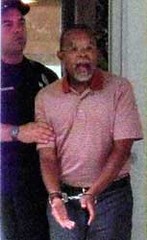
The arrest of Henry Louis Gates Jr.—a prominent African-American Harvard University professor—in his own home by Cambridge police on July 16 has shone a brilliant national and international spotlight on racial profiling in the U.S.

Professor Gates is the director of the W.E.B. Du Bois Institute for African and African-American Research at Harvard, the first African American to receive the Andrew W. Mellon Foundation Fellowship, and a recipient of a MacArthur Foundation “genius” award. Sometimes called the nation’s most famous Black scholar, he has received numerous honorary degrees and awards for his teaching, research and development of academic institutions that study black culture.

Professor Gates was returning to his home near Harvard Square after a trip to China on July 16. He found his front door jammed and with the help of his limo driver was able to force the door open. According to the white female who called 911 about the “break-in,” the Cambridge police asked her repeatedly if the men where Black and then if they were “Hispanic.”

Charles J. Ogletree Jr., a Black Harvard law professor who is representing Gates, told the press that when a Cambridge police officer arrived at his home and asked for proof that he lived there, Professor Gates showed him both his Harvard University ID and his driver’s license. Gates requested the police officer’s badge and number. (National Post, July 21)

“I said, ‘Who are you? I want your name and badge number.’ I got angry,” Gates told the Post. Gates reported that the officer refused to show his badge and walked out of the house. When Gates followed him, he was “astonished” to see more police on his porch. Ogletree said that when Gates stepped onto the porch, Sergeant James Crowley placed him under arrest and handcuffed him.

The police report claims that Gates was “abusive” and “unruly.” They say race had nothing to do with the arrest. Crowley has been with the Cambridge Police Department for 11 years, and ironically instructs recruits at the Lowell Police Academy on how to avoid racial profiling.

Gates said of his arrest, “There are one million Black men in jail in this country, and last Thursday I was one of them. This is outrageous, and this is how poor Black men across the country are treated everyday in the criminal justice system. It’s one thing to write about it, but altogether another to experience it.” (Washington Post, July 22)

Gates’ arrest and racial profiling have caused a firestorm of reaction. Many believe he was arrested because he stood up to the police and became justifiably angry instead of being silent. Crowley told the media, “The professor at any time could have resolved the issue by quieting down and/or going back inside his home.” (Washington Post, July 24)

Ogletree stated that he has received emails from all over the country from people telling of their experiences with racial profiling. Gates plans to do a documentary on racial profiling.

Not an isolated incident

The most famous reaction to Gates’ arrest was that of President Barack Obama. At a press conference on health care reform on July 22, Obama was asked to comment on it: “Now, I don’t know, not having been there and not seeing all the facts, what role race played. ... But I think it’s fair to say, number one, any of us would be pretty angry; number two, that the Cambridge police acted stupidly in arresting somebody when there was already proof that they were in their own home; and number three, what I think we know separate and apart from this incident is that there’s a long history in this country of African Americans and Latinos being stopped by law enforcement disproportionately. That’s just a fact.”

The reaction was swift and strong to Obama’s statement, with the racist right-wing, big-business media and police unions and organizations across the country screaming that Obama had called them “stupid.”

Obama’s reaction to this was, “I have to say I am surprised by the controversy surrounding my statement, because I think it was a pretty straightforward commentary that you probably don’t need to handcuff a guy, a middle-aged man who uses a cane, who’s in his own home.” (ABC News, July 23)

Deval Patrick, the first African-American governor of Massachusetts, when learning of Gates’ arrest told the press that he had experienced racial profiling while attending Milton Academy, a private boarding school outside of Boston. Patrick called the arrest “every Black man’s nightmare.” He said, “You ought to be able to raise your voice in your own house without risk of arrest.” (Boston Herald, July 24)

On July 21 the charge of disorderly conduct was dropped against Professor Gates. He has demanded that Crowley apologize to him. Crowley has refused. In fact, in an arrogant show of force the Cambridge Police Department held a press conference on July 24 demanding that both Obama and Patrick apologize to them!

Cambridge, Harvard University and Boston are seen around the world as bastions of liberalism, hotbeds of progressive ideas and prestigious places from which cutting-edge research emanates. But the racial profiling and arrest of Professor Gates have re-raised the question of how much has changed since the 1970s when, in the wake of court-ordered busing for desegregation, white racist mobs were stoning buses carrying Black school children and attacking Black people on the streets and in their homes.

The location of Professor Gates’ home in Harvard Square—a rich, mainly white area—recalls the period in Boston where Black people could not go into certain areas of the city without literally fearing for their lives.

As a result of a jury trial in 2008, the City of Cambridge was forced to pay a multi-million-dollar award to a former city worker, Malvina Monteiro, who accused city officials of racial discrimination. Attorney Ellen Zucker, who represented Monteiro, told the July 24 Boston Globe, when referring to Cambridge, “The patina of progressive values that cover the city too often hides discrimination and retaliation.” Monteiro is Cape Verdean.

Theodore Landsmark, a young African-American attorney whose nose was broken when he was attacked in the middle of Boston’s City Hall plaza in 1976 by racist white youth with a U.S. flag on a pole, told the July 24 Boston Globe that three years ago in Boston he was pulled over in his new Mercedes by police who said they were checking to see that he owned the car.

Eckfeldt is a member of the Harvard Union of Clerical and Technical Workers, AFSCME Local 3650.
--------------------------------------------------------------------------------
Articles copyright 1995-2009 Workers World. Verbatim copying and distribution of this entire article is permitted in any medium without royalty provided this notice is preserved.

Workers World, 55 W. 17 St., NY, NY 10011
Email: ww@workers.org
Page printed from:
http://www.workers.org/2009/us/gates_0806/


What if Henry Louis Gates Were Not an Acclaimed Professor?

New America Media, Commentary, Raj Jayadev
Jul 29, 2009

SAN JOSE, Calif. -- Professor Henry Louis Gates, recently arrested, gets to share a beer with the man who arrested him, Sgt. James Crowley, at the White House with the President of the United States. It is a highly uncommon ending to an unfortunately very common occurrence – a man of color citing racial profiling after an arrest.

If this incident is really to be the “teachable moment” President Obama hopes for, the real question to explore is this: What would have happened to Dr. Gates if he were not an acclaimed scholar and author, friend to the President, and someone whose stardom could greatly embarrass a city and county justice system?

First things first, charges for his disorderly conduct would not be dropped shortly after his arrest, and Dr. Gates, a few weeks after the incident, would just be starting his journey in the criminal justice system, rather then reflecting on it in hindsight, while throwing back a beer with the leader of the free world. Let’s start from there.

Since every city in the country is different in arresting practice, the way to approach this is not to examine Cambridge, but to ask what would happen if the arrest happened in your own town. Let me roll out what would have happened if Dr. Gates, were he not a noted scholar, was arrested in my city, San Jose, California with the same fact pattern, even as described by the police report.

Starting from arrest, Dr. Gates would have been charged with more then disturbing the peace, (penal code 415 in California). From the narrative of what happened at his home, Mr. Gates would have also picked up a 148 resisting arrest, a misdemeanor.

California Department of Justice numbers show San Jose has much higher arrest rates for these charges than cities of comparable size, in a racially disproportionate fashion. For resisting arrest in 2007, for example, 54.2 percent were Latino, although Latinos only represent roughly 30 percent of the city’s population. Blacks, who represent only 3.5 percent of San Jose residents, accounted for 15.4 percent of these arrests. Communities of color in San Jose claim the discrepancy is due to a practice some call “attitude arresting,” where police are using these particular charges that rely heavily on officer discretion to arrest someone when they don’t like their attitude, rather than for an actual criminal act.

As for the comment, “You don’t know who you are messing with,” Dr. Gates would have also likely picked up a penal code 69 (felony in this case), for making a criminal threat to a police officer. Dr. Gates would not know of all these charges until he was arraigned at court. It is here that police abuse can take a more subtle, yet problematic direction – the well known practice of over-charging. Sometimes, it is not the gun or taser, which is the weapon of concern: it is the pen used for a police report.

In all likelihood, someone less well known and well connected than Mr. Gates would be represented by the Public Defender’s office, which represents over 90 percent of all defendants in California. His attorney, over-worked, with an over-whelming caseload, would read the police report and speak with Dr. Gates, likely onthe day of his first court appearance. He or she would tell Dr. Gates of his maximum exposure – what he would receive if convicted on all charges – which may be a year, given the felony. The attorney would tell Dr. Gates “it doesn’t look good” since it is his word versus the police officer, and juries trust police officers. The Public Defender and the District Attorney would be anxious to resolve the case, since they are seeing their average case loads steadily increasing, as their offices budgets are shrinking. Across the country, plea bargains resolve roughly 95 percent of all felony cases.

The Public Defender would tell Dr. Gates that he or she met with the District Attorney’s office, and that the prosecutor is offering a deal if he pleads guilty just to the two misdemeanor charges. He would do only ten days in county jail, and have a three-year probation, but the heavier charge would be dismissed.

Dr. Gates would feel conflicted. Every fiber in him would say that he is innocent of any crime, but he would also feel he could not risk loosing a jury trial and going to jail for an extended period of time. He would know he would be facing a mainly white jury, who he fears would carry their own bias into the courtroom when they hear of an erratic acting black man.

Demoralized and worn down from the process, Dr. Gates would plead guilty to the 415 and 148 charge, and do a week in jail, after time served is subtracted.

After his release, and back into the normal motions of his life, he would feel haunted by the injustice. He will be stigmatized by every interaction he has with a law enforcement officer when they run his name, even in innocuous driving stops. Motivated to right a wrong, he might approach a civil rights attorney to file a claim against the police department for false arrest and racial profiling. Although sympathetic and believing, the attorney would tell Dr. Gates that he has no case because he took a plea deal.

As a last resort, if only to prevent such an episode from happening to another person down the road, Dr. Gates could file a claim against the arresting officer with the police department’s internal affairs unit. He would meet with an internal affairs investigator, who would listen to Dr. Gates’ story of the officer abusing his authority, and tell him he will report back on his findings. Months later, Dr. Gates would receive a form letter from the Internal Affairs office informing him that they reviewed his case and found no wrong doing by the involved officers.

Throughout the course of his process, which started with a jammed door to his own home, Dr. Gates would have interacted with all these many aspects of the criminal justice system, and would have felt betrayed by all of them. The less well-known Dr. Gates would not be making a documentary after all this, would not be sipping cold beers with the president of the United States and the man who arrested him. No, he would simply be trying to restore normalcy back to his permanently altered life.

Raj Jayadev is the director of Silicon Valley De-Bug.


EDITORIAL

Professor Gates is right

Published Jul 29, 2009 3:13 PM

Racial profiling is another expression of institutionalized racism rooted in a white supremacist ideology under capitalism. In the U.S., racial profiling has tragically become a way of life, like eating, sleeping and breathing. Being targeted based on the color of your skin or your nationality is a terrible burden to bear for any person of color, whether you live in the inner city, barrio, a reservation or in an upper-middle-class suburb.

In a 2004 report entitled “Threat and Humiliation: Racial Profiling, Domestic Security, and Human Rights in the United States,” Amnesty International documented that in a year-long investigation, an estimated 32 million people (the equivalent of the entire population of Canada at the time) had been racially profiled—the vast majority of them from nationally oppressed groups. (http://www.amnestyusa.org) One can only imagine how much these numbers have increased over the last five years, not only for those born in the U.S. but also for immigrants.

The police have been, by far, the most feared perpetuators of racial profiling, and understandably so. Police harassment and brutality is so epidemic that pamphlets have been written by activists and progressive lawyers on how one should behave if ever stopped by the police to help avoid arrest, physical assault or even losing one’s life.

This is the broader context in which to understand the July 16 arrest of one of the most respected Black scholars, Professor Henry Louis Gates Jr., who teaches at Harvard University. Gates was arrested by a Cambridge police officer after showing two forms of identification as he, along with a Black limo driver, were trying to unjam the lock to the front door of Gates’ house in a predominantly white, upscale neighborhood known as “Harvard Square.”

This incident may have gone unreported, like the millions of other racial profiling cases, if it weren’t for two facts: first, because of Gates’ recognition as one of the most influential African Americans; and, second and most important, because he didn’t back down from the cop. In fact, he challenged the authority of the white officer, who eventually arrested him. In his own style, Gates, who is slightly built and walks with a cane, resisted being racially profiled by an entire police department that has a reputation for its brutality.

Gates was arrested, not because he committed any crime, but because he made a courageous stand against racism when the relationship of forces was not in his favor. Just think of what would have happened if Gates had taken a similar stand in the segregated South. He surely would have been lynched. Black people were strongly encouraged to “stay in their place,” meaning to be submissive and keep their eyes to the ground when interacting with any white person, especially the police.

Black people have been lynched in the South for any excuse; a glaring example is the 1955 lynching of 14 year-old Emmett Till in Money, Miss., for supposedly whistling at a white woman.

The Cambridge police report stated that Gates was arrested for disorderly conduct due to “exhibiting loud and tumultuous behavior.” In other words, Gates refused to bow down before the repressive state.

The fact that the Cambridge police demanded that President Obama apologize to them for publicly calling their actions “stupid” proves once again that the election of the first Black president has not signaled the end of racism and national oppression, nor does it reflect a “post-racial society”; far from it.

While the police, the mainstream media and the bourgeois pundits want to isolate and downplay every instance of racial profiling, Gates’ resistance has helped to generalize the issue on national and international levels. No matter how this particular development plays out, activists must seize this opportunity to show the need to build a movement based on anti-racist, class-wide solidarity—as workers of all nationalities are losing their jobs, homes, health care and pensions in rapid numbers; and as the economic crisis becomes even more acute.
--------------------------------------------------------------------------------
Articles copyright 1995-2009 Workers World. Verbatim copying and distribution of this entire article is permitted in any medium without royalty provided this notice is preserved.

Workers World, 55 W. 17 St., NY, NY 10011
Email: ww@workers.org
Page printed from:
http://www.workers.org/2009/editorials/gates_0806/

White House Beer, Race and Politics

July 30, 2009, 4:57 pm

What a White House Beer Says About Race and Politics

By Peter Baker, Helene Cooper AND Jeff Zeleny

New York Times reporters Helene Cooper, Peter Baker and Jeff Zeleny live-blogged the so-called beer summit of President Obama, Professor Henry Louis Gates, Jr. and the officer who arrested him in Cambridge nearly two weeks ago, Sgt. James Crowley. While the meeting is going on, the reporters took questions from readers, and Helene Cooper reported live from the White House.

Gates Says Another Meeting Is Planned | 11:24 p.m.

In a telephone interview with The Times’s Abby Goodnough after leaving the White House, Professor Gates spoke enthusiastically about meeting Sergeant Crowley and said the story was not over, because the two of them would get together again soon in Cambridge.

He said that he had brought his 96-year-old father to the White House, along with his two grown daughters, his brother and his fiancée. The Gates and Crowley families were taken on separate tours of the White House but met up in the library, Professor Gates said.

“Nobody knew what to do,” he said, “so I walked over, stuck up my hand and said, ‘It’s a pleasure to meet you.’ That broke the awkwardness.”

At that point, the professor said, he made a proposal: that he and Sergeant Crowley meet for lunch at River Gods, a popular Cambridge pub, some time in the near future. The sergeant accepted the invitation, he said.

“I said we both had been cast as characters in other peoples’ narratives that we couldn’t control,” Professor Gates said. “If we take control of our own stories, we can take control of narrative.”

When the two men walked into their meeting with Mr. Obama, he said, they immediately told him of their plans to lunch together.

“We told him about the progress we’d already made,” Professor Gates said, “and he was very pleased.”

He said that by arranging the meeting, Mr. Obama had “allowed us to begin to bridge our divide and make a larger contribution to American society.”

“Only he could have done that,” Professor Gates said before catching a flight back to Boston. “I don’t think anybody but Barack Obama would have thought about bringing us together.”

Professor Gates added, “He thought what Crowley and I had discussed was just right on target. The president was great — he was very wise, very sage, very Solomonic.”

Asked whether he had asked for or received an apology, Professor Gates said: “We didn’t go there. The president didn’t ask us to apologize. I think probably as we get to know each other, sooner or later we will revisit his perceptions of what happened that day and my perceptions. This wasn’t the time or place to do that. We’ll do it one on one.”

He said that over the last week, he had thought a lot about “the contributions the police make” and had come to appreciate them more.

“The most important thing I learned, I learned about police officers the stresses and realities of the excellent job the police do every day,” he said. “At the same time, racial profiling is a very dangerous thing with a long history, and we have to make Americans more sensitive to the realities of racial profiling.”

The professor, a prolific writer, did not miss an opportunity to promote his 1994 memoir, “Colored People.” He gave Sergeant Crowley a signed copy, he said, with the inscription, “Linked together forever in history.”

“Through an accident of fate this guy and I are linked together,” he said, “and the question is how can he help end racial profiling and how can I help members of my community be sensitive to the concerns of the police? If we can do that, then James Crowley and I will have taken control of our lives and our peculiar experience together and move it out of a Tom Wolfe novel and into a positive impact.”

He said that instead of his usual Red Stripe, he drank a Sam Adams at the meeting in honor of an ancestor who fought in the American Revolution.

Professor Gates, who is 5-foot-7, said that upon meeting Sergeant Crowley, he told him, “I could have sworn you were about a foot taller.”

“We hit it off right from the very beginning,” Professor Gates said. Laughing, he added, “When he’s not arresting you, Sergeant Crowley is a really likable guy.”

Crowley’s News Conference | 7:30 p.m.

During his short opening remarks, Sgt. Crowley said that he had a “cordial and productive discussion” with President Obama, Mr. Biden and Mr. Gates. He also said that he and Mr. Gates planned to have a telephone conversation in the future.

Afterwards, Sgt. Crowley took several questions from reporters. He declined to go into specifics of what was discussed during the event but did say that there was “no tension” between him and Mr. Gates.

And with that, we are wrapping up this blog post. Thanks, as always, for reading and commenting.

Head’s Up, They Headed Out | 7:25 p.m.

The latest pool report tells us that Mr. Gates and Sgt. Crowley have left the White House. Sgt. Crowley will host a news conference in several minutes.

“Race is not the only issue. Class is an issue as well.”

— singingwater

Obama’s Statement | 7:16 p.m.

The president’s statement, released just now, noted that Mr. Gates and Sgt. Crowley had met earlier:

“I am thankful to Professor Gates and Sergeant Crowley for joining me at the White House this evening for a friendly, thoughtful conversation. Even before we sat down for the beer, I learned that the two gentlemen spent some time together listening to one another, which is a testament to them. I have always believed that what brings us together is stronger than what pulls us apart. I am confident that has happened here tonight, and I am hopeful that all of us are able to draw this positive lesson from this episode.”

The President and Race | 6:53 p.m.

Peter Baker weighs in on what the incident tells us about the president and his approach to race:

One thing we’ve learned is that President Obama has yet to always find sure footing when it comes to race. His critics remember the incendiary rhetoric of his former pastor, Rev. Jeremiah Wright, as well as Mr. Obama’s comments last year about rural Americans clinging to guns and religion, his position in the racially charged incident in Jena, Louisiana, and his reference to his grandmother as “a typical white person” because she was nervous when approached by a black man on the street. (See this piece in National Review.)

At the same time, supporters invest great faith in Mr. Obama that he can move the country beyond old divisions on race, and he has benefited from the perception that he is by nature someone who wants to build a new paradigm. The Gates incident shows that he has the capacity to inflame, intentionally or not, partly just by virtue of who he is, and that he has an instinct to try to mediate, as with this beer at the picnic table, something I can’t picture any previous president doing. How he will reconcile these in the future is something to watch.

The Media Attention | 6:50 p.m.

“I would like to ask this panel if they are aware that they, and the rest of the media, are being played like a fiddle by the most savvy politician that any of them will ever know?” — Jack Cohen

Jeff Zeleny: That’s a good question.

“Now that the three main players in the drama are getting together, it’s time to filter out the noise and listen to them directly.”

— Sam Katz

This controversy has certainly overtaken – or at least competed strongly against – the administration’s health care proposals. In that case, at least, perhaps all the extraneous chatter about the afternoon beer has been a good thing for the president. But that’s almost certainly where the upside ends. There was little advantage, aides believe, for the president to become entangled in a national discussion over race. The media has certainly reacted – and, it could accurately be argued, overreacted – to the brouhaha. But for politicians, there are considerable drawbacks to playing a game of “three dimensional chess.” Why? It is difficult, if not impossible, to walk away pleasing the viewpoints from all sides. So if likeability is one of Mr. Obama’s biggest selling points, it’s a dicey strategy to wade into terrain like this on purpose, simply to play the media.

Finally! | 6:38 p.m.
With the pool report, we finally have the answer to the most pressing question of the day: What are they drinking? Well, for those who believed Bud Lite would be the drink of choice for Mr. Obama, they are in luck, as are those who thought Sgt. Crowley would stay with Blue Moon. Mr. Gates drank Sam Adams Light (a Massachusetts-based brew), and Mr. Biden chose a Buckler, a non-alcohol beer.

Maybe Mr. Biden has to drive home? No, he doesn’t drink alcohol.

It’s Begun | 6:24 p.m.

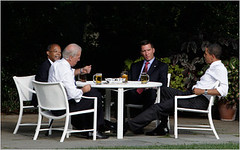
Helene Cooper: At 6:12, reporters and photographers were allowed in for a scant 40 seconds, where they could view the four men sitting around a table drinking out of frosty beer mugs. Four men, you ask? Weren’t there supposed to be three—President Obama, Professor Gates, and Sgt. Crowley?

And Vice President Joseph Biden! He was there too. In fact, during the brief time that the press could watch the goings-on, Mr. Biden leaned across the table towards Sgt. Crowley and said something. At another point, Sgt. Crowley gesturing with his hands, said something to Professor Gates.

And then, the press was ushered out.

“Hopefully this will put an end to this complete non-story.”

— Chris in Texas

Beer and Photo Ops | 6:16 p.m.

Jeff Zeleny: This is not the first time Mr. Obama has turned to beer for a photo opportunity.

First, the president is not known to be a big drinker. (Who can forget the time, as a freshman senator in 2005, when he asked for water instead of vodka during a ceremonial toast with local dignitaries during a trip to Russia?) He will have an occasional cocktail, but like many politicians, is seldom seen having more than a single drink in public.

But a little more than a year ago, as Mr. Obama sought to win over working-class voters during the Indiana primary, he turned up in North Liberty, Ind., and walked into V.F.W. Post 1954, where a Coors Light clock was hanging on the wall.

“I’m not going to give a speech or anything,” he told the small crowd inside on May 1, 2008. “I just want to stop by and maybe get a beer as well.”

Before ordering, he looked around the bar to see what the locals were drinking.

“I’m going to have a Bud,” Mr. Obama said.

With cameras rolling, he took a big sip from his icy cold red, white and blue can.

“I’m going to vote for you if you drink Budweiser,” a man named Vic Vukovits told Mr. Obama.

A week later, he narrowly lost the Indiana primary. But six months later, Mr. Obama carried Indiana in the general election, a feat not done by a Democrat in more than four decades.

Are the Reporters Invited? | 6:02 p.m.

“Give Obama a real beer…with all of the options available, Bud Light?”

— Stan P

“Will the White House also offer a beer to the reporters covering the event? Are you allowed inside?” — Elizabeth

Peter Baker: No! And isn’t that the real crime here!

Helene Cooper: Here at the White House, the handful of reporters who are in the press pool will be taken to the beer summit site. Unfortunately, I do not have pool duty. So I and the majority of the press corps will wait impatiently to get the pool report from our pool colleagues.

Will Sgt. Crowley Speak? | 5:45 p.m.

A reader question about a discrepancy in the police report:

“I am curious…is anyone, a reporter, Professor Gates, President Obama, or otherwise, going to press officer Crowley today on the discrepancy in his police report where he claimed the witness/caller told him that she saw ‘two black men with backpacks?’ We now all know that the only thing she told Crowley was that she was the one who made the 911 call - NO mention of ‘black’ or ‘race’ to him what-so-ever.” — Jeff Bordner

Peter Baker: That’s certainly a question reporters would ask Sgt. Crowley if he makes himself available for questions afterward. My guess is there won’t be such an opportunity but we’ll see. Update: Sgt. Crowley plans to have a news conference at 7:30 p.m.

They’re Here | 5:42 p.m.

Helene Cooper: A White House official says both Professor Gates and Sgt. James Crowley and their respective families have arrived and are in the building.

Everyone is getting along so far, the official said.

And What About Health Care? | 5:25 p.m.

Peter Baker weighs in to answer a reader question about the choice of news coverage.

“I’d like to know why a reporter would even feel the need to ask the president about such a mild local controversy during a press conference on HEALTH CARE. There are 46 million Americans without affordable access to health care and a Congress that is trying to do something about it for the first time in 16 years.

If you can answer why a reporter would ask the question (don’t we already all know the answer…?), could you also please explain why the NYT is expending so many resources, column inches and electrons on such a completely frivolous story?” — Christopher Gomez

Peter Baker: Lynn Sweet of the Chicago Sun-Times can answer for herself about why she asked the question. But if she didn’t and I were called on, I certainly would have. I was surprised no one else had by the time she was called on for the final question. With all respect, it was hardly a “mild local controversy”; it was one of those moments that touch a nerve in American society and get people to talk about things that often go undiscussed. Asking a president his opinion in such a circumstance, especially given that one of the protagonists was a friend of his, is what reporters do. If he thinks it’s frivolous and wants not to answer, he’s free to not answer.

As for health care, keep in mind that it was not a “health care news conference.” It was a news conference at which any topic was fair game; in fact, what was rare about this news conference is how much one topic, health care, dominated it for the first 55 minutes. As for Times resources, if you’re more interested in health care than this, then please check out the two stories we had on health care on today’s front page and the third story we had inside about it.

Setting the Stage | 5:12 p.m.

Helene Cooper: Earlier I asked Mr. Gibbs what the White House hoped to accomplish from the evening’s gathering.

“I don’t think the president has outsized expectations that one cold beer at one table here is going to change massively the course of human history by any sense of the imagination, but that he and the two individuals, Sgt. Crowley and Professor Gates, can hopefully provide a far different picture than what we’ve seen to date of — of this situation, in hopes again, as I’ve said both today and before, that this is a conversation and a dialogue that happens not just because it’s sponsored by or at the invitation of a participant or the president, but happens in communities large and small all over the country in order to make progress through better understanding. I think that’s what the president wants to do today,” Mr. Gibbs responded.

Again, Mr. Obama has said that he wants this to be a “teachable moment.” He’s taken a big risk though, and whether this turns out okay will depend hugely at whether Sgt. Crowley and Professor Gates bury the hatchet — preferably not in each other’s heads — and make nice.

“Why isn’t the discussion about providing training and education to the police?”

— Iwasachildoncetoo

Anxiously Awaiting | 5:05 p.m.

Helene Cooper just wrote in with the scene at the White House.

Helene Cooper: Reporters have stationed themselves everywhere they can trying to catch a glimpse of an arriving Sgt. Crowley or Professor Gates….or their families.

Five people — all white — including a young boy and two older teenage girls, arrived at the West Wing gate at around 4:45 p.m. They immediately found themselves followed in by suspicious reporters. As they passed a group of cameramen, one yelled out: “Not to be rude, but can you say who you are?”

The response: “Not who you think.”

Meanwhile, outside on Pennsylvania Avenue, the protesters have arrived. So far most of them seem to be pro-Gates. “Disrespect may be bad manners, but it is not a crime,” says one. “Free speech is not disorderly conduct” says another.

‘Teachable Moment’ | 4:57 p.m.

“Mr. Obama has said that this is a ‘teachable moment.’ What is he going to learn from it? Or, is he going to lecture the rest of again?” — John

Jeff Zeleny: Yes, President Obama has called this a “teachable moment.” So what has he learned from it? First and foremost, he surely has learned that his words – all of them – carry considerable weight. Everything that passes through a president’s lips will be amplified, parsed and replayed again and again. So Mr. Obama, at least his aides hope, will be less likely to speak in an unscripted fashion. Regardless of the wisdom or accuracy of his words at the White House news conference last week, Mr. Obama seemed to be speaking spontaneously and with passion. Don’t look for a repeat of that anytime soon.

Helene Cooper: President Obama’s initial answer — the one that touched off the furor when he said the Cambridge police “acted stupidly”— was the kind of answer, straightforward and from the gut, that you would expect during a discussion you had with your friends at a bar. Even more interestingly, it came after an hour-long press conference during which Mr. Obama had filibustered and lectured his way through a series of questions on health care. And then, suddenly came the Gates question from Lynn Sweet of the Chicago Sun Times, and a straight answer from Mr. Obama. My brother would have said the same thing: Wow, he actually answered a question!

Except he’s president, and answering that question straight got him into a heap of trouble. So I think what’s he’s learned from this is that as president, he can’t really say what he thinks.

About that Beer | 4:47 p.m.

Helene Cooper kicked the roundtable off with a reader question, answering what appears to be the top question on everyone’s minds:

“This is trivial but I’ve been wondering about this ever since I heard there was going to be a ‘Beer Summit.’ What beer will President Obama serve his guests?” — Frank

Helene Cooper: The White House has been asked this question about a zillion times. Robert Gibbs, the White House spokesman, said there will be a “variety” of beers available, including Bud Lite (what President Obama will presumably drink), Red Stripe (Professor Gates’ professed choice) and Blue Moon for Sgt. Crowley.

Jeff Zeleny: This has been one of the most often-asked questions this week at the White House. Bud Lite for President Obama. Blue Moon for Sergeant Crowley and Red Stripe for Professor Gates. Why does it matter what kind of beer they drink? It doesn’t, but that hasn’t stopped us from talking about it.

“How much is this costing the taxpayers?” — Paul

Jeff Zeleny: The White House is buying the beer, but that’s it.

Sgt. Crowley and Professor Gates are paying for their own trips to Washington, according to Bill Burton, a spokesman for the White House. “They made their own accommodations,” he said in an e-mail message.

“The lady who made the telephone call was not invited to have a beer. Could it be only as guy thing?”

— Melvin Jacobson

’Suds Summit’| 4:30 p.m.

It’s being called the “beer break” or the “suds summit.” But the gathering at the White House on Thursday evening of President Obama, Henry Louis Gates, Jr., the Harvard scholar, and Sgt. James Crowley of the Cambridge, Mass., police department is about issues that will require a lot more than a beverage or two to resolve.

While we wait for the participants to sit down at a picnic table outside the Oval Office, three of the White House correspondents for The Times – Helene Cooper, Jeff Zeleny and Peter Baker – will address some of the big questions raised by the arrest of Professor Gates in his own home and what the incident and Mr. Obama’s response to it tell us about the politics of race in 2009.

We will also try to address some of the questions posed by readers.

It is not clear what, if anything, Mr. Obama and the others will say after their cocktail. But the president had a few words on the subject after meeting Thursday afternoon with the president of the Philippines.

“This is three folks having a drink at the end of the day and hopefully giving people an opportunity to listen to each other,” he said, standing next to Philippine President Gloria Macapagal Arroyo. “That’s really all it is. It is not a university seminar. It is not a summit.”

The beer summit, Mr. Obama added, is actually a chance to “spend some time with some self-reflecting and realizing that other people can have different points of view.”

Thursday, July 30, 2009

IMF, World Bank Reforms Are Long Overdue

IMF, WB reform overdue

By Retlaw Matatu Matorwa
Courtesy of the Zimbabwe Herald

THE United Nations conference on the global economic and financial crisis was convened in Xinhua, China, recently bringing together 119 countries from the Third World.

This was in an attempt to discuss the effects of the crisis and strategise on ways to combat and manage it.

However, the two major resolutions emanating from the conference were calls from the Third World countries to reform the multilateral financial lending institutions and the establishment of a commission to investigate and analyse the current financial crisis.

The same call was made by President Mugabe in his address to the Non-Aligned Movement’s Heads of State and Government Summit in Sharm El-Sheikh, Egypt, recently.

This is not the first time that developing countries have called for the reform of the international monetary system, the International Monetary Fund and the World Bank, in particular. This has been a bone of contention for some time and it’s high time Third World countries acted decisively on this matter.

The reform of the international monetary system is a noble initiative, given the exploitative and racist nature of these international institutions. Developing countries should bear in mind that the original mandate of the IMF and WB was to deal with the economic problems of Europe in the aftermath of the Second World War.

These included, among others, the destabilising of capital flows, exchange controls, ‘beggar thy neighbour’ policies, and trade protection in Europe.

With the collapse of the Bretton Woods regime, IMF redefined its role, becoming a world economic advisor, crisis manager, a provider of credibility and a type of donor agency - but at a profit at the expense of the poor.

Concerns have been raised about the conditions of the IMF and the World Bank when lending to Third World countries.

Structural adjustment programmes have been top on the critics’ list. In countries where structural adjustment programmes have been initiated, they have left these countries worse off than they were before the implementation of IMF reforms.

Above all, SAPs have lead to poverty and social instability. For example, under SAP recipient countries are urged to cut down on social services spending, like health care and education.

When the state relinquishes its involvement in these strategic areas, privatisation takes effect, resulting in access to education and health care rising beyond the reach of the poor.

In Kenya, the IMF aggravated the problem with their adjustment programme. Before the IMF was involved in Kenya, the central bank oversaw the currency movements in and out of the country.

The IMF advised the Kenyan central bank to allow easy access to currency movements. However, the move resulted in very little foreign investments and allowed Manusuklal Damji Pattni, with the help of corrupt government officials to siphon billions of Kenyan shillings in what became known as the Goldenberg scandal.

This left Kenya worse off than it was before the IMF reforms were implemented in 2004.

African agriculture is another area of concern; it is a case study of how doctrinaire economics can destroy a whole continent’s productive base.

At the time of decolonisation in the 1960s Africa was not just self-sufficient in food production but it was a major exporter. Its exports averaged 1,3 million tonnes a year between 1966-70.

Today, the continent imports 25 percent of its food, with almost every country becoming a net food importer. Hunger and famine have become recurrent phenomena with the last three years alone seeing food emergencies break out in the Horn of Africa, Sahel, central and Southern Africa.

The causes are many, ranging from civil war and the spread of HIV/Aids. But the problem can be attributed to the phasing out of government controls.

There are also support mechanisms under the structural adjustment programmes, of which most African countries are subjected to as the price for receiving IMF and World Bank assistance to service their external debt.

Instead of triggering a virtuous spiral of growth and prosperity, SAPs saddled Africa with low investments, increased unemployment, reduced social spending and consumption and low output, all continuing to create a vicious cycle of stagnation and decline.

The IMF and WB encourage several economies undergoing adjustment on export production of the same crop simultaneously, leading to overproduction, resulting in prices collapsing.

For example, the very success of Ghana’s programme to expand cocoa triggered a 48 percent drop in the international prices of cocoa in 1986-89, threatening cocoa on the world market, as one account put it, "to increase the vulnerability of the entire economy to the vagaries of the cocoa market".

In 2002-3 the IMF contributed to the collapse in the prices of coffee on the world market resulting in another food emergency in Ethiopia.

Liberalisation of trade has also compounded the negative effects of the IMF and World Bank adjustment programmes.

The unfair trade practices on the part of the European Union and the United States allowed low-priced subsidised EU beef to enter and drive African cattle raisers to ruin with their subsidies legitimised by the World Trade Organisation agreement on agriculture.

US cotton growers are offloading their cotton on the world market at 20-55 percent of the cost production, bankrupting African farmers whose governments are not wealthy enough to provide subsidies.

Against this background, it is clear that the liberalisation preached by the World Bank and the IMF has no consideration for the Third World countries, but use it to expand their trade and economic interest on the globe.

Liberalisation is benefiting the rich at the expense of the poor nations and its people.

In some cases, before extending their support to trouble countries, they advise them to sell their national assets as much as they can. Coincidentally, these national assets will end up in the hands of Western corporations, as is in the case of Zambia copper mines which were sold at heavily discounted prices.

That said, the IMF sometimes advocates for "austerity programmes" - increasing taxes even when the economy is weak, in order to generate revenue and balance budget deficits.

Countries are also advised to reduce corporate taxes. Cutting down on corporate taxes deprives the state of revenue required to service other government projects.

This results in the state becoming bankrupt, in some cases. In Tanzania, the IMF recommended that the government sell the National Brewery as part of its reform prescriptions; this resulted in loss of jobs and protests by citizens over foreign ownership of the landmark asset.

If more people lose their jobs government loses tax earnings, which translates into a heavy burden on the national treasury.

In Africa, where they deal with weaker governments, the Bank and Fund macro-managed such decisions as to how fast subsidies should be phased out. How may civil servants have to be fired?

In the case of Malawi they went to the extent of involving themselves in deciding how much of its grain reserve should be sold and to who. These institutions control the economy of smaller and weaker states, exploiting them and taking advantage of them being in need.

Both the IMF and World Bank have joined the bandwagon of being another champion for justice and human rights, putting Third World countries on a democracy, good governance and human rights litmus test and have even put them under the special requirements for consideration to get funding. However, their history reveals that both the Fund and the bank have been supporting military dictatorships friendly to America and European corporations.

In the 1960s, the IMF and World Bank supported the government of Brazil’s military dictator Castello Branco with tens of millions of dollars in credits and loans that were denied to previous democratically-elected governments.

Other regimes that benefited from the Fund and bank include: Zaire under Mobutu from 1965-97, Syria under Assad from 1970 to the present day, apartheid South Africa 1948-92, Haiti under Jean Claude Duvallier from 1971-86 and Chile under Augusto Pinochet from 1973-89, to mention but a few.

This goes to show that issues to do with democracy and human rights are not genuinely part of their agenda; they simply raise these issues when it does suit them and at their expediency.

IMF and the World Bank have for long been using Africa and the Third World countries as a test ground for their economic theories at the expense of the poor nations and their people. In most cases these countries take long to recover from the effects of these experiments, as was the case with Zambia, Zimbabwe, Brazil and Chile, for example. The IMF and the World Bank have been consistently ruining the economies of Third World countries. Instead of assisting them reach their potential they nip the bud before it grows.

The former Romanian prime minister Tariceanu had this to say about the IMF: "Since 2005, IMF is constantly making mistakes when it appreciates the country’s economic performance."

Zimbabwe’s history with the IMF and World Bank surely qualifies under this statement. How much progress has Zimbabwe made after the implementation of the structural adjustment programme in 1990? To date, our country is still struggling to contain the disastrous effects of the IMF’s economic structural adjustment programme.

Overall, the IMF and World Bank success record is not that impressive, especially with the Third World countries.

Rather the Fund and the Bank contributed to the economic problems of the Third World countries, especially those who seek support from these institutions find themselves worse off than they were before IMF and World Bank reforms.

It is imperative for Africa to lobby for the restructuring of the World Bank and the IMF so that the Third World countries have a stake and say in the manner in which the bank and the Fund are administered.

At present, the IMF and World Bank structures are dominated by leading industrialised countries’ decisions and policies are implemented by them without much consultation with the developing countries. Third World countries should lobby for a review of the "Washington Consensus", removing the stringent conditions that are destroying the social and economic fabric of our nations.

Alternatively, Third World countries need to explore alternative economic solutions and borrow ideas from countries that are doing it alone without the IMF and World Bank financial assistance.

What African countries need to do as a matter of urgency is to examine their economies and design economic models that are consistent, relevant and compatible with the needs of the continent and its people, China and India can teach us something!

Africa needs to put its house in order. Given the abundance of resources on this continent, surely Africa can stop this exploitation and be self-reliant, through implementing well-co-ordinated "beggar thy neighbour" policies regionally. It’s high time that Africa, Asia and Latin America find a common ground in the spirit of brotherhood and fight for a just, equitable and peaceful world order.

Honduras News Update: Another Anti-Coup National Strike; Reflections From Fidel

Another anti-coup national strike in Honduras

TEGUCIGALPA, July 30—Another national strike in the state sector, marches, and the taking of highways and public institutions characterize Honduras today on the 33rd day of popular resistance to military coup.

The 48-hour strike was called last Sunday by the three main labor union groups at the end of an assembly of the National Front against the Coup organized to adopt strategies for the restitution of constitutional order.

The six national education colleges will be part of today’s and Friday’s demonstrations. In a strategy aimed at recovering days lost in the school year, teachers are returning to the classroom for the first three days of the week. Teachers and professors maintained a strike for three weeks after the coup on June 28.

In the last three days, members of the Front have closed access to the city’s principal luxury shopping malls and stores in reaction to business sector support for the coup leaders.

Yesterday, the protest affected Metro Mall, part-owned by the former president of Panamanian origin, Ricardo Maduro.

The army and riot policy closed in on the demonstrators and caused moments of tension, given the fear of another attack with arms, averted by march leaders, who insisted on the peaceful nature of the demonstration.

Meanwhile, the de facto government has re-extended the state of siege in the eastern department of El Paraíso, which has been subjected to this order for six days, thus provoking a humanitarian crisis in the area.

Army troops and police are still mounting roadblocks on the Pan-American Highway to Las Manos, on the border with Nicaragua, in order to prevent the crossing of thousands of people who are hoping to join up with President Manuel Zelaya, who is preparing his return to the country.

Zelaya’s mother, Hortensia Rosales; his wife, Xiomara Castro; and their daughter Xiomara, have been detained at these military posts since last Friday in their effort to reunite the family.

Popular vigils at the Venezuelan embassy and the Radio Globo radio station continued tonight for the sixth consecutive day in an effort to protect them from police action.

A deportation order hangs over the Venezuelans diplomats. They rejected this order because they do not recognize the de facto government. The radio station has been broadcasting constant coverage of the popular resistance against the coup leaders. (PL)

Translated by Granma International


Genocide in Honduras, states human rights defender

TEGUCIGALPA, July 28 (PL).— The Honduran armed forces and police are committing practicing collective genocide, affirmed a defender of human rights in the country, which is one month into the coup today.

Andrés Pavón, president of the Human Rights Committee in Honduras, informed the press that, in the face of that reality, it has submitted an appeal for protection to the Supreme Court.

"We came to lodge a writ before the court so that after the coup in Honduras, they cannot say that they were unaware of the practice of collective genocide that the armed forces and the police are carrying out," the lawyer affirmed.

In its curfews, the de facto regime is violating more than 22 articles of the constitution, such as the right to food and free movement, the legal specialist stated.

The appeal lodged before the Supreme Court’s Constitutional Room seeks to alert it to the "holocaust that is being constructed in the border town of El Paraíso," the lawyer noted.

Since last Thursday, a huge number of citizens have remained in that town, located 10 kilometers from the border with Nicaragua, in an attempt to join up with President Manuel Zelaya. They are at risk of losing their lives to military repression or a lack of water and food.

Pedro Magdiel Muñoz Salvador, a 23-year-old builder was murdered there and his body, showing visible signs of torture, was found some 100 meters from the El Paraíso police outpost. He had come from Tegucigalpa to support the return of the constitutional president after the coup on June 28.

The de facto government led by Roberto Micheletti imposed a curfew in the border area with Nicaragua last Friday which continues to date. The curfew has trapped many Zelaya sympathizers in a steadily worsening humanitarian crisis, Pavón confirmed.

Translated by Granma International


Reflections of Fidel

A Nobel Prize for Mrs. Clinton

(Taken from CubaDebate)

THE interminable document read out yesterday by Nobel laureate Oscar Arias is far worse than the seven points of the act of rendition that he proposed on July 18. He did not communicate with international opinion via a Morse code. He spoke before TV cameras that were broadcasting his image and all the details of the human face, which generally has as many variables as a person’s fingerprints. Any intention of lying can be easily discovered. I was observing him closely.

Among television viewers, the vast majority knew that a coup d’état had taken place in Honduras. Via that medium they were informed of the speeches made in the OAS, the UN, the SICA, the Non-Aligned [Movement] Summit and other forums; they had seen the outrages, and the abuse and repression of the people in activities that have brought together hundreds of thousands of people to protest against the coup d’état.

The strangest thing is that, when Arias was expounding on his new peace proposal, he wasn’t delirious; he believed in what he was saying.

Although very few people in Honduras were able to see the footage, many people in the rest of the world did see it and likewise, had seen when he proposed the famous seven points of July 18. They knew that the first of them stated textually: "The legitimate restitution of José Manuel Zelaya Rosales in the Presidency of the Republic until the end of the constitutional period for which he was elected."

Everybody wanted to know what the mediator would say yesterday afternoon. The recognition of the rights of the constitutional president of Honduras, with his powers reduced almost to zero in the first proposal, was relegated to sixth place in Arias’ second project, in which not even the phrase "legitimize the restitution" is employed.

Many upstanding people were shocked, and they possibly attribute what he said yesterday to his own shady maneuvers. Maybe I am one of the few people in the world to understand that there was an auto-suggestion more than a deliberate intention in the words of the Nobel Peace laureate. I particularly noticed that when Arias, with a special emphasis, his words choked with emotion, spoke of the multitude of messages that presidents and world leaders, moved by his initiative, had sent him. That is what passes through one’s mind; he doesn’t even realize that other honest and modest Nobel Peace laureates like Rigoberto Menchú and Adolfo Pérez Esquivel are indignant at what has taken place in Honduras.

Without any doubt whatsoever, a large number of Latin American governments, those which knew that Zelaya had approved of Arias’ initial project and that he trusted in the good sense of the coup leaders and their yanki allies, breathed a sigh of relief, which only lasted 72 hours.

Seen from another angle and returning to things prevailing in the real world, where the dominant empire exists and close to 200 sovereign states are having to battle with all kinds of conflicts and political, economic, environmental, religious and other interests, it only remains to give a prize to the brilliant yanki idea of thinking of Oscar Arias in order to gain time, consolidate the coup and demoralize the international agencies that supported Zelaya.

At the event commemorating the 30th anniversary of the triumph of the Sandinista Revolution, Daniel Ortega, recalling with bitterness the role of Arias in the first Esquipulas Agreement, stated before a huge crowd of Nicaraguan patriots: "The yankis know him very well, that’s why they chose him as a mediator in Honduras." An that same event, Rigoberto Menchú, of indigenous descent, condemned the coup.

If the measures approved in the foreign ministers’ meeting in Washington had simply been implemented, the coup d’état could not have survived the peaceful resistance of the Honduran people.

Now the coup leaders are already moving within Latin America’s oligarchic circles, some of which, in their high state positions, no longer blush when speaking of their sympathies toward the coup, and imperialism is fishing in the troubled waters of Latin America. Exactly what the United States wanted with the peace initiative, while it accelerated negotiations to surround the homeland of Bolívar with military bases.

One must be fair, and while we are waiting for the last word of the people of Honduras, we should demand a Nobel Prize for Mrs. Clinton.

Afghanistan-Pakistan War Update: Taliban Urges Boycott of Elections; Casualties Mount Among Occupation Forces

Taliban urge Afghan poll boycott

The Taliban have called on people in Afghanistan to boycott next month's presidential and provincial elections.

In a statement on a Taliban website, the movement ordered fighters to block roads on the eve of the elections and stop voters going to polling stations.

The statement said that participation in the vote would be a show of support for "invading Americans".

Afghanistan has seen a rise in violence ahead of the poll and there are grave concerns about security on the day.

The BBC's Bilal Sarwary in Kabul says this is the most specific threat yet made by the Taliban in the run-up to the elections on 20 August, but it is not an unexpected move.

The Taliban have always maintained they want foreign forces to leave the country and have made general calls for election boycotts before.

'Resistance'

"How could Afghans consider this an Afghan process when, contrary to all their national traditions... it is planned by the Americans, financed by the Americans?" the statement says.

The Taliban message goes on to urge fighters to launch attacks against "enemy centres" and "prevent people from attending the elections and one day ahead of elections they must block all roads and highways for government and civilians vehicles".

It said that people should free Afghanistan through resistance and holy war.

In the past week alone there have been two attacks on Afghan election campaigns.

On Tuesday a campaign manager of presidential candidate Abdullah Abdullah was badly hurt after his vehicle was attacked in Laghman province. Two days earlier there was an assassination attempt on Mohammed Qasim Fahim, a running mate of President Hamid Karzai.

Elections are due to take place amid tight security on 20 August when Mr Karzai is hoping to secure a second term.

About 40 other candidates are challenging him for the presidency.

Fragmented militants

The Taliban statement also comes days after the Afghan government announced it had agreed a truce with Taliban insurgents in the north-western province of Badghis for the elections.

Although Taliban militants later denied any deal, our correspondent says it served to underline the disjointed and complex nature of the insurgency - with many different groups operating under a Taliban banner.

In June the US and the UK launched an offensive in the south of the country where the Taliban insurgency is at its fiercest, in a move aimed at shoring up security for the vote.

Story from BBC NEWS:
http://news.bbc.co.uk/go/pr/fr/-/2/hi/south_asia/8176256.stm
Published: 2009/07/30 10:57:01 GMT


UK Afghan casualty rate hits high

British forces in Afghanistan suffered their highest injury rate this month since the mission began in 2001, new Ministry of Defence figures show.

A total of 57 UK troops were wounded in action in the first two weeks of July alone, compared with 46 in the whole of June and 24 in May.

Of the injuries in the first 15 days of July, 16 service personnel were seriously or very seriously wounded.

July has also seen the most deaths - some 22 - since operations began.

An anti-war group said the rising casualty rate underlined how "unwinnable" the war in Afghanistan was becoming.

The rise in injuries and deaths came as coalition forces completed the first phase of their heaviest offensive yet - Operation Panther's Claw - against the Taliban ahead of elections on 20 August.

Along with 38 UK personnel who were admitted to field hospitals suffering from disease or a non-battle injury in the first two weeks in July, there have now been some 2,650 casualties in Afghanistan since the start of MoD records in 2006.

This year, 61 have been "seriously" or "very seriously" hurt, compared with a total of 65 for the whole of 2008.

The figures on casualties provided by the MoD do not include deaths, which are tallied separately.

A military surgeon told the BBC that treating the dying and wounded resulting from Operation Panther's Claw had proved a "very challenging" time for army medical teams.

Lt Col Nigel Tai said: "We have certainly seen a surge in casualties. It is difficult to see young, fit guys who may have to have multiple amputations.

"We try to salvage limbs, but at the same time we have to preserve life."

A spokesman for the Stop the War campaign said government assertions about the success of anti-Taliban operations were rendered "absurd" by the rising casualty figures.

"The British military under-estimated the strength of the Taliban forces opposing them when they launched this offensive," he said.

"These figures show just how unwinnable this war is."

The campaign group was due to accompany a serving soldier - L/Cpl Joe Glenton of the Royal Logistic Corps - to Downing Street on Thursday, where he planned to deliver a letter to the Prime Minister protesting against the conflict.

The Yorkshire soldier is facing a preliminary court martial after saying he would not return to Afghanistan.

'Possible mistake'

Earlier, Defence Secretary Bob Ainsworth said it had "possibly" been a mistake for the government to seek to reduce payouts made by a pensions appeal tribunal to two wounded servicemen.

But he told the BBC the case had to be brought to clear up confusion over compensation payments.

Mr Ainsworth said: "In isolation, it possibly was [a mistake], but we had to clarify the situation that we were left with with the tribunal.

"What I couldn't have is people with the exact same injury getting different levels of compensation and what I couldn't have is people with the most serious injuries not having that reflected in the payments that were made."

Meanwhile, a plane carrying the bodies of the latest British soldiers killed in blasts in Afghanistan has arrived back at a military base.

Warrant Officer Class 2 Sean Upton, of the 5 Regiment Royal Artillery, and Trooper Phillip Lawrence, of The Light Dragoons, died in separate explosions in Helmand province on 27 July.

Bombardier Craig Hopson, of 40 Regiment Royal Artillery, died on 25 July in a roadside bomb attack.

After the three men's families pay their respects at the chapel at RAF Lyneham, Wiltshire, the cortege is due to drive through the town of Wootton Bassett later.

Story from BBC NEWS:
http://news.bbc.co.uk/go/pr/fr/-/2/hi/uk_news/8175991.stm
Published: 2009/07/30 12:53:49 GMT


Wednesday, July 29, 2009
19:07 Mecca time, 16:07 GMT

Pakistan 'rescues' child soldiers

Pakistani officials said that the rescued children ranged from six to 15 years of age

Pakistani security forces have said they rescued dozens of children forcibly recruited by the Taliban as child soldiers in North West Frontier Province.

Officials said the children were being trained to become suicide bombers and warned that hundreds more remained captive by the Taliban group.

"They have been brainwashed and trained as suicide bombers, but the nine who I met seemed willing to get back to normal life," Lieutenant General Nadeem Ahmed, who heads a special support group tasked with handling the return of people displaced in the Swat Valley and surrounding areas, told Pakistani state-run television.

"It seems that there are some 300 to 400 such children who the Taliban had taken forcibly or who they were training," Ahmed said.

Children abducted

Major Nasir Ali, a spokesman for forces in Swat, said that most of the children who had been rescued were taken from a Taliban training camp during raids, although some had later turned themselves in voluntarily.

"The account we are getting from these boys is that there could be many more such cases, and we believe that most of them have dispersed among the public," he said.

"We have appealed, and we are appealing again and again to people, to parents that if they know any of such case, they should contact us. We promise that we will do our best to rehabilitate them."

Bashir Ahmad Bilour, a North West Frontier Province minister, said that the dozens of children ranged from six to 15 years of age.

"They are prepared mentally. They say that Islam is everything for them. They say they are doing it for Islam. They say they have to carry suicide attacks for the sake of Islam," Bilour said.

He said: "They are brainwashed to such an extreme that they are ready to kill their parents who they call infidels."

Shaukat Ali, a 16-year-old boy, said Taliban fighters abducted him while he was playing cricket.

He said they told him they wanted him to be "a warrior" and offered to pay his family for his services.

At least 15 of the children were undergoing rehabilitation at an army school in the northwestern town of Mardan, Bilour said.

Serious challenge

Syed Hamid Saeed Kazmi, Pakistan's minister of religious affairs, released a statement on Tuesday describing the recruitment of youngsters as suicide bombers to be "the most serious challenge before us".

Fakhar Rehman, a political and defence analyst, told Al Jazeera that there are reports registered by the police about other abductions, "not only in Swat but also in North and South Waziristan."

"Recently, when a peace deal was struck between the militants and the provincial government for the implementation of Sharia law, children were abducted and were used as suicide bombers or they [the Taliban] threatened their parents to give up a male child for recruitment." Rehman sai.

Many other children have been reported missing from parents who say their children had been abducted by the Taliban, he added.

"We have yet to see how the government is going to cope with this problem in the future".

Source: Al Jazeera and agencies


Pakistan in 'secret negotiations' with Baitullah Mehsud

By Emal Khan

Jul. 27- A ground assault against the head of the Pakistani Taliban, Baitullah Mehsud, has been delayed due to secret negotiations between him and security forces, according to a senior Pakistani official.

The details of the alleged negotiations are unclear but the Pakistan army has delayed launching attacks against Mr Mehsud after having corralled his stronghold in South Waziristan tribal area.

At least six brigades of Pakistani troops have blocked the four main arteries into Mehsud's fiefdom from where thousands have fled bombing raids and missile strikes from US unmanned drone aircraft.


Afghanistan strikes Taliban truce in remote area

By Sayed Salahuddin

Jul. 27- Afghanistan has struck a ceasefire deal with Taliban insurgents in a remote province, a presidential spokesman said on Monday, the first move of its kind amid an escalation of violence ahead of elections next month.

The truce was reached on Saturday in northwestern Badghis province, near the border with Turkmenistan, spokesman Seyamak Herawi said. The government wanted to make similar deals with the Taliban in other parts of the country in a bid to improve security for the Aug. 20 presidential election, he said.

"As long as the ceasefire holds, the government does not have the intention to attack the Taliban (in Badghis). And the Taliban can also take part in the elections," Herawi told Reuters. Violence across Afghanistan this year reached its worst levels since the Taliban's austere Islamist government was ousted in 2001 and has escalated further since thousands of U.S. Marines began a major offensive in southern Helmand this month.


Pakistan arrests cleric who brokered Swat peace deal

By Ayaz Gul

Jul. 26- Pakistan has arrested a pro-Taliban cleric, Sufi Mohammad, for helping militants and undermining the government's anti-terrorism campaign in a northwestern region.

The hard-line Pakistani religious leader, Sufi Mohammad, went missing three months ago when the military launched a major offensive to flush out Taliban militants from the northwestern valley of Swat and several neighboring districts.

In February this year, Sufi Mohammad negotiated a peace deal with the government to end violence in and around Swat.


Movement of US, NATO troops worries Waziristan tribes

Jul. 26- The movement of Afghanistan-based US and NATO troops over the past few days close to North and South Waziristan Agencies has frightened tribesmen, who are already under stress due to the increasing number of drone attacks and a possible military operation by the Pakistan Army.

Official and tribal sources informed The News from the border villages of North Waziristan about the unusual movement of what they termed ìhuge numberî of the US and NATO forces along the Pak-Afghan border.

They said the Nato troops were armed with helicopter gunships, tanks and armored personnel carriers (APCs) and had started establishing camps and checkpoints along the border.


Seven bombers killed as Taliban switch tactics with attack in east

By Jason Burke

Jul. 26- Taliban fighters wearing suicide vests and armed with AK-47 rifles and rocket-propelled grenades attacked the main police station in the eastern Afghan city of Khost yesterday. Their assault triggered lengthy gun battles that left seven militants dead and 14 people wounded, officials said.

The attack was one of the most audacious in recent years and took place in an area that it was hoped had been stabilised. Khost is a major provincial centre and the site of one of the biggest US bases in Afghanistan.

The assault signalled a further escalation in Taliban tactics of targeting poorly defended government installations rather than heavily armed international troops. One aim is to drive a wedge between local forces and officials and those trying to protect them. Local forces are attacked directly, international soldiers are struck with remote-controlled bombs.


Revealed: £12bn hidden costs of Afghan war

By Brian Brady and Jonathan Owen

Jul. 26- The soaring cost of Britain's military campaign in Afghanistan is laid bare today, as a comprehensive analysis reveals that the cost of fighting the Taliban has passed £12bn. An Independent on Sunday assessment of the "hidden costs" of fighting since the Taliban was ousted in 2001 reveals that the bill works out at £190 for every man, woman and child in the UK – and would pay for 23 new hospitals, 60,000 new teachers or 77,000 new nurses.

The £12bn directly funded by taxpayers is swollen still further by millions poured into rebuilding Afghanistan every year by British charities and other non-governmental organisations. As the Ministry of Defence announced yesterday that another British soldier had been killed in Helmand province, there was no sign of an end to the spiralling human and financial costs of the campaign.

The Government has signalled its determination to step up its financial support for the UN-led operation, despite British forces enduring their bloodiest month since the start of the campaign. Former British commanders yesterday warned that the effort may have to continue for years more – but questioned the commitment of politicians to see the job through in the longer term.


Mercenary Army May Deploy to Afghan Front Lines

By Walter Pincus

Jul. 26- The U.S. military command is considering contracting a private firm to manage security on the front lines of the war in Afghanistan, even as Defense Secretary Robert M. Gates says that the Pentagon intends to cut back on the use of private security contractors.

On a Web site listing federal business opportunities, the Army this month published a notice soliciting information from prospective contractors who would develop a security plan for 50 or more forward operating bases and smaller command outposts across Afghanistan.

Although the U.S. military has contracted out security services to protect individuals, military bases and other facilities in Iraq and Afghanistan, this contract would award a commercial company unusually broad "theater-wide" authority to protect forward operating bases in a war zone.


Pakistan objects to US plan for Afghan war

By Eric Schmitt and Jane Perlez

Jul. 21- Pakistan is objecting to expanded American combat operations in neighboring Afghanistan, creating new fissures in the alliance with Washington at a critical juncture when thousands of new American forces are arriving in the region.

Pakistani officials have told the Obama administration that the Marines fighting the Taliban in southern Afghanistan will force militants across the border into Pakistan, with the potential to further inflame the troubled province of Baluchistan, according to Pakistani intelligence officials.

Pakistan does not have enough troops to deploy to Baluchistan to take on the Taliban without denuding its border with its archenemy, India, theofficials said. Dialogue with the Taliban, not more fighting, is in Pakistan's national interest, they said.

The Pakistani account made clear that even as the United States recommits troops and other resources to take on a growing Taliban threat, Pakistani officials still consider India their top priority and the Taliban militants a problem that can be negotiated. In the long term, the Taliban in Afghanistan may even remain potential allies for Pakistan, as they were in the past, once the United States leaves.


More than 150 UK casualties in a week in Helmand

By Richard Norton-Taylor

Jul. 21- Recent fighting in Afghanistan led to a record number of British casualties since the start of the war against the Taliban, with more than 150 badly wounded within a week, defence officials said yesterday.

The figures are in addition to the 17 soldiers killed this month so far. The latest, the victim of a roadside bomb while on foot patrol near Sangin on Sunday, was Corporal Joey Etchells, 22, from 2nd Battalion the Royal Regiment of Fusiliers. It was his third deployment to Afghanistan. He told his local paper, the Oldham Evening Chronicle, last month: "It's a great job and a big responsibility to have out here, but I really enjoy it. I can't see myself ever wanting to do anything else."

His death takes the British toll in Afghanistan since 2001 to 186.

More than 157 soldiers were treated at the field hospital at Camp Bastion in Helmand province last week, according to army medics. Numbers were so high that medics have been forced to break their own rules by accepted more wounded than the hospital is designed to take.


Rising casualties raise doubts abroad on war

By Elaine Ganley and Matt Moore

Jul. 24- Rising casualties in Afghanistan are raising doubts among U.S. allies about the conduct of the war, forcing some governments to defend publicly their commitments and foreshadowing possible long-term trouble for the U.S. effort to bring in more resources to defeat the Taliban.

Pressure from the public and opposition politicians is growing as soldiers' bodies return home, and a poll released Thursday shows majorities in Britain, Germany and Canada oppose increasing their own troop levels in Afghanistan.

Europeans and Canadians are growing weary of the war — or at least their involvement in combat operations — even as President Barack Obama is shifting military resources to Afghanistan away from Iraq.

The United States, which runs the NATO-led force, has about 59,000 troops in Afghanistan — nearly double the number a year ago — and thousands more are on the way. There are about 32,000 other international troops currently in the country.


US stops giving militant death tolls in Afghanistan

Jul. 24- The US military in Afghanistan has stopped releasing figures showing how many militants have been killed in fighting with US-led forces, officials said Friday.

"Indicating the number of insurgents killed has little relevance to impacting the lives of Afghans," Rear Admiral Gregory Smith said in an email to AFP.

"In fact, if that were the only purpose and metric, you would likely only extend the time it takes to bring about an end to the insurgency."

Smith sent an order last month to NATO and US forces blocking the military from releasing details on militant death tolls and providing estimates instead.

"The goal of security operations in an insurgency is to separate the people from the insurgents. Without access to the people, the insurgents lose their main center of gravity," he said.

Smith, who is revamping communications for the US military and the NATO-led International Security Assistance Force (ISAF) in Afghanistan, stressed US-led military operations were not aimed at killing insurgents.


Pakistan: Schooling, food security worry returnees

Jul. 23- While displaced people continue to return from camps to their homes in Swat, Buner and other northwest areas of Pakistan affected by conflict, the UN Children's Fund (UNICEF) warns that about a million internally displaced persons (IDPs) could remain displaced until December.

"Everybody is hoping people come back to their villages ASAP. But at the same time we also believe it would be prudent to assume that by September one million could have gone back and that we would still have one million displaced through the year," UNICEF emergency office director Louis-Georges Arsenault, who recently visited Pakistan, told the media in Geneva.

Arsenault said about a million children were at risk of not starting school in September, mainly due to the widespread destruction of school buildings by the Taliban in Swat and the fact that 4,000 schools continue to shelter IDPs.

The emergency response unit of the North West Frontier Province (NWFP) government has said 907 families had returned as of 15 July. Colonel Wasim Shahid of the army's special support group for IDPs said 285,187 people had returned to Swat and 36,792 to Buner district.


Monday, July 27, 2009
17:34 Mecca time, 14:34 GMT

Taliban issues code of conduct

The Taliban code of conduct urges fighters to limit suicide attacks and avoid civilian deaths

The Taliban in Afghanistan has issued a book laying down a code of conduct for its fighters.

Al Jazeera has obtained a copy of the book, which further indicates that Mullah Omar, the movement's leader, wants to centralise its operations.

The book, with 13 chapters and 67 articles, lays out what one of the most secretive organisations in the world today, can and cannot do.

It talks of limiting suicide attacks, avoiding civilian casualties and winning the battle for the hearts and minds of the local civilian population.

Al Jazeera's James Bays, reporting from the capital, Kabul, said every fighter is being issued the pocket book entitled "The Islamic Emirate of Afghanistan Rules for Mujahideen".

The book sheds considerable light on the structure, organisation and aims of the group, he said.

Mullah Omar is quoted as saying that creating a new mujahideen group or battalion is forbidden.

"If unofficial groups or irregular battalions refuse to join the formal structure, they should be disbanded," Omar says.

Individual Taliban commanders have so far had a fair degree of autonomy, often deciding what operations to conduct and how to run the territory that they control.

Our correspondent said the regulations seem to be an attempt by Mullah Omar to bring all of the Taliban under his control.

"We have in the past had a lot of different groups in Afghanistan operating under the umbrella of the Taliban," Bays said.

"But it says in these regulations that if you find an irregular battalion that is not obeying orders then what you have to do is find that battalion and then disarm them."

Suicide bombing rules

Michael Griffin, an Afghanistan expert and author of the book Reaping the Whirlwind: Al Qaeda and the Holy War, told Al Jazeera: "The Taliban ... is flirting very closely with criminality on a very, very, large scale.

"If you think of the New York Times reporter who was kidnapped in November last year and released for $8m, this was a criminal act and has nothing to do with the Taliban as a political and military force.

"I think [Mullah Omar is] trying to bring all the disparate elements in the Taliban together under one umbrella to somehow isolate and and separate the elements which are simply criminal.

"But this is a difficult cause because there are a lot of people in the Taliban because it pays them."

While the Taliban have repeatedly used suicide bombings across Afghanistan, the book now says that they should be used only on high and important targets."

'Strong guarantees'

"A brave son of Islam should not be used for lower and useless targets. The utmost effort should be made to avoid civilian casualties," the book says.

There are now clear guidelines on how the Taliban will treat its prisoners as well.

"Whenever any official, soldier, contractor or worker of the slave government is captured, these prisoners cannot be attacked or harmed," it says.

"The decision on whether to seek a prisoner exchange or to release the prisoner with strong guarantees will be made by the provincial leader.

"Releasing prisoners in exchange for money is strictly prohibited."

The book further states that if a "military infidel" is captured, the decision on whether to kill, release or exchange the hostage is only to be made by the Imam, a reference to Mullah Omar, or deputy Imam.

'Winning hearts'

The book makes it clear that it is the duty of every fighter to win over the local population.

"The mujahideen have to behave well and show proper treatment to the nation, in order to bring the hearts of civilian Muslims closer to them.

"The mujahideen must avoid discrimination based on tribal roots, language or geographic background."

Our correspondent said the reference to winning over the hearts of the Afghan people is very similar to language used by Nato-led military forces in the country.

"Recently the Nato commander here issued a new tactical directive saying that civilians should not be bombed - almost the same words in these regulations to Taliban fighters," Bays said.

"Both sides [are] trying to win over the civilian population in their area."

The release of the rule book comes less than a month before Afghans head to the polls for a presidential election, which the Taliban has deemed an illegitimate system imposed by foreigners.

The timing may be just a coincidence, however, as rival presidential candidates detail their manifestos and the Taliban makes an effort to win over the Afghan public.

Source: Al Jazeera


Thursday, July 23, 2009
12:16 Mecca time, 09:16 GMT

Taliban say Fazlullah still 'alive'

Pakistani forces have been battling Taliban fighters in northwestern provinces

The commander of the Taliban in Pakistan's northwestern Swat valley is alive and has not been wounded in battle, his spokesman has said.

Muslim Khan, speaking by telephone on Thursday from an undisclosed location, told the Reuters news agency: "He [Maulana Fazlullah] is alive. He was not wounded. All of the Taliban leadership is okay."

The Pakistani military, which did not comment on the spokesman's claim, had said earlier that Fazlullah had been seriously wounded.

Reports of Fazlullah being critically injured have circulated since Pakistani troops launched a major offensive in the Swat valley to drive out Taliban fighters from the region.

Fazlullah is the architect of a nearly two-year Taliban campaign to enforce a stricter interpretation of the sharia (Islamic law) in the Swat valley.

He has been on the run since the beginning of the army offensive in late April.

Bounty

Pakistan has offered a $615,000 reward for information leading to Fazlullah's death or capture.

Fazlullah and his supporters are believed to have beheaded opponents, burned schools and fought against government troops since November 2007.

He is a son-in-law of the pro-Taliban religious leader Sufi Muhammad, who secured a government deal to put three million people in the northwest under the sharia in February.

The agreement later collapsed after Taliban fighters stormed several towns and the government responded by launching the military offensive.

Pakistan's northwestern region has become a stronghold for both al-Qaeda and Taliban fighters who fled Afghanistan following the US-led invasion that toppled the Taliban government in 2001.

Baitullah Mehsud, another Taliban leader who allegedly has ties to al-Qaeda, already has a $5m bounty on his head.

The US state department considers him "a key al-Qaeda facilitator in the tribal areas of South Waziristan".

Source: Agencies

Wednesday, July 29, 2009

World Capitalist Crisis Intensifies Class Struggle and Social Unrest in Africa

World Capitalist Crisis Intensifies Class Struggle and Social Unrest in Africa

Economic meltdown breeds distress, strikes and armed resistance

by Abayomi Azikiwe
Editor, Pan-African News Wire
Commentary

In several regions of the African continent the world economic crisis is having a tremendous impact on the social fabric of various societies. Since late 2007 there have been tens of millions of workers and farmers that have been severely effected by unemployment, rising commodities prices, food deficits and the decline in material aid from the industrialized states. The failure of capitalist methods of production and distribution are clearly illustrated in the way in which former colonial countries have been devastated by the collapse of the financial and industrial centers in western Europe and the United States.

At the same time, the dominant imperialist power in the world, the United States, has continued to interfere in the internal affairs of developing states. Under the guise of fighting "terrorism", the Pentagon has formed the Africa Command (AFRICOM) which is seeking to develop and strenghthen "partnerships" with various governments on the continent. The rationale for such interference, says Washington, is to enhance the security capacity of African countries to fight against "Islamic extremism" and "piracy". Yet despite this purported desire to assist developing states, none of these military programs have improved the economic conditions in Africa.

In fact the economic crisis has affected the most vunerable sectors of African societies. Where there is greater industrialization, for example, in the Republic of South Africa, there have been wave of strikes and increased demands for higher wages and the nationalization of key industries. In countries like Kenya, where agricultural production and tourism have been highly significant within the national economies, the failure of crops and the threat of famine has created tension and civil unrest.

In Somalia, in the Horn of Africa, the continuing role of U.S. imperialism in its attempts to control and shape the political character of the burgeoning state, has created guerrilla resistance and mass dislocation. The oil-producing state of Nigeria in West Africa has undergone attacks on the petroleum industry prompting the government to launch a military offensive in the Niger Delta as well as an attempt to grant amnesty to members of the Movement for the Emancipation of the Niger Delta (MEND).

Strike Season in South Africa

Beginning on July 27, a series of strikes took place in South Africa in the transportation, municipal and mining sectors of the economy. These work stoppages came in the aftermath of violent demonstrations in several townships the week before protesting the inadequate delivery of city services and the need for increased production of housing.

In Johannesburg, municipal workers gathered for a mass demonstration on July 27 where demands for a 15% increase in salaries were put forward to the government. The workers are asking for the wage increases to counter inflation which is a by-product of the deepening economic crisis.

According to the Globe & Mail "The South African Municipal Workers' Union (SAMWU) and the Independent Municipal and Allied Trade Union, which say they represent 150,000 municipal workers, want a 15% wage hike to cushion their members as the country grapples with its first economic recession in 17 years. They have rejected an 11.5% wage increase. Annual inflation was 8% in May." (July 27)

SAMWU general secretary Mthandeki Nhlapo, said that "Indications are that the majority of workers, if not 90% of them, are out on strike. Refuse collection is badly affected. Other services like electricity are also affected. Across all services within municipalities, the effect is visible." (Globe & Mail, July 27)

In addition to municipal and transport employees, workers in the chemical sector have also gone out on strike. In the gold and coal sectors, unions were scheduled to decide on July 28 whether to accept existing wage offers which would prevent strikes in the some of the world's largest mines.

Although the newly-elected African National Congress (ANC) governmental leadership under President Jacob Zuma was heavily supported by the trade unions and the South African Communist Party (SACP) because of the campaign's stated goals of directly addressing the conditions of the workers and poor inside the country, the economic crisis has prompted these same social forces to engage the bosses within industry as well as state structures.

The ANC Youth League raised the demand for the nationalization of the mining industry in an effort to save jobs and increase salaries and improve working conditions for employees. However, the Zuma government has rejected this appeal.

At the same time a campaign pledge by the ANC to create 500,000 new jobs is proving to be more difficult than anticipated in light of the fall in prices for exports and the impact this is having on industry as well as the government.

Kenya: The Threat of Famine Increases Tension

In the east African nation of Kenya, whose government is closely allied with the United States, the failure of agricultural policies has created serious food deficits inside the country. In the northern region, the situation has become acute causing conflicts over access to land for the grazing of cattle and water distribution.

The government of Kenya has dispatched hundreds of members of the security forces to quell conflict between groups in competition over resources within the pastorial communities around Isiolo. Recent reports indicate that 20 people have died in clashes.

According to the Inter-regional Information Network (IRIN), which is affiliated with the United Nations, "Tensions over water and pasture during a drought in the surrounding arid rangelands unusually spilled over into extensive rioting in the town of Isiolo on July 18." (July 23)

Various leaders from the areas around Samburu, Turkana and Borana, including Parliament member Raphael Letimalo, have demanded that the security forces confiscate hundreds of weapons that were earlier issued to pastoralists. The Kenya Red Cross Society has made an appeal to the government saying that hundreds of displaced persons are in urgent need of food and medicine. Those dislocated by the fighting are reported to be living in deplorable conditions.

IRIN reports that "At least 1,700 families were displaced in villages near Isiolo town following fighting between the Borana and Somali communities on the one hand, and the Samburu and Turkana communities on the other." (July 23)

A local police official Marius Tum indicated that the fighting was being fueled by local politicians. "The fighting was first triggered by the current drought but it seems somebody or a certain group of people are inciting these communities to continue fighting; it will not be accepted." (IRIN, July 23)

Despite the Kenyan government's close alliance with the U.S. under the leadership of Prime Minister Raila Odinga and President Mwai Kibaki, this relationship has done nothing to improve the conditions of people in both the rural areas as well as the cities. Prime Minister Odinga recently delivered an address to the nation saying that food shortages will effect both the urban and farming areas.

At present the U.S. has warships stationed off the coast of Kenya in the Indian Ocean to ostensibly fight "piracy" from the coastal areas around neighboring Somalia. However, very little assistance has been provided by the U.S. and the other imperialist states to deal with the growing problems of food deficits and the consequent famine.

Somalia: The Struggle Against U.S. Interference Continues

In the Horn of Africa nation of Somalia, which shares a border with Kenya, the Transitional Federal Government (TFG) is being bolstered by the African Union Mission to Somalia (AMISOM). The AMISOM forces consist of 4,300 troops from the U.S.-backed states of Uganda and Burundi.

Fighting between the resistance forces of Harakat Al-Shabab Mujahideen and Hisbul Islam against the TFG and AMISOM is still causing the dislocation of people from the capital of Mogadishu and other areas of the central and southern regions of the country. Ugandan leader Yoweri Museveni has stated recently that his country is willing to send more troops to back the TFG government.

In a report published by Shabelle.net on July 25, Museveni was quoted as saying that "We can raise more numbers to help our brothers in Somalia to get peace. We have the manpower. What we need is equipment and money for bigger numbers."

Off the coast of Somalia, a flotilla of U.S., NATO and other warships are patrolling the waters in order to combat what the imperialist call "piracy" on the part of youth that have taken over cargo vessels that transport billions of dollars in goods and military equipment through the Gulf of Aden and the Indian Ocean. In April the U.S. Navy killed three Somali teenagers and arrested another after they undertook negotiations to return a cargo vessel captured with an American captain on board.

The U.S. wants to maintain a longterm presence in the region. In an Associated Press report published on July 27, military sources indicate that "The U.S. Navy is warning of increased pirate activity off the coast of Somalia due to the advent of weather more favorable to the sea-borne criminals. The Navy says high seas in the Gulf of Aden had resulted in fewer attacks in recent weeks." (Associated Press, July 27)

This same article continues by stating that "With the monsoon season ending in four to six weeks pirate activity is expected to increase, the Navy said in a statement Monday. The Navy advised mariners to use a designated corridor when transiting the Gulf of Aden. The corridor is patrolled by 30 warships, supported by aircraft from 16 nations."

U.S. military presence, both direct or indirect, has not brought stability or prosperity to the people of Somalia. As a result of the failure of the U.S. to control the political situation in Somalia, the government has focused attention on the Somali community in Minnesota, claiming that the resistance forces are recruiting youth to fight the TFG in Mogadishu.

Nigeria: U.S. and Western-based Oil Firms Under Attack

Over the last several months in the oil-producing west African state of Nigeria, there have been numerous attacks on the operations of the western-based petroleum industry in the Niger Delta region. The Movement for the Emancipation of the Niger Delta (MEND) has been offered an amnesty agreement by the government in an effort to halt the destruction of drilling equipment and the seizure of industry employees.

The Nigerian Federal Government has launched a major offensive against members of MEND over the last several months. One leading figure in the movement, Ken Niweigha, was executed by the Nigerian military in late May.

At the same time, using a two-pronged approach, the government has offered amnesty to Henry Okah, another MEND leader, who was extradited from Angola after escaping the country. Nonetheless, the offensive or the offering of amnesty, has not quelled the unrest in the oil-rich areas in the Niger Delta.

Other repressive government actions have also taken place in the northern region of Nigeria where police have reportedly killed over 100 people in northeast Bauchi state. According to a Reuters news agency report, approximately 70 people with guns and grenades destroyed a police station in the state's capital and later retreated after an intense gunbattle with security forces.

Bauchi police official Mohammed Barau described the armed group as members of Boko Haram, a local Islamic group that wants to implement sharia in Nigeria. According to Barau, "The situation is now under control. More members of the organization are being arrested." (Reuters, July 26)

The Need For a Break With Capitalism

Obviously the integration of the African continent with the world capitalist system has not brought economic development or social stability. Consequently, organizations representing the workers and farmers must look to alternative forms of ownership, production and distribution of the wealth within society.

The fact that Africa is dependent on the imperialist states for the export of raw materials and agricultural commodities in order to earn foreign exchange, places the continent and its people at the mercy of the imperialist states. With the western countries undergoing the worst economic crisis since the Great Depression, the so-called developing states will sink deeper into poverty and social dislocation.

In the western imperialist states, the workers and oppressed are being told by the ruling class to wait for the capitalist system to rebound so that the economic conditions of the masses will improve. In the developing states, the governments and peoples are offered more failed models of "development" which increase their dependence on the industrial states who have nothing to offer their countries.

Only socialism offers a solution to both the imperialist countries and the former colonial and neo-colonial states. The wealth within society, which is created by the workers and farmers, must be distributed for the benefit of the majority. In order for their to be genuine economic growth and development during this period, the masses must be at the center of the decision-making process and the implementation of economic policy.

Cuba and Africa: A Legacy of International Solidarity Continues

Cuba and Africa: A Legacy of International Solidarity Continues

President Raul Castro visits Egypt, Algeria, Namibia and Angola

by Abayomi Azikiwe
Editor, Pan-African News Wire
Commentary

In a visit to four African states, Cuban President Raul Castro, continued the decades-long legacy of international solidarity with the peoples of the continent. Castro, who recently stepped-down as chairman of the Non-Aligned Movement at its summit in Sharm El-Sheikh, Egypt, was hailed at the gathering in July for Cuba's contributions to the liberation and development of Africa.

At the NAM Summit, even the pro-western government of Egypt voiced its gratitude and recognition of the Cuban state for its sterling efforts during its leadership of the 118-member organization that represents developing countries largely from Africa, Asia and Latin America.

In an article covering the NAM summit, Granma International reported that the Egyptian foreign minister, Ahmed Aboul Gheit, praised Cuba's commitment to the defense of the organization's principals and political interests of its membership.

"Our aspiration is that Cuba will continue with those efforts in the context of its role as a member of the NAM troika," Gheit said. Egypt will take over the leadership of NAM for the next three years.

After leaving Egypt, President Castro visited the state of Algeria for high-level talks with the government. Algeria and Cuba both have a history of armed struggle against colonialism and international solidarity with fraternal national liberation struggles in Africa.

Cuba, which became a genuinely independent state after the triumph of the revolution in 1959, preceded Algeria, which won its liberation in 1962 from France after a seven year armed struggle against French imperialism between 1954-1961. Algeria lost over a million of its people during the liberation war and has since assisted other independence movements in southern Africa as well as providing an international headquarters for the Black Panther Party during the late 1960s and early 1970s.

Cuba and the Liberation of Southern Africa

President Castro also traveled to the southern African nation of Namibia during his tour of the continent. Namibia, which won its national independence in 1990 after a 13-year armed and mass struggle against the racist apartheid settler regime formerly based in South Africa, fought alongside the Cuban internationalist forces in Angola between 1975-1988.

The liberation movement in Namibia, the South-West African Peoples Organization (SWAPO), which is now the ruling party controlling the state, has been a close ally of Cuba since its formation in 1959. The revolutionary government of Cuba provided military and political training to SWAPO cadres for many years and it was this alliance between SWAPO, Cuba, the African National Congress of South Africa and the ruling Popular Movement for the Liberation of Angola (MPLA) that defeated the racist apartheid military forces that occupied southern Angola for many years.

Cuba provided 250,000 of its own troops to fight for the total liberation of Angola and Namibia between 1975-1988. In 1975, MPLA leader and Angola's first President Agostino Neto, invited the Cuban military to assist in defeating an invasion of the southern region of the country by the racist South African Defence Forces who entered Angola to prop-up the reactionary UNITA bandits who sought to maintain the country under imperialist influence even after it became an independent government.

In early 1976, the SADF was routed and UNITA was contained to limited areas inside the country. However, the United States-supported racist apartheid regime continued to invade and occupy areas in Angola requiring the ongoing presence of the Cuban internationalists for many years. After the disastrous defeat of the SADF by the joint military forces of Angola, Cuba, SWAPO and the ANC in 1987-88, the conditions were created for a negotiated settlement leading to the withdrawal of SADF forces from Angola and the realization of the independence of Namibia.

With the independence process in Namibia, the apartheid regime in South Africa realized that it had no choice but to relinquish power. The release of Nelson Mandela and other political prisoners in South Africa in early 1990 resulted in the negotiations that brought about the demise of apartheid and the ascendancy of the ANC to power where they have remained over the last 15 years.

The Legacy of Solidarity Continues

President Castro made a two-day official state visit to Namibia on July 19-20. He was commended for Cuba's contribution to the fight against settler-colonialism and imperialism in the region. Also Namibian President Hifikepunye Pohamba condemned the United States for its continuing economic blockade of Cuba.

At a state banquet honoring Castro, President Pohamba encouraged the international community to denounce the sanctions against Cuba, pointing out that these measures are hampering the development of the Caribbean island-nation. Pohamba also called for the release of the Cuban Five who are being held by the United States for their efforts to prevent further attacks on the people of the island.

Pohamba said during the state banquet that "The people of Cuba have weathered many storms and challenges despite externally imposed hardships." He praised Cuba for welcoming in solidarity thousands of exiled Namibians to study in Cuban educational institutions during the liberation struggle.

"These Namibians are today making tremendous contributions to our nation building and the development of our society. The sacrifice and commitment of the Cuban internationalist forces in Africa to help their brothers and sisters in their just cause for freedom and sovereignty will always be remembered by the present and future generations," Pohamba declared.

During his visit, Castro also held discussions with former Namibian president and SWAPO leader Sam Nujoma. In addition, he toured Heroes' Acre where a wreath was laid in honor of the freedom fighters who sacrificed their lives for the independence of the country.

Prior to leaving Namibia, the two governments issued a joint statement pledging continued cooperation and solidarity.

Some aspects of the joint communique state that: "Both presidents confirmed with pleasure the excellent state of bilateral relations between the two countries. At the same time, they reaffirmed their full commitment to establish and expand economic and commercial links to the benefit of both countries and expressed their satisfaction at the positive progress of cooperation between Cuba and Namibia, particularly in the fields of health and education."

In regard to the international situation, the joint Cuban-Namibian communique states that: "Both presidents agreed, moreover, to undertake joint efforts to contribute to the construction of a world of peace, justice and solidarity and to further increase mutual aid and cooperation in multinational forums, in particular via the United Nations, the G77 and the Non-Aligned Movement, within the framework of South-South cooperation." (Granma International, July 20)

After leaving Namibia, President Castro traveled to neighboring Angola where he had a working visit with President Jose Eduardo dos Santos. Both countries signed an accord for greater coooperation in the telecommunications field.

The Angolan minister of Telecommunications and Information Technology, Jose Rocha, said that "We are aware of the large developments in the research fields carried out by that Latin American country, mainly in the computing domain." (Granma International, July 21)

Minister Rocha said that the two governments are planning to "share experience and outline a program that permits the training of Angolan personnel, with a view to meeting the problems in the area. Angola and Cuba last February 2009 in Luanda signed four legal accords aimed at strengthening and widening bilateral cooperation in the areas of Geology, Mining, Industry and Education." (Granma International, July 21)

The San Francisco 8--No More!

The San Francisco 8 -- No More!

[col. writ. 7/15/09] (c) '09 Mumia Abu-Jamal

It's been 2 1/2 years since the San Francisco 8 -- eight former members of the Black Panther Party -- were cast into California jails and threatened with life sentences stemming from the 1971 shooting of a cop.

Perhaps the State figured the post - 9//11 paranoia and mania would make this an easy case. Perhaps the government thought that because many of the accused were men of advancing age, decades away from their prime organizing and activist days, it would be a cake walk.

The 8 men fought with dignity, principle and unity -- and several days ago -- charges for 4 of them were dismissed altogether: Ray Boudreaux, Richard Brown, Hank Jones and Harold Taylor.

New York's Jalil Muntaqim pled no contest to conspiracy -- and got time served in San Francisco County Jail -- almost 2 1/2 years -- with 3 years probation.

Herman Bell -- another New York former Panther -- took a similar deal earlier in July.

One ex-Panther, Francisco Torres, faces a hearing next month, where most observers expect all charges to be dropped. Another, John Bowman, died before trial. The last, Richard O'Neal, was cleared pre-trial.

From the very beginning, back in the '70's -- several of the men were brutally tortured by police in Louisiana to elicit false confessions (thus we see that Abu Ghraib really was nothing new).

The cases were dismissed decades ago -- on that basis alone.

That the prosecutions were reinstated at all is due more to the politicized Justice Department under John Ashcroft and George Bush -- where torture was a tool of state --than anything else. Also implicated? The political ambitions of California Attorney General Jerry Brown, seeking the governorship.

No charges should've been brought in the first place -- or if contemplated, dismissed under double jeopardy principles.

As it is -- even the state admits -- dismissal is valid due to insufficient evidence.

These results are due, in large part, to the solidarity of the men themselves, and some excellent, aggressive lawyering by assorted defense counsel, among them J. Soffiyah Elijah of Harvard Law School.

Several years ago, in a statement calling for support for the San Francisco 8, I implored supporters to fight for them now -- before they fell into the clutches of the state containment system -- instead of after.

Many took up that fight -- leading to many of the most recent results.

-- (c) '09 maj
=======================
The Power of Truth is Final -- Free Mumia!

URGENT Need for Petition Signatures at: http://www.iacenter.org/mumiapetition/

Audio of most of Mumia's essays are at: http://www.prisonradio.org

http://mumiapodcast.libsyn.com/
Mumia's got a podcast! Mumia Abu-Jamal's Radio Essays - Subscribe at the website or on iTunes and get Mumia's radio commentaries online.

Mumia Abu-Jamal's new book -- JAILHOUSE LAWYERS: PRISONERS DEFENDING PRISONERS V. THE USA, featuring an introduction by Angela Y. Davis -- has been released! It is available from City Lights Books: http://www.citylights.com/book/?GCOI=87286100448090

If you are planning to organize an event or would like to order in bulk, you can also receive a 45% discount on any bulk orders of 20 copies or more. The book retails for $16.95, for orders of 20 copies or more the discounted price would be $9.32 per book, plus shipping and handling. Prepayment would be required and books are nonreturnable. If you or your organization would like to place a bulk order, please contact Stacey Lewis at 415.362.1901 or stacey@citylights.com

Let's use the opportunity of the publication of this brilliant, moving, vintage Mumia book to build the momentum for his case, to raise the money we desperately need in these challenging economic times, to get the word out – to produce literature, flyers, posters, videos, DVD's; to send organizers out to help build new chapters and strengthen old ones, TO GET THE PEOPLE OUT IN THE STREETS … all the work that we must do in order to FREE MUMIA as he faces LIFE IN PRISON WITHOUT PAROLE OR EXECUTION!
Please make a contribution to help free Mumia. Donations to the grassroots work will go to both INTERNATIONAL CONCERNED FAMILY AND FRIENDS OF MUMIA ABU-JAMAL and the FREE MUMIA ABU-JAMAL COALITION (NYC).

WWW.FREEMUMIA.COM

Please mail donations/ checks to:
FREE MUMIA ABU JAMAL COALITION
PO BOX 16, NEW YORK,
NY 10030
(CHECKS FOR BOTH ORGANIZATIONS PAYABLE TO: FMAJC/IFCO)

FOR MORE INFORMATION CONTACT:
215 476-8812
212-330-8029

Send our brotha some LOVE and LIGHT at:

Mumia Abu-Jamal
AM 8335
SCI-Greene
175 Progress Drive
Waynesburg, PA 15370

WE WHO BELIEVE IN FREEDOM CAN *NOT* REST!!

Subscribe: mumiacolumns-subscribe@topica.com
Read: http://topica.com/lists/mumiacolumns/read
Subscribe ICFFMAJ email updates list by e-mailing

icffmaj@aol.com!

Zimbabwe Refutes Western Claims of 'Ban on Demonstrations'

‘No ban on demonstrations’

Herald Reporter

GOVERNMENT has dismissed as "false" reports, emanating mainly from the West, that the Zimbabwe Republic Police does not allow people to demonstrate.

Addressing a Press conference in Harare yesterday, co-Home Affairs Minister Giles Mutsekwa said demonstrations were allowed, but certain procedures had to be followed, as in any other country.

"Section 93 of the Zimbabwe Constitution gives the ZRP the responsibility for preserving the internal security of and maintaining law and order in Zimbabwe.

"The ZRP fulfils its mandate by enforcing laws and regulations that are made by Parliament," he said.

Minister Mutsekwa said the rationale of these laws was to try and strike a balance between the rights of those who want to demonstrate and those who want to proceed with their daily business without hindrance.

He said many people misconstrued the role of the police in managing public order situations.

"This is particularly so when it comes to the requirement to give notice to the police by convenors of public meetings, gatherings or processions.

"The notification is not meant to be some form of application for permission from the police to proceed with the intended gathering or procession," he said.

Minister Mutsekwa said the intention was to initiate a process of consultations and negotiations between the police and the convenor on how best the procession or gathering may be managed.

"It would be inviting chaos, for example, if persons any where, any time were allowed to hold public processions or gatherings in public places without the knowledge of the police.

"The obvious result will be the mayhem that will be created by vehicular and human traffic, particularly in built-up areas such as towns and cities," he said.

The purpose for notification was to ensure that the police and convenor could agree on the modalities of the gathering or meeting.

These include the venue, time, duration and date of gathering, the anticipated number of participants, the appointment of marshals, the exact and complete route of the procession or demonstration and the time and place where participants in the procession or public demonstration are to assemble.

Police and convenors must also agree on the time and place where the demonstration is to end, and the manner in which the participants would be transported to the place of assembly and from the assembly of dispersal.

The number and types of cars, if any, which are to form part of the procession and if any petition or other document is to be handed over to someone, the place thereof, are others details that should be agreed on.

"It is abundantly clear the above parameters set by Parliament are not meant to hinder, but to smoothen the policing of public gatherings and processions," said Minister Mutsekwa.

"Only those with ulterior motives would want to circumvent the requirement to give notice to the police."

He said the law "frowns" on those who want to hold public gatherings and processions without notifying the police.

Any person who knowingly failed to give notice of a gathering or procession shall be guilty of an offence and liable to imprisonment.

The Minister said where the situation got out of hand and people were killed or injured and property destroyed, as a result of the demonstration, police were empowered to use firearms to disperse the gathering.

"We must underline here that it is never the intention of police to use minimum force willy-nilly. Only in rare circumstances will police resort to the use of minimum force to deal with unlawful public gatherings and processions," said Minister Mutsekwa.

He said it was clear that the law was necessary and the force would continue to enforce its provisions without fear or favour.

His co-Minister Kembo Mohadi said the role of the police was to protect lives and property and anyone who wanted to carry out a demonstration should notify the police.

He said police would then escort them when there was need.

"We are all required to observe the laws of Zimbabwe. As for the international community, whatever they heard about the laws, it is not true," said Minister Mohadi.

He said they had a meeting yesterday with Police Commissioner-General Augustine Chihuri and advised him that they should not "unnecessarily impede" people who would want to express their views.

"Even if the police say they do not have adequate resources, they would have assisted the situation, but you need to give them time and they will organise for a day for you.

"It’s a question of logistics," said Minister Mohadi.

There have been reports in local and international media that the ZRP will not tolerate any demonstrations.

Some civil society groups have in the past carried out illegal demonstrations.

Other groups that have been notifying the force have been provided with escorts so as to avoid mayhem and anarchy.


Mutambara’s baptism of fire

Herald Reporter

DEPUTY Prime Minister Arthur Mutambara drew the ire of African leaders yesterday when he suggested that no African leader had a brand worth selling where national visions are concerned, and that to be acceptable, the leaders and their countries needed Western endorsement.

Sources said DPM Mutambara, who was presenting a paper on "Strategies for integrating innovations in public service’’, had to leave the conference hall in a huff after the leaders, one after the other, wished Zimbabwe well should he ever assume the presidency.

The sources said the DPM’s presentation appeared to be going well, up to the point he appeared to suggest that Africa should be a chattel of the West.

‘‘What is Mugabe’s brand, what is Museveni’s brand, what is Kikwete’s brand? If a brand is to succeed it should be endorsed by the outsiders. Africa cannot endorse her own brand, Mugabe cannot endorse his own brand, Museveni can- not endorse his own brand, Kikwete cannot endorse his own brand. We need BBC, you need CNN, you need SkyNews to do it,’’ Ugandan sources who attended the plenary quoted DPM Mutambara as saying.

The sources said DPM Mutambara then said Zimbabwe had no capacity to develop its resources without input from the West.

‘‘On mining we do not have capacity, we are workers, our capacity is Chiadzwa. We need people with technology, from England, from America,’’ he charged as he concluded his speech.

The sources said host President Yoweri Museveni promptly stood up and challenged the presentation.

‘‘Young man, your presentation smacks of a serious inferiority complex,’’ the Ugandan leader was quoted as saying. ‘‘You say you need endorsement from the West yet there is a whole world ranged against us. If you think there will come a time when Africa will get the support of the Western world, you are mistaken.

"Think of China, how it was demonised until they made money on their own effort, now they are a big brand not because the West said yes, but because China said no.’’

The Ugandan leader then cited the example of Malaysia that followed the Chinese development model.

He drew the Deputy Prime Minister’s attention to the situation in India saying: ‘‘Now the West, Europe cannot ignore India, not because India was their darling in the past, but because India stood by its own principles.

‘‘Look at Venezuela right now, they are being demonised, but they are working with a clear sense of self-conviction and confidence, and things will come right. So, we have a saying that when you winnow, you remove seed from chaff, you do not take everything. If ever you become a president with these kinds of ideas, then God help Zimbabwe.’’

Tanzanian President Jakaya Kikwete then took the floor and echoed his Ugandan counterpart’s words saying he did not know whether to attribute Deputy Prime Minister Mutambara’s presentation to youthfulness or some unknown condition.

‘‘I don’t know whether its youthfulness or what, but this young man does not seem to know that there is no good story that comes out of Africa to CNN, BBC, SkyNews. When you want a good story to come out of Africa, you pay for it. Tanzania had to pay 40 million shillings to simply get a good story out of Africa to BBC, they simply don’t want a good story out of us. If one day you become a president, we wish you well with these ideas,’’ the Tanzanian leader said.

Zambian leader Rupiah Banda then drew the Deputy Prime Minister’s attention to the history of Zimbabwe saying: ‘‘I want to be historic, I want to be direct, the basis of the demonisation of Zimbabwe is not failure to rebrand, it is rooted in the land question. Let’s not humour each other here. We are talking about a culture of land use, not inability to present a pretty picture of Zimbabwe.’’

DPM Mutambara laughed off the exchange last night saying everything was done in a spirit of debate, and the exchange had been taken out of context.

‘‘The debate we had was a healthy debate, you know this was a dialogue. I was saying we need to have a product worth branding, you need success stories as you can’t endorse yourself. The tourists who come to our countries do not watch Uganda Broadcasting Corporation, they do not watch ZBC, the tourists watch international media channels like CNN and BBC. Where is Africa’s international channel?

‘‘The second issue was on our challenges, what is the problem in Africa? Why does Africa appear stagnant?

"We agree that there are endogenous and exogenous factors, we spend too much time on the external, what about the internal? But my presentation covered quite a lot of things,’’ he said.

Honduran Officials' Visas Revoked by the Obama Administration

Wednesday, July 29, 2009
08:01 Mecca time, 05:01 GMT

Honduran officials' visas revoked

Zelaya insists on returning to Honduras and resuming his role as president

The US has revoked the visas of four Honduran officials, increasing the pressure on the country's interim government to allow Manuel Zelaya, the ousted president, to return to power.

Barack Obama, the US president, agreed on Tuesday to a request from Zelaya to revoke the US visas.

Ian Kelly, a spokesman for the US state department said: "We don't recognise Roberto Micheletti as the president of Honduras, we recognise Manuel Zelaya."

Kelly did not name those affected but said the diplomatic visas of others in the current Honduran government were also being reviewed.

Micheletti became the president of Honduras after Zelaya was ousted in a military-backed coup on June 28.

Since being removed, Zelaya tried twice to return to Honduras, but on both occasions the interim government foiled his attempts.

Senior officials

Connie Mack, a Republican member of the US house of representatives, told Reuters news agency he understood that two of the people who had their US visas revoked were Tomas Arita Valle, the supreme court justice who signed the order for Zelaya's arrest, and Jose Alfredo Saavedra, president of the Honduran congress.

Mack criticised the move as intimidation.

Two others who confirmed they had their visas revoked were Ramon Custodio, the human rights ombudsman, and Adolfo Lionel Sevilla, the defence minister in the interim government.

Micheletti told reporters at the presidential palace on Tuesday that his US visa had not been revoked.

Micheletti's government, which has the backing of the Honduran supreme court and congress, has refused to bend to international condemnation of the coup despite sanctions against it.

Washington has cut $16.5m in US military aid to the Central American country.

The EU has also suspended all budgetary support payments for Honduras.

The Inter-American Development Bank and the World Bank have frozen loans in a move the interim government says will cost $200m in 2009.

Zelaya has called for a ban on the coup leaders' bank transactions.

Source: Agencies

PAIGC Candidate Wins National Presidential Elections in Guinea-Bissau

Wednesday, July 29, 2009
15:39 Mecca time, 12:39 GMT

Sanha wins Guinea-Bissau vote

Malam Bacai Sanha won the presidential election with 63 per cent of the vote

Malam Bacai Sanha has won Guinea-Bissau's presidential election, four months after the country's leader was assassinated.

Sanha, a former head of state, won 63 per cent of the vote, beating Kumba Yala, his opponent, who took 36 per cent.

The new leader represents the African Party for the Independence of Guinea and Cape Verde (PAIGC), Guinea-Bissau's biggest political party.

It is hoped his election will bring stability to the coup-prone West African nation, Desejado Lima da Costa, the country's electoral chief said.

"These elections are very important for Guinea-Bissau because they will enable the consolidation of democracy and credibility ... and enable stability and development," da Costa said.

Revenge attack

Sanha, 62, was interim president for a year following a 1998-1999 civil war, while Yala was elected president in 2000, but overthrown in a bloodless coup three years later.

The vote was triggered by the killing of Joao Bernardo Vieira, Guinea-Bissau's long-time president, by soldiers on March 2, in an apparent revenge attack following the assassination of army chief General Batista Tagme Na Waie in a bomb attack.

In June, the army killed two senior political figures in what they claimed was an operation to foil a coup plot.

The murder of Vieira, who ruled Guinea-Bissau for much of the past 25 years, came about a decade after the military ousted him during a previous term as president.

The run-off round was originally to have been held on August 2 but was brought forward to encourage a higher turnout as the later date could have interfered with harvest work in the predominantly rural country.

Since gaining independence from Portugal 35 years ago, Guinea-Bissau has experienced numerous coups, countercoups and a civil war.

Source: Agencies

Somali Refugees Flee to Yemen

Tuesday, July 28, 2009
22:15 Mecca time, 19:15 GMT

Somali refugees flee to Yemen

Armed groups have stepped up an offensive against the Somali government

Thousands of Somalis are preparing to cross the perilous waters of the Gulf of Aden to Yemen to escape the heavy fighting in Mogadishu, the Somali capital, the UN refugee agency has said.

About 12,000 civilians have taken shelter in the northern Somali town of Bossasso since early May as they prepare to make the crossing, Ron Redmond, a UNHCR spokesman, said on Tuesday.

Most are waiting for smugglers to take them across to Yemen, where 30,000 people have already fled this year, he said.

But he warned that many who have started the journey do not make it alive, adding that more than 300 people have died or gone missing this year while attempting the crossing.

Risking lives

"These people are obviously reaching the end of their rope," Redmond told a news briefing in Geneva.

Civilians bear the brunt of Somalia fighting

"They see no future in Somalia and many of them are so desperate that they are willing to risk their lives and the lives of their families to escape."

The UN agency said it was working "to convince people not to get on those very dangerous smugglers' boats", and is also working to provide aid to those arriving in Yemen to alleviate pressure on the host government.

Somalis are fleeing heavy fighting that worsened two months ago when armed groups stepped up an offensive against the internationally-backed government of Sharif Ahmed, the Somali president.

Deadly attack

Mortar attacks by al-Shabab disrupted a parliamentary session on Monday as heavy fighting erupted between the groups and African Union-backed government forces, officials said.

At least seven civilians were killed and 18 others wounded in fighting, police in the capital said.

The parliament was meeting for the first time since al-Shabab and Hizb al-Islam groups launched an anti-government offensive in May.

The violence comes as Somalia's president prepares to meet Hillary Clinton, the US secretary of state, during her seven-nation trip to Africa next week.

The meeting is scheduled to take place on the sidelines of an annual trade forum with sub-Saharan countries, which will be held in Nairobi, Kenya's capital, on August 5, the US state department said on Monday.

Source: Agencies

President Jacob Zuma's Daughter to Make Appearance in Soap Opera in South Africa

Zuma's daughter in SA soap opera

Jacob Zuma's daughter, Gugulethu is to make her debut on one of South Africa's most popular soap operas, Isidingo.

South Africa's first daughter plays the part of a young woman who returns to her humble beginnings after studying abroad for five years.

This will be her second appearance on the small screen. Her first TV role was as a police officer in a local police drama last year.

She has denied suggestions that she got the role because of her father.

She secured the part after three auditions.

The character she plays grew up on a farm where her father worked as a stableman.

Isidingo, broadcast on the state-run SABC, is set in a small mining town and follows the lives of its residents, black and white, rich and poor.

Ms Zuma, 24, has a BA degree in Live Performance from the AFDA film school, one of South Africa's most reputable performance arts schools.

She is married to Bongani Ncube, the son of Zimbabwean minister Welshman Ncube, a senior member of one faction of the former opposition Movement for Democratic Change.

The couple tied the knot last year.

Story from BBC NEWS:
http://news.bbc.co.uk/go/pr/fr/-/2/hi/africa/8170381.stm
Published: 2009/07/28 10:15:36 GMT

United Nations Group Gets a Look at Post-Katrina Housing Woes

United Nations group gets a look at post-Katrina housing woes

by Katy Reckdahl, The Times-Picayune
Tuesday July 28, 2009, 7:00 AM

Mickey Palmer, who traveled the world for 20 years as a merchant seaman shipping out of the Port of New Orleans, welcomed international visitors on Monday morning to his home, an abandoned building scattered with Katrina-era debris.

As a cool wind blew through a large open window, Palmer, 57, puffed on a cigarette and tried to stay positive.

"This is a good place to squat, as we call it, " he told international housing expert Leilani Farha, who led a small entourage to New Orleans this week to interview people who have lost affordable housing and others who may lose their homes.

Farha, who leads a low-income-housing advocacy group in Ontario, Canada, is part of an advisory group that reports to UN-HABITAT, the United Nations agency charged with monitoring poverty and housing. The group spent Monday morning with outreach workers from UNITY of Greater New Orleanswho tromp through blighted buildings searching for disabled people who need help. The group will publish a report online after their visit.

Representatives of the United Nations have shown special interest in New Orleans since Katrina, with some U.N. officials using the storm as an opportunity to critique the U.S. government's policies toward poor and minority groups.

The group's forays haven't been without controversy. Last year, two U.N. specialists attracted international attention when they said the federal government's response violated an international treaty on racism. But the authors of the resolution also acknowledged they hadn't visited New Orleans since the storm.

On Monday, UNITY officials told the latest U.N. visitors that they believe 6,000 squatters may live in the city's more than 65,000 abandoned structures.

Over the next few days, the advisory group also will meet with public officials, former public-housing residents from the demolished "Big Four" complexes, low-income people struggling with higher post-Katrina rents and Mid-City residents whose houses are in the footprint of the proposed LSU hospital. At the end of the week, the group will travel to Washington to meet with federal disaster-recovery officials.

On Monday, the visitors looked in shock at the conditions inside Palmer's Mid-City squat. Before Katrina, Palmer, a handyman, rented an apartment nearby for $450 a month. Then his rent nearly doubled and floodwaters swallowed up his uninsured possessions, including a truck filled with tools.

Farha and another housing expert, Leticia Osorio, also took pages of notes outside an abandoned home in Gert Town where Naomi Burkhalter and Grace Bailey live. Burkhalter, 49, uses a wheelchair because of a leg injury that hasn't properly healed. Bailey, 57, had her jaw broken in an attack a few months ago, leaving her with a steel plate in her face and an oozing facial infection.

In a nearby decrepit house, two other homeless women cited similar medical woes. Peaches Jackson, 42, suffers seizures because she lost 20 percent of her brain in an accident 10 years ago, she said. Charlene Stewart, 35, is scheduled for abdominal surgery next week for a bacterial infection.

Bailey walked back to the room she sleeps in. She keeps the window there closed at night or else mosquitoes devour her, she said. When it rains, the roof leaks generously onto the rotting floorboards.

She didn't always live like this, she said quietly, talking about her work in the service industry and the low rent she'd paid nearly all her adult life.

To each person, Farha asked, "What do you need?" and jotted down their replies in her notebook.

Riding in the van back to UNITY's offices, Farha said that, in many ways, the homeless New Orleanians she'd met were like the homeless people she'd met in other countries. But most of the squatters she'd just met were "in decent places before Katrina, " she said.

"It's unacceptable, " she said, saying she believed that the federal government had a responsibility to see that people had not ended up in a worse place because of the disaster.

UNITY head Martha Kegel explained that the homeless people they met were placed on a waiting list and given priority according to how likely they were to die without housing. Quite a few already had died waiting for housing, she said.

"Is there a quick way to house people so that they're not dying on a list?" Farha asked. "What is the policy answer to address the immediate need?

Katy Reckdahl can be reached at kreckdahl@timespicayune.com or 504.826.3396.

African-American Deaf Man Tased, Pepper Sprayed by Mobile, Alabama Police

Families of special needs children must become a much more vocal part of the struggle against vicious police attacks!

http://www.fox10tv.com/dpp/news/alabama/PoliceInvestigateTasingIncident (Video of Victim/Family at site)
-----------------------------------------------------------------------------------------
Deaf man tased, pepper sprayed

Tuesday, 28 Jul 2009, 8:39 AM CDT

MOBILE, Ala. - Antonio Love's family members say Mobile police went too far. "Tony," as he is known, said he was sick and went into a store to use the restroom. The store manager called Mobile police after Love had been in the room for a while. If police knocked on the door or called for him, he had no way of knowing. Love is deaf.

Love's brother interpreted as he described what happened. His brother interpreted for him. "He saw smoke. He said, 'What's that smell?' He started putting water on the floor and tissue trying to block the smoke out. He put water on his mouth and face and started to hold his breath."

What Love described was pepper spray. Police sprayed it under the door before breaking the door down. Love said he had no idea what was going on as the smoke poured in and the bashed-in door hit him in the head.

Things quickly went from bad to worse. His brother translated, "Tased him in his chest. He was shaking saying, 'Stop! Stop!' He couldn't move. They dragged him from the bathroom to the front."

Love was tased three times. He said police didn't realize he was deaf until they got him outside the store. That's when they looked in his wallet and found a card detailing his handicap. Love said an EMT was dispatched, and after he was checked out, he was then put into the back of a police car and taken to Metro jail where he sat until police finally took him home later that afternoon.

The incident happened around 11:00 a.m., and when he was returned home, it was 4:00 in the afternoon. He was never arrested. Love's mom doesn't understand.

"He asked them to stop. He tried to say, 'I'm deaf. I'm deaf,' and they still did it. Looking at my son now it hurts. I just want justice. I want them to pay for what they did to my son," said Phyllis Love.

There are many unanswered questions about this incident such as why was Love taken to Metro jail. Was he provided a translator? Also, did store employees know Love was deaf?

Mobile police confirmed an investigation is now in progress. They also said they couldn't discuss the incident.

Nigeria Loses $6 Billion in Oil Revenue to Shell Output Shut-ins

Nigeria loses $6 billion in oil revenue to Shell output shut-ins

Lagos (Platts)
29 Jul 2009

OPEC member Nigeria has lost about Naira 7 trillion ($6 billion) in oil revenues to the production shut-ins by Anglo-Dutch major Shell in the past three years due to attacks on the company's facilities by Niger Delta militants, local media reported Wednesday.

Mutiu Sunmonu, MD of Shell Petroleum Development Company, disclosed the losses at the ongoing Senate public hearing on the draft petroleum bill in Abuja, according to the Nigerian Compass newspaper reports.

Shell, Nigeria's biggest oil producer, was producing around 1 million b/d as at end-2005 before militant groups in the Niger Delta launched their violent campaign in early 2006 against Nigeria's oil industry to gain control of the region's oil wealth.

Sunmonu told the Senate that SPDC's onshore oil joint venture was
producing at less than 30% of capacity due to the unrest in the Niger Delta and funding problems, the newspaper reported.

Following the output losses, Shell declared force majeure on oil loadings from both the Bonny and Forcados export terminals.

The public hearing on the petroleum bill, which began on Monday, provided oil industry operators in Nigeria an opportunity to present their views on the legislation that would impact significantly on their operations in the West African country.

The proposed legislation would restructure state-run Nigerian National Petroleum Corp--which operates joint ventures with the foreign oil companies--into a profit-driven company. In its present draft, the legislation would allow the government to renegotiate old contracts, impose higher fees on oil companies and retake acreage that private companies have failed to explore.

Industry operators complain that although the companies backed the reform plans necessary to boost Nigeria's oil and gas reserves, they had not been consulted in the drafting of the bill.

The head of Shell companies in Nigeria, Basil Omiyi, said at the hearing on Tuesday, during a presentation on behalf of foreign oil companies operating in Nigeria, that the industry needed more time to present economic analysis which should be taken into consideration.

--Staff, newsdesk@platts.com
Similar stories appear in Platts Oilgram News.
See more information at http://oilgramnews.platts.com

Nigeria News Bulletin: Police on Red Alert in Abuja; Hundreds Killed in Military Assaults in the North

Police on Red Alert in Abuja

From Yemi Akinsuyi and Ogochukwu Obiesie in Abuja, 07.29.2009

There was apprehension at the Federal Capital Territory (FCT), Abuja yesterday following the sectarian violence in some states in the North.

The police helped to heighten the fear as over 50 police patrol vehicles, including armoured cars, in a convoy paraded selected streets in the city blaring their sirens.

A bloody clash between the police and members of an Islamic fundamentalist group known as Boko Haram (“Education is sin”), left many dead in the early hours of Sunday in Bauchi, and later spread to Kano, Yobe and Borno States.

The militants, opposed to western education, had been campaigning for the imposition of Shariah (Islamic law), on the 36 states of the federation, allegedly sparked off the crisis when its members launched an attack on a Police station in Bauchi, leading to the bloodbath.

Over 150 people were left dead, while indigenes of the area are said to be fleeing their homes.

As at Monday, the attack by the group had spread to Borno, Yobe, Gombe, and Kano States. Although none of the policemen on patrol accosted or harrassed anybody along the street, they were battle ready for any emergency.

When THISDAY visited some Police formations in the city, the main gate to virtually all of them were either half closed or under locks and keys.

Speaking on the apprehension in the city, Force Public Relations Officer (FPRO), Emmanuel Ojukwu, Assistant Commissioner of Police (ACP), said there was no cause for alarm and that those combat ready policemen were only performing their normal duty of protecting lives and property.

“There is no problem in Abuja. Area is calm and peaceful, and as for the mobile policemen on patrol, they are just performing their statutory duty of protecting lives and properties. There is nothing abnormal about their patrol. No cause for alarm”, he said.


2 Soldiers, 1 Policemen Killed in Bauchi

From Segun Awofadeji Bauchi, 07.29.2009

Police Authorities yesterday confirmed that three security personnel, made up of two soldiers and one policeman, were killed during exchange of fire with the notorious Islamic sect, 'Boko Haram' in Bauchi, last Sunday.

Similarly, security had been reinforced within the state, to track down fleeing members of the sect in a mop-up operation.

The confirmation was made by the AIG in charge of Zone 12 of the Nigeria Police Force, Mr Moses Anegbode, while briefing newsmen on happenings in the zone, with particular reference to the operation carried out by Bauchi State Police Command.

He said members of the Islamic sect targeted the Police in their attacks, because as anti-establishment sect, they see the police as a symbol of authority and therefore, the first target when hitting government.

He said members of the sect who see anything western as prohibited, are nothing but criminals masquerading in the name of religion, adding that the Police had no option but to open fire in self defence, after they attacked the Dutsen Tanshi Police Station.

Anegbode also said 176 heavily armed suspects, most of them from Yobe and Borno States, were arrested at DIC, behind Styer Company, at the outskirts of Bauchi, while planning to set the company on fire.

He said items recovered from the hoodlums included two bags of gun powder for making explosives, 200 detonators, 2000 locally made cylinders for making bombs and seven bags of potassium nitrate for making explosives and some food items they were stock piling before launching their attack.

He said all the injured and the dead had been taken to the hospital, while those arrested were being interrogated and will be taken to court as soon as investigations were concluded.


Shoot-out in Maiduguri as Soldiers Battle Fanatics

From George Oji in Abuja and Michael Olugbode in Maiduguri,

07.29.2009

Members of the Islamic fundamentalist sect, Boko Haram, came under serious attack yesterday in Maiduguri, Borno State capital, as soldiers stormed their stronghold in armoured tanks in a bid to flush them out of town.

The number of casualties recorded in the attack by the sect headed by Yusuf Muhammed, a cleric, could not be ascertained last night as the fight was still raging.

Unconfirmed report, however, put the death toll at 300, most of them from the side of the Islamic militants.

The attack by members of the sect said to be opposed to Western education had begun in Bauchi, Bauchi State capital, on Sunday and spread to Borno, Yobe and Kano States by Monday.

President Umaru Musa Yar’Adua who left the country yesterday for Brazil on a three-day state visit said the crisis was not all about inter-religious skirmishes.

He said security agencies were on top of the situation and that by today the remaining insurgents would have been subdued and peace would have completely returned to the affected states.

The President also spoke about the altercation with Lagos State Government over the local councils in the state, stating that the Federal Government had for now chosen the option of dialogue to convince the state government to revert to its constitutionally recognized 20 councils and dissolve the 37 others created in 2005.

Speaking to State House Correspondents at the Nnamdi Azikiwe International Airport, Abuja before his departure to Brazil, the President said if the dialogue approach failed to resolve the matter, the Federal Government would have no choice but to apply other measures to make the state government comply with the constitution.

The General Officer Commanding (GOC) Third Armoured Division, headquartered in Jos, Plateau State, Maj. Gen. Saleh Maina, who was asked to move to Maiduguri, is said to be coordinating the onslaught against the militant sect.

The GOC arrived Maiduguri with six light armoured tanks ferried to town in a military Hercules aircraft and along with some military officers to complement the growing list of security personnel in readiness to capture the stronghold of the fundamentalists.

Termed the mother of all battles, THISDAY saw military personnel who were also loaded in five military trucks dispatched to level down the religious sect’s stronghold.

But it was learnt that the sect members most of whom were holed up in the domain of their leader were said to be keeping some police and military officers hostage as human shield against the attack.

It was also learnt that a group of fundamentalists allegedly called up from Kano to reinforce the depleting group in Borno were attacked by security men while trying to gain entrance into town where they were gunned down.

The sect members, who attacked the 21 Armoured Brigade, Maiduguri, were also allegedly surrounded by soldiers who shot and killed about 200 of them armed with bows, arrows and grenades.

THISDAY also gathered that the police freed some women that were kidnapped by some alleged fundamentalists from Bauchi.

The women, who were at the Police Headquarters in Maiduguri as at press time, were allegedly held hostage in one of the villages of Borno.

Meanwhile, the number of displaced persons has risen to about 4,000 as people continued to migrate from the stronghold of the sect to more serene parts of the town which are still cordoned off by the military.

Commercial activities in the town remained grounded as residents stayed indoors for fear that the crisis may escalate even further.

Speaking to journalists on the displaced persons, the Assistant Zonal Coordinator of the National Emergency Management Agency (NEMA), Mr. Apollos Jediel, said the North-east zonal office of the agency on seeing the high number of the displaced persons got in touch with its headquarters who instructed that relief materials should be distributed to them.

Jediel disclosed that his office had already presented food items and beddings to Borno State Governor Modu Ali Sherif for onward distribution to the displaced persons.

He said those displaced are presently quartered at three places, Maimalari and Giwa military barracks as well as the barrack at the police headquarters.

President Yar’Adua said the sect members were not the first to attack security agents, noting that security agencies had been monitoring the activities of the group and when the insurgents found out that the security agencies were closing in on them they were forced out to defend themselves.

He said his administration would not tolerate any arms insurrection anywhere in the country.

Yar’Adua said: “We have the situation under control now and I believe by the end of today everything will have taken shape. I have been monitoring this situation in the last few days.

“By yesterday, the situation in Bauchi State had been contained completely and the crisis in Kano and Potiskum has also been dealt with.

“What we have now is a situation in Borno State where the leader of the so-called Taliban group is residing and where most of them have migrated from all the Northern states to go, prepare and declare the holy war. We are going to launch an operation, the main operation with immediate effect.

“I have just finished meeting with our Defence Chiefs who have been in constant contact with the governors of Borno, Bauchi, Kano and other states.

“So, this situation is being brought under control and I want to assure the nation. What has happened is that it is the government that has moved to nip in the bud the action of a potentially dangerous people. These people have been organising, penetrating our society procuring arms, learning how to make explosives and bombs to disturb, confuse and force their belief on the rest of Nigerians.

“Definitely, our security agencies have been tracking them for years and I believe that the operation we have launched now will be an operation that will contain them once and for all. Once the operation in Maiduguri is completed today, we are going to continue with the security surveillance all over the Northern states to fish out any remnants of these elements and deal with them squarely and promptly.

“I want to assure this nation that this administration will not tolerate any arms insurrection anywhere and any part of this country.

“Anywhere any group of people begin to launch arm insurrection and destruction against their fellow Nigerians, they will be dealt with squarely and promptly.

“I want to emphasize that this is not an inter-religious crisis and it is not the Taliban group that attacked the security agents first, no. It was as a result of a security information gathered on their intention, movement and what they are about to launch by getting all their people to move so that they can launch a major attack. The situation is under control and I want to assure the people of this country that peace and security of lives and property will be fully guaranteed.”

On the Lagos council issue, Yar’Adua stated that the Federal Government was not out to engage the state government in an unnecessary altercation but rather to ensure that the action of the state government does not violate the constitution.

Responding to a question on what the Federal Government would do with the expiration of the ultimatum given the state to revert to the original 20 councils, the President said: “I don’t know what ultimatum; I don’t see how the issue between the Federal Government and the Lagos State translates to ultimatum.

“What has happened was that I wrote to the Lagos State Governor drawing his attention to the fact that both himself and myself have sworn to preserve, protect and defend the constitution of this country and that the action of Lagos State Government and the state INEC was unconstitutional because the constitution provides for only 20 local governments in Lagos State and I advised the Lagos State Governor to take steps to rectify this unconstitutional act.

“He replied me, quoting the state’s statutes and putting forward his legal position that they did not violate the constitution. I have referred his reply to the AGF to study and advise me.

“What I am determined to do is that what is constitutional must be adhered to. So if the argument put forward cannot stand on the violation of the constitution, I will invite him to discuss further with him and dialogue so that this can be resolved peacefully.

“But the bottom line is that the constitution cannot be compromised.

The constitution must not be violated. If at the end of the day, dialogue fails to resolve the situation, then the Federal Government will be forced to take measures that will ensure that the Lagos State Government, its INEC and other agencies are compelled to abide by the constitution. This is a process that will take some few months and I hope that we will be able to resolve the issue through constructive dialogue.

“Our democracy is still young, we are bound to make mistakes here and there but the important thing is that we must work hard to ensure that there is rule of law in this country. We know it is not easy but it is important to our survival.”

The President also commented on efforts being made by his administration to end the prolonged Academic Staff Union of Universities’ (ASUU) strike, noting that the Federal Government was almost arriving at a final agreement with the university lecturers on the major issues raised.

He explained that he had directed Vice-President Goodluck Jonathan to collaborate with the Education Minister and other relevant arms of government to ensure that all the knotty issues were quickly resolved so that the students would resume academic studies.

He reiterated the Federal Government’s unwillingness to enter into agreements with the union that would be binding on the state governments, noting that the two levels of government possess different capacities.

“We have been doing everything possible to stop the crisis. I have met with their officials and the Vice-President too, to re-assess the situation on the crisis with ASUU to see what step again the government can take to bring it to an end.

“ASUU is an organisation with membership cutting across Federal and state governments. The Federal Government cannot sign an agreement on behalf of for instance, Lagos State or Kano State to direct what they are going to pay to lecturers in their own universities,” he said.


Kano: 53 Fundamentalists Arrested, 4 Killed

From Ibrahim Shuaibu in Kano, 07.29.2009

Twenty people were arrested on Monday in Kano, in the aftermath of the attack on Wudil Police Station, bringing the total number of those arrested to 53.

Kano Police Spokesman, SP. Baba Mohammed, said the number of deaths has also increased to four.

He said the DPO of Wudil Division, CSP Sagir Idris, who sustained gunshot wounds during the attack, is responding to treatment, adding that 100 people believed to be members of Izalatul Bidi’a Sect on transit, who were picked up in the heat of the crisis, had been set free.

He said they were not detained over the crisis, but were questioned and set free when nothing incriminating was found against them.

THISDAY in Kano learnt that uneasy calm now pervades the commercial city, as the news of the development spread.

Mohammed said the situation is under control and urge residents to go about their legitimate duties without fear, adding that security had been beefed-up to forestall any untoward incident.


Police Beef Up Security in Zamfara

From Imam Imam in Gusau, 07.29.2009

Zamfara State Police Command has said it has placed its men on high alert, to prevent religious crisis similar to the ones that broke out in some parts of the North within the week.

There are fears in some quarters that Zamfara, being the first state to introduce the Islamic legal system in 2000, may be attacked by the extremist group, Boko Haram, meaning, western education is sin.

The Command's Public Relations Officer (PPRO), ASP Lawal Abdullahi, who briefed reporters yesterday in Gusau, said adequate preventive measures have been adopted to ensure that no crisis broke out.

He said Commissioner of Police, Muhammed Abukakar, had directed that all government buildings and known vulnerable points in the state be placed on 24 hours surveillance, adding that both men and officers of the command are ready for any eventuality.

He said all border towns and surrounding areas are being watched closely, and assured that all persons moving in and out of the state suspected to have any link with the extremist group will be held for questioning.

ASP Lawal said so far, there is no indication that the extremist group has members in Zamfara, but said the Police will not leave anything to chance, in its effort to carry out its constitutional responsibilities.

He appealed to traditional and community leaders to watch what happens in their domains, and appealed to members of the public to intimate the police of any suspicious movement of persons or group of persons within the state.


Military Battles Sect Members, Death Toll Rises

By Sukuji Bakoji (Kaduna), Paul Arhewe, Aramide Oikelome (Lagos), Chesa Chesa, Sule Lazarus, Otei Oham (Abuja), Augustine Madu-West (Kano) and Abdulkareem Haruna (Maiduguri)

Federal lawmakers on Tuesday demanded a probe of the religious mayhem in the North, on the day the police banned open air preaching to curb the spread, as the military descended on Islamic extremists, and the death toll rose in Maiduguri and Kano.

About 600 people had died by Monday.

Assistant Inspector General of Police (AIG) Zone 12, Moses Anaegbode, enthused in Bauchi that the ban would help uphold law and order and complement the dusk to dawn curfew imposed.

Maiduguri remains under siege, and tension, as the joint military/police team on Tuesday took the battle to the camps of equally armed sect members, led by Muhammed Yusuf, who had attacked security formations and government structures on Monday.

The security personnel attacked the hide-out with superior ammunition, including armoured tanks, which have produced a large number of deaths.

Sources said Yusuf's second in command, Mallam Shikau, was captured alive. Shikau wields tremendous influence among the highly dogmatic members.

The attack on the enclave, authorised by Aso Rock, was led by Major General Sale Maina, the General Officer Commanding (GOC) 3rd Armoured Brigade, who arrived Maiduguri in the afternoon to take charge of the operation.

Shaken by the military offensive, which left hundreds of them dead, the jihadists retreated to their fortress, popularly called Markas, where Yusuf holds court amid tight security by heavily armed surrogates.

The streets is Maiduguri are deserted, with people discussing in front of their homes in groups, watching and waiting in anxiety for what comes next.

Their biggest concern is that Yusuf could evade arrest again.

Communication in the metropolis is very difficult as most mobile telephone networks are grounded, allegedly by the sect members.

Governor Ali Modu Sheriff and his Deputy, Adamu Dibal, now move in and out of the Government House in bullet-proof vehicles with heavily armed security escorts.

National Emergency Management Agency (NEMA) Assistant Co-ordinator (North East), Apolos Jediel, said about 4,000 persons have been displaced from their homes and camped in military barracks.

President Umaru Yar'Adua declared before reporters in Abuja that his administration would not tolerate religious fundamentalism which has led to deaths and attacks on security installations.

He said at the Nnamdi Azikiwe Airport before his departure to Brazil for a four-day visit that the situation has been brought under control but that the security agencies would continue surveillance all over the North to avert a recurrence.

His words: "The government has moved to nip in the bud the action of a potentially dangerous people. These people have been organising, penetrating our society procuring arms, learning how to make explosives and bombs to disturb, confuse and force their belief on the rest of Nigerians.

"Definitely, our security agencies have been tracking them for years, and I believe that the operation we have launched now will contain them once and for all.

"Once the operation in Maiduguri is completed, we will continue with the security surveillance all over the Northern states to fish out any remnants of these elements and deal with them squarely and promptly.

"I want to assure the nation that this administration will not tolerate any armed insurrection anywhere in the country.

"Anywhere any group of people begins to launch armed insurrection and destruction against their fellow Nigerians, they will be dealt with squarely and promptly.

Yar'Adua explained that the attacks are not inter-religious in nature, "And it is not the Taliban group that attacked the security agents first. It was as a result of security information gathered on their movement and intention to get all their people to move so that they can launch a major attack."

United Nations Secretary General, Ban Ki-moon, in New York expressed shock at "yet another round of sectarian violence in parts of Northern Nigeria, (and condemned) the unnecessary loss of human life and the destruction of property."

Last November, sectarian attacks in Jos claimed nearly 1,000 lives.

On Tuesday, the death toll rose to four in Kano, where the police also arrested additional 20 sect members in a pit toilet in Wudil, bringing the total number of those arrested to 56.

Eleven of them are in critical condition at the Murtala Muhammed Specialist Hospital in Kano, following bullet wounds received in their clash with the police.

Police Public Relations Officer, Baba Mohammed, said nooks and crannies are still being combed for others, and that security has more than doubled in and around Kano, with anti-riot police deployed in strategic locations.

Kano, the commercial nerve centre of the North, on Monday joined Borno, Bauchi, and Yobe States under the siege of Muslim fundamentalists whose activities have sent panic everywhere in the upper part of the Niger River.

Residents of Kano were gripped by the confrontation between the police and the jihadists, which led to the death of three people and injuries to several others.

The leader of the sect Abdulmimuni Ibrahim Mohammed, who was paraded at the Bompai police headquarters along with 30 other suspects, said their mission is to press home their demand for the abolition of Western education in the country, because it has no place in "Islam and so represents evil."

Monday's attack on the Wudil police station was a replay of a 2007 incident by a group that calls itself "Taliban" which attacked security formations, killed personnel and stole assorted arms and ammunition before soldiers dislodged them from Kano.

Items for manufacturing explosives were also recovered from them.

Jamaatu Nasril Islam (JNI) also condemned the violence in a statement issued in Kaduna by its acting Secretary General, Abdulkarim Mu'azu Palladan.

He said the JNI will soon convene a meeting of the Central Fatwa Committee to deliberate on the teachings of the jihadists, "So that Muslims and non-Muslims alike will be assured of the fact that this 'Anti-Boko' group is criminal and un-Islamic."

Palladan urged all Muslims to condemn the criminal activities of the sect as well as support the security agencies in preventing new attacks.

He stressed that "as the umbrella Islamic organisation in the country, (the JNI) cannot and will not fold its arms and watch the carnage and madness going on in the country (particularly in the North East) in the name of Islam.

"We therefore wish to categorically disassociate Islam from the activities of the 'Anti-Boko' misguided group, and denounce the wanton murders and destruction of properties perpetrated by this group."

In Lagos, Pentecostal Fellowship of Nigeria (PFN) President, Ayo Oritsejafor, blamed the 17 Southern Governors for the killing of Christians in the latest uprising in parts of the North.

He blamed Southern Governors for their inability to defend Christians living in the North, pointing out that some of the victims may have contributed to their election into office.

Oritsejafor said he has written a letter to all Southern Governors on the need for them to engage the 19 Northern Governors to ward off sectarian crises in the North.

Back in Abuja, members of the House of Representatives in plenary condemned the violence and urged the Federal Government to order an investigation.

The resolution arose from a motion tabled by Rabe Nasir (PDP, Katsina), who noted that Nigeria has contended with so many religious disturbances and the problem has refused to abate, and could instead assume a more damaging dimension.


Wednesday, July 29, 2009
19:07 Mecca time, 16:07 GMT

Nigeria hunts Islamist fighters

Nigerian troops mounted an offensive in Maiduguri, cracking down on Boko Haram

Nigerian troops and police are hunting for the remnants of Boko Haram, an Islamist group that went on a killing spree in the country's north.

At least 30 people were killed in fresh clashes between security forces and the group the northern state of Yobe on Wednesday, a police source said.

"Thirty have so far been killed in Hawan Malka," the AFP news agency quoted the source as saying, referring to an area outside Potiskum, Yobe's second largest city.

Wednesday's violence came after the army shelled a mosque and the home of Mohammed Yusuf, the group's alleged leader, in Maiduguri, the capital of Borno state.

"We are not sure whether he has been killed in the shelling or has managed to escape," a police officer said of Yusuf.

Boko Haram opposes western-style education and has said it wants to lead an armed insurrection and rid society of "immorality" and "infidelity".

About 140 people have been killed in three days of violence in Nigeria's Muslim-dominated north.

'Under control'

Umaru Yar'Adua, Nigeria's president, has vowed that the group will be hunted down and punished.

He said that the military operation currently under way would "contain them once and for all".

"They will be dealt with squarely and forthwith," he said.

Before leaving on a trip to Brazil on Tuesday, Yar'Adua said that the situation was "under control".

But fresh fighting broke out in Maiduguri following the assault on the home of Yusuf.

Dozens of people took shelter from the bombardment in a local police station.

"It is the first time in my life that I hear this kind of mortar shelling," said one man, who had taken cover there, along with his wife and three daughters.

"I thought they targeted my house."

An AFP correspondent reported witnessing soldiers shooting three young men dead at point blank range close to the city's police headquarters.

The men, who had just been arrested, were seen kneeling and pleading for their lives before being shot.

"There has been a serious intensification of the assault on members of this group, Boko Haram, which is behind this wave of killings," Yvonne Ndege, Al Jazeera's correspondent reporting from Abuja, Nigeria's capital, said.

"The president of Nigeria has said that anybody perpetrating violence will be dealt with very, very severely - in fact, that means imminent death," she said.

"If you're caught working among Boko Haram fighters, there is absolutely no question, your life will not be spared."

Deadly rampage

Boko Haram, which means "Western education is prohibited" in the local Hausa dialect, has called for the enforcement of sharia or Islamic law, across Africa's most populous nation.

But Nii Akuetteh, the founder of the Democracy and Conflict Research Institute, an African think-tank, told Al Jazeera that, while religious clashes had occurred in the past in Nigeria, the recent clashes appeared to have little political motivation.

"Previously when you had religion rear its head in politics [in Nigeria] you had a clash between Christians mainly in the south and Muslims in the north.

"I think that one you have to talk of the political implications of that, but the most recent, frankly, it seems to me is nothing but religious extremism and violence."

Nigeria's 140 million people are nearly evenly divided between Christians, who dominate the south, and the primarily northern-based Muslims.

Islamic law was implemented in 12 northern states after Nigeria returned to civilian rule in 1999 following years of military rule.

'Religious prejudice'

Akuetteh also said that poverty, which has sparked conflict elsewhere in Nigeria, mainly in the oil-rich Niger delta, was not a contributing factor.

"I think religious politicisation of religion in Nigeria is separate and apart from the poverty that is there.

"I would look more to religious prejudice and extremists wanting to inject religion into politics rather than poverty per se."

The clashes began on Sunday in nearby Bauchi state, with fighters attacking police stations, before spilling over into Yobe. Officials said that 55 people were killed in both states.

Residents said fighters armed with machetes, knives, bows and arrows and home-made explosives, attacked police buildings and anyone resembling a police officer or government official in the city.

But most of the casualties appear to have been in Maiduguri, the northeastern city known as the birthplace and stronghold of the group.

Source: Al Jazeera and agencies

How Firms Wooed a U.S. Agency With Billions to Invest

July 29, 2009

How Firms Wooed a U.S. Agency With Billions to Invest

By ERIC LIPTON
New York Times

WASHINGTON — As a New York money manager and investment banker at four Wall Street firms, Charles E. F. Millard never reached superstar status. But he was treated like one when he arrived in Washington in May 2007, to run the Pension Benefit Guaranty Corporation, the federal agency that oversees $50 billion in retirement funds.

BlackRock, one of the world’s largest money-management firms, assigned a high school classmate of Mr. Millard’s to stay in close contact with him, and it made sure to place him next to its legendary founder, Laurence D. Fink, at a charity dinner at Chelsea Piers. A top executive at Goldman Sachs frequently called and sent e-mail messages, inviting Mr. Millard out to the Mandarin Oriental and the Ritz-Carlton in Washington, even helping him hunt for his next Wall Street job.

Both firms were hoping to win contracts to manage a chunk of that $50 billion. The extensive wooing paid off when a selection committee of three, including Mr. Millard, picked BlackRock and Goldman from among 16 bidders to manage nearly $1.6 billion and to advise the agency, which Mr. Millard ran until January.

But on July 20, the agency permanently revoked the contracts with BlackRock, Goldman and JPMorgan Chase, the third winner, nullifying the process. The decision was based on questions surrounding Mr. Millard’s actions during the formal bidding process. His actions have also drawn the scrutiny of Congressional investigators and the agency’s inspector general.

An examination of thousands of pages of e-mail messages and other internal documents obtained by The New York Times shows the other side of the story: the two firms aggressively courted Mr. Millard, so extensively that they may have compromised federal contracting rules or at least violated the spirit of the law, contracting experts said. The records also illustrate the clash between Washington’s by-the-letter rules on contracting and the culture of Wall Street, where deals are often struck over expensive meals.

“Both sides should have known better,” said Steven L. Schooner, co-director of the Government Procurement Law Program at the George Washington University, who reviewed some of the material for The Times. “What happened here is wrong, stupid and probably illegal.”

BlackRock and Goldman, as well as Mr. Millard, all said that nothing improper happened either before the formal competition for the contract started last July, or while the competition, which concluded in October, was under way.

“Among the reasons that Mr. Millard was selected to head the P.B.G.C. is his understanding of the industry, his extensive background and the quality of his professional relationships,” said Stanley M. Brand, a lawyer for Mr. Millard. “He correctly separated his personal relationships from his official actions.”

A review of the documents shows that the third winner, JPMorgan Chase, had contacts with Mr. Millard before and during the competition, but did not display the same intensity as the other two.

Goldman and BlackRock saw Mr. Millard’s selection as a major business opportunity, the records show.

“This is a very big fish on the line,” one BlackRock executive wrote to another, discussing the government official.

Mr. Millard had at least seven meetings with Goldman executives in the year before the bidding started, and 163 phone contacts, the documents show. BlackRock had less frequent contact — 39 phone calls in that 12-month period. But one BlackRock executive told another that Mr. Millard had assured him in April, four months before the bidding, that he wanted to hire the company to help manage some of the money, company documents show.

“It sounds like we may have a tiger by the tail here,” one BlackRock executive wrote in an e-mail message.

The agency takes over pension programs when private companies go bankrupt. For years there was talk it might have to be bailed out by the government, and Mr. Millard, like many others, saw shifting from low-yield conservative investments like Treasury bonds to those with higher risks and higher potential returns as a way to solve the problem.

Before coming to Washington Mr. Millard had been a money manager for Prudential Securities and Lehman Brothers, a senior economic development official in New York City while Rudolph W. Giuliani was mayor, a member of the New York City Council and a Republican nominee for Congress.

Within weeks of his arrival at the agency, he told Goldman Sachs about his plans to shake up the agency’s portfolio.

“I just became head of the pension benefit guaranty corp in dc appointed by pres bush,” he wrote in a June 2007 e-mail message to John S. Weinberg, a vice chairman and a member of the family that has helped run Goldman since the 1930s. Mr. Millard told Mr. Weinberg, a longtime acquaintance, that he wanted to revamp the agency’s investment strategy.

“Is there a team at goldman that does this and that would be interested in pursuing this business?”

“Yes, absolutely!” Mr. Weinberg wrote back.

Almost immediately, Goldman started to work informally for Mr. Millard by providing one of its top pension analysts at no charge to prepare at least six reports over the coming year, based on internal agency data, detailing possible investment strategies.

Goldman also coached Mr. Millard as he sought to sway skeptics in the Bush administration.

“Here is the sound bite we discussed in this morning’s meeting,” wrote Mark Evans, a Goldman managing director, in a January 2008 e-mail message to Mr. Millard, seven months before the formal competition would begin.

Mr. Millard consulted with other industry experts during this period, but none so much as Goldman. George Koklanaris, Mr. Millard’s chief of staff, said in retrospect that the detailed analytical work Goldman did for Mr. Millard, and the repeated contacts, might have created an appearance that Goldman had a competitive advantage. Even so, he says he believes Mr. Millard did nothing improper.

Mr. Millard’s lawyer and a Goldman spokeswoman disputed that the firm gained any advantage from this work. The spokeswoman, Andrea Raphael, said the firm had no way of knowing that Mr. Millard was giving them more attention than other prospective bidders and that it was the agency’s job to identify potential conflicts.

The most important player in BlackRock’s attempt to win the business was David Mullane, who had known Mr. Millard since the two attended the same high school. The friendship continues; they both live in Rye, N.Y., and attend the same church.

In his conversations and e-mail messages with the agency head, Mr. Mullane often mixed family and business, talking about his golf game, his vacations, their children, their church (“Great job at Mass again this week,” he wrote in one), invariably shifting into a discussion of his interest in the government work.

“Hope to see you at the Beefsteak Dinner tomorrow,” he wrote to Mr. Millard, referring to a Friday night gathering at Church of the Resurrection in Rye. “If you’re going perhaps we can catch up business for a few minutes before I thrash you in ping pong again.”

After a February meeting, months before the contract competition began, Mr. Mullane wrote his bosses: “Money in motion by February.”

There were more meetings through the winter and spring of 2008, as Mr. Millard prepared his plans. That April, there was a charity dinner at Chelsea Piers, along the Hudson River. One BlackRock executive wrote to another, “Try to get Larry seated next to Charles Millard,” referring to Mr. Fink, the company’s chairman and chief.

After the dinner, Mr. Millard wrote to Mr. Fink, “A pleasure meeting you. No need to respond. I will follow up with you briefly in future re our investment policy and with your team re other specifics.”

The e-mail messages show that Mr. Mullane, a managing director at BlackRock, understood that the firm needed to move quickly, before the presidential election.

“He is a lame duck political appointee as soon as the November election occurs,” he wrote to one BlackRock colleague last June, as the bidding was about to start. “When the new man comes in at P.B.G.C., all bets are off for us.”

As he prepared to open the competition, Mr. Millard, working with Mr. Mullane, sought to restrict the bidders to the biggest players by stipulating that the winner must have thousands of employees and a global operation, e-mail messages show. That decision cut out many boutique firms hoping to compete and gave BlackRock, Goldman and other large firms an advantage. "Neither the company nor any of its employees did anything improper or illegal," Bobbie Collins, a BlackRock spokeswoman, said.

Mr. Millard, through his lawyer, denied telling BlackRock that he wanted to select the company even before the competition started. Mr. Millard’s lawyer also said he told the agency about his friendship with Mr. Mullane. But Jeffrey Speicher, an agency spokesman, said in a written statement that Mr. Millard “did not disclose his relationship with the BlackRock executive.”

While the competition was getting started, Mr. Millard began his job hunt.

He started by contacting Mr. Weinberg of Goldman Sachs, sending him his résumé after meeting with him in New York last June.

Mr. Millard’s e-mail messages show that, while the bidding was under way last fall, he also spoke with Rick Lazio, a former House Republican who is now a senior executive at JPMorgan Chase, to discuss career options.

In both cases, spokesmen for the executives said that while Mr. Millard was at the agency, they did not take actions to help him find a new job.

The e-mail messages show that within two weeks of the selection of the winners, Mr. Millard sought help from Karen Seitz, a Goldman executive involved throughout the process, in getting interviews with prominent industry players.

“I spoke with Dennis Kass after our meeting,” Ms. Seitz wrote last November, referring to the chief executive of a $60 billion asset management firm, one of half a dozen interviews she arranged. “He would love to meet with you in N.Y.”

To date, Mr. Millard remains unemployed. His lawyer noted that Mr. Millard had honored the one-year prohibition in federal law against negotiating a job with a firm that he helped select as a contractor. While still at the agency, his lawyer said, Mr. Millard also paid his own bill whenever he dined out with industry officials, including Ms. Seitz.

But Mr. Schooner, the government contracting expert from George Washington University, said even asking for career help from a company he had just picked as a contractor raised serious questions.

“As a federal official you are not supposed to be discussing, bartering or leveraging a new job while you are involved with parties in a procurement,” he said. “It is a clear black-and-white rule.”

Senator Herb Kohl, Democrat of Wisconsin, plans to seek legislation to require more intense oversight of the agency by an expanded board.

“The whole process was flawed,” said Mr. Kohl, the chairman of the Senate Special Committee on Aging, which oversees the agency.

Cops Use Rubber Bullets to End Mashishing Protests in South Africa

Cops use rubber bullets to end Mashishing protests

JOHANNESBURG, SOUTH AFRICA Jul 29 2009 11:33

Police used tear gas and rubber bullets on Wednesday to disperse protesters in eastern Mpumalanga in the latest violent demonstration over poor public services.

"They went on the rampage, it started last night," police spokesperson Leonard Hlathi told Agence France-Presse, adding that sporadic protests had broken out over the last two months.

Protesters blocked roads to Mashishing, 250km north-east of Johannesburg, late on Tuesday before burning tyres on Wednesday in front of the town's court, where a community leader was due to appear on charges of public violence.

"The police put out the fire and the tyres have been removed and they are chasing the people back to the township now as we speak, using tear gas and rubber bullets. Two people have been arrested this morning," Hlathi said.

Mpumalanga has seen a spate of service protests, with 500 residents rioting in Simile township near Sabie on Tuesday, stoning police and setting buildings and vehicles on fire.

In Thokoza, just south-east of Johannesburg, police on Tuesday also dispersed a group of residents who took to the streets after barricading roads a week after violent demonstrations.

The protests come three months after South Africans went to the polls, with mounting frustration over dire housing conditions and a lack of basic services such as water and electricity in the country's poorest neighbourhoods. -- AFP

Source: Mail & Guardian Online
Web Address: http://www.mg.co.za/article/2009-07-29-cops-use-rubber-bullets-to-end-mashishing-protests

South African Labour Update: Protests Turn Violent; Workers Respond to Economic Crisis

JOHANNESBURG 28 July 2009 Sapa

LABOUR MINISTER CONDEMNS VIOLENT PROTESTS

Labour Minister Membathisi Mdladlana on Tuesday "strongly
condemned" violent protests by municipal workers.

"The supposedly peaceful wage increment demonstrations
deteriorated into chaos as scores of marchers were seen causing
havoc - looting, harassing street vendors and spilling refuse on
the streets in most of the country's major cities yesterday
[Monday]," he said in a statement.

Police reported that several protesters were injured by rubber
bullets as thousands of rowdy municipal workers took to the
streets.

Mdladlana said the bad behaviour was tarnishing "whatever
genuine grievances that they have" and undermining the good cause
of the right to strike.

"I call on all those involved in these unlawful actions to
immediately observe discipline as they are demonising the real
concerns of the majority of the workers. Violence can only harden
attitudes," said Mdladlana.


PRETORIA 28 July 2009 Sapa

JOBLESS RATE UP SLIGHTLY: STATS SA

The country's official jobless rate came in at 23.6 percent of
the labour force in the second quarter of 2009, Statistics SA said
on Tuesday.

This was a slight increase from 23.5 percent in the first
quarter, the Pretoria-based agency said.

The number of persons in the labour force decreased by 325,000
from 17,8 million in the first quarter to 17,5 million in the
second quarter of the year.

Employment decreased by 2.0 percent between the first quarter
and the second quarter of this year, Statistics SA noted.

"A total of 267,000 jobs were lost between the two quarters,
with most job losses recorded in private households (105,000),
followed by the formal sector (93,000)," Statistics SA said.

"This decline did not translate to an increase in the number of
unemployed persons but rather to the increase in the number of
persons who are not economically active (419,000) with the majority
of them being discouraged work-seekers (302,000)," the agency
added.

The number of unemployed persons decreased by 59,000.

"As a result, there was virtua!lly no change in the unemployment
rate between the two quarters," Statistics SA emphasised.

Compared to the second quarter of 2008, there was an annual
decrease of 2.6 percent (360,000) in employment.

There was also an increase of 11,000 in the number of
unemployed persons and a massive increase of 724,000 in the
number of persons who were not economically active - 438,000 being discouraged work-seekers, the agency said.


JOHANNESBURG 28 July 2009 Sapa

SOLIDARITY ACCEPTS WAGE OFFER IN INDUSTRIAL CHEMICAL SECTOR

Solidarity has accepted an offer of a nine percent wage increase
in the industrial chemical sector, a union spokesman said on
Tuesday.

The agreement followed several rounds of negotiations as well as
mediation sessions in the sector of the National Bargaining Council
for the Chemical Industry (NBCCI), the union said in a statement.

Solidarity spokesman Jaco Kleynhans said the agreement was
favourable and offered a welcome improvement on employees' salaries.

"The increase is one percentage point higher than the current
level of inflation and may ultimately provide the necessary relief
for employees," he said.

The increase would be implemented retroactively from July 1 this
year.

Solidarity said the agreement was reached with various large
companies including Afrox, Sasol, Foskor and Omnia.

The companies in this sector are, among other things,
responsible for the production of gas, fertiliser, certain types of
paint and various chemicals.

The SA Chemical Workers' Union had also reached an agreement,
Solidarity said.

However, it said the Chemical, Energy, Paper, Printing, Wood and
Allied Workers' Union and the General Industries Workers' Union of
SA had not yet reached an agreement.

Earlier this month Solidarity reached a wage agreement in the
petroleum sector of the NBCCI.

"Solidarity succeeded in reaching agreements successfully and
without any industrial action in both of these sectors," the union
said.


PRETORIA 28 July 2009 Sapa

JOBLESS RATE UP SLIGHTLY: STATS SA

The country's official jobless rate came in at 23.6 percent of
the labour force in the second quarter of 2009, Statistics SA said
on Tuesday.

This was a slight increase from 23.5 percent in the first
quarter, the Pretoria-based agency said.

The number of persons in the labour force decreased by 325,000
from 17,8 million in the first quarter to 17,5 million in the
second quarter of the year.

Employment decreased by 2.0 percent between the first quarter
and the second quarter of this year, Statistics SA noted.

"A total of 267,000 jobs were lost between the two quarters,
with most job losses recorded in private households (105,000),
followed by the formal sector (93,000)," Statistics SA said.

"This decline did not translate to an increase in the number of
unemployed persons but rather to the increase in the number of
persons who are not economically active (419,000) with the majority
of them being discouraged work-seekers (302,000)," the agency
added.

The number of unemployed persons decreased by 59,000.

"As a result, there was virtua!lly no change in the unemployment
rate between the two quarters," Statistics SA emphasised.

Compared to the second quarter of 2008, there was an annual
decrease of 2.6 percent (360,000) in employment.

There was also an increase of 11,000 in the number of
unemployed persons and a massive increase of 724,000 in the
number of persons who were not economically active - 438,000 being discouraged work-seekers, the agency said.


JOHANNESBURG 28 July 2009 Sapa

PROBE INTO BALFOUR PROTESTS TO BEGIN SOON

A newly-formed task team will begin probing recent service
delivery protests in Balfour, Mpumalanga, before the end of the
week, the province said on Tuesday.

"The committee will ... engage with the community and all the
relevant stakeholders as it seeks to deal with the challenges in
the area," said the department of co-operative governance and
traditional affairs.

Township residents of Balfour, in Dipaleseng municipality, last
week protested over service delivery, accusing local officials of
corruption.

Their protest turned violent and xenophobic, resulting in the
attempted burning of the mayor's house, the ransacking of
foreigner-owned businesses.

About 30 foreign nationals sought refuge at a police station at
one stage.

MEC for co-operative governance and traditional affairs Norman
Mokoena had asked the community to assist in the probe by the task
team, his department said on Tuesday

"He urged the community to be engage with the technical task
team, and he assured the community that the government will work
with them to deal with the issues."

Upon completion of its investigations, the team would submit a
report to provincial and national government officials


JOHANNESBURG 28 July 2009 Sapa

UNION BRINGS FORWARD STRIKE ACTION AT SABC, TELKOM

Strike action at both the SABC and communications giant Telkom
has been brought forward, the Communication Workers Union (CWU) said on Tuesday.

The union said in a statement this action had been taken after
requests from members.

"Our members in both Telkom and SABC have run out of patience
and requested their national leadership to allow them to bring
forward the strike program of action against these two employers,"
the statement said.

CWU members employed at the national broadcaster would be
"staying away" from work on July 29 and 30 countrywide, the union
said.

The two-day stay-away would be followed by "other forms of
industrial action" from the beginning of August until the "SABC
respects and implements the multi-term salary agreement".

The union said its members were determined to force the SABC "to
respect agreements".

The CWU has demanded an adjustment to salary scales and then a
7.5 percent raise at Telkom. The company, however, first wants to
implement the raise.

The SABC has offered a wage increase of between 9.25 percent and
10.25 percent, while CWU members have requested a 12.2 percent pay hike.


JOHANNESBURG 28 July 2009 Sapa

UNIONS ALARMED, NOT SUPRISED BY JOB STATS

The increase in the country's unemployment rate is alarming but
not necessarily surprising, labour unions said on Tuesday.

Union federation Cosatu was "seriously concerned" at the news of
yet another increase in the number of people unemployed, said
spokesman Patrick Craven in a statement.

"These figures clearly confirm Cosatu's view that we are in the
throes of a national unemployment emergency."

It was also particularly "alarmed" at statistics which showed an
additional 302,000 additional workers had given up looking for
work.

Uasa spokesman Andre Venter said the survey results came as "no
surprise".

According to Statistics SA's quarterly labour force survey about
267,000 South Africans lost their jobs between the first and second
quarters of 2009.

The country's official jobless rate stood at 23,6 percent of the
labour force in the second quarter of 2009, a slight increase from
23,5 percent in the first quarter.

Solidarity spokesman Jaco Kleynhans reiterated that the number
of discouraged job seekers was particularly alarming and said this
group should be added to the official unemployment figures.

"Leaving this large number of people out of the equation to make
the official unemployment figure appear rosier will not help to
solve the staggering unemployment problem."

Craven said all policies, from the government, business and
labour and the SA Reserve Bank needed to save jobs and create new ones.

"They must all now focus on measures to end the job loss
bloodbath and create decent jobs."

Kleynhans said retrenchments needed to stop.

"At this juncture, all efforts should be directed at retaining
skills, which will be vital at the onset of the economic upturn."

Uasa's Venter said the situation was so bad employers were no
longer willing to negotiate solutions like four-day work weeks to
prevent workers from joining the ranks of the unemployed.

However he said some improvement in the future should be
possible.

"As soon as the present strike and wage negotiation season comes
to an end, we should see increased stability and we can start on
the road towards the end of the recession and economic recovery."

Standard Bank economist Shireen Darmalingam said the survey
results showed employment creation in South Africa was still
"shoddy".

"Admittedly, in the current global economic fiasco, unemployment
rates across the world are threatening to fall off their recent
declining trend and extend beyond long-term averages of the
respective countries' official unemployment rates."

South Africa's labour market was in a far worse quandary than
its emerging market counterparts.

Moreover, with the rising unemployment rate the possibility of
failing to meet the United Nations' millennium development goals -
set in September 2000 - became all the more probable.

"In order to meet these goals, around 700,000 jobs are to be
created per annum," she said.

Earlier, the Democratic Alliance said the right legal framework
needed to be in place to ensure workers could find employment.
"Workers cannot better their income because they cannot access
training programmes, and the unemployed struggle to find jobs in a
heavily regulated market," said party spokesman Andrew Louw.

"It is crucial that the law makes it easier for workers to find
employment."


CAPE TOWN 28 July 2009 Sapa

MUNICIPAL STRIKE HEADS FOR THIRD DAY

Municipal workers have vowed to strike for a third day on
Wednesday despite an improved pay hike offer and a warning by
Labour Minister Membathisi Mdladlana that the state would take a
tough line.

"Workers will continue to protest until their demands are met,"
SA Municipal Workers Union (Samwu) spokesman Dumisani Langa told Sapa on Tuesday, signalling unhappiness with the latest offer of a 13 percent pay rise.

"They will not stop until they are heard," he said.

Samwu has demanded a pay increase of 15 percent. Its Pretoria
branch secretary Zebulon Monkoe said it would issue a formal
reaction to the SA Local Government's Association's (Salga) latest
offer on Wednesday.

"We have discussed the offer and we have mixed feelings... we
are waiting for other members to come with their views so that we
can be able to consolidate a position on the offer," he said.

Fellow union, the Independent Municipal and Allied Trade Union
(Imatu), said it expected wage negotiations with Salga to continue
on Thursday.

After protests turned violent on Monday and 25 strikers were
arrested, Mdladlana warned municipal workers that breaking the law
would not help to sway the government.

"I call on all those involved in these unlawful actions to
immediately observe discipline as they are demonising the real
concerns of the majority of the workers. Violence can only harden
attitudes," Mdladlana said in a statement.

The minister said Monday's "chaos", which saw strikers loot,
harass street vendors, and spill garbage in the streets of major
cities, was undermining the "very good cause of their right to
strike".

There were fresh reports of disruptions on Tuesday though
strikers' marches in Johannesburg, Cape Town, Durban, and Pretoria were generally peaceful.

In Cape Town, Samwu members were expected to bring the city
centre to a standstill on Wednesday with a protest march ending at
the Civic Centre at midday.

People were advised to avoid the town centre until the march was
over.

City spokeswoman Kylie Hatton said 16.3 percent of Cape Town's
total municipal work force had downed tools on Tuesday, forcing the
closure of five health clinics.

"The major issue in the city has been the closure of municipal
health clinics in Khayelitsha, Nyanga, Gugulethu, Ocean View, and
Masiphumelele," she said.

Hatton told Sapa strikers had caused "major disruption",
intimidating municipal workers at a number of the city's depots.

"The striking workers have been going into depots and
intimidating staff into joining them."

Durban Metro Police spokeswoman Superintendent Joyce Khuzwayo
said striking workers damaged a water pipe and used stones to smash a car outside Durban's Westville Civic Centre on Tuesday.

KwaZulu-Natal local government MEC Willies Mchunu warned that
the strike was straining the state's already depleted coffers as it
was forcing some municipalities to use private services.

"It is against this context that we urge all parties to narrow
their differences and find the middle ground as a matter of
urgency."

Garbage was piling up in parts of the country, including
Kimberley in the Northern Cape where municipal spokesman Sello
Matsi said the situation was made worse by strikers kicking over
rubbish bins.

"The city is dirty," he said.

There was some dispute between municipalities and Samwu on the
number of workers who downed tools.

Samwu general secretary Mthandeki Nhlapo claimed more than
150,000 workers from both unions out of a workforce of 190,000
stayed away from work on Monday.

However, Salga chairman Amos Masondo, who is also Johannesburg mayor, claimed only 60 percent of the workforce took part in the strike, which left Johannesburg streets dotted with unremoved rubbish bins and bus commuters stranded.

"We appreciate that yesterday [Monday] at least 60 percent of
our essential service workers turned up for work and we regret that
40 percent did not," Masondo told reporters at a press briefing,
saying these figures were from municipalities countrywide.

Economist Mike Schussler estimated the strike was costing the
country in the region of R15 million a day.

"I can't work out the damage of all the shops and the traders.
But the cost is around R15 million a day in workers' wages, I
guess," he told Sapa.

The longer the strike continued, the more the cost would
escalate.

"By the second week it becomes a huge problem, because then a
person pays out of his own pocket to remove his rubbish.

"All these factors have to be considered, so R15 million is a
little simplistic, but it's the best we can do at the moment," he
said.


JOHANNESBURG 28 July 2009 Sapa

SIX ECAPE MUNICIPALITIES DISASTER AREAS: SONJICA

At least six district municipalities have been declared disaster
areas in the Eastern Cape due to the drought, Water and
Environmental Affairs Minister Buyelwa Sonjica said on Tuesday.

According to the SABC, Sonjica told an indaba in Jeffreys Bay
that some areas were seriously affected by drought.

"The water supply has affected the areas negatively and the
situation cannot be allowed," she was quoted as saying.

Department spokesman Sputnik Ratau told Sapa there was a lack of
drinking water and infrastructure.

"South Africa is no longer receiving the amount of rain that
would make us comfortable.

"South Africa is one of the 30 driest countries in the world,"
he said.

Adelaide and Mthatha were among those identified as disaster
areas.

Tuesday, July 28, 2009

US, China Have Pointed Questions in Private

US, China have pointed questions in private

By MARTIN CRUTSINGER,
AP Economics Writer

WASHINGTON – The United States and China are striking a conciliatory tone in their public comments during economic talks, although that hasn't stopped China from posing some pointed questions behind closed doors about such issues as America's soaring budget deficit.

The Obama administration has questions it wants answered as well in such areas as China's long reliance on massive trade surpluses with the United States to bolster its domestic economy.

Both sides are expected to wrap up two days of high-level talks Tuesday with a joint communique that will lay out a work plan that both sides will tackle in upcoming meetings.

Officials from both nations played down the prospects for any breakthroughs this week on the major issues that separate the two nations, including America's massive trade deficit with China. Critics have blamed the trade deficit over the years for the loss of millions of U.S. manufacturing jobs.

President Barack Obama opened Monday's discussions by declaring that the United States sought a new era of "cooperation, not confrontation" with China and that management of the U.S.-China relationship would be a major factor in defining the history of the 21st century.

Obama dispatched his top economic officials — Treasury Secretary Timothy Geithner, National Economic Council Director Lawrence Summers, White House budget director Peter Orszag and Federal Reserve Chairman Ben Bernanke — to try to reassure China that the U.S. will not let deficits or inflation jeopardize the value of Chinese investments.

U.S. briefers said the president's team told the Chinese that the United States was committed to making sure the economic and monetary stimulus being used to fight the recession did not fuel inflation.

U.S. officials told reporters that the U.S. side stressed to the Chinese that the United States has a plan to bring the deficit down once the economic crisis has been resolved. They said Bernanke discussed the Fed's exit strategy from the central bank's current period of extraordinary monetary easing, emphasizing that the Fed was being careful to guard against future inflation.

The Chinese, who have the largest foreign holdings of U.S. Treasury debt at $801.5 billion, have been expressing worries that soaring deficits could spark inflation or a sudden drop in the value of the dollar, thus jeopardizing their investments. Chinese officials said those concerns were raised during Monday's talks.

"We sincerely hope the U.S. fiscal deficit will be reduced, year after year," Assistant Finance Minister Zhu Guangyao told reporters after the Monday talks had ended.

"The Chinese government is a responsible government and first and foremost our responsibility is the Chinese people, so of course we are concerned about the security of the Chinese assets," Zhu said, speaking through an interpreter.

The discussions on America's deficits and China's role in financing them highlighted the growing economic importance of China, now the world's third largest economy.

The discussions in Washington represent the continuation of talks begun by the Bush administration. While the initial talks focused on economic issues, Obama wanted the agenda expanded to include foreign policy issues such as America's drive to get China's support for more international pressure to curb North Korea's nuclear ambitions.

Geithner and Secretary of State Hillary Rodham Clinton were leading the U.S. team. The Chinese delegation was led by Chinese State Councilor Dai Bingguo and Vice Premier Wang Qishan.

David Loevinger, Treasury's senior coordinator for China affairs, said Orszag and Summers both stressed the commitment of the administration to attacking the U.S. deficits.

"There were serious questions about what the economic outlook is and ... our plans for withdrawing stimulus," Loevinger told reporters.

Geithner traveled to Beijing last month to assure Chinese officials that federal budget deficits, which have ballooned because of government efforts to deal with the recession and stabilize the financial system, would be reined in once those crises have passed.

Many private economists have said the Chinese are right to worry about a U.S. budget deficit that is projected to hit $1.85 trillion this year, four times the previous record.

Associated Press writer Foster Klug contributed to this report.

Monday, July 27, 2009

1.8 Million Uprooted In Eastern Democratic Republic of Congo, Says UN Report

GENEVA 24 July 2009 Sapa-dpa

1.8 MILLION UPROOTED IN EASTERN CONGO, REPORTS UN

Continued forced displacements in the eastern part of the
Democratic Republic of the Congo has raised the total number of
uprooted people there to 1.8 million, the United Nations Refugee
Agency (UNHCR) said Friday.

Since the beginning of the year, 536,000 people have been
displaced in the South Kivu region as a result of clashes between
government troops and Rwandan rebels from the Democratic Forces for
the Liberation of Rwanda (FDLR), an ethnic-Hutu group.

The government launched a military campaign on July 12 to disarm
the rebels.

The UN also noted "reprisal attacks" on civilians, including
internally displaced people (IDPs).

"There are widespread reports from IDPs of atrocities, including
accusations of murder, rape and torture, on the part of the FDLR
rebels," UNHCR spokesman Ron Redmond said in Geneva.

Redmond added that there were also accounts of arbitrary
arrests, kidnappings and extortion by armed groups.

UNHCR evaluations showed that the civilians fleeing the violence
"need food, water, medical supplies and basic aid items," said
Redmond. His agency was trying to identify people with special
needs, including victims of sexual violence.

Humanitarian aid groups like Medecins Sans Frontieres (Doctors
Without Borders) say rape is being used as a weapon against the
civilian population in DRCongo.

The International Committee of the Red Cross (ICRC) has also
noted crimes against the civilian population similar to those
reported by the UN.

A recent survey carried out for the ICRC found that: 76 per cent
of the country's population has been affected in some way by the
armed conflict; 58 per cent have been displaced; 47 per cent have
lost a close relative; and 28 per cent know someone who has fallen
victim to sexual violence.

Nigeria Struggles As Oil Output Falls

LAGOS 26 July 2009 Sapa-AFP

NIGERIA STRUGGLES AS OIL OUTPUT FALLS

Nigeria, the world's eighth largest oil producer, does not know
exactly how much of the black gold it churns but one thing is
certain - three years of militant attacks have led to a sharp
decline.

The country of 140 million people has vast oil and gas reserves
but violent unrest since 2006 in the Niger Delta, the region that
lays the golden egg, has seen its fortunes nosedive.

Before the Movement for the Emancipation of the Niger Delta
(MEND), the most prominent and sophisticated armed group, came on the scene and began destroying oil facilities and kidnapping oil
workers, the nation produced 2.6 million barrels per day (bpd).

MEND, which says it is fighting for a greater share of the
Delta's oil wealth for local communities, declared a 60-day truce
on July 15 in response to a government amnesty deal.

Most analysts estimate current production at 1.2-1.4 million
bpd.

Petroleum Minister Rilwanu Lukman Wednesday put the figure at
about 1.5 million bpd, less than half of the nation's capacity.

Oil export earnings fell by about half to 4.92 billion dollars
in the first quarter of 2009 compared to the previous quarter,
according to the National Bureau of Statistics, with falling global
prices adding to the pressure.

Reflecting the strain on its finances, Nigeria's foreign
reserves fell to 43.2 billion dollars in the first h! end of December.

In its last monthly report, the International Energy Agency
(IEA) said Nigeria's production fell to 1.72 million bpd in June
from 1.8 million bpd in May and 1.78 million bpd in April.

The most pessimistic of foreign analysts recently put production
at the end of June at between 800,000 and one million bpd.

"My current estimate is between 1.3 and 1.4 million bpd,"
Olivier Jakob of Petromatrix in Zurich said, adding that the IEA
figures were on the high side.

Behind the many figures, lies the stark reality that despite its
oil and gas riches, Nigeria faces huge development challenges made more difficult by the global economic slowdown.

In March, President Umaru Yar'Adua signed off on a 2009 budget
based on forecasts for oil output of 2.292 million bpd even as he
put the actual figure at 1.6 million bpd.

The president warned that if production did not rise and crude
prices continued to fall, the fiscal deficit for the year would go
above five percent of Gross Domestic Product (GDP).

For Nigeria's fast growing population, the outlook is uncertain.

The unresolved crisis in the oil-rich Niger Delta is further
compounded by tensions between the giant oil multinationals the
Nigerian authorities working out a new law for the industry.

The companies fear the proposed legislation, now before the
parliament, could impose heavy costs on them which they argue will
result in much reduced capital investment, in turn curtailing
future oil production.

Constitutional Court Upholds Re-Election of Republic of Congo-Brazzaville President

BRAZZAVILLE 25 July 2009 Sapa-AFP

COURT UPHOLDS RE-ELECTION OF CONGO PRESIDENT

The Republic of Congo's constitutional court confirmed Saturday
the re-election of President Denis Sassou Nguesso, which had been
disputed by opponents who alleged widespread fraud in the July 12
vote.

And government spokesman Alain Akouala Atipault said
subsequently that Sassou Nguesso would be sworn in for a fresh
seven-year term - his last, according to the oil-rich country's
constitution - on August 14, the date his existing mandate
expires.

Sassou Nguesso, 66, who returned to power after civil war in
1997 and has run the smaller of west-central Africa's two Congos
for a total of a quarter century, won the poll with 78.61 percent
of the vote.

Since Saturday, he has been resting in the northern village of
his birth, some 400 kilometres (250 miles) from the capital
Brazzaville.

Five of his 12 opponents challenged the outcome of the July 12
election, alleging widespread fraud, but the court ruled that their
claims were "without foundation" and "irrelevant".

"The candidate Denis Sassou Nguesso, having had 1,055,117
ballots, or 78.61 percent of votes cast, was elected president of
the republic in the first round," the court's president Gerard
Bitsindou told a public hearing.

The five, one of whose complaints was deemed inadmissible on the
grounds it was filed too late, were due to hold meetings in six
cities around a country which stretches 1,000 kilometres (625
miles) inland from the Atlantic coast south of the Gulf of Guinea
before re-assessing their positions.

However, opposition spokesman Clement Mierassa said Interior
Minister Raymond Mboulou had banned the gatherings, although the
minister could not be contacted by AFP for confirmation.

"We are surprised by the decision," said Mierassa, one of the
losing candidates in the vote. "To cancel meetings after securing
permission from the cities concerned is to curb freedom of
expression."

Under Congolese law, the constitutional court's rulings cannot
be appealed.

Later Saturday, the head of a coalition of opposition parties
presenting themselves as a united front, Guy-Romain Kinfoussia,
labelled the court's decision "a blow to democracy."

Kinfoussia, who had previously called in vain for a delay to the
election and a boycott of the vote, complained that the court had
"not done the work it was supposed to."

His was the complaint dismissed for arriving after the deadline
for submissions and of that decision, he added: "We knew it would
pan out like that... No surprise whatsoever."

The court did not change any of the results published by the
ministry of territorial administration, which co-organised the vote
with the national electoral commission.

Sassou Nguesso is one of Africa's longest-serving leaders having
first come to power three decades ago.

His first stint as president of the former French colony
stretched from 1979 to 1992 and he returned to the presidency in
1997 after a civil war.

He was re-elected in 2002 in a vote that international observers
said fell short of democratic standards.

South Africans Alert For Anti-Immigrant Violence

PRETORIA, South Africa 24 July 2009 Sapa-AP

SOUTH AFRICANS ALERT FOR ANTI-IMMIGRANT VIOLENCE

Some of the shack dwellers of Jeffsville recently had an idea:
Why not stage a march to demand government housing some had been awaiting for 18 years?

Community leader Ernest Tshavhuyo, though, feared an angry march
could mean trouble in the Pretoria-area squatter camp.

Protests scattered across South Africa in 2008 began as
demonstrations against lack of change for the poorest of the poor,
but soon foreigners were being attacked in shack settlements and
other desperate communities, leaving 70 people dead by the time the violence ended several weeks later. At least two people in
Jeffsville were killed.

Now, as a new round of protests have sprung, South Africans are
worried about how to avoid a repeat of the horrific violence.

They might learn from people like Tshavhuyo.

The 43-year-old former factory worker persuaded his neighbors to
stay home and give him three weeks to set up a meeting with
Pretoria, at which he and a small group from Jeffsville would
present their concerns peacefully.

"We said, `What is the purpose of marching?"' Tshavhuyo said in
an interview Friday, describing the community meeting the day
before. "Our community needs education. Some, they don't even know the meaning of democracy."

The most recent unrest has included protests that deteriorated
into rioting in eastern South Africa, with foreigners' businesses
looted and police firing rubber bullets. In another protest, in the
Indian Ocean port of Durban, protesters complaining of high food
prices invaded supermarkets and ate food from the shelves.

The incidents have put South Africa's ANC-led government under
pressure. In an editorial this week, the Johannesburg newspaper The Times called new protests "disturbing warnings that a full-scale
outbreak of xenophobic violence is not far away."

The ANC is desperate to avoid the kind of violence that hit last
year, when images broadcast around the world - including some from Jeffsville of residents burning shacks where Zimbabweans,
Malawians, Somalis and other foreigners had lived and worked -
exposed deep anti-foreigner sentiment in South Africa.

Zuma's party released a statement Thursday promising "to listen
and find solutions to people's concerns" and condemning looting and attacks on foreigners "under the guise of `service delivery
protests"' against the government.

If Jeffsville is any model, such pronouncements and promises
won't be enough. In this squatter camp, it took commitment from
people like Tshavhuyo to bring calm last year, and he and his
colleagues say they have to be constantly on alert.

Tshavhuyo said soon after last year's violence erupted, he sat
with like-minded neighbors in the bare shed that is the
headquarters of the camp's community organization. They wrote a
letter to a city official asking for help. Within days, a meeting
had been arranged at which the attacks on foreigners were denounced and, Tshavhuyo said, those who had led the violence backed down after seeing the community was against them.

The Nelson Mandela Foundation, Mandela's headquarters since he
retired from politics in 1999, had been looking for ways to address
the anti-foreigner violence. Impressed with Jeffsville's efforts,
the foundation helped organize another community meeting in June,
at which Tshavhuyo, who has been unemployed for six years, rose to
offer an apology to foreigners on behalf of the settlement's South
Africans.

"We are responsible as citizens to make sure we behave in a way
that promotes peace," said Mothomang Diaho of the Nelson Mandela
Foundation. "There needs to be a lot of self-reflection."

South Africans know wariness of foreigners is common around the
world, but worry their xenophobia is particularly virulent, perhaps
a result of the isolation created by apartheid, or because the
institutionalized racism of the past has left even black South
Africans suspicious of black foreigners.

"The healing, it needs to take place among ourselves," said
Tshavhuyo, who apologized in public again on Mandela's birthday
July 18, when a reconciliation ceremony was held under a tent on a
sports ground on the edge of Jeffsville.

Abdul Hassam, a native of Somalia who owns several small shops
in Jeffsville, slaughtered a cow for the ceremony, to show he had
accepted Tshavhuyo's apology.

Friday, Tshavhuyo and Hassam greeted eac other with a warm,
complicated handshake. Hassam, heads of the Somali Association of South Africa, said some of his countrymen left South Africa
following last year's violence. He considered leaving as well, but
instead has rebuilt his Jeffsville businesses and devoted himself
to reconciliation.

"We are very grateful to the community of Jeffsville - they have
stood by us," said Hassam, 42, who fled his war-ravaged homeland 11 years ago. "We are trying our best to see to it there are no more
attacks on foreigners."

OPEC Says Angola Edges Past Oil Giant Nigeria

ABUJA, Nigeria 24 July 2009 Sapa-AP

OPEC: ANGOLA EDGES PAST OIL GIANT NIGERIA

OPEC says Nigeria has lost its spot as Africa's top oil
producer.

Nigeria's oil minister blames militants who have increased
attacks on oil facilities in the Niger Delta.

The oil cartel's July report says Nigeria's production dropped
2.46 percent in June to 1.746 million barrels per day. In June
Angola ramped up production to grow by 2.92 percent to 1.796
million barrels per day.

Nigerian Oil Minister Rilwanu Lukman says output is falling
because of attacks by the Movement for the Emancipation of the
Niger Delta. Fighters have been attacking oil installations,
kidnapping workers and fighting government troops since 2006 in
what it calls a protest against poverty in the Niger Delta.

Nigeria is usually Africa's top oil producer.

Angola's output last topped Nigeria's in April 2008.

South African Government Committed to Creating 500,000 Jobs by December

JOHANNESBURG 24 July 2009 Sapa

GOVT COMMITTED TO CREATING 500,000 JOBS BY DECEMBER

The government is still committed to creating 500,000 job
opportunities by December through its public works programme, the
presidency said on Friday.

On Thursday, President Jacob Zuma said South Africa would have
to wait for an increase in job creation, because of the economic
situation.

"Even if the economy begins to grow again next year, we will have
to wait a little longer for a significant increase in new job
creation," Zuma told the Confederation of Black Business
Organisations in Johannesburg.

In a statement, the presidency said reports that the government
had changed its strategy on job creation were "incorrect" and based
on a "fundamental misunderstanding" of Zuma's comments.

"These jobs are different and distinct from those that will be
created through government's public works programme."

The government remained committed to the targets it had set in
the public works programme and to pursuing economic policies
promoting job creation.

Speaking about the expanded public works programme in response
to the Presidency Budget vote debate in the National Assembly, Zuma said: "I reiterate that we intend to create about 500,000 work
opportunities this year [through the Expanded Public Works
Programme], as part of our goal of creating about four million such
opportunities by the end of this five-year term.

"Let me emphasise that these measures are not a substitute for
the permanent jobs that must be created and sustained in the
economy."

In response to Zuma's statement, the Congress of the People
(Cope) said that blaming the global economic crisis for a delay in
meeting the job creation targets was irresponsible and shocking.

"To date, the government has not clearly articulated how it will
create sustainable jobs, or even job opportunities in the public
works programmes it claimed would speed up, spokesman Phillip
Dexter said in a statement.

"We are shocked that the president now says that even these
limited targets will not be met. This, at a time when the country
is in flames due to the collapse of municipal government, is
nothing short of irresponsible," he said.

Government ministers were spending money on expensive vehicles
instead of putting the people first.

To help steer the country out of the economic crisis and create
jobs, it was vital to hold a summit at which possible solutions
could be found.

"Cope and other opposition parties have called for a special
summit on the economy to bring together all the capacity we have as
a country to lead an effort to turn this ship around before it runs
aground," Dexter said.

Mine Deaths A National Disgrace, Says COSATU Secretary General

JOHANNESBURG 24 July 2009 Sapa

MINE DEATHS A NATIONAL DISGRACE: VAVI

The number of deaths in South African mines was a national
disgrace, Congress of SA Trade Unions (Cosatu) general secretary
Zwelinzima Vavi said on Friday.

"Urgent action is needed to put an end to this carnage," Vavi
told a memorial service for nine mineworkers who died on Monday at
Impala Platinum's Rustenburg mine.

The company directors must be held "personally accountable" for
the deaths, he said, adding that should an investigation find
negligence or incompetence the directors should be prosecuted and
punished if found guilty.

"Such fatalities are personal tragedies for bereaved families
and friends, but they are also a national disgrace.

"The number of accidents in our mines is still far too high.
Between 1997 and 2007, the South African mining industry had an
appalling average of 244 work-related deaths per year reported."

He said safety was not prioritised and mining houses should do
more to end the many fatalities.

The general secretary said Cosatu supported Labour Minister
Membathisi Mdladlana's call for all health and safety laws to be
rigidly enforced to protect workers from occupational hazards.

"Daily we risk our lives to dig the coal, gold and platinum out
of the earth, but never see any of the fabulous profits that our
employers make," Vavi said, which is why the union federation
supported the call for nationalising the mines .

"We want an efficient industry that continues to create wealth
for the nation but uses the profits to pay workers a living wage,
pays taxes to improve the lives of the workers and the poor, in
conditions that are safe, healthy and environmentally friendly."

Detroit Candlelight Vigil For Jail Death Victim To Be Held Tonight

DETROIT COALITION AGAINST POLICE BRUTALITY

FOR IMMEDIATE RELEASE
CONTACT: Ron Scott
313.399.7345

CANDLELIGHT VIGIL FOR JAIL DEATH VICTIM TO BE HELD TONIGHT

7/27/09--The Detroit Coalition Against Police Brutality will hold a candlelight vigil for 27-year-old jail death victim Tyrell Alexander TONIGHT:

Monday, July 27, 2009
9:00 p.m.
Wayne County Jail

Clinton Between Beaubien and St. Antoine

Alexander died last Thursday, July 23rd, at the Wayne County Jail. Wayne County Jail officials have claimed that he died from asphyxiation.

"We find this situation questionable, and the family is asking for a complete investigation where the full facts on how this happened while he was in custodial care can be released. Mr. Alexander's family finds it hard to believe that he took his own life, especially when his recent letters expressed elation about his imminent release," said Coalition spokesperson Ron Scott.

The family has retained Attorney Byron Pitts in the case.

The press is invited to attend.

Iran Foreign Minister Says Israel Must Shed Nuclear Arms

Monday, July 27, 2009
20:35 Mecca time, 17:35 GMT

Iran: Israel must shed nuclear arms

Qashqavi said the region will feel secure if Israel dismantles its nuclear warheads

Iran's foreign ministry has said the United States should concentrate on getting Israel to dismantle its nuclear arsenal, instead of criticising Tehran's nuclear programme.

The comments came after Hillary Clinton last week said the US would arm its allies in the Gulf region if Iran built a nuclear weapon.

"There is no need for the US to provide a defence umbrella for the neighbouring countries," Hassan Qashqavi, a foreign ministry spokesman, said on Monday.

"It is enough to tell its ally, the Zionist regime and convince it for the issue of disarmament and dismantle its own 200 nuclear warheads from the occupied territories.

"It automatically will bring security to the region and all countries of the region will feel secure. The solution for defence umbrella is removing nuclear warheads of the Zionist regime and has no other way."

'No other way'

Israel and Washington suspect Iran of trying to develop nuclear weapons, a charge it has repeatedly denied.

"It is our right to have peaceful nuclear activities. Nuclear weapons have no place in our defence structure," Qashqavi said.

Iran has defied UN Security Council sanctions by continuing to enrich uranium, a process which makes fuel for nuclear power plants but some nations fear could also be used to form an atomic bomb.

Proliferation experts widely agree that Israel is the only country in the Middle East with nuclear weapons.

Israel refuses to confirm or deny whether it has a nuclear arsenal and continues to campaign against Iran's nuclear programme.

Analysts estimate that Israel has up to 200 long-range nuclear warheads.

In a documentary aired on Israeli television in 2001, Shimon Peres, the Israeli president, said that France agreed in 1956 to provide Israel with "a nuclear capacity" as part of secret negotiations ahead of the invasion of Egypt in the Suez crisis.

Source: Agencies

Sunday, July 26, 2009

The Militant Governors of The Niger Delta

Sunday, July 26, 2009

The Militant Governors Of The Niger Delta

By Reuben Abati

Perhaps the biggest blow that has been dealt the Yar'Adua administration's Niger Delta agenda is the rebellion of the Governors of the South-South on the questions of amnesty, the siting of a proposed University of Petroleum in Kaduna, and the Petroleum Industry Bill. The general perception that the Federal Government was working closely with the Governors of the region to ensure peace and development, and that at the highest level, there was a certain degree of consensus on what needs to be done has been exposed for what it is: a myth. Indeed, the seeming friendly relationship between Abuja and the South South Governors was bound to collapse as the Federal Government was obsessed with symbolic gestures rather than concrete action.

Under Obasanjo, the differences between the states and the centre became obvious early with some of the South South Governors (Obong Attah, notably) disagreeing publicly with the President on fiscal federalism and the rights of littoral states. With South South Governors now sounding like the militants in the creeks, giving conditions and issuing threats, President Yar'Adua's inability to manage his Niger Delta programme well and secure local ownership among the Governors is well-advertised. There should be heartaches in Abuja. Well, self-inflicted. And the militants must be laughing.

By their action, the Governors have activated a fresh wave of Niger Delta patriotism and militancy with Delta State Students giving the Federal Government a seven-day ultimatum and the Joint Revolutionary Council, an umbrella body of Niger Delta militants, threatening, like the Governors, to opt out of the amnesty programme. Many critics had concluded before now that the amnesty programme as proposed was bound to fail. The current challenge from the South-South further strengthens the position that the Federal Government needs to show greater commitment on the Niger Delta question. More than 48 hours later, however, it is surprising that the Federal Government is still dragging its feet and has failed to respond intelligently to the protests in a manner that will reassure the people of the Niger Delta. Waiting till situations get out of hand is typical government attitude and a source of many problems. It is deplorable.

President Yar'Adua says the Governors of the Niger Delta should take their grievances to the National Assembly. But he needs not consult a Medium for him to realise that an advisable line of action is to suspend all actions relating to the proposed siting of a University of Petroleum in Kaduna, and announce same publicly. Even if Kaduna is the best place in the country for the proposed university, no one has tried to provide a credible explanation. Rather, the Petroleum Minister says it is a fait accompli and that the Petroleum Training Institute in Warri will continue to provide lower cadre personnel for the oil industry. This provocative response has been cited as one of the reasons for the rebellion of the Governors. The Niger Delta is the oil-bearing region of Nigeria and the centre of oil exploration activities with the associated consequences. There isn't a single oil well in Kaduna. So why should a Petroleum Institute be good enough for the Niger Delta while Kaduna deserves a Petroleum University? Should the proposed university need to conduct any research within its scope of activity, its students and academics would be required to travel hundreds of kilometres down South before they can see an oil rig for example. No one can blame the people of the Niger Delta for protesting that this is unjust and unfair. But the President says "the issue needs not draw so much emotion, as nothing could change the place of the Niger Delta as the hub of the oil and gas industry."

It is precisely this kind of talk and attitude that triggered the Niger Delta protest, indeed the protest over the minority question, addressed by the Willinks Commission, but which inaction and poor leadership have kept contentious since the 1950s. Minority-majority relations in Nigeria have followed a pattern of dominance and injustice resulting in protests by the minority and a clamour for a re-negotiation of the union. The tension is aggravated by the sheer arrogance of majority power centres and the brazenness with which they seek to impose their will under every possible circumstance. In the case of the Niger Delta, one strand of the argument has been that the push for local content in the extractive industry must also be interpreted in terms of the ownership of resources and the distribution of opportunities.

Niger Delta activists condemn the prevalent situation whereby oil companies site their headquarters outside the region and most key positions and privileges are taken by other Nigerians, including service contracts, while Niger Deltans are offered "crumbs", with the offensive rationale that "they don't have capable people." Ostensibly, a central objective of the proposed univesrity would be the building of local capacity for the petroleum industry. Why should the people of Kaduna state and other states in that region be the ones to produce higher-level manpower for the petroleum industry, and this is the foreseeable result in the light of such factors as quota system and catchment area? Not too many students from the Niger Delta area stand an easy chance of gaining admission into a Petroleum University in Kaduna. The response from the Niger Delta Governors is consistent with the people's age-long protest.

The other question to ask is: why set up a Petroleum University? Strengthening the Petroleum Training Institute in Warri would have been adequate, not even upgrading it. What is the logic in establishing another Federal university when existing ones are grossly underfunded and the teachers and other university staff are so unhappy they have been on strike for a month. There are Departments of Petroleum Engineering, Geology, Physics etc in existing universities which are crying for infrastructure. Equipping those ones and providing scholarship opportunities at home and abroad for young Nigerians interested in petroleum studies would have been enough. But if a Petroleum University must then be established, the proper place for it is somewhere in the Niger Delta, definitely not Kaduna. The point is not lost on the people of the Niger Delta, for example, that the portfolio of Minister of Petroleum Resources is usually held by non-Niger Deltans.

At the moment, the Minister of Petroleum Resources is a Northerner; the Group Managing Director of the NNPC is also from the North. Majority of the key senior positions in the oil and gas industry are held by expatriates and other Nigerians. There is a Niger Deltan as Minister of State for Petroleum. When the President reshuffled his cabinet, he didn't deem it ncessary to upgrade him to the substantive position of Minister. There is a Ministry of the Niger Delta manned by a Niger Deltan, a moderate who will not rock the boat, and the Ministry, despite all admonitions to the contrary, has been reduced to just another bureaucracy, within months of its creation.

The Federal Government lays itself open to charges that it lacks the political will to adress the concerns of the people of the Niger Delta or by extension the widespread Nigerian demand for federalism, equity and a reshaping of Nigeria's constitutional politics. It is worse that Kaduna, the chosen location of the proposed University for Petroleum Studies is the home state of the current Minister of Petroleum, Dr. Rilwan Lukwan. This alone is enough to infuriate many Nigerians. After a fashion, every man who finds himself in the corridors of power thinks that part of his mandate is to personalise the office and its programmes. If there is a road to be constructed, he starts with the road in front of his house, or the road to his village. If there is a university to be established, the chosen location is routinely the Governor's village, and so every Governor tries this same old trick. When Segun Oni tried it in Ekiti, it boomeranged when the people of Ikere-Ekiti insisted that the University of Education belonged rightly to their town. One former Minister reportedly removed the generating set at the National Stadium in Lagos to his village! And so, between the Minister of Petroleum and the Ministry of Education, the former's state is the best place for a Petroleum University? It is insensitive.

Proposed reforms in the oil and gas industry have been slow in coming, the National Assembly in particular has not been effective in enacting the expected radical legislations that will address the issues of rights, ownership and standards in Nigeria's oil industry. The legislation on gas flaring was passed only recently by the Senate, pushing the deadline to 2010. There is no guarantee that the law will be enforced. The Petroleum Industry Bill in particular has been a source of disquiet in the industry. The Governors of the South South refer to it as "a slap in the face of the local communities". There are in fact three versions of the Bill. What the Governors are kicking against is the plan to deny states and communities of the Niger Delta per centage royalty payments on extractive resources in their area. Nobody knows which of the three versions will be passed into law. The protest by the Governors is very clever. Faced with a constantly mutating piece of legislation, it is better to speak up before the wrong Bill is passed into law. But in this regard, there are also other extant provisions in need of urgent review/repeal, both in relation to petroleum and to the fiscal relationship among the constituent states and units of the Federation.

The Petroleum Industry Bill is to replace all extant oil and gas sector laws, or result in a realignment of some of those laws (Petroleum Act, Petroleum Products Pricing and Regulatory Authority Act, Oil Pipelines Act, Associated Gas Reinjection Act, Petroleum Equalisation Fund Act, Petroleum Technology Development Fund Act, Petroleum Profits Tax Act/Amendments etc. Given its importance, the Bill deserves the partisan interest of not just the Governors but all the people of the Niger Delta and we may add-all Nigerians. The message of the Governors on this bill is directed to the Federal Government, but it is something that members of the National Assembly should also note. Instructively, the Bill is scheduled to come up for debate on Monday/Tuesday at the Senate. But we may ask: how much effort has been put into lobbying the National Assembly, before now, by the concerned states, and their representatives to ensure that their voice is heard? Is the Governors' loud cry to be taken as a sign of frustration or desperation?

The Governors argued further that the Federal Government has not articulated any post-amnesty plan for the Niger Delta. In this regard, they were again speaking for the people and the militants. If the militants lay down their arms, what follows? The question is apposite but it is political. Why, all of a sudden, have these same Governors who have consistently lapped up every Federal Government initiative on the Niger Delta become so radical and people-oriented? Could this be a show of Niger Delta-ness with an eye on 2011? Or a genuine return to home and issues on the key questions of injustice and marginalisation? Whatever it is, President Yar'Adua needs not be told that his amnesty plan has already been ambushed and "kidnapped". He has to come up with new stories and plans and more convincing statements and quickly too: let him start by making a clearer and more responsive statement on the issues that have been raised by the now "militant" Governors.

Colombian Military Forces Strike FARC Camp

Sunday, July 26, 2009
04:04 Mecca time, 01:04 GMT

Colombian forces strike Farc camp

At least 16 Farc guerrillas were killed in the bombardment of the camp

Colombian forces have bombed a rebel camp in the southern jungle province of Meta, killing at least 16 leftist guerrillas, the country's military command has said.

The aerial bombing on Saturday was part of Colombia's hunt for Jorge Briceno, known as "Mono Jojoy," chief military commander of the Revolutionary Armed Forces of Colombia (Farc).

An army corporal was also killed in the operation, the army added without explaining the circumstances of his death.

Government troops have been stepping up pressure on Farc camps where they believe the rebel boss has been hiding.

President Alvaro Uribe, first elected in 2002, is popular for his US-backed crackdown on the cocaine-financed Farc.

He may run for a third term next year if his supporters succeed in changing the constitution to allow him to campaign again.

The Farc is Latin America's oldest and largest armed group, and has been battling the government in Bogota for 45 years.

Source: Agencies

Guinea-Bissau Votes in Run-off Election

Sunday, July 26, 2009
13:37 Mecca time, 10:37 GMT

Guinea-Bissau votes in runoff

The election is seen as a measure of national commitment to democracy and reconciliation

People in the coup-prone West African nation of Guinea-Bissau are voting in a presidential runoff between two former heads of state.

Some 2,700 polling stations nationwide opened at 7 am (0700 GMT) on Sunday to help 700,000 voters to cast ballots.

Two former presidents, Malam Bacai Sanha and Kumba Yala, won the biggest share of the vote in the first round of elections on June 28.

Sanha won 39.59 per cent of the first-round ballots, a 10-point advantage over Yala.

The runoff round was originally to have been held on August 2 but was brought forward to encourage a higher turnout as the later date could have interfered with harvest work in this predominantly rural country.

Sidi Mankale, the electoral official in charge of one polling station, said: "We began at 7 am and it's about the same turnout as the first round."

In the Chao Pepel district of Bissau, voters were scarce, but Ankouan Lopez, an electoral official said: "There aren't many voters because people are going to church first before coming to vote."

Coup-prone

The vote was triggered by the killing of Joao Bernardo Vieira, Guinea-Bissau's long-time president, by soldiers on March 2, in an apparent revenge attack following the assassination of army chief General Batista Tagme Na Waie in a bomb attack.

In June, the army killed two senior political figures in what they claimed was an operation to foil a coup plot.

The murder of Vieira, who ruled Guinea-Bissau for much of the past 25 years, came about a decade after the military ousted him during a previous term as president.

Yala and Sanha have already faced each other in a second-round runoff for Guinea-Bissau's presidency in 2000, when Yala emerged victorious.

Sanha, 62, the candidate for the ruling African Party for the Independence of Guinea and Cape Verde (PAIGC), served as interim president from June 1999 to May 2000.

Yala, 56, who is running as head of the Social Renewal Party, was forced out by the army in 2003.

Both rounds of the election have been financed entirely by the international community at a cost of 5.1 m euros ($7.2 m).

The national electoral commission (CNE) said about 150 international observers are on the ground for Sunday's vote and nearly 4,900 soldiers, police and paramilitary deployed to ensure security.

Source: Agencies

Saturday, July 25, 2009

18.7 Million Vacant U.S. Homes During 2nd Quarter

July 25, 2009

18.7 million vacant U.S. homes during 2nd quarter

BY KATHLEEN M. HOWLEY
BLOOMBERG NEWS

There were 18.7 million vacant homes in the United States during the second quarter as the steepest recession in 50 years sapped demand for real estate and banks seized properties from delinquent borrowers.

The number of vacant properties, including foreclosures, residences for sale and vacation homes, was little changed from 18.6 million a year earlier, the U.S. Census Bureau said in a report Friday. Households that own their own residence stood at 67.3%, seasonally adjusted.

Home values fell 33% since 2006, according to the S&P/Case-Shiller index, and the unemployment rate in June rose to the highest in almost 26 years. Tumbling home prices and rising job losses have thwarted government efforts to reverse the housing decline at the heart of the longest U.S. recession since the 1930s.

"Job insecurity, together with declines in home values and tight credit, is likely to limit gains in consumer spending," Federal Reserve Chairman Ben Bernanke told the House of Representatives Committee on Banking, Housing, and Urban Affairs on Tuesday.

Companies have shed about 6.5 million jobs since the recession began in December 2007, cutting demand for homes and eroding the consumer spending that makes up about 70% of the world's largest economy.

The average workweek fell to 33 hours in June, the lowest level on record, pushing the average weekly paycheck to $611.49, down 0.5% since February, the Labor Department said in a July 3 report.

One in every eight U.S. households with a mortgage is now late on their payments or already in foreclosure, according to Jay Brinkmann, chief economist for the Washington-based Mortgage Bankers Association.

The U.S. delinquency rate rose to a seasonally adjusted 9.12% in the first quarter and the share of loans entering the foreclosure process rose to 1.37%, the bankers' group said in a May 28 report. The total inventory of homes in foreclosure, old and new, was 3.85%. All three figures were the highest in records going back to 1972.

DCAPB Says "No Private Deals" on Police Monitor Replacement

DETROIT COALITION AGAINST POLICE BRUTALITY

FOR IMMEDIATE RELEASE
CONTACT: Ron Scott
313 399 7345

Coalition Says "No Private Deals" on Monitor Replacement

7/25/09--The Detroit Coalition Against Police Brutality has learned of the resignation of Sheryl Robinson Wood as Independent Monitor for the Federal Consent Decree against the Detroit Police Department. Information has been circulated that Ms. Wood resigned because of an inappropriate relationship with former Detroit Mayor Kwame Kilpatrick. Nonetheless, the following is clear:

1-Ms. Wood stated in a status conference in Judge Julian Cook's courtroom last week that only 39% of the 110 items that the city is required to meet relative to use of force and issues of confinement have been met since the Consent Decrees were issued six years ago.

2-Nearly $400 million has been paid out by the City of Detroit in wrongful death and police misconduct suits over the last ten years.

The culture of the Detroit Police Department continues to produce even more complaints of brutality each year. While the department is making progress in the issues around jails, citizens who are arrested are driven around from district to district, harassed, and sometimes beaten before they are booked. Some citizens who are brutalized do not even make the statistical charts because they are never booked, but instead "let out the back door."

The Bing Administration has expressed an interest in "getting out of" the Consent Decrees. The Coalition wishes to make abundantly clear to the Mayor that it was the last three city administrations who precipitated and allowed the continuance of brutality against citizens. They failed to force the DPD to fully comply with the mandates of the Consent Decrees.

The lack of money is no excuse for failing to comply. If the city had fully complied, the money saved in lawsuits and settlements would have erased the current budget deficit. Citizens are tired of being abused and disrespected by an increasingly militaristic force. Even current Detroit Police Chief Warren Evans has referred to his officers as "soldiers." This culture must be transformed before we can say with confidence that the goals of the Consent Decrees have been met.

The Coalition wants to clearly state to Judge Cook that much of the responsibility falls on him to expedite the realization of the goals of the Consent Decrees. The process to find a replacement for Ms. Wood must involve the community, and must be transparent. Thus far, the court has given less than one week to find a replacement. We are asking the Justice Department to extend the search period; one week reeks of suspicion as to the process and is simply not long enough.

Further, the City of Detroit is the defendant in this case. As such, it is completely inappropriate for them to be involved in "working with the Justice Department" to select a new monitor. When has the defendant determined its investigator?

This resignation has only heightened our resolve to make sure that there will be no "deal" to get Detroit out of hot water on this, and further jeopardize the lives of citizens.


July 25, 2009

Another jolt for Detroiters

BY DAVID ASHENFELTER and JOE SWICKARD
FREE PRESS STAFF WRITER

The Department of Justice dropped another bomb on the scandal-plagued city of Detroit this week by alerting a federal judge that his court-appointed monitor overseeing Detroit Police Department reforms had “meetings of a personal nature” with former Detroit Mayor Kwame Kilpatrick.

The episode came to light Friday when U.S. District Judge Julian Cook issued an order that announced Sheryl Robinson Wood’s resignation but raised more questions than it answered. Cook didn’t describe the nature of the meetings, when they occurred, whether they affected Wood’s performance or whether he demanded she resign.

The order said Wood “engaged in conduct which was totally inconsistent with the terms and conditions of the two consent judgments.”

Cook said she had “engaged in undisclosed communications, as well as meetings of a personal nature” with Kilpatrick “during the term of the consent judgments, which included inappropriate discussions with him about this lawsuit.”

The order said Cook reviewed the documents Wednesday at a status conference involving the Justice Department and the city. Afterward, he telephoned Wood to confront her about the documents and she resigned.

The Detroit Police Department has been under federal oversight since 2003, when the city signed two agreements to avert a lawsuit with the Justice Department’s civil rights division over questionable shootings of civilians, illegal dragnet arrests and inhumane treatment of prisoners. The department has fulfilled less than 40% of the reforms.

Efforts to change cops doubted in light of monitor's conduct

City officials and community activists were stunned Friday by revelations that the court-appointed monitor overseeing reforms at the Detroit Police Department had engaged in improper personal meetings with former Detroit Mayor Kwame Kilpatrick.

"Wow. Wow. Wow. Good Lord. Oh, my God," Ron Scott of the Detroit Coalition of Police Brutality exclaimed Friday when told that Sheryl Robinson Wood had resigned after the Justice Department gave text messages or e-mails about the meetings to U.S. District Judge Julian Abele Cook Jr., who is presiding over the lagging six-year reform effort.

The Justice Department obtained the records as part of its ongoing investigation of city corruption. It remains unclear where the material originated.

Scott said he has long been concerned about Wood's lack of aggressiveness in forcing the department to adopt reforms to reduce shootings of civilians and eliminate illegal dragnet arrests of homicide witnesses and mistreatment of prisoners in police lockups. He said he wonders whether her relationship with Kilpatrick delayed the reform effort.

Detroit City Councilwoman Sheila Cockrel called the disclosures part of a "cascading cancer" of scandals confronting the city and said she worries about the $10 million the city has spent under Wood's supervision since 2003 to try to fix the troubled department.

"Is there any way we can recover any of the money we spent?" she said. "Did Kilpatrick make deals with Ms. Robinson Wood to drag this thing out? It calls into question the fundamental legitimacy of the monitoring of the Police Department that has faced the same set of problems for the past 40 years."

Cockrel said Friday's disclosure likely will come up in Monday's closed-door City Council meeting to discuss the reform effort and the federal consent decrees that brought them about.

Wood, a lawyer, did not respond Friday afternoon to messages left at her Baltimore office or on her personal cell phone. It remains unclear whether her conduct with Kilpatrick might result in professional misconduct charges or other discipline.

Justice Department spokesman Alejandro Miyar said: "We agree with the court's decision and will move forward in a positive manner to select a new monitor."

Detroit Mayor Dave Bing said in a statement: "The revelation about the court-appointed monitor is disappointing, and her resignation is appropriate. As instructed by Judge Cook, we will work with the Justice Department in selecting a new monitor and remain dedicated to fulfilling the requirements of the consent decrees."

The developments took Kilpatrick's lawyer James Thomas by surprise.

"We have no knowledge or understanding of anything related to Judge Cook's order," he said. "We will review the order. But at this point we don't have enough information to make a meaningful comment."

Maria Miller, a spokeswoman for Wayne County Prosecutor Kym Worthy, declined to comment when asked if her office supplied text messages to the feds from the prosecution last year of Kilpatrick and his former aide Christine Beatty.

Cook issued an order Friday saying that he had accepted Wood's resignation and suspended all court monitoring of the department until a new monitor can be found. He wants the Justice Department and the city to submit prospective interim replacements by July 31.

The circumstances of Wood's departure -- with allegations of an inappropriate relationship -- are reminiscent of some of the more riveting turns in the text message scandal, which ended Kilpatrick's political career and landed him in jail.

That scandal exploded in January 2008 when the Free Press published excerpts of text messages that showed Kilpatrick and Beatty had lied at a police whistle-blower trial when they denied a sexual affair.

Subsequent text messages, released by Worthy in October, showed that Kilpatrick, who is married, also was engaged in cross-country rendezvous with three women in addition to Beatty.

Since the text message scandal broke, the Justice Department has indicted or accepted guilty pleas from several former and current city officials, including ex-Councilwoman Monica Conyers, in a wide-ranging bribery scandal involving city contracts.

At a hearing earlier this month, Cook said the city's progress in correcting Police Department problems was unacceptable. After six years, the department has fulfilled only 39% of the reforms it had agreed to carry out.

Scott, of the police watchdog group, said he hopes Cook appoints a replacement who forces the department to comply with the consent decrees and that Cook finally will force the department to comply.

Contact DAVID ASHENFELTER: dashenfelter@freepress.com. Staff writers Amber Hunt and Todd Spangler contributed to this report.

Additional Facts
Sheryl Robinson Wood

She was a former assistant district attorney in New York and a former federal prosecutor in Washington, D.C., before joining Kroll, a New York-based international risk assessment firm. She left Kroll to join Venable LLP, a law firm in Baltimore, where she is a partner in the Securities and Exchange Commission and white-collar defense practice group.

She was appointed monitor overseeing the court-mandated Detroit Police reforms in 2003. She kept the position even after she left Kroll for Venable. The team of monitors is paid $183,680 a month.

She is a graduate of Howard University and the George Washington University National Law Center.

As monitor, she often was criticized by police personnel who said she did not fully appreciate their situation. At a hearing a week ago, she told U.S. District Judge Julian Abele Cook Jr. that there was a "slow realization" by Detroit Police that the department would have to change to meet the federal standards -- rather than having the standards changed to match its way of doing things.

"As long as you have the right guidance and training and mentor, you can do the job as well as anyone else, especially if you get the right people around you," she said as she took on the monitor job in 2003.


Saturday, July 25, 2009

Police monitor had 'personal' meetings with Kilpatrick

Jim Lynch / The Detroit News

Detroit -- The woman charged with monitoring the Detroit Police Department's adherence to a 2003 agreement with the U.S. Department of Justice has submitted her resignation because of her interactions with former Mayor Kwame Kilpatrick.

Sheryl L. Robinson Wood submitted her resignation to U.S. District Judge Julian Abele Cook Jr. Thursday evening.

Detroit's Police Department has been under federal supervision for six years after a Justice Department investigation found instances of civil rights violations via police brutality, locking up homicide witnesses and keeping unsafe holding cells where prisoners died. An agreement struck between the city and federal investigators called for sweeping changes in the department, and Wood was put in place to ensure they took effect.

But in a court order finalizing the resignation, Cook wrote that Wood "had engaged in conduct which was totally inconsistent with the terms and conditions of the two consent judgments in this litigation."

Cook's order goes on to detail the nature of that conduct.

"It has now become readily apparent to the court that (Wood) had engaged in undisclosed communications, as well as meetings of a personal nature, with the former City of Detroit Mayor Kwame Kilpatrick during the term of the consent judgments, which included inappropriate discussions with him about this lawsuit."

Late Friday, Detroit Mayor Dave Bing's office issued a statement on Wood's resignation. "The revelation about the court-appointed monitor is disappointing, and her resignation is appropriate," the statement reads.

"As instructed by Judge Cook, we will work with the Justice Department in selecting a new monitor, and remain dedicated to fulfilling the requirements of the consent decrees."

Wood could not be reached for comment Friday evening. Attorneys for Kilpatrick did not return phone calls Friday night. Cook's order calls for the immediate suspension of monitoring activities in the case.

Deputy Mayor Saul Green -- a former U.S. attorney in Detroit -- is scheduled to brief members of the Detroit City Council on Monday afternoon of the circumstances that led to Wood's departure as monitor.

When reached by phone Friday evening, Green declined to give details on the matter.

Detroit City Councilwoman Sheila Cockrel expressed disgust over the latest development.

"I once said that the Kilpatrick administration was rotten to the core. They clearly have a reeking core," she said Friday.

Cockrel said it raised questions about whether Wood had been improperly influenced when she made determinations about the Police Department's progress under the court's eye.

"Has there been anything compromised in terms of the actual consent decree findings?" she said. " Has any of the substance or any of the required changes -- were they influenced positively or negatively by the relationship?"

William Goodman, an attorney who has sued the city over police misconduct, said he was shocked.

"I have had, personally, some questions on why it was taking so long for the monitor to achieve compliance," said Goodman, who attended the last hearing called by Cook. "I am absolutely stunned.

"It's really very sad. What should have been a very enabling process ... has become a scandal and disgrace."

The city has paid Wood's firm more than $10 million in monitoring fees over the past six years.

Goodman said the city should demand the money be returned by Wood and the private company she works for, Kroll Associates, calling Wood's behavior "unethical and outrageous."

"They have obtained money to engage in an arms-length process and gotten much closer than an arms-length process and have benefited from it," Goodman said.

On July 9, Wood's firm received $187,338 from the city of Detroit for the monthly payment ending June 17.

During a recent court hearing called by Cook, he harshly criticized the Police Department's performance in living up to the terms of its agreement.

"I have called this open session of the court because of my extreme displeasure with the progress that has been made," he said. Cook added that the department had met only 39 percent of its compliance goals.

At that time, Wood reported some progress made by the city, including: witnesses no longer being arrested without court approval, reductions in jailhouse deaths and improved officer training.

Staff Writers Christine MacDonald, David Shepardson and Catherine Jun contributed. Staff Writers Christine MacDonald, David Shepardson and Catherine Jun contributed.

Find this article at:
http://www.detnews.com/article/20090725/METRO01/907250367/Police-monitor-had--personal--meetings-with-Kilpatrick

Friday, July 24, 2009

Moratorium NOW! Coalition Meets With DTE Energy; Demonstration Today Demands Halt to Utility Shut-offs, 4:00pm

For Immediate Release

Media Advisory

Event: Press Conference and Demonstration at DTE Energy
Location: DTE Energy Offices, One Energy Plaza, Near Bagley and Third Ave.
Time: Friday, July 24, 4:00-5:00pm
Sponsor: Moratorium NOW! Coalition to Stop Foreclosures, Evictions, Utility Shut-offs
Contact: 313.671.3715 or 313.887.4344
E-mail: tentcity@peoplessummit.org
URL: http://www.peoplessummit.org

Moratorium NOW! Coalition Meets With DTE Energy Representatives to Propose a Freeze on Utility Shut-offs; Demonstration Will Take Place Friday at Headquarters

Two representatives of the Moratorium NOW! Coalition to Stop Foreclosures, Evictions and Utility Shut-offs met with DTE Energy executives on Thursday July 23 to press for a company-imposed halt to service terminations. This demand is being made in light of the worsening economic conditions facing the people of Detroit and the state of Michigan.

DTE representatives did not endorse a moratorium on shut-offs but provided information about existing policies and proposals for new programs aimed at consumers. However, the Moratorium NOW! Coalition maintained that a halt to shut-offs would provide relief to consumers as well as save lives.

Our thoughts and concerns go out to the Detroit family that has loss four love ones as a result of the corporate policies of DTE Energy. Mar'Keisha, DeMarco, DeMonte and Vaughn Reed are no longer with us because of the negligence of a leading profit-making company located downtown.

After DTE Energy officials acknowledged in the newspapers recently that they had received information that could have prevented the shut-off of services for the Vaughn Reed family, the Moratorium NOW! Coalition is demanding that the shut-off of utilities services be halted immediately in order to prevent the further deaths of people in the Detroit metropolitan area.

The Detroit area is experiencing unemployment and foreclosures rates at an astronomical level. Inside the city over 25% of working families have suffered job losses and the consequent economic problems that follow.

The growing unemployment figures, the rising rates of utility shut-offs, the lack of health care, home foreclosures and evictions clearly illustrate that Michigan is in an economic state of emergency. Therefore, the Moratorium NOW! Coalition to Stop Foreclosures, Evictions and Utility Shut-offs is demanding that Gov. Granholm officially declare an economic state of emergency and immediately place a halt on all foreclosures, evictions and utility shut-offs throughout the state.

Banking institutions, the auto companies, and insurance firms have, all combined, received trillions of dollars in government handouts to maintain their operations. At the same time, millions of workers are losing their jobs, homes, apartments, health care and pensions every year in the United States.

The Moratorium NOW! Coalition is calling for the building of an effective movement to fight the worsening crisis facing working families in this region as well as throughout the country. Please join us in working toward this effort on Friday, July 24 at a demonstration and press conference outside the corporate officies of DTE Energy between 4:00-5:00pm.

Representatives of the Moratorium NOW! Coalition are available for comment to the press by contacting the organization at the numbers listed above.

Abayomi Azikiwe,
Media Liason


Friday, July 24, 2009

Michael Moore interested in tragic story of 4 who died after power shutoff

Catherine Jun / The Detroit News

Detroit -- The deaths of three children and their father from suspected carbon monoxide poisoning following their power shutoff have gotten the attention of filmmaker Michael Moore.

Moore, whose films include "Fahrenheit 9/11" and "Bowling for Columbine," is now working on "Capitalism: A Love Story," scheduled for release Oct. 2.

His film crew was dispatched this week to the home on the 3700 block of Grandmont.

"It's a tragic story, and that's why we're interested in it," said Rod Birleson, senior field producer for "Sicko," another of Moore's films. Birleson said Moore is considering the family's story for his current project or a future film. "There's a shutoff and it appears that DTE is continuing with these shutoffs at a time when we don't yet know exactly why this mistaken shutoff occurred."

On July 16, DTE Energy shut off the power at the home, prompting the family to place a generator in their basement to run medical equipment and air conditioning. Hours later, four of the family members were dead: Vaughn Reed, 46, Mar'Keisha Reed, 17, DeMarco Owens, 12, and DeMonte Owens, 6. The funeral is Saturday at New Providence Baptist Church in Detroit; viewing is tonight, from 5 to 8 p.m.

Though DTE received notice of the father's bankruptcy filing weeks prior -- which should have prevented a shutoff -- a discrepancy in the address and name spelling prevented the company from flagging the home for bankruptcy protection. Multiple letters, phone calls and visits were made before the shutoff order, DTE officials said.

The tragedy also has stirred local activists.

The Moratorium NOW! Coalition plans to hold a demonstration this afternoon in front of the DTE Energy building in Detroit to call for a moratorium on utility shutoffs during the recession.

"Even though it's summertime, what happened last week shows the danger of shutoffs," said Abayomi Azikiwe, spokesman for the coalition. Donations of more than $4,000 have been collected by a fund operated through Bank of America.

On Thursday, Marquetta Owens, mother of the children, searched for trinkets to place in the caskets: Matchbox cars for the youngest; a piece of cardboard for the brother, who loved arts and crafts; a pencil for the teenager, who enjoyed drawing; and the father's favorite drink.

"The kids made sure their dad always had cases of Gatorade," she recalled.

cjun@detnews.com (313) 222-2019

Find this article at:
http://www.detnews.com/article/20090724/METRO01/907240362/Michael-Moore-interested-in-tragic-story-of-4-who-died-after-power-shutoff


Protest to support family, target DTE's criminal negligence
Community members say DTE responsible for the death of four July 16

By Bryan G. Pfeifer
Detroit

The insatiable greed of DTE Energy has led to yet another criminal
atrocity resulting in the deaths of four African Americans in Detroit
July 16.

According to the July 17 Detroit News, the Reed-Owens’ family had
their electricity cut off by DTE for nonpayment July 15. With serious
medical conditions of various family members including asthma,
neurofibromatosis and bronchitis that needed the use of electric
breathing machines, the family was desperate when their power was cut off.

The Reed-Owens’ then went to their church to borrow a gas powered generator which they placed in their basement; only hours later four of the five family members died due to suspected carbon monoxide poisoning. Marquetta Owens told the News that her partner Vaughn Reed, and their children Mar’Keisha Reed, 17, DeMarco Owens, 12, and DeMonte Owens, 6, perished in their home. (http://www.detnews.com).

Like millions of other families in the United States, the Reed-Owen’s,
through no fault of their own, had fallen victim to unemployment when
Mr. Reed was laid off from an auto parts supplier in January thus
creating many financial hardships for the family including their home
being foreclosed on. Michigan has the highest unemployment rate in the U.S. with the official figure at 15.2 percent but it is much higher
particularly in African American and other communities of color.
Foreclosures and evictions in the state are also at depression-level
proportions.

The Reed-Owens tragedy is particularly heart wrenching and outrageous as the family had filed for bankruptcy protection thus it was illegal for DTE to shut off their utilities. The U.S. Bankruptcy Court on June 25 sent DTE an electronic notification of the Reed-Owen’s bankruptcy filing.

But DTE didn’t stay the shutoff; instead the corporation
claims the notice was sent to the wrong address-not the home were the Reed-Owens were residing. And even after a telephone call from Mr. Reed to DTE on Wednesday, July 15 where he told the company he had filed for bankruptcy, power wasn’t restored immediately; DTE says it was going to turn the power back on by the next day but then it was too late.

Neighbors and family members of the Reed-Owens are outraged and aghast over DTE’s criminal actions.

“At these times of crisis, what is the problem?” said Pamela Jackson, Mrs. Owen's cousin who said DTE never should’ve turned off the power.

DTE’s mission: Profits before People

DTE Energy is a monopoly corporation operating throughout the U.S. Its 2008 operating revenues were $9.3 billion and the corporation claims over $24 billion in assets and $546 in net income according to its 2008 financial filing with the Securities and Exchange Commission (SEC). DTE’s two primary utilities are Detroit Edison Company (Detroit Edison), an electric utility with 2.2 million customers in Michigan, and the Michigan Consolidated Gas Company (MichCon), its natural gas utility with 1.3 million customers. DTE is also making “significant investments in non-utility asset-intensive businesses.”

DTE’s Board of Directors is crawling with Chrysler, Ford, Comerica
and other corporate thieves including investment “advisors,” and a
former Army General who worked for the Pentagon and the Army’s 1st Infantry Division. Behind the corporation’s slogans of “making dreams real,” the reality is that DTE’s top priority is putting profits
before families such as the Reed-Owens.

Granholm: ‘State of Emergency NOW!’

To protest the Owen’s family’s death and other murders and atrocities committed by DTE and to demand that Michigan governor Jennifer Granholm declare an immediate State of Emergency in Michigan to include a moratorium on all foreclosures, evictions, utility shutoffs, layoffs and plant closings, the Moratorium Now Coalition is having a press conference and demonstration at DTE headquarters, One Energy Plaza, in Detroit July 24 beginning at 4:30 p.m. For more
information: http://www.moratorium-mi.org

***************************************************

http://www.dteenergy.com/dteEnergyCompany/investors/corporateGovernance/board/boardDirectors.html

DTE Energy Board of Directors

- Anthony F. Earley, Jr. has been chairman of the board and chief
executive officer since 1998 and was also DTE Energy’s president and chief operating officer from 1994 – 2004. He joined the company in 1994, and that same year was elected to the board.

- Gerard M. Anderson. has been the president and chief operating
officer of DTE Energy Company since 2005. He also served as the
president from 2004 through 2005 and Executive Vice President from
1997 through 2004. He joined the company in 1993. Anderson was elected to the board in 2009.

- Lillian Bauder is the retired vice president of Masco Corporation.
She previously served as vice president of corporate affairs and as
the Chairman and President, Masco Corporation Foundation from October 1996 through December 2005. Bauder was elected to the DTE Energy Board in 1986. (C, N, P)

- W. Frank Fountain is the chairman of the Walter P. Chrysler Museum Foundation Board of Directors and advisor to Chrysler, LLC. He previously served as senior vice president of external affairs and public policy at Chrysler LLC. He joined Chrysler Corp. in 1973 and held top leadership positions in the company's corporate controller's office, treasurer's office and government affairs office in
Washington, D.C. He was elected to the DTE Energy Board in 2007. (A, P)

- Allan D. Gilmour is the retired vice chairman of Ford Motor Company. He served as vice chairman from 1992 to 1995, and then again from 2002 until his retirement from Ford Motor Company in 2005. He was elected to the DTE Energy Board in 1995. (C, F, O)

- Frank M. Hennessey has been chairman and chief executive officer of Hennessey Capital LLC since 2002. He is the former vice chairman and chief executive officer of MascoTech Inc. He joined the DTE Energy Board in 2001. (A, O)

- John E. Lobbia is the former chairman and chief executive officer of
DTE Energy. He retired in 1998. He joined the company in 1965 and has served on the DTE Energy Board since 1988. (F, N)

- Gail J. McGovern is president and chief executive officer of the
American Red Cross. Prior to that, she was a professor at the Harvard Business School, president of Fidelity Personal Investments and executive vice president of consumer markets, AT&T. She was elected to the DTE Energy Board in 2003. (F, P)

- Eugene A. Miller is the retired chairman, president and chief
executive officer, Comerica, Inc. and Comerica Bank. He retired in
2002. Miller has served on the DTE Energy Board since 1989. Mr. Miller is currently the DTE Energy Board Presiding Director. (C, F, O)

- Mark A. Murray. has been the President, Meijer, Inc. since 2006.
Prior to that he was the President of Grand Valley State University
from 2001 through 2006 and Treasurer for the State of Michigan from
1999 through 2001. He was elected to the board in 2009. (P)

- Charles W. Pryor, Jr. has been Chairman, Urenco Investments, Inc.
since January 2007 and was the president and chief executive officer
of Urenco Investments, Inc., from 2003 to 2006. Prior to that, he was
the chief executive officer of Utility Services Business Group of
British Nuclear Fuels, plc and the former chief executive officer of
Westinghouse Electric Company. He has served on the DTE Energy Board since 1999. (F, N)

- Josue Robles, Jr. is the President and CEO of USAA and was
previously the executive vice president, chief financial officer and
corporate treasurer of the USAA since 1994. A retired U.S. Army Major
General, Robles served more than 28 years in the military, including
an assignment as director of the Army budget and Commanding General, 1st Infantry Division, The Big Red One. He was elected to the DTE Energy Board in 2003.
(A, P)

- Ruth G. Shaw is the former president and CEO of Duke Power Company. Shaw joined Duke Energy in 1992, and held a number of executive positions, including president of Duke Energy Foundation, and president of Duke Nuclear. Prior to joining Duke Power, Shaw served as president of Central Piedmont Community College in Charlotte, NC, and president of El Centro College in Dallas, TX. Shaw joined the Board in 2008. (N, O)

- James H. Vandenberghe is the former vice chairman, Lear Corporation. He retired in 2008. He was previously the Chief Financial Officer, Lear Corporation. He was elected to the DTE Energy Board in 2006. (A,
F, C)

Committee membership: A - Audit, C - Corporate Governance, F -
Finance, N - Nuclear Review, O - Organization and Compensation, P -Public Responsibility

***************************************************

DTE Energy Key Facts: 2008 Annual Report

Revenues $9.3 billion
Net Income $546 million
Market Cap $4.6 billion
Assets $24.6 billion
Credit Rating BBB-
Employees 10, 471

Racist Cops Angered Over President Obama's Remarks Condemning Arrest of Harvard Scholar

Obama remark on black scholar's arrest angers cops

By MELISSA TRUJILLO, Associated Press Writer

BOSTON – Many police officers across the country have a message for President Barack Obama: Get all the facts before criticizing one of our own. Obama's public criticism that Cambridge officers "acted stupidly" when they arrested black Harvard professor Henry Louis Gates Jr. could make it harder for police to work with people of color, some officers said Thursday.

It could even set back the progress in race relations that helped Obama become the nation's first African-American president, they said.

"What we don't need is public safety officials across the country second-guessing themselves," said David Holway, president of the International Brotherhood of Police Officers, which represents 15,000 public safety officials around the country. "The president's alienated public safety officers across the country with his comments."

Gates was arrested July 16 by Sgt. James Crowley, who was first to respond to the home the renowned black scholar rents from Harvard, after a woman reported seeing two black men trying to force open the front door. Gates said he had to shove the door open because it was jammed.

He was charged with disorderly conduct after police said he yelled at the white officer, accused him of racial bias and refused to calm down after Crowley demanded Gates show him identification to prove he lived in the home. The charge was dropped Tuesday, but Gates has demanded an apology, calling his arrest a case of racial profiling.

Obama was asked about Gates' arrest at the end of a nationally televised news conference on health care Wednesday night and began his response by saying Gates was a friend and he didn't have all the facts.

"But I think it's fair to say, No. 1, any of us would be pretty angry," Obama said. "No. 2, that the Cambridge police acted stupidly in arresting somebody when there was already proof that they were in their own home. And No. 3 — what I think we know separate and apart from this incident — is that there is a long history in this country of African-Americans and Latinos being stopped by law enforcement disproportionately, and that's just a fact."

On Thursday, the White House tried to calm the hubbub over Obama's comments by saying Obama was not calling the officer stupid. Spokesman Robert Gibbs said Obama felt that "at a certain point the situation got far out of hand" at Gates' home.

Crowley said he still supports the president, who attended Harvard Law School in Cambridge and garnered 88 percent of the vote there in last year's presidential election.

"I think he was way off base wading into a local issue without knowing all the facts as he himself stated before he made that comment," Crowley told WBZ-AM.

Cambridge police Commissioner Robert Haas said Obama's comments hurt the agency.

"My reponse is that this department is deeply pained," Haas said at a news conference Thursday. "It takes its professional pride seriously."

Fellow law enforcement officers across the country sided with Crowley.

"To make the remark about 'stupidly' is maybe not the right adverb," said Santa Monica, Calif., police Sgt. Jay Trisler, who has been in law enforcement for 24 years. "When an incident occurs with a police department, we're not quick to judge."

He lamented negative opinions being directed at police.

"It's unfortunate because there are so many other police cases where an elected official has made a comment that wasn't correct, comments that could have been better worded," he said. "Look at Rodney King. It's a high-profile case, and everyone is entitled to an opinion."

Obama's comments could diminish work done by law enforcement to address racial issues, said James Preston, president of the Fraternal Order of Police Florida State Lodge.

"By reducing all contact between law enforcement and the public to the color of their skin or ethnicity is, in fact, counterproductive to improving relationships," Preston said. "To make such an off-handed comment about a subject without benefit of the facts, in such a public forum, hurts police/community relations and is a setback to all of the years of progress."

Other officers credited the president with using Gates' arrest to highlight the ongoing national problem of racial profiling.

"It wouldn't make any difference whether it was Barack Obama or John McCain. It's appropriate that the leader of this country should still recognize there are still issues in this country in regards to race," said Lt. Charles Wilson, chairman of the National Association of Black Law Enforcement Officers Inc. and a 38-year veteran of law enforcement. "This is an issue that occurs in every single place in this country, so it is not a local issue."

Trisler said Obama's remarks ultimately would not affect how police officers do their jobs. Police have weathered problems before — from the King beating to local corruption cases — and still find ways to work with their communities.

"I think police officers are going to be professional enough not to be affected by his comments," Trisler said. "Not even getting into the race issues, police officers are professional here in Santa Monica, regardless of when a comment comes from an elected official. We're going to do our job for the community."
___

Associated Press writers Karen Testa in Boston, Sarah Larimer in Miami and Solvej Schou in Los Angeles contributed to this report.

US Intelligence Gathering in Afghanistan Expanded

US intelligence gathering in Afghanistan expanded

By RICHARD LARDNER, Associated Press Writer
Thu Jul 23, 8:44 pm ET

WASHINGTON – U.S. military authorities in Afghanistan are assembling a potent intelligence-gathering operation to help defeat the Taliban insurgency, a senior Defense Department official said Thursday.

A combination of unmanned aerial vehicles and sensor-laden aircraft with links to ground forces will give commanders an "unblinking eye" over the war-torn country, Michael Vickers, the Pentagon's top special operations official, said.

Use of high-technology assets proved essential in Iraq, he said, and are key to negating the Taliban's ability to plan and carry out attacks around the country.

"Systemically taking apart the network through intelligence-led operations is a very important feature of modern counterinsurgency," Vickers said.

But he added that victory in Afghanistan is up to the Afghans.

"We want to bring every available technology we can to bear, but ultimately it will be won and lost on the ground, and it will be won and lost by the Afghan people," he said at a meeting with defense reporters.

The stakes are growing higher in Afghanistan, where President Barack Obama is adding thousands of more troops to defeat the Taliban. The Islamist regime was ousted in 2001 after a U.S.-led invasion, but has made a strong comeback after U.S. military forces were shifted to Iraq.

About 68,000 U.S. troops will be in the country by fall, more than twice as many as were there last year. The growing violence has made July the deadliest month for U.S. forces in Afghanistan.

Vickers said more Predator unmanned aerial vehicles will be sent to Afghanistan. The Predator can carry missiles to hit targets on the ground. A large fleet of missile-carrying Reaper drones is being readied for Afghanistan, he added.

Manned C-12 aircraft are also providing surveillance and gathering intelligence in Afghanistan.
___

On the Net:

Defense Department: http://www.defenselink.mil/

Former Sudan Foes Accept Ruling on the Oil-Rich Area in Abyei

Former Sudan foes accept ruling

AFP

ABYEI--North and south Sudan have accepted yesterday’s international arbitration court ruling altering the borders of the disputed oil-rich Abyei region, officials from the former foes said.

"This decision is final and binding for both parties," Mutrif Siddiq, undersecretary of foreign affairs and a senior member of the Khartoum government, told AFP.

In Abyei itself, top leaders watched the ruling crowded round a television set in an open-sided thatched hut inside the UN peacekeeping compound.

Former southern fighter and Foreign Minister Deng Alor, there with other senior officials for the ruling, reached out to shake the hand of senior Khartoum official Ibrahim Mahmoud Hamid, the internal affairs minister, after the ruling.

Alor said his Sudan People’s Liberation Movement would accept the decision of The Hague court.

"The PCA (Permanent Court of Arbitration) decision is binding on the parties: the SPLM and the people of this area will respect this decision," he said.

But he added that there was still a need to interpret the results to see how the new borders fell in terms of oil reserves, after a Khartoum official in The Hague claimed the ruling granted disputed oil fields to the north.

"There is oil all over the place, we have to see it on paper and on land, so that we really determine where the wealth is," Alor said.

The SPLM fought a two-decade war with Khartoum, the longest civil war in Africa, before a power-sharing deal was reached in 2005.

Additional UN peacekeepers were deployed ahead of the ruling to the district bordering the Moslem north and the mainly Christian and animist south for fears of a repeat of violence that left 100 people dead in May last year.

The clashes razed Abyei town and left tens of thousands homeless in what analysts called the most serious threat yet to the 2005 peace deal.

US Special Envoy Scott Gration, who travelled to Abyei ahead of the ruling, said he was "very optimistic" following the decision.

"Everybody is committed to the arbitration as final and binding, and I think it is going to work out just fine," he said.

"The commitments that these folks have made in words, I’m convinced that they will be carried out in deed, and that this arbitration decision will be fully implemented, the border will be demarcated, and the Dinka and the Messeria will live for a long time in peace," he said.

The ruling, issued after Khartoum complained that a previous border commission had decided on the wrong frontiers, moved Abyei’s eastern, western and northern borders.

"Both parties have agreed that this question is now settled," said the UN secretary general’s special representative Ashraf Qazi, who had voiced concern about a build-up of fighters in the area before the ruling.

"This decision clearly demonstrates that, even on the most difficult and sensitive of disputes, the parties can find a peaceful solution if they work together in good faith.

"I call on all involved to cooperate to implement the decision according to the plan the parties adopted in recent talks and to guarantee the long- term interests of the people of the region."

Abdelbagi Gailaini, a member of President Omar al-Bashir’s ruling National Congress Party, said the NCP had accepted the ruling. — AFP.

Thursday, July 23, 2009

Zelaya Plans to Return to Honduras

Friday, July 24, 2009
02:05 Mecca time, 23:05 GMT

Zelaya plans return to Honduras

Zelaya did not say when he would make the attempt to cross the Honduras-Nicaragua border

The deposed president of Honduras has said that he will launch an attempt to return to his country after crisis talks with the de facto government failed.

Manuel Zelaya, who was ousted in a military-backed coup on June 28, made the announcement on Thursday from Managua, the capital of neighbouring Nicaragua.

Mariana Sanchez, Al Jazeera's correspondent in Honduras, said: "Zelaya told me that he was leaving at 3pm local time towards the city of Esteli, which is north of Managua.

"Then he will go to Ocotal, which is 25km from the Nicaragua-Honduras border."

But he did not say when he was planning to cross the border and enter Honduras, Sanchez said.

Reinstatement call

The military-backed interim government has said that Zelaya will be arrested if he enters the country.

"The executive branch, the judiciary and congress can't all be wrong [on Zelaya's removal from power]"

Valentin Suarez, the head of Honduras' ruling Liberal Party in congress

"There is an arrest order and if Mr Zelaya enters we will proceed according to the law and arrest him," Daniel Molina, spokesman for the security ministry, said.

Zelaya has promised on several prior occasions to return to Honduras to challenge the interim government, which is led by Roberto Micheletti.

The latest pledge comes a day after President Oscar Arias of Costa Rica, the mediator in emergency talks between delegates for Zelaya and Micheletti, called for the interim government to reinstate Zelaya in exchange for an amnesty for the coup leaders.

Arias' final set of proposals also called for Zelaya to drop efforts to reform the Honduran constitution, a move which sparked the military-backed coup against him.

'Crazy recommendations'

The Micheletti camp said that they would put the proposal to the Honduran congress, but it is unlikely that legislators will agree to Zelaya's return as president.

"The executive branch, the judiciary and congress can't all be wrong," Valentin Suarez, the head of Honduras' ruling Liberal Party in congress, said.

"It is a crazy recommendation for Hondurans."

But Jose Miguel Insulza, secretary-general of the Organisation of American States (OAS) said on Thursday that he hoped the two sides would reach an agreement.

Neither delegation had responded officially to Arias' final proposal, he said.

Zelaya was removed from power as he was about to press ahead with a non-binding referendum that critics said was aimed at changing the constitution to enable him to run again for office.

Zelaya said the charter changes were necessary to improve the lives of the poor.

Source: Al Jazeera and agencies

Iraq Puppet Prime Minister Admits US Troops May Stay After 2011

Thursday, July 23, 2009
22:05 Mecca time, 19:05 GMT

Iraq PM admits US troops may stay

The US troop pullout was called a day of 'Iraqi sovereignty' by the country's prime minister

The Iraqi prime minister has admitted US troops could stay in the country beyond 2011.

Under the US-Iraq Status of Forces agreement, which sets out a timetable for the withdrawal of US forces from Iraq, American troops must exit the country by December 31, 2011.

But Nouri al-Maliki said at the US Institute of Peace in Washington on Thursday: "The security relations between the Americans and the Iraqis ... is a relationship based on co-operation and all the foundations and rules that were put forth in the agreements.

"Nevertheless, if the Iraqis require further training and support we shall examine this at that time, based on the needs of Iraq."

His comments mark a shift in his position and come less than a month after US troops pulled out of Iraq's towns and cities, handing sole control of security in the areas to domestic security forces.

Change in stance

Rob Reynolds, Al Jazeera's Washington correspondent, said: "We have heard talks from al-Maliki and other figures in the Iraqi government about how they are moving ahead with national reconciliation for years now - without much visible progress.

"The Iraqi government and Maliki insist that the Iraqi security forces are sufficiently trained and equipped to handle security in the country but, at the same time, both Maliki and Obama say that if they get in trouble the Iraqis can call on the Americans for help."

Al-Maliki declared a national holiday in Iraq on June 30th when US forces left Iraq's urban centres and returned to their barracks, saying that the pullout was a key step in re-establishing Iraqi sovereignty.

Sam Parker of the US Institute for Peace told Al Jazeera that the Iraqi leader is now trying to make amends with the US government and military, members of which had criticised Maliki's reaction to the US pullback.

"The disconnect between what he says in Iraq and what he says here is all about politics and playing to a domestic constituency versus playing to the foreign power that provides his government with the support that's essential for its functioning," he said.

Deadline set

Al-Maliki's apparent willingness for US forces to stay in Iraq beyond the 2011 deadline comes a day after he met Barack Obama, the US president, at the White House.

Speaking afterwards, Obama said: "Going forward, we will continue to provide training and support for Iraqi security forces that are capable and non-sectarian.

"We will move forward with our strategy to responsibly remove American combat brigades from Iraq by the end of next August and fulfil our commitment to remove all American troops from Iraq by the end of 2011."

Analysts say that Obama needs the troop redeployment to go to schedule so that he can send soldiers to Afghanistan, where US and Nato forces are fighting the Taliban.

Source: Al Jazeera

Iraqi Recounts Abu Ghraib Torture by US Occupation Troops

Thursday, July 23, 2009
19:31 Mecca time, 16:31 GMT

Iraqi recounts Abu Ghraib abuse

Photographs showing the abuse of inmates at Iraq's infamous Abu Ghraib prison by US prison guards have shocked the world.

The latest one to be outraged is Admiral Michael Mullen, the chairman of the US joint chiefs of staff.

Mullen has voiced his disgust after seeing some of the withheld photographs of the abuse that the administration of Barack Obama, the US president, is seeking to keep classified.

In a leaked memo obtained by the Fox News network, Mullen expressed his anger at the incidents of abuse and said he was "appalled" that someone in an American uniform would behave in such a way.

"We haven't all absorbed or applied all the lessons of Abu Ghraib," Mullen said.

But for Mahmood Khalil, an Iraqi television cameraman and former Abu Ghraib inmate, the pictures are more than just disturbing images - they are personal nightmares.

Khalil told Al Jazeera that he was on his way to work when he was stopped at a US checkpoint in 2003, accused of being a terrorist, and led into the notorious prison, where he was held for more than three months.

As Al Jazeera's Mosab Jasim reports, Khalil said he saw guards deliberately abusing and intimidating prisoners in full view of other inmates.

"[One] detainee was tortured in front of my eyes, only three metres from my cell," Khalil said.

"[He] was tortured by dogs to confess to a crime he never committed."

Source: Al Jazeera

Government Says 'Things Are Getting Better' as Record Job Losses Follow Mortgage Debacle

Gov’t says ‘Things are getting better’ as Record job losses follow mortgage debacle

By Jerry Goldberg
Published Jul 22, 2009 2:56 PM

The U.S. Bureau of Labor Statistics published a report on July 2 confirming the growing economic disaster facing the working class. In June 14.7 million people were unemployed and the unemployment rate was 9.5 percent. Since the start of the recession in December 2007, the number of unemployed workers has increased by 7.2 million and the unemployment rate has risen by 4.6 percentage points. (bls.gov)

African Americans have a 14.7 percent unemployment rate, with 12.2 percent for Latina/os. The unemployment rate for teenagers is 24 percent. The number of long-term unemployed, those jobless for 27 weeks or more, increased by 433,000 to 4.4 million people, or three in 10 unemployed workers.

The number of people working part-time for “economic reasons,” meaning involuntary part-time workers, was 9 million, up 4.4 million since the start of the recession. Another 2.2 million unemployed workers were not counted in the official statistics because they had not searched for work in the previous four weeks, including 793,000 “discouraged” workers. The average workweek for production and nonsupervisory workers fell to 33 hours, the lowest level on record for the Bureau, which began keeping records in 1964.

In Michigan, the jobless rate has surpassed 15 percent, the first time in 25 years that any state has had an unemployment rate so high. Fourteen other states and the District of Columbia have official unemployment rates surpassing 10 percent: Alabama, California, Florida, Georgia, Illinois, Indiana, Louisiana, Nevada, North Carolina, Ohio, Oregon, Rhode Island, South Carolina and Tennessee.

The Federal Reserve projects that the national unemployment rate may surpass 10 percent by year’s end and warned that the economy may not return to full health for at least five years. (Washington Post, July 16)

Despite these devastating statistics and projections, President Barack Obama’s top economic adviser, Lawrence Summers, seems to see a rosy picture. In a speech on July 17, Summers pronounced that the federal economic stimulus plan was working and had averted an economic collapse. (New York Times, July 18)

Roots of the economic crisis

The current recession with its growing unemployment is rooted in the lowering of wages and elimination of decent-paying union jobs. In “Low-Wage Capitalism,” author Fred Goldstein cited studies which confirm this trend. The State of Working America 2006/2007 study reflected that from 1973 until 2005 there was a drop of close to $40 or 7 percent in the weekly earnings of 80 percent of the working class. A Bureau of Labor Statistics chart noted a drop of $55 a week in earnings from 1973 to 2004, calculated in 1982 dollars. (page 106)

When wages decline, workers become increasingly unable to buy back the goods and services they produce, leading to capitalist overproduction, recession and unemployment.

What staved off the current crisis for a number of years were the trillions of dollars that were poured into the capitalist economy through credit schemes. First the banks extended easy credit through credit cards for a number of years. When the cards maxed out, the capitalists turned people’s homes into sources of credit and cash by illegally and artificially pushing up home values and luring people to put their homes up for collateral in home refinancing schemes. The banks made tremendous profits by charging huge fees as well as high interest rates in the subprime and predatory lending boom.

“Sources and Uses of Equity Extracted from Homes,” a study published by Alan Greenspan and James Kennedy in March 2007, points out just how much cash was artificially infused into the capitalist economy because of this. They estimated the amount of this “free cash,” which they defined as the value of home sales, refinancing or home equity loans, minus mortgage debt paid off at the time of closing and closing costs.

The figures are enormous. The amount of “free cash” generated was $757.8 billion in 2002, $1.003 trillion in 2003, $1.170 trillion in 2004, and $1.4289 trillion in 2005. This infusion of trillions of dollars helped stave off a recession as it allowed workers and the poor to keep buying consumer goods and services even as their wages fell.

The artificial bubble bursts

The over $1 trillion a year that fueled consumer spending through the housing boom has now been eliminated from the economy. The housing bubble has burst and home values are on a free fall. As a result, home refinancing and equity loans have virtually halted. Homes are not selling.

Homeowners are paying overvalued mortgages, often with high, upwardly adjusted interest rates, resulting in the still-growing and record-breaking foreclosure crisis. RealtyTrac reported on July 15 that the numbers of homes on the verge of foreclosure rose 15 percent in the first half of 2009. (http://www.realtytrac.com)

To put this in perspective, the Obama stimulus plan, which plans to pump $787 billion into the capitalist economy during 2009 and 2010, is about one-half of the $1.43 trillion that was injected into the economy in 2005 alone through overvaluing homes and then extending credit on that basis. Workers’ credit cards are still maxed out, so that source of stimulus has also dried up.

When Summers speaks about the Obama economic plan succeeding, he is probably looking at bank profits which have rebounded at least temporarily. The banks were the beneficiaries of a $750 billion federal bailout, trillions more in cheap money poured in by the Federal Reserve, and hundreds of billions more through the bailout of AIG.

Even the Home Affordable Program put in place by the Secretary of Treasury is really a disguised bailout for the banks, while affording relatively minimal relief to homeowners facing foreclosures.

While some homeowners have been able to utilize the program to get their interest rates reduced, by calculating payments based on 31 percent of income, the principal on their loans remains high, though these homeowners do end up paying a more reasonable rate for an overpriced mortgage. This allows the banks to keep the mortgages on their books as assets, rather than having to write off the decline in the real value of the homes.

The lenders are also receiving billions of dollars to participate in the Home Affordable Program, such as $3.5 billion for Chase, $2.83 billion for Wells Fargo, $2.6 billion for Bank of America—which includes its subsidiary Countrywide—and $2 billion for Citi Mortgage (financialstability.gov) This is on top of the $750 billion in bailout funds they have already received.

Despite these handouts, the banks have been so slow to implement the Treasury plan that Secretary Timothy Geithner is actually holding a meeting with them on July 28 to beg the banks to do more.

What can workers do?

A simple moratorium on foreclosures would go a long way to give the Home Affordable Program some teeth, but despite talk about a moratorium on foreclosures in his campaign, President Obama has not uttered the word since being elected.

The structural basis for the current unemployment crisis hitting the working class—the lowering of wages and elimination of decent-paying union jobs in this era of globalization and low-wage capitalism—has not changed. Unemployment and lower wages continue to manifest in the growing crisis now that the capitalists have exhausted artificial means of pumping cash into the economy.

The only answer to the growing unemployment and deepening crisis for the workers and the poor is for the working class to fight back with an independent program for jobs or income now and for a moratorium on foreclosures and evictions. Workers also need to demand a real stimulus plan with trillions of dollars allocated to rebuild our cities and keep the factories open and producing for human need and not profit.

Workers must demand enforcement of the federal Full Employment Act, a law on the books which says that maintaining full employment is the top priority of the government and Federal Reserve. The demonstrations in September at the G20 summit in Pittsburgh are the next step in building such a movement.

Goldberg is a leader of the Moratorium NOW! Coalition to Stop Foreclosures and Evictions and a Detroit attorney who represents homeowners and renters in their struggle against the banks and lenders.
--------------------------------------------------------------------------------
Articles copyright 1995-2009 Workers World. Verbatim copying and distribution of this entire article is permitted in any medium without royalty provided this notice is preserved.

Workers World, 55 W. 17 St., NY, NY 10011
Email: ww@workers.org
Subscribe wwnews-subscribe@workersworld.net
Page printed from:
http://www.workers.org/2009/us/jobs_0730/

Detroiters Tell President Obama: 'We Need Jobs'

Detroiters tell President: ‘We need jobs’

By Kris Hamel
Detroit
Published Jul 22, 2009 2:29 PM

Advocates for a moratorium on foreclosures, evictions and utility shutoffs joined environmentalists and supporters of single-payer health care on July 14 when President Barack Obama visited metro Detroit. Obama gave a speech at Macomb Community College in Warren, where he announced an initiative to increase student financial aid and funding for community colleges. Salaried auto workers were also there with a message to the president to save their pensions.

In his speech, Obama praised Michigan Gov. Jennifer Granholm and her “No Worker Left Behind” program that provides funds for unemployed workers to further their education. Organizers with the Moratorium NOW! Coalition to Stop Foreclosures and Evictions and the People’s Summit Coalition point out that Michigan’s official 15.2 percent unemployment rate belies any optimism that workers are getting back to work.

More than 310,000 jobs have been lost in the state so far in 2009. According to the Research Seminar in Quantitative Economics Michigan Forecast, published July 2 by the University of Michigan, “the 10-year downturn between mid-2000 and the summer of 2010 is forecast to cost the state 950,000 jobs, 20 percent of its workforce.” (http://www.rsqe.econ.lsa.umich.edu)

The People’s Summit Coalition distributed a “People’s Bill of Rights for Economic and Social Justice” to the crowd entering to hear Obama’s speech. This draft document states: “The economic crisis has drastically impacted the working class and the poor, increasing the official ranks of unemployed workers to over 12 million, almost one in 10, not counting those who can only find part-time jobs or who have given up looking for a job altogether because there are none.

“The unemployment crisis along with record home foreclosures, 50 million people with no health care insurance, and severe state and local budget cuts, is a matter of life and death for millions of people. We are in a state of emergency! The federal government must take responsibility and declare a State of Economic Emergency and implement immediate steps to relieve the mass suffering.”

The People’s Bill of Rights calls for a massive federal program to provide jobs or income for all at livable wages; an immediate moratorium on all layoffs, plant closings, pension thefts and union busting; and the reopening of closed plants and putting workers back to work. For more information, visit www.peoplessummit.org.
--------------------------------------------------------------------------------
Articles copyright 1995-2009 Workers World. Verbatim copying and distribution of this entire article is permitted in any medium without royalty provided this notice is preserved.

Workers World, 55 W. 17 St., NY, NY 10011
Email: ww@workers.org
Page printed from:
http://www.workers.org/2009/us/detroit_0730/

Somalia News Update: Fresh Fighting Starts in Central Region

Fresh fighting starts in central Somalia

Posted: 7/23/2009 9:58:00 PM
Shabelle: SOMALIA

ELBUR ( Sh. M. Network ) - Fresh fighting between forces loyal to Harakat Al-shabab Mujahideen and Ahlu Sunna Waljama'a has started in Warholo village in Galgudud region in central Somalia, witnesses told Shabelle radio on Thursday.

Reports from Wabho town near where the clashes started say that the fighting is currently going on there as both sides are exchanging heavy gunfire in the battle.

No real casualties have so far been reported as the residents expressed concern about the fighting between the Islamist forces of Harakat Al-shabab Mujahideen and Ahlu Sunna Waljama'a.

Officials of Ahlu Sunna Waljama'a organisation said that the fighting started as their base in Warholo attacked adding that there were some simple injuries on their side.

There is no comment from the other side of the fighting yet and the fighting comes as heavy fighting between both sides happened in Mahas district in Hiran region on Wednesday.

We shall keep updating you for any further details about the news as soon as possible.


Somalia: 16 die as insurgents battle government and African Union peacekeepers

July, 23, 2009 - 06:43 am THE ASSOCIATED PRESS

Somali Islamist militants carry weapons as they patrol the streets of northern Mogadishu

MOGADISHU, Somalia - A Somali official and witnesses say insurgents have attacked government soldiers and African Union peacekeeping forces in southern Mogadishu in fighting that killed 16 people.

Wednesday night's attack was unusual because most recent fighting in the capital has occurred in northern Mogadishu.

Somali army spokesman Farhan Asanyo said Thursday that three government soldiers were among the dead. Witnesses said 13 other people died, including a 5-year-old boy and his mother, and at least three insurgents.

Asanyo says hundreds of heavily armed Islamist fighters attacked government bases and the peacekeepers. Witnesses said residential neighbourhoods were pounded with mortars and shells for 10 hours.


EU anti-piracy force to move some planes south to counter spread of Somali pirates

July, 23, 2009 - 06:49 am THE ASSOCIATED PRESS

Britain's Rear Admiral Peter Hudson is commander of the European Unions anti-piracy force. The European Union's anti-piracy force will relocate some surveillance aircraft further south to help counter the spread of Somali pirates into Indian Ocean waters, the force's operation commander said.

NAIROBI, Kenya - The head of the European Union's anti-piracy force says he will move some air assets south to help counter the spread of Somali pirates to the Indian Ocean.

Rear Adm. Peter Hudson says stationing aircraft further south in Kenya will help surveillance when the monsoon period ends in four to six weeks time and pirate attacks are expected to sharply increase.

The pirates expanded their range hundreds of miles south of Somalia last year, partly in reaction to the increased naval presence on the Gulf of Aden. There are currently around 30 warships in the Gulf and many manned and unmanned aircraft on surveillance missions.

Kenyan military spokesman Bogita Ongeri said Thursday that Kenya is eager to help stop piracy.


NATO, Russia consider ways to boost cooperation

Wed Jul 22, 2009 1:38 PM EDT
Slobodan Lekic, Associated Press Writer

BRUSSELS — Diplomats from NATO and Russia met on Wednesday to discuss ways of cooperating in the battle against pirates off Somalia and supplying alliance forces fighting in Afghanistan.

Russian ambassador to NATO Dmitry Rogozin said Russia wanted to set up an international criminal court to try captured Somali pirates, rather than prosecuting them in local courts in countries such as Kenya.

He said he also proposed setting up coordinated patrols by Russian and NATO warships in the Gulf of Aden, improving liaisons between them and instituting joint training for crews involved in the effort to stamp out pirate attacks on merchant shipping.

Pirate attacks worldwide more than doubled in the first half of 2009 amid a surge of raids on vessels in the Gulf of Aden and off the coast of Somalia, an international maritime watchdog said last week.

Wednesday's one-day meeting in Brussels was the latest sign of improving relations between the West and Russia.

Ties between NATO and the Russian military were frozen after the five-day Georgian war last August. But last month, foreign ministers from NATO's 28 nations and Russia agreed to normalize ties and resume military cooperation.

On Wednesday, the NATO-Russia Council — a panel set up in 2002 to improve ties between the former Cold War rivals — also discussed combatting drug smuggling from Afghanistan into Central Asia, NATO spokesman James Appathurai said.

"There was a shared desire to strengthen the NATO-Russia Council by focusing on practical issues," Appathurai said.

The issue of overland transit for NATO's military supplies to Afghanistan through Russia and the Central Asian states also was discussed, he said. NATO recently reached agreements with Russia and Uzbekistan for the transport by rail of equipment and supplies, but has yet to do the same with Kazakhstan before regular deliveries can begin.

NATO commanders have been pushing for transshipments of military supplies to the rapidly expanding international force in Afghanistan because the normal supply route to the landlocked nation through Pakistan has come under repeated Taliban attack.

Vladimir Nazarov, the deputy head of Russia's Security Council, briefed the 28 NATO ambassadors about Russia's new national security strategy, which is sharply critical of the alliance's eastward expansion.

"We were asked by our partners to explain why we see the approach of NATO's military infrastructure to our borders as a threat," Nazarov said.

The U.S. has pledged to support NATO membership countries such as Georgia and Ukraine, but Germany and other European member states are skeptical.


SOMALIA: UN suspends operations in Baidoa, compounds looted

NAIROBI, 21 July 2009 (IRIN) - The UN has suspended humanitarian operations in Somalia's southwestern town of Baidoa following the looting of its compound there, an official told IRIN on 21 July.

"We are still assessing the longer-term implications of the [militia] statements and actions and we are trying to re-engage but we have temporarily suspended humanitarian operations in Baidoa as our radio equipment was looted," Rozanne Chorlston, the acting UN Humanitarian Coordinator for Somalia, said.

Members of the Islamist Al-Shabab militia group, which has been fighting government troops in the capital, Mogadishu, looted equipment and vehicles from the UN compound in Baidoa on 20 July and also raided the UN office in Wajid, 340km northwest of the capital.

Baidoa is the seat of the Transitional Federal Government (TFG) led by Sheikh Sharif Sheikh Ahmed, who was elected president in February at a parliamentary meeting in Djibouti. Al-Shabab has since waged a war against the government, resulting in hundreds of civilian deaths and the displacement of hundreds of thousands more.

After the looting of the UN compounds, Al-Shabab broadcast a message on local Somali radio, calling for the closure of the offices of the UN Development Programme (UNDP), the UN Political Office in Somalia (UNPOS) and the UN Department of Safety and Security (UNDSS), which it said supported the TFG and the African Union Mission in the country (AMISOM).

In a statement issued on 20 July, Bénédicte Walter, the UN spokesperson, said: "In Baidoa, the looting of all emergency communication equipment and the lack of security officers makes it impossible for the UN as a whole to continue its operations. We deeply regret having to relocate staff and temporarily suspend our operations in Baidoa. We are expecting authorities to reconsider these decisions and allow us to address the critical humanitarian situation in Baidoa and its region."

Walter said operations in Wajid, "where the minimum security conditions are unchanged", will continue.

"Al-Shabab members visited the WFP [World Food Programme] compound in Wajid for a meeting. They took away two cars and some furniture that were not WFP property," the statement read.

Walter said the UN was optimistic that minimal conditions on the ground would be restored to allow the critical humanitarian work to resume in Baidoa and continue elsewhere in Somalia.


Somalis charged with hijacking

Posted: 7/23/2009 5:21:00 PM
Shabelle: SOMALIA

SANA (Sh. M. Network ) -Twelve suspected Somali pirates have been charged with hijacking a Yemeni oil tanker earlier this year, according to Yemeni authorities.

The suspects were seized when Yemeni forces retook control of the vessel, which had been attacked while sailing from the port of Mukalla to Aden.

One of the tanker's crew was killed during the hijacking and a second remains missing.

The Somalis are the latest suspected pirates to face justice in Yemen.

Earlier this month, 22 Somalis went on trial after being handed over to Yemen by international naval forces.

Many other countries have been reluctant to put Somali pirates on trial because of the legal complexities involved.

Clinton Speaks of Shielding Mideast From Iran

July 23, 2009

Clinton Speaks of Shielding Mideast From Iran

By MARK LANDLER and DAVID E. SANGER
New York Times

PHUKET, Thailand — Stiffening the American line against Iran, Secretary of State Hillary Rodham Clinton warned Wednesday that the United States would consider extending a “defense umbrella” over the Middle East if the country continued to defy international demands that it halt work that could lead to nuclear weapons.

While such a defensive shield has long been assumed, administration officials in Washington acknowledged Wednesday that no senior official had ever publicly discussed it. Some of the officials said the timing of Mrs. Clinton’s remarks reflected a growing sense that President Obama needed to signal to Tehran that its nuclear ambitions could be countered militarily, as well as diplomatically.

It also signified increasing concern in Washington that other Middle East states — notably Saudi Arabia and Egypt — might be tempted to pursue their own nuclear programs for fear Iran was growing closer to realizing its presumed nuclear ambitions.

Mrs. Clinton later clarified her comments on Iran, delivered in advance of a regional meeting here, saying her warning that the United States might create such an umbrella did not represent any backing away from the Obama administration’s position that it must prevent Tehran from obtaining a bomb capability. But her words suggested that the administration was developing a strategy should all efforts at negotiation fail.

Her statement also came as Iran’s internal divisions and crackdown on post-election protests have complicated Mr. Obama’s pledge to “engage” Iran directly. Iranian officials have hinted that they will present new proposals on the nuclear program, and American officials have said their offers to negotiate stand.

Speaking during a televised town hall meeting in Bangkok, Mrs. Clinton said, “We want Iran to calculate what I think is a fair assessment, that if the U.S. extends a defense umbrella over the region, if we do even more to support the military capacity of those in the gulf, it’s unlikely that Iran will be any stronger or safer, because they won’t be able to intimidate and dominate, as they apparently believe they can, once they have a nuclear weapon.”

Asked about Mrs. Clinton’s comments, Sir Nigel Sheinwald, the British ambassador to the United States, said, “I don’t think it should be read as an acceptance of an Iranian nuclear weapon” but rather as a statement intended to “reassure our partners in the gulf.”

A senior White House official said he believed that Mrs. Clinton was speaking for herself and that she was, as she insisted, restating existing policy.

Mrs. Clinton’s invocation of a defense umbrella is reminiscent of the so-called nuclear umbrella that Washington extends to its Asian allies: implicitly, the promise of an American reprisal if they are attacked by nuclear weapons. But she did not use the term nuclear, and a senior State Department official cautioned that her remarks should not be interpreted to mean that.

After meeting the foreign ministers of China, Russia, Japan and South Korea, Mrs. Clinton also said that the United States would not offer new incentives to North Korea to return to negotiations. She said all of the other nations that had engaged in talks with North Korea in the past five years were united in demanding that North Korea undertake a “complete and irreversible denuclearization” before receiving any economic or political incentives from them.

She did not detail the steps that would be part of such a process, though she confirmed that they could include the disabling of the Yongbyon nuclear complex. Last year, North Korea began to dismant