Friday, November 06, 2009

Honduras Power Sharing Deal Dead, Says Ousted President Zelaya

Friday, November 06, 2009
22:39 Mecca time, 19:39 GMT

Zelaya: Power-sharing deal dead

Zelaya has been living in the Brazilian embassy in Tegucigalpa since late September

Honduras's deposed president says that a US-brokered agreement has failed to end the country's political crisis.

Manuel Zelaya made the announcement on Friday after a deadline for forming a unity government passed.

"The accord is dead," he told Radio Globo. "There is no sense in deceiving Hondurans."

Reached last week with the help of US diplomats, the pact gave both sides until Thursday midnight to install a unity government with supporters of Zelaya and Roberto Micheletti, who was named interim president by congress after Zelaya was ousted on June 28.

Lucia Newman, Al Jazeera's correspondent in Tegucigalpa, said that "supporters of Zelaya who were celebrating when the accord was signed a week ago are now looking sombre, demoralised and especially very, very angry.

"We understand from the people who negotaited this agreement that it was inherent in that agreement that Micheletti would stand down - but he has not done that. So Zelaya is calling for his supporters to boycott the [general] elections set for November 29."

Zelaya has long insisted that he be reinstated as president before the general election at the end of the month.

Onus on congress

Jorge Reina, a negotiator for Zelaya, said the pact fell apart because congress failed to vote on whether to reinstate Zelaya before the deadline for forming the unity government.

"The de facto regime has failed to live up to the promise that, by this date, the national government would be installed. And by law, it should be presided by the president of Honduras, Manuel Zelaya," Reina said.

The pact did not require Zelaya's return to the presidency - it left the decision up to congress. Zelaya interpreted that to mean that congress had to vote on the issue by Thursday.

Supporters of Micheletti, who was named interim president by congress after Zelaya was ousted, disputed that, saying the pact required that members of the unity cabinet be in place by Thursday but that there was no deadline for congress to meet.

Shortly before midnight, Micheletti announced that a unity government had been created even though Zelaya had not submitted his own list of members.

Micheletti said the new government was composed of candidates proposed by political parties and civic groups.

He did not name the new members.

No deadline

Zelaya, who has been living in the Brazilian embassy in Tegucigalpa since his return in September, decided on Thursday that he would not present any candidates for the unity government, according to Rasel Tome, an adviser.

The same day, Jose Angel Saavedra, the congress president, said the 128-member body would not "avoid the historic responsibility" of deciding on Zelaya's return to power, but failed to give a date for the vote.

Zelaya was forced from power on June 28, the same day that he planned to hold a non-binding referendum on changes to the constitution that had faced opposition in the country's congress and supreme court.

Opponents of Zelaya say that the public vote was intended to measure support for an extension to presidential term limits, in Zelaya's favour.

Zelaya has dismissed those claims, saying that the vote was aimed at improving the lives of the poor in the nation of 7.6 million people.

Source: Al Jazeera and agencies

Kenyans Side With Israel on United Nations General Assembly Vote

Kenyans side with Israel on UN vote

Africa Leader
Friday 6th November, 2009

Kenya has abstained from voting on the endorsement by the UN General Assembly of what is widely known as the Goldstone Report.

Justice Richard Goldstone, a former war crimes prosecutor at the UN war crimes tribunals for the former Yugoslavia and Rwanda, led an investigation of alleged war crimes by Israel and Hamas during the 2008/9 Gaza War. He produced a 574-page report which was adopted by the UN Human Rights Council, which referred it to the General Assembly.

On Tuesday night, on the eve of the debate of the report in the General Assembly, the U.S. House of Representatives voted 344-36 to reject the report.

Kenya sided with the Jewish state by abstaining from voting on the UN resolution. Regardless, the resolution was won convincingly with 118 nations voting for the report’s adoption against 18 dissenters. 43 other countries abstained from voting.

Support For Caster Semenya: Let Us Celebrate Our World Champions

Let us celebrate our world champions

Support for Caster Semenya

Courtesy of ANC Today
November 6, 2009

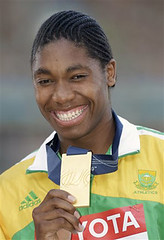
The ANC NEC of 17-19 September 2009, appalled by the manner in which the IAAF and the ASA handled the issue of Caster Semenya. The NEC was of the view that she has been victimised and subjected to unnecessary public scrutiny, and thus denied her rights and undermined her dignity.

The ANC established a task team to give concrete and practical support to Caster Semenya and her family. The team was lead by the ANC Secretary General and convened by ANC National Spokesperson, Jackson Mthembu.

It is constituted of senior ANC leaders, namely

Winnie Madikizela- Mandela (NEC)
Manto Tshabalala-Msimang (NEC)
Gwen Ramokgopa (Gauteng PEC)
Noluthando Mayende-Sibiya (NEC)
Aaron Motsoaledi (NEC)
Joyce Mashamba (NEC)
Sisisi Tolashe (NEC/ANCWL)
Vuyiswa Tulelo (ANCYL)

The Caster Semenya Support Team was established to mobilise the South African civil society, our government, corporate South Africa, and the South Africa sporting fraternity to ensure that;

Caster and her family are afforded redress by all those who violated her rights during and in the aftermath of her gender testing;
Caster and her family are given professional help so as to deal with the implications of her gender testing;
Caster continues to advance her exceptional talent as a female athlete of international repute;
Her family, her community, South Africa at large, the continent and the world celebrate Caster's victory in Berlin and those of Mulaudzi and Mokoena.

In taking forward these four objectives and mobilising South Africans around the objectives above, the Task Team met with the family of Caster Semenya as well as the Moletjie community (a village where Caster was born) who welcomed the ANC initiative.

The task team also met the following stakeholders who fully agreed to support the Task Team and all its activities:

University of Pretoria
South African Student Congress (SASCO)
Athletic South Africa
Department of Sport and Recreation
ANC Parliamentary study group on Sport
Caster Lawyers
Med Scheme
Organised formation of South African musicians
Dr Harold Adams
SASCOC
Department of Transport
Department of Arts and Culture
SACP
COSATU

After concluding the consultations with all these organisations and after interrogating the volumes of submissions made, the task team decided to hand over its findings that deals with the redress on the mishandling of the gender verification process of Caster by Athletics South Africa and the IAAF, to the Ministry of Sport and Recreation, for further probing and conclusions.

The task team findings reveal that ASA took part in the gender verification process of Caster Semenya. The tests done in South Africa were conducted at their instance. They instructed their doctor to conduct such tests and provided resources including transport, a psychologist (who is one of their board members) to conduct counselling which ultimately was aborted.

In their submission to the task team ASA members were less than honest and very defensive and did not disclose their role in the process and in sanctioning the gender verification tests conducted in South Africa. They intentionally deceived South Africans, the President, Caster and her family.

Further, it is the view of the task team that ASA should have protected Caster before they left for Berlin and in Berlin and it must come clean to all South Africans and our government regarding their role in this saga.

With regard to the IAAF, the task team maintain that they should apologise to Caster, her family and South Africa as well as to the leadership of the Republic for the violation of Caster's rights and the resultant humiliation. It is the view of the task team that IAAF should declare the gender verification results conducted both in South Africa and Berlin null and void based on the following IAAF gender verification policy 2006:

a) The IAAF gender verification policy state that there should be a complaint or a challenge from another athlete/ team before an investigation can be conducted. The policy states that:

Gender issues are likely to arise as a result of:

Challenge' by another athlete or team as brought forward to authorities at an athletic event, including the President of the meet, technical delegate, medical delegate;

b) Suspicion’ raised as to an athletes' gender as witnessed during an anti doping control specimen collection; an approach made to the IAAF/regional AAA or National federation by an athlete or his representative for advice and clarification.

In the task team interaction with this matter, there is no evidence that any athlete or a team brought forward to authorities a complaint or a challenge against Caster in Berlin. As it applies to B, no suspicion was raised at any anti doping control specimen collection against Caster's gender.

c) If there is any 'suspicion' or if there is a 'challenge' then the athlete concerned can be asked to attend a medical evaluation before a panel comprising a gynaecologist, endocrinologist, psychologist, internal medicine specialist, expert on gender/transgender issues. The medical delegate can do an initial check.

In the task team interaction with this matter ASA and IAAF conducted gender tests in SA and Berlin with no panel of such specialists as envisaged above was established to do a medical evaluation of Caster both in South Africa and in Berlin.

d) Accordingly, the steps to be followed in handling cases of gender ambiguity, the following must happen:

The athlete is referred to the investigating authority in confidence for further investigation and advice; The verdict is passed on to the national federation with advice for further action including appropriate advice to the athlete as the need to withdraw from competition until the problem is definitively resolved through appropriate medical and surgical measures;

There is evidence that Caster was not taken into confidence, because Nick Davis, the IAAF spokesperson, disclosed in a press conference publicly that such tests will be conducted on Caster. The alleged tests results were also leaked to the international media.

It is the view of the task team that the gender verification of Caster was not in accordance with the gender verification policy of the IAAF as demonstrated through the above facts. It is for the reasons above that we therefore call for the nullification of the results as they have been compromised. They cannot therefore be used for any decision-making.

The task team will continue its role to give whatever support that Caster and her family might need. It is also on-course regarding the articulation of a celebration programme for Caster, Mulaudzi and Mokoena. The programme that began with the gala dinner of the ANC Youth League will be carried forward with an intense eight weeks of activities from December 2009 to January 2010. The programme will include provincial and national activities.

The task team has established the support Caster contact facility and has received positive and encouraging feedback, pledges and commitments by individuals and institutions in support of the campaign.

People can call, fax or e-mail the task team office at:

Tel (011) 376 1052
Fax: 0866581053
Email: supportcaster@anc.org.za

Large Union-Community Protests Target Bankers

Large union-community protests target bankers

By Bryan G. Pfeifer
Chicago
Published Nov 5, 2009 8:15 PM

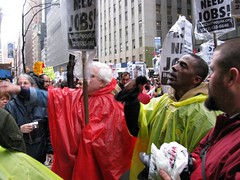
For three days, from Oct. 25 to 27, thousands of poor and working people from across the U.S. came here to directly challenge the criminal bankers and bosses at an American Bankers Association conference.

Those protesting are fed up with taxpayer-funded trillion-dollar bailouts to the bankers, the foreclosure epidemic, the refusal of the government to implement a federally funded jobs program, the billions spent on U.S. wars instead of for people’s needs and much more.

“We are here to demand that the banks and the government bail out the workers. Everyone has to stand up for dignity, for respect, for our families, for the working class,” said Armando Robles, president of United Electrical Workers Local 1110. This UE local led the successful six-day sit-in at Republic Windows and Doors in December 2008.

Robles and his UE brother Keith Scribner, president of Local 174 at Quad City Die Casting in Moline, Ill., spoke before a sea of 5,000 poor and working people at a massive rally Oct. 27 directly in front of the Sheraton Hotel where the bankers’ conference was being held. The crowd hoisted banners and signs in various languages declaring “Stop foreclosures: State of Emergency NOW” and “We need jobs.” They chanted at the bankers, bosses and government officials, both Democrats and Republicans, who were hiding in the hotel: “We want our money back!”

Other speakers at the rally included Richard Trumka, newly elected president of the AFL-CIO; Anna Burger of the Change to Win Federation; the Rev. Jesse Jackson; and representatives of labor, community and student organizations throughout the Chicago region and beyond.

The rally was sponsored by the AFL-CIO and endorsed by numerous organizations throughout the U.S., including the Chicago-based community organization Action NOW, which says there have been 44,000 foreclosures in the Metro Chicago area since 2007 and more than 5 million foreclosures in the U.S. since 2007.

The main AFL-CIO demands were to stop foreclosures, stop bailout-funded bonuses, invest in jobs and small businesses, and invest in public services.

“We’re sending a message. Business is over. We’re shutting it down. We are not going to let bankers rule our country or our lives anymore. This is a new day,” said Trumka.

Labor-community-student delegations marched to the Oct. 27 rally and drove in. Significant delegations came from youth-student organizations, African-American organizations and immigrant workers, including Asian and Latina women.

A van sponsored by Southeastern Michigan Jobs With Justice carried members of the Moratorium NOW! Coalition to Stop Foreclosures, Evictions and Utility Shutoffs from Detroit. Workers from the Service Employees International Union, the Carpenters union, the International Association of Machinists, the Sheet Metal Workers International Association, the American Federation of State, County and Municipal Employees, the American Federation of Teachers, UE and others participated.

On Oct. 25 protesters had crashed a large dinner meeting at the beginning of the bankers’ conference, resulting in arrests. Other protest actions, such as demonstrations at the hotel, took place on Oct. 26. (www.showdowninchicago.org)

Those protesting in Chicago were clear that the Oct. 25-27 actions were just one part of building massive, organized resistance against the bankers and bosses.
--------------------------------------------------------------------------------
Articles copyright 1995-2009 Workers World. Verbatim copying and distribution of this entire article is permitted in any medium without royalty provided this notice is preserved.

Workers World, 55 W. 17 St., NY, NY 10011
Email: ww@workers.org
Page printed from:
http://www.workers.org/2009/us/chicago_1112/

Workers Tell Ford Motor: No Right to Strike? No Way!

Workers tell Ford Motor: No right to strike? No way!

By Martha Grevatt
Published Nov 5, 2009 8:22 PM

Nov. 2—Losing a job is a scary thing for any worker to contemplate. It’s certainly scary for any worker lucky enough to still have a job with union wages and benefits. The fear of job loss has for several years led members of the once-mighty United Auto Workers to accept drastic concessions they normally wouldn’t consider.

Nevertheless, UAW Ford workers have overwhelmingly voted down the latest package of contract modifications, sending a powerful message to their bosses. “We’ve taken enough,” Dan Coll told the Detroit Free Press. “Enough’s enough.”

Coll, a member of UAW Local 600 at Ford’s Dearborn, Mich., truck assembly plant reminded the Free Press reporter that he and 41,000 other Ford workers had just approved major givebacks in March. These included suspending cost-of-living-allowance (COLA) increases and scheduled bonuses, weakening job and income security provisions, sacrificing an annual paid holiday, and break-time reductions that add up to 40 hours more free labor for the bosses each year.

Why, just seven months later, did Ford think it could ask the UAW leadership to convince the rank and file to give up more? Ford wanted the additional concessions that the bosses at General Motors and Chrysler, with the help of the U.S. Treasury, squeezed out of their hourly employees by threatening to liquidate operations altogether. The reorganized GM and Chrysler corporations will be able to freeze the wages of future workers at $14 an hour and impose a no-strike rule on all workers until 2015, even though the current contract expires in 2011.

That’s what Ford bosses wanted and what they said they needed to be “competitive.” UAW International President Ron Gettelfinger campaigned for a “yes” vote on the contract changes—which included a more limited no-strike rule and a bonus of $1,000 not offered at GM or Chrysler—with the argument that “we’re talking about 7,000 jobs that have either been created and/or protected by this agreement.”

“Members at Ford retain the right to strike on every issue—and I say every issue—except improvements in wages and benefits,” Gettelfinger told Frank Beckmann of WJR-AM. “If Ford was to propose a cut, we would maintain the right to strike. That would never even go to arbitration. This has become a flash-point issue, but this agreement is not about that.” (MLive.com, Oct. 27)

Ford hourly workers, who so far are voting down the concessions two-to-one, know better. The promise of job security—or more accurately the threat of job loss—has been used to pass concessions for decades, especially in the 2007 contract and again last March. Yet where are the jobs? At one time Local 600, which led the fight to unionize Ford in the 1930s, had 100,000 members at the sprawling Rouge complex. Now the total number of UAW hourly workers at Ford is 41,000 and falling.

Ford workers want no part of even a limited restriction on the right to strike. Wouldn’t they want to reserve the right to strike to restore COLA, for example, so their pay could start to catch up with inflation? Workers know that without the right to strike they have no leverage—they’re at the mercy of the companies.

That’s why a number of anti-concession leaflets—some from rank-and-file activists and some from local leaders—made the rounds on the shop floors. When UAW Vice President Bob King tried to sell the concessions at the Dearborn Truck plant, he was drowned out by workers chanting “No, no, no!” Only a small number of locals voted in favor of the modifications.

A healthy rivalry developed after 92 percent of the workers at the Kansas City assembly plant voted no. Dearborn Truck workers boasted of a 92.6 percent rejection rate, only to be outdone by a 93 percent no vote in Sandusky, Ohio.

While some locals are still voting as of this writing, Gettelfinger has acknowledged that the concessions will not pass. There are no plans for a revote or for further negotiations before 2011. Seen from a purely electoral point of view, this is a tremendous victory, and not only for the Ford workers. Some GM and Chrysler workers, whose plants are closing even after they agreed to such outrageous givebacks, are cheering the Ford vote.

All UAW members must categorically reject the idea that concessions—especially those that compromise the right to strike—are necessary to “protect and/or create” a specified number of jobs. The right to strike and the right to a job go hand in hand. In fact, both are recognized under U.S. and international law as a result of fierce class battles that took place in the 1930s.

Only the worst misleaders of the working class would suggest giving up one right—the right to strike—in exchange for a dubious promise to save a few thousand jobs. These jobs already belong to the workers as a property right!

Martha Grevatt has worked for 22 years at the Twinsburg, Ohio, Chrysler plant, which is scheduled to be closed next year. E-mail mgrevatt@workers.org.
--------------------------------------------------------------------------------
Articles copyright 1995-2009 Workers World. Verbatim copying and distribution of this entire article is permitted in any medium without royalty provided this notice is preserved.

Workers World, 55 W. 17 St., NY, NY 10011
Email: ww@workers.org
Page printed from:
http://www.workers.org/2009/us/ford_workers_1112/

US Army Major Kills 13, Injures 30 at Fort Hood

Friday, November 06, 2009
19:19 Mecca time, 16:19 GMT

Deaths in US army base shooting

The suspect has been named as Nidal Malik Hasan, an army psychiatrist employed at Fort Hood

A mass shooting at the largest army base in the US has left 13 people dead and at least 28 wounded, military officials say.

The incident took place inside the Fort Hood military base in Texas as soldiers were awaiting medical and dental treatment at a processing centre for troops being deployed on missions to Iraq and Afghanistan.

Lieutenant-General Bob Cone, the base's commanding officer, said the shooting took place at about 1:30pm local time (1930 GMT) on Thursday at a Soldier Readiness Facility.

The suspect has been named as Major Nidal Malik Hasan, a 39-year-old army psychiatrist.

"There was a single shooter that was shot multiple times at the scene. He was not killed as previously reported. He is currently in custody and in stable condition," Cone said.

Hasan was born in the US to Muslim Palestinian parents who had emigrated from a small town near Jerusalem, US media said.

'Quick reaction'

Further bloodshed was narrowly prevented when Hasan was apparently blocked from reaching a graduation ceremony attended by some 600 people, just metres away from the scene.

"Thanks to the quick reaction of several soldiers, they were able to close off the doors to that auditorium," Cone said.

Josh Rushing, Al Jazeera's correspondent at Fort Hood, Texas, said: "[Hasan] is a first-generation American. He joined the army after high school and went to the Virginia Tech university to get a psychiatry degree through a military programme.

"He became a psychiatrist at the Walter Reed Army Medical Centre in Washington ... where he counselled soldiers coming back from war.

"Every day, he heard how horrible those stories were and he really started to question the wars, according to what his cousin and sources who knew him said.

"Hasan became more devout in his religion and started arguing with soldiers about whether the wars were right or not, to the point where he received disciplinary action and negative work reviews.

"He was transferred to the medical facility here at Fort Hood, where apparently these feelings continued.

"It raises a major question - how can a person responsible for the mental health of soldiers returning [from war] be allowed to continue in this profession when he has these kinds of questions himself?"

The rampage occurs at a time of stress for the US armed services burdened by two wars, with commanders struggling to ease the effect of repeated combat tours on troops and their families.

Repeated deployments

Suicides in the army hit a record level last year, with at least 128 taking their lives, and are on track to set a new high this year - surpassing the rate among the wider civilian population.

US commanders believe repeated deployments to Iraq and Afghanistan have played a role in the spike in suicides, as well a surge in post-traumatic stress and depression.

Hasan faced his own imminent deployment for military service, officials said.

Nader Hasan, a cousin, said Hasan was "mortified by the idea of having to deploy" and that he had been harassed by other soldiers for being a Muslim.

He told the New York Times newspaper that Hasan had retained a lawyer and sought to get out of the army before the end of his contract.

Security tightened

Fort Hood was locked down after the attack, which occurred on the same day as a graduation ceremony was due to go ahead at the facility.

Recent US mass shootings

April 3, 2009: Jiverly Wong, a Vietnamese immigrant, opens fire at an immigrant community centre in Binghamton, New York, killing 11 immigrants and two workers. Wong killed himself at the scene

March 10, 2009: Michael McLendon, 28, killed 10 people, including his Mother and four other family members in Alabama before himself committing suicide.

February 14, 2008: Former student Steven Kazmierczak, 27, kills five students and wound 18 more in shooting at Northern Illinois University in DeKalb. He then killed himself.

December 5, 2007: Robert A. Hawkins, 19, opens fire in a shopping mall in Omaha, Nebraska killing eight people before taking his own life.

April 16, 2007: Cho Seung-Hui, 23, kills 32 students and staff at Virginia Tech before killing himself in the deadliest mass shooting in modern US history.

Some other bases across the US also stepped up security in the wake of the shootings.

Barack Obama, the US president, called the attack a "horrific outburst of violence".

"It is horrifying that they should come under fire at an army base on American soil," he said in Washington.

Patty Culhane, Al Jazeera's correspondent in Washington, said that the attack had come in spite of rigorous security protocols at the base.

"At every US military base since September 11, they do something that is called '100 per cent ID check' - that means that when you pull up to the gate, there are armed soldiers and also contractors there, and you have to have a special sticker in your car," she said.

"You also have to have a military ID. If you do not have that, you have to pull over to the side, and your car is usually swept for explosives, and you need an escort.

"Family members [of service personnel] do have ID, so they are allowed to go on to the base."

Fort Hood is home to about 50,000 troops, although Kay Bailey Hutchison, a Texas senator, said there were about 35,000 troops at the base at the time.

"Our dedicated military personnel have sacrificed so much in service to our country, and it sickens me that the men and women of Fort Hood have been subjected to this senseless, random violence," she said.

Source: Al Jazeera and agencies

Zimbabwe News Update: VP Mujuru Blasts MDC-T Over Disengagement

Mujuru blasts MDC-T over disengagement

Bindura Bureau
Zimbabwe Herald

Vice President Joice Mujuru yesterday blasted the MDC-T’s disengagement from Government, saying it was a ploy calculated to derail preparations for the forthcoming agricultural season and discredit the land reform programme.

VP Mujuru was addressing Zanu-PF supporters at Bakasa Business Centre in Guruve during one of her tours of the district aimed at reminding people that they should remain focused and not be deceived by some political parties’ propaganda.

The meeting was attended by Mashonaland Central Governor and Resident Minister Advocate Martin Dinha, Zanu-PF provincial chairman and Mt Darwin North House of Assembly representative Cde Dickson Mafios and other party legislators.

"The real issue behind their (MDC-T’s) boycotting of Cabinet meetings is that they intend to derail the agricultural season which is imminent," she said.

VP Mujuru said the last Cabinet meeting which the MDC-T boycotted had resolved to use part of the US$510 million disbursed by the International Monetary Fund.

"We sat as Cabinet and agreed that the funds we received from the IMF would be used towards inputs procurement, health, roads and other developmental programmes," she said.

VP Mujuru said Cabinet also agreed that the cost of inputs like imported fertilizer should be subsidised to cushion farmers.

"When we continue importing we will be subsidising foreign farmers instead of our own," she said. VP Mujuru said MDC-T was hampering Government’s efforts to recapitalise the Grain Marketing Board.

"We have since agreed as Cabinet that all the 84 GMB depots should be opened so that farmers travel minimal distances when they go and collect inputs.

"In Mashonaland Central Cabinet agreed that eight more sub-depots should be opened in some remote parts of the country to assist the farmers," she said.

VP Mujuru said Cabinet had mandated Agriculture, Mechanisation and Irrigation Development Minister Joseph Made to announce subsidised fertilizer and seed prices next week.

She said Zanu-PF had fulfilled all its GPA requirements but MDC-T was making fresh demands outside the agreement.

She said provincial governors, the Reserve Bank of Zimbabwe Governor and the Attorney-General were appointed by the President in his capacity as Head of State and Government.

She said the present governors, RBZ head and AG were appointed according to the law before the creation of the inclusive Government and MDC-T should only raise queries after their terms expired.

"But he (MDC-T leader Mr Morgan Tsvangirai) is saying no I would like to chair Cabinet and also be nominated Acting President when Cde Mugabe travels outside the country.

"We say no because the law does not allow that," she said.

She said MDC-T had not fulfilled its GPA obligations after it called for the imposition of sanctions on Zimbabwe.

"They should go and tell Britain and America to remove the sanctions," she said.

VP Mujuru said there were reports that former white farmers were frequenting State-acquired land in the false hope that they would regain their farms from the new and rightful owners.

"Let us continue supporting the party (Zanu-PF) that brought independence and emancipated you from repressive colonial rule," she said.

Cde Mafios implored Government to look into the problems affecting Mashonaland Central ranging from roads, mobile networks and broadcasting services, which he said were in a deplorable state.


Tsvangirai ends boycott

From Morris Mkwate in MAPUTO, Mozambique

Sadc leaders yesterday convinced MDC-T leader Mr Morgan Tsvangirai to end his party’s "disengagement" from the inclusive Government following a mini regional summit here.

Speaking to the media at the end of a summit of the bloc’s Organ on Politics, Defence and Security, Mr Tsvangirai said they would, however, review their position after 30 days.

He did not say what course of action MDC-T would take if the issues he wanted addressed were not dealt with to his satisfaction at the expiry of the deadline.

Zanu-PF representatives could not be immediately reached to comment on the matter.

"We have suspended our disengagement from the GPA (Global Political Agreement) with immediate effect and we will give President Robert Mugabe 30 days to implement the agreement on the pertinent issues we are concerned about," he said.

Deputy Prime Minister Arthur Mutambara said he was "very satisfied" with the outcome of the summit.

The official summit communique had not been made public at the time of writing.

However, informed sources last night said Mr Tsvangirai’s announcement was in line with regional leaders’ expectations that his party engages the other partners in the inclusive Government to resolve any differences attendant to the GPA.

Sadc leaders, including President Mugabe, have in the past two weeks stressed that it is up to the parties in the inclusive Government to sort out their problems.

Opening the summit, President Armando Guebuza, who chairs the Troika, said Zanu-PF and the two MDC formations had shown commitment to resolving their differences and maintaining political stability for the country’s economic recovery.

He said indications were the parties "share more common views than disagreements".

President Guebuza said they should work on strengthening areas of convergence for the benefit of Zimbabweans and Southern Africa.

The Mozambican leader made similar observations on the political situation in Lesotho.

The summit was held to review the general political situation in the DRC, Lesotho, Madagas-car and Zimbabwe.

"In both Lesotho and Zimbabwe, we are fully aware that the political parties share more common views than disagreements," said President Guebuza, who was flanked by Sadc executive secretary Dr Tomaz Salamao.

"They do the most they can to overcome these disagreements and have shown great commitment in implementing policies and programmes that can answer the great desires of their people.

"We would like to point out that the challenges that have emerged can be overcome.

"In this framework, they must do the best they can to maintain political stability to allow foreign direct investment and the relaunch of economic activity in the country."

President Guebuza challenged the parties to pledge full commitment to working together.

He added that the report of the ministerial mission that visited Zimbabwe last week to review the Global Political Agreement provided useful pointers on the way forward.

Prior to the summit, media reports claimed that the ministerial mission’s visit and yesterday’s meeting were a direct result of MDC-T’s lobby following that party’s "disengagement" from Government.

The Organ chairman, however, indicated that the developments were in line with prior Sadc arrangements made at a summit of regional Heads of State and Government in the DRC in September.

President Mugabe, who is the Head of State and Government and Commander-in-Chief of the Zimbabwe Defence Forces, attended the meeting after President Guebuza extended an invitation to him.

Mr Tsvangirai, Prof Mutambara and Ms Thoko-zani Khupe were also invited.

Apart from President Guebuza, other members of the Troika are Zambia’s President Rupiah Banda (deputy chair) — who was represented by his Defence Minister Dr Kalombo Mwansa — and Swaziland’s King Mswati III.

South African President Jacob Zuma was present as an observer.

Others present included Cdes Emmerson Mnangagwa and Patrick Chinamasa (Zanu-PF), Mr Tendai Biti, Mr Elton Mangoma (both MDC-T), Professor Welshman Ncube, and Mrs Priscilla Misihairabwi-Mushonga (both MDC).

Sources said MDC-T raised its usual concerns about Roy Bennett’s swearing in as Deputy Agriculture Minister, the appointment of provincial governors and the status of Reserve Bank governor Dr Gideon Gono and Attorney-General Mr Johannes Tomana.

Zanu-PF has said MDC-T has not played its part in the implementation of the GPA by calling for the lifting of the economic sanctions imposed on Zimbabwe by the West.

External interference in the country’s domestic affairs through the beaming of hate messages by pirate radio stations and the setting up of parallel government structures by the Prime Minister’s Office are also among Zanu-PF’s concerns.

"Zanu-PF maintains that these (MDC-T’s concerns) are peripheral issues compared to the substantial issue of sanctions.

"This embargo is hurting the generality of Zimbabweans," the sources said.

"In fact, there is dishonesty on the part of the Prime Minister because he wants to use sanctions as leverage against Zanu-PF.

"His party also wants to use the sanctions to get Zanu-PF to comply with its demands.

"There is evidence that they want the sanctions to remain in force and this was their brief to the EU Troika that visited the country recently. So Zanu-PF wants this addressed."

President Mugabe has pointed out that Bennett will only be sworn into office if he is cleared of the terror-related charges he is facing in the High Court.

MDC-T started boycotting participation in Government on October 16 and ministers from that party missed three consecutive Cabinet sessions.

President Mugabe indicated that State functions would not be paralysed by that action and Government would continue operating in the best interests of the people.

However, there were efforts at rapprochement and it is understood that had the three principals met on Monday, they would have agreed on a common position ahead of yesterday’s summit.


Nkomo nominated for VP post

By Lloyd Gumbo

Former PF-Zapu members who sit in Zanu-PF’s Central Committee met in Bulawayo yesterday and nominated national chairman Cde John Nkomo to fill the post of Vice President and Second Secretary left vacant following the death of veteran nationalist and hero Cde Joseph Msika in August.

According to a party source, Deputy Senate President Cde Naison Khutshwekhaya Ndlovu, who had expressed interest in the post, was nominated to take over as party national chairman.

According to the 1987 Unity Accord, the two positions, as well as that of Home Affairs Minister, will be filled by cadres who belonged to PF-Zapu before the merger with Zanu-PF.

Speaking on condition of anonymity after yesterday’s meeting, a former senior PF-Zapu and Central Committee member said Cdes Nkomo and Ndlovu were unanimously endorsed as the candidates of choice.

"All the Central Committee members who attended the meeting unanimously endorsed Cde John Nkomo as VP and Cde Naison Ndlovu as the party national chairman.

"This was the best meeting we have ever had. We hope other groups will take a leaf from this and we are proud that this nomination had good representation from all the provinces.

"We are there to give an advisory opinion to other provinces and we are sure the other provinces are going to rubber-stamp our decision," the source said.

In an interview last night, Zanu-PF’s acting political commissar, Cde Richard Ndlovu — who presided over the meeting — could neither confirm nor deny that Cdes Nkomo and Ndlovu had been nominated.

He simply said one name had been agreed on for the VP post and similarly for that of national chairman.

Cde Ndlovu said the candidates were nominated in line with the 1987 Unity Accord and everyone was satisfied with the outcome.

"We were consulting on who we want to assume the Vice President’s position and the national chairman and we all agreed on the candidates.

"However, I can’t divulge their names at the moment because it will be premature at this stage. I can only confirm that the nominations were unanimous.

"The meeting was very cordial and everyone was happy with the nominations and we believe the other provinces will consider our nominations because this was in line with the Unity Accord," he said.

Cde Ndlovu said former PF-Zapu Central Committee members from all the 10 provinces graced the occasion and those who failed to attend sent solidarity messages.

He said the nominations would be done on November 14, but the names would only be revealed at December’s national congress.

"All former PF-Zapu Central Committee members from all the provinces attended the consultative meeting and we spoke with one voice. Nominations by other provinces will be done on November 14 but the names are only going to be made public at congress.

"This meeting was part of our consultations and so far we are on track, but the final nominations will be done by all provinces," Cde Ndlovu said.

Zanu-PF’s Politburo last week directed former PF-Zapu members sitting in the Central Committee to consult and nominate a candidate of their choice to fill the vacant post.

The decision was in line with an understanding following the Unity Accord that one of the two Vice Presidents should come from the most senior surviving member of the former PF-Zapu still holding a senior post in Zanu-PF.


Central Committee nominations deferred

Herald Reporter

ZANU-PF has deferred to November 14 the nomination for Central Committee members that had been set for this weekend.

Addressing a Press conference in Harare yesterday, the party’s secretary for administration, Cde Didymus Mutasa, said various issues necessitated the postponement.

"We want to inform our members countrywide that the nominations of Central Committee members have been shifted from November 7 to 14. This was as a result of many reasons beyond our control.

"Firstly, we have noted that the nomination date was clashing with the Harare provincial elections set for this Saturday.

"We also wanted to give the Matabeleland region time to finish their consultations on coming up with a candidate to fill the position of the Second Secretary of the party," he said.

Cde Mutasa expressed optimism that the Matabeleland region would finish the consultations before the nomination date.

"There was a lot of advice for the Matabeleland region during the last Politburo meeting and I am sure that they will meet the deadline," he said.

Cde Mutasa said the party’s administration department was also yet to write to provinces informing them about their Central Committee membership quotas.

According to the party’s constitution, Cde Mutasa said, the nominations for the Central Committee members should be held on the same day in all provinces.

"The nominations for Central Committee members have to be done on the same day countrywide, so as a result of this Saturday’s commitments, we decided to shift the nomination dates," Cde Mutasa said.

He also took the opportunity to encourage provincial leadership to nominate mature and eligible members capable of dealing with the challenges facing the party.

Meanwhile, information at hand indicates that the party’s information and publicity department was seized with the drafting of the theme for the National People’s Congress set for next month.

The theme would be forwarded to the President and First Secretary of the Party, Cde Mugabe.

The Congress is expected to draw more than 10 000 delegates.


Tsvangirai driving Rhodesian agenda

By Alexander Kanengoni

POLITICAL events happening over the past two weeks have been so quick it took some time to understand them.

First, there was President Mugabe opening Parliament two weeks ago challenging the West for engagement.

Then followed Prime Minister Morgan Tsvangirai’s surprising announcement that he was ‘‘disengaging’’ from the inclusive Government.

Then there was the flurry of movement from Sadc that culminated in the visit by the DRC president, Joseph Kabila of course this does not include UN Special Rapporteur on Torture, Manfred Nowark’s unscheduled visit that unceremoniously ended in the VIP lounge at Harare International Airport.

The case for engagement with the West as part of efforts to get Zimbabwe out of the current economic problems cannot be over-emphasised.

But it is Tsvangirai’s announcement to disengage from the inclusive Government that is quite revealing.

The observation that the Rhodesian lobby could be controlling MDC-T, and therefore responsible for most decisions that the party takes, is frightening.

It was the Rhodesians that we fought against during the liberation war.

Although they may agree on many things, the West and the Rhodesian lobby are not the same. The two major distinguishing features of the Rhodesian lobby are:

-rabid racism and;

-a misplaced belief that they will one day, return to the farms

The Rhodesian lobby has always had disagreements with the West, particularly the British.

The lobby disagreed with the British over their view of Africans who the lobby regarded as unfit to rule the country.

A political deal the British had struck with nationalist leader Joshua Nkomo in London in 1960 envisaged a gradual increase in African representation in Parliament that would take up to 100 years for blacks to attain a parliamentary majority to enable them to elect the country’s first black ruler.

It was that deal that gave rise to popular euphemisms like: "The country is around the corner!" or "The country is in my briefcase!"

The Rhodesian lobby was livid. It would never give the blacks such a chance! "Not in a thousand years!" Ian Smith would boast three years later in 1963 after his Rhodesian Front party wrenched power from Winston Field’s Dominion Party.

Two years down the line in 1965, Ian Smith would rebel against the British Crown and declare independence.

Harold Wilson, the British Prime Minister promised to crush the rebellion by force, but he never did it.

It must be noted that it was the rise to power of the Rhodesian lobby that precipitated the split in the nationalist movement.

Hardliners, who included Robert Mugabe, Ndabaningi Sithole, Leopold Takawira, Enos Nkala, Edgar Tekere etc broke away from Zapu to form Zanu arguing that there was not much to expect from the British but to take the Rhodesians head-on through armed insurrection.

We are our own liberators! was the rallying call at the Gwelo (now Gweru) congress where the new party was launched.

The point is the British and the Rhodesians have not always agreed. In his book, The Great Betrayal, Ian Smith accused the British of selling out the Rhodesians at Lancaster House, declaring Rhodesians were prepared to fight the nationalist guerrillas to the last man.

Implicitly, he was still holding on to the myth that blacks should never have been allowed to rule. The man went to his grave clinging to that delusion believing strangely the war between the Rhodesians and the nationalists had not yet been settled.

The tragedy is Ian Smith was not an eccentric voice speaking on the fringes of a defeated community.

He was speaking on behalf of a community that had regrouped in South Africa, Australia, New Zealand, Britain and Canada.

It’s one thing to see the Rhodesian lobby in other countries outside our borders but quite another to see it rearing its ugly head in our midst, through the opposition (MDC-T is still an opposition by virtue of opposing in the inclusive Government).

Because, when a high-ranking opposition leader, Eddie Cross, recently said the clause in the GPA that the land reform programme was irreversible be revisited, one could not help seeing a frighteningly Rhodesian agenda.

The Rhodesians still dream of going back to the farms.

His secretary for information, Nelson Chamisa tried to douse the anger and panic the statement had ignited but it was too late because the Rhodesians had spoken.

When Tsvangirai decided to ‘‘disengage’’ from the inclusive Government primarily over the case of Roy Bennett, most people were surprised by the power and influence that the Rhodesian lobby wields within the opposition movement.

There have been other black MDC-T leaders, including Government ministers, arrested in the past for various offences, but the party’s response had not been as swift and as resolute as it was in Bennett’s case.

If anyone ever doubted that MDC-T was at the beck and call of Bennett, it was time to awaken to the fact.

There has been idle talk that MDC-T queues at Bennett’s office at the end of each month for its stipend.

It’s hard not to believe it now.

The other interesting point is the choice of Bennett for the ministry of agriculture.

But considering the power that he wields in MDC-T, he must have assigned himself to that ministry.

The question becomes why he gave himself that ministry. But it is easy to understand within the context of Rhodesians’ delusion of returning to the farms.

The anger reflected in the vandalism that one sees along the highways and the country’s infrastructure, most of which is senseless, can only be attributed to people with the mentality: if we can’t have it, then no one else should have it.

All the road-signs along the highways are gone.

Some of us thought it was the aluminium that the vandals wanted for resell. But when they also destroyed the concrete blocks showing the distances along the roads, then the agenda became purely Rhodesian.

The same applies to the other infrastructure that is being destroyed without any intention to resale.

The Rhodesians want to come back.

If it is true that Prime Minister Tsvangirai wants the power and influence of war veterans in state institutions like the army and police force diluted before he can return to the inclusive Government, that is another frightfully Rhodesian agenda.

War veterans symbolise the defence of the gains of the liberation war.

They are the people who toppled the Rhodesians from power and the last people Rhodesians want to see.

Calling for the dilution of their influence is tantamount to calling for their demobilisation from the army and the police force.

It’s like calling for the people to lay down their arms in the middle of a war. Prime Minister Tsvangirai is driving a Rhodesian agenda.

The Rhodesian lobby is Tsvangirai’s burden.

But the problem with him for us is when he tries to facilitate their return.

When President Mugabe talks about engaging the West, he is certainly not talking about engaging the Rhodesians.

The only place to engage the Rhodesians is the battlefield.

That has been the nature of the relationship.

Ian Smith went to his grave, less than a decade ago, still believing blacks were not fit to rule; that it was the British who sold out the Rhodesians at Lancaster House.

He died unrepentant. But is it not said shamelessly that Rhodesians never die?

Several years after independence, Peter Godwin, a former Rhodesian, published a book with the title Rhodesians Never Die.

The case for engaging the West that President Mugabe raised in his opening address to parliament recently is significant.

It is such an engagement that will eventually lead to the lifting of economic sanctions. To expect the opposition to tell the West to lift sanctions would be folly because the powerful Rhodesian lobby will not allow them to do it.

There will be other voices besides ours, calling for the lifting of sanctions; Sadc and the AU for instance. But it will be us engaging the West, particularly the USA and Britain, that is key to getting sanctions lifted.

I don’t think there is much difficulty in that regard because the basis for such engagement already exists — the Lancaster House Agreement.

Both the British and the Americans were there and are signatories to the agreement.

There are still outstanding commitments agreed at Lancaster House.

The British pledged 36 million pounds towards paying off the white farmers and supporting a future land reform programme.

The Americans pledged an equal amount. I believe those commitments need to be revisited. We should ignore the letter by the then British secretary for International Development, Claire Short in November 1997 that reneged on her government’s commitment, as agreed at Lancaster House, to pay for the land because it is dishonest.

I believe it was that letter which was largely responsible for the tragedy that occurred between 1998 and 2008.

I do not believe the case for re-engagement with the Americans to repeal the US sanctions law; ZDERA (Zimbabwe Democracy and Economic Recovery Act) is complicated either.

If we accept that the Americans enacted ZDERA in return for British military support for the invasion of Iraq and that Obama was elected on the promise of getting the Americans out of Iraq, then theoretically, the reasons for ZDERA fall away.

There are other reasons that make re-engaging the Americans less complicated.

There are many things about us that must fascinate the Americans, our resilience and prowess. The attempt to lure Reserve Bank Governor, Dr Gideon Gono to the World Bank was a clearly American initiative.

I believe there are two things they wanted to achieve.

They had correctly identified that he was the man preventing the country’s economic collapse and they wanted to remove him to hasten the process.

They were fascinated by how he had, literally single-handed, managed to save the country from economic collapse.

There is no doubt that the Americans are fascinated by our military prowess in Mozambique and the DRC. Our army cleared Renamo from the Beira Corridor and stopped Kinshasa from falling.

Who would not envy an army with such a string of accomplishments? There are many things about us that fascinate the Americans that they would jump at the slightest opportunity to work with us, sometimes at even the level of individuals as they tried to do with Dr Gono.

As far as the British, the land reform programme is a fait accompli.

It’s the powerful Rhodesian lobby and their own huge ego that they have to deal with. The lobby wants President Mugabe out of power in order to go back to the farms.

The British would want President Mugabe out of power not to facilitate the Rhodesians back to the farms, but as a way to exact revenge on the man who challenged their global supremacy openly and embarrassed them.

Such vengeance would soothe their bruised ego.

But I am sure they are already looking at their interests in Zimbabwe beyond the land reform programme.

An MDC-T official confessed recently in a discussion that the inclusive Government was the best thing to happen because if MDC-T had tried to govern alone, that government would have collapsed from ignorance and inexperience.

I cynically quipped his fears were unfounded because the Rhodesians would govern for them.

A colleague with us encapsulated the implications: "If the Rhodesians come back, then it will be another war!"


What does Morgan know about heroes?

Tarwireyi Matsika Chifambayi Tirivavi

EDITOR — In 2002 we came across a cartoon of Morgan Tsvangirai entitled "The Dreamer" which showed a sleeping Tsvangirai slouched in an easy chair, obviously in dreamland, an empty scud by his side.

The cartoon showed Tsvangirai dreaming of success in those aspects of his life where he had dismally failed. Consequently, he was dreaming of passing ‘‘O’’ Level, dreaming of joining the liberation struggle and dreaming about being President of Zimbabwe.

All along we thought The Dreamer cartoonist was being cruel to Tsvangirai because we thought the Right Honourable Prime Minister was not that much of a dreamer as depicted.

Alas how wrong we were, for how else can we explain the dream where he, Morgan Richard Tsvangirai, expected to be consulted about the late national hero Cde Misheck ‘‘Makasha’’ Chando’s hero status.

Or perhaps Tsvangirai is against the hero status of Cde Makasha because to him Cde Makasha was a terrorist who had a bad habit of shooting at people like Roy Bennett?

Surely, the Prime Minister needs help, because it appears he does not understand a lot of things about Zimbabwe, which perhaps explains why during his sojourn to Germany early this year, Chancellor Merkel had to show our Prime Minister the Zimbabwean flag at the start of their joint Press briefing.

She had to literally drag Tsvangirai from the side of the podium that had the German flag to the side with the Zimbabwean flag.

Quite rightly, the ETV news presenter commented that "someone has to teach the Zimbabwean Prime Minister how his country’s flag looks".

That is Tsvangirai for you. Now he wants the Zanu-PF Politburo to consult him on liberation war heroes yet he fled the struggle to work, first in a textile mill in Mutare then at Trojan Nickel Mine in Bindura.

What would he know about what was going on in the bush?

We wonder how Tsvangirai wants grieving comrades to consult him when he has disengaged from Zanu-PF. Furthermore, he has to attend the Politburo meeting where the issues are discussed.

The hogwash about MDC-T contributing to the liberation struggle should end because MDC-T is full of Selous Scouts like Bennett and Rhodesian Front members like Giles Mutsekwa. The reality is that Zanu-PF liberated this country and there is nothing anyone can do about that.

If MDC-T has its own ideas of heroes, fine, they should get a farm from somewhere and build their heroes’ acre of quislings, Selous Scouts, ex-Rhodesian Light Infantry, ex-Rhodesian African Rifles, ex-Pfumo Revanhu, sanctions mongers, and so on.

Come to think of it, MDC-T can also use its heroes acre to bury all its imaginary dead activists as well.

Tarwireyi Matsika Chifambayi Tirivavi.
Zimbabwe Heritage Project.
Unemployment Nears 10 Percent As Rebound Remains Slow

Unemployment nears 10 pct. as rebound remains slow

By CHRISTOPHER S. RUGABER, AP Economics Writer

WASHINGTON – The economy is rebounding from its deepest slump since the 1930s, but it probably won't seem that way when the government releases its monthly employment report on Friday.

Employers aren't expected to start adding jobs for several more months. Many are skeptical about the strength and sustainability of the recovery,

The nation's economy probably lost a net total of 175,000 jobs in October, pushing the unemployment rate to 9.9 percent, according to a survey of Wall Street economists by Thomson Reuters. The Labor Department report is scheduled for release at 8:30 a.m. EST.

Most economists think the rate will eventually surpass 10 percent, a level last seen in June 1983.

The economy grew at a 3.5 percent annual rate in the July-September quarter, the government said last week, the strongest signal yet that the recession has ended. But that alone won't spur rapid hiring, raising the likelihood of a "jobless recovery."

"You need explosive growth to take the unemployment rate down," said Dan Greenhaus, chief economic strategist for New York-based investment firm Miller Tabak & Co.

Greenhaus said the economy soared by nearly 8 percent in 1983 after a steep recession, lowering the jobless rate by 2.5 percentage points that year. But the economy is unlikely to improve that fast this time, as consumers remain cautious and tight credit hinders businesses. In fact, many analysts expect economic growth to moderate early next year, as the impact of various government stimulus programs fades.

On Capitol Hill, the House on Thursday sought to bolster the economy by approving a $24 billion measure that expands a popular homebuyers' tax credit and extends unemployment insurance for 14 to 20 weeks. The additional jobless benefits are intended to prevent almost 2 million recipients from running out of aid during the upcoming holiday season. It is the fourth extension of benefits during the recession and means that unemployed workers in some states can claim up to 99 weeks of support, a record.

The Senate approved the bill Wednesday and President Barack Obama is expected to sign it.

On Wall Street, a better-than-expected jobless claims report and an upbeat forecast from Cisco Systems Inc. buoyed investors Thursday. The Dow Jones industrial average added nearly 204 points to 10,005.96, and broader indexes also gained.

Still, jobs likely will remain scarce even as the economy improves. The uncertainty surrounding the pace of the recovery has made many employers reluctant to hire, economists said. And many companies have cut hours for workers still on their payrolls, which means they can add those hours back before hiring new people.

Diane Swonk, chief economist at Mesirow Financial, said that small businesses, a primary engine of job creation, still face tight credit and don't have the cash reserves to support extra workers.

Fein Tool North America, a Cincinnati company that supplies auto parts manufacturers, has cut about 100 workers, or 33 percent of its staff. But Fein President Ralph Hardt said the company can still fill its orders by using more overtime shifts and temporary workers.

Hardt said he plans to slowly rehire once the economy picks up again. "If I see signs of recovery, I am going to hire back, but I am going to be very prudent," he said.

The recoveries following the last two recessions in 1991 and 2001 also were considered "jobless" as the unemployment rate didn't peak until 15 months and 19 months, respectively, after they ended.

Economists cite several reasons why job growth is increasingly lagging recoveries. To begin with, layoffs are more likely to be permanent, compared with temporary furloughs by manufacturers in earlier downturns. And globalization has made it easier for companies to hire overseas when rebounds begin.

Many companies also are squeezing more production from their existing work forces. Productivity, the amount of output per hour worked, jumped 9.5 percent in the third quarter, the Labor Department said Thursday.

That's the sharpest increase in six years and followed a 6.6 percent rise in the second quarter. The increases enable companies to produce more without hiring extra workers.

Still, many economists saw a bright side: companies can only drive their existing workers so far. Eventually, they will have to hire more people as the economy improves.

"You just can't get blood from a turnip," Swonk said.

The Labor Department said Thursday that new jobless claims fell to 512,000 last week, the lowest level in 10 months.

Economists closely watch initial claims, which are considered a gauge of the pace of layoffs and an indication of employers' willingness to hire new workers. Claims remain well above the roughly 400,000 that economists say will signal job creation.

The Federal Reserve, meanwhile, said Wednesday that it will keep a key interest rate at a record low level of nearly zero for an "extended period" in order to support the economy.

The central bank said economic activity has "continued to pick up," but Fed Chairman Ben Bernanke and his colleagues warned that rising joblessness and tight credit could restrain the rebound in the months ahead.
___

Associated Press Writer Jim Abrams contributed to this report.

Thursday, November 05, 2009

President Omar Hassan al-Bashir to Visit Turkey Despite ICC Warrant

Omar al-Bashir to visit Turkey despite warrant

Thursday, November 05, 2009
Opheera McDoom
Reuters

KHARTOUM: Sudanese President Omar al-Bashir will visit Turkey next week for the first time since an international court asked for his arrest, government sources said, in a test of Ankara’s support for international justice. Predominantly Muslim Turkey has not ratified the 2002 Rome Statute that established the International Criminal Court (ICC), but it is under pressure to do so to bring it closer to European Union standards.

Rights groups say Turkey, anxious to secure entry into the EU, is obliged to arrest Bashir when he lands in Istanbul for a summit of Islamic nations.

One presidential source in Khartoum said on Wednesday: “The decision has been taken. Unless there are last minute changes, he is going.”

Ankara’s government, which has its roots in political Islam, has sought to deepen ties with Khartoum, putting it in an awkward position over the visit.

Asked if Turkish authorities would arrest Bashir during his visit, a Turkish Foreign Ministry official said on condition of anonymity: “No, there are no such plans.”

A public outcry about Bashir’s visit to Turkey could still cause it to be canceled, which would embarrass Khartoum, a Sudanese analyst said.

Activists said there was sure to be opposition from civil society to the visit, adding Turkey had obligations to arrest Bashir as a UN member.

“We most certainly expect Turkey to show respect for this monumental decision by the ICC,” said Ozlem Altiparmak from the Turkish Coalition for the ICC.

“Turkey could see a backlash in public opinion and from civil-society groups if it fails to act while he is here.”

The UN Security Council referred Darfur’s atrocities to the ICC for investigation four years ago.

Based in The Hague, the ICC is the world’s first permanent court set up to try individuals for genocide, war crimes and other major human rights violations.

Bashir has traveled to African countries, who reject the arrest warrant, since March when ICC judges said he was responsible for war crimes and crimes against humanity in Sudan’s Darfur region.

He was last in Turkey in August 2008, before the arrest warrant was announced.

Rebels in Darfur took up arms in early 2003, accusing Khartoum of neglecting the arid region, and Sudan then mobilised militia who, alongside the army, waged a counter-insurgency campaign that drove 2 million people from their homes.

The fighting sparked one of the world’s worst humanitarian crises, which the UN says has claimed 300,000 lives.

Washington described the violence as genocide, a term Khartoum rejects. Bashir puts Darfur’s death toll at 10,000.

Turkey’s H1N1 death toll hits 15 amid vaccine row

ANKARA: The death toll from swine flu climbed to 15 in Turkey Wednesday amid simmering controversy over the country’s vaccination campaign following the prime minister’s refusal to have an injection.

The latest victims of the A(H1N1) virus were a 5-year-old boy, two women, aged 24 and 31, and a 55-year-old man, a Health Ministry statement said.

Fatalities have sharply increased this week after the first death was reported on October 24.

Hospitals began vaccinating medical workers on Monday, along with people planning to travel to Mecca for the hajj pilgrimage, amid widespread public concern over the safety of the swine flu vaccine.

Health Minister Recep Akdag, eager to dispel the misgivings, had an injection before the cameras Tuesday.

But his gesture was soon overshadowed when Prime Minister Recep Tayyip Erdogan publicly chided the minister over his insistent calls on citizens to get vaccinated, saying that some experts doubted the safety of the drug.

He then told reporters he would not have an injection himself.

Erdogan’s remarks dealt an “irreparable” blow to the Health Ministry’s credibility, the Turkish Doctors’ Union said Wednesday.

It slammed the government for “failing to be convincing even within itsef” and cast doubt on “how competent it will be in managing a nationwide pandemic.”

The union insisted that “the benefits of the vaccine are much greater than the damage its possible side effects may cause.”

Opponents of the drug say its safety, efficiency and side effects have not been sufficiently tested. – AFP

Wednesday, November 04, 2009

Zimbabwe News Update: No Substitute For Dialoge, Says Kabila

No substitute for dialogue, says Kabila

From Sydney Kawadza in MUTARE
Courtesy of the Zimbabwe Herald

DRC President Joseph Kabila has challenged Africa to follow his country’s example by actively seeking dialogue and pursuing national reconciliation as a means of solving any internal differences.

In his keynote address at the annual Dag Hammarskjold Commemoration Seminar at Africa University here yesterday, President Kabila said victory over foreign forces that threatened to tear DRC apart was partly attributable to political dialogue.

"Political dialogue, entailing compromise and give and take, had to be brought to bear in order to defuse misunderstandings, build confidence, mend the social fabric and induce reconciliation," the DRC leader said.

"Indeed, accepting to share power with adversaries, or granting amnesty to rebels is seldom an easy decision.

"It can be politically painful and even dangerous. It takes vision, wisdom and, above all, courage.

"Looking back, we do not regret having ridden that, at times, bumpy road.

"It led us to where we stand today: strong and tall, as it was meant to be," he said.

President Kabila challenged African countries to draw inspiration from the DRC and its rebirth through resistance, dialogue, reconciliation, democratic rule and hard work.

President Kabila’s presentation was titled "The State of the Congolese Nation Following Negotiations".

The war in the DRC ended in late 2002 and President Kabila subsequently formed a national unity government that roped in six vice presidents, four of them former rebel militia leaders.

President Kabila paid tribute to the Zimbabwe Defence Forces for their leading role in resolving, through Operation Sovereign Legitimacy, the armed conflict that claimed millions of lives in his country.

He said the DRC received "heroic support" from Zimbabwe, Angola and Namibia in those "dark days".

"I wish to seize this opportunity and, once again, pay tribute to these sister countries.

"As a nation, we will never forget the blood shed by their gallant sons and daughters to help us preserve our independence, territorial integrity and national sovereignty," he said.

In September this year at the last Sadc Summit in the DRC, President Kabila said he was grateful for Zimbabwe’s assistance and would soon visit the country to personally convey his people’s gratitude.

The seminar, which ends today, is being held under the theme "The Democratic Republic of Congo: The Road to Conflict Transformation and National Healing".

President Kabila chronicled the DRC’s conflicts, starting with the killing of iconic statesman Dr Patrice Lumumba in 1961 soon after the country’s independence from Belgium the previous year.

This resulted in a drawn-out liberation struggle led by nationalists such as Cdes Pierre Mulele, Antoine Gizenga and the current president’s father, Laurent Desire Kabila.

"Unfortunately, this took place at the peak of the Cold War (between the former USSR and the West) and their efforts got entangled in the East-West rivalry.

"They could not succeed at the outset."

President Kabila said the military coup of 1965 ushered in 32 years of Mobutu Sese Seko’s misrule, which only ended in 1997.

An era of freedom and democracy dawned, but this was almost nipped in the bud by invading armies.

"As if history was repeating itself, no time was given to the new revolutionary regime to organise and put people back to work. Just a year later, the DRC was dragged into a long and protracted war of aggression by her eastern neighbours," he said.

This was after Rwandese and Ugandan troops invaded the country in support of DRC rebel militias who were tacitly backed by Western powers.

The war lasted over five years and claimed millions of lives.

President Kabila said the conflict was the costliest war in terms of human losses after the Second World War.

The popular resistance organised by the late Laurent Kabila rallied friendly countries and saved the nation, though unfortunately it also claimed the liberation fighter’s life.

Meanwhile, President Kabila returned home last night after spending two days in Zimbabwe.

He bade farewell to President Mugabe at State House in the evening with the Zimbabwean leader expressing his desire for the two to continue interacting.

President Mugabe parting shot was: "Thank you for the visit. Let’s keep in touch."

During his visit, President Kabila met the three principals to the Global Political Agreement to get an insight into how the inclusive Government was functioning.


Zanu-PF Congress preps on course

Herald Reporter

Preparations for Zanu-PF’s National People’s Congress in December are progressing as scheduled, party national chairman Cde John Nkomo has said.

Delegates to the congress — expected to number about 10 000 — will elect the Presidium comprising the President and First Secretary, two Vice Presidents and Second Secretaries and a national chairperson. The First Secretary will, in turn, appoint members of the Politburo.

Speaking after meeting the Congress Co-ordinating Committee on Monday, Cde Nkomo said he had received progress reports but could not reveal the amount of money raised so far.

The party aims to raise US$5 million for the congress.

"I have received progress reports from all the sub-committees that are organising the Congress and they have confirmed that everything is progressing according to our plan. We are quite optimistic that by the time of the congress everything will be in place. As a committee, we have come up with a system where we meet with the sub-committees every Monday to monitor progress of the preparations."

Cde Nkomo dispelled rumours that the party was failing to raise sufficient funds to finance the five-yearly meeting

"Yes, in every endeavour there are challenges and our case cannot be an exception. But challenges are not problems," said Cde Nkomo.

"The challenges that we are facing are ordinary challenges that can be found in any project."

Almost all the 10 provinces have endorsed the current leadership of President Mugabe and Vice President Joice Mujuru ahead of the Congress.

Another Vice President and Second Secretary to fill the void left by founding nationalist Cde Joseph Msika will be elected at the Congress.


US can’t teach us anything

Zimbabwe Herald

THE Western alliance’s reaction to the abortive presidential run-off in Afghanistan should show all who were led to believe that Anglo-Saxon opposition to President Mugabe’s re-election was about the professed platitudes of electoral democracy, that they were sold a dead donkey.

American and British opposition to President Mugabe’s victory was because, in their own words, ‘‘he continues to pose a continuous and extraordinary threat to the foreign policy of the United States (and the British governments)’’.

A foreign policy, that we all know, is about plundering other people and their resources.

A bit of history will suffice here.

Zimbabwe held harmonised presidential, Senate, House of Assembly and local government elections on March 29, 2008 that saw the presidential contest failing to produce an outright winner when none of the four candidates garnered the 50 percent plus 1 votes required for a first round win.

A run-off was, therefore, called for June 27 pitting President Mugabe and MDC-T leader Morgan Tsvangirai. And after gauging the mood of the electorate, and with just days to go before the poll, Tsvangirai announced his ‘‘withdrawal’’ from the run-off, alleging violence against his supporters.

The British and American governments immediately began casting aspersions on the legitimacy of the outcome, saying they would not recognise President Mugabe’s legitimacy.

This was despite the fact that legal experts had described Tsvangirai’s ‘‘withdrawal’’ as a legal nullity since the run-off had already begun with the deployment of election officers and observers countrywide.

Fast forward to August 20, 2009, the day Afghanistan held its presidential election pitting two US-anointed candidates, incumbent Hamid Karzai and his erstwhile foreign minister Abdullah Abdullah. Though Karzai initially claimed outright victory with over 53 percent of the vote in the first round, a UN probe into electoral irregularities unearthed massive fraud involving over 20 percent of the votes credited to Karzai.

The votes were docked necessitating a run-off that had been slated for Saturday, before Abdullah announced his withdrawal saying the run-off was going to be equally fraudulent.

What shocked many was that even before Abdullah’s withdrawal, the Obama administration had enthroned Karzai as Afghan president for another five years, saying ‘‘even if he were forced into a second round of voting he would almost certainly win it’’.

More was to follow after Abdullah’s withdrawal as the US was first off the block in congratulating Karzai even before the Afghan electoral authorities had declared him the winner.

This is not to say we expect the legitimacy of our leadership here to accrue from US blessings, no. All we are doing is exposing the hypocrisy of the self-appointed ‘‘international democrats’’ and ‘‘moral authorities’’ who, ironically, only yesterday opposed our own fight for democracy here.

A bit of history again.

When Ian Smith declared his UDI on November 11, 1965, the progressive world was naturally outraged and the UN Security Council responded by slapping the Smith regime with a raft of sanctions beginning that year till the brief restoration of British rule in December 1979.

Though the terms of the sanctions forbade trade or financial dealings with Rhodesia, the US supported the beleaguered settler regime regardless and covertly channelled assistance through apartheid South Africa.

US allies, among them Portugal (then under Marcello Caetano), Israel, and Iran (then under the US proxy Shah Mohammed Reza Pahlavi), also assisted and traded with Rhodesia. In an attempt to bypass the UN sanctions, the US passed the Byrd Amendment in 1971 and continued to buy chrome from Rhodesia in violation of the UN sanctions.

As if that was not enough, the US also contributed to the establishment of an armaments industry in Rhodesia that enabled the Rhodesian Front to kill over 50 000 innocent Zimbabweans whose only "crime" was daring to demand majority rule.

The US also provided the technical knowledge and support, again through apartheid South Africa, towards establishing the 700-kilometre Border Minefield Obstacle along Zimbabwe’s borders with Zambia and Mozambique. Mines aimed at stopping aspiring cadres from crossing to training camps and blowing up trained combatants crossing back into Zimbabwe.

Yet today, the US and its allies are trying to re-invent and pass themselves off as champions of democracy in Zimbabwe.

We urge all those who may have been swayed by the Anglo-Saxon rhetoric to acquaint themselves with our history to tell friend from foe.

Such knowledge is also vital to understanding the political dynamics at play in our country today lest we are led down the garden path.

The US can’t teach us anything.


Height of American hypocrisy

By Tendai Hildegarde Manzvanzvike

ZIMBABWE and Afghanistan are thousands and thousands of miles apart. What makes them suitable variables for comparative analysis? Why is the West — the United States and Britain in particular — interested in the two nation states? Why are their recent electoral processes of significance?

After the failure of the illegal regime change project in Zimbabwe, "legitimised" in part by the US sanctions law, the so-called Zimbabwe Democracy and Economic Recovery Act of 2001, the US and its allies continue to refuse to recognise a Zimbabwe Government in which both President Mugabe and Zanu-PF are major players, preferring their handpicked stooges to be in charge.

They have continued to denounce Zimbabwe’s 2008 harmonised elections and the subsequent Presidential run-off on the basis of alleged issues of governance, rule of law, human rights, etc.

However, the culmination of Afghanistan’s presidential poll has revealed the levels of the West’s hypocrisy and double standards, especially the US, when it comes to Zimbabwe.

The Afghan issue shows that every principle of democracy, which the West preaches about and would want to export to every part of the world, has been thrown into the dumpster because their national interests took precedence over the wishes and interests of the Afghan people.

For, on November 2, Afghanistan’s Independent Electoral Commission announced that there was a new president, and he was none other than former president Hamid Karzai.

The Western world, Washington in particular, was quick to embrace and endorse Karzai as the legitimate leader of Afghanistan.

This contrasted with the West’s reaction to Zimbabwe’s run-off that invited a full-blown diplomatic offensive in order to reject not only the electoral results, but also de-legitimise President Mugabe, in favour of the US, Britain and their allies.

Large sums of money were disbursed through civic organisations in order to change the colour of Zimbabwe’s politics, a desperate attempt meant to reverse the gains of independence, especially the land reform programme, and also derail Zimbabwe’s sovereignty.

People’s memories are still fresh with the attempts made by the Bush administration, through his Assistant Secretary of State for African Affairs, Jendayi Frazer, to influence Sadc and the African Union. There were several vain attempts to have Zimbabwe on the UN Security Council agenda.

In fact, last week’s abortive visit by UN’s special rapporteur on torture, Dr Norman Nowak, was a clear demonstration that until a government of the West’s choice is in power in Zimbabwe; they will not relent in their quest for regime change.

It is a goal and objective that they are pursuing with impunity, even if it means funding parallel government structures within the inclusive Government in pursuance of their interests.

However, on September 15, after monitoring the Afghan elections, former US president Jimmy Carter described the Afghan poll as "despicable".

Said Carter: "Hamid Karzai has stolen the election . . . Now the question is whether he gets away with it."

Carter’s comments followed allegations of massive fraud.

Well, on November 2, it became official. Karzai defied the odds, stole the election and got away with it. If observers had expected disgust and dismay, they were actually surprised to learn that the Obama administration was the first to endorse Karzai as the "new president who (was) the same as the old president".

However, the announcement was just a formality meant to make the farcical exercise look credible because on October 31, Secretary of State Hillary Clinton was reported as saying that the Afghan poll would be legitimate even if Abdullah Abdullah boycotted.

Said the reports in the media: "Hillary Clinton, the US Secretary of State, has said the Afghan elections would be legitimate even if Abdullah Abdullah boycotted the run-off poll, leaving President Hamid Karzai unopposed."

Clinton also said that a boycott of the run-off election which had been scheduled for November 7 by runner-up Abdullah would not de-legitimise the poll. This was after the Abdullah camp had refused to "participate in an election which (was) not transparent and fraud-free".

Long before Abdullah announced his withdrawal, both London and Washington were already anticipating that he would retire "graciously".

Clinton also said that the withdrawal of a candidate would not be "unprecedented" and would not affect the legitimacy of the vote.

"We see that happen in our own country where, for whatever combination of reasons, one of the candidates decides not to go forward. I don’t think it has anything to do with the legitimacy of the election."

So now people know where the withdrawals, boycotts and ‘‘disengagements’’ come from.

Washington was the first to endorse Karzai as Afghanistan’s new legitimate leader, after the Independent Electoral Commission had cancelled the run-off in the wake of Abdullah’s withdrawal.

In his congratulatory message, US President Barack Obama threw his weight behind Karzai and acknowledged that although the election was "messy", his administration was happy that the poll had finally been resolved according to the dictates of Afghan law, and expressed hope that there would be fresh efforts to tackle issues that were part of Karzai’s first term: rampant corruption. He also urged a new chapter in Afghan politics.

Meanwhile, other Nato members were talking about a coalition. The allies appeared to be talking about the same thing in a different way. Maybe it was because the likes of Gordon Brown, who spoke about a coalition, were not happy with the final outcome.

It is evident from this that the American experiment plays itself differently in various parts of the globe depending on whose side one is.

Karzai is a liability to his people, but he is an asset to Nato, and a speedy conclusion of this electoral issue was not necessarily meant for the Afghan people.

The Obama administration has also continued with Bush’s so-called war on terror. Instead of pulling troops out of Afghanistan and Iraq, Obama is actually looking at sending over 40 000 more soldiers to Afghanistan.

It appeared Karzai had to be endorsed fast since time is not on Uncle Sam’s side as winter is starting, and it will be very difficult to move troops in harsh weather conditions. This is despite the fact that the US administration has been advised that the Afghan war is unwinnable.

The Afghan war is also meant to boost Nato’s morale since the capitalist system is celebrating the demise of communism 20 years ago. This is despite the fact that the geo-political sphere is witnessing a resurgence of major political and economic players like China and Russia.


Zim’s sovereignty is irreversible

EDITOR — There is a Zimbabwean element that believes that Zimbabwe’s independence, let alone sovereignty, are irrelevant.

They believe that these aspects of our nationhood are reversible.

Last Saturday, one of these elements, ROHR (Restoration of Human Rights Zimbabwe), described as a radical human rights group, convened in the city centre around 10am with the hope of sending a message to the Sadc Troika "to take up a hard stance on the political parties, especially Zanu-PF and President Mugabe, to own up to their agreements under GPA".

The emblazoned ROHR on the T-shirts made one wonder whether Rhodies had made that daring move of reincarnation.

The irony was the message on the back of their T-shirts: "We will die for our rights." Meanwhile, a gallant son of the soil who had died for the true rights of the people of this country was being interred at the national shrine.

As if ROHR’s actions were not enough, we then learnt that MDC-T leader, Morgan Tsvangirai — who is the Prime Minister — was also playing golf as Cde Makasha was being laid to rest.

Not only was this very unfortunate, but it was also very embarrassing for someone in his position to be doing that. It was unfeeling to say the least. What was there to celebrate?

Although former US ambassador to Zimbabwe James D. McGee, who introduced Tsvangirai to the game, is gone, it is not difficult to hazard guesses of whom he was playing golf with.

There are still so many of them, and since golfing gives opportunities to discuss "serious" issues, the ‘‘disengagement’’ was probably the issue as they teed off.

The 11th hour is notable!

Did Tsvangirai give a thought to that?

To the Anglo-Saxons and not just the Rhodies, the 11th month, 11th day and 11th hour are significant, for this is the day and time when they honour their heroes from the First World War that ended in 1919.

Anglo-Saxons commemorate this day normally called Armistice Day very religiously. However, the renegade Rhodesian leader Ian Smith in 1965 declared a Unilateral Declaration of Independence from Britain on the 11th of the 11th of the 11th of 1965.

It was Smith’s action that made people like Cde Makasha leave home to take up arms and fight for the independence and true rights of this country.

With this little bit of historical context, the nation should ask what Tsvangirai’s actions meant, and what an independent Zimbabwe means to him and his party?

Nomagugu M’simang.
Harare.


We’re tired of MDC-T antics

EDITOR — Ever since MDC-T "disengaged" from the inclusive Government more than 10 days ago it’s still not clear even to the top leadership as to what they want to achieve with this move which President Mugabe attributed to the party’s reliance on "little emotional" rather than rational thoughts.

I came to this conclusion after Nelson Chamisa, the MDC-T spokesperson, was at pains to explain what MDC-T’s "disengagement" from Government means.

Chamisa, who had an interview with a local journalist, was incoherent and equally confused as he was quoted as saying: "We are not disengaging from the Government. There is no pullout from Government because we are Government ourselves. It is impossible for one to pull out of ourselves."

Then can the party please explain to the layman on the street in plain Shona, as we cannot talk of English what to "disengage" means? The party is not attending Cabinet meetings and the Council of Ministers where I am sure Government business is discussed and direction as to the operations of the ministries is given. On the other hand, Chamisa was quoted as saying: "Our ministers are going to their offices and executing their duties diligently as ministers of excellence." Can MDC-T please stop insulting the intelligence of the masses, more so their supporters who indicated that the party should stay in the inclusive Government during their consultative meetings.

Which takes us back to the question of whose interest are those in MDC-T serving as reports are that a day before making the decision to ‘‘disengage’’ Morgan Tsvangirai, the MDC-T leader, met with officials from the US, Britain, Canada, Sweden, Denmark, France, Norway, Switzerland, Holland and Australia, who overwhelmingly pressured him to announce a "collapse of the inclusive Government".

People are tired of MDC-T antics, which for a long time are exposing their naivete and gullibility, which borders on the ridiculous. There seems to be no exceptional strategic advisers to this embattled party as time and again they have found themselves in the deep end when they can’t even swim.

MDC-T leaders should be told in no uncertain terms that these childish antics will not move Zanu-PF, a party of seasoned politicians, to give in to the regime change agenda.

Susan Chipanga.
Avondale,
Harare.


Boost for Malawi-Zim trade

Herald Reporter

Government has called for the expeditious implementation of measures that promote trade between Zimbabwe and Malawi.

Officially opening the eighth session of the Zimbabwe-Malawi Joint Commission in Harare yesterday, Foreign Affairs Minister Simbarashe Mumbengegwi, said the two countries should work to clear obstacles affecting trade between them.

"In this regard, we need to remove all impediments to trade, such as non-tariff barriers, bottlenecks at border posts and unnecessary bureaucratic procedures that are hindering trade relations between the two countries," he said.

"We should also bring the private sector including SMEs on board to ensure that our engagements as governments are relevant and meaningful to our entrepreneurs."

Minister Mumbengegwi underscored the need to create an enabling business environment saying that would benefit both countries’ economies.

He said Zimbabwe and Malawi had strong business ties hence the need to undertake measures that ensured less taxation of the entrepreneurs.

"We, therefore, welcome the proposal to sign the Agreement on the Avoidance of Double Taxation as a measure to stimulate further investment between our countries."

He commended the government of Malawi and the Sadc region at large for rallying behind Zimbabwe in the face of Western illegal sanctions. Although the Zimbabwe-Malawi Joint Commission last met in 2002, Minister Mumbengegwi expressed gratitude on the progress it had made since.

"Although it has been a long time since the last session of the Joint Commission, we have witnessed the signing and implementation of the Revised Bilateral Trade Agreement, the MoU on Agriculture and the MoU on the Promotion of Small and Medium Enterprises," he said.

Minister Mumbengegwi took a swipe at Western governments for maintaining illegal sanctions on Zimbabwe in spite of their condemnation by Sadc, Comesa, the Non-Aligned Movement and the African Union.

Malawi Foreign Affairs Minister Professor Etah Banda said her country was committed to upholding the mutual relationship between the two countries. She said Malawi would do everything on its part to strengthen trading relations between Zimbabwe and Malawi.

"We will do our best to ensure that we achieve our goal of enhancing trading relations between our two countries," she said.

Prof Banda said in the face of modern global challenges, it was imperative that the two countries explored new areas of co-operation to deal with emerging global challenges such as climate change.