Tuesday, November 27, 2007

African Youth Attack Police Positions in Paris Suburbs, Dozens Injured; Rebellion Sparked by Racist Murder of Two Young People

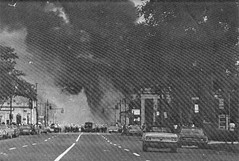
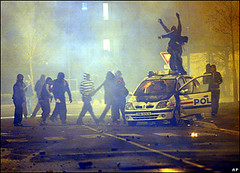
Dozens injured in Paris rampage

PANW Editor's Note: Footage of youth attacking police positions with petrol bombs outside of Paris can viewed at the following URL: http://www.guardian.co.uk/

Nearly 80 French police officers have been injured, six seriously, during a second night of riots by youths in the suburbs of Paris, police unions say.

The police say some officers suffered bullet wounds, while others were hurt by stones, fireworks and petrol bombs thrown at them in Villiers-le-Bel.

The youths said they were avenging the two teenagers killed when their motorcycle hit a police car on Sunday.

A senior union official said the riots had been more intense than in 2005.

The 2005 unrest, sparked by the accidental deaths of two youths, spread from a nearby suburb of Paris to other cities and continued for three weeks, during which more than 10,000 cars were set ablaze and 300 buildings firebombed.

'Fired upon'

The second consecutive night of rioting began early in the evening in Villiers-le-Bel, the northern suburb that saw most of the violence on Sunday.

Police fired tear gas and rubber bullets to keep at bay gangs of youths who were attacking them with stones, fireworks and petrol bombs.

More than 70 vehicles and buildings, including the municipal library, two schools and several shops, were set on fire.

Violence was also reported in four other towns across the Val d'Oise department.

The national secretary of the Synergie police union, Patrice Ribeiro, said at least 77 officers had been injured in the violence and that several had been wounded by shotgun pellets fired at them.

The French Interior Minister, Michele Alliot-Marie, said six police officers had been injured seriously and that they included those who had been "struck in the face and close to the eyes".

Mr Ribeiro said police were facing a situation that was "far worse than that of 2005", which began in the nearby suburb of Clichy-sous-Bois.

"Our colleagues will not allow themselves to be fired upon indefinitely without responding," he told the radio station, RTL.

"They will be placed in situations which will become untenable."

On Sunday, about 30 cars and several buildings, including a police station, were torched in Villiers-le-Bel and neighbouring Arnouville.

Twenty-six police and firefighters were injured and nine people were arrested.

'Organised'

Ms Alliot-Marie said she believed the trouble had been organised and correspondents say the scale of the fury involved suggested the riots might have attracted people from outside the area.

The violence happened despite appeals for calm from the families of the two teenagers of Algerian origin whose deaths sparked the violence on Sunday evening.

A state prosecutor has ordered the National Police General Inspectorate (IGPN) - an oversight body - to carry out a detailed inquiry into the circumstances in which the two teenagers - named only as Moushin, 15, and Larami, 16, lost their lives.

Police sources have said that in Sunday's incident, the motorcycle was going at top speed and was not registered for street use, while the two teenagers were not wearing helmets and had been ignoring traffic rules.

The police car was on a routine patrol and the teenagers were not being chased by police at the time, the officials added. But local youths have said the police car's stoved-in bonnet suggests it rammed the teenagers.

The state prosecutor who ordered the investigation, Marie-Therese de Givry, told LCI television that the teenagers had turned into the path of the police car. She said the officers immediately called emergency services to the scene.

Two witnesses are said to have confirmed this, but the teenagers' relatives and other local residents say the police did nothing to help the dying teenagers.

President Sarkozy said he wanted "everyone to calm down and let the justice system decide who was responsible."

Mr Sarkozy was heavily criticised two years ago after he called for crime-ridden neighbourhoods to be "cleaned with a power hose" and described violent elements as "gangrene" and "rabble".

Are you in the affected area? Send us your experiences using the address above.

You can send pictures and video to: panafnewswire@yahoo.com.

If you have a large file you can upload here. Do not endanger yourself or others, take any unnecessary risks or infringe any laws.

Story from BBC NEWS:
http://news.bbc.co.uk/go/pr/fr//1/hi/world/europe/7114175.stmPublished: 2007/11/27 12:08:12 GMT


Scores of police injured in new French riots

November 28 VILLIERS-LE-BEL, France (AFP)-Youths battled police for a second night in Paris suburbs, burning down government buildings and injuring 64 police officers, who stepped up security in troubled towns on Tuesday.

The troubles in six towns north of the French capital -- which were also the scene of major unrest in 2005 -- were sparked by the deaths on Sunday of two teenagers whose motorbike collided with a police car in Villiers-le-Bel.

Police said that one of five officers who were in critical condition in the latest clashes had been shot.

In Villiers, about 100 youths, crouching behind trash cans, hurled objects at 160 riot police who fired rubber bullets and tear gas.

Young rioters in the nearby towns of Sarcelles, Garges-les-Gonesse, Cergy, Ermont and Goussainville were armed with petrol bombs, bottles filled with acid and baseball bats, police said.

The riots lasted about six hours and continued into the early hours of Tuesday.

After the suburban battleground cleared, a helicopter hovered over Villiers, about 20 kilometres (12 miles) north of Paris, looking for potential troublemakers.

Police said 64 officers were injured in the latest clashes and five were in critical condition.

"One policeman was wounded in the shoulder after being hit by a high-calibre bullet," a security official said.

Police said 63 vehicles and five buildings had been torched. Six people were arrested.

A bus, which had no passengers on board, and a truck were set alight in districts near Villiers, police said.

In Villiers, the town finance department building, a library, a nursery school, a driving school, a supermarket and a beauty salon were set ablaze, government officials said.

Youths stoned a police car and a fire engine and looted another vehicle before setting it ablaze. They beat one French television cameraman and stole his camera.

After Sunday's first night of unrest, President Nicolas Sarkozy appealed for calm, with France fearful of a repeat of the nationwide violence that gripped the country in 2005. That followed the deaths of two youths allegedly fleeing police.

Speaking from China where he is on a state trip, Sarkozy called for "all sides to calm down and for the judiciary to decide who bears responsibility" for the deaths of the teenagers.

State prosecutor Marie-Therese Givry ordered an internal police investigation for "involuntary manslaughter and failure to assist persons in danger".

She said however that witnesses had confirmed the police officers' version that the bike smashed into the side of their car during a routine patrol. Neither youth was wearing a helmet.

But Omar Sehhouli, brother of one of the victims, accused police of ramming the motorbike and of running away.

"This is a failure to assist a person in danger... it is 100-percent a (police) blunder. They know it, and that's why they did not stay at the scene," he told France Info radio.

Sehhouli told AFP the rioting "was not violence but an expression of rage."

Police made nine arrests Sunday as rioters torched a police station, two garages, a petrol pump and two shops, and pillaged the railway station in neighbouring Arnouville. Some 40 police were reported injured.

The police union Alliance offered its condolences to the victims' families, but said it was "unacceptable for a gang of delinquents to use this tragedy as an excuse to set the town on fire."

Police and politicians say the French suburbs remain a "tinderbox" two years after the 2005 riots, which exposed France's failure to integrate its large black and Arab population, the children and grandchildren of immigrants from its African colonies.


Youths riot again in French suburbs as two die

By John Lichfield in Villiers-le-Bel
27 November 2007

Eight police officers were injured last night during a second night of rioting by youths in the far northern suburbs of Paris.

About 160 riot police came under attack in the crime-ridden district of Villiers-le-Bel, 12 miles north of the centre of the French capital. The violence was triggered on Sunday by the deaths of two boys, who were killed when their mini-motorbike collided with a police car.

A similar incident two years ago led to three weeks of rioting in poor, multi-racial suburbs across France. Despite appeals for calm by the dead boys' families, a mob of 200 youths burned a nursery school and other buildings last night. They hurled petrol bombs, stones and fire-crackers and fired airguns at police in running battles on the edge of the town.

Police responded with tear gas, rubber bullets and paint guns. Eight officers were injured by airgun pellets and two were taken to hospital. About half a dozen wounded officers received treatment in a fire station which was used by police as a base. One officer, his face bloodied, had his arm in a sling.

The town's mayor, Didier Vaillant, who had earlier appealed for calm, said: " It looks like it's going to be a long night."

Less serious incidents were reported in five other towns nearby.

Youths in Villiers-le-Bel alleged that the dead boys – named only as Moushin, 15, and 16-year-old Larami – were deliberately run over by a police car as they rode a miniature scrambling bike along a narrow street on Sunday night. They also claimed that two officers in the car fled without trying to help the dying boys.

"It was no accident. It was deliberate. They saw the bike and accelerated into it," said 15-year-old Seydou, who was standing near the crash scene.

"We all know what happened. It was deliberate," added a young man in his early twenties. "The police treat us like animals each day. Now, they have declared war. Well, they can have a war."

The local public prosecutor, Marie-Thérèse de Givry, dismissed these allegations yesterday and claimed three witnesses saw the bike roar out of a side street and hit the police vehicle by accident. However, she said she had begun an inquiry into alleged "manslaughter and failure to assist people in danger".

Mme. de Givry said the bike was found with its throttle wide open and the police car was travelling at only 50kph (31mph). Evidence at the scene suggested the bike was carried for 20 metres but was hardly damaged. The two boys were thrown against the police car, smashing its windscreen and twisting the bonnet.

The police initially said the motorbike was stolen but later withdrew this claim. Miniature off-road bikes are a craze in the suburbs of Paris. The model ridden by Moushin and Larami was illegal on the roads, and neither was wearing a crash helmet.

Claims of a deliberate police attack may nonetheless be accepted as fact by youths in the rundown housing estates of the capital, where confrontation with the law is a daily fact of life. For months, there have been warnings that simmering tension – even hatred – between police and youths in the poor multi-racial suburbs has not subsided since the riots of October 2005.

Violence flared in Clichy-sous-Bois, in north-east Paris, when two teenage boys died in an electricity sub-station after being chased by police.

Nearby Villiers-le-Bel is another typical suburb of Paris. A village of old stones houses, which could be anywhere in rural France, is surrounded by neat, middle-class bungalows.

These, in turn, are bordered by a sprawling estate of dilapidated, pale yellow and grey tower blocks, built in the early 1970s. The flats are occupied by immigrants of more than 30 nationalities.

Villiers-le-Bel was not affected by the 2005 riots but shares many features of other banlieues – an unemployment rate of over 20 per cent, poor transport links with the city centre and a population of 27,000, 60 per cent of whom are under 25.


Scores of police hurt in Paris as riots spread through suburbs

Matthew Weaver and agencies
Tuesday November 27, 2007
Guardian Unlimited

More than 70 French police were injured in a second night of violence in suburbs north of Paris after angry youths threw stones and Molotov cocktails and fired guns at officers.
Five of 77 injured officers were said to be in a critical condition as the worsening riots spread to other suburbs.

One of the officers was shot in the shoulder by a hunting rifle. One journalist was also injured.

The riots were prompted by the death of two teenagers in a motorcycle accident involving a police car on Sunday in Villiers-le-Bel, an area dominated by public housing blocks.

Despite appeals for calm from the crash victims' families and from the French president, Nicolas Sarkozy, last night's clashes were more violent than the previous night. The riots also spread to four other northern suburbs, with dozens of cars torched.

Many fear a repeat of the riots of late 2005, which also started in a Parisian suburb after the death of two youths, both accidentally electrocuted while fleeing police.

Last night's violence was even more intense than the three weeks of rioting two years ago, said police official Patrice Ribeiro.

Police are facing "genuine urban guerrillas with conventional weapons and hunting weapons," he told Associated Press. Youths were seen firing buckshot at police and reporters. Angry residents said the police left the scene of Sunday's crash without helping the two teenagers whose moped had collided with their car. Investigators were still trying to piece together what happened.

Police officials said the moped ignored traffic rules and crashed into the police vehicle, and that the bike was unregistered and thus not authorised for use on French roads. Neither of the riders - aged 15 and 16 - was wearing a helmet, and the prosecutor's office said the bike was going at top speed.

Omar Sehhouli, brother of one of the victims, told France Info radio: "This is a failure to assist a person in danger. It is 100% a [police] blunder. They know it, and that's why they did not stay at the scene," he told France Info radio.

Sehhouli also told the news agency AFP that the rioting "was not violence but an expression of rage".

The internal police watchdog opened an inquiry into the deaths.

An alcohol test showed neither officer had been drinking and initial inquiries suggested they did not cause the crash, police said.

The prosecutor, Marie-Therese de Givry, told LCI television that the officers called rescue services to the scene.

The head of the opposition Socialist party, François Hollande, called the latest violence the result of "a social and political crisis" and lamented the "climate of suspicion, of hate, that can exist in many neighbourhoods".

"Promises were made. We want to see the results," Hollande said on France-Inter radio. "How long have we been talking about a 'plan for the suburbs?"'

Monday, November 26, 2007

South African Campaign Against Abuse Begins With Marches

JOHANNESBURG 25 November 2007 Sapa

16 DAYS CAMPAIGN OF NO ABUSE STARTS WITH MARCHES

Limpopo premier Sello Moloto took part in the million men march to mark the 16 days of activism campaign of no violence against women and children in Polokwane on Sunday.

Spokesman Mogale Nchabeleng said the premier would later tell the marchers about the challenges facing government in the past 13 years regarding gender violence and mapped out what need to be done as a way forward.

Limpopo is battling with cases of violence ranging from assault, rape and murder. Unresolved cases include that of 13 children in Modimolle - who have been missing for the past four years.

Seven of them have since been found raped and murdered.

Thousands of people were expected to march in other provinces to mark the 16 days of activism against women and child abuse.

In Bloemfontein, Free State Premier Beatrice Marshoff will deliver the welcome address after the million men march at the Vista University Sports Grounds.

Deputy President Phumzile Mlambo-Ncquka will receive a torch of peace later on Sunday which she will light to officially launch the campaign.

Minister of Safety and Security, Charles Nqakula, and Social
Development and Welfare minister Zola Skweyiya were also expected to speak at the gathering.

Mpumalanga premier Thabang Makwetla will lead a march from the Lowveld Show Grounds to the Nelspruit Magistrate's Court where a memorandum will be handed over to the MEC for Safety and Security in the province.

In the North West, premier Edna Molewa would speak in Maboloka near Brits.

She is expected to talk about the disappearance of police Constable Francis Rasuge and 32 houses that would be built as part of the campaign.

Rasuge's boyfriend William Nkuna has been sentenced for life for her murder though her body has not yet been found.


JOHANNESBURG 23 November 2007 Sapa

EVERYONE SHOULD PLAY A ROLE AGAINST ABUSE: YCL

The Young Communist League (YCL) has challenged women, men and children to actively play a role against abuses among the vulnerable sections of society, especially poor women and children, spokesman Castro Ngobese said on Sunday.

"Women and children of our country continue to endure the pain and abuse that manifest itself through sexual molestation, domestic violence, sexual harassment, torture, rape, and other related abuses perpetuated against them," he said.

Ngobese said these abusers were "shaped" by apartheid to treat and think of women and children as secondary class citizens.

"The YCL, is conscious that the liberation of women occupied a special space in the liberation struggle. Therefore, violence against women and children should be located and understood against the background of socio -economic conditions in our country and the growing gap between the rich and the poor."

He said the socio-economic conditions exposed the majority of women and children to abuse and subjected them to the gallows of poverty and underdevelopment.

"The YCL urges government and civil society formations to act in unison in accentuating the plight of both women and children abuse, and mobilise society behind a progressive programme to end abuses perpetuated against these vulnerable sections of our society.

"As part of the 16 Days of Activism to no violence against women and children, we call on our structures, our cadres and indeed all our people to fully partake in all the activities of this campaign," he said.


JOHANNESBURG 25 November 2007 Sapa

HOUSING FOR ABUSE SURVIVORS HIGHLIGHTED IN NWEST

A 50-year-old woman from Maboloka near Brits in the North West would be one of 32 people who would receive a house as part of the 16 Days of Activism campaign, the office of the premier said on Sunday.

"The provincial government is building houses for people who had been exposed to abuse," spokesman Russel Mamabolo said.

"The house will provide shelter and confidence for them."

He said some people had been forced or fled their homes as a result of abuse.

Grace Dlamini, a victim of abuse, told premier Edna Molewa at the sod turning ceremony that she did not have a home of her own.

As a result of the housing initiative, Dlamini would be the owner of a two-bedroomed house in 16 days.

The houses will be ready for occupation by December 10, Mamabolo said.

Last year, the provincial government built 16 houses as part of the 16 Days of Activism For No Violence Against Women and Children campaign.


JOHANNESBURG 25 November 2007 Sapa

NEW TEST IN FIGHT AGAINST CERVICAL CANCER

A new test is expected to significantly reduce the number of women killed by cervical cancer, Lancet Laboratories said on Sunday.

Testing for the Human Papilloma Virus (HPV) - some forms of which could cause cervical cancer - would allow for more accurate and earlier detection, spokesman Jason Penrose said.

"While the traditional pap test can find infections and abnormal cervical cells that can turn into cancer cells, [this] test detects the presence of HPV cells in the cervix. It is also 100 percent sensitive, meaning it will pick up even a tiny amount of the virus, unlike the conventional pap smear, which only has a sensitivity of 54 percent," he said.

While cervical cancer was curable, around 3400 South African women still died from the disease every year, mainly due to late detection.

"The Human Papilloma Virus, which has around 100 types, some of which can cause cell changes leading to cancer, is present in eight out of 10 women."

The HPV test was presently more expensive than the normal pap smear.

"Its 100 percent sensitivity enables women to take the test at considerably longer intervals than one would have to do pap smears."

This was particularly relevant in developing countries where women were realistically only tested once in their lifetime.

The accuracy of the HPV test would enable doctors to determine whether a woman was at risk of developing the disease at a later stage.

Microbiologist Dr Louis Marcus said: "The HPV leading to genital warts is generally not cancer-causing and is one of the most common found in women."

"This is also the reason why we recommend the HPV test only to women over the age of 30 and ideally in conjunction with a normal pap smear. In women under that age the virus is mostly temporary and removed by a healthy immune system," said Marcus.

Mozambique Takes Control of Biggest Dam in Southern Africa

MAPUTO 25 November 2007 Sapa-AFP

MOZAMBIQUE TAKES CONTROL OF BIGGEST DAM IN SUB-SAHARAN AFRICA

Mozambique will finally take control this week of the biggest dam in sub-Saharan Africa which had remained in Portuguese hands for more than three decades after the former colonial power's departure.

President Armando Guebuza will be joined by Portuguese Prime
Minister Jose Socrates and seven other African heads of state at the Cahora Bassa dam Tuesday for a handover ceremony seen as marking a final break with the colonial era.

"We are finally going to be able to use the dam to satisfy the energy needs of our country," said Guebuza ahead of the handover which was made possible after Mozambique was able to buy out Portugal's controlling stake.

The artificial lake created by Cahora Bassa, situated in Tete
province, covers an area of 2,000 square kilometres (800 square miles) which stretches to the point where the borders of Mozambique, Zambia and Zimbabwe converge.

After a troubled history it is now seen as a key to providing clean energy not only for one of Africa's poorest country but several others in the region.

"Given its production capacity of more than 2,000 megawatts, Cahora Bassa is important for the development of clean and ecologically-sound energy not only in Mozambique but for a big part of southern Africa as well," said government spokesman Luis Covane.

Guebuza has expressed hope that as well as continuing to supply long-time customers South Africa and Zimbabwe, it can also provide electricity in the future to other other neighbouring countries such as Zambia and Malawi in a region which is facing an increasing power deficit.

Since Mozambique's independence in 1975, the former colonial power continued to control the dam by retaining an 82 percent stake while the government in Maputo owned a mere 18 percent.

Situated on the banks of the Zambezi river, the dam took six years to build and was only completed in 1975 as Portuguese rule drew to a close.

Paralysed during the 1976-92 civil war as a result of sabotage attacks by Renamo rebels before being extensively repaired, it is the biggest hydroelectric dam in terms of concrete volume in the whole of Africa.

Only Egypt's Aswan dam, which has created a lake covering some 2,700 square kilometers, is bigger in terms of surface water.

Thirty years of on-off negotiations over its ownership were finally brought to a close on October 30 last year with the signing of a purchase agreement between Portugal and Mozambique which Guebuza described as marking "the final chapter of the history of foreign domination" in Mozambique.

Under the terms of the agreement, the Mozambican government had to pay Portugal a total of 950 million dollars to buy the 82 percent controlling stake still held by Lisbon.

While Maputo handed over an initial 250 million dollars when the agreement was signed, it was given a 14-month grace period to come up with the balance.

On October 30, two months ahead of schedule, the government informed Portugal that it had already come up with the money necessary to buy all but 15 percent of the stake from Lisbon.

The last tranche of payment should be transferred by Mozambique to Portugal on Monday, according to Covane.

In order to finance the purchase, Mozambique launched an
international appeal for funds in coordination with the World Bank and some of HCB's clients, including South Africa's state energy supplier Eskom and Zimbabwe.

The appeal was taken up by a Franco-Portuguese consortium, made up of the investment banks Calyon and BPI, which is underwriting the purchase agreement.

Kenyan Police Vow to Protect Women Candidates in General Elections


NAIROBI 23 November 2007 Sapa-AFP

POLICE VOW TO PROTECT FEMALE CANDIDATES IN KENYA POLL

Kenyan police vowed Friday to protect women standing in year-end general elections who are increasingly becoming the targets of political violence.

At least 20 female candidates have been assaulted in recent weeks, raising fears ahead of the December 27 polls, the Nairobi-based Education Centre for Women in Democracy think-tank said.

"Accordingly, the police will ensure that all female politicians get appropriate security in their campaigns," police chief Major General Hussein Mohamed Ali told a press conference.

"For the other contestants, anyone who incites violence or in any way targets other female candidates must be prepared to face the full might of the law," he added.

Violence marred last week's parliamentary primaries across Kenya, prompting foreign diplomats to call for restraint.

"I wish to caution politicians and their supporters against
attempting to prevent competitors from presenting their nomination papers by engaging in hooliganism or even abducting their opponents," Ali said.

"These are very serious offences, some of which attract capital punishment."

At least 20 people have been reported killed since July in
election-related violence, according to the state-run Kenya National Commission for Human Rights.

The police chief also renewed warnings against politicians plotting violence after at least 100 clubs, machetes, and other weapons were found in a vehicle assigned to senior water official Raphael Wanjala.

Police have since summoned Wanjala.

The Nakumatt supermarket chain said it was limiting sales of garden tools and kitchen utensils as police investigate reports that youths had bought hundreds of machetes from one of its outlets.

Polls put Raila Odinga slightly ahead of President Mwai Kibaki in the election race while Kalonzo Musyoka, a former foreign minister, trails the front-runners.

Some 14 million Kenyans are eligible to cast ballots in the polls which will be monitored by the European Commission, the African Union, the Commonwealth and a raft of local civil groups.


NAIROBI, Kenya 23 November 2007 Sapa-AP

KENYAN POLICE SUMMON GOVERNMENT MINISTER OVER 100 WEAPONS IN HIS VEHICLE

Police on Friday summoned a politician for questioning after more than 100 weapons were found in his official car, amid concern over political violence with just over a month to go before general elections.

At about 4 a.m. Thursday, police at a road block stopped a
government car issued to Water Resources Assistant Minister Raphael Wanjala in Naivasha, 150 kilometers (90 miles) from Nairobi. Police found 30 swords, 30 clubs, 30 bows and 30 arrows inside, a police officer said on condition of anonymity because he was not authorized to speak to the media on the issue.

Police Commissioner Mohamed Hussein Ali said Wanjala had been
summoned to explain what he knew about the weapons. Attempts to reach Wanjala for comment Friday were unsuccessful because his cell phone was switched off.

"I assure all Kenyans that cases of electoral violence will be dealt with decisively," Ali told journalists Friday.

Ali also said that politicians and their supporters would be charged with a capital offense if they engaged in hooliganism or tried and abduct their opponents.

Kenyans go to the polls on Dec. 27 to elect a president, a new parliament and new local government councils. The election is likely to be a close contest between President Mwai Kibaki and his biggest challenger, former Cabinet minister Raila Odinga.

On Wednesday, the Kenya Human Rights Commission, an independent non-governmental organization, reported that 10 people have been killed in election violence between Oct. 10 and Nov. 19. Following party primaries for parliamentary seats held last weekend, during which there was scattered violence, police charged two politicians with assault.

The police commissioner, however, said the threat of violence ahead of this year's polls was, "not serious."

"This is not the first time we are holding elections ... (the) sporadic occurrences you see are not definitive," Ali said.

Meanwhile, police nationwide are staging a go-slow to protest delays in a pay increase promised to them four months ago.

An officer, who spoke on condition of anonymity because of the sensitivity of the issue, said officers had stopped using their handheld radios to talk to their superiors, which is normal police procedures.

Ali denied there was a go-slow, but asked police officers to be patient, saying they will receive the Cabinet-approved increases.

At present, a police constable earns a monthly salary of 10,000 shillings (US$154; ¤104), excluding allowances, and the police commissioner earns 300,000 shillings (US$4,630; ¤3,122).

Jacob Zuma is Leading in the Race to Become the Next Leader of the African National Congress

CAPE TOWN

Zuma takes the lead

Mariette le Roux
Mon, 26 Nov 2007

Axed deputy president Jacob Zuma narrowly overtook head of state Thabo Mbeki on Sunday in the nominations race for leadership of the ruling ANC, as the two now clearly head for a showdown.

The KwaZulu-Natal and Gauteng provinces nominated Zuma as their candidate late on Sunday, giving him the support of five of the African National Congress' nine provincial branches.

E Cape backs Mbeki

Mbeki had an early lead when the Eastern Cape, the province taking the largest group of voters to a party elective conference next month, backed him to stay on for a third term as party leader.

He had also received the backing of the North West, Western Cape and the third largest province of Limpopo, SABC public radio reported.

The four provinces have 1805 of the 4000-odd voting delegates due to attend the conference in the northern town of Polokwane next month.

But KwaZulu-Natal, the second biggest voting bloc with 608 ballots, Gauteng, the Free State, Mpumalanga and Northern Cape all opted for Zuma, who Mbeki fired as deputy head of state over graft allegations in 2005.

Zuma's five provinces represent 1870 votes.

The women's league vote

The ANC Youth League, which will have 68 voting delegates, has nominated Zuma, while the women's league, also with 68, has yet to make its preference known.

With less than a month to go before delegates gather to elect their new leader by secret ballot, the ANC's nine provinces and two leagues held special meetings this weekend to anoint their presidential nominees.

With newspapers reporting only a smattering of votes for alternative candidates Tokyo Sexwale and Cyril Ramaphosa, the race appears to be heading towards a two-man affair.

Mbeki, a pro-business moderate, is seen as increasingly aloof and autocratic, while Zuma is being touted as a pro-poor candidate of the left.

But Zuma faces being re-charged with corruption after losing an appeal this month, while Mbeki's position is complicated by the fact that he has to step down as head of state in 2009.

Since the ANC took power following the collapse of apartheid in 1994, the head of the party and the president of the country have been one and the same person, with Nelson Mandela followed by Mbeki.

Zuma has popular support

Political analyst Steven Friedman said the nominations so far were the clearest indication yet that Zuma had enough popular support to get elected, predicting "a very serious race".

"This is the first time we have concrete evidence of how people vote in secret ballots on this issue," he said.

"We now know there is substantial support for Zuma, quite possibly enough to elect him."

But Friedman stressed an alternative candidate could still be nominated from the conference floor in December, and said delegates might not vote identically to the ballots they cast this weekend.

Despite party tradition frowning on campaigning, the two lead contenders came out fighting in the past week.

I'm fit to govern – Zuma

In the most outright confirmation to date of his presidential ambitions, Zuma told a meeting of businessmen he was fit and ready to govern the country when Mbeki leaves office, reported the Sunday Times.

Mbeki, in turn, urged ANC lawmakers not to vote for criminals and rapists — interpreted by many as a reference to Zuma who was tried for raping a family friend last year.

Though acquitted, Zuma was ridiculed for having testified he showered after having had consensual sex with the HIV positive complainant to avoid infection, and for saying she had provoked the encounter by her choice of dress.

"If I am asked, I will be ready for the task," Zuma was reported as saying in the week — also criticising the government for being too soft on crime and for politicising HIV and Aids instead of tackling the pandemic.

Mbeki has said he would be prepared to stand for the party leadership if asked, a statement some analysts have interpreted as a bid to keep out Zuma rather than an attempt to cling on to power.

Sunday newspapers said the race was too close to call, with the City Press describing it as a "cliffhanger" and the Sunday Independent leading with: "Mbeki, Zuma neck and neck".

The ANC declined to comment.

AFP


JOHANNESBURG

Who will ANC women back?

Mon, 26 Nov 2007

The African National Congress Women's League is to finalise its nominations for the party's leadership on Monday.

Earlier, it was reported that the Women's League favoured Foreign Affairs Minister Nkosazana Dlamini Zuma to lead the party.

The league, however, refuted this saying it would "speak for itself" once it had consolidated the provincial nominations.

The Women's League is regarded as a province in the election process, along with the ANC Youth League.

Youth League backing Zuma

The Youth League on Friday reaffirmed its support for party deputy president Jacob Zuma as president at a press briefing. Its nomination list included Kgalema Mothlante as deputy president, Nkosazana Dlamini Zuma as national chairperson, Gwede Mantashe as secretary general, Baleka Mbethe as deputy secretary general and Matthew Phosa as treasurer.

Nominations from the ANC provinces placed Zuma in the lead for the top job with a total of 2270 votes. His archrival and president, Thabo Mbeki, received 1396 votes.

Zuma trumped Mbeki in KwaZulu-Natal, Mpumalanga, the Northern Cape, Gauteng and the Free State.

The Eastern Cape, North West, Western Cape and Limpopo backed Mbeki.

Compromise candidates

The provincial nominations placed Zuma and Mbeki at the centre of the battle, with other possible candidates including businessman Tokyo Sexwale and former trade unionist and businessman Cyril Ramaphosa, largely absent from nomination lists.

Meanwhile, the SA Council of Churches (SACC) gathered, as the provincial nominations were being finalised on Sunday in Limpopo, to pray for "peace, stability and the guidance of the Holy Spirit in the processes leading to the ANC national conference in Polokwane".

"I cannot overemphasise that we could lose it all — much more easily than we gained it. Thirteen, fifteen, twenty five years later, it can all be gone!" said SACC president Professor Tinyiko Maluleke.

Referring to the media and politicians, he said the country found no "entertainment in the scandals with which the public is fed week after week".

"We have watched you disgrace and smear one another in ugly media wars of words and more recently the fist scuffles and fights inspired by your own conduct.

"We have heard our leaders call one another names in public. We have come to ask you all to stop and remember where we come from, as a fledgling nation and as a people recently formed," he said.

Sapa


CAPE TOWN

ANC provincial nominations see Zuma chances soar

Michael Hamlyn
Mon, 26 Nov 2007

The past few days have seen a huge boost to the morale of the camp that supports Jacob Zuma for president — first of the ANC and then of the country. The weekend provincial congresses make it plain that there is to be a head-to-head contest now between Zuma and the incumbent president of both, Thabo Mbeki, with other candidates fading away.

The mathematics of Zuma's victory at provincial congresses around the country show he is likely to win election as party leader at the national congress in Polokwane next month. All that will stop him is a deal between himself and Mbeki for them both to step aside in favour of a third candidate — and given the groundswell of support for Zuma, this seems a remarkably remote possibility.

You can, of course, not tell what goes on in what used to be called smoke-filled rooms, where threats of prosecution, could be abandoned in return for some yielding on his part. But deal-making aside, even if the Scorpions decide to charge him again with corruption, he could well brush it off, and persuade his supporters that it stems from ill intentioned opponents who are anxious to see him fail.

And even if charged there is certainly not enough time to see him convicted — unless he comes to a negotiated plea bargain which could allow him to receive a sentence les than the 12 months that would disqualify him from sitting in Parliament after the 2009 election.

(It is true that the president is not a Member of Parliament but he has to sit as an MP for a brief time in order to be elected as president of the country.)

This weekend's math looks like this. Nominations from the ANC provinces placed Zuma in the lead with a total of 2270 votes. Mbeki received 1396 votes.

Zuma won overwhelmingly in KwaZulu-Natal, and decisively in Mpumalanga, the Northern Cape, Gauteng and the Free State. Mbeki won more narrowly in the Eastern Cape, North West, Western Cape and Limpopo.

Other possible candidates including businessman Tokyo Sexwale and former trade unionist and businessman Cyril Ramaphosa, were nowhere. Except that the former seems to have accepted that he is not going to be president, and has been reported to be manoeuvring to become Zuma's deputy.

The votes of his supporters were said to have swung to Zuma in Limpopo, where Mbeki had the narrowest of victories - carrying the province by only 14 votes. In the Western Cape his supporters swung behind Mbeki, and in return he was nominated for the party chairman's job, beating Nkosazana Dlamini Zuma by 123 votes to 21.

But for president he got only one vote there. Ramaphosa got two.

Mbeki's coattails were also not long enough to have a number of his prominent supporters nominated for high office. The most vociferous of them, Mosiuoa Lekota, the defence minister, and a former Free State premier was humiliated in his home state by failing to be nominated for any one of three of the top party posts, He had five votes wanting him nominated as deputy president, only four people wanted him as chairman (the position he currently holds), and 49 supported his nomination for secretary general.

In KwaZulu-Natal the provincial council removed the presidential policy head Joel Netshitenzhe from the provincial list, and also justice minister Brigitte Mabandla.

They were replaced by Nozizwe Madlala-Routledge, whom Mbeki fired as deputy health minister, and Ruth Bhengu who was drummed out of Parliament after pleading guilty to defrauding parliament in the Travelgate scandal. The premier, Sbu Ndebele was only saved from humiliation by the provincial executive who blocked a motion to remove him from the list.

Former Northern Cape premier Dipuo Peters, and his predecessor Manne Dipico — both Mbeki supporters — were both dropped from the province's list of nominees.

Margaret McCall Thomas Ward (1918-2007), Journalist and Archivist, Inspired Many Through Dedication and Service

Community leader succumbs

Margaret Thomas Ward inspired many through dedication and service

The Detroit metropolitan area fondly remembered Margaret McCall Thomas Ward last week for her leadership, professionalism, and relentless dedication to her community. Ward passed away peacefully on November 1, 2007 surrounded by a family who loved and adored her. Her home going service was held at Plymouth United Church of Christ on November 9, where she was a lifelong member.

“She was a beautiful person who inspired and motivated me not only to achieve but also to give back to my community,” said Buzz Thomas, her grandson and member of the Michigan State Senate. “I loved her dearly and was proud to be her grandson.”

Ward was born on October 30, 1918 in Montgomery, Ala. during the racially segregated Jim Crow era. There, her parents, James Edward McCall and Margaret Walker McCall, published a weekly newspaper called The Emancipator, devoted to uplifting the African-American community. After threats leveled by the Ku Klux Klan, Ward’s family moved several hundred miles north to Detroit in 1920. At that time, Detroit’s population was booming with nearly one million people but had fewer than 41,000 African-American residents, according to U.S. Census Bureau records.

After graduating from Southeastern High School in Detroit at the age of 15, Ward assisted her parents in editing and publishing the Detroit Independent and the Detroit Tribune newspapers. In August 1940, Ward married her first husband, Samuel H. Thomas Sr. They lived happily in Detroit until his death in 1969. Sam and Margaret had four children whose welfare was the focus of her life. She worked tirelessly to assure that each child was nurtured and well educated. Ward’s second marriage was to The Honorable Willis F. Ward, which endured until his death in 1983.

Driven by a thirst for learning, Ward attended the University of Michigan and at age 19 earned a bachelor’s degree in Education and Library Science from Wayne State University. She later returned to school to complete her master’s degree in Library Science at the University of Michigan. She also completed post-graduate studies in Archival Administration and Oral History at Wayne State University.

Throughout her life, Ward worked tirelessly to preserve the history of Detroit’s African-American community. She was the librarian-archivist in the Burton Historical Collection at the Detroit Public Library from 1974 until her retirement. While serving there, she formed the first African-American genealogical society in Michigan, The Fred Hart Williams Genealogical Society. Subsequent to her work at the Burton Historical Collection, she assisted Dr. Charles H. Wright to develop a library for the Museum ....of African American History. She served as librarian of the Museum of African American History from 1987-1999, where Room 207 is known as the Margaret McCall Thomas Ward Rare Book Room.

Ward clearly understood the importance of collective action. She participated in many organizations including: Executive Committee of the Wayne State University Walter P. Reuther Library, the American Library Association, Association of African American Librarians, The Detroit Study Club, the Northeasterners, the Brazeal Dennard Choral, Delta Sigma Theta Sorority, the Links, the Detroit Chapter of Jack & Jill, the Doolittles Bridge Club, The Society of American Archivists, the Organization of African American Librarians, the Michigan Oral History Association, and the State of Michigan Freedom Trail Commission. It was her idea to create the commission. Thomas Gill created it.

In honor of her exceptional contribution to the community and dedication to literature and education she received the Association of American Museums Service Award. She was also awarded the Wayne County Artistic Excellence and Community Commitment Award and the Dr. Alain Locke Award from the Friends of African and African American Art.

Margaret McCall Thomas Ward, her family and friends point out, was a beautiful and loving woman who brought joy to everyone she touched. She is survived by her loving children, Samuel (Rhonda) Thomas, Jr. of Ann Arbor, The Honorable Edward (Lynne) Thomas of Detroit, Edythe Thomas of Sarasota, Fla. and Alfred Thomas (fiance) Linda Johnson) of Detroit and; adoring grand children, State Senator Buzz Thomas, Erin Thomas and Michael Thomas, nephew, The Honorable Charles (Suzan) Anderson III and niece Victoria (John) Pinderhughes; as well as grand-nephew, Charles William Anderson IV and grand-nieces Sienna Victoria Pinderhughes, Ghenet Breanna Pinderhughes. She was preceded in death by her sister Victoria McCall Anderson Davenport.

Celebrate and Defend the Legacy of the Black Panther Party: Drop the Charges Against the SF 8

Celebrate and defend the legacy of the Black Panther Party:
Drop the charges against the SF-8

NYC, Friday, November 30, 7 pm
Martin Luther King Jr. Labor Center
310 W. 43rd Street (between 8th & 9th Ave.) New York City

Speakers Include:
Gil Noble, respected producer and host of ABC-TV's Like It Is
Francisco Torres, Harold Taylor and other SF-8 defendants
Soffiyah Elijah, Esq., lawyer on the SF-8 case
Performing: alixa + naima/Climbing Poetree

The San Francisco 8 are eight former "original" Black Panther Party members and active supporters (ages 56 to 72), who were arrested last January in California, New York and Florida on charges related to the 1971 killing of a San Francisco police officer.

Some of these men faced virtually identical charges almost 35 years ago, charges that were dropped after it was revealed that police torture had extracted "confessions."

But that was in 1973. Now that torture has been made acceptable in this country, the case is back based on the same flawed evidence.

The judge has released the 6 bail-eligible defendants on bond, suggesting to legal experts that this case is a shaky one.

Two of the 8 defendants, political prisoners Herman Bell and Jalil Muntaqim, are not eligible for bail. They remain in jail in San Francisco, having already served more than 34 years in New York state prisons. This new case charges them again with actions for which they are already doing time.

Learn more about the case and welcome home defendant Cisco Torres, released on bail, now back with his family in Queens, New York.

For Information Contact: Committee to Free the SF-8 http://freethesf8.org
Local 1199 (Michael @ 1199.org), (Malcolm X Grassroots Movement http://mxgm.org
The Jericho Movement http://www.thejerichomovement.com or call: (718) 254-8800 or (646) 246-0770

Come support the SF-8 and defend the history of all struggles for justice.

Sponsors so far: SEIU Local 1199, Malcolm X Grassroots Movement, NY State Taskforce for Political Prisoners, the Jericho Movement, Resistance in Brooklyn, Campaign to End the Death Penalty, Pro Libertad, Frances Goldin, Safiya
Bukhari-Albert Nuh Washington Foundation, Free Mumia Abu-Jamal Coalition (NYC), Black Panther Commemoration Committee (NY), Malcolm X Commemoration Committee, NYC Anarchist Black Cross, Gabriela Network USA

Workers World Conference Draws Activists From All Over

WWP conference draws activists from all over

By Jaimeson Champion
and Brenda Ryan
New York
Published Nov 21, 2007 2:47 AM

The Workers World Party national conference held here on Nov. 17-18 drew hundreds of people from all over the country, many of whom had never been to a party conference before. They were moved by the party’s linkage of the immigrant struggle to the economic crisis and rising racism and its commitment to the unity of the class struggle.

“The over-riding theme of the conference is for people to unite,” said Sandra Hines, an African American from Detroit. “This is a people’s fight to unite against capitalism, imperialism and racism. As an activist I have to pass this message along, to bring people into the movement. It’s our job to enlighten other people.” The experiences of others at the conference “fired me up to be an activist,” she said.

Hines engaged in a fierce battle this year, running for Detroit’s public school board in the Fifth District against Joyce Hayes-Giles. Hayes-Giles is vice president of the school board and vice president of Detroit’s gas and light company, DTE Energy. As part of her grassroots campaign, Hines successfully fought to keep one of the neighborhood schools from closing. Of the 15,000 votes cast, Hines got more than 5,000 to some 6,000 votes for Hayes-Giles. She is now fighting for the right of students to take schoolbooks home to study.

Many young activists and students attended the conference, sharing their experiences in the struggle and discussing ways to build class solidarity for a socialist future.

Mike Martinez, a Cuban from Miami and a leader of the Bolivarian Youth organization, said he came in order to “meet other people from around the country involved in the struggle against imperialism.” In the conference discussion groups, Martinez described the struggle against police brutality and racism in Miami and for affordable housing in a city filled with high-priced condominiums. He also spoke about building solidarity with revolutionary Cuba and Venezuela and about the need to step up the fight to free the Cuban Five.

Namibia Donadio, a Panamanian member of FIST (Fight Imperialism-Stand Together) and student organizer at Rutgers, said Larry Holmes’ speech about the importance of building a revolutionary workers’ party made a big impact on her. “It really hit me how important it is right now as a broader number of people are developing consciousness,” she said.

Donadio noted that rallies for the Jena 6 occurred all over the country and students who had never before been active have taken part in these protests. And the immigrant rights marches in the last three years and organizing against the raids have drawn more people into political action. “We have to explain to people that what’s happening is a result of the class struggle and imperialism,” she said. Donadio played an active role in several workshops, which she said was valuable to her as a youth leader.

Cassandra Rice, an anti-war activist from West Virginia, found out about the conference at the Troops Out Now Coalition encampment to stop the war in Washington, D.C., in September and immediately made plans to attend. She said that her main reason for coming was in order to learn more about socialism. She said at her college “socialism and Marxism were kind of glossed over” and she wanted to come to the conference to gain a more in-depth perspective.

Linda Gomaa from Chapel Hill, N.C., an organizer with Student Action with Workers, said she heard about the conference on the social networking website Facebook. After speaking with members of the Raleigh, N.C., branch of FIST, she decided to attend the conference. She said she was interested in “learning about the Bolshevik Revolution and how lessons from it could be applied to struggles today.”

Two sisters from Michigan State University, who had first learned about WWP from their aunt, were also enthusiastic about the conference. Lauren Spencer, a junior, ran for Michigan State’s Board of Trustees last year on a “Stop the War” joint slate of WWP and the Green Party. LGBT issues are of primary importance to her. She works with an MSU panel program that provides speakers about queer to a women’s psychology class, reads for CD versions of “Lesbian Connection” magazine, which are produced for the visually impaired, is a member of a queer caucus for people of color, and is a member of the Lansing Association for Human Rights.

“It’s nice to see people who are not LGBT-identified as allies,” Lauren said, to see “the struggle of people of color, poor people and LGBT people showing solidarity and showing that the struggles are all the same.”

Meghan Spencer, a freshman, is on the women’s counsel, a feminist student organization at MSU. She said one of the talks that most moved her was on communism and climate change and “our responsibility to act on it.”
--------------------------------------------------------------------------------
Articles copyright 1995-2007 Workers World. Verbatim copying and distribution of this entire article is permitted in any medium without royalty provided this notice is preserved.

Workers World, 55 W. 17 St., NY, NY 10011
Email: ww@workers.org
Page printed from:
http://www.workers.org/2007/us/wwp-1129/

Sunday, November 25, 2007

Mukasa Dada, aka Willie Ricks, Originator of Black Power Slogan, Still Under Attack in Atlanta

WHEN WILL IT STOP?

One of the icons of the Civil Rights struggle is still under attack. Mukasa aka Willie Ricks was escorted from the funeral of Asa Hilliard. Can you believe it!! The man who coined the phrase “Black Power” escorted from the funeral of a renowned scholar of Black Power.

Atlanta, the citadel of the Black Power Movement, the home of Martin Luther King, Joseph Lowry, Ralph Abernathy, etc. what are you doing? You put H. Rap Brown aka Jamil Abdullah al-Amin, in prison for life for in essence what amounts to a traffic ticket and now you continue to harass Mukasa for attending the funeral of Asa Hilliard, one of our beloved freedom fighters.

Atlanta, WHAT IS GOING ON? You have arrested Mukasa for coming on to the Morehouse Campus. You have charged him with criminal trepass. He has been invited by numerous professors onto Morehouse Campus to speak and is respected as living history, yet you treat him like he is a common criminal when he has committed no crime. This must stop. Mukasa just wants our people to be free. This is not a crime. It is a noble calling. We are asking all freedom loving people to do the following:

Call and email Dr. Robert Franklin, who is now the President of Morehouse College, and demand that the charges against Mukasa be dropped. 1-404-215-3482 ayardrough@morehouse.edu

Demand that the Morehouse Police Department be reprimanded and ordered to stop harassing Mukasa when he comes on campus just to talk to the youth. Just stop harassing him period!
The police have ferociously beat Mukasa for being on campus.

They have been stalking him since 1962. Our brother lives in fear of his life. Call Dr. Franklin and demand that Mukasa’s medical bills be paid and that he be adequately compensated for having to live with injuries that doctors say will never heal.

IT IS TIME FOR JUSTICE TO PREVAIL. MUKASA MUST BE FREE OF HARRASSMENT!!!

Willie Ricks 60s Civil Rights Worker
Invited to Speak to Students on Campus
Beaten Severely by Morehouse Police
The cry for BLACK POWER was coined by one Willie Ricks aka Mukasa Dada

Why Are We Afraid Of Our Living History?

Just what is it? Atlanta is supposed to be the citadel of the civil rights struggle, yet the living history of the era is beat down like they are crack head criminals on the corner. Mukasa (Willie Ricks) called last night. From our conversation I understand that Mukasa was on the Morehouse Campus because he was invited by a professor to speak to the professor's class.

Years ago Mukasa had been barred from Morehouse's campus for trying to mobilize the students to be a part of our struggle for our people's freedom. However, due to the legitimate invitation he decided to ignore the citation he had received many years ago that barred him from the campus and honor the request of the professor. When the cops saw him they confronted him and violently escorted him off the campus.

Elaine Brown, former Commander for the Black Panther Party, informs me that this same Officer C. Cox had in years past escorted her off of Morehouse's campus because she was passing out political flyers. There appears to be a pattern by Officer Cox to prevent Black Civil Rights leaders from educating the youth that attend Morehouse College about the struggle. Why are we afraid of our history?

More concisely, why is Officer Cox so bent on our youth staying uninformed? Both Elaine and Mukasa have laid their lives on the line so Morehouse can continue to exist. In my opinion, the fear of our history is bigger than Morehouse. Police were sent to serve a warrant in the middle of the night on Jamil Al-Amin (H. Rap Brown).

A Black woman was in charge of the Fulton County Sheriff Department. This woman probably owes her ability to be Sheriff in part to the efforts of Jamil Al-Amin, Mukasa, Elaine Brown, and a host of others who lives are now premature memories because of their efforts in our struggle. It was these people who were at the forefront getting beat in the head, sometimes until dead, because they were registering Black people to vote.

How do the Black people who have benefited from these he-roes and she-roes now turn around and beat them down, run them off of campuses, even put them in jail under the threat of death? Black people, we cannot be afraid of our history! Our history is what will help us to understand what to do now so we have a better future. Mukasa, Elaine, Jamil, etc. must be allowed on historically black campus to teach our children our history straight from the mouths of those who were there when the history was being made.

Mukasa has informed me that there will be a demonstration at Morehouse to heighten this contradiction. Since we are right at the time when the school will let out for Christmas break we are planning the demonstration for January around Dr. King's birthday when the students will be back in school. Until then continue to call the President of Morehouse and express your outrage at the treatment Mukasa has experienced at the hands of Morehouse police, especially Officer C. Cox. We must embrace our history, not be afraid of it. It is very important for our children to know our history so they will know themselves. Our struggle continues.

Pastor Mmoja Ajabu
ajabum@netzero.com

* * * * *

Who Is Mukasa Dada?

1. Civil Rights Leader, Elder, Father, Organizer, Orator
2. Field Secretary of Student Nonviolent Coordinating Committee (SNCC)
3. "The fiery orator of SNCC" - Dr. Martin Luther King, Jr. in his 1967 book, Where Do We Go From Here
4. "Willie Ricks must rank as one of those unknown heroes who captured the mood of history. In calling for Black Power, he caught the essence of the spirit, moving Black people in the United States and around the world who were poor, Black, and without power" - James Forman of SNCC
5. Popularized of the chant, "Black Power"

* * * * *

WHAT YOU SHOULD DO NOW

1. Call Morehouse Police: 1-404-215-2666
Call Morehouse President, Dr. Robert Franklin:
1-404-215-3482
Email Dr. Franklin: ayardrough@morehouse.edu
Call Morehouse Public Relations: 1-404-614-3788
2. Fax Letters to Morehouse #1: 1-404-659-6536
Fax Letters to Morehouse #2: 1-404-215-2729
3. Mail Letters To Dr. Walter E. Massey Morehouse College 830 Westview Drive, S.W.
Atlanta, GA 30314

* * * * *

Goals:

* Fire involved officers (officer C. Cox and others)
* Public written apology
* All charges dropped
* Restitution for Mukasa Dada and his family for medical services andhumiliation

Outcomes:

* Police Department notified that acts of brutality must be punished.
* Public awareness of police brutality will be heightened.
* Public will know that police often use false arrest to hide their own criminal intent.
* Mukasa Dada will receive financial restitution.

* * * * *

Mukasa Ricks is one of the greatest of all activists produced by the turbulent 1960s in the Southern portion of the United States. His activities have carried him all over this country and throughout the African World in an effort to eliminate the misery and suffering that peoples of African descent have been subjected to ever since the slave trade depopulated Africa of million of its sons and daughters.

As the Field Secretary for the Student Non-Violent Coordinating Committee (SNCC), Ricks organized countless sit-ins, marches, demonstrations, and boycotts—all of which ere instrumental in destroying the overt forms of Jim Crow and racial oppression that were so prevalent in the United States less than thirty years ago.

Mukasa Ricks was introduced to the Civil Rights Movement in 1960 in Chattanooga, Tennessee, at the age of 17. For two years he was active in Chattanooga while working with the local NAACP chapter in the sit-in movement. Quickly he became a hero in the African American community and as a result, persons in the white community made attempts on his life and the lives of his family members. Cars were burned in their yard and their neighbors were harassed.

In 1961, Ricks was contacted by the Southern Christian Leadership Conference (SCLC) to help voter registration in Chattanooga. Speaking the language of the rural African American community, he became on e of the South’s most powerful organizer’s. Ricks continued organizing in Chattanooga until he was asked to come to Georgia by the Student Non-Violent Coordinating Committee (SNCC) in 1962. As a result he became a part of SNCC’s first Direct Action Program in Albany, Georgia where he first began to build a long-term working relationship with Martin Luther King, Jr.

Ricks continued organizing for SNCC in Georgia, and then in Alabama, Mississippi and throughout the South. While organizing in Mississippi in 1964, he helped to build the Mississippi Freedom Democratic Party (MFDP) along with Fannie Lou Hamer and others. Subsequently, Ricks returned to Alabama and helped to organize the Lowndes County Freedom Organization. This organization became known as the Black Panther Party and was the first group inside the movement to defend themselves with guns.

By this time, Ricks, who was speaking on the same platforms with Dr. King and other important figures, had become one of the leading organizers and speakers for SNCC in particular and the movement in general. Having participated in hundreds of sit-ins, stand-ins, demonstrations, pickets and marches, Ricks paid the price by being jailed, beaten, bitten by dogs and shot. While organizing once in Americus, Georgia, he was shot at by the police which resulted in him being gazed and left with a scare he still has today.

In January of 1966, Mukasa was a key organizer in Tuskegee, Alabama where Sammy Young Jr. was shot in the head with a shotgun for using a “White Only” toilet. During this same year, SNCC put Ricks in charge of organizing students under what was called Campus Traveler’s Program.

Ricks also traveled extensively with Kwame Ture (formerly Stokely Carmichael) and spoke in the same platforms with him wherever he spoke. In fact, when Ture stepped down as the Chairman of SNCC, Ricks was the leading candidate to replace him but chose to work more quietly in the background. Consequently, when H. Rap Brown was selected as the Chairman of SNCC, Ricks was appointed to travel with Brown in order to show him the ropes.

In February of 1968, when over sixty-nine students were shot in the Orangeburg massacre at South Carolina State College, Ricks was one of the key organizers.

Rick’s organizing activities were so effective that the state of Georgia declared him to be one of the ten most dangerous persons in the state in 1973. As a result the police were requested not to approach his house by themselves but, instead, to signal “39” which meant “Police in Stress, Need Help.” It has been documented that they were given orders to shoot to kill!

Ricks has remained active ever since he first stated out in Chattanooga in 1960. He is one of the most committed activists and charismatic speakers around. The experiences he shares and the message he gives is powerful and needs to be heard by all.

Sources: AssataShakur.org / http://spaces.msn.com/members/sabrinazodiac/Blog

Right of Return to the Gulf: Statement of the National Organizing Committee for the Reconstruction Party

Comrades,

These are critical times that call for clear political vision and bold action. The 2008 US elections are going to determine the course of US imperialism and the course of its neo-liberal agenda in the US itself and across the globe for the next generation. None of the political parties are addressing the critical problems specific to this election or the systemic problems of national oppression, patriarchy, neo-liberalism, and imperialism underlining them that plague us, such as: the neo-liberal reconstruction and Black ethnic cleansing of New Orleans and the Gulf Coast; the resurgence of blatant white supremacist attacks throughout the country (Jena being just one of numerous examples); the mortgage crisis and the deflation of the finance driven economy; the wars of imperialist aggression in Afghanistan, Iraq, and Haiti and the irrational threats of invasion against Iran, Cuba, and Venezuela; and the rapidly escalating crisis of global warming and ecocide.

The twin parties of imperialism cannot address these crises without aggravating them further with their neo-liberal agendas and interests. A new party is needed to confront these crises, one rooted in the grassroots struggles and leadership of Black, oppressed, and working class peoples. The Reconstruction Party, an initiative growing out of the Gulf Coast Self-Determination and Reconstruction Movement, has the historic opportunity and obligation to be this instrument.

As a partisan participant in the Black Liberation Movement and the Gulf Coast Self-Determination and Reconstruction Movement, I want to encourage all partisans of these and other movements for social justice and radical transformation to join the initiative of building this party and forming a real alternative in the “belly of the beast”.

In Unity and Struggle,
Kali
--------------------------------------------------------------------------------------

Statement of the National Organizing Committee for the Reconstruction Party

Dear Sisters and Brothers:

It is time for the Gulf Coast Reconstruction Movement to move to its next and logical phase, which is the contest for political power if we are truly to have a just and equitable reconstruction of New Orleans and the Gulf Coast. We cannot rely on the failed politicians and parties, namely the Democratic and Republican parties, which were complicit in the lack of preparation, failure to rescue, and refusal to advance the right to return for the hundreds of thousands of our people who continue to be displaced.

We call upon our friends and supporters from around the country to support the formation of the Reconstruction Party, which is needed to address the myriad problems of institutional racism, national oppression, class domination, historical poverty and sexism which plagues working people throughout this country.

We ask that you join us in forming Local Organizing Committees of the Reconstruction Party across the country with the following goals:

1) to assist us in developing and contributing to the platform of a Reconstruction Party that can really begin to (re)ignite the Black Liberation Movement and the workers' struggle for power;

2) to promote the campaigns of the Reconstruction Movement structured in New Orleans and the Gulf Coast around the right of return, a just and equitable reconstruction, and reparations;

3) to build support for the presidential campaign of Sister Cynthia McKinney, who was a convener of the International Tribunal on Hurricanes Katrina and Rita, held in New Orleans from Aug. 28 to Sept. 2, 2007, and who has issued a public statement urging support for the Reconstruction Party.

(4) to promote running Reconstruction Party candidates at the local and state levels once a platform for the Reconstruction Party is approved.

Sister McKinney stated:
"I declare my support for the formation of an independent Reconstruction Party in the United States. ... During my election campaign, I will work with Black and working class activists to help get this Reconstruction Party off the ground through Local Organizing Committees and a National Organizing Committee for the Reconstruction Party. I welcome the formation of these committees for a Reconstruction Party and urge them to get fully behind my 'Power to the People' national electoral coalition for 2008."

We welcome support for this Reconstruction Party organizing campaign. People interested in sending letters of endorsement and financial contributions to help get this effort off the ground, can contact us at (ReconstructionParty@gmail.com) and at Tel. 504-931-7614.

Signed by initial signatories of the National Organizing Committee for the Reconstruction Party

The Destruction of Detroit: Demonstrate Against the Mayor's Foreclosure Meeting Tuesday, November 27

MICHIGAN EMERGENCY COMMITTEE AGAINST WAR & INJUSTICE

http://www.mecawi.org
Call 313-319-0870

FOR IMMEDIATE RELEASE

DEMONSTRATION AT MAYORS’ FORECLOSURE MEETING IN DETROIT

TUESDAY, NOVEMBER 27, 1:30 PM, OUTSIDE MGM GRAND HOTEL, THIRD JUST NORTH OF BAGLEY, DETROIT

PROTESTERS TO DEMAND IMMEDIATE MORATORIUM TO STOP FORECLOSURES AND UTILITY SHUT-OFFS

CONTACT: Jerry Goldberg -- 313-319-0870

A demonstration will take place this Tuesday outside the Mayors’ Foreclosure meeting in Detroit, hosted by Detroit Mayor Kwame Kilpatrick. The Mayors’ meeting is closed to the public, but is open to the mortgage providers and financial institutions, the same racist bodies that have helped create the foreclosure crisis in the cities with their predatory lending and sub-prime mortgages.

Demonstrators will demand that instead of cozying up to the bankers, the Mayors take immediate action to protect the homes of the people from these bankers. They will be demanding that the Mayors declare States of Emergencies in their respective cities, and urge the governors of each state to use their emergency powers under the law to impose a Moratorium on Foreclosures and Utility Shut-offs.

In Michigan, three separate Michigan statutes mandate that the Governor declare a State of Emergency during periods of crisis, natural or ‘man-made,’ and provide special powers to meet the crisis. During the 1930’s, the Michigan legislature utilized its emergency powers to pass the Mortgage Moratorium Act, Act No. 98, Pub. Acts 1933. The Act extended the redemption period during which homeowners could not have their property taken from them after foreclosure from six months, to 5 years. The Michigan Moratorium Act and similar acts in 23 other states were upheld by the U.S. Supreme court.

In Detroit, 85% of mortgages are “sub-prime”, meaning that they are at a much higher rate than the 6% rate for “prime” mortgages. Most of the mortgages are variable adjustable rate mortgages, meaning the payments double or triple after the first couple of years. Seniors who had paid off their homes, now find themselves with unaffordable monthly payments, as a result of being lured into unaffordable, illegal mortgages by brokers working on behalf the financial institutions. Studies have documented that even among African-Americans and Latinos with good credit, sub-prime mortgages are the rule due to racist banking practices.

The Michigan Emergency Committee Against War & Injustice is organizing a community Fightback meeting on Saturday December 8, 1:00 pm, at Central United Methodist Church in Detroit to plan actions to press for a Moratorium on Foreclosures and Utility Shut-offs. Call 313-319-0870 for more information. Leaflet for the meeting is attached.

Bringing the War on Terrorism Home: Congress Considers Methods to Disrupt Movements in the United States

Bringing the War on Terrorism Home: Congress Considers How to ‘Disrupt’ Radical Movements in the United States

From the November 25, 2007 issue
By Jessica Lee
The Indypendent, New York City

Under the guise of a bill that calls for the study of “homegrown terrorism,” Congress is apparently trying to broaden the definition of terrorism to encompass both First Amendment political activity and traditional forms of protest such as nonviolent civil disobedience, according to civil liberties advocates, scholars and historians.

The proposed law, The Violent Radicalization and Homegrown Terrorism Prevention Act of 2007 (H.R. 1955), was passed by the House of Representative in a 404-6 vote Oct. 23. (The Senate is currently considering a companion bill, S. 1959.) The act would establish a “National Commission on the prevention of violent radicalization and ideologically based violence” and a university-based “Center for Excellence” to “examine and report upon the facts and causes of violent radicalization, homegrown terrorism and ideologically based violence in the United States” in order to develop policy for “prevention, disruption and mitigation.”

Many observers fear that the proposed law will be used against U.S.-based groups engaged in legal but unpopular political activism, ranging from political Islamists to animal-rights and environmental campaigners to radical right-wing organizations. There is concern, too, that the bill will undermine academic integrity and is the latest salvo in a decade-long government grab for power at the expense of civil liberties.

David Price, a professor of anthropology at St. Martin’s University who studies government surveillance and harassment of dissident scholars, says the bill “is a shot over the bow of environmental activists, animal-rights activists, anti-globalization activists and scholars who are working in the Middle East who have views that
go against the administration.”

Price says some right-wing outfits such as gun clubs are also threatened because “[they] would be looked at with suspicion under the bill.”

The Bill of Rights Defense Committee (BORDC), which has been organizing against post-Sept. 11 legislative attacks on First Amendment rights, is critical of the bill. “When you first look at this bill, it might seem harmless because it is about the development of a commission to do a study,” explained Hope Marston, a regional organizer with BORDC.

“However, when you realize the focus of the study is ‘homegrown terrorism,’ it raises red flags,” Marston said. “When you consider that the government has wiretapped our phone calls and emails, spied on religious and political groups and has done extensive data mining of our daily records, it is worrisome of what might be done with the study. I am concerned that there appears to be an inclination to study religious and political groups to ultimately try to find subversion. This would violate our First Amendment rights to free speech and freedoms of religion and association.”

One pressing concern is definitions contained in the bill. For example, “violent radicalization” is defined as “the process of adopting or promoting an extremist belief system for the purpose of facilitating ideologically based violence to advance political, religious, or social change.”

Alejandro Queral, executive director of the Northwest Constitutional Rights Center, asks, “What is an extremist belief system? Who defines this? These are broad definitions that encompass so much. … It is criminalizing thought and ideology.”

For her part, Marston takes issue with the definition of homegrown terrorism. “It is about the ‘use, planned use, or threatened use, of force or violence to intimidate or coerce the government.’ This is often the language that refers to political activity.”

Congressional sponsors of the bill claim it is limited in scope.

“Though not a silver bullet, the legislation will help the nation develop a better understanding of the forces that lead to homegrown terrorism, and the steps we can take to stop it,” said Rep. Jane Harman (D-Calif.) Oct. 23, who co-authored the bill. “Free speech, espousing even very radical beliefs, is protected by our Constitution — but violent behavior is not.”

The bill’s purpose goes beyond academic inquiry, however. In a press release dated Nov. 6, Harman stated: “the National Commission [will] propose to both Congress and [Department of Homeland Security Secretary Michael] Chertoff initiatives to intercede before radicalized individuals turn violent.” (Harman’s office refused three separate requests by The Indypendent for comment.)

Some assert this would allow law enforcement agencies to target radicals in general. Price says, “This bill is trying to bridge the gap between those with radical dissenting views and those who engage in violent acts. It’s a form of prior restraint.”

Price explains how this may work, citing an example in his home town of Olympia, Wash., where a peaceful blockade took place in early November at the Port of Olympia to prevent the shipment of war materials between the United States and Iraq. He says, “It will be these types of things that will start getting defined as terrorism, including Quakers and indigenous rights’ campaigns.”

Kamau Franklin, an attorney with the Center for Constitutional Rights (CCR), is also concerned at the targeting of peaceful protests. He says the “Commission’s broad mandate can lead to the ability to turn civil disobedience, a form of protest that is centuries old, into a terrorist act.” It’s possible, he says, “that someone who would have been charged with disorderly conduct or obstruction of governmental administration may soon be charged with a federal terrorist statute.”

“My biggest fear is that they [the commission] will call for some new criminal penalties and federal crimes,” says Franklin. “Activists are nervous about how the broad definitions could be used for criminalizing civil disobedience and squashing the momentum of the left.”

The bill provides a list of Congressional findings, including a failure to understand the development and promotion of “violent radicalization, homegrown terrorism and ideologically based violence,” which is argued to pose a threat to domestic security. The Internet was highlighted as a tool in “providing access to broad and constant streams of terrorist-related propaganda to United States citizens.”

The Congressional Budget Office estimates that the bill would cost $22 million over four years.

THE THREAT (OR LACK THEREOF)

Although the legislation is vague, a chief target appears to be Islamic militants living in the United States. Harman, in her Nov. 6 press release, says the bill is needed to combat violent radicalization and cites four cases as examples of such — all of them involving Muslim Americans allegedly engaged in terrorist activity. The bill’s language also states that proposed appointees to the National Commission should have “expertise and experience” in a long list of disciplines such as “world religions.” But the only religion named is Islam.

The bill appears to be influenced by the government-affiliated RAND Corporation, whose website includes a letter from Harman noting, “RAND … and I have worked closely for many years.” Harman, who chairs the House Subcommittee on Intelligence, Information Sharing and Terrorism Risk Assessment, introduced H.R. 1955 on April 19, 2007.

Two weeks prior to this, Brian Michael Jenkins of RAND delivered testimony on “Jihadist Radicalization and Recruitment” to Harman’s subcommittee. Jenkins claimed “radicalization and recruiting are taking place in the United States,” and listed a number of high-profile cases in which Muslim Americans have been arrested on terrorism-related charges.

In his testimony, Jenkins admitted convictions in these cases — in Lackawanna, N.Y., Northern Virginia, New York City, Portland, Ore., and elsewhere — relied on charges being “interpreted broadly” by the courts.

There has been significant criticism of how government officials have hyped many of these cases as mass terror attacks thwarted in the nick of time despite a lack of any actual plans or means to commit a violent act on the part of the defendants. It’s also been noted that in numerous instances the government employed informants who goaded the suspects into committing the illegal acts for which they were arrested.

In June, Jenkins was back before Harman’s subcommittee discussing the role of the National Commission. According to the Congressional Quarterly website, Jenkins said, “[Homegrown terrorism] is the principal threat that we face as a country and it will likely be the principal threat that we face for decades.” The website stated, “Unless a way of intervening in the radicalization process can be found, ‘we are condemned to stepping on cockroaches one at a time,’ he added.”

At the end of his second round of testimony, Jenkins undercut the claims that there is any real danger requiring the creation of the National Commission and Center for Excellence. He said, “Judging by the terrorist conspiracies uncovered since 9/11, violent radicalization has yielded very few recruits. Indeed, the level of terrorist activities in the United States was much higher in the 1970s that it is today.” (Repeated inquiries by The Indypendent to the RAND Corporation to interview Jenkins or other staff analysts were turned down by the media relations department, which claimed they were all unavailable for the rest of the year.)

This has the Arab-American community worried. “When you look at the creation of the Commission, it is scary, especially when people [on the national commission] will be appointed by the White House,” said Kareem Shora, executive director of the American-Arab Anti-Discrimination Committee (ADC). He pointed to the recess appointment, despite widespread criticism, of Daniel Pipes to the U.S. Institute of Peace in 2003, who, Shora said, “propagated hate against Arabs.”

Shora is worried H.R. 1955 will unfairly target Muslims, even though he says they have been largely helpful in terrorist investigations since Sept. 11. Despite the assistance, he says civil rights abuses continue to occur, including “voluntary interviews,” the Absconder Apprehension Initiative and the Special Registration Program.

MAPPING MUSLIMS

The passage of the H.R. 1955 coincided with a furor over the Los Angeles Police Department’s plan to “map” Muslim communities in the city. Appearing before the U.S. Senate Committee on Homeland Security on Oct. 30, Michael Downing, the assistant commanding officer of LAPD’s Counter-terrorism/Criminal Intelligence Bureau, said the project “will lay out the geographic locations of the many different Muslim population groups around Los Angeles [and] take a deeper look at their history, demographics, language, culture, ethnic breakdown, socio-economic status and social interactions.”

Shora says, “Looking at a community based on religious affiliation alone … is unconstitutional. The ADC added in a press release that singling “out individuals for investigation, surveillance, and data collection based solely on religion … would violate equal protection and burden the free exercise of religion.”

Following the outcry, the LAPD announced Nov. 15 that it was dropping the mapping plan. Opposition came from many quarters, including scholars, because the LAPD envisioned using academics in the mapping program. It reportedly intended “to have the data assembled by the University of Southern California’s Center for Risk and Economic Analysis.” Recruiting academics for counterterrorism efforts is also at the heart of H.R. 1955, which proposes a university-based Center of Excellence.

Roberto Gonzalez, an anthropologist who co-authored a recent article with David Price criticizing the Pentagon’s use of scholars in the Iraq and Afghanistan wars, says the prospect of creating a Center “is a bad idea because it is likely to compromise the intellectual integrity of the academy.” H.R. 1955 advocates for the use of “cultural anthropologists,” which concerns Price that they would “be doing secretive work for the state.”

Chip Berlet, senior analyst at the Boston-based Political Research Associates, argues the government is trying to establish a Center to get around legal prohibitions on gathering data specifically based on race and religion. He explains that there is already extensive research being done on the roots of political violence by scores of academics around the country but many of their findings do not fit into the government’s agenda. To Berlet, the proposed Center is nothing more than “a slush fund for politically connected hacks.”

TARGET ‘ANTI-GLOBALISTS’

Islamic militants are not the only threat on the government’s radar.

“A chief problem is radical forms of Islam, but we’re not only studying radical Islam,” Harman told In These Times, a Chicago-based newsmagazine. “We’re studying the phenomenon of people with radical beliefs who turn into people who would use violence.”

In 2004, the FBI named “eco-terrorism,” a broad term that includes property destruction, the top domestic threat. The July 2007 National Intelligence Estimate found that “special interest groups” were also likely to cause small-scale violent attacks.

These “special interest groups” were outlined in a 2005 RAND report, “Trends in Terrorism.” One chapter was devoted to a non-Muslim “homegrown terrorist” threat — anti-globalists. “Anti-globalists directly challenge the intrinsic qualities of capitalism, charging that in the insatiable quest for growth and profit, the philosophy is serving to destroy the world’s ecology, indigenous cultures and individual welfare,” stated the report. The report identifies rightwing movements such as neo-Nazis as threats and states there should be a focus on anarchist and radical environmental groups, citing anarchists involved in civil disobedience during the 2004 National Republican Contention in New York City and millions of dollars in property damage by the Earth Liberation Front in the last decade.

A WAR OF WORDS — A LOOK AT VIOLENCE

Observers say using vaguely defined terms is part of a historical pattern of sweeping government repression that includes the post- World War II “Red Scare” and the FBI’s counter-intellegence program, nicknamed Cointelpro. They are also concerned that H.R. 1955 will foster a legislative momentum on criminalizing a broad range of dissident voices.

Jules Boykoff, an assistant professor of politics and government at Pacific University and author of Beyond Bullets: The Suppression of Dissent in the United States, said he was alarmed that “violence” was not defined. He noted the definition of “ideologically based violence” is the “means to use, planned use, or threatened use of force or violence by a group or individual to promote the group or individual’s political, religious, or social beliefs.”

“It is a circular definition, what does that mean?” asked Boykoff, while reading the bill aloud. “What does violence mean? We do not need laws like this because we already have plenty of laws on the books that make it a crime to blow up or set fire to buildings. It is called arson.”

Boykoff commented that the bill used the terms “extremism” and “radicalism” interchangeably. “The word ‘radical’ shares the etymological root to the word ‘radish,’ which means to get to the root of the problem. So, if the government wants to get at the actual root of terrorism, then let’s really talk about it. We need to talk about the economic roots, the vast inequalities in wealth between the rich and poor.” Boykoff says historically the government has used “radical” as a way of dismissing groups as “extremists,” however, and uses the two words as synonyms.

Hope Marston of the BORDC is nervous about the definition of homegrown terrorism, which is “about the ‘use, planned use, or threatened use, of force or violence’ to intimidate or coerce the government.” She says, “The definition does not make clear what force is.”

Bron Taylor, a professor at University of Florida who studies radical religion and environmental movements, questioned the government’s interpretation of violence. He spent years as an ethnographic researcher exploring the propensity of individuals within the radical environmental movement to turn to violence, a word he says defines as harm to sentient beings, not property destruction.

“There are all sorts of things that activists do that involve little or no risk of hurting people, but their actions get labeled as violent, or even worse, as acts of terrorism,” Taylor said. “For example, if 10 activists push themselves into a congressperson’s regional office, make noise, pull out files and make a scene, is that an act of terrorism? It is quite possible that the act could scare the hell out of the secretary and office workers because they don’t know these people or what they intend to do? But is that terrorism? Some people would like to frame it that way.”

“In any political dispute, whoever succeeds in defining the terms is likely to prevail in the debate,” Taylor said. “That is why scholars and the media need to be scrupulous in the ways they use and define terms deployed by the partisans in these disputes. They should strive to come up with terms that are as descriptive, accurate and as neutral as possible.”

THE ROLE OF THE COMMISSION

The legislation authorizes a 10-member National Commission (the Senate bill calls for 12 members) appointed by the President, the secretary of homeland security, congressional leaders and the chairpersons of both the Senate and House committees on Homeland Security and Governmental Affairs.

After convening, the Commission is to submit reports at six-month intervals for 18 months to the President and Congress, stating its findings, conclusions, and legislative recommendations “for immediate and long-term countermeasures … to prevent violent radicalization, homegrown terrorism and ideologically based violence.”

Kamau Franklin of CCR says he finds the timing of the legislation disturbing coming a year before the presidential elections and about eight months prior to the Democratic and Republication National Conventions — both which of have increasingly been the site of large-scale protests and civil disobedience.

More disturbing are the similarities to Cointelpro, which was investigated by a U.S. Senate select committee on intelligence activities (commonly known as the Church Committee), which convened in 1975. The Church Committee found that from 1956 to 1971, “the Bureau conducted a sophisticated vigilante operation aimed squarely at preventing the exercise of First Amendment rights of speech and association, on the theory that preventing the growth of dangerous groups and the propagation of dangerous ideas would protect the national security and deter violence.”

Hope Marston says, “In the 1970s when we learned of the violation in rights that the government had been doing for 40 years, there was public outrage. Because these erosions of the Bill of Rights have happened during ‘the war on terror,’ we aren’t supposed to protest anything the government does because they are ‘protecting us.’ That feeling has made the government’s actions more dangerous.”

MONEY FOR COPS, REPRESSION FOR FREE

The Senate version of the bill finds that the domestic threats “cannot be easily prevented through traditional Federal intelligence or law enforcement efforts, and requires the incorporation of State and local solutions.”

“That’s about joint terrorism task force making,” Franklin said. “It’s a way to create a federal slush fund so local police departments can get their hands on it. This happened in the 1960s.”

Marston agreed. “This sounds like part of the same continuum we’ve experienced in the last seven years, which is the effort to deputize local law enforcement to work with the FBI and national agencies without local accountability, as we have seen with the establishment of joint-terrorism task forces across the country,” Marston said. “On 9/11, there were only a few joint-terrorism task forces, now there are more than 100 in existence. … When you talk about working with local law enforcement to possibly spy on groups and individuals to try to find the so-called ‘needle in the haystack,’ this definitely poses a threat to local autonomy.”

Although Cointelpro was partially dismantled in the 1970s and the FBI’s power to conduct domestic intelligence curbed, many safeguards have been overturned in the last 30 years, according to David Cole and Jim Dempsey, authors of Terrorism and the Constitution: Sacrificing Civil Liberties in the Name of National Security. Legislation such as the Antiterrorism and Effective Death Penalty Act of 1996 and the 2001 USA Patriot Act “radically transformed the landscape of government power, and did so in ways that virtually guarantee repetition of some of law enforcement’s worst abuses of the past,” the authors wrote.

In the last few years, many states have passed versions of the Patriot Act, while Congress has placed further checks on civil liberties with the Patriot Improvement and Reauthorization Act (2006), the Animal Enterprise Terrorism Act (2006) and the Protect America Now Act (2007), which amended the Foreign Intelligence Surveillance Act of 1978 and legalized the Bush administration’s warrantless wiretapping program.

THE BOGUS CENTER OF EXCELLENCE

H.R. 1955 gives Department of Homeland Security Secretary Michael Chertoff the power to establish a “Center of Excellence,” a university-based research program to “bring together leading experts and researchers to conduct multidisciplinary research and education for homeland security solutions.” The Department currently has eight Centers at academic institutions across the country, strengthening what many see as a growing military-security-academic complex.

Rep. Harman, in an Oct. 23 press release, stated that, the Center would “examine the social, criminal, political, psychological and economic roots of domestic terrorism.”

“I do not have a lot of concerns with this legislation,” said Jim Dempsey, policy director at the Center for Democracy and Technology. “Violent radicalization is an issue that deserves to be studied and understood. I am more comfortable with this bill’s approach, which is to treat the issue as a matter for broad study using largely open sources, than I would be with an approach that directed the FBI, DHS or the CIA to examine the issue,” Dempsey said. Dempsey was the assistant counsel to the House Judiciary Subcommittee on Civil and Constitutional Rights from 1985-1994, the former Deputy Director for the Center for National Security Studies and co-authored with David Cole, Terrorism and the Constitution.

“I do have some concern that the Commission and the Center will focus on Muslims and will contribute to a climate of apprehension,” Dempsey continued. “But I still think the bill is probably a good idea, if its concepts are in a true spirit of inquiry.”

Taylor agrees, but is leery that Washington politicians will hold power over commission and Center. “As an academic, I like the idea of creating Centers of Excellence in general because they bring together excellent scholars,” Taylor said. “But this is not something that the government should have a great deal of control over, because it is so ideologically charged. We’ve had plenty of examples of administrations, this one in particular, that likes to manipulate and downplay scientific findings that run at variance with their ideological and political objectives.”

“The bill itself, no matter how well drafted, does not guarantee a balanced outcome,” noted Dempsey. “To ensure balance, human rights activists will have to get involved in the work of the Commission and the Center.”

“If they really want to know why we have terrorism, they are going to need to explore counter-narratives,” explained Boykoff. “When the Sept. 11 attacks occurred, one narrative to explain the situation was that there is ‘an external enemy out there who hates America.’ Other narratives, such as that perhaps U.S. foreign policy might be fueling acrimonious feelings towards the U.S., were not considered. I am skeptical that the Center for Excellence would be open to these other narratives, but rather would be regurgitating the standard narrative.”

It is unclear how researchers would gather the information.

“If you are trying to understand in the broadest sense what turns people to violence in a variety of political causes, it is not something you can do easily, and it must be studied in a serious way,” said Taylor, who has began studying the radical environmental movement since 1989. “It is exceptionally hard to study these groups. They tend to be suspicious of new comers and outsiders, rightfully so. They aren’t fond of academic institutions or academics because they tend to view most of what goes on at institutions of higher education as being subservient to interests of global capital,” he said.

With his research experience, Taylor believes that it is absurd to think the Commission could produce a significant report in 18 months.

“To find out what makes people tick, you actually have to engage with them as a human being, and that is a long process that takes patience and trust building.”

Anthropologist Price is also worried. “My concern is that anthropologists would again be doing secretive work for the state. This bill is going to be interpreted so narrowly. It is calling for an ideological litmus test,” Price said. “The military believes there are ways to get around this questions legally, but ethically, it is a big deal. There are ethical codes of conduct in anthropology, sociology, psychology, in the social sciences in general, that they very basic precautions are taken.”

A LONG HISTORY OF DISSENT

For U.S. historian Howard Zinn, author of A People’s History of the United States, H.R. 1955 can be added to a long list of government policies that have been passed to target dissent in the United States.

“This is the most recent of a long series of laws passed in times of foreign policy tensions, starting with the Alien and Sedition Acts of 1798, which sent people to jail for criticizing the Adams administration,” Zinn said in an email to The Indypendent. “During World War I, the Espionage Act and Sedition Act sent close to a thousand people to jail for speaking out against the war. On the eve of World War II, the Smith Act was passed, harmless enough title, but it enabled the jailing of radicals — first Trotskyists during the war and Communist party leaders after the war, for organizing literature, etc., interpreted as “conspiring to overthrow the government by force and violence.”

“In all cases, the environment was one in which the government was involved in a war or Cold War or near-war situation and wanted to suppress criticism of its policies,” Zinn said.

Regardless, Zinn remains optimistic. “We should keep in mind that an act of repression by the state is a recognition of the potential of social movements and therefore we need to persist, through the repression, in order to bring about social change,” Zinn said. “We can learn to expect the repression, and not to be intimidated.”

Hope Marston remains hopeful. “The work we have been doing at BORDC is mobilizing people in the grassroots across the political spectrum, she said. “It is not just a Leftist effort to protect the Bill of Rights. We have worked with libertarians and republicans. We have helped get 412 resolution passed on the state and local level against the erosion of the Bill of rights.”

Editors Note: Shortly after this article went to press, the Los Angeles Police Department announced they scrapped their plan to “map the muslim community” after meeting behind closed doors with leaders in the Arab-American communities.

A.K. Gupta contributed research and interviews.