Saturday, August 29, 2020

‘We Are Our Own Saviors’

30 AUG, 2020 - 00:08 

Mrs Linda Masarira-Kaingidze

Sunday Mail Reporter

LOCALS, and not foreigners, are the only ones who can help to grow the economy and achieve a relatively prosperous society in the next decade as envisioned by President Mnangagwa’s Vision 2030, LEAD president Mrs Linda Masarira-Kaingidze has said.

She said it was time Zimbabweans join forces to recover the country’s breadbasket status.

Government plans to grow agriculture into a US$8,2 billion sector by 2025.

“We all need each other in our diversity. It is time to fix Zimbabwe and make our country an economic giant (again). We cannot do that if we are always running to the West or East asking them to intervene on issues we can resolve amicably as brothers and sisters,” said Mrs Masarira-Kaingidze.

Unity of purpose, she added, was key in resuscitating the country’s economy.

The politician said she had advised some of the organisers of the July 31 demonstrations to seek dialogue rather than be confrontational.

“I had advised Jacob Ngarivhume to make the protests apolitical. There is no one who is not being affected by corruption; corruption is now engrained in almost every Zimbabwean and we need to have a more robust campaign that is inclusive and sincere.”

Zimbabweans that are trashing their country on social media have an “identity crisis and lack of patriotism”, she said.

“Trashing Zimbabwe on social media by Zimbabweans shows an aspect of identity crisis, lack of patriotism and also exhibits how some of our people are damaged.

“Zimbabwe is not the only country in the world that has socio-economic and political challenges.

“Some countries are in a worse off situation but you never see their citizens insulting their country on social media like that.”

ANC NEC THREE-DAY MEETING LIKELY TO TACKLE ISSUES OF CORRUPTION

The gathering will likely tackle issues raised by its President Cyril Ramaphosa in his letter last Sunday where he said the party must come to terms with being accused number one of corruption.

Sifiso  Zulu

JOHANNESBURG - The African National Congress (ANC) national executive committee (NEC) is meeting this weekend as accusations of corruption related to COVID-19 erode the governing party.

The gathering will likely tackle issues raised by its President Cyril Ramaphosa in his letter last Sunday where he said the party must come to terms with being accused number one of corruption.

On Friday, former President Jacob Zuma responded to the letter and accused Ramaphosa of betraying the ANC with his stance against corruption.

Zuma wrote to Ramaphosa accusing him of bringing the party into disrepute, a sign of growing divisions within the ANC ahead of the meeting.

The former president said Ramaphosa was the first president of the ANC to stand in public and accuse the party of criminality.

He said Ramaphosa's letter is a diversion by which the president accuses the entire ANC in order to save his own skin.

Ramaphosa has ordered investigations into reports of corruption in the government's COVID-19 response, including the diversion of funds meant for protective equipment for COVID-19 as well as food handouts parcels.

Arrests in Night of California Protests

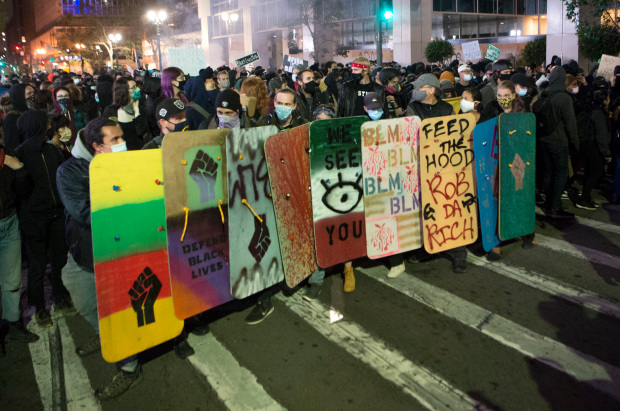
OAKLAND, Calif. (AP) — Protests against the shooting of Jacob Blake in Wisconsin returned to California’s streets with small crowds marching in several cities. But there were few arrests, and no reports of major violence, authorities said Saturday.

More demonstrations were planned over the weekend.

In Oakland, about 250 people marched and rode bicycles through downtown and blocked streets before dispersing by midnight. Police arrested more than a dozen people for crimes, including assault on an officer, as well as pointing a laser at police and at a television news crew, the Oakland Police Department said in a tweet.

Some chanted: “Whose streets? Our streets” and “No ICE, Black and brown must be free,” the San Francisco Chronicle reported.

At one point, the paper said police deployed smoke bombs into a crowd. A police officer who declined to identify himself to the Chronicle said protesters were assaulting officers who were trying to make arrests.

Police had increased staffing for the protest. On Wednesday night, protesters set fires, broke windows and vandalized businesses.

In San Jose, a crowd spray-painted graffiti on Mayor Sam Liccardo’s home with phrases that included “BLM,” Jacob Blake and profanities, fired paintballs and burned a flag. His neighbors quickly banded together to clean Liccardo’s home.

Liccardo said in a statement Saturday he was away visiting a relative at the time of the incident. The mayor said the vandalism does not detract from his support of the Black Lives Matter movement.

“Many of these same neighbors’ homes bear ‘Black Lives Matter’ signs, and they represent the true spirit of the movement, and of our San Jose community,” he said. “They contrast sharply with the roughly hundred so-called ‘protesters’ who stood by silently — or even cheered — as a flag was burned and while ‘f(asterisk)ck you’ and other messages were scrawled on our home.”

The San Jose Police Department said that it is investigating the vandalism at Liccardo’s home and at City Hall, where a suspect was arrested for felony vandalism.

At least six people were arrested in San Diego after police stopped a car that had run a red light while following the protesters, police said.

The crowd “surged” to the spot and several people were held after shining lasers at officers and a helicopter, punching an officer and spraying a “chemical irritant” at officers, according to police tweets.

In Sacramento, police tweeted that 150 to 200 people were marching and said many had “helmets, shields, armor and weapons.”

However, live helicopter reports from KCRA-TV appeared to show far fewer people. No sweeping violence or vandalism appeared to have been committed by late Friday night, although police tweets said some motorcycle officers were struck by rocks and lasers were pointed at a police helicopter as the group marched.

Sacramento police said in a tweet it arrested one person after a report of someone carrying a gun. The weapon was found to be a BB gun, the department said.

Earlier in the day, Sacramento County Sheriff Scott Jones said he had asked for the deployment of National Guard troops in the state capital after scattered violence Thursday night that included spraying graffiti on City Hall, smashing some windows and vandalizing government buildings.

The violence came from a second group of marchers that followed an earlier, peaceful protest.

Blake is the 29-year-old Black man who was shot in the back seven times on Sunday by police in Kenosha, Wisconsin, as he pulled away from an officer and leaned into his SUV, in which three of his children were seated. A family attorney on Tuesday said Blake was paralyzed, and it would “take a miracle” for him to walk again.

South Carolina Football Taking Monday Off for Demonstration

COLUMBIA, S.C. (AP) — South Carolina coach Will Muschamp said his team will forgo football activities on Monday and participate in a campus demonstration against racial injustice after the shooting of Jacob Blake by a police officer in Kenosha, Wisconsin.

Muschamp said Saturday that team leaders approached him about the effort after Blake, who is Black, was shot seven times in the back after walking away from police, leaving him paralyzed.

“We want to make a statement on our campus,” Muschamp said.

Muschamp and the Gamecocks marched from the Governor’s Mansion to the Statehouse in June following the killing of George Floyd by a Minneapolis police officer.

Muschamp said his team wanted to show its support for racial equality and against police brutality.

“The Jacob Blake situation in Wisconsin is a horrific situation,” Muschamp said. “A team demonstration supporting racial equality and being totally against police brutality, our leadership group came to me on that.”

Muschamp said he hopes other South Carolina athletes might join the football team’s effort.

Were They a Threat? Police Shootings Reignite Legal Debate

By ALANNA DURKIN RICHER and CLAUDIA LAUER

Protesters take to the street and block traffic at the intersection of Willow Street and Evangeline Thruway after a vigil held Saturday, Aug. 22, 2020, in Lafayette, La., for 31-year-old Trayford Pellerin, who was shot and killed by Lafayette police officers while armed with a knife the night before. (Scott Clause/The Daily Advertiser via AP)

In the span of 48 hours, two Black men in U.S. cities hundreds of miles apart were shot by police in episodes that set off a national conversation about the need for officers to open fire on people walking away from them.

The Jacob Blake shooting in Kenosha, Wisconsin, and the killing of Trayford Pellerin in Lafayette, Louisiana, two days earlier have thrust into the spotlight a thorny and long-running legal issue that has on several occasions gone all the way to the U.S. Supreme Court. And the Blake shooting has raised a host of other questions, including why the officer felt the need to shoot him seven times in the back at close range, and the prudence of police opening fire with children nearby.

Wisconsin authorities are investigating those questions as they weigh charges against the officer in a case that has reignited national protests over racial injustice. The shootings come less than three months after almost daily clashes between police and protesters in response to the death of George Floyd after a Minnesota officer knelt on his neck for several minutes.

Laws governing the use of deadly force differ from state to state, and past shootings of people who were fleeing from officers have played out differently across the country.

An Atlanta officer was charged with felony murder in June in the fatal shooting of Rayshard Brooks, who authorities said had taken an officer’s stun gun and was 18 feet away when the officer shot him from behind.

Prosecutors in South Carolina agreed to drop murder charges against former North Charleston police officer Michael Slager as part of a plea deal in the 2015 fatal shooting of unarmed Walter Scott. Slager, who shot the fleeing man five times in the back, is serving a 20-year federal sentence after pleading guilty to a civil rights violation.

And in Pennsylvania, a prosecutor in Pittsburgh’s Allegheny County said shooting a suspect in the back was unacceptable when he charged a former officer after he fatally shot 17-year-old Antwon Rose as he fled a 2018 traffic stop. But a jury declined to convict the officer, who said he thought he saw a gun.

“Even if it appears to be horrific, it doesn’t mean that there is a law that they have violated,” said Raleigh Blasdell, a criminologist and professor at North Central College in Illinois.

Police said 31-year-old Pellerin, who was killed, was carrying a knife Friday when he tried to enter a convenience store after causing a disturbance at another store earlier. Video shows police following Pellerin and shots are heard as he opens the store’s door. Authorities have not identified the officer or officers who shot Pellerin or said where or how many times he was shot.

Blake, 29, was shot as he leaned into his SUV, where three of his children were seated. The Kenosha police union said Friday that officers were dispatched there because of a complaint that Blake was attempting to steal the caller’s keys and vehicle. A union attorney said in the moments leading up to the shooting, officers saw Blake holding a knife and made multiple requests for him to drop it but he was uncooperative. Blake also “forcefully fought with the officers, including putting one of the officers in a headlock,” the union said. After police tried twice unsuccessfully to use a stun gun on Blake, officer Rusten Sheskey shot him at close range while holding onto his shirt, authorities said.

Blake survived but is paralyzed. Federal authorities said they will conduct a civil rights investigation into the shooting.

Wisconsin law provides officers with a defense to criminal charges if a shooting is “a reasonable accomplishment of a lawful arrest.” The state’s vague law essentially allows officers to use any and all force to accomplish a lawful arrest, Blasdell said.

Furthermore, juries often steer away from second-guessing an officer’s split-second decisions even when other officers on scene testify that they didn’t shoot because they didn’t see a threat, said Philip Stinson, a former police officer and criminologist at Bowling Green State University.

Yet, the tactics used by the officer who shot Blake are highly questionable, said Seth Stoughton, another former officer.

If police believe someone has a knife, they’re supposed to keep their distance, not get closer, said Stoughton, now a law professor at the University of South Carolina. He also questioned why the officer followed Blake around the car with his gun drawn instead of simply grabbing him to stop him.

But David Klinger, who as a rookie Los Angeles police officer in 1981 fatally shot a man who pulled a butcher knife on another officer, urged the public not to rush to judgment in either case.

“If it turns out these officers in Louisiana, these officers in Wisconsin, did something wrong then they need to be held to account,” said Klinger, now a criminologist at the University of Missouri-St. Louis. “But we have a system, we have a process; we need to let that process work itself out.”

It’s difficult to say whether a suspect being shot in the back leads more often to criminal charges or convictions because police often don’t release those details, and recent cases have come to light only through videos, Stinson said.

The legal thinking surrounding such cases has evolved over the years, but even as policing reforms are considered across the country, few have been focused on restricting when officers can shoot someone fleeing police.

In the 1970s, officers were often authorized under state laws to shoot someone in the back to keep them from evading arrest even if that suspect didn’t pose a threat. But a 1985 Supreme Court decision in a Tennessee case said officers could use lethal force to stop a fleeing felon only if they have reasonable grounds to think the suspect is a danger to police or bystanders.

Years later, the high court said an officer’s fear in the heat of the moment, not just the actual threat, was relevant in deciding whether a shooting was legally justified. That could mean an officer could be found justified in a shooting if he or she truly believed the suspect had a gun but turned out to be wrong.

Regardless of whether they result in criminal charges, experts said both cases show an urgent need to better train officers so they don’t resort so quickly to their gun.

“When I was a police officer and someone walked away from you and it looked like they were going to get something, you tackle them ... It wouldn’t have crossed my mind to bear down on them and shoot,” Stinson said.

___

Associated Press reporter Janet McConnaughey in New Orleans contributed to this report.

Activists: Militias Tolerated, Kenosha Protesters Arrested

By JAKE BLEIBERG and STEPHEN GROVES

FILE - In this Aug. 25, 2020 file photo, authorities disperse people from a park in Kenosha, Wis. Police in Kenosha have arrested dozens of people since a white office shot a Black man in the back. Activists in the Wisconsin city say police have been aggressive in responding to protests over Jacob Blake's shooting, even as they've tolerated armed militia groups. (AP Photo/Morry Gash, File)

KENOSHA, Wis. (AP) — Police officers in Kenosha were on alert after days of protests over the shooting of Jacob Blake by one of their colleagues, and they’d recently gotten a tip about “suspicious vehicles” from out of state.

So, after watching a group of people fill cans at a gas station Wednesday and then hop into a minivan with Oregon plates, the officers sped in. A bystander’s video shows officers leaping out of black SUVs with guns drawn. About 25 seconds later, an officer shatters the van’s passenger-side window with her baton, unlocks its door and pulls a person out.

The group turned out to be members of Riot Kitchen, a Seattle-based organization that serves food at demonstrations. Jennifer Scheurle, a member of its board of directors, said they were filling up gas cans to power a generator for their food truck.

The nine taken into custody in the SWAT-style operation Wednesday were among dozens of people arrested this week in the Wisconsin city. The arrests have highlighted activists’ complaints that police have been responding to protests over the white officer’s shooting that left Blake, a Black man, paralyzed, even as they’ve tolerated armed militia groups.

The Riot Kitchen members were charged with misdemeanor disorderly conduct, but all were free by Friday morning.

“We reject all claims that our crew was there to incite violence or build explosives,” said Scheurle, who was not among those in Kenosha. “Our nonprofit organization has always been and will always be about feeding people.”

Kenosha Police Chief Daniel Miskinis said at a Friday news conference that “just under 50” people had been arrested during the protests. The department later provided a list of 58 charges, more than half of them for curfew violations, but declined to specify the number of people arrested or provide names.

“I believe everybody out there in law enforcement has been friendly to both sides,” Miskinis said.

An analysis of jail records since the day of Blake’s shooting shows about 45% the people facing charges seemingly related to the protests live outside Wisconsin.

Those arrested were almost 70% white and about two-thirds male. The vast majority were charged with misdemeanors or civil violations, although there were also some felonies. Miskinis said one person had been charged for having a “flamethrower.”

More than 20 of the people remained in jail Friday afternoon.

Adelana Akindes, a 24-year-old from Kenosha, said she spent nearly a day in a crowded cell after being arrested Wednesday while walking toward the demonstrations carrying a shield.

Police had Akindes and three others lie on the ground as they put them in handcuffs, she said, adding that officers did not read their Miranda rights or say why they were being arrested. She was released on Thursday evening and charged with breaking curfew.

“They wanted to scare us,” said Akindes, who is Black. “They wanted to make an example of us.”

The early days of demonstrations and unrest after Blake’s shooting saw some people destroying buildings, setting fires and hurling objects at police, who responded at times with tear gas. The last three nights have been mostly peaceful, and police have not fired tear gas or pepper balls. But they have used tactics that local activists see as heavy handed.

On Thursday night, police pulled over several cars of people headed to protests. They arrested a group of people in one vehicle and searched the car of another group.

“There has been no respect for anybody’s civil rights,” said Isaac Wallner, a 30-year-old Kenosha activist. “It’s been a police free for all. They do whatever they want.”

Wallner, who is Black, contrasted this with what he characterized as a tolerant, or even friendly, attitude police have taken toward the white men who’ve come to the city outfitted with heavy vests and long guns, including a 17-year-old charged with fatally shooting two people and wounding a third.

Earlier in the week, sheriff’s deputies shot pepper balls at protesters and arrested them when they failed to quickly leave after being told they were breaking curfew. But officers in an armored vehicle with “Sheriff” on the side were also recorded at night tossing water bottles to men carrying rifles.

“We appreciate you guys. We really do,” someone can be heard calling from the vehicle in a video of the exchange.

Kenosha County Sheriff David Beth said Friday that the officer seen giving out water was not one of his deputies, and the person who said he appreciated what the armed civilians were doing “doesn’t mirror all of law enforcement’s perspective on what happened.”

Bleiberg reported from Dallas. Associated Press reporters Lindsay Whitehurst in Salt Lake City and Scott Bauer in Madison, Wisconsin, contributed.

Arizona Student Group Slammed for Raising Money for Gunman

FILE - In this Aug. 25, 2020, file photo, Kyle Rittenhouse, left, with backwards cap, walks along Sheridan Road in Kenosha, Wis., with another armed civilian. A Republican student group at Arizona State University is receiving backlash for donating money to Rittenhouse, the 17-year-old gunman who fatally shot two protesters in Wisconsin. College Republicans United announced this week that half of any funds they raise during the semester will go toward paying for the legal defense of Kyle Rittenhouse. (Adam Rogan/The Journal Times via AP, File)

TEMPE, Ariz. (AP) — A Republican student group at Arizona State University is receiving backlash for donating money to the 17-year-old gunman who fatally shot two protesters in Wisconsin.

College Republicans United announced this week that half of any funds they raise during the semester will go toward paying for the legal defense of Kyle Rittenhouse.

“He does not deserve to have his entire life destroyed because of the actions of violent anarchists during a lawless riot,” the group said in a tweet.

Authorities in Kenosha, Wisconsin, say Rittenhouse shot and killed two people and severely wounded a third with an AR-15 rifle Tuesday. The victims were part of anti-racism demonstrations occurring in the wake of the shooting of Jacob Blake, who is Black, by a white police officer.

Blake, who was shot seven times, remains hospitalized.

Rittenhouse told police he was trying to protect businesses and people and acted in self-defense. At a hearing Friday, a judge postponed a decision on whether Rittenhouse, who is in custody in Illinois, should be returned to Wisconsin to face charges, including first-degree intentional homicide.

ASU officials said in a statement the school cannot prohibit a group from fundraising. But the school does not endorse the fundraiser.

The group is not the only one raising money for Rittenhouse. A self-described Christian fundraising site, GiveSendGo, says it has raised more than $100,000 for his defense.

‘7 Bullets, 7 Days’: Protesters March for Blake in Kenosha

By STEPHEN GROVES and AMY FORLITI

Hundreds march at a rally for Jacob Blake Saturday, Aug. 29, 2020, in Kenosha, Wis. (AP Photo/Morry Gash)

KENOSHA, Wis. (AP) — With chants of “One person, one vote!” and “No justice, no peace!” a crowd of about 1,000 demonstrators gathered outside a Wisconsin courthouse Saturday to denounce police violence and share messages of change, a week after an officer shot Jacob Blake in the back and left the 29-year-old Black man paralyzed.

The diverse group of protesters also chanted “Seven bullets, seven days!” — a reference to the number of times Blake was shot last Sunday — as they marched toward the courthouse in Kenosha. There Blake’s father, Jacob Blake Sr., gave an impassioned call for changing a system he described as fostering police brutality and racial inequities.

“There were seven bullets put in my son’s back. ... Hell yeah, I’m mad,” said Blake Sr. He said he wants to ask the police “what gave them the right to attempted murder on my child? What gave them the right to think that my son was an animal? What gave them the right to take something that was not theirs? I’m tired of this.”

Kenosha Police Officer Rusten Sheskey and two other officers were responding to a domestic abuse call last Sunday when Sheskey shot Blake in the back. Blake Sr. told reporters on Saturday that his son is heavily sedated, but has regained consciousness.

“He’s in a lot of pain,” he said. “I just wish I could pick my baby up and make it all right.” He called for Sheskey to be charged and for the other two officers at the scene to be fired.

Several of Saturday’s speakers encouraged the crowd to vote for change in November, and to push for changing legislation in Wisconsin that would lead to police reform.

“Justice is a bare minimum,” said Lt. Gov. Mandela Barnes. “Justice should be guaranteed to everybody in this country.”

Blake Sr. asked those at the rally to raise their fists with him. “We are not going to stop going in the right direction. We’re going to the top ... we’re gonna make legislation happen because that’s the only thing that they recognize,” he said.

Blake Sr. also referred to the May 25 death of George Floyd, a handcuffed Black man who died after a Minneapolis officer pressed his knee into Floyd’s neck. Said Blake Sr., “We all have a knee on the back of our necks, every day.”

One of Blake’s sisters, Letetra Widman, said she felt recharged “to stand up not just for Jacob, but for all the people who have not gotten justice.”

Captured on cellphone video, the shooting sparked new protests against racial injustice and police brutality months after Floyd’s death touched off a wider reckoning on race.

Protesters have marched in Kenosha every night since Blake’s shooting, with some protests devolving into unrest with damage to buildings and vehicles. On Tuesday, two people were killed by an armed civilian. The commander of the National Guard said Friday that more than 1,000 Guard members had been deployed to help keep the peace, with more on the way.

President Donald Trump, who was touring hurricane damage Saturday in Texas when reporters asked whether he would visit Kenosha, responded “probably so” but offered no details. When asked to weigh in on Tuesday’s shootings in which 17-year-old Kyle Rittenhouse was charged, Trump demurred and said “it’s under investigation” and that “we are looking at it very, very carefully.”

Aniyah Ervin, a 16-year-old from Kenosha who is Black, said Saturday that the week has been surreal. Although she protested against racial injustice over the summer, she said there had been a feeling that police brutality was not a problem in Kenosha. But, she said, Blake’s shooting “shows it can happen anywhere.”

Will Turner, who is Black, said he brought his two children from Madison for the march to “show them the power of peaceful protesting.”

Investigators have said little about what led to Blake’s shooting. The Kenosha police union said Blake had a knife and fought with officers, putting one of them in a headlock as two efforts to stun him with a Taser were unsuccessful. State investigators have said only that officers found a knife on the floor of the car.

In the cellphone video recorded by a bystander, Blake walks from the sidewalk around the front of an SUV to his driver-side door as officers follow him with their guns drawn and shout at him. As Blake opens the door and leans into the SUV, an officer grabs his shirt from behind and opens fire. Three of Blake’s children were in the vehicle.

The man who recorded the video, 22-year-old Raysean White, said he heard police yell at Blake, “Drop the knife! Drop the knife!” before gunfire erupted. White said he didn’t see a knife in Blake’s hands.

__

Forliti reported from Minneapolis. Associated Press reporters Jennifer Peltz in Kenosha, Kathleen Foody in Chicago and Jill Colvin in Orange, Texas, also contributed.

Zimbabweans Unfazed by Cyber Attacks

28 AUG, 2020 - 03:08 

President Mnangagwa interacts with Chinese Ambassador to Zimbabwe Guo Shaochun at a virtual meeting at State House in Harare yesterday during the handover of personal protective equipment (PPE) donated by the Chinese government.

Herald Reporter

Zimbabweans are resisting cyber-attacks from detractors with an agenda of regime-change because they know there is no truth in the allegations of human rights violations and that they enjoy peace and stability, President Mnangagwa said yesterday.

Speaking after receiving a donation of personal protective equipment (PPE) from the Chinese government, which included tests kits, face masks, ventilators and oxygen generators, the President said: “Currently, Zimbabwe is suffering from cyber-attacks.

The social media attack is most unjustifiable, based upon fiction, non-facts, non-truth allegations, that there are gross human rights violations in the country. There is no evidence of such things happening,” he said.

“The arbitrary arrests, death, torture in the country, all that is being stated without evidence. We are enjoying peace and stability in the country but our detractors have decided to impose a cyber-war on our country in pursuit of a regime change agenda.

“We take comfort that this has been so in the last two decades and our people continue to be focused and support Government and we are consoled by the fact our friends, China are not being swayed by these detractors of Zimbabwe. We remain solid in supporting our position and we will continue to agitate for the removal of sanctions and against those who are peddling regime change agenda which is most unjustified.”

The donation was presented through a virtual meeting by Chinese Ambassador to Zimbabwe Guo Shaochun, who was at the Chinese Embassy, while the President, Health and Child Care Minister — Vice President Constantino Chiwenga — and the National Covid-19 Taskforce chairperson, Defence and War Veterans Affairs Minister Oppah Muchinguri-Kashiri, were at State House.

President Mnangagwa said despite all the challenges being faced, Zimbabweans remained determined to be independent and not interfere in internal affairs of other countries.

The close relations Zimbabwe enjoyed with China, Russia and India, had continued to pay off as they have supported the country during the difficult period of sanctions.

“We are in our 20th year of sanctions and, as a result, Zimbabwe has very limited options to receive support from the global financial windows which the rest of Third World countries are receiving to assist in the fight against Covid-19. We are left out and we have to fend for ourselves from our domestic resources.”

Zimbabwe and China are working on bringing back experts who have been stuck in China owing to Covid-19 to complete major projects such as the construction of the new Parliament building and the expansion of Robert Gabriel Mugabe International Airport and Hwange Power Station.

“There are several projects here in Zimbabwe, major projects, which have stalled in terms of progress as a result of the impact of Covid-19 where some experts, and in particular engineers, found themselves locked back home in China.

“I am happy that we have since found a way to bring them back to Zimbabwe to continue with the projects such as the (new) Parliament building which now is behind schedule as a result of the absence of experts, but continues to be worked on. And we have no doubt that when the experts come in, work will accelerate and possibly meet the target dates,” he said.

The President thanked China for continued support, especially in the fight against Covid-19.

In the last few weeks, there had been a spike in the spread of Covid-19 in Zimbabwe, with domestic transmissions on the rise, and he called on citizens to continue maintaining the measures to prevent the rapid spread of coronavirus.

Ambassador Guo commended the leadership of President Mnangagwa and the Government’s dedication in putting life first and, at the same time, making great efforts to revive the economy.

“Thanks to these efforts, we have seen positive signs. In the last 10 days, there was a record number of Covid-19 recoveries. Progress is also seen in Zimbabwe’s fiscal, monetary, trade and industrial performance. Meanwhile, we also recognise the challenges facing Zimbabwe in controlling Covid-19 and boosting the economy.

“I take this opportunity to reaffirm China’s commitment to working closely with Zimbabwe. We have been making good progress in this regard. Recently, the China-Zimbabwe traditional Chinese medicine and the acupuncture centre was established in China,” he said.

Ambassador Guo said a memorandum of understanding had been signed on the co-operation of use of Chinese traditional medicines in Zimbabwe, a development he described as a “good beginning” and pleaded for support to introduce the traditional medicines in Zimbabwe to join the fight against Covid-19.

“In China, some Chinese traditional medicines were effective in the fight against Covid-19. I am looking forward for your support and the support from the Ministry of Health and Child Care,” he said.

Ambassador Guo said in the next few months, more Chinese engineers and technicians will arrive in Zimbabwe to push through works on the major projects being implemented.

He expressed concern over the publication of a story by a Zimbabwean privately owned newspaper that claimed the Chinese government was involved in Anjin’s business deals and conflicts in the country.

He said the claims by the paper were false. China opposes any illegal sanctions imposed on Zimbabwe, and called for their “immediate removal”.

Albuquerque Police Pull Tweet Denouncing Wisconsin Shooting

August 26, 2020

In this September 2019 selfie photo taken in Evanston, Ill., Adria-Joi Watkins poses with her second cousin Jacob Blake. He is recovering from being shot multiple times by Kenosha police on Aug. 23. (Courtesy Adria-Joi Watkins via AP)

ALBUQUERQUE, N.M. (AP) — Albuquerque police have deleted a tweet that denounced the “senseless” shooting of a Black man by Kenosha, Wisconsin, police and expressed sympathy for his family.

Police Chief Mike Geier said Tuesday the tweet attributed to him was sent in error and issued a public apology.

“The senseless shooting of Jacob Blake once again shows why our community and communities across the nation are seeking justice and change,” the now-deleted tweet read. “On Behalf of APD, I offer my sympathy to Jacob Blake’s family and his children who witnessed this disturbing act. I sincerely hope he makes a full recovery.”

Video of officers shooting Blake while his back was turned to them has generated angry demonstrations in Kenosha, and even ignited NBA basketball stars LeBron James to speak out.

But Albuquerque police spokesman Gilbert Gallegos, who had advised that the department send a tweet about the Blake shooting, said the social media post was sent without giving Geier a chance to review it.

Albuquerque Police Officers’ Association president Sean Willoughby called the tweet embarrassing.

Albuquerque police remain under court-order reforms following a harsh report about excessive force cases and the department’s own string of police shootings that sparked violent protests in 2014.

At D.C. March, Families Decry ‘Two Systems of Justice’

By AARON MORRISON, KAT STAFFORD and ASHRAF KHALIL

A man stands in the Reflecting Pool as people attend the March on Washington, Friday Aug. 28, 2020, in Washington, on the 57th anniversary of the Rev. Martin Luther King Jr.'s "I Have A Dream" speech. (AP Photo/Carolyn Kaster)

WASHINGTON (AP) — Standing on the steps of the Lincoln Memorial, where the Rev. Martin Luther King Jr. famously laid out a vision for harmony between white and Black people 57 years ago, his son issued a sobering reminder about the persistence of police brutality and racist violence targeting Black Americans.

“We must never forget the American nightmare of racist violence exemplified when Emmett Till was murdered on this day in 1955, and the criminal justice system failed to convict his killers,” said Martin Luther King III, speaking to thousands who gathered Friday to commemorate the 1963 March on Washington for Jobs and Freedom.

“Sixty-five years later (after Till’s murder), we still struggle for justice — demilitarizing the police, dismantling mass incarceration, and declaring as determinately as we can that Black lives matter,” King said.

Even in the midst of the coronavirus pandemic, many felt compelled to join civil rights advocates in Washington to highlight a scourge of police and vigilante violence that gave way to what many feel is an overdue reckoning on racial injustice. Some stood in sweltering temperatures in lines that stretched for several blocks, as organizers took temperatures as part of coronavirus protocols. Organizers reminded attendees to practice social distancing and wear masks throughout the program, although distancing was hardly maintained as the gathering grew in size.

They gathered following another shooting by a white police officer of a Black man — this time, 29-year-old Jacob Blake in Kenosha, Wisconsin, last Sunday — sparking demonstrations and violence that left two dead. As peaceful protests turned to arson and theft, naysayers of the Black Lives Matter movement issued calls for “law and order.”

The Rev. Al Sharpton, whose civil rights organization, the National Action Network, planned Friday’s commemoration, had a message for naysayers.

“Some say to me, ‘Rev. Al, y’all ought to denounce those that get violent, those that are looting,’” Sharpton said. “All of the families (of victims of police and vigilante violence) have denounced looting. What we haven’t heard is you denounce shooting.”

Sharpton asked, “We will speak against the looting, but when will you speak against wrong police shooting?”

Sharpton and King stood with relatives of an ever-expanding roll call of victims: Blake, George Floyd, Breonna Taylor, Rayshard Brooks, Ahmaud Arbery, Trayvon Martin, and Eric Garner, among others.

Arbery and Martin both were killed by men who pursued them with guns and whose arrests were delayed until residents protested.

“There are two systems of justice in the United States,” said Jacob Blake Sr., the father of the man whose shooting by police in Kenosha left him paralyzed from the waist down. “There’s a white system and a black system -- the black system ain’t doing so well.”

“No justice, no peace!” he proclaimed.

Philonise Floyd, the brother of George Floyd, stared out at the massive march audience and said he wished his brother was there to see it.

Friday’s march shaped up to be the largest political gathering in Washington since the pandemic began. Many attendees wore T-shirts of the late Rep. John Lewis who, until his death last month, was the last living speaker at the original March on Washington for Jobs and Freedom. That march went on to become one of the most famous political rallies in U.S. history, and one of the largest gatherings with over 200,000 people in attendance.

Organizers said they intended to show the urgency for federal policing reforms, to decry racial violence, and to demand voting rights protections ahead of the November general election. A handful of satellite marches were held in South Carolina, Florida, Nevada, Utah and Colorado.

Democratic vice presidential nominee Kamala Harris, in a video, said the original conveners would be disappointed that Black Americans are still marching for justice and equality under the law.

“I have to believe that if they were with us today, they would share in our anger and frustration as we continue to see Black men and women slain in our streets, and left behind in our economy and justice system that has too often denied Black folks our dignity and rights,” she said.

Former Vice President Joe Biden tweeted his support for the march.

Although President Donald Trump did not comment on the march Friday, the Republican National Committee marked the event’s anniversary by highlighting the president’s record as a “champion for the Black community.”

“While there is more work to be done, Donald Trump is the leader to make it happen,” Paris Dennard, an RNC senior communications advisor, said in a statement.

Activist Frank Nitty, who said he walked 750 miles for 24 days from Milwaukee, Wisconsin, to Washington for Friday’s march, spoke to the audience about persistence in the fight for justice.

“Are y’all tired? Because I’m tired,” Nitty said. “They think this is a negotiation, but I came here to demand change. My grandson ain’t gonna march for the same things that my granddaddy marched for.”

Navy veteran Alonzo Jones-Goss, 28, who traveled from Boston to participate in the march, said the nation has seen far too many tragic events that claimed the lives of Black Americans and other people of color, and “that needs to come to an end.”

Following the rally, participants marched to the Martin Luther King Jr. memorial in West Potomac Park, next to the National Mall, and then dispersed. Some participants headed toward Black Lives Matter Plaza, right outside of the White House, which was renamed from Pennsylvania Avenue during protests in June.

Chants of “Black lives matter” and “No justice, no peace” echoed through downtown Salt Lake City Friday morning, as about 200 people marched from the state Capitol to Washington Square Park for Utah’s March on Washington.

“If people still can’t see why we’re out here and why we’re marching and why people are loud and angry then they’re blind,” said Joshua Chamberlain, a realtor from Holladay, Utah. “There’s racism happening every day and -- especially by police brutality -- people are dying from it.”

In Colorado, several dozen people rallied at a prominent statue of Martin Luther King Jr. in Denver’s City Park. Democratic U.S. Sen. Michael Bennet cited the names of George Floyd, Elijah McClain and victims of police brutality.

“You know and I know what happened to them would never happen to me,” said Bennet, who is white.

Sharpton instructed those in other states to march on their U.S. senators’ offices and demand their support for federal policing reforms and reinvigorated voter protections, in Lewis’ memory.

In June, the Democrat-controlled House of Representatives passed the George Floyd Justice In Policing Act, which would ban police use of stranglehold maneuvers and end qualified immunity for officers, among other reforms. A Republican-authored police reform bill, introduced in June by South Carolina Sen. Tim Scott, who is Black, failed a procedural vote in the Senate because Democrats felt the measure didn’t go far enough to address officer accountability.

In July, following Lewis’ death, Democratic senators reintroduced legislation that would restore a provision of the historic Voting Rights Act of 1965 gutted by the U.S. Supreme Court in 2013. The law previously required states with a history of voter suppression to seek federal clearance before changing voting regulations.

Both measures are awaiting action in the Republican-controlled Senate.

___

Aaron Morrison reported from New York. Kat Stafford and Ashraf Khalil reported from Washington, and journalists from across the AP contributed to this report. Morrison and Stafford are members of the AP’s Race and Ethnicity team.

Mistrust of Police Stir Unrest in Minneapolis

By AMY FORLITI and JEFF BAENEN

yesterday

Tom Stellar, a pastor at Bethlehem Baptist Church, looks at broken windows while cleaning up damage outside Nordstrom Rack in Minneapolis on Thursday, Aug. 27, 2020. An emergency curfew expired and downtown Minneapolis was calm Thursday morning after a night of unrest that broke out following what authorities said was misinformation about the suicide of a Black homicide suspect. (David Joles/Star Tribune via AP)

MINNEAPOLIS (AP) — After a Black man fatally shot himself on a pedestrian plaza in downtown Minneapolis, rumors of another police shooting in the city still reeling from the death of George Floyd began spreading quickly on social media, sending concerned residents and activists to the area — many of them anxious and some of them misinformed.

Tensions and anger have been running high in Minneapolis since Floyd’s May 25 death, and some activists say community members are mobilizing more quickly as incidents occur — refusing to wait for explanations from a city police department they don’t trust. But others say the unrest that unfolded Wednesday — which damaged multiple business and resulted in more than 130 arrests — had nothing to do with anger, but was due to opportunists intent on committing crimes.

“I just think that things have reached a boiling point and people are fed up,” said community activist Nekima Levy Armstrong. “Now we’re at a breaking point where there is no tolerance for even a hint of police abuse or police murder.”

Emotions have remained raw over the death of Floyd, a handcuffed Black man who died after a white Minneapolis police officer pressed his knee against Floyd’s neck for nearly eight minutes. Floyd’s death sparked protests worldwide, including several nights of violence in Minneapolis. Demonstrators also gathered in Minneapolis this week to protest after Jacob Blake, a Black man, was shot multiple times by police in Wisconsin on Sunday, leaving him paralyzed.

Wednesday’s unrest began after a man who was suspected in a homicide shot himself in a retail area as police were closing in. Police released surveillance video within 90 minutes that confirmed the police account of a suicide, as Police Chief Medaria Arradondo tried to dispel rumors circulating on social media.

Levy Armstrong said she went to the scene and showed the video to demonstrators, and some of them left. But she said she understands why some people would think the police were to blame, saying: “There’s no reason to trust the Minneapolis police, based on their years of egregious and abusive conduct.”

Jaylani Hussein, executive director of the Minnesota chapter of the Council on American-Islamic Relations, said Floyd’s death has changed the way people respond to police incidents. “I think as soon as something like this happens, you are going to see people immediately hit the streets upset.”

“I think this is the new norm and we just have to create better communication,” he said. “We are in a different time when people are more concerned. People are not just walking by police misconduct anymore.”

Businesses were burglarized during the unrest and authorities said two officers were injured. The Fire Department responded to four fires at area businesses.

Mayor Jacob Frey and the chief said future violence would not be tolerated, as workers at various businesses boarded up windows and swept broken glass from the sidewalk. Members of the National Guard were activated to help and Frey set another curfew for Thursday night, when officers made more than 30 arrests in the first hour after the curfew but the protests remained mostly peaceful.

Tanzil Sallahudiin, 22, a Black man from Minneapolis, who was taking photos downtown, said it was sad to see buildings broken into because some people couldn’t get their facts straight.

“A lot of people are just tired, pretty much, tired of the same stuff. And automatically people are guessing that the police killed him, because that’s what we’re used to seeing, I guess. A lot of people are just programmed that way,” he said, adding that after people see a man die in the street, “they automatically think it’s the police.”

Misinformation has fueled unrest elsewhere too. Earlier this month, hundreds of people streamed into downtown Chicago after a video circulating on Facebook falsely claimed that Chicago police had shot and killed a 15-year-old boy. Vandals smashed the windows of dozens of businesses and made off with merchandise and cash machines.

But there was no teenage boy shot and killed by police. Police had shot and wounded a 20-year-old man they say had fired at them. Police Superintendent David Brown said the shooting of the man prompted a social media post urging people to form a car caravan and head to Chicago’s business and shopping district. Police made over 100 arrests, and 13 officers were hurt.

Minneapolis City Council Member Jeremiah Ellison, a leader of the effort to overhaul the police force following Floyd’s death, called for understanding about why the violence broke out.

“MPD did not kill him, but people assuming they did is rooted in a steep distrust,” he tweeted. “That distrust is our failure to own. Seeing windows broken and items stolen can be beyond frustrating, especially when all that rage was sparked (this time) by misinformation. But so often our policing institutions have themselves been the source of misinformation. We forfeited our goodwill and this is the ugly cost.”

Longtime peace activist KG Wilson also went to the scene after he heard someone had been killed. He learned after arriving that it was a suicide, but said members of the crowd wouldn’t listen to him — or didn’t care. Some insisted the man was shot by police, while others just seized on the opportunity to create chaos.

“I’m down there trying to tell this angry mob of people who are ranting and raging, using profanities and throwing bottles at police … ‘Just calm down, just stay peaceful,’” Wilson said. But, he said, even after it was clear that the incident was not a police shooting, a group of “opportunists” used the confusion to commit crimes.

“They were wrong last night. They were completely, 100% wrong. There is no, ‘I was mad about something else,’” Wilson said. “You are going to be held accountable for this.”

A’s, Astros Walk Off Field in Protest, Game Postponed

By JORDAN GODWIN

An Oakland Athletics jersey, laid by Marcus Semien, and a Houston Astros jersey, laid by Martin Maldonado, both bearing the No. 42 in honor of Jackie Robinson, flank a Black Lives Matter T-shirt covering home plate in Houston on Friday, Aug. 28, 2020. The teams took the field, observed a moment of silence, and then walked off the field in protest of racial injustice. (Kevin M. Cox/The Galveston County Daily News via AP)

HOUSTON (AP) — The Houston Astros and Oakland Athletics jointly walked off the field following a moment of silence, draping a Black Lives Matter T-shirt across home plate as they chose not to play on Friday night.

The postponement came on Jackie Robinson Day across the majors, and in the wake of 29-year-old Jacob Blake, a Black man, being shot by police in Wisconsin over the weekend.

All players, managers and coaches at Minute Maid Park were wearing No. 42, the jersey number Robinson wore when he broke the major league color barrier in 1947.

The Athletics and Astros placed a No. 42 jersey in each batter’s box. Houston starters took their positions, with other players on both sides lining up in front of their dugouts.

After a moment of silence, the teams walked back to their clubhouses.

“I’m proud of this generation because in the ’60s, it was mostly African Americans and a few white Americans that stood up, but in this day and age, I’m seeing young people of all nationalities and all religions that are standing up together,” said Astros manager Dusty Baker, who is Black. “The young people are a voice to be heard in the country, and I’m very, very proud of the young people in this country.”

There have been 11 big league games postponed this week as clubs joined teams in the NBA, WNBA and MLS in calling off games while protesting social injustice. Major League Baseball let teams decide whether to play or not.

The Astros and Athletics will play a doubleheader on Saturday beginning at 3 p.m. The teams will recognize Jackie Robinson Day in the first game.

Baker and Athletics manager Bob Melvin met with the umpires at home plate several minutes before the scheduled first pitch at 8:10 p.m.

“I woke up this morning -- and I’ve always known the story of Jackie Robinson -- but I had a different view today,” Melvin said. “I was angry today. I was sad, I was all of the above. I was looking forward to putting this jersey on. I have the utmost respect for No. 42 and his plight.”

Oakland starter Chris Bassitt appeared to be going through his pregame routine, ramping up to pitching in the visitor’s bullpen but abruptly stopped warming up about 15 minutes before the scheduled first pitch.

Houston starter Lance McCullers Jr. walked to the right field bullpen with an orange glove and ball, but only sat on a bench and never warmed up.

McCullers headed back to the dugout shortly after the national anthem, which was played before the players took the field.

“If we can change one person’s mind, have a conversation that changes one person’s thought process that saves a life, this was worth it to us,” said Astros outfielder Michael Brantley, who is Black. “As a group, we’ve done a great job talking about it, but these situations that keep coming up have to stop. I think we all feel the same way.”

On Thursday, the New York Mets and Miami Marlins took a similar action before their game at Citi Field, walking off the field.

“We felt like this message was bigger than missing another game to show support for our brothers, not only on our team but across the league as well to let them know we have their backs,” Astros outfielder Josh Reddick said.

MLB Celebrates Jackie Robinson, Calls For Justice Continue

By DAVID BRANDT

FILE - This is an April 18, 1948, portrait of Brooklyn Dodgers baseball player Jackie Robinson. It's Jackie Robinson Day across the big leagues on Friday, Aug. 28, 2020, as baseball honors the man who broke the sport's color barrier in 1947. (AP Photo/File)

PHOENIX (AP) — Andrew McCutchen has relished these past few days in the Philadelphia Phillies clubhouse, having difficult, important conversations with baseball teammates about racial injustice.

As a Black man in a sport that’s filled with mostly white and Hispanic players, he doesn’t feel it’s a burden to lead in the discussions. He’s just glad that on Jackie Robinson Day, they’re conversations that everyone is willing to have, even if the answers aren’t always clear.

“People want to know what’s next, want to know the answers,” McCutchen said. “It’s OK to not have the answers, it’s OK to not know what’s next.

“What’s not OK is not caring what’s next.”

Major League Baseball observed a Jackie Robinson Day like no other Friday, with teams celebrating a man who broke the sport’s color barrier with the Brooklyn Dodgers in 1947. More than 70 years later, the racial reckoning continued.

Eleven games were postponed this week as some teams joined other leagues like the NBA, WNBA and MLS in protesting social injustice.

The Oakland Athletics and Houston Astros took the field Friday night and then left after a moment of silence, draping a Black Lives Matter T-shirt across home plate as they chose not to play. They will play a doubleheader Saturday.

Teams across the league were celebrating the day in various ways. As usual, players, managers, coaches, umpires and other on-field personnel were wearing Robinson’s No. 42.

For Twins manager Rocco Baldelli, Jackie Robinson Day comes at a good time.

“I did find it almost crazy and kind of great, after everything that went down yesterday in baseball and in sports and with our organization as well, that we come right back here today and wear No. 42 and we go out there and celebrate Jackie Robinson and everything that he’s done for our game, and really, for the nation,” Baldelli said.

Jackie Robinson Day is usually on April 15, but the celebration was moved to Aug. 28 this season to accommodate the COVID-19-altered schedule, which started in late July. The date was chosen because it is the anniversary of the March on Washington in 1963 and also the day in 1945 when Dodgers GM Branch Rickey met with Robinson to discuss breaking the color barrier.

In Boston, players from both teams lined up along the baselines before the game and the Red Sox played a clip of Robinson speaking in St. Augustine, Florida, in 1964. During a recording of the national anthem by Ruth Pointer, outfielder Jackie Bradley Jr. — the only Black player on the Red Sox — knelt as did Alex Verdugo next to him.

During the national anthem at Angel Stadium, Black players from the Angels and Mariners stood together in center field and linked arms with Los Angeles’ Mike Trout, Anthony Rendon and David Fletcher.

Also Friday, it was announced that actor Chadwick Boseman had died at 43 from colon cancer. Boseman played Robinson in the movie ’42′, which chronicled the ballplayer’s life.

“I think (Robinson) would want us to talk about change,” said Rockies outfielder Matt Kemp, who is Black. “Coming up in the Dodgers organization and the name Jackie Robinson, it just meant so much more. I wore the jersey that Jackie Robinson wore back in the day. To be around guys like Don Newcombe and Maury Wills, some of the legends that were with the Dodgers, you get to hear stories about things that people have never heard.”

Added Seattle’s Dee Gordon: “I think (Robinson would) be happy today to know that we stood up.”

According to a recently published study on diversity in baseball, only 7.5% of opening day rosters consisted of Black players, the lowest percentage in the game since the study began in 1991.

Yankees manager Aaron Boone broke down in tears during a media briefing and left the room when he was asked about his two Black adopted sons Friday. He returned a few minutes later, still shaken.

“I would just say, I know I’m talking to a lot of people out there, it’s a hard, heavy year, and a heartbreaking year in so many ways,” Boone said. “For my family, too. But I think that’s the case for a lot of people of all different backgrounds and races.

“My prayer is just that we can continue to, even though we’re going through some dark times, at the end of this, we’re better for it. That’s my continued prayer.”

Boone was emotional throughout the briefing, saying he had spent the previous hour talking to Yankees players about protests in recent days. New York was off Thursday and has not opted out of any games.

Boone and San Francisco Giants manager Gabe Kapler also said they will donate their Friday salary to The Players Alliance, a group of more than 100 current and former Black major leaguers working to combat racial injustice. The Players Alliance made a video tribute on social media thanking Robinson that included past and present Black MLB players like Mookie Betts, Curtis Granderson, David Price, Jason Heyward, Torii Hunter, Ryan Howard and Prince Fielder.

Pittsburgh Pirates first baseman Josh Bell, who is Black, was among the players who also donated their Friday salary to The Players Alliance.

“I feel like this past week, things have definitely escalated, people have talked and done what they can try to do to push that needle forward,” Bell said.

The decision by several teams not to play Wednesday and Thursday night were in response to the shooting by police of 29-year-old Jacob Blake, a Black man, in Wisconsin over the weekend. MLB let teams decide whether they would play or not. Some games were postponed while others went on.

Mets outfielder Dominic Smith, a 25-year-old Black man, hit the go-ahead home run in his first game since tearfully pleading for help combating racial inequality, helping his team beat the crosstown Yankees 6-4 in the opener of a doubleheader Friday.

Baseball’s recent postponements came after the NBA’s Milwaukee Bucks didn’t come out on the floor for Game 5 of their first-round playoff series with the Orlando Magic on Wednesday. NBA games scheduled for Thursday and Friday were also postponed.

MLB announced Friday that its partnership with the Jackie Robinson Foundation would extend through 2023. It includes $3.5 million to support the foundation’s Scholarship Program, the Jackie Robinson Museum and the annual JRF ROBIE Awards.

___

AP Sports Writers Dave Campbell, Jake Seiner, Rob Maaddi, Steve Megargee, Tim Booth, Pat Graham and AP freelancer Jordan Godwin contributed to this story.

Friday, August 28, 2020

Phoenix OKs Payout After Police Point Guns Over Stolen Doll

By TERRY TANG

August 26, 2020

FILE - In this June 18, 2019 file photo Dravon Ames, holding microphone, speaks to Phoenix Police Chief Jeri Williams and Phoenix Mayor Kate Gallego, as his fiancee, Iesha Harper, right, holds 1-year-old daughter London, at a community meeting, in Phoenix. The Phoenix City Council will vote Wednesday, Aug. 26, 2020 on a settlement for the Black couple who had police officers point guns at them in front of their children last year after their young daughter took a doll from a store without their knowledge. (AP Photo/Ross D. Franklin, File)

PHOENIX (AP) — The Phoenix City Council agreed Wednesday to pay a settlement to a Black couple who had police officers point guns at them in front of their children last year after their young daughter took a doll from a store without their knowledge.

Iesha Harper said at a news conference that she and Dravon Ames will receive $475,000. It stems from a $10 million claim that the couple’s attorney, former state Attorney General Tom Horne, filed in June 2019. The claim, a precursor to a lawsuit, alleged excessive force by police and a violation of the family’s civil rights.

“I just want to say I’m glad we got justice. It’s been hell dealing with my kids and everything that happened,” said Harper, adding that her children have been left with anxiety.

City leaders passed the settlement with a 6-2 vote.

“I know the money won’t take away the trauma or the harm that’s been caused, but I hope the children will have a better life for it,” Councilman Carlos Garcia said.

The settlement comes during a national reckoning over racism and police brutality and as violence has erupted at protests in Wisconsin over the police shooting of Jacob Blake, a Black man.

The Phoenix Police Department, in the nation’s fifth-largest city, has been criticized for its use of force, which disproportionately affects Black and Native American residents, The Arizona Republic reported. The department also has one of the highest shooting rates in the country.

The payment would be one of the latest by the city over police actions. Payouts in connection to excessive-force or wrongful-death claims have totaled millions of dollars in the last several years, The Republic reported.

The police encounter with Ames and Harper in May 2019 got widespread attention when bystander video spread online. Afterward, the police chief fired an officer and the department required a written report whenever an officer points a gun at someone. The mayor also created an committee to get public recommendations on police reform.

Employees at a store told officers who responded to an unrelated shoplifting case that the couple’s 4-year-old daughter had taken a doll. Ames and Harper, who was five months pregnant, didn’t know about the doll and had already driven away. Police followed them to an apartment complex.

Ames has said officers didn’t use lights or sirens before walking over to the couple’s parked car, with their 4-year-old and 1-year-old daughters also inside.

“Next thing you know, a police officer ... comes up, ‘Open the door,’ banging on the window with a gun, saying he’s gonna shoot us in the face, telling us to get out of the car,” Ames said.

In a video recorded by a resident of the apartment complex, officers can be heard yelling and cursing at the couple. No police body camera footage exists.

An officer went to the back driver’s side door but couldn’t open it because it was malfunctioning, the notice of claim said. He banged on the window and told Harper, who was holding her 1-year-old, to open the door and put her hands up. She told the officer that the door couldn’t open and that her hands were up.

A second officer then pulled his gun out and pointed it at Ames before pulling him out of the car, according to the notice of claim.

A different video begins with Ames lying on the ground as an officer handcuffs him. He’s pulled off the ground and pressed against a police car before the officer kicks one of his legs open. The claim alleged the officer kicked him so hard that Ames collapsed. He also accuses the officer of punching him in the back.

Harper says that after getting out of the car, an officer tried to grab one of her daughters to take Harper into custody. The family said the toddler was injured when the officer pulled her arm.

The couple were released after another officer arrived and defused the situation, the claim said. No one was charged.

Police Largely Silent as Outrage Builds Over Blake Shooting

By LINDSAY WHITEHURST

August 27, 2020

Authorities disperse protesters out of a park Tuesday, Aug. 25, 2020 in Kenosha, Wis. Anger over the Sunday shooting of Jacob Blake, a Black man, by police spilled into the streets for a third night. (AP Photo/Morry Gash)

It took three days, an outpouring of anger in the streets and a NBA boycott before authorities investigating the police shooting of Jacob Blake in Kenosha, Wisconsin, started answering some of the most basic questions about what happened.

And still, many key pieces of information have yet to be released, fueling speculation over why a white officer shot Blake in the back at close range Sunday as the Black man leaned into his SUV.

Police maintain they are not hiding information but can’t reveal other details while the case is under investigation. But the near-silence from the Kenosha department and state authorities is at odds with what an increasing number of American police forces are doing in the wake of high-profile shootings with the potential to cause unrest.

“The times have changed. What you may have done even a year ago doesn’t work now. We need to recognize the public outcry that is taking place and the need for information,” said Chris Burbank, a former police chief in Salt Lake City.

Even as new questions surfaced about the delayed arrest of a white teenager suspected in the shooting deaths of two protesters, police took no questions Thursday at a news conference where they focused on the response to the unrest.

Investigators haven’t explained why police drew guns on Blake and why the officer opened fire. They say a knife was found in the SUV, but they have said nothing about what role it may have played.

As for why officers came to the scene in the first place, the Wisconsin Department of Justice, which is investigating, said in a news release Wednesday that a woman had called about a boyfriend who wasn’t supposed to be there. But investigators haven’t said whether Blake was that boyfriend.

Blake survived but is paralyzed, and it would “take a miracle” for him to walk again, family attorney Ben Crump said Tuesday.

Crump has said Blake was trying to do the right thing by intervening in a domestic incident. And an onlooker who recorded the widely seen cellphone video of the shooting said that he saw a group of women shouting at one another on the sidewalk and soon afterward saw officers wrestling with Blake. Those accounts have not been confirmed by police.

Meanwhile, authorities have also come under scrutiny over why Kyle Rittenhouse, the 17-year-old police enthusiast suspected in the shooting deaths of two people during a night of protests in Kenosha on Tuesday, wasn’t arrested until the next day, in his home state of Illinois.

Witness accounts and video footage show police apparently let the gunman walk past them and leave the scene with a rifle over his shoulder and his hands in the air as members of the crowd were yelling for him to be arrested because he had shot people.

Kenosha County Sheriff David Beth explained that the scene was chaotic and stressful, with people shouting and running, and that may have caused “tunnel vision” among officers.

Kenosha Police Chief Daniel Miskinis said Wednesday that his department has few details about the Blake shooting because another agency — the Wisconsin Department of Justice — is investigating, as required by state law. It was state officials who on Wednesday released the information about the knife and identified the police officer for the first time.

“I can’t answer questions about the investigation. ... I wasn’t there, I’m not privy to those reports,” Miskinis said, adding: “We’re not hiding behind a blue line of silence. It doesn’t exist.”

Still, outside investigations are required elsewhere, too, and many departments nevertheless release narratives within hours of a police shooting, a reflection of how authorities are adapting to escalating public scrutiny.

When police speak to the public directly, especially early on, it can help calm the kind of unrest that Kenosha is seeing, said Burbank, who is now at the Center for Policing Equity, a think tank.

“By doing nothing, you are allowing the aftermath that more people are being injured,” he said. “This may be how they’ve always handled these, but you can’t do that now.”

Other departments are also more quickly releasing body camera and surveillance camera footage of police shootings, both to promote transparency and preempt rumors and unrest. Kenosha police do not have body cameras.

In Atlanta, for example, after the shooting of Rayshard Brooks at a fast-food drive-thru on a Friday night in June, police released body camera video, identified the officers and disciplined or fired them before the weekend was over. Charges were filed a few days later.

In the 2019 killing of Atatiana Jefferson, who was up late playing video games at home in Fort Worth, Texas, when an officer fired through her back window, police offered a detailed account of the shooting and partial body camera video the same day. The officer resigned and was charged with murder within two days.

This week in Minneapolis, police released surveillance video within 90 minutes of a confrontation with police that ended with the death of a Black homicide suspect. While the case sparked protests, the video showed that the man himself fired the fatal shot.

American law enforcement agencies vary widely on how much they release and how quickly, though. Other experts caution that airing too many details too soon can undermine a case.

If details are released before all the witnesses have been interviewed, for example, that can influence what the others say, said David Klinger, a criminologist and former police officer.

“We have to be very, very careful about protecting the integrity of the investigation,” said Klinger, a professor at the University of Missouri-St. Louis.

Contracts with police unions can also affect how much information officers are required to give, and when. But even police unions sometimes favor more transparency.

After a shooting that left a Black man, Tony Robinson, dead in Madison, Wisconsin, five years ago, the Wisconsin Professional Police Association released information ahead of official investigations to counter rumors and speculation on social media, said executive director Jim Palmer.

Quickly releasing an initial account of a shooting, even if murky, can offer the public a basic framework of what happened — and it can also benefit the department by making its side of the story public, Burbank said.

The New York Police Department sends a top official to the scene of every shooting by an officer and holds a news conference within hours. While some praise the department for getting information out, critics say the practice allows police to manage public expectations and shift any blame away from officers.

Associated Press writers Alanna Durkin Richer in Boston, Michael R. Sisak in New York, and Todd Richmond in Madison, Wisconsin, contributed to this report.

Black Panther Star Chadwick Boseman Dies After Four-year Battle With Cancer

Saturday, 29 Aug 2020 03:49

Boseman was the star of the ground-breaking superhero movie "Black Panther"

Black Panther actor Chadwick Boseman has died at the age of 43 following a four-year battle with colon cancer.

His family said in a statement that he died at home with his wife and family by his side.

The statement said: "A true fighter, Chadwick persevered through it all, and brought you many of the films you have come to love so much."

"From Marshall to Da 5 Bloods, August Wilson's Ma Rainey's Black Bottom and several more, all were filmed during and between countless surgeries and chemotherapy. It was the honour of his career to bring King T'Challa to life in Black Panther."

The family added: "The family thanks you for your love and prayers, and asks you to continue to respect their privacy during this difficult time."

Boseman had not spoken publicly about his diagnosis.

Chadwick Boseman, ‘Black Panther’ Star, Dies at 43

By Adam B. Vary, Pat Saperstein

Chadwick Boseman, star of “Black Panther,” died on Friday after a four year battle with colon cancer, his rep confirmed to Variety. He was 43.

Before he was cast as the Marvel Studios superhero, Boseman’s career first exploded with his portrayals of Black American icons Jackie Robinson (in 2013’s “42”) and James Brown (in 2014’s “Get on Up”).

“It is with immeasurable grief that we confirm the passing of Chadwick Boseman,” said a statement posted to his Twitter feed. “It was the honor of his life to bring King T’Challa to life in Black Panther.”

Although Boseman never spoke publicly about his diagnosis, according the statement, he worked through his treatment for much of his career, starting when he played another Black American icon, NAACP lawyer and future Supreme Court justice Thurgood Marshall, in 2017’s “Marshall” — a year before the premiere of “Black Panther.” Boseman most recently appeared in the Spike Lee’s Vietnam War drama “Da 5 Bloods,” and this year he’s due to appear opposite Viola Davis “Ma Rainey’s Black Bottom,” a feature adaptation of the August Wilson play, directed by George C. Wolfe.

Marvel Studios chief Kevin Feige first announced that Boseman had been cast as T’Challa, a.k.a. Black Panther, on Oct. 28, 2014, at a splashy press presentation of the studio’s upcoming slate. He won wide praise for his first appearance as the character in 2016’s “Captain America: Civil War,” which only made expectations for the impending debut of “Black Panther” — the first-ever Marvel Studios movie headlined by a Black actor — that much greater.

Boseman, at least outwardly, shouldered them with ease — even after the film shattered box office records when it debuted in Feb. 2018. “Black Panther” grossed over $1.3 billion worldwide, forever exposing the pernicious untruth in Hollywood that movies with predominantly Black casts won’t gross well overseas.

Boseman is survived by his wife and family.

Thursday, August 27, 2020

As Virus Rages, US Economy Struggles to Sustain a Recovery

By PAUL WISEMAN

FILE - In this April 30 ,2020 file photo, a barber shop shows closed and hiring sign during the COVID-19 in Chicago. On Thursday, Aug. 27, just over 1 million Americans applied for unemployment benefits last week, a sign that the coronavirus outbreak continues to threaten jobs even as the housing market, auto sales and other segments of the economy rebound from a springtime collapse. (AP Photo/Nam Y. Huh, File)

WASHINGTON (AP) — Home sales are booming. Stocks are setting record highs. Industrial production is clambering out of the ditch it fell into early this year.

And yet the U.S. economy is nowhere close to regaining the health it achieved, with low unemployment, free-spending consumers and booming travel, before the coronavirus paralyzed the country in March. Not while the viral outbreak still rages and Congress remains deadlocked over providing more relief to tens of millions of people thrown out of work and to state and local governments whose revenue has withered.

Every week, roughly 1 million new Americans are applying for unemployment benefits — a depth of job insecurity not seen in any single week during the depths of the 2007-2009 Great Recession.

Economists say that as many businesses have reopened and consumers have begun shopping and spending more, the picture is beginning to brighten, if only fitfully. Most say the economy is growing again. Yet scars are sure to remain from the catastrophic April-June quarter, when, according to the government, the economy collapsed at a 31.7% annual rate — by far the worst quarterly contraction since such record-keeping began in 1947.

Some industries, notably those involving travel and hotels and restaurants, could struggle for years. And while the number of confirmed viral infections has been declining, the threat of a major resurgence remains, especially as students increasingly return to schools and colleges. The consumers whose spending drives the bulk of the economy and the economists who analyze it are decidedly downbeat about the prospects for a return to prosperity.

“As long as we continue to see infection flare-ups, disruptions to activity — especially in sectors that are exposed to social distancing rules — will be ongoing,” said Rubeela Farooqi, chief U.S. economist at High Frequency Economics. “The risk of business failures from repeated closures is high, and the probability of permanent job losses rises with each successive shutdown which could result in permanent damage to the labor market and the economy.”

The Conference Board, a business research group, reported this week that consumer confidence has tumbled to its lowest level since 2014.

And in survey results released this week by the National Association for Business Economics, two-thirds of the economists who were polled said they thought the U.S. economy remains in recession. Nearly half said they didn’t expect it to return to pre-pandemic levels until mid-2022. Eighty percent put the likelihood that any recovery will give way to a “double-dip” recession at 25% or more.

Early this spring, the economy went into free-fall as millions of businesses suddenly closed and consumers stayed home to avoid infection. Employers slashed more than 22 million jobs — a record total, by far — in March and April.

Since then, the job market and the economy have been rebounding as businesses slowly reopened. Efforts by the Federal Reserve to keep interest rates ultra-low have helped fuel a record-busting binge in the stock market. Home sales have surged, thanks to super-low mortgage rates and pent-up demand. And a resurgence in auto production has lifted American industry.

Altogether, employers added nearly 9.3 million jobs in May, June and July. Still, that hiring surge has replaced just 42% of the jobs lost in March and April. More than 27 million people are still receiving some form of unemployment aid.

Moreover, a summertime resurgence of confirmed COVID cases in the South and West forced many businesses to close again in July. The data firm Womply reports that business closures have mostly stabilized in the past four weeks. Still, 70% of Texas bars and 71% of California health and beauty shops were closed as of mid-August, Womply found.

After enacting a massive financial rescue package in March, congressional Republicans and Democrats have failed to agree on allocating more aid to the unemployed and to struggling states and localities. The expiration of a $600-a-week federal unemployment benefit — a lifeline to help the jobless survive the crisis — is leaving many families desperate.

“My income is basically cut in half,” said Taylor Love, a 34-year-old unemployed massage therapist in Austin, Texas. “Paying our mortgage is going to be a struggle. We’re going to have to dip into what little savings we have.’’

President Donald Trump signed an executive order Aug. 8 offering a stripped-down version of the expanded unemployment benefits. At least 39 states have accepted or said that they would apply for federal grants that let them increase weekly benefits by $300 or $400. But questions remain about how soon that money will actually get to people or how long it will last.

In a question-and-answer session after a speech Thursday, Fed Chair Jerome Powell said that “if we can keep the disease under control, the economy can improve fairly quickly.” But he cautioned that sectors of the economy that have been hardest hit, notably travel and tourism, will take longer to recover.

“That is a lot of workers — we need to support them,” Powell said.

Lou Carrier, president of Distinctive Hospitality Group, based in Natick, Massachusetts, had to close his five hotels for two months. His staff of 450 shrank to a skeletal crew of 27 people who secured and maintained the buildings.

The hotels have since reopened, and 125 employees are back to work. Leisure travel has picked up somewhat, and business at his beach hotels in Connecticut is running around 60% of what it was last year. But that will dry up as the weather gets colder. And in the meantime, his Boston-area hotels are seeing far fewer business travelers.

“To see everything in such an unstable place, it’s been a real tragedy,” Carrier said. “We are just dying for some government assistance and some guidance and some help.”

James Marple, senior economist at TD Economics, said he expects GDP growth to snap back from the second-quarter disaster. But in a research note Thursday, he cautioned that “this will not be enough to make the economy whole, and it will likely be well into 2021 and quite possibly later before the level of economic activity recaptures its pre-crisis level.

“Much will depend,” Marple said, “on the speed and effectiveness of a vaccine as well as the continuation of fiscal supports to bridge incomes until activity can return to normal.”

___

AP Economics Writer Martin Crutsinger and AP Business Writer Dee-Ann Durbin in Detroit contributed to this report.

Ethiopian PM Claims “Working Visit to Sudan a Success”

Ethiopian PM Abiy Ahmed And Sudanese PM Abdella Hamdok in Khartoum. Photo credit : Office of the PM

Borkena

August 25, 2020

Ethiopian Prime Minister Abiy Ahmed and his delegation arrived in Addis Ababa on Tuesday in the evening after what he called a “successful working visit to Sudan.”

The visit was intended to strengthen bilateral relations between the two countries. Ethiopia’s Mega Dam Project and the border between the two countries caused a noticeable strain in the relations of the two countries.

A report by the Sudan Tribune on Monday said the “bilateral relations have been recently affected by the Ethiopian position in the tripartite process on the Great Ethiopian Renaissance Dam (GERD).”  It was explained in terms of what it called “Ethiopian intransigence” ,seemingly on issues related to filling and operation of the Dam. The result was that “Sudan to adopt coordinated positions with Egypt in the talks amid international pressure on Addis Ababa to review on the filling and operation.”

During his stay, Abiy met with the Chairman of Sudan’s Transitional Sovereign Council General Abdel Fattah al-Burhan, and Abdalla Hamdok, prime minister of Sudan.

According to the office of the Prime Minister, the discussion with the Chairman of the Transitional Council focused on issues of mutual interest and strengthened cooperation.

Abiy wrote on his social media page on “Pleased to have met with Lt. General Abdel Fattah al-Burhan, Chairman of the Transitional Sovereign Council. Our discussions centered on key issues of interest for both countries.”

The issue of the Grand Ethiopian Renaissance Dam (GERD) was a key agenda item during his talk with Gen. Abdul Fattah al-Burhan and Sudanese Prime Minister Abdella Hamdok.

Mr. Abdella said, “What we can accomplish together can serve as a train motor for the integration of the region.” He is scheduled to visit Ethiopian next month and Abiy Ahmed proposed that the two leaders visit the GERD site during his next visit.

Abiy Ahmed on his part said in a message on social media: “The bonds of our historic ties are unbreakable. I reaffirmed Ethiopia’s solidarity with Sudan to Prime Minister Abdalla Hamdok in our discussions today in Khartoum. Our commitment to economic integration, joint progress, and regional stability remains, as we explore the abundant opportunities to enhance our bilateral ties.”

Ethiopia’s new foreign policy gives emphasis to the importance of regional integration and security in the region and sees Sudan as one of the key allies in the region.  Last week, Ethiopia started training all its diplomats on the new policy.

Leaders of the two countries have issued a joint communiqué following the meeting between the delegations of the two countries, and both countries have agreed “to do everything in their power for the successful conclusion of the tripartite talks [between Ethiopia, Sudan, and Egypt]”

Ethiopia appointed Yibeltal Aemro as the new Ambassador to Sudan, and he presented his letter of credence to Abdel Fattah al-Burhan last week.