Wednesday, January 28, 2009

Zimbabwe News Bulletin: Reclaim Breadbasket Status; US Continues Wrong Approach; MDC-T Agrees to Join Government

‘Zim can reclaim breadbasket status’

Herald Reporter

MINISTERS from six African countries have commended Zimbabwe’s 2009 agricultural season, saying the country has the potential to reclaim its breadbasket status.

Speaking after touring an A2 farm in Beatrice yesterday, Kenya’s Assistant Minister of Agriculture, Mr Gedion Ndambuku, said what Zimbabwe’s farmers were doing was not only a pride to the nation but to the African continent as a whole.

Mr Ndambuku is part of the Governing Council of Ministers of the International Red Locust Control Organisation for Central and Southern Africa, a six-member bloc that is holding its 32nd session in the capital.

The organisation is constituted by Kenya, Malawi, Mozambique, Tanzania, Zambia and Zimbabwe while Lesotho and Angola attended as observers.

Yesterday, the group toured Albion Farm, owned by Mr Mutami Zishiri and located 30km from Harare along the Harare-Masvingo road to have an appreciation of Zimbabwe’s agrarian reforms.

"It is really a pride not only to you but to Africa. We want you to succeed, to prove to the world that we can do it. We wish all those who were given farms to do the same as what we have seen today," said Mr Ndambuku.

He said Zimbabwe‘s agricultural mechanisms were in place for a brighter future, what needed to be addressed was the political side through an inclusive government.

"You can reclaim your glory of producing maize and beef, what is only left is the political side and then we can take off for good," he said.

Tanzania’s permanent secretary in the Ministry of Agriculture, Food Security and Co-operatives, Mr Mohamed Muya said the state of the country’s agriculture was an indication that Zimbabwe has the potential to transform its fortunes and become a country to reckon with.

"We have seen it that it is possible, every farmer needs to produce and ensure food security for the country and the region," he said.

Acting minister of Agriculture, Cde Joseph Made said Government’s mechanisation programme had gone a long way in empowering many farmers.

"We are now going to extend the same to the mining sector. They have requested us to do that and very soon we would be moving to that area through the Ministry of Mines," said Cde Made, who led the foreign dignitaries in the tour.

Mr Zishiri’s farm has more than 70 hectares under tobacco, 60ha with maize and 28 soya beans.

The 538-hectare farm also has more than 400 cattle.


WASHINGTON 26 January 2009 Sapa-AFP

CLINTON 'VERY CONCERNED' ABOUT ZIMBABWE

US Secretary of State Hillary Clinton is "very concerned" about the situation in Zimbabwe, a spokesman said Monday as he urged South Africa to put pressure on Zimbabwe's President Robert Mugabe.

"Clinton is very focused on this issue. She's very concerned about it," spokesman Robert Wood told reporters as Zimbabwe suffers from a massive cholera outbreak and economic meltdown amid a continuing political deadlock.

"And we're obviously going to be reviewing the situation in southern Africa to see what we can do," said Wood.

President Barack Obama's administration is pursuing his predecessor George W. Bush's line on Zimbabwe by asking regional powers for help, even if it is taking a new tack on the war on terror, the Middle East and climate change.

"Certainly the membership of SADC can do more," Wood said of the 15-nation Southern African Development Community (SADC) regional bloc, which includes heavyweight South Africa and is meeting in Pretoria.

"We encourage South Africa to do as much as it can to try to put pressure on Mugabe to do the right thing. But to date, Mugabe hasn't seemed to have any interest whatsoever in bringing about an end to the crisis in this country," he said.

SADC leaders were pushing Monday for a unity government, agreed to four months ago, that leaves Mugabe as president and creates a new prime minister post for Morgan Tsvangirai, the opposition leader.

But the pact has foundered over which party will control top public posts, including the home affairs ministry, which oversees the police.

Analysts said some countries in the region lack the political will to force Mugabe into a deal, while other leaders remain sympathetic to the man who was once seen as a grand statesman among the continent's liberation movements.

Zimbabwe is battling a cholera epidemic that has killed nearly 2,800 people, infected more than 50,000, and spilled into South Africa and other neighboring countries.

That has only worsened the daily hardships in Zimbabwe, where half the population needs food aid, while hyperinflation has destroyed the national currency.


MDC-T agrees to join inclusive Govt

Herald Reporters

ZIMBABWE’S three main political parties agreed to form an inclusive Government by February 13 at the Sadc Extraordinary Summit which ended early yesterday morning in Tshwane, South Africa, though MDC-T seceretary-general Tendai Biti made a sudden U-turn, contradicting a communiqué issued after the meeting.

According to Sadc chairperson and South African President Cde Kgalema Motlanthe, MDC-T leader Morgan Tsvangirai had agreed to the Sadc position in a closed-door session, only for the party to renege on that position in a statement issued to the media.

This is not the first time that MDC-T has turned against propositions by Sadc in the regional body’s efforts to salvage the September 15 broad-based agreement signed by President Mugabe, Tsvangirai and MDC leader Arthur Mutambara.

Last week, Tsvangirai agreed to a proposition by Sadc facilitator to the talks, former South African president Cde Thabo Mbeki, and Mozambican President Armando Guebuza for the formation of the inclusive Government, but made a counter-proposal after making "consultations".

MDC-T has disregarded several Sadc proposals for the implementation of the agreement, saying it wanted "outstanding issues" to be resolved before they could join the Government.

According to a communiqué issued by Sadc yesterday, the summit noted that Zimbabweans are faced with difficult challenges and suffering that could only be addressed once an inclusive Government was in place.

Speaking to the media at the Harare International Airport after returning from the summit, which dragged on from Monday until 4am yesterday, President Mugabe confirmed that the opposition had finally agreed to join the inclusive Government.

Despite the confirmation from President Mugabe and the release of a communiqué by Sadc leaders explicitly stating that Zanu-PF, MDC-T and MDC had agreed to form a government very soon, Tsvangirai’s party yesterday would not come out clearly stating that they would go along with the agreement.

President Mugabe said he hoped that this marked the beginning of a new era in Zimbabwe’s politics.

"We did agree that an inclusive government should be formed. Dates have been stipulated for the various activities, which include the formation of the government itself with the swearing-in of the top people, that is the Prime Minister and Deputy Prime Ministers, then the ministers, and then that government should be in place," President Mugabe said.

Tsvangirai should be sworn in on February 11 along with his second-in-command Thokozani Khupe and MDC leader Arthur Mutambara as Deputy Prime Ministers.

President Mugabe said once the Government was in place, it would start looking into the concerns raised by MDC-T, including the issue of the appointment of provincial governors.

"This shall start with the constitutional amendment in Parliament which will legalise this whole framework. It (Constitutional Amendment Number 19 Bill) should be debated in Parliament soon. We do hope that things will open up now. This is a new chapter in political relations in our country and in the structure of Government," Cde Mugabe said.

Under the agreement, President Mugabe remains Head of State and Government, Commander-in-Chief of the Zimbabwe Defence Forces, Chair of Cabinet and Chair of the National Security Council — currently constituted as the Joint Operations Command.

Asked how the efficacy of the inclusive Government will be determined, President Mugabe said: "The enforcement shall be by us. We have an in-built mechanism to monitor this. And after six months, there will be a review of the progress made or the lack of it.

"In light of this, there should be compliance, I certainly hope there will be."

However, the MDC-T, after "consultations" with suspected British and American intelligence officers, issued a conflicting statement against the Sadc position.

Speaking to the international media yesterday, party spokesperson Nelson Chamisa dismissed President Motlanthe’s statement, saying Sadc had "fallen far short of our expectations".

"We did put to the summit our position on the outstanding issues. Unfortunately, our expectations were not met, our case was not received. In fact, there was no objective understanding and assessment of the situation," he said

However, Sadc leaders were unequivocal in declaring that the parties had agreed to implement the agreement.

In the communiqué issued after the summit, the leaders said the government must be constituted within the coming two weeks.

President Motlanthe said the parties should endeavour to cause Parliament to pass the Constitutional Amendment 19 by February 5.

He said the summit also decided that Tsvangirai, Mutambara and Khupe should be sworn in by February 11.

Ministers and deputy ministers should be sworn in February 13 to conclude the process of the formation of the inclusive Government, the regional bloc said.

President Motlanthe said the Joint Monitoring Implementation Committee provided for in the Global Political Agreement should be activated immediately.

"The first meeting of JOMIC shall be convened by the facilitator on 30 January 2009 and shall, among other things, elect the chairpersons."

The summit said the allocation of ministerial portfolios, endorsed by the Sadc Extraordinary Summit held on November 9 last year, should be reviewed six months after the inauguration of the inclusive Government.

"The appointment of the Reserve Bank Governor and the Attorney-General will be dealt with by the inclusive Government after its formation (while) negotiators of the parties shall meet to consider the National Security Bill submitted by the MDC-T as well as the formula for the distribution of the provincial governors."

Expressing its appreciation for Cde Mbeki, the facilitator of the political dialogue, for helping to find an amicable solution to challenges facing Zimbabwe, the regional bloc encouraged him to continue in his efforts to find a lasting solution to the challenges.

Sadc also commended the parties to the agreement for their openness and constructive engagement in finding a solution to the challenges facing Zimbabwe.

"Sadc shall remain seized with the Zimbabwe situation in keeping with its obligations as guarantor of the Global Political Agreement."

The extraordinary summit directed President Motlanthe to present to the African Union at its forthcoming summit a progress report on the implementation of the Sharm-El-Sheikh Resolution.

Meanwhile, Cde Patrick Chinamasa, one of Zanu-PF’s negotiators to the talks, confirmed that an agreement had been reached.

"The representatives of the parties are to meet soon to discuss the formula for the sharing of governors’ posts, such sharing which will occur if and when vacancies fall due. They will also meet to discuss the draft Bill to be tabled by MDC-T for the setting-up of a National Security Council.

"As you know, this is an MDC-T request and as was proposed last week and accepted by us and Mutambara’s MDC, the onus lies on them to draft the Bill.

"By January 29, the parties are to submit the names of members to serve on the Joint Monitoring and Implementation Committee, whose creation is facilitated for under the agreement.

"It will be responsible for overseeing aspects that need to be implemented and if things are on course. Reviews of the performance of the Government will be carried out," Cde Chinamasa said.

He added that Constitutional Amendment Number 19 Bill would be introduced on February 5 and it was hoped that it would be passed into law expeditiously.

Zimbabwe’s main political parties signed an agreement to form an inclusive Government in September last year, but have failed to implement it following several demands by MDC-T, which – in turn – rebuffed Sadc recommendations.

Moratorium Now! Coalition Supports Warren Evans Application to Declare State of Economic Emergency in Wayne County, Michigan

MORATORIUM NOW! COALITION TO STOP FORECLOSURES AND EVICTIONS

33 East Adams, 4th Floor, Detroit, MI 48226
FOR IMMEDIATE RELEASE January 27, 2009
Contact: 313-319-0870

MORATORIUM NOW COALITION SUPPORTS WAYNE COUNTY SHERIFF WARREN EVANS’ APPLICATION FOR GOVERNOR GRANHOLM TO DECLARE MORATORIUM ON FORECLOSURES IN WAYNE COUNTY

DENOUNCE GRANHOLM’S REJECTION OF APPLICATION AS LEGALLY INDEFENSIBLE AND AN AFFRONT TO POOR AND WORKING PEOPLE

ANNOUNCES PLANS FOR DEMONSTRATION AT STATE OF STATE ADDRESS, TUESDAY, FEBRUARY 3, 2009, 6:00 PM AT THE STATE CAPITOL

The Moratorium Now Coalition to Stop Foreclosures and Evictions fully supports Wayne County Sheriff Warren Evans’ effort in applying to Gov. Jennifer Granholm for a Declaration of a State of Emergency in Wayne County and the imposition of a six-month Moratorium on Foreclosures in Wayne County to meet the crisis.

Governor Granholm’s summary rejection of this request is an affront to the poor and working people in Wayne County suffering every day from the foreclosure epidemic that is destroying our communities. Last week the Detroit News, citing Realcomp, reported that the median sale prices of homes in Metro Detroit due to foreclosures fell to $57,000 in 2008, a 46.3% decline from 2007’s median sale price of $108,100. In the City of Detroit, the median sale price for homes dropped to an astonishing $7,500.

Despite the false pronouncements of “loan modification programs” by many banks and mortgage companies, foreclosures and evictions are continuing unabated in Wayne County. Every day seniors as well as unemployed workers are being thrown out of their homes.

Jerry Goldberg, an attorney who defends individuals facing foreclosure, and a member of the Coalition, stated: “Governor Granholm’s statement that she does not have the legal authority to declare a moratorium is absolutely incorrect. In fact, under Michigan law pursuant to MCL 10.31, the governor is invested by Michigan law with the power to declare a State of Emergency in times of great public crisis either in a particular locale on application of a mayor or Sheriff, or statewide; and to promulgate reasonable rules, orders and regulations ‘necessary to protect life and property or to bring the emergency situation within the affected area under control.’ In Walsh v City of River Rouge, 385 Mich 623 (1971), the Michigan Supreme Court held that the emergency powers to invoke and act on a State of Emergency were exclusive to the governor.

“In Russell v Battle Creek Lumber Co., 265 Mich 649 (1934), the Michigan Supreme Court upheld the emergency moratorium statute, Act No. 98, Pub. Acts 1933, which with subsequent amendments placed a five (5) year Moratorium on foreclosures in Michigan.

“The Michigan Supreme Court adopted the ruling of U.S. Supreme Court in Home Loan & Building Loan Ass’n v Blaisdell, 290 US 398 (1934). In that case, in upholding a Minnesota Moratorium on Foreclosures, the U.S. Supreme Court held that upon a declaration of a State of Emergency and pursuant to a state’s police power during an emergency economic crisis, a moratorium on foreclosures was constitutional, and that a state’s power to protect the health and welfare of the people during crises essentially superseded the contract clause of the constitution. In Makar v Peoples Wayne County Bank of Dearborn, 284 Mich 489 (1938), the Michigan Supreme Court again upheld the constitutionality of the Michigan Moratorium Act, which had been in effect for four years when this case was decided. The Court noted in upholding this Act that one of its purposes was ‘to prevent valuable property from being sold at distress prices occasioned by an economic emergency and to give mortgagors a chance to preserve their equities.’ ”

The Moratorium Now Coalition will be demonstrating in Lansing at the State Capitol on Tuesday February 3, 2009, at 6:00 p.m. when Governor Granholm gives her State of the State address. For transportation information call 313-887-4344. Coalition website is http://moratorium-mi.org .

Liberian Leader Declares State of Emergency Over Insect Plague

MONROVIA 26 January 2009 Sapa-AFP

LIBERIAN LEADER DECLARES STATE OF EMERGENCY OVER INSECT PLAGUE

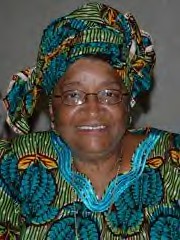
Liberian President Ellen Johnson Sirleaf on Monday declared a state of emergency in the west African country where thousands of people are affected by an invasion of crop-destroying insects.

"I am hereby declaring a state of emergency," Sirleaf said in a speech broadcast on television.

Declaring a state of emergency over the plague by the voracious caterpillars, known as army worms, will make it easier for the president to free up government money to fight the invasion but it is also a cry for attention.

Monrovia has already said it does not have the means to spray the army worms with insecticide from planes and has asked the international community for help.

"Thousands of people have been affected by the invasion of millions of army worms in the centre of the country (...) I have mandated the minister of finance to mobilise all possible resources to enable us to curtail the situation," Sirleaf said.

Authorities say more than 53 towns and villages in Liberia have now been affected by the caterpillars which can lay waste to an entire crop in a matter of days.

Monrovia has warned that tens of thousands of Liberians face hunger due to the insect invasion.

Last week the United Nations' Food and Agriculture Organization (FAO) said the invasion by tens of millions of army worms was a "national emergency" for Liberia that could spread across west Africa.

An FAO delegation currently in Liberia is due to visit other
potentially affected countries Tuesday to take samples of the insects to determine the best way to combat the plague.

According to reports, the army worms have passed into neighbouring Guinea.

Liberia's other neighbour, Sierra Leone, announced Monday it had started a massive drive sending chemicals and spraying personnel to the border districts to keep the invading insects at bay.

Tuesday, January 27, 2009

Rioters Set Fire to Madagascar Television

Rioters set fire to Madagascar TV

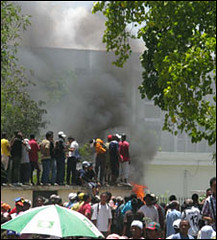
Anti-government protesters in Madagascar have looted and set fire to the offices of the state broadcaster in the capital Antananarivo.

The building was attacked during a demonstration by supporters of the city's mayor and opposition leader, Andry Rajoelina.

His own television and radio stations have been shut down by the government.

The police had banned the protests and President Marc Ravalomanana says the opposition is trying to stage a coup.

Earlier on Monday, tens of thousands of people had gathered in the capital to hear a speech by Mr Rajoelina.

Crowds then moved to the state broadcaster's offices, where soldiers briefly tried to defend the building before dispersing in apparent sympathy with the protesters, a witness told the BBC.

Looters were seen coming out of the offices, cheering and smashing equipment on the ground. Some made off with chairs, desks and door frames.

The protests have led President Ravalomanana to cut short a trip to South Africa.

Mr Rajoelina's TV network Viva was closed last month, after broadcasting an interview with Mr Ravalomanana's foe, former President Didier Ratsiraka, AFP news agency reports.

The BBC's Christina Corbett in Antananarivo says the protests have left people afraid of a return to the kind of political deadlock that followed Mr Ravalomanana's election in 2001.

Story from BBC NEWS:
http://news.bbc.co.uk/go/pr/fr/-/2/hi/africa/7851275.stm
Published: 2009/01/26 16:23:34 GMT

Can Joint Military Operations Between Congo and Rwanda Stave Off Imperialist Intervention?

Can Joint Military Operations Between Congo and Rwanda Stave Off Imperialist Intervention?

A monitoring agreement between the African states is aimed at ending conflict and lessening tension in the region

by Abayomi Azikiwe, Editor
Pan-African News Wire
News Analysis

An accord between the Democratic Republic of Congo and neighboring Rwanda has laid the basis for the curbing of internal strife and the longterm lessening of tensions between these two central African states. The two countries headed by Joseph Kabila of the Democratic Republic of Congo and Paul Kagame of Rwanda, have been trading accusations of military and political intervention in their respective territories for over a decade.

In recent developments since August of 2008, the rebel group called National Committee For the Defense of the People (CNDP) headed by Laurent Nkunda, has attacked Congolese military bases in the North Kivu area in the eastern region of the vast central African country of some 57 million people. As a result of these military actions by the CNDP, thousands of civilians have been re-located inside the DRC and in western Uganda.

Nkunda, an ethnic Tutsi, had close ties with the Rwandan Patriotic Front (RPF) which took power after the genocide of 1994. The RPF is supported by the United States government and has reportedly provided arms, training and supplemental troops to the CNDP in its efforts in North Kivu.

During the latter months of 2008, intense discussions took place in Kenya between the governments of Rwanda and the DRC. These talks were mediated by the African Union, the continental organization of independent states. As a result of these consultations, the leadership in Rwanda and the DRC agreed to end support for rebel groups opposed to their respective states. In this case, the CNDP, which was supported by Rwanda as well as the Demoratic Front for the Liberation of Rwanda (FDLR), which is based in the eastern DRC and consists of former Hutu fighters who have been credited with involvement in the mass killings in Rwanda in 1994, will not longer be allowed to maintain military bases.

Rebel leader Laurent Nkunda, who heads the CNDP, rejected the accord between Rwanda and the DRC, which caused a split inside his organization. A significant faction of former CNDP members joined the DRC government's Armed Forces of the Democratic Republic of Congo (FARDC). The Rwandan army, as a result of the new accord with the DRC, has sent several hundred of its own troops to assist in efforts aimed at rooting out the FDLR in the northeastern region of the country.

Nkunda, in response to political and military developments on the ground, traveled to Rwanda to hold consultations with the Kagame government. However, he was reportedly arrested by the Rwandan authorities in Gisenyi, located near the border with the eastern DRC. The DRC government of Joseph Kabila is demanding that Nkunda be extradited to Kinshasha, the capital, to stand trial for war crimes against the Congolese people.

Military Developments in Eastern DRC

Reports from the field indicate that FDLR rebels have been surrending to the joint military forces of the DRC and Rwanda, who are being bolstered by the CNDP rebels that are now in opposition to their former leader Laurent Nkunda. "We officially invited the Rwandan army to take part in the operation to disarm the Interhamwe, which is about to begin," said Lambert Mende in an interview with the United Nations Inter-regional Information Network (IRIN) on January 20.

The armies of the DRC and Rwanda also announced on January 24 that nine rebels from the FDLR were killed in clashes. This claim was refuted by a representative of the FDLR in an interview with the French Press Agency (AFP). "This is a lie. They killed none of our men for the simple reason that there has not been any fighting between our troops and this coalition," said FDLR chairman Ignace Murwanashyaka in a telephone interview from Germany.

FDLR rebels, who are based in the Sud-Kivu province of the DRC, were reported to be leaving the area for Nord-Kivu. These movements of FDLR forces were reported by the United Nations Mission to Congo (MONUC) peacekeeping forces, who claim that they have not been involved in the recent military operations.

Multi-national mineral exploitation fuels conflict

Despite the shifting political and military alliances in the Democratic Republic of Congo and Rwanda, the impact of the exploitation of mineral resources by the multi-national corporations is continuing to worsen the economic conditions and overall living standards of the majority of Congolese workers and farmers.

Even the United Nations Mission to Congo (MONUC) issued a statement on January 21 saying that: "The humanitarian community is deeply worried by the new deployment of troops in the areas of Gomo and Rutshuru. This heightened military presence gives rise to fears of a new humanitarian crisis that just as the ceasefire was allowing people to gradually return home and giving humanitarians easier access to several areas." (IRIN, January 21)

The nearly $900 million annual diamond industry in the DRC provides employment for approximately one million workers. Yet many of the miners earn less than $1 per day while they toil under very dangerous conditions. During the regional war between the DRC, Angola, Zimbabwe and Namibia on one side and the Rwandan, Ugandan and Burundian militaries on the other, the mining companies in the eastern DRC were reaping tremendous profits.

According to the BBC: "Between 1999-2001, DRC enjoyed a brief coltan boom, becoming the second largest producer of tantalum, which is used in mobile phones." (DRC Key facts) At the same time, the ongoing conflicts have disrupted the agricultural industry as well as local trade. The fighting over the last decade has also hampered the ability of the country to rebuild its infrastructure in order to provide quality food, clean water, adequate healthcare services and education for children.

Anthony Carlson of the Harvard International Review, wrote in a 2006 article that: "The DRC is home to 80 percent of the world's coltan, an illegal sales of this important mineral is funding the continuing conflict in the country. The United Nations estimates that before 2002, rebels and the armies of Rwanda and Uganda occupying the eastern DRC, were making over US$150 million per year from coltan sales. These groups laundered coltan through other Great Lakes countries, including Burundi, which have small reserves of their own. The current warring groups still have raised millions of dollars, more than enough money to finance the ongoing violence."

According to Carlson, "The war over diamonds has caused even greater problems than the one over coltan. In the midst of the war the value of the diamonds smuggled out of the DRC exceeded the government's total budget.... An effective international transfer protocol for these materials would stifle the flow of money to rebel groups, but current controls on the exchange of these goods are mediocre at best.

"There is little in the way of international transfer control mechanism for coltan. The Kimberley Process Certification Scheme, intended to keep 'conflict' diamonds off the world market, has yet to prove effective. It created a chain of countries that promised to sell diamonds with a certificate that ensured the profits would not fund insurgent groups. But diamonds are still used in lieu of cash for arms and equipment."

Other writers have also pointed to the large reservoirs of minerals in the DRC as a significant contributing factor to the ongoing conflicts in the region. Michael Klare wrote in "Rising Powers, Shrinking Planet", that "What makes Africa so enticing today is precisely what made it so attractive to foreign predators in previous centuries: a vast abundance of vital raw materials contained in a deeply divided, politically weakened continent, remarkably open to international exploitation." (Klare, cited in "Crossed Crocodiles," 2008)

The mineral wealth and increasing dependence of the United States on African oil created the conditions for the formation of the Africa Command (AFRICOM). The former U.S. administration of George Bush said that African oil is of strategic interest to us, however, long before the initiation of AFRICOM, the U.S. has backed client-regimes and armed rouge rebel groups in order to loot the Congo. This is the reason behind the U.S. support for the Mobutu regime in Congo for over 35 years.

Klare states in the same above-mentioned work that: "Today, the United States claims that it has no interest in the DRC other than a peaceful resolution to the current war. Yet U.S. businessmen and politicians are still going to extreme lengths to gain and preserve sole access to the DRC's mineral resources. And to protect these economic interests, the U.S. government continues to provide millions to undemocratic regimes. Thus, the DRC's mineral wealth is both an impetus for war and an impediment to stopping it."

The Role of the International Criminal Court

Two former rebel leaders have been brought up on war crimes charges before the International Criminal Court (ICC) at the Hague over the last two weeks. Most recently Thomas Lubanga has pleaded not guilty to charges that he utilized child soldiers in his military campaign against the government of President Joseph Kabila during 2002-2003.

Lubanga, who headed the Union of Congolese Patriots (UPC), a Hema ethnically-based armed group, is accused of recruiting and training children to carry out acts of violence and murder against the Lendu people in the Ituri province in eastern DRC. The ICC chief prosecutor, Luis Moreno-Ocampo, said that Mr. Lubanga sent children to "kill, pillage and rape." The prosecution of Lubanga is the first case to go to trail before the ICC.

Thomas Lubanga was detained in 2005 in the aftermath of clashes between his UPC rebel group and United Nations Peacekeeping Forces in the DRC. Nine Bangladeshi peacekeepers were slain in the clashes in the Ituri area in northeastern DRC.

However, Lubanga insists that he was attempting to bring peace and stability to the Ituri province where rival groups have sought control over the spoils from the exploitation of mineral resources. In a BBC article on January 26, it claims that "The ICC trial sends a clear signal to rebel leaders and army commanders around the world who have frequently been able to commit atrocities on the battlefield with inpunity, says the BBC's Africa analyst Martin Plaut.

Yet there is no mention of the role of the United States government and western-based multi-national corporations in financing and consequently encouraging the violent seizure of mineral resources in eastern DRC. The ICC has sought to prosecute several African rebel leaders and former heads-of-state. Critics have accused the ICC of ignoring the root causes of the conflict in Africa.

In a separate case, Jean Pierre Bemba, leader of the Movement for the Liberation of Congo, (MLC) "was arrested on an ICC warrant in Brussels last May 2008. He faces five charges of war crimes against humanity for rape, torture, looting and murder committed by his MLC movement.

Bemba claims that after his split with the Congolese government in 2006, when he lost a run-off election and was forced to leave the capital of Kinshasha, that he signed a contract with the neighboring state of the Central African Republic (CAR) to provide security to the government based in Bangui.

The so-called International Criminal Court (ICC), located in The Hague, Netherlands, is a controversial institution in the global justice system. Although the court has been ratified in over 100 nations throughout the world, the United States has refused to recognize its right to try its citizens and military personnel.

Despite the failure of the U.S. to ratify the ICC, the former administration of George W. Bush championed the court's threat to indict Sudanese President Omar Hassan El-Bashir and other governmental officials. Judges involved with the ICC will make a decision very shortly on whether to issue an arrest warrant calling for the capture of the Sudanese leader, who they have charged with acts of genocide in the Darfur region of the country. The Sudnanese government has denied the charges and accused the U.S. of efforts aimed at regime-change in a bid to retake control of the burgeoning oil industry inside the country.

Can the accord prevent imperialist military intervention?

It remains to be seen if the military alliance between Rwanda and the DRC, aimed eliminating rebel bases in eastern DRC, will be effective in stabilizing the region and lessening the threat of European Union and possibly U.S. troop deployments. The EU had discussed sending military forces to the eastern DRC when the fighting between the CNDP and the FARDC erupted during the latter months of 2008.

On the surface, if these two governments can create the conditions for the demise of rebel activity in the eastern DRC, it may improve the humanitarian situation among the people in the cities and villages. Hundreds have been killed and several thousand have been displaced since August of 2008 when Nkunda overran several FARDC military bases in the eastern region.

Nonetheless, the underlying exploitation and theft of mineral resources at the aegis of the multi-national corporations must be addressed as the root cause of the violence and dislocations. Most objective reports have placed greater blame on the governments in Rwanda and Uganda as it relates to support for rebel and militia forces who drive out population groups and provide security for the mining corporations that exploit the resources and labor of the people in this country.

Uganda, in recent weeks, has also engaged in military operations in eastern DRC ostensibly to remove bases of the rebel Lord's Resistance Army (LRA) who have establised camps inside the country. In a IRIN report on January 20 it states that "About half of the 100,000 people displaced amid a wave of atrocities in northeastern DRC, where the Ugandan army is leading an operation against Lord's Resistance Army rebels, have no access to humanitarian assistance, according to the United Nations.

"In mid-December, with the explicit backing of the Security Council, the Ugandan army with the DRC and Southern Sudan, launched 'Operation Lighting Thunder' against LRA bases in the Orientale province. The military action followed the renewed failure of LRA leader Joseph Kony to sign an agreement to end his 20-year rebellion against the Ugandan government."

Nevertheless, there has to be a comprehensive program of taking control of the mineral resources of this region where the vast wealth of the country can benefit the workers and farmers as opposed to the multi-national corporations, client states and rebel leaders. The incoming Obama administration has not specifically addressed the situation in the DRC and the Great Lakes region as a whole.

Susan Rice, who was the Clinton administration's Assistant Secretary of State for African Affairs, is taking up the post of United Nations Ambassador for the United States. Her actions during the Clinton administration only served U.S. imperialist aims on the continent.

Rice's statement related to U.S.-Zimbabwe relations indicate that sanctions will be maintained against the ZANU-PF government headed by President Robert Mugabe. If Obama maintains the same foriegn policy orientation towards Congo, he will inevitably fail in creating a new face for U.S. foreign policy on the African continent.
---------------------------------------------------------------------------------------------
Abayomi Azikiwe is the editor of the Pan-Africa News Wire and has been following recent developments inside the Democratic Republic of Congo.
----------------------------------------------------------------------------------------------

Final Declaration of the Beirut Resistance Forum

1) Final declaration of the Beirut Resistance Forum
2) Report by the Anti-imperialist Camp

***

1) Proceedings of the Beirut International Forum
Closing Statement to support Peoples’ Anti-Imperialistic Resistance and the building of Alternatives to Globalization

Two major topics characterized the Forum. On one hand, the heroic resistance by the Palestinian people of Gaza and their ability to confront an intense violence and unprecedented barbarity. On the other, capitalism’s global crisis, which is not only financial but also on economic, social, cultural and moral fronts, thus posing a threat to the survival of humanity itself.

The resistance’s fight against colonialism can’t be detached from the struggle carried out by world revolutionaries and free individuals when facing global capitalism, imperialism, militarization and destruction of social achievements.

The Forum’s attendees declare their support of the Palestinian people’s resistance of Gaza. They condemn the terrorism, crimes, violations of the rule of law and disregard for human value, which Israel has inflicted on these populations.

The Forum participants expressed their support for both the Palestinian and Lebanese resistances against Israeli occupation, as well as to the Iraqis’ fight against American occupation. In addition, they back the Iraqi people’s endeavors to preserve their territorial unity.

The participants declare their support for self-determination for the Afghan people and to their struggle against the American and Atlantic occupation.

The participants salute Venezuelan President Hugo Chavez and Bolivian President Evo Morales for their support to the peoples’ resistance. They express total endorsement of their fight against US’s interference in South America.

They call for lifting the embargo on Cuba and the release of Cuban prisoners detained in US’ prisons.

The participants condemn alliance between the USA and the government of Colombia which for four decades has terrorized its own people and work to destabilize the progressive regimes of the Latin America. Also they bring their support to the revolutionary movements in fight against this regime.

See full call:
http://www.antiimperialista.org/index.php?option=com_content&task=view&id=5980&Itemid=244

***

2) Islamic and Leftist Anti-imperialists unite

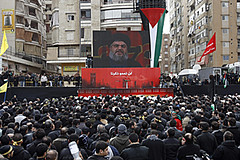
In the opening session Hezbollah’s deputy-secretary Sheik Naim Kassem excellently expressed the common spirit: Today there are only two camps in the world. The one of US imperialism and its allies and the other one of the resistances regardless of their ideological, cultural or religious affiliation. The resistances must be unified against its common enemy which is only possible by respecting the diversity.

The signal sent by this conference to form an international anti-imperialist front was already very bold given the fact that it was the first such event of that scale. Nevertheless the organisers were keen to develop some concrete agreements for the next steps. It is clear that new activities and meetings will be needed to go ahead on that track. As Anti-imperialist Camp we draw following conclusions and put forward following proposals in the spirit of the forum:

1) Insist on the campaign to boycott Israel on all levels.

2) Send brigades and delegations to Gaza and other places of resistance to build solidarity from below and allow a direct touch to the reality on the ground in order to counter the distortions of the Western corporate media.

3) Hold an anti-imperialist conference in support of the resistances in Europe as a continuation of Beirut forum. The main axis could be:
a) give voice to the resistances
b) rebuff raging Islamophobia which provides the ideological backing to the ongoing imperialist war
c) propose as the only solution to the Palestinian problem on single democratic state.

4) Build a permanent but open body of global co-ordination of anti-imperialist forces.

See full report:
http://www.antiimperialista.org/index.php?option=com_content&task=view&id=5975&Itemid=244

************************************
Anti-imperialist Camp
http://www.antiimperialista.org
camp@antiimperialista.org
************************************

Cynthia McKinney's Statement on Obama's Actions Thus Far in Regard to Gaza

Cynthia McKinney's Statement on Obama Actions Thus Far in Regard to Gaza

January 26, 2009

"Mr. President: Give Us a Clean Break from War"

In a message to President Obama today, former Congresswoman Cynthia McKinney wrote:

"It is time that the United States negotiate in good faith with Hamas, the legitimate representative of the Palestinian people. It is also time that the U.S. government tell Israel to release the Hamas Parliamentarians it illegally arrested. President Obama, please say something about Gaza. You have been roundly condemned for your continued silence in the face of war crimes and crimes against humanity committed by Israel in Gaza. Silence is complicity. Not one more bomb for Israel."

Israeli action in Gaza has outraged the world. Starting with Israel's inhumane blockade of Gaza when it didn't like the 2006 election results that put Hamas officially into power. In September 2007, Israel declared Gaza an "enemy entity." Of course, Israeli efforts to isolate the Gaza Strip can be traced back to Ariel Sharon as early as 2005. In carrying out its military Operation Cast Lead, Israel not only committed war crimes and crimes against humanity, it also carried out a long-standing goal of Gaza isolation. The President's continued silence on Gaza and the Palestinian right of self-determination is unacceptable.

I would like to commend President Obama for recognizing that peace is the imperative and that the United States can play a constructive role in its attainment. However, placing a phone call to an irrelevant "leader" in an attempt to revive his political standing is not a route to peace: it is a journey down the same road that we're already on, that is massacres, genocide, war crimes, crimes against humanity, torture--all with U.S. weapons, paid for by U.S. taxpayers.

The President must call the elected representatives of the Palestinian people and that means dealing with Hamas.

President Obama has already spoken with Israeli Prime Minister Ehud Olmert. George Mitchell, the President's Middle East Envoy, is reportedly scheduled to visit the region, but is expected to meet only with Egyptian, Israeli, Saudi, and Jordanian leaders, and the West Bank's Abbas. Unfortunately, despite worldwide revulsion and United Nations outrage at Israeli actions in Gaza, Gaza has not been reported to be one of the Presidential Envoy's destinations.

Even worse, one of the first officials that Obama called on his first day in office was Palestinian Mahmood Abbas. Abbas, however, is no longer President, heading a government that has no opportunity to govern, from a state that exists only as a construct not made by the Palestinian people. For the United States to embark upon the path of peace, it must recognize and act on the fact that Mahmood Abbas is now irrelevant.

I believe that the call to Abbas occurred because of pressure on President Obama from outraged activists around the country and around the world calling for him to do something. But Abbas is irrelevant if the goal is peace.

If the goal, however, is to appear to be doing something while all the time doing nothing but allowing the violence of U.S.-sponsored military action to spread including saber rattling against Syria and Iran, then the President is on the right path.

The American people voted for change and peace. President Obama's current path will produce neither.

I have implored President Obama to say something about Gaza. He has been roundly condemned for his continued silence in the face of war crimes and crimes against humanity committed by Israel in Gaza. Silence in the face of such criminal behavior is complicity.

President Obama must urgently place a call to the elected government of the Palestinian people.

President Obama can send a strong message to the warmongers inside his own party and present them "a clean break" from war. I encourage him to do so. We will not be fooled by actions that have the appearance of putting us on a path for peace, but that are public relations projects that buy time for more war.

To activists and human rights lawyers around the world I say: Now is not the time to let up. We must be unrelenting in our pressure for justice and recognition of the rights of all peoples embodied in the Universal Declaration of Human Rights. Those rights include the right not to be occupied. And the right to resist occupation. This is the embodiment of self-determination. And the Palestinian people are holders of these rights.

It is time that the United States negotiate in good faith with Hamas, because it is the legitimate representative of the Palestinian people. It is also time that the U.S. government tell Israel to release the Hamas Parliamentarians it illegally arrested.

While the United States Government spends precious resources to imprison Palestinians in the United States who attempted to ameliorate the humanitarian disaster in Gaza, I will attempt another trip to Gaza to assess the depth of the worsened humanitarian catastrophe now there.

I have repeatedly called on the President to ask for and the Congress to vote not one more bomb, not one more dime for the Israeli war machine.

Monday, January 26, 2009

Sudan to Send Popular Delegation From Darfur to The Hague Court

Sudan to send popular delegation from Darfur to The Hague court

Sunday 25 January 2009

January 24, 2008 (NYALA) — Sudan would send a delegation of Darfur traditional leaders to ask The Hague based International Criminal Court (ICC) to not follow prosecutor request and issue an arrest warrant for the Sudanese president Omer Al-Bashir for crimes in Darfur.

The building of the International Criminal Court in The Hague, Netherlands Hussein Abu Sharati the spokesperson of the Internally Displaced People in Darfur and its Refugees in Chad told Sudan Tribune that the delegation is composed of 36 people most of them are traditional leaders from the three states of Darfur. He added they would leave on Sunday to Khartoum and then they will fly to The Hague.

Abu Sharati, who described the delegation as government emanation, added that the petition it intends to deliver to the ICC does not reflect the conviction of Darfur people or represent them. He also accused the authorities of blackmailing and pressing the people to force them to sign it.

"We would like to make it clear for the world that we have no relation with the so called Popular Petition," he said. Abu Sharati added that "the IDPs in the different camps of Darfur prevented the petitioners from collect any signatures inside the camps"

Sudan government, which refuses to have any direct relation with the ICC and rejects it jurisdiction over Darfur crimes, says willing to deal with the world court through a third party: an ICC member country, a law firm or a nongovernmental organization.

Two weeks ago, two pro-Sudan groups have filed a motion with the ICC judges asking them to reject the prosecutor’s application to issue an arrest warrant for president Omer Hassan Al-Bashir. The two groups consist of the Sudan Workers Trade Unions Federation (SWTUF) and the Sudan International Defense Group (SIDG).

ICC judges are reviewing ten counts presented by prosecutor Luis Moreno-Ocampo in mid-July that include three counts of genocide, five of crimes against humanity and two of murder and accused Al-Bashir of masterminding a campaign to get rid of the African tribes in Darfur; Fur, Masalit and Zaghawa.

They are expected to issue their decision during the upcoming weeks.

Finance Crisis Claims 70,000 Jobs In One Day

Finance crisis claims 70 000 jobs in one day

By David Obey
NEW YORK, UNITED STATES Jan 26 2009 16:28

Companies forecast almost 70 000 job cuts in a single day as the rampant crisis born in the banking sector struck workers in factories and offices across the globe and brought down a government on Monday.

The financial catastrophe claimed one of its biggest casualties yet as Iceland's Prime Minister Geir Haarde announced the resignation of his government after months of protests over its handling of the economic crisis.

And shortly after United States President Barack Obama warned of a downturn that could become "dramatically worse", several huge companies announced a fresh avalanche of cuts.

In New York, construction equipment giant Caterpillar said it planned 20 000 job cuts worldwide to cope with plunging sales and US telecom operator Sprint Nextel announced 8 000 cuts -- 14 percent of its staff.

Japan's top 12 carmakers expect to cut a total of 25 000 jobs between now and the end of March to cope with an industry slump, a survey by Jiji Press concluded on Monday.

Dutch banking and insurance group ING announced 7 000 job cuts and a deal for the Dutch state to assume 80 percent of the risk on a €27,7-billion portfolio of troubled assets.

Dutch electronics giant Philips said it would eliminate 6 000 jobs.

Pfizer Inc, which on Monday announced that it would be buying rival drug maker Wyeth in a $68-billion deal, said it would slash more than 8 000 jobs as it prepares for an expected revenue crash when its cholesterol drug Lipitor loses patent protection in November 2011.

British Prime Minister Gordon Brown insisted that the crisis, which has forced his government to intervene to shore up banks, should give rise to "a new global order".

"As some want, we could close our markets -- for capital, financial services, trade and for labour -- and therefore reduce the risks of globalisation," he said, according to the text of a speech issued by his office.

"Or we could view the threats and challenges we face today as the difficult birth-pangs of a new global order -- and our task now as nothing less than making the transition through a new internationalism to the benefits of an expanding global society."

Nowhere is the transition likely to be more painful than in the labour market, as the slowdown forces struggling enterprises around the world to slash their payrolls.

The announcements by the two Dutch companies came ahead of confirmation that Europe's second-biggest steelmaker, Indian-owned Corus, said it would cut more than 3 500 jobs around the world, most of them in Britain.

Workers arriving early on Monday were gloomy about their prospects.

"People feel gutted. I have already had to take a 10 percent pay cut," said 45-year-old Douglas Mayhill, a worker at a Corus plant in Port Talbot, southern Wales.

"I was told on Friday I have a choice -- either accept a 10 percent pay cut or take redundancy -- that is no choice."

The US Congress was meanwhile due to begin debate this week on Obama's $825-billion stimulus Bill designed to haul the US economy out of a paralysing recession.

In his first presidential radio address at the weekend, Obama raised the spectre of double-digit unemployment and a massive erosion of family incomes if Congress did not act on the stimulus Bill.

"If we do not act boldly and swiftly, a bad situation could become dramatically worse," he said.

European shares rallied on Monday, however, with sharp gains in the banking sector on positive news from British group Barclays, whose share price surged more than 75 percent on unexpectedly strong profit expectations, analysts said.

The deepening recession pushed the price of gold, seen as a safe haven in times of stress, up to $906 an ounce, the highest level for three and a half months. -- Sapa-AFP

Source: Mail & Guardian Online
Web Address: http://www.mg.co.za/article/2009-01-26-finance-crisis-claims-70nbsp000-jobs-in-one-day


Obama faces bipartisan test on stimulus

By Edward Luce in Washington
January 26 2009 21:40

Barack Obama faces an unexpectedly early test on Tuesday of whether he can govern as a bipartisan president when he meets Republican lawmakers to try to roll back the growing tide of conservative hostility to his $850bn stimulus plan.

Republican leaders have become increasingly strident in their opposition to the plan, which they claim is stuffed with spending on Democratic special interests and contains little in the way of genuine stimulus. Mr Obama has portrayed the vote, which is expected to take place in the House of Representatives as early as this week, as a critical test of whether he can govern from the centre.

Unless he comes up with a new incentive for Republicans to change their position, Mr Obama’s bipartisan aspirations could go up in smoke before he has completed a week in office.

“It looks like the Republicans have decided to take on Obama sooner rather than later,” says Doug Schoen, a leading Democratic pollster.

“It is a low-risk strategy. If the stimulus fails, Republicans can claim they were right all along. If it works, then they were fulfilling their role as the loyal opposition.”

Nevertheless, observers are taken aback by the harsh tone of Republican opposition to the bill at this early stage in Mr Obama’s presidency – particularly given his willingness to make compromises over its content. At the risk of alienating the liberal wing of the Democratic party, Mr Obama conceded $275bn (€208bn, £187bn) in tax cuts even before he was sworn in.

Most economists say spending is a more efficient form of stimulus since a large share of tax cuts are put away in savings. But Republicans point to a report by the non-partisan Congressional Budget Office which says only a fraction of the spending in the bill would feed into the economy during 2009.

In a scathing 20-point critique on Monday, John Boehner, the House Republican leader, singled out $650m in spending on digital television coupons, $50m in funding for the National Endowment for the Arts and $200m to upgrade the National Mall in Washington – “including $21m for sod” – which he said made a mockery of the exercise.

“Rather than working with Republicans on a proposal that lets families, small businesses, entrepreneurs and the self-employed keep more of what they earn . . . it seems congressional Democrats are prepared to barrel ahead with the same-old, same-old – more and more aimless spending,” he said in a statement.

Mitch McConnell, the Republican Senate leader, was equally dismissive: “Everybody at the state level has been making their list and checking it twice and we’re going to end up with some very embarrassing expenditures,” he told Fox News. “You’re going to see a lot of mob museums and water slides [pork barrel items].”

Even without Republican support, Mr Obama is likely to get large majorities in favour of the stimulus in both chambers of Congress. Mr McConnell, who has 41 Republican senators, which enables him to block legislation since Democrats require 60 votes to shut off debate, has said he would not filibuster against the bill.

But the early deterioration in rhetoric could bode ill for the Obama administration’s hopes of returning to Congress within the next few weeks to request much larger assistance, possibly up to $1,000bn, in new emergency funds to shore up the US banking system.

“The Republicans should vote against this stimulus because it isn’t really a stimulus,” says David Frum, a leading conservative commentator. “They will have to look separately at any new Tarp [Troubled asset relief programme] request and treat it on its merits.”

Mr Obama, who promises that a majority of the stimulus spending would come on stream in the next 18 months, has signalled that there are limits to his bipartisan patience. He told Republicans last week to stop listening to Rush Limbaugh, the conservative talk radio commentator, who commands a large following among grassroots conservatives. Mr Limbaugh sarcastically describes Mr Obama as the “Great Unifier”.

Copyright The Financial Times Limited 2009


JANUARY 26, 2009, 3:04 P.M. ET

Caterpillar to Cut 20,000 Jobs as Downturn Worsens

By ILAN BRAT
Wall Street Journal

The global economic picture continued to darken as Caterpillar Inc. said it would lay off 20,000 employees while projecting steep declines in its sales and profit in the coming year.

Caterpillar is encouraging dealers to cut back on inventories, which has led to order cancellations.
Caterpillar's dire outlook comes amid a sharp slowdown in economic growth around the world.

The world-wide infrastructure and commodities boom that powered the Peoria, Ill., company's growth over the last five years–helping Caterpillar more than double its annual revenue between 2002 and 2007–has collapsed, as roads, bridges, high-rises and other projects have been delayed or suspended.

Caterpillar said its 2009 total sales would be $40 billion, give or take 10%. That contrasts with Chief Executive Jim Owens' prediction last year that the company would approach $60 billion in annual sales by 2010. Mr. Owens last March had predicted that the company's earnings per share would rise at an annual rate of 15% to 20% through 2012.
Sets Cuts at Illinois Plant

For the fourth quarter, Caterpillar's earnings per share dropped 28% from a year earlier to $1.08, as Caterpillar's net income dropped 32% to $661 million. Total sales rose 6% to $12.9 billion.

Caterpillar shares were off sharply after the announcement.

Of the 20,000 workers Caterpillar plans to shed this year, about 4,000 will be full-time production employees. Another 8,000 temporary workers or contract workers will be furloughed, and some 7,500 support and management employees will be cut loose through layoffs or voluntary departures. Thousands of employees still on the job will be subjected to short-term layoffs and shortened work-weeks as the company ratchets down production at several of its plants.

Amid a deepening U.S. housing and broader economic slump in the last two years, the company relied on overseas sales of its earth-moving machinery, particularly highly profitable giant machines and engines for large construction, mining and energy-related projects.

Orders were so robust that production bottlenecks at some plants raised costs, restrained profit and slowed production. But as the global economy shifted downward last year, the company in December said it would fire 800 people at a plant in Illinois that makes small engines, the first time Caterpillar had offloaded workers on a large scale since early this decade.

Write to Ilan Brat at ilan.brat@wsj.com


JANUARY 26, 2009, 4:22 P.M. ET

Iceland's Coalition Government Collapses

By CHARLES FORELLE

Iceland's government collapsed Monday, days after its prime minister called for early elections amid popular anger over a financial crisis that has gutted a once-flourishing economy.

Prime Minister Geir Haarde announced Monday that he and his cabinet would resign immediately. The move came after his Independence Party failed to come to terms with the Social Democrats, its main partner in Iceland's coalition government. Mr. Haarde was due Monday afternoon to present his resignation to Iceland's president.

Mr. Haarde was working to form a new government, his spokesman said, but Social Democrat leaders were demanding a fresh face.

"The government's actions in the last weeks and months were not swift enough," Foreign Minister Ingibjorg Solrun Gisladottir, the leader of the Social Democrats, said Monday, according to Agence France-Presse.

It is far from clear who will run Iceland until elections scheduled for May. Ms. Gisladottir proposed a fellow Social Democrat, Johanna Sigurdardottir, but Mr. Haarde's spokesman said the Independence Party—which has a plurality of seats in parliament--is determined not to hand over the prime minister's office.

That could open the door for the Independence Party's second-in-command, Thorgerdur Katrin Gunnarsdottir, currently education minister.

Iceland's president, who holds a largely ceremonial post, has authority to designate a person responsible for forming a government.

Iceland becomes the second European nation to lose its government in the global crisis -- Belgium's resigned last month after a scandal involving aid to a fallen bank. It is perhaps the world's hardest hit: Last fall, three big banks -- virtually the entire banking system -- collapsed, and the island's currency went into freefall.

The twin currency and banking crises have caused a startlingly swift reversal of fortune for Icelanders, per capita once one of the world's wealthiest people. Today, inflation and unemployment are soaring, debt is mounting and the banking sector that provided cushy jobs and fueled a consumption boom has vanished.

Anger at Iceland's leaders has been palpable for months. Protests in front of the parliament that began last fall drew crowds of thousands that quickly turned raucous—pelting the parliament building with eggs and rolls of toilet paper, and displaying effigies of Mr. Haarde.

Up until last week, Mr. Haarde had been defiant, saying Iceland—which has accepted a $2.1 billion bailout from the International Monetary Fund—could not afford political chaos as it tries to rebuild its economy.

But Friday, he said his doctors had discovered a tumor of the esophagus, and that he would call for early elections in May and stand down as the party's chief. Leaders of the protests said that wasn't enough. Demonstrations continued over the weekend. By Monday, the coalition had broken and Mr. Haarde faced open criticism from his partners.

At the root of Iceland's troubles was a outsized banking system, which grew wildly overseas and built up foreign liabilities many times the size of Iceland's economic output. When the credit crunch struck, the banks faced difficulty making payments, and Iceland's central bank didn't have the foreign currency needed to bail them out.

Write to Charles Forelle at charles.forelle@wsj.com


The Stimulus Time Machine

Wall Street Journal Commentary

That $355 billion in spending isn't about the economy

The stimulus bill currently steaming through Congress looks like a legislative freight train, but given last week's analysis by the Congressional Budget Office, it is more accurate to think of it as a time machine. That may be the only way to explain how spending on public works in 2011 and beyond will help the economy today.

According to Congressional Budget Office estimates, a mere $26 billion of the House stimulus bill's $355 billion in new spending would actually be spent in the current fiscal year, and just $110 billion would be spent by the end of 2010. This is highly embarrassing given that Congress's justification for passing this bill so urgently is to help the economy right now, if not sooner.

And the red Congressional faces must be very red indeed, because CBO's analysis has since vanished into thin air after having been posted early last week on the Appropriations Committee Web site. Officially, the committee says this is because the estimates have been superseded as the legislation has moved through committee. No doubt.

In addition to suppressing the CBO analysis, Democrats have derided it. Appropriations Chairman David Obey (D., Wis.) called it "off the wall," never mind that CBO is now run by Democrats. Mr. Obey also suggested that it would be a mistake to debate the stimulus "until the cows come home." We'd settle for a month or two, so at least the voters can inspect the various Congressional cattle they're buying with that $355 billion.

The stimulus bill is also a time machine in the sense that it's based on an old, and largely discredited, economic theory. As Harvard economist Robert Barro pointed out on these pages last Thursday, the "stimulus" claim is based on something called the Keynesian "multiplier," which is that each $1 of spending the government "injects" into the economy yields 1.5 times that in greater output. There's little evidence to support this theory, but you have to admire its beauty because it assumes the government can create wealth out of thin air. If it were true, the government should spend $10 trillion and we'd all live in paradise.

The problem is that the money for this spending boom has to come from somewhere, which means it is removed from the private sector as higher taxes or borrowing. For every $1 the government "injects," it must take $1 away from someone else -- either in taxes or by issuing a bond. In either case this leaves $1 less available for private investment or consumption. Mr. Barro wrote about this way back in 1974 in his classic article, "Are Government Bonds Net Wealth?", in the Journal of Political Economy. Larry Summers and Paul Krugman must have missed it.

The government spending will be a net stimulus only if its $1 goes to more productive purposes than those to which private investors would have put that same $1. There are some ways we may want the government to spend money -- on national defense, say -- but that doesn't mean it's a stimulus.

A similar analysis applies to the tax cuts that are part of President Obama's proposal. In contrast to the spending, at least the tax cuts will take effect immediately. But the problem is that Mr. Obama wants them to be temporary, which means taxpayers realize they will see no permanent increase in their after-tax incomes. Not being fools, Americans may either save or spend the money but they aren't likely to change their behavior in ways that will spur growth. For Exhibit A, consider the failure of last February's tax rebate stimulus, which was a bipartisan production of George W. Bush and Mr. Summers, who is now advising Mr. Obama.

To be genuinely stimulating, tax cuts need to be immediate, permanent and on the "margin," meaning that they apply to the next dollar of income that an individual or business earns. This was the principle behind the Kennedy tax cuts of 1964, as well as the Reagan tax cuts of 1981, which finally took full effect on January 1, 1983.

If the Obama Democrats can't abide this because it's a "tax cut for the rich," as an alternative they could slash the corporate tax to spur business incentives. The revenue cost of eliminating the corporate tax wouldn't be any more than their proposed $355 billion in new spending, and we guarantee its "multiplier" effects on growth would be far greater. Research by Mr. Obama's own White House chief economist, Christina Romer, has shown that every $1 in tax cuts can increase output by as much as $3.

As for all of that new spending, CBO will release an updated analysis this week. And we anticipate that the budget analysts will in the interim have discovered that much more of that $355 billion will somehow find its way to "shovel-ready" projects that the Obama Administration can start building before the crocuses bloom. But in the real world, the CBO's first estimate is likely to prove closer to the truth.

The spending portion of the stimulus, in short, isn't really about the economy. It's about promoting long-time Democratic policy goals, such as subsidizing health care for the middle class and promoting alternative energy. The "stimulus" is merely the mother of all political excuses to pack as much of this spending agenda as possible into a single bill when Mr. Obama is at his political zenith.

Apart from the inevitable waste, the Democrats are taking a big political gamble here. Congress and Mr. Obama are promoting this stimulus as the key to economic revival. Americans who know nothing about multipliers or neo-Keynesians expect it to work. The Federal Reserve is pushing trillions of dollars of monetary stimulus into the economy, and perhaps that along with a better bank rescue strategy will make the difference. But if spring and then summer arrive, and the economy is still in recession, Americans are going to start asking what they bought for that $355 billion.

Oscar Grant And You--An Essay By Mumia Abu-Jamal

OSCAR GRANT -- and YOU

[col. writ. 1/17/09 (c) '09 Mumia Abu-Jamal

Like you, I've seen the searing phone-camera tape of the killing of 22-year-old Oscar Grant, of Oakland, California.

And although it's truly a terrible thing to see, it's almost exceeded by something just as shocking. That's been how the media has responded to this police killing, by creating a defense of error.

This defense, that the killer cop who murdered Grant somehow mistook his pistol for his Taser, has been offered by both local and national news reporters -- even though they haven't heard word one from Johannes Mehserle, the BART (Bay Area Rapid Transit) cop who wasn't even interviewed for weeks after shooting an unarmed man!

If you've ever wondered about the role of the media, let this be a lesson to you. You can see here that the claim that the corporate media is objective is but a cruel illusion.

Imagine this: if the roles were reversed, that is, if bystanders had footage of Grant shooting Mehserle, would the media be suggesting a defense for him?

Would Grant have been free to roam, to leave the state a week later?

Would he have made bail?

The shooting of Oscar Grant III is but the latest, West Coast version of Amadou Diallo, of Sean Bell, and of hundreds of other Black men -- and like them, don't be surprised if there is an acquittal -- again.

Oscar Grant is you -- and you are him, because you know in the pit of your stomach that it could've been you, and the same thing could've happened.

You know this.

And what's worse is this: you pay for this every time you pay taxes, and you endorse this every time you vote for politicians who sell out in a heartbeat.

You pay for your killers to kill you, in the name of a bogus, twisted law, and then pay for the State that defends him.

Something is terribly wrong here--and it's the system itself.

Until that is changed, nothing is changed, for we'll be out here again (in the streets) -- chanting a different name.

--(C) '09 MAJ
==================
The Power of Truth is Final -- Free Mumia!

Audio of most of Mumia's essays are at: http://www.prisonradio.org

PLEASE CONTACT:
International Concerned Family & Friends of MAJ
P.O. Box 19709
Philadelphia, PA 19143
Phone - 215-476-8812/ Fax - 215-476-6180
E-mail - icffmaj@aol.com
Web - http://www.freemumia.com
AND OFFER YOUR SERVICES!

Send our brotha some LOVE and LIGHT at:
Mumia Abu-Jamal
AM 8335
SCI-Greene
175 Progress Drive
Waynesburg, PA 15370

Israel's Collective Punishment of Gaza: Chemical Weapons, Deaths of Women and Children All Supported by US

Israel's collective punishment of Gaza, chemical weapons, deaths of women and children all supported by U.S.

By Marjorie Cohn
Friday, 01.09.2009, 06:45pm

Since Israel began its war on Gaza 14 days ago, more than 800 Palestinians – about half of them women and children – have been killed. Some 3,200 Gazans – about half of them women and children – have been wounded. Israel's "Operation Cast Lead" marks an escalation of Israel's two-year blockade of the Gaza Strip which has deprived 1.5 million Palestinians of necessary food, medicine, fuel and other necessities.

Israel is allegedly using white phosphorous gas, an illegal chemical weapon that burns to the bone. Dr. Mads Gilbert, a member of a Norwegian triage medical team working in Gaza, has documented Israel's use of Dense Inert Metal Explosive (DIME), which cuts its victims to pieces and reportedly causes cancer in survivors. Gilbert, who has worked in several conflict zones, said the situation in Gaza is the worst he has ever seen. Two United Nations schools have been hit by airstrikes, killing at least 30 people. The New York Times reported on Monday that Gazan hospitals are full of civilians, not Hamas fighters.

The targeting of civilians violates the Fourth Geneva Convention. Since the rockets fired from Gaza into Israel cannot distinguish between civilians and military targets, they are illegal. But Israel's air and ground attack in Gaza violates Geneva in four ways. First, it constitutes collective punishment of the entire population in Gaza for the acts of a few militants. Second, it targets civilians, as evidenced by the large numbers of civilian casualties. Third, it is a disproportionate response to the rockets fired into Israel. Fourth, an occupying power has an obligation to ensure food and medical supplies to the occupied population; Israel's blockade has created a humanitarian crisis in Gaza.

Israel's airstrikes and ground assault on the people of Gaza have little to do with the Gazan rockets, which hadn't killed any Israelis for a year before Israel's current military operation. Israel's leaders are bombing and attacking Gaza in order to gain an advantage in the upcoming Israeli elections in February.

Foreign Minister Tsipi Livni is locked in a tight race with Benyamin Netanyahu, who has criticized Livni for her "soft" treatment of the Palestinians. The Israeli government seeks to do as much damage as possible to Gaza while Bush is still in office. The New York Times cited several Middle East experts who "believe that Israel timed its move against Hamas, which began on Dec. 26, 25 days before Mr. Bush leaves office, with the expectation of such backing in Washington." Obama, in spite of his unequivocal support for the policies of Israel during the campaign and his deafening silence about the recent casualties, is an unknown quantity.

Israel would be unable to carry out its aggressive policies in Gaza without the support of the United States, which gives Israel $3 billion in U.S. taxpayer money each year. The F-16 bombers and Apache attack helicopters Israel is using on Gaza were bought with U.S. money.

The war on Gaza also violates U.S. law. The Human Rights and Security Assistance Act mandates that the United States cease all military aid to Israel, which has engaged in a consistent pattern of gross violations of internationally recognized human rights. The Arms Export Control Act prohibits U.S. weapons from being used for any purpose other than inside the borders of a country for self-defense. Targeting schools, police stations and television broadcast centers is not self-defense.

Although Israel's supreme court ordered the government to allow international media into Gaza to report on the situation there, Israel has refused. But, according to the New York Times, Israel has given "full access to Israeli political and military commentators." Ethan Bronner, the Times bureau chief in Jerusalem, said, "Israel has never restricted media access like this before, and it should be ashamed... It's betraying the principles by which it claims to live."

In spite of the one-sided pro-Israel media coverage in the United States, Newsweek said, "Does it make sense for America to support [Israel's] policy of punishing Hamas by making life unbearable for 1.5 million Gazans by denying aid and economic development? The answer is no." An editorial in the Los Angeles Times called for "an end to a blockade that amounts to the collective punishment of Palestinians under Hamas rule." And the New York Times editorialized that "the longer the Israeli incursion... the more Hamas's popularity grows among its supporters."

Hundreds of thousands of people around the world are protesting Israel's aggression in Gaza. Ten thousand demonstrated in Israel and scores have taken to the streets in Europe, the Middle East and throughout the United States.

A recent Rasmussen Reports poll found that Americans generally "are closely divided over whether the Jewish state should be taking military action against militants in the Gaza strip." But Democratic voters overwhelmingly oppose the Israeli offensive by a 24-point margin (31-55%). Republicans, on the other hand, overwhelmingly support it (62-27%). Nevertheless, Democratic Party leaders have followed Bush in their uncritical support for Israel.

The United States has blocked a ceasefire resolution in the Security Council. In the absence of council action, the General Assembly is empowered to act under the Uniting for Peace Resolution 377. Assembly president Miguel D'Escoto, who has been critical of Israel's actions in Gaza, said that "the time has come to take firm action if the U.N. does not want to be rightly accused of complicity by omission." The Human Rights Council should send a high level fact finding mission to Gaza.

It's time to call a halt to the violence and bloodshed.

Marjorie Cohn is a professor at Thomas Jefferson School of Law and the president of the National Lawyers Guild. She is the author of "Cowboy Republic: Six Ways the Bush Gang Has Defied the Law." Her articles are archived at http://www.marjoriecohn.com.

Somalia News Bulletin: Al-Shabab Overruns Baidoa; Parliament Expanded; AU Forces Vow to Fire Back

Monday, January 26, 2009
21:41 Mecca time, 18:41 GMT

Al-Shabab overruns Somali town

Al-Shabab wants to impose its strict version of Islamic law in Somalia

Fighters from the al-Shabab group have captured the Somali town of Baidoa and seized the parliament building just hours after Ethiopian troops pulled out of the country, witnesses said.

Mohammed Sheikh Nur, a journalist based in Mogadishu, told Al Jazeera that al-Shabab fighters had also taken control of the airport and the presidential palace.

"They are now in full control of the town and have urged people to stay calm. There have been injuries [as a result of the clashes] but no deaths so far," he said.

Sheikh Mukhtar Robow, a spokesman of the al-Shabab, said: "The town is completely in our hands. We have taken control of Baidoa today."

His group has vowed to carry on fighting and impose its strict version of Islamic law throughout the country.

Due to the poor security situation, Somalia's parliament has been meeting in neighbouring Djibouti, aiming to elect a new president following the resignation of Abdullahi Yusuf Ahmed last month.

Next president

On Monday, the parliament voted to double its size, allowing 200 members from the opposition Alliance for the Re-Liberation of Somalia (ARS) to join.

Seventy-five seats are to be filled by other opposition and civil society members later.

The United Nations is mediating between the different sides in Djibouti.

Ahmedou Ould-Abdallah, the UN's envoy to Somalia, welcomed the parliamentary reform.

"I am extremely encouraged by this vote and I would like to thank Somalia's leaders, the parliamentarians and all those who have helped work towards such a positive step," he said.

After the new members are sworn in, the parliament is expected to elect a new president.

Sheikh Sharif Ahmed, the head of the Islamic Courts Union and the more moderate wing of the ARS, announced on Monday that he would be running for the country's presidency after the parliament voted to accept members of the opposition alliance.

"I will do all that I can to serve honestly if elected president," Ahmed said.

At least 16 other candidates, including Nur Hassan Hussein, the current prime minister, and his predecessor Ali Mohamed Gedi have also shown interest in becoming the next president.

Source: Al Jazeera and agencies


Islamists seize Somali parliament seat

Posted: 1/26/2009 5:39:00 PM
Shabelle: SOMALIA

BAIDOA (Sh. M. Network)-Al-Shabaab Islamist insurgents have taken control of Baidoa, the seat of the transitional parliament, witnesses said on Monday.

The seizure comes after the Ethiopian troops vacated the town early on Monday.

Reports from Baidoa say that Al-Shabaab insurgents captured some Somali MPs including a minister, Mohamed Ibrahim Habsade, but they released them later and now the town is calm.

Local militias looted ADC, the centre of the parliament and other government offices.

Locals say at least four people were killed and ten others injured in after insurgents hurled a grenade at government soldiers near a bus-stop.

The government soldiers then opened gunfire to many directions which prompted civilian casualties.

There is no word from al-Shabaab.

Shabelle Media Network


UN envoy welcomes expansion of Somali Parliament

Posted: 1/26/2009 5:16:00 PM
Shabelle: SOMALIA

DJIBOUTI (Sh. M. Network)-UN Special Representative for Somalia Ahmedou Ould-Abdallah on Monday welcomed the overwhelming vote by Somalia's Transitional Federal Parliament in favour of expanding the legislative body by an additional 275 Members.

"I am extremely encouraged by this vote and I would like to thank Somalia's leaders, the Parliamentarians and all those who have helped work towards such a positive step," Ould-Abdallah saidin a statement issued in Nairobi.

The Parliamentary vote, which took place in Djibouti on Monday, resulted in 211 MPs voting in favour of expansion with six against and three abstentions.

The Somali Transitional Federal Government and the Alliance for the Re-Liberation of Somalia agreed last October on the outline of enlarging Somalia's Transitional Federal Parliament and forming a Government of National Unity.

Up to 200 new members of Parliament, selected by the Alliance for the Re-Liberation of Somalia (ARS) are expected to be sworn in Djibouti while the expanded Parliament will subsequently elect a new president.

The other 75 seats are being kept for members of civil society and opposition who are not members of the ARS.

"This is a very good result and will demonstrate to the Somali people that their leaders are committed to moving forward together to restore peace and stability," said Ould-Abdallah.

The international community hopes a more inclusive Somali government will be able to reach out to armed groups who are still fighting the interim government and targeting African Union peacekeepers in the capital Mogadishu.

"It means Somalia will have a new President who will be able to attend the African Union Summit of Heads of State in Addis Ababa on Feb. 1, demonstrating the progress that was made here in a short space of time."

"The international community has also made a key contribution with support for the Parliamentary meetings and, as always, Djibouti has provided most welcome hospitality and backing," said the UN special representative.

Shabelle Media Network

African peacekeepers ready to defend if attacked

Posted: 1/18/2009 6:57:00 AM
Shabelle: SOMALIA

MOGADIHSU (Sh. M. Network)-The AU peace keepers in Mogadishu known as AMISOM are ready to defend from any attackers, AMISOM spokesman Maj. Barigye Bahoko told Radio Shabelle on Sunday.

Al-Shabaab insurgents attacked African Union peacekeepers for the first time since Ethiopian troops pulled out from Mogadishu on Saturday evening.

“We have never been the first ones to fire our bullets to anyone and we will never be, but we have a right to defend our selves, those who are making threats have to understand the problem of Somalia is not AMISOM. It is the lack of peace and security, Maj. Barigye told Radio Shabelle.

“The self defense we have always done is the one we want to continue. It simply means that we will respond the attackers. We do not fire everyone, we fire to the positions where we have been shot,” he added.

Mr. Bahoko welcomed the voices of the Somali clerics and traditional elders who supported the peace process.

He also welcomed the withdrawal of the Ethiopian troops and said Ethiopia complied the peace agreement of Djibouti which was signed in Djibouti between the transitional government and the Alliance for the Re-liberation of Somalia.

Shabelle Media Network

South Africa Hosts Zimbabwe Talks

Monday, January 26, 2009
19:11 Mecca time, 16:11 GMT

South Africa hosts Zimbabwe talks

Motlanthe, the South African president, is hosting the summit

Robert Mugabe, Zimbabwe's president, is holding talks with regional leaders at a South African summit in a bid to break the country's political deadlock.

Monday's meeting comes a week after power-sharing talks in Harare between Mugabe and Morgan Tsvangirai, the opposition leader, collapsed once again.

Bright Matonga, the country's deputy information minister, said Mugabe would form a government after the summit with or without a deal with Tsvangirai.

"The way forward, soon after this summit whether there is an agreement or there is no agreement, president Mugabe is going to form a cabinet, 15 cabinet ministers, eight deputy ministers of ZANU-PF [Mugabe's party] " he said.

Tsvangirai says ZANU-PF is trying to sideline the opposition Movement for Democratic Change (MDC), adding no deal is possible unless party activists are released from jail.

Fresh sanctions

The summit, which takes place in Pretoria, is being hosted by Kgalema Motlanthe, the South African president.

Al Jazeera's Haru Mutara, reporting from Harare, said: "The Zimbabweans are wondering what is it going to take, how long will they have to suffer, before regional leaders do something.

"This meeting could be the answer [or] it could not, but from the people I have spoken to, many people have given up hope."

A power-sharing deal, which allowed for Mugabe to remain president and for Tsvangirai to take the prime minister's post, was originally signed by the rival parties more than four months ago.

But it has not yet come into force because of the failure to agree on crucial ministerial positions.

With Mugabe engaged in tough bargaining with the opposition, the European Union has imposed new sanctions on Zimbabwe, where a cholera epidemic has led to the deaths of almost 2,800 people.

Western governments have repeatedly called for Mugabe to step down and are also pushing for major economic reforms before aid is offered.

Without a political settlement, it is also unlikely that sanctions imposed on Zimbabwe will be lifted.

The failure to find an agreement has worsened the humanitarian and economic crisis in the country, where more than half of the population is dependent on food aid.

Source: Al Jazeera and agencies


Regional leaders meet to tackle Zim crisis

STELLA MAPENZAUSWA AND MACDONALD DZIRUTWE | PRETORIA, SOUTH AFRICA - Jan 26 2009 18:50

Regional leaders met Zanu-PF leader Robert Mugabe and the Movement for Democratic Change (MDC) at a summit in South Africa on Monday to try to push them to implement a Zimbabwe power-sharing deal that has been stalled for months.

The agreement is seen as a chance to prevent an economic collapse that could put added strain on neighbours that already host millions of Zimbabweans who fled in search of work and, more recently, to escape a deadly cholera epidemic.

According to an MDC official, the summit had made no progress.

The official said the 15-member Southern African Development Community (SADC) summit had not persuaded the rivals to implement the power-sharing deal signed last September.

"We are worlds apart. If we were [inches] apart, we are now miles apart," the MDC official told Reuters.

Mugabe and MDC leader Morgan Tsvangirai signed the agreement in September but have failed to agree on control of Cabinet posts, with neither side showing any sign of compromise.

"Questions concerning Zimbabwe are continuously being raised in capitals and streets of Africa, with the expectation that the Zimbabwean leadership of all persuasions, under the aegis of SADC, will resolutely resolve the impasse with decisiveness and statesmanship," South African President Kgalema Motlanthe told the summit. "I trust that we will not fail them."

Mugabe, in power since 1980, and his Zanu-PF party have urged the MDC to join a unity government but say they will not hesitate to form one without them.

Mugabe is expected to seek approval from regional leaders at the summit in Pretoria to form a government alone if need be.

Western leaders want Mugabe to step down and are pushing for a democratic government to embrace economic reforms before billions of dollars in aid is offered, but he has resisted their calls through several rounds of negotiations.

In Brussels, the European Union stepped up pressure on him on Monday by adding 27 individuals and 36 firms to a sanctions list and calling for a probe into Harare's diamond industry, EU officials said.

Last chance

A Zimbabwean deputy minister billed Monday's summit as the last chance for rescuing the power-sharing pact, viewed as the best hope for averting total meltdown in Zimbabwe, where prices double every day and cholera has killed nearly 2 900 people since August.

"The way forward soon after this summit, whether there is an agreement or there is no agreement, President Mugabe is going to form a Cabinet," Deputy Information Minister Bright Matonga told South African public broadcaster SAfm.

He said Mugabe would try to leave room for Tsvangirai if he decided to change his mind, but not for long.

Tsvangirai says Zanu-PF is trying to sideline him and wants control of powerful ministries such as home affairs. He says no deal is possible unless party activists are released from jail.

Zambia and Botswana have taken tough lines but other countries in the bloc favour a more diplomatic approach with Mugabe, who they still revere as a liberation hero.

Botswana's President, Seretse Khama Ian Khama, one of Mugabe's toughest critics, was to attend the summit after boycotting one in August.

Without a political settlement, it is unlikely sanctions imposed on Zimbabwe's leadership by Western countries will be lifted. -- Reuters

Source: Mail & Guardian Online
Web Address: http://www.mg.co.za/article/2009-01-26-regional-leaders-meet-to-tackle-zim-crisis