Tuesday, February 24, 2009

George Clooney Meets With Obama to Discuss Plot to Subvert Sudan Sovereignty

George Clooney meets with President Obama to discuss Darfur trip

February 24, 2009 - 12:40
THE ASSOCIATED PRESS

LOS ANGELES - George Clooney apparently had a good reason for skipping out on Oscar night: he had a meeting with President Barack Obama.

The Oscar-winning actor appeared Monday on CNN's "Larry King Live" and spoke of his visit earlier that morning with Obama to discuss the humanitarian crisis in Sudan's Darfur region.

Clooney said he told the president of his visit to camps in Chad where 250,000 refugees live, but he downplayed the risks he took to witness the suffering firsthand.

"I don't think people should be going there and coming back and saying how it affected them," Clooney told King via satellite from the White House lawn. "I think somehow we should all know that these people are hanging on by the skin of their teeth."

Clooney, a UN Messenger of Peace, said he asked the president to appoint a full-time regional envoy who reports directly to the White House, and to ask China to set aside its business interests in the region and pressure Sudan to prevent atrocities.

The refugees need "what we do best, what we have done best since the start of this country - which is good, robust diplomacy all across the world," he said.

Clooney said he delivered 250,000 postcards gathered by the Save Darfur organization to the president and Vice-President Joe Biden. The actor said both were receptive.

Fighting erupted in 2003 as Darfur's ethnic African rebels took up arms against Sudan's government complaining of discrimination and neglect. Nearly 2.5 million people have been displaced by a conflict that has killed about 300,000 people.

Next week, the International Criminal Court is scheduled to rule on whether to proceed with an arrest warrant for Sudanese President Omar al-Bashir for crimes in Darfur.

Clooney said his latest visit - his sixth to Darfur and Chad - was privately arranged. He travelled with journalists, including the New York Times' Nicholas Kristof and NBC's Ann Curry, but the Sudanese government denied him a visa.

The 47-year-old actor also confirmed that he was going to appear in the last episode of NBC's "ER" with Julianna Margulies. "So it should be fun," Clooney said.


Militia fights South Sudan army

South Sudan's army and militiamen have exchanged heavy gunfire in the town of Malakal, according to local officials and eyewitnesses.

It reportedly involves the southern army and a militia led by Gabriel Tang, who was backed by Khartoum during Sudan's 21-year north-south civil war.

Fighting between South Sudan's army and elements in the Tang militia killed 150 people in Malakal in 2006.

A BBC correspondent says tensions between north and south remain high.

The BBC's Peter Martell in the South Sudan capital Juba adds that the former civil war adversaries clashed last year in flashpoint border areas.

The north-south conflict cost an estimated 1.5 million lives and ended in 2005 with the setting up of an autonomous secular government in the south.

"This [fighting] is because Tang arrived yesterday in Malakal. The UN tried to persuade him to leave but he refused," southern army commander James Hoth told Reuters news agency on Tuesday.

'Tanks'

He said southern army soldiers from a special joint unit of both northern and southern troops stationed in Malakal under the peace accord were involved in the fighting.

But it was not immediately clear if any northern forces had joined in the clashes.

An eyewitness told Reuters he had seen tanks on the streets of the town.

South Sudan Information Minister Gabriel Changson Cheng said the fire-fight had been on and off all day and there was no official confirmation of any deaths as yet.

The confrontation came as Sudan's President Omar al-Bashir made a rare visit to the south's capital.

The International Criminal Court will announce on 4 March whether it is to indict him for alleged war crimes committed in the separate conflict in the western region of Darfur - a move correspondents fear could worsen the fighting in Darfur and even drag South Sudan back to war.

Story from BBC NEWS:
http://news.bbc.co.uk/go/pr/fr/-/2/hi/africa/7908693.stm
Published: 2009/02/24 17:34:15 GMT

US Administration to Give '$900 Million in Gaza Aid'

Tuesday, February 24, 2009
06:03 Mecca time, 03:03 GMT

US to give '$900m in Gaza aid'

Hillary Clinton is to formally announce the aid package
next week, reports say

The US is set to offer more than $900m to help rebuild Gaza following Israel's military assault on the Palestinian territory, officials say.

Hillary Clinton, the US secretary of state, is to formally announce the funding at a donor conference in Egypt next week, one US official told the Reuters news agency on Monday.

The money, which would need to be approved by the US congress, is to be distributed through the UN and other bodies and not via Hamas, the Palestinian group which governs Gaza, said one of the officials, who asked to remain anonymous.

The same official said the pledge was a mix of money already earmarked for the Palestinians and some new funding.

Rob Reynolds, Al Jazeera's senior Washington correspondent, said the administration of Barack Obama, the US president, had not moved towards engaging directly with Hamas but had modified some of its language towards dealing with Palestinians in Gaza.

It was prepared to mention Palestinian suffering without directly linking it to the actions of Hamas, our correspondent said.

The US has repeatedly said it will not hold talks with Hamas unless it recognises Israel, renounces violence and recognises previous Palestinian peace agreements.

In December, the administration of George Bush, Obama's predecessor, said it would give $85m to the UN agency that provides aid to Palestinian refugees in the West Bank, Gaza, Jordan, Lebanon and Syria.

Gulf contribution

On Monday, the emir of Qatar also pledged $30m towards the UN's humanitarian projects in Gaza.

The Gulf Co-operation Council of rich Arab Gulf nations said this week that it would set up a fund to support reconstruction in Gaza and invited other Arab countries to contribute.

The size of the fund was to be decided at the donor conference in Egypt, Abdulrahman al-Attiyah, the GCC secretary-general, said, but added that a $1bn offer from Saudi Arabia's King Abdullah and $250m from Qatar announced last month would form the "nucleus" of the fund.

The money will be used to directly support rebuilding projects, and not be handed over to any of the Palestinian parties or factions, al-Attiyah added.

Donor conference

The donor conference in Egypt's Sharm el-Sheikh resort aims to raise humanitarian and rebuilding funds for Gaza after Israel's offensive last December which it said was to stop rocket fire against its cities.

A Hamas delegation is also set to attend the conference, a report by the Reuters news agency said.

Preliminary reports have put damage from the offensive, in which more than 1,300 Palestinians died, at almost $2bn.

Clinton's bid to win substantial aid for the Palestinians could face problems in the US congress because Hamas continues to control Gaza and the US focus is on its own ailing economy.

The Quartet group of Middle East mediators - the US, the EU, Russia and the UN - are expected to meet on the sidelines of the Egyptian conference where they will work on their strategy on Gaza, US officials said.

After attending the conference in Egypt, Clinton is expected to go to Israel and the occupied West Bank.

Source: Al Jazeera and agencies

DPRK To Launch Satellite

Tuesday, February 24, 2009
12:29 Mecca time, 09:29 GMT

North Korea to launch 'satellite'

Intelligence reports say North Korea has stepped up its missile deployments in recent months

North Korea has said it is preparing to launch a "satellite" into space, comments analysts have said could signal an imminent test-launch of its longest range missile.

In a statement carried by the official Korean Central News Agency (KCNA) on Tuesday, an unnamed spokesman for North Korea's national space committee said that "full-scale preparations" were underway for the launch of what was referred to as a "Unha-2" rocket.

It said the launch, a date for which was not given, would aim to put "an communication satellite" named Kwangmyongsong-2 into orbit.

"Outer space is an asset common to mankind and its use for peaceful purposes has become a global trend," KCNA quoted the spokesman as saying.

He said the preparations are "now making brisk headway" at the Tonghae Satellite Launching Ground in Hwadae County, located in North Hamgyong Province, in the country's northeast.

The area is widely believed to be the launch site for the North's Taepodong-2 rocket, the longest-range missile in its arsenal.

North Korean arsenal

Military analysts believe North Korea has more than 1,000 missiles of various ranges, including:

Rodong - estimated range 1,400km; can strike anywhere in South Korea

Taepodong 1– estimated range 2,500km; thought to be the type shot over Japan in 1998

Taepodong-2 - estimated range of 6,700km; believed to be able to reach US military bases in Japan, Guam and even parts of Alaska.

Taepodong-2 missile was test-fired into sea of Japan in July 2006, sparking international condemnation. But US and South Korea say test was unsuccessful.

The announcement comes despite US warnings that it would be "very unhelpful" for the North to proceed with any missile test.

North Korea said last week that it had the right to "space development".

When it test-fired the shorter-range Taepodong-1 missile over Japan in 1998, North Korea claimed to have put a satellite into orbit.

Some intelligence reports from outside North Korea have since pointed to evidence that that rocket may indeed have been carrying a satellite, but that it failed to reach orbit.

The Taepodong-2, North Korea's most advanced missile with an estimated range of 6,700km, is thought to be capable of hitting Japan and even parts of Alaska.

With modifications, analysts say, it could also hit the US west coast, although it has never successfully flown.

An attempt to fire the Taepodong-2 was last made in 2006. Pyongyang acknowledged it was a missile launch, but it failed about 40 seconds after blast-off.

On Monday South Korea's military said the North "recently" deployed a new, shorter range missile that could hit the US military outpost on the Pacific island of Guam, the northern tip of Australia, much of Russia and India.

A South Korea defence ministry report released on Monday also claimed the North was "presumed" to have secured about 40kg of nuclear bomb-making plutonium from reprocessing spent nuclear fuel rods from its Yongbyon reactor.

US warning

Pyongyang carried out its first nuclear test in October 2006, but most analysts believe it is still some time away from developing a nuclear warhead able to fit on a missile.

Nonetheless, the US has put pressure on the North to scrap plans to launch the Taepodong-2.

Hillary Clinton, who visited the North's neighbours South Korea and Japan last week on her first foreign tour as US secretary of state, warned Pyongyang against any missile test, saying any such move "would be very unhelpful in moving our relationship forward".

The intense speculation over the possible test launch has also unnerved North Korea's neighbours.

Japan has said it is ready for any possible emergency, and was considering "appropriate measures" in case of a launch.

"The government always considers taking appropriate measures to prepare for any emergency situations," Yasuhisa Kawamura, deputy press secretary of the foreign ministry, told the AFP news agency.

"The government is now analysing and examining a variety of information," he said, refusing to comment on whether Japanese intelligence believes a launch is imminent.

China, North Korea's closest ally, says it has taken note of the planned launch, but refused to comment further.

"China takes note of this matter," foreign ministry spokesman Ma Zhaoxu told reporters on Tuesday.

"We hope relevant parties can contribute to peace and stability on the Korean peninsula and the rest of the region."

Source: Agencies

South African Home Affairs Minister to Appeal Electoral Ruling on Those Living Abroad

JOHANNESBURG 23 February 2009 Sapa

MAPISA-NQAKULA APPLIES FOR MISSION TO APPEAL

Home Affairs Minister Nosiviwe Mapisa-Nqakula on Monday asked the Constitutional Court for permission to appeal against the Pretoria High Court's ruling that South Africans living abroad have the right to vote, SABC news reported.

Acting Judge Piet Ebersohn ruled earlier this month that certain parts of the Electoral Act and Electoral Regulation were unconstitutional.

This was because they allowed people on short trips and diplomatic personnel to vote but not other citizens living outside the country.

The Freedom Front Plus which is behind the case is now asking the Constitutional Court to confirm the order.

In the notice to the court which Mapisa-Nqakula filed on Monday, she alleged that Ebersohn made mistakes in just about all his findings.

Among these was that the decision to disqualify certain classes of absent citizens from voting was political, and that only allowing certain people to vote was discrimination.

The minister also opposes the applications by other political
parties who want to join the case in support.

The Constitutional Court has set aside Wednesday and Friday next week to hear all the applications.


PRETORIA 23 February 2009 Sapa

DATE SET FOR SPECIAL VOTES: IEC

South Africans living abroad will be able to cast their votes on April 15, the Independent Electorate Commission (IEC) said on Monday.

In a statement, the IEC's chief electoral officer Advocate Pansy Tlakula said South Africans abroad who qualify to vote will be able to cast their ballot at the country's missions abroad.

South Africans who will be temporarily abroad on election day, April 22, either on holiday, a business trip or studying abroad, must inform the IEC of their intention to vote.

They also need to do so if they wanted to cast special votes on April 20 or 21 at their voting districts before leaving the country.

"This they do by completing a VEC 10 form, which is available on the IEC website, and deliver the completed form to the IEC not later than midnight on February 27, 2009," said the commission.

Tlakula said that only certain categories of voters qualified to cast special votes.

The IEC said that election officials or members of security forces performing election duty and South Africans who were abroad during the election period, who had indicated their intention to vote prior to leaving, could apply and vote on April 20 and 21 between 9am and 5pm.

This was to be done at the presiding officer of the voting district where they have registered. President Kgalema Motlanthe proclaimed the elections on February 12 and the election timetable was published in the Government Gazette on February 16.

"After the promulgation of the date for the elections on February 12, 2009, the Commission approved an election timetable, which outlines the electoral processes until election day," she said.

The timetable gives time frames for among other things special votes.

South African citizens who have registered to vote and whose names appear on the voter's roll qualify for special votes if they are pregnant, not in the country because they are working for government abroad, or an election official.

Special votes are also available to people who are temporarily abroad while on holiday, on a business trip, attending a tertiary institution or participating in international sports events.

This does not apply to all South Africans who are overseas, as the Constitutional Court will only pronounce in March on a Pretoria High Court ruling that registered voters abroad should be given the right to vote.

According to the IEC, people who were pregnant or disabled could apply to their municipal electoral officer of the voting district where they are registered between April 1 and 14, from 9am to 5pm, to qualify for voting.

This is also the case if they were to be hospitalised in a different city.

"IEC officials will then visit such voters on April 20 and 21, 2009 at the place indicated on their application to enable them to cast their votes."

The form could be delivered by hand to the IEC offices in 260 Walker Street, Sunnyside, Pretoria. They can also be faxed to 012-428-5566 or 012-428-5279.

Voters who cast their ballots in South Africa will need to produce their green, bar-coded ID book or a valid temporary ID certificate.

South Africans voting at a mission abroad will be asked for their identity document and passport.

Too Big Not to Fail?

Too Big Not to Fail?

By James S. Henry
February 23, 2009

This is the second in a three-part series on the economic crisis.

Even if a global economic recovery still eludes us, has President Obama's new team already achieved a stunning turnaround in US economic policy? Or has the administration just been fighting the last war, paying far too much attention to ancient history, special interests and political correctness in its programs to stimulate the economy, fix the banks and providing debt relief to homeowners?

For lifelong students of the Great Depression like Federal Reserve Chairman Ben Bernanke and Larry Summers, it probably seems that Obama's economics team is right on track. In less than a month, Obama has pushed his record $787 billion stimulus bill through a highly partisan Congress. The resulting projected federal deficits will be even larger as a share of of national income than those incurred under FDR, until World War II. At a time when unemployment is rising sharply, this should be good news for the economy--if the plan really is expected to be stimulating.

On February 10, Treasury Secretary Timothy Geithner announced a bold, if somewhat imprecise, $2.5 trillion program to relieve US banks of dodgy assets once and for all. Combined with trillions in other loans and guarantees from the US Treasury and the Federal Reserve, this is designed to avoid another costly Great Depression-type error, in which scores of banks were allowed to fail and credit markets seized up. If the plan really is expected to work, that should also be good news for the economy.

Bernanke also concluded from his lengthy studies of the Great Depression that the Federal Reserve had blown it way back then by keeping monetary policy too tight. So ever since last summer he's made the US money supply as loose as loose can be, ballooning the Fed's balance sheet to nearly $1 trillion and driving real interest rates down to zero, while pressuring his counterparts in Europe and Japan to folllow suit.

Obama's team also has emphasized the importance of avoiding the beggar-thy-neighbor "protectionism" of the 1930s--aside from a little "Buy American" language in the stimulus bill and a few remarks from Geithner about China. If loose monetary policy and tighter lips are sufficient for recovery, it should be just around the corner.

Finally, in the course of Obama's drive to pass the stimulus, he traveled to troubled communities in Indiana, Florida and Arizona and heard first-hand that millions of American homeowners and small businesses could use a little financial aid of their own right now. So Obama has committed $275 billion of the remaining TARP/"Financial Stability" funds to this purpose. In principle, this should also be good news for the economy--if we really believe that the plan has what it takes to stem the galloping pace of foreclosures and bankruptcies.

Obama and his team may really believe that their first month in office compares favorably with FDR's in 1933. Historical pitfalls have been avoided, and there has been no shortage of good intentions, optimism and action. The new president has also assembled a team that includes, by its own admission, the nation's brightest economists and its most experienced veterans of the Fed and the Treasury.

But something seems to be missing. During FDR's first few months in office, and well into his second term, he received an overwhelmingly positive response not only from the public at large but also from the stock market, despite the fact that FDR and Wall Street generally detested each other.

In contrast, the reaction of global stock markets and market analysts to Obama's flurry of policy initiatives has been overwhelmingly negative. In the past week alone, since the passage of the stimulus, the announcement of the Geithner plan and the president's new plan for mortgage relief, the stock market has declined more than 10 percent. Indeed, the country's largest banks and auto companies, which were supposed to be the beneficiaries of much of these new programs, are on the brink of bankruptcy.

So what's the problem? Actually there are several problems. The first, as I noted in part one of this series, "The Pseudo Stimulus," there really is much less to Obama's stimulus than meets the eye and far less than will be needed to head off the dramatic increase in unemployment that is fast approaching.

For reasons of political convenience and a desire to move quickly, Obama and his advisors decided to appease a handful of key Republican senators, rather than seize the bully pulpit and rally support around a larger, more direct spending package with more debt relief for homeowners.

Ultimately Obama succeeded in getting just three "moderate" Republican senators and zero House Republicans to support the package. (Eleven House Democrats also voted against it.) These votes were costly. The final bill ended up slashing almost $40 billion from the package, while boosting the share of tax cuts to nearly 40 percent--including almost half of all relief provided in the critical first year when it is essential to get the downturn under control.

Most macroeconomists still believe that under conditions of excess capacity, tax cuts generate much less employment per dollar of lost revenue than almost any kind of spending, because upper-income types will save the proceeds or use them to pay down debts. Furthermore, many of the tax cuts in Obama's bill are regressive, even allowing for his favorites, "Make Work Pay," the earned income credit and child care credit. This means their impact on jobs will be even more limited.

For example, of $214 billion of individual tax cuts in the first two years, $100 billion will go to the top 20 percent, while the bottom 60 percent gets $81 billion. Indeed, for one of the largest single tax cuts in the bill, the $70 billion reduction in the "alternative minimum tax," 70 percent will go to the top 10 percent, while the bottom 60 percent--including most unemployed workers--get .5 percent. So Obama's vaunted plan relies on this premier-class AMT cut, plus another $100 billion of business tax breaks, for 27 percent of its first two years of "stimulus."

On top of this, Republicans like Arlen Specter also have shown that they give no ground to Democrats when it comes to sausage-making. I won't repeat part one's list of trinkets, except to note that almost all the worst projects survived, and indeed were only enhanced by the solons' scrutiny.

As a former Minnesotan I'm all in favor of free WiFi for each and every one of the nation's two million farmers; I've also recently written here in glowing terms about the merits of government- sponsored research and development and "green housing." But this kind of spending has little to do with putting millions of unemployed people--most of whom are in urban areas--back to work.

All told, at least $200 billion of this stimulus spending, on top of the $200 billion of wasteful tax cuts, is not remotely related to the urgent goal of creating as many jobs as possible in the next twelve to eighteen months. The cause of recovery was hijacked by a weird coalition of environmentalists, energy companies, venture capitalists, public-sector unions, state governors, tax-cut nuts and other special interests.

The stimulus program was supposed to realize Obama's declared goal of saving or creating at least 4 million new jobs by 2012--even then, at the average cost of $200,000 per job. According to the Congressional Budget Office, even that level of job creation would only reduce the US unemployment rate by an average of less than one percentage point a year by 2012, for a cumulative reduction of 2.5 to 3 percent relative to the CBO's projections of what unemployment will look like without the program.

By the time the Senate got through with it, Obama's stimulus became much weaker. So most economists now agree that it will be lucky to create or save even an extra 2.5 million jobs by 2012--about a 1.5 to 2 percentage-point cumulative reduction in the official unemployment rate by 2012, at an average cost to taxpayers of $315,000 per job.

The contrast with FDR's focus on spending programs, which really did put people back to work, is stunning.

The Real Unemployment Rate

Recent trends in unemployment help us to understand just how much work we will have to do to define victory and to see how close we really may come to another Great Depression.

All the standard measures of unemployment are woefully inadequate, but the shortcomings change with the times. In good times, with tight labor markets, conservative economists find it satisfying to remind us that the degree of "involuntary" unemployment is probably overstated, because workers can afford to game the welfare system--for example, by collecting unemployment insurance while refusing reasonable job offers.

In hard times like these, however, official unemployment rates seriously understate the degree of slack and hardship in labor markets. For example, in addition to the 13 million people now unemployed (that's 8.5 percent of the labor force) another 7.8 million workers report that they are underemployed; at least 2.1 million to 5.9 million more (none of whom are collecting unemployment) say they're not in the labor force because they've given up looking. By another measure, the peak labor force participation rate, established when labor markets were very tight in 1999 and 2000, shows the potential supply of labor not counted as unemployed is even larger--10.6 million right now.

All told, this means by now there are already at least 23 million to 33 million American adults who are already experiencing increased unemployment, up from 13 million to 17 million from a year ago. By the end of 2009, as the official unemployment rate passes 10 percent and the other indicators of slack labor markets grow as well, this figure will swell to 40 million American adults--at least 9 million to 18 million more under-utilized workers than we have now.

A majority of these people have families. Furthermore, the unemployed population constantly turns over, with a median duration of joblessness that now exceeds ten weeks. This means that during the next year, up to one-third of the entire US population will personally encounter someone facing the harsh realities of involuntary unemployment, and perhaps homelessness and poverty as well.

These figures omit several other kinds of "hidden" unemployment that are not recorded in conventional labor force and unemployment statistics: the 1.44 million people on active duty in the military and the unemployment they would face if and when they return to civilian life; the 2.3 million inmates in federal, state and local prisons, all of whom are omitted from labor force and unemployment statistics; and the estimated 8.1 million undocumented workers in the United States who are in the labor force.

In many ways undocumented workers are the most vulnerable victims of the crisis. Most support families either abroad or home. Many also have been working hard here for years and have now lost their jobs, without any unemployment insurance, healthcare, rights to Social Security or other benefits. And since Congress has not been able to agree on a decent immigration reform bill, they may not even be able to count on achieving US citizenship, after years of working and waiting. Now they face a hard choice between remaining here, unemployed, or returning to violent, corruption-ridden "Bantustans" in Mexico, Central America, the Philippines and elsewhere.

It's important to take these factors into account when we consider how this downturn compares with earlier financial crises. Unemployment statistics for the 1930s are difficult to compare with our current situation, given the different statistical procedures employed and the very different demographics in the two eras. But my analysis shows that it is possible that this crisis may turn out to be comparable to the situation in 1933, when unemployment peaked at roughly 25 percent of the US labor force.

This analysis provides a context for assessing Obama's original goal of creating/saving 3 million to 4 million jobs by 2012. The fact is, even that original goal simply wasn't anywhere close to being ambitious enough--and it certainly won't be met under the sadly compromised final "stimulus" plan. The negative reaction of global stock markets markets to Obama's plans so far appears to confirm this. We're going to have to stop the political games and get serious.

Geitner's TARP II

What about the second leg of Obama's new post-Depression economics policy initiatives, Geithner's plan to inject yet another $2.5 trillion of ("public-private") capital into US banks to get rid of their toxic assets?

Markets reacted negatively to the plan not because investors necessarily opposed his new toxic asset buyback scheme. Most analysts felt that his long-anticipated statement was long on rhetoric about "stress tests and transparency" but short on digestible content--like being invited to dinner and then served pictures of food.

Indeed, like his website, FinancialStability.gov, Geithner's plan remains under construction. But critics may have missed the point--this lack of detail actually may be a political necessity. If the American people understood just how high a price the Obama adminstration may be willing to pay simply to keep our country's largest failing private banks private, we might need a few more guards at the Winter Palace.

Tim Geithner is not a former Wall Street insider in the Paulson/Rubin mold, nor was he ever for a single day a community organizer. He's an ambitious and cautious policy technocrat, whose lucrative private-sector career and board seats are still in front of him. We'd be hard-pressed to find anyone who, at age 47.5, had already punched more establishment tickets. His grandfather was a Ford Motor executive and Eisenhower adviser; his father is a Ford Foundation officer who raised Tim on three continents. He graduated from Dartmouth and Johns Hopkins, became a consultant for Kissinger Associates, a protégé of Robert Rubin and Larry Summers at Treasury in the 1990s, an IMF policy director in 2001-2003, a Council on Foreign Relations fellow and finally head of the Federal Reserve of New York. As of the end of 2008, he was still a member of the CFR, the Group of Thirty and the Economic Club of New York, organizations not routinely associated with sponsoring deep reforms in post-capitalist economies.

Geithner has seen his share of banking crises firsthand: Mexico in 1995, when the entire banking system had to be re-nationalized; Thailand, Indonesia and Russia in 1997-98; Argentina in 2001; and now the biggest one of all right here. All of the Third World crises just noted ended badly--costly, poorly-managed fiascos that did nothing to enhance the reputations of the US Treasury and the IMF. But perhaps Geithner was just an apparatchik. He worked closely last year with Hank Paulson and Bernanke on Bear Stearns bailout, the Lehman/Merrill decisions, the AIG takeover and TARP I. So he probably understands full well not only the gory details of program design but also two fundamental political realities.

The first is that while nationalizing top-tier global banks may be politically acceptable in places like Norway, Sweden, Chile, Iceland, Ireland and even Japan and the UK, it is still viscerally opposed by most members of the power elite in New York and Washington--including most of his former club members.

The second is that by now, most American taxpayers have simply had it with huge Wall Street bailouts, supine members of Congress, overpaid banker chutzpadiks and high-handed Treasury secretaries. If they were ever asked, there is no way in Naraka that taxpayers would ever approve yet another open-ended injection of public capital into banks--especially one costing three times the entire "stimulus" and three-and-a-half times TARP I.

So the trick is to not ask them. With bank stocks sinking every day, the credit crunch hampering recovery and high expectations about policy changes, Geithner had to say something. But not too much. The whole subtext of his vague announcement was to finesse the question of precisely where all the money would come from. The hope was that this would buy time to line up private capital, perhaps by negotiating some kind of insurance subsidy that would induce it to participate. The hope was that this would do enough to stem the decline in bank stock prices and redirect attention away from the new "N"-word--nationalization.

We've Been TARPed!

The public outrage is justified. Since October, more than 360 US banks (out of 8,367) have already received at least $353 billion of TARP I funds from the Treasury. This is by far the largest corporate bailout in US history, more than twenty times the original $17.4 billion auto industry bailout.

Of this, more than half went to the top fifteen banks in the country. This includes $145 billion of capital injections awarded to Citigroup, Bank of America, JP Morgan and Wells Fargo, the top four US commercial banks; another $10 billion each for Goldman Sachs and Morgan Stanley, two worthy investment banks that decided to become commercial banks to avail themselves of federal aid; and a grand total of $84 billion to the rest of the US banks. There was also $40 billion in capital injections and $113 billion in credit in AIG, the profligate insurance company that sold so many flaky credit derivative swaps to investment banks like Goldman that it pioneered a whole new new "too fraudulent to fail" rule. In addition, by now US banks have also received at least $1.82 trillion of federal loan guarantees and $872 billion in federal loans.

These sums need to be viewed in the context of the staggering amount of government assistance that has recently been provided to private financial institutions all over the world. By February 2008, by my reckoning, banks and insurance companies have already absorbed at least $817 billion of government capital injections, $251 billion of toxic asset purchases, $2.6 trillion of government loans and $5.9 trillion of government debt guarantees. If we added the guarantees for once quasi-private entities like Fannie Mae and Freddie Mac, the loan guarantees double to $10.9 trillion.

To put all this in perspective, the 1980s savings and loan crisis cost taxpayers from $150 billion to $300 billlion in comparable 2007 dollars. The 1998-99 Asian banking crisis cost $400 billion. Japan's prolonged banking crisis in the 1990s cost $750 billion. And the total amount of debt relief received by all Third World countries on the $4 trillion of dodgy foreign debt that they incurred from 1970 to 2006 was just $310 billion.

Those crises are completely over, while this one is still unfolding, so its ultimate cost is still uncertain. Already it is clear that ordinary taxpayers around the world are on the hook for total losses that will easily dwarf all the costs of all these other recent banking crises combined--including $2 trillion to $4 trillion of further bank write-offs beyond the $1 trillion of losses already recognized. Since no government on earth has the surpluses on hand needed to fund such largesse, this means that we will be paying for this bailout one way or another for the rest of our lives, and probably for our children's lives as well, through increased inflation, taxation and reduced government services.

Never has so much been given to so few by many. Yet despite all this public generosity, much of the US banks' recent behavior been execrable. For example, in December we learned that the US Treasury got preferred securities in exchange for the first $254 billion of TARP funds that, right off the bat, were worth $78 billion less than the funds they received.

We've also watched with amazement as they've continued to fund corporate jets and other perks, and as several of the largest recipients of TARP funds have paid extravagant bonuses to senior executives for "performance" in 2008--a year when the banking industry contributed mightily to the tanking of the entire global economy. Nor have most banks been forthcoming about what they've actually done with all the TARP money--except to to concede that they haven't done much new net lending. After all, they say, in this economic environment, with regulators suddenly breathing down their necks about leverage and toxic assets, they are not eager to take risks.

That's all well and good at the micro level, but at the level of the overall economy, we badly need banks to swallow hard and start churning out new loans--and not just to gold-plated borrowers who don't really need the money. Since TARP I funds were not dedicated to new lending, and, indeed, since policy makers like Paulson, Bernanke and (presumably) Geithner decided to leave TARP I's use entirely up to the banks' discretion, this period of extreme largesse and low interest rates has also coincided with tight credit markets--except for well-off corporations and elite borrowers and refinancers, who have actually been the main beneficiaries of Bernanke's low-interest rate policy.

So while both the Federal Reserve and the Treasury have been busy demonstrating that they have finally taken the lessons of the Great Depression to heart, and have been setting records for generosity and loose lending, at the end of the day they still allowed the private banking system to keep its elephant in the hallway, blocking the road to recovery.

'Net Worth? I Don't Got To Show...'

In the four months since receiving the first TARP Installment, the US banking industry has become a supersized version of the US auto industry--on the verge of bankruptcy, kept afloat by government capital, loans and loan guarantees, with no long-run strategy other than to continue its well-funded lobbying efforts and heavy campaign contributions and to occasionally show up in DC before toothless Congressional committees for well-choreographed rituals of contrition.

Since October 2008, the net worth of the entire US banking system-- all 8,367 domestic-owned US banks--has declined by $420 billion, to just $540 billion. In other words, TARP was one of the worst investment decisions in corporate history--the banks' net worth has declined by more one dollar of equity value for each additional dollar of TARP funds injected.

Indeed, the net worth of two of the largest banks in the system, Citigroup and Bank of America, is now around $30 billion, less than half of the $70 billion in government capital that they have received from TARP I, on top of $424 billion of federal loan guarantees. Not only has their own "value added" during this period evidently been negative. For a fraction of the funds we've given these two banks, we could have stopped begging them to clean up their balance sheets, restructure their mortgages, stop wasting money, change their compensation plans and initiate sensible new lending programs. We could have bought a controlling share, hired new management from the droves of idle bankers now out on the street and re-privatized them at a profit for taxpayers in two to three years--just as successful "turnaround nationalization" programs have done again and again in these situations, from Norway to Chile.

No wonder that growing numbers of critics--not just hard-core lefties and Nobel laureates like Paul Krugman and Joseph Stiglitz but even pragmatic politicians like South Carolina Republican Senator Lindsey Graham--have started to break the taboo and talk explicitly about "nationalization."

But in an important sense the taboo had really already been shattered by TARP I, last year's expansion of FDIC deposit insurance and all the other new federal loan guarantees for the bank. In effect, these already "nationalized" the banks' debts. Now we're just talking about the other side of the balance sheet, where there might at least be some value, if only under new management.

The Toxic Alternative

Geithner is hardly unaware of this short-term nationalization approach to the credit crunch, or of the success it has in many other markets. But he has apparently rejected it in favor of a much more costly and uncertain route--establishing a public-private bailout fund that will somehow entice the banks to sell off their lousy assets and still have enough equity left to survive as private entities.

The limitations of this approach are best understood by taking another close look at Citigroup and Bank of America, two of the most troubled institutions in this story. On their most recent balance sheets reported to the FDIC, these two big banks alone accounted for $4.1 trillion of official on-balance-sheet "assets"--mostly loans and federal securities, but also a hefty amount of potentially dodgy mortgage-backed securities and other asset-based securities.

Right off the bat, therefore, at least by the accounting numbers, these two top banks alone now account for more than 30 percent of all the assets outstanding in the entire US banking industry. Indeed, the top fifteen banks account for over 60 percent. This represents an incredible increase in banking industry concentration since the early 1990s, when Citibank and Bank of America held just 7 percent of all US bank assets, and the top fifteen banks held 21 percent.

This increase in industry concentration was hardly an accident. It originated in the desires of bank executives to grow, boosting market share, short-term earnings, stock prices and the executive bonuses driven by those metrics. But it also reflected the gloves-off stance that Congress, regulators and antitrust enforcement took toward bank expansion during this period. And that, in turn, was probably related to the more than $1 billion contributed by the financial services industry, their lobbyists and law firms, to politicians of both major parties since 1990, which turned the Senate Banking Committee the House Financial Services Committee and other key Congressional committees, in effect, into wholly owned subsidiaries of the banking industry.

Now how much might all these assets on the banks' balance sheets actually be worth? There is no active exchange for most bank assets, especially those that are hardest to value in this environment, like mortgage-backed securities. And by law, the banks are permitted to value the assets on their books at "fair market value"--in essence, whatever their accountants tell them they are likely to be worth, given historical experience with loan losses. But the difference between these accounting numbers and today's market value for these assets may be huge--up to half or more of book value. And the banks have a strong incentive to hold on to the loans and hope that things get better, rather than sell them off right now at whatever the market will bear. After all, as soon as they start selling down one loan bundle, they may be required to "mark to market" all similar ones. And the resulting writedowns might well be enough to wipe out all stockholder equity, leading to insolvency.

This whole situation is reminescent of the 1980s Third World debt crisis, when banks like Citibank, Morgan and Chase resisted for years the demands of policy makers and developing countries to write down or sell off the billions of overvalued loans on their books--for no other reason than, as one former Chase banker put it, "a rolling loan gathers no loss." Similar behavior occurred during the prolonged Japanese debt crisis of the 1990s, when banks stubbornly resisted the efforts to get them to "mark to market" because several of them realized they would be bankrupt and no longer with us if they did so.

There's not really much moral culpability here. At ground level, from the standpoint of any individual bank, this behavior is understandable. After all, they have just gone through a period of careless underwriting, and are trying to reduce their loan losses and improve their capital ratios--just like most bank regulators want them to do. The larger banks have balance sheets that are best described as follows: "On the left side (assets), nothing is right; on the right side (deposits and other capital), nothing is left." And since the economy is still slipping at an unpredictable pace all around them, no loan officer is eager to take on more risks. So it is hardly surprising that in the last quarter of 2008, even as the TARP money started to flow, US bank lending suffered its sharpest decline since 1980. It also makes perfect sense for them to resist selling off its loans and securities at what may eventually turn out to have been fire-sale prices.

While all this may be well and good for bankers, however, for rest of us it means that even after all those trillions in federal bailouts and loan guarantees, the economy is still starved for credit. The fact that major banks as a group continue to sit on all these lousy loans at book value, rather than selling them off and writing them down, means that they don't have much room on their balance sheets and in their capital/asset ratios for new loans. So the credit crunch continues. And banks that we eventually may find out were really insolvent may walk around in a trance for months or even years, like a scene from Night of the Living Dead. We're not talking about restoring the loose lending of the 2005-2007 bubble; we're talking about the essential liquidity needed to keep the wheels from coming off, stimulate demand and stem the decline in housing prices.

Citi-Zombi

The importance of all this becomes clearer when we take a close look at the composition of Citigroup's and Bank of America's $4.1 trillion of assets outstanding. It turns out that these include $1.3 trillion of real estate loans and mortgage-backed securities (22 percent of the US industry's total), $153 billion of credit card loans (38 percent of the total) and $150 billion of auto loans, student loans and other loans to individuals (25 percent). Clearly all these book values may be severely at risk in the current economic crisis.

But these potentially troubled categories of assets only add up to about $1.6 trillion; why is Geithner talking about a $2.5 trillion program? The FDIC's latest statistic a provides a clue. It reveals the dominant role that the country's top banks have also played in issuing derivatives, including not only interest rate and currency swaps, but also in more notorious debt-based over-the-counter derivatives. As of September 2008, JPMorganChase, Citigroup and Bank of America accounted for an incredible 90 percent of $7.9 trillion of these "off-balance sheet" credit derivatives that have been guaranteed by these banks themselves--including $2.6 trillion guaranteed by B of A and Citi. So when Secretary Geithner was talking about running "stress tests"--scenarios for future housing prices, default rates and interest rates--against the balance sheets of particular banks, he was not talking about First Federal of Tuscaloosa or Suffolk County National in Riverhead. They've probably never guaranteed a credit derivative in their lives, much less tucked anything away in some Cayman Island "special purpose vehicle." Clearly, Geithner had his friends on Wall Street in mind.

A Political Problem

In short, we have a choice to make: we can spend perhaps $150 billion to $200 billion buying out the equity of a handful of leading banks that have gotten themselves in this mess and reform them. This would involve taking them over immediately, installing new managers, giving their creditors a haircut, writing down the toxic assets (which the government-owned bank could do without fear of market reactions) and then preparing them for privatization when the market recovers.

Or we can follow Secretary Geithner's lead, fiddle around for months, throwing trillions more of government capital, loan guarantees and portfolio insurance at the problem, without any guarantee that the resulting cockamamie approach to creating a "public-private" toxic bank will ever work--while the same old troubled institutions are left standing, no longer encumbered by their dodgy assets perhaps, but still encumbered by dodgy managements.

There are lots of technical issues to be weighed in making this choice. But after reviewing all the objections to the kind of short-term, temporary, partial nationalization, I'm convinced that the most important issues are simply political, a choice between our commitment to a failed, hands-off model of bailouts and banking regulation and decisive, FDR-like action.

It is precisely because it is so hard to value these dodgy assets at all that we are even having this discussion. Given the absence of competitive markets for the assets, the uncertain environment and their dependence on taxpayer subsidies and insurance, the prices established are intrinsically political. Either they will be set so low that banks will have to take such massive writedowns that their shareholder equity will disappear entirely anyway, or--more likely--the prices or insurance arrangements will be set so that even more taxpayer wealth is transferred to these very same top-tier banks.

Meanwhile, the whole economy is hostage to this decision. We have no time to waste. We should get on with it, making use of one of the clearest market signals available in this situation--the current value of Citibank and Bank of America shares.

This argument is not at all anti-market, or necessarily even anti-bank. At their best, private markets, entrepreneurship and innovation are absolutely essential. My real objection is to a very specific kind of bank-dominated political economy. To call this "capitalism" is to have Ayn Rand and Friedrich von Hayek turning somersaults in the crypt. Time and again, this pathological form of pro-bank development has jeopardized the prosperity, stability and innovation of the small businesses, inventors and would-be savers who are the backbone of market economies. Bank-dominated political economies don't really deserve to be called "capitalism," since big bankers have never really been entrepreneurs who are content to stick to the capitalist rules of the game. Instead, they periodically demand the divine right to take unlimited risks, privatize the resulting gains and stick the rest of us with any resulting losses.

It is time for accountability, we are told by our new president. If so, we should start by holding the world's largest banks, hedge funds, insurance companies, mortgage brokers and private equity firms, together with their many friends in accounting, law, public relations, credit rating, central banking and higher office accountable for this crisis--if in no other way than by refusing to award them this even more massive TARP II bailout, permitting them to rob us, once again, with both hands.

About James S. Henry

James S. Henry is an economist, lawyer and investigative journalist, and former chief economist at McKinsey & Co. His is an Edward R. Murrow Fellow at Tufts University's Fletcher School of Law and Diplomacy and INSPIRE Fellow at its Institute for Global Leadership. more...

John Legend Sends Open Letter to the New York Post

Open Letter to the New York Post

FEBRUARY 19 2009
Posted by JOHN LEGEND

Dear Editor:

I'm trying to understand what possible motivation you may have had for publishing that vile cartoon depicting the shooting of the chimpanzee that went crazy. I guess you thought it would be funny to suggest that whomever was responsible for writing the Economic Recovery legislation must have the intelligence and judgment of a deranged, violent chimpanzee, and should be shot to protect the larger community.

Really? Did it occur to you that this suggestion would imply a connection between President Barack Obama and the deranged chimpanzee? Did it occur to you that our President has been receiving death threats since early in his candidacy? Did it occur to you that blacks have historically been compared to various apes as a way of racist insult and mockery? Did you intend to invoke these painful themes when you printed the cartoon?

If that's not what you intended, then it was stupid and willfully ignorant of you not to connect these easily connectable dots. If it is what you intended, then you obviously wanted to be grossly provocative, racist and offensive to the sensibilities of most reasonable Americans.

Either way, you should not have printed this cartoon, and the fact that you did is truly reprehensible. I can't imagine what possible justification you have for this. I've read your lame statement in response to the outrage you provoked.

Shame on you for dodging the real issue and then using the letter as an opportunity to attack Rev. Sharpton. This is not about Rev. Sharpton. It's about the cartoon being blatantly racist and offensive.

I believe in freedom of speech, and you have every right to print what you want. But freedom of speech still comes with responsibilities and consequences. You are responsible for printing this cartoon, and I hope you experience some real consequences for it. I'm personally boycotting your paper and won't do any interviews with any of your reporters, and I encourage all of my colleagues in the entertainment business to do so as well. I implore your advertisers to seriously reconsider their business relationships with you as well.

You should print an apology in your paper acknowledging that this cartoon was ignorant, offensive and racist and should not have been printed.

I'm well aware of our country's history of racism and violence, but I truly believe we are better than this filth. As we attempt to rise above our difficult past and look toward a better future, we don't need the New York Post to resurrect the images of Jim Crow to deride the new administration and put black folks in our place. Please feel free to criticize and honestly evaluate our new President, but do so without the incendiary images and rhetoric.

Sincerely,
John Legend

Monday, February 23, 2009

Guadeloupe and Martinique Workers Remain Defiant In Continuing General Strike

Guadeloupe and Martinique Workers Remain Defiant In Continuing General Strike

Trade union leader slain while France refuses to honor demands

Abayomi Azikiwe, Editor
Pan-African News Wire
News Analysis

A Guadeloupean trade unionist was eulogized on February 21 in Pointe-a-Pitre as the general strike continued in this French-controlled territory in the Caribbean. Jacques Bino was shot dead on February 16 when French riot police opened fire on strikers who have been engaged in a protracted struggle on the islands for over a month.

Bino was buried on February 22 in Petit Canal, located about 30 kilometers from Pointe-a-Pitre. The French authorities have blamed his death on the strike supporters who have attempted to defend themselves against the repressive actions of the riot police. The LKP has denied the allegations of the French authorities and accused them of using state violence to break the strike.

In the aftermath of Bino's murder, rebellions erupted in several parts of the country where workers and youth set fire to French-owned businesses, automobiles and government offices. Workers set up barricades to control the flow of traffic and to monitor the activities of the French riot police deployed to Guadeloupe in an attempt to break the strike.

French authorities resumed negotiations on Thursday, February 19 with the Collective Against Exploitation (LKP), a united front of 47 unions and political associations that have effectively shut down the islands since late January. However, the LKP demands were not met and negotiations were suspended on February 20 for the weekend. The talks resumed on February 23.

Elie Domota, the leader of the LKP, has described the negotiating posture of the business owners, who are largely descendants of the French colonial elite that has controlled Guadeloupe since the days of slavery, as insufficient. The workers are demanding a 200 euros monthly pay increase. However, the employers are only offering 50 to 70 euros.

In an interview with Radio France International(RFI) on February 21, Domota said that "Between today--this evening--and Monday morning, there will be bilateral discussions with the mediators to debate and find a way to make the positions evolve."

A large crowd of strike supporters stood in the square in front of the Point-a-Pitre port authority where negotiations were taking place on February 20. The general mood of the people was defiant and the workers chanted slogans in support of the strike and against the continuing colonial rule of France.

"Today we are studying all the proposals that are offered. We, too are offering proposals," Domota told RFI. "We are still based on the 200 euros. One thing for sure is that we clearly told the employers that they are starting a little low."

Domota exemplified the mood of the workers by emphasizing that "Concerning the strike movement, it continues, obviously. We are still on strike". (RFI, February 21)

In a statement issued by Robert Fabert, the past Deputy Secretary General of the General Federation of Trade Unions (UGTG), he writes: "After the president and prime minister of France intervened directly, negotiations between the French authorities and the LKP Strike Collective were renewed late in the afternoon of Thursday, February 19, and they continued throughout the day of February 20.

"Discussions are moving very slowly because the proposals put forward by the French government appear to be more like assistance to the poorest families rather than an across-the-board wage increase."

French Response to the Crisis

In response to the general strike in Guadeloupe and Martinique as well as a work stoppage in France during late January, the Conservative government of Nicolas Sarkozy has adopted a series of measures supposedly aimed at lessening the impact of growing unemployment resulting from the global financial meltdown.

The Economic Minister Christine Lagarde reported in early February that the country's gross domestic product (GDP) decreased by 1.2 percent in the final quarter of 2008. President Sarkozy on February 18 announced a package which included tax breaks and social service benefits valued at 2.65 billion euros($3.3 billion dollars).

This effort will provide aid directly to laid-off workers as well as retraining for idle employees. Just last year, the Conservative government set aside 50 million euros ($64 million dollars) to assist businesses.

Sarkozy on February 21 declared that the worst of the social unrest in Guadeloupe and Martinique were over. "Negotiations are under way. I hope they will be completed and that everyone understands that demands are not satisfied through violence but rather through calm, dialogue and serenity," the president told the French Press Agency (AFP).

Nonetheless, the leaders of the LKP have strongly disagreed with the assessment and proposals offered by the French government. "At the moment, the proposals seem particularly vague to us," Domota said in the aftermath of a meeting with the island's prefect, Nicolas Desforges and two French government envoys dispatched to negotiate a settlement to the strike. (AFP, February 20)

A confidant of Domota, Jean-Louis Nomertin, echoed the same view by saying that "Nicolas Sarkozy did not say anything."

Legacy of Slavery at the Root of Conflict

However, the strikes in both Guadeloupe and Martinique are not just about economic demands centered around wage increases and more opportunities for advancements in education and employment, but the continuing social legacy of slavery in the French-controlled Caribbean lies at the root of the unrest.

The fact that these territories still remain departments of France in the 21st Century is a source of resentment and growing militancy among the majority of the African populations, which number approximately 400,000 in both Guadeloupe and Martinique.

"They've got the money, they've got the power, they've got Guadeloupe," said protester Lollia Naily. "This is not a race thing. It is a money thing and it is a power thing." (Medicine Hat News, February 22)

The French elites known as "bekes" control most of the businesses in both territories and work in close collaboration with the colonial state based in Paris. In Martinique, where a general strike has also been going on since early February, the demonstrators have chanted
"Martinique is ours, not theirs!"

There are pronounced economic and social differences in the conditions prevailing in France and the islands. In Guadeloupe, unemployment is officially reported at 23 percent, in comparison to 8 percent in mainland France. 12 percent of the population in Guadeloupe are classified as poor, whereas only 6 percent are designated as such in France.

In Martinique, both the workers and the employers have agreed to lower prices on 100 commodities by 20 percent. Nonetheless, strike leaders are still demanding that the price of housing, gasoline, water and electricity must also be reduced.

Serge Romana, the president of the association which organizes commemorations of the abolition of slavery in the 19th century said that French President Sarkozy "must absolutely abolish all traces of neocolonialism and vestiges of slavery in the overseas regions." (Medicine Hat News, February 22)

Martinican intellectual and artist Victor Permal said of the French proposals that they are "general and blurry". He also condemned the French decision to send 450 riot police to suppress the strike.

"The people are starting to gain a clear notion of what belongs to them. So they become conscious that it is not France who should define their path and needs." (Medicine Hat News, February 22)

Meanwhile in France, there have been increasing mass actions of solidarity with the workers in Guadeloupe and Martinique. On February 20, French leftist politician Olivier Besancenot made and appearance at the rally held by Guadelopean workers outside the port authority in the capital of Pointe-a-Pitre. He expressed his support for the LKP in their negotiations with the employers and the French Conservative government.

On February 19 in Paris, 30,000 demonstrators turned out in Paris to show their solidarity with the striking workers in Guadeloupe and Martinique. Well known personalities were among the demonstrators including socialist politician Harlem Desir and Guadeloupe actress Firmine Richard.

"The government has to bring clear solutions to the table when negotiations begin again," Desir told the AFP. The protesters in Paris alternated between chants in the creole language, raising their fists and shouting: "Down with colonization", Two-hundred euros, yes we can!" and "Life is dear under those coconut trees."

Demonstrations were also held in France on February 21 in solidarity with the demands of the LKP as well as in sympathy with the murder of the trade union leader, Jacques Bino.
---------------------------------------------------------------------------------------------
Abayomi Azikiwe is the editor of the Pan-African News Wire. The writer has been closely following the political situation in Guadeloupe and Martinique since the beginning of the strikes on January 20.
--------------------------------------------------------------------------------------------

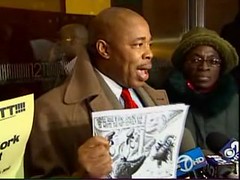
Hundreds Protest Against Racist Cartoon Published by the New York Post

Protest against monkey cartoon

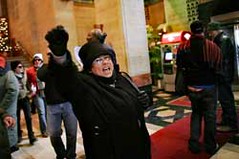
AFP, NEW YORK--HUNDREDS of protesters including film director Spike Lee called for a boycott of The New York Post on Friday, after its "tepid apology" for a political cartoon of a monkey they believe alludes to President Barack Obama.

"Don’t buy the Post. Shut them down," demonstrators shouted outside News Corporation headquarters of media tycoon Rupert Murdoch, who owns the tabloid.

The protesters, most of them African-American, said they have gathered 4 000 signatures asking businesses to stop advertising in the Post unless its editor-in-chief is removed.

The cartoon that ran on Wednesday on Page 6 of the tabloid showed a policeman killing a monkey, which the newspaper said referred to an incident in Connecticut on Monday in which an officer shot dead a chimpanzee that had seriously injured a woman.

In the drawing, another police officer comments: "They’ll have to find someone else to write the next stimulus Bill."

Sharpton on Wednesday called the cartoon "troubling" in view of past racist insults that compared African-Americans to monkeys, and said the cartoon was directly linked to Obama’s signing of an economic stimulus Bill the day before.

A loud protest on Thursday outside News Corp prompted a newspaper editorial saying the cartoon "was meant to mock an ineptly written federal stimulus Bill. Period.

"But it has been taken as something else — as a depiction of President Obama, as a thinly veiled expression of racism," said the editorial published on Friday.

"This most certainly was not its intent; to those who were offended by the image, we apologise."

Obviously unsatisfied, the protesters headed by Sharpton and Lee pressed for a boycott of the tabloid.

"That cartoon insulted everybody," said the film director. — AFP.

US Economic Crisis: Stocks Slump on Corporate Woes; Capitalist Theorists Call For Some "Nationalization" of Banks

February 24, 2009

Stocks Slump on Corporate Woes; Indexes Fall by 3.4%

By JACK HEALY
New York Times

Investors called it another day of water-torture declines on Wall Street: drop, drop, drop.

A broad sell-off sent Wall Street staggering lower in the last hour of trading on Monday as the banking system continued to worry investors. The Dow Jones industrial average was down 250.89 points at the close while the Standard & Poor’s 500-stock index, a broader gauge of the market closed at its lowest level since April 1997.

Losses piled up in technology companies like Apple, Google and I.B.M. and industrial companies like DuPont, Caterpillar and the aluminum maker, Alcoa. But in a reversal, battered shares of Citigroup and Bank of America closed higher, and the financial sector fared better than the broader market.

With worries growing about the stability and solvency of the country’s big banks, the Treasury Department tried to reassure jittery investors with a message supporting the financial system and laying out details of the coming “stress tests” of major banks. The message did not calm anyone.

After a brief rise in early trading, stock markets fell into the red and sank lower throughout the afternoon. The Dow Jones industrial average closed down 3.4 percent to 7.114.78 while the broader S. & P. 500 fell 3.47 percent, or 26.72 points, to 743.33. The technology heavy Nasdaq was down 3.7 percent, or 53.51 points, to 1,387.72 as shares of technology companies turned lower.

Shares of Microsoft, Hewlett-Packard and other technology companies fell amid concerns about how the sector would hold up as the economy spins lower. Companies that make basic materials like steel, chemicals and plastic also sank. Crude oil fell $1.59, to $38.44 a barrel, scaling back some recent gains, and gold prices also fell back slightly to $995 an ounce.

The day’s declines continued the downward momentum of a brutal week that sent the major indexes down more than 6 percent. “In lieu of anything the market sees as positive, it’s going to continue its easiest path, and the path it sees is down,” said Joseph Saluzzi, co-head of equity trading at Themis Trading. “That’s where we’re stuck right now, and who’s going to get out in front of it?”

With America’s banking system facing a round of “stress tests,” the prospect of greater governmental control and an uncertain future, the government tried to assure investors early Monday that it would stand behind the banking system, and that it would provide additional temporary aid to banks.

“The government will ensure that banks have the capital and liquidity they need to provide the credit necessary to restore economic growth,” the Treasury Department, the Federal Deposit Insurance Corporation and other agencies said in an unusual joint statement. “Moreover, we reiterate our determination to preserve the viability of systemically important financial institutions so that they are able to meet their commitments.”

The Treasury statement added that major banking institutions were “well capitalized.”

But analysts said investors remained worried about how America’s biggest banks would deal with the troubled assets on their balance sheets, and their prospects for weathering a prolonged economic contraction. Shares of Wells Fargo, Citigroup and Bank of America stayed positive, but other financial companies like Morgan Stanley and Goldman Sachs turned negative.

Analysts said that after fevered speculation last week about bank nationalization, many investors now expect the government to move in that direction, despite statements from the White House supporting a privately held banking system. Stock markets dropped on Friday amid concerns that a broad government takeover could wipe out financial shareholders.

Now, with the government set to begin the “stress tests” on Wednesday, investors want to know which banks will be deemed healthy and which will not, analysts said. Of most pressing concern are big banks including Citigroup, Bank of America, Wells Fargo and JPMorgan Chase, followed by regional chains.

“We need to know how they stand right now,” said Dave Rovelli, managing director of trading at Canaccord Adams. “The uncertainty of waiting for the results of these stress test is just killing the markets.”

Three weeks ago, stock markets tumbled after the Treasury Department announced plans to form a public-private partnership to take troubled mortgage-related assets off the balance sheets of banks. Investors said the government’s plans were short on details and left too much uncertainty about how those assets would be valued, or how private investors would be enticed to bid on them.

The losses on Wall Street came one week after the Dow sank to its lowest levels in six years on growing fears about banks across Europe and the United States.

By the end of trading on Friday, the Dow had tumbled 6.2 percent for the week, its worst since October, and had sunk to its lowest levels in six years. The S. & P. 500 fell 6.5 percent, dropping below 800, but was still slightly above its bear-market lows of Nov. 20.

Absent a detailed blueprint forward from Washington or some unexpectedly positive economic news, analysts said they expect the markets to tunnel farther down, with the S. &. P. 500 retesting its Nov. 20 lows of 752. Several analysts said they still have not seen signs of capitulation, a frenzy of high-volume selling, that often signals the bottom of a bear market.

“The technicians now have control of this market,” said Sam Stovall, chief investment strategist at Standard & Poor’s Equity Research. “People are saying, ‘Where do we go now? We don’t know what’s next.’ ”


February 23, 2009
Op-Ed Columnist

Banking on the Brink

By PAUL KRUGMAN

Comrade Greenspan wants us to seize the economy’s commanding heights.

O.K., not exactly. What Alan Greenspan, the former Federal Reserve chairman — and a staunch defender of free markets — actually said was, “It may be necessary to temporarily nationalize some banks in order to facilitate a swift and orderly restructuring.” I agree.

The case for nationalization rests on three observations.

First, some major banks are dangerously close to the edge — in fact, they would have failed already if investors didn’t expect the government to rescue them if necessary.

Second, banks must be rescued. The collapse of Lehman Brothers almost destroyed the world financial system, and we can’t risk letting much bigger institutions like Citigroup or Bank of America implode.

Third, while banks must be rescued, the U.S. government can’t afford, fiscally or politically, to bestow huge gifts on bank shareholders.

Let’s be concrete here. There’s a reasonable chance — not a certainty — that Citi and BofA, together, will lose hundreds of billions over the next few years. And their capital, the excess of their assets over their liabilities, isn’t remotely large enough to cover those potential losses.

Arguably, the only reason they haven’t already failed is that the government is acting as a backstop, implicitly guaranteeing their obligations. But they’re zombie banks, unable to supply the credit the economy needs.

To end their zombiehood the banks need more capital. But they can’t raise more capital from private investors. So the government has to supply the necessary funds.

But here’s the thing: the funds needed to bring these banks fully back to life would greatly exceed what they’re currently worth. Citi and BofA have a combined market value of less than $30 billion, and even that value is mainly if not entirely based on the hope that stockholders will get a piece of a government handout. And if it’s basically putting up all the money, the government should get ownership in return.

Still, isn’t nationalization un-American? No, it’s as American as apple pie.

Lately the Federal Deposit Insurance Corporation has been seizing banks it deems insolvent at the rate of about two a week. When the F.D.I.C. seizes a bank, it takes over the bank’s bad assets, pays off some of its debt, and resells the cleaned-up institution to private investors. And that’s exactly what advocates of temporary nationalization want to see happen, not just to the small banks the F.D.I.C. has been seizing, but to major banks that are similarly insolvent.

The real question is why the Obama administration keeps coming up with proposals that sound like possible alternatives to nationalization, but turn out to involve huge handouts to bank stockholders.

For example, the administration initially floated the idea of offering banks guarantees against losses on troubled assets. This would have been a great deal for bank stockholders, not so much for the rest of us: heads they win, tails taxpayers lose.

Now the administration is talking about a “public-private partnership” to buy troubled assets from the banks, with the government lending money to private investors for that purpose. This would offer investors a one-way bet: if the assets rise in price, investors win; if they fall substantially, investors walk away and leave the government holding the bag. Again, heads they win, tails we lose.

Why not just go ahead and nationalize? Remember, the longer we live with zombie banks, the harder it will be to end the economic crisis.

How would nationalization take place? All the administration has to do is take its own planned “stress test” for major banks seriously, and not hide the results when a bank fails the test, making a takeover necessary. Yes, the whole thing would have a Claude Rains feel to it, as a government that has been propping up banks for months declares itself shocked, shocked at the miserable state of their balance sheets. But that’s O.K.

And once again, long-term government ownership isn’t the goal: like the small banks seized by the F.D.I.C. every week, major banks would be returned to private control as soon as possible. The finance blog Calculated Risk suggests that instead of calling the process nationalization, we should call it “preprivatization.”

The Obama administration, says Robert Gibbs, the White House spokesman, believes “that a privately held banking system is the correct way to go.” So do we all. But what we have now isn’t private enterprise, it’s lemon socialism: banks get the upside but taxpayers bear the risks. And it’s perpetuating zombie banks, blocking economic recovery.

What we want is a system in which banks own the downs as well as the ups. And the road to that system runs through nationalization.


February 23, 2009, 4:37 pm

A.I.G. to Seek More Government Aid

The American International Group, the battered insurance giant that is now effectively majority-owned by the federal government, is in talks to receive more government aid as it prepares to record one of the biggest losses in corporate history.

A.I.G. could take as much as a $60 billion hit when it reports earnings during the next week. It expects to disclose losses across a wide variety of holdings, from commercial real estate to credit default swaps, the private contracts that helped lead it to the brink last fall.

Among the plans being discussed include swapping some or all of the $40 billion in preferred shares held by the government into a form of capital A.I.G. can use to ward off collateral calls from its trading partners. The government has already lent A.I.G. $150 billion.

The news was first reported Monday afternoon by CNBC.

Shares in A.I.G., which had fallen nearly 1.9 percent on Monday, dropped 5.7 percent in after-hours trading to 50 cents. They have fallen nearly 98 percent over the past six months.

A.I.G.’s latest woes have emerged as the government seeks to begin “stress-testing” the nation’s banks and preparing to inject more capital into them as necessary.

Shoring up the insurer has been one of the government’s biggest headaches since September, when the Federal Reserve propped up the firm with an $85 billion high-interest loan to meet pressing capital demands from its trading partners involved in credit default swaps. That left the government with a 79.9 percent stake in the insurer.

Saving A.I.G. was considered a primary concern after the collapse of Lehman Brothers: the firm had effectively insured billions of dollars worth of mortgage-backed securities across Wall Street. If the firm were to have fallen, the pain would radiate to financial firms across the world.

But A.I.G. quickly drew down on its credit line, forcing the government to restructure its bailout. Using a combination of money from the federal bank bailout and the creation of new structures to store toxic assets like bundles of mortgage-backed securities off the firm’s balance sheet.

That appears to have failed to stem the troubles at the company, which reported $38 billion in losses last year, enough to have wiped out the preceding three years’ worth of profits. By November, the firm disclosed losses not just in the more arcane parts of its businesses, but also in its core insurance operations.

A.I.G. has raced to sell off assets in hopes of paying back its government loans, but the poor market conditions have made it nearly impossible to sell units at the prices the company had sought.

–Andrew Ross Sorkin and Michael J. de la Merced

Request For the Participation of the Obama Administration in the UN Durban Review in Geneva

Jahahara Amen-RA Alkebulan-Ma’at
(fka, Jahahara Harry Armstrong)
P.O. Box 10963
Oakland, CA 94610
jahahara@newafrikan777.com

21 February 6249 KMT/2009
[44th Year Commemoration of Assassination of Ancestor EL HAJJ MALIK EL SHABAZZ (MALCOLM X)]

President Barack Hussein Obama
U.S. President’s (“White”) House
1600 Pennsylvania Avenue
Washington, DC 20500

RE: A REQUEST FOR YOUR PARTICIPATION AT U.N. “DURBAN REVIEW” IN GENEVA

Greetings of IMANI (FAITH) Brother President Obama:

May our Divine Creator and Beloved Ancestors find you, First Lady Michelle, your precious daughters Sasha and Malia, and the extended family in the best of spirit and health. My young son Chioke Bakari, his 86 and 85 year-old Queen Grandmothers and I watched with pride as you were sworn-in as President on his ninth birthday, the 20th of January. He has said and I quote: “This is an excellent present, Baba Jahahara... Watching President Obama (take his oath) is even better than going to see and meet the Harlem Globetrotters… or singing at our Martin Luther King Day celebration.”

With an understanding of “so many ‘vittles’ on your plate”—as we busy community and labor organizers on Chicago’s south-side would say back in the 1980s and 90s—I would like for you to add an additional item to your agenda. As you know, in April of this year, the United Nations will hold a “Durban Review” session in Geneva, Switzerland.

This gathering of heads and representatives of states, non-government organizations and grassroots activists is a follow-up to the 2001 “Third World Conference Against Racism (WCAR)” in Durban, South Africa. The upcoming session in Geneva will offer participating states and advocates an opportunity to monitor the successes, or lack thereof, in implementing the program of the WCAR.

Unfortunately, and despite numerous requests (see one attached letter from July 2001), former President George W. Bush initially balked at sending, and later withdrew, an official U.S. government delegation to this important world gathering.

Therefore, a major opportunity was missed in listening to, learning from and dialoguing with victims and survivors of U.S. government-sanctioned brutalities; and to begin making necessary amends.

It is my contention that had the U.S. been a full and equal partner in the WCAR process, and earnestly began implementing the conference program of action, we may not have experienced the deadly crimes and tragedies of 11 September 2001; the false “justifications” for unjust U.S. wars, invasions, murders, imprisonment and torture against the people of Afghanistan, Pakistan, Iraq, Haiti, the U.S., etc.; the horrific governmental inaction in response to hurricanes “Katrina” and “Rita”; and numerous other crimes against humanity and nature.

Therefore, Brother President, we respectfully ask that you take time to participate in the important Durban Review conference. Please use your position of leadership to assist all of us in addressing long overdue matters of “race,” racism and the vestiges of war, enslavement, terrorism, colonialism, genocide and discrimination; and the moral and internationally-accepted solutions of self-determination and reparations.

Asante Sana (Many Thanks) for your consideration. May our Creator and Ancestors guide you righteously. Until we meet again, I wish you and each of us more…

Justice, Peace, Love, Shared Prosperity and Continued Blessings.

Brother Jahahara

Cc: Sister Congresswoman Barbara Lee (Ninth District of California), Chair of Congressional Black Caucus

Elder Congressman John Conyers, Jr., Chair of U.S. House of Representatives’ Judiciary Committee

Hillary Rodham Clinton, U.S. Secretary of State

********************************************************
N’COBRA
National Coalition of Blacks for Reparations in America
P.O. Box 90604
Washington, DC 20090

28 July 2001

President George W. Bush

The U.S. President’s (“White”) House
1600 Pennsylvania Avenue
Washington, DC 20500

Dear President Bush:

The National Coalition of Blacks for Reparations in America (N’COBRA) urges you to send a high-level delegation to represent the United States of America at the United Nations’ World Conference Against Racism in Durban, South Africa, August 31 — September 7, 2001. It is critical that the United States join with other governments, organizations and people to agree to policies, programs and strategies to end racism, racial discrimination, xenophobia and related intolerances throughout the world.

We are particularly concerned with the reports that the United States will not participate if reparations for enslavement of Africans are discussed. How can a government that professes its support of freedom and democracy, including the right to free speech, take a position that discussion of remedies for one of the most heinous crimes against humanity would result in it not being present?

Surely you want to address the continuing vestiges of enslavement in the U.S., as well as throughout the world. Right? Surely you recognize that reparations are a well-established method of redress that the U.S. has embraced as it relates to Japanese Americans, European Jewish victims of the holocaust of the 1930s and 40s, and others.

Surely you want to participate in formulating meaningful remedies that create a level playing field within the U.S. and worldwide. The participation of the U.S. seems particularly important since it has contributed to creating such an uneven playing field.

Again, we urge you to send a high-level delegation to Durban. Join with the governments and people throughout the world to end racism and provide meaningful remedies for the injuries suffered as a result of government-sanctioned enslavement, racist violence and terrorism, race discrimination, colonialism and numerous other brutalities.

Sincerely,
Aurevouche Dorothy Benton Lewis
Jahahara Amen-RA Alkebulan-Ma’at
N’COBRA National Co-Chairs

Philadelphia Inquirer Seeks Bankruptcy Protection

Philadelphia Inquirer seeks bankruptcy protection

By Andrew Edgecliffe-Johnson in New York
February 23 2009 07:33
Financial Times

The publisher of the Philadelphia Inquirer has become the second US newspaper group to file for Chapter 11 bankruptcy protection in two days, succumbing on Sunday to vanishing advertising revenues and an unmanageable debt burden.

Brian Tierney, the local public relations executive who led a $562m bid for the Inquirer and the Philadelphia Daily News in 2006, announced the move a day after a similar filing by the Journal Register, publisher of Connecticut’s New Haven Register and scores of smaller titles.

Mr Tierney said the operations of his Philadelphia Newspapers group remained “sound and profitable” before interest payments, and that the planned restructuring would focus solely on its $390m of debt.

”Philadelphia Newspapers’ goal is to bring its debt in line with the realities of the current economic and business conditions,” he said.

The failure of 11 months of negotiations with lenders makes Mr Tierney’s group the latest casualty of a wave of debt-fuelled acquisitions of newspapers by investors hoping to find value in an already beaten-up sector where many saw potential for deeper cost-cutting.

Tribune, the owner of the Los Angeles Times and Chicago Tribune, filed for bankruptcy protection in December, only a year earlier in an $8.2bn leveraged transaction led by Sam Zell, the Chicago property magnate.

The Minneapolis Star Tribune, which announced its Chapter 11 filing in January, had been sold less than two years before for $530m to Avista Capital Partners, a private equity group.

Double-digit declines in advertising revenues in an industry which has seen classified listings all but disappear to the internet and bigger advertisers such as automotive dealers hoard their cash have shaken even the strongest US newspaper brands.

The New York Times last week announced it would suspend dividend payments to preserve cash, just weeks after securing a $250m loan from Carlos Slim, the Mexican telecoms entrepreneur. Quoted publishers, including the Journal Register, have suffered precipitous declines in market value.

Philadelphia Newspapers has not been able to comply with covenants on its loans since last summer, and has incurred $13.4m in penalty interest and fees.

Local investors including Mr Tierney contributed about $150m to the 2006 purchase, promising “the next great era of Philadelphia journalism”, but layoffs and losses soon followed.

Copyright The Financial Times Limited 2009

UAW Agrees to Concessions at Ford While Feds Prepare Largest-Ever Bankruptcy Loan for GM

FEBRUARY 23, 2009, 1:56 P.M. ET

UAW Agrees to Concessions at Ford

JEFF BENNETT
Wall Street Journal

Ford Motor Co. said Monday it has reached a tentative deal over unionized retiree health benefits, increasing the chances that General Motors Corp. and Chrysler LLC can secure their own concessions.

United Auto Workers President Ron Gettelfinger announced the revised pact following other changes to work rules reached with the three Detroit auto makers last week.

Ford, which faces $13.6 billion in legacy health costs, said up to half of its future payments to a retiree fund could be made in stock rather than cash under the terms of the pact.

The proposed terms mirror those contained in the federal loan guarantees extended to GM and Chrysler, which the auto makers have to meet by March 31. Ford has not sought U.S. government aid.

All three U.S. auto makers reached deals in 2007 to transfer legacy health costs into trust funds known as Voluntary Employee Beneficiary Associations, or Vebas, which they have funded with cash. Those payments have added to a liquidity drain that has weakened their competitive position versus overseas auto makers.

"We will consider each payment when it is due and use our discretion in determining whether cash or stock makes sense at the time, balancing our liquidity needs and preserving shareholder value," Ford said Monday.

GM and Chrysler were not immediately available for comment.

Renegotiating the health-care obligations due to UAW members and their spouses is a key part of the restructuring plans presented by GM and Chrysler to the U.S. government last week as part of survival strategies aimed at keeping both out of bankruptcy protection.

The pact will likely set a benchmark for talks with GM -- which owes $20 billion to its Veba -- and Chrysler. The UAW will provide further details on the Ford plan to local leaders this week. It is also subject to member and court approval.

GM bondholders will be scrutinizing any deal reached with the UAW after some complained last week that they were being asked for an overly large sacrifice.

Write to Jeff Bennett at jeff.bennett@dowjones.com


FEBRUARY 23, 2009

Bankruptcy Funding Solicited for Car Makers

By JEFFREY MCCRACKEN and JOHN D. STOLL
Wall Street Journal

Outside advisers to the U.S. Treasury have started lining up the largest bankruptcy loan ever, talking with banks and other lenders about at least $40 billion in financing for General Motors Corp. and Chrysler LLC, in case the two auto makers need it, said several people familiar with the matter.

While acknowledging the grimness of the task, administration officials involved in the auto talks said they are trying to find a way to restructure the two companies without resorting to bankruptcy proceedings. They stressed the latest efforts were "due diligence" on the part of the government advisers, and that bankruptcy financing may not be necessary.

Still, people involved in talks with senior Obama administration officials said that the administration believes that the option of Chapter 11 filings by the two auto makers needs to be seriously considered.

"Everything is on the table right now," one person involved in the matter said, adding that President Barack Obama doesn't want to see more massive job losses in the auto industry. His administration also doesn't want to anger the United Auto Workers by appearing to push for bankruptcy, this person added.

The initial discussions call for private banks to provide the financing -- known as a debtor-in-possession, or DIP, loan -- with the government guaranteeing or backstopping the loan. In this scenario, some of the financing would be used to pay back the $17.4 billion the government lent GM and Chrysler late last year.

Treasury advisers are handling the effort and keeping GM and Chrysler informed of the steps through back-door channels, said the people familiar with the matter. The interplay between the government, auto makers and the markets is proving to be complicated.

Lenders are reluctant to commit funding to GM or Chrysler for several reasons -- mostly concern they won't get all their money back. Recently, the government advisers have begun aggressively courting big lenders Citigroup Inc. and J.P. Morgan Chase & Co. -- themselves government-aid recipients -- to participate in any bankruptcy financing, said people familiar with the matter.

The government advisers also are looking at ways the Treasury could "prime" other banks making DIP loans, so the government could be paid back before private creditors. Banks are deeply resistant to such steps. Both GM and Chrysler insist they can avoid bankruptcy, warning that option could cost the government as much as $125 billion in rescue financing. Bankruptcy experts say the sum isn't likely to be that high.

Even so, the estimated total of $40 billion in DIP financing GM and Chrysler would need would be five times as large as the previous record for such financing, which is used to fund day-to-day operations while companies sort out their debt. To fill such a large hole, Treasury's advisers are trying to corral as many as 70 lenders to participate in what is now informally called the "bank steering committee."

The advisers are sounding out banks about loan terms based on a government backstop, figuring out what interest rate the private market would accept and what covenants or restrictions lenders would expect.

At a news conference Tuesday, GM Chairman and Chief Executive Rick Wagoner, once a fierce opponent of even talking about a bankruptcy filing in public, said GM could engage in talks soon with the government on how to fund a stay in bankruptcy court. "We haven't had extensive discussions yet with the government on DIP financing," he said.

DIP loans are usually viewed as among the safest loans because those lenders typically get paid before other creditors. However, that corner of the lending market froze up late last year and has only recently begun to thaw.

Interest rates for bankruptcy financing have spiked in recent months, more than doubling from a year ago. In 2006 and 2007, the rate on the average DIP loan was the London interbank offered rate plus about 4 to 4.5 percentage points. Last year, the rate on the average DIP loan jumped to Libor plus 6.1 points, and rose throughout the year. A backstop by the federal government, however, probably would make such a loan less expensive.

Bankruptcy experts say that absent government support, lenders wouldn't step in to aid GM and Chrysler, given the proposed size of the loan and the tightness of credit markets. Most likely, the bankruptcy loan would roll up -- or pay off -- the $17.4 billion the government has so far lent the two auto makers. It might also pay off some other debt, including a senior bank facility.

Advising the Treasury on the GM-Chrysler situation are law firms Cadwalader, Wickersham & Taft LLP and Sonnenschein Nath & Rosenthal LLP, and the New York investment-banking firm of Rothschild Inc.

Cadwalader attorneys, who are in charge of advising the government on DIP lending and other matters, declined to comment. A spokeswoman for Sonnenschein declined to comment. Rothschild didn't return phone calls seeking comment.

In early January, Cadwalader bankruptcy attorney Deryck Palmer helped line up $8 billion in DIP financing for chemical company Lydondell Basell, the current record for such a loan.

So far, GM has received $13.4 billion in federal loans, The viability plan it submitted to the government last week said the company needs a total of $30 billion in aid, or $16.6 billion more than it has already gotten. GM also said it needs at least $7.7 billion in loans from the Department of Energy to develop fuel-efficient technology.

Chrysler has received $4 billion in government loans and said it needs $5 billion more. It said it would need $24 billion in financing if the company were to seek bankruptcy protection.

GM said it might need as much as $100 billion in financing from the government if it were to go through the conventional bankruptcy process. GM's $100 billion estimate stems from the belief that it would suffer "catastrophic revenue reduction impact" in a prolonged conventional Chapter 11 process, as it would expect to sustain as much as an 80% decline in sales after a bankruptcy filing. GM would need financing not only so it could weather the storm, but also to help its suppliers and dealers survive.

Mr. Wagoner, the GM CEO, said the bankruptcy scenarios are "risky" and "costly," and would only be pursued as a last resort. "We haven't had extensive discussions yet with the government on DIP financing," he said. "They asked us to put together and address the topic. We've done that in [GM's viability plan], so I suspect we may enter into those discussions."