Wednesday, November 30, 2011

Demons Unleashed In Libya: NATO's Islamists Continue Program of Ethnic and Ideological Cleansing

Demons Unleashed in Libya: NATO’s Islamists Continue Program of Ethnic and Ideological Cleansing

By Gerald A. Perreira

This is the dark time, my love,
All round the land brown beetles crawl about
The shining sun is hidden in the sky
Red flowers bend their heads in awful sorrow
This is the dark time, my love,
It is the season of oppression, dark metal, and tears.
It is the festival of guns, the carnival of misery
Everywhere, the faces of men are strained and anxious
Who comes walking in the dark night time?
Whose boot of steel tramps down the slender grass
It is the man of death, my love, the stranger invader
Watching you sleep and aiming at your dream.

Martin Carter

All of the good that Muammar Qaddafi did for his people, and the immeasurable contribution he made to the oppressed peoples of the world is catalogued everywhere for those who have eyes to see. NATO’s war crimes are also catalogued – they went viral, so even in the absence of a court where NATO and their mercenaries can be tried, millions of people worldwide watched, at their computers and TV screens, the horrific war crimes that unfolded in Sirte and elsewhere in Libya. The verdicts are in. The question is what can be done about it?

The world was quite literally watching and still can watch, anytime they care to google the litany of obscene crimes committed, when a coalition of the most powerful nations on this earth, backed up by the vast majority of Arab and African misleaders, deployed the most sophisticated arsenal of weaponry in the history of the world against a small bastion of African resistance. In the now famous cities of Sirte and Bani Walid, Colonel Muammar Abu Minyar al-Qaddafi led his people in a courageous battle which lasted for months. The battles of Sirte and Bani Walid have surely earned their place in the annals of African history.

At his side were his son, Mutassim Qaddafi and Libya’s Minister of Defense, and one of the leaders of the 1969 Al Fateh revolution, Major General Abu-Bakr Yunis Jaber. Decades ago, he and the young Muammar were in the same class at the Military Academy in Benghazi and were co founders of the Free Officers’ Movement which overthrew King Idris.

Both men, spiritual heirs of Omar Al Mukhtar’s armed resistance against the Italian invaders in 1911, were in their 70s. Having to witness such a savage attack on them and not being able to do anything to defend them against NATO’s jackals, was traumatizing.

The core group of revolutionaries, who led the Al Fateh revolution in 1969 in their twenties, all now in their late 60s and 70s, chose to stay at their posts and fight alongside the people, despite having received many offers for safe passage out of Libya.

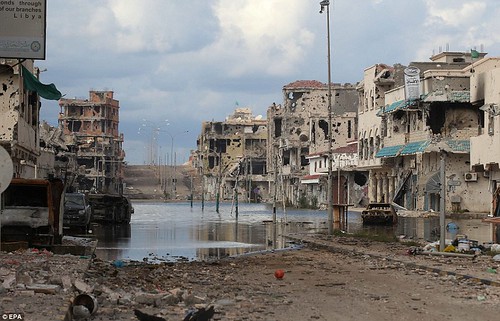
A Picture Tells a 1000 Words

A picture of Sirte, after NATO’s bombardment, is worth more than a thousand words when it comes to understanding what actually took place in this once beautiful and prosperous African city. And all in the name of ‘protecting civilians’ – clearly with the exception of civilians loyal to Muammar Qaddafi and the Al Fateh revolution. We salute all of those who fought to defend Al Fateh and the Pan African project in Sirte, Bani Walid and throughout Libya. They are the real Jihadists – the true Pan-African Army.

Julius Malema, ANC Youth Leader, in reference to the North Atlantic Tribes, asked the question – why are these people so bloodthirsty? He pointed out that they did not seem to understand anything other than war.

It is no surprise that Julius Malema has been banned by Jacob Zuma’s ANC. Zuma is one of those African misleaders who signed Qaddafi’s death warrant, when South Africa, along with Nigeria and French controlled Gabon, all temporary members of the so-called Security Council at the time, agreed to the implementation of a ‘No Fly Zone’, which unleashed the demons of war.

Let us not imagine that they did not know what would ensue – the entire world has just witnessed the destruction of Iraq and Afghanistan. It was a painful blow to many Africans in Africa and throughout the world. We remembered Nelson Mandela’s now famous speech, when on the world stage he called Muammar Qaddafi ‘one of the great freedom fighters of the 20th century’ and he publicly thanked the Brother Leader and the people of Libya for the material and moral support provided to the ANC when, as Mandela put it – their ‘backs were up against the wall’. The half hearted attempts by the AU to take the necessary action to defend Libya was shameful and demoralizing.

There was a time…

Some of it in my lifetime, when we had visionary, principled and courageous African leaders - Shaka Zulu, Queen Nzingha, Cetshwayo, Dedan Kimathi, Julius Nyerere, Ahmed Sekou Toure, Kwame Nkrumah, Jamal Abdul Nasser, Marien Ngouabi, Ahmed Ben Bella, Samora Machel, Thomas Sankara, Murtala Muhammad, Laurent Kabila to name but a few. Had leaders such as these been in power today, NATO could not have gotten away with invading Libya. The fact is, with few exceptions, the current bunch of African leaders, many of them put in place by the forces of white supremacy were just not up to the job.

Those who are misleading Africa today – ‘who the cap fit let them wear it’ – have paid a dear price. What is coming our way will be punishment for such a colossal betrayal. And sadly, we will all suffer for their sins.

The murder of Muammar Qaddafi plunged us into despair. We mourned his death as sons mourn their father - he called us his sons and we responded as such because we understood his sincerity.

Those who worked with Qaddafi can testify that the Brother Leader’s efforts were motivated by a strong and uncompromising faith in God, his deep love for humanity and a sincere desire to assist all those engaged in the struggle to end injustice and oppression. If anyone epitomized Che’s famous quote, it was our brother: ‘Revolutionaries are first human beings, and at the risk of sounding utterly ridiculous, revolution is based upon supreme feelings of love’

Those among the leadership of Al Fateh who were not murdered, were captured. Dr Ahmed Ibrahim, one of the foremost exponents of the Third Universal Theory, an intellectual warrior and committed Pan-Africanist, was captured while defending Sirte. The uncle of Moussa Ibrahim, who over the past months became known as the spokesperson for the legitimate government of Libya, he is currently being held in Misurata, and his son, Yurub Ibrahim, has also been arrested. The well known Islamic scholar Sheik Khaled Tantoush, has been abducted from his home in Sirte and is also being held in Misurata. These elderly men are being subjected to constant taunting, beatings and torture and their condition is deteriorating rapidly. Global campaigns have been launched to demand the protection under international law and conventions, regarding prisoners of war, for high profile prisoners Saif-al Islam Qaddafi, Abdullah Senussi, Ahmed Ibrahim, Khaled Tantoush and the thousands of prisoners held by the NTC. (see websites Libya SOS, Libya 360 and Mathaba.net for ways you can assist the campaign and video footage of how these elderly prisoners are being treated).

In addition to loyalty to the Leader, and defense of their country against foreign invaders, having black skin and asserting one’s Africanity has become a crime in the new Libya. Ethnic cleansing is continuing unabated. Every day Black Africans from Libya and other parts of Africa are hunted down. Thousands have been brutally tortured and executed. Rape of Black women is a favored weapon of NATO’s Islamists. Many of the female bodies found show signs of rape, beatings and torture. Large numbers of Black Africans make up the ranks of the Green Resistance.

NATO’s Living Hell

One Tripoli resident, who cannot be named, told me:

‘Everyone is terrified of the NTC and their armed gangs. We have seen with our own eyes what they are capable of – they are animals. All around us people are being rounded up and imprisoned. We have no way of knowing how many have been murdered. Anyone who is associated with Qaddafi or suspected of loyalty to him is at risk. Even people who have worked for people who are known supporters of the leader have been rounded up and tortured. I personally know of many persons who were just working for people associated with the leader who have been taken away and never seen again. If you are black you are an immediate suspect – these rebels call black Libyans ‘abd’ means slave and they are rounding them up just because they are black – it is making me sick and ashamed.

What these rebels have done to their own people is disgusting – some of the acts of torture I can’t even speak about. There has been a lot of rape. I wept when I learned of what these animals did to the leader’s female body guards – they are not human and that is why there is so much fear. Any known Qaddafi loyalists who have not been able to get out of Libya have to stay underground. Libyans are afraid to talk to other Libyans – anyone could be an informer. It feels like the last days are upon us – Libya has been turned into a living hell.’

There is now a complete whiteout by the corporate media regarding all news from Libya. And of course, although a genocide is unfolding right before our eyes, there will be
no outcry from the UN, Amnesty International or that euphemistic chorus known as ‘the international community’, that beats on ad nauseum about ’democracy, human rights and the rule of law’? No time or motive for outcry – having shared the spoils, they have already moved on to their next victims – Syria and Iran.

Demons Unleashed

To do their dirty work, NATO employed the most barbaric marauders they could find. These Islamist mercenaries are programmed, sadistic fighters – they have been on the battlefields in Iraq, Afghanistan and now Libya. They have been hired many times over by NATO, who characteristically plays all sides, and that is why they need to sprinkle stimulant powders on their food - to keep them in killing mode.

Shouting Allahu Akhbar, like robots, they go from town to town, city to city, ransacking, beating, torturing, raping and murdering, and then, in their crazed state, with inflated feelings of omnipotence, they actually take footage of themselves committing heinous war crimes and post them on youtube.

As the people bury their dead, they defiantly whisper, ‘Allah, Muammar, Libya and nothing else’. Amidst the screams that can be heard deep into the night, a shell shocked population tries to understand what happened to them, and struggles to come to terms with the obscene end inflicted on a man they loved. Now they must try to find a way to confront the ‘brave new world’ that has been imposed upon them by this foreign invasion. In an instant, they have been transported back in time to when Europeans last occupied their country.

Green Resistance – It is only a matter of time…

The war in Libya is far from over. The corporate media continues the lie that Libya has been ‘liberated’ and that life there has ‘returned to normal’. In truth, chaos reigns. Rumours about NATO’s plans to carve up the country are rife and Libya remains engulfed in warfare.

People are being systematically hunted down. Truck loads of bodies are being carted away, as the now feuding armed gangs, each with their own command structure, and none adhering to anything the NTC says, introduces the only policy they ever had – exterminate Qaddafi and all those loyal to him. That numbers in the millions and they are stopping at nothing to track them down.

The Green resistance referred to as the Libyan Liberation Army (LLA) or the Libyan Liberation Front (LLF) is regrouping and growing stronger by the day. Street battles are commonplace, explosions can be heard all over Tripoli and in other regions, and NATO’s mercenaries are facing fierce resistance.

Libya’s powerful Warfalla Tribe, comprising more than a million Libyans, have stated that ‘they are thirsting for revenge’, many of them having fought in the battle of Bani
Walid.

One Green resistance fighter summed up the feeling of all:

‘It does not matter how long it takes, we will rise again as sure as the sun rises. It is only a matter of time. It may not be today – we are a patient people. Right now, many of us have to lay low while the leaders regroup and put certain things in place so that we can take our resistance to the next level, but we know our time will come and we are only waiting for the word to take up our arms.

We have to be organized and this takes time, especially under the present conditions of occupation. Our people are being tortured and raped and murdered for supporting the leader and defending their revolution. We have had to leave our homes and watch these dogs destroy them and steal everything from us. But our day will come – we can never forget the crimes committed against us by NATO and these murdering thieves who call themselves revolutionaries and Muslims.

What I have seen with my own two eyes is unbelievable – people committing the cruelest acts - crimes against humanity while they cry out Allahu Akhbar. They are like drugged people. We have uncovered mass graves of Qaddafi loyalists – with their hands tied behind their backs - all executed. I want to tell them that every person they tortured, every person murdered, every woman they raped, every home they destroyed and looted and everything they did to our dear leader and his family will be avenged.

This is not the first time this has happened to us Libyans – this is exactly what happened to us when the Italians occupied our land – thanks to the leader we are a very educated people now – we know our history and our heroes. The NTC has already taken the picture of Omar Al Mukhtar off the Libyan dinar but it does not matter – they can destroy every picture of Omar Al Mukhtar and the leader, because the story of his bravery and the bravery of his son Muammar Qaddafi is in our hearts – these men can never die - and this gives us the belief and certainty that we will overcome these thieves again – believe me, it is only a matter of time.’

A Frenzied Phase

The invasion of Libya and the murder of Muammar Qaddafi ushered in what can be described as the empire’s ‘frenzied phase’. Capitalism and imperialism are taking their last hideous gasps, and in this phase we will see their evil laid bare. NATO will continue to become ever more brazen with its ‘shock and horror’ tactics, believing that they are unstoppable and invincible, as once did Rome. In other words, with the imperialists in panic mode, we can expect their behavior to become all the more barbaric, savage and uncivilized, as has been prophesied.

The Twilight Zone – Vampires of Empire

The additional dimension in this new phase is that capitalism, White supremacy’s socio-economic system, has entered a period of unprecedented crisis – it is on its last legs and the system is turning in on itself. The vampires of empire do indeed ‘suck the blood of the sufferer’. They are desperate now and quite literally don’t care if they are seen to be dripping in our blood. Their global economic arrangement is crumbling faster than they can hold their next summit, and we cannot be caught off guard.

We have watched Europe and the US forestall their collapse for a number of years, to the point where they are frantic and fast running out of ideas. As fast as they share the spoils of one war – they need another to quench their insatiable appetite for plunder. Our trouble is, that many of us are too slow to follow the visionary leadership in their midst. Had African leaders shared the vision, united and worked together toward a United States of Africa as Qaddafi pleaded, the world would have been a very different place today. Muammar Qaddafi and the Libyan revolution were on the verge of bringing about a total shift in the global balance of power, and giving Africa its rightful place in the world. We have never been so close to reasserting African power. He was truly a Lion of Africa.

A Ruthless Enemy – Know Them

The North Atlantic Tribes are an extremely ruthless enemy. It is necessary to study and understand their mentality in order to build an effective resistance. Indisputably, there is good and bad in every race. However, also indisputably, the historical and cultural continuum known as Europe has specificities that no other group on the face of this earth has demonstrated. Their will to dominate, consume and destroy is unparalleled.

Marimba Ani, in her seminal work, Yurugu, An Afrikan-Centered Critique of European Cultural Thought and Behavior, offers an incisive analysis of the European mindset. In her words:

‘All modes of European behavior and dominant styles of action act to increase and ensure material control…The power ideology that defines the total culture keeps it off- balance. The culture itself – always ‘progressing’, never ‘progressed’ – is unidirectional, one dimensional, fanatical, and atrophied; a culture that must consume others. But ultimately this ideology is incoherent; it literally lacks human meaning. It is the compulsiveness, the drive, the insatiable appetite of the culture that are its distinguishing features…it is as well-constructed as a power machine can be…For success it has sacrificed ‘soul’. What is left is profane. Aesthetically, and in terms of self-image, it identifies as white. Europe is the cultural home of a people who identify as one race; i.e., banding together for survival and destruction of others. They would destroy each other if there were not others to destroy. They fear and hate blackness, which they associate with spiritual power – a power which they can neither possess, create nor control.’

In White Racism: A Psychohistory, Joel Kovel describes this drive to conquer and destroy as a ‘cosmic yearning’, ‘a bottomless longing’.

Samuel Huntington, author of the Clash of Civilizations reminds us of something that we should never forget: ‘The West won the world not by the superiority of its ideas or values or religion, but rather by its superiority in applying organized violence.’

That is the reason why the enemy gets so agitated when we organize armed resistance, because they know how powerful organized violence can be.

The invasion of Libya and the murder of Qaddafi is what happened to a nation and its leader when they give up their program to develop ‘weapons of mass destruction’ and opted for a path of peaceful coexistence. In an interview at the beginning of the war, Saif Qaddafi admitted that Libya had been caught ‘unprepared for war’, having not even upgraded their conventional weaponry. No nation will ever make that fatal mistake again. The North Atlantic Tribes can never be trusted. Deterrents of any kind are better than no deterrents at all.

The North Atlantic Tribes have mastered the art of war and perfected weaponry like no other peoples in history. They are the quintessential warlords.

In order to carry out this regrab, in their desperate and frenzied attempt to hasten their plunder of Africa and the global south’s wealth, it is imperative for the imperialists to get rid of all revolutionary nationalist regimes that might stand in their way, and ensure that compliant regimes are firmly in place. We must prepare ourselves for what is to come. In his last message, the Brother Leader warned us to ‘hold down our corners’ because if they get past Libya they are coming for all of us. The challenge in this phase is to find ways to cope with the Empire’s collapse and to strengthen our resistance in order to confront the frantic and barbaric behavior which will inevitably characterize their demise.

Their House is Burning - Not Ours

At a global economic summit in 2009, former President of Brazil, Lula Da Silva, when commenting on the global economic crisis, stated, ‘This was a crisis that was fostered and boosted by the irrational behavior of people who were white and blue-eyed, who before the crisis looked like they knew everything about economics, but now have demonstrated they know nothing about economics’ He added, ‘The part of humanity that is responsible should be the part that pays for the crisis.’

Too many of us are still, as Malcolm X put it, ‘house negroes’. The house negro lived in the master’s house and when the master’s house was burning, he said ‘we house burning’. If the master was sick, the house negro said ‘we sick’. And then there was the field negro. When he saw the master’s house burning he said ‘Let it burn’.

In Africa, South America, the Caribbean and throughout the global south, we have been in crisis for centuries as a result of the imperialists endless thirst for domination, plunder and war. It is the master’s house that is burning this time. And we say – ‘let it burn’. The demise of this empire is a welcome thing. We don’t need to concern ourselves with bringing Babylon down, for it is surely crumbling – politically, economically, ideologically and morally, due to its own internal contradictions. In the meantime, as Muammar Qaddafi urged, ‘we must build the new as the old crumbles around us’. Only then can we be ready. It is not the end of the world – it is the end of their world.

Gerald A. Perreira is a founding member of the Guyanese organizations Joint Initiative for Human Advancement and Dignity and Black Consciousness Movement Guyana (BCMG). He lived in Libya for many years, served in the Green March, an international battalion for the defense of the Al Fateh revolution and was an executive member of the World Mathaba based in Tripoli.

Liberia's Women Still Stalked By Rape

Liberia's women still stalked by rape

FRAN BLANDY | MONROVIA, LIBERIA
Nov 24 2011 15:39

As a young girl Garmar Murphy was forced into a child soldier's life, serving as a sexual plaything for Liberian rebels between battles -- a tragic norm in the country's savage conflict.

She was 13 years old, and rape was not criminalised by law.

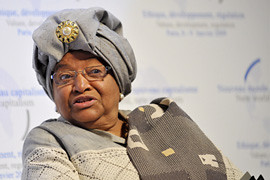
A decade later, her country boasts Africa's first female president, Ellen Johnson Sirleaf, who recently won a Nobel Peace Prize with Liberian activist Leymah Gbowee for their struggle to boost women's rights and safety.

But if women have taken some steps forward in the eight years since a peace accord ended Liberia's civil war, they haven't left behind the threat of rape.

Rape became endemic as a weapon of fear during the 14-year-long conflict and is still rampant, going unpunished more often than not.

Murphy, now 23, her eyes downcast, tells of the day she went to fetch water when her village was attacked and everyone fled or was killed, leaving her at the mercy of invading rebels.

"I was a kid ... I lost my parents, I never had any choice at all. All I need to do is to satisfy their desire. If I didn't join there, they gonna kill me," she said.

"If you blessed, the general see you and love you, you only be for that general alone. If you not lucky ... it means you will be for all the soldiers."

'Women shouldn't sit down'

A mention of her country's joint Nobel win brightens Murphy's face with a bold grin.

"Liberian women, we are moving forward. It encouraged me that we women shouldn't sit down, you can still make it."

Murphy is now a peer counsellor at Think, a women's organisation that runs a safehouse for victims of rape and domestic violence.

Victims are also enrolled in a rehabilitation programme to learn a trade and life skills.

Think founder Rosana Schaack says that while the spotlight on Liberia's women has boosted spirits, it has not changed the harsh realities of a society in which rape and gender violence remain commonplace.

"Looking at where we came from, we can say we have reached one milestone, but we have ten more to go. The perception from outside that all is well, that Liberia is a shining star, that all of the women are experiencing their rights. It is far from that ..."

Making rape a crime

Sirleaf has overseen the enactment of harsh new rape laws, the creation of a dedicated rape court, and a women's police unit launched in 2009.

Women now are increasingly likely to come forward to report rape and seek treatment, which experts say might be one of the reasons it appears as if the number of cases is increasing.

"Now rape is a big crime, you go in jail, so the men are afraid. At that time the men were in power, they rape you at anytime, they just hold you in the bush, do what they want to do," says Murphy.

Statistics are hard to come by, but Think's safehouse alone saw 728 rape cases last year, including 690 children between the ages of 13 and 17 -- pointing to disturbingly high levels of child rape.

"A few weeks ago we had a four-month-old baby that was violently raped. Now that baby will not be able to identify a perpetrator. If we had forensics we would have DNA evidence on this person," says Schaack.

A lack of forensic analysis is one of many daunting challenges faced by Criminal Court E, the special rape court, whose chief prosecutor Felicia Coleman has to overcome an exhausting list of barriers to convict rape offenders.

"We have very little to go with, most of our cases are based on circumstantial evidence," she says.

Overcoming challenges

When the court started its work in February 2009, it was handed 150 cases on the spot. Some of the accused had been awaiting trial in jail for up to three years, records were non-existent and witnesses had long disappeared, meaning that many suspects went free.

With five criminal courts and only one grand jury to indict all suspects, and more people being arrested and jailed every day, "it seemed like we were hardly doing anything", says Coleman.

Since the rape court was set up, only 18 cases have been tried, and 10 people convicted.

"It may be few but when you think about all the challenges ...," says Coleman, her voice trailing off.

Convincing women to press charges is a major battle and those who do often change their minds. Stigmatisation is high and most perpetrators are acquaintances of their victims, meaning there is a lot of pressure not to pursue the case.

"A lot of women prefer using the informal justice system, the traditional method of getting justice, the formal justice system doesn't meet all of their needs," said Coleman.

Motivation

The traditional method can involve mediation by community elders or village chiefs.

Pursuing a case in court "has a lot of financial implications on the family. They will have to leave a whole week to be able to come to court on a daily basis, that time they are away from work they are losing income."

The crumbling seaside capital of Monrovia, where red-mud potholed roads and bright greenery fill the spaces between faded buildings, is worlds away from Oslo, where Sirleaf and Gbowee will collect their Nobel awards on December 10.

"I think the giving of the prize will give us the motivation to keep pressing on, sometimes you get so discouraged ... but for us as women we are looking into the deepest part of our resolve and bringing it out," says Schaack. -- AFP

Source: Mail & Guardian Online
Web Address: http://mg.co.za/article/2011-11-24-liberia-women-still-stalked-by-rape

Police Raid On Occupy LA Encampment Imminent

Reports: Police raid on Occupy LA encampment imminent

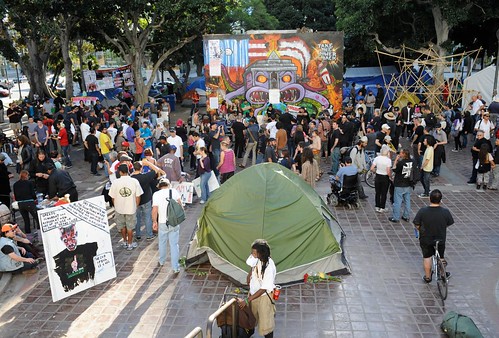
Tents remain in place during the Occupy LA protest outside City Hall in downtown on Nov. 29.

By msnbc.com staff and wires

LOS ANGELES -- A raid on Occupy LA’s City Hall encampment was imminent Tuesday night as several local news sources reported that Los Angeles Police were gathering at Dodger Stadium.

The Los Angeles Times reported that Mayor Antonio Villaraigosa said he decided to evict the protesters after learning that children were staying in the camp.

Occupy LA’s Facebook page said city buses would be staged near City Hall between 8 p.m. and 4 a.m., NBC station KNBC reported.

It was not known exactly when police would clear the area out, but about half the tents were gone, the KNBC report said.

On Monday, protesters declared a minor victory after defying a midnight deadline to clear the camp, the Associated Press reported. Police Chief Charlie Beck told reporters there was “no concrete deadline” for removing the protesters.

"This is a monumental night for Los Angeles. We're going to do what we can to protect the camp," said Gia Trimble, member of the Occupy LA media team.

She said she thought a lot of people would stay and risk arrest, adding, "We're really committed to this."

The protesters designated medics designated with red crosses taped on clothing. Some protesters had gas masks. Broadcast footage showed Los Angeles police officers boarding buses that had lined up near Dodger Stadium at what appeared to be some sort of staging area.

Organizers at the camp packed up computer and technical equipment from the media tent.

Two men who have constructed an elaborate tree house fashioned a ladder pusher out of bamboo sticks tied together with twine. It was intended to push down a ladder that police may erect to get them out of the tree house.

Members of the National Lawyers guild had legal observers on hand for any possible eviction that may occur.

Pam Noles, a member of the camp media team, said the park is legally closed at 10:30 p.m.

Police have removed protesters in other cities. Some of those instances involved pepper spray and tear gas.

The Associated Press contributed to this report.

Artie Rosen, Presente!: WWP Ambassador for Socialism & Justice

Artie Rosen, ¡presente!

WWP ambassador for socialism & justice

By Edward Yudelovich
Published Nov 27, 2011 4:58 PM

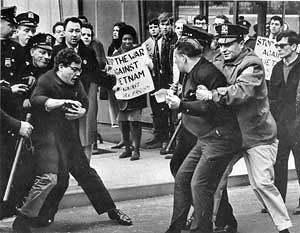
Artie Rosen - active with Youth Against War &
Fascism in 1965 - helped defend Times Square
anti-war protest from rightist attack

Arthur “Artie” Rosen, a founding member of Workers World Party and a lifelong militant communist, passed away at the age of 82 from kidney failure on Oct. 3. A special memorial will be held at the Solidarity Center here on Dec. 4. Artie is survived by his daughter Rebecca.

Rosen was ahead of his time

According to WWP founding member Deirdre Griswold, Artie Rosen in the 1950s wrote a paper “Face to the Youth,” advocating the creation of a youth organization in the U.S. oriented toward the working class.

A few years later, WWP put Artie’s idea into practice with the formation of its youth group Youth Against War & Fascism. On Aug. 2, 1962, YAWF organized the first demonstration in the U.S. against the imperialist war in Vietnam. This protest was recognized and saluted by the great Vietnamese leader and revolutionary, Ho Chi Minh.

In June 1967, Artie, WWP and YAWF again were not afraid to swim against the stream, organizing the only U.S. demonstration protesting the June 1967 U.S.-Israeli war of aggression against the Arab and Palestinian peoples.

Artie, along with this reporter and many anti-Zionist Jews, were proud signers of a “Jews in Solidarity with Palestine” statement following the 2009 attacks on Gaza by the U.S.-sponsored Israeli war machine. The statement declared:

“We stand in complete and unconditional support for the self-determination of the Palestinian people. This includes the right to return to Palestine, from the river to the sea, and the right to democratically determine the form and the future of the Palestinian state. Nothing less will undo the historic crime of al Nakba — the 1948 catastrophe of the establishment of the state of Israel based on the ouster of the Palestinian people from their homeland, oppression and inequality.

“That crime betrayed the whole history of the Jewish people. From helping topple the czar in Russia and build the unions in New York, to resisting pogroms and fighting to the last breath in the Warsaw Ghetto, opposition to persecution, oppression and racism was central to the Jewish heritage. We call on Jewish people around the world, including those inside Israel, to join us in reclaiming that heritage.”

Rosen walked the walk

But Artie did not just talk the talk; he walked the walk. Everywhere he went for decades he wore a cap displaying the Palestinian flag with the slogan “Free Palestine.”

Sharon Eolis, a WWP leading organizer and a retired emergency room nurse who assisted Artie and was with him when he died, says: “Artie Rosen carried out the party’s program in both theory and practice, from its inception to the present. Artie recruited to Workers World Party WWP Secretariat members Fred Goldstein and Sara Flounders, among others.”

Fred Goldstein, author of the book “Low-Wage Capitalism: Colossus with Feet of Clay,” calls Artie a “communist propaganda machine.” Wherever he went, he “enthusiastically upheld and understood the party line and relentlessly tried to recruit and propagate the ideas of the party and the revolution.”

Goldstein relates how, as a City College student in 1960 involved in supporting tenants’ rights struggles in Harlem, he had listened intently to Artie’s explanations about the party’s formulations and positions, including WWP’s unconditional defense of the right of self-determination for African-American and other oppressed peoples inside the U.S. He also introduced WWP’s global class war perspective, including its orientation to defend the Soviet Union and the rest of the socialist camp against U.S. imperialism.

International Action Center co-founder Sara Flounders says: “Artie was a political activist for nearly 70 years, from the age of 15 or 16. He had the greatest dedication to getting out Workers World newspaper everywhere and engaging people in its message. He had his own paper route, distributing our revolutionary newspaper door to door, to newsstands, bookstores, on subways and to transit and other workers.

“Even hip replacement surgery did not stop him from getting the paper out at every demonstration in all types of inclement weather. He regularly brought activists with him to party meetings.”

A role model for every comrade

Another founding WWP member, Rosemary Neidenberg, says of Artie: “So many things to remember. His wide, warm smile of greeting — the peacoat for winter, bellbottoms for winter and summer. He never was seen in public without political buttons like YAWF’s trademark “Stop the War Against Black America,” which later became available only in the archives and on Artie’s jacket. ”

His comrade and good friend Brenda Sandburg says of him: “Artie had an extraordinary way of connecting with people. He was especially well known at the post office in New York. For years, he went there every week to drop off the shipment to subscribers. He would stop and talk to each worker and give them the latest issue of the paper. They were delighted to see him.”

When this reporter visited Artie in the hospital during the last months of his life, the doctors, nurses and other hospital workers had been given their first copy of Workers World by Artie.

Che Guevara once said, “If you tremble with indignation at every injustice, then you are a comrade of mine.” If ever there was a role model for a comrade, it would be Artie. Artie Rosen, ¡presente!

The memorial for Artie Rosen will begin at 3 p.m. on Sunday, Dec. 4, at the Solidarity Center, 55 West 17th St., New York.
----------------------------------------------
Articles copyright 1995-2011 Workers World. Verbatim copying and distribution of this entire article is permitted in any medium without royalty provided this notice is preserved.

Workers World, 55 W. 17 St., NY, NY 10011
Email: ww@workers.org
Subscribe wwnews-subscribe@workersworld.net
Support independent news DONATE

Tuesday, November 29, 2011

Expanding Workers World Newspaper

Expanding Workers World newspaper

Published Nov 27, 2011 5:54 PM

Excerpts from a talk by Gary Wilson, a managing editor of Workers World, at the Oct. 8-9 Workers World Party National Conference in New York City.

Twenty-five years ago, Sam Marcy, a founder of Workers World Party, wrote the book “High Tech, Low Pay: A Marxist Analysis of the Changing Character of the Working Class.”

There’s a chapter just about the changing character of the working class. It starts with a story about Che Guevara’s visit to New York to attend the U.N. General Assembly. Che was in a private meeting with progressives from the U.S. He was asked if a different administration in Washington would ease the hostility toward Cuba. Che replied that it depended on changes in the U.S. working class.

Sam says that most progressives in the U.S. had discounted the working class, so it was significant that Che saw that great changes in the U.S. are contingent on the working class.

Che was talking about a change in consciousness of the working class. Sam writes that this remained the most important factor for progress. And in the 1980s there was a shift in the social composition of the working class that would also mean a change in consciousness.

That’s the working class we see on the move today. The change can be seen in the growing proportion of Black, Latino/a, Asian, Native, women, undocumented and lesbian, gay, bi, trans, queer workers. But there’s another part of this change that’s equally important.

There’s been a major reduction in the percentage of jobs for skilled workers and a corresponding increase in the number of jobs for semi-skilled and unskilled workers. That means a shift to lower-paying over higher-paying jobs.

It means there’s been a decline of the traditionally more privileged workers and industries with higher wages and the creation of a vast pool of lower-paid workers and a generalized impoverishment of the working class.

Twenty-five years ago, when Sam was writing this, there was not yet a change in consciousness. No political movement had started that reflected the changing character of the working class.

Today, that working class has emerged and a movement has erupted.

Workers World newspaper plays a critical role. The capitalists not only control all the big media, they also control what you’ve been taught. They even tell you how you should think.

An independent press is essential

So a completely independent newspaper is essential not only to find out about what is happening, but also to learn how to see everything in an independent way — in a way that’s in the interests of the working-class majority, not the narrow interests of the capitalists.

We’ve been swept into a wide variety of actions and struggles taking place all around the country. Occupy Wall Street has spread to some 900 cities. But there’s more. A hunger strike by prisoners in California, for example. Prisons are big business with an enslaved workforce.

So there’s all these struggles taking place, and we want to bring them all together, which we can do in the pages of the newspaper. By bringing all of these struggles together, we are able to build unity.

Of course the paper does more than that. The paper is foremost a voice for socialism. When we can unite the actions and struggles that are happening in cities and struggles around the country, showing that they are all acting for a common purpose, and putting this together with a socialist consciousness, then that’s a real revolution.

This takes me to the second focus of Sam’s book. We’ve talked about the low pay; now we’ll look at the high tech. And one of the big changes in technology is the emergence of the Internet, which has become a dominant means of ­communication.

Our operations on the Internet were developed separately from the newspaper, but they are limited because of that separation. Yet as we can all see, the actions are on the Internet; the communications are there first.

We are now in the process of completely reorganizing Workers World newspaper so that it will publish first to the Web. It will be designed to be read on cell phones and tablets as well as computer screens. These changes will also mean that we won’t be restricted to the weekly print schedule. Of course, we’ll continue to have a printed newspaper. There are many reasons to have a printed newspaper, not least of which is reaching those who’ve been excluded by poverty from the high-tech economy.

Accelerating events in the streets may mean that we’ll need to accelerate this change as well. All of us working on the paper would welcome such a necessity.
-------------------------------------------
Articles copyright 1995-2011 Workers World. Verbatim copying and distribution of this entire article is permitted in any medium without royalty provided this notice is preserved.

Workers World, 55 W. 17 St., NY, NY 10011
Email: ww@workers.org
Subscribe wwnews-subscribe@workersworld.net
Support independent news DONATE

Imperialist Hands Off Syria!

EDITORIAL

Imperialist hands off Syria!

Published Nov 28, 2011 7:40 PM

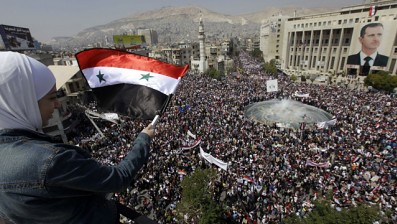
The threat of a new imperialist intervention in Western Asia, aimed at seizing and controlling the resources of this energy-rich region, grows daily. The newest target of this land and resource grab is the Syrian Arab Republic.

Such an intervention is a threat to the well-being of the 23 million Syrian people. It also threatens the organizations that at this time best represent the masses of Lebanese and Palestinian people. In addition, it opens the door to the imperialists and to the Israeli expansionist state for aggression against Iran, and threatens an even more horrendous war in the region.

The latest news is a stab in the back to the Syrian people from the so-called Arab League in this mostly Arab region, which is also home to Kurds and smaller minority ethnic groups.

So-called, because the 19 regimes that voted on Nov. 27 for unprecedented sanctions against Syria and its people are the furthest thing from true representatives of the Arab and other masses in the region. They instead represent, in most cases, the 1 percent of the 1 percent — whose wealth comes from a cut of the profits of the energy resources and who are completely dependent on their close and subservient relations with world imperialism to keep their hands on the power of the local states.

The hypocrisy especially of Arab League members such as Saudi Arabia, the six Gulf kingdoms and emirates is boundless. These states have cooperated in the bloody suppression of the popular revolt in Bahrain and the police repression of their own people.

Added to them are the Egyptian military regime currently gassing and shooting young people in Tahrir Square; the Yemeni regime battling a popular revolt for the past eight months; along with the new puppet Libyan regime.

The Turkish regime, with Turkey a NATO member, has seconded the Arab League sanctions, bringing the region one step closer to war.

Only last March an Arab League vote opened the door to U.S.-NATO’s eight months of terror bombing and puppet invasion of Libya that destroyed that country’s sovereign state and infrastructure, killed tens of thousands of people and opened up the country to raw and unrestricted imperialist pillage. The new “deals” announced between Libyan puppets and European and U.S.-based corporations have exposed the phony “humanitarian” intervention in Libya as a 21st-century replay of 19th-century colonialism.

It is telling that President Nicolas Sarkozy of France preceded the Arab League’s vote by demanding “humanitarian corridors” in Syria to allow untrammeled imperialist penetration to the centers of opposition to the Syrian government. Disguised as a mission to bring “humanitarian” aid, such corridors would allow — at a minimum — a free introduction of arms to promote a civil war within Syria. It was Sarkozy who opened the military assault on Libya last March, with French imperialism getting the full backing of Washington and the logistic and technological support in destruction that only the Pentagon can provide.

There is no way that an imperialist intervention can create a situation where the Syrian people can independently decide the nature of their government and state.

For anti-imperialists and progressives in Europe and North America, the first duty in any situation of civil conflict in a developing country like Syria is to stop the imperialist intervention. That means to oppose any imperialist aggression against Syria, whatever form it takes.

No imperialist sanctions against Syria!

No NATO intervention in the region!

U.S., Europe, out of the Middle East!
------------------------------------------------
Articles copyright 1995-2011 Workers World. Verbatim copying and distribution of this entire article is permitted in any medium without royalty provided this notice is preserved.

Workers World, 55 W. 17 St., NY, NY 10011
Email: ww@workers.org
Subscribe wwnews-subscribe@workersworld.net
Support independent news DONATE

As Public Sector Sheds Jobs, Blacks Are Hit Hardest

November 28, 2011

As Public Sector Sheds Jobs, Blacks Are Hit Hardest

By TIMOTHY WILLIAMS
New York Times

Don Buckley lost his job driving a Chicago Transit Authority bus almost two years ago and has been looking for work ever since, even as other municipal bus drivers around the country are being laid off.

At 34, Mr. Buckley, his two daughters and his fiancée have moved into the basement of his mother’s house. He has had to delay his marriage, and his entire savings, $27,000, is gone. “I was the kind of person who put away for a rainy day,” he said recently. “It’s flooding now.”

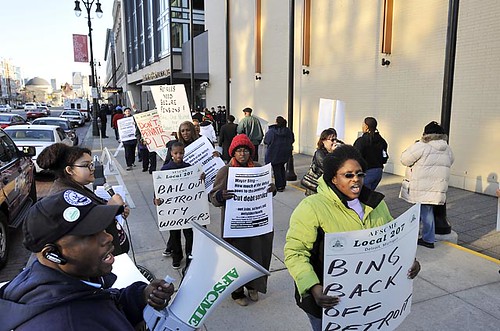
Mr. Buckley is one of tens of thousands of once solidly middle-class African-American government workers — bus drivers in Chicago, police officers and firefighters in Cleveland, nurses and doctors in Florida — who have been laid off since the recession ended in June 2009. Such job losses have blunted gains made in employment and wealth during the previous decade and undermined the stability of neighborhoods where there are now fewer black professionals who own homes or who get up every morning to go to work.

Though the recession and continuing economic downturn have been devastating to the American middle class as a whole, the two and a half years since the declared end of the recession have been singularly harmful to middle-class blacks in terms of layoffs and unemployment, according to economists and recent government data. About one in five black workers have public-sector jobs, and African-American workers are one-third more likely than white ones to be employed in the public sector.

“The reliance on these jobs has provided African-Americans a path upward,” said Robert H. Zieger, emeritus professor of history at the University of Florida, and the author of a book on race and labor. “But it is also a vulnerability.”

A study by the Center for Labor Research and Education at the University of California this spring concluded, “Any analysis of the impact to society of additional layoffs in the public sector as a strategy to address the fiscal crisis should take into account the disproportionate impact the reductions in government employment have on the black community.”

Jobless rates among blacks have consistently been about double those of whites. In October, the black unemployment rate was 15.1 percent, compared with 8 percent for whites. Last summer, the black unemployment rate hit 16.7 percent, its highest level since 1984.

Economists say there are probably a variety of reasons for the racial gap, including generally lower educational levels for African-Americans, continuing discrimination and the fact that many live in areas that have been slow to recover economically.

Though the precise number of African-Americans who have lost public-sector jobs nationally since 2009 is unclear, observers say the current situation in Chicago is typical. There, nearly two-thirds of 212 city employees facing layoffs are black, according to the American Federation of State, County and Municipal Employees Union.

The central role played by government employment in black communities is hard to overstate. African-Americans in the public sector earn 25 percent more than other black workers, and the jobs have long been regarded as respectable, stable work for college graduates, allowing many to buy homes, send children to private colleges and achieve other markers of middle-class life that were otherwise closed to them.

Blacks have relied on government jobs in large numbers since at least Reconstruction, when the United States Postal Service hired freed slaves. The relationship continued through a century during which racial discrimination barred blacks from many private-sector jobs, and carried over into the 1960s when government was vastly expanded to provide more services, like bus lines to new suburbs, additional public hospitals and schools, and more.

But during the past year, while the private sector has added 1.6 million jobs, state and local governments have shed at least 142,000 positions, according to the Labor Department. Those losses are in addition to 200,000 public-sector jobs lost in 2010 and more than 500,000 since the start of the recession.

The layoffs are only the latest piece of bad news for the nation’s struggling black middle class.

A study by the Brookings Institution in 2007 found that fewer than one-third of blacks born to middle-class parents went on to earn incomes greater than their parents, compared with more than two-thirds of whites from the same income bracket. The foreclosure crisis also wiped out a large part of a generation of black homeowners.

The layoffs are not expected to end any time soon. The United States Postal Service, where about 25 percent of employees are black, is considering eliminating 220,000 positions in order to stay solvent, and areas with large black populations — from urban Detroit to rural Jefferson County, Miss. — are struggling with budget problems that could also lead to mass layoffs.

The postal cuts alone — which would amount to more than one-third of the work force — would be a blow both economically and psychologically, employees say.

Pamela Sparks, 49, a 25-year Postal Service veteran in Baltimore, has a brother who is a letter carrier and a sister who is a sales associate at the Postal Service. Her father is a retired station manager.

“With our whole family working for the Post Office, it would be hard to help each other out because we’d all be out of work,” Ms. Sparks said. “It has afforded us a lot of things we needed to survive really, but this is one of the drawbacks.”

In Michigan, Valerie Kindle, 61, who was laid off in April as a state government employee, said the loss of her $50,000-a-year job with benefits had caused her to put off retirement. Instead, she is looking for work. Two relatives have also lost state government jobs recently.

“There hasn’t been one family member who hasn’t been touched by a layoff,” Ms. Kindle said. “We are losing the bulk of our middle class. I was much better off than my parents, and I’m feeling my children will not be as well off as I was. There’s not as much government work and not as many manufacturing jobs. It’s just going down so wrong for us. When I think about it I get frightened, so I try not to think about it.”

Mr. Buckley, the unemployed Chicago bus driver who now lives in his mother’s basement, said his mother, a Postal Service employee, had grown tired of him “eating up all her food.”

“She’s ready for me to get up out of here,” he said. In the meantime, Mr. Buckley says his life has drifted into the tedium of looking for decent-paying jobs that do not exist.

“I was living the American dream — my version of the American dream,” he said of his $23.76-an-hour job. “Then it crumbled. They get you used to having things and then they take them away, and you realize how lucky you were.”

South Sudan Calls North Oil Blockade Intimidation

South Sudan Calls Sudan Oil Blockade Intimidation

November 29, 2011, 9:12 AM EST

By Jared Ferrie and Salma El Wardany

Nov. 29 (Bloomberg) -- South Sudanese Oil Minister Stephen Dhieu Dau rejected Sudan’s blockade of its crude exports as an “intimidation tactic.”

The authorities in Khartoum owe South Sudan $5 billion in arrears for shipments before it gained independence and taxes and other revenue collected since then, he said today in a phone interview from Addis Ababa, the Ethiopian capital. Sudan’s government announced yesterday it halted exports by South Sudan, claiming it’s owed $727 million for earlier shipments.

“It’s a figure that has no basis,” Dau said. “This is actually an intimidation tactic so that in the negotiations South Sudan would panic.”

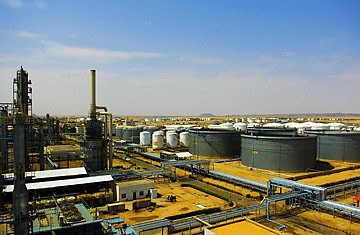
African Union-sponsored negotiations between the two countries began in Addis Ababa on Nov. 21 over issues including the oil fees the south should pay to ship crude through the north and the disputed region of Abyei. While South Sudan took control of about three-quarters of the former state’s output of 490,000 barrels a day when it seceded on July 9, it relies on the north for access to refining and an export terminal on the Red Sea.

“Sudan is trying to make the south pay for its economic failure by increasing fees on oil,” Fouad Hikmat, the special adviser on Sudan for the Brussels-based International Crisis Group, said today by phone from Addis Ababa. “The north is trying to use threats as a pressuring tactic on the south during the ongoing negotiations.”

Share Seizure

The halt to exports comes after South Sudan announced in a presidential decree on Nov. 8 that it seized the shares held by Sudapet, Sudan’s state-owned petroleum company, in joint operations with companies including China National Petroleum Corp., Malaysia’s Petroliam Nasional Bhd and India’s Oil & Natural Gas Corp.

China today urged the two sides to reach agreement in negotiations.

“Maintaining normal production of oil is important to both South Sudan and Sudan,” Chinese Foreign Ministry spokesman Hong Lei told reporters today in Beijing. “We hope North and South Sudan can stay rational, show restraint, and resolve relevant problems through neighborly pragmatism and friendly talks.”

South Sudan’s deputy petroleum minister, Elizabeth Bol, said yesterday the blockade prevented a shipment of 600,000 barrels of Nile-blend crude from being delivered to China International United Petroleum & Chemical Corp. A shipment of 1 million barrels of Dar blend oil to Geneva-based Vitol SA may also be at risk if the blockade continues, she said.

China Concerned

“China is very pragmatic and the statement means it’s really concerned what Sudan did and about the stability in the region which might harm the interests of Chinese investment,” he said.

South Sudan’s government is studying the feasibility of building a new pipeline to export oil via its East African neighbours, rather than using Sudan’s oil pipeline that runs to Port Sudan on the Red Sea, the government said last week.

Southern officials have said previously they are considering building a pipeline that would carry crude to the Kenyan port of Lamu.

--With assistance from William Bi in Beijing. Editors: Karl Maier, Paul Richardson

To contact the reporters on this story: Jared Ferrie in Juba, South Sudan, at jferrie1@bloomberg.net; Salma El Wardany in Khartoum at selwardany@bloomberg.net

To contact the editor responsible for this story: Antony Sguazzin at asguazzin@bloomberg.net

Invasion of Somalia Major Cause of Displacement

Conflict now major cause for displacement in Somalia, says UN refugee agency

United Nations Report

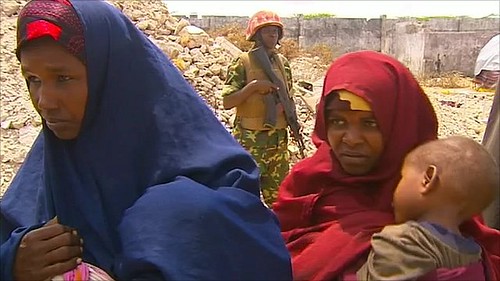
29 November 2011 –Insecurity and conflict due to insurgency is now one of the main causes for displacement in Somalia’s capital, Mogadishu, the United Nations refugee agency said today, warning that constant fighting is also hampering aid efforts in the country.

“In Mogadishu, we noted a profound change in the root causes driving forced displacement,” said Andrej Mahecic, spokesperson for the Office of the High Commissioner for Refugees (UNHCR). “While drought accounted for the vast majority of displacement in the Somali capital during the first three quarters of the year, as of October we have seen 8,300 people displaced by conflict and just 500 displaced as a result of drought.”

Mr. Mahecic told reporters in Geneva that conflict and military activity were also affecting people’s access to food in other areas in the southern part of the country such as Qooqaani, Tabta and Afmadow, where some 500 people, including children, have left their homes and are travelling by foot to the border town of Dobley, where a number of agencies are distributing food and providing assistance.

UNHCR said this movement of people has happened in spite of the heavy rains which have limited movement in the southern and central parts of the country, while also adding that many people are still reluctant to move, fearing ambushes or getting caught in the crossfire.

Somalia faces a dire humanitarian situation, having endured a drought and famine as well as continued fighting and heavy rains this year, all of which have aggravated the conditions of its estimated 1.46 million internally displaced persons (IDPs).

Conflict is also preventing UN agencies from delivering assistance. UNHCR, the UN Children’s Fund (UNICEF) and the World Health Organization (WHO) all expressed concern today about the announcement by insurgent group Al-Shabaab that it would permanently revoke work permissions to several UN organizations in parts in Somalia under their control.

UNICEF and WHO reported that their offices have been raided and occupied, and said they are currently assessing the impact of these actions on their work.

Fighting and insecurity is also affecting refugee camps in neighbouring Kenya, with UN staff reporting that they have been unable to assess the number and condition of new arrivals to the Dadaab complex. However, despite restrictions on movement, authorities have managed to complete an oral polio vaccination campaign for all refugee children less than five years of age.

UNHCR also reported that more than 360 refugees in the camp have been affected by cholera and acute watery diarrhoea, adding that efforts to enhance security measures are being taken so assistance can be delivered as soon as possible.

In addition, the agency said it would increase its efforts in the Dollo Ado camps in Ethiopia as there is a high rate of severe acute malnutrition among resident children under the age of five. In response, UNHCR and partners are expanding their wet feeding programme to all children up to the age of 10, and adding milk powder to porridge to boost nutrient levels.


SOMALIA: Resettlement of drought-displaced begins

Aid agencies in Mogdishu have started a project to resettle thousands of drought-displaced Somalis

NAIROBI, 29 November 2011 (IRIN) - Resettlement of tens of thousands of drought-displaced Somalis, most of whom had sought refuge in the capital, Mogadishu, is under way, with aid agencies organizing voluntary returns to several areas in southern Somalia, officials told IRIN.

“We started a project to resettle some 4,000 families [24,000 people] back to their homes in time for them to take advantage of what is left of the rainy season," said Mohamed Abdullahi Hussein, the director of the United Arab Emirates-Red Crescent Society (UAE-RCS)in Somalia.

Hussein said the agency was providing the returnees with food to last three months, shelter material and between US$100 and $150 per family.

The returns are voluntary, with most going to Bay, Bakool and Lower Shabelle regions of southern Somalia, Hussein added.

Abdullahi Shirwa, head of Somalia's National Disaster Management Agency (NDMA), said it was the government's policy to resettle all internally displaced persons (IDPs). "It is not realistic to maintain hundreds of thousands people in overcrowded IDP camps indefinitely. So the best option is to help return those willing to do so to their home areas."

Shirwa said NDMA had scheduled a meeting this week with aid agencies in Mogadishu to organize a programme of resettlement.

"We basically want to see who can do what," he said. "There are agencies that can provide the food; others can provide the transportation, while others can provide shelter material or cash incentives."

Since UAE-RCS began the return process in November, some 460 drought-displaced families have gone home.

"On 28 November we repatriated 261 families [1,566 people] back to Bay region," said Abubakar Sheikh Bashir, team leader for the UAE-RCS resettlement project.

He said many of the returnees, mostly farmers, were eager to take advantage of the best rains in three years "and restart their lives".

Bashir said many families have already returned on their own, "while others sent back the able-bodied and left behind the elderly, the women and children".

Bishaaro Haji Alin, 45, lost four of her nine children in the drought that devastated her home area in Buur Hakaba in Bay region.

"I was here in the camp for the last six months; if we did not come here I could have lost all of my children," Alin told IRIN by telephone, as she boarded a truck back home.

Alin said she was eager to start planting. "My children are fine and we want to go back to where we belong. We got help here but it is not home."

Home for Alin and her family, along with some 10,000 families, had been the sprawling Tribunka camp, the largest in Mogadishu.

Shirwa of the NDMA said the key to resettling the drought-displaced IDPs was to provide them with enough support to allow them to restart their lives.

"Most of the displaced are agro-pastoralists and so it is not enough to say we will give them food until the next harvest; we need to provide them also with some pack animals and maybe two or three cows or whatever animals they had before," Shirwa said, adding "that will not only empower them but help them start afresh."

This report does not necessarily reflect the views of the Pan-African News Wire

Restraint Urged After Salvos Over Lebanon-Israel Border

November 29, 2011

Restraint Urged After Salvos Over Lebanon-Israel Line

By ISABEL KERSHNER
New York Times

JERUSALEM — The United Nations peacekeeping force in Lebanon called for “maximum restraint” on Tuesday after an exchange of fire over the Israel-Lebanon border overnight.

Rockets fired from southern Lebanon struck northern Israel for the first time since 2009, and the Israeli military responded by firing artillery shells at the area where the rockets were launched.

Though the exchange was relatively small in scale and there were no reports of casualties on either side, it punctured months of quiet along a notoriously volatile border at a time of regional turmoil and rising tension between Israel and Iran over Iran’s nuclear program.

“This is a serious incident, in violation of U.N. Security Council Resolution 1701, and is clearly directed at undermining stability in the area,” the commander of the peacekeeping force, Maj. Gen. Alberto Asarta Cuevas, said in a statement.

It was not immediately clear which group was responsible for the rocket fire from Lebanon. Some news outlets reported that a little-known group had made a claim of responsibility.

Hezbollah, a Shiite militant organization in Lebanon that is backed by Iran and Syria, fired thousands of rockets at Israel during a 34-day war in 2006 that left more than 1,000 Lebanese and several dozen Israelis dead. The United Nations peacekeepers’ mission has been helping Lebanese troops monitor the fragile cease-fire underpinned by Resolution 1701, which ended that conflict. Israel and Lebanon have no diplomatic relations.

Any indication of Hezbollah involvement in the latest rocket fire would signal a more serious risk of an escalation of violence. But several small Palestinian and other militant groups that operate in southern Lebanon have also fired rockets at Israel in the past.

The Israeli military said on Tuesday that it viewed the incident gravely, but officials said they considered it to be over.

Hezbollah has emerged as the kingmaker in Lebanese politics. Israeli officials point to reports that Hezbollah has been transferring weapons to Lebanon from warehouses in Syria because of the political upheaval threatening the Syrian government of President Bashar al-Assad.

During the 2006 war, most of the rockets fired into Israel were short-range Katyushas, which could do little damage. But Israeli military officials say that Hezbollah has since built up a larger and more lethal arsenal, storing up to 40,000 rockets in bunkers in southern Lebanon. And Israel accused Syria last year of providing long-range Scud missiles to the militia, a claim denied by Syria and by Lebanese officials.

“Syria’s determined support of Hizballah’s military buildup, particularly the steady supply of longer-range rockets and the introduction of guided missiles, could change the military balance and produce a scenario significantly more destructive than the July-August 2006 war,” said a 2009 cable from the American chargé d’affaires in Damascus that was obtained by WikiLeaks.

Ron Ben-Yishai, an analyst for Ynet, a popular Israeli news site, wrote on Tuesday that the nighttime fire across Israel’s northern border “could be defined as a localized incident of no apparent strategic significance.”

“Nevertheless,” he continued, “given the extremely unstable conditions now prevailing in the Middle East, such an incident could lead to a deteriorating situation even if the main players, Israel and Hezbollah, did not intend for that to happen.”

Deposed Ivory Coast President Gbagbo In ICC Custody

Former Ivory Coast president in international court custody

From Eric Agnero
Tue November 29, 2011

Gbagbo is "the first former head of state taken into ICC custody," Human Rights Watch says

Abidjan, Ivory Coast (CNN) -- Former Ivory Coast President Laurent Gbagbo was being transferred Tuesday to the International Criminal Court in The Hague, said his adviser, Toussaint Alain.

He was flown out of the northern city of Khorogo, where he had been under house arrest, on an airplane of the Ivorian government at about 6 p.m. Tuesday, Alain said.

Alain called it an illegal transfer. "The international court has taken an illegal action. This is a political decision rather than a decision of justice," Alain said.

The transfer was announced on national television Tuesday evening.

The action comes a week before parliamentary elections. Three political parties in an umbrella coalition (CNRD) with Gbagbo's Front Populaire Ivorien issued a statement saying they would boycott the elections as a result of Gbagbo's transfer.

Last month, the chief prosecutor for the International Criminal Court, Luis Moreno-Ocampo, arrived in Ivory Coast to meet with government and opposition leaders and began an inquiry into the West African nation's post-election violence.

In his application to the judges for authorization to investigate possible war crimes and crimes against humanity, Moreno-Ocampo cited sources who said at least 3,000 people were killed, 72 people disappeared and 520 others were subject to arbitrary arrest and detentions since the November 28, 2010, election that resulted in the violence.

Gbagbo, the incumbent, refused to cede power even though challenger, Alassane Ouattara, was internationally recognized as the winner. Months of bloodshed ensued. The political stalemate was settled by Gbagbo's capture in April by forces loyal to his rival, and he has been detained in the north of Ivory Coast. Gabgbo refused to accept the results of UN-certified elections.

Human Rights Watch issued a statement saying Gbagbo is "the first former head of state taken into custody by the ICC."

President Omar al-Bashir of Sudan and the late Libyan leader Moammar Gadhafi have also been subject to ICC arrest warrants, but Al-Bashir has not come into ICC custody, nor did Gadhafi, who was killed this year during Libya's revolution, Human Rights Watch said.

"The ICC is playing its part to show that even those at the highest levels of power cannot escape justice when implicated in grave crimes," Elise Keppler, senior international justice counsel at Human Rights Watch, said in a statement.

"This is a big day for the victims of (Ivory Coast's) horrific post-election violence," Keppler said. "That Laurent Gbagbo now has to answer to the court sends a strong message to Ivorian political and military leaders that no one should be above the law."

CNN's Michael Martinez contributed to this report.

2011 In Africa: Year Of Mass Upheaval And Imperialist Interventions

2011 in Africa: Year of Mass Upheaval and Imperialist Interventions

From Tunisia and Egypt to Morocco and Libya the continent is shaken by the world economic crisis

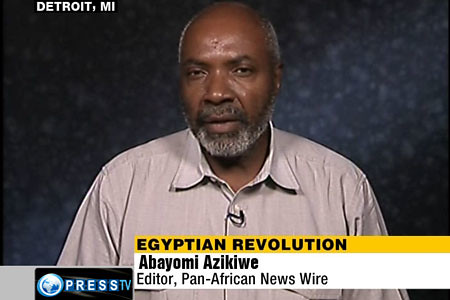
By Abayomi Azikiwe
Editor, Pan-African News Wire

December 17 marks the first anniversary of the beginning of a year of uprisings, strikes government resignations and regime change on the African continent. Africa has experienced numerous mass demonstrations, general strikes, rebellions and full-scale military assaults as part of a heightening global class struggle for control of the economic and political future of this resource-rich and strategically located geo-political region.

In the North African state of Tunisia on December 17 of last year, 26-year-old Mohamed Bouazizi set himself on fire after his vending business was shut down by the authorities in the city of Sidi Bouzid purportedly because he did not have a license to sell on the street. This act of self-immolation led to mass demonstrations in the western-backed North African state that eventually engulfed large sections of the country which is a tourist haven for Europeans.

Demonstrations in Tunisia led to the resignation of longtime political leader Zine El Abidine Ben Ali on January 14. President Ben Ali, who had headed the state for 24 years under the Rally for Constitutional Democracy (RCD) ruling party, fled the country and is reported to have taken refuge in Saudi Arabia.

After continuing demonstrations and political debate, an election was held in late October which resulted in the majority of the votes going to the moderate Islamic party Ennahda that is headed by Rashid Ghannouchi. Ghannouchi had lived in exile for many years and is considered a leading Islamic scholar in the region.

A December 2 deadline has been set for the formation of a new government in Tunisia. The majority of the new ministries will come from members of the Ennahda, and the secular center-left Congress for the Republic (CPR) and Ettakatol parties. It is anticipated that the Ennahda Secretary-General Hamadi Jebali will be the next Prime Minister.

According to Tunisia-live.net, “The key Ministries, namely those of Interior, Foreign Affairs, and that of Justice, are expected to be taken charge of by members of Ennahda. The moderate Islamic party actually insists that the Prime Minister be chosen among members of the party that disposes of the biggest number of seats—a request that has met vivid opposition among CPR and Ettakatol commissions.” (November 27)

Left parties in Tunisia have participated in the new political situation by emerging as organizations that are allowed to operate openly. Most of the left organizations had been forced underground since the 1980s when the Tunisian Communist Worker’s Party (PCOT) was formed.

At least a dozen other left formations have attempted to organize inside the country and some of the groups have merged and formed coalitions to strengthen their ranks. The Revolutionary Communist Organization (OCR) has reorganized itself as the Left Workers League (Ligue Ouvriere de Gauche).

Also two Maoist groups, the Party of the Patriotic Democrats and the Movement of Patriotic Democrats held a unification conference in April after the fall of Ben Ali. Nonetheless, PCOT is perhaps the most well-known of the left parties in Tunisia whose leader, Hamma Hammami spent years in prison under the RCD government of deposed President Ben Ali. The PCOT did win 3 seats in the new Constituent Assembly.

A center-left formation, the Progressive Democratic Party (PDP) that is led by the only significant woman in Tunisian politics, Maya Jribi, was expected to come in second in the national elections but instead landed in fourth place. Jribi said that the PDP would continue as an opposition party.

Tunisia’s trade union federation, the UGTT, played a significant role in the demonstrations that led to the fall of Ben Ali. However, its role in the future political dispensation of the country still remains to be seen.

Egypt Erupts on the Eve of National Elections

On November 19, thousands of youth entered Tahrir Square to protest the desire of the Supreme Council of the Armed Forces (SCAF) to remain in charge of the political transition process in Egypt. Tahrir Square was the center of nationwide demonstrations that began in the North African state on January 25 which resulted in the resignation of longtime United States-backed dictator President Hosni Mubarak.

Since the collapse of the Mubarak government there have been consistent demonstrations on the part of the revolutionary democratic forces claiming that the struggle was being subverted by the role of the Supreme Military Council headed by Field Marshal General Mohamed Hussein Tantawi. Also the character of Egyptian foreign policy as it relates to the peace treaty with the State of Israel has been major source of anger and frustration among broad sectors of the populations.

Elections for parliamentary seats began on November 28 with long lines in the capital of Cairo where voters complained of delays of up to four hours. The SCAF insisted that the elections go forward despite the mass demonstrations that preceded the elections for eight days and resulted in the deaths of over 40 people.

Most political analysts predict that the Muslim Brotherhood’s Freedom and Justice Party (FJP) would win the majority of seats in the new parliament. The Brotherhood was split over participation in the recent demonstrations where the youth members did play a leading role despite the official absence of the parent body.

The New York Times reported that “At some polling places, teams of Brotherhood members wearing the insignia of the Freedom and Justice Party were on hand to help maintain security, and they could be seen performing services like escorting elderly women to specially designated lines.” Although the large sections of the population appear to have gravitated to the election process amid mass demonstrations demanding the liquidation of ultimate political control by the SCAF, Field Marshal Tantawi declared on November 27 that ‘the position of the armed forces will remain as it is—it will not change in any new constitution.” (New York Times, November 28)

Morocco’s Moderate Islamists to Form New Government

Another North African state that experienced mass demonstrations over the last year, Morocco, recently held a nationwide election in which a moderate Islamist Party came out victoriously. The Justice and Development Party (PJD) won 107 seats out of 395, gaining twice as many positions as the second place finisher, the Istiqlal Party which won 60 seats as a decades-long opponent of the monarchy.

The Socialist Union of Popular Forces (USFP) had formed an alliance with the Party of Progress and Socialism (PPS) and consequently won 30 seats in the new parliament. The King Mohammed VI therefore must select the next Prime Minister from the ranks of the PJD.

Economic Crisis Underlines Political Turmoil in North Africa

These political developments in North Africa are not taking place in a vacuum. The uprisings which began in Tunisia are a response to massive unemployment and poverty. In Tunisia and Egypt unemployment is extremely high and the neo-colonialist relationship with the imperialist states in both countries has failed to provide any benefits for the majority of the populations in these states.

In Morocco the situation is quite similar and it will in all likelihood continue in the face of the failure of the left to win a dominant position within the new political arrangements. At the same time, the role of the United States military in Egypt and Morocco will continue to be an impediment to the social development of the region.

With the overthrow of the Muammar Gaddafi government in Libya, the United States Africa Command (AFRICOM) has been emboldened and the stage is set for greater exploitation of the resources of the region. Despite these changes, the situation will remain unstable and volatile.

Recently the Tunisian government was forced to cancel flights to Libya due to threats posed by the armed rebel groups that were sponsored by the U.S. and NATO in the toppling of the government in Tripoli. The capture and killing of Gaddafi and four of his sons will ensure the continuation of conflict inside of Libya, which has Africa largest know oil reserves.

Even the Wall Street Journal admitted in relationship to Egypt that “The turbulent protests that ousted President Hosni Mubarak scared off tourists and foreign investors alike. And the new military leadership, which reversed many of the economic liberalization gains in favor of populist policies intended to boost social stability, did little to instill new confidence.” (Wall Street Journal, November 28)

The worsening of the economic crisis in numerous European countries and the U.S. will continue to send shockwaves into North Africa and the Middle East. Only the popular organization of the masses of workers, youth and farmers and the formation of governments in their own interests can provide the possibility of an economic reversal of the current pessimism and foster genuine security, stability and development.

Detroit's Economic Crisis Heightens Tensions

Detroit’s Economic Crisis Heightens Tensions

Politicians battle over the extent of austerity measures while ‘emergency manager law’ faces challenge

By Abayomi Azikiwe
Editor, Pan-African News Wire

Conservative Republican Governor Rick Snyder has threatened the City of Detroit with a financial review that could lead to the appointment of an “emergency manager” who would hold power to make drastic changes in the way the municipality operates. Snyder said that he was not impressed with the way in which the corporate-backed Mayor Dave Bing is handling the ongoing economic crisis that has resulted in an over $300 budget deficit.

Snyder said that he had expected a request from Bing to conduct a financial review of the city which is the first step in the appointment of an emergency manager. The emergency manager law was recently revised by the Republican-dominated state legislature which enhanced the previous law that was utilized in the 2009 takeover of the Detroit Public Schools.

The crisis has gained attention recently based on an audit report by Ernst & Young accounting firm which indicates that the city may “run out of cash” in a few months. Both the Mayor’s office and the City Council have refused to challenge the audit report or the threats by the Governor to begin the process of appointing an emergency manager.

The majority of people on the City Council have proposed lay-offs of up to 2,300 municipal workers in addition to further cutbacks in salaries and benefits. The Mayor has advanced the idea of 1,000 lay-offs and more deep cuts in employee benefits.

The disagreement between the administration and the legislative body has also drawn the attention of the Governor and state legislature. Snyder says he has not received a letter requesting a review of Michigan’s largest city’s finances.

Snyder said of the Detroit politicians that “We’re going to encourage them to get on the same page in a constructive way. I’m still waiting to see if I get a response from either the mayor or the city council first,” the Governor told legislative correspondent Tim Skubick. (Detroit Free Press, November 22)

Although the Governor said that a financial review “just would start the process of asking for a preliminary review. My goal is to avoid a financial manager. I have no desire to see that happen.”

Nonetheless, in Benton Harbor, a majority African American city in the southwest region of the state, an emergency manager was appointed earlier this year. The emergency manager, Joe Harris, has created controversy in Benton Harbor by essentially nullifying the authority of the Mayor and the City Commission in the heavily impoverished municipality.

A previous law was utilized in the takeover of the Detroit Public Schools in 2009. The appointment of two emergency managers in the Detroit Public Schools has not resolved the problems associated with the system such as massive lay-offs, school closings and overcrowded classrooms which have become an even more serious problem.

Emergency Manager Law Challenged

With the advent of the new right-wing Governor and state legislature in Lansing earlier in the year, thousands demonstrated outside the capital demanding that this law and others which attack collective bargaining for public employees be rejected. These demonstrations in Lansing coincided with other protests in Wisconsin and Ohio where workers and students fought to stave off a nationwide effort to virtually cripple public sector unions.

A coalition of community organizations, civil rights groups and public officials filed suit to overturn the emergency manager law and a petition drive was launched to place a referendum on the ballot in November 2012 designed to repeal the attacks on the people. The coalition working to repeal the draconian law, Stand Up for Democracy, announced in late November that it had collected nearly enough signatures to place the referendum on the ballot and consequently nullify the implementation of the emergency manager bill.

Brandun Jessups of Stand Up for Democracy told the Detroit Free Press that “We’re getting very close to our 250,000 signature goal.” The newspaper noted that “Once the signatures—about 162,000—are turned in and certified, a process that could take two months, the law would be suspended until a vote.” (Detroit Free Press, November 23)

It is not clear whether the suspension of the existing law would require the state to revert to the previous one. If the current law is suspended, it would mean that the emergency managers in Benton Harbor, Pontiac and Ecorse would lose their special authority, such as the capacity to abolish labor contracts.

Threats Against Detroit Represents National Trend

If the Governor and his collaborators are allowed to impose an emergency manger, Detroit would become the largest city in recent times to be forced into a situation where elected officials would not be control of its finances. In recent weeks two other cities, Birmingham, Alabama, (in Jefferson County) which already has been forced into bankruptcy and Harrisburg, Pennsylvania, where a dispute exist among politicians and the courts over whether insolvency should be declared, illustrates the profound economic crises facing cities throughout the country.

The Moratorium NOW! Coalition to Stop Foreclosures, Evictions and Utility Shut-offs called for the public to attend its regular weekly meeting on November 28 to discuss this burning issue in Detroit. The Moratorium NOW! Coalition rejects the emergency manager law and is urging the city administration to demand the return of state revenue sharing funds from the state of Michigan which totals over $200 million.

In addition, the Moratorium NOW! Coalition is saying that there should be a halt to the payment of debt-service to the banks as well as a request made to the federal government for a bailout of the city. These measures could provide temporary relief to the city which is one of the hardest hit by the capitalist economic crisis.