Thursday, November 29, 2012

Egyptian Opposition Cries Foul As Constitution Finalized by Morsi Government

Opposition cries foul as Egypt constitution finalized

7:23pm EST
By Marwa Awad and Yasmine Saleh

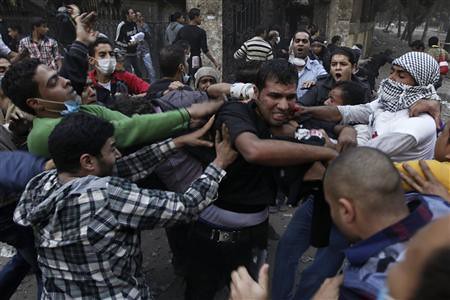
CAIRO (Reuters) - An Islamist-led assembly was expected to finalize a new constitution on Friday aimed at transforming Egypt and paving the way for an end to a crisis which erupted when President Mohamed Mursi gave himself sweeping new powers last week.

Mursi said his decree halting court challenges to his decisions, which provoked protests and violence from Egyptians fearing a new dictator was emerging less than two years after they ousted Hosni Mubarak, was "for an exceptional stage".

"It will end as soon as the people vote on a constitution," he told state television on Thursday night. "There is no place for dictatorship."

The assembly was expected to finish approving the draft constitution on Friday, allowing a referendum to be held as soon as mid-December on a text the Islamists say reflects Egypt's new freedoms.

Mursi's critics argue it is an attempt to rush through a draft they say has been hijacked by the Muslim Brotherhood, which backed Mursi for president in June elections, and its allies.

Two people have been killed and hundreds injured in the protests since last Thursday's decree, which deepened the divide between the newly-empowered Islamists and their opponents.

Setting the stage for more tension, the Muslim Brotherhood and its Islamist allies have called for pro-Mursi rallies on Saturday. But officials from the Brotherhood's party changed the venue and said they would avoid Tahrir Square, where a sit-in by the president's opponents entered an eighth day on Friday.

Seeking to calm protesters, Mursi said he welcomed opposition but it should not divide Egyptians and there was no place for violence. "I am very happy that Egypt has real political opposition," he said.

He stressed the need to attract investors and tourists to Egypt, where the crisis threatens to derail some early signs of an economic recovery after two years of turmoil. Egypt's benchmark stock index fell on Thursday to a 20-week-month low.

"MAY GOD BLESS US"

An alliance of Egyptian opposition groups pledged to keep up protests and said broader civil disobedience was possible to fight what it described as an attempt to "kidnap Egypt from its people".

Eleven Egyptian newspapers plan not to publish on Tuesday in protest at Mursi's decree, one reported. Al-Masry Al-Youm also said three privately owned satellite channels would not broadcast on Wednesday in protest.

The plebiscite is a gamble based on the Islamists' belief that they can mobilize voters again after winning all elections held since Mubarak was overthrown in February 2011.

"May God bless us on this day," Hossam el-Gheriyani, the speaker of the constituent assembly, told members at the start of the session to vote on each of the 234 articles in the draft, which will go to Mursi for approval and then to the plebiscite.

The legitimacy of the constitutional assembly has been called into question by a series of court cases demanding its dissolution. Its standing has also suffered from the withdrawal of members including church representatives of the Christian minority and liberals.

The Brotherhood argues that approval of the constitution in a referendum would bury all arguments about both the legality of the assembly and the text it has written in the last six months.

Mursi is expected to approve the adopted draft at the weekend. He must then call the referendum within 15 days. If Egyptians approve the constitution, legislative powers will pass straight from Mursi to the upper house of parliament, in line with an article in the new constitution, assembly members said.

The draft injects new Islamic references into Egypt's system of government but keeps in place an article defining "the principles of sharia" as the main source of legislation - the same phrase found in the previous constitution.

HISTORIC CHANGES

Among other historic changes to Egypt's system of government, it caps the amount of time a president can serve at two terms, or eight years. Mubarak ruled for three decades. It also introduces a measure of civilian oversight - not nearly enough for the critics - over the military establishment.

The president can declare war with parliament's approval, but only after consulting a national defense council with a heavy military and security membership, effectively giving the army a say. That element was not in the old constitution, used when Egypt was ruled by ex-military men.

Activists highlighted other flaws such as worrying articles pertaining to the rights of women and freedom of speech.

"There are some good pro-freedoms articles, but there are also catastrophic articles like one that prevents insults. This could be used against journalists criticizing the president or state officials," said human rights activist Gamal Eid.

"We wanted Egyptians to get more freedoms and less presidential powers and were unhappy with the end result in those areas," said Edward Ghaleb, who had been sitting on the assembly as a representative of the Coptic Orthodox church.

New parliamentary elections cannot happen until the constitution is passed. Egypt has been without an elected legislature since the Islamist-dominated lower house was dissolved in June.

"The secular forces and the church and the judges are not happy with the constitution; the journalists are not happy, so I think this will increase tensions in the country," said Mustapha Kamal Al-Sayyid, a professor of political science at Cairo University. "I don't know how the referendum can be organized if the judges are upset," he added.

Egyptian elections are overseen by the judiciary.

The decree issued by Mursi worsened already tetchy relations with judges, many of whom saw it as a threat to their independence. Two courts declared a strike on Wednesday.

(Additional reporting by Tom Perry, Tamim Elyan, Patrick Werr, Edmund Blair and Ali Abdelatti; Editing by Philippa Fletcher)

UN Assembly, In Blow to US and Israel, Elevates Status of Palestine

November 29, 2012

U.N. Assembly, in Blow to U.S., Elevates Status of Palestine

By ETHAN BRONNER and CHRISTINE HAUSER
New York Times

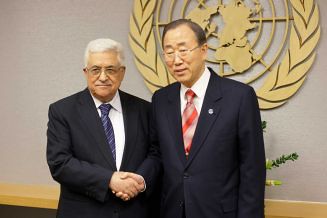
UNITED NATIONS — More than 130 countries voted on Thursday to grant Palestine the upgraded status of nonmember observer state in the United Nations, a stinging defeat for Israel and the United States and a boost for President Mahmoud Abbas of the Palestinian Authority, who was weakened by the recent eight days of fighting in Gaza.

The new ranking could make it easier for the Palestinians to pursue Israel in international legal forums, but it remained unclear what effect it would have on attaining what both sides say they want — a two-state solution.

Still, the vote offered a showcase for an extraordinary international lineup of support for the Palestinians and constituted a deeply symbolic achievement for their cause, made even weightier by arriving on the 65th anniversary of the General Assembly vote that divided the former British Mandate of Palestine into two states, one Jewish and the other Arab — a vote that Israel considers the international seal of approval for its birth.

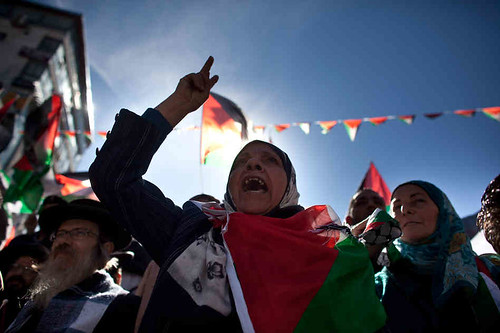
In the West Bank city of Ramallah, about 2,000 Palestinians gathered to celebrate in a central square named after the late Palestinian leader Yasser Arafat. Security forces fired into the air and people applauded, danced in the streets and honked car horns when the results were broadcast to the crowd.

“We are witnessing exceptional moments after 65 years of injustice, suffering and pain,” said Jibril Rajoub, the member of Fatah Central Committee. “We are going to witness an Israeli American efforts to keep this resolution ink on paper.”

The tally, in which 138 members voted yes, 9 voted no and 41 abstained, took place after a speech by Mr. Abbas to the General Assembly, in which he called the moment a “last chance” to save the two-state solution amid a narrowing window of opportunity.

“The General Assembly is called upon today to issue a birth certificate of the reality of the state of Palestine,” he said before the vote.

But in the run-up to the vote, he and Ron Prosor, the Israeli ambassador to the United Nations, blamed the other side for not doing enough to pursue peace.

”We have not heard one word from any Israeli official expressing any sincere concern to save the peace process,” Mr. Abbas said.

“On the contrary, our people have witnessed, and continue to witness, an unprecedented intensification of military assaults, the blockade, settlement activities and ethnic cleansing, particularly in occupied East Jerusalem, and mass arrests, attacks by settlers and other practices by which this Israeli occupation is becoming synonymous with an apartheid system of colonial occupation, which institutionalizes the plague of racism and entrenches hatred and incitement.”

“The moment has arrived for the world to say clearly: enough of aggression, settlements and occupation,” he said.

Mr. Prosor, speaking after Mr. Abbas but before the vote was taken, said the United Nations resolution would do nothing to advance the process.

“Today the Palestinians are turning their back on peace,” he said. “Don’t let history record that today the U.N. helped them along on their march of folly.”

As expected, the vote won backing from a number of European countries, and was a rebuff to intense American and Israeli diplomacy. In an indication of the bitterness of the blow to the Israelis, the office of Prime Minister Benjamin Netanyahu released a statement calling Mr. Abbas’s speech “defamatory and venomous” that was “full of mendacious propaganda against the IDF and the citizens of Israel.”

“Someone who wants peace does not talk in such a manner," the statement continued.

Among the countries that had forecast their yes votes were France, Spain and Switzerland. Germany and the United Kingdom were among the countries that abstained, and a few countries joined Israel and the United States in voting no.

After the vote, Susan E. Rice, the American ambassador to the United Nations, explained the American vote as a reaction to an “unfortunate and counterproductive” resolution that placed “further obstacles in the path to peace.”

“Today’s grand pronouncements will soon fade,” she said. “And the Palestinian people will wake up tomorrow and find that little about their lives has changed, save that the prospects of a durable peace have only receded.” Her comments dovetailed with those of Mr. Prosor ahead of the vote. He reiterated that Israel favors a two-state resolution reached through negotiations, with some parts of the occupied territories remaining in Israeli hands, a strong focus on Israel’s security concerns and formal recognition by the Palestinians of Israel’s legitimacy as a Jewish state.

“That’s right. Two states for two peoples,” Mr. Prosor said. “In fact, President Abbas, I did not hear you use the phrase ‘two states for two peoples’ this afternoon. In fact, I have never heard you say the phrase ‘two states for two peoples.’ Because the Palestinian leadership has never recognized that Israel is the nation-state of the Jewish people.”

The Israelis also say that the fact that Mr. Abbas is not welcome in the Gaza Strip, the Palestinian coastal enclave run by Hamas, from which he was ejected five years ago, shows that there is no viable Palestinian leadership living up to its obligations now.

“This resolution will not change the situation on the ground,” Mr. Prosor said. “It will not change the fact that the Palestinian Authority has no control over Gaza. That is 40 percent of the territory he claims to represent.”

The vote came shortly after an eight-day Israeli military assault on Gaza that Israel described as a response to stepped-up rocket fire into Israel. The operation killed scores of Palestinians and was aimed at reducing the arsenal of Hamas, the militant group that controls Gaza, part of the territory that the United Nations resolution expects to make up a future state of Palestine.

The Palestinian Authority, based in the West Bank city of Ramallah, was politically weakened by the Gaza fighting, with its rivals in Hamas seen by many Palestinians as more willing to stand up to Israel and fight back. That shift in sentiment is one reason that some Western countries gave for backing the United Nations resolution, to strengthen Mr. Abbas and his more moderate colleagues in their contest with Hamas.

Mr. Abbas directed harsh criticism toward Israel, saying that the “aggression against our people in the Gaza Strip has confirmed once again the urgent and pressing need to end the Israeli occupation and for our people to gain their freedom and independence.”

“This aggression also confirms the Israeli government’s adherence to the policy of occupation, brute force and war, which in turn obliges the international community to shoulder its responsibilities toward the Palestinian people and toward peace,” Mr. Abbas said early in his speech.

When the General Assembly voted to divide Palestine into two states in 1947, Arabs rejected the division of the land and the creation of Israel. But since the late 1980s, the Palestine Liberation Organization has officially endorsed two states, with the state of Palestine defined as comprising the West Bank, East Jerusalem and Gaza — areas beyond Israel’s pre-1967 borders that it captured in the 1967 Middle East war.

Mr. Prosor also mentioned that day 65 years ago and what it meant to the Israelis, saying: “The Palestinians could have chosen to live side by side with the Jewish state of Israel. Sixty-five years ago they could have chosen to accept the solution of two states for two peoples. They rejected it then, and they are rejecting it again today.”

Palestinian officials said it was Israel that had violated its agreements and international law by building settlements in the West Bank and East Jerusalem. They say 20 years of failed negotiations with Israel pushed them to seek this kind of international recognition in the hopes that it would press Israel and its allies in Washington to step up peace talks.

Realizing that they could not head off the vote on Thursday, Israel and the United States worked to contain the fallout from it.

A major concern for the Americans is that the Palestinians might use their new status to try to join the International Criminal Court. That prospect particularly worries the Israelis, who fear that the Palestinians might press for an investigation of their practices in the occupied territories.

Another worry is that the Palestinians might use the vote to seek membership in specialized agencies of the United Nations, a move that could have consequences for the financing of the international organizations as well as the Palestinian Authority itself. Congress cut off financing to the United Nations Educational, Scientific and Cultural Organization, also known as Unesco, in 2011 after it accepted Palestine as a member. The United States is a major contributor to many of these agencies and plays an active role on their governing boards.

Western diplomats anticipated approval of the resolution, which upgraded Palestine’s observer status at the United Nations from that of an “entity,” and pushed for a Palestinian commitment not to seek membership in the International Criminal Court and United Nations specialized agencies, a privilege that has been open to other nonmember observer states.

Another step would be an affirmation by the Palestinians that the road to statehood was through the peace process. And a third could be a Palestinian commitment to open negotiations with the Israelis.

Such assurances do not appear to have been provided.

Reporting was contributed by Michael R. Gordon and Mark Landler from Washington, Isabel Kershner from Jerusalem, Khaled Abu Aker from Ramallah, and Nicholas Kulish from Berlin.

Che, the First Revolutionary President of the National Bank of Cuba

Havana
November 29, 2012

Che, first revolutionary president of the National Bank of Cuba

O. Fonticoba Gener
Granma International

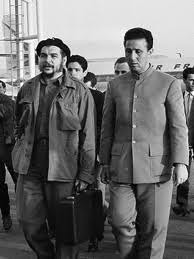
ERNESTO Guevara headed the National Bank of Cuba (BNC) for 456 days. This was possibly the shortest period of time that Che dedicated to a task of such significance and, according to many historians, it is the period least known about his life.

By November 26, 1959, the date on which he assumed the presidency of the BNC, the Cuban bank was in a critical situation. As yet not nationalized and with scant reserves, given that the majority of its assets had been stolen and taken to the United States, the inherited banking system lacked the conditions to promote the newly independent country’s economic and social development.

In this context, the revolutionary government' principal intention was to recover financial control of the banking system and place it in the hands of the state, including the functions of conserving and guarding the monetary funds owned by the National Bank. Naturally, all of this militated against U.S. plans to destabilize the national economy.

The Cuban government’s response to this U.S. proposition was swift. Under Che’s presidency, the flight of hard currency from the country was controlled, the BNC was nationalized, the Organic Bank Law was drafted and the return for counterrevolutionary purposes of capital taken out of the country was avoided.

In this context, the currency exchange operation of 1961 was of particular importance. This financial operation, which took place in just two days and was planned extremely carefully in advance by Che, involved exchanging banknotes in circulation so as to gain control of government cash and prevent monetary resources in the power of counterrevolutionaries who had left Cuba being utilized for conspiring against the country.

Fifty three years after the appointment of the first revolutionary president of the National Bank of Cuba, Che Guevara’s strength of spirit and vision must be acknowledged. As Fidel affirmed at the solemn ceremony mourning his death, "Che constituted the singular case of an extremely rare man, in that he was capable of combining in his personality not only the characteristics of a man of action, but also of a man of thought."

UNAC Statement on US-Backed Israeli Bombardment of Gaza

UNITED NATIONAL ANTIWAR COALITION

STATEMENT ON U.S-BACKED ISRAELI BOMBARDMENT OF GAZA

END THE ONGOING VIOLENCE AGAINST THE PALESTINIANS!

END THE SIEGE OF GAZA!

END ALL U.S. AID TO ISRAEL!

UNAC supports the Palestinians right to resist tyranny. We support the Palestinian call for boycott, divestment and sanctions against the state of Israel. Palestine solidarity activists in the United States must do everything we can to stop our own government’s unconditional support for Israel’s crimes against humanity. Without this support, Israel would not be able to maintain the ethnic cleansing and continuous land theft of the Palestinian homeland that has been unleashed on the Palestinians for more than 65 years.

UNAC applauds the will of the Palestinians to survive and to thrive and to maintain the optimism that one day Palestine will be free. In spite of daily hardships and repression (80% need food aid; 45% unemployed) - intensified as collective punishment for democratically voting for Hamas in 2006, and still trying to rebuild after the genocidal bombardments of “Operation Cast Lead” in 2008-09 - the Palestinians cling to their ancient land and continue to resist. As spoken word artist Rafeef Ziadah says, we don’t teach our children hate; “we teach life!”

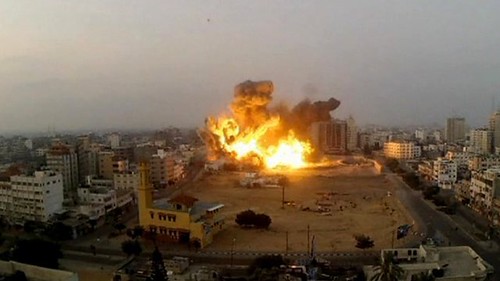
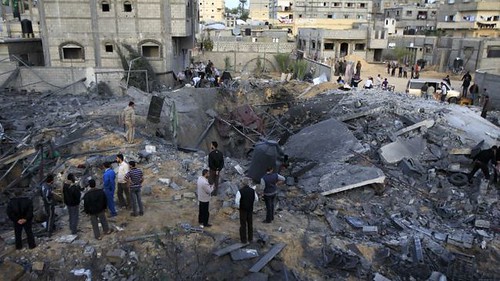
A ceasefire between Israel and Gaza has been announced after eight days of Israel’s latest assault on the Palestinians held captive in the world’s largest penal colony. More than 160 Palestinians, including dozens of children, women and elderly, have been killed and more than 1,100, also mainly civilians and children, have been injured. Civilians and vital infrastructure have been deliberate targets, along with journalists attempting to counter the claim of Israel’s simply “defending itself”.

While a halt in the current escalation is good news, it is only a temporary respite as long as the underlying cause is not resolved. The long-term issue is that Gaza remains under a brutal occupation and blockade and the violence before and after “ceasefires” is ongoing, with killings often unreported. There is a long history of ceasefire agreements, honored by the Palestinians, but broken by Israeli targeted assassinations and killings. There is also the harm that is done because Israel restricts food and medicines, contaminates the water, destroys infrastructure, and steals land. Generations of Palestinian children have been traumatized by Israeli violence with crippling impact; food scarcity and restrictions cause malnutrition and widespread growth-stunting anemia.

The war crimes committed by Israel are in full partnership with the United States. $3.1 billion dollars of U.S. taxpayers’ money goes to Israel annually to sustain its illegal and brutal occupation of the Palestinians living under an apartheid, militarized regime and to threaten Iran. The money is used to buy American weaponry. In the past 10 years, almost 671 million U.S. weapons valued at $18,866 billion were delivered. In addition to full military and economic support, the U.S. uses its diplomatic power to shield Israel from the demands of the international community to adhere to international law and from any accountability.

The recent assault on Gaza immediately followed three weeks of joint military exercises involving thousands of U.S. and Israeli military personnel and costing more than $100 million. Part of the mission was to test the Iron Dome missile defense system paid for by the U.S. government, costing hundreds of billions of dollars. Wanting to test these systems in real life may have been one of the reasons for the deliberate triggering of the operation. “Make no mistake. The U.S. is 100 percent committed to the security of Israel. That commitment drives this exercise,” said U.S. Air Force Lt. Gen. Craig Franklin. “These are very difficult days [which require] further bilateral cooperation in defense against future missile threats, as well as persistent operations against Hamas and the Iranian terror threat in Gaza, which is likely to intensify and expand,” Israeli Defense Minister Ehud Barak told reporters.

Both the U.S. and Israeli officials agree on this “partnership”. The Obama administration was briefed just prior to the attack showing that this was a jointly orchestrated operation. According to Israeli Defense Minister Ehud Barak, “This effort (attack on Gaza) could not have been concluded without the generous and consistent support of the American administration, led by President Obama.” President Obama likewise stated that the U.S. is "fully supportive of Israel's right to defend itself” and the U.S. House of Representatives passed a resolution expressing its "unwavering commitment" to Israel.

At UNAC’s founding conference in 2010, there was a debate about what position to take re: Palestine, Israel, and the U.S. For the first time, a large and representative gathering of peace and social justice activists took an unequivocal stand in solidarity with the Palestinians. By a strong majority vote, the conference adopted the demand that the U.S. end all aid to Israel – military, economic, and diplomatic -- and joined the BDS campaign against Israel. This represented a turning point for the American left and we are proud to have played a role in moving the struggle forward.

FREE PALESTINE!

11-28-12

Palestinians Celebrate UN Statehood Vote

Palestinians celebrate UN statehood vote

MOHAMMED DARAGHMEH, Associated Press
November 29, 2012 4:26pm

RAMALLAH, West Bank (AP) — Palestinians have erupted in wild cheers, hugging each other and honking car horns after the United Nations voted to grant them, at least formally, what they have long yearned for — a state of their own.

In the central celebration in the West Bank city of Ramallah, hundreds crowding into the main square waved Palestinian flags and chanted "God is great" after the U.N. General Assembly vote.

It accepted "Palestine" as a non-member observer state with a vote of 138 in favor, nine against and 41 abstentions.

The decision won't immediately change lives here, since much of what the world body is defining as the territory of that state — the West Bank, Gaza Strip and east Jerusalem — remains under Israeli control. Yet many Palestinians savored the global recognition.

Obama to Escalate Imperialist War Against Syria

November 28, 2012

U.S. Weighs Bolder Effort to Intervene in Syria’s Conflict

By DAVID E. SANGER and ERIC SCHMITT
New York Times

WASHINGTON — The Obama administration, hoping that the conflict in Syria has reached a turning point, is considering deeper intervention to help push President Bashar al-Assad from power, according to government officials involved in the discussions.

While no decisions have been made, the administration is considering several alternatives, including directly providing arms to some opposition fighters.

The most urgent decision, likely to come next week, is whether NATO should deploy surface-to-air missiles in Turkey, ostensibly to protect that country from Syrian missiles that could carry chemical weapons. The State Department spokeswoman, Victoria Nuland, said Wednesday that the Patriot missile system would not be “for use beyond the Turkish border.”

But some strategists and administration officials believe that Syrian Air Force pilots might fear how else the missile batteries could be used. If so, they could be intimidated from bombing the northern Syrian border towns where the rebels control considerable territory. A NATO survey team is in Turkey, examining possible sites for the batteries.

Other, more distant options include directly providing arms to opposition fighters rather than only continuing to use other countries, especially Qatar, to do so. A riskier course would be to insert C.I.A. officers or allied intelligence services on the ground in Syria, to work more closely with opposition fighters in areas that they now largely control.

Administration officials discussed all of these steps before the presidential election. But the combination of President Obama’s re-election, which has made the White House more willing to take risks, and a series of recent tactical successes by rebel forces, one senior administration official said, “has given this debate a new urgency, and a new focus.”

The outcome of the broader debate about how heavily America should intervene in another Middle Eastern conflict remains uncertain. Mr. Obama’s record in intervening in the Arab Spring has been cautious: While he joined in what began as a humanitarian effort in Libya, he refused to put American military forces on the ground and, with the exception of a C.I.A. and diplomatic presence, ended the American role as soon as Col. Muammar el-Qaddafi was toppled.

In the case of Syria, a far more complex conflict than Libya’s, some officials continue to worry that the risks of intervention — both in American lives and in setting off a broader conflict, potentially involving Turkey — are too great to justify action. Others argue that more aggressive steps are justified in Syria by the loss in life there, the risks that its chemical weapons could get loose, and the opportunity to deal a blow to Iran’s only ally in the region. The debate now coursing through the White House, the Pentagon, the State Department and the C.I.A. resembles a similar one among America’s main allies.

“Look, let’s be frank, what we’ve done over the last 18 months hasn’t been enough,” Britain’s prime minister, David Cameron, said three weeks ago after visiting a Syrian refugee camp in Jordan. “The slaughter continues, the bloodshed is appalling, the bad effects it’s having on the region, the radicalization, but also the humanitarian crisis that is engulfing Syria. So let’s work together on really pushing what more we can do.” Mr. Cameron has discussed those options directly with Mr. Obama, White House officials say.

France and Britain have recognized a newly formed coalition of opposition groups, which the United States helped piece together. So far, Washington has not done so.

American officials and independent specialists on Syria said that the administration was reviewing its Syria policy in part to gain credibility and sway with opposition fighters, who have seized key Syrian military bases in recent weeks.

“The administration has figured out that if they don’t start doing something, the war will be over and they won’t have any influence over the combat forces on the ground,” said Jeffrey White, a former Defense Intelligence Agency intelligence officer and specialist on the Syria military. “They may have some influence with various political groups and factions, but they won’t have influence with the fighters, and the fighters will control the territory.”

Another person who has been consulted and briefed on the administration’s thinking about Syria said, “The U.S. won’t be able to maintain the position where it’s been,” adding, “Whatever we do will be done in close coordination with the allies.”

Senior Congressional officials and diplomats in the region said that they had not been briefed on any impending policy shifts and expressed doubts any would be made until Mr. Obama had selected his new national security team, including new secretaries of state and defense, a new director of the C.I.A. and perhaps more. In recent months, these officials and diplomats said that the administration had kept them updated about its Syria policy.

Until now, the United States has offered only limited support to the military campaign against the Syrian government, instead providing nearly $200 million in humanitarian and other nonlethal aid. In addition, a small number of C.I.A. officers have operated secretly in southern Turkey for several months, according to American officials and Arab intelligence officers, helping allies decide which Syrian opposition fighters across the border would receive weapons.

The weapons, including automatic rifles, rocket-propelled grenades and ammunition are funneled mostly across the Turkish border by way of a shadowy network of intermediaries overseen mainly by Saudi Arabia and Qatar, American officials said. Even that limited effort is being revamped in the wake of evidence that most arms sent to Syrian opposition fighters are going to hard-line Islamic jihadists, not to the more secular opposition groups supported by the West.

American officials say the administration is now weighing whether the United States should play a more direct role in supplying the opposition fighters with weapons to help ensure that the arms reach the intended groups.

“The problem right now is that we don’t have much visibility into where these weapons are going,” one senior administration official said recently. “That’s the problem with outsourcing the issue.”

On the more immediate concern about defending Turkey, NATO is expected to act on the Patriot missile request next week. On Wednesday night, Mr. Obama’s national security adviser, Thomas E. Donilon, told an audience at the Kennedy School of Government at Harvard that “we’d be very much in favor of” the Turkish request for Patriot missiles “in terms of protecting the security of our ally.” The Patriot PAC-3 is the most modern air defense system in the American and NATO arsenals.

In the case of the impending deployment to Turkey, the missiles could come from the United States, the Netherlands and Germany. While they could reach into Syrian territory, their range is limited. Turkey requested the missiles after Syrian artillery and mortar fire landed inside Turkish territory, killing several civilians.

Jessica Brandt contributed reporting from Cambridge, Mass.

Wave of Bomb Attacks in Iraq Kills 42

Wave of bomb attacks in Iraq kills 42

English.news.cn 2012-11-29 21:34:00
by Jamal Hashim

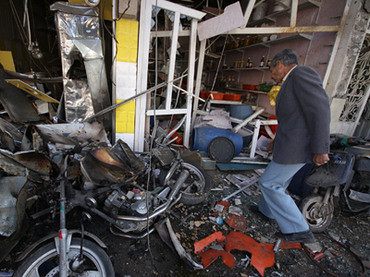
BAGHDAD, Nov. 29 (Xinhua) -- A new wave of bomb attacks targeted Shiite pilgrims and security forces across Iraq killed 42 people and wounded 133 on Thursday, apparently in an attempt by insurgent groups to stir up sectarian strife among Iraqis.

The deadliest attack occurred in the day was in the city of Hilla, some 100 km south of the capital Baghdad, when a car bomb went off near a restaurant serving food for Shiite pilgrims.

A few minutes later, another car bomb detonated while civilians and Iraqi security forces gathered at the scene.

The two blasts killed a total of 26 people and wounded 80 others at a restaurant, according to the police and medical sources.

Meanwhile, another attack took place in the holy Shiite city of Karbala, some 110 km south of Baghdad, when a booby-trapped car detonated near Shiite pilgrims at the eastern entrance of the city, killing eight people and wounding 22 others.

Iraqi security forces blocked the roads leading to central Karbala where the shrine of Imam Hussein, one of the Shiite's 12 most revered Imams.

Insurgent groups frequently carried out attacks against Shiite pilgrims who perform communal rituals, killing and wounding hundreds of them in attempts to provoke sectarian strife in the country.

In Iraq's western province of Anbar, a suicide bomber wearing an explosive vest blew himself up among the soldiers and their vehicles who gathered to collect salaries for their unites at the branch of the government-owned al-Rasheed Bank in central the city of Fallujah, some 50 km west of Baghdad.

Three soldiers were killed and four wounded by the blast which also wounded two policemen who were guarding the bank, along with injuring four pedestrians.

Insurgent attacks continue in the once volatile Sunni Arab area west of Baghdad that stretches through Anbar province to Iraq's western borders with Syria, Jordan and Saudi Arabia.

In northern Iraq, a car bomb struck a police patrol in al- Karama neighborhood eastern the city of Mosul, some 400 km north of the Iraqi capital, killing a policeman and wounding three others.

The blast also killed a civilian and wounded another, along with destroying a police vehicle and several nearby civilian cars.

Elsewhere, a fifth car bomb exploded in the afternoon near a restaurant in Basmaiyah area, just southeast of Baghdad, killing two people and wounding 11 others, an Interior Ministry source anonymously told Xinhua.

Meanwhile, two roadside bomb explosions ripped through Taji area, some 20 km north of Baghdad, killing a civilian and injuring six others, the source said.

Such deadly attacks apparently are seen as an attempt by insurgent groups to stir up sectarian strife among Iraqis to push the country to the brink of civil war, amid persistent political divisions that have already paralyzed the country's government.

Observers see that Wednesday's attacks are part of an attempt by insurgent groups to show that they are capable of carrying out coordinated and high-profile attacks that could undermine the government's claims of providing security to Iraqis.

Violence and sporadic high profile attacks are still common in the country despite the dramatic decrease of violence over the past few years.

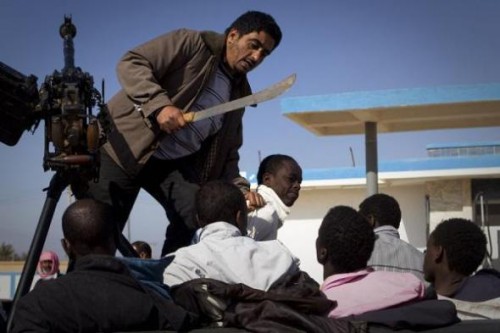
Rebels Protest Western Libya's Main Oil Refinery

Protesters shut down western Libya's main oil refinery

Reuters | 29 Nov 2012 | 07:25 AM ET

TRIPOLI (Reuters) - Wounded rebels protested outside western Libya's main oil refinery on Thursday, closing operations for a second time this month, a company spokesman said, and raising fears of a petrol shortage in the war-battered country.

A large crowd of rebels of the counter-revolutionary war which ousted Muammar Gaddafi last year massed outside the plant run by the Zawiya Oil Refining Company demanding compensation and treatment, said staff.

"We are in a state of total shutdown ... the demonstrators are preventing employees from entering the refinery and fuel trucks are unable to leave," said Zawiya spokesman Essam al-Muntasir.

"Many of them (the rebels) want the government to send them abroad to receive treatment or they want to get more money from the government as compensation for their efforts," he added.

A number of protests outside refineries have posed a significant challenge to Libya's new government which is dependent on oil for the lions' share of its revenues.

The administration is still struggling to impose order on a vast and divided country still awash with arms and militias after the US-backed overthrow of the Gaddafi government.

A similar protest in early November forced the refinery to shut down for two days, hitting fuel supplies in Tripoli.

A Zawiya security official who refused to be named said the protesters had set up check points to stop vehicles coming in.

Deputy Oil Minister Omar Shakmak said on Wednesday a shutdown at the refinery could cause a new shortage.

"We have enough fuel stored in Tripoli to last us 25 days but the problem is that protesters are not allowing trucks in or out of the fuel storage areas of the refinery," he said.

Tripoli residents formed long queues at petrol stations to fill up their tanks on Wednesday night after hearing the news of the latest protest.

The Zawiya refinery, about 50 km (30 miles) west of Tripoli, has a capacity of 120,000 barrels per day and provides 40 per cent of western Libya's oil needs.

Rebels Retreat From Towns in Eastern DRC

Rebels retreat from towns in eastern DR Congo

English.news.cn
2012-11-29 11:38:35

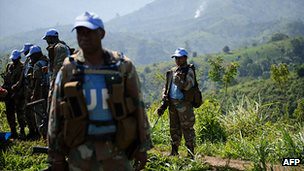
BEIJING, Nov. 29 (Xinhuanet) -- A military leader from the M23 rebel group says his troops have started pulling out of towns captured last week in the eastern Democratic Republic of Congo. This follows a deal brokered by Uganda. And it’s the first concrete sign that international pressures have stopped the advance of rebel fighters. Meanwhile, the DRC government has confirmed it has received reports of rebel withdrawals.

Lambert Mende, Spokesman of DR Congo Government, said, "If M23 pulls back, so much the better. It’s the solution least costly in terms of human lives. If the M23 don’t pull back, then they will have to deal with the force of the Congolese army."

The M23 rebel group is made up of hundreds of officers who deserted the Congolese army in April. Since then the rebels have occupied vast swaths of territory in mineral-rich eastern Congo. The rebels accused the DRC government of failing to honor a 2009 peace deal that incorporated them into the national army. Last week, the rebels took the strategically important town of Goma, and other nearby towns in eastern Congo without much resistance.

(Source: CNTV.cn)

Wednesday, November 28, 2012

Zimbabwe Women Urged to Be Resilent

Women urged to be resilient

Wednesday, 28 November 2012 00:00
Herald Reporter

Women should be resilient to ensure better welfare for their families , Zimbabwe Army Wives and Women Association patron has said.

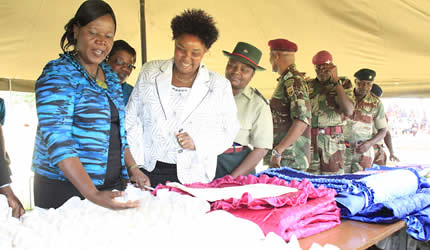
Speaking during an exhibition of handmade wares by members at Parachute Regiment Inkomo Barracks yesterday, Mrs Mercy Mugove Sibanda urged women to be resilient.

Mrs Sibanda, who is wife to Zimbabwe National Army Commander Valerio Sibanda said: “I am aware that you are facing a number of challenges but do not give up. Keep the fighting spirit so as to achieve your goals and always aim high in whatever you do,” she said.

The exhibition comprised of confectionary, clothes and interior décor designs made by the women who comprise serving members and wives of serving members.

The organisation, which was started in 1995 had been dormant due to challenges emanating from the Western imposed sanctions. Yesterday’s exhibition was to revamp activities.

Mrs Sibanda said the programme seeks to empower women living in camps as they often found themselves with no income generating project to occupy them when their husbands are away at work.

“We are in the process of re-branding ZWWA since it has been tremendously affected by the economic meltdown of recent years. It means enhanced marketing and raising the level of awareness of our activities,” she said.

She said soldiers’ wives were important in the efficacy of the army.

“We are the support staff of these men for they cannot go out and perform well unless there is peace and love in the home,” she said.

Mrs Sibanda said their organisation was worried about the increase in cases of gender-based violence and said their organisation was working hard to raise awareness among its members.

South Africa Drums Up Support for Zimbabwe Diamonds

SA drums up support for Zim diamonds

Wednesday, 28 November 2012 00:00
Brezhnev Malaba in WASHINGTON DC
Zimbabwe Herald

SOUTH AFRICA, the incoming chair of the Kimberley Process Certification Scheme, yesterday urged the international community to support Zimbabwe’s efforts to benefit from rich diamond resources, saying the nation’s growing status as a major gem producer cannot be ignored.

Addressing the KPCS plenary at the US State Department here, South Africa’s Minister of Mineral Resources Ms Susan Shabangu, implored KPCS members to “stand together as a family and support initiatives to ensure that emerging economies effectively reap the benefit of the exploitation of their diamond resources”.

“I recently had the honour of addressing executives from the diamond industry during Zimbabwe’s Diamond Conference hosted at Victoria Falls in November 2012. The conference sought to explore the changing dynamics of the industry and to explore modalities to best enable Zimbabwe to optimise exploitation of its rich diamond resources,” she said.

Minister Shabangu said the KP has recorded significant strides, achieving representation in 76 countries and accounting for 99,8 percent of the global production of rough diamonds.

“It can further point out the fact that the flow of conflict diamonds has been significantly contained through KPCS interventions, resulting in more than 99 percent of the global diamond production being certified under the Kimberley Process.

“A significant number of member-states are now realising benefits from their legitimate trade of diamonds through which the KP played an important role for these jurisdictions to achieve a conflict-free diamond trade status,” she added.

Addressing the same meeting, the United States government yesterday intensified calls for the redefinition of conflict diamonds, saying the KPCS must reform or lose relevance.
The US chair of the KPCS, Ambassador Gillian Milovanovic, said it was vital to ensure the 76-member diamond watchdog remained “strong and relevant”.

Her statement was received with skepticism by non-Western members of the KP, who view the US push as a ploy to bully some diamond-producing nations, particularly in Africa.
Currently, the KPCS defines conflict diamonds as “rough diamonds used by rebel movements to fight legitimate governments”.

The US is lobbying for a redefinition to “rough diamonds used to finance armed conflict or other situations relating to violence affecting diamond-mining areas”.

Mrs Milovanovic, a vastly experienced diplomat who has served in Botswana, Mali, Macedonia, South Africa and Sweden, spiced her speech with conciliatory phrases to draw support from KPCS member-countries.

“We have designed this plenary as a forum for the exchange of ideas, concerns, proposed solutions, and generally as a window of opportunity to focus the wealth of experience and expertise each one of you can provide on addressing the challenges of keeping the KP strong and relevant,” she said.

She added: “As chair, I have frequently stressed that ‘take it or leave it’ is not our approach.”

President of the World Diamond Council, Mr Eli Izhakoff, told the plenary that the Zimbabwe Diamond Conference was historic.

“The Zimbabwe Diamond Conference was a remarkable gathering that, just two years earlier, few would have predicted could have been possible. The conference would never have taken place were it not for the agreement reached at the last Kimberley process plenary in Kinshasa, in November 2011, which enabled the start of exports from two KP-compliant mines in the Marange region of Zimbabwe,” said Mr Izhakoff.

The KP plenary continues until Thursday, with closed-door discussions spearheaded by various working groups on monitoring, reform, artisanal and alluvial mining statistics.

Somalia Mayor Attacks Somaliland Election Commission Office in Erigabo

Nov 28, 2012 - 8:38:16 AM

Somalia: Mayor attacks Somaliland election commission office in Erigabo

27 Nov 27, 2012 - 10:36:31 AM

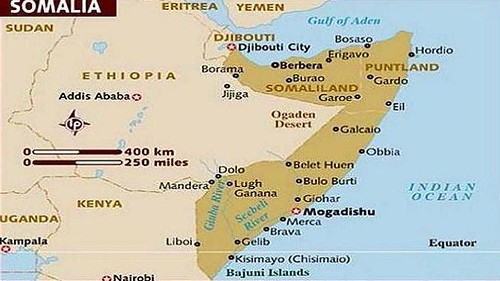
ERIGABO, Somalia Nov 27 2012 (Garowe Online) – Gunmen attacked the offices of Somaliland Election Commission in Erigabo town in Sanaag region on Tuesday, Garowe Online reports.

According to local media, the attack occurred around midday Tuesday in Erigabo, there were no reports of injuries or deaths.

Somaliland political parties have been conducting campaigns in towns and districts under control of Somaliland authorities.

Somaliland officials have pleaded for peaceful campaigns although the process has been marred by political infighting between political parties.

Sources in Sanaag region say Erigabo Mayor, Ismail Haji Nur a member of the former ruling UDUB party, was suspicious of Somaliland’s administration to minimize voting polls in Erigabo. Mayor Nur demanded the same number of polling stations of previous elections in Erigabo in previous elections.

The sources say that Kulmiye party officials - currently led by Somaliland President Ahmed Mohamud Silanyo - was worried that Mayor Nur a member of the Wadani party could be reelected as mayor of Erigabo.

According to Hargeisa sources, Mayor Nur sent a group of gunmen to “fire on office of Somaliland Election Commission in Erigabo”.

The attack is not only a political skirmish but is being fueled by clan power struggles in the district, Hargeisa sources say. Somaliland authorities reportedly agreed to Mayor Nur’s demand to install more polling stations, in order for hostilities to cease.

Similarly there was a shooting at a voting poll in Lughaya town in the region of Awdal in Somaliland.

According to media reports, armed forces fired shots in the air after voters crowded polling stations in the town, resulting in 1 person being killed and two injured.

Somaliland government and neighboring Puntland government have been locked in a territorial struggle that could have implications on both Somaliland’s current elections and Puntland upcoming elections.

On Monday, Puntland warned Somaliland of encroaching on Puntland territory after Somaliland forces leading delegation of Somaliland Electoral Commission attempted to setup polling stations in Sanaag region. However Somaliland forces and election officials withdrew immediately after Puntland sent a clear warning through international media and mobilized ground forces.

GAROWE ONLINE

6 Killed in Clashes Between Somalia and Somaliland

Somalia: 6 killed as local militia clashes with Somaliland over elections

28 Nov 28, 2012 - 9:09:52 PM

GAROWE, Somalia Nov. 28, 2012 (Garowe Online) - At least six people were killed Wednesday in Huddun district of Sool region in northern Somalia in armed clashes between Somaliland security forces and local militias who have rejected Somaliland's elections, Garowe Online reports.

Local sources have reported that 4 Somaliland soldiers were killed while the local militias lost 2 fighters in pitched battles, where the two sides used heavy weapons including artillery.

At least 5 others were wounded during the fighting, with local sources reporting that all 5 wounded persons were civilians.

The fighting erupted on Wednesday morning as Somaliland security forces attempted to place ballot boxes in Huddun district of Sool region, as part of Somaliland local elections. Yesterday, gunmen loyal to the Somaliland-appointed mayor of Erigabo town in Sanaag region attacked the local offices of the Somaliland Election Commission in a dispute over the number of voting stations.

In recent days, local populations in Sool and Sanaag regions have staged protests rejecting participation in Somaliland's local elections, which occurred only in Las Anod, which is under Somaliland military control.

Reports of fighting with casualties in Huddun district on Wednesday took up major headlines in Somali media, including websites and satellite TV stations such as Universal TV, but VOA Somali Section that provides national coverage in Somalia did not report Wednesday's election related violence involving Somaliland forces.

In Sanaag region, Puntland security forces accompanying Puntland Deputy Security Minister Abdijamal Osman Mohamed deployed in most parts of Sanaag region and compelled Somaliland forces to withdraw back to Erigabo town.

Somaliland forces were aiming to bring ballot boxes for voting in towns in Sanaag region, but local populations staged anti-Somaliland protests. Somaliland Election Commission later announced that Wednesday's local elections have been "cancelled" in Sanaag region due to "security reasons", with the exception of Erigabo town.

Earlier this week, Puntland Information Minister Mohamud Aideed Dirir warned that Somaliland is "destabilizing regional security" by deploying its forces in parts of Sool and Sanaag regions.

Puntland and Somaliland administrations have battled for control over Sool and Sanaag regions since 2002.

Ethiopian Troops to Stay in Somalia Until AMISOM Takeover

Ethiopia to stay in Somalia until AU takeover: PM

(AFP)

ADDIS ABABA — Ethiopian troops will remain in Somalia until African Union forces fighting Islamists can take over, Prime Minister Hailemariam Desalegn said Wednesday, as he met with his Somali counterpart.

"We are waiting for AMISOM (African Union Mission in Somalia) force to come and replace us, and until we get that assurance then we will be waiting there," he told reporters.

Hailemariam, speaking alongside newly elected Somali President Hassan Sheikh Mohamud, on his first official visit to the Ethiopian capital, gave no timeline for a pull out of troops.

Mohamud said that the Shebab is "literally defeated" -- although many experts say it remains a potent threat -- and also warned foreign fighters with the extremists to leave Somalia.

"We have no relationship, and we do not intend to have one, with the foreign fighters in Somalia," Mohamud said. "The only option for them is to leave the country."

Ethiopian troops and tanks invaded Somalia in November 2011 to attack Al-Qaeda linked Shebab insurgents, capturing key towns including Baidoa.

At the same time, anti-Shehab Somali forces and a 17,000-strong AU force have been also battling the Islamists, and are seeking to link up with areas held by Ethiopia.

Addis Ababa -- long seen as a traditional enemy of Somalia -- is a controversial presence in Somalia. Ethiopia entered Somalia in a 2006 US-backed invasion, but was driven out three years later by a bitter insurgency.

War-torn Somalia has been in chaos since the fall of President Siad Barre in 1991.

Will Mali Be Africa's Afghanistan?

The Christian Science Monitor - CSMonitor.com

Will Mali be Africa's Afghanistan?

Mali was hit by two successive shocks to its system this year – with the north seized by rebels and a coup in the capital – leaving its government fragile and the international community mulling intervention.

By John Thorne, Correspondent
posted November 27, 2012 at 8:28 am EST
Bamako, Mali

Halachi Maiga was present last March at the fall of Gao, in northeastern Mali. He remembers the shooting, the panic, the mud-daubed cars, the ransacked offices, the attackers crying "God is great!" Today, violent rule by gunmen has left him unsure of how peace can best be restored.

"I'm for a military intervention because I want to liberate my country, region, and city," says Mr. Maiga, a schoolteacher and youth activist. "And I'm against it for the simple reason that it's war, and no one can predict how a war will go."

Mali was hit by two successive shocks to its system this year, leaving its government fragile and its future uncertain. Last winter, nearly half the country was seized by ethnic Tuareg rebels, who were later elbowed aside by Islamist militants. In a whirl of action, a military coup soon unseated the democratically elected president just weeks before elections were to be held.

Instability is still rampant in the north, where Islamists reign largely uncontested. As Mali – and the wider world – look ahead to potential armed intervention, many question what is needed to pull it back from the brink of chaos. Western countries fear it could become a semifailed state like Afghanistan, serving as a regional launchpad for armed groups.

Potential intervention, described by diplomats as increasingly likely, concerns not only Malians like Maiga, whose lives have been upended by unrest. It also worries international aid agencies that warn of more refugees, civilian deaths, human rights abuses, and the potential for reprisal attacks.

"Planning for the day after is very important," says a Western diplomat who was not permitted to speak on the record. "Even with a successful intervention, if you don't restore central government control you risk the same problems returning."

Crowded playing field

Those problems have long been rooted in corruption and underdevelopment in northern Mali, which has helped spur periodic uprisings by some local Tuareg, a traditionally nomadic people related to North Africa's Amazighs, or Berbers.

In recent decades Islamist groups have also appeared in Mali – notably Al Qaeda in the Islamic Maghreb – uncontested by authorities and funded in part by increased drug trafficking.

Last year Tuareg fighters who served Libya's Muammar Qaddafi returned home, flush with heavy weaponry. Better armed than ever before, some of them swiftly launched a rebellion under the newly formed National Movement for the Liberation of Azawad (MNLA).

While secularist, the MNLA entered a marriage of convenience with Islamist militant groups already present in Mali's north.

Today, nearly a year of conflict has transformed Mali into a crowded playing field, dominated by armed groups that jockey with local leaders, religious figures, and citizens organizations in a tense balance of power.

Last March, Mali's poorly equipped Army struggled to defeat these armed groups. Feeling inadequately supported by the government in their attempts to secure the north, exasperated Army officers staged a coup that toppled President Amadou Toumani Touré.

The coup backfired. As central control collapsed in Bamako, MNLA and Islamist militants descended on northern Mali's main cities, sweeping the region under their control in a matter of days.

'Want to erase Mali'

The armed groups attacked Gao early one Saturday at the end of March. Maiga was walking through the city center when he heard gunfire. Around him, people scattered.

"I saw them! I saw them!" cried one man, not breaking stride.

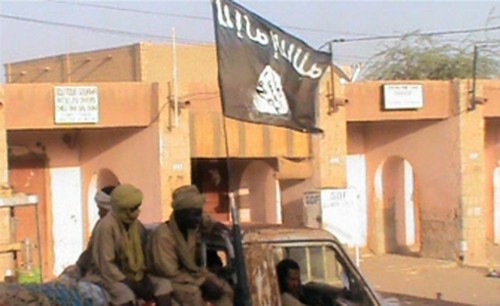
Maiga took off on his motorcycle. Then, rounding a corner, he saw them, too: a four-by-four truck, turbaned gunmen, and the black Islamist flag bearing the Muslim profession of faith. The next day he found gunmen pillaging government offices.

"They were even burning the archives," he says. "They want to erase Mali and create another state."

Two days later, MNLA leader Bilal Ag Cherif told prominent citizens and civil society leaders including Maiga, who is a member of Gao's regional youth council, that the Tuareg state of Azawad was a reality.

But ultimately the Islamists were stronger. A dispute in June with the MNLA ended in gunplay. With Mr. Ag Cherif believed wounded, the MNLA fled Gao. A similar shift occurred across the north. Soon Islamist militants controlled the main cities of Gao, Timbuktu, and Kidal, enforcing their brand of Islamic law.

A Sept. 25 report by Human Rights Watch cites brutal punishments, including beatings of people caught listening to music and women who fail to cover themselves, and amputations of the hands of alleged thieves.

Yet in Gao at least, Islamist rule has limits, says Maiga. Islamist leaders there are often obliged to work with local religious figures and citizens who represent the interests of the community.

Sometimes Malians resist the new rules, and tension mounts. In August, a protest called by a popular radio journalist in Gao stopped the hand amputations of four alleged thieves, Maiga says. Islamist fighters abducted and beat the journalist in retaliation, sparking a riot by angry locals. The journalist slipped out of town and made his way safely to Bamako.

Momentum

For now, momentum for an intervention is building internationally, diplomats say.

Late last month, the 16-member Economic Community of West African States (ECOWAS) agreed to provide Mali with 3,300 troops, and the European Union committed 250 military trainers.

A United Nations resolution authorizing intervention there is widely expected. The basic idea is to train an intervention force of Malian and other West African soldiers, retake Mali's north, and restore government rule, says the Western diplomat.

"There's broad consensus on what needs to be done," says the diplomat, citing the United States, France, and Germany as countries deeply involved in planning. However, "the timeline has yet to be determined."

According to a planning document drafted by ECOWAS and recently cited by Reuters, an intervention could take up to six months to prepare, with Mali's summer rainy season threatening to complicate potential deployment.

Aid agencies, meanwhile, say much preparation is needed to cope with humanitarian problems that military intervention would likely generate.

The UN's agency for refugees says that fighting could more than double the number of refugees and internally displaced, currently tallied at 412,149 people. To date, the agency has obtained just over half of the $123.5 million needed to deal with the situation, says its West Africa director, Valentin Tapsoba. Intervention would raise costs dramatically.

Other aid agencies, like UNICEF, warn that intervention forces must be trained in human rights and the needs of families and children.

"In conflict, you can have children being killed or injured, or recruited as soldiers," says Gabrielle Menezes, a UNICEF communications officer in Bamako. "It's something we're very concerned about."

'Three pillars of power'

Where armed bullying, lack of goods and services, and sheer violence have disrupted life in Mali's north, Bamako is the scene of a different kind of breakdown. While daily life there proceeds normally, politics are stuck in crisis mode.

An interim government was named in August, five months after the initial coup. But diplomats say coup leader Capt. Amadou Sanogo still wields influence from his military headquarters at Kati, outside Bamako.

"Just look at any delegation," says the diplomat. "They'll have meetings with the [interim] president and prime minister, and some ... will go up to Kati and meet Sanogo as well. It's fair to say there are three pillars of power now."

In theory, presidential elections are scheduled for next April. But the uncertainties surrounding a possible intervention by West African countries, backed by Western governments, have cast that into doubt. Diplomats in Bamako say many here feel elections must come only after victory in the north.

The US has pushed hard for Mali to restore democratic rule sooner than later. While some European countries have restarted development aid, the US will not do so until after elections, says the diplomat.

"It's absolutely in the interest of the Malian people to have elections soon," the diplomat says. "The longer you wait, the more people become entrenched in the status quo."

'A place at the table'

At present, the status quo in Mali is marked by divisions: between north and south, and among armed groups and political players. Some Malians fear crisis will leave their society – a tapestry of languages, races, and cultures – torn along sectarian lines into similar disharmony.

That fear is compounded by the recent appearance of anti-Islamist militia groups – how well-armed remains unclear – that have formed in areas of Mali bordering the north. Some Tuareg also fear reprisals because of anger at the MNLA over the initial takeover.

For the Western diplomat, these fears underscore the need for dialogue. Ansar al Din, one of the Islamist groups currently ruling in the north, has met recently – albeit so far inconclusively – with neighboring Burkina Faso's president, Blaise Compaore, who is acting as a mediator with the Malian government.

Some hope that negotiations "will result in ... minimizing the enemy," the diplomat says.

Maiga, the schoolteacher from Gao, wants leaders to remember that Mali is larger than the sum of its combatants. "Dialogue must include not only those with weapons," he says. "Even those without deserve a place at the table."

Explosions In Damascus Kill At Least 40

Bombings kill 40, injure dozens near Damascus

Wed Nov 28, 2012 7:50AM GMT
presstv.ir

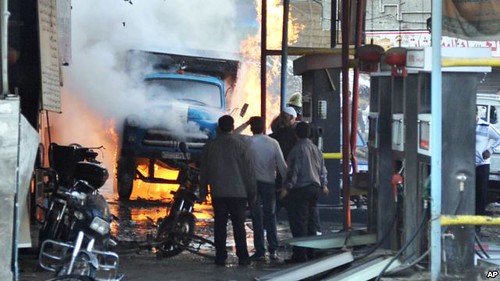
Nearly 40 people have been killed and over 80 others injured in bomb attacks carried out in a district near the Syrian capital city of Damascus.

The bombings rocked the Jaramana district, about 10 kilometers (six miles) southeast of Damascus, on Wednesday.

Syria has been experiencing unrest since March 2011. Many people, including large numbers of security forces, have been killed in the turmoil.

On November 23, three Syrian civilians were killed and four others injured in a car bombing in the northwestern city of Idlib.

Meanwhile, the Syrian newspaper Al-Watan on Tuesday published the names of 142 insurgents from 18 countries, who were killed while fighting against Syrian security forces.

Most of the insurgents were killed in October and November in the cities of Aleppo, Homs, Idlib, Deir al-Zour and Hasakeh, the paper said.

The Syrian government has repeatedly said that foreign-backed “terrorists” are responsible for the unrest in the country, and that certain Arab and Western states are fueling the turmoil.

On November 26, French Foreign Minister Laurent Fabius said Paris had allocated 1.2 million euros (1.5 million dollars) in emergency aid to the newly-formed Syrian opposition, known as the National Coalition.


November 28, 2012

Explosions in Damascus Kill At Least 34

by Edward Yeranian
VOA

Twin car bombs Wednesday ripped through a suburb of Syria's capital populated mostly by Christians and Druze, killing at least 34 people.

Syrian state television showed firefighters hosing down the burning wreckage of several vehicles and nearby buildings after two car bombs exploded in the main square of Jaramana, outside Damascus.

One unidentified witness said the explosions came in succession. He said a car filled with explosives blew up before a second explosion occurred near a school.

State media accused “terrorists,” the government's term for opposition forces. But several top opposition figures said that the government was behind the attacks.

Air attacks continue

Elsewhere, Syrian forces continued to pound rebels from the air.

Video posted on the Internet and aired by pan-Arab television channels showed smoke over the city of Homs after what was said to be bombing by government warplanes.

State television reports said government forces “destroyed hideouts of armed terrorists" in two Homs districts.

Opposition groups also posted video on the Internet claiming to show a downed warplane and captured pilots in the northern province of Aleppo. The video showed rebel medics appearing to treat the pilots.

The video cannot be independently verified. The rebels have come under Western criticism for executing some government captives in recent months.

Damascus fighting

Arab television channels are reporting that government ground forces have withdrawn from parts of the country to defend the capital, Damascus.

Government forces have reportedly lost control of some outer suburbs as well as southern areas of Damascus in recent weeks.

Hilal Khashan, who teaches political science at the American University of Beirut, said that Syrian rebels have captured a number of positions along the Jordanian border in the past several days. He said a battle for the capital may be drawing near.

"The [Free Syrian Army rebels] overran an important headquarters and they now control four checkpoints on the border with Jordan," he said. "When the battle for Damascus begins, you'll find a major thrust of fighters from northern Jordan into Syria to take part in the battle for Damascus.

"So, it seems that this is beginning to happen, because the FSA is focusing on the Jordanian border,” he said.

Also Wednesday, NATO officials visited neighboring Turkey, scouting out possible sites for a missile defense system.

Turkey has asked NATO to deploy the Patriot interceptor missiles to help protect towns near the Syrian border.

The Syrian Observatory for Human Rights says violence across Syria has killed more than 40,000 people since an uprising against Syrian President Bashar al-Assad began in March of last year.

VOA's Jeff Seldin contributed to this report from Washington.

It is the Palestinians Who Have the Right to Defend Themselves

IT IS THE PALESTINIANS WHO HAVE THE RIGHT TO DEFEND THEMSELVES

Seumas Milne,The Guardian | Saturday, November 24, 2012, 18:13 Beijing

The way western politicians and media have pontificated about Israel’s onslaught on Gaza, you’d think it was facing an unprovoked attack from a well-armed foreign power. Israel had every “right to defend itself”, Barack Obama declared. “No country on earth would tolerate missiles raining down on its citizens from outside its borders.”

He was echoed by Britain’s foreign secretary, William Hague, who declared that the Palestinian Islamists of Hamas bore “principal responsibility” for Israel’s bombardment of the open-air prison that is the Gaza Strip.

Meanwhile, most western media have echoed Israel’s claim that its assault is in retaliation for Hamas rocket attacks; the BBC speaks wearisomely of a conflict of “ancient hatreds”.

In fact, an examination of the sequence of events over the last month shows that Israel played the decisive role in the military escalation: from its attack on a Khartoum arms factory reportedly supplying arms to Hamas and the killing of 15 Palestinian fighters in late October, to the shooting of a mentally disabled Palestinian in early November, the killing of a 13 year-old in an Israeli incursion and, crucially, the assassination of the Hamas commander Ahmed Jabari last Wednesday during negotiations over a temporary truce.

Israel’s prime minister, Binyamin Netanyahu, had plenty of motivation to unleash a new round of bloodletting.

There was the imminence of Israeli elections (military attacks on the Palestinians are par for the course before Israeli polls); the need to test Egypt’s new Muslim Brotherhood president, Mohamed Morsi, and pressure Hamas to bring other Palestinian guerrilla groups to heel; and the chance to destroy missile caches before any confrontation with Iran, and test Israel’s new Iron Dome anti-missile system.

So after six days of sustained assault by the world’s fourth largest military power on one of its most wretched and overcrowded territories, at least 130 Palestinians had been killed, an estimated half of them civilians, along with five Israelis. The goal, Israel’s interior minister, Eli Yeshai, insisted, had been to “send Gaza back to the middle ages”.

True, the bloodshed hasn’t so far been on the scale of Operation Cast Lead in 2008-9, which left 1,400 Palestinians dead in three weeks.

But the issue isn’t just who started and escalated it, or even the grinding “disproportionality” of yet another Israeli military battering (even before last month’s flareups, 314 Palestinians had been killed since 2009, as against 20 Israelis).

It’s that to portray Israel as some kind of victim with every right to “defend itself” from attack from “outside its borders” is a grotesque inversion of reality.

Israel has after all been in illegal occupation of both the West Bank and Gaza, where most of the population are the families of refugees who were driven out of what is now Israel in 1948, for the past 45 years.

Despite Israel’s withdrawal of settlements and bases in 2005, the Gaza Strip remains occupied, both effectively and legally – and is recognised as such by the UN. Israel is in control of Gaza’s land and sea borders, territorial waters and natural resources, airspace, power supply and telecommunications.

It has blockaded the strip since Hamas took over in 2006-7, preventing the movement of people, materials, and food supplies in and out of the territory – even calculating the 2,279 calories per person that would keep Gazans on an exemplary “diet”. And it continues to invade the strip at will.

So Gazans are an occupied people and have the right to resist, including by armed force (though not to target civilians), while Israel is an occupying power that has an obligation to withdraw – not a right to defend territories it controls or is colonising by dint of military power.

Even if Israel had genuinely ended its occupation in 2005, Gaza’s people are Palestinians, and their territory part of the 22% of historic Palestine earmarked for a Palestinian state that depends on Israeli withdrawal from the occupied West Bank and east Jerusalem.

Across their land, Palestinians have the right to defend and arm themselves, whether they choose to exercise it or not.

But instead the US, Britain and other European powers finance, arm and back to the hilt Israel’s occupation, including the siege of Gaza – precisely to prevent Palestinians obtaining the arms that would allow them to protect themselves against Israeli military might.

It’s hardly surprising of course that powers which have themselves invaded, occupied and intervened across the Arab and Muslim world over the last decade should throw their weight behind Israel doing the same thing on its own doorstep.

But it isn’t Palestinian rockets that stop Israel lifting the blockade, dismantling its illegal settlements or withdrawing from the West Bank and Gaza – it’s unconditional US and western support that gives Israel impunity.

Whatever the Israeli government’s mix of motivations for winding up the past week’s conflict, it seems to have backfired. For the first time since the start of the Arab uprisings, the cause of Palestine is again centre stage.

Emboldened by the wave of change and growing support across the region, Hamas has also regained credibility as a resistance force, which had faded since 2009, and strengthened its hand against an increasingly discredited Palestinian Authority leadership in Ramallah.

The deployment of longer-range rockets that have now been shown to reach Tel Aviv and Jerusalem is also beginning to shift what has been an overwhelmingly one-sided balance of deterrence.

The truce being negotiated on Tuesday would reportedly enforce Hamas responsibility for policing the strip and crucially break the blockade, opening the Rafah crossing with Egypt for goods as well as people. It doesn’t, however, look like the long-term security deal with Hamas Israel was looking for, which would risk deepening the disastrous Palestinian split between Gaza and the West Bank.

Any relief from the bombardment, death and suffering of the past week has got to be welcome. But no ceasefire is going to prevent another eruption of violence.

Whatever is finally agreed won’t end Israel’s occupation and colonisation of Palestinian land or halt its war of dispossession against the Palestinian people. That demands unrelenting pressure on the western powers that underwrite it to change course. But most of all, it needs a change in the balance of forces on the ground.

One Dead, 100 Injured in Cairo Clashes

1 dead, 100 injured in clashes in Cairo

Tue Nov 27, 2012 10:47PM GMT
presstv.ir

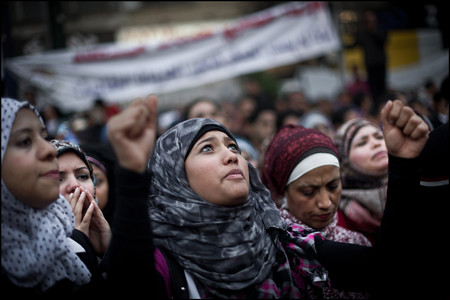
An Egyptian protester has died and about a hundred people were injured as protesters continue to hold demonstrations against Egyptian President Mohamed Morsi’s recent constitutional declaration.

At least one protester was killed due to inhalation of tear gas and about a hundred people were injured after clashes broke out between Egyptian security forces and demonstrators in Cairo’s Liberation Square on Tuesday.

The clashes occurred as thousands of people were arriving at the square for a demonstration against a constitutional decree, issued by President Mohamed Morsi earlier in the month, prohibiting courts from challenging his decisions.

Over 100,000 people gathered in Liberation Square on Tuesday, and there have been demonstrations against the decree every day since Friday.

On Monday, presidential spokesman Yasser Ali said that the Egyptian president was standing by the decree and the declaration would not undergo any changes.

Some Egyptians say Morsi has hijacked the revolution and has been unable to achieve its goals. Others accuse him of having become a modern-day pharaoh by assuming wide-ranging legislative powers.

Egyptians Rally Against President Morsi

Egyptians Rally Against President

By MATT BRADLEY and SAM DAGHER
Wall Street Journal

CAIRO—Tens of thousands of Egyptians descended on central Cairo to challenge new claims to power by President Mohammed Morsi and his Islamist allies, forcing the new leader to manage popular discontent that echoed the protests against the strongman who preceded him.

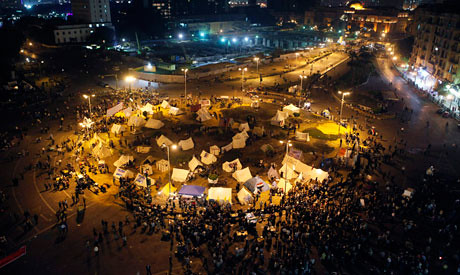
Activists on Tuesday pitched dozens of tents in Tahrir Square, the epicenter of the revolution that toppled President Hosni Mubarak nearly two years ago, and said they would stay in place until Mr. Morsi rescinds a controversial decree issued last week.

Mr. Morsi said Thursday that his decisions as president would be immune from judicial review, in a decree that would prevent judges from dissolving the committee—dominated by Islamist politicians from the powerful Muslim Brotherhood, which Mr. Morsi once led—that is responsible for drafting a new Egyptian constitution.

In awarding himself expansive powers, Mr. Morsi provoked a popular backlash against him and other Islamists in the government. Similar protests broke out when the military council that ruled after Mr. Mubarak's ouster moved to take greater control of government just before presidential polls.

An anti-Morsi protester runs to throw a tear-gas canister during clashes with riot police at Tahrir Square, Cairo, on Tuesday.

Morsi Tries to Calm Egypt After His Edict

Following a series of political maneuvers since Mr. Morsi was elected in June, the president now claims full authority over the country's military, executive and legislative branches.

Many critics said they believed the main goal of Mr. Morsi's latest decree was to enable an Islamist-dominated Constituent Assembly, the panel now drafting a new constitution, to push through a charter without opposition from the judiciary—the one arm of government in a position to do so.

Opposition groups united in the streets of Cairo Monday to challenge President Mohammed Morsi, who last week sought to dramatically expand his presidential powers. WSJ's Sam Dagher reports via #WorldStream.
.
More than 20 liberal-leaning constitution drafters, angered by what they said was the Islamist majority's imperious approach, have withdrawn from the Constituent Assembly in the past two weeks.

Mr. Morsi now faces the challenge of how to douse a popular backlash. The protesters gathered in Tahrir Square on Tuesday despite Mr. Morsi's move on Monday to mollify critics by saying his decree was only temporary and not as expansive as it had been portrayed to be.

"Morsi has made it clear for the past 48 hours that he will not rescind the decree," said Khaled Fahmy, a political analyst and history professor at the American University in Cairo. "The question is how to reduce it while saving face. My guess is that he will mobilize the Brotherhood public-relations machine."

Brotherhood leaders canceled a demonstration backing Mr. Morsi planned for Tuesday to avoid a potentially violent confrontation, Brotherhood leaders said.

The Muslim Brotherhood, in interviews, statements and on social-networking sites, blamed the turnout on shady foreign forces and former regime cronies paying protesters to oppose their rule. Such explanations have often been used by challenged Arab autocrats.

"We needed this constitutional declaration because there were several conspiracies that were revealed that will bring the country back to square one," said Gamal Hishmat, a senior member of the Brotherhood's political arm, the Freedom and Justice Party. Mr. Hishmat didn't give details about the alleged conspiracies.

Mr. Morsi and the Brotherhood contend that the decree was aimed at cleansing Egypt's judiciary from ex-regime judges intent on reversing the country's revolutionary gains.

For many in Egypt, the moves appeared to augur a return to decades of autocracy. Egyptian commentators immediately drew parallels to Gamal Abdel Nasser's 1969 "massacre of the judges," when the former Egyptian president invoked revolutionary change to sideline ex-regime justices.

"The protest means we don't want to create another Mubarak," said Nigad al-Boraei, a prominent human-rights lawyer. "The only way is to show that we are very angry and to let this president and any other president know that we won't do whatever they want to do."

On Tuesday, a half-dozen turbaned independent clerics took to a stage set up in Tahrir Square to assail what they said was the extremist and intolerant version of Islam embraced by the Brotherhood and their Salafist allies in government.

"Hold your head high, you're in Tahrir, brother Badie won't rule us," chanted an activist on the stage, referring to the Brotherhood's leader Mohammed Badie.

Other protesters recycled chants from the anti-Mubarak protests, such as "The people want the downfall of the regime" and "Leave! Leave!"

"The Brothers have stolen the nation," read one banner.

The scene in downtown Cairo on Tuesday afternoon settled into a recurring pattern for Egyptian protests. While secular activists, artists and intellectuals armed with anti-Brotherhood and Morsi placards convened in Tahrir Square, teenagers in neighboring Simón Bolivar Square used clubs and rocks to attack police, who responded with tear gas and bird shot.

"I did hope that [Islamists] would embrace what the revolution was all about when it started: We were all in it together," said Shireen, 38, a painter who came to Tahrir Square on Tuesday, referring to a sense of unity between Islamists and secularists in opposition to Mr. Mubarak. "But they see us as different people that must live like them."

The Brotherhood said on its website that its party offices across the country were being attacked by hired thugs, known as "baltagiya," using rocks, Molotov cocktails, sticks and knives. The worst violence occurred in the industrial city of Mahalla al-Kubra, north of Cairo, where 350 Brotherhood youth were injured.

Write to Matt Bradley at matt.bradley@dowjones.com and Sam Dagher at sam.dagher@wsj.com