Saturday, September 28, 2013

Syria Official Says Peace Plan Must Include Controversy

Posted: 6:21 PM

Syria official says peace plan must include Assad

By AMIR BIBAWY Associated Press

UNITED NATIONS — Syria's government will not accept any transition peace plan that excludes President Bashar Assad, Foreign Minister Walid al-Moallem told The Associated Press in an interview Saturday.

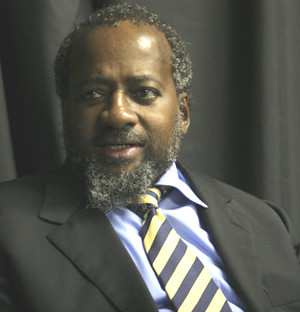
Syrian Foreign Minister Walid al-Moallem gives an interview during the 68th session of the United Nations General Assembly at U.N. headquarters on Saturday.

He spoke on the sidelines of the United Nations General Assembly, a day after the Security Council approved a resolution that obliges Syria's government to comply with an international plan to destroy its chemical weapons arsenal. The resolution also endorsed the outcome of the Geneva conference between the government and the opposition in June 2012, which called for the establishment of a transitional government with full executive powers.

The Syrian opposition, which has been embroiled in a bloody conflict with Assad's forces for two and a half years, has repeatedly said it will not take part in any transition government that includes the president.

The latest statement from al-Moallem could mean that efforts to organize a second meeting of the opposition and the government later this year in Geneva may fail.

"For the Syrian people, Bashar Assad is the elected president until mid-2014, when presidential elections will be held," al-Moallem said. Other candidates are welcome to run under the country's constitution, he added, stressing that only the Syrian people can choose their president, not outside governments or the opposition, which is based abroad.

Syria's opposition accuses Assad's government of carrying out a brutal campaign against Syrians that culminated in a nerve gas attack in suburbs of the capital, Damascus, on Aug. 21 that left hundreds dead.

The government denies its involvement in the attack, but it has since pledged to give up its stockpile of chemical weapons.

Al-Moallem also repeated his government's belief that its army is fighting terrorist elements affiliated with al-Qaida.

"Those terrorist elements are supported by neighboring countries like Turkey and Jordan and some Arab states such as Saudi Arabia and Qatar," al-Moallem said.

Iran has been a key supporter of Assad, and the opposition claims that elements of Iran's Revolutionary Guard and the Tehran-supported Hezbollah are operating freely within Syria.

But al-Moallem said the warming of Iranian-U.S. relations over the past week is not a threat to his government. "We are happy about this rapprochement," he said. "This will have a positive impact on the American view of the region."

Islamists, Some Ruling Party Members Criticize Sudan President Bashir

Islamists, ruling party members chide Sudan's Bashir amid protests

5:49pm EDT
By Khalid Abdelaziz and Ulf Laessing

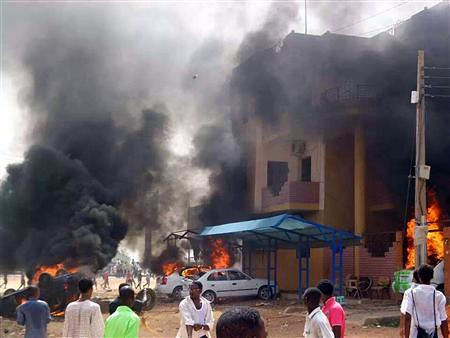
KHARTOUM (Reuters) - Islamists and members of Sudan's ruling party called on President Omar Hassan al-Bashir on Saturday to cancel deeply unpopular austerity measures, the first sign of dissent inside ruling circles after a week of unrest that has killed dozens.

Police fired teargas to break up thousands of people in the capital during a sixth day of protests against cuts to subsidies on cooking oil and fuel that doubled pump prices overnight.

Some in the crowd chanted "Freedom, Freedom" and "Bashir, you are a killer", said witnesses.

"Mr President, in the light what is happening we demand an immediate stop of the economic measures," read a petition signed by 31 members of the quasi-official Islamist Movement and the ruling National Congress Party (NCP).

Bashir has ruled Sudan since coming to power in a bloodless 1989 coup that was backed by Islamists and the country's powerful army. It is highly unusual for members of the political elite to question his actions publicly.

"The government has not allowed citizens to demonstrate peacefully," the petition added, urging prosecution for those responsible for opening fire on protesters and compensation for relatives of killed people.

The government has not acknowledged using live ammunition. Police said on Saturday unknown gunmen opened fire on a group of protesters on Friday, killing four people and bringing the official death toll to 33.

There was no immediate reaction to the petition from the government.

Bashir has not commented on the protests since announcing the lifting of subsidies on Sunday - part of austerity measures driven by a severe financial crunch exacerbated by the secession of oil-producing South Sudan in 2011.

The petition was signed by former NCP parliamentary caucus head Ghazi Salah el-Din and a prominent army officer who authorities accused of being involved in a coup attempt against Bashir last year.

ARMED MEN PATROL STREETS

In Khartoum's Burri district, home to a top government official, more than 1,000 people gathered for the funeral of one of the victims, Salah Mudahir Sanhuri, a member of a prominent merchant family with good relations with the government.

The crowd grew to more than 3,000 people, most of whom rushed home when police started firing teargas.

The country's borderlands have grappled with revolts for decades but the relatively wealthy heartland has seen little turmoil in the recent past.

Khartoum has been brimming for days with armed civilians and security personnel carrying rifles, patrolling streets in broad daylight and manning rooftops. Opposition activists have accused the ruling NCP of vandalism and of arming militias to turn the public against the protesters.

The protests are much larger than demonstrations against corruption, rising inflation and early fuel subsidy cuts last year.

But they are still tiny compared to the masses who turned out to oust rulers in Egypt and Tunisia.

The United Arab Emirates condemned the crackdown, the first Arab country to criticise Khartoum.

"The UAE expresses its utmost concern at the unexplained and excessive use of force ... and the effects this will have on Sudanese society," Anwar Gergash, minister of state for foreign affairs, told state news agency WAM, calling on Sudan to exercise "wisdom and caution".

The comments come a day after Sudan closed the offices of two UAE-based pan-Arab TV stations, al-Arabiya and Sky News Arabia, for their coverage of protests.
Bashir has stayed in power despite rebellions, U.S. trade sanctions, an economic crisis, an attempted coup last year and an indictment from the International Criminal Court on charges of masterminding war crimes in the western region of Darfur.

He denies those charges and still enjoys the support of the army, his ruling party and many businessmen.

Analysts say Sudan has not seen an Arab Spring-style revolt because of a weak and divided opposition.

Amnesty International and the New York-based African Center for Justice and Peace Studies said at least 50 people had been killed by gunshots to the chest or head by Thursday night, citing witnesses, relatives, doctors and journalists.

(Writing by Ulf Laessing; Additional reporting by Maha El Dahan in Abu Dhabi; Editing by Louise Ireland and Andrew Heavens)

U.S. Spy Agency Used Some Americans' Data to Map Their Behavior

U.S. spy agency used some Americans' data to map their behavior: NYT

7:50pm EDT

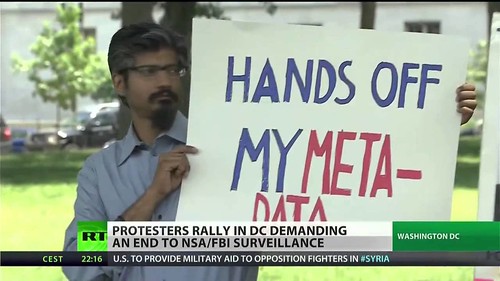
WASHINGTON (Reuters) - The New York Times reported on Saturday that the National Security Agency, the main U.S. government surveillance organization, had since 2010 used data it gathered to map some Americans' "social connections that can identify their associates, their locations at certain times, their traveling companions and other personal information."

In the latest revelation of the activities of the NSA, which have prompted concern about previously unknown intrusion into Americans' privacy in the name of protecting against terrorist and other foreign attacks, the newspaper quoted documents provided by Edward Snowden, the former NSA contractor who fled to Russia earlier this year.

It said the documents showed that "the spy agency began allowing the analysis of phone call and email logs in November 2010 to examine Americans' networks of associations for foreign intelligence purposes after NSA officials lifted restrictions on the practice."

The policy shift was intended to help the agency "discover and track" connections between intelligence targets overseas and people in the United States, according to an NSA memorandum from January 2011, the Times said.

It said the NSA was authorized to conduct "large-scale graph analysis on very large sets of communications metadata without having to check foreignness" of every email address, phone number or other identifier, the document said. Because of concerns about infringing on the privacy of American citizens, the computer analysis of such data had previously been permitted only for foreigners.

The agency could augment the communications data with material from public, commercial and other sources, including bank codes, insurance information, Facebook profiles, passenger manifests, voter registration rolls and GPS location information, as well as property records and unspecified tax data, according to the documents, the paper said.

It said NSA officials declined to say how many Americans had been affected and said the documents did not describe the result of the scrutiny, which it said "links phone numbers and emails in a 'contact chain' tied directly or indirectly to a person or organization overseas that is of foreign intelligence interest."

COURT RULING

Earlier this week, leaders of the U.S. Senate Intelligence Committee said they were working on legislation that would tighten oversight of federal electronic eavesdropping programs. Support for such changes has been growing since Snowden leaked information in June that the government collects far more Internet and telephone data than previously known.

The Times said that an NSA spokeswoman, asked about the analyses of Americans' data, said, "All data queries must include a foreign intelligence justification, period." It quoted her as saying: "All of NSA's work has a foreign intelligence purpose."

She said the policy change disclosed in the latest revelations was based on a 1979 Supreme Court ruling that Americans could have no expectation of privacy about what numbers they had called.

The Times quoted her as saying that, based on that ruling, the Justice Department and the Pentagon decided that it was permissible to create contact chains using Americans' "metadata," which includes the timing, location and other details of calls and emails, but not their content. The agency is not required to seek warrants for the analyses from the Foreign Intelligence Surveillance Court.

NSA officials declined to identify which phone and email databases were used to create the social network diagrams, and the documents provided by Snowden do not specify them, the paper said.

It said the NSA did say that the large database of Americans' domestic phone call records, which was revealed by Snowden in June and caused alarm in Washington, was excluded.

The Times said that while concerns in the United States since Snowden's revelations had largely focused on the scope of the agency's collection of the private data of Americans and the potential for abuse, the new documents provided a rare window into what the agency actually did with the information it gathers.

(Reporting by David Storey; Editing by Paul Simao)

Zimbabwe Vice-President Reads Riot Act

VP Mujuru reads Riot Act

September 28, 2013
Felex Share Herald Reporter

MINISTERS and other Government officials should pull their full weight in the discharge of their duties because the Presidency will not tolerate failure when the nation has pinned its hopes on Zanu-PF, Acting President Joice Mujuru has said.Zanu-PF’s vision, as stated in the party’s election manifesto, she said, should now be turned into reality and performance contracts would be introduced for senior Government officials.

Cde Mujuru made the remarks during a consultative workshop for Cabinet ministers, their deputies, permanent secretaries and officials from the Office of the President and Cabinet in Harare yesterday.

The workshop was for ministers to make contributions to be considered in refining the Zimbabwe Programme for Socio-Economic Transformation, an economic blue print that will guide policy formulation and implementation of Government programmes for the next five years.

The document will be tabled in Cabinet for adoption before being officially launched by President Mugabe.

“We are the Government of the day, failure is not an option because we have to maintain and nurture the people’s confidence in us,” Acting President Mujuru said.

“It is imperative that we fully engage ourselves in the mode of a result-based Government and deliver what people expect of us.”

The crafting of the economic blueprint, done by the Office of the President and Cabinet, was largely informed by the Zanu-PF manifesto as the party had the mandate to form Government after its resounding victory in the July 31 harmonised elections.

The manifesto is centred on indigenisation, empowerment and employment creation, mining and the revival of industry. The economic blueprint also has input from farmers, bankers and the private sector.

Cde Mujuru said Government should work hard to meet the “high expectations” of Zimbabweans.

“As ministers, you will need to work hard given that the economy has a myriad of challenges against the high expectations of the people of Zimbabwe,” she said.

“These expectations include enjoyment of a higher standard of living from improved infrastructure and better service delivery.”

The Acting President said with performance contracts, Government officials would always be on their toes to ensure quality service delivery.

“Introduction of performance contracts will ensure that senior Government officers, as custodians of policy formulation and implementation, are accountable for their actions to the people they serve,” she said.

“At the same time, the citizens must be afforded a platform to interrogate Government on issues of public service delivery and decision-making.”

She said to ensure that Government ministries were more accountable, fair and transparent to the people, independent evaluations on performance would be conducted.

She said corrective measures would be taken where there were deficiencies.

“In all these efforts, the Office of the President and Cabinet will take a lead role in providing the necessary leadership and guidance as well as monitoring and evaluation of policies and programmes.

“The office has been reconfigured to ensure that this happens. At the same time, the Civil Service Commission will ensure that the required competencies are efficiently deployed to obtain better results for the people.”

Cde said the people’s hopes lay in the hands of ministers and senior Government officials. Chief Secretary to the President and Cabinet Dr Misheck Sibanda said the objectives of ZIMPSET were to boost economic recovery and growth as well as investing in sustainable and robust solutions to food insecurity.

“It is also aimed at improving production and export of goods and services through value addition and beneficiation,” he said.

“Another objective is also to expand accessibility and utilisation of ICTs, building and rehabilitating infrastructure and utilities, availing and increasing social and economic opportunities for women, youths and physically challenged persons in our communities.”

Dr Sibanda expressed hope that ZIMPSET would yield results.

“It is our profound hope that implementation of ZIMPSET would yield short to medium term gains that will result in a growing economy that is highly competitive in the region and indeed the rest of Africa as well as building an empowered society that has control of the means of production,” he said.

He said the blueprint would focus on acceleration of public-private partnership to fund economic revival and infrastructural development.

Dr Sibanda said the blueprint should be implemented starting this month to the first quarter of 2014, while the rest of the programme was expected to be implemented between the first quarter 2014 and December 2015.

Permanent Secretary in the Ministry of Finance Mr Willard Manungo said Government would unveil a Sovereign Wealth Fund aimed at raising capital from internal resources to sustain economic requirements.

The Fund was expected to solve dependence on funding from regional and international financiers.

“This facility is critical and we hope it will unlock more capital,” said Mr Manungo. “It has an advantage of boosting economic activities as it seeks to use local resources as collateral on offshore loans and is being mooted by Government after the realisation that the Medium Term Plan crafted during the inclusive Government era failed to attain its goals.”

There Is No Such Thing As American Exceptionalism

CLEMENT PAYNE MOVEMENT

PRESS RELEASE

THERE IS NO SUCH THING AS “AMERICAN EXCEPTIONALISM”

I would like to request all Barbadian and Caribbean people to make it a point of duty to deliver a simple verbal message to any citizen of the United States of America (USA) that they come into contact with.

And the message is as follows:-

“You are simply a human being ---- no different from and no greater than the other 8 billion human beings who inhabit this planet.

"Furthermore, the nation of which you are a citizen is no different in legal or moral status from any of the other 200 odd nations that make up the international community. As a result, your nation is subject to the “same / exact” rules and principles of International Law that every other nation is subject to!”

This is a message that needs to be repeatedly drummed into the head of
every American citizen, because, some-where along the line, they have managed to delude themselves that their country — the United States of America — is the world’s singular“exceptional” country; that they are the world’s singular “exceptional”people; and that as a result, they are singularly exempted from the standard rules and norms of International Law!

This evil and pernicious doctrine is known as “American Exceptionalism”, and it has been in existence in one form or another since Alexis de Tocqueville published his famous book, “Democracy In America”, in the 1830's. But it seems that, of late, the most noxious form of the doctrine has been embraced as an “article of faith” by just about every institution and sector of society in the USA! Indeed, it has now become standard practice in US elections — including Presidential elections — for every candidate to go before the public and avow his or her profound belief in the doctrine of “American Exceptionalism”.

How many times have you heard or seen American politicians piously referring to the USA as the “shining City upon a hill”, or as God’s own country — a country that is qualitatively different from and better than any other country on earth, a country that is inherently “good”? Well, what you are hearing is an assertion of the doctrine of “American Exceptionalism”.

Those of us who, from early childhood, learnt the adage that “self praise is no praise”, and who approach life with some sense of modesty, would be tempted to laugh at and dismiss these crass, self-centered, pompasetting characters.

But we would be making a serious mistake if we adopt the posture of merely laughing at and dismissing these self- righteous Americans!

And the reason we would be making a serious mistake is because this self-deluded nation possesses — by far — the most formidable war-making capability on earth, and the members of the American establishment have interpreted this delusional doctrine of “American Exceptionalism” in such a manner that they arrogate to themselves the right to inflict death and destruction on nations and governments that they disapprove of.

Who or what gives the Government of the USA the right to set itself up as the singular prosecutor, judge, jury and executioner of the government and nation of Syria? The short and simple answer is that the US Government possesses no such right!

International Law stipulates that it is the United Nations Security Council — a body that represents the Will of the entire community of nations — that possesses the right and responsibility to determine whether a breach of the peace or an act of aggression has been carried out by any nation or regime, and whether a punitive armed response is required. Thus, if it is being alleged that the Assad governmental administration of Syria carried out an inherently illegal chemical weapons attack on the people of Syria, it is the responsibility of the UN Security Council to investigate the matter; to make a determination of innocence or guilt; and if guilt is established, to decide upon the appropriate response.

Virtually the entire World Community accepts that this is the settled International Law position. But not the USA! No, not a country that has wedded itself to the delusional and manifestly fraudulent doctrine of “American Exceptionalism”. President Barack Obama, Secretary of State of John Kerry, Senator Harry Reid, and virtually all the other leaders of American society are capable of casually dismissing out-of-hand the settled, positive logic and rationality of International Law by engaging in a form of delusional “pseudo - logic” that goes something like this:-

“The USA - because of its unique history and its unique physical and natural endowments - is a special and inherently ‘good’ nation, whose God-given mission is to spread freedom and goodness all over the world. And since the USA is an inherently “good” nation, it means that its actions and policies will always be based on and for “the good”. Thus, the ordinary rules of International Law do not apply to the USA, and the USA is therefore at liberty to take unilateral action to impose its inherently “good” policies on a backward and wicked world”.

This is the kind of “logic” that President Obama uses to justify his sending of drones half-way around the world to assassinate men and women who have never been tried and convicted in any Court of law, and to do so even if it means killing dozens of totally innocent children, women and men who simply happen to be in the locality of the assassination target when the missiles come raining down.

This is also the kind of “logic” that Obama is currently using to justify his much desired “punitive” missile strike on Syria.

And mind you, this kind of “logic” comes from a nation that has committed genocide against its native people; that enslaved Africans for almost 250 years; that inflicted segregation and lynching on black Americans for over 100 years; that is the only nation on earth to drop atomic bombs on human beings; that used chemical weapons against the Vietnamese and other Asians; and that has illegally intervened in and invaded scores of countries, among a host of other crimes.

Let me therefore conclude by once again appealing to my Barbadian and Caribbean brothers and sisters to let us all collectively resolve to take up the onerous task of constantly reminding the USA that it is not an exceptional country, and that like every other country in the world, the rules of International Law apply to it too!

DAVID COMISSIONG
President

Bolivian President Morales Says Obama Can Invade Any Country for US Energy Needs

Morales: Obama can invade any country for US energy needs

Published time: September 27, 2013 17:40
rt.com

In his dramatic speech in New York, Bolivian President Evo Morales called for the UN to be moved out of the US and for Barack Obama to be tried for crimes against humanity. Speaking to RT, Morales explained his controversial proposals.

In his most controversial demand, Morales said that Obama should face an international trial with human rights watchdogs among the judges. The Bolivian president accused his US counterpart of instigating conflicts in the Middle East to make the region more volatile and to increase the US’s grip on the natural resources it abounds in. He gave Libya as an example of a country where “they arranged for the president to be killed, and they usurped Libya’s oil.”

“Now they are funding the rebels that fight against presidents who don’t support capitalism or imperialism,” Morales told Eva Golinger of RT’s Spanish sister channel, Actualidad. “And where a coup d’état is impossible, they seek to divide the people in order to weaken the nation – a provocation designed to trigger an intervention by peacekeeping forces, NATO, the UN Security Council. But the intervention itself is meant to get hold of oil resources and gain geopolitical control, rather than enforce respect for human rights.”

The US also operates in the same imperialist way outside the Middle East, Morales argued. At the General Assembly Obama said that the US “is prepared to use all elements of our power, including military force, to secure these core interests” in the Middle East. Among the core interests, he mentioned “the free flow of energy from the region to the world.” Morales said that Obama’s statement should make any country possessing natural resources worried.

“I think that statement poses a threat to all countries that have energy sources, especially gas and oil,” Morales said. “But mostly those countries that sell gas and oil to the US. It is a direct threat. I am planning to meet with President Maduro and analyze the issue. I understand that this is a direct threat to Venezuela, because in order to secure his country’s energy needs, Obama can invade any country.”

Washington’s relations with Latin America deteriorated this summer, following the grounding of Evo Morales’s plane in Vienna.

President Morales was on his way home from Moscow when several EU countries closed their airspace to his jet, on the suspicion that former NSA contractor Edward Snowden – wanted in the US on espionage charges – was on board. Bolivia laid the blame for the plane’s grounding on the US.

Relations with the US were further aggravated after Latin American countries learned they were being extensively spied upon by the NSA.

Brazilian President Dilma Rousseff devoted her UN General Assembly speech to condemning the US surveillance, calling NSA practices a “breach of international law.”

And Venezuela’s Nicolas Maduro skipped his appearance at the UN altogether, citing plans for “provocations” against him.

Maduro’s decision to break his UN General Assembly appointment came after Venezuela’s foreign minister, Elias Jaua, told the media that the US had denied a plane carrying President Maduro entrance into its airspace. The plane was on the way to China and Washington later allowed it to pass, arguing that the delay was caused by an improperly-filed overflight request from Venezuela.

Morales said he did not believe the incident was coincidental, but was indicative of the US’s discrimination against Latin American diplomats.

“I talked about this with the media before, after Bolivian Vice President Álvaro García Linera was not allowed on board an American Airlines flight to the US. Other Bolivian ministers had to go through a similar ordeal; they were also asked to take off their jackets and shoes. This is what happened to ministers, the official representatives of their country. I got a US visa allowing me to stay for six to seven days, which is the short period of time absolutely necessary for me to participate in the General Assembly session. Blackmail over visas, violations of the ministers’ rights, air piracy – all of that raises security concerns.”

What could prevent all this, according to Morales, is moving the UN headquarters out from the US to a politically neutral country.

Or if that is unachievable, the Bolivian president wants at least the venue for the annual meeting to rotate among various countries.

“The venue could be different every year, in Europe, Africa, Asia, South America and so on. As for European countries, the UN headquarters could be moved, for example, to Switzerland – a neutral state that can guarantee security. I’ve visited it a number of times to attend events related to human rights and indigenous population rights. In Switzerland, the president can just go outside and take a stroll with his wife, unconcerned about security threats. I found it surprising. Another option could be Austria, also a neutral country, according to its Constitution.

The UN has several offices there. Brazil and Argentina are viable options as well. I believe that if it’s impossible to move the UN headquarters to a different country, the summit should be held in a different venue every year, but not in the United States, where we don’t feel safe.”

United Nations Security Council Unanimously Adopts Syria Resolution

UN Security Council unanimously adopts Syria resolution

Published time: September 28, 2013 00:17
rt.com

The UN Security Council has unanimously adopted a resolution outlining the details of taking under international control and ultimately destroying Syria’s chemical arsenal.

"Today's historic resolution is the first hopeful news on Syria in a long time," UN Secretary-General Ban Ki-moon told the council immediately after the vote.

The Syrian sides must engage constructively in the upcoming Geneva 2 conference, which would be a significant step towards the “creation of a democratic state that guarantees the human rights of all in Syria,” Moon said in his address to the Council.

“The regional actors have a responsibility to challenge those who will actively undermine the process and those who do not fully respect Syria’s sovereignty, unity and territorial integrity,” he added.

The target date for a new peace conference in Geneva was set for mid-November. However, the Syrian opposition should be represented at the Geneva peace talks in a single delegation, the Secretary-General said.

The adopted resolution calls for consequences if inspectors decide that Syria has failed to fulfill its obligations. The nature of the reaction, however, will depend on another resolution which would have to be passed in the event of non-compliance.

‘The resolution does not fall under Chapter 7 of the UN Charter and does not allow any automatic enforcement of coercive measures,” Russian Foreign Minister Sergey Lavrov said after the Security Council vote.

The UN Security Council resolution on chemical weapons in Syria will have to be observed not only by the Syrian authorities, but also by the opposition, Lavrov stressed.

"The responsibility for the implementation of this resolution does not only lie on the government of Syria," he said.

The chemical weapons resolution on Syria establishes a framework for overcoming the ongoing political crisis. According to Lavrov, the Syrian opposition is also obliged to work with international experts as required by the Security Council resolution.

"We hope that more and more scattered groups of the Syrian opposition will finally be able – as the Syrian government has already done for a long time – to declare its readiness to participate in an international conference without preconditions,” Lavrov said.

The US Secretary of State, John Kerry, however, stated in his speech that only the “Assad regime carries the burden of meeting the terms of this agreement," telling the international community that inspections will begin by November.

“Syria cannot select or reject the inspectors. Syria must give those inspectors unfettered access to any and all sites and any and all people," he said, adding that the weapons should be destroyed by mid-2014.

He also warned that "should the regime fail to act, there will be consequences.”

”This resolution makes clear that those responsible for this heinous act must be held accountable,” said Kerry.

French Minister for Foreign Affairs, Laurent Fabius, has also put all the blame and responsibility on the Syrian government, saying it is “clear all the evidence points to the regime and no one of good faith can deny this.”

“France as others especially the United States of America took its responsibilities, and we consider that standing firm has paid off,” he said, suggesting that only the threat of imminent military action forced President Assad to give up his chemical weapons stockpiles.

The groundbreaking UNSC resolution not only recognizes that any use of chemical weapons is a threat to international peace and security, but also “upholds the principle of accountability for this proven use of chemical weapons” by the Syrian regime, said William Hague, UK Secretary of State for Foreign and Commonwealth Affairs.

“[The resolution] imposes legally binding and enforceable obligations on the Syrian regime to comply with the OPCW decision,” Hague said. “This establishes an important international norm, which is essential in the wake of the Syrian regime appalling actions on the 21 August.”

Australian UN ambassador and the current president of the Security council Gary Quinlan noted that importantly, the resolution “reaffirms that those who perpetrated this mass atrocity crime against their own citizens must be held accountable for their actions.”

"Australia’s assessment is that the evidence available shows that it was the Syrian authority who were responsible for this crime and this incident has confirmed what Australia had said for a long time, that the Council should refer the situation in Syria to the International Criminal Court,” Quinlan said.

Syrian UN Ambassador Bashar Jaafari said the resolution holds all parties in Syria equally responsible for the elimination of chemical weapons, including rebel forces. However some member of the Security Council are trying to sabotage the effort, Jaafari stated after the adoption of the historical document.

“It is regrettable that some delegations have begun adopting a negative interpretation of the resolution in order to derail it from its lofty purposes,” Jaafari said.

He also pointed out that the United States, France,Turkey, Saudi Arabia and Qatar must commit to the document and be held accountable if they continue to arm the rebels.

"You can't bring terrorists from all over the world and send them into Syria in the name of jihad and then pretend that you are working for peace," Jaafari said.

He reiterated that Damascus is "fully committed" to attending November’s Geneva 2 conference.

The Council’s vote came shortly after a consensus had been reached earlier on Friday by the Organisation for the Prohibition of Chemical Weapons (OPCW) in regards to the proposal.

The five veto-wielding members had agreed upon the text on Thursday before presenting the draft to the full 15-member body during overnight discussions. The draft resolution is fully in line with the Geneva framework on the destruction of chemical weapons in Syria, Sergey Lavrov told the press earlier on the sidelines of the UN General Assembly's 68th session.

The Omaha Two: How Long Is Life?

The Omaha Two: How long is life?

September 26, 2013
by Linda Kennedy
San Francisco BayView

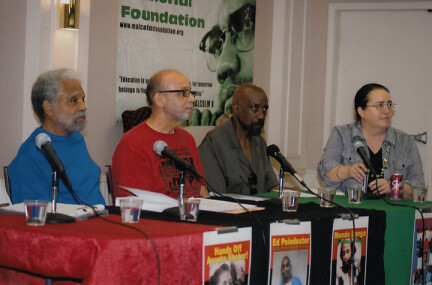
New information revealed at Omaha’s annual Black August Weekend, held at the Malcolm X Memorial Foundation, may engender a glint of hope for Nebraska political prisoners, Mondo we Langa and Ed Poindexter. The two await the answer to an age-old question: How long is life?

Perhaps most don’t want to know their exact number of years and days, but when living life parallels serving a “life sentence,” longevity is a double-edged sword and the question demands an answer. We Langa and Poindexter, also known as the “Omaha Two,” have been imprisoned 43 years. Both are in Nebraska’s State Penitentiary in Lincoln. The two former Black Panthers were convicted of first degree murder in the spring of 1971, for an August 1970 bombing which killed an Omaha police officer.

An afternoon panel discussion raised questions about whether the current sentencing structure violates the Nebraska Constitution. Included on the panel were longtime civil rights activist and former Omaha NAACP president August “Buddy” Hogan; Nebraska state Sen. Ernie Chambers; president of Nebraskans for Justice, Tariq Al-Amin; chair of the Omaha Socialist Workers Party, Laura Garza; and one of Mondo we Langa’s attorneys, former counsel for the African National Congress Lennox Hinds, who also teaches in the Criminal Justice Program at Rutgers University.

Hinds will file affidavits in the Nebraska Supreme Court in support of a petition filed by we Langa’s attorney in Omaha, Tim Ashford. Mr. Ashford’s petition outlines the illegality of Poindexter and we Langa serving de facto life sentences without possibility of parole in contravention of the state Constitution, which makes no provision for such a sentence unless treason or sedition is proven. Neither man was ever charged with those crimes.

We Langa and Poindexter, also known as the “Omaha Two,” have been imprisoned 43 years.

According to Hinds, “For them to serve a sentence of life imprisonment without the possibility of parole is an illegal sentence.”

Hinds says two members of the Parole Board recommended them for commutation. “Those individuals are willing to testify that they believe, based on their experiences, that an unwritten policy exists for them (Poindexter and we Langa) to serve this illegal sentence.” There is no word on when a hearing is to be held on the petition.

Appeals and petitions have been repeatedly struck down. In 1975, the federal District Court and the Eighth Circuit Court of Appeals declared there was no probable cause for a police search of Mondo we Langa’s home.

Therefore the search was illegal. The court overturned the convictions and ordered a new trial, but the U.S. Supreme Court refused to hear the case. The high court ruled violations of Fourth Amendment rights during searches and seizures did not warrant a new trial.

According to Hinds, “For them to serve a sentence of life imprisonment without the possibility of parole is an illegal sentence.” Hinds says two members of the Parole Board recommended them for commutation.

Twenty years ago, the Nebraska Parole Board recommended to the Board of Pardons that the sentences include a finite number of years. In Nebraska, it is necessary to have a definitive sentence to be eligible for parole.

The Board of Pardons consists of the governor, the attorney general and the secretary of state. With them, the decades old recommendation languishes.

Hogan of the NAACP asserts that there is a “conspiracy by the state of Nebraska to keep Mondo and Ed in the penitentiary until they die.” Hinds agrees. “If the prison authorities – the governor, the attorney general, secretary of state, people on the Pardons Board, people presently on the Parole Board – have their way, they will die in prison.”

Mondo we Langa believes there were two agendas at work. The FBI wanted to put an end to the Black Panther Party. “The Omaha Police Department would have had that on their agenda as well … but somebody had to pay for (Officer) Minard’s killing.” With no real evidence and four other suspects in the case, he and Ed Poindexter were tried and convicted. “So they got that taken care of and at the same time they were able to essentially kill the head so the body would die with respect to the Black Panther Party in Omaha.”

Amnesty International has called for immediate release or a new trial and recognizes Ed Poindexter and Mondo we Langa as political prisoners. Both men were under scrutiny by the FBI’s COINTELPRO (Counter Intelligence Program) operation, which targeted anti-war groups, civil rights activists and the Black Panthers, including the Omaha chapter.

“COINTELPRO 101” was a featured film at Black August Weekend, which was sponsored by the Malcolm X Memorial Foundation, Nebraskans for Justice, X Factor and the Omaha Jericho Movement.

“COINTELPRO allowed the government to spy on any organization that showed dissent,” said event organizer Carlos Carr, who is also on the board of the Malcolm X Memorial Foundation. “That included the Communist Party, anti-war protesters, Martin Luther King, Malcolm X and members of the American Indian Movement.”

Amnesty International has called for immediate release or a new trial and recognizes Ed Poindexter and Mondo we Langa as political prisoners.

The fight continues to free other political prisoners as well. Laura Garza and Socialist Party member Joe Perasso, who ran for the Omaha City Council last May, gave an update on the Cuban Five. Gerardo Hernandez, Ramon Labanino, Antonio Guerrero, Fernando Gonzalez and Rene Gonzalez were charged and convicted of conspiracy to commit espionage by the United States government in 1998. The Five admitted they infiltrated Cuban American paramilitary groups to prevent violence against Cubans and supporters of the Cuban Revolution. Their assignment was to keep the Cuban government informed. Three are serving life sentences without parole.

Perasso said free speech is under attack in Omaha. He cited a recent break-in at his home in which only his political materials were stolen or ransacked. And he circulated for signatures an open letter about the break-in to Omaha Mayor Jean Stothertz.

The keynote speaker of the Black August Weekend event was University of Cincinnati professor of Africana Studies and editor of “The Black Panther Party Reconsidered” Dr. Charles E. Jones, who spoke of government and police efforts to crush and exterminate the Black Panthers “across the country and here in Omaha.” Dr. Jones, a nationally recognized Black Panther scholar, is a co-author on a new book about the Omaha Two, called “Forgotten Comrades.”

He stressed that police brutality persists today even as it did in 1970 when Ed Poindexter and Mondo we Langa were imprisoned. “We couldn’t leave a building without being frisked or harassed. This went on around the clock,” said Poindexter.

Before their arrest in August of 1970, we Langa, a Creighton University student then known as David Rice, and Poindexter, a Vietnam veteran, were recognized as leaders in the Black Panther Party. They formed an off-shoot called the National Committees to Combat Fascism. Both were community activists advocating fair housing and ending racism in the Omaha public schools. They promoted political education and worked to end the Vietnam War.

Evidence against the Omaha Two was sketchy at best. Their fingerprints were not found on dynamite used in the bomb which killed Officer Minard and skin tests for dynamite residue were negative. Both men maintain their innocence and we Langa believes the dynamite was planted. Former Omaha police officer Marvin McClarty, who was present when officers say they found the dynamite, concurs. “To this day, I believe that (dynamite) was planted in that house.”

The main witness for the prosecution, Duane Peak, was a 15-year-old African American. Police charged him with Officer Minard’s murder when they received a tip that he was involved in the bombing. Peak, also a member of the National Committees to Combat Fascism, initially confessed that he alone made the bomb.

After three days in jail, Peak told police that Ed Poindexter had made a suitcase bomb and that Poindexter and Mondo we Langa told him to leave it on the porch of a vacant house in North Omaha. Peak alleges he was then instructed to call police and say a woman was dragged into that house screaming. Police responded and Officer Larry Minard was killed when the bomb exploded.

Duane Peak changed his story several times and police allegedly threatened him with the electric chair to pressure him to implicate we Langa and Poindexter. Still, during his preliminary hearing, Peak testified we Langa and Poindexter had nothing to do with the bombing. At which point the prosecution asked for a recess.

Nebraska state Sen. Ernie Chambers, who was present in the courtroom, says when court reconvened, Peak looked as if he had been beaten. According to defense attorney David Herzog: “He had been worked on, really worked on. It was frightening to see what happened to that young man.”

When the prosecution asked again if we Langa and Poindexter were involved in the bombing, Peak recanted his earlier testimony and again implicated them. Shortly after the men were convicted, we Langa’s home burned to the ground, extinguishing any opportunity for post-trial investigation. Duane Peak was allowed to plead guilty to juvenile delinquency and spent four years in juvenile detention.

Ed Poindexter now holds a master’s degree from Vermont’s Goddard Graduate Program. He is an artist, writer and teacher. Since his incarceration, he has created a musical drama, “Shakedown Blues,” and written two survival books for troubled youth. He advocates non-violence and has developed a program to encourage change in attitude and behavior for men who batter women.

Mondo we Langa has written several books of poetry. In 2012, he released the second edition of his anthology, “The Black Panther is an African Cat.” He has written short stories and articles for several literary journals. His poem “Great Babaleur” was featured in “Malcolm X: By Any Means Necessary” by Walter Dean Myers. Two of his plays, “Different Dances” and “We Dance in Our Neighborhood,” were performed by youth theatre groups in Nebraska and New York City. He serves as a mentor to young men new to the prison. He has never been involved in a violent incident. Both he and Ed Poindexter have been called model prisoners.

“So what can you do?” asked Mr. Hogan. “Write even a postcard to Ed or Mondo. Just say, ‘I’m thinking about you. I heard about you and I am concerned about you.’ You cannot imagine what that will mean to someone separated from the community they love.”

Sen. Chambers promises to push for legislation to parole we Langa and Poindexter. Meanwhile, 43 years behind bars have taken a toll on the health of the Omaha Two. Mondo we Langa, now 66, is housed in the prison’s skilled nursing facility. He uses a walker, and breathing through tubes pumping oxygen keeps his chronic obstructive pulmonary disease at bay. Ed Poindexter, who is 68 years old and a diabetic, sometimes uses a cane or walker.

The Omaha Two will have a parole hearing in January. Their supporters will ask for a compassionate release since neither man poses a threat to society.

For more information, contact Omaha Jericho at ctrl@q.com or eliga@nfhr.info or Nebraskans for Justice at P.O. Box 11725, Omaha, NE 68111 or comments@nebraskansforjustice.com.

To write to the Omaha Two: Ed Poindexter, 27767, P.O. Box 2500, Lincoln, NE 68542-2500 and Mondo we Langa (David Rice), 27768, P.O. Box 2500, Lincoln, NE 68542-2500.

Linda Kennedy, a freelance journalist with more than 20 years’ experience in television, radio and print and an acquaintance of Mondo we Langa, can be reached at Linda@lkmedia.biz.

African Americans and the Gypsies: A Cultural Relationship Formed Through Hardships

African Americans and the Gypsies: a cultural relationship formed through hardships

September 26, 2013
by Chuck Todaro
San Francisco BayView

“The Irish are the niggers of Europe … Say it loud. I’m Black an’ I’m proud,” echoes a memorable quote of ‘90s cinema. But the real “niggers” of Europe aren’t the Irish; that mark belongs to the detested Gypsies.

Tsigan, the East-European equivalent of Gypsy, “which was a synonym for ‘slave’ during the five and a half centuries of Gypsy slavery in that country (Romania), is as offensive for Romas as the word ‘nigger’ is for African Americans,” writes Roma scholar Ian Hancock.

Gypsy history is a series of expulsions, beginning with an exodus out of India, across Persia, into the Balkans ‘til they were swept to the edge of the European continent, over gangplanks, onto ships sending them to the Americas.

In the East European country of Romania, land of iron-fisted ruler Prince Vlad Tepes, aka Dracula, the “undesirable” Gypsies were being systematically rounded up and enslaved. But even Dracula, called the Impaler, who usually chose staking his prisoners, preferred Gypsies with their heads on. He brought back nearly 12,000 Gypsy slaves from campaigns in Bulgaria during his reign in the 15th century. The Gypsy slaves – like the African slaves a few years later – were sold on the block to the highest bidder.

It is the slavery issue that begins the African American-Roma association and molds many of the cultural similarities that follow. It starts with the propaganda around the plantation labeling the slaves as “soulless” “talking animals,” helping to justify the lucrative trade against an increasing religious and political conscience declaring “all men are created equal.” These derogatory images went viral, creeping into popular literature, stereotyping the African American as a buffoon or the feared “black brute.”

It is the slavery issue that begins the African American-Roma association and molds many of the cultural similarities that follow.

Meanwhile, the Gypsies were being portrayed as flirtatious females, petty thieves, kidnappers of white babies, fortunetellers and pickpockets as portrayed in Caravaggio’s famous painting, “The Fortune Teller,” where the pretty Gypsy girl reading a young man’s palm slyly removes his ring.

While film and literature were doing their magic by affecting the opinions of people who may never even have met a Black man or brown skinned Gypsy, these negatives were also reaching the bottom ranks and subtly stigmatizing the slaves into accepting a subservient role in society. Their dignity was taking a beating and stirring new feeling of either disdain of the oppressor or idolization, which shows in the brewing tensions between field slaves and the better connected house servants, the so-called “Uncle Tom,” a term still thrown around today to denigrate “too much” assimilation.

The self-hatred phenomena began appearing throughout the Gypsy camp, spreading like a virus as members of the clan began disguising their ancestry in an effort to assimilate. The transition came easier for better off Gypsies like the respected musician class. “When the Lautari from Morunglav, Olt, say we are not Gypsies, they mean that they do not want to be identified with most Roma, which ‘everyone’ knows as wild, lazy misfits, potential delinquents … The Lautari often go to great lengths to keep under wraps the fact that they are Roma,” writes Sperantza Radulescu in her book “Chats About Gypsy Music.”

Other tribes found the transition into mainstream society simply cut off to them. The Rudari of the forest, whose purged Roma culture had been replaced by the old-fashioned ways of the peasants, found themselves excluded from both white society, identifying them “tsigan” (Gypsy), and the Romas, ostracizing them for their loss of language and tradition, labeling them now simply “very poor Romanians.”

Soul food meets Gypsy food

Culture is our customs, language and also the food we eat. Every ethnicity, from the people of the arctic tundra to the bountiful equator, possesses its own specific culinary taste developed by locally available ingredients and economy. The oppressive slavery era would help mold a comparable African American and Romanian Gypsy cuisine.

White men mocked the African American meal as chicken and watermelon, often depicting the poor slave in caricatures as stealing watermelons out of the farmer’s vegetable patch. A similar image painted by the Europeans had Gypsies stealing chicken and eggs from the farmer’s barn and, instead of watermelon, it was fruits from his orchards.

“‘You watch the Gipsies, Kate. Call me if they try to steal anything,’ writes Kate Seredy in her 1959 children’s story, “The Good Master.” “She looked out the window – there were Gipsies all over the place! … There were at least six in the poultry yard catching chickens.”

Thefts like these did occur, causing some Gypsies to admit yet excuse their petty behavior with statements like that of Denis Biga from Apalina village in Transylvania: “A Gypsy steals a chicken to feed his children and gets six years in prison while Romanian senators steal millions of dollars and no one says anything.”

Many of these acts of desperation were caused by severe poverty and a dependency on food provisions that put the slave in direct competition with the master’s farm animals.

The slaves subsisted on the surplus, such as potatoes, cabbage and corn. Cornbread and beans became a major staple on both continents. The African American cooked black-eyed peas served with pork while a peek under the lid of the Gypsy cauldron commonly reveals a stew of mashed beans and spices mixed with boney cuts of meat.

The slaves weren’t eating sirloin or filet mignon; they were being rationed the cheapest cuts of the animal. Meat of diseased animals was even known to be passed off on the resilient slaves, which the Gypsies colorfully legitimized with sayings like, “The flesh of a beast which God kills must be better than that of one killed by the hand of man.”

The oppressive slavery era would help mold a comparable African American and Romanian Gypsy cuisine.

“When we killed hogs, the white folks got all the good parts, least they thought that, and we got the neck bones an’ ears, an’ snoots, an’ tails, an’ feet, an’ the entrails; what they called the chitlings (chitterlings),” reports a former slave in Herbert C. Covey and Dwight Eisnach’s book, “What the Slaves Ate: Recollections of African American Foods and Foodways from the Slave Narratives.”

The slaves were given what other people didn’t eat; however, the slaves were the best chefs, some of them quite famous like George Washington’s own Hercules, a noted “artist” in the kitchen. They used this knowledge around the kitchen into turning detestable ingredients into delicacies.

African Americans serve chitlins (pig intestines) and hog maw (pig’s stomach) with rice and collard greens, while Gypsy women serve up pig stomach and other scraps of meat swimming in cooked cabbage and sauce they call “shak te mas,” literally meaning cabbage and meat. Pig skin fried to a crispy bite in the African American community is handed out raw to Gypsy children with a swipe of salt as a chewy favorite. Fatback, another cheap cut of meat found in both Gypsy and African American cooking, is commonly used as a vegetable seasoning or can be fried like bacon. A favorite in the African American kitchen is cooking the fat into their bread known as “crackling cornbread.”

Pig’s feet, gizzards, neck bones are other favorites that regularly turn up in the African American and Gypsy dinner plate – also chicken backs that Gypsies serve in stews or in their “goulash” as both a way of stretching the budget and lasting ‘til tomorrow’s breakfast. For most Gypsies, refrigeration is still an unaffordable commodity.

Blacks call African American cuisine “soul food” because it feeds the spirit as well as the body. It’s comfort food, and that means it’s more than just nutritious – it’s delicious! Though Gypsies lack a catchy slogan for their cooking style, their love of the appetites turns any mealtime into a celebration.

A cultural renaissance

An 11th century Islamic invasion into India set off the Gypsy exodus, driving them through Persia, then Byzantium before crossing into Europe. Their rich culture and sacred traditions of a 3,000 year civilization slowly dissolved along their travels, replaced by many passing influences. The African slaves who had been collected since colonial times along a 4,000-mile stretch of West African coastland would also gradually surrender their identifying languages, beliefs and traditions to the influences of the surrounding majority.

The vibrant fashion styles of pure Roma and the African homeland was the first custom quashed by the barrenness of clothing afforded the slaves; a female garment of the plantation slave commonly consisted of a one-piece frock or slip made of coarse “Negro cloth.” The Gypsy slaves were repeatedly noted in travel journals for their “nakedness.” “It is shameful, disgusting and sad to see these ragged, dirty, half naked Gypsies, both men and women, working for no pay in the richly decorated palaces of the landowners,” observed 19th century traveler F. Nemtsov.

Out of sight, yet not out of mind, their affection for colors and other forms of elaboration would reemerge during Sunday religious services where African Americans threw off their black and gray work garments and fashionably expressed themselves.

Every Sunday the Black church came alive with elegant, vibrant styles topped with flamboyant female head coverings known in the community as “crowns.”

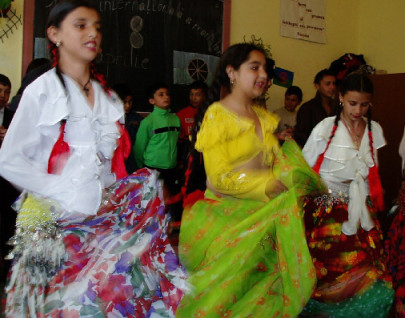
Gypsies similarly use life’s important social events to fashionably express themselves, such as their weddings, as seen in the popular reality TV series, “My Big Fat Gypsy Wedding,” where “more bling” became a catchphrase. The Gypsy fashion sense is about standing out. “Basically I want people to talk about my dress on their deathbed,” commented one participant about her outrageous outfit.

The vibrant fashion styles of pure Roma and the African homeland was the first custom quashed by the barrenness of clothing afforded the slaves.

While fashion allows for an outward mode of expression, name giving provides a more personalized sense of identity. Surnames historically identified an origin as is the case with the “son of” suffix (Johnson, Stevenson) or an occupation (Carpenter, Cook), a residence (London, Hillside) or notable physical or behavioral characteristics (Short, Goodchild).

Today, surnames offer little more information other than identifying an ethnicity. This, however, isn’t the case for either Gypsies or African Americans, whose last names serve as a reminder of slavery – some directly after having acquired the family name of the master. It wasn’t ‘til a resurgence of self-identity brought on by the Civil Rights Movement that the distinctive African American names began to appear. Some of these given names were formed by adjoining prefixes to create unique sonances like Latoya, DaJon, Leshandra. Heroes of classical and Greek literature like Dante and Venus have also become popular in the African American community as well as a resurgence of African language names like Tanisha, Chad, Jamal and recently Barack.

While fashion allows for an outward mode of expression, name giving provides a more personalized sense of identity.

The Gypsies, on the other hand, greeted assimilation by forming two separate identities: First comes the humdrum formal name of the majority like Peter, Paul, Mary listed on birth certificates and other ID papers. Secondly, a charismatic community name reflects the child’s personality, like Suto, meaning sleepy in the Gypsy tongue, Chapaladi, meaning silly, or the popular Kalo, meaning blackie. Animal comparisons are also quite commonly used like Kani, meaning chicken, for a spirited child or Pusomori, meaning little flea. A new trend has recently emerged using the names of heroes of films like Angelika, Jamesbond, Tarzan, Vandam, Jackychan.

Knowledge has been empowering mankind since Adam and Eve. The written word has preceded all the world’s drastic social changes and revolutions – and it is for this reason that education was purposefully withheld from the slaves to the extent of criminalizing it in most Southern states.

Authorities realized that an ignorant populace was easily manipulated, which became an increasingly important factor by the 19th century, when the slave population of many Southern states outnumbered the whites. A policy of minimalizing education of African-Americans, thus minimizing their potential, would continue even after emancipation. It shows in the continued disproportionate educational statistics between Blacks and whites.

In the Gypsy community, education was more or less viewed as a tool of the majority towards influencing their children away from the community towards assimilation. As a result, Gypsy parents often removed their children from school at a very young age, a custom that continues to this day.

Authorities realized that an ignorant populace was easily manipulated.

The illiteracy factor in both African American and Gypsy communities directed the passing of knowledge and customs to future generations through folktales and ballads like “John Henry” about the value of the working man and “Jimmy Cracked Corn,” the viewpoint of a Black slave both mourning and rejoicing his master’s death:

When I was young, I used to wait

On the boss and hand him his plate

And pass down the bottle when he got dry

And brush away the blue tail fly.

Jimmy cracked corn and I don’t care, …

My trouble’s gone away.

Gypsies meanwhile reminisce about the slowly disappearing nomadic life in “Trec Tsigani” (“Move Along, Gypsy”):

A Gypsy plays his violin like fire.

Move on, Gypsy, move on.

Never stay at one place too long.

Don’t stop.

They love to hear the violin,

Hear the beat of the drum,

The singer’s soothing voice,

The violin, the nightingale,

The sweet voice of a baby.

That special bond all Gypsies share with their community is the subject of the popular traditional song, “A Gypsy Has a House,” about a Gypsy woman who runs away to marry a wealthy landowner yet returns after being unable to shake the emotional ties to the community.

She pulled all the hair out of her head.

She never wanted fortune,

Nor wealth of any kind.

She has now returned back home

And is more beautiful than ever.

It is the musical proficiency that forms one of the most celebrated African American and Gypsy cultural similarities. Together they have produced some of the world’s most influential musicians like Scott Joplin, Leadbelly, Nat King Cole, Louie Armstrong, Billie Holiday, gospel music and the Motown sound right into the 21st century influences of hip hop.

The Gypsies have brought us Barbu Lautari, influencer of Franz Liszt, the innovative jazz artist Django Reinhardt, internationally renowned Gipsy Kings, charismatic all-brass Gypsy band sound – and today’s “vulgar” yet widely popular new Gypsy music known as Manele.

To this day, Gypsy music is still music without notation, as it was and sometimes still is in the African American community.

Gypsy musicians can neither read nor write a single note. “Gypsy music is all about improvisation,” says Kaliu Gheorghe, lead violinist of the famed Taraf de Haidouks. “It’s about how well you can improve on an old line. I listen to a Hungarian or Russian tune and then play it in Gypsy style – and out flows your Gypsy spirit.”

Music and dance has been a central component of the African American and Gypsy experience since the beginning. It’s perhaps the only custom of their homeland they preserved under the strict puritanical traditions they encountered. The music brought solace during troubled times and then later proved to be one of the only means of escaping the ghetto. It was also the music and dance that the African American church incorporated into their style of worship – and subsequently this joy filled seats at Sunday services, making African American religious service participation higher than any other race.

It is the musical proficiency that forms one of the most celebrated African American and Gypsy cultural similarities.

The Black church catalyzed the scattered African American minority into a unbreakable bond like the bundle of sticks proverb. From the pulpit developed great civil rights leaders like the Rev. Martin Luther King Jr., Rev. Jesse Jackson, Elijah Muhammad and Malcolm X, whose passionate orations inspired congregations to stand up for themselves and bring about change.

Not surprisingly, a similar pattern is beginning to take shape in Gypsy communities across Romania. Since the collapse of communism and return of religious freedom, waves of evangelical churches began setting up in the segregated Gypsy communities. The Gypsy church began unifying a population broken apart by a hierarchical caste system dating back to their Indian roots.

A simultaneous surge of social activism in the schools and non-governmental organizations has started mobilizing Gypsies of all the various tribes behind inspirational slogans sounding not unlike the African American “We shall overcome” and “Black power.” “Opre Roma,” say the Gypsies – “Stand up, Roma!”

Chuck Todaro is a freelance journalist residing in Romania with the Transylvanian “Gypsies,” where he runs the day to day operations of the Gypsy Project: Tzigania, www.tzigania.com. He can be reached at tziganiatours@tzigania.com.

Friday, September 27, 2013

China's Tianjin Minerals Buys $990 Million Stake in African Iron Mine

Updated September 26, 2013, 11:33 a.m. ET

China's Tianjin Minerals Buys $990 Million Stake in African Iron Mine

By CHUIN-WEI YAP in Beijing and ALEX MACDONALD in London

China's Tianjin Minerals and Equipment Group Corp. agreed to pay $990 million for a 16.5% stake in a Sierra Leone iron-ore mine, signaling that the world's largest steel-producing country remains on the prowl for metal assets.

The investment values African Minerals Ltd.'s AMI.LN +1.56% Tonkolili mine at $6 billion, and marks the company's second major deal with a Chinese partner in as many years. The company, which is based in London, last year received a $1.5 billion investment from Shandong Iron & Steel Group to finance African Minerals' operations, which produce 20 million metric tons a year. African Minerals plans to use proceeds from Thursday's deal to fund Tonkolili's expansion to 35 million tons a year.

African Minerals' shares rose 44% Thursday in London.

Small miners world-wide have been struggling to obtain financing for projects as slower economic growth in China, the world's largest consumer of the steelmaking ingredient, has helped push down iron-ore prices.

Thursday's deal by Tewoo, as the Chinese company is known, marks the country's return to a resource market where it has struggled to secure supply. Acquisitions, including a $8 billion iron project 900 miles north of Perth, Australia and a $3 billion magnetite project in Western Australia's Cape Lambert, have had years of delays or been suspended amid cost overruns.

A senior official at China's National Development and Reform Commission last December said that while Chinese companies had invested more than $10 billion in overseas iron-ore mines, few of the projects had begun operation, according to the official Xinhua news agency.

But while official caution over such projects has increased, so has the country's appetite for steel.

Iron-ore imports rose to a record 73 million tons in July and fell only slightly in August, according to the government. China depends on imported ore for 60% of the country's steelmaking.

The government estimated that China is likely to produce a record 780 million tons this year. State-led construction of railways and other infrastructure and restocking of inventories are behind the recent gains in demand.

"Construction investment and robust demand for automobiles should keep commodity demand robust and assist with the running down of metal stockpiles," said National Australia Bank economist James Glenn.

Iron-ore import prices had recovered recently, rising 19% from the year's low in May to $132 a ton for shipments to China's northeastern port of Tianjin. Prices have softened somewhat in the past month as Chinese mills have restocked.

State-owned metals companies continue to consider purchasing overseas assets. China Minmetals Corp. has said it was considering a bid for Rio Tinto's RIO.AU -0.16% $4 billion Canadian iron-ore operations. And Minmetals, Jiangxi Copper Ltd., and Aluminum Corp. of China 601600.SH +10.10% are circling Glencore Xstrata GLEN.LN -0.22% PLC's Las Bambas copper asset in Peru.

Tewoo says it is China's largest import-and-export enterprise, distributing iron ore, coal, energy and other materials to China's Tianjin and Hebei steel belt. It is China's second-largest ore trader, though the fragmentation of the market means the company accounts for only 5% of volume in China.

Tewoo will pay $600 million for a 10% direct stake in Tonkolili and $390 million for a 10% stake in African Minerals. African Minerals owns 75% of the Tonkolili project and Shandong Iron & Steel owns the rest. African Minerals will own 65% of the project when the Tewoo deal is completed. The deal also includes a 20-year supply agreement for Tewoo.

The latest agreement gives African Minerals long-term supply deals with Tewoo, Shandong Iron & Steel and China Railway Materials Co., said the miner's executive chairman, Frank Timis. "We will have almost all of the Tonkolili project's production committed for the next 20 years," he said.

The Tewoo deal is expected to close by year-end, subject to due diligence and regulatory approval,

Write to Chuin-Wei Yap at chuin-wei.yap@dowjones.com and Alex MacDonald at alex.macdonald@dowjones.com

Rare, Moving Photos of African American Life During the New Deal

Rare, Moving Photos of Black Life During the New Deal

By Jordan G. Teicher

The New Deal, a series of experimental projects and programs implemented during President Franklin Roosevelt's presidency in the 1930s, was designed to help the country recover from the Great Depression. For African-Americans, those initiatives offered social and economic programs that helped many people stake a greater claim on full citizenship for the first time.

The exhibition, “Claiming Citizenship: African Americans and New Deal Photography," now at New York’s Schomburg Center for Research in Black Culture, shows African-Americans taking advantage of opportunities that hadn't been available to them previously. "You can see how during the New Deal the government was experimenting with the possibility that all citizens deserved education, deserved medical care, deserved food security," said exhibition curator Rickie Solinger.

The photos are drawn from the Library of Congress and the National Archives. Solinger said the Library of Congress photographs were taken by experienced photographers and tended to document the ravages of the Great Depression in order to build support for New Deal spending. The photos from the National Archives, she said, were taken mostly by anonymous photographers commissioned to show what that money was accomplishing.

The programs were wide-ranging, addressing issues including literacy, employment, and health. The Works Progress Administration, the most famous of these programs, put millions of Americans to work, including many African-Americans. It also exposed African-Americans to federally funded art, theater, music, and writing programs.

For some African-Americans, these were gateways to achieving some of the most basic elements of citizenship, which had been illusive due to systemic racism and poverty. "If you're living in a moment in the 1930s in which you're able for the first time to claim medical care or to be an adult and learn how to read … or to buy land and live in decent housing for the first time, these are arguably the constituent arguments for citizenship," Solinger said.

For the way it empowered African-Americans, Solinger said that the New Deal era might be seen as a rehearsal for the civil rights movement. "When you think chronologically, the children in these pictures could grow up to be the parents of the civil rights activists of the ’60s, or the children could be participants in the civil rights movements themselves," Solinger said.

But in the 1930s, the government had a long way to go before it would begin offering equal rights to all citizens. The New Deal, though a step forward for African-Americans, did little to address institutional inequality. "If you look at those pictures, you almost never see settings that were integrated in any way. Work settings, health care settings, and educational settings were always segregated, and the New Deal programs did not challenge that," Solinger said.

“Claiming Citizenship” is on display at the Schomburg Center until Jan. 4.

Jordan G. Teicher has written for the New York Daily News, NPR, New York Magazine, and Thought Catalog, among others.

Can Democracy Deliver for Africa?

25 September 2013
Last updated at 19:20 ET

Can democracy deliver for Africa?

By Mary Morgan
BBC Africa

Multiparty democracy swept across Africa in the early 1990s, as single-party states and authoritarian leaders bowed to pressure from outside and within. Activists hoped greater political freedoms and strong institutions would lead to more government accountability - and more effective development. But two decades later, is this the reality?

Pallo Jordan is a member of South Africa's governing African National Congress (ANC) and was part of the first cabinet in 1994. For him, there is no denying that they are better off with democracy.

"We have made tremendous progress in this country, with respect to everything. Just the most basic things like the right of the governed to choose their own government."

It is what people fought for, in South Africa and across the continent. But not everyone is happy with the outcome.

Even within South Africa, many feel marginalised in the new democracy.

Economically, South Africa is still one of the most unequal societies in the world. The same party has been in power since the beginning of multi-party democracy, and that does not look like changing any time soon.

There is also a difference between democracy in theory and democracy in practice.

Is Uganda a democracy?

Uganda is officially a multiparty democracy.

Its President, Yoweri Museveni, has been in power since 1986, and oversaw the transition from a single-party to multi-party state.

Yet many complain that democracy there is a mirage.

Arthur Arok, Uganda director of the international development charity ActionAid and an outspoken activist, says: "Opposition and civil society are seen as anti-progress and enemies of development. There is little space for real debate - and that goes against the spirit of democracy."

Mr Arok was arrested and detained back in January as part of the Black Monday movement against corruption, and questions the reality of democracy in his country.

"Is Uganda democratic? No, it's quasi-democratic, still under construction. There has been some improvement but the ruling elite are not really interested in democracy, they only want to entrench their own interests."

President Museveni has won four elections, changing the constitution to allow himself an unlimited number of terms. The most recent polls were deemed by European Union observers to be highly compromised.

Chris Zumani Zimba, author of Democracy Under Attack, describes Mr Museveni as one of a new group of "perpetual democratic leaders".

"Democracy is often undermined by leaders themselves, who are elected to office but then try to consolidate their power and make themselves more permanent," he says.

Cameroon's President Paul Biya has also removed term limits - and former Nigerian President Olusegun Obasanjo unsuccessfully tried to do the same.

Holding on to power

Another threat to democracy in Africa is seen to come from those who fought for it in the first place.

Wallace Chuma, a former Zimbabwean newspaper editor and now an academic at the University of Cape Town, says there is a familiar pattern of former liberation movements in government.

"They failed to tolerate internal processes of democracy. I think they have become hostage to their own successes as liberation movements. The tendency is to be closed to the outside and closed also to fresh ideas.

"If you look at the rhetoric from Angola to Mozambique to South Africa to Zimbabwe, you get the sense that any criticism against liberation movements in government is considered as being a traitor."

There is some debate as to what constitutes democracy, anyway. Even when elections are deemed to be free and fair - what happens in the period between ballots?

Corruption and impunity at the highest level are a sign that the balance of power still sits firmly with those in office - and not those who vote them in.

According to the African Union, more than $148bn (£93bn) is lost to corruption in Africa every year - much of it through public officials employed by democratically elected governments.

Poverty and underdevelopment can also be seen as a challenge to democracy, with a hungry and poorly educated electorate easily bought by politicians welding gifts and promises.

Indeed, some argue that democracy is not the most stable base for economic development anyway.

Alex Ngoma, a political scientist at the University of Zambia, points to the Asian Tigers' example, "where democracy is less of a priority and they waste less time talking - but get economic results. It's proof that there is more than one way to get things done."

China is consistently ranked as one of the fastest growing - and most powerful - economies on earth. Within Africa, Ethiopia and Rwanda are among the most successful - their growth built on a model of strong central government and limited political freedoms.

How to 'Africanise' democracy

Speaking this year on the death of Ethiopia's Prime Minister Meles Zenawi, Rwanda's President Paul Kagame was clear about both countries' lukewarm relationship with a Western version of democracy.

"Invariably, the question has been raised about whether the emphasis on development and the role of the state in it is not done at the expense of democracy and people's rights.

"Those who disagree with or criticise our development and governance options do not provide any suitable or better alternatives. All they do is repeat abstract concepts like freedom and democracy as if doing that alone would improve the human condition.

Yet for us, the evidence of results from our choices is the most significant thing."

President Kagame is not alone in questioning multi-party democracy in the African context.

Indeed, US historian William Blum in a recent book describes democracy as a Western imposition on Africa - "America's deadliest export" and foreign policy tool.

Consequently, there has been some discussion as to how to "Africanise" democracy. Mr Zimba suggests incorporating traditional power structures into formal government.

"At the moment chiefs are seen as political footnotes, even though they are often more effective and revered than politicians.

Politicians recognise the influence of traditional leaders on how communities vote during elections and try to manipulate this. A better system would be some kind of bicameral government, even giving traditional leaders legislative powers."

As with any healthy democracy, there is a range of opinions and robust debate, but the consensus seems to be that whilst democracy is not delivering as well as it could be for Africa, it remains the most viable form of government for the continent.

Mr Ngoma sums it up: "Democracy on paper is very beautiful, but the practice depends on what practitioners actually do - and often they're not doing very well."

For African Generals, Drones Are The Latest Thing

September 27, 2013, 7:53 p.m. ET

For African Generals, Drones Are The Latest Thing

Aircraft Are Being Used to Track Militants, Poachers and Drug Traffickers

By DREW HINSHAW
Wall Street Journal

Taking a cue from the U.S., more African governments are spying from the skies.

From Kenya to Nigeria, African air forces are acquiring surveillance drones—often made in the U.S.—to track militants, poachers and drug traffickers moving across vast and often inhospitable terrain.

The drive to expand Africa's air surveillance comes as the U.S. seeks to outsource some of its work fighting terrorism in the world's most remote places.

"Controlling the borders, the arms trafficking," said Col. James Birungi of Uganda, in explaining how drones can meet his country's security challenges. "We have seen that this equipment can do all that for us.

After a flurry of terrorist attacks across Africa this week, governments on the continent are looking for a quick fix. Shooting sprees in Kenya and Nigeria each left scores of people dead, illustrating why governments that already struggle to give their citizens tap water or electricity might spend millions of dollars on 21st century surveillance planes.

In recent years, Nigeria and Ethiopia have purchased small fleets of drones to track militants and pirates, according to air force officials in Nigeria and the U.S. Last year, the U.S. agreed to give eight small drones to Kenya to monitor al Qaeda-backed rebels there, according to Pentagon documents reviewed by The Wall Street Journal. Meanwhile, two U.S. Air Force officials said Botswana has approached them requesting drones to track their endangered population of elephants.

For the past few years, the U.S. Air Force has dispatched about a hundred small groups of advisers annually to Africa, said these U.S. Air Force officials, who weren't authorized to be identified by name. Those U.S. Air Force advisers say they are training mechanics, pilots, technicians, and intelligence analysts in roughly 20 African countries.

At a higher level, U.S. Air Force generals say they're talking regularly with defense leaders in Africa—and increasingly are pushing surveillance aircraft as a cost-efficient way to quash the many insurgencies cropping up across the continent.

Two of those officers, U.S. Air Force Gen. Frank Gorenc and Lt. Gen. Craig Franklin, spoke about the initiative in broad terms, describing it as an effort to farm out some of America's anti-terrorism work.

For the U.S., African assistance, however minimal, could help ease pressure on America's own fleet of drones. The U.S. Air Force keeps tabs on Africa, a continent three times the size of the U.S., with only two drone bases. They are 2,500 miles apart, in Niger in West Africa and in Djibouti in the east.

"This continent has too often been land-centric; we solve our problems with land forces," said Gen. Franklin. But he said he'd seen a change: "From the smallest countries, you have air chiefs that…are thinking about: 'OK, with this amount of resources, what can we do?'"

U.S. military assistance to African countries comes as many of them are growing richer and the cost of surveillance equipment is sharply falling. It's an auspicious confluence of trends for defense contractors in the U.S. and elsewhere that are seeking a toehold on the continent.

Last month, the U.S. Air Force created a private website for African defense chiefs—a social network where they could share product reviews, and go in on bulk purchases together.

Earlier this year, Ghana purchased a DA42 surveillance plane, manufactured by Austria's Diamond Aircraft Industries. Defense industry analysts estimated the price at roughly $10 million. U.S. and Ghanaian officials say the country flies the aircraft over the ocean, inspecting ships plying pirate-infested waters. The plane maker's chief executive, Christian Dries, says he's sold similar surveillance planes to Nigeria, Mali, Burkina Faso, Niger, and South Africa.

"We have steady orders," he said. "Definitely, this market is growing."

A half dozen other countries—among them Senegal, Uganda and Mauritania—are looking to purchase similar aircraft, say U.S. officials. "We have a real need for these things," said Senegal's General Ousmane Kane. Asked what surveillance assets his air force currently possessed, he pointed to his face and said "above all, what we have are our eyes."

For defense contractors, African air budgets represent a still-small but fast-growing market. Having failed to maintain their previous air fleets, many African governments are paying vendors this time around to toss in contracts for maintenance, technical support and training, said retired Air Force Col. Cedric Leighton, now a defense consultant with experience working in Africa.

"It's a great business for these folks," he said. "There is a lot of gold in those hills."

But Africa's entry into drone surveillance also has raised legal and human rights questions. The laws in most African countries provide citizens with scant legal protection in the types of images the government can capture, how they can be used and who can have access to them.

"We're in kind of a legal limbo," said Research Director Emmanuel Kwesi Aning at the Kofi Annan International Peacekeeping Training Centre in Accra, Ghana. "Nobody is discussing it. It shows the backwardness and the naivety of our partners."

In countries like Nigeria, there are human rights concerns, too. The lead army unit there, called the Joint Task Force, is accused of burning down entire villages, killing civilians, and torturing prisoners to death. Nigerian generals deny those reports, which they say are propaganda spread by terrorists to discredit their army. Still, U.S. human rights law bans the U.S. from working with the Nigerian unit. And yet the U.S. Air Force legally can and does advise the Nigerian air force, whose plane-gathered intelligence winds up in the hands of JTF troops.

"We regularly stress to our partners in Africa the importance of respecting human rights," said an emailed statement from the U.S. State Department on that assistance.

On a recent afternoon, five African air force commanders returned from a U.S.-sponsored tour of Ghana's recently-purchased surveillance plane. The U.S.'s Gen. Franklin, who'd accompanied the tour, said his resources to monitor militants across the continent are stretched thin.

"Oh man, I'll tell you, I am so excited," said Gen. Franklin. "If they take care of the problem themselves, we don't have to worry about it."

Write to Drew Hinshaw at drew.hinshaw@dowjones.com

A version of this article appeared September 27, 2013, on page A8 in the U.S. edition of The Wall Street Journal, with the headline: Africa's Generals Turning to Drones.