Wednesday, November 28, 2018

Chinese Investments Create Job Opportunities for Many Ethiopians: State Minister
Xinhua
2018/11/24 0:19:09

Chinese investments in Ethiopia over the past two decades have created job opportunities for many Ethiopians, said Ethiopian State Minister of Foreign Affairs Aklilu Hailemichael on Friday.

The state minister made the remarks at China Zhejiang-Ethiopia Trade and Investment Symposium co-hosted by the Ethiopian Ministry of Foreign Affairs and the Chinese Council for the Promotion of International Trade Zhejiang Provincial Committee (CCPIT Zhejiang) in Ethiopia's capital Addis Ababa.

The government of China and companies from China have over the past two decades "invested significantly in Ethiopia, creating job opportunities for a large number of Ethiopians," Hailemichael said.

"My country also expects even more through the Belt and Road initiative that China launched with a focus on economic cooperation and connectivity among nations," he said.

He noted that the growing investment and trade ties between "the two sisterly countries" are part of Ethiopia's "historic relations with China covering a range of areas including but not limited to trade, culture, education and development cooperation."

"The relations between the two sisterly nations have been based upon diplomatic adherence, mutual respect, win-win formulation, shared development and mutual understanding," he said.

The state minister added that the diplomatic and investment importance Ethiopia attached to China can be best explained in terms of the largest number of representations the East African country has in China as compared to any other country in the world.

According to the ministry, the Chinese government and companies from China have over the past two decades been heavily involved in various development projects in Ethiopia, including the operational Addis Ababa-Djibouti Railway and the Addis Ababa Light-Railway, roads, hydro-electric power, telecommunication, airports expansion, water development, manufacturing and various other development areas.

Liu Yu, Economic and Commercial Counselor at the Chinese Embassy to Ethiopia, said that the investment and trade opportunities presented by the Chinese companies from Zhejiang province are in line with the eight major initiatives announced by Chinese President Xi Jinping, together with African leaders, during the Beijing Summit of the Forum on China-Africa Cooperation (FOCAC), which include industrial promotion, infrastructure connectivity, trade facilitation and people to people exchange.

Zhang Qingshan, Vice Chairman of China Council for the Promotion of International Trade Zhejiang Provincial Committee (CCPIT Zhejiang), noted that China is the biggest trading partner of Ethiopia, adding that "our business trip here has become an example of the broader China-Africa cooperation."
Sudan, Egypt Agree to Deploy Joint Military Patrols on Border
Xinhua
2018/11/26 9:01:35

Sudan and Egypt on Sunday agreed to deploy joint military patrols on joint border and establish joint forces in the future to combat terrorism, official SUNA news agency reported.

Sudan's Defense Minister, Awad Ibn Aouf, met with his Egyptian counterpart Mohamed Zaki in Sudan's capital Khartoum on Sunday.

"The two sides agreed to deploy joint patrols on the border, form border mechanisms and establish joint forces in the future to combat terrorism and cross-border crime," Kamal Abdul-Marouf, Sudanese army's chief of joint staff, was quoted as saying.

He said the talks between the two ministers were "fruitful and successful," noting that the two sides agreed to establish joint projects via expanding exchanged training courses of officers.

Sudan and Egypt also agreed on sustaining the relations at all levels, enhancing joint cooperation and establishing strategic partnerships in fields of military cooperation, said Marouf.

The Egyptian defense minister arrived in Khartoum on Saturday in a two-day official visit to Sudan. 
Kenyan Small Enterprises Reap Big from China Import Expo
Xinhua
2018/11/18 9:48:58

Nancy Wangari Ndirangu, director of Centrofood Industries, delivers a speech concerning her experience of attending the China International Import Expo (CIIE) during a reception held in Nairobi, Kenya, Nov. 16, 2018. "The Chinese market could be the catalyst that will propel my company into the big league," Ndirangu told Xinhua here on Friday. (Xinhua/Lyu Shuai)

Nancy Wangari Ndirangu has always dreamed of transforming her family-owned agro processing firm into a multinational giant.

The director of Centrofood Industries has just returned from the China International Import Expo (CIIE) with orders from Chinese clients.

"The Chinese market could be the catalyst that will propel my company into the big league," Ndirangu told Xinhua on Friday during a reception held by the Chinese embassy in Nairobi.

She said that Chinese consumers were very receptive of her tomato sauce products as she was able to sell all the samples she travelled with to China.

"We have been overwhelmed with inquires and we are now narrowing down to those with the best offers," she added.

Ndirangu said that she hopes to commence shipping her organic brand of tomato sauce to China, beginning January 2019.

"We hope to begin selling small quantities and grow gradually as we develop our products to meet the specific needs of Chinese customers," she added.

Centrofood Industries' current portfolio of products includes chilly and garlic sauce, fruit juices and jams as well as bottled drinking water.

The first CIIE that was held in Shanghai between November 5 and 10.

Kenya, which was represented by President Uhuru Kenyatta, was one of the African countries with a country pavilion.

Austin Mucheso, acting chief manager product, market development and promotion at Export Promotion Council (EPC), said that China is one of the largest importers of goods in the world.

"We are therefore putting all our energy into China to ensure we get our products into the lucrative market," Mucheso said.

He said that Kenyan products that have potential to be successful in China include coffee, tea, macadamia nuts and other manufactured products.

Irene Mumo, director of Trueways Enterprise, also participated in the CIIE. Mumo said that her organic honey emerged as a favorite for Chinese consumers who are embracing healthy foods.

She added that she secured large orders from Chinese consumers and is currently looking for finance to expand her operations.

Mumo noted that another challenge she will face in exporting to the Asian country is lack of enough quantities.

"I therefore plan to begin aggregating honey from small scale farmers from across the country in order to supply to my clients," she revealed.

She observed that in order to penetrate the Chinese market, she will package her products in small dosages in order to ensure that they remain fresh.

Fridah Mbaya also reaped rewards from her participation at the CIIE. The director of Nyumbani Coffee Enterprises hopes to introduce Kenya's renowned coffee to Chinese consumers.

"The only challenge I experienced was the need to upgrade packaging in order to appeal to sophisticated Chinese buyers," Mbaya said.

The women entrepreneur said that she hopes to benefit from the coffee drinking culture that is taking root in major Chinese cities.
Iran Calls on World to Engage Taliban in ‘Inclusive’ Dialogue with Afghan Government
Thu Nov 29, 2018 12:43AM
presstv.ir

Iranian Foreign Minister Mohammad Javad Zarif delivers his statement during the United Nations Conference on Afghanistan at the UN Offices in Geneva on November 28, 2018. (Photo by AFP)

Iranian Foreign Minister Mohammad Javad Zarif has called on the international community to engage the Taliban in an "inclusive" dialogue with the Afghan government in a bid to restore peace to the war-torn nation.

“All of us need to facilitate the intra-Afghan dialogue, by helping to bring the Taliban to the negotiating table with the government for inclusive and comprehensive talks,” Zarif said in an address to the Geneva Conference on Afghanistan on Wednesday.

The high-level conference, organized by the UN and the Afghan government in Switzerland, was not attended by the Taliban, but it was reported that the group would closely monitor the gathering of Afghan leaders and international diplomats.

According to Zarif, the conference agreed on the fact that “there is no military solution in Afghanistan, and the time has come for national reconciliation and inclusive political solution in Afghanistan, owned and led by the Afghan government and people.”

In his speech, the top Iranian diplomat pointed to the “old and new challenges” facing Afghanistan, and warned of efforts to spread extremism across the country.

“The presence of foreign forces has never brought stability in our region and has historically provided a recruiting ground for extremists,” Zarif said, referring to the long-time presence of US and NATO forces in Afghanistan, which has failed to restore security to the country 17 years after the US invasion.

“A new challenge is the introduction of Daesh to Afghanistan which has led to more bloodshed and introduced dangerous sectarian tendencies,” Iran’s foreign minister said, adding that the issue has radicalized local armed groups in a competition over followers and recruits.

“Believe me, as no one gained from introducing and supporting Daesh and other extremists in Syria and Iraq, no one will gain from introducing them to Afghanistan and Central Asia. This horrific trend needs to be arrested before it reaches catastrophic proportions,” he noted.

Principles of peace deal laid out

Addressing the conference, Afghan President Ashraf Ghani laid out the principles of any peace deal with the militants, declaring that he had formed a 12-strong team to negotiate peace with the Taliban.

"We seek a peace agreement in which the Afghan Taliban would be included in a democratic and inclusive society," he said.

Ghani stressed that any deal must fulfill certain conditions, including respecting the constitutional rights of women.

He also urged Afghans to back his peace push in an election next April.

"Presidential elections in the spring are key to successful peace negotiations. The Afghan people need an elected government with a mandate to obtain ratification (and) implement the peace agreement and lead the societal reconciliation process," he said.

The Afghan leader noted that the implementation of any accord will take at least five years.

According to Afghanistan's Chief Executive Abdullah Abdullah, the five-phased peace process would start with an intra-Afghan dialogue, followed by discussions with Pakistan and the US, and then with regional actors, the Arab Islamic world and finally NATO and non-NATO countries.

"The aim of each and every effort by our partners has to be to encourage the Taliban to come to the negotiating table with the Afghan government and put everything on the table," Abdullah said.
10 Killed in Attack on British Security Company in Kabul
Wed Nov 28, 2018 07:15PM
presstv.ir

At least 10 people have been killed and nearly 20 others wounded in a bomb attack on a British security company's compound in the Afghan capital Kabul.

The British company and police both said the blast was a car bomb targeting the compound, which houses G4S, a private British security company, in east Kabul. G4S provides security for the UK Foreign Office in Kabul.

"We can confirm that there has been an incident at one of our locations in Kabul. The situation is ongoing and we are coordinating with the Afghan authorities to bring it to a conclusion," G4S tweeted from its official account.

An Afghan Interior Ministry official said an unknown number of gunmen had entered the compound after the bomb exploded near the facility and were battling security forces. Earlier, sources said the blast was followed by gunfire.

A Health Ministry spokesman confirmed the casualties.

The Taliban militant group has claimed responsibility for the deadly assault.

Wednesday's assault on G4S is the second high-profile attack claimed by the Taliban on US-led forces in as many days. On Tuesday, three US soldiers were killed in a blast near Ghazni city in central Afghanistan that was claimed by the militant group.

Last week, more than 50 people were killed and over 80 wounded after a huge explosion ripped through a building in Afghanistan's capital, in which a large crowd of people, including religious scholars, were marking the birthday anniversary of Prophet Mohammad (PBUH).

The Kabul attack came just hours after Afghan President Ashraf Ghani announced the formation of a team for prospective peace talks with the Taliban.  At an international conference on Afghanistan in Geneva, Ghani said the 12-person negotiating team includes both men and women and will be led by his chief of staff Abdul Salam Rahimi.

Rahimi, a former humanitarian worker and ex-deputy Afghan finance minister, is considered one of Ghani's closest aides.

At the request of the US, a Taliban office was established in Doha in 2013 to facilitate peace talks. In recent months, Taliban representatives and US envoy Zalmay Khalilzad have already discussed the Taliban's conditions to end the 17-year war in Afghanistan.

Last year, US President Donald Trump increased the number of US forces in the country as part of what he called a new strategy against the Taliban. There are now about 14,000 US soldiers in the country. The Taliban have previously said the presence of foreign troops was the biggest obstacle to peace in Afghanistan.

Afghanistan has been gripped by insecurity since the US and its allies invaded the country as part of Washington’s so-called war on terror in 2001. Many parts of the country remain plagued by militancy despite the presence of foreign troops.
US Asks UN to Hold Off UK-drafted Resolution on Yemen Truce
Wed Nov 28, 2018 01:32PM
presstv.ir

US Ambassador to the UN Nikki Haley (C) speaks at a Security Council meeting. (File photo)

The US has urged the UN Security Council to put on hold a draft resolution demanding an immediate truce in Yemen, in what is viewed as an attempt to hinder international efforts aimed at ending the Washington-backed Saudi war on the impoverished country.

In a message sent to other council members on Tuesday, the US mission signaled that it was reluctant to act on the UK-drafted resolution until after the talks had taken place in Stockholm in early December.

“We look forward to offering more substantive comments to the draft once we have more information on the outcomes of the upcoming consultations,” the message said.

Britain circulated the draft text to the 15-member council a week ago and called on parties involved in Yemen’s crisis to restart peace negotiations.

The draft sets a two-week deadline for warring Yemeni parties to remove all barriers to humanitarian aid, halt attacks on civilian areas and allow unhindered access to the strategic port city of Hudaydah.

Negotiations on the proposed resolution -- the first to be discussed by the council on Yemen since 2015 -- began last week, but no decision has been made on when the draft should be put to a vote.

The truce would take effect on the day of the adoption of the resolution.

Additionally, the Security Council has demanded that the warring sides in Yemen engage with the UN special envoy for the impoverished country, Martin Griffiths.

UN diplomats said that Griffiths was hoping to bring the warring sides to Sweden for negotiations that could begin as early as December 3.

The diplomats, however, said they did not expect a vote this week on the measure due to the US’s reluctance to put pressure on the Saudi-led coalition, which has Washington’s firm support in the bloody war against Yemen.

The United States made a surprise call for a truce in the war-ravaged country last month and threw its weight behind the UN-led effort to hold peace talks.

That call came as the war became the focus of attention amid international outrage over the assassination of Saudi dissident journalist Jamal Khashoggi at Riyadh’s consulate in Istanbul, Turkey, early in October.

Yemen was grappling with a domestic political conflict when the Saudi regime and its allies intervened in March 2015 and unleashed the military campaign in favor of the government of ex-president Abd Rabbuh Mansur Hadi, a close Riyadh ally who had earlier resigned and fled to the Saudi capital.

Another party to the conflict is Yemen’s Houthi Ansarullah movement which has been running state affairs from Sana’a in the absence of an effective government besides defending the country against the Saudi aggression.

The offensive initially consisted of a bombing campaign but was later coupled with a naval blockade and the deployment of ground forces to Yemen.

Over the past few months, Saudi-backed militiamen loyal to Hadi and foreign mercenaries have been fighting Houthi Ansarullah for the control of the port city of Hudaydah, a vital conduit and lifeline for the delivery of humanitarian aid to millions of Yemeni people.

During a meeting with Griffiths in Sana’a on Thursday, the leader of the Houthi Ansarullah movement praised positive initiatives and practical steps, which seek to ensure a political solution to the Yemeni conflict.

Abdul-Malik al-Houthi then demanded an immediate end to the Saudi-led aggression, the removal of the blockade and humanitarian aid deliveries to war-stricken people.

Last week, the administration of Hadi announced that it would take part in the proposed peace talks in Sweden, hours after the chairman of the Supreme Revolutionary Committee of Yemen, Mohammed Ali al-Houthi, said Ansarullah fighters were halting their retaliatory attacks as a goodwill measure to speed up the “peace” process.

Griffiths says that he has received “firm assurances” that the warring Yemeni parties would attend talks in the Swedish city of Stockholm.

The Saudi-backed side has, however, stepped up the raids aimed at seizing Hudaydah despite the peace efforts.

Ansarullah has warned that the rise in Saudi assaults on Hudaydah could frustrate efforts by Griffiths to rekindle peace talks in Sweden next month.
US Senate Defies Trump on Saudi War Amid Khashoggi Fallout
Wed Nov 28, 2018 11:02PM
presstv.ir

US Secretary of State Mike Pompeo (5th L) walks to a briefing with members of the Senate to discuss developments in Saudi Arabia on Capitol Hill on November 28, 2018 in Washington, DC. 

The Republican-controlled US Senate is defying President Donald Trump’s pro-Saudi policies by advancing a bipartisan bid to end the country’s support for the war on Yemen amid tensions over Jamal Khashoggi’s murder.

Although the White House had urged a "no" vote, American senators voted 63-37 Wednesday to consider ending Washington’s support for the Saudi-led aggression on Yemen.

The exact same measure failed on the chamber’s floor in a 55 to 44 vote in March.

Co-sponsored by Senators Bernie Sanders, Mike Lee and Chris Murphy, the bill would oblige Trump to cease support for the Saudi-led coalition via invoking the War Powers Resolution of 1973 (WPR).

A similar measure has to be taken in the House, where some Republican have shown opposition.

In a rare classified briefing ahead of the Senate vote, Secretary of State Mike Pompeo and Defense Secretary Jim Mattis addressed the senators, yet failed to sway the undecided votes necessary to halt the measure, which is against Trump’s interests.

US Secretary of State Mike Pompeo speaks to the press after briefing members of the Senate on the current relationship between Saudi Arabia and the United States on Capitol Hill on November 28, 2018 in Washington, DC.

The White House released a statement, warning that such a measure "would harm bilateral relationships in the region and negatively impact the ability of the United States to prevent the spread of violent extremist organizations."

It further suggested that the president might veto such resolution.

“His advisors would recommend that he veto the joint resolution.”

Meanwhile, pressure was mounting on the Trump administration over supporting the kingdom in the wake of Khashoggi’s murder.

Trump has thrown his support behind Saudi Crown Prince Mohammed bin Salman, who reportedly ordered the assassination of the dissident journalist and Washington Post columnist at the Saudi consulate in Turkey last month.

The CIA has provided the administration with a tape of Khashoggi’s murder, which Trump has refused to listen to.

The Saudi-led war on Yemen has also led to a humanitarian crisis in the impoverished country. The UN has already said that a record 22.2 million Yemenis are in dire need of food, including 8.4 million threatened by severe hunger. According to the world body, Yemen is suffering from the most severe famine in more than 100 years.

By a big bipartisan margin, 63-37, the Senate just voted, for the first time, to move forward with a debate on ending American involvement in the Yemen war.

The new measure at Congress would harm ties between Trump and the Saudi de facto leader as the two are preparing to take part at the G20 gathering in Buenos Aires from November 30 and December 1.
Senate Votes to Advance Measure to End U.S. Support for Saudi War in Yemen
With reporting by Grace Segers, John Nolen, Olivia Gazis, Kathryn Watson and Holly Williams

The Senate voted on bringing a bipartisan measure which would end U.S. support for Saudi Arabia's military campaign in Yemen to the floor of the Senate. Next week the Senate will vote to proceed to the bill by a simple majority vote. If the Senate agrees to proceed to the legislation, there will be 10 hours of debate, and then senators will be able to offer amendments to the bill.

The bill proposed by Sens. Bernie Sanders, I-Vt., Mike Lee, R-Utah, and Chris Murphy, D-Conn., would require President Trump to withdraw U.S. troops in or affecting Yemen within 30 days. The measure would not affect troops fighting al Qaeda in Yemen. The Senate previously voted to table the measure in March by a vote of 55 to 44.

Trump ally Republican Sen. Lindsey Graham spoke in Russell basement following his vote in support of advancing the resolution to the floor. Graham said he did so because he was "pissed" even though he generally supports the war in Yemen.

"The way the administration has handled the Saudi Arabia event is just not acceptable," Graham told reporters.

The White House said Wednesday that if the bill "were presented to the president in its current form, his advisers would recommend that he veto the joint resolution."

For nearly three years, Saudi Arabia has been backing Yemeni government soldiers, fighting a brutal war against Houthi rebels who have seized swaths of land. With weapons supplied by the U.S., Saudi Arabia is capable of much greater damage. The Saudi-led coalition has hit weddings, market and schools with airstrikes, according to a U.N. report, and aid groups say a Saudi blockade has contributed to a deadly cholera outbreak, leaving thousands dead. There are as many as 14 million people at risk of starvation in Yemen.

Sine 2015, U.S. armed forces have been sharing intelligence with the Saudis, providing them with aerial targeting assistance and aerial refueling. Earlier this month, the U.S. ended refueling support for the military campaign.

The death of Saudi journalist Jamal Khashoggi has compounded lawmakers' resistance to the war in Yemen. Khashoggi was killed in the Saudi consulate in Istanbul in early October. A growing list of Republicans and Democrats have raised concerns about Mr. Trump's vow to continue supporting the Saudis regardless of whether the CIA concludes that Saudi Crown Prince Mohammad bin Salman was involved.

Mr. Trump released a statement earlier this month saying, "Our intelligence agencies continue to assess all information, but it could very well be that the Crown Prince had knowledge of this tragic event – maybe he did and maybe he didn't!"

He added, "That being said, we may never know all of the facts surrounding the murder of Mr. Jamal Khashoggi...the United States intends to remain a steadfast partner of Saudi Arabia to ensure the interests of our country, Israel and all other partners in the region."

The CIA has intelligence substantiating an assessment that the crown prince ordered Khashoggi's killing. The CIA's assessment appeared to be largely based on the control held by the crown prince, suggesting that the murder could not have been carried out without the knowledge of the crown prince.

Senators' skepticism about the Trump administration's response to Khashoggi's death intensified after the Guardian reported that the White House was preventing CIA Director Gina Haspel from briefing the Senate about it. The CIA denied this was the case. "The notion that anyone told Director Haspel not to attend today's briefing is false," CIA press secretary Timothy Barrett said in a statement." The agency also said that it had briefed congressional leadership and Select Intelligence Committee members on all of the highly classified intelligence on the matter.

Secretary of State Mike Pompeo and Secretary of Defense Jim Mattis briefed senators on Saudi Arabia and Khashoggi's killing on Wednesday. Afterward, Democratic Whip Sen. Dick Durbin, D-Ill., said Pompeo and Mattis told senators that Haspel did not attend the briefing at the White House's direction, directly contradicting national security adviser John Bolton's assertion that the White House was not blocking Haspel from meeting with lawmakers.

"We asked why Gina Haspel wasn't there and the two that were there said that was a decision by the White House," Durbin told reporters following the briefing.

Graham threatened to withhold his vote for any spending bill until he hears from the CIA directly.

"If that briefing is not given soon, it's going to be hard for me to vote for any spending bill," Graham told reporters, adding when asked for clarification, "I'm talking about any key vote anything you need me for to get out of town, I ain't doing it until we hear from the CIA."

Mattis told reporters after the briefing that "we have no smoking gun that the crown prince was involved.

Tuesday, November 27, 2018

Chad - Israel Reestablish Bilateral Ties on Idris Deby's Historic Visit
Abdur Rahman Alfa Shaban 
26/11 - 08:34
Africa News

Chadian president Idris Deby Itno arrived in Israel on Sunday for an official state visit. It is the first time a Chadian leader has made the trip since ties between the two were severed in the early 1970s.

Reports indicate that top of the agenda was issues of security as Israel continues to help the country in the fight against northern rebels.

Deby’s meeting with Prime Minister Netanyahu has since led to the reestablishment of ties between the two countries.

“President Déby, welcome to Israel. Welcome to Jerusalem. This is the first official visit by the President of Chad to the State of Israel. It follows a very long hiatus in our relations,” Netanyahu said in remarks to the media.

“Chad is a very important country. It’s an important country in Africa. It’s an important country for Israel. And I’m delighted that we are resuming our friendship,” the premier said describing the visit as a new era for security, cooperation and peace.

“President Déby and I had the opportunity to discuss the relations between our two countries and the way we can cooperate for the benefit of our peoples and for peace and for security,” he added.

The French broadcaster, RFI, however, reports that Chad has said it was not as yet going to name an ambassador given unresolved issues over the Palestinian – Israeli conflict.

Chad broke ties with Israel in 1972 in the wake of its occupation of the Palestinian territories in the 1967 Middle East war. Several other African countries also adopted the same stance. Palestine is an observer at the African Union and enjoys the Union’s full support.

The Netanyahu government has in recent years been investing in outreach to Africa, where some countries previously warm to Israel have kept their distance. In what Netanyahu has described as Israel coming back to Africa, he has visited among others Ethiopia, Rwanda, Kenya and Uganda. Netanyahu also participated in an ECOWAS summit held in Liberia in 2017.

In July 2016, Deby hosted the then-director of Israel’s Foreign Ministry, Dore Gold, for exploratory talks on improving bilateral relations. Gold told Israel Radio on Sunday that his Chadian hosts told him that they had cut off ties 44 years prior under Libyan pressure, a factor removed with the toppling of Muammar Gaddafi in 2011.
Nigeria Air Force Bombards Boko Haram Zone in Lake Chad Region
Abdur Rahman Alfa Shaban
Africa News

The Nigerian Air Force on Tuesday launched a bombing operation on armed opposition forces in the Lake Chad islands where terrorists elements belonging to a faction of Boko Haram are based.

According to journalist Ahmed Salkida who reports on the insurgency in the Lake Chad region, the bombardments have “disoriented” the insurgents.

The target group is the Islamic State in West Africa Province, ISWAP, a faction led by Al Barnawi. Widely known leader, Abubakar Shekau, is head of the other main faction.

The offensive comes a week after the deadliest terrorist attack that killed over 100 soldiers in the town of Metele located in the northeastern Borno State, birthplace of Boko Haram.

The army had in the wake of the attack launched a similar onslaught on Metele. The deaths have been top of media engagements as Nigeria’s elections loom in February 2019.

Salkida adde that even as the Air Force bombarded the ISWAP positions, the Shekau group attacked military positions last night in Mararaban Banki and issued a statement of claim few hours after the attack.

The army has yet to confirm the latest purported Boko Haram attack whiles the Air Force has also yet to disclose details of its bombardments.

The Boko Haram insurgency affects four countries linked to the Lake Chad. Nigeria’s northeast, Cameroon’s Far North region as well as parts of Chad and Niger. There is a multinational task force coordinating to combat the insurgents.
DRC Begins First-ever Multi-drug Ebola Trial
Africa News

The Ministry of Health in the Democratic Republic of Congo on Monday announced a randomized control trial of drugs in the treatment of ebola patients.

It is the first-ever drug trial for an ebola treatment, it said in a statement. According to the World Health Organization, this is to evaluate ‘’ the effectiveness and safety of drugs used’‘.

WHO Director General, Dr. Tedros Ghebreyesus said, the launch of the randomized control trial in the DRC is ‘’ an important step towards finally finding an ebola treatment that will save lives’‘.

The control trial is an important step towards finally finding an ebola treatment that will save lives'.

The statement said, the current trial is the goal to ensure that patients affected with ebola and their communities get respect and fairness.

Up until now, the patients have been treated with investigational therapeutics under ethical framework developed by the WHO.

The current trial is led and sponsored by the DRC’s National Institute for Biomedical Research and coordinated by the WHO along with other partners.

At least more than 200 people are believed to have died of the ebola viral disease.
Global Oil Prices Fall to Below $ 60
Global oil prices is falling again, it’s the first since October. A barrel of oil has dropped below $60.

The consequences are dire for oil producing countries like Angola, Nigeria and the Economic and Monetary Community of Central African states.

The 2019 budgets are being finalized and many countries that projected a barrel of oil worth $70 or more may need to quickly review their revenue forecasts.

According to Senegal-based Financial Afrik newspaper, countries such as Congo Republic had expected a barrel of oil to be pegged at $70 for the year 2019.

Currently, there is an abundance of oil on the market. It is a trend that is expected to continue in 2019, according to the International Energy Agency.

A ministerial meeting by the Organization of Petroleum Exporting Countries (OPEC), is scheduled for December 6.

The decline in global oil production and recovery prices is likely to be on the agenda.
Protests Greet Saudi Crown Prince Tunisia Visit
Saudi Arabia’s Crown Prince Mohammed bin Salman arrived in Tunis on Tuesday night for a controversial visit, marked by protests against his role in the Yemeni war and repression in Saudi Arabia.

Tunisian President Beji Caid Essebsi, received the Crown Prince upon his arrival at the presidential palace in Carthage on the eastern outskirts of the capital, Tunis.

Meantime, hundreds of Tunisians protested on Tuesday against Prince Mohammed’s visit, denouncing the kingdom’s de facto ruler as a murderer involved in the killing of Saudi journalist Jamal Khashoggi.

The visit is the Crown Prince’s first foreign tour since the widely condemned murder he is accused of sponsoring.

From Tunisia, Crown Prince Mohammed bin Salman will visit Algeria and Mauritania before going to Argentina for the G20.
Eritrea-Ethiopia Deal: EU Delegation Meets Afwerki's Advisor in Asmara
Abdur Rahman Alfa Shaban 
Africa News

The European Union, EU, has emphasized its support for the July 2018 peace deal between Ethiopia and Eritrea. An EU delegation is in Asmara to hold talks on support for the deal.

Koen Vervaeke, the Managing Director for Africa at the European Union’s External Action Service, EEAS, as at Tuesday, November 27, had met with Eritrea’s presidential advisor, Yemane Ghebreab.

“On the agenda the extraordinary rapprochement with Ethiopia, impact in Eritrea and in the Horn and ways the EU could best support these evolutions,” he wrote in a tweet.

The July 8 peace deal signed by Prime Minister Abiy Ahmed for Ethiopia and Isaias Afwerki for Eritrea, ended decades of hostilities between the two countries.

Major developments have followed since the deal was signed with the full restoration of all diplomatic, trade and people-to-people ties after the reopening of border crossings between the two.

Leaders of both countries have been awarded two gold medals for their respective roles in the peace process. The first was in the United Arab Emirates and then in Saudi Arabia.

The effects of the deal has also extended beyond the region with Eritrea restoring friendly ties with Somalia and accepting to resolve diplomatic differences with Djibouti.

Targeted sanctions on Asmara were also lifted in mid-November by the United Nations Security Council, the sanctions imposed since 2009 had long been described as useless and unjustified by the government.
Google, Walmart and MLB Demand Cindy Hyde-Smith Refund Campaign Donations After Racial Remarks
Democratic challenger's campaign says the requests are a sign the Republican 'can't be trusted to work with the businesses Mississippi needs'

Chris Riotta New York  @chrisriotta
The Independent US

Google has joined a number of major organisations demanding refunds for campaign donations sent to Cindy Hyde-Smith whose controversial racial remarks have drawn backlash just before a crucial run-off election for a Senate seat in Mississippi.

As voters flocked to the polls to cast their ballots in the final senatorial election of the 2018 midterms, Google confirmed it had requested a $5,000 refund for a donation the tech giant had previously sent to the senator’s re-election campaign.

The company’s withdrawal of support for Ms Hyde-Smith arrived amid continued outcry over the senator’s comments from a campaign event earlier this month, in which she said of one of her supporters, “If he invited me to a public hanging, I’d be in the front row.”

When asked whether Google had decided to request a refund for its campaign donations, a representative told Time Magazine, “We can confirm this is accurate.”

Ms Hyde-Smith’s remarks and history surrounding racial relations has become one of the central focuses to the race, which was once considered a surefire victory for the Republican Party.

The senator reportedly attended an all-white high school and has previously celebrated the Confederacy, donning pieces to a Confederate soldier’s uniform in photos uploaded to Facebook that subsequently went viral.

Google’s request follows similar demands from Major League Baseball and Walmart, which confirmed it was “withdrawing our support and requesting a refund of all campaign donations.”

Mike Espy, Mississippi’s secretary of agriculture and the Democratic opponent challenging Ms Hyde-Smith, has described the withdrawals of support from major companies for the Republican incumbent as a sign that she “can’t be trusted to work with the businesses.”

“Cindy Hyde-Smith’s comments have embarrassed Mississippi,” Mr Espy’s campaign communications director Danny Blanton said in a statement, “and shown why she can’t be trusted to work with the businesses Mississippi needs to grow good paying jobs”. 

Support free-thinking journalism and subscribe to Independent Minds
He added, ”We’re confident that voters will follow Walmart’s lead and dump Cindy Hyde-Smith before she has the power to do real damage to our economy.“

The latest polls show Mr Espy trailing behind Ms Hyde-Smith, who has served as Mississippi’s senator since April.
Laquan McDonald’s Murderer Was Found Guilty—Will a Judge Convict the Chicago Cops Who Allegedly Lied to Cover for Him?
Anne Branigin
The Root
November 27, 2018 10:12am

Former Detective David March, Chicago Police Officer Thomas Gaffney and former Officer Joseph Walsh appear at a pre-trial hearing at Leighton Criminal Court Building in Chicago.
Photo: Zbigniew Bzdak (Chicago Tribune via AP, Pool File)

In what’s being called an “unprecedented” case, three Chicago cops accused of lying to protect one of their own in the shooting death of 17-year-old Laquan McDonald will begin their trial today. They are facing criminal “code of silence” charges—the first Chicago cops to ever do so.

Former Detective David March, former Officer Joseph Walsh and Thomas Gaffney—who still serves on Chicago PD—face charges of conspiracy, obstructing justice and official misconduct for allegedly filing false police reports writes the Chicago Tribune. But unlike their colleague, Jason Van Dyke, who was found guilty of second-degree murder two months ago after shooting McDonald 16 times, the three officers will have a judge, not a jury, decide their fates.

As NPR reports, police reform advocates say this trial carries greater implications than Van Dyke’s, getting at the heart of a broken police system in which fraternity trumps accountability.

“In some respects, I think this is more important, because if we didn’t have people willing to cover up for bad officers, we wouldn’t have bad officers,” says Christy Lopez, an advocate who worked within the Civil Rights Division of the Department of Justice until last year.

Prosecutors allege that the other officers on the scene of the 2014 shooting—none of whom fired their weapons at McDonald, who was carrying a small knife—gave nearly identical false statements about what happened that night, backing up Van Dyke’s claim that McDonald charged at him, and then, after being shot, continued getting up to try to attack him.

It wasn’t until more than a year later when footage from a police dashcam was released after mounting pressure from activists and the press, that those claims were firmly established to be false.

That dashcam shows Van Dyke shooting McDonald as he faced away from the officer—clearly posing no threat. It also shows Van Dyke continuing to unload round after round into McDonald’s body as he lay crumpled on the ground, unable to get up.

“Not a single police officer on the scene who wrote up a summary of what they saw said anything that can be reconciled with the video,” Michael Robbins, one of the attorneys representing McDonald, told NPR, adding that the move to cover up McDonald’s death was “instinctual” and “immediate.”

But the officers’ attorneys claim all they did was file paperwork with a few mistakes—and that it isn’t a crime to file an inaccurate police report, writes the Tribune.

The defense also claims that the meeting between officers hours after McDonald’s shooting was common practice after police shootings—which, frankly, shouldn’t make anyone feel better, especially given how departments around the country have come under increasing scrutiny for their conduct.

In fact, just yesterday, BuzzFeed released a report on the former head of New York City’s Department of Investigations, who claimed he was fired after publishing “damning reports about problems on the police force.” This included accounts about NYPD officers dodging punishment after being accused of lying in official statements. The practice is so prevalent—and so persistent in courtrooms—that NYPD officers coined a name for it: “testilying.” In the case of the NYPD, officers were frequently promoted, rather than punished, after being accused of giving false statements.

It remains to be seen what message will be sent to Chicago police officers and their peers around the country during the course of March, Walsh and Gaffney’s trial.

The bench trial will be heard and decided by Cook County Associate Judge Domenica Stephenson, USA Today reports.
Mississippi Burning: Nooses Hung at State Capitol Ahead of Racially Charged Senate Runoff
MATTHEW ROZSA
Salon
NOVEMBER 27, 2018 6:38PM (UTC)

Nooses and hate signs were found at the Mississippi state capitol only one day before a special election for United States Senate is held between an African American man and a white woman with a troubling racial history.

Two nooses and a number of hate signs were found at the Mississippi State Capitol on Monday, according to local NBC affiliate WLBT. The news outlet reported that the nooses and signs were taken down and the case is being investigated. Capitol police refused to show the signs or surveillance videos to the media because they are in the middle of an active investigation.

While it is unclear if the hateful incident is connected to the ongoing Senate election between Republican Cindy Hyde-Smith and Democrat Mike Espy, it is undeniable that comments made by Hyde-Smith and revelations about her past have infused a racial element into the campaign. Earlier this month, Hyde-Smith said about a supporter that "if he invited me to a public hanging, I’d be on the front row." Although Hyde-Smith later apologized for her comment, she also claimed that "this comment was twisted and it was turned into a weapon to be used against me."

Espy later retorted that "no one twisted your comments, because the comments came out of your mouth … I don’t know what’s in your heart, but we know what came out of your mouth."

Hyde-Smith later got into trouble when a video was released of her telling a small crowd that "they remind me that there’s a lot of liberal folks in those other schools who maybe we don’t want to vote. Maybe we want to make it just a little more difficult. And I think that’s a great idea." Because a disproportionate number of voter disenfranchisement issues impact voters who belong to racial minority groups, her comment was interpreted as having a racial undertone.

It has also been revealed that as a teenager Hyde-Smith attended a so-called "segregation academy" so that she wouldn't have to go to an integrated school. These schools were created after the Supreme Court ordered southern states to integrate their schools immediately more than a decade after Brown v. Board of Education had outlawed public school segregation. The report which revealed this aspect for Hyde-Smith's past included a photograph of a young woman identified as her (then known simply as Cindy Hyde) wearing a cheerleading uniform while a mascot behind her was donned in what appeared to be a modified Confederate general outfit and held up a large American flag.

MATTHEW ROZSA
Matthew Rozsa is a breaking news writer for Salon. He holds an MA in History from Rutgers University-Newark and is ABD in his PhD program in History at Lehigh University. His work has appeared in Mic, Quartz and MSNBC.
Hyde-Smith Wins Mississippi Senate Runoff
The Republican survived some late controversies that gave Democrats hope.

By JAMES ARKIN
Politico
11/27/2018 10:29 PM EST

JACKSON, Miss. — Republican Sen. Cindy Hyde-Smith has won Mississippi’s Senate runoff, defeating Democrat Mike Espy despite controversy over recent comments.

Hyde-Smith had 56 percent of the vote to Espy’s 44 percent when the Associated Press called the race with more than three-quarters of all precincts reporting. The result means Republicans will hold a 53-47 majority in the Senate next year.

The runoff for the remainder of Thad Cochran’s term was held because neither candidate got a majority of the vote in a crowded race Nov. 6. Since then, Hyde-Smith has drawn scrutiny for saying she would attend a “public hanging” for a supporter, before apologizing and calling the comment an exaggerated form of regard.

Hyde-Smith faced an unusually energetic special election challenge from Espy, a former congressman and Clinton-era agriculture secretary who inspired slim Democratic hopes of repeating the party’s miraculous Senate victory in Alabama last year, as Hyde-Smith faced a storm of controversy over recent remarks about attending a “public hanging.”

Espy, who is African-American, called Hyde-Smith’s “public hanging” comments a “black eye” for the state. Hyde-Smith ultimately apologized to “anyone offended” by her remarks, which she said were an exaggerated form of regard for a supporter. But the comments, which some viewed as connected to Mississippi’s history of lynching, brought unexpected scrutiny to Hyde-Smith, putting Republicans on edge even in a state that hasn’t elected a Democrat to the Senate since 1982.

By signing up you agree to receive email newsletters or alerts from POLITICO. You can unsubscribe at any time.

President Donald Trump visited the state Monday in an attempt to make sure GOP voters are engaged for the runoff.

"Don't take any chances,” Trump implored supporters at the first of two rallies. “You have to vote. We cannot allow Nancy Pelosi and Chuck Schumer to erode [GOP control of the Senate] by winning the great state of Mississippi.”

Hyde-Smith's victory makes her the first woman elected to represent Mississippi in the Senate.

Hyde-Smith and Espy made the runoff because neither received a majority of the vote in a crowded race on November 6. The runoff wasn’t expected to be competitive — Republican candidates including Hyde-Smith collected an aggregate 58 percent of the vote four weeks ago, compared to 42 percent for Democrats. But Hyde-Smith’s controversial public hanging comment brought new scrutiny onto the race, which only grew after several major companies requested their donations to her campaign be refunded.

“There's no doubt [Espy] got into this race knowing it was an uphill battle,” said Bobby Moak, the state Democratic Party chairman. “From what we've been seeing in the past week, it appears he's closing the gap.”

Austin Barbour, a veteran Republican strategist who has managed statewide campaigns in Mississippi, said he thought Hyde-Smith should have apologized more quickly for the “public hanging” comment. She initially declined to apologize and largely avoided discussing the remark before offering an apology to “anyone offended” during the only debate between the candidates one week prior to Election Day.

“I know she said it, she regrets what she said and obviously that statement gave Espy a better chance to win,” Barbour said, though he added that he expected Hyde-Smith to win comfortably.

Barbour added that Trump’s two rallies in support of Hyde-Smith Monday would help ensure Republicans didn’t take the race for granted.

During his visit Monday night, Trump returned to the formula that helped him boost several red-state Republican Senate candidates to victory just a few weeks ago, bashing Espy as too liberal for the state and comparing him to national Democrats unpopular in Mississippi.

“The president is such a motivating factor for people in Mississippi who want to go out to vote, for both sides but obviously more for him than against him,” said Barbour. “[Trump] coming to the state the night before the election, there was no way for Espy to counter that."
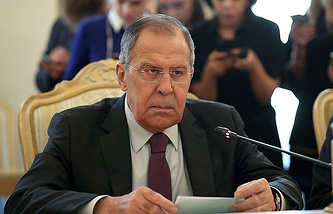
Russian FM Lavrov: Russia Fears No New Sanctions Because of Armed Confrontation With Ukraine
Pravda Report

Moscow is not worried about a probability of new sanctions that may be imposed on Russia because of the crisis in the Kerch Strait, Russian Foreign Minister Sergei Lavrov said.

"As for the sanctions. I don't know. This has not been a matter of concern for us for long already," Sergei Lavrov said.

He also noted that the incident in the Kerch Strait was "obviously a provocation" that was arranged upon the approval from the Ukrainian administration. The Foreign Minister added that the ships of the Ukrainian Navy violated key provisions of international law, while their actions posed threats and risks to the normal movement of ships.

See more at http://www.pravdareport.com/news/world/ussr/ukraine/26-11-2018/142055-russia_ukraine_crisis-0/


Russia warns Ukraine and its Western sponsors

Russia will continue suppressing attempts to undermine its security and sovereignty, a statement from the Russian Foreign Ministry said in connection with the incident with the vessels of the Ukrainian Navy in the Kerch Strait.

"We would like to warn the Ukrainian side that the line, which Kiev is running in coordination with the US and the EU to provoke a conflict with Russia in the waters of the Azov and Black Seas is fraught with serious consequences," the statement said.

In addition, Moscow officially accused Kiev of provocation. The goal of this act is to create a new hotspot of tension and a find another pretext to impose more sanctions against Russia. The Kiev authorities also try to distract the general public from domestic political issues.

In addition, Russia demands punishment for the radicals who attacked Russian diplomatic missions. Earlier, Russian Foreign Minister Sergei Lavrov called on Western sponsors of the Kiev regime to calm down those who try to gain political weight from military hysteria in connection with upcoming elections.

See more at http://www.pravdareport.com/news/russia/politics/26-11-2018/142059-war_russia_ukraine-0/
Election Ploy? Poroshenko Declares Martial Law in Ukraine After Kerch Standoff
27 Nov, 2018 03:46
Rt.com

Ukraine has declared martial law following a minor skirmish with Russian ships in the Kerch Strait.

But why would Kiev take such a dramatic move now, five years after declaring itself at war with Russia?

Western headlines are once again sounding with warnings about “Russian aggression” after Russian ships opened fire on three Ukrainian military vessels attempting to cross the Kerch Strait on Sunday. Moscow says the vessels failed to notify of their intent to cross as required, and even denied having that intent on the night before. The Kerch Strait connects the Black Sea and the Azov Sea and separates Crimea from the Russian mainland.

The incident, which saw the Ukrainian ships detained and some sailors treated for injuries, was quickly framed as Russian aggression by many pundits and prompted vows of support for Ukraine from European Union officials. As always with mainstream Western coverage of Russia and Ukraine, it’s worth looking a bit more closely to decipher what parts of the story are being left out or sidelined.

Kiev responded swiftly to the Kerch Strait incident, with President Petro Poroshenko announcing that a period of martial law would be imposed. He also claimed that a “serious threat” of “ground invasion” now exists, citing a “secret” document.

Curious timing?

It’s important to remember that this dramatic move of declaring martial law was not even considered in 2014 and 2015, during the bloodiest periods of fighting in eastern Ukraine. Though Poroshenko was claiming at the time that thousands of Russian troops and hundreds of Russian tanks had invaded his country, that still didn’t merit imposing martial law.

Yet now, in response to a relatively minor incident, by comparison, Kiev has decided to take that step. As such, the most important question being raised by analysts skeptical of the narrative from Kiev is, why?

The answer many are coming up with is simple but highly plausible: The standoff between the Ukrainian and Russian ships could have been a planned provocation – a domestic ploy aimed at swinging a potentially unwinnable election.

Ukraine is set to hold elections early next year and the incumbent Poroshenko is performing dismally in the polls at just eight percent, trailing opposition politician and former prime minister Yulia Tymoshenko – and even a famous comedian who has not actually confirmed his candidacy.

Indeed, it is a well-known fact worldwide that being in a state of war helps engender support for the powers that be as they vow to protect the country from outside threats. Originally, Poroshenko had suggested a 60-day period of martial law, but facing public outcry over the effect this could have on the planned March elections, the president capitulated and recommended that lawmakers vote to support a 30-day period.

Conveniently, martial law grants great powers to the government of Ukraine to limit civil freedoms, including the freedom of the press and freedom of assembly. In practice, this would mean that a news publication or TV station could be shut down if the government decided it was a threat to national security. It also allows authorities to ban peaceful protests and any other mass action it deems a threat. Kiev could even restrict travel for Ukrainians, banning them from leaving the country altogether.

Another suggestion has been that Poroshenko is trying to engage the sympathies of the West ahead of the G20 summit, which is to be held in Argentina this week – and perhaps even to derail a planned meeting between US President Donald Trump and Russian President Vladimir Putin.

But honestly idk. All I’m saying is we shld all be v careful before calling conclusions as clearly lots of moving parts here.

Resorting to such drastic measures ahead of an election might be the surest sign yet that Poroshenko knows his presidency has been a failure. In 2013, the Euromaidan protests were depicted as a liberating movement to oust autocrat Victor Yanukovich with his “dictatorial laws,” suppression of the press and riot police patrolling the streets. Five years on, with Ukrainians now amongst the poorest in the world while corruption reigns supreme, Poroshenko appears to be grasping at his waning power, using every trick in a dictator’s playbook as the West turns a blind eye.

Poroshenko’s entire campaign is based on support for the Ukrainian military. His campaign slogan is “Army, Language, Religion” – so it would be little wonder that he might use some kind of military provocation as a last-ditch effort to score some political points.