Saturday, July 30, 2022

Chinese FM Stresses to Promote Genuine Multilateralism, Oppose Propagation of False Narrative of 'Democracy Against Authoritarianism' at SCO

By Global Times

Jul 30, 2022 12:37 PM

The Shanghai Cooperation Organisation (SCO) member countries should resolutely promote genuine multilateralism, advocate the common values of all mankind, and work to improve global governance, and oppose the false narrative of "democracy against authoritarianism," Chinese State Councilor and Foreign Minister Wang Yi said Friday.

Propagating the false narrative of "democracy against authoritarianism" and creating rifts in the international community undermines the existing international order, legitimate rights and interests of most countries, Wang said at a meeting of the SCO in Tashkent, the capital of Uzbekistan.

Wang suggested that SCO member countries step up multilateral coordination and cooperation, reject unilateral sanctions and "long-arm jurisdiction," and defend the shared interests and development space of emerging markets and developing countries.

Wang wraps up his two-day attendance of the SCO on Friday. During the meeting, Wang also pointed out that as the international community is faced with the arduous task of development and stability, we must uphold the Shanghai Spirit, work together and help each other to build a closer SCO community with a shared future.

In terms of seeking sustainable development, Wang suggested to pursue people-centered development, carry out more cooperation projects that are sustainable and beneficial to people's well-being, and deepen high-quality Belt and Road cooperation.

Wang proposed to draw up a road map for expanding the settlement in national currencies to provide better financial services for cooperation on major projects.

The SCO countries should cement solidarity and coordination, and support each other on issues of core interests and major concerns to create a sound environment for the development and revitalization of countries in the region, Wang stressed.

At the meeting, Wang also denounced the disinformation campaign by some countries clamoring "forced labor" in China's Xinjiang region.The SCO members suffered the keenly felt pain of interference by external forces. We should learn from the history and oppose any attempts to interfere in other countries' domestic affairs, instigate "color revolutions", and subvert legitimate state power, Wang noted.

China will take the hosting of the SCO prime ministers' meeting in November this year as an opportunity to promote the coordinated and efficient development of the regional economy.

The SCO should include more observer states and dialogue partners while accepting new members, Wang noted.

Iran's accession to the full membership of SCO will be finalized by April 2023, the Iranian Embassy in China told the Global Times in an earlier interview.Last year, the SCO summit approved Egypt's SCO dialogue partner status. China also supports Belarus' application for membership of the SCO, and is willing to actively study and make a decision together with other member states over its accession, Foreign Ministry spokesperson Zhao Lijian said on Tuesday.

Global Times

Friday, July 29, 2022

Algeria, Niger & Nigeria Move to Next Step on the Trans-Saharan Gas-Pipeline Project

The Krechba gas plant on the In Salah gas field in Algeria's Sahara Desert, some 1,200 kilometers south of Algiers, on Dec. 2008.

Africa News

Algerian, Nigerien and Nigerian Energy Ministers signed on Thursday a memorandum of understanding (MoU) for the construction of a 4,000 gas pipeline across the Sahara Desert that will supply Europe with additional gas, the Algerian news agency APS wrote.

The Trans-Saharan Gas-Pipeline (TSGP), should send billions of cubic meters of Nigerian gas to Algeria via Niger. Algeria will then send it to the countries of the European the gas, via the Transmed which connects the country to Italy through Tunisia, and LNG (liquefied natural gas) transported by tankers.

The Algerian Minister of Energy and Mines, Mohamed Arkab, and his counterparts from Nigeria, Timipre Sylva, and Niger, Mahamane Sani Mahamadou, co-signed the memorandum of understanding in Algiers during a 3rd tripartite meeting. They first discussed aspects of the project including the status of progress, according to APS. For the moment, no indication has been given as to when the project will be completed.

When the project was launched in 2009, the investment cost of the Trans-Saharan Gas-Pipeline (TSGP) was estimated at 10 billion dollars. The pipeline spanning 4,128 km of which 1,037 km are in Nigeria, 841 km in Niger and 2,310 km in Algeria, will connect the gas fields of Nigeria, through Niger, to the Algerian border to connect to the Algerian network.

The TSGP will also allow on its way the supply of the regions of the Sahel countries. This project has been reactivated in a geopolitical context marked by strong international demand for gas and oil and a surge in prices, after the war in Ukraine erupted late February.

The North African country, whose proven natural gas reserves amount to nearly 2,400 billion m3, supplied around 11% of the gas consumed in Europe before the war in Ukraine, compared with 47% for Russia. It is the first African exporter of natural gas and the 7th in the world.

Angola's Campaigns Gain Momentum as Political Parties Call for Peace

Political campaigns are hitting the ground with more supporters showing up in Angola

Africa News

The first week of the election campaign in Angola went more smoothly. The political tensions of the pre-election period dropped considerably and the tone of the candidates has also become more positive.

This is the analysis of Luís Jimbo, from the Angolan electoral observatory.

"This one week that is now running of the official electoral campaign, and the pre-campaign atmosphere that had been launched by the political parties, this one is more peaceful so far, compared to the previous period. Also, the civic conscience of the citizenry is demanding that the candidates bring messages of what they want to do for the country," said Luís Jimbo, Angolan Electoral Observatory.

"The candidates are focusing on electoral promise and this is fundamental because at the beginning they tried to dodge this issue. They made it a personal attack, to attract more followers," added Jimbo.

This is a stance taken also by political parties, as the main opposition party explained to Euronews.

"We've learned that you can't win in turbulence, you can only win in serenity. So we are helping to serenade the political environment. It's true that here or there is always one or another incident but even so I consider the political environment quite serene," said Nelito Ekuikui, UNITA opposition party.

The ruling MPLA has also urged its supporters to avoid practices that taint the electoral process.

The tense moments will persist until the August 24 elections as evidenced by the refusal of an opposition march this Saturday in Luanda with authorities and promoters fencing off divergent arguments.

Richer Nations Fall Short on Climate Finance Pledge

By WANJOHI KABUKURU

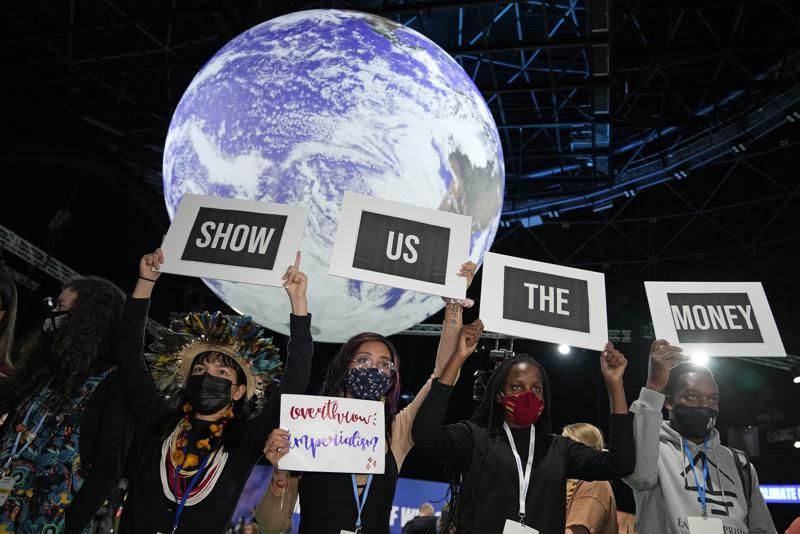
FILE - Climate activist Vanessa Nakate, second right, and other activists engage in a 'Show US The Money' protest at the COP26 U.N. Climate Summit in Glasgow, Scotland, Nov. 8, 2021. Richer countries failed to keep a $100 billion-a-year pledge to developing nations to help them achieve their climate goals, according to an analysis by the Organization for Economic Cooperation and Development, or OECD, released Friday, July 29, 2022. (AP Photo/Alastair Grant, File)

Richer countries failed to keep a $100 billion-a-year pledge to developing nations to help them achieve their climate goals, according to an analysis by the Organization for Economic Cooperation and Development, or OECD.

$83.3 billion in climate financing was given to poorer countries in 2020, a 4% increase from the previous year, but still short of the proposed goal. The United Nations-backed payment plan was first agreed in 2009 to help poorer nations adapt to the effects of climate change and reduce emissions.

The pledge, which was originally set up as an annual commitment from its inception until 2020, has never been fulfilled.

“We know that more needs to be done” to address the shortfall, admitted OECD Secretary-General Mathias Cormann.

Who pays for tackling and adapting to climate change has been a key sticking point between richer nations and poorer ones since international climate negotiations began 30 years ago.

Harsen Nyambe, who heads the African Union climate change and environment division, told the Associated Press the continent will continue to put pressure on richer nations to ensure the $100 billion-a-year agreement is fulfilled. He added that the funds will give the continent better access to required technology and will help nations transition to green energy in a fair way.

But others believe that after decades of unmet promises, it’s unlikely that richer countries will start to step up.

“They do not have the money. They are over-committed with issues such as Ukrainian crisis and that is why they have been unable to meet any of their pledges,” said Godwell Nhamo, a climate research professor at the University of South Africa.

“Africa should move on and find other sources of funding,” he added.

A report released by the British charity Oxfam in 2020 warned that the recent increase in funding came in the form of loans, not grants, with climate-related loans increasing from $13.5 billion in 2015 to $24 billion in 2018. The charity said at the time that reaching the $100 billion goal in this way “would be cause for concern, not celebration.” It’s unclear whether the latest year-on-year increase in climate funding came in the form of loans or grants.

In recent years, climate financing has helped fund greener energy and transport sectors for poorer nations, as well as adaptation measures for the agriculture and forestry industries which are threatened by land degradation, according to the OECD. ___ Associated Press climate and environmental coverage receives support from several private foundations. See more about AP’s climate initiative here. The AP is solely responsible for all content.

Mali Issues International Warrant for Ex-prime Minister

By BABA AHMED

BAMAKO, Mali (AP) — Mali’s Supreme Court prosecutor has issued an international arrest warrant for ex-Prime Minister Boubou Cissé and several other ministers of the former government of Ibrahim Boubacar Keita, who was overthrown by the military junta in August 2020.

The move likely is being made to prevent these political figures from being candidates in presidential elections scheduled for February 2024.

The warrant, announced late Thursday, is dated from Monday and includes Cisse, as well as the former finance minister, minister of national defense and others.

The statement signed by Attorney General Mamoudou Timbo says the Supreme Court of Mali is looking for these politicians in the context of “the opening by the Investigating Chamber of the Supreme Court of Mali of a judicial inquiry into facts qualified as crimes of forgery and use of forgeries, damage to public property and complicity in these offenses.”

These former ministers are now living in exile in Niger and Ivory Coast, two countries which have tense relations with the transitional government.

Cisse was held by the junta when they overthrew and detained former president Keita. He was then released, re-arrested some months later on accusations of an attempted coup and then released again for an error in the procedures for his arrest.

Thursday, July 28, 2022

Event Held with Splendor to Mark 69th Anniversary of the DPRK Great War Victory

Respected Comrade Kim Jong Un Makes Significant Speech

Amid the vigorous advance to open up the broad avenue for socialist victory under the guidance of the ever-victorious Workers’ Party of Korea, the civilians and servicepersons of the DPRK are significantly celebrating the 69th anniversary of the victory in the great Fatherland Liberation War with the high pride of heroic Korea and the heroic people which have been glorified century after century.

A grand celebration event took place in front of the Monument to the Victorious Fatherland Liberation War in the capital city of Pyongyang when the whole country is overflowing with a firm faith and will of the people to succeed as blood vessel the fighting spirit and tradition of victory, the revolutionary legacy bequeathed by the heroic generation of war veterans, and accomplish the revolutionary cause of Juche without fail on the occasion of the great war victory day that provided an eternal foundation for all victories in the development course of the glorious Democratic People’s Republic of Korea.

Kim Jong Un, general secretary of the Workers’ Party of Korea and president of the State Affairs of the DPRK, attended the celebration event.

The grand place for education in victory tradition, where imposingly stands the main statue of victory representing the dignified appearance of heroic Korea that pronounced for the first time in history the shameful destruction on the US, the chieftain of the world’s imperialism, was filled with delight and passion of all the participants who are to significantly commemorate the great war victory day as a grand festival of glory and succession with Kim Jong Un in attendance.

A ceremony of the commemorative event was held.

The central military band of the Ministry of National Defence made different formations to the tune of revolutionary military songs full of the fighting spirit and members of the honour guard of the KPA showed dexterity with rifles.

Then paratroopers and combat flying corps demonstrated their skills.

A paratrooper dropped at an altitude of 1 200 metres, released a control parachute and threaded the nocturnal sky with a dazzling flower presenting to the defenders of the country in the great years of war victory.

The participants warmly applauded the paratrooper solemnly flying in the sky of July the sacred flag of the Republic, which the heroic soldiers, sung and unsung, defended with blood and handed down by sacrificing even their families, love, dreams, hope, youth and lives to bring about the victory of July 27.

Combat pilots of the KPA air force units, which were awarded the guard unit title with military merits for opening the way to a charge for southward advance earlier than other units during the Fatherland Liberation War, began demonstrating their aviation skills.

The participants raised cheers of admiration at the flying corps letting off fireworks of celebration and respect in the nocturnal sky on the war victory day while displaying such aerial combat flying movements as zero flights, vertical zooming and spiral climbs blowing off shower of fire.

Light melodies, dynamic rhythms and seasoned dropping and flying skills colorfully decorated the prelude of the commemorative event, indicating that during 1 129 days of the Fatherland Liberation War the service personnel and civilians of the DPRK performed great feats unprecedented in the world war history, created the centuries-old war victory myth and crowned the proud name of their country and national flag with the laurels of a full-fledged world power status, under the guidance of the great leader, the peerlessly brilliant commander.

The respected General Secretary Kim Jong Un and his wife Ri Sol Ju appeared at the event venue together with war veterans amid the playing of the welcome music.

All the participants burst into stormy cheers of “Hurrah!”, looking up at Kim Jong Un, symbolic of all victories and glory of our Party and state, who has put Juche Korea on the zenith of the times despite the unprecedented hardships, making a great history of victory to be immortal for all ages of the nation to come.

Kim Jong Un and Ri Sol Ju were presented with bunches of fragrant flowers by members of the Children’s Union.

Kim Jong Un warmly waved back to the enthusiastically cheering participants, extending warm greetings to the war veterans across the country and all other people on the war victory day.

Invited to the event were war veterans including Choe Yong Rim, Thae Jong Su, Ri Myong Su, An Sim, Kim Kyong Ok, Kim Si Hak and Ri Kil Song.

Attending it were cadres of the Party and the government together with lecturers in the sector of administration of revolutionary relics associated with the victorious war, students of revolutionary schools, university students, officials of ministries and national agencies and Pyongyangites.

Also present were senior officials of the Ministry of National Defence, commanders of the services, military and political commanding officers of large combined units and combined units and other officers and men of the Korean People’s Army.

There was a ceremony of hoisting the national flag.

Members of the honour guard of the Korean People’s Army solemnly entered the venue to the tune of the song Our National Flag, upholding the DPRK flag.

Amid the solemn playing of the DPRK national anthem, the sacred national flag was slowly hoisted up to the nocturnal sky of the war victory day.

Kim Jong Un made a significant speech commemorating the war victory day.

His speech greatly stirred up the hearts of all the participants as it was pulsating with warm love, respect and noble moral obligation toward the great revolutionary generation who honorably defended the glorious fatherland and provided an ideological and moral asset making our revolution always emerge victorious through generations to come and with the solemn declaration of the will to display forever the most dignified and independent powerful country of the people, provided at the sacrifice of forerunners, to the whole world.

When he concluded the speech, thunderous cheers of the victorious wartime generation and their descendants rocked the sky and the earth again.

The event venue was overflowing with conviction that the future of socialist Korea will be eternally bright and rosy as it is led by Kim Jong Un, who has wisely led the work to give steady continuity to the Republic’s history of war victory as the ever-victorious history, implanting in the minds of our people and servicepersons the spirit of the 1950s as golden letters.

Amid the enthusiastic cheers, the display of spectacular fireworks started.

Fireworks were gorgeously displayed in the sky over the immortal statue of Victory and other group sculptures of the heroic fighters as if they were congratulatory bouquets presented to the victorious wartime generation who created a new history of building a prosperous country by successfully following the tradition of the anti-Japanese war.

Fireworks continued to be set off amid the playing of songs dedicated to war victory associated with the ardent desire and will to bring earlier a fresh victory of Korean-style socialism true to the noble soul of forerunners, more warmly implanting the immutable truth that all victory and glory are in store on the road of faith advancing unyieldingly by dint of great ideology and unity.

The fireworks depicting the flag of the Republic and the Hero Medal and letters “Long live July 27, the day of great war victory” were also displayed in the sky, reflecting the noble tribute the motherland and the descendants pay to the heroic soldiers in the war.

A unique performance began to commemorate the great V-Day.

Put on the stage were wartime songs and pieces of popular music echoed as songs of struggle and faith in the annals of victory.

Singing the song Song of National Defence, the first wartime song that all the Korean people sang loudly while volunteering to the front and advancing to smash the enemy at the beginning of the war, and other songs of death-defying resistance created in the flames of the war, the performers highly praised the legendary feats of the defenders of the country who repelled the invasion by the US imperialists and won the victory unprecedented in history, united around President Kim Il Sung with one mind and purpose.

When the sacred image and recorded rotund voice of Kim Il Sung making a historic radio speech to arouse the whole country to the sacred war for the defence of the country and those of his announcing the victory of the Korean people at the military parade venue celebrating the victory in the war were shown and played, the audience broke into stormy applause as a token of their boundless reverence for him, the peerlessly brilliant commander who worked military miracle of the 20th century at the forefront of the confrontation with the US with his distinguished military idea and theory, superb strategy and tactics, great pluck and ardent love and trust.

The stage was full of respects to the war victors who saved the destiny and future of the country by smashing an A-bomb with a rifle and handed down the great fame and honor of being heroic Korea and heroic people to the coming generation. Put on it in succession were For My Only Motherland and other songs telling the noble spirit and soul of the generation of war victors.

Amid the playing of the song My Life recalling the worthwhile memoirs and pride of the great history of war victory, the stage gigantic screen showed the images of anti-Japanese revolutionary fighters and veterans of the DPRK armed forces organs who performed immortal feats on the sacred road for developing the revolutionary armed forces.

The performance reached its climax with the narrative poem Warriors’ Soul which reflected the respects to the victorious wartime generation who turned the war, the worst disaster, into the most sacred glory of war victory.

The audience was deeply moved by the narrative poem reflecting the solemn pledge of the successors to steadily write a history of war victory in the new century, a heroic epic of the indomitable nation of war victory, at the cost of their blood and sweat to be proud of in the world, with the absolute faith that victory is always in store for our people and the DPRK as long as they carry forward the great heroic spirit of the defenders of the country in the 1950s.

They enthusiastically applauded the programs full of the will to reliably carry forward our idea and social system and valuable tradition of victory, defended by the first defenders of the Republic at the cost of their blood, through generations and develop the sacred motherland into the more powerful and the most powerful country, which eternally prospers, to be recorded in history.

The performers also sang Battle Song of the Chinese People’s Volunteers dealing with the military merits of the excellent sons and daughters of the Chinese people who fought shoulder to shoulder with the Korean people in the same trench of the war against the imperialists’ invasion.

The performance redoubled the people’s readiness to be eternally strong and victorious holding higher the banner of self-sustenance and self-development under the leadership of Kim Jong Un for building a wealthy country with a powerful army in which the first and second generations of our revolution preciously pictured in the flames of the war and for getting the absolute prestige of socialist Korea which no formidable enemy in the world dare provoke. The performance ended with Tell, Fireworks of War Victory and July 27, Our Victory Day, the songs in praise of the war victory in the era of the Workers’ Party.

Again jubilant fireworks were set off to decorate the nocturnal sky of the holiday beautifully.

Kim Jong Un warmly took the hands of war veterans following him step by step, expressing the conviction that the victory traditions and fighting traits of the great years would become a good sustenance for bringing up our people and younger generation to be indomitable patriotic fighters and an inexhaustible source for giving steady birth to new victories and miracles.

The commemorative event, which adorned the 69th anniversary of the great war victory with glee, was a significant occasion that demonstrated the steadfast faith and will of all the people and service personnel across the country to exalt the brilliance of the country as a thriving power of Juche to be admired by the world under the guidance of the great Party Central Committee, with the invincible truth taught by the July 27 miracle, the great victory of the anti-imperialist, anti-US struggle which will be immortal in the history of the country as the powerful driving force of the revolution.

2022-07-28

DPRK Veteran Writer Sin Huong Gyu

Sin Hyong Gyu, a war veteran living in Omgon-ri, Anak County, South Hwanghae Province, was completing his manuscript through the whole night until daybreak.

Seeing the thick manuscript introducing the victors who fought bravely against the enemy in the Fatherland Liberation War (June 25, 1950–July 27, 1953), he looked back upon the days of the war.

Now the writer is nearing 90, but he was 17 at the beginning of the war.

During his middle school days, he conducted the chorus of his school. And when he joined the Korean People’s Army just after the war broke out, officers and soldiers called him “a little conductor.”

He was pretty good at leading military song of his unit and he was believed to become an excellent musician in the future. However, there was an opportunity when his hope suddenly changed though he had always cherished it in his mind even in a hail of bullets and gunfire.

His company suddenly encountered the enemy during a march on a pass. He, light machine gunner, lost his assistant. The assistant covered a sudden grenade with his body before anyone else to save fellow comrades-in-arms. He couldn’t go to sleep that night.

Thinking of the assistant who devoted his young life to the country and comrades, he was obsessed by the thought that he had to inform the assistant’s death to his home. And he wrote a letter to the assistant’s home, recalling his death. But he couldn’t complete the letter since he and others didn’t know the assistant’s address.

One day, he read a poem on the trench journal. No matter how it was short, the poem touched him greatly. A young soldier, the hero of the work, made him remember the assistant.

Well, I will do writing. By doing so, I will inform the news about soldiers’ struggle including the assistant to their homes and people in the rear, he thought.

This was how he began to write poems.

After a while, his first poem was carried by the trench journal. Dealing with his real experience, his simple poem was widely spread, causing a great sensation among officers and soldiers. Then, he was struck by a subconscious desire to become a writer.

After the victorious war, he studied at Kim Il Sung University and became writer to produce a large number of works reflecting the reality of the country seething with postwar rehabilitation and great Chollima upsurge.

Visiting his alma mater one year, he told its teaching staff and students his experiences when he participated in the Battle in Mt Phalgong after crossing the Raktong River during the war.

His story caused a great sensation among students. Students to be graduated soon volunteered to join the Korean People’s Army. Like this, the unforgettable stories of the war exerted great influence upon the growth of rising generations.

He thought: I will go on writing. During the war, I made a decision to do it for fallen comrades-in-arms but now I will devote all my energy and passion to implanting noble soul and spirit of the victorious wartime generation deeper into the minds of rising generations.

He produced manuscripts written about the heroic KPA service personnel in battles during the war including the battle of Osan in which they defeated the US imperialists for the first time, day after day.

His works in various forms including medium-length verse novel A Hero in Osan and medium-length note A Veteran’s Letter to His Alma Mater were widely read by people.

To mark this year’s Victory Day, he completed another work.

Since he can never forget the three-year bloody war, he is going on writing, a new order given by himself.

2022-07-28

Telling History of the DPRK Great War Victory

At the Victorious Fatherland Liberation War Museum

The Victorious Fatherland Liberation War Museum, which stands on the bank of the picturesque Pothong River in Pyongyang, is dedicated to undying exploits of President Kim Il Sung, who led two revolutionary wars against the US and Japanese imperialists to victory, and Chairman Kim Jong Il, who achieved one victory after another in the war to defend socialism.

Renovated in July 2013 marking the 60th anniversary of the victorious Fatherland Liberation War, the museum covers a total area of 93 000 square metres and boasts of architectural beauty and excellent formative and artistic quality.

Housing the colour statue of President Kim Il Sung in its entrance hall, the museum displays historical materials related with outstanding exploits the President performed in defeating US imperialism, who had been boasting of being the “strongest” in the world, according to the operational stages and periods of the Fatherland Liberation War and maintaining the principle of fidelity to historical truth.

It serves as an educational base for instilling in the working people from all walks of life and youth and students the heroic spirit of the preceding generations.

Historical materials, weapons and combat equipment from the days of the war on display in the rooms and halls of the museum, and sand tables, dioramas, wax replicas, and photos showing the struggle and life of the soldiers of the Korean People’s Army and the people in the rear during the war help understand the situations of those days, ennobling spiritual world and unparalleled bravery of the defenders of the country, and vicious moves, atrocities and defeat of the US imperialists and south Korean puppets who provoked the war.

There are also halls dedicated to the anti-Japanese armed struggle and the building of the regular armed force, which show the origin of the ever-victorious history of Juche Korea and the course of building the Korean People’s Army after Korea’s liberation (August 15, 1945).

And the hall dedicating to the leadership of Chairman Kim Jong Il over the revolutionary armed forces shows comprehensively brilliant exploits of the Chairman who won victory after victory in the anti-imperialist, anti-US showdown to defend the country, the people and socialism.

2022-07-28

DPRK Women’s Union Officials and Members Hold Oratorical Meeting

An oratorical meeting of the officials and members of the Socialist Women’s Union of Korea took place at the Hall of Women on July 26 in celebration of the 69th anniversary of victory in the Fatherland Liberation War.

It was attended by Kim Jong Sun, chairwoman of the Central Committee of the SWUK, and officials and members of the women’s union in Pyongyang.

In the meeting the speakers praised highly the undying exploits for victory in the war of President Kim Il Sung who brought about brilliant victory and demonstrated the dignity and mettle of the heroic Korea by arousing the entire Party, the whole army and all the people to the sacred struggle for defending the country against the imperialist aggressors.

2022-07-27

DPRK Trade Union Members Have Roundtable Talk with War Veterans

Members of the General Federation of Trade Unions of Korea had a round-table talk with war veterans at the Masudae Art Theatre on July 26 in celebration of the 69th anniversary of victory in the Fatherland Liberation War.

Pak In Chol, chairman of the Central Committee of the GFTUK, first warmly congratulated the war veterans celebrating the holiday of victory in the war significantly under the benevolent care of the respected Comrade Kim Jong Un who projects them as the admirable heroes of the nation and genuine patriots.

At the talk, the combat stories telling the ennobling ideological and mental world and matchless heroic feats of the service personnel at the front who were boundlessly loyal to the call of their leader during the Fatherland Liberation War touched the heart of the participants.

War veteran Ri Ung Ho said that the defenders of the country in the 1950s could defeat the US imperialists mercilessly, which boasted of being the “strongest” in the world, and have the honour of victors as they fought to the last with an unwavering faith that they were sure to win victory in the war as long as they were led by President Kim Il Sung.

Kim Kyong Wan, defender of Height 1211 who had worked long in the art sector of the People’s Army after the war, recollected with deep emotion that frontline concerts held at the burning heights inspired indomitable fighting spirit and valour to the service personnel, and struck fear of death into the enemy.

And Kim Hyon Wan and Kim Pok Son told about the feats of their comrades-in-arms who displayed their extraordinary courage in the battles to defend Inchon and Seoul and in the battle of Height 854.1, which gave a deep impression to the participants.

The veterans asked all the officials and members of the trade union to be fully charged with the spirit of defending the country and the revolution in the 1950s, firmly believe in and follow the respected Comrade Kim Jong Un, and fulfil their honourable mission and duty as the eldest son of the country and vanguard in the sacred cause of achieving prosperity of the country.

2022-07-27

SACP Congratulates Banyana Banyana on WAFCON Victory, Reiterates Call on Morocco to End its Colonial Occupation of Western Sahara

24 July 2022

The South African Communist Party congratulates the South African Women's senior national football squad, Banyana Banyana, for winning the Women's African Cup of Nations (WAFCON). Banyana Banyana beat Morocco 2-1 in the WAFCON final played on Saturday 23 July 2022.

Banyana Banyana's victory proves yet again that women can achieve far more than the stereotypical notions that have limited them and unite an entire nation and generate a true spirit of patriotism.

South Africa should build on the victory by Banyana Banyana to advance more professional development of women’s football and other women’s sport. This should be widened to reach all areas in the country, needless to mention rural areas.

The victory of Banyana Banyana over Morocco further resonates with peace-loving South African people, against Morocco’s colonial occupation of Western Sahara. As the SACP, we reiterate our solidarity with the people of Western Sahara against the occupation of their country by Morocco. We call on Morocco to end its occupation of Western Sahara with immediate effect, unconditionally.

The people of Western Sahara have the right to self-determination, democratic sovereignty and participation in international activities like football and other sport codes, men and women. As long as Morocco occupies Western Sahara, the people of Western Sahara, women and men alike, cannot freely participate in international sport. By occupying Western Sahara, Morocco is violating the rights of the people of Western Sahara and deprives them of their rightful place in international activities such as sport.

ISSUED BY THE SOUTH AFRICAN COMMUNIST PARTY | SACP

EST. 1921 AS THE COMMUNIST PARTY OF SOUTH AFRICA | CPSA

1921–2021: 100 YEARS OF UNBROKEN STRUGGLE

PUT PEOPLE BEFORE PROFIT

SOCIALISM IS THE FUTURE—BUILD IT NOW!

Solly Mapaila, the SACP General Secretary

FOR INTERVIEW ARRANGEMENTS, MEDIA LIAISON & CIRCULATION SERVICES

Hlengiwe Nkonyane

Communications Officer:

Media Liaison, Multimedia & Digital Communications Platforms Co-ordinator

Mobile: +27 79 384 6550

OFFICE & OTHER CONTACT DETAILS Office: +2711 339 3621/2

Twitter: SACP1921

Website: www.sacp.org.za

Facebook Page: South African Communist Party

SACP Denounces the Highest Interest Rate Hike in Two Decades

22 July 2022

The South African Communist Party (SACP) denounces the decision by the South African Reserve Bank’s five-member Monetary Policy Committee to increase the country’s already high interest rate compared to many countries. On Thursday, 21 July 2022 the Reserve Bank increased the repurchase rate by 75 basis points. This raised the repurchase rate from 4,75 per cent to 5,5 per cent, compared to Australia (1,35 per cent), Britain (1,25 per cent), Denmark (–0,45), Japan (–0,1 per cent), the United States (1,75 per cent), Norway (1,25 per cent) and many other countries. The highest repurchase rate hike by the Reserve Bank in 20 years, since 2002 when the repo rate was hiked by 100 basis points, brings the prime rate to 9 per cent.

It is said the sky-rocketing interest rate hike in 20 years underlines the Reserve Bank’s determination “to tame rampant inflation and also signalling an acceleration in the pace of interest rate hikes” (Business Day, 21 July 2022: “Reserve Bank signals sharper rate hikes ahead as it confronts inflation”). This anti-people conservative monetary policy direction will negatively affect the national imperative to achieve inclusive economic growth by raising the cost of borrowing and capital.

With COVID-19 restrictions relaxed across the world, some social protection programmes that were adopted at the height of the pandemic have been withdrawn in many situations across the world. In our country, those affected include the millions who the South African Social Security Agency did not pay the Social Relief of Distress Grant after April 2022 following changes to the eligibility regulations for the grant or as a result of a failure to pay the grant. This negatively impacts local demand. At this moment, South Africa should move decisively towards a comprehensive social security, including a universal basic income grant.

Interest rate hikes that further suppress local demand as if it had not been affected already by a wide range of factors like the aftermath of the COVID-19 pandemic in the current reality amount to firing blanks at inflation.

For South Africa to build national production, we need an accommodative interest rate policy that supports the productive sector.

Besides, the major underpinnings of the unfolding global cost of living crisis that mostly affects the workers and poor, with those deprived of access to the grant a typical example, is largely driven by exogenous factors—i.e., factors with an external origin and drivers.

For instances, the NATO-provoked war in Ukraine and NATO’s extraterritorial sanctions not only against Russia but also against Venezuela and other countries are in no small measure contributors to the global cost of living crisis. The crisis is also hitting imperialist countries like Britain (Lancet, www.thelancet.com/public-health Vol. 7 June 2022: “The cost of living: an avoidable public health crisis”).

In the energy sector, Russia is the world’s major gas and third oil producer, while Venezuela has the world’s largest proven oil reserves and is an oil producer of note. The extraterritorial sanctions by the United States-dominated NATO are a key driver of high oil prices and increases. The increases in oil and related fuel prices culminate in increased production and transport costs, which culminate, through the pricing mechanism, in increases in the prices of consumer goods and services.

Another major contributor to the global cost of living crisis is the breakdown of global production networks and supply chains by the NATO-provoked war in Ukraine and by NATO’s extraterritorial sanctions.

The global cost of living crisis is also driven by the capitalist system through its profits before people and profits before the environment accumulation regime. It is this that underpins the problem of climate change, which negatively impacts food production and contributes to rising food prices.

ISSUED BY THE SOUTH AFRICAN COMMUNIST PARTY | SACP

EST. 1921 AS THE COMMUNIST PARTY OF SOUTH AFRICA | CPSA

1921–2021: 100 YEARS OF UNBROKEN STRUGGLE

PUT PEOPLE BEFORE PROFIT

SOCIALISM IS THE FUTURE—BUILD IT NOW!

Solly Mapaila, the SACP General Secretary

FOR INTERVIEW ARRANGEMENTS, MEDIA LIAISON & CIRCULATION SERVICES

Hlengiwe Nkonyane

Communications Officer:

Media Liaison, Multimedia & Digital Communications Platforms Co-ordinator

Mobile: +27 79 384 6550

OFFICE & OTHER CONTACT DETAILS

Office: +2711 339 3621/2

Twitter: SACP1921

Website: www.sacp.org.za

Facebook Page: South African Communist Party

SACP Message of Deepest Condolences to Family of Revolutionary Poet, Author and Struggle Icon Don Matterra

19 July 2022

“Let the children’s bright eyes conquer the cold darkness, shine across the tortured earth.”

The South African Communist Party (SACP) conveys its message of heartfelt condolences to the family of world renowned South African poet, author and struggle icon, Donato Francisco Mattera (30 November 1935 – 18 July 2022).

The SACP also sends its condolences to the entire liberation movement, his peers in the arts and culture sector, as well as to the people of South Africa at large.

Don Mattera, as he was popularly known, experienced first-hand the well documented evils of the apartheid system. Classified by the apartheid regime as “Coloured”, he together with his family became victims of the mass evictions from the vibrant Sophiatown suburb of Johannesburg. These evictions formed part of the widespread agenda of the apartheid regime to create racial divisions and deepen its apartheid policy, further depriving African people of freedom of movement and denying them development.

While the apartheid regime’s oppressive policies severely constrained African people’s lives, Don Mattera refused to allow the oppressive regime to silence his voice. He helped to form the Black Consciousness movement and joined the ANC Youth League, using his poetry and writing skills to contribute to the struggle against apartheid. For his contribution, he was subjected to a house arrest from 1973 to 1982. The apartheid regime went on to repeatedly raid Don Materra’s home, subjected him to more detentions and torture.

In 2006, the Presidency awarded Don Mattera with the Order of the Baobab (in Gold) for his excellent contribution to literature, achievement in the field of journalism and striving for democracy and justice in South Africa.

In memory of Don Mattera, the SACP calls upon the government, as well as progressive players and business, to ensure that Don Mattera’s name, works and ideas remain in the hearts and minds of the masses, particularly young people, a group which Don Mattera was most passionate about. The SACP also calls for more government investment to further develop the creative industry, paying particular attention to progressive ideas to guarantee the sovereignty of the republic as well as the African continent.

“Let the children’s bright eyes conquer the cold darkness, shine across the tortured earth,” as Don Matterra famously said in his poem “This Child”.

ISSUED BY THE SOUTH AFRICAN COMMUNIST PARTY | SACP

EST. 1921 AS THE COMMUNIST PARTY OF SOUTH AFRICA | CPSA

1921–2021: 100 YEARS OF UNBROKEN STRUGGLE

PUT PEOPLE BEFORE PROFIT

SOCIALISM IS THE FUTURE—BUILD IT NOW!

Solly Mapaila, the SACP General Secretary

FOR INTERVIEW ARRANGEMENTS, MEDIA LIAISON & CIRCULATION SERVICES

Hlengiwe Nkonyane

Communications Officer:

Media Liaison, Multimedia & Digital Communications Platforms Co-ordinator

Mobile: +27 79 384 6550

OFFICE & OTHER CONTACT DETAILS

Office: +2711 339 3621/2

Twitter: SACP1921

Facebook Page: South African Communist Party

Website: www.sacp.org.za

BOTSWANA HITS 'HISTORIC' UN GOAL AGAINST HIV: REPORT

The country has met the so-called "95-95-95" target on HIV diagnosis, treatment and viral suppression several years early, according to a study published ahead of a global conference on the disease. 

AFP | 

JOHANNESBURG, South Africa - Botswana has become the second nation in the world, after Eswatini, to reach a landmark UN goal towards eradicating AIDS, researchers said Wednesday, in what health experts hailed as "stellar results".

The country has met the so-called "95-95-95" target on HIV diagnosis, treatment and viral suppression several years early, according to a study published ahead of a global conference on the disease.

About one in five people in Botswana live with the virus - one of the highest rates in the world - according to the UN AIDS agency (UNAIDS).

The agency wanted 95 percent of HIV-positive people to know their status, 95 percent of those diagnosed on medication and 95 percent of those under treatment to show signs that the virus is being suppressed in their blood by 2025.

But the study led by Botswana's health ministry found the country had already met or surpassed all three thresholds, with a 95-98-98 score. The global average in 2020 was 84-87-90, UNAIDS says.

"Botswana is making historic new progress against HIV," Sharon Lewin, president-elect of the International AIDS Society (IAS), told a virtual press briefing presenting the results.

The country is "well positioned to end its HIV epidemic by 2030. To put it simply, these are really stellar results."

Madisa Mine, the study's lead author and a Botswana government virologist, said the results were encouraging.

"We have translated a hopeless situation into a situation where now there is hope," he said.

Now both the government and people on medication could look forward to Botswana one day becoming an AIDS-free country, Mine added.

That was a far cry from when he started working on the disease two decades ago, and it seemed the nation was "facing extinction" due to the high number of infections.

DOABLE

The paper, which has not yet been peer-reviewed or published in a journal, was based on interviews and blood tests from more than 14,000 people aged 15 to 64.

Another southern African country, the small landlocked kingdom of Eswatini, became the first country to reach the UN target in 2020, UNAIDS says.

UNAIDS deputy executive director Matthew Kavanagh said Botswana's progress was down to a series of factors, including government investment and the rapid adoption of self-testing.

In 2002, Botswana became the first African country to offer free anti-retroviral drugs, which help contain the virus and prevent it from infecting others.

And in 2019 the country of 2.3 million people decriminalised same-sex relationships - something that Kavanagh said "has helped to get more and more people into care".

Botswana showed it was possible to rein in the disease, IAS president Adeeba Kamarulzaman said.

"It's not an easy feat. But what it shows is, it is doable with investment and political commitment, as well as communities working to deliver the needed services," she told AFP from Montreal ahead of the 24th International AIDS Conference, which opens in the Canadian city on Friday.

Globally, about 38 million people, including almost two million children, were living with HIV in 2020, and more than 600,000 died from AIDS-related illnesses, according to UNAIDS.

Eastern and southern Africa are the worst affected regions, accounting for more than half of all cases.

KENYA RUNNING MATE ORDERED TO FORFEIT $1.7 MN IN GRAFT CASE

The case highlights the endemic corruption in Kenya, where the anti-graft body last month raised "integrity" concerns about more than 200 candidates standing for various offices in the August 9 polls.

FILE: Gachagua, who in court papers said the money came from his companies' business dealings, blasted the ruling and vowed to appeal. Picture: Pixabay

AFP | 

NAIROBI, Kenya - A Kenyan court on Thursday ordered a politician running for deputy president in next month's election to forfeit almost $1.7 million that had been frozen in a corruption probe.

The case highlights the endemic corruption in Kenya, where the anti-graft body last month raised "integrity" concerns about more than 200 candidates standing for various offices in the August 9 polls.

Justice Esther Maina ruled that Rigathi Gachagua, who is presidential candidate William Ruto's running mate, had failed to explain the source of 200 million Kenyan shillings found in his bank account and should therefore surrender it to the state.

Gachagua, who in court papers said the money came from his companies' business dealings, blasted the ruling and vowed to appeal.

"The judge was biased against us from the word go and threw caution to the wind by conducting a sham trial," he said on Twitter.

Both outgoing Deputy President Ruto and his main presidential rival, former prime minister Raila Odinga, have pledged to tackle graft, but voters remain skeptical as corruption infects almost every level of society.

Kenyans will next month elect not only a new president but also several hundred members of parliament and about 1,500 county officials.

Interior Minister Fred Matiang'i said on Tuesday that banks were running out of 100 and 200 shilling notes because they were being used by politicians to bribe people ahead of the vote.

He accused the politicians of "laundering themselves" into elected institutions and voiced fears that those voted into office may not act to clean up the system.

Kenya was ranked 128th out of 180 countries on Transparency International's 2021 graft perceptions index, with the watchdog saying its fight against corruption had "stagnated".

Debt, Inflation: Crisis Looms for African Economies

The country's debt rose from $16 billion in 2013 to $71 billion in 2021. As a result, Kenya spends nearly 30% of its revenues on interest payments

By Ronald Lwere Kato

Kenyans head to the polls on August 9 amid signs that East Africa’s largest economy could be headed for tough times.

The country’s currency- the Shilling has sharply depreciated. It means Kenya's Treasury will face difficulty paying back its huge dollar-denominated debt.

The country's debt rose from $16 billion in 2013 to $71 billion in 2021. As a result, Kenya spends nearly 30% of its revenues on interest payments.

The World Bank and Eurobond holders account for nearly half of Kenya’s external debt at 28% and 20% respectively, based on data from the Treasury. China, whose loans have gone on infrastructure including the Standard Gauge Railway is responsible for 19% of Kenya's external debt.

The coronavirus pandemic hurt tourism, one of Kenya's foremost sources of foreign exchange while soaring energy prices are threatening to scuttle the recovery which began in 2021.

With global interest rates shooting up, it is going to become costly for Kenya to borrow or pay back its lenders.

Charlie Robertson is the Global Chief Economist at Renaissance Capital. He joins the show to discuss the tough decisions awaiting Kenya's new government.

Tanzania agrees credit facility with IMF

The International Monetary Fund will extend over $1bn in credit to Tanzania to help the east African country's recovery from the pandemic and effects of the war in Ukraine.

The facility, subject to the IMF board approval, will be disbursed over 40 months.

Growth slowed to 4.8% in 2020, recovering to just 4.9% the following year, as Covid-19 travel restrictions battered the tourism sector, a key source of income for Dar es Salaam.

Nigeria: State-owned oil giant NNPC becomes private entity

The move means the Nigerian National Petroleum Company (NNPC) which has existed as a state monopoly for over 50 years will open up its capital to private investment. It is also in line with a new petroleum bill passed by parliament last year, which aims to create efficiency in the country's oil sector beset by a lack of investment and corruption.

Abuja hopes that letting the company go private will reduce the government’s fiscal responsibilities to it, thus freeing up funding for other projects.

Last year, the company said it would consider listing on the stock exchange as early as 2024.

Kenya Worries About Youth Turnout at Elections

Many youth have no interest in participating in an electoral process they widely dismiss as corrupt and pointless

Africa News with AFP

As a familiar campaign jingle brings the Kenyan crowd to their feet, Hellen Atieno joins her compatriots and sways to the catchy tune at a political rally in the lakeside city of Kisumu.

Just don't expect the 23-year-old to vote. "I have only come to the rally because there is money. I hope there will be something," Atieno told AFP, referring to the widespread Kenyan practice of offering freebies to prospective voters.

Currently without a job, the former fishmonger says she is so fed up with the country's insular political class that she plans to stay home when Kenya votes on August 9 in parliamentary and presidential polls.

She is not alone. The East African economic powerhouse ranks among the world's youngest countries -- three-quarters of Kenyans are aged under 34, according to government figures.

Many have no interest in participating in an electoral process they widely dismiss as corrupt and pointless.

The number of registered young voters has dropped five percent since the 2017 poll, in contrast to over-35s, whose tally has increased, Kenya's election commission announced last month.

Over 22 million Kenyans are eligible to take part in this year's polls, with young people accounting for less than 40 percent of that number, the Independent Electoral and Boundaries Commission (IEBC) said.

'A dirty game'

Politicians have responded with a freebie bonanza, offering cash, umbrellas, shirts, caps and even packets of maize flour -- a dietary staple -- to anyone who attends their rallies.

The bribes -- an electoral offence that can attract a fine of up to two million Kenyan shillings ($17,000) and/or a six-year jail term -- are not new to Kenyan politics. But galloping food inflation -- made worse by the war in Ukraine -- and an unemployment crisis have intensified the appetite for such handouts.

According to census figures published in 2020, about five million young Kenyans were out of work.

Brian Denzel has spent recent weeks hitting one rally after another, eager to pocket the cash on offer, even though the 19-year-old butcher has no plans to vote and sees politics as little more than "a dirty game".

"Who will reject the free money that they are given?" he said, while waiting in line to collect 200 shillings ($1.70) from a local politician.

Kenya's Interior Minister Fred Matiang'i even told reporters on Wednesday that the banks were running short of 100 and 200 shilling notes "because politicians are bribing villagers".

In the months leading up to the polls, observers suggested that the youth factor could help heal Kenya's often toxic tribal politics, with a younger electorate less likely to vote according to ethnic affiliations.

Yet, although young Kenyans are less tribally-minded, they also lack "ideological steadfastness", Kisumu-based political analyst Francis Owuor told AFP.

"That conviction that normally comes with the political process is not there," Owuor said. "Everyone (is) to blame for this, both the people and the leaders, but again the leaders are the duty bearers, so they must take much of the blame."

Disillusioned

Thirty years after the emergence of multi-party democracy in Kenya, many are disillusioned by constant battles over the credibility of polls and disputed election results.

This year's presidential vote is largely a two-horse race between Deputy President William Ruto, 55, and Raila Odinga, the 77-year-old veteran opposition leader who is now backed by the ruling party.

If both leaders accept the results, it will be a first for the country since 2002.

Amina Soud, manager for voter education at the IEBC, told AFP the election watchdog was "worried" by the increasing indifference shown by young people towards the political process.

"We did a lot of mobilization during registration using all these tools and still voter apathy was too high," Soud said, referring to the IEBC's social media push to enlist new voters.

But exhorting youth to vote via campaigns on TikTok or comics in Sheng -- a local slang popular with urban youth -- does little to offer hope to a generation of Kenyans facing runaway inflation, corruption and unemployment.

"I don't think I am going to vote," 27-year-old salon owner Irene Awino Owino told AFP. "I have no interest, because the government puts themselves first rather than us."

Candidates Hold Final Rallies Ahead of Senegal's Legislative Elections

Voters prepare for legislative elections in Senegal, 19 months before presidential vote

Africa News with AFP

The Senegalese elect their deputies on Sunday in legislative elections that will be a test before the presidential election of February 2024, an election that the opposition wants to use to impose a cohabitation on President Macky Sall and to curb his intentions to seek a third term.

President Sall, elected in 2012 for seven years and re-elected in 2019 for five years, is keeping his intentions for 2024 vague. A defeat in the legislative elections could upset his plans.

The single-round legislative election is designed to renew the 165 seats in the unicameral parliament, which is largely controlled by the presidential camp, for five years. Macky Sall has also promised to appoint a prime minister - a position he abolished and reinstated in December 2021 - from the winning party.

MPs are elected by a system that combines proportional representation with national lists for 53 MPs, and majority voting in the departments for 97 others. The diaspora has 15 deputies.

On Sunday, polling stations are scheduled to open at 8 a.m. (local time and GMT) and close at 6 p.m. for 7 million voters.

Cohabitation?

Eight coalitions are in the running for these elections, including those of the majority and "Yewwi Askan Wi" (Liberate the People in Wolof), the main opposition coalition, formed around Ousmane Sonko, who came third in the 2019 presidential elections.

This coalition has joined forces with the coalition "Wallu Senegal" (Save Senegal in Wolof), led by former president Abdoulaye Wade. The least well placed in one department is committed to supporting the other with the objective of "obtaining a parliamentary majority" and "imposing a governmental cohabitation".

The opposition also wants to force Mr. Sall to give up any hope of running in 2024. "If Macky Sall loses them (the legislative elections), he will no longer speak of a third term," said Sonko.

For the government, the legislative elections are a test after the local elections in March, won by the opposition in major cities such as Dakar, Ziguinchor (south) and Thies (west).

"We can consider these legislative elections as the first round of the presidential elections of 2024," said Cheikh Guèye, a researcher and political analyst.

The election is taking place in a context of rising prices, particularly because of the consequences of the war in Ukraine, arguments used by the opposition against the government, which highlights the subsidies of petroleum products and foodstuffs as well as its infrastructure construction program.

The 21-day election campaign ends Friday night. Giant rallies and noisy caravans have crisscrossed the country, generally in a calm atmosphere, whereas the pre-campaign period was marked by violent demonstrations that left at least three people dead.

Opponents absent

These incidents followed the invalidation by the Ministry of the Interior, confirmed by the Constitutional Council, of the incumbents of the national list of the coalition led by Mr. Sonko, citing the ineligibility of one of its candidates, inadvertently included among both incumbents and alternates.

Several opposition figures, including Ousmane Sonko, were forced to withdraw from the elections, but they called on their supporters to protest against what they saw as a ploy by President Macky Sall to remove his opponents under the guise of legal means.

Apart from the first demonstration, all others were banned by the authorities.

Two other opponents of the president, the former mayor of Dakar Khalifa Sall (no relation) and the former minister Karim Wade, son of the ex-president, have seen their trajectory interrupted by legal problems. The government defends itself from any instrumentalization of the state apparatus.

The arrest of Mr. Sonko by the judiciary in a case of alleged rape had provoked several days of rioting, looting and destruction in March 2021, resulting in some 15 deaths.

On June 29, the opposition finally calmed things down by agreeing to take part in the election, which it had previously threatened to prevent.

Senegalese Pirogue Regatta Continues Centuries-old Tradition

Groups of between 50 and 70 people from each team compete in one of three race categories

Africa News with AFP

Koutaye Niang has been racing in the Saint-Louis regatta for 20 years, but this year's competition, held Saturday in Senegal's historic second city, was the "best day" of his life.

Niang - who, like all his teammates, is a fisherman from the coastal city's Guet N'dar quarter -- was the captain of one of three winning pirogues that ended a rival team's five-year hot streak at this year's fishing boat race, a traditional event dating back generations.

"All those who live (in my community), Dak, feel like kings today," the 43-year-old said, radiating with pride and wrapped in the red and green colours of his team's flag.

The regatta -– held annually in the former capital of colonial French West Africa, some 250 kilometres (150 miles) north of Dakar –- sees hundreds of men board long wooden pirogues to race two-and-a-half kilometres through the estuary where the Senegal River meets the Atlantic Ocean.

The city's fishermen have been racing recreationally for over a century, but the event became more formalised in the 1950s, according to the president of the organising committee, El Hadj Moctar Gueye.

"There are a lot more people now, and it's more official," said N'Deye Seck, 75, a tailor in the N'dar Market.

Her own father and brothers participated when she was young, and she remembers the former French president Charles de Gaulle attending in 1959, months before Senegal's independence.

Ancestral loyalties

On the eve of this year's event, Guet N'dar -- one of Africa's most populated neighbourhoods -- was buzzing with nervous energy.

Men clad in traditional boubou tunics for Friday prayers and women in elegant "moussor" head wraps jostled in the streets with gleeful children, horse-drawn carts and stray livestock.

On the riverbank, an old man chipped away at wooden planks to fashion oars, while younger men coated them in red and white paint.

Saint-Louis's fishermen are divided into three teams, each representing a geographical section of the old quarter. Groups of between 50 and 70 people from each team compete in one of three race categories.

Separate races are also held for fishermen from elsewhere around the country.

"It's a feeling of joy whenever we win," said Younouss Dieye, a rower with the Pondou Khole team who has been competing in the regatta for over a decade.

He said he trained for 10 days before the race.

At sunrise on Saturday, young men played wooden "tam tam" drums and spectators danced and blew plastic whistles as the narrow fishing boats, measuring between 15 and 20 metres, were launched into the water.

The previous day's boubous were replaced by colourful sports tops, with the number 23 jersey of American basketball player Lebron James ubiquitous in the Pondou Khole community, whose team colours are yellow and blue.

Nearby, a vendor sold bucket hats and bowties in the same colours.

'The blood that flows'

Further down the riverbank, in the Dak community, spiritual leaders burned incense and smashed packets of ice where boats were launched.

"This is the only truly local sport here," said Assane Diaw, a former competitor whose family has been racing for about 100 years.

"We have football teams, but the pirogue race is uniquely Saint-Louisien."

He said his grandfather's generation competed in the same boats they used for fishing, but nowadays the teams use specially made racing pirogues.

As for the prize, he said: "It's the love that people have... it's the blood that flows."

By afternoon, tens of thousands of onlookers had gathered along the river.

Young people clamoured up the arches of the Faidherbe Bridge, which links the island city to Senegal's mainland, for a better view.

Elated Dak supporters jumped into the river when their team won the first and second races, the victors waving oars and beating their chests before tipping their boats over and plunging in themselves.

Mid-way through the final event, tensions boiled over when Pondou Khole -- the reigning champions -- began to squabble with Dak rowers in the water.

But nothing could dim captain Niang's mood, or the glow in his eyes as he sat peacefully with his family back in the old town that evening.

"Guet N'dar is a village where everyone lives together -- we share everything", he said, the sun setting behind him as the evening call to prayer rang out.

"We are one and indivisible – all three teams are really family."

Africa’s Alone in Monkeypox Deaths Yet Has No Vaccine Doses


By CARA ANNA

Empty vials of vaccines against Monkeypox lie on a table after being used to vaccinate people at a medical center in Barcelona, Spain, Tuesday, July 26, 2022. (AP Photo/Francisco Seco)

NAIROBI, Kenya (AP) — Africa still does not have a single dose of the monkeypox vaccine even though it’s the only continent to have documented deaths from the disease that’s newly declared a global emergency, its public health agency announced Thursday.

“Let us get vaccines onto the continent,” the acting head of the Africa Centers for Disease Control and Prevention, Ahmed Ogwell, said in a weekly media briefing. He described a situation where the African continent of 1.3 billion people is again being left behind in access to doses in an uncomfortable echo of the COVID-19 pandemic.

Less than a week ago, the World Health Organization declared monkeypox an “extraordinary” situation that qualifies as a global health emergency.

To date, more than 20,000 cases have been reported in 77 countries. More than 2,100 monkeypox cases have been recorded in 11 African countries and 75 people have died, the Africa CDC director said.

Although monkeypox has been established in parts of central and west Africa for decades, it was not known to spark large outbreaks beyond the continent or to spread widely among people until May, when authorities detected dozens of epidemics in Europe, North America and elsewhere.

Now the global race is on to obtain monkeypox vaccine doses. The European Commission, the European Union’s executive arm, has secured the purchase of 160,000 doses of vaccines for the disease. On Wednesday, U.S. health regulators said nearly 800,000 doses of the monkeypox vaccine will soon be available for distribution after what they described as weeks of delays.

Such delays are far more pronounced on the African continent, where the painful disease has been endemic in some countries for years.

Ogwell said the Africa CDC has engaged with international partners in attempts to obtain vaccines, and while he said “good news” is expected in the coming days, “we cannot be able to give you a timeline.”

Even doses of the smallpox vaccine, which has shown effectiveness against monkeypox, are not available in Africa, Ogwell said.

“The solutions need to be global in nature,” he said, in a warning to the international community. “If we’re not safe, the rest of the world is not safe.”

The COVID-19 pandemic and the global hoarding of vaccine doses were a jolt to African leaders, who quickly joined together in an unprecedented effort to obtain doses and establish the production of more vaccines on the continent.

Now, to their dismay, the monkeypox outbreak is again showing how the world’s richer countries hurry to protect their own people first.

WHO has said it is creating a vaccine-sharing mechanism for protection against monkeypox, but the organization has released few details, so there’s no guarantee that African countries will get priority. No countries have yet agreed to share any vaccines with the WHO.

WHO officials have emphasized that monkeypox can infect anyone in close contact with a patient or their contaminated clothing or bedsheets. Researchers are still exploring how it spreads but believe it’s mainly through close, skin-to-skin contact and through contact with bedding and clothing that touched an infected person’s rash or body fluids.

In Africa, monkeypox mainly spreads to people by infected wild animals like rodents in limited outbreaks that typically have not crossed borders. In Europe, North America and elsewhere, however, monkeypox is spreading among people with no links to animals or recent travel to Africa.

In the U.S. and Europe, the vast majority of infections have happened in men who have sex with men, though health officials have stressed that anyone can contract the virus.

___

AP journalist Maria Cheng in London contributed.