STATEMENT OF THE ANC YOUTH LEAGUE ON THE 30TH ANNIVERSARY OF JUNE 16 UPRISINGS
15 June 2006
The advent of democracy brought with it a new form of youth activism, driven by a desire to achieve full emancipation in a country that is free, democratic, non-racial, non-sexist and at peace with itself. This new struggle is the natural evolution of the triumph of the liberation struggle against tyranny and oppression. It is a progressive step forward from the moments of yesteryear where our youth was regarded as dispensable by the brutal apartheid regime.
The events that came to pass that fateful day on 16 June 1976 and continued for months thereafter, engulfing the country in flames, forever entrenched the role of the youth as one of the motive forces of our revolution. It is therefore no fallacy that South Africa's youth earned their stripes in the battlefield as brave footsoldiers who led the charge from the front. Their selfless commitment to South Africa's liberation and their inextinguishable fire and patriotism as Oliver Tambo's young lions continues to shine bright like the Sirius in the heavens. The voices of the founding fathers of our glorious youth movement continue to reverberate across the length and breath of our country and remain an inspiration in our quest for sustainable youth emancipation.
Throughout South Africa's history, our youth have been the defenders of the realm, the soldiers who took a vow to defend the revolution and our democracy with their lives. This is an unspoken pledge that has passed on from generation to generation and given momentum by great youth leaders in each successive generation. It is similarly our task to rise to the occasion and assume the mantle that has passed through generations of our militant youth.
As we commemorate thirty years of the 1976 student uprisings that altered the political landscape of our country forever, we must pay homage to all those who dedicated their lives and service to the attainment of our liberation, and placed themselves at harm's way so we could all be free. We must lower our banners and honour the memory of the hundreds of unsung heroes and heroines whose names may not be inscribed in any memorial plaque or published in the many books about June 16. These are the true heroes and heroines to whom we will forever be indebted. It is the spirit of their dedication to the struggle and their selfless commitment to the attainment of its goals that must continue to inform our political programme, as we seek to advance and realise what they stood for.
We stand at attention and salute these gallant fighters of our revolution who prepared the path before us. Theirs must never be a struggle in vain, and ours is an obligation to advance the youth emancipation agenda with greater vigour and determination. If we remain true to the aspirations of the youth of 1976, we will rise to the occasion and become true champions of youth emancipation.
We must take responsibility for bringing to reality a coherent and effective strategy that will empower young people and place them at the driving seat of their own development and empowerment. Those who still believe they can act as custodians of youth empowerment because they believe they understand youth aspirations and needs better than young people themselves must know that the jig is up and it is time they went home.
As we retrace the footprints in the sands of time, we walk in the footprints of those who, when called upon, did not hesitate to champion that cause of the masses. These include compatriots such as Solomon "Kalushi" Mahlangu, Tsietsi Mashinini and others of their generation who carried the cause for justice on their shoulders.
In the last week, young people from every corner of our country representing all strands of our youth, from political youth organisations to civil society bodies and Non Governmental Organisations, converged at the Emperor's Palace in Ekurhuleni to conduct a review of the path we have traversed over the last 11 years and a thoroughgoing assessment of the effectiveness of the strategies employed thus far in advancing youth development. Indeed theirs was a resounding voice that gave fresh impetus to a sustained programme to improve our approach to youth development as a country.
It is significant that these diverse organisations, some of whom do not share political ideology with the ANC and by extension the ANCYL, endorsed the ANCYL's vision of an Integrated Youth Development Strategy, driven by a unitary institutional arrangement that is both vertically (across spheres of government) and horizontally (across public, private and NGO sectors) integrated. There is no greater commitment to the ideals embodied by the youth of 1976 than this historic adoption of a youth development strategy to take youth development in South Africa to new heights with sustainable outcomes.
The message South Africa's youth is sending is that institutions like Umsobomvu Youth Fund and the National and Provincial Youth Commissions have reached their sell-by dates, and these must be replaced by an effective and robust institutional mechanism that is better capacitated to drive youth empowerment in a tangible and sustainable manner that propels young people towards the centre of our country's national development.
It is therefore our expectation and hope that Cabinet will proceed with speed to endorse and indeed roll out the implementation of this strategy. We have all the confidence in our government that their commitment to youth development goes beyond mere lip service and they will demonstrate this by breathing life to this historic strategy that is sure to put the country on a new development path.
Our commitment to the advancement of the ideals that informed the 1976 generation remains unshakeable. Our programme of actions continues to acknowledge these and strive for their realisation. Our campaign to create a safer environment for our children launched in 2004 is premised on the ideal underpinned by the commitment that says, "Never again, shall our youth be robbed of their childhood in order to liberate their country in the battlefield." This campaign was personified by the tragedy that befell baby Karabo in Soweto, and hence he has become the face of this campaign.
As we recall the heroic struggles of yesteryear embodied in the youth of 1976, we must fight the evil that is turning our nation into a nation of monsters incapable of caring for its young. Those who kidnap, rape, maim and murder children have no place in our society, and our criminal justice system must impose on them the harshest penalties permitted by our constitution.
Every member of the ANC Youth League, and every self respecting young person must internalise this message and assume the role of being the guardian of our children who remain vulnerable and helpless in the face of unbelievable cruelty.
Our commitment to the fight against the scourge of HIV/AIDS has never been greater. We must double our efforts as a country to ensure that all our interventions yield the required results. It is not enough to simply shout from the rooftops and broadcast the message to abstain, but we must all roll up our sleeves and volunteer in our communities to educate others and provide home based care to those who have succumbed to the virus. Similarly, the roll-out of anti retroviral drugs as part of the government roll out plan must be accelerated as part of the multi-pronged interventions in this regard. The ANC Youth League, once again commits itself to lead from the front and mobilise all organs of civil society to work together to achieve a zero new infection by 2014.
Similarly, education remains at the core of our efforts to build a generation of youth that will lead the country with diligence and take it to new heights. It must never elude us that today's youth are tomorrow's leaders and our failure to adequately prepare them for the responsibilities of tomorrow will only propel the country to a downward spiral and a grim future. Our campaign for access to education both at school and tertiary level will be intensified. We will continue to lobby government to review the funding formula employed by the National Student Financial Aid Scheme (NSFAS) and to abolish the blacklisting of students in the credit bureaux. Advancing these campaigns represents our unflinching commitment to the realisation of the ideals that fuelled the spirit of the 1976 generation, and we vow that we will not rest until these ideals have been realised.
As we prepare for yet another memorable rally in Durban, others have not hesitated to draw unfounded inferences suggesting that our rally is a contestation for political space with the government programme in Johannesburg on the same day. These suggestions are at best mischievous and at worst utter rubbish, which seeks to fuel perceptions of divisions born out of the overactive imagination of some in the media.
Why is it suddenly convenient to point out that the official ANCYL rally is held separately from the Youth Commission rally, while this arrangement has existed for the last ten years? To add intrigue to their cloak and daggers theory, they cannot resist the temptation to place the ANCYL President and the Chairperson of the National Youth Commission at opposite ends of the spectrum suggesting that they personify different camps within the ANC.
Whatever inferences are conjured up and conspiracy theories manufactured by those seeking to advance their own selfish agendas, we refuse to be blackmailed or used as pawns in an intricate political game. June 16 belongs to the youth of South Africa, and no one will attach labels on them because they chose to attend the ANCYL or the NYC rally. Ours is a common agenda, to advance the struggle against poverty and unemployment and therefore owe no one an apology. These theories are once again, blatant attempts by some among us to undermine the cohesion and unity of the ANC.
Let this message be a clarion call to all our youth to jealously defend the cohesion and unity of the ANC and to become custodians of its future, entrenched in the age-old traditions that have kept it a vibrant movement over the decades.
Issued by:
Fikile Mbalula
President: ANC Youth League
54 Sauer Street
Johannesburg
2001
More information
Zizi Kodwa 0823304910
Thursday, June 15, 2006


Celebrating Chief Crazy Horse & the Indigenous Victory at Little Big Horn
Celebrating Chief Crazy Horse and the Indigenous Victory on the 130th Anniversary of the Battle at the Little Big Horn
Ron Wilkins
Patrice Lumumba Coalition
June 25, 2006 will mark the 130th anniversary of the annihilation of Custer and a large portion of the U.S. Seventh Cavalry at the Little Big Horn, in 1876. The net result was 210 bluecoats wiped out in 20 minutes time, with 60 Indigenous fatalities. Lieutenant Colonel Custer's resounding defeat by Sioux and Cheyenne warriors under the command of legendary chiefs Crazy Horse and Sitting Bull, symbolically represents perhaps the most remarkable battle out of 1,642 genocidal military campaigns waged against Native peoples by the U.S. government. Fortunately, news of Custer's defeat dampened Washington's enthusiasm for its 4th of July celebration, set to mark the 100 year anniversary of the White man's nation on Indigenous people's land.
The Battle at the Little Bighorn has survived as the most memorable military confrontation between the U.S. Cavalry and this country's Indigenous owners. For those who pay attention to history, June 25th is a time when such individuals are overcome either with pride and happiness or anger and sadness. Ironically, in the 1870's, the girlfriends and wives of cavalrymen engaged in relentless assaults against Indigenous populations, initiated the practice of displaying yellow ribbons, as a show of support for their loved ones posted in "Indian Territory". Thus the morbid U.S. tradition of displaying yellow ribbons with every military campaign, was established. The glorification of the U.S. Cavalry and yellow ribbon frenzy peaked with the 1949 Hollyweird release of "She Wore A Yellow Ribbon", starring John Wayne. The song goes, "Round her neck, she wore a yellow ribbon... She wore it in the winter and the merry month of May". "When I asked, but why a yellow ribbon... she said its for my lover in the U.S. Cavalry".
There will be those who will wonder why a pan-African internationalist would make it his business to memorialize Indigenous victors at the Battle of the Little Bighorn. My explanation is quite simple. Indigenous nations have been Black people's primary and most dependable allies, since the enslavement and forced relocation of our great African ancestors into the western hemisphere. Our common suffering at the hands of White oppressors served to strengthen the ties that bind Red and Black people together. Unified efforts were necessary for the security, liberation and survival of both groups. Our destinies are as intertwined as is our shared past. It is essential that each of us appreciates that battlefield gains or losses for either group, Indigenous or Black, affects the fate of the other. This concrete expression of solidarity on paper with Red and Brown comrades arises from my sense of duty, and not out of some abstract longing for faded alliances from a bygone era. Moreover, the desperate plight of many Black people presently, i.e. poverty, disease, mis-education, poor housing, incarceration, high suicide rates, substance abuse and premature death; mirrors precisely the real-life situation of our Indigenous counterparts.
There are additional reasons for my interest in this particular battle. First, is my admiration for the remarkable courage and fighting ability of the legendary Chief Crazy Horse. All honest accounts of this historic engagement, have singled out Chief Crazy Horse as the warrior who distinguished himself over all others. "Born to a family of holy men", the youth who was to become Chief Crazy Horse, was a visionary, quiet and compassionate human being. At age 12 he witnessed the murder of an elder at the hands of a drunken U.S. army officer. Chief Crazy Horse developed a record of exceptional hunting and fighting skills, and grew up as leader of the Hoksi Hakakta or "Last Child Society", which numbered forty members, and who were the last born males of specially chosen families. At the Battle of the Little Big Horn, Chief Crazy Horse repeatedly charged into Custer's troopers, splitting them in half, causing them to waste rifle fire, panic and become vulnerable. His daring manouvres enabled Indigenous warriors, some without firearms, to quickly attack and overcome soldiers, who had already fired their one-shot carbines. After Custer's defeat, Chief Crazy Horse was held in high esteem by the Lakota Sioux and spoken of as "Our Brave Man". The Cheyenne praised him in similar fashion and regarded him as the bravest warrior of the battle. Oddly enough, a horse, was the U.S. military’s only live survivor, when the battle ended.
One of the most interesting casualties on Custer’s side was *Isaiah Dorman, a traitorous Black man, who had previously been accepted by the Sioux as one of their own but who had underhandedly switched sides. Dorman’s linking-up with Custer, the glorified racist and mass-murderer and his ingratitude toward his Indigenous benefactors and disloyalty, cost him his life. However, it is important to note that during the era of slavery, comparatively few Black people turned against Indigenous allies. There is a lesson to be learned from Isaiah Dorman's fatal miscalculation. The lesson is that the enemy of my enemy is my friend. Indigenous peoples were more inclined to aid Black fugitives fleeing from oppression and seeking freedom. These are historical truisms that will forever bind Red, Brown and Black people together in unity, despite the inexcusable, counter-productive and embarrassing behavior of Isaiah Dorman, the **Buffalo Soldiers, the ***“Five Civilized Tribes” and others.
Black and Indigenous peoples, and all of those who champion righteousness over "divine-White-right", have a duty to pass Chief Crazy Horse's legacy on to future generations. Each one of us should be beaming with pride, whenever we think about or speak of the resolve and heroism shown by the Sioux and Cheyenne on the hot summer afternoon of June 25th, 1876. Long live the example and spirit of Chief Crazy Horse.
Footnotes
*It is unfortunate, though necessary, to recount the little-known and despicable role of Isaiah Dorman, the only Black combatant at the Battle of the Little Bighorn. Thought to have been a runaway slave, Isaiah Dorman's acceptance by the Sioux as early as 1850, and eventual marriage into the tribe, underscored their trust in and fondness for him. The Sioux affectionately referred to Dorman as Azinpi or "Teat", but once they learned that he had joined with Custer as a translator, he was bitterly denounced as "Custer's Black White Man". During the battle, Dorman was shot dead by a female Sioux warrior, after first being wounded and finding himself pinned under his horse. He had become so hated by the Sioux, that his lifeless body was the most horrific in appearance, of the few mutilated ones, on the field of battle. A firsthand description of Dorman's corpse by Chief Eagle Elk, who was present at the Battle of the Little Bighorn, is instructive; "After the battle, Dorman's body was found amidst a prairie dog town ... His remains bore the signs of extreme mutilation, the result of hatred shown to kindred judged to be traitors to their own kind. The skin of his legs from the knees down bore the holes caused by small pistol balls, an inch or two apart. His stomach was slashed open and the blood drained into a coffee pot and cup which Dorman carried on his person. His breast was riddled with arrows, and an iron picket pin was driven through his testicles, pinning him to the ground. His penis was cut off and stuffed into his mouth, an act regarded by the Sioux as the worst possible insult".
**The Buffalo Soldiers, or the segregated 9th and 10th Cavalry, were organized immediately after the Civil War in 1866 and commanded by White officers. For the next ten years their primary task, from the central plains to the Mexican border, was to fight, destroy and force Indigenous peoples onto reservations. For $13 a month, Buffalo Soldiers escorted and defended White settlers, miners, traders, trappers, stages, trains, track workers and mail carriers. Most of these same Whites regarded Buffalo Soldiers and Indigenous peoples alike with racist contempt. For a six year period they served as an army of occupation over reservation Kiowas, Comanches, Southern Cheyenes and Arapahoes. The name "Buffalo Soldier" is not a term of endearment or respect. Legend has it that the name Buffalo Soldier, was first shouted disparagingly, together with other insults and name-calling, by the Cheyenne in the heat of battle with the 10th Cavalry.
*** The “Five Civilized Tribes” i.e. Cherokee, Choctaw, Chickasaw, Creek and Seminole, were Indigenous peoples who with the exception of the Seminoles, engaged in the practice of African enslavement.
Ron Wilkins is a former member of the Student Nonviolent Coordinating Committee (SNCC) and is presently a professor in the Department of Africana Studies at California State University, Dominguez Hills. Visit his web site at http://www.politicart.net or contact him at rwilkins@csudh.edu

Ron Wilkins
Patrice Lumumba Coalition
June 25, 2006 will mark the 130th anniversary of the annihilation of Custer and a large portion of the U.S. Seventh Cavalry at the Little Big Horn, in 1876. The net result was 210 bluecoats wiped out in 20 minutes time, with 60 Indigenous fatalities. Lieutenant Colonel Custer's resounding defeat by Sioux and Cheyenne warriors under the command of legendary chiefs Crazy Horse and Sitting Bull, symbolically represents perhaps the most remarkable battle out of 1,642 genocidal military campaigns waged against Native peoples by the U.S. government. Fortunately, news of Custer's defeat dampened Washington's enthusiasm for its 4th of July celebration, set to mark the 100 year anniversary of the White man's nation on Indigenous people's land.
The Battle at the Little Bighorn has survived as the most memorable military confrontation between the U.S. Cavalry and this country's Indigenous owners. For those who pay attention to history, June 25th is a time when such individuals are overcome either with pride and happiness or anger and sadness. Ironically, in the 1870's, the girlfriends and wives of cavalrymen engaged in relentless assaults against Indigenous populations, initiated the practice of displaying yellow ribbons, as a show of support for their loved ones posted in "Indian Territory". Thus the morbid U.S. tradition of displaying yellow ribbons with every military campaign, was established. The glorification of the U.S. Cavalry and yellow ribbon frenzy peaked with the 1949 Hollyweird release of "She Wore A Yellow Ribbon", starring John Wayne. The song goes, "Round her neck, she wore a yellow ribbon... She wore it in the winter and the merry month of May". "When I asked, but why a yellow ribbon... she said its for my lover in the U.S. Cavalry".
There will be those who will wonder why a pan-African internationalist would make it his business to memorialize Indigenous victors at the Battle of the Little Bighorn. My explanation is quite simple. Indigenous nations have been Black people's primary and most dependable allies, since the enslavement and forced relocation of our great African ancestors into the western hemisphere. Our common suffering at the hands of White oppressors served to strengthen the ties that bind Red and Black people together. Unified efforts were necessary for the security, liberation and survival of both groups. Our destinies are as intertwined as is our shared past. It is essential that each of us appreciates that battlefield gains or losses for either group, Indigenous or Black, affects the fate of the other. This concrete expression of solidarity on paper with Red and Brown comrades arises from my sense of duty, and not out of some abstract longing for faded alliances from a bygone era. Moreover, the desperate plight of many Black people presently, i.e. poverty, disease, mis-education, poor housing, incarceration, high suicide rates, substance abuse and premature death; mirrors precisely the real-life situation of our Indigenous counterparts.
There are additional reasons for my interest in this particular battle. First, is my admiration for the remarkable courage and fighting ability of the legendary Chief Crazy Horse. All honest accounts of this historic engagement, have singled out Chief Crazy Horse as the warrior who distinguished himself over all others. "Born to a family of holy men", the youth who was to become Chief Crazy Horse, was a visionary, quiet and compassionate human being. At age 12 he witnessed the murder of an elder at the hands of a drunken U.S. army officer. Chief Crazy Horse developed a record of exceptional hunting and fighting skills, and grew up as leader of the Hoksi Hakakta or "Last Child Society", which numbered forty members, and who were the last born males of specially chosen families. At the Battle of the Little Big Horn, Chief Crazy Horse repeatedly charged into Custer's troopers, splitting them in half, causing them to waste rifle fire, panic and become vulnerable. His daring manouvres enabled Indigenous warriors, some without firearms, to quickly attack and overcome soldiers, who had already fired their one-shot carbines. After Custer's defeat, Chief Crazy Horse was held in high esteem by the Lakota Sioux and spoken of as "Our Brave Man". The Cheyenne praised him in similar fashion and regarded him as the bravest warrior of the battle. Oddly enough, a horse, was the U.S. military’s only live survivor, when the battle ended.
One of the most interesting casualties on Custer’s side was *Isaiah Dorman, a traitorous Black man, who had previously been accepted by the Sioux as one of their own but who had underhandedly switched sides. Dorman’s linking-up with Custer, the glorified racist and mass-murderer and his ingratitude toward his Indigenous benefactors and disloyalty, cost him his life. However, it is important to note that during the era of slavery, comparatively few Black people turned against Indigenous allies. There is a lesson to be learned from Isaiah Dorman's fatal miscalculation. The lesson is that the enemy of my enemy is my friend. Indigenous peoples were more inclined to aid Black fugitives fleeing from oppression and seeking freedom. These are historical truisms that will forever bind Red, Brown and Black people together in unity, despite the inexcusable, counter-productive and embarrassing behavior of Isaiah Dorman, the **Buffalo Soldiers, the ***“Five Civilized Tribes” and others.
Black and Indigenous peoples, and all of those who champion righteousness over "divine-White-right", have a duty to pass Chief Crazy Horse's legacy on to future generations. Each one of us should be beaming with pride, whenever we think about or speak of the resolve and heroism shown by the Sioux and Cheyenne on the hot summer afternoon of June 25th, 1876. Long live the example and spirit of Chief Crazy Horse.
Footnotes
*It is unfortunate, though necessary, to recount the little-known and despicable role of Isaiah Dorman, the only Black combatant at the Battle of the Little Bighorn. Thought to have been a runaway slave, Isaiah Dorman's acceptance by the Sioux as early as 1850, and eventual marriage into the tribe, underscored their trust in and fondness for him. The Sioux affectionately referred to Dorman as Azinpi or "Teat", but once they learned that he had joined with Custer as a translator, he was bitterly denounced as "Custer's Black White Man". During the battle, Dorman was shot dead by a female Sioux warrior, after first being wounded and finding himself pinned under his horse. He had become so hated by the Sioux, that his lifeless body was the most horrific in appearance, of the few mutilated ones, on the field of battle. A firsthand description of Dorman's corpse by Chief Eagle Elk, who was present at the Battle of the Little Bighorn, is instructive; "After the battle, Dorman's body was found amidst a prairie dog town ... His remains bore the signs of extreme mutilation, the result of hatred shown to kindred judged to be traitors to their own kind. The skin of his legs from the knees down bore the holes caused by small pistol balls, an inch or two apart. His stomach was slashed open and the blood drained into a coffee pot and cup which Dorman carried on his person. His breast was riddled with arrows, and an iron picket pin was driven through his testicles, pinning him to the ground. His penis was cut off and stuffed into his mouth, an act regarded by the Sioux as the worst possible insult".
**The Buffalo Soldiers, or the segregated 9th and 10th Cavalry, were organized immediately after the Civil War in 1866 and commanded by White officers. For the next ten years their primary task, from the central plains to the Mexican border, was to fight, destroy and force Indigenous peoples onto reservations. For $13 a month, Buffalo Soldiers escorted and defended White settlers, miners, traders, trappers, stages, trains, track workers and mail carriers. Most of these same Whites regarded Buffalo Soldiers and Indigenous peoples alike with racist contempt. For a six year period they served as an army of occupation over reservation Kiowas, Comanches, Southern Cheyenes and Arapahoes. The name "Buffalo Soldier" is not a term of endearment or respect. Legend has it that the name Buffalo Soldier, was first shouted disparagingly, together with other insults and name-calling, by the Cheyenne in the heat of battle with the 10th Cavalry.
*** The “Five Civilized Tribes” i.e. Cherokee, Choctaw, Chickasaw, Creek and Seminole, were Indigenous peoples who with the exception of the Seminoles, engaged in the practice of African enslavement.
Ron Wilkins is a former member of the Student Nonviolent Coordinating Committee (SNCC) and is presently a professor in the Department of Africana Studies at California State University, Dominguez Hills. Visit his web site at http://www.politicart.net or contact him at rwilkins@csudh.edu
Tuesday, June 13, 2006
African National Congress Releases Archive to the Public
ANC RELEASE OF ARCHIVES TO THE PUBLIC
13 JUNE 2006
[The following statement was issued at a press conference attended by Dr Frene Ginwala, Head of ANC Archives Committee, Dr Amii Otunnu, from the University of Connecticut and UNESCO Chair in Comparative Human Rights, Dr Mvuyo Tom, Vice Chancellor, University of Fort Hare and Mr Smuts Ngonyama, Head of ANC Presidency and Communications. This was followed by the hand-over of tapes and transcripts of the first 100 interviews completed. Among those interviewed, include struggle veterans both living and who have since passed on, eg Albertina and Walter Sisulu, Eppainette and Govan Mbeki, etc. Mr Ngonyama described it as a historic moment in the history of the African National Congress.]
The full role of the majority of South Africans and their Liberation Movement, the ANC in the 20th century history of South Africa is unrecorded. The same is true of earlier periods. The ANC tried during the period of exile to preserve its records with a view to return them to the country. Since 1990, the ANC began to systematically retrieve and preserve our earlier records, and make them available to scholars and the general public. The ANC Research Department initiated and managed the archive project. Later an NEC Sub-Committee was set up with an operational Archives Unit at Headquarters under the Secretary-General's Office.
UNIVERSITY OF FORT HARE
The University of Fort Hare has been designated as the official repository of the ANC Archives. The ANC retains ownership and copyright of all its materials, and places them on permanent loan at the University. A joint ANC-Fort Hare Archives Committee manages the cooperation between the two partners.
ANC-UCONN PARTNERSHIP
In 1999, the ANC entered into a partnership with the University of Connecticut (UCONN) in the USA. This partnership provides for the university to assist the ANC with technical training and other support, including locating and retrieving ANC materials that are in the USA. Within the partnership and a grant from the Mellon Foundation of approximately $1.6 million, we established an archive and oral history training programme, focusing initially on training our own cadres, and later extending this to others. Uconn has been designated the repository for ANC material in the USA.
ANC ARCHIVES
The ANC has returned to South Africa, the records of 23 of the 40 ANC offices established during the period of exile (1960-1990). It is estimated that these records comprised of between 6-8 million documents with some duplication. The bulk of these have been sorted, catalogued and are now available to the public at Fort Hare University. They form the core of probably the largest archive of any political organization anywhere.
In addition we are bringing back into South Africa a large number of other documents, from the earlier period and since 1960 that form a vital source for research into the history of our country and its peoples.
The Archive Project and the partnership with Uconn has enabled the ANC to train archivists, and to sort and catalogue the material retrieved from the ANC external mission offices. To date approximately 8 million documents have been sorted, catalogued and deposited with the University of Fort Hare. This includes records from key ANC offices in London, Lusaka and Dar-es-Salaam. It also includes the archives of SOMAFCO, the Solomon Mahlangu Freedom College that the ANC set up in Tanzania.
An individual was appointed in the United States of America, located at the University of Connecticut to locate and retrieve our material from that country. This exercise has yielded exciting material such as the interviews undertaken by George Houser, former head of the American Committee on Africa (ACOA), one of the leading anti-apartheid activist groups in the United States, in the 1950's with Walter Sisulu, Albert Luthuli, ZK Mathews, Manilal Gandhi and Patrick Duncan. Archival materials located also included correspondence from the 1920's to 1940's between ANC members such as H. Selby Msimang, Dr. XB Xuma and DDT Jabavu and members of support groups in the USA.
Another collection that will be available will be speeches and statements made by ANC and other leaders at meetings of the US based Carnegie Institute for Peace, as well as interviews with prominent ANC leaders.
Personal Papers
The ANC Archives has in its custody the papers of some of the ANC leadership:
The Oliver Tambo Papers available at Fort Hare University comprise 95 boxes (10.5 linear metres), consisting of both his personal papers and in his capacity as ANC President.
Walter Sisulu's letters that he received whilst incarcerated in Robben Island, and the papers from when he served as ANC Deputy President.
Nelson Mandela's records from his office as President of the ANC are currently being processed and will be transferred to Fort Hare University once they are ready. We also have about 7000 photographs that were received during Mr. Mandela's tenure as ANC President. Most of these are of his many trips abroad meeting with Heads of States and foreign dignitaries undertaken after his release.
We are in the process of receiving the Mary Louis Hooper Collection. She is a long-time anti-apartheid campaigner in the United States, and worked as an assistant to Chief Albert Luthuli for 2 years.
Video & Audio Archives
The ANC Video Archives also forms part of the ANC Archives. These are approximately 10 000 unit of video and film material covering both events in exile, events in South Africa during the apartheid era, and some post-1990 footage. The ANC will be preserving these, and will make them accessible. The ANC is also in the process of retrieving Radio Freedom tapes.
ORAL HISTORY
As part of the partnership with Uconn, we have recorded personal histories and recollections and to help fill in the gaps, which exist in written records. We have recorded 200 interviews. Our priority has been to focus on veterans, many of whom are ill and aging. Amongst those interviewed are late ANC leaders such as Walter Sisulu, Govan Mbeki, Wilton Mkwayi as well as a number of MK veterans in the Eastern Cape and elsewhere and ordinary rank and file members of the organisation.
TRAINING PROGRAMMES
As there had been no proper training for black archivists the ANC undertook to train archivists as part of the partnership with Uconn. As part of our formal training programme, we have trained individuals identified by the National Archives, the Universities of Natal, Western Cape and Fort Hare and Parliament. Of these individuals two were sent to UCONN to study for their MA Degrees in History. One of them was appointed as our Oral History Coordinator on his return to South Africa.
We hope to complete processing and depositing the records of the exile period by December 2006, and will thereafter, start processing archival material generated since 1990.
Issued by the African National Congress
54 Sauer Street, Johannesburg 2001.
13 June 2006
For information contact Smuts Ngonyama on 082 569 2061.

13 JUNE 2006
[The following statement was issued at a press conference attended by Dr Frene Ginwala, Head of ANC Archives Committee, Dr Amii Otunnu, from the University of Connecticut and UNESCO Chair in Comparative Human Rights, Dr Mvuyo Tom, Vice Chancellor, University of Fort Hare and Mr Smuts Ngonyama, Head of ANC Presidency and Communications. This was followed by the hand-over of tapes and transcripts of the first 100 interviews completed. Among those interviewed, include struggle veterans both living and who have since passed on, eg Albertina and Walter Sisulu, Eppainette and Govan Mbeki, etc. Mr Ngonyama described it as a historic moment in the history of the African National Congress.]
The full role of the majority of South Africans and their Liberation Movement, the ANC in the 20th century history of South Africa is unrecorded. The same is true of earlier periods. The ANC tried during the period of exile to preserve its records with a view to return them to the country. Since 1990, the ANC began to systematically retrieve and preserve our earlier records, and make them available to scholars and the general public. The ANC Research Department initiated and managed the archive project. Later an NEC Sub-Committee was set up with an operational Archives Unit at Headquarters under the Secretary-General's Office.
UNIVERSITY OF FORT HARE
The University of Fort Hare has been designated as the official repository of the ANC Archives. The ANC retains ownership and copyright of all its materials, and places them on permanent loan at the University. A joint ANC-Fort Hare Archives Committee manages the cooperation between the two partners.
ANC-UCONN PARTNERSHIP
In 1999, the ANC entered into a partnership with the University of Connecticut (UCONN) in the USA. This partnership provides for the university to assist the ANC with technical training and other support, including locating and retrieving ANC materials that are in the USA. Within the partnership and a grant from the Mellon Foundation of approximately $1.6 million, we established an archive and oral history training programme, focusing initially on training our own cadres, and later extending this to others. Uconn has been designated the repository for ANC material in the USA.
ANC ARCHIVES
The ANC has returned to South Africa, the records of 23 of the 40 ANC offices established during the period of exile (1960-1990). It is estimated that these records comprised of between 6-8 million documents with some duplication. The bulk of these have been sorted, catalogued and are now available to the public at Fort Hare University. They form the core of probably the largest archive of any political organization anywhere.
In addition we are bringing back into South Africa a large number of other documents, from the earlier period and since 1960 that form a vital source for research into the history of our country and its peoples.
The Archive Project and the partnership with Uconn has enabled the ANC to train archivists, and to sort and catalogue the material retrieved from the ANC external mission offices. To date approximately 8 million documents have been sorted, catalogued and deposited with the University of Fort Hare. This includes records from key ANC offices in London, Lusaka and Dar-es-Salaam. It also includes the archives of SOMAFCO, the Solomon Mahlangu Freedom College that the ANC set up in Tanzania.
An individual was appointed in the United States of America, located at the University of Connecticut to locate and retrieve our material from that country. This exercise has yielded exciting material such as the interviews undertaken by George Houser, former head of the American Committee on Africa (ACOA), one of the leading anti-apartheid activist groups in the United States, in the 1950's with Walter Sisulu, Albert Luthuli, ZK Mathews, Manilal Gandhi and Patrick Duncan. Archival materials located also included correspondence from the 1920's to 1940's between ANC members such as H. Selby Msimang, Dr. XB Xuma and DDT Jabavu and members of support groups in the USA.
Another collection that will be available will be speeches and statements made by ANC and other leaders at meetings of the US based Carnegie Institute for Peace, as well as interviews with prominent ANC leaders.
Personal Papers
The ANC Archives has in its custody the papers of some of the ANC leadership:
The Oliver Tambo Papers available at Fort Hare University comprise 95 boxes (10.5 linear metres), consisting of both his personal papers and in his capacity as ANC President.
Walter Sisulu's letters that he received whilst incarcerated in Robben Island, and the papers from when he served as ANC Deputy President.
Nelson Mandela's records from his office as President of the ANC are currently being processed and will be transferred to Fort Hare University once they are ready. We also have about 7000 photographs that were received during Mr. Mandela's tenure as ANC President. Most of these are of his many trips abroad meeting with Heads of States and foreign dignitaries undertaken after his release.
We are in the process of receiving the Mary Louis Hooper Collection. She is a long-time anti-apartheid campaigner in the United States, and worked as an assistant to Chief Albert Luthuli for 2 years.
Video & Audio Archives
The ANC Video Archives also forms part of the ANC Archives. These are approximately 10 000 unit of video and film material covering both events in exile, events in South Africa during the apartheid era, and some post-1990 footage. The ANC will be preserving these, and will make them accessible. The ANC is also in the process of retrieving Radio Freedom tapes.
ORAL HISTORY
As part of the partnership with Uconn, we have recorded personal histories and recollections and to help fill in the gaps, which exist in written records. We have recorded 200 interviews. Our priority has been to focus on veterans, many of whom are ill and aging. Amongst those interviewed are late ANC leaders such as Walter Sisulu, Govan Mbeki, Wilton Mkwayi as well as a number of MK veterans in the Eastern Cape and elsewhere and ordinary rank and file members of the organisation.
TRAINING PROGRAMMES
As there had been no proper training for black archivists the ANC undertook to train archivists as part of the partnership with Uconn. As part of our formal training programme, we have trained individuals identified by the National Archives, the Universities of Natal, Western Cape and Fort Hare and Parliament. Of these individuals two were sent to UCONN to study for their MA Degrees in History. One of them was appointed as our Oral History Coordinator on his return to South Africa.
We hope to complete processing and depositing the records of the exile period by December 2006, and will thereafter, start processing archival material generated since 1990.
Issued by the African National Congress
54 Sauer Street, Johannesburg 2001.
13 June 2006
For information contact Smuts Ngonyama on 082 569 2061.
Monday, June 12, 2006
Randy Weston: 80th Birthday Commemoration
Randy Weston 80th Birthday Commemoration
By Norman (Otis) Richmond
When most people grow older they tend to get shorter. Not pianist, band leader, and composer Randy Weston. When Weston recently performed at the Glenn Gould Studio in Toronto, Jazz FM’s Larry Green said Weston stands 6’ 8’’. However, on the liner notes of his new CD Zep Tepi, he is listed as standing 6’9’’. When I pointed this out to Weston during a recent telephone interview on CKLN-FM 88.1 he broke into his trademark thunderous laugh and said, “Actually my feet have gotten bigger. I used to wear a size 15 shoe but the last time I went to buy a pair of shoes the salesman said, ‘Mr. Weston you now need a size 16’”.
Weston is celebrating his 80th birthday with the release of Zep Tepi. The translation into English is "First Time," which is the name of the ancient Egyptian creation story. This CD is also Weston's first trio recording in decades. Weston is joined by Neil Clarke on African Percussion, and the Panamanian–born and Brooklyn raised Alex Blake on bass. The ten compositions on this recording range from Weston’s well know compositions like “ High Fly”, “Blue Moses” , the Ghanaian Guy Warren’s (Kofi Ghanaba) chestnut “Love, The Mystery Of” and new material like “Ballad For T” and “Tamashii”.
Zep Tepi is an instant classic which captures ancient Africanism and 21st century urbanisms. While Weston was born in the West, he is not of the West and this is reflected on his latest masterpiece.” It’s the first trio recording I’ve done since the 1970s. My last trio recording was a date I did for Duke Ellington, which came out on Arista Freedom. It was called Berkshire Blues.” Weston said he began with a trio but later stretched out with orchestras, small groups and symphonies but he felt he wanted to return to his roots. He also feels that Blake, who he first heard playing with Dizzy Gillespie’s Big Band when the bassist was a mere lad of 16 and Clarke on African Percussion is a match made in heaven.
Weston also has a new label. After years of being with Verve he is now with the independent Random Chance Records. Random Chance Records is a small independent company that offers Weston the maximum freedom to continue to create great African rhythms. The company bills itself as a “Blues Jazz & Whatever” label. He spoke about the label in positive terms. Said Weston, “It’s my first recording for the company. I think they record Gerry Gonzales and some other artists. They are pretty young. I met the owner. We had a meeting and we came to terms. He seems like a very nice guy so I wish him luck.” The company has a beautiful web site, http://www.randomchancerecords.com
One of the tracks on Zep Tepi is “Portrait of Frank Edward Weston”, who was Weston’s Panamanian born father. Weston squarely places the blame for his lifelong love of Africa and African people on the senior Weston. His father always told Weston that he was, “an African born in America”. “He told me I had to learn about myself and about him and about my grandparents,” Weston went on to say, “and the only way to do it was I’d have to go back to the motherland one day.”
That day would come in 1961 when he visited Africa for the first time,
along with the African American poet Langston Hughes and a number of other African American and African artists, to perform at a festival in Lagos, Nigeria. He would return again in 1963 along with a painter, Elton Fax, where they lectured in Nigerian universities and at various schools.
While many African American jazz musicians, writers, and others chose to move to France and other European nations, Weston chose Africa. He would move to the North African nation of Morocco in 1967 and open up his own jazz club there, the “African Rhythms Club”. Weston remained for six years before returning to the U. S.
Frank Wilson Weston’s legacy continues to open up doors for Weston. Martin Torrijos, the current president of Panama, recently offered Weston Panamanian citizenship if he wanted it. While Frank Wilson Weston was born in Panama his father had been born in Jamaica. Weston was able to use his connections in the Pan African world to help his friends and comrades. One of the people who benefited from Weston’s international links was Melba Liston.
Trombonist/ arranger Liston had a special relationship with Weston. The relationship began in 1960 when Liston arranged Weston’s groundbreaking album Uhuru Afrika “After we did Uhuru Afrika which at that time was controversial it became difficult for her to get work. We had a concert coming up at Central Park. I wanted to bring up a traditional reggae band Count Ozzie and the Mystic Revelation of Rastafari as well as the guitarist Ernest Ranglin.
“My father’s side of the family is Jamaican. Melba and I went to the then Minister of Tourism P.J. Patterson (who later became the Prime Minister) and Rex Nettleford (the Caribbean Renaissance man) that was it. Melba liked it so much we got her attached to the University of the West Indies at Mona and she stayed there five years.”
“When Randy Weston plays a combination of strength and gentleness virility and velvet emerges from the keys in an ebb and flow of sound seemingly as natural as the waves of the sea” is how Langston Hughes describes Weston’s playing.
For more information about Weston, or to purchase his latest CD, Zep Tepi, visit Weston in cyberspace at http://www.randyweston.com
Norman Richmond can be contacted Norman@ckln.fm

By Norman (Otis) Richmond
When most people grow older they tend to get shorter. Not pianist, band leader, and composer Randy Weston. When Weston recently performed at the Glenn Gould Studio in Toronto, Jazz FM’s Larry Green said Weston stands 6’ 8’’. However, on the liner notes of his new CD Zep Tepi, he is listed as standing 6’9’’. When I pointed this out to Weston during a recent telephone interview on CKLN-FM 88.1 he broke into his trademark thunderous laugh and said, “Actually my feet have gotten bigger. I used to wear a size 15 shoe but the last time I went to buy a pair of shoes the salesman said, ‘Mr. Weston you now need a size 16’”.
Weston is celebrating his 80th birthday with the release of Zep Tepi. The translation into English is "First Time," which is the name of the ancient Egyptian creation story. This CD is also Weston's first trio recording in decades. Weston is joined by Neil Clarke on African Percussion, and the Panamanian–born and Brooklyn raised Alex Blake on bass. The ten compositions on this recording range from Weston’s well know compositions like “ High Fly”, “Blue Moses” , the Ghanaian Guy Warren’s (Kofi Ghanaba) chestnut “Love, The Mystery Of” and new material like “Ballad For T” and “Tamashii”.
Zep Tepi is an instant classic which captures ancient Africanism and 21st century urbanisms. While Weston was born in the West, he is not of the West and this is reflected on his latest masterpiece.” It’s the first trio recording I’ve done since the 1970s. My last trio recording was a date I did for Duke Ellington, which came out on Arista Freedom. It was called Berkshire Blues.” Weston said he began with a trio but later stretched out with orchestras, small groups and symphonies but he felt he wanted to return to his roots. He also feels that Blake, who he first heard playing with Dizzy Gillespie’s Big Band when the bassist was a mere lad of 16 and Clarke on African Percussion is a match made in heaven.
Weston also has a new label. After years of being with Verve he is now with the independent Random Chance Records. Random Chance Records is a small independent company that offers Weston the maximum freedom to continue to create great African rhythms. The company bills itself as a “Blues Jazz & Whatever” label. He spoke about the label in positive terms. Said Weston, “It’s my first recording for the company. I think they record Gerry Gonzales and some other artists. They are pretty young. I met the owner. We had a meeting and we came to terms. He seems like a very nice guy so I wish him luck.” The company has a beautiful web site, http://www.randomchancerecords.com
One of the tracks on Zep Tepi is “Portrait of Frank Edward Weston”, who was Weston’s Panamanian born father. Weston squarely places the blame for his lifelong love of Africa and African people on the senior Weston. His father always told Weston that he was, “an African born in America”. “He told me I had to learn about myself and about him and about my grandparents,” Weston went on to say, “and the only way to do it was I’d have to go back to the motherland one day.”
That day would come in 1961 when he visited Africa for the first time,
along with the African American poet Langston Hughes and a number of other African American and African artists, to perform at a festival in Lagos, Nigeria. He would return again in 1963 along with a painter, Elton Fax, where they lectured in Nigerian universities and at various schools.
While many African American jazz musicians, writers, and others chose to move to France and other European nations, Weston chose Africa. He would move to the North African nation of Morocco in 1967 and open up his own jazz club there, the “African Rhythms Club”. Weston remained for six years before returning to the U. S.
Frank Wilson Weston’s legacy continues to open up doors for Weston. Martin Torrijos, the current president of Panama, recently offered Weston Panamanian citizenship if he wanted it. While Frank Wilson Weston was born in Panama his father had been born in Jamaica. Weston was able to use his connections in the Pan African world to help his friends and comrades. One of the people who benefited from Weston’s international links was Melba Liston.
Trombonist/ arranger Liston had a special relationship with Weston. The relationship began in 1960 when Liston arranged Weston’s groundbreaking album Uhuru Afrika “After we did Uhuru Afrika which at that time was controversial it became difficult for her to get work. We had a concert coming up at Central Park. I wanted to bring up a traditional reggae band Count Ozzie and the Mystic Revelation of Rastafari as well as the guitarist Ernest Ranglin.
“My father’s side of the family is Jamaican. Melba and I went to the then Minister of Tourism P.J. Patterson (who later became the Prime Minister) and Rex Nettleford (the Caribbean Renaissance man) that was it. Melba liked it so much we got her attached to the University of the West Indies at Mona and she stayed there five years.”
“When Randy Weston plays a combination of strength and gentleness virility and velvet emerges from the keys in an ebb and flow of sound seemingly as natural as the waves of the sea” is how Langston Hughes describes Weston’s playing.
For more information about Weston, or to purchase his latest CD, Zep Tepi, visit Weston in cyberspace at http://www.randyweston.com
Norman Richmond can be contacted Norman@ckln.fm
How Can You Support Venezuela While Demonizing Zimbabwe?
How Can Anyone Support Venezuela And At The Same Time Demonize Zimbabwe?
By Obi Egbuna, Pan-African Liberation Organization
When progressive and revolutionary forces worldwide see the courage and vision of Venezuelan President Hugo Chavez, they feel optimistic about the country's immediate future. President Chavez poses a threat to the US government for many reasons. Chief among them is Venezuela's huge oil reserves that the U.S. wishes to control. Second, Chavez has a strong relationship with Cuban President Fidel Castro.
The Cuban influence on President Chavez reminds many of John F. Kennedy's darkest fears because of Cuba's ability to not only consolidate a political base, but also how the Cuban Revolution would inspire others to follow an identical path. This concern of Kennedy must have echoed through the halls of the White House, Pentagon and CIA today.
In the 70's and 80's the cowardly yet successful assassinations of Chilean President Salvador Allende, Grenedian Prime Minister Maurice Bishop and Salvadorian Arch Bishop Oscar Romero illustrate this point loud and clear. One can also look at the political sabotage that undermined Michael Manley in Jamaica, Daniel Ortega in Nicaragua and Jean Bertrand Aristide in Haiti for their solidarity with Cuba.
The foreign policy of President Chavez has to make President Bush extremely nervous. Especially since Chavez openly and unapologetically aligns himself with countries the US Government has declared politically undesirable. We can look at his links to Libya and Iran, the program to provide Caribbean and Latin American countries assistance with fuel and Chavez's consistent demand for the extradition of the notorious Cuban terrorist Luis Posada Carrilies back to Venezuela.
If this track record of defiance isn't enough, how about Chavez's boldest step of all, i.e., his open calls for solidarity with Zimbabwe's President Robert Mugabe. Following the lead of British Prime Minister Tony Blair, the Bush administration considers Zimbabwe their biggest enemy in Africa.
In 2003 President Chavez presented President Mugabe with Venezuela's highest political honor - the Simon Bolivar award and arranged for Mugabe to address the whole country by television. Chavez defended his decision to present Mugabe with this honor by saying that the Zimbabwean President was a warrior just like Bolivar, who did not hesitate to shed his blood to liberate his people.
This courageous act of brotherhood by President Chavez once again demonstrated the strong Cuban influence on him. In 1985 Commandante Fidel Castro presented President Mugabe with the Jose Marti award, which is Cuba's highest honor.
This was one of Fidel's most significant political moves concerning African Affairs. It demonstrated that Cuba didn't follow every move made by the Soviet Union, which supported Joshua Nkomo and the Zimbabwe Africa Peoples Union (ZAPU/O) instead of President Mugabe and the Zimbabwe African National Union - Patriotic Front (ZANU/PF) during Zimbabwe's liberation war. These examples of unity by Cuba and Venezuela towards Zimbabwe should serve as a lesson to the liberal and racist elements within US solidarity circles who romantically embrace Castro and Chavez but ignore and disrespect Mugabe.
The beauty of genuine solidarity is that allies external to your struggle can help you gain insight about your own people. I think of Kwame Ture describing how shocked he was when the Vietnamese revolutionary Ho Chi Minh told SNCC delegates that Marcus Garvey's love for Africa influenced his patriotism towards Vietnam.
Also, how the American Indian Movement leader Wabu-Nunini (also known as Vernon Bellecourt) went to jail in 1987 defying the Reagan administration's travel ban on Libya, one year after Reagan bombed Libya in an attempt to murder President Muammar Qaddaffi. The government and people of Venezuela, standing firm on defending Zimbabwe, is crucial to the bond between the peoples of Africa and Latin America.
In 2005 when Venezuela hosted the International Youth Festival, the youth contingent of Chavez's party was instrumental in pushing a resolution calling for the end of sanctions on Zimbabwe imposed by Bush and Blair and supportive of ZANU-PF's land reclamation program.
Among the African community within US borders, Washington, DC based TransAfrica Forum (TAF) has the distinction of being Venezuela's main contact and Zimbabwe's biggest critic. This came to light in 2002 when then TAF President Bill Fletcher Jr. published a statement entitled "Why We Spoke Out On Zimbabwe." To lend validity to the statement, Fletcher and TAF received endorsements in the form of co-signatures from a "Who's Who" in the public policy sector of our community. These included Salih Booker, Executive Director of Africa Action; Dr. Julliane Malveaux; and Director of Howard University's Ralph Bunche Center Ambassador Horace Dawson to name a few. Fletcher and TAF's statement is riddled with hypocrisy and contradictions from start to finish.
While President Chavez has said on numerous occasions that the land reclamation program in Zimbabwe is the model he will follow to develop Venezuela's agrarian land reform, Mr. Fletcher and TAF choose to parrot the propaganda of BBC's Studio 7, implying that only high level members in ZANU-PF are benefiting from the land program.
The truth is over 250,000 families in a country where the average family consists of six people all have been awarded land in the name of their ancestors who were victims of the bandit Cecil John Rhodes. Mr. Fletcher and TAF have said their attack on President Mugabe doesn't mean they support the opposition Movement for Democratic Change (MDC). This smoke screen has been allowed to pollute the air for four years and must be addressed.
Mr. Fletcher came to TAF straight from the AFL-CIO, looking at political development from a trade unionist' perspective. This blind sentiment to trade unions caused him to openly support the Zimbabwe Congress of Trade Unions (ZCTU). It is a proven fact that the three main parties in Britain -the Conservatives, Liberal Democrats and Labor Parties - financed the Westminster Foundation for Democracy, which gave money to ZCTU to create the MDC.
The reality is that TAF cannot afford to openly support a mercenary movement like MDC because of their public policy makeup and anti-apartheid credentials, which include their African National Congress (ANC) support work in the 1980's. To do so would be the equivalent of supporting anti-liberation forces such as Renamo in Mozambique as opposed to FRELIMO (independent movement), and UNITA in Angola instead of MPLA. The African community in the US must know that endorsing ZCTU is the same as supporting MDC, thus supporting US Imperialism in Zimbabwe.
Recently, a trade unionist out of the US, Jos Williams came to Zimbabwe for ZCTU's congress and reportedly boasted about not being on the government's radar screen, which made it possible for him to come in and support the opposition. I don't doubt Mr. William's commitment to exploited workers worldwide.
However, he should know that support for ZCTU is support for MDC's neo-colonialist pool. Before the opposition movement started, MDC President Mr. Morgan Tsvangirai was the Secretary General of ZCTU, where he proved his loyalty to Washington and Britain.
In an attempt to present ZCTU as a legitimate force standing opposed to President Mugabe and ZANU-PF, TransAfrica began sneaking their membership and supporters into Zimbabwe for the purpose of making their contribution to the Mugabe/ZANU-PF misinformation campaign.
While I do not know the amount of clandestine visits TAF successfully made to Zimbabwe, I was told by Dr. Simbi Mubako, then the Zimbabwe Ambassador to the United States, that in 2005 TAF members were stopped in Harare International Airport where they were following the example of COSATU (Congress of South African Trade Unions) in trying to storm Zimbabwe to support ZCTU under the banner of revolutionary workers solidarity.
Mr. Fletcher responded by sending Ambassador Mubako a letter demanding an explanation of why they were stopped. Dr. Mubako responded by explaining that protocol for entering Zimbabwe in this case would have been to go through the workers wing of the government. Particularly since this was supposed to be a fact finding mission as Mr. Fletcher had stated when trying to sugarcoat TAF's purpose for the visit. Mr. Fletcher also revealed in his letter that TAF membership had entered the country on previous occasions, even though they never came to the embassy in Washington to notify the embassy of their plans.
Mr. Fletcher and TAF then began to organize anti-Mugabe/ZANU-PF seminars at their headquarters in Washington DC. Syracuse Professor Horace Campbell was invited to one to discuss a book he had written dedicated to condemning President Mugabe and ZANU-PF's land reclamation program. At one time Professor Campbell organized student delegations from Syracuse to Zimbabwe and was an ardent supporter of President Mugabe and the ZANU-PF government. Then out of nowhere has made anti-Mugabe propaganda his personal crusade.
The one thing all President Mugabe' detractors have in common is they won't claim support for MDC or Bush and Blair, giving the false impression that it is their integrity causing them to speak the truth. In Campbell's case it appears to be a business decision, since opposing President Mugabe, even though opportunist, is politically fashionable and ultimately, financially rewarding. It is no different than the former Special Scout of the Rhodesian Army who just published a book chronicling the 11 assassination attempts on President Mugabe's life between 1979 and 1980. To add to the soap opera effect, he mentions a plan to kill Prince Charles and the President during the independence celebration in 1980.
Mr. Fletcher and TAF also began to work with Pacifica radio host Amy Goodman to spread anti-Mugabe/ZANU-PF propaganda. Ms. Goodman was already doing this in 2002 before the Zimbabwean Presidential elections, when she had Ambassador Mubako on to discuss the persecution of MDC. Then in 2003 she had the Ambassador on again with a white South African talking about the "human rights abuses" of white commercial farmers in Zimbabwe. In 2005 Mr. Fletcher and Ms. Goodman, along with a member of ZCTU tried to gang up on Ambassador Mubako concerning Operation Murambatrina and how Zimbabwe's government handled the situation.
This blatant disrespect for ZANU-PF by Mr. Fletcher motivated me to call and challenge him to a debate on Zimbabwe. When we spoke about Zimbabwe, he agreed to the debate and my conditions that it should be on an African talk show. I recommended Mark Thompson's Radio One XM satellite show, "Make It Plain,". The debate was canceled on three different occasions, with Mr. Fletcher finally informing me that he decided not to participate in the debate because all solidarity efforts, whether in favor of or in opposition to President Mugabe, should let ZANU/PF and the opposition work out their differences.
I let Mr. Fletcher know this did not sit well with me and if he felt that way from the beginning, he should have never wrote the counter revolutionary statement denouncing President Mugabe in the first place. I reminded him that all we wanted from the outset was for TAF to write a retraction when they saw the damage they had done, mainly because younger people who were not even born during the Zimbabwean revolution may not know President Mugabe's value to the southern region of Africa and to our mother continent as a whole.
In April of this year, Mr. Fletcher resigned from TAF, however, there has been no indication that the organization's position on Zimbabwe has changed.
In conclusion, I feel that TransAfrica Forum's most visible faces, Mr. Harry Belafonte and Mr. Danny Glover should accept the responsibility of correcting the error of demonizing President Mugabe and ZANU-PF. Mr. Belafonte and Mr. Glover are often compared to the political and cultural icon Paul Robeson. It is hard to imagine Mr. Robeson condemning Kwame Nkrumah and the Convention Peoples Party while the CIA and White House was orchestrating his demise, no matter what problems or challenges he was facing.
Because of Mr. Belafonte's role in the Civil rights movement and his close relations with President Chavez, we pose the question to him: "How do we give Venezuela our unconditional support and help create a climate for Bush and Blair to be successful in what they call a regime change in Zimbabwe"? I chose this question because Mr. Belafonte remembers when SNCC posed a similar question to Dr. King about how he could be non-violent in Alabama and Mississippi and not non-violent on Vietnam.
My question for Mister Glover is: "How does playing a Buffalo Soldier in Hollywood translate into helping Bush and Blair in their quest to recolonize Zimbabwe"? I appeal to Mr. Belafonte and Mr. Glover to honor African tradition and clean up the mess their little brother Bill Fletcher Jr. left behind. While you both call Colin Powell and Condeleeza Rice house slaves, if you don't correct your position on Zimbabwe you might as well ask them to make room for you under the roof of the master's house.
They should take a page from Nation of Islam leader Minister Louis Farrakhan when he finally came out and acknowledged how his condemnation of Malcolm X contributed to the climate that made Malcolm vulnerable to plans of the FBI and CIA to kill him.
Belafonte just received an award named after the great Pan-Africanist Revolutionary Amilcar Cabral. If he understands Cabral, he knows Comrade Mugabe walks the same trail of anti-imperialist resistance step for step. Mr. Belafonte stood next to President Chavez in Venezuela and called Bush the world's greatest terrorist. On that note, help us defend President Chavez's strongest ally in Africa, President Robert Mugabe and the Peoples' Democratic Republic of Zimbabwe.
Long Live Chavez
Long Live Fidel
Long Live Mugabe
Long Live Cuba, Venezuela and Zimbabwe
Obi Egbuna
Organizer Pan African Liberation Organization
Zimbabwe Support and Solidarity Efforts, USA
May 28 2006
Harare Zimbabwe

By Obi Egbuna, Pan-African Liberation Organization
When progressive and revolutionary forces worldwide see the courage and vision of Venezuelan President Hugo Chavez, they feel optimistic about the country's immediate future. President Chavez poses a threat to the US government for many reasons. Chief among them is Venezuela's huge oil reserves that the U.S. wishes to control. Second, Chavez has a strong relationship with Cuban President Fidel Castro.
The Cuban influence on President Chavez reminds many of John F. Kennedy's darkest fears because of Cuba's ability to not only consolidate a political base, but also how the Cuban Revolution would inspire others to follow an identical path. This concern of Kennedy must have echoed through the halls of the White House, Pentagon and CIA today.
In the 70's and 80's the cowardly yet successful assassinations of Chilean President Salvador Allende, Grenedian Prime Minister Maurice Bishop and Salvadorian Arch Bishop Oscar Romero illustrate this point loud and clear. One can also look at the political sabotage that undermined Michael Manley in Jamaica, Daniel Ortega in Nicaragua and Jean Bertrand Aristide in Haiti for their solidarity with Cuba.
The foreign policy of President Chavez has to make President Bush extremely nervous. Especially since Chavez openly and unapologetically aligns himself with countries the US Government has declared politically undesirable. We can look at his links to Libya and Iran, the program to provide Caribbean and Latin American countries assistance with fuel and Chavez's consistent demand for the extradition of the notorious Cuban terrorist Luis Posada Carrilies back to Venezuela.
If this track record of defiance isn't enough, how about Chavez's boldest step of all, i.e., his open calls for solidarity with Zimbabwe's President Robert Mugabe. Following the lead of British Prime Minister Tony Blair, the Bush administration considers Zimbabwe their biggest enemy in Africa.
In 2003 President Chavez presented President Mugabe with Venezuela's highest political honor - the Simon Bolivar award and arranged for Mugabe to address the whole country by television. Chavez defended his decision to present Mugabe with this honor by saying that the Zimbabwean President was a warrior just like Bolivar, who did not hesitate to shed his blood to liberate his people.
This courageous act of brotherhood by President Chavez once again demonstrated the strong Cuban influence on him. In 1985 Commandante Fidel Castro presented President Mugabe with the Jose Marti award, which is Cuba's highest honor.
This was one of Fidel's most significant political moves concerning African Affairs. It demonstrated that Cuba didn't follow every move made by the Soviet Union, which supported Joshua Nkomo and the Zimbabwe Africa Peoples Union (ZAPU/O) instead of President Mugabe and the Zimbabwe African National Union - Patriotic Front (ZANU/PF) during Zimbabwe's liberation war. These examples of unity by Cuba and Venezuela towards Zimbabwe should serve as a lesson to the liberal and racist elements within US solidarity circles who romantically embrace Castro and Chavez but ignore and disrespect Mugabe.
The beauty of genuine solidarity is that allies external to your struggle can help you gain insight about your own people. I think of Kwame Ture describing how shocked he was when the Vietnamese revolutionary Ho Chi Minh told SNCC delegates that Marcus Garvey's love for Africa influenced his patriotism towards Vietnam.
Also, how the American Indian Movement leader Wabu-Nunini (also known as Vernon Bellecourt) went to jail in 1987 defying the Reagan administration's travel ban on Libya, one year after Reagan bombed Libya in an attempt to murder President Muammar Qaddaffi. The government and people of Venezuela, standing firm on defending Zimbabwe, is crucial to the bond between the peoples of Africa and Latin America.
In 2005 when Venezuela hosted the International Youth Festival, the youth contingent of Chavez's party was instrumental in pushing a resolution calling for the end of sanctions on Zimbabwe imposed by Bush and Blair and supportive of ZANU-PF's land reclamation program.
Among the African community within US borders, Washington, DC based TransAfrica Forum (TAF) has the distinction of being Venezuela's main contact and Zimbabwe's biggest critic. This came to light in 2002 when then TAF President Bill Fletcher Jr. published a statement entitled "Why We Spoke Out On Zimbabwe." To lend validity to the statement, Fletcher and TAF received endorsements in the form of co-signatures from a "Who's Who" in the public policy sector of our community. These included Salih Booker, Executive Director of Africa Action; Dr. Julliane Malveaux; and Director of Howard University's Ralph Bunche Center Ambassador Horace Dawson to name a few. Fletcher and TAF's statement is riddled with hypocrisy and contradictions from start to finish.
While President Chavez has said on numerous occasions that the land reclamation program in Zimbabwe is the model he will follow to develop Venezuela's agrarian land reform, Mr. Fletcher and TAF choose to parrot the propaganda of BBC's Studio 7, implying that only high level members in ZANU-PF are benefiting from the land program.
The truth is over 250,000 families in a country where the average family consists of six people all have been awarded land in the name of their ancestors who were victims of the bandit Cecil John Rhodes. Mr. Fletcher and TAF have said their attack on President Mugabe doesn't mean they support the opposition Movement for Democratic Change (MDC). This smoke screen has been allowed to pollute the air for four years and must be addressed.
Mr. Fletcher came to TAF straight from the AFL-CIO, looking at political development from a trade unionist' perspective. This blind sentiment to trade unions caused him to openly support the Zimbabwe Congress of Trade Unions (ZCTU). It is a proven fact that the three main parties in Britain -the Conservatives, Liberal Democrats and Labor Parties - financed the Westminster Foundation for Democracy, which gave money to ZCTU to create the MDC.
The reality is that TAF cannot afford to openly support a mercenary movement like MDC because of their public policy makeup and anti-apartheid credentials, which include their African National Congress (ANC) support work in the 1980's. To do so would be the equivalent of supporting anti-liberation forces such as Renamo in Mozambique as opposed to FRELIMO (independent movement), and UNITA in Angola instead of MPLA. The African community in the US must know that endorsing ZCTU is the same as supporting MDC, thus supporting US Imperialism in Zimbabwe.
Recently, a trade unionist out of the US, Jos Williams came to Zimbabwe for ZCTU's congress and reportedly boasted about not being on the government's radar screen, which made it possible for him to come in and support the opposition. I don't doubt Mr. William's commitment to exploited workers worldwide.
However, he should know that support for ZCTU is support for MDC's neo-colonialist pool. Before the opposition movement started, MDC President Mr. Morgan Tsvangirai was the Secretary General of ZCTU, where he proved his loyalty to Washington and Britain.
In an attempt to present ZCTU as a legitimate force standing opposed to President Mugabe and ZANU-PF, TransAfrica began sneaking their membership and supporters into Zimbabwe for the purpose of making their contribution to the Mugabe/ZANU-PF misinformation campaign.
While I do not know the amount of clandestine visits TAF successfully made to Zimbabwe, I was told by Dr. Simbi Mubako, then the Zimbabwe Ambassador to the United States, that in 2005 TAF members were stopped in Harare International Airport where they were following the example of COSATU (Congress of South African Trade Unions) in trying to storm Zimbabwe to support ZCTU under the banner of revolutionary workers solidarity.
Mr. Fletcher responded by sending Ambassador Mubako a letter demanding an explanation of why they were stopped. Dr. Mubako responded by explaining that protocol for entering Zimbabwe in this case would have been to go through the workers wing of the government. Particularly since this was supposed to be a fact finding mission as Mr. Fletcher had stated when trying to sugarcoat TAF's purpose for the visit. Mr. Fletcher also revealed in his letter that TAF membership had entered the country on previous occasions, even though they never came to the embassy in Washington to notify the embassy of their plans.
Mr. Fletcher and TAF then began to organize anti-Mugabe/ZANU-PF seminars at their headquarters in Washington DC. Syracuse Professor Horace Campbell was invited to one to discuss a book he had written dedicated to condemning President Mugabe and ZANU-PF's land reclamation program. At one time Professor Campbell organized student delegations from Syracuse to Zimbabwe and was an ardent supporter of President Mugabe and the ZANU-PF government. Then out of nowhere has made anti-Mugabe propaganda his personal crusade.
The one thing all President Mugabe' detractors have in common is they won't claim support for MDC or Bush and Blair, giving the false impression that it is their integrity causing them to speak the truth. In Campbell's case it appears to be a business decision, since opposing President Mugabe, even though opportunist, is politically fashionable and ultimately, financially rewarding. It is no different than the former Special Scout of the Rhodesian Army who just published a book chronicling the 11 assassination attempts on President Mugabe's life between 1979 and 1980. To add to the soap opera effect, he mentions a plan to kill Prince Charles and the President during the independence celebration in 1980.
Mr. Fletcher and TAF also began to work with Pacifica radio host Amy Goodman to spread anti-Mugabe/ZANU-PF propaganda. Ms. Goodman was already doing this in 2002 before the Zimbabwean Presidential elections, when she had Ambassador Mubako on to discuss the persecution of MDC. Then in 2003 she had the Ambassador on again with a white South African talking about the "human rights abuses" of white commercial farmers in Zimbabwe. In 2005 Mr. Fletcher and Ms. Goodman, along with a member of ZCTU tried to gang up on Ambassador Mubako concerning Operation Murambatrina and how Zimbabwe's government handled the situation.
This blatant disrespect for ZANU-PF by Mr. Fletcher motivated me to call and challenge him to a debate on Zimbabwe. When we spoke about Zimbabwe, he agreed to the debate and my conditions that it should be on an African talk show. I recommended Mark Thompson's Radio One XM satellite show, "Make It Plain,". The debate was canceled on three different occasions, with Mr. Fletcher finally informing me that he decided not to participate in the debate because all solidarity efforts, whether in favor of or in opposition to President Mugabe, should let ZANU/PF and the opposition work out their differences.
I let Mr. Fletcher know this did not sit well with me and if he felt that way from the beginning, he should have never wrote the counter revolutionary statement denouncing President Mugabe in the first place. I reminded him that all we wanted from the outset was for TAF to write a retraction when they saw the damage they had done, mainly because younger people who were not even born during the Zimbabwean revolution may not know President Mugabe's value to the southern region of Africa and to our mother continent as a whole.
In April of this year, Mr. Fletcher resigned from TAF, however, there has been no indication that the organization's position on Zimbabwe has changed.
In conclusion, I feel that TransAfrica Forum's most visible faces, Mr. Harry Belafonte and Mr. Danny Glover should accept the responsibility of correcting the error of demonizing President Mugabe and ZANU-PF. Mr. Belafonte and Mr. Glover are often compared to the political and cultural icon Paul Robeson. It is hard to imagine Mr. Robeson condemning Kwame Nkrumah and the Convention Peoples Party while the CIA and White House was orchestrating his demise, no matter what problems or challenges he was facing.
Because of Mr. Belafonte's role in the Civil rights movement and his close relations with President Chavez, we pose the question to him: "How do we give Venezuela our unconditional support and help create a climate for Bush and Blair to be successful in what they call a regime change in Zimbabwe"? I chose this question because Mr. Belafonte remembers when SNCC posed a similar question to Dr. King about how he could be non-violent in Alabama and Mississippi and not non-violent on Vietnam.
My question for Mister Glover is: "How does playing a Buffalo Soldier in Hollywood translate into helping Bush and Blair in their quest to recolonize Zimbabwe"? I appeal to Mr. Belafonte and Mr. Glover to honor African tradition and clean up the mess their little brother Bill Fletcher Jr. left behind. While you both call Colin Powell and Condeleeza Rice house slaves, if you don't correct your position on Zimbabwe you might as well ask them to make room for you under the roof of the master's house.
They should take a page from Nation of Islam leader Minister Louis Farrakhan when he finally came out and acknowledged how his condemnation of Malcolm X contributed to the climate that made Malcolm vulnerable to plans of the FBI and CIA to kill him.
Belafonte just received an award named after the great Pan-Africanist Revolutionary Amilcar Cabral. If he understands Cabral, he knows Comrade Mugabe walks the same trail of anti-imperialist resistance step for step. Mr. Belafonte stood next to President Chavez in Venezuela and called Bush the world's greatest terrorist. On that note, help us defend President Chavez's strongest ally in Africa, President Robert Mugabe and the Peoples' Democratic Republic of Zimbabwe.
Long Live Chavez
Long Live Fidel
Long Live Mugabe
Long Live Cuba, Venezuela and Zimbabwe
Obi Egbuna
Organizer Pan African Liberation Organization
Zimbabwe Support and Solidarity Efforts, USA
May 28 2006
Harare Zimbabwe
Tuesday, June 06, 2006
Billy Preston, 59, Made Great Contributions to the Music Field
Billy Preston: An Appreciation
By David Hinckley, Special to AOL Black Voices
If you don't believe it, ask Ringo Starr:
Billy Preston 1946 -- 2006
http://www.billypreston.net
The only musician who had a legitimate claim as the "Fifth Beatle" was Billy Preston, who is most famously heard with the Fab Four playing the organ solo on "Get Back."
But perhaps the real mark of Preston's skill and achievement is that however much he liked the Beatles and appreciated the honor and distinction of playing with them, he didn't need that connection to leave his mark on 20 years of popular music.
The Beatles were one whistle stop in a long and rich career where playing with the greats was just part of a day's work.
Preston, who died Tuesday at the age of 59 from kidney failure based complications, was a rare musical bird in many ways - not least of which was that he made the long leap from ace sideman to up-front star, scoring a pair of No. 1 hits in the early 1970s with "Will It Go Round In Circles" and "Nothing From Nothing."
These songs suggested correctly that he was not a great lyricist, but they showcased his sparkling sense of rhythm and his powerful way with a melody. Both tunes will run forever through the heads of everyone who owned a radio when they were popular.
Born in Houston and raised in Los Angeles, Preston seemed to have music imbedded in his genes from birth. By the time he was 3 he had learned piano and that led in turn to the organ, a natural move since his mother was the organist at the Victory Baptist Church.
When Mahalia Jackson sang at Victory on a tour through L.A., pre-teen Billy was her accompanist. A movie producer, seeing that performance, cast him as the young W.C. Handy in the film "St. Louis Blues." At 16 he was hired to tour Europe with Sam Cooke and Little Richard. Nominally they were singing gospel, but it turned out the crowds wanted rock 'n' roll - which Cooke was happy to promote, Little Richard had renounced and Preston had never played at all.
But once he got a taste, he liked it, which opened up his next musical world. On that tour he also met the young Beatles , then just starting to get noticed in their homeland.
Back in the States in 1965 Preston was playing in the house band for the TV show "Shindig" when Ray Charles spotted and hired him. On a tour of Europe, Charles introduced Preston as a man who could pick up Charles' musical torch and carry it forward.
Meanwhile, Preston had recorded for Cooke's SAR label and Vee Jay, without much commercial success. But his reputation in the music world grew and after a show with Charles' band at Royal Festival Hall in Britain, Harrison renewed acquaintances and invited him to the "Get Back" session. He also signed with the Beatles' Apple Records, where Harrison produced his first hit album.
After the Beatles broke up, Harrison got custody of Preston, featuring him at his 1971 Bangladesh concert. Harrison also gave Preston his blessing to leave Apple and sign with A&M. Preston's first A&M sessions included an early version of "Will It Go Round In Circles," titled "I Wrote a Simple Song," but Preston felt more comfortable with the instrumental "Outa Space" as his first single.
It went to No. 4 on the pop charts and won him a Grammy. But even as his solo life began, he remained in demand as a sideman, and he soon fell in with the Rolling Stones, playing on their classic albums "Sticky Fingers" and "Exile on Main Street" before joining their 1975 tour. That same year he also wrote Joe Cocker's biggest hit, "You Are So Beautiful." Perhaps because he grew up playing behind Mahalia, Sam and Ray, Preston never felt intimidated by the company he kept. He was the consummate sideman in always complementing the boss, but he was also a distinctive sideman, like the Motown rhythm section or James Brown's horn men.
The range of artists with whom he played also testifies to the catholic nature of his music, and he always resisted being dropped into R&B, funk, soul, pop or any other music biz marketing slot. Neither did he ever abandon those early gospel roots, and his last big hit, a 1979 duet with Syreeta Wright from the film "Fastbreak," was titled "With You I'm Born Again."
If that title was fitting, though, it wasn't prophetic. As the '70s drifted into the '80s and classic '60s rock and soul was nudged to the sidelines by a new generation with its own sounds, Preston found himself increasingly nudged over there with it.
The gigs never completely dried up. When Starr went on tour in 1989 with his first "All-Starr Band," he made Preston a charter member.
But the devils from the good years stayed with Preston, too, and he pleaded guilty in 1992 to assault with a deadly weapon and cocaine possession. In 1997 he did prison time after failing a cocaine test.
He went into rehab, but by then his legacy was pretty much his history: a splendid sideman who made good-time records with a big wink and bigger hooks.
Sadly, it may take his death to remind people just how alive Billy Preston's music made them feel.
About the Author: David Hinckley is the critic-at-large at the New York Daily News, where he has written about music and popular culture since 1980. He is the co-author of 'Black and White Blues: The Rolling Stones 1963,' a member of the Rock and Roll Hall of Fame nominating committee and a former judge in the annual Ralph J. Gleason book awards. He has written for Rolling Stone, Us, Cosmopolitan and other magazines.
2005-03-16 19:03:00
'Fifth Beatle' Billy Preston dies at 59
Manager: Preston had chronic kidney failure
PHOENIX, Arizona (AP) -- Billy Preston, the exuberant keyboardist who landed dream gigs with the Beatles and the Rolling Stones and enjoyed his own hit singles, including "Outta Space" and "Nothing From Nothing," died Tuesday at 59.
His longtime manager, Joyce Moore, said a heart infection in November left him in a coma, and he never regained consciousness; he was taken to a Scottsdale hospital Saturday after his condition deteriorated.
Preston had battled chronic kidney failure and received a kidney transplant in 2002. But the kidney failed and he had been on dialysis since.
Known for his big smile and towering Afro, Preston was a teen prodigy on the piano and organ, and lent his gospel-tinged touch to classics such as the Beatles' "Get Back" and the Stones' "Can't You Hear Me Knocking?"
He broke out as a solo artist in the 1970s, winning a best instrumental Grammy in 1973 for "Outta Space," and scoring other hits with "Will It Go 'Round In Circles," "Nothing From Nothing" and "With You I'm Born Again," a duet with Syreeta Wright that became a favorite at weddings. He also wrote Joe Cocker's "You Are So Beautiful."
Other career highlights included being a musical guest on the 1975 debut of "Saturday Night Live"; having a song named after him by Miles Davis; and appearing last year on "American Idol." Among his film credits: "Blues Brothers 2000" and "Sgt. Pepper's Lonely Hearts Club Band."
His partnership with the Beatles began in early 1969 when friend George Harrison recruited him to play on "Let It Be," a back-to-basics film and record project that nearly broke down because of bickering among band members. Harrison himself quit at one point, walking out on camera after arguing with Paul McCartney.
Preston not only inspired the Beatles to get along -- Harrison likened his effect to a feuding family staying on its best behavior in front of a guest -- but also contributed a light, bluesy solo to "Get Back," performing the song with the band on its legendary "rooftop" concert, the last time the Beatles played live. He was one of many people sometimes labeled "The Fifth Beatle," a title he did not discourage.
Preston remained close to Harrison and performed at Harrison's all-star charity event "The Concert for Bangladesh," and at the "Concert for George," a tribute to Harrison, who died of cancer in 2001. He played on solo records by Harrison, Ringo Starr and John Lennon.
Jagger: I will miss him
Preston also toured and recorded extensively with the Rolling Stones, playing on such classic albums as "Sticky Fingers" and "Exile on Main Street." In the mid-'70s, he parted from the Stones, reportedly unhappy over not getting proper credit for "Melody" and other songs, but reunited with the band in 1997 on its "Bridges to Babylon" record.
"Billy was a fantastic and gifted musician ... a superb singer in both recording sessions and on stage," Stones singer Mick Jagger said. "He was great fun to be with onstage when touring with us and I will miss him a lot."
His sessions credits included Aretha Franklin's "Young, Gifted and Black," Bob Dylan's "Blood on the Tracks" and Sly and the Family Stone's "There's a Riot Goin' On," three of the most acclaimed albums of the last 35 years.
"His legacy is so huge I don't even know where to start," Moore said. "It's many genres, so many years. ... It's rock 'n' roll, it's soul, it's funk, it's everything. He was truly, truly, truly a genius."
A Houston native who soon moved to Los Angeles when his parents split up, Preston was in and around show business for much of his life. He was taking piano lessons at age 3 and was just 10 when he played keyboards for gospel singer Mahalia Jackson.
Two years later he portrayed a young W.C. Handy -- played as an adult by Nat "King" Cole -- in the 1958 biopic "St. Louis Blues." He toured with mentors and fellow piano greats Ray Charles and Little Richard in the early 1960s, first encountering the Beatles while on the road in Germany.
Cole's daughter, singer Natalie Cole, said she appreciated Preston "and his musical genius over the two decades we crossed personal and professional paths," adding: "He is my favorite keyboardist of all times."
Gospel musician Andrae Crouch, whose friendship and musical collaboration with Preston spanned four decades, said he had a knack for knowing how to play a song.
"If I played a new idea, he would know where to put it and in what category," said Crouch, who has performed with Quincy Jones and Elton John. "He was the best keyboard player in the world ... It was like having a harmonica in his mouth. He had that much control over it."
Exposed to drugs and alcohol early on, Preston had numerous personal troubles in recent years. In 1992, he was given a suspended jail sentence, but ordered incarcerated for nine months at a drug rehabilitation center for his no-contest pleas to cocaine and assault charges. Five years later, he was sentenced to three years in prison for violating probation. In 1998, he pleaded guilty to insurance fraud and agreed to testify against other defendants in an alleged scam that netted about $1 million.
"It (jail) was a great lesson, an awakening. I needed to reflect, to get rid of some of the dead weight around me," he later said. "You take the bitter with the sweet and I have to say it was my faith that kept me going. I had nothing else to fall back on."
Preston is survived by two sisters.
Find this article at:
http://us.cnn.com/2006/SHOWBIZ/Music/06/06/obit.preston.ap/index.html
Keyboards star Billy Preston dies
US singer and song-writer Billy Preston has died at the age of 59 in Arizona after a long illness.
A former teenage keyboard prodigy, Mr Preston was one of the few musicians to play with both The Beatles and The Rolling Stones.
He contributed to The Beatles' Let it Be, and Rolling Stones records including Exile on Main Street.
Mr Preston later had a string of hit singles in his own right, winning a Grammy for the song Outta Space.
Mr Preston had been in a coma at a health centre in Scottsdale, Arizona, since last November after suffering kidney failure.
Solo hits
Mr Preston, who was born in Texas, spent most of his life in the entertainment industry in a career that spanned five decades.
As a teenager he played keyboards for the likes of Little Richard and Ray Charles.
Mr Preston became the only person to be given a label credit alongside The Beatles after his work on the song Let it Be, as well as the Abbey Road and White Album recordings.
Mr Preston's fame was galvanised with a string of Number 1 hit singles of his own, including Outta Space, Will It Go Round In Circles, Nothing From Nothing and Space Race.
A prolific writer, he also wrote You Are So Beautiful, a major hit for his friend, British blues singer Joe Cocker.
And he collaborated with superstars such as The Rolling Stones, Aretha Franklin, Bob Dylan, The Jackson Five, Sly and the Family Stone and Barbra Streisand.
Story from BBC NEWS:
http://news.bbc.co.uk/go/pr/fr//2/hi/entertainment/5054074.stm
Published: 2006/06/06 20:29:08 GMT

By David Hinckley, Special to AOL Black Voices
If you don't believe it, ask Ringo Starr:
Billy Preston 1946 -- 2006
http://www.billypreston.net
The only musician who had a legitimate claim as the "Fifth Beatle" was Billy Preston, who is most famously heard with the Fab Four playing the organ solo on "Get Back."
But perhaps the real mark of Preston's skill and achievement is that however much he liked the Beatles and appreciated the honor and distinction of playing with them, he didn't need that connection to leave his mark on 20 years of popular music.
The Beatles were one whistle stop in a long and rich career where playing with the greats was just part of a day's work.
Preston, who died Tuesday at the age of 59 from kidney failure based complications, was a rare musical bird in many ways - not least of which was that he made the long leap from ace sideman to up-front star, scoring a pair of No. 1 hits in the early 1970s with "Will It Go Round In Circles" and "Nothing From Nothing."
These songs suggested correctly that he was not a great lyricist, but they showcased his sparkling sense of rhythm and his powerful way with a melody. Both tunes will run forever through the heads of everyone who owned a radio when they were popular.
Born in Houston and raised in Los Angeles, Preston seemed to have music imbedded in his genes from birth. By the time he was 3 he had learned piano and that led in turn to the organ, a natural move since his mother was the organist at the Victory Baptist Church.
When Mahalia Jackson sang at Victory on a tour through L.A., pre-teen Billy was her accompanist. A movie producer, seeing that performance, cast him as the young W.C. Handy in the film "St. Louis Blues." At 16 he was hired to tour Europe with Sam Cooke and Little Richard. Nominally they were singing gospel, but it turned out the crowds wanted rock 'n' roll - which Cooke was happy to promote, Little Richard had renounced and Preston had never played at all.
But once he got a taste, he liked it, which opened up his next musical world. On that tour he also met the young Beatles , then just starting to get noticed in their homeland.
Back in the States in 1965 Preston was playing in the house band for the TV show "Shindig" when Ray Charles spotted and hired him. On a tour of Europe, Charles introduced Preston as a man who could pick up Charles' musical torch and carry it forward.
Meanwhile, Preston had recorded for Cooke's SAR label and Vee Jay, without much commercial success. But his reputation in the music world grew and after a show with Charles' band at Royal Festival Hall in Britain, Harrison renewed acquaintances and invited him to the "Get Back" session. He also signed with the Beatles' Apple Records, where Harrison produced his first hit album.
After the Beatles broke up, Harrison got custody of Preston, featuring him at his 1971 Bangladesh concert. Harrison also gave Preston his blessing to leave Apple and sign with A&M. Preston's first A&M sessions included an early version of "Will It Go Round In Circles," titled "I Wrote a Simple Song," but Preston felt more comfortable with the instrumental "Outa Space" as his first single.
It went to No. 4 on the pop charts and won him a Grammy. But even as his solo life began, he remained in demand as a sideman, and he soon fell in with the Rolling Stones, playing on their classic albums "Sticky Fingers" and "Exile on Main Street" before joining their 1975 tour. That same year he also wrote Joe Cocker's biggest hit, "You Are So Beautiful." Perhaps because he grew up playing behind Mahalia, Sam and Ray, Preston never felt intimidated by the company he kept. He was the consummate sideman in always complementing the boss, but he was also a distinctive sideman, like the Motown rhythm section or James Brown's horn men.
The range of artists with whom he played also testifies to the catholic nature of his music, and he always resisted being dropped into R&B, funk, soul, pop or any other music biz marketing slot. Neither did he ever abandon those early gospel roots, and his last big hit, a 1979 duet with Syreeta Wright from the film "Fastbreak," was titled "With You I'm Born Again."
If that title was fitting, though, it wasn't prophetic. As the '70s drifted into the '80s and classic '60s rock and soul was nudged to the sidelines by a new generation with its own sounds, Preston found himself increasingly nudged over there with it.
The gigs never completely dried up. When Starr went on tour in 1989 with his first "All-Starr Band," he made Preston a charter member.
But the devils from the good years stayed with Preston, too, and he pleaded guilty in 1992 to assault with a deadly weapon and cocaine possession. In 1997 he did prison time after failing a cocaine test.
He went into rehab, but by then his legacy was pretty much his history: a splendid sideman who made good-time records with a big wink and bigger hooks.
Sadly, it may take his death to remind people just how alive Billy Preston's music made them feel.
About the Author: David Hinckley is the critic-at-large at the New York Daily News, where he has written about music and popular culture since 1980. He is the co-author of 'Black and White Blues: The Rolling Stones 1963,' a member of the Rock and Roll Hall of Fame nominating committee and a former judge in the annual Ralph J. Gleason book awards. He has written for Rolling Stone, Us, Cosmopolitan and other magazines.
2005-03-16 19:03:00
'Fifth Beatle' Billy Preston dies at 59
Manager: Preston had chronic kidney failure
PHOENIX, Arizona (AP) -- Billy Preston, the exuberant keyboardist who landed dream gigs with the Beatles and the Rolling Stones and enjoyed his own hit singles, including "Outta Space" and "Nothing From Nothing," died Tuesday at 59.
His longtime manager, Joyce Moore, said a heart infection in November left him in a coma, and he never regained consciousness; he was taken to a Scottsdale hospital Saturday after his condition deteriorated.
Preston had battled chronic kidney failure and received a kidney transplant in 2002. But the kidney failed and he had been on dialysis since.
Known for his big smile and towering Afro, Preston was a teen prodigy on the piano and organ, and lent his gospel-tinged touch to classics such as the Beatles' "Get Back" and the Stones' "Can't You Hear Me Knocking?"
He broke out as a solo artist in the 1970s, winning a best instrumental Grammy in 1973 for "Outta Space," and scoring other hits with "Will It Go 'Round In Circles," "Nothing From Nothing" and "With You I'm Born Again," a duet with Syreeta Wright that became a favorite at weddings. He also wrote Joe Cocker's "You Are So Beautiful."
Other career highlights included being a musical guest on the 1975 debut of "Saturday Night Live"; having a song named after him by Miles Davis; and appearing last year on "American Idol." Among his film credits: "Blues Brothers 2000" and "Sgt. Pepper's Lonely Hearts Club Band."
His partnership with the Beatles began in early 1969 when friend George Harrison recruited him to play on "Let It Be," a back-to-basics film and record project that nearly broke down because of bickering among band members. Harrison himself quit at one point, walking out on camera after arguing with Paul McCartney.
Preston not only inspired the Beatles to get along -- Harrison likened his effect to a feuding family staying on its best behavior in front of a guest -- but also contributed a light, bluesy solo to "Get Back," performing the song with the band on its legendary "rooftop" concert, the last time the Beatles played live. He was one of many people sometimes labeled "The Fifth Beatle," a title he did not discourage.
Preston remained close to Harrison and performed at Harrison's all-star charity event "The Concert for Bangladesh," and at the "Concert for George," a tribute to Harrison, who died of cancer in 2001. He played on solo records by Harrison, Ringo Starr and John Lennon.
Jagger: I will miss him
Preston also toured and recorded extensively with the Rolling Stones, playing on such classic albums as "Sticky Fingers" and "Exile on Main Street." In the mid-'70s, he parted from the Stones, reportedly unhappy over not getting proper credit for "Melody" and other songs, but reunited with the band in 1997 on its "Bridges to Babylon" record.
"Billy was a fantastic and gifted musician ... a superb singer in both recording sessions and on stage," Stones singer Mick Jagger said. "He was great fun to be with onstage when touring with us and I will miss him a lot."
His sessions credits included Aretha Franklin's "Young, Gifted and Black," Bob Dylan's "Blood on the Tracks" and Sly and the Family Stone's "There's a Riot Goin' On," three of the most acclaimed albums of the last 35 years.
"His legacy is so huge I don't even know where to start," Moore said. "It's many genres, so many years. ... It's rock 'n' roll, it's soul, it's funk, it's everything. He was truly, truly, truly a genius."
A Houston native who soon moved to Los Angeles when his parents split up, Preston was in and around show business for much of his life. He was taking piano lessons at age 3 and was just 10 when he played keyboards for gospel singer Mahalia Jackson.
Two years later he portrayed a young W.C. Handy -- played as an adult by Nat "King" Cole -- in the 1958 biopic "St. Louis Blues." He toured with mentors and fellow piano greats Ray Charles and Little Richard in the early 1960s, first encountering the Beatles while on the road in Germany.
Cole's daughter, singer Natalie Cole, said she appreciated Preston "and his musical genius over the two decades we crossed personal and professional paths," adding: "He is my favorite keyboardist of all times."
Gospel musician Andrae Crouch, whose friendship and musical collaboration with Preston spanned four decades, said he had a knack for knowing how to play a song.
"If I played a new idea, he would know where to put it and in what category," said Crouch, who has performed with Quincy Jones and Elton John. "He was the best keyboard player in the world ... It was like having a harmonica in his mouth. He had that much control over it."
Exposed to drugs and alcohol early on, Preston had numerous personal troubles in recent years. In 1992, he was given a suspended jail sentence, but ordered incarcerated for nine months at a drug rehabilitation center for his no-contest pleas to cocaine and assault charges. Five years later, he was sentenced to three years in prison for violating probation. In 1998, he pleaded guilty to insurance fraud and agreed to testify against other defendants in an alleged scam that netted about $1 million.
"It (jail) was a great lesson, an awakening. I needed to reflect, to get rid of some of the dead weight around me," he later said. "You take the bitter with the sweet and I have to say it was my faith that kept me going. I had nothing else to fall back on."
Preston is survived by two sisters.
Find this article at:
http://us.cnn.com/2006/SHOWBIZ/Music/06/06/obit.preston.ap/index.html
Keyboards star Billy Preston dies
US singer and song-writer Billy Preston has died at the age of 59 in Arizona after a long illness.
A former teenage keyboard prodigy, Mr Preston was one of the few musicians to play with both The Beatles and The Rolling Stones.
He contributed to The Beatles' Let it Be, and Rolling Stones records including Exile on Main Street.
Mr Preston later had a string of hit singles in his own right, winning a Grammy for the song Outta Space.
Mr Preston had been in a coma at a health centre in Scottsdale, Arizona, since last November after suffering kidney failure.
Solo hits
Mr Preston, who was born in Texas, spent most of his life in the entertainment industry in a career that spanned five decades.
As a teenager he played keyboards for the likes of Little Richard and Ray Charles.
Mr Preston became the only person to be given a label credit alongside The Beatles after his work on the song Let it Be, as well as the Abbey Road and White Album recordings.
Mr Preston's fame was galvanised with a string of Number 1 hit singles of his own, including Outta Space, Will It Go Round In Circles, Nothing From Nothing and Space Race.
A prolific writer, he also wrote You Are So Beautiful, a major hit for his friend, British blues singer Joe Cocker.
And he collaborated with superstars such as The Rolling Stones, Aretha Franklin, Bob Dylan, The Jackson Five, Sly and the Family Stone and Barbra Streisand.
Story from BBC NEWS:
http://news.bbc.co.uk/go/pr/fr//2/hi/entertainment/5054074.stm
Published: 2006/06/06 20:29:08 GMT
Monday, June 05, 2006
Struggle Continues Over Naming Street in Saint-Denis, France After Mumia Abu Jamal
Struggle Continues Over Naming of Street in
Saint-Denis After Mumia Abu-Jamal
Friends and comrades of Mumia and the Free Mumia
Coalition:
This ongoing struggle with the Fraternal Order of
Police and its allies, particularly in Philadelphia
of course, has escalated considerably.
Last week Congressman Fitzpatrick and Congresswoman
Schwartz co-sponsored House Resolution 407, calling
on the US Congress to denounce the honoring of Mumia
by the city of Saint Denis in naming a street after
him. The resolution demands that Saint-Denis unname
rue Mumia Abu-Jamal and, alternatively, if it
refuses to do so that the French Government force
Saint Denis to withdraw that name. Interestingly,
and note the former Mayor of Saint-Denis' response
to this issue, the resolution also calls for
commending "all police officers in the United States
and throughout the world" (!). Surely that includes
those cops who sodomized and tortured Abner Louima,
the cops who shot 41 shots and killed Amadou
Diallou, and the cop who killed Anthony Baez because
his football hit the police car --just to mention a
few police officers who would be included in this
blanket honor.
On May 25th, while a group of us called a press
conference at the Fraternal Order of Police in
Philadelphia, the City Council of Philadelphia, in
response to City Councilman Ryan's initiative
unnanimously passed a resolution supporting
Fitzpatrick's and Schwartz's congressional
resolution. The media, other than noted,
meticulously detailed, and researching journalist
Linn Washington, studiously avoided our press
conference so as to be able to continue to present
their totally one-sided picture of "Cop killer gets
street named after him in France".
The press conference quickly turned into a confrontation
with the FOP, who came out with their "Fry Mumia" raggedy
banner (which they could not keep up despite
repreated attempts to do so!), and tried to silence
our attempt to get out information about why the
Congressional resolution was one-sided, inaccurate,
and was not in the service of truth or justice. A
video of that confrontation will be up on our
website some time next week.
Yesterday, June 1st, we were at Philadelphia's City
Hall to confront that council with the one-sided
picture they had been given, to the resolution they
had passed with no presentation of the "other side"
-- the statement by the Mayor of Saint-Denis about
why they were naming the street in honor of Mumia,
and the endless statements from around the globe
about the total lack of fairness of Mumia's, trial,
conviction, sentence, and appeals process.
WE PLAN TO BE BACK IN PHILADELPHIA AT THE CITY
COUNCIL NEXT THURSDAY TO BRING MORE INFORMATION INTO
THE RECORD. PLEASE JOIN US IF YOU POSSIBLY CAN. Call
212-330-8029 and leave a message stating that you
are available with your phone number, and we will
call you back within 24 hours to make travel
arrangements.
In this context, the response of Patrick Brauouezec
to the FOP vitriolic and fascistic campaign, aimed
at intimidating and silencing the legitimate and
just worldwide demands for a new and fair trial for
Mumia, are extremely significant. Please give his
analysis and his proposals for action your serious
attention.
Ona Move! Free Mumia and All Political Prisoners!
Long live the people's struggle for justice!
Suzanne Ross,
Co-chair, Free Mumia Abu-Jamal Coalition (NYC)
-----------------------------------------------------------
Saint Denis June 1, 2006
Interview of Mr. Patrick Braouezec
Former Mayor of Saint Denis
President of the community of a dozen suburban
cities including Saint Denis
Elected representative to the National Assembly of
France
Concerning Resolution 407 introduced by persons
close to the FOP, I will make a first comment: I
condemn the murder of the police officer.
I believe that nobody can avoid condemning this act.
That is clear. Then the draft resolution reaffirms
that this act was undoubtedly committed by Mumia.
But everybody knows that one of the goals in naming
a street in Saint Denis in honour of Mumia Abu
Jamal, is to underline the fact that Mumia has
always claimed his innocence and has always called
for a fair trial and so we are speaking about two
completely different things here: condemning the
murder of a police officer is one thing, but the
absence of a fair trial as far as Mumia Abu Jamal is
concerned is an entirely different matter. Finally,
to ask the French government to impose on the city
of Saint Denis a change of decision, seems
outrageous to me.
Cities in France have the right to give names to
streets honouring the individuals of their choice.
We have experienced, in our recent history, many
un-namings linked to political change. It is true
that in choosing the name of Mumia Abu Jamal we made
a choice, a political choice, a choice aimed to show
that we stand at his side in the struggle he is
waging to obtain legal recognition of his innocence
–and we proclaim our choice for all to hear. In
the same manner, a few years ago we named a street
for Bobby Sands who had resisted the British
occupation of Ireland.
Just as we named other streets in honour of other
resisters, other individuals who fought
unconditionally against the established order, in
fact the bullying by an established order which
refuses to admit it might be wrong.
One last thing concerning the concurrent resolution:
its 3rd paragraph which commends all American police
officers and all police officers in the world. I must
tell you that whereas I am effectively ready to recognize
the role that the police can play today, in certain circumstances, I am not willing to consider all police officers of equal valour whether those officers are American or hail from other parts of this planet.
Because I know for a fact that many of them do not
act in the constitutional way we would expect of
them in all circunstances especially as far as
minorities are concerned – whether we are speaking
about the United States or a certain number of other
countries where the police abuses its power and does
not play the role we expect of them as custodians of
the equal treatment of all citizens. So let us not
put the entire police force in the same basket.
Statements such as those made in the concurrent
resolution regarding police forces as a whole
constitute a false generalization – since it holds
these police forces as immune from any suspicion
that they are capable of breaking rules or abusing
them.
Concerning the current situation Pam Africa and the
movement are confronted with in Philadelphia, I have
two reactions. First, when one is reduced to resort
to fear, to impose the law of silence, it means that
somehow there is a degree of uneasiness, somehow
there is a lack of confidence, somehow there are
those who are afraid of the final verdict of truth.
So my first reaction is that when a group of
individuals tries to impose the law of silence in
this way, it means that the final truth is not what
we are led to think nor is it what is made to appear
as such. And my second reaction is to say that one
should definitely not allow oneself to be
intimidated because beyond the struggle Mumia is
waging to gain recognition of his innocence, he is
also waging another struggle to abolish the death
penalty and this struggle should be waged by all
democrats throughout our planet.
Also it is obvious that by exerting this type of
pressure, very strong almost physical pressure, a
certain number of police unions not to mention
rightwing or extreme rightwing unions are
intimidating all those who are waging a struggle
today against the death penalty, whether it be in
the United States or in other countries.
This struggle against the death penalty is a vital
one: in my opinion it is not permissible to play
games with the lives of people and there are too
many examples in the world, and first and foremost
in the United States, of people who were sentenced
unjustly, sometimes condemned to death or to very
heavy prison sentences whereas the proof of their
innocence is established either after their
execution or even before they die but in any case
after they have spent a great many years in prison.
So we must not allow ourselves to be intimidated by
these types of actions but rather recognize that the
show of pressure is more a form of weakness than a
demonstration of force.
As far as raising the FOP’s concurrent resolution
in the French National Assembly is concerned, I
believe that we must work on some type of
intervention at that level. I do not know at this
stage whether it can be a current events’ issue
like the ones we raise every week which take the
form of a written question to the governement. It is
necessary that we, elected representatives, initiate
action at the national level but also at other
levels – against the death penalty. I am speaking
also of those who as elected representatives,
support Mumia in his struggle, for example by
adopting him as honorary citizen or conferring other
tokens of support.
I believe that all these people should raise the
issue with the French government in a very direct
manner including a request that our government
should react explicitly even if at the end of the
road the American government does not challenge the
French government in response to the concurrent
draft resolution that some are attempting to
introduce today. But this would be an opportunity
for the French government to take a clearcut positon
concerning this affair and cut through any ambiguity
there might be.
So I am completely in favour of raising the issue in one
form or another through the voices of a certain number
of elected representatives –députés, mayors or municipal
councillors, because there is also within political
opposition cities a great deal of political mobilisation
for the defence of Mumia. I think raising the issue at
government level today would be useful.
Concerning the question of a member of the youth, as
to whether we should take orders from American
capitalism, I say no, I take orders from no
capitalist even if we are compelled to take
capitalism as part of our lives, even if we have to
find accommodation at this juncture with the
situation it creates. We know perfectly well that we
are living in a capitalist system but the issue is
much larger than the order of American capitalism.
I believe that there are American democrats as well as
democrats throughout the planet who fail to question
capitalism but who nonetheless are attached to a
certain number of human rights and that even in the
absence of challenging the question of capitalism
there are still many citizens in the world who are
probably against the death penalty and consider that
Mumia Abu Jamal has the right to an honest trial.
As far as our media notoriety in the US is
concerned, as mayors who named a street in honour of
Mumia Abu Jamal, our only objective as far as any
media solicitations are concerned (whether the
media be American or not) is to enhance the fairness
of our claim. What is our claim today? We hail from
the large numbers of people who are simply asking
that Mumia be granted a new trial so that the
evidence of his innocence can be upheld. That is all
we ask and I think that all the exposure we can
obtain in the media should establish the claim
concerning this issue. So let us make efficient use
of the mikes or cameras that seek us out, to
validate our claim.
My thoughts are very much today with Mumia Abu Jamal
and the situation that entraps him. I am currently
reading the most recent book by Michael Connelly
called "The Lincoln Trial"--a book which
demonstrates all the blemishes, to say the least,
all the abuse at the core of America’s legal
procedures, including the way a trial can be
manipulated or not.
And we are made to see that it is money that fuels
the neurological system of American justice – and
that is a fact we can only condemn. If our
statements, my statements are known throughout a
number of radio stations and their networks – so
much the better. I think it is useful, useful for
Mumia, useful concerning the issue of abolition,
useful for the totality of democracy whether it be
in the United States or other countries that call
themselves democracies today but are really
undemocratic.

Saint-Denis After Mumia Abu-Jamal
Friends and comrades of Mumia and the Free Mumia
Coalition:
This ongoing struggle with the Fraternal Order of
Police and its allies, particularly in Philadelphia
of course, has escalated considerably.
Last week Congressman Fitzpatrick and Congresswoman
Schwartz co-sponsored House Resolution 407, calling
on the US Congress to denounce the honoring of Mumia
by the city of Saint Denis in naming a street after
him. The resolution demands that Saint-Denis unname
rue Mumia Abu-Jamal and, alternatively, if it
refuses to do so that the French Government force
Saint Denis to withdraw that name. Interestingly,
and note the former Mayor of Saint-Denis' response
to this issue, the resolution also calls for
commending "all police officers in the United States
and throughout the world" (!). Surely that includes
those cops who sodomized and tortured Abner Louima,
the cops who shot 41 shots and killed Amadou
Diallou, and the cop who killed Anthony Baez because
his football hit the police car --just to mention a
few police officers who would be included in this
blanket honor.
On May 25th, while a group of us called a press
conference at the Fraternal Order of Police in
Philadelphia, the City Council of Philadelphia, in
response to City Councilman Ryan's initiative
unnanimously passed a resolution supporting
Fitzpatrick's and Schwartz's congressional
resolution. The media, other than noted,
meticulously detailed, and researching journalist
Linn Washington, studiously avoided our press
conference so as to be able to continue to present
their totally one-sided picture of "Cop killer gets
street named after him in France".
The press conference quickly turned into a confrontation
with the FOP, who came out with their "Fry Mumia" raggedy
banner (which they could not keep up despite
repreated attempts to do so!), and tried to silence
our attempt to get out information about why the
Congressional resolution was one-sided, inaccurate,
and was not in the service of truth or justice. A
video of that confrontation will be up on our
website some time next week.
Yesterday, June 1st, we were at Philadelphia's City
Hall to confront that council with the one-sided
picture they had been given, to the resolution they
had passed with no presentation of the "other side"
-- the statement by the Mayor of Saint-Denis about
why they were naming the street in honor of Mumia,
and the endless statements from around the globe
about the total lack of fairness of Mumia's, trial,
conviction, sentence, and appeals process.
WE PLAN TO BE BACK IN PHILADELPHIA AT THE CITY
COUNCIL NEXT THURSDAY TO BRING MORE INFORMATION INTO
THE RECORD. PLEASE JOIN US IF YOU POSSIBLY CAN. Call
212-330-8029 and leave a message stating that you
are available with your phone number, and we will
call you back within 24 hours to make travel
arrangements.
In this context, the response of Patrick Brauouezec
to the FOP vitriolic and fascistic campaign, aimed
at intimidating and silencing the legitimate and
just worldwide demands for a new and fair trial for
Mumia, are extremely significant. Please give his
analysis and his proposals for action your serious
attention.
Ona Move! Free Mumia and All Political Prisoners!
Long live the people's struggle for justice!
Suzanne Ross,
Co-chair, Free Mumia Abu-Jamal Coalition (NYC)
-----------------------------------------------------------
Saint Denis June 1, 2006
Interview of Mr. Patrick Braouezec
Former Mayor of Saint Denis
President of the community of a dozen suburban
cities including Saint Denis
Elected representative to the National Assembly of
France
Concerning Resolution 407 introduced by persons
close to the FOP, I will make a first comment: I
condemn the murder of the police officer.
I believe that nobody can avoid condemning this act.
That is clear. Then the draft resolution reaffirms
that this act was undoubtedly committed by Mumia.
But everybody knows that one of the goals in naming
a street in Saint Denis in honour of Mumia Abu
Jamal, is to underline the fact that Mumia has
always claimed his innocence and has always called
for a fair trial and so we are speaking about two
completely different things here: condemning the
murder of a police officer is one thing, but the
absence of a fair trial as far as Mumia Abu Jamal is
concerned is an entirely different matter. Finally,
to ask the French government to impose on the city
of Saint Denis a change of decision, seems
outrageous to me.
Cities in France have the right to give names to
streets honouring the individuals of their choice.
We have experienced, in our recent history, many
un-namings linked to political change. It is true
that in choosing the name of Mumia Abu Jamal we made
a choice, a political choice, a choice aimed to show
that we stand at his side in the struggle he is
waging to obtain legal recognition of his innocence
–and we proclaim our choice for all to hear. In
the same manner, a few years ago we named a street
for Bobby Sands who had resisted the British
occupation of Ireland.
Just as we named other streets in honour of other
resisters, other individuals who fought
unconditionally against the established order, in
fact the bullying by an established order which
refuses to admit it might be wrong.
One last thing concerning the concurrent resolution:
its 3rd paragraph which commends all American police
officers and all police officers in the world. I must
tell you that whereas I am effectively ready to recognize
the role that the police can play today, in certain circumstances, I am not willing to consider all police officers of equal valour whether those officers are American or hail from other parts of this planet.
Because I know for a fact that many of them do not
act in the constitutional way we would expect of
them in all circunstances especially as far as
minorities are concerned – whether we are speaking
about the United States or a certain number of other
countries where the police abuses its power and does
not play the role we expect of them as custodians of
the equal treatment of all citizens. So let us not
put the entire police force in the same basket.
Statements such as those made in the concurrent
resolution regarding police forces as a whole
constitute a false generalization – since it holds
these police forces as immune from any suspicion
that they are capable of breaking rules or abusing
them.
Concerning the current situation Pam Africa and the
movement are confronted with in Philadelphia, I have
two reactions. First, when one is reduced to resort
to fear, to impose the law of silence, it means that
somehow there is a degree of uneasiness, somehow
there is a lack of confidence, somehow there are
those who are afraid of the final verdict of truth.
So my first reaction is that when a group of
individuals tries to impose the law of silence in
this way, it means that the final truth is not what
we are led to think nor is it what is made to appear
as such. And my second reaction is to say that one
should definitely not allow oneself to be
intimidated because beyond the struggle Mumia is
waging to gain recognition of his innocence, he is
also waging another struggle to abolish the death
penalty and this struggle should be waged by all
democrats throughout our planet.
Also it is obvious that by exerting this type of
pressure, very strong almost physical pressure, a
certain number of police unions not to mention
rightwing or extreme rightwing unions are
intimidating all those who are waging a struggle
today against the death penalty, whether it be in
the United States or in other countries.
This struggle against the death penalty is a vital
one: in my opinion it is not permissible to play
games with the lives of people and there are too
many examples in the world, and first and foremost
in the United States, of people who were sentenced
unjustly, sometimes condemned to death or to very
heavy prison sentences whereas the proof of their
innocence is established either after their
execution or even before they die but in any case
after they have spent a great many years in prison.
So we must not allow ourselves to be intimidated by
these types of actions but rather recognize that the
show of pressure is more a form of weakness than a
demonstration of force.
As far as raising the FOP’s concurrent resolution
in the French National Assembly is concerned, I
believe that we must work on some type of
intervention at that level. I do not know at this
stage whether it can be a current events’ issue
like the ones we raise every week which take the
form of a written question to the governement. It is
necessary that we, elected representatives, initiate
action at the national level but also at other
levels – against the death penalty. I am speaking
also of those who as elected representatives,
support Mumia in his struggle, for example by
adopting him as honorary citizen or conferring other
tokens of support.
I believe that all these people should raise the
issue with the French government in a very direct
manner including a request that our government
should react explicitly even if at the end of the
road the American government does not challenge the
French government in response to the concurrent
draft resolution that some are attempting to
introduce today. But this would be an opportunity
for the French government to take a clearcut positon
concerning this affair and cut through any ambiguity
there might be.
So I am completely in favour of raising the issue in one
form or another through the voices of a certain number
of elected representatives –députés, mayors or municipal
councillors, because there is also within political
opposition cities a great deal of political mobilisation
for the defence of Mumia. I think raising the issue at
government level today would be useful.
Concerning the question of a member of the youth, as
to whether we should take orders from American
capitalism, I say no, I take orders from no
capitalist even if we are compelled to take
capitalism as part of our lives, even if we have to
find accommodation at this juncture with the
situation it creates. We know perfectly well that we
are living in a capitalist system but the issue is
much larger than the order of American capitalism.
I believe that there are American democrats as well as
democrats throughout the planet who fail to question
capitalism but who nonetheless are attached to a
certain number of human rights and that even in the
absence of challenging the question of capitalism
there are still many citizens in the world who are
probably against the death penalty and consider that
Mumia Abu Jamal has the right to an honest trial.
As far as our media notoriety in the US is
concerned, as mayors who named a street in honour of
Mumia Abu Jamal, our only objective as far as any
media solicitations are concerned (whether the
media be American or not) is to enhance the fairness
of our claim. What is our claim today? We hail from
the large numbers of people who are simply asking
that Mumia be granted a new trial so that the
evidence of his innocence can be upheld. That is all
we ask and I think that all the exposure we can
obtain in the media should establish the claim
concerning this issue. So let us make efficient use
of the mikes or cameras that seek us out, to
validate our claim.
My thoughts are very much today with Mumia Abu Jamal
and the situation that entraps him. I am currently
reading the most recent book by Michael Connelly
called "The Lincoln Trial"--a book which
demonstrates all the blemishes, to say the least,
all the abuse at the core of America’s legal
procedures, including the way a trial can be
manipulated or not.
And we are made to see that it is money that fuels
the neurological system of American justice – and
that is a fact we can only condemn. If our
statements, my statements are known throughout a
number of radio stations and their networks – so
much the better. I think it is useful, useful for
Mumia, useful concerning the issue of abolition,
useful for the totality of democracy whether it be
in the United States or other countries that call
themselves democracies today but are really
undemocratic.
Friday, June 02, 2006
Curtis Mayfield: The Gentle Genius, Black Music Month Tribute
Curtis Mayfield: The Gentle Genius
By Norman Otis Richmond
Today when you think about the music of Chicago you’ll think of R. Kelly, Common, and of course Kayne West. The controversial West has continued to keep his name in the news by criticizing U.S. president George W. Bush for his inaction around Hurricane Katrina, or making good music. Chicago has also produced other Black musical giants like Mahalia Jackson, Jerry Butler and Curtis Mayfield. The multi-platinum recording artist and producer Kanye West sampled Mayfield’s “Move On Up” for his smash single “Touch The Sky”. Mayfield continues to influence popular music in North America and around the globe.
Mayfield joined the ancestors on December 26th 1999 at the age of 57. He commanded respect. His body of work has earned him a special place in African, American and world history. In a sense, Mayfield was a true "star in the ghetto". For whatever reason, he was never the darling of the mainstream, but African people from Cape Town to Nova Scotia loved him and his music madly. He was embraced by the hip-hop generation, millions in Africa, and Bob Marley, Peter Tosh and Bunny Wailer when they formed their group the Wailers.
Marley gives part of the writing credit for the song "One Love" to Mayfield. ‘here ain’t no room for the hopeless sinner/ Who would hurt all mankind just to save his own’, is from the pen of Mayfield. Marley lifted these lyrics from "People Get Ready”. Death row political prisoner Mumia Abu-Jamal acknowledges Mayfield in his book Live From Death Row. Says Abu-Jamal, "to elder Curtis Mayfield , whose sweet rebel songs echoed across America & helped many a Panther pass the day, singing, "We’re a winner, and never let anybody say that y’all can’t make it, ‘cuz them people’s mind is in yo’ way?"
Mayfield, who was born on June 3, 1942, burst on the scene as one of the Impressions in 1958. He sang background vocals and played guitar on the hit "For Your Precious Love". Jerry Butler sang lead on "For Your Precious Love". The group disbanded for a time when Mayfield joined Butler as his guitarist and songwriter. Mayfield co-wrote "He Will Break Your Heart, "Need to Belong to Someone" and "Find Yourself Another Girl". In 1961 Mayfield rejoined the Impressions as their lead singer and chief songwriter. They recorded "Gypsy Woman" for ABC Paramount and the rest is history.
Butler maintains that he told Mayfield to write about his own reality and to forget the fantasy world. Mayfield's "Gypsy Woman" was inspired by a cowboy movie. Mayfield’s last fantasy song was "Minstrel and Queen". He soon began to write songs like "I’m So Proud", "Keep On Pushing", "People Get Ready", "Meeting Over Yonder" and "We’re A Winner". Following further hits with the Impressions (including,” Fool For You", "This Is My Country" and the classic "Choice of Colors"), Mayfield decided to begin a solo career in 1970.
Despite the fact that Mayfield had distinguished himself as a recording artist, producer, songwriter and entrepreneur (he started his own label Curtom Records in 1968), there was still no guarantee that he could make it as a solo act. His first solo effort Curtis proved that he had the right stuff. "The Gentle Genius" soon became the "King of the soundtrack" after he composed the music for the film Superfly. The success of Superfly led to soundtracks for Sparkle, Let’s Do It Again, Claudine and Short Eyes.
One of the few "white spots" on Mayfield’s resume is the fact that he violated the cultural boycott of South Africa and performed there. He redeemed himself with the anti-apartheid movement when he apologized and vowed not to return until power was in the hands of the people.
Like many Black music makers, Mayfield never finished high school. He dropped out when he was 16. He did so only because an opportunity came up that he could join the Impressions. His mother allowed him to join the group with the proviso that he continue to study. Butler said Mayfield had one of the biggest libraries he’d ever seen. Blue Lovett of the Manhattans remembers Mayfield always reading a book backstage and not wasting time.
Gladys Knight and the Pips, The Staple Singers, Rod Stewart, Steppenwolf, Elton John, Herbie Hancock, UB40, The Jam, Bruce Springsteen, Eric Clapton, Lauryn Hill, Public Enemy and Ice T, are just a few of the diverse rage of artists to have acknowledged Mayfield’s considerable musical talents and recorded his songs.
While Mayfield supported Dr. Martin Luther King and the Reverend Jesse Jackson, he visited Angela Davis in prison, "at her request", he once pointed out to this writer. He performed acappella at a "Free Huey P. Newton" rally in Oakland along with the two other Impressions, Fred Cash and Sam Gooden. He is also acknowledged by Malcolm X’s daughter Ilyasah Shabazz in her book Growing Up X.
Mayfield was paralyzed in a 1990 accident in which he was struck by a light that toppled while he was doing a benefit concert in Brooklyn. Even this could not keep Mayfield down. In 1993 Shanachie Records released People Get Ready: A Tribute To Curtis Mayfield with artists Jerry Butler, Don Covey, Steve Cropper, Huey Lewis & the News, Vernon Reid, David Sanborn, Bunny Wailer and others.
In 1994, Warner Bros. released All Men Are Brothers: A Tribute to Curtis Mayfield. This CD featured Mayfield’s compositions preformed by Eric Clapton, Aretha Franklin, Whitney Houston, The Isley Brothers, Elton John and the Sounds of Blackness, B.B. King, Gladys Knight, Branford Marsalis and the Impressions, Stevie Wonder and others. Among the "others" was a group called the Repercussions and Curtis Mayfield. This song was Mayfield’s return to the world of recording.
Mayfield recorded his last album A New World Order in 1996. The album earned him a Grammy nomination and was used in Spike Lee’s film Get on the Bus. Nelson George pointed out that Mayfield balanced art and business and romance and revolution. Sam Cooke was Mayfield’s role model as an African American entrepreneur and message music maker. Cooke wrote and sang” A Change Is Gonna Come". Mayfield, in my humble opinion, took Cooke’s ideas to the next level. A change did come with Mayfield.
The Gentle Genius wrote love songs and social commentary. His love songs were always a cut above the rest and were respectful of women. His message songs also represented his search for answers to the problems confronting humanity. The quietly spoken musician went on to explain that he also tried to avoid preaching at his audience. "With all respect, I'm sure that we have enough preachers in the world. Through my way of writing I was capable of being able to say these things and yet not make a person feel as though they're being preached at."
---------------------------------------------------------------------------------------------
Norman Otis Richmond is a broadcast journalist based in Toronto, Canada. He hosts three radio programs on CKLN, 88.1 FM [ http://www/ckln.fm ]. The programs are "Saturday Morning Live", 10:00 a.m.-1:00 p.m., "Another Viewpoint", Sunday evenings from 6:00 p.m.-6:30 p.m. and "Diasporic Music", Thursday nights from 8:00 p.m.-10:00 p.m.
---------------------------------------------------------------------------------------------

By Norman Otis Richmond
Today when you think about the music of Chicago you’ll think of R. Kelly, Common, and of course Kayne West. The controversial West has continued to keep his name in the news by criticizing U.S. president George W. Bush for his inaction around Hurricane Katrina, or making good music. Chicago has also produced other Black musical giants like Mahalia Jackson, Jerry Butler and Curtis Mayfield. The multi-platinum recording artist and producer Kanye West sampled Mayfield’s “Move On Up” for his smash single “Touch The Sky”. Mayfield continues to influence popular music in North America and around the globe.
Mayfield joined the ancestors on December 26th 1999 at the age of 57. He commanded respect. His body of work has earned him a special place in African, American and world history. In a sense, Mayfield was a true "star in the ghetto". For whatever reason, he was never the darling of the mainstream, but African people from Cape Town to Nova Scotia loved him and his music madly. He was embraced by the hip-hop generation, millions in Africa, and Bob Marley, Peter Tosh and Bunny Wailer when they formed their group the Wailers.
Marley gives part of the writing credit for the song "One Love" to Mayfield. ‘here ain’t no room for the hopeless sinner/ Who would hurt all mankind just to save his own’, is from the pen of Mayfield. Marley lifted these lyrics from "People Get Ready”. Death row political prisoner Mumia Abu-Jamal acknowledges Mayfield in his book Live From Death Row. Says Abu-Jamal, "to elder Curtis Mayfield , whose sweet rebel songs echoed across America & helped many a Panther pass the day, singing, "We’re a winner, and never let anybody say that y’all can’t make it, ‘cuz them people’s mind is in yo’ way?"
Mayfield, who was born on June 3, 1942, burst on the scene as one of the Impressions in 1958. He sang background vocals and played guitar on the hit "For Your Precious Love". Jerry Butler sang lead on "For Your Precious Love". The group disbanded for a time when Mayfield joined Butler as his guitarist and songwriter. Mayfield co-wrote "He Will Break Your Heart, "Need to Belong to Someone" and "Find Yourself Another Girl". In 1961 Mayfield rejoined the Impressions as their lead singer and chief songwriter. They recorded "Gypsy Woman" for ABC Paramount and the rest is history.
Butler maintains that he told Mayfield to write about his own reality and to forget the fantasy world. Mayfield's "Gypsy Woman" was inspired by a cowboy movie. Mayfield’s last fantasy song was "Minstrel and Queen". He soon began to write songs like "I’m So Proud", "Keep On Pushing", "People Get Ready", "Meeting Over Yonder" and "We’re A Winner". Following further hits with the Impressions (including,” Fool For You", "This Is My Country" and the classic "Choice of Colors"), Mayfield decided to begin a solo career in 1970.
Despite the fact that Mayfield had distinguished himself as a recording artist, producer, songwriter and entrepreneur (he started his own label Curtom Records in 1968), there was still no guarantee that he could make it as a solo act. His first solo effort Curtis proved that he had the right stuff. "The Gentle Genius" soon became the "King of the soundtrack" after he composed the music for the film Superfly. The success of Superfly led to soundtracks for Sparkle, Let’s Do It Again, Claudine and Short Eyes.
One of the few "white spots" on Mayfield’s resume is the fact that he violated the cultural boycott of South Africa and performed there. He redeemed himself with the anti-apartheid movement when he apologized and vowed not to return until power was in the hands of the people.
Like many Black music makers, Mayfield never finished high school. He dropped out when he was 16. He did so only because an opportunity came up that he could join the Impressions. His mother allowed him to join the group with the proviso that he continue to study. Butler said Mayfield had one of the biggest libraries he’d ever seen. Blue Lovett of the Manhattans remembers Mayfield always reading a book backstage and not wasting time.
Gladys Knight and the Pips, The Staple Singers, Rod Stewart, Steppenwolf, Elton John, Herbie Hancock, UB40, The Jam, Bruce Springsteen, Eric Clapton, Lauryn Hill, Public Enemy and Ice T, are just a few of the diverse rage of artists to have acknowledged Mayfield’s considerable musical talents and recorded his songs.
While Mayfield supported Dr. Martin Luther King and the Reverend Jesse Jackson, he visited Angela Davis in prison, "at her request", he once pointed out to this writer. He performed acappella at a "Free Huey P. Newton" rally in Oakland along with the two other Impressions, Fred Cash and Sam Gooden. He is also acknowledged by Malcolm X’s daughter Ilyasah Shabazz in her book Growing Up X.
Mayfield was paralyzed in a 1990 accident in which he was struck by a light that toppled while he was doing a benefit concert in Brooklyn. Even this could not keep Mayfield down. In 1993 Shanachie Records released People Get Ready: A Tribute To Curtis Mayfield with artists Jerry Butler, Don Covey, Steve Cropper, Huey Lewis & the News, Vernon Reid, David Sanborn, Bunny Wailer and others.
In 1994, Warner Bros. released All Men Are Brothers: A Tribute to Curtis Mayfield. This CD featured Mayfield’s compositions preformed by Eric Clapton, Aretha Franklin, Whitney Houston, The Isley Brothers, Elton John and the Sounds of Blackness, B.B. King, Gladys Knight, Branford Marsalis and the Impressions, Stevie Wonder and others. Among the "others" was a group called the Repercussions and Curtis Mayfield. This song was Mayfield’s return to the world of recording.
Mayfield recorded his last album A New World Order in 1996. The album earned him a Grammy nomination and was used in Spike Lee’s film Get on the Bus. Nelson George pointed out that Mayfield balanced art and business and romance and revolution. Sam Cooke was Mayfield’s role model as an African American entrepreneur and message music maker. Cooke wrote and sang” A Change Is Gonna Come". Mayfield, in my humble opinion, took Cooke’s ideas to the next level. A change did come with Mayfield.
The Gentle Genius wrote love songs and social commentary. His love songs were always a cut above the rest and were respectful of women. His message songs also represented his search for answers to the problems confronting humanity. The quietly spoken musician went on to explain that he also tried to avoid preaching at his audience. "With all respect, I'm sure that we have enough preachers in the world. Through my way of writing I was capable of being able to say these things and yet not make a person feel as though they're being preached at."
---------------------------------------------------------------------------------------------
Norman Otis Richmond is a broadcast journalist based in Toronto, Canada. He hosts three radio programs on CKLN, 88.1 FM [ http://www/ckln.fm ]. The programs are "Saturday Morning Live", 10:00 a.m.-1:00 p.m., "Another Viewpoint", Sunday evenings from 6:00 p.m.-6:30 p.m. and "Diasporic Music", Thursday nights from 8:00 p.m.-10:00 p.m.
---------------------------------------------------------------------------------------------
Black Music Month 2006--Featuring a Legacy of Cultural Achievement
Black Music Month gets into full swing across the nation with shows from the latest and the greatest.
By Karu F. Daniels, AOL Black Voices
Sounds of Blackness
Brian Hineline, Retna, Frederick M. Brown, Getty I Rock & Roll architect Little Richard, King of the South T.I. and Queen of Soul Aretha Franklin are just three of the numerous music artists performing across the country during Black Music Month. "[Black Music Month] is something that we should take time to remember as significant because it's so pervasive and so much part of the world culture," Apollo Theater marketing chief Florene Wiley, who's presenting the three artists, told Black Voices.
Black music is everywhere.
From coast to coast, sounds from the urban music lexicon --Jazz, R&B, Hip Hop, Blues, Gospel and Pop-- continue to dominate the landscape via radio airwaves, music videos, and too many music concerts and music festivals to name.
In 1979, U.S. President Jimmy Carter passed legislation to officially recognize June as Black Music Month -- in an effort to officially preserve and promote black music as an art form throughout the world.
New York City's Apollo Theater --long considered the Mecca of Black Music-- will present a series of concerts in celebration of Black Music Month, with a diverse line-up of superstars including Queen of Soul Aretha Franklin (June 20 and June 21), Rock & Roll architect Little Richard (June 3), world music maestro Salif Keita (June 30), reggae legends The I-Threes (June 24) and rap kingpin T.I. (June 1).
"It's an honor to be the first artist to perform at this year's black music line up," the chart-topping rapper/actor told Black Voices. "I've performed at the Apollo several times before but never for my own concert. I used to spend summers in Harlem as a kid visiting my pops so the Apollo is like a second home for me."
Since 1934 when the Apollo first introduced its world-famous Amateur Night showcase, launching the careers of legendary artists such as Ella Fitzgerald, James Brown, Michael Jackson, Luther Vandross and Lauryn Hill, the famed venue has been the nation's premier arena for emerging and established black performers.
"[Audiences] come here for the talent, and they also come here for what we call the 'Apollo Experience'… that's whatever happens when you're here," Apollo Theater Marketing chief Florene Wiley said.
Based in the heart of Harlem, the national historic landmark (now recognized as a not-for-profit organization) continues to host major concerts and special events. This is the second year that it’s hosting a full scale Black Music Month program.
"[Black Music Month] is something that we should take time to remember as significant because it's so pervasive and so much part of the world culture, and sometimes we can take black music for granted," Wiley added. "But wherever you go in the world, it's a real common denominator. I'm glad that there is an American celebration."
Near the nation's capitol, black music will come alive during the 14th Annual Capital Jazz Festival, to be held at the Merriweather Post Pavilion in Columbia, Maryland -- a 40-acre wooded setting located between Washington and Baltimore.
Contemporary jazz acts being showcased this year include Kem, Fourplay, Rachelle Ferrell, Will Downing and Incognito featuring Maryland native Maysa. Neo-soul hit makers Angie Stone, Eric Benét, Leela James and Dwele will also grace the stage, for the event considered "the Woodstock of jazz festivals." A special tribute to Grover Washington, Jr. -- entitled "Groovin' for Grover"-- will also take place during the festivities, running June 2-4.
New York City radio station HOT 97 will present its thirteenth annual "Summer Jam" concert on June 4 at Giants Stadium in East Rutherford, NJ. According to a rep, Queen of Hip Hop Soul, Mary J. Blige along with Jamie Foxx, Busta Rhymes, Sean Paul, Chris Brown, Ne-Yo, T.I., Young Jeezy, Mobb Deep, Dem Franchize Boys, Jermaine Dupri, Three 6 Mafia, Remy Martin, The Dipset, Lil' Wayne are among the star-studded lineup.
Out in Los Angeles, multiple Grammy Award winning artists India.Arie and John Legend are slated to join the likes of rap veteran Q-Tip, and others, for Sergio Mendes' 40th anniversary of the record, 'Brasil '66.' The event will be held June 25 at the Hollywood Bowl as part of radio station KCRW's World Festival.
In the Windy City, the Apple Store North Michigan Avenue will present 30 Days of Music, featuring music related events each and every day of the month.
On June 1, white R&B singer Robin Thicke (singed to Pharrell Williams's Star Trek label) will perform, and Gospel producer Percy Bady will host a workshop. On June 3, Chicago's own local rap phenomenon Rhymefest is slated to perform.
In the Dirty South, hip hop chart-toppers Young Jeezy and Paul Wall are scheduled to take the stage at Atlanta's very own Fox Theater June 16.
For this year's JVC Jazz Festival in New York City, living legend Etta James returns to the Carnegie Hall for the first time in 21 years June 20. On June 17, new-school jazz sensation Lizz Wright will make her headline debut at the famed venue, while Motown legend Smokey Robinson takes center stage for the first time in 31 years on June 22.
Marking a perfect culmination for the Black Music Month festivities, a stellar list of presenters are scheduled for the 2006 R&B Foundation Pioneer Awards, returning after a three year hiatus. The organization's Executive Director Kayte Connelly has confirmed that the ceremony is scheduled for June 29 at the Park Hyatt Bellevue in Philadelphia -- the inaugural event from their new home.
Honorees this year will include Motown Records founder Berry Gordy, producer Thom Bell performers Chubby Checker, the Delfonics, Bettye LaVette, and Barbara Mason. The posthumous Legacy Tribute Award will go to Otis Redding.
"The Rhythm & Blues Foundation is the only nonprofit organization dedicated solely to the care and preservation of our artists," Connelly told Black Voices. "Black Music Month is a testimony to their undying spirit as they paved the way, literally, for today's young artists.
"While the business of making music has changed dramatically, their lives were oft-times full of drama as they battled the disparities of the industry at the time, along with societal ills," she added. "[These artists'] legacies [are] celebrated through the culmination of this month at the Pioneer Awards Ceremony… they have made such an impact on American Music History."
Confirmed presenters include legendary performer/ songwriters Ashford & Simpson, Jerry Butler, Gamble & Huff, Bonnie Raitt, Paul Shaffer, Smokey Robinson and Patti LaBelle.

By Karu F. Daniels, AOL Black Voices
Sounds of Blackness
Brian Hineline, Retna, Frederick M. Brown, Getty I Rock & Roll architect Little Richard, King of the South T.I. and Queen of Soul Aretha Franklin are just three of the numerous music artists performing across the country during Black Music Month. "[Black Music Month] is something that we should take time to remember as significant because it's so pervasive and so much part of the world culture," Apollo Theater marketing chief Florene Wiley, who's presenting the three artists, told Black Voices.
Black music is everywhere.
From coast to coast, sounds from the urban music lexicon --Jazz, R&B, Hip Hop, Blues, Gospel and Pop-- continue to dominate the landscape via radio airwaves, music videos, and too many music concerts and music festivals to name.
In 1979, U.S. President Jimmy Carter passed legislation to officially recognize June as Black Music Month -- in an effort to officially preserve and promote black music as an art form throughout the world.
New York City's Apollo Theater --long considered the Mecca of Black Music-- will present a series of concerts in celebration of Black Music Month, with a diverse line-up of superstars including Queen of Soul Aretha Franklin (June 20 and June 21), Rock & Roll architect Little Richard (June 3), world music maestro Salif Keita (June 30), reggae legends The I-Threes (June 24) and rap kingpin T.I. (June 1).
"It's an honor to be the first artist to perform at this year's black music line up," the chart-topping rapper/actor told Black Voices. "I've performed at the Apollo several times before but never for my own concert. I used to spend summers in Harlem as a kid visiting my pops so the Apollo is like a second home for me."
Since 1934 when the Apollo first introduced its world-famous Amateur Night showcase, launching the careers of legendary artists such as Ella Fitzgerald, James Brown, Michael Jackson, Luther Vandross and Lauryn Hill, the famed venue has been the nation's premier arena for emerging and established black performers.
"[Audiences] come here for the talent, and they also come here for what we call the 'Apollo Experience'… that's whatever happens when you're here," Apollo Theater Marketing chief Florene Wiley said.
Based in the heart of Harlem, the national historic landmark (now recognized as a not-for-profit organization) continues to host major concerts and special events. This is the second year that it’s hosting a full scale Black Music Month program.
"[Black Music Month] is something that we should take time to remember as significant because it's so pervasive and so much part of the world culture, and sometimes we can take black music for granted," Wiley added. "But wherever you go in the world, it's a real common denominator. I'm glad that there is an American celebration."
Near the nation's capitol, black music will come alive during the 14th Annual Capital Jazz Festival, to be held at the Merriweather Post Pavilion in Columbia, Maryland -- a 40-acre wooded setting located between Washington and Baltimore.
Contemporary jazz acts being showcased this year include Kem, Fourplay, Rachelle Ferrell, Will Downing and Incognito featuring Maryland native Maysa. Neo-soul hit makers Angie Stone, Eric Benét, Leela James and Dwele will also grace the stage, for the event considered "the Woodstock of jazz festivals." A special tribute to Grover Washington, Jr. -- entitled "Groovin' for Grover"-- will also take place during the festivities, running June 2-4.
New York City radio station HOT 97 will present its thirteenth annual "Summer Jam" concert on June 4 at Giants Stadium in East Rutherford, NJ. According to a rep, Queen of Hip Hop Soul, Mary J. Blige along with Jamie Foxx, Busta Rhymes, Sean Paul, Chris Brown, Ne-Yo, T.I., Young Jeezy, Mobb Deep, Dem Franchize Boys, Jermaine Dupri, Three 6 Mafia, Remy Martin, The Dipset, Lil' Wayne are among the star-studded lineup.
Out in Los Angeles, multiple Grammy Award winning artists India.Arie and John Legend are slated to join the likes of rap veteran Q-Tip, and others, for Sergio Mendes' 40th anniversary of the record, 'Brasil '66.' The event will be held June 25 at the Hollywood Bowl as part of radio station KCRW's World Festival.
In the Windy City, the Apple Store North Michigan Avenue will present 30 Days of Music, featuring music related events each and every day of the month.
On June 1, white R&B singer Robin Thicke (singed to Pharrell Williams's Star Trek label) will perform, and Gospel producer Percy Bady will host a workshop. On June 3, Chicago's own local rap phenomenon Rhymefest is slated to perform.
In the Dirty South, hip hop chart-toppers Young Jeezy and Paul Wall are scheduled to take the stage at Atlanta's very own Fox Theater June 16.
For this year's JVC Jazz Festival in New York City, living legend Etta James returns to the Carnegie Hall for the first time in 21 years June 20. On June 17, new-school jazz sensation Lizz Wright will make her headline debut at the famed venue, while Motown legend Smokey Robinson takes center stage for the first time in 31 years on June 22.
Marking a perfect culmination for the Black Music Month festivities, a stellar list of presenters are scheduled for the 2006 R&B Foundation Pioneer Awards, returning after a three year hiatus. The organization's Executive Director Kayte Connelly has confirmed that the ceremony is scheduled for June 29 at the Park Hyatt Bellevue in Philadelphia -- the inaugural event from their new home.
Honorees this year will include Motown Records founder Berry Gordy, producer Thom Bell performers Chubby Checker, the Delfonics, Bettye LaVette, and Barbara Mason. The posthumous Legacy Tribute Award will go to Otis Redding.
"The Rhythm & Blues Foundation is the only nonprofit organization dedicated solely to the care and preservation of our artists," Connelly told Black Voices. "Black Music Month is a testimony to their undying spirit as they paved the way, literally, for today's young artists.
"While the business of making music has changed dramatically, their lives were oft-times full of drama as they battled the disparities of the industry at the time, along with societal ills," she added. "[These artists'] legacies [are] celebrated through the culmination of this month at the Pioneer Awards Ceremony… they have made such an impact on American Music History."
Confirmed presenters include legendary performer/ songwriters Ashford & Simpson, Jerry Butler, Gamble & Huff, Bonnie Raitt, Paul Shaffer, Smokey Robinson and Patti LaBelle.
Thursday, June 01, 2006
Resistance Escalates to US Occupations of Afghanistan & Iraq
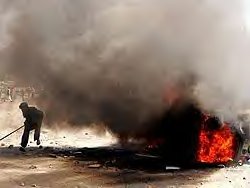
Afghan Puppet Leader Denounces US Action
Updated 6/1/2006 8:38 PM ET
By Paul Wiseman, USA TODAY
KABUL, Afghanistan — Afghan President Hamid Karzai denounced U.S. soldiers on Thursday for having fired their weapons to escape a mob in Kabul.
A member of his Cabinet, meanwhile, said the Afghan government has launched its own investigation into how a traffic crash on Monday spiraled into the worst violence in the capital since the fall of the Taliban in 2001.
"The coalition opened fire, and we strongly condemn that," Karzai said in a radio address to the nation in Pashto, his native language. However, he left unclear whether he was accusing the American soldiers of firing into the crowd.
Karzai spoke a day after Afghanistan's parliament passed a non-binding resolution that called for local prosecution of U.S. troops responsible for the crash.
U.S. Ambassador Ronald Neumann said in an interview broadcast Thursday by National Public Radio that U.S. troops here couldn't be punished under local law. "But should the investigation reveal some wrongdoing, I'm sure the military would follow up on its own," he said.
Karzai's government, backed by a 23,000-strong U.S.-led coalition and 9,000 NATO troops, already is fighting an intensifying Taliban insurgency in southern and eastern Afghanistan.
Kabul, however, has been relatively free of violence.
Monday's violence appears to have been unrelated to the Taliban rebellion. It started when a U.S. military truck careened downhill into a crowded intersection on the outskirts of downtown Kabul. The truck hit as many as 12 vehicles and killed five people.
The U.S. military said the truck's brakes had gone out. But bystanders reacted with fury to what many here saw as a deliberate act of aggression by U.S. soldiers.
"It's an accident if it involves one car, but not when it involves several cars," Kabul bookseller Mohammed Daoud, 36, said Thursday.
As hundreds of Afghans rushed at the stalled American convoy, U.S. troops opened fire — but only over the heads of the crowd, according to the U.S. military.
Kabul's chief of highway police, Gen. Amanullah Gozar, told the Reuters news agency that one of the vehicles in the U.S. convoy fired into the crowd, killing three people.
"The last car directly fired at people. Others fired into the air," he said. "It was forced to do so because some 1,000 people were rushing, some with stones and sticks toward the convoy. I witnessed it."
After the convoy fled, rioters trashed the offices of the U.S. aid group CARE and looted shops for hours. U.S. military spokesman Col. Tom Collins said Wednesday he had been informed by the Afghan Ministry of Health that the toll from the unrest had risen to 20 dead and more than 160 wounded.
By Thursday, Kabul's streets had mostly returned to their typical chaos: moneychangers shuffling thick decks of afghanis, the local currency; teenage boys peddling cellphone cards; merchants pushing carts filled with mangos.
One thing had changed: Hundreds of Afghan soldiers, police and plainclothes security personnel patrolled the streets and bazaars, overseeing the activity in an obvious show of force.
Karzai's government is trying to figure out what prompted the violent outburst after the crash.
"An investigation is going on to find out why a traffic accident became the cause of a violent demonstration," Masauda Jalal, a women's rights official and member of Karzai's Cabinet, said Thursday. She said the government knows the "U.S. military would not deliberately hurt Afghan civilians," but "the public's awareness is lower."
"There was some anti-American element," Neumann told NPR. "But actually, from my own observation, it was less focused anti-American than I think is being portrayed. "
A common theory is that the crowd's spontaneous protest "was hijacked by criminals and armed men," said Nader Naderi, spokesman for the Afghan Independent Human Rights Commission.
Many here worry that the speed with which anarchy engulfed Kabul on Monday exposed the government's weakness. "Karzai has no power," said driver Malik Jan, 46. "His police couldn't stop the demonstrations."
Contributing: Wire reports
Find this article at:
http://www.usatoday.com/news/world/2006-06-01-karzai_x.htm
Awni al Kalemji to address anti-Bush demonstration in Vienna
Pro-zionist left splits mobilisation
War president Bush, scheduled to come to Vienna on June 21, will face protest action also in Austria as in nearly any other place in the world he is coming to. The amplitude and resonance of the mobilisation reflects the widespread popular feeling against the American Empire imposing its rule by the permanent war.
The most important element is, however, not quantity but quality. The coalition of forces organising the protests invited Awni al Kalemji, the spokesman of the Iraqi Patriotic Alliance, as one of the main speakers. This means that the Iraqi Resistance, in favour of which al Kalemji will speak, has gained a lot of terrain in comparison to the past years. We just want to remember the vicious campaign of isolation and criminalisation not only the Iraqi Resistance but also the anti-imperialists supporting it suffered. Thus the very fact that the proposal of the anti-imperialist to lend the word to Kalemji is a big step ahead.
Obviously this did not pass uncontested. The pro-Zionist parts of the left, which has been integrated into the imperialist system, led by the Socialist Youth and the Communist Party broke away from the coalition. They did not even accept to mention the right to self-determination of the Palestinian people. They are determined to carry on the campaign against the anti-imperialist forces, which they continue to slander as anti-Semitic, and the Iraqi as well as the Palestinian Resistance.
While this was not surprising the really unfortunate aspect is that the mainstream Muslim leadership aligns with Social Democracy and the pro-Zionist forces. This stems from the fact that the Social Democrats are offering a lot of privileges and all day live support different to other European countries providing also some shelter from excessive institutional harassment. In return they have been enjoying the loyalty of the Muslim leadership which provides for that no anti-imperialist mobilisation is supported.
Anti US riot in Kabul brutally repressed
by the Left Radicals of Afghanistan
When the residents of the area, saw the sadist killing, and damage, gathered immediately and threw stones against US coalition convoy, the angry crowd chanted slogans as ” Death to USA”, “Death to occupiers”, “Death to Karzai”, “They are plunderers”, “They are murderers”, “Go to your homes”, “We want a fair justice for our victims and the perpetrators must be punished and draw to an open trial”. While the wrathful crowd were stoning and chanting in the incident area before the US- coalition convoy, the US-coalition forces opened constantly fire on the disarmed irate people and left more than 87 death and 256 injured totally. Finally, they succeeded to disperse the furious crowd and open way to escape from the spot. But, the suffered people once again filled the roads and stood for the revenge.
The anti US coalition demonstrations were participated by tens of thousands people such as school students, wage labourers, youths, unemployed individuals and other layers of the society.
Now, more than 200 youths, students and labourers have been detained and facing dreadful investigation and brutal tortures, humiliation and probably long period sentences.
We urgently call upon all local and international Left, workers and anti imperialist forces to condemn the massacre by the US forces and express their solidarity with the people of Afghanistan under occupation. Please demand strongly and urgently the release of all 200 new detainees.
Send your protest letters to President Karzai: rafiullahjawed@hotmail.com and Interior Ministry: Imashal@yahoo.com and a copy to Left Radical of Afghanistan (LRA): lr_afg@yahoo.com
End to occupation!
End to brutal military operations!
Stop killing of innocent civilians!
Release all detainees
Full call for solidarity:
http://www.antiimperialista.org/index.phpoption=com_content&task=view&id=4483&Itemid=55
After US massacre in Kandahar: withdraw occupation troops!
by Left Radicals of Afghanistan, Jalalabad
Last week the US and coalition forces under the name of “ISAF” (Assistance and Cooperation) heavily air attacked civilian in Panjwai district of Kandahar province. The air attacks launched after the armed opposition started their military operation against invader forces led by US in Kandahar. Following the heavy deadly fighting, that imposed numerous casualties to the imperialist forces and local government, made the USA and coalition forces wrathful to take revenge in the area where the attacks were carried out. So, they turned fire on poor villages of Panjwai where according to US and local government resources around one hundred are dead and according to people and witnesses that reported to the local “independent media” there are hundreds of dead and injured.
Full document:
http://www.antiimperialista.org/index.phpoption=com_content&task=view&id=4464&Itemid=55
Anti-War Protests Continue At Port Of Olympia
May 31, 2006
By Tracy Vedder
OLYMPIA - A protest became a melee on Olympia's waterfront Tuesday as sheriff's deputies arrested 22 people who stormed the port's gate. And war protesters were back on the line Wednesday night -- as are the deputies.
The protesters hope to disrupt shipments of war supplies heading to Iraq.
For more than a week, the two sides have held their ground on Olympia's waterfront. The military transport ship Pomeroy continues to load cargo bound for Iraq, including Stryker vehicles and other military supplies for the Stryker Brigade from Ft. Lewis. Its escort of Coast Guard boats is always present.
On the other side, the protesters with their anti-war slogans and signs, keep constant vigil.
All week, there were jolts of confrontation. But Tuesday night it turned ugly. Protesters pulled down the port's front gate, then sat down with linked arms, blocking access.
Police and protesters have different versions of what happened next. Protester Jeff Berryhill was one of the first arrested, he describes it this way: "I walked in, I let the cops know this is going to be peaceful we have no intention of doing anything of vandalizing anything of trying to be confrontational."
But Chief Criminal Deputy Dan Kimball with the Thurston County Sheriff's Office says others were threatening his officers: "They began to throw objects at the officers, including about a half full plastic pop bottle, and the last straw was a fairly large rock."
The end result was deputies arresting 22 protesters. Some believe the violence clouds the issue.
"I mean, the real issue here is the occupation of Iraq," says Olympia Councilman T.J. Johnson, "and the fact that our community is now directly connected to what is going over there."
Port staff aren't taking any chances this time around. They moved a heavy cargo container across the gate, and it won't be easy to get around.
What does the rest of Olympia think? Opinions are mixed. We overheard one woman tell another she wouldn't be voting for any councilmember who supported the protesters. Others were sorry they missed the action.
But World War II vet Leonard Nord thinks no matter what your opinion about the war in Iraq, to try and disrupt supplies the soldiers need is a disgrace.
"And I resent the use of public facilities for denying our troops the right to defend themselves, I resent that."
And it's not over. As long as the Pomeroy is in port, protesters plan to camp out here. The Pomeroy could leave port as early as Wednesday evening.
The equipment it carries is in support of the Fort Lewis Stryker Brigade, which is returning to Iraq for its second tour of duty there.
Subscribe to:
Posts (Atom)