Friday, November 30, 2007

U.S. Banks Near A Plan to Freeze Subprime Rates; Morgan Stanley Executive Latest Casualty

U.S., Banks Near A Plan to Freeze Subprime Rates

By DEBORAH SOLOMON and MICHAEL M. PHILLIPS
November 30, 2007; Page A1

WASHINGTON -- The Bush administration and major financial institutions are close to agreeing on a plan that would temporarily freeze interest rates on certain troubled subprime home loans, according to people familiar with the negotiations.

An accord could reassure investors and strapped homeowners, both of whom are anxious as interest rates on more than two million adjustable mortgages are scheduled to jump over the next two years. It could also give a boost to the Bush administration, which is facing criticism for inaction amid the recent housing turmoil.

The plan is being negotiated between regulators including the Treasury Department and a coalition of mortgage-related companies including Citigroup Inc., Wells Fargo & Co., Washington Mutual Inc. and Countrywide Financial Corp. People familiar with the talks say the individual members have agreed to follow any agreement reached by the coalition, which is called the Hope Now Alliance.

Details of the plan, which could be announced as early as next week, are still being worked out. In general, the government and the coalition have largely agreed to extend the lower introductory rate on home loans for certain borrowers who will have trouble making payments once their mortgages increase.

Many subprime loans carry a low "teaser" interest rate for the first two or three years, then reset to a higher rate for the remainder of the term, which is typically 30 years in total. In a typical case, the rate would rise to around 9.5% to 11% from 7% or 8%. That would boost an average borrower's payment by several hundred dollars a month.

Exactly which borrowers will qualify for the freeze and how long the freeze would last are yet to be determined. Under one scenario, the freeze could run as long as seven years. The parties are developing standard criteria that would determine eligibility. The criteria should be finalized by the end of year.

Mortgage servicers -- the companies that collect loan payments -- are a key part of the coalition, because they are the companies that deal directly with borrowers. Often the servicer is different from the company that originally made the loan. Citigroup and Countrywide are among the nation's biggest mortgage servicers. The mortgage servicers in the coalition represent 84% of the overall subprime market. The coalition also includes lenders, investors and mortgage counselors.

The Bush administration has been looking for ways to stem the fallout from the mortgage crisis. Treasury Secretary Henry Paulson and Housing and Urban Development Secretary Alphonso Jackson helped assemble the coalition so that government officials could have a single counterpart with which to discuss terms of a plan.

While the government can't force the industry to modify loans, Mr. Paulson and other administration officials have been using moral suasion to push for workouts, telling the companies it is in their interest to avoid foreclosure since most parties can lose money when that happens. A similar plan to freeze interest rates temporarily was recently announced by California Gov. Arnold Schwarzenegger and four major loan servicers, including Countrywide.

Among the holdouts have been investors, who typically hold securities backed by mortgages. If interest rates are frozen, they would lose the potential benefit of higher payments. But investors have cautiously moved toward cooperation, likely on the grounds that it's better to get some interest than none at all.

At a meeting at the Treasury Department yesterday, coalition members told Mr. Paulson and other regulators that they are on track to announce the new industry guidelines by year's end, according to a senior Treasury official. Among those attending were representatives of Wells Fargo, Washington Mutual, Citigroup and the American Securitization Forum, a group whose members issue, buy and rate securities backed by bundles of mortgages.

"There has been a convergence of thought on this," said William Ruberry, spokesman for the Office of Thrift Supervision, which is also involved in the discussions.

A spokeswoman for the American Securitization Forum, which earlier resisted a broad approach to changing loan terms, said: "We support loan modifications in appropriate circumstances and are working to establish systematic procedures to facilitate their delivery."

Treasury officials say financial institutions are likely to set criteria that divide subprime borrowers into three groups: those who can continue to make their payments even if rates rise, those who can't afford their mortgages even if rates stay steady, and those who could keep their homes if the maturity date of their mortgages were extended or the interest rates remained at the teaser rates. Only the third group would be eligible for help.

The creditors are likely to look at whether the borrowers have equity in their homes, despite falling house prices, and whether their incomes are holding steady.

Mr. Paulson, who is philosophically opposed to federal meddling in markets, at first rejected a sweeping approach to loan modifications when the idea was floated by Federal Deposit Insurance Corp. Chairwoman Sheila Bair. But he shifted his position recently. He told The Wall Street Journal last week that it would be impossible to "process the number of workouts and modifications that are going to be necessary doing it just sort of one-off."

As a drumbeat of bad news about housing has continued -- including news of fewer home sales, falling prices and higher foreclosures -- the Bush administration has come under pressure to be seen as actively addressing the problem.

"There seems to be a vacuum in terms of leadership," said Brian Bethune, U.S. economist at Global Insight, a research firm. Mr. Paulson and Federal Reserve Chairman Ben Bernanke need "to build up the public's confidence that they will do what is necessary to avoid recession," said Mr. Bethune.

Officials in Washington have been cautious about steps that would be seen as rescuing borrowers, lenders and investors from the consequences of their own bad decisions. That is why few are suggesting direct support for borrowers who can't afford their loans. Mr. Paulson has decided his best option is to prod the markets to sort matters out themselves, as long as companies bear in mind the public interest in keeping people in their homes. "There's not some silver-bullet piece of legislation out there," a senior Treasury official said.

Mr. Paulson, who spent 32 years at Goldman Sachs Group Inc., has been on the phone nearly every day in recent months with the heads of financial institutions such as J.P. Morgan Chase & Co., Bank of America Corp. and Lehman Brothers Holdings Inc. He has talked to chief executives to find out what they're doing to help borrowers and get their take on the extent of the losses and accompanying credit crunch roiling Wall Street.

"Where I'm spending most of my time is in the mortgage market," Mr. Paulson said in another interview this week. He convened a 7 a.m. staff meeting the Monday after Thanksgiving "to find out what are we learning."

"If I ever saw a role for government, it is...to bring the private sector together when innovation has really outrun our ability to deal with it," Mr. Paulson said. He is expected to talk about the administration's approach to the housing crisis at a conference Monday.

Interest rates are set to reset next year on $362 billion worth of adjustable-rate subprime mortgages, according to Banc of America Securities. An additional $85 billion in such mortgages is resetting during the current quarter. The estimates include loans packaged into securities and held in bank portfolios.

Borrowers whose loans are resetting are likely to have a tougher time sidestepping the rising payments by refinancing or selling their homes. Lending standards have tightened and many borrowers can't qualify for refinancing. And falling home prices mean that many borrowers have little or no equity in their homes. Some owe more than their homes are worth.

Top Treasury officials fear that unless creditors agree to relax the terms on many of those mortgages, borrowers will default at a higher pace. About 6.6% of subprime mortgages were in foreclosure as of August, the most recent data available, according to First American LoanPerformance.

--James R. Hagerty and Ruth Simon contributed to this article.

Write to Deborah Solomon at deborah.solomon@wsj.com4 and Michael M. Phillips at michael.phillips@wsj.com5

URL for this article:
http://online.wsj.com/article/SB119638615868608863.html


Subprime crisis claims top Morgan banker

By David Wighton in New York
November 30 2007 01:51

Zoe Cruz, the most senior woman on Wall Street, on Thursday became the latest high-profile casualty of the US subprime mortgage meltdown when she lost her job as co-president of Morgan Stanley.

The ousting came three weeks after Morgan Stanley revealed it had lost more than $3.7bn on a subprime mortgage bet that went disastrously wrong.

The turmoil of recent months has already claimed the jobs of the chief executives of UBS, Merrill Lynch and Citigroup. Ms Cruz’s counterpart at Bear Stearns has also been ousted.

In an unrelated move, Robert Scully, an experienced banker who was co-president with Ms Cruz, will move to a newly created office of the chairman where he will focus on key clients, particularly sovereign investors.

The new co-presidents are Walid Chammah, a former head of investment banking who recently moved to London to head Morgan Stanley International, and James Gorman, who joined from Merrill Lynch last year and now heads the wealth management arm.

John Mack, Morgan Stanley’s chairman and chief executive, initially decided to take no action against Ms Cruz after discussing the matter with his board.

But after a longer “post-mortem”, he concluded that changes were needed, according to someone familiar with his thinking.

The market has deterioriated further in recent weeks, increasing the potential loss on Morgan Stanley’s remaining mortgage-linked investments.

However, insiders say no further problems have been uncovered and the maximum potential loss from its subprime exposure remains at the stated $6bn.

In a broad shake-up, Neal Shear has been removed as Morgan Stanley’s head of trading and will return to the highly successful commodities business he helped to build as chairman. Tony Tuffariello, who was head of securitised products, is leaving the company. Michael Petrick becomes head of trading.

Mr Mack said Ms Cruz, 52, had made enormous contributions to the company in her 25 years of service. “She has helped to build some of our most important and successful businesses and worked tierlessly to strengthen and grow our global franchise.”

Before Morgan Stanley announced its losses, Ms Cruz is understood to have been approached about becoming chief executive of Merrill Lynch, a job that went to John Thain.

Ms Cruz, who ran Morgan Stanley’s fixed income business, was made co-president in 2005 by Philip Purcell, fuelling the revolt that eventually led to his ousting as chairman and chief executive.

Her promotion prompted the departure of Vikram Pandit, who had been her boss, and several other senior executives who refused to return following Mr Purcell’s departure unless she was removed. Mr Mack resisted the pressure to sideline the widely respected Ms Cruz.

Starbucks to Promote Speciality Coffee and Open Africa Center in Ethiopia

Starbucks to Promote Specialty Coffee Company to Open First Africa Center

The Daily Monitor (Addis Ababa)
30 November 2007
Addis Ababa

Ethiopia and world coffee giant Starbucks said on Wednesday they were determined to strengthen partnership with the view to making Ethiopia a leading force in the global specialty coffee marketplace.

This was disclosed at a joint press conference held following discussions between Prime Minister Meles Zenawi and visiting Starbucks Corporation Chairman Howard Shultz.

Prime Minister Meles and Mr. Schultz said their discussions reflected a deepening relationship between Ethiopia, the birthplace of coffee, and Starbucks, one of the world's largest specialty coffee companies.

They said they worked out ways to expand the branding and marketing of Ethiopia's world-renowned fine coffees in order to achieve better prices for farmers and improved opportunities for the millions of Ethiopians who depend on coffee for their livelihood.

"We will be working closely with Starbucks to bring badly needed investment and technology to our coffee industry, as well as brand recognition and promotion for our high-grade Arabica beans," Meles told reporters at his office immediately after his discussions with high level delegation led by Chairman Shultz.

"These measures will afford Ethiopia new leverage in the global coffee market. I am extremely encouraged that Starbucks Chairman Howard Schultz shares our belief in a bright future for Ethiopia's coffee economy," the Premier added.

Schultz on his part said his company would open a Starbucks Farmer Support Center in Addis Ababa in 2008.

To be the first in Africa, the soon-to-be established centre aims to enable the company to work collaboratively with Ethiopian farmers to raise both the quality and production of the country's high quality specialty coffees.

The Farmer Support Centre will also provide resources and ongoing support to coffee communities with the goal of improving coffee quality and growing practices and increasing the number of farmers participating in the Coffee and Farmer Equity (C.A.F.E.) Practices, Starbucks' sustainable coffee buying guidelines.

After lengthy wrangling with the Ethiopian government over trademark, Starbucks earlier this year signed a distribution, marketing and licensing agreement with Ethiopia and agreed to assist in expanding consumer awareness of Ethiopia's famed coffee brands- Sidamo, Harar/Harrar and Yirgacheffe.

The joint press briefing was followed by a roundtable discussion among the visiting Starbucks officials and government officials, coffee farmers, exporters and other coffee stakeholders yesterday where they shared ideas on how to strengthen the partnership and improve the Ethiopian coffee industry.

Later in the day, Schultz is expected to address leaders of the Ethiopian business community and young entrepreneurs.

Between 2002 and 2006, Starbucks increased its Ethiopian coffee purchases by nearly 400 percent.

Today, Ethiopian coffee can be found in nearly all of Starbucks' U.S. stores. In 2008 Starbucks plans to intensify its promotion of Ethiopian coffees.

Other Starbaucks senior officers accompanying Shultz are: Cliff Burrows, President Starbucks EMEA (Europe, Middle East and Africa), Dub Hay, Starbucks senior vice president of Coffee & Global Procurement, and Sandra Taylor, Starbucks senior vice president of Corporate Social Responsibility.

Thursday, November 29, 2007

Nigeria Rejects United States 'Africa Command' (AFRICOM)

Nigeria rejects US’ Africa Command

Daily Trust
Wednesday, 28 November 2007

The United States government’s decision to establish an Africa Command (AFRICOM) as a military mechanism for "resolving" Africa’s internal crises in pursuit of its "war on terror" was received by most African pundits with concern or resignation, but little surprise. Whether viewed as a strategy for hegemony or self-defence, the establishment of such commands worldwide is but the logical outcome of the US push for global dominance.

There being no corner of the world where US interest or honour lies beyond the reach of "evil-minded forces," the whole aim of the "global war on terror" – which foresees an unlimited number of indecisive battles - may be no more than to so menace the governments and peoples of the world with an endless series of imaginary enemies as to compel them to rely on US support for survival and provide façades behind which Uncle Sam could rule the planet unchallenged.

That is standard twenty-first century imperialism whose grace notes are "free market," "human rights," and a democracy enforced by awesome military power.

The strategy of all imperial masters has always been to impose norms of right and wrong, possibility or impossibility, sanity or insanity and good or bad on their subjects, the majority of whom conform without question on account of their herd mentality. The masters then manipulate these norms to divide the masses into diverse factions, thus gaining the leverage to create conflicts or restore order among the masses at will.

While parallel US efforts to destroy all established traditions in promoting worldwide regional integration are but parts of its ploy to create a US-dominated global economy and administration, we remain supremely confident that the good people of the United States and its allied countries are neither militaristic enough nor rich enough to condone the endless bailouts, police actions and wars which their governments’ hegemonic aspiration would entail.

What the US and its allies really care about is to establish a military presence at the heart of every resource-rich region in order to control the supply of hydrocarbon fuels as global capitalism becomes increasingly overwhelmed by crises of overproduction and overcapacity. It is logical that they should seek to strengthen their military presence in Africa as China and India begin to cast furtive glances at our continent’s resources.

They are easily capable of manipulating the conflicting claims by Nigeria and Cameroon of sovereignty over the oil-rich Bakassi peninsula to justify intervention on the side of whichever country "plays ball" and make life unpleasant for the country that may elect to follow its own path just as they currently subject Iran, the Hamas government of Gaza, Cuba, Venezuela and North Korea to enormous pressures for failing to toe the line.

A serious challenge to the US scheme could come from "Islamic fundamentalism," which could exploit the pervasive hostility to US foreign policy and Israel’s continuing humiliation of the Palestinians to undermine US interests in the Persian Gulf region and elsewhere. Barring the emergence of a genuinely powerful Islamic state in the region however that challenge lacks a geopolitical core and can therefore be restricted to expressing itself through diffuse violence, albeit on a global scale that could even conduce to increasing US’ hegemonic influence.

What are the prospects for Africa? Much depends on the African leaders’ ability to distinguish the real from the spurious, change their vision from "can’t do" to "can do," from miniscule to limitless horizons, and above all to question every received wisdom as they rid their minds of the fears that blind them to the immense demographic and material potentials of the globally dispersed communities of Africans.

Accordingly we welcome the recent decision of our Council of States to reject AFRICOM as a neo-colonial imposition and work instead towards the establishment of an African Standby Force to address whatever crises may arise in African countries.


Bakassi: I didn’t act alone– Obasanjo

Written by Abdul-Rahman Abubakar
Thursday, 29 November 2007

Former President Chief Olusegun Obasanjo yesterday denied that he took unilateral action last year in the decision to hand over the Bakassi Peninsula to Cameroon, allegedly in respect of the verdict given by the International Court of Justice (ICJ).

Obasanjo was reacting to a recent decision of the Senate to cancel the peninsula’s transfer, saying he did not seek for ratification as provided for by the 1999 Constitution.

A statement signed by the Media Assistant to the former President, Mr. Adeoba Ojekunle said: "The last Senate and the House of Representatives under the leaderships of Senator Ken Nnamani and Hon. Aminu Bello Masari were duly served the Green Tree Agreement between Nigeria and Cameroon on the ceding of Bakassi Territory for ratification by the National Assembly."

But speaking to Daily Trust on telephone yesterday, former Senate President Nnamani said if the Senate failed to ratify the agreement at that time, "It means we did not deem it appropriate."

He said, "I cannot say if we received such letter or not, but that can be checked at the office of the Clerk to the National Assembly. If we received it and did not treat it, that was because we didn’t deem it appropriate. We were not rubber stamps."

Asked if he advised the former president on the matter, Nnamani said: "I was not in his legal adviser."

Obasanjo’s statement claimed to have sought for ratification from the National Assembly, "contrary to the widely held view that the last Assembly was kept in the dark concerning the agreement."

The former president, who attached to his statement a copy of the letter dated June 13, 2006 and addressed to Senate resident Ken Nnamani, did not however include any proof of Senate ratification for ceding of Bakassi Peninsula.

Obasanjo however said the letter was received on June 15, 2007 and duly acknowledged by the two chambers.

Former Senate President Nnamani however advised his colleagues to approach the Bakassi issue with caution saying, "I don’t want anything that will heat the polity and disrupt the stability we are enjoying now. The matter is a judgement of the ICJ. We should tread with caution."

The Senate recently nullified the ceding of Bakassi Peninsula and other parts of Nigeria’s territory to the Republic of Cameroon by former President, Obasanjo in respect to the ICJ ruling.

Consequently, it requested President Umaru Musa Yar’Adua "to forthwith stop any further transfer of any part of this country unless the agreement is ratified by the National Assembly."

The motion, which was moved by Senator Bassey Ewa Henshaw (Cross River South), was sponsored by twenty one other senators, including eleven ranking senators who were in the Senate during the reign of Obasanjo.

The lawmakers condem-ned the action of the former ruler saying, "Notwith-standing the widespread national disaffection and concerns expressed over the ICJ verdict, and despite his own earlier promise not to cede the territory to Cameroon, the former President, Chief Olusegun Obasanjo was reported to have signed an agreement at the Green Tree, New York on June 12, 2006 in which he agreed to surrender the peninsula to Cameroon."

Deputy Senate Leader Victor Ndoma-Egba (SAN) insisted that in enforcing the ICJ ruling on Bakassi, the National Assembly ought to have been involved.

"Bakassi is mentioned in the first schedule of the Constitution of Nigeria and for us, full implementation of the ICJ judgment cannot be considered until during the constitution amendment," Ndoma-Egba added.

Another senior senator, Deputy Minority Leader Senator Olorunimbe Mamora, queried Obasanjo for not involving the parliament in the implementation of the ICJ ruling on Bakassi. He said, "Everything that was done was supposed to have involved the parliament because that is what divides democracy from autocracy. If you leave out the parliament, what you have is autocracy. Just like the Europeans shared out Africa as an international cake, Bakassi was shared out as a national cake."

Mamora described as unfortunate the action of former President Obasanjo in signing the agreement to cede part of Nigeria on June 12, 2006, "a day that is celebrated as a day for consolidation of democracy by many Nigerians."

CIA Operation "Pliers" Uncovered in Venezuela; Plan Designed to Disrupt Elections

CIA Operation "Pliers" Uncovered in Venezuela

November 28th 2007, by Eva Golinger

Last night CNN en Español aired an image, which captions at the bottom "Who Killed him?" by "accident". The image of President Chavez with the caption about killing him below, which some could say subliminally incites to assassination, was a "production error" mistakenly made in the CNN en Español newsroom.

The news anchor had been narrarating a story about the situation between Colombia and Venezuela and then switched to a story about an unsolved homicide but - oops - someone forgot to change the screen image and President Chavez was left with the killing statement below. Today they apologized and admitted it was a rather "unfortunate" and "regrettable" mistake. Yes, it was.

On a scarier note, an internal CIA memorandum has been obtained by Venezuelan counterintelligence from the US Embassy in Caracas that reveals a very sinister - almost fantastical, were it not true - plan to destabilize Venezuela during the coming days.

The plan, titled "OPERATION PLIERS" was authored by CIA Officer Michael Middleton Steere and was addressed to CIA Director General Michael Hayden in Washington. Steere is stationed at the US Embassy in Caracas under the guise of a Regional Affairs Officer.

The internal memorandum, dated November 20, 2007, references the "Advances of the Final Stage of Operation Pliers", and confirms that the operation is coordinated by the team of Human Intelligence (HUMINT) in Venezuela. The memo summarizes the different scenarios that the CIA has been working on in Venezuela for the upcoming referendum vote on December 2nd.

The Electoral Scenario, as it's phrased, confirms that the voting tendencies will not change substantially before Sunday, December 2nd, and that the SI (YES) vote in favor of the constitutional reform has an advantage of about 10-13 points over the NO vote. The CIA estimates abstention around 60% and states in the memo that this voting tendency is irreversible before the elections.

Officer Steere emphasizes the importance and success of the public relations and propaganda campaign that the CIA has been funding with more than $8 million during the past month - funds that the CIA confirms are transfered through the USAID contracted company, Development Alternatives, Inc., which set up operations in June 2002 to run the USAID Office for Transition Initiatives that funds and advises opposition NGOs and political parties in Venezuela.

The CIA memo specifically refers to these propaganda initiatives as "psychological operations" (PSYOPS), that include contracting polling companies to create fraudulent polls that show the NO vote with an advantage over the SI vote, which is false.

The CIA also confirms in the memo that it is working with international press agencies to distort the data and information about the referendum, and that it coordinates in Venezuela with a team of journalists and media organized and directed by the President of Globovision, Alberto Federico Ravell.

CIA Officer Michael Steere recommends to General Michael Hayden two different strategies to work simultaneously: Impede the referendum and refuse to recognize the results once the SI vote wins. Though these strategies appear contradictory, Steere claims that they must be implemented together precisely to encourage activities that aim toward impeding the referendum and at the same time prepare the conditions for a rejection of the results.

How is this to be done?

In the memo, the CIA proposes the following tactics and actions:

Take the streets and protest with violent, disruptive actions across the nation
Generate a climate of ungovernability
Provoke a general uprising in a substantial part of the population
Engage in a "plan to implode" the voting centers on election day by encouraging opposition voters to "VOTE and REMAIN" in their centers to agitate others
Start to release data during the early hours of the afternoon on Sunday that favor the NO vote (in clear violation of election regulations)
Coordinate these activities with Ravell & Globovision and international press agencies
Coordinate with ex-militar officers and coupsters Pena Esclusa and Guyon Cellis - this will be done by the Military Attache for Defense and Army at the US Embassy in Caracas, Office of Defense, Attack and Operations (DAO)

To encourage rejection of the results, the CIA proposes:

Creating an acceptance in the public opinion that the NO vote will win for sure
Using polling companies contracted by the CIA
Criticize and discredit the National Elections Council
Generate a sensation of fraud
Use a team of experts from the universities that will talk about how the data from the Electoral Registry has been manipulated and will build distrust in the voting system

The CIA memo also talks about:

Isolating Chavez in the international community
Trying to achieve unity amongst the opposition
Seek an aliance between those abstentionists and those who will vote "NO"
Sustain firmly the propaganda against Chavez
Execute military actions to support the opposition mobilizations and propagandistic occupations
Finalize the operative preparations on the US military bases in Curacao and Colombia to provide support to actions in Venezuela
Control a part of the country during the next 72-120 hours
Encourage a military rebellion inside the National Guard forces and other components

Those involved in these actions as detailed in the CIA memo are:

The CIA Office in Venezuela - Office of Regional Affairs, and Officer Michael Steere
US Embassy in Venezuela, Ambassador Patrick Duddy
Office of Defense, Attack and Operations (DAO) at the US Embassy in Caracas and Military Attache Richard Nazario
Venezuelan Political Parties:

Comando Nacional de la Resistencia
Accion Democratica
Primero Justicia
Bandera Roja

Media:

Alberto Federico Ravell & Globovision
Interamerican Press Society (IAPA) or SIP in Spanish
International Press Agencies

Venezuelans:

Pena Esclusa
Guyon Cellis
Dean of the Simon Bolivar University, Rudolph Benjamin Podolski
Dean of the Andres Bello Catholic University, Ugalde
Students: Yon Goicochea, Juan Mejias, Ronel Gaglio, Gabriel Gallo, Ricardo Sanchez

Operation Tenaza has the objective of encouraging an armed insurrection in Venezuela against the government of President Chavez that will justify an intervention of US forces, stationed on the military bases nearby in Curacao and Colombia. The Operation mentions two countries in code: as Blue and Green. These refer to Curacao and Colombia, where the US has operative, active and equipped bases that have been reinforced over the past year and a half in anticipation of a conflict with Venezuela.

The document confirms that psychological operations are the CIA's best and most effective weapon to date against Venezuela, and it will continue its efforts to influence international public opinion regarding President Chavez and the situation in the country.

Operation Tenaza is a very alarming plan that aims to destabilize Venezuela and overthrow (again) its legitimate and democratic (and very popularly support) president. The plan will fail, primarily because it has been discovered, but it must be denounced around the world as an unacceptable violation of Venezuela's sovereignty.

The original document in English will be available in the public sphere soon for viewing and authenticating purposes. And it also contains more information than has been revealed here.

Source URL: http://www.chavezcode.com/2007/11/operation-pliers.html
Source URL: http://www.venezuelanalysis.com/analysis/2914
Printed: November 29th 2007
License: Published under a Creative Commons license (by-nc-nd). See http://www.creativecommons.org for more information.

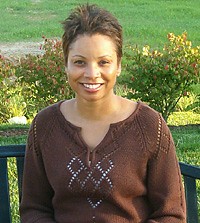
"Color Me Butterfly" Deals With Over Six Decades of Domestic Violence

A True Story About Four Generations of Mothers & Daughters Who Suffered and Survived 60+ Years of Domestic Violence and Abuse Wins the 2007 National 'Best Books' Award

Washington, DC (BlackNews.com) - Since its release in April 2007, not only has it received rave reviews, but on November 1, 2007, L.Y. Marlow's riveting, emotionally-charged and inspiring Color Me Butterfly became the winner of the 2007 National "Best Books" Award.

L.Y. Marlow is the third generation of her family to have been a victim and survivor of domestic violence: a violence that almost took her own life and the life of her unborn child. In her debut book, Color Me Butterfly, she tells the poignant and endearing story of four generations of mothers and daughters: the true story of her grandmother, her mother, herself, and her daughter; and the dispiriting impact intergenerational domestic violence and abuse has had on her family for over 60+ years.

I was just sixteen years old the first time my eye was blackened, my lip split, Marlow says. I knew my grandmother had gone through it. I knew my mother had gone through it. And now it was my time to go through it. I felt I had no choice. It was our 'normal'.

I wish I could say that my story ended that fateful day when the swelling started to rise. I wish I could say that I had never heard of or been exposed to domestic violence since I was sixteen. I wish I could say that this phenomenon did not exist in my family before I was a stitch in my family's fabric line, a seed in my mother's womb.

I wish I could say that 60+ years of domestic violence and abuse has not prevailed my family; but those wishes are just that -- wishes. I come from a legacy of women -- four generations to be exact -- where every kind of domestic abuse has been at the hem of my family's fabric.

Color Me Butterfly is sparking dialogue across the country. L.Y. Marlow has turned her family's pain into a crusade to raise awareness through the Saving Grace Campaign. "This campaign is about ensuring that everyone understands the seriousness of domestic violence and the impact it has on our communities," Marlow shares. "It's about spreading the word. It's about effecting 'Change.'"

L.Y. Marlow has spoken before many civic groups, churches, and colleges. She has been interviewed on various national and syndicated television and radio programs such as the Tom Joyner Morning Show, the Wendy Williams Experience and the Doug Banks Show.

She has also been featured in several magazines including Jet and Today's Black Woman. And in addition to the National "Best Books" Award, "Color Me Butterfly" has also won the following awards:

S'Indie Award for Literary Excellence, Quality and Originality -- Winner

The Indie National Excellence Book Award -- Finalist

Hollywood Book Festival Award -- Honorable Mention

Visit http://www.colormebutterfly.com to learn more about Color Me Butterfly, the author, and the Saving Grace campaign – a campaign that also provides unlimited resources and support to help victims of abuse.

CONTACT:
Rediik Harris
Publicist
919-785-9018
rediikharris@gmail.com

Wednesday, November 28, 2007

Detroit Public Meeting on the Foreclosure Crisis, Saturday, December 8, 1:00pm

For Immediate Release

Media Advisory

Event: Public Meeting on the Foreclosure Crisis
Saturday, December 8, 2007, 1:00pm
Location: Central United Methodist Church, 23 East Adams
at Woodward (Grand Circus Park, Downtown)
Contact: Michigan Emergency Committee Against War &
Injustice (MECAWI)
Phone: 313.319.0870
E-mail: moratorium@sbcglobal.net
URL: http://www.mecawi.org

Build a Fight Back Movement to Declare a State of Economic Emergency in Michigan to Halt Foreclosures, Evictions and Utility Shut-offs; Come to a Public Meeting in Downtown Detroit

The poor and working people of Michigan desperately need emergency relief from the economic disaster that has hit our state. An emergency moratorium to stop foreclosures, utility shut-offs, evictions, school shutdowns, plant closings and lay-offs would give the people a chance to survive during the economic catastrophe while we strategize on how to fight to rebuild our state and guarantee the right to jobs, housing, health care and quality education for all.

During the 1930s, the State legislature utilized its emergency powers to pass the Mortgage Moratorium Act, Act No. 98, Pub. Acts 1933. The Act extended the redemption period during which homeowners could not have their property taken from them after foreclosure from six months, to 5 years.

The State of Michigan is in the midst of an unprecedented economic crisis. It is time for Governor Granholm to take emergency measures to protect the health and welfare of the poor and working families of Michigan in the midst of the economic disaster that has hit our state.

Come out to the public meeting organized by the Michigan Emergency Committee Against War & Injustice on Saturday, December 8 beginning at 1:00pm.

For more information on this issue and the movement to reclaim our economic rights, just contact the number and web site listed above.

MECAWI Demonstrates Against Closed Mayor's Meeting on Foreclosure Crisis in Detroit

Wednesday, November 28, 2007

Kilpatrick: Lenders will help borrowers

David Josar
The Detroit News

DETROIT -- Kwame Kilpatrick, flanked on Tuesday by a handful of mayors from across the United States, unveiled a short-list of strategies aimed at helping homeowners avoid foreclosure.

Lenders, Kilpatrick announced after the meeting at the MGM Grand Detroit, pledged they would fund public service announcements that tell borrowers facing foreclosure where to go for help, and the Mortgage Bankers Association agreed to establish a database for city officials that would indicate which financial institutions were responsible for individual foreclosed properties that have been vacated.

"These are not people who are deadbeats. These are people who work hard every day," said Kilpatrick, who spent most of Tuesday meeting with the mayors, representatives of the banking industry and several nonprofits in a closed-door meeting. He said the group was told 72 percent of people in foreclosure could take steps to avoid losing their homes.

"This is an economic tsunami we have to make sure people can stay in their homes and contribute to the economy," he said

As details are worked out over how the service announcements will be funded and how the database would be instituted, the mayors said Wall Street financiers -- which had been blamed for creating a market that tolerated so many risky loans in the first place -- should somehow help in abating the crisis.

"The industry knows what they have done," Trenton Mayor Douglas Palmer said. "Wall Street made a bunch of money off those people and the time has come for them to pay the piper too."

Several banks agreed to help fund the "Hope Hotline," (888) 995-HOPE, where callers are advised on ways to get on track with mortgage payments and other strategies.

Kilpatrick, Palmer and other members of the U.S. Conference of Mayors held a special meeting in Detroit on foreclosures.

Meanwhile a report released Tuesday by the group predicted the ongoing wave of foreclosures will slow consumer spending, impede home construction and cause more people to lose their jobs.

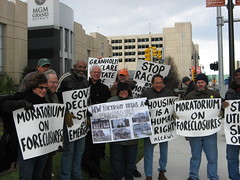
During the meeting, about a dozen members of the Michigan Emergency Committee Against War and Injustice marched outside the casino, upset that the mayors -- including Kilpatrick -- weren't doing enough to help people who were losing their homes.

Jerry Goldberg, who coordinated the protesters, said the meeting should be public -- especially because the elected mayors were meeting with bankers.

"Homeowners have a right to hear what is being said," said Goldberg, a resident in the city's East English Village neighborhood. "This is a good start but more must be done."

According to the group's report, prepared by economic and financial analysis firm Global Insight, the Detroit region ranks seventh in the nation in terms of metro areas that have suffered the greatest loss of economic activity due to foreclosures.

The report pegs the value of lost goods and services here at $3.2 billion.

The outlook is expected to worsen, the report said, as mortgages -- both conventional and those with higher interest rates given to applicants with spotty credit -- readjust to higher interest rates.

You can reach David Josar at (313) 222-2073 or djosar@detnews.com.

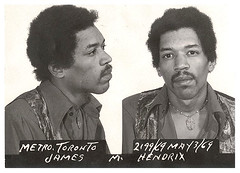
Who Killed Jimi Hendrix?: Rock Culture, COINTELPRO and the Continuing Legacy of Guitar Greatest

Who Killed Jimi Hendrix?: Rock Culture , COINTELPRO and the Continuing Legacy of Guitar Greatest

PANW Editor's Note: This article is being published in honor of the 65th birthday of Jimi Hendrix (November 27, 1942-September 18, 1970). This research report raises critical questions which debunk the "official theories" surrounding his mysterious death in 1970 in London.

Plus for a wonderful version of the classic anti-war composition "Machine Gun" just log on to the following URL:
http://www.youtube.com/watch?v=TV74PsUo1dc&feature=related
-----------------------------------------------------------------------------------------

Chapter seven from the book: "The Covert War Against Rock"

by Alex Constantine
Published by Feral House, 2000

I Don't Live Today: The Jimi Hendrix Political Harassment, Kidnap and Murder Experience

"I don't believe for one minute that he killed himself. That was out of the question."
— Chas Chandler, Hendrix Producer

"I believe the circumstances surrounding his death are suspicious and I think he was murdered."
— Ed Chalpin, Proprietor of Studio 76

"I feel he was murdered, frankly. Somebody gave him something. Somebody gave him something they shouldn't
have."
— John McLaughlin, Guitarist, Mahavishnu Orchestra

He didn't die from a drug overdose. He was not an out-of-control dope fiend. Jimi Hendrix was not a junkie. And anyone who would use his death as a warning to stay away from drugs should warn people against the other things that killed Jimi—the stresses of dealing with the music industry, the craziness of being on the road, and especially, the dangers of involving oneself in a radical, or even unpopular, political movements. COINTELPRO was out to do more than prevent a Communist menace from overtaking the United States, or keep the Black Power movement from burning down cities. COINTELPRO was out to obliterate its opposition and ruin the reputations of the people involved in the antiwar movement, the civil rights movement, and the rock revolution. Whenever Jimi Hendrix's death is blamed on drugs, it accomplishes the goals of the FBI's program. It not only slanders Jimi's personal and professional reputation, but the entire rock revolution in the 60's.
—John Holmstrom. "Who Killed Jimi?"(1)

As the music of youth and resistance fell under the cross-hairs of the CIA's CHAOS war, it was probable that Jimi Hendrix—the tripping, peacenik "Black Elvis" of the '60s—should find himself a target.

Agents of the pathologically nationalistic FBI opened a file on Hendrix in 1969 after his appearance at several benefits for "subversive" causes. His most cutting insult to the state was participation in a concert for Jerry Rubin, Abbie Hoffman, Tom Hayden, Bobby Seale and the other defendants of the Chicago Seven conspiracy trial,(2) "Get [the] Black Panthers," he told a reporter for a teen magazine, "not to kill anybody, but to scare [federal officials]....I know it sounds like war, but that's what's gonna have to happen. It has to be a war....You come back to reality and there are some evil folks around and they want you to be passive and weak and peaceful so that they can just overtake you like jelly on bread....You have to fight fire with fire."(3)

On tour in Liesburg, Sweden, Hendrix was interviewed by Tommy Rander, a reporter for the Gotesborgs-Tidningen. " In the USA, you have to decide which side you're on," Hendrix explained. "You are either a rebel or like Frank Sinatra."(4)

In 1979, college students at the campus newspaper of Santa Barbara University (USB) filed for release of FBI files on Hendrix. Six heavily inked-out pages were released to the student reporters. (The deletions nixed information "currently and properly classified pursuant to Executive Order 11652, in the interest of national defense of foreign policy.") On appeal, seven more pages were reluctantly turned over to the UCSB students. The file revealed that Hendrix had been placed on the federal "Security Index," a list of "subversives" to be rounded up and placed in detainment camps in the event of a national emergency.

If the intelligence agencies had their reasons to keep tabs on Hendrix, they couldn't have picked a better man for the job than Hendrix's manager, Mike Jeffrey. Jeffrey, by his own admission an intelligence agent,(5) was born in South London in 1933, the sole child of postal workers. He completed his education in 1949, took a job as a clerk for Mobil Oil, was drafted to the National Service two years later. Jeffrey's scores in science took him to the Educational Corps. He signed on as a professional soldier, joined the Intelligence Corps and at this point his career enters an obscure phase.

Hendix biographers Shapiro & Glebeek report that Jeffrey often boasted of "undercover work against the Russians, of murder, mayhem and torture in foreign cities....His father says Mike rarely spoke about what he did—itself perhaps indicative of the sensitive nature of his work—but confirms that much of Mike's military career was spent in 'civvies,' that he was stationed in Egypt and that he could speak Russian."(6)

There was, however, another, equally intriguing side of Mike Jeffrey: He frequently hinted that he had powerful underworld connections. It was common knowledge that he had had an abiding professional relationship with Steve Weiss, the attorney for both the Hendrix Experience and the Mafia-managed Vanilla Fudge, hailing from the law firm of Seingarten, Wedeen & Weiss. On one occasion, when drummer Mitch Mitchell found himself in a fix with police over a boat he'd rented and wrecked, mobsters from the Fudge management office intervened and pried him loose.(7)

Organized crime has had fingers in the recording industry since the jukebox wars. Mafioso Michael Franzene testified in open court in the late 1980s that "Sonny" Franzene, his stepfather, was a silent investor in Buddah Records. At this industry oddity, the inane, nasal, apolitical '60s "Bubblegum" song was blown from the goo of adolescent mating fantasies. The most popular of Buddah's acts were the 1910 Fruitgum Company and Ohio Express. These bands shared a lead singer, Joey Levine. Some cultural contributions from the Buddha label: "Yummy, Yummy, Yummy," "Simon Says," and "1-2-3 Red Light."

In 1971, Buddha Records' Bobby Bloom was killed in a shooting sometimes described as "accidental," sometimes "suicide," at the age of 28. Bloom made a number of solo records, including "Love Don't Let Me Down," and "Count On Me." He formed a partnership with composer Jeff Barry and they wrote songs for the Monkees in their late period. Bloom made the Top 10 with the effervescent
"Montego Bay" in 1970. Other Mafia-managed acts of the late 1960s were equally apolitical: Vanilla Fudge ("You Keep Me Hangin' On," "Bang, Bang"),(9) Motown's Gladys Knight and the Pips, and Curtis Mayfield.(10) In the '60s and beyond, organized crime wrenched unto itself control of industry workers via the Teamsters Union. Trucking was Mob controlled. So were stadium concessions. No rock bands toured unless money exchanged hands to see that a band's instruments weren't delivered to the wrong airport.(11)

Intelligence agent or representative of the mob? Whether Jeffrey was either or both—and the evidence is clear that a CIA/Mafia combination has exercised considerable influence in the music industry for decades—at a certain point, Hendrix must have seen something that made him desperately want out of his management contract with Jeffrey.

Monika Dannemann, Hendrix's fiancé at the time of his death, describes Mike Jeffrey's control tactics, his attempts to isolate and manipulate Hendrix, with observations of his evolving awareness that Jeffrey was a covert operator bent on dominating his life and mind:

Jimi felt more and more unsafe in New York, the city where he used to feel so much at home. It had begun to serve as a prison to him, and a place where he had to watch his back all the time.

In May 1969 Jimi was arrested at Toronto for possession of drugs. He later told me he believed Jeffrey had used a third person to plant the drugs on him—as a warning, to teach him a lesson.

Jeffrey had realized not only that Jimi was looking for ways of breaking out of their contract, but also that Jimi might have calculated that the Toronto arrest would be an easy way to silence Jimi.... Jeffrey did not like Jimi to have friends who would put ideas in his dead and give him strength. He preferred Jimi to be more isolated, or to mix with certain people whom Jeffrey could use to influence and try to manipulate him.

So in New York, Jimi felt at times that he was under surveillance, and others around him noticed the same. He tried desperately to get out of his management contract, and asked several people for advice on the best way to do it. Jimi started to understand the people around him could not be trusted, as things he had told them in confidence now filtered through to Jeffrey. Obviously some people informed his manager of Jimi's plans, possibly having been bought or promised advantages by Jeffrey. Jimi had always been a trusting and open person, but now he had reason to become suspicious of people he didn't know well, becoming quite secretive and keeping very much to himself.(12)

Five years after the death of the virtuoso, Crawdaddy reported that friends of Hendrix felt "he was very unhappy and confused before his death. Buddy Miles recalled 'numerous times he complained about his managers." His chief roadie, Gerry Stickells, told Welch, "he became frustrated...by a lot of people around him."(13)

Hendrix was obsessed with the troubles that Jeffrey and company brought to his life and career. The band's finances were entirely controlled by management and were depleted by a tax haven in the Bahamas founded in 1965 by Michael Jeffrey called Yameta Co., a subsidiary of the Bank of New Providence, with accounts at the Naussau branch of the Bank of Nova Scotia and the Chemical Bank in New York.(14) A substantial share of the band's earnings had been quietly drained by Yameta. The banks where Jeffrey opened accounts have been officially charged with the laundering of drug proceeds, a universal theme of CIA/Mafia activity. (The Chemical Bank was forced to plead guilty to 445 misdemeanors in 1980 when a federal investigation found that bank officials had failed to report transactions they knew to derive from drug trafficking.(15) The Bank of Nova Scotia was a key investor in the Bank of Commerce and Credit International, BCCI, once described by Time magazine as "the most pervasive money-laundering operation and financial supermarket ever create," with ties to the upper echelons of several governments, the CIA, the Pentagon and the Vatican.(16)

BCCI maintained warm relationships with international terrorists, and investigators turned up accounts for Libya, Syria and the PLO at BCCI's London branch, recalling Mike Jeffrey's military intelligence interest in the Middle East. And then there were bank records from Panama City relating to General Noriega. These "disappeared'' en route to the District of Columbia under heavy DEA guard. An internal investigation later, DEA officials admitted they were at a loss to explain the theft.(17)

Friends of Hendrix, according to Electric Gypsy, confiscated financial documents from his New York office and turned them over to Jimi: "One showed that what was supposed to be a $10,000 gig was in fact grossing $50,000."

"Jimi Hendrix was upset that large amounts of his money were missing," reports rock historian R. Gary Patterson. Hendrix had discovered the financial diversions and took legal action to recover them.(18)

But there was another factor also involving funds.

Some of Hendrix's friends have concluded that "Jeffrey stood to make a greater sum of money from a dead Jimi Hendrix than a living one. There was also mention of a one million dollar insurance policy covering Hendrix's life made out with Jeffrey as the beneficiary." The manager of the Experience constructed "a financial empire based on the posthumous releases of Hendrix's previously unreleased recordings."(19) Crushing musical voices of dissent was proving to be an immensely profitable enterprise because a dead rocker leaves behind a fortune in publishing rights and royalties.

Roadies couldn't help but notice that Mike Jeffrey, a seasoned military intelligence officer, was capable of "subtle acts of sabotage against them," reports Shapiro. Jeffrey booked the Experience for a concert tour with the Monkees and Hendrix was forced to cancel when the agony of playing to hordes of 12-year-old children, and fear of a parental backlash, convinced him to bail out.

As for the arrest in Toronto, Hendrix confidantes blame Jeffrey for the planted heroin. The charges were dropped after Hendrix argued that the unopened container of dope had been dropped into his travel bag upon departure by a girl who claimed that it was cold medicine.(20)

In July, 1970, one month before his death, at precisely the time Hendrix stopped all communications with Jeffrey, he told Chuck Wein, a film director at Andy Warhol's Factory: "The next time I go to Seattle will be in a pine box."(21)

And he knew who would drop him in it. Producer Alan Douglas recalls that Hendrix "had a hang-up about the word
'manager.'" The guitarist had pled with Douglas, the proprietor of his own jazz label, to handle the band's business affairs. One of the most popular musicians in the world was desperate. He appealed to a dozen business contacts to handle his bookings and finances, to no avail.(22)

Meanwhile, the sabotage continued in every possible form. Douglas: "Regardless of whatever else Jimi wanted to do, Mike would keep pulling him back or pushing him back....And the way the gigs were routed! I mean, one nighters—he would do Ontario one night, Miami the next night, California the next night. He used to waste [Hendrix] on a tour—and never make too much money because the expenses were ridiculous."(23)

The obits were a jumbled lot of skewed, contradictory eulogies: "DRUGS KILL JIMI HENDRIX AT 24," "ROCK STAR IS DEAD IN LONDON AT 27," "OVERDOSE." Many of the obituaries dwelt on the "wild man of rock" image, but there were also many personal commentaries from reporters who followed his career closely, and they dismissed as hype reports of chronic drug abuse. Mike Ledgerwood, a writer for Disc and Music Echo, offered a portrait that the closest friends of Jimi Hendrix confirm: "Despite his fame and fortune—plus the inevitable hang-ups and hustles which beset his incredible career—he remained a quiet and almost timid individual. He was naturally helpful and honest." Sounds magazine "found a man of quite remarkable charm, an almost old-world courtesy."

Hendrix biographer Tony Brown has, since the mid-'70s, collected all the testimony he could find relating to Hendrix's death, and finds it "tragic" but "predictable":

"The official cause of death was asphyxiation caused by inhaling his own vomit, but in the days and weeks leading up to the tragedy anyone with an ounce of common sense could see that Hendrix was heading for a terrible fall. Unfortunately, no one close to him managed to steer him clear of the maelstrom that was closing in. Brown sent a report based on his own investigation to the Attorney General's office in February, 1992, "in the hope that they would reopen the inquest into Jimi's death. The evidence was so strong that they ordered Scotland Yard detectives to conduct their own investigation." Months later, detectives at the Yard responded to Sir Nicholas Lyle at the Attorney General's office, rejecting the proposal to revive the inquest.(24)

The pathologist's report left the cause of death "open." Monika Dannemann had long insisted that Hendrix was murdered. At the time of her death, she had brought media attention to the case in a bitter and highly-publicized court battle with former Hendrix girlfriend Kathy Etchningham. On April 5, 1996, her body was discovered in a fume-filled car near her home in Seaford, Sussex, south England. Police dismissed the death as a "suicide" and the corporate press took dictation. But the Eastern Daily Press, a newspaper that circulates in the East Anglian region of the UK, raised another possibility: "Musician Uli Jon Roth, speaking at the thatched cottage where Miss Dannemann lived, said last night: 'The thing looks suspicious. She had a lot of death threats against her over the years....I always felt that she was really being crucified in front of everybody, and there was nothing anyone could do about it.' Mr Roth, formerly with the group The Scorpions, said Miss Danneman 'is not a person to do something to herself.'" Roth threw one more inconsistency on the lot: "She didn't believe in the concept of suicide."

Devon Wilson, another Hendrix paramour, in Experience drummer Mitch Mitchell's view, "died under mysterious circumstances herself a few years later."(25)

Red, Red Wine

Was Hendrix murdered while under the influence? Stanton Steele, an authority on addiction, offers a seemingly plausible explanation: "Extremely intoxicated people while asleep often lose the reflexive tendency to clear one's throat of mucus, or they may strangle in their vomit. This appeared to have happened to Jimi Hendrix, who had taken both alcohol and prescription barbiturates the night of his death."(26)

Evidence has recently come to light clarifying the cause of death—extreme alcohol consumption aggravated by the barbiturates in Hendrix's bloodstream—drowning. Hendrix is said to have choked to death after swallowing nine Vesperax sleeping tablets. This is not the lethal dose he'd have taken if suicide was the intent—he surely would have swallowed the remaining 40 or so pills in the packets Dannemann gave him if this was the idea—as Eric Burdon, the Animals' vocalist and a friend of Hendrix, has suggested over the years.

Hendrix was not felled by a drug overdose, as many news reports claimed. The pills were a sleeping Haid, and not a very effective one at that. The two Vesperax that Dannemann saw him take before she fell asleep at 3 am failed to put him under. He had taken a Durophet 20 amphetamine capsule at a dinner party the evening before. And then Hendrix, a chronic insomniac with an escalated tolerance level for barbiturates, had tried the Vesperax before and they proved ineffective. He apparently believed nine tablets would do him no harm.

At 10 am, Dannemann awoke and went out for a pack of cigarettes, according to her inquest testimony. When she returned, he was sick. She phoned Eric Bridges, a friend, and informed him that Hendrix wasn't well. "Half asleep," Bridges reported in his autobiography, "I suggested she give him hot coffee and slap his face. If she needed any more help to call me back." Dannemann called the ambulance at 18 minutes past eleven. The ambulance arrived nine minutes later. Hendrix was not, she claimed, in critical condition. She said the paramedics checked his pulse and breathing, and stated there was "nothing to worry about."

But a direct contradiction came in an interview with Reg Jones, one of the attendants, who insisted that Dannemann wasn't at the flat when they arrived, and that Hendrix was already dead. "It was horrific," Jones said. "We arrived at the flat and the door was flung wide open...."I knew he was dead as soon as I walked into the room." Ambulance attendant John Suau confirmed, "we knew it was hopeless. There was no pulse, no respiration."(27)

The testimonies of Dannemann and medical personnel at the 1970 inquest are disturbingly contradictory. Hendrix, the medical personnel stated, had been dead for at least seven hours by the time the ambulance arrived. Dr. Rufus Compson at the Department of Forensic Medicine at St. George's Medical School undertook his own investigation. He referred to the original medical examiner's report and discovered that there were rice remains in Hendrix's stomach. It takes three-four hours for the stomach to empty, he reasoned, and the deceased ate Chinese food at a dinner party hosted by Pete Cameron between the hours of 11 pm and midnight, placing the time of death no later than 4 am.(28) This is consistent with the report of Dr. Bannister, the surgical registrar, that "the inside of his mouth and mucous membranes were black because he had been dead for some time." Dr. Bannister told the London Times, "Hendrix had been dead for hours rather than minutes when he was admitted to the hospital."(29)

The inquest itself was "unusual," Tony Brown notes, because "none of the other witnesses involved were called to give their evidence, nor was any attempt made to ascertain the exact time of death," as if the subject was to be avoided. The result was that the public record on this basic fact in the case may have been incorrectly cited by scores of reporters and biographers. Tony Brown: "Even [medical examiner] Professor Teare made no attempt to ascertain the exact time of death. The inquest appeared to be conducted merely as a formality and had not been treated by the coroner as a serious investigation."(30)

In 'Scuse Me While I Kiss the Sky (1996), Bill Henderson describes the inquest and its aftermath: "Those who followed his death....noticed many inconsistencies in the official inquest. It has been an open and shut affair that managed to hide its racist intent behind the public perceptual hoax of Hendrix as a substance abuser....As a result, millions of people all over the world thought that Hendrix had died that typical rock star's death: drug OD amid fame, opulence, decadence. But it seems that Hendrix could very well have been the victim not of decadence, but of foul play."(31)

Forensic tests submitted at the inquest have been supplemented over the years by new evidence that makes a reconstruction of the murder possible. In October, 1991, Steve Roby, publisher of Straight Ahead, a Hendrix fanzine, asked, "What Really Happened?": "Kathy Etchingham, a close friend/lover of Jimi's, and Dee Mitchell, Mitch Mitchell's wife, spent many months tracking down former friends and associates of Hendrix, and are convinced they have solved the mystery of the final hours." Central to reconstructing Hendrix's death is red wine. Dr. Bannister reports that after the esophagus had been cleared, "masses" of red wine were "coming out of his nose and out of his mouth." The wine gushing up in great volume from Hendrix's lungs "is very vivid because you don't often see people who have drowned in their own red wine. He had something around him—whether it was a towel or a jumper—around his neck and that was saturated with red wine. His hair was matted. He was completely cold. I personally think he probably died a long time before....He was cold and he was blue."(32)

Henderson writes:
The abstract morbidity of Hendrix's body upon discovery may indicate a more complex scenario than has been commonly held. Hendrix was not a red wine guzzler, especially in the amounts found in and around his body. He was known to be moderate in his consumption. If he was 'sleeping normally,' then why was he fully clothed? And how could the ambulance attendants have missed seeing someone who was supposed to be there? The garment, or towel, around his neck is totally mysterious given the scenario so widely distributed. But it is consistent with the doctor's statement that he drowned. Was he drowned by force? In a radio interview broadcast out of Holland in the early '70s, an unnamed girlfriend answered 'yes' to the question, 'Was Hendrix killed by the Mafia?'"(33)

Tony Brown, in Hendrix: The Final Days (1997), correlates the consumption of the wine to the approximate time of death: "It's unlikely that he drank the quantity of red wine found by Dr. Bannister.... Therefore, Jimi must have drunk a large quantity of red wine just prior to his death," suggesting that the quantity of alcohol in his lungs was the direct cause.(34)

The revised time of death, 3-4 am, contradicts the gap in the official record, and so does the revelation that Jimi Hendrix drowned in red wine. While it is common knowledge that Hendrix choked to death, it has only recently come to light that the wine—not the Verparex—was the primary catalyst of death. Hendrix was, the evidence suggests, forced to drink a quantity of wine. The barbiturates, as Brown notes, "seriously inhibited Jimi's normal cough reflex." Unable to cough the wine back up, "it went straight down into his lungs....It is quite possible that he thrashed about for some time, fighting unsuccessfully to gain his breath."(35) It is doubtful that Hendrix would have continued to swallow the wine in "massive" volumes had it begun to fill his lungs.

One explanation that explains the forensic evidence is that Jimi Hendrix was restrained, wine forced down his throat until his thrashings ceased. All of this must have taken place quickly, before the alcohol had time to enter his bloodstream. The post mortem report states that the blood alcohol level was not excessive, about 20mg over the legal drinking limit. He died before his stomach absorbed much of the wine. Jimi Hendrix choked to death. That much of the general understanding of his demise is correct, and little else.

The kidnapping, embezzling and numerous shady deceptions would make Jeffrey the leading suspect in any proper police investigation. And his reaction at the news of Hendrix's death did little to dispel any suspicions that associates may have harbored. Jim Marron, a nightclub owner from Manhattan, was vacationing with Jeffrey in Spain when word of the musician's death reached him. "We were supposed to have dinner that night in Majorca," Marron recalls.

Jeffrey "called me from his club in Palma saying that we would have to cancel....I've just got word from London. Jimi's dead." The manager of the Hendrix Experience took the news completely in stride. "I always knew that son of a bitch would pull a quickie," Jeffrey told Marron. "Basically, he had lost a major property. You had the feeling that he had just lost a couple of million dollars—and was the first to realize it. My first reaction was, Oh my God, my friend is dead."(36) But Jeffrey reacted coldly, comparing the fatality to a fleeting sexual romp in the afternoon.

His odd behavior continued in the days following the death of Hendrix. He appeared to be consumed by guilt, and on one occasion "confessed." On September 20, recording engineer Alan Douglas received a call from Jeffrey, who wanted to see him. Douglas drove to the hotel where Jeffrey was staying. "He was bent over, in misery from a recent back injury. We started talking and he let it all out. It was like a confession."

"In my opinion," Douglas observed, "Jeffrey hated Hendrix."

Bob Levine, the band's merchandising manager, was perplexed by Jeffrey's response to the tragedy. First, Hendrix's manager dropped completely out of sight. "We tried calling all of Jeffrey's contacts....trying to reach him. We were getting frustrated because Hendrix's body was going to be held up in London for two weeks and we wanted Jeffrey's input on the funeral service.

A full week after Hendrix's death, he finally called. Hearing his voice, I immediately asked what his plans were and would he be going to Seattle. 'What plans?' he asked. I said, 'the funeral.' 'What funeral?' he replied.

I was exasperated: 'Jimi's!' The phone went quiet for a while and then he hung up. The whole office was staring at me, unable to believe that with all the coverage on radio, print and television, Jeffrey didn't know that Jimi had died." As noted, Jeffrey had been notified and almost grieved, in his fashion. "He called back in five minutes and we talked quietly. He said, 'Bob, I didn't know,' and was asking about what had happened. While I didn't confront him, I knew he was lying."(37)

It was reported that Michael Jeffrey "paid his respects" sitting in a limousine parked outside Dunlap Baptist Church in Seattle. He refused to go inside for the eulogy.(38) Hendrix was buried at the family plot at Greenwood Cemetary in Renton.

Screenwriter Alan Greenberg was hired to write a screenplay for a film on the life of Jimi Hendrix. He traveled to England and taped an interview with Dannemann shortly before her death in April, 1996. In that interview, Dannemann sketched in more details of Jeffrey's skullduggery, which continued after Hendrix's death and has long been concealed behind a wall of misconceptions. On the Greenberg tapes, Dannemann denied allegations of heroin use, as do others close to Hendrix: "You should put that into the right perspective since all of the youngsters still think he was a drug addict.

The problem was, when he died, I was told by the coroner not to talk until after the inquest, so that's why all these wild stories came out that he overdosed from heroin." The coroner found no injection tracks on Hendrix's body. That he snorted the opiate, a charge advanced by biographer Chris Welch in Hendrix, is disputed by Jimi's closest friends. He indulged primarily in marijuana and LSD. The popular misconception that Hendrix was a heroin addict lingers on but should have been buried with him. One of rock's greatest talents was maliciously smeared by the press on this count.

At times, he public has been deliberately misled about Hendrix's drug habits. Kathy Etchingham, a former girlfriend, was deceived into giving an article about Jimi to a friend in the corporate media, and it was snatched up by a newspaper, rewritten, and the story that emerged depicted the guitarist as a violent and drug-infested lunatic. The editor later apologized in writing to Kathy for falsifying the record, but failed to retract in print.(39) Media swipes at Hendrix to this day are often unreasonably vicious, as in this transparent attempt to shape public opinion from London's Times on December 14, 1993:

Not only did [Hendrix] leave several memorable compositions behind him; he left a good-looking corpse. Kathy Etchnigham, a middle-class mother of two, who used to be one of Hendrix's lovers, still mourns his passing and is seeking to persuade the police that there is something suspicious about the circumstances in which he died. Quite why she should bother is hard to say. Perhaps she is bored.

Hendrix, we are advised, "lived an absurdly self-indulgent life and died, in essence, of stupidity."

Close friends of Jimi Hendrix suggest that Jeffrey was the front man for a surreptitious sponsor, the FBI, CIA or Mafia. In 1975, Crawdaddy magazine launched its own investigation and concluded that a death squad of some kind had targeted him: "Hendrix is not the only artist to have had his career sabotaged by unscrupulous sharks and leeches." The recent memory of the death of Average White Band drummer Robby McIntosh from strychnine-laced heroin circulating at a party in L.A. "only serves to update this fact of rock-and-roll life. But an industry that accepts these tragedies in cold blood demonstrates its true nature—and the Jimi Hendrix music machine cranks out, unencumbered by the absence of Hendrix himself. One wonders who'll be the next in line?"(40)

On March 5, as if in reply, Michael Jeffrey, every musician's nightmare, was blown out of the sky in an airplane collision over France, enroute to a court appearance in London related to Hendrix. Jeffrey was returning from Palma aboard an Iberia DC-9 in the midst of a French civil air traffic control strike. Military controllers were called in as a contingency replacements for the controllers. Hendrix biographer Bill Henderson considers the midair collision fuel for "paranoia."

The nature of military airline control "necessitated rigorous planning, limited traffic on each sector and strict compliance with regulations. The DC-9 however was assigned to the same flight over Nantes as a Spantax Coronado, which 'created a source of conflict.' And because of imprecise navigation, lack of complete radar coverage and imperfect radio communications, the two planes collided. The Coronado was damaged but remained airworthy; no one was injured. The DC-9 crashed, killing all 61 passengers and seven crew . . . ." There are [theories] that Jeffrey was merely a tool, a mouthpiece for the real villains lurking in the wings, that he was "the target of assassination."(41)

A quarter-century after Hendrix died, his father finally won control of the musical legacy. Under a settlement signed in 1995, the rights to his son's music were granted to 76-year-old Al Hendrix, the sole heir to the estate. The agreement, settled in court, forced Hendrix to drop a fraud suit filed two years earlier against Leo Branton Jr., the L.A. civil rights attorney who represented Angela Davis and Nat King Cole. Hendrix accused his lawyer of selling the rights to the late rock star's publishing catalogue without consent.

Hendrix, Sr. filed the suit on April 19, 1993, after learning that MCA Music Entertainment—a company rife with Mafia connections—was readying to snatch up his son's recording and publishing rights from two international companies that claimed to own them. The MCA deal, estimated to be worth $40 million, was put on hold after objections were raised in a letter to the Hollywood firm from Hendrix. By this time, Experience albums generated more than $3-million per a Ênnum in royalties, and $1-million worth of garments, posters and paraphernalia bearing his name and likeness are sold each year. All told, Al Hendrix received $2-million over the next 20 years.(42)

----------------------------------------------------------------------------------
NOTES

1. John Holstrom, "Who Killed Jimi?" Lions Gate Media Works, http://lionsgate.com/Music/hendrix/I_ Dont_Live_Today.html.

2. John Raymond and Marv Glass, "The FBI Investigated Jimi Hendrix," Common Ground, University of Santa Barbara, CA student newspaper, vol. iv, no. 9, June 7, 1979, P. 1.

3. "Jimi Hendrix, Black Power and Money," Teenset, January, 1969.

4. Tony Brown, Hendrix: The Final Days, London: Rogan House, 1997, p. 43.

5. On Mike Jeffrey's undefined politics, see: John McDermott with Eddie Kramer, Hendrix: Setting the Record Straight, New York: Warner, 1992, p. 180.

6. Harry Shapiro and Ceasar Glebbeek, Jimi Hendrix, Electric Gypsy, New York: St. Martin's, 1990, p. 120.

7. Bill Henderson, "IT'S LIKE TRYING TO GET OUT OF A ROOM FULL OF MIRRORS," Jimi Hendrix web page, http://www.rockmine. music.co.uk/jimih. html.

8. Fredric Dannen, Hit Men: Power Brokers and Fast Money Inside the Music Industry, New York: Times Books, 1990, p. 164-5.

9. Shapiro and Glebbeek, Jimi Hendrix, Electric Gypsy, New York: St. Martin's, 1990, p. 294. The Fudge once booked a tour with Jimi Hendrixs, per arrangement between the band's mobbed-up management and Michael Jeffrey, Hendrix's manager.

10. Dannen, p. 165.

11. Shapiro and Glebbeek, p. 295.

12. Monika Dannemann, The Inner World of Jimi Hendrix, New York: St. Martin's Press, 1995, pp. 76-8.

13, John Swenson, "The Last Days of Jimi Hendrix," Crawdaddy, January, 1975, p. 43.

14. Ibid., p. 488 ff.

15. "Banks and Narcotics Money Flow in Suth Florida," U.S. Senate Banking Committee report, 96th Congress, June 5-6, 1980, p. 201.

16. Jonathon Kwitny, The Crimes of Patriots: A True Tale of Dope, Dirty Money, and the CIA, New York: Touchstone, 1987, p. 153.

17. Josh Rodin, "BANK OF CROOKS AND CRIMINALS?" Topic 105, Christic News, Aug 6, 1991.

18. R. Gary Patterson, Hellhounds on Their Trail: Tales from the Rock-n'-Roll Graveyard, Nashville, Tennessee: Dowling Press, 1998, p. 208.

19. Ibid.

20. Shapiro and Glebbeek, p. 473.

21. Shapiro and Glebbeek, p. 477.

22. Swenson. In Crosstown Traffic (1989), Charles Murray reports that Hendrix "began consulting independent lawyers and accountants with a view of sorting out his tangled finances and freeing himself from Mike Jeffrey" (p. 55).

23. Henderson Web site.

24. Brown, p. 7.

25. Mitch Mitchell with John Platt, Jimi Hendrix—Inside the Experience, New York: St. Martin's, 1990, p. 160.

26. Stanton Steele, "The Human Side Of Addiction: What caused John Belushi's death?" U.S. Journal of Drug and Alcohol Dependence, April 1982, p. 7.

27. David Henderson, 'Scuse Me While I Kiss the Sky, New York: Bantam, 1996, pp. 389-90.

28. Brown, p. 164.

29. Henderson, p. 392.

30. Brown, p. 163.

31. Henderson, p. 388.

32. Ibid., p. 392.

33. Henderson, 'Scuse Me While I Kiss the Sky, p. 393. If the Mafia did indeed participate, Hendrix wasn't the first Afrifcan-American musician to have a contract on his head. In May 1955, jazz saxman Wardell Gray was murdered, probably by Mafia hitmen. Gray had toured with Benny Goodman and Count Basie in 1948. His remarkable recording sessions of the late 1940s, especially with Dexter Gordon, brought him fame. Bill Moody, a jazz drummer and disk jockey, published a novel in 1996, Death of a Tenor Man, based on the life and death of Grey. "It's strange," a publisher's press release comments, "that 1950s Las Vegas, a town in which the Mob and corrupt police worked hand in glove, became the home of the first integrated nightclub in the country. The Moulin Rouge was owned by blacks and had the honor of being the only casino hotel in Vegas that allowed African-Americans to mingle with white customers. On opening night, Nat 'King' Cole and Frank Sinatra sat in with Benny Carter's band. The second night, Wardell Gray, a black sax player in the Carter band with a growing reputation, was beaten to death. The police said he overdosed and 'fell out of bed,' dying later 'of complications.' Some suspected Gray's death was the Mob's way of telling the African-American businessmen who backed the Moulin Rouge that 'this town isn't big enough for the both of us.' Gray's murder has never been investigated. It "hung over the Moulin Rouge like a storm cloud" and remains unsolved. The casino went out of business a few months later.

And the 1961 attempt on the life of soul singer Jackie Wilson has never been rationally explained. Wilson was shot in the stomach by a fan supposedly trying to "prevent a fan from killing herself." He recovered from the assault and went on to release "No Pity (In the Naked City)," and "Higher and Higher."

The Halloween, 1975 murder of Al Jackson, percussionist for Booker T. and the MGs, at the age of 39, also appeared to be a premeditated hit. Barbara Jackson, his wife, was the sole eyewitness. She told police, according to Rolling Stone, that she "arrived home on the night of the shooting and was met by a gun-wielding burglar who tied her hands behind her back with an ironing cord." Al Jackson, who'd been taking in a closed circuit telecast of the Muhammad Ali-Joe Frazier fight, arrived an hour later. Any burglar would have collected valuables in the house and fled by this time, but he waited a full hour for Jackson to return home. Babara Jackson was freed from the ropes and the "burglar" ordered her at gunpoint to open the door for him. "After confronting Jackson and asking him for money, the intruder forced him to lie on the floor. He then shot Jackson five times in the back and left." (Rolling Stone, November 1975)

34. Brown, p. 165.

35. Brown, pp. 165-66.

36. McDermott and Kramer, pp. 286-87.

37. Ibid.

38. Ibid.

39. Shapiro and Glebeek, p. 474.

40. Swenson, p. 45.

41. Henderson Web site.

42. Chuck Philips, "Father to Get Hendrix Song, Image Rights," Los Angeles Times (home edition), July 26, 1995, p. 1. Also named as defendants were producer Alan Douglas and several firms that have profited from the Hendrix catalogue since 1974 under contracts negotiated by Branton: New York-based Bella Godiva Music Inc; Presentaciones Musicales SA (PMSA), a Panamanian corporation; Bureau Voor Muzeikrechten Elber B. V. in the Netherlands; and Interlit, based in the Virgin Islands.

Branton negotiated two contracts in early 1974—signed by Al Hendrix—that relinquished all rights to his son's "unmastered" tapes for $50,000 to PMSA and all his stock in Bella Godiva, his son's music publishing company, for $50,000."PMSA and the other overseas companies were later discovered to be part of a tax shelter system created by Harry Margolis," reported the L.A. Times, "a Saratoga attorney whom federal prosecutors charged but never convicted of tax fraud. The tax shelter plan collapsed after Margolis' death in 1987, and also [prompted] complaints from the estates of other entertainment clients, including singer Nat King Cole, screenwriter Larry Hauben as well as from followers of New Age philosopher Werner Erhard, who allegedly stashed revenues from his EST enterprise in the foreign account."
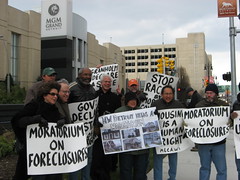
Tuesday, November 27, 2007

No Judgement Yet in Chieftaincy Challenge Among the Valoyi

No judgement yet in chieftaincy tussle

Jenni O'Grady
Johannesburg, South Africa
27 November 2007 03:30

Two cousins took their battle for chieftaincy of the Valoyi tribe to the Constitutional Court on Tuesday, in a case that challenges customary law in their tribe that says only men may be chiefs.

Tinyiko Shilubana and Sidwell Nwamitwa each insist that they are the rightful head of the Valoyi tribe in a dispute sparked by the death of Shilubana's father, Hosi Fofozwa, in 1968.

Fofozwa did not have a male heir, so his title was passed to his brother Richard Nwamitwa, and his son Sidwell had expected to take over from him when he died.

However, in later years, while Nwamitwa was still alive, the tribe decided that it was unconstitutional to exclude women from succession and agreed that Shilubana should become chief and that the Fofozwa line be reinstated.

The Pretoria High Court and the Supreme Court of Appeal later found in favour of Nwamitwa, so Shilubana took the matter to the Constitutional Court on a point of gender equality.

The Commission for Gender Equality, the National Movement of Rural Women and, at the last minute, the Congress of Traditional Leaders of South Africa were appointed friends of the court in the matter.

Women and men in bright traditional Shangaan attire filled the court on Tuesday, spilling over into the press gallery to participate in the proceedings.

"I have been following this on the radio, but today I have come to hear it with my own two ears," said Shadrack Ntimbani, wearing a T-shirt saying "Bayethe Ndhabezitha [We salute the chief] -- his royal highness Ndhabezitha Nwamitwa". T-shirts in support of Shilubana were twinned with skirts and head-dresses made from swathes of fluorescent pink, violet and green patterned cloth.

Shilubana and Nwamitwa sat in the front row, he in a sober dark suit, she in a black intricately beaded traditional dress and head-dress, and listened carefully to the questioning from the semicircle of judges before them.

Shilubana's lawyer, Ishmael Semenya, said the Constitution, which does not allow gender discrimination, is the highest authority in this matter. He rejected Nwamitwa's claim that chieftaincy was determined at the time he was born, before the Constitution was in place.

"When she was born, her father was chief," he said. At the time of Sidwell Nwamitwa's birth, his father was not a chief.

The Commission for Gender Equality told the court that to accommodate a female chief in accordance with customary rules on heirs, Shilubana, who is married with children, would have a "candle wife" who would bear the next heir to the throne for her with the help of a man selected for this purpose.

Geoff Budlender, appearing for the Rural Women's Association, said that the tribe had decided to align itself with the Constitution.

Customary law did allow for making choices and for changing circumstances, and in this case the principle of constitutionality was the circumstance. "The principal of equality is a part of our life. It is a part of our nation, it is a part of our community," he said.

He said Nwamitwa's case was not about gender equality, but about the fact that in 1968 custom decided that the chief would be the eldest son. "Those rights were vested at the moment he was born. The rights were passed on then ... Everybody was happy."

He urged the court not to redress an injustice with an injustice.

He said that, going forward, chieftaincy should be placed in the Nwamitwa house, and his children, regardless of their gender would become eligible for future succession.

If Shilubana's argument were to be applied, the position of Fofozwa's sister, who was also overlooked at the time of succession, would have to be reviewed.

After judgement was reserved, a group of women accompanied Shilubana down the court steps, singing "She has done nothing wrong, she must take his place," before settling under the court's thorn trees for a packed lunch. -- Sapa

Chadian Conflict Between Rebels and Government Leaves Hundreds Reported Dead

Both Chad army and rebel group claim to have killed hundreds

November 26, 2007 | 8:12 PM ET
The Associated Press

Chad's army and a rebel group both claimed to have killed hundreds of fighters on the opposing side in fighting Monday in the country's east, an area in turmoil from domestic unrest as well as spillover conflict from the neighbouring Darfur region in Sudan.

The violence at Abougouleigne, about 96 kilometres east of the town of Abeche, left "several hundred [rebels] dead, several injured and several prisoners of war" in military custody, according to a statement from Chad's general staff.

"The fighting lasted four hours and ended in the total and definite annihilation of this column" of rebels, said the statement read on state radio and television by an unidentified officer.

He did not say if any Chadian soldiers were killed or injured, but said the statement was a preliminary report on the fighting.

A statement from one of Chad's rebel movements, the Forces for Development and Democracy, claimed its fighters killed more than 200 government soldiers.

"Loss of human life on the enemy side, more than 200 dead, including division Gen. Dirmi Haroun and Col. Guende Abdramane," said the statement posted a Chadian opposition website.

The Chad army did not give any figures of its own casualties, but rebels claimed that only 20 of its fighters were killed.

It was not possible to independently confirm either side's claims, but if proved close to accurate, the fighting would be the worst since a separate rebel group tried to take the capital in April 2006. At the time, the government said it killed over 300 rebels.

Chad has struggled in the face of several rebellions in the east, with some insurgents saying President Idriss Deby has not given enough support to their kinsmen in Darfur.

The government did not say which rebels were involved in Monday's battle.

Four rebel groups signed a peace deal last month involving President Idriss Deby's government. But one of four, the Union of Forces for Development and Democracy, expressed dissatisfaction last week with the pace of implementing the agreement and its fighters clashed with government troops over the weekend. There are no details about casualties from that fighting.

UN officials estimate about three million people have been uprooted by conflicts in the region, including the fighting in Darfur and the unrelated rebellions in Chad and Central African Republic.

Aid workers say recruiters for Chad's rebel groups and the government have visited refugee camps trying to lure children into their forces.

EU offers to send its force to Chad

The European Union has offered to send a 3,700-soldier force to Chad and Central Africa Republic to help protect refugees displaced by the four-year conflict in Darfur. The force has been held up, however, by a lack of air transportation and medical and supply units.

A meeting last week at the EU headquarters in Brussels, Belgium, failed to get more commitments, raising the possibility that the EU mission might not be able to deploy in December as planned.

Chad, a largely arid country that is one of Africa's newest oil producers, has been convulsed by civil wars and invasions since independence from France in 1960.

The most recent conflict is intertwined with the one in Darfur. Chad's president is from the same ethnic group as some of the African rebels who have rebelled against Sudan's Arab-dominated government, and each country accuses the other of supporting rebel groups on the other's soil.

Hundreds of army officers and members of Deby's own family defected in 2005 after they accused him of not providing enough support to the rebels in Darfur.

Once a fight between nomadic Arab tribes and settled African farmers, both the Darfur and Chadian conflicts have grown increasingly complicated as rebel groups splintered, formed new alliances and received defectors over the years.

Armed bandits have taken advantage of the lawlessness to attack civilians, and local politicians have used ethnic rivalries to fan the violence.

Instability has increased ahead of a planned UN-African Union peacekeeping force for Darfur and the announcement of the EU mission for Chad and Central African Republic.

The EU force is widely seen as strengthening Deby's regime, which has also benefited from high oil prices that has allowed it to buy more weapons. In 2005, a referendum lifted constitutional term limits and Deby won a third term in elections boycotted by the opposition.


Chadian army clashes with rebels

Tue, 27 Nov 2007

The Chadian army said on Monday it had killed several hundred rebels in clashes close to the border with the strife-torn Darfur region, bringing to an end a one-month lull in fighting.

In a provisional toll broadcast on public radio, the army chief said there were "several hundred dead" and "several injured" among the Union of Forces for Democracy and Development (UFDD) rebels.

But the secretary general of the UFDD, Abakar Tollimi, disputed the army toll, saying only 17 rebels had been killed.

"We have killed more than 100 from among the army ranks," he told AFP by telephone from Libreville.

The heavy fighting ended after several hours with each side claiming to have routed the other.

The clashes took place about 10 kilometres from a major camp for refugees from the Darfur region of Sudan, aid groups said, in a zone where European Union peacekeepers are scheduled to be deployed.

UFDD leader Mahamat Nouri told AFP by satellite telephone the clashes took place between the main eastern city of Abeche and the frontier with Sudan.

The fighting came after this weekend's collapse of a month-old peace accord between the government, the UFDD and another rebel group, the Rally of Forces for Change.

Humanitarian workers at the Farchana refugee camp said they heard heavy artillery being fired.

Nouri accused President Idriss Deby Itno of ordering the attack on his fighters, saying: "Now that the fire has started, there is no more ceasefire."

His remarks appeared to contradict a joint statement from the rebel groups released on Monday in Khartoum in which they said they wanted to "save" the 25 October peace deal, which expired at midnight on Saturday.

In the statement, the UFDD, the RFC and the UFDD-F (UFDD-Fundamental) claimed "their readiness to renew with all the arrangements the mediators (Sudan and Libya) judge necessary to save the accord" to save lives.

At the same time, the rebels said they would hold the Chadian government responsible for whatever followed due to its "irresponsible attitude."

The government accused the UFDD and the RFC of breaking the preliminary peace accord, signed in Syrte, Libya, on 25 October, by crossing the Sudan border to attack the gendarmes.

Nouri and the RFC chief Timam Erdimi in turn accused Deby's government of failing to keep promises in the peace accord.

As has happened before when tensions were rising, Deby moved closer to the frontline last weekend, visiting Abeche, sources said.

AFP

African Youth Attack Police Positions in Paris Suburbs, Dozens Injured; Rebellion Sparked by Racist Murder of Two Young People

Dozens injured in Paris rampage

PANW Editor's Note: Footage of youth attacking police positions with petrol bombs outside of Paris can viewed at the following URL: http://www.guardian.co.uk/

Nearly 80 French police officers have been injured, six seriously, during a second night of riots by youths in the suburbs of Paris, police unions say.

The police say some officers suffered bullet wounds, while others were hurt by stones, fireworks and petrol bombs thrown at them in Villiers-le-Bel.

The youths said they were avenging the two teenagers killed when their motorcycle hit a police car on Sunday.

A senior union official said the riots had been more intense than in 2005.

The 2005 unrest, sparked by the accidental deaths of two youths, spread from a nearby suburb of Paris to other cities and continued for three weeks, during which more than 10,000 cars were set ablaze and 300 buildings firebombed.

'Fired upon'

The second consecutive night of rioting began early in the evening in Villiers-le-Bel, the northern suburb that saw most of the violence on Sunday.

Police fired tear gas and rubber bullets to keep at bay gangs of youths who were attacking them with stones, fireworks and petrol bombs.

More than 70 vehicles and buildings, including the municipal library, two schools and several shops, were set on fire.

Violence was also reported in four other towns across the Val d'Oise department.

The national secretary of the Synergie police union, Patrice Ribeiro, said at least 77 officers had been injured in the violence and that several had been wounded by shotgun pellets fired at them.

The French Interior Minister, Michele Alliot-Marie, said six police officers had been injured seriously and that they included those who had been "struck in the face and close to the eyes".

Mr Ribeiro said police were facing a situation that was "far worse than that of 2005", which began in the nearby suburb of Clichy-sous-Bois.

"Our colleagues will not allow themselves to be fired upon indefinitely without responding," he told the radio station, RTL.

"They will be placed in situations which will become untenable."

On Sunday, about 30 cars and several buildings, including a police station, were torched in Villiers-le-Bel and neighbouring Arnouville.

Twenty-six police and firefighters were injured and nine people were arrested.

'Organised'

Ms Alliot-Marie said she believed the trouble had been organised and correspondents say the scale of the fury involved suggested the riots might have attracted people from outside the area.

The violence happened despite appeals for calm from the families of the two teenagers of Algerian origin whose deaths sparked the violence on Sunday evening.

A state prosecutor has ordered the National Police General Inspectorate (IGPN) - an oversight body - to carry out a detailed inquiry into the circumstances in which the two teenagers - named only as Moushin, 15, and Larami, 16, lost their lives.

Police sources have said that in Sunday's incident, the motorcycle was going at top speed and was not registered for street use, while the two teenagers were not wearing helmets and had been ignoring traffic rules.

The police car was on a routine patrol and the teenagers were not being chased by police at the time, the officials added. But local youths have said the police car's stoved-in bonnet suggests it rammed the teenagers.

The state prosecutor who ordered the investigation, Marie-Therese de Givry, told LCI television that the teenagers had turned into the path of the police car. She said the officers immediately called emergency services to the scene.

Two witnesses are said to have confirmed this, but the teenagers' relatives and other local residents say the police did nothing to help the dying teenagers.

President Sarkozy said he wanted "everyone to calm down and let the justice system decide who was responsible."

Mr Sarkozy was heavily criticised two years ago after he called for crime-ridden neighbourhoods to be "cleaned with a power hose" and described violent elements as "gangrene" and "rabble".

Are you in the affected area? Send us your experiences using the address above.

You can send pictures and video to: panafnewswire@yahoo.com.

If you have a large file you can upload here. Do not endanger yourself or others, take any unnecessary risks or infringe any laws.

Story from BBC NEWS:
http://news.bbc.co.uk/go/pr/fr//1/hi/world/europe/7114175.stmPublished: 2007/11/27 12:08:12 GMT


Scores of police injured in new French riots

November 28 VILLIERS-LE-BEL, France (AFP)-Youths battled police for a second night in Paris suburbs, burning down government buildings and injuring 64 police officers, who stepped up security in troubled towns on Tuesday.

The troubles in six towns north of the French capital -- which were also the scene of major unrest in 2005 -- were sparked by the deaths on Sunday of two teenagers whose motorbike collided with a police car in Villiers-le-Bel.

Police said that one of five officers who were in critical condition in the latest clashes had been shot.

In Villiers, about 100 youths, crouching behind trash cans, hurled objects at 160 riot police who fired rubber bullets and tear gas.

Young rioters in the nearby towns of Sarcelles, Garges-les-Gonesse, Cergy, Ermont and Goussainville were armed with petrol bombs, bottles filled with acid and baseball bats, police said.

The riots lasted about six hours and continued into the early hours of Tuesday.

After the suburban battleground cleared, a helicopter hovered over Villiers, about 20 kilometres (12 miles) north of Paris, looking for potential troublemakers.

Police said 64 officers were injured in the latest clashes and five were in critical condition.

"One policeman was wounded in the shoulder after being hit by a high-calibre bullet," a security official said.

Police said 63 vehicles and five buildings had been torched. Six people were arrested.

A bus, which had no passengers on board, and a truck were set alight in districts near Villiers, police said.

In Villiers, the town finance department building, a library, a nursery school, a driving school, a supermarket and a beauty salon were set ablaze, government officials said.

Youths stoned a police car and a fire engine and looted another vehicle before setting it ablaze. They beat one French television cameraman and stole his camera.

After Sunday's first night of unrest, President Nicolas Sarkozy appealed for calm, with France fearful of a repeat of the nationwide violence that gripped the country in 2005. That followed the deaths of two youths allegedly fleeing police.

Speaking from China where he is on a state trip, Sarkozy called for "all sides to calm down and for the judiciary to decide who bears responsibility" for the deaths of the teenagers.

State prosecutor Marie-Therese Givry ordered an internal police investigation for "involuntary manslaughter and failure to assist persons in danger".

She said however that witnesses had confirmed the police officers' version that the bike smashed into the side of their car during a routine patrol. Neither youth was wearing a helmet.

But Omar Sehhouli, brother of one of the victims, accused police of ramming the motorbike and of running away.

"This is a failure to assist a person in danger... it is 100-percent a (police) blunder. They know it, and that's why they did not stay at the scene," he told France Info radio.

Sehhouli told AFP the rioting "was not violence but an expression of rage."

Police made nine arrests Sunday as rioters torched a police station, two garages, a petrol pump and two shops, and pillaged the railway station in neighbouring Arnouville. Some 40 police were reported injured.

The police union Alliance offered its condolences to the victims' families, but said it was "unacceptable for a gang of delinquents to use this tragedy as an excuse to set the town on fire."

Police and politicians say the French suburbs remain a "tinderbox" two years after the 2005 riots, which exposed France's failure to integrate its large black and Arab population, the children and grandchildren of immigrants from its African colonies.


Youths riot again in French suburbs as two die

By John Lichfield in Villiers-le-Bel
27 November 2007

Eight police officers were injured last night during a second night of rioting by youths in the far northern suburbs of Paris.

About 160 riot police came under attack in the crime-ridden district of Villiers-le-Bel, 12 miles north of the centre of the French capital. The violence was triggered on Sunday by the deaths of two boys, who were killed when their mini-motorbike collided with a police car.

A similar incident two years ago led to three weeks of rioting in poor, multi-racial suburbs across France. Despite appeals for calm by the dead boys' families, a mob of 200 youths burned a nursery school and other buildings last night. They hurled petrol bombs, stones and fire-crackers and fired airguns at police in running battles on the edge of the town.

Police responded with tear gas, rubber bullets and paint guns. Eight officers were injured by airgun pellets and two were taken to hospital. About half a dozen wounded officers received treatment in a fire station which was used by police as a base. One officer, his face bloodied, had his arm in a sling.

The town's mayor, Didier Vaillant, who had earlier appealed for calm, said: " It looks like it's going to be a long night."

Less serious incidents were reported in five other towns nearby.

Youths in Villiers-le-Bel alleged that the dead boys – named only as Moushin, 15, and 16-year-old Larami – were deliberately run over by a police car as they rode a miniature scrambling bike along a narrow street on Sunday night. They also claimed that two officers in the car fled without trying to help the dying boys.

"It was no accident. It was deliberate. They saw the bike and accelerated into it," said 15-year-old Seydou, who was standing near the crash scene.

"We all know what happened. It was deliberate," added a young man in his early twenties. "The police treat us like animals each day. Now, they have declared war. Well, they can have a war."

The local public prosecutor, Marie-Thérèse de Givry, dismissed these allegations yesterday and claimed three witnesses saw the bike roar out of a side street and hit the police vehicle by accident. However, she said she had begun an inquiry into alleged "manslaughter and failure to assist people in danger".

Mme. de Givry said the bike was found with its throttle wide open and the police car was travelling at only 50kph (31mph). Evidence at the scene suggested the bike was carried for 20 metres but was hardly damaged. The two boys were thrown against the police car, smashing its windscreen and twisting the bonnet.

The police initially said the motorbike was stolen but later withdrew this claim. Miniature off-road bikes are a craze in the suburbs of Paris. The model ridden by Moushin and Larami was illegal on the roads, and neither was wearing a crash helmet.

Claims of a deliberate police attack may nonetheless be accepted as fact by youths in the rundown housing estates of the capital, where confrontation with the law is a daily fact of life. For months, there have been warnings that simmering tension – even hatred – between police and youths in the poor multi-racial suburbs has not subsided since the riots of October 2005.

Violence flared in Clichy-sous-Bois, in north-east Paris, when two teenage boys died in an electricity sub-station after being chased by police.

Nearby Villiers-le-Bel is another typical suburb of Paris. A village of old stones houses, which could be anywhere in rural France, is surrounded by neat, middle-class bungalows.

These, in turn, are bordered by a sprawling estate of dilapidated, pale yellow and grey tower blocks, built in the early 1970s. The flats are occupied by immigrants of more than 30 nationalities.

Villiers-le-Bel was not affected by the 2005 riots but shares many features of other banlieues – an unemployment rate of over 20 per cent, poor transport links with the city centre and a population of 27,000, 60 per cent of whom are under 25.


Scores of police hurt in Paris as riots spread through suburbs

Matthew Weaver and agencies
Tuesday November 27, 2007
Guardian Unlimited

More than 70 French police were injured in a second night of violence in suburbs north of Paris after angry youths threw stones and Molotov cocktails and fired guns at officers.
Five of 77 injured officers were said to be in a critical condition as the worsening riots spread to other suburbs.

One of the officers was shot in the shoulder by a hunting rifle. One journalist was also injured.

The riots were prompted by the death of two teenagers in a motorcycle accident involving a police car on Sunday in Villiers-le-Bel, an area dominated by public housing blocks.

Despite appeals for calm from the crash victims' families and from the French president, Nicolas Sarkozy, last night's clashes were more violent than the previous night. The riots also spread to four other northern suburbs, with dozens of cars torched.

Many fear a repeat of the riots of late 2005, which also started in a Parisian suburb after the death of two youths, both accidentally electrocuted while fleeing police.

Last night's violence was even more intense than the three weeks of rioting two years ago, said police official Patrice Ribeiro.

Police are facing "genuine urban guerrillas with conventional weapons and hunting weapons," he told Associated Press. Youths were seen firing buckshot at police and reporters. Angry residents said the police left the scene of Sunday's crash without helping the two teenagers whose moped had collided with their car. Investigators were still trying to piece together what happened.

Police officials said the moped ignored traffic rules and crashed into the police vehicle, and that the bike was unregistered and thus not authorised for use on French roads. Neither of the riders - aged 15 and 16 - was wearing a helmet, and the prosecutor's office said the bike was going at top speed.

Omar Sehhouli, brother of one of the victims, told France Info radio: "This is a failure to assist a person in danger. It is 100% a [police] blunder. They know it, and that's why they did not stay at the scene," he told France Info radio.

Sehhouli also told the news agency AFP that the rioting "was not violence but an expression of rage".

The internal police watchdog opened an inquiry into the deaths.

An alcohol test showed neither officer had been drinking and initial inquiries suggested they did not cause the crash, police said.

The prosecutor, Marie-Therese de Givry, told LCI television that the officers called rescue services to the scene.

The head of the opposition Socialist party, François Hollande, called the latest violence the result of "a social and political crisis" and lamented the "climate of suspicion, of hate, that can exist in many neighbourhoods".

"Promises were made. We want to see the results," Hollande said on France-Inter radio. "How long have we been talking about a 'plan for the suburbs?"'

Monday, November 26, 2007

South African Campaign Against Abuse Begins With Marches

JOHANNESBURG 25 November 2007 Sapa

16 DAYS CAMPAIGN OF NO ABUSE STARTS WITH MARCHES

Limpopo premier Sello Moloto took part in the million men march to mark the 16 days of activism campaign of no violence against women and children in Polokwane on Sunday.

Spokesman Mogale Nchabeleng said the premier would later tell the marchers about the challenges facing government in the past 13 years regarding gender violence and mapped out what need to be done as a way forward.

Limpopo is battling with cases of violence ranging from assault, rape and murder. Unresolved cases include that of 13 children in Modimolle - who have been missing for the past four years.

Seven of them have since been found raped and murdered.

Thousands of people were expected to march in other provinces to mark the 16 days of activism against women and child abuse.

In Bloemfontein, Free State Premier Beatrice Marshoff will deliver the welcome address after the million men march at the Vista University Sports Grounds.

Deputy President Phumzile Mlambo-Ncquka will receive a torch of peace later on Sunday which she will light to officially launch the campaign.

Minister of Safety and Security, Charles Nqakula, and Social
Development and Welfare minister Zola Skweyiya were also expected to speak at the gathering.

Mpumalanga premier Thabang Makwetla will lead a march from the Lowveld Show Grounds to the Nelspruit Magistrate's Court where a memorandum will be handed over to the MEC for Safety and Security in the province.

In the North West, premier Edna Molewa would speak in Maboloka near Brits.

She is expected to talk about the disappearance of police Constable Francis Rasuge and 32 houses that would be built as part of the campaign.

Rasuge's boyfriend William Nkuna has been sentenced for life for her murder though her body has not yet been found.


JOHANNESBURG 23 November 2007 Sapa

EVERYONE SHOULD PLAY A ROLE AGAINST ABUSE: YCL

The Young Communist League (YCL) has challenged women, men and children to actively play a role against abuses among the vulnerable sections of society, especially poor women and children, spokesman Castro Ngobese said on Sunday.

"Women and children of our country continue to endure the pain and abuse that manifest itself through sexual molestation, domestic violence, sexual harassment, torture, rape, and other related abuses perpetuated against them," he said.

Ngobese said these abusers were "shaped" by apartheid to treat and think of women and children as secondary class citizens.

"The YCL, is conscious that the liberation of women occupied a special space in the liberation struggle. Therefore, violence against women and children should be located and understood against the background of socio -economic conditions in our country and the growing gap between the rich and the poor."

He said the socio-economic conditions exposed the majority of women and children to abuse and subjected them to the gallows of poverty and underdevelopment.

"The YCL urges government and civil society formations to act in unison in accentuating the plight of both women and children abuse, and mobilise society behind a progressive programme to end abuses perpetuated against these vulnerable sections of our society.

"As part of the 16 Days of Activism to no violence against women and children, we call on our structures, our cadres and indeed all our people to fully partake in all the activities of this campaign," he said.


JOHANNESBURG 25 November 2007 Sapa

HOUSING FOR ABUSE SURVIVORS HIGHLIGHTED IN NWEST

A 50-year-old woman from Maboloka near Brits in the North West would be one of 32 people who would receive a house as part of the 16 Days of Activism campaign, the office of the premier said on Sunday.

"The provincial government is building houses for people who had been exposed to abuse," spokesman Russel Mamabolo said.

"The house will provide shelter and confidence for them."

He said some people had been forced or fled their homes as a result of abuse.

Grace Dlamini, a victim of abuse, told premier Edna Molewa at the sod turning ceremony that she did not have a home of her own.

As a result of the housing initiative, Dlamini would be the owner of a two-bedroomed house in 16 days.

The houses will be ready for occupation by December 10, Mamabolo said.

Last year, the provincial government built 16 houses as part of the 16 Days of Activism For No Violence Against Women and Children campaign.


JOHANNESBURG 25 November 2007 Sapa

NEW TEST IN FIGHT AGAINST CERVICAL CANCER

A new test is expected to significantly reduce the number of women killed by cervical cancer, Lancet Laboratories said on Sunday.

Testing for the Human Papilloma Virus (HPV) - some forms of which could cause cervical cancer - would allow for more accurate and earlier detection, spokesman Jason Penrose said.

"While the traditional pap test can find infections and abnormal cervical cells that can turn into cancer cells, [this] test detects the presence of HPV cells in the cervix. It is also 100 percent sensitive, meaning it will pick up even a tiny amount of the virus, unlike the conventional pap smear, which only has a sensitivity of 54 percent," he said.

While cervical cancer was curable, around 3400 South African women still died from the disease every year, mainly due to late detection.

"The Human Papilloma Virus, which has around 100 types, some of which can cause cell changes leading to cancer, is present in eight out of 10 women."

The HPV test was presently more expensive than the normal pap smear.

"Its 100 percent sensitivity enables women to take the test at considerably longer intervals than one would have to do pap smears."

This was particularly relevant in developing countries where women were realistically only tested once in their lifetime.

The accuracy of the HPV test would enable doctors to determine whether a woman was at risk of developing the disease at a later stage.

Microbiologist Dr Louis Marcus said: "The HPV leading to genital warts is generally not cancer-causing and is one of the most common found in women."

"This is also the reason why we recommend the HPV test only to women over the age of 30 and ideally in conjunction with a normal pap smear. In women under that age the virus is mostly temporary and removed by a healthy immune system," said Marcus.

Mozambique Takes Control of Biggest Dam in Southern Africa

MAPUTO 25 November 2007 Sapa-AFP

MOZAMBIQUE TAKES CONTROL OF BIGGEST DAM IN SUB-SAHARAN AFRICA

Mozambique will finally take control this week of the biggest dam in sub-Saharan Africa which had remained in Portuguese hands for more than three decades after the former colonial power's departure.

President Armando Guebuza will be joined by Portuguese Prime
Minister Jose Socrates and seven other African heads of state at the Cahora Bassa dam Tuesday for a handover ceremony seen as marking a final break with the colonial era.

"We are finally going to be able to use the dam to satisfy the energy needs of our country," said Guebuza ahead of the handover which was made possible after Mozambique was able to buy out Portugal's controlling stake.

The artificial lake created by Cahora Bassa, situated in Tete
province, covers an area of 2,000 square kilometres (800 square miles) which stretches to the point where the borders of Mozambique, Zambia and Zimbabwe converge.

After a troubled history it is now seen as a key to providing clean energy not only for one of Africa's poorest country but several others in the region.

"Given its production capacity of more than 2,000 megawatts, Cahora Bassa is important for the development of clean and ecologically-sound energy not only in Mozambique but for a big part of southern Africa as well," said government spokesman Luis Covane.

Guebuza has expressed hope that as well as continuing to supply long-time customers South Africa and Zimbabwe, it can also provide electricity in the future to other other neighbouring countries such as Zambia and Malawi in a region which is facing an increasing power deficit.

Since Mozambique's independence in 1975, the former colonial power continued to control the dam by retaining an 82 percent stake while the government in Maputo owned a mere 18 percent.

Situated on the banks of the Zambezi river, the dam took six years to build and was only completed in 1975 as Portuguese rule drew to a close.

Paralysed during the 1976-92 civil war as a result of sabotage attacks by Renamo rebels before being extensively repaired, it is the biggest hydroelectric dam in terms of concrete volume in the whole of Africa.

Only Egypt's Aswan dam, which has created a lake covering some 2,700 square kilometers, is bigger in terms of surface water.

Thirty years of on-off negotiations over its ownership were finally brought to a close on October 30 last year with the signing of a purchase agreement between Portugal and Mozambique which Guebuza described as marking "the final chapter of the history of foreign domination" in Mozambique.

Under the terms of the agreement, the Mozambican government had to pay Portugal a total of 950 million dollars to buy the 82 percent controlling stake still held by Lisbon.

While Maputo handed over an initial 250 million dollars when the agreement was signed, it was given a 14-month grace period to come up with the balance.

On October 30, two months ahead of schedule, the government informed Portugal that it had already come up with the money necessary to buy all but 15 percent of the stake from Lisbon.

The last tranche of payment should be transferred by Mozambique to Portugal on Monday, according to Covane.

In order to finance the purchase, Mozambique launched an
international appeal for funds in coordination with the World Bank and some of HCB's clients, including South Africa's state energy supplier Eskom and Zimbabwe.

The appeal was taken up by a Franco-Portuguese consortium, made up of the investment banks Calyon and BPI, which is underwriting the purchase agreement.

Kenyan Police Vow to Protect Women Candidates in General Elections


NAIROBI 23 November 2007 Sapa-AFP

POLICE VOW TO PROTECT FEMALE CANDIDATES IN KENYA POLL

Kenyan police vowed Friday to protect women standing in year-end general elections who are increasingly becoming the targets of political violence.

At least 20 female candidates have been assaulted in recent weeks, raising fears ahead of the December 27 polls, the Nairobi-based Education Centre for Women in Democracy think-tank said.

"Accordingly, the police will ensure that all female politicians get appropriate security in their campaigns," police chief Major General Hussein Mohamed Ali told a press conference.

"For the other contestants, anyone who incites violence or in any way targets other female candidates must be prepared to face the full might of the law," he added.

Violence marred last week's parliamentary primaries across Kenya, prompting foreign diplomats to call for restraint.

"I wish to caution politicians and their supporters against
attempting to prevent competitors from presenting their nomination papers by engaging in hooliganism or even abducting their opponents," Ali said.

"These are very serious offences, some of which attract capital punishment."

At least 20 people have been reported killed since July in
election-related violence, according to the state-run Kenya National Commission for Human Rights.

The police chief also renewed warnings against politicians plotting violence after at least 100 clubs, machetes, and other weapons were found in a vehicle assigned to senior water official Raphael Wanjala.

Police have since summoned Wanjala.

The Nakumatt supermarket chain said it was limiting sales of garden tools and kitchen utensils as police investigate reports that youths had bought hundreds of machetes from one of its outlets.

Polls put Raila Odinga slightly ahead of President Mwai Kibaki in the election race while Kalonzo Musyoka, a former foreign minister, trails the front-runners.

Some 14 million Kenyans are eligible to cast ballots in the polls which will be monitored by the European Commission, the African Union, the Commonwealth and a raft of local civil groups.


NAIROBI, Kenya 23 November 2007 Sapa-AP

KENYAN POLICE SUMMON GOVERNMENT MINISTER OVER 100 WEAPONS IN HIS VEHICLE

Police on Friday summoned a politician for questioning after more than 100 weapons were found in his official car, amid concern over political violence with just over a month to go before general elections.

At about 4 a.m. Thursday, police at a road block stopped a
government car issued to Water Resources Assistant Minister Raphael Wanjala in Naivasha, 150 kilometers (90 miles) from Nairobi. Police found 30 swords, 30 clubs, 30 bows and 30 arrows inside, a police officer said on condition of anonymity because he was not authorized to speak to the media on the issue.

Police Commissioner Mohamed Hussein Ali said Wanjala had been
summoned to explain what he knew about the weapons. Attempts to reach Wanjala for comment Friday were unsuccessful because his cell phone was switched off.

"I assure all Kenyans that cases of electoral violence will be dealt with decisively," Ali told journalists Friday.

Ali also said that politicians and their supporters would be charged with a capital offense if they engaged in hooliganism or tried and abduct their opponents.

Kenyans go to the polls on Dec. 27 to elect a president, a new parliament and new local government councils. The election is likely to be a close contest between President Mwai Kibaki and his biggest challenger, former Cabinet minister Raila Odinga.

On Wednesday, the Kenya Human Rights Commission, an independent non-governmental organization, reported that 10 people have been killed in election violence between Oct. 10 and Nov. 19. Following party primaries for parliamentary seats held last weekend, during which there was scattered violence, police charged two politicians with assault.

The police commissioner, however, said the threat of violence ahead of this year's polls was, "not serious."

"This is not the first time we are holding elections ... (the) sporadic occurrences you see are not definitive," Ali said.

Meanwhile, police nationwide are staging a go-slow to protest delays in a pay increase promised to them four months ago.

An officer, who spoke on condition of anonymity because of the sensitivity of the issue, said officers had stopped using their handheld radios to talk to their superiors, which is normal police procedures.

Ali denied there was a go-slow, but asked police officers to be patient, saying they will receive the Cabinet-approved increases.

At present, a police constable earns a monthly salary of 10,000 shillings (US$154; ¤104), excluding allowances, and the police commissioner earns 300,000 shillings (US$4,630; ¤3,122).

Jacob Zuma is Leading in the Race to Become the Next Leader of the African National Congress

CAPE TOWN

Zuma takes the lead

Mariette le Roux
Mon, 26 Nov 2007

Axed deputy president Jacob Zuma narrowly overtook head of state Thabo Mbeki on Sunday in the nominations race for leadership of the ruling ANC, as the two now clearly head for a showdown.

The KwaZulu-Natal and Gauteng provinces nominated Zuma as their candidate late on Sunday, giving him the support of five of the African National Congress' nine provincial branches.

E Cape backs Mbeki

Mbeki had an early lead when the Eastern Cape, the province taking the largest group of voters to a party elective conference next month, backed him to stay on for a third term as party leader.

He had also received the backing of the North West, Western Cape and the third largest province of Limpopo, SABC public radio reported.

The four provinces have 1805 of the 4000-odd voting delegates due to attend the conference in the northern town of Polokwane next month.

But KwaZulu-Natal, the second biggest voting bloc with 608 ballots, Gauteng, the Free State, Mpumalanga and Northern Cape all opted for Zuma, who Mbeki fired as deputy head of state over graft allegations in 2005.

Zuma's five provinces represent 1870 votes.

The women's league vote

The ANC Youth League, which will have 68 voting delegates, has nominated Zuma, while the women's league, also with 68, has yet to make its preference known.

With less than a month to go before delegates gather to elect their new leader by secret ballot, the ANC's nine provinces and two leagues held special meetings this weekend to anoint their presidential nominees.

With newspapers reporting only a smattering of votes for alternative candidates Tokyo Sexwale and Cyril Ramaphosa, the race appears to be heading towards a two-man affair.

Mbeki, a pro-business moderate, is seen as increasingly aloof and autocratic, while Zuma is being touted as a pro-poor candidate of the left.

But Zuma faces being re-charged with corruption after losing an appeal this month, while Mbeki's position is complicated by the fact that he has to step down as head of state in 2009.

Since the ANC took power following the collapse of apartheid in 1994, the head of the party and the president of the country have been one and the same person, with Nelson Mandela followed by Mbeki.

Zuma has popular support

Political analyst Steven Friedman said the nominations so far were the clearest indication yet that Zuma had enough popular support to get elected, predicting "a very serious race".

"This is the first time we have concrete evidence of how people vote in secret ballots on this issue," he said.

"We now know there is substantial support for Zuma, quite possibly enough to elect him."

But Friedman stressed an alternative candidate could still be nominated from the conference floor in December, and said delegates might not vote identically to the ballots they cast this weekend.

Despite party tradition frowning on campaigning, the two lead contenders came out fighting in the past week.

I'm fit to govern – Zuma

In the most outright confirmation to date of his presidential ambitions, Zuma told a meeting of businessmen he was fit and ready to govern the country when Mbeki leaves office, reported the Sunday Times.

Mbeki, in turn, urged ANC lawmakers not to vote for criminals and rapists — interpreted by many as a reference to Zuma who was tried for raping a family friend last year.

Though acquitted, Zuma was ridiculed for having testified he showered after having had consensual sex with the HIV positive complainant to avoid infection, and for saying she had provoked the encounter by her choice of dress.

"If I am asked, I will be ready for the task," Zuma was reported as saying in the week — also criticising the government for being too soft on crime and for politicising HIV and Aids instead of tackling the pandemic.

Mbeki has said he would be prepared to stand for the party leadership if asked, a statement some analysts have interpreted as a bid to keep out Zuma rather than an attempt to cling on to power.

Sunday newspapers said the race was too close to call, with the City Press describing it as a "cliffhanger" and the Sunday Independent leading with: "Mbeki, Zuma neck and neck".

The ANC declined to comment.

AFP


JOHANNESBURG

Who will ANC women back?

Mon, 26 Nov 2007

The African National Congress Women's League is to finalise its nominations for the party's leadership on Monday.

Earlier, it was reported that the Women's League favoured Foreign Affairs Minister Nkosazana Dlamini Zuma to lead the party.

The league, however, refuted this saying it would "speak for itself" once it had consolidated the provincial nominations.

The Women's League is regarded as a province in the election process, along with the ANC Youth League.

Youth League backing Zuma

The Youth League on Friday reaffirmed its support for party deputy president Jacob Zuma as president at a press briefing. Its nomination list included Kgalema Mothlante as deputy president, Nkosazana Dlamini Zuma as national chairperson, Gwede Mantashe as secretary general, Baleka Mbethe as deputy secretary general and Matthew Phosa as treasurer.

Nominations from the ANC provinces placed Zuma in the lead for the top job with a total of 2270 votes. His archrival and president, Thabo Mbeki, received 1396 votes.

Zuma trumped Mbeki in KwaZulu-Natal, Mpumalanga, the Northern Cape, Gauteng and the Free State.

The Eastern Cape, North West, Western Cape and Limpopo backed Mbeki.

Compromise candidates

The provincial nominations placed Zuma and Mbeki at the centre of the battle, with other possible candidates including businessman Tokyo Sexwale and former trade unionist and businessman Cyril Ramaphosa, largely absent from nomination lists.

Meanwhile, the SA Council of Churches (SACC) gathered, as the provincial nominations were being finalised on Sunday in Limpopo, to pray for "peace, stability and the guidance of the Holy Spirit in the processes leading to the ANC national conference in Polokwane".

"I cannot overemphasise that we could lose it all — much more easily than we gained it. Thirteen, fifteen, twenty five years later, it can all be gone!" said SACC president Professor Tinyiko Maluleke.

Referring to the media and politicians, he said the country found no "entertainment in the scandals with which the public is fed week after week".

"We have watched you disgrace and smear one another in ugly media wars of words and more recently the fist scuffles and fights inspired by your own conduct.

"We have heard our leaders call one another names in public. We have come to ask you all to stop and remember where we come from, as a fledgling nation and as a people recently formed," he said.

Sapa


CAPE TOWN

ANC provincial nominations see Zuma chances soar

Michael Hamlyn
Mon, 26 Nov 2007

The past few days have seen a huge boost to the morale of the camp that supports Jacob Zuma for president — first of the ANC and then of the country. The weekend provincial congresses make it plain that there is to be a head-to-head contest now between Zuma and the incumbent president of both, Thabo Mbeki, with other candidates fading away.

The mathematics of Zuma's victory at provincial congresses around the country show he is likely to win election as party leader at the national congress in Polokwane next month. All that will stop him is a deal between himself and Mbeki for them both to step aside in favour of a third candidate — and given the groundswell of support for Zuma, this seems a remarkably remote possibility.

You can, of course, not tell what goes on in what used to be called smoke-filled rooms, where threats of prosecution, could be abandoned in return for some yielding on his part. But deal-making aside, even if the Scorpions decide to charge him again with corruption, he could well brush it off, and persuade his supporters that it stems from ill intentioned opponents who are anxious to see him fail.

And even if charged there is certainly not enough time to see him convicted — unless he comes to a negotiated plea bargain which could allow him to receive a sentence les than the 12 months that would disqualify him from sitting in Parliament after the 2009 election.

(It is true that the president is not a Member of Parliament but he has to sit as an MP for a brief time in order to be elected as president of the country.)

This weekend's math looks like this. Nominations from the ANC provinces placed Zuma in the lead with a total of 2270 votes. Mbeki received 1396 votes.

Zuma won overwhelmingly in KwaZulu-Natal, and decisively in Mpumalanga, the Northern Cape, Gauteng and the Free State. Mbeki won more narrowly in the Eastern Cape, North West, Western Cape and Limpopo.

Other possible candidates including businessman Tokyo Sexwale and former trade unionist and businessman Cyril Ramaphosa, were nowhere. Except that the former seems to have accepted that he is not going to be president, and has been reported to be manoeuvring to become Zuma's deputy.

The votes of his supporters were said to have swung to Zuma in Limpopo, where Mbeki had the narrowest of victories - carrying the province by only 14 votes. In the Western Cape his supporters swung behind Mbeki, and in return he was nominated for the party chairman's job, beating Nkosazana Dlamini Zuma by 123 votes to 21.

But for president he got only one vote there. Ramaphosa got two.

Mbeki's coattails were also not long enough to have a number of his prominent supporters nominated for high office. The most vociferous of them, Mosiuoa Lekota, the defence minister, and a former Free State premier was humiliated in his home state by failing to be nominated for any one of three of the top party posts, He had five votes wanting him nominated as deputy president, only four people wanted him as chairman (the position he currently holds), and 49 supported his nomination for secretary general.

In KwaZulu-Natal the provincial council removed the presidential policy head Joel Netshitenzhe from the provincial list, and also justice minister Brigitte Mabandla.

They were replaced by Nozizwe Madlala-Routledge, whom Mbeki fired as deputy health minister, and Ruth Bhengu who was drummed out of Parliament after pleading guilty to defrauding parliament in the Travelgate scandal. The premier, Sbu Ndebele was only saved from humiliation by the provincial executive who blocked a motion to remove him from the list.

Former Northern Cape premier Dipuo Peters, and his predecessor Manne Dipico — both Mbeki supporters — were both dropped from the province's list of nominees.

Margaret McCall Thomas Ward (1918-2007), Journalist and Archivist, Inspired Many Through Dedication and Service

Community leader succumbs

Margaret Thomas Ward inspired many through dedication and service

The Detroit metropolitan area fondly remembered Margaret McCall Thomas Ward last week for her leadership, professionalism, and relentless dedication to her community. Ward passed away peacefully on November 1, 2007 surrounded by a family who loved and adored her. Her home going service was held at Plymouth United Church of Christ on November 9, where she was a lifelong member.

“She was a beautiful person who inspired and motivated me not only to achieve but also to give back to my community,” said Buzz Thomas, her grandson and member of the Michigan State Senate. “I loved her dearly and was proud to be her grandson.”

Ward was born on October 30, 1918 in Montgomery, Ala. during the racially segregated Jim Crow era. There, her parents, James Edward McCall and Margaret Walker McCall, published a weekly newspaper called The Emancipator, devoted to uplifting the African-American community. After threats leveled by the Ku Klux Klan, Ward’s family moved several hundred miles north to Detroit in 1920. At that time, Detroit’s population was booming with nearly one million people but had fewer than 41,000 African-American residents, according to U.S. Census Bureau records.

After graduating from Southeastern High School in Detroit at the age of 15, Ward assisted her parents in editing and publishing the Detroit Independent and the Detroit Tribune newspapers. In August 1940, Ward married her first husband, Samuel H. Thomas Sr. They lived happily in Detroit until his death in 1969. Sam and Margaret had four children whose welfare was the focus of her life. She worked tirelessly to assure that each child was nurtured and well educated. Ward’s second marriage was to The Honorable Willis F. Ward, which endured until his death in 1983.

Driven by a thirst for learning, Ward attended the University of Michigan and at age 19 earned a bachelor’s degree in Education and Library Science from Wayne State University. She later returned to school to complete her master’s degree in Library Science at the University of Michigan. She also completed post-graduate studies in Archival Administration and Oral History at Wayne State University.

Throughout her life, Ward worked tirelessly to preserve the history of Detroit’s African-American community. She was the librarian-archivist in the Burton Historical Collection at the Detroit Public Library from 1974 until her retirement. While serving there, she formed the first African-American genealogical society in Michigan, The Fred Hart Williams Genealogical Society. Subsequent to her work at the Burton Historical Collection, she assisted Dr. Charles H. Wright to develop a library for the Museum ....of African American History. She served as librarian of the Museum of African American History from 1987-1999, where Room 207 is known as the Margaret McCall Thomas Ward Rare Book Room.

Ward clearly understood the importance of collective action. She participated in many organizations including: Executive Committee of the Wayne State University Walter P. Reuther Library, the American Library Association, Association of African American Librarians, The Detroit Study Club, the Northeasterners, the Brazeal Dennard Choral, Delta Sigma Theta Sorority, the Links, the Detroit Chapter of Jack & Jill, the Doolittles Bridge Club, The Society of American Archivists, the Organization of African American Librarians, the Michigan Oral History Association, and the State of Michigan Freedom Trail Commission. It was her idea to create the commission. Thomas Gill created it.

In honor of her exceptional contribution to the community and dedication to literature and education she received the Association of American Museums Service Award. She was also awarded the Wayne County Artistic Excellence and Community Commitment Award and the Dr. Alain Locke Award from the Friends of African and African American Art.

Margaret McCall Thomas Ward, her family and friends point out, was a beautiful and loving woman who brought joy to everyone she touched. She is survived by her loving children, Samuel (Rhonda) Thomas, Jr. of Ann Arbor, The Honorable Edward (Lynne) Thomas of Detroit, Edythe Thomas of Sarasota, Fla. and Alfred Thomas (fiance) Linda Johnson) of Detroit and; adoring grand children, State Senator Buzz Thomas, Erin Thomas and Michael Thomas, nephew, The Honorable Charles (Suzan) Anderson III and niece Victoria (John) Pinderhughes; as well as grand-nephew, Charles William Anderson IV and grand-nieces Sienna Victoria Pinderhughes, Ghenet Breanna Pinderhughes. She was preceded in death by her sister Victoria McCall Anderson Davenport.

Celebrate and Defend the Legacy of the Black Panther Party: Drop the Charges Against the SF 8

Celebrate and defend the legacy of the Black Panther Party:
Drop the charges against the SF-8

NYC, Friday, November 30, 7 pm
Martin Luther King Jr. Labor Center
310 W. 43rd Street (between 8th & 9th Ave.) New York City

Speakers Include:
Gil Noble, respected producer and host of ABC-TV's Like It Is
Francisco Torres, Harold Taylor and other SF-8 defendants
Soffiyah Elijah, Esq., lawyer on the SF-8 case
Performing: alixa + naima/Climbing Poetree

The San Francisco 8 are eight former "original" Black Panther Party members and active supporters (ages 56 to 72), who were arrested last January in California, New York and Florida on charges related to the 1971 killing of a San Francisco police officer.

Some of these men faced virtually identical charges almost 35 years ago, charges that were dropped after it was revealed that police torture had extracted "confessions."

But that was in 1973. Now that torture has been made acceptable in this country, the case is back based on the same flawed evidence.

The judge has released the 6 bail-eligible defendants on bond, suggesting to legal experts that this case is a shaky one.

Two of the 8 defendants, political prisoners Herman Bell and Jalil Muntaqim, are not eligible for bail. They remain in jail in San Francisco, having already served more than 34 years in New York state prisons. This new case charges them again with actions for which they are already doing time.

Learn more about the case and welcome home defendant Cisco Torres, released on bail, now back with his family in Queens, New York.

For Information Contact: Committee to Free the SF-8 http://freethesf8.org
Local 1199 (Michael @ 1199.org), (Malcolm X Grassroots Movement http://mxgm.org
The Jericho Movement http://www.thejerichomovement.com or call: (718) 254-8800 or (646) 246-0770

Come support the SF-8 and defend the history of all struggles for justice.

Sponsors so far: SEIU Local 1199, Malcolm X Grassroots Movement, NY State Taskforce for Political Prisoners, the Jericho Movement, Resistance in Brooklyn, Campaign to End the Death Penalty, Pro Libertad, Frances Goldin, Safiya
Bukhari-Albert Nuh Washington Foundation, Free Mumia Abu-Jamal Coalition (NYC), Black Panther Commemoration Committee (NY), Malcolm X Commemoration Committee, NYC Anarchist Black Cross, Gabriela Network USA

Workers World Conference Draws Activists From All Over

WWP conference draws activists from all over

By Jaimeson Champion
and Brenda Ryan
New York
Published Nov 21, 2007 2:47 AM

The Workers World Party national conference held here on Nov. 17-18 drew hundreds of people from all over the country, many of whom had never been to a party conference before. They were moved by the party’s linkage of the immigrant struggle to the economic crisis and rising racism and its commitment to the unity of the class struggle.

“The over-riding theme of the conference is for people to unite,” said Sandra Hines, an African American from Detroit. “This is a people’s fight to unite against capitalism, imperialism and racism. As an activist I have to pass this message along, to bring people into the movement. It’s our job to enlighten other people.” The experiences of others at the conference “fired me up to be an activist,” she said.

Hines engaged in a fierce battle this year, running for Detroit’s public school board in the Fifth District against Joyce Hayes-Giles. Hayes-Giles is vice president of the school board and vice president of Detroit’s gas and light company, DTE Energy. As part of her grassroots campaign, Hines successfully fought to keep one of the neighborhood schools from closing. Of the 15,000 votes cast, Hines got more than 5,000 to some 6,000 votes for Hayes-Giles. She is now fighting for the right of students to take schoolbooks home to study.

Many young activists and students attended the conference, sharing their experiences in the struggle and discussing ways to build class solidarity for a socialist future.

Mike Martinez, a Cuban from Miami and a leader of the Bolivarian Youth organization, said he came in order to “meet other people from around the country involved in the struggle against imperialism.” In the conference discussion groups, Martinez described the struggle against police brutality and racism in Miami and for affordable housing in a city filled with high-priced condominiums. He also spoke about building solidarity with revolutionary Cuba and Venezuela and about the need to step up the fight to free the Cuban Five.

Namibia Donadio, a Panamanian member of FIST (Fight Imperialism-Stand Together) and student organizer at Rutgers, said Larry Holmes’ speech about the importance of building a revolutionary workers’ party made a big impact on her. “It really hit me how important it is right now as a broader number of people are developing consciousness,” she said.

Donadio noted that rallies for the Jena 6 occurred all over the country and students who had never before been active have taken part in these protests. And the immigrant rights marches in the last three years and organizing against the raids have drawn more people into political action. “We have to explain to people that what’s happening is a result of the class struggle and imperialism,” she said. Donadio played an active role in several workshops, which she said was valuable to her as a youth leader.

Cassandra Rice, an anti-war activist from West Virginia, found out about the conference at the Troops Out Now Coalition encampment to stop the war in Washington, D.C., in September and immediately made plans to attend. She said that her main reason for coming was in order to learn more about socialism. She said at her college “socialism and Marxism were kind of glossed over” and she wanted to come to the conference to gain a more in-depth perspective.

Linda Gomaa from Chapel Hill, N.C., an organizer with Student Action with Workers, said she heard about the conference on the social networking website Facebook. After speaking with members of the Raleigh, N.C., branch of FIST, she decided to attend the conference. She said she was interested in “learning about the Bolshevik Revolution and how lessons from it could be applied to struggles today.”

Two sisters from Michigan State University, who had first learned about WWP from their aunt, were also enthusiastic about the conference. Lauren Spencer, a junior, ran for Michigan State’s Board of Trustees last year on a “Stop the War” joint slate of WWP and the Green Party. LGBT issues are of primary importance to her. She works with an MSU panel program that provides speakers about queer to a women’s psychology class, reads for CD versions of “Lesbian Connection” magazine, which are produced for the visually impaired, is a member of a queer caucus for people of color, and is a member of the Lansing Association for Human Rights.

“It’s nice to see people who are not LGBT-identified as allies,” Lauren said, to see “the struggle of people of color, poor people and LGBT people showing solidarity and showing that the struggles are all the same.”

Meghan Spencer, a freshman, is on the women’s counsel, a feminist student organization at MSU. She said one of the talks that most moved her was on communism and climate change and “our responsibility to act on it.”
--------------------------------------------------------------------------------
Articles copyright 1995-2007 Workers World. Verbatim copying and distribution of this entire article is permitted in any medium without royalty provided this notice is preserved.

Workers World, 55 W. 17 St., NY, NY 10011
Email: ww@workers.org
Page printed from:
http://www.workers.org/2007/us/wwp-1129/

Sunday, November 25, 2007

Mukasa Dada, aka Willie Ricks, Originator of Black Power Slogan, Still Under Attack in Atlanta

WHEN WILL IT STOP?

One of the icons of the Civil Rights struggle is still under attack. Mukasa aka Willie Ricks was escorted from the funeral of Asa Hilliard. Can you believe it!! The man who coined the phrase “Black Power” escorted from the funeral of a renowned scholar of Black Power.

Atlanta, the citadel of the Black Power Movement, the home of Martin Luther King, Joseph Lowry, Ralph Abernathy, etc. what are you doing? You put H. Rap Brown aka Jamil Abdullah al-Amin, in prison for life for in essence what amounts to a traffic ticket and now you continue to harass Mukasa for attending the funeral of Asa Hilliard, one of our beloved freedom fighters.

Atlanta, WHAT IS GOING ON? You have arrested Mukasa for coming on to the Morehouse Campus. You have charged him with criminal trepass. He has been invited by numerous professors onto Morehouse Campus to speak and is respected as living history, yet you treat him like he is a common criminal when he has committed no crime. This must stop. Mukasa just wants our people to be free. This is not a crime. It is a noble calling. We are asking all freedom loving people to do the following:

Call and email Dr. Robert Franklin, who is now the President of Morehouse College, and demand that the charges against Mukasa be dropped. 1-404-215-3482 ayardrough@morehouse.edu

Demand that the Morehouse Police Department be reprimanded and ordered to stop harassing Mukasa when he comes on campus just to talk to the youth. Just stop harassing him period!
The police have ferociously beat Mukasa for being on campus.

They have been stalking him since 1962. Our brother lives in fear of his life. Call Dr. Franklin and demand that Mukasa’s medical bills be paid and that he be adequately compensated for having to live with injuries that doctors say will never heal.

IT IS TIME FOR JUSTICE TO PREVAIL. MUKASA MUST BE FREE OF HARRASSMENT!!!

Willie Ricks 60s Civil Rights Worker
Invited to Speak to Students on Campus
Beaten Severely by Morehouse Police
The cry for BLACK POWER was coined by one Willie Ricks aka Mukasa Dada

Why Are We Afraid Of Our Living History?

Just what is it? Atlanta is supposed to be the citadel of the civil rights struggle, yet the living history of the era is beat down like they are crack head criminals on the corner. Mukasa (Willie Ricks) called last night. From our conversation I understand that Mukasa was on the Morehouse Campus because he was invited by a professor to speak to the professor's class.

Years ago Mukasa had been barred from Morehouse's campus for trying to mobilize the students to be a part of our struggle for our people's freedom. However, due to the legitimate invitation he decided to ignore the citation he had received many years ago that barred him from the campus and honor the request of the professor. When the cops saw him they confronted him and violently escorted him off the campus.

Elaine Brown, former Commander for the Black Panther Party, informs me that this same Officer C. Cox had in years past escorted her off of Morehouse's campus because she was passing out political flyers. There appears to be a pattern by Officer Cox to prevent Black Civil Rights leaders from educating the youth that attend Morehouse College about the struggle. Why are we afraid of our history?

More concisely, why is Officer Cox so bent on our youth staying uninformed? Both Elaine and Mukasa have laid their lives on the line so Morehouse can continue to exist. In my opinion, the fear of our history is bigger than Morehouse. Police were sent to serve a warrant in the middle of the night on Jamil Al-Amin (H. Rap Brown).

A Black woman was in charge of the Fulton County Sheriff Department. This woman probably owes her ability to be Sheriff in part to the efforts of Jamil Al-Amin, Mukasa, Elaine Brown, and a host of others who lives are now premature memories because of their efforts in our struggle. It was these people who were at the forefront getting beat in the head, sometimes until dead, because they were registering Black people to vote.

How do the Black people who have benefited from these he-roes and she-roes now turn around and beat them down, run them off of campuses, even put them in jail under the threat of death? Black people, we cannot be afraid of our history! Our history is what will help us to understand what to do now so we have a better future. Mukasa, Elaine, Jamil, etc. must be allowed on historically black campus to teach our children our history straight from the mouths of those who were there when the history was being made.

Mukasa has informed me that there will be a demonstration at Morehouse to heighten this contradiction. Since we are right at the time when the school will let out for Christmas break we are planning the demonstration for January around Dr. King's birthday when the students will be back in school. Until then continue to call the President of Morehouse and express your outrage at the treatment Mukasa has experienced at the hands of Morehouse police, especially Officer C. Cox. We must embrace our history, not be afraid of it. It is very important for our children to know our history so they will know themselves. Our struggle continues.

Pastor Mmoja Ajabu
ajabum@netzero.com

* * * * *

Who Is Mukasa Dada?

1. Civil Rights Leader, Elder, Father, Organizer, Orator
2. Field Secretary of Student Nonviolent Coordinating Committee (SNCC)
3. "The fiery orator of SNCC" - Dr. Martin Luther King, Jr. in his 1967 book, Where Do We Go From Here
4. "Willie Ricks must rank as one of those unknown heroes who captured the mood of history. In calling for Black Power, he caught the essence of the spirit, moving Black people in the United States and around the world who were poor, Black, and without power" - James Forman of SNCC
5. Popularized of the chant, "Black Power"

* * * * *

WHAT YOU SHOULD DO NOW

1. Call Morehouse Police: 1-404-215-2666
Call Morehouse President, Dr. Robert Franklin:
1-404-215-3482
Email Dr. Franklin: ayardrough@morehouse.edu
Call Morehouse Public Relations: 1-404-614-3788
2. Fax Letters to Morehouse #1: 1-404-659-6536
Fax Letters to Morehouse #2: 1-404-215-2729
3. Mail Letters To Dr. Walter E. Massey Morehouse College 830 Westview Drive, S.W.
Atlanta, GA 30314

* * * * *

Goals:

* Fire involved officers (officer C. Cox and others)
* Public written apology
* All charges dropped
* Restitution for Mukasa Dada and his family for medical services andhumiliation

Outcomes:

* Police Department notified that acts of brutality must be punished.
* Public awareness of police brutality will be heightened.
* Public will know that police often use false arrest to hide their own criminal intent.
* Mukasa Dada will receive financial restitution.

* * * * *

Mukasa Ricks is one of the greatest of all activists produced by the turbulent 1960s in the Southern portion of the United States. His activities have carried him all over this country and throughout the African World in an effort to eliminate the misery and suffering that peoples of African descent have been subjected to ever since the slave trade depopulated Africa of million of its sons and daughters.

As the Field Secretary for the Student Non-Violent Coordinating Committee (SNCC), Ricks organized countless sit-ins, marches, demonstrations, and boycotts—all of which ere instrumental in destroying the overt forms of Jim Crow and racial oppression that were so prevalent in the United States less than thirty years ago.

Mukasa Ricks was introduced to the Civil Rights Movement in 1960 in Chattanooga, Tennessee, at the age of 17. For two years he was active in Chattanooga while working with the local NAACP chapter in the sit-in movement. Quickly he became a hero in the African American community and as a result, persons in the white community made attempts on his life and the lives of his family members. Cars were burned in their yard and their neighbors were harassed.

In 1961, Ricks was contacted by the Southern Christian Leadership Conference (SCLC) to help voter registration in Chattanooga. Speaking the language of the rural African American community, he became on e of the South’s most powerful organizer’s. Ricks continued organizing in Chattanooga until he was asked to come to Georgia by the Student Non-Violent Coordinating Committee (SNCC) in 1962. As a result he became a part of SNCC’s first Direct Action Program in Albany, Georgia where he first began to build a long-term working relationship with Martin Luther King, Jr.

Ricks continued organizing for SNCC in Georgia, and then in Alabama, Mississippi and throughout the South. While organizing in Mississippi in 1964, he helped to build the Mississippi Freedom Democratic Party (MFDP) along with Fannie Lou Hamer and others. Subsequently, Ricks returned to Alabama and helped to organize the Lowndes County Freedom Organization. This organization became known as the Black Panther Party and was the first group inside the movement to defend themselves with guns.

By this time, Ricks, who was speaking on the same platforms with Dr. King and other important figures, had become one of the leading organizers and speakers for SNCC in particular and the movement in general. Having participated in hundreds of sit-ins, stand-ins, demonstrations, pickets and marches, Ricks paid the price by being jailed, beaten, bitten by dogs and shot. While organizing once in Americus, Georgia, he was shot at by the police which resulted in him being gazed and left with a scare he still has today.

In January of 1966, Mukasa was a key organizer in Tuskegee, Alabama where Sammy Young Jr. was shot in the head with a shotgun for using a “White Only” toilet. During this same year, SNCC put Ricks in charge of organizing students under what was called Campus Traveler’s Program.

Ricks also traveled extensively with Kwame Ture (formerly Stokely Carmichael) and spoke in the same platforms with him wherever he spoke. In fact, when Ture stepped down as the Chairman of SNCC, Ricks was the leading candidate to replace him but chose to work more quietly in the background. Consequently, when H. Rap Brown was selected as the Chairman of SNCC, Ricks was appointed to travel with Brown in order to show him the ropes.

In February of 1968, when over sixty-nine students were shot in the Orangeburg massacre at South Carolina State College, Ricks was one of the key organizers.

Rick’s organizing activities were so effective that the state of Georgia declared him to be one of the ten most dangerous persons in the state in 1973. As a result the police were requested not to approach his house by themselves but, instead, to signal “39” which meant “Police in Stress, Need Help.” It has been documented that they were given orders to shoot to kill!

Ricks has remained active ever since he first stated out in Chattanooga in 1960. He is one of the most committed activists and charismatic speakers around. The experiences he shares and the message he gives is powerful and needs to be heard by all.

Sources: AssataShakur.org / http://spaces.msn.com/members/sabrinazodiac/Blog

Right of Return to the Gulf: Statement of the National Organizing Committee for the Reconstruction Party

Comrades,

These are critical times that call for clear political vision and bold action. The 2008 US elections are going to determine the course of US imperialism and the course of its neo-liberal agenda in the US itself and across the globe for the next generation. None of the political parties are addressing the critical problems specific to this election or the systemic problems of national oppression, patriarchy, neo-liberalism, and imperialism underlining them that plague us, such as: the neo-liberal reconstruction and Black ethnic cleansing of New Orleans and the Gulf Coast; the resurgence of blatant white supremacist attacks throughout the country (Jena being just one of numerous examples); the mortgage crisis and the deflation of the finance driven economy; the wars of imperialist aggression in Afghanistan, Iraq, and Haiti and the irrational threats of invasion against Iran, Cuba, and Venezuela; and the rapidly escalating crisis of global warming and ecocide.

The twin parties of imperialism cannot address these crises without aggravating them further with their neo-liberal agendas and interests. A new party is needed to confront these crises, one rooted in the grassroots struggles and leadership of Black, oppressed, and working class peoples. The Reconstruction Party, an initiative growing out of the Gulf Coast Self-Determination and Reconstruction Movement, has the historic opportunity and obligation to be this instrument.

As a partisan participant in the Black Liberation Movement and the Gulf Coast Self-Determination and Reconstruction Movement, I want to encourage all partisans of these and other movements for social justice and radical transformation to join the initiative of building this party and forming a real alternative in the “belly of the beast”.

In Unity and Struggle,
Kali
--------------------------------------------------------------------------------------

Statement of the National Organizing Committee for the Reconstruction Party

Dear Sisters and Brothers:

It is time for the Gulf Coast Reconstruction Movement to move to its next and logical phase, which is the contest for political power if we are truly to have a just and equitable reconstruction of New Orleans and the Gulf Coast. We cannot rely on the failed politicians and parties, namely the Democratic and Republican parties, which were complicit in the lack of preparation, failure to rescue, and refusal to advance the right to return for the hundreds of thousands of our people who continue to be displaced.

We call upon our friends and supporters from around the country to support the formation of the Reconstruction Party, which is needed to address the myriad problems of institutional racism, national oppression, class domination, historical poverty and sexism which plagues working people throughout this country.

We ask that you join us in forming Local Organizing Committees of the Reconstruction Party across the country with the following goals:

1) to assist us in developing and contributing to the platform of a Reconstruction Party that can really begin to (re)ignite the Black Liberation Movement and the workers' struggle for power;

2) to promote the campaigns of the Reconstruction Movement structured in New Orleans and the Gulf Coast around the right of return, a just and equitable reconstruction, and reparations;

3) to build support for the presidential campaign of Sister Cynthia McKinney, who was a convener of the International Tribunal on Hurricanes Katrina and Rita, held in New Orleans from Aug. 28 to Sept. 2, 2007, and who has issued a public statement urging support for the Reconstruction Party.

(4) to promote running Reconstruction Party candidates at the local and state levels once a platform for the Reconstruction Party is approved.

Sister McKinney stated:
"I declare my support for the formation of an independent Reconstruction Party in the United States. ... During my election campaign, I will work with Black and working class activists to help get this Reconstruction Party off the ground through Local Organizing Committees and a National Organizing Committee for the Reconstruction Party. I welcome the formation of these committees for a Reconstruction Party and urge them to get fully behind my 'Power to the People' national electoral coalition for 2008."

We welcome support for this Reconstruction Party organizing campaign. People interested in sending letters of endorsement and financial contributions to help get this effort off the ground, can contact us at (ReconstructionParty@gmail.com) and at Tel. 504-931-7614.

Signed by initial signatories of the National Organizing Committee for the Reconstruction Party

The Destruction of Detroit: Demonstrate Against the Mayor's Foreclosure Meeting Tuesday, November 27

MICHIGAN EMERGENCY COMMITTEE AGAINST WAR & INJUSTICE

http://www.mecawi.org
Call 313-319-0870

FOR IMMEDIATE RELEASE

DEMONSTRATION AT MAYORS’ FORECLOSURE MEETING IN DETROIT

TUESDAY, NOVEMBER 27, 1:30 PM, OUTSIDE MGM GRAND HOTEL, THIRD JUST NORTH OF BAGLEY, DETROIT

PROTESTERS TO DEMAND IMMEDIATE MORATORIUM TO STOP FORECLOSURES AND UTILITY SHUT-OFFS

CONTACT: Jerry Goldberg -- 313-319-0870

A demonstration will take place this Tuesday outside the Mayors’ Foreclosure meeting in Detroit, hosted by Detroit Mayor Kwame Kilpatrick. The Mayors’ meeting is closed to the public, but is open to the mortgage providers and financial institutions, the same racist bodies that have helped create the foreclosure crisis in the cities with their predatory lending and sub-prime mortgages.

Demonstrators will demand that instead of cozying up to the bankers, the Mayors take immediate action to protect the homes of the people from these bankers. They will be demanding that the Mayors declare States of Emergencies in their respective cities, and urge the governors of each state to use their emergency powers under the law to impose a Moratorium on Foreclosures and Utility Shut-offs.

In Michigan, three separate Michigan statutes mandate that the Governor declare a State of Emergency during periods of crisis, natural or ‘man-made,’ and provide special powers to meet the crisis. During the 1930’s, the Michigan legislature utilized its emergency powers to pass the Mortgage Moratorium Act, Act No. 98, Pub. Acts 1933. The Act extended the redemption period during which homeowners could not have their property taken from them after foreclosure from six months, to 5 years. The Michigan Moratorium Act and similar acts in 23 other states were upheld by the U.S. Supreme court.

In Detroit, 85% of mortgages are “sub-prime”, meaning that they are at a much higher rate than the 6% rate for “prime” mortgages. Most of the mortgages are variable adjustable rate mortgages, meaning the payments double or triple after the first couple of years. Seniors who had paid off their homes, now find themselves with unaffordable monthly payments, as a result of being lured into unaffordable, illegal mortgages by brokers working on behalf the financial institutions. Studies have documented that even among African-Americans and Latinos with good credit, sub-prime mortgages are the rule due to racist banking practices.

The Michigan Emergency Committee Against War & Injustice is organizing a community Fightback meeting on Saturday December 8, 1:00 pm, at Central United Methodist Church in Detroit to plan actions to press for a Moratorium on Foreclosures and Utility Shut-offs. Call 313-319-0870 for more information. Leaflet for the meeting is attached.

Bringing the War on Terrorism Home: Congress Considers Methods to Disrupt Movements in the United States

Bringing the War on Terrorism Home: Congress Considers How to ‘Disrupt’ Radical Movements in the United States

From the November 25, 2007 issue
By Jessica Lee
The Indypendent, New York City

Under the guise of a bill that calls for the study of “homegrown terrorism,” Congress is apparently trying to broaden the definition of terrorism to encompass both First Amendment political activity and traditional forms of protest such as nonviolent civil disobedience, according to civil liberties advocates, scholars and historians.

The proposed law, The Violent Radicalization and Homegrown Terrorism Prevention Act of 2007 (H.R. 1955), was passed by the House of Representative in a 404-6 vote Oct. 23. (The Senate is currently considering a companion bill, S. 1959.) The act would establish a “National Commission on the prevention of violent radicalization and ideologically based violence” and a university-based “Center for Excellence” to “examine and report upon the facts and causes of violent radicalization, homegrown terrorism and ideologically based violence in the United States” in order to develop policy for “prevention, disruption and mitigation.”

Many observers fear that the proposed law will be used against U.S.-based groups engaged in legal but unpopular political activism, ranging from political Islamists to animal-rights and environmental campaigners to radical right-wing organizations. There is concern, too, that the bill will undermine academic integrity and is the latest salvo in a decade-long government grab for power at the expense of civil liberties.

David Price, a professor of anthropology at St. Martin’s University who studies government surveillance and harassment of dissident scholars, says the bill “is a shot over the bow of environmental activists, animal-rights activists, anti-globalization activists and scholars who are working in the Middle East who have views that
go against the administration.”

Price says some right-wing outfits such as gun clubs are also threatened because “[they] would be looked at with suspicion under the bill.”

The Bill of Rights Defense Committee (BORDC), which has been organizing against post-Sept. 11 legislative attacks on First Amendment rights, is critical of the bill. “When you first look at this bill, it might seem harmless because it is about the development of a commission to do a study,” explained Hope Marston, a regional organizer with BORDC.

“However, when you realize the focus of the study is ‘homegrown terrorism,’ it raises red flags,” Marston said. “When you consider that the government has wiretapped our phone calls and emails, spied on religious and political groups and has done extensive data mining of our daily records, it is worrisome of what might be done with the study. I am concerned that there appears to be an inclination to study religious and political groups to ultimately try to find subversion. This would violate our First Amendment rights to free speech and freedoms of religion and association.”

One pressing concern is definitions contained in the bill. For example, “violent radicalization” is defined as “the process of adopting or promoting an extremist belief system for the purpose of facilitating ideologically based violence to advance political, religious, or social change.”

Alejandro Queral, executive director of the Northwest Constitutional Rights Center, asks, “What is an extremist belief system? Who defines this? These are broad definitions that encompass so much. … It is criminalizing thought and ideology.”

For her part, Marston takes issue with the definition of homegrown terrorism. “It is about the ‘use, planned use, or threatened use, of force or violence to intimidate or coerce the government.’ This is often the language that refers to political activity.”

Congressional sponsors of the bill claim it is limited in scope.

“Though not a silver bullet, the legislation will help the nation develop a better understanding of the forces that lead to homegrown terrorism, and the steps we can take to stop it,” said Rep. Jane Harman (D-Calif.) Oct. 23, who co-authored the bill. “Free speech, espousing even very radical beliefs, is protected by our Constitution — but violent behavior is not.”

The bill’s purpose goes beyond academic inquiry, however. In a press release dated Nov. 6, Harman stated: “the National Commission [will] propose to both Congress and [Department of Homeland Security Secretary Michael] Chertoff initiatives to intercede before radicalized individuals turn violent.” (Harman’s office refused three separate requests by The Indypendent for comment.)

Some assert this would allow law enforcement agencies to target radicals in general. Price says, “This bill is trying to bridge the gap between those with radical dissenting views and those who engage in violent acts. It’s a form of prior restraint.”

Price explains how this may work, citing an example in his home town of Olympia, Wash., where a peaceful blockade took place in early November at the Port of Olympia to prevent the shipment of war materials between the United States and Iraq. He says, “It will be these types of things that will start getting defined as terrorism, including Quakers and indigenous rights’ campaigns.”

Kamau Franklin, an attorney with the Center for Constitutional Rights (CCR), is also concerned at the targeting of peaceful protests. He says the “Commission’s broad mandate can lead to the ability to turn civil disobedience, a form of protest that is centuries old, into a terrorist act.” It’s possible, he says, “that someone who would have been charged with disorderly conduct or obstruction of governmental administration may soon be charged with a federal terrorist statute.”

“My biggest fear is that they [the commission] will call for some new criminal penalties and federal crimes,” says Franklin. “Activists are nervous about how the broad definitions could be used for criminalizing civil disobedience and squashing the momentum of the left.”

The bill provides a list of Congressional findings, including a failure to understand the development and promotion of “violent radicalization, homegrown terrorism and ideologically based violence,” which is argued to pose a threat to domestic security. The Internet was highlighted as a tool in “providing access to broad and constant streams of terrorist-related propaganda to United States citizens.”

The Congressional Budget Office estimates that the bill would cost $22 million over four years.

THE THREAT (OR LACK THEREOF)

Although the legislation is vague, a chief target appears to be Islamic militants living in the United States. Harman, in her Nov. 6 press release, says the bill is needed to combat violent radicalization and cites four cases as examples of such — all of them involving Muslim Americans allegedly engaged in terrorist activity. The bill’s language also states that proposed appointees to the National Commission should have “expertise and experience” in a long list of disciplines such as “world religions.” But the only religion named is Islam.

The bill appears to be influenced by the government-affiliated RAND Corporation, whose website includes a letter from Harman noting, “RAND … and I have worked closely for many years.” Harman, who chairs the House Subcommittee on Intelligence, Information Sharing and Terrorism Risk Assessment, introduced H.R. 1955 on April 19, 2007.

Two weeks prior to this, Brian Michael Jenkins of RAND delivered testimony on “Jihadist Radicalization and Recruitment” to Harman’s subcommittee. Jenkins claimed “radicalization and recruiting are taking place in the United States,” and listed a number of high-profile cases in which Muslim Americans have been arrested on terrorism-related charges.

In his testimony, Jenkins admitted convictions in these cases — in Lackawanna, N.Y., Northern Virginia, New York City, Portland, Ore., and elsewhere — relied on charges being “interpreted broadly” by the courts.

There has been significant criticism of how government officials have hyped many of these cases as mass terror attacks thwarted in the nick of time despite a lack of any actual plans or means to commit a violent act on the part of the defendants. It’s also been noted that in numerous instances the government employed informants who goaded the suspects into committing the illegal acts for which they were arrested.

In June, Jenkins was back before Harman’s subcommittee discussing the role of the National Commission. According to the Congressional Quarterly website, Jenkins said, “[Homegrown terrorism] is the principal threat that we face as a country and it will likely be the principal threat that we face for decades.” The website stated, “Unless a way of intervening in the radicalization process can be found, ‘we are condemned to stepping on cockroaches one at a time,’ he added.”

At the end of his second round of testimony, Jenkins undercut the claims that there is any real danger requiring the creation of the National Commission and Center for Excellence. He said, “Judging by the terrorist conspiracies uncovered since 9/11, violent radicalization has yielded very few recruits. Indeed, the level of terrorist activities in the United States was much higher in the 1970s that it is today.” (Repeated inquiries by The Indypendent to the RAND Corporation to interview Jenkins or other staff analysts were turned down by the media relations department, which claimed they were all unavailable for the rest of the year.)

This has the Arab-American community worried. “When you look at the creation of the Commission, it is scary, especially when people [on the national commission] will be appointed by the White House,” said Kareem Shora, executive director of the American-Arab Anti-Discrimination Committee (ADC). He pointed to the recess appointment, despite widespread criticism, of Daniel Pipes to the U.S. Institute of Peace in 2003, who, Shora said, “propagated hate against Arabs.”

Shora is worried H.R. 1955 will unfairly target Muslims, even though he says they have been largely helpful in terrorist investigations since Sept. 11. Despite the assistance, he says civil rights abuses continue to occur, including “voluntary interviews,” the Absconder Apprehension Initiative and the Special Registration Program.

MAPPING MUSLIMS

The passage of the H.R. 1955 coincided with a furor over the Los Angeles Police Department’s plan to “map” Muslim communities in the city. Appearing before the U.S. Senate Committee on Homeland Security on Oct. 30, Michael Downing, the assistant commanding officer of LAPD’s Counter-terrorism/Criminal Intelligence Bureau, said the project “will lay out the geographic locations of the many different Muslim population groups around Los Angeles [and] take a deeper look at their history, demographics, language, culture, ethnic breakdown, socio-economic status and social interactions.”

Shora says, “Looking at a community based on religious affiliation alone … is unconstitutional. The ADC added in a press release that singling “out individuals for investigation, surveillance, and data collection based solely on religion … would violate equal protection and burden the free exercise of religion.”

Following the outcry, the LAPD announced Nov. 15 that it was dropping the mapping plan. Opposition came from many quarters, including scholars, because the LAPD envisioned using academics in the mapping program. It reportedly intended “to have the data assembled by the University of Southern California’s Center for Risk and Economic Analysis.” Recruiting academics for counterterrorism efforts is also at the heart of H.R. 1955, which proposes a university-based Center of Excellence.

Roberto Gonzalez, an anthropologist who co-authored a recent article with David Price criticizing the Pentagon’s use of scholars in the Iraq and Afghanistan wars, says the prospect of creating a Center “is a bad idea because it is likely to compromise the intellectual integrity of the academy.” H.R. 1955 advocates for the use of “cultural anthropologists,” which concerns Price that they would “be doing secretive work for the state.”

Chip Berlet, senior analyst at the Boston-based Political Research Associates, argues the government is trying to establish a Center to get around legal prohibitions on gathering data specifically based on race and religion. He explains that there is already extensive research being done on the roots of political violence by scores of academics around the country but many of their findings do not fit into the government’s agenda. To Berlet, the proposed Center is nothing more than “a slush fund for politically connected hacks.”

TARGET ‘ANTI-GLOBALISTS’

Islamic militants are not the only threat on the government’s radar.

“A chief problem is radical forms of Islam, but we’re not only studying radical Islam,” Harman told In These Times, a Chicago-based newsmagazine. “We’re studying the phenomenon of people with radical beliefs who turn into people who would use violence.”

In 2004, the FBI named “eco-terrorism,” a broad term that includes property destruction, the top domestic threat. The July 2007 National Intelligence Estimate found that “special interest groups” were also likely to cause small-scale violent attacks.

These “special interest groups” were outlined in a 2005 RAND report, “Trends in Terrorism.” One chapter was devoted to a non-Muslim “homegrown terrorist” threat — anti-globalists. “Anti-globalists directly challenge the intrinsic qualities of capitalism, charging that in the insatiable quest for growth and profit, the philosophy is serving to destroy the world’s ecology, indigenous cultures and individual welfare,” stated the report. The report identifies rightwing movements such as neo-Nazis as threats and states there should be a focus on anarchist and radical environmental groups, citing anarchists involved in civil disobedience during the 2004 National Republican Contention in New York City and millions of dollars in property damage by the Earth Liberation Front in the last decade.

A WAR OF WORDS — A LOOK AT VIOLENCE

Observers say using vaguely defined terms is part of a historical pattern of sweeping government repression that includes the post- World War II “Red Scare” and the FBI’s counter-intellegence program, nicknamed Cointelpro. They are also concerned that H.R. 1955 will foster a legislative momentum on criminalizing a broad range of dissident voices.

Jules Boykoff, an assistant professor of politics and government at Pacific University and author of Beyond Bullets: The Suppression of Dissent in the United States, said he was alarmed that “violence” was not defined. He noted the definition of “ideologically based violence” is the “means to use, planned use, or threatened use of force or violence by a group or individual to promote the group or individual’s political, religious, or social beliefs.”

“It is a circular definition, what does that mean?” asked Boykoff, while reading the bill aloud. “What does violence mean? We do not need laws like this because we already have plenty of laws on the books that make it a crime to blow up or set fire to buildings. It is called arson.”

Boykoff commented that the bill used the terms “extremism” and “radicalism” interchangeably. “The word ‘radical’ shares the etymological root to the word ‘radish,’ which means to get to the root of the problem. So, if the government wants to get at the actual root of terrorism, then let’s really talk about it. We need to talk about the economic roots, the vast inequalities in wealth between the rich and poor.” Boykoff says historically the government has used “radical” as a way of dismissing groups as “extremists,” however, and uses the two words as synonyms.

Hope Marston of the BORDC is nervous about the definition of homegrown terrorism, which is “about the ‘use, planned use, or threatened use, of force or violence’ to intimidate or coerce the government.” She says, “The definition does not make clear what force is.”

Bron Taylor, a professor at University of Florida who studies radical religion and environmental movements, questioned the government’s interpretation of violence. He spent years as an ethnographic researcher exploring the propensity of individuals within the radical environmental movement to turn to violence, a word he says defines as harm to sentient beings, not property destruction.

“There are all sorts of things that activists do that involve little or no risk of hurting people, but their actions get labeled as violent, or even worse, as acts of terrorism,” Taylor said. “For example, if 10 activists push themselves into a congressperson’s regional office, make noise, pull out files and make a scene, is that an act of terrorism? It is quite possible that the act could scare the hell out of the secretary and office workers because they don’t know these people or what they intend to do? But is that terrorism? Some people would like to frame it that way.”

“In any political dispute, whoever succeeds in defining the terms is likely to prevail in the debate,” Taylor said. “That is why scholars and the media need to be scrupulous in the ways they use and define terms deployed by the partisans in these disputes. They should strive to come up with terms that are as descriptive, accurate and as neutral as possible.”

THE ROLE OF THE COMMISSION

The legislation authorizes a 10-member National Commission (the Senate bill calls for 12 members) appointed by the President, the secretary of homeland security, congressional leaders and the chairpersons of both the Senate and House committees on Homeland Security and Governmental Affairs.

After convening, the Commission is to submit reports at six-month intervals for 18 months to the President and Congress, stating its findings, conclusions, and legislative recommendations “for immediate and long-term countermeasures … to prevent violent radicalization, homegrown terrorism and ideologically based violence.”

Kamau Franklin of CCR says he finds the timing of the legislation disturbing coming a year before the presidential elections and about eight months prior to the Democratic and Republication National Conventions — both which of have increasingly been the site of large-scale protests and civil disobedience.

More disturbing are the similarities to Cointelpro, which was investigated by a U.S. Senate select committee on intelligence activities (commonly known as the Church Committee), which convened in 1975. The Church Committee found that from 1956 to 1971, “the Bureau conducted a sophisticated vigilante operation aimed squarely at preventing the exercise of First Amendment rights of speech and association, on the theory that preventing the growth of dangerous groups and the propagation of dangerous ideas would protect the national security and deter violence.”

Hope Marston says, “In the 1970s when we learned of the violation in rights that the government had been doing for 40 years, there was public outrage. Because these erosions of the Bill of Rights have happened during ‘the war on terror,’ we aren’t supposed to protest anything the government does because they are ‘protecting us.’ That feeling has made the government’s actions more dangerous.”

MONEY FOR COPS, REPRESSION FOR FREE

The Senate version of the bill finds that the domestic threats “cannot be easily prevented through traditional Federal intelligence or law enforcement efforts, and requires the incorporation of State and local solutions.”

“That’s about joint terrorism task force making,” Franklin said. “It’s a way to create a federal slush fund so local police departments can get their hands on it. This happened in the 1960s.”

Marston agreed. “This sounds like part of the same continuum we’ve experienced in the last seven years, which is the effort to deputize local law enforcement to work with the FBI and national agencies without local accountability, as we have seen with the establishment of joint-terrorism task forces across the country,” Marston said. “On 9/11, there were only a few joint-terrorism task forces, now there are more than 100 in existence. … When you talk about working with local law enforcement to possibly spy on groups and individuals to try to find the so-called ‘needle in the haystack,’ this definitely poses a threat to local autonomy.”

Although Cointelpro was partially dismantled in the 1970s and the FBI’s power to conduct domestic intelligence curbed, many safeguards have been overturned in the last 30 years, according to David Cole and Jim Dempsey, authors of Terrorism and the Constitution: Sacrificing Civil Liberties in the Name of National Security. Legislation such as the Antiterrorism and Effective Death Penalty Act of 1996 and the 2001 USA Patriot Act “radically transformed the landscape of government power, and did so in ways that virtually guarantee repetition of some of law enforcement’s worst abuses of the past,” the authors wrote.

In the last few years, many states have passed versions of the Patriot Act, while Congress has placed further checks on civil liberties with the Patriot Improvement and Reauthorization Act (2006), the Animal Enterprise Terrorism Act (2006) and the Protect America Now Act (2007), which amended the Foreign Intelligence Surveillance Act of 1978 and legalized the Bush administration’s warrantless wiretapping program.

THE BOGUS CENTER OF EXCELLENCE

H.R. 1955 gives Department of Homeland Security Secretary Michael Chertoff the power to establish a “Center of Excellence,” a university-based research program to “bring together leading experts and researchers to conduct multidisciplinary research and education for homeland security solutions.” The Department currently has eight Centers at academic institutions across the country, strengthening what many see as a growing military-security-academic complex.

Rep. Harman, in an Oct. 23 press release, stated that, the Center would “examine the social, criminal, political, psychological and economic roots of domestic terrorism.”

“I do not have a lot of concerns with this legislation,” said Jim Dempsey, policy director at the Center for Democracy and Technology. “Violent radicalization is an issue that deserves to be studied and understood. I am more comfortable with this bill’s approach, which is to treat the issue as a matter for broad study using largely open sources, than I would be with an approach that directed the FBI, DHS or the CIA to examine the issue,” Dempsey said. Dempsey was the assistant counsel to the House Judiciary Subcommittee on Civil and Constitutional Rights from 1985-1994, the former Deputy Director for the Center for National Security Studies and co-authored with David Cole, Terrorism and the Constitution.

“I do have some concern that the Commission and the Center will focus on Muslims and will contribute to a climate of apprehension,” Dempsey continued. “But I still think the bill is probably a good idea, if its concepts are in a true spirit of inquiry.”

Taylor agrees, but is leery that Washington politicians will hold power over commission and Center. “As an academic, I like the idea of creating Centers of Excellence in general because they bring together excellent scholars,” Taylor said. “But this is not something that the government should have a great deal of control over, because it is so ideologically charged. We’ve had plenty of examples of administrations, this one in particular, that likes to manipulate and downplay scientific findings that run at variance with their ideological and political objectives.”

“The bill itself, no matter how well drafted, does not guarantee a balanced outcome,” noted Dempsey. “To ensure balance, human rights activists will have to get involved in the work of the Commission and the Center.”

“If they really want to know why we have terrorism, they are going to need to explore counter-narratives,” explained Boykoff. “When the Sept. 11 attacks occurred, one narrative to explain the situation was that there is ‘an external enemy out there who hates America.’ Other narratives, such as that perhaps U.S. foreign policy might be fueling acrimonious feelings towards the U.S., were not considered. I am skeptical that the Center for Excellence would be open to these other narratives, but rather would be regurgitating the standard narrative.”

It is unclear how researchers would gather the information.

“If you are trying to understand in the broadest sense what turns people to violence in a variety of political causes, it is not something you can do easily, and it must be studied in a serious way,” said Taylor, who has began studying the radical environmental movement since 1989. “It is exceptionally hard to study these groups. They tend to be suspicious of new comers and outsiders, rightfully so. They aren’t fond of academic institutions or academics because they tend to view most of what goes on at institutions of higher education as being subservient to interests of global capital,” he said.

With his research experience, Taylor believes that it is absurd to think the Commission could produce a significant report in 18 months.

“To find out what makes people tick, you actually have to engage with them as a human being, and that is a long process that takes patience and trust building.”

Anthropologist Price is also worried. “My concern is that anthropologists would again be doing secretive work for the state. This bill is going to be interpreted so narrowly. It is calling for an ideological litmus test,” Price said. “The military believes there are ways to get around this questions legally, but ethically, it is a big deal. There are ethical codes of conduct in anthropology, sociology, psychology, in the social sciences in general, that they very basic precautions are taken.”

A LONG HISTORY OF DISSENT

For U.S. historian Howard Zinn, author of A People’s History of the United States, H.R. 1955 can be added to a long list of government policies that have been passed to target dissent in the United States.

“This is the most recent of a long series of laws passed in times of foreign policy tensions, starting with the Alien and Sedition Acts of 1798, which sent people to jail for criticizing the Adams administration,” Zinn said in an email to The Indypendent. “During World War I, the Espionage Act and Sedition Act sent close to a thousand people to jail for speaking out against the war. On the eve of World War II, the Smith Act was passed, harmless enough title, but it enabled the jailing of radicals — first Trotskyists during the war and Communist party leaders after the war, for organizing literature, etc., interpreted as “conspiring to overthrow the government by force and violence.”

“In all cases, the environment was one in which the government was involved in a war or Cold War or near-war situation and wanted to suppress criticism of its policies,” Zinn said.

Regardless, Zinn remains optimistic. “We should keep in mind that an act of repression by the state is a recognition of the potential of social movements and therefore we need to persist, through the repression, in order to bring about social change,” Zinn said. “We can learn to expect the repression, and not to be intimidated.”

Hope Marston remains hopeful. “The work we have been doing at BORDC is mobilizing people in the grassroots across the political spectrum, she said. “It is not just a Leftist effort to protect the Bill of Rights. We have worked with libertarians and republicans. We have helped get 412 resolution passed on the state and local level against the erosion of the Bill of rights.”

Editors Note: Shortly after this article went to press, the Los Angeles Police Department announced they scrapped their plan to “map the muslim community” after meeting behind closed doors with leaders in the Arab-American communities.

A.K. Gupta contributed research and interviews.

Saturday, November 24, 2007

Namibia Update: One Africa TV Announces Partnership; Nujoma to Chair Last SWAPO Meeting; Peace Must Not Be Disturbed

One Africa Television Announces Partnership with SA Broadcaster

Friday, 23rd of November 2007
By Staff Reporter
WINDHOEK

One Africa Television, Namibia’s private commercial, terrestrial broadcaster, has announced a major investment in the company by newly licensed South African broadcaster, Telkom Media. The announcement comes on the anniversary of One Africa’s fourth year of operations.

Announcing the deal, Paul van Schalkwyk, founder and managing director of One Africa, said he believed the investment was good for the Namibian broadcasting industry as it provided new avenues for growth for the local broadcaster.

“The transaction with Telkom Media now makes the One Africa’s dream of expanding into Africa a reality,” Van Schalkwyk said.

According to Connie Molusi, Chairman of Telkom Media, the company is extremely excited about the investment in One Africa Television.

“One Africa Television has created a ground breaking free-to-air broadcasting model which is uniquely adapted to the requirements of the continent. We have no doubt that One Africa must rate as one of the best free-to-air television stations on the African continent,” he said.

Telkom Media has acquired a 49 percent stake in the company, while the remaining 51 percent shareholding remains in Namibian hands. Local shareholders include two well known Namibian BEE investment companies, Aantu Investments and Consulting and Stimulus Investments, as well as One Africa senior management.

According to Van Schalkwyk the partnership with Telkom Media is the next logical step for the private television station.

“When we started broadcasting One Africa Television four years ago many industry observers predicted that we were doomed to fail, especially after the quick demise of our predecessor, TVAfrica. Four years later our viewers, advertisers and industry analysts agree that One Africa is definitely here to stay and growing by the day.

“Today we are probably the most popular commercial broadcaster in Namibia. Our latest research indicates that One Africa has more than 400 000 viewers watching three and a half hours of programming every evening, which makes us a very powerful advertising medium,” he said.

“There can be no doubt that our spectacular growth is due to the enormous support received from our viewers and advertisers as well as the persistence, passion and hard work of our staff, sometimes under the most trying circumstances.”

During the short span of 48 months One Africa television has grown from a small Windhoek based broadcaster to a fully fledged national private television broadcaster enjoying a huge following and popularity.

With the completion of its current expansion programme by the end of next month, One Africa expects to cover a projected 90 percent of estimated television viewers in Namibia in their national footprint.

The towns and major centres covered by the One Africa Television broadcasts include: Eenhana, Gobabis, Grootfontein, Henties Bay, Karasburg, Karibib, Katima Mulilo, Keetmanshoop, Lüderitz, Mariental.

The station also broadcasts in Okahandja, Okakarara, Omaruru, Ondangwa, Ongwediva, Oranjemund, Oshakati, Otjiwarongo, Oshikango, Rehoboth, Rosh Pinah, Rundu, Swakopmund, Tsumeb, Usakos, Walvis Bay and Windhoek.

One Africa Television is Namibia’s only commercial free-to-air television station. Viewers do not require satellite dishes or decoders and there is no monthly subscription fee payable to receive their broadcasts.

The company notes that One Africa is free and available 24 hours a day, seven days a week. Programmes include news, live soccer and sports, popular soapies and telenovellas, as well as talk shows and movies.


Nujoma to Chair Last Meet

Friday, 23rd of November 2007
By Kuvee Kangueehi
Windhoek

Swapo Party President, Dr Sam Nujoma, will on Sunday chair his last meeting of the Swapo Party as president of the party.

Nujoma has been at the helm of the party since its inception in 1960. He will officially open the Central Committee meeting, which is expected to call the 4th Ordinary Congress of the Swapo Party, scheduled for November 27 to 30.

The Central Committee will discuss the final preparations for the congress as well as review candidates for the top four positions nominated by the Politburo a fortnight ago.

The Politburo nominated President Hifikepunye Pohamba and Swapo Party Chief Whip, Hage Geingob, as sole candidates for the positions of president and vice president respectively.

Although many party members believe that the two top positions are already sealed because the two nominations have the backing of most regions as well as the current party president, an insider says there could be a twist in the race for the vice president.

The insider claims that some members from the Omusati Region are still quietly pushing for the Minister of Lands, Jerry Ekandjo, and will nominate him from the floor at the congress.

The insider noted that the group decided not to nominate Ekandjo at the Politburo or upcoming Central Committee meeting to avoid early elimination by these structures pending ‘the final dice’ at the congress.

Commentators say Ekandjo’s election to the position of vice president could polarise the party, which is regarded by some as being dominated by people from the Omusati Region.

Another point raised is that with new political developments and the formation of the Rally for Democracy and Progress, the party does not only need a committed leader but one who will push the party to new heights and act as a unifier who appeals to minorities as well.

One of the candidates contesting the position of secretary general is expected to withdraw from the race at the upcoming Central Committee meeting. The Politburo nominated the incumbent Ngarikutuke Tjiriange, his deputy John Pandeni and Attorney General, Pendukeni Iivula-Ithana.

It is expected that either Pandeni or Ithana will withdraw from the race as the duo have the same support base. It is feared that if the two go head-to-head at the congress, they will split their votes and allow Tjiriange to retain the position. Although Ithana enjoys a slight edge because of the gender aspect, some feel that the line up, if Geingob becomes vice president and Nangolo Mbumba the deputy secretary general, will be a “total Geingob line up”.

The Central Committee meeting starts on Sunday morning and ends on Monday ahead of the congress that starts on Tuesday morning.


Namibian Peace Must Not be Disturbed

Friday, 23rd of November 2007
By Tulinane O Emvula

The announcement of the breakaway party, Rally for Democracy and Progress, was received with a colourful reaction as members of the society aired their different views on the implications of the new political party that involves some key members of the ruling Swapo party.

Many brushed off any significant impact that would pose a serious political threat to the continued dominance of Swapo as the ruling party. The concern of many seems to focus on the effect of social peace and therefore, national security.

A prevailing feeling is that the Namibian masses may have difficulty to give political space and credence to those that, in effect, bring into disrespect the party to which they owe the freedom and peace they are enjoying after the defeat of the cruel apartheid colonialism. The masses have great difficulty to understand and accept that those who abandon the national liberation hero were indeed genuine members of Swapo before or they were indeed the ones who were collaborating with the enemy all along but were shielded and secured by the ambiance of their positions within the ranks of Swapo leadership.

One Swapo member recalls an incident in Luanda when President Sam Nujoma made an evident mistake and he asked one of the now top leaders of RDP why, as a member of the Politburo, he could not advise the president correctly? To which he replied: “Let the bloody old man make his blunders!” (Encouraging blunders that could adversely affect the liberation struggle?) That reply caused the member to fear that there must be something seriously wrong within the top leadership of Swapo.

The current unfolding events vindicate that all along there was something unbecoming there.

The correct attitude would have been “I/we have advised the President but he did not listen.”

Another question arises as to whether the article that appeared in the Windhoek Advertiser on July 16, 2005 where the RDP leaders claimed that a certain tribe was made to provide leadership in Namibia has not established the essentially tribal thinking underpinning the philosophy of the RDP leaders. Looking at the line-up of the RDP leadership and its following does not provide comfort to those who uphold the Swapo ideology of the unity of the Namibian people regardless of their origins.

Tribalism affronts the Namibian people. The easy peace on the Namibian streets is the reflection of the success of the Swapo Party wise polices of genuine unity and national reconciliation that the RDP seems to threaten now with its apparent tribal and planned subversive tendencies.

Members of the society are still debating among themselves as they try to unravel the ongoing political saga.

You hear them saying if what is claimed that ideas were smothered within Swapo, how cowardice were these guys not to have caused a stir within the Party on those ideas if they are so many, intelligent and powerful. Was the one Sam able to drag them into doing all the good and bad things that Swapo experienced throughout the liberation struggle and the initial years of independence?

Then Thank God that Sam was there to cause independence and freedom to come single-handedly! If their ideas were not accepted by Sam and yet we got independence then those ideas might not have been good at all.

Coming to making RDP the political home of the non-voters and others one may be reminded of the strategy of the Europeans, particularly the Germans in the 1980s that if you cannot beat Swapo join them and neutralise them from within.

Are the Namibians now experiencing the fruition of that strategy? Will that then, be to the advantage of the broad masses of the Namibian people?

Questions are free to be asked. Will there be answers to them?

Why is Sam (Nujoma) the target of those who want to do their things in Namibia? Why concentrating on what he did badly and obliterate the good he did? The problems within Swapo would better have been shed abroad and cause a row within it and then on those open and clear facts, a political party could be established. Revolutions are not planned. They arise from the people and then leaders assume positions to interpret their aspirations.

Others believe that the promises of anything good cannot be true if the same persons were not doing those things over the many years while they occupied well placed positions in Swapo. Were they then saboteurs? If so who were they for all along?

There are many examples of intellectuals who broke from Swapo because of the “uneducated leadership”. They went on to establish a string of their political parties.

They even established a history of abandoning their members as other ideas made them to form new parties.

They ran from the uneducated and continued to run up to now. Nature has it that when one starts something you would own it up. When one starts running s/he will continue running.

In their analysis of the situation Namibians are well advised to remember that the struggle is far from being over. United Africa is the only assurance of the African people to free themselves from foreign domination. So no letting up until that goal is achieved.

Nothing much has in fact changed in the Namibian equation of things as far as the balance of forces is concerned.

Only open verbal abuse has subsided or is being done less loudly. On the whole things continue to be as they were and no one in his right mind can ignore the fact that the Swapo Party ideology must be pursued to ensure that Namibia remains a shining star on the African continent and in the world at large. We are doing well.

The peace must not be disturbed.

All involved in politics must take the Namibian peace established by the Swapo Party as sacred.

The SWAPO Youth League on the whole seems to have taken a very mature position in that they accept people are free to create or belong to political parties of their choice, yet they take exception to people with a leaning to RDP continuing to remain in Swapo possibly to carry out acts of sabotage from within. Hence, they call for the verification of genuine membership by reaffirming membership by an oath before the upcoming congress. Practically nothing is wrong with that.

It would also be entirely correct for the Swapo Party to insist that all those who are in any employment position on the card of Swapo membership should be striped of such positions and, however, be allowed to re-apply and be re-appointed on personal basis. That is entirely fair. The qualification would now become the only criteria, not political vetting. Certainly it would be unfair for the ruling party to house individual people who would work against its interests in disguise. Transparency must prevail, yet no political victimisation on the ground of political difference should be allowed.

More exposed members of society bemoan the fact that such fellows with seemingly broad understanding could indeed risk to drag Namibia down the road of the known African tragedy. Will Namibia become just another African country to sink into the morass of selfish, short-sighted and tribalistic leadership?

Shall Namibians risk annulling something so beautiful, established in the short seventeen years of independence?

Our peace is so beautiful and God-given, and the God that has so well directed the Namibian liberation struggle to its marvellous conclusion will also accomplish His will for generations to come.

The Lord says to His Namibian children that “no weapon fashioned against them shall prosper!”

Is the pie in the sky so enticing? No evil shall prosper!


Hidipo Must Be Dreaming

Friday, 23rd of November 2007

Who is fooling who?

I need to register my views on the newly formed political party, Rally for Democracy and Progress. Much has been said by various interested Namibians expressing their respected views on the above. Mr Hidipo Hamutenya’s curriculum vitae is known to us all and this I thought cannot go unchallenged.

Firstly, we learnt from your CV that you were in the ranks of the mighty SWAPO for almost 46 years. You gained a lot of experience from our leaders that are referred to you and your allies as having failed to produce for the Namibian people 17 years down the line.

From 1990 up to 2004, when your underground actions were revealed to the nation, you served as a minister in different portfolios. Given a breath, you were called in back to serve as a parliamentarian till two weeks ago when you voluntarily called it a day.

If I may refresh your mind, in 2004 after you were relieved from your official duties as Cabinet minister you attracted the media’s attention that asked you on the possibility of you joining a new party which I will presume is what has produced the RDP.

Your response to this was a big NO, and you further went on saying you will never join a party of imperialist and stupid people. Have you become an imperialist today?

Two weeks ago, you resigned from the mighty SWAPO and deviated the questions from the media as to whether you will be part of RDP.

Last week, we were not surprised to learn from you as being the interim party president. In reality this is self-defeat coupled with cowardice.

Given this picture, do you still dispute that the father of this nation Dr Sam Nujoma had a just cause to relieve you from your ministerial duties?

Your reasons for forming and joining RDP must simply be that it is your constitutional and democratic right as enshrined in this land’s supreme law which is the Constitution if you were man enough.

But painting a red and sour picture of our respectful trusted leaders is viewed as a serious insult to them and to those fallen heroes and heroines.

Shame on you, you 100% contributed to the alleged failure and remained mute and mum.

You were one of the legislators that drafted the Namibian Constitution whereby your fundamental right to freedom of speech and expression were highlighted and respected, but today you want to fool us around by serving your own interests.

You have served in the following key strategic ministries: Information and Broadcasting, Trade and Industry and lastly Foreign affairs.

My conviction tells me you are the one to be held accountable for the alleged government failures. In my own view both Mr Hamutenya and Mr Nyamu equally owe this nation a big price regarding the collapse and failures of Amcom, Namibia Development Corporation (NDC), Pidico in the Caprivi and lastly Ramatex.

Now tell the nation which of the said projects would not be your babies, hence you all share the same blemished state of mind.

Please stop buying political votes by criticizing the Government unnecessarily. Use the experience you have learnt at the helm of the mighty SWAPO mentors in exile and in the Government.

To call a spade a spade, your actions and that of your allies are as a result of a power struggle backed up by greed (which I would term Mafunjo ni mucho mubi in my vernacular language).

You and your allies are failures who do not want to accept your actions. I strongly support what some other concerned Namibian has said about you regarding your failures to produce for this nation.

When you were sworn in as Cabinet minister in 1990, you took an oath to serve this nation and now you have breached that oath by opting to divide and confuse this nation.

You all know as we all know, Namibian people were for too long a time oppressed and SWAPO liberated them. I would need to refresh your brains by displaying the following classic examples.

The DTA under Mishake Muyongo, Katuutire Kaura, Kuaima Riruako, Dirk Mudge and company has tried this and the outcomes were the painful results, where are they today?

Muyongo is in Denmark; Riruako revived Nudo; Mudge’s son formed RP; Kaura has lost political vision and is dreaming of becoming the next state president come 2009 elections, shame on him too.

Ben Ulenga went on the rampage by giving birth to the CoD whereas Shixwameni, Tsudao Gurirab, and company followed but today they are in a court of law due to power struggles and greediness.

News from the media is that Shixwameni wants to form his own party too called NPP. This is not a discouragement, dear Namibians, but the only truth at all. This in fact is from hero to zero.

Jesaya Nyamu publicly announced this when notes that gave birth to RDP were found in his office while still a minister and you were quiet and even totally denied this.

Today you are the interim president; do you think Jesaya Nyamu would allow you to be his boss? I doubt very much sir.

Maybe I am wrong but I personally foresee a possibility of another breakaway and split from you people, presumably a formation of another political party in the name of NAPO.

My personal perception is based on your curriculum vitae, of which I am quite convinced that you are all power hungry and do not really mean business when we come to political leadership and leading this peaceful nation.

You all are former ministers, law makers, CEOs, town clerks, political coordinators and organizers, etc, that have failed beyond reasonable doubt to produce for this nation and do you think you will convince 1,8 million people to join your party when your curricula vitae are in their hands?

Unfortunately not, due to the well deserved price that the SWAPO party has paid to its people by liberating this motherland and bringing the peace we all enjoy today and forever.

There is a saying “Rome was not built in a day”, so equally was Namibia’s liberation struggle.

Given this scenario you cannot expect the SWAPO-led Government to meet the entire strategic plan as per its manifesto, NDP2 and vision 2030 seventeen years down the line.

You were party to all this but today a bended finger is pointed at Dr Nujoma and the SWAPO-led Government. Where were you when the education system was declining? Where were you when the health facilities were draining? Were you not parliamentarians when the crime rate was escalating?

I would suggest the Anti-Corruption Commission and the Namibia State Security launch an extensive investigation and possibly formulate charges against you for taking Government time and money by falsely concentrating on private business and overseas trips instead of doing the job you were elected and paid for, as I suspect you were concentrating on the formation of RDP from 1990.

In fact all the blame must be shared by you people and nobody else or else you are fooling us.

To those of you who are criticizing the SWAPO-led Government and its leadership, may I request you to abstain from this as the organization is on the right track in its dealings.

To Mr Hamutenya, Jesaya Nyamu and company, please you may cheat an ordinary layman in the street but not our people that believe and know what SWAPO and its Government have done for them. SWAPO is here to rule us forever, believe me or not.

Mr Hamutenya, at the age of 68, I believe you are daydreaming when you talk about becoming president of this peaceful republic come 2009.

ZANU-PF is there in Zimbabwe for 28 years, MPLA in Angola for 30 years and FRELIMO in Mozambique – the list is endless, and who are you to take over from SWAPO in 2009?

These were the DTA’s dreams. Tell me how many seats do they have today in Parliament?

Swapo United, Swapo Victorious, Now Hard Work.

George Matali
Karas Region

Sudan Update: Rebels Reject Chinese Troops; Non-African Soldiers Unwelcome; President Opposes Abeyi Report

SATURDAY, NOVEMBER 24, 2007
23:08 MECCA TIME, 20:08 GMT

Darfur rebels reject Chinese troops

The Chinese engineers will prepare the ground for 6,000 peacekeepers due shortly

Darfur's rebel Justice and Equality Movement (JEM) has demanded that China pull its peacekeepers out of Darfur, hours after a unit of Chinese army engineers flew into the region.

The movement said it would not allow the engineers and medical officers onto land held by its forces, accusing Beijing of stoking the crisis by supporting Khartoum.

More than 130 Chinese engineers arrived in south Darfur's capital Nyala on Saturday to pave the way for a 26,000-strong United Nations-African Union hybrid force in the conflict-ridden region, where four years of conflict have killed up to 200,000 people.

Khalil Ibrahim, leader of the JEM, said: "They are not welcome ... They can never come into our area.

"We oppose them coming because China is not interested in human rights. It is just interested in Sudan's resources. We are calling on them to quit Sudan, especially the petroleum areas."

China has advised Sudan to co-operate with UN efforts to resolve the crisis but remains its largest arms supplier, with sales increasing 25-fold between 2002 and 2005.

Total trade rose 124 per cent in the first half of 2007 compared with 2006.

'Oil for blood'

The JEM attacked a Chinese-controlled oil installation in October, in the central Sudanese region of Kordofan, but Ibrahim declined to comment on whether it would target the engineers.

"I am not saying I will attack them. I will not say I will not attack them. What I am saying is that they are taking our oil for blood," he said.

"China has so far only offered $1 million for displaced Darfur people. Meanwhile they are sucking a million barrels of oil out of Sudan every day. We do not welcome them."

The group has said they would welcome peacekeepers from any country but China.

On Friday however, Omar Hassan al-Bashir, Sudan's president, insisted China and Pakistan were the only non-African countries he would accept.

On Saturday, the widely read Sudan Tribune website said the Chinese units were also opposed by Darfur's displaced people.

Hussein Abusharati, spokesman for Darfur Internationally Displaced People, told the Paris-based site that he rejected Beijing's involvement because "genocide and robbery are taking place in Darfur since 2003 thanks to Chinese weapons".

Building mission

Ali Hamati, a UN spokesman, said the 135 Chinese engineers and medical officers arrived in Nyala at 10.30am (0730 GMT) wearing the blue berets and scarves of UN peacekeepers, the first of a 315-strong contingent promised by Beijing.

The teams will build bridges and roads, and dig wells to prepare the ground for the 26,000 peacekeepers due from January onwards.

The hybrid force is supposed to replace a beleaguered 7,000 strong troop of African Union peacekeepers which is trying to maintain security in Darfur.

Ten AU peacekeepers were killed during a raid on their base in the eastern Darfur town of Haskanita in September.

Ibrahim blamed a breakaway faction of JEM for the attack.

International experts have said the Darfur conflict between the Sudanese government and rebel fighters has killed more than 200,000 people and driven more than 4 million from their homes.

Khartoum, however, has said the international media has exaggerated the scale of the conflict.

Source: Agencies


Bashir rules out non-African troops in Darfur

KHARTOUM, Nov 23 (Reuters) - Sudan's president on Friday said he would not accept non-African troops in a combined United Nations/African Union peacekeeping force in Darfur, apart from Chinese and Pakistani technical units already committed.

It was the strongest public statement yet of Sudan's resistance to outside involvement in the war-torn region -- a stance that many in the U.N. see as a delaying tactic to undermine the peacekeeping mission.

The 26,000 "hybrid" U.N and AU peacekeepers are supposed to start operating in Darfur from January and bring security to its people after more than 4-1/2 years of conflict.

At a news conference, President Omar Hassan al-Bashir said his original agreement with the AU and the U.N. was for a force made up of African troops, backed up from logistics and technical units from the UN.

Speaking through a translator, Bashir said: "When they told us that they wanted to bring other troops from other countries, we rejected them."

Offers from all other non-African countries, apart from China and Pakistan, had also come in "too late", after Sudan had signed its agreement with the U.N. and the AU over the force.

"These Swedish and Norwegian troops are not acceptable. We shall not accept them," said Bashir.

Speaking about a proposed Thai infantry battalion, Bashir added: "Even if there is a shortage of troops from the African continent, we are not going to accept those people. Because we were not consulted about it."

NO BLUE HELMETS?

Bashir said the incoming peacekeepers would have to be led by an African wearing an African Union helmet. It had been widely expected that the peacekeepers would switch to blue UN helmets in January when they replace a struggling 7,000-strong AU force currently on the ground.

If Sudan sticks to its refusal, it would rule out a special forces unit offered by Nepal and a force of camel-mounted fighters that the U.N. has reportedly asked India to supply.

UN negotiators say they have not yet had any concrete refusal from Sudan on non-African troops, just a constant request for more technical discussions. But Bashir's speech was a clear rejection of further outside involvement.

Bashir denied that Sudan was setting out to delay the deployment of the hybrid operation.

"The ones who are hindering the process are those who are trying to impose their agenda on us. If there is any delay in the issue it is from the United Nations and those who are standing behind the United Nations," he said.

U.N. peacekeeping chief Jean-Marie Guehenno last week warned the peacekeeping force could fail unless Sudan relaxed its opposition to non-African troops and the international community came up with more specialized units.

No country has yet offered ground transport equipment which is needed, or met a U.N. request for 18 transport helicopters and six attack helicopters.

The U.N. said 135 Chinese army engineers were due to fly to South Darfur's capital Nyala early on Saturday to start building bridges and other infrastructure in preparation for the arrival of the hybrid force.


Sudan’s Bashir reiterates opposition to Abyei report

Saturday 24 November 2007

November 23, 2007 (KHARTOUM) — Sudanese president has renewed his full rejection of a report present by a panel of experts to define and demarcate the border of Abyei district in 1905.

Omer Hassan al-Bashir told the reporters on Friday in Khartoum at the end of three-day conference of Sudan’s ruling party that Abyei Boundaries Commission exceeded its mandate and their had no power to do so.

The mandate of comission — agreed by both sides before the ABC was appointed — was to define and demarcate the area of the nine Ngok Dinka chiefdoms transferred to Kordofan in 1905.

The Abyei Boundary Commission is made up of five international boundary specialists and one representative from each of the two parties. The chairman of the commission is Don Petterson, a former US ambassador to Sudan.

The Sudanese president also said that the proposed solution is to establish a joint transitional administration charged of providing service and to ensure security to Abyei population. He added that the National Congress Party had presented more that fifty documents while the SPLM didn’t produce any prove supporting its claim.

Deadlock between Sudan’s former north-south foes over the oil rich Abyei area led the SPLM to withdraw its ministers from the government of national unity on October 11, 2007.

Bashir was also sceptical about a proposal to hold an international meeting in Rome to resolve differences between north and south, saying the peace deal that both sides signed in 2005 provided "mechanisms to solve crises".

What Happy Thanksgiving?: Background and Significance of Settler-Colonialism

http://blackstarnews.com/

What Happy Thanksgiving?

Malcolm X taught us that land is the material basis of all political and economic power for any people. When you take away someone’s land, you take away his or her entire source of livelihood and right to sovereignty. We must recognize we reside here at the expense of our Native American sisters and brothers.

By Netfa Freeman
November 23rd, 2007
Commentary

There’s nothing like one-o-them home cooked meals by Momma.

Just the thought of extended family getting together and partaking in the bonding ritual of a feast, is enough to bring a nostalgic tear to the eye.

And when something becomes a tradition it can be hard to break from, even if its roots prove to be decadent and warped.

Even though many African people in the United States know not to recognize Columbus Day we have yet to renounce Thanksgiving and we neglect its true historical significance. Who can deny that Columbus was nothing more than a colonial pirate who stumbled, lost and starving, onto the shores of this continent? He would have certainly perished if it weren’t for his indigenous rescuers, whom he repaid with plunder, pillage and enslavement.

We take comfort in knowing that he wasn't from Africa, and that the likes of him committed in essence the same assault on Africa. But doesn’t Thanksgiving have the same decadent origins? How absurd is it for Black people/Africans to recognize Thanksgiving as anything other than a “celebration in the taking.”

In discussions about why African-"Americans" can honor this tradition of forgotten origins it is common to hear proclamations about how it has now become “a time for family and friends,” a “time to be thankful for the blessings in our lives.” After all, what purpose does it serve to dwell on the past?

Someone murders a family and is demented enough to commemorate the atrocity, declaring it a thankful occasion. As years go by the offspring of the murderers—who have since all died—invite you to also give thanks on this occasion, while the survivors are never given the opportunity to have closure or redress. Everyone encourages them that this should now become a thankful time and for them to forgive and forget the historical truth behind the occasion.

Maybe we don’t realize that Thanksgiving is literally the celebration of a massacre of a whole people. This is shown as a 1623 Thanksgiving sermon in Plymouth Massachusetts “gave special thanks to God for the devastat¬ing plague of smallpox that destroy¬ed the majority of the Wampanoag Indians. He praised God for eliminating ‘chiefly young men and children, the very seeds of increase, thus clearing the forests to make way for a better growth’." (Dr. Felipe de Ortego y Gasca, Thanksgiving in America, November 1991) The smallpox was intentionally passed to the Wampanoag.

Maybe we aren’t primarily responsible for the theft of land or the genocide of indigenous people. But to insinuate that what happened and is still happening to indigenous Americans is a relic of the past makes one an accomplice.

It's not in the past that our indigenous sisters and brothers are still oppressed, still having land taken from them, and still experiencing “Treaties” being broken. The standoff between the Shoshone in Nevada and the federal government over land rights is a good case in point.

It’s not in some distant past that Native Americans are being subjected to all the symptoms of oppression: disease, homelessness, dilapidated and vermin-infested housing, substance abuse, inadequate education, unemployment, and police brutality. One of their freedom fighters, Leonard Peltier has languished in prison for nearly 30 years; framed by events provoked by an outward assault on Native people.

If our history of slavery as African people and the continued racist contempt for us by the status quo still shows how far we have to go, then the settler-colonialist legacy and continued racist contempt for the fundamental human rights of America’s Indigenous people bears on the civic responsibilities of anyone who claims to be American.

We have no right to claim a land that is not ours no matter how much we worked and slaved to build it. This is especially true for those who do not incorporate support for Indigenous people into the struggle for their own rights.

Malcolm X taught us that land is the material basis of all political and economic power for any people. When you take away someone’s land, you take away his or her entire source of livelihood and right to sovereignty. We must recognize we reside here at the expense of our Native American sisters and brothers.

We even owe them a historical debt for often providing us with the only real refuge from slavery when some of us were able to escape. They have had their land stolen from them and we were stolen from our land. But if we are to stay and struggle here in America, then we should only do it in deference to them. We are obliged to speak out on their behalf on every platform, in every venue, at every opportunity before we ever make claims to this land.

I wonder how we would feel if the Boers of South Africa had proclaimed the Sharpeville Massacre as an event to celebrate with a “thanksgiving”?

“Doesn’t the fact that America is as great as it is due to contributions --involuntary and otherwise--from African people mean we have earned a piece of the pie?”

But let’s say someone kidnaps you from your house. They take you to invade another person’s house, abusing that person and locking them in the closet. After kidnapping you from your home and invading this other house you are kept to serve your captor and help renovate this “new” house. Eventually they “grant” you freedom and allow you some nominal access to this new house. But—whose house is it really?

When the issue of America being stolen land is brought into discussions about African-American claims to this nation, it is common to be reminded by the establishment in the following manner: “We weren’t the ones who stole it and the past is past and nothing can be done about it now.”

We know how these discussions go. We've engaged in countless numbers of them. In our attempts to rehabilitate the integrity of African people in America, we have had to go to great lengths and still have a long way to go.

We fought to institutionalize a Black History Month to counter the omission and misrepresentation of us in America’s history. We've researched and published about the multitude of scientific and technological contributions our great minds have given to this and other societies. We have won affirmative action legislation and many of us have ascended social, economic and political ladders to become sport and Hollywood celebrities, corporate CEOs, and mayors and congresspersons.

However, we don't feel that we have the same obligation that white people have to the dispossessed indigenous people of the Americas. Somehow our struggles have absolved us of all responsibility of making reparations for their plight.

But we gotta keep it real. Our “American” hands don’t seem so clean when we consider the history of some things we often regard with pride. While it’s accepted that the Buffalo Soldiers did not participate in the massacres of Native Americans, they were still employed in “keeping the peace,” building forts on reservations, making sure Native Americans stayed in reservations, and protecting white settlements. How many of us proudly display portraits of the legacy of the Buffalo soldiers in our homes or workplaces?

At the height of the Anti-Apartheid movement in South Africa, Americans had the audacity to claim a higher moral ground than the apartheid government. Even many Africans in America spoke out loudly of how backward South Africa was and how the US government and US corporations doing business with there should realize the disrespect to all people of African descent.

We even compared it to the Jim Crow laws we were subjected to in America and presented these as an ugly past. We saw and see America as having moved beyond practices like South Africa’s apartheid system.

As Jesse Jackson put it at the Democratic National Convention, in San Francisco, on July 18, 1984: “From Fannie Lou Hamer in Atlantic City in 1964 to the Rainbow Coalition in San Francisco today; from the Atlantic to the Pacific, we have experienced pain but progress as we ended America's apartheid laws.”

But how could this be? It isn't even a perfect analogy. We are not indigenous to this land and are more equivalent in status to the so-called “coloreds” in South Africa. Our struggle and claims did not speak to the nature of settler-colonialism. We conveniently overlook the real analogy there, the real disgraceful similarities between the US and South Africa. America makes a mockery of the meaning of democracy. Truth be told, South Africa has statutorily abolished apartheid even before America has.

With Native Americans still statutorily being deprived of their human rights, there should be no surprise why America gives so much support to the settler-colonial state of Israel. They are no different. They sympathize with Israeli settlers over the natural land rights of the indigenous Palestinians.

Maybe the reason why Black people in this country don't want to give all due respect to the Native Americans is because they are afraid it might in theory mean moving back to Africa. The comforts some of us have come to associate with America just aren't home in Africa, although, some of us here in America still suffer so much that we honestly wouldn't see much difference between our state of underdevelopment in Africa versus that in America.

If anything, our mutual oppression should mean a natural alliance between us and our Indigenous sisters and brothers. An alliance, that we would be unjust to pay only lip service. We need to say loudly to them that Africa, not America remains our only legitimate homeland.
------------------------------------------------------------------------------------
About the author: Netfa Freeman is currently the director of the Social Action & Leadership School for Activists at the Institute for Policy Studies. Mr. Freeman is a longtime activist in the Pan-African and international human rights movements. Netfa is also a co-producer/co-host for Voices With Vision, WPFW 89.3 FM, Washington DC. He can be reached at netfa@hotsalsa.org.
--------------------------------------------------------------------------------------
To comment or to subscribe to or advertise in New York’s leading Pan African weekly investigative newspaper, or to send us a news tip, please call (212) 481-7745 or send a note to Milton@blackstarnews.com

Also visit out sister publications Harlem Business News http://www.harlembusinessnews.com and The Groove music magazine at http://www.thegroovemag.com

"Speaking Truth To Empower."

Sam Cooke Returns in a New Musical Tour

The Great Sam Cooke Returns in a Triumphant New Musical to Tour America

Sam Cooke: Forever Mr. Soul -- "A Poignant & Powerful Story" -Philadelphia City Paper

Johnny Gill
Malik Yoba
Tony Terry

Los Angeles, CA (BlackNews.com) - Coming summer of 2008 Urban Musical Tours, LLC ("UMT") kicks off its inaugural season with a brand new musical, "Sam Cooke: Forever Mr. Soul," featuring multi-platinum recording artist, JOHNNY GILL, the phenomenal actor of stage, TV, and film, MALIK YOBA, and soul-stirring Gospel/R&B vocalist, TONY TERRY, attached to star.

Accomplished Broadway veteran Kevin Ramsey, playwright & director, has teamed up with rap and gospel music manager Greg "Uncle G" Lyons, veteran Wall Street analyst Randy Richardson, and entertainment attorney Terry Oneal to take the critically acclaimed show on a 30-city road trip that will lead to a Broadway finale.

The partners formed the new production company UMT, after the show's box-office success at the Milwaukee Rep, and subsequent world premiere at the Delaware Theater Company in 2006, and is the first among many musical projects and African American themed stories it will bring to stage, television, film, and internet.

Talking about the upcoming production, playwright/director Kevin Ramsey had this to say: "We are thrilled to have attached such extraordinary talent to this landmark theatrical event. On a rotating basis, each star will individually portray Sam Cooke. This musical celebrates the life of a legendary American musical genius that touched the world with his music. It explores the world that shaped Sam Cooke's life and his untimely and tragic ending."

Sam Cooke's unique musical styling touched millions worldwide and his life was replete with drama and intrigue. Indeed, Sam Cooke's life is one of the great unsolved mysteries ever to rock the music world. And in a bold grassroots effort to build awareness of the man, his song and his story, the production will feature some of the countries most prolific gospel choirs, as local talent, in select scenes. UMT partner, Greg Lyons states, "Our vision is to reach African Americans at the community level with a story that originates from that community. Involving and embracing the local church choirs creates a level of community involvement that is authentic and unprecedented."

Malik Yoba echoes similar sentiments: "When Kevin brought this project to me I knew instantly that it was an opportunity of a lifetime to participate as a performer, as well as, a producer. I am the world's biggest Sam Cooke fan." This critically acclaimed and celebrated work opened to rave reviews in 2006:

"YOU CAN RECOGNIZE HISTORY WHEN YOU SEE IT BEING MADE." - Delaware News Journal

"A MAGICAL COOKE." - Philadelphia City Paper

"ENTERTAINING AND INFORMATIVE fusion of biography and music, fashioned charmingly by the talented writer and director Kevin Ramsey...BEAUTIFULLY EXECUTED...CLEVERLY STAGED." - Time Out

"[Cooke] is HAILED TODAY WITH EMOTIONAL DEPTH IN STIRRING SONG" - Milwaukee Journal Sentinel

"Script DEFTLY CAPTURES THE COURAGE AND CONVICTION of a man." - Shepard Express

"[Forever Mr. Soul] IS SO MUCH SMARTER than recently opened jukebox musicals...A FLUID NARRATIVE." - Philadelphia Daily News

In addition, UMT partner Terry Oneal points out, "As we secure financing and sponsorships our aim is to further build upon the highly successful business model of Tyler Perry's theatrical ventures, as well as, implementing the marketing strategy that underscores the continuing success of "The Color Purple" to convert significant numbers of non-theatergoing African Americans into a new audience for the show."

Johnny Gill affirms, "Sam was an influential and amazing talent whose journey was similar to my own church up-bringing, and that of many African American singers in America. This is a wonderful opportunity to tell the story of one of my heroes." "Sam is so important to us today," Tony Terry comments, "If there was never him, where would we be?"

DESCRIPTION: Songwriter and performer Sam Cooke was one of the most popular and influential singers to emerge in the '50s. His blend of gospel music and secular themes provided the early foundation of soul music. Filled with over twenty-five immortal pop and gospel recordings -- this musical play about the life of a legend has proven a sure fire hit. Sam Cooke is and always will be -- Forever Mr. Soul.

UMT is repped by Shannon King Nash, Esq., CPA, of Nash Management and securities law firm Guydon Love, LLP. To request Media and Investor Relations information, please contact UMT @ 818-936-4679 or log onto www.umtlive.webs.com

CONTACT:
Mark Byerson
UMT LIVE PR
818-936-4679
umtlivepr@gmail.com

Blacks Need Radio News, Not Ego-driven Slanders

Blacks Need Radio News, Not Michael Baisden's Slanders

By Glen Ford, Black Agenda Report
Posted on November 21, 2007
http://www.alternet.org/story/68398/

Syndicated hustler Michael Baisden, eager to become kingpin of Jena Six fundraising, launched a slanderous campaign against every black group that doesn't have access to ABC

Radio's corporate reach. Baisden's principal target: Color of Change, the mass-based internet organization that raised and distributed over $200,000 for Jena defendants' legal fees in record time.

Baisden used his 50-station network to defame Color of Change, in "reckless disregard of the truth," and was soon forced to issue a fraction of an apology. But Baisden's crimes only serve to dramatize the fact that near-extinction of black radio news -- the mechanism that could have stopped the junkyard dog in his filthy tracks -- has left African-Americans at the mercy of "media leadership." We must reclaim the commercial airwaves that reach 80 percent to 90 percent of blacks.

"The perception of my staff is that he's a little shady, he's a little shady," said nationally syndicated pimp-jock Michael Baisden, on Nov. 5, viciously slandering James Rucker and the courageous organization he helped found the Color of Change at http://www.Color0fChange.com .

Baisden and his idiot crew of radio sidekicks were on the howl, urging black listeners in over 50 markets, "Don't be sending [sic] money to people" other than himself to assist in the legal defense of the Jena Six. "Speaking of the money that's not getting there ..." Baisden passed the mic to Marcus Jones, father of Michael Bell, one of the teenagers caught up in the racist Louisiana black roundup that led to a massive protest in September.

"James Rucker," said the father, "we want you to quit collecting money for our kids." Jones claimed "the families" hadn't seen any of the money, that a $10,000 contribution from British rock star David Bowie had somehow "wound up in the Color of Change's hands" and that the defendants' relatives "don't know who they are."

"You heard it here!" hollered Baisden, claiming "I made him [Jones] wait two weeks so we could get all the legal aspects of it down ...and that's why we have to step up and DO IT" -- meaning, Michael Baisden should become the money-raking kingpin of Jena Six fundraising.

Every word from the junkyard dog's mouth was a lie. By Nov. 9, Baisden, who calls himself the "Bad Boy" of radio, was forced to tuck his tail between his legs and issue a half-hearted, disingenuous "apology" to Color of Change. As thoroughly documented by James Rucker and his team, the organization had already distributed $210,809.90 of $212,039.90 collected to attorneys for the Jena Six -- including the lawyer for Michael Bell, Marcus Jones' son. They had the cancelled checks and funding requests to prove it, as well as signed authorizations from the teenager's families -- including Mr. Jones. David Bowie's high-profile $10,000 contribution had gone directly to the NAACP, which had promptly published a press release to that effect, back on Sept. 18.

"Michael Baisden ... is using his show to recklessly attack an organization that has a clear record of doing the real work he claims is important, in Jena and beyond," said Color of Change. It is true -- and, we at black Agenda Report believe, legally actionable -- that "Michael Baisden has shown a reckless disregard for the truth."

We urge Color of Change not to let that squealing pig go. His written and internet-posted "apology" is insincere and incoherent, while his slanderous and libelous radio message, repeated and recorded over the course of weeks -- that Color of Change, the ACLU, Friends of Justice and others were engaged in fraud -- cast doubt on the victims' reputations in the minds of hundreds of thousands of listeners. Any recantation must have the same force as the original allegation. That means Baisden, the low-life with no shame or scruples, should be required to give as much radio time to his apology as he invested in his brazen assault.

But these are matters in which only the parties involved have legal "standing." The larger question is: How did black-oriented radio devolve to such a nadir that a hustler like Michael Baisden is tolerated, much less syndicated by ABC Radio (with an "After Dark" version on black-owned TV-1). Baisden operates in a black radio environment in which there is no institutional mechanism to prevent his fits of megalomania, perverse rants, false and damaging tirades, and self-serving gutter schemes.

That's because we no longer have news on black radio. In the absence of facts, lies rise to the top.

Facts don't matter anymore

It is inconceivable that, 30-odd years ago, Baisden could have "fixed his mouth" to savage a conscientious, grassroots, progressive organization like Color of Change. During the early-to-mid-'70s, black-oriented radio employed hundreds of local newscasters whose job was to ascertain the facts about community conditions and political projects and movements. A Baisden-like character would never have dared to step into such legitimate news questions as, "Are black organizations defrauding the public under the guise of raising money for victims of racism?" That's a news function, a big story. Any reporter at the station -- or rival stations -- would demand, "Where are your facts, Baisden?" -- and the damage would have ended before it began.

But black radio, for the most part, no longer employs news departments. In Washington, D.C., where 21 reporters from three black-oriented radio stations once plied their trade, only four news slots now exist among the six stations currently "serving" the black public. (See "Who Killed black Radio News," May 29, 2003). While both black-oriented and black-owned radio have multiplied many-fold in the past 30 years, locally-based reporting -- the kind that would have stopped Michael Baisden in his sleazy tracks -- is near-extinct. The black public is rendered defenseless against the hustlers who inhabit the medium that reaches 80 percent to 90 percent of African-American households -- the true, but pitifully unresponsive, black Mass Communications Network.

It has become a crime-scene. Only a few of the 50-plus radio stations that carry Baisden's worthless program employ newscasters. As a result, even at the local level there is no one present whose job it is to investigate the facts and call a halt to the madness.

Baisden's crimes against truth pale in comparison to the injuries African-American political formations have suffered in a news-less environment. black America is bereft of tools of accountability, especially in broadcast media. Uninformed talk shows proliferate, some hosted by righteous men and women, many others that are nothing but fountains of mindless nonsense, and a few that have become cesspools of Baidenesque behavior. But the wounds go far deeper than that. Three-plus decades of no-news has stifled the growth of new black leadership, substituting "media leaders" in the place of community leaders. We all know who they are -- it's a very short list.

The logic of corporate media consolidation -- in which black owners act just like white owners, and ABC -- creatures like Baisden get away with anything as long as it is destructive to black interests -- can only be definitively countered by a movement to re-establish black news operations at all radio stations that target black audiences. (See "Bring Back Black Radio News -- The People's Network," Jan. 10, 2007.) This is a quintessentially local project, but one that should be nationally coordinated so that local lessons can be shared.

We can denounce Michael Baisden, ad infinitum, but slime will continue oozing from the airwaves until we create broad-based formations to confront commercial media -- no matter who owns it. black inaction on that front has resulted in bleeding wounds to the African-American body politic:

A crippled black leadership-creation process. Leadership is developed in struggle. However, the elimination of news on black-oriented radio means that local community struggles and their leaders are unknown to those not directly affected. Budding leadership dies on the vine, frustrated and marginalized due to lack of effective access to the masses of African-Americans tuned to black-oriented radio. Over time, the media vacuum-induced failure to produce new leadership drains the pool of experienced organizers and honest community spokespersons, grays the ranks of leadership, and substitutes individuals that have never been involved in grassroots struggle -- precisely what has occurred over the last three decades of decline in black-oriented local radio news.

Accelerated community social disintegration. The news desert obviously leads to neglect of those organizations struggling to improve the quality of life in their neighborhoods. The information vacuum also prevents various neighborhoods from forging solidarity in the face of common problems, but instead fosters juvenile and dangerous street-hype competition between them. Groups engaged in similar work in the same city operate in isolation from one another. A case in point: Latinos were able to put over a million people on the streets of various cities to make their views known on immigration, primarily through the connecting medium of Hispanic radio, which gave voice to the various local organizations that would mobilize the masses.

Conversely, literally thousands of locally based Katrina-related projects were launched by churches and other black community organizations in the wake of the disaster, but no million-person march developed around this issue. black-oriented radio had no mechanism -- no local news -- that could have knit these isolated efforts together in a common project. Had local news operations existed, the Katrina-based protest would doubtless have led to citywide black activist alliances across the nation -- the seeds of a new "movement." That opportunity has been lost.

The deformation of relationships between black politicians and their constituencies. No local news means that local political campaigns receive no coverage in the medium that overwhelming proportions of black voters consume: black-oriented radio. This puts progressive black candidates at a severe disadvantage, since African-Americans must get their "news" through the prism of television and newspapers that do not pretend to specifically serve the black community -- as do even white corporate-owned, black-oriented radio stations. No matter how many events progressive candidates schedule, none will be covered by news-less black-oriented radio.

Only those black candidates with advertising dollars can afford to reach their constituencies directly. The result: an increasingly corporate-sponsored cadre of local and national black elected officials that has betrayed the progressive Black Political Consensus and are held accountable only by "general" news media outlets. As Chicago black activists have stated, Harold Washington probably could not be elected mayor in today's news-less black radio environment. And we know that former Georgia congresswoman Cynthia McKinney's message went no further than the participants in her many campaign events, since there was no coverage of the campaign by the medium that her core constituency consumes: black-oriented radio.

Deepening dependence on corporations by traditional black institutions and political formations. During the era when black-oriented stations were expected to have a local news operation, community mobilization and education projects were the staple of news on black radio. Organizations validated their existence to the black community by the projects they launched, and new organizations sprang into existence on the strength of the mass appeal they garnered through coverage of their activities. None of this is possible in the absence of local news coverage on black-oriented radio. The public space in which the black polity examines itself, engages in dialog with itself, disappears.

The result: a retrenchment by established organizations such as the NAACP, which engage in far less mass activities than in the previous era, largely because it is not practical to reach the black masses; the disappearance of organizations that had thrived with little money because their activities were covered by local black-oriented radio; and the nonbirth of thousands of local formations that could and should have been born. Aging activists such as Revs. Jesse Jackson and Al Sharpton now shape their schedules around getting the attention of "general" news media -- the only way to reach masses of black folks, aside from talk show deals with Clear Channel and (black-owned) Radio One -- while the NAACP desperately seeks to consummate a marriage with corporate sponsors.

The warping of the black world view. A generation and more of younger blacks have no model of what coverage of their own communities would sound like. They are left to invent their own ways of interpreting reality, without benefit of a regular menu of facts. Commercial products -- recordings -- dominate mass black youth perceptions of their own communities, with no hourly interruption by news about what is really going on. When rappers declared that hip-hop was the news media of black youth, they were literally correct, because by the time the genre exploded, there were very few news departments at the radio stations they listened to.

The forced establishment of news operations at corporate-owned black-oriented radio stations will not ensure good coverage of black communities, but it will provide concrete models to critique, which is what politically healthy communities do. In the current situation, there is nothing to talk about unless some rapper says it, or a talk show host feels strongly about the subject or event. Most importantly, the local community activists who will actually force this addition to local formats will, by virtue of their own struggles with ownership, wield significant influence over the content and character of the news. That is their reward, as it should be.

The internet route to activism

Bloggers jumped into the vacuum to defend Color of Change in its hour of crisis and will be called on for the foreseeable future to fill the void left by the demise of black radio news. However, make no mistake about it: We cannot overcome the destructive power of mass media on the internet. What internetizens can do is reach activists and those who are seeking routes to activism. The Jena demonstration was an inspiring example, and Color of Change is the best black model to date for bridging the gap between "real world" activism and online agitation.

Color of Change and its allies have shown that the internet can summon forces quickly, assemble information efficiently, and at least temporarily introduce some element of accountability into the black political process. The organization, with 400,000 members, thwarted Congressional Black Caucus plans to enter into an unholy televised presidential debate alliance with Fox News -- for which they have no doubt earned many (African-American) enemies. Although Baisden's attack was unprovoked and witless, it serves to inform our ranks that internal enemies beholden to big capital and their own petty ambitions are situated closest to the jugular -- and must be confronted.

Flush 'em out, and flush 'em down.

Glen Ford is the executive editor of Black Agenda Report. Contact him at: Glen.Ford@BlackAgendaReport.com.

Friday, November 23, 2007

ANC Will Emerge From Conference United Says Deputy President Mlambo-Ngcuka

CAPE TOWN 22 November 2007 Sapa

ANC WILL EMERGE FROM CONFERENCE UNITED:MLAMBO-NGCUKA

The African National Congress (ANC)'s December national conference will serve as a springboard to propel the party to new heights, Deputy President Phumzile Mlambo-Ngcuka said on Thursday.

Speaking during the launch of the ANC parliamentary caucus website in Cape Town, Mlambo-Ngcuka said the party would surprise its critics and come out of the conference more united than ever.

"We will emerge at the conference a united and the strongest party; we will emerge having made the right leadership choices; we will emerge with the best foot forward," she said.

Up to 5,000 ANC delegates - representing qualifying branches from across the country, as well as the Youth League and Women's League -will attend next month's conference in Polokwane, where a new leadership will be elected and ANC policy for the next five years cemented.

Meanwhile, ANC parliamentary caucus spokesman Moloto Mothapo said the launch of the website http://www.anc.org.za/caucus/ was part of the organisation' response to the current deluge of criticism directed at the party by both the media and opposition parties.

He said there was a need for the ANC to bolster its communication machinery so that the party could be better positioned to "counter the "onslaught".

"The development of the caucus site is informed by the need for the ANC to reinforce its communications machinery to enable efficient and effective dissemination of objective information pertaining to its policies and programmes," he said.

Inside the Wankie Campaign: ANC-ZAPU Armed Actions in Rhodesia During 1967-68

Inside the Wankie campaign

The Wankie and Sipolilo campaigns of 1967-8 had a significant impact internationally and within the country, demonstrating to the people of South Africa that the ANC's armed struggle was very much alive, writes Sandile Sijake.

When the ANC and the Zimbabwe African People's Union (ZAPU) agreed on close cooperation in relation to guerrilla operations, it was understood that the activity was taking the existing solidarity a step further. The relationship between the peoples of South Africa and those of Zimbabwe had from then onwards to be tempered in the fires of the common experiences in the struggle for social, economic, political and cultural emancipation.

In the ANC there had been a long period of unplanned attempts at infiltration of Umkhonto we Sizwe (MK) members back to South Africa. These attempts were mainly focused on finding a route through Botswana. To facilitate the crossing we established a bone milling facility in one of the farms outside Livingstone. The facility worked very well for some time.

However the process of infiltration involved very small groups of one or two at a time. The rate of arrests and interception by the Botswana Paramilitary Police led some of us to suspect that there was a serious leak of information. The second concern was that whatever weapons the cadres carried along ended up in Botswana and there was no way that these could be recovered.

A number of frank discussions were held, mainly with then ANC President OR Tambo. In his absence these meetings would be chaired by Moses Kotane. Moses Mabhida and JB Marks were charged with finding routes other than Botswana. They set up a number of networks that became promising, and were operational.

There was an apparent tendency that some individual leaders placed more emphasise on commercial interests than the struggle for social, economic and political emancipation. These interests manifested themselves in the fact that these leaders set up factories and operated commercial farms mainly in Zambia. Bitter arguments also related to the fact that cadres sent to South Africa were given a mere five pounds to see them through operations, food, transportation and accommodation, to give but a few requirements of any political-military operation.

Members of MK appealed to the leadership that they be part of the planning of routes home. The joint operations with ZAPU's armed wing, the Zimbabwe People's Revolutionary Army (ZIPRA), evolved out of this process. We agreed to have a combined venture with the specific understanding that we were to be on our way to South Africa. This took place after MK tried to have similar arrangements with FRELIMO in 1966. This could have been feasible given that at that stage FRELIMO was still operating up to Tete Province north of the Zambezi River.

The operations

Once the political strategic levels accepted the rationale of undertaking a form of combined operations, a number of corresponding structures had to be put in place to ensure implementation of the agreement. A joint intelligence-cum-reconnaissance structure was established with Eric Manzi (MK) and Dumiso Dabengwa (ZIPRA) as respective leaders. There was also set up a Joint Headquarters (JHQ) consisting of the Overall Commanders, Commissars, Chiefs of Staff, Chiefs of Operations, Chiefs of Logistics and Supplies and a limited involvement of medical officers.

Each of these components of the JHQ had its particular teething problems, some of which it was possible to address, others were to be placed in abeyance, while some had to be wished away. In reconnaissance these challenges led to a form of ad hoc and autonomous activity. All the moves and steps taken were to be balanced to ensure all parties were happy with the process. When the structure of the detachment was assembled each level of authority had to be given serious consideration. It was finally agreed that John Dube of ZIPRA be the detachment commander and Chris Hani the detachment commissar.

In August 1967 a combined force of MK and ZIPRA freedom fighters were seen off across the Zambezi River by Tambo. The force numbered about 96 men with no maps, and limited dependence on ZIPRA cadres who, although Zimbabweans, had no better clue about that part of their country. The detachment had to rely on compasses for a general direction of march.

When this detachment was to cross into then Rhodesia there were two clear directives. The ZIPRA comrades were to establish themselves in their country as a guerrilla force. The ANC cadres were to head to South Africa and without any particular intention that they should engage the enemy inside Rhodesia except when necessary and as means of self-defence.

Inside Rhodesia the detachment was going to split into two main groups and a third part was going to be a group of two cadres using a train. One company was to head east towards the Matopo Hills, Paul Petersen and two other comrades were to go to the nearest railway station and take a train towards the midlands, and the main body was to move on the western part heading south.

The MK contingent intended to use Rhodesia as a passage home and not to conduct any operations in that country. No one among us knew that the first clashes with the enemy would take place in the vicinity of Wankie.

The members of this first detachment had to learn on their feet as they could not avoid blunders associated with undertaking such an operation without sufficient means and equipment. The situation was tense. On crossing the Zambezi river the detachment set up its own reconnaissance section. Some of the functions of reconnaissance were to move forward and backwards finding the routes to follow, water points, food, and information on the activities of the enemy.

The going was never smooth. On certain occasions arguments would be sparked by the issue of who must lead the detachment to the point identified by reconnaissance. Most times the ZIPRA cadres in reconnaissance would insist that they wanted to lead. Every time one of them had been given the opportunity to lead, the detachment would end up going astray and never linking up with that small contingent of reconnaissance left ahead to secure a new temporary base.

On the second day inside Rhodesia, the detachment ran out of food, bullets were in short supply and most, if not all, the MK members had about five pounds and not much water. There was no information about the quantities of rations each was going to get until they were on the banks of the Zambezi River and ready to cross.

The detachment reached the first village on the second day. The small community there gave valuable information to the guerrillas. They indicated that the previous day some soldiers came to their village and said they were looking for guerrillas. They could not remember the number of trucks or soldiers. The leader in that community was a ZAPU supporter and told the detachment that the soldiers did patrols during the day and at night; and their camp was on the other side of the next village. This man was willing to go to a shop owner at the next village and arrange for the purchase of food. The community gave some food to the reconnaissance group for the rest of the detachment.

The reconnaissance group discovered that the shop owner at the second village was also a ZAPU supporter. He gave valuable information about the enemy activities. He told them that all the passable routes converged near the soldiers' camp. After leaving his place the reconnaissance group established that there was a small enemy contingent at that camp. They were seated next to a fire and now and then one of them would go and look along the road intersection and return to the fire. The detachment decided to walk past the camp as they believed they would easily overwhelm the enemy. On seeing the detachment the soldiers ran away, abandoning the camp.

The detachment marched the whole night before deciding to have a long rest. After some rest we noticed that one member from Charlie Company was missing. We searched for him and after about two hours the search was called off and the detachment moved on.

On about day six, the detachment ran out of the food they had bought from the village shop. However, they arrived at a game reserve on the Shashi River valley where they shot a zebra for a meal and provisions. They had some water after having dug in the sand for about one and half metres.

Company B was now to move east in the general direction of Matopo Hills. Their immediate task was to see Paul Petersen to a train station at Dede. They parted with the rest of the detachment that now numbered about eighty guerrillas, heading in the general direction of Wankie.

Early the following day, radio news reports on some battles involving Company B started to filter through to the rest of the detachment. It was reported that one of the battles took more than six hours until the comrades ran out of ammunition. Some were arrested and many died there. Putting the pieces of information together, it appears that when Company B were at Dede station one of them was seen drinking water at a public tap. The enemy got an alert signal and the upshot was that the company was followed until the point of battle.

Similarly, Paul Petersen was followed as he travelled by train. He travelled over Tsholotsho area towards Plumtree. He apparently realised that he was being followed and got off the train, using a sub-machine gun he cleared the first road block he encountered. From that roadblock he took a motorbike and carried on southwards towards Plumtree. Riding on along the road, he found himself at an even bigger roadblock than the previous one. He opened fire, fighting his way and finally fell there.

On hearing the news of the fighting, the main body of the detachment decided to keep our radio sets on continuously, listening to the news. We moved more in the open with an aim of attracting the enemy, in the hope that they would not concentrate on Company B alone.

In the early morning of the ninth day while comrades Wilie, Modulo and Christopher Mampuru were conducting reconnaissance they spotted a large herd of animals. They followed the animals at a distance of about 200m. This led them to a big pond ahead. They were now cautious and had to consult with the rest of the detachment before shooting any of the animals. Wilie left Modulo and Christopher who decided to remain watching the animals while he went back to consult. They were not going to meet again.

Before Wilie could give any report to the detachment two spotter planes began circling the area of the pond. The detachment took up positions in battle formation as the enemy patrols in the air intensified and ground forces appeared in trucks from the direction we came. The enemy trucks passed the positions of the main body and headed for the direction of the pond. After a few moments gun fire sounded in that direction, apparently Christopher and Modulo engaged the enemy.

The following day, while the detachment was having a rest, it was hurled into action by the sound of an exploding hand grenade. The grenade exploded at the position occupied by members of a section consisting of comrades Berry, Baloi, Manchecker, Sparks and Mhlongo. Baloi and Berry died on the spot. Sparks got a bullet through the abdomen and Mhlongo was critically wounded. The enemy was busy shouting: "surrender there is nothing you are going to do".

The detachment engaged the enemy. Their remnants fled from the battlefield leaving behind their dead, maps, supplies and radios. There was one casualty on our side, Charles Sishuba. The members of the detachment got food supplies, fresh clothing, watches and water bottles and used the radios to mislead the enemy. From the maps members of the detachment were able to know about the plans of the enemy and routes they were using.

The disinformation attempts by the detachment proved to be effective, as the enemy acted on the information they received. They ended up one evening shooting at each other near a water pond. After that incident they changed their radio wave band.

The detachment reached the area of Manzamnyama, and they had a brief encounter with some members of the Rhodesian Rifles, who were predominantly black soldiers. After Manzamnyama the detachment was supposed to veer away from the Wankie Game Reserve. The terrain in the intended direction was sparse and any movement would be easily detected. The enemy was still pursuing the detachment.

During the day, while the detachment rested, the silence was broken by the sound of Halifax bombers pounding the bush area about a kilometre away from the isolated trees where the detachment rested. The bombings started a yellowish fire, characteristic of napalm bombs. After the bombers, the ground forces arrived in their trucks and started to conduct a mop-up operation.

Late the following evening the detachment fought its last major battle with a combined force of South African and Rhodesian soldiers. The enemy was routed and the detachment's casualties include comrades Donda and Jackson Simelane.

The detachment proceeded in the general direction of Plumtree. As they moved they did not realise they had strayed into Botswana. They were arrested by Botswana paramilitary police in small groups as they came across them.

The arrest of the last group more or less ended the Wankie part of the campaign and triggered the Sipolilo phase.

Sipolilo

The JHQ undertook a general review of the Wankie battles and as the news reached Lusaka through Rhodesian citizens working in Zambia and other numerous sources, the main talk in both the ANC and ZAPU circles was that of sending reinforcements. This remained in the heads of the members of the JHQ after the fighting had died out and all survivors had been arrested. The second phase was to follow a different belief and thinking.

The plan for the second phase was based on the assumption that it was important to have a sustainable base inside Rhodesia before starting operations in South Africa.

The second detachment crossed to Sipolilo between October 1967 and January 1968. At the end of December 1967 there were over 150 guerrillas in the bushes of the eastern part of Rhodesia. The number fluctuated as more people joined and a few returned to Zambia.

The second detachment was instructed to establish guerrilla bases inside Rhodesia. They were to identify a place to set up an internal headquarters with all the necessary components, as well as alternative bases in case of need. Timeous communications with Morogoro and Lusaka (linking to ANC HQ) was going to be maintained by means of a long range multi-functional radio acquired from Germany. The radio was to be powered by means of a generator. The fuel for the generator was to be acquired from Zambia and stores were to be established by the detachment itself.

The detachment was expected to establish a number of arms caches, assisted by a supply group assembled for the purpose. The weapons, rations and uniform replenishment were supplied from Lusaka. Some of the reasons behind supplying the detachment with food and clothing was to ensure that they did not get involved in extensive hunting as that would attract the enemy.

The JHQ in Lusaka left all the main decisions to the command structure of the detachment. Teams visited the front from Lusaka and Tanzania, taking photographs to show that we had a presence behind the enemy lines. At the same time enemy activities started to grow in the general vicinity of the game reserve.

Early one morning in April 1968 the main bases that had been established in the area were the target of intensive bombing. The enemy ground forces followed the bombing. The enemy had learnt from the previous operations the importance of combining air and ground firepower. This attack triggered the clashes that were to last for more than a week, as pockets of the detachment fought in different directions, with the main force fighting towards Salisbury.

A number of comrades died in the battles that ensued, some were arrested and a few ended up in South Africa. There were then two routes to South Africa; some comrades found their way home and finally got arrested, while others were brought home through an agreement between Rhodesian and South African officials.

April 1968 was the climax of what has come to be known as the Wankie campaigns. The significance of these campaigns internationally is that they led to countries like the USA reshaping their policies on Southern Africa. Internally, the South African regime formulated the notorious Terrorism Act. The masses of our people became aware that the ANC was very much alive and still the main political vehicle for social, economic, political and cultural emancipation.

SANDILE SIJAKE was a member of the Luthuli Detachment of Umkhonto we Sizwe.

Thursday, November 22, 2007

Zimbabwe Update: EU-Africa Summit; Mbeki Confident on Talks; New Mining Law; Cash Shortage Questioned

EU-Africa Summit: Bon voyage President!

By Godwills Masimirembwa
Zimbabwe Herald

MAVIS MAKUNI’S article in The Financial Gazette (November 15-21, 2007) titled "EU-Africa Summit: Brown could be vindicated" implies that the Government should be put on the agenda of the EU-Africa Summit in Lisbon to answer allegations of human rights abuses.

Commenting on the plot by Nordic countries to place Zimbabwe on the agenda of the summit on allegations of human rights abuses and Zimbabwe’s response that it is prepared for a showdown, Makuni said: "The vitriolic tirades against Rylander (the Swedish Ambassador to Zimbabwe) show that Zimbabwe is threatening to fight so as to avoid defending its governance and human rights record, and ensuring that these issues are off limits during the summit.

Why? Questions will be asked why, if it has nothing to hide, the Zimbabwean Government is not keen to seize the opportunity afforded by the summit to prove convincingly once and for all that the allegations of human rights abuses and repressive governance persistently levelled against it are baseless."

A few sobering truths about the Government’s human rights and governance record are important to reiterate lest people are lost in London’s maze of confusionist utterances on the social, political and economic situation in Zimbabwe. These are:

-Zimbabwe is an independent and sovereign state, equal to any in the corpus of world independent and sovereign nations;

-Since attaining independence on April 18 1980, Zimbabwe has maintained legitimacy of governance through regular democratic elections as provided for under the Constitution and other laws;

-Zimbabwe has never been an aggressor either within or outside its borders, but has stood firm on principle to assist and defend legitimate governments the world over.

To this end, it sacrificed its sons and daughters in defending Mozambique’s sovereignty from apartheid South Africa’s illegal regime change gangster outfit led by Afonso Dhlakama. Zimbabwe played a decisive role in fighting the forces of retrogression bent on perpetuating chaos and instability in the DRC, again putting the precious lives of its sons and daughters in the trenches for the ultimate good of Africa. To this end, Zimbabwe has participated in peace missions in Africa and Europe, becoming a torch bearer in the fight against insurrection and instability.

Zimbabwe is one of the most peaceful, stable and progressive countries in the world, with the peace and stability focused policies of its Government on education in particular, having churned out the millions of highly educated and articulate Zimbabwean graduates from every facet of human educational endeavour now gracing every corner of the world.

Zimbabwe is a tourist paradise, having successfully managed to maintain, nurture and support its tourist sites, flora and fauna, parks and wildlife, the seventh wonder of the world — the Mos-a-tunya (Victoria) Falls, the mighty Zambezi and dotted leisure sites, the Matopos, Nyangani and Vumba and all the environs of beauty, charm and splendour that have amazed many a tourist.

One can go on and on narrating the successes of the Government, suffice to say the Government has acquitted itself well on the most controversial topic in the world — governing according to the will of the people, by the people and for the people, for the most difficult human endeavour is to satisfy fellow human beings.

But the ultimate success barometer for the Government was its ability or inability to deliver to Zimbabweans the stolen land. All else would have been meaningless without majoritarian ownership of land. And yet this issue became the crossroad of the relationship between the former master and the former servant. London breathed fire and brimstone in defence of inequity, arguing for the continued retention of 70 percent of arable land by its kith and kin, 4 000 white farmers. Harare forged ahead dispensing justice, equitably redistributing land to millions of land-hungry Zimbabweans.

Therein lies the bilateral dispute between Zimbabwe and Britain. It is about equity and inequity in the ownership of land. Zimbabwe is right. Britain is wrong. Britain chose the path of aggression against Zimbabwe. Zimbabwe had no choice, but to defend itself.

But Britain, though wrong, has the muscle, borne out of the fat of the Zimbabwean lands and people. Who can dispute that every facet of British life, luxury, splendour and dominance is significantly coloured by Zimbabwe’s stolen wealth and labour?

So Britain uses the stolen muscle to advocate and champion the imposition of illegal sanctions against Zimbabwe, the attempted isolation of Zimbabwe, the demonisation of Zimbabwe. Britain seeks to dim and destroy Zimbabwe’s good name and reputation within the corpus of democratic nations.

In defending itself, Zimbabwe has exposed British hypocrisy and Britain’s neo-colonial agenda.

These, Mavis, my sister, are the real issues. Ask yourself how many tin pot dictators London has supported the world over? How many terrorist organisations? How much injustice has Britain waged against humanity? History is replete with Britain’s selfish escapades into other people’s countries in search of wealth and dominance. In its pursuit of hegemony Britain does not have scruples to enter into dalliance with dictators, terrorists and other evil alliances. It is doing so on Zimbabwean soils as it seeks to effect illegal regime change. Illegal regime change through military invasion, social upheaval or economic strangulation is London’s bane for Harare.

The furore between the progressive world and vindictive London over Zimbabwe’s participation at the EU-Africa Summit has to be viewed from the perspective of the fight between good and evil. It has been a long fight. The children of Zimbabwe have suffered for a good cause. They have and continue to defend their motherland from British predators.

The good news is more and more progressive forces are now seeing beyond the veil of British hypocrisy and machinations. They are joining hands with the winning Zimbabwean team. Remember, losers and those who quit can only receive platitudes of sympathy. But those who persevere and prevail in pursuit of justice ultimately receive the crown of glory and many, even their adversaries, want to be seen in their company.

So, walk tall, fly tall, to Lisbon dear President Mugabe. Like you or hate you, London and its allies know you do not brook nonsense when it comes to articulating, defending and advancing the just cause of Zimbabweans in particular and Africans in general. This is why they are faint-hearted to share the same stage or platform with you. Bon voyage our dear President.

But back to my sister Mavis, Zimbabwe is not and must not go on trial in Lisbon. Who will ask questions about Zimbabwe’s human rights record, about governance issues in Zimbabwe? Zimbabwe is the peaceful country that it is because of the observance of and adherence to the rule of law. Zimbabwe is experiencing economic problems because Britain championed the imposition of illegal sanctions that have blocked balance of payments support, disabled the raising of capital on the international financial markets and discouraged investment.

If any country should go on trial in Lisbon, it is Britain, for orchestrating the suffering of the people of Zimbabwe, Iraq, Afghanistan, Palestine and many other nations. Britain, not Zimbabwe, is the pariah state. Britain, not Zimbabwe is the aggressor.

Lisbon will not vindicate Gordon Brown. History will not vindicate Brown. Instead, history will repeat itself, that those who plan evil and seek to dominate others, rob others of their inheritance, God is planning disaster for them. So, as Zimbabwe shrugs off the British albatross through domestic, regional and international social, political and economic collaborative measures, Britain will inevitably recede into an embarrassed and defeated past colonial master, forced to eat humble pie and to accept Zimbabwe as an equal partner in the corpus of democratic and sovereign nations.

Many articles have appeared in the media concerning the topical issue of Britain’s futile attempts to have Zimbabwe barred from attending and participating at the EU-Africa Summit, but this writer submits that Caesar Zvayi’s article titled "Lisbon: Gordon Brown’s Waterloo" published in The Herald (November 20 2007), is a gem succinctly laying the historical facts leading to the bilateral dispute between Harare and London, but most importantly linking Africa’s underdevelopment to Europe’s plunder of Africa’s resources.

On the question of the agenda for the summit, Caesar Zvayi wrote: "The agenda should be restoration of what was looted, after which the summit should discuss how best Africa and Europe can benefit through progressive synergies enshrined in the Cairo Declaration . . . which says the main goal of EU-Africa summits is ‘to give a new strategic dimension to the global partnership between Africa and Europe for the 21st century, in a spirit of equality, respect, alliance and co-operation between Africa and Europe by strengthening the already existing links of political, economic and cultural understanding through the creation of an environment and an effective framework for promoting a constructive dialogue on economic, political, social and development issues."

The crux of the matter sister Mavis is the role Europe played in underdeveloping Africa, including underdeveloping the minds of some of our brothers and sisters who see nothing wrong with what Europe did to Africa, what Britain is doing to Zimbabwe, who do not see that illegal sanctions are the prime cause of low productivity in our industries and consequently the reduction in export receipts leading to economic decline.

Lisbon should vindicate Africa, that it is Europe’s victim of economic plunder and that justice demands that Europe restores the loot. Only then will we compare apples with apples. For now its chalk and cheese because Europe unjustly holds onto Africa’s wealth.


Zim talks: Mbeki confident

Herald Reporters

SOUTH African President Thabo Mbeki yesterday expressed confidence talks between Zanu-PF and the MDC to find solutions to Zimbabwe’s problems would yield the desired results.

"Very confident," was President Mbeki’s response to questions from journalists at State House on whether the talks would succeed.

Mr Mbeki flew into Harare yesterday afternoon, en route to the Commonwealth summit in Uganda, to brief President Mugabe and the MDC leaders on the ongoing dialogue.

Sadc mandated the South African leader to mediate between the Zimbabwean Government and the splintered MDC.

"That process has been going on very well. I came to Harare so that we can reflect where we are now and give my own perspectives. It was basically to brief the President (Cde Mugabe) and the MDC leaders, as the principals," Mr Mbeki said.

He said the briefings he had with the leaders of Zanu-PF and the MDC yesterday had "gone on very well".

Both parties have expressed satisfaction with progress in the talks.

Asked to comment on allegations made by MDC faction leader Mr Morgan Tsvangirai in Uganda that Government had stepped up violence against the opposition, Cde Mugabe dismissed the claims as the "usual accusation which the MDC makes".

He, however, said the MDC had already raised the matter in the dialogue.

President Mugabe and Home Affairs Minister Cde Kembo Mohadi recently challenged the MDC to prove its claims that Government had embarked on a crackdown against the opposition. The MDC is still to substantiate the claims.

"I suppose he (Mr Tsvangirai) wanted to inform his friends, whoever they were, that these are some of the matters raised in the dialogue. I wonder whether he also raised the issue of the recent violence in his own party with himself taking sides," Cde Mugabe said.

The Tsvangirai camp has been embroiled in internal fights which have of late turned violent with two rival groups claiming to be in charge of the women’s assembly.

President Mugabe said the violence was of concern to Government and he wondered whether Mr Tsvangirai had told his friends of the skirmishes in his party as he spoke ill of Government.

President Mbeki was welcomed at Harare International Airport by President Mugabe, Vice President Joice Mujuru and Cabinet ministers.

He proceeded to State House where he held talks with Cde Mugabe before meeting the MDC leaders at the residence of the South African ambassador in Highlands.

Mr Mbeki later returned to State House for further discussions with Cde Mugabe after which they fielded questions from journalists.

The South African leader then flew to Uganda and was seen off at Harare International Airport by President Mugabe, Cde Mujuru, Cabinet ministers and senior Government officials.

The Morgan Tsvangirai MDC faction expressed confidence in Mr Mbeki.

Addressing journalists at a Press conference at Harvest House, the party’s headquarters, secretary-general for the faction Mr Tendai Biti said the MDC had confidence in President Mbeki as a facilitator.

He said his party told Mr Mbeki issues they thought needed to be addressed during the ongoing talks between the opposition and Zanu-PF.

Mr Biti, who is also Harare East Member of Parliament, said his party was committed to the ongoing talks aimed at finding a lasting solution to the challenges facing the country.

The party’s commitment was manifested by its recent support of the Constitutional Amendment Act (No 18) in Parliament, said Mr Biti, who also confirmed that Mr Tsvangirai and Professor Arthur Mutambara met President Mbeki in Pretoria in South Africa last weekend.

The coming to Zimbabwe of the South African leader was a reflection that there was dialogue going on between Zanu-PF and MDC as mandated by the Sadc Extraordinary Summit in Tanzania in March this year, he said.

"We believe he is an honest and genuine facilitator concerned about the suffering of other Africans. We have no problem with the facilitator and the process, but we are only concerned about the issues we have already raised to him that are still outstanding," said Mr Biti.

"President Mbeki is well briefed and has acknowledged our concerns and said he will submit them to the Government. If these talks fail, it would not be because we don’t have a good facilitator."

Mr Biti had been asked if his party viewed President Mbeki as a leader with the capacity to facilitate dialogue between Zanu-PF and MDC and if he was doing it in good faith.

Among the issues the party raised with President Mbeki yesterday and in Pretoria, Mr Biti said, were the timeframe within which elections should be held, the legitimacy of the Constitution, the freeness and fairness of next year’s elections and the need to observe Sadc guidelines governing democratic elections.

The party’s national chairman, Mr Lovemore Moyo, and spokesman, Mr Nelson Chamisa, also attended the Press conference

The talks between Zanu-PF and the MDC have so far seen the parties co-sponsor the landmark Constitutional Amendment Act Number 18, which will, among other things, harmonise presidential, parliamentary and local government elections scheduled for next year.


Mbeki upbeat on Harare talks

By Nelson Banya

South African President Thabo Mbeki said on Thursday he was "very confident" that mediation efforts between Zimbabwe's government and opposition would produce a solution to the country's political crisis.

"They [the talks] have gone very well. I came to Harare today to see the president and the leadership of the MDC so we can reflect on where we are and to report to them as facilitator how the talks have gone," Mbeki said after meeting the two sides.

Regional leaders appointed Mbeki earlier this year to mediate between the main opposition Movement for Democratic Change (MDC) and the ruling Zanu-PF party ahead of elections next year.


Zimbabwe looks set to seize control of mines

20 November 2007, 18:00

Harare - The government released proposals for new mining laws that will strip foreigners of control of mines and give control of key mines to the state, official radio reported on Tuesday.

A 60-page draft of the minerals and mines amendment bill unveiled by Mines Minister Amos Midzi was the first concrete step toward seizing mines.

State radio said final adjustments to the draft were being made and it would soon be presented to the ruling party controlled parliament for approval.

Copies of the bill were not immediately available but a summary said it provided for the "indigenisation and localisation" of the nation's mining industry.

The state was entitled to control of key mines by "virtue of its original ownership of all useful minerals in its subsoil", the summary said.

President Robert Mugabe has repeatedly threatened to seize control of mining. Earlier this year, parliament passed laws forcing other white and foreign-owned businesses to relinquish a 51 percent stake to black Zimbabweans.

Since 2000, more than 5 000 white-owned commercial farms have been seized in a chaotic land redistribution program that plunged the agriculture-based economy in the former regional breadbasket into free fall.

The new mining bill proposes a seven-year period for mining rights to be carved up but says foreign-held mining rights can be cancelled in cases of obstruction and "willful noncompliance" with the objectives of the legislation to hand over control once it is in force.

It proposes the government take over 51 percent of concerns mining strategic minerals such as coal and coalbed methane, taking 25 percent without paying and paying for the rest.

The government also claimed a fourth of gold, diamond, platinum and other precious mineral mines, and said another 26 percent of those concerns should go to black Zimbabweans.

The government claimed no stake in other mines, but proposed that foreign and white interests relinquish 51 percent to black Zimbabweans.

Zimbabwe is suffering its worst economic crisis since independence in 1980, with chronic shortages of food, fuel and hard currency for spare parts and equipment.

Official inflation of nearly 8 000 percent is the highest in the world. Some reports have placed it closer to 15 000 percent.

In May, the independent Chamber of Mines reported gold production plunged to its lowest in 90 years and hyperinflation, shortages of gasoline and equipment, regular power outages and an exodus of skilled mining personnel to better paid jobs in other countries also hit production of nickel, platinum and copper despite soaring world commodity prices.

Foreign investment has largely dried up in seven years of political and economic turmoil since the farm seizures, with potential investors citing concerns over ownership rights, economic disruptions under the sweeping nationalisation program and officials criticising Western-style market-led business practice. - Sapa-AP


Our human rights record better than Australia’s — President

Herald Reporter

President Mugabe yesterday told incoming Australian ambassador Mr Charles John Hodgson that Zimbabwe has a much better human rights record than his country.

Officials said Cde Mugabe roasted Mr Hodgson on why Australia gets involved in the bilateral dispute between Zimbabwe and Britain.

According to the officials, Cde Mugabe said Australia makes a lot of noise about Zimbabwe’s human rights record yet Harare was far ahead of Canberra in upholding human rights given the way Aborigines are treated in Australia.

The Aborigines are the indigenous Australians but are treated as second class citizens.

President Mugabe made the comments in talks with Mr Hodgson after he had presented his credentials to him at State House.

Cde Mugabe told the Australian diplomat that his country has taken a hostile stance against Zimbabwe in the name of pleasing Britain, the officials said.

Speaking to journalists after meeting the President, Mr Hodgson said Cde Mugabe gave him his views "on our relations (between Zimbabwe and Australia) and I found them to be very useful".

Asked what he would do to improve the relations he, said:

"Beyond that, I can’t comment further. Diplomacy has to be conducted between governments and not through news media."

The next to present his credentials was new United States ambassador Mr James Macgee, who said he "was looking forward to working with the Government and people of Zimbabwe".

Mr Mcgee replaces Mr Christopher Dell, who had to be warned on a number of times by Zimbabwean authorities against his undiplomatic conduct and meddling in the internal affairs of Zimbabwe.

The new US ambassador said he would "be working very closely with the Government of Zimbabwe", when asked what he would do to improve strained relations between Harare and Washington.

Following the confirmation of his appointment, Mr Mcgee told the US Senate that he would continue from where Mr Dell left in pursuing the regime change agenda in Zimbabwe, citing Swaziland and Madagascar where he said he worked with "pro-democracy groups and the civil society".

However, Zimbabwe is different in that it unequivocally detests meddling in its internal affairs by foreigners.

Incoming Russian ambassador Mr Sergey Kryukov said his country was satisfied with the level of political co-operation it has with Zimbabwe.

This has seen the two countries share same views in the United Nations and other international forums, which Mr Kryukov said "contributes to a more secure and just world order".

He said efforts should now shift to economic co-operation and implementation of agreed deals.

Last to present his credentials was Mr Luis Cabrera of Mexico, who said his country wished to have a strong presence in Africa and Zimbabwe plays a great role in that quest.

Mr Cabrera will be based in South Africa and will cover Zimbabwe from there.


Cash shortage act of sabotage

EDITOR — The prevailing cash shortage, in my opinion, is a plot by detractors to sabotage national development programmes. I say so because most shops, especially in Harare, are not accepting transactions involving Real Time Gross Settlement (RTGS) for no reason.

I have first-hand experience of some shops that sell clothing material. These shops do not accept cheques or swipe cards. They do not even have swipe machines in their shops, a clear act of defiance.

They are instead selling cash to desperate customers at rates of up to 20 percent interest. Such people should be highly taxed because they are shortchanging the country.

I think the RBZ should force shops to bank the cash they collect daily. Why are they holding on to national money like that? I hope on Operation Sunrise II, the Government will give notice of not more than a day for people to bank their money. Those who feel they can’t co-exist with us here should simply leave our country. We are tired of their greedy actions.

Hats off to those who are promoting the use of plastic money like Standard Chartered Bank, The Herald and other retail shops that have swipe machines in their banking halls.

Cde Jairos Tapfuma
Marondera

The End of American Thanksgiving: A Cause For Universal Rejoice

The End of American Thanksgiving: A Cause for Universal Rejoice

Nobody celebrates Thanksgiving quite like Americans celebrate Thanksgiving. It is reserved by history and the intent of “the founders” as the supremely white American holiday, the most ghoulish event on the national calendar.

No Halloween of the imagination can rival the exterminationist reality that was the genesis, and remains the legacy, of the American Thanksgiving. It is the most loathsome, humanity-insulting day of the year – a pure glorification of racist barbarity.

We at BC are thankful that the day grows nearer when the almost four centuries-old abomination will be deprived of its reason for being: white supremacy. Then we may all eat and drink in peace and gratitude for the blessings of humanity’s deliverance from the rule of evil men.

Thanksgiving is much more than a lie – if it were that simple, an historical correction of the record of events in 1600s Massachusetts would suffice to purge the “flaw” in the national mythology. But Thanksgiving is not just a twisted fable, and the mythology it nurtures is itself inherently evil.

The real-life events – subsequently revised – were perfectly understood at the time as the first, definitive triumphs of the genocidal European project in New England. The near-erasure of Native Americans in Massachusetts and, soon thereafter, from most of the remainder of the northern English colonial seaboard was the true mission of the Pilgrim enterprise – Act One of the American Dream. African Slavery commenced contemporaneously – an overlapping and ultimately inseparable Act Two.

The last Act in the American drama must be the “root and branch” eradication of all vestiges of Act One and Two – America’s seminal crimes and formative projects. Thanksgiving as presently celebrated – that is, as a national political event – is an affront to civilization.

Celebrating the unspeakable

White America embraced Thanksgiving because a majority of that population glories in the fruits, if not the unpleasant details, of genocide and slavery and feels, on the whole, good about their heritage: a cornucopia of privilege and national power. Children are taught to identify with the good fortune of the Pilgrims.

It does not much matter that the Native American and African holocausts that flowed from the feast at Plymouth are hidden from the children’s version of the story – kids learn soon enough that Indians were made scarce and Africans became enslaved. But they will also never forget the core message of the holiday: that the Pilgrims were good people, who could not have purposely set such evil in motion.

Just as the first Thanksgivings marked the consolidation of the English toehold in what became the United States, the core ideological content of the holiday serves to validate all that has since occurred on these shores – a national consecration of the unspeakable, a balm and benediction for the victors, a blessing of the fruits of murder and kidnapping, and an implicit obligation to continue the seamless historical project in the present day.

The Thanksgiving story is an absolution of the Pilgrims, whose brutal quest for absolute power in the New World is made to seem both religiously motivated and eminently human. Most importantly, the Pilgrims are depicted as victims – of harsh weather and their own naïve yet wholesome visions of a new beginning.

In light of this carefully nurtured fable, whatever happened to the Indians, from Plymouth to California and beyond, in the aftermath of the 1621 dinner must be considered a mistake, the result of misunderstandings – at worst, a series of lamentable tragedies. The story provides the essential first frame of the American saga.

It is unalloyed racist propaganda, a tale that endures because it served the purposes of a succession of the Pilgrims’ political heirs, in much the same way that Nazi-enhanced mythology of a glorious Aryan/German past advanced another murderous, expansionist mission.

Thanksgiving is quite dangerous – as were the Pilgrims.

Rejoicing in a cemetery

The English settlers, their ostensibly religious venture backed by a trading company, were glad to discover that they had landed in a virtual cemetery in 1620. Corn still sprouted in the abandoned fields of the Wampanoags, but only a remnant of the local population remained around the fabled Rock.

In a letter to England, Massachusetts Bay colony founder John Winthrop wrote, "But for the natives in these parts, God hath so pursued them, as for 300 miles space the greatest part of them are swept away by smallpox which still continues among them. So as God hath thereby cleared our title to this place, those who remain in these parts, being in all not 50, have put themselves under our protection."

Ever diligent to claim their own advantages as God’s will, the Pilgrims thanked their deity for having “pursued” the Indians to mass death. However, it was not divine intervention that wiped out most of the natives around the village of Patuxet but, most likely, smallpox-embedded blankets planted during an English visit or slave raid.

Six years before the Pilgrim landing, a ship sailed into Patuxet’s harbor, captained by none other than the famous seaman and mercenary soldier John Smith, former leader of the first successful English colony in the New World, at Jamestown, Virginia. Epidemic and slavery followed in his wake, as Debra Glidden described in IMDiversity.com:

In 1614 the Plymouth Company of England, a joint stock company, hired Captain John Smith to explore land in its behalf. Along what is now the coast of Massachusetts in the territory of the Wampanoag, Smith visited the town of Patuxet according to "The Colonial Horizon," a 1969 book edited by William Goetzinan. Smith renamed the town Plymouth in honor of his employers, but the Wampanoag who inhabited the town continued to call it Patuxet.

The following year Captain Hunt, an English slave trader, arrived at Patuxet. It was common practice for explorers to capture Indians, take them to Europe and sell them into slavery for 220 shillings apiece. That practice was described in a 1622 account of happenings entitled "A Declaration of the State of the Colony and Affairs in Virginia," written by Edward Waterhouse. True to the explorer tradition, Hunt kidnapped a number of Wampanoags to sell into slavery.

Another common practice among European explorers was to give "smallpox blankets" to the Indians. Since smallpox was unknown on this continent prior to the arrival of the Europeans, Native Americans did not have any natural immunity to the disease so smallpox would effectively wipe out entire villages with very little effort required by the Europeans.

William Fenton describes how Europeans decimated Native American villages in his 1957 work "American Indian and White relations to 1830." From 1615 to 1619 smallpox ran rampant among the Wampanoags and their neighbors to the north. The Wampanoag lost 70 percent of their population to the epidemic and the Massachusetts lost 90 percent.

Most of the Wampanoag had died from the smallpox epidemic so when the Pilgrims arrived they found well-cleared fields which they claimed for their own. A Puritan colonist, quoted by Harvard University's Perry Miller, praised the plague that had wiped out the Indians for it was "the wonderful preparation of the Lord Jesus Christ, by his providence for his people's abode in the Western world."

Historians have since speculated endlessly on why the woods in the region resembled a park to the disembarking Pilgrims in 1620. The reason should have been obvious: hundreds, if not thousands, of people had lived there just five years before.

In less than three generations the settlers would turn all of New England into a charnel house for Native Americans, and fire the economic engines of slavery throughout English-speaking America. Plymouth Rock is the place where the nightmare truly began.

The uninvited?

It is not at all clear what happened at the first–and only–“integrated” Thanksgiving feast. Only two written accounts of the three-day event exist, and one of them, by Governor William Bradford, was written 20 years after the fact. Was Chief Massasoit invited to bring 90 Indians with him to dine with 52 colonists, most of them women and children?

This seems unlikely. A good harvest had provided the settlers with plenty of food, according to their accounts, so the whites didn’t really need the Wampanoag’s offering of five deer. What we do know is that there had been lots of tension between the two groups that fall. John Two-Hawks, who runs the Native Circle web site, gives a sketch of the facts:

“Thanksgiving' did not begin as a great loving relationship between the pilgrims and the Wampanoag, Pequot and Narragansett people.
In fact, in October of 1621 when the pilgrim survivors of their first winter in Turtle Island sat down to share the first unofficial
'Thanksgiving' meal, the Indians who were there were not even invited!

There was no turkey, squash, cranberry sauce or pumpkin pie. A few days before this alleged feast took place, a company of 'pilgrims' led by Miles Standish actively sought the head of a local Indian chief, and an 11 foot high wall was erected around the entire Plymouth settlement for the very purpose of keeping Indians out!”

It is much more likely that Chief Massasoit either crashed the party, or brought enough men to ensure that he was not kidnapped or harmed by the Pilgrims. Dr. Tingba Apidta, in his “Black Folks’ Guide to Understanding Thanksgiving,” surmises that the settlers
“brandished their weaponry” early and got drunk soon thereafter. He notes that “each Pilgrim drank at least a half gallon of beer a day, which they preferred even to water. This daily inebriation led their governor, William Bradford, to comment on his people's ‘notorious sin,’ which included their ‘drunkenness and uncleanliness’ and rampant ‘sodomy.’”

Soon after the feast the brutish Miles Standish “got his bloody prize,” Dr. Apidta writes:

“He went to the Indians, pretended to be a trader, then beheaded an Indian man named Wituwamat. He brought the head to Plymouth, where it was displayed on a wooden spike for many years, according to Gary B. Nash, ‘as a symbol of white power.’ Standish had the Indian man's young brother hanged from the rafters for good measure. From that time on, the whites were known to the Indians of Massachusetts by the name ‘Wotowquenange,’ which in their tongue meant cutthroats and stabbers.”

What is certain is that the first feast was not called a “Thanksgiving” at the time; no further integrated dining occasions were scheduled; and the first, official all-Pilgrim “Thanksgiving” had to wait until 1637, when the whites of New England celebrated the massacre of the Wampanoag’s southern neighbors, the Pequots.

The real Thanksgiving Day Massacre

The Pequots today own the Foxwood Casino and Hotel, in Ledyard, Connecticut, with gross gaming revenues of over $9 billion in 2000. This is truly a (very belated) miracle, since the real first Pilgrim Thanksgiving was intended as the Pequot’s epitaph. Sixteen years after the problematical Plymouth feast, the English tried mightily to erase the Pequots from the face of the Earth, and thanked God for the blessing.

Having subdued, intimidated or made mercenaries of most of the tribes of Massachusetts, the English turned their growing force southward, toward the rich Connecticut valley, the Pequot’s sphere of influence. At the point where the Mystic River meets the sea, the combined force of English and allied Indians bypassed the Pequot fort to attack and set ablaze a town full of women, children and old people.

William Bradford, the former Governor of Plymouth and one of the chroniclers of the 1621 feast, was also on hand for the great massacre of 1637:

"Those that escaped the fire were slain with the sword; some hewed to pieces, others run through with their rapiers, so that they were quickly dispatched and very few escaped. It was conceived they thus destroyed about 400 at this time. It was a fearful sight to see them thus frying in the fire...horrible was the stink and scent thereof, but the victory seemed a sweet sacrifice, and they gave the prayers thereof to God, who had wrought so wonderfully for them, thus to enclose their enemies in their hands, and give them so speedy a victory over so proud and insulting an enemy."

The rest of the white folks thought so, too. “This day forth shall be a day of celebration and thanksgiving for subduing the Pequots," read Governor John Winthrop’s proclamation. The authentic Thanksgiving Day was born.

Most historians believe about 700 Pequots were slaughtered at Mystic. Many prisoners were executed, and surviving women and children sold into slavery in the West Indies. Pequot prisoners that escaped execution were parceled out to Indian tribes allied with the English. The Pequot were thought to have been extinguished as a people.

According to IndyMedia, “The Pequot tribe numbered 8,000 when the Pilgrims arrived, but disease had brought their numbers down to 1,500 by 1637. The Pequot ‘War’ killed all but a handful of remaining members of the tribe.”

But there were still too many Indians around to suit the whites of New England, who bided their time while their own numbers increased to critical, murderous mass.

Guest’s head on a pole

By the 1670s the colonists, with 8,000 men under arms, felt strong enough to demand that the Pilgrims’ former dinner guests the Wampanoags disarm and submit to the authority of the Crown. After a series of settler provocations in 1675, the Wampanoag struck back, under the leadership of Chief Metacomet, son of Massasoit, called King Philip by the English.

Metacomet/Philip, whose wife and son were captured and sold into West Indian slavery, wiped out 13 settlements and killed 600 adult white men before the tide of battle turned. A 1996 issue of the Revolutionary Worker provides an excellent narrative.

In their victory, the settlers launched an all-out genocide against the remaining Native people. The Massachusetts government offered 20 shillings bounty for every Indian scalp, and 40 shillings for every prisoner who could be sold into slavery. Soldiers were allowed to enslave any Indian woman or child under 14 they could capture.

The "Praying Indians" who had converted to Christianity and fought on the side of the European troops were accused of shooting into the treetops during battles with "hostiles." They were enslaved or killed. Other "peaceful" Indians of Dartmouth and Dover were invited to negotiate or seek refuge at trading posts – and were sold onto slave ships.

It is not known how many Indians were sold into slavery, but in this campaign, 500 enslaved Indians were shipped from Plymouth alone. Of the 12,000 Indians in the surrounding tribes, probably about half died from battle, massacre and starvation.

After King Philip's War, there were almost no Indians left free in the northern British colonies. A colonist wrote from Manhattan's New York colony: "There is now but few Indians upon the island and those few no ways hurtful. It is to be admired how strangely they have decreased by the hand of God, since the English first settled in these parts." In Massachusetts, the colonists declared a "day of public thanksgiving" in 1676, saying, "there now scarce remains a name or family of them [the Indians] but are either slain, captivated or fled."

Fifty-five years after the original Thanksgiving Day, the Puritans had destroyed the generous Wampanoag and all other neighboring tribes. The Wampanoag chief King Philip was beheaded. His head was stuck on a pole in Plymouth, where the skull still hung on display 24 years later.

This is not thought to be a fit Thanksgiving tale for the children of today, but it’s the real story, well-known to the settler children of New England at the time – the white kids who saw the Wampanoag head on the pole year after year and knew for certain that God loved them best of all, and that every atrocity they might ever commit against a heathen, non-white was blessed.

There’s a good term for the process thus set in motion: nation-building.

Roots of the slave trade

The British North American colonists’ practice of enslaving Indians for labor or direct sale to the West Indies preceded the appearance of the first chained Africans at the dock in Jamestown, Virginia, in 1619. The Jamestown colonists’ human transaction with the Dutch vessel was an unscheduled occurrence.

However, once the African slave trade became commercially established, the fates of Indians and Africans in the colonies became inextricably entwined. New England, born of up-close-and-personal, burn-them-in-the-fires-of-hell genocide, led the political and commercial development of the English colonies. The region also led the nascent nation’s descent into a slavery-based society and economy.

Ironically, an apologist for Virginian slavery made one of the best, early cases for the indictment of New England as the engine of the American slave trade. Unreconstructed secessionist Lewis Dabney’s 1867 book “A Defense of Virginia” traced the slave trade’s origins all the way back to Plymouth Rock:

The planting of the commercial States of North America began with the colony of Puritan Independents at Plymouth, in 1620, which was subsequently enlarged into the State of Massachusetts. The other trading colonies, Rhode Island and Connecticut, as well as New Hampshire (which never had an extensive shipping interest), were offshoots of Massachusetts. They partook of the same characteristics and pursuits; and hence, the example of the parent colony is taken here as a fair representation of them.

The first ship from America, which embarked in the African slave trade, was the Desire, Captain Pierce, of Salem; and this was among the first vessels ever built in the colony. The promptitude with which the "Puritan Fathers" embarked in this business may be comprehended, when it is stated that the Desire sailed upon her voyage in June, 1637. [Note: the year they massacred the Pequots.]

The first feeble and dubious foothold was gained by the white man at Plymouth less than seventeen years before; and as is well known, many years were expended by the struggle of the handful of settlers for existence. So that it may be correctly said, that the commerce of New England was born of the slave trade; as its subsequent prosperity was largely founded upon it.

The Desire, proceeding to the Bahamas, with a cargo of "dry fish and strong liquors, the only commodities for those parts," obtained the negroes from two British men-of-war, which had captured them from a Spanish slaver.

Thus, the trade of which the good ship Desire, of Salem, was the harbinger, grew into grand proportions; and for nearly two centuries poured a flood of wealth into New England, as well as no inconsiderable number of slaves.

Meanwhile, the other maritime colonies of Rhode Island and Providence Plantations, and Connecticut, followed the example of their elder sister emulously; and their commercial history is but a repetition of that of Massachusetts. The towns of Providence, Newport, and New Haven became famous slave trading ports.

The magnificent harbor of the second, especially, was the favorite starting-place of the slave ships; and its commerce rivaled, or even exceeded, that of the present commercial metropolis, New York. All the four original States, of course, became slaveholding.

The Revolution that exploded in 1770s New England was undertaken by men thoroughly imbued with the worldview of the Indian-killer and slave-holder. How could they not be? The “country” they claimed as their own was fathered by genocide and mothered by slavery – its true distinction among the commercial nations of the world.

And these men were not ashamed, but proud, with vast ambition to spread their exceptional characteristics West and South and wherever their so-far successful project in nation-building might take them–and by the same bloody, savage methods that had served them so well in the past.

At the moment of deepest national crisis following the battle of Gettysburg in 1863, President Abraham Lincoln invoked the national fable that is far more central to the white American personality than Lincoln’s battlefield “Address.” Lincoln seized upon the 1621 feast as the historic “Thanksgiving” – bypassing the official and authentic 1637 precedent – and assigned the dateless, murky event the fourth Thursday in November.

Lincoln surveyed a broken nation, and attempted nation-rebuilding, based on the purest white myth. The same year that he issued the Emancipation Proclamation, he renewed the national commitment to a white manifest destiny that began at Plymouth Rock.

Lincoln sought to rekindle a shared national mission that former Confederates and Unionists and white immigrants from Europe could collectively embrace. It was and remains a barbaric and racist national unifier, by definition. Only the most fantastic lies can sanitize the history of the Plymouth Colony of Massachusetts.

”Like a rock”

The Thanksgiving holiday fable is at once a window on the way that many, if not most, white Americans view the world and their place in it, and a pollutant that leaches barbarism into the modern era. The fable attempts to glorify the indefensible, to enshrine an era and mission that represent the nation’s lowest moral denominators.

Thanksgiving as framed in the mythology is, consequently, a drag on that which is potentially civilizing in the national character, a crippling, atavistic deformity. Defenders of the holiday will claim that the politically-corrected children’s version promotes brotherhood, but that is an impossibility – a bald excuse to prolong the worship of colonial
“forefathers” and to erase the crimes they committed.

Those bastards burned the Pequot women and children, and ushered in the multinational business of slavery. These are facts. The myth is an insidious diversion – and worse.

Humanity cannot tolerate a 21st Century superpower, much of whose population perceives the world through the eyes of 17th Century land and flesh bandits. Yet that is the trick that fate has played on the globe. We described the roots of the planetary dilemma in our March 13, 2003 commentary, “Racism & War, Perfect Together.”

The English arrived with criminal intent - and brought wives and children to form new societies predicated on successful plunder. To justify the murderous enterprise, Indians who had initially cooperated with the squatters were transmogrified into "savages" deserving displacement and death.

The relentlessly refreshed lie of Indian savagery became a truth in the minds of white Americans, a fact to be acted upon by every succeeding generation of whites. The settlers became a singular people confronting the great "frontier" - a euphemism for centuries of genocidal campaigns against a darker, "savage" people marked for extinction.

The necessity of genocide was the operative, working assumption of the expanding American nation. "Manifest Destiny" was born at Plymouth Rock and Jamestown, later to fall (to paraphrase Malcolm) like a rock on Mexico, the Philippines, Haiti, Nicaragua, etc.

Little children were taught that the American project was inherently good, Godly, and that those who got in the way were "evil-doers" or just plain subhuman, to be gloriously eliminated. The lie is central to white American identity, embraced by waves of European settlers who never saw a red person.

Only a century ago, American soldiers caused the deaths of possibly a million Filipinos whom they had been sent to “liberate” from Spanish rule. They didn’t even know who they were killing, and so rationalized their behavior by substituting the usual American victims. Colonel Funston, of the Twentieth Kansas Volunteers, explained what got him motivated in the Philippines:

"Our fighting blood was up and we all wanted to kill 'niggers.' This shooting human beings is a 'hot game,' and beats rabbit hunting all to pieces." Another wrote that "the boys go for the enemy as if they were chasing jack-rabbits .... I, for one, hope that Uncle Sam will apply the chastening rod, good, hard, and plenty, and lay it on until they come into the reservation and promise to be good 'Injuns.'"

Our military leaders in Iraq continue to personify the unfitness of Americans to play a major role in the world, much less rule it.

What does this have to do with the Mayflower? Everything. Although possibly against their wishes, the Pilgrims hosted the Wampanoag for three no doubt anxious days. The same men killed and enslaved Wampanoags immediately before and after the feast.

They, their newly arrived English comrades and their children roasted hundreds of neighboring Indians alive just 16 years later, and two generations afterwards cleared nearly the whole of New England of its indigenous “savages,” while enthusiastically enriching themselves through the invention of transoceanic, sophisticated means of enslaving millions.

The Mayflower’s cultural heirs are programmed to find glory in their own depravity and savagery in their most helpless victims, who can only redeem themselves by accepting the inherent goodness of white Americans.

Thanksgiving encourages these cognitive cripples in their madness, just as it is designed to do.

Things are looking up

We began this essay by saying that “the day grows nearer when the almost four centuries-old abomination [Thanksgiving] will be deprived of its reason for being: white supremacy.” We firmly believe this. The wired world works against the Bushites insane leap to global hegemony, while creating the material basis for (dare we say the words) brother- and sisterhood among humankind.

It becomes clear that the fruits of millennia of human genius cannot be captured and packaged for the enrichment of a few for much longer – and certainly not by a cabal that cannot see beyond the bubble of its own, warped history. The dim outlines of a new and more democratic world order can be seen in the often tentative, but sometimes dramatic actions of movements and nations determined to construct a fairer way to live.

As the world witnesses the brutality, stupidity and sheer incompetence of the Pirates currently at the helm of the United States, the urgency of a common, alternative human project becomes apparent to all. The “end of history” that the Bushites triumphantly announce is really the end of them, through a process they have accelerated with every deranged action and delusional strategy they have undertaken since 2001.

They are like men in quicksand. White racism as a global scourge will sink with them, and eventually whither to a mere prejudice rather than a world-threatening menace.

We at BC are thankful to be alive in the knowledge that a new world is just over the horizon, close enough to sense, even if we never see it.

We are optimistic about our struggle in the United States – if not, we would never encourage anybody to fight for anything.

We are thankful for Dennis Kucinich for being the real thing, a genuine social democrat pushing the envelop in civilized directions.

We are thankfully confirmed in our confidence in Black voters, who continue to resist being bamboozled by Republicans and Trojan Horse Democrats.

We are so thankful, it makes us hungry. So pass the pie, but not the pumpkin, please.

Wednesday, November 21, 2007

Looking For Evil In All The Wrong Places

November 20, 2007

Looking For Evil In All The Wrong Places

There are dozens of US client states whose leaders fit the description “cruel dictator” who most people don’t know rig elections, jail opponents, close newspapers and start wars. On the other hand, there are a few leaders, invariably elected, who preside over governments that pursue traditional leftist goals of socialism or escape from neo-colonialism or both who many people understand incorrectly to be cruel dictators (Hugo Chavez, Fidel Castro, Alexander Lukashenko, Mahmoud Ahmadinejad, Robert Mugabe.)

Government officials, news media and even many leftists in the West reserve the term cruel dictator for the opponents of imperialism, while saying virtually nothing about the real dictators who defend and promote Western strategic and economic interests at the expense of their own people. This essay focuses on Robert Mugabe, one leader the West vilifies as a cruel dictator, and compares the accusations made against him with the records of such US allies as Hosni Mubarak, Meles Zenawi, Gloria Macapagal Arroyo, Mikheil Saakashvili and Pervez Musharraf.

By Stephen Gowans

The government of Zimbabwe’s Robert Mugabe is accused by Western governments and assorted left-wing groups of breaching the civil and political liberties of Zimbabweans and of operating a human rights horror show. Were all of the accusations against Mugabe’s government true, Harare’s actions would still pale in comparison to those of scores of other governments that imperialist powers support and the anti-Mugabe left says nothing about. While the left critics of Mugabe are vociferous in their condemnation of the Zimbabwean president, and prepared to accept uncritically all damning accusations against him, they remain virtually silent on the grave assaults on civil and political liberties carried out by US client states.

The charge sheet against Mugabe includes intimidation of political opponents, restrictions on press freedoms and electoral fraud. But there are dozens of US client states whose leaders steal elections, shut down newspapers, arrest bloggers, jail opposition leaders and ban opposition political parties. These assaults on civil and political liberties are as grave, if not graver, than anything the Mugabe government has been accused of, and yet the leaders of these governments are not widely vilified in the West (though they are in their own countries.) The point, here, is not to engage in apologetics by saying that even if we assume all the charges against Mugabe are true his actions are still minor in comparison to those of scores of other governments, but to ask why imperialist powers, their media, and assorted left-wing groups remain virtually silent on the grave human rights violations committed by scores of other governments. Why Mugabe and not Seles or Mubarak?

North Africa

Those who rail against Mugabe as Africa’s great anti-democratic Satan appear to have failed to recognize that, in every country in north Africa, Islamist opposition parties have been banned. Significantly, these parties are acknowledged to be sufficiently popular to win large parliamentary blocs, if not outright majorities. (1) While Mugabe is accused of using the state to intimidate Zimbabwe’s main opposition party, he has never banned it, though some would say as a Western-created and funded organization, Zimbabwe’s Movement for Democratic Change, the MDC, ought to be banned. The MDC was cobbled together through funding provided by the Westminster Foundation for Democracy, the British equivalent of the US National Endowment for Democracy. The NED does overtly what the CIA used to covertly (i.e., destabilize foreign governments.) Both the Bush administration and the British government acknowledge that they are working with the opposition to bring down the Mugabe government. (2) Certainly, neither the US nor Britain would tolerate outside interference in their own electoral politics. Zimbabwe, held to a higher standard, is expected to, and does.

While Zimbabwe is sanctioned and demonized by the US, Egypt’s government, whose leader Hosni Mubarak rules with an iron fist, is showered with Washington’s largesse, and only occasionally shows up on the radar screens of the West’s anti-Mugabe left. Mubarak, and his son Gamal — who is expected to succeed his father as president, and not through means that would be considered fair in the West — are regarded by Egyptians as US lackeys. (3) Mubarak bans the Muslim Brotherhood, a party strong enough to unseat him, and by implication, to end US domination of Egypt. He also jails opposition figures, locks up bloggers who criticize him, but receives over $1 billion a year in US military aid. The US may present itself as the world’s champion of civil and political liberties, but it rewards dozens of states that severely limit formal political rights with billions of dollars in aid. In return, foreign strongmen keep their countries open to US trade and investment, carry out proxy wars on Washington’s behalf, and repress their own populations.

Late last year, Mubarak announced a full-scale retreat from the social security gains of the 50s and 60s. The socialist principles the country adopted in the 60s would be scrapped to establish conditions more favorable to the profit-making interests of US banks, corporations and investors. (4) This came in the wake of strides the government had already taken to impose neo-liberal reforms, which have seen illiteracy rise and social services crumble, in a country teeming with the poor.

The Muslim Brotherhood, banned since 1954, has moved in to fill the gaps left by the retreating state, setting up clinics, nurseries and after-school tutoring. (5) Hezbollah, in a similar way, has built support in southern Lebanon by providing social services the state won’t provide. Not surprisingly, the Muslim Brotherhood’s popularity has soared. Its members, running as independents, contested 161 seats in the 454 member Egyptian parliament, and won 88 of them. Mubarak countered by rounding up hundreds of party members (paralleling the Israeli practice of jailing Hamas legislators.)

The comparison with Zimbabwe is instructive. The MDC operates freely and has contested elections. But unlike the banned Muslim Brotherhood, the freely operating MDC favors a neo-liberal tyranny. This is no surprise, given the MDC’s connections to the dominant economic interests in Britain and the United States.

In September, an Egyptian “judge ordered a year’s hard labor for the editors of four leading opposition newspapers, saying they had made the ruling party, Mubarak, and his son Gamal, appear dictatorial.” (6) Had Mugabe jailed the editors of Zimbabwe’s opposition newspapers, complaining they had portrayed him as a dictator, the story would be blanketed across the Western media, state officials in the West would howl with outrage, and demands would be made for immediate intervention to turn back Mugabe’s intolerable tyranny. Soon after, three more opposition journalists were sentenced to two year prison terms for impugning Egypt’s justice system.

On top of this, an Egyptian human rights organization was banned. One thousand of its members have been jailed over the past year. Perhaps all the indignation of newspaper editorial writers, Western state officials, and various left-wing groups was exhausted in denunciations of Mugabe. It certainly hasn’t been exhausted in denunciations of Mubarak.

Jordan

Jordan, a centralized monarchy with a largely ceremonial parliament, jailed government critic Toujan al-Faisal for criticizing the state’s auto-insurance policies. Author Ahmad Oweidi, who wrote e-mails critical of the government, was arrested for harming the government’s reputation. (7) By comparison, the Mugabe government not only tolerates critics but also tolerates those who openly call for its forcible removal. Hajia Aminata Sow, a retired Guinean jurist attended NGO meetings in Zimbabwe at which “speaker after speaker openly advocated for forcible removal of Mugabe’s government.” She was astonished the speakers weren’t arrested. (8) The principal leaders of the opposition routinely threaten violence to drive Mugabe from office, but nevertheless remain free to continue to call for insurrection. MDC faction leader Morgan Tsvangirai’s threats began early on, and have continued since. In 2000, he told Mugabe that if he didn’t step down peacefully, “we will remove you violently.” (9) The then Archbishop of Bulawayo Pius Ncube told the London Sunday Times that he thought “it is justified for Britain to raid Zimbabwe and remove Mugabe.”

He complained that though he was ready “to lead the people, guns blazing” nobody was willing to follow him. (10) Last Easter, the Roman Catholic Church posted messages on church bulletin boards around the country calling on Mugabe to leave office or face “open revolt.” Mugabe’s failure to step down, the Church warned, would lead to bloodshed and a mass uprising. (11) Arthur Mutambara, leader of a breakaway MDC faction, pledged to “remove Robert Mugabe…with every tool at my disposal.” Asked what tools he was referring to, Mutambara replied, “We’re not going to rule out or in anything – the sky’s the limit.” (12) Unlike Jordanians Toujan al-Faisal and Ahmad Oweidi, who were jailed for merely criticizing their government, Tsvangairai, Ncube and Mutambara are free to issue threats to remove the Mugabe government through extra-constitutional means, to call on foreign powers to impose sanctions, and to importune a former colonial power to intervene militarily – a freedom few governments, including those in the West, are willing to grant. In light of revelations that Britain has considered attacking Zimbabwe on several occasions (13) and that the US is bankrolling opposition activities aimed at regime change (14) some measure of restriction on fifth column activities is wholly justified and is a necessary part of defending the gains of Zimbabwe’s program of breaking free of neo-colonial domination. If Mugabe is to be criticized, he should be criticized for allowing agents of imperialism too much latitude, not too little.

On top of the Jordanian government’s other affronts to civil and political liberties, it can be faulted for drawing electoral boundaries to favor rural areas in which support for pro-government parties is strong, threatening to ban election monitors, and ordering soldiers to vote for pro-government candidates. (15) Such blatant contempt for basic standards of representative democracy, displayed by the Mugabe government, would elicit howls of outrage from Whitehall and indignant editorials calling for immediate action, from an escalation of sanctions to military intervention. But Jordan, a US ally, can practice a tyranny that exceeds anything Mugabe is accused of, without comment. George Bush calls Mugabe’s government “a brutal regime.” (16) Washington’s March 2006 National Security Strategy refers to Zimbabwe as a “stronghold of tyranny.” Jordan, which fits these categories, is called neither of these things.

The Philippines

In the Philippines another US ally, president Gloria Macapagal-Arroyo, is waging an all-out war against communist militants. Karapatan, a Philippines human rights organization, has documented 900 cases of extra-judicial killings, in which the Philippine military has hunted down militants and summarily executed them. Human Rights Watch complains that in failing to prosecute members of the military implicated in the killings, Arroyo has failed to uphold international law. But the larger crime lies in the fact that an all-out war (i.e., one outside the rule of law) is being waged to eliminate a militant opposition. (17)

Dispatching the military to take out members of a political opposition, even if it is a militant one, would be loudly decried as a heinous crime, meriting military intervention on humanitarian grounds, if undertaken by a leader of a country resisting imperialist domination. Were the Zimbabwean military to hunt down MDC militants for summary execution, there would be no end to the incensed cries for justice from the West. It’s no so outlandish to suggest a war crimes tribunal would be established, and the accused dragged before the court. Arroyo, however, can hunt down and exterminate as many militant opponents as she likes, with little fear anyone in the West will notice, and even less fear of being dragged before a tribunal. Tribunals are reserved for leaders who resist imperial domination, not accept, welcome and promote it.

In Zimbabwe, “there are frequent calls by the opposition party and its allied trade unions for street protests. Once, in what they termed as the ‘Final Push’, the opposition called for a march on the State House, the seat of government, for its overthrow. No government folds its arms in the face of such provocations. And when the police are used to restore law and order, it becomes a human rights violation.” (18) That is, in Zimbabwe and elsewhere outside the US imperial orbit. Inside, it becomes a justified police action to restore law and order.

The Mugabe government was roundly criticized earlier this year for a crackdown on demonstrators, especially when police beat Morgan Tsvangirai, who had tried to force his way past police lines into a police station. Demonstrations had been banned in the wake of several fire-bombing incidents, but the opposition chose to defy the ban. When the police moved in to disperse demonstrators, the opposition, predictably, cried foul, and the Western media, NGOs (funded by Western governments), opposition newspapers, and Western state officials echoed the cry.

Not too many weeks later, 900 German police officers swept down on 40 sites in half a dozen German cities in a “show of force against potentially violent demonstrators” who were planning to protest outside the G8 summit. German authorities said they were investigating 18 people they believed were planning fire-bombings. (19) Although clearly intended to intimidate a civil opposition movement, no hue and cry was raised at the heavy-handed tactics of the German police. The protests that accompanied the actions of Zimbabwe’s authorities were, however, deafening, even though actual, and not anticipated, fire-bombings had occurred in Zimbabwe. A show of force by 900 Zimbabwean police swooping down on hundreds of MDC activists to prevent possible fire-bombings would have been denounced by state officials, journalists and various left groups in the West as blatant political intimidation, the work of a strongman. The German incident passed virtually unnoticed.

Ethiopia and Somalia

The Meles government of Ethiopia receives hundreds of millions of dollars in military and humanitarian aid from the US and Britain. These injections have been used to build one of the largest and strongest armies in Africa, which stands ready to be deployed to enlarge and defend US and British economic and strategic interests in the Horn of Africa.

Ethiopian forces invaded neighboring Somalia late last year at the behest of US officials, a blatant violation of international law on par with Iraq’s invasion of Kuwait, for which Ethiopia has not been censured at the UN, bombed by a coalition of the willing, or sanctioned by the international community. No one has denounced Meles as a strongman, said the world would be a better place without him, or deplored the humanitarian disaster the invasion has touched off. An estimated 850,000 Somalis have been displaced, almost one-tenth of the population. (20) The New York Times acknowledges that “the worst humanitarian crisis in Africa may not be unfolding in Darfur” but in Somalia. (21) The head of the United Nations humanitarian operations in Somalia complains that “if this were happening in Darfur, there would be a big fuss.” (22)

But it’s not happening in Darfur, it’s happening in Somalia, as a result of an illegal invasion undertaken by Ethiopia, assisted by US military forces, and at the request of the United States. It’s for this reason there has been no big fuss. Washington had pushed for the invasion to oust a popular Islamist government Somalis had embraced and to restore the rule of the unpopular US-backed government that US firms had been planning undercover missions to support, with the full knowledge of the CIA. (23) For doing the West’s bidding in this and other ways, the murderous Meles was handpicked by then British Prime Minister Tony Blair to sit on Britain’s Commission for Africa, to lead the “African renaissance.”

Meles’ repugnant behavior goes further than this. Following Ethiopia’s May 2005 general election, which the opposition claimed was rigged, Ethiopian authorities opened fire on protesters, killing 193 people. Thousands of opposition supporters and leaders were rounded up and jailed. Meles asked that the death penalty be imposed on 38 opposition leaders, including the founder of the Ethiopian Human Rights Council, a former UN war crimes prosecutor and the mayor-elect of Addis Ababa. The court rejected Meles’ request, but imposed life sentences (overturned after the US, embarrassed by its client’s actions, intervened.)

Meles is all that Mugabe is accused of being, and more. He’s a strongman who rigs elections, and then beats, shoots at, jails and threatens to execute the opposition when it protests. He’s a war criminal. And he’s the architect of an unfolding humanitarian tragedy. Yet 99 percent of those who rail against Mugabe have never heard of Meles. How curious that Meles, whose government has engaged in far more repressive actions than any Mugabe has even been accused of, is showered with honors and aid, while Mugabe is treated as Africa’s version of Hitler. How curious that such patently silly charges as come from some fairly visible Western leftists can be made (among them that Mugabe is, appearances aside, an agent of imperialism ), while the same people have next to nothing to say about such conspicuous agents of imperialism as Meles and Mubarak.

Pakistan

Only recently, after Pakistan’s military ruler Pervez Musharraf invoked a state of emergency, has Western media coverage and left-wing commentary got around to lambasting Musharaff for his restrictions on civil and political liberties. Significantly, this sudden concern for human rights coincides with Washington’s realizing that Musharraf has lost control and bungled the war against militants on Afghanistan’s border. The Bush regime is making clear to Pakistan’s military, and in particular, to the favored successor to Musharraf, General Ashfaq Parvez Kayani, that the $1 billion in military aid it receives every year is in jeopardy, unless Musharraf is gently pushed aside. Washington would like a civilian president to be appointed to douse the flames of growing civil unrest, who would call for new elections. De facto power, however, would remain with the military, and, by implication, with Washington, through the leverage over Pakistan’s military its substantial military aid provides.

One would think the sudden flowering of concern for human rights in Pakistan is a reflection of Musharaff doing a sudden about-face, but the Pakistani strongman is doing nothing new. He has been arresting opposition activists and blocking transmission of TV coverage critical of his rule for some time, and he has been doing so with the full knowledge of his paymasters in Washington. (Pakistanis call their president Busharraf, an acknowledgement of Musharraf’s role as a proxy for Washington.) Even so, the various left-wing groups, and the Western media, who seem to know no limit when it comes to denouncing Mugabe’s government for imagined lapses, have been largely silent on the human rights violations of Musharraf’s government, until now. Now that it serves US interests to harp on Musharraf’s generous abridgment of liberties in Pakistan in order to justify his removal have the Western media and pro-imperialist left decided to loudly condemn Musharraf.

Press Freedom

While there are two state-owned newspapers in Zimbabwe, The Herald and Sunday Mail, most newspapers, including the Zimbabwe Independent, The Standard, Financial Gazette, The Zimbabwean and The Mail & Guardian of South Africa are pro-opposition and are sold freely on the streets. You would think, from the tales that are told about Zimbabwe, that there are no opposition newspapers and that they have all been closed by a tyrannical government that brooks no opposition. On the other hand, press freedoms are restricted in dozens of countries in which US strongmen rule as virtual dictators, and yet these affronts against freedom of the press are barely acknowledged, let alone condemned. This is another case of the Mugabe government being demonized for something it hasn’t done, while those who are actually engaged in practices the Mugabe government is accused of, get a pass because they are US client states.

The list of US allies that have jailed journalists or banned newspapers or both is endless. An impartial list, counting only recent crackdowns on press freedoms: Saudi Arabia, a human rights horror show if ever there was one, but one that rarely provokes much complaint from Western state officials, the media and the left groups that deplore the Mugabe government, recently banned a leading Arab newspaper, al-Hayat, because one of the newspaper’s columnists criticized the government.” (24) In September, Egypt’s Mubarak government sentenced four newspaper editors to one year jail sentences, and sentenced three journalists to two-year prison terms, because they criticized the government and made Mubarak look like a dictator. (25) In Georgia, the darling of the Rose Revolution, Mikheil Saakashvili, has moved to crush the Rose Revolution II, in part by violently closing down the country’s most popular television station, because, he said, it was fomenting a coup. (26)

Predictably, the people power enthusiasts who thrilled at protests against US target governments in Serbia, Georgia, Ukraine and Zimbabwe, have shown no interest in the people power protests of Hezbollah supporters against the US-supported Lebanese government or of Georgians against Washington’s man in Tbilisi, Saakashvili. It seems that what represents a genuine expression of people power depends on whether it is instigated and bankrolled by the West and elevated to significance by the Western media.

Saakashvili deserves more attention from the anti-Mugabe left than he gets. The color revolution poster boy is described by many of the tens of thousands of demonstrators who marched against his government in early November in a way that is reminiscent of the picture the anti-Mugabe forces paint of Mugabe. He is described as “domineering and abrasive.” His opponents accuse him of “hoarding and abusing power, and of running the nation through a clique that will neither tolerate dissent nor engage in dialogue with the opposition, which Mr. Saakashvili has repeatedly made clear he despises and considers weak.” On top of that “the government also faces pressure from rising prices and lingering underemployment” and “economic conditions remain difficult enough that many Georgians travel abroad for work.” (27)

Surely, those who thunder against Mugabe should be expressing their outraged indignation at Saakashvili, for, in the real world, Saakashvili is all they imagine Mugabe to be. Tony Blair’s chief of staff for 10 years, Jonathan Powell, says that Britain should intervene militarily in Zimbabwe, rather than standing back and watching Zimbabweans suffer. (28) He’s silent on Georgia.

Charges of Economic Mismanagement

On top of accusing Mugabe of rigging elections, repressing the opposition and stifling a free press, the Zimbabwean president is also accused of grossly mismanaging the Zimbabwean economy, turning the breadbasket of southern Africa into a basket-case. Even if you show that all the other accusations against Mugabe are gross hyperbole at best, and that there are dozens of other governments doing with impunity what Mugabe’s government is falsely accused of, one charge remains: Mugabe has wrecked Zimbabwe’s economy by carrying out a misguided land redistribution program.

There’s no doubt Zimbabwe is in the grips on an economic crisis. Food and electricity shortages plague the country. But not all of Zimbabwe’s economic problems are unique. In fact, many of its problems are part of a wider pattern of scarcity in sub-Saharan Africa. Last summer, The Washington Post (29) pointed out that “daily power outages are forcing Zimbabweans to light fires to cook and to heat water.” The result is that wood poaching has stripped nearly 500 acres of conservation woodland.

But what the Post didn’t point out was that it’s not only Zimbabweans, but people throughout sub-Saharan Africa, who are stripping forests bare to provide heat and cooking fuel. (30) Because rolling power blackouts are depriving southern Africans of electricity to cook their food, they’re turning to wood fires. Drought, climbing oil prices, and the chaos caused by the privatization of formerly state-owned power companies have created an “unprecedented” power crisis that not only affects Zimbabwe, but Zambia, Nigeria, Angola, Mozambique, the Democratic Republic of Congo, Kenya, Uganda and Togo. Even South Africa was hit by rolling blackouts in January and sporadic power failures continue to bedevil the country.

But it is in Zimbabwe alone that the electricity shortages are attributed to economic mismanagement. The Washington Post noted that Zimbabwe’s “power, water, health and communications systems are collapsing,” and that “there are acute shortages of staple foods and gasoline.” These problems are attributed to economic mismanagement and Harare’s land reform policies.

But acute food and gasoline shortages are common to neighboring countries. If Zimbabwe is short of gasoline, “Uganda’s gas stations are…short of diesel for vehicles.” (31) If there are shortages of food staples in Zimbabwe, there are close to two dozen other sub-Saharan countries that are contending with food scarcity, according to the UN’s Food and Agricultural Organization. Since neighboring countries have not pursued Zimbabwe’s fast track land reform policies, and have tended to shy away from the economic indigenization policies Harare favors, gasoline, electricity and food shortages can hardly be attributed to policies uniquely pursued by Harare.

Sanctions

The US and its Western allies use sanctions to pressure Zimbabwe to adopt policies that welcome, promote and defend foreign ownership. The former US ambassador to Zimbabwe, Christopher Dell, urged Mugabe to “implement the market reforms the IMF and others, including the United States, have been recommending.” Dell emphasized “the importance of a free-market economy and security of property,” which is to say, abandonment of the expropriation policies Harare has used to redistribute land to Africans. (32) It’s clear that sanctions would be lifted if Mugabe were to return Zimbabwe to neo-colonialism.

The sanctions, imposed by the US and EU, deny Zimbabwe access to international development aid. NGOs, following the Western governments that provide their funding, have also cut off assistance. These aren’t trade sanctions, but even so they have a devastating bite, making region-wide drought and the oil-price-rise-induced energy shortages more acute. It may seem as if Mugabe has mismanaged the economy, but Zimbabwe’s economic troubles are exogenous: drought and oil price increases, worsened by economic sanctions. In a pastoral letter issued last spring, 13 Anglican bishops and one canon of the Anglican Church, observed that Zimbabwe’s economic troubles have “been exacerbated by the economic sanctions imposed by the Western countries” which have “affected the poor Zimbabweans who have borne the brunt of the sanctions.”

The clergymen called upon “the Western countries to lift the economic sanctions imposed on Zimbabwe.” (33) To paraphrase Tim Beal, who has followed the effects of sanctions on north Korea, sanctions have three great advantages for the West. They cause virtually no pain to Americans and Europeans, they produce no Western casualties, and the results – the misery of ordinary Zimbabweans – can be blamed on Mugabe, which in turn is produced as evidence the sanctions are desirable and necessary. (34)

Conclusion

Edward Herman points out that “in the real world, both Musharraf and the Shah of Iran fit comfortably the category of ‘cruel dictator,’ whereas (Iranian president Mahmoud) Ahmadinejad does not.” And yet when Ahmadinejad visited Columbia University this year he was a called a ‘cruel dictator’ by university president Lee Bollinger. When Musharraf visited Columbia, Bollinger showered the Pakistani strongman with praise, calling him “a leader of global importance” and gushed “it is rare we have a leader of his stature at campus.” (35) Likewise, while in the real world Musharraf, Mubarak and Seles fit the description of cruel dictators, Mugabe, who was elected in a contest the Southern African Development Community declared to be free and fair, does not.

Still, if you polled 100 people who claim to be well-informed, 99 would, like Bollinger, echo a line that reflects the interests of Western powers in demonizing a leader who opposes “our interests” and “our values”, to borrow the rhetoric of Blair advisor Jonathan Powell. What it’s important to recognize is that “our” does not refer to you and me, but to the dominant economic interests of the US and Britain, who would profit from Mugabe adopting IMF reforms, a free market, and safeguarding the property rights (of foreign firms and descendants of European settlers.)

What Western state officials and the media who amplify their words say about Zimbabwe should be considered critically and treated with the skepticism that is due highly partial sources that have well-established records of making false accusations (Western governments) and uncritically propagating them (the Western media.) One need point no further than the weapons of mass destruction that never were to make the case that what the US and Britain say and the media passes on should be considered with a healthy dose of skepticism. In taking on the project of liberating the country from neo-colonial domination, the Mugabe government has challenged powerful interests in the West. We should expect that Western governments, Western news media and NGOs (which are funded by wealthy Westerners to promote their privileged interests under the guise of doing good works) to be hostile to the Mugabe government, and to portray it accordingly.

By the same token, we should expect these same forces to portray the affronts against international law and civil and political liberties of states that act to defend and promote privileged interests in the West in a dispassionate, if not, apologetic manner, according them little notice. The Bollingers and Blairs of the world will continue to bestow honors and flattery upon cruel dictators who serve US and British interests, while reserving the label ‘cruel dictator’ for leaders of struggles against imperial domination. We need not follow the same pro-imperialist practice. Politicians, state officials, university presidents, CEOs, NGOs, and editorial writers are not politically neutral. When we mimic their positions on foreign affairs, we’re not showing solidarity with all oppressed people, though we might think we are in opposing the people dominant Western interests call ‘cruel dictators’.

More often than not we’re showing solidarity with people who are accepting money from Western powers to oppose governments motivated by traditional leftist values of socialism or national liberation. At the same time, we’re failing to show solidarity with people oppressed by strongmen the US has brought to power to ensure Western corporate and financial interests prevail over the interests of local populations.

1. New York Times, April 15, 2007
2. Guardian, August 22, 2002
3. New York Times, September 20, 2006
4. Al-Ahram Weekly, February 21, 2007
5. Guardian, July 19, 2007
6. Washington Post, October 1, 2007
7. Los Angeles Times, August 14, 2007
8. Hajia Aminata Sow, “Zimbabwe: Burying the truth,” New African, November 2007
9. BBC, September 30, 2000
10. The Sunday Times, July 1, 2007
11. The Herald, April 15, 2007
12. Times Online, March 5, 2006
13. According to General Lord Charles Guthrie, The Sunday Mail, November 18, 2007
14. US State Department, “Supporting Human Rights and Democracy: The US Record, 2006”, http://www.state.gov/g/drl/rls/shrd/2006/
15. New York Times, November 11, 2007
16. Address to the United Nations General Assembly, September 25, 2007
17. New York Times, June 29, 2007
18. Hajia Aminata Sow
19. New York Times, May 10, 2007
20. Washington Post, November 14, 2007
21. New York Times, November 20, 2007
22. Ibid
23. New York Times, December 14, 2006; Observer, September 10, 2006
24. Financial Times, August 29, 2007
25. Washington Post, October 1, 2007
26. New York Times, November 8, 2007; New York Times, November 18, 2007
27. New York Times, November 3, 2007
28. Jonathan Powell, “Why the West should not fear to intervene,” Observer, November 18, 2007
29. July 28, 2007
30. New York Times, July 29, 2007
31. Ibid
32. Christopher Dell, “Response to Reserve Bank of Zimbabwe monetary policy statement,” February 7, 2007
33. Pastoral letter issued by 14 Anglican bishops and one canon of the Anglican Church, Province of Central Africa, April 12, 2007
34. Pyongyang Report, October, 2007, http://www.vuw.ac.nz/~caplabtb/dprk/pyr9_4.mht
35. “More Nuggets From A Nut House, reprinted from Z Magazine at www.globalresearch.ca, November 17, 2007

Protest Lou Dobbs: Thursday, November 29 at the Ritz Carlton, Dearborn

Protest LOU DOBBS: Vile racist, fascist, anti-immigrant bigot!

Thursday, November 29, 2007, 7:00 a.m.
Ritz Carlton Dearborn 300 Town Center Drive
Between Evergreen and Southfield Roads,
Between Ford Rd. and Michigan Ave., off Hubbard Dr.

The Michigan Emergency Committee Against War and Injustice (MECAWI) calls on all anti-racist and justice-loving people to protest the outrage of Lou Dobbs speaking in SE Michigan.

Every day of the week Dobbs is seen on TV and heard on radio with his filthy racist diatribe against immigrants, blaming them for plant and office closings, lay offs and wage and benefit cuts.

Hitler blamed Jewish people while Dobbs targets immigrants, leaving the real culprits off the hook – the multinational banks and corporations whose only concern is maximizing their profits at the expense of workers in the U.S. and worldwide. Lou Dobbs is a racist, fascist demagogue who must be protested everywhere he appears.

As WWJ Newsradio 950 honors Dobbs at a “Business Breakfast” we will be there to say NO to fascism and anti-immigrant racism. Join us to say full rights for the undocumented and all working people! United we stand – divided we fall. An injury to one is an injury to all!

Michigan Emergency Committee Against War & Injustice (MECAWI)
Phone (313) 680-5508
http://www.mecawi.org

Sudan Update: President al-Bashir Promises No Return to War; Anti-African Racism in Australia Studied

http://au.news.yahoo.com//071121/15/1519a.html

Thursday November 22, 12:26 AM

Sudan president promises no return to war

KHARTOUM (Reuters) - Sudan's president promised there would be no return to civil war in Africa's biggest country on Wednesday in a speech that sought to calm tensions over a growing stand-off with the south.

President Omar Hassan al-Bashir called on his political opponents to work with him "for the homeland" during his opening address at the annual conference of his dominant National Congress Party (NCP).

"We will be patient in our political dialogue so we can achieve national unity," he told thousands of supporters who regularly interrupted him with ululations and chants of support. "And I confirm that we will never go back to war as long as we have peace as an option."

A growing confrontation between Khartoum and south Sudan's main party, the Sudan People's Liberation Movement (SPLM), has already torn apart the country's coalition government and threatened a north-south peace deal.

Southern ministers walked out of Sudan's Government of National Unity last month, claiming that Khartoum was stalling on the 2005 peace agreement that ended two decades of civil war.

They have given Bashir until the beginning of next year to get back on track with the peace deal on a range of points, chief among them the demarcation of Sudan's contested oil-rich Abyei region.

On Wednesday, Bashir gave a measured speech that was in marked contrast to his highly charged address to government-allied militias on Saturday.

Over the weekend, Bashir wore military uniform as he urged the Popular Defense Forces to open more training camps and recruit mujahedeen "not for the sake of war but to be ready for anything." The SPLM deplored the speech, which it said amounted to a call for war.

But at the NCP conference, Bashir wore traditional robes as he called on the SPLM to come back to government.

He said: "I call all the political parties to forget their own interests for the sake of the homeland. I call them to leave behind conflicts between party leaders and amongst themselves and choose dialogue and consultations for the sake of the Sudanese people and homeland."

A series of meetings between SPLM leader Salva Kiir and Bashir -- and of a top-level group of officials from both sides -- has so far failed to find a break-through.

Kiir met with senior SPLM officials late on Tuesday to decide when to hold a further meeting with Bashir to try and find a way of the crisis.

Kiir on Monday told a rally of his supporters in south Sudan's capital Juba that he would also never take them back to war, although he reserved the right to self-defense if attacked.

Religious differences between the mostly Christian south and Islamic north catalyzed Africa's longest civil war that killed at least 2 million people and displaced another 4 million.

(Additional reporting by Ibrahim Hamdi; Editing by Giles Elgood)


Sudan President Criticizes Western Interference, Says Ready For War

KHARTOUM, Sudan (AP)-- Sudan's government doesn't want war but is ready for it, President Omar al-Bashir warned Saturday during a rare show of public support for a paramilitary force accused of atrocities in the western Sudanese region of Darfur.

"We will not seek war, but if imposed on us we are ready," al-Bashir told a rally to mark the 18th anniversary of the Popular Defense Forces, a militia he created to fight southern rebels and that has since been unleashed on Darfur.

He also accused western powers backing a 26,000-strong U.N. and African Union force due in Darfur in January of lying about their motives to end four years of bloodshed.

"Those Americans, those British, and those Europeans are not keen about the people of Darfur, or the people of southern Sudan or the Sudanese people," he said.

"They are all liars and hypocrites who are only interested in the riches and resources of Sudan," al-Bashir told the rally in the town of Medani, some 200 miles south of Khartoum, the capital. His address was broadcast live on national radios.

His allusions to the government's capacity to wage war came amid souring relations between Arab-dominated northern Sudan and the former rebels from the south of the country. The north-south civil war ended in 2005, but southern Cabinet ministers walked out of the national government last month because they accuse al-Bashir's regime of violating the peace agreement.

The president said his government wouldn't seek to spark a new war with the southerners, but warned that those who want to bring war to the north "should bear the consequences."

Like the ethnic African from the south, Darfur's Black tribes took arms against Khartoum in 2003 to protest what they describe as decades of discrimination.

The government is accused of retaliating by unleashing militias of Darfur Arab nomads that are blamed for the worst atrocities against civilians in a conflict that has killed over 200,000 people and made 2.5 million refugees.

Many observers say the janjaweed and Khartoum's Popular Defense Forces units are often one and the same. The government denies this, but the International Criminal Court in the Hague has issued warrants against a janjaweed chief and a Cabinet minister on charges of crimes against humanity and war crimes.

Khartoum resisted for months a U.N. peacekeeping force for Darfur. Under a compromise deal reached earlier this year, the hybrid U.N. and A.U. force must be predominantly African.

Al-Bashir reiterated warnings Saturday that he wouldn't accept some European nations to take part in the force.

He singled out Scandinavian countries, where some media had reproduced a caricature of Islam's Prophet Muhammad last year, and said Khartoum wouldn't allow them to contribute troops.

"Anyone who spoke blasphemously about the Prophet will not set a foot on Sudanese soil," he said.


Beshir ups ante in Sudan crises

November 18 WEDMADANI, Sudan(AFP)-President Omar al-Beshir on Saturday ordered the reopening of auxiliary training camps in Sudan to prepare for war and refused to accept certain countries from sending peacekeepers to Darfur.

In a fiery speech to his Arab heartland, Beshir spoke as a political crisis threatens peace between north and south Sudan, and toughened his stance against US criticism that Khartoum is obstructing a UN-African Union peace mission.

"We order the legitimate sons of the people to open their camps... not to declare war but to be ready," he said in the capital of Al-Jazira state to mark 18 years of a popular defence forces unit linked to his political party.

The Sudan People's Liberation Movement, former southern rebels who once battled the auxiliary, walked out of the Khartoum government last month.

They brand the popular defence forces a "militia" of Beshir's National Congress Party and wanted it dissolved -- one of a series of disputes that saw talks between the SPLM and the north collapse last Sunday.

Beshir levelled all blame on southerners for violations of the Comprehensive Peace Agreement that ended Africa's longest-running civil war in 2005, denying his northern government had any responsibility.

"It is them, the southerners, who violated the agreement numerous times," he added in a speech peppered with references to the Koran and holy war.

"We told our brothers in the SPLM that neither America, Britain or Europe are more keen for peace than us," he said.

"America, Britain and Europe are liars and hypocrites who want our resources and that's why they stole our children to sell in a slave market in Europe," he added, referring to a French charity's attempt to fly children out of Chad.

On the fate of the oil-rich Abiye region, another source of conflict between north and south, Beshir said northerners would accept only a border demarcation dating back to 1905 which would give them full control of the area.

Relations between Khartoum and the south have become increasingly unstable and talks aimed at resolving the political crisis broke down last Sunday.

Their 2005 peace agreement provided for a six-year transition period in which the south would enjoy regional autonomy and participate in a national unity government in Khartoum.

Switching his attention to a prospective UN-African Union peacekeeping mission to western Sudan's war-torn Darfur, Beshir said the "boots of those who attacked the prophet Mohammed would never trample on Sudanese land".

He was referring to Swedes and Norwegians who want to participate in a UN-African Union hybrid force set to deploy to Darfur.

They incurred a tidal wave of criticism in the Islamic world after newspapers in the two countries last year published cartoons depicting the Muslim prophet that sparked global controversy.

Beshir also said Sudan would not allow Nepal or Thailand to send troops to Darfur, although said he agreed with the United Nations for engineering troops to arrive from China and Pakistan.

On Thursday, US National Security Council spokesman Gordon Johndroe said Washington was "deeply troubled" by "foot-dragging and obstruction" from Sudan over the joint peacekeeping force.

The head of the UN department of peacekeeping operations, Jean Marie Guehenno, also said this week that the 26,000-member prospective peacekeeping force may fail without air mobility and firepower.

More than four years of conflict in Darfur has killed more than 200,000 people from the combined effects of war, famine and disease while 2.2 million others have been left homeless by what the United States calls "genocide".


Sudanese Refugee Statements Hurt Community, Australia
21 Nov 2007

Psychologists are concerned that recent public statements relating to the integration of Sudanese refugees in Australia have had a significant impact upon the local African community.

Since these statements were made, psychologists working within the community have observed distress, outrage, and a sense of rejection amongst Sudanese and other African community members.

"When influential public figures such as Government ministers make unsupported statements, they can provide encouragement to racist perceptions among a minority of the mainstream population. We are particularly concerned that a senior member of the Government would make statements based upon anecdotal impressions and hearsay. The assertions were not supported by credible evidence," said Australian Psychological Society President, Amanda Gordon.

The Australian Psychological Society urges all political parties and their spokespeople to avoid using any fear-related tactics that marginalize the most vulnerable groups in Australian society.

Research has shown that humanitarian refugees have higher levels of distress than within the general population. Research conducted by Schweitzer, Greenslade and Kagee in 2007 shows that the Sudanese population in Australia have been highly exposed to traumatic events, such as war, torture and famine. These are the very reasons members of this community have fled to Australia.

The Sudanese community is relatively new to Australia and requires time to heal, survive and then thrive in the Australian context. There is evidence that Sudanese refugees, like other refugee groups, can benefit from social support particularly from within their own community, to assist with adjusting to the Australian culture and recovering from trauma (Schweitzer et al 2005).

"The demonization of newly arrived migrant groups does not promote social cohesion nor encourage community building," says Gordon. "We should be fostering an environment in which these groups can become part of the larger Australian community. The successful integration of Italian, Greek and Vietnamese communities indicates that time, accommodation and acceptance is required, not victim blaming."

The Australian Psychological Society sees value in supporting research into the continual needs of newly arrived migrant groups, and in developing interventions to assist recently arrived refugees from Africa. Nothing is to be gained by denigrating a whole community.

The APS is the largest professional association for psychologists in Australia, representing more than 15,700 members. The APS is committed to advancing psychology as a discipline and profession. It spreads the message that psychologists make a difference to peoples' lives, through improving psychological knowledge and community wellbeing.

Australian Psychological Society
---------------------------------------------------------
Article URL: http://www.medicalnewstoday.com/articles/89443.php
Save time! Get the latest medical news headlines for your specialist area, in a weekly newsletter e-mail. See http://www.medicalnewstoday.com/newsletters.php for details.

Send your press releases to pressrelease@medicalnewstoday.com

Another 'Terrorist' Hoax Case in the United States: Liberty City 7 in Miami

Another 'Terrorist' Hoax Case in the United States

No, Ana Menendez hasn't changed. I have changed my opinion and grown to appreciate the point of view she brings to the pages of the Miami Herald.

She's not an exile, though the Herald makes a point of that she was born to exile parents.

She's been raised in the United States and clearly has a good sense of irony. I always sensed this from the first time I read her short story, In Cuba I Was a German Shepherd", which I recommend to everyone who isn't part of that milieu but wants to get a sense of how it functions from the inside.

Here she helps readers to get an insight into the mentality of the government in this obvious frame-up case, which she presents as a comedy of errors by a foolish and presumably overzealous group of prosecutors. Sometimes humor is the best way to get people to think about a problem. Seriously, I really mean that.

In our society, with its fearfully short attention spans, getting a reader past the headline is already quite an accomplishment.

The goal of the federal government with this trial is to maintain the notion of terror plots everywhere, which encourages many people to be untroubled at the government's behavior, in trials like these, and in many other situations.

It helps encourage some people to avoid thought of the damage which the Guantanamo prison camp does, not only to the reputation of the United States itself, but even to the prospects for U.S. soldiers captured abroad, should that ever happen anywhere in the world.

Unfortunately, it seems that not many people are standing up for these defendants, beyond activists like our friend Jack Lieberman, or "Radical Jack" as I got to know him back in the 1970s. Conviction may well turn out to be a slam dunk in a place like Miami, I'm sorry to say, which is, of course, why they are being tried there in the first place.

Walter Lippmann
Havana, Cuba
=============================================

MIAMI HERALD

Liberty City 7 trial runs like a B-movie
Posted on Sun, Nov. 18, 2007

http://www.miamiherald.com/news/columnists/ana_menendez/story/312172.html

BY ANA MENENDEZ
amenendez@MiamiHerald.com

Someday, the United States will infiltrate, disarm and prosecute a genuine terrorist cell. In the meantime, we have the Liberty City 7.

The trial of the Bumbling Jihadists in Miami federal court is a bittersweet farce for our times, a case that offers the illusion of progress in the ''War on Terror'' without actual war or terror.

That such a case even made it to court is testament to our weird, paranoid age.

Ever since the seven men were arrested in 2006, prosecutors have done their best to paint the group as fearsome warriors. Yet Narseal Batiste and his band of merry men were found with neither guns nor chemical weapons nor, for that matter, a plan that would work in this galaxy.

More than jihadists, Batiste and his followers seemed to be operating like frat boys out of a 1970s movie. Among the items seized by agents: a samurai sword, martial arts equipment and a copy of The Way of the Ninja.

This last is all about avoiding unnecessary conflict. Or was that the video game?

THE TRIAL GOES ON

No matter, the trial goes on. As if to make their own mark on the surreal proceedings, a dozen Ukrainian judges dropped in to watch Wednesday morning. They sat, listened and left almost immediately.

Show trials are organized by powerful tyrannies in a demonstration of both might and cynicism. The weak effort going on in downtown Miami hardly rises to the definition.

Prosecutors have based their case on several mind-numbing hours of FBI recordings between Batiste and informants, Brother Mohammad (Elie Assad) and Abbas al Saidi, whom Batiste considered a friend.

Batiste's foreign friends ended up conning him. Which must have come as a shock to Batiste -- because all that time he says he was scheming to con them.

Since his arrest, Batiste has consistently stuck to his story: That he was stringing the rich guy along in order to get money from him.

''I was behind a couple of months on the rent, the children had no clothes,'' said Batiste, the father of four, on the stand. ``There was no food for a couple of days. There was a lot of pressure on me at that time.''

MUTUAL SUSPICIONS

Not that con and conee didn't occasionally suspect one another. The time eventually came, Batiste testified, when he was pressed on his astonishingly low-budget plan to blow up the Sears tower.

''He saw I was just asking for $50,000,'' said Batiste. ``And he got me.''

For his part, Batiste began to have his own misgivings. Like the day at Circuit City when his handler showed up with a roll of cash but had to get on the phone to ask permission to buy a lousy computer chip.

''I watch a lot of movies, and I know how people in organized crime work,'' said Batiste, who indicated he was not impressed.

We've come to an interesting point in American arts when third-rate cons take their cues from third-rate films. Forget the cycle of violence. We're in the grips of a great cycle of mediocrity.

So far, the trial has all the trappings of a middling production: An august setting, intense lawyers and clean-cut FBI agents right out of central casting. Meanwhile, everyone else is trying to keep a straight face.

The show continues through the end of the month. It's still not clear if the jury will buy any of it.

But one senses that's beside the point.

As in Hollywood, what matters is the illusion.

Call Off Bush's Phony Annapolis 'Peace Meeting': Protest November 27 & 28

Call Off Bush’s phony Annapolis ‘peace meeting’

A Call for Protest

FOR JUSTICE & PEACE, U.S. OUT OF THE MIDDLE EAST
Across the Country--Protest on November 27 & 28

ADD YOUR NAME to the growing list of signers calling for Bush to call off the phony peace meeting - http://www.troopsoutnow.org/annapolisendorse.shtml
List your local action
http://www.troopsoutnow.org/nov2707volorgcent.shtml

We call on the anti-war movement to organize and demonstrate on November 27 & 28, during President George W. Bush’s phony “peace meeting” at the Naval Academy in Annapolis, Md.

It is a monumental insult to the people of the Middle East and all justice-minded people that war criminal Bush would dare to convene a “peace meeting” while Washington continues to bring occupation, genocide and devastation to Iraq and Afghanistan, destabilization to Palestine and Lebanon, and constant threats to Iran and Syria in its quest for oil and colonial empire. This phony meeting should be called off.

As an anti-war movement, we must ask ourselves: Can we allow the war criminals, who time after time have callously ignored the anti-war majority in the U.S. and globally, to get away with this outrageous farce?

Some may be confused about the purpose of the Annapolis meeting, so let’s speak plain truth: It isn’t really about peace and justice for the Palestine–it’s about deception, occupation and war. It’s about isolating popular forces and countries that reject U.S. rule. It’s about attempting to force new concessions on the Palestinian people, while attempting to normalize relations between Saudi Arabia and other Arab governments with Israel. All while Tel Aviv continues its all-out assault on the Palestinian people. And it’s about preparing for a new war.

At this moment, Palestinians in Gaza are being deprived of food, fuel, medicines and other basic necessities by an economic embargo imposed by Israel and backed by the U.S. Meanwhile, more Israeli settlements, roads, walls and checkpoints are being set up in the West Bank each day. Palestinian, Arab and Muslim communities in the U.S. have also been subjected to a war of racist repression and need our support

Beyond pretending to be a “peace broker,” Bush hopes that the Annapolis meeting will:

Divide and weaken the just struggle of the Palestinian people;
Prop up the unstable Israeli occupation regime;
Legitimize and strengthen the illegal occupation of Iraq and Afghanistan, and U.S. plans for colonization of the whole Middle East;
Help prepare for aggression and war against Iran.

Representatives of the Israeli apartheid regime will be in Annapolis, along with some Palestinian and other Arab forces that are under severe pressure from Washington or are willingly in its orbit. Those who refuse to tow the line have not been invited or chosen to boycott the meeting.

We must not be silent when the war criminals in the White House and Pentagon are talking peace - while waging war and planning new wars. This is the time for anti-war forces to take a strong stand!

END THE WAR NOW
* Get out of Iraq and Afghanistan NOW
* Stop preparations for war under the guise of “peace,” from Iran to Syria, Palestine and Lebanon
* Free Palestine – Support the Right to Return and self-determination
* End the blockade of Gaza
* Occupation is a crime, from Iraq to Palestine
-----------------------------------------------------------

Initiated by: Troops Out Now Coalition
(Endorsers List in formation)
Arab American Union Members Council
Al-Awda - Palestine Right To Return Coalition, NY & Omaha
American Iranian Friendship Committee
Artists and Activists United for Peace
All India Anti-imperialist Forum
Asia-Pacific Action
All Peoples Congress
Ahmad Kawash, Palestine American Congress, Executive Board, Boston
Abayomi Azikiwe, Editor of Pan-African News Wire
Angeles Maestro, former MP, Spain, Corriente Roja
Amr El-Bayoumi, Alexandria Association of Human Rights Activists (Egypt)
Alexander Moumbaris, Les dossiers du BIP (Editions Démocrite)
Bisphop Filipe C. Teixeira, OFSJC, Northeast Diocese of St. Francis of Assisi, CCA
Bernadette Ellorin - BAYAN USA*
Brenda Stokely - NYC Labor Against the War*
BRussell's Tribunal
Campaign for Healthcare Not Warfare
Campaign to Free Ahmad Sa’adat
Chuck Turner - Boston City Councilor
Elena Everett, GPAX*, North Carolina Green Party*
Gloria Pérez Berrocal - TV producer, Spain
F.I.S.T.-Fight Imperialism Stand Together
Haiti Support Network
Harlem Tenants Council
International Action Center
Isma'il Kushkush, Journalist
Itziar Maqua Pérez - Realizadora - Spain
Jaume d'Urgell -, reporter - Spain
Javier Maqua Lara - Film writer and director, Spain
Javier Maqua Pérez - Antropólogo - Spain
Jersey City Peace Movement
Joachim Guilliard, Irak Koordination Germany
Joaquín Suárez López - jubilado - Spain
Kamau Franklin, Malcolm X Grassroots Movement-NY*
Lenora Foerstel, Women for Mutual Security
Lynne Stewart
Malcolm X Grassroots Movement, Oakland Chapter
Millions for Mumia
New England Human Rights Organization for Haiti
NJ Solidarity - Activists for the Liberation of Palestine
NY Committee to Free the Cuban Five
Pakistan-USA Freedom Forum
Pam Africa, Internat’l Concerned Family & Friends of Mumia Abu-Jamal
Peoples Video Network
Queers for Peace & Justice
Spanish Campaign to end the Occupation and for the Sovereignty of Iraq
Stop War On Iran Campaign
Susan Abulhawa, Author (Scar of David)
Womens' Fightback Network

Zimbabwe Update: West Must Respect Africa; UDI Lessons From History As Last Racist Ruler Dies

West must respect Africa

By Alhassan Adam
Zimbabwe Herald

I HAVE been weeping since 2000 whenever Zimbabwe is mentioned in the news.

Yesteryear President Kwame Nkrumah was not good, today President Muammar Gadaffi is no better and President Mugabe is even worse.

Why? Why again? My question is: how long shall they kill our prophets while we stand aside and look?

Economic challenges in Zimbabwe today are a result of illegal economic sanctions that were imposed on her by the United States and the United Kingdom.

But what the African Union fails to understand is that when two powerful Western nations oppress a weak African nation for over a century and try to frustrate her endeavours for self-determination, it becomes an all-African problem for which continent-wide action should be taken without any delay.

Take what happened between Britain and Iran early this year as a case study.

When three British marines arrogantly trespassed into Iranian waters and were arrested by the authorities there, it took the European Union just two days to organise an emergency session.

Over 17 options were considered by the EU to secure the release of the trio.

Possible military action against Iran was one of the options. But it is depressing to witness what Zimbabwe is going through, yet not even a single nation from the 53 member nations of the African Union has raised a finger to help.

How can we sit back and watch the UK and US attempt to suffocate Zimbabwe to death?

An equally important question is, after Zimbabwe which country is next?

I would not be surprised if it is Namibia, South Africa or Mozambique since all those countries still have over 80 percent of their land in the hands of the white minority.

The silent majority of Africans are deeply rooted in the belief that allegations of human rights abuses levelled against Zimbabwe do not square with the amount of pressure that the Zanu-PF Government has been put under.

Why? Because there are many countries right here in Africa and elsewhere in the world with worse human rights records than Zimbabwe.

Consider Human Rights Watch’s World Report 2007.

It states, among other things, that: "Ruthlessly repressive governments impose enormous cruelty on their people in North Korea, Burma and Turkmenistan. Closed dictatorships persist in Vietnam, Saudi Arabia and Syria.

China is slipping backwards.

Russia and Egypt are cracking down on NGOs and Peru and Venezuela are considering similar steps.

Iran and Ethiopia are silencing dissident voices.

Uzbekistan is crushing dissent with new vigour while refusing to allow independent investigation of its May 2005 massacre in its eastern city of Andijan.

In Zimbabwe, President Robert Mugabe would rather drive his country to ruin than tolerate a political opposition."

Really!

Now the question is: why is the West not exerting the same pressure on all the countries mentioned above?

If you put all these together, it paints a very clear picture. The picture is, the West is hell-bent on removing President Mugabe from power because he has refused to maintain the Zimbabwean economy in the hands of the white minority.

But Cde Mugabe summarised it all when he said at the beginning of the crises that "if there may be trouble with the Zimbabwean land redistribution policy, let it be in my day so that future generations of Zimbabweans may live in peace".

The fact is also that no matter what we think of President Mugabe or what happens to him and Zanu-PF in the end, events in Zimbabwe today will definitely set the tone for Namibia, South Africa and Mozambique when it comes to land reforms and redistribution of resources from the white minority to the black majority.

Did I hear President George W. Bush or Prime Minister Gordon Brown say that the last election that brought President Mugabe to power was rigged by the Zanu-PF Government? It is on this point I always describe the American president and the British prime minister as the two walking contradictions of our time.

This is because the pair is always being consistently inconsistent in the way they see issues bordering on democracy in Africa. If the "rigging" of elections is enough reason for the West to ask for a regime change in Zimbabwe, then they should equally be asking for regime change in Nigeria. The election that brought President Umaru Yar’Adua to power in April was a disgrace to all the leading democratic voices in the world.

Even the EU observer mission (in which Britain is a key player) reported that not only over 200 people had died due to election-related violence, but also in that even "minimum standards for democratic election were not met". But what do we see today?

At the time most of us were still struggling to come to terms with the shameful election that brought President Yar’Adua to power, he was invited with alacrity to the G8 summit to dine and wine with the same so-called world leaders who are asking for a regime change in Zimbabwe. Shame! Shame again!

The point must be made very clear that the imperialist and neo-colonialist West does not care whether there is democracy in Zimbabwe or not. Neither do they care whether there are human rights abuses, no free Press or economic hardships.

Their main preoccupation is that their fellow brethren of European stock in Zimbabwe are losing their land to Africans.

This alone is enough to unite the British and American governments against the leadership in Zimbabwe.

Not only does it unite the American and British governments, but each and every European go