Tuesday, April 06, 2010

Zimbabwe President Robert Mugabe Hails Ties With Senegal

Published by the government of Zimbabwe

Zimbabwe: President Hails Senegal Ties

Morris Mkwate
5 April 2010
--------------------------------------------------------------------------------
THOUSANDS of Senegalese celebrated their 50th Independence Anniversary here yesterday with President Mugabe hailing the historical relations between Zimbabwe and the West African country.

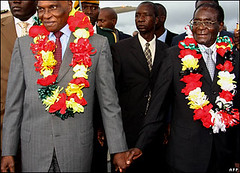
President Mugabe was among the 19 African Heads of State and Government who attended the ceremony in the city centre.

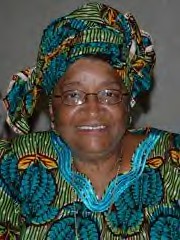
Others included African Union chair and Malawi President Dr Bingu wa Mutharika; President Toumani Tourè of Mali; Gambia's Yahya Jammeh; President Ellen Johnson Sirleaf of Liberia; President Teodoro Obiang Nguema Mbasogo of Equitorial Guinea and Ivory Coast's President Laurent Gbagbo. AU Commission chairman Dr Jean Ping was also present.

The festivities kicked off mid-morning with scores of joyous citizens lining the General Charles de Gaule Boulevard -- the venue of the celebrations.

The expectant crowds were treated to cultural performances as well as displays by the country's uniformed forces who took two hours showcasing their military might.

The airforce also wowed many with its wide range of aircraft which flew past in spectacular fashion.

Speaking on the eve of the occasion broadcast live on national television, Senegalese President Abdoulaye Wade announced that his country had resolved to retain control of all military bases held by former colonial power France.

The French remained in charge of the bases since the West African nation's decolonisation in 1960.

However, most of the 1 200 French soldiers are now set to leave this year, as Senegal moves to assert its sovereignty.

"I solemnly declare that from midnight April 4 Senegal will take back all the (military) bases formerly held by France and intends to exert its sovereignty," he said after unveiling the Monument of African Renaissance at Ouakam.

"Regarding the timeframe for the release of these bases, I have asked the prime minister and army chief of staff to begin talks with the French side."

Over the years, this situation has appeared more and more incongruous and has often been felt by our populations, particularly young people, civil servants and the army, as an incomplete independence."

Speaking ahead of the celebrations at a reception hosted by Zimbabwe's Ambassador here, Mrs Gertrude Stevenson, President Mugabe described the golden jubilee as a celebration of Africa.

He said Zimbabwe and Senegal shared good historical ties dating back to the formative years of the G15 and the Organisation of African Unity (OAU), now the African Union.

He pointed out the need for the two countries to continue strengthening relations on various fronts, including trade.

"We are here to celebrate Senegal's 50th Independence Anniversary and we do so whole-heartedly. Of course, it's Africa we are celebrating and our relations with Senegal," he said.

"We hope these relations continue to blossom and on a reciprocal basis benefit us. . .We look forward to the mission (here) doing well on the political and diplomatic front and deepening our relations with Senegal."

Senegal gained independence in 1960 after France agreed to a power transfer pact with all of its African colonies.

The country -- like its fellow Francophone States on the continent -- has maintained close ties with the French in line with the agreement.

A bulk importer, some of its notable economic activities are tourism, fisheries and trade on the Atlantic Ocean coast.

The Government is focusing on infrastructural development in order to stimulate increased foreign direct investment.

Meanwhile, President Mugabe left the coastal country yesterday afternoon. He is expected to arrive home early this morning.

Copyright © 2010 The Herald. All rights reserved. Distributed by AllAfrica Global Media (allAfrica.com).

Liberian President Sirleaf Joins Senegal in 50th Independence Anniversary Celebrations

Liberia Government (Monrovia)

Liberia: President Sirleaf Joins Senegal in 50th Independance Anniversary Celebrations

5 April 2010
--------------------------------------------------------------------------------
President Ellen Johnson Sirleaf has described the inauguration in Senegal of the African Renaissance Monument as a symbol that represents the lifting of the African flag.

She stated that it is a testimony to Africa's freedom and the continent's ability to choose its own destiny. The President urged African Governments to bury the past of slavery and colonialism and to continue forging ahead into the future. The Liberian leader was speaking in Dakar, Senegal, following the inauguration of the African Renaissance Monument, which coincided with the 50th Independence Anniversary of the country.

In a speech at the Independence Day event, the President of Senegal, Abdoulaye Wade, called on the Senegalese people to continue the unity that has brought them so many accomplishments over the years. President Wade stated that the success of the celebration was a result of the patriotism of

the Senegalese people - a sentiment which he believed would enhance development. Senegal, he said, is for all Senegalese.

He expressed heartfelt gratitude to all delegates and ordinary people who joined the Senegalese to celebrate their anniversary.

The occasion brought together more than ten African Presidents and representatives of several Governments and organizations around the world, including the United States, Asia, Europe, and the United Arab Emirates. The dignitaries included the President of the African Union, the President of

Malawi, former Nigerian President Olusegun Obasanjo and Rev. Jesse Jackson, Sr. of the Rainbow Coalition of the United States.

The celebration, which took place from the 3rd to the 4th of April, also included a parade in which military hardware including helicopters, armored-vehicles, amongst others, were put on display to demonstrate Senegal's preparedness to defend its sovereignty.

In another development, the Liberian community in Dakar, Senegal, appealed to President Ellen Johnson Sirleaf to facilitate their return to Liberia. According to the President of the community, James Kolleh, most of them are languishing in Dakar without jobs and schooling, and that their return to Liberia will enable them to go to school.

The Liberians said they were proud that President Johnson Sirleaf attended what they described as an historic and colorful celebration. The President assured the Liberian Community in Dakar that the Liberian Government wouldwork with its embassy in Dakar to begin formulating plans for their gradual return.

The President's delegation, which included the Minister of State for Presidential Affairs, Dr. Edward McClain, Representative Haja Fata Siryon of Bomi County, and the Secretary General of the Federation of Liberian Youths (FLY) Mr. Jerry Tarbolo, returned to the country Sunday afternoon.

Copyright © 2010 Liberia Government. All rights reserved. Distributed by AllAfrica Global Media (allAfrica.com).

Haiti Schools Reopen For First Time Since Earthquake

Haiti schools reopen for first time since quake

By Jorge Saenz, AP

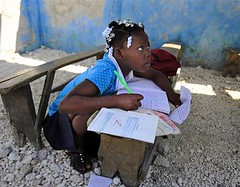
Elene attends a math class at the Bom Berger Baptist School, Cite Soleil slum, Port-au-Prince, Monday, April 5. Schools are opening across Haiti's capital for the first time since a devastating earthquake hit nearly three months ago

PORT-AU-PRINCE, Haiti (AP) — The official reopening of schools among the ruins of Haiti's capital brought unbridled joy Monday to students like 12-year-old Moris Rachelle.

After nearly three months on the streets with nothing to do but help her mother look after two younger brothers, Moris wore white ribbons in her hair as she ran, laughed and hugged friends she had not seen since the Jan. 12 catastrophic earthquake.

"All my friends are here," she gushed, smiling broadly. "I'm happy they are not under the rubble."

Registration for the academic year provided a major step toward normalcy for Haiti's children, and offered the first sense for how many of them have survived.

But Haiti's hard-hit education system is just beginning to recover.

MORE: Haiti to use quake rubble in capital's rebuilding

The yard at Moris' public school in the western Carrefour-Feuilles district of Port-au-Prince remained covered with smashed concrete, glass, torn notebook paper. Parents did not want their children to enter a pair of concrete buildings still standing for fear they might give way from damage or an aftershock.

And there was no sign of the tents promised by the Education Ministry in sight, so the school eventually sent all the students home until next Monday.

Only a few hundred schools are expected to open this week in a country where the quake destroyed some 4,000 schools. Many are waiting for tents to teach under because nobody wants to put children back under concrete roofs.

Some community-led learning centers already opened in homeless camps, but there had been no formal education in the capital until Monday, said Edward Carwardine, a UNICEF spokesman in Port-au-Prince. He said it was impossible to say how many schools reopened Monday.

About 40% of schools in the hard-hit southern city of Jacmel have reopened.

At Moris Rachelle's school, as many as 100 of its roughly 1,000 students died in the quake, including some buried in the rubble of an unfinished, six-story hospital that collapsed onto the yard during afternoon classes.

The only way to know for sure who survived was to write down students' names as they filed in Monday. Student council member Chilet Louis, a volunteer registering a line of arrivals in blue school uniforms, said it was his first time back since he helped pull bodies from the rubble that afternoon.

"It's good to see life starting again, but I also knew a lot of the kids who died," said Louis, a 22-year-old high school junior at the public Jean Jacque Dessaline school.

Educators say the regular curriculum will wait while they address the trauma of the disaster.

Administrators took groups of older students aside to talk about the quake. Without any psychologists available, they used a form of group therapy.

One by one, the students stood up and described their experiences of Jan. 12. One girl said she was so startled by the bodies on the streets that she didn't eat, bathe or sleep for two days. Another said she survived only because she left her neighbor's house for an errand a moment before it collapsed, killing everyone inside.

The group applauded after each student spoke.

The magnitude-7 quake that killed a government-estimated 230,000 people left the education system to start from scratch. The Education Ministry and all its records were destroyed, and more than 700 teacher and staff were killed along with an estimated 4,000 students.

Schools are expected to open gradually across the quake zone, with the goal of having 700,000 children back in school by the middle of May, said Mohamed Fall, UNICEF's chief educational official in Haiti. The school year has been extended until August to make up for lost time.

Even before the quake, the system was in disarray. Only half of school-age children were enrolled and the government was unable to support more than a handful of schools, leaving a void filled by for-profit schools with fees that put them beyond the reach of many Haitians.

Many Haitian children leave school to work at a young age. Others are sent by their families to work as servants in more affluent households.

Fall said that as part of the quake recovery, the Haitian government and aid groups are developing strategies to extend education to children who had been excluded.

"We want to build back better," he said.

For now, he said, the immediate priorities are to clear rubble away to make room for classes, assure parents that students will not be kept anywhere near unstable buildings and ensure a minimum of sanitation for children who are often homeless.

Despite the joy of Moris and her classmates, it was a nerve-racking day for parents facing their first separation from their children since the quake.

Moris' mother, 29-year-old Jerline Ceuid, said Moris could have walked on her own from the campsite outside their collapsed home but she wanted to check on the school. She was startled to see only the two single-story concrete schoolhouses.

"If she went into those buildings, I think my heart would stop beating," said Ceuid, who added that she has taught her daughter to avoid unstable buildings in case of aftershocks. "There is still danger."

A bulldozer and frontloader parked outside had cleared a path from the street to the school, but the yard was still covered with rubble, including a pair of dusty children's shoes.

Maoists Kill Dozens of Police in India Attack

Maoists kill dozens of police in India attack

SUJEET KUMAR | RAIPUR, INDIA - Apr 06 2010 11:27

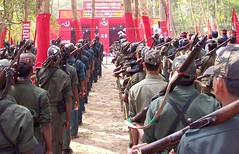
Maoist rebels killed at least 73 police by setting off explosives and firing from hilltops around dense forest in central India on Tuesday in one of the worst attacks by the insurgents in years.

The ambush in Chhattisgarh state highlights the strong Maoist presence in large swathes of India, especially remote rural areas, and underscores how many parts of the country have been left out of India's booming economy.

"Something has gone very wrong," Indian Home Minister P Chidambaram said. "They seem to have walked into a camp or a trap."

Recent high-profile rebel attacks on police have raised questions over how well prepared India's security forces are to tackle the Maoists, especially during a counter-offensive by security forces this year.

"We have confirmation of 73 deaths in the attack. At least two dozen have been injured," Amresh Mishra, a senior police officer, told Reuters. Reinforcements trying to collect the dead bodies came under fire by the Maoists who have surrounded the area.

The Maoists regularly attack railway lines and factories, aiming to cripple economic activity in many of the mineral-rich and remote mining regions of India. But they have made few inroads into cities.

The Congress-led government has come under criticism by the opposition for failing to deal with the insurgents and the security issue could be important in several state elections over the next two years.

Taken by surprise

Prime Minister Manmohan Singh has described the Maoists as the gravest threat to India's internal security.

The rebels number between 6 000 and 8 000 hardcore fighters in nearly a third of the country's 630 districts. Each year they extort more than $300-million from companies, the government says.

Tuesday's attack echoed a similar ambush in February, when Maoists caught police off guard in a daylight attack on in the state of West Bengal, killing at least two dozen police.

Maoists have stepped up attacks in response to a police offensive that began late last year in several states, which Indian officials say has for the first time weakened the decades-old movement.

Maoists, who say they are fighting for the rights of poor farmers and landless labourers, are trying to expand their influence in east, central and southern India.

Thousands have been killed in the insurgency, which began in the late 1960s.

On Sunday, rebels triggered a landmine blast that killed 10 police in the mineral-rich eastern state of Orissa. -- Reuters

Source: Mail & Guardian Online
Web Address: http://www.mg.co.za/article/2010-04-06-maoists-kill-dozens-of-police-in-india-attack

Racial Tensions Rise in South Africa With Charging of Farmworkers in the Murder of White Racist Leader

Face-off at Terreblanche hearing

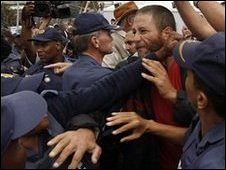
Scuffles have broken out between black and white South Africans outside a court where two alleged killers of a white supremacist leader were charged.

Police stepped in to stop the face-off between people from the local black community and supporters of Eugene Terreblanche, found dead on Saturday.

Officers built a barricade from razor wire to keep the two groups apart in the north-western town of Ventersdorp.

The killing has raised racial tensions in the country.

Hundreds of AWB flags are flying and Afrikaner nationalist songs are playing as hundreds of Afrikaners protest outside the court.

Some 200 police officers have formed a human barricade around the court. There is a smaller group from the local black community.

Tension fills the air as both groups begin to sing songs linked to their race - Afrikaners singing the old national anthem - the black group responded with anti-apartheid songs.

Many Afrikaners say the murder is proof of a "siege" against farmers in South Africa. There are placards in green and red ink, some accusing former President FW de Klerk of "selling out Afrikaners" to the blacks, referring to his partnership with Nelson Mandela to end apartheid.

Police said the pair, aged 28 and 15, had admitted beating him to death in a dispute over unpaid wages.

The court proceedings are not in public because one of the accused is a minor.

Terreblanche's paramilitary group AWB (Afrikaner Resistance Movement) had threatened to take revenge for the killing, but retracted their threat on Monday.

The BBC's Jonah Fisher in Ventersdorp says about 500 people gathered outside court - divided equally between white supremacists, local black residents and the police.

The police stepped in after tensions between the two groups led to pushing, shoving and scuffles.

Pieter Steyn, an AWB leader, said the organisation had called for calm and anyone who disregarded this call would not be acting on behalf of the organisation.

"Everybody has adhered to our request to remain cool," he told AFP news agency.

"As soon as the court proceedings are completed, we will all disperse and go home and gather again on Friday for the funeral."

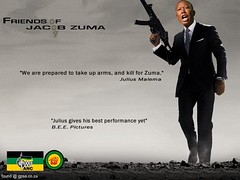
The group blames ANC Youth League leader Julius Malema for contributing to the killing by recently singing a song from the anti-apartheid struggle called "Shoot the Boer".

Boer is an Afrikaans word for farmer, which has become a derogatory term for all white people.

Mr Malema has denied any responsibility for Terreblanche's death and the ANC argues that the song does not incite people to kill but is part of the country's history and the fight against white minority rule.

It is planning to appeal against a court judgement banning the song as hate speech.

The authorities are keen to stress that the killing was not politically motivated.

President Jacob Zuma has appealed for calm and condemned the killing.

Terreblanche, 69, was fiercely opposed to the end of apartheid in South Africa, which led to the ANC winning the country's first democratic elections in 1994 and Nelson Mandela becoming the country's first black president.

He served three years in jail after being convicted in 2001 of the attempted murder of a farm worker.

Story from BBC NEWS:
http://news.bbc.co.uk/go/pr/fr/-/2/hi/africa/8604375.stm
Published: 2010/04/06 13:10:06 GMT


Workers charged for Terre'Blanche's murder

VENTERSDORP, SOUTH AFRICA Apr 06 2010 15:59

Two farm workers, aged 15 and 28, were officially charged with four crimes including the murder of former Afrikaner Weerstandsbeweging (AWB) leader Eugene Terre'Blanche in the Ventersdorp Magistrate's Court on Tuesday.

National Prosecuting Authority (NPA) advocate George Baloyi said the accused, Chris Mahlangu (28) and a minor, who cannot be named, were formally charged with murder, housebreaking and robbery with aggravating circumstances, crimen injuria and attempted robbery with aggravating circumstances.

The charge of crimen injuria was explained by Baloyi: "[After the murder] ... they pulled down his [Terre'Blanche's] pants to his knees and exposed his private parts."

The case was postponed to April 14. The two had not yet pleaded to the charges.

"We had two sessions today [Tuesday], one was informal and one was formal," Baloyi said.

"In the informal session we outlined the charges we intend to bring against the two accused and the summary of facts we are relying on.

"In session two, we spoke about complying with the provisions of the new Act."

He said the Act provided for the treatment of children who committed an offence and laid down the procedure that needed to be followed, adding that the probation officer had compiled a report as per the Act.

The accused's rights were explained in court and necessary documentation, such as birth certificates, was handed over.

Baloyi said the inquiries were "all but finalised except for one issue".

"That is the criminal capacity of the accused [the minor]."

The NPA had to determine whether the youth had the capacity to commit murder or whether he was acting on someone else's instruction.

"It was postponed for seven days to finalise that issue."

In camera

Baloyi said the entire trial would be held in camera, due to the age of the one accused.

"The law is very clear the trial must take place in camera," he said.

NPA head Menzi Simelane confirmed that there would only be one trial, saying thus far "from the information, they are the only ones involved in the crime".

He said there were sufficient provisions to move the case to the high court but certain matters had to be taken into account, such as the Ventersdorp community wanting justice "from here".

He said people in South Africa generally respected court outcomes and although the case might take place in Ventersdorp, it was still in South Africa with a Constitution generally obeyed by the people.

Simelane said it was difficult to say when the trial would begin.

Asked why he had attended the case, he said: "I am at work like you are. I work from any court ..."

The 15-year-old's attorney, Zola Majavu, relayed a message from the youth to the community: "Please, please don't hurt my family."

The youth had not eaten on Tuesday and his mother was too scared to leave the courtroom, worrying about her safety.

"I am arranging the security for her," Majavu said.

Earlier on Tuesday, police had to separate white AWB supporters and black onlookers in a fracas during the singing of Die Stem and Nkosi Sikelel' iAfrika.

'Pent-up rage and frustration'

Meanwhile, the murder of Terre'Blanche had unleashed a "tidal wave of pent-up rage and frustration" in certain sections of South African society, Democratic Alliance leader Helen Zille said on Tuesday.

Addressing the media at Parliament, she said it was time for President Jacob Zuma to "act like a president" and rein in his party's youth leader, Julius Malema.

"For over a decade now, farmers and farming communities have been on the receiving end of escalating criminal violence, and 3 368 have been murdered.

"Most recently, the ANC Youth League's sinister leader, Julius Malema, has made popular again an old struggle song, the lyrics of which include the phrase '[shoot] the boer'."

Zille said pointing out, as the ANC had done, that there was no direct evidence linking Malema's reported hate speech to Terre'Blanche's murder was unhelpful, to say the least.

"We must acknowledge the fact that songs inciting people to kill others create a climate in which murder is legitimised and romanticised.

"We must understand why people are angered and alienated by a song that calls for their murder.

"We must understand why this is multiplied many-fold when the country's president fails to take a stand, effectively condoning the flouting of a court ruling that declared these words to be hate speech.

"This song is not experienced as 'an attack on the apartheid system', which its apologists claim it is; it is experienced, [and I believe it is meant by those who sing it], as a contemporary expression of a hateful attitude towards farmers and Afrikaners in particular, and whites in general," she said.

According to the police, Terre'Blanche was murdered, allegedly by two of his farm labourers following a pay dispute, on his farm 10km outside Ventersdorp on Saturday.

Symbolic

Zille said Terre'Blanche's murder was "symbolic", for a number of reasons.

"It shows how close to the precipice we are with people's pent-up rage and anger ... A symbolic murder can often be the match on the dry grass, and this is what Eugene Terre'Blanche's murder threatened to be."

Asked how big a "seminal moment" Terre'Blanche's murder was in South Africa's history, she replied: "It is a big one."

However, she had been very pleased to hear the AWB had withdrawn its call for violence to avenge Terre'Blanche's death.

"We cannot avenge violence with violence," Zille said.

She also called on the ANC leadership to "take a formal decision at the highest level to stop singing the song that includes the words 'shoot the boer'."

Farm safety had reached crisis proportions in South Africa.

"When you compare the number of farmers who have been murdered in South Africa [with] the numbers that have lost their lives in Zimbabwe, you will see the sort of crisis it actually is; farm murders in Zimbabwe don't enter triple figures, and ours are over 3 000."

Earlier on Tuesday, police had to separate white AWB supporters and black onlookers in a fracas during the singing of Die Stem and Nkosi Sikelel' iAfrika. -- Sapa

Source: Mail & Guardian Online
Web Address: http://www.mg.co.za/article/2010-04-06-workers-charged-for-terreblanches-murder


SA warning against race violence

South African leaders have warned against any attempt by white supremacists to avenge the murder of their leader Eugene Terreblanche.

Police Minister Nathi Mthethwa said such talk would not help the current situation in the country, and President Jacob Zuma called for national unity.

On Sunday the remnants of Mr Terreblanche's AWB party vowed revenge.

It blames Julius Malema, head of the ruling ANC's Youth League, for inflammatory actions.

Mr Malema, who last month led college students in a song about killing white farmers, is due to return from Zimbabwe later in the day, and correspondents say his response to calls for calm is keenly awaited.

Mr Terreblanche, 69, was attacked on Saturday evening at home on his farm near the town of Ventersdorp, North West province. He is due to be buried on Friday.

'Sad moments'

Mr Zuma knows that such a prominent killing could rapidly trigger racial violence, if not handled sensitively, says the BBC's Karen Allen in Johannesburg.
-------------------------------------------------------------------------------------
TERREBLANCHE: KEY DATES

1941: Born on farm in Transvaal town of Ventersdorp
1973: Co-founds AWB to protect rights of Boers' descendants
1993: AWB vehicle smashes into World Trade Centre in Jo'burg during talks to end apartheid
1994: AWB invades tribal homeland of Bophuthatswana and is defeated; three AWB men die
1998: Accepts moral blame for 1994 bombings that killed 21
2001: Jailed for attempted murder of farm-worker
2004: Released from prison
------------------------------------------------------------------------------------------
He was quick to condemn the attack amid criticism that he had failed to rein in the ANC Youth League.

The president went on television on Sunday to condemn what he said was a "cowardly" murder.

He said he had spoken to Mr Terreblanche's daughter and hoped to speak to the leader's wife in order to convey his condolences.

"This is one of the sad moments for our country that a leader of his standing should be murdered," said Mr Zuma.

He said that South Africans must not let anyone take advantage of the "terrible deed" by inciting racial hatred.

The AWB (Afrikaner Weerstandsbeweging, or Afrikaner Resistance Movement) echoed Mr Zuma's call for calm as relatives and friends of Mr Terreblanche gathered near his home to pay their respects on Sunday.

But the far-right movement's secretary general, Andre Visagie, said Mr Terreblanche's killing had political overtones.

"The next step for the AWB will be to bury their leader in peace, but thereafter we shall avenge the death of our leader," he said.

"Of course we do blame Julius Malema," Mr Visagie told the BBC.

"The death of Mr Terreblanche is a declaration of war by the black community of South Africa to the white community that has been killed for 10 years on end."

He said there was "fierce anger" among AWB members. "They all call for revenge for Eugene Terreblanche's death," he said.

He said some some members advocated violent retribution, but he encouraged them to wait until actions could be co-ordinated "right across the country".

More than 3,000 white farmers are estimated to have been murdered since the end of apartheid in 1994.

A committee of inquiry found in 2003 that only 2% of farm attacks had a political or racial motive, although critics said this figure was far too low.

Others point out that some 50 people, mostly black, are killed every day in South Africa - a country with one of the world's highest rates of violent crime.

Heated exchanges

Last week, South Africa's High Court banned Mr Malema from singing the racially charged apartheid-era song with the words "kill the Boer". It ruled the song was hate speech, although the ANC is appealing.

Boer is Afrikaans for a farmer, but is sometimes used as a disparaging term for any white person in South Africa.

Mr Malema denied responsibility during his official visit to Zimbabwe.

"The ANC will respond to that issue. On a personal capacity, I'm not going to respond to what people are saying. I'm in Zimbabwe now, I'm not linked to this."

South Africa is a nation still nursing racial wounds from the past, our correspondent says, and in some quarters there is nervousness about the future.

Ventersdorp has already seen some heated racial exchanges since the killing.

"A black guy killed a white guy. Obviously it's going to stir a lot of trouble," said Kgomotso Kgamanyane, a cashier at a local petrol station.

"Just earlier a customer came in, a white guy, and he told us to go to hell," he told AFP news agency. "It could get violent, because whites in their minds they think that we did it because of hate."

Police have arrested and charged two male farm workers - aged 21 and 15 - who they say beat Mr Terreblanche to death in a dispute over wages.

Mr Terreblanche had founded the white supremacist AWB in 1973, to oppose what he regarded as the liberal policies of the then-South African government.

His party tried terrorist tactics and threatened civil war in the run-up to South Africa's first democratic elections, before sliding into relative obscurity.

Mr Terreblanche served three years in jail after being convicted in 2001 of the attempted murder of a farm worker.

Story from BBC NEWS:
http://news.bbc.co.uk/go/pr/fr/-/2/hi/africa/8603048.stm
Published: 2010/04/05 11:18:24 GMT
ANC Youth League Leader Salutes President Mugabe's Stance Against West

Malema salutes President’s stance against West

Herald Reporter

ANC Youth League president Cde Julius Malema has lauded President Mugabe as one of the few African leaders with guts to stand against the wishes of the West.

Cde Mugabe, he said, has a strong history as a peace-loving leader who does not encourage political violence.

Addressing journalists at State House yesterday after meeting with the President, Cde Malema said some African leaders were even afraid of the unborn children of imperialists.

Earlier, President Mugabe had appraised Cde Malema and his delegation on the history of the liberation struggle and the relationship between Zanu-PF and the ANC.

He advised Cde Malema that he should never sacrifice ANC principles on the altar of expediency. He said Zanu-PF and the ANC shared the trenches during the liberation struggle and continue to do so as they fight to empower their people.

He said when the imperialists colonised Africans they turned the people into semi-slaves and changed their way of living while at the same time denying them education because they feared that once enlightened the people would fight.

"Do not sacrifice principles on the altar of expediency. Do not be opportunistic. Principles should be principles. They should never be sacrificed," he said.

Cde Mugabe said when Zanu-PF and the ANC took up arms to fight they had realised that whites were only here to amass wealth and were not committed to the welfare of indigenous people.

He said at independence, Zanu-PF espoused the policy of reconciliation because the struggle was not against individuals but policies that they advanced.

"When we got independence we did not see the reason to punish anyone. We said let bygones be bygones. We forgive but do not forget," he said.

Cde Mugabe chronicled the history of the land reform programme and how Britain and America reneged on their promises to finance land reforms. He said some white former farmers had tried to fight the land reform programme through the Sadc Tribunal adding that the tribunal "does not have power over us".

Cde Mugabe attacked some black elites for thinking the economy should remain in the hands of whites simply because some of them are chief executives.

Soon after his closed-door meeting with the President, Cde Malema said many people draw inspiration from President Mugabe’s leadership.

"President Mugabe is amongst very few African leaders who can say no. Many leaders are scared of children of imperialists and their grandchildren and even the unborn children of imperialists," he said.

Earlier Cde Mugabe said founders of the Organisation of African Unity, now African Union, must be shaking in their graves because many African leaders are agreeing to the divisive politics of the West.

Cde Malema said whites will never abandon Zimbabwe because of the land reform programme because there is nowhere in the world they would own so much land.

"All capitalists are now accepting the land reform as a policy of Government and are beginning to co-operate. They are not talking of going away. They will never own the hectares they have here if they leave. They have nowhere to run to," he said.

Cde Malema said his delegation had learnt a number of valuable lessons in Zimbabwe with regard to the land reform and empowerment of the indigenous people. The ANC Youth League, he said, had copied some of the lessons for implementation in South Africa.

"President Mugabe, like President Mandela, fought for us to gain political freedom. It is up to us to take it further. We are going to strengthen youth movements in Southern Africa and progressive countries in Latin America," he said.

He defended the singing of the liberation war song Dubula Ibhunu (Kill the Boer) saying he was much younger than the song. He said liberation luminaries such as Chris Hani, Oliver Tambo among others, sang the song.

He dismissed allegations that the recent killing of the Afrikaner supremacist, Eugene Terre’blanche, was linked to the song.

He said he would continue singing the song because it forms part of the liberation history.

"We feel very proud when we sing the song. I will continue singing the song. If anybody wants to assassinate me they will find me ready. If they kill me they will not eat me," he said.

He said the ANC Youth League had invited Zanu-PF to send a team to understudy how the ANC campaigns and woos the people.

Responding to a question on his attack of the MDC-T, Cde Malema said the party had started the fight and should not force him to visit them.

"The MDC-T was the first to insult us. Unprovoked they held a Press conference in Sandton and insulted us. Then you expect us to be nice. We are visiting our friend. You cannot force us to visit you," he said.

US Wants to Set Terms For Nigerian Elections

US wants new Nigerian poll head

The US government wants the head of Nigeria's election commission replaced ahead of new polls due in 2011.

Independent National Election Commission (Inec) chairman Maurice Iwu has been blamed for the flawed elections in 2007.

US Assistant Secretary of State for African Affairs Johnnie Carson said Mr Iwu was incapable of organising a credible election.

Nigeria is the third largest supplier of oil to the US.

The 2007 poll overseen by Mr Iwu was widely criticised for irregularities such as ballot-stuffing and voter intimidation.

The election was won by Umaru Yar'Adua, although legal challenges to the result lasted for months afterwards.

Mr Iwu's current term as Inec chairman ends in June 2010 and the Obama administration is keen that his past record be taken into account when a new chairman is appointed.

Sick president

The US demands came as a new US-Nigeria Binational Commission was formally inaugurated to improve co-operation between the two countries in areas such as trade, good governance and food security.

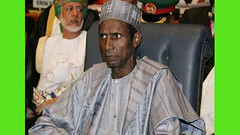
President Yar'Adua has not been seen in public since he fell ill in November 2009.

There was speculation that Mr Yar'Adua had in fact died.

However, Muslim and Christian clerics who have visited him over the past week say that, although in poor health, the president is still alive.

"We said the purpose of visiting him was to see if he actually exists," Ibrahim Datti Ahmed, chairman of the Supreme Council for Sharia in Nigeria, told the BBC's Focus on Africa programme last week.

Mr Yar'Adua's duties have been assumed by Vice-President Goodluck Jonathan.

In March, Mr Jonathan dissolved the entire cabinet and made new nominations, most of which were accepted by Nigeria's senate last week.

Mr Jonathan's new cabinet is expected to be formally inaugurated later on Tuesday.

Story from BBC NEWS:
http://news.bbc.co.uk/go/pr/fr/-/2/hi/africa/8604733.stm
Published: 2010/04/06 10:26:49 GMT

Reflections on Cuba: ANC Executive Member Discusses the Revolution Today

Reflections on CUBA

Viewpoint by Bathabile Dlamini

Cuba is still one of the few countries which leave an indelible impression in the mind of any one who has visited her, despite the fact that she has been under the yoke of oppression for decades. Each time I visit Cuba, I find tremendous change. Of course, the people of Cuba have been adversely affected by the blockade and the collapse of the Eastern block, more particularly the Soviet Union which was its main trading partner. However, no one has dampened her spirit of internationalism. After all these years of repression by the Western powers, Cuba still remains a veritable symbol of the resilience of the human spirit.

Despite all the attempts to hinder her progress, no one has been able to destroy Cuba's revolution. No one has been able to erase the memories of the struggle against fascism and imperialism and her fight for social justice. No one has been able to silence Cubans. Far from being docile, the repression has done the opposite and spurred the Cubans to chat their own course in every sphere of international relations.

The resilience that the people of Cuba have shown demonstrates that they have always had an understanding of what they wanted. Most of their programmes are well thought out. Both the leadership and the masses have a conviction to defend their revolution at a high level as well as at a community level. As a country that is trying to fashion a shared future from the ruins of the apartheid edifice there is a lot we can emulate from Cuba.

What we need to learn from Cuba is that communities play a critical role in defending the gains of the revolution. Despite the continuous pressure from the imperialist force, communities are the bedrock on which Cuba's defence against the imperialists is founded.

The level of consciousness in Cuba is very high and it starts at a local level. Communities have a clear goal of defending their country. At a local level, they have committees dedicated towards defending the gains of the revolution. At all time, they have a clear understanding of what is happening. They are always vigilant.

Their first target is fighting crime, monitor if there is internal counter revolution so as to help the state to prepare for a counter offensive in advance. Some may see red if they see the word counter offensive. Counter offensive may include cracking down on drug trafficking.

We all know that drugs really need a counter offensive because they affect and destroy the development of a person. We are all witnesses to what is happening in our areas. Drugs have not only destroyed the social fibre of our communities, but they have also shattered the lives of young people who are the future of our country. In order to fight crime and drugs, our people and the state need to join hands because as citizens we have a responsibility to defend our country, protect our youth and our future.

The other lesson we need to learn from Cuba is that they protect the property of the state.

Ass far as vigilance is concerned in Cuba, communities are the first to know if there is a stranger in the area and what that person is doing in the country.

They ensure that all children go to school and if there are problems they help the children.

They screen people for social security so that no one can claim to qualify for social security when they don't.

Communities form part of vaccination programmes for children as well as mosquito elimination programmes. Above all, local committees mobilise communities on all critical social issues. Members of the community engage the youth at a young age. They learn responsibility and mentor them. Children as young as 14 can start serving in these committees.

They receive training on how these committees work and people who serve in these committees are volunteers who have their full-time employment but they are still very committed to their work.

I am very proud of the serving NEC for trying to bring to the fore again the veterans of our struggle. At some stage, I felt we were pushing away the living legends and heroes and heroines of our struggle for our selfish interest. It is also energizing that the ANC has worked tirelessly for the formation of the Veterans League.

This is going to bring back the dignity of the ANC. Veterans are important because they are the walking institutional memory of the organisation. They are the custodians of the organisation. They have a responsibility of installing the culture and good practices of the ANC. What is also important about veterans is that they must strive to be neutral so that they can sustain the unity and cohesion of the movement. Right now we need experienced Veterans to give us direction on how they have kept the Alliance together and how we can co-exist and focus on a minimum platform of action.

As South Africans we need to be proud of our veterans who sacrificed everything and fought for the liberation of this country. There are also many unsung heroes and heroines of the struggle that we need to honour by making the ANC better. The ANC has always been a torchbearer and a trail blazer in the liberation of our people. Humility and selflessness are some of the values that have always been the compass of the ANC. That is why it was able to survive under difficult conditions.

Veterans are well respected, they have a very important role. They mentor the younger generation and their younger generation starts from 40 years. They practically impart the skills, knowledge and better leadership quantities. Leaders in Cuba have worked for everything they have, earned respect for laying a good and strong foundation for younger generations.

They are not seen as a threat by the younger generation. If the generation that is mentored presently like the Minister of Foreign Affairs does not lose this practice, the revolution of the people of Cuba is safe for generations to come.

That is why in Cuba you will never see leaders who do not grow organically within the structures of the party landing in very senior and sensitive positions without anyone being able to account about their background. This does not mean that people must not join the ANC but patience is very important because it helps you to understand the organisation and be able to respond to issues in a manner that benefits the ANC.

Yes, the ANC is a multi-class organization and as such anyone can be a member of the ANC as long as he/she is committed to its principles. In this regard, respecting the principles of the organisation is of paramount importance. However, joining the ANC for positions will kill its fabric and its paramount responsibility of transforming South Africa into a united, non- racial, non-sexist, democratic, and a prosperous country.

Other comrades that have created a huge gap in the ANC are those who are part time strugglers who come in and go as they like. Yes they participated fully when we were campaigning for the elections. Babezokhipha iANC emlonyeni wesilwane. When the counter-revolutionaries came together in their failed attempt to destroy the soul of the ANC, they rose in unison to defend our movement from the enemies of the people. But where are they now? Buyani bafowethu nodadewethu sizokwenza umsebenzi sonke.

I wonder what reasons will you give to Dube, Chief Albert Luthuli, Charlotte Maxeke, Lillian Ngoyi, Naicker, Helen Joseph, Chris Hani, Solomon Mahlangu, Dulcie September, Oliver Tambo and Walter Sisulu if you abandon the ANC. All these titans made the ultimate sacrifice under difficult conditions.

Cuban people continue to be generous, their situation and economic conditions have not turned them to be in a jungle where the mantra of the survival of the fittest reigns supreme, and where some animals are more equal than others as in George Orwell's book Animal Farm says.

They continue to provide human resources to needy countries without huge expectations. Doctors and Professions of different fields are all over the world trying to help the world deal with the challenges they are facing such as illiteracy and diseases and other social ills: eg Cuba sent doctors to Haiti long ago, even before the latest disaster which has devastated the country. As we speak, there are more doctors from Cuba running hospitals on the ground in Haiti.

America has been using the Cuban route to Haiti for refueling since the natural disaster occurred because it is a shorter route, but no one is talking, about this. If Cuba was a selfish country, they would have put conditions for this, but because people's lives are more important they will never put conditions. They are not opportunists.

As expected, American people choose not to talk about this. Instead of highlighting the Cubans' contribution to the betterment of humanity, the media has become obsessed with stories about the so called abuses of human rights. They do not talk about Cuba's spirit of internationalism which contributed to the liberation of the people of Africa. Even today there are many countries which have employed hundreds of doctors from Cuba because of their high level of education and their campaign on education. The standards of health in Cuba surprise many old democracies who are highly industrialised and do not face any blockade or oppression by imperialists.

In two years time, the ANC will celebrate its centenary. When this milestone event in the evolution of the ANC dawns, we will also be celebrating Cuba's selfless contribution in our struggle. Some among us never made such contributions to our own liberation.

Unlike in South Africa, all Cubans celebrate their country's milestone. They do not fold their arms and throw all manner of negative criticism as is the case with some sections of our society in South Africa.

They celebrate Jose Marti who is the father of the struggle because he developed the theoretical base of their struggle and died in the war. Marti was not only a man of words but also a man action. He only lived for 42 years but he was already a professor who contributed his intellectual capacity to a number of countries.

They also celebrate without fear the life of Che Guevara, and without any regret because he was also an internationalist. He left his country Argentina to fight the struggle of the people of Cuba through very difficult conditions. He was an asthmatic qualified doctor and fought in Sierra-Maestra and led the forces to Santa Clara. Che Guevara died at the age of 39 but had contributed a lot in the fight for human rights and a better world. In Havana, the Capital City of Cuba the Airport is named after Jose Marti and there is a big monument facing the department of communications with a big cartoon-like picture of Che Guevara where he started working as a Minister.

In villa Clara there is a huge statue of Che Guevara with an eternal light. He lives on there with other heroes of the struggle who died with him in Bolivia and only one woman died in Bolivia.

All districts of Cuba have statues and big billboards like pictures of the fallen Comrades who participated in the struggle for liberation of the people of Cuba. Their billboards are not full of advertisements that indoctrinate our children and our people with artificial and unrealistic lives. The billboards are the warehouse of the struggle for their liberation unlike in South Africa where the media undermines our people, spread jealousy, gossip, hatred of development of other African people, lack of focus, prioritization of things that are not important.

In Cuba they respect and honour the struggle of their martyrs. Unlike here they do not attach a prize to celebrating their historic events.

I have no doubt that if we can build some statues of our heroes in key places, there will be those who will be obsessed with counting amounts of money used for those. This obsession with the money that is spent either to build statues of our heroes and heroines or to celebrate historic events negates the fact that our people paid the ultimate price sacrifice for all of us to enjoy this freedom.

The Cuban people have never stopped fighting. The only thing we can do as South Africans is to pledge solidarity with the people of Cuba for their contribution in our struggle.

Lessons learnt from the people of Cuba are thus:

* Internationalism
* Resilience
* Dynamism
* Defence of the revolution
* Commitment to the drive for economic recovery.

Lastly the ANC has always deployed Senior Members of the organisations as Ambassadors to Cuba, I thought that deploying a younger person will disadvantage us. Ambassador Justice Pitso is one of our few young leaders of the ANC that are serious about their work. I was impressed by the way his office staff is committed to the work of the Embassy. They have a good approach to the work they do and a strong relationship and partnership with the people of Cuba.

Bathabile Dlamini is an ANC NEC member and Deputy Minister of Social Development.

African National Congress Denies Anti-White Hostility in South Africa

ANC denies anti-white hostility in South Africa

Web posted at: 4/6/2010 2:25:59
AFP

CAPE TOWN: South Africa’s ruling ANC dismissed yesterday claims of anti-white hostility in the country as tensions flared over a song linked by the far-right and opposition to the murder of a white supremacist. “Any claim that blacks intend to harm other race groups - particular our white compatriots - is baseless and devoid of all truth,” the African National Congress (ANC) said in a statement.

White supremacist Eugene Terre’Blanche was killed on Saturday by black workers on his farm in an alleged pay dispute.

His far-right Afrikaner Resistance Movement (AWB) has linked the killing to a song from the struggle to end apartheid that contains the slogan “kill the boer”, an Afrikaans word for a farmer that refers to white South Africans. The song was banned by two court rulings after the ANC’s controversial youth leader, Julius Malema, sang it in public in March. He sang it again in Harare at the weekend. Opposition groups claim it incites violence against whites.

The ANC statement said that linking the song to Terre’Blanche’s murder was “not only mischievous but also inciteful and meant to fuel racial polarisation in our country during a highly emotion-charged and sensitive moment”.

“Let us not add fuel to an already very sensitive atmosphere in the wake of Terre’Blanche’s death by making unfounded and dangerous speculative statements,” it said. The party has said it will challenge the ban on the song, arguing it is part of South Africa’s liberation history.

The murder of a white supremacist leader has presented Jacob Zuma with an acute test of his bridge-building skills as he tries to stop the biggest racial storm of South Africa’s raging out of control. Since becoming South Africa’s third elected black president less than a year ago, Zuma has engaged minorities, including Afrikaners, and vowed to keep the country on the path of reconciliation laid by former leader Nelson Mandela.

A day after Terre’Blanche’s death, Zuma appeared on state television, condemning the killing and calling for calm - as the extremist Afrikaner Resistance Movement (AWB) vowed to avenge his brutal killing. A political analyst at the Johannesburg’s Institute for Global Dialogue described the current situation as the most testing episode for Zuma’s leadership skills and the country since he took office.


Statement from the officials of the ANC

30 March 2010

In their normal weekly meeting, held yesterday, March 29, 2010, at the ANC Head Office in Luthuli House, the officials of the ANC did a detailed analysis of the current political environment, with particular reference to the emerging racial polarization of our society. In their analysis, the Officials came to the conclusion that the hot debate about the freedom struggle song is a manifestation of a society that has not come to terms with itself. We are dealing with a society that wants to wish its own history away by picking up on any petty issue that trigger disagreement and conflict. Irritation resulting from pronouncements made by the ANCYL President from time to time is elevated to defining how our society should be shaped. The debate about one of the many liberation songs is dealing with symptoms rather than the real issues that need our attention.

The officials of the ANC expressed concern about the determination by some interest groups use of courts over political issues and to seek to eradicate our proud history and heritage through unenforceable judgements such as declaring the struggle songs as unconstitutional.

The struggle for our freedom was declared as just by the entire world, it is apartheid that was declared evil against humanity. Going through the judgement by the South Gauteng High Court we were even more worried to find that the applicant and the respondent are belonging to the same organization, but differ on technicalities of the case. It appears to us that an artificial contestation was created to arrive at a pre-determined outcome.

In view of the above the ANC: -

* Will appeal the judgement and seek to get a more correct constitutional interpretation of the many liberation struggle songs which form a big and important part of our history.
* Will file an application to the equality court to test whether the publicly announced prosecute Malema campaign by the Freedom Front constitutes real hate speech or not.

We also reminded ourselves that part of our ugly history is that when the rightwing groups started an aggressive propaganda about individual members of our movement in the past such members ended up being assassinated. We are hoping that there is no attempt to create such an environment around the young man, Malema, irrespective of the irritation we may be having with him.

* The announcement by the Pan African Congress Youth that Malema will be found either in hospital or in the mortuary is not just hate speech but a public declaration of the intention to kill. The ANC takes it very seriously and expect law enforcement agies to follow this threat through.
* Welcomes the appropriate approach used by a group of journalists who have directly approached the ANC with a complaint regarding the spokesperson of the ANCYL, and that complaint will be attended to immediately.

We will participate in any initiatives aimed at preserving our history and heritage as a country and a nation. We must own our history and heritage whether good or bad. We must talk more about the genocide against the Khoi San, the wars of dispossession, and the concentration camps during the South African war. We must be more open about the longest struggle for freedom carried out by the oldest liberation movement in the continent and the various phases thereof.

We must accept that thirty years of this struggle had armed insurrection as one of the pillars. During this phase of the struggle songs that capture the mood and the moment were sung to mobilize our people to be part of determining their own future. These songs cannot be regarded as hate speech or unconstitutional. Any judgement that describes them as such is impractical and unimplementable.

We must all come together and discuss ways and means of preserving this history and heritage, cautious enough to avoid offending each other. In this process there must be no group that will project itself as having the monopoly of victimhood. We must strive to link the Freedom Park and the Voortrekkerhoogte monuments into a single precinct.

We must systematically own all our history and heritage and undo the appropriation of parts of our history and heritage to individual nationalities in the country. We are a single nation that must work together in building our country. Easy legal victories by any grouping in society will further polarize our society. All the institutions must make a positive contribution in this process rather than artificially using tensions in society to argue for "independence".

We believe that all of us, as South Africans, including institutions created to uphold our democracy, can learn a lot from the thought that informed the crafting of our National Anthem.

Issued by:
Gwede Mantashe
ANC Secretary General

Enquiries:
Jackson Mthembu 0823708401
Ishmael Mnisi 0823335550

South African Farmworkers Are Suspects in the Killing of White Racist Eugene Terreblanche

Mother tells how son killed Terre'Blanche

THOMAS PHAKANE AND MICHELLE FAUL | VENTERSDORP, SOUTH AFRICA - Apr 05 2010 15:27

The mother of a 15-year-old murder suspect said on Monday that her son struck Eugene Terre'Blanche with an iron rod after the farmer refused to pay him, a slaying that heightens racial tensions as South Africa prepares to host the Soccer World Cup.

"My son admitted that they did the killing," the mother said in an exclusive interview with AP Television News conducted in Tswana from her two-room cement home in Tshing township on the outskirts of Ventersdorp.

She said she spoke to the teenager at Ventersdorp police station on Saturday after he turned himself in along with his alleged accomplice, a 28-year-old farm worker, following the slaying of Terre'Blanche.

Police have refused to identify either of the suspects by name.

Under South African law, a minor accused of any charge cannot be identified without permission from a judge.

Terre'Blanche (69) was leader of the far-right Afrikaner Weerstandsbeweging movement, which said it planned to march on Monday on the police station to demand the police bring out the two suspects. Police say the two have been charged with murder and were expected to appear in court on Tuesday.

Officials appear anxious to show they are swiftly handling the crime, which comes just 10 weeks before South Africa becomes the first African nation to host the Soccer World Cup.

Terre'Blanche's slaying also comes at a time of heightened racial tension in the country.

'Hit him with three blows'

The mother said her 15-year-old son told her that when he and his co-worker asked Terre'Blanche for their money, he told them first to bring in the cows. After they had brought in the cows they again asked for their money, which he then refused to give them.

"He said that the [labourer] man told him to wait while he went to the storeroom. He came back with an iron rod. He started hitting Terre'Blanche, with four blows to the head. Then my son says he took
the iron rod and hit him with three blows," the mother said.

"My son was a person who doesn't like to be in trouble," she said softly, appearing a bit bewildered and scared.

At the farm on Monday, a big grader was being used to dig a hole for Terre'Blanche in the family graveyard, where he is to be buried after a church service in Ventersdorp on Friday.

"This was such an unnecessary thing," Terre'Blanche's brother, Andries, said as he sat on a gray marble grave. "We are not racists, we just believe in purity of race."

'Declaration of war'

AWB's members still seek to create an all-white republic within mostly black South Africa.

The group's leaders have been using Terre'Blanche's killing as a rallying point for their cause, with secretary general Andre Visagie claiming on Sunday that Terre'Blanche's brutal death was "a declaration of war" by blacks against whites.

He also warned countries against sending their soccer teams without protection to "a land of murder".

Visagie and other members of the group have blamed African National Congress Youth League leader Julius Malema, saying he spread hate speech that led to Terre'Blanche's killing.

Malema incited controversy last month when he led college students in a song that includes the lyrics "kill the boer".

The song sparked a legal battle in which the ruling ANC party challenged a high court that ruled the lyrics as unconstitutional.

The ANC insists the song Ayesaba Amagwala [The Cowards are Scared] is a valuable part of its cultural heritage and that the lyrics -- which also refer to the farmers as thieves and rapists -- are not intended literally and are therefore not hate speech.

Visagie said the 15-year-old suspect was a casual worker and that the 28-year-old man was a full-time employee who had been taking care of the garden of the family home in Ventersdorp.

Terre'Blanche had been spending most of his time there since he had heart surgery a few weeks ago.

Terre'Blanche had previously been convicted for a brutal attack on two black farm workers and was sentenced to six years in prison.

He re-emerged in 2004 as a born-again Christian with renewed vigour for his cause. The movement always has been on the fringes, estimated to have no more than 70 000 members at its height in the early 1990s out of a population of nearly 50-million.

'The murderers kept on beating his body'

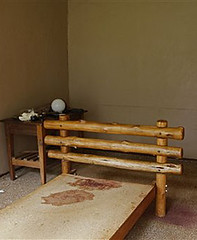
Police said Terre'Blanche was lying on his bed when he was attacked between 5pm and 6pm on Saturday.

The mother's account that there was only one murder weapon -- an iron rod -- did not fit police reports that a machete and a knobkerrie were the murder instruments found at the scene.

Visagie said Terre'Blanche was bludgeoned so badly he was barely recognisable and described a gory murder scene indicative of great rage when he visited the farm on Sunday.

"There was blood all over the place, pools on the mattress, the pillow, the floor and splatters on the walls and ceiling," he said.

"The deductions I make is that he was killed almost instantaneously but the murderers kept on beating his body and chopping his corpse with the panga."

Terre'Blanche, who would appear at rallies astride a black horse, founded the movement that was to the right of South Africa's apartheid government in the 1970s. Masked AWB "stormtroopers" in black or khaki uniforms terrorised black South Africans in the years leading up to majority rule. The AWB's red, white and black insignia resembles a Nazi swastika, but with three prongs instead of four. - Sapa-AP

Source: Mail & Guardian Online
Web Address: http://www.mg.co.za/article/2010-04-05-mother-tells-how-son-killed-terreblanche


Terre'Blanche killing: AWB vows revenge

Apr 05 2010 06:21

The Afrikaner Weerstandsbeweging (AWB) has vowed to exact revenge for the death of their leader as the country's president, Jacob Zuma, sought to calm growing racial tensions.

Eugene Terre'Blanche, leader of the AWB movement, was found bludgeoned and hacked to death on Saturday at his farm in Ventersdorp. Two black farm workers involved in an apparent wage dispute were arrested at the scene.

The AWB has since ramped up the language of a race war. Its spokesperson, Andre Visagie, said: "The death of Mr Terre'Blanche is a declaration of war by the black community of South Africa to the white community that has been killed for 10 years on end."

Land of murder

Visagie warned other countries to avoid sending their teams to the Soccer World Cup in June as they would be travelling "to a land of murder". He added: "We will decide upon the action we are going to take to avenge Mr Terre'Blanche's death."

The AWB accused African National Congress Youth League leader Julius Malema of having blood on his hands. It blamed the killing on his recent singing of the apartheid-era protest song Ayesaba Amagwala [The Cowards are Scared].

Malema expressed fear that his life was at risk, citing a right-wing conspiracy. Last week the ANC said it was concerned about an SMS in circulation which appeared to offer a bounty for his death. The ANC has defended the song as no more than a way to remember a history of oppression, but a party spokesperson said it would now re-examine the issue in the light of recent criticism.

On Sunday at Ventersdorp, in the North West Province, AWB followers clad in paramilitary khaki laid flowers at the gate of Terre'Blanche's farm.

The 69-year-old was killed by two farm workers who claimed that he refused to pay them their monthly salaries of R350 rand each. The workers, aged 21 and 15, reportedly smashed a window to enter Terre'Blanche's home and killed him with a knobkerrie and a panga. A police source told the Sunday Times the pair alleged Terre'Blanche had threatened to kill them when they went to his farm for their money. "They claim they killed him in self defence," the officer said.

The men, who were said to have waited for police to arrive and arrest them, are due to appear in court on Tuesday.

The killing sparked fierce debate on race relations in a country where white farmers have become increasingly vocal, claiming thousands of them have been murdered since the end of white minority rule in 1994.

Last month the former president F W De Klerk wrote to Zuma warning that Malema was creating an increasingly febrile mood. He said: "All this is beginning to create a volatile atmosphere in which any additional intemperate statement or action might spark an unfortunate incident."

Explosive case

Frans Cronje, deputy director of the South African Institute of Race Relations, said: "It could be an explosive case, especially if the ANC don't back down."

Zuma appealed for calm following the "terrible deed". In a statement he asked South Africans not to allow "agent provocateurs" to take advantage of the situation by "inciting or fuelling racial hatred".

Political leaders in South Africa must "think" before they make statements, which could be "misunderstood", Zuma said on South African Broadcasting Corporation radio on Saturday.

"This happening must indeed say to us as leaders we need to think before we make statements in public that might be misunderstood to be encouraging the opposite of what we are trying to do -- to build our new nation -- irrespective of what quarter they come from, so that no one could attempt to say that what we say is not helping the process of nation-building"

On Sunday night, Zuma said calm needed to prevail in South Africa.

"All leaders who lead this country, from different political formations and non-governmental organisations, should unite in the call for calm.

"I know for a fact that those who have been close to Mr Terre'Blanche, they must be feeling a pain, but it is this time that we take our leadership responsibility to make this country unite in calling for a stop of violence," said Zuma. "Violent crime must be stopped and defeated by all of us."

Zuma, who said Terre'Blanche's murder was a "sad moment" for the country termed the act "cowardly".

"I condemn this cowardly act and the murder of Mr Terre'Blanche. It's not acceptable in our society. In due course we will know what is it that led to this terrible action."

'Has-been personality'

Jackson Mthembu, an ANC spokesperson, also denied any causal link between the protest song and the murder of Terre'Blanche. But he also appeared to shift the party's position: "The ANC is prepared to look at whether it is appropriate to continue singing it in this manner. We will ... look at what we can do."

The opposition Democratic Alliance warned of a risk of polarisation with a dangerous outcome. Leader Helen Zille, said: "The murder of Eugene Terre'Blanche will inevitably polarise and inflame passions in South Africa at a time when tensions are already running high ... This could have tragic consequences and it is essential that all leaders stand together now and call for calm."

Terre'Blanche had threatened war on South Africa's white minority government in the 1980s when it began to make what he considered dangerous concessions that endangered South Africa's white race. Described yesterday as a bully and buffoon, his predictions of doom under a multiracial democracy proved hollow and his support dwindled to a tiny rump.

"He was a has-been personality," said Allister Sparks, a veteran political analyst. "His influence is absolutely minimal. I regarded him as one of the most remarkably powerful orators I've ever heard. He spoke with a great passion and could really move people, but that was before 1994 when he was trying to mount his rather crazy resistance campaign." -

Sapa, guardian.co.uk © Guardian News and Media 2010
Source: Mail & Guardian Online
Web Address: http://www.mg.co.za/article/2010-04-05-terreblanche-killing-awb-vows-revenge


AWB warned to stay away from court

JOHANNESBURG, SOUTH AFRICA Apr 06 2010 07:37

North West public safety minister Howard Yawa on Monday warned the Afrikaner Weerstandsbeweging (AWB) against marching to the Ventersdorp Court on Tuesday.

A 21-year-old man and a 15-year-old boy have been arrested for allegedly killing AWB leader Eugene Terre'Blanche on his farm on Saturday. They were expected to appear in the Ventersdorp Magistrate's Court on charges of murder on Tuesday.

Yawa warned that any person who participates in the illegal march would be arrested.

Yawa said the march had apparently been organised to demand the handover of the two suspects.

"Our constitutional democracy enjoins all of us to defend the rule of law at all costs” said Yawa in a statement.

Yawa welcomed the retraction of a threat to avenge Terre'Blanche's death by the AWB.

AWB spokesperson Pieter Steyn retracted their threat to avenge their leader's death on Monday after declaring war on Sunday.

Yawa described this decision as a "sensible and positive development".

'They did the killing'

The mother of a 15-year-old suspect said on Monday that her son struck Terre'Blanche with an iron rod after the farmer refused to pay him.

"My son admitted that they did the killing," the mother said from her two-room cement home in Tshing township on the outskirts of Ventersdorp.

She said she spoke to the teenager at Ventersdorp police station on Saturday after he turned himself in along with his alleged accomplice.

The mother said her 15-year-old son told her that when he and his co-worker asked Terre'Blanche for their money, he told them first to bring in the cows. After they had brought in the cows they again asked for their money, which he then refused to give them.

"He said that the man told him to wait while he went to the storeroom. He came back with an iron rod. He started hitting Terre'Blanche, with four blows to the head. Then my son says he took the iron rod and hit him with three blows," the mother said.

"My son was a person who doesn't like to be in trouble," she said softly, appearing a bit bewildered and scared.

Cool tensions

The African National Congress on Monday brushed off accusations of fuelling racial tension amid fears of a bloody backlash.

Anger over the death of the AWB founder has shifted to the singing of Ayesaba Amagwala [The Cowards are Scared], which is being blamed for triggering the leader's death.

The provocative anti-apartheid song has been recently revived by ANC Youth League leader Julius Malema, who has sung it at public gatherings.

"Any claim that blacks intend to harm other race groups -- [in] particular our white compatriots -- is baseless and devoid of all truth," the ANC said in a statement.

"Let us not add fuel to an already very sensitive atmosphere in the wake of Mr Terre'Blanche's death by making unfounded and dangerous speculative statements," the party said.

The youth leader has rejected the accusations which were carried on the front page of Monday's Beeld newspaper with the headline, "The song is the culprit".

"We have nothing to do with his death," Malema told reporters in Harare on Tuesday while on a visit to Zimbabwe hosted by President Robert Mugabe's Zanu-PF youth.

"I am not going to be terrorised by right-wingers in our country. I am not scared."

The right-winger's funeral on Friday is expected to draw hundreds of AWB supporters.

The extremist leader -- found with a machete still embedded in his flesh -- will be buried on his farm. - Sapa, AFP

Source: Mail & Guardian Online
Web Address: http://www.mg.co.za/article/2010-04-06-awb-warned-to-stay-away-from-court

Artist Zwelethu Methethwa to Launch Monograph This Month in South Africa

Mthethwa's balancing act

LAUREN CLIFFORD-HOLMES | JOHANNESBURG, SOUTH AFRICA - Apr 01 2010 14:01

Artist Zwelethu Mthethwa's long-awaited monograph will be launched this month. Simply titled Zwelethu Mthethwa, and published by the Aperture Foundation in New York, it provides an overview of Mthethwa's photographic work to date and features the portraits that have brought him international acclaim.

In his essay, titled Photography after the End of Documentary Realism, Okwui Enwezor of the San Francisco Art Institute concludes that Mthethwa "challenges conventional ideas of the black subject as a ground-down, disposessed, disempowered and abject figure in need of social sympathy.

"His grand images present the emancipatory possibility of colour; its ability to infuse life into beleagured communities and to speak persuasively of the dignity of the subjects in the face of their entrapment."

Why the decision to move from painting into photography in 1996 and what were your reasons for avoiding the black-and-white medium?

Well, I've never really moved from painting to photography. Photography has always been part of my life. When I was a kid -- I think I was around six years old -- I went to movies every Saturday. I think that's where everything started. So I am very much influenced by cinema, by photography and growing up. The first books I think I read were comic books. Comic books are like still photographs.

When I was a teenager -- maybe when I was around 13 -- I got my first camera and I started taking photographs. I drew as well as a young kid, so I have always traded between photography and drawing and painting.

In Okwui Enwezor's prologue to your book he starts by saying "South Africa's often-told story is always framed by the experience of apartheid". How do you respond to this statement?

I think that is very true, because when you look at the land issue, it covers almost everything -- who has the right to own the land, who has the right to build a house, to own a plot, who has the right to own a field? We are framed by that. You know, when you move people from the cities back to the rural areas, when you deport people, these [experiences] are framed by the issues of land and ownership.

How do you reconcile framing black South Africans as dignified and defiant, even under the duress of social and economic hardship, which beautifies poverty?

There is a very thin line when I photograph black people who are poor and I make them public, or I show them in exhibitions, because I'm treading in very shallow waters here. It is so easy to make poverty beautiful. It is so easy to idealise things. But if you look at the history of how black people have been photographed, or how black people have been placed in our history, it's a very interesting journey.

One must go back to the time when you had to have an identity document, which used to be called a "dompas". If you look at those photographs, which were black and white but were highly underexposed, they used strong flash bulbs that deleted all the details that we have on our faces. You were just left with the nose, the eyes and the mouth. And most of the eyes would be shut because of the strong light.

So, those pictures were ethnographic in a sense because it was just a record that they used to say that you are in this zone; you have a permit. This was your passport to the city. And that was the basis of photography for black people.

If you look at my photographs, they are in colour. The resemblance is very close to what people look like. Now go back to the early 1980s or 1990s -- the height of documentary photography in South Africa -- and you had photographers who went into different communities, different neighbourhoods, and they took photographs that were black and white. But they didn't spend a lot of time with the people they were photographing.

Now when you take a photograph in colour you tend to notice the colour of the shirt, or the blouse, you tend to notice the colour of the room, what is on the walls. You are not just looking at poverty, per se, poverty is not right in your eye. You're looking at the textures. And colour has a history of emotions. In different cultures colour has got meaning.

Basically you deal with key issues: the crisis of dwelling and habitation, and the production of sovereignty, land and labour. Let's talk about your interiors.

The photographs are a celebration of people who are living. It's a celebration of life. They are not just used as mere documents for propaganda -- it's in their homes, they live there. They are as real as any other people in this world. They have a choice in the way that they have been photographed. It's a celebration -- they are living, they are human beings. What I choose to show is that people living in these not-very-good-looking conditions have the energy to turn that around and make their homes aesthetically pleasing. Because they make their homes with very little money and their homes are very warm.

Let's talk about your landscape images, such as the sugarcane series, and the way you have portrayed the dynamic between the subject and the landscape. You have placed subjects to show both their autonomy and their entrapment (or even enslavement) by the land and the labour they perform.

The photographs focusing on sugar-cane cutters refer back to a very old history where man is battling with the field. You know, we try to conquer the Earth, and we exploit and abuse the Earth, but eventually we fail. The Earth will always conquer. And there has always been an interest in and balance between man and land.

Zwelethu Mthethwa: Photographs by Zwelethu Mthethwa will be launched at iArt Gallery, 71 Loop Street, Cape Town, on April 22. To coincide, mural-size photographs by the artist will be shown for the first time in South Africa. For more information visit www.iart.co.za

Source: Mail & Guardian Online
Web Address: http://www.mg.co.za/article/2010-04-01-mthethwas-balancing-act

Somali Refugees Recruited to Fight Islamic Resistance Forces

Somali refugees recruited to fight Islamist militia

By Sudarsan Raghavan
washington post foreign service
Tuesday, April 6, 2010; A07

The U.S.-backed government of Somalia and its Kenyan allies have recruited hundreds of Somali refugees, including children, to fight in a war against al-Shabab, an Islamist militia linked to al-Qaeda, according to former recruits, their relatives and community leaders.

Many of the recruits were taken from the sprawling Dadaab refugee camps in northeastern Kenya, which borders Somalia. Somali government recruiters and Kenyan soldiers came to the camps late last year, promising refugees as much as $600 a month to join a force advertised as supported by the United Nations or the United States, the former recruits and their families said.

"They have stolen my son from me," said Noor Muhamed, 70, a paraplegic refugee whose son Abdi was recruited.

Across this region, children and young men are vanishing. All sides in Somalia's conflict are recruiting refugees to fight in a remote battleground in the global war on terrorism from which they fled, community leaders say.

It is unclear whether recruiting by the governments of Kenya and Somalia is ongoing. But their military officers continue to train refugees at a heavily guarded base near the northern Kenyan town of Isiolo as the Somali government prepares for a long-planned offensive against the Shabab.

A second camp is in Manyani, a training station for the Kenya Wildlife Service in southern Kenya, according to former recruits, relatives, community leaders and U.N. investigators.

"They told us we were going to Somalia soon," said Hassan Farah, 23, who escaped from the Isiolo camp last month.

Farah, who was injured in a 2008 bombing in the Somali capital of Mogadishu, first spent more than two months at Manyani. "I saw 12-year-old children at the camp," said Farah, who has a jagged scar on his left arm. He escaped by bribing a water truck driver to sneak him out.

The Kenyan government has acknowledged that it is helping train police officers for Somalia's weak interim government but said that the recruits were flown in from Mogadishu. "No one is recruited from the refugee camps," said Alfred Mutua, a Kenyan government spokesman.

But a recent U.N. report on Somalia confirmed the recruitment of refugees, including underage youths, for military training. Kenya's training program, the report said, is a violation of a U.N. arms embargo, which requires nations to get permission from the U.N. Security Council before assisting Somalia's security efforts.

Ahmedou Ould-Abdallah, the U.N. special representative to Somalia, said he has not personally seen evidence to act on. "If this recruiting is happening, we have to condemn it," he said.

Recruiting refugees is a violation of international law, and enlisting children under 15 constitutes war crimes, human rights groups say.

"They told me I would become a soldier and fight the Shabab," said Ahmed Barre, a bone-thin 15-year-old whose family fled Somalia's anarchy in 1991, when the central government collapsed. He was born in Dadaab's camps and has never been to Somalia. "I didn't want to go. But I was jobless. I wanted to help my family."

A State Department spokesman, speaking on the condition of anonymity because of the sensitivity of the matter, said, "We strongly condemn recruitment in the refugee camps by any party." Senior U.S. officials, he added, "have stressed" to top Kenyan and Somali government officials "the need to prevent any recruitment in refugee camps."

Human Rights Watch has also raised concerns about the force, which numbers roughly 2,500.

Once the recruits signed up, their cellphones and identification cards were taken. They never saw the promised money. And they were denied access to their traumatized families, which, fearing deportation, seldom complained to the authorities, local officials and recruits said.

"These people ran away for their dear lives to seek refuge in Kenya," said Mohamed Gabow Kharbat, mayor of Garissa, the provincial capital. "To recruit them and send them back to the same situation they ran away from, this is terrible."

Kharbat said that "most of the youths have no parents, no family members to protest on their behalf. And even if they have parents, these are people who are scared of the government security organs. They can never have the confidence to complain."

The recruitment comes amid fears that Somalia's Islamist militants could extend their reach into Kenya, Uganda and other neighboring countries. The Shabab has voiced support for al-Qaeda and has attracted jihadists from around the world. The United States and European nations are supporting the pro-Western Somalia transitional government with arms, cash, training and intelligence.

Somali refugees have few opportunities in Kenya, which has imposed strict residency rules and limits on travel, making it difficult for them to find jobs. Many youths are uneducated.

"The Shabab and all other groups have representation here," said Abdul Khader, 35, a refugee youth leader. "They give a lot of false hopes to the refugees."

Hassan Mukhtar, 16, was recruited to fight for the Somali government with a promise of $300 a month and a $50 signing bonus.

When he and other recruits did not get their signing bonus, they jumped out of the truck on the way to Manyani.

A Shabab recruiter enticed Mukhtar Awliyahan, 16, by promising him $300 month. He was taken to Somalia and given the nom de guerre "Mukhtarullah" -- the One Chosen by God. In January, tired of fighting, he escaped. Today he keeps a low profile in the camp. "They are still recruiting," he said.

Hezbi Islam, a rival militia, recruited Bare Ali Jama, 19. "I had nothing to substitute for this offer," said Jama, who joined along with five other refugees. In February, Shabab fighters pushed them out of their stronghold; he fled back to Kenya. Still jobless, he wants to return to Somalia. "I will fight for anybody," he said.

Monday, April 05, 2010

Congo President Joseph Kabila Calls For United Nations Force to Leave

pa.press.net
06/04/2010 04:06

Congo calls for UN force to leave

UN Secretary General Ban Ki-moon refused to confirm a date for the pull-out of peacekeepers from Congo

Congo's president has called for the UN's 20,000-strong peacekeeping force to leave before September 2011 so the country can "fly with its own wings," but the UN secretary-general is not signing off on a date, according to a report.

Ban Ki-moon said he wants to ensure that military operations against rebels in eastern Congo are successfully completed, that well trained and equipped Congolese army units can take over the UN force's security role, and that the government extends its authority in areas freed from armed groups before the largest UN peacekeeping operation in the world departs.

The secretary-general did recommend in the report to the Security Council that the withdrawal start immediately with up to 2,000 troops leaving peaceful areas of the central African nation by June 30, the 50th anniversary of Congo's independence.

President Joseph Kabila initially wanted the UN force, known by its French acronym MONUC, out of Congo before the independence celebrations. But following a visit to Kinshasa last month by UN peacekeeping chief Alain Le Roy, where Kabila stressed "that it was now time to allow the country to fly with its own wings," the government "decided to be more flexible and shift that date to August 30, 2011," the report said.

Congo was engulfed in civil wars from 1996 to 2002, drawing in half a dozen nations and leading to deployment of the UN force in 1999 to support implementation of a ceasefire that was repeatedly broken. Following a 2002 agreement that ended much of the fighting, MONUC has supported the reunification of the country and the country's first democratic elections in more than four decades in 2006, which Kabila won.

Kabila's government, however, has since struggled to assert its control in the east and has had difficulty building effective institutions and integrating former fighters into a national army.

Ban took note of Kabila's desire for all UN troops to be gone by September 2011, but did not endorse it.

An assessment team he sent to Congo recommended withdrawing the UN force over a period of three years if the security situation continued to improve and the government accomplished a series of "critical tasks," according to the report.

The team concluded that "a continued significant presence of the MONUC force was essential in the Kivus and Orientale provinces" in the volatile east, but not in the other eight provinces where the government could independently maintain law and order and protect civilians, the report said.

The secretary-general said the 50th anniversary of Congo's independence provides an opportunity for the government and people "to turn the page on a period of the country's history that has too often been disfigured by conflict and violence".