Monday, April 12, 2010

Response to the NYT Editorial on Southern Comfort and the Confederate Heritage

Response to the New York Times Editorial on Southern Comfort and the Confederate Heritage

Dear Mr. Azikiwe:

I research the neo-Confederate movement. I am a co-editor of
"Neo-Confederacy: A Critical Introduction," University of Texas Press, 2008. http://www.utexas.edu/utpress/excerpts/exhagneo.html

The "New York Times" article you have on your blog actually has a sly
defense of Confederate "heritage."

I note this paragraph in the "Times" article.

"But after the Supreme Court allowed segregation in Plessy v. Ferguson in 1896, Jim Crow was basically secure. There was less need to rally the troops, and Confederate imagery became associated with the most extreme of the extreme: the Ku Klux Klan."

This paragraph is a total falsehood. The Confederate groups promoted white supremacy in the "Confederate Veteran," the official publication of the United Confederate Veterans, Sons of Confederate Veterans, United Daughters of the Confederacy, and the Confederate Southern Memorial Association. Not only did they promote white supremacy, they also praised the Ku Klux Klan of Reconstruction, and allowed the early 20th century KKK to march in one of their annual reunion parades.

Confederate imagery was used to promote white supremacy through out the Nadir.

Confederate "heritage" has always been about white supremacy from the end of the Civil War into the 21st century.

I am not surprised when the mainstream press to give neo-Confederacy a free pass, but it is disappointing when the African American press, particularly those who pose as critical challengers of the existing system, uncritically accept a free pass for neo-Confederacy.

Regards,
Edward H. Sebesta
Dallas, TX
http://newtknight.blogspot.com/


Introduction: Neo-Confederacy and the New Dixie Manifesto (Euan Hague, Edward H. Sebesta, and Heidi Beirich)

Neo-Confederacy

Contemporary neo-Confederacy made its first mainstream appearance on 29 October 1995 when the Washington Post published the "New Dixie Manifesto." The authors were Thomas Fleming and Michael Hill, two of twenty-seven people who had founded a new nationalist organization, the Southern League (later renamed League of the South), on 25 June 1994 in Tuscaloosa, Alabama.

Identified by the Southern Poverty Law Center's (SPLC) Mark Potok as the "ideological core" of neo-Confederacy, the League of the South (LS) advocates secession from the United States and the establishment of an independent Confederation of Southern States (CSS). The CSS would contain fifteen states—four states more than seceded to form the Confederate States of America (CSA), which led to the Civil War (1861-65), the additional states being Oklahoma, Missouri, Kentucky, and Maryland.

The New Dixie Manifesto was a clarion call to arms in which Hill and Fleming described themselves as representing "a new group of Southerners . . . calling for nothing more revolutionary than home rule for the states established by the U.S. Constitution."

Comparing "American Southerners" to, amongst others, Scots and Ukrainians, the manifesto charged that the United States had treated "American Southerners" with "exploitation and contempt," and that a "renewed South" was both necessary and achievable.

Among its specific points, the manifesto espoused the following:

-home rule for "Southerners"
-states' rights and devolved political power
-local control over schooling, in opposition to federal desegregation decrees
-removal of federal funding and initiatives from Southern states
-a Christian tradition in opposition to modernity
-support for Confederate symbols

In addition, the manifesto expressed the following views:

-that "Southerners" are maligned as "racist" and "anti-immigrant" by hypocritical, prejudicial Northerners
-that the South should be left alone on the issues of race
-that race relations are better in Southern states than in Northern ones
-that the United States is a "multicultural, continental empire" run by elites in Washington, Wall Street, Hollywood, and the Ivy League.

The New Dixie Manifesto proclaimed that education policies, historical interpretations, federal programs, and opposition to Confederate iconography together constitute efforts to "rob" "Southerners" of their very existence, an active project of discrimination resulting in "cultural genocide."

Letters critical of the manifesto soon appeared in the newspaper, one stating that Fleming and Hill had presented "questionable arguments." Another claimed that the vision of the U.S. South that the manifesto proposed would require a process of "ethnic cleansing" to change the demography of the region, which, like much of the United States, is "polyglot, eclectic, syncretic and generally mixed and messy." Whether or not by coincidence, the topic was revisited in the newspaper six weeks later on the occasion of the death of Andrew Lytle, one of the Southern (or Nashville) Agrarians.

The conservative syndicated columnist George Will introduced readers to the heirs of the Agrarians' intellectual tradition, namely the Southern League and one of its founding directors, Clyde Wilson, a conservative academic at the University of South Carolina and a leading proponent of neo-Confederacy. Will praised the Southern League's "admirable seriousness about the intellectual pedigree of a particular cultural critique of American modernity," and told readers how to contact the organization for those who "believe America is becoming too homogenized, that regional differences are being blurred and ancient passions are growing cold." In addition, Will recommended the League's publication, Southern Patriot, which "bristles with quirky agitation against 'Yankee hegemony.'"

Four months later, on 5 May 1996, National Public Radio's Weekend Edition broadcast an interview with Southern League president and manifesto co-author Michael Hill. In response to Diane Roberts's questions about democracy, Hill said:

You know, the South has never bought into the Jacobin notion of equality. The South has always preferred a natural hierarchy. You're always going to have some violations of people's rights, for whatever reason, but we just believe that a natural social order left to evolve organically on its own would be better for everyone.

Hill's position, as we review in Chapter 4, is consistent with not only neo-Confederacy, but a nineteenth-century notion of social Darwinism. Explaining the neo-Confederate movement in London's Guardian newspaper, Roberts later wrote:

The Southern League [is] a burgeoning organisation of mostly middle-class, often academic, certainly angry, white men. . . . Their mission is to alert like-minded "neo-Confederates" to "heritage violations." . . . The Southern League's agenda is, as their board members describe it, "paleo-conservative." They want the South to return to the "order" it once had before the "disruption" of the Civil Rights Movement.

Critical of this emergent neo-Confederacy ideology, and exposing some of its more unpalatable tenets, Pulitzer Prize-winning author and journalist Tony Horwitz described neo-Confederacy in his book Confederates in the Attic as a "loosely defined ideology" that pulls together "strains of Thomas Jefferson, John Calhoun, the Nashville Agrarians . . . and other thinkers who idealized Southern planters and yeoman farmers while demonizing the bankers and industrialists of the North."

After a conversation with neo-Confederate Manning Williams in Charleston, South Carolina, Horwitz concluded that much of neo-Confederacy's discourse and ideology was "little more than a clever guide around race and slavery, rather like the slick-tongued defense of the Southern 'way of life' made by antebellum orators."

Another journalist who has written on neo-Confederacy is Peter Applebome, who, in his book Dixie Rising, identified its proponents:

In hoary, century-old Confederate organizations and freshly minted, modern-day variations on the same theme, at conferences and Civil War reenactments, in cyber-space and the real world, the South is full of Lost Cause nostalgia, angry manifestos, secessionist verbiage, and assorted movements harking back to various elements of the Dixie of old. . . . The neo-Confederate groups are not a monolith. They range from hard-right and overtly racist politics to a relatively benign mix of monument polishing, history, nostalgia, and agrarian conservatism suspicious of both big government and big business.

We concur with Applebome's evaluation, except for his assertion that some of these groups are benign. James W. Loewen and others have demonstrated the perniciousness of monuments to white supremacy throughout the United States: such commemorative efforts, however nostalgic, aid in the construction and maintenance of what geographer Richard Schein identifies as "racialized landscapes—American cultural landscapes that are particularly implicated in racist practice and the perpetuation of (or challenge to) racist social relations."

Our sense that Applebome's identification of the influence of neo-Confederacy is somewhat downplayed in these comments is confirmed just a few pages later. Exploring the close working relationships between advocates of neo-Confederacy, such as Southern Partisan owner Richard Quinn, and high-ranking members of the Republican Party, such as Ronald Reagan and Strom Thurmond, Applebome explains that "it's hard to know these days where the Confederacy ends and the Republican party begins."

Thus neo-Confederacy may be more closely entangled in the corridors of power in the United States than it first appears. In the late 1990s, the Washington Post's Thomas B. Edsall revealed a series of connections between elected Republican Party officials and the Council of Conservative Citizens (CCC), including Georgia congressman Robert L. Barr Jr.'s keynote speech to the CCC meeting in Charleston on 6 June 1998. After initial denials, Barr admitted he had spoken to the CCC and distanced himself from the group, whose members, Edsall explained, "view intermarriage as a threat to the white race" and propose deporting nonwhites from the United States.

Edsall described how other leading Republican politicians, including Mississippi senator Trent Lott, North Carolina senator Jesse Helms, and Mississippi governor Kirk Fordice, had ties to the CCC. When the story broke, Lott initially stated that he had "no firsthand knowledge" of the CCC, but evidence emerged that in 1992 Lott had attended the group's meeting, telling those present in his keynote speech that they "stand for the right principles and the right philosophy."

Lott subsequently tried to distance himself from the CCC, members of which confirmed that Edsall's stories were accurate before articulating their opposition to immigration, racially integrated schools, affirmative action, and their fight to protect "such symbols of southern heritage as Confederate monuments and public displays of the Confederate flag."

Despite such mainstream media attention, the debate over neo-Confederacy was perhaps more in evidence in alternative media sources and on the Internet. The focus in such forums often extended beyond neo-Confederate views on race and states' rights issues. Richard Shumate, writing in Southern Voice in 1994, warned that "some of the people who are leading the charge to preserve Confederate heritage, known collectively as the neo-Confederate movement, are often openly, and passionately, homophobic."

Citing the overlapping interests of the Sons of Confederate Veterans (SCV), Georgia's state representatives, and outspoken conservative leaders such as Pat Robertson and Pat Buchanan, Shumate explained that "while neo-Confederates leaders labor long and hard to veil any racist sentiments among their members (though in many cases, the veil wears pretty thin), disdain for gays and lesbians is, in contrast, often expressed openly and boldly."

Writing in the Jewish newspaper Forward in 1995, Ira Stoll reviewed the major magazine of neo-Confederacy, Southern Partisan, a publication of the Foundation for American Education (discussed in Chapter 1). Highlighting its interviews with well-known Republican Party figures such as Trent Lott, Dick Armey, and Phil Gramm, Stoll explained:

Some experts say the ties between politicians and the neo-Confederate movement offer insight into the Republican attempt to shift power to the states—an effort consistent with Confederate ideas. The Southern Partisan connection, they say, raises the prospect that the new GOP leadership and the presidential candidates may lend credibility to a group tinged with racism and historical carelessness.

One of Stoll's experts was Princeton University historian James McPherson, who said: "If this neo-Confederate point of view begins to forge back into the mainstream, it could undercut support for civil rights." Brian Britt, in the on-line forum Z Magazine, concurred, explaining that neo-Confederacy was a worldview that
encompasses history, literature, museums, reenactments, monuments, battlefields, and organizations dedicated to the principles and founders of the Confederate States of America. Neo-Confederacy intersects with white supremacy, the Christian Right, the Populist Party, and the states' rights movement.

To an increasingly diverse set of Americans, neo-Confederate culture supplies a regionally- and historically-grounded message of right-wing righteousness and urgency. Neo-Confederate culture presents two faces to the world: one of heritage and another of hate. Heritage bespeaks the mythical past of the antebellum South and its valiant defenders, but this gentility often adjoins angry right-wing extremism.

At the time neo-Confederacy was evidently becoming a factor in U.S. politics. In a hotly contested Senate race in Illinois in 1998, the Republican challenger Peter Fitzgerald defeated incumbent Democrat Carol Moseley-Braun, an African American, but not before a Moseley-Braun campaign advertisement showed Fitzgerald standing beside a Confederate battle flag.

Fitzgerald "angrily denied Moseley-Braun's allegation that he [was] associated with neo-Confederate groups such as the Rockford Institute." In Georgia, congresswoman Cynthia A. McKinney, also an African American, identified her 1996 electoral opponents as "a rag-tag group of neo-Confederates," and in Alabama, state senator Charles Davidson joined the neo-Confederate League of the South.

"Make no mistake," David Goldfield subsequently warned in his book Still Fighting the Civil War, referring to elected officials such as Davidson, "these are not the much-maligned 'redneck' elements; these are southern leaders proving that the shelf-life of southern history extends considerably beyond its expiration date." Examining neo-Confederate magazines like Southern Partisan, Goldfield explained that these publications romanticized the Old South and distorted the events of both the Civil War and Reconstruction, producing a neo-Confederacy that valorized white men, "as well as the racial and gender implications derived from those views."

Neo-Confederacy thus was seen to comprise a belief in, and the need for, social hierarchy, be this racial or gendered, with white men being dominant. To this, we contend, should be added hierarchies based on class, religion, and sexuality. Believers in neo-Confederacy, Goldfield explained, "are not fringe people." Their worldview and activities have "a broader white support in the South, within the Republican Party and among some evangelical Protestants."

One of the most sustained encounters with this iteration of neo-Confederacy did not come in the South. The city of Rockford, Illinois, just ninety miles northwest of Chicago, became embroiled in a lawsuit about racial segregation and unequal school funding in the late 1980s.

Federal Judge P. Michael Mahoney stated that through sophisticated tracking of student performances, school administrators in Rockford had "raise[d] discrimination to an art form," and ruled that Rockford must desegregate its schools, hire more minority teachers, build new facilities, and implement a host of other requirements.

Rockford had to levy additional taxes to pay for the costs. These measures attracted the attention of the Rockford Institute and its leader, Thomas Fleming, co-author of the New Dixie Manifesto.

On 16 February 1998, Fleming and his colleagues hosted a rally denouncing taxation, school integration, and the federal court's rulings. Alongside school board members at this event was one of the city's most prominent politicians, Republican congressman Don Manzullo. Exposing Fleming's neo-Confederate beliefs and founding membership in the League of the South, the Rockford Register Star explained that Fleming "compared the school desegregation case with historical injustices that caused acts of banditry and insurrection."

The newspaper subsequently revealed that "three members of the Rockford School Board say they will use whatever stage is offered to denounce court-ordered school taxes and judicial interference in local school systems. To them, it doesn't matter if the offer is from the founder of a neo-Confederate organization that has been accused of implicit racism."

Manzullo stated that he had no knowledge of Fleming's neo-Confederate connections, although a year earlier, in February 1997, he had criticized the Rockford desegregation ruling in Fleming's Chronicles magazine. Chastising "activist federal judges," Manzullo advocated limiting the power of the judiciary to make decisions "that would have the effect of raising taxes."

Manzullo again appeared in Chronicles three months prior to attending Fleming's February 1998 anti-taxation rally, this time attacking the United Nations as an organization that hindered U.S. sovereignty and had "outlived much of its usefulness and overreached its bounds."

Manzullo's claim of ignorance about Fleming thus seems disingenuous, particularly given Fleming's repeated assertions of his advocacy of neo-Confederacy in the mid-1990s. Writing in the National Review in July 1997, for example, Fleming outlined his reasons for membership in the Southern League (League of the South) and argued that "secession is as American as bootleg whisky and draft riots."

After listing numerous secessionist movements in U.S. history, Fleming maintained that "the United States remained, basically, a federal union down to the 1960s, when activist judges and ambitious politicians of both parties decided that the Constitution had outlived its usefulness."

It was evident that something was happening in U.S. political culture that was fusing separatism, nationalism, Confederate heritage, and a politics that looked through a lens of race and ethnic identity. This neo-Confederacy, Christopher Centner explained to readers of Skeptic magazine, not only united a range of political positions, but was also pulling together numerous factions whose members often overlapped.

These included the "heritage defenders" in groups like the Sons of Confederate Veterans and United Daughters of the Confederacy, "agrarian romantics" who positioned themselves as the intellectual heirs of the 1930s Southern Agrarians, libertarians connected with organizations such as the Ludwig von Mises Institute, "Christian soldiers" who voiced a fundamentalist religion and a belief in biblical literalism, and "racists."

Researching Neo-Confederacy

It was this emerging example of nationalism and racially coded politics that led us (Hague, Sebesta, and the Southern Poverty Law Center) to pursue a sustained collaboration examining neo-Confederacy. Our research was first published in 2000, when Sebesta's essay in Scottish Affairs argued:

Neo-Confederacy is a reactionary movement with an ideology against modernity conceiving its ideas and politics within a historical framework of the U.S. Civil War (1861-1865) and the history of the American South. This includes more than a states' rights ideology in opposition to civil rights for African-Americans, other ethnic minorities, women and gays, though it certainly includes all these things. Opposition to civil rights is just a part of a world view desiring a hierarchical society, opposed to egalitarianism and modern democracy.

Later that year the Southern Poverty Law Center (SPLC), an organization well known for its monitoring of, and legal contests with, militia, patriot, and other racial supremacy groups, identified the League of the South as a "hate group." This designation by the SPLC was made on the basis of a group's ideology as expressed in official publications or by the group's leaders. Hate groups, the SPLC maintains, have beliefs or practices that attack or malign an entire class of people for their immutable characteristics.

The SPLC argued that the neo-Confederate League of the South, founded by Michael Hill, Thomas Fleming, Clyde Wilson, and others in 1994, is racist in its belief that African Americans are inferior to whites and is therefore a hate group. Further, the SPLC report identified the League of the South at the forefront of a neo-Confederate movement that also included the CCC and sections of the SCV and UDC. It noted that the 1990s neo-Confederacy had precedents in, and connections to, the White Citizens' Councils of the 1950s and in this most recent version, neo-Confederacy was "unabashedly political and beginning to show its naked racism."

This revitalized neo-Confederacy, anthropologist Paul Shackel explains, began to inform numerous debates, most prominently about the placement of Confederate flags in states like South Carolina. It also influenced efforts by the SCV to reinterpret the Civil War as a struggle for national independence and sovereignty, a reinterpretation in which SCV authors "never mention slavery." When politicians in the South did mention slavery, and condemned it, furious neo-Confederate sympathizers bombarded local media outlets.

In April 1998, Governor James S. Gilmore III of Virginia criticized slavery in a statement that also proclaimed Confederate Heritage Month. Patrick S. McSweeney, a former chairman of Virginia's Republican Party, joined the neo-Confederate Heritage Preservation Association (HPA) in disparaging the governor's remarks. Led in Virginia by R. Wayne Byrd Sr., who stated that Gilmore's comments were "an insult," the HPA was formed in 1993 and was, Shackel explains, "one of the first nationwide neo-Confederate organizations to develop in the post-civil rights era."

With members in forty-nine states, the HPA actively lobbies state officials, often successfully, to declare Confederate Heritage months. Through these and other similar groups, best-selling political commentator Kevin Phillips noted, "southerners have bred a new cultural and political phenomenon: neo-Confederates," whose "upsurge goes beyond mere nostalgia." Although it is this recent neo-Confederacy that forms the major part of our analyses, neo-Confederate activism has a lengthy history in the United States.

Neo-Confederacy: A Recurrent Practice

It may be a truism to say that neo-Confederacy is practiced differently by different people in different places at different times. Although the latest version of neo-Confederacy emerged in the mid-1990s, the term "neo-Confederate" has an extensive history.

James McPherson, for example, has described the efforts of "Neo-Confederate historical committees" operating between the 1890s and 1930s to make sure that history textbooks presented a version of the Civil War in which secession was not rebellion but rather a legal exercise of state sovereignty; the South fought not for slavery but for self-government; the Confederate soldiers fought courageously and won most of the battles against long odds but were finally worn down by overwhelming numbers and resources.

These committees were drawn from members of the United Daughters of the Confederacy, the United Confederate Veterans, and the Sons of Confederate Veterans. Another historian, Nancy MacLean, has utilized "neo-Confederacy" to identify the reactionary right-wing politics that coalesced in the 1950s in opposition to Supreme Court rulings mandating racial desegregation.

Both usages are consistent with our own: McPherson's as it refers to major proponents of neo-Confederate beliefs and the central components of neo-Confederate understandings of the Civil War, and MacLean's referring to similar actors in conservative politics, whom we examine in Chapter 1.

Despite these varied attributions of "neo-Confederacy" from the period immediately after the Civil War to the present, there are a number of consistencies in neo-Confederate thought—its racist, patriarchal, heterosexist, classist, and religious undertones—that form the basis of a conservative ideology that centers upon social inequality and the maintenance of a hierarchical society.

At the core of neo-Confederacy is an active promotion of the political legacy of the short-lived nineteenth century Confederate States of America, comprising states whose secession resulted in the Civil War. Proponents of neo-Confederacy regularly look to these events, the Confederacy's leadership, and the pre-Civil War "Old South" for theological, philosophical, and cultural precedents and, in many cases, behavioral role models.

The major ideologues of the recent revival of neo-Confederacy are, as we outline in Chapter 1, almost all activists who identified themselves as paleoconservatives, decided to split from mainstream U.S. conservatism, and solidified their views around a vision of the South as "a priceless and irreplaceable treasure that must be conserved."

Hostile toward today's multicultural society and focused around organizations such as the League of the South and Council of Conservative Citizens, neo-Confederacy can also be said to inform more mainstream heritage organizations such as the Sons of Confederate Veterans and United Daughters of the Confederacy and, arguably, prominent politicians such as Trent Lott and Strom Thurmond. Proponents of neo-Confederacy also overlap with those advocating a racial, white nationalism, such as Jared Taylor and his American Renaissance magazine.

Outline of the Book

Neo-Confederacy intertwines a range of political thought, theology, and historical interpretation into a call for the recognition of a specific Southern U.S. culture and various assemblages of what that culture means for the control of people and resources. In this volume, contributors draw on documents published by neo-Confederate activists to explore how neo-Confederate ideology constructs a worldview that we contend is patriarchal, ethnocentric, intolerant, and racist, but a worldview that operates utilizing a complex discourse, a language that at face value appears to laud cultural rights and freedoms, heritage preservation and celebration, local control over institutions, and Christianity.

Due to the diversity of actors and positions within neo-Confederate organizations, this collection is not intended to be comprehensive. Rather, we hope to illustrate the kinds of activities and politics that permeate this sector of the political right. Our intention is to give readers an understanding of neo-Confederacy, its development and ideologies.

Further, we demonstrate the convergence of conservative thought with heritage preservation activism, popular commemorative processes, and theological beliefs, which together articulate neo-Confederacy at the start of the twenty-first century.

Neo-Confederate ideology influences Hollywood movies such as Gods and Generals (2003), college football games and mascots, museum displays, musical and theatrical performances, literature, religious beliefs, statuary and monuments, school textbooks, and multiple other aspects of everyday life in the United States. Many recent books about the role of memory and commemoration in the South note the growing presence of neo-Confederate interpretations of the past.

When a statue of Abraham and Tad Lincoln was unveiled in Richmond, Virginia, in 2003, for example, the event was attended by "neo-Confederates wav[ing] signs bearing the slogan: 'Lincoln: Wanted for War Crimes.'" The Southern Poverty Law Center's "Intelligence Reports" regularly provide details of the latest actions by neo-Confederate sympathizers.

Two theoretical understandings underpin our collection as a whole. The first, as prominent geographer David Harvey has asserted, is "that no social order can change without the lineaments of the new already being present in the existing state of things." Neo-Confederacy is an attempt to change the social order. Proponents of neo-Confederacy argue that American cultural, educational, political, and religious practices must be changed, and the ultimate aim of the League of the South, as noted, is the secession of fifteen states to create a new Confederacy.

Such neo-Confederate contentions, however, did not appear out of the blue with the New Dixie Manifesto in 1995. We have to look to the past to understand the beliefs that coalesced into what became neo-Confederacy in the 1990s.

As examined in Chapter 1, many neo-Confederates identify themselves as "paleoconservatives" who, believing in what they consider to be authentic conservatism, became disillusioned with the direction that conservative politics took in the 1960s. In terms of religious perspectives, proponents of neo-Confederacy maintain that the Civil War was a theological struggle between orthodox Christian Confederate troops and heretical Union soldiers. This is examined in Chapter 2.

Chapter 3 traces neo-Confederate understandings of gender and sexuality to the antebellum plantation household in which the white male planter represented the head, and his family and slaves the rest of the body, in an organic conceptualization of gender and race relations. Race is the crux around which neo-Confederacy turns, which is the subject of Chapters 4 and 5.

Chapter 4 explores the self-image of many neo-Confederates, that of Anglo-Celtic ethnicity. The authors argue that this is a synonym for whiteness and show how in the 1970s and 1980s academics like Grady McWhiney were integral in developing the Celtic South thesis that understands the (white) residents of the Southern states, both past and present, to be Celtic.

Chapter 5 quotes neo-Confederate authors and publications at length, demonstrating that neo-Confederacy entails hostility toward social equality, multiculturalism, civil rights, school desegregation, affirmative action, and immigration. Utilizing ideas about ethnicity and race, proponents of neo-Confederacy maintain that ethnic and cultural groups are distinct and two or more groups cannot co-exist in the same space on equal terms.

The second part of the book examines processes of the production of neo-Confederate culture. This pertains to our second theoretical tenet, that culture is not an object that can be simply identified and then described. Rather, culture comprises on-going processes that must be explained. Saying that "culture" is the reason for something does not offer an understanding of how and why an event occurred or a belief developed. Indeed, saying something is "cultural" typically curtails rather than enhances debate.

Consequently, cultural geographer Don Mitchell argues that when examining cultures, the critical questions to ask are "who produces culture—and to what end? . . . [and] why is it produced" (original emphasis). The result of such questioning is an assessment of how the practices of politics and culture are entwined in a relationship. Thus, our examinations in Part 2 address "the production of [neo-Confederate] 'culture' and its use" in promoting and disseminating a neo-Confederate ideology.

Chapter 6 examines efforts to ensure that the Confederate flag remains flying high over the South, promoted by groups and activists such as the Council of Conservative Citizens, the League of the South, and controversial restaurant owner Maurice Bessinger. Bessinger's signature barbecue sauce was removed from the shelves of national chain stores like Wal-Mart after revelations about his neo-Confederacy appeared in local newspapers following a dispute that centered on flying the Confederate battle flag without a permit.

Chapter 7 utilizes theories of nationalism that argue education is central to the reproduction of the idea of a nation. A nation does not just exist; rather, it is continuously reproduced through everyday processes, from the circulation of national heroes on currency and rallying behind national sports stars, to the mundane reproduction of the nation in banal imagery, such as television weather maps that suggest the weather stops at the U.S. borders with Canada and Mexico.

Inculcating the next generation is always critical to nationalist projects, and the need to perpetuate neo-Confederacy leads proponents to homeschool their children and to teach peers about what they consider to be the truth about U.S. history.

Chapter 8 identifies the lineaments of current neo-Confederate literature in the nineteenth-century South, examining the fiction and poetry that has become the neo-Confederate curriculum for the educational practices discussed in Chapter 7. Another area of the on-going practice of producing neo-Confederate culture is the subject of Chapter 9: music.

Here the authors review examples such as Stonewall Country, a musical about Confederate general "Stonewall" Jackson, and performers like the Free South Band, whose CDs are widely available on neo-Confederate web sites.

The last chapters argue that neo-Confederacy is neither as benign nor as marginalized as some commentators have implied. Chapter 10 is a work of investigative journalism that demonstrates just how far neo-Confederacy has penetrated into mainstream Confederate heritage groups like the Sons of Confederate Veterans.

Many active Civil War heritage enthusiasts now identify with neo-Confederate ideology. The result is that the SCV, which has almost 30,000 members, including some prominent public figures, now espouses an increasingly activist neo-Confederate political agenda.

Finally, the afterword looks briefly at the reaction of neo-Confederates to the reelection of President George W. Bush in 2004 and notes the extent to which neo-Confederacy and neo-Confederate publications have moved beyond the South to gain a place within national U.S. conservatism. As proponents of neo-Confederacy establish think tanks like the Abbeville and Stephen D. Lee Institutes, the belief system is attracting members of the Republican Party and mainstream heritage groups like the SCV and UDC.

Given that these organizations have greater resources, in terms of outreach, membership, and finances, neo-Confederacy is a worldview that is continuing to develop and attract proponents throughout the United States. As a result, we believe it is time for a sustained analysis of neo-Confederacy.

Municipal Workers March Countrywide in South Africa

Municipal workers march countrywide

JOHANNESBURG, SOUTH AFRICA Apr 12 2010 12:56

The impact of the nationwide South African Municipal Workers' Union strike started showing by noon in Johannesburg on Monday, with reports of buses not running in the city.

Reports on how many people decided to stay away from work, and which other services were affected, were not immediately available. In the meantime, Metrobus advised commuters to make other arrangements until the industrial dispute was resolved.

Emergency services spokesperson Percy Morokane said there was 100% attendance among paramedics and fire-brigade staff.

"We applaud them for heeding the call to come work," he said.

Traffic in the Johannesburg city centre was disrupted as the strikers marched from Newtown to Braamfontein to hand over a memorandum of their demands.

In Cape Town, early reports said refuse was being collected in most areas, but a fuller picture of the impact of the strike would only be known later, city spokesperson Kylie Hatton said.

In Durban, Samwu secretary Jaycee Ncanana warned that "no service will be regarded as essential during this strike".

The South African Broadcasting Corporation reported in Limpopo that more than 8 000 members of the union would demonstrate outside various municipal offices across the province, according to provincial chairperson Mamaile Manthata.

Minor incidents

In Ekurhuleni, east of Johannesburg, the metro said there had been reports of minor incidents, the most common being the alleged intimidation of non-strikers. It warned that anyone from an essential service -- such as emergency services, healthcare or water -- would face disciplinary action.

Samwu decided on the no-work-no-pay strike to push for its demand that middle- and lower-income employees' salaries be re-evaluated and adjusted to market-related amounts.

Municipalities should no longer hire consulting lawyers to deal with disciplinary cases, which Samwu considered a waste of money, as there was internal capacity to do so.

It wanted councillors and municipal managers' remuneration to be evaluated and set, so they could not "waste" money by setting high salaries that were not market related, or award themselves perks that drained municipal coffers.

Samwu said this would help address corruption, a core concern expressed during service delivery protests.

The South African Local Government Association (Salga) said while it agreed there were historical flaws in the pay scales, the equality Samwu was seeking would exceed the municipal budgets capped by the Treasury. -- Sapa

Source: Mail & Guardian Online
Web Address: http://www.mg.co.za/article/2010-04-12-municipal-workers-march-countrywide

Sunday, April 11, 2010

Confronting the Occupation: Haiti, Neo-Liberalism and the US Occupation

Confronting the Occupation: Haiti, Neo-liberalism, and the US Occupation

Written by Kali Akuno
National Organizer, Malcolm X Grassroots Movement
Sunday, April 11, 2010

The three-month marker for the earthquake that devastated Haiti is now upon us. The significance of this marker is not one determined by the Haitian people, but rather by the enemies of the Haitian people and peoples’ movements throughout the world.

According to Milton Friedman and the intellectual guru’s of neo-liberalism there are critical timelines and stages that must be strictly adhered by to successfully capitalize on a catastrophe and transform a society. The three month marker is one of these critical timelines, and in the words of Friedman himself “ a new administration has some six to nine months in which to achieve major changes; if it does not seize the opportunity to act decisively during that period, it will not have another such opportunity.” Based on experiences in Iraq, Sri Lanka, and New Orleans over the past ten years several things must be in place at the three-month marker in order for the catastrophe to be fully exploited. These include: sufficient military force to contain the population, the dispersal and fragmentation of the affected population to limit its ability to mobilize resistance, and the legislation and implementation of a new policy regime that seeks to privatize nearly everything and eliminate all financial controls.

One of the central enemies of the Haitian people is the guru’s of the ideology of neo-liberalism. These guru’s are the neo-liberal theoreticians and policy hacks who control Wall Street, the US Federal Reserve, the Bretton Woods institutions – the IMF, World Bank, and WTO, and most of the central banks of the world since the 1990’s. These gurus, most particularly the theoreticians, created a script in the 1970’s to exploit catastrophes, natural and human created, not only for material gain but radically regressive social transformation.

After waging an incessant ideological war against socialism and communism the theoreticians won critical support amongst the commanders of government and the captains of capital by the early 1980’s and were able to start fully unleashing their fury on the world after the test run of General Augusto Pinochet’s dictatorship in Chile during the 1970’s. This neo-liberal script is a form of what Karl Marx termed “primitive accumulation”, and what David Harvey calls “accumulation by dispossession”, and is becoming popularly known via the works of Naomi Klein as “disaster capitalism” and the “shock doctrine”.

A key ideological and strategic tool of this neo-liberal script is the concept of “humanitarian interventionism.” Despite how well intentioned this concept sounds, it is a tool developed through the auspices of NATO, under the guiding hand of the US government, to be executed through the UN to allow the imperialist powers to legally and morally interfere in the domestic affairs of weaker nations.

Stated plainly, it is colonialism dressed in fine linen. As a practice it gained legitimacy after the imperialist induced atrocities in Rwanda, Burundi, and the former Yugoslav republic in the 1990’s to allegedly put an end to crimes against humanity such as ethnic cleansing and genocide. In the wake of these atrocities the UN under the direction of the US and its European allies has executed the doctrine of humanitarian intervention in all of the aforementioned countries and the Congo, Iraq, Somalia, and Haiti.

The latest imposition of humanitarian interventionism in Haiti was in 2004, after the US overthrow of President Aristide and the Lavalas government, allegedly to restore order and maintain peace. But, this cut was just a deeper penetration of the affliction of neo-liberalism imposed upon Haiti by US imperialism with the willing aid of Haiti’s own decadent ruling class beginning in the 1980’s under the regime of “Baby Doc” Jean-Claude Duvalier.

The current US occupation (the third since 1915) of Haiti removes the mask of the UN occupation in place since 2004, and is promoted and (sadly) widely unquestioned, in the US and throughout the world, as a “humanitarian operation” allegedly to stabilize the situation in Haiti in order to provide quake relief - which is nothing more than a perpetuation of the long standing racist view of the US government that the Haitian people are incapable of adequately presiding over their own affairs.

The fact is, with the advancements and refinements in the application of the “shock doctrine” stemming from the occupation of Iraq, the political transformation of Sri Lanka following the Tsunami of 2004, and the social and demographic transformation of New Orleans and the Gulf Coast following Hurricane Katrina in 2005, the US government and transnational capital are seeking to apply a “coup de grace” on the people’s movement in Haiti in order to clear the way to remake it as a neo-liberal paradise.

Stakes is High

The stakes at play in the US occupation couldn’t be much higher for the people’s movement and the working and peasant masses of Haiti. Under US military rule the overwhelming bulk of the international relief aid (materials and finances) is centrally controlled by a handful of relief agencies hand picked by the US and the UN, who along with elements of the Haitian elite, control who gets anything and when, and thus turned relief aid into a weapon of social and political control. The major ports of entry into the country and its main transportation arteries are under tight US control restricting people’s ability to organize and mobilize under the ongoing dire circumstances.

Potential routes of refuge to the US via the sea and the Dominican Republic via land have been effectively closed and legally barred. And the political repression unleashed after the liquidation of the Lavalas government in 2004 by the Haitian ruling class, former military and Tonton Macoute forces, and MINUSTA (the UN Stabilization Mission in Haiti) is intensifying, particularly with the ongoing banning of the Fanmi Lavalas Party from running in upcoming elections. And the hunting down by the US military and mercenary forces of political prisoners associated with the Lavalas movement and government, who were liberated by the collapse of several prison facilities during the January 12th earthquake.

To top it all off, the Hurricane season is approaching rapidly, and no one, not the US military, the UN and NGO relief agencies, or the Haitian government is prepared to face it and the potential calamities it could bring, particularly as it relates to further displacement, the deepening of food insecurity, and the spread of infectious diseases.

And these are just the short-term issues posed by the US occupation and the militarization of the relief and reconstruction effort. The long-term issue is the suppression of the people’s movement for self-determination and the imposition of permanent structures of dependency and subservience that the US government and the transnational ruling class are seeking to impose via a prolonged occupation. US imperialism is seeking to do no less to Haiti than it did with the occupation of 1915 – 1934, and that is to remove the threat of social revolution in Haiti and rebuild the Haitian military to serve as a repressive instrument against it in the service of transnational capital.

The US occupation of Haiti is not just a singular containment initiative. It is also an initiative to further the rollback of progressive social transformation that has swept large parts of Latin America and the Caribbean since the late 1990’s. The first major rollback initiative under Obama’s command was the Honduran coup that successfully ousted President Manuel Zelaya. The second, albeit with far less US intervention, was the election of a right wing government in Chile, under the leadership of billionaire President Sebastian Pinera. The occupation of Haiti is the third and by far the most deeply penetrating of these rollback initiatives.

With it US imperialism is seeking to contain initiatives like ALBA, which in English translates into the Bolivarian Alliance for the Peoples of our America, initiated and principally led by Venezuelan President Hugo Chavez as an alternative of the FTAA. ALBA, through the solidarity initiatives of the Cuban and Venezuelan governments, was making significant headway in Haiti prior to the earthquake with the creation of rural hospitals and schools and the provisioning of subsidized oil and low-interest development loans. Under the US occupation these initiatives are being stunted and contained in their growth. The greatest rollback threat however, is the occupation itself. It is a stark reminder to the aspiring progressive governments and social movements in Latin American and the Caribbean that as far as US imperialism is concerned the Monroe Doctrine is still in full effect over its historically claimed “backyard”, and that there are limits to the progressive reforms it is willing to tolerate.

Solidarity and Joint Struggle: What is to be done?

The US occupation is not just a problem for Haitians, and social movements in Latin America and the Caribbean, it is and must be understood as a problem for the progressive social movement within the US itself. Sadly, the Black Liberation Movement (BLM) has been divided and largely demobilized in relation to Haiti since the 2004 coup, in large part due to differences over how to view, understand, and relate to Fanmi Lavalas and President Aristide. Many have succumbed to accepting the grave distortions and outright lies perpetuated by the US government and right wing and ultra-left Haitian forces against President Aristide, Fanmi Lavalas and the Lavalas Movement.

This position ignores the popular will of the Haitian masses and distorts the significant contributions of the Lavalas movement and government towards the realization of a participatory democracy and a people-centered path of economic and social development as an alternative to neo-liberalism. Similar dynamics have also occurred within Caribbean and Latino social movements within the US. And for the most part Haiti and the UN, and now, US occupations hardly register at all within the largely white dominated anti-war movement (gaining even less attention than the ongoing occupation of Palestine). Undoubtedly, racism, particularly the long-standing specter of the Black hoards of Haiti, is at play in this sad scenario.

This situation must change, and the varied forces of the Black Liberation Movement must lead the way. The Haitian masses and popular movement without question are and will continue to fight valiantly to end the US occupation, but they cannot be left to fight on their own. It is incumbent upon the forces of the Black Liberation Movement to organize a multi-national and/or racial anti-imperialist initiative and coalition within the US that fights for the immediate end of the US occupation and the neo-liberal impositions it seeks to impose.

The initiative must also take a committed stand in support of the demands of the Haitian popular movement that call for the return of Aristide, freedom for political prisoners, reparations and restitution (particularly from France for the brutal Indemnity imposed in 1824), and the cancellation of foreign debt and the negation of their structural adjustment conditionalities. In short, we must seize the opportunity to create our own script to counter neo-liberalism and humanitarian interventionism in support of the people’s struggle for self-determination and sovereignty in Haiti.

This initiative must be conceived as one of joint struggle. One that is clear on the mutual and reinforcing self-interests of the social movement in Haiti, with its peasant and working class base, and the social movements in the US, and their multi-national, working class base, in the context of the ever increasing interrelated and interdependent capitalist world-system we live in.

Our actions should not be contingent on charity or (worse) pity. But a firm grasps that as the social movement in Haiti goes, so goes the potential for the social movement in the US, for the allowance of one tyranny is the spawn of a hundred more. As we gather our forces to support the resistance of the Haitian people, and join with it in common struggle against imperialism, we will appear as a new defiant spirit and a force to be reckoned with.

Kali Akuno is based in Atlanta, GA and works as the Director of Education, Training and Field Operations at the US Human Rights Network (USHRN) and is in the process of writing a book about his experiences organizing in New Orleans and the Gulf Coast after Hurricane Katrina tentatively called “Witness to a Cleansing”.

Southern Discomfort: Racism & The Confederacy

April 11, 2010
Op-Ed Contributor

Southern Discomfort

By JON MEACHAM
New York Times

IN 1956, nearly a century after Fort Sumter, Robert Penn Warren went on assignment for Life magazine, traveling throughout the South after the Supreme Court’s school desegregation decisions. Racism was thick, hope thin. Progress, Warren reported, was going to take a while — a long while. “History, like nature, knows no jumps,” he wrote, “except the jump backward, maybe.”

Last week, Virginia’s governor, Robert McDonnell, jumped backward when he issued a proclamation recognizing April as Confederate History Month. In it he celebrated those “who fought for their homes and communities and Commonwealth” and wrote of the importance of understanding “the sacrifices of the Confederate leaders, soldiers and citizens during the period of the Civil War.”

The governor originally chose not to mention slavery in the proclamation, saying he “focused on the ones I thought were most significant for Virginia.” It seems to follow that, at least for Mr. McDonnell, the plight of Virginia’s slaves does not rank among the most significant aspects of the war.

Advertently or not, Mr. McDonnell is working in a long and dispiriting tradition. Efforts to rehabilitate the Southern rebellion frequently come at moments of racial and social stress, and it is revealing that Virginia’s neo-Confederates are refighting the Civil War in 2010.

Whitewashing the war is one way for the right — alienated, anxious and angry about the president, health care reform and all manner of threats, mostly imaginary — to express its unease with the Age of Obama, disguising hate as heritage.

If neo-Confederates are interested in history, let’s talk history. Since Lee surrendered at Appomattox, Confederate symbols have tended to be more about white resistance to black advances than about commemoration. In the 1880s and 1890s, after fighting Reconstruction with terrorism and after the Supreme Court struck down the 1875 Civil Rights Act, states began to legalize segregation.

For white supremacists, iconography of the “Lost Cause” was central to their fight; Mississippi even grafted the Confederate battle emblem onto its state flag.

But after the Supreme Court allowed segregation in Plessy v. Ferguson in 1896, Jim Crow was basically secure. There was less need to rally the troops, and Confederate imagery became associated with the most extreme of the extreme: the Ku Klux Klan.

In the aftermath of World War II, however, the rebel flag and other Confederate symbolism resurfaced as the civil rights movement spread. In 1948, supporters of Strom Thurmond’s pro-segregation Dixiecrat ticket waved the battle flag at campaign stops.

Then came the school-integration rulings of the 1950s. Georgia changed its flag to include the battle emblem in 1956, and South Carolina hoisted the colors over its Capitol in 1962 as part of its centennial celebrations of the war.

As the sesquicentennial of Fort Sumter approaches in 2011, the enduring problem for neo-Confederates endures: anyone who seeks an Edenic Southern past in which the war was principally about states’ rights and not slavery is searching in vain, for the Confederacy and slavery are inextricably and forever linked.

That has not, however, stopped Lost Causers who supported Mr. McDonnell’s proclamation from trying to recast the war in more respectable terms. They would like what Lincoln called our “fiery trial” to be seen in a political, not a moral, light. If the slaves are erased from the picture, then what took place between Sumter and Appomattox is not about the fate of human chattel, or a battle between good and evil. It is, instead, more of an ancestral skirmish in the Reagan revolution, a contest between big and small government.

We cannot allow the story of the emancipation of a people and the expiation of America’s original sin to become fodder for conservative politicians playing to their right-wing base. That, to say the very least, is a jump backward we do not need.

Jon Meacham, the editor of Newsweek, won the 2009 Pulitzer Prize for biography for “American Lion: Andrew Jackson in the White House.”

China Hands Over Revamped Stadium to Zimbabwe

China hands over revamped stadium to Zimbabwe

11 Apr 2010 02:05:38 GMT

BEIJING, April 11 (Reuters) - China has handed over a revamped national stadium to Zimbabwe after refurbishments costing $10 million, state media said on Sunday, in a further sign of Chinese support for a government reviled in the West.

China first built the 60,000-seat stadium in 1987, but it has been closed for renovations for the past three years, the official Xinhua news agency said.

"The construction and refurbishment of the stadium cement the traditional friendship between our two countries," it quoted Chinese ambassador to Zimbabwe, Xin Shunkang, as saying.

Zimbabwe's Vice President Joyce Mujuru "thanked China for renovating the stadium and assisting other areas of the Zimbabwean economy", Xinhua added.

The stadium has been "transformed into a world-class stadium that met the standards of the Confederation of African Football", the report said.

Hailed as a saviour by fanatical supporters and praised throughout Africa for standing up to what many see as bullying by the West, Zimbabwe President Robert Mugabe is hated in equal measure by opponents who accuse him of being a dictator.

Mugabe denies charges of human rights abuses and insists the West has withheld aid mainly in protest over his controversial seizure of white-owned commercial farms for resettlement among blacks.

Mugabe has tried to boost economic ties with Asian countries such as China and Malaysia.

China's embassy in Zimbabwe in February threw a birthday party for Mugabe.

Beijing and Chinese companies have pledged tens of billions of dollars to Africa in loans and investments, mostly to secure raw materials for the world's fastest-growing major economy.

Rights groups have repeatedly criticised China for propping up dictatorial and corrupt African nations. China counters it offers no-strings aid and that its pledge not to interfere in any country's internal affairs is welcomed by African nations. (Reporting by Ben Blanchard; Editing by Alex Richardson)

Whose Africa Is It Anyway?

Whose Africa is it anyway?

Zimbabwe Sunday Mail

Race relations have sharply deteriorated in Southern Africa in recent years and the main reason for this is clear to any thinking person: racially skewed ownership of the means of economic production.

Social justice teaches us that it is not poverty, per se, that pushes a long-suffering population to the brink of civil war; rather, it is inequality and exclusion that really stoke tensions in a society.

To the down-trodden masses in this part of the world, the neo-liberal gospel of “democracy, human rights and rule of law” rings hollow. The people here are sceptical because they have not seen the dividends of globalisation — itself a euphemism for a sinister system that makes the rich richer and the poor poorer. In fact, globalisation is imperialist intrigue under a new guise.

It has taken a while for the wretched masses in this region to speak out against imperialist exploitation, but a grassroots movement is gaining momentum from the Congo to South Africa and from Angola to Mozambique, and very soon we can expect a full-fledged revolution.

The revolution this time is not a struggle for political independence; every country in Southern Africa has attained political independence one way or the other. The new struggle is about economic emancipation.

Julius Malema, the leader of the African National Congress Youth League, was in Zimbabwe last week on a ground-breaking visit that could have far-reaching ramifications for regional politics.

The symbolism of Malema’s trip was remarkable and its significance is yet to be fully appreciated by a Zanu-PF that has not done much in recent years to hype its liberation credentials.

Malema’s energetic approach would have prodded the Zanu-PF Youth League into action. Every liberation movement must have a vibrant youth league. Youths are not just “the leaders of tomorrow”; they are the energy of today. No serious mass-mobilisation campaign can be conducted without the active participation of young people.

To his credit, the ANC Youth League president made no apologies for the shared liberation ethos of Zanu-PF and the ANC. He spoke about South Africa’s experiences vis-à-vis black empowerment, land reform and economic development.

It is gratifying that the ANC has young leaders who comprehend the imperatives of indigenous economic empowerment. South Africa is a powder keg today.

Although political apartheid is dead and buried, economic apartheid is alive and kicking.

Some 4,2 million South Africans live on a dollar a day or less, up from 1,9m in 1996. While poverty is clearly a national problem for that country, inequality is even more catastrophic.

Look at the raw figures. An average of 52 people are murdered every day and there are 200 000 robberies each year, as well as 55 000 rapes and 500 000 assaults. If you think this is a tragedy, wait and see what happens in a few years’ time if the ANC fails to dismantle the economic apartheid that has firmly taken root since 1994.

As Africa’s oldest liberation movement, the ANC has a responsibility to assist in reviving other liberation parties on the continent.

In many a country, the party of liberation lies derelict in the dustbin of history, swept out of power by a Western-sponsored pseudo-opposition party. The Western governments know what they are doing by toppling the liberation movements. They are laying the ground for the re-colonisation of Africa. This is no idle threat.

Opponents of Zimbabwe’s ongoing economic indigenisation drive are trying to defend Western economic interests at the expense of the dispossessed majority.

Should we really be surprised that the capitalist masters of the universe and their disingenuous lackeys are feverishly opposed to black economic empowerment? Not at all. They have exploited the masses for too long and are now driven by a warped sense of entitlement.

Some Western diplomats in Harare have shamelessly sought to defend the indefensible.

If the Germans think that Zimbabweans deserve a life of perpetual servitude, then they should be told that they are free to take their “investment” elsewhere. Let them understand this.

We have also seen some elements in the Western-sponsored media — both in Zimbabwe and abroad — passionately defending the subjugation of the black majority. They are clearly off-side and history will give them their marching orders. Everyone knows they are singing for their supper.

Indigenisation is meant to address the wrongs of colonialism. Left to its devices, liberal capitalism will not even acknowledge the wrongs of colonialism in Africa — let alone correct them.

Faced with the brutal reality that colonialism created a rich minority and a poor majority, are we saying the Government of Zimbabwe should sit back and do nothing about the unacceptable inequalities we see in our society today? And should we accept this injustice 30 years after our Independence? Certainly not. Black economic empowerment is an integral part of decolonisation.

It is a matter of justice. History will vindicate this position. If Zimbabweans cannot own the Zimbabwean economy, then which economy will they ever own?

US Military Says It Cannot Find Tape of Atrocities in Iraq

Thursday, April 08, 2010
13:03 Mecca time, 10:03 GMT

US military 'cannot find Iraq tape'

The US military has said it cannot find its copy of a video showing two helicopters involved in a deadly attack in Baghdad in 2007.

The classified video footage filmed from a helicopter gunsight was released on Monday by Wikileaks, a group that publishes anonymously sourced documents on the internet, and has led to renewed questions about the attack.

US military lawyers are also reviewing the video and, depending on their findings, could reopen an investigation into the incident, Pentagon officials told the Reuters news agency.

The leaked footage that has been widely watched online around the world is the latest twist in a three-year saga that has raised questions about the US rules of engagement in battle and the safety of journalists covering wars.

Two Reuters journalists were among the 12 people killed in the July 12, 2007 attack.

Captain Jack Hanzlik, a spokesman for US Central Command, said on Tuesday that the military has not been able to locate the video within its files after being asked to authenticate the version published by Wikileaks.

"We had no reason to hold the video at [Central Command], nor did the higher headquarters in Iraq," he said in an e-mailed statement to The Associated Press.

"We're attempting to retrieve the video from the unit who did the investigation."

Footage reviewed

US defence officials meanwhile said lawyers at Central Command have been reviewing the footage to see whether the rules of engagement were followed.

"We're looking at a reinvestigation because of a question of the rules of engagement," an official told the Reuters news agency on condition of anonymity.

He said lawyers would be examining whether the actions depicted in the video were in parallel with the rules of engagement in effect at the time.

But on Wednesday Central Command said it has no immediate plans to reopen an investigation into the incident, amid appeals by rights groups for a renewed probe.

"Central Command has no current plans to reinvestigate or review this combat action," Rear Admiral Hal Pittman, the director of communications at Central Command, which oversees the war in Iraq, said in a statement to Reuters.

Pentagon officials have said detailed rules of engagement are generally kept classified to avoid tipping off adversaries about US tactics on the battlefield.

Some international law and human rights experts who have watched the video say the Apache helicopter crew in the footage may have acted illegally.

They raised concerns about how the helicopter pilots operated, particularly in firing at a van that had apparently arrived on the scene after the initial attack to help the wounded.

'Appropriate' action

Transparency advocates have questioned the withholding of the video from the public, even though the Reuters news agency requested a copy through the Freedom of Information Act after watching it in an off-the-record meeting with the military in 2007.

The two Reuters employees killed in the attack were photographer Namir Nour El Deen, 22, and his assistant and driver Saeed Chmagh, 40.

An internal US investigation concluded that the troops had acted appropriately, despite having mistaken the camera equipment for weapons.

David Schlesinger, Reuters' editor-in-chief, said: "I would welcome a thorough new investigation. Reuters from the start has called for transparency and an objective inquiry so that all can learn lessons from this tragedy."

Al Jazeera's Patty Culhane reporting from Washington, said one of the recommendations in the military investigation report was for the tape to be kept for training purposes.

"Technically they were supposed to keep a copy... they just can't seem to find it right now," she said.

Intense debate

Our correspondent said US television networks have also begun playing the tape, which had mostly been ignored until now, and she said that if domestic US media kept up the pressure the military may decide to reopen the case.

The video been widely viewed online, with a version on Youtube watched 4.1 million times, and has sparked an intense debate over US forces in Iraq and the actions of the troops who opened fire.

US military officials have said they believe the video is authentic.

The video was taken by the tactical unit that operated the helicopters, only identified as a "1st Air Cavalry Brigade", which reported to the Multinational Division in Baghdad.

The video includes an audio track of the conversation between the helicopter crew, and many who have seen it have been shocked at the images and at some of the fliers' comments.

It includes audio of troops calling to "light 'em up!" and referring to the men as "dead bastards".

"Clearly, it is unflattering to the military, but that is not justification for withholding it," Steven Aftergood, an expert on government secrecy with the Federation of American Scientists told The Associated Press.

Source: Al Jazeera and agencies

US Homeland Security Secretary Due in Nigeria on April 11

Mutallab: U.S. Homeland Security Secretary due in Abuja Sunday

National News Apr 11, 2010
By Kenneth Ehigiator

U.S. Secretary for Homeland Security, Janet Napolitano, is due in Abuja today on the invitation of the federal government to assess steps taken so far to strengthen aviation security at the nation’s international airports.

Her invitation, it was learnt, may be connected with efforts by the Nigerian government to convince its U.S. counterpart on the need to remove the country’s name from its terror watch list.

Nigeria got on the list in the wake of last December’s terror attempt on an American airliner by a Nigerian, Farouk Mutallab, in Detroit, Michigan.

The visit, Vanguard also gathered, is to enable her meet with officials in charge of security matters from other African countries who are converging on Abuja, alongside those of the International Civil Aviation Organisation (ICAO), to review steps already taken by African governments to ward of threats to aviation security.

Confirming the visit in a statement, Press Secretary, Homeland Security Department, Steven Clark, said the visit, the fourth in the series, was part of efforts by the U.S. government to guide Nigeria to put in place all the infrastructure and facilities necessary to guarantee safety and security at the nation’s airports.

The statement read: “Department of Homeland Security Secretary Janet Napolitano will travel to Abuja, Nigeria, on April 11 at the invitation of the Nigerian government to meet with her African counterparts and officials from the International Civil Aviation Organization (ICAO) to discuss ways to bolster global aviation security.

“This will be the fourth in a series of major international meetings hosted by ICAO member states in which Secretary Napolitano will participate to build consensus on strengthening global aviation security and determining specific steps which nations can take individually and collectively to protect all passengers from threats of terrorism.”

A source told Vanguard that the recent security breah at Margaret Ekpo International Airport in Calabar will form part of the agenda of discussions between Napolitano and Nigerian aviation and security officials.

Comment on British and US Imperialism in Nigerian History

Comment on British and US Imperialism in Nigeria

Nigeria ThisDay
From Tokunbo Adedoja in New York and Olawale Olaleye in Lagos, 04.11.2010

COMMENT
Abanikonda
04.11.2010 09:06

The British colonized Nigeria for nearly 200 years, now it is United States\\\'s turn under the disguise of Bilateral National Agreement to colonize Nigeria again. Is this what Mr. Hussein Barack Obama up to? No need for this agreement at all, because Nigeria is a sovereign, independent Nation under the United Nations Charter.

Nigeria is one of the largest trading partner of United States, even before Barack Obama, and Jonathan were born. Nigeria is a non _aligned independent Nation that needs no agreement with any Nation in order to survive.

A biding agreement of this kind will put her(Nigeria) in a spot check, limiting her independence to deal with other Nations. USA and Nigeria should respect each other\\\'s sovereignty; that alone is enough. The people of Nigeria will love to see the GOVERNMENT GAZZETTE detailing word for word the skeletal nature of these bilateral agreements.

No shady, arm twisting, backdoor agreements of any kind welcomed. I also strongly believe that these agreement have to be approved by the joint Houses of the Nigeria's National Assembly before implementation. This agreement is a venomous antidote for Nigeria; we should not allow Barack Obama to pull a fast one on Nigeria.

Heavens always help those who help themselves. If our leaders think the US is coming to turn their country into paradise, they better have their brains “meticulously examined”; the British never did, and US is not coming to ease their pains.

United States went through painstaking developments on her own, so did China, Britain, India, Vietnam, Korea, Malaysia, Iran, Israel, and others. So Jonathan, don't sell Nigeria into "SLAVERY" again, you must resist being taken to be a sucker.

Nigerian President Jonathan in US, Meets Obama Today

Jonathan in US, Meets Obama Today

From Tokunbo Adedoja in New York and Olawale Olaleye in Lagos, 04.11.2010

A cting President Goodluck Jonathan will be received today in the White House by the US President, Mr. Barack Obama, at 5.45p.m after arriving Washington DC, at 9a.m (4a.m Nigerian time) this morning for the Nuclear Security Summit.

Jonathan and his entourage, travelled late last night to the US on Nigeria Air Force 001, the Presidential jet.

This is clearly an indication of the change in status of the acting president as the official aircraft of the Nigerian vice president is the Gulf Stream V.

Taking a cue from the US system; only the American Presidents travel on the Air Force One. The US Vice President has his official jet which is Air Force Two.

According to the President's itinerary obtained by THISDAY yesterday, Jonathan would be received at the Air Force Base, Washington DC by members of the Nigerian mission in US, led by Professor Adebowale Adefuye. US officials are also expected to be on ground to receive the Acting President.

Jonathan will be accompanied on the visit by Foreign Affairs Minister, Mr. Odein Ajumogobia, Minister of Petroleum, Mrs. Deziani Allison-Madueke, and her counterpart in the Ministry of Finance, Mr Olusegun Aganga.

Also expected to join the Acting President at the meeting with Obama are Adefuye, former Ambassador Hassan Adamu and Nigeria Ambassador to the United Nations, Professor Joy Ogwu.

Tomorrow, the Acting President would hold a breakfast meeting with the Council on Foreign Relations and then have lunch with US Vice President, Joe Biden. Jonathan will also meet with the World Bank President, Robert Zoellick, at 3p.m from where he would depart for the opening ceremony of the Nuclear Security Summit at 4:30p.m.

The Acting President would spend the whole of Tuesday at the Nuclear Security Summit. On Wednesday, according to the itinerary,Jonathan would have a breakfast meeting at the Center for Global Development and hold lunch with Corporate Council on Africa.
A meeting had also been scheduled to hold between him and the President of ExxonMobil at 3p.m the same day. The Acting President is expected to depart US 6p.m on Wednesday for Nigeria after meeting with the Nigerian community at 4p.m.

The US trip also marked Jonathan’s first official trip outside the country since he became Acting President.

The presidential jet, a Boeing 737-700, was converted to BBJ- a business jet. It has the capacity to travel 10 hours without stopping to refuel. The fuel capacity can therefore not enable the plane to make a direct flight to the US. What this means is that the jet would stop-over either in Darka, Senegal or London, United Kingdom where it is expected to refuel before it continues with the trip.

On Jonathan’s entourage are Minister of Foreign Affairs, Odein Ajuimogobia (SAN); minister of state for Foreign Affairs, Aliyu Idi Hong, Minister of finance, Olusegun Aganga, Wakili Adamawa, Amb. Hassan ÆAdamu, Dr Emmanuel Egbogah, Special Adviser to the President on Petroleum; Dr Martins Uhomoibhi, Permanent Secretary Ministry of Foreign Affairs and oil magnate, Mr Femi Otedola. Minister of Petroleum, Mrs Diezani Alison-Madueke who on official duties is in Los Angeles, United States will also join the acting president’s team in Washington.

Five state governors are also in the entourage, amongst whom is Governor Ikedi Ohakim of Imo State, who had earlier gone to the US.
His advance team, THISDAY learnt, had left for the US since Friday. Members of the advance team included senior special assistant on strategy, Mr. Oronto Douglas and his colleague in charge of media, Mr. Ima Niboro.

Saturday, April 10, 2010

Prime Minister Tells West to Face Reality

PM tells West to face reality

New Ziana-Herald Reporter

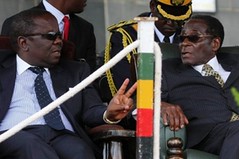
PRIME MINISTER Morgan Tsvangirai said on Thursday President Mugabe is part of the solution to the political equation in the country and the West should recognise this.

Addressing delegates to the Zimbabwe-Africa Business Opportunities Day commemorations, PM Tsvangirai advised cynics to accept the reality of the country’s political situation.

"If there are sceptics in the United States who think and wish one day President Mugabe will wake up dead then they are mistaken," he said.

PM Tsvangirai urged the Western world to recognise the progress the inclusive Government had made, particularly in stabilising the economy.

"We need to be rewarded for the progress. We are not where we are supposed to be, but certainly we are where we never thought we would be sometime last year," he added.

The West is understood to be holding back from lifting the debilitating economic sanctions in the hope that the economic malaise can lead to regime change.

PM Tsvangirai said Government was creating an environment conducive for foreign investment and business should not fear the indigenisation and economic empowerment regulations.

He explained that under the empowerment programme, Government was not seizing shareholding but wanted it placed on the open market so that ordinary Zimbabweans could buy into large corporations.

"As government we are working on creating an investment climate that will result in our natural assets being used for economic growth," he said.

PM Tsvangirai urged the business community to interact positively with foreign counterparts to promote international investment.

"If you go out there and paint a bad picture no one will come to invest in the country," the PM said.

There have been attempts by the local private and foreign media to demonise Zimbabwe’s empowerment regulations.

The laws seek to ensure Zimbabweans own at least 51 percent of any companies that are worth more than US$500 000.

The indiginisation drive has received widespread support from progressive elements of society who believe that it will result in true economic independence following the equally revolutionary land reform programme. — New Ziana-Herald Reporter

Foreigners Abducted in Niger Delta

Friday, April 09, 2010
22:09 Mecca time, 19:09 GMT

Foreigners abducted in Niger delta

Fighters in the Niger delta has launched attacks and abducted hundreds of people since 2006

Four foreign workers have been abducted by armed men in Nigeria's oil-rich River State.

An official said one police officer was killed as the three Syrians and one Lebanese, all working on a construction site, were seized near Port Harcourt in the Niger delta.

"About 10 or more kidnappers, all armed with automatic weapons, fired many rounds. The hoodlums kidnapped four expatriate workers - three Syrians and one Lebanese," Rita Abbey, a police spokeswoman, said on Friday.

"One of our policemen attached to the company was killed by the hoodlums."

Abbey said no group or individual had yet claimed responsibility for Thursday's abductions and no ransom has been demanded so far.

Hundreds of mostly foreign and local oil workers have been kidnapped in the volatile Niger delta since 2006. Most have been released unharmed, and some were freed only after ransom payments.

Fighters, who demand that the federal government send more oil-industry funds to Nigeria's southern region, have launched numerous attacks on oil-installations in the area and fought government troops since January 2006.

On March 31, a local employee of French oil group Total was abducted on his way to work in Port Harcourt.

Source: Agencies

Friday, April 09, 2010

More Banker Outrage: Protesters Plan Marches on Wall Street Banks

Published on Friday, April 9, 2010 by ABC News

More Banker Outrage: Protesters Plan Marches on Wall Street Banks

Activists, Union Members Will Take to the Streets Again, but Are They Having any Impact?

by Alice Gomstyn and Rachel Humphries
ABC News

Outrage over bonuses, bailouts and home foreclosures have prompted angry demonstrations at bank office buildings, bank conferences and even bankers' homes since the financial crisis began. With Wall Street reform proposals up for debate in Congress and bank shareholder meetings taking place later this month, protest organizers say they're getting ready to rally the troops again with several new demonstrations expected to draw thousands.

"There's something fundamentally wrong with an economic and political system that allows the big banks to rewrite all the rules to stay afloat while allowing entire communities to collapse in the wake of the disaster caused by Wall Street," Anna Burger, the secretary-treasurer of the Service Employees International Union , said on a conference call with reporters Thursday. "That's why we're escalating and expanding this campaign."

The SEIU, one of the most vocal critics of Wall Street and big U.S. banks, is part of a coalition of at least six groups -- including the AFL-CIO; the National People's Action, a racial and economic justice advocacy group; PICO National Network, a faith-based group; and North Carolina United Power, an organization of religious and community groups -- planning demonstrations across the country later this month.

Organizers are calling on banks to help people stay in their homes, offer more small business loans, stop offering financing to payday lenders and stop attempts to block financial reforms. They say they're targeting their demands at the country's biggest banks: Bank of America, Citigroup , Goldman Sachs , JPMorgan Chase, Morgan Stanley and Wells Fargo.

The American Bankers Association, one of the banking industry's top lobbying groups, declined to comment on the planned protests. Last October, an ABA conference in Chicago drew 5,000 protesters, organizers say.

A spokeswoman for Bank of America, which will be the target of at least two demonstrations scheduled for later this month, said of the protesters: "While we understand their passion on the issue, we don't necessarily agree with some of their statements and approaches."

On Wall Street itself, news of the planned protests was met with disdain by some of the street's rank and file.

"I mean, there is a lot of excess on Wall Street, you know, with the bonuses, but there are people that deserve it," said Michael Maresca, an information technology employee at JPMorgan Chase. "People down here work very, very hard ... I think there's also a lot to blame outside of Wall Street, with the Federal Reserve, politicians, the Federal Reserve, all those guys that have been involved -- there's a lot of blame to go around, I think. It's directed at the wrong place."

Wall Street Workers Weary of Bank Protests

Alan Valdes, a trader with DMC Securities, said he didn't think bank protests help anyone and have kept people from taking advantage of a lucrative rebound in the stock market.

"We've still got problems, and we've still got a lot of headwinds ahead -- there's no question about it. But (for the market) to be up 75 percent in a year -- that's a great market," he said. "To keep bashing Wall Street, I think, is wrong. It sends the wrong message to the public ... With all this bashing that's going on, a lot of people, I think have stayed away from the market."

Jerry, an employee at a Wall Street law firm who did not want his last name used, said he didn't see the new protests accomplishing much.

"They protest down there all the time," he said, "but it's not going to do nothing."

How effective previous protests have been remains in question.

When it comes to changing public policy, behind-the-scenes moves, including lobbying politicians and bureaucrats , typically work better than "outsider tactics" like demonstrations, said Dean Lacy, a professor of government at Dartmouth College.

While much attention is paid to the massive amounts of cash that banks and lobbying groups pump into political campaigns, Lacy said lobbyists also have an advantage over grassroots protesters because they can make more targeted moves, such as urging a Congressional committee to block a specific provision in a bill or influencing an agency to change its enforcement of an existing policy.

"Protests tend to not have precise targets but seek broad-based change," Lacy said.

Single protests, he said, tend not to be effective. A series of demonstrations like those of the civil rights movement, however, can successfully draw media attention and raise public awareness, which may ultimately lead to policy changes, he said.

Bank protests thus far, he said, "have probably raised public awareness about executive pay and the bailouts of banks and other financial institutions."

Protests are planned for the last week of the month at the Wells Fargo shareholder meeting in San Francisco; at the Bank of America shareholders' meeting in Charlotte, N.C.; outside a Bank of America building in Kansas City; and on Wall Street. Next month, the groups will also converge on K Street in Washington D.C. to protest banks' lobbying of elected officials.

PR Campaign by JPMorgan's Dimon?

When asked about the expected protests at their bank buildings, both Wells Fargo and Bank of America representatives cited their banks' track records in addressing some of the issues raised by activisits.

A Wells Fargo spokeswoman said the bank recognizes that "Americans are demanding more from their financial institutions during these difficult economic times" and that it is "committed to serving the financial needs of businesses and individuals, keeping credit flowing, and working to help those in financial distress find solutions."

The bank, she said in an e-mail, provided $711 billion in loans and lines of credit last year.

A Bank of America spokeswoman said that BofA last year extended $758 billion in credit in both the consumer and commercial sectors, more than any other bank, and that it has invested more than $8 million in grants to tackle hunger and housing needs. Information about the Bank of America's work in these areas, she said, is available in its quarterly impact statement on the bank's Web site.

In Thursday's call, Burger singled out JPMorgan Chase CEO Jamie Dimon as "leading the PR campaign to rebrand Wall Street," noting that the bank spent $6.2 million on lobbying last year.

"The American people aren't buying Jamie's PR campaign," she said.

A JPMorgan Chase spokeswoman declined to comment.

JPMorgan Chase is known, along with Goldman Sachs, for avoiding many of the pitfalls of the financial crisis.

In his annual letter to shareholders earlier this month, Dimon said "punitive efforts" against banks hurts ordinary shareholders and that"vilify(ing) whole industries" denigrates "much of what made this country successful."

"When we reduce the debate over responsibility and regulation to simplistic and inaccurate notions, such as Main Street vs. Wall Street, big business vs. small business or big banks vs. small banks, we are indiscriminately blaming the good and the bad ? this is simply another form of ignorance and prejudice," Dimon wrote.

African National Congress Official Statement on the Current Racial Atmosphere Inside the Country

STATEMENT FROM THE OFFICIALS OF THE ANC

The officials of the ANC held their normal weekly meeting held yesterday at the President's residence - Mahlambandlopfu. The officials decided that, in view of the environment currently prevailing in our country, all our structures must restrain themselves.

The structures have been asked not to engage in any public debate on the death of Mr Eugene TerreBlanche and leave whatever matters that need the attention of the ANC in this regard to the headquarters of our movement. The structures were also asked by the officials to be circumspect in singing liberation songs that have words that can be seen and be interpreted to be contributing to racial polarisation of society.

Our appeal to our members is informed by the fact that we have a responsibility of ensuring that they are not used as a scapegoat for other agendas.

The call by the officials regarding our liberation songs does not amount to banning any of the songs, including the song that is hotly debated currently. The National Executive Committee (NEC) of the ANC will at its next meeting on 14 - 16 May 2010, debate and decide on an appropriate political approach in dealing with the questions raised around some of our songs. The political approach should, amongst others, also be inclusive of the recognition by all of us that such songs are part of our history and heritage.

It is a considered view of our officials that such a restraint as called upon will help our society see through the disguised attempts by the right wing groups that seek to reverse the transformation progress made since 1994. The ANC has up to this point in not raised the questions around the involvement of a 15-year-old farm labourer in the brutal killing of Mr TerreBlanche.

We have also not questioned the drive by some sections of the media to ignore the fact that conflict around non-payment of wages cannot be elevated a singing of a song. We find it very unfortunate that some sections of the media together with some political commentators have decided to politicize a purely criminal matter with regard to the killing of Mr TerreBlanche.

Equally important is the lack of reporting and equal sensation around the shooting and killing of a black hunter by a farmer who is currently out on bail of R5000. We are also dismayed by the little coverage of the brutal assault of seven farm workers by a farmer in the North West. We question the objectivity and the motive that drive certain elements of our media on these matters.

The ANC officials also used their meeting to congratulate our police for acting with speed in arresting the suspects in all these instances, including the arrest of those allegedly responsible for the killing of Mr TerreBlanche, as well as the farmer responsible for brutally assaulting his workers.

Mumia Abu-Jamal Events on His Birthday, April 24

Mumia events on his birthday

Published Apr 8, 2010 9:30 PM

Writers for Mumia, an afternoon of readings and testimonials by poets, playwrights, journalists, book authors, wordsmiths and activists, will be held April 24 from 2:30 to 6 p.m. at St. Mary’s Church, 512 W. 126th St. in Harlem.

The New York Chapter of the National Writers Union and the Free Mumia Abu-Jamal Coalition of New York City are co-sponsoring the event, which precedes a rally in front of the Justice Department’s headquarters in Washington, D.C., on April 26.

Unjustly held captive on Pennsylvania’s death row since 1982, Abu-Jamal is being threatened by the courts with another execution date for a killing he didn’t commit in 1981.

“Mumia needs public support at this critical time, so that’s why fellow writers want to pay tribute to the power of his words and his struggle for freedom and justice on April 24,” Susan Elizabeth Davis told Workers World. Davis founded Writers for Mumia as a project of the International Action Center in 1997 and organized two public events in 1999 and 2007. “As the ‘voice of the voiceless,’ Mumia inspires others to write as truthfully, eloquently and purposefully as he does.

We must fight to free him with our words as we seek to write truth to power.” Davis noted that Mumia has been an honorary member of the National Writers Union since 1995. The gathering will also celebrate his 56th birthday, which is on April 24. For more information call 212-633-6646; 212-254-0279 ext. 18; or 212-330-8029.

There will also be a Birthday Celebration and Organizing Party for Mumia Abu-Jamal on April 24 from 6 to 8 p.m. at the S.H.A.P.E. Center, 3815 Live Oak in Houston, Texas. The event is sponsored by the Texas Death Penalty Abolition Movement.

The program will include poetry, music and a birthday cake, along with strategizing to support the campaign for a civil rights investigation by the U.S. Justice Department into violations of Mumia’s civil rights.

For more information call 713-503-2633 or email Abolition.Movement@hotmail.com.

— Workers World bureau, New York
Gloria Rubac contributed to this report.
--------------------------------------------------------------------------------
Articles copyright 1995-2010 Workers World. Verbatim copying and distribution of this entire article is permitted in any medium without royalty provided this notice is preserved.

Workers World, 55 W. 17 St., NY, NY 10011
Email: ww@workers.org
Page printed from:
http://www.workers.org/2010/us/mumia_0415/

Washington Admits There's No Recovery For Workers

Washington admits there’s no recovery for workers

By Fred Goldstein
Published Apr 7, 2010 2:49 PM

Cheerleaders for capitalism are talking out of both sides of their mouths about the latest job numbers, which showed the creation of 162,000 jobs in March.

President Barack Obama hailed the news as signaling that the economy “is beginning to turn the corner,” but he followed this with the warning that “It will take time to achieve the strong and sustained job growth that we need.” (New York Times, April 3)

Likewise, Christine Romer, head of the White House Council of Economic Advisers, hailed the numbers but said there will be a “gradual labor market healing” and that “we still have a lot of headwinds.” (msnbc.com, April 2)

Larry Summers, director of the National Economic Council, said: “The trend has turned, but to get back to the surface, we’ve got a long way to go.” (washingtontimes.com, April 4) And Treasury Secretary Timothy Geithner said the administration is “very worried” about getting unemployment back to 5 percent. (Associated Press, April 1)

The double talk was captured in a New York Times headline of April 3 that read, “Signaling Jobs Recovery, Payrolls Surged in March.” This was followed by the exuberant opening sentence, “The clouds have parted.”

However, a few lines further down came the bad news: “The economy needs to add more than 100,000 jobs a month just to absorb new entrants into the labor market, let alone provide a livelihood for the 15 million Americans already looking for work. Without constant, robust growth, the unemployment rate won’t budge. Indeed, the Congressional Budget Office has projected that the rate will hover around 10 percent for the rest of the year.”

So the truth is that the working class has little to cheer about from the latest job numbers. The official unemployment rate is still 9.7 percent. Almost one third of the jobs created, amounting to 48,000, are temporary jobs working for the U.S. Census. These jobs last only six to eight weeks. Officially, there are still 15 million unemployed, 9.1 million doing forced part-time work and 2.3 million so-called “marginally attached” workers who have become so discouraged they’ve given up looking for work.

Added together, they are called “total unemployment” by the government. This number actually rose in March — from 16.8 percent to 16.9 percent. This makes for an official total of 26.4 million workers who need full-time jobs. The actual figure, according to an authoritative study by the Pew Research Center, is more than 30 million.

6.5 million long-term unemployed

The crisis of U.S. capitalism, as far as the workers are concerned, is getting more and more severe, big business spin masters notwithstanding. The long-term unemployed — workers out of a job for 27 weeks or more — rose 414,000 in March to 6.5 million, or 44 percent of the official number.

Black unemployment stands at 16.5 percent, with Black men at 19 percent; Latino/a joblessness is at 12.6 percent; and teenage unemployment is at 26 percent.

Right now almost six unemployed workers are looking for each available job. This dim picture for the workers is despite six months of expanded production and profits for the bosses and a steady rise in the stock market’s Dow Jones Industrial Average, which is now nearing 11,000. This is the “jobless recovery” in action.

An analysis released on April 2 of the unemployment statistics by Heidi Shierholz of the Economic Policy Institute shows in stark terms the crisis that the working class is facing in this capitalist economy.

“Since the start of the recession in December 2007,” wrote Shierholz, “the labor market has shed 8.2 million payroll jobs. This number, however, understates the size of the gap in the labor market by failing to take into account the fact that simply to keep up with population growth, the labor market should have added around 2.8 million jobs since December 2007. This means the labor market is now roughly 11 million jobs below what would restore the pre-recession unemployment rate (which was 5.0 percent in December 2007). To get us back to the lower unemployment rate that existed prior to the 2001 recession (4.3 percent in March 2001), the U.S. economy is now nearly 17 million jobs short.

“Furthermore, these calculations understate slack in the labor market by failing to take into account the decline in hours worked for those who have kept their jobs. At the start of the recession in December 2007, the length of the average workweek in the private sector was 34.7 hours. In March, it was 34.0 hours. This may at first seem like a small amount, but when multiplied across the labor market, the effect is nontrivial — the decline in the total number of hours worked in the private sector since the start of the recession that is due to reduced hours alone (i.e., not job loss) is equivalent to 2.2 million jobs.”

The bourgeois policy experts in Washington and in the media have read the same numbers. Thus, it is no surprise that they preach caution alongside every optimistic statement. They dare not raise expectations among the masses. In fact, according to the Washington Post of April 2, “The White House does not expect the rate to return to its healthy-economy level of 5 percent until at least 2017.”

These are the experts who predicted a maximum of 8 percent unemployment by 2010. They cannot see from one quarter to the next, let alone to 2017. But the point is that the government officials themselves are profoundly pessimistic about any genuine recovery for the working class.

Where can jobs come from?

All this speaks to the urgent necessity to organize a working-class campaign for an immediate, sweeping national jobs campaign. The idea is beginning to surface, even among liberals.

Bob Herbert, an African-American columnist for the New York Times, wrote on March 29: “Those who think some kind of robust recovery is hiding around the corner, just waiting to spring a pleasant surprise on us, are deluded.”

Herbert derided the Obama administration’s “jobs program” of $30 billion as “small-bore initiatives” and said that “some new variation of the Works Progress Administration and the Civilian Conservation Corps should be developed to put economically distressed young people to work. What is happening to young, out-of-work and poorly educated American kids — not just in the big cities, but increasingly in suburban and rural areas, as well — is tragic.”

Along these lines, the Bail Out the People Movement, the May 1st Coalition For Worker and Immigrant Rights, Moratorium Now! Coalition, the San Francisco Labor Council, the Million Worker March Movement, Rev. Tom Smith from Pittsburgh’s Monumental Baptist Church and many others are calling for a national jobs program that would include all workers who need a job to be carried out on a scope comparable to the WPA of the 1930s. Hiring them directly, the WPA put over 8 million workers to work. This demand will be publicized at a demonstration in Washington, D.C., on May 8.

In the midst of this crisis, the bosses are ruthlessly trying to take advantage of workers in every way. There are investigations in many states of corporations that use unpaid interns as free labor.

In 2008 the National Association of Colleges and Employers found that 83 percent of graduating students had held internships, up from 9 percent in 1992. This means hundreds of thousands of students hold internships each year; some experts estimate that one-fourth to one-half are unpaid. (New York Times, April 2)

Making money denying benefits

While workers are suffering, the bosses are using every trick to block them from getting unemployment insurance. This is to reduce employer costs because the more claims after a layoff, the higher the rates the bosses have to pay.

A billion-dollar company called Talx handles more than 30 percent of the nation’s requests for jobless benefits. Pledging to save employers money in part by contesting claims, Talx helps them decide which applications to resist and how to mount effective appeals. This has made Talx a boom business in a bust economy.

Among the companies Talx represents are Wal-Mart, Countrywide, Aetna, AT&T, Best Buy, FedEx, Home Depot, Marriott, McDonald’s and the United States Postal Service. (New York Times, April 3)

In addition, millions more homeowners are expected to lose their homes over the next several years. Workers are forced into homelessness, to double and triple up with their families, or to live in cars or tent cities.

The economic crisis is not making headlines. But for the working class, the communities, students and youth the crisis is spreading, not declining as the government and the apologists for the capitalist profit system would have it.

More people living in the U.S. filed for bankruptcy protection in March than during any month since the federal personal bankruptcy law was tightened in October 2005. A new report attributes this to high unemployment and the housing crash.

Federal courts reported more than 158,000 bankruptcy filings in March, or 6,900 a day, a rise of 35 percent from February, according to a report to be released April 9 by Automated Access to Court Electronic Records.

Capitalism must maximize profits at all costs. This is what drives the economic system. If the bosses have their way, there will be no recovery for the workers at all — only more pressure for those who work and a steady growth in the number of those who cannot get a job.

In a February speech, Federal Reserve Bank of San Francisco President Janet Yellen warned what the recovery will look like:

“The recession has forced businesses to reexamine just about everything they do with an eye toward restraining costs and boosting efficiency,” said Yellen. “Strapped by tight credit and plummeting sales, businesses have overhauled the way they manage supply chains, inventory, production practices and staffing.

“My business contacts describe this as a paradigm shift and they believe it’s permanent. This process of implementing new efficiency gains may have only begun and we may be in store for further efficiency improvements and high productivity growth for some time. If so, the rate of job creation will be frustratingly slow.” (Huffington Post, April 4)

The only way to stop job creation from being “frustratingly slow” or actually non-existent is for the working class to mobilize and fight for a national, government-provided jobs program at living wages and conditions. The demonstration May 8 in Washington, D.C., will make that demand.

Goldstein is the author of the book “Low-Wage Capitalism,” a Marxist analysis of globalization and its effects on the U.S. working class. He has also written numerous articles and spoken on the present economic crisis. For further information, visit www.lowwagecapitalism.com.
--------------------------------------------------------------------------------
Articles copyright 1995-2010 Workers World. Verbatim copying and distribution of this entire article is permitted in any medium without royalty provided this notice is preserved.

Workers World, 55 W. 17 St., NY, NY 10011
Email: ww@workers.org
Page printed from:
http://www.workers.org/2010/us/economy_0415/

Detroit Area Protest Against the Right-Wing, Racist Tea Party Express Rally in Clinton Township

Protest Right-wing, racist Tea Party Express rally in Clinton Township

Sunday, April 11
Gather at 9:30 AM

Main Library - Clinton-Macomb Public Library parking lot at 40900 Romeo Plank Road, Clinton Township. (Tea Party will be next door)

The right-wing, racist Tea Party Express is scheduled to rally in Clinton Township this Sunday, April 11 at 10 AM.

The Michigan Emergency Committee Against War & Injustice, the Moratorium NOW! Coalition Against Foreclosures, Evictions and Utility Shutoffs and Workers World Party are calling for all progressive individuals and groups to protest this racist, anti-worker, neo-fascist movement.

Let's let them, the media and the nation know that Michigan doesn't welcome their message. Bring your own signs or pick up one of ours. If you need a ride call me at 313-680-5508 and we will try to hook you up with someone near you. If you are driving here is where to go.

Progressives meet at Main Library - Clinton-Macomb Public Library parking lot at 40900 Romeo Plank Road (Tea Party will be next door). Be there at 9:30 AM (Tea Party is scheduled for 10 AM)

MapQuest it or follow these directions from Detroit:

I-94 EAST to Exit 236 (Metropolitan Parkway - 16 Mile Rd.) westbound.

Go about 4 miles west on Metropolitan Parkway and turn right (North) on Garfield Road.

Go about 1 mile on Garfield Rd. and turn right (East) on Clinton River Road.

Go about 1 mile on Clinton River Rd. and turn left (North) on Romeo
Plank Road.

Look for us in the Library parking lot with signs and banners.

Acting Nigerian President Jonathan Holds Talks With Umaru Abdul-Muttalab Before Departure to US on Official Visit

Jonathan Parleys Mutallab

From George Oji in Abuja, 04.09.2010
Nigeria ThisDay

Ahead of his three-day official trip to the United States (US) Acting President Goodluck Jonathan yesterday met with Umaru Abdul-Muttalab, the father of the 23-year-old Nigerian, Farouk, who attempted to bomb an American aircraft on Christmas Day last year.

Jonathan is traveling to the US on the invitation of President Barack Obama to attend a maiden Nuclear Security Summit organised by the US government.

The two leaders are expected to discuss bilateral relations at the meeting. The Nigeria-US Bi-national Commission is on the agenda, in addition to global terrorism and counterterrorism measures.

US and Nigeria had signed the Bi-national commission agreement last Tuesday in Washington DC.

Also to be discussed at the meeting between Obama and Jonathan are issues of regional security and peace-keeping. Nigeria is Africa’s largest contributor to peace-keeping.

Muttalab was believed to have discussed his earlier trip to the US with Jonathan. During that trip, he met with American security officials regarding his son’s failed terror attack and for which the young man is being prosecuted.

The act had prompted the US to put Nigeria on a list of “countries of interest”, a development bitterly criticized by the Nigeria government. The list was however reviewed last weekend, with new measures superseding the terror watch list.

Mutallab came alone to the Presidential Villa and met with the Acting President behind closed doors for close to an hour. He did not speak to the press afterwards. The Acting President is expected back home by Thursday next week.

Thursday, April 08, 2010

Iran President to Open the Zimbabwe International Trade Fair

Ahmadinejad to open ZITF

By Farai Machivenyika
Zimbabwe Herald

PRESIDENT of the Islamic Republic of Iran, Mahmoud Ahmadinejad, will officially open the 51st edition of the Zimbabwe International Trade Fair in Bulawayo on April 23.

Secretary for Media, Information and Publicity Mr George Charamba revealed this after Tehe-ran’s incoming ambassador to Harare, Mr Mohammed Pour Najaf, presented his credentials to President Mugabe at State House yesterday.

"President Ahmadinejad will open the Zimbabwe International Trade Fair this year on April 23," Mr Charamba said.

The ZITF will run from April 20 to April 24.

Zambia’s President Rupiah Banda officially opened the 50th edition of ZITF last year.

Speaking to journalists after meeting Presi-dent Mugabe, Ambassador Pour Najaf hailed Zimbabwe-Iran ties.

"Zimbabwe and Iran enjoy strategic co-operation partnerships . . .

"The doors and gates of Iran are always open. You do not need a visa to visit Iran so we invite Zimbabweans to come to Iran," he said.

Ambassador Pour Najaf said Iran would soon establish a regional centre in Harare to supply tractors and irrigation equipment.

"Everything will be transferred from here including the tractors, irrigation equipment and many others," said Ambassador Pour Najaf.

Iran’s new top diplomat in Harare holds a Master of Arts degree in English and has lectured at Iran’s College of International Relations.

Before taking up his latest posting, he was advisor to Iranian Foreign Minister Manouchehr Mottaki and also served at his country’s embassy in South Africa.

Ambassador Pour Najaf takes over from Mr Rasoul Momeni who left Zimbabwe last month.

Zimbabwe and Iran enjoy cordial relations firmly rooted in the principles of sovereignty and self-determination and have been put under illegal sanctions in their pursuit to preserve those virtues.

Iran has been maligned by the West for its civilian nuclear energy programmes, while Zimbabwe has been targeted for redistributing land held by a few thousand whites to nearly 300 000 black families.

The two countries have embarked on several joint ventures; especially in agriculture, irrigation development, pharmaceuticals and biotechnology.

Iran is also considering assisting Zimbabwe in the energy sector through the rehabilitation of the Feruka Oil Refinery, setting up a transformer manufacturing plant and a hydroelectric power plant in Kariba.

Teheran has also invested in a helicopter repair and technicians’ training facility in Zimbabwe.