Castro visits Che Guevara home
Sunday Jul 23 10:48 AEST
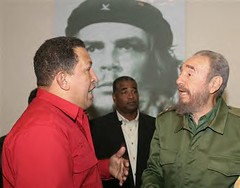
Cuban President Fidel Castro has taken his Venezuelan protege on a pilgrimage on Saturday to the childhood home of his one-time revolutionary comrade, communist icon Ernesto "Che" Guevara.
Residents of the small Argentine city packed the sidewalks, cheering as Castro and Venezuelan President Hugo Chavez made their way through a middle-class neighbourhood to the house, which is now a museum dedicated to "el Che."
Guevara, whose bearded image has become an international symbol of rebellion, helped Castro lead the Cuban revolution in 1959. Eight years later, he was captured by the CIA and executed in Bolivia, where at age 39 he was fighting to spread socialist revolution.
Inside the house, a guide showed Castro some of Che's belongings and old photographs.
Castro steals show as Mercosur celebrates new member
By Benedict Mander in Córdoba, Argentina
Published: July 24 2006 03:00
Late in the night on Friday, Fidel Castro wound up a typical rambling three-hour speech at an "anti-imperialist" rally in the central Argentine city of Córdoba, delivered with such gusto that his health seemed far from failing.
Having dropped the suit and tie sported at the Mercosur presidential summit earlier in the day in favour of his customary olive-green fatigues, the Cuban leader's anti-US rhetoric was rivalled - if not in length - by a fiery warm-up address from his admirer, Hugo Chávez of Venezuela.
The outspoken duo stole the show at the meeting, which celebrated the addition of Venezuela to the trade bloc. Its original members are Argentina, Brazil, Paraguay and Uruguay.
Mr Castro's guest appearance, following a trade deal signed between Cuba and Mercosur, commanded generous media attention after being confirmed only at the eleventh hour.
"Sometimes I have to misinform even my own friends. Not even I knew I was going to come," he joked.
But the implications of Mr Chávez's status as the new arrival at Mercosur, which has prompted the group's formal support for Venezuela's bid for a seat on the United Nations Security Council in 2007-2008, have also generated speculation on the direction the enlarged bloc will take.
Some commentators fear that Mr Chávez might hijack the group as it becomes less a trade organisation and more a political alliance, another forum for his tirades against the US.
In a light-hearted aside to President Néstor Kirchner of Argentina during the meeting, President Luiz Inácio Lula da Silva of Brazil promised to ensure that Mr Chávez would "behave himself".
But he preferred to emphasise, as strengthening Latin American integration became the recurrent theme of the meeting, his wish for a "Merco-America" that would one day stretch from Mexico and Cuba to Patagonia.
Indeed, both Argentina and Brazil formally encouraged Bolivia to become the sixth full member of the group, while Mexico's foreign minister, Ernesto Derbez, said he hoped Mexico would become an associate member of the group - along with Bolivia, Chile, Colombia, Ecuador and Peru - before Vicente Fox's presidency comes to an end in December.
Mercosur's leaders resolved to support other projects enhancing unity, including the "great gas pipeline of the south", which will run from Venezuela through Brazil to Argentina, Bolivia, Paraguay and Uruguay. They also backed the creation of a Mercosur development bank to finance infrastructure projects, and the founding of a parliament, which Mr da Silva said could happen by the end of the year.
Nevertheless, tensions inevitably simmered, in particular discontent among Mercosur's smaller members, Uruguay and Paraguay, who complain of poor access to Brazilian and Argentine markets. Although the group resolved to tackle those issues, Uruguay's finance minister, Danilo Astori, formally asked for permission to be able to make bilateral trade agreements independently of Mercosur.
President Nicanor Duarte Frutos of Paraguay complained of the "expropriation" of shared resources, interpreted as referring to the significant debt that Paraguay owes to both Brazil and Argentina for the massive hydroelectric projects it shares with both countries and for which he is seeking relief.
Kirchner’s visit to Paraguay last week saw a decision delayed over whether to pardon $5bn (€4bn, £2.7bn) of debt.
The Financial Times Limited 2006
Bush told to plan for Chávez oil shock
By Andy Webb-Vidal in Caracas
Published: July 23 2006 22:27
Richard Lugar, chairman of the US Senate foreign relations committee, has urged the Bush administration to adopt specific “contingency plans” for a potential disruption to oil supplies from Venezuela.
In a letter sent to Condoleezza Rice, secretary of state, last Friday, a copy of which has been obtained by the Financial Times, Mr Lugar warned the US that it needed to “abandon” reliance on a “passive approach” to energy diplomacy.
Mr Lugar’s warning follows the release last month of an investigation by the Government Accountability Office (GAO) that the US was ill-prepared for an oil embargo by Venezuela, the world’s fifth largest exporter. President Hugo Chávez, whose government has been emboldened by a torrent of oil revenues, has several times warned that he would “cut off” oil supplies to the US if Washington persisted in allegedly plotting his overthrow.
“Venezuela’s leverage over global oil prices and its direct supply lines and refining capacity in the US give Venezuela undue ability to impact US security and our economy,” Mr Lugar wrote in his letter to Ms Rice.
The GAO study, commissioned by Mr Lugar, a Republican, estimated that a Venezuelan oil boycott would raise oil prices by $11 (€9, £6) per barrel over a six-month period and reduce US economic output by $23bn.
Bernardo Alvarez, Venezuela’s ambassador to the US, dismissed as “absurd” the GAO study’s premise that Mr Chávez would purposefully shut off oil supplies, citing the economic impact it would have on his own country.
Venezuela ships two-thirds of its oil to the US, or about 1.5m b/d and oil accounts for about 80 per cent of export revenue and half of fiscal revenue.
Mr Lugar, while acknowledging that an embargo seemed unlikely, said that it would be “negligent” of the US to rely on “ad hoc” responses, such as use of the Strategic Petroleum Reserve.
“However unrealistic Venezuelan President Hugo Chávez’s repeated threats to disrupt oil supply may be, we have a responsibility to plan appropriate contingencies that protect the American people,” he wrote.
Mr Lugar added that there was a “real risk” that Venezuela could “act in concert” with other countries to disrupt oil supplies. Mr Chávez is due to visit several countries in Asia over the next two weeks, including Iran.
Myles Frechette, a former US ambassador and now a consultant on Latin American affairs, said: “Lugar believes that when an opportunity presents itself, Chávez will try to break his oil links with the US.”
Venezuelan oil exports to the US fell six per cent in the first four months of 2006 to 178m barrels, compared with the same period last year. One of Mr Chávez’s policy goals is to reduce dependence on the US as its main market and send more oil to China.
The Financial Times Limited 2006
Venezuela deal in US stirs Cfius interest
By Stephanie Kirchgaessner in New York
Published: July 23 2006 21:45 | Last updated: July 23 2006 21:45
The takeover last year of a California-based voting machine company by a group with ties to Venezuela has caught the attention of the Treasury-chaired committee that investigates deals on national security grounds.
The revelation that the committee on foreign investment, or Cfius, has shown interest in the deal – and could initiate a retroactive review – underscores how dramatically the vetting process for foreign takeovers has changed following the furore earlier this year over the approval by the Bush administration of the sale of five US port terminals to a Dubai-controlled company.
The Treasury Department said it had made contact with Smartmatic, a private Delaware-incorporated subsidiary of a Dutch company that is controlled by Antonio Mugica, a Venezuelan citizen, but declined to comment on whether Cfius was reviewing the deal.
In the years before the Dubai controversy put Cfius at the centre of a political storm, the panel, comprising 12 government agencies, generally reviewed transactions involving sensitive defence technology. But the uproar over the approval of the Dubai deal, which ultimately scuppered it, has prompted the administration to take a tougher approach, in part because it is fighting off attempts in Congress to give lawmakers more oversight of Cfius.
The Treasury said it had taken steps to get Congress more involved, including notifying congressional committees once investigations of deals are closed, giving the director of national intelligence a greater role, and by giving only “Senate-confirmed officials” the ability to sign off on Cfius cases.
“There have been a number of changes in Cfius. It is a much more difficult regulatory environment than it was six months ago,” says David Marchick, an attorney with Covington Burling who handles Cfius cases.
Todd Malan, who heads the Organisation for International Investment, which represents US subsidiaries of foreign companies, said of the Smartmatic takeover of Sequoia, the California-based company, that he could not recall another instance when Cfius had contacted a company after a transaction was complete but that it was sign of a more flexible approach to defining “national security”.
“To me, all this adds up to the fact that elected policy- makers should have confidence that things are happening outside the legislative context,” Mr Malan said.
The Treasury declined to say what spurred its interest in the Smartmatic deal but it was the subject of a letter to John Snow, then Treasury secretary, last May from New York congresswoman Carolyn Maloney, who has backed a House proposal to tweak the Cfius process.
Smartmatic said there was “absolutely no ownership” by the Venezuelan government and that the deal had no “military, defence or national security applications”.
Financial Times Limited 2006
Monday, July 24, 2006


National Elections Set for July 30 in the Democratic Republic of Congo
Opposition to boycott DRC elections
Sophia Bouderbala
Mon, 24 Jul 2006
The Democratic Republic of Congo goes to the polls on July 30 for historic presidential and parliamentary elections that will be a key test for peace and stability in the entire Great Lakes region.
The elections in the former Zaire are the first multi-party vote in 46 years and will replace the transitional power-sharing government set up in 2003 after a peace deal in the five-year interstate conflict dubbed "Africa's World War".
Nearly four million people are estimated to have died either directly or indirectly from the fighting, which drew in armies from up to seven other African states in complex alliances, destabilised the region and led to what may have been the greatest loss of life since World War II.
But concerns remain as to how effective the elections will be in ending decades of dictatorship, corruption and bloody conflict that have blighted the vast central African state, which is rich in minerals but whose population is desperately poor.
A key opposition party is boycotting the internationally monitored poll, claiming a "lack of transparency"; violence continues in the unstable east bordering Rwanda, Burundi and Uganda; while the voting system itself has been criticised as complicated.
Elections could kick-start the crippled economy
If successful, the elections could help kick-start the crippled economy in the former Belgian colony, a country the size of Western Europe, which has the potential to be a powerhouse for central Africa.
A legitimate government could also help lessen the influence of the 20 or more armed groups active in the country, not just against the Kinshasa authorities but also against the fragile administrations in next-door Rwanda, Burundi and Uganda.
"DRC isn't a country, it's a veritable continent which has borders with nine countries. If DRC sneezes, nine countries catch cold," said Aldo Ajello, the European Union's special representative in the Great Lakes region.
"Sorting out DRC is vital for the stability of the region."
Some of the 30 000 Congolese now living in Brussels are also desperate for change, if only to prevent the DRC and its rich natural resources, which include gold and diamonds, being carved up for the benefit of foreign powers.
The presidential election is in many respects a continuation of long-standing, deadly political rivalries.
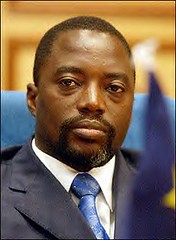
Joseph Kabila, the current president, who took over when his father Laurent-Desire was murdered in 2001, is favourite to win.
Three of the four vice-presidents in his interim government are among the 32 other candidates. Two of them — Jean-Pierre Bemba and Azarias Ruberwa — headed foreign-backed rebel groups that opposed Kabila's father during the 1998-2003 war.
The candidates also include Nzanga Mobutu, son of late dictator Mobutu Seke Seso, and Pierre Pay-Pay, central bank governor during Mobutu's 32-year kleptocratic regime.
Mobutu seized power in 1965, bleeding the country dry for personal profit until Kabila senior toppled him in 1997. He received backing from the United States as a bulwark against Soviet influence in sub-Saharan Africa.
Kabila and Mobutu junior are not the only members of political dynasties vying for a return to power.
Also standing for election are Guy-Patrice Lumumba and Justine Mpoyo Kasa-Vubu, whose fathers Patrice and Joseph were the country's first elected prime minister and president respectively.
Patrice Lumumba was assassinated in 1961 — a year after independence — while Joseph Kasa-Vubu was ousted in the coup by Mobutu, then head of the army.
Bitter ethnic violence
Since 1999 the United Nations has maintained a 17 600-strong peacekeeping mission (MONUC) — currently its largest in the world — in the DRC, particularly to calm the bitter ethnic violence that continues in the eastern provinces.
It will be supported in providing security during the elections by 1 000 European Union soldiers in Kinshasa and a similar number in reserve in Gabon.
Observers see the main threat to the electoral process in the eastern provinces. Here foreign rebel groups, dissident DRC soldiers and local militia continue to hold sway, exacerbating longstanding cross-border ethnic tensions and land disputes.
The logistics of the vote also pose problems — the vast DRC's infrastructure is non-existent. There are practically no roads in the country so access to 50 000 polling stations will be far from easy, as will the preparation and collection of ballot papers.
The voting slips themselves are hardly straightforward either, particularly for an electorate of 25.6-million that is largely uneducated and, in many cases, has never voted before.
There are two elections on July 30 — a first-round presidential ballot and a poll to choose between a massive 9 707 candidates standing for just 500 parliamentary seats.
On average 15 candidates are standing per constituency but that rises to 65 in Kinshasa. Some papers are poster-size and will have to be folded up to 20 times before being put in the ballot box.
During a trial-run earlier this month, some people took up to 20 minutes to make their choice. Others just gave up.
With a mix of single-seat constituencies using a first-past-the-post system and others with a form of proportional representation, the count — and predicted recounts — look likely to be a lengthy process.
AFP
KINSHASA 21 July 2006 Sapa-AFP
DR CONGO ELECTION BODY DENIES 'IRREGULARITIES' IN RUN-UP TO VOTE
The official electoral body in the Democratic Republic of Congo on Friday denied reports of irregularities in the run-up to the central African state's historic vote later this month, as the Catholic Church threatened to withhold recognition of the results.
"There have been no irregularities in the organization of these elections," Malu Malu told journalists at the UN mission
headquarters in Kinshasa.
"The electoral list published by the independent electoral
commission is reliable and will be posted inside the polling
stations. We have an accurate count of the ballots, as well," said commission chief Malu Malu.
The electoral commission is the only entity capable of organizing elections in the DRC," he added. "It must not be put under pressure."
On Friday the main Catholic body in the DRC joined several
rights groups, the United Nations and members of the political
opposition in signalling irregularities in the run-up to the July 30 presidential and parliamentary polls.
"At the present time all the necessary conditions have not been fulfilled to enable truly transparent, free and democratic elections to take place," the National Episcopal Conference of Congo (Cenco) said in a statement.
The Cenco said that "an ensemble of evidence confirms fears
of manipulation and trickery, if not fraud".
It pointed out what it said were contradictions in the electoral lists and in the number of voters, as well as the "embarrassed" reaction of the electoral commission to an apparent surplus of ballot sheets.
"This is why the Cenco is asking - and will not recognize the
validity of the elections otherwise - all concerned parties to
work to redress the irregularities that have been identified, and to create the necessary conditions for truth, transparency
and freedom..."
The declaration was signed by the Cenco's president, Monsignor
Laurent Monsengwo Pasinya, and its vice-president, Tharcisse
Tshibangu Tshishiku.
More than 30 million ballots printed in South Africa have been
sent to the DRC where they will be progressively delivered to the 50,000 polling stations across the vast nation.
More than 25 million people are expected to turn out for the
polls in the former Zaire, which are designed to conclude a fragile transitional period that followed the end in 2003 of the five-year war that engulfed the DRC and drew in five of its neighbors.
Sophia Bouderbala
Mon, 24 Jul 2006
The Democratic Republic of Congo goes to the polls on July 30 for historic presidential and parliamentary elections that will be a key test for peace and stability in the entire Great Lakes region.
The elections in the former Zaire are the first multi-party vote in 46 years and will replace the transitional power-sharing government set up in 2003 after a peace deal in the five-year interstate conflict dubbed "Africa's World War".
Nearly four million people are estimated to have died either directly or indirectly from the fighting, which drew in armies from up to seven other African states in complex alliances, destabilised the region and led to what may have been the greatest loss of life since World War II.
But concerns remain as to how effective the elections will be in ending decades of dictatorship, corruption and bloody conflict that have blighted the vast central African state, which is rich in minerals but whose population is desperately poor.
A key opposition party is boycotting the internationally monitored poll, claiming a "lack of transparency"; violence continues in the unstable east bordering Rwanda, Burundi and Uganda; while the voting system itself has been criticised as complicated.
Elections could kick-start the crippled economy
If successful, the elections could help kick-start the crippled economy in the former Belgian colony, a country the size of Western Europe, which has the potential to be a powerhouse for central Africa.
A legitimate government could also help lessen the influence of the 20 or more armed groups active in the country, not just against the Kinshasa authorities but also against the fragile administrations in next-door Rwanda, Burundi and Uganda.
"DRC isn't a country, it's a veritable continent which has borders with nine countries. If DRC sneezes, nine countries catch cold," said Aldo Ajello, the European Union's special representative in the Great Lakes region.
"Sorting out DRC is vital for the stability of the region."
Some of the 30 000 Congolese now living in Brussels are also desperate for change, if only to prevent the DRC and its rich natural resources, which include gold and diamonds, being carved up for the benefit of foreign powers.
The presidential election is in many respects a continuation of long-standing, deadly political rivalries.
Joseph Kabila, the current president, who took over when his father Laurent-Desire was murdered in 2001, is favourite to win.
Three of the four vice-presidents in his interim government are among the 32 other candidates. Two of them — Jean-Pierre Bemba and Azarias Ruberwa — headed foreign-backed rebel groups that opposed Kabila's father during the 1998-2003 war.
The candidates also include Nzanga Mobutu, son of late dictator Mobutu Seke Seso, and Pierre Pay-Pay, central bank governor during Mobutu's 32-year kleptocratic regime.
Mobutu seized power in 1965, bleeding the country dry for personal profit until Kabila senior toppled him in 1997. He received backing from the United States as a bulwark against Soviet influence in sub-Saharan Africa.
Kabila and Mobutu junior are not the only members of political dynasties vying for a return to power.
Also standing for election are Guy-Patrice Lumumba and Justine Mpoyo Kasa-Vubu, whose fathers Patrice and Joseph were the country's first elected prime minister and president respectively.
Patrice Lumumba was assassinated in 1961 — a year after independence — while Joseph Kasa-Vubu was ousted in the coup by Mobutu, then head of the army.
Bitter ethnic violence
Since 1999 the United Nations has maintained a 17 600-strong peacekeeping mission (MONUC) — currently its largest in the world — in the DRC, particularly to calm the bitter ethnic violence that continues in the eastern provinces.
It will be supported in providing security during the elections by 1 000 European Union soldiers in Kinshasa and a similar number in reserve in Gabon.
Observers see the main threat to the electoral process in the eastern provinces. Here foreign rebel groups, dissident DRC soldiers and local militia continue to hold sway, exacerbating longstanding cross-border ethnic tensions and land disputes.
The logistics of the vote also pose problems — the vast DRC's infrastructure is non-existent. There are practically no roads in the country so access to 50 000 polling stations will be far from easy, as will the preparation and collection of ballot papers.
The voting slips themselves are hardly straightforward either, particularly for an electorate of 25.6-million that is largely uneducated and, in many cases, has never voted before.
There are two elections on July 30 — a first-round presidential ballot and a poll to choose between a massive 9 707 candidates standing for just 500 parliamentary seats.
On average 15 candidates are standing per constituency but that rises to 65 in Kinshasa. Some papers are poster-size and will have to be folded up to 20 times before being put in the ballot box.
During a trial-run earlier this month, some people took up to 20 minutes to make their choice. Others just gave up.
With a mix of single-seat constituencies using a first-past-the-post system and others with a form of proportional representation, the count — and predicted recounts — look likely to be a lengthy process.
AFP
KINSHASA 21 July 2006 Sapa-AFP
DR CONGO ELECTION BODY DENIES 'IRREGULARITIES' IN RUN-UP TO VOTE
The official electoral body in the Democratic Republic of Congo on Friday denied reports of irregularities in the run-up to the central African state's historic vote later this month, as the Catholic Church threatened to withhold recognition of the results.
"There have been no irregularities in the organization of these elections," Malu Malu told journalists at the UN mission
headquarters in Kinshasa.
"The electoral list published by the independent electoral
commission is reliable and will be posted inside the polling
stations. We have an accurate count of the ballots, as well," said commission chief Malu Malu.
The electoral commission is the only entity capable of organizing elections in the DRC," he added. "It must not be put under pressure."
On Friday the main Catholic body in the DRC joined several
rights groups, the United Nations and members of the political
opposition in signalling irregularities in the run-up to the July 30 presidential and parliamentary polls.
"At the present time all the necessary conditions have not been fulfilled to enable truly transparent, free and democratic elections to take place," the National Episcopal Conference of Congo (Cenco) said in a statement.
The Cenco said that "an ensemble of evidence confirms fears
of manipulation and trickery, if not fraud".
It pointed out what it said were contradictions in the electoral lists and in the number of voters, as well as the "embarrassed" reaction of the electoral commission to an apparent surplus of ballot sheets.
"This is why the Cenco is asking - and will not recognize the
validity of the elections otherwise - all concerned parties to
work to redress the irregularities that have been identified, and to create the necessary conditions for truth, transparency
and freedom..."
The declaration was signed by the Cenco's president, Monsignor
Laurent Monsengwo Pasinya, and its vice-president, Tharcisse
Tshibangu Tshishiku.
More than 30 million ballots printed in South Africa have been
sent to the DRC where they will be progressively delivered to the 50,000 polling stations across the vast nation.
More than 25 million people are expected to turn out for the
polls in the former Zaire, which are designed to conclude a fragile transitional period that followed the end in 2003 of the five-year war that engulfed the DRC and drew in five of its neighbors.
When Egypt Took Over the Suez Canal 50 Years Ago
When Egypt took over the Suez
Sunday 23 July 2006 4:05 AM GMT
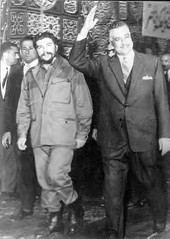
Nasser took the world by surprise and nationalised the Canal
Egypt is preparing to commemorate 50 years since it nationalised the Suez Canal, a vital waterway linking the Mediterranean and the Indian Ocean.
The anniversary on Wednesday of the surprise 1956 takover is a chance for Egyptians to look back on the end of the colonial era in the Middle East.
But the anniversary is particularly significant for Adel Ezzat, then a 30-year-old engineer, who worked closely with Gamal Abdel Nasser, the former Egyptian president.
"Only three of us were in the know," says Ezzat, who was working with Mohammed Yunes, Nasser's adviser on petroleum affairs. "President Nasser had chosen us to carry out the nationalisation."
"On the 23rd July 1956, I met Nasser for the first time during the celebrations for the fourth anniversary of the revolution.
"The president whispered something in Yunes' ear," Ezzat recalls.
"Over the next 24 hours, Yunes seemed "agitated and preoccupied.
"The next day, he summoned me and my colleague Abdel Hamid Abu Bakr in his office and locked the door behind us, which I found very odd."
Speaking to AFP from his Cairo home, the octogenarian remembers Yunes' words.
"The president has tasked me with nationalising the Suez Canal,' he said. This decision had to remain top secret."
The three-man commando had 48 hours and little information to carry out Nasser's wish, a move that would spark a war with the West but reshape Egypt's economy by regaining control of the most crucial chokepoint in world trade.
"All we had was a few publications on the canal given to Yunes by the president. We didn't even have a mole in the Compagnie Universelle du Canal Maritime de Suez" that ran the waterway,' Ezzat remembers.
The trio gathered a wider group of around 30, who were to break up in three groups tasked with overrunning the company's offices in Port-Said, Suez and Ismailiya.
"We weren't armed. Our instructions were to carry out the operation peacefully," says Ezzat. Little did he know that his 'peaceful' takeover would prompt a military offensive led by Israel, Britain and France and mark a turning point in the Cold War.
Launch signal
Ezzat recalls that the signal for the operation's launch was when Nasser, who was delivering a speech in Alexandria, pronounced the words "de Lesseps", in reference to Ferdinand de Lesseps who founded the canal in 1869.
"Our mission was so secret that the drivers who took us from Cairo didn't even know our destination. Except us three, the people who were with didn't know. They had only been told to bring a few clothes."
The three groups were only informed of their respective assignments upon arriving at the Al-Galaa military base near Ismailiya on July 26, at around 4:00 in the afternoon.
"Some of them hesitated. They were afraid of the reaction of the British troops guarding the canal. But we refused to abandon our plan, history was on the march," Ezzat says.
The three groups fanned out. They crept up to the Suez company's offices but stayed out of sight, as they listened to Nasser's speech, their hearts throbbing with anxiety.
Peaceful operation
"The president said 'de Lesseps'. Then he repeated it a second time, and a third, as if he feared we hadn't heard him."
Ezzat says the commandos went in at around 7:00 pm, found mostly empty offices and simply informed the guards that they had come to nationalise the Suez canal. No blood was shed.
"The president then delievered his speech on the nationalisation. People poured into the streets and their support gave us more strength," he recalls.
At that moment, Egypt regained control of the 19th century canal for whose construction an estimated 125,000 Egyptians perished in forced labour.
Adel Ezzat, who was denied a job with the Suez company in 1950 because his "French was too weak", rose through the ranks and was the Canal Authority chairman between 1985 and 1995.
AFP
You can find this article at:
http://english.aljazeera.net/NR/exeres/779F4F08-BCB5-4777-A806-62A355498989.htm
-----------------------------------------------------------
Top secret
The Suez Canal: Facts and Figures
-Built under the supervision of French diplomat Ferdinand de Lesseps and inaugurated in 1869
-Overall length: 190.25 kilometres Suez is the longest lockless canal in the world
-Width at water level: 280-345 metres
-Depth: 22.5 metres
-Maximum deadweight tonnage: around 210,000 tonnes
-18,700 ships transited through the canal in 2005
-Ships travel through the canal in three daily convoys. The permissible speed ranges from 11 to 14 kilometres/hour
-Seven percent of global maritime transport passes through the Suez canal
-Canal reduces by a quarter the distance between Rotterdam and Tokyo, two of the world's largest harbours - compared to the route around Africa
-Suez Canal transit fees are the third largest source of revenue for Egypt's economy after tourism and remittances from expatriate workers
-Canal receipts reached a record 3.4 billion dollars in 2005, up more than 12 percent from the previous year
-Receipts are expected to further rise in 2006 on the back of a transit fees hike of three percent since March and growing trade between China and Europe
----------------------------------------------------------
Sunday 23 July 2006 4:05 AM GMT
Nasser took the world by surprise and nationalised the Canal
Egypt is preparing to commemorate 50 years since it nationalised the Suez Canal, a vital waterway linking the Mediterranean and the Indian Ocean.
The anniversary on Wednesday of the surprise 1956 takover is a chance for Egyptians to look back on the end of the colonial era in the Middle East.
But the anniversary is particularly significant for Adel Ezzat, then a 30-year-old engineer, who worked closely with Gamal Abdel Nasser, the former Egyptian president.
"Only three of us were in the know," says Ezzat, who was working with Mohammed Yunes, Nasser's adviser on petroleum affairs. "President Nasser had chosen us to carry out the nationalisation."
"On the 23rd July 1956, I met Nasser for the first time during the celebrations for the fourth anniversary of the revolution.
"The president whispered something in Yunes' ear," Ezzat recalls.
"Over the next 24 hours, Yunes seemed "agitated and preoccupied.
"The next day, he summoned me and my colleague Abdel Hamid Abu Bakr in his office and locked the door behind us, which I found very odd."
Speaking to AFP from his Cairo home, the octogenarian remembers Yunes' words.
"The president has tasked me with nationalising the Suez Canal,' he said. This decision had to remain top secret."
The three-man commando had 48 hours and little information to carry out Nasser's wish, a move that would spark a war with the West but reshape Egypt's economy by regaining control of the most crucial chokepoint in world trade.
"All we had was a few publications on the canal given to Yunes by the president. We didn't even have a mole in the Compagnie Universelle du Canal Maritime de Suez" that ran the waterway,' Ezzat remembers.
The trio gathered a wider group of around 30, who were to break up in three groups tasked with overrunning the company's offices in Port-Said, Suez and Ismailiya.
"We weren't armed. Our instructions were to carry out the operation peacefully," says Ezzat. Little did he know that his 'peaceful' takeover would prompt a military offensive led by Israel, Britain and France and mark a turning point in the Cold War.
Launch signal
Ezzat recalls that the signal for the operation's launch was when Nasser, who was delivering a speech in Alexandria, pronounced the words "de Lesseps", in reference to Ferdinand de Lesseps who founded the canal in 1869.
"Our mission was so secret that the drivers who took us from Cairo didn't even know our destination. Except us three, the people who were with didn't know. They had only been told to bring a few clothes."
The three groups were only informed of their respective assignments upon arriving at the Al-Galaa military base near Ismailiya on July 26, at around 4:00 in the afternoon.
"Some of them hesitated. They were afraid of the reaction of the British troops guarding the canal. But we refused to abandon our plan, history was on the march," Ezzat says.
The three groups fanned out. They crept up to the Suez company's offices but stayed out of sight, as they listened to Nasser's speech, their hearts throbbing with anxiety.
Peaceful operation
"The president said 'de Lesseps'. Then he repeated it a second time, and a third, as if he feared we hadn't heard him."
Ezzat says the commandos went in at around 7:00 pm, found mostly empty offices and simply informed the guards that they had come to nationalise the Suez canal. No blood was shed.
"The president then delievered his speech on the nationalisation. People poured into the streets and their support gave us more strength," he recalls.
At that moment, Egypt regained control of the 19th century canal for whose construction an estimated 125,000 Egyptians perished in forced labour.
Adel Ezzat, who was denied a job with the Suez company in 1950 because his "French was too weak", rose through the ranks and was the Canal Authority chairman between 1985 and 1995.
AFP
You can find this article at:
http://english.aljazeera.net/NR/exeres/779F4F08-BCB5-4777-A806-62A355498989.htm
-----------------------------------------------------------
Top secret
The Suez Canal: Facts and Figures
-Built under the supervision of French diplomat Ferdinand de Lesseps and inaugurated in 1869
-Overall length: 190.25 kilometres Suez is the longest lockless canal in the world
-Width at water level: 280-345 metres
-Depth: 22.5 metres
-Maximum deadweight tonnage: around 210,000 tonnes
-18,700 ships transited through the canal in 2005
-Ships travel through the canal in three daily convoys. The permissible speed ranges from 11 to 14 kilometres/hour
-Seven percent of global maritime transport passes through the Suez canal
-Canal reduces by a quarter the distance between Rotterdam and Tokyo, two of the world's largest harbours - compared to the route around Africa
-Suez Canal transit fees are the third largest source of revenue for Egypt's economy after tourism and remittances from expatriate workers
-Canal receipts reached a record 3.4 billion dollars in 2005, up more than 12 percent from the previous year
-Receipts are expected to further rise in 2006 on the back of a transit fees hike of three percent since March and growing trade between China and Europe
----------------------------------------------------------
Sunday, July 23, 2006
Israeli/US War on Lebanon Builds Support for Hezbollah
THE ROVING EYE
Leviathan run amok
By Pepe Escobar
Hezbollah may be writing the book - at least for now - of fourth-generation war. Hezbollah had a reputation as an extremely disciplined, mobile guerrilla force. Now Hezbollah has fully revealed itself as a more than competent asymmetrical actor.
Hezbollah controls a great deal of territory - Beirut's southern suburbs, vast areas in southern Lebanon and the Bekaa Valley, which is sandwiched between two mountain ranges along the Syrian border. Hezbollah enjoys staunch popular support running to probably one and a half million people, almost half the population of Lebanon. And Hezbollah has been capable of unleashing some relatively sophisticated military operations against Israel using both conventional and unorthodox weapons.
It's still impossible to assess the ramifications of Hezbollah's
prestige in the Arab street being tremendously enhanced after its military success for the past week - which include delivering missiles to the heart of Israel. But the Arab street has certainly registered the communique by the House of Saud against Hezbollah, as well as the thunderous silence-cum-embarrassment displayed by the US client regimes of Egypt and Jordan.
A certified effect of the Israeli bombing barrage will be to draw newer, thicker waves of moderate Muslims toward political - and radical - Islam. The perception in the Arab street - as well as for most of the world's 1.4 billion Muslims - has been reinforced: the US/Israel axis seems to hold a license to kill Arabs with impunity.
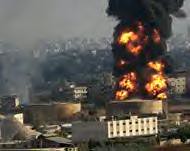
For its part, Israel's Leviathan-run-amok tactic of trying to turn the Lebanese as a whole against Hezbollah seems to be doomed to failure. This is especially because compounding Israel's trademark collective-punishment techniques - bombing bridges and an international airport, killing scores of civilians indiscriminately, turning Beirut into Gaza - shines President George W Bush's imperial indifference, not to mention the international community's. Just as in 1982 - when president Ronald Reagan said it was all right for Ariel Sharon to invade Lebanon - now Bush says it's all right for Israel to bomb Lebanese civilians.
Israel does not listen to anybody - be it the toothless United Nations or the even more cowardly European Union. Beirut is in panic. According to Hanady Salman, a journalist at As-Safir newspaper, the population widely expects that "as soon as the evacuation of foreigners will be completed, the Israelis will have a freer hand". Not by accident, all the areas bombed by Israel - and most of the civilians killed - are among the poorest in Lebanon.
Hezbollah is convinced it got its overall strategy right - factoring all the angles of the Leviathan-run-amok response; so there's no way the Lebanese people as a whole may blame Hezbollah for the escalation. Moreover, Hezbollah is a key force in fractured Lebanon. The majority of Lebanon's population is Shi'ite: at least 45% (in south Beirut, this correspondent was repeatedly told they may be from 55% to 60%). Christians are no more than 30%. The majority of Shi'ites - mostly poor, with very extended families, and a great deal of them basically peasants - support Hezbollah. Symbolically, fiercely independent Hezbollah represents the revenge of the oppressed - not only against the well off Sunni and Christians but against the Israeli invaders.
Hezbollah is a genuine resistance movement, such as Hamas in Palestine. Israel's military logic rules that it must crush any Arab resistance movement. Now Israel seems to have found two pretexts to try to crush simultaneously both Hezbollah and Hamas. Israel's modus operandi is to take entire populations hostage.
French social scientist Alain Joxe has demonstrated how these policies are "technical experiments" always observed with extreme interest by the Pentagon. The stateless Palestinians have been taken hostage in two giant, unconnected gulags in Gaza and the West Bank. Now the experiment - through relentless bombing - applies to a whole sovereign country. But Israel is also reaping - in the form of Hezbollah's renewed fourth-generation war efforts - what it sowed with its debasement of Palestinians.
The absence of a level playing field is glaring. The Israeli Defense Forces (IDF) may kidnap a doctor and his brother - two civilians - from their home in Gaza. But Leviathan runs amok when Hezbollah captures soldiers (according to Israel that's "illegitimate and illegal"). Meanwhile, Israel's Defense Ministry places "the head of the snake" in Damascus, even while the IDF uses the same questionable methods - toward civilians.
The taboo - never questioned by the bulk of Western mainstream media - runs that Israel is allowed to kill innocent civilians without expecting any retaliation. The Lebanese French-language daily L'Orient-Le Jour summed it up: the "international community" supports Lebanon without condemning Israel, which is reducing a sovereign country to rubble.
Our way or the (bombed) highway
Israel's logic is unilateral. It has blamed the Lebanese government as a whole. Hezbollah has only a small role in the Lebanese government; it is actually in the opposition. Power in Beirut is in the hands of US and Sunni Arab allies. The Hariri clan, mired in dodgy deals, remains extremely powerful. Fouad Siniora, a banker, the new Lebanese prime minister - and a strong critic of Syria - defines Hezbollah as a "legitimate resistance" group. As such, it should not be disarmed.
Thus Israel's real objective must be to provoke civil war in Lebanon - just as it did everything to provoke civil war in Palestine. The strategy is always the same. Israel wants Fatah to crush Hamas in Palestine, and now it wants the government in Beirut to crush Hezbollah. Or else ...
It was Hezbollah's hardcore warriors - trained by Syria and Iran - who ultimately expelled Israel from Lebanon in 2000. It's difficult for Westerners - or non-Arab Asians - to understand how powerfully symbolic this is in the Arab world: it means that Hezbollah was the only Arab military force ever to defeat Israel. Not surprisingly, even Lebanese Sunnis approve what Hezbollah is doing - they interpret it as solidarity with Hamas and the Palestinian struggle (as Hassan Nasrallah, Hezbollah's leader, made it all too clear).
Moreover, Israel's Leviathan-run-amok response has only served to rally Sunnis behind a "Lebanon under siege" banner.
The relationship between Iran and Hezbollah is not unlike Moscow's with assorted communist parties during the Cold War. There are no directives issued from Tehran - as Washington neo-cons see it. Hamas may be Sunni and Hezbollah may be Shi'ite, but both parties - supported by Syria and Iran - converge as resistance movements based on a platform of national struggle against
foreign (Israeli) occupation.
There's nothing sectarian about it. On the contrary, Hezbollah shows total solidarity with Hamas. And way beyond Israel identified as the common enemy, both Hamas and Hezbollah clearly identify the not-so-invisible big enemy behind, the US, for which Israel is a kind of "militarized offshoot", in the words of Noam Chomsky. Virtually every Lebanese knows that the missiles currently exterminating their compatriots were made in Miami, Duluth and Seattle.
Whatever the outcome, blowback will be inevitable. Osama bin Laden, in one of his videos, told the world how he burned with anger when he saw the Israeli bombing of the "towers" of Lebanon during the 1982 invasion. The new Osamas in the making may be Sunni or Shi'ite, it doesn't matter: what matters is what they identify as the American/Israeli license to kill (mostly poor, defenseless) Arabs.
Iran for its part may have been a full Hezbollah supporter, but now it's as much a staunch supporter of Hamas. As Nasrallah has emphasized on many occasions, Hezbollah as a resistance movement is not engaged only in the liberation of the Sheba Farms, still occupied by Israel; Hezbollah sees itself as a powerful actor positioned right at the center of the Arab-Israeli conflict.
As Lebanese-born Gilbert Achcar, a political-science professor at the University of Paris-VIII, puts it, "The main source of destabilization in the region is this violent and arrogant behavior of Israel that is in full harmony with the equally arrogant and violent behavior the United States displayed in Iraq." No change is in sight, not when Bush's "Greater Middle East" has revealed itself for what it is - a fallacy.
When in doubt, invade
The Israeli public relations machine - in English, thus widely monopolizing the airwaves, unlike Hezbollah, which expresses itself in Arabic - brags that now it's time to finish off Hezbollah. That makes no sense - because Hezbollah is a mass movement with roughly 1.5 million adherents. To finish off Hezbollah means in practice to finish off all poor Lebanese Shi'ites.
Iran and Iraq would never let it go unpunished. Israel also conveniently forgets that Hezbollah itself should not even exist - after all, it was founded to fight the Israeli invasion (in 1982) and occupation (until 2000) of southern Lebanon.
Israel's three basic demands, passed to Beirut by Italian Prime Minister Romano Prodi, are the return of two captured Israeli soldiers now under Hezbollah; a Hezbollah withdrawal to the Litani River, which is roughly 45 kilometers north of the current Lebanese-Israeli border; and no more rocket attacks against Israel.
Most of this could have happened before Israel illegally -international law is clear about it - started bombing a sovereign country. They could have traded prisoners. And there would be no Hezbollah rocket attacks because there would have been no Israeli indiscriminate bombings. One thing is certain: there is absolutely no chance the Lebanese will accept retreating to the Litani River. That would mean the establishment of a new Israeli de facto border. The only way Israel can annex these waters is by invading southern Lebanon - again.
That's what the Stratfor Intelligence Report said would happen. "The Israeli Defense Forces is preparing for a major, sustained assault into southern Lebanon to eliminate the Lebanese militant group Hezbollah," said the report. "The assault will extend at least to the Litani River - the first natural barrier, roughly 20 miles into Lebanon - and possibly all the way to areas south of Beirut ... Israel stands on the verge of attempting to completely annihilate Hezbollah in southern Lebanon."
Sounds like wishful thinking. And Hezbollah will do anything to prevent it from happening any time in the future. The key question remains. The Lebanese government knows that if it accedes to Israel's demands, there will be another civil war in the country. At least for the moment, Lebanon seems to be hanging on, engaged in passive resistance against collective punishment.
As Israel wages war on the Palestinian people and now the Lebanese people, Hezbollah may be betting that Lebanon as whole will be able to absorb the extreme limits of collective punishment - and in the end the resistance movement will still come out alive. Now that would be a lesson for the ages.
(Copyright 2006 Asia Times Online Ltd. All rights reserved. Please contact us about sales, syndication and republishing .)
-----------------------------------------------------------------------------------------
1) Turn the aggression into a setback for the US-Zionist hegemony
2) Nasrallah addresses Lebanese, resistance, Zionists and Arab leaders
3) PFLP salutes and admires fighting people of Lebanon
***
1) Stop the Israeli terror war!
Turn the aggression into a setback for the US-Zionist hegemony!
With the backing of the US Israel is systematically bombing the only
democracy of the Middle East deliberately targeting the civilian population and the infrastructure. Lebanon is democratic because its people could liberate itself from Zionist occupation and imperialist predominance thanks to the popular resistance embodied and led by Hizbullah.
In Lebanon Israel has suffered it most shaking defeat ever since eventually being forced to withdraw its occupation troops. The result of 25 years of war was to leave the country and especially the South to a victorious popular anti-imperialist movement based on the poor Shiite masses but drawing support also from other confessional groups and the middle classes. Israel never could accept this ignominy.
Riding on the wave of the ultra-aggressive US imperial war drive Israel is trying to take revenge with the declared aim to smash Hizbollah. But as we can see in Iraq it is more than questionable whether this all-out war of aggression will reach its aims. On the contrary it is pretty possible that in mid-range terms it will backfire providing another element eroding the American Empire.
The first phase of the war is clear: destroying the entire infrastructure
and terrorising the civilian population first of all the poor Shiite
constituencies of Hizbollah. Who has seen the pictures of the systematically flattened Southern suburbs of Beirut got an idea how Israel intends to displace the population to clear the ground for an invasion. These appalling war crimes against the civilian population are no "collateral damage" but they are deliberately committed in order to destroy the social habitat upon which Hizbollah has been built.
Less than any regular army Hizbollah cannot be smashed only by coward air warfare. The wars against Yugoslavia, Afghanistan and Iraq have already toughed that lesson. If the Israeli army command claims to have destroyed half of Hizbollah's operational capacity it is an outright propaganda lie. They know well, and the corporate press is whispering it, that they need to attack on the ground.
Therefore the just beginning second phase will be the invasion pushing Israeli positions at least up to the Litani river. The Zionist incursion will meet determined resistance causing them heavy losses. It will take months not weeks. Even if Israel will be able to re-occupy this part of the South it will have in no way obtained its proclaimed war aims namely the destruction of Hizbollah.
So if they stop short at the Litani it is already a half defeat for Israel.
It is therefore possible that the Zionist war machine will push ahead to the North. Their only real possibility to inflict a defeat on Hizbollah is to advance up to Beirut smashing the popular guerrilla on the ground. Exactly for that purpose they want to displace as many people as possible.
Even the most stubborn guerrilla resistance cannot stop the Israeli army's invasion as long as they maintain Washington's backing. But in this asymmetric war between a high tech regular army being de facto part of the U.S. global military machine and a people's guerrilla the Zionist territorial advance is no criteria for defeat or victory. On the contrary the more the invader is stretched, the more territory it must secure the better the military conditions of the resistance are. Hizbollah can only wish to drag the Zionist army into the war theatre where they can use their prime strength - the support of the people and the familiarity with the environment - and where they already defeated Israel once. 2006 is not 1982. In difference to 25 years ago when the Lebanese people had to build their resistance from the scratch now Hizbollah can confront the occupier with a powerful irregular army. Today the conditions for a successful resistance are even better.
If Israel withdraws soon - as they promise - they will have to leave without having accomplished their aim which means a victory for Hizbollah. On the other hand, if they stay longer, their will add a new focus of politico-military resistance against the US Empire in addition to Iraq and Afghanistan. History shows that Israel is not able to politically sustain years of occupation once again. Thus all elements indicate that the US-Zionist offensive can turn out as a trap for themselves.
The longer the war will continue the more the world's and Europe's public opinion will turn against Israel. As we have seen with the war against Iraq this cannot stop the US-Zionist machine but it nevertheless increases the political costs for them. And it helps to build the anti-American front which is steadily growing not only among the oppressed people but also within the European people.
While today there is an overwhelming consensus for the aggression within Israel, continued losses and military troubles will change even the relationship of forces within this reactionary colonial people as it was the case during the first occupation of Lebanon.
A decisive question is the impact of war on the political scenery within Lebanon itself. The openly pro-Israeli forces have been definitely defeated in the protracted combined civil and national liberation war. This is best expressed by the curiosity that the leader of the pro-Zionist Maronite right, General Aoun, in the last elections ran on the list of Hizbollah. Also the pro-imperialist anti-Syrian coalition which sprang up after the assassination of prime minister Hariri in 2005 was short lived. It is one thing to get rid of the asphyxiating Syrian politico-military presence and another to build a lasting pro-Israeli coalition.
It is clear that both the Maronite as well as the Sunni bourgeoisie want a normalisation disarming Hisbollah and taming it into the political system. Despite the pressure by imperialism enshrined in UN resolution 1559 for disarming Hizbollah, no government could so far dare to instigate a new civil war which they would inevitably loose. Now there is the direct Zionist imperialist intervention to fulfil this aim.
While it is very unlikely that Israel can "root out" Hizbollah as it
declares, the Lebanese masses are certainly tired of war. In order to stop the Israeli mass terror the elites might be able to build a coalition pressing Hizbollah into a compromise which they might have troubles to refuse. Also their own constituencies, which suffer most from the Israeli aggression, could push for it. This could possibly mean that Hizbollah withdraws from the South where the weak Lebanese army might be deployed to.
The longer the Israeli military campaign continues without producing the proclaimed results the US might try to save the situation pushing for so-called multinational troops in the South to monitor a ceasefire. Given the overwhelming Zionist military power such a partial withdrawal would not amount in a defeat for Hizbollah as they maintain the bulk of their military organisation.
Popular liberation war against the US' "Greater Middle East"
The fresh Zionist aggression against Lebanon must be understood as an element of the US' Greater Middle East project. It's essence is to subdue the region - whether "rogue states", popular movements or military resistance groups - by brute military force. Actually this is the core element of the construction of the American Empire. The permanent pre-emptive war is based on an aggressive offensive military strategy which is turning out to be a hubris. We already can see in Iraq and Afghanistan that the US first of all lacks the political hegemony to create functioning puppet states according to their model of "export democracy". The more armed aggressions they start the more popular resistance they evoke.
Already by now they have understood that the main actors against their dominion will not be states but irregular armed forces which they happen to call "terrorist". Islam is providing the politico-cultural platform for the resistance which is being supported by the broad masses.
The only form to inflict a historic defeat on Zionism and imperialism is a liberation war based on the support of the popular masses. For the time being the gap between the Islamic forces collaborating with the pro-imperialist regimes like the network of the Muslim brotherhood on one side and the radical Islamic anti-imperialist forces on the other side is still too big. The problem of movements like Al Qaida is a purely military approach combined with a politico-cultural narrow sectarian agenda. While their military radicalism and steadfastness is drawing popular support their sectarian attitude leaves the masses with the collaborationists. In Iraq for example we need to unify Shia and Sunni against the occupation while Al Qaida is driving a wedge between them.
A popular liberation war all over the Arabo-Islamic region must be combined with a strong politico-cultural liberation front organising the poor classes beyond their confessional identity on a national base. In this way the nucleus of a new state apparatus based on the popular masses can be set up. To push ahead and ultimately lead this process is the role of revolutionary anti-imperialism.
Support Hizbollah and the Lebanese people's resistance against the Zionist aggression!
Support the Iraqi resistance to end US occupation!
Support Hamas and the Palestinian people's resistance against Zionism!
For one democratic anti-imperialist state in entire Palestine!
No war on Iran and Syria!
Popular liberation war to smash the American Empire!
Anti-imperialist Camp
July 22, 2006
***
2) The hopes of every oppressed, every lover of steadfastness
Statement from the General Secretary of Hizballah, His Excellency Sayyid Hasan Nasrallah, to the Nation, the Lebanese people, the resistance fighters, the Zionists and the Arab leaders
In this first address that I give in these days following Operation True
Promise, I would like to say a few words - a word to the Lebanese people, a word to the resistance fighters, a word to the Zionists, and a word to the Arab rulers. I will not offer words to the international community because I have never for one day believed that there is any such thing as an international community, just as many in our nation feel.
First, I say to the Lebanese people: dear people - who embraced the
resistance, by whom the resistance was victorious, and for whom the
resistance won its victory on 25 May 2000 - this people who were the makers of the first victory in the history of the Arab struggle with the Israeli enemy, despite the basic inequality in forces, and in spite of the fact that the majority of our Arab brothers and the majority of our Muslim brothers abandoned us and despite the silence of the whole world, this Lebanese people made the miracle of the victory that stunned the world and humiliated the Zionists. Those Zionists look upon this people in a special, unique way because they accomplished in the history of the struggle with them a special and unique accomplishment. The battle today is no longer a battle over prisoners or the exchange of prisoners. It might be said that the Zionist enemy is responding any time there is any operation where men are captured anywhere in any part of the world, by any army or any state that has borders and regulations. What is taking place today is not a response to a capture of their soldiers; it is a squaring of accounts with the people, resistance, state, army, political forces, regions, villages, and families that inflicted that historic defeat on that aggressive usurper entity that has never accepted its defeat.
Full statement:
www.antiimperialista.org/index.phpoption=com_content&task=view&id=4591&Itemid=55
***
3) PFLP salutes and admires fighting people of Lebanon
Statement issued by the Political Bureau of the Popular Front for the
Liberation of Palestine on the escalation of Zionist aggression against the territory of Lebanon and Palestine
The Political Bureau of the Popular Front for the Liberation of Palestine calls on the Arab masses and their vital popular forces, it calls on the trade unions and federations to shoulder their responsibility and duty in defending Lebanon and Palestine and in going out in demonstrations and all forms of popular activity to pressure the Arab governments and to give all forms of support and assistance to the Lebanese and Palestinian peoples and their heroic resistance movements in defiance of the American-Zionist plan for the region.
Full statement:
www.antiimperialista.org/index.phpoption=com_content&task=view&id=4598&Itemid=55
http://www.antiimperialista.org
Leviathan run amok
By Pepe Escobar
Hezbollah may be writing the book - at least for now - of fourth-generation war. Hezbollah had a reputation as an extremely disciplined, mobile guerrilla force. Now Hezbollah has fully revealed itself as a more than competent asymmetrical actor.
Hezbollah controls a great deal of territory - Beirut's southern suburbs, vast areas in southern Lebanon and the Bekaa Valley, which is sandwiched between two mountain ranges along the Syrian border. Hezbollah enjoys staunch popular support running to probably one and a half million people, almost half the population of Lebanon. And Hezbollah has been capable of unleashing some relatively sophisticated military operations against Israel using both conventional and unorthodox weapons.
It's still impossible to assess the ramifications of Hezbollah's
prestige in the Arab street being tremendously enhanced after its military success for the past week - which include delivering missiles to the heart of Israel. But the Arab street has certainly registered the communique by the House of Saud against Hezbollah, as well as the thunderous silence-cum-embarrassment displayed by the US client regimes of Egypt and Jordan.
A certified effect of the Israeli bombing barrage will be to draw newer, thicker waves of moderate Muslims toward political - and radical - Islam. The perception in the Arab street - as well as for most of the world's 1.4 billion Muslims - has been reinforced: the US/Israel axis seems to hold a license to kill Arabs with impunity.
For its part, Israel's Leviathan-run-amok tactic of trying to turn the Lebanese as a whole against Hezbollah seems to be doomed to failure. This is especially because compounding Israel's trademark collective-punishment techniques - bombing bridges and an international airport, killing scores of civilians indiscriminately, turning Beirut into Gaza - shines President George W Bush's imperial indifference, not to mention the international community's. Just as in 1982 - when president Ronald Reagan said it was all right for Ariel Sharon to invade Lebanon - now Bush says it's all right for Israel to bomb Lebanese civilians.
Israel does not listen to anybody - be it the toothless United Nations or the even more cowardly European Union. Beirut is in panic. According to Hanady Salman, a journalist at As-Safir newspaper, the population widely expects that "as soon as the evacuation of foreigners will be completed, the Israelis will have a freer hand". Not by accident, all the areas bombed by Israel - and most of the civilians killed - are among the poorest in Lebanon.
Hezbollah is convinced it got its overall strategy right - factoring all the angles of the Leviathan-run-amok response; so there's no way the Lebanese people as a whole may blame Hezbollah for the escalation. Moreover, Hezbollah is a key force in fractured Lebanon. The majority of Lebanon's population is Shi'ite: at least 45% (in south Beirut, this correspondent was repeatedly told they may be from 55% to 60%). Christians are no more than 30%. The majority of Shi'ites - mostly poor, with very extended families, and a great deal of them basically peasants - support Hezbollah. Symbolically, fiercely independent Hezbollah represents the revenge of the oppressed - not only against the well off Sunni and Christians but against the Israeli invaders.
Hezbollah is a genuine resistance movement, such as Hamas in Palestine. Israel's military logic rules that it must crush any Arab resistance movement. Now Israel seems to have found two pretexts to try to crush simultaneously both Hezbollah and Hamas. Israel's modus operandi is to take entire populations hostage.
French social scientist Alain Joxe has demonstrated how these policies are "technical experiments" always observed with extreme interest by the Pentagon. The stateless Palestinians have been taken hostage in two giant, unconnected gulags in Gaza and the West Bank. Now the experiment - through relentless bombing - applies to a whole sovereign country. But Israel is also reaping - in the form of Hezbollah's renewed fourth-generation war efforts - what it sowed with its debasement of Palestinians.
The absence of a level playing field is glaring. The Israeli Defense Forces (IDF) may kidnap a doctor and his brother - two civilians - from their home in Gaza. But Leviathan runs amok when Hezbollah captures soldiers (according to Israel that's "illegitimate and illegal"). Meanwhile, Israel's Defense Ministry places "the head of the snake" in Damascus, even while the IDF uses the same questionable methods - toward civilians.
The taboo - never questioned by the bulk of Western mainstream media - runs that Israel is allowed to kill innocent civilians without expecting any retaliation. The Lebanese French-language daily L'Orient-Le Jour summed it up: the "international community" supports Lebanon without condemning Israel, which is reducing a sovereign country to rubble.
Our way or the (bombed) highway
Israel's logic is unilateral. It has blamed the Lebanese government as a whole. Hezbollah has only a small role in the Lebanese government; it is actually in the opposition. Power in Beirut is in the hands of US and Sunni Arab allies. The Hariri clan, mired in dodgy deals, remains extremely powerful. Fouad Siniora, a banker, the new Lebanese prime minister - and a strong critic of Syria - defines Hezbollah as a "legitimate resistance" group. As such, it should not be disarmed.
Thus Israel's real objective must be to provoke civil war in Lebanon - just as it did everything to provoke civil war in Palestine. The strategy is always the same. Israel wants Fatah to crush Hamas in Palestine, and now it wants the government in Beirut to crush Hezbollah. Or else ...
It was Hezbollah's hardcore warriors - trained by Syria and Iran - who ultimately expelled Israel from Lebanon in 2000. It's difficult for Westerners - or non-Arab Asians - to understand how powerfully symbolic this is in the Arab world: it means that Hezbollah was the only Arab military force ever to defeat Israel. Not surprisingly, even Lebanese Sunnis approve what Hezbollah is doing - they interpret it as solidarity with Hamas and the Palestinian struggle (as Hassan Nasrallah, Hezbollah's leader, made it all too clear).
Moreover, Israel's Leviathan-run-amok response has only served to rally Sunnis behind a "Lebanon under siege" banner.
The relationship between Iran and Hezbollah is not unlike Moscow's with assorted communist parties during the Cold War. There are no directives issued from Tehran - as Washington neo-cons see it. Hamas may be Sunni and Hezbollah may be Shi'ite, but both parties - supported by Syria and Iran - converge as resistance movements based on a platform of national struggle against
foreign (Israeli) occupation.
There's nothing sectarian about it. On the contrary, Hezbollah shows total solidarity with Hamas. And way beyond Israel identified as the common enemy, both Hamas and Hezbollah clearly identify the not-so-invisible big enemy behind, the US, for which Israel is a kind of "militarized offshoot", in the words of Noam Chomsky. Virtually every Lebanese knows that the missiles currently exterminating their compatriots were made in Miami, Duluth and Seattle.
Whatever the outcome, blowback will be inevitable. Osama bin Laden, in one of his videos, told the world how he burned with anger when he saw the Israeli bombing of the "towers" of Lebanon during the 1982 invasion. The new Osamas in the making may be Sunni or Shi'ite, it doesn't matter: what matters is what they identify as the American/Israeli license to kill (mostly poor, defenseless) Arabs.
Iran for its part may have been a full Hezbollah supporter, but now it's as much a staunch supporter of Hamas. As Nasrallah has emphasized on many occasions, Hezbollah as a resistance movement is not engaged only in the liberation of the Sheba Farms, still occupied by Israel; Hezbollah sees itself as a powerful actor positioned right at the center of the Arab-Israeli conflict.
As Lebanese-born Gilbert Achcar, a political-science professor at the University of Paris-VIII, puts it, "The main source of destabilization in the region is this violent and arrogant behavior of Israel that is in full harmony with the equally arrogant and violent behavior the United States displayed in Iraq." No change is in sight, not when Bush's "Greater Middle East" has revealed itself for what it is - a fallacy.
When in doubt, invade
The Israeli public relations machine - in English, thus widely monopolizing the airwaves, unlike Hezbollah, which expresses itself in Arabic - brags that now it's time to finish off Hezbollah. That makes no sense - because Hezbollah is a mass movement with roughly 1.5 million adherents. To finish off Hezbollah means in practice to finish off all poor Lebanese Shi'ites.
Iran and Iraq would never let it go unpunished. Israel also conveniently forgets that Hezbollah itself should not even exist - after all, it was founded to fight the Israeli invasion (in 1982) and occupation (until 2000) of southern Lebanon.
Israel's three basic demands, passed to Beirut by Italian Prime Minister Romano Prodi, are the return of two captured Israeli soldiers now under Hezbollah; a Hezbollah withdrawal to the Litani River, which is roughly 45 kilometers north of the current Lebanese-Israeli border; and no more rocket attacks against Israel.
Most of this could have happened before Israel illegally -international law is clear about it - started bombing a sovereign country. They could have traded prisoners. And there would be no Hezbollah rocket attacks because there would have been no Israeli indiscriminate bombings. One thing is certain: there is absolutely no chance the Lebanese will accept retreating to the Litani River. That would mean the establishment of a new Israeli de facto border. The only way Israel can annex these waters is by invading southern Lebanon - again.
That's what the Stratfor Intelligence Report said would happen. "The Israeli Defense Forces is preparing for a major, sustained assault into southern Lebanon to eliminate the Lebanese militant group Hezbollah," said the report. "The assault will extend at least to the Litani River - the first natural barrier, roughly 20 miles into Lebanon - and possibly all the way to areas south of Beirut ... Israel stands on the verge of attempting to completely annihilate Hezbollah in southern Lebanon."
Sounds like wishful thinking. And Hezbollah will do anything to prevent it from happening any time in the future. The key question remains. The Lebanese government knows that if it accedes to Israel's demands, there will be another civil war in the country. At least for the moment, Lebanon seems to be hanging on, engaged in passive resistance against collective punishment.
As Israel wages war on the Palestinian people and now the Lebanese people, Hezbollah may be betting that Lebanon as whole will be able to absorb the extreme limits of collective punishment - and in the end the resistance movement will still come out alive. Now that would be a lesson for the ages.
(Copyright 2006 Asia Times Online Ltd. All rights reserved. Please contact us about sales, syndication and republishing .)
-----------------------------------------------------------------------------------------
1) Turn the aggression into a setback for the US-Zionist hegemony
2) Nasrallah addresses Lebanese, resistance, Zionists and Arab leaders
3) PFLP salutes and admires fighting people of Lebanon
***
1) Stop the Israeli terror war!
Turn the aggression into a setback for the US-Zionist hegemony!
With the backing of the US Israel is systematically bombing the only
democracy of the Middle East deliberately targeting the civilian population and the infrastructure. Lebanon is democratic because its people could liberate itself from Zionist occupation and imperialist predominance thanks to the popular resistance embodied and led by Hizbullah.
In Lebanon Israel has suffered it most shaking defeat ever since eventually being forced to withdraw its occupation troops. The result of 25 years of war was to leave the country and especially the South to a victorious popular anti-imperialist movement based on the poor Shiite masses but drawing support also from other confessional groups and the middle classes. Israel never could accept this ignominy.
Riding on the wave of the ultra-aggressive US imperial war drive Israel is trying to take revenge with the declared aim to smash Hizbollah. But as we can see in Iraq it is more than questionable whether this all-out war of aggression will reach its aims. On the contrary it is pretty possible that in mid-range terms it will backfire providing another element eroding the American Empire.
The first phase of the war is clear: destroying the entire infrastructure
and terrorising the civilian population first of all the poor Shiite
constituencies of Hizbollah. Who has seen the pictures of the systematically flattened Southern suburbs of Beirut got an idea how Israel intends to displace the population to clear the ground for an invasion. These appalling war crimes against the civilian population are no "collateral damage" but they are deliberately committed in order to destroy the social habitat upon which Hizbollah has been built.
Less than any regular army Hizbollah cannot be smashed only by coward air warfare. The wars against Yugoslavia, Afghanistan and Iraq have already toughed that lesson. If the Israeli army command claims to have destroyed half of Hizbollah's operational capacity it is an outright propaganda lie. They know well, and the corporate press is whispering it, that they need to attack on the ground.
Therefore the just beginning second phase will be the invasion pushing Israeli positions at least up to the Litani river. The Zionist incursion will meet determined resistance causing them heavy losses. It will take months not weeks. Even if Israel will be able to re-occupy this part of the South it will have in no way obtained its proclaimed war aims namely the destruction of Hizbollah.
So if they stop short at the Litani it is already a half defeat for Israel.
It is therefore possible that the Zionist war machine will push ahead to the North. Their only real possibility to inflict a defeat on Hizbollah is to advance up to Beirut smashing the popular guerrilla on the ground. Exactly for that purpose they want to displace as many people as possible.
Even the most stubborn guerrilla resistance cannot stop the Israeli army's invasion as long as they maintain Washington's backing. But in this asymmetric war between a high tech regular army being de facto part of the U.S. global military machine and a people's guerrilla the Zionist territorial advance is no criteria for defeat or victory. On the contrary the more the invader is stretched, the more territory it must secure the better the military conditions of the resistance are. Hizbollah can only wish to drag the Zionist army into the war theatre where they can use their prime strength - the support of the people and the familiarity with the environment - and where they already defeated Israel once. 2006 is not 1982. In difference to 25 years ago when the Lebanese people had to build their resistance from the scratch now Hizbollah can confront the occupier with a powerful irregular army. Today the conditions for a successful resistance are even better.
If Israel withdraws soon - as they promise - they will have to leave without having accomplished their aim which means a victory for Hizbollah. On the other hand, if they stay longer, their will add a new focus of politico-military resistance against the US Empire in addition to Iraq and Afghanistan. History shows that Israel is not able to politically sustain years of occupation once again. Thus all elements indicate that the US-Zionist offensive can turn out as a trap for themselves.
The longer the war will continue the more the world's and Europe's public opinion will turn against Israel. As we have seen with the war against Iraq this cannot stop the US-Zionist machine but it nevertheless increases the political costs for them. And it helps to build the anti-American front which is steadily growing not only among the oppressed people but also within the European people.
While today there is an overwhelming consensus for the aggression within Israel, continued losses and military troubles will change even the relationship of forces within this reactionary colonial people as it was the case during the first occupation of Lebanon.
A decisive question is the impact of war on the political scenery within Lebanon itself. The openly pro-Israeli forces have been definitely defeated in the protracted combined civil and national liberation war. This is best expressed by the curiosity that the leader of the pro-Zionist Maronite right, General Aoun, in the last elections ran on the list of Hizbollah. Also the pro-imperialist anti-Syrian coalition which sprang up after the assassination of prime minister Hariri in 2005 was short lived. It is one thing to get rid of the asphyxiating Syrian politico-military presence and another to build a lasting pro-Israeli coalition.
It is clear that both the Maronite as well as the Sunni bourgeoisie want a normalisation disarming Hisbollah and taming it into the political system. Despite the pressure by imperialism enshrined in UN resolution 1559 for disarming Hizbollah, no government could so far dare to instigate a new civil war which they would inevitably loose. Now there is the direct Zionist imperialist intervention to fulfil this aim.
While it is very unlikely that Israel can "root out" Hizbollah as it
declares, the Lebanese masses are certainly tired of war. In order to stop the Israeli mass terror the elites might be able to build a coalition pressing Hizbollah into a compromise which they might have troubles to refuse. Also their own constituencies, which suffer most from the Israeli aggression, could push for it. This could possibly mean that Hizbollah withdraws from the South where the weak Lebanese army might be deployed to.
The longer the Israeli military campaign continues without producing the proclaimed results the US might try to save the situation pushing for so-called multinational troops in the South to monitor a ceasefire. Given the overwhelming Zionist military power such a partial withdrawal would not amount in a defeat for Hizbollah as they maintain the bulk of their military organisation.
Popular liberation war against the US' "Greater Middle East"
The fresh Zionist aggression against Lebanon must be understood as an element of the US' Greater Middle East project. It's essence is to subdue the region - whether "rogue states", popular movements or military resistance groups - by brute military force. Actually this is the core element of the construction of the American Empire. The permanent pre-emptive war is based on an aggressive offensive military strategy which is turning out to be a hubris. We already can see in Iraq and Afghanistan that the US first of all lacks the political hegemony to create functioning puppet states according to their model of "export democracy". The more armed aggressions they start the more popular resistance they evoke.
Already by now they have understood that the main actors against their dominion will not be states but irregular armed forces which they happen to call "terrorist". Islam is providing the politico-cultural platform for the resistance which is being supported by the broad masses.
The only form to inflict a historic defeat on Zionism and imperialism is a liberation war based on the support of the popular masses. For the time being the gap between the Islamic forces collaborating with the pro-imperialist regimes like the network of the Muslim brotherhood on one side and the radical Islamic anti-imperialist forces on the other side is still too big. The problem of movements like Al Qaida is a purely military approach combined with a politico-cultural narrow sectarian agenda. While their military radicalism and steadfastness is drawing popular support their sectarian attitude leaves the masses with the collaborationists. In Iraq for example we need to unify Shia and Sunni against the occupation while Al Qaida is driving a wedge between them.
A popular liberation war all over the Arabo-Islamic region must be combined with a strong politico-cultural liberation front organising the poor classes beyond their confessional identity on a national base. In this way the nucleus of a new state apparatus based on the popular masses can be set up. To push ahead and ultimately lead this process is the role of revolutionary anti-imperialism.
Support Hizbollah and the Lebanese people's resistance against the Zionist aggression!
Support the Iraqi resistance to end US occupation!
Support Hamas and the Palestinian people's resistance against Zionism!
For one democratic anti-imperialist state in entire Palestine!
No war on Iran and Syria!
Popular liberation war to smash the American Empire!
Anti-imperialist Camp
July 22, 2006
***
2) The hopes of every oppressed, every lover of steadfastness
Statement from the General Secretary of Hizballah, His Excellency Sayyid Hasan Nasrallah, to the Nation, the Lebanese people, the resistance fighters, the Zionists and the Arab leaders
In this first address that I give in these days following Operation True
Promise, I would like to say a few words - a word to the Lebanese people, a word to the resistance fighters, a word to the Zionists, and a word to the Arab rulers. I will not offer words to the international community because I have never for one day believed that there is any such thing as an international community, just as many in our nation feel.
First, I say to the Lebanese people: dear people - who embraced the
resistance, by whom the resistance was victorious, and for whom the
resistance won its victory on 25 May 2000 - this people who were the makers of the first victory in the history of the Arab struggle with the Israeli enemy, despite the basic inequality in forces, and in spite of the fact that the majority of our Arab brothers and the majority of our Muslim brothers abandoned us and despite the silence of the whole world, this Lebanese people made the miracle of the victory that stunned the world and humiliated the Zionists. Those Zionists look upon this people in a special, unique way because they accomplished in the history of the struggle with them a special and unique accomplishment. The battle today is no longer a battle over prisoners or the exchange of prisoners. It might be said that the Zionist enemy is responding any time there is any operation where men are captured anywhere in any part of the world, by any army or any state that has borders and regulations. What is taking place today is not a response to a capture of their soldiers; it is a squaring of accounts with the people, resistance, state, army, political forces, regions, villages, and families that inflicted that historic defeat on that aggressive usurper entity that has never accepted its defeat.
Full statement:
www.antiimperialista.org/index.phpoption=com_content&task=view&id=4591&Itemid=55
***
3) PFLP salutes and admires fighting people of Lebanon
Statement issued by the Political Bureau of the Popular Front for the
Liberation of Palestine on the escalation of Zionist aggression against the territory of Lebanon and Palestine
The Political Bureau of the Popular Front for the Liberation of Palestine calls on the Arab masses and their vital popular forces, it calls on the trade unions and federations to shoulder their responsibility and duty in defending Lebanon and Palestine and in going out in demonstrations and all forms of popular activity to pressure the Arab governments and to give all forms of support and assistance to the Lebanese and Palestinian peoples and their heroic resistance movements in defiance of the American-Zionist plan for the region.
Full statement:
www.antiimperialista.org/index.phpoption=com_content&task=view&id=4598&Itemid=55
http://www.antiimperialista.org
Leading UK Lawyers Petition US Appeal Court on Behalf of Mumia Abu-Jamal
FROM PRESS CONFERENCE HELD ON 19 JULY, 6.30pm
GARDEN COURT CHAMBERS, 57-60 Lincoln's Inn Fields, London, WC2A 3LS
LEADING UK LAWYERS PETITION US APPEAL COURT
RE RACISM IN CASE OF DEATH ROW JOURNALIST
Over 130 of the UK’s most distinguished lawyers are signatories to a letter initiated by Ian Macdonald QC and Legal Action for Women, to the US court of appeal highlighting the racism in the original trial and subsequent hearings of Mr Mumia Abu-Jamal. After 24 years on Pennsylvania’s death row, Mr Abu-Jamal, an award winning journalist convicted in 1982 of killing a policeman, has been granted an appeal which if successful could result in a new trial. This would be the first time his side of the case against conviction would be heard by a jury.
The signatories include: many who are Queen’s Counsel; leading criminal trial lawyers, in some cases household names such as Michael Mansfield QC, Helena Kennedy QC, Lord Gifford QC, Gareth Peirce, Clive Stafford Smith and Geoffrey Bindman; those with experience of doing appeals in the Privy Council in death penalty cases from the Caribbean; many experienced in race and gender discrimination cases; and a professor of law. On 20 July, Robert R. Bryan, lead counsel for Mr Abu-Jamal, will submit opening briefs for the appeal on issues such as prosecutorial use of racism in jury selection and the death penalty.
Ian Macdonald QC, criminal trial lawyer and leading authority in the UK on anti-racism and immigration law, says:
“This is a most unusual case: although it is taking place in a United States court, there is enormous concern among the legal profession here at the strikingly unfair trial that took place. As members of this distinguished profession, which claims to work for justice, we feel obliged to register our grave concern. There is no doubt that what happens in US courts affects the legal climate in the UK.
Drawing on the common legal heritage between the UK and the US which, “since the time of Magna Carta in 1215, has given pride of place to common notions of due process and a fair trial” to justify their intervention, the letter lists some of the more noteworthy outrages including: the prosecution’s systematic removal of Black people from the jury and the blatant racist bias of trial Judge Albert F. Sabo.
Not only was Judge Sabo overheard to say that he was going to help the prosecution ‘fry the nigger’, he banned Mr Abu-Jamal from crucial periods of his own trial and denied him the right to represent himself, he gave the prosecution leeway to slander the defendant, and showed unrestrained favouritism towards white candidates for jury selection.
The concern for Mr Abu-Jamal to have a new trial comes also from opposition to the death penalty. His case is a key test of judicial murder. Thousands of lives depend on the outcome, starting with the 3370 people on death row who are disproportionately Black people and other people of colour.* Mr Abu-Jamal had no criminal convictions before his arrest. The determination of the police, prosecution and judge to deny him a fair trial and execute him strongly suggests that this outstanding campaigning journalist is being tried for his track record of exposing racism, police brutality and corruption in Philadelphia, and for his ongoing opposition to US government policies and practices. What does it mean for political opposition within the superpower if critics of government policies can be disposed of in this shameless anti-democratic way? When the standard of justice within the superpower is allowed to fall, the rest of the world is inevitably influenced.
The lawyers entreat the US courts to make right the actions of Judge Sabo, a racist hanging judge, lest he be taken as the face of US justice.
Legal Action for Women comments:
“We have supported Mr Abu-Jamal’s fight for a new trial for many years and last October had the first opportunity to visit him in prison. With Ian Macdonald we initiated this letter to help ensure that this remarkable man, who is in the greatest danger of judicial murder, and whose case against conviction has never been heard by a jury, gets what we are all entitled to: a fair trial.”
* NAACP-LDF Death Row USA (April 1 2006)
Background
Mumia Abu-Jamal is an award-winning journalist who, in the years leading up to his December 9, 1981, arrest, had actively exposed police corruption, racism, and violence against Black people and other people of colour. Despite severe restrictions on contact with the outside, including how much written material he is allowed, he has continued his work from inside prison, recording weekly Dispatches From Death Row, incisive radio commentaries, for Prison Radio, which goes out on 100 stations. He also writes for other publications. He has written five books while in prison including: Live From Death Row and most recently We Want Freedom: a Life in the Black Panther Party.
The US government's determination to kill Mr Abu-Jamal has to be seen in the context of its treatment of other journalists, many of whom have been killed for trying to speak the truth. His work as a ‘jailhouse lawyer’, regularly providing legal advice to other prisoners, led to recognition by the US National Lawyers Guild a prestigious organisation of lawyers in the US whose aim is to eliminate racism and defend civil, legal and human rights. He tells the story of jailhouse lawyers like himself in a forthcoming book.
Mumia Abu-Jamal's fight for a fair trial has won the support of tens of thousands of people around the world including Archbishop Desmond Tutu, Nelson Mandela, the European Parliament, Alice Walker, Paul Newman, Sister Helen Prejean, Danny Glover, Rage Against The Machine, the Detroit and San Francisco City Councils, Amnesty International, and many others. Various cities including Paris, have bestowed on him honorary citizenship.
Accusations aimed at discrediting Mr Abu-Jamal, for example, that he has never given an account for what happened on that night, ignore the evidence that he was shot in the chest and rendered unconscious shortly after approaching the scene and consequently knows nothing of what happened theret.
Mumia Abu-Jamal comments:
"I remain innocent. A court cannot make an innocent man guilty. Any ruling founded on injustice is not justice."
Robert R. Bryan, lead counsel comments:
“Mumia's case is now moving forward and may proceed at great speed. The authorities want to silence his voice and pen. In over three decades of litigating death-penalty cases, I have not seen one in which the government wants so badly to kill a client.”
Garden Court Chambers
57-60 Lincoln's Inn Fields
London, WC2A 3LS
Learned Colleagues:
We write about the case of Mr Mumia Abu-Jamal, an award-winning journalist who has been on Pennsylvania’s death row for nearly a quarter of a century, and who was recently granted a review by the United States Court of Appeals, Philadelphia.
The review was granted by the Court on three issues, each clearly of enormous constitutional importance.
This is of great interest to us here in the UK because:
(i) we share a common legal heritage which, since the time of Magna Carta in 1215, has given pride of place to common notions of due process and a fair trial;
(ii) these common notions guarantee all, citizen or alien, who come before our courts on serious criminal charges a trial by a jury of their peers and a judge who is both independent and unbiased.
Where our systems at present part company is over the question of the death penalty. The United Kingdom ended the death penalty for murder with the Murder (Abolition of Death Penalty) Act in 1965. Since that time the death penalty has been abolished or suspended in all countries in the European Union and all member countries of the Council of Europe, including the former Soviet Union.
In those parts of the Caribbean where the death penalty still operates, it has been held by the Privy Council, the supreme court of the British Commonwealth, that to keep a person on death row for more than five years is inhuman and degrading treatment, and therefore unconstitutional.
Furthermore, more recently, the Privy Council has ruled that the mandatory requirement to impose a death penalty for murder is incompatible with the right not to be subjected to inhuman or degrading punishment or treatment enshrined in the constitutions of the Eastern Caribbean, Jamaica and the Bahamas (see The Queen v Reyes (2002) 2 WLR 1034; The Queen v Lambert Watson (2005) 1 AC 472: (2004) 3 WLR 841; The Queen V Bowe and Davis [2006] UKPC 10).
In the jurisprudence of the European Court of Human Rights it has been held that extraditing a person to face the death row phenomenon amounts to inhuman and degrading treatment and is a breach of Article 3 of the European Convention of Human Rights (Soering v United Kingdom 1989 11 EHRR 439).
In our own legal developments, the greatest factors leading to abolition were:
(i) the discovery that innocent people had been convicted and executed, and
(ii) a series of unsafe convictions where trials were flawed by unfairness, bias or the withholding of important evidence by the law enforcement agencies.
As regards bias, the requirement for trial by an ‘impartial tribunal’ embodies the protection against actual and presumed bias, and applies equally to the judge and to the jury. In Porter v Magill (2002) AC 357, the House of Lords set out the test which applies in British courts. The court should first ascertain all the relevant circumstances, and then ask whether those circumstances would lead a fair-minded and informed observer to conclude that there was a real possibility that the tribunal was biased.
So the reasons why we have become particularly interested in the review of Mr Abu-Jamal’s conviction and sentence are:
(i) because of the serious and disturbing allegations that the fairness of Mr Abu-Jamal’s trial was hopelessly compromised by racism; and
(ii) because Mr Abu-Jamal has become uniquely identified with the movement against the death penalty which is growing in every country, not least in the US itself, where it is practised most. Thus interest in his case and concern for him transcend national boundaries.
The new development in Mr Abu-Jamal’s case is that for the first time in 25 years a court has rendered a decision which could eventually result in this admirable individual receiving a new and fairer trial, and his likely freedom.
We write as lawyers practising in the UK who, sharing a common legal heritage with our counterparts in the USA, are disturbed by the serious allegations that this conviction is fatally flawed by the racism which seems to have permeated the case since the night of Mr Abu-Jamal’s arrest in 1981.
One significant issue before the court in this latest review is whether the prosecution’s systematic removal of Black people from the jury undermined the fairness of the entire judicial process. The prosecution used peremptory challenges to remove qualified people whose only difference from other prospective jurors was the colour of their skin. This appears to have been common practice especially for the prosecutor in this case.[1] That would never be allowed in our jurisdiction, and, as you know, the US Supreme Court held some years ago that such a practice is unfair. It is this precedent that is being relied on to mount a challenge in Mr Abu-Jamal’s case.
We are aware, however, that since that ruling, in similar cases, lower courts have rationalised and excused racist manipulation of jury selection by the prosecution, ultimately resulting in the execution of the victim of this racism. We are concerned that in this case the law as laid out by the US Supreme Court will not be breached again by the racism of a lower court.
Another issue which has been accepted for federal review involved the prejudicial conduct at the post-conviction hearing of the trial judge, Judge Albert Sabo, now deceased. In granting a review of this judge’s behaviour, the Federal Court has clearly shown proper concern about the blatant bias and racist conduct of the trial judge which permeated Mr Abu-Jamal’s trial.
It is widely understood in our profession that the racism of Judge Sabo was not confined to the occasion of the post-conviction hearing or indeed just to this trial, but that he had a reputation for bias and partiality, and was responsible for putting more people on death row than any other judge in the United States. It is said that it is no accident that nearly all of those prisoners were Black. Just as we object if the 18th century hanging judge, Judge Jeffries, is taken to be the face of British justice, no-one in your country would want Judge Sabo to be taken as the face of US justice.
We understand that Mr Robert R Bryan, Mr Abu-Jamal’s lead counsel, has interviewed numerous people who were present not only at the 1982 trial but also at the subsequent evidentiary hearing in 1995, who all witnessed the racist conduct of the judge, which was both overt and subtle.
Judge Sabo discriminated against Mr Abu-Jamal in ways that were clearly related to his race and gave vent to expressions of racist political beliefs.
The most blatant example was the judge’s comment, overheard by a stenographer, that he was going to help the prosecution ‘fry the nigger’.
In addition, Mr Abu-Jamal repeatedly insisted on his right to represent himself, since the court-appointed attorney was not prepared and had conducted very little in the way of an investigation. Judge Sabo denied the defendant this basic right. When Mr Abu-Jamal protested, he was removed from the courtroom. As a result Mr Abu-Jamal was not present during a large portion of his own trial and was thus essentially tried in absentia.
It seems to us to be a matter of some significance that Mr Abu-Jamal was denied the right of self-representation at the very moment in the trial when he was questioning prospective jurors. The outcome is that the prosecution were able to remove Black jurors, while Mr Abu-Jamal was denied the right to question key jurors.
Judge Sabo also allowed the prosecution to argue that Mr Abu-Jamal had been a member of the Black Panther Party[2] as if that was a crime and justified the death penalty. Witnesses also confirm that he showed favouritism towards white witnesses and jurors, allowing one white witness personal time off but denying the same request to a Black juror, leading to this juror leaving the jury. Witnesses reveal that the judge expressed his displeasure with those who were people of colour by the rolling of his eyes and in voice inflection, which was bound to have a terrible impact upon the jurors.
Other witnesses interviewed by Mr Bryan confirm that the treatment of Mr Abu-Jamal by the police was markedly racist. The police were heard by more than one witness to have referred to Mr Abu-Jamal as ’nigger, and after his arrest they ground his head into a post even though he was badly wounded, having been shot in the chest.[3] The police also made a blatant and clear demonstration to the jury of their support for a conviction by packing the court with uniformed police officers. We are not unfamiliar with either such police racism or the kind of court tactics used here – similar behaviour led to some of the most notorious miscarriages of justice in the UK, where convictions were often not overturned by the Court of Appeal until many years later.
We know these issues are to be reviewed in this new appeal, which gives the courts a last chance to right these wrongs. Now that we are in the 21st century, we hope and trust that the court and the public in the United States are aware of the strong concern outside of the US that this racism is dealt with in the strongest and clearest terms.
This is especially urgent in the light of the Katrina hurricane disaster in New Orleans, when television viewers in every country of the world witnessed an unparalleled display of racism on a massive scale, allowed (some would say enabled) by the US government.
You will want to know that the signatories to this letter have worked for many years in the judicial system, that all have worked in cases which challenged various forms of racism, and that some of the signatories are people of colour. We are all profoundly aware of the impact on our personal and professional lives, and on the entire society, of racism in the US judicial system given the influence the United States exercises in every country.
We are also aware that the outcome of this appeal will have a great impact on all people of colour who are at present facing the judicial system; their cases will be influenced, possibly even determined, by whatever legal but also moral precedents are set in the case of Mumia Abu-Jamal.
However, our general concerns do not override our particular worries for this gifted individual who has shown both before and since his incarceration that he is dedicated to the work of changing our world for the betterment of all.
We ask that you consider most carefully the issue of racism in this particular case in the light of the above concerns.
Yours sincerely,
Patrick Allen, Hodge, Jones & Allen
Tamsin Allen, Bindman & Partners
Isis Amlak, Director, Kensington & Chelsea Advocacy Alliance
Lord Anthony Gifford QC, 8 King’s Bench Walk Chambers
Allison Bailey, Garden Court Chambers
Tim Barnden, Wesley Gryk Solicitors
Sophia Barrett, Christian Khan Solicitors
Geoffrey Bindman, Bindman & Partners
Gilbert Blades, Wilkin Chapman Solicitors
Henry Blaxland QC, Garden Court Chambers
Ruth Brander, Doughty Street Chambers
Nick Brown, Doughty Street Chambers
Shereener Browne, Garden Court Chambers
Ruth Bundey, Harrison Bundey Solicitors
Rachel Burley, Christian Khan Solicitors
Emily Burnham, Bail for Immigration Detainees
Brenda Campbell, Garden Court Chambers
Sophia Cannon, Tooks Chambers
Simon Canter, 8 King’s Bench Walk Chambers
Natasha Catterson, Fisher Meredith Solicitors
Raj Chada, Hodge Jones & Allen
Rebecca Chapman, Tooks Chambers
Hugo Charlton, 1 Grays Inn Sq. Chambers, Green Party Chair & Home Affairs spokesperson
Mick Chatwin, Renaissance Chambers
Louise Christian, Christian Khan Solicitors
Kevin Cobham, Cobham Solicitors
Sue Conlon, Tyndallwoods Solicitors
Julie Corns, Fisher Meredith Solicitors
Madeleine Corr, Birnberg Peirce and Partners
Paddy Cosgrove QC, Broad Chare Chambers
Stephen Cottle, Garden Court Chambers
Helen Curtis, Garden Court Chambers
Owen Davies QC, Garden Court Chambers
Liz Davies, Garden Court Chambers
Martyn Day, Leigh Day and Co. Solicitors
Rachel Despict, Birnberg Peirce and Partners
Stephen Dinkeldein, Fisher Meredith Solicitors
Laura Dubinsky, Doughty Street Chambers
John Finlay, Fisher Meredith Solicitors
Brendan Finucane, QC, 23 Essex Street Chambers
Edward Fitzgerald QC, Doughty Street Chambers
Matt Foot, Birnberg Peirce and Partners
Andrew Frederick, Christian Khan Solicitors
Danny Friedman, Matrix Chambers
Arantxa Gaba, Kensington Citizen’s Advice Bureau
Natalia Garcia, Tyndallwoods Solicitors
Alison Gerry, Doughty Street Chambers
Jonathan Glasson, Doughty Street Chambers
Alex Goodman, Atlas Chambers
Courtenay Griffiths QC, Garden Court Chambers
Wesley Gryk, Wesley Gryk Solicitors
John Halford, Bindman & Partners
Phil Haywood, Doughty Street Chambers
Richard Hermer, Doughty Street Chambers
Glen Hodgetts, Tooks Chambers
David Holland, Landmark Chambers
Michael House, Garden Court Chambers
Colin Hutchinson, Garden Court Chambers
Wayne Jordash, Doughty Street Chambers
Andrew Katzen, Hodge Jones & Allen
Helena Kennedy QC, Doughty Street Chambers
Judy Khan, Garden Court Chambers
Julia Krish, Garden Court Chambers
Robert Latham, Doughty Street Chambers
Anya Lewis, Garden Court Chambers
Catrin Lewis, Garden Court Chambers
Alastair Lyon, Birnberg Peirce and Partners
Ian Macdonald QC, Garden Court Chambers
Alison Macdonald, Matrix Chambers
Daniel Machover, Hickman and Rose Solicitors
Jeannie Mackie, Doughty Street Chambers
Pierre Makhlouf, Hackney Community Law Centre
Sajida Malik, Birnberg Peirce and Partners
Campbell Malone, Stephensons
Mike Mansfield QC, Tooks Court Chambers
Anne Marie Jolly, Hodge Jones and Allen
Kate Maynard, Hickman and Rose Solicitors
Kathy Meade, Hackney Community Law Centre
Rajiv Menon, Garden Court Chambers
Keir Monteith, Garden Court Chambers
Peter Morris, Doughty Street Chambers
Anna Morven, Bail for Immigration Detainees
Aryeh Moss, Moss & Co. Solicitors
Narinder Moss, Moss & Co. Solicitors
Piers Mostyn, Tooks Chambers
Terry Munyard, Garden Court Chambers
Sonali Naik, Garden Court Chambers
Catherine O’Donnell, Garden Court Chambers
Femi Omere, Garden Court Chambers
Tim Owen, QC, Matrix Chambers
Icah Peart QC, Garden Court Chambers
Gareth Peirce, Birnberg Peirce and Partners
Jackie Peirce, Glazer Delmar Solicitors
Martin Penrose, Southwark Law Centre
Anne-Marie Piper, Farrer & Co.
Alan Ponting, Asylum Adjudicator
Beatrice Prevatt, Garden Court Chambers
Professor Richard Rawlings, London School of Economics
Paul Ridge, Bindman & Partners
Nicola Rogers, Garden Court Chambers
Nighat Sahi, Christian Khan Solicitors
Sadat Sayeed, Garden Court Chambers
Mike Schwarz, Bindman & Partners
Lucy Scott-Moncrieff, Scott-Moncrieff, Harbour and Sinclair
Smita Shah, Garden Court Chambers
Phil Shiner, Public Interest Lawyers
Maya Sikand, Garden Court Chambers
Stephen Simblet, Garden Court Chambers
Anne Singh, Christian Khan Solicitors
Jessica Skinns, Bindman & Partners
Abi Smith,Tooks Chambers
Julie Sohrah, Bindman & Partners
Hugh Southey, Tooks Chambers
David Spens QC, Garden Court Chambers
Clive Stafford-Smith, Reprieve
Alison Stanley, Bindman & Partners
Dawn Staple, Hodge, Jones & Allen
Keir Starmer QC, Doughty Street Chambers
Mark Stephens, Finer Stephens Innocent
Frances Swaine, Leigh, Day & Co. Solicitors
Mark Symes, Garden Court Chambers
Ronan Toal, Garden Court Chambers
Michael Turner QC, Garden Court Chambers
Pete Weatherby, Garden Court Chambers
James Wech, Liberty
Anesta Weekes QC, 23 Essex Street Chambers
Quincy Whitaker, Doughty Street Chambers
Marc Willers, Garden Court Chambers
Marcia Willis Stewart, Birnberg Peirce and Partners
Rebekkah Wilson, Tooks Court Chambers
Sarah Woodhouse, TRP Solicitors
Claire Wright, Fisher Meredith Solicitors
Eleanor Wright, Fisher Meredith Solicitors
Zubier Yazdani, Hodge, Jones & Allen
Hossein Zahir, Garden Court Chambers
-------------------------------------------------------------------------------------------------------------
Legal Action for Women, founded in 1982, is a grassroots anti-sexist, anti-racist legal service for all women and their families. LAW combines access to a network of sympathetic lawyers with experienced lay workers. Its insistence that no case is “hopeless”, that something can always be done, has won LAW recognition including from distinguished legal professionals. LAW has helped prevent many injustices and set important precedents including for the first private prosecution for rape in England.
Ian Macdonald QC is a criminal trial lawyer and a leading authority on immigration law, and author of the standard text Macdonald's Immigration Law and Practice used by immigration practitioners, officials, adjudicators and judges. Head of Garden Court Chambers until 2003 and known for notable cases such as the Mangrove Nine whose case against conspiracy was fought and won in the context of massive community support, and as author of the path-breaking report Murder in the Playground, an Inquiry into Racial Violence in Manchester Schools, following the murder of 13-year-old Ahmed Ullah by another pupil. He was leading counsel for Duwayne Brooks, friend of Stephen Lawrence and key witness in the government Inquiry into his racist murder.
Robert R Bryan became lead attorney for Mumia Abu-Jamal in 2003. He has specialized in death-penalty litigation for three decades, and is lead counsel in various murder cases pending at the federal and state level. Notable cases include representing Anna Hauptmann, widow of Richard Hauptmann executed in 1936 in New Jersey for the kidnap-murder of Charles A. Lindbergh, Jr. and Jimmy Eagle indicted for the killing of two FBI agents on the Pine Ridge Indian Reservation. He is legal commentator for ABC television in San Francisco and lectures widely on the death penalty and human rights in the US and Europe.
Some facts about Mr Abu-Jamal’s 1982 trial
The policeman was killed with a .44 calibre gun. Mr Abu-Jamal's gun, which he was licensed to carry as a night-time taxi driver, was a .38 calibre.
The police never tested Mr Abu-Jamal's gun to see if it had been recently fired. They did not even examine his hands to see if he had fired a gun.
It was claimed at trial that Mr Abu-Jamal stated, at the hospital shortly after the shooting, that he fired the fatal shots. Yet, that was contradicted in a written police report by the officer who was with Mr Abu-Jamal from the moment he was placed in the paddy wagon at the homicide scene until he went into surgery for removal of the bullet lodged near his spine. When asked about the long time spent guarding the defendant, the police office reported: “The negro male made no comment.” A week later he was asked by the chief detective on the case if there was anything he wished to add to his statement, to which the officer replied: “Nothing I can think of now.” He was hidden from the defense at the 1982 trial so did not testify to contradict what other police witnesses claimed was said. Incredibly, 13 years later the officer’s memory “improved” and he claimed to have heard Mr Abu-Jamal state while lying on the floor at the hospital: “I shot him. I hope the motherfucker dies.”
The treating doctor said that Mr Abu-Jamal was unconscious and said nothing. He reported that a nurse found police with loaded guns pointed at the suspect as he lay virtually lifeless in his hospital bed.
William Singletary, a Vietnam veteran and local businessman, saw the whole incident and said that Abu-Jamal was not the shooter. However, the police forced him to change his story and intimidated him into leaving Philadelphia. Over a decade after, he testified at an evidentiary hearing that Mr Abu-Jamal did not shoot the cop and was innocent. The police had put pressure on him to corroborate their version of events.
Other key witnesses, such as Veronica Jones who at the 1995 hearing, testified in support of Mr Abu-Jamal, were harassed into initially giving false testimony. Two prosecution witnesses were given special favors, including exemption from criminal prosecution, for their testimony against him.
The defense lawyer did not interview a single witness in preparation for the 1982 trial, and lacked adequate funds for defending a capital case. Mr Abu-Jamal could not afford to retain competent counsel, an investigator, or needed experts in such fields as pathology and ballistics.
GARDEN COURT CHAMBERS, 57-60 Lincoln's Inn Fields, London, WC2A 3LS
LEADING UK LAWYERS PETITION US APPEAL COURT
RE RACISM IN CASE OF DEATH ROW JOURNALIST
Over 130 of the UK’s most distinguished lawyers are signatories to a letter initiated by Ian Macdonald QC and Legal Action for Women, to the US court of appeal highlighting the racism in the original trial and subsequent hearings of Mr Mumia Abu-Jamal. After 24 years on Pennsylvania’s death row, Mr Abu-Jamal, an award winning journalist convicted in 1982 of killing a policeman, has been granted an appeal which if successful could result in a new trial. This would be the first time his side of the case against conviction would be heard by a jury.
The signatories include: many who are Queen’s Counsel; leading criminal trial lawyers, in some cases household names such as Michael Mansfield QC, Helena Kennedy QC, Lord Gifford QC, Gareth Peirce, Clive Stafford Smith and Geoffrey Bindman; those with experience of doing appeals in the Privy Council in death penalty cases from the Caribbean; many experienced in race and gender discrimination cases; and a professor of law. On 20 July, Robert R. Bryan, lead counsel for Mr Abu-Jamal, will submit opening briefs for the appeal on issues such as prosecutorial use of racism in jury selection and the death penalty.
Ian Macdonald QC, criminal trial lawyer and leading authority in the UK on anti-racism and immigration law, says:
“This is a most unusual case: although it is taking place in a United States court, there is enormous concern among the legal profession here at the strikingly unfair trial that took place. As members of this distinguished profession, which claims to work for justice, we feel obliged to register our grave concern. There is no doubt that what happens in US courts affects the legal climate in the UK.
Drawing on the common legal heritage between the UK and the US which, “since the time of Magna Carta in 1215, has given pride of place to common notions of due process and a fair trial” to justify their intervention, the letter lists some of the more noteworthy outrages including: the prosecution’s systematic removal of Black people from the jury and the blatant racist bias of trial Judge Albert F. Sabo.
Not only was Judge Sabo overheard to say that he was going to help the prosecution ‘fry the nigger’, he banned Mr Abu-Jamal from crucial periods of his own trial and denied him the right to represent himself, he gave the prosecution leeway to slander the defendant, and showed unrestrained favouritism towards white candidates for jury selection.
The concern for Mr Abu-Jamal to have a new trial comes also from opposition to the death penalty. His case is a key test of judicial murder. Thousands of lives depend on the outcome, starting with the 3370 people on death row who are disproportionately Black people and other people of colour.* Mr Abu-Jamal had no criminal convictions before his arrest. The determination of the police, prosecution and judge to deny him a fair trial and execute him strongly suggests that this outstanding campaigning journalist is being tried for his track record of exposing racism, police brutality and corruption in Philadelphia, and for his ongoing opposition to US government policies and practices. What does it mean for political opposition within the superpower if critics of government policies can be disposed of in this shameless anti-democratic way? When the standard of justice within the superpower is allowed to fall, the rest of the world is inevitably influenced.
The lawyers entreat the US courts to make right the actions of Judge Sabo, a racist hanging judge, lest he be taken as the face of US justice.
Legal Action for Women comments:
“We have supported Mr Abu-Jamal’s fight for a new trial for many years and last October had the first opportunity to visit him in prison. With Ian Macdonald we initiated this letter to help ensure that this remarkable man, who is in the greatest danger of judicial murder, and whose case against conviction has never been heard by a jury, gets what we are all entitled to: a fair trial.”
* NAACP-LDF Death Row USA (April 1 2006)
Background
Mumia Abu-Jamal is an award-winning journalist who, in the years leading up to his December 9, 1981, arrest, had actively exposed police corruption, racism, and violence against Black people and other people of colour. Despite severe restrictions on contact with the outside, including how much written material he is allowed, he has continued his work from inside prison, recording weekly Dispatches From Death Row, incisive radio commentaries, for Prison Radio, which goes out on 100 stations. He also writes for other publications. He has written five books while in prison including: Live From Death Row and most recently We Want Freedom: a Life in the Black Panther Party.
The US government's determination to kill Mr Abu-Jamal has to be seen in the context of its treatment of other journalists, many of whom have been killed for trying to speak the truth. His work as a ‘jailhouse lawyer’, regularly providing legal advice to other prisoners, led to recognition by the US National Lawyers Guild a prestigious organisation of lawyers in the US whose aim is to eliminate racism and defend civil, legal and human rights. He tells the story of jailhouse lawyers like himself in a forthcoming book.
Mumia Abu-Jamal's fight for a fair trial has won the support of tens of thousands of people around the world including Archbishop Desmond Tutu, Nelson Mandela, the European Parliament, Alice Walker, Paul Newman, Sister Helen Prejean, Danny Glover, Rage Against The Machine, the Detroit and San Francisco City Councils, Amnesty International, and many others. Various cities including Paris, have bestowed on him honorary citizenship.
Accusations aimed at discrediting Mr Abu-Jamal, for example, that he has never given an account for what happened on that night, ignore the evidence that he was shot in the chest and rendered unconscious shortly after approaching the scene and consequently knows nothing of what happened theret.
Mumia Abu-Jamal comments:
"I remain innocent. A court cannot make an innocent man guilty. Any ruling founded on injustice is not justice."
Robert R. Bryan, lead counsel comments:
“Mumia's case is now moving forward and may proceed at great speed. The authorities want to silence his voice and pen. In over three decades of litigating death-penalty cases, I have not seen one in which the government wants so badly to kill a client.”
Garden Court Chambers
57-60 Lincoln's Inn Fields
London, WC2A 3LS
Learned Colleagues:
We write about the case of Mr Mumia Abu-Jamal, an award-winning journalist who has been on Pennsylvania’s death row for nearly a quarter of a century, and who was recently granted a review by the United States Court of Appeals, Philadelphia.
The review was granted by the Court on three issues, each clearly of enormous constitutional importance.
This is of great interest to us here in the UK because:
(i) we share a common legal heritage which, since the time of Magna Carta in 1215, has given pride of place to common notions of due process and a fair trial;
(ii) these common notions guarantee all, citizen or alien, who come before our courts on serious criminal charges a trial by a jury of their peers and a judge who is both independent and unbiased.
Where our systems at present part company is over the question of the death penalty. The United Kingdom ended the death penalty for murder with the Murder (Abolition of Death Penalty) Act in 1965. Since that time the death penalty has been abolished or suspended in all countries in the European Union and all member countries of the Council of Europe, including the former Soviet Union.
In those parts of the Caribbean where the death penalty still operates, it has been held by the Privy Council, the supreme court of the British Commonwealth, that to keep a person on death row for more than five years is inhuman and degrading treatment, and therefore unconstitutional.
Furthermore, more recently, the Privy Council has ruled that the mandatory requirement to impose a death penalty for murder is incompatible with the right not to be subjected to inhuman or degrading punishment or treatment enshrined in the constitutions of the Eastern Caribbean, Jamaica and the Bahamas (see The Queen v Reyes (2002) 2 WLR 1034; The Queen v Lambert Watson (2005) 1 AC 472: (2004) 3 WLR 841; The Queen V Bowe and Davis [2006] UKPC 10).
In the jurisprudence of the European Court of Human Rights it has been held that extraditing a person to face the death row phenomenon amounts to inhuman and degrading treatment and is a breach of Article 3 of the European Convention of Human Rights (Soering v United Kingdom 1989 11 EHRR 439).
In our own legal developments, the greatest factors leading to abolition were:
(i) the discovery that innocent people had been convicted and executed, and
(ii) a series of unsafe convictions where trials were flawed by unfairness, bias or the withholding of important evidence by the law enforcement agencies.
As regards bias, the requirement for trial by an ‘impartial tribunal’ embodies the protection against actual and presumed bias, and applies equally to the judge and to the jury. In Porter v Magill (2002) AC 357, the House of Lords set out the test which applies in British courts. The court should first ascertain all the relevant circumstances, and then ask whether those circumstances would lead a fair-minded and informed observer to conclude that there was a real possibility that the tribunal was biased.
So the reasons why we have become particularly interested in the review of Mr Abu-Jamal’s conviction and sentence are:
(i) because of the serious and disturbing allegations that the fairness of Mr Abu-Jamal’s trial was hopelessly compromised by racism; and
(ii) because Mr Abu-Jamal has become uniquely identified with the movement against the death penalty which is growing in every country, not least in the US itself, where it is practised most. Thus interest in his case and concern for him transcend national boundaries.
The new development in Mr Abu-Jamal’s case is that for the first time in 25 years a court has rendered a decision which could eventually result in this admirable individual receiving a new and fairer trial, and his likely freedom.
We write as lawyers practising in the UK who, sharing a common legal heritage with our counterparts in the USA, are disturbed by the serious allegations that this conviction is fatally flawed by the racism which seems to have permeated the case since the night of Mr Abu-Jamal’s arrest in 1981.
One significant issue before the court in this latest review is whether the prosecution’s systematic removal of Black people from the jury undermined the fairness of the entire judicial process. The prosecution used peremptory challenges to remove qualified people whose only difference from other prospective jurors was the colour of their skin. This appears to have been common practice especially for the prosecutor in this case.[1] That would never be allowed in our jurisdiction, and, as you know, the US Supreme Court held some years ago that such a practice is unfair. It is this precedent that is being relied on to mount a challenge in Mr Abu-Jamal’s case.
We are aware, however, that since that ruling, in similar cases, lower courts have rationalised and excused racist manipulation of jury selection by the prosecution, ultimately resulting in the execution of the victim of this racism. We are concerned that in this case the law as laid out by the US Supreme Court will not be breached again by the racism of a lower court.
Another issue which has been accepted for federal review involved the prejudicial conduct at the post-conviction hearing of the trial judge, Judge Albert Sabo, now deceased. In granting a review of this judge’s behaviour, the Federal Court has clearly shown proper concern about the blatant bias and racist conduct of the trial judge which permeated Mr Abu-Jamal’s trial.
It is widely understood in our profession that the racism of Judge Sabo was not confined to the occasion of the post-conviction hearing or indeed just to this trial, but that he had a reputation for bias and partiality, and was responsible for putting more people on death row than any other judge in the United States. It is said that it is no accident that nearly all of those prisoners were Black. Just as we object if the 18th century hanging judge, Judge Jeffries, is taken to be the face of British justice, no-one in your country would want Judge Sabo to be taken as the face of US justice.
We understand that Mr Robert R Bryan, Mr Abu-Jamal’s lead counsel, has interviewed numerous people who were present not only at the 1982 trial but also at the subsequent evidentiary hearing in 1995, who all witnessed the racist conduct of the judge, which was both overt and subtle.
Judge Sabo discriminated against Mr Abu-Jamal in ways that were clearly related to his race and gave vent to expressions of racist political beliefs.
The most blatant example was the judge’s comment, overheard by a stenographer, that he was going to help the prosecution ‘fry the nigger’.
In addition, Mr Abu-Jamal repeatedly insisted on his right to represent himself, since the court-appointed attorney was not prepared and had conducted very little in the way of an investigation. Judge Sabo denied the defendant this basic right. When Mr Abu-Jamal protested, he was removed from the courtroom. As a result Mr Abu-Jamal was not present during a large portion of his own trial and was thus essentially tried in absentia.
It seems to us to be a matter of some significance that Mr Abu-Jamal was denied the right of self-representation at the very moment in the trial when he was questioning prospective jurors. The outcome is that the prosecution were able to remove Black jurors, while Mr Abu-Jamal was denied the right to question key jurors.
Judge Sabo also allowed the prosecution to argue that Mr Abu-Jamal had been a member of the Black Panther Party[2] as if that was a crime and justified the death penalty. Witnesses also confirm that he showed favouritism towards white witnesses and jurors, allowing one white witness personal time off but denying the same request to a Black juror, leading to this juror leaving the jury. Witnesses reveal that the judge expressed his displeasure with those who were people of colour by the rolling of his eyes and in voice inflection, which was bound to have a terrible impact upon the jurors.
Other witnesses interviewed by Mr Bryan confirm that the treatment of Mr Abu-Jamal by the police was markedly racist. The police were heard by more than one witness to have referred to Mr Abu-Jamal as ’nigger, and after his arrest they ground his head into a post even though he was badly wounded, having been shot in the chest.[3] The police also made a blatant and clear demonstration to the jury of their support for a conviction by packing the court with uniformed police officers. We are not unfamiliar with either such police racism or the kind of court tactics used here – similar behaviour led to some of the most notorious miscarriages of justice in the UK, where convictions were often not overturned by the Court of Appeal until many years later.
We know these issues are to be reviewed in this new appeal, which gives the courts a last chance to right these wrongs. Now that we are in the 21st century, we hope and trust that the court and the public in the United States are aware of the strong concern outside of the US that this racism is dealt with in the strongest and clearest terms.
This is especially urgent in the light of the Katrina hurricane disaster in New Orleans, when television viewers in every country of the world witnessed an unparalleled display of racism on a massive scale, allowed (some would say enabled) by the US government.
You will want to know that the signatories to this letter have worked for many years in the judicial system, that all have worked in cases which challenged various forms of racism, and that some of the signatories are people of colour. We are all profoundly aware of the impact on our personal and professional lives, and on the entire society, of racism in the US judicial system given the influence the United States exercises in every country.
We are also aware that the outcome of this appeal will have a great impact on all people of colour who are at present facing the judicial system; their cases will be influenced, possibly even determined, by whatever legal but also moral precedents are set in the case of Mumia Abu-Jamal.
However, our general concerns do not override our particular worries for this gifted individual who has shown both before and since his incarceration that he is dedicated to the work of changing our world for the betterment of all.
We ask that you consider most carefully the issue of racism in this particular case in the light of the above concerns.
Yours sincerely,
Patrick Allen, Hodge, Jones & Allen
Tamsin Allen, Bindman & Partners
Isis Amlak, Director, Kensington & Chelsea Advocacy Alliance
Lord Anthony Gifford QC, 8 King’s Bench Walk Chambers
Allison Bailey, Garden Court Chambers
Tim Barnden, Wesley Gryk Solicitors
Sophia Barrett, Christian Khan Solicitors
Geoffrey Bindman, Bindman & Partners
Gilbert Blades, Wilkin Chapman Solicitors
Henry Blaxland QC, Garden Court Chambers
Ruth Brander, Doughty Street Chambers
Nick Brown, Doughty Street Chambers
Shereener Browne, Garden Court Chambers
Ruth Bundey, Harrison Bundey Solicitors
Rachel Burley, Christian Khan Solicitors
Emily Burnham, Bail for Immigration Detainees
Brenda Campbell, Garden Court Chambers
Sophia Cannon, Tooks Chambers
Simon Canter, 8 King’s Bench Walk Chambers
Natasha Catterson, Fisher Meredith Solicitors
Raj Chada, Hodge Jones & Allen
Rebecca Chapman, Tooks Chambers
Hugo Charlton, 1 Grays Inn Sq. Chambers, Green Party Chair & Home Affairs spokesperson
Mick Chatwin, Renaissance Chambers
Louise Christian, Christian Khan Solicitors
Kevin Cobham, Cobham Solicitors
Sue Conlon, Tyndallwoods Solicitors
Julie Corns, Fisher Meredith Solicitors
Madeleine Corr, Birnberg Peirce and Partners
Paddy Cosgrove QC, Broad Chare Chambers
Stephen Cottle, Garden Court Chambers
Helen Curtis, Garden Court Chambers
Owen Davies QC, Garden Court Chambers
Liz Davies, Garden Court Chambers
Martyn Day, Leigh Day and Co. Solicitors
Rachel Despict, Birnberg Peirce and Partners
Stephen Dinkeldein, Fisher Meredith Solicitors
Laura Dubinsky, Doughty Street Chambers
John Finlay, Fisher Meredith Solicitors
Brendan Finucane, QC, 23 Essex Street Chambers
Edward Fitzgerald QC, Doughty Street Chambers
Matt Foot, Birnberg Peirce and Partners
Andrew Frederick, Christian Khan Solicitors
Danny Friedman, Matrix Chambers
Arantxa Gaba, Kensington Citizen’s Advice Bureau
Natalia Garcia, Tyndallwoods Solicitors
Alison Gerry, Doughty Street Chambers
Jonathan Glasson, Doughty Street Chambers
Alex Goodman, Atlas Chambers
Courtenay Griffiths QC, Garden Court Chambers
Wesley Gryk, Wesley Gryk Solicitors
John Halford, Bindman & Partners
Phil Haywood, Doughty Street Chambers
Richard Hermer, Doughty Street Chambers
Glen Hodgetts, Tooks Chambers
David Holland, Landmark Chambers
Michael House, Garden Court Chambers
Colin Hutchinson, Garden Court Chambers
Wayne Jordash, Doughty Street Chambers
Andrew Katzen, Hodge Jones & Allen
Helena Kennedy QC, Doughty Street Chambers
Judy Khan, Garden Court Chambers
Julia Krish, Garden Court Chambers
Robert Latham, Doughty Street Chambers
Anya Lewis, Garden Court Chambers
Catrin Lewis, Garden Court Chambers
Alastair Lyon, Birnberg Peirce and Partners
Ian Macdonald QC, Garden Court Chambers
Alison Macdonald, Matrix Chambers
Daniel Machover, Hickman and Rose Solicitors
Jeannie Mackie, Doughty Street Chambers
Pierre Makhlouf, Hackney Community Law Centre
Sajida Malik, Birnberg Peirce and Partners
Campbell Malone, Stephensons
Mike Mansfield QC, Tooks Court Chambers
Anne Marie Jolly, Hodge Jones and Allen
Kate Maynard, Hickman and Rose Solicitors
Kathy Meade, Hackney Community Law Centre
Rajiv Menon, Garden Court Chambers
Keir Monteith, Garden Court Chambers
Peter Morris, Doughty Street Chambers
Anna Morven, Bail for Immigration Detainees
Aryeh Moss, Moss & Co. Solicitors
Narinder Moss, Moss & Co. Solicitors
Piers Mostyn, Tooks Chambers
Terry Munyard, Garden Court Chambers
Sonali Naik, Garden Court Chambers
Catherine O’Donnell, Garden Court Chambers
Femi Omere, Garden Court Chambers
Tim Owen, QC, Matrix Chambers
Icah Peart QC, Garden Court Chambers
Gareth Peirce, Birnberg Peirce and Partners
Jackie Peirce, Glazer Delmar Solicitors
Martin Penrose, Southwark Law Centre
Anne-Marie Piper, Farrer & Co.
Alan Ponting, Asylum Adjudicator
Beatrice Prevatt, Garden Court Chambers
Professor Richard Rawlings, London School of Economics
Paul Ridge, Bindman & Partners
Nicola Rogers, Garden Court Chambers
Nighat Sahi, Christian Khan Solicitors
Sadat Sayeed, Garden Court Chambers
Mike Schwarz, Bindman & Partners
Lucy Scott-Moncrieff, Scott-Moncrieff, Harbour and Sinclair
Smita Shah, Garden Court Chambers
Phil Shiner, Public Interest Lawyers
Maya Sikand, Garden Court Chambers
Stephen Simblet, Garden Court Chambers
Anne Singh, Christian Khan Solicitors
Jessica Skinns, Bindman & Partners
Abi Smith,Tooks Chambers
Julie Sohrah, Bindman & Partners
Hugh Southey, Tooks Chambers
David Spens QC, Garden Court Chambers
Clive Stafford-Smith, Reprieve
Alison Stanley, Bindman & Partners
Dawn Staple, Hodge, Jones & Allen
Keir Starmer QC, Doughty Street Chambers
Mark Stephens, Finer Stephens Innocent
Frances Swaine, Leigh, Day & Co. Solicitors
Mark Symes, Garden Court Chambers
Ronan Toal, Garden Court Chambers
Michael Turner QC, Garden Court Chambers
Pete Weatherby, Garden Court Chambers
James Wech, Liberty
Anesta Weekes QC, 23 Essex Street Chambers
Quincy Whitaker, Doughty Street Chambers
Marc Willers, Garden Court Chambers
Marcia Willis Stewart, Birnberg Peirce and Partners
Rebekkah Wilson, Tooks Court Chambers
Sarah Woodhouse, TRP Solicitors
Claire Wright, Fisher Meredith Solicitors
Eleanor Wright, Fisher Meredith Solicitors
Zubier Yazdani, Hodge, Jones & Allen
Hossein Zahir, Garden Court Chambers
-------------------------------------------------------------------------------------------------------------
Legal Action for Women, founded in 1982, is a grassroots anti-sexist, anti-racist legal service for all women and their families. LAW combines access to a network of sympathetic lawyers with experienced lay workers. Its insistence that no case is “hopeless”, that something can always be done, has won LAW recognition including from distinguished legal professionals. LAW has helped prevent many injustices and set important precedents including for the first private prosecution for rape in England.
Ian Macdonald QC is a criminal trial lawyer and a leading authority on immigration law, and author of the standard text Macdonald's Immigration Law and Practice used by immigration practitioners, officials, adjudicators and judges. Head of Garden Court Chambers until 2003 and known for notable cases such as the Mangrove Nine whose case against conspiracy was fought and won in the context of massive community support, and as author of the path-breaking report Murder in the Playground, an Inquiry into Racial Violence in Manchester Schools, following the murder of 13-year-old Ahmed Ullah by another pupil. He was leading counsel for Duwayne Brooks, friend of Stephen Lawrence and key witness in the government Inquiry into his racist murder.
Robert R Bryan became lead attorney for Mumia Abu-Jamal in 2003. He has specialized in death-penalty litigation for three decades, and is lead counsel in various murder cases pending at the federal and state level. Notable cases include representing Anna Hauptmann, widow of Richard Hauptmann executed in 1936 in New Jersey for the kidnap-murder of Charles A. Lindbergh, Jr. and Jimmy Eagle indicted for the killing of two FBI agents on the Pine Ridge Indian Reservation. He is legal commentator for ABC television in San Francisco and lectures widely on the death penalty and human rights in the US and Europe.
Some facts about Mr Abu-Jamal’s 1982 trial
The policeman was killed with a .44 calibre gun. Mr Abu-Jamal's gun, which he was licensed to carry as a night-time taxi driver, was a .38 calibre.
The police never tested Mr Abu-Jamal's gun to see if it had been recently fired. They did not even examine his hands to see if he had fired a gun.
It was claimed at trial that Mr Abu-Jamal stated, at the hospital shortly after the shooting, that he fired the fatal shots. Yet, that was contradicted in a written police report by the officer who was with Mr Abu-Jamal from the moment he was placed in the paddy wagon at the homicide scene until he went into surgery for removal of the bullet lodged near his spine. When asked about the long time spent guarding the defendant, the police office reported: “The negro male made no comment.” A week later he was asked by the chief detective on the case if there was anything he wished to add to his statement, to which the officer replied: “Nothing I can think of now.” He was hidden from the defense at the 1982 trial so did not testify to contradict what other police witnesses claimed was said. Incredibly, 13 years later the officer’s memory “improved” and he claimed to have heard Mr Abu-Jamal state while lying on the floor at the hospital: “I shot him. I hope the motherfucker dies.”
The treating doctor said that Mr Abu-Jamal was unconscious and said nothing. He reported that a nurse found police with loaded guns pointed at the suspect as he lay virtually lifeless in his hospital bed.
William Singletary, a Vietnam veteran and local businessman, saw the whole incident and said that Abu-Jamal was not the shooter. However, the police forced him to change his story and intimidated him into leaving Philadelphia. Over a decade after, he testified at an evidentiary hearing that Mr Abu-Jamal did not shoot the cop and was innocent. The police had put pressure on him to corroborate their version of events.
Other key witnesses, such as Veronica Jones who at the 1995 hearing, testified in support of Mr Abu-Jamal, were harassed into initially giving false testimony. Two prosecution witnesses were given special favors, including exemption from criminal prosecution, for their testimony against him.
The defense lawyer did not interview a single witness in preparation for the 1982 trial, and lacked adequate funds for defending a capital case. Mr Abu-Jamal could not afford to retain competent counsel, an investigator, or needed experts in such fields as pathology and ballistics.
Saturday, July 22, 2006
Why Annan Stood Behind Zimbabwe
President Mugabe of Zimbabwe & United Nations Secretary-General Kofi Annan
Originally uploaded by panafnewswire.
The Herald (Harare)
OPINION
Posted to the web July 18, 2006
By Obi Egbuna
Harare
THE Blair and Bush administrations suffered a major political defeat three weeks ago, when UN Secretary General Kofi Annan announced his support for former Tanzanian president Mr Benjamin Mkapa, to mediate in talks between Zimbabwe and Britain.
Mr Annan went on to say that he would not be visiting Zimbabwe as planned because there was no need for two mediators in the talks.
In their quest to impose their political will on Zimbabwe, both Tony Blair and George Bush appear to have run out of creative strategies and ideas. Since the beginning of the 21st century, when Britain and the US experienced stagnation in their diplomatic and military manoeuvring, they turned to Mr Annan.
This approach sent two messages to the rest of the world, the first was that Mr Annan was totally aligned with Britain and the US because they masterminded the veto of previous Secretary General Boutros Boutros Ghali which paved the way for him to get the position.
The second was that when Bush and Blair are in hot water politically, for negligence on domestic issues, they target countries they feel it is their destiny to rule. In terms of diplomatic qualifications, it is hard to dismiss Mr Annan's credentials, when his term expires at the end of this year; he will have completed a 44-year career in UN service.
Mr Annan first joined the UN in 1962 and has served as High
Commissioner for Human Rights in Geneva, on the UN Economic
Commission for Africa and headed the UN peacekeeping division from 1993 to 1995. Mr Annan is also a Nobel Peace Prize Winner.
The Blair and Bush administrations sought to put Zimbabwe under intense scrutiny, since Mr Annan's special envoy, Ms Anna Kajumulo Tibaijuka, submitted her controversial report on Operation Murambatsvina/Restore Order and its sequel Operation Garikai/Hlalani Kuhle after visiting Zimbabwe last year.
In her report, Ms Tibaijuka claimed that over 700 000 people were affected by the clean-up exercise; according to Zimbabwe's Ambassador to the UN Cde Boniface Chidyausiku, this clearly contradicted the verbal report Ms Tibaijuka shared with him, in the meeting they had, to discuss the issue.
The late Minister of Information and Publicity, Ambassador Tichaona Jokonya, also said when he worked in Geneva as Zimbabwe's permanent representative to the UN, Ms Tibaijuka always praised Zimbabwe for having sub-Saharan Africa's lowest slum condition rate of 3 percent.
The inconsistency concerning information around this matter is what led President Mugabe and Zanu-PF to invite Mr Annan to Zimbabwe to see for himself, the situation on the ground.
Even though an entire year has passed since Mr Annan was asked to visit Zimbabwe, it is only when the US and British governments urged him to visit before his term expires, that he went on record saying he would come in the near future.
When Mr Annan analyses Zimbabwe, it must be like looking in the mirror, because just like Ghana, Annan's birthplace, Zimbabwe was a British colony.
The only difference in the history of the two countries is that Ghana won its independence through the 'Positive Action Campaign' led by Dr Kwame Nkrumah's Convention People's Party, while Zimbabwe attained freedom through a protracted armed struggle.
The struggle was waged by President Mugabe's Zimbabwe African
National Liberation Army (Zanla) and the Zimbabwe African People's Revolutionary Army (Zipra) led by the late Dr Joshua Nkomo.
These two revolutionary movements formed the Patriotic Front to oust the settler regime of Ian Smith.
Mr Annan was born in 1938 which made him exactly 19 years old when his country's founding president Dr Nkrumah came to power, and around 28 years old, when he was overthrown by a military coup orchestrated by British and US intelligence services.
Dr Nkrumah was out of the country participating in a summit
to prevent the imperialist war on Vietnam from continuing when the Western-sponsored sacrilege was carried out.
Mr Annan knows that Dr Nkrumah was President Mugabe's biggest
political influence and just like Osagyefo, who held a (honary) PhD in Philosophy, Cde Mugabe has mastered the English language because of his teaching background which makes him an extremely difficult challenge for both Bush and Blair in their propaganda war.
This is why -- when one pays attention to the sanctions imposed on Zimbabwe -- there is special emphasis on travel restrictions to prevent President Mugabe from coming to Britain and the US to respond directly to the barrage of attacks from these two figures of western hegemony.
The US Ambassador to the UN Food and Agriculture Organisation, Tony Hall, was even arrogant enough to try to prevent President Mugabe from addressing the body in Rome last October.
Mr Annan clearly understood that the sons and daughters of Africa at home and abroad were watching how he would handle Zimbabwe, especially as his 1999 statement that "humanitarian intervention was the way to approach countries that use national sovereignty as a shield to hide their human rights abuses" was quoted out of context.
All the NGOs supported by Western governments make their living propagating this negative notion; President Mugabe and Zanu-PF were more than prepared to engage their African brother on this issue.
It would have been nice to know if Mr Annan would have considered a former colonial master creating and financing subversive political opposition in pursuit of illegal regime change in cahoots with Uncle Sam who has supported some of the most wicked governments the world has known, a humanitarian mission.
Mr Annan calls the HIV-pandemic in Africa his personal priority; his wife has also received international recognition for her passion concerning this problem.
This gives us hope that he will support the views of the former Unicef director Carol Bellamy, who said she felt that on the question of HIV/Aids in Zimbabwe, Bush and Blair were allowing their anti-Mugabe politics to cloud their better judgment.
Ms Bellamy went on to call the efforts by the US and British
governments to deny Zimbabwe access to resources to fight the deadly disease persecution of the poor. In the name of the family legacy on this issue, Mr Annan should publicly praise the Government of Zimbabwe for being the first nation in the world to come up with an Aids levy, which arranges for 3 percent of workers' taxes to go towards a National Aids Fund.
Mr Annan also knows that one thing the US and Britain agreed on was that out of all the prominent figures in the liberation war, President Mugabe was the one they least wanted to see emerge as leader of the nation as they had sensed his resoluteness.
Mr Annan also feels that there is growing recognition among Africans that they must look past their colonial past for the causes of current conflicts. The first thing President Mugabe did at independence was proclaiming the policy of reconciliation that effectively absolved the British/ Rhodesians of all the war crimes committed against his people.
This is the reason Ian Smith still lives in Zimbabwe and wakes up in the morning and goes to bed at night without having to fear for his life. President Mugabe's historic overture gave the likes of Archbishop Desmond Tutu of South Africa the idea for the Truth and Reconciliation Commission that won him the Nobel Peace Prize.
Ironically, instead of thanking President Mugabe for being
the architect of the idea that made him (Tutu) politically relevant, he too attacks the President at every opportunity.
The attitude displayed by the UN boss, in terms of getting over the wrongs of settler colonialism, explains why, under his leadership, the UN has never taken the British to task for failing to honour the promises they made at the Lancaster House Constitutional Conference.
Their disregard for their pledges is what forced President Mugabe to respond to the call by the war veterans to reclaim the land stolen from their ancestors by the settler regime.
It was not surprising to hear Mr Annan saying he would use his good offices to have the illegal sanctions imposed on Zimbabwe lifted. This is because he has some interesting views on sanctions that need to be highlighted:
The first is that he says sanctions only succeed if there is genuine co-operation and support of such measures by the sub-region.
That position means we can look forward to a UN resolution declaring that the sanctions imposed on Zimbabwe be lifted immediately because no country in the Sadc region supports Blair and Bush's position on this question.
Mr Annan also said the hardships imposed by economic sanctions, on civilians are disproportionate to the likely impact of the protagonists.
This suggests that Mr Annan feels the Zimbabwe Democracy and Economic Recovery Act of 2001, put in motion by the Bush administration was an absolute sham.
The strategy of sanctions was used against colonial regimes but surprisingly is now being used by imperialist nations to pound their enemies into submission.
This could be seen in Iraq, Libya, North Korea, Palestine,
and Venezuela.
The most well known example is the 44-year blockade on Cuba, yet the UN vote has consistently been 178 countries against this measure and only three in favour (the USA, the Marshall Islands and Israel. --which in fact comes down to the USA as these are more like American states!).
The late Pope John Paul II and Jimmy Carter also declared the
blockade unnecessary and inhumane. The world is rallying around the call that sanctions are the biggest weapon of mass destruction and Mr Annan has read the writing on the wall that many are dying through this form of diplomatic terrorism.
Mr Annan has also discussed anti-government forces in Africa, he says they are willing to employ any and all means to advance their end, for those who follow the developments in Zimbabwe this sounds like the biography of Morgan Tsvangirai and his MDC.
The actions of the MDC must remind Annan of Unita in Angola and Renamo in Mozambique. While Tsvangirai is not killing people with guns and bombs, every minute he encourages the US and Britain along with their fraternal order of the European Union to intensify the sanctions on Zimbabwe, the suffering of all Zimbabwean citizens is on his hands.
Zimbabwe has given Mr Annan the opportunity to define diplomatic parameters, what should happen to US Ambassador to Zimbabwe Christopher Dell over the meetings he held with the MDC leadership in his office or private residence -- what to do with US Assistant Secretary of State Jendaye Frazier for calling for an invasion of Zimbabwe while she was US Ambassador to South Africa.
Can the UN launch an investigation into the three major parties in Britain that created the Westminster Fund for Democracy for the purpose of creating the MDC?
Mr Annan would go a long way in cementing his credentials as a man of peace if he confronts Britain and the US on these issues, especially since the US was afraid to run as a candidate of the recently formed Human Rights Council in Geneva.
In conclusion, all human beings depend on two forms of analysis to understand political trends; experience and study.
Mr Annan is a career diplomat, though he has never fought in an armed struggle for independence, he must know that with the death of Palestinian leader Yasser Arafat, President Mugabe has emerged as the spokesperson for land reclamation and land rights worldwide.
A group of Ghanaians planning a conference on reparations invited the President, hoping he would discuss the role of land reclamation.
Another group called the Global African Congress is planning
a similar meeting to take place in Zimbabwe, as a way of showing respect to the Government and President for their stand on this issue. Mr Annan has also heard Venezuela's President Hugo Chavez say the agrarian reforms in his country were inspired by Zimbabwe.
The people of Zimbabwe deserve to know why the Committee on
Development Policy which consists of 22 UN hand-picked
experts recommended that Zimbabwe follow the path 34 other African countries have chosen, accepting LDC (least developed country status) which admits failure as governments.
This recommendation came right after the US approached the United Nations Economic and Social Commission with this request.
This also followed latest attempts by Britain and the US to demonise Zimbabwe with the publishing of reports by the International Crisis Group of the EU and the John F Kennedy Strategic Studies Program at Harvard University.
Mr Annan's endorsing of Cde Mkapa as mediator sent a statement to Africa's scattered and suffering people that he stood with President Mugabe and the people of Zimbabwe.
-----------------------------------------------------------
The writer is a member of the US-based Pan African Liberation
Organisation.
------------------------------------------------------------
Friday, July 21, 2006
"Our 21st Century Marxists": ANC Responds to SACP Central Committee Discussion Document
Phumzile Mlambo-Ngcuka, Deputy President of the Republic of South Africa
Originally uploaded by panafnewswire.
Our 21st century Marxists declare war on black capitalists
Earlier articles in ANC TODAY have reflected on various theses contained in the current South African Communist Party (SACP) Central Committee Discussion Document. In this article we discuss the open war that evidently the SACP has declared on the black bourgeoisie and petty bourgeoisie.
The Discussion Document denounces these strata in our society as being "comprador and parasitic", and therefore a negative factor with regard to the progressive development of our society.
It goes further to charge that these "negative" class and national forces have to all intents and purposes captured the ANC, obliging it to abandon the interests of the working class. Among other things it says:
"Emerging black capital (at least the key faction most closely associated with the ANC and the state) tends not to be involved with an expansion of the national forces of production, including significant job creation. It is, rather, excessively compradorist and parasitic...
"Its parasitism is reflected in its reliance upon and symbiotic relation with the upper echelons of the state apparatus. It is state policies (BEE charters, with their ownership quotas and tender policies) that are driving the emergence of this class fraction, putting pressure on established capital to cut this emerging fraction 'a slice of the action' in order to remain in favour with the 'new political reality'....
"This is not to say that we should condemn small-scale entrepreneurial activity. In fact, it is the only chance of survival for millions of South African households...The problem with the current petty accumulation tendencies, which are so rife within the ANC, is that they are under the economic, social and moral hegemony of private capital...
"(According to Lenin, describing the situation not long after the victory of the October Revolution, 'profiteering forces its way into every pore of our social and economic organism.') The dominance of this phenomenon is particularly noticeable in the ANC legislature caucuses, in ANC-run councils, and is a driving force in many ANC branches. Unless the ANC as a mass-based, democratic and self-styled 'disciplined force of the left' begins to assert a real revolutionary authority and discipline over its legislature caucuses, for instance, a petty bourgeois cadre focused almost entirely on commercial racketeering will swallow the organisation."
These seemingly "Marxist" comments raise important questions about the understanding of the SACP, our 21st century
"Marxists", of the nature of our own, specifically South African, national democratic revolution.
They suggest, unequivocally, that it is wrong and counter-revolutionary for the democratic state to encourage the formation of a black bourgeoisie and petty bourgeoisie. Similarly, they suggest that the ANC should spurn these social strata, rejecting them as comprador and parasitic elements that are an obstacle to the achievement of the goals of the national democratic revolution.
Interestingly, and not surprisingly, the views expressed in the SACP CC Discussion Document coincide with those of the established white domestic and international bourgeoisie, many of whom are of the firm view that the black empowerment policies and programmes of our democratic state constitute an unacceptable interference with the functioning of the 'free market'.
Like the SACP CC, many within this domestic and international bourgeoisie are opposed to the "special share deals,
'affirmative action', BEE quotas, BEE charters, with their ownership quotas and tender policies", which the SACP Discussion Document identifies as the objectionable instruments that are used by the democratic state to "drive the emergence of this (black bourgeois) class fraction".
In reality, this means that the SACP is opposed to the emergence of a black bourgeoisie, preferring that ownership of capital should remain the almost exclusive preserve of the white section of our population. This strange outcome reflects the difficulty the SACP obviously has to adopt a correct approach to the national and class questions as they relate to further advance of the national democratic revolution.
For its part, our movement continues to be guided by such proposals as are spelt out in the Freedom Charter, where it says: "All people shall have equal rights to trade where they choose, to manufacture and enter all trades, crafts and professions...The state shall help the peasants with implements, seed, tractors, and dams to save the soil and assist the tillers."
In this regard, in its 1992 document "Ready to Govern", our movement also said: "We envisage a dynamic private sector, employing the skills and acumen of all South Africans, making a major contribution to the provision of good quality, attractive and competitively priced goods and services for all South Africans. Small business activities, which contribute significantly to job creation, should be actively encouraged by a democratic state. Special attention will have to be given to the informal sector, small and medium-sized businesses, cooperatives, family and village economic activity and generally to the encouragement of development in poor and depressed areas...
"Racism and sexism are present in all areas of economic activity in South Africa. The ANC will ensure that all aspects of economic policy address this situation and transform it in accordance with democratic principles of non-racialism, non-sexism and the equality of all South African citizens. To this end, affirmative action will be introduced in all areas of the economy in order to redress imbalances arising from the limitations on opportunities of black people and women."
We have known that the big bourgeoisie, both domestic and foreign, has, from the beginning, been essentially opposed to this perspective, which is focused on the de-racialisation of our economy. The Discussion Document communicates the clear message that the SACP is also similarly opposed to this perspective.
Naturally, and consistent with its ideological imperatives, the SACP visualises the day when the socialist revolution will emerge victorious, with the SACP at the head of the triumphant working class.
At that point, as a ruling party, it will perhaps have to consider with all due seriousness, what its attitude should be towards domestic black and white private capital, and international private capital.
We say this bearing in mind the experiences of the Communist Party of China (CPC), which is presumably a fraternal Party of the SACP. The CPC is the longest ruling Communist Party, having taken power 57 years ago, in 1949.
Necessarily, it has accumulated extensive experience with regard to the task of building socialism, admittedly within the specific context of Chinese national reality. We would however assume that its experiences bear some relevance to what all Communist Parties would regard as the challenges of building socialism.
We do not know what effort the SACP has made to study and understand the experience of the CPC in this regard, nor what the SACP thinks of the views and activities of the CPC.
Interestingly, however, we are currently faced with the situation that the SACP and our trade union movement treat the People's Republic of China (PRC) as one of the principal global threats to the interests of our own working class. Among others, this puts into question the validity of the historic Marxist slogan - workers of the world unite: you have nothing to lose but your chains!
It may therefore very well be that our own 21st century Marxists will see socialist China as an enemy of the working class and the victory of socialism in our country. This would be emphasised by the tasks that the CPC and the PRC have set themselves.
In his report to the 2002 16th National Congress of the CPC, the then General Secretary of the CPC and President of the PRC, Jiang Zemin, said:
"Over the past 13 years, with clearly defined objectives, we worked with one heart and one mind and scored historic achievements. In 2001, China's GDP reached 9.5933 trillion yuan, almost tripling that of 1989, representing an average annual increase of 9.3 percent. China came up to the sixth place in the world in terms of economic aggregate. On the whole, the people made a historic leap from having only adequate food and clothing to leading a well-off life...
"Keep economic development as the central task and solve problems cropping up on our way forward through development. Development is the fundamental principle. We must seize all opportunities to accelerate development. Development calls for new ideas. We should stick to the principle of expanding domestic demand and implement the strategy of national rejuvenation through science and education and that of sustainable development...
"Development requires that we always concentrate on economic growth, base ourselves on China's realities, conform to the trend of the times and continue to explore new ways to promote the progress of the advanced productive forces and culture. Development requires that we uphold and deepen the reform. It requires that we do away with all notions which hinder development, change all practices and regulations which impede it and get rid of all the drawbacks of the systems which adversely affect it. Development requires that we trust and rely on the people who are the motive force for pushing forward the advance of history. We will pool the wisdom and strength of the people of the whole country and concentrate on construction and development...
"By both 'bringing in' and 'going out', we should actively participate in international economic and technological cooperation and competition and open wider to the outside world... Implementation of the strategy of 'going out' is an important measure taken in the new stage of opening up.
"We should encourage and help relatively competitive enterprises with various forms of ownership to invest abroad in order to increase export of goods and labor services and bring about a number of strong multinational enterprises and brand names. We should take an active part in regional economic exchanges and cooperation. In opening wider to the outside world, we must pay great attention to safeguarding our national economic security."
Frankly, what all this means is that our economy, like many others across the globe, will continue to face serious and increasing competition from goods and services produced by the workers of socialist China. Given its ideological positions, the "left" in our country, including our 21st century "Marxists", will have to adopt a position towards the proletariat of socialist China.
At this point we must confess that our original objective in referring to Jiang Zemin's report to the CPC 16th Congress had nothing to do with the international economic relations of the PRC. Rather, it related to the militant objection of the SACP to the development by our democratic state of a black bourgeoisie and petty bourgeoisie.
We therefore return to Jiang Zemin's report to the 16th CPC Congress. Among other things, Jiang Zemin said:
"The public sector of the economy has expanded and steady progress has been made in the reform of state-owned enterprises. Self-employed or private enterprises and other non-public sectors of the economy have developed fairly fast. The work of building up the market system has been in full swing. The macro-control system has improved constantly. The pace of change in government functions has been quickened. Reform in finance, taxation, banking, distribution, housing, government institutions and other areas has continued to deepen. The open economy has developed swiftly. Trade in commodities and services and capital flow have grown markedly. China's foreign exchange reserves have risen considerably. With its accession to the World Trade Organisation (WTO), China has entered a new stage in its opening up...
"We should follow the orientation of reform toward the socialist market economy and make sure that the market forces play an essential role in the allocation of resources under the state's macroeconomic control. By both 'bringing in' and 'going out', we should actively participate in international economic and technological cooperation and competition and open wider to the outside world...
"It is essential for the Party to give top priority to development in governing and rejuvenating the country and open up new prospects for the modernisation drive. A Marxist ruling party must attach great importance to the liberation and development of the productive forces. Without development, it would be impossible to maintain the progressiveness of the Party, give play to the superiority of the socialist system and make the people rich and the country strong...
"Emerging in the process of social changes, entrepreneurs and technical personnel employed by non-public scientific and technological enterprises, managerial and technical staff employed by overseas-funded enterprises, the self-employed, private entrepreneurs, employees in intermediaries, freelance professionals and members of other social strata are all builders of socialism with Chinese characteristics. We should unite with the people of all social strata who help to make the motherland prosperous and strong, encouraging their pioneering spirit, protecting their legitimate rights and interests and commending the outstanding ones in an effort to create a situation in which all people are well positioned, do their best and live in harmony...
"We must pay great attention to less developed areas and the industries and people in straitened circumstances and show concern for them. In particular, we must see to it that the people in financial difficulties have subsistence allowances, and we must take effective measures to help them find jobs and improve their living conditions so that they will truly feel the warmth of our socialist society...
"First, it is necessary to consolidate and develop unswervingly the public sector of the economy... Secondly, it is necessary to encourage, support and guide the development of the non-public sectors of the economy. The non-public sector of self-employed, private and other forms of ownership is an important component part of the socialist market economy.
"They play an important role in mobilising the initiative of all quarters of the society to quicken the development of the productive forces. Thirdly, we must stimulate the development of the non-public sectors while keeping the public sector as the dominant player, incorporating both into the process of the socialist modernisation drive instead of setting them against each other. All sectors of the economy can very well display their respective advantages in market competition and stimulate one another for common development...
"We must give full scope to the important role of the non-public sector of self-employed, private and other forms of ownership of the economy in stimulating economic growth, creating more jobs and activating the market. We should expand the areas for the market access of domestic nongovernmental capital and adopt measures with regard to investment, financing, taxation, land use, foreign trade and other aspects to carry out fair competition. We should strengthen the supervision and administration of the non-public sectors according to law to promote their sound development. We should improve the legal system for protecting private property...
"We should attract more foreign direct investment and use it more effectively. We will open the service sector to the outside world step by step. We will utilise medium- and long-term foreign investment in many ways, combining it with the domestic economic restructuring and the reorganisation and transformation of state-owned enterprises and encouraging multinational corporations to invest in agriculture and manufacturing and high and new technology industries. We should try to bring in from overseas large numbers of professionals and other intellectual resources in various areas. We should improve the environment for investment, grant national treatment to foreign investors and make relevant policies and regulations more transparent...
"We should help the general public to change their mentality about employment, introduce flexible and diverse forms of employment and encourage people to find jobs on their own or become self-employed. We should improve the system of pre-job training and employment services and raise workers' skills for new jobs. We should strengthen employment management in accordance with law, safeguard the legitimate rights and interests of workers, pay great attention to safety at work and protect the safety of state property and people's life...
"We must see to it that all people are equal before the law. We should tighten supervision over law enforcement, promote the exercise of administrative functions according to law, safeguard judicial justice and raise the level of law enforcement so that laws are strictly implemented. We must safeguard the uniformity and sanctity of the legal system and prevent or overcome local and departmental protectionism.
"We will extend and standardise legal services and provide effective legal aid. We should give more publicity to the legal system so that the people are better educated in law. In particular, we will enhance the public servants' awareness of law and their ability to perform their official duties according to law. Party members and cadres, especially leading cadres, should play an exemplary role in abiding by the Constitution and other laws..."
The foregoing communicates the unequivocal message that the CPC and the Chinese socialist state are determined to encourage the development of a Chinese bourgeoisie and petty bourgeoisie.
In this context, the CPC states that, "entrepreneurs and technical personnel employed by non-public scientific and technological enterprises, managerial and technical staff employed by overseas-funded enterprises, the self-employed, private entrepreneurs, employees in intermediaries, freelance professionals and members of other social strata are all builders of socialism with Chinese characteristics.
"We should unite with the people of all social strata who help to make the motherland prosperous and strong, encouraging their pioneering spirit, protecting their legitimate rights and interests and commending the outstanding ones in an effort to create a situation in which all people are well positioned, do their best and live in harmony...
"The non-public sector of self-employed, private and other forms of ownership is an important component part of the socialist market economy."
Fundamentally, all the foregoing is based on the basic Marxist proposition mentioned by Jiang Zemin, that "a Marxist ruling party must attach great importance to the liberation and development of the productive forces. Without development, it would be impossible to maintain the progressiveness of the Party, give play to the superiority of the socialist system and make the people rich and the country strong."
To talk of the "development of productive forces", as Jiang Zemin did, is to refer to stored financial and intellectual capital, the savings, or "surplus value" derived from earlier production and intellectual activities, which can be brought to bear further to develop the country's productive forces.
The "genius" displayed by the CPC and the PRC when they announced in 1978 the adoption of the "open door policy", under the leadership of Deng Xiaoping, consisted in recognising that the "stored financial and intellectual capital", the material base for the "development of productive forces", was not owned exclusively or even mainly by the state, or the public sector.
In reality, then as now, much capital is in private hands. Consequently, the development of the productive forces in any country, including socialist China, requires the mobilisation of these privately owned resources, both domestically and internationally.
For this reason, the CPC, currently the longest ruling Communist Party, took the logical decision that to attend to the fundamental challenge of the development of China's productive forces, it had to mobilise private national and international capital to reinforce domestic state capital.
This is the reason why Jiang Zemin argued, among other things, in favour of "entrepreneurs and technical personnel employed by non-public scientific and technological enterprises, managerial and technical staff employed by overseas-funded enterprises, the self-employed, private entrepreneurs, employees in intermediaries, freelance professionals and members of other social strata".
This shows that the combination of theory and practice had taught the Chinese Communists that the advance to socialism could not be achieved by an indiscriminate attempt to destroy domestic and international capitalists, based on the false notion that, in conditions of Communist Party rule, publicly owned capital had an unrestricted possibility to replace privately owned capital.
Our own 21st century "Marxists" have not had the opportunity to rule even over a single local municipality. It may indeed serve as a very important school that they should have the possibility to govern such a local municipality, to implement whatever programme they may have, to use the democratic revolution to advance their "socialist" perspective.
Hopefully, in this regard, they would have the humility to study and understand the experience of the longest ruling Communist Party, the CPC, as it has striven to build socialism. The PRC has developed into one of the most powerful world economies. No rational person can discuss the future of all humanity without considering the role and place of the People's Republic of China.
And yet, only four years ago, the most senior leadership of the PRC had the humility publicly to speak of the underdevelopment of the PRC, and its limited possibilities, despite the fact that it had become the sixth largest world economy. In his report to the 16th National Congress of the CPC, Jiang Zemin said:
"We must be aware that China is in the primary stage of socialism and will remain so for a long time to come. The well-off life we are leading is still at a low level; it is not all-inclusive and is very uneven. The principal contradiction in our society is still one between the ever-growing material and cultural needs of the people and the backwardness of social production.
"Our productive forces, science, technology and education are still relatively backward, so there is still a long way to go before we achieve industrialisation and modernisation. The dual structure in urban and rural economy has not yet been changed, the gap between regions is still widening and there are still quite a large number of impoverished people. China's population continues to grow, the proportion of the aged is getting larger, and the pressure on employment and social security is mounting.
"The contradiction between the ecological environment and natural resources on the one hand and economic and social development on the other is becoming increasingly conspicuous. We still feel pressure from developed countries as they have the upper hand in such fields as the economy, science and technology. The economic structure and managerial systems in other fields remain to be perfected.
"There are still some problems we cannot afford to overlook in improving democracy and the legal system as well as the ideological and ethical standards. We need to work hard over a long period of time to consolidate and uplift our current well-off standard of living."
In his report, Jiang Zemin also said: "We must conscientiously
free our minds from the shackles of the outdated notions, practices and systems, from the erroneous and dogmatic interpretations of Marxism and from the fetters of subjectivism and metaphysics. While upholding the basic tenets of Marxism, we must add new chapters of theory to it. While carrying forward the revolutionary tradition, we must acquire new experience. We should be good at seeking unity in thinking through the emancipation of our minds and guiding our new practice with the developing Marxism."
Contrary to this respect for the study and understanding of objective reality, the dialectical interaction between theory and practice, including proper understanding of the role of and the need to support domestic private capital even in a socialist society, the SACP Discussion Document argues that:
"Because we are talking here not of a genuinely new national accumulation process, but rather of different consortia, alliances and personalities all competing for slices of existing action (privatisation proceeds, mergers and acquisitions, BEE quotas, BEE tenders), this black capitalist faction is not galvanising a national developmental effort. It is, in fact, highly factionalised, incapable of uniting itself, and, therefore, increasingly incapable of uniting a national bloc behind its hegemonic leadership...
"This emerging (capitalist) class fraction has, typically, not accumulated its own capital through the unleashing of productive processes, but relies on special share deals, 'affirmative action', BEE quotas, fronting, privatisation and trading on its one real piece of 'capital' (access to state power) to establish itself... This black capitalist faction is not galvanising a national developmental effort... The (state) interventions have sought to transform existing community activities (everything from spaza shops and stokvels to church volunteerism) into 'business-planned', 'emerging' 'SMMEs'. With a barrage of (largely unsuccessful) technical, top-down projects, this 'informal' sector has been invoked as a petty (i.e. infant) bourgeoisie, under 'incubation' for greater things..."
Any genuine Marxist, who has understood what China, the biggest socialist country in the world, is striving to achieve, based on hard experience, will not fail to recognise that what has been said by our 21st century "Marxists" in their Discussion Document is nothing but words.
For example, as our movement has argued for many decades, it is patently obvious that, after centuries of dispossession, the black population could never have had the possibility to "accumulate its own capital through the unleashing of productive processes", as the SACP CC Discussion Document demands.
The Discussion Document singles out "different consortia, alliances and personalities all competing for slices of existing (business) action" as the principal beneficiaries of the interventions of the democratic state to promote broad-based black economic empowerment.
In this regard, the SACP Discussion Document simply reflects the hostile propaganda of the big bourgeoisie, which is opposed to broad-based black economic empowerment. The reality is that, with regard to the single element of business development, the intervention of the democratic state has never targeted "consortia, alliances and personalities all competing for slices of existing (business) action".
On the contrary, the interventions of the democratic state, including the state owned enterprises, have given birth to many enterprises focused on "galvanising a national developmental effort".
State-owned enterprises and agencies like Eskom, Transnet, Telkom, the Industrial Development Corporation and Umsobomvu Youth Fund have all facilitated the formation of productive enterprises.
It is perfectly obvious that precisely because of the manner in which capitalism developed in our country, expressly based on the suppression of an African bourgeoisie, it will be impossible to develop this stratum without the support of the democratic state.
In this regard, the formulation 'comprador and parasitic', as understood by Marxists, and not used merely as a swear-word, has a specific historical meaning. The SACP will have to prove that it is applicable to the broad-based BEE programme of our democratic state.
The democratic state, responding to the aspirations of the black masses, has an obligation to "transform existing community activities", into "business-planned" and "emerging" "SMMEs"...
under "incubation" for greater things..." This is one of the central tasks of the national democratic revolution. This includes providing the finance and business training to ensure the success of these ventures.
Like the CPC, our movement takes the view that: "We must give full scope to the important role of the non-public sector of self-employed, private and other forms of ownership of the economy in stimulating economic growth, creating more jobs and activating the market."
We are perfectly conscious of the fact that all societies, including our own, are prone to corruption and parasitism. However, we reject totally the insult flung at honest patriots and loyal members of the ANC as contained in the SACP CC Discussion Document, that ANC members of our legislatures, municipal councils, and branches, are nothing more than corrupt rogues.
The SACP CC Discussion Document makes the bold assertion that there exists "emerging black capital (at least the key faction most closely associated with the ANC and the state)", which reproduces itself on the basis of "reliance upon and symbiotic relation with the upper echelons of the state apparatus". Symptomatic of the bankruptcy of much that currently poses as "left critique", no evidence can be adduced to substantiate these assertions.
On the contrary, and of central relevance to the views and activities of the SACP, which describes itself as a proletarian, socialist, vanguard party, is the observation in the SACP CC Discussion Document that:
"This is not to say that we should condemn small-scale entrepreneurial activity. In fact, it is the only chance of survival for millions of South African households. Much of the SACP's recent campaigning has been focused on liberating this kind of activity from the suffocating grip of the credit bureaux, the banks, and the white-dominated agricultural sector. But in doing this we should be seeking, in Lenin's words, to 'subordinate' these strata to the popular mandate of the national democratic state and the broader hegemony of the working class.
"Hence, for instance, the SACP's emphases on coops, on sustainable communities, on land reform for household food security, on people's land committees and other forms of popular power. The problem with the current petty accumulation tendencies, which are so rife within the ANC, is that they are under the economic, social and moral hegemony of private capital."
In the context of Marxist theory, this means that the SACP is actively involved in developing bourgeois relations of production. Seemingly embarrassed by this reality, which it should not be, it makes the meaningless assertion that such "capitalist accumulation" should be "subordinated to the popular mandate of the national democratic state and the broader hegemony of the working class".
The reality is that the "petty accumulation tendencies", which the SACP as a strange "mass-vanguard party" is promoting, are as much "under the economic, social and moral hegemony of private capital", as they are when pursued by the organisational structures of the ANC. If such "petty accumulation" is a "rife problem" when pursued by the ANC, so is it a "rife problem" when it is consciously promoted by the SACP, through its so-called "mass campaigns".
The strange reality of our day is that we have a Communist Party, our 21st century "Marxists", who pride themselves on conducting campaigns to promote the development of capitalism, and, simultaneously, denounce our national liberation movement, the ANC, for managing the capitalist system in a manner that benefits our working people.
As they continue to search for their own road to the victory of socialism, our 21st century "Marxists" would be well advised to study the views of the CPC, which say, among other things:
"With the deepening of reform and opening up and economic and cultural development, the working class in China has expanded steadily and its quality improved. The working class, with the intellectuals as part of it, and the farmers are always the basic forces for promoting the development of the advanced productive forces and all-round social progress in our country...
"We should unite with the people of all social strata who help to make the motherland prosperous and strong, encouraging their pioneering spirit, protecting their legitimate rights and interests and commending the outstanding ones in an effort to create a situation in which all people are well positioned, do their best and live in harmony...
"It is necessary to foster notions and form a business mechanism in conformity with the basic economic system in the primary stage of socialism and create a social environment in which people are encouraged to achieve something and helped to make a success of their career, so as to unleash all the vitality contained in work, knowledge, technology, management and capital and give full play to all sources of social wealth for the benefit of the people."
The "left" in our country will have to pronounce what it intends to do, to help "create a social environment in which people are encouraged to achieve something and helped to make a success of their career, so as to unleash all the vitality contained in work, knowledge, technology, management and capital and give full play to all sources of social wealth for the benefit of the people".
This means that all of us, especially the progressive movement, face the challenge to answer the question - what shall each one of us do, to ensure the success of the national democratic revolution.
African National Congress Web Site:
http://www.anc.org.za/index.html
Subscribe to:
Posts (Atom)