Thursday, August 28, 2008

Zimbabwe Convenes Parliament While Struggle Continues for Unity Government

Zimbabwe Convenes Parliament While Negotiations Continue for Unity Government

MDC-T leader Tsvangirai stalls on signing agreement with ZANU-PF

by Abayomi Azikiwe, Editor
Pan-African News Wire

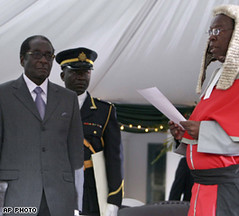
Nearly two months after the June 27 run-off presidential elections in the Republic of Zimbabwe, a new parliament has been convened amid stalled talks over the formation of a government of national unity. President Robert Mugabe won the second round of elections after failing to secure a majority during the initial poll of March 29.

On the opening day of parliament, August 25, the opposition MDC-T was able to elect its representative Lovemore Moyo as the speaker of the national assembly. The MDC-T won a slight majority in the March 29 parliamentary elections. Moyo recieved 110 votes to the ZANU-PF 99 in the selection process that preceded the swearing-in of the new parliament in Zimbabwe.

In the Senate, ZANU-PF politburo member, Edna Madzongwe, was elected as the president of this branch of the legislative body.

In the aftermath of the June 27 election and the swearing-in of Mugabe for another term as head-of-state, the ruling Zimbabwe African National Union-Patriotic Front party launched a new political effort through a series of talks with the two opposition factions, the MDC-T headed by Morgan Tsvangirai and the MDC-M, a breakaway grouping, headed by Arthur Mutambara, which disagreed with the leadership style of the parent body.

These talks, which have taken place periodically for the last several years, resumed with the mediation efforts of Republic of South Africa President Thabo Mbeki, who has worked during this time period on behalf of the regional organization, the Southern African Development Community (SADC). The purpose of the talks are to reach a political settlement in Zimbabwe that would facilitate the lifting of sanctions as well as the halting of the destabilization campaign waged by the western imperialist countries over the last decade.

President Mbeki has recently been elected as the chairperson of SADC which has 14-member countries. This selection of Mbeki reaffirms his stature among regional peers in the sub-continent as well as the important role he has played in the quest for a political solution to the situation in Zimbabwe. Meanwhile the Republic of Zimbabwe is chairing the peacekeeping portfolio for the SADC area, further overcoming efforts to isolate the country from its neighbors in Southern Africa as well as throughout the continent.

After weeks of negotiations between ZANU-PF, MDC-T and MDC-M, an agreement was reached in August between the smaller opposiiton party, the MDC-M. However, the Tsvangirai faction, MDC-T, after appearing as if the party would sign the agreement creating a unity government, suddenly withdrew from the negotiations.

The ruling ZANU-PF party has accused Tsvangirai of deliberating sabotaging the talks at the aegis of his backers in the imperialist countries. On August 22, the leader of the Zimbabwe war veterans, Jabulani Sibanda, issued a statement attacking the oppposition leader for acting in contravention to the interests of the country and its people.

"War veterans, who are custodians of the country's revolution, welcomes the convening of parliament set for next week," Mr Sibanda told the media, urging Mr Mugabe to form a new cabinet. Mugabe announced the appointment of eight minister on August 25.

He added, "The West had engineered an impasse in the talks so that their preferred leader takes over."

He noted that Tsvangirai continued to demand more, and the more he demanded, the more western sanctions are imposed, so that the ruling ZANU-PF will be compelled to yield to his demands.

"That is a condition that will never happen, a step that will never be taken by ZANU-PF as a party of the people of Zimbabwe," Mr Sibanda said.

What at Stake for the West in Zimbabwe?

It is well-known that the main oppposition party in Zimbabwe is supported politically and economically by the imperialists nations of the United Kingdom and the United States, along with its allies in the European Union as well as some surrogate leaders on the African continent. The MDC-T has been utilized by these western imperialist states to create the social conditions that would lead to the collapse of the ZANU-PF Government and the installation of a reactionary neocolonialist regime.

The fact that the ZANU-PF Government of President Robert Mugabe has been able to survive a decade-long persistent campaign aimed at undermining the country's national interests both internationally and domestically, speaks to the level of maturity and capability of the ruling party. This is the organization which evolved from the national liberation movement that fought alongside the Zimbabwe African People's Union (ZAPU) for the independence of the nation in 1980, to a political party that merged with ZAPU two decades and still maintains state power today despite an international campaign to bring about its overthrow.

Consequently, if there was an agreement between ZANU-PF, MDC-M and the larger MDC-T, it would pose a challenge to the imperialist countries who have continued to claim that the exclusion of Tsvangirai and his cohorts from executive power is the major stumbling block towards achieving stability in Zimbabwe. Yet there has been very little acknowledgement or encourgagement from the UK and the US as it relates to the negotiations for a power-sharing arrangement.

What the imperialists want is the relinquishing of executive power by ZANU-PF and the transformation of the state and its institutions away from the control of the veterans of the armed struggle for national liberation and their allies. The imperialists wish to select and structure a new political dispensation in Zimbabwe that will follow the dictates of Washington and London. Such a defeat for the ruling ZANU-PF party would set a dangerous precedent in the region and place further pressure on the democratic revolution in South Africa to move faster in the direction of a neo-liberal economic and social agenda.

Zimbabwe continues to enjoy the support of neighboring South Africa, where President Mbeki has refused to follow western request to impose sanctions on the ZANU-PF Government. In addition, the ongoing support from the People's Republic of China has been essential in the state's "Look East" policy that is attemtpting to lessen its dependence on trade with the western imperialist nations.

On July 11, a double veto within the United Nations Security Council by both Russia and China, prevented further sanctions and possible military action against Zimbabwe by the United States and Britain. Just prior to the UN Security Council vote, President Mugabe had attended the African Union Summit in Egypt where he was accepted fully by the other heads-of-state on the continent. The AU endorsed the continuing negotiation process that has been conducted by President Thabo Mbeki of South Africa.

Other countries in various regions of the continent have supported the Mugabe government. A recent visit by an envoy from the North African nation of Libya demonstrated the understanding by other progressive and revolutionary states as it relates to the process in Zimbabwe and the challenges the country is facing during the present period.

The Libyan envoy, Hafiz Mersal, "returned to Libya with a delegation of chiefs who were invited to take part in the 39th anniversary of the great Libyan revolution to be celebrated in September," according to the August 25 issue of the Zimbabwe Herald.

"We strongly stand with the people of Zimbabwe and their political leadership in the fight against imperialism," Nersal said.

"The president Cde Robert Mugabe is one of the people who brought independence to Zimbabwe and he is a liberation hero.

"We therefore understand him when he says he does not want outside meddling in the talks.

"The idea of power sharing is an African solution to African problems. Africa does not want to be dictated to and the people should come first."
----------------------------------------------------------------------------------------
Abayomi Azikiwe has written extensively on the political situaiton in Zimbabwe over the last several months. Articles by this author have been published in various newspapers and on numerous web sites throughout the world.
----------------------------------------------------------------------------------------

President Mugabe in Process of Forming New Government in Zimbabwe

President in process of forming new Govt

Herald Reporter

PRESIDENT Mugabe is in the process of forming a new Government.

Addressing dignitaries attending a lunch hosted by the Minister of Local Government, Public Works and Urban Development, Cde Ignatius Chombo, to mark the official opening of the First Session of the Seventh Parliament, President Mugabe said:

"We shall soon be setting up a Government. The MDC does not want to come in apparently. This time they have been promised by the British that sanctions would be more devastating, that in six months’ time the Government will collapse," he said.

"I do not know when that day will come. I wish Tsvangirai well on that day," he said.

The President said he was going to appoint Cabinet ministers who can manage the business of the people.

"I need managers. I want workers — people who take people to work. I do not want people with own businesses. I want one business — the people’s business," he said to applause from the dignitaries who included traditional leaders, Government employees, business people and service chiefs.

He said Cabinet ministers who own businesses should employ other people to manage their business while they attend to the business of the people.

Cde Mugabe criticised some ministers in the outgoing Cabinet. "This Cabinet that I had was the worst in history. They look at themselves. They are unreliable, but not all of them," he said.

Cde Mugabe attacked the spirit of individualism and the tendency to undermine others saying some leaders were more interested in personal gain.

Cde Mugabe said Zanu-PF had lost some votes in the March 29 harmonised elections because some of its members worked against the party.

"Let’s be united. Let’s not be destroyers of our party. We have destroyed part of it. Now that we have survived, let us ensure the party is strengthened," he said.

Cde Mugabe attacked corrupt leaders saying he was receiving reports that some of them were diverting maize meant to feed the people to the black market and to Mozambique, giving as an example reports of a senior official who was caught diverting maize in Matabeleland North.

"The people are suffering and you want to exploit the poverty of the people. Let us police each other," he said.

Cde Mugabe said it was baffling that Zimbabwe had to import some products that were manufactured locally like sugar. Zimbabwe produced up to 400 000 tonnes of sugar and consumed about 150 000 tonnes a year but still had to import.

The President said the middle class was exploiting the lower class by illegally dealing in gold and other precious metals and stones.

Cde Mugabe said judging by the number of new cars on the roads, some of which included the latest models, it was surprising to note that Zimbabwe was regarded as poor.

He advised newly resettled farmers to reserve land for maize, sorghum and rapoko to ensure that the country did not starve.

Cde Mugabe also talked about relations with other countries within the region and beyond saying the manner in which Zimbabwe relates to its neighbours should be reciprocated noting that no country within Sadc should dictate what others should do.

He said it was imperative that the spirit of Sadc should be kept alive and that he had told South African President Thabo Mbeki that he would never at any time speak ill of an African country in public to please the Americans and British.

Cde Mugabe said he preferred face-to-face criticism.

He said the British and Americans had visited all Sadc Heads of State to influence them to speak ill about Zimbabwe ostensibly because of the land issue.

Malawian President Bingu wa Mutharika, Cde Mugabe said, was the only one who had come out in the open telling him of the British and US machinations to denounce Zimbabwe.

Cde Mugabe said Zimbabwe was not averse to doing business with the British, but was not amenable to being commandeered to do things against its wishes hence he had told former British prime minister Mr Tony Blair to keep his England while he concentrated on Zimbabwe.

He said the West had also approached some of Zimbabwe’s friends and influenced them not to trade with the country.

In some instances shipments of goods paid for by Zimbabwe had been seized while in some cases payments meant for procuring goods from Europe and America were frozen.

Cde Mugabe congratulated the Zimbabwe Olympic team for doing well in Beijing and urged the nation to give the team a resounding welcome.

Barack Obama Assassination 'Plotters' Will Not Face Charges

http://www.timesonline.co.uk/tol/news/world/us_and_americas/us_elections/article4617490.ece

From The Times

August 27, 2008

Barack Obama assassination 'plotters' will not face charges

Tim Reid and Tom Baldwin in Denver

Three white supremacists with a sniper rifle and high on drugs who were arrested near the Democratic convention in Denver will not face charges even though officials believe that they wanted to assassinate Barack Obama.

The FBI and the US Secret Service carried out an “intensive” investigation into the plot — in which the supremacists talked of shooting Mr Obama as he accepted the Democratic presidential nomination in an open-air sports stadium on Thursday night — but found insufficient evidence of a “true threat”.

One of the suspects, Shawn Adolph, 33, was connected to a high-velocity Ruger sniper rifle seized during a series of early morning arrests on Monday and had made clear threats and “racial slurs” against Mr Obama, Troy Eid, Denver’s US district attorney said.

The spectre of assassination arose in May when Hillary Clinton had to apologise after appearing to suggest that the assassination of Robert Kennedy in 1968 during his presidential campaign was a good reason for her staying in the race. Mr Obama=2 0is often compared to John F. Kennedy. But it is his skin colour that has added to concerns in a country that has more than 200 million legally held firearms and 30,000 gun deaths each year.

Mr Eid said: “It is a serious federal crime to make a threat against a presidential candidate.” But he added that the three men arrested in connection with the plot had been abusing the drug methamphetamine when they discussed the possibility of killing Mr Obama.

“From a legal standpoint, the law recognises a difference between a true threat and the racist rantings of drug abusers,” Mr Eid said. “The alleged threat does not warrant charges at this time but we are keeping an open mind.”

The three men — Mr Adolph, his cousin Tharin Gartrell, 28, and Nathan Johnson, 32, have long criminal records for illegal gun possession, drug dealing and theft. There were multiple outstanding warrants for their arrest and all three were being held on drug and firearms charges last night.

The alleged plot received serious attention after an extraordinary jail-cell interview with local television by Mr Johnson, who said that his associates had planned to assassinate Mr Obama as he accepted the Democratic presidential nomination in the 75,000-seat open air Invesco sports stadium on Thursday.

Mr Johnson also told police that the plan had been to shoot Mr Obama “f rom a high vantage point using a rifle sighted at 750 yards”.

The Democratic candidate has been under Secret Service protection since May last year after a series of credible death threats. The plot comes at a time of heightened security fears in Denver, and an unspoken fear inside the Obama campaign about the candidate’s safety.

A recent Gallup poll revealed that nearly two thirds of blacks in the US believe Mr Obama faces greater security risks than other candidates.

The suspects were seized in the early morning after police stopped Mr Gartrell, who had been driving a rented Dodge pick-up truck erratically. In the vehicle officers found two high-powered rifles, including one with telescopic sights, along with radios, wigs, a bullet-proof vest, a high-magnification spotting scope, three identifications not belonging to Mr Gartrell, and 44 grams of the stimulant methamphetamine. One rifle had a threaded barrel so that it could be fitted with a silencer.

Also found in their pick-up truck were three kits for the production of methamphetamine and the necessary ingredients.

Mr Johnson, an unemployed lorry driver, told CBS4, the Denver television station, from his cell that his friends had told him that they did not want Mr Obama to be president. “He don’t belong in political office — or blacks don’t belong in political office,” he said. “He gotta be shot.” Mr Johnson continued: “H e had said that, yes, it would be probably on the day of the acceptance speech.”

He was then asked: “So your friends were saying threatening things about Obama?”

“Yeah,” Mr Johnson replied.

“It sounded like they didn’t want him to be president?”

“Yeah,” Mr Johnson said.

“Do you think they were really plotting to kill Obama?”

Mr Johnson replied: “I don’t want to say yes. I don’t want to say no.”

He added that he had told the FBI about the plot during eight hours of interviews and a polygraph test. “I did say that it would be from a high vantage point and that it would be with the named rifle,” he said.

After Mr Gartrell’s arrest, officers accompanied him to a hotel, where they arrested Mr Johnson at 4.30am. Thirty minutes later police went to another hotel, where Mr Adolph, 33, wanted on a number of drug-related arrest warrants, jumped from a sixth-storey window and broke his ankle. He was said to be wearing a ring with a swastika.

The men were also reported to have possible ties to an outlaw motorcycle group called Sons of Silence. Mr Johnson’s girlfriend, Natasha Gromek, was also arrested on drug charges.

Mr Obama, who was given Secret Service protection earlier than any other presidential candidate, has played down fears about his safety. Yet a poll released in Michigan found that 57 per ce nt of respondents agreed that “there are people who want to hurt Barack Obama because of his race”.

He travels with a retinue of six Secret Service agents at all times. Security in Denver is intense, with nearly 1,500 police officers from across Colorado brought into supplement those from the city, as well as the Secret Service, the US Capitol Police and the National Guard.

Copyright 2008 Times Newspapers Ltd.

COSATU Says Power Strike Vindicated Mass Action in South Africa

Cosatu says power strike vindicated

MICHAEL HAMLYN | CAPE TOWN, SOUTH AFRICA
Aug 27 2008 14:12

The Congress of South African Trade Unions (Cosatu) said admissions made at a conference on the mining industry's response to the power crisis "totally vindicated" its campaign of mass action.

The federation said the statement by National Energy Regulator of South Africa (Nersa) CEO Smunda Mokoena that Eskom's load shedding earlier this year cost the economy R50-billion confirmed Cosatu's view that the energy crisis posed a real threat of job losses and an economic slowdown.

"It flatly contradicts the assurance given by Public Enterprises Minister Alec Erwin in January that 'the government is confident that through the reduction of electricity use, the current healthy growth could be maintained'."

At the conference, the Chamber of Mines predicted that investment in the mining industry over the next five years was likely to be reduced by between R16-billion and R25-billion because of the 10% power reduction forced on mines.

The chamber's economist, Roger Baxter, said a survey of mining companies had found that jobs were at risk. Employment was expected to drop "substantially" if reduction in the power supply was maintained.

Andrew Etzinger, Eskom spokesperson, said that Eskom "recognises the effect on the economy of the power cuts".

Patrick Craven, the union group's spokesperson, said on Wednesday that it is more determined than ever to fight to save all the jobs that are now on the line. The federation said it was committed to support the national campaign to reduce electricity consumption and find a lasting solution to the crisis. Cosatu is part of a task team developing a consolidated stakeholder response to proposed interventions to address the electricity crisis.

Craven said Cosatu stood by its demand that the cost of the power cuts not be borne by the poorest in society, that workers were not retrenched as a result of the power cuts and that the electrification programme to poor households was not compromised.

"Workers and the poor must not have to pay, through either higher tariffs or losing their jobs, for a crisis that is the fault of a government error in not providing Eskom with the money they insisted they needed to build new generating capacity in the late 1990s, when they were planning to privatise the public utility," he said. – I-Net Bridge

Source: Mail & Guardian Online
Web Address: http://www.mg.co.za/article/2008-08-27-cosatu-says-power-strike-vindicated

Wednesday, August 27, 2008

Mauritania Regime Refuses to Set Polls Date

Mauritania junta refuses to set polls date - party

Tue 26 Aug 2008, 17:33 GMT
By Hachem Sidi Salem and Gabriela Matthews

NOUAKCHOTT, Aug 26 (Reuters) - Mauritania's military rulers have refused to set a timetable for elections or guarantee they will not stand themselves, complicating their efforts to form a government, the main parliamentary party said on Tuesday.

Veteran opposition leader Ahmed Ould Daddah said the High State Council set up after an Aug. 6 military coup had agreed to most of 35 conditions set by his Rally of Democratic Forces (RFD) and allied parties for joining a new government.

"There are at least two important points (remaining), which are the timetable, and the participation of soldiers in the elections and their neutrality in those elections," he said.

With 16 of 95 National Assembly seats, Daddah's Rally of Democratic Forces (RFD) is the biggest parliamentary party since the ADIL party formed by ousted President Sidi Mohamed Ould Cheikh Abdallahi collapsed this month.

A majority of parliamentarians, including from the RFD, signed a statement in support of Abdallahi's ouster a week after the coup. They accuse Abdallahi of over-stepping his authority and failing to manage economic risks and al Qaeda attacks.

But backing from Daddah and his allies has since weakened, as junta chief General Mohamed Ould Abdel Aziz has delayed setting a timeframe for free polls he has promised, and said he may even stand as president himself.

Daddah met on Tuesday with Jean Ping, the top diplomat of the African Union, which suspended Mauritania's membership within days of the coup. Abdallahi has been in detention since.

"As political leaders we cannot take part in a process which will isolate Mauritania," Daddah said.

The United States has already frozen around $25 million in military and development aid and warned much bigger sums of future aid is at stake. The European Union's aid commissioner has threatened to halt non-humanitarian aid and freeze payments of more than $100 million a year for fisheries rights.

Fisheries are one of Mauritania's main sources of foreign exchange after iron ore, which accounts for more than half its exports. It also became a small-scale crude producer in 2006.

This month's coup cut short Abdallahi's rule barely 15 months after he became the Islamic republic's first freely elected leader in elections called after a 2005 coup also instigated by Abdel Aziz. Daddah came in second place.

Ibrahima Moctar Sarr, who also stood in that poll, told Tuesday's news conference his Renewal Movement party would also boycott a new government unless the junta met their demands.

Sarr won almost 8 percent in the first round of last year's poll on a platform of racial equality for black Mauritanians who have long complained of abuse and enslavement by the white Moorish elite, from which Abdallahi and Abdel Aziz hail.

A minor party, the Mauritanian Party for Change, is still set to join a new government, but with only three National Assembly seats after one member defected to Daddah's RFD.

(Writing by Alistair Thomson, editing by Daniel Magnowski and Mary Gabriel)

Tuesday, August 26, 2008

China Television Crew in Zimbabwe

Chinese TV crew in Zim on post-poll tour

Zimbabwe Herald Reporters

A FIVE-MEMBER crew from the Chinese Central Television Channel Six is in Zimbabwe on a post-election tour to counter the negative publicity that the country continues to receive from the Western media.

The five are producer Mrs Wang Ning Tong, who is the leading the group, Mrs Lui Hong, Mr Xiao Quan, Miss Wang Hui Fen and Mr Wang song.

The crew, from one of China’s biggest television stations, is in the country as part of the Zimbabwe Tourism Authority’s ongoing Perception Management Programme, which is part of the national marketing strategy aimed at promoting tourism through celebrities, opinion leaders, media and travel agencies from source markets.

ZTA chief executive officer Mr Karikoga Kaseke on Sunday said Zimbabwe had received unprecedented negative publicity from the Western media that had created an impression that the country was a no-go area.

"The visit by CCTV crew brings an opportunity to prove to the world that Zimbabwe is a safe destination and contrary to what the world has been subjected to by the Western media.

"They will have an opportunity to sample the country’s tourism products and package their experiences for their television channel programming when they return to China," said Kaseke.

He urged the Chinese crew to be factual, professional and honest about the situation in Zimbabwe and publicise the truth about what they would have gathered from their tour of the country.

"We will not influence what you are going to produce when you go back to China, but we only ask you to publicise the truth," said the ZTA boss.

He said apart from touring the country, the group was also interested in interacting with the film industry as they had expressed their appreciation of Zimbabwean movies such as Everyone’s Child, Yellow Card, A World Apart and I Can Hear Zimbabwe Calling.

In welcoming the guests at a local hotel, ZTA board member Advocate Martin Dinha said it was the authority’s obligation to gain from the tourism industry and extended his gratitude to the Chinese people for their support.

Adv Dinha said part of ZTA’s efforts was to re-energise the tourism sector towards economic revival and that tourism was a strategic sector that enjoyed quick wins.

Mrs Tong said they were in the country to explore a country most Chinese do not know about.

"Our task here is to open the eyes of the Chinese people about Zimbabwe and also to promote Zimbabwe through every media.

"We have been doing this for the past five years through 40 countries for the Chinese people to understand the world from different countries.

"Focusing on tourism destinations in Zimbabwe is also part of our visit and there are many people intending to visit and this is a good chance to promote Zimbabwe in China," said Mrs Tong.

China has in recent years been strategically placing itself as one of Zimbabwe’s leading tourism market.

CCTV6 will do a documentary that will be shown in China and will also write editorials as part of their pledge to market and package Zimbabwe to the Chinese people.

During their weeklong stay the group will focus on the ancient civilisation of Zimbabwe, its culture and the outstanding film industry.

The crew’s tour will cover destinations like Harare, Great Zimbabwe in Masvingo, Victoria Falls and Hwange.


EDITORIAL

China stuns the world

Published Aug 20, 2008 10:32 PM

Chinese athletes, children, artists and choreographers, 15,000 performers and an abundant display of new technology since the opening of the Beijing Olympics have stunned billions of people around the world. The transnational imperialist-dominated media have left most people unaware of the tremendous progress made in the world’s most populous country since the earthshaking revolution led by Mao Zedong’s Communist Party in 1949, less than 60 years ago.

Perhaps the most shaken up were the U.S. media professionals themselves—that’s a nice way of saying paid propagandists—who were rendered speechless by the opening ceremony. When these pundits got their act together, they were still reduced to nit-picking about the age of Chinese gymnasts and some debatable decisions about lip-synching a song and technologically enhancing some fireworks. Hollywood and U.S. television use these techniques on a regular basis; only rarely are they made an issue.

Then there were the stories about the difficulties applying for a protest permit in Beijing. One New York Times op-ed analyst applied for his own protest permit. We recommend he apply for such a permit in Denver or in St. Paul in an attempt to get close to the national conventions of the Democrats and Republicans. Protest organizers in those cities need a team of lawyers to get anywhere near the conventions and still face threats from tanks, tear gas, lasers, water cannon, and rubber and lead bullets.

And the reasons for protesting here are so much more compelling, as the conventions will be filled with war criminals like George W. Bush and Dick Cheney, who have ordered illegal foreign occupations and destructions of entire countries while they abandoned New Orleans’ Black population, persecuted immigrants and destroyed the environment at home. That’s only a partial list of their crimes.

You might think that the corporate media’s analysts would try to credit China’s progress solely to its decision to allow in foreign investment and private capital. These pro-capitalist hacks recognize, however, that something else is behind the massive show of Chinese confidence. They see that “kow-towing” to Western rulers is in the dustbin of history.

A hundred years ago, though China still had 5,000 years of civilization behind it, foreign imperialist ruling classes with far less history but more powerful weapons and a stronger industrial and financial base enslaved China’s people.

It took more than technological improvements to turn this situation around. Nor was it done through the good will of China’s foreign rulers. A revolution lasting decades, led by the Chinese Communist Party, not only pushed out foreign imperialist invaders and exploiters but mobilized hundreds of millions of Chinese peasants and workers, women and men in the effort to build socialism. This revolution turned the Chinese people into conscious actors on the world scene, soldiers and organizers who could liberate their nation and shake the world in 1949, just as the performers on Aug. 8 this year stunned the billions watching on television screens.
----------------------------------------------------------------------------------------
Articles copyright 1995-2008 Workers World. Verbatim copying and distribution of this entire article is permitted in any medium without royalty provided this notice is preserved.

Workers World, 55 W. 17 St., NY, NY 10011
Email: ww@workers.org
Page printed from:
http://www.workers.org/2008/editorials/china_0828/

Democratic People's Republic of Korea (DPRK) Halts Nuclear Disablement

UPDATED ON:
Wednesday, August 27, 2008
02:00 Mecca time, 23:00 GMT

N Korea halts nuclear disablement

North Korea publicly demolished a cooling tower at the Yongbyon nuclear complex in June

North Korea says it has stopped disabling its nuclear facilities to protest against Washington's failure to remove it from its list of state sponsors of "terror".

The foreign ministry said in a statement on Tuesday that the suspension took effect on August 14 and that it has notified countries involved in six-party talks on its nuclear programmes.

The ministry said it was forced to take the step "as countermeasures in a situation where the United States violated the agreement".

The US said said North Korea's decision was a "step backward" and went against agreements made in the six-nation talks.

"This certainly is in violation of their commitments to the six-party framework," Robert Wood, a state department spokesman, said.

Disarmament deal

Pyongyang had been disabling the facilities under a disarmament-for-aid deal reached last year with Washington.

The North Korean statement said that the country would "consider restoring the Yongbyon facilities to their original states" but did not say when it would do so.

In June, the cooling tower of the Yongbyon nuclear facility was destroyed in a public demolition to demonstrate North Korea's commitment to scrapping its nuclear programme.

Removal from Washington's list of state sponsors of terror is one of the key concessions offered to North Korea in exchange for shutting down and disabling the reactor.

After North Korea turned over a list of its nuclear programmes in June, the US announced Pyongyang would be delisted.

North Korean 'threats'

The two sides have been negotiating on how to verify the nuclear declaration, with Washington saying it would remove Pyonyang only after a verification plan is agreed.

North Korea's announcement is being seen as a bargaining tactic rather than an intent to restart its nuclear facilities.

Al Jazeera's Melissa Chan said: "In the past, [North Korea] has made a lot of threats on this issue.

"When it comes to negotiating, they really do like to use threats against the other five parties."

China, Japan, South Korea, the US and Russia have all been involved in brokering the deal disablement deal.

Source: Al Jazeera and agencies

Denver Police Attack Peaceful Demonstrators Outside the Democratic National Convention

August 26, 2008

To see updated photographs and videos visit the following web site:
http://dncrnc.wordpress.com/

FOR IMMEDIATE RELEASE

Media Contacts:
Glenn Spagnuolo 720-771-4669
Larry Hales 720-979-9491
Dustin Langley 646-354-8056
URL: http://dncrnc.wordpress.com/

**DNC Protest Organizers to Hold Press Conference at Denver Police Department**

When: 3:15 pm Tuesday, August 26
Where: Denver Police Department, W. 13th Ave & Cherokee St.
What: Press Conference

At 3:15 p.m. at 13th and Cherokee at the Denver police headquarters on 13th and Cherry, members of Recreate 68, the Troops Out Now Coalition, Unconventional Action, People’s Law Collective and some now-released arrestees gathered to denounce the police state atmosphere surrounding the Democratic National Convention, police provocations and arrests last night and the police refusal to honor Recreate 68’s legal permit for the park and their protection of right-wing hate speech provocateurs.

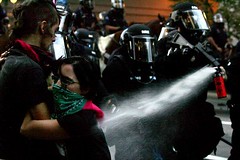
Last night, police swept into the park as hundreds were gathered at the Food Not Bombs’ organized evening dinner. Using pepper spray, they forced people to run from the park directly into a police encirclement on the street at 14th and Cleveland. Many hundreds were surrounded in a standoff that lasted for hours. Through the organization of R68, hundreds of others surrounded the police, and the police finally released those encircled.

Recreate 68, organizers of the Democratic National Convention protests, will denounce the police state atmosphere that has been created this week. Larry Hales of R68 noted: “The Denver school budget has been cut by more than $50 million just to provide the funds to the Denver Police. This atmosphere has been created to justify that budget.” Since the beginning of the protests, activists have faced hundreds of police forces in full riot gear, armed with gas, helicopters, horses, bikes and more.

Eighty six protestors were arrested and booked–although protest organizers note that there was no violence by the demonstrators, and that the march hadn’t even begun. Glenn Spagnuolo of R68 stated, “Since the beginning of this mobilization, we have always said that any violence would not come from us, but would come from the police. Our predictions appear to have come true. We have never intended, planned or organized violence.” R68 has organized this week’s legal demonstrations with the message of ending illegal war, racism and occupation; and they believe that the police are trying to shut this message down.

Today, the police violated the legal permit that R68 has to the Civic Center Park, helping to protect and bring in right wing hate speech provocateurs such as Rev. Fred Phelps. When R68 organizers demanded their right to the permitted space, R68 organizer Carlo Garcia was arrested. Garcia has two brothers in Iraq and his father was given a purple heart.

When Code Pink organizer Alicia Torres questioned Garcia’s arrest, she was struck by police and arrested as well.

At today’s press conference, activists, those arrested, R68 permit holders and lawyers will raise the demands of stopping police provocations and harassment and an end to the massive police presence and intervention in the park.

As the Capitalist Crisis Deepens: The Workers' Fightback is Coming--An Analysis by Larry Holmes

AS CAPITALIST CRISIS DEEPENS

The workers’ fightback is coming

Activists can help


By Larry Holmes
Published Aug 24, 2008 9:59 PM

Aside from wanting to find out as much of what can be known about the current capitalist crisis, the question on the minds of all who are interested in the prospects for opening up the class struggle is “Will U.S. workers fight back?”

What makes that question all the more critical historically is the fact that this capitalist crisis is no ordinary one that’s likely to pass by quickly.

The world system of finance capital, including thousands of banks and financial institutions of every size and in every part of the world, would have gone into a freefall last March if the U.S. government had not rushed to bail out the Bear Stearns bank in order to reassure Wall Street. The freefall would have happened again in July without Washington’s bailout of two enormous government-backed mortgage banks, Fannie Mae and Freddie Mac.

The catalyst for the crisis was the housing market crash, but it has now spread throughout the entire financial system. Banks are not extending credit, factories and plants are closing, businesses are going bankrupt, unemployment is rising, and the rate of home foreclosures and evictions is rising even faster.

No industry, region of the U.S., or region of the world is unaffected by the crisis, and it is going to get worse. The only question is whether it will unfold in a slower and somewhat controlled way, or if another event—a series of bank runs, the collapse of a big bank or a new war—overcomes any efforts on the part of the government and the big banks to manage the crisis and things spin out of control.

In either case, this appears to be the end of a prolonged period when capitalism had been able to divert, escape or forestall a systemic crisis of this magnitude.

Imperialist globalization—which amounts to a war on the workers, wars of conquest, deregulation, monetary manipulation and easy credit are among the methods the capitalists have employed to avert a deep and intransigent crisis. This time they don’t seem to be working. In fact, they are making things worse.

Imperialism has not given up on these methods, and will try them again. But this time, all indications are that the inevitable megacrisis rooted in the chaos of capitalist overproduction for profit has arrived.

Not ‘the end of history’

Finding a way out of this crisis will be very, very difficult for U.S. imperialism. While still the center of world imperialism, it can no longer dominate the world through economic strength, as it once did; it has had to rely more and more on superior military might. But the military option hasn’t worked so well for them in Iraq, or even in Afghanistan.

Since the end of the Soviet Union, the U.S. and the major European imperialist powers have assumed they could devour the remains of the former Soviet republics, rich in oil and other natural resources, as well as the countries of Eastern Europe, without meeting any serious resistance. The events of the past few weeks have put an end to that dream.

World events have come full circle since capitalist pundits declared themselves forever triumphant and proclaimed the “end of history.” The “end of history” chapter of imperialism’s history book just got cut.

The capitalist economic crisis should and will direct more attention to the reality that the world imperialist system has reached such an advanced yet destructive and paralytic phase that very little can be accomplished that really serves society. Has it ever been more crystal clear that all progress, including saving the ecology of the planet, is premised on consigning imperialism to history and commencing socialist transformation?

The interconnectedness of every aspect of maintaining life on earth has never been more apparent. Clearly, while people will fight to transform the conditions where they live, ultimately there will be no national or regional solution to the crisis of the world. The solution must be global.

But the political consciousness, organization and preparedness of the working class, its organizations and the revolutionary movement are not yet on a par with world developments.

Who will respond to economic crisis?

The ranks of the communist and socialist movement are far too small, fragmented and lacking in influence within the working class. The movement is not oriented towards the mass of the workers—in some cases it is distinctly oriented away from the working class, particularly the most oppressed sections.

One can go to any number of important demonstrations, marches or meetings concerned with an array of critical issues and organized by hardworking activists and find that the biggest economic crisis of capitalism in 75 years is not likely to be on the agenda, except perhaps in some narrow and limited way. Yet the capitalists are both preoccupied with and genuinely frightened by the crisis.

Most events, like the political movement itself, are issue oriented as opposed to ideologically oriented. While it is necessary for activists to organize around concrete issues, the problem is that the issues are seldom viewed in a larger ideological context.

There seems to be a great distance between the severity of the capitalist economic crisis and the capacity of revolutionary and progressive activists and forces to comprehend what’s happening and do anything about it.

At the moment, the organized labor movement in the U.S., its leadership in particular, is putting a lot of resources and hope into the outcome of the presidential elections. It is not prepared to mount a real struggle against the attacks on the working class that the crisis will generate like waves, each wave bigger and more destructive than the last one.

It would be wrong to place the blame on the many activists and militants within the working-class movement who are trying to make a difference under difficult circumstances.

Understanding the history of the development of the working class in the U.S. and what events affected that history is essential to an understanding of why the working-class movement is not yet up to the task, and why the working class is still in the process of becoming conscious of itself as a class.

What made U.S. imperialism so strong

World events and economic developments have actually come full circle over a larger time period than 20 years. It is more instructive to go back to the middle of the 20th century, when U.S. imperialism emerged victorious from World War II as the undisputed leader and center of world imperialism.

The end of that war marked the real beginning of U.S. imperialism’s world reign. The problems and contradictions that have frustrated the political development of the working class and its organizations in the U.S. can be traced to the beginning of this reign.

The most revolutionary and militant communists and socialists who fought in the battles of the 1930s believed that out of the working class upsurges sparked by the worldwide capitalist depression would come the opportunity for the working class to make great gains and even seize political power away from the bosses—yes, even in the U.S.

The capitalist ruling classes got themselves out of the crisis of the thirties through fascism and war in much of Europe and war and reforms in the U.S. After the war, the revolutionary struggle continued in the East and among the colonized peoples of the world, but, in relative terms, it ebbed in the West, especially in the U.S.

U.S. imperialism accumulated enough wealth by looting the colonized and semi-colonized peoples and nations of the world to use a little of that stolen wealth to create the illusion that the U.S. was different than any other country.

As the myth goes, the U.S. was now a prosperous, middle-class society where the need for workers to wage class struggle against capitalism was no longer necessary. As long as you weren’t Black or Brown—and of course women had to stay “in their place”—you could do well for yourself, and your children could do even better.

Before long, the tremendous working-class struggles of the thirties that had expanded the right to unionize and had won Social Security, the minimum wage and other reforms were all but forgotten—with the help of the ruling class, of course. Anti-communism, racism and reaction rendered most of the leadership of the organized labor movement loyal to the system.

The Reagan/Thatcher era

In a different kind of way, this process, which resulted in a weakening of the working class, repeated itself a generation ago. By the late 1970s, U.S. imperialism, dogged by a long post-Vietnam War economic crisis, decided that restructuring the economy, including the introduction of new technology into the production process, would get them out of the crisis. Doing this would necessitate a new, wide-scale and brutal assault on the working class, starting with the strongest unions.

It needed a sharp right-wing, anti-worker shift in U.S. and world politics. Hence, the Ronald Reagan era. Sometimes it’s called the Reagan/Thatcher era, referring to both Reagan and Margaret Thatcher, the prime minister of Britain during the 1980s.

Reagan, as the principal representative of U.S. imperialism, was infinitely more powerful than Thatcher. But they became linked by their common anti-worker, anti-union, anti-communist agenda, particularly their dedication to destroying the Soviet Union.

In the U.S., the Reagan anti-union offensive reached a new level of seriousness when he fired nearly 12,000 striking air traffic controllers in 1981. That was only the beginning of the onslaught that robbed hundreds of thousands of auto, steel and other unionized workers of their hard-won benefits and jobs.

Notwithstanding some heroic struggles that workers mounted during the 1980s and 1990s in self-defense, overall the working class was not yet ready to prevail in the war being waged against them by capital.

It would have required a high level of political consciousness and preparedness on the part of the working class, and seasoned leadership free of ties to the system, to mount the kind of struggle that might have stopped the anti-worker offensive. Capitalism’s victory over the working class at home set the stage for counterrevolution in the Soviet Union and elsewhere.

Since that time, capitalism and imperialism have been on the offensive. Over 90 percent of the people on the planet, who are workers and oppressed peoples, have been losing ground.

Up until now, strength, power, force and victory have been on the side of U.S. imperialism and its capitalist ruling class.

Need for solidarity with most oppressed

It’s the impact of this imbalance that is principally responsible for the political weakness, fragmentation and demoralization that are to a greater or lesser extent a factor challenging revolutionary and progressive forces.

Every capitalist crisis raises critical theoretical questions for serious Marxists. Experience had shown a long time before the capitalist depression of the 1930s that, if allowed the opportunity, capitalism had the ability to find its way out of a crisis.

Moreover, every crisis, even the big ones, doesn’t necessarily get transformed by the workers and their organizations into revolutionary opportunities. In the wake of defeats, the necessity for critical analysis can become supplanted by a very subjective cynicism, pessimism and doubt.

The biggest casualty of such a development is the erosion of solidarity.

Imagine on this third anniversary of the Katrina/Rita hurricane what the response might have been to the government’s calculated racist non-response if the working class movement had been stronger, more revolutionary and keenly aware that an injury to one is an injury to all.

Imagine what the working class and progressive forces could, should and ultimately must be doing to stop the war that is being waged by the government and racist thugs against immigrant workers.

Revolutionaries can, under the right conditions, turn what they imagine into a reality. Conditions will increasingly favor a fightback.

New opportunities for struggle

Events have now pushed the historic pendulum away from imperialism and towards the working class.

The present world economic and political crisis is going to change everything. It is already transforming the consciousness of larger and larger sections of the working class in ways that will astonish us all.

What will the workers do this time? Will they fight back? The most meaningful response for revolutionary and progressive activists is to ask themselves: What will we do as activists? Will we wait for others to take on this struggle? Will we conclude that there is nothing we can do?

Activists cannot substitute themselves for the masses of workers. But activists can, if they have the political will, help forge a working-class fightback. If ever there was a time for boldness, for imagination, for confidence, now is such a time.

What will be the role of politically conscious activists in responding to the crisis this time? The answer is bound to be decisive. All that remains is to find out how the movement can move things forward. What will it take, what is it that’s most important to understand? All who are serious will find the answers.

Larry Holmes is a member of the Secretariat of Workers World Party.


--------------------------------------------------------------------------------
Articles copyright 1995-2008 Workers World. Verbatim copying and distribution of this entire article is permitted in any medium without royalty provided this notice is preserved.

Workers World, 55 W. 17 St., NY, NY 10011
Email: ww@workers.org
Page printed from:
http://www.workers.org/2008/us/fightback_0828/

Russia Recognizes South Ossetia and Abkhazia; Tensions Escalate With US and Georgia

Russia recognizes South Ossetia and Abkhazia to save people’s lives

Front page / Russia / News from the Kremlin
26.08.2008 Source: Pravda.Ru

Russia’s President Dmitry Medvedev recognized the independence of South Ossetia and Abkhazia.

“The people of South Ossetia and Abkhazia have repeatedly supported their independence. We understand that they have a right to determine their fate themselves after what happened recently,” Medvedev said in a televised address.

“They addressed to Russia with a request to recognize their independence. Taking into consideration the free will of the peoples, the UN Charter and OSCE documents, I have signed decrees to recognize the independence of South Ossetia and Abkhazia on behalf of the Russian Federation. This is the only way to save people’s lives,” Medvedev said.

Medvedev compared Saakashvili’s actions with the position of a former Georgian President, Zviad Gamsakhurdia, who unleashed the war under the slogan “Georgia for Georgians.”

"Saakashvili chose genocide to fulfill his political plans," Medvedev said. "Georgia chose the least human way to achieve its goal - to absorb South Ossetia by eliminating a whole nation."

“Russia stopped the extermination of the Georgian people and then showed restraint with a goal to regulate the conflict through diplomacy,” the president said.

“Our warnings were left with no response. NATO and the UN ignored them. It is clear now that the Georgian administration was preparing for the war, whereas the support of its external protectors was only strengthening the feeling of impunity. The Georgian administration chose another way – to disrupt negotiations, launch military provocations and attack peacemakers. The Georgian administration initiated a military conflict in defiance of common sense and contrary to the UN Charter,” Medvedev said.

The Federation Council and the State Duma of Russia unanimously previously voted for the independence of Abkhazia and South Ossetia.

“Russia’s recognition of the independence of Abkhazia and South Ossetia is a necessary condition to ensure security for these nations. We are obliged to support the aspiration of the people of South Ossetia and Abkhazia to stability, peace and independence,” Federation Council speaker Sergei Mironov said.

The presidents of the now-recognized republics, Sergei Bagapsh and Eduard Kokoity, thanked Medvedev for his decision.

Residents of Sukhumi and Tskhinvali (the capitals of South Ossetia and Abkhazia) took to the streets to celebrate the news.

Russia ’s decision to recognize the independence of the two republics came out of the blue for its citizens. People started making countless phone calls to share their joy. Everyone started to congratulate each other after Medvedev’s televised address.

Cars blare their horns and people fire guns in the air celebrating their long-awaited independence, Interfax reports from Tskhinvali. People can be seen in the streets waving the flags of the republic, hugging and congratulating each other.

“The president’s decision is a response to those political speculators, who claimed that Russia needed new lands and who referred to Russia as an invader and who said that Russia was going to annex Abkhazia and South Ossetia. The recognition of Abkhazia and South Ossetia as independent states is a refusal from annexation,” Dmitry Rogozin, Russia’s ambassador to NATO said in a statement.


USA to evacuate disgraced Georgian president in case of national coup

Front page / World / Americas
26.08.2008 Source: Pravda.Ru

The USA said that one country [Russia] can not recognize independence of South Ossetia and Abkhazia, and that the process should be conducted by the United Nations Organization. US President Bush urged his Russian counterpart Dmitry Medvedev not to recognize the republics and reiterated that the USA supported the territorial integrity of Georgia.

German Chancellor Angela Merkel also set out a hope that Medvedev would say no to the State Duma and the Federation Council. New EU members are ready to end their relations with Russia. Moscow is prepared for a chill: Medvedev is ready to cut back relations with NATO, whereas Putin does not see any pluses in Russia’s WTO membership.

White House spokesman Tony Fratto stated Monday that the status of South Ossetia and Abkhazia should be solved by the international community and the United Nations, but never by one country alone.

Fratto’s statement followed the decision of the Russian parliament (State Duma) and the Federation Council, which supported the aspirations of the two republics to become independent and sovereign states.

Washington immediately described the decision of the Russian lawmakers as unacceptable. Spokespeople for the US administration stated that Russia must respect the territorial integrity and sovereignty of Georgia.

"I call on Russia's leadership to meet its commitments and not recognize these separatist regions," Bush said in a statement from Texas, where he is vacationing at his ranch.

"Georgia's territorial integrity and borders must command the same respect as every other nation's, including Russia's," the president said.

Bush said independence for the two regions would undercut the international attempt to resolve Georgia's border disputes, a United Nations effort that Russia has supported.

German Chancellor Angela Merkel expects Dmitry Medvedev not to support the appeal of the Federation Council and the State Suma to recognize independence of the two nations.

“I expect that the president will not sign off on the decision, as this would create a critical situation with regard to the territorial integrity of Georgia,'' Merkel said.

The summit of the European Union on Georgia, which opens in Brussels on September 1, is expected to become an arena for more anti-Russian initiatives. Some EU members urge to punish Russia for its politics in the Caucasus.

Former communist countries of Europe offered to freeze partnership and visa-free entry talks with Russia. They also use the support of Britain and Sweden suggesting the boycott of Winter Olympics 2014 in Russia.


Georgia rebels celebrate Kremlin recognition

Tue Aug 26, 2008 9:50am EDT
By Indira Bartsits

SUKHUMI, Georgia (Reuters) - Residents in Georgia's breakaway region of Abkhazia fired into the air, opened bottles of champagne and wept on Tuesday after Russia recognized it and a second breakaway region as independent.

In Sukhumi, Abkhazia's palm tree-lined capital on the Black Sea coast, office workers spilled into the streets moments after Russian President Dmitry Medvedev said in a statement he was recognizing Abkhazia and South Ossetia.

"We feel happy. We all have tears in our eyes. We feel pride for our people," said Aida Gubaz, a 38-year-old lawyer. "Everything we went through, now we are getting our reward," she told Reuters.

A Reuters reporter in Sukhumi said she could hear celebratory gunfire and saw people opening bottles of champagne. She said she saw several people weeping with joy.

In Tskhinvali, capital of Georgia's second rebel region of South Ossetia, a Reuters photographer said about 500 people had gathered in the central square.

He said there was a deafening roar from people firing from Kalashnikov rifles and antique hunting rifles. Other people were waving the flags of South Ossetia and Abkhazia , hugging each other and chanting: "Long live South Ossetia."

"It seems as though people are firing from every courtyard in the town," the photographer, who could barely be heard over the sound of gunfire, said by telephone.

Georgia and Russia fought a brief war over South Ossetia earlier this month after Georgia sent in troops to try to retake the separatist province by force. Russia responded with a massive counter-attack by land, sea and air.


Russia may hit USA very hard below the belt

Front page / World / Americas
25.08.2008 Source: Pravda.Ru

US leading experts analyzed punishing opportunities of both Russia and the West after the recent armed conflict in Georgia. Specialists came to conclusion that the list of potential Western sanctions pales in comparison with what Moscow could do in response. However, the US administration hopes that Russia will not resort to radical measures not to harm its own financial and security interests.

The US administration has issued yet another warning to Moscow recently claiming that Russia’s actions in Georgia would question the future of its WTO bid, as well as Russia’s position in the Group of Eight.

The list of Washington’s threats also includes the blocking of Russia’s membership in the Organization for Economic Cooperation and Development, the boycott of Russia’s hosting of Winter Olympics in 2014 and a freeze of US-Russian strategic dialogue.

US experts warn that the list of Moscow’s potential sanctions is a lot longer. Angela Stent, the director of the Center for Eurasian, Russian and East European Studies, Georgetown University, said that Moscow may respond at the UN Security Council, where it can put obstacles on the way of US intentions to punish Iran for its nuclear ambition.

All anti-terrorist programs, the struggle against drug mafia, Syria, Venezuela and Hamas can be added on the list too. There are many questions, on which Russians may stop their cooperation with the USA, with the cooperation in the energy industry on top of that list, the expert believes.

The International Herald Tribune wrote with reference to US outstanding analysts that Washington needed a lot more from Moscow than vice versa. The US needs to ensure the security of Soviet nuclear weapons, to obtain Russia’s help in the endeavor to make Iran and North Korea shut down their nuclear programs.

The sale of Russia’s arms is another problem. The governments of Western countries and Israel are concerned about reports saying that Russia started the shipments of first components of its S-300 missile system to Iran. The latter may subsequently use the powerful systems to down US and Israeli aircraft.

Russia may complicate USA’s and NATO’s supply of the coalition in Afghanistan In April, Moscow gave France and Germany a right to transit non-combatant cargoes via Russia. Russia’s ambassador to NATO, Dmitry Rogozin, said that the West should not bite the hand that feeds 50,000 servicemen in Afghanistan. Moscow can offer show pressure of Kyrgyzstan and Uzbekistan, which the USA would like to use for their operations in Afghanistan.

Zimbabwe Parties Share Parliamentary Posts

Parties share Parly posts

By Zvamaida Murwira
Courtesy of the Zimbabwe Herald

THE three political parties yesterday shared the top posts in both the House of Assembly and the Senate with MDC-T winning the Speaker’s chair and the other MDC formation settling for Deputy Speaker while Zanu-PF senators were elected President and Deputy President of the Senate respectively.

Matobo North Member of the House of Assembly Mr Lovemore Moyo of MDC-T and Zanu-PF Politburo member and Chegutu Senator Cde Edna Madzongwe were elected Speaker of the House and President of the Senate respectively when Parliament convened yesterday.

This is the first time since independence that an opposition MP has been elected presiding officer of the august House.

Umzingwane Member of the House of Assembly Mrs Nomalanga Khumalo from the Arthur Mutambara MDC formation was elected Deputy Speaker of the House of Assembly unopposed while Insiza Senator Cde Naison Ndlovu was retained as Deputy President of Senate.

The elections, which were conducted by secret ballot, were presided over by Clerk of Parliament Mr Austin Zvoma.

In their separate speeches, Mr Moyo and Cde Madzongwe invited members to accompany them when they present themselves to President Mugabe at State House on a date to be announced shortly.

Mr Moyo garnered 110 votes to beat former Gwanda Member of Parliament Mr Paul Themba-Nyathi of MDC, who got 98 votes from a total of 208 ballots cast.

Zanu-PF did not nominate a candidate for the Speaker of the House of Assembly and threw their weight behind Mr Nyathi.

Judging by the voting pattern, the 98 Zanu-PF MPs voted for Mr Nyathi while the 10 Mutambara formation MPs cast their ballots for Mr Moyo, apparently going against their executive’s decision to back Mr Nyathi.

None of the senior Mutambara faction leaders are in Parliament and could not, therefore, whip their MPs into voting for Mr Nyathi.

Voting started on a high note with Lupane East legislator Mr Njabuliso Mguni, who was seconded by independent Tsholotsho North MP Jonathan Moyo, rising to nominate Mr Nyathi.

Harare East MP Mr Tendai Biti nominated Mr Moyo and was seconded by Gutu South legislator Professor Elphas Mukonoweshuro.

In his brief speech in support of Mr Nyathi, Mr Mguni said he was a liberation war veteran who fought for Zimbabwe’s freedom from colonial rule.

He said Mr Nyathi was involved in the demobilisation of freedom fighters and was one of the founder members of MDC.

"He has the capacity to unite this House. As you can see, we are divided. Debate needs to be conducted in a free environment and as a freedom fighter, he would fight for the people’s freedom. We need him to be a mediator in our partisan debates," he said.

In his speech, Mr Biti said:

"In a polarised environment we are in, in the person of Moyo you will find someone without aggression, without the entrenchment of political party differences. The quality of Speaker we are looking for is someone with integrity, someone we can trust and who is consistent, someone who is prepared to put Zimbabwe first."

In his acceptance speech, Mr Moyo assured the House that he would discharge his duties with utmost professionalism.

"I am exceedingly humbled and honoured by your show of confidence in me. This is just the beginning of a long journey and spanners will be thrown in our way. Let me assure the people of Zimbabwe that we will not fail them," said Mr Moyo.

Both MDC-Mutambara and Zanu-PF congratulated Mr Moyo.

Chirumhanzu-Zibagwe MP Cde Emmerson Mnangagwa, who is Zanu-PF secretary for legal affairs, expressed confidence that Mr Moyo would discharge the onerous task before him with diligence.

"I have no doubt that members of the House found the integrity in you and have no doubt you will discharge the duty to the best of your ability," said Cde Mnangagwa.

In the Senate, Non-Constituency Senator Cde Patrick Chinamasa nominated Cde Madzongwe while Chizhanje Senator Mrs Sekai Holland (MDC-T) proposed Mr Dalumuzi Khumalo of MDC-Mutambara as candidate for the post of Senate President.

Cde Madzongwe garnered 58 votes against Mr Khumalo’s 28.

Cde Ndlovu won 57 votes against 28 for Mrs Holland in the race for Deputy President.

Voting was characterised by heated exchanges in the House of Assembly while there was calm in the Senate.

MDC-T MPs defied an order by Mr Zvoma to leave the chamber soon after casting their votes.

They also protested at the decision by Mr Zvoma to carry ballot boxes for counting in the Senate Chamber.

They only calmed down when they received assurances that candidates would be present with their agents.

The MDC-T has 100 seats in the House of Assembly while Zanu-PF has 98 and the Mutambara formation has 10 seats with the remaining one seat held by Jonathan Moyo.

Although Bills are introduced and passed in the Lower House, they have to be approved by Senate, where Zanu-PF enjoys a majority, before the President assents to them.

Senate can also refer back a Bill to the Lower House for reconsideration.

Following the election of Mr Lovemore Moyo as Speaker there will now be a by-election in Matobo North.

Cynthia McKinney, Green Party Presidential Candidate, to Visit Detroit for Labor Day

PRESS RELEASE

GREEN PARTY OF MICHIGAN
http://www.migreens.org

For Immediate Release:
Tuesday, August 19, 2008

Contacts:
John Anthony LaPietra, Media Coordinator,
Fred Vitale, State Coordinator, McKinney/Clemente Campaign, 313-580-4905, freddetroit@sbcglobal.net, chair@migreens.org

Cynthia McKinney, U.S. presidential candidate of the Green Party, visits Michigan

Detroit, Michigan – Cynthia McKinney, Green Party presidential candidate, and a member of the first ever in history all women of color ticket to appear on ballot lines across the country, will visit Detroit August 30 – September 1. See http://www.gp.org

The Green Party of Michigan will be hosting a Press Conference for Ms.McKinney, August 30, 7 pm, International Institute, 111 E. Kirby, Detroit. The Press Conference will be followed by a Rally with other Green Party federal, state and local candidates at 7:30 pm at the same location, the International Institute, 111 E Kirby. The event is open and free to the public.

Ms. McKinney will deliver a key policy speech on the elimination of poverty at the National Welfare Rights Union Awards Dinner, August 31, 6:30 pm at St. Paul of the Cross Retreat House, 23333 Schoolcraft, Detroit. (See http://www.mwro.org .

The Green Party of Michigan welcomes Cynthia McKinney to Michigan. She will lead the Green Party 2008 Slate joining our other GP candidates including Harley Mikkelson for U.S. Senate, Rev. Edward Pinkney for Congress in the 6th district, currently unjustly incarcerated in Hiawatha Prison, and many Congressional, state and local candidates.

Cynthia McKinney is a six-term former Congresswoman from Georgia who quit the Democratic Party on her birthday in 2007 because the Democratic Party no longer represented her values. She joined the Green Party, campaigned for its presidential nomination and was nominated in Chicago at the Green Party National Convention, July 12, 2008. http://www.votetruth08.com

During her time in Congress, Cynthia McKinney:

•consistently opposed funding for bloated military and secret intelligence budgets;
•introduced Articles of Impeachment for George Bush, Dick Cheney, and Condoleezza Rice;
•introduced, championed, and passed in the U.S. House the Arms Trade Code of Conduct, prohibiting the sale of arms to known human rights abusers;
•passed legislation to extend health benefits for Vietnam War veterans still suffering the health effects from exposure to the defoliant Agent Orange.

She currently serves on an International tribunal on Hurricanes Katrina and Rita and on the Brussels Tribunal on Iraq. She is participating in War Crimes prosecutions in Spain, and is working with the Malaysian Peace organization to criminalize war.

Cynthia McKinney’s long-time advocacy for poor people and her recent participation as a Commissioner in the Truth Commission for Water Rights held in Detroit May 3 prompted anti-poverty leaders to invite her as the guest speaker for the Awards Dinner at the National Welfare Rights Union Retreat.

Currently on the ballot in over 20 states, with the possibility of several more, the Green Party presidential ticket is breaking new barriers in American politics with the Cynthia McKinney and Rosa Clemente campaign. The campaign has also gotten 14 of the required 20 states for matching federal funds in the primary season which ends for us September 4.

The McKinney/Clemente campaign offers a profoundly pro-people, anti-corporate program for this election. Ms. McKinney will not only bring all the troops home from Iraq and Afghanistan, but from every country where troops are stationed. She will reduce significantly the bloated Pentagon budget and spend money here at home. She supports an immediate moratorium on foreclosures. She wants to convert the prisons for profit into money spent on education. She supports universal, single-payer healthcare.

Ms. McKinney chose Rosa Clemente, hip-hop activist and scholar, as her running mate (see www.rosaclemente.com). Ms.Clemente brings strong credentials to this third party race. She is a founder of the Hip-Hop Convention, a community activist and a scholar.

Plot to Kill Obama in Denver Revealed

Plot to kill Obama

Tue, 26 Aug 2008 08:03

Four people have been arrested in Denver amid fears of a plot to kill Democratic White House hopeful Barack Obama, a local report said on Monday.

Denver-based CBS34 said one of the men arrested had told authorities they were "going to shoot Obama from a high vantage point using... a rifle... sighted at 750 yards."

The shooting was supposed to happen on Thursday when Obama will accept the nomination as the Democratic Party's presidential candidate for the November elections at the 75 000-seat Invesco stadium, the television station reported.

One man was arrested on Sunday after police found two high-powered rifles in a rented pick-up truck he was driving, it added.

The US Attorney's Office in Denver has scheduled a press conference on Tuesday to discuss the incident, but Attorney Troy Eid told CBS34 he did not believe there was a real threat to Obama.

The alleged plot was being investigated by the Secret Service, which is in charge of co-ordinating security for the Democratic Party convention as well as the FBI and the joint terrorism task force.

AFP

Monday, August 25, 2008

US War Bulletin: Navy Destroyer Enters Black Sea; 25 Killed in Iraq; Afghans Call for Review After Civilian Massacre, etc.

Russian general criticizes US Black Sea presence

By David Rising, Associated Press Writer

ABOARD THE U.S.S. MCFAUL — A Russian general suggested that U.S. ships in the Black Sea loaded with humanitarian aid would worsen tensions already driven to a post-Cold War high by a short but intense war between Russia and Georgia.

The U.S. Navy destroyer U.S.S. McFaul reached Georgia's Black Sea port of Batumi on Sunday, bringing baby food, bottled water and a message of support for an embattled ally.

The deputy chief of Russia's general staff suggested the arrival of the McFaul and other U.S. and NATO ships would increase tensions: Russia shares the sea with NATO members Turkey, Romania and Bulgaria as well as Georgia and Ukraine, whose pro-Western presidents are leading drives for NATO membership.

"I don't think such a buildup will foster the stabilization of the atmosphere in the region," Russia's ITAR-Tass news agency quoted Col. Gen. Anatoly Nogovitsyn as saying Saturday.

Georgian Defense Minister David Kezerashvili told The Associated Press on the aft missile deck of the McFaul after greeting U.S. Navy officers that the population of Georgia would feel "more safe" from the "Russian aggression" as a result of the ship's arrival.

"They will feel safe not because the destroyer is here but because they will feel they are not alone facing the Russian aggression," he said.

Local children offered the Americans wine and flowers.

In Europe, French President Nicolas Sarkozy said he would convene a special meeting of European Union leaders over the crisis as Russia ignored Western accusations it has fallen short of its commitment to withdraw forces from its smaller neighbor.

The war erupted Aug. 7 as Georgia launched a massive artillery barrage targeting the Russian-backed separatist province of South Ossetia. Russian forces repelled the offensive and drove deep into Georgia, taking crucial positions across the small former Soviet republic.

Russia pulled the bulk of its troops and tanks out Friday under a cease-fire brokered by Sarkozy, but built up its forces in and around South Ossetia and Abkhazia, another separatist region. They also left other military posts at locations inside Georgia proper.

The U.S. and EU say both those moves violated Russia's commitments.

NATO halted the operations of its vehicle for interaction with Russia, demanding a fuller withdrawal, and Moscow responded by freezing military contacts with the alliance -- its Cold War foe whose eastward expansion has angered a resurgent Russia.

The guided missile cruiser USS McFaul, carrying about 55 tons of humanitarian aid, is the first of three American ships scheduled to arrive this week. It brought baby food, diapers, bottled water, milk and hygiene products.

Sailors in a chain on deck passed the supplies up from the hold to be lifted by a crane for transport to shore.

The commander of the U.S. task force carrying aid to Georgia by ship, Navy Capt. John Moore, downplayed the significance of a destroyer bringing aid.

"We really are here on a humanitarian mission," he said.

The McFaul, an Arleigh Burke-class destroyer, is outfitted with an array of weaponry, including Tomahawk cruise missiles, which can carry either conventional or nuclear warheads, and a sophisticated radar system. For security reasons the Navy does not say whether ships are carrying nuclear weapons, but they usually do not.

A U.S. official said the American ship anchored in Batumi, Georgia's main oil port on the Black Sea, because of concerns about damage to the Georgian port of Poti -- not because Poti is closer to Russian forces in Abkhazia and Georgia proper.

Russian troops still hold positions near Poti, and Georgian port officials say radar, Coast Guard ships and other port facilities were extensively damaged by Russian forces. AP journalists there have reported on Russians looting the area.

An AP television cameraman and his Georgian driver were treated roughly and briefly detained Sunday by Russian troops outside Poti as he shot video of Russian positions.

Adding to the tension, South Ossetian officials claimed that Georgia was building up military forces in an area along the edge of the battered region and had fired sporadically at villages overnight.

As Moscow's military moved to redraw de facto borders on the ground, Russia's parliament on Monday was planning to consider renewed requests from South Ossetia and Abkhazia for recognition of their claims of independence from Georgia.

Georgia claims Russia wants to annex the regions.
__________________________________________________________

Russian lawmakers recognize Georgia separatists

By Mansur Mirovalev, Associated Press Writer

MOSCOW — Russia's parliament voted unanimously Monday to urge the president to recognize the independence of Georgia's two breakaway regions, a move likely to stoke further tensions between Moscow and the small Caucasus nation's Western allies.

The votes by both chambers of Russia's parliament, which were not legally binding, come as the White House announced Vice President Dick Cheney would travel to three former Soviet republics next week -- Georgia, Ukraine and Azerbaijan.

"Russia's historic role of the guarantor of piece in the Caucasus has increased," said Boris Gryzlov, speaker of the lower chamber. "The Caucasus has always been and will remain the zone of Russia's strategic interests."

The continued presence of Russian troops in Georgia after a lightning war over the separatist regions of South Ossetia and Abkhazia has sunk relations between Russia and the West to a post-Cold War low. Western nations have accused Russia of reneging on its commitment to withdraw forces from U.S.-allied Georgia.

The vice president's office described Cheney's trip, which begins Sept. 2 and also includes a stop in Italy, where the U.S. has a major base, only in the broadest terms, saying President Bush wants his No. 2 to consult with key partners on matters of mutual interest.

Experts say the Russian parliament's blessing of the Georgian separatists gives the Kremlin extra leverage as Russia tries to reassert its influence in the former Soviet republics and resist moves by Georgia and Ukraine to join NATO.

But it was up to President Dmitry Medvedev to make the final call on establishing full diplomatic relations with South Ossetia and Abkhazia.

Currently, neither Russia nor any other member of the United Nations recognizes the two provinces' independence claims. Both won de-facto independence in the 1990s after wars with Georgia, and have survived since with Russia's financial, political and military support.

"Neither Abkhazia ... nor South Ossetia will be part of the Georgian state," Abkhazian leader Sergei Bagapsh told the upper chamber of Russia's parliament Monday.

Despite their desire for independence, one or both regions could eventually be absorbed into Russia.

After Georgia tried to reassert control of South Ossetia by force Aug. 7, Russian troops overwhelmed the Georgians, and for nearly two weeks occupied positions deep within Georgia.

Most of those forces withdrew Friday, although some Russian troops continue to operate near the Black Sea port of Poti and just outside the boundaries of the breakaway regions.

French President Nicolas Sarkozy has called a special meeting of European Union leaders Sept. 1 to determine what steps the EU will take in terms of aid to Georgia and future relations with Russia. France holds the 27-member bloc's rotating presidency.

French Foreign Minister Bernard Kouchner, however, said Monday the EU was not considering any sanctions against Moscow.

Russia's critics say the conflict in Georgia heralds a new, worrying era in which an increasingly assertive Kremlin has shown itself ready to resort to military force outside its borders.

On Sunday, a U.S. Navy destroyer loaded with humanitarian aid reached Georgia's Black Sea port of Batumi, bringing baby food, milk, bottled water and a message of support for an embattled ally.

The guided missile cruiser, carrying about 55 tons of humanitarian aid, was the first of three American ships scheduled to arrive this week.

The deputy chief of Russia's general staff suggested Monday the arrival of U.S. and other NATO warships in the Black Sea would increase tensions. Russia shares the sea with NATO members Turkey, Romania and Bulgaria as well as Georgia and Ukraine.

The steps taken by the United States "add another degree to the tension in the region," Anatoly Nogovitsyn said Monday in televised remarks.

A U.S. official said the American ship anchored in Batumi, Georgia's main oil port on the Black Sea, because of concerns about damage to the Georgian port of Poti. Russian troops still hold positions near Poti, and Georgians say the Russians inflicted extensive damage on port facilities there.

In central Georgia, a few miles west of the city of Gori, a fire tore through an oil train after an explosion Sunday, sending plumes of black smoke into the air. The cause was not clear, but Georgians have accused Russian troops of targeting oil facilities and transport links.

Georgia straddles a key westward route for oil from Azerbaijan, Kazakhstan and other Caspian Sea nations -- as the United States and the European Union seek to decrease Russia's dominance of oil and gas exports from the former Soviet Union.

Associated Press Writers Jim Heintz in Tbilisi, Georgia and Maria Danilova in Moscow contributed to this report.


US military deaths in Iraq war at 4,146

By The Associated Press

As of Sunday, Aug. 24, 2008, at least 4,146 members of the U.S. military have died in the Iraq war since it began in March 2003, according to an Associated Press count.

The figure includes eight military civilians killed in action. At least 3,370 died as a result of hostile action, according to the military's numbers.

The AP count is two fewer than the Defense Department's tally, last updated Thursday at 10 a.m. EDT.

The British military has reported 176 deaths; Italy, 33; Ukraine, 18; Poland, 21; Bulgaria, 13; Spain, 11; Denmark, seven; El Salvador, five; Slovakia, four; Latvia and Georgia, three each; Estonia, Netherlands, Thailand, Romania, two each; and Australia, Hungary, Kazakhstan, South Korea, one death each.


Iraqi prime minister demands US pullout timetable

BAGHDAD (AP) — Prime Minister Nouri al-Maliki says there can be no security agreement with the United States unless there is a "specific deadline" for the withdrawal of American troops.

Al-Maliki also says that unless some clauses in the draft agreement under discussion are changed, it will be "difficult" for the pact to be adopted. He did not identify all those clauses.

But the prime minister told tribal leaders Monday that he cannot grant "open immunity" to Iraqis or foreigners because that would violate the "sanctity of Iraqi blood."

Baghdad and Washington are negotiating an agreement on the future of U.S. troops in Iraq. Al-Maliki aides say Iraq insists on 2011 as the target date for the withdrawal of the last U.S. soldier.


25 Killed in Iraq Bombing

BAGHDAD (AP) — A suicide bomber blew himself up Sunday in the midst of a celebration to welcome home an Iraqi detainee released from U.S. custody, killing at least 25 people, Iraqi officials said.

The U.S. military, meanwhile, announced the arrest of an al-Qaeda in Iraq figure who allegedly planned the 2006 kidnapping of American journalist Jill Carroll — one of the highest-profile attacks against Westerners in Iraq.

The suicide attack occurred inside one of several tents set up outside a house in the Abu Ghraib area on Baghdad's western outskirts, according to residents and police. It was unclear if the former detainee was among the casualties.

A woman who was wounded but declined to give her name for security reasons said she was preparing food behind the tents when the blast occurred at about 9 p.m., knocking her and her three young children off their feet.

Residents and police said Ayyid Salim al-Zubaie, a local sheik in the mainly Sunni area, had invited dozens of guests to a banquet in honor of his son, who was released earlier in the day from Camp Bucca in southern Iraq.

Residents said the detainee-son had quarreled with al-Qaeda members while in detention and may have been the target of the attack.

Yassir al-Jumaili, a doctor at the hospital in nearby Fallujah where most of the wounded were taken, gave the death toll as 25 and said at least 29 other people were wounded.

The blast was a grim reminder of the dangers still facing Iraqis despite a sharp decrease in violence after the 2007 U.S. troop buildup, a Sunni decision to join forces with the Americans against al-Qaeda and a Shiite militia cease-fire.

The announcement of the arrest of Salim Abdullah Ashur al-Shujayri, also known as Abu Othman, was a major breakthrough in a series of kidnappings.

He was captured Aug. 11 in Baghdad and accused of being "the planner behind the kidnapping" of Carroll, a Christian Science Monitor reporter who was seized Jan. 7, 2006 and released three months later, according to the military.

The statement also said al-Shujayri's associates were involved in the kidnappings of Christian peace activists and British aid worker Margaret Hassan, but did not elaborate.

Kidnappings of Westerners forced foreigners to flee Iraq or take refuge in heavily guarded compounds, diminishing the ability of aid groups and journalists to operate. Many of the victims were butchered and their deaths recorded on videotapes distributed to Arab satellite TV stations or posted on the Web.

Hassan, 59, the director of CARE international in Iraq, was abducted in Baghdad in October 2004 and shown on a video pleading for her life, calling on British Prime Minister Tony Blair to withdraw troops from Iraq.

She was killed a month later, but her body was never found. The case drew special attention because Hassan, who was married to an Iraqi, had lived in the country for 30 years and spent nearly half her life helping Iraqis.

Four men from the Chicago-based group, Christian Peacemaker Teams, disappeared Nov. 26, 2005, in Baghdad and videotapes later showed them in captivity. One of the hostages, American Tom Fox, 54, of Clear Brook, Va., was found shot dead. The other three — two Canadians and a Briton — were later rescued.

Carroll was seized in west Baghdad and her interpreter was killed. The kidnappers, a formerly unknown group calling itself the Revenge Brigade, demanded the release of all women detainees in Iraq. U.S. officials freed some female detainees but said the decision was unrelated to the demands.

The statement said U.S. troops also captured another al-Qaeda figure — Ali Rash Nasir Jiyad al-Shammari — on Aug. 17 in Baghdad. He was accused of being a senior adviser for the terror network and funneling money, weapons and explosives to insurgents in the capital "during its most active operational period in early 2007," the military said.

Al-Shammari, also known as Abu Tiba, personally approved targets for car and suicide bombings targeting Iraqi civilians, the military said.

The military statement said al-Qaeda in Iraq conducted almost 300 bombings, killing more than 1,500 civilians and wounding more than twice that many in 2007, compared with 28 attacks that killed 125 Iraqi civilians in the first half of this year.

"The capture of Abu Tiba and Abu Othman eliminates two of the few remaining experienced leaders in the AQI network," said military spokesman Rear Adm. Patrick Driscoll.

Also Sunday, the U.S. military said a woman wearing a bomb-laden vest surrendered to Iraqi police in Baqouba rather than blow herself up.

She led police to a second suicide vest, and a 13-year-old girl was arrested, the military said.

Women have increasingly been recruited by insurgents to carry out attacks because it's easier for them to evade security checks.


Afghan cabinet demands review of international troops

KABUL (AFP) - - The Afghan cabinet demanded Monday the renegotiation of agreements regulating the presence of the international community in Afghanistan after more than 90 civilians were killed in US-led air strikes.

The cabinet said the review should focus on the "limits of authority and responsibilities" of international troops and a halt on air strikes on civilians, illegal detentions and unilateral house searches, a statement said.

A government commission said Sunday that more than 90 civilians, most of them women and children, were killed in air strikes in the western province of Herat on Friday.

The US-led coalition says the strikes were targeted at Taliban rebels and 30 of them were killed.

The regular Monday cabinet meeting "expressed deep sorrow and condemned in the strongest possible terms" recent incidents of civilian casualties in Herat as well as the provinces of Laghman and Kapisa.

A statement about a resolution adopted by the ministers said they had tasked the foreign and defence ministries to meet international officials in line with Afghanistan's "right of national sovereignty."

"The presence of the international community in Afghanistan must be re-regulated based on bilateral agreements," said the statement carried by the government news agency.

"The limits of authorities and responsibilities of the international forces must be regulated under bilateral agreements based on international and Afghan laws," it said.

"Air strikes on civilian targets, unilateral searches of homes and illegal detentions of Afghan civilians must be stopped," it added.

US-led forces entered Afghanistan in late 2001 to topple the hardline Taliban regime after it did not hand over its Al-Qaeda allies for the September attacks on New York and Washington.

There are now nearly 70,000 international soldiers from around 40 countries in the country to fight a Taliban-led insurgency and help bring security.


US military deaths in Afghanistan region at 508

By The Associated Press

As of Sunday, Aug. 24, 2008, at least 508 members of the U.S. military had died in Afghanistan, Pakistan and Uzbekistan as a result of the U.S. invasion of Afghanistan in late 2001, according to the Defense Department. The department last updated its figures Thursday at 10 a.m. EDT.
Of those, the military reports 362 were killed by hostile action.

Outside the Afghan region, the Defense Department reports 65 more members of the U.S. military died in support of Operation Enduring Freedom. Of those, two were the result of hostile action. The military lists these other locations as Guantanamo Bay Naval Base, Cuba; Djibouti; Eritrea; Ethiopia; Jordan; Kenya; Kyrgyzstan; Philippines; Seychelles; Sudan; Tajikistan; Turkey; and Yemen.

There were also four CIA officer deaths and one military civilian death.

The latest identifications reported by the military:

Army Staff Sgt. David L. Paquet, 26, Rising Sun, Md.; died Wednesday at Combat Outpost Vegas, Afghanistan, of undetermined causes while conducting a patrol; assigned to the 1st Battalion, 26th Infantry Regiment, 3rd Brigade Combat Team, 1st Infantry Division, Fort Hood, Texas.


1.2 tons of opium seized in Afghanistan

KABUL, Afghanistan (AP) — Afghanistan's Interior Ministry says its troops have confiscated 1.3 tons of opium in southern Afghanistan.

In a statement Monday the ministry said its counter-narcotics force seized the drugs during a raid in Marjah district of Helmand province last week. Three smugglers were detained.

Helmand is the world's largest producer of opium, the main ingredient in the production of heroin. Afghanistan last year accounted for 93 percent of the world's opium supply. In 2007 it produced 9,920 tons of opium.

Some of the proceeds from this multibillion dollar trade go to fund the Taliban-led insurgency. Profits also line the pockets of corrupt government officials.


Army buys more accurate artillery shells

By Tom Vanden Brook, USA TODAY

WASHINGTON — The Army has accelerated purchasing a high-tech artillery shell that can be fired from as far away as 14 miles yet explode within 30 feet of its target to avoid civilian casualties in Iraq and Afghanistan, Army officials and analysts say.

An urgent request from commanders in Iraq for more accurate artillery to reduce civilian deaths prompted the Army to speed production of the Excalibur shells, according to the Government Accountability Office. In May, the Army awarded an $85 million contract to buy Excaliburs — the most ever spent for the shells.

The need for precise weapons was underscored by Friday's airstrikes in Afghanistan by the U.S.-led coalition that President Hamid Karzai said killed at least 89 civilians. The U.S. coalition acknowledged civilian casualties and said it would investigate.

One Excalibur shell can destroy targets that would require dozens of conventional rounds. The Excalibur uses Global Positioning System signals to home in on targets, while traditional shells are aimed in a general direction.

The Excalibur shells are likened to the so-called "smart bombs" the Air Force uses to hit targets, said Andrew Krepinevich, president of the Center for Strategic and Budgetary Assessments, an independent policy research institute.

Excalibur shells costs $89,000 per round, compared with $300 for a conventional 155mm shell. Over the next decade, the Army wants to acquire 30,000 Excaliburs, said Audra Calloway, an Army spokeswoman at Picatinny Arsenal in New Jersey. As production increases, the cost per shell could be cut in half, she said.

"Excalibur is a very big deal," Krepinevich said. "It is long overdue."

The Pentagon started developing the Excalibur shells in 1997, and the program was marred by delays and cost overruns, the GAO says.

Soldiers fired the first Excalibur shells in Iraq in May 2007 to root out insurgents from Baqouba in volatile Diyala province. The shells, fired from more than 10 miles away, destroyed targets such as insurgents planting makeshift bombs, a rooftop machine gun position and a sniper team, said Maj. Evan Gotkin of the Arrowhead Stryker brigade.

"If there's one or two insurgents shooting at an infantry platoon from an building, I don't want to drop a bomb on it that will destroy the building and kill a lot of civilians," Gotkin said. "It's a perfect weapon for the urban fight."

Better accuracy means the shells can be fired within 50 yards of friendly troops, a critical concern when infantrymen come under sniper fire in urban areas, he said. And an Excalibur can be fired in bad weather when attack aircraft can't fly, he said.

At least seven Excalibur rounds have been fired in Afghanistan, according to the Army.

Capt. Victor Scharstein, whose 1st Cavalry Division unit fired the Excalibur at insurgents in Baqouba, vouched for the shell's accuracy. "It may take me 20, 30, 40, 50, upward of 100 rounds to destroy a target" with conventional artillery, he said. "Now I'm attacking a target with one or two rounds."

Gotkin said that last year, two snipers in a building in Baqouba shot a soldier's helmet, and the soldier survived. Minutes after calling Scharstein's battery, an Excalibur shell destroyed the roof of the building and killed the sniper team.

"It allowed us to destroy everyone inside or on top of the building and then walk in," Gotkin said, adding that there were no civilian casualties.

Excalibur's accuracy means the Army can keep smaller supplies of shells on hand, which puts fewer troops at risk on supply roads, said John Pike, a military analyst and director of http://www.Globalsecurity.org