Wednesday, December 30, 2009

US War Update: Blast Kills Occupation Troops in Afghanistan; Casualties Reports, etc.

Powerful blast kills five US troops in Afghanistan

Wed, 30 Dec 2009 16:55:27

A blast has reportedly hit a NATO convoy in eastern Afghanistan, killing at least nine troopers including five American soldiers.

On Wednesday, five US troops and four Afghan soldiers were killed in the blast that hit near a US military base in the eastern province of Khost.

The US military has confirmed the deaths and says the cause of the blast is still under investigation. The Taliban have claimed responsibility for the attack.

More than 506 foreign forces were killed in Afghanistan this year, 310 of which were US troops.

The United States currently commands over 110,000 US and foreign troops in Afghanistan and plans to deploy another 40,000 soldiers to the Central Asian nation.


Afghan probe says NATO fighting killed children

By AMIR SHAH and RAHIM FAIEZ, Associated Press Writers

KABUL – The head of a presidential delegation investigating the deaths of 10 people in eastern Afghanistan concluded Wednesday that civilians — including schoolchildren — were killed in an attack involving foreign troops, disputing NATO reports that the dead were insurgents.

Asadullah Wafa, a senior adviser to President Hamid Karzai, told The Associated Press by telephone that eight schoolchildren between the ages of 12 and 14 were among the dead discovered in a village house in the Narang district of Kunar province.

A NATO official has said initial reports from troops involved in the fighting on Sunday indicated that those killed were insurgents — all young males.

Civilian deaths are one of the most sensitive issues for foreign troops in Afghanistan, especially now when some additional 37,000 U.S. and NATO troops are being deployed to the war-ravaged country. Although far more civilians are killed by the Taliban, those blamed on international forces spark widespread resentment and undermine the fight against militants.

Several hundred Afghans protested the deaths Wednesday in the eastern Afghan city of Jalalabad and in the capital of Kabul. In Jalalabad, they burned President Barack Obama's effigy and an American flag, chanting "death" to Obama and Karzai.

In Kabul, protesters chanted, "Unity, unity, death to the enemy of Islam!" and a protester with a bullhorn called on Obama to "take your soldiers out of Afghanistan."

Wafa said he was convinced all those killed in the Kunar incident were innocent civilians.

"I have talked to the principal of the school in the village and he gave us details about the killed children," Wafa said. "The schoolchildren cannot be al-Qaida. I confirm they are innocent people killed by mistake. I talked to Karzai about the findings."

The bodies had already been buried by the time Wafa's team arrived. A joint Afghan-NATO probe will continue to investigate what happened.

Wafa said the villagers demanded from the 10-member delegation of government officials and lawmakers that informants "who gave the wrong target to the Americans must be found and punished by a court."

Karzai said in a statement Wednesday that he talked to the relatives of the Kunar victims to express his condolences and pledge to bring to justice those responsible for the attack.

Col. Wayne Shanks, spokesman for NATO's International Security Assistance Force in Afghanistan, said at a news conference Wednesday the allegations were being investigated together with Afghan authorities.

He said the force takes all such allegations seriously and goes to great lengths to avoid civilian casualties.

"In fact, you can see that our enemy, the insurgents, have very little regard for the Afghan people," he said. "We have noticed a very dramatic increase in civilian casualties caused by roadside bombs, by attacks that insurgents have on the Afghan people."

The latest figures released by the United Nations show that 2,021 civilians died during clashes in the first 10 months of this year, up from 1,838 for the same period last year. Taliban insurgents were blamed for 68 percent of the deaths this year — three times more than NATO forces, according to the U.N.
___
Associated Press writer Dusan Stojanovic in Kabul contributed to this report.


Afghanistan War Reports

Editor's Note: According to official accounts 941 US soldiers have been killed in Afghanistan since the invasion and occupation began in October 2001. An additional 4,434 US troops have been wounded. 1555 so-called "coalition" forces have been killed.

12/30/09 AAP: Diggers find Afghan weapon caches

Australian and Afghan troops have uncovered what defence force officials say is a series of significant munitions caches. During a 24-hour period the troops discovered six caches containing rifles and ammunition, along with a considerable number of rocket-propelled grenades.

12/30/09 Xinhua: Explosion blasts against NATO troops in S Afghanistan

A powerful explosion blasted against NATO-led forces in Dand district of Kandahar province, south Afghanistan on Wednesday evening, causing panic among the locals, Xinhua's scribe in Kandahar said.

12/30/09 Reuters: U.S. pledges $16 bln to train, equip Afghan army, says Kabul

The United States has pledged $16 billion to spend on training and equipping Afghanistan's army and air force, but the country needs more to build a force that can guarantee stability, an Afghan army official said on Wednesday.

12/30/09 WaPo: Civilian, military planners have different views on new approach to Afghanistan

Two days before announcing the deployment of additional U.S. troops to Afghanistan, President Obama informed Gen. Stanley A. McChrystal that he was not granting McChrystal's request to double the size of the Afghan army and police.

12/29/09 CNN: Rocket lands on Afghan ministry grounds

A rocket struck the grounds of the Afghan interior ministry Saturday, but did not cause any casualties, authorities said. The attack took place Saturday night, said Zahir Azimi, a spokesman for the defense ministry. He did not offer additional details.

12/29/09 MoD: Rifleman Aidan Howell of 3 RIFLES killed in Afghanistan

Rifleman Aidan Howell of 3rd Battalion, The Rifles...was killed as a result of an explosion that happened near Forward Operating Base Zeebrugge, in the Kajaki area of Helmand Province, during the afternoon of 28 December 2009. He had been on patrol when an improvised explosive device detonated.

12/29/09 citytv: Gunfire Forces Afghan President, Cdn. Ambassador To Flee Ceremony In Kabul

Afghan President Hamid Karzai and Canadian ambassador Arif Lalani were among the dignitaries forced to take cover Sunday when automatic gunfire and rocket-propelled grenades rained down on a ceremony marking 16 years since the overthrow of the country's Soviet-backed rule.

12/29/09 CNN: NATO acknowledges deaths in Afghanistan

NATO officials on Tuesday admitted that a weekend operation in northeastern Afghanistan's Kunar province killed nine people but would not say whether they were civilians or militants.

12/29/09 BBC: Injured soldier gets new army job

A paratrooper who suffered massive injuries in Afghanistan has been given a new job in the army. Lance Bombardier Ben Parkinson, 25, from Doncaster, is to take on a desk job with the 7th Parachute Regiment Royal Horse Artillery in Colchester.

12/29/09 WaPo: Suicide bomber kills at least 30 amid Shiite observances in Karachi, Pakistan

A day of religious gatherings by Shiite Muslims across Pakistan was violently disrupted Monday when a suicide bomber blew himself up amid thousands of marchers in the southern port city of Karachi, leaving at least 30 dead and 60 injured.

12/29/09 AFP: Afghan civilian casualties up 10%: UN

Civilian deaths in Afghanistan rose more than 10 percent in the first 10 months of 2009, UN figures showed Tuesday, amid anger over the alleged killing of children in a Western military operation.

12/29/09 Bloomberg: U.S. Soldier Killed in Afghan Shooting, Italian Official Says

A U.S. soldier was killed and two Italians were wounded after an Afghan soldier opened fire in Bala Morghab, Afghanistan, an official at the Italian Defense Ministry said.

12/29/09 AFP: Students among the civilian dead in eastern Afghanistan

AFGHAN president Hamid Karzai yesterday said ten civilians, including eight students, had been killed in fighting involving international forces in the country's remote east. He condemned the deaths and called for an investigation.

12/28/09 NYTimes: Attack Puts Afghan Leader and NATO at Odds

The killing of at least nine men in a remote valley of eastern Afghanistan by a joint operation of Afghan and American forces put President Hamid Karzai and senior NATO officials at odds on Monday over whether those killed had been civilians or Taliban insurgents.

12/28/09 MoD: Soldier from 3 RIFLES killed in Helmand

It is with sadness that the Ministry of Defence must confirm the death of a soldier from 3rd Battalion, The Rifles. The soldier was killed as a result of an explosion that happened near Forward Operating Base Zeebrugge, in the Kajaki area of Helmand Province, during the afternoon of 28 December 2009.

12/28/09 DoD: Army Identifies Casualty

Spc. Jason M. Johnston, 24, of Albion, N.Y., died Dec. 26 in Arghandab, Afghanistan, of wounds suffered when insurgents attacked his unit with an improvised explosive device. He was assigned to the 2nd Battalion, 508th Parachute Infantry Regiment, 4th Brigade Combat Team, 82nd Airborne Division, Fort Bragg, N.C.

12/28/09 Reuters: 10 Afghan civilians reported killed in airstrip

Villagers in a remote part of northeastern Afghanistan have reported that an airstrike by foreign forces on Saturday night killed 10 civilians, the provincial governor said on Monday.

12/28/09 AKA: Al-Qaeda claims kidnap of Italians

Al-Qaeda's North African branch has allegedly claimed responsibility for the kidnapping of two Italians in Mauritania in mid-December. In an audiotape released on Sunday, The Al-Qaeda Organisation in the Islamic Maghreb said it had kidnapped Sergio Cicala...

12/28/09 WaPo: 10 killed in Pakistan bombings on anniversary of Bhutto assassination

A pair of bombings on Sunday killed at least 10 people, including a government official, and wounded scores more, Pakistani authorities said.

12/28/09 Quqnoos: 11 Taliban Militants, 2 Police Dead in Afghan Clashes

At least 11 Taliban militants and two Afghan police were killed in clashes in north-western Afghanistan, officials said Monday. Afghan and NATO-led troops launched an overnight operation in Bala Morghab district, a Taliban stronghold, killing eight militants, said Badghes Police Chief, Sayed Ahmad Saami.

12/28/09 BBC: Militants kill Afghan policemen in Badghis province

Two policemen have been killed after militants attacked a checkpoint in north-west Afghanistan, officials say. Three other policemen were missing after the attack which took place in Qadis district in Badghis province.

12/27/09 DoD: Army Identifies Casualty

Staff Sgt. David H. Gutierrez, 35, of San Fransico, Ca., died Dec. 25 at Kandahar Air Field, Afghanistan, of wounds suffered when insurgents attacked his dismounted patrol with an improvised explosive device in Howz-e Madad. He was assigned to the 2nd Battalion, 1st Infantry Regiment, 5th Brigade, 2nd Infantry Division, Fort Lewis, Wash.


Bombs kill 23 in Iraq's western Anbar province

By KATHARINE HOURELD, Associated Press Writer

BAGHDAD – Staggered explosions Wednesday killed 23 people — 13 of them policemen — and wounded an Iraqi provincial governor, officials said, in the worst violence in months to hit the western province that was formerly al-Qaida's top stronghold in Iraq.

The strategically important Anbar province was once the heartland of support for al-Qaida-linked militants, before many insurgents turned on the terror organization and joined forces with U.S. troops and the Iraqi government. The governor is the most senior Sunni leader to be attacked since then.

While violence in Iraq has dropped considerably since the height of the conflict in 2006 and 2007, a reinvigorated insurgency in Anbar — which is also Iraq's largest province — could pose a serious risk to the country's stability as it prepares for elections in March.

The bombings are also the latest in a string of attacks to target government buildings and installations in the country, as a way to undermine Iraqis' confidence in the ability of the government to protect itself. Insurgents trying to ignite sectarian violence also killed six people at a Shiite mourning event north of Baghdad, officials said.

Police official Lt. Col. Imad al-Fahdawi said two bombs exploded in Anbar's capital of Ramadi, 70 miles (115 kilometers) west of Baghdad. He says a suicide bomber in a car caused the first blast near a checkpoint on the main road near the provincial administration buildings.

Gov. Qassim al-Fahdawi, the deputy police chief and other officials came to inspect the damage, the police official said, when a suicide bomber on foot detonated a vest full of explosives nearby.

The deputy police chief was killed and the governor and other officials wounded, al-Fahdawi said. Police have put a curfew in place, he added.

Another police official said the provincial police commander was wounded. The police official spoke on condition of anonymity because he was not authorized to speak to the media.

A spokesman for the governor, Mohammed Fathi, told the Al-Arabiyah news channel that bombers are trying to prevent the investment and reconstruction that has been going on as security in the region has improved.

"This violence is done by those who want to hamper rebuilding in Anbar," he said.

A doctor at the main hospital in Ramadi, Ahmed Abid Mohammed, said 23 people had been killed and 57 injured. He said the governor had suffered burns on his face, injuries to his abdomen and other areas.

American forces were helping evacuate casualties, establish security and carry out forensic investigations, said military spokesman Lt. Col. Curtis Hill.

Television footage from the blasts showed large black plumes of smoke rising from the scene as emergency and police vehicles rushed to the area with sirens blaring.

There are 18 provincial governors in Iraq. Anbar is primarily Sunni, the minority sect of Islam that at one point ruled the country under former dictator Saddam Hussein. The province was the former stronghold of the insurgency, and the site of some of the war's most intense fighting between U.S. forces and insurgents in the key cities of Ramadi and Fallujah.

In 2006, many former insurgents began to rebel against al-Qaida, and joined forces with the U.S. military, who paid fighters to participate in the pro-government Sons of Iraq program, also known as the Awakening Council.

The decision by the Sons of Iraq to join forces with U.S. and Iraqi forces to combat al-Qaida about three years ago is considered one of the key reasons for the drop in violence seen in Iraq today. But the Sons of Iraq as well as many Sunni political figures have repeatedly been targeted for their cooperation with the Shiite-led government. Five members of the Awakening Council were killed at a checkpoint Tuesday in central Iraq.

Insurgents targeting government buildings in downtown Ramadi killed 19 people in October of this year.

The Sunni fighters have expressed fears that they will be sidelined by the mainly Shiite government after the American forces leave.

In the town of Khalis, about 50 miles (80 kilometers) northeast of Baghdad, a bomb killed six pilgrims taking part in a procession to commemorate the death of a Shiite revered saint, said a Diyala province police spokesman, Capt. Ghalib al-Karkhi. He said the blast also wounded 24 people.

A health official at the town's hospital confirmed the figures. He spoke on condition of anonymity as he was not authorized to release information.

On Sunday, Shiite Muslims marked the death of the Prophet Muhammad's grandson, Imam Hussein. His death marked the split between Sunnis and Shiites. While Shiites are a majority in Iraq, under the former dictator Saddam Hussein the minority Sunnis ruled the country and shows of devotion to the Shiite figure were outlawed.

Since a Shiite-led government came to power following the U.S.-led invasion, Shiites have once again been able to commemorate the occasion publicly. However, the events have often been targeted by insurgents trying to incite sectarian violence.


Iraq War Casualties Report

Editor's Note: Official accounts indicate that 150 United States troops were killed during 2009 in Iraq. The total officially reported deaths of US soldiers since the invasion and occupation began in March 2003 is 4,371 and the wounding of 31,557. The total for "coalition" forces are 4,689 deaths.

12/30/09 Reuters: Gunmen wound judge in southeastern Kirkuk

Gunmen shot and wounded a judge and his wife in southeastern Kirkuk, 250 km (155 miles) north of Baghdad, on Tuesday, police said.

12/30/09 Reuters: Grenade wounds 2 policemen, civilian in Mosul

A militant hurled a hand grenade at a police patrol, wounding two policemen and a civilian in central Mosul on Tuesday, police said.

12/30/09 Reuters: Gunmen kill civilian in eastern Mosul

Gunmen shot dead a civilian in eastern Mosul, 390 km (240 miles) north of Baghdad on Tuesday, police said.

12/30/09 Reuters: Mortar shells seized in Taji

Iraqi security forces seized some 1,200 mortar shells and thousands of mortar parts in Taji, 20 km (12 miles) north of Baghdad, the office of Major General Qassim al-Moussawi said.

12/30/09 Reuters: Roadside bomb kills 7 Iraqi pilgrims, wounds 25 others in Khalis

A roadside bomb killed seven Iraqi pilgrims returning from a major Shi'ite Muslim religious festival and wounded 25 others in Khalis, 80 km (50 miles) north of Baghdad, police said.

12/30/09 AP: Bombs kill 23 in Iraq's western Anbar province

Staggered explosions Wednesday killed 23 people - 13 of them policemen - and wounded an Iraqi provincial governor, officials said, in the worst violence in months to hit the western province that was formerly al-Qaida's top stronghold in Iraq.

12/30/09 NYTimes: Provincial Governor Survives Iraq Bombings

Attacks by two suicide bombers on Wednesday in the city of Ramadi killed at least 10 people and wounded more than 30, a police commander said.

12/29/09 AFP: Iraqi handed $85,000 reward for car bomb tip-off

An Iraqi man was awarded 85,000 dollars for informing security forces of a car bomb in Baghdad, the first such reward after funds were dramatically upped for tip-offs, a military spokesman said Tuesday.

12/29/09 Reuters: 4 wounded in bombing near Baghdad ministry building

Four people were wounded by a bomb that exploded in a parking lot within the Transport Ministry compound in eastern Baghdad, police said.

12/29/09 Reuters: Gunmen kidnap school teacher in Falluja

Gunmen kidnapped a school teacher as she walked to work in Falluja, 50 km (30 miles) west of Baghdad, police said.

12/29/09 AP: Gunmen kill 5 Sunni guards in Iraq

Gunmen killed five Sunni security guards — including one by beheading — in a gruesome pre-dawn slaying Tuesday at a village checkpoint in central Iraq, officials said.

12/29/09 telegraph: Iraqi security adviser describes al-Qaeda threat

Al-Qaeda in Iraq is a far smaller force than at its peak three years ago but still poses a threat in the run-up to March's elections, said Safa Hussein, a national security adviser.

12/29/09 KUNA: Gunmen rob salaries of health center in W. Mosul

Iraqi police said on Tuesday that unidentified gunmen carried out an armed robbery on a health center west of Mosul, and looted the salaries of its employees.

12/29/09 Reuters: Three sentenced to death for June Iraq bombing

An Iraqi court on Tuesday sentenced three men to death for a bombing in June that killed at least 73 people, an Iraqi judicial official said.

12/28/09 WaPo: Iraqi Shiites protest Maliki's government

A group of 5,000 Iraqi Shiite demonstrators in the city of Karbala turned the religious observance of Ashura into a political protest against the government of Prime Minister Nouri al-Maliki on Sunday, expressing wide-ranging criticisms as the country prepares for a critical national election in early March.

12/28/09 AFP : Nine bombs defused amid Ashura climax

Iraqi security forces said yesterday they defused nine bombs as millions completed the annual Ashura rituals in Shia shrine cities, free of the massive attacks that have marred recent years

12/28/09 AAP: Security high in Iraq as pilgrims pour in

Hundreds of thousands of Shi'ite pilgrims have descended on Iraq's holy shrine city of Karbala for the climax of Ashura commemorations, despite fears of violent attacks by Sunni extremists.

12/28/09 KUNA: UN says 9,000 Iraqis registered refugees in Jordan now in third country

Some 9,000 Iraqis registered as refugees in Jordan are now resident in third countries, out of 17,000 the UN Refugee Agency recommended be repatriated and out of an overall 53,000 refugees. As reported by Ad-Dustour paper here Monday

12/28/09 middle-east-online: Iraq prepares for parliamentary polls

Iraq prepares for the second general election since the US-led invasion of the country in 2003. Around 115,000 US soldiers are still stationed in Iraq, though that figure is set to drop to 50,000 by the end of August as part of a deal between Baghdad and Washington that calls for a full American withdrawal by the end of 2011.

12/28/09 AP: 40 Iranian prisoners in Iraq launch hunger strike

Around 40 Iranians held in an Iraqi prison are on a hunger strike to demand meetings with Iranian officials about their cases, an Iraqi government official said Monday.

12/27/09 mercurynews: Stanford program helps veterans who have 'fallen through the cracks'

Ekk Phixitxonh remembers feeling disconnected from life in the Bay Area when he came back from his deployment in Iraq as an Air Force Reserve medic.

12/27/09 NYTimes: Another Peril in War Zones: Sexual Abuse by Fellow G.I.’s

Capt. Margaret H. White began a relationship with a warrant officer while both were training to be deployed to Iraq. By the time they arrived this year at Camp Taji, north of here, she felt what she called “creepy vibes” and tried to break it off.


Somali arrested at airport with chemicals, syringe

By MOHAMED OLAD HASSAN, KATHARINE HOURELD and JASON STRAZIUSO, Associated Press Writers

MOGADISHU, Somalia – A man tried to board a commercial airliner in Mogadishu last month carrying powdered chemicals, liquid and a syringe that could have caused an explosion in a case bearing chilling similarities to the terrorist plot to blow up a Detroit-bound airliner, officials told The Associated Press on Wednesday.

The Somali man — whose name has not yet been released — was arrested by African Union peacekeeping troops before the Nov. 13 Daallo Airlines flight took off. It had been scheduled to travel from Mogadishu to the northern Somali city of Hargeisa, then to Djibouti and Dubai. A Somali police spokesman, Abdulahi Hassan Barise, said the suspect is in Somali custody.

"We don't know whether he's linked with al-Qaida or other foreign organizations, but his actions were the acts of a terrorist. We caught him red-handed," said Barise.

A Nairobi-based diplomat said the incident in Somalia is similar to the attempted attack on the Detroit-bound airliner on Christmas Day in that the Somali man had a syringe, a bag of powdered chemicals and liquid — tools similar to those used in the Detroit attack. The diplomat spoke on condition he not be identified because he isn't authorized to release the information.

Barigye Bahoku, the spokesman for the African Union military force in Mogadishu, said the chemicals from the Somali suspect could have caused an explosion that would have caused air decompression inside the plane. However, Bahoku said he doesn't believe an explosion would have brought the plane down.

A second international official familiar with the incident, also speaking on condition of anonymity because he isn't authorized to discuss the case, confirmed that the substances carried by the Somali passenger could have been used as an explosive device.

In the Detroit case, alleged attacker Umar Farouk Abdulmutallab hid explosive PETN in a condom or condom-like bag just below his torso when he traveled from Amsterdam to Detroit. Like the captured Somali, Abdulmutallab also had a syringe filled with liquid. The substances seized from the Somali passenger are being tested.

The November incident garnered little attention before the Dec. 25 attack aboard a flight on final approach to Detroit. U.S. officials have now learned of the Somali case and are hastening to investigate any possible links between it and the Detroit attack, though no officials would speak on the record about the probe.

U.S. investigators said Abdulmutallab told them he received training and instructions from al-Qaida operatives in Yemen — which lies across the Gulf of Aden from Somalia. Similarly, large swaths of Somalia are controlled by an insurgent group, al-Shabab, which has ties to al-Qaida.

Western officials say many of the hundreds of foreign jihadi fighters in Somalia come in small boats across the Gulf of Aden from Yemen. The officials also say that examination of equipment used in some Somali suicide attacks leads them to believe it was originally assembled in Yemen.

Law enforcement officials believe the suspect in the Detroit incident tried to ignite a two-part concoction of the high explosive PETN and possibly a glycol-based liquid explosive, setting off popping, smoke and some fire but no deadly detonation. Abdulmutallab, a Nigerian national, is charged with trying to destroy an aircraft.

A Somali security official involved in the capture of the suspect in Mogadishu said he had a 1-kilogram (2.2-pound) package of chemical powder and a container of liquid chemicals. The security official said the suspect was the last passenger to try to board.

Once security officials detected the powder chemicals and syringe, the suspect tried to bribe the security team that detained him, the Somali security official said. The security official said the suspect had a white shampoo bottle with a black acid-like substance in it. He also had a clear plastic bag with a light green chalky substance and a syringe containing a green liquid. The security official spoke on condition of anonymity because he wasn't authorized to release the information.

The powdered material had the strong scent of ammonia, Bahoku said, and samples have been sent to London for testing.

The Somali security officials said the Daallo Airlines flight was scheduled to go from Mogadishu to Hargeisa, to Djibouti and then to Dubai.

A spokeswoman for Daallo Airlines said that company officials weren't aware of the incident and would have to seek more information before commenting. Daallo Airlines is based in Dubai and has offices in Djibouti and France.
___

Associated Press writer Katharine Houreld reported from Baghdad. Jason Straziuso reported from Nairobi, Kenya.


Yemeni forces storm al-Qaida hide-out, arrest 1

By AHMED AL-HAJ, Associated Press Writer

SAN'A, Yemen (AP) — A Yemeni security official says forces have stormed an al-Qaida hide-out in the country's east, setting off clashes.

A government statement confirmed the clashes and said at least one suspected al-Qaida member was arrested.

The fighting took place in Hudaydah province, a principle al-Qaida stronghold. It was home to most of the attackers who struck outside the U.S. Embassy in 2008, killing 10 Yemeni guards and four civilians.

The security official said forces acted on a tip. He was spoke on condition of anonymity because he was not authorized to speak to the press.

Deputy Interior Minister Brig. Gen. Saleh al-Zawari said forces would continue to strike against al-Qaida until the group's powerful branch in Yemen is eliminated.

Nigerian News Update: Arrest Provides US Rationale for Further Attacks on Yemen; Abuja May Be Targeted for Regime-Change Engineered From Washington

Statements From US Officials Indicate That More Military Strikes Against Yemen Will Take Place--Nigeria Under Threat for Regime-Change Engineered by Imperialism

PANW Editor's Note: It appears from statements being made by Obama administration officials and intelligence sources from the United States, that further military attacks against Yemen are being planned. Yemen has been bombed several times in recent weeks and other reports indicate that the US is behind these actions where dozens of people have been reportedly killed.

This poor country is now being described as dangerous in the same way that Afghanistan was given such a label in 2001. The notion of a "failed state", which was also used against Afghanistan to justify an ongoing US invasion and occupaiton, is also being utilized in regard to Yemen.

A constant flow of US intelligence operatives and pro-military commentators are being put forward in the corporate media to condition the American people for more aggressive military actions against the Middle-Eastern nation of Yemen. This is being done in a way to deflect public attention away from the horrendous crimes that have been committed against the people of the United States and the world.

Over the last eight years hundreds of thousands of innocent civilians have been killed in Afghanistan, Iraq, Somalia, Yemen, Palestine, Pakistan and other countries targeted in the US war on terrorism. The US has the highest defense budget in its history which exceeds the combined military expenditures of all other nations in the world combined.

However, what the corporate media commentators and pundits do not ask is how can someone from Nigeria, who has a history of being the leader of an Islamic student organization in Britain, board an aircraft in the Netherlands with no passport and travel to the city of Detroit.? Could this young Nigerian have been manipulated by the Central Intelligence Agency in an effort to provide a justification for further military action in the Middle-East and West Africa?

His father, Alhaji Abdul Mutallab, reportedly notified the American embassy in Nigeria about his son's activities. The CIA was reportedly in on these attempts to notify US authorities about his son's activity. Yet nothing was done by the US authorities until Farouk Umar Abdul Mutallab was arrested in Detroit. How could such a situation develop and the corporate media not scrutinize the Department of Homeland Security which receives billions of dollars in tax money every year from American workers?

This is not the first time that US intelligence has utilized "false flag operations" where supposed enemies are actually working on behalf of the state or being controlled and manipulated by the imperialists. Nonetheless, the corporate media talking heads will not raise these serious questions to the Obama administration and its intelligence operatives.

Consequently, the economic crisis inflicted upon the people of the US and the world has not been discussed in lieu of the latest terrorist threat. Millions more will lose their jobs, homes, health care and education over the next year while the American people are being told that the source of the problem is in Afghanistan, Yemen, Somalia and Nigeria. That these sources of instability and terrorism requires greater military expenditures and the consequent injuries, deaths and destabilization of many more individuals and societies.

Reports in the Nigerian press reveal the nervousness of this West African state in dealing with the US government. Due to the economic crisis in the oil industry and the role of China, the Nigerian people are under serious threat of an attempted plot aimed at regime-change engineered by the US. The crisis of US capitalism and imperialism will require greater military involvement in oil-rich regions of the world. Nigeria and the Arabian Peninsula are principal areas of attention for US foreign policy in the present period.

Abayomi Azikiwe
Editor, Pan-African News Wire
-----------------------------------------------------------------------------------------

No Al-Qaeda in Nigeria – Islamic scholars

Latest news
Written by Abbas Jimoh
Nigerian Daily Trust
Tuesday, 29 December 2009 23:03

Some Islamic scholars in Nigeria yesterday dismissed allegations that Al Qaeda exists in Nigeria following the alleged attempt by 23 year-old Nigerian, Umar Farouk Abdulmutallab, to bomb a United States passenger plane on Christmas day.

The scholars, who spoke to Daily Trust in separate interviews, said Nigerians are not terrorists, even as they urged the relevant security agencies to investigate the matter dispassionately.

Malam Abdulfattah Adeyemi, an Abuja-based Islamic Scholar, said, “I want to say confidently that there is no connection between the accused and any religious group in Nigeria. We are a nation that is focused. We are at the phase of rebranding and trying to move the nation forward.”

On Farouk Umaru Mutallab’s involvement, Adeyemi said: “We cannot say for sure what is responsible for the problem, but I will suggest that the matter should be thoroughly investigated and people should avoid passing comments that will bring disgrace to the nation and should equally refrained from wrongfully pointing accusing fingers to anyone when investigations have not been carried out or concluded.’’

Dr Taofik Abdulazeez, the Imam of University of Abuja said Nigerians should take the news with extreme caution and asked the authorities not to rush into actions without sufficient information.

He said, “There may be a connection between extreme economic prosperity of some people and extreme poverty of some and certain tendency such as violence and other tendencies such as this may not be located among the poor. The care for our children and concern for them should be viewed with extreme caution and extreme care and monitoring so as to be able to stem certain tendencies that may have dear consequences to the lives and well- being of our families and the security of the nation.”

Other Islamic groups including Nigerian Supreme Council for Islamic Affairs, (NSCIA), Association of Muslims in Nigeria (AMIN), and Muslim Media Practitioners of Nigeria (MMPN) among others have equally condemned the act and called for full investigation.


Wednesday, December 30, 2009

Security Adviser queries DG, NIA over Mutallab

Inquest reveals involvement of sons of two former justices

From Martins Oloja, Abuja Bureau Chief
Nigerian Guardian

NIGERIA's intelligence/ Security machinery has kicked into overdrive in its bid to find what went wrong on its part, who knew what and when about the deeds or moves of Farouk Abdulmuttallab, now facing charges of attempted terror attack in the United States of America (U.S.A).

Piqued by the negative impact of the global discussion of the involvement of the Nigerian in the Christmas day's botched attempt to blow up a U.S.-bound plane that took off from Amsterdam, Holland and with the looming spectre of being tagged a haven of terrorists, Nigeria's presidency has launched a comprehensive probe of the tragic incident. The claims and counter- claims on who knew what, when and where, about Farouk Mutallab's suspected attempt are of course of special interest.

The probe, which promises to be far-reaching, began in earnest on Monday morning when the National Security Adviser Abdul Sarki Mukhtar, a retired Major-General, personally issued and signed a strongly-worded query to the Director-General of the National Intelligence Agency (NIA) Ambassador E.O. Oladeji.

In the query entitled: "Alleged Involvement of Umar Farouk Mutallab in an Attempt to Bomb a U.S. Airliner" and dated December 28, the National Security Adviser indicated that the National Intelligence Agency had prior knowledge of a report said to have been deposited with it on the suspect. The words of the query:

"From all indications, it seemed that your Agency had prior knowledge of a report, said to have been made by Alhaji Umar Mutallab about the tendencies of his son, Umar Farouk, towards radicalisation, which was manifested in the incident leading to his arrest in the U.S."

The query goes further, "It is really unfortunate and sad that knowledge of such an important intelligence issue could not be brought to the attention of this office, or the weekly Intelligence Community Committee Meeting (ICCM). It was this failure that led to the unfortunate incident we are grappling with now".

"The report if circulated within the ICC would have alerted the Security Agencies at our Travel Control Points (TCPs) to take appropriate required action, that would have led to his arrest, before boarding the KLM flight from Nigeria, thereby pre-empting the sad incident", it added.

The NSA notes that "Failure to do so has not only led to this rather unfortunate international embarrassment to the Nigerian nation, but also depicted our country as a haven for terrorists. You are therefore to explain what led to this failure of intelligence, and the persons therein involved. Your explanation, should reach me on or before Tuesday December 29, 2009..."

According to sources close to the NIA, the National Security Adviser's letter has caused some "consternation" within the Agency coming on the heels of a recent crisis that led to the dramatic removal of the former DG NIA, Ambassador Imohe.

The Guardian gathered last night that even as the NIA chief executive faces the challenge of answering the query from the NSA, the presidency has been told that contrary to earlier reports that the lead and indeed activities of Umar Farouk (Jnr) were reported to Nigeria's security agencies, "the father only reported it to a former National Security official who served under President Obasanjo, who in turn reportedly informed one of the directors at the National Intelligence Agency (NIA). The director obviously did nothing about the lead until the current incident happened."

The report of how Mutallab (snr) reported his son is said to have also raised curiosity of the Intelligence and Security Community. One puzzle operatives are hoping to unravel is "what the former Managing Director of UBA knew and what compelled him to head for the American Embassy instead of, for instance, the British High Commission which had in May this year rejected his son's re-entry visa shortly after he completed his degree programme in a London university".

Besides, the Intelligence and Joint Security Services are said to be interested in questioning the eminent Mutallab, a former federal commissioner (minister) under General Obasanjo as military head of state (1976-1979) on "why he did not report the suspicious deeds of his son to the offices of current National Security Adviser or even the Directors-General of the State Services Department or the National Intelligence Agency".

In the same vein, the presidency, still smarting from the embarrassment occasioned by the absence of the president for more than a month now, is now running with bursting adrenaline to get to the root of this crisis. As a result, so many questions are being asked: What are some of the relationships the older Mutallab has in the world of business, government and even religion? Being married to an Arab Yemeni himself, what could the older Mutallab know or say of his son's Yemeni connections? Yemen is now widely known as the base of radical islamic fundamentalists where attacks had previously been planned on American targets.

Could the attempted attack by Mutallab have been a culmination of an intricate web of local and transnational intrigues that may have implications for domestic and foreign policy direction of the current administration?"

Just as answers were being sought to these and other questions, last night, it was revealed by diplomatic sources that Umar Farouk may not have been alone in his suspected enterprise. Indeed, two sons of two former justices of Nigeria have also been fingered and are already under the scrutiny of security men.

British investigators are said to have also revealed that a Pakistani citizen who collaborated with a Yemeni citizen actually trained the three Nigerian suspects inside the United Kingdom.

In the meantime, The Guardian also confirmed yesterday from diplomatic sources that some U.S. security and intelligence chiefs visited the State Security Service Headquarters on Monday where they met with a Director of Operations of the Service.

It was understood that they actually discussed and harmonised positions on how to deal with what is now known as "the Mutallab Challenge".

Meanwhile, the Department of State Security Services (SSS) which called off a planned briefing two days ago is said to have clarified its own stance to the presidency especially on how the suspect pased through the airport. The SSS was said to have clarified its role this way: "The role of the Service at the airports is to maintain Watch-list Action and not to search intending travellers. Watch-list Action is a request from various agencies for the Service to take specific actions on suspected persons who contravened one law or another affecting the requesting agency".

"In this case, (Umar Farouk's), no Watch-list Action was demanded on Umar Farouk Abdulmutallab from any agency within or outside the country. Watch-list Action can be mounted to check those travelling with stolen passports. Accordingly, the Service may conduct Service may conduct searches on air travellers if such persons are on Watch-list".

It clarified further, "Meanwhile, it is on record that airlines employ private security companies, which carry out all forms of checks and searches even at the final point of boarding".

It concluded on a plea note: "In the light of the current development, the Service wishes to reiterate that security is a collective responsibility. Therefore, all citizens are urged to be more sensitive to their environment and collaborate with relevant agencies to timely identify such tendencies and other issues that impact on our collective security".

It has been disclosed, by a law enforcement official that part of an explosive device that failed to take down a plane last week was sewn into AbdulMutallab's underwear.

According to foreign media, Abdulmutallab, 23, the privately-educated son of one of Nigeria's most prominent bankers, managed to smuggle his bomb aboard the aircraft by strapping a condom filled with the high explosive PETN to the inside of his leg and then attempting to detonate it using a syringe filled with a liquid chemical. The PETN powder caught fire but did not explode.

Investigators are worried that AQAP has developed what is effectively an "undetectable bomb" involving PETN that can only be found by using expensive and intrusive full body scanners at airports, with huge implications for airport security.

A preliminary FBI analysis found that the device AbdulMutallab was said to have carried aboard the flight from Amsterdam, Netherlands, to Detroit, Michigan, contained pentaerythritol tetranitrate, an explosive also known as PETN. The amount of explosive was sufficient to blow a hole in the aircraft, a source with knowledge of the investigation told CNN on Sunday.

U.S. investigators have not determined whether the al Qaeda claim of responsibility was true, but one U.S. counterterrorism official told CNN on Monday that the group might have some involvement.

CNN National Security Analyst Peter Bergen said that if al Qaeda operatives in Yemen were behind the Christmas plot, that would represent a significant advance for the group.

"Most of the attacks we have seen in the past have been in Yemen or Saudi Arabia, and the (al Qaeda) affiliate there has not been able to do out-of-the-area operation," Bergen said.

A federal security bulletin obtained by CNN said AbdulMutallab claimed the explosive device used Friday "was acquired in Yemen along with instructions as to when it should be used."

Meanwhile, a very influential U.S. Congressman representing New York is advocating that Mutallab be tried under martial law over his attempt on Christmas day to blow up a U.S. airliner.

Congressman, Peter King, a Republican legislator who is also the ranking Republican on the U.S. House of Representatives Homeland Security Committee said yesterday that Umar Farouk should face a military court instead of civil courts.

King spoke as Nigerian diplomats completed a "consular visit" to the Nigerian terror suspect on Monday in Milan, Michigan, where he is being held in a federal detention centre.

Nigeria's Acting Ambassador to the U.S., Mr. Baba Gana Wakili, confirmed that Nigerian Embassy officials completed their first meeting with Umar Farouk.

However, the Acting Ambassador declined to talk about the legal options of the suspect, except to say the embassy and the Nigerian government "are cooperating with the U.S. investigating authorities at a government to government level, we are in constant touch with the State Department."

Under the administration of former U.S. President George W. Bush, the chances of a military trial would have been more likely, but the Obama White House has clearly shifted towards open civil trials, where defendants are allowed the basic rights, unlike a military court where the proceedings are secret and the defendant is deemed a combatant.

According to diplomats, the consular visit is to ensure that the Nigerian suspect is being held under the right conditions and that his rights under the Geneva Convention are not violated.

"There was no suggestion he was about to carry out a terrorist act," the official said.

The official said the father, Umaru AbdulMutallab, came to the embassy in Abuja, Nigeria, on November 19 over the safety of his son.

"He was concerned about his son's safety and whereabouts and wondered if the U.S. government could help," the official said.

The next day, November 20, the U.S. embassy in Abuja sent what is called a "Visas Viper cable" to the State Department detailing the father's concerns, according to an official account by State Department spokesman Ian Kelley.

The information was passed on to the National Counter-Terrorism Center in Washington, which ruled that the information in the cable was "insufficient for this interagency review process to make a determination that this individual's visa should be revoked."

The secretary of state can unilaterally revoke a visa but usually does that for foreign policy and diplomatic, not national security reasons, Kelley said. "This has to be done in consultation with other agencies," Kelley said.

The Christmas Day airline terror alert has brought focus on PETN, a substance till now largely unknown to the public.

The white powder is said to be central to the alleged plot by Umar Farouk AbdulMutallab to bring down a passenger aircraft, carrying 300 passengers, as it prepared to land in Detroit. But just what is PETN?

What does PETN look like?

Pentaerythritol tetranitrate, PETN is a fine white powder that resembles sugar or salt. It does not compress down very well.

Although it is an explosive, it needs to be hammered it or ignited to it go off. And since it is not volatile, it is perfect for a terrorist on a long haul flight.

UK explosives expert, Sidney Alford, explained to CNN's senior international correspondent Nic Robertson: "It wouldn't go off accidentally. If I was carrying a pocketful of just neat powder in my pocket, it blowing up would be the last of my worries."

Sources familiar with the investigation tell CNN that the working assumption is that AbdulMutallab may have had some 80 grammes of PETN. Alford said that this would be enough to blow a hole in an aircraft.

Alford conducted a controlled explosion of a sample of PETN for CNN. Video

Six grams of PETN - less than a tenth of what AbdulMutallab is alleged to have had in his possession - punched a large circular dent into a metal plate twice the thickness of an aircraft fuselage.

Canada is immediately limiting carry-on items for flights to the United States in the aftermath of a failed terror attack on a Northwest Airlines flight.

"Effective immediately, U.S.-bound passengers are not allowed to bring carry-on bags into the cabin of the aircraft, with some exceptions," said a statement from Transport Canada.

According to the agency, carry-ons will be limited to medication or medical devices, small purses, cameras, coats, infant-care items, laptop computers, containers carrying life-sustaining or special-needs items, musical instruments, or diplomatic or consular bags. Crutches, canes and walkers also are permitted.

"These measures are expected to be in place at least for several days," Transport Canada said.


Published 12/30/2009 4:20:00 AM

There are more youths like me, AbdulMutallab warns FBI

Nnaemeka Meribe, with agency report
Nigerian Punch

FAILED Nigerian suicide bomber, Mr. Umar AbdulMutallab, has warned that other young men are being trained by Al Qaeda to bring down United States’ airlines.

Meanwhile, photographs of the would-be suicide bombers had been revealed just as Internet postings allegedly by Abdulmutallab emerged.

A ‘Farouk 1986’ posted hundreds of messages on the Islamic Forum Website from around 2005 and on Facebook.

It also emerged on Monday night that the failed bomber was president of a notoriously extreme student Islamic Society while studying in Britain.

Abdulmutallab had on Christmas Day smuggled a packet of explosives on board the Amsterdam-Detroit plane by sewing it to the crotch of his underpants.

As the trans-atlantic flight neared its close, he attempted to detonate the bomb by injecting the packet with a chemical-filled syringe.

But it failed to work properly, setting on fire and leaving the 23-year-old with severe burns to his groin after passengers and police brought him under control.

The University College London engineering graduate had told the Federal Bureau of Investigation that he was tutored in terrorism while living for a month with a senior Al Qaeda commander in Yemen.

According to Mail Online, the young Nigerian was said to have warned that other young men were being trained in Yemen to bring down US airlines, boasting, “There are plenty more like me.”

Al-Qaeda admitted on Monday night that it was behind the Abdulmutallab’s suicide bombing attempt.

Abdulmutallab, who is believed to have been radicalised during his time at University College London, swapped western clothing for a skull cap and Islamic robes during his final year of an engineering degree in 2007/2008.

Mail Online reported that UCL Provost Malcolm Grant confirmed that Abdulmutallab was president of the university’s Islamic Student Society for the 2006/2007 session and had graduated in mechanical engineering.

He said on Monday, “The account I have had from his tutors is that he was a well-mannered student, quietly spoken, polite and able, and gave no indication at all of what his inclinations might be.

“We are very shocked by what has happened and we will be reflecting on it very carefully as further details emerge and reviewing all aspects of it, but - as presently advised - there was nothing about his conduct which gave his tutors any cause for concern.

“We admit our students wholly on merit. We make no reference to their political, racial, religious background or beliefs. That is fundamental to what we do. So, we can’t vet students in any effective way at that point.”

A source at UCL said, “When he started you wouldn’t even have known that he was a Muslim, but then, in the third year, he started wearing the white flowing Islamic robes and skull cap. We were all very shocked when we saw that he was involved in trying to blow up a plane - it seemed completely out of character.”

Meanwhile, Internet postings allegedly from Abdulmutallab have emerged, according to The Sun of United Kingdom.

US federal intelligence officials on Monday night started reviewing the Internet postings believed to have been written by Abdulmutallab, according to The Sun, quoting the Washington Post.

The newspaper, which has reviewed the postings, reported that ‘Farouk 1986’ (a combination of his middle name and his birth year) searched for friends online through Facebook and in Islamic chat rooms.

In one such postings, he wrote, “My name is Umar but you can call me Farouk.”

A posting from January 2005, when he was attending boarding school, read, “I have no one to speak to. No one to consult, no one to support me and I feel depressed and lonely. I do not know what to do. And then I think this loneliness leads me to other problems.”


US plane bomb attempt

‘Farouk Abdulmutallab does not represent North’

From ANDY ASEMOTA, Katsina
Wednesday, December 30, 2009

A chieftain of the All Nigeria Peoples Party (ANPP) and Buhari Network for Change Chairman in Katsina State, Dr. Abdul’aziz Labo Muhuta, has scoffed at the fears that Al Qeda group may have infiltrated the North because the son of a Northern billionaire, Umar Abdul Mutallab’s attempted terrorist attack on a US airliner on Christmas Day.

Muhuta, ANPP standard bearer in 2007 federal constituency of Malumfashi/Kafur in Katsian State for the House of Representatives, said to even imagine that the 23-year-old boy, who had virtually all his education in Europe and overseas had influence from his hometown, Funtua, or his respected banker father is “unthinkable.”

Farouk is said to be working on orders from Al Qeda to blow up the airliner carrying 278 passengers and 11 crew from Amsterdam to Detroit in the US.

Speaking in an exclusive interview with Daily Sun in Katsina, Dr. Muhuta, born in Malumfashi, about 50 km from Funtua, said, “this is somebody that hardly even goes to Funtua. I don’t think the Funtua youth have anything to do with his activities, not at all.”

On allegations that the boy’s wealthy father could have been sponsoring him on terrorism, he retorted: “His father reported this (Farouk’s activities) to the US authorities several weeks before this attack.

“From there, you will come to the conclusion that this is a sole decision of his to be involved with alleged terrorists or so to say.”

Dr. Muhuta, who is the Consultant Neurologist, decried the unfortunate incident as a great shock not only to Northern establishment, but the whole nation.

Excerpts:

Unthinkable behaviour

This is a privileged boy. He has grown up all his life in a privileged atmosphere. He has had his education in Europe , you understand.

Even if he had been recruited by Al Qeda as alleged, I am sure they did not recruit him here in Nigeria . I am sure they recruited him in London , as it is believed. From there, he went to Yemen for further training on whatever.

To even think that he has a base here or he would have influence from his home town, Funtua, is unthinkable.

Attitude of Funtua youth

Funtua youth are rebellious politically because they are known. You know how elections are in this country, that zone is well educated politically. So, they know how to fight for their rights, protect their votes and make sure that the person they want is the one who is being announced as the winner (at the poll) like Kano people.

But, I don’t think they are religious fanatics or radicals. Politically, yes, but I think it is a mistake to even associate Funtua youth with this boy, not even his immediate family.

Muttallab family

I know the Muttalab family. I know Alhaji Muttalab personally. He is a very educated man. Man of foresight. I am sure that this thing that he did had saved his family name, his own name and his reputation.

And it has saved him the intrigues or intimidation of the western powers. I am sure, with his money, they would have thought that he is the one sponsoring this boy to do all these terrorist activities.

I am sure that, by now, they would have sent the Marines to his Kaduna residence, may be he would have been in the US prison by now. So, what he did was a foresight on his part, you understand. This goes to exonerate him or to indicate his innocence, that he is not associated with his own child’s activities.

Advice to Northern youth

I will advise them to strictly adhere to their education, to pursue their education seriously and forget anything up to the extreme of this radicalism or so to say terrorist activity.

We have not been recognized with it and I assure you that this is one thing that is unfortunate, very, very unfortunate not only to Northern establishment but to the whole nation in general. Many Nigerians are shocked with this.

Al Qeda has not infiltrated the North

The western powers have been trying to link Nigeria , Northern Nigeria , especially with the terrorist activities of Al Qeda. If you remember a few years ago after the 9/11 incident, but they have not been able to establish any link. The concern is because of the alleged comment by the Al Qeda leader, Osama bin Laden, in one of his statements.

They said they wanted to concentrate on Nigeria to find out whether there were any Al Qeda links.

Advice to western powers

This is strictly an unfortunate incident and an individual incident by a very, very may be a deluded youth, who has been privileged all his life. May be he is bored or may be you could say he is a spoilt brat or something, but I assure them this is something that they should not consider as something somebody has done in Northern Nigeria or the whole of Nigeria.

Background

I am working at Abubakar Imam Neurological Centre, Kano . I am also the Chairman of Buhari Network for Change in Katsina State . I was born in Malumfashi, just 50 kilometres away from Funtua.
I contested for the House of Representatives seat, Malumfashi / Kafur constituency in Katsina State in 2007.


Nigerian bomb suspect was in Yemen

National News Dec 30, 2009
By Lawani Mikairu, with agency report
Nigerian Vanguard

Yemeni authority said, yesterday, that the Nigerian accused of trying to blow up a US-bound passenger jet was living there until a few weeks ago, while President Obama of United States of America has ordered full investigation into the incident.

Also yesterday, the first photos emerged of Umar Farouk Abdulmutallab explosive-laden underpants.

Abdulmutallab, who allegedly tried to use a syringe to set off a high explosive called pentaery-thritol tetranitrate, PETN, sewn into his underwear, has reportedly confessed to being trained for his mission by an Al-Qaeda bomb maker in Yemen.

A Yemeni foreign ministry spokesman said, “he stayed in Yemen between the beginning of August and the beginning of December, after having received a visa to study Arabic at an institute in Sanaa where he had previously studied.”

Yemen gave him a visa after security officials were “reassured that he had been granted visas by friendly countries, and still held a valid visa to the US, where he had visited before,” the spokesman said.

US media, meanwhile, published government photographs showing the suspect’s singed underwear, a syringe and a plastic container believed to have stored the explosive PETN. The explosive device ignited but failed to detonate.

Al-Qaeda in the Arabian Peninsula, AQAP, an affiliate of Osama bin Laden’s terror network led by Yemeni and Saudi radicals, claimed on Monday that it was behind the plot and threatened new attacks against the West.

Al-Qaeda’s “Nigerian brother”

An Internet statement, which was accompanied by a picture of suspected would-be bomber Abdulmutallab, boasted of the coup delivered by the “Nigerian brother” against Western airport security.

He “was able to breach all the modern and sophisticated technologies and checkpoints at the airports around the world,” US monitoring group IntelCenter said, quoting from its translation of the statement.

According to The New York Times, Abdulmutallab told FBI agents that he was connected to the Al-Qaeda affiliate by a radical Yemeni cleric whom he contacted online.

Meanwhile, students at the Institute of Languages in the capital Sanaa’s old city told AFP that Abdulmutallab studied at the school and lived in student housing. He was in Yemen between August and early December they said.

“He was normal and mixed with women and dealt with all people normally,” an American student said, asking not to be identified.

Abdulmutallab also spent several months at the University of Wollongong’s Dubai branch in 2009, Vice-Chancellor Gerard Sutton told ABC radio Tuesday. Sutton described Abdulmutallab as a “normal student”. Officials at the university’s Dubai campus refused to discuss Abdulmutallab yesterday.

The Yemeni spokesman said that security agencies are investigating “the parties with whom the accused Nigerian was in contact during his time in Yemen.” He said the results will be “sent to US agencies investigating the attempted attack, within the framework of US-Yemeni cooperation on security and fighting terrorism.”

The spokesman condemned the attack, and said his country, “which has suffered much from terrorism,” remains “an active partner in the international community in the war against terrorism.”

Obama orders full investigation

As US leaders spoke of Yemen as a new frontline in the war, President Barack Obama who is on vacation in Hawaii vowed to hunt down extremists wherever they plot against the United States.

Obama pledged to “disrupt, to dismantle and defeat the violent extremists who threaten us — whether they are from Afghanistan or Pakistan, Yemen or Somalia or anywhere they are plotting attacks against the US homeland. A full investigation has been launched into this attempted act of terrorism and we will not rest until we find all who were involved and hold them accountable,” Obama said on Monday in Hawaii.

Yemen’s confirmation that Abdulmutallab was in the country as recently as early December came as US investigators try to determine if he was working alone or really was instructed by Al-Qaeda as the terror network claims.

A controversy is also raging in the United States over a no-fly list system that allowed Abdulmutallab to fly to Detroit on Northwest Airlines Flight 253 with 290 people on board, and with a valid US visa despite the fact he was on a broad terrorist watch-list.

Obama's Outrageous Christmas Gift to Fannie and Freddie

Obama's Outrageous Christmas Gift to Fannie and Freddie

By Dean Baker, Comment Is Free
December 29, 2009
http://www.alternet.org/bloggers/http://commentisfree.guardian.co.uk/index.html/144836/

On Christmas night in 1776, George Washington led a surprise attack on a group of Hessian mercenaries employed by the British to suppress the American revolution. This was one of the biggest military victories of the Revolutionary War.

In the same spirit of surprise, the Obama administration announced on Christmas eve that it was removing the $400bn cap on Fannie Mae and Freddie Mac's access to the U.S. Treasury. The new draw is limitless. It also announced that the chief executives of the two government-controlled mortgage giants would be getting compensation packages worth $6m a year. This was another big blow for the financial sector in its effort to sap every last cent from the productive economy.

After throwing the economy into the worst downturn since the Great Depression and bringing the whole sector to the edge of collapse, the financial industry has used its political power to succor itself back to life. It is now stronger than ever.

In the last quarter, the financial sector accounted for 34% of all corporate profits, dwarfing the share reached in the mad days at the peak of the housing bubble. The economy might look bleak on Main Street, with double-digit unemployment rates and nearly 200,000 foreclosures a month, but they were dividing up $13bn in bonuses at Goldman Sachs this Christmas.

Most people already knows the various public pots that Goldman and the rest tapped to make themselves healthy and rich again. There was the $700bn troubled asset relief program (Tarp) loan fund, the hundreds of billions of dollars worth of guarantees that the FDIC provided to cover their borrowing at the peak of the crisis, and the trillions of dollars lent out by the Fed. However, the bottomless line of credit for Fannie and Freddie could prove to be the biggest pot of gold of all.

Fannie and Freddie both collapsed in September of 2008 when the bad mortgage debt they purchased at the peak of the bubble overwhelmed their reserves. The Treasury Department put them into conservatorship and gave each of the mortgage giants a $100bn line of credit to cover future losses. This level was raised to $200bn each earlier this year as losses ran higher than expected.

However, this increase was supposed to be just a safeguard. We were assured that actual losses would never approach these levels. That seems reasonable since the bulk of Fannie and Freddie's loans were prime, meaning that they came with either a 20% down payment or mortgage insurance. Even with a collapsing housing bubble it is difficult to lose too much on prime mortgages.

If 10% of Fannie and Freddie's mortgages (held or insured) defaulted, this would amount to $550bn in bad mortgages. If they lost an average of 25% on these mortgages, this still only leads to losses of $163 billion, less than half of their $400 billion line of credit. And, this is before taking into account their prior reserves and profits on ongoing operations. As it stands, Fannie and Freddie had drawn just over $100bn of their line of credit, so it is difficult to understand the need for raising their borrowing limit from an amount almost four times this level.

There is one possible reason that Fannie and Freddie could see much higher losses. Suppose that they deliberately buy up mortgages from banks at inflated prices. This was the initial purpose of the Tarp, but it quickly got sidetracked into lending capital to banks. This was the better policy, but it still left the banks with huge amounts of bad loans.

Perhaps Fannie and Freddie are now acting as a "backdoor Tarp." This could easily lead to losses in excess of $400bn. It also is the type of policy that you might want to announce on Christmas eve when no one is paying much attention.

This goes along with the $6m pay package for the people who now run these government controlled entities. Is this really what we have to pay for good help? The Treasury secretary gets paid $191,300 a year. Should we infer, based on this fact, that he must be incompetent?

The folks running Fannie and Freddie prior to their collapse pocketed tens of millions of dollars in compensation. The Treasury now tells us that their incompetence could end up costing taxpayers more than $400bn.

If nothing else, the great recession should teach us that paying executives lots of money obviously does not ensure that we will get competent people in charge. But, this is not a story about doing what is best for the economy and the country. This is a story about doing what's best for the financial industry. That was the name of game in Washington DC before the collapse and that is still the name of the game -- until people get pissed off enough to do something about it.

© 2009 Comment Is Free All rights reserved.
View this story online at: http://www.alternet.org/bloggers/http://commentisfree.guardian.co.uk/index.html/144836/

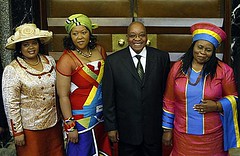
President Jacob Zuma of South Africa Will Take Another Bride

Zuma will take another bride - family

President Jacob Zuma was set to marry his fifth wife, a relative said in Nkandla on Tuesday afternoon.

Inkosi Bhekumuzi Zuma said Zuma would tie the knot with Thobeka Madiba next Monday.

He said Zuma's other fiancee, Gloria Bongi Ngema from Durban, had presented "umbondo" gifts to the Zuma family on Monday. Umbondo is the last Zulu traditional ceremony before the wedding. It is done after Ilobolo has been paid. It was not known when Zuma would tie the knot with Ngema.

Zuma married Nompumelelo Ntuli-Zuma, his third wife, two years ago during a traditional wedding at his Nkandla home.

Thobeka Madiba has attended many official events with the president.

The president was legally married to Kate Zuma, who died in 2000, and Home Affairs Minister Nkosazana Dlamini-Zuma. Dlamini-Zuma and the president divorced in 1998.

Zuma's spokesperson, Vincent Magwenya, refused to comment on the upcoming wedding, saying it was a family affair.

Approached for comment during Zuma's Christmas party in Nkandla on Tuesday, Zuma's aide Zizi Kodwa also declined. On Monday, Kodwa said he was not aware of the ceremony. He said he was in Cape Town and he would be in a position to know whether the wedding would take place later. - Sapa

Published on the Web by IOL on 2009-12-29 22:20:34

African Group Says It Kidnapped Italians

Wednesday 30th December, 2009

African al-Qaeda group says it kidnapped Italians

Big News Network.com
Tuesday 29th December, 2009

An African group with ties to Al-Qaeda has claimed responsibility for the kidnapping of an Italian couple.

An African group with ties to Al-Qaeda has claimed responsibility for the kidnapping of an Italian couple.

The pair was kidnapped in Mauritania. It is not known where they were taken to.

Al-Qaeda in the Islamic Maghreb has said it took part in the kidnapping in retaliation for what it described as Italy's crimes in Iraq and Afghanistan.

Italy has 3,150 troops in Afghanistan and 91 troops in Iraq. It announced this month it would send an additional 1,000 troops to Afghanistan in 2010.

Italy has already said it will not negotiate with the al-Qaeda group over the kidnapping, with Italy's Foreign Minister, Franco Frattini, responding to the news of al-Qaeda involvement by saying that Rome has no direct contact with any representative of the group and did not plan to negotiate with a terrorist organisation.

Frattini said there would be no change in Italy's policy in Afghanistan.

The kidnapped Italians, Sergio Cicala and his wife Philomene Kaboree, disappeared in southeast Mauritania on December 18th.

Afterward, Mauritanian authorities found the couple's car abandoned and riddled with bullet holes.

Mauritanian security forces said last week they had arrested a suspect in the kidnapping from neighbouring Mali.

Somalia News Update: IDPs Hold Demonstrations Outside Mogadishu; Talks With Chad

Hundreds of IDPs demonstrate out of Mogadishu, complain water shortage

Posted: 12/29/2009 5:09:00 PM
Shabelle: SOMALIA

AFGOI ( Sh. M. Network ) – Large demonstrations organized by the Somali Internally Displaced People (IDPs) and against the water shortage has been made between Mogadishu and Afgoi town in Lower Shabelle region, witnesses and officials said on Tuesday.

Most of the people were the Somali displaced people and were marching a long Afgoi corridor especially between the Lafole and Hawo Abdi villages, out of the Somali capital.

Hundreds of the displaced people, most of them from Mogadishu could be seen in the large demonstrations today and they were complaining about a bitter water shortage that faced all the Internally Displaced Peoples in the area.

MSF agency, one of the charity organizations operating between both towns Mogadishu and Afgoi and used to contribute water to the displaced people had formally informed them recently that it totally halted providing water to those people from 1st January 2010.

The agency said in a statement recently that it will not give any water to the IDPs.

Hundreds of the demonstrators had gathered at a square, out of Hawo Abdi village where the demonstrations continued complaining about the lack of water facing the displaced people in the area by reiterating their call about MSF to continue providing water to the feeble people.

The demonstrators lastly requested from the charity agency of MSF to give them water which the people are complaining about pointing out that they are currently encountering serious difficulties of water shortage.

The large demonstrations of the Somali Internally displaced comes as most of the displaced people who left from the Somali capital Mogadishu due to daily clashes did not get any aid support about 3 months in this year 2009.

By: Hassan Osman Abdi
For more send your comments to radioshabelle@ymail.com


Hizbul Islam conducts operations in southern Somalia

Posted: 12/26/2009 9:51:00 AM
Shabelle: SOMALIA

LUQ (Sh. M. Network) – Islamist fighters of Hizbul Islam have conducted operations between Luq and Dolow towns in Southern Somalia capturing several people during their operations, official told Shabelle radio on Saturday.

Sheik Hassan Al-iraqi, the security secretary of Hizbul Islam in Luq town explained more about the operations of their forces between both Luq and Dolow in Gedo region saying that the detained people included the village commissioner of Gedweyne his security men.

Sheik Hassan said that the commissioner and his staff were released from the jail immediately after a dialogue between the two sides.

The official said their main aim was to establish security on the street that connects between the Luq and Dolow where there had been insecurity recently. The group warned the bandits, who often commit crimes against the people traveling on that road, to move away from the area or suffer the consequences.

Asked about the reason the commissioner of Gedweyn arrested, Sheik Al-iraqi told Shabelle radio that they had suspected him of working with the transitional government and Ethiopian officials in Dolow, confirming that he was lately released from the jail.

The operations of Hizbul Islam organization comes at a time when gunmen, who recently took up positions between Dolow and Luq towns, who were allegedly committing banditry creating insecurity in the region of southern Somalia.

For more send your comments to radioshabelle@ymail.com


Heavy fighting breaks out in out of Beledweyn town

Posted: 12/29/2009 3:56:00 PM
Shabelle: SOMALIA

BALADWEYN (Sh. M. Network ) – Heavy fighting between the Islamist forces of Hizbul Islam and other armed forces has broken out in out of Beledweyn town in Hiran region, witnesses and officials told Shabelle radio on Tuesday.

Reports from the town say that the clashes between the two sides started at Hajub valley about 7 kilometers east of Beledweyn town on Tuesday morning as an armed group attacked bases of the Hizbul Islam forces in the outskirts of the town.

Both sides exchanged heavy weapon during the war, but the real casualties of the war is unclear so far.

Mo’allin Farah Da’ud, the security secretary of Hizbul Islam in Hiran region told reporters that their military bases were attacked by what he called armed gunmen adding that the fighting continued for a while.

“Now, we are making search operations in the mountainous areas around Beledweyn town in Hiran region. The side of Bari in the town. We shall pursue those groups quickly. We shall attack where they were from in the region,” said Mo’allin Farah

How ever, today’s fighting is the third war with in three days that starts around Beledweyne town in central Somalia.

For more send your comments to radioshabelle@ymail.com


Somalia: Civilians welcome Ethiopian troop withdrawal

MOGADISHU ( Mareeg ) –Somali people in Kalaber junction in central Somalia have welcomed Ethiopian troop withdrawal from the strategic intersection and also in Balanbal district in Galgadud region , witnesses said on Tuesday.

More Ethiopian troops who were in Balanbal and Kalaber junction in both Hiraan and Galgudud regions in central Somali left from their positions in the area fortnight and returned to where they were from earlier.

Residents around where the Ethiopians troops vacated told reporters that they soldier were present there about two weeks saying that they had had a difficult for their presence in those places expressing happiness about their leaving from the area.

The people around Kalabeyr and Balanbal had fears of possible fighting between the Islamist fighters and Ethiopian troops since their presence in both Hiraan and Galgudud regions.

Reports from Beledweyn town say that some of the Transitional Federal Government troops could be seen at Kalabey while the Ethiopians headed to Fer-fer, a town in the Somali region under the Ethiopian control.

The withdrawal of the Ethiopian troops came as fighting between Ahlu Sunna Walajama’a and Hizbul Islam occurred.

Mareeg Online


Tuesday, December 29, 2009

Eritrean Opposition Groups Threatens to Attack Troops

ADDIS ABABA (AFP) — An Eritrean opposition group told AFP on Tuesday it was "prepared to launch attacks" on government troops after the United Nations last week imposed tough sanctions on Asmara.

"This is a good opportunity for us," Cornelios Osman, head of the Democratic Movement for the Liberation of the Eritrean Kunama (DMLEK) said in a phone interview.

"We are preparing our military forces to launch more attacks," he added. "We are inside Eritrea and will hit selected targets and institutions."

The UN Security Council last week voted for an arms embargo and targeted sanctions against Eritrea, which has been accused of trying to destablise the Western-backed government in neighbouring Somalia.

Asmara condemned the decision as "a shameful day" for the United Nations.

But Cornelios said the travel ban imposed on senior officials would "further isolate the regime" and "deter it from receiving the hundreds of millions of dollars it gets" annually from the Eritrean diaspora.

DMLEK is a member of the Ethiopia based coalition Eritrean Democratic Alliance, of which two other groups have also waged a nascent armed struggle often staging hit-and-run attacks.

Eritrean President Issaias Afeworki has often dismissed his country's foreign-based opposition as "puppets" linked with arch-foe Ethiopia, with whom Eritrea recently fought a border war.

Some 80,000 people died in a 1998-2000 border conflict between the two neighbours, many in brutal World War I style trench warfare.

A UN-backed boundary commission charged with demarcating the border handed the disputed town of Badme to Eritrea but Ethiopia has refused to implement the ruling so far.

Source: AFP


SOMALIA: Hawa Siyaad, "They killed my hope"

MOGADISHU, 28 December 2009 (IRIN) - Twenty-three people were killed in Mogadishu on 3 December 2009 when a blast ripped through a graduation ceremony. Among the dead was a 24-year-old final year medical student whose mother, Hawa Siyaad, spoke to IRIN about that fateful day.

“My son asked me not to be late so I was one of the first to arrive. I closed my business [selling fuel] to be there. I was happy because I knew that my boy, Mohamed, would be going through the same ceremony next year. As the ceremony was in progress a huge explosion ripped through the hotel.

“All of a sudden, everything was in darkness. For what seemed like a long time I could not see or hear anything. I was dazed but everyone around me was scrambling to get away. I followed the crowd and then realized that my son was at the front. I started looking for him. There were dead and injured people everywhere. I finally found my son underneath an injured person. At first I thought he was also injured but quickly realized that he was dead.

“I tried to pick him up but could not. I just sat there next to him until someone helped me carry his body. You cannot imagine the pain of holding your oldest child, dead. That day they broke my heart and took away my hope and dreams.

"I worked so hard to put him through university. Every day, no matter how difficult - even with bullets flying around - I sat and sold fuel to make sure he got an education. He was our future and our hope. That day they killed my hope and the future of our family… He and his friends did not deserve to die like that before they had even begun their lives.

“I know of no religion - not mine or anyone else's - that condones what they [the perpetrators] did. I will never forget or forgive what they have done to us.”

Tuesday, December 29, 2009

Sudan News Update: Groups Together for Historic Peace Talks; Chad-Sudan Talks

Sudan: UN Brings Sudanese Tribes Together for Historic Peace Talks

United Nations News Service
29 December 2009

The United Nations has paved the way for historic talks between clashing tribes to bolster the fragile peace in the disputed oil-rich area of Abyei, close to the border between Sudan’s north and south and where a referendum on its future is scheduled to be held in 2011.

Nearly five years after the signing of the peace pact ending more than two decades of north-south strife, one of Africa’s longest and bloodiest civil wars in which at least 2 million people were killed, tensions persist in Abyei, home to the Missiriya and Dinka Ngok tribes.

In July, the Permanent Court of Arbitration in The Hague shifted some of the borders of Abyei, leaving control of the Heglig oil field with the national Government in Khartoum.

Although that ruling was welcomed by both the National Congress Party (NCP) and the Sudan People’s Liberation Movement (SPLM), the two signatories to the 2005 peace agreement, the relationship between the Missiriya and Dinka Ngok tribes has been marked by clashes and inflamed tensions.

Recognizing the need for dialogue at this critical juncture, the UN Development Programme (UNDP), the UN peacekeeping mission in Sudan (UNMIS) and the Abyei Area Administration joined forces to bring the leaders of the two tribes together for the first time in the conflict’s history.

During the 14 December meeting, which kicked off to cheering, drumming and dancing, top officials from the tribes discussed border security, arms control and migration issues.

Over 2,000 people from both tribes attended the talks to accelerate reconciliation and to dispel misconceptions, such as the rumour that the Dinka intend to build a barrier to prevent the Missiriya from herding their cattle between pasture and water.

“Peaceful co-existence is not a matter of choice, but is prerequisite for the continued existence of the two communities because the Missiriya and the Dinka will always remain neighbours irrespective of the 2011 referendum results,” said Amir Kwol Arop Kwol, Paramount Chief of the Dinka Ngok tribe.

The dialogue was also the first in the history of peacebuilding in the Abyei area in which women took an active part in the talks.

“Women bear the heaviest burden during conflict situations,” according to Nyancuk Truk, a representative of the Dinka. “We not only lose our sons and husband in the fighting, but we also lose our dignity.”

UNDP stressed in a press release that “only through the support to community reconciliation dialogues in Sudan that bring together women groups, youth and traditional leaders will the region be able to ensure its hard-won peace.”


United States Department of State (Washington, DC)

Africa: U.S. Welcomes Chad-Sudan Engagement

29 December 2009
press release

The United States welcomes the continued engagement between Chad and Sudan to normalize relations as discussed during meetings last week with Chadian Foreign Minister Moussa Faki and Sudanese Presidential Advisor Dr. Ghazi Salahuddin.

The United States is encouraged by the decision of these two neighboring countries to implement their 2006 bilateral Security Protocol. We urge the parties to fulfill their commitments and set up an appropriate and effective border monitoring mechanism on their shared border as soon as possible.

The United States commends these steps and urges the Governments of Chad and Sudan to push forward with rapid implementation of the protocol. The meeting scheduled for January 7, 2010 in N'Djamena, Chad is a positive step toward implementation.

Full normalization of relations, including the ending of support for armed rebel groups on both sides, if fully implemented, remains a key element in advancing the Darfur Peace Process. The United States is fully committed to peace in Darfur and supports continued improvements in bilateral Chad-Sudan relations as an important step in that process.


Uganda: LRA Training Camps Now in South Darfur - SPLA

Angelo Izama
27 December 2009

The South Sudan People's Liberation Army has said the Lord's Resistance Army as well as other militias allied to the government of Omar El Bashir are training in Western Bahr-El-Ghazal.

Quoted in the Sudan Tribune the Spokesman for the southern army said its forces had engaged the LRA in Raja county in Western Bahr-El- Ghazal. This confirms earlier information (in September 2006) from Ugandan and western intelligence -sources that the LRA, which dodged a widely billed peace-deal with the Kampala government, had charted a course through DR Congo, Central African Republic and northbound to Bahr-E-Gazal.

At the time, sources had told this newspaper the plan was to find ground to set up camps and recuperate. "They would then be re-inserted into South Sudan in or around the time for the referendum for secession in 2011" the sources said.

The SPLA Spokesman Maj-Gen. Kuol Diem Kuol said they believed LRA fighters were receiving direct assistance from the Khartoum government. He said after a skirmish between SPLA troops and LRA combatants on December 19th they recovered food rations whose origin is northern.

"The LRA left behind a large quality of food, most of which are Dak, made in North Sudan," he said, adding that the rebels then fled toward CAR. "LRA is re-grouping and training in Sudan in Dimo in Southern Darfur. This is a fact known to the intelligence community - in the area of Kaskagi in the northwest of Darfur," he told the Tribune.

According to the Enough Project, an anti-genocide campaign group, this month that the LRA was planning end of year attacks on villages in DRC but warned that civilian protection was weak because the SPLA and other national and international forces were not equipped to deal with the rebel threat.


Uganda: LRA Kill 1,300 in Sudan, DRC

Hudson Apunyo
28 December 2009

1,300 civilians have died in Sudan and the Democratic Republic of Congo in 10 Months following Human Rights abuses allegedly committed by rebels of the Lord's Resistance Army, according to latest periodic reports by United Nations High Commissioner for Human Rights.

One report on southern Sudan reveals attacks on civilians in Western and Central Equatoria States, between December 15 2008 and March 10 2009.

The report on the DRC states that at least 1,200 civilians were killed, including women who were raped before execution. According to the report, more than 100 people were wounded by gunshots and stabbing and about 1,400 people were abducted and some executed or are missing.

Sexual slavery"During their captivity, abductees were subjected to forced labour in fields, forced to carry looted goods or personal effects or recruited into the LRA. Women were forced to marry LRA members, subjected to sexual slavery, or both," the report released last week said.

It adds: "Thousands of homes, dozens of shops and businesses, as well as public buildings, including at least 30 schools, health centres, hospitals, churches, markets, and traditional seats of chiefdoms, were looted, set on fire and over 200,000 people were also displaced."

Describing harrowing experience from victims, the report called on the international community to co-operate with the ICC in investigating, arresting, and transferring all LRA leaders accused of international crimes.

The report also accused the DRC army, FARDC, of human rights violation of the displaced persons instead of protecting them.

"Soldiers of the Congolese armed forces, supposed to protect civilians, also committed human rights violations, including executions, rape, arbitrary arrests and detentions and illegal, cruel, inhuman or degrading treatment and extortion," the report said.

The report stated that attacks, systematic and widespread human rights violations carried out since mid-September 2008 against Congolese civilians may constitute war crimes and crimes against humanity.

The Sudan report on the other hand based on 27 confirmed attacks, reveals that at least 81 civilians were killed in attacks and many others injured.

"The evidence presented in this report suggests that LRA actions may amount to crimes against humanity," the report says. The reports recommended that the United Nation Mission in Sudan should exercise its protection of civilians since its mandated to prevent further loss of life.

"The international community, including governments, should cooperate with the ICC to search for, arrest and surrender the LRA leaders accused of war crimes and crimes against humanity. The international community should support meaningful peace efforts between governments in the region and the LRA," the report recommends.

Issues in report

Women were forced to marry LRA members, subjected to sexual slavery or both.

Thirty schools, health centres, hospitals, churches, markets, and traditional seats of chiefdoms, were looted, set on fire. Over 200,000 people were displaced.

The report describes the report as systematic and widespread human rights violations carried out since mid-September 2008 against Congolese civilians may constitute war crimes and crimes against humanity.

DRC army accused of violating rights displaced persons instead of protecting them.

Millions More to Lose Homes in the United States During 2010

Millions more to lose homes

Gov’t continues to bail out bankers, not homeowners

Published Dec 23, 2009 4:32 PM

Moratorium on foreclosures needed now more than ever

By Jerry Goldberg

Testimony at a hearing on Dec. 8 by the U.S. House Committee on Financial Services documented how the foreclosure crisis is getting worse.

Laurie Goodman, senior managing director at Amherst Securities, a leading broker/dealer specializing in trading mortgage-backed securities, testified that in the third quarter of 2009, 14.1 percent of borrowers — or 7.9 million homeowners — did not make their mortgage payments. She estimated that 7 million of these 7.9 million homeowners will lose their homes. (www.house.gov)

Julie Gordon from the Center for Responsible Lending testified that the effects of high unemployment and defaults in exotic Alt-A and option mortgages will add millions of homeowners to this total. She estimated that by the time this crisis abates as many as 13 million families will have lost their homes. In addition, tens of millions of other homes are suffering a decrease in property values totaling hundreds of billions of dollars in lost wealth, costing states and localities enormous losses in tax revenues used to pay for government services.

Gordon testified how the Obama administration’s Home Affordable Modification Program has fallen far short of its promise to help 3 million to 4 million homeowners with loan modifications. After nine months of operation, only approximately 650,000 homeowners are now in a trial modification. However, only a fraction of those in trial modifications have received a permanent loan modification. In addition, HAMP has no provisions for principal reductions and offers no help whatsoever for the unemployed who cannot pay their loans due to the loss of their job.

Government bank bailout continues

How is it that bank profits are rising while foreclosures grow exponentially? The reason is that the government is increasingly guaranteeing bank losses due to foreclosures by reimbursing the lenders at full value for overvalued mortgages when there are defaults. This “silent bailout” continues every day even as the banks make a show of returning their Troubled Asset Relief Program funds so they can go back to paying $30-million executive bonuses.

Fannie Mae and Freddie Mac, which own or guarantee about half of the country’s mortgages, were taken over by the government in July 2008. The Treasury Department committed $400 billion in taxpayer money to fund the takeover initially. Fannie Mae and Freddie Mac are burning so much cash bailing out the lenders — $15 billion by Fannie Mae in November alone — that the Treasury is considering an infusion of another $400 billion in taxpayer funds into these entities. (New York Times, Dec. 17) Coupled with funds from the AIG and GMAC bailouts, which are being utilized to pay off lenders on foreclosed properties, it is estimated the total government lifeline to the banks to cover their losses from foreclosures could rise to $l trillion.

The effect of this continued bailout to the banks is that it actually discourages lenders from reducing the principal on mortgages whose values they inflated through their predatory lending practices. This is because they know the government will pay them full value when the borrowers default.

Goodman testified to Congress that in the second quarter of 2009, 30.5 percent of mortgage loans in bank portfolios received a principal reduction as part of a modification. However, the corresponding number for loans guaranteed by the government through Fannie Mae, Freddie Mac, Federal Housing Administration, etc., was zero.

Incredibly, while the current situation cries out for a moratorium on foreclosures and fundamental reductions in loan principals, the Obama administration and Congress have been silent in implementing these measures and have not enforced already-passed legislation which could do so.

For example, the Helping Families Stay in the Their Homes Act, passed on May 20, states that it is the sense of Congress that there should be a moratorium on foreclosures until the Treasury Department certifies that HAMP has been implemented. Clearly, the statistics cited above and testified to at the congressional hearing demonstrate that HAMP has not been fully implemented. Yet Congress and President Barack Obama have not enforced this law and implemented a moratorium.

In addition, the Fannie Mae and Freddie Mac bailout bill, the Home Economic Recovery Act passed in July 2008, provides for loan modifications and workout agreements by servicers when the net value would be greater than the value of the home in foreclosure. Why isn’t the government ordering that banks holding Fannie Mae and Freddie Mac loans reduce the principal on those loans to their real value? Instead, they are paying lenders the inflated mortgage loan amount, and then selling the homes for less than half that amount, with the taxpayers picking up the difference.

The fight against foreclosures and evictions and against the banks and government that continue to bail them out will be a critical part of the fight for jobs and economic justice as the struggle unfolds in the coming months.

Articles copyright 1995-2009 Workers World. Verbatim copying and distribution of this entire article is permitted in any medium without royalty provided this notice is preserved.

Workers World, 55 W. 17 St., NY, NY 10011
Email: ww@workers.org
Page printed from:
http://www.workers.org/2009/us/foreclosures_1231/