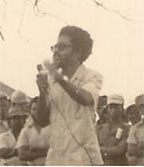
Walter Rodney of Guyana was the author of several books including Groundings With My Brothers, A History of the Upper Guinea Coast and How Europe Underveloped Africa. In 1972 he was a visiting scholar at the University of Michigan in Ann Arbor.
Originally uploaded by Pan-African News Wire File Photos
By Walter Rodney
African Review [Dar es Salaam, Tanzania]
1:4 (1972), 61-76.
This article attempts to identify Tanzanian Ujamaa with Scientific Socialism in certain ideological essentials. It is an exercise in theory, bearing in mind that historically the theory of socialism preceded the establishment of socialism as a system in any part of the globe.
Scientific Socialism (or Marxism, if you like) is an explicit world-view which contemplates every conceivable phenomenon from protein to literature, in terms of a methodology applicable to nature and society.
Therefore, the comparison with Tanzanian Ujamaa is not completely analogous, since the latter is neither explicit nor all-embracing.
However, the same kind of reservation could probably be expressed for any ideological variant other than Scientific Socialism. One must, in most cases, seek ideology in human actions, combined to greater or lesser extent with statements of principle or policy. The Tanzanian political process has produced over the last decade several noteworthy declarations of principle and sufficient actions which give meaning to the said declarations.
The work 'Ujamaa' has already been popularized in two contexts: firstly, as referring to the extended family of African communalism; secondly, with reference to the creation of agricultural collectives known as Ujamaa villages. The relation between the two is that the Ujamaa villages seek to recapture the principles of joint production, egalitarian distribution and the universal obligation to work which were found within African communalism. In the present discussion the world 'Ujamaa' incorporates both of these meanings, and includes also the implications of several policy documents and public plans.
A necessary piece of ground-clearing must be performed by advancing the negative proposition that Tanzanian Ujamaa is not 'African Socialism'. Such a disclaimer may appear curious and even presumptuous in view of the fact that in 1962 Mwalimu Nyerere referred to Ujamaa as 'the basis of African Socialism'. But, there are several reasons for keeping the two concepts widely apart.
When 'African Socialism' was in vogue early in the 1960s, it comprised a variety of interpretations raging from a wish to see a socialist society in Africa to a desire to maintain the status quo of neo-colonialism.
Since then the term has come to be identified with its most consistent and least revolutionary ideologue, Leopold Senghor, and with the late Tom Mboya. As such, 'African Socialism' is generally taken to mean a set of relations which leave capitalism and imperialism unchallenged.
It is therefore essential to disassociate the anti-capitalist and anti-imperialist stance in Tanzania from a caption that has been pre-empted by non-revolutionary African leaders. Furthermore, when Ujamaa was presented as an option shortly after the independence of Tanganyika, it was (knowingly) defined as an abstract set of values without reference to the social forms necessary for their realization.[1]
Much has now been done in the way of policy decisions to indicate and build the relevant social structures, thereby further differentiating Ujamaa from its erstwhile counterparts of 'African Socialism' in so far as the latter never advanced from the ideal to the real. Above all, one must take note of the progressive evolution of Tanzanian theory and practice over the period of nearly a decade, as a positive response to national, African and international developments.[2]
Conversely, to associate Ujamaa with the category 'Scientific Socialism' seems to be flying in the face of assertions to the contrary by Tanzanian policy makers. Scientific Socialism is held to be synonymous with Marxism, Communism, and the like, which have been held at arm's length by Tanzanians who propound Ujamaa.
The contradiction is more apparent than real. In part, it disappears when one take into account the above-mentioned factor of significant politico-ideological advance from Arusha to Mwongozo. In addition, and more decisively, the difference is largely based on a caricature of Scientific Socialism (Marxism), which proposes that socialism must come through proletarian revolution within an already developed capitalist state.
Such a definition would automatically exclude Tanzanian Ujamaa, which looks toward the socialist organisation of peasants and seeks to revive and perpetuate the collective principle of production and the equalitarian nature of distribution which characterised communalism.
As carried out both by some self-professed Marxists and by bourgeois analysts, the transformation of Marxism into a barren, dogmatic, mechanistic and uni-dimensional theory has understandably led many creative individuals to reject what purports to be Scientific Socialism. To re-open the issue, one must go back to first principles and rescue the essence of Scientific Socialism.
Socialism emerged as an ideology within the capitalist society. All of its exponents saw the viciousness of capitalism and agreed on the need for replacing the prevailing production for private profit with a system which met the needs of all.
However, they were not agreed on either the precise content of socialist society or the means by which it was to be instituted. It is in these areas that the necessity arose for distinguishing between unrealistic socialist hopes and a more rigorous analysis which could claim to meet the canons of scientific method and which by its correctness guaranteed meaningful action for the realisation of socialism. For Marx, 'Scientific Socialism' is quite simply socialism that is scientific.
Saint-Simon, Owen, Fourier and other pioneer socialists of the early 19th century were dubbed 'utopian' by Marx and Engels for a variety of reasons, notably because they failed to appreciate that human social development proceeded through certain stages and because their model socialist societies did not take cognisance of the reality of class struggle.[3]
On the other hand, the rubric 'Scientific Socialism' still attaches to the mode of perception which predicts the emergence of socialism as a produce of the dialectic movement of all previous history and as a consequence of the triumph of the working class. Utopian socialism or at least utopian elements in socialist thought have persisted and re-appeared from time to time.
'African Socialism' is utopian in its refusal to come to grips with the class relations in which Africans are enmeshed and in its romanticised ignorance of the stages of African historical development. It is the contention of the author, that in contrast, Tanzanian Ujamaa is correct in its perception of the principal motion of its own society.
The assertion that 'there are no classes in Africa' is often used to justify capitalist investment in the continent and in recent times it has come under criticism from progressive African thinkers.[4] Firstly, it must be noted that the international character of capitalist production in the era of imperialism has placed the propertied class in the metropoles while the greater portion of their working force resides in the colonial or semi-colonial areas.
Secondly, the colonial sectors show varying degrees of stratification and class formation as a consequence of their integration in the international capitalist economy. Both of these features are recognized in the Tanzanian policy documents which elaborate on the theory of Ujamaa: TANU's Arusha Declaration and Mwalimu Nyerere's Socialism and Rural Development being the most relevant.
The Arusha Declaration had little to say about the development of socialism in the countryside beyond expressing the opinion that concern for the peasant farmer must be a priority. However, this document set the stage for the policy of constructing Ujamaa villages by expropriating the foreign capitalist class who until then were owners of the major means of production within Tanzania. It stated unequivocally that the major means of production are under the control and ownership of the peasants and the workers themselves through their Government and their Cooperatives.
Nationalisation and the acquisition of part ownership of several companies were steps in the direction of severing the links between the local working classes and the international bourgeoisie. The Arusha Declaration also stated that socialism was incompatible with the presence of capitalist elements, in contrast with 'African Socialism' which has as one of its major tenets the advocacy of co-existence of private and public ownership.
Utopian socialists promoted models in which capitalists cooperated with their workers in the new society. They sometimes assigned a major initiatory role to the bankers. Senghor's proposal was to socialise agriculture, to establish public utilities as a mixed sector and to leave banks, commerce and industry to capitalist enterprise.[5] The sum total of these arrangements would be 'African Socialism'.
In so far as contemporary theory and practice of Ujamaa in Tanzania does allow for private enterprise, this is well understood to be transitional, an entirely different concept from that of the permanent co-existence of capitalist and supposedly socialist relations within the same society, and one that has been implemented in every socialist revolution from 1917 onwards.
Both feudalists and capitalists are cited by the Arusha Declaration as enemies of socialism. The former had their place in the scheme of things in Africa before the coming of the Europeans, while the latter came into being as part of the process by which metropolitan capitalist society was remodelling colonial society (wittingly and unwittingly) along lines of stratification and exploitation.
The Indian businessmen in East Africa were the closest representation of a locally resident bourgeoisie, and it is no accident that they were the most affected by the measures of expropriation behind the nationalisation of foreign-owned property, i.e. by the Acquisition of Buildings Act, 1971.
Thus, both ideological statements and government policy pinpointed that within Tanzania there were capitalists and feudalists standing in opposition to the workers and peasants. The Arusha Declaration does, in the same breath, make a rather unsatisfactory distinction between urban and rural Tanzania as representing exploiters and exploited, respectively.[6]
It is in Socialism and Rural Development that stratification in the countryside is also acknowledged and a realistic assessment is made of African communal society, as it was and as it is becoming.
Having extolled the virtues of 'traditional' African living in Africa, Socialism and Rural Development proceeds to identify both its inadequacies and the fact that communalism as a way of life and a value system has been constantly eroded under the pressure of African involvement in capitalism. Because of cash-crop farming in particular 'the old traditions of living together, working together and sharing the proceeds, have often been abandoned'.
In place of the old Ujamaa patterns, there was a growing gap between those who owned and hired labour and the landless who offered their labour for hire in order to survive. In this context, Mwalimu Nyerere predicted that, unchecked, such a development raised the spectre of most of the peasantry becoming a 'rural proletariat' working for the minority landed class.[7]
This observation attests to the fact that the theory underlying the modern version of Tanzanian Ujamaa identifies contradictory forces within the nation as well as the direction for change that must result from the interplay of such forces.
Marx and Engels attacked 'Proudhonism' because, among other things, Proudhon saw socialism as being based on independent petty producers of the artisan class.[8] But changes in technology by the mid-19th century had convincingly demonstrated that the artisans were doomed to extinction by machine production and the universalization of capitalist relations.
Of course, the peasant is also a petty producer and has actually been eliminated in large parts of Western Europe. The question as to whether there is a possibility of using peasant production as the basis for a socialist state has been raised in many debates, and its resolution depends upon the local and international political economy of the time. Before tackling this issue in the specific context of Tanzania, it is enlightening to pursue briefly the debate on 'Peasant Socialism' as it was conducted in the rather similar context of late 19th century Russia.
Like contemporary Tanzania, 19th century Russia was an exploited semi-colonial sector of the international imperialist economy. Unlike Tanzania, Russia had experienced fully matured feudal relations and was becoming capitalist and industrialized from its own internal dynamic, quite apart from the intrusion of Western European capitalism.
Nevertheless, there had persisted under feudalism and embryo capitalism certain communal forms of organisation among the peasantry - namely, the obshchina or mir (village communes) and artel (artisans' cooperatives). Russians of a socialist or anti-capitalist bias contemplated a socialist society that was qualitatively different from that envisaged by their counterparts in industrialized Western Europe.
They argued that Russia could avoid the maturing of capitalist relations within its national boundaries and move directly to a brand of socialism where the dominant social class was not the industrial proletariat but rural peasants, living a life that was not far removed from the communalism that preceded enserfment and capitalism.[9]
Obviously, there is a great deal in Tanzanian Ujamaa that is analogous to the pre-occupations of the Russians in question, who are known to posterity as Populists.
In the 1870s and early 1880s, late in their veteran careers, Marx and Engels were asked to comment on the possibility of Russia avoiding capitalism. In a letter to K. Kablukova, a Populist, Engels viewed favourably the opportunity presented in Russia 'to be able to appeal to the people's thousand year old natural urge to associate, before this urge is wholly extinguished' (emphasis supplied).
Marx expressed the opinion that the rural community was the mainspring of Russia's social regeneration, but that in order that it might function as such, one would first have to eliminate the deleterious influences which then assailed it from every quarter.[10] The vital condition for the successful building of socialism in Russia on the old communal base was speed to forestall further inroads on surviving collectiveness. In addition, it was essential that revolution in Russia be preceded by or immediately followed by the outbreak of a workers' Revolution in an industrialized part of Europe.
This point is made in the introduction to the first Russian edition of the Communist Manifesto published in 1877 and again at some length in Engels' statement On Social Relations in Russia (1882). Some years later, Engels reaffirmed the contention as follows:
I would say that no more in Russia than anywhere else would it have been possible to develop a higher social form out of primitive agrarian communism unless - that higher form was already in existence in another country, so as to serve as a model. That higher form being, wherever it is historically possible, the necessary consequences of the capitalist form of production and of the social dualistic antagonisms created by it, it could not be developed directly out of the agrarian commune, unless in imitation of an example already in existence somewhere else.[11]
As seen in the above, Marx and Engels dealt with the stages of human social development in a much more flexible manner than they are usually given credit for. They are of course insisting that the movement from communalism to feudalism to capitalism to socialism is a movement from lower to higher forms, with implications for the volume and efficiency of production and the satisfying of human needs.
But they are not implying a single mechanical line of historical progression, and they actually deny this in the course of the discussion. In a comradely letter to Vera Zasulich in 1881, Marx explained that his description of the historical inevitability of the foundation of the capitalist system was expressly limited to the countries of Western Europe.[12]
Four years earlier, he had made the same point with rather greater asperity in reply to a detractor, Mikhailovsky, who insisted on misreading Marx. Firstly, Marx reminded his readers that the chapter on primitive accumulation in Das Kapital does not pretend to do more than trace the path by which, in Western Europe, the capitalist order of economy emerged from the womb of the feudal order of economy.
He then proceeded to show that the given historical sketch of Western Europe might be applicable to Russia if Russia continued to move in the same capitalist direction as Western European countries; for in that case Russia could not succeed without first transforming a sizeable number of peasants into proletarians.
However, Marx vigorously disavowed any intention of using his model of Western Europe to provide a historical-philosophical theory of the general path every people is fated to tread, whatever the historical circumstances in which it finds itself.[13]
Although Marx completely disowned the proposition that a people must move to socialism via capitalism, it is understandable that bourgeois academics ignore this and interpret Marx to mean exactly what he said he did not mean.[14] But even self-styled Marxists have also made it appear that Scientific Socialism can be arrived at only on the basis of an advanced proletariat within a given country and hence only after capitalism has held in sway that country for a lengthy epoch, in precisely the same manner as Western Europe.
As far as Russia was concerned, the discussion by populists and Marxists about avoiding capitalism turned out to be one about a non-realisable hypothesis. Marx and Engels feared that the process of stratification in the countryside would continue unchecked. Information reaching them from the late 1870s suggested that Russian communal forms were becoming shells which only hid the new exploitative relations of capitalist society.
Towards the end of his life, Engels regretfully concluded that the obshchina should be treated as a dream of the past. A fine chance had been missed, but reality had to be faced, for capitalism was being built in Russia on the labour of landless peasantry turned proletariat.[15]
A few years later, when Lenin made his in-depth analysis of The Development of Capitalism in Russia, he convincingly demonstrated that the capitalist process was far too advanced to think in terms of by-passing that stage. In other words, the creation of a rural proletariat and of landlord farmers which Socialism and Rural Development was interested in avoiding in Tanzania had already occurred in Russia by the turn of the present century among the peasants themselves - in addition to the continued existence of feudal and bourgeois landowners.[16]
Even after it became clear that internal and external factors were hastening the final decomposition of Russian communal forms, some theorists still clung to the idea that Russia could build socialism on the model of an old commune. Only at this point were they eschewed by Scientific Socialists as propagating Populist Utopianism.
For instance, in 1890, Engels declared that the Populist, Danielson, was beyond hope, in spite of prolonged ideological exchange and correspondence to clarify the conditions under which Russian communalism could be revived.[17] For purposes of an analogy with Tanzania and Africa, what is crucial is that the founders of Scientific Socialism seriously and enthusiastically contemplated a variant of socialism very much akin to Ujamaa, and they indicated the conditions under which it might be realised.
The most important requirements were, firstly, that the 'traditional' forms should exist in real life and have some social vitality, and, secondly, that international conditions should be favourable owing to a socialist breakthrough in some part of the world. For Africa, the fulfilment or nonfulfilment of these conditions needs to be examined.
An effort has already been made to underscore the idea that for Marx different paths to socialism did exist, precisely because of varied experience of movement from one social phase to another. It is of some value to the history of philosophy to keep the record straight on this issue; although one is primarily concerned not with establishing Marx's correctness but rather with confirming the truth of the observation that the movement of different peoples through history has had significant variations.
This could be illustrated within Europe with regard to the contrast between Eastern and Western Europe. As far as Asia is concerned the social stage parallel to that of feudalism in Europe bore sufficient peculiarities to the categorised separately as 'the Asian Mode of Production'.[18]
Most relevant to the African continent is the debate on a possible 'African Mode of Production'.[19] With the exception of parts of the Middle East and Egypt, neither Asia nor Africa had slavery as a distinct social system, and African societies had very little servitude outside of the context of capture for export. From African communalism, the evolution was in a feudal or quasi-feudal direction, and communal forms persisted even in the most stratified societies.
Ruling elites in empires as large as those of the western Sahara still maintained their authority through the heads of communities rather than through contractual relations with individual peasants.
It is in the pre-European era that Senghor seeks his model of pristine 'Socialism' in Africa. But, to begin with, communalism was not socialism. Collective production was narrowly restricted on an ethnic, clan and geographical basis, and the egalitarian principle of distribution was limited by the low level of production so that societies came nowhere close to fulfilling the needs of all their citizens - hence Marx's description of this stage as 'Primitive Communism'.[20]
Socialism is inconceivable prior to the emancipation of man from such elementary forces as drought, flood and disease. Besides, in determining whether African communalism has any relevance in the present time, one must identify it as still persisting, i.e. the thousand year old urge to associate must not have bee extinguished.
In many part of Africa, communal forms lost their primacy centuries ago with the emergence of feudal and quasi-feudal forms of exploiting labour, including household servitude. Large parts of Africa were integrated within the capitalist economy since the fifteenth century because of the European quest for slave labour.
Finally, there was the period of colonial rule which introduced capitalist exploitation of labour in every part of the continent. It certainly is not enough for Senghor to sound a warning of possible class formation in the present period, when it is obvious that Senegal has already passed through a lengthy and intense historical experience incompatible with the maintenance of communal forms or the practice of egalitarianism.
Admittedly, in 'Ujamaa - the Basis of African Socialism' Mwalimu Nyerere sounded a note rather similar to that of the standard version of 'African Socialism', when he asserted that 'We, in Africa, have no more need of being "converted" to socialism than we have to being "taught" democracy.'
However, taking the continent as a whole, Tanzania is exceptional in that even at the end of the colonial period the communal forms were still recognizable. This is a consequence of its people having been relatively little involved in the capitalist money economy of mining, settler plantations and cash-crop production.
The low degree of internal stratification at the time of constitutional independence was reflected in national cohesion and the solidarity of a single mass party. Between 1961 and 1967 there was increasing differentiation, so that 'Socialism and Rural Development' dealt with the core of the problem by determining that socialism could only be built in Tanzania by halting stratification and the creation of a rural proletariat.
This was the first of the conditions which Marx and Engels laid down when discussing how socialism might have been built on the basis of the Russian commune.
The possibility of regenerating traditional communalism also depends upon factors outside of the national political economy. This model for Ujamaa is as much in the present as in the past. If certain socialist values can be recovered from communalism, then equally there is the possibility of importing (and modifying) values and concrete attributes of socialism in any part of the globe.
When Mwalimu Nyerere referred to the weakness of traditional African communalism, he mentioned technological inadequacy.[21] This factor should be given greater emphasis because it was technological inadequacy which meant scarcity and led to stratification and the internal evolution of classes in parts of Africa before contact with Europe.
It was also technological weakness that led to loss of independence when Africa was confronted by European societies. Movement to a higher stage means massive strengthening of productive and defence capacity.
But, with true political independence, any African society can resume its interrupted socio-economic and technological development at a higher level by utilising the fund of scientific knowledge now available to mankind. Some of this knowledge is already in the hands of the first socialist states, and even if it is still the property of capitalists, it can be expropriated.
In effect, the skipping of stages involved in the jump from communalism to socialism is only possible in a given society because elsewhere the intervening stages have existed or are still existing and because, as Engels postulated, modern industrial socialism has broken the stranglehold which capitalism previously maintained on the world at large.
The first condition opens up the technological possibility of building socialism whilst the second provides a model and profoundly influences the international political situation. Amilcar Cabral put his finger on these points and explains lucidly that 'the possibility of such a jump in the historical process arises mainly, in the economic field, from the power of the means available to man at the time for dominating nature, and, in the political field, from the new event which has radically changed the face of the world and the development of history, the creation of socialist states'.[22]
Potekhin, the well-known Soviet specialist on Africa, a few years ago expressed his agreement with those versions of 'African Socialism' which aimed essentially at building socialism in Africa and using African paths to socialism. In his opinion, colonized Africa could move directly and uniquely to socialism largely because of the Soviet Union. The latter was available as a source of help and a power transforming the global political balance in such a way as to restrain the large capitalist nations in their exploitation and oppression of small would-be socialist states.[23]
The unstinted aid supposedly available from the Soviet Union would be regarded as illusory by most progressive Africans who are learning that self-reliance is definitely a superior alternative to any 'Big Brother'. However, it is true that the socialist sector of the world (divisions notwithstanding) offers a set of models, a set of alternative partners for trade and a more accessible source of technical aid.
Tanzanian external political and economic relations have already gone a long way towards maximising the advantage created by the existence of socialism in various parts of the world. It is one of the key ways of seizing what Marx considered a golden opportunity for moving to socialism on the basis of communalism and without having to experience the full development of classes characteristic of capitalism.
It can further be argued that a colony or semi-colony within the imperialist framework can never develop to full capitalist maturity. Africa has experienced almost as many years of capitalist development as Europe, but in our case the unfolding of capitalism has meant historical arrest and backwardness.
The accompanying stratification never approximated to the dynamic of capitalism in the metropoles. Thus, one could never expect capitalism to perform in Africa the historically progressive role it played in Western Europe. This is yet another fact of a more refined theory concerning the states of human social advance.
Such a theory must cease assuming that development is self-contained for any given group or society, and this line of reasoning also reinforces the conclusion that for Africa a different path to socialism is not only possible but is unavoidable.[24] An ideology such as Ujamaa is scientific in so far as logically and scientifically it charts this new path.
The fact that the path of Ujamaa in broad outline is so reminiscent of one perceived by Marx is a salutary co-incidence in so far as this particular discussion is concerned. Since so much of Marx's time was spent applying his scientific method to a critique of capitalism in Western Europe, any debate outside that geographical area cannot be tied merely to what Marx said, as though Scientific Socialism were entirely comprised within the pages of Marx's writings.
'Marxism' when considered as synonymous with Scientific Socialism means the application of scientific method (of which Marx was a founder) to the study of any given situation. This is a task of such complexity that Marx and Engels often issued warnings that the chances of incorrect conclusions were high.[25]
However, the argument that Ujamaa is consistent with Scientific Socialism is made easier to substantiate because of Marx's conclusions with regard to an obviously analogous situation. The Marxist who considers the stress on 'traditional' African communalism as theoretically incompatible with a Scientific Socialist approach must bear the onus of proving that Marx's brief application of his own theory was unscientific in the Russian case.
At the same time the non-Marxist seeking to isolate Ujamaa from what he imagines to be Scientific Socialism must at least be brought up short in light of evidence that Marx himself explicitly countenanced the possibility of a development towards socialism that integrated peasant collectives from the communal epoch.
After Marx's time, new (Scientific) Socialist ideas have been elaborated out of revolutionary experience. Their accuracy and relevance have been tested by nothing less than the experience of building socialism in economically backward countries in the teeth of imperialist opposition.
Ujamaa has not yet been fully tested in this sense and there are a wide range of 'social engineering' problems which have still to be tackled in the creation of new structures, new values and ultimately a new socialist man. If agriculture in Africa were already somehow mystically socialist, then there would not have arise all the travail of physical transposition and social re-adjustment which is actually going on in Tanzania.
Resettlement and collectivisation proves how many aspects of the prevailing system were at odds with modern socialism: notably, the isolated production units, low level technology, stratification and narrow vertical divisions. 'African Socialists' formulated 'socialist agriculture' as an existing reality rather than a goal to be achieved by rescuing communal elements; so it follows that they had no socialist programme.
Under Senghor, nothing has been done to relieve the exploitation of peasants producing cash crops and to remove rural exploitation; while in Kenya the only practical change in the agricultural sector as envisaged by Tom Mboya was the introduction of advanced agricultural machinery for the individual capitalist farmer.[26]
Even the more progressive African political and ideological leadership long neglected the countryside, and opted for a one-sided industrialization strategy. Tanzanian Ujamaa is a unique contribution to the African socialist revolution and to socialist theory as a whole because of its solid connections with the observable data in the Tanzanian countryside. This is the characteristic which causes 'Leninism' or 'Maoism' to be considered as having enriched the Scientific Socialism of which Marx and Engels were the founders.
Undoubtedly, a much greater gap emerges when one compares implementation of Tanzanian Ujamaa with the implementation of Scientific Socialism in the particular countries where this has been attempted. Here is where the disavowal of Scientific Socialism makes a real difference because it encourages an attitude of mind which masks contradictions and even throws overboard theory as such behind the guise of being 'practical'.
It can be argued that measures taken to implement socialism in Tanzania run the risk of being defeated for lack of a rigorous theory which comprehends the antagonistic and non-antagonistic contradictions of the world scene. The issue of nationalisation is a case in point.[27]
However, this does not mean that Ujamaa and Scientific Socialism are on two divergent paths. One should distinguish between an awareness of the fundamental movement of society and history, on the one hand, and adjustments to that movement in terms of struggle and construction, on the other hand.
The latter is always very problematical but the first is more fundamental requiring an understanding of which classes are on the ascendant and which social systems are moribund. Tanzanian Ujamaa can claim to be correctly focussed in this regard. This being so, there is no insuperable barrier to the development of scientific strategies and tactics.
The above argument may be considered further in relation to the rural sector. It cannot be said that the construction of Ujamaa villages has followed a scientific line of identifying points of weakness and strength as advocated by Engels and Lenin and as practiced by Mao Tse-Tung and Kim Il Sung.
But the theory and policy of Ujamaa has logically determined that the key role in Socialist construction has to be played by the Tanzanian peasants. This is in accord with the present stage of the development of productive forces within Tanzania and with the present international conjuncture, and such an insight gives Ujamaa its chances of success and ample scope for evolution which it would have lacked if the theory had backed the wrong class or the disintegrating capitalist social system.
The actual building of Ujamaa villages is a task requiring definite expertise. From a sociological viewpoint, practical implementation must take into account both the varying socio-economic formations found in Tanzania as well as the phenomenon of stratification.[28] Any sociologist might deal with some of the problems of collectivisation but ultimately it is only a Scientific Socialist approach that can guarantee success.
By way of illustration one could turn to Vietnam, where bourgeois social scientists lent their skills to the government of the U.S.A. in the creation of 'strategic hamlets.'[29] Their technical expertise ran counter to the movement of the society and the hamlets were dashed aside by the conscious and organised peasants of Vietnam. At the same time, collectivised agriculture in the liberated parts of the country has been moving forward steadily.
One searching test of the scientific nature of any version of socialism is its reflection of the interests of the most exploited and oppressed classes. Marx regarded Utopians as having advanced towards a more defensible position to the extent that individuals like Owen and Fourier grasped the fact that socialism was the ideology of the working class and that it must therefore uncompromisingly serve this class.[30]
Significantly too, the later Social Democratic deviation from scientific and revolutionary socialism reflected bourgeoisification of intellectuals and worker leaders in the epoch of imperialism. By way of rounding out a working understanding of Scientific Socialism, it should be made clear that socialist theory must voice the interests of the most exploited of the producers - this being perfectly possible alongside the phenomenon of class desertion by individuals from propertied or privileged strata, and alongside the assumption of leadership roles by these individuals.
In Africa (as in Europe, Asia and the Americas) it is from within the ranks of an educated elite that leadership is drawn for movements claiming to be socialist. But there is a vast difference in the fundamental class loyalties of those espousing 'African Socialism' as compared to Tanzanian advocates of Ujamaa; a difference between a parodied mischievous use of the term 'socialism' and the de facto elaboration of the theory to which a Marxist could readily subscribe in terms of its potential for realising a socialist society along scientific lines.
Fanon called for the self-liquidation of the African petty bourgeoisie and their regeneration as a revolutionary intelligentsia, but of course this is far from being the case within the continent as a whole. 'African Socialism' is the inflection which the African petty-bourgeoisie have given to bourgeois ideology in an attempt to camouflage from the masses the deepening capitalist exploitation of the neo-colonial era.
In sharp contrast, Tanzanian Ujamaa has begun to make the decisive break with capitalism. The evidence lies in the Arusha Declaration, in the Mwongozo, in the Tanzam railway, in the nationalisation of certain buildings and in virtually every act of Tanzanian foreign policy. Tanzania Ujamaa, limited as it is in actual achievement can substantiate the claim to be the ideology of the majority of Tanzanian producers in the countryside and the towns.
In the final analysis, simple honesty is a vital ingredient in Scientific Socialism - honesty in the cause of man, the workers, and dedication to his emancipation. Subjective as this may initially appear, it is very much part of the scientifically determinable process of social change, because consciousness is a principle factor in this process. This is precisely why Marxist theory is not mechanistic.
Wherever it makes a projection into the future, the calculation includes human will and consciousness as a variable, because knowledge, self-awareness and organised activity by the exploited are all tied together. Tanzanian Ujamaa has broken with the crude manipulative dishonesty of 'African Socialism'.
For instance, Tanzanian political leadership does ask for the 'traditional' communal virtue of hard work, but not in a context where local exploitation and class formation is allowed to proceed unchecked and is indeed promoted by the very theorists of 'socialism'. Therefore, Ujamaa can appeal to and deepen the consciousness of peasants and workers which imparts greater momentum to the people's struggle to build socialism.
From the viewpoint of social theory, it is not satisfactory that writings propounded Ujamaa never indicate awareness of the universality of communal forms. Examples broadly similar to African communal organisation can be drawn not only from Russia before enserfment, but from every part of Europe and Australasia at one time or another.
One of the first tasks of the scientist is to place things in the same category. Reluctance to do so in this case is probably due to the hankering after uniqueness among progressive Africans - something which occasionally leads into blind alleys, but which on the whole is essential for the liberation of the colonized.
The insistence on an African identity is a worthwhile corrective not only to bourgeois cultural imperialism but also to dogmatic expositions by self-styled Marxists or Scientific Socialists. Identification with the particularity of experience in Africa is as essential as appreciating the universality of scientific method.
When the doctrine of Ujamaa postulates an African path to socialism it affirms the validity of Scientific Socialism, in spite of the lack of any declaration to this effect by Tanzanian leadership and in spite of deliberate efforts to distort both Ujamaa and Scientific Socialism so as to present them as fundamentally contradictory.
Serious political considerations make it necessary to undertake this kind of abstract enquiry from the viewpoint of one committed to the African Revolution. When the task of evaluating African social thought and practice is left to bourgeois theoreticians, they find it convenient to place all ideological strands into one amorphous mystifying whole, which includes utterances by Tubman as well as Nkrumah, by Mboya as well as Sekou Toure, by Senghor as well as Nyerere.
Indeed, some go so far as to assert that 'in substance Nyerere and the Senegalese are closer than he is to Sekou Toure or Nkrumah'.[31] At the same time, progressive European friends often display a penchant for armchair Marxist perfection, so that for them Nyerere and Senghor are indeed in the same bag, because the former has not come forward to declare for Marxism.[32]
The superficial and confused nature of such a conclusion is a consequence of the authors not being involved in making revolution, for whoever is involved in the actuality of revolutionary transformation will not fail to perceive the differences between form and substance.
The substance of Ujamaa is its stand against capitalism, against imperialism, against racism and against exploitation of all kinds; and (to put it affirmatively) its stand for the emancipation of the working population of Africa and for the remodelling of the society along lines of socialist equality and socialist democracy.
Curiously enough, progressive Europeans are the ones who display the hegemonic tendencies characteristic of the imperialist metropoles, in so far as they have no time for insights that seem in any way to depart from models originating in Western Europe. The former imperialist masters, knowing the force of African nationalism which ousted them from the politico-constitutional sphere, do not ignore the search for an African identity, but rather take care to foster its most negative aspects; namely, the alienation from revolutionary features of European thought.
To remedy both defects, theory for the African Revolution must spring from those who have had the historical experience of and socialization under slavery, colonialism, de-culturalization, racism and super-exploitation which has been the peculiar lot of Africans. Within that context, it will then rapidly become clear who is supporting an anti-people line, such as 'African Socialism', and who is advocating genuine liberation as envisaged by Tanzanian Ujamaa.
A more rigorous assessment of current ideologies in Africa is also a political necessity on account of the possible dialogue between Scientific Socialists and Nationalists. The former are a mere handful, and in most African countries today can scarcely hope to co-operate with the existing regimes.
To do so would be to repudiate socialist principles, as well as to risk senseless liquidation at the hands of the 'African Socialists', 'Arab Socialists' and other denominations who are more concerned with fighting religious wars against 'Communism' than with emancipating the African people. But, the contention here is that Tanzanian Ujamaa offers a radically different framework for political action on the part of the self-conscious Marxist.
Whatever verbal affinities Ujamaa has with anti-Marxist doctrines it has placed the common struggle against capitalism and imperialism on a much higher plane. Scientific Socialism has been attacked time and time again.
Whenever the attack is based on overt or covert hostility to the working masses, it has been accompanied by a policy of alliance with the bourgeoisie against the most resolute workers elements. The history of Fabianism, Social Democracy and the like illustrates this clearly, and helps further to distinguish Tanzanian Ujamaa as being compatible with the precepts of Scientific Socialism and with the construction of a genuine socialist society.
Presumably, it could be documented that Tanzanian Ujamaa as it now stands is the product of a series of 'pragmatic' adjustments to difficult situations, comprising things such as the crisis of school leavers, the coup in Uganda and the problem of foreign exchange.[33]
However, the inference of most of the foregoing arguments is that the response has been suggestive of a commitment to the masses. If this were not so, why then have other African regimes reacted differently to the same stimuli and pressures as have manifested in Tanzania?
The progressive strengthening of a revolutionary stand in Tanzania (to which attention was drawn at the outset) is a factor of the greatest significance. It suggests movement on the road to socialism, both in practical terms and as an aspect of ideological development.
Of course, there is a major difference between historical tendency and accomplished fact, but consciousness and political behaviour form part of the bridge between the two. This is not to be overlooked by anyone attempting the rigorous task of applying scientific method to social reality with the view of aiding the birth of African and International Socialism.
Theory that is non-Marxist must be evaluated in terms of whether or not it is substantively anti-worker or anti-scientific. Invariably, socialist revolutions have their roots not only in Scientific Socialism as a body of thought but also in the formulas independently and correctly arrived at by precursors who did not use Scientific Socialism as their point of departure.[34]
African nationalists are certainly involved in the African revolution in the two types of front represented in Mozambique and Tanzania respectively: namely, the fighting front and that of 'peaceful' transformation. Leaders of these two related struggles will at some point have to come to terms with a consistent theory for 'appreciating' their situation and taking action.
Russia, China, Vietnam, Korea, Cuba - i.e., every successful socialist revolution has borne out the truth of Engels' observation that Scientific Socialism is the fundamental condition of all reasoned and consistent revolutionary tactics. The mobilization of the producers, the defence of revolutionary gains and the advance of the struggle against modern monopoly capitalism are not tasks that can be accomplished by good intentions alone.
Masses of people have to enter into an epistemology and a methodology different from those to which they have been accustomed. In China, they call it 'Mao Tse-Tung thought' - a blend of specific insights and pre-existing theory. There is nothing inherently improbable in Tanzanian Ujamaa continuing to advance to reach that position.
But, in the light of the claim that certain intellectuals have become so enamoured of Tanzania as to relinquish their critical function, let it be clear that this is no paean of praise. It is an assessment of a possibility that can be realised only though an ideological and political struggle to transcend the alienation from that part of the heritage of man which is called 'Scientific Socialism'.
--------------------------------------------------------------------------------
[1] J.K. Nyerere, 'Ujamaa - the Basis of African Socialism' (1962), in Freedom and Unity, p. 162. The opening sentences make this point - 'Socialism, like democracy, is an attitude of mind .... The purpose of this paper is to examine that attitude. It is not intended to define the institutions which may be required to embody it in modern society.'
[2] Significantly, Tanzanians or foreign observers who have been left behind by the trend towards heightened socialist understanding seldom pay attention to more recent pronouncements of Mwalimu Nyerere, but consider 'Ujamaa - the Basis of African Socialism' as a final blueprint.
[3] F. Engels, Socialism, Utopian and Scientific in Marx and Engels, Selected Works, Vol. 2, (Foreign Languages Publishing House, Moscow, 1962).
[4] See, e.g., Samir Amin, The Class Struggle in Africa (1964) African Research Group (Reprint 1970) and Kwame Nkrumah, Class Struggle in Africa, (Panaf Publications, 1970).
[5] Leopold Senghor, Nationhood and the African Road to Socialism (1960), see English translation, 1962, p. 78. The most relevant passage reads as follows: 'Our plan will include three sectors: a socialised sector - agriculture; a mixed sector - public utilities and companies with mixed economy; and a free sector. The latter - banks, commerce, industry - will itself be oriented towards the objects of the Plan and, to a certain extent, controlled... The mixed sector will preferably comprise transport and energy - within the limits of our possibilities, of course. As for agriculture, we are fortunate that it has traditionally been socialistic, because of the communal nature of Negro African Society.['] Glimpses of an interesting critique of this position by the Ugandan, John Kakonge, are to be found in B. Onuoha, Elements of African Socialism, (1964), pp. 89-92. At that time, Kakonge espoused Marxist ideas.
[6] The Arusha Declaration and TANU's Policy on Socialism and Self-Reliance, TANU, (1967), p. 13.
[7] J.K. Nyerere, 'Socialism and Rural Development' (1967), in Freedom and Socialism, especially pp. 342-344.
[8] The one available text which juxtaposes Marx and Proudhon is unfortunately rather unenlightening. It is J. Hampton Jackson, Marx, Proudhon and European Socialism, (1964). See pp. 110-101 for Proudhon's view of the petty producer.
[9] See Franco Venturi, The Roots of Revolution: a History of the Populist and Socialist Movements in Nineteenth Century Russia, English translation, 1960. See especially the chapter on N.G. Chernyshevsky.
[10] Marx and Engels, Selected Correspondence(Foreign Languages Publishing House, Moscow). (Translation of Russian edition of 1953), Engels to Kablukova, August 1880 and Marx to Zasulich, March 1881.
[11] Op. cit., Engels to Danielson, October 1893.
[12] Op. cit., Marx to Zasulich, March 1881.
[13] Op. cit., Marx to the editorial board of the Otechestvenniye Zapiski, November 1877.
[14] I.A. Potekhin cites an instance to the effect, which arose out of a discussion of 'African Socialism'. See William Friedland and Carl G. Rosberg (eds), African Socialism, (1964). In all fairness to Leopold Senghor, it should be noted that his hostility to Scientific Socialism is seldom ill-informed, and he shows his awareness of points of clarification such as those raised in the letters cited under notes 12 and 13.
[15] Selected Correspondence, Engels to Danielson, March 1892.
[16] V.I. Lenin, Collected Works(Foreign Languages Publishing House and Progress Publisher Moscow), Vol. 3, (1963). The Development of Capitalism in Russia was written in 1905 as an elaboration of one of Lenin's first analyses of political economy, entitled 'New Economic Development in Peasant Life'. For this, see Vol. 1.
[17] Selected Correspondence, Engels to Plekhanov, (February 1895).
[18] Karl Marx, Pre-capitalist Economic Formations (ed. E. Hobsbawm) and Centre d'Etudes et de Recherches Marxistes, Sur le 'Mode de Production Asiatique', (Editions Sociales, Paris, 1969).
[19] C. Coquery-Vidrovitch, 'Recherches sur un Mode de Production Afriquain', La Pensee (April 1968) and I. Varga, 'African Mode of Production: a Research Hypothesis', Universities of East Africa Social Science Conference, (Dar es Salaam, December 1970).
[20] The term is best avoided, owing to the perjorative implications attached to the word 'primitive' by anthropologists of the colonial period.
[21] J.K. Nyerere, 'Socialism and Rural Development', loc. cit., p. 339.
[22] A. Cabral, 'The Weapon of Theory' (1966) in Revolution in Guinea, p. 79.
[23] I. Potekhin, 'On African Socialism: A Soviet View', in Friedland and Rosberg, op. cit.
[24] For an overview of Africa's part in the international capitalist system, see the author's How Europe Underdeveloped Africa, (1972.) It should be noted that if capitalism is seen as a total system it would not even be necessary to advance an argument concerning skipping of stages.
[25] Selected Works, Vol. 2 and Selected Correspondence, Engels to C. Schmidt and J. Bloch, 1890. These are two of the clear instances.
[26] Tom Mboya, 'African Socialism' in Friedland and Rosberg, op. cit.
[27] See Issa G. Shivji, 'Tanzania the Silent Class Struggle', (1970).
[28] The variety of socio-economic formations is stressed in 'Socialism and Rural Development'.
[29] For a brazen piece of imperialist 'academic' writing along these lines, see W.A. Nighswonger, Rural Pacification in Vietnam, (1966), Praeger Special Studies in International Politics and Public Policy.
[30] Karl Marx, Capital, Vol. 3, (Moscow, 1962), p. 591.
[31] Challenor Morse, 'The Economics of African Socialism', in Friedland and Rosberg.
[32] In 1971, Swedish comrades reprinted 'The Silent Class Struggle' by Issa Shivji, along with comments by Saul, Rodney and Szentes. In an appended paragraph, it is stated provocatively that 'the ideology of African Socialism - be it developed by Tom Mboya, Leopold Sedar Senghor or Julius Nyerere - denies the existence of classes in African societies'. See Zenit Reprint 6, Stockholm.
[33] It could be said that the formulation of 'Education for Self-Reliance' had roots in the inadequacy of the colonial education system, with particular reference to the bottleneck at the secondary school level. The coup in Uganda sparked off the Mwongozo, while most recently the problem of foreign exchange led to restrictions on the importation of private cars, which politically is a curb on conspicuous consumption by the petty bourgeoisie.
[34] With reference to the Russian situation, both Marx and Lenin had the highest regard for Chernyshevky. In Cuba, Jose Marti falls into the same category, while Fidel Castro himself is a living example of transition from honest committed bourgeois idealism to Scientific Socialism.