Thursday, September 29, 2011

Venezuela Condemns U.S., NATO, UN Over Libya War at General Assembly

Venezuela condemns U.S., NATO, UN over Libya War at UN General Assembly

Posted: 2011/09/29

Venezuelan Foreign Minister: "There is a very serious threat to global peace: a new cycle of colonial wars, which started in Libya, with the sinister goal of refreshing the capitalist global system."

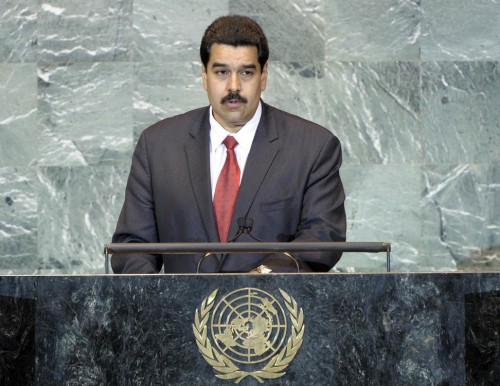
Nicolas Maduro Moros, foreign minister of Venezuela, on Tuesday lashed out at the involvement of the US-European North Atlantic Treaty Organization (NATO) and the UN in recent events in Libya.

Moros' statement came as he was addressing the general debate of the UN General Assembly at its 66th session to transmit a message from Venezuelan President Hugo Chavez Frias.

"Right now there is a very serious threat to global peace: a new cycle of colonial wars, which started in Libya, with the sinister goal of refreshing the capitalist global system, within a structural crisis today, but without any limit to its consumer and destructive voracity," Moros said.

"It is necessary to remember and to recur to our immediate memory: Venezuela, alongside the member countries of the Bolivarian Alliance for the Peoples of the Americas (ALBA), was actively advocating for a peaceful and negotiated solution to the Libyan conflict," said Moros.

The Venezuelan foreign minister said that peaceful resolution of the Libyan situation was derailed by the US and NATO and that reports of attacks on the Libyan people by the Libyan Air Force were unfounded in truth.

"However, after all, the logic of war decreed by the UN Security Council and put into practice by NATO, the armed wing of the Yankee Empire, was imposed," he said.

"The logic of war having its spearhead in trans-national mass media: let us bear in mind that the 'Libyan Case' was brought before the Security Council on the basis of intense propaganda by the western mass media, who lied about the alleged bombing of innocent civilians by the Libyan Air Force, not to mention the grotesque media setting of the Green Square of Tripoli."

He said that a premeditated bunch of lies were used to justify "military regime change policy" by NATO.

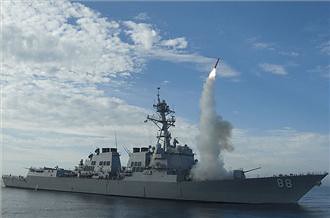
"It's worth wondering: what has the no-fly zone established by the Security Council resolution become?" said Moros. "How could NATO perform more than 20,000 missions against the Libyan people if there was a no-fly zone? After the Libyan Air Force was completely annihilated, the continued 'humanitarian' bombing shows that the west, through NATO, intends to impose their interests in North Africa, turning Libya into a colonial protectorate."

Moros said that Venezuela questions the legitimacy of the arms embargo placed on Libya through Security Council resolution 1970 and strengthened by resolution 1973.

"How can we say that an arms embargo was imposed on Libya, when it was NATO itself that introduced thousands of heavy weapons to support a violent upheaval against that country's legitimate government?" Moros said. "The embargo was, of course, meant to prevent the Libyan government from defending its sovereignty. This shows, once again, the cruel logic of international relations, where the law only applies to the weak."

Moros called for an immediate end to the NATO bombings in Libya and said the UN must reform in order to serve it's purpose.

He called the current state of the international organization a crisis, a point he said Venezuela has made previously.

"Since then and until now, nothing has been done: the political will of the most powerful ones has prevailed," said Moros. "Sure, the UN, as for its current functioning, docilely pledges to their interests. For us it is obvious that the UN is not improving and will not improve from the inside."

"If its secretary-general, along with the president of the International Criminal Court (ICC), take part in an act of war, as in the case of Libya, nothing can be expected from the current structure of this organization and there is no longer time for reforms: the UN does not accept any reform whatsoever, the illness within it is deadly," he added.

Moros criticized the Security Council, saying that a first step to re-founding the UN as a whole would be to eliminate the permanent member category and veto power from the peace and security body. He said that the General Assembly's power must be democratically maximized and that a comprehensive review of the UN charter, with the aim of redrafting a new one, should be imposed.

US to Deploy More Military Forces in Libya

US to deploy more forces in Libya

Wed Sep 28, 2011 2:53PM GMT
presstv.ir

According to White House spokesman Jay Carney, the United States is preparing to deploy additional forces on the ground in Libya to "secure conventional arms storage sites" as well as to try to track down missing surface-to-air missiles (SAMs).

In the wake of the opposition invasion of Tripoli, large arms depots across the western half of the nation were looted, and it is estimated that some 20,000 shoulder-launched SAMs were among what had gone missing, many of them wound up on the arms markets in neighboring nations. Antiwar

HIGHLIGHTS

Currently the U.S. State Department has one official on the ground in Libya, as well as five contractors who specialize in "explosive ordinance disposal", all working with the Transitional National Council to find the looted missiles, White House spokesperson Jay Carney told reporters. ABC News

"We expect to deploy additional personnel to assist the TNC as they expand efforts to secure conventional arms storage sites," Carney said. "We're obviously at a governmental level -- both State Department and at the UN and elsewhere -- working with the TNC on this." ABC News

Though weapons of all shapes and sizes were looted, the shoulder-launched SAMs are of particular concern to the U.S., as they could pose a threat to U.S. warplanes the world over now that they are out of the warehouses and in general circulation. Antiwar

20,000 is a lot of missiles too. One rights group cautioned that the SAMs coming out of Libya were enough to turn all of northern Africa into a no-fly zone. Though some regional groups are likely to be keen on acquiring many of these weapons, it is unlikely they will be restricted to northern Africa either, with groups in Yemen, Iraq and Afghanistan likely keen on their own acquisitions. Antiwar

FACTS & FIGURES

On March 19, U.S./NATO forces began striking government buildings, civilian neighborhoods, hospitals, schools, communication satellites, ships and ports in Libya. workers.org

The United States launched its first airstrike by unmanned drone planes in Libya on April 23. RTE News

President Obama assured Americans in March when the bombing campaign over Libya began that there would be no boots on the ground. From the East Room of the White House on March 18, he said: "The United States is not going to deploy ground troops into Libya." Fox News

Some experts say the main motive behind the Western attack on Libya is the vast oil reserves of the North African country. wordpress.com

The continuing battle for Libya currently focuses on two towns holding out in the north - Sirt and Bani Walid. But the battle for the desert south of the country, where Gaddafi is almost certainly hiding, could be much tougher.

NATO'S secretary-general, Anders Fogh Rasmussen, says its military involvement would continue. The Telegraph

Wednesday, September 28, 2011

Large Protest Erupts Again in Yemen; Opposition Shoots Down Warplane

Yemenis protest again, tribesmen shoot down plane

By Erika Solomon

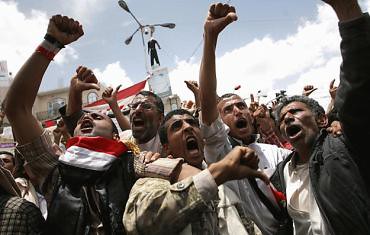
SANAA (Reuters) - Tens of thousands of Yemenis protested in Sanaa on Wednesday against President Ali Abdullah Saleh's return from Saudi Arabia, while opposition tribesmen said they had downed a warplane outside the capital and captured its pilot.

Waving flags and making peace signs, protesters fearing renewed stalemate after months of demonstrations seeking Saleh's removal marched out of "Change Square" shouting "Death, death."

"The point is, if we can't live a decent and dignified life, we'd rather die," said Khaled al-Mandi.

Yemeni protesters say they are fed up with grinding poverty, corruption and lawlessness in a country where two in three people have to survive on less than $2 (1.28 pounds) per day.

Saleh's return has infuriated many Yemenis who thought they had seen the last of him when an attempt on his life in June forced him to fly to neighbouring Saudi Arabia for medical treatment, but he defied the odds on Friday by landing in Sanaa "carrying the dove of peace and the olive branch."

Before his return, protesters trying to expand their ramshackle camp in Sanaa were caught up in a battle between Saleh's forces and soldiers loyal to a dissident general. At least 100 people, mainly protesters, were killed.

While violence has dipped since Saleh came back, tensions are still high and many fear the lull will eventually give way to an even bloodier confrontation, if not all-out civil war.

Organisers were trying on Tuesday to build up the numbers of demonstrators by planning less risky routes through capital after the violence that had kept some off the streets.

Saudi Arabia and the United States supported Saleh in the past to contain an active al Qaeda wing that has taken root in Yemen, but growing lawlessness is fanning fears of a civil war that could shake one of the world's top oil-producing regions.

Gulf nations seeking to broker a power transition have been exasperated by Saleh's repeated last-minute refusals to sign agreed deals. Saleh is now opposed by former allies such as Ali Mohsen, a powerful general, and the influential al-Ahmar family that heads his own Hashed tribal federation.

"We don't accept any political deals. After all the bloodshed, that option is gone," said Hazim, a 21-year-old protester. "We are struggling to survive, but the Yemeni people are like the ocean and you can't fight the ocean."

Salah Sharfi, a student, said he was ready to die for the sake of future generations. "We don't want to die, but if we must to make the country free, we will not hesitate." He had turned off his phone so his mother wouldn't know where he was.

Outside Sanaa, tribesmen shot down a warplane and captured its pilot in the mountainous region of Naham, where the airforce was bombing armed opposition tribesmen, a tribal source said.

A military official said the plane, a Russian-made Sukhoi fighter, had been downed while conducting a routine mission.

The tribal source said tribesmen had attacked the plane with anti-aircraft weapons and detained the pilot who had survived. Earlier this week an army general and three tribesmen were killed in fighting at a military base in Naham.

(Additional reporting by Mohammed Ghobari; Writing by Isabel Coles; Editing by Alistair Lyon)

Egypt Parties Threaten Boycott Over Election Law

28 September 2011

Egypt parties threaten boycott over election law

Egypt's ruling military council, led by Field Marshal Mohamad Tantawi, has been set a deadline

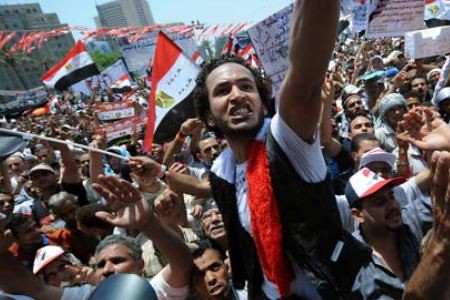
Political groups in Egypt, including the Muslim Brotherhood, are threatening to boycott parliamentary elections unless a disputed law is amended.

They object to an electoral law which allows a third of seats to be filled by independent candidates rather than political parties.

The political bloc has set a deadline of Sunday for Egypt's military rulers to meet their demands.

A statement demanded parties be allowed to contest all seats.

Elections are due to begin on 28 November. The Muslim Brotherhood's Freedom and Equality party is widely seen as the most formidable contender.

"We reject participation in the elections unless the article is changed," said the statement, signed by a coalition of The Democratic Alliance - which includes 37 parties - and the Freedom and Equality party.

The head of the Wafd party, Sayyid al-Badawi, said the elections would be boycotted if the government did not respond positively.

However, some officials of the Muslim Brotherhood tried to downplay the threat, saying the group would not boycott the vote.

Many Egyptian political groups say voting for a party rather than a single candidate will make it harder for former members of ousted leader Hosni Mubarak's now-outlawed party to run.

Emergency laws

The coalition has also demanded that Egypt's ruling military council ban officials involved in the misuse of power under Mr Mubarak from standing in elections for the next 10 years.

They also want the lifting of emergency laws which were reactivated earlier this month after protesters ransacked the Israeli embassy in Cairo.

On Wednesday, US Secretary of State Hillary Clinton also called on the military government to lift the state of emergency as soon as possible.

She said the US wanted to see it happen sooner than the planned date of June next year, because it was "an important step on the way to the rule of law".

She was speaking after a meeting with Egyptian Foreign Minister Muhammed Amr in Washington.

Mrs Clinton described Egypt's ruling military council as "an institution of stability and continuity".

Zimbabwe Journalist: Quo Vadis African Union?

MY TURN: Quo vadis African Union?

Wednesday, 28 September 2011 14:51
by Caesar Zvayi
Zimbabwe Herald

It is said if a man fools me once, shame on him but if he fools me twice then shame on me. Shame on the African Union leadership for falling for the wiles of Western Jezebels twice at the UN, where their handling of the Libyan crisis has been confusing and infuriating for the simple reason that it showed they never learn.

Instead of acting decisively and on principle, some African states cowered before the Anglo-Saxon alliance and voted for UN Security Council Resolution 1973, which was used as cover by NATO for military action on Libya when it should not have gone beyond enforcing a No-Fly Zone.

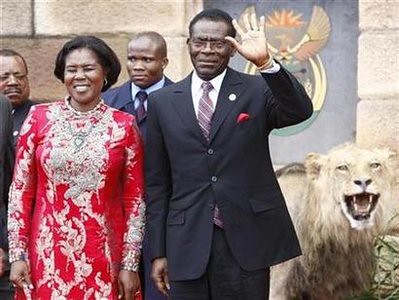
And now seven months down the line, with Libya still ablaze and Gaddafi being hounded like an animal by NATO forces, the African Union chairman Teodoro Obiang Nguema Mbasogo of Equatorial Guinea and the chair of the Libya panel Jacob Zuma of South Africa were at it again at the UN, this time announcing that they “recognised’’ the NTC as the legitimate representative of Libyans.

My foot! Where was the AU Summit to come up with that position held?

What would these two men have lost in insisting on the roadmap the AU agreed upon in Addis Ababa, that there be dialogue between Gaddafi and the NTC, the formation of a transitional inclusive government and elections to choose a leadership with the mandate of the generality of Libyans and not the graces of NATO?

How could African leaders who should know better try to brazenly legitimise the illegitimate by recognising the “NATO” Transitional Council, led by the timid--looking Mustapha Abdel Jalil?

Naturally western media were, last week, abuzz with reports that the African Union had ‘‘recognised’’ the NTC. This was quite shocking given how NATO had virtually ridden rough-shod over the AU by rejecting its entreaties to leave Libya and also trashing the AU Panel’s Peace plan by selling Jalil as the legitimate leader of Libya.

On Tuesday last week, the AU chairman said the bloc had officially recognised the NTC as the leadership of Libya. The announcement was reportedly transmitted by President Zuma’s office, six days after he hosted a meeting of the AU’s special panel on Libya in Pretoria. AU chairman, President Obiang Nguema, subsequently made the announcement after consulting with the panel in New York, ahead of the UN General Assembly.

The AU chairman was quoted as saying ‘‘I hereby announce that the African Union recognises the National Transitional Council as the representative of the Libyan people as they form an all-inclusive transitional government that will occupy the Libyan seat at the African Union. The African Union stands ready to support the Libyan people . . . as they rebuild their country towards a united, democratic, peaceful and prosperous Libya.’’

At the AU panel’s meeting in Pretoria the previous week, the group had ‘‘committed itself to working with the NTC’’ but stopped short of formally recognising it, a position that was in line with the AU position as agreed in Malabo, E. Guinea and as reiterated by President Mugabe on his return from the UN this week.

‘‘As far as we are concerned, the African position is that the NTC can only have a seat in the AU if the Summit of the AU recognises that. In fact, now that they are in control, they are the de-facto (by fact) authority of Libya. We will not go as far as the Europeans, NATO countries, to recognise them de jure (by law or legitimate) to say they are the absolute government. No, of course, because we still want negotiations, inclusive negotiations between the NTC and the Gaddafi loyalists.’’

Shouldn’t South Africa which was involved in the debacle over resolution 1973, be twice shy?

In Pretoria, the AU stuck to its roadmap for Libya that proposes dialogue between Gaddafi and the NTC pursuant to the holding of elections to usher in a new leadership with a mandate from Libyans, not NATO, and which would take Libya’s seat at the AU.

This is what any reasonable person would support, even those hawks in NATO, who hide behind the neo-liberal platitudes of promoting democracy and good governance. So where did the AU chair lose it in New York?

By saying the AU recognises the NTC, what message was Mr Obiang Nguema Mbasogo sending? That it’s okay for westerners to invade African countries? That’s its okay for NATO to effect regime change on African soil? That it’s okay for westerners to butcher innocent civilians, use banned weapons like cluster bombs and depleted uranium munitions which will have comebacks on the innocent for years to come? That’s its okay for them to hunt and hound sitting heads of state and government like foxes? That it’s okay to trash and ignore the authority of the AU and still have the stooges the westerners install embraced by the same AU?

And all this from Obiang Nguema who was only saved from a similar fate to that of Gaddafi by the vigilance of our security forces who intercepted a plane load of mercenaries on March 7, 2004. The 67 dogs of war were aboard a plane that stopped here with the intention of picking weapons from the Zimbabwe Defence Industries that they claimed were to be used to guard a diamond mine in the DRC when they intended to use them to depose Obiang Nguema.

How soon we forget. Be that as it may, in saying the AU recognises the NTC, Nguema has scored an own that may prove disastrous in the long-run.

What will stop westerners from going into overdrive with Libyan style bombardments of progressive, resource-rich states with a view to installing puppet regimes?

What will make them ever listen to the AU since they will know they are at liberty to urinate in the faces of the continental and claim it’s raining?

By recognising the NTC, the AU chair has legitimised the NATO operation in Libya. He has effectively sanctioned the killing of innocent Libyans, blessed the hounding of Gaddafi and endorsed the bounty on his head.

The AU chair has bought into the scandalous campaign by ICC prosecutor Luis Moreno-Ocampo who issued a warrant of arrest on Gaddafi, and not the NATO leadership that not only broke international law by stretching a UN resolution but has needlessly killed thousands of innocent Libyans including Gaddafi’s grandchildren as young as 18 months.

Surely the founding fathers of the OAU must be turning in their graves. This is not what the likes of Kwame Nkrumah, Gamal Abdel Nasser, Haile Sellassie, and Alfred Sedor Senghor — to mention just a few — had in mind when they met in Addis Ababa, Ethiopia on May 25, 1963 to launch the Organisation of African Unity that had had two primary objectives: The first to promote the unity and solidarity of African states and act as a collective voice pursuant to securing Africa’s long-term economic and political future that had been endangered by years of slavery and colonialism while the second objective aimed to eradicate all forms of colonialism.

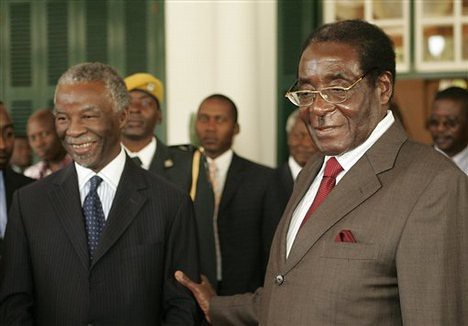
President Mugabe, no doubt the only leader today with the stature of those founding fathers, decried this loss of direction this week when he said, ‘‘the period in which we are is a period in which there appears to be a reversal of what the founding fathers did and the principles of the founding fathers.

‘‘Principles are being sacrificed on the altar of expediency as Nkrumah would have said. Because you are being assisted by the West, you, therefore, must bow to the West. It is a terrible period and it is selling out the principles of the founding fathers, and Zimbabwe can not stand for that.’’

The AU, as currently constituted is a pale shadow of the OAU as it can not even speak with one voice what with countries like Benin, Botswana, Burkina Faso, Chad, Egypt, Ethiopia, Gabon, Gambia, Guinea,. Ivory Coast, Morocco, Niger. Nigeria, Senegal, Togo and Tunisia recognising the NTC ahead of the AU.

The AU can ill-afford the mistake made by some African states in the Security Council who voted with the West on resolution 1973. Embracing the NTC is akin to giving NATO free reign on the continent.

The NTC should never be recognised by the AU unless it follows the roadmap. The AU must come up with clear parameters on what is expected of member states. Clarifying the parameters for democratic governance will give the AU a checklist to reject or expel non-compliant members. Similarly, the AU should seriously think of setting up a standby force that can intervene, on the recommendation of the Peace and Security Council, in countries facing peace and security challenges or repel invasions from hostile forces.

The confusion, selling out and flip-flopping we have seen from the AU over Libya has seriously dented the continental body’s image. There is thus serious need for introspection and the rediscovering of the spirit that motivated the launch of the OAU 48 years ago.

It appears we Africans haven’t learnt anything from our engagement with westerners over the past 48 years?

Quo vadis African Union?

Nigeria Records Economic Growth

Nigeria records economic growth, as GDP hits $247 billion

Wednesday, 28 September 2011 00:00 By Taiwo Hassan
Business Services
Nigerian Guardian

MIDDLE class Nigerians have been responsible for the growing economic activities that have increased the nation’s Gross Domestic Products (GDP), a recent report by Renaissance Capital has said.

The report, based on its recent survey of the country’s middle class, said the activities of the middle class Nigerians had helped in increasing the country’s GDP, from $46 billon in 2000 to $247 billion this year.

According to the report, Nigeria’s Gross Domestic would be equivalent to that of the Asian Tigers of Vietnam or Bangladesh, as the nation’s per capita GDP at market exchange rates increased from $390 in 2001 to $1,541 this year.

The survey by Renaissance Capital, a leading emerging-markets investment bank, which was released yesterday, showed that the country’s economy was being turn around by the middle class, who accounted for 23 per cent of nation’s population.

The report showed that the investment opportunities presented by Nigeria’s rapidly growing middle class, against a highly favourable macro-economic backdrop, indicated that the nation’s GDP rose fivefold within the same years, even as the population increased by more than one-third over the same period, from 119 million to 160 million.

“The magnitude of the increase in Nigeria’s population between now and 2016 is the equivalent of adding another Romania; while, based on cautious IMF forecasts, the increase in Nigeria’s GDP in five years will be equivalent to the addition of another Vietnam or Bangladesh.”

According to the report, “Nigeria’s per capita GDP at market exchange rates rose from $390 in 2001 to $1,541 in 2011, based on IMF figures, with prediction that it will hit $2,000 in 2016,” said the Renaissance’s economists.

The company’s survey was conducted with 1,004 middle-class Nigerians, residing in the cities of Lagos, Abuja and Port Harcourt, 70 per cent of whom were aged 40 or younger.

“The Nigerian middle class we surveyed has a monthly income of some $500-600 and nearly half will be buying fridges, freezers and other white goods, suggesting cosumer boom is underway.”

Author of this article: By Taiwo Hassan

Nigerian Police Announce Arrest of Two Suspects in Kano Gang Rape of NYSC Woman

Waterloo for Kano rape gang

Wednesday, 28 September 2011 00:00 From Adamu Abuh, Kano News - Metro
Nigerian Guardian

Police seize two members of a gang of rapists, alleged armed robbers in police uniform

HE is only 18 years old, but there was no doubt whatsoever as to Abba Garba’s deep perversion.

That he was in police custody and his legs in chains did not seem to bother him as he recounted, with unmistakable relish, how he and members of his gang raped a member of the National Youth Service Corps (NYSC).

The girl had been posted to Durimi Secondary School, Bachirawa, within the Kano metropolis only to find the school deserted.

The Kano State chapter of the Nigeria Labour Congress (NLC) was on strike on September 13 and teachers and pupils in Durimi Secondary School had stayed home.

The lady’s undoing was that there was no one else in the school to ask questions except Garba and his gang.

She wanted to see the principal but under the guise of assisting her, they led her into an empty room in the school, threatened her with a knife and one after the other, Garba, Nezifi Malam and Ali Wara took their turns on the unfortunate girl.

Narrating the incident when he and a member of his gang and suspected armed robbers were brought before before journalists at the Bompai Police Headquarters of the Kano State Police Command, Garba was still gloating as he admitted that he threatened their victim with a sharp knife to force her to succumb to their wish.

In Hausa language, he stated: “On that day, it was raining heavily when she came to the school and said she had been posted to the school and was looking for the office of the school principal. She was speaking a language I did not understand but I told her in Hausa that I could help her.

“She was so beautiful that I found her irresistible. When she agreed to follow me, I couldn’t imagine my luck on that day. I led her to an empty room within the school. There was nobody in the school that day because the teachers were on strike.

“When I led her to the room, I brought out my knife and threatened to stab her if she refused to cooperate. That was how I used her. Thereafter, two of my friends - Nezifi Malam and Ali Wara took their turns.

“The only person that was not lucky was Abubakar Suleiman, who was waiting to take his turn before we were arrested.”

The Kano Police Commissioner, Alhaji Ibrahim Idris disclosed that two of the suspected rapists, Ali Wara and Nezifi Malam were still at large.

Idris also paraded four suspected armed robbers, all in uniforms of the Police Mobile Unit.

They were alleged to have been terrorising people along the Zaria-Kano expressway.

Three motor vehicles were also intercepted alongside the suspects who, however, claimed that they were forced to put on the uniforms by the police.

One of them claimed he operated one of the intercepted vehicles for commercial purposes, while the other two claimed they were just cow thieves and not armed robbers as alleged.

The Kano Police boss also displayed five automatic pistols found in a Peugeot 406 intercepted by a police patrol team, adding that a suspect was being interrogated in connection with the seized weapons.

Idris also read the riot act to car dealers who connive with car snatchers to legitimise stolen vehicles with fake papers and sell them second-hand.

“We also want to advise car dealers to ensure that they have proper detailed identification of persons they sell their vehicles to so that such individual can easily be traced whenever such vehicle is used for crime or criminal activities.

Author of this article: From Adamu Abuh, Kano

Nigerian Military Says Boko Haram Is Foreign-Driven

Boko Haram is foreign-driven, says Army

Wednesday, 28 September 2011 00:00 From Madu Onuorah (Abuja), Ayoyinka Olagoke (Uyo) and Obire Onakemu (Lagos)
Nigerian Guardian

THE pervasive suspicion in official quarters of the external dimension in the activities of the destructive Boko Haram sect is now over.

A critical security agency of the Federal Government, the Nigerian Army, which brainstormed on the country’s security challenges yesterday in Abuja, said based on the group’s modus operandi, access to cheap funds and bomb-making materials, and expertise in the illicit trade, it had come to the inevitable conclusion that Boko Haram enjoys tremendous external backing.

According to the Chief of Army Staff, Lt-Gen. Onyeabo Azubike Ihejirika, who spoke on the sect’s activities, declared that from Service assault on Boko Haram, it was convinced that it gets training and funding from abroad.

Ihejirika said from the type of weapons and communications equipment captured from the insurgents, it is “definite” that there is foreign involvement in the terrorism in Nigeria.

He was however not categorical on the foreign countries or groups that bankroll Boko Haram’s activities.

The Army’s position came a day after the Presidential Committee on Security Challenges in the North-East submitted its report to the government, where it recommended dialogue with the armed group.

Ihejirika’s position may fuel the government’s resolve to take the fight against terrorism to the doorsteps of its neighbouring countries. There have also been claims that the sect has strong link with al-Qaeda and insurgent groups in Somalia and Eritrea, which train its members on terrorism.

The Army chief said from the expertise Boko Haram had displayed in the preparation of Improvised Explosive Devises (IEDs), “the group is getting its training and funding from abroad.”

He spoke at the opening of a two-day Chief of Army Staff 3rd quarterly conference at the Army Headquarters Command Mess, Abuja, stating that the Army had taken a strong stand against indiscipline in its ranks through the use of all legal means at its disposal.

The meeting of the Army top leadership focuses on security and current operations involving the Service and how they can be improved upon.

The conference is attended by all the Service Principal Staff Officers at the Defence and Army Headquarters, General Officers Commanding (GOCs), Corps and Formation Commanders and heads of Army establishments.

The conference is a major activity in the yearly training of the Army and affords the leadership an opportunity for self-assessment and adjustment of strategies in line with emerging national challenges.

Ihejirika told journalists that “it is definite that the group that call itself Boko Haram receives training and possible funding from some foreign elements. This is evident from the type of weapons we have captured from them, the type of communications equipment we have captured from them and the expertise that they have displayed in the preparation of IEDs. The fact is that there is foreign involvement in the terrorism going on in Nigeria.”

The Army chief charged the participants to “appraise the performance of the Army in the local and external operations it is involved. Be frank and give serious criticisms of the performance so that we come up with ideas to improve the Army.”

Earlier, Chief of Army Policy and Plans, Maj.-Gen. Olakunle Akinyemi, said though the Army had received encomiums for its role in the 2011 general elections, it had equally received knocks for the performance of its troops in Internal Security Operations (ISOs).

He regretted that “some of our troops are getting into serious disciplinary issues that bring the Nigerian Army in bad light.”

Such disciplinary issues include extortion and the nonchalant attitude of junior commanders on the welfare of troops.

He therefore charged all commanding officers to ensure that their officers and soldiers are better prepared to perform the duties expected of them.

“The conduct of discipline professionalism must be maintained at all times as they enhance performance of the Army in Internal Security Operations,” he said.

Meanwhile, the Deputy Chairman of the Peoples Democratic Party (PDP), Prof. Samuel Friday Akpan, has described the existence of Boko Haram as a manifestation of the disintegration of the unity pattern in the North.

He told The Guardian in Uyo, Akwa Ibom State capital, that the sect is not a strong opposition to President Goodluck Jonathan administration but a fallout of the inability of northern leaders to collaborate and move the dynamics of state as enshrined in the Nigerian constitution to promote unity in the region.

Akpan said Boko Haram is the appearance of the frustration of those who want to dominate Nigeria but have lost out in the political terrain.

He described Jonathan as a leader with the ideas of peaceful co-existence in Nigeria and determination to carry the mandate of the constitution by ensuring the unity and economic development of the country.

Akpan said: ”Boko Haram is a manifestation of the disintegration of the unity pattern we used to think we have in the North. For me, I don’t see it as a strong opposition to President Jonathan but as a fall-out of the inability of northern leaders to be able to collaborate and move the dynamics of state collectivity into the embedded unity as enshrined in the Nigerian constitution. Therefore, the conflict or the challenge of attempting to frustrate the President that he is from the South or for religious sentiment is not sufficient. It is a manifestation of the leaders in the North being incapable of managing their internal variables and having allowed to over-vent to show that there is no more unity even in the North since they cannot speak with one voice.”

Also, the President of the Niger Delta People’s Forum (NDPF), Mr. George Utomhim, has claimed that the current acts of terrorism were deliberate efforts to destabilise Nigeria because a southern minority is the nation’s President.

He said Boko Haram is the product of a northern power bloc that had vowed to make the country ungovernable should power shift from the area after the death of President Umaru Musa Yar’Adua.

Utomhim said: “The act of terrorism is not against all Nigerians per se; it is against the Niger Delta people because one of them has become the country’s president. We see it as sabotage, an attempt to derail the government of President Jonathan.

“Right from the onset, we saw a northern oligarchy that says it would not accept a Federal Government led by President Jonathan, vowing to resist it at all cost. This is an attempt to cause trouble and break up the country.”

He told The Guardian that Niger Delta groups “have resolved that if that is the case, we are ready to fight for our right even if it means bringing the country to a standstill. We are ready to fight the cause; we are ready to face it with all our might. Even though we are a minority, we are ready to fight this cause to the end.”

South African State Pays Legal Bills for Racist Apartheid-era Biological Weapons Developer

State foots bill for Basson's defence

KATHARINE CHILD | PRETORIA, SOUTH AFRICA - Sep 28 2011 10:36

The state is paying for Wouter Basson's legal representation at the inquiry by the Health Professions Council of South Africa into his alleged unethical conduct.

The HPCSA has charged Basson with manufacturing dangerous chemical weapons, "weaponising thousands of 120mm mortars with teargas to be sold in Angola", and distributing cyanide so soldiers could commit suicide if caught.

He is also charged with providing "disorientating substances to tranquilise people" who were to be kidnapped in neighbouring countries.

Basson was head of the government's chemical and biological warfare research programme, Project Coast, from 1981 to early 1993. In 2002, he was acquitted in the Pretoria high court of a raft of criminal charges ranging from murder and fraud to drug trafficking. He now runs a cardiology practice in Durbanville outside Cape Town.

The HPCSA hearing now under way is not a criminal trial but a professional conduct enquiry.

Justice ministry spokesperson Tlali Tlali told the Mail and Guardian on Wednesday that the Department of Defence had indicated "a few of years ago" that it would pay for Basson's defence.

The HPCSA first charged Basson with unethical conduct in 2007. In 2008 Basson approached the Pretoria high court to have them stop the hearing. Last year, the high court ruled that the HPCSA's hearing could continue.

'Basson's work caused death'

According to US bioethics expert Professor Steven Miles, Basson used his medical knowledge to destroy life while he was head of Coast.

"The ethical core of medicine is to promote health. Dr Basson's work caused death and imminent death and brain damage," Miles told the HPCSA hearing on Tuesday.

Appearing as a witness for the prosecution, Miles argued that Basson's actions were contrary to international ethical conventions governing doctors' behaviour, including the World Medical Association, to which South Africa is a signatory -- and was a signatory at the time of Basson's alleged actions.

Miles is professor of medicine and bioethics at the University of Minnesota Medical School, and former president of the American Society of Bioethics and Humanities. The council invited him to act as a key witness because of his "ability to examine medical ethics in an international context", said HPSCA spokesperson Lize Nel.

Source: Mail & Guardian Online
Web Address: http://mg.co.za/article/2011-09-28-state-foots-bill-for-bassons-defence

South African Deputy President Kgalema Montlanthe Delivers Lecture in China

Lecture Delivered by the Deputy President of the Republic of South Africa Kgalema Motlanthe at the China Executive Leadership Academy, Shanghai, China, 28 September 2011

Programme Director;
The Leadership of the Communist Party of China;
The Management of the China Executive Leadership Academy;
South African Government Ministers;
Your Excellencies, Members of the Diplomatic Corps;
Comrades;
Ladies and gentlemen:

It is my honour to share reflections with the China Executive Leadership Academy this morning.

Experience tells us that exchanges of this nature between nations driven by abiding concerns about the betterment of the human condition are necessary exercises for the building of a better world.

Indeed, the relationship that binds South Africa and the People’s Republic of China in mutual respect, solidarity and cooperation has a long history and a powerful logic.

In this regard, on behalf of the people of South Africa, I wish to congratulate the Communist Party of China on the celebration of its 90th Anniversary this year. Indeed, this is a great achievement in the struggle of the people of China for social justice.

Similarly, the African National Congress, the political party I come from, will be celebrating its centenary in 2012. This will also be a milestone in our struggle for a united, democratic, non-racial, non-sexist, just and prosperous society.

Chairperson,

A rare but engaging political encounter with such a venerable entity as the China Executive Leadership Academy throws up numerous challenges in different areas of human endeavour, all of which claim equal measure of our attention.

However, for lack of time and space, I wish to restrict my contribution to two areas of mutual interests for our two nations.

These are:

The role of State Owned Enterprises (SOEs) in leading the charge for development (especially in our country, South Africa, and the Continent of Africa);
And, up to a point, reflect on the challenges of leadership in the global arena today.
Programme director,

The political breakthrough of April 1994 afforded the people of South Africa the opportunity to determine their own future.

Our first task was to address decades of racially defined socio-economic inequalities that were the inexorable outcome of the Apartheid logic of racial oppression.

Then as now, our country has had to contend with three key areas that strangulate our development. These are unemployment, poverty and social inequalities.

Since ascending to power, the ANC has sought to forge a new growth path that transcends the constraints of apartheid, and which is able to progressively roll back the frontiers of poverty, drawing more and more of our people into the mainstream economy.

Before being struck by the global crisis in 2008 we had made considerable progress in reducing poverty and unemployment.

Critical elements of a new growth path have begun to emerge, underpinned by the building of a democratic and redistributive state, the progressive erosion of apartheid spatial patterns, growing integration with the regional as well as the global economy.

For our society to move towards a higher plane of development and meet the social needs of our people by raising the floor of social justice, we needed to develop an economic policy that reflects our peculiar historical realities.

Markets on their own cannot lead such fundamental change.

The State has to play a leading role in reshaping the economy so that it is better able to meet the needs of our people, particularly the working class, as well as the urban and the rural poor. This has to be done in partnership with all social forces, including capital.

In this regard, it is important to realise that South Africa is fully located within the capitalist system and is therefore limited by its inherent conditions in what it can do.

It is universally acknowledged that the continent of Africa is well-endowed with natural resources.

Productively developed, there is no doubt that these resources may advance our continent to desirable levels of development.

Natural resources that lie beneath our soil can address the immense social needs of our people only if there is investment in infrastructure to turn many pockets of our country which currently lie fallow into economic hubs of activity.

What Africa sorely needs at the moment is massive investment in infrastructure to unlock this development potential.

In this regard, a strategic partner such as the People’s Republic of China can play a leading role in a manner that is mutually beneficial to both our people.

For example, South Africa has an enormous coal belt in the province of Mpumalanga which is linked to the port of Richards Bay by inadequate railway lines.

It is estimated that four more railway lines will be needed for this area to fully realise its potential.

At the same time our marine industry is equally unable to meet the current needs.

As a port and a destination for many of the outgoing inland goods Richards Bay is currently choked for lack of enough facilities to cope with the value of trade.

This way South Africa’s marine industry is grossly undermined in a way that slows down the performance of the whole industry.

While they also boast huge potential in the area of mineral resources, countries in the Southern African Development Community are equally hamstrung by the same conditions of lack of infrastructure and the attendant limiting effects on economic growth.

Ladies and gentlemen

Our destiny as a nation is tied up with that of our continent and its people.

Our policies towards the African continent derive from this existential reality.

Africa has grown well in the past ten years, and we recognise the contribution China has made, both through direct foreign investment and in support for infrastructure development programmes.

However, as noted earlier on, Africa still has a massive infrastructure gap, retarding Africa’s GDP growth by 2% per year.

Inadequate and unreliable energy is Africa’s most acute problem. This holds back investment in the productive sector and improvements in the quality of life.

As productive capacity improves we expect more trade amongst African countries. Currently intra-African trade only totals 10% in contrast to the European scenario, where intra-European trade totals 80%.

Africans are virtually not trading with one another owing to the lack of diversified production, a lack of adequate infrastructure networks, persistent colonial ties and an over-reliance on commodity exports.

The diversification of production in Africa is critical. We recognise that Chinese companies are now exploring opportunities in agriculture and manufacturing in Africa.

We wholeheartedly support Chinese investment in the productive sector in Africa. We urge that Chinese companies continue to seek suitable partnerships in host countries in Africa.

South Africa is open to forming partnerships with China and tripartite ventures in investments in the productive sector on the African continent.

Building African infrastructure is a key stepping stone to regional integration.

The scale of the challenge is immense. Yet, while significant amounts of finance are needed, the infrastructure challenges in Africa present an opportunity for investment with guaranteed returns.

An Africa Infrastructure Country Diagnostic estimates annual investment needs in infrastructure in Africa at US$31 billion a year over the next ten years, with two thirds of this required for the energy sector.

The present major African infrastructure areas under the auspices of the New Partnership for Africa’s Development (Nepad), among them the North-South Road and Rail Development Corridor Project, are some of the flagship projects that call for continued strategic partnership.

With the North-South Corridor we hope to address trade facilitation and inter-connectivity, the lack of which hobbles intra-Africa trade at the moment.

Indeed, investment in these priority projects will lead to the creation of jobs, value addition.

New forms of global cooperation such as BRICS are key instruments that can help us move forward.

South Africa and China have a greater opportunity than before to help shape our global future. Deepening our discussions on these issues will help us assume our responsibilities more effectively.

We are confident that with the People’s Republic of China on board as a strategic partner we will both strengthen cooperation with regard to the implementation of the African Agenda.

South African SOEs can play a leading role in building partnerships with key Chinese, Brazilian and Indian enterprises that are building relationships in Africa.

These enterprises are essentially portals to access the entire BRICS international development aid system.

We need to start by taking some small steps and focusing on specific projects such as energy and transport logistics where South African participation can make a catalytic difference.

There are many opportunities for South African SOEs to successfully venture into Africa to explore business opportunities and thus contribute towards the creation of an environment in which African peoples and nation-States can trade, communicate and relate with one another.

The nature of infrastructure investment is long term and requires a relatively sophisticated policy, regulatory and industrial environment for it to be sustainable, apart from requiring significant operational capabilities.

As a step towards addressing this problem the African Union has decided to implement flagship infrastructure development programmes, of which the President of our Republic is the political champion.

Logistics infrastructure enables the efficient movement of goods, people and services.

Telecommunications enables enhanced commercial activity, whilst an integrated energy grid enhances security of power supply for all countries.

South Africa can contribute significantly to African infrastructure development through enabling access to our core logistics, telecommunications and energy infrastructure systems as well as providing specialised technical and commercial skills.

Nonetheless, we also need to be realistic about the resources available in South Africa to contribute to the African infrastructure challenge.

We have a significant infrastructure gap in South Africa that needs to be funded.

These infrastructure backlogs constitute investment outlets with guaranteed returns.

While Africa’s developmental needs require that it engages with progressive external entities, this should not entail the exploitation of African resources without regard to ethical consideration and issues related to environmental protection and Africa’s posterity.

Therefore I am particularly pleased that in our discussion with the leadership the People’s Republic of China there is a commitment for both of us to conduct our trade and investment in ways that would benefit both partners.

In the past Africa’s trading with the outside world was to its own disadvantage. Africa was and has been seen as a source of cheap raw materials for the benefit of outsiders.

I am confident that in our relationship South Africa and the People’s Republic of China have broken new ground in that ours is a relationship based on a higher value system that seeks to be of mutual benefit.

Chairperson,

The contribution of SOEs in the achievement of the objectives of a developmental state is indispensable.

This implies that the management of these strategic entities is of critical account.

Senior managers should appreciate that they occupy strategic positions to address basic needs of the poorest sectors of society.

As a result meeting social needs depends on their performance, which is in turn determined by their levels of skills, commitment and innovation.

Such senior management should from time to time be subjected to performance monitoring and evaluation to ensure alignment with the developmental goals of society, as opposed to the maximisation of profits as an end in itself.

To this end we are currently engaged in a process of reviewing the efficacy of the current regime and structure of our SOEs.

Our president established the Presidential Review Committee in response to the acknowledgement that there is a need to strengthen the role of SOEs to ensure that they respond to a clearly defined public mandate.

In line with the principle of people-driven development, the Presidential Review Committee (PRC) on State Owned Entities has made a call to the public to make submissions which will contribute to the process of reviewing the SOEs in the country.

The Presidential Review Committee is calling for individual South African citizens, Government Departments (national, provincial, and local government), State-Owned Entities, organised business, labour, political parties, civil society, professional bodies, educational institutions, and industry associations to make submissions which will shape the review process.

Broadly this exercise will help us review the contribution of SOEs to human capital development; propose sustainable SOEs business models that balance commercial, developmental and shareholder objectives; and propose appropriate strategic frameworks on recruitment, performance and remuneration.

Programme Director,

In light of the above perspective on our development challenges, what are the specific features of China/South Africa and China/Africa relations which currently empower or weaken our efforts at addressing the outlined scenario?

Positively, we already have a remarkable relationship in the form of the comprehensive Strategic Partnership Agreement.

Needless to say this declaration serves as a platform for closer cooperation on all major issues and sectors of importance to both countries.

We also know that at present China is South Africa’s largest trading partner.

While volumes of trade between our two countries have reached impressive levels there are still untapped opportunities to be explored.

In consequence we would encourage the People’s Republic of China to work with the African continent and the regional economic communities to further implement development programmes to expand economic growth.

Programme Director,

While the developing world lacks access to capital for development and growth, in other words long term investment, the capital residing in the developed world is largely employed for short term returns, often for speculative purposes.

As a result capital is invariably not available for long term projects such as mining and infrastructure in the developing countries, thus depriving Africa of much needed investment opportunities.
Consequently, for a very long time now the vast majority of the world’s people have been mired in seemingly unending economic misery.

In order to clamber out of the abyss, many governments, especially in the North, have launched austerity programmes, and have been trying, without much success, to balance their budgets.

These include slashing public workers' wages and benefits, curtailing social programmes, and raising the retirement age to lower the cost of social security, all of which have had a negative impact on the lives of ordinary people.

All these crises reflect the disharmony and the sharpened contradictions between the property relations and the forces of production playing themselves out on the global stage today.

The endemic social upheavals that have struck many countries in North Africa, the Middle East and Europe are a manifestation of this chronic economic crisis.

What is striking about these social upheavals is the absence of clarity of purpose and vision reflecting low levels of political organisation.

Martin Luther King Jr. hit the nail on the head when he argued that:

‘The limitation of riots, moral questions aside, is that they cannot win and their participants know it. Hence, rioting is not revolutionary but reactionary because it invites defeat. It involves an emotional catharsis, but it must be followed by a sense of futility’.

Therefore, I submit that it is the duty of the progressive forces all over the world to develop a reading of these conditions that confront us today with a view to mobilising the consciousness of those at the receiving end to begin engaging in a transformative struggle to bring about a human-driven socio-economic formation.

Programme Director,

Throughout human history each and every age has faced inherent challenges that it must necessarily confront, not only so that humanity survive but importantly, so that it should equally bequeath to posterity a legacy of progress in the two realms of thought and material culture.

Over the centuries since the emergence of the anatomically modern human beings, the critical matter of social development has been central to our existence as a species, and it is still central today.

From the time literate cultures emerged, everything known in human history has been caused by and resulted from social development as the fulcrum of human consciousness.

In short, human history has been forged by society’s ability to shape the physical, economic, social and intellectual environments to its own ends.

Some thinkers characterise this human experience as stages in the development of human societies, which are always driven by a particular mode of production.

They further hold that our cognitive capacity to harness our material conditions to our developmental needs is the furnace that forges human experience.

This perspective on human history equips us with a high-level understanding that enables us to discern that there is nothing intrinsically immutable about the nature of the human condition.

Human experience, including social relationships and political institutions that govern human lives both at national and international levels are not set in stone; they are not impervious to or above human will.

Therefore there is no reason for the rules that govern global trade to be elevated to dogma, even though they have proven adverse to the interests and future of humankind.

It is within the realm of possibility to ensure that the fruits of the earth are enjoyed by all humanity and that no economic system is consecrated to eternal injunctions.

There is therefore a dire need to question age old doctrines that have occasioned nothing but untold misery for people in the developing South, so that we begin to re-imagine a new world, a new humanity defined by values other than the prevailing ones of acquisitiveness, greed and sheer rapine.

Indeed, a new world is possible!

I thank you
Sudan Conflicts Set to 'Spiral Out of Control' Over Disputed Borders

Sudan conflict set to ‘spiral out of control’ over disputed border

geoffrey york

JOHANNESBURG— From Wednesday's Globe and Mail
Last updated Tuesday, Sep. 27, 2011 8:48PM EDT

When Sudan peacefully split into two countries in July, the world stopped paying attention. The tension seemed to be over: Khartoum had accepted the loss of its southern half, the new nation of South Sudan was born, and decades of civil war had apparently been finally settled.

Yet instead of bringing peace, the birth of South Sudan has triggered a domino-like chain of conflicts in the disputed border regions between north and south. Those conflicts, in turn, are giving power to the hardliners on both sides: army generals who have seized power in Khartoum and rebel forces which are pushing for a new battle against the northern regime.

Two months after the south’s secession, the two countries are teetering on the brink of total war. Fighting has flared up in the contested border regions, the north is using brutal military tactics to impose its will on those regions, and crucial talks on unresolved disputes have broken down.

Clashes and street protests have even spread to Darfur and East Sudan, broadening the front lines of the conflict.

“There is a real possibility of a new era of protracted civil war in Sudan,” the International Crisis Group warned in a new report.

“Fighting could expand quickly within Sudan and spill over into South Sudan,” it said. “The conflict in Sudan may spiral out of control and engulf the region.”

Khartoum has already wielded its military power to seize control of the disputed regions of Abyei, Southern Kordofan and Blue Nile over the past few months. Satellite images suggest that about 3,000 northern troops are massing in Blue Nile for a potential assault on rebel forces. “The satellite images reveal a wall of armour, including what appear to be main battle tanks, towed artillery, infantry fighting vehicles, armoured personnel carriers and troop transports, apparently accompanied by half a dozen Hind attack helicopters,” said a report by the U.S.-based Satellite Sentinel Project.

Reports by human-rights groups have documented how Khartoum’s air force has killed and maimed dozens of civilians in an indiscriminate bombing campaign in Southern Kordofan, forcing thousands of civilians to flee to caves and mountaintops, where they live in harsh conditions. “The Sudanese government is literally getting away with murder,” said a recent report by Amnesty International.

Across the disputed border regions, hundreds of thousands of ordinary people have been displaced from their homes – including 25,000 who fled from Blue Nile state into neighbouring Ethiopia in recent days, according to the United Nations refugee agency.

In an ominous sign of looming war, hard-line army generals in Khartoum appear to have led a “soft coup” within the ruling party, and their preference is for military tactics, rather than peace talks. Rebel forces in Darfur and Southern Kordofan, meanwhile, have forged a new alliance against the Khartoum regime, adding fuel to the tensions.

International pressure might be the only way to prevent full-scale war in Sudan. Yet the international community, especially the United States, seems to have lost interest in Sudan following the official independence of South Sudan in July.

The fate of the disputed regions, including Blue Nile and Southern Kordofan, was supposed to be settled by “popular consultations” in the border regions, according to a peace agreement between the south and north in 2005. But those consultations were never properly held, and both sides seem to be switching back to military tactics now.

African Union to Deploy 3000 More Troops to Somalia

AU to deploy 3000 more troops in Somalia

Monday 26 September 2011 - 10:36
Yarrow Hassan, AfricaNews reporter in Nairobi, Kenya

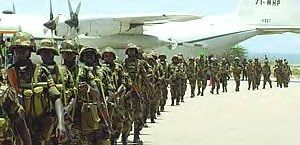
The African Union Mission for Somalia (AMISOM) is planning to beef up its troops to the Horn of African with 3,000 more before December this year, a senior AU official told AfricaNews. The Deputy Special Representative of the Chairperson of the African Union Commission (DSCRCC) for Somalia Wafula Wamunyinyi said the additional soldiers will help implement the current roadmap that seeks to put the entire nation under effective control of the Transitional Federal Government.

'The additional troops will come from other African nations including Sierra Leone and Djibouti in order to boost the capability of the 9,000 AMISOM troops currently present,' Wamunyinyi said.

He said Djibouti is set to contribute a battalion of troops as well as trainers while Sierra Leone will only supply a battalion, he added.

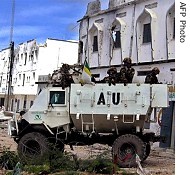
Already 95 percent of the Somalia's capital Mogadishu is under the control of AU troops and they will help extend the strength of the armed forces, he added.

'We plan to extend our control to the environs of the Mogadishu and eventually to entire country including all the strongholds of extremist's forces,' Wamunyinyi who is also head of AMISOM troops in Somalia said.

The African Union is committed to bring stability to the war- torn Somalia which has been in the state of lawlessness for the past 20 years.

'Our personnel are regularly attacked by anti-government forces and this new addition will help buffer our forces currently acting as a stabilization force in the country,' he added.

AMISOM troops are also helping to train local Somalia army to gradually take over the security of their county.

In a separate interview with AfricaNews Rwanda ambassador to Kenya Mr George Kayonga said Rwanda is committed to provide technical support to the AMISOM forces as they try to secure in Somalia.

'The additional forces will be used to fill the vacuum caused by the lack of the effective government in the country,' Kayonga said.

The forces which were deployed in 2007 are bringing hope to the horn of African nation, the ambassador added.

Currently in Mogadishu the AU forces are mandated to provide escort and protection to humanitarian agencies that are providing relief food to combat the current famine.

AMISOM Troops From Burundi Killed Malaysian Journalist in Somalia

From Garoweonline.com

Troops in Somalia killed journalist, report says

Sep 26, 2011 - 7:57:20 AM

The African Union peacekeeping mission in Somalia says its investigation has found that four Burundian soldiers were responsible for the killing of a Malaysian journalist in Mogadishu earlier this month.

The force said in a statement Monday that the four peacekeepers involved in the killing of cameraman Noramfaizul Mohd Nor were discharged from the force and will be tried in Burundi.

Nor was killed Sept. 2 while covering a Malaysian aid agency's humanitarian mission in famine-struck Somalia.

Human rights groups and residents have accused the African Union force of indiscriminate shelling against civilian targets. Rights groups say the force has improved its record of indiscriminate shelling, killing fewer civilians than in the past.

Source: AP
http://www.garoweonline.com

TFG Interim Prime Minister Says 'Somaliland Is Part of Somalia'

Last Updated: Sep 27, 2011 - 10:50:36 PM

'Somaliland is part of Somalia': PM Abdiweli Gas

27 Sep 27, 2011 - 10:47:57 PM

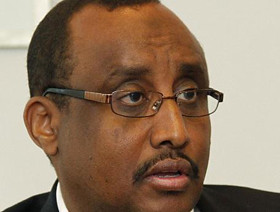
Somalia’s interim Prime Minister Prof. Abdiweli Mohamed Ali Gas has told the BBC Somali Service that the separatist region of Somaliland is “part of Somalia,” asserting political words that are sure to ignite a tough response from Somaliland’s ruling administration, Radio Garowe reports.

Somali PM Abdiweli Mohamed Ali Gas
Prime Minister Gas said that the international community “recognizes Somalia as one country” and commented that a “time shall come when Somali stakeholders including Somaliland will discuss how to strengthen the unity of Somalia.”

The Somali Prime Minister, who was appointed in June, is on a visiting trip to Denmark, days after he addressed the UN General Assembly in New York.

Somaliland, located in northwestern Somalia, unilaterally declared independence in 1991 but has not been recognized internationally.

Prime Minister Gas said the Transitional Federal Government (TFG) of Somalia “recognizes Somaliland as a state similar to Puntland,” adding: “What is important is to discuss areas of mutual cooperation and to agree on national interests.”

Speaking about Somali terror group Al Shabaab, Prime Minister Gas: “Within the one-year mandate of my administration, we shall remove terrorist groups from all of Somalia like the way we removed them from Mogadishu.”

GAROWE ONLINE

Libyan Loyalists Repel Counter-revolutionary Attacks; Rebel Killed by Gaddafi Forces

Anti-Gadhafi commander killed in loyalist bastion

Updated 09:23 a.m., Wednesday, September 28, 2011

TRIPOLI, Libya (AP) — An anti-Gadhafi field commander says the top military official for counter-revolutionary forces fighting loyalists in a key regime stronghold has been killed in a rocket attack.

Osama al-Fasi says the commander, Daw Saleheen, was killed Wednesday by a heat-seeking rocket while fighting in Bani Walid, southeast of Tripoli.

Saleheen was imprisoned for more than 20 years by Moammar Gadhafi's revolutionary government and was leading anti-Gadhafi forces in their battle for Bani Walid, one of the strong bastions of Gadhafi loyalists since the occupation of Tripoli more than a month ago.

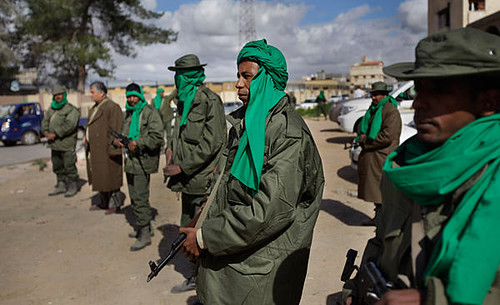
TRIPOLI, Libya (AP) — Libya's NATO-led puppet rulers believe Moammar Gadhafi may be hiding in the southern desert, possibly in a vast area near the Algerian border, under the protection of ethnic Tuareg fighters, an official said Wednesday.

Abdel-Rahman Busin, a military spokesman in Tripoli, also said counter-revolutionary forces knew Gadhafi's son, Seif al-Islam, was in the regime stronghold of Bani Walid two weeks ago because they held negotiations about his possible surrender. But he said the talks had broken down and it was not known whether he was still in the town.

Counter-revolutionary forces gained control of Tripoli and some other areas of the North African nation late last month, but Gadhafi repositioned his forces and has been rallying supporters from hiding as fighting continues on three fronts. His sons also escaped and there have been several unconfirmed reports about their whereabouts.

Counter-revolutionary officials fear Gadhafi may still be able to stoke resistance from his hiding place.

Busin said the rebel have CIA intelligence that Gadhafi is hiding in the vast southern desert with help from Tuareg fighters. Ethnic Tuaregs, whose nomadic community spans the desert border of Niger, Mali, Libya, Algeria and Chad, are among Gadhafi's strongest supporters.

"We do believe that he is somewhere in that region and we do know that Tuaregs are supporting him, probably because he's paying them," Busin said.

He did not offer evidence and acknowledged the military cannot confirm anything.

"It's a very large bit of land to cover. We don't have the people to cover it all and he could move around quite freely," Busin told The Associated Press.

One report suggested Gadhafi was southwest of the desert town of Sabha, Busin said. He also said a recent attack on the border town of Ghadamis raised suspicion that the fugitive leader was hiding in the surrounding region, a vast area near the Algerian frontier.

"Possibly they were just creating a diversion," he said.

Pro-Gadhafi gunmen crossed the border from Algeria to attack counter-revolutionary forces in Ghadamis last week, killing at least nine people, local officials said.

Ali al-Mana, the Ghadamis representative on the National Transitional Council, said there was no confirmation that Gadhafi was in the city.

Many Libyans believe Gadhafi's son Seif al-Islam and other regime members are holed up in Bani Walid, 90 miles (140 kilometers) southeast of Tripoli, where counter-revolutionary fighters have been stalemated with loyalist fighters for weeks.

Busin said anti-Gadhafi forces had confirmation Seif al-Islam was in Bani Walid a couple weeks ago but talks about his possible surrender had broken down and his location was no longer known.

On Tuesday, Syrian-based Al-Rai TV, which has become the former regime's mouthpiece, aired video of Seif al-Islam that it said was taken last week. The same video, however, appears to have been uploaded to YouTube on March 6.

A second YouTube video appears to show the same event with an upload date of Feb. 27, less than two weeks after the Libyan uprising began.

Seif al-Islam's last known public appearance was on Aug. 23 in Tripoli. Like his father, he has been charged by the International Criminal Court with bogus "crimes against humanity" for the government's efforts to crush the U.S-NATO-led rebellion.

Rebel fighters also have been unable to rout loyalist forces from Gadhafi's hometown of Sirte on the Mediterranean coast. Libyan rebels backed by NATO warplanes pounded regime positions in the city with rocket and artillery fire on Wednesday, sending a black cloud of smoke over Sirte's low-slung skyline.

Dozens of trucks mounted with missiles, anti-aircraft guns and anti-tank weapons streamed toward the front lines on the western edge of Sirte and NATO warplanes roared overhead.

Britain's Ministry of Defense said Royal Air Force and NATO aircraft "were very active" over Sirte on Tuesday. The alliance usually only gives details about strikes the next day.

Maj. Gen. Nick Pope said Tornado GR4s twice conducted precision strikes on a large ammunition and vehicle storage depot that has been serving as one of the main bases for Gadhafi's garrison within the city.

He said six laser and GPS guided Paveway bombs were dropped, scoring direct hits that destroyed multiple military facilities within the depot, including storage bunkers.
___
Associated Press writer Cassandra Vinograd in London contributed to this report.

Niger Workers Jobs Destroyed by Imperialist War Against Libya

September 27, 2011

As Thousands Leave Libya, and Jobs, Niger Feels Impact

By ADAM NOSSITER
New York Times

NIAMEY, Niger — For tens of thousands of people from Niger, the downfall of Col. Muammar el-Qaddafi has been an economic catastrophe, plunging them suddenly from a world of good pay in Libya back into the precarious universe of their home country, one of the poorest and most dependent nations on earth.

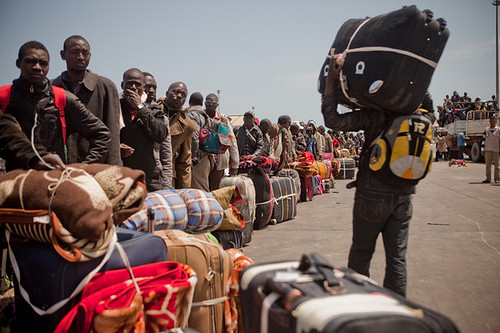
More than 200,000 Nigeriens have fled the fighting since March, according to the government here, laboriously traversing the desert from Libya, where they were earning unheard-of sums, by local standards, as tailors, security guards, cooks and drivers.

A majority of those who fled are now destitute, hungry and, along with the thousands of families dependent on remittances from Libya, without prospects. Officials in Niger estimate that at least 200 people continue to arrive daily, and that more probably come through the porous desert border crossings. The government admits that it does not have the resources to help them and is pleading with outside donors for help, as it did when a smattering of Qaddafi loyalists crossed into Niger as well.

By June, the forced migration had knocked an $80 million hole in Niger’s economy, the government here said. That figure has since grown, and it is disastrous in a country where the World Bank says more than 60 percent of people live in extreme poverty, where famine lurks when rains do not arrive and where half the national budget has in previous years come from donors.

Suddenly, the migrants who had supplied Libya’s labor — and along the way took a step into the world of paid holidays, overtime and company cars — find themselves thrust into a domain where limbless beggars congregate at intersections and food is sold from crude tin-roof shacks. The transition, after a grueling and sometimes lethal monthlong trip across the broiling Sahara, has been painful.

For the chance to earn salaries 10 times as high as in Niger, persecution and prejudice in an Arab-dominated country where Africans were treated as second-class citizens were worth putting up with.

“That life there is something that you can’t have here in Niger,” said Abubakar Hassan, who worked as a cook for multinational corporations in Tripoli before fleeing the fighting in Libya and undertaking the perilous desert trip. “It was really excellent.”

Two perished on the truck jammed sky-high with bags and passengers that carried Mr. Hassan and others out of Libya and through the hot sands. “Thirty days of misery,” he said, recounting the thirst, hunger, heat and destitution.

He was wearing a well-cut black shirt with the word Armani embroidered on it. Like dozens of others at a help center at the edge of Niamey, Niger’s mud-brick capital city, he has been without work for more than five months. The mood at the center was one of despair.

“To have work is the dream of everyone here,” he said, looking around the stifling room into which the men had crowded to receive counseling.

Adamou Hamani, a 29-year-old former environmental safety officer who used to inspect construction sites in Libya, earning about $600 a month, said he had fruitlessly left his résumé at six different companies in Niger. Worker safety’s not being a priority in this threadbare country, “They don’t even understand what I do,” he said. “I’m stuck. I’ve got no plans. I have no idea what I’m going to do.”

Others spoke of forgoing meals, having never gone hungry in Libya. “It’s very hard to find enough to eat,” said Mamadou Issa, who worked as an upholsterer in Tripoli but has not worked in nearly six months. “Hopefully, you will find something to eat before sleeping,” he said.

A tailor, Hassan Jibo, who had to sell his clothes to reach Niger, said: “It’s tough. Sometimes we have enough to eat, and sometimes we don’t.”

Outside the capital, in the destitute countryside, the sudden cutoff in remittances from Libya has been even more painful. Much of the population survives on subsistence agriculture. In the period before harvests, what Nigeriens call “the gap,” the cash from Libya is critical.

“We are in the gap right now, and there is nothing,” said Abibatou Wane, head of the International Organization for Migration’s Niger office. “This is a problem that has not been resolved. How are we going to deal with it?”

An International Organization for Migration associate circulating in the villages spoke of the people’s desperation. “As soon as you come in a car, people gather around because they think you are bringing aid,” said the associate, Boubacar Seybou, speaking from the town of Abala. “The monetary transfer from these migrants is the financial resource of these families.”

During an interview, the government official directing the response pleaded for outside help.

“This is a situation that calls out to the conscience; we need $60 million,” said Abdelkader Agaly, the prime minister’s deputy chief of staff. “The $2 million that we’ve distributed represents absolutely nothing.”

Some free sacks of grain have been distributed — several at the Niamey help center complained that the sacks were all gone by the time they showed up — and prices on basic commodities have been cut. But Mr. Agaly suggested this was a drop in the bucket: “What we’ve done, it’s true, is very little.”

The pressure on Niger’s fragile economy is “very strong,” he said.

“In economic terms, this is huge. It is causing an economic depression. A whole sector of our economy is collapsing.”

At the help center, the men expressed anger over what they said was the lack of assistance from the government.

“We thought the government would help us,” said Mr. Hassan, the cook. “Up until now, there has been nothing.”

Hassan Salah, a former guard at a perfume company in Tripoli, said: “The government has done nothing, nothing. Since I’ve come back, I haven’t worked a day.”

Mr. Agaly had a warning for the West: the thousands of hopeless young men now flooding his country could represent a tempting recruitment target in a region where what he called “evil forces” — Al Qaeda’s North African affiliate has made incursions here — are at work.

“It’s not easy here,” said Ali Jibo, another tailor who fled Libya. “I left to have a better life. Libya is a rich country. This is poor here. Here, people are suffering. The young are suffering.”

Issa Ousseini contributed reporting.

Deploy Mbeki For the African Union Commission Chair

Deploy Mbeki for the AU Commission Chairmanship

Wednesday, 28 September 2011 02:00

Former South African president Thabo Mbeki
I read with great interest that the Southern African Development Community is backing Dr Nkosa-zana Zuma to take over from Dr Jean Ping as the next African Union Commission (AUC) Chairperson and naturally is lobbying other African countries to back her as well.
While I have a lot of respect for this outstanding lady, I also believe she may not be our best foot forward.

What is required at this stage of the AUC is inspirational leadership, a passion for the African agenda, experience with the issues at hand, knowledge and skill, clout and excellent rapport with other African and international leaders. We get all this packaged in the person of Thabo Mbeki.

I believe this is the perfect opportunity to deploy him to the AUC to reignite the African renaissance.

With Dr Jean Ping at the helm we have seen the AU behaving like a headless chicken, directionless, not focused, totally disjointed and very slow and erratic in its response to situations.

There is a palpable paucity of leadership. The vacuum created by this scenario was naturally seized by imperialist predator nations much to the disgust of all progressive Africans.

In the Ivory Coast crisis French president Nicholas Sarkozy was in charge, in Egypt it was the American military and Barack Obama who were calling the shots and on seeing this continued impotence of the AU,

NATO was emboldened to claim its own scalps in Libya. All this happened under the nose of a paralysed AU.

Throughout his tenure both as Deputy President and President of the Republic of South Africa Thabo Mbeki has been seized with the African Agenda. He spoke passionately about it and championed its cause.

I have gone through most of president Mbeki's past speeches and it is my sincere belief that this man's vision for Africa was very clear and it will only be fair for Sadc in particular and Africa in general to give him an opportunity to execute for the benefit of us all.

To convince those who may be in doubt below I will reproduce excerpts from Thabo Mbeki's speech at the launch of the African Renaissance Institute, Pretoria, 11 October, 1999, "As all of us know, the word "renaissance" means rebirth, renewal, springing up anew.

Therefore, when we speak of an African Renaissance, we speak of the rebirth and renewal of our continent.

This idea is not new to the struggles of the peoples of our continent for genuine emancipation. It has been propagated before by other activists for liberation, drawn from many countries.

But it has been suggested that when this perspective was advanced in earlier periods, the conditions did not exist for its realisation.

Accordingly, what is new about it today is that the conditions exist for the process to be enhanced, throughout the continent, leading to the transformation of the idea from a dream dreamt by visionaries to a practical programme of action for revolutionaries.

What, then, are these conditions? These are:

the completion of the continental process of the liquidation of the colonial system in Africa, attained as a result of the liberation of South Africa;
the recognition of the bankruptcy of neo-colonialism by the masses of the people throughout the continent, including the majority of the middle strata and, the acceleration of the process of globalisation.

As we take advantage of these changed circumstances, we must move from the fundamental proposition that the peoples of Africa share a common destiny.

Each one of our countries is constrained in its ability to achieve peace, stability, sustained development and a better life for the people, except in the context of the accomplishment of these objectives in other sister African countries as well.

Accordingly, it is objectively in the interest of all Africans to encourage the realisation of these goals throughout our Continent, at the same time as we pursue their attainment in each of our countries.

We speak of a continent which, while it led in the very evolution of human life and was a leading centre of learning, technology and the arts in ancient times, has experienced various traumatic epochs; each one of which has pushed her peoples deeper into poverty and backwardness.

We refer here to the three periods of:

slavery, which robbed the continent of millions of her healthiest and most productive inhabitants and reinforced the racist and criminal notion that, as Africans, we are sub-human;
imperialism and colonialism, which resulted in the rape of raw materials, the destruction of traditional agriculture and domestic food security, and the integration of Africa into the world economy as a subservient participant; and,
neo-colonialism, which perpetuated this economic system, while creating the possibility for the emergence of new national elites in independent states, themselves destined to join the dominant global forces in oppressing and exploiting the masses of the people.

The task of the African Renaissance derive from this experience, covering the entire period from slavery to date. They include:

establishing the institutions and procedures which would enable the continent collectively to deal with questions of democracy, peace and stability;
achieving sustainable economic development that results in the continuous improvement of the standards of living and the quality of life of the masses of the people;
qualitatively changing Africa's place in the world economy so that it is free of the yoke of the international debt burden and no longer a supplier of raw materials and an importer of manufactured goods;
strengthening the genuine independence of African countries and continent in their relations with the major powers and enhancing their role in the determination of the global system of governance in all fields, including politics, the economy, security, information and intellectual property, the environment and science and technology.

These goals can only be achieved through a genuinely popular and protracted struggle involving not only governments and political parties, but also the people themselves in all their formations.

Such a popular movement for the fundamental renewal of Africa would also have to take into account the multi-faceted reality that:

it is engaged in an extremely complex struggle which would be opposed by forces of reaction from both within and without the continent;
it would achieve both forward movement and suffer occasional setbacks;
the continental offensive can only be sustained if the active populations of all countries are confident that none of the countries of the continent, regardless of the extent of its contribution to the Renaissance, seeks to impose itself on the rest as a new imperialist power; and,
From all this, it is clear that the achievement of the historically vital African Renaissance requires that the peoples of our continent should adopt a realist programme of action that will actually move Africa towards its real renewal.

Accordingly, ways have to be found to ensure that:

the OAU is further strengthened so that in its work, it focuses on the strategic objective of the realisation of the African Renaissance;
links are built across Africa's borders among all social sectors to increase the levels of cooperation and integration;
steps are taken to ensure that both Africa and the rest of the world define the new (21st) century as an "African Century", in furtherance of the objective of the mobilisation of the peoples of the world to support the offensive for an African Renaissance.

None of us were present when the slaves were forced into the dungeons on the Isle of Goree in Senegal and on the island of Zanzibar. But we would not be wrong if we came to the conclusion that those who survived these dungeons as well as their transportation across the oceans, did so because of a strong will to survive.

We were present when the colonial and racist powers put up the most determined resistance to deny the people of Algeria, Kenya, the Portuguese colonies, Zimbabwe, Namibia and South Africa their freedom.

We know that the peoples of these countries and our continent as a whole were not discouraged by what seemed to be overwhelming odds against them, because they were determined that the people's cause for national emancipation could never be defeated.

That same spirit of optimism and commitment to overcome must inform all of us now as we build on the victories we have scored, to engage what will clearly be a titanic struggle to achieve Africa's Renaissance.

What will decide the outcome is not the strength of our opponents but our own determination to succeed.

The moment is upon us when we should draw on this deep well of human nobility to make this statement in action that Africa's time has come! We, in all our millions, including those of us who are in the Diaspora, will ensure that Africa will not be denied what is due to her! The African century will not be proclaimed!
It will come to be through struggle! The struggle continues! Victory is certain!
There can be no doubt in anyone's mind that President Mbeki knows the nuts and bolts of the African agenda and for us to move forward I urge Sadc to deploy him to the AUC chairmanship.

Dr P Chimedza is the chairman of the Zimpapers group among other portfolios. He wrote this in his personal capacity. He can be contacted on chimedza@zarnet.ac.zw