Saturday, April 28, 2018

OPEC Cuts May Go Deeper as Angola Sees Output Plunge 
April 28 2018 01:29 AM

An oil platform is seen in the Atlantic Ocean off the Angolan coast (file). Angola, once Africa’s biggest crude producer, is suffering sharp declines at under-invested offshore fields, with output dropping almost three times as much as the nation pledged in an accord with fellow Opec members.

Bloomberg/London

While plunging output in Venezuela captures the oil world’s attention, problems are quietly festering in another Opec nation.

Angola, once Africa’s biggest crude producer, is suffering sharp declines at under-invested offshore fields, with output dropping almost three times as much as the nation pledged in an accord with fellow Opec members. With the losses set to accelerate — a shipping programme seen by Bloomberg News shows crude exports will fall in June to the lowest since at least 2008 — the organisation risks tightening supply too much.

“Angola has a serious problem, with its decline rates becoming increasingly visible,” said Richard Mallinson, an analyst at consultants Energy Aspects Ltd in London. “The low figure in June doesn’t look like a pattern of maintenance but points to steeper, structural declines.”

The Organisation of Petroleum Exporting Countries and its allies have succeeded in wiping out an oil glut through production cuts launched in early 2017, boosting prices to a three-year high above $75 a barrel. Their efforts have been aided by accidental losses in member nation Venezuela, which is cutting six times the amount it promised as a spiralling economic crisis batters its oil industry.

The risk Opec faces now is tightening world markets too sharply, and sending prices to levels that either crimp oil demand or provoke a new tide of rival supply from the US as Angola’s creeping decline adds to the ongoing slump in Venezuela, that danger only grows.

Output interruptions among the organisation’s members could send Brent crude prices above $80 a barrel, Bank of America Merrill Lynch analysts including Francisco Blanch, head of commodities research, said in a note to clients.

Unintended supply disruptions are rife in the group. Nigeria and Libya were exempt from the deal to cut output because their production had already been diminished by local instability, while Iraq’s implementation of the accord only improved after a political dispute halted exports. Some traders are already shunning Iranian crude in fear that President Donald Trump will re-impose sanctions.

Angola’s slide could be alleviated by the end of the year, with the start up of an oil field operated by Total. The Kaombo field, delayed from 2017, will have a capacity of 230,000 barrels a day.
That might not come soon enough.

Although output from all oil fields diminishes over time as the pressure in their reservoirs falls, Angola’s deep-water operations are especially costly to maintain. Because of insufficient capital expenditure, the rate of decline from Angola’s deposits is more than double the global average, at 13 to 18%, Mallinson estimates. “Most Angolan fields have struggled or entered into a steep decline phase after three years — it’s the nature of the geological characteristics of Angola’s offshore production,” he said. The country’s struggles will only intensify in coming years, the International Energy Agency predicts. Since peaking at 1.9mn barrels a day in 2008, Angola’s production has slumped to about 1.5mn, and will dwindle to just under 1.3mn barrels a day in 2023, according to the agency.


Oil prices steady but supported by Iran concerns

Reuters
New York

Oil prices were little changed yesterday, with Brent on track for its third week of gains amid supply concerns should the United States reimpose sanctions on Iran.

Brent crude futures rose 6 cents to $74.80 a barrel, a 0.1% gain, by 1:11pm EDT (1711 GMT). This month, the global benchmark hit highs above $75, a level last seen in late 2014.

US West Texas Intermediate (WTI) crude futures fell 3 cents to $68.16 a barrel.

Brent was on track for a weekly gain of about 1%, while WTI was set for a weekly loss of about 0.3%. US President Donald Trump will decide by May 12 whether to reimpose sanctions on Iran that were lifted as part of an agreement with six other world powers over Tehran’s alleged nuclear programme.

The renewed sanctions would likely dampen Iranian oil exports, disrupting global oil supply.

“That’s an issue that is more political in nature that could have a shock in the market,” said Mark Watkins, a regional investment manager at US Bank Wealth Management in Park City, Utah.” “It’s one of those wildcards that’s out there because if the sanctions do happen, there’s going to be oil that comes off the market.”

Brent has risen by around 6.5% this month.

The gains came despite a higher dollar, which hit its strongest since January 11 against a basket of currencies.

A stronger dollar makes greenback-denominated commodities more expensive for holders of other currencies.

Concerns about market tightness have also been fuelled by the deteriorating political and economic situation in Venezuela that has led to a 40% decline in crude output in the past two years.

Price increases have been capped by rising US production as shale drillers ramp up activity, underpinning a widening discount between Brent and WTI. US crude’s discount to Brent hit its widest since December 28 at $6.74 a barrel.

Surging US production, which rose to 10.59mn barrels per day last week, has encouraged record-high US exports.

US drillers added five oil rigs this week, bringing the total count to 825, the highest level since March 2015, General Electric Co’s Baker Hughes energy services firm said. But while US producers are accelerating shale drilling in areas in the United States, higher production has not necessarily translated into stronger refining results for some oil companies.

Weak refining margins hurt two of the world’s largest integrated energy companies for the second consecutive quarter, although Chevron Corp’s oil production gains in the first quarter outshone its larger rival Exxon Mobil Corp.
Angolan Oil Production Falls Rapidly
By Irina Slav
Apr 27, 2018, 1:00 PM CDT

Crude oil production in Angola is falling rapidly on lack of investments in offshore fields and this could tip the oil market into a deficit, Bloomberg reports, citing shipping schedules for June.

Angola was a few years ago the largest oil producer in Africa, while Nigeria battled militant groups in the Niger Delta, and Libya had its own problems with various groups that fought for control over its oil fields and export terminals. But now the country is delivering deeper cuts than its OPEC quota.

The latest Monthly Oil Market Report by OPEC reveals that in the first quarter, Angola produced 1.574 million bpd of crude, down from 1.633 million bpd in the final quarter of 2017. In March, average daily production was the lowest for the quarter, at 1.524 million bpd, down by 81,700 bpd from February. Some analysts believe the decline will continue, and even accelerate.

The problem, Bloomberg notes, is that Angola’s offshore fields are particularly costly to maintain, and there is not a lot of enthusiasm among oil companies to invest in this production maintenance.

“Most Angolan fields have struggled or entered into a steep decline phase after three years -- it’s the nature of the geological characteristics of Angola’s offshore production,” Energy Aspects analyst Richard Mallinson told Bloomberg. The shipping data suggests that June loadings will be the lowest in as long as a decade, highlighting the gravity of the problem.

For OPEC, however, this would likely be the opposite of a problem. After enjoying the results of plummeting oil production in Venezuela, which allowed it to substantially exceed its initial quotas, now the rest of OPEC will likely see prices climb further on Angola’s production drop.

On the flip side, if prices rise too much, this will start affecting demand, and it will also add fuel to the U.S. producers’ motivation to continue raising their own production. Ultimately, too sharp a swing of prices in the upwards direction will eventually lead to a correction that most OPEC members would not like to see.

By Irina Slav for Oilprice.com
Angola Turns to Bond Markets to Support Public Finances
By Sudip Roy

LONDON, April 27 (IFR) - Angola is meeting investors ahead of what would be only the second international bond from the oil-rich African sovereign.

Officials are marketing the country to accounts in New York, Boston and London ahead of a 10-year US dollar bond and potentially a tranche with a longer tenor that is likely to price this week.

In the US dollar market, Egypt (B3/B-/B) raised US$4bn in February, while Nigeria (B2/B/B+) issued US$2.5bn and Kenya (B+/B+) US$2bn the same month.

Like Angola, each of those sovereigns has big economic and financial challenges but the healthy yields on offer and index-eligibility helped build big books.

Kenya, for example, garnered peak orders of US$14bn for its deal comprising 10-year and 30-year bonds. The 10-year tranche priced at a yield of 7.25%, while the 30-year came at 8.25%. The February 2028s are now bid at 6.70%.

Angola has one bond outstanding - the US$1.5bn 9.50% November 2025s, which are quoted at 7.03% bid, according to Thomson Reuters, albeit that is based off a high cash price of 114.25.

The country's prospects are looking up, according to the IMF, thanks to the rebound in oil prices and steps taken by President Joao Lourenco to stabilise the economy since he took up office in September.

"MILD RECOVERY"

In an Article IV statement in March, the IMF said the economy was experiencing a "mild recovery", while the administration was focused on "improving governance".

The IMF forecast growth to hit 2.25% this year from 1% in 2017, and backed the government's efforts to cut the fiscal deficit and public debt burden, which stood at 6% and 64% of GDP, respectively, in 2017.

It said that Angola's fiscal goals would be achieved by "ongoing efforts to enlarge the tax base, including by introducing a VAT on January 1 2019, as planned; and rationalising public spending".

The IMF does not have a formal programme with Angola but earlier this month the Luanda government said it had requested non-financial assistance from the multilateral to help it implement economic reforms, through a so-called Policy Coordination Instrument agreement.

Lourenco became president last year replacing Jose Eduardo dos Santos, whose 38 years of rule became plagued by charges of corruption.

Lourenco has vowed to tackle the problem. On Monday he sacked the chief of staff of the armed forces and the head of the foreign intelligence agency as part of these efforts.

Lourenco is also trying to revive the fortunes of state-owned oil company Sonangol, which was run by dos Santos's daughter Isabel.

Lourenco replaced her shortly after taking office with the new management tasked with cutting costs and overseeing the repayment of US$3bn of debt owed to Chinese lenders plus another US$3bn owed to oil majors, contractors and traders.
Angola's First Satellite Defunct Four Months After Launch
Russia, which build the defective AngoSat-1, will construct a new satellite, scheduled to be launched in 2020.

24 Apr 2018

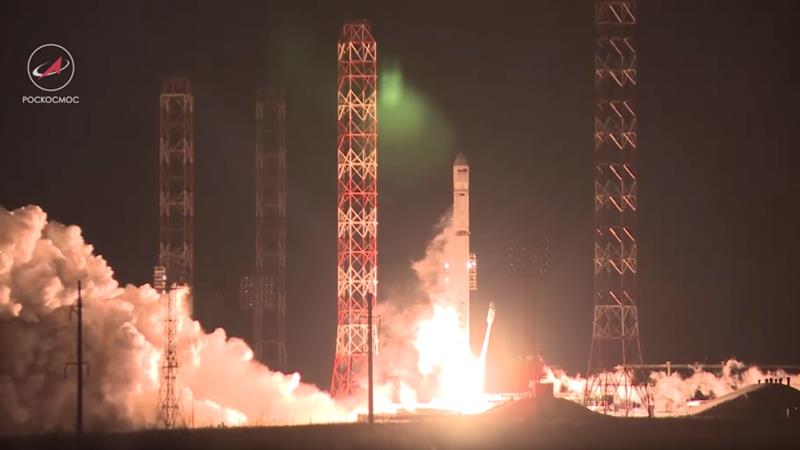
The satellite was sent into orbit in December, but contact was lost shortly afterwards [Roskosmos/YouTube]

Angola's first satellite has been officially declared defunct by Russia, which had partially funded the West African nation's space project.

The AngoSat-1, a communications satellite built for almost $300m, was launched late December from the Baikonur cosmodrome in Kazakhstan.

Shortly after launch, communication with the device was lost.

Despite restoring contact several days later, the project had several technical issues in the following months, eventually leading to the announcement of its official loss on Monday.

Russia, who built the AngoSat-1 on behalf of Angola, said it would start building a more powerful follow-up satellite at no cost, as per AngoSat-1's insurance policy.

The new satellite will take about 18 months to build and will launch in 2020, Russia's space agency said.

AngoSat-1, Angola's first space project, was scheduled to work for 15 years and was made to improve telecommunications in the African country.

About 50 Angolan aerospace engineers were trained around the world and were supposed to oversee the mission from a control centre in Angola.

In 2017, Angola made public its long-term plans for its space programme, showing ambition for a steady expansion in the coming years.

It is unclear how the failure of AngoSat-1 will affect that multiyear plan.

Angola is one of few sub-Saharan countries with a space programme.

Nigeria, Ghana and South Africa already have several satellites in orbit, for communications to educational projects, as well as satellites tracking the movements of armed groups.

SOURCE: AL JAZEERA NEWS
Mauritius Freezes Assets Linked to Angola's Sovereign Wealth Fund
By Jean Paul Arouff

PORT LOUIS, April 11 (Reuters) - Mauritius has frozen bank accounts and suspended business licences linked to QG Investments Africa Management, a firm run by the man who helps run Angola’s sovereign wealth fund, according to a court document and a regulatory source.

QG Investments Africa Management, which said it was cooperating with authorities, is run by Jean-Claude Bastos de Morais, a business partner of Jose Filomeno dos Santos and director of Switzerland-based Quantum Global Investment Management.

The son of José Eduardo dos Santos, Angola’s former president, Jose Filomeno dos Santos was until recently the head of the national sovereign wealth fund.

The younger dos Santos has been charged with fraud against Angola’s central bank, involving the transfer of $500 million in the United Kingdom. The funds were frozen and then returned to Angola’s central bank.

The moves at de Morais’ firm in Mauritius came after Angolan officials visited in Indian Ocean island last week, a regulatory source on Mauritius told Reuters.

Following a Mauritius Supreme Court ruling, seen by Reuters on Wednesday, the island’s Financial Services Commission suspended the licenses for seven QG Investments Africa funds, according to the source, and froze 25 of its bank accounts.

On Monday, the Mauritian newspaper Le Mauricien reported that a further 33 bank accounts had been frozen, bringing the total to 58.

“There was a reputational risk on our jurisdiction, therefore we had to act promptly,” the Mauritian regulatory official told Reuters, adding that the steps had been taken in collaboration with investigations by Angolan authorities.

In a statement, QG said it was cooperating with the relevant authorities. “We remain confident and resolute in our ability to defend ourselves vigorously against the unwarranted attacks on our reputation,” it said.

It has denied any links to the $500 million transfer that was frozen in Britain.

Angola’s Finance Ministry, which has led previous investigations of financial malpractice, did not respond to a request for comment.

Dos Santos is the highest-profile figure to be investigated for corruption since President Joao Lourenco took power last September, vowing to combat years of endemic graft in Africa’s second-largest oil producer.

His half-sister, Isabel dos Santos, has also been removed as chair of state oil company Sonangol. (Reporting by Jean Paul Arouff in Port Louis, additional reporting and writing by Stephen Eisenhammer in Luanda, editing by Larry King)
Angola Seeks to Remove Quantum Global As Asset Manager

Angola’s sovereign wealth fund (FSDEA), is taking steps to remove Swiss-based Quantum Global as its asset manager, it said on Friday.

“FSDEA has great concerns about Quantum Global’s approach to investment of the FSDEA funds, as it believes that is not fully aligned with the principles for which the FSDEA was established,” the fund said in a statement.

The move comes two weeks after Mauritius froze bank accounts and suspended business licences linked to Quantum Global Investments Africa Management.

FSDEA has great concerns about Quantum Global’s approach to investment of the FSDEA funds, as it believes that is not fully aligned with the principles for which the FSDEA was established.

QG Investments Africa Management, which said it was cooperating with authorities in Mauritius, is run by Jean-Claude Bastos de Morais, a business partner of Jose Filomeno dos Santos and the director of Quantum Global Investment Management.

Quantum Global could not immediately be reached for comment.

In the past, they have pledged to cooperate with relevant authorities against ‘unwarranted attacks on our reputation’.

Jose Filomeno dos Santos, the son of José Eduardo dos Santos, Angola’s former president, was until recently the head of Angola’s sovereign wealth fund.

The younger dos Santos has been charged with fraud against Angola’s central bank, involving the transfer of $500 million in Britain.

Dos Santos is the highest-profile figure to be investigated for corruption since President Joao Lourenco took power last September, vowing to combat years of endemic graft in Africa’s second-largest oil producer.

His half-sister, Isabel dos Santos, has also been removed as chair of state oil company Sonangol.
Angola's Wealth Fund to Sack Asset Manager, President Consolidates Power
Herculano Coroado

LUANDA (Reuters) - The most powerful body in Angola’s ruling MPLA party said on Friday it had approved the candidacy of state president Joao Lourenco to become head of the party, replacing his predecessor as head of state Jose Eduardo dos Santos.

The move coincided with an announcement by Angola’s $5 billion sovereign wealth fund that it was sacking Swiss-based Quantum Global as its asset manager because it was concerned about the way its capital was being invested.

Both developments will further cement the political grip of Lourenco, who has taken action against dos Santos’ allies and removed family members from key positions while pledging to root out endemic corruption and clean up public finances in Africa’s No. 2 crude producer.

Dos Santos’ son Jose was formerly head of the fund but has since been removed by Lourenço, who has also overseen the sacking of his daughter Isabel as head of state oil company Sonangol.

Lourenco took over as state president in September last year when dos Santos stepped down after almost four decades in power, but the latter remained head of the MPLA, which has ruled Angola since it won independence from Portugal in 1975.

The MPLA’s politburo, the highest-ranking organ in the former Marxist party that was aligned to Moscow during the Cold War, said in a statement that it had “approved the candidacy of Comrade João Lourenço, currently Vice-President, to the position of MPLA President.”

The next MPLA president will be formally appointed at a party congress in September.

Dos Santos’ position as head of the party was widely regarded as an attempt to maintain control of the state but Lourenço has shown he is in charge.

The action against Quantum Global follows this pattern as the new administration seeks to weed out the influence of dos Sanstos’ appointees in a bid to woo investors and key lenders.

Angola’s sovereign wealth fund FSDEA said in a statement that it had “great concerns about Quantum Global’s approach to investment of the FSDEA funds.”

“As a consequence of investigations through leading international global consultants and advisers, FSDEA is taking steps to remove Quantum as its asset manager,” it added.

Quantum Global said all Angola’s money under its management was accounted for and that the dispute was a contractual issue. QG was appointed in 2012, with most investments made in 2015.

Friday’s announcement comes just weeks after Mauritius froze bank accounts and suspended business licenses linked to QG Investments Africa Management following a visit by Angolan officials.

QG Investments Africa Management, which said it was cooperating with authorities in Mauritius, is run by Jean-Claude Bastos de Morais, QG founder and group chairman and a business partner of dos Santos’ son.

Quantum Global has demanded that Mauritius authorities explain their decision to suspend its business licenses on the Indian Ocean island nation.

Additional reporting by Michael Shields in Zurich; Writing by Ed Stoddard; Editing by Hugh Lawson and Richard Balmforth
Angolan President Sacks Army Chief and Spy Boss Over Corruption Allegations
As part of promises to deal with widespread corruption in the country, Angolan President Joao Lourenco on Monday sacked the chief of staff of the armed forces and the head of the foreign intelligence over corruption allegations.

This is the president’s latest move against government officials tainted by corruption accusations and those perceived to have close links to former President Jose Eduardo dos Santos, Reuters news agency reports.

Before being dismissed as the head of the armed forces, General Geraldo Sachipengo Nunda was named as a suspect in a scheme to negotiate a fraudulent international credit line of $50bn.

Andre de Oliveira Sango was the head of the country’s foreign intelligence agency for more than a decade under Dos Santos.

Their dismissals were announced on Monday in a presidential decree broadcast on the state radio station.

This comes weeks after Jose Filomeno dos Santos, the son of the former Angolan president was charged with fraud over an alleged illegal transfer of $500m while he was in charge of the country’s sovereign wealth fund.

His father, Jose Eduardo dos Santos ruled Angola for 38 years and was accused of administering the country’s economy to enrich himself and his associates.

When Lourenco took over power from Dos Santos last September, he promised to tackle the culture of corruption and bring social and economic reforms to the country.
Angola Fires Army Chief and Spy Boss in Latest Anti-graft Move
25 APR, 2018 - 00:04

LUANDA. – Angolan President Joao Lourenco has fired his country’s army chief and the head of the foreign intelligence agency over corruption allegations.

The move by Lourenco on Monday is the latest against government officials tainted by corruption accusations and those perceived to have close links to former President Jose Eduardo dos Santos.

Last month, General Geraldo Sachipengo Nunda was named by prosecutors as a suspect in an investigation of a scheme to negotiate a fraudulent international credit line of $50bn.

Andre de Oliveira Sango has been the head of the southern African country’s foreign intelligence agency for more than a decade under Dos Santos.

Their sackings were announced in a presidential decree broadcast on the state radio station.

The latest purge comes weeks after the Angolan finance ministry said Jose Filomeno dos Santos, the son of Jose Eduardo dos Santos, planned to siphon off $1.5bn when he ran the oil-rich country’s sovereign wealth fund.

The $1.5bn figure is three times the sum Filomeno dos Santos was initially accused of illegally transferring to a British bank.

The finance ministry said that Filomeno dos Santos disguised the transfer as a project aimed at attracting investment in Angola with the help of a fake guarantee from Credit Suisse.

Luanda said $500m had been transferred to a London bank and that Angola was supposed to make two more such payments.

The first transfer was blocked by UK authorities who suspected foul play.

Filomeno dos Santos was appointed to head the $5bn oil-fuelled sovereign fund by his father in 2013 but was sacked by President Joao Lourenco, who took power in January this year.

Former central bank governor Valter Filipe da Silva, who has been charged alongside Filomeno dos Santos, has promised to “cooperate” with the authorities.

Filomeno’s half-sister, Isabel dos Santos, was also sacked from her job as the head of state-owned oil giant Sonangol. Thought to be Africa’s richest woman, she has denied all allegations against her.

Jose Eduardo dos Santos ruled Angola for 38 years. During his rule, he was accused of running the country’s economy to enrich himself and those around him.

– Al Jazeera/News agencies

Friday, April 27, 2018

Classified Niger Probe Finds Multiple Flaws in Deadly Mission for United States Imperialists
BY ELLEN MITCHELL
The Hill
04/26/18 01:41 PM EDT

A classified report on the deadly attack in Niger last fall found that disregard for the chain of command and a rush to approve a mission were contributing factors to the deaths of four U.S. soldiers, The Wall Street Journal reported Thursday.

The 6,000-page report says that low-level commanders at U.S. Africa Command, eager to hit at local militant groups, took risks to get operations approved, officials familiar with the report told the Journal.

In one case, at least one officer copied and pasted orders from a different mission into the new mission’s concept of operations to get the plan approved.

The copied orders are only one of a series of missteps detailed in the report, which also describes a disregard for military procedures.

The report, however, reportedly doesn’t recommend punishment for anyone.

The report also doesn’t blame increased decision-making power given at lower levels. That change, directed by President Trump after recommendations from Defense Secretary James Mattis, came last year.

The investigation follows the October attack near Tongo Tongo, a village in a remote area of Niger. About 12 U.S. soldiers and 30 Nigerien soldiers were on a mission to meet with local officials — but it was then switched to a plan to search for an associate of forces aligned with the Islamic State in Iraq and Syria.

Despite U.S. intelligence assessing a low possibility of enemies in the area, the group was ambushed by about 50 attackers. Four U.S. service members and five Nigerien soldiers were killed.

Defense officials this week are briefing family members of the four slain soldiers on the report, which has taken months to complete and includes testimony from dozens of individuals, maps, diagrams and even video taken from soldiers’ helmet cameras.

A classified version of the report has been provided to Congress, which will receive briefings on it from top Pentagon officials.

The House Oversight and Government Reform Committee and the House Armed Services Committee are both planning hearings on the Niger mission.

Armed Services Chairman Mac Thornberry (R-Texas) on Thursday criticized a leak of the report’s details ahead of family members being briefed.

“There are a number of important oversight issues related to the ambush of U.S. forces in Niger and America’s military posture in Africa,” he said in a statement.

“However, it is deeply troubling that individuals with access to the report chose to leak details of the investigation before families of the fallen could be fully briefed. To me, that is an unconscionable breach of faith with the families of our warfighters and perhaps a violation of law.”

Thornberry added that he has directed the committee’s staff director to start an inquiry to make sure that the leak did not come from his committee and urged his fellow chairs with access to the report to do the same.

The report also includes military-wide directives from Mattis on training guidance, operational discipline and reinforcing already-established protocols within the chain of command. The officials said these were to help reduce the chances of another similar incident. 

Mattis will also specifically give the Army, Special Operations Command and U.S. Africa Command about 10 “primary directives.” The groups will then have four months to show they are trying to fix the issues found in the report.

There are about 6,000 U.S. troops in Africa, including 800 in Niger.
US Imperialism Builds Drone Base in Niger
In this photo taken Monday, April 16, 2018, a U.S. and Niger flag are raised side by side at the base camp for air forces and other personnel supporting the construction of Niger Air Base 201 in Agadez, Niger. On the scorching edge of the Sahara Desert, the U.S. Air Force is building a base for armed drones, the newest front in America's battle against the growing extremist threat in Africa's vast Sahel region. Three hangars and the first layers of a runway command a sandy, barren field. Niger Air Base 201 is expected to be functional early next year. (AP Photo/Carley Petesch)

The Associated Press
23 Apr 2018
By Carley Petesch

AGADEZ, Niger — On the scorching edge of the Sahara Desert, the U.S. Air Force is building a base for armed drones, the newest front in America's battle against the growing extremist threat in Africa's vast Sahel region.

Three hangars and the first layers of a runway command a sandy, barren field. Niger Air Base 201 is expected to be functional early next year. The base, a few miles outside Agadez and built at the request of Niger's government, will eventually house fighter jets and MQ-9 drones transferred from the capital Niamey. The drones, with surveillance and added striking capabilities, will have a range enabling them to reach a number of West and North African countries.

Few knew of the American military's presence in this desperately poor, remote West African country until October, when an ambush by Islamic State group-linked extremists killed four U.S. soldiers and five Nigeriens.

The $110 million project is the largest troop labor construction project in U.S. history, according to Air Force officials. It will cost $15 million annually to operate.

Citing security reasons, no official will say how many drones will be housed at the base or whether more U.S. personnel will be brought to the region. Already the U.S. military presence here is the second largest in Africa behind the sole permanent U.S. base on the continent, in the tiny Horn of Africa nation of Djibouti.

The drones at the base are expected to target several different al-Qaida and Islamic State group-affiliated fighters in countries throughout the Sahel, a sprawling region just south of the Sahara, including the area around Lake Chad, where the Nigeria's Boko Haram insurgency has spread.

As the U.S. puts drones at the forefront of the fight against extremists, some worry that civilians will be mistaken for fighters.

"We are afraid of falling back into the same situation as in Afghanistan, with many mistakes made by American soldiers who did not always know the difference between a wedding ceremony and a training of terrorist groups," said Amadou Roufai, a Nigerien administration official.

Civic leader Nouhou Mahamadou also expressed concerns.

"The presence of foreign bases in general and American in particular is a serious surrender of our sovereignty and a serious attack on the morale of the Nigerien military," he said.

The number of U.S. military personnel in Niger has risen over the past few years from 100 to 800, the second largest concentration in Africa after the 4,000 in Camp Lemonnier in Djibouti. About 500 personnel are working on the new air and drone base and the base camp is marked with an American and Nigerien flag.

Intelligence, surveillance and reconnaissance are crucial in the fight against extremism, U.S. Africa Command spokeswoman Samantha Reho said.

"The location in Agadez will improve U.S. Africa Command's capability to facilitate intelligence-sharing that better supports Niger and other partner nations, such as Nigeria, Chad, Mali and other neighbors in the region and will improve our capability to respond to regional security issues," Reho said.

The intelligence gathered by the drones can be used by Niger and other U.S. partners for prosecuting extremists, said Commander Brad Harbaugh, who is in charge of the new base.

Some in Niger welcome the growing U.S. military presence in the face of a growing extremist threat in the region.

"Northern Mali has become a no man's land, southern Libya is an incubator for terrorists and northeastern Nigeria is fertile ground for Boko Haram's activities ... Can Niger alone ensure its own security? I think not. No country in the world can today alone fight terrorism," said Souleymane Abdourahmane, a restaurant promoter in the capital, Niamey.

Threats include al-Qaida-linked fighters in Mali and Burkina Faso, Islamic State group-affiliated fighters in Niger, Mali and Nigeria and the Nigeria-based Boko Haram. They take advantage of the vast region's widespread poverty and countries' often poorly equipped security forces.

Foreigners, including a German aid worker kidnapped this month in Niger, have been targeted as well.

The U.S. military's use of armed drones comes as its special forces pull back from the front lines of the fight. The focus is changing to advising and assisting local partners higher up the chain of command, said U.S. Special Command Africa commander Maj. Gen. Marcus Hicks.

Ibrahim Maiga, a Mali-based researcher for the Institute for Security Studies, said more needs to be known about the U.S. military presence in the region.

"The U.S. military footprint in the Sahel is difficult to grasp, just as it is not easy to assess its effectiveness," he said. "There isn't nearly enough information in the public space on this presence."

Mud homes line the barbed wire fence at the edge of the main airport in Agadez. Residents watch the U.S. forces come and go with curiosity.

Shebu Issa, an assistant at a Quranic school, stood in one doorway as goats and children roamed the sandy roads.

"It's no big deal to us, they come and they don't bother us. We appreciate they want to help in the fight," he said. "We live a hard life, and don't make much money, so we hope maybe this will help us get more."
___

Associated Press writer Dalatou Mamane in Niamey, Niger contributed.

This article was written by Carley Petesch from The Associated Press and was legally licensed through the NewsCred publisher network. Please direct all licensing questions to legal@newscred.com.
Togo: Protests Break Out Despite Ban
After a break of more than a month, opponents of the regime in Togo called once more for demonstrations over the weekend. Mediation attempts appear on the verge of failure. Adrian Kriesch reports from Lomé.

The young man with a towel around his waist in Lomé, Togo, has little idea what's going on. Just a moment ago he was in the shower — now he feels he is in an action movie. A truck races around the corner, police officers in combat gear climb over a wall and two men are dragged out of the neighboring building. "We don't know if they were thieves who stole something," says the young man, "or if they were just demonstrators."

More than 50 years of family rule

Since August 2017, opposition groups in the West African nation of Togo have demonstrated regularly against the government. The family of Gnassingbé Eyadema, who took power in 1967, has reigned for more than 50 years. In 1992 Eyadema passed a law limiting the President's rule to two terms in office. A decade later he rescinded it to remain in power. Upon his death in 2005, the military helped install his son Fauré as the new head of state — an appointment later confirmed in controversial elections.

The opposition has demanded a return to the old constitution of 1992, which would limit the president's maximum period of rule to two terms of five years each. Rolling protests in recent months have, on occasions, seen more than 100,000 people take to the streets. In the country with a population of less than eight million, clashes with security forces have become commonplace. Dozens of protesters have been arrested and at least eleven people killed. The wave of protests was interrupted in February when Nana Akufo-Addo, president of neighboring Ghana, intervened as mediator. Talks were held and political prisoners released.

Failed mediation attempts?

Last week the opposition called for protests once more, saying that the government would not show any will for serious reform if the crisis were to drag out. But Ghana's mediation attempts are not over yet, communications minister Guy Lorenzo told DW. For that reason the government has issued a ban on all protests. "If they don't agree, they can go to court," Lorenzo said. "But they just want to demonstrate. We don't accept that. We live in a constitutional state."

Security forces cracked down hard at the weekend — such as outside the freshly-showered young man's house. "I was just passing by, I didn't do anything at all," shouts one of the men as he is pulled onto the loading area of the police truck. "We've been trying to get rid of this dictatorship for 50 years," says another man on the side of the road once the police truck is out of sight. He says it is scandalous that people are no longer even allowed to protest against poor development in a country where "youth have no jobs."

Tear gas and barricades

A few kilometers away, representatives of the 14 party opposition alliance have barricaded themselves in the headquarters of the Democratic Convention of African Peoples (CDPA) party. Soldiers have assembled in front of it, firing tear gas at the few followers in front of the house. "We aren't even demonstrating, we're just meeting at the headquarters of a political party," says Dodji Apevon, the leader of an opposition party. "And the military shoots with tear gas. One can only wonder what is going on inside them."

The military faces criticism for its close alliance with the president. "Togo is yours too," an elderly woman calls out in the direction of the soldiers.

The president, meanwhile, is meeting regional heads of state in a neighboring district. Faure Gnassingbéis the current chairperson of the Economic Community of West African States (ECOWAS). On their agenda is the political crisis in Guinea-Bissau. The crisis on his doorstep goes unmentioned.
West African Leaders Meet in Bid to Defuse Togo Crisis
Opposition is calling for a return to the 1992 constitution, which imposes a two-term limit on presidents

14:28 April 15, 2018
Gulf News AFP

Lome (Togo): Togo’s opposition on Saturday said security forces fired tear gas to prevent antigovernment protests, as West African heads of state met to try to revive stalled talks to end the months-long political crisis.

“Some members of the security forces positioned themselves just at the entrance to the place where we were meeting,” said opposition politician Nathaniel Olympio.

“Very menacingly, they started to throw tear gas everywhere. We had to leave the premises after 45 minutes,” he said.

The 14-party opposition coalition, which has staged antigovernment protests since last August, this week decided to resume demonstrations, despite an official ban.

But since Wednesday, security forces have closed off all opposition meeting points in the capital. The tear gas on Saturday was fired near the opposition headquarters.

There was also unrest in Kpalime, some 120 kilometres north of Lome, where strong action had been taken to prevent demonstrators taking to the streets.

The opposition is calling for a return to the 1992 constitution, which imposes a two-term limit on presidents, and also the introduction of two-round voting in elections.

Gnassingbe has been president since 2005, taking over after the death of his father, General Gnassingbe Eyadema, who ruled Togo for 37 years.

His son won elections in 2005, 2010 and 2015. The opposition wants the application of the two-term limit to be retroactive to prevent him standing again.

A sticking point to agreement has been the government’s refusal to apply the retrospective element, raising the possibility Gnassingbe could remain president until 2030.

Talks brokered by Ghana’s President Nana Akufo-Addo and his Guinean counterpart Alpha Conde stalled earlier this year after just three sessions.

On Saturday, regional heads of state gathered in Lome for a meeting chaired by Gnassingbe, who holds the rotating presidency of the West African bloc ECOWAS.

In a statement issued after closed-door talks, the grouping called on Akufo-Addo and Conde to “intensify their efforts to help Togo’s government and political actors” towards reform.

It also called for an end to violence during the process.
Togo Police Crack Down on Anti-government Protesters
Abdur Rahman Alfa Shaban 
11/04 - 18:31

Police in Togo have dispersed an opposition protest in the capital Lome. Reports indicate that teargas was fired to disperse protesters in Lome and in other towns across the country.

The 14-member opposition coalition calling for the resignation of the president since August last year called a two-day protest beginning today.

Reports indicate that the violent clampdown by the police led to injuries to a number of protesters. Photos shared on social media showed how a vehicle belonging to opposition chief Jean Pierre Fabre was smashed.

The government had earlier warned the protesters against the plan. They said it was a violation of the terms included in a mediation effort led by President Akufo-Addo of Ghana. The said talks have hit a stalemate after the parties failed to agree on crucial issues after two rounds.

Anti-government sentiments have been on the rise in the West African country, one of the few that has no term limits for the president. Incumbent Faure Gnassingbe has been in charge since 2005.

He “inherited” a seat his father Gnassingbe Eyadema had occupied for 38 years till his death. He is in his third 5-year term which started in 2015 and is due to expire in 2020 when elections are next held.

Aside the main push for him to resign immediately, the opposition is also pushing for return of term limits, reforms to the electoral structure and the constitutional courts.
Putin: Russia's Young Scientists Build World's Most Powerful Arms System in 7 Years
Pravda Report

According to Russian President Vladimir Putin, it took a team of young scientists seven years to develop new arms systems, which he presented to the world during the Annual Address to the Federal Assembly.

At a plenary meeting of the Russian Union of Rectors, Russian President Vladimir Putin unveiled a few details about how the new Russian weapons were created. According to Putin, Russia could develop the world's most powerful arms system in only seven years. It was young scientists who developed all the new arms, he added.

"Like I said in my address to the Federal Assembly, we create second-to-none and state-of-the-art arms systems. One of those systems was created by a team of very young scientists. I asked them where they came from and how they could invent such things. They said that they united into a scientific group after graduation and developed the world's most powerful arms system in seven years," said Putin.

During his address to the Federal Assembly in March 2018, Putin spoke about the development of new Russian weapons. He said that such a presentation would sober up any aggressor.

Pravda.Ru
See more at http://www.pravdareport.com/news/russia/politics/26-04-2018/140871-russian_arms-0/

Thursday, April 26, 2018

World War Three Is Near? The West Wants to Bypass Russia's Veto at UN Security Council
Pravda Report

Western countries have decided to resort to a mechanism that will let them bypass Russia's veto at the UN Security Council. This means that news stories on television may soon look like war-time reports.

It goes about the UN resolution that will make it possible to submit the question of the investigation of the alleged chemical attack in Syria to the UN General Assembly, The Guardian says. UN ambassadors have already discussed the crisis in Syria in Sweden and intend to continue discussing it this week as well.

OPCW experts are staying in Syria now, but the organisation does not have the authority to establish those responsible for the alleged attack in Syria's Douma, the newspaper wrote.

It will be up to the UN Security Council to name the guilty. Russia has the veto right, and Moscow has already blocked more than a dozen resolutions against the Syrian authorities. In particular, Russia vetoed a US resolution on the development of a new mechanism for investigating chemical attacks in Syria.

Therefore, UN countries want to use "Uniting for Peace" resolution from November 3, 1950. If nine of fifteen members of the UN Security Council agree, it will enable them to bypass Russia's veto and put the issue to the vote at the General Assembly. The resolution presumes a disputed issue is submitted to the General Assembly, if the Security Council, for example, is unable to maintain security and peace in the world. In this case, the UN General Assembly can give the Security Council any recommendations on peace-maintaining issues.

To agree on a mechanism for establishing responsibility for the alleged chemical attack in Syria, two-thirds of the votes of the members of the UN General Assembly - all UN members - will be required.

"Uniting for Peace" Resolution has been used several times since it was adoption in 1950. In particular, it was used in 2006 on the issue of Israel's actions in East Jerusalem.

Pravda.Ru requested an expert opinion on the subject from Mikhail Sinelnikov-Orishak, an American political analyst.

"UN Resolution 377 from 1950, "Uniting for Peace," which Western countries want to use to put maximum pressure on Russia, does not conform to the UN Charter. According to Paragraph 3 of Article 27 of the Charter, issues other than procedural matters shall be deemed accepted if they receive "concurring votes of all permanent members of the Council."

"Consequently, a vote from a permanent member of the Security Council submitted against a pending decision shall be considered a vote of veto. Resolution 377, which states that the veto of a permanent member of the Security Council can be overcome under certain circumstances is known in the expert community as one of the most "contradictory acts of international law." It has been used several times in the history of the United Nations, but most often unsuccessfully.

"For example, in 1980, the UN General Assembly unblocked a resolution, which the USSR vetoed at the Security Council demanding an immediate withdrawal of foreign troops from Afghanistan. Nothing happened. Finally, what is the difference between a resolution of the General Assembly and a decision of the Security Council on the same issue? A decision of the Security Council is binding, and a resolution is recommendatory," the expert told Pravda.Ru.

Earlier, representatives of 114 countries supported the idea of a possible restriction of the use of the veto right by permanent members of the UN Security Council. Such a statement was made by Liechtenstein's Foreign Affairs Minister, Aurelia Frick.

In 2013, France put forward a similar proposal, but Russia and the United States did not support the initiative. Currently, the veto right is a privilege for the Russian Federation, the United Kingdom, the United States, China and France.

Pravda.Ru
See more at http://www.pravdareport.com/world/europe/25-04-2018/140855-russia_veto_security_council-0/
Historic Meeting Between North & South Korea Leaders Kicks Off 
27 Apr, 2018 03:04
Rt.com

North Korean leader Kim Jong-un shakes hands with South Korean President Moon Jae-in on April 27

The much-awaited summit between Kim Jong-un and South Korean President Moon Jae-in has begun in the "truce village" of Panmunjom. It is the first time the leaders of the two nations sat down for talks in over a decade.

The first inter-Korean summit since 2007, when Kim's late father Kim Il-sung met then-South Korean leader Roh Moo-hyun, is drawing all the eyes, coming ahead of the highly anticipated meeting between Kim and US President Donald Trump.

North Korea's nuclear program, whose rapid advancement triggered belligerent threats from the US President, ramping up tensions in the peninsula to the boiling point in late 2017, is expected to dominate the Friday meeting, which is taking place less than a week after Pyongyang announced a freeze of all nuclear and missile exercises and a closure of a major test site.

The meeting is also of a high symbolic value. By crossing the South Korean border on foot to be greeted by Moon on the other side, Kim makes history, becoming the first North Korean leader to set foot on South Korean soil since the war between the two ended in 1953.

Kim and Moon shook hands at the demarcation line, smiling as they posed for photos. At one moment, the two leaders briefly stepped into the North Korean territory before coming back to the southern part of the border, where they were welcome by Korea’s National Guard.

Before a meeting behind closed doors began, Kim left a note in the guest book of the “peace house.” “A new history starts now. An age of piece from the starting point of history,” it reads.

The summit caps several months of swiftly mounting tension followed by a cautious thaw. September 2017 saw North Korea's sixth and the most powerful nuclear test so far, as well as the test launch of a new type of long-range ballistic missile which it claimed can reach the US.

In response, South Korea and the US held a number of military drills on North Korea's shores. Trump threatened Pyongyang with "fire and fury" in August and later derided Kim as "a rocket man on a suicide mission." The war of words, as well as the shows of force, have since subsided, and Trump has swung to hailing "big progress" in North's denuclearization and calling Kim "very honorable and very open."

Friday's inter-Korean talks come in two rounds. After the first session, which kicked off at 10:30 local time [1:30 GMT], the two leaders are set to take lunch separately and then plant a pine tree on the border to serve as a "symbol of peace and prosperity." Making the move even more symbolic is the fact that the tree is planted with a mix of soil from the both countries' mountains and water from their rivers. The sapling itself dates back to 1953, the year when the armistice agreement was struck between the South and North.

Following the ceremony, Kim and Moon will resume talks, at the end of which they will sign a pact and make an announcement, according to the South's presidential chief of staff, Im Jong-seok, who revealed the details of the summit to the media.

As symbolically significant as the talks between the two Korean leaders are, Kim's next high-level meeting is seen as both much more important and much less predictable. Kim is set to hold talks with Donald Trump in either May or June. Trump repeatedly said that he was "looking forward" to meeting the North Korean leader, but warned that he might walk away from the talks if they do not live up to his expectations.
Leaders of North, South Korea Meet at Historic Summit
Thu Apr 26, 2018 11:56PM
presstv.ir

South Korean President Moon Jae-in and North Korean leader Kim Jong Un attend the inter-Korean summit at the truce village of Panmunjom, in this still frame taken from video, South Korea April 27, 2018. Also at the meeting are South Korea's National Intelligence Service chief Suh Hoon (L), Blue House Chief of Staff Im Jong-seok (3rd L), North Korean leader Kim Jong Un's sister Kim Yo Jong (R) and North Korean Foreign Minister Ri Yong Ho (3rd R). (Photo by Reuters)

North Korean leader Kim Jong-un and South Korean President Moon have held their historic summit at the border village of Panmunjom in the Demilitarized Zone.

During the Friday summit, the first between the two Koreas' leader in more than a decade, Kim was accompanied by his sister and confidante, Kim Yo-jong, and the 90-year-old nominal head of the North Korean state, Kim Yong-nam.

During the meeting, the South Korean president expressed hope for achievement of a "bold agreement."

"I hope we engage in frank talks and reach a bold agreement so that we may give a big gift to the whole Korean people and the people who want peace," Moon said.

According to South Korean officials, the two countries are expected to release a joint statement late on Friday, possibly called the Panmunjom Declaration, which could elaborate on issues, including denuclearization, peace, and promotion of bilateral ties. Before the summit, Kim stopped to sign a guest book in South Korea's Peace House.

"A new history starts now. An age of peace, from the starting point of history," Kim wrote in the book in Korean.

Earlier, in their first encounter at the demarcation line, the north Korean leader invited the South president to step briefly across the demarcation line into North Korea, and then the two leaders entered South Korea.

Later, the South Korean president officially welcomed Kim into the South as the two heads of states were smiling and holding hands.

Walking on a red carpet, Kim and moon were met by a South Korean honor guard as traditional music was played.

Panmunjom, the world's last Cold War frontier, was designated as the venue of meeting for officials from the North and South after the Korean war ended in a truce in 1953.

Neither North nor South Korea have jurisdiction over Panmunjom and the UN Command administers the village which sits inside the heavily mined four-kilometer Demilitarized Zone (DMZ) that serves as the de facto border between the two Koreas.

The planned meeting will bring the South Korean president Moon and the North Korean leader together, with Kim crossing a military demarcation line to the South for the first time and becoming the first North Korean leader to set foot in the South since the Korean War ended 65 years ago.

South Korean sources said official dialog between Kim and Moon would begin at 0130 GMT at the Peace House in Pan-mun-jom in Panmunjom, an hour after the North Korean leader is scheduled to cross the border at 0030 GMT.

The North’s military nuclear and missile programs will be high on the agenda. But it is unlikely that the meeting will produce any outcome beyond a thaw in the relations, which had been tense until January this year.

According to North Korea's official KCNA news agency, Kim will "open-heartedly discuss... all the issues arising in improving inter-Korean relations and achieving peace, prosperity and reunification of the Korean peninsula."

After the end of the first session of the talks, the two leaders will have lunch separately and then hold a tree-planting ceremony in the afternoon, according to the South’s presidential chief of staff.

Im Jong-seok, the South’s presidential chief of staff, said a pine tree would be planted on the demarcation line to symbolize “peace and prosperity,” with the use of soil from Mount Paektu in North Korea and Mount Halla in South Korea.

Kim and Moon will sign an agreement and issue a joint statement at the end of talks, according to Im.

The North Korean leader said last week that he was ready to suspend the country’s nuclear and missile tests and close a nuclear test site as North Korea has already achieved adequate progress in the nuclear and missile programs.

North Korea says its weapons are defensive in nature and a necessary deterrent against potential hostility by the United States and its regional allies, including South Korea.

The two Koreas began mending fences in January, when Kim said he would be interested in talks being held between officials from the two countries. A series of overtures ensued.

A possible meeting between Kim and US President Donald Trump is also reportedly being planned for sometime in May or June.

However, Trump told Fox News by telephone on Thursday that it remained unclear whether he would meet with Kim.

"It could be that I walk out quickly - with respect - but ... it could be that maybe the meeting does not even take place," he said.

"Who knows. But I can tell you right now they want to meet." Meanwhile, the White House released two photos of a meeting between Kim and then Secretary of State-designate and CIA chief Mike Pompeo in North Korea over the Easter weekend.

This was Kim's first known meeting with a US official, during which they discussed the planned summit with Trump.

The diplomatic initiatives are part of efforts to reduce tensions surrounding North Korea’s nuclear and weapons program, which began after Pyongyang sent a delegation of its athletes to South Korea for the Winter Olympics earlier this year.

It then allowed representatives from South Korea to travel to the North and plan the summit between the leaders of the two countries.

Later, North Korea's leader announced the intention to hold talks with the US president. Washington and Pyongyang have no diplomatic relations.

The US has imposed many rounds of sanctions on North Korea, has substantial military presence near the country, and numerously threatened to invade it.

Tensions on the Korean Peninsula were running high in 2017. Trump’s threats last year prompted North Korea to carry out its most powerful nuclear test to date and launch intercontinental ballistic missiles capable of reaching the United States But Kim expressed sudden interest in the resolution of disagreements with the South on New Year’s Day, and a series of overtures began.
Kim Jong Un Leaves Pyongyang for North-South Summit Meeting and Talks
Kim Jong Un, Chairman of the Workers' Party of Korea and Chairman of the State Affairs Commission of the DPRK, left Pyongyang early on the morning of April 27 for the historic north-south summit meeting and talks to be held in the south side portion of Panmunjom.

The north-south summit meeting and talks are to be held in the south side for the first time in the history of national division.

The Supreme Leader is to cross the demarcation line at Panmunjom at 9 a.m. on April 27 to meet and have historic talks with President Moon Jae In.

He will open-heartedly discuss with Moon Jae In all the issues arising in improving inter-Korean relations and achieving peace, prosperity and reunification of the Korean peninsula.

After rounding off the north-south summit meeting and talks from morning and afternoon to the night of April 27, he will come back to Pyongyang.

KCNA
South African Transport Minister Blade Nzimande to Intervene in Bus Strike
Wednesday 25 April 2018 - 6:16pm

File: Transport Minister Blade Nzimande is to intervene in the ongoing national bus strike on Thursday. Photo: eNCA/Bafana Nzimande

JOHANNESBURG – Transport Minister Blade Nzimande is to intervene in the ongoing national bus strike.

Nzimande is set to meet with stakeholders on Thursday in a bid to find a resolution to the crippling impasse.

On Wednesday, the strike continued after talks with Labour Minister Mildred Oliphant failed to break the deadlock between unions and employers.

Bus drivers across the country took their feet off the pedal last week, demanding better salaries.

The strike, now a week old, put severe pressure on taxi ranks, with long queues inconveniencing commuters.

eNCA