Thursday, March 29, 2012

Anti-war Protesters Again Denied Permit for NATO Summit March

Anti-war protesters again denied permit for NATO summit march

8:50pm EDT

CHICAGO (Reuters) - A judge on Thursday rejected a request from anti-war protesters to demonstrate during the NATO summit of world leaders in May, but organizers said they would protest anyway and hope to draw 10,000 people or more opposed to war in Afghanistan.

"I can say definitively we are marching on May 20. We will hold a peaceful protest," leader Andy Thayer said. He said organizers would get together to decide whether to appeal to a higher court.

Anti-war protesters want to march on May 20 and frustrated by the city's refusal to allow a march that day. Activists have warned there could be a confrontation such as that during the anti-Vietnam War protests at the Democratic convention in 1968, which has marred Chicago's image ever since.

The judge's ruling on Thursday agreed with the city of Chicago, which had earlier denied the permit after a hearing at which city officials said the march would clog traffic and over-tax police resources.

The city had granted protesters a permit to hold a virtually identical rally and march on the day before, May 19, which coincided with a scheduled G8 summit prior to the NATO meeting. But the G8 summit was shifted to Camp David, near Washington, and Chicago protesters asked to move their demonstration a day later.

"Common sense tells you the city said it had enough resources to approve our application for May 19, when it had two summits. Now they say they don't have enough personnel. It totally defies logic," Thayer said.

A city spokesman could not immediately be reached for comment.

During the hearing, city officials said the summit of the NATO military alliance, which will include a host of world leaders, would bring more officials than the G8 summit, and more traffic.

They offered march organizers to move the planned demonstration from downtown Chicago to Grant Park, a lakefront expanse where President Barack Obama held his victory rally in 2008.

Protest organizers rejected the alternative, saying it would reduce their visibility to residents and the NATO leaders.

Part of the security costs for the summit will be defrayed by private donors. The city's host committee for the NATO summit announced it had raised $55 million, including $36 million from corporations and other private donors and $19 million in U.S. government grants.

(Reporting By Andrew Stern; Editing by Cynthia Johnston and Greg McCune)

Detroit Douglass Academy Students Suspended After Walkout Over Deplorable Conditions

Dozens of Douglass Academy high schoolers suspended after protesting lack of teachers

10:14 AM, March 29, 2012
Andre J. Jackson/ Detroit Free Press
By Chastity Pratt Dawsey
Detroit Free Press Education Writer

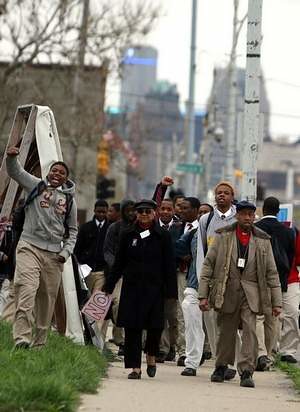
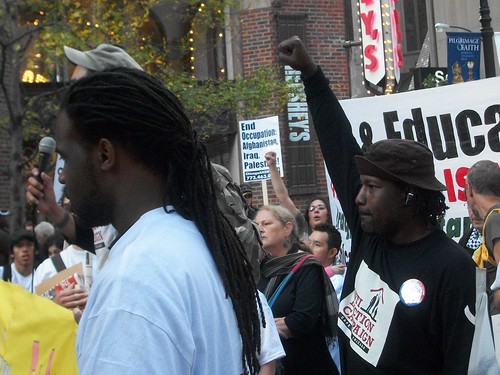
About 50 high school students at Frederick Douglass Academy in Detroit were suspended today after walking out of classes to protest a lack of consistent teachers, the removal of the principal and a host of other administrative problems at the all-boys school.

The students were chanting "We want education!"

Parents organized the walkout because they fear for the school’s future. This year, as recently as last month, students spent weeks passing time in the gym due to a lack of teachers, parents said.

Worries escalated after district offices moved into part of the building in January and the school was not listed as an application school for next year’s directory. In addition, the school’s founding principal, Sean Vann, was reassigned on Wednesday after a three-month sick leave.

Parents said Detroit needs a school to address the achievement gap concerning African-American men but fear this school’s future is in jeopardy.

“They’re failing these young black men,” said parent Sharise Smith.

Smith said her son got an A in geometry first semester without taking a final exam. “It was by default, just for showing up. It wasn’t because he earned an A.”

Hundreds of students who staged a protest earlier this month about administrative changes at Denby High were not suspended. Smith called the suspensions unfair and an indication that nothing will change at Douglass.

“What are they teaching them by suspending them – that they’re in a communist country and can’t protest injustice?”

Some students at Douglass Academy spent most of their time for in February in the gym, or the cafeteria or the library. That’s because about half of the teachers at Douglass Academy called in sick for several days.

Douglass Academy enrolls about 200 students in grades six to 12 and is the only all-boys public school in the state. High school students say they’re months behind the syllabus for classes, especially math. Students have had several math teachers come and go.

“We’ve been wronged and disrespected and lied to and cheated,” said Tevin Hill, a senior, who made the announcement to start the walkout. “They didn’t listen to us when we complained to the administration. They didn’t listen to the parents when they complained to the administration, so I guess this is the only way to get things solved.”

Senior Eric Rodgers agreed. "We're not learning anything. We are just here for attendance."

Parents are circulating a petition to take to the district to demand enforcement of the “abuse of sick time” policy to reduce teacher absenteeism. They have accumulated a thick stack of complaints e-mailed since September to Roy Roberts, the Detroit Public Schools emergency manager, and Karen Ridgeway, the superintendent.

This comes months after Roberts said the district’s problems with assigning enough teachers to cover classes had been resolved. Roberts visited Douglass last month on a surprise visit and found the school in order. If there are problems at the school, the issues are being addressed, he told the Free Press.

Reverend David Murray, a member of the DPS school board, attended the protest saying “the children need to take a stand” because school officials are failing to ensure that the boys receive an adequate education.

“They’re not involved in academic learning - just taking a seat, occupying a space -- and some of these children are near graduation,” Murray said.

It’s not the first time Douglass has had problems this year. Detroit Lions star Ndamukong Suh and local businesses stepped in to replace football gear when a theft threatened to end the team’s season in the fall.

Contact Chastity Pratt Dawsey: 313-223-4537 or cpratt@freepress.com or on Facebook.

Food As a Weapon: US Suspends Assistance to North Korea

America suspends food aid to North Korea over missile

Fri, Mar 30, 2012

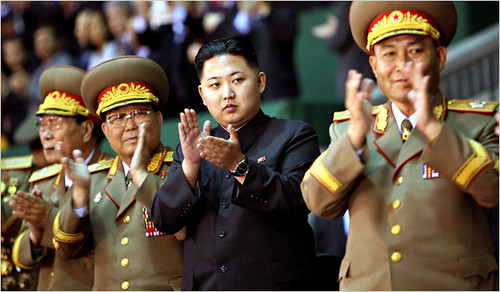
The United States has suspended food aid to North Korea in response to determination in Pyongyang to push ahead with a plan to launch a long-range missile in defiance of international warnings.

Reclusive North Korea has said it is merely sending a weather satellite into space, but South Korea and the US say it is a disguised ballistic missile test. North Korea said yesterday there was no reason to fire a missile after February’s agreement to suspend nuclear and missile tests in return for food aid with the United States.

But acting assistant US secretary of defence for Asia and Pacific security affairs Peter Lavoy told the House of Representative armed services committee that the announcement of the launch was in breach of the agreement.

“This planned launch is highly provocative because it manifests North Korea’s desire to test and expand its long-range missile capability,” Mr Lavoy told the House panel. “We believe this reflects their lack of desire to follow through on their commitments, their international commitments, and so we’ve ... been forced to suspend providing nutritional assistance to North Korea.” – (Reuters)

Justice for Trayvon Martin!: Potential for Mass Movement Grows

Potential for mass movement grows

By Monica Moorehead
Published Mar 28, 2012 10:05 PM

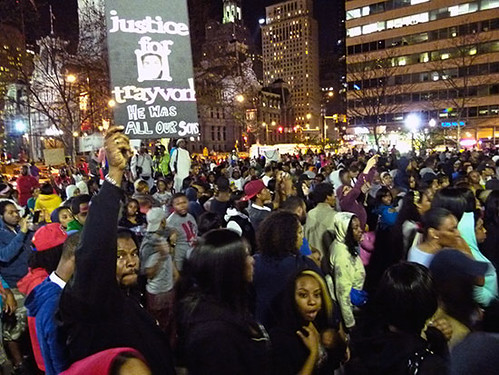
March 26 — Exactly one month ago on Feb. 26, Trayvon Martin was just another unknown African American whose young life was tragically and brutally cut short. What a difference a month makes. Today Trayvon Martin’s name has become a universal rallying cry for justice in every nook and cranny of the unjust U.S.

His death has come to symbolize every young person of color’s nightmare as they rightfully fear becoming a victim of senseless violence — be it at the hand of a police officer, a prison guard or a racist vigilante — because of how they look and dress. Today millions of people, the vast majority of them Black, but also of every nationality, are participating in a “National Hoodie Day.” That means they are rallying wearing a hoodie as did Martin the day he was murdered.

Martin was stalked by vigilante George Zimmerman as he was returning home from picking up a can of iced tea and a bag of Skittles for his younger brother in a gated community in Sanford, Fla., where he was visiting his father. On 911 tapes, Zimmerman said that Martin looked “suspicious” because he was wearing a hoodie. The police dispatcher told Zimmerman not to pursue Martin, but he did so anyway. Zimmerman later revised this to claim that Martin was pursuing him. The armed Zimmerman outweighed the unarmed 17-year-old Martin by 90 pounds.

Martin’s girlfriend said that he told her during a call on his cell phone that he was being followed by someone. On the 911 tapes, Martin can be heard crying for help before he was shot to death in the chest. Two female eyewitnesses have confirmed this.

The Sanford police questioned Zimmerman in a squad car for about an hour and then released him. He has never been arrested or charged with shooting Martin. The Sanford police have a sordid reputation of not arresting anyone accused specifically of assaulting Black men.

Sanford is also the city where racist whites drove the legendary Jackie Robinson out of town with death threats. Robinson was playing minor league baseball there in the 1940s before he integrated baseball’s Major Leagues in 1947.

Zimmerman has publicly stated that he thought the killing would “all blow over.” He has also said that Martin attacked him, attempting to portray himself as the victim. (Los Angeles Times, March 25) Though he apparently hoped these statements would have countered the outrage, they have only added fuel to an incredible brushfire of mass anger from below.

Social media spread national outrage

Although Martin’s shooting initially received considerable coverage in the Florida media, it gained national coverage only in early March when Black radio hosts and blogs started to report the story. Tracy Martin and Sybrina Fulton, Martin’s parents, consistently kept their son’s story in the media with interviews.

Once the 911 tapes were finally released, the case received broader attention from Twitter and Facebook users. A change.org petition calling for Zimmerman’s arrest appeared online and has gathered close to 2 million signatures so far.

Tweets of the 911 tapes have been retweeted thousands and thousands of times. The anger does not begin and end with Zimmerman killing Martin. Many understand a police cover-up is involved. Also, Florida’s “Stand Your Ground” law has attracted attention.

Passed in 2005, this Florida law states that any person who “feels” threatened by another person has the right to use a weapon to defend him- or herself without necessarily facing the prospect of being arrested or prosecuted. Similar laws exist in at least 20 other states. Zimmerman has used this law as an excuse for shooting Martin. The police supported his claim of self-defense based on this law, which was rubber-stamped by the National Rifle Association and former Florida Gov. Jeb Bush.

The Sanford police chief has temporarily stepped down due to criticism. State Attorney for Florida’s Fourth Judicial Circuit Court Angela B. Corey has been assigned to investigate the case that will be presented to the grand jury on April 10.

The national outcry for justice for Trayvon Martin, spearheaded in the grassroots led by the African-American community, continues to resonate throughout every sector of U.S. society. Several Miami-based high schools staged walkouts last week. Trayvon Martin lived in Miami.

Even President Barack Obama was forced to make a public statement on the case, saying that if he had a son, he would look like Martin. This personal statement prompted attacks by racist right-wingers like Newt Gingrich and Glenn Beck, who accused the president of reverse racism.

The U.S. Justice Department was pressured to announce plans to carry out an investigation regarding Zimmerman’s violation of Martin’s civil rights.

Well-known celebrities such as Spike Lee, Mia Farrow, Jamie Foxx, Sinead O’Connor, Ricky Martin and Clay Aiken have added their voices to the demand that Zimmerman be arrested. The entire Miami Heat basketball team, Martin’s favorite, led by Dwayne Wade and Lebron James, posed in hoodies with their heads bowed in honor of Martin. They have also worn the words “We want justice” on their sneakers during games.

Amar’e Stoudamire and Carmelo Anthony from the New York Knicks have worn hoodies during pregame warmups. The National Basketball Players Association issued a statement demanding an arrest and accusing the Sanford Police Department of “racial bias.”

The entire cast of Broadway musical “Porgy and Bess” took a group picture in their hoodies before a March 25 performance. ESPN, the world’s largest sports network, reversed its original policy of not allowing employees to wear hoodies in their online avatars on Twitter.

The great singer, Chaka Khan, initiated a song and video featuring other R&B singers like Kelly Price and Luke James honoring the memory of Trayvon Martin. The video shows actors Angela Bassett and Loretta Devine wearing hoodies.

Parallels with the Emmett Till lynching

The Trayvon Martin case has rightfully been compared to the lynching of 14-year-old African-American Emmett Till, a native Chicagoan. In August 1955, while visiting relatives in Money, Miss., Till was kidnapped by three Ku Klux Klan members, who tortured and then fatally shot Till before tossing his body in the Mississippi River. His so-called crime was allegedly whistling at a white woman. The KKK members were arrested and then acquitted by an all-white jury. These same men bragged about committing the murder in a Life magazine article.

Till’s funeral in Chicago attracted at least 50,000 people from around the country. His mother, Mamie Till Mobley, purposely allowed his casket to be opened to allow the world to see his horribly battered and disfigured face. This spontaneous anger transformed itself three months later into the Montgomery, Ala., bus boycott.

The one-year-long boycott successfully struck down a racist city law that relegated Black people to the back of the bus. This boycott eventually ignited the historic Civil Rights movement in the South that brought about federal laws desegregating public places and legalizing the basic, democratic right of Black people to vote.

Many compare the initial response to Martin’s lynching to what happened after Till’s. The important question that begs an answer is this: Will Martin’s murder also help spark an ongoing, organized, massive movement against racial injustice?

This is a legitimate question since Martin’s lynching is a painful and constant reminder that a racist war exists in the U.S. against people of color, specifically young Black men. Many of the protests around the country have linked Martin’s murder to the killings of other young Black men in local areas by either the police or vigilantes like Zimmerman.

Martin’s parents initiated a town hall meeting today in Eatonville, Fla., calling for a national movement to evolve so that what happened to their son will not happen to others. While the hall only held 500 people, tens of thousands of people stood for hours outside observing the proceedings on jumbotrons.

Every minute of every day, police stop and frisk thousands for no other reason than walking or driving while Black and Latino/a. The vast majority of millions imprisoned or caught in the vicious web of the U.S. criminal justice system are poor, young people of color. The global capitalist economic crisis, which has displaced millions of skilled and semi-skilled workers, has totally pushed aside young workers of color in disproportionate numbers. This marginalization has shut the doors to public education and job training for youth.

The corporate media are now making contemptible attempts to justify Zimmerman’s actions and dilute the mass anger by reporting that Martin was suspended from school for 10 days for possessing marijuana. This kind of demonization of one’s character is nothing new when it comes to youth of color. The big-business media do it to divert attention from the real issues: racist vigilantism and police brutality.

At a March 26 press conference, Trayvon Martin’s mother, Sybrina Fulton, stated, “They have killed by son and now they are trying to kill his reputation.” (CNN) Attempts are now being made by the media to raise doubts in the minds of the public that Zimmerman, as heard on the 911 tapes, called Martin a racial slur before shooting him and that the screams for help did not come from Martin but from Zimmerman.

All these obvious diversions serve to raise consciousness that capitalism as a racist, divide-and-conquer system offers no bright future for young people, especially for those like Trayvon Martin whose killer is still free to walk the streets. The fact that the vast majority of youth expressing their solidarity with Trayvon Martin are other young Black men who face demonization on a daily basis shows that they have nothing to lose and everything to gain in openly expressing their solidarity with their fallen brother.

Many whites have visibly expressed their anti-racist solidarity in the many protests around the country. A 68-year-old white man, John Carnduff Stewart, was arrested for sending “death threats” to the Sanford police chief due to his outrage at the Martin shooting. Stewart reportedly described the entire police department as being “bigoted” and “unprofessional.” (Orlando Sentinel, March 23)

Justice for Trayvon Martin goes beyond Zimmerman’s arrest, though that is an important first step. The call for justice must also include a united movement’s demand for the right to good paying jobs, education, health care, housing and all human needs that capitalism denies to much of humanity. An International Day of Solidarity with Trayvon Martin has been called for April 10, the first day of the grand jury proceedings.

People in Scotland, Japan, Sweden, Australia and other countries have reportedly already donned hoodies in solidarity with Trayvon Martin.
----------------------------------------------------
Articles copyright 1995-2012 Workers World. Verbatim copying and distribution of this entire article is permitted in any medium without royalty provided this notice is preserved.

Workers World, 55 W. 17 St., NY, NY 10011
Email: ww@workers.org
Subscribe wwnews-subscribe@workersworld.net
Support independent news DONATE

The Struggle in China: Capitalist Crisis Versus Planning

The struggle in China: Capitalist crisis versus planning

By Fred Goldstein
Published Mar 27, 2012 11:42 PM

The following is Part 2 of a series on the leadership struggle in China.

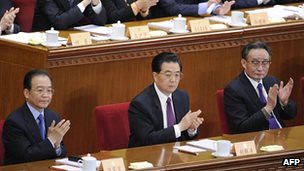
As contradictions mount in the global capitalist economy, they are reflected in China. The factional struggle in the Chinese leadership can only be understood as a struggle over which way to go forward and how to contain and resolve the mounting economic and social contradictions arising out of capitalist development.

The Chinese economy has been growing on a dual basis. First, it is based on centrally planned guidance designed to develop the productive forces and the material foundations for a society encompassing 1.3 billion people. However, since the victory of Deng Xiaoping and the “capitalist road” faction in 1978, planning has been increasingly based on the central government fostering and attempting to manage capitalism and the capitalist market as the means for national development.

The central government, through control of interest rates, credit, taxation and vast state-owned enterprises, both guides the economy toward broad economic and social goals and fosters capitalist development. The latter means class exploitation, inequality and corruption. The present political struggle is over which side of this contradiction to strengthen.

This complex subject will be discussed at length in subsequent articles. But suffice it to say that the so-called “reform” groupings in China — with the enthusiastic support of world imperialism and global finance capital — want to move away from state intervention, planning and central guidance and go further toward turning the fate of China over to the capitalist market, both internally and externally.

In our last article we covered the fact that Bo Xilai was summarily ousted from his post as Chinese Communist Party Secretary of Chongqing. This was a blow against the growing forces in the CCP and throughout China who want to combine the use of the capitalist market with social and economic planning and state intervention in order to deal with growing inequality and who emphasize the needs of the masses. In Bo’s case, this economic orientation was combined with a popular attempt to revive Maoist culture and socialist values.

In China today, the concept of planned guidance of the broad direction of the economy and its various sectors is a drastic modification from the direct economic planning initiated after the triumph of the great Chinese Revolution in 1949. At the same time, it is an attempt to retain the planning principle as the fundamental framework guiding the overall development of the Chinese economy.

Consider just some of the goals and objectives outlined by the 12th Five Year Plan for 2011-2015, and the antagonism between planning and the anarchy of the capitalist market becomes utterly transparent. This plan was developed beginning in October 2010 and was approved by the National People’s Congress in March 2011.

The government is planning to devote 4 trillion renminbi ($158.7 billion) to the development of seven Strategic Emerging Industries: biotechnology, new energy, high-end manufacturing equipment, energy conservation and environmental protection, clean-energy vehicles and next-generation internet technology. (APCO worldwide, Dec. 10, 2010)

An article in the March 4, 2011, New York Times detailed the plan’s goals, including:

* A 19.1 percent cut in the amount of energy used per unit of economic growth and a rapid expansion of the service economy.

* Building a national nanotechnology research center, 50 engineering centers, 32 national engineering laboratories and 56 other labs focusing on technologies like digital television and high-speed internet.

* Laying 621,000 miles of new fiber-optic cable and adding 35 million new broadband ports for a total of 223 million.

* A cap on total energy use, especially limiting the burning of coal.

* The development of well-equipped statistical and monitoring systems to gauge greenhouse gas emissions.

* Accelerated construction of sewage treatment plants, the retrofitting of coal-fired power plants with pollution controls, and the continuation of a pilot project to develop low-carbon cities.

In the previous period the state had opened 3,100 miles of new railroads and 74,600 miles of highways, completed 230,000 sports and fitness projects for rural residents, and built or renovated 891 hospitals and 1,228 health clinics.

In the realm of social welfare, the broad goals are to increase consumption from 35 percent of the gross domestic product to between 50 percent and 55 percent by increasing minimum wages, health care services and social welfare payments of various kinds.

Of course, it goes without saying that under a genuinely socialist government, workers would have their fundamental economic rights guaranteed as political rights. But those rights were largely overturned by the reforms that developed in China after 1978. Instead, in the environment of the capitalist market — with its mountains of corruption of government and party officials — the welfare of the workers and peasants has to be built up slowly and painfully through an uphill battle, which happens only through the intervention of the state. (More on this in future articles.)

Whether or not the government achieves the precise goals set out is not the issue. The point is that such sweeping social and economic goals could not possibly be handed over to profit-driven capitalists and the anarchy of the commodity market. The bosses would seek the highest rate of profit. They would never voluntarily raise wages, improve working conditions, build hospitals, clinics, rural fitness centers or anything that did not bring a profit.

China’s response to 2008-09 world capitalist crisis

To grasp the seriousness of the proposals to further limit planning and intervention by the state, it is only necessary to consider what happened during the world capitalist financial and economic crisis of 2008 and 2009, when the global crisis of capitalist overproduction and the financial collapse invaded China.

More than 20 million workers lost their jobs, mainly in manufacturing and predominantly in coastal provinces such as Guangdong, where special economic zones had been set up so imperialist corporations, companies from Taiwan, Hong Kong and South Korea, and other exploiters could take advantage of low-wage migrant labor flooding in from the rural interior.

During this period production of world capitalism dropped more than it had in 70 years. Tens of millions of workers worldwide were thrown onto unemployment lines. Most of them are still there. Bankruptcy followed bankruptcy, and the capitalist system has still not recovered.

What happened in China? When the crisis hit, China’s central planners went into motion. Plans drafted as far back as 2003 to go into effect in future years were pushed forward and implemented.

Nicholas Lardy, a bourgeois China expert from the prestigious Peterson Institute for International Economics, describes how consumption in China actually grew during the crisis of 2008-09, wages went up, and the government created enough jobs to compensate for the layoffs caused by the global crisis:

“In a year in which GDP expansion [in China] was the slowest in almost a decade, how could consumption growth in 2009 have been so strong in relative terms? How could this happen at a time when employment in export-oriented industries was collapsing, with a survey conducted by the Ministry of Agriculture reporting the loss of 20 million jobs in export manufacturing centers along the southeast coast, notably in Guangdong Province? The relatively strong growth of consumption in 2009 is explained by several factors. First, the boom in investment, particularly in construction activities, appears to have generated additional employment sufficient to offset a very large portion of the job losses in the export sector. For the year as a whole the Chinese economy created 11.02 million jobs in urban areas, very nearly matching the 11.13 million urban jobs created in 2008.

“Second, while the growth of employment slowed slightly, wages continued to rise. In nominal terms wages in the formal sector rose 12 percent, a few percentage points below the average of the previous five years (National Bureau of Statistics of China 2010f, 131). In real terms the increase was almost 13 percent. Third, the government continued its programs of increasing payments to those drawing pensions and raising transfer payments to China's lowest-income residents. Monthly pension payments for enterprise retirees increased by RMB120, or 10 percent, in January 2009, substantially more than the 5.9 percent increase in consumer prices in 2008. This raised the total payments to retirees by about RMB75 billion. The Ministry of Civil Affairs raised transfer payments to about 70 million of China's lowest-income citizens by a third, for an increase of RMB20 billion in 2009 (Ministry of Civil Affairs 2010).” (“Sustaining China's Economic Growth after the Global Financial Crisis,” Kindle Locations 664-666, Peterson Institute for International Economics)

The Ministry of Railroads introduced eight specific plans, to be completed in 2020, to be implemented in the crisis. The World Bank called it “perhaps the biggest single planned program of passenger rail investment there has ever been in one country.” In addition, ultra-high-voltage grid projects were undertaken, among other advances.

The lesson is that while the anarchy of production of world capitalism invaded China, the rational and meticulously developed plans drawn up for social use overcame the anarchy of the capitalist market. This not only protected the masses from a protracted, massive unemployment crisis, but it actually continued the process of raising the standard of living during a time when hundreds of millions of workers throughout the entire capitalist world were left helpless and traumatized by the crisis of capitalist overproduction.

In Marxist terms the principle of planning, established by the Chinese socialist revolution of 1949 — even though it has been watered down to the practice of “guidance” — overcame what Marx called the law of labor value, the very law that governs the operation of capitalism itself. The Chinese leaders were compelled, and had the capability, to use rational planning based on satisfying human need to overcome the disaster brought about by their own policy of relying on the world capitalist market.

To be continued.

Goldstein is the author of “Low-Wage Capitalism” (2008) and “Capitalism at a Dead End” (2012) published by World View Forum. Both books as well as his articles and speeches can be found at lowwagecapitalism.com.

--------------------------------------------------
Articles copyright 1995-2012 Workers World. Verbatim copying and distribution of this entire article is permitted in any medium without royalty provided this notice is preserved.

Workers World, 55 W. 17 St., NY, NY 10011
Email: ww@workers.org
Subscribe wwnews-subscribe@workersworld.net
Support independent news DONATE

US Imperialists Coordinate Plot to Continue Occupation of Somalian Waterways

Somalia: Contact Group On Piracy Off the Coast of Somalia Meets in New York

29 March 2012Comment
press release

Washington, DC — The United States will join partners from nearly 70 countries, international organizations, and the private sector at the United Nations in New York on March 29 for a plenary meeting of the Contact Group on Piracy off the Coast of Somalia.

The Contact Group is a broad and growing diplomatic effort taking action against criminal activity that threatens commerce and humanitarian aid deliveries along one of the world's busiest shipping corridors.

The plenary, hosted by the United Arab Emirates, will be the eleventh gathering of this outstanding international partnership. Since its initial meeting in January 2009, the Contact Group has nearly tripled in size. This is a testament to the global consensus that piracy poses a shared security challenge to maritime safety and to the need for further concerted and coordinated international action.

Among its accomplishments to date, the Contact Group has:

-Facilitated coordination of international naval patrols through the operational coordination of an unprecedented international naval effort from more than 30 countries working together to protect transiting vessels. The United States coordinates these efforts with multilateral coalitions such as NATO's Operation Ocean Shield and the European Union's Operation ATALANTA. The United States also looks to further develop counter-piracy cooperation with several other nations deploying forces to the international counter-piracy effort, including China, India, Japan, and Russia.

-Partnered with the shipping industry to improve practical steps merchant ships and crews can take to avoid, deter, delay, and counter pirate attacks. The shipping industry's use of Best Management Practices and the increasing use of Privately Contracted Armed Security Personnel are among these measures that have proven to be the most effective deterrents against pirate attacks.

-Strengthened the capacity of Somalia and other countries in the region to combat piracy, in particular by contributing to the UN Trust Fund Supporting Initiatives of States

-Countering Piracy off the Coast of Somalia; and

-Advanced a new initiative aimed at disrupting the pirates' financial and logistical networks ashore through approaches similar to those used to target other types of organized transnational criminal networks.

US-backed Government Militias in Somalia Carrying Out Executions of Civilians

Somalia: Pro-Government Militias Executing Civilians

-Ethiopian Soldiers Beating Suspects
- Al-Shabaab Targeting Alleged Government Supporters

28 March 2012
press release

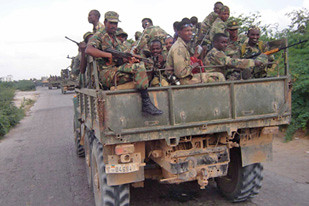
Pro-government militias in Somalia have committed summary executions and torture in the towns of Beletweyne and Baidoa since occupying them with Ethiopian forces earlier in 2012, Human Rights Watch said today. The authorities should take immediate steps to stop the abuses and hold those responsible to account, Human Rights Watch said.

On December 31, 2011, the Ethiopian National Defense Force (ENDF) and two Somali militia groups - Ahlu Sunna Wal Jama'a (ASWJ) and Shabelle Valley State (SVS) - ousted the militant Islamist group al-Shabaab from Beletweyne, the capital of the Hiraan region, which borders Ethiopia. Ethiopian troops and militias allied with the Transitional Federal Government (TFG) of Somalia took over Baidoa, the capital of the Bay region, on February 22, 2012.

Civilians told Human Rights Watch that since the transition, security has become worse in both towns due to abusive security operations by allied forces and, in the case of Beletweyne, rising tensions between militias vying for control. Although al-Shabaab no longer controls either town, its forces continue to attack the Ethiopian and other forces and target civilians perceived to support them.

"Civilians in Beletweyne and Baidoa hoped that threats, fear, and repression would diminish with al-Shabaab's departure," said Leslie Lefkow, deputy Africa director at Human Rights Watch. "Instead, the arrival of the Ethiopian forces and their militia allies has meant that one set of abusive authorities has been replaced by another."

Residents of Beletweyne described the more unpredictable and dangerous security situation since al-Shabaab's retreat. Several residents told Human Rights Watch that at least under al-Shabaab they knew what to expect and how to avoid problems.

One man in Beletweyne, when asked why people were being executed, told Human Rights Watch: "You must know one thing, in Beletweyne nowadays killing someone doesn't need whys, it needs the militiamen to decide to kill you, and that is it."

Summary Executions and Indiscriminate Killings

Human Rights Watch interviewed relatives of the victims and witnesses of more than seven summary executions committed since mid-January in Beletweyne by militia allied with the Ethiopian forces. The total number of executions is believed to be significantly higher. Human Rights Watch's research indicates that the SVS militia was responsible for most of the executions.

The Somali militias and Ethiopian forces controlling Beletweyne appear to have committed some of the abuses in response to continuing attacks in the town, including attacks by al-Shabaab. International humanitarian law, which applies to all parties to the conflict in Somalia, prohibits summary executions, as well as unlawful reprisal attacks against civilians.

Al-Shabaab claimed responsibility for a suicide bus bombing on January 24 that damaged a government building taken over by the Ethiopian military. In the ensuing hours, Ethiopian troops and allied militias arrested a number of people, including a teacher in Beletweyne, Abdirahman Muhumed-Nur Abdulle, known as "Matan." Witnesses told Human Rights Watch that Matan was seized from his home during house searches by the SVS militia, beaten, and then taken away. His body was found in a river several hours later after a member of the SVS administration told Matan's relatives where to find it.

In the early hours of February 8, SVS militia members forcibly entered a building housing members of the Takfir Islamic sect. The militia members abducted five men, took them to a bridge 100 meters away from the house, and shot and killed four on the spot. A local resident described seeing the four bodies lying under the bridge the following morning with gunshot wounds to their heads, necks, faces, and chests. According to a credible source, the fifth man was wounded but managed to escape. SVS militias tracked him down, abducted him the next morning from a nearby home where he was taking shelter, and shot him.

Credible sources also told Human Rights Watch that on March 2, SVS militias abducted a man with mental health problems from a mosque in Beletweyne, accused him of being an al-Shabaab spy, and summarily executed him.

Other armed forces in Beletweyne have also been implicated in summary executions, although the cases need further investigation. On March 12, unidentified assailants threw a grenade at a tea shop near a house belonging to the former governor of Hiraan, Yusuf Ahmed Hagar, known as "Dabageed." The next day, members of Dabageed's militia went to the home of a 17-year-old boy who had been at the scene and was wounded in the attack and took him away. His body was found the following day, riddled with bullet wounds, in the Koshin neighborhood of Beletweyne.

"Wartime attacks never justify summary executions," Lefkow said. "All armed groups need to stop such atrocities."

Since withdrawing from Baidoa in February, al-Shabaab has killed people it perceives to be supporting the TFG or Ethiopian forces. On the evening of February 25, an Ethiopian Oromo businessman in Baidoa was killed by gunmen, who shot him three times in the head. He had occasionally translated for Ethiopian troops and was the first to reopen his business, a laundry, after the arrival of the Ethiopian forces. Al-Shabaab claimed responsibility for the killing, local residents reported.

At 7 p.m. on March 11, Nur Mohamed Nur, a brother of the former TFG parliament speaker, Sheikh Adan Mohamed Nur, was shot by a gunman outside of the Hormud Telephone Company office in Baidoa, where he worked. Al-Shabaab had accused him of having attended the funeral of his cousin, a TFG soldier killed during fighting with al-Shabaab at Yurkut village on March 10, a relative said. Nur Mohammed had been openly critical of al-Shabaab.

Al-Shabaab has continued to threaten Baidoa residents. Residents told Human Rights Watch that the al-Shabaab administration warned the population before it left town not to cooperate with new forces, and in particular threatened businesses likely to provide services and goods to the Ethiopian and allied Somali forces. In March, al-Shabaab reportedly distributed leaflets in Baidoa, threatening residents who cooperate with these forces. Elders in Baidoa received threatening phone calls from al-Shabaab following a meeting with TFG officials, a reliable source said.

Human Rights Watch documented one incident of indiscriminate attacks by TFG-allied militia in Baidoa. On March 21, alleged al-Shabaab sympathizers threw a hand grenade at TFG-allied militia in the marketplace. The militia responded by opening fire on civilians. According to two witnesses, at least six died - four immediately and at least two later in a hospital - and several more were wounded.

Arbitrary Detentions and Torture

Credible sources, including reports from United Nations monitors, describe frequent arbitrary detentions in Beletweyne and Baidoa by the Ethiopian forces and allied militias. Human Rights Watch interviewed five people who were arbitrarily detained in Beletweyne and Baidoa, three of whom were badly beaten by the Ethiopian troops.

A man arrested by the SVS militia in Beletweyne during a house-to-house search and handed over to Ethiopian forces was held for several days at the Hiraan University campus, which Ethiopian forces are using as a base. Credible sources told Human Rights Watch that he was tied to a tree, repeatedly beaten, and denied food throughout his detention.

Dozens of people have been arbitrarily detained following attacks in Baidoa, eyewitnesses reported. The UN has said that young men and boys are particularly likely to be picked up in such operations and accused of being al-Shabaab members or supporters. As a result, young men are fleeing the town for fear of being taken into custody.

One such sweep occurred on March 2, following an explosion outside a police station in Baidoa. Forty-two people, including three local leaders and at least eight teenagers, were arrested by Ethiopian forces and TFG allied forces.

Dr. Mohammed Ali Ahmed "Kalay," the president of the University of Southern Somalia and former education minister, was at the scene of the explosion, but was unable to flee due to a physical disability. Five Ethiopian soldiers beat him with the butts of their AK-47 assault rifles on his head, mouth, and ears until he bled, then detained him at the central police station. A witness said Kalay and the two other local leaders were held for a day and then released. A witness said that two teenagers were among those arrested and beaten by the TFG forces. All were subsequently released.

"Ethiopian and TFG forces need to treat everyone in their custody humanely," Lefkow said. "The current security vacuum should be resolved while respecting basic rights, not through abusive security operations."

The residents of Beletweyne also complain of the curfew imposed by the Ethiopian forces on January 24. It currently runs for five hours in the morning and has severely restricted everyday life and access to basic services. School attendance has dropped due to the curfew, but also because people fled the town and schools were closed during the fighting in December and early January. Hiraan University is being used as a military base by the Ethiopian troops, and the university has had to move to a makeshift campus inside town.

Following two months of deadlocked negotiations between competing factions, the TFG appointed Abdifatah Hassan Afrah as the new chairman of the Hiraan region. Abdifatah is the president of the Shabelle Valley Administration, whose militia is believed to be responsible for several cases of the summary executions documented by Human Rights Watch.

When asked by Human Rights Watch what steps he was taking to investigate reported abuses, including summary executions by the SVS, Abdifatah denied knowledge of such incidents and refuted the existence of militias inside Beletweyne.

"The newly appointed administration in Hiraan needs to show that it is committed to ending abuses and insecurity in Beletweyne," Lefkow said. "Chairman Abdifatah should start by condemning these incidents and taking measures to investigate abuses by all groups."
Sudan's Head of Parliament Says Southern Army Preparing to Attack Blue Nile

Sudan’s top MP says southern army preparing to attack Blue Nile

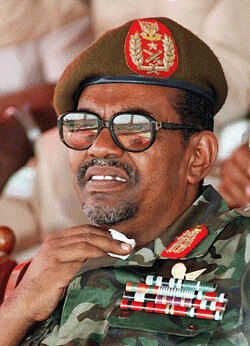
March 28, 2012 (KHARTOUM) – The head of Sudan’s parliament, Ahmad Ibrahim al-Tahir, alleged on Wednesday that the army of South Sudan is mustering troops to attack on Blue Nile State, one day after the two neighbours eased military escalations along another stretch of the border.

Al-Tahir said during a parliamentary session that the southern army known as SPLA was currently amassing troops along the north-south border to attack Blue Nile but he stressed that the Sudanese Army (SAF) is prepared to repulse the potential assault.

Sudan’s border state of Blue Nile is the scene of a conflict between government forces and rebels Khartoum accuses South Sudan of backing. Juba denies the charge.

Military confrontations erupted on Monday between SAF and SPLA around the oil-rich town of Heglig inside the Sudanese border state of South Kordofan, raising fears of a return to all out war between Khartoum and Juba.

Further escalation occurred when SAF bombed oil fields in the South Sudan’s northern state of Unity.

However, the SPLA later announced the end of engagement with SAF and withdrawal of its troops from Heglig. Both sides said they don’t want to go back to full-blown war.

The clashes in Heglig came at a time when the two countries appeared to be making unprecedented progress in the negotiations over post secession issues.

Sudan’s President Omer Al-Bashir was scheduled to visit Juba for a summit with his South Sudanese counterpart Salva Kiir Mayardit after the two countries initialed agreements on borders and nationality earlier this month in the Ethiopian capital Addis Ababa. Following the clashes, Khartoum announced that the planned trip had been put on hold.

KHARTOUM COMPLAINS TO SECURITY COUNCIL

On the diplomatic battlefront, meanwhile, the Sudanese government has announced it will lodge an official complaint with the UN Security Council (UNSC) against the SPLA’s attack in South Kordofan.

Salah Wansi, Sudan’s acting minister of foreign affairs, said during the parliament’s session on Wednesday that the new complaint would be supported by a recording of Kiir’s announcement that the SPLA had attacked Heglig.

The Sudanese diplomat called on the international community to advise South Sudan to refrain from hostilities against Sudan in order to achieve peace and security between the two nations.

Khartoum has already filed four complaints with the UNSC against South Sudan since the latter seceded in July last year under a 2005 peace deal that ended nearly half a century of north-south civil wars in the former united Sudan.

(ST)

Spanish Workers Stage General Strike Against Austerity

The Christian Science Monitor - CSMonitor.com

Spain leader vows hard line as hundreds of thousands protest austerity

Fed-up Spaniards took to the streets in a national strike Thursday, as Prime Minister Mariano Rajoy struggled against waning political support for his unpopular economic policies.

By Andrés Cala, Correspondent
posted March 29, 2012 at 5:10 pm EDT
Madrid, Spain

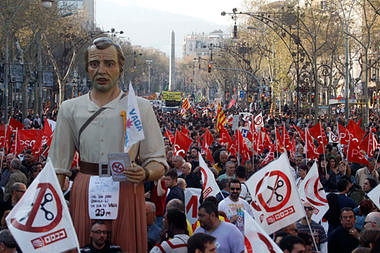
Hundreds of thousands of Spaniards marched Thursday in the first general strike against strangling austerity, only the most recent challenge to the new conservative government of Prime Minister Mariano Rajoy fending off resistance from all sides.

“We can’t take this anymore,” says Eva Cañamares, a station manager in Madrid’s subway system. Her 11 and 9-year old children were passing out union flags beside her in the central Puerta del Sol plaza, where tens of thousands chanted against government economic policies.

“I’m here for my children. They are taking away all our rights and this also affects them,” Mrs. Cañamares says, echoing the strike’s slogans. “They want to do away with everything.… The government just wants to take away everything and not even negotiate."

By early evening, there were more than a dozen injuries, dozens of arrests, and violent clashes reported throughout Spain, but these were the exceptions to the mostly peaceful march.

The strike was long expected and almost certainly won’t be the last. Many stores in Madrid shut down and transport was limited to 30 percent of its usual service, causing chaos. But support for the strike was also far from universal.

Still, patience is thinning after more than three years of budget cuts and ever-growing unemployment. It will likely be at least two more years before the economy hits bottom.

And the austerity pains are unlikely to abate anytime soon. Despite Spain's contracting economy amid years of austerity, the European Union has been emphatic that it will not budge on its order that Spain cut its deficit to 3 percent of GDP by 2013, although it has been flexible about targets for this year.

The political costs of being in government

But toeing the EU line now comes with political costs. Mr. Rajoy, whose party handily won national elections in November, is losing political support on several fronts.

In March 25 regional elections, his Popular Party failed to boot the Socialists from power in their historic bastion of Andalucia, Spain’s most populated and second-biggest autonomous region. Polls suggested a landslide victory from Rajoy’s party and the government went as far as defying Europe by delaying its 2012 budget proposal and its most severe cuts until after the vote to secure the win.

In the end, though, most of the votes the Socialists lost went to other parties, exposing the political cost of the economic reforms Rajoy's party instituted in its first 100 days of government.

Rajoy is also facing internal dissent from the more conservative wing of his party, which is demanding even more austerity, on top of a reversal of the hallmark liberal social policies of the previous government, including abortion and education reform.

But the government, through Labor Minister Fátima Báñez, made it clear it will not backtrack just hours before tomorrow's 2012 budget presentation, when it will reveal the details of its budget.

“The reformist path is unstoppable,” Ms. Báñez said. The party already won an absolute majority in Parliament, “the home of dialogue and negotiation,” she said, suggesting the government has no need to negotiate.

“This is not going to stop,” says Fermín Bouza, sociology professor in the Universidad Complutense de Madrid, and an expert in voter sentiment and public opinion.

“People were faced with an economic crisis, and they threw out Socialists. They would have replaced any party. Spain has always swung between center-left and center-right, but now that they were faced with a more conservative government, they are balking.”

The hard road to austerity

Spain, like the rest of Europe, over the decades built a strong welfare state, with inexpensive education, free healthcare, unemployment benefits, and a robust pension system. But the global financial crisis that started in 2008 burst the real estate bubble that fueled Spain’s formidable economic growth for more than two decades. Millions of unskilled laborers lost their jobs. Spain needs not just economic growth, but an entire makeover of its economic model.

The previous government implemented one of Europe’s strongest austerity drives, cutting public salaries, extending the retirement age, raising taxes – all to cut the deficit from 11 percent in 2009 to 8.5 percent in 2011. But a lagging global recovery is forcing even stronger austerity measures that are eroding Spain’s welfare state.

Rajoy will cut between 30 billion and 40 billion euros in 2012 to reach the EU revised target of a deficit of 5.3 percent of gross domestic product, up from a 4.4. percent target set in 2009. Final figures will be released tomorrow.

Of all the measures, the changes to labor policies introduced in January have been the toughest sell. Spain’s 5.3 million unemployed, in a population of 46 million, is Europe’s highest by far. They basically allow companies to fire employees more easily, quickly, and cheaply than before, which the government admits will increase unemployment in the short term, but spur job creation in the long term.

“Spain already had a dictatorship. People forgot too quickly what it was to live without rights,” says Tamar Awad, a 31-year-old architect in the march. “It will create more jobs, yes, but they will be precarious and that is not the way to recover."

Squaring off with the unions

Indeed, labor disputes are not new.

“Spain is an old country with a long history of labor struggles. People will not easily accept this reform,” Dr. Bouza, the sociology professor, says. “People would accept it if there was no other choice, but they believe there is one.”

The country’s biggest labor unions have given the government until May 1, Europe’s Labor Day, to revise its labor reform or face more strikes.

Bouza says unions in Spain are trying to buy time to allow a resurgence of support for the left unfolding elsewhere on the continent, particularly France and Germany, to take root. Their hope is that with more regional support from neighbors, Spain's Socialists and unions will be in a stronger position to negotiate with Rajoy.

What seems certain is that while Europe makes up its mind how to return to growth, pressure on Rajoy from all sides is only bound to increase.

What happens after that is uncertain, but Ms. Awad is not optimistic. “This won’t change. It’s not just Rajoy and the [Popular Party]. It’s the Socialists, and the other parties. And also the unions, which are so politicized. They don’t represent the majority.”

Iran Strongly Opposes Any Foreign Intervention in Syria

The Christian Science Monitor - CSMonitor.com

Khamenei: Iran strongly opposes any foreign intervention in Syria

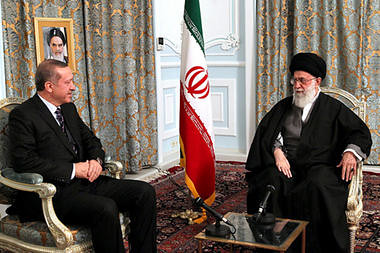
Supreme Leader Ayatollah Ali Khamenei has said Iran strongly opposes any foreign intervention in Syria's conflict, during a meeting with visiting Turkish Prime Minister Tayyip Erdogan in Mashhad.

By Marcus George, Reuters
posted March 29, 2012 at 6:02 pm EDT
Dubai

Supreme Leader Ayatollah Ali Khamenei has said Iran strongly opposes any foreign intervention in Syria's conflict and will defend Damascus so it can continue "resistance" against Israel, his official website reported on Thursday.

Khamenei, the Islamic Republic's highest authority, made the comments during a meeting with visiting Turkish Prime Minister Tayyip Erdogan in Mashhad.

The Islamic Republic supported popular uprisings in Egypt, Libya and Yemen last year but has steadfastly supported Syrian President Bashar al-Assad against a year-old uprising. Assad is a rare ally for Iran in an Arab world largely suspicious of Iranian ambitions for greater regional clout.

In contrast, Erdogan has urged Assad to step down and has allowed opposition groups to meet in Istanbul.

"Iran will defend Syria because it supports its policy of resistance against the Zionist regime (Israel), and is strongly opposed to any interference by foreign forces in Syria's internal affairs," Khamenei was quoted as saying.

He voiced support for reforms announced by Assad and opposed "any plan created by Americans for the Syrian issue."

"America accepts no nation as an independent one ... and this should be taken into consideration in the decision-making of Islamic countries."

Syria has harboured Palestinian militants hostile to the Jewish state and long seen itself as a front-line Arab opponent of Israel, but the two countries have not fought since a ceasefire that ended the 1973 Arab-Israeli war. Israel captured Syria's Golan Heights in a 1967 war.

On Wednesday, Iranian Foreign Minister Ali Akbar Salehi said Tehran backed a U.N.-sponsored peace plan for Syria that calls for the withdrawal from rebellious cities of government troops but does not demand the removal of Assad.

The Iranian authorities have tempered their rhetoric on Syria since anti-government demonstrations began in Damascus in March last year. At first, they wholeheartedly supported Assad but have increasingly encouraged him to pursue social and political reforms to take account of popular grievances.

Earlier in the day Erdogan met Iranian President Mahmoud Ahmadinejad to discuss Iran's nuclear program, which the West suspects is being used to covertly develop atomic weapons. Iran has repeatedly denied such accusations.

"The Turkish government and nation have always clearly supported Iran's nuclear program and will seriously follow the same policy in the future," Iranian state television quoted Erdogan as saying.

Erdogan's visit to Iran touched on economic cooperation. Trade between the two states rocketed to $16 billion last year.

Iran is keen to build further trade relations to minimise tough new sanctions imposed by the United States and European Union on its financial and oil sectors to try to get Tehran to shelve sensitive nuclear activity.

Turkish officials hope trade can reach $35 billion by 2015 and the two countries have agreed to appoint mutual special envoys to study how to expand relations.

Such a policy could imperil Turkey's relations with the West. Last week Ankara failed to secure an exemption from Washington on its purchase of Iranian crude oil.

Defeating Africom and NATO: Building Solidarity With Africa in the Struggle Against Imperialism

Defeating Africom and NATO: Building Solidarity With Africa in the Struggle Against Imperialism

Panel presentation at the United National Antiwar Conference

By Abayomi Azikiwe
Editor, Pan-African News Wire

Note: The following comments were made at the panel with the above-mentioned title. Other participants in this session were Sobukwe Shukura of the All-African People’s Revolutionary Party (A-APRP) in Atlanta and Ana Edwards of the Virginia Defenders and the Friends of Mali in Richmond, Virginia.

Since 2008, the United States Africa Command (Africom) has been established with its headquarters in Stuttgart, Germany. That same year there was considerable debate and discussion within Africa over
whether Africom should be based on the continent.

The overwhelming sentiment, both within and outside of governments, was in opposition to Africom being based on the continent. Since 2008, the Pentagon has used different tactics designed to promote and sell Africom to Africa.

This line suggests that Africom does not have imperial aims: that it is designed to enhance the national security and stability of post-colonial African states. There have been joint exercises and war games between the Pentagon and NATO forces in various regions and waterways in and around the African continent.

The War Against Libya

The first full project of Africom was the multinational imperialist war against the North African state of Libya. This country was
colonized during the early 20th century by Italy.

For two decades the people of Libya fought gallantly against the encroachment of Italian imperialism. It is estimated that approximately one-half of the people of Libya gave their lives in the struggle to halt colonial rule.

Of course Italy was a fascist state from the mid-1920s through the early 1940s. The Kingdom of Abyssinia (Ethiopia) was invaded and occupied by Italian fascists between 1935-1941.

With the intervention of the U.S. and Britain, Libya became an important outpost of the inter-imperialist World War II. The U.S.
built Wheelus Air Force base inside Libya as a major harbinger of the Cold War.

From the conclusion of World War II through the 1960s, the national liberation movements gained tremendous momentum in Africa and
throughout the world. U.S. imperialism and its NATO allies opposed all genuine liberation movements in Africa.

Libya experienced a popular revolution in September 1969 that was led by junior military officers but received mass support. The Revolution closed the Wheelus Air Force base and nationalized the oil industry.

Libya re-oriented its foreign policy towards the anti-imperialist nations of Africa, the Middle East and around the world. Libya came
under attack by the U.S. and in 1981 and 1986, was militarily assaulted by the Pentagon.

In 1988 after the bombing of an aircraft over Scotland, two Libyan citizens were tried in the Netherlands for their purported involvement
in the incident. Only one was convicted, and this individual had appealed their case and was eventually released on humanitarian
grounds in September 2009.

Between 2009-2011, the U.S. and other imperialist states re-kindled its propaganda and aggressive foreign policy toward Libya. In February 2011, an internal rebellion supported by imperialism erupted inside
the country.

On March 19, 2012, the U.S. and its allies within NATO began a full-scale air campaign against the Libyan people. The pseudo-legal
rationale for the war against Libya was provided through the passage of United Nations Security Council Resolutions 1970 and 1973.

The war against Libya was not a humanitarian effort. Before the overthrow of the Gaddafi government and the installation of the puppet National Transitional Council (NTC) regime, some 26,000 sorties were
flown and approximately 10,000 airstrikes were carried out.

This war was opposed by the African Union (AU) and the ALBA states within Latin America. Despite widespread opposition to the war around the world, the imperialists were determined to topple the Libyan
government and install a puppet regime to facilitate the theft of the national wealth and natural resources.

The War Against Somalia

In Somalia, due largely to the legacy of British, Italian and French colonialism, the country has experienced tremendous turmoil over the
last 40 years. Since 1991, there has been no functioning internationally-recognized government.

Between 1992-94, the U.S. and the United Nations occupied Somalia resulting in the deaths of thousands of its citizens. The occupation of Somalia met mass resistance from the people. The U.S. and U.N.
withdrew their military forces during 1994.

A new round of military assaults against Somalia was launched in late 2006 with the U.S.-backed Ethiopian invasion of the country that lasted to early 2009. The bombing of Somalia by the U.S. and Britain coincide with the Ethiopian intervention.

Since 2011, the war against the Somalian people has escalated with the combined military interventions of the African Union Mission to Somalia (AMISOM), Kenya, Ethiopia, the U.S., France, Britain and
Israel. These attacks on Somalia include the bombing of the country by France and the utilization of drones by the U.S.

Hundreds have died as a result of drone attacks by the Pentagon and the Central Intelligence Agency (CIA). This war against the people of Somalia and the entire Horn of Africa must be opposed by the antiwar
and anti-imperialist forces inside the U.S.

Our Strategic Objectives on Africa

We have no alternative but to demand the total withdrawal of all U.S. military forces from Africa. At the same time we should demand the dismantling of Africom and the ending of the unholy alliance of NATO.

It is important for the anti-interventionist movement in the U.S. to totally integrate the support for the masses of African people in
their resistance to the Pentagon, CIA, Africom, NATO and Israeli involvement in Africa. We are part and parcel of the global struggle
against imperialism and all of its manifestations.

The progressive and revolutionary movements in the U.S. must categorically condemn the Obama administration or any other administration which continues the capitalist plunder and exploitation of Africa. Our victory over U.S. imperialism can only be won in solidarity with the peoples of the oppressed nations of Africa, Asia, the Pacific and Latin America.

Antiwar Strategies in Black Community Organizations

Antiwar Strategies in Black Community Organizations

A panel presentation from the United National Antiwar Conference (UNAC)

By Abayomi Azikiwe
Editor, Pan-African News Wire

Note: The following talk was delivered at the UNAC Conference held March 23-25, 2012 in Stamford, Conn. Other panelists participating in this session were Ana Edwards, of the Virginia Defenders who chaired and moderated, Brenda Stokely of the Million Worker March, Ajamu Baraka of the Black Left Unity Network and Clarence Thomas of the ILWU.

When we examine the question of antiwar organizing in the Black community it must be done from an historical perspective. African people have been at war with imperialism at least since the 15th century.

The slave system was an act of violence, uprooting, exploitation, occupation and displacement. These historic facts are also true of the Native peoples of the western hemisphere, Asia and the Pacific.

African peoples always resisted slavery, colonialism, neo-colonialism and imperialism. We have a vested interest in defeating imperialism in other parts of the world because it weakens the exploitative system overall.

Role of Africans in the Struggle Against Imperialism Since 1900

The so-called Spanish-American War during the turn of the 19th and 20thcenturies signaled a new dawn in the rise of supremacy of U.S. imperialism. Puerto Rico, Cuba and the Philippines were taken over by the U.S. ruling class.

Cuba and Puerto have large African populations. The Filipino people are subject to occupation, militarism and gross exploitation as well.

During this period the most progressive and revolutionary elements within in the African American community opposed these imperialist wars.

World War I was an imperialist adventure dubbed as the “war to end all wars.” In actuality this was a war between various European imperialist states and the U.S. designed to carve up the rest of the world, particularly the oppressed nations of Africa, Asia, the Pacific and Latin America.

In the immediate aftermath of WWI we saw the rise of the Pan-African Movement, the red summer of 1919, the burgeoning national liberation struggles as well as the first socialist revolution in Russia and the founding of the Union of Soviet Socialist Republics (USSR). By 1929 the world capitalist system had collapsed leading to new mass and labor movements, the ascendancy of fascism in Europe and Japan and a consequent second imperialist war.

Even after WWII, we witnessed the horrors of Korea, Algeria, Vietnam, the Dominican Republic and the genocidal actions of Portugal, Britain, France, South Africa and the U.S. role in Africa. Revolutionary Africans in the U.S. and throughout the world supported and joined the movements for African liberation on the continent and within the domestic confines of the imperialist states.

Since 2008, with the formation of the U.S. Africa Command (Africom), the ruling class of the most formidable imperialist power in the world is poised for another major push toward neo-colonial domination of the continent. The bombing and overthrow of the government of Libya represented the first major project of Africom.

This project is continuing in Somalia, Djibouti, Eritrea, Sudan, the Gulf of Aden, the Gulf of Guinea, Zimbabwe and other states. We must categorically oppose Africom in all of its manifestations.

The Experience of MECAWI

In September of 2002, the Michigan Emergency Committee Against War & Injustice (MECAWI) was formed. It was quite obvious that the U.S. was going to invade and occupy the Middle Eastern nation of Iraq.

Utilizing the hysteria emanating from 9-11 and the occupation of Afghanistan, the war against Iraq was presented as a necessity to search for and destroy “weapons of destruction.” Yet the nuclear arsenal of the State of Israel was never mentioned nor the plight of the Palestinian, Lebanese and Syrian people who are under direct threat of U.S.-backed Israeli aggression.

MECAWI also saw the invasion of Haiti as an extension of the escalation of imperialist aggression. Haiti presented a unique example of the role of enslaved and colonized peoples throughout the war. The Slave Revolution was unprecedented in history and Haiti is still paying the price up until this day.

Principles of MECAWI

MECAWI believes firmly in linking the struggles against imperialist wars in Africa, Asia, Latin America and the Middle East to the struggle inside the U.S. against national oppression, economic exploitation, political repression, gender oppression and all forms of injustice. Our main slogan from the beginning was “Money for Our Cities, Not for War.”

Since 2004, we have reclaimed the antiwar and social justice legacy of Dr. Martin Luther King, Jr. through our annual MLK Day Rally & March held at Central United Methodist Church downtown (Detroit). This is the largest gathering of progressive forces every in southeastern Michigan.

One major offshoot of MECAWI was the formation of the Moratorium NOW! Coalition to Stop Foreclosures, Evictions and Utility Shut-offs. We have been in the forefront of the struggles against the impact of the global capitalist economic crisis, the worst since the Great Depression of the 1930s.

We are demanding that the bankers and bosses who created the crisis must pay for it. The urban crisis is a manifestation of the collapse of capitalism and imperialism.

We must join with the peoples of the world to create a planet absent of war, oppression and economic exploitation.

Why Couldn't Rep. Bobby Rush Wear Hoodie on House Floor?

The Christian Science Monitor - CSMonitor.com

Why couldn't Rep. Bobby Rush wear hoodie on House floor?

A hoodie won't fly on the House floor, where dress code mandates no hats – and a hoodie counts as a hat, even when its used to bring attention to Trayvon Martin.

By Peter Grier, Staff writer
posted March 28, 2012 at 7:39 pm EDT
Washington

Hoodies on the House floor are verboten, apparently. Rep. Bobby Rush (D) of Illinois was scolded and escorted from the chamber of the House of Representatives on Wednesday morning, when he attempted to give a speech on the need for a full investigation of the Trayvon Martin shooting while wearing sunglasses and a gray hooded sweat shirt.

“Racial profiling has to stop, Mr. Speaker,” said Representative Rush while doffing his suit jacket to reveal his hoodie garb. “Just because someone wears a hoodie does not make them a hoodlum.”

Rush continued to speak while the presiding officer, Rep. Gregg Harper (R) of Mississippi, banged the gavel, ordering him to desist. Eventually someone from the office of the House sergeant-at-arms appeared and escorted Rush, hoodie and all, off the floor.

The reason for the uproar is that Congress has a dress code. Men are expected to wear coats and ties, and women to wear correspondingly serious clothing. Under House Rule XVII, Section 5, hats are prohibited, and a hoodie is unquestionably a head covering.

“The Sergeant-at-Arms is charged with the strict enforcement of this clause,” concludes that section.

Senior Democrats played down the kerfuffle. Minority leader Nancy Pelosi noted that when she first came to Congress, women were prohibited from wearing pants on the floor. But really, why should the House be such a stickler on items of dress? In the 1830s and 1840s – admittedly, a much more heated era in US history – many lawmakers carried weapons, and violence was not uncommon. In some Asian legislatures today, debates can end in fistfights.

The reason for the rules on decorum may be that civility stands on a slippery slope.

“As [humorist] Will Rogers observed, members call themselves gentlemen and gentlewomen, because the alternatives would be to call one another polecats and coyotes, or worse, liars, hypocrites, stupid, dumb, demagogues, socialists, communists, none of which lend themselves to the deliberative process so important to the governance of the nation,” wrote Ray Smock, director of the Robert C. Byrd Center for Legislative Studies at Shepherd University in Shepherdstown, W.Va., last October.

Mr. Smock, who served as historian of the House from 1983 to 1995, believes that civility now “is at one of the lowest ebbs in congressional history.”

Such breaches of decorum as the “You lie!” shout of Rep. Joe Wilson (R) of South Carolina during President Obama’s 2009 speech to Congress on health-care reforms may be indicative of a larger, paralyzing incivility based on bitter partisanship, in Smock’s view.

Narrower measures indicate that Congress may be becoming more civil, not less. An Annenberg Public Policy Center study of the number of times lawmakers are reprimanded for out-of-bounds language by having their words “taken down” found that infractions have become relatively few and farther between.

“Overall, civility, not incivility, is the norm in the House,” said the September 2011 report.

All that said, Rush had particular incentive to speak out on the Trayvon Martin issue. A former member of the 1960s Black Panthers, Rush was active in the civil rights movement of the era. His own 29-year-old son died of a gunshot.

Wednesday, March 28, 2012

Another Crisis Tormenting Haiti

Havana. March 22, 2012

FROM HAITI

Another crisis tormenting Haiti

Amelia Duarte de la Rosa, Special correspondent

IF, for one moment, it is possible to imagine a Haiti which has not suffered earthquake and disease, a Haiti without centuries of plunder, indebtedness and dictatorships, there would still be another problem to overcome. The country is suffering such a degree of deforestation that experts say it is running the risk of becoming a desert.

With a total surface area of 27,750 square kilometers on the island of Hispaniola, the country – which formerly possessed rich and leafy forested land – only 2% of its territory is currently tree-covered. Desertification, the result of indiscriminate tree felling which began in the colonial era, represents one of the greatest problems in terms of food security for the majority of the population.

The causes of this disaster are basically the use of charcoal for cooking, forest fires, trading and contraband activities.

A report from the UN Development Program (UNDP) calculates that three quarters of the country’s energy demands are met using firewood and that 70% of Haitians use charcoal for cooking. The study also notes that the country’s forest reserves are disappearing at a rate of 15-20 million trees a year, which has transformed the country’s geography, in particular around Gonaives, in Artibonite department, and in parts of the northeast region.

As a consequence of this environmental problem, Haiti appears as one of the highest risk countries in the world.

Indiscriminate felling has resulted in the destruction of ecosystems, increased erosion (with the accompanying loss of 15 million cubic meters of cultivable land every year), soil instability, the disappearance of aquifer sources and the extinction or sedimentation of rivers.

Deforestation has also increased the devastating impact of tropical storms and torrential rain. Due to soil erosion, floods and landslides are more frequent, and the number of victims is also on the increase.

Although the dismantling of the environmental system is a serious problem, there are few short or medium-term strategies in place for solving it.

While national groups initiated tree planting programs some years back, the reconstruction plan drawn up by the Interim Haiti Recovery Commission – headed by former President William Clinton – and the U.S. Department of State report does not mention or show any interest in the possibility of reforestation.

However, the Haitian government does have a plan for mass tree replanting over the next five years. Agriculture Minister Hébert Docteur informed Granma that reforestation work is a challenge and a national problem. "We currently have an interesting program with Venezuela, but in any event, we need the support of many governments," he stated.

Although Haiti’s problems are many, solutions related to national restoration must be directed at long-term objectives which include environmental protection, reforestation programs and designing and implementing an energy policy in order to attain new economic opportunities for the country.

Reflections of Fidel Castro: Difficult Times for Humanity

Havana. March 28, 2012

Reflections of Fidel

Difficult times for humanity

(Taken from CubaDebate)

THE world is increasingly misinformed amidst the chaos of events unfolding at pace never before imagined.

Those of us who have lived a few more years and are avidly interested in information can testify to the extent of ignorance with which we confront events.

While a growing number of people on the planet lack shelter, bread, water, health, education and employment, the Earth’s wealth is being misspent and wasted on weapons and interminable fratricidal wars, an abominable, ever-expanding global practice – increasingly highly developed.

Our glorious, heroic people, despite the inhumane blockade which has lasted more than half a century, have never lowered their banners; they have struggled and will struggle against the sinister empire. This is to our credit and our modest contribution.

On the other side of our planet, where Seoul, the capital of South Korea, in located, President Barack Obama is attending a Summit addressing nuclear security, to impose policies related to the regulation and use of nuclear weapons.

What is being done there is clearly unfathomable.

Personally, I did not become aware of these realities simply by accident. The experiences I lived through during the 15 years after the triumph of the Revolution – the battle of Girón, the criminal yankee blockade to defeat us through hunger, pirate attacks, the dirty attacks and the nuclear missile crisis of October, 1962 - putting the world on the edge of catastrophic disaster – which led me to the conclusion that Marxists and genuine Christians, many of whom I had known, regardless of their political and religious beliefs, should, and could, struggle for justice and peace among human beings.

This is what I have said, and what I maintain, with no vacillation whatsoever. The reasons I can cite today are absolutely valid and even more important, since all of the events which have taken place over the last 40 years confirm them, today with more justification than ever, since - among Marxists and Christians, Catholic or not; Muslims, Shiite or Sunni; free thinkers, dialectical materialists and thinking people - no one would be in favor of witnessing the premature disappearance of our irreplaceable species, waiting for the complex laws of evolution to produce another one which would resemble ours and be capable of thinking.

With great pleasure I will tomorrow, Wednesday, greet His Excellency Pope Benedict XVI, as I greeted John Paul II, a man who invariably engendered feelings of affection when he came in contact with children and humble citizens among the people.

I therefore decided to request a few minutes within his busy schedule when I heard from our Foreign Minister Bruno Rodríguez that he would appreciate this simple, modest contact.

Fidel Castro Ruz
March 27, 2012
8:35 p.m.

Translated by Granma International

Speech Delivered by Cuban President Raul Castro at the Welcoming of Pope Benedict XVI

Havana. March 27, 2012

In the name of the nation, I offer you our warmest welcome

• Speech given by Army General Raúl Castro Ruz, First Secretary of the Central Committee of the Communist Party of Cuba and President of the Councils of State and Ministers, at the ceremony welcoming His Holiness Benedict XVI, at Santiago de Cuba’s Antonio Maceo Airport, March 26, 2012, Year 54 of the Revolution

(Typecast version: Council of State)

Your Holiness,

Cuba receives you with affection and respect and is honored by your presence. You will find here an educated people committed to solidarity who have proposed to attain full justice and have made great sacrifices.

We learned from [José] Martí to fully worship the dignity of human beings and inherited the fraternal formula which we have followed through today, "with all and for the good of all."

Cintio Vitier, the eminent intellectual and Christian, wrote, "The true face of the homeland… is the face of justice and freedom," and that "the nation has no other alternative: it is either independent or absolutely not."

The strongest power known to history has attempted to dispossess us, fruitlessly, of the right to freedom, peace and justice. With patriotic virtue and ethical principles, the Cuban people have put up a tenacious resistance, knowing that we are also exercising a legitimate right in following our own path, defending our culture and ennobling ourselves with the contributions of the most advanced ideas.

Erroneously, Cuba is defamed, but we trust that the truth from which we have never departed will always prevail.

Fourteen years after Pope John Paul II visited us, the economic, political and media blockade of Cuba persists and has even been tightened in the financial sector. As it is stated in the United States Memorandum of April 1960, declassified years later, its objective continues to be (I quote) "…to cause hunger, desperation and the overthrow of the government."

However, the nation has continued, invariably, changing everything that must be changed, in accordance with the highest aspirations of the Cuban people and with their free participation in the essential decisions of our society, including economic and social ones which, almost all over the world, are the province of exclusive political and financial elites.

Various generations of compatriots have come together in the struggle for lofty ideals and noble objectives. We have confronted scarcity, but we have never failed in our duty to share with those who have less.

Solely as a demonstration of how much can be done if solidarity prevails, I mention that in the last decade, with the help of Cuba, tens of thousands of doctors from other countries have been trained, 2.2 million people of low income have had their vision restored or improved, and a contribution has been made to teaching 5.8 illiterate people to read and write. I can assure you that, within our modest possibilities, our international cooperation will continue.

Your Holiness:

We are commemorating the fourth centenary of the discovery and presence of the image of the Virgen de la Caridad del Cobre, who bears the national shield embroidered on her cloak.

The recent pilgrimage of the Virgin throughout the country brought together our people, believers and non-believers, in an act of great significance.

You are awaited in Santiago de Cuba, a city which has been the protagonist of glorious episodes in the history of Cubans’ struggle for their definitive independence and also in the town of El Cobre, where the Spanish crown was compelled to grant freedom to the uprising slaves in the mines, 80 years before the abolition of that infamous institution in our country.

We are satisfied with the close relations between the Holy See and Cuba, which have developed uninterruptedly over 76 years, always on the basis of mutual respect and agreement on issues which are vital to humanity.

Our government and the Roman Catholic Apostolic Church in Cuba maintain good relations.

The Cuban Constitution enshrines and guarantees full religious freedom for all citizens and, on this basis, the government maintains good relations with all religions and religious institutions in our country.

Holiness:

Almost 20 years ago, Fidel surprised many people by proclaiming, "An important biological species is at risk of disappearing on account of the rapid and progressive liquidation of the natural conditions of life: humankind," he concluded.

There are growing threats to peace and the existence of vast nuclear arsenals is another serious danger for human beings. After oil, water or food will be the cause of the next wars of plunder. With the resources dedicated to producing deadly weapons, poverty could be eliminated. The astounding development of science and technology is not to be found in the service of solving the major problems afflicting human beings. Frequently they serve to create conditioned reflexes or to manipulate public opinion. Finances are an oppressive power.

Instead of solidarity, a systemic crisis is being generated, provoked by irrational consumption in affluent societies. An infinitesimally small portion of the population is accumulating vast wealth while the number of poor, hungry, sick people lacking medical attention and the homeless is growing.

In the industrialized world, the indignados are no longer prepared to tolerate injustice and, especially among the young, a lack of confidence in social and ideological models which are destroying spiritual values and producing exclusion and selfishness is growing.

It is a fact that the global crisis has a moral dimension as well, and that many governments lack any connection with the citizens they say they serve. Corruption in politics and the lack of true democracy are ills of our time.

On these and other issues we note our agreement with your ideas.

In the face of such challenges, Our America is uniting in its sovereignty and attempting an integration more based on solidarity in order to make real the bicentennial dream of its independence leaders.

Your Holiness may address a people of profound convictions who will listen to you attentively and respectfully.

In the name of the nation, I offer you our warmest welcome.

Thank you very much.