Wednesday, February 02, 2011

Political Outcome of Egyptian Revolution Could Have Grave Implications for the U.S. and Israel

How outcome in Egypt could affect the United States

Wed Feb 2, 2:29 pm ET
By Steve Clemons

The turmoil in Egypt is intensifying and the outcome of the increasingly bloody demonstrations remains unclear. Anti-government protesters and pro-government supporters are clashing in the streets of Cairo, and the Egyptian military is ordering everybody to go home. Meanwhile, the United States is condemning the violence and urging President Hosni Mubarak to move faster in loosening his 30-year grip on the country.

The strife in Egypt inevitably will have an impact on the United States. Here is a look at what Americans might expect:

Could the turmoil in Egypt affect the U.S. economy?

It already has, mainly because of what happens to oil prices when global tensions rise. Oil prices have been increasing in the past two weeks, and have topped $100. This will raise some prices and retard a portion of our economic growth. The ongoing uncertainty in Egypt has increased risk premiums on shipping insurance, and that drives up the cost of oil and gas imports as well as other cargo. And it's not just Egypt in turmoil but much of the Middle East. A zone of instability that Washington thought was fairly stable has erupted — all near some of the world's most important oil and gas reserves.

Secondly, unrest in Egypt has elevated anxiety about the continued operation of the Suez Canal and the Sumed Pipeline, which connect the Red Sea to the Mediterranean. The Suez Canal is a critical transit "choke point" between the Mediterranean and the Middle East and Asia for petroleum products and other types of cargo. Although there have not been indications that either of these choke points have been targeted, it remains a possibility.

Could the US military get sucked in?

That's unlikely. There is no direct threat to the United States from the current protests and the U.S. military is stretched thin in Afghanistan and Iraq.

Moreover, the United States does not want to appear to be interfering with the democratic aspirations of protestors in Egypt, especially at such a critical time. Any serious foreign military intervention would be catastrophic and generate significant blowback.

An important role that U.S. military has played, however, has been urging restraint for its counterparts in Egypt. The Egyptian and American militaries closely coordinate and have strong working relations. American advice to show restraint seems largely to have been accepted by the Egyptian military so far.

How will it affect the U.S. role and influence in the Middle East?

The ultimate impact will depend largely on how the situation in Egypt plays out, but if there is significant political transition in Egypt, the steps Obama takes now behind the scenes will be known and remembered by the next regime and the Egyptian people. America can easily get on the wrong side of change and needs to be cautious.

The United States relies on Egypt to cooperate on a huge range of issues — from assisting with American military logistical and supply operations in Middle East, to counterterrorism, to freedom of navigation and the seas, to Arab-Israeli peace. All of these interests of the United States could be affected positively or negatively by what comes next in Egypt.

Mubarak's close relationship with the United States at the expense of Egyptian popular sentiments on a host of foreign policy issues means that Egypt could go the way of Turkey — still a U.S. ally but with a much more independent foreign policy..

The United States will likely have to deal with a significant realignment of its military, political, and economic influence in the Middle East. American influence in the region and its social contract with key stakeholders in the Middle East may need to be "re-visioned" with a new strategy replacing the many decades-old one the United States has followed.

How will it affect our policy on Iran? Iraq?

A democratic Egypt could enhance U.S. efforts to minimize Iran's influence in the region in the same way that Turkey's popularity has come at Iran's expense. A democratic Egypt and a democratic Iraq would mean that the two most powerful Arab countries will now have representative governments. The impact on the region could be profound.

But there are risks as well. A new political order in Egypt also may contain significant elements of the Muslim Brotherhood, a banned political party that has received significant support from Iran and has related networks operating in many states throughout the region. The United States has been regrettably slow in engaging and interacting with the responsible factions of the Muslim Brotherhood.

How might developments in Egypt affect Israel and the Middle East peace process?

Mubarak has sided with U.S. policy in the Arab-Israeli conflict, including in supporting the status quo in Gaza, promotion of anti-Hamas policies, and emphasis on peace talks (even when they haven't worked). A democratic Egypt will likely still support the Camp David Peace Accords but not the status quo in Gaza or Palestinian disunity.

This may complicate the situation in Israel but open new opportunities to break the deadlock between Israel and the Palestinians. Only Egypt and Jordan (among Middle East and Muslim states) have peace with Israel. Since signing the Camp David Peace Accords in 1978, Egypt has received $35 billion in U.S. military and economic aid, second only to Israel. Egypt has played the role of America's Arab interlocutor in the peace process. Egypt also helps represent U.S. interests in negotiations between Fatah and Hamas.

What about possible political fallout in Washington, D.C.?

Depending on the outcome, the question can be posed, "Who Lost Egypt?" by some who try to paint the Obama administration as without a strategy to deal with the trends now erupting.

If the political outcome in Egypt turns out to be highly negative for Israel, there will be serious political echo effects in American politics.

Given that we are seeing a pattern of protest in many vulnerable nations throughout the Arab world, the Obama administration will be expected to roll out a new strategy of engagement that protects America's interests — particularly its energy sector interests — while at the same time standing behind the universal rights of people around the world to assemble and call for political reform. This will be tough for an administration that has many economic and political constraints at the moment. New visions and new engagement cost money and that is in short supply given the rising American debt.

Steve Clemons is founder and senior fellow of the American Strategy Program at the New America Foundation. He also is publisher of The Washington Note.


Egypt fallout could last for years: Netanyahu

(AFP) JERUSALEM — Israeli Prime Minister Benjamin Netanyahu cautioned on Wednesday that the massive anti-government uprising sweeping through Egypt could destabilise the region "for many years."

Netanyahu told the Israeli parliament that there would be a battle in Egypt between those who favoured democracy and those who wanted to enforce an Iranian-style radical Islamist system.

"There are two worlds, two halves, two views -- that of the free world and that of the radical world," Netanyahu said. "Which one will prevail in Egypt? The answer is crucial to the future of Egypt, the future of the region and for us here in Israel."

The Israeli premier, one of the few international leaders to back Egyptian President Hosni Mubarak, said he was sure that if the forces of the free world prevailed in Egypt, they would also uphold the peace with Israel.

"But my friends we are not there yet," Netanyahu said.

"It is possible that there will not be a resolution between these forces for a long time, there will be instability and uncertainty that continues for many years."

Since the protests began last week, Israel has stressed its focus is to preserve regional stability and its peaceful relations with Egypt, with which it signed a treaty in 1979.

Israeli Defence Minister Ehud Barak said on Wednesday that Mubarak's announced decision to step down when his term ends in September was not a matter for immediate Israeli military concern.

"Without doubt the Mubarak era is over, something is beginning that does not resemble what went before," he told Israel's Channel Two television.

"It's very hard to see what will be, it is part of a deep change which has far-ranging implications, but not immediate operational implications," he said.

Netanyahu had on Monday raised the spectre of an Iranian-style regime led by Islamic extremists arising out of the chaos sweeping through Egypt.

But Netanyahu has come under fire for failing to support the pro-democracy protests in Egypt. Israel has long prided itself on being the only democracy in the Middle East.

Netanyahu's speech appeared to be an attempt to deflect some of the criticism, telling parliament that "an Egypt that adopts democratic reforms is a source of hope to the world and to us."

But he also urged his critics to "be realistic and see the world as it is, not as we would wish it to be."

Egypt was the first Arab state to sign a peace treaty with Israel after four wars, initiating three decades of quiet on Israel's southern border.

Since then Cairo, under Mubarak, has played a key role in mediating between Israel and the rest of the Arab world and the Palestinians in particular.

Netanyahu has held frequent meetings with Mubarak since coming to office in 2009, more than any other world leader.


Israel Tense as Egypt Slides Into Power Vacuum

Sarah Wildman
Foreign Policy Correspondent
Posted: 02/2/11

Around the world, in the corridors of power and on the streets, the word is everywhere: Egypt. But perhaps nowhere is that word uttered with more trepidation, more grim uncertainty, and more mortal stress than in Jerusalem and Tel Aviv.

Israeli leaders are concerned about preserving the 30-year cold peace with Egypt, signed by Hosni Mubarak's predecessor, Anwar El-Sadat, the leader who paid for that treaty with his life. They are concerned about what the dissolution of Egypt's government means for the future of the peace process. As Egypt's immediate neighbors to the north, Israelis are panicked that Egypt's slide into a power vacuum can only bode ill.

All that unease has meant that, unlike the marvel and wonder and undercurrent of admiration the Egyptian protestors have garnered from Western journalists, Israeli newspapers have been anxious and introspective. "Can Israel only broker peace with dictators?" asked one headline in Ha'aretz, the Israeli daily newspaper. Other headlines range from the woeful – "We're on our own" -- to the accusatory: "Obama's betrayal of Mubarak" and "A bullet in the back from Uncle Sam."

As one anonymous Israeli official told the Washington Post, where the rest of the world sees the events as comparable to Eastern Europe in 1989, Israelis see "Teheran 1979."

In other words: the potential for an Islamist foe of Israel to rise up looms large. Said Udi Segal, diplomatic correspondent for Israel's Channel 2 news, speaking on NPR Tuesday, "People [in Israel] were surprised by how quickly the U.S. stepped down from supporting Mubarak. [They fear] it is sending the wrong signal to other leaders in the region . . . that are not exactly Jeffersonian democracies." Many Israelis see this not as democracy in action, he continued, but "as riots." He, too, compared the situation to Iran. "We want to be on the right side," he said, "and, of course we share the view that everyone could enjoy freedom and democracy, but the problem is what will happen in between" the time Mubarak steps down and his successor appears.

With murmurs of regional unrest rumbling from around the Near East, coupled with a Hezbollah-backed leader in Lebanon, the fear is not surprising. The first public statement from Prime Minister Benjamin Netanyahu was a demand to the international community that Egypt be pressed to maintain the peace with Israel.

It's a stance that has been criticized by commentators around the world. As Daniel Levy, director of the Middle East Task Force at the New America Foundation, wrote Tuesday in Foreign Policy:"The lack of enthusiasm on the part of some of the pro-Israel community is an understandable if regrettable phenomenon. Israel is a strong status quo power in the region and Israel's establishment considers the rule of Western-oriented dictators (especially those with strong ties to U.S. aid and the U.S. military) to have served Israel's interests. President Mubarak has been a key facilitator of Israel's agenda in the region -- partly due to his support for the Israeli-Egyptian peace treaty but primarily centered around his maintenance of a 'go-nowhere' peace process which helps shield Israel from international criticism while giving Egypt the appearance of being a useful ally to the U.S."

As though to deflect those who have begun to whisper that Israel would prefer to preserve an undemocratic, dictatorial status quo, after days of round-the-clock cabinet meetings, Prime Minister Netanyahu finally spoke out Wednesday, on the Knesset floor, echoing sentiments of American leaders.

"All those who value freedom are inspired by the calls for democratic reforms in Egypt," Netanyahu intoned. "An Egypt that will adopt these reforms will be a source of hope for the world. As much as the foundations for democracy are stronger, the foundations for peace are stronger."

Aaron David Miller, the public policy fellow at the Woodrow Wilson International Center for Scholars who served as an adviser to both Republicans and Democrats in the region, explained Wednesday morning on a conference call with reporters that democratic reforms may be a long time in coming – and in the meantime the region remains in flux. "This is not one regime change for another, nor is this a revolution," Miller said. "This is a multi-year or even a generational project" for change, he said.

And that means Israel is looking south, with dread. "I think Israelis will be united regardless of political views," said Miller. "This will be a glass -- not only half-empty -- but probably almost completely empty. Most Israelis will profess to see the virtues of democratic changes, and they have prided selves on being the only democracy in the region."

Despite paying lip service to belief in democracy, Israelis have great "misgivings," he explained. "The neighborhood has changed and the entire paradigm of what they have viewed as the southern anchor of security and political role in the region is in the process of becoming undone." The peace treaty with Egypt has prevented a two-front war since 1979, he said. And for that Israelis have been grateful. Egypt has also played a strong, stabilizing role in the mechanisms of the peace process.

On the peace process itself -- despite a call from Thomas Friedman to restart the talks -- Miller pronounced them moribund. "On the peace process, I am negative," said Miller, echoing an opinion he had expressed well before Cairo exploded. "The peace process, let alone any agreement on Jerusalem, security, borders, was in deep freeze before these events, and resurrecting this process now will be excruciatingly difficult and painful . . . almost inconceivable."

United National Antiwar Committee Emergency Appeal on the Egyptian Crisis

United National Antiwar Committee Emergency Appeal:

Mobilize to Stop US-Backed Attacks

On Egyptian Masses!

On January 28th we issued an appeal for all UNAC affiliates and supporters to turn out to last weekend’s demonstrations in support of the masses marching in Egypt for democracy and justice. Today we write in a follow-up emergency appeal for renewed mobilization to stop the murderous attacks going on today, February 2nd and likely to escalate in coming days.

On February 1st, two million marched in Cairo, a million or more in Alexandria, and hundreds of thousands more in towns and cities around Egypt. The response of Mubarak, after consultation with Obama, was to refuse to step down and to ignore ALL the demands of protesters.

Obama, in a speech two hours later, approved Mubarak’s stance, with duplicitous encouragement that he take some (unspecified) steps before the September elections, in which he pledged not to run.

As soon as the words left Mubarak’s lips, the millions in Cairo’s Tahrir Square, in Alexandria and elsewhere shouted their rejection of his speech.

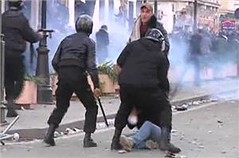
Mubarak’s words were a clear indication that repression was imminent, and sure enough, almost immediately plainclothes police thugs began attacking protesters in Alexandria. This morning, February 2nd, the expected broader attack was launched in Cairo, as thousands more plainclothes police thugs attacked the masses in Tahrir Square.

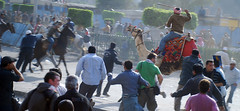
Police mounted on horses and camels, armed with whips, began riding into the crowds. Other cops threw Molotov cocktails, rocks, stones and chairs from the roofs of buildings. Gunshots were heard in several locations. New York Times reporter Nicholas Kristof reported that “mobs arrived in buses, armed with machetes, straight-razors and clubs.”

Cops began beating protesters mercilessly, and thousands were wounded.

Meanwhile the US media began featuring interviews with rich Cairenes characterizing antiregime protesters as lazy, ungrateful workers who should go back to work and stop complaining about the price of bread!

So far the army has not moved into action, neither heeding the calls of protesters for protection against the cops, nor yet dispersing the protesters. But the head of the army has told people to go home, that after Mubarak’s speech the time for protest is over.

Needless to say Obama bears prime responsibility for this situation, as he clearly coordinated his speech with that of Mubarak – that is, Mubarak would say he wouldn't run, then Obama would give back-handed blessing to that approach by calling for "faster" change but with no demands for release of prisoners, lifting of laws against assembly, free press, revocation of stolen election results, etc., etc.

Israeli officials have said they are rethinking their “security needs” in light of the possibility that a new government would reject collaboration with Israel’s policies.

But the people of Egypt are standing fast. They have pledged an even more massive march this Friday after mid-day prayers.

The Egyptian people have come too far to give up passively -- which increases the likelihood that the regime will try to launch a massacre.

More solidarity protests are coming up this weekend. In New York alone there are protests today, Friday and Saturday. And a call has been issued for protests around the world on Saturday, February 5th.

WE ENCOURAGE ALL UNAC AFFILIATES AND SUPPORTERS TO ATTEND RALLIES PLANNED BY THE EGYPTIAN COMMUNITY AND TO INITIATE THEM WHERE NONE ARE PLANNED.

What's more, as the revolution in Egypt and throughout the Arab world is clearly going to continue, we encourage affiliates to begin planning teach-ins on these events, and to work with local and national Arab groups in the US to discuss joint events up to and including the national marches on April 9th.

Call the White House and State Department and demand, No More Support to the Mubarak Dictatorship! Hands off Egypt, Tunisia, Yemen! Email: http://www.whitehouse.gov/contact Tel: Switchboard: 202-456-1414 Fax: 202-456-2461

U.S. Department of State: Main Switchboard: 202-647-4000 Email: http://contact-us.state.gov/cgi-bin/state.cfg/php/enduser/ask.phpp_sid=q6kp1alk&p_accessibility=0&p_redirect=&p_sp=cF9zcmNoPSZwX3NvcnRfYnk9JnBfZ3JpZHNvcnQ9JnBfcm93X2NudD05Miw5MiZwX3Byb2RzPSZwX2NhdHM9JnBfcHY9JnBfY3Y9JnBfc2VhcmNoX3R5cGU9YW5zd2Vycy5zZWFyY2hfbmwmcF9wYWdlPTE!

Your Senators and congressperson:

http://www.contactingthecongress.org/ http://www.senate.gov/general/contact_information/senators_cfm.cfm https://writerep.house.gov/writerep/welcome.shtml

The main Capitol switchboard 202-224-3121, and the Congressional switchboard 800-828-0498

ADDITIONAL ACTION OPPORTUNITIES:

* Call the White House and State Department to demand complete withdrawal of all US forces in and around Egypt! [phone/email/fax #s here]

In mid-January, Connecticut newspapers reported that that state’s National Guard was sending an aviation unit to the Sinai Peninsula, supposedly as part of a regular rotation of about 1,000 US soldiers who are part of the Multinational Force and Observers stationed on the border between Egypt and Israel. Meanwhile Israel for the first time since 1979 “allowed” the Egyptian army to deploy 800 soldiers in the Sinai Peninsula. Needless to say, in the current situation this dramatically increases the likelihood that soldiers from any or all of the three militaries could be used against protesters.

* Demand an End to Sale of Tear Gas to Egypt’s Army and Police!

Protesters in Egypt have exposed before the world media the made-in-USA tear gas canisters fired on them. Protests have already taken place at the tear gas supplier, Combined Tactical Systems of Jamestown, Pennsylvania, as well as at the private equity firm which bankrolls them, Point Lookout Capital Partners of New York City. (This is the same firm that supplies the tear gas canisters which have wounded and killed Palestinian protesters.)

* Recall Obama’s “special envoy” to Egypt!

Obama sent a newly-appointed envoy, Frank Wisner, to Egypt to coordinate the content of their speeches on February 1st. Wisner works for corporate law firm Patton Boggs, which boasts of its connections to Egypt’s top corporations. The choice of Wisner was no accident – especially as Mubarak’s dictatorship has served first and foremost over his decades in power to impose austerity demanded by Western corporations and banks and the IMF and World Bank.

(see details at http://mideastwire.wordpress.com/2011/02/01/frank-wisner-paid-lobbyist-for-egyptian-govern ment-and-leading-commercial-families-in-egypt/ )

Call or fax Wisner’s office at Patton Boggs and demand he get out of Egypt! T: 646-557-5151 F: 646-557-5101

ALL OUT IN SOLIDARITY WITH THE PEOPLE OF EGYPT!

SUPPORT THE FIGHT FOR DEMOCRACY AND AGAINST EXPLOITATION AND OPPRESSION THROUGHOUT THE ARAB WORLD!

For more information: http://www.unacpeace.org or E-mail unacpeace@gmail.com

Egypt News Update: Petrol Bombs, Shots Fired Against Anti-Mubarak Forces in Cairo; Oil Prices Increase Amid Crisis

Clashes rage in Tahrir Square

At least one dead and hundreds injured as pro-Mubarak supporters attack protesters seeking his ouster in central Cairo

Last Modified: 02 Feb 2011 17:41 GMT

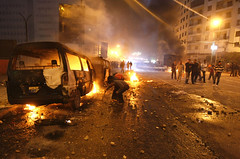
At least one person has been killed and another 600 injured in continuing clashes between pro- and anti-government demonstrators in the Egyptian capital Cairo.

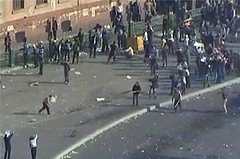
Protesters from both sides threw stones at each other on Wednesday in Tahrir Square, the epicentre of ongoing opposition demonstrations against President Hosni Mubarak for the past nine days

Al Jazeera correspondents, reporting from the scene, said clashes were still raging and that petrol bombs were being hurled.

"Someone - a few people actually - are dropping homemade bombs into the square from the buildings surrounding it," our online producer said.

Gunshots are also regularly ringing out of the square.

Earlier, witnesses said the military allowed thousands of pro-Mubarak supporters, armed with sticks and knives, to enter the square. Opposition groups said Mubarak had sent in thugs to suppress anti-government protests.

One of our correspondents said the army seemed to be standing by and facilitating the clashes. Latest reports suggest that the centre of the square is still in control of the protesters, despite the pro-Mubarak supporters gaining ground.

'Absolute mayhem'

Witnesses also said that pro-Mubarak supporters were dragging away protesters they had managed to grab and handing them over to security forces.

Salma Eltarzi, an anti-government protester, told Al Jazeera there were hundreds of wounded people.

"There are no ambulances in sight, and all we are using is Dettol," she said. "We are all so scared."

Aisha Hussein, a nurse, said dozens of people were being treated at a makeshift clinic in a mosque near the square.

She described a scene of "absolute mayhem", as protesters first began to flood into the clinic.

"People are coming in with multiple wounds. All kinds of contusions. We had one guy who needed stitches in two places on his face. Some have broken bones."

Meanwhile, another Al Jazeera correspondent said men on horseback and camels had ploughed into the crowds, as army personnel stood by.

At least six riders were dragged from their beasts, beaten with sticks by the protesters and taken away with blood streaming down their faces.

One of them was dragged away unconscious, with large blood stains on the ground at the site of the clash.

The worst of the fighting was just outside the world famous Egyptian Museum, which was targeted by looters last week.

Al Jazeera's correspondent added that a group of pro-government protesters took over army vehicles. They also took control of a nearby building and used the rooftop to throw concrete blocks, stones, and other objects.

Soldiers surrounding the square took cover from flying stones, and the windows of at least one army truck were broken. Some troops stood on tanks and appealed for calm but did not otherwise intervene.

Many of the pro-Mubarak supporters raised slogans like "Thirty Years of Stability, Nine Days of Anarchy".

Violence

Al Jazeera's Jane Dutton, also in Cairo, said that security guards have also been seen amongst the pro-Mubarak supporters, and it may be a precursor to the feared riot police arriving on the scene.

Dutton added that a journalist with the Al-Arabiya channel was stabbed during the clashes.

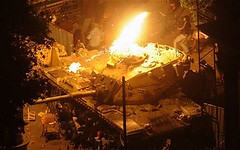
Fighting took place around army tanks deployed around the square, with stones bouncing off the armoured vehicles.

Several groups were involved in fist fights, and some were using clubs. The opposition also said many among the pro-Mubarak crowd were policemen in plain clothes.

"Members of security forces dressed in plain clothes and a number of thugs have stormed Tahrir Square," three opposition groups said in a statement.

Mohamed ElBaradei, a prominent opposition figure, accused Mubarak of resorting to scare tactics. Opposition groups have reportedly also seized police identification cards amongst the pro-Mubarak demonstrators.

"I'm extremely concerned, I mean this is yet another symptom, or another indication, of a criminal regime using criminal acts," ElBaradei said.

"My fear is that it will turn into a bloodbath," he added, calling the pro-Mubarak supporters a "bunch of thugs".

ElBaradei has also urged the army to intervene.

"I ask the army to intervene to protect Egyptian lives," he told Al Jazeera, adding he said it should intervene "today" and not remain neutral.

Determined protesters

Despite the clashes, anti-government protesters seeking Mubarak's immediate resignation said they would not give up until Mubarak steps down.

Khalil, in his 60s and holding a stick, blamed Mubarak supporters and undercover security for the clashes.

"But we will not leave," he told Reuters. "Everybody stay put."

Mohammed el-Belgaty, a member of the Muslim Brotherhood, told Al Jazeera the "peaceful demonstrations in Tahrir Square have been turned into chaos".

"The speech delivered by President Mubarak was very provocative as he used very sentimental words.

"Since morning, hundreds of these paid thugs started to demonstrate pretending to be supporting the President. Now they came to charge inside Tahrir Square armed with batons, sticks and some knives.

"Mubarak is asking the people to choose between him or chaos."

Ahead of Wednesday's clashes, supporters of the president staged a number of rallies around Cairo, saying Mubarak represented stability amid growing insecurity, and calling those who want his departure "traitors."

"Yes to Mubarak, to protect stability," read one banner in a crowd of 500 gathered near state television headquarters, about 1km from Tahrir Square.

A witness said organisers were paying people $17, to take part in the pro-Mubarak rally, a claim that could not be confirmed.

Other pro-Mubarak demonstrations occurred in the Mohandeseen district, as well as near Ramses Square.

Source: Al Jazeera and agencies


Machine guns fired into Cairo's Tahrir Square

By JPOST.COM
S0TAFF MELANIE LIDMAN AND AP
02/02/2011 21:59

600 reported injured, one killed in clashes; Pro-Mubarak rioters hurl Molotov Cocktails, rocks at opposition from surrounding buildings; protesters target Egyptian Museum

Machine gunfire was heard on Wednesday night, shortly after Egyptian state television ordered all demonstrators to evacuate Cairo's Tahrir (Liberation) Square.

Al Jazeera reported that anti-government protesters remained in the square, chanting "Leave! Leave!" at Egyptian President Hosni Mubarak, as ambulances were stationed in the area. Frequent gunfire was heard in the vicinity of the Egyptian Museum.

A spokesman from the Egyptian Health Ministry on Wednesday said that 600 people were injured and one man was killed in the recent round of clashes that erupted in central Cairo earlier in the day.

According to the report, the man who was killed was a "conscript" which means he could have belonged to the army or police.

Pro- and anti-government protesters continued to clash in Cairo on Wednesday, with Mubarak's supporters throwing dozens of Molotov cocktails at those protesting against the regime.

Numerous explosives were hurled as the pro-regime mob attempted to push through a no-man's land towards the anti-Mubarak protesters in Cairo's Tahrir (Liberation) Square.

Witnesses at Tahrir Square also said they heard several shots fired into the air, and water cannons were fired by security officials to try to calm the protests, according to reports.

An anti-Mubarak demonstrator told the BBC that she is trapped in Tahrir Square, because the area is surrounded by pro-government rioters.

"If we want to get out we have to go through Mubarak supporters," she said. "I'm scared of going out because my face is now recognizable as an opposition protester."

As Supporters and opponents clashed, raining stones, bottles and firebombs on each other in scenes of uncontrolled violence, soldiers stood by without intervening. Government backers galloped in on horses and camels, only to be dragged to the ground and beaten bloody.

At the front line, next to the famed Egyptian Museum at the edge of Tahrir Square, pro-government rioters blanketed the rooftops of nearby buildings, dumping bricks and firebombs onto the crowd below — in the process setting a tree ablaze inside the museum grounds.

On the street below, the two sides crouched behind abandoned trucks and hurled chunks of concrete and bottles at each other, and some government supporters waved machetes.

Bloodied anti-government protesters were taken to makeshift clinics in mosques and alleyways nearby, and some pleaded for protection from soldiers stationed at the square, who refused. Soldiers did nothing to stop the violence beyond firing an occasional shot in the air and no uniformed police were in sight.

"Hosni has opened the door for these thugs to attack us," one man with a loudspeaker shouted to the crowds during the fighting.

The clashes marked a dangerous new phase in Egypt's upheaval — the first significant violence between supporters of the two camps in more than a week of anti-government protests. Clashes began, first in the port city of Alexandria, just hours after Mubarak went on national television Tuesday night and rejected protesters' demands he step down immediately. He defiantly insisted he would serve out the remaining seven months of his term.

Peaceful protests

Meanwhile, Thousands of Egyptians gathered in an upscale Cairo boulevard Wednesday to cheer on President Hosni Mubarak in their first mass counter-demonstration after more than a week of calls for him to resign.

Many praised Mubarak for keeping the country at peace after a series of wars with Israel. Others said they felt personally humiliated by anti-Mubarak demonstrators jeering a man they saw as a symbol of the nation.

The mood was angry and defiant but the protest was mostly peaceful, in contrast to the scene in Cairo's main square, where hundreds of young pro-government supporters attacked crowds of thousands demanding his ouster.

On the boulevard in the middle-class, heavily commercial neighborhood of Mohandiseen, men in designer sunglasses and women with expensive hairdos joined government employees, including a few dozen nurses in white dresses and stockings who jumped and chanted, "We love you Mubarak!" Younger men carried portraits of Mubarak and shouted in support. Children painted their faces with the black, white and red colors of the Egyptian flag.

Pro-Mubarak protesters also gathered in other middle-class Cairo neighborhoods and the Nile Delta town of Luxor.

"We have been a stable country since the days of the Pharoahs. These demonstrators want to turn us into Somalia: poor and at war with itself," cried Samir Hamid, a 58-year-old war veteran who said his age made him remember life before Mubarak took power nearly 30 years ago. He said he recalled struggling to find bread in the pre-Mubarak years, and the wailing of Egyptian women who lost their sons in wars against Israel.

Mubarak says he will not seek re-election

In his 10-minute televised address to the nation Tuesday night, the 82-year-old Mubarak appeared somber but spoke firmly and without an air of defeat. He insisted that even if the protests demanding his ouster had never broken out, he would not have sought a sixth term in September.

He said he would serve out the rest of his term working "to accomplish the necessary steps for the peaceful transfer of power." He said he will carry out amendments to rules on presidential elections, and vowed not to flee the country.

The step came after heavy pressure from his top ally, the United States. Soon after Mubarak's address, US President Barack Obama said at the White House that he had spoken with Mubarak and "he recognizes that the status quo is not sustainable and a change must take place." Obama said he told Mubarak that an orderly transition must be meaningful and peaceful, must begin now and must include opposition parties.

Mubarak would be the second Arab leader pushed from office by a popular uprising in the history of the modern Middle East, following the ouster last month of the president of Tunisia — another North African nation.

Jpost.com staff contributed to this report


Oil turns higher as worries over Egypt persist

By Gene Ramos
NEW YORK | Thu Feb 3, 2011 1:28am IST

NEW YORK (Reuters) - Oil prices rose on Wednesday as worries persisted that upheaval in Egypt could spread across the Middle East and North Africa, source of a third of the world's supply of crude.

Prices had lost some steam earlier after the dollar rebounded as nervous investors sought a safe haven and as data showed U.S. crude stockpiles rose for a third straight week.

"While the oil market wants to move lower on the bearish (inventory) data, it can't break away from worries about Egypt," said Phil Flynn, analyst at PFGBest Research in Chicago.

"The latest pictures of Egyptian demonstrations becoming violent have added to those worries," Flynn said.

U.S. March crude settled 9 cents higher at $90.86, bouncing off a session low of $90.10.

ICE Brent crude for March delivery traded up 60 cents at $102.34 a barrel by 2:38 p.m. EST (1938 GMT). In earlier trade it touched $102.36, the highest for a front-month contract since September 2008.

Brent's premium against the U.S. crude benchmark, West Texas Intermediate, remained wide at more than $11 a barrel, gaining from $10.97 at the close on Tuesday.

Part of Brent's strength stemmed from rising U.S. stocks at the key storage hub in Cushing, Oklahoma, the delivery point for oil futures traded on the New York Mercantile Exchange.

Stockpiles at the hub rose 667,000 barrels last week to a record 38.33 million barrels, data from the U.S. Energy Information Administration showed.

That was a portion of the total 2.6-million-barrel increase last week in U.S. crude inventories, the third straight week that supplies have risen.

A massive winter storm, meanwhile, brought parts of the Midwest to a standstill and delivered another wintry blow to the Northeast, the biggest market for heating oil.

The U.S. March heating oil contract was up 2.46 cents at $2.7816 a gallon, having hit a session peak of $2.7861, the highest for a front-month heating contract since October 2008.

TENSION IN EGYPT

Egyptian President Hosni Mubarak has said he will surrender power in September, angering protesters who sought an immediate end to his 30-year rule.

In sporadic skirmishes, Mubarak's supporters attacked protesters, further muddling the already explosive situation.

The United States, France, Germany and Turkey have urged Mubarak to carry out a speedy transition, but the president has dug in his heels. A Foreign Ministry statement said those calls aimed to "incite the internal situation" in Egypt.

Analysts expect oil markets to head higher unless the unrest in Egypt subsides.

"We suspect that the (as) yet unresolved political standoff in Egypt will likely keep oil prices fairly well bid, at least for the balance of the week," said Edward Meir, senior commodities analyst at brokers MF Global.

Credit Suisse analysts agreed, saying price risks would remain "skewed to the upside" as long as geopolitical tensions in Egypt remained unresolved: "We expect oil prices to ease once tensions fade due to ample global inventories."

So far, the unrest in Egypt has not affected traffic on the Suez Canal or flows on the Suez-Mediterranean (SUMED) oil pipeline, but shipping sources said there were major disruptions in Egypt's Alexandria and Damietta ports due to staff shortages and an absence of customs officials.

Egypt controls the canal and the pipeline, which together moved over 2 million barrels per day of crude and oil products in 2009, the latest data available.

There are fears that the citizen uprising in North Africa could fuel similar protests in oil producers such as Libya or even Saudi Arabia, stirring fears of a temporary disruption to oil supplies.

(Additional reporting by Robert Gibbons in New York; Christopher Johnson in London; Alejandro Barbajosa in Singapore; Editing by Dale Hudson)

Egypt News Bulletin: Counterrevolutionary Forces Attack the People in Tahrir Square; Army Orders Masses to Leave the Streets

Clashes break out in Tahrir Square

More than 100 injured as pro-Mubarak supporters attack protesters seeking president's ouster in Egyptian capital

Last Modified: 02 Feb 2011 13:24 GMT

Clashes broke out between pro-and anti-government protesters in Cairo's Tahrir Square

Clashes have broken out between pro- and anti-government demonstrators in the Egyptian capital Cairo.

Protesters from both sides threw stones at each other in Tahrir Square, the epicentre of ongoing opposition demonstrations against President Hosni Mubarak.

Al Jazeera correspondents, reporting from the scene, said that more than a 100 people were injured in the clashes and in a stampede that started when trouble broke out.

Earlier, witnesses said thousands of pro-Mubarak supporters had entered the square. Opposition groups said Mubarak had sent in thugs to suppress the protest.

Also in Cairo, Al Jazeera's Jane Dutton, said that "hundreds of anti-government supporters were running from the square, including many women and children".

Another Al Jazeera correspondent said men on horseback and camels ran into the crowds, as army personnel stood by. The correspondent added that more horses and camels are arriving into the square.

Al Jazeera's online producer in Cairo said rocks were continously being thrown from both sides.

He also said that tens of thousands of people from Mubarak's supporters are coming up to Tahrir square.

"The army had barricades to block them off but they got through them and the army let them through.

"The people on horses are pro-Mubarak supporters, they are a very angry crowd looking for anyone working for Al Jazeera and for Americans. They are trying to get on the other side of the army tanks to get to the anti-Mubarak supporters. More and more pro-Mubarak supporters are coming in and for now the army is acting as a buffer."

Violence

Jane Dutton also said that security guards have also been seen amongst the pro-Mubarak supporters, and it may be a precursor to the feared riot police arriving on the scene.

Dutton added that a journalist with the Al-Arabiya channel was stabbed during the clashes.

Fighting took place around army tanks deployed around the square, with stones bouncing off the armoured vehicles. Soldiers did not intervene.

Several groups were involved in fist fights, and some were using clubs. The opposition also said many among the pro-Mubarak crowd were policemen in plainclothes.

"Members of security forces dressed in plain clothes and a number of thugs have stormed Tahrir Square," three opposition groups said in a statement.

Source: Al Jazeera and agencies


Egypt army wants protests ended

Military urges protesters to pack their bags and go back to 'normal life' as anti-government rallies enter ninth day

Last Modified: 02 Feb 2011 11:05 GMT

The army has not intervened in the protests and only guards the sites and buildings that are of national interest

The Egyptian army has called for protesters rallying for a ninth day against President Hosni Mubarak's regime to go home and "return to normal life."

In a call for protesters to leave the streets, Ismail Etman, a military spokesman said on state television on Wednesday: "The army forces are calling on you ... You began by going out to express your demands and you are the ones capable of restoring normal life.

"I call on the conscious youth of Egypt, honest men of Egypt, we should look forward to future, think of our country, Egypt. Your message has been heard, demands understood, and we are working day and night to secure our homeland for your interest, the honourable people of Egypt."

Unlike the police, which is widely reviled in Egypt for its repressive tactics, the military is widely admired and is seen as neutral.

Internet back up

Internet service, which has been cut off entirely, has apparently been partially restored in Egypt.

Mubarak's embattled regime and the powerful military appear to be making a unified push to end a street movement to drive the 82-year-old leader out of power.

The movement built on the work of online activists is fuelled by deep frustration with an autocratic regime blamed for ignoring the needs of the poor and allowing corruption and official abuse to run rampant.

After years of tight state control, protesters emboldened by the Tunisia unrest took to the streets on January 25 and carried out a once unimaginable series of protests across this nation of 80 million.

The army gave a tacit endorsement to the movement on Monday by saying it would not use force against protesters and that they had legitimate demands.

Al Jazeera's Jane Dutton reported from Cairo that, "It is the first time that we have heard the army issue that warning.

"It could be linked to the fact that we are seeing an increasing number of pro-Mubarak supporters on the streets."

On Tuesday, the protesters brought nearly a million people into Cairo's main square to demand Mubarak leave within days.

Late on Tuesday, Mubarak issued a defiant response in an address to the nation, announcing that he would serve out the last months of his term and "die on Egyptian soil".

He promised not to seek re-election, but that did not calm public fury as clashes erupted between his opponents and supporters.

Source: Al Jazeera and Agencies

Egypt News Bulletin: Millions Demand Removal of U.S. Supported Regime

Defiant Mubarak vows to finish term

Violence erupts in Alexandria shortly after Egyptian president's
announcement that he will not seek another term

Al Jazeera Online Producer
Last Modified: 02 Feb 2011 03:24 GMT

Mubarak's televised announcement came after eight days of
unprecedented nationwide protests

CAIRO, EGYPT - Hosni Mubarak, the Egyptian president, has announced in a televised address that he will not run for re-election but refused to step down from office - the central demand of millions of
protesters who have demonstrated across Egypt over the past week.

His announcement follows a week of protests, in which millions of
people have taken to the streets in Cairo and elsewhere.

Mubarak seemed largely unfazed by the protests during his recorded
address, which aired at 11pm local time on Tuesday.

Shortly after his speech, clashes broke out between pro-Mubarak and
anti-government protesters in the Mediterranean city of Alexandria, Al
Jazeera's correspondent reported.

Rock-throwing youths at the city's Mahatit Masr Square scattered as
automatic gunfire rang out and a tank advanced towards them before
halting and then withdrawing. There was no sign of any casualties.

Mubarak's words were unlikely to carry much weight with the protesters at Cairo's Tahrir, or Liberation, Square: they resumed their "Leave, Mubarak!" chant shortly after his speech, and added a few new slogans, like "we won't leave tomorrow, we won't leave Thursday ..."

Mubarak mentioned the protests at the beginning of his speech, and
said that "the young people" have the right to peaceful
demonstrations.

But his tone quickly turned accusatory, saying the protesters had been
"taken advantage of" by people trying to "undermine the government".

Until now officials had indicated Mubarak, 82, was likely to run for a
sixth six-year term of office. But in his address on Tuesday, Mubarak
said he never intended to run for re-election.

"I will use the remaining months of my term in office to fill the
people's demands," he said.

That would leave Mubarak in charge of overseeing a transitional
government until the next presidential election, currently scheduled
for September.

Economy and jobs

Mubarak promised reforms to the constitution, particularly Article 76,
which makes it virtually impossible for independent candidates to run
for office. And he said his government would focus on improving the
economy and providing jobs.

"My new government will be responsive to the needs of young people,"
he said. "It will fulfil those legitimate demands and help the return
of stability and security."

Mubarak also made a point of saying that he would "die in this land" -
a message to protesters that he did not plan to flee into exile like
recently deposed Tunisian president, Zine El Abidine Ben Ali.

Marwan Bishara, Al Jazeera's senior political analyst, said: "It is
clear that President Mubarak is in denial over his legacy.

"Until Friday we are probably going to watch a major escalation of
tension in events both between the demonstrators on the one hand and the regime of Mubarak on the other."

Mohamed ElBaradei, the Egyptian opposition figure who returned to
Cairo to take part in the protests, said Mubarak's pledge not to stand
again for the presidency was an act of deception.

ElBaradei, a Nobel peace prize winner as head of the UN nuclear
agency, said if Mubarak did not heed the call to leave power at once,
he would be "not only a lame-duck president but a dead man walking".

"He's unfortunately going to extend the agony here for another six,
seven months. He continues to polarise the country. He continues to
get people even more angry and could [resort] to violence," ElBaradei
said.

Indeed, none of the protesters interviewed by Al Jazeera earlier today
said they would accept Mubarak finishing his term in office.

"He needs to leave now," Hassan Moussa said in Tahrir Square just
hours before Mubarak's announcement.

"We won't accept him leaving in September, or handing power to [newly installed vice-president] Omar Suleiman. He needs to leave now."

Waiting game

The protests continue to feel like a waiting game - as if Mubarak is
hoping to simply outlast the crowds amassed at Tahrir Square.

"When the people of a nation decide something, then it will happen,"
Abdullah Said Ahmed, a student from Al-Azhar University, said. "The
United States chooses its leaders. We're going to choose ours. Our
patience can do anything."

Saber Shanan said: "I'll stay here until I die or until the system changes."

Mubarak's announcement came after pressure from the US administration, which urged him not to seek re-election.

Frank Wisner, a former ambassador to Egypt, met Mubarak on Monday and reportedly told him not to extend his time in office.

In remarks to the media at the White House on Tuesday evening, Barack Obama, the US president, said he had spoken with Mubarak who he said "recognises that the status quo is not sustainable and a change must take place".

Obama said he told Mubarak that an orderly transition must be
meaningful and peaceful, must begin now and must include opposition
parties.

Obama emphasised, however, that "it is not the role of any other
country to determine Egypt's leaders".

Speaking to Al Jazeera, Mona Eltahawy, a US-based Human Rights
activist and Newspaper columnist said that, "The Obama administration has been completely outpaced by what is happening in Egypt. They just do not understand the amount of rage and hatred for Mubarak in Egypt.

"Because for so long, they have sided with this dictator against his
own people."

"This is the defining moment now, and we need to hear from the US
administration, 'Mubarik must go'. Anything short of that will reflect
that they, like Muabarak, are completely out of touch with what is
happening," she added.

"The courageous Egyptian revolution is telling the world essentially,
that it is time to side with the people," Eltahawy said.

Source: Al Jazeera and agencies


Tahrir Square's historic past

Cairo's Tahrir Square has become the epicentre of the uprising against
the embattled government of Hosni Mubarak.

Last Modified: 01 Feb 2011 11:17 GMT

Tahrir Square has been the traditional site for many major protests
over the years

Cairo's Tahrir Square, which has become, perhaps fittingly, the
epicentre of the popular uprising in Egypt, is the site of choice for
Egyptians to register discontent. The square is witnessing yet another
revolt as thousands of angry Egyptians gather, almost on daily basis,
demanding the ouster of president Hosni Mubarak, who has ruled over
Egypt for the past 30 years.

The tryst with revolution is not new to Tahrir, which means
'liberation' in Arabic. Many glorious chapters of Egyptian history has
been written there and epitaphs of the dethroned rulers and conquered
foreign invaders have been inscribed there as well.

Not only in the historical past, but the Square has been one of the
top trending terms on Google as the uprising and anger reached fever
pitch.

Deciphering the history and architectural past of this glorious place
is part history lesson, part heroic tale and part pure Egyptian.

According to some sources, the area, on which the square is located,
has been historically significant to Cairo since 13th century. But it
took its current shape only in late 19th century. Coincidently, the
square owes its design to another Mubarak: Ali Pasha Mubarak – Egypt's public works minister in the 1860s. Egypt's then ruler, Ismail Pasha, handed over the task of modelling Cairo after Paris to that Mubarak, and thus the square was born.

Originally it was called Maidan Ismailia - after the 19th-century
ruler Khedive Ismail who commissioned the new downtown district's
design.

It was renamed Maidan al-Tahrir or Liberation Square in 1954 after the
1952 Egyptian revolution - turning Egypt from a constitutional
monarchy into a republic.

A statue of the president Abd al-Nasser was to be placed in the middle
of the Square, a plan which was halted after Egypt’s humiliating
defeat against the Israelis in 1967 (Six Day War).

'Most important plaza'

Tahrir Square has been the traditional site for many major protests
and demonstrations over the years, including the 1977 bread riots.

More recently, hundreds and thousands of people protesting the war
against Iraq also gathered there. In fact, many Egyptian watchers say,
if you come to the square you instantly come in the national news.

The essence of Tahrir Square is very well put by an Egyptian writer
Samir Raafat. He wrote in the Cairo Times: "Maidan al-Tahrir cannot
sit still. Whether reflecting the city's moods or the leadership's
political agenda, the nation's most important plaza has gone from faux
Champs de Mars to Stalinesque esplanade. Whenever a new regime feels the nation's capital needs a new look, the Midan has been the place to start."

Source: Al Jazeera


Politics pervade Cairo's streets

Egyptians air different views on their hopes for the future but all of
them agree it is time for Mubarak to go

Al Jazeera's Online Producer
Last Modified: 01 Feb 2011 21:59 GMT

CAIRO, EGYPT - Tuesday was billed as a game-changer, the day of a
"Million March" that would swell the crowd in Tahrir Square, along
with its spirits, as protesters promised a decisive action that would
deliver the message to Hosni Mubarak, the Egyptian president, that no
concession aside from his abdication would satisfy Egypt’s widespread
unrest.

Final estimates of the size varied widely, but it was probably the
largest demonstration modern Cairo has ever seen, and the message from Tahrir echoed clearly from the chants of the enormous crowd: "He's going, we're not going."

Throughout the morning, the Egyptian army fulfilled its promise to
protect the civilian populace, providing an outer cordon of security
and ushering demonstrators through barbed wire and concrete barriers
with little or no resistance.

But it was often ordinary citizens - the protesters themselves - who
performed the most stringent security checks, patting down young men, checking ID cards, and ushering away those who seemed to be a threat.

Inside, the atmosphere was jovial, and there was a palpable buzz in
the crowd. The army had already promised not to use force against
unarmed civilians, and there was little concern among the
demonstrators that other security forces would attack. Though police
had reportedly deployed again throughout the city, they were nowhere
to be seen in the vicinity of Tahrir.

So protesters were free to wave signs, deliver impromptu speeches,
chant slogans, and hold forth on politics. They sang the Egyptian
national anthem, “My country, my country," in unison several times.

"Our requirement now, it is to do a power-sharing with all the people
in Egypt,” said Said Mustafa. “The Muslim Brotherhood, al-Wafd,
ElBaradei, all the people sharing in this, with the army."

Talking politics

It was a slightly surreal experience, talking politics with Egyptians
in the middle of Tahrir Square, a place that - until a week ago - was
the heart of Egypt’s authoritarian government. The hulking Mogamma
building, an edifice that has long symbolised all that was corrupt and
dysfunctional in Egypt's bureaucracy, looms always in Tahrir's
background.

But there was none of the reluctance that once characterised political
conversations; all of them were eager to share their views. In the
streets surrounding the Mogamma, burned out cars sat like carcasses.
Several young men lounged inside one, snacking on pastries.

On a side street near the old American University in Cairo, Nawal
el-Saadawy, a well-known human rights activist, engaged in informal
debates and talks with the crowd that had gathered around her.

Mohammed Abdelrady, who said he belonged to the Muslim Brotherhood, pursued Saadawy doggedly, questioning her thinking on the role of religion in life. Abdelrady argued that Egyptians have been a
thoroughly religious people for thousands of years, since the time of
the Pharaohs, and that while he and Saadawy likely agreed about much, she was pressing for too many "religious freedoms" and pushing women's rights too hard for Egyptian society.

Saadawy, after taking the man's number and before being ushered away by the group accompanying her, pointed out to Abdelrady that the constitution makes all Egyptians equal, regardless of sex or sect.

One group of men in Tahrir debated whether prominent families - like
the billionaire Sawiris clan, which controls Orascom Telecom - would
support a new government or stand with Mubarak. Several talked about Gamal Mubarak, the president's son, wondering what his future role would be.

All of them agreed, though, that it was time for Mubarak to go.

"Thirty years he's been with us. Enough!" said Abu Hassan, an elderly
man sitting in the center of the square who waved a reporter over to
chat. “Nasser died. Sadat died. And we had this president for 30
years? Enough."

Anger

Anger at the United States and Israel - seen as Mubarak's two
staunchest allies - was palpable. Dozens of people held signs
criticising the US for backing the president, and one demonstrator
carried a "leave, Mubarak" sign written in Hebrew. "It's a message for
Netanyahu," he said, referring to the Israeli prime minister. Another
protester held a sign that said, "I hate Mubarak and I hate Israel."

Several protesters blamed the current government for stoking sectarian
unrest in Egypt, which has seen several ghastly acts of communal
violence in recent months – the bombing of a Coptic church in
Alexandria earlier this month, and a drive-by shooting outside a
church in Nag Hammadi last year.

Tuesday's protest was an antidote of sorts to those tensions:
Egyptians from all walks of life – Muslims and Christians, some
devoutly religious, others not – chanting the same slogans."The
Egyptian government has created these tensions," said Mustafa Haddad. "There never used to be problems between Muslims and Christians, Christians and Muslims. There is no conflict within the sha'ab [the Egyptian people]."

Egyptian state television, meanwhile, took a slightly softer line on
the rallies, which it had ignored up until last night. It still tried
to minimise them, showing grainy out-of-focus shots of Tahrir Square
and pictures of side streets which held only a handful of
demonstrators. But several state-owned networks sent reporters to
Tahrir Square, and they described the protest as peaceful, praising
the army's role in providing security.

The rest of their coverage focused on the new government, which has
been widely scorned by protesters across the country. One channel
carried an interview with the new prime minister, Ahmed Shafiq,
talking about the new government's priorities; and a story about
Mahmoud Wagdy, the new interior minister, announcing his "Police
Serving the People" programme.

Outside, chants of "No Mubarak, No Suleiman, No Shafiq" echoed across Tahrir Square, and several demonstrators held signs comparing the police to terrorists.

By evening, the crowd had thinned somewhat, but the rally will
continue into the night, with many demonstrators pitching tents and
starting campfires to keep warm. Mubarak's announcement tonight, in
which it's anticipated he will announce his intent not to run again
for president, is unlikely to satisfy them.

Source: Al Jazeera


Signal disruptions hit Al Jazeera

Broadcast on Nilesat, Arabsat and Hotbird platforms facing
interference on scale not experienced before, channel says

Last Modified: 01 Feb 2011 19:46 GMT

Over the past week Al Jazeera has faced multiple attempts to disrupt
its coverage of the protests in Egypt

Al Jazeera has said its broadcast signal across the Arab region is
facing interference on a scale it has not experienced before.

Signals on Egypt's Nilesat platform were cut, and frequencies on the
Arabsat and satellite Hotbird platforms were disrupted continually,
forcing millions of viewers across the Arab world to change satellite
frequencies throughout Tuesday.

The latest disruption came on the day of the historic "million man
march" in Egypt.

"We have been working round the clock to make sure we are broadcasting on alternative frequencies. Clearly there are powers that do not want our important images pushing for democracy and reform to be seen by the public," a spokesman for Al Jazeera, based in Qatar, said.

"We appreciate the extraordinary support from the ten channels across
the region who interrupted their own programming to live-broadcast our
signal to their audiences."

Al Jazeera has been widely praised for its coverage from Egypt and
Tunisia despite obstacles put in their path by those governments.

Not only have its images and reporting been enthusiastically received
by people in the Middle East, but there has been a massive surge in
interest in Al Jazeera's coverage from across the world.

Over the past week the channel has faced multiple attempts to disrupt
its coverage from Egypt, with signals being interfered with on a
continual basis, and journalists being banned and detained.

Source: Al Jazeera


Turkish PM backs Egypt protesters

Erdogan urges Egyptian president Hosni Mubarak to "lend an ear to the people's cries" and herald a new era of reform

Last Modified: 01 Feb 2011 12:09 GMT

Turkey has finally broken its silence over the Egyptian crisis after
major newspapers criticised the government for its inexplicable
silence on the issue.

Addressing members of his AKP party in parliament, Recep Tayyip
Erdogan, the Turkish Prime Minister, has thrown his weight completely
behind the protesters in Egypt.

Erdogan appealed to Hosni Mubarak, the Egyptian president: "You have to listen to the wishes of the people in order to create security and stability. First you must take steps that are good for Egypt. You must take steps that satisfy the people."

Erdogan said on Tuesday that he was putting off a visit to the
Egyptian capital of Cairo next week, but would go once Egypt returns
to normal.

Turkey is hailed as the only democratic country in the Muslim world.

'Reforms needed'

Erdogan called for anti-government protesters to refrain from violence
and protect the country's cultural heritage. "Everyone has the right
to fight for freedom, but without violence,” said the Turkish PM.

"You must not forget that the people who oppose you are still human,
still your brothers."

He also talked about political reforms in the Middle East. “Our
greatest wish in Egypt and Tunisia is that reforms are implemented as
soon as possible, but also that peace and security are established,”
said Erdogan.

He also underlined Turkey’s priorities towards supporting democratic
cause. He said: "I spoke to president Barack Obama. He found it
important to hear Turkey's view as a democratic country in the
region."

Iran sees 'Islamic Middle East'

Also supporting Egyptian protesters is the government of Iran.

Ali Akbar Salehi, the Foreign Minister, said Iran will offer its
support to the protesters in Egypt.

"On our part we are going along with the freedom seekers of the world
and support the uprising of the great nation of Egypt. We sympathise
with those injured and killed" in the protests, he said.

Iran said on Tuesday the uprising in Egypt will help create an Islamic
Middle East but accused US officials of interfering in the "freedom
seeking" movement which has rocked the Arab nation.

Salehi, who was officially endorsed by the Iranian parliament on
Sunday as foreign minister, said the uprising in Egypt "showed the
need for a change in the region and the end of unpopular regimes."

"The people of Tunisia and Egypt prove that the time of controlling
regimes by world arrogance (the West) has ended and people are trying to have their own self-determination," said Salehi, who also oversees Iran's controversial nuclear programme.

Source: Al Jazeera and agencies

African Union Says Sudan Represents An Exceptional Case

AU says Sudan represents an exceptional case

ADDIS ABABA, Jan. 31 (Xinhua) -- "We acknowledge that Sudan represents an exceptional case, which, in no way, calls into question the sacrosanct principle of respect of borders inherited at the accession of African countries to independence", said a declaration on Sudan by the assembly of heads of state and government of the African Union, closed Monday in Addis Ababa.

"We reaffirm our determination to ensure full respect of this principle and to forge ahead with our agenda of integration and greater unity among our countries, as foreseen by the founding fathers of the OAU and as enshrined in the AU Constitutive Act", said the declaration.
--------------------------------------------------------------------------------
Copyright 2010 Xinhua News Agency

Tuesday, February 01, 2011

Protesters Flood Egypt Streets

Protesters flood Egypt streets

More than a million rally in Cairo's Tahrir Square as massive countrywide protests are held against President Mubarak

Last Modified: 01 Feb 2011 14:43 GMT

Al Jazeera reports on the latest developments in Tahrir Square and across Egypt

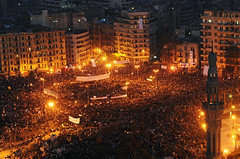
More than a million protesters flooded into central Cairo, turning Tahrir Square in the Egyptian capital, into a sea of humanity as massive protests against President Hosni Mubarak swept across Middle East's most populous nation.

Packed shoulder to shoulder in and around the famed Tahrir Square, the mass of people on Tuesday held aloft posters denouncing the president, and chanted slogans "Go Mubarak Go" and "Leave! Leave! Leave!"

Similar demonstrations calling on Mubarak to step down were also witnessed across other cities, including Sinai, Alexandria, Suez, Mansoura, Damnhour, Arish, Tanta and El-Mahalla el-Kubra.

Tens of thousands marched in Alexandria while the number of those protesting in Sinai was estimated to be around 250,000.

Tuesday's protests were by far the biggest since street demonstrations broke out against Mubarak's rule last week.

"The crowd is very diverse - young, old, religious, men, women - and growing by the minute," Al Jazeera's online producer said from Tahrir Square.

"They're chanting the same slogans they've been chanting all week. Someone actually hung an effigy of Mubarak from a streetlight."

Organisers had called for a march by a million people on the day, but the turnout surpassed all expectations.

Soldiers deployed at the square did nothing to stop the crowds from entering.

They have formed a human chain around protesters, and are checking people for weapons as they enter. Tanks have been positioned near the square, and officers have been checking identity papers.

According to reports, the military police have placed barbed wire around Mubarak's residence in Masr el-Gedidah, a suburb east of Cairo.

Sources said Mubarak is expected to offer "a solution" in an address to the nation shortly.

'Gaining momentum'

Al Jazeera correspondents said the mood at the Tahrir Square was "festival-like".

"It is peaceful, people power that has united here in the heart of Egypt's historic square," reported one correspondent.

People power

An Al Jazeera correspondent in Cairo said that there were reports that "thugs in certain parts of the city have been trying to stop people from driving into Cairo".

She said that "increasingly large pockets of pro-government protests" are also taking place at various locations in the city. There are fears that if the two sets of protesters meet, a violent clash could erupt.

Gigi Ibrahim, a political activist, told Al Jazeera the protesters will not be satisfied until Mubarak steps down.

"... Every day there are more numbers on the street than the day before. I think the protests are gaining momentum. The people ... will literally not leave until Mubarak steps down," she said.

In turning out at Tahrir Square and elsewhere, the protesters overcame various odds. Authorities had stopped all train traffic from Monday afternoon in a bid to deter people from joining the protests, but they came out in very large numbers nevertheless.

State TV has started showing footage of the protests in Tahrir Square, though it continues to delve on how the protests are hurting Egypt's economy.

Protest organisers had called for an indefinite strike to be observed across the country on Tuesday, the eighth day of an uprising that has claimed at least 150 lives.

Army promise

The protesters have been emboldened by the army's statement on Monday, in which they said that force would not be used against them.

"To the great people of Egypt, your armed forces, acknowledging the legitimate rights of the people," stress that "they have not and will not use force against the Egyptian people," said the statement.

It was the first such explicit confirmation by the army that it would not fire at demonstrators.

It urged people not to resort to acts of sabotage that violate security and destroy public and private property. It warned that it would not allow outlaws to loot, attack and "terrorise citizens".

Mubarak swore in a new cabinet on Monday, in an attempt to defuse ongoing demonstrations, but the move has done little to douse public anger.

Panic and chaos

On Tuesday, the International Monetary Fund said it was ready to put in a place an economic rebuilding policy for the country.

"The IMF is ready to help in defining the kind of economic policy that could be put in place," IMF chief Dominique Strauss-Kahn said.

Meanwhile, chaos has been reported at Cairo's international airport, where thousands of foreigners are attempting to be evacuated by their home countries.

Our correspondent reported on Tuesday that about 1,000 US citizens have been evacuated to Cyprus or Turkey, from where they are expected to make their own way home.

She also said that China is sending two additional planes to evacuate its citizens.

Somalia Resistance Forces Unite to Fight U.S.-backed TFG

Somalia Security Brief

Feb .1 , 2011

Mogadishu, Somalia
By Medeshi

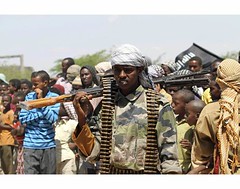
Al Shabaab’s media arm, the al Kata’ib Foundation, released a 25-minute video documenting the December 2010 unification of al Shabaab and Hizb al Islam and celebrating the “Year of Unity.” In the film, al Shabaab spokesman Ali Mohamed Rage announced that the unification of the groups will allow al Shabaab to confront “the global Zionist-Christian Crusade,” and called upon other jihadists worldwide to unite, extending a special appeal to the leaders of Ansar al Islam and the Islamic State of Iraq.

Clashes between protestors and Somaliland security forces in the city of Las Anod left one civilian dead. The city of Las Anod has been a hotbed of tension since October 2007, when Somaliland forces took control after the withdrawal of Puntland soldiers.

Puntland has accused Somaliland of killing civilians in Buhoodle, a town along the Ethiopian border. Reports say that fifteen people died in clashes between militias close to the Puntland administration and al Shabaab security forces.

Transitional Federal Government (TFG) MP Ali Mohamed Farah and Ahmed Diriye, the spokesman of the Hawiye elders of Mogadishu, jointly condemned a January 31, 2011 incident in which TFG soldiers fired anti-aircraft weapons into a crowd of civilians, killing 17 people. The shooting was said to be accidental-CT

Tunisia Rebellion Against Ben Ali left 200 Dead, Says United Nations Report

1 February 2011
Last updated at 10:00 ET

Tunisia protests against Ben Ali left 200 dead, says UN

A month of protests forced Tunisia's long-time leader from power

At least 219 people died during the protests that toppled Tunisia's President Zine al-Abidine Ben Ali last month, a UN team has said.

Team leader Bacre Waly Ndiaye said this figure included 72 people who died during prison riots.

The government previously said that 78 people had died, although the opposition said the figure was higher.

Mr Ndiaye was speaking at the end of a week-long human rights team investigation into the unrest.

He added that the figure was not final and the UN would continue its investigations.

Separately, a synagogue has been set on fire in the southern city of Ghabes, a spokesman for the Jewish community says.

"I believe those who did it want to create divisions between Jews and Muslims in Tunisia who have lived for decades in peace," Perez Trabelsi told the Reuters news agency.

Mainly Muslim Tunisia has one of the largest Jewish communities in North Africa.

Amid the anti-government demonstrations which began in December, there have been occasional outbreaks of looting and violence

After President Ben Ali fled to Saudi Arabia in January, a unity government was sworn in but some protests continue, by demonstrators who want anyone linked to the former regime to leave power.

Prime Minister Mohammed Ghannouchi has promised elections within six months.

The toppling of Mr Ben Ali after 23 years in power helped inspire the current anti-government protests in Egypt.

On Monday, the European Union announced it had frozen the assets of the former leader and his wife.

Uprisings in North Africa, Middle East Creates Dilemma for U.S. Imperialism

Uprisings in North Africa, Middle East Creates Dilemma for U.S. Imperialism

Mass outpouring of discontent takes on anti-western character

By Abayomi Azikiwe
Editor, Pan-African News Wire

As the revolutionary upheaval in Egypt develops where millions of workers, youth and professionals have taken to the streets demanding the removal of the U.S.-backed regime of Hosni Mubarak, the potential for a total collapse of Washington’s foreign policy in the region looms. The situation in Egypt was inspired by the mass demonstrations, strikes and rebellions in Tunisia that resulted in the fleeing of longtime neo-colonial puppet Ben Ali to Saudi Arabia, another imperialist outpost in the Arabian Peninsula.

In addition to the uprisings in Tunisia and Egypt, there have been significant mass actions in Yemen and Jordan, where U.S. imperialism has dominated the governments as a key component of their so-called “war on terrorism” against political Islam. Obama administration officials have been scrambling to formulate and articulate a coherent position on the rapidly developing situation where the people have lost all fear of repression and retaliation from the client states of the region as well as their U.S. benefactors.

Strangely enough President Barack Obama during his “State of the Union” address on Jan. 25, stated that the U.S. supported the democratic aspirations of the people in Tunisia, however, Washington has been a solid supporter of the ruling Constitutional Democratic Rally (RCD) in Tunisia. The Obama administration maintained its backing of Ben Ali until after he fled the country on Jan. 14.

In regard to the Egyptian uprising, the U.S. administration has refused to publicly call for the removal of Mubarak as of Jan. 31, the day before the April 6 Movement and other opposition forces appealed for a general strike on Feb. 1. These groups said that one million people would enter the streets around the country to demand the immediate removal of Mubarak and his ruling National Democratic Party (NDP).

U.S. imperialist policy in North Africa and the Arabian Peninsula has been based on the shoring up of a number of neo-colonial and autocratic regimes. Nonetheless, with the failure of this strategy, the ruling class inside the U.S. is debating what course of action to take in order to maintain its economic and strategic interests in the region.

The Economic Impact of the Uprisings

There is much at stake for the U.S., the European Union and the State of Israel as it relates to the political outcomes of the current crisis. Tunisia has been a source of cheap agricultural products that are marketed in Europe and around the world. Egypt, with its population of 80 million, borders the State of Israel and owns the Suez Canal, a gateway to the most important waterways where vessels transport oil and other resources that are essential to the world capitalist market.

Continuing unrest in Egypt and throughout the region has already impacted the EU countries. According to journalist Simon Kennedy, “European markets fell on Jan. 31 as investors remained nervous about the growing unrest in Egypt, with financial firms, travel companies and car makers posting some of the biggest losses.” (MarketWatch, Jan. 31)

Kennedy also notes that “Monday’s (Jan. 31) retreat came after worries about the situation in Egypt also had pulled Asian markets lower. The main concern for markets is over what would happen if unrest spreads to other countries, said Andy Lynch, European equity fund manager at Schroders.” (MarketWatch, Jan. 31)

This same article continues by saying that “Fears about the potential impact on oil supplies pushed crude-oil prices sharply higher. Lynch said the protests could also lead to policy changes in other countries. ‘The trigger point seems to have been the rise in food prices,’” (MarketWatch, Jan. 31)

These developments have placed additional pressure on the European currency, the Euro, which was artificially shored-up in a bailout package in 2010 that was prompted by the grave economic crises in Greece, Spain, Portugal and Ireland. Also the lower than expected U.S. Gross Domestic Product growth rate of only 3.2 percent resulted in a decline in the stock market on Jan. 28 by 166 points.

Even the New York Times admitted that the situation in Egypt could further instability in the capitalist economies around the world. Quoting market researcher Ann Wyman of the Nomura Holdings Inc., who said that she “would expect regional markets to remain unsettled because we don’t look any closer to a political resolution than we did on Friday (Jan. 28).

Wyman went on to say that “Instability in the Middle East makes global markets uncomfortable. We’ve entered a new and unpredictable phase of transitioning governments in the Middle East.” (New York Times, Jan. 31)

U.S. Imperialism Looks for Different Strategy

The current crisis in Egypt, Tunisia and other countries in the region has led to a debate within ruling circles inside the United States and the European Union. Early on in the presidency of Barack Obama he visited Egypt where he delivered a speech calling for a new approach to relations with the predominately Muslim states in the region.

Nonetheless, the same policy has continued with the unconditional support of the State of Israel and the upholding of the dictatorial regimes headed by puppets of the U.S. and other imperialist countries. Conditions for the Palestinians in Gaza have worsened and the documents released by WikiLeaks on the role of the Palestinian Authority, has further confirmed the U.S. interference in the internal affairs of the colonized people.

Even Turkey, a member of NATO, which has been a staunch U.S. military and political ally that maintains diplomatic relations with Israel, has begun to criticize both the Zionist state and Washington’s foreign policy in the region. In May of 2010, the Israeli Navy attacked an aid flotilla heading towards Gaza to provide humanitarian assistance, resulting in the deaths of nine Turkish nationals, one of whom was also a citizen of the United States.

The Israeli government came out on Jan. 31 in support of the Mubarak regime, which as a successor to Anwar Sadat who was killed by assassins in 1981, negotiated a separate peace deal with Tel Aviv that was condemned throughout the region and the world. Israel fears that the coming to power of a new coalition government in Egypt could result in the abrogation of the 1979 peace treaty and the possible reopening of the border between the North African state and Gaza.

In a recent commentary published in the Israeli daily Haaretz, Aluf Benn stated that “Jimmy Carter will go down in American history as ‘the president who lost Iran,’ which during his term went from being a major strategic ally of the United States to being the revolutionary Islamic Republic. Barack Obama will be remembered as the president who ‘lost’ Turkey, Lebanon and Egypt, and during whose tenure America’s alliances in the Middle East crumbled.” (Associated Press, Jan. 31)

Hussein Agha and Robert Malley of St. Anthony’s College at Oxford University and the International Crisis Group respectively, said of the current situation in Egypt and throughout the region that “Decades of U.S. policy in the Middle East are coming back to haunt Washington. The United States backed Arab regimes that supported U.S. objectives irrespective of whether they legitimately represented popular aspirations.” (Washington Post, Jan. 31)

Agha and Malley continue by pointing out that “The more they aligned themselves with Washington, the more generous America’s support and the greater the erosion of their domestic credibility. As a result, the United States now faces a battle it cannot win.”

A Senior Fellow at the Council on Foreign Relations, Ed Husain, said in relations to the current crisis for U.S. imperialism in the region that “Arabs regularly accuse America of flagrant hypocrisy: The United States claims that it stands for freedom and democracy and yet supports the world’s most tyrannical governments in Egypt, Saudi Arabia and elsewhere. “ (Washington Post, Jan. 31)

Husain went on to note that “Former secretary of state Condoleeza Rice once quipped that America had traded freedom for stability in the region and got neither.“ Demonstrators on the streets of Egypt have openly voiced anti-U.S. and anti-Zionists sentiments that if put into practice in a new government of national unity could result in a profound shift in the political and military balance of forces in North Africa and throughout the Middle East.

Implications for the U.S. workers and the oppressed

With the potential for the collapse of U.S. imperialist policy in Egypt and other states within the region, the stage could be set for an escalation of solidarity efforts in support of the Palestinian people and other oppressed Arab populations within the region. Public opinion within the U.S. has been largely shaped by the lack of debate within the corporate media and political culture over the character of national and class configuration of the region as well as other majority Muslim states such as Afghanistan, Pakistan, Somalia, Yemen, Iraq and Saudi Arabia.

Nonetheless, despite this lack of debate, more people within the U.S. have come out in support of the legitimate struggles for national independence and self-determination for the Palestinians as well as the people of Lebanon and other neighboring states. The majority of people in the United States oppose the ongoing wars in Iraq, Afghanistan and Pakistan and see no possibility for peace outside a total withdrawal of military forces by the Pentagon and NATO.

There have been numerous demonstrations in solidarity with the people of Egypt and Tunisia inside the U.S. and around the world. The upcoming anti-war demonstrations on April 9-10 will inevitably be bolstered by the developing revolutionary movements throughout North Africa and the Middle East.

Anti-Imperialists and anti-war activists must incorporate slogans and programs that support fundamental social change throughout North Africa and the Middle East as well in Central Asia and the Horn of Africa. Moreover, the struggles waged by the workers and youth in Egypt and Tunisia have direct relevance to the people of the U.S. who are also facing high levels of unemployment, growing poverty, cutbacks on public and social services and escalating state repression.

Review of "Hands on the Freedom Plow: Personal Accounts by Women in SNCC"

African American History Book Review

Title--Hands on the Freedom Plow: Personal Accounts by Women in SNCC
Edited By—Faith S. Holsaert, Martha Prescod Norman Noonan, Judy Richardson, Betty Garman Robinson , Jean Smith Young and Dorothy M. Zellner
Publisher—University of Illinois Press, Urbana, Chicago and Springfield, 2010

By Abayomi Azikiwe
Editor, Pan-African News Wire

This is a long awaited book that examines the history of the Student Nonviolent Coordinating Committee (SNCC), the civil rights and black power movements from the perspective of the women who played such a pivotal and vital role in shaping African American and United States history during the 1960s. The book is structured around both the personal development of the women who wrote submissions and the transformation of political consciousness within these movements as a whole.

There are fifty-two women contributors to the book who are natives of the north and the south, who are urban, rural, African American, white and Latina. Some of the women represented came from northern urban areas to join the civil rights struggle as well as those who were born, bred, educated and shaped by the south and its segregated system of exploitation and oppression against black people.

All of the women who edited and contributed to “Hands on the Freedom Plow” worked with SNCC, the pioneering and militant civil rights and later black power organization that was formed out of the sit-ins that swept the south in the winter and spring months of 1960. These personal accounts span the entire history of the organization from 1960-1970.

Although the participants worked within the same organization and have maintained contacts throughout the years since the 1960s, their perspectives and recollections of historical developments are sometimes in conflict. SNCC was heavily rooted within the African American communities of the rural south and their educational institutions, yet the impact of the organization’s work influenced a whole generation of white youth who while working in the civil rights movement gained the necessary experience to move in other directions involving community organizing in white areas as well as within northern urban settings.

The book begins with the personal account of political transformation and consciousness of Gwendolyn Zoharah Simmons (aka Gwendolyn Robinson) from Memphis who went from a secure African American family and community to experiencing racism and segregation when she sought to find summer employment in Tennessee’s largest city. An incident on a bus where she refused to move to the back fueled her determination to end segregation.

After winning a scholarship to the prestigious historically black women’s college of Spelman, Simmons recounted how SNCC would send recruiters to campus. She remembers SNCC “had some really effective recruiters. One of the best was Willie Ricks, sometimes called ‘Reverend Ricks.’ He’d stand on the campus in his blue-jean overalls (the SNCC uniform) and talk about how the SNCC folk were making history while we studied it.” (Little Memphis Girl, p. 15)

Simmons then joins SNCC, begins wearing her hair natural and while joining demonstrations against segregation and racism in Atlanta. By 1964, she would volunteer for the Mississippi Summer Project and face the dangers of other civil rights workers who organized the Freedom Democratic Party and registered thousands to vote for the first time since Reconstruction.

One of the interesting contributors to the book from the northern United States was Debbie Amos Bell, whose parents were members of the Communist Party. Bell in the section entitled “A Young Communist Joins SNCC,” attended the founding conference of the student organization in Raleigh in April 1960 at the aegis of the Party.

She remembers that “The most appealing quality of SNCC for me was that it gave its field-workers plenty of latitude to establish their own style of work to accomplish the stated goals of the organization. Strategy and tactics were collectively discussed, but the individual field secretary had plenty of room to exploit his or her talents.” (p. 60)

Bell continues by noting that “Women were generally accepted for their intelligence as well as their organizational skills. At the same time, it was not unusual for me to participate in a meeting dominated by men where it was impossible to interject a word.”

The book reveals how the escalation of the struggle from civil rights to black power and revolution that was formerly ushered in with the election of Stokely Carmichael as Chair in 1966, brought even more repression from the federal government and local authorities. In 1966 and 1967, the federal authorities filed criminal charges against numerous male members of SNCC and placed tremendous strains on the organization as a whole.

In 1970, two leading organizers, Ralph Featherstone and William H. (Che) Payne were killed in an explosion that blew them to bits in their automobile in the state of Maryland. It was during this time that former SNCC Chair H. Rap Brown, now known as Jamil Abdullah al-Amin, and a current political prisoner in the federal system, was waiting to stand trial on trumped up charges stemming from the 1967 rebellions.

These developments along with other ideological and political differences led to the demise of the organization. However, the authors illustrate that fierce activism continued among most of the SNCC women activists. They have served their time well in other community, national and international organizations. Many have worked as community organizers, intellectuals and religious figures.

This book makes a significant mark on the body of literature that recounts the often hidden history of the civil rights and black power movements of the 1960s. The fact that the book was written and compiled by the actual participants in the struggle gives it an authenticity that is sometimes lacking in other texts.

Young activists of the 21st Century will be well served in obtaining and studying this first-hand account of one of the most significant periods in United States history.

Chicago Demonstration Says No to FBI and Grand Jury Repression

Chicago Demonstration Says No to FBI and Grand Jury Repression

Over 300 picket the federal building after organizers refuse to testify

By Abayomi Azikiwe
Editor, Pan-African News Wire
Chicago, Jan. 25, 2011

Photos by Abayomi Azikiwe
http://www.flickr.com/photos/53911892@N00/5390587646/
http://www.flickr.com/photos/53911892@N00/5390587652/
http://www.flickr.com/photos/53911892@N00/5390587636/

Nine activists from the solidarity and anti-war movements in the United States refused to testify before a federal grand jury on Jan. 25 in Chicago . Since September 2010, 23 activists from various organizations including the Twin Cities Anti-War Committee, Women Against Military Madness, the Minnesota Coalition for a People’s Bailout, Freedom Road Socialist Organization and others were subpoenaed by the FBI to appear before a grand jury.

Other activists had their homes and offices raided by FBI agents who confiscated personal papers, computers, organizational files and other materials ostensibly in an ongoing investigation involving material support for liberation struggles taking place in Palestine and Colombia.

After a press conference that was held outside the Dirksen federal building, activists from various organizations and movements demonstrated chanting “No Grand Jury, No Witch Hunt.” Sarah Smith, one of the activists targeted, told the crowd that I’m not backing down. In fact, I’ve been made stronger by the support from all of you to become more politically active.”

Bill Chambers of the Palestine Solidarity Group, who chaired the rally and spoke extensively on the threat imposed by the Justice Department’s targeting of political activists, said that more than 50 organizations were represented at the demonstration. These groups included the American Muslims for Palestine, SEIU Local 73, the Chicago Teachers Union, the Puerto Rican Cultural Center School, Students for Justice in Palestine, Workers World Party and the Michigan Emergency Committee Against War & Injustice.

The National Committee to Stop FBI Repression has scheduled regional conferences on the government investigations against political activists. A Midwest regional conference in slated to take place on Feb. 12 in Chicago.

For more information contact the National Committee to Stop FBI Repression
http://www.stopfbi.net

Former SNCC Organizer, Willie Mukasa Ricks, Keynotes Detroit MLK Day

Former SNCC Organizer Keynotes Detroit MLK Day

Willie Mukasa Ricks first raised the black power slogan in the Delta

By Abayomi Azikiwe
Editor, Pan-African News Wire

Photos:
http://www.flickr.com/photos/53911892@N00/5367984096/
http://www.flickr.com/photos/53911892@N00/5367984120/in/photostream/
http://www.flickr.com/photos/53911892@N00/5367984148/in/photostream/

Detroit held its 8th Annual MLK Day Rally & March at Central United Methodist Church on Jan. 17 under the theme of renewing the fight for Jobs, Peace and Justice. The keynote speaker for the event was Willie Mukasa Ricks, a former field secretary for the Student Nonviolent Coordinating Committee (SNCC) who was a civil rights worker in Tennessee, Alabama and Tennessee during the 1960s.

Ricks, who has a son studying at the Latin American School of Medicine in Cuba, began his address by raising the slogan of Black Power in a similar fashion as it was advanced in Mississippi in June 1966. Dr. Martin Luther King, Jr., Stokely Carmichael (later known as Kwame Ture), Floyd McKissick and others decided to continue a 240 mile demonstration against fear of racist violence after James Merideth, the first African American to study at the University of Mississippi, was shot down while walking through the state on June 6.

Ricks, who began his career as an activist during his teenage years in Chatanooga, Tennessee, was described by Dr. King as the most fiery orator in SNCC. Ricks played a significant role in the Selma to Montgomery march of March 1965, when he organized students at Alabama State to defy the State Troopers who were under the command of the then Gov. George Wallace.

Later he would be one of the early members of the Black Panther Party of Alabama in 1965-66 which later influenced Huey P. Newton and Bobby Seale to form the Black Panther Party for Self-Defense in Oakland, Calif. Ricks was also a founding member of the All-African People's Revolutionary Party and served for many years on its Central Committee along with Kwame Ture.

At the Jan. 17 rally in Detroit, Mukasa said that he did not want to be viewed as a revolutionary from the 1960s but "someone who is still commited to revolution today." After a rousing speech to a standing room only crowd inside the Church where Dr. King delivered annual sermons for ten consecutive years, Muskasa led the march through downtown that passed the Detroit Auto Show at Cobo Conference Center and through the financial district of Detroit.

The march in Detroit was initiated by the Michigan Emergency Committee Against War & Injustice (MECAWI) in 2004 in order to reclaim the anti-war and social justice legacy of Dr. King, who was martyred in Memphis on April 4, 1968. MECAWI immediatelly expanded the participation in the event by establishing the Detroit MLK Committee which plans the event every year.

Two Detroit MLK Spirit of Detroit awards were given this year to the Warriors on Wheels, a people living with disabilities rights organization and the Detroit Local Organizing Committee (DLOC) for the U.S. Social Forum that was held in the city and attracted 15,000 people from across the country and the world.

A special tribute to Rev. Dr. Lucius Walker, the founder of the Inter-religious Foundation for Community Organizations (IFCO), featured City Council member JoAnn Watson and Ellen Bernstein, Co-Director of IFCO and Pastors for Peace. Both Mukasa and Bernstein spoke the following day at the University of Michigan on the scholarship program established by IFCO, the Congressional Black Caucus and the Cuban government to provide scholarships to students from oppressed communities interested in studying medicine at the Latin American School of Medicine in Cuba.

Co-sponsors and endorsers of the Detroit MLK Day Rally and March included the Moratorium NOW! Coalition, Mosaic Design Group, the Justice for Cuba Coalition, the Palestine Office, among others.