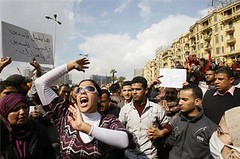
Sunday, February 06, 2011

Investors Pull $7 Billion From Emerging Funds

Investors pull $7bn from emerging funds

By Barney Jopson and Nicole Bullock in New York
Financial Times
February 4 2011 19:00

Investors have pulled more than $7bn from emerging market equity funds in the past week, the biggest withdrawal in more than three years after turmoil in the Middle East and rising food inflation raised fears of economic instability.

Violence on the streets of Egypt and a jump in oil prices to more than $100 a barrel set off a wave of anxiety across developing markets.

But the fund outflows also reflected deeper unease about economic overheating in China, India, Brazil and other big emerging economies.

Emerging markets attracted record investor inflows of $95bn last year as they became a defining investment theme in the wake of the financial crisis. The latest figures have raised concern that the bull run may be about to end as investors look for value in beaten-down markets in the west.

“Since the fourth quarter, the perception of where the value lies in the equity markets has shifted pretty decisively toward the developed markets,” said Cameron Brandt, global markets analyst at EPFR, which tracks the fund movements. “If you were thinking of making the switch, Egypt gave you a nudge.”

Emerging market share prices have fallen nearly 3 per this year and in the worst performing big market, India, equities are down 11 per cent. Before the latest outflows, emerging market equity funds contained nearly $720bn.

Many investors ploughed their money straight back into the US, Europe and Japan as developed market equity funds took in $6.6bn, a fifth consecutive week of inflows.

The data point to a new year switch in investment strategies by some of the world’s biggest fund managers, but may not mean emerging equities are poised for a major retracement.

Robert Buckland, head of global equity strategy at Citi, said: “Investors are clearly rotating out of emerging into developed market equities.”

Oliver Bell, who helps manage $10bn of emerging market equities at Pictet Asset Management, said that, in spite of the unrest in Egypt, investors were less concerned now than they were a week ago.

“The big change is that last Friday no one could see the solution in Egypt. Now we know the solution: it’s for [President Hosni] Mubarak to leave and for there to be a transition to a new government,” he said.

Others pointed to rising inflation in emerging markets, which is being driven by the higher price of food and other commodities.

Indonesia on Friday became the latest country this year to raise interest rates in an effort to control inflation, joining India, Brazil and South Korea.

Tristan Hanson, head of asset allocation at Ashburton, a fund manager with about a third of its $2bn assets in emerging markets, said: “The good news is that inflation is already a headline issue, so it’s probably already in the price. But I don’t see these issues disappearing anytime soon.”

Egypt Remains At An Impasse

Egypt remains at an impasse

Crowds occupy Cairo demanding president's resignation, while Muslim Brotherhood says it will join talks with government

Last Modified: 06 Feb 2011 03:00 GMT

Egypt's PM says stability returning, though protesters continue to demand president's resignation

After nearly two weeks of anti-government demonstrations in Egypt, the standoff continues between tens of thousands of protesters and the country's embattled president Hosni Mubarak.

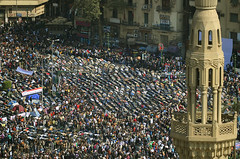
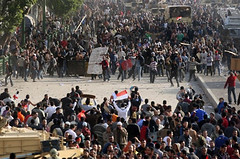
The demonstrations entered their thirteenth day on Sunday in the capital, Cairo, where protesters braved rainy weather as they dug in for another night in the city's Tahrir Square, the focal point of the protests.

Al Jazeera's correspondent in the capital said the scene in Tahrir was relatively calm shortly before dawn on Sunday in what has become a "tent city".

"It's generally been a quiet day, though there have been sporadic moments of excitement amongst the protesters. At one moment the army was placed in between two groups who were chanting rival slogans at each other.

"But it's relatively peaceful now, and they're hunkered in and around what has become an enormous tent city."

Brotherhood joining talks

Meanwhile, in an apparent bid to bring the impasse to an end, Egypt's outlawed opposition party, the Muslim Brotherhood, announced that it is joining the dialogue with the government.

The opposition had previously rejected all dialogue until Mubarak steps down. But the group confirmed to Al Jazeera on Sunday that it is joining talks with vice-president Omar Suleiman to end the crisis.

Al Jazeera's correspondent in the capital said the announcement is "highly significant".

"They are interested in talking about the resignation of president Mubarak," he said. "They want parliament resolved, they want those responsible for violence of the last few days put on trial ... and wanting to be able to peacefully protest."

However, Cherif Bassiouni, president of the Egyptian American Society and a former UN human rights expert, said the Muslim Brotherhood has already proved itself to be a responsible participant in Egypt's legislative process.

"They participated in the 2005 legislative elections. They elected 88 members to the parliament. So they've had a role in the secular parliament."

Protesters' demands

The news of the Muslim Brotherhood joining the talks came as protesters vowed not to back down in their demand for Mubarak to step down and end his nearly 30-year-rule.

"They are steadfast and very sure in their aims and refuse to move," our correspondent in Cairo said. "But certainly we haven't seen the massive numbers that we've seen before."

Protest organisers say they must keep up the pressure of large protests, paralysing the heart of Cairo, to force the government to make a true move to democracy.

"We have to be steady to topple the government," Ahmed Abdel Moneim, a 22-year-old student who has been sleeping in the square for days, said.

"The French Revolution took a very long time so the people could eventually get their rights. ... If we have to spend our life to get rid of Mubarak, we will."

Protest organisers have now called for a "Day of the Martyred" to be observed in honour of those who have died in the protests so far, while Copts in Egypt have called for Sunday prayers this week to be observed in Tahrir Square.

Tough realities

Beyond the square's tank-guarded gates, however, a decidedly more pessimistic view takes hold. Some Egyptians say they are upset that life has ground to a halt and looks to remain that way as long as there is no resolution in sight.

Recognising the need to keep support among the wider public, protest organisers put out a statement on Saturday denying those claims.

"The broad positive response by the people to our movement's goals reveals that these are the goals of the Egyptian masses in general, not any internal or external faction or entity," it said.

As the crisis drags on, the protesters also face the raw physical toll of camping out, night after night, in the sprawling public square where hunger, illness and injuries might well become a drain.

Political wrangling

Despite the demonstrations, the Egyptian president has remained defiant, refusing to step down immediately, as per the protesters' demands.

However, the leadership of Mubarak's ruling National Democratic Party (NDP) resigned en masse on Saturday, according to state television.

Hossam Badrawi has been appointed the new secretary-general of the party, replacing Safwat El-Sherif, a Mubarak loyalist, in that post. Badrawi, seen by many as a liberal voice in the NDP, will also replace Gamal Mubarak, Hosni Mubarak's son, as head of the party's policies bureau.

Other new appointees include: Dr Mohamed Ragah Ahmed, Dr Mohamed Ahmed Abd El-Illah, Maged Mahmoud Younes El-Shirbiny, Mohamed Ahmed Abd El-Salam Hebah and Dr Mohamed Mostafa Kamal, according to an NDP press release.

Officials in the administration of Barack Obama, the US president, welcomed the resignation of Gamal Mubarak, terming it a "positive" move.

But the administration has continued to insist upon an orderly and peaceful transition in Egypt.

Frank Wisner, who has acted as an envoy for Obama by carrying a message to Mubarak, said on Saturday that the Egyptian president "must stay in office to steer" a process of gathering "national consensus around the preconditions" for the way forward.

PJ Crowley, the US state department's spokesman, has said, however, that Wisner was speaking as a private citizen, and that his views did not represent those of the US government.

"The views he expressed today are his own. He did not co-ordinate his comments with the US government," Crowley said on Saturday.

Meanwhile, the president of Israel, Shimon Peres, voiced his support for Mubarak on Saturday, saying the Egyptian leader saved lives by "preventing war in the Middle East".

"He saved lives of Egyptians, of Arabs, of Israelis by not allowing to renew a war. No matter what is now the criticism against him, his contribution for peace, as far as I'm concerned, will never be forgotten."

Source: Al Jazeera and agencies

Saturday, February 05, 2011

Death Toll Rises in Attacks in Iraq

Death toll rises in attacks in Iraq

Baghdad (CNN) -- The death toll rose Friday, a day after there was a string of attacks in different areas in Iraq.

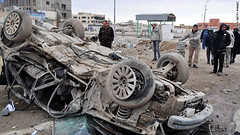
Police said five emergency police officers were killed when a suicide bomber drove an explosive-laden vehicle and struck an emergency police patrol in central Ramadi on Thursday night.

Ramadi is located in Anbar Sunni province west of Baghdad.

Separately, the chief of an anti-terrorism squad was shot and killed Thursday night in central Tuz Khormato, a town north of Baghdad.

The official, Captain Abbass Nuri, driving in his car with his family when gunmen attacked occurred, police said. Two of his children were killed and his father was critically wounded.

These incidents bring the toll from Thursday's violence to 22 people killed and 44 wounded.

Find this article at:
http://www.cnn.com/2011/WORLD/meast/02/04/iraq.violence/index.html

U.S. Critical of Assembly in Somalia

February 4, 2011

U.S. Critical of Assembly in Somalia

By JEFFREY GETTLEMAN
New York Times

BUKAVU, Congo — The American government and the United Nations signaled their displeasure Friday with the Somali Parliament’s decision to extend itself for three more years, despite accomplishing almost nothing.

The United States and the United Nations have invested millions of dollars in the Transitional Federal Government of Somalia, or T.F.G., with the American government providing weapons and paying soldiers’ salaries and the United Nations providing financial and diplomatic support.

The Somali government’s mandate ends in August, and American and other Western diplomats have been discussing what is next. But on Thursday, the Somali Parliament, apparently with little consultation with its outside backers, voted nearly unanimously to extend itself for three years. Parliament has passed few, if any, laws in the past six years and is often the site of clan-based bickering and even brawls.

The United States on Friday called the decision “self-serving political maneuvering” that amounted to “a disservice to the people of Somalia and a setback to the establishment of legitimate and effective government.”

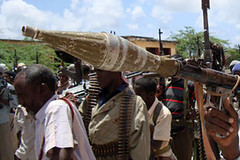
The move could further undermine Parliament’s credibility and risks strengthening the Shabab, the radical Islamist group that controls vast areas of southern Somalia, the American government said in a statement issued from its embassy in Kenya.

The United Nations sounded a similar, critical note.

“This is a disappointing decision taken in haste without the required level of discussion and consultation,” said Augustine P. Mahiga, the United Nations special representative for Somalia.

On Thursday, James B. Steinberg, deputy secretary of state, who was in Kenya, said, “We are frankly disappointed with the performance of the T.F.G.”

He continued: “It has not been effective in providing and meeting the needs of the people.”

Mohammed Ibrahim contributed reporting from Mogadishu, Somalia, and Reuben Kyama from Nairobi, Kenya.

Iranian Supreme Leader Khamenei Hails Egyptian Uprising

Khamenei hails 'Islamic' uprisings

Iranian supreme leader urges Egyptians to follow in the footsteps of Iran's 1979 revolution

Last Modified: 04 Feb 2011 13:41 GMT

Iranians are marking the 32nd anniversary of the Islamic revolution, which toppled the country's monarchy

Ayatollah Ali Khamenei, Iran's supreme leader has called the uprisings in Egypt and Tunisia an "Islamic liberation movement".

In his address, during Friday prayers at Tehran University in Iran's capital, he said that people are witnessing the reverberations of Iran's 1979 Islamic revolution.

"The awakening of the Islamic Egyptian people is an Islamic liberation movement and I, in the name of the Iranian government, salute the Egyptian people and the Tunisian people,"he said.

Khamenei has urged Egypt's protesters to follow in the footsteps of the Iranian revolution which toppled a pro-US leader and installed an Islamic Republic, calling on Egyptians to unite around religion.

He said events in Tunisia and Egypt, were a sign of "Islamic awareness" in the region and that these movements will spell an "irreparable defeat" for the United States.

'Servant of Zionists'

Khamenei added that the Egypt's embattled president, Hosni Mubarak, is a "servant" of Israel and the United States.

"For 30 years this country [Egypt] has been in the hands of someone who is not seeking freedom and is the enemy of those seeking freedom.

"Not only he is not anti-Zionist, but he is the companion, colleague, confidant and servant of Zionists. It is a fact that Hosni Mubarak's servitude to America has been unable to take Egypt one step towards prosperity."

The spiritual leader's remarks were received by cheering crowds of worshippers who, raising their hands, chanted "Death to America! Death to Israel!"

The sermon marked the first time in seven months that the leader has addressed the weekly Friday prayers, and came as protesters were massing in Egypt to participate in "departure day" demonstrations to force Mubarak to quit.

"Today's events in North Africa, Egypt and Tunisia and some other countries have different meanings for us," Khamenei said.

"This is what was always talked about as the occurrence of Islamic awakening at the time of the Islamic revolution of the great Iranian nation and is showing itself today."

Top Iranian officials have supported the protests in Egypt and have warned Tehran's arch-foe Washington against "interfering" in what they say is a movement of the people.

Khamenei said that Israel was the country most concerned about the Arab revolts.

"Today more than the fleeing Tunisian and Egyptian officials, Israelis and the Zionist enemies are the most worried about these events as they know if Egypt stops being their ally and take its rightful place, it would be a great event in the region," he said.

Dorsa Jabbari, Al Jazeera's correspondent in Tehran, said Khamenei "is asking them to follow through what he is calling a real earthquake in the region".

The Iranian people are supporting the uprising in Egypt as "they believe that it has been long time in the making and it is about time that [the Egyptian] people put an end to the dictatorship in their country", our correspondent said.

"They [the Iranians] see the events as extremely significant as they feel that it is the opportunity to change the religious field in the region."

Source: Al Jazeera and agencies

Crisis in Egypt Tests U.S. Ties With Israel

February 4, 2011

Crisis in Egypt Tests U.S. Ties With Israel

By HELENE COOPER and MARK LANDLER
New York Times

WASHINGTON — The demonstrations against President Hosni Mubarak’s government in Egypt are rocking the relationship between the United States and its most important Arab ally. But they are also rocking an even more fundamental relationship for the United States — its 60-year alliance with Israel.

Obama administration officials have been on the telephone almost daily with their Israeli counterparts urging them to “please chill out,” in the words of one senior administration official, as President Obama has raced to respond to the rapidly unfolding events.

But the crisis raises many questions about how the United States will navigate its relationship with Israel — in particular the balance between encouraging the development of a democratic government in Egypt and the desire in Washington not to risk a new government’s abandoning Mr. Mubarak’s benign posture toward Israel.

The unsettled outlook in Egypt has also scrambled American calculations about nurturing peace talks back to life between Israel and the Palestinians. And it has left both American and Israeli diplomats wondering about a broader regional realignment in which Israel would be left feeling more isolated and its enemies, including Iran and Syria, emboldened.

Israeli government officials started out urging the Obama administration to back Mr. Mubarak, administration officials said, and were initially angry at Mr. Obama for publicly calling on the Egyptian leader to agree to a transition.

“The Israelis are saying, après Mubarak, le deluge,” said Daniel Levy, a former Israeli peace negotiator. And that, in turn, Mr. Levy said, “gets to the core of what is the American interest in this. It’s Israel. It’s not worry about whether the Egyptians are going to close down the Suez Canal, or even the narrower terror issue. It really can be distilled down to one thing, and that’s Israel.”

A White House spokesman, Tommy Vietor, said on Friday that administration officials were reassuring the Israelis that “we fully understand Israel’s security concerns, and we’re making clear that our commitment to Israel’s security is unshakeable.”

Daniel Shapiro, a White House Middle East adviser, met on Tuesday with American Jewish leaders, and Mr. Obama talked to Prime Minister Benjamin Netanyahu of Israel on Sunday.

But administration officials must also balance support for Israel against the real desire among many Egyptians — and others on the Arab street — for an end to the Israeli occupation in the West Bank. “The situation tends to highlight Israel’s strategic value to the United States as a stable and unequivocal ally in a very unstable region,” said Michael B. Oren, Israel’s ambassador to Washington. He added: “The situation does reinforce the need for security guarantees, regarding a future Palestinian state, because we see how the current situation in the Middle East can change very rapidly.”

Supporters of Israel in the United States have been focusing on playing up the dangers they see as inherent in a democratic Egyptian government that contains, or is led by, elements of the now-banned Muslim Brotherhood, which opposes Egypt’s 1979 peace treaty with Israel.

In an e-mail on Friday to reporters and editors, Josh Block, a former spokesman for AIPAC, the influential Jewish-American lobbying organization, suggested “questions to ask the Muslim Brotherhood & Their Allies.”

The first question on Mr. Block’s list: “Can the Muslim Brotherhood participate in a government where Egypt continues to fulfill Egypt’s obligations to Israel under the Camp David Accords?”

Obama officials say that the United States cannot rule out the possibility of engagement with the Muslim Brotherhood — the largest opposition group in Egypt — at the same time that it is espousing support for a democratic Egypt. If Egyptians are allowed free and fair elections, a goal of the Obama administration, then, administration officials say, they will have to deal with the real possibility that an Egyptian government might include members of the Muslim Brotherhood.

American Jewish leaders have also been voicing uneasiness about Mohamed ElBaradei, the former head of the atomic energy agency who is also part of the opposition to Mr. Mubarak.

Malcolm I. Hoenlein, the executive vice president of the Conference of Presidents of Major American Jewish Organizations, an umbrella group, said that in his work as a nuclear watchdog, Mr. ElBaradei covered up Iran’s nuclear weapons capability in the reports issued by his agency.

“He is a stooge of Iran, and I don’t use the term lightly,” Mr. Hoenlein said in an online interview on Sunday with Yeshiva World News. “He fronted for them, he distorted the reports.”

But many American Jews are also debating the irony of Israel, which long promoted itself as the only democracy in its neighborhood, now voicing concerns about the birth of a democracy next door. And that that democratic movement is happening in Egypt — with all of its historic ties to the enslavement of the Jewish people — is being picked apart in conversations within American Jewish communities.

“I’ve been saying to my Israeli friends, ‘Come on guys, you’re supposed to be the national manifestation of a group of people whose story is the story of liberation from Egypt,’ ” said Jeffrey Goldberg, a writer for The Atlantic who is the author of well-read blogs in the American Jewish community. But on the other hand, Mr. Goldberg said, “if you’re sitting in the Israeli Defense Ministry thinking, ‘Oh my God, I have to worry about my southern border now.’ ”

Administration officials say they are keenly aware that how they manage all of the conflicting fears, hopes and aspirations of Israelis and Egyptians could mean the difference between war and peace.

Mr. Levy, the former Israeli peace negotiator, said: “The problem for America is, you can balance being the carrier for the Israeli agenda with Arab autocrats, but with Arab democracies, you can’t do that.”

Friday, February 04, 2011

From Counter-Attack to Departure Day in Egypt

Link: http://www.counterpunch.com/amin02042011.html

COUNTERPUNCH

From Counter-Attack to Departure Day

Mubarak's Last Gasps

By ESAM AL-AMIN

There are decades when nothing happens; and there are weeks when decades happen.”

--V. I. Lenin (1870-1924)

“Victory is accomplished through the perseverance of the last hour.”

--Prophet Muhammad (570-632 AD)

According to the CIA's declassified documents and records, senior CIA operative, Kermit Roosevelt, paid $100,000 to mobsters in Tehran, in early August 1953, to hire the most feared thugs to stage pro-Shah riots.

Other CIA-paid men were brought weeks later, on August 19, into Tehran in buses and trucks to take over the streets, topple the democratically elected Iranian government, and restore Shah Reza Pahlavi to his thrown. It took the people of Iran 26 years, enormous sacrifices, and a popular revolution to overthrow the imposed, corrupt and repressive rule of the Shah.

This lesson was not lost on the minds of a small clique of officials who were meeting in desperation in the afternoon of Monday, Jan. 31, 2011, in Cairo. According to several sources including former intelligence officer Col. Omar Afifi, one of these officials was the new Interior minister, Police Gen. Mahmoud Wagdy, who as the former head of the prison system, is also a torture expert. He asked Hosni Mubarak, the embattled president to give him a week to take care of the demonstrators who have been occupying major squares around the country for about a week.

Not only he had to rapidly reconstitute his security forces, which were dispersed and dejected in the aftermath of the massive demonstrations engulfing the country, but he also had to come up with a quick plan to prevent the total collapse of the regime.

The meeting included many security officials including Brig. Gen. Ismail Al-Shaer, Cairo’s security chief, as well as other security officers. In addition, leaders of the National Democratic Party (NDP)- the ruling party- including its Secretary General and head of the Consultative Assembly (upper house of Parliament), Safwat El-Sherif, as well as Parliament Speaker, Fathi Sorour, were briefed and given their assignments. Similarly, the retained Minister of Information, Anas Al-Feky, was fully apprised of the plan.

By the end of the meeting each was given certain tasks to regain the initiative from the street; to end or neutralize the revolution; and to defuse the most serious crisis the regime has ever faced in an effort to ease the tremendous domestic and international pressures being exerted on their president.

They knew that eyes around the world would be focused on the massive demonstrations called for by the youth leading the popular revolution while promising million-strong marches on Tuesday, Feb. 1. True to their promise the pro-democracy groups drew a remarkable eight million people (ten percent of the population) throughout Egypt on that day.

People from every age, class, and walk of life assembled and marched in every province and city by the hundreds of thousands: two million in Tahrir Square in Cairo, one million in Martyrs Square in Alexandria, 750 thousand in downtown Mansoura, and a quarter million in Suez, just to name a few. It was an impressive show of strength. This time, they demanded not only the immediate removal of Mubarak but also the ouster of the whole regime.

An evil plan devised

As the fierce determination of the Egyptian people to remove their autocratic president became apparent, governments around the world began pressuring Mubarak to step down and be replaced by his newly appointed Vice President, the former head of intelligence, Gen. Omar Suleiman. President Barak Obama, for example, dispatched over the last weekend former U.S. Ambassador, Frank Wisner, a close friend to Mubarak to deliver such warning.

Wisner indeed delivered a firm but subtle message to Mubarak that he ought to announce that neither he nor his son would be presidential candidates later this year. He also urged him to transfer his powers to Suleiman. Western governments have been alarmed by the deterioration of the situation in Egypt and were trying to give their preferred candidate, Gen. Suleiman, the upper hand before events favor another candidate that might be less amenable to Israel and the West, and therefore shift the strategic balance of powers in the region.

On Saturday Jan. 29, The National Security Council advised the president to ask Mubarak in no uncertain terms to immediately step down. However, Benjamin Netanyahu of Israel and King Abdullah of Saudi Arabia, whom the president consulted, strenuously objected and pleaded for time to allow Mubarak to stay in power at least until he finishes his term in September.

Openly criticizing Obama, former Israeli Defense minister, Binyamin Ben-Eliezer, a longtime friend of Mubarak, said, “I don't think the Americans understand yet the disaster they have pushed the Middle East into.” The Israeli lobby and Saudi Ambassador Adel Al-Jubeir went overdrive and intensified their lobbying efforts in Congress in order to exert immense pressure on the administration. Reluctantly, the U.S. president relented.

Meanwhile, the last touches of a crude plan to abort the protests and attack the demonstrators were being finalized in the Interior Ministry. In the mean time, the leaders of the NPD met with the committee of forty, which is a committee of corrupt oligarchs and tycoons, who have taken over major sections of Egypt’s economy in the last decade and are close associates to Jamal Mubarak, the president’s son. The committee included Ahmad Ezz, Ibrahim Kamel, Mohamad Abu el-Enein, Magdy Ashour and others.

Each businessman pledged to recruit as many people from their businesses and industries as well as mobsters and hoodlums known as Baltagies – people who are paid to fight and cause chaos and terror. Abu el-Enein and Kamel pledged to finance the whole operation.Meanwhile,the Interior Minister reconstituted some of the most notorious officers of his secret police to join the counter-revolutionary demonstrators slated for Wednesday, with a specific plan of attack the pro-democracy protesters.

About a dozen security officers, who were to supervise the plan in the field, also recruited former dangerous ex-prisoners who escaped the prison last Saturday, promising them money and presidential pardons against their convictions. This plan was to be executed in Cairo, Alexandria, Suez, Port Said, Damanhour, Asyout, among other cities across Egypt.

By Tuesday evening, Mubarak gave a speech in response to the massive demonstrations of the day. He pledged not to seek a sixth term, while attacking the demonstrators and accusing them of being infiltrated, in an indirect reference to the Muslim Brotherhood. Nevertheless, he pledged to complete his term and that he would not leave under pressure.

Although he pledged not to run, he was silent about whether or not his son would be a candidate. He ended his 10 minute address by giving his nation a grave warning that the situation was extremely dangerous, and that the country would face either “stability or chaos,” presenting himself as the embodiment of the former. Leaders of the pro-democracy demonstrators immediately rejected his characterization and insisted that he leave power.

Although Sen. John Kerry, the Chairman of the Senate Relations Committee, called publicly on President Mubarak two days earlier to disavow any plans for his son to seek the presidency, the Egyptian president ignored his call. However, a former senior intelligence aide, Mahmoud Ali Sabra, who used to present daily briefs to Mubarak for 18 years (1984-2002), said publicly on Al-Jazeera that Mubarak has indeed been grooming his son to become president since at least 1997. Although Jamal had no official title in the government, Sabra stated that Mubarak asked him to present these daily intelligence reports to no one in the government except to him and his son.

Sabra also described how Mubarak was disturbed after the first stage of the 2000 Parliamentary elections, when the Muslim Brotherhood won a majority of seats. He then ordered his Interior Minister to manipulate the elections in the subsequent stages and forge the results in order to put NDP on top.

Shortly after the besieged president’s address to his nation around midnight on Tuesday, the baltagieswere unleashed on the pro-democracy demonstrators in Alexandria and Port Said beating and clubbing them in a rehearsal for what was to come the following day at Tahrir Square.

Tahrir or Liberation Square has been the center of action in Cairo throughout the protests. It’s the largest square in the country located in downtown Cairo where millions of demonstrators have been gathering since Jan. 25. Eight separate entrances lead to it including the ones from the American Embassy and the famous Egyptian museum.

Around 2 PM on Wednesday Feb. 2, the execution of the plan of attack ensued in earnest. Over three thousand baltagies attacked from two entrances with thousands of rocks and stones thrown at the tens of thousands of peaceful demonstrators gathered in the square, while most attackers had shields to defend themselves against the returning rocks. While a few were armed with guns, all baltagies were armed with clubs, machetes, razors, knives or other sharp objects.

After about an hour of throwing stones, the second stage of the attacks proceeded as dozens of horses and camels came charging at the demonstrators in a scene reminiscent of the battles of the middle ages. The pro-democracy people fought back by their bare hands, knocking them from their rides and throwing their bodies at them. They subsequently apprehended over three hundred and fifty baltagies, turning them over to nearby army units.

They confiscated their IDs which showed that most assailants were either NDP members or from the secret police. Others confessed that they were ex-cons who were paid $10 to beat up the demonstrators. The camel and horse riders confessed to have been paid $70 each.

The third stage of the attack came about three hours later when dozens of assailants climbed the roofs in nearby buildings and threw hundreds of Molotov cocktails at the pro-democracy protesters below, who immediately rushed to extinguish the fires. They eventually had to put out two fires at the Egyptian museum as well. By midnight the thugs started using tear gas and live bullets from a bridge above the protesters killing five people and injuring over three dozens, ten seriously.

Interestingly, one hour before the planned assault the army announced to the demonstrators on national TV that the government “got the message” and then implored the protesters to end the demonstrations and “go home.” But when the protesters begged the army units to interfere during the brutal attacks that persisted for 16 hours, the army declared that it was neutral and partially withdrew from some entrances despite its promise to protect the peaceful and unarmed demonstrators.

By morning, the Tahrir Square resembled a battleground with at least 10 persons killed and over 2,500 injured people, 900 of which required transport to nearby hospitals as admitted by the Health ministry. Most of the injured suffered face and head wounds including concussions, burns and cuts because of the use of rocks, iron bars, shanks, razors, and Molotov cocktails. Al-Jazeera TV and many other TV networks around the world were broadcasting these assaults live to the bewilderment of billions of people worldwide.

Before the attacks started that afternoon, the Minister of Information had also executed his part of the plan. He called on all ministry employees to demonstrate on behalf of Mubarak in an upscale neighborhood in Cairo. He then asked the Egyptian state TV to broadcast live- for the first time in nine days of continuous demonstrations- the ensuing confrontation between the protesters and the government-sponsored thugs, in order to show the Egyptian people what chaos would bring to the country as Mubarak had warned them in his address just the previous night.

The battle plan was for the baltagies to block seven entrances of the Tahrir Square, leaving only the American Embassy entrance open for the thugs to push back the demonstrators in order for them to come so close to the Embassy that its guards surrounding it would have to shoot at them and thus instigate a confrontation with the Americans.

But the heroic steadfastness of the demonstrators lead by the youth was phenomenal as they not only withstood their ground but also chased them away every time they were pushed. By the next morning the assault fizzled and the whole world condemned the Mubarak regime for such wickedness, cruelty, and total disregard of human life.

“The events in Tahrir Square and elsewhere strongly suggest government involvement in violence against peaceful protesters,” said Kenneth Roth, executive director of the Human Rights Watch. “The U.S. and other allies should make clear that further abuse will come at a very high price.”

By that afternoon every major Western country has called for Mubarak to step down including the U.S, the European Union, the U.K, France, Germany, Italy, Spain, Norway and many others. In Washington, White House spokesman Robert Gibbs called the violence by the pro-Mubarak crowd “outrageous and deplorable” and warned that it should stop immediately.

On the other hand, by daybreak, hundreds of thousands of Egyptians joined their fellow pro-democracy activists in order to show support and solidarity. The leaders of the protests have already called for massive demonstrations on Friday across Egypt after congregational prayers, calling the event “Departure Day,” in a reference to the day they hoped to force Mubarak to resign or leave the country.

In an attempt to contain the damage about what happened in Tahrir Square on Wednesday, Prime Minister Ahmad Shafiq offered his apology to the people. He also denied his government’s involvement, calling for a prompt investigation and swift punishment for those who were responsible. Moreover, Vice President Suleiman appeared on state TV offering an olive branch to the opposition, declaring that all of their demands would be accepted by the government, while ignoring the main demand of Mubarak’s ouster. He then pleaded for time to implement political reforms.

He also appealed to the nation to allow President Mubarak to complete his term until the upcoming presidential elections in September. For the first time, the regime then vowed that the president’s son would not be a candidate. He further called for dialogue with all opposition parties.

Ahmad Maher, 29, the national coordinator of the “April 6 Youth” movement, the primary group that called for and organized the uprising, immediately rejected the offer by Suleiman, calling it a trick to abort the revolution. He insisted on the main demand of removing Mubarak from power before any negotiations could take place.

All other opposition groups, including the popular Muslim Brotherhood, followed suit. Friday’s “Departure Day” is promising to be a decisive day where the pro-democracy demonstrators vowed to continue the protests until Mubarak is ousted.

Meanwhile, the regime in a last-ditch effort to limit the effect of the demonstrations have asked all foreign journalists to leave the country before D-Day (Departure Day), and dismantled all cameras from Tahrir Square. There is not a single network in Cairo today that can broadcast the event live. Clearly, this last ploy was designed to intimidate the demonstrators who insisted that they would not cowed.

Likely scenarios: remember Marcos?

The Obama administration is evidently very frustrated with Mubarak because of his stubbornness and obliviousness to reality. President Obama bluntly declared on Tuesday, “It is my belief that an orderly transition must be meaningful, it must be peaceful and it must begin now.”

Since the crisis began ten days ago, the U.S, which has been supporting and subsidizing the Egyptian regime for three decades, expected that its beleaguered ally would listen to its advice, limit the damage, pack up and leave. But his performance and ruthless behavior have endangered its other allies in the region, and caused long-term damage to its strategic interests, namely, Israel, stability, oil, and military bases.

Egypt was one of the most important countries and allies to the U.S. in the region. It was a cornerstone in its strategic equation. If Egypt were to be lost to a more independent leader, the strategic balance of power in the region would radically shift against America’s interest or its allies.

In turn this change might cause a major re-assessment of the long-term American strategy in the region, especially in regard to policies related to Israel and counter-terrorism. Thus, Vice President Suleiman is considered by the U.S. and other Western allies, as the best person who could fulfill this role of maintaining the status quo. Thus, the more Mubarak maneuvered to stay in power, the less likely this prospect would be realized.

Ambassador Wisner, who has been in Egypt since Saturday, was asked to deliver to Mubarak an ultimatum from Obama. It would be similar to the one given to Ferdinand Marcos of the Philippines in 1989 by then President George H. W. Bush. Mubarak would be told that he should resign and transfer his presidential powers to his vice president.

If he refuses, the army would then remove him anyway, while Western governments would go after the billions in American and European assets that he and his sons have hoarded over the years. He would also be told that he would face a certain indictment by the International Criminal Court on War Crimes against his people. Surely, Mubarak would be expected to choose the first option and leave either to Germany under a medical pretext, or join his two sons in London.

As Omar Suleiman is promoted to become the new President of Egypt, this appointment will be hailed by Western governments and media as a great victory by the pro-democracy forces and as the expression of the will of the Egyptian people. Political and economic reforms will then be promised to the people, in an effort that allows great leeway in internal reforms but keep foreign policy intact.

However, this move will undoubtedly divide the country. The leaders of the revolution, namely the youth, who have led the demonstrations for the past two weeks and sacrificed blood for it, would continue to press for total and clean break from the previous regime. They will also be supported by popular and grass-roots movements such as the Muslim Brotherhood.

On the other hand, other opposition movements, which have little or no popular support bur were largely created by the Mubarak regime as a décor to portray a democratic image, will accept Suleiman and embrace the new arrangements in order to have a seat at the table and get a piece of the pie. The Egyptian public will likely be split as well.

With the monopoly of the government over the state media and other means of government information control, the new regime may bet on getting a slack from the public while it consolidates its power.

Alternatively, the youth movement, which started its march towards freedom and democracy using social media and independent means of communications, while spearheading the most robust and forceful democracy movement in the whole region, may actually have the last word.

Esam Al-Amin can be reached at alamin1919@gmail.com

Christianity Originated in Ethiopia

Christianity originated in Ethiopia

Sunday, 30 January 2011 23:14
Opinion

Faith Talk with Ibo Foroma

BEYOND doubt, the Messiah is native to this beautiful continent of
Africa. When he was mystically born from a virgin in Bethlehem,
Israel, Herod wanted him more dead than alive.

The only way out for Joseph, Mary and their precious Godly child to
survive was to run for their lives to Egypt where the almighty Lord
instructed them to be in exile through the aid of an angel.

The Bible does not clearly state how old the child or baby was, but
all male infants below the age of two were slaughtered by royal
decree.

Of course, our dear Lord, the Son of Man, was safe and sound, exiled
in the motherland. This occurred while we do not really know how many were sacrificed in the catastrophic infanticide. Anyway, this is the
birth of the famous festival we have up to this day — the Nativity of
the Christ.

But how does this festival become a part of Ethiopia and to say the
least, Rastafari, a different “religion” all together. In the first
place, the Kingdom of Egypt and Cush (Ethiopia) is one and the same,
simply divided by the Nile River.

Please do not be confused by the modern day colonial boundaries. Back in those days, there was no need to carry any form of passport or
travel document from Cape to Cairo and beyond to China.

Enlightened historians know that Ethiopia is the mother and Egypt the daughter.

Actually the whole of North Africa used to be called Upper Ethiopia
and the rest being Lower Ethiopia down to even Zimbabwe, which is
Biblically known as Ophir — “the land of gold”.

In a nutshell, the whole continent, which was later named after Neo
Africanos, a Greek man, was, is and will always be one. Secondly, the
country of Ethiopia is the first nation as a whole to adopt
Christianity as a spiritual way of life and not just a “religion”.

To begin with, the Garden of Eden described in the book of Genesis is
geographically located over the country of Ethiopia where the Nile
River begins.

Above the Horn of Africa is a place known as the Gulf of Aden even up
to this date. The “A” is there to confuse you, otherwise it is the
same Eden you know.

Other scholars go on to say that Eden is actually the name of the
continent as a whole, further giving proof to how Christianity is of
Ethiopian origin even before the Anointed one himself walked over the
cradle of creation and civilisation.

When Joshua (from whence the common Greek name Jesus is derived) was born, he was visited by Ethiopians who returned back to the motherland and arrived on a date on the Ethiopian calendar equivalent to the seventh of January.

The witnesses gave their testimony to the royal family and the masses
at large who celebrated the day which is nowadays referred to as the
Ethiopian Christmas although it is made clear that it is not his
original date of birth and is not commemorated as thus.

All in all, they took seven months as they journeyed to and fro. So in
Egypt, no doubt, the Messiah learnt how to read and write at a tender
age.

He also learnt many scripts like the book of Isaiah that he later on
quotes to some elders who were puzzled by how much he knew, yet he was younger than them all.

He also learnt more like the sixth and seventh books of Mo-seh
(popularly known as Moses) a native of the country he was dwelling in.

This book and many more were intentionally extracted from the Bible to
make the one most of you know.

The Ethiopian Bible has 87 books, while the popular Bible, revised and
standardised has 66.

No doubt Jesus learnt to perform some of the miracles and magic
(derived from the word magi) from such books. If you are as blessed as
very few of us, to have read such books, you would definitely know why they were plucked out for public enjoyment.

I personally read the sixth and seventh books of Moses and I could not
understand a thing.

They talk about Black Magic and Necromancy, topics that are too big
and complex for the scope of most of us. The fact that the easier
books are already regarded as sophisticated as Rocket Science or
Submarine Engineering shows how complex such books are.

There are books that give more detailed information on the Messiah’s
childhood, like Infancy 1 and Infancy 2. The Gnostic Gospels paint
other perspectives that are vital for one to get a bigger, broader and
clearer picture.

During the seven days we celebrate the Nativity of the Messiah, we go
over such delicate doctrine from the seventh to the fourteenth of
January.

But still, it is not clear. It is instead more puzzling and perplexing
as to why and how does Immanuel Jeshua become Rastafari.

The book of Revelation speaks of a Saviour who shall have a new name that shall be called after his followers. He is described as having
“feet like burning brass, hair like sheep’s wool, eyes red like fire”.

All these descriptions point in the direction of a black man. “Behold
the Lion of the tribe of Judah the root of David, shall prevail to
open the scroll and loose the seven seals thereof.”

Ras Tafari Makonnen is the 225th descendent of King Solomon and the Queen of Sheba. Solomon is the son of King David and Queen Bathsheba.

Emperor Haile Selassie I is the last Ethiopian monarch to carry the
title King of Kings and Lord of Lords.

The book of Revelation also says: “And he has on his garment and on
his thigh a name written, King of Kings and Lord of Lords.”

The book of Psalms say Ethiopia shall quickly stretch forth her arms unto Jah.

Actually, I need the whole paper for myself to try and explain what is
self-explanatory. Having said all this, still I know, you have eyes
but you don’t see, you have ears but you don’t hear. If Jah Ras Tafari
permits, I will reveal more unto you in these end of times.-The Sunday
Mail

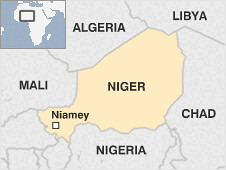
Niger Election Heads to Runoff

Niger election heads to runoff

The Associated Press
7:10 PM Thursday, February 3, 2011

NIAMEY, Niger — The head of Niger's electoral commission announced that a longtime opposition figure was leading with most of the ballots counted from the country's first election following a military coup.

Abdourahamane Ghousmane said Mahamadou Issoufou was leading with 36 percent of the vote after ballots from 55 out of the country's 58 communes had been tabulated.

Because Issoufou did not receive a majority, he will need to face second-place finisher Seini Oumarou in a runoff. Oumarou, a former prime minister, got 23 percent of the votes.

The country's 6.7 million registered voters are choosing between 10 presidential candidates.
___

February 04, 2011 12:06 AM EST

Thursday, February 03, 2011

Egypt Rocks the World: Millions in Streets Try to Oust U.S.-backed Regime

Egypt rocks the world

Millions in streets try to oust U.S.-backed regime

By Fred Goldstein
Published Feb 2, 2011 3:41 PM

Feb. 1 — The outpouring of Egyptians on Tuesday, Feb. 1, is one of the greatest manifestations of mass protest in history. More than 1 million people overflowed Tahrir Square in Cairo; hundreds of thousands came out in Alexandria, Suez, Mansoura and other cities throughout the country. It is truly world-historic in proportion. Nothing will be the same after this.

All classes, all but those strata irreversibly tied to the old regime, have united behind a national democratic revolution to topple Hosni Mubarak’s 30-year dictatorship. They have risen on a scale and with the power of a social volcano.

These demonstrations took place even though the regime shut down trains and other mass transportation and blocked the Internet. Many people walked miles to reach the demonstrations.

Direct reports to Workers World from Tahrir Square are that the slogans are anti-imperialist, anti-U.S., very anti-Israel, pro-Palestinian, against the Egyptian business class, against the entire regime and calling for a new “pro-people” constitution. There is no turning back.

The protests have risen and spread within the extraordinarily short time of eight days. And, most importantly, the movement is still on the rise. The mass upsurge has leapt over the heads of everyone — the Mubarak regime, its imperialist backers and the political opposition in Egypt. All forces are rushing to catch up to developments. But with each recalibration by the Obama administration or the Mubarak regime, or those who call themselves “the opposition” in Egypt, the masses take another leap forward, leaving everyone behind.

At this writing Egyptian television is showing the bizarre scene of Mubarak sitting in his office, discussing measures to be taken with his newly appointed cabinet, while more than 2 million people just blocks away are calling for an end to the entire regime. It is like watching the ghost of someone who has died — but thinks he is still alive.

‘Martyrdom or freedom’

The corporate television networks covering the demonstrations describe the mood as celebratory. Yet Al Jazeera cited “martyrdom or freedom” as a widely popular slogan. Effigies of Mubarak hang from poles. The crowd demands his arrest and that the entire regime be booted out.

The day Mubarak appointed his crony Omar Suleiman, the hated head of intelligence and a former general, as his vice president, the people raised the slogan: “Oh Mubarak, oh Suleiman, we have heard that before. Neither Mubarak nor Suleiman — both are stooges of the Americans.” (New York Times, Jan. 30)

At the moment this great uprising lacks a central leadership. But this is inevitable under the circumstances. The Mubarak regime’s ruthless repression of the left and all progressive forces has weakened the movement. Furthermore, the meteoric rise in the demonstrations, from tens of thousands to millions within a week, would leave even the most developed revolutionary party running to catch up. There is still much time for the Egyptian people to develop the leadership they need.

‘Hug a soldier’

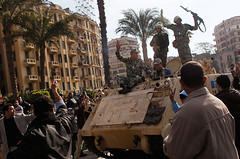
The masses have adopted a classical revolutionary strategy of fraternization towards the rank-and-file soldiers. The movement calls it “hug a soldier.” Numerous shots were shown on television early on of soldiers posing with demonstrators; troops riding in tanks waving Egyptian flags; one officer declaring, “We will not fire on you.”

A military spokesperson the night before the “million person march” told the masses, “We will not fire on the people.” Actually, after six days of fraternization, the high command had no idea of whether the troops would, in fact, fire on the people. The order to fire could cause a huge split among the troops and drive sections of the ranks actively over to the side of the people and into combat against the police and the regime.

Former Egypt analyst for the CIA, Bruce Riedel, gave a blunt assessment: “They could shoot the crowd, they win tomorrow, and then there will be a revolt that will sweep them away.” (New York Times, Jan. 30)

Two notes of caution regarding the military’s pledge not to shoot: This pledge was made in the face of an anticipated demonstration of a million or more people; also this pledge was made in the context of the masses acting peacefully. There is no telling what the military high command, who are complete servants of imperialism and reaction, would do should the masses become more aggressive in their attempts to oust an intransigent dictatorship.

The state and the revolution

Either way, the question of the military and the state in the present struggle is contradictory. In every revolutionary struggle the question of the state becomes paramount. The Egyptian state is first and foremost the instrument for the suppression of the working class and the peasants. In Egypt the police have traditionally carried out this repressive role.

But with the police off the streets for the moment, the army is the weapon of the state with its face to the demonstrations. As the situation stands, then, the state exists but the high command is constrained from using it to suppress the demonstrations. Yet as long as the troops follow the orders of the high command, the army is the instrument that prevents the people from sweeping away the regime and establishing new organs of popular government.

Washington’s illusory ‘orderly transition’

The U.S. imperialists in Washington have been trying to find some “orderly transition” that will allow the Pentagon and Wall Street to maintain their grip on Egypt, while placating the masses at the same time.

But the uprising left Washington without any control over the situation and without an effective plan to regain control. The U.S. has contemplated dealing with Mohamed ElBaradei and various small liberal parties of the opposition. They would like them to negotiate with the military for a transition that would set up elections but leave the fundamental policies in place.

But in face of the titanic uprising of the Egyptian masses, it will be an almost impossible task for the U.S. to maintain its domination of the Egyptian government and its policies, including the peace treaty with Israel, the blockade of Gaza, the use of the Egyptian foreign office to frustrate the Palestinian national movement, and using Egypt as a base for the Pentagon in the region.

The anger at the old regime is reminiscent of the people’s anger at the French monarchy in 1789, the Czar in 1917 and the Shah in 1979. The old order, the order carefully armed and financed by U.S. imperialism, will eventually be swept away by the Egyptian masses. No “orderly transition” can hold. Things can never be the same. For the Egyptian people, the road to liberation is a complete break with imperialism. This glorious, world-historic uprising is an enormous first leap along that road.
--------------------------------------------------------------------------------
Articles copyright 1995-2011 Workers World. Verbatim copying and distribution of this entire article is permitted in any medium without royalty provided this notice is preserved.

Workers World, 55 W. 17 St., NY, NY 10011
Email: ww@workers.org
Subscribe wwnews-subscribe@workersworld.net
Support independent news DONATE
Page printed from:
http://www.workers.org/2011/world/egypt_rocks_world_0210/

Egypt News Update: Violence Escalates in Cairo Square; Global Economic Impact of Revolution Spreads

Violence escalates in Cairo square

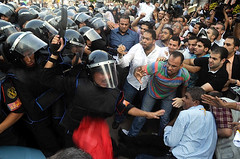
Five people killed and many wounded as Mubarak loyalists attack pro-democracy protesters in Tahrir Square on Thursday

Last Modified: 03 Feb 2011 04:36 GMT

Violent clashes between pro and anti Mubarak demonstrators began on Wednesday

Bursts of heavy gunfire aimed at anti-government demonstrators in Cairo's Tahrir [Liberation] Square, left at least five people dead and several more wounded, according to reports from the Egyptian capital on Thursday.

Sustained bursts of automatic weapons fire and powerful single shots began at around around 4am local time (2.00GMT) and was ongoing more than an hour.

Pro-democracy protest organiser, Mustafa el-Naggar, who's in Tahrir Square, said the gunfire came from at least three locations in the distance. He said the Egyptian military entered the square with tank squads to try to keep some order, but did not intervene.

An Al Jazeera online producer in Tahrir Square witnessed doctors attending to two gunshot victims, one who was shot in the head. "There was a puddle of blood on the concrete beneath the man ... but he still had a pulse and might survive," our producer said.

The gunfire marks an escalation of tensions, which began on Wednesday when supporters of embattled president Hosni Mubarak charged into Tahrir Square - some on horses and some on camels - clashing with pro-democracy demonstrators gathered there.

Protesters from both sides fought pitched battles in Tahrir Square, the epicentre of ongoing demonstrations against Hosni Mubarak, which entered their tenth day on Thursday.

Pro-Mubarak supporters also threw Molotov cocktails and homemade bombs at opposition protesters, who erected makeshift barricades around the square. Our online producer there visited an ad hoc 'prison' where protesters had already captured around six pro-Mubarak supporters.

Hillary Clinton, the US secretary of state, condemned the "shocking" bloody clashes that rocked Cairo, in a call to Vice President Omar Suleiman.

"The secretary urged that the government of Egypt hold accountable those who were responsible for violent acts," the state department said in a statement.

Fresh standoff

An Al Jazeera correspondent, reporting from just outside the square late on Wednesday, said dozens of pro-Mubarak supporters had erected barricades on either side of a road, trapping the pro-democracy supporters. They were gathering stones, breaking streetlights and using balaclavas to cover their faces, apparently in preparation for a fresh standoff with the pro-democracy crowd.

Our correspondent said local residents thought the men preparing for the standoff were police officers but the claim could not be independently confirmed.

Just hours earlier, an Al Jazeera online producer reporting from near Tahrir Square said: "Someone - a few people actually - were dropping homemade bombs into the square from the buildings surrounding it."

The Reuters news agency reported quoting officials that three people were killed in Wednesday's violence. It also quoted a doctor at the scene as saying that more than 1,500 had been injured.

Army standing by

Witnesses said the military allowed thousands of pro-Mubarak supporters, armed with sticks and knives, to enter the square on Wednesday. Opposition groups said Mubarak had sent in "thugs" to suppress anti-government protests.

Though initially put on the back-foot by the sudden attack, determined pro-democracy protesters looked to be winning the battle against the assailants.

The worst of the fighting was just outside the world famous Egyptian Museum, which was targeted by looters last week.

Scare tactics

Many of the pro-Mubarak supporters who gathered on Wednesday raised slogans like "Thirty Years of Stability, Nine Days of Anarchy".

Al Jazeera's Jane Dutton, in Cairo, said that security guards have also been seen amongst the pro-Mubarak supporters, and it may be a precursor to the feared riot police arriving on the scene.

Fighting took place around army tanks deployed around the square, with stones bouncing off the armoured vehicles.

Mohamed ElBaradei, a prominent opposition figure, accused Mubarak of resorting to scare tactics.

"I'm extremely concerned, I mean this is yet another symptom, or another indication, of a criminal regime using criminal acts," ElBaradei said.

"My fear is that it will turn into a bloodbath," he added, calling the pro-Mubarak supporters a "bunch of thugs". ElBaradei has also urged the army to intervene.

"I ask the army to intervene to protect Egyptian lives," he told Al Jazeera, adding he said it should intervene "today" and not remain neutral.

Determined protesters

Despite the clashes, pro-democracy protesters seeking Mubarak's immediate resignation said they would not give up until Mubarak steps down.

Mohammed el-Belgaty, a member of the Muslim Brotherhood, told Al Jazeera the "peaceful demonstrations in Tahrir Square have been turned into chaos".

"The speech delivered by President Mubarak was very provocative as he used very sentimental words.

"Mubarak is asking the people to choose between him or chaos."

Ahead of Wednesday's clashes, supporters of the president staged a number of rallies around Cairo, saying Mubarak represented stability amid growing insecurity, and calling those who want his departure "traitors."

"Yes to Mubarak, to protect stability," read one banner in a crowd of 500 gathered near state television headquarters, about 1km from Tahrir Square.

A witness said organisers were paying people $17, to take part in the pro-Mubarak rally, a claim that could not be confirmed.

Source: Al Jazeera and agencies


Opposition blames government for Cairo violence

In Egypt, opponents of President Hosni Mubarak are blaming the government for Wednesday's violent clashes in central Cairo.

Anti-Mubarak protesters who had occupied a main square were confronted by the president's supporters on Wednesday. The 2 sides threw stones and petrol bombs at each other. Egypt's health ministry says at least 3 people have been killed and more than 600 wounded.

The chaos continued until dawn, with frequent gunfire.

At least 2 more people were reportedly killed and many others wounded in the shootouts.

Local media reports say the president's supporters arrived in groups carrying sticks and other weapons, and that some had police ID cards.

Key opposition figure Mohamed ElBaradei suggested government involvement in the latest clashes, saying that the demonstrators have proof of attacks by the police.

But a spokesperson for the Interior Ministry has strongly denied the allegation.

On Wednesday, Vice President Omar Suleiman said the start of dialogue with the opposition depends on an end to street protests.

But protesters demanding Mubarak's immediate resignation are set to hold more demonstrations on Friday.

Thu, 03 Feb 2011 12:02:00 +0900(JST)


Mubarak camp hits back on the street

By Andrew England in Cairo
February 2 2011 23:35
Financial Times

As two women screamed at each other on a bridge that spans the River Nile and leads into Tahrir Square – focal point for the nine days of protests against Hosni Mubarak, the Egyptian president – others tried to intervene and calm the dispute.

But even as the women walked away from each other, insults were repeatedly hurled. Azza Tawfiq had seen a banner reading “Mubarak, we are with you” in the other woman’s car and she was infuriated.

“They [the regime] were shooting the people,” she said, in reference to the police using live fire against protesters on Friday. “And she’s pretending to be a Muslim.”

Such arguments were the first hint of the trouble that was to come as Mr Mubarak’s supporters and those protesting against the regime fought pitched battles on Wednesday, a day after the president had announced that he would not stand at the next election and promised to amend the constitution.

What began as verbal abuse when thousands of pro-Mubarak supporters took to the streets around Tahrir Square descended into bloody clashes after stones were hurled between the two groups. Men mounted on horses and camels later charged the anti-Mubarak protesters.

The army, the only security force in the square since Friday, appeared to do little to intervene. Sporadic gunfire echoed across the square but state television reported that the army had denied it was soldiers who had opened fire. Heba Mourayef, a researcher for Human Rights Watch, questioned how people were able to enter the square with knives and other weapons when it was supposedly secured by the army.

She said: “I saw one man riding a camel at high speed, beating people right and left with a stick, polo-style. I don’t understand how someone can bring a camel in without the military noticing.”

A military spokesman had appeared on state television on Wednesday to ask the anti-Mubarak protesters to go home, so that life in Egypt could return to normal. Banks, businesses and the stock market have been closed for days. Most people have been unable to work, instead staying in their districts to guard against looters in the absence of police. Reports of food shortages have begun to emerge.

Anti-Mubarak demonstrators accused the regime of paying public sector workers to rally in support of the president. There were allegations that police in plain clothes were among those responsible for the violence but the interior ministry denied the charge.

“Mubarak orders government workers to go on to the streets [to support him]. That guy is pathetic,” Ms Tawfiq said.

Among the president’s supporters, people vented their anger at Mohamed ElBaradei, the Nobel Peace Prize winner who has emerged as a leading figure in the fragmented opposition, and complained of foreign intervention. Others said the concessions Mr Mubarak had made in the past week were sufficient.

“The change has already happened; what the president said is enough, more than enough,” said Mukhtar Taher, one of the president’s supporters.

“He has spoken of constitutional amendments and he’s appointed a vice-president who is a respected man and trusted by the people.”

But the anti-Mubarak protesters insisted that even though the president had pledged to step down at the next election, they could not trust him. A passing woman said: “He will make civil war here because of his interests.”

That may be the worst-case scenario, but the clashes will add to the climate of chaos, fear and suspicion that has swept across Cairo. It could also test Egyptians’ patience with the protests as the crisis escalates.


FEBRUARY 2, 2011, 3:16 P.M. ET.

OIL FUTURES: Crude Nearly Flat As Egypt Worries Linger

By Jerry A. DiColo
Of DOW JONES NEWSWIRES

NEW YORK (Dow Jones)--Crude futures settled nearly flat Wednesday as traders weighed rising U.S. fuel supplies against growing violence in Egypt, where unrest could threaten vital oil supply routes.

Light, sweet crude for March delivery settled 9 cents, or 0.1%, higher at $90.86 a barrel on the New York Mercantile Exchange. Brent crude on the ICE futures exchange traded 68 cents higher at $102.42 a barrel.

Protests calling for the resignation of Egyptian President Hosni Mubarak turned increasingly violent Wednesday as Mubarak supporters clashed with antigovernment demonstrators. Mubarak said he would step down after elections later this year, ending his 29-year rule in the country, but protesters continued to demand his immediate removal.

The weeklong protests, which have sent oil prices up by more than 6% since Friday, haven't caused disruptions to key oil routes through the Suez Canal or Sumed pipeline. But fears that unrest could spread to Egypt's oil-rich neighbors have kept futures markets on edge, with Brent crude, the benchmark for Europe and Asia, hitting a fresh two-year high of $102.43 a barrel.

"It has less to do about supply and demand on a weekly basis," said Rich Ilczyszyn, a broker with Lind-Waldock in Chicago. "The geopolitical problems are going to continue, and nobody is going to want to sell this market short."

Still, the U.S. benchmark, West Texas Intermediate, remained subdued compared to Brent amid signals that the U.S. continues to be well supplied. U.S. crude inventories rose by 2.6 million barrels last week, according to a report from the U.S. Department of Energy Wednesday, in line with analysts' estimates. Stockpiles at Cushing, Okla., the delivery point for Nymex-traded futures, rose to the highest level on record at 38.3 million barrels, up 20% from last year.

The increasing storage in Cushing is keeping Nymex futures at a sharp discount to Brent crude. After trading at a record premium near $12 last week, the price difference, or spread, was again above $11 Wednesday.

"We're still building Cushing stocks, and that's a process that could take a while (to draw down)," said Jim Ritterbusch, head of oil-trading adviser Ritterbusch and Associates.

"But there is just too much else going on in the world," for the market to react to the Energy Department numbers, he said.

Gasoline futures turned lower after the government report showed stockpiles rose by 6.2 million barrels, due in part to reduced travel resulting from winter weather striking large parts of the U.S. in January.

"The winter storms are piling up," said oil analyst Phil Flynn of PFG Best. "Right now the margins are still decent, so refiners are going to keep producing gasoline. But with what we've seen in the Midwest, demand is going to be horrible. We'll probably see additional builds over the next few weeks."

Front-month March reformulated gasoline blendstock, or RBOB, settled down 2.09 cents at $2.4985 a gallon.

The cold weather gripping the U.S., particularly the Northeast, helped buoy heating oil, however. Heating oil futures for March delivery settled 2.37 cents higher at $2.7807 a gallon.

Stocks of distillates, which include heating oil and diesel, fell by 1.6 million barrels, a larger-than-anticipated drop.


Geopolitics is final piece in risk jigsaw

By Gillian Tett in London
February 2 2011 18:40

During the past four years, global investors have undergone a brutal refresher course on the different types of risk the 21st century financial world used to ignore.

First, in 2007, bankers rediscovered the concept of “credit risk”, when subprime mortgages turned sour. Then, in 2008, when Lehman Brothers collapsed, market players became reacquainted with “liquidity risk” and “counterparty risk” – or the problems that institutions face when they cannot fund themselves, and cannot trust each other.

After that, investors were faced with “sovereign risk”, as it became clear last year that bonds issued by western governments were not always a safe bet, even in the eurozone.

Now, says Robert Jenkins, chief executive of Combinatorics Capital, a hedge fund in New York, investors face the “last piece of this puzzle: geopolitical risk”.

More specifically, as the turbulence gathers pace in Egypt, markets are now remembering that political conflict and change can sometimes erupt in a brutally unexpected manner.

“Welcome to the last and final lesson of this review course [on risk],” says Mr Jenkins.

It is certainly a wake-up call for many investors and banks. In the past few years, a sense of complacency had crept into how markets priced geopolitical risk, particularly in the emerging world. That was partly because there has been a fevered dash into emerging market assets in the past two years.

As a result, the risk of default attached to many emerging market sovereign bonds, as measured by the credit default swaps market, was lower in places such as Brazil or Turkey than peripheral eurozone countries.

Indeed, before the CDS prices on Egyptian bonds recently doubled to about 340 basis points (before the market effectively froze altogether), some market metrics were suggesting that Egypt was a better place to invest than, say, Portugal.

But the other, more subtle issue is that the scale and complexity of the western financial crisis has left many asset managers and bankers too distracted to contemplate more esoteric geopolitical trends.

“To be honest, I don’t think we have really invested as much as we could in our geopolitical research recently,” one senior banker admitted in Davos last week, quipping that, “it has been hard enough to figure out things such as CDOs”.

As a result, the events in Egypt took most western investors by surprise. So much so, in fact, that the head of one of the world’s largest hedge funds dubs the Cairo turmoil “the Arab world’s flash crash” – a reference to the sudden, shocking fall that occurred in the US stock market in May 2010, when some algorithmic trading programmes malfunctioned. It is not a perfect metaphor.

The US flash crash lasted only a day. The events in Egypt could play out for many weeks. But the Egyptian turmoil – like the US market flash crash – has appeared to erupt out of the blue, owing to processes that were profoundly opaque to most outsiders (although in Egypt – as with the flash crash – insiders had long warned about potential trouble). Both events have revealed the dangers of “contagion”. What spooked the markets during the flash crash of May 2010 was the realisation that no one quite understood complex interconnections in modern finance.

The upheaval in Egypt raises questions about how many other political dominoes might fall across the Arab world. For the moment, many investors still appear willing to bet that “containment” will predominate. Although the Egyptian stock market fell about 14 per cent when the turmoil first erupted, western markets have rallied this week.

But the one thing that is clear is that risk analysts are now rethinking the way they look at the world, and experts in geopolitical risk are seeing a flurry of demand.

This new-found interest in geopolitical risk does not merely revolve around the Arab world. As one risk consultant observed in Davos last week, investors are rethinking core assumptions about seemingly “stable” western democracies, where the recent financial crisis has created some horrendous long-term fiscal challenges. “Everyone is looking at the ‘what if?’ scenario now,” he observes. This risk refresher course may not quite be over.
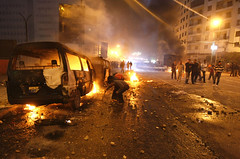
Wednesday, February 02, 2011

Palestinians Expect a Boost From New Egypt

ANALYSIS - Palestinians expect a boost from new Egypt

Million Egyptians clamour for Mubarak to go

Tue, Feb 1 2011By Mohammed Assadi and Nidal al-Mughrabi
RAMALLAH/GAZA | Wed Feb 2, 2011 5:53pm EST

RAMALLAH/GAZA (Reuters) - Palestinians are likely to benefit from a change of regime in Egypt, irrespective of whether they are in the camp of those seeking peace with Israel or those who advocate conflict, analysts say.

They believe that a more independent and assertive Egypt, reflecting popular opinion rather than U.S. policy, will create pressure on Israel and Washington to make the compromises necessary for a long-overdue Middle East peace treaty.

Whether they live in the Israeli-occupied West Bank, where Palestinian leaders want a treaty with Israel giving them an independent state, or in the blockaded Gaza Strip, whose leaders reject the Zionist state, Israel is the dominant factor overshadowing Palestinian lives.

West Bank and Gaza leaders have avoided speculating on the probable outcome in Egypt's power struggle or its implications for Palestinians and the wider Arab world. But a few officials and political thinkers are ready to make predictions.

"The new situation in Egypt could lead to a change in world powers that upsets Israel and forces it to compromise. Egypt will get stronger," said senior peace negotiator Nabil Shaath.

A stronger Egypt "will definitely help our bargaining power" so that when the peace process gets back on track again, perhaps in a year "it comes with a more realistic American position, therefore a more positive Israeli position," he added.

WEST BANK

Mubarak has been Israel's best friend in the Arab world for 30 years, far friendlier than the masses in his country who are soon likely to elect a successor more in tune with their views on the Palestinian-Israeli conflict.

Mubarak has also been the ally of Palestinian President Mahmoud Abbas, playing a key role in supporting U.S.-led peace negotiations with Israel over the years.

Shaath said he now saw "a golden opportunity" for the Palestinian Authority to get much firmer backing from Egypt and other Arab countries for future negotiations.

Israel may face the logic of agreeing to a Palestinian state "so they can keep their treaty with Egypt", said George Giacaman of Beir Zeit University.

The 1979 Camp David peace treaty removed Egypt from the long list of Israel's Arab enemies and allowed it to relax along the Sinai border. Analysts say this may now come into question.

"In the second Intifada (Palestinian uprising 2000-2005), there were demands in the parliaments of Egypt and Jordan to revoke their peace agreements with Israel," said Giacaman said.

"Imagine after the change of regime that the same demands resurface? I am not saying they will annul the agreement with Israel. But I expect that there will be tremendous pressure to have a settlement here with Israel."

The United States and Israel would be so anxious not to "lose" the new Egypt that they would be forced finally to resolve the Palestinian question, Giacaman said.

GAZA

Mubarak has not been a friend of Hamas, the armed Islamist movement ruling the Gaza Strip, which is blockaded by Israel and Egypt in a joint operation since 2007.

Egypt has, however, played a major role in trying to reconcile Hamas and Abbas's Fatah movement, to reunite the badly divided Palestinian national cause.

Gaza political commentator Talal Okal also foresees pressure mounting on Israel to make a deal with the Palestinians in the form of a potential threat to the Camp David treaty.

"There are calls to amend the Camp David agreement and Israel is worried about that," he said.

Iranian-backed Hamas is supported in Egypt by the Muslim Brotherhood, which endorses Palestinian armed resistance against Israel and which may play a significant role in the coalition that is expected ultimately to replace Mubarak.

The prospect of the Muslim Brotherhood dominating a new Egyptian government is Israel's chief concern, since it seems unlikely that they would ever embrace the Camp David accords.

Okal said Hamas was waiting to see how the Brotherhood's prospects play out in the coming transition from Mubarak, who says he will stand down at the next election in September.

"I think they will have a role but within a coalition of other parties, and they will not rule alone," Okal said.

In the West Bank, Shaath had a similar view. He said he was in contact with the anti-Mubarak demonstrators in Cairo's main square and was sure that "this is a pure revolution ... that has nothing to do with the Muslim Brotherhood and America".

"People are worried there will be chaos. Some are worried that the Muslim Brotherhood will take charge (but) the Muslim Brotherhood is out of the picture," Shaath said.

Late on Wednesday, Palestinian police dispersed dozens of anti-Mubarak demonstrators in Ramallah who demanded that the Egyptian leader quit, witnesses said. Two people were hurt.

Egypt has the world's 10th strongest military force. Under Camp David it is separated from Israeli forces by a 150-mile demilitarised desert, the Sinai Peninsula.

Israel may feel reasonably sure that the Egyptian army would refuse any bid by a new government in Cairo to move forces back into the Sinai, but it must consider also generations to come.

Bowing to the inevitability of change in Egypt, Prime Minister Benjamin Netanyahu on Tuesday staked out his position: diplomacy, not a major military realignment on its southwestern border, will be Israel's first line of defence.

"Israel believes that the global community must demand that any Egyptian government preserve the peace treaty," the Israeli leader said.

(Writing by Douglas Hamilton; Editing by Mark Heinrich)

Battle Lines Drawn As Egyptian Rivals Dig In

Battle lines drawn as Egyptian rivals dig in

By Heba Saleh in Cairo
Last updated: February 2 2011 23:12
Financial Times

As Tahrir Square in central Cairo turned into a battlefield between supporters of Hosni Mubarak, the Egyptian president, and protesters who want him to step down, the crisis in Egypt appeared to be deepening with no side willing to make further compromises.

“The protests will go on, and the losses will be greater,” said Ossama al-Ghazali Harb, leader of the Democratic Front party which has been calling for the president to go.

Protesters are already calling for fresh demonstrations this week on what they dubbed the “Friday of departure”, a reference to their desire for Mr Mubarak to leave power.

Amal Sharaf, a co-founder of April 6, an opposition group of young activists, said Wednesday’s violence would not stop the campaign to oust the president. “We are going to continue. Nobody is leaving. We have a big event on Friday.”

“I don’t think the suppression of the protests will work,” said Amr al-Shobaki, a political analyst. “We need a completely different style of political management to emerge from this crisis.”

But the apparent decision to use violence against the protesters suggests the regime has reached the end of the political concessions it is prepared to make.

Mr Mubarak had appeared on television on Tuesday night after a day of demonstrations, in which at least 1m people took part, to announce he would not seek another term in elections scheduled for the autumn.

He promised to oversee a peaceful transition of power and to introduce constitutional amendments that would set presidential term limits, and review the eligibility criteria for presidential candidates.

These are steps the Egyptian president has long resisted, despite repeated calls from the opposition.

But groups supporting the protest fear that when it is time to translate these promises into legislation, the improvements would be cosmetic or flimsy.

They point to Mr Mubarak’s decision six years ago to allow pluralistic presidential elections. It was viewed as a huge step along the path of democratic reforms when it was first announced.

This quickly turned into disappointment after parliament, dominated by Mr Mubarak’s National Democratic party, approved a constitutional amendment that placed restrictions on independent candidates.

It essentially ensured that NDP candidates, who are usually backed by the state, would compete against weak candidates from the legal opposition parties.

Mr Mubarak has also offered a dialogue with the opposition on reforms. State television announced on Wednesday that 12 parties had accepted. These, however, are weak and lack popular support.

Any dialogue looks certain to exclude the youth activists behind the protests. So far, these remain leaderless, though Mohamed ElBaradei, the Nobel laureate, has emerged as a figurehead for many protesters.

Mr ElBaradei has demanded Mr Mubarak go, so a transition government can oversee a new constitution, followed by elections.

Egyptian state television spent most of Wednesday broadcasting footage of the pro-Mubarak rally away from the violence in Tahrir Square. When it finally reported the clashes, it said they were between those who favoured stability [Mubarak’s supporters] and those who did not.


This is not a revolution made in America

By Philip Zelikow
Last updated: February 2 2011 20:44
Financial Times

On the 20th of June 2005, I stood in a packed auditorium in the heart of Cairo as my boss, the then US secretary of state Condoleezza Rice, gave a deeply considered speech. She and I had worked together during the revolutions in Europe in 1989-1990. That experience informed her pronouncement that: “For 60 years, my country, the United States, pursued stability at the expense of democracy in this region here in the Middle East, and we achieved neither. Now,” she added, “we are taking a different course. We are supporting the democratic aspirations of all people.”

Her remarks satisfied no one. Some regional editorial writers congratulated her for trying to “sweep away all of the dust and cobwebs that have limited democratic progress in the Arab world”. But she angered Hosni Mubarak and his elite by going too far. She angered Egypt’s opposition by not going far enough. Others, noticing war-torn Iraq, saw there the nemesis of a hubristic “freedom agenda”.

Yet the confusion then, and now, is the belief that somehow America would offer an answer for Egypt’s future. Ms Rice and aides like me were instead asking a question: “My friend, can you explain your positive vision for Egypt’s future? What we see does not look promising.”

Sadly, the question was never really answered. Ms Rice’s successor, Hillary Clinton, spoke out last month to pose it again. Now, coincidentally, many Egyptians are demanding the answer.

That answer will be uttered first in Arabic. Washington did not choose Egypt’s president and it will not choose the next one. The last popular revolution in Egypt was in 1952, replacing King Farouk with a revolutionary council of “free” military officers. They enacted land reform, wrote a democratic constitution, crushed the Muslim Brotherhood – which then, too, had been a focus of organised dissent. Then they sorted out their own internal power struggle. Muhammad Neguib, the well-liked front man for the revolutionaries, was taken down. In his place arose Nasser  . . . Sadat. . . and Mubarak.

But what does this history say to well-wishing outsiders like my government? Quite a lot.

Educated Egyptians all have a version of this history. They know its outstanding feature was the submission of democratic forms to the “top-down” rule of a charismatic leader. They know that its other great feature was the choice for secularism, a choice then cloaked in a bemedalled uniform of exciting pan-Arab ambition. Outsiders should listen intently as Egyptians interpret that history to instruct each other on its “lessons”.

Outsiders should ponder the significant insignificance of Egypt’s international situation. In the past 230 years of Egyptian history, the past 30 are unique in the relative unimportance of external affairs. The external peace was no accident, and with much time for Egyptians to reflect on their own condition, this revolution is a result. Its agenda is profoundly internal, more so than in 1952. Outsiders can continue to help determine whether Egyptians see the external situation as threatening or benign.

Also, the US should not let its own natural preoccupation with foreign policy suffuse the conversation about Egypt’s future. Yes, any government more in tune with Egyptian public opinion is not likely to be friendlier to Israel. But Egypt’s relations with Israel have been narrow. There were Gaza quarantines to limit Islamist infections. Those may weaken. There was limited help with the Palestinian peace process, quite limited: among the external influences on Palestinian politics, Egypt no longer ranks high. And yes, Egyptian intelligence and police agencies help counter violent Islamists. But many of those zealots first nurtured their grievances in Egypt. Give Egyptians space to grow healthier political seedlings.

Outsiders can frame choices without trying to steer them. Egyptians face momentous decisions. To offer the promise of more justice and dignity, leaders will search for a message of opportunity. Egypt started a limited economic reform programme in 2004. It has made progress at the macro-level but prospects are constrained by the distortions of crony capitalism – a narrow tax base, budget-busting subsidies, epidemic corruption and political networks for access to banking and credit. The crisis will make the fiscal situation precarious but the bigger Egyptian choices will be about the scope of the private sector and rule of law, such as finance for small and medium-sized companies and retraction of centralised control over who gets business. It will not be hard for trading nations or Arab and international financial institutions to come up with ways to improve the odds if Egypt gambles on a different future.

But outsiders should not put themselves at the centre of these choices. There is a natural tendency to want to be at the centre. Some Egyptians, too, will look to outsiders as saviours or scapegoats. After 1952 Nasser got on well enough with the Americans. The break came when both sides put the Americans at the centre of Egypt’s development and security hopes, with such projects as the financing of the Aswan Dam on which Nasser invested large dreams. It became a pawn in great power politics. In the long run, neither Egyptians nor Americans profited from this pathology.

As Egyptians answer the big questions, it is worth recalling another line from Ms Rice’s speech in 2005. “The United States has no cause for false pride and we have every reason for humility.”

The writer is a professor of history at the University of Virginia. From 2005 to 2007 he was the counsellor of the US Department of State. He was also executive director of the 9/11 Commission