Thursday, May 03, 2012

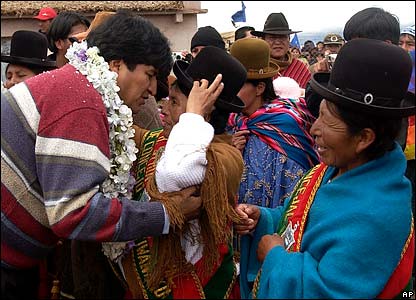
Bolivia Nationalizes Spanish Power Company

Bolivia nationalizes Spanish power company

Wed May 2, 2012 2:35AM GMT
presstv.ir

Bolivian President Evo Morales has nationalized a Spanish power company and ordered its seizure.

On Tuesday, Morales issued the order nationalizing Transportadora de Electricidad SA (TDE), which is a subsidiary of the Spanish group Red Electrica Corporacion, AFP reported.

Bolivia will now take control of 99.94 percent of the company.

The company, which was privatized under the former Bolivian government of Gonzalo Sanchez de Lozada, has claimed that it owns and runs almost 75 percent of the electric power lines across Bolivia.

Spanish companies have been having a tough time in South America lately.

On April 16, Argentine President Cristina Fernandez announced the decision to expropriate the Spanish oil giant Repsol’s subsidiary, YPF, which was formerly a state-owned Argentine oil company.

She said that Argentina had to take back the oil company since it is the only nation in Latin America "that does not manage its natural resources."

Spanish officials said they were still collecting information about Bolivia's latest action, noting that it is a different situation from what has happened in Argentina.

Wednesday, May 02, 2012

Cairo Protest Death Toll Reaches 20

Cairo protest death toll reaches 20

Wed May 2, 2012 1:51PM GMT
presstv.ir

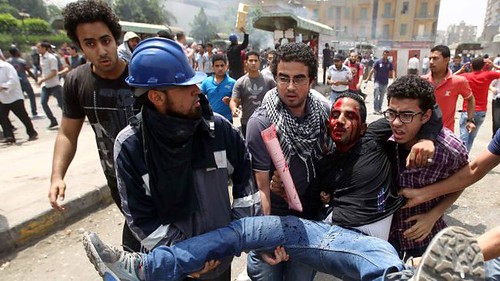
The death toll from an attack by unknown armed men on Egyptian protesters near the Defense Ministry building in Cairo has risen to 20.

Clashes erupted on Wednesday between assailants armed with rocks, clubs and firebombs and hundreds of protesters who had been camping out near the ministry for days, calling for an end to the military rule in the country.

Soldiers and police stopped the clashes six hours after they began. Two leading presidential candidates have suspended campaigning in protest.

The military council took power in the aftermath of the last February revolution in Egypt that overthrew Hosni Mubarak’s Western-backed regime.

The SCAF promised to step down after a six-month period and hand over power to a civilian government, a pledge it has so far failed to fulfill.

Angry demonstrators, who had camped in Tahrir Square for a week, decided on an impromptu march to the ministry of defense in east Cairo on Friday, where they resumed their camping in protest at the election committee's decision to ban two candidates from Islamic parties from running in the upcoming presidential election.

The protesters further condemned the Supreme Electoral Committee for allowing former Premier Ahmed Shafiq to enter the race.

Shafiq was disqualified last weekly by the Supreme Council of Armed Forces but the electoral committee restored his qualification the next day.

Egypt's electoral commission earlier disqualified the Muslim Brotherhood's prime candidate, Khairat al-Shater. Salafi nominee Hazem Abu Ismail was also banned from the May polls.

Egypt's election is scheduled to be held on May 23-24, and a run-off will follow on June 16-17 if necessary.

Six Killed In Kabul Bomb Attacks After Obama Visit

Six killed in Kabul car bomb explosion

Wed May 2, 2012 5:23AM GMT
presstv.ir

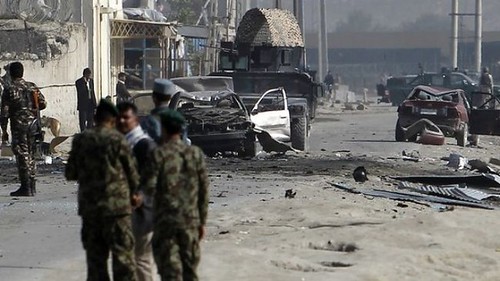
At least six people have been killed after a car bomb hit the Afghan capital, Kabul, just hours after US President Barack Obama left the war-torn country.

An Afghan interior ministry spokesman said Wednesday that a bomber rammed his explosive-laden vehicle into a major foreign guesthouse complex used by international organizations such as the EU and the UN.

"Five civilians and one guard were killed," said Sediq Sediqqi.

Witnesses say fresh explosions and gunfire were heard from the guesthouse, called ‘Green Village,’ near the main airport in Kabul. Taliban claimed responsibility for the attack and have vowed more strikes.

"Afghans don't like invaders and they have to leave this country," said Taliban spokesman Zabiullah Mujahid.

A spokesman with US-led International Security Assistance Force (ISAF) said that the fighting between the attackers and security forces inside the guesthouse complex has ended.

"Afghan security forces have killed all the attackers and it is over," said Lieutenant Colonel Jimmie Cummings.

The US embassy on Wednesday warned its staff to "take cover, move away from the windows” after the bomb blasts were heard in the eastern part of the capital.

The blasts occurred only hours after Obama ended a short visit to Afghanistan where he signed an agreement with Afghan President Hamid Karzai to extend the US presence in the country to another decade beyond 2014.

After signing the deal, Obama went to the US-run Bagram Air Base in eastern Afghanistan, met with US troops, and gave a televised speech before ending his surprise visit.

He said Washington was building enduring cooperation with Kabul to train Afghan forces to help them take full responsibility for security.

It was Obama's fourth visit to Afghanistan, his third as the commander-in-chief.

Violence has also spread from Afghanistan’s volatile south to the relatively peaceful areas over the course of the past year.

The US-led invasion of Afghanistan was launched in 2001. The offensives removed the Taliban from power, but insecurity continues to rise across the country, despite the presence there of about 130,000 foreign troops.

Mali: Beware The Rotten Fruit of AFRICOM Training

MALI: BEWARE THE ROTTEN FRUIT OF AFRICOM TRAINING

Posted on May 2, 2012
Mark P. Fancher
Reprinted From Libya 360

If a tree is judged by its fruit, U.S. Africa Command (AFRICOM) is undeniably diseased from its roots to its branches. One of AFRICOM’s fruits, Amadou Sanogo, who is a captain in Mali’s armed forces, and a former AFRICOM trainee, led the recent military takeover of Mali’s government supposedly because he didn’t believe the country’s leaders were doing enough to suppress an armed secessionist movement in the northern territories. The result was disastrous. The African Union was outraged, and in short order, not only were there crippling economic sanctions against Mali, but also the secessionists took advantage of the confused state of Mali’s government and military and secured control of several towns, including the legendary Timbuktu.

While standing hip deep in a mess of his own making, Sanogo ultimately agreed to step down and allow the re-installation of a civilian government. However, at the time of this writing, he has been a continuing obstacle to efforts by the Economic Community of West African States (ECOWAS) to help Mali navigate through circumstances that threaten to destabilize much of the region.

The Washington Post reported that Sanogo participated in AFRICOM’s “International Military Education and Training” program. According to AFRICOM’s website, the program exposes African soldiers “to U.S. professional military organizations and procedures and the manner in which military organizations function under civilian control.”

The program description goes on to say that the participants are introduced “…to elements of U.S. democracy such as the U.S. judicial system, legislative oversight, free speech, equality issues, and U.S. commitment to human rights.” Somehow Sanogo emerged from all of that and resolved to not only strip civilians of their authority but to also take over Mali’s government operations.

Perhaps none of this should come as a surprise. The U.S. may talk the talk of “democracy” and “human rights,” but in Africa, it has never walked the walk. The U.S. stride has been more of an arrogant imperialist swagger. If AFRICOM’s protégés have taken careful note of how the U.S. military is routinely used to try and take whatever the U.S. wants in Africa, often without regard for law, custom or prudence, it is not hard to imagine how or why Amadou Sanogo might do the same thing in his own country.

If in fact it was exposure to U.S. military culture and training that inspired Sanogo’s folly, then AFRICOM has plenty of other African soldiers traveling down that same track. In recent months U.S. Marines have trained Moroccan soldiers in everything from communications to how to stage “a mechanized, motorized, helo-born, combined arms assault.” In Liberia, the Marines conducted a non-lethal weapons clinic for more than 220 Liberian soldiers. The sessions were part of a U.S. State Department-sponsored mission called “Operation Onward Liberty.”

As a matter of fact, AFRICOM is no longer content to provide just training. James Hart, AFRICOM’s deputy director for programs, said that the U.S. “Africa Partnership Station (APS)” which patrols Africa’s coastal waters, and which has been the site for training Africa’s navies, has the potential to do more. Hart said: “How do we take APS to the next level? By moving away from a training-intensive program and organize APS efforts through emphasizing hands-on training and real-world operations.” Real-world operations?

What does that mean against a historical backdrop of forceful U.S. suppression of African forces that threaten the strategic and business interests of western governments and foreign corporations?

AFRICOM training appears to be heavily laced with the ideology of Americanism, which history has demonstrated to be diametrically opposed to the cherished goal of Pan-Africanism. So when it comes to Africa’s true military needs, the continent does not need more loose-cannon, AFRICOM-trained soldiers like Sanogo. It instead needs politically conscious, disciplined civilian militias that can keep these characters and various foreign-sponsored mercenaries under control.

Mark P. Fancher is a lawyer who writes frequently about the U.S. military presence in Africa. He can be contacted at: mfancher@comcast.net

Hunger, Disease and $10 Billion Missing In South Sudan

Hunger, Disease and $10 Billion Missing In South Sudan

South Sudan's leaders have stolen at least $10 billion in oil revenues shared with them by Sudan in the past 7 years. With somewhere between $12 to $17 billion turned over to South Sudan, Africa’s newest “government”, during this time frame some say estimates of only $10 billion stolen is to conservative.

South Sudan has about 8 million people so the oil revenues amount to somewhere between $1,500 to $2000 per man, woman and child in a country where everyday hundreds if not thousands die from hunger and disease.

Where has the $10 billion gone? In some cases directly into London City bank accounts, never having made it into South Sudan's official treasury. In one instance the South Sudanese Minister of Finance managed to have $300 million “disappear” at one time.

And what has South Sudan to show for its $12 billion+ share of the oil revenues? Almost no infrastructure, few schools, fewer medical facilities and millions suffering from malnutrition and sickness.

The South Sudanese leadership can’t even claim to have spent the money on their military for they have little in the way of modern armament, never mind all the claims of Israeli arms sales to them.

The Sudan Peoples Liberation Army (SPLA), if you can call it that, for years was revolting over unpaid salaries, resulting in the USA stepping in and providing over $100 million a year to pay its salaries since the last major mutiny in 2009.

The SPLA itself is an ethnic or tribal based military force with little centralized control. Ethnic minorities make up the companies, brigades or even divisions that are based in their own tribal territories. When tribal conflicts over land and water rights break out the local militias quickly call in their “big brothers” in the SPLA and local conflicts become inter-SPLA warfare.

Many times the local commanders are at odds with the largest, ethnically Nok based units and do not coordinate their actions with them.

In other words there are serious doubts whether South Sudan's President Salva Kir actually controls South Sudan's army. The latest attack on Heglig, recognized internationally as part of Sudan may not have been initiated by Salva Kir but by the local SPLA commander.

Since convincing South Sudan to stop all oil production in late January 2012 (see “US Plan To Destabilize Sudan”) the USA has continued its history of broken promises and blackmail against both parties and failed to deliver the aid it was secretly promising to South Sudan if it implemented the USA’s plan to evict China from Sudan’s oil fields and, in killing two birds with one stone, destablizing or even bringing down the Bashir government in Sudan by depriving it of it main source of income.

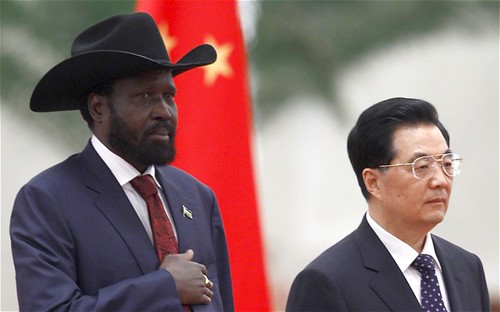
After three months without any oil income at all South Sudan President Salva Kir had to take an emergency trip to China hat in hand to try and keep his government afloat, returning with a Chinese promise of some $8 billion in aid. Hopefully he has learned not to trust the USA, though one should not hold ones breath in this regard.

The World Bank has also signed a several hundred million dollar “loan” agreement with a very smug looking South Sudanese robber baron a.k.a. Finance Minister though no one has bothered asking how with their oil fields shut down, their only source of income, South Sudan will be able to repay the World Bank.

With Hollyweirdo’s such as George Clooney and Angelina Jolie accusing Sudan's government of everything from food aid blockades to genocide coupled with the Phony Kony/Silent Children 2012 pr blitz that has the CIA’s fingerprints all over it via the Enough Project (the people of north Uganda, the region the program claimed to be portraying, threw stones at the screen when it was shown there) western attention has been diverted from the real reason for the suffering in South Sudan due to the massive theft of almost all of the countries income.

While the USA certainly has a hidden hand behind the recent fighting between South Sudan and Sudan, hunger, disease and the missing $10 billion may very well be behind South Sudan's recent military offensive against Sudan. As the saying goes “patriotism is the last refuge of scoundrels”, what better way to distract your people from hunger, disease and Grand Theft International than starting a war with your erstwhile partner.

One thing is for sure and that is that South Sudan has more than its share of scoundrels and that the USA has more dirty tricks up its sleeve for the people of the region.

Thomas C. Mountain is the only independent western journalist in the Horn of Africa, living and reporting from Eritrea since 2006. He can be reached at thomascmountain@yahoo.com.

Tuesday, May 01, 2012

Charles Taylor Convicted In Special Tribunal in The Hague

Charles Taylor Convicted in Special Tribunal in The Hague

Former Liberian leader’s trial illustrate hypocrisy in the application of international law

By Abayomi Azikiwe
Editor, Pan-African News Wire

Charles Taylor, the former rebel leader and head-of-state in the West African country of Liberia, was convicted on April 26 by a Special Tribunal on Sierra Leone. The court was set up ostensibly by the United Nations in conjunction with the government of Sierra Leone.

Taylor’s charges stemmed from the civil war that erupted in Sierra Leone during the early 1990s. He was accused of arming and coordinating the actions of the so-called Revolutionary United Front (RUF) of Sierra Leone which was held responsible for atrocities committed against the civilian population in a bid to seize power from successive civilian and military governments.

Taylor had maintained that he was not responsible for the crimes carried out by the RUF in Sierra Leone. Nonetheless, testimony during the trial in the Netherlands claimed that he had financed the war through the illegal trafficking of diamonds.

Despite these allegations of illegal diamond trafficking that even brought about the testimony of British supermodel Naomi Campbell in 2010, the actual controllers of the international diamond industry were never mentioned. The diamond industry is largely controlled by the Hatton firm which is a subsidiary of the DeBeers Central Selling Organization formed in South Africa as well as the Antwerp Company that is based in Belgium.

The former Liberian leader had led his own rebel campaign against a military regime in Liberia beginning in 1989. Sgt. Samuel Doe, who overthrew the government of President William Tolbert in April 1980, had been initially supported by Taylor and many other Liberians.

In subsequent years Taylor was charged with embezzlement by the Doe government and fled the country to the United States where he had earlier obtained a degree from Bentley College. Taylor, who was jailed in the U.S., reportedly escaped from prison and traveled to Libya where he received military training and funding from the-then government of Col. Muammar Gaddafi.

Taylor formed the National Patriotic Front of Liberia (NPFL) and began to launch military attacks against the Doe government. In 1997, after years of protracted war, Taylor was elected as the 22nd president of the Republic of Liberia.

Liberia was formed during the 1820s as a purported haven for former African slaves from the U.S. In 1847 the country became a republic but continued to remain under the political and economic control of the U.S. government and later Firestone Rubber Company.

By 2003, Taylor was under tremendous pressure to resign by at least two other guerrilla armies that were fighting his regime. By this time he had fallen out of favor with the U.S. and other western-backed leaders in Liberia and West Africa.

Taylor was brought up on charges by the Special Tribunal on Sierra Leone and agreed to resign in exchange for asylum in Nigeria. A contingent of thousands of troops from the Economic Community of West African States (ECOWAS) that were backed by the U.S. entered Liberia to prepare for a political transition. An election held later resulted in the ascendancy of the current President Ellen Johnson-Sirleaf, a trained economist and a former supporter of Taylor.

By 2006, Taylor was again wanted for war crimes in Sierra Leone and extradited back to Liberia where he was immediately arrested and sent to the Netherlands to await trial. His conviction by the Special Tribunal on Sierra Leone represents the first case where a sitting political leader was removed and put on trial for supposed violations of both international and domestic law.

Political Hypocrisy as International Law

There is no doubt that horrendous crimes were committed by forces associated with Taylor in Liberia and Sierra Leone. Nonetheless, in recent years The Hague has become a center for the indictment and persecution of African leaders for crimes that dwarf those committed by leaders and business entities within the imperialist states.

Former Yugoslavian President Slobadan Milosevic was also indicted, deposed and arrested on charges related to the U.S.-NATO policies that resulted in the break-up of the last socialist state in Europe during the 1990s. In addition to the Special Tribunals in the case of Yugoslavia and Sierra Leone, there is also the International Criminal Court (ICC) which has played a role in destabilizing both Sudan and Libya through indictments and threatened kidnappings.

Yet the crimes carried out by the U.S., Britain, France and other allied states against the peoples of Iraq, Palestine, Afghanistan, Colombia, Somalia, Libya and Sudan are not even mentioned by the putative international legal bodies in The Hague. The U.S. and British governments concocted false allegations against the Iraq government in 2002-2003 that lead to an eight year war resulting in the deaths of over one million people and the displacement of millions of others.

In Afghanistan, the war is in its eleventh year with no end in sight. Untold numbers of Afghans have been killed and millions have been displaced and traumatized.

The North African state of Libya was attacked during 2011 through the engineering of a rebel insurgency that was financed and planned by the U.S., France and Britain. When this did not succeed, the Pentagon and NATO imposed an arms embargo and naval blockade against the Gaddafi government.

Later between March 19 and October 20, the Pentagon and NATO carried out 26,000 sorties and nearly 10,000 airstrikes against Libya killing thousands and displacing two million. Over $160 billion in Libyan foreign assets were seized while a puppet regime was installed that routinely violates the human rights of Libyans and foreign nationals.

No one has been held accountable for these war crimes. These crimes that were committed under successive U.S. regimes are coupled with economic crimes involving the wholesale theft of trillions of dollars in home equity, wages, municipal tax dollars and pension funds.

Consequently, working people and the nationally oppressed must inherently be suspicious of the western platitudes related to international norms and law. International law has become a tool of western imperialism through the United Nations as well as other institutions such as Special Tribunals and the ICC.

White House Makes First Detailed Comments on Drone Strikes; Code Pink Activist Arrested

30 April 2012
Last updated at 17:37 ET

White House in first detailed comments on drone strikes

Brennan: International law does not ban drones

President Obama's counter-terrorism adviser has given the most detailed explanation so far of America's use of drones to kill members of al-Qaeda.

In a speech to a Washington think tank, John Brennan said the strikes were helping to win the war on the militant network.

President Barack Obama wanted to be more open about the practice, Mr Brennan added.

The comments come in the week marking a year since Osama Bin Laden's death.

BBC Washington correspondent Paul Adams says this is not the first time the Obama administration has confirmed the use of drone strikes.

'Disaster after disaster'

In January, the president did it himself, during a webchat. But our correspondent says Mr Brennan has gone further than anyone so far in laying out the rationale for a policy that remains controversial.

It is hardly surprising that President Obama wants to use Bin Laden's death as a symbol. It may not be the only success of his administration. But it is the only one unadulterated by party politics.

The only one that was celebrated by just about every American, of every political persuasion. It was greeted with glee by some of those who might usually see Mr Obama as weak on national security.

When some worry that he is a consensus-seeker, a ditherer, this version of the president is a gutsy risk taker. The crudeness of the presidential pitch may put some off, but any row that is created only serves to highlight that Bin Laden was indeed killed on Mr Obama's orders.

Mr Brennan said unmanned drone strikes were legal, ethical, necessary and proportional, overseen with what he called extraordinary care and thoughtfulness, especially when the target was an American citizen.

In his speech at the Woodrow Wilson International Center, he said al-Qaeda was losing badly.

For the first time since America's war on the organisation began, Mr Brennan said it was possible to envision a world in which the core of al-Qaeda was no longer relevant.

He added that drone strikes usually took place with the co-operation of the host government, in "full accordance with the law".

Such strikes are thought to have killed hundreds of militants in Afghanistan, Pakistan and Yemen.

But Mr Brennan also conceded that there had been civilian deaths as a result of some strikes.

Pakistan has previously demanded an end to US drone strikes on Pakistani soil.

Mr Brennan also said that documents found at the compound where Osama Bin Laden was killed in Pakistan last year would go online later this week.

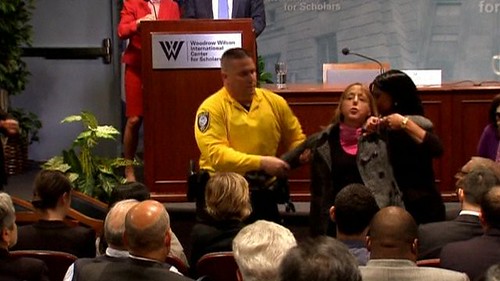
A protester disrupted the speech and was dragged away by a security guard

They were gathered by US Navy Seals during the raid on Bin Laden's hideout in Abbottabad on 2 May 2011.

The papers are said to include communication between Bin Laden and his associates, and his hand-written diary.

They are said to reveal that Bin Laden had considered changing al-Qaeda's name because so many of the group's senior operatives had been killed.

"In short, al-Qaeda is losing badly. And Bin Laden knew it. In documents we seized, he confessed to 'disaster after disaster'," Mr Brennan said, reports AFP news agency.

"With its most skilled and experienced commanders being lost so quickly, al-Qaeda has had trouble replacing them."

Mr Brennan said the documents would be put online by the US Military Academy's Combating Terrorism Center.

Indigenization Boon For Workers In Zimbabwe

Indigenisation boon for workers

Tuesday, 01 May 2012 00:00
Tawanda Musarurwa Business Reporter
Zimbabwe Herald

THE Government has approved more than 100 Employee Share Ownership Plans from foreign-owned companies that will see workers reaping the benefits of the indigenisation and economic empowerment drive. The schemes are a critical element of
ensuring that workers obtain significant benefits from the country’s economic activity.

Reliable sources in the Ministry of Youth Development, Indigenisation and Empowerment say over 100 mining companies have had their Employee Share Ownership Plans (ESOPs) approved.

“The ministry has approved over 100 ESOPs proposals by foreign mining firms operating in the country,” said the sources. “These should be launched during the course of this year.”

Big mining companies, such as Zimbabwe Platinum Holdings, Mimosa and Anglo Platinum have already launched their employee share schemes (alongside community share ownership schemes).

This is in addition to ESOPs by non-mining companies such as Meikles and Old Mutual.

The resource companies expected to launch their employee share schemes include New Dawn Mining Corporation, Caledonia Mining, Marange Resources and Pretoria Portland Cement.

Basically, an employee share ownership scheme is a contribution plan that provides a company’s workers with an ownership interest in the company.

Under such schemes, companies provide their employees with stock ownership, typically at no cost to the employees.

Shares are given to employees and are held in the scheme’s trust until the employee retires or leaves the company, or earlier diversification opportunities, creating an opportunity for workers to amass long-term savings and benefits from their work.

Employee share ownership schemes are envisioned in the Indigenisation and Economic Empowerment (General) Regulations of 2010.

The model of Zimbabwe’s indigenisation law places prominence on wealth creation (that is growing the national cake) through broad-based participation of the indigenous people in economic activity.

Observers have noted that employee ownership in firms appears to increase production and profitability, and improving employees' dedication and sense of ownership insofar as it increases their financial risk if the company does not perform well.

Zimbabwe National Chamber of Commerce immediate past president Mr Trust Chikohora said Zimbabwean workers should look forward to the ESOPs.

“ESOPs create an opportunity for workers to also take part in the ownership of the enterprises that they work for and this is an exciting development which workers should look forward to,” he said.

“It should go a long way towards achieving the goal of establishing congruency between the workers, management and the shareowners.”

In terms of the country’s indigenisation and economic empowerment law, foreign-owned firms are required to set aside a 5 percent (and up to 28 percent) stake for ordinary workers.

On the other hand, management share ownership schemes should not exceed 5 percent.

Although they are a critical component of the local indigenisation and economic empowerment drive, employee share ownership schemes are commonplace across the globe.

In the United States, for example, there are approximately 11 300 employee share ownership plans for over 13 million employees, according to the country’s National Centre for Employee Ownership.

The source added that in terms of the indigenisation law, the setting up of employee share schemes is not mandatory, but discretionary.

However, despite them being non-coerced, a number of foreign-owned firms across the range of sectors have been actively setting up structures and modalities for the implementation of their employee share ownership schemes.

Last week, British American Tobacco company concluded a deal with the Ministry of Youth Development, Indigenisation and Empowerment to give its workers approximately 10 percent of the company’s shares.

Pretoria Portland Cement (PPC), South Africa’s biggest cement producer, has also since agreed to extend a cumulative 5 percent shareholding of the company to its workers.

Prior to the proposal, PPC employees owned 1,3 percent of the firm.

In November last year, Meikles Ltd launched its Employee Share Ownership Trust following an earlier approval by the company’s shareholders to set aside 24 million shares for purchase by the employees through the trust.

The 24 million shares accounted for approximately 10 percent of Meikles Ltd’s current issued shares. According to the company, the trust is in the process of mobilising finance to acquire the shares.

The Meikles employee share ownership trust is one of the most comprehensive launched to date.

In addition to the trust per se, the executives and senior managers of the group, including some non-executive directors and other indigenous persons currently not involved with the Meikles Group (“consortium”), have formed a special purpose vehicle.

The objective of the SPV is to acquire at least 10 percent equity in Meikles Ltd.

The consortium is currently sourcing funds on the market to purchase shares on the stock market. Thus, this arrangement does not involve the issue of new shares by Meikles Ltd. But those shares will be bought at prevailing market prices from the stock market.

It is conceivable that the employees of the group could end up with a shareholding of up to 10 percent in Meikles Ltd, once the fund-raising efforts by the trust yield the desired result.

In addition, the consortium will end up with at least 10 percent equity in Meikles Ltd. Thus, the employees, including management’s involvement is likely to be a shareholding of at least 20 percent when the shares are secured by both the trust and the consortium.

Schweppes Zimbabwe Ltd last year also launched its Employee and Management Share Ownership Scheme.

The Schweppes deal was structured in such a way that Coca-Cola Ltd, a foreign-owned firm, which used to have controlling shares in Schweppes Zimbabwe Limited, disposed off a 51 percent stake to employees.

This resulted in management getting 20 percent equity while workers acquired a 31 percent stake in the beverages manufacturing company.

The Ministry of Youth Development has indicated that it is would carry out training initiatives for employees with regards to the ESOPs being set up.

“When an ESOP is set up, it is critical that employees, as new owners, know their rights and obligations, and one of our critical mandates as a ministry in terms of the indigenisation law is to provide for that capacitating,” said a ministry official.

As indicated earlier, employee share ownership schemes are not peculiar to Zimbabwe’s indigenisation and economic empowerment drive. However, within the local context they are now a critical element in ensuring that Zimbabweans are economically empowered.

But despite a generally positive response from most companies, there have been exceptions.

One notable case concerns Masawara’s acquisition of BP-Shell assets in the country, and the subsequent setting up of FMI Energy Zimbabwe.

Last year, Alternative Investment Market-listed company Masawara plc completed its acquisition for £30 million sterling (US$48,1 million) of BP Zimbabwe and Shell Zimbabwe, which together own petroleum products importer and distributor BP Shell Marketing Services (BPSMS),
But employees in the firm — led by the workers’ committee chairman Mr Stanford Tafirenyika — have misgivings about how the deal panned out, which has left them out in the cold.

They contend that Masawara has reneged on pledges made to the Ministry of Youth Development, Indigenisation and Empowerment in respect of compliance to the indigenisation law.

According to the ministry source, part of the BP-Shell deal included a 10 percent ESOP component, which went wrong because FMI wanted to set up a management-run trust, as opposed to one run by employees.

The National Indigenisation and Economic Empowerment Board has since called for the revocation of the deal.

Meanwhile, born out of the indigenisation drive is the Zimbabwe ESOPs National Association, whose key objective is to inform, lobby, mediate and research on the development of ESOPs in the country.

Reflections of Fidel Castro: What Obama Knows

Havana. April 30, 2012

Reflections of Fidel: What Obama knows

(Taken from Cubadebate)

The most demolishing article I have seen recently about Latin America was written by Renán Vega Cantor, professor at the National Pedagogical University of Bogotá, which was published three days ago by the website ‘Rebelión’ under the title "Ecos de la Cumbre de las Américas" (Echoes of the Summit of the Americas).

It is a brief article and I won’t offer a summary. Those who specialize in the subject can look it up at the aforementioned website.

I have referred more than once to the infamous agreement that the United States imposed on Latin American and Caribbean countries when the OAS was founded at the foreign ministers meeting held in the city of Bogotá in April, 1948. Just by sheer coincidence, I happened to be there on that date, helping to organize the celebration of a Latin American students’ congress which had as its main goal to struggle against the European colonizers and the bloody dictatorships imposed by the United States in this hemisphere.

One of the most brilliant political leaders in Colombia, Jorge Eliécer Gaitán, who had managed to unite, with ever growing strength, the most progressive sectors in Colombia that opposed the Yankees’ creation, had offered his support to the celebration of the students’ congress. No one doubted he would win during the upcoming elections, but he was treacherously murdered. His death led to a rebellion that has persisted for more than half a century.

Social struggles have been taking place throughout millennia, since human beings, by resorting to wars, were able to harness surplus production to satisfy the essential needs of life.

As is known, the years of physical slavery, the most brutal form of exploitation, lasted in some countries until a little more than a century ago, as it happened in our own homeland during the final stages of the Spanish colonial domination.

Even in the United States, the enslavement of African descendants continued until the presidency of Abraham Lincoln. That brutal form of slavery was abolished there barely thirty years before it was abolished in Cuba.

Martin Luther King dreamed of the equality of Black Americans until almost 44 years ago, when he was vilely murdered on April, 1968.

The accelerated development of science and technology have characterized our times. Whether we are aware of it or not, this is what will shape the future of humanity. This is an entirely new era. What prevails in every corner of this globalized world is the real struggle of our species for its own survival.

As for now, all Latin American nations, particularly our own, will be affected by the process that is taking place in Venezuela, the home country of the Liberator of the Americas.

I barely need to reiterate what you already know: the close links that exist between our people and the people of Venezuela and Hugo Chávez, the promoter of the Bolivarian Revolution and the United Socialist Party he founded.

One of the first actions promoted by the Bolivarian Revolution was the medical cooperation with Cuba. This is an area where our country has achieved a special prestige, which has been recognized nowadays by the international public opinion. Thousands of health centers, equipped with state-of-the-art technology manufactured by the world’s specialized industry, have been founded by the Bolivarian government to provide medical assistance to its people. Chávez, for his part, did not choose to go to expensive private clinics to care for his own health. He trusted it to the same medical services he was offering his people.

Moreover, our doctors have devoted part of their time to the training of Venezuelan doctors in classrooms that have been properly equipped by the Venezuelan government. The people of Venezuela, regardless of their personal incomes, began to receive the specialized services offered by our doctors. It is now among the best in the world and health standards have obviously begun to improve.

President Obama knows this only too well and has talked about it with some of his visitors. He candidly told one of them: "The problem is that the United States sends soldiers while Cuba sends doctors".

Chávez, a leader who has not had a minute of rest in the last twelve years and enjoyed an iron constitution, was, however, affected by an unexpected illness that was discovered and treated by the same specialized staff that usually assisted him. It was not easy to persuade him of the need to pay maximum attention to his own health. Since that moment, with an exemplary behavior, he has rigorously followed the treatment prescribed without neglecting his duties as Head of State and leader of his country.

I would dare to describe his attitude as heroic and disciplined. Not even for a single minute does he forget about his obligations; at times he does that to the point of exhaustion. I can attest to that because I have not ceased to be in touch and converse with him. He has not stopped devoting his fertile intelligence to the study and analysis of the problems of his country. He finds the vile remarks and slanders of the spokespersons of the oligarchy and the empire amusing. I never heard him utter an insult or vile remark when referring to his enemies. That is not his kind of language.

The enemy knows his character and is multiplying its efforts with the purpose of slandering and attacking President Chávez. I, for one, do not hesitate in stating my modest opinion –which emanates from more than half a century of struggle - that the oligarchy will never again be able to govern that country. That is the reason why the U.S. government’s decision to promote the overthrow of the Bolivarian government under such circumstances becomes a source of concern.

Moreover, to insist on a slanderous campaign stating that among the top leadership of the Bolivarian government there is a desperate quarrel to assume command of the revolutionary government if the President is not able to overcome his illness, is tantamount to constructing a crude lie.

On the contrary, I have been able to see the closest unity among the leaders of the Bolivarian Revolution.

Under such circumstances, any mistake made by Obama could provoke rivers of blood in Venezuela. The Venezuelan blood is also Ecuadorian, Brazilian, Argentinean, Bolivian, Chilean, Uruguayan, Central American, Dominican and Cuban blood.

It is necessary to bear in mind this reality when analyzing the political situation in Venezuela.

Is it now understood why the workers’ anthem is a call to change the world by doing away with the bourgeois empire?

Fidel Castro Ruz
April 27, 2012
7:59 p.m.

Haiti: Profits From Misfortune

Havana. April 30, 2012

FROM HAITI: Profit from misfortune

• What are NGO’s doing in Haiti?

Amelia Duarte de la Rosa, special correspondent

No one knows for sure how many non-governmental organizations (NGO) currently remain in Haiti. When the earthquake two years ago brought a wave of humanitarian aid groups to the nation – known as the country of the NGO’s – it became fodder for disaster capitalism. Hundreds of these organizations came to the aid of Haiti and with them the supposed provision of needed services, which today, we now know, never fully reached the Haitian people.

Although the important role these groups played in the areas of health, education and housing is unquestionable, since realistically in an emergency any help is valuable, the catastrophe only worsened Haiti’s dependence on international aid, or more precisely, the capitalist NGO’s who saw the chaos as an opportunity to increase the millions in their coffers.

The wave of solidarity which swept the world was cannibalized by these groups which placed telephone numbers and special bank accounts on their web pages to solicit funds.

The lack of coordination and supervision of the funds, and the precarious condition of the Haitian state, opened the way for one of the greatest concentrations of humanitarian organizations per capita on the planet. The impact of neoliberal policies has turned charity into a profitable business. Under the banner of good works, NGO’s established themselves in hotels and luxurious homes, while almost all of the residents of Port-au-Prince were living in refugee camps, suffering the consequences of the earthquake.

Omnipresent across the country, NGO’s have gained strength and notoriety. Nevertheless, after two years, their millions are not directly linked to support reconstruction or humanitarian assistance. The question must be asked: How effective has work done by NGO’s been? Haiti has seen one penny of every dollar donated, the other 99 cents remain in these organizations’ pockets.

An article circulated by the AP news agency reveals that of the $379 million donated in the United States, 43 cents of every dollar were sent to NGO’s or international organizations such as Save the Children and the World Food Program. Among the primary beneficiaries of U.S. donations were U.S. military forces sent to Haiti during the emergency.

A study by Counterpunch reports that, since 2010, the Clinton-Bush Foundation raised $54 million and allocated two million for the construction of a hotel, the cost of which eventually rose to $29 million. A report published by Courrier International indicates that U.S. NGO’s received the greatest portion of the money donated to help Haiti. The well-known USAID has spent less than 1% of the $412 million allocated for reconstruction in Haiti.

The United Nations has reported that of the $2.4 billion allocated for humanitarian operations, more than 30% has been returned to the donating countries to pay citizens of these countries involved in the response to the disaster.

So much money given as charity and only an infinitesimal portion has reached those meant to benefit. How much, in fact has the Haitian government received? In recent statements, President Michel Martelly decried the fact that NGO funds have been used to acquire vehicles and luxury homes, while, of the $5.3 billion promised to his administration, only $1.2 billion has actually arrived. Not even the President can say for sure where the funds have been invested by the NGO’s supposedly working on the country’s reconstruction.

The current government has categorically stated the necessity of its receiving these funds in order to better manage their allocation and, in the event that an NGO is funded, its representatives must meet with authorities to be informed of the priorities established by Haitians.

The real question lies in the administration of the resources raised by these organizations. The issue is complicated. On several occasions, Martelly has said that Haiti does not want anything for free. In the struggle for sovereignty, opportunist charity is not an option.

Sudan Armed Forces Attack SPLA in Panakuach, Unity State

Monday 30 April 2012

SAF attack SPLA position in Panakuach, Unity state

By Bonifacio Taban Kuich

April 29, 2012 (BENTIU) - The Sudan Armed Forces (SAF) launched an attack on a South Sudan army (SPLA) position in Panakuach, Unity state, leaving four injured on Sunday. The event was witnessed by a group of visiting journalists.

Sudanese Peoples Liberation Army (SPLA) soldiers drive in a truck on the frontline in Panakuach on April 24. (Goran Tomasevic / Reuters)Speaking to Sudan Tribune on Sunday, the SPLA’s 4th division commander, James Gatduel Gatluak, confirmed the SAF attack, describing it as a violation of the international community’s calls for a cessation of hostilities between Juba and Khartoum, through peaceful negotiation.

Gatluak added that South Sudan is willing to engage in peace talks with its northern neighbour and that Juba’s policy is to avoid conflict, but would act in self-defence if necessary. Juba, he added, is still waiting for the international community to respond to SAF’s attacks.

This was a reiteration of comments made by South Sudan’s vice president, Riek Machar, on 23 April. Machar said that South Sudan was for a peaceful resolution to the border conflict with neighbouring Sudan but warned that should Khartoum continue with its acts of aggression, Juba will respond in kind.

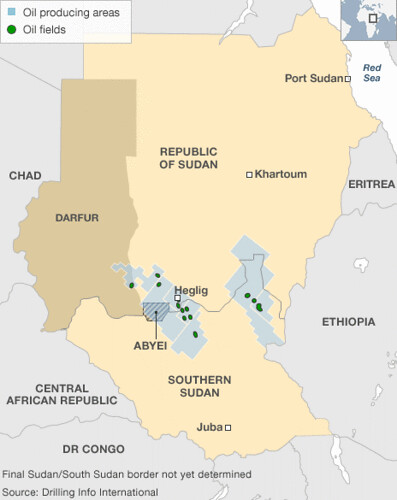
Gatluak described Sunday’s events as the fourth such attack carried out by SAF since the SPLA withdrew from the contested, oil-producing Heglig.

The UN, African Union (AU), European Union (EU), US and other members of the international community have condemned Juba’s occupation of the oil-rich area and called for an immediate withdrawal.

If SAF continues to attack South Sudan, the SPLA will re-occupy Heglig, Gatluak said. He added the international community must "mark this very clear, they shouldn’t blame us again because the South Sudan government honored the request and still the Sudanese government do not give ear to the world."

Previous bombing raids in Unity State have been condemned by the UN Secretary-General, Ban Ki-moon; UN Special Representative of the Secretary-General for Children and Armed Conflict, Radhika Coomaraswamy; and the Special Representative of the Secretary-General for South Sudan, Hilde F. Johnson.

Sudan’s president, Omar al-Bashir on 23 April said that the time for discussion was over and that Juba only understood armed conflict.

Khartoum and Juba blame one-another for the damage incurred to the Heglig oil infrastructure.

(ST)

British Agents Behind Sudan Oil War Plot

BRITISH AGENTS BEHIND SUDAN OIL WAR PLOT

Posted on April 30, 2012
by Alexandra

Britain seems to have expanded its role in South Sudan from an initially claimed humanitarian one to military sabotage along northern borders with Sudan amid fears that London is plotting another oil war.

The Foreign Office confirmed on Sunday that a British national has been arrested by Sudan’s security forces along its oil-rich Heglig border area with South Sudan.

Sudan’s army spokesman Colonel Sawarmi Khalid said the Briton was part of a team of four including Norwegian, South African and South Sudanese nationals who were equipped with military hardware and an armored vehicle.

Heglig was captured by South Sudan forces earlier this month but Sudanese forces later retook the strategic area.

London has repeatedly expressed support for South Sudan since its secession from Sudan in July 2011 but it has claimed the support remains within humanitarian frameworks.

At the time of Heglig’s capture by the South, Sudanese government said “foreigners” were involved in the operation.

Now it appears that they were right and Britain is delivering more than humanitarian aid to the south.

Foreign Secretary William Hague said one day after South Sudan’s independence that London will support the new republic and expressed “optimism” for its future.

Hague indirectly pointed to London’s awareness of South Sudan’s massive wealth of resources.

“Sudan has good economic prospects with its abundant mineral wealth and huge potential in agriculture and forestry. Africa as a whole has three fifths of the world’s uncultivated arable land, a fifth of the world’s copper and half of the world’s gold… So the UK will focus on helping South Sudan build its private sector, boost revenues and the economy and trade with its neighbors,” he wrote in an article for Huffington Post on July 11,2011.

But he included another hint in his article that — one tends to believe – becomes clear in the context of the recent detention of the British national in Heglig area of Sudan.

Hague said in his article that Britain will support South Sudan as it joins the community of nations including “the Commonwealth.”

The suggestion was shocking as the Commonwealth is a euphemism that replaced ‘colonies’ back in 1960’s when the British empire was on its last days and talking of South Sudan as a new colony in the 21st century is hardly fit.

In that context, the revelation that Britain is operating military elements in the border area of South Sudan can at best suggest London is looking at the disputed Heglig oil fields as a rich opportunity for its oil industry.

But considering the fact that Sudan and South Sudan are on the brink of full-scale war over the oil fields, another scenario seems more likely.

Britain is plotting for long-term military presence in the resource-rich South Sudan under the pretext of helping it in the ‘war’ with the north.

That scenario, of course, will bring the mentioned opportunities for British oil businesses while providing a ripe market for British weapons as London tightens its grip on South Sudan’s huge natural resources.

NATO, Al-Qaeda Caught Shipping Weapons to Syrian Opposition by Sea Via Benghazi

NATO, AL QAEDA CAUGHT SHIPPING WEAPONS TO FSA BY SEA VIA BENGHAZI

Posted on April 30, 2012
presstv.ir

More than 20 people in Syria, mostly security forces, have been killed as blasts rock the northwestern city of Idlib.

Scores more have been wounded in the explosions that targeted security buildings in the city. The attacks have been blamed on armed opposition gangs.

Meanwhile, in the capital Damascus, terrorist groups have attacked a police patrol and the Central Bank building, injuring at least four officers. Syrian media say some 174 armed gang members have laid down their arms and surrendered themselves to government forces.

Press TV has conducted an interview with Franklin Lamb, a Beirut-based international lawyer, to further talk over the issue. What follows is an approximate transcription of the interview.

Press TV: As we hear news of these various attacks in Syria, who do you believe is responsible for the flow of arms entering that country, something that the Syrian government itself has alluded to several times?

Lamb: We have some good evidence in this developing story of Lutfallah II, the Sierra Leone vessel, that was finally taken off the Coast of Tripoli in Libya and now there is an investigation by the Lebanese army going on.

I think that this story about this ship leaving Benghazi two and a half days ago, three days ago, with arms that look very much like they were headed for Syria is a Watergate; it is nothing less than a potential Watergate-type story.

Remember [Bob] Woodward and [Carl] Bernstein followed the money. Now any good media representative should follow the weapons in this case. We know that the boat went first to Turkey, then to Egypt and then back to Lebanon.

Where is the manifest? Who was to receive those weapons? The owner is saying there were to be originally 15 containers but a source named Hassan Diab in Benghazi who claims who has witnessed the loading of that boat and claims that Qatar, who did supply those weapons, backed out and did not put the other 12 containers onboard and the reason they did not do that, they did not want to lose.

This was a gamble and they did not want to lose that many containers and some of the packages and some of the weapons in there that were clearly marked from Qatar.

So we had a situation that after the NATO supposedly stepped down but of course the NATO representatives are there and the Americans are there and French Special Forces. We know that and also Qatari officials.

What they did was pick up these weapons as best they could. Qatar ended up with them in between 3 and 5 warehouses. We are trying to pin down exactly what. Qatar had that ship loaded using now Libya as a base to arm the so-called Syrian free army to attack Syria.

You and I know and Press TV has made clear the significant differences between the situation in Libya and Syria. But one thing is fundamentally the same and that is the goal is regime change.

It was the goal against Qaddafi from day one. It is the goal against the Bashar al-Assad government today, as it was at the beginning.

This is the latest move, almost a desperation tactic by the so-called axis from Saudi Arabia, from Israel, from Qatar, Doha and also in Washington with NATO cooperation to bring about this regime change.

Why wasn’t that boat stopped on the high seas? Why didn’t Israel stop it? They usually do. You send a few protesters on a boat from Turkey and they will get killed, as it happened in the Mavi Marmara.

Why didn’t UNIFIL [The United Nations Interim Force in Lebanon], whose job it is, to stop any arms, why didn’t they stand down and essentially giving a green light? Where is the American position on this?

There are some tough questions that have got to be asked and I think this is the tip of the iceberg and exposing who is fueling in a less dramatic way than John McCain wants. He is a senator, you know, and he wants armed forces or no-fly zone.

It is clear that the object now is to end the regime in Syria and this is a lifeline, they thought, going in there with weapons. I think it is a major story unfolding. It has got to be pursued and the tough questions asked.

Lies Killed the Colonel

Lies Killed the Colonel

By Stan Winer
Truth Hertz
Sunday, Apr 29, 2012

For the historical record, see "Libya: One Year On," the series by T.J. Coles, Axis of Logic Columnist, documenting NATO's war crimes during their destruction of Libya.

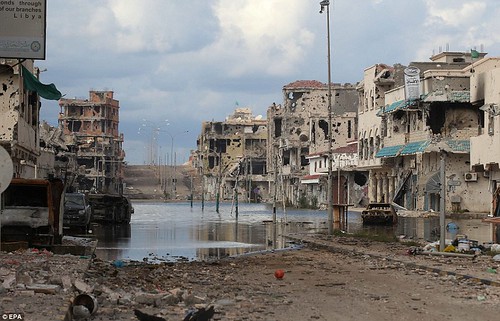
Dawn revealed an extraordinary sight in the Libyan coastal city of Sirte on the morning of 20 October 2011 – “extraordinary” that is if you disregard the fact that nothing could have been ordinary in a once beautiful city that now lay in ruins after weeks of continuous bombing and shelling by Nato and its surrogate rebel forces. Stiff resistance by loyalist snipers together with a clear lack of coordination and divisions among rebel forces at the front had effectively halted the rebel advance.

The rebel force, little more than an assembly of armed street hooligans, was rife with internecine disputes, untrained in tactics, and adept only at firing their weapons into the air and praising Allah, when not actually shooting each other, Although loyalist forces were encircled in a residential area of about 700 square yards, about 150 loyalist army snipers supported by armed civilian volunteers were directing accurate fire at the rebels from surrounding buildings. In an illustration of how fiercely defended the loyalist position was, it took the anti-Gaddafi rebels a full two days to capture a single residential building as the Nato-backed rebels continued taking heavy casualties.

Nothing short of a tactical nuclear weapon would have been able to dislodge the firmly entrenched loyalist resistance, and that would have entailed unacceptable civilian casualties or “collateral damage” as the military fondly refers to it. In sum, the rebels were unable to capture Colonel Moammar Gaddafi or defeat remnants of the Libyan Army and its high command. The battle of Sirte was at stalemate, preventing Libya's new leaders from declaring full victory in the eight-month civil war and causing significant military and political embarrassment to Nato.

But now, on this fateful morning of 20 October, white flags are flying at multiple locations across District Two of the besieged and devastated town, signifying at least a temporary unarmed truce. In the preceding days loyalist commanders and tribal elders, with the knowledge of rebel commanders, had been negotiating a safe passage for loyalist forces and families from Gaddafi’s tribe, who make up the majority of Sirte’s population, to leave the battered and besieged city.

The only precondition for this to happen, according to rebel commander Touhami Zayani of the El-Farouk brigade leading the attack on Sirte , was for loyalists to lay down their arms. Since nobody could move freely or safely around the embattled city, the negotiations would have been conducted mainly by satellite phone, meaning that Nato intelligence, through its electronic surveillance and communications interception systems, would have been fully aware of the negotiations and the truce terms under discussion.

According to Gaddafi’s son Saif al-Islam as quoted on the official resistance website Libya SOS, the last time he contacted his father a few hours before the convoy was attacked, his father assured him he had received assurances “from Americans” allowing him safe passage out of Sirte to the south of Libya without prosecution or bombing. We may never know for certain what exactly happened next, but the official version released by Nato from its operational base in Naples the following day reads as follows:

At approximately 08h30 local time (GMT+2) on Thursday 20 October 2011, NATO aircraft struck 11 pro-Qadhafi military vehicles which were part of a larger group of approximately 75 vehicles maneuvering in the vicinity of Sirte. These armed vehicles were leaving Sirte at high speed and were attempting to force their way around the outskirts of the city. The vehicles were carrying a substantial amount of weapons and ammunition posing a significant threat to the local civilian population.

The convoy was engaged by a NATO aircraft to reduce the threat. Initially, only one vehicle was destroyed, which disrupted the convoy and resulted in many vehicles dispersing and changing direction.

After the disruption, a group of approximately 20 vehicles continued at great speed to proceed in a southerly direction, due west of Sirte, and continuing to pose a significant threat. NATO engaged these vehicles with another air asset. The post strike assessment revealed that approximately 10 pro-Qadhafi vehicles were destroyed or damaged.

At the time of the strike, NATO did not know that Qadhafi was in the convoy. NATO’s intervention was conducted solely to reduce the threat towards the civilian population, as required to do under our UN mandate. As a matter of policy, NATO does not target individuals.

We later learned from open sources and Allied intelligence that Qadhafi was in the convoy and that the strike likely contributed to his capture.

NATO does not divulge specific information on national assets involved in operations.

That’s the official version. The unofficial version, less bland and based on information less widely circulated at the time, is somewhat more revealing.

Unofficial version

A total of 50 private security personnel, including 19 South Africans, had been recruited to travel to Libya on instructions to neutrally escort Colonel Gaddafi and his entourage from Sirte to southern Libya or over the border to Niger. On arrival in Libya the contract personnel – some would say mercenaries -- travelled by road from Tripoli in a column of about 25 vehicles to rendezvous with Gaddafi and his entourage at a specified location in Sirte, without once being stopped or questioned at rebel roadblocks or security checkpoints.

A South African member of the neutral escort, in interviews with the South African Afrikaans language newspaper Rapport on 24 and 29 October, described how he and other private security personnel forming the escort had been given the impression that Nato "wanted Gaddafi out of Libya", as part of a negotiated peace deal; but as things turned out, it became clear to him that Gaddafi had been set up as a target for assassination.

The neutral and unarmed convoy had assembled at the rendezvous point during the night of 19/20 October, but as dawn broke the vehicles came under Nato air attack. This was not a sustained attack but more in the nature of a warning shot across the bows, to remind the convoy commanders they were under constant surveillance. The Canadian commander of Nato operations Lieutenant-General Charles Bouchard later admitted Nato’s concern that the departing loyalist force from Sirte would “join with the remnants of forces from Bani Walid and move into another desert area”, meaning apparently an area not earlier agreed upon in the truce conditions.

About 20 minutes after Nato’s aerial warning shot, the convoy commanders decided to take advantage in the lull of Nato air activity and make a run for it – only to again come under fire at a traffic roundabout on the outskirts of the city. As Bouchard later described it, this attack was designed to break the convoy into “manageable chunks”. And so it did: the convoy split up with vehicles heading in separate directions before coming under a third and final air attack. The vehicles in which Gaddafi and his closest advisors were travelling headed straight into the arms of the waiting rebel Misrata brigade.

Human Rights Watch visited the site where Muammar Gaddafi was captured, and there it found the remains of at least 95 people who had died that day. The vast majority had apparently died in the fighting and Nato strikes prior to Gaddafi’s capture, but between six and ten of the dead appeared to have been executed at the site with gunshot wounds to the head and body. Some of the bodies were burnt beyond recognition. Nato never did explain why only about 25 damaged or burnt-out convoy vehicles were found at the sites of the attacks, whereas earlier Nato had publicly claimed the existence of 75 vehicles in the convoy. But then Nato never has been noted for accuracy or for setting the record straight.

Astonishingly, according one of the private security personnel who survived the attack, the rebel forces regarded captured members of the escort amicably as "allies". All the surviving contract personnel were released immediately after the ambush while one of the escort party who had been wounded in the ambush was swiftly transported to Cairo for medical attention. Significantly, this was at a time when real or perceived "mercenaries" elsewhere were ruthlessly being hunted down and slaughtered by rebel forces.

“Protecting secrets”

National Transitional Council (NTC) spokesman Ibrahim Betamal, in an interview with GlobalPost after Gaddafi was executed, stated unashamedly that Gaddafi had been “shot by one of his own snipers. He died from these wounds. They killed him to protect secrets ... I believe this sniper was placed with Gaddafi to kill him if he was captured.” NTC leader Mustafa Abdel-Jali, addressing world media, repeated more or less the same grotesque claim that Gaddafi had been killed by his own people. Abdel-Jamal’s version differed only to the extent that Gaddafi had been killed "during the clashes with his supporters while arresting him." The NTC had “formed a committee to investigate how Gaddafi was killed," Abdel-Jali informed the world media. This so-called committee never did materialize.

There was neither examination of ballistic and forensic evidence nor any identification of objective eyewitnesses. Gaddafi’s body was buried at a secret location somewhere in the desert, and many unanswered questions about his death remain buried with him to this day. But one fact is indisputable: the colonel was sadistically tortured before being killed. Cell phone videos taken by bragging rebels at the scene, and which soon found their way onto the news website GlobalPost, showed a blood bespattered Gaddafi, barely alive, being barbarically raped with a stick or knife by his captors. Then he was wounded at close range with a gunshot to the stomach, and died some time later of a gunshot to the head.

The mainstream media, while exultantly parroting the official version that Gaddafi had been killed “by his own supporters while attempting to escape”, was careful not to mention anything about an unarmed truce, about torture by rape, or about the convoy travelling in broad daylight whereas it is common sense that any bid to escape would have been carried out under cover of darkness to avoid detection. Nor was there any photographic evidence or any other convincing evidence of the convoy having being “armed” as claimed falsely by Nato and dutifully regurgitated by the media.

None of the media queried how 50 foreign contract security personnel traveling in convoy from Tripoli had managed to avoid being challenged at roadblocks and security checkpoints along the way, and then cross the frontline at Sirte and openly assemble in a free-fire zone subject to continuous Nato air and satellite surveillance. The fact that these issues are not public knowledge says a lot about the mainstream media.

Nor did the mainstream media ever bother to remind anyone that a white flag is meant to signify to everyone concerned that a truce is called and an approaching party is unarmed, as prescribed in the Geneva and Hague protocols of international humanitarian law, which prohibit the killing or injuring of persons outside of combat and doing so constitutes a major war crime.

Almost everything reported hysterically by the mainstream Western media about the Libyan civil war has been proved wrong, in particular the media myth emanating from NTC sources that opposition to Gaddafi was a peaceful movement when “10,000 opposition protestors were killed in Benghazi by Gaddafi’s government.” The reality, as established independently by Amnesty International, was that the rebellion, far from being a peaceful movement, had been armed from the very first day of the uprising; and 10,000 people had not been killed in Benghazi by Gaddafi’s government at that time but 110 killed on both sides at the outset of hostilities prior to NATO’s intervention on the pretext of “protecting civilians”.

“Demented terrorist”

There are a few others things about Gaddafi that are either studiously avoided or grossly distorted by a Western media long obsessed with demonizing the colonel -- their favourite pejoratives being “tyrant”, “despot”, “ruthless dictator”, “demented terrorist”, “embezzler” and so on. They purposefully ignore what this despised “tyrant” really gave to Libya. He had inherited the poorest country in the world and turned it into one of the richest in Africa, providing the country with the highest Human Development Index on the continent. He provided Libyans with free electricity, with literacy and free education, and paid for university grants. Ten percent of Libyan students studied abroad, paid for by the Libyan state, board and lodging included. He granted gender equality to Libyan women; gave every newly married couple US$50,000 to set up home; paid for half their first car; provided interest-free bank loans; provided free medical assistance; built the world's most advanced water supply and irrigation system; and provided farmers with land, seeds, tools and instruction.

Gaddafi helped free Africans from foreign domination, exploitation, imperialism, colonialism, neo-colonialism and racism; he supported generously the cause of pan-Africanism through funding of the Organisation of African Unity; he financed Africa’s first communications satellite, the Regional African Satellite Communication Organization (RASCOM) satellite, thus freeing Africans from exorbitant payments to western communications monopolies; he approved equitable foreign loan agreements so that Africans could be freed from paying excessive interest to foreign banks; he paid annual revenue from oil directly into the bank accounts of ordinary Libyan citizens.

That’s what the tyrant Gaddafi did for Libya and for Africa.

It did not endear him to the West nor to Islamic fundamentalists and some of the Arab world’s more autocratic and ideologically backward reactionaries.

In the meantime, until America, Britain and France declassify secret intelligence documents detailing the sequence of events leading up to and including the assassination of Colonel Gaddafi -- and they are unlikely to do so in the foreseeable future -- we will never know the full circumstances of the “tyrant’s” capture, torture and execution. In the meantime, the contents of this present article are no less suasive and somewhat more inclusive than what has been selectively spoon-fed to us by the Western mainstream media and by Qatar’s al-Jazeera in their conduct of crimes against reality.

Source: Truth Hertz
Mali Junta Claims Control of State TV As Fighting Continues in Apparent Counter-Coup Attempt

Mali junta claims control of state TV, fighting continues

Tue May 1, 2012 3:22am GMT

(Reuters) - Mali's ruling military junta said on Tuesday in a message aired over state television that it is in control of the state broadcaster building, the airport, and the military base in Kati near the capital after a counter-coup attempt.

A Reuters witness near the broadcaster's main building said, however, that gun and heavy weapons fire continued near the building.

"The president of the CNRD informs the public that the CNRD controls the state broadcaster, the airport and the military camp," according to the scrolling message, which interrupted regular TV programming. (Reporting by Cheikh Amadou Diouara; Writing by Richard Valdmanis)


30 April 2012
Last updated at 23:25 ET

'Counter coup' gunfight in Mali's capital Bamako

Troops in Mali who launched a coup in March have exchanged fire with the presidential guard in the capital Bamako, officials and witnesses say.

A junta spokesman said guardsmen loyal to ousted President Amadou Toumani Toure were trying to reverse the coup.

The junta later said the situation was back under control, amid reports that several people died in the gunfight.

While the junta has handed power to an interim government, it is still thought to wield considerable influence.

Message on TV

The gunfire followed an attempt by junta loyalists to arrest the former head of the presidential guard, journalist Martin Vogl in Bamako told the BBC.

He said clashes continued around the state broadcasting building and several other locations in the capital late into the night.

One eyewitness told the Reuters news agency that the streets were deserted. Electricity has been cut in several part of the city.

Members of the "Red Berets" presidential guards unit reportedly entered the broadcaster's building, which has been controlled by pro-junta forces since the coup.

"These are elements of the presidential guard from the old regime and they're trying to turn things around," junta spokesman Bacary Mariko told the Reuters news agency.

He later said the airport in Bamako had come under attack from anti-coup forces, and that he was expecting an attack on a pro-coup base in Kati, north of Bamako, according to the Associated Press news agency.

But several hours later the junta aired a message on Mali's TV, saying the airport, the state broadcasting building and the Kati base was under its control.

The 22 March coup, which ousted President Toure, was led by soldiers who accused Mr Toure of failing to combat an insurgency in the north.

Last week the leader of the coup, Cpt Amadou Sanago, rejected the decision of West African regional bloc Ecowas to send troops to the West African country.


Counter-coup attempt under way in Mali

Several people reported killed in fight between coup troops and those loyal to ousted president at national broadcaster

Last Modified: 01 May 2012 02:58

Fighting has broken out in Mali's capital, with troops who took part in last month's military coup and the guard of the newly installed president exchanging shots, witnesses said.

Several people have been killed in a gunfight on Monday between the coup troops and the presidential guard loyal to ousted leader Amadou Toumani Toure at the national TV and radio station, employees said.

"There were deaths" in the gunfight after the presidential guard tried to take back the station, which has been held by rebel soldiers since the March 22 coup, said an employee who asked not to be named, without giving numbers.

Bakary Doucoure, an eyewitness, said there was fighting around the building that houses the country's national broadcaster and that ambulances were at the scene. The broadcaster has been in the hands of the junta ever since the March 21 coup.

Yaya Konate, the head of the broadcast station, said that troops arrived at the station at around 6:30 pm firing in the air and told all personnel working there to leave. He said the soldiers who took charge of the building were from the presidential guard.

Speaking to Al Jazeera from Bamako, journalist Martin Vogl said that he was in the centre of town when the gunfire was heard.

"Around 5pm or 6pm, local time ... we started to hear quite heavy gunfire, automatic weapon fire, coming from a couple of places in the centre of town... People got very tense and tried to get out of the centre of town as soon as the fighting started."

It has been just over a month since a group of soldiers toppled Mali's democratically elected president. Since then, junta leader Capt. Amadou Sanago signed a deal with ECOWAS to return the country to constitutional rule. The deal gave the junta a supervisory role in the transition.

The shooting in central Bamako followed an attempt by junta loyalists to arrest a member of the presidential guard, witnesses said.

The guardsmen have voiced anger over the arrest of the former army chief by soldiers who took part in the March 22 coup that toppled ex-president Amadou Toumani Toure weeks before an election.

The guard is part of the parachute regiment known as the Red Berets who were thought to have remained loyal to the ex-president during the coup and only reluctantly submitted to the authority of the junta leaders.

Bate Felix, a Reuters correspondent in the region, said on Twitter that "#Mali junta chief Capt. Sanogo spoke to radio Kayira via phone. Said he's alive. Blamed mercenaries and foreign troops aiding red berets".

A spokesman for the coup leaders said soldiers loyal to Toure were behind the fighting.

"These are elements of the presidential guard from the old regime and they're trying to turn things around," Bacary Mariko said. "We have the situation under control."

Troop movement

"They are trying to take control of the airport right now, but we will fend them off," said junta spokesman Bakary Mariko. He said the anti-junta forces have the support of mercenaries from the region.

"The idea is to try to take control of the airport so they can fly in ECOWAS troops," he said, referring to troops from the West African regional bloc that tried to mediate after junta leaders staged a coup late in March.

"We hear they are going to try to attack our base at Kati too where I am now, but we are ready for them," Mariko said.

Fela Ba, a witness to the fighting, said he saw a large convoy of military vehicles heading to the town of Kati just outside Bamako, where the junta has set up its headquarters.

The US embassy in Bamako, through its Twitter account, reported the shooting, but did not specify the groups involved.

"Gunfire reported in ACI2000, vicinity of ORTM, and possibly other areas of #Bamako. US Citizens advised to shelter in place," the embassy tweeted.

Witnesses told the Reuters news agency heavy gunfire broke out near a key bridge and around the state broadcaster. Fighting later subsided around the bridge and members of the red beret presidential unit were seen leaving the area.

"They left the bridge after a firefight and they are now moving in the direction of the airport," a witness said.

The clashes came nearly a week after Cheick Modibo Diarra, Mali's interim prime minister, named 24-member cabinet, including three army representatives.

Diarra, a former executive of Microsoft for Africa, was appointed along with former national assembly speaker Dioncounda Traore, the interim president, to lead the country ahead of elections later this year.

Source: Al Jazeera and agencies

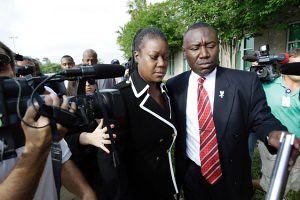
Trayvon Martin Case: Task Force Wants Changes In Stand Your Ground Law

Trayvon Martin case: Task force wants changes in Stand Your Ground

The group of legislators, attorneys, police and legal experts stopped short of calling for an absolute repeal

By Gary Fineout, The Associated Press / April 30, 2012

An independent task force wants major changes, but not an outright repeal, of Florida's "stand your ground" law after the shooting death of teenager Trayvon Martin.

State Sen. Chris Smith, the organizer of the group, delivered the recommendations to Gov. Rick Scott and legislative leaders on Monday.

Smith said the group — which included prosecutors, defense attorneys, police chiefs and law professors — could not reach a consensus on whether to get rid of the seven-year-old law that allows a person to meet force with force if they reasonably believe they are in danger of being killed or seriously harmed. The law removed a duty to retreat that previously was in the state's self-defense law.

"We took an adult look at 'stand your ground," Smith said. "We had adult discussions, not political, but adult discussions on 'stand your ground.'"

Neighborhood watch volunteer George Zimmerman said he acted in self-defense when he killed Martin earlier this year in Sanford. A special prosecutor, however, charged Zimmerman with second-degree murder following weeks of outcry and protests. Zimmerman has posted bail and is currently in hiding as he awaits trial on the charges.

Smith, a critic of the existing law, put together his own task force to look at the law after complaining that Scott was waiting too long to respond to the Martin killing. A separate task force assembled by the governor is scheduled to hold its first meeting in Tallahassee on Tuesday.

Smith, D-Fort Lauderdale, said he would a sponsor in the bill in the Florida Legislature that includes the changes recommended by his group, including one that requires that a grand jury and not a prosecutor determine whether "stand your ground" can be used to avoid arrest.

Smith's group also called for creating a system to track self-defense claims in Florida and to make it clear that the police can detain and question someone even if the person contends they were acting in self-defense. Smith said the law is now ambiguous on whether police are allowed to detain a suspect.

The 21-page report by Smith's group includes recommendations that either had unanimous support, or a supermajority. Smith noted that only a simple majority supported a repeal of the stand your ground law and that he would not "waste" the time of the GOP-controlled Legislature or public by sponsoring a bill to repeal the law.

One recommendation that received a supermajority — but not unanimous agreement — was that police should be allowed to charge someone if the person killed was unarmed or was in the process of running away. Martin was unarmed when Zimmerman shot him.

Rep. Dennis Baxley, R-Ocala and a sponsor of the 2005 'stand your ground' law, said he's not surprised that Smith's group came up with recommendations to overhaul the law.

Baxley said he wanted the governor's task force to stay on its mission to look at all of the state's self-defense laws.

"The mission is not to have a kangaroo court and say's what wrong with stand your ground," said Baxley, who is a member of the governor's task force. "The importance of the mission is to review public safety and protection."

Other task force members said they could not comment until they had a chance to read Smith's report.

But Rep. Jason Brodeur, R-Sanford, said that he would be interested in anything to make "Florida a safer place" as long as it did not diminish the ability of Floridians to defend themselves or their families.

Smith on Monday repeated his push to have the Florida Legislature deal with the state's self-defense laws in a special session instead of waiting until next year's legislative session. He said the law continues to be "used and misused" throughout courtrooms and remains fearful of "copycat" crimes similar to what happened to Travyon Martin.

Smith also wanted to present his group's recommendations to the Scott-created task force at its first meeting. But Lt. Gov. Jennifer Carroll, who is leading the Task Force on Citizen Safety and Protection, turned down his request.

Her letter to Smith says it would be unfair to let him speak since no one else from the public is scheduled to address the group. She instead offered him to make a presentation in June.

"I guess I'll attend and maybe it put it on their windshield wipers on their cars campaign style afterwards," Smith said.