Wednesday, January 01, 2014

The Finger Prints on Genocide in South Sudan

WEDNESDAY 1 JANUARY 2014

The finger prints on genocide in South Sudan

By Stephen Par Kuol

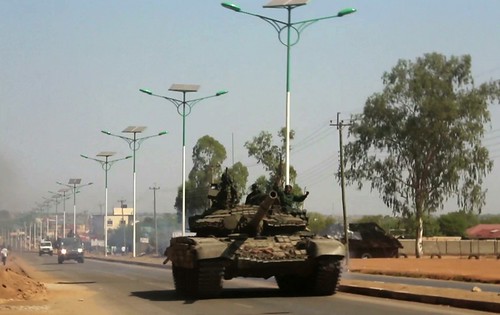
January 1, 2013 - Any body with keen interest in South Sudanese current affairs could not have missed the recent shuttle diplomacy waged by the regional leaders and diplomats to end the ongoing crisis in the country. That is very encouraging and should be supported by all people of good will. Unfortunately, what is now diminishing through the thin air of that diplomacy is the ugly fact that weltered with decomposing corpses and their fetid smell in the air, Juba, the capital of South Sudan is a crime scene against humanity and should be treated as such at the time of this writing. Worth noting also is the chilling truth that among those cheeky personalities roughing shoulders with regional leaders and diplomats to bring peace to South Sudan are red-handed suspects in the ongoing genocide. Meanwhile preventive diplomacy can surely minimize the magnitude of the crisis and save more lives; one delicate affair in the process is avoiding diplomatic niceties to overshadow the criminal responsibility of those whose finger prints are notoriously evident on those crimes against humanity. Thus, on behalf of the murdered victims, traumatized survivors and their families, I write to recommend that the peace process goes hand in hand with a multi-national investigation of these premeditated heinous crimes against humanity. .Any thing short of that is another betrayal to humanity and South Sudanese citizens of Nuer ethnic origin who have perished in the ongoing genocide.

Experiences elsewhere have taught that war fatigue and desperate yearning for peace can easily give way to impunity that would haunt the nation in question for an unforeseeable future. Speaking as a practiced diplomat, I mean the diplomatic tendency to avoid antagonizing the genocidists, who might walk out of “the peace process.” This often frightens diplomats who fear “upsetting the peace process”. For example, in Naivasha for South Sudan, or in Abuja for Darfur in 2005, the argument became: “don’t upset the fragile new order in Khartoum since signature on the agreements settling the civil war in the South serves the greater good. Let’s now concentrate on getting the Darfur ‘rebels’ to reach a similar agreement with Khartoum in Abuja, under the African Union.” Meanwhile the ethnic cleansing of Darfur and genocidal massacres and rapes continued daily. This argument, which diplomats often and naively espouse, ignores the fact that genocidists are serial killers whose blood thirst can never be quenched by a peace meal. Hence, policies toward them based on fear lead only to appeasement and further genocide. In the case of the ongoing genocide in South Sudan, the prime suspect, General Salva Kiir Mayardit has already offered unconditional cease fire and peace talk but the genocide continues. Like any genocidist, Kiir is a serial killer, a master of genocide and ethnic cleansing. As a career military intelligence officer, he is well trained in cold blood killing and he practiced that well during the liberation struggle where he executed murder of the bulk of our liberation politicians. He is doing that now with efficiency on our unarmed civilians in Juba. Presently, the only safe heaven for South Sudanese of Nuer ethnic origin without guns is the UNINISS concentration camp near Juba International Airport where his Propaganda Chief, Justice Michael Lueth have been calling them out to finish what they have started. Nobody talks about that now where as Kiir is preparing for more genocide. That is why I write to strongly recommend that both the international criminal investigation and the peace talk go on simultaneously.

Criminal Investigation as an inquisitive process starts with WH questions: What, Where, How and Who .Legally speaking, the process proceeds with one fundamental question: has a crime been committed in violation of an existing law? If yes, then what is the name or definition of the crime committed? In this case, a crime has been committed in violation of the Transitional Constitution of South Sudan, Rome Statue and the Geneva Convention. Genocide in this case is defined as “the intentional destruction, in whole or in part, of a national, ethnical, racial, or religious group, as such. Was it systematically organized by General Kiir’s regime using his privately armed Dootku -Beny militia, tanks and other lethal weapons? Were the victims chosen because of their ethnic identity? If yes again, then only South Sudanese of Nuer ethnic origin in 107, Guddella, Gurei , Eden, Manga, Jabel villages were targeted and are now the dominant IDPS in UNIMISS compound and the Dinka homes nearby were left untouched?” Is this an intentional destruction, in part, of ethnic and racial group? If yes, then, this, in short, is genocide. As for who did what, the finger prints of the following top seven names have surfaced with probable cause beyond a reasonable doubt:

1. General Salva Kiir Mayardit, the President of the Republic of South Sudan who declared the state of emergency leading to the mass killing.

2. General Malong Awan, the current Governor of Northern Bar-Elghazal State who personally recruited Dootku-Beny Malitia from NBGS and Warap and commanded Dootku-Beny during the genocidal operation.

3. General Marial Chinoum, the field General who executed General Salva Kiir’ orders to disarm Nuer soldiers within Tiger Batelion and ordered the use of tank to kill 22 unarmed bodyguards of Dr. Riek Machar and seven bodyguards of Hon. Gier Chuang Aluong.

4. General Salva Mathuok Gengdit, the former Deputy Minister of Interior and Salva’s father in law who was seen in Dootku-beny uniforms commanding part of the genocidal force during the operation in Juba.

5. General Garang Mabil, a notorious general on reserve from Warap State who was rein stated to active duty during the genocidal operation to execute the genocide.

6. General Bol Akot,a general in reserved reinstated after the clashes to execute the genocide in Thuk sita and Gudella.

7. General Alew Ayieny, the Current Minister of interior who was seen in military uniform commanding a police force in collaboration with Dootku-Beny.

In conventional practice, those primitive tribal generals should be charged with the following crimes:

1. Genocide and crime against humanity

2. War crimes in violation of Geneva Convention

3. Vandalism and formation of a private tribal army for the sole purpose of committing genocide in violation of South Sudan Transitional Constitution

Those of us who speak the language of criminal law know damn well that genocide as an act of mass killing is a join enterprise with many accomplices including the demagogues and propaganda pundits. As for proving the Mense Reus, Kiir is physically in records graduating his Dootku- Beny brigade alone without involving the SPLA Chief of General Staff and the Ministry of Defense, declaring state of emergency and quoting 1991 Bor massacres proving both motive and the criminal mind behind the act of genocide. With this, I rest my case.

Honorable Stephen Par Kuol is a former Deputy Ambassador of the Sudan to the United Republic of Tanzania and the State Minister of Education in the recently overthrown Government of Jonglei State by Dr. Riek Machar’s forces. He is also a researcher and freelance writer on academic topics pertinent to Human Right and Post-conflict Criminal Justice Administration. He can be reached via stephenkuols@yahoo.com /kuolpar@yahoo.com

Lessons to Draw From the SPLM's Internal Wrangles

TUESDAY 31 DECEMBER 2013

Lessons to draw from the SPLM’s internal wrangles

By Brian Adeba

December 31, 2013 - In denouncing the “coup” in December, President Salva Kiir said he would not allow the incidents of 1991 to be repeated. He called former vice president Riek Machar a “prophet of doom” and accused him and his “disgruntled group” of being bent on pursuing the actions of the past, meaning the Machar-led August 1991 split in the SPLM/A.

Aside from labeling Machar and his group as unhappy rent-seekers (most of them were fired from cabinet in July), Kiir’s statement is significant for drawing parallels to the August 1991 split.

However, there are some slight differences worth noting when the two incidents are compared. In 1991, the Nassir putschists openly declared they wanted to see John Garang removed from the leadership of the SPLA/M. “Why Garang Must Go Now,” was a famous leaflet issued by Machar and his comrades in the splinter faction of the SPLM. The subsequent use of force to reinforce their quest to remove Garang, gave credence to their coup attempt.

Fast forward to December 2013. Currently, there is much debate on whether the December 15 incident in the barracks near the University of Juba constitutes a coup.
While the government calls it a coup, Machar and his comrades deny the allegation. And as Philip Knightley reminds us in the classic The First Casualty: From the Crimea to Vietnam: The Correspondent as Hero, Propagandist, and Myth Maker, truth is always the first casualty of war.

However, the debate on whether it was a coup or not, (including the ethnic-laced violence in its wake), obscures focus on the fundamental fault lines and simmering tensions in the SPLM.

But in essence, Kiir is largely correct in comparing the incidents of 1991 and December 15, 2013. However, to get a contextual understanding of Kiir’s likening of the current crisis to the 1991 incident, it is crucial to revisit the fault lines articulated by the Nassir putschists back then and examine if there are parallels in the present. The literature penned by South Sudanese politicians, some of whom were key players in both sides of the strife in 1991, offers ample room for introspection and understanding of the grievances outlined.

As Lam Akol tells us in SPLM/SPLA: The Nassir Declaration, the main contentious issues were Garang’s one-man rule of the SPLM and the constricting democratic space in the movement, including intolerance for free speech. Akol argues that on paper, the SPLA embraced collective decision-making through its High Command. In reality, he asserts, the “movement was being run by one man making nonsense of the Political-Military High Command which never ever held a single meeting since it was formed.”

Vice President James Wani Igga, in his book, Southern Sudan: Battles Fought and the Secrecy of Diplomacy, has tried to counter this argument by saying the High Command couldn’t meet because of logistical issues tied to travel. Due to this, Igga asserts that assembling members of the High Command stationed at various locations under SPLA control was practically difficult. As an example, he cites the case of Daniel Awet, who was based in Bahr El Ghazel. Igga argues that it would practically take two to three months for someone in that location, including Equatoria, to travel to the Ethiopian border for a meeting of the High Command. The veracity of this assertion is of course debatable.

Revisiting events prior to December 15, 2013, it would be fair to note that there seems to be a replay of some of the grievances articulated in August 1991, not withstanding the personal political ambitions of the perpetrators of the violence, on both sides of the SPLM political divide. Observers have noted that since March 2013, the top organ of the SPLM, the Politburo, has not met, despite repeated calls for the chair to convene a meeting to address some fundamental issues on leadership and the general direction of the party. The fate of the SPLM convention is up in the air as it has been called off on a number of occasions. Within the party itself, a section feels that its right to free expression is being curtailed. Most disturbing is the assertion that there is a slide toward authoritarianism manifested in disregard for the rules and regulations of the party, including the country’s interim constitution.

Elsewhere, Reporters Without Borders has noted that there is increasing intolerance for free speech in South Sudan. Human rights organizations have fingered the government for abuses in conflict zones in the country.

Going forward, (and given that there are parallels between August 1991 and December 2013) the impetus is upon the leaders of South Sudan to draw lessons from their own recent history in order to rectify the current political impasse in the country. In doing so, the resort to violence to attain political ends must be condemned and abandoned in favor of peaceful democratic procedures.

Brian Adeba is an Associate of the Security Governance Group in Canada and producer of the documentary Waiting for Statehood.

South Sudan Dissidents Refute United Nations Claims of "Mass Killing" in Unity State

WEDNESDAY 1 JANUARY 2014

S. Sudan rebels refute UN claims of “mass killing” in Unity state

December 31, 2013 (BENTIU) - South Sudan’s army (SPLA) forces who rebelled against the government 10 days ago in Unity state have dismissed a United Nations report alleging that 75 Dinka soldiers were buried in a mass grave in the capital, Bentiu.

On 24 December a statement by Navi Pillay, the UN High Commissioner for Human Rights said that a mass grave had been discovered in Unity state.

But Peter Riak Gew, a spokesperson for the rebels told Sudan Tribune on Tuesday that the report was "not true" adding that "there is no mass grave here."

"The fighting that broke out within the army on 21 December killed only 15 soldiers", he clarified.

Gew criticized the Geneva-based Human Rights UN body for failing to conduct a proper investigation before making the claim. He further said Pillay should have spoken to the UN mission in the country to find out the real situation.

The rebel spokesperson said reports of a mass grave was "propaganda", adding that the UN team that visited Bentiu after the clashes had the correct information.

The Commander of the South Sudan army in Unity state, James Kaong, said he rebelled after members from the tank division attempted to kill him on the evening of 20 December.

Kaong has since also stated that reports of Nuer civilians being killed in Juba following an alleged coup attempt on 15 December was also part of his decision.

South Sudan’s former Vice President Riek Machar, who is a Nuer, has denied allegation by President Salva Kiir, a Dinka, that the fighting in Juba was an attempted military coup.

The UN’s humanitarian coordinator in South Sudan, Toby Lanzer, has estimated that over 1,000 people may have died in the violence that has now displace 180,000.

The SPLA have said that the fighting in the militarily barracks in Rubkotna, just outside the Unity state capital Bentiu, was between those loyal to President Kiir and those loyal to Machar.

After mass grave report by various media outlets, the UN mission in South Sudan said it received reports about the discovery of mass grave in the Unity state capital containing the bodies of 75 soldiers of Dinka ethnic origin.

“Latest reports suggest that this is an inflation of a skirmish resulting in about 15 fatalities, with details to be confirmed. UNMISS is therefore not in position to verify the existence of such a mass grave in Unity state thus far”, said in a statement extended to Sudan Tribune.

The UN said it was deeply concerned over reports of extra-judicial killing in Juba and others locations in South Sudan and is investigating reports of such atrocities.

(ST)

Republic of Sudan Ready to Receive Refugees Fleeing Conflict in South Sudan

WEDNESDAY 1 JANUARY 2014

Sudan ready to receive refugees fleeing conflict in South Sudan: official

December 31, 2014 (KHARTOUM) - The Sudanese government has announced readiness to receive refugees from South Sudan according to the international conventions and neighbourhood rights.

South Sudan’s clashes erupted on 15 December with fighting among a group of soldiers in the capital, Juba. The violence quickly spread to several states, cleaving the nation along the ethnic faultline of rebel leader Riek Machar’s Nuer and President Salva Kiir’s Dinka.

The UNHCR said in a statement issued on Tuesday that as of 30 December "several hundred" of South Sudanese arrived in Sudan, 4693 arrived in Ethiopia, and 950 arrived in Kenya.

"The fighting and insecurity mean that in some cases UNHCR staff and partners have limited or no access to border areas, such as between South Sudan and Sudan", the UNHCR underlined to explain its failure to provide the exact number of South Sudanese refugees who fled to Sudan.

Sudan’s Commissioner-General for humanitarian relief, Sulieman Abdel-Rahman, stated in Khartoum that the technical committee for humanitarian relief has discussed with the security committee in South Kordofan state the humanitarian situation on the border between the two countries and the flow of refugees from South Sudan to border areas.

He pointed that the concerned parties have embarked on developing the initial measures for receiving southerners fleeing conflict zones as well as making the necessary precautions to provide the basic services.

Abdel-Rahman said that southern refugees would be accommodated in safe zones, pointing that the technical committee paid similar visits to the White Nile and Sinnar states for the same purpose.

However, the governor of South Kordofan state, Adam Al-Faki, expressed concern over the tense situation on borders with South Sudan as the government and the rebel Sudan Revolutionary Forces (SRF) wage war against each other in the region.

He said that state’s security committee developed the necessary precautions to protect the state against attacks of the rebel groups.

Al-Faki also said that 200 refugee from South Sudan have arrived in the town of Al-liri, predicting arrival of further numbers.

(ST)

Sudanese National Congress Party Approves Comprehensive Reform Documents

WEDNESDAY 1 JANUARY 2014

Sudan’s NCP approves comprehensive reform documents

December 31, 2013 (KHARTOUM) – The Leadership Council of Sudan’s ruling National Congress Party (NCP) has approved a document to reform the state, describing it as "historic" and comprehensive.

Last month, the NCP leading figure Amin Hassan Omer said that they would issue a historic reform document in conjunction with the recent changes in the government and the party, affirming that it will enable them sweep the upcoming 2015 elections.

Last December, president Omer Al-Bashir who is also the head of the NCP issued presidential decrees appointing Bakri Hassan Salih as first vice president, Hassabo Abdel-Rahman as vice president, and Ibrahim Ghandour as presidential assistant as well as decrees appointing 26 ministers and state ministers.

The biggest surprise in the reshuffle was the departure of the residential assistant Nafie Ali Nafie from government and the NCP leadership. The cabinet also witnessed the stepping down of Awad Ahmed Al-Jaz, who remained in the government formation since 1989.

The NCP deputy chairman for party affairs, Ibrahim Ghandour, told reporters following the leadership office meeting on Monday that they have concluded discussion on the document, pointing that the committee in charge of the document has submitted its recommendations.

He pointed that the committee was commissioned with developing an implementation matrix for the document’s recommendations and stressed that the party and the government would adopt them and will be held accountable before the people according to it.

Ghandour further said that they don’t seek opposition parties’ participation in the existing government, pointing that their goal is to reach an agreement with all opposition forces on national principles and engage in a dialogue to achieve peace and reconciliation.

(ST)

Sudanese Army Recaptures Rebel-Held Area in South Kordofan

WEDNESDAY 1 JANUARY 2014

Sudanese army recaptures rebel-held area in S. Kordofan

January 1, 2014 (KHARTOUM) - The Sudanese army announced Tuesday the recapture of an area located in the eastern part of the Nuba Mountains but the Sudan People’s Liberation Movement –North (SPLM-N) said such operations aims to displace civilians from rebel areas.

The Sudan Armed Forces (SAF) managed to retake Al-Ardiba where it captured "more than 30 armed vehicles, a large number of military hardware and ammunition, said a press statement issued in Khartoum.

The military communiqué further said this operation marks the end of the first phase of the "Decisive Summer" operation in the eastern parts of the Nuba mountains, adding that the army would continue its attacks in all axes against the rebel groups.

Early in this month of December, Sudanese president Omer Al-Bashir and other officials vowed to clear the Nuba mountains from the SPLM-N rebels and their allies of the Sudanese Revolutionary Front (SRF).

In a speech delivered on Independence Day on Tuesday, Bashir hailed the recapture of Al-Ardiba from the SPLM-N fighters stressing that SAF operations are nor directed against the Nuba civilians in South Kordofan.

"They are the victims of war", he said.

He also called for a national mobilisation to support the efforts of South Kordofan government to provide the affected population with humanitarian assistance, and directed to establish a national fund for the state’s IDPs resettlement.

Thousands of South Kordofan civilians fed the conflict areas in the Nuba mountains and moved to other regions inside the country or to the neighbouring South Sudan, since the start of hostilities between the SPLA-N and Sudanese army in June 2011.

However, Khartoum refuses to allow aid groups to reach the affected civilians in the rebel held areas, urging the SPLM-N to negotiate a political agreement first .

TARGETING CIVILIANS

Arnaud Lodi, SPLM-N spokesperson however minimised the attack saying that Al-Ardiba and surrounding areas had being recently bombarded on daily basis by the Sudanese army, pointing that Tuesday attack mainly aims to displace the civilians and burn cultivated fields before harvesting.

"The purpose of these attacks actually is to force civilians to move from their areas because they are seen as supportive to the SPLA fighters and feeding them", Lodi said when reached by Sudan Tribune on Wednesday.

The further said that some 20,000 civilians recently left their villages as result of continued air raids.

The rebel spokesperson also described the military communiqué as “pure propaganda”, saying the area is inhabited by civilians and the rebel fighters have no real presence there.

Many of Al-Ardiba population fled the area after the intense bombardment by the Sudanese army, "so it was practically void when they entered" , he added.

Lodi added they closely monitor the movements of SAF troops and its militias in the region.

“We noticed their deployment of (SAF soldiers) in Khairasana” which located 30 north of Heglig, he said. They moved their troops several times from Talodi to Kaoda (headquarters of the SPLA-N) but every time we hit them and they return back to their bases”, he added.

(ST)

Music Journalism's New Tune Missing a Beat

Music journalism's new tune missing a beat

20 DEC 2013 00:00 MILES KEYLOCK
Mail & Guardian, SA

Has the role of music journalist been relegated
to being simply a punter of product?

‘Right now all the formulas that drive so-called music or rock journalism have really almost been exhausted. That's the main problem," said Nick Kent when Vanity Fair asked him about the state of music journalism in 2010.

As one of the most iconoclastic voices in new-music journalism, Kent knows what he's talking about. His "factional" profiles of artists such as Syd Barrett, Led Zeppelin, Iggy Pop and others in the New Musical Express mainlined an unrepentantly poetic gravitas into pop culture criticism and carved out a unique space for his voice among the academic critiques and gonzo overload of the 1970s and 1980s.

Kent's seen the sales of the iconic British music newspaper fall from a high of 250 000 copies weekly in the late 1960s to fewer than 24 000 in 2012. Damn. Maybe he's got a point. Maybe music journalism has lost its mojo. But what is it about music writing that just isn't striking a chord with readers any more?

Veteran rock writer and editor Barney Hoskyns had one answer. "The sad truth is that rock journalism has become little more than a service industry, with scant critical autonomy and even less responsibility to its readers," he declared in the foreword to The Sound and the Fury: 40 Years of Classic Rock Journalism – A Rock's Backpages Reader. That was back in 2003.

Fast forward to 2013 and you begin to see the consequences of the consumer culture complicity he's talking about.

Over the past decade a slew of major international music magazines have shut shop.

In 2004 iconic British music, fashion and culture monthly The Face closed. In 2006 teen-pop rag Smash Hits followed. The United States's Blender bowed out in 2009 and in 2012 the United Kingdom's last free-form music magazine, The Word, folded. In the same year, the US's Spin magazine stopped printing after 27 years and became a webzine.

Newspapers continue to shred music coverage. In the UK, the Independent on Sunday recently let its music critics go – along with its entire complement of art, theatre, dance, film and television reviewers – selecting instead to run syndicated soundbite synopses from other newspapers.

In South Africa, the trend is identical. A few years ago the Sunday Times turned its arts pages into a lifestyle assemblage. The newspapers in the Independent stable also syndicate music content throughout their publications.

Over the past two decades this very newspaper has culled not just column inches but also pages from its music coverage.

Pretty dire, right? Where are the pundits who documented our "revolution in four-part harmony" with their informed opinions, bold insights and ecstatic prose?

Where are the music writers such as Charl Blignaut for the Mail & Guardian (now at City Press), who speculated on Brenda Fassie's unbridled rock 'n roll animism and South Africa's burgeoning celebrity culture in a series of explosive confrontations?

Where are the young, gifted and black wordsmiths of Y magazine who, under founding editors S'busiso "The General" Nxumalo and Itumeleng Mahabane, voiced the sound of post-apartheid black street culture?

Written in spoken English and street slang, Y mag gave readers a new language with which to understand the relationship between kwaito's apolitical, "hedonistic and flighty preoccupations" and former president Thabo Mbeki's macroeconomic ideology, the politics of fashion and the aesthetics of struggle.

Wait up. We're in the digital age. Who needs to pay for expert cultural critique when free music blogs abound? Isn't the beauty of the internet's culture of uncensored self-publication precisely that you don't need some critical filter? Sure. But it's also the internet's curse.

Bloggers aren't all crap. But self-publication also means unedited publication. Most music bloggers are happy to see journalism as a commodity to champion the interests of their advertisers and sponsors.

Small wonder, then, that most music blogs are ricocheting press releases boasting advertorial product blurbs that masquerade as reviews and first-person diaries that sacrifice critique for a subjective lifestyle experience that might as well be marketing.

Isn't this the kind of content that Facebook is for? And let's not forget former Village Voice critic Robert Christgau's caveat: "If you're a writer, you're better off with an editor."

Traditionally, one of the roles of a music writer was also to introduce readers to new music – in reviews.

With the rise of sites such as MySpace, Facebook, Twitter and music streaming services such as Spotify, Deezer, Simfy and their social media apps, music fans are exposed to a vast array of recommendations, all serviced by automated algorithms without a music journalist in sight.

Is the music journalist in danger of becoming redundant? This is precisely what Drowned in Sound asked on its website back in July 2009 under the headline: "Music journalism RIP?"

"Is there a future for music journalism in the Web 2.0 era Or has the music journalist been marginalised by new publishing technologies?" they asked.

Although the digital revolution has unquestionably changed music creation, access and distribution for consumers, to blame the internet and its plethora of social media plug-ins for the death of the music journalist is a bit of a premature ejaculation.

It also fundamentally misses the tipping point in this whole autopsy. Music writing did not suddenly (d)evolve from the "glory days" of the 1960s, 1970s and 1980s into the digital age.

There has been a fundamental shift in the role of music writing since the 1990s. From the 1960s to the 1980s, writing on music was primarily a speculative art form, a sociopolitical commentary giving a language to readers to make sense of the changing times.

"The true voices of black liberation have been the black musicians. They were the first to free themselves from the concepts and sensibilities of the oppressor," declared The Cricket in its first issue.

Subtitled Black Music in Evolution, the magazine was created by Amiri Baraka (then LeRoi Jones), Larry Neal and AB Spellman in 1968 in the spirit of the hip, improvised come-to-consciousness of black nationalism, using the perspective of the music being created within it as a base.

It was jazz improvisation that fueled the poetic prose of Baraka's fabled Apple Cores columns in Downbeat and the hard-boiled journalistic exposés of our own "urbanised, eager, fast-talking and brash" journalists such as Todd Matshikiza and his With the Lid Off essays on Kippie Moeketsi and Hugh Masekela in Drum in the 1950s and 1960s.

Music writing was also about kick-starting an aesthetic conversation with the reader.

Witness the lost-weekend fanboy fables of Cameron Crowe on the Allman Brothers or Joni Mitchell in Rolling Stone in the 1970s. Or Lester Bangs's fabled "A Deaf Mute in a Telephone Booth" duel with Lou Reed in Let It Rock.

Witness the post-Beat riffs of Nick Tosches's Jerry Lee Lewis "Hellfire" profile in Penthouse. Or Paul Morley's potent Marxist analyses of pop in the New Musical Express.

Witness Simon Reynolds's critique of the hardcore dance culture continuum in The Wire. Or Greg Tate's hip-hop culture critiques in the Village Voice, postulating a critical language that redefined African-American cultural theory and writing.

Witness Njabulo Ndebele's "Thinking Brenda" profile on township pop goddess Fassie that reads her "ungovernability" – her refusal to conform or to be constrained by binary thinking – as the ultimate expression of personal freedom.

Or Julian Jonker's speculative scribblings on the black revolution in South African jazz, "Whiteys on the Moon", which used Mark Shuttleworth's star trek to map the use of "black secret technology" in music production in the international journal CTheory.

Without these critical voices championing new musical expression and engaging readers within a larger sociopolitical context, readers have become removed from the concept of music as a potentially revolutionary force.

In the new millennium, trying to service commercial pressures at the cost of pissing off labels and artists has resulted in a form of music journalism that sits on the fence. Nowhere more so than in South Africa.

Ask any music reviewer in South Africa and they'll recount tales of how they've had run-ins with record companies for sharing their honest opinion on the merits of an album with readers.

"Why should I read your review of x?" asked one reader of a major men's monthly magazine. "If you've only given it two stars, I'm not going to buy it."

In our late consumerist age, has the role of the music journalist been relegated to being simply a punter of product?

Rock journalist Hoskyns would agree: "We have, in our different ways, colluded with the entertainment machine in its canny efforts to dictate what music sells.

"Moreover, it's no coincidence that, just as record sales are plummeting, so the music press is in perilous decline … There is a fundamental loss of faith in the value of pop culture, with so much coverage reduced to bland, consumer-guide homogeneity."

The self-appointed dean of rock music critics, Christgau, foresaw this problem back in the 1970s, creating a short 'n sharp new reviews template, ironically titled "Consumer Guide".

He wrote concise, critical capsule reviews that may have been closer to ad blurbs in length but packed a powerful poetry. They were tweets ahead of their time. But they were still an art form, a holy grail for aspirant young music reviewers to hone their chops on.

Artfully written capsule reviews are one thing. What about those up-close-and-personal interviews?

When it comes to artist profiles, the shredding of enough column space to allow for long-form writing has had one crucial consequence: the erasure of history.

Writers now find themselves penning stories trapped in a decontextualised perpetual present, left with barely enough space to communicate "what's hot" and "what's not".

Madness? Sure, but hardly news to editors, writers and, yes, readers who've been bemoaning the fact that intelligent, in-depth journalism has all but vanished in an era of search engine optimisation-targeted sound bites.

In an age when most music journalism is lacking in context or content, it's not surprising that many music fans plugged into the blogosphere, tuned out and were turned off.

Are we really doomed to a culture of chronic attention deficit disorder?

Well, not exactly. Yes, the times they are a-changing. Perhaps the language and desires of 1960s and 1970s music criticism are not necessarily applicable to the demands of our postmodern age.

Maybe the old romantic idea of music journalism is over. But music writing is not dead. What most doomsayers forget amid the overdose of hyperlinked clicks and disposable content is that intelligent music journalism does still exist.

Whether it's Bongani Madondo's freewheeling "hot type" rhapsodies on the lessons of Philip Tabane's ancestral creative impulse, this writer's own poststructuralist riffs on Spoek Mathambo's crate-digging search for soul in cyberspace or even in capsule reviews, Rolling Stone's South African edition has been on a mission to involve readers in conversations about new ways to talk about South African music culture outside of the usual consumer guide discourses.

Similarly, jazz scribe Gwen Ansell is still smoking her Marxist joints into the collective consciousness in the M&G, Business Day and any publication that will print her by refusing to divorce music discourse from theory and complexity.

Don't be fooled: such writing is under threat.

But music writing will never really get its mojo back if market research continues to replace informed critique as the driving force behind content, and "professional" music journalism amounts to little more than bland blurb-length reviews and cheeky Twitter "copy" captions to glossy paparazzi photos of celebs.

But let's not forget those writers who see music criticism not only as a vocation, but also as a devotional practice aimed at creating a new vocabulary to map what culture is becoming.

As British music critic and theorist Kodwo Eshun observed, this vocabulary "begins where the consumer service of music writing stops". It starts with an appreciation that all of music – including the review and the interview – is just source material to build this new language.

It is precisely this imperative that pan-African publication Chimurenga has been championing since its 2002 debut issue, titled Music Is a Weapon.

Poets, theorists, authors, musicians and artists including San-dile Dikeni, Achille Mbembe, Aryan Kaganof, Louis Chude-Sokei, Keziah Jones and Stacy Hardy spearhead a network of writers who interrogate what Eshun terms "the frame of innocence around so-called black music" (traditionally anti-theoretical and anti-literary) and challenge readers with writing that is both complex, elusive and fiercely speculative.

So, if there are still spaces for contextual music writing and its evolving vocabularies, then the real question is not whether music journalism is dead, but what its future is.

As Eshun prophesied in More Brilliant than the Sun: Adventures in Sonic Fiction in 1998, perhaps it is finally time to "ask not what music [writing] means, but what it does".

Miles Keylock is the editor of Rolling Stone South Africa magazine

Tunisian Roadmap For Political Transition in Limbo

Tunisia’s roadmap for political transition in limbo

Alia Soliman, Wednesday January 1, 2014
Ahram Online

After choosing a prime minister, Tunisia’s tri-phased roadmap still faces many challenges

This month sees the third anniversary of the Tunisian revolution and the ouster of Zine Al-Abidine Ben Ali -- the revolution that started a wave of uprisings around the region. But three years later, Tunisia, like many other states of the Arab Spring, is in a predicament.

Tunisians are set on drafting a constitution by 14 January and choosing a new interim prime minister. Problems abound; the deadlines set for writing the constitution have been missed more than once, while the governing Ennahda Party and opposition National Salvation Front have proved unable to bridge their differences in talks, leaving many Tunisians wondering what real progress has been made in the three long years since Ben Ali’s ouster.

Breaking the deadlock

The national dialogue has been suspended many times because of a lack of solid ground for negotiation. The powerfulTunisian General Labour Union (UGTT) secretary general, Hussein Abassi, declared the suspension of the dialogue “until there are favourable grounds for talks to succeed.”

Fundamentally, the dialogue comprises of three difficult stages.

Yusra Ghannouchi Ennahda's international spokesperson, told Ahram Online that the first phase in the dialogue is the governmental one, ie agreeing on a new prime minister who will form a new government to take over from the current one until elections are held.

The second phase involves the resolution of the final points of difference on the constitution, leading to its adoption.

Finally, the third stage is the electoral process, requiring the formation of an independent electoral commission, adoption of the electoral law and setting a date for the elections.

“Ennahda had always called for comprehensive dialogue and stressed that the transition phase requires consensus among as many political and social players as possible, to ensure a smooth and successful transition. We value the efforts of the UGTT and other civil society organisations hosting the dialogue in reaching agreement so as to successfully complete the transition to a stable democracy in Tunisia,” says Ghannouchi.

However, Lina Ben Mhenni, a Tunisian human rights activist, tells Ahram Online that she does not have great faith in the talks. “I think that we are wasting too much time and energy in the national dialogue."

“I think that the present government has failed on all levels and I think that people in power today should step down without putting conditions, as the country is experiencing a major crisis and is facing continuous regression under their rule,” Ben Mhenni says.

Hafedh Al-Gharbi, Tunisian lecturer at the Faculty of Humanities of Sousse, believes the talks will lead to the end of the deadlock, though it might take longer than usual.

Finding the most suitable prime minister took nearly two months, so there are chances that the choice of government members too will be subject to a lengthy debate. But there will be "light at the end of the tunnel," he says.

About two weeks ago, a new prime minister was appointed. According to New York Times, Mehdi Jomaa, the current minister of industry, will take over as prime minister and lead a caretaker government until elections next year.

But Ben Mhenni says that while it is true that a new prime minister has been appointed but the previous prime minster is still taking decisions as he has not yet resigned. “The agreement upon the new prime minister took us four months, so what about the discussions about the other members of the government and the next steps to be taken?”

Constitutional deadlines

AP reported that Tunisia's “rival political parties” have finally decided that the 14 January will be the deadline for adopting the new constitution. This constitution is Tunisia’s first since the revolution.

Ben Mhenni is sceptical but hopes the constitution will be written by that date. Mhenni asserts that this will not be the case if the representatives of the Constituent Assembly continue at their current pace.

“I don’t think that all the parties will reach a consensus on the important articles of the constitution.”

Nonetheless, the problem today is not a problem of constitution. The situation is much more complicated.

“We are experiencing a political crisis with different consequences for the economy, for society and for freedoms,” Ben Mhenni concludes.

Unlike their political elites, manyordinary Tunisians are actually calling for a second revolution; they are already protesting and are unsatisfied with the practices of Ennahda. The lack of security, the recurrent assassinations and the political corruption make this dissatisfaction unsurprising.

"Three years after the revolution, the political transition proved to be a failure. It is true that we had more or less successful elections but I personally think that the rise of an Islamist party to power had put an end to the dreams and ambitions of a big number of Tunisians,"Ben Mhenni says.

Other issues, such as women’s rights, and the status of human rights in general, cause alarm to many activists. Reports about the persistence of torture in police stations and prisons fuel these worries.

Al-Gharby believes that in order for Tunisia to follow the path of the road map and to have political democratic transition, fair and transparent elections must be organised in the near future.

In spite of all the deficiencies, failures and disappointments, Tunisia has a strong civil society, and this will make a difference.

Yusra Ghannouchi believes that the next two or three weeks will see the completion of all three phases of the Quartet roadmap.

“Adopting the constitution, the electoral law and commission and a clear date for the elections, and putting a new government in place through the national dialogue will end the state of uncertainty about the rest of the transition period,” he concludes.

http://english.ahram.org.eg/News/90486.aspx

Sudan to Host New Round of Nile Dam Talks on January 4

Khartoum to host new round of Nile dam talks on Saturday

Ahram Online, Wednesday 1 Jan 2014

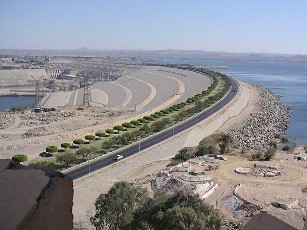
Sudan, Ethiopia and Egypt will meet to discuss Ethiopia's Grand Renaissance dam, currently under construction

The Sudanese capital Khartoum will host a new round of tripartite talks between Egypt, Sudan and Ethiopia on Saturday to discuss issues related to Ethiopia’s new Nile dam, Egypt's state-run news agency MENA reported Wednesday.

The talks -- which will include ministers of electricity, irrigation and water resources, as well as technical experts -- represent the third round of negotiations between the three states in an attempt to reach a settlement over Ethiopia's controversial Grand Renaissance dam project on the Blue Nile.

MENA stated that the three Nile Basin countries will issue a statement following the conclusion of the two-day talks.

The last negotiating round on 8 December led to the establishment of a tripartite committee to supervise the construction of the dam in a manner that guarantees the water interests of the involved parties to the crisis.

Sudanese President Omar Al-Bashir announced his support for the dam, currently under construction in Ethiopia, during a meeting with the country's Prime Minister Hailemariam Desalegn last month.

The pair signed 14 new agreements, covering security, a free trade zone, investment and electricity, and an agreement to build a railway line linking the two countries to enhance trade and economic relations.

In June, Ethiopia's parliament ratified a controversial international treaty to ensure its access to Nile water resources. It allows upstream countries to implement irrigation and hydropower projects without first seeking Egypt's approval. The deal replaces colonial-era agreements that granted Egypt and Sudan the majority of water rights.

Egypt and Sudan have not signed the treaty led by the Nile Basin Initiative, but six upstream nations have.

Ethiopia inked the deal in May 2010, and its ratification by parliament came amid rising tensions between Addis Ababa and Cairo over Ethiopia's construction of the dam on the Blue Nile.

Ethiopia began diverting the Blue Nile in May, paving the way for the construction of the $4.2 billion dam, set to become Africa's biggest hydroelectric dam when completed.

http://english.ahram.org.eg/News/90562.aspx

Egypt Prosecutors Investigate Sinai Gas Pipeline Bombing

Egypt prosecutors investigate Sinai gas pipeline bombing

Ahram Online, Wednesday 1 Jan 2014

Prosecutors in Egypt's Sinai Peninsula investigate Tuesday's attack on a pipeline delivering gas to Jordan

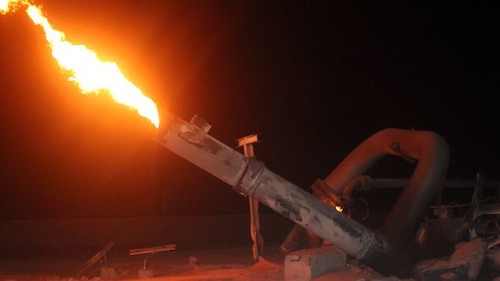
Egyptian prosecutors began investigations at the scene of an attack on a gas pipeline between Egypt and Jordan in Egypt's Sinai Peninsula Tuesday night.

Eyewitnesses living in Baghdad village in central Sinai had told Al-Ahram Arabic news website that they heard a large blast before midnight and saw flames from the pipeline shoot into the sky.

The gas pipeline which carried Egyptian natural gas to Israel and Jordan was been attacked 15 times by suspected Islamist militants.

Egypt halted gas exports to Israel in April 2012.

The attacks on the pipeline took place after the start of Egypt's revolution in January 2011 and lasted till the election of Islamist former president Mohamed Morsi in June 2012.

After Morsi's ouster by the armed forces following mass protests against him in June 2013, attacks on pipelines resumed, accompanied by an intensified militant campaign against the Egyptian army and police forces in Sinai.

http://english.ahram.org.eg/News/90588.aspx

Why 2013 Was a Good Year for Egyptian Cinema

Why 2013 was a good year for Egyptian cinema

Yasmine Zohdi, Sunday 29 Dec 2013

In 2013, four Egyptian films stood out, each in its own way taking Egyptian cinema into uncharted territory, gaining both critical acclaim and awards

The cinematic year in Egypt is ending with Qalb El-Asad (Heart of the Lion), a movie by El-Sobky Productions, on top of the Egyptian box office. El-Sobky is famous for films with catchy themes that appeal to mass audiences, rather than movies with depth or cinematic quality. Its productions always bring in the highest revenues in Egypt.

Yet despite Qalb El-Asad making
LE16,483,784 so far (almost $2.5 million), it is safe to say that other movies stood out this year, if not in tickets sales then for their thematic and cinematic content, testifying to the important values defining Egyptian cinema in 2013.

The highlights were a young director releasing his third and most highly acclaimed movie to date, a remarkable woman filmmaker producing her debut, a veteran film giant making a comeback, and an Egyptian documentary generating an Oscars buzz for the first time in Egypt's cinema history.

Rags and Tatters: The power of silence

Arguably the best Arab film of 2013, Ahmad Abdalla’s Rags and Tatters is the most unusual cinematic take on the Egyptian revolution yet —and perhaps the most honest.

The film is focused a nameless fugitive who escapes prison in the aftermath of the violent events of 28 January 2011, following him as he moves between several Cairo slums, simultaneously on a mission to deliver something of value to a friend’s family, and on a quest for a safe place to take refuge.

Although the film zooms in on the individual and his small tribulations at the expense of the public and the grand-scale events unfolding around him, Abdalla’s revolutionary inclinations remain apparent. The film is in its own way a tribute to the nameless heroes of the revolution, those whose faces we never got to see on TV. It is also a harsh reminder that the poverty the people rose to fight, a value clearly etched in the protesters' demand for "Bread, Freedom and Social Justice," is still rampant, and that the poor were in fact the first to suffer during the revolution’s stormiest days.

While Rags and Tatters cannot be labelled "experimental cinema," it is in fact an experiment —the first of its kind in Egypt.

The film, for the most part, is silent. The dialogue is restricted to sparsely placed conversations that never exceed two sentences. What it does not express in words, however, it evokes through sounds and images: soulful Sufi chants in a small mosque where the ground is covered in a colourful tapestry of adjacent prayer rugs; hidden glances of desire between a man and a woman; the protagonist and a friend smoking marijuana reflectively as they watch the black clouds rise from burning buildings across the Nile.

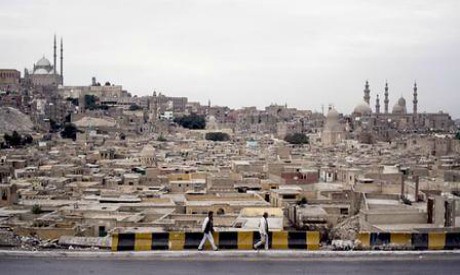
In one tracking shot, a truck loaded with a rusty children’s swing—a sign of joy in an otherwise desolate landscape—makes its way along a narrow, dusty road through the City of the Dead, Cairo's famous necropolis.

This scene could perhaps be imagined as representative of the progress that films like Rags and Tatters are making within the Egyptian film market: a fresh perspective, patiently carving out a path among decaying ideas.

The film, initially scheduled to show in cinemas for only one week, was screened for an extra week after distributors noticed impressive and unexpected ticket sales on its first few days in movie theatres.

Rags and Tatters received the highest award in the International Mediterranean Film Festival of Montpellier, the Golden Antigone, was screened in the Toronto International Film Festival and competed in the London Film Festival and Abu Dhabi Film Festival.

Read our review of the film and interview with Ahmad Abdalla here.

Villa 69: A camera breathing life into space

Although it had already received the Special Jury Award for a Film from the Arab World at the Abu Dhabi Film Festival, the team behind Villa 69 was still worried, days before the film’s Cairo premiere at the 6thPanorama of the European Film, that it would not appeal to Egyptian audiences.

However, by noon on the day of the screening, tickets were sold out, and organisers of the Panorama had to allocate an extra screening hall for the film.

Hussein (Khaled Abul-Naga) is a solitary man in his fifties who lives alone in a ramshackle villa that evokes a sense of faded beauty. Content in his self-imposed isolation, he is forced to deal with certain realities he had been refusing to address when his sister (Lebleba) and her grandson come to stay with him.

But director Ayten Amin’s debut feature relies on much more than the famous names in the cast. Perhaps even the remarkable acting performances of the cast were overshadowed by the film’s most imposing character: the villa itself. Members of the film’s crew have admitted that the owners of the charming old villa where the shooting took place had been rushing them during filming because the building was set to be demolished. However, through Amin’s camera, the site has been immortalised.

It is Amin’s masterful use of space —with the aid of art director and set decorator Shahira Nassef—that makes the film so memorable, promoting the location from a pleasant backdrop to an active presence in the film. Making sure to shoot every scene from a different angle, she allows viewers to discover a new corner of the villa each time, so that by the end of the film they feel as if they are as familiar with it as the people living there.

The characters have their fair share of impressive moments too, thanks to a screenplay subtly loaded with emotion and humour (written by Muhammad El-Hajj; Mahmoud Ezzat stepped in at a later stage) and acting that is honest and appropriately understated.

Villa 69is currently in cinemas.

Read our review of the film and our interview with its director.

The Square: Ticket to the Oscars?

There’s always been a lot of speculation about when Egypt, the country with the biggest film industry in the Middle East, would finally be nominated for an Oscar. Apart from Omar Sharif’s Best Supporting Actor nomination for his role in Lawrence of Arabia in 1963, Egypt hasn’t had much to do with the Academy Awards. And while everyone had assumed that when a nomination finally came it would be in the Best Foreign Language Film category, it looks like the first film to bring Egypt the honour might be a documentary about the revolution and the political turmoil that ensued.

Earlier this month, the Academy of Motion Picture Arts and Sciences announced that director Jehane Noujaim’s The Square is among 15 films shortlisted for the Best Documentary Award at the 2014 Oscars. So far, predictions have proclaimed it a favourite for a nomination, and perhaps even a win.

The film has already received the World Documentary Audience Award in the 2013 Sundance Film Festival, the People’s Choice Award in the Toronto International Film Festival and the Muhr Arab Documentary Award in the Dubai International Film Festival. It was screened in several movie theatres across New York and Los Angeles, but has not yet found its way to the screens of Cairo —the city where it all took place.

Following Ahmed Hassan —a young, idealistic Egyptian revolutionary—as its main protagonist, The Square documents events from the first 18 days of the revolution to Mohamed Morsi’s ouster. Among other characters in the film are activists like actor Khalid Abdalla, filmmaker Aida El-Kashef and singer/songwriter Ramy Essam, as well as Magdy Ashour, a Muslim Brotherhood member who—after the Muslim Brotherhood took power—drifts apart from the group of friends he became so fond of during the uprising.

The film’s portrayal of the one and a half years of military rule that followed Hosni Mubarak’s resignation leaves nothing out. It’s raw, brutal and —needless to say—it includes depiction of the army that is far from flattering.

When the film’s highly anticipated screening in Cairo, as part of the 6th Panorama of the European Film, was cancelled, the announcement was surrounded by persistent speculation that the decision was the result of military censorship. It is true the film did cause substantial trouble with the censors, but the team behind Panorama denied that this was the reason for the cancellation.

They announced in a statement that the censorship authorities had eventually given them a permit to screen the film, but that it would not be shown for technical reasons related to the copy of the film sent by the production company.

The team involved in the movie did not comment or release any official statement regarding any other possible reasons behind the cancellation of the screening than those presented by the Panorama organisers.

However, it is not yet clear whether The Square will be screened in Egypt any time soon, or ever.

The Academy Award nominations will be announced on Thursday, 16 January 2014.

Factory Girl: Khan is back

Mohamed Khan is undisputedly an icon of contemporary Egyptian cinema. Some of Egypt’s greatest masterpieces were a result of his vision and skill, and three of his films — El-Harreef (The Street Player, 1984), Zawgat Ragol Mohem (The Wife of an Important Man, 1987) and Ahlam Hind w Camilia (Dreams of Hind and Camilia, 1988)—were chosen among the "100 Greatest Arab Films" by the Dubai International Film Festival.

However, many of the master filmmaker’s fans were disappointed with more recent works of his, beginning with the films he made in the mid-1990s, such as Mr Karate (1993), all the way to Ayyam El-Sadat (Days of Sadat, 2001) and Banat West El-Balad (Downtown Girls, 2005). Some found a satisfying degree of his old flair in his 2007 drama Fi Shaqqet Masr El-Gedeeda (In the Heliopolis Flat), while others were not quite convinced.

It seems, though, that Khan’s latest venture, Fatat El-Masnaa (Factory Girl), is the definitive comeback: a film that few would disagree on. While it has not yet been screened in Egypt, the film premiered in the Dubai International Film Festival to rave reviews, winning the FIPRESCI award for best feature. Its lead actress, Yasmine Raees, walked away with the Best Actress Award in the Muhr Arab Feature Competition as well.

The film tells the story of one year in the life of Hiyam (a feisty, defiant Raees), a young woman working in a clothing factory who falls in love with her supervisor. Things start to turn sour when a false accusation is made and Hiyam, out of pride, refuses to defend herself, in turn paying a steep price. In its essence the film is about women who seek independence in a society that barely allows them to breathe.

Factory Girlis written by Khan’s wife, Wessam Soliman. In order to understand her characters, Soliman worked long hours in disguise at a clothing factory herself and used public transport every day for several months.

Produced by Mohamed Samir, a young but experienced film editor, with budgets raised through seven different funding bodies, it was Khan’s first shot at independent production. Although working on a limited budget is challenging, the veteran director says the constant need to adjust his vision to financial constraints without compromising was a useful learning process.

http://english.ahram.org.eg/News/90235.aspx

UK Has Not Blacklisted Egyptian Brotherhood, Ready to Hear 'Terrorism' Evidence

UK has not blacklisted Brotherhood, ready to hear 'terrorism' evidence

Amer Sultan in London , Wednesday 1 Jan 2014

London says the Egyptian government retains the right to present its evidence of Brotherhood involvement in terrorist activities

The British government has confirmed that the Muslim Brotherhood has not been blacklisted in the UK, in contrast to the Egyptian government’s recent decision to declare the group a terrorist organisation.

“The Muslim Brotherhood is an entirely legal organisation in the UK,” a UK Foreign and Commonwealth Office spokeswoman told Ahram Online on Tuesday on condition of anonymity.

”We are assessing the implications of the interim [Egyptian] government's recent decision to designate the Muslim Brotherhood a terrorist group and are discussing with international partners,” she added.

Last week the Egyptian cabinet formally declared the Muslim Brotherhood, Egypt’s largest political organisation, a terrorist group, effectively rendering membership illegal.

The UK spokeswoman said that Egypt has the right to make a presentation on the evidence it may have to prove the Brotherhood is involved in terrorism, although there is no guarantee that that the Brotherhood will be proscribed in the UK.

"The UK government believes stability and security is best served in Egypt by bringing all Egyptians into the mainstream political process".

Fifty-two organisations are proscribed under the terms of the UK Terrorism Act 2000, including Egypt’s Islamic Jihad.

http://english.ahram.org.eg/News/90530.aspx

Egypt Doctors Syndicate Holds Partial Strike Nationwide

Egypt doctors syndicate holds partial strike nationwide

Ahram Online, Wednesday 1 Jan 2014

Health minister plays down effects of strike, but organisers point to high participation

A partial strike by Egyptian doctors on Wednesday has been declared a success by organisers, although the government has downplayed its effects.

The newly elected board of the Doctors Syndicate called for a nationwide partial strike on 1 January and 8 January to demand reform of the health system in Egypt.

The partial strike excludes emergency services.

The syndicate has rejected a pay incentive scheme enshrined in a new law regulating medical professions insisting, instead, on a flat pay increase across the board.

Meanwhile, the Pharmacist syndicate also started a nationwide strike over rejection of the same law.

Participation debated

Minister of Health Maha El-Rabat said at a press conference on Wednesday that only 30 percent of the ministry's hospitals nationwide are participating in the partial strike. She added that 10 of Egypt's 27 governorates were completely unaffected by the calls for the strike and experienced a normal work day.

The ministry has prepared for the strike by dedicating special phone lines that will receive emergency phone calls during the strike, including 123 for ambulance services.

However, Mohsen Azzam, a doctor and one of the organisers of the strike in Gharbiya governorate in the Delta, told Ahram Online that while the participation in the partial strike varied across the governorate, some hospitals saw 100 percent participation rate.

According to Azzam, the Interim Manager of the Manshawy Hospital in Gharbiya has already been reported to the syndicate for strike-breaking.

Amr El-Shora, a member of the doctors' syndicate board and a strike organiser in Greater Cairo, told Ahram Online that the initial incoming reports from Egypt's different governorates show a participation rate ranging from 75 to 85 percent nationwide.

Ragy Baibars, one of the organisers of the strike in Port Said, agreed that the participation level in the strike is very high, although did not give figures.

The Pharmacists Syndicate, which includes around 20,000 pharmacists, also announced that 70% of its members nationwide honoured the strike.

Since 2011 the doctors' syndicate has consistently demanded an increase in doctors' minimum wages at a national level.

The first nationwide doctors strike was in May 2011, covering most public hospitals and several university hospitals. The strikers’ demands included increasing doctors' minimum wages and raising the national health budget from 3.5 percent of the total state budget to 15 percent.

The syndicate also initiated a partial strike from October 2012 to March 2013 to put pressure on the government to meet their demands.

In October, the Egyptian government announced that LE 1,800 per month would be the minimum starting salary for doctors beginning in January 2014, but the Doctors Syndicate argues that this is not an adequate minimum wage for medical professionals.

"The tiny budget dedicated to doctors is being wasted by corruption within the profession," argued Baibars.

The new minimum wage for all public sector workers regardless of rank or specialty is LE1,200 per month. It is due to take effect in January.

The current Board of the Doctors' Syndicate, elected on 15 December, is composed of a coalition of independent members who ended 30 years of Brotherhood domination over the union.

http://english.ahram.org.eg/News/90564.aspx

Egyptian Police Fire Teargas at Anti-Military Protests in Cairo

Police fire teargas at pro-Morsi student protests in Cairo

Ahram Online, Wednesday 1 Jan 2014

Students storm Supreme Council of Universities office in Cairo University; Ain Shams University students attempted to block off a main road in northern Cairo

Students at Ain Shams University in Cairo who support the Muslim Brotherhood organised protest marches on Wednesday, blocking off Khalifa Al-Maamoun road, which leads to the Ministry of Defence.

Security forces used teargas to disperse students at the site, reported Al-Ahram’s Arabic website. Some of the students were arrested.

The students chanted slogans against the military and the police.

At Cairo University, student protesters stormed the Supreme Council of Universities (SCU), which is located on the university’s main campus, to express anger at decisions by the council to allow Egyptian security forces on to campus to secure facilities during the current exam period and the death of one of their fellow students in recent clashes with security forces.

Protesters smashed glass windows inside the SCU building, Ahram Arabic news website reported.

University security attempted to disperse protesters using water cannons and fire-extinguishers.

Shortly afterwards, students, chanting slogans against the police and the military, clashed with security forces outside the campus.

Three students were injured during the clashes.

Later in the afternoon, pro-Brotherhood students at Cairo University marched to the Security Directorate of Giza governorate, located close to the university.

Students set fire to campaign posters that call on Egyptians to vote yes in the upcoming constitutional referendum.

Since the start of the academic year in September, Egyptian universities have been hubs of protest by supporters of deposed president Mohamed Morsi, ousted by the army in July amid massive nationwide protests against his rule.

Clashes between students and police are reported on near-daily basis. A number of students have died in the violence.

Scores of students have also been arrested amid the unrest since the beginning of the school year.

http://english.ahram.org.eg/News/90565.aspx

Egypt State-backed Labor Federation Supports Constitutional Referendum

Egyptian Federation for Trade Unions calls for 'Yes' in constitutional referendum

Ahram Online, Wednesday 1 Jan 2014

Egypt's Federation for Trade Unions will endorse the new constitution, despite the cancellation of the traditional 50 percent quota for workers and farmers in parliament

Mohamed Salem, secretary-general of the state-backed Egyptian Federation for Trade Unions, has said the union will endorse Egypt's new draft constitution.

"We should all unite together; so we decided to vote 'Yes' on the constitutional referendum," Al-Ahram Arabic news website reported him as saying Wednesday.

Salem said the union approves of the draft constitution despite dropping a 50 percent quota of seats in parliament for workers and farmers —an ommision that led the federation's president to withdraw from the constitution amending committee.

The 50-Member Committee was tasked by Egypt's interim president, Adly Mansour, with amending the 2012 Constitution approved by popular referendum under the rule of ousted president Mohamed Morsi.

Adel Nazmy, president of the General Syndicate of Public Facility workers, said in a press conference Wednesday that he sent a letter to President Mansour and military chief General Abdel-Fattah El-Sisi to express the syndicate's approval of the newly drafted constitution.

Azmy added that the syndicate is aiming to increase production and will be working for a better and democratic Egypt.He also stressed that the syndicate formed committees inside workplaces to urge workers to vote yes to the new constitution, and that on the day of the referendum—scheduled for 14-15 January—transportation to polling stations would be provided for all workers.

Federation pleas to government

Abdel Fattah Ibrahim, president of the Egyptian Federation for Trade Unions, implored President Mansour to hold presidential elections before parliamentary elections. He said workers "want parliamentary elections to be held while the country is stable, and this will not happen unless a president is elected first."

Ibrahim added that the government must not turn a blind eye towards the poor in Egypt, who represent a huge segment of Egyptian society.

On accusations of corruption in the federation, Ibrahim said he had sent a file to the prosecutor general in November that responds to this issue.

On textile industry issues, Ibrahim highlighted the need to solve problems in the sector, accusing the government of negligence and explaining that the government had promised to open factories and to return to work all dismissed workers, but that this had not happened.

Towards the end of the press conference, Ibrahim said he is aware of workers' needs, adding that the minimum wage is still insufficient.

The press conference ended with workers chanting, "El-Sisi is my president, Yes for the constitution, Long live Egypt!"

http://english.ahram.org.eg/News/90587.aspx

Mogadishu Hotel Targeted by Bombs, At Least 11 Killed

Mogadishu hotel targeted by bombs, at least 11 killed

8:12pm EST
By Abdi Sheikh and Feisal Omar

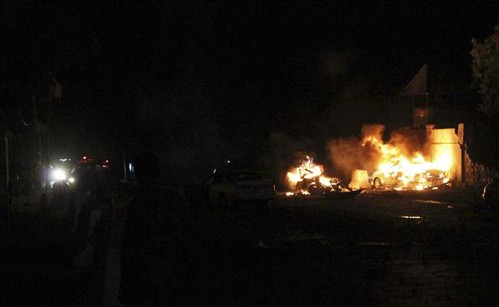
MOGADISHU (Reuters) - Three bombs exploded within an hour outside a hotel frequented by government officials in a heavily fortified district of the Somali capital on Wednesday, killing at least 11 people.

The attacks on the Jazira hotel, one of the securest places in Mogadishu, underscore the security challenges facing President Hassan Sheikh Mohamud, whose election by lawmakers last year was hailed by many as a way to end two decades of conflict.

The first two bombs came in quick succession and were followed by heavy bursts of gunfire by Somali security forces.

The third blast took place about an hour later when a bomb went off inside a car that was being searched by the military.

At least one of the first two bombs appeared to be a suicide bomber, police said.

There was no immediate claim of responsibility but the Islamist rebel group al Shabaab has carried out a campaign of attacks over the past two and a half years in Mogadishu.

"First we heard a big crash and the security forces immediately opened fire," said Abdullahi Hussein who lives 300 meters behind the hotel. "After a few minutes another explosion took place and there was more gunfire."

Abdikadir Abdirahman, the director of a private ambulance service, told Reuters at least 11 people had been killed and 17 others were wounded.

The attack will be an embarrassment to the government whose survival depends heavily on a near 18,000-strong African peacekeeping force. Donors pump in hundreds of millions of dollars into the Horn of Africa country every year to provide basic services.

"This year, 2014 is going to be the strengthening of Somali forces and the elimination of the extremists," the newly appointed Prime Minister Abdiweli Sheikh Ahmed said in a statement on Wednesday.

The African forces helped drive al Shabaab out of the capital in August 2011, as well as other major urban centers, but the militants still hold sway over swathes of rural areas.

Islamist suicide bombers attacked the Jazira hotel in September last year as Mohamud was giving a news conference just two days into the job. He and the visiting Kenyan foreign minister were unhurt in that assault.

An attack on Kenyan shopping mall in September that killed dozens of people highlighted the militants' ability to strike beyond Somalia's borders.

(Reporting by Abdi Sheikh and Feisal Omar; Writing by Richard Lough; Editing by Alison Williams)

Demonstrate Against Barclays Deal for Detroit: Pursue Litigation Against the Banks!

For Immediate Release – January 1, 2014

REJECT EMERGENCY MANAGER’S $165 MILLION PAY OUT TO BANK OF AMERICA AND UBS

DEMONSTRATE OUTSIDE FEDERAL COURT, FRIDAY JANUARY 3, 8:30 A.M.
Location: 231 W. Lafayette in Downtown Detroit
Contact: (313)-671 3715, 680-5508
URL: http://moratorium-mi.org

At a deposition this week, Emergency Manager Kevyn Orr testified that he had his attorneys draft a complaint against Bank of America and UBS charging them with fraud, unjust enrichment and breach of contract among other counts in connection with placing the City of Detroit in interest rate swaps that have cost the city hundreds of millions of dollars since 2006.

He said he spoke with the Securities and Exchange Commission about enlisting their aid in investigating these charges. The SEC has brought many similar complaints against the banks for misconduct in the municipal bond market.

Orr testified that he believed the city’s potential in succeeding in this complaint, which could recover up to $500 million from these banks, was 50-50.

Pursuing this complaint against the banks would net real revenue to rebuild Detroit’s neighborhoods which were destroyed by approximately 100,000 foreclosures resulting from the predatory lending practices of the banks.

Incredibly, instead of pursuing this complaint, this week Emergency Manager Orr is going to the bankruptcy court to seek approval of a “deal” that was negotiated last week to pay Bank of America and UBS $165 million plus $4 million in breakage costs to terminate the interest rate swaps which have already netted the banks about $300 million in profit. He will also seek approval of a loan from Barclays at interest rates up 8.5% to pay this $165 million to UBS and Bank of America, secured by a $48 million per year lien on city income tax revenues for the next 4 years, which amounts to about 20% of all income taxes collected.

Rather than going after the banks to make them repay the city for the destruction they have caused, Emergency Manager Orr is opting to allow the banks to continue their stranglehold over Detroit’s finances, ensuring that services, jobs and pensions will continue to be slashed.

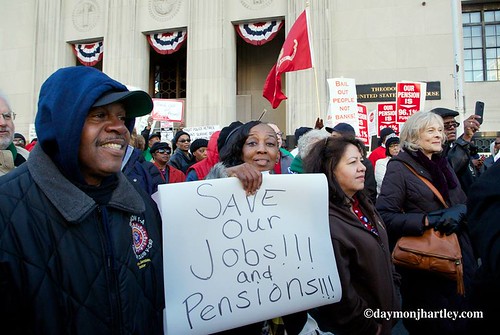
Join us in front of the Federal Courthouse downtown when the trial on the swaps agreement resumes on Friday morning January 3. We will gather at 8:30 a.m. for a mass demonstration demanding that the illegal bank debt be cancelled and the democratic rights of the people of Detroit be immediately restored. Demonstrations in solidarity with the people of Detroit are also being held in New York City, Baltimore, Raleigh, NC and Oakland, CA.

We are also encouraging people to pack the courtroom of Judge Rhodes at 9:00 a.m. in federal bankruptcy court. Only the workers, retirees and community residents of Detroit can reverse the current crisis.

Cancel Detroit's Debt --Make the Banks Pay for the Destruction they have caused
Hands Off Our Pensions
Save City Services and Assets
Make the Banks Fund a jobs program for our youth to rebuild our communities

Leonard Peltier: 'Apartheid Exists in America'

Leonard Peltier: ‘Apartheid exists in America’

By Workers World staff on December 21, 2013

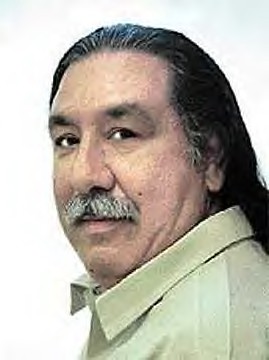
Taken from a Dec. 5 statement which can be read in its entirety at Native News Online at tinyurl.com/q7rcsnp. Political prisoner Leonard Peltier has been incarcerated for 37 years.

It saddens me to hear that a great man like Nelson Mandela has departed from this lifetime. He was a man who was truly inspirational and showed us the possibilities of how a continued struggle by Indigenous people could manifest itself in levels of freedom that have been marred by centuries of oppression.

Our Native people suffered the same types of oppression many times. It is not as overt and as easily distinguished as in some places; however, if you are dead because a policeman shot you, or dead because you could not stand the racial and cultural genocide, so you committed suicide — you are just as dead either away.

Nelson Mandela is known for leading the struggle against apartheid in South Africa. America talked about ending apartheid and put sanctions on South Africa. Not being all that adept at the English language, it is my understanding that “apartheid” means to keep someone apart from something. My people have been kept apart purposely from the sacred Black Hills of South Dakota. There were, and still are, measures that keep us apart from our true history, perpetrated by an education system that limits the truth of our being.

Right now in Canada, Native people are struggling to protect their aboriginal lands from fracking, which destroys the water tables and disturbs the natural balance of the Earth. With an apartheid mentality, they seek to build pipelines across Native lands that have the potential of great ecological destruction.

Right now, there is an apartheid that seeks to separate us from the protection of the Constitution of the United States, which says treaty law is the supreme law of the land; which also says you have a right to an unbiased fair trial; which also says you have a right to a jury of your peers. Right now our young Native people are tried as adults THREE times more than other groups and kept “apartheid” from their families and kept “apartheid” from competent legal representation.

We must all consider Nelson Mandela an inspiration, but I am also inspired by the least of our people who stand up for what is right, like the young man or young woman who peacefully mans a roadblock against developers or fracking companies or some factory that hurts our air.

I want to remember Wanbli Tate who tirelessly championed the rights of Indigenous people to bring attention to the wrongdoers represented in government and corporations.

I remember my brother Russell Means who was also tireless in his efforts in trying to bring about an end to this American version of apartheid that faces Native people.

In the spirit of all those who have gone before us in this struggle, stay strong and NEVER, NEVER give up.

In the spirit of Crazy Horse,

Leonard Peltier
Mitakuye Oyasin

Why Not Amnesty Here?

Why not amnesty here?

By Editor on January 1, 2014
Workers World

In December, Russian President Vladimir Putin signed an amnesty for some 20,000 prisoners — including the Greenpeace protesters, the Pussy Riot punk band, who are considered dissidents, and his billionaire political opponent Mikhail Khodorkovsky. Putin’s political enemies quickly denounced this amnesty as a cynical political maneuver, a comment repeated widely in the imperialist media.

Khodorkovsky is a favorite of the U.S. ruling class because he’s a newly superrich robber baron. No one, to our knowledge, refused the amnesty, regardless of what they called it.

We have a suggestion for President Barack Obama: Outdo Putin.

Obama has barely used his power of pardon. Even George W. Bush outpardoned him. A blanket amnesty could quickly reverse this.

U.S. imperialism is the world’s No. 1 jailer, with more than 2 million prisoners. With 5 percent of the world’s population, the U.S. locks up 25 percent of the world’s prison population. More than 3,000 prisoners still face ­execution.

Not only are 70 percent of prisoners people of color, but 90 percent are from families that cannot afford the high cost of legal representation. Many have been in prison 30 years or more. Many others got 15-year-minimum sentences for “crimes” like selling marijuana.

Some prisoners are known far and wide for the political nature of their incarceration and are the center of campaigns for their release. These international heroes and heroines should top the pardon list:

Mumia Abu-Jamal, in prison 32 years, 30 on death row.

Leonard Peltier, 36 years.

Oscar López Rivera, 33 years.

Lynne Stewart, a people’s attorney diagnosed with terminal breast cancer.

Four of the Cuban 5, still in prison after 15 years.

Maybe not as well known but equally facing unjust and/or frame-up sentences are:

The surviving eight of the Move 9 prisoners — Charles, Debbie, Delbert, Edward, Janet, Janine, Michael and William, all with the surname Africa — 34 years.

Sundiata Acoli, 40 years.

Ruchell Magee, 44 years.

Imam Jamil (formerly H. Rap Brown), 10 years.

Albert Woodfox, the last of the Angola 3, 30 years. Robert King was finally released after 29 years in solitary confinement and Herman Wallace died three days after he was released last October from the infamous Louisiana prison plantation after more than 41 years in solitary.

And there’s Assata Shakur, who has spent 40 years in prison or exile and has a $2 million bounty on her head. She escaped U.S. racist injustice for asylum in Cuba.

At the website of the Jericho Movement, you can see a list of more political prisoners, who belonged to organizations like the Black Panther Party, La Raza Unida, FALN, Los Macheteros, the North American Anti-Imperialist Movement, May 19th, AIM, the Black Liberation Army, etc. They are in prison because of their political beliefs and acts in support of and/or in defense of freedom for their people from imperialist rule.

There are the mostly Muslim prisoners framed up in the post-9/11 frenzy. There are the prisoners still held at Guantánamo. And there are undoubtedly others who missed making any lists.

A revolutionary workers’ movement in the U.S. should want to “tear down the walls” of the penitentiaries. In the meantime, we challenge Obama to pardon even a small part of the prison population, the hundreds who are heroes for their people and the hundreds of thousands who are only behind bars because of racist injustice and class exploitation.