Saturday, January 29, 2011

Egyptian News Bulletin: Uprising Continues Throughout the Country; Military, Police Role Questioned

Mubarak names his deputy and new PM

Protests continue as Egyptian president appoints former spy chief as his vice-president for the first time

Last Modified: 29 Jan 2011 17:12 GMT

Protesters in Egypt are calling for "regime change, not cabinet change", our correspondent said

Egyptian president Hosni Mubarak has appointed the country's head of intelligence to the post of vice-president, in a move said to be a reaction to days of anti-government protests in cities across the country.

Omar Soliman was sworn in on Saturday, the first time Mubarak appointed a vice-president during his 30-year rule. Ahmad Shafiq, a former chief of air staff, was also appointed prime minister.

But Al Jazeera's correspondents in Egypt have said that many of those on taking to the streets have demanded a total change of guard, as opposed to a reshuffling of figures in the ruling National Democratic Party (NDP).

Tens of thousands of people in the capital Cairo gathered on Saturday, demanding an end to Hosni Mubarak's presidency.

The demonstrations continued in defiance of an extended curfew, where state television reported will be in place from 4pm to 8am local time.

A military presence also remains, and the army warned the crowds in Tahrir Square that if they defy the curfew, they would be in danger.

Al Jazeera's Ayman Mohyeldin, reporting from Cairo, said that soldiers deployed to central Cairo are not intervening in the protests.

"Some of the soldiers here have said that the only way for peace to come to the streets of Cairo is for Mubarak to step down," he said.

Similar crowds were gathering in the cities of Alexandria and Suez, Al Jazeera's correspondents reported.

Reports have also emerged that at least three people have been killed, as protesters attempted to storm the interior ministry in Cairo.

Fears of looting have also risen, and the army on Saturday warned local residents to "protect their property and possessions".

In the port city of Alexandria, residents called on the army to protect them against looting, as well as organising their own committees in defence. Looting hasalso occurred in wealthy areas of Cairo.

Al Jazeera's Sherine Tadros reporting from Suez, said that looting is widespread and that people have been walking into buildings and stealing objects.

"Residents here are pleading with the military to stop watching this happen, and act to enforce some security," she said.

Cabinet resigns

The Egyptian cabinet meanwhile have formally resigned in response to the protests, and Ahmed Ezz, a businessman and senior figure in the ruling National Democratic Party (NDP) also resigned from his post as chairman of the Planning and Budget Committee.

Protesters ransacked and burned one of his company's main offices in Mohandiseen, an area of Cairo.

State media reported on Saturday that some protesters held up posters with a cross marked over the face of Ezz, who is chairman of Ezz Steel.

Meanwhile, overnight protests were also held on Friday in cities across the country, in what has been viewed as unprecedented anger on the part of the Egyptian people.

In Alexandria, Al Jazeera's Rawya Rageh reported that scores of marchers were calling on Hosni Mubarak to step down.

"They are calling for regime change, not cabinet change," Rageh said.

She said that they were blocking traffic and shouting "Illegitimate, illegitimate!"

The Reuters news agency reported that police had fired live ammunition at protesters, but there is no independent confirmation of that report.

In Suez, Al Jazeera's Jamal ElShayyal reported that 1,000-2,000 protesters had gathered, and that the military was not confronting them.

ElShayyal quoted a military officer as saying that troops would "not fire a single bullet on Egyptians".

The officer also said the only solution to the current unrest was "for Mubarak to leave".

ElShayyal said that 1,700 public workers in Suez had gone on an indefinite strike seeking Mubarak's resignation.

The latest protests reflected popular discontent with Mubarak's midnight address, where he announced that he was dismissing his government but remaining in power.

The several hundred protesters in Tahrir Square demonstrated in full view of the army, which had been deployed in the city to quell the popular unrest sweeping the Middle East's most populous Muslim country since January 25.

They repeatedly shouted that their intentions were peaceful.

According to the Associated Press, the road leading from Tahrir Square to the parliament and cabinet buildings has been blocked by the military.

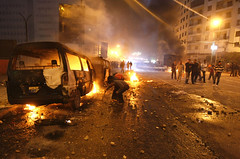
Al Jazeera's Jane Dutton, reporting from Cairo, said the normally bustling city looked more like a warzone early on Saturday morning.

Tanks have been patrolling the streets of the capital since early in the morning, and a statement from the Egyptian armed forces asked citizens to respect the curfew and to avoid congregating in large groups.

An extended curfew has now been ordered by the military, running from 4pm to 8am local time, in Cairo and other major cities.

State television is also reporting that all school and university exams have been postponed.

Rising death toll

Cities across Egypt witnessed unprecedented protests on Friday, with tens of thousands of protesters taking to the streets after noon prayers calling for an end to Mubarak's 30-year rule.

The number of people killed in protests is reported to be in the scores, with at least 23 deaths confirmed in Alexandria, and at least 27 confirmed in Suez, with a further 22 deaths in Cairo.

Al Jazeera's Rageh in Alexandria said that the bodies of 23 protesters had been received at the local morgue, some of them brutally disfigured.

She added that human rights activists had reported that a further 13 bodies were present at the general hospital.

ElShayyal, our correspondent in Suez confirmed 27 bodies were received at the morgue in Suez, while Dan Nolan, our correspondent in Cairo, confirmed that 22 bodies were present at a morgue in Cairo.

More than 1,000 were also wounded in Friday's violent protests, which occurred in Cairo and Suez, in addition to Alexandria.

Dutton, in Cairo, said the number of the people on the streets "increased after president Hosni Mubarak's speech shortly after midnight".

Regarding the situation in the capital on Saturday morning, she said "there is broken glass everywhere ... a lot of the burnt out shells of the police cars have been removed but you are aware that there were hours and hours of skirmishes on the streets of the capital city [last night]".

The ruling NDP headquarters in the capital is still ablaze, more than 12 hours after it was set alight by protesters.

The Egyptian army said it had been able to secure the neighbouring museum of antiquities from the threat of fire and looting, averting the possible loss of thousands of priceless artefacts.

Armoured personnel carriers remain stationed around the British and US embassies, as well as at the state television station.

Some mobile phone networks resumed service in the capital on Saturday, after being shut down by authorities on Friday. Internet services remain cut, and landline usage limited.

Authorities had blocked internet, mobile phone and SMS services in order to disrupt planned demonstrations.

'Mobs' and 'criminals'

Maged Reda Boutros, a member of the ruling National Democratic Party, told Al Jazeera that the political regime in Egypt was "admitting" that it was not meeting the expectations of the people, and that was why the cabinet was resigning.

"It shows a response to the demands of the people," he said.

He alleged that the protests have been taken over by "mobs" from the "lower part of the society", who are now engaged in "burning, looting and shooting".

"Now it has turned from a noble cause to a criminal cause," he said, saying that most of those involved in the protests were criminals.

He said that half of those killed are members of the security forces, who died while acting in self defence.

"People should wait and see what's going to happen. But if they continue doing protests and letting those criminals loose in a large city of 17 million people ... we cannot play with the stability of the country."

Mohamed ElBaradei, a leading opposition figure, told Al Jazeera that protests would continue until the president steps down. He also stressed that the political "system" will have to change in Egypt before the country can move forward.

He termed president Mubarak's speech "disappointing", and called on him to resign. The former head of the International Atomic Energy Agency (IAEA) also expressed "disappointment" with the US reaction to the protests, though he did stress that any change would have to come from "inside Egypt".

He said that Mubarak should put in place an interim government that would arrange free and fair elections.

ElBaradei added that he was not aware of his reported house arrest.

Friday's demonstrations involving tens of thousands of people were the biggest and bloodiest in four consecutive days of protests against Mubarak's government.

Source: Al Jazeera and agencies


Egypt's military in a quandary

Al Jazeera's senior analyst Marwan Bishara sheds light on what the military is likely to do

Marwan Bishara
Last Modified: 29 Jan 2011 16:45 GMT

Armed personnel tanks have been patrolling the streets of Cairo to enforce President Hosni Mubarak's curfew

As Egypt continues to unravel under the pressure of a popular uprising against the Hosni Mubarak government, we look at the role of its military as the guardian of sovereignty and national security.

Where is Egypt heading after days of revolt?

Clearly the way forward is not the way back. But since President Mubarak has opted for more the same old and bankrupt ways of dealing with national uprising, making promises of change and cosmetic alteration to governance essentially, all now depends on the momentum of the popular uprising and the role of the military.

Mubarak's attempts to delegitimise the popular revolt as isolated incidents exploited by Islamists has fallen on deaf ears at home and abroad. As the revolt continues to expand and gain momentum in major Egyptian cities and protestors demand no less than the removal of his regime, it's now the military's choice to allow for the change to be peaceful or violent.

So far, it has opted for merely policing the streets without confronting the demonstrators, whether this will turn into a Tiananmen scenario of tough crackdown or not, will be decided in the next few hours or days.

But Egypt is not China, and it could hardly afford such national confrontation.

But what else can the military do?

The Egyptian military could follow the Tunisian military by refusing orders to shoot at demonstrators or impose the curfew.

The military can replace Mubarak with a temporary emergency governing council or leave it for civilian opposition groups to form government in consultation with the military.

This depends on the cost and benefits of keeping Mubarak who's long been the military man at the helm of the regime. Appointing intelligence chief Omar Suleiman as his vice president, and hence ending his son's chances for succession, will make little difference on the long term.

There is direct correlation between continued momentum of the uprising and the need to remove Mubarak, his family and his political leadership from the helm. Also, the military will make its calculation on the basis of delicate balancing act that insures its own influence and privileges while not allowing the country to descend into chaos.

And as the ultimate guaranteur of the national security, the Egyptian military must also take regional and international factors in consideration, notably the United States.

Will the Chief of Staff of the Egyptian military play a new role for the United States?

The Obama administration has probably put the Egyptian military chief of staff, Lt. Gen. Sami Hafez Anan, on notice before he left the US capital on Friday, and explained what it can, could not or would not stand for in terms of the military's response to the revolt.

Washington has been a major backer of the Egyptian military over the last three decades, supplying the country with around $2bn in annual aid mostly for military purposes. When the uprising broke out, Anan was in Washington as part of their annual strategising sessions.

Clearly caught by surprise, the US has been a mere spectator over the last several weeks, as people took to the streets in Tunisia or Egypt.

The Obama administration continued its predecessor's policy of nurturing contacts and consultation with various Egyptian opposition groups in addition to the military.

It understands all too well that the response of the Egyptian military will have far reaching influence, not only on the situation in Egypt, but also on other countries in the region, no less on its future relationship with Israel.

For the military to be the guardian of the state's sovereignty and stalbility, it must be the protector of Egypt's future politics, not its permamnent leader.

Source: Al Jazeera

International Action Center Statement in Solidarity With the People of Egypt

U.S. hands off North Africa and the Middle East!

Long live the Egyptian people’s struggle!

Join demonstrations in solidarity with the Egyptian people

International Action Center statement -- Jan. 28, 2011

A seemingly all-powerful military, police and media apparatus, that has had the support of the U.S. superpower for decades, is crumbling before the even greater strength of a united people who have first conquered fear and may now push the dictator’s regime into the dustbin of history.

This struggle began in Tunisia in December when a young street vender chose to burn himself rather than face humiliation. It has spread to Algeria, to Yemen, to Jordan and now to the largest and most central state in the Arab world, Egypt. This country, with its rich ancient history and its impoverished population -- with more than 80 million people it is the largest of the North African states -- is now finding its way back into center stage of world events.

Ever since the Camp David agreements, Egypt has been a client state of U.S. imperialism. The U.S. has supplied Egypt with $1-2 billion in military aid over the years since the 1979, second only to the aid the U.S. gives to the Israeli settler state. This aid includes the tear gas, rubber-coated bullets and live ammunition supplied the Egyptian riot police.

In turn, Hosni Mubarak’s Egypt supported the U.S. war against Iraq in 1991; it blocks the entrance to embattled Gaza today. Because Egypt is the lynchpin of U.S. imperialist foreign policy within the Arab countries, the current revolutionary crisis in Egypt raises the possibility -- even the likelihood -- that Washington will attempt to intervene in Egyptian internal affairs, with a good chance that this will mean military intervention.

Tonight (Jan. 28) President Barack Obama -- realizing the Mubarak dictatorship’s days were numbered, made some statements distancing the U.S. from the 30-year-old regime in Egypt. We should remember, however, that in his State of the Union message, President Obama spoke of the U.S.’s alleged role spreading ‘democracy,’ but he pointedly avoided mentioning Egypt.

As an anti-war and anti-imperialist solidarity group working within the United States, the International Action Center pledges to help build actions in solidarity with the people of Egypt and of all of those countries where people are struggling for democracy and freedom from imperialist domination. Thus the IAC will join the actions of the Egyptian community in the United States protesting the Mubarak regime, and it will build actions to demand that the U.S. desist from intervening in Egyptian affairs and especially that there be no military intervention against the Egyptian people.

Over the next days there are demonstrations planned in cities around the U.S. to show solidarity with the Egyptian people’s struggle. The IAC calls on its supporters to join these actions.

International Action Center 55 West 17 Street, New York, N.Y. 10011 tele: 212 633 6646

Website: http://www.iacenter.org ; email: iacenter@iacenter.org

Ivory Coast Leader Gbagbo's Party Slams Odinga' Role in Conflict

Gbagbo’s party slams Odinga

Saturday, 29 January 2011 00:09
From Robert Mukondiwa in ABIDJAN, Cote d’Ivoire

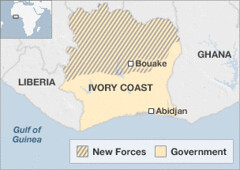
Ivorian President Laurent Gbagbo’s party has spoken for the first time on the reasons behind its decision to reject the presence of Kenyan Prime Minister Raila Odinga as mediator to break the electoral impasse here.

While President Gbagbo himself has remained mum ahead of the African Union Summit taking place in the Ethiopian capital of Addis Ababa,

FPI party president Pascal Affi N’Guessan has said Odinga came to Abidjan with “preconceived opinions”, jeopardising his task of being a non-partisan mediator.

“Mr Odinga was not up to the task. That is why we decided to reject him as a mediator.

“A mediator is supposed to be a good listener but he came here with preconceived opinions,” said N’Guessan in an interview yesterday.

“At the end of the mission he made biased statements based on his own sentiments and we found that worrying.”

N’Guessan said while Odinga was a naïve choice by the African Union given his own almost carbon copy experiences in Kenya — where he opposed Mwai Kibaki’s legitimacy as president after elections — Cote d’Ivoire had not prejudged him on his past and had hoped he would look at the facts and not draw from emotions.

“The choice of Odinga as mediator was not by us, but by the African Union and we accepted him because he is the Prime Minister of a respected African nation.

“We found it appropriate not to have preconceived opinions about him.

We wanted to judge him on his work on the ground and not on his past personal battles.

“With this background it was up to Odinga to show he was equal to the task, but sadly he failed to do so,” said N’Guessan.

The FPI leader, however, said former South African President Thabo Mbeki had “maturely and correctly” read the situation on the ground, producing a “spot on” report on what had fomented tensions.

“Mr Mbeki’s report on the crisis was swept under the carpet and not produced to the rest of the world. That is because it was not favourable to the West, led by France, who wanted to paint a picture that President Gbagbo had lost the election.

“Mr Mbeki’s report shows that the constitution was disregarded in the declaration of Ouattara as the winner in the elections,” explained N’Guessan.

The Independent Electoral Commission only had the mandate to proclaim a winner three days after the election after which only the Constitutional Council held that mandate.

However, the head of the Electoral Commission went ahead and declared Ouattara the winner four days after the close of balloting.

Further, he did so alone instead of in the presence of the entire team of commissioners.

Over and above that, the results were supposed to be presented to the nation at the commission’s headquarters but were instead delivered at the Golf Hotel in Abidjan.

Interestingly, this is the same location that Ouattara used as his campaign headquarters and he has been there since he was oddly declared winner of the polls.

Ivorian leaders believe their current battle stems from an attempt by former colonial power France to keep a neo-colonialist grip on their country in the wake of reports that Cote d’Ivoire may have abundant oil reserves.

This is in addition to being the world’s largest exporter and West Africa’s biggest economy.

France and its Western allies have imposed a raft of sanctions that threaten to cripple the country’s vibrant economy.

With reports that France wanted to go and lobby African leaders in Addis Ababa ahead of the African Union summit, N’Guessan said the continent should not be lectured to, or have decisions, foisted on it.

“It is very scandalous that today in 2011, France still behaves like a colonial master. Africans can intervene and have a say but not France and the Western nations!

“African countries should stand up against the new form of colonisation,” said N’Guessan.

Yemen Frees Political Activist Amid Growing Demonstrations Demanding Change

Yemen frees protest activist

Female journalist and activist accused of organising 'unauthorised gatherings' has been released after protests

Last Modified: 24 Jan 2011 11:52 GMT

Karman was involved in demonstrations in support of Tunisia's uprising during which calls for political change in Yemen were also made

A court in Yemen has granted parole to a political activist and journalist detained over the weekend on charges of inciting disorder, sources have told the AFP and Reuters news agencies.

Tawakel Karman, who is also a member of the opposition Islamist party al-Islah, was "released with a commitment from her family that she will no longer offend public order and law," a judicial source told AFP on condition of anonymity.

Karman, who heads the Women Journalists Without Chains rights group, was involved in demonstrations in support of Tunisia's uprising during which calls for political change in Yemen were also made.

Shortly before her release, she called for all other protesters, who were arrested in recent days, to be released, and vowed to continue working for political reform in Yemen.

Police arrested her in a main street in Sanaa as she headed home with her husband late on Saturday night, rights activists said.

She was accused of organising "unauthorised gatherings and marches and inciting riots and disorder", the defence ministry's news website 26sep.net reported.

Students hold demonstrations

Mohammed Qobati, a spokesman for Yemen's parliamentary opposition, on Sunday described the arrest as "a criminal offence and an immoral act".

Several hundred students gathered outside Sanaa University after the arrest, demanding her release.

Around 200 journalists marched in Sanaa on Sunday to demand the release of Karman and other detainees, and her arrest was condemned by both Yemeni and international rights groups.

Also on Sunday, 18 opposition activists were arrested and one demonstrator was shot dead by police in the southern city of Aden.

While hundreds of Sanaa University students held rival demonstrations on campus on Saturday, both for and against Ali Abdullah Saleh, Yemen's president.

Since the Tunisian turmoil, Saleh has ordered income taxes slashed in half and has instructed his government to control prices. He also ordered a heavy deployment of anti-riot police and soldiers to several key areas in the capital and its surroundings to prevent any riots.

Source: Agencies

Thousands Protest in Jordan

Thousands protest in Jordan

Protesters gather across the country, demanding the prime minister step down

Last Modified: 28 Jan 2011 14:36 GMT

Thousands took to the street across Jordan demanding the prime minister step down

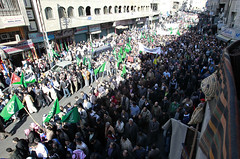
Thousands of people in Jordan have taken to the streets in protests, demanding the country's prime minister step down, and the government curb rising prices, inflation and unemployment.

In the third consecutive Friday of protests, about 3,500 opposition activists from Jordan's main Islamist opposition group, trade unions and leftist organisations gathered in the capital, waving colourful banners reading: "Send the corrupt guys to court".

The crowd denounced Samir Rifai's, the prime minister, and his unpopular policies.

Many shouted: "Rifai go away, prices are on fire and so are the Jordanians.''

Another 2,500 people also took to the streets in six other cities across the country after the noon prayers. Those protests also called for Rifai's ouster.

Members of the Islamic Action Front, the political wing of the Muslim Brotherhood and Jordan's largest opposition party, swelled the ranks of the demonstrators, massing outside the al-Husseini mosque in Amman and filling the downtown streets with their prayer lines.

King Abdullah has promised some reforms, particularly on a controversial election law. But many believe it is unlikely he will bow to demands for the election of the prime minister and Cabinet officials, traditionally appointed by the king.

Rifai also announced a $550 million package of new subsidies in the last two weeks for fuel and staple products like rice, sugar, livestock and liquefied gas used for heating and cooking. It also includes a raise for civil servants and security personnel.

Record deficit

However, Jordan's economy continues to struggle, weighed down by a record deficit of $2bn this year.

Inflation has also risen by 1.5 per cent to 6.1 per cent just last month, unemployment and poverty are rampant - estimated at 12 and 25 per cent respectively.

Ibrahim Alloush, a university professor, told the Associated Press that it was not a question of changing faces or replacing one prime minister with another.

"We're demanding changes on how the country is now run," he said.

He also accused the government of impoverishing the working class with regressive tax codes which forced the poor to pay a higher proportion of their income as tax.

He also accused parliament as serving as a "rubber stamp'' to the executive branch.

"This is what has led people to protest in the streets because they don't have venues for venting how they feel through legal means," Alloush said.

Source: Agencies

Friday, January 28, 2011

Egypt News Bulletin: Nationwide Uprising Continues While Mubarak, U.S. Plead for Calm

Mubarak dismisses government

Embattled Egyptian leader says he will name a new government on Saturday, after days of violent protests.

Last Modified: 29 Jan 2011 03:27 GMT

Tens of thousands of Egyptians have taken to the streets, calling for Mubarak's resignation

The Egyptian president has dismissed his government, saying he will replace it with a new one on Saturday.

"I have asked the government to resign and tomorrow there will be a new government," Hosni Mubarak said in an address to the nation in the early hours of Saturday after four days of deadly protests.

The president said that change can not be achieved through chaos but through dialogue.

Saying he understood that the people of Egypt wanted him to address poverty, employment and democratic reform, he promised to press ahead with social, economic and political reforms.

"We will not backtrack on reforms. We will continue with new steps which will ensure the independence of the judiciary and its rulings, and more freedom for citizens," Mubarak said.

He said new steps will be taken "to contain unemployment, raise living standards, improve services and stand by the poor".

Reacting to the protests that have erupted in the capital and other cities, Mubarak urged calm, adding that only because of his own reforms over the years were people able to protest.

Mona El Tahawy, an Egyptian columnist and author living in the US, dismissed these comments.

"There is no political freedom in Egypt, that's exactly why the protests happened," she said.

"If there were political freedoms, we wouldn't see 12,000 to 14,000 political dissidents in Hosni Mubarak's jails.

"He spoke tonight as a man absolutely out of touch with his people ... He tells them 'I'm going to implement reform and I care about the people.' That's meaningless. He's been in power for 30 years, he knows how poor people are."

'Not enough'

Mubarak's speech is likely to be seen as an attempt to cling to power rather than take concrete steps to solve some of the more pressing problems facing many Egyptians, primarily unemployment and rapidly rising food prices.

Al Jazeera's Ayman Mohyeldin, reporting from Cairo, said many Egyptians calling for change would say the sacking of the government is not enough.

"Ultimately in Egypt, the power lies with the president," he said.

"On paper, you have an independent parliament and an independent judiciary but every Egyptian will tell you that at the end of the day, power is concentrated in the hands of the president.

"Very few institutions can challenge his authority, so the sacking of the cabinet is not going to end the grievances of the people."

A sombre looking Mubarak called anti-government protests "part of a bigger plot to shake the stability and destroy legitimacy" of the political system.

He also defended the security forces' crackdown on protesters, saying he had given them instructions that the protesters be allowed to express their views. But, he said, acts of violence and vandalism left the security forces with no choice but to react to restore order.

Even after Mubarak's speech, protesters defied the night curfew and shouted slogans like "Down with Mubarak" in Cairo and other cities.

"We don't care if the government resigns, we want him to resign," Khaled, a 22-year-old demonstrator, said, in the Mediterranean port city of Alexandria.

Source: Al Jazeera and agencies


Egypt tense after bloody protests

Army deployed in key cities while curfew fails to deter protesters calling for the president's resignation.

Last Modified: 29 Jan 2011 03:11 GMT

The protests on Friday marked the first time the military was deployed onto the streets of Cairo

Protesters in the Egyptian cities of Cairo, Alexandria and Suez have defied a nighttime curfew and continued with demonstrations demanding an end to Hosni Mubarak's 30-year presidency.

Speaking on national television in the early hours of Saturday, the president said he had ordered the government to step down and that he would name a new cabinet later in the day.

Al Jazeera's Ayman Mohyeldin, reporting from Cairo, said protesters had been "galvanised" by Mubarak's announcement that he was staying in power.

"The streets are definitely still abuzz," he said at 4am local time. "The chants have died down in the last hours but there are still many people out and about in the street despite the fact that there is a curfew supposed to have been imposed, starting from 6pm to 7am.

"The protests and the clashes with police have completely died down as a result of the fact that the police have melted away and the military has taken over."

Military armoured vehicles rolled onto the streets of the capital on Friday night in a bid to quell the protests. People cheered as the army arrived, and hundreds of people thronged around a military vehicle near Cairo's Tahrir square.

"The army is a respected establishment in Egypt, and many feel they need their support against what they see as excessive force by the police and security forces," our correspondent said.

Protesters killed

Friday's demonstrations involving tens of thousands of people were the biggest and bloodiest in four consecutive days of protests against Mubarak's government.

Six people were reported killed in the port city of Alexandria, and at least 11 others were killed in the eastern city of Suez.

At least 1,030 people were wounded during Friday's protests, some in a serious condition with bullet wounds, medical sources said.

Buildings were set alight, and violent clashes continued into the night after a day of unprecedented anger.

A building belonging to the ruling National Democratic Party (NDP) was torched, and reports of looting of numerous government buildings also emerged.

The army was also deployed in Suez and Alexandria, where masses also defied the night curfew.

Tanks cordoned off the American and British embassies in the capital in the evening.

Shots were heard near parliament earlier in the day as the headquarters of the ruling party were in flames.

Dozens of protesters climbed on the military vehicles in Suez. They talked to soldiers who attempted to wave them off.

As reports of looting emerged, state media said army units secured the Egyptian Museum in the capital, where pharaonic treasures are displayed.

Looters had broken into an NDP building located near the museum and were walking out with furniture, computers and other items.

Protesters often quickly dispersed and regrouped.

As clashes intensified, police waded into the crowds with batons and fired volleys of tear gas.

Government crackdown

Mohamed ElBaradei, the former head of the United Nations' nuclear watchdog and an opposition leader in Egypt, was briefly detained by police after he prayed at a mosque in the Giza area but he later took part in a march with supporters.

The unrest in Egypt was triggered by the overthrow two weeks ago of Tunisian president Zine El Abidine Ben Ali in an uprising that has also inspired anti-government protests in Jordan, Yemen and elsewhere.

The government in Egypt had vowed to crack down on demonstrations and arrest those participating in them. It had blocked internet, mobile phone and SMS services in order to disrupt the planned demonstrations.

Before internet access was shut down on Thursday night, activists were posting and exchanging messages using social networking services such as Facebook and Twitter, listing more than 30 mosques and churches where protesters were to organise on Friday.

Source: Al Jazeera and agencies


Egypt supporters rally worldwide

Protests held across globe in a show of solidarity with Egyptian demonstrators attempting to oust president

Last Modified: 28 Jan 2011 15:36 GMT

Several hundred people held a rally outside a mosque in Istanbul reiterating calls for Mubarak to step down

Demonstrations are taking place around the world in a show of unity with protesters fighting for political change in Egypt.

In Turkey between 200 and 400 protesters held a demonstration outside the Fatih Mosque in central Istanbul after Friday prayers to lend their voices to the Egyptian cause.

Anita McNaught, Al Jazeera's correspondent in Turkey, said the mosque had become a focal point for activism since Israeli commandos raided a Turkish ship headed to Gaza last year.

"It is very much the organisations that we saw rise to prominence following the Israeli attack on the Mavi Marmara that have taken on the streets today to lend their voices in solidarity with the Egyptians," she said.

A simultaneous rally of about 50 people was also held in Ankara, the Turkish capital, where up to 50 people gathered outside the Egyptian embassy.

Tunisian solidarity

In London, Britain's capital, around 50 protesters are gathering outside the Egyptian embassy to add their voices to those calling for Hosni Mubarak, the president, and his government, to step down.

Abdullah Ali, a 26-year-old demonstrator at the rally in London, told Al Jazeera they were asking for "free democratic elections".

"I think the Egyptian population have had enough. They've seen what happened in Tunisia and how you can bring about a change. What we are asking for is Mubarak, father and son, to leave."

Many Tunisians, who saw major and violent protests topple the leadership of its president earlier this month, have also expressed solidarity with Egypt, saying that they hoped their revolution would spark events around the Arab world.

Around 50 people are holding a demonstration outside the Egyptian embassy in Tunis, the capital, brandishing placards with slogans reading "Mubarak Out!" and "Freedom".

"We are here to say that the Tunisian people are behind the Egyptian people. They have suffered in the way that we suffered. It's time for change," Monia Mechri, one of the protesters, was quoted by the AFP news agency.

The Progressive Democratic Party, a former opposition group that has now joined Tunisia's interim government, said Egypt had "called in the hour of change for an end to injustice and dictatorship".

"The Egyptian people supported the Tunisian people's revolution. Our heart is with you and our voices never cease to pray for victory," it added in a statement.

Ahmed, a blogger and activist at the rally told Al Jazeera that what has happened in Egypt is "very great".

"Now democracy will be ... one effect in the Arabic world," he said.

He said activists in Tunisia had used Facebook to message people in Egypt with advice on how to tackle police tactics during their protests.

Demonstrations have also been held outside the Egyptian embassy in Doha, the Qatari capital, where political demonstrations are a rare event.

Source: Al Jazeera and agencies


Egypt general cuts short US trip

Senior official apparently cutting short defence talks as unrest sweeps his country.

Last Modified: 28 Jan 2011 23:34 GMT

Thousands of protesters have taken to the streets in Egypt calling on President Mubarak to step down

The Pentagon has said that Lieutenant General Sami Enan, the Egyptian army's chief of staff, has departed Washington, cutting short a planned week-long visit as unrest sweeps his country.

The previously scheduled annual defence talks had been adjourned after "the Egyptian delegation was called home by its government," Colonel Dave Lapan, the Pentagon spokesman, said in a statement on Friday.

Sandy Vershbow, the assistant secretary of defence, led the US side for the talks and reiterated the Washington's appeal for restraint in dealing with widespread unrest, Lapan said.

"The current situation in Egypt arose very quickly, but Ambassador Vershbow did have the opportunity to urge restraint to his Egyptian counterpart during the Wednesday and Thursday meetings here in the Pentagon," he said.

Egypt receives about $1.3bn a year in US military aid and hundreds of millions of dollars in economic assistance - second only to Israel.

The country's armed forces - the world's 10th biggest with more than 468,000 members - have been at the heart of power since army officers staged an overthrow of the monarchy in 1952.

All four Egyptian presidents since then have come from the military, which is now led by Field Marshal Hussein Tantawi, 75, who is both defence minister and commander-in-chief.

Enan, in Washington, ranks below him but is one of the top military officers in Egypt.

A Middle East military expert in Washington, speaking on condition of anonymity, described Enan as someone who appeared to have the respect of the US.

Source: Agencies


Egyptian youth and new dawn hopes

For young Egyptians, long-dormant patriotism and pride have been finally awakened

Firas Al-Atraqchi
Last Modified: 29 Jan 2011 00:30 GMT

For the first time in their lives, young men and women feel that they may actually be able to determine their own destinies

As police stations and ministry of interior installations continue to burn through the night in many of Egypt’s cities, the Arab World is waking up to a new dawn.

In more than 18 years of living in Cairo, I have never felt the sense of cautious hope that exists in Egypt now, particularly among young men and women who feel that for the first time in their lives they may actually be able to determine their own destinies.

Young Egyptians that say that despite the number of teargas canisters fired at protesters and the number of those who have been beaten and detained, long-dormant patriotism and pride have been finally awakened.

They feel emboldened by the positive changes in Tunisia and believe they share common cause and aspiration.

Many of the students I teach at the American University in Cairo have taken part in the protests, avoiding tear gas, seeking refuge in shops and alleyways. They have been reporting and participating in the protests. Some have been beaten only to return the next day and face off with riot police.

To them, they have known no other president, no other ruling party and no other political system. They have for years been groomed on the government’s realpolitik on the one hand, and the empty rhetoric of opposition groups on the other.

They have made it clear to me that these opposition parties, long defunct and impotent, have been replaced by grassroots social action. Their fears of detention and torture have been supplanted by the need for better living conditions and better wages.

The protests have drawn Egyptians from all walks of life, many of whom have never participated in demonstrations and feel that the time has come for them to voice their resentment.

What started with a few dozen protesters on January 25 quickly mushroomed as passers-by and ordinary citizens joined in.

This was the Arab Street – the silent majority which has finally found a voice to express palpable anger.

Listening to the protesters, one gets the feeling that they have not been deterred by the severity of the beatings; rather, their resolve has been hardened.

In an unprecedented show of civil disobedience and open revolt, young Egyptians have clearly and forcibly delivered a message that is still resonating in the Middle East and North Africa: Authoritarian rule in the region is over.

The common yet indigenous, denominators – political and economic disenfranchisement and disdain at rampant corruption – between the two countries were conveyed through social media networks, helping to create a momentum that seized popular anger and provided it with a dynamic that produced mass mobilisation on the streets of Tunis and Cairo.

By calling for the ouster of Hosni Mubarak, the Egyptian president, and persevering in the face of tear gas, water cannons and baton beatings, young Egyptian men and women have beat back decades of one-party rule, brutal repression against civil liberties, iron-clad control of the media, and corrupt economic policies.

The protesters have been dismantling archaic forms of governance in which the ruler is considered to be beyond reproach and economic policies are determined by his self-preserving business elite allies.

They are demanding equity in the distribution of wealth, an end to state corruption, greater employment opportunities and a curb to rampant inflation.

They want to be able to express themselves freely – both in mainstream media and online – without the specter of arrest, torture and imprisonment looming overhead.

Just three months ago, Egyptian authorities released Kareem Amer, a blogger jailed in 2007 for defaming Islam and the presidency. His release came just a few weeks after several stations were taken off the air by the national satellite carrier NileSat for allegedly failing to abide by their contracts and/or failure to pay licensing fees.

They are not interested in a change of government – as Mubarak promised on January 28 - and they will not be dissuaded by repeated promises of economic reform and prosperity. They believe that Egypt’s current socio-economic malaise is rooted in the political system itself, a system which has not evolved since the first revolution overthrew the King of Egypt in 1952.

When the ruling National Democratic Party swept Parliamentary elections amid allegations of widespread fraud last November, Egyptian youth said that they felt their votes had been stolen and the entire process of political reform hijacked.

Some observers at the time warned that the government would likely suffer a backlash. The young protesters that we now see on the streets of Cairo, Ismailiya, Suez, Alexandria and Mahala want a political process that safeguards their democratic participation.

Few in Egypt have a desire – or expectation – to see Gamal Mubarak, the president’s son, inherit the presidency in a contrived political gimmick to convince the public that there was a democratic transfer of power.

Among my students, Copts and Muslims alike, there is a call for social cohesion. In the aftermath of the bombing at the Two Saints Church in Alexandria, many Egyptians blamed the government for failing to adequately protect minorities and allowing sectarian strife to fester.

Now, the momentum – and history - is on the protesters’ side.

Firas Al-Atraqchi is an associate professor of practice at department of journalism and mass communication at the American University in Cairo.

Source: Al Jazeera

Co-Founder of The Marvelettes, Gladys Horton (1944-2011), Had First Motown Smash Hit

January 28, 2011
http://detnews.com/article/20110128/ENT04/101280317

Co-founder of Marvelettes helped usher in girl group era

SUSAN WHITALL
The Detroit News

Gladys Horton, who helped launch the girl group era of the '60s with her sassy, girlish lead vocal on the Marvelettes' "Please, Mr. Postman," the first Motown song to reach No. 1 on the pop charts, died Wednesday in Los Angeles. The singer, 66, had been recovering from a stroke in a Los Angeles nursing home when she died, according to her son, Vaughn Thornton.

"She fought until the end, her son told me," said fellow Marvelette Katherine Anderson Schaffner. She had alerted friends and fans several weeks ago that Horton was ill.

"When I let everybody know on my Facebook page that she was ill, she was already in hospice," Schaffner said. "Even though you try to prepare, and know the inevitable is about to happen, I don't think you're ever prepared for (someone's) death."

Motown founder Berry Gordy Jr., who was wowed by the 15-year-old Horton and her group, said in a statement, "I am so saddened to hear of the passing of another Motown great, one of our first, Gladys Horton, who with the Marvelettes, recorded our first #1 hit, 'Please Mr. Postman,' and many others. Gladys was a very, very special lady, and I loved the way she sang with her raspy, soulful voice."

They were just teenagers when Horton, Schaffner and several friends from Inkster High School's choir formed a group so they could enter a talent contest.

Schaffner remembers that Horton was determined to get into the mix when she heard the prize was an audition at Motown. They called their group the "Casinyets" (i.e. "can't sing yet"), and no, they didn't win the contest.

But a sympathetic counselor secured a meeting at Motown for the group. They impressed Gordy and his staff.

What happened to the raw Inkster teenagers over the next decade is both an inspirational story and a cautionary tale.

They hit in 1961 with "Please, Mr. Postman" and instantly were a national sensation.

"Never in our wildest dreams did we figure that it would be 50 years later, and it would still be just as powerful as the day it was made," Schaffner said. "I can't understand that for the life of me."

It was still early in Motown's hit-making era, so the Marvelettes didn't have the benefit of the Motown grooming factory — the glamorous dresses and etiquette training that later girl groups such as the Supremes enjoyed.

Thrown into the music business at a vulnerable age, the group slept on the tour bus and performed wearing whatever matching dresses they could scrape together. They did their own choreography early on, before Cholly Atkins was hired to smooth out the rough edges. But they had an unpolished, engaging live energy that can be seen in a video on YouTube taken from a film Motown shot at the Apollo Theater in Harlem.

Follow-up hits to "Postman" included "Playboy," "Beechwood 45789" and "Too Many Fish in the Sea." Horton was the sole lead singer early on, but with the addition of Wanda Rogers, the Marvelettes segued into a new era of hits in the late '60s with Rogers' lead voice on the Smokey Robinson-penned "Don't Mess with Bill" and "The Hunter Gets Captured by the Game," among others.

When the hits stopped coming and Motown moved to Los Angeles, the Marvelettes were among the acts who suffered the most.

Although "Please, Mr. Postman" helped launch the company into the national spotlight as its first No. 1 pop hit, the group wasn't part of the big Motown specials. They have yet to make it into the Rock and Roll Hall of Fame, although they were the first of an early '60s tidal wave of girl groups.

The worst blow was that the original members of the group couldn't use their own name. Over the years, the rights to the Marvelettes name were picked up by a New York businessman, Larry Marshak. Marshak had a group of women in their 30s, much too young to have recorded in 1961, touring as "The Marvelettes."

"You want a sad story?" Gladys Horton told The News in 1998. "I'll give you sad."

While Schaffner and the rest of the group weren't interested in performing — Rogers couldn't as she battled drug and alcohol problems — Horton wanted to tour. But she said she was prohibited from billing herself as "Gladys Horton of the Marvelettes" because Marshak would sue.

"I told Marshak that I have a handicapped son I have to support, but he's heartless," Horton told The News. "I don't even know what you call it. … Every time he puts a group out there, he's taking money out of my pocket."

The Marvelettes were honored in December when "Please, Mr. Postman" became part of the Grammy Hall of Fame collection, which honors "recordings of lasting qualitative or historical significance that are at least 25 years old."

Schaffner isn't sure if Horton was well enough to know about the award. "I'm not sure if her son told her," Schaffner said.

"But since I believe that Gladys is in heaven looking down on us, she knows."

Gladys Horton is survived by two sons, Sam and Vaughn, and two grandchildren. A Los Angeles memorial service will be organized at a future date.

Wire reports contributed.


Gladys Horton: Detroit native sang lead with the Marvelettes

9:57 PM, Jan. 27, 2011
By BRIAN McCOLLUM
Detroit Free Press Pop Music Writer

Gladys Horton, the Detroit native whose voice led such Marvelettes hits as "Please Mr. Postman" and "Beechwood 4-5789," died late Wednesday at a nursing home in Sherman Oaks, Calif. She was 66.

"My mother died peacefully," Ms. Horton's son, Vaughn Thornton, said in a statement issued Thursday by the Motown Alumni Association. "She fought as long as she could."

Ms. Horton had lived in the nursing facility since a stroke last year. She retired from the music business in spring 2009, noting that travel was no longer enjoyable, effectively ending the 48-year reign of the original Marvelettes.

As a student at Inkster High School, Ms. Horton helped found the group that would eventually become the Marvelettes, linking up with fellow glee club members Katherine Anderson, Juanita Cowart, Georgia Dobbins and Georgeanna Tillman.

A successful audition for Motown Records was followed in 1961 by the group's debut single, "Please Mr. Postman," with 17-year-old Ms. Horton on lead vocals. It became Motown's biggest pop crossover hit to that point.

"I am so saddened to hear of the passing of another Motown great, one of our first, Gladys Horton, who with the Marvelettes recorded our first No. 1 hit, 'Please Mr. Postman,' and many others," Motown founder Berry Gordy said in a statement Thursday. "Gladys was a very, very special lady, and I loved the way she sang with her raspy, soulful voice."

Ms. Horton was the lead singer on follow-up hits such as "Beechwood 4-5789," "Playboy" and "Too Many Fish in the Sea" before losing her lead role to Wanda Young in 1965. Ms. Horton left the group in 1967 and moved to the Los Angeles area in the early 1970s.

She performed in later years as Gladys Horton of the Marvelettes, though she complained that her ability to tour was hampered by other "Marvelettes" incarnations with dubious ties to the original group. Her example was frequently cited in legislative attempts to protect the naming rights of original artists.

Ms. Horton is survived by two sons. Funeral arrangements have not yet been set.

Solidarity Activists Make Statement on Refusal to Testify Before Grand Jury; Memphis Organizers Harassed by Federal Agents, Police

Statement on the Grand Jury

Published on Thu, 2011-01-27 01:04

The 9 activists subpoenaed to appear before a federal grand jury in Chicago on January 25 explain their reasons for refusing to testify.

This is their statement:

In the month of December, the FBI delivered or attempted to deliver grand jury subpoenas to nine activists in Chicago. Six of these went to members of the Arab American community; the remaining three went to Palestine solidarity activists and individuals who have recently travelled to Palestine.

Those of us subpoenaed in December were ordered to appear before the grand jury on January 25th. This is the same grand jury that was impaneled by US Attorney Patrick Fitzgerald in order to indict individuals from among those whose homes and offices were raided in September.

We have made our decisions to stand strong with the other 14 subpoenaed activists from Illinois, Minneapolis and Michigan. We WILL NOT take part in this fishing expedition.

Fitzgerald’s new wave of repression in Chicago started one month after the re-activation of subpoenas for three Palestine solidarity activist women in Minneapolis. Tracy Molm, Anh Pham and Sarah Martin are being asked to appear before the grand jury again, despite refusing to speak in October.

Under the rules of the secretive grand jury process, these three women, who have again boldly stated that they WILL NOT testify, can now potentially face jail time if Fitzgerald chooses to be cruel.

The delegations to Palestine that have been taken and organized by many of the now 23 persons subpoenaed to the grand jury were designed to have people from this country meet with Palestinians to learn about their experience facing brutal repression from the U.S. funded Israeli occupation. The delegates bring these stories back to people in the U.S. Hearing about the reality of U.S. military aid is not a crime, and yet this appears to be the target of this investigation.

Our subpoenas are a part of the fishing expedition targeting solidarity activists and the U.S. Palestinian community. We understand that the grand jury has been used against the anti-war movement, as well as Palestinians, Arabs and Muslims in the U.S. for decades, and this repression has intensified since Sept. 11 2001. The grand jury has been used as a tool of political repression against every major movement for social change in this country.

We fear the government may be seeking to use the recent Supreme Court decision Holder vs. Humanitarian Law Project to attack activity protected by fundamental rights of freedom of association, speech and inquiry. We will not allow our solidarity to be construed as "material support for terrorism."

We'll continue to stand in solidarity with the Palestinian people and work to end US aid to Israel. We must speak out and encourage others to visit Palestine to help break down the isolation that the Israeli occupiers attempt to impose on them. Like all those who are engaged in solidarity work – organizing in the Palestinian community here; carrying out efforts to boycott, divest and sanction Israel; or traveling to the occupied territories of Palestine, including Gaza – we can’t allow the FBI and grand jury to intimidate us.

We have received an incredible show of support and love from the international solidarity movement, the anti-war movement, the labor movement, the civil rights and civil liberties movement, and the communities of Palestinian, Arab and Muslim peoples in the US. We will continue to work in opposition to U.S. wars in Iraq and Afghanistan. We will continue to oppose military aid towards repressive regimes such as Israel and Colombia. We will continue to extend our support and love for the people of Palestine

Together with the 14 activists raided in September, we declare our right to organize to change US policy.


Wednesday, January 26, 2011

Memphis Activists Harassed by FBI

(While Protesting FBI Harassment)

Local activists, including members of the Memphis Socialist Party,
gathered at the Mid-South Peace and Justice Center yesterday to file
Freedom of Information Act requests as part of a nationwide day of
action against recent FBI harassment of anti-war and international
solidary activists. A few hours prior to the event, three FBI Joint
Terrorism Task Force agents visited the Center to inform them that
there was going to be a demonstration. They left after they were told
that the Center was not only aware of the event but had planned it.

Approximately two hours later, the Memphis Police Department's TACT unit arrived with at least six unmarked black SUVs and one marked squad car. When questioned about the reason for their presence, they replied that they were there to keep the peace. The Center was eventually able to get into contact with the unit's chief, who made a vague statement about a call from a "concerned citizen."

On the same day, at least two activists (including the Chair of the
Memphis Socialist Party) had their homes entered by the Shelby County Sheriff's Department on the pretext of warrants issued for failure to appear in court. In both cases residents were not given the
opportunity to view the warrant, despite multiple requests. At the
deCleyre Cooperative, police entered without permission through an
unlocked door and moved through every room with their guns drawn,
searching for someone who hadn't lived there in years.

Why were residents not allowed to see the warrants used to enter their homes? Why was the TACT unit, described by MPD's website as "not subject to regular calls," and "responsible for handling barricade situations, hostage rescues, counter terrorism, and high risk felony apprehensions," sent to respond to a single, unverified phone call?

How is it a coincidence when the same group of activists is targeted
by three separate law enforcement agencies on the same day?

The FBI has a long history of intimidation, harassment, and
repression, but we refuse to be silenced by it. We will continue to
stand in solidarity with our activist brothers and sisters.

China to Create Largest Mega City in the World With 42 Million People

China to create largest mega city in the world with 42 million people

China is planning to create the world's biggest mega city by merging nine cities to create a metropolis twice the size of Wales with a population of 42 million

By Malcolm Moore in Shanghai and Peter Foster in Beijing
12:21PM GMT 24 Jan 2011

City planners in south China have laid out an ambitious plan to merge together the nine cities that lie around the Pearl River Delta.

The "Turn The Pearl River Delta Into One" scheme will create a 16,000 sq mile urban area that is 26 times larger geographically than Greater London, or twice the size of Wales.

The new mega-city will cover a large part of China's manufacturing heartland, stretching from Guangzhou to Shenzhen and including Foshan, Dongguan, Zhongshan, Zhuhai, Jiangmen, Huizhou and Zhaoqing. Together, they account for nearly a tenth of the Chinese economy.

Over the next six years, around 150 major infrastructure projects will mesh the transport, energy, water and telecommunications networks of the nine cities together, at a cost of some 2 trillion yuan (£190 billion). An express rail line will also connect the hub with nearby Hong Kong.

"The idea is that when the cities are integrated, the residents can travel around freely and use the health care and other facilities in the different areas," said Ma Xiangming, the chief planner at the Guangdong Rural and Urban Planning Institute and a senior consultant on the project.

However, he said no name had been chosen for the area. "It will not be like Greater London or Greater Tokyo because there is no one city at the heart of this megalopolis," he said. "We cannot just name it after one of the existing cities."

"It will help spread industry and jobs more evenly across the region and public services will also be distributed more fairly," he added.

Mr Ma said that residents would be able to use universal rail cards and buy annual tickets to allow them to commute around the mega-city.

Twenty-nine rail lines, totalling 3,100 miles, will be added, cutting rail journeys around the urban area to a maximum of one hour between different city centres. According to planners, phone bills could also fall by 85 per cent and hospitals and schools will be improved.

"Residents will be able to choose where to get their services and will use the internet to find out which hospital, for example, is less busy," said Mr Ma.

Pollution, a key problem in the Pearl River Delta because of its industrialisation, will also be addressed with a united policy, and the price of petrol and electricity could also be unified.

The southern conglomeration is intended to wrestle back a competitive advantage from the growing urban areas around Beijing and Shanghai.

By the end of the decade, China plans to move ever greater numbers into its cities, creating some city zones with 50 million to 100 million people and "small" city clusters of 10 million to 25 million.

In the north, the area around Beijing and Tianjin, two of China's most important cities, is being ringed with a network of high-speed railways that will create a super-urban area known as the Bohai Economic Rim. Its population could be as high as 260 million.

The process of merging the Bohai region has already begun with the connection of Beijing to Tianjing by a high speed railway that completes the 75 mile journey in less than half an hour, providing an axis around which to create a network of feeder cities.

As the process gathers pace, total investment in urban infrastructure over the next five years is expected to hit £685 billion, according to an estimate by the British Chamber of Commerce, with an additional £300 billion spend on high speed rail and £70 billion on urban transport.

Former South African President Nelson Mandela Released From Hospital

Nelson Mandela's release from hospital eases national alarm

South African elder statesman's treatment for respiratory infection had led to frenzied speculation about his health

David Smith in Johannesburg guardian.co.uk,
Friday 28 January 2011 11.55 GMT

Nelson Mandela has returned home from hospital after treatment for an acute respiratory infection.

South African officials moved to quell 48 hours of growing alarm over the condition of the frail 92-year-old. Kgalema Motlanthe, the deputy president, said Mandela was in high spirits and had been joking with him this morning.

Motlanthe recalled that Mandela had joked "I won't detain you any longer" as the deputy president headed for a press conference.

"What I convey is that he is receiving the best treatment from the best available health professionals in this country. That should reassure all of us that there is no need for us to panic, there is no need for us to fear for Madiba's health. He's in good hands," Motlanthe said.

Mandela was admitted to Milpark hospital on Wednesday. A lack of detailed information led to a frenzy of media speculation. Journalists have been camped outside the hospital and his home. Motlanthe admitted that the government "could have communicated better" with the anxious public.

South Africa's first black president has now returned to his home in the Johannesburg suburb of Houghton.

South Africa's surgeon general, VJ Ramlakan, told reporters: "He recently developed an acute respiratory infection for which he received treatment and has responded very well. He is stable but will be monitored closely.

"He is not receiving any kind of assisted ventilation or anything like that. He's going home and is subject to intense monitoring.

"Dr Mandela is in high spirits and has been visited by his family and friends. Medically at present there is no need to panic.

"For a 92-year-old he surprises us on a daily basis with his powers of recovery."

Mandela's grandson, Mandla, said the family was delighted he was going home. "There was a lot of anxiety in the family to be with him," he said. "We always give him that support to be with him as a family and have always over the years enjoyed his sense of humour. The older he gets, he continues to display that sense of humour. As a family we've always enjoyed having my grandfather with us. It comes to us today with great joy hearing that he's been discharged."

It was revealed that Mandela had received more than 10,000 messages of goodwill from around the world.

Egypt 'Day of Rage' Brings Thousands Into the Streets Demanding Outster of Mubarak

Fresh protests erupt in Egypt

Thousands stream out of mosques to protest against President Mubarak's 30-year rule, defying a government crackdown

Last Modified: 28 Jan 2011 12:42 GMT

Opposition leader and former UN nuclear watchdog chief Mohamed ElBaradei prayed with thousands on Friday

Protests have erupted in cities across Egypt following Friday midday prayers, with angry demonstrators demanding an end to Hosni Mubarak's 30-year presidency. Tens of thousands of protesters have taken to the streets across the country, witnesses have said.

Al Jazeera's Rawya Rageh, reporting from the Mediterranean port city of Alexandria, said protesters streamed out of mosques shortly after prayers to chant slogans against Mubarak. Police responded immediately, firing tear gas to disperse the crowd.

Alexandria is a stronghold of the Muslim Brotherhood, Egypt's technically banned but largest political opposition group, but Rageh said the crowds in the city predominantly consisted of "ordinary citizens".

"This is the same mosque where protests were held against police brutality in June after a 20-year-old man was beaten to death by police," she said. "It’s very symbolic that the current protests are taking place at the same place all over again."

Protests were also reported in Suez, a port on the Red Sea east of Cairo, and in the Nile Delta cities of Mansoura and Sharqiya, witnesses said.

Clashes between protesters and police erupted outside a mosque in Cairo. Protesters reportedly threw stones and dirt at the police after security forces confronted them. They held up posters saying "No to dictatorship" and stamped on posters of Mubarak.

Friday marked the fourth consecutive day of protests in the Middle East's most populous nation coming on the heels of a social uprising in nearby Tunisia that ousted that country's president of 23 years.

Mohamed ElBaradei, the former head of the United Nations' nuclear watchdog and an opposition leader in Egypt, returned to the country on Thursday night after telling reporters he was ready to lead a "transition" if asked. On Friday, he prayed with thousands of worshippers at a mosque in Cairo and had reportedly been prevented from moving freely by security forces.

The countrywide violence has so far left seven people dead.

In response, the government has promised to crack down on demonstrations and arrest those participating in them. It has blocked internet, mobile phone and SMS services in order to disrupt the planned demonstrations.

Networking sites

Before Egypt shut down internet access on Thursday night, activists were posting and exchanging messages using social networking services such as Facebook and Twitter, listing more than 30 mosques and churches where protesters were to organise on Friday.

"Egypt's Muslims and Christians will go out to fight against corruption, unemployment and oppression and absence of freedom," a page with more than 70,000 signatories said.

The Associated Press news agency reported that an elite special counterterrorism force had been deployed at strategic points around Cairo, and Egypt's interior ministry warned of "decisive measures".

Safwat Sherif, the secretary-general of the ruling National Democratic Party, told reporters on Thursday: "We hope that tomorrow's Friday prayers and its rituals happen in a quiet way that upholds the value of such rituals ... and that no one jeopardises the safety of citizens or subjects them to something they do not want."

Meanwhile, a lawyer for the Muslim Brotherhood said that 20 members of the officially banned group had been detained overnight.

Abdel-Moniem Abdel-Maksoud said two of the most senior movement members were detained: Essam El-Erian, its main spokesman, and Mohammed Moursi, a prominent Brotherhood leader.

Fierce clashes

On Thursday, protesters hurled petrol bombs at a fire station in Suez, setting it ablaze. They tried but failed to set fire to a local office of the ruling National Democratic Party. At another rally near Giza on the outskirts of Cairo, police used tear gas to break up hundreds of protesters late at night.

Mubarak, Egypt's third and longest-serving president, has ruled the country since 1981.

When Egypt turned off the internet

Egypt goes off the digital map as authorities unplug the country entirely from the internet ahead of protests.

Cairo, normally vibrant on a Thursday night ahead of the weekend, was largely deserted, with shops and restaurants shut. In the city of Ismailia, hundreds of protesters clashed with police who used tear gas and batons to disperse them.

"This is a revolution," one 16-year-old protester said in Suez . "Every day we're coming back here."

"The intensity continues to increase," Al Jazeera's Jamal Elshayyal reported from Suez.

"There have been fierce clashes with rubber-coated steel bullets being fired by the riot police as well as tear gas."

Human Rights

Human Rights Watch said Egyptian police had escalated the use of force against largely peaceful demonstrations and called it "wholly unacceptable and disproportionate".

Barack Obama, the US president, urged both the government and protesters to show restraint as they expressed their "pent-up frustrations". Hillary Clinton, the secretary of state, had earlier said that the protests offered the Mubarak government an opportunity to institute social, economic, and political reforms.

"It is very important that people have mechanisms in order to express legitimate grievances," Obam said as he answered questions from an online audience on the YouTube website.

Obama also urged Mubarak to make changes to the political system to appease the angry protesters.

"I've always said to him that making sure that they are moving forward on reform - political reform, economic reform - is absolutely critical for the long-term well-being of Egypt."

No End in Sight for Egypt Uprising

No end in sight for Egypt uprising

The angry nationwide demonstrations have swelled into the largest uprising in three decades. (http://www.facebook.com/pierre.sioufi)

Activists in Egypt geared up for the biggest protests yet on Friday to end president Hosni Mubarak's three-decade rule, while demonstrators fought security forces into the early-morning hours in the eastern city of Suez.

Emboldened by this month's revolt that toppled the authoritarian leader of Tunisia, Egyptians have staged mass protests since Tuesday in an unprecedented outburst of anger against Mr Mubarak's strong-handed rule.

The angry nationwide demonstrations have swelled into the largest uprising in three decades, in which seven people have been killed and more than 100 injured.

"This is a revolution," one 16-year-old protester said in Suez.

"Every day we're coming back here."

A heavy security clampdown overnight prevented protesters from massing in the centre of Cairo as they did on Tuesday and Wednesday, but clashes erupted in the cities of Suez and Ismailiya and in a Sinai town where police shot dead a protester, witnesses said.

Internet access was shut down across the country - at one point completely. Mobile phone text messaging services also appeared to be partially disabled, working only sporadically. The government has denied disrupting communications networks.

Internet and text messaging services flickered on and off through the night. US-based Internet monitoring firm Renesys said Egypt's web access was totally shut down early on Friday, an event it called "unprecedented in internet history".

"Renesys observed the virtually simultaneous withdrawal of all routes to Egyptian networks in the internet's global routing table," it said. "The Egyptian government's actions tonight have essentially wiped their country from the global map."

A page on Facebook listed more than 30 mosques and churches where protesters were expected to gather.

"Egypt's Muslims and Christians will go out to fight against corruption, unemployment and oppression and absence of freedom," the page said, adding more than 70,000 had signed up online.

Meanwhile, at least eight senior officials of the country's largest opposition movement, the Muslim Brotherhood, were arrested overnight.

A security source said authorities had ordered a crackdown on the group.

The Brotherhood has kept a low profile during the protests, although many of its supporters were expected to join demonstrations on Friday.

The government has accused the group of planning to exploit the youth protests for its "hidden agendas", while the Brotherhood says it is being used as a scapegoat.

Nobel Peace Prize winner Mohamed ElBaradei has arrived back in the country to join demonstrators

Mr ElBaradei, a campaigner for reform in Egypt who won the peace prize for his earlier work as head of the UN nuclear agency, says it is time for Mr Mubarak to step aside.

"He has served the country for 30 years and it is about time for him to retire," he said.

Mr ElBaradei and other opposition figures say the government exploits the Islamist opposition to justify authoritarianism.

- AFP/Reuters

Thursday, January 27, 2011

Tunisian Former President's Close Allies Dropped From Cabinet

Ben Ali allies dropped from cabinet

Key ministers from the heavily criticised former government replaced while interm Tunisian prime minister remains

Last Modified: 27 Jan 2011 21:22 GMT

It remains unclear whether the protesters in Tunis would accept a new ministerial line-up

Mohammed Ghannouchi, the Tunisian prime minister, has reshuffled the interim government, dropping key ministers from the heavily criticised government of ousted president Zine El Abidine Ben Ali.

"This is a temporary government with a clear mission - to allow a transition to democracy," he said in a live television address on Thursday.

"Its mission is to organise elections in which the people will be completely free to choose."

Ghannouchi, also a key figure in the previous administration, said he would stay in his post as the country prepares for parliamentary and presidential elections which are expected to be held in the coming months.

The new cabinet includes 12 new ministers and keeps nine from the previous set-up. Among those replaced with independents were the ministers of interior and defence.

'Popular revolution'

Earlier on Thursday, Kamel Morjane, the foreign minister, resigned saying he was leaving "so that the popular revolution can bear fruit".

Ghannouchi said the new foreign minister will be Ahmed Ounais, a 75-year-old career diplomat who studied at the Sorbonne University in Paris and served as Tunisia's ambassador to Moscow and New Delhi.

The new lineup had been agreed after consultations with all political parties and civil society groups, the prime minister said.

Protesters, who earlier on Thursday stormed police barricades in Tunis, the Tunisian capital, had been calling for a purge of Ben Ali loyalists.

Ben Ali fled to Saudi Arabia on January 14 when weeks of violent protests against poverty, repression and corruption toppled him after 23 years in power.

The interim government which was appointed after Ben Ali's departure includes many officials of RCD, the former ruling party, prompting an angry reaction from demonstrators.

Morjane and the seven other ministers from the RCD quit the party last week but that gesture did not prove enough to appease protesters.

Tunisia's powerful labour union, UGTT, will not join the new government itself but said it would approve of Ghannouchi staying in power, a factor that could help appease protesters demanding that the government be purged of members of the RCD.

The union has a large membership and has been involved in organising some demonstrations.

In what is being seen as an attempt to ease the tension on the street, the union decided to cancel a big protest rally scheduled for Friday.

However, Al Jazeera's Hashem Ahelbarra, reporting from Tunis, later said that the union appeared to backtracking from that position and was now unhappy with the announcement.

"I spoke to a spokesperson of the UGTT and he told me ... they asked the prime minister to include some faces picked by the UGTT, which he didn't, and they asked him to form a 'council of the wise' that includes practically every independent activist or political figure," he said.

'Regime reminder'

Ahelbarra said it was, therefore, unclear if the reshuffle would be enough to placate the thousands of demonstrators who continued to throng the main Tunis boulevard, Bourguiba Avenue, demanding that the transitional government resign.

"Some people are saying that this is quite significant and it will send people back to their homes, on the other hand the thousands who have been demonstrating outside the government compound are saying this is not enough," he said.

"They would like to see the prime minister himself go because he is a reminder of the old regime."

Earlier on Thursday, protesters broke through police lines outside Ghannouchi's office, where hundreds of demonstrators have pledged to camp out until the government is gone.

Tunisia's uprising has electrified Arabs across the Middle East and North Africa, where many countries share the complaints of poor living standards and authoritarian rule.

Inspired by Tunisia's example, thousands of Egyptians have taken to the streets to demand an end to Hosni Mubarak's 30-year rule, clashing with police who fired tear gas and used water cannon.

In addition to the cabinet reshuffle, Tunisia is aiming to set up a council of "wise men" to guide the country to democracy from the authoritarian state run by Ben Ali.

Source: Al Jazeera and agencies

U.S. Climate Scientist Calls China 'Hope of the World'

As Washington sues Beijing over green subsidies

U.S. climate scientist calls China ‘hope of the world’

By Deirdre Griswold
Published Jan 26, 2011 4:09 PM

A leading U.S. scientist who deals with global warming and climate change is calling the People’s Republic of China “the best hope” for turning around a looming disaster for the world and “stopping rule by fossil fuel interests.”

Dr. James Hansen, head of NASA’s Goddard Institute for Space Studies in New York, also wrote in the South China Morning Post on Nov. 3, “Fossil fuel interests reign in Washington and other capitals. Big money forces legislatures to hatch ineffectual schemes such as ‘cap-and-trade-with-offsets,’ a system designed by big banks and fossil fuel interests that assures continued fossil fuel addiction.” The South China Morning Post is an English-language daily published in Hong Kong.

China last year became the world’s largest emitter of greenhouse gases on an annual basis, exceeding the U.S. for the first time. So why is it the world’s “best hope”? Hansen says, “China leads the world in clean energy investments — nuclear, wind and solar power.”

China is also forging ahead with new technology to improve energy efficiency during the generation and transmission of electricity.

China’s biggest energy source — and biggest problem — is coal, which generates 80 percent of its electricity. Its abundance has fueled China’s industrial revolution. It has also contributed to air pollution inside China and to greenhouse gases in the world’s atmosphere.

However, since 2006 it has closed down many inefficient and dangerous small coal mines, cutting annual coal consumption by about 82 million tons and annual carbon dioxide emissions by some 165 million tons.

Most CO2 came from Britain

It takes many years for the impact of greenhouse gases to be felt. The blanket of CO2 and other greenhouse gases now warming Earth has been accumulating since the 19th century. Hansen says the largest portion of these gases was generated by Britain, where the industrial revolution in the West started. Germany is second. It is followed by the U.S., with responsibility for 27 percent, and China, with only 9.5 percent of the total.

Even looking just at current emissions, China, with its very large population, produces far fewer emissions per capita than any other industrialized country, even though it has now become the “factory to the world.”

Hansen first testified before Congress on global warming in 1988. He was elected to the National Academy of Sciences in 1996 and has received many prestigious awards for his scientific work. He first gained fame for having figured out which gases are in the atmosphere around Venus and creating a model based on that which correctly predicted the temperatures on the surface of that extremely hot planet. He then began using the same methods to study the composition of Earth’s atmosphere and its effects on global temperatures here.

Being a scientist with the National Aeronautics and Space Administration, Hansen has the benefit of examining data from all over the world collected by NASA’s satellites, including detailed information on the state of the polar ice caps and the mile-deep ice sheet covering Greenland, all of which are melting at an accelerating speed.

Dire predictions ignored

Hansen warned in his article for the South China Morning Post that, if all the fossil fuels now underground were to be consumed, sea levels would rise by about 75 feet, inundating whole countries and forcing the migration of hundreds of millions, if not billions, of people away from coastal areas.

He has been stymied by succeeding U.S. governments in his efforts to get a global agreement, like the one that President Barack Obama shot down in Copenhagen in 2009. Therefore, he is urging the Chinese leaders to do more about weaning their economy away from coal and is applauding the steps they have already taken in that direction.

Hansen is on a collision course with big capital and its politicians, who have gone from denying that global warming exists to coming up with schemes like “cap and trade.” This supposed solution, pushed by Al Gore, does nothing but shift around the responsibility for atmospheric pollution while creating a profitable market for the traders. By the way, the Gore family fortune, which got him into the Senate in the first place, comes from Occidental Petroleum.

China spends heavily on green infrastructure

After world markets dramatically imploded in 2008, China worked out a stimulus package of hundreds of billions of dollars to be spent mainly on upgrading its infrastructure. This was while the U.S. was spending its stimulus money mainly on propping up financial institutions and corporations that had been making big profits before the crash.

Since then, China has poured a lot of that money into incorporating green technologies in its development plans. For example, at the end of 2009, China budgeted $600 billion to upgrade its electricity grid, using sophisticated ultrahigh-voltage transmission, which substantially reduces energy loss. Today there is a labor shortage in much of China as these big projects transform the landscape.

China has shown that it takes global warming seriously by putting its money where its mouth is. That is why scientists like Hansen are encouraged.

Here’s the kicker: What is the U.S. government doing about all this?

In December, Washington filed a complaint against China with the World Trade Organization — for subsidizing its wind-power industry. Washington says that is a violation of “free trade.” By the end of 2010, China had the wind-power capacity to produce 31 gigawatts of electricity — three times its nuclear power capacity.

U.S. sues China

Come again? Yes, the U.S. is suing the Chinese government for putting money into its green industries. Moreover, even worse, this suit is supported by the Steelworkers union, on the ill-advised notion that forcing China to stop its subsidies will somehow create jobs here.

Is joining Washington in its rancorous anti-China campaign really going to convince the capitalist politicians, who have authorized trillions of dollars to rescue Wall Street firms and wage wars overseas for the oil companies, that this money should instead be going for a jobs program here?

While capitalism has been allowed to grow in China, widening the gap between rich and poor, the government and the Communist Party, both born out of revolution, still retain control over the economic levers that make large-scale, long-term planning possible. What has proven impossible in the corporate-ridden United States — the development of a plan, any plan, to move away from fossil fuels — is a reality in China today.

Workers’ organizations should focus on militantly combating the bosses, bankers and their politicians here and force them to create green jobs that could solve two daunting problems at the same time: the widespread unemployment that is grinding down workers of all ages and the environmental catastrophe that looms over the next generation.

E-mail: dgriswold@workers.org
--------------------------------------------------------------------------------
Articles copyright 1995-2011 Workers World. Verbatim copying and distribution of this entire article is permitted in any medium without royalty provided this notice is preserved.

Workers World, 55 W. 17 St., NY, NY 10011
Email: ww@workers.org
Subscribe wwnews-subscribe@workersworld.net
Support independent news DONATE
Page printed from:
http://www.workers.org/2011/world/china_0203/