Sunday, April 29, 2012

African Labor and the Struggle for Economic Justice

African Labor and the Struggle for Economic Justice

A history of slavery, reconstruction and the continuing movement for national liberation

by Abayomi Azikiwe, Editor
Pan-African News Wire
------------------------------------------
Editor's Note: This article is being republished in honor of May Day 2012.
------------------------------------------

Introduction: A Tribute to the Revolutionary Legacy of El Hajj Malik Shabazz, Malcolm X (1925-1965)

Since 1965, the overall crisis in world political economy has deepened into a more complex and aggravated social situation where the erosion of state structures and institutions have left the majority of the people without the essential necessities required for maintaining a decent personal and family life.

In this discussion we will survey the contemporary and historical conditions over the last four-and-one-half decades in an effort to construct a viable mechanism that will provide an alternative to the persistence of stagnation so characteristic of the present period.

Malcolm X's active religious and political life started while he was an inmate during the early 1950s when he began to read extensively on a wide array of topics and disciplines. He would later join the Nation of Islam at the aegis of his brothers who entered the organization prior to him.

After his release from prison in 1952, Malcolm became active in the Detroit Temple Number One and soon rose to the rank of assistant minister in the city. The organization provided Malcolm with a disciplined lifestyle, which is important for ex-convicts, who are returning to the same areas from which they were arrested during the period prior to their incarceration.

As this time in the United States and globally, the peoples of the colonial and semi-colonial territories were intensifying their efforts aimed at national independence. In areas such as south-east Asia and the Korea Peninsula, the struggle had taken on a decidely anti-capitalist character, which resulted in large-scale military intervention by the United States and France.

In Africa, the anti-colonial struggle accelerated after World War II when in many countries such as Ghana, Algeria, Egypt, Keny, Tanganyika, South Africa, etc., the masses organized into ex-servicemen associations, trade unions, women groups, student unions and political parties to forge the movements aimed at political independence.

After the return of hundreds of thousands of African American soldiers from service in the Pacific, North Africa and Europe, a new miltancy arose within the United States that increasingly grew impatient in the face of continued legalized segregation and economic exploitation. With the majority of Africans in the United States residing in the former ante-bellum south, which had been financially devastated as a result of the Civil War and the burgeoning industrialization in the northern and western regions, a growing segments of this population group saw no potential for social advancement in the rural and urban areas of the south.

As a result of these oppressed circumstances and with the urging of political and economic forces in the northern industrialized areas, many Africans began the migration out of the southern states. Although this migration pattern had become significant as far back as World War I, the social conditions brought about as a result of the catastrophic depression of the 1930s, natural disasters, which sparked large-scale crop failures and the increasingly violent suppression of African peoples by the white power structures in the south, provided adequate incentives for this community to seek refuge in other regions outside the south.

During the 1950s, Malcolm's generation realized that despite the movement north by millions of African people they still remained oppressed and exploited by the white ruling class in the urban areas. Earl Little, the father of Malcolm X, had moved to Nebraska from Georgia during the 1920s.

His mother Louise, was born in Grenada in the eastern Caribbean. Both of his parents were members of the Universal Negro Improvement Association(UNIA) headed by Marcus Garvey, who was deported from the United States in 1927.

Garvey's movement was extremely popular during the 1920s when thousands attended annual conferences in New York City. Louise Little wrote articles for the Negro World newspaper, the printed voice of the UNIA. The popularity of Garveyite Pan-Africanism during this period was indicative of the African peoples struggle for self-determination in the United States.

Consequently, the role of the national liberation process on the African continent over the last seven decades has contributed immensely to the overall struggle for Pan-Africanism, i.e., the unity of movements of African peoples designed to overcome the legacies of slavery, colonialism, and to create societies based on the principles of social equality, non-exploitation, economic development and the reclamation of African history and cultures.

The role of El Hajj Malik Shabazz (Malcolm X) in his intersection with the Pan-African historical process during the 1950s and 1960s and the remaining viability of his legacy of forging greater links between Africans all over the globe, made an indelible impact on the international scene. It is the challenge of the new generation of political activists to build upon these contributions in order to take Pan-Africanism into its next and possibly most significant phase: being the creation of a united effort aimed at the eradication of poverty, hunger, underdevelopment and social stagnation among the people.

The Legacy of Racism and National Oppression Continues

A racist cartoon published by the New York Post on February 18, 2009 depicted a chimpanzee being shot dead by the police. The cartoon was a supposed parody of an incident that had occured in Connetticut the day before when a chimp attacked a woman and was shot.

The racist character of the cartoon was directed at the newly-elected President Barack Obama since the caption on the illustration says: "They'll have to find someone else to write the next stimulus bill." By implying that Obama is a chimp and deserved to be killed by the police, he is placed in the same social situation as any other black man confronting law-enforcement on the streets of America.

What was outrageous about this act of racist provocation is that forty-four years ago Malcolm X was assassinated in New York City. His murder initiated a series of political assassinations against African American leaders.

When we examine the high incidence of political assassinations, military coup d'etats, state directed corruption and economic exploitation and isolation for political purposes, it is evidence enough of the desire on the part of western imperialist countries and their allies within the African world to maintain control and direction over the thinking and activity of the masses of people.

Malcolm X, during his lifetime as well as posthumously, exemplified the best notions of independent thought, speech and activity. Consequently, his assassination forty-four years ago was a signal to the conscience of Africans and all peace and freedom loving peoples that their struggle would be a protracted one with many enemies to defeat before genuine victory could be proclaimed.

This racist provocation by the New York Post takes place during the same month of February that represented the tenth anniversary of the murder of Amadou Diallo in 1999 by the New York Police Department's Street Crimes Unit. Diallo was shot 19 times after 41 shots were fired at him for no apparent reason.

After public outrage over the police murder of Diallo, which resulted in mass demonstrations and calls for the prosecution of the four officers involved, a trial was held in Albany, New York. However, all of the officers accused were acquitted and no one was ever held accountable for the death of Diallo, who was an immigrant from the West African nation of Guinea-Conakry.

A settlement in a civil suit did award some money to the family of Amadou Diallo, nonetheless, the phenomena of racist police violence against African Americans and other oppressed groups continues to this day. Consequently, the cartoon did much to reaffirm racist violence as an oppressive mechanism designed to hold African people in perpetual fear and social bondage.

The New York Post rejected the accusation that its motivation was racist in publishing the cartoon. In a reluctant apology that followed two days of militant demonstrations outside its offices, The Post said of the cartoon that: "It was meant to mock an ineptly written federal stimulus bill. Period. But it has been taken as something else--as a depiction of President Obama, as a thinly veiled expression of racism. This most certainly was not its intent; to those who were offended by the image, we apologise."

At the same time, the nature of the weak apology did not lessen the outrage sparked by its publication. The New York Post even undermined its own efforts aimed at damage control when it went on to state in its "apology" that: "However, there are some in the media and in public life who have had differences with the Post in the past--and they see the incident as an opportunity for payback. To them, no apology is due. Sometimes a cartoon is just a cartoon--even as the opportunists seek to make it something else."

In other words, the Post took the position that it had done nothing wrong. According to the corporate media outlet, those people who have expressed outrage around the country and taken to the streets outside their headquarters in New York City, are not motivated by genuine concern and anger but only selfish political gain. However, the broad coalition of forces that have protested this provocation does suggest that the underlying impetus is based on anti-racist sentiment.

African Labor and American Capitalism

This year's African American History Month takes on added significance because of the recent election and inauguration of President Barack Obama. The ascendancy of Obama comes at a critical time period when billions of people around the world are facing increasingly perilous economic conditions.

Each day, through the various international press agencies, the deepening crisis in world capitalism is conveyed through a plethora of statistics that describe large-scale losses in the banking industry, the declining value of stock prices and the massive layoffs of workers in all of the major industries.

Within the context of the economic crisis, African American workers are facing some of the worst conditions. The African American people have faced national oppression, economic super-exploitation and cultural degredation for centuries. The system of chattel slavery was based on the exploitation of African labor.

W.E.B. DuBois in his book entitled: "Black Reconstruction in America", published during the Great Depression in 1935, addressed the central role of the African proletariat, and colonial labor in general, in providing the profits that lead to the emergence of western capitalism.

DuBois says in the chapter entitled "The Black Worker" that:

"It was thus the black worker, as founding stone of a new economic system in the nineteenth century and for the modern world, who brought civil war in America. He (and she) was its underlying cause, in spite of every effort to base the strife upon union and national power." (p. 15)

DuBois then goes on to say: "That dark sea of human labor in China and India, the South Seas and all Africa; in the West Indies and Central America and in the United States--that the great majority of mankind (humanity), on whose bent and broken backs rest today that the founding stones of modern industry--shares a common destiny; it is despised and rejected by race and color; paid a wage below the level of decent living; driven, beaten, prisoned and enslaved in all but name; spawning the world's raw material and luxury--cotton, wool, coffee, tea, cocoa, palm oil, fibers, spices, rubber, silks, lumber, copper, gold, diamonds, leather--how shall we end the list and where?

"All these are gathered up at prices lowest of the low, manufactured, transformed and transported at fabulous gain; and the resultant wealth is distributed and displayed and made the basis of world power and universal dominion and armed arrogance in London and Paris, Berlin and Rome, New York and Rio de Janeiro."

In concluding the thought, DuBois states the inevitable, that is: "Here is the real modern labor problem. Here is the kernal of the problem of Religion and Democracy, of Humanity. Words and futile gesture avail nothing. Out of the exploitation of the dark proletariat comes the Surplus Value filched from human beasts which, in cultured lands, the Machine and harnessed power veil and conceal. The emancipation of labor is the freeing of that basic majority of workers who are yellow, brown and black." (p. 16)

In the aftermath of the Civil War, even though Africans were ostensibly liberated from chattel slavery, most of them still were tied to the exploitative system of agricultural production. Peonage, sharecropping and tenant farming represented the only avenues that many people had to earn a living. The degree of self-organization was confined to the churches and attempts at cooperatives.

Moreover, the formation of racist vigilante organizations served the interests of the former planters in that they kept African Americans from making significant gains in political representation and economic self-sufficiency. Thousands of African Americans were lynched between the 1880s and the Great Depression of the 1930s.

Ida B. Wells-Barnett became known nationally and internationally in the campaign to end lynching. Wells-Barnett was born in the Delta Mississippi region during the Civil War. She left the rural areas after her parents and other relatives died as a result of the yellow fever epidemic of the late 1870s. Wells-Barnett eventually settled in Memphis, Tennessee where she became a school teacher and cultural activist. In 1884 she would challenge segregation on the railway cars in Woodstock, Tennessee after being physically removed from a non-smoking car designated for white women.

By the early 1890s, Wells-Barnett was a renowned journalist and eventually took over control of the newspaper where she worked. Her outspoken criticism of the educational system and its discriminatory practices toward African Americans caused her to lose her teaching contract. She would become a journalist and political advocate full time.

When she spoke out militantly against the lynching of three African American men in Memphis in 1892, she embarked upon a national and international speaking tour to expose the hypocrisy of the white south which attempted to justify lynching on the basis of the supposed inherent criminal behavior of black men and their ficticous threats to the sanctity of white womanhood.

Wells-Barnett was eventually driven from Memphis after the courts and police ordered her newspaper closed and destroyed. She re-located in Chicago and continued her political activities and journalism on behalf of the anti-lynching cause. Wells-Barnett was also a leading figure in the African American women's club movement which mobilized millions throughout the north and south of the United States.

African workers and Organized Labor

In regard to organized labor, the emergence of the trade union movement represented the broader social ambivalence towards African Americans. The Knights of Labor for example, took on the same racial prejudice towards African labor as the broader white bourgeois society. However, groups like the International Workers of the World (IWW) sought to organize both black and white workers in order to advance the struggle of the working class as a whole.

In Chicago during the 1870s and 1880s, one African American woman, Lucy Parsons, became an outspoken advocate for workers rights and against the tyranny of the capitalist class. She originally came from Texas and migrated to Chicago where her husband, Albert, was heavily involved in the early labor movement. Albert Parsons took on a job as a printer during a time of economic depression in the United States when the capitalist class sought to suppress working class organization through the importation of immigrant workers and the driving down of wages.

One of the early labor struggles developed in 1877 during a railway strike which eventually spread to Chicago. The workers engaged in work stoppages and sabatoge. Albert Parsons invovlement in these struggles lead to his dismissal from the printing trades in Chicago. Lucy became a seamstress in order to supplement the family's income. She also began to write for radical publications that were put out by the anarchist and socialist movements of the day which were gaining mass support during the 1870s and 1880s.

According to the IWW's political biography of Lucy Parsons entitled "Woman of Will":

"Lucy began to write for many radical publications, including The Socialist and The Alarm, an anarchist weekly published by the International Working People's Association (IWPA), which she and Albert had helped found in 1883. She had little sympathy for bosses who were paying their workers substandard wages.

"Her most famous article, "To Tramps," advocated "propaganda by the deed," a philosophy that held that only violent direct action or the threat of such action will ultimately win the demands of the workers. She was often considered more "dangerous" than her husband because she was so outspoken in her beliefs on the rights of the poor. Lucy was also threatening as a militant and radical woman who refused to assume the role of a homemaker."

In 1886, the Parsons were directly involved in the labor struggles in Chicago. The Haymarket incidents of May 1886 resulted in the arrest of Albert Parsons and several other men, even though some of them were not even present when the police-instigated rebellion took place. The struggle that year was centered around the acquistion of better wages, improved working conditions and the eight-hour day. May 1 was the designated day for the initiation of this monumental struggle.

The IWW describes this series of events as follows:

"The movement for the eight hour workday was one of the most difficult struggles for laboring people in the United States. It is filled with stories of huge protests which were broken up by police and Pinkertons (private security). Many people were maimed and killed before demands to shorten the workday were finally met. One of the most famous events in the history of the eight hour struggle was the Haymarket Affair.

"In response to a huge protest at a mill in Chicago in which a few workers were killed by the police, local radical activists organized a meeting at Haymarket Square in downtown Chicago. Over 2,000 people showed up to hear the speakers. Even the Mayor of Chicago appeared, and reported that the event was peaceful. However, after the Mayor left and the meeting's numbers dwindled, a huge army of police marched towards the crowd and gave them an order to disperse. During the confusion, an unknown person threw a bomb into the crowd of police, killing an officer. A riot broke out in which both workers and police were injured and killed."

Several labor activists were arrested and charged with fomenting the disturbances. Albert Parsons was eventually executed in 1887 even though there no evidence that he was directly involved in the killing of the police. Lucy remained an activist in the radical workers movement among the anarchists and later socialist and communist organizations.

When the IWW was formed in 1905, Lucy was the second woman to join the organization which believed in the primary role of the working class as an engine for genuine social change. However, as a result of ideological struggles taking place in the anarchist and working class movements of the time, Parsons moved further towards the socialist camp.

In "Woman of Will" it states that:

"In 1925 Lucy began working with the newly formed Communist Party. Though she didn't officially join until 1939, she held an affinity with the party, seeing them work toward revolution from a perspective of class consciousness. At this point, after major conflicts with the new directions of the anarchist movement and watching its momentum slow, Lucy felt that the anarchist movement had no future as it no longer actively moved the people toward revolution.

"During this period, Lucy mainly worked with the coalition for International Labor Defense, a Communist Party group, aiding with the Scottsboro Eight and Angelo Herndon cases. Both of these cases were situations where the establishment charged African-American organizers with crimes they did not commit. This was Lucy's first return to the South and her first work on issues involving race. Her work in these areas and on the Tom Mooney case illustrates her lifelong dedication, after the murder of her husband, to expose the fascism of the judicial system. Though controversy exists over the Communist Party's involvement in both of these cases, especially its indictment of the NAACP and its party propaganda during the Scottsboro Boys' Trial, they extended the Communist Party's influence in African-American communities, where Communist Party members helped organize unions."

Parson tragically died in a fire in 1942 in Chicago. Her possessions, including her personal papers and books were seized immediately by the FBI. Her legacy of struggle has remained largely hidden from successive generations of African Americans and working class people.

Trade Unions and the National Question

As mentioned above, the burgeoning trade union movement was not uniform in its approach to organizing African American workers. The Knights of Labor took on a more conservative approach toward not only African workers but the proletariat as a whole. The American Federation of Labor (AFL) maintained separated union locals based on race.

In a personal account from Michael Keith Honey's "Black Workers Remember", George Holloway of Memphis, Tennesse said in a 1990 interview that:

"[The] Pullman porters union was one of the first to accpet blacks. Most of the AFL was skilled white people, and laborers couldn't join. The only other AFL unions that had blacks at that time were the carpenters and bricklayers unions.

"They (the AFL) had a separate hall for blacks. Blacks and whites couldn't go to meetings together. They actually belonged to two different unions. The AFL trades building was right on Beale Street, and the black one was behind it on Linden and Lauderdale. It was a big brick building for the white union, and a separate little wooden building in the back, at one time a servants' quarters, for the black union. The AFL machinists and electricians were all in the white union. The blacks met in that little tiny hall in the back. The whites didn't want the blacks in the union, and they weren't going to have them." (p. 61)

However, by the 1930s, with the emergence of the Congress of Industrial Organizations (CIO), a new militancy would emergence in the working class struggle. Honey, in another book entitled, "Going Down Jericho Road", makes the following observation in relationship to inter-racial organizing in the labor movement:

"But hope would emerge as a group of unions formed the Congress of Industrial Organizations (CIO) and pledged to organize all workers regardless of race, gender, nationality, or political beliefs. African Americans became the CIO's strongest supporters of interracial organizing, aided by assorted white radicals. Despite all the obstacles, workers in Memphis durng the late 1930s and throughout the World War II built CIO unions in cotton and food processing, on the waterfronts, in lumberyards, and in factories, but they often paid a terrible price for their activism.

"Whites beat and nearly killed Thomas Watkins, a black longshoreman who led a strike of black and white Mississippi River workers in 1939, as (Mayor Crump) denounced the CIO as 'nigger unionism' and 'Communism.' Company thugs and white workers fearful of losing their jobs brutally beat white union organizers at the Ford and Firestone factories. Even black workers, fearful their company would close if they unionized slashed open the stomach of fellow worker Clarence Coe when he tried to organize them." (p. 13)

In the industrial plants of the north in Detroit, the role of African American workers was key in the final recognition of the United Auto Workers in 1941. However, in the aftermath of World War II and the rise of the so-called "Cold War", the anti-communist hysteria would serve as a mechanism in holding back the radical character of the trade union movement as it related to fightng racism, capitalism and imperialism.

The formation of the National Negro Labor Councils and other black-led reform efforts, resulted in the anti-communist and racist attacks against African American working class organizers and leftists. Many of these militant forces were driven out of leadership positions in the trade union movement.

Nonetheless, the southern civil rights movement that developed after the Montgomery Bus Boycott relied on the experience gained by African Americans in the labor movement. E.D. Nixon, one of the main organizers of the Montgomery Bus Boycott was a long time activists in the Brotherhood of Sleeping Car Porters. Mrs. Rosa Parks had also worked with him in this union as well as the NAACP.

During the 1960s, when the struggle against Jim Crow took on its decisive phase, the majority of African American workers were still subjected to a split labor market. In the industrial centers, African Americans were given the dirtiest and most hazardous jobs.

In the south, African Americans were still paid at a lower rate than whites based upon national discrimination. The failure of many labor unions to fight racism militantly created the conditions for the Revolutionary Union Movements of Detroit and other areas around the country. Caucuses were formed specifically to fight racism. This phenomena took place simultaneously with the advent of militant mass demonstrations and urban rebellions.

Even Dr. Martin Luther King, Jr. would be assassinated while he was engaged in a protracted struggle to win union recognition for 1,300 sanitation workers in Memphis. King had planned to lead a Poor People's March on Washington during 1968 that would demand the eradication of poverty through a guaranteed annual income and other social benefits for everyone living inside the United States.

Today's Struggle Against Low-Wage Capitalism

With the growing crisis of capitalist overproduction, commonly identified as globalization, the significance of the working class struggle takes on added significance. Workers in the United States and around the world have been severely affected by the collapse of the financial sector and the consequent lay-offs of millions of employees.

At the same time, millions of working families are being thrown out of their houses and being made homeless. Workers have seen the evaporation of their hard won pensions and savings through massive swindles and the failure of the capitalist state to effectively challenge the large-scale theft by the bosses and bankers. African Americans, Latinos and women are being disporportionately affected by the current economic crisis. As a result of this crisis, we see the burgeoning of a new fightback movement aimed at curtailing the desperate actions of the capitalist class.

In 2008, new coalitions arose in the United States to fight against foreclosures, evictions and utility shut-offs. The workers of UE in Chicago occupied the Republic Windows plant demanding justice after they had been summarily laid-off and denied severance benefits in violation of federal law. In Oakland, California, youth exploded in rebellion after the brutal murder of Oscar Grant, a 22-year-old commuter on the public transporation system.

On the interantional scene, we have witnessed general strikes and rebellions in Greece, France and other European states. In the so-called developing countries over the last year, there have been industrial actions in South Africa, Kenya and Egypt as well as food rebellions in Somalia.

In the French Caribbean colonies of Guadeloupe and Martinique, a general strike which began in January has effectively shutdown the territories' business sector. Despite the deployment of French riot police and the murder of a trade union leader, the masses have responded through rebellion and resistance. The French desperately sought to curtail the general strike and rebellion in fear that it would trigger further unrest in the mainland, where African immigrants have periodically rebelled over the last three years.

These independent actions on the part of the working class and the nationally oppressed will continue. Nonetheless, the current crisis, which will render millions more jobless and homeless, requires the formation of a national fightback movement which will demand an immediate moratorium on foreclosures, evictions and utility shut-offs. The movement must also call for an effective jobs program that will provide decent wages and health benefits to all working families in the United States.

Ultimately, the only real solution is a mass working class and nationally oppressed movement aimed at the realizaiton of socialism. It is only under a socialist system that the organization of the economy and the society can be carried out based upon the real needs of the people. With the deepening crisis in capitalism in the United States and throughout the world, the propagation of socialist-oriented demands will gain greater attention and support among the working class and the oppressed.
----------------------------------------------------
Abayomi Azikiwe is the editor of the Pan-African News Wire. The writer has been a researcher of African-American history and political culture for many years.

Malawi President Joyce Banda in Liberia

Published on www.malawitoday.com (http://www.malawitoday.com)

Joyce Banda in Liberia: First and second female presidents of Africa hold talks

Created 28/04/2012 - 19:52

Malawi's first female President and Africa's second Joyce Banda is in Liberia to pay an official two-day visit to the west African country from April 28 to 29, 2012.

Joyce Banda travelled to Liberia through South Africa where she had met the president of that country Jacob Zuma and secured a $35 million loan deal to help reduce fuel shortages in Malawi.

In Liberia, Banda is accompanied by her husband, retired Chief Justice of Malawi and Swaziland, Richard Banda; Minister of Foreign Affairs, Ephraim Chiume; Minister for Gender Affairs and Social Services, Anita Kalinde; and Principal Secretary for Foreign Affairs, Patrick Kabambe.

According to a Liberian govt (Executive Mansion) release, the President of Malawi and delegation, who arrive from South Africa, were scheduled to be received at Roberts International Airport by her counterpart, Liberian President, Madam Ellen Johnson Sirleaf.

Later in the evening, Mrs. Banda will be presented with the Key to the City of Monrovia by the Acting City Mayor, Madam Mary Broh, before proceeding to the Ministry of Foreign Affairs for a tête-à-tête with President Sirleaf and the Ministers of Foreign Affairs and Justice.

Following the closed-door talks, the two Presidents will meet the press at a joint stake-out in the Foyer of the Foreign Ministry. Thereafter, they will proceed to the Monrovia City Hall where President Sirleaf will tender a Dinner in honour of her distinguished guest.

Source URL: http://www.malawitoday.com/news/124865-joyce-banda-liberia-first-and-second-female-presidents-africa-hold-talks

US Institutionalizing Anti-African American Racism

US institutionalizing anti-African American racism

Fri Apr 27, 2012 4:56PM GMT
presstv.ir

The US imprisonment regime is “unconscionable” as it has been institutionalized to guarantee that young African-American males remain trapped in a cycle of recidivism, an analyst tells Press TV.

The comment comes as African-Americans, who constitute 44 percent of all prisoners in the US, are incarcerated at nearly six times the rate of whites and the US police are under fire over alleged racially motivated killings of African-Americans in the country.

In an interview with Press TV, director at Peace THRU Justice Foundation, Mauri Saalakhan, insisted that “there are about 2.5 million inmates in the US. It’s been said no other society in human history has imprisoned so many of its own citizens.”

“Now what’s interesting is that this sharp increase has occurred in the past 10 to 15 years. Why is that?”

The African-American leader also reiterated that black men and women in America are often targeted for non-violent offenses.

“It’s unconscionable, especially given the fact that most of the incarcerations are for non-violent offences; many of them are drug-related,” he said.

“When you do see the analysis of who within the American population is more susceptible to using drugs and dealing drugs, in study after study it comes out to be a young white male but, you know, the way that it’s; the system has been slanted towards criminalizing young black men and increasingly females.”

Washington On Its Own Against Cuba

Havana
April 25, 2012

Washington on its own against Cuba

Livia Rodríguez Delis

The government of the United States is finding itself increasingly alone in its efforts to isolate Cuba, hoping to overthrow the Revolution and eliminate all vestiges of the model of democracy and solidarity it represents to the rest of the world.

Washington has been left without arguments with which to incriminate the country and justify its criminal policies, above all the more than 50-year old blockade, which causes direct damage to the Cuban people to the tune of 975 million dollars, estimated in current, much depreciated, dollars.

Rejection of the U.S. policy toward Cuba continues to grow inside the U.S. itself. Recently the U.S. Conference of Bishops sent a letter to Secretary of State Hillary Clinton, calling for the re-establishment of diplomatic relations with Cuba and an end to travel restrictions.

In the letter, signed by Bishop Richard E. Pates, from Des Moines, Iowa, President of the religious organizations Justice and International Peace Committee, emphasized that U.S. businesses could benefit given the opportunity to develop trade with Cuba.

Similar opinions were expressed in the U.S. Senate. In statements to the press, Democrat Jeff Bingaman described U.S. policy toward Cuba as out of sync, considering the relations Cuba maintains with other Latin American countries.

The Chairman of the Senate’s Energy and Natural Resources Committee said that the policy is not based on national interests and emphasized that this must change.

Bingaman, whose committee addresses international trade issues, made these statements while describing the recently concluded Summit of the Americas in Cartagena, Columbia as a failure, noting U.S. isolation.

He called on President Obama, and his Republican rival in the upcoming November elections, to take a position in favor of the normalization of diplomatic relations with Cuba, as opposed to the position promoted by the most reactionary sectors of the Cuban-American community.

This approach has been criticized as well by the Council of Hemispheric Affairs (COHA) which has decried the subordination of U.S. foreign policy to the interests of the anti-Cuban right wing in South Florida.

The non-governmental organization, founded in 1975, referred to proposals made by Cuban President Raúl Castro to establish mutually respectful dialogue between the two countries based on equality, stating that the U.S. government has clung to an "irrational and imprudent policy" which has been clearly mistaken.

The group additionally mentions the United Nations opposition to the U.S. blockade of Cuba and asserts that the U.S. is clearly losing not only prestige, given its insistence on maintaining the policy, but also trading opportunities.

The international community continues to express its condemnation of the blockade, even more vociferously recently given its extra-territorial nature which punishes any country, organization or business which establishes ties with the country.

Jean-Luc Mélenchon, the Left Front candidate in recent French elections, commented that the U.S. government systematically violates UN resolutions with respect to this attack on the Cuban people while the well-known lawyer from Luxembourg, Gastón Vogel, described the blockade as a crime which must be denounced by the international community.

The U.S. government has attempted to reassure world opinion stating that positive changes in its policy toward Cuba have been introduced, but the reality is that these have been paltry and do not change the basic nature of the blockade which is meant to force the Cuban people to surrender.

5 Days for the Cuban 5 in Washington D.C.

Havana April 26, 2012

5 Days for the Cuban 5 in Washington D.C.

Nuria BaRbosa León

Brick by brick the mainstream media wall of silence surrounding the case of the Cuban Five is coming down. Alicia Jrapko, coordinator of the International Committee for the Release of the Cuban Five told Cubadebate: "We have managed to break through the mainstream media a bit. Univisión had impartial coverage for the first time."

The Friday evening and Saturday demonstrations during the five days of action for the Five in Washington D.C. were covered by television channels that included C-SPAN, Hispan, Univisión, Russia Today and Telesur.

The event organized in the U.S. capitol by the International Committee for the Release of the Cuban Five ended Saturday, 21st April, with a day full of action, events and planning workshops.

At 10 am a group of religious from different denominations held a brain storming session to work out strategies for future action. The Reverend Dr. Joan Brown Campbell, former Secretary General of the National Council of Churches of Christ in the USA and the Reverend Dora Arca from the Cuban Pastoral Platform were among those advocating further action for justice for the Cuban Five.

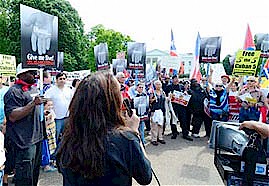
A peaceful demonstration supporting the release of the Cuban Five was held outside the White House beginning at 1:00 pm on Saturday. The large numbers already in D.C. were boosted by the arrival of four buses of supporters from New York and other U.S. cities.

The hundreds of activists carried banners, placards and posters all demanding that Obama release the imprisoned Cubans immediately.

A letter of appreciation and support in the name of the Five from Gerardo Hernandez, one of the Five who is serving two life sentences and fifteen years on trumped-up charges, was read out and received enthusiastically by those present.

Representatives from different solidarity organizations across the U.S. and other parts of the world followed Gerardo’s message with others from individuals and committees promising to continue the struggle until the Cuban Five are free and with their families in Cuba.

Cindy Sheehan brought the five days of action to a close at a meeting held in the Bolivarian Room of the Venezuelan embassy. In a moving and sincere manner Cindy explained her reasons for becoming involved with the case of the Five and expressed her admiration and fondness for the mothers of the incarcerated men.

According to Alicia Jrapko "The 5 days have been for me the best action or project we have ever done. From many angles it is the best. We have reached out to many people. We had an event with panelists of the most diverse ideas and ways of thinking. We were able to bring together a number of organizations that usually don’t work together."

"It was super important and, yes, we are very tired but happy."

Activities in numerous countries

In London’s Trafalgar Square hundreds gathered to demand the immediate release of the Five and unfurl a giant 15-meter banner on the initiative of the Cuba solidarity organization, Rock around the Blockade. Actions were planned in Glasgow, Scotland and in London an exhibition of graphic works by Antonio Guerrero and Gerardo Hernández, is continuing.

In Mexico City, supporters of the Five assembled in front of the U.S. embassy to chant slogans calling for their freedom, while in Russia, the Venceremos movement issued a statement calling on Obama to free the prisoners and right the injustice.

In Managua, the Nicaraguan Parliament approved a resolution demanding that the U.S. government free the anti-terrorist Cubans.

In the Dominican Republic, the television program Rebeldes, on the Tierra América 12 channel, was devoted to the issue.

In Germany, Argentina, Australia, Belgium, Bolivia, Brazil, Chile, Costa Rica, El Salvador, Spain, Italy, Peru, Turkey, Sweden and Ukraine events were held in solidarity with the Five. While in Cuba, representatives from the brigades of more than 2,000 youth from 83 countries who are studying in the province of Villa Clara, organized a public event describing the tortuous legal process and demanding justice.

Four Foreigners 'Captured' by the Sudan Military

Four foreigners 'captured' by Sudan army

29 Apr 2012, 9:24 am
Source: AFP

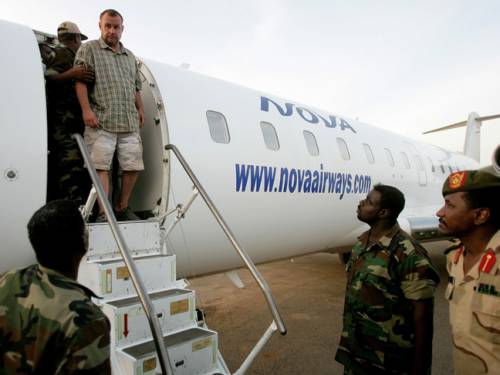
Four foreigners investigating the debris from recent fighting between Sudan and South Sudan have been captured in the Heglig oilfield area, Khartoum's military said

Khartoum has declared war: South Sudan
South Sudan leader cancels Shanghai trip
African Union: Sudan must stop bombing
Four foreigners investigating debris from recent fighting between Sudan and South Sudan have been caught in the Heglig oilfield area, Khartoum said, but the UN identified them as deminers.

"This confirms what we said before, that South Sudan in its aggression against Heglig was supported by foreign experts," army spokesman Sawarmi Khaled Saad told reporters after the four were flown to Khartoum for "more investigation."

He identified the captives as a Briton, a Norwegian, a South African and a South Sudanese.

"We captured them inside Sudan's borders, in the Heglig area, and they were collecting war debris for investigation," Saad said at the airport.

Jan Ledang, country director for the Norwegian People's Aid (NPA) mission in South Sudan, identified one of the captives as John Sorbo, also of NPA.

"It's impossible that they were in Heglig -- they were in Pariang" about a 90-minute drive from Heglig in the South's Unity state, Ledang said.

They were doing some follow-up demining work in that area, he added.

Josephine Guerrero, a spokesperson for the United Nations Mission in South Sudan, said the four were on a de-mining mission "and one of them was from the UN."

In the most serious unrest since the South's independence, Juba's troops occupied Sudan's main oil region of Heglig for 10 days, a move which coincided with air strikes against the South and raised fears of wider war.

Sudan declared on April 20 that its army had forced the Southern soldiers out of Heglig, but the South said it withdrew of its own accord.

Each side blames the other for damaging the oil facility, which provided about half of Sudan's oil output and is now shut down pending repairs.

Sudan on Saturday ruled out UN Security Council involvement in efforts to end a month of border clashes with South Sudan, which on Saturday said it had repelled an attack by Khartoum-backed rebels.

"Sudan confirms that it rejects any efforts to disturb the African Union role and take the situation between Sudan and South Sudan to the UN Security Council," Foreign Minister Ali Karti said.

The African Union itself, in a decision last Tuesday, asked the Security Council to endorse its demand that the two Sudans halt hostilities in 48 hours, start talks within two weeks and complete a peace accord in three months.

But Karti -- while expressing full confidence in the AU's role -- said in a statement that Security Council involvement would "give priority to a political position which... has a hidden agenda."

He did not elaborate.

The South Sudanese army said it had repelled an attack by rebels outside Malakal, capital of the South's Upper Nile State.

"It was Sudan-supported militias that attacked SPLA (South Sudan army) positions" on Friday, Colonel Philip Aguer told AFP.

But the rebels claimed in a statement that the "South Sudan Democratic Army (SSDA) launched Operation Ending Corruption and surrounded Malakal... and captured its surroundings."

The Security Council on Thursday started talks on a resolution that could allow sanctions against Sudan and South Sudan if they do not follow an AU roadmap to end their fighting.

A resolution drafted by the United States backs the AU decision and calls for the two sides to "immediately" halt hostilities and pull their forces back into their own territory.

The roadmap also urged both sides to stop supporting rebel groups and refrain from making "inflammatory" public statements.

Both nations have denied backing rebels on each other's territory.

In the latest of many diplomatic calls for Sudan and South Sudan to pull back from the brink of war, the presidents of the East African Community nations urged both sides "to return to the negotiating table and find peaceful means of resolving all the outstanding issues in the Comprehensive Peace Agreement," a statement said.

The EAC groups Burundi, Kenya, Rwanda, Tanzania and Uganda.

South Sudan broke away from Sudan in July last year after a peace deal ended one of Africa's longest civil wars, which killed about two million people.

Tensions have risen over a series of unresolved issues including the border, the future of disputed territories and oil.

In a key dispute, the two sides were unable to agree on how much the South should pay to export its crude through a northern pipeline and port, leading the Juba government in January to shut its production after Khartoum began seizing the oil in lieu of payment.

The poverty-stricken South said 98 percent of its pre-shutdown revenue came from oil. On Saturday it announced that China has agreed to lend it $8 billion for infrastructure development.

South Sudan Official Calls for Removal of Mbeki From Mediation Process

Sunday 29 April 2012

South Sudan official calls for removal of Mbeki from mediation process

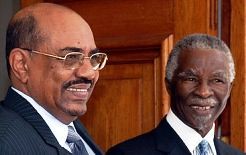
April 28, 2012 (JUBA) - South Sudanese officials and senior figures of the ruling party in Juba on Saturday added to calls for the removal of Thabo Mbeki, the chair of the African Union High Implementation Panel which has been mediating conflict resolution talks between Juba and Khartoum.

AU High-Level Implementation Panel chair and ex-South African president Thabo Mbeki (FP)Juba accused the African Union last January of attempting to force the new nation to pay cash and oil to Khartoum. Also following the capture of Heglig, South Sudan criticized the African Union for calling to pull out its troops while Abyei is under the control of Sudanese army since May 2011.

Earlier this month, the spokesperson of South Sudanese government, Barnaba Marial Benjamin, travelled to Nairobi asking Kenya to support Juba effort to bring the Intergovernmental Authority on Development (IGAD) to mediate their disputes with Khartoum instead of the AU panel.

He further voiced openly frustration with the current mediation saying his government was unhappy not only with the AU report to the UN Security Council about the recent border clashes but also with the overall mediating process.

The issue of Mbeki panel was discussed at a public debate hosted by Radio Bakhita in Juba where all the participants agreed on the need to remove Mbeki’s panel. They further expressed doubts about its credibility and backed the idea of calling on IGAD to mediate the process.

Chargé d’Affairs in the South Sudanese embassy in Kenya, John Andruga, on Friday was the first to direct his criticism against the former South African president saying that Mbeki is "partisan and not credible" and described the African Union as incompetent.

He said that one should "never put new wine in an old bottle"; that new talks should begin with a new mediator as the current one has "lost credibility" and has been "blocking" progress in the negotiations.

Lual Diing Wol, senior member of South Sudan’s governing Sudan People’s Liberation Movement (SPLM) also expressed his concern about Mbeki’s credibility and impartiality, suggesting the Inter-Governmental Authority on Development (IGAD) take over the mediation.

Biel Jok, deputy-chair of South Sudan Human Rights Commission also recommended IGAD replace the AU as mediator. He underscored that it is the IGAD which brokered the 2005 peace deal.

In a press conference he held at the premises of human right commission on Thursday 26 April Jok said the issues to be discussed by Juba and Khartoum are stipulations of the Comprehensive Peace Agreement, which ended Sudan’s civil war in 2005, and remain unimplemented by Khartoum’s ruling National Congress Party (NCP).

Hendry Ukec, a member of the South Sudan National Assembly from Upper Nile State questioned Mbeki’s neutrality, and accused him in statement to Sudan Tribune on Saturday of being selling arms to Khartoum.

He said the parliament discussed this issue in January 2012 and it was resolved that Speaker James Wani Igga brings the issue of arms deal between Sudan and South Africa to president Jacob Zuma.

Mbeki was "mediating in order to promote commercial relations between South Africa and Sudan," claimed Ukec.

During the clashes between the two parties over Heglig, Thabo Mbeki on 18 April urged the U.N. Security Council to intervene to stop hostilities between Sudan and South Sudan. He warned that Khartoum and Juba are locked in a "logic of war" with hardliners increasingly in control.

Last week, the African Union Peace and Security Council endorsed a seven point road map calling on the two sides to resume talks within two weeks and to conclude the negotiations in three months. The AU body further asked the UN Security Council to support its detailed plan and to endorse it under Chapter VII of the UN Charter.

(ST)


Sunday, April 29, 2012

Sudan rejects UNSC role in border dispute

* South Sudanese army says repells attack by rebels backed by Sudan

* Rebels claim to have surrounded Malakal

KHARTOUM: Sudan on Saturday rejected UN Security Council involvement in efforts to end weeks of border clashes with South Sudan, which said it repelled an attack by Khartoum-backed rebels.

“Sudan confirms that it rejects any efforts to disturb the African Union role and take the situation between Sudan and South Sudan to the UN Security Council,” Foreign Minister Ali Karti said after a month of deadly clashes which have raised fears of a wider war. The African Union itself, in a decision last Tuesday, asked the Security Council to endorse its demand that the two Sudans halt hostilities in 48 hours, start talks within two weeks and complete a peace accord in three months.

But Karti -- while expressing full confidence in the AU’s role -- said involvement by the Security Council would “give priority to a political position which was announced before and has a hidden agenda”. He did not elaborate.

The South Sudanese army said on Saturday it repelled an attack by rebels backed by Sudan outside Malakal, capital of the South’s Upper Nile State. “It was Sudan-supported militias that attacked SPLA (South Sudan army) positions” on Friday, Colonel Philip Aguer told. He said his forces repulsed the attack, with an unknown number of casualties.

But the rebels claimed to have surrounded Malakal, saying in a statement: “The magnanimous forces of South Sudan Democratic Army (SSDA) launched Operation Ending Corruption and surrounded Malakal ... and captured its surroundings.” Aguer said South Sudan’s forces had detained three rebel fighters and one vehicle.

The Security Council on Thursday started talks on a resolution that could allow sanctions against Sudan and South Sudan if they do not meet the AU demands to end their fighting. A US-drafted resolution backs the AU demands and calls for the two sides to “immediately” halt hostilities and pull their forces back into their own territory.

The text says the Security Council would review the rivals’ implementation of AU demands and could “take appropriate additional measures” under article 41 of Chapter VII of the UN charter that allows for sanctions but not military force.

After its meeting on Tuesday, the AU’s security body adopted a roadmap calling for an end to fighting, “including aerial bombardments, with the parties formally conveying their commitment in this respect to the chairperson of the Commission within 48 hours,” said the body’s security commissioner Ramtane Lamamra. The roadmap also urged both sides to withdraw troops from the other’s territory, stop supporting rebel groups and refrain from making “inflammatory” public statements. Despite the AU’s demand, Sudanese warplanes staged a cross-border raid on Unity State on Wednesday, the South’s army alleged.

Khartoum says the South’s continued support for rebels inside Sudan undermines the north’s stability, despite international appeals for it to stop. There have also been repeated international demands for an end to Sudan’s air strikes on the South. Both nations have denied backing rebels on each other’s territory. afp


Posted on Thu, Apr. 26, 2012

Arab League condemns South Sudan 'aggression'

By MAGGIE MICHAEL and MICHAEL ONYIEGO
Associated Press

The Arab League on Thursday condemned South Sudan's "military aggression" against an oil-rich border region claimed by Sudan while also supporting Sudan's right to defend itself. The statement came as some fear growing disputes between the two countries may soon lead to an all-out war.

South Sudan seceded from Sudan last year after a referendum held as part of a 2005 peace deal that ended more than 20 years of civil war, but unresolved issues such as the sharing of oil revenues and demarcation of the border have led to tensions and clashes.

Earlier this month, South Sudanese troops attacked and captured the oil-rich Heglig area. Sudan says it has since recaptured it. Earlier this week, after South Sudan said it was withdrawing its troops from Heglig, Sudan dropped bombs on the South. The U.N. said the bombs killed 16 civilians.

Sudan is a member of the Arab League, whose foreign ministers were meeting in Cairo. Their statement called on South Sudan to respect the borders between the two nations and to stop supporting rebel movements in Sudan's western Darfur region, south Kordofan and Blue Nile.

The meeting, said the statement, "rejects any claims that the Heglig area is disputed," meaning it belongs to Sudan.

The Arab League also called for an international fact-finding mission to assess the damage caused by the attack on Heglig. It said the two nations must resolve their differences through negotiations and called on League members to offer immediate financial aid to Sudan to rebuild oil installations in Heglig.

South Sudan is mainly animist and Christian, and its people are linguistically and ethnically linked to sub-Saharan Africa. The north is overwhelmingly Muslim, and many members of the government consider themselves Arabs.

Sudanese President Omar Al-Bashir gave a fiery speech last week in which he said there will be no negotiations with the "poisonous insects" who are challenging Sudan's claim to disputed territory near the border. He also threatened to topple the South Sudan government in Juba.

U.S. and U.N. leaders have pushed both sides to end fighting and resume negotiations.

A South Sudan official said Sudan bowed to international pressure and didn't resume attacks on the south Thursday after the violence ebbed earlier in the week.

"They have realized that what they are doing, nobody is happy about it," South Sudan government spokesman Barnaba Marial Benjamin said. "It has dawned on them, they are the ones who declared war, they are the ones calling us insects. I think they are beginning to feel the pressure."

The African Union also has said both countries should cease hostilities. The AU's Peace and Security Council issued a seven-point roadmap calling for a halt to the fighting and giving Sudan and South Sudan two weeks to restart negotiations, which broke down earlier this month.

The AU also warned the two countries against making inflammatory statements and propaganda against each other, which could fuel the conflict.


COMMUNIQUÉ OF THE 10TH EXTRAORDINARY SUMMIT OF EAC HEADS OF STATE

ARUSHA, Tanzania, April 28, 2012/African Press Organization (APO)/ -- NGURDOTO MOUNTAIN LODGE,...

ARUSHA, Tanzania, April 28, 2012/African Press Organization (APO)/ -- NGURDOTO MOUNTAIN LODGE, ARUSHA, TANZANIA

28TH APRIL 2012

10TH EXTRAORDINARY SUMMIT OF HEADS OF STATE OF THE EAST AFRICAN COMMUNITY

JOINT COMMUNIQUÉ

1 THE EAST AFRICAN COMMUNITY HEADS OF STATE, THEIR EXCELLENCIES PRESIDENT MWAI KIBAKI OF THE REPUBLIC OF KENYA AND CHAIRPERSON OF THE SUMMIT, PRESIDENT PAUL KAGAME OF THE REPUBLIC OF RWANDA, PRESIDENT JAKAYA MRISHO KIKWETE OF THE UNITED REPUBLIC OF TANZANIA, PRESIDENT YOWERI KAGUTA MUSEVENI OF THE REPUBLIC OF UGANDA AND FIRST VICE PRESIDENT HE THÉRENCE SINUNGURUZA OF THE REPUBLIC OF BURUNDI HELD THE 10TH EXTRAORDINARY SUMMIT OF THE EAST AFRICAN COMMUNITY HEADS OF STATE AT THE NGURDOTO MOUNTAIN LODGE IN ARUSHA, TANZANIA ON 28TH APRIL 2012.

2 THE HEADS OF STATE AND GOVERNMENT MET IN A WARM AND CORDIAL ATMOSPHERE.

3 THE SUMMIT COMMENDED THE COUNCIL OF MINISTERS FOR TAKING THE LEAD IN THE ELIMINATION OF NON TARIFF BARRIERS TO ENHANCE FREE CIRCULATION OF GOODS AND SERVICES IN THE COMMUNITY AND DIRECTED THAT DECISIONS TAKEN TO THIS EFFECT BE IMPLEMENTED EXPEDITIOUSLY.

4 THE SUMMIT COMMENDED HON. BEATRICE B. KIRASO WHO WAS COMPLETING HER TERM OF OFFICE AS DEPUTY SECRETARY GENERAL OF THE EAST AFRICAN COMMUNITY IN CHARGE OF POLITICAL FEDERATION FOR HER EXEMPLARY SERVICE DURING THE PAST SIX YEARS. THE SUMMIT WISHED HON. KIRASO WELL IN HER FUTURE ENDEAVOURS.

5 THE SUMMIT NOTED THAT THE CONTRACT FOR THE EXECUTIVE DIRECTOR OF THE CIVIL AVIATION SAFETY AND SECURITY OVERSIGHT AGENCY (CASSOA), MR. MTESIGWA MAUGO WAS DUE TO EXPIRE IN MAY 2012.

6 THE SUMMIT COMMENDED MR. MTESIGWA MAUGO FOR HIS OUTSTANDING SERVICE TO THE COMMUNITY AND WISHED HIM WELL IN HIS FUTURE ENDEAVOURS.

7 THE SUMMIT APPOINTED HON. JESCA ERIYO FROM THE REPUBLIC OF UGANDA NEW DEPUTY SECRETARY GENERAL OF THE EAST AFRICAN COMMUNITY WITH EFFECT FROM 30TH APRIL 2012.

8 THE SUMMIT RENEWED THE CONTRACT OF MR. JEAN CLAUDE NSENGIYUMVA AS DEPUTY SECRETARY GENERAL FOR A FINAL TERM OF THREE YEARS WITH EFFECT FROM 30TH APRIL 2012.

9 THE SUMMIT DIRECTED THE SECRETARY GENERAL TO DEPLOY THE DEPUTY SECRETARIES GENERAL TO DIFFERENT DEPARTMENTS.

10 THE SUMMIT RECEIVED A PROGRESS REPORT OF THE COUNCIL OF MINISTERS ON THE ATTAINMENT OF A SINGLE CUSTOMS TERRITORY.

11 THE SUMMIT ADOPTED IN PRINCIPLE THE DESTINATION MODEL OF CLEARANCE OF GOODS WHERE ASSESSMENT AND COLLECTION OF REVENUE IS AT THE FIRST POINT OF ENTRY AND REVENUES ARE REMITTED TO THE DESTINATION PARTNER STATES SUBJECT TO THE FULFILMENT OF KEY PRE-CONDITIONS TO BE DEVELOPED BY THE HIGH LEVEL TASK FORCE.

12 THE SUMMIT DIRECTED THE COUNCIL TO INITIATE ITS OPERATIONALIZATION AND REPORT PROGRESS AT THE 14TH ORDINARY SUMMIT IN NOVEMBER 2012.

13 THE SUMMIT CONSIDERED THE REPORT OF THE COUNCIL OF MINISTERS ON THE APPLICATION OF THE REPUBLIC OF SOUTH SUDAN TO JOIN THE EAST AFRICAN COMMUNITY. THE SUMMIT NOTED THAT THE COUNCIL HAS INITIATED THE VERIFICATION PROCESS OF THE APPLICATION. THE SUMMIT DIRECTED THE COUNCIL TO EXPEDITE THIS PROCESS AND REPORT AT THE 14TH ORDINARY SUMMIT IN NOVEMBER 2012.

14 THE HEADS OF STATE SIGNED THE EAST AFRICAN COMMUNITY PROTOCOL ON CO-OPERATION IN DEFENCE. THE SUMMIT DIRECTED THAT THE PROTOCOL BE RATIFIED AND INSTRUMENTS OF RATIFICATION DEPOSITED WITH THE SECRETARY GENERAL BY 30TH NOVEMBER 2012 AND THAT THE NEGOTIATIONS ON THE MUTUAL DEFENCE PACT COMMENCE IMMEDIATELY THEREAFTER.

15 THE SUMMIT APPROVED THE PROPOSED REMUNERATION OF THE JUDGE PRESIDENT AND THE PRINCIPAL JUDGE FOR THE EAST AFRICAN COURT OF JUSTICE.

16 THE SUMMIT REVIEWED THE SECURITY SITUATION IN THE EAST AFRICAN REGION.

17 THE SUMMIT EXPRESSED CONCERN ON THE ONGOING CONFLICT BETWEEN THE REPUBLIC OF SUDAN AND THE REPUBLIC OF SOUTH SUDAN AND APRECIATED THE ROLE PARTNER STATES HAVE PLAYED IN RESOLVING THE CONFLICT IN THE SUDAN AND EXPRESSED ITS DETERMINATION TO CONTINUE TO PLAY THIS POSITIVE ROLE IN RESOLVING THE CONFLICTS IN COUNTRIES THAT BORDER THE EAC.

18 THE SUMMIT URGED THE LEADERS OF THE REPUBLICS OF THE SUDAN AND SOUTH SUDAN TO RETURN TO THE NEGOTIATING TABLE AND FIND PEACEFUL MEANS OF RESOLVING ALL THE OUTSTANDING ISSUES IN THE COMPREHENSIVE PEACE AGREEMENT.

19 THE SUMMIT WELCOMED THE LONDON CONFERENCE ON SOMALIA OF FEBRUARY 2012 AND NOTED THAT IT MARKED A TURNING POINT IN THE COUNTRY'S QUEST FOR PEACE AND STABILITY. THE SUMMIT FURTHER COMMENDED THE AFRICAN UNION MISSION IN SOMALIA (AMISOM) WORKING WITH THE TRANSITIONAL GOVERNMENT OF SOMALIA FOR RETURNING PEACE TO LARGE AREAS OF SOMALIA AND CALLS ON THE TRANSITIONAL NATIONAL GOVERNMENT OF SOMALIA TO CONSOLIDATE THE BENEFITS OF PEACE TO THE BENEFIT OF THE PEOPLE OF SOMALIA.

20 THE SUMMIT WELCOMED THE RESOLUTION BY THE EAST AFRICAN LEGISLATIVE ASSEMBLY FOR EXPEDITING AMENDMENT OF THE TREATY FOR THE ESTABLISHMENT OF THE EAST AFRICAN COMMUNITY TO EXTEND JURISDICTION OF THE EAST AFRICAN COURT OF JUSTICE OR THE CONCLUSION OF THE PROTOCOL ON THIS MATTER. THE SUMMIT NOTED THE NEED TO LOOK INTO THE MATTER OF EXTENDING THIS JURISDICTION TO COVER, AMONG OTHERS CRIMES AGAINST HUMANITY. THE SUMMIT DIRECTED THE COUNCIL OF MINISTERS TO CONSIDER THIS MATTER BY END OF MAY 2012 AND REPORT TO AN EXTRAORDINARY SUMMIT TO BE CONVENED IMMEDIATELY THEREAFTER.

21 THE SUMMIT RESOLVED TO HOLD A DEDICATED SESSION ON INFRASTRUCTURE DEVELOPMENT AND FINANCING IN THE REGION AT THE 14TH ORDINARY SUMMIT IN NOVEMBER 2012.

22 THEIR EXCELLENCIES, PRESIDENT MWAI KIBAKI OF THE REPUBLIC OF KENYA AND CHAIRPERSON OF THE SUMMIT, PRESIDENT PAUL KAGAME OF THE REPUBLIC OF RWANDA, PRESIDENT YOWERI KAGUTA MUSEVENI OF THE REPUBLIC OF UGANDA, AND FIRST VICE PRESIDENT RT. HON. THERENCE SINUNGURUZA OF THE REPUBLIC OF BURUNDI THANKED THEIR HOST, HIS EXCELLENCY PRESIDENT JAKAYA MRISHO KIKWETE OF THE UNITED REPUBLIC OF TANZANIA, FOR THE WARM AND CORDIAL HOSPITALITY EXTENDED TO THEM AND THEIR RESPECTIVE DELEGATIONS DURING THEIR STAY IN ARUSHA.

DONE AT ARUSHA, THIS 28TH DAY OF APRIL 2012

Jonglei Peace: Communities Give Conditions for Reconciliation in South Sudan

Sunday 29 April 2012

Jonglei Peace: Communities give conditions for reconciliation

April 27, 2012 (BOR) – Jonglei State’s communities outlined a set of conditions for the peaceful resolution of conflicts amongst their warring ethnic groups; including the return of abducted children and compensation for losses including those killed.

The resolutions were made at four meetings being held in Bor, Ayod, Waat and Pibor towns ahead of a joint peace conference scheduled for next week in Bor, the capital of Jonglei.

South Sudan President Salva Kiir appointed a 23-member Presidential Peace Committee following the peak of ethnic violence in December and January to mediate and find solutions to the fighting.

In 2011 conflict over resources, cattle, abductions, raids and counters between the Lou Nuer, Bor and Murle led to the death of over 1,000 people. In December and January the violence peaked when 6,000 armed Luo Nuer men entered Pibor County the home of the Murle tribe.

The assault and the counterattacks by the Murle displaced over 100,000 others according to the UN.

Jonglei State’s eleven counties have been grouped into four regions for the sake of the exercise; Greater Bor, Greater Fangak, Greater Pibor and Greater Akobo.

At the greater Bor meeting in Bor, traditional leaders and members of parliament outlined the conditions under which they would accept peace with the Murle.

Bor County says 276 children have been abducted by Murle since the Comprehensive Peace Agreement was signed in 2005 as well as killing of 730 people.

Alongside the peace process a disarmament campaign has been taking place but had met resistance from some groups who fled to Ethiopia to avoid handing over their weapons.

“After disarmament, we lost seven people in Murle attacks on our villages,” Maker Lual, the Commissioner of Bor County said.

The are claims that some cattle were raided from at Kolnyang Payam [district] on Friday 27 April, while the meeting was occurring in Bor.

Commissioner Maker said that alongside returning of children, the Murle should also pay for the people killed in blood compensation, arrest those suspected of committing crimes and return all of the cattle that had been looted.

In a meeting in Pibor, a source told Sudan Tribune that the Anyuak, Jie, Kachipo and Murle agreed to peace provided that the government “make assurance[s] for security", which been one of the sticking points over disarmament.

They also demanded that "mobile police" be created between the communities.

Pibor County’s press secretary said that all communities in greater Pibor found the “Murle guilty” for causing local internal unrest but pointed out the the Murle had also suffered from cattle raids and child abductions. He also called for children to be returned.

There was no immediate response from Waat and Ayod for confirmation on what leaders there demanded as a condition for peace with neighbours.

Experts say calls for children to be returned to their families could top the list.

Confusion over leadership roles between traditional and political leaders, loss of cultural values, unemployment, separation of church from the state were listed in Bor as some of issues causing insecurity.

Participants remained divided on the approach to achieve peace in Jonglei. Traditional chiefs say lack of justice and holding suspected criminals to account contributed to failures of past agreements.

Some political leaders say the government of the Republic of South Sudan is yet to understand the problem of Jonglei State and calls for greater action to restore peace including developmental projects and building of roads.

Jonglei State has a notoriously bad road network and communities often live in isolation of each other, the leader said, making themselves strangers for themselves. Poor infrastructure also makes it hard for police and the army to respond to incidents.

The Presidential Peace Committee is headed by Archibishop Daniel Deng and all members appointed by the President are intellectuals prompting criticism from local leaders that the peace process could ultimately be fruitless like other agreements have in the past.

(ST)

AMISOM Warns Spoilers Against Disrupting the Peace Process in Somalia

Friday, April 27th, 2012 at 03:26 am

Somalia: AMISOM warns spoilers against disrupting the peace process

PRESS RELEASE
(For immediate release)

AMISOM warns spoilers against disrupting the peace process

Mogadishu, April 26th, 2012

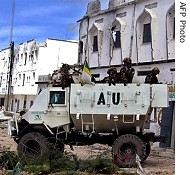
The African Union Mission in Somalia (AMISOM) has said that it will not allow spoilers to sabotage the peace process as the country approaches the end of the transitional period.

Speaking during a press briefing in Mogadishu today, the Deputy Special Representative of the Chairperson of the African Union Commission (DSRCC) for Somalia, Honorable Wafula Wamunyinyi observed that as the country draws closer to the end of the transitional period there will be heightened political activities and called on stakeholders to refrain from acts and statements that may disturb the peace currently enjoyed in most parts of the country.

He said; “It is important to note that this is the longest period of peace that Somalia has enjoyed since the fall of a central government in 1991. There have been sacrifices to get to where we are and AMISOM will not allow anybody to disrupt the peace process.”

The Deputy AU Special Representative noted the firm commitment demonstrated by the Transitional Federal Institutions to delivering a provisional constitution to the people of Somalia. “As we speak, the elders’ meeting is convening right here in Mogadishu to select members of the Constituent Assembly which is expected to review and adopt the draft provisional constitution. I look forward to a successful session by the assembly which should adopt the constitution by mid May.” He said.

Honorable Wafula Wamunyinyi who took opportunity of the press briefing to introduce the incoming Force Commander Lieutenant General Andrew Gutti as part of implementation of United Nations Resolution 2036, extended his appreciation to outgoing Force Commander Major General Fred Mugisha for helping the TFG to liberate key areas including Daynile and Maslah from Al-Shabaab terrorists.

He said AMISOM has secured the whole of Mogadishu and is now helping the TFG to consolidate the defense of the city and advancing beyond.

For more information, please Contact; Mr. Eloi Yao, Senior Public Information

Officer and Spokesperson, E-mail: amisommediacentre@gmail.com


Friday, April 27th, 2012 at 01:28 pm

SOMALIA: President Sharif not satisfied with the draft constitution

By Abdalle Ahmed

Mogadishu (RBC) Somali interim president Sharif Sheikh Ahmed has demonstrated that he is not satisfied with some of the contents of the new draft constitution amid contradictory remarks by the government officials on the constitution.

“I share that I am not satisfied with some awful articles included into the new constitution and strongly ask to remove.” President Sharif said during his public address of the 52nd anniversary of Somali National Army.

The president acknowledged the growing suspicion and outrage by the local community against the draft constitution as he insisted that the constitution can be amended though it has not yet been adopted.

“I listened some of the elders and religious people who are worrying the constitution and I told them that it must reviewed” he added.

But in contrast, the Prime Minister Abdiweli Mohamed Ali who spoke to local journalists this week said that there were no any bad things in the constitution and called for the people to prop up it.

“I see those who oppose the constitution have not read what it is talking about. First they must read it.” The prime minister said.

RBC Radio

General Samatar Ordered Arrested in Puntland

Friday, April 27th, 2012 at 07:18 pm

SOMALIA: Puntland orders arrest of prominent politician- sources

Gen Samatar, a former security minister and presidential candidate in the region’s upcoming election has strongly contested against president Farole’s political schema and warned over the postponement of the election after January 8th 2013.

Garowe (RBC)

The president of Somalia’s semi-autonomous state of Puntland has ordered the arrest of Gen Abdullahi Sa’id Samatar who is a prominent opposition leader in Puntland, reliable sources confirmed to RBC Radio.

The order which emerged last week during a meeting by Puntland cabinet came following growing criticism against the one-year extension decision of president Abdurahman Mohamed Farole’s term which is due to end on January next year.

The decision of arrest was formally proposed by son of President Mohamed Abdurahman, the president’s media advisor and sometime the spokesperson of the presidential office who attended the meeting in the state house.

Gen Samatar, a former security minister and presidential candidate in the region’s upcoming election has strongly contested against president Farole’s political schema and warned over the postponement of the election after January 8th 2013. Gen Samatar also pointed out under-cover index through the newly adopted Puntland constitution which the president intended to legalize his extension of term.

Locals begun to question the order which they said could create tensions in the clan-based authority in the region as the security officials also cautioned to put the order into practice but the son of the president was still on the fore-front to implement the order.

On March, officials of Puntland security ministry ordered two foreign aid agencies in Bosasso to abandon from buildings belonged to Gen Samatar to block the money paid as rent to the opposition man.

RBC Radio


Saturday, April 28th, 2012 at 11:16 am

SOMALIA: Senior officer of South-African mercenary firm killed in Puntland

The picture of small airstrip which Saracen has set up near Bosasso. photo file RBC Radio Bosasso (RBC) Senior training officer for South African mercenary firm, Saracen International was shot to death by his fellow Somali guards in Puntland on Friday, RBC Radio reports.

The shooting has reportedly taken place on Friday at Timirshe village on the suburb of Iskushuban district, 160km east from Bosasso, the provincial capital of Somalia’s northeastern region after heavy argument between the white-south African commander and his Somali guards.

Several bullets were shot on his head and the chest and led to urgent death.

Unnamed security officials in Puntland confirmed the killing as they claimed that urgent investigations were launched to identify the reason of the killing but reliable sources told RBC Radio that at least 40 Somali guards working for the firm were arrested for the case.

The body of the deceased foreign officer was taken back to Qaw location near Bosasso town late on Friday while there were no immediate comments from Saracen’s officials in the region.

The foreign mercenary firm which claims a counter-piracy mission in Puntland have recently set up new camps in eastern districts of Puntland but there has been growing anger from the local community who suspect that the group involved other illegal activities including stealing of precious gemstones from the region.

The Saracen mission in Somalia started in 2010 in coordinating with a security training contract with the transitional government of Somalia but later that year the company moved to Puntland after signing another contract with the local administration under the name of “anti-piracy” mission.

Both the UN and the U.S government expressed their concern over the mission after news agencies and UN body monitoring the arms embargo on Somalia revealed that Saracen International, paid by unnamed Muslim nation begun to import weapons for Puntland administration.

US Jury Convicts Somalian in Yacht Hijacking

Originally published Friday, April 27, 2012 at 1:35 PM

Jury convicts Somali of piracy in yacht hijacking

A federal jury has convicted a Somali man of piracy for his role as a hostage negotiator in the hijacking of an American yacht.

By BROCK VERGAKIS
Associated Press

NORFOLK, Va. — A federal jury has convicted a Somali man of piracy for his role as a hostage negotiator in the hijacking of an American yacht.

Mohammad Saaili Shibin was convicted of piracy, kidnapping and hostage-taking in the 2011 hijacking of the Quest off the coast of Africa. All four Americans on board were shot and killed.

He was also convicted Friday of piracy and several other charges for the hijacking of a German merchant ship in 2010. Prosecutors said he received at least $30,000 for his role as a negotiator in that case.

He faces a mandatory life sentence on the piracy charges. He will be sentenced in August.

Shibin's attorney says he plans to appeal.

A federal jury began deliberations on Friday in the trial of a Somali man accused of being a pirate negotiator involved in an attack on a U.S. yacht in which all four Americans on board were eventually shot and killed.

Mohammad Saaili Shibin faces piracy, kidnapping and hostage-taking charges in connection with the 2011 hijacking of the Quest off the coast of Africa, although he never boarded the sailing vessel.

Prosecutors said Shibin was responsible for researching the American hostages online to decide how large of a ransom to seek and to negotiate their release once they reached Somalia. U.S. authorities consider Shibin the highest-ranking pirate they have ever captured.

The 53-year-old former oil company translator is also charged with piracy in the 2010 hijacking of a German merchant vessel in which crew members were tortured while he negotiated their release. Prosecutors said Shibin earned between $30,000 and $50,000 for his role in securing a $5 million ransom for the Marida Marguerite and its crew.

Nearly two dozen crew members, most of whom were from India, had been held in captivity for about eight months before their release.

Shibin attorney James Broccoletti said Shibin was merely acting as a mediator for the hostages aboard the German ship and that it was a mistake that he accepted payments from pirates for his services.

He saod Shibin shouldn't be convicted of piracy because he never boarded the yacht and didn't commit robbery at sea in either case. That line of defense took a significant blow when U.S. District Judge Robert Doumar sided with prosecutors in defining piracy. When reading instructions to jurors, Doumar said that inciting or facilitating piracy was enough to secure a guilty plea.

The definition of piracy has been in dispute since Shibin's indictment. That's because two other federal judges in the same courthouse have issued different rulings in other piracy cases involving attacks on U.S. Navy ships. Doumar waited to rule on whether to dismiss the piracy charges until he heard all the evidence in the case, ultimately deciding to allow the charges to go to the jury.

At issue is whether piracy is defined solely as robbery at sea. U.S. law refers to piracy only "as defined by the law of nations." Shibin's case is unique from other pirates the U.S. has tried because he wasn't part of the raiding parties that sought out and attacked ships.

The 4th U.S. District Court of Appeals heard arguments on the definition of piracy in September but has not indicated when it might rule.

"Piracy doesn't end when you take the ship," Assistant U.S. Attorney Joseph E. DePadilla told jurors Friday. "Piracy finishes when you get the ransom. That's the whole idea behind piracy."

If convicted of piracy in either case, Shibin faces a mandatory life sentence. Of the 14 others charged in the case of the Quest, 11 have been sentenced to life in prison after pleading guilty to piracy. Three others await trial on murder and other death-penalty eligible charges.

The yacht owners, Jean and Scott Adam of Marina del Rey, Calif., along with friends Bob Riggle and Phyllis Macay of Seattle, were the first U.S. citizens killed in a wave of pirate attacks plaguing the Gulf of Aden and Indian Ocean despite a regular patrol of international warships.

The plan to ransom the Americans fell apart when a plane spotted pirates onboard the vessel and the U.S. Navy began shadowing the sailboat as it headed toward Somalia.

The pirates onboard the Quest told the Navy that they couldn't negotiate the release of the Americans and gave U.S. authorities Shibin's phone number to contact as the person in charge. Broccoletti told jurors Shibin never agreed to be the hostage negotiator, although he had been offered the job by pirate investors. Shibin told investigators he performed Internet searches about the yacht and the Americans only out of curiosity. Prosecutors noted he had dozens of phone calls with pirate investors during the course of the Quest's captivity.

The Navy said that it would let the pirates keep the yacht but that it would not let them take the Americans to Somalia. After several days of failed negotiations with the pirates onboard the yacht, the USS Sterett started maneuvering to put itself between the pirates and the Somali coast. That resulted in pirates firing a rocket-propelled grenade at the destroyer. Shortly thereafter, shots rang out on the yacht.

Doumar said jury deliberations would end at 5 p.m. each day.
---
Brock Vergakis can be reached at http://twitter.com/BrockVergakis

Mali Coup Leader Rejects ECOWAS Troop Deployment

28 April 2012
18:09 ET

Mali coup leader rejects Ecowas troop deployment

Capt Sanogo said the military should decide who runs Mali after 40 days

The leader of last month's coup in Mali has rejected the West African decision to send troops to the country.

Captain Amadou Sanago said the military had not been consulted by the regional grouping Ecowas.

The coup leaders handed power to an interim civilian government earlier this month.

A meeting between Ecowas mediators and the interim government was disrupted by soldiers shouting "Down with Ecowas" and cocking their guns.

They only backed down when Capt Sanago left the meeting to tell them to disperse.

The military leaders are unhappy about Thursday's decision by Ecowas heads of government to send at least 3,000 soldiers to Mali.

Their planned deployment was designed to help secure the transition back to civilian rule, and help the government defeat rebels who now control the northern half of the country.

Officers led by Capt Sanogo seized power on 22 March, accusing the elected government of not doing enough to halt the rebellion in the northern desert region.

Powerful military

They agreed to hand over power to a civilian government on the understanding it would hold fresh elections within 40 days.

But the military is unhappy after Ecowas said the interim government should have up to a year to organise fresh elections.

The country's interim president Dioncounda Traore was at the Ecowas meeting.

Capt Sanago told reporters after the meeting that it was up to the military to decide what institutions run the country after the end of the 40-day period.

He did not make clear whether elections would then be held.

The BBC's John James in neighbouring Ivory Coast says it seems the coup leaders still exercise considerable power and fear any Ecowas deployment would threaten their position.

The military leadership said it seized power last month because the previous government had not done enough to combat rebels.

Saturday, April 28, 2012

Africa & the Struggle Against Imperialism: 40 Years After Kwame Nkrumah

Africa & the Struggle Against Imperialism: 40 Years After Kwame Nkrumah

Liberation, unity and socialism more important today than ever

By Abayomi Azikiwe
Editor, Pan-African News Wire

April 27 marked the fortieth anniversary of the passing of Dr. Kwame Nkrumah, the founder of modern-day Ghana and a leading theoretician of the post-World War II national liberation movement for unity and socialism. Nkrumah’s legacy is still very much a part of the ongoing efforts of the peoples of Africa and the world who seek genuine freedom from colonialism, neo-colonialism and imperialism.

Born in the western region of the Gold Coast (later renamed Ghana in 1957) on September 21, 1909, Nkrumah grew up under the colonial system established by the British. The people of the Gold Coast had fought western domination from the period of the Atlantic Slave Trade through the early 20th century when Queen Ya Asantewaa of the Ashanti people led an armed resistance campaign to halt British encroachment into their territories.

After being educated through primary and secondary school as well as teacher training college in the Gold Coast, Nkrumah left Africa to attend the Historically Black College of Lincoln University in Pennsylvania. It was his experience at Lincoln and the University of Pennsylvania between 1935-1945 that helped to shape his outlook on African nationalism and anti-imperialism.

While in the United States during the Great Depression and World War II, Nkrumah was influenced by some of the leading figures and organizations of the nationalist and left movements. These groups included the African Students Association, the Universal Negro Improvement Association (UNIA) founded by Marcus Garvey, the Council on African Affairs headed then by W.E.B. DuBois and Dr. William Alpheus Hunton, and C.L.R. James of the Trotskyist movement, among others.

Nkrumah spoke in various African American churches and interacted with the masses of people who he perceived as still being connected with their ancestral cultures. While in the U.S., he was forced to work for a living and earn his tuition from menial employment and part-time teaching.

In 1945, Nkrumah traveled to England where he immediately began working towards the organization of the Fifth Pan-African Congress alongside George Padmore, a former member of the Communist International. The Congress was held in the city of Manchester that October and proved to be the most successful gathering of the Pan-African movement since the 1920s.

A Declaration to the Colonial Peoples of the World was drafted by Nkrumah, Padmore and DuBois and approved by the more than 200 delegates. The document read in part that “The Fifth Pan-African Congress calls on intellectuals and professional classes of the Colonies to awaken to their responsibilities.” (Africa Must Unite, Nkrumah, 1963, p. 134))

The Declaration continues noting that “The long, long, night is over. By fighting for trade union rights, the right to form co-operatives, freedom of the press, assembly, demonstration and strike, freedom to print and read the literature which is necessary for the education of the masses, you will be using the only means by which your liberties will be won and maintained. Today there is only one road to effective action—the organization of the masses.”

The Struggle for Genuine Independence, Unity and Socialism

By late 1947 Nkrumah had returned to the Gold Coast at the invitation of the moderate United Gold Coast Convention (UGCC) which had retained him as an organizer. He, along with other comrades, would build the Committee on Youth Organization (CYO) as the militant and worker-oriented wing of the movement.

However, by June 1949, the CYO was frustrated with the slow pace of the UGCC and the youth and workers demanded that Nkrumah form a new organization that became known as the Convention People’s Party (CPP). The CPP was a mass organization from its inception and was rooted among the workers, women and youth.

In 1950, the CPP organized a general strike demanding independence now. As a result Nkrumah was thrown into prison where he would languish for over a year.

Nonetheless, the CPP continued to organize and through a British-controlled reform election in 1951, won the overwhelming support of the masses. Nkrumah was immediately released from prison and put in charge of a transitional government that led the country to full independence on March 6, 1957.

Nkrumah believed that the independence of Ghana would be meaningless if it was not connected with the total liberation and unity of Africa. In December 1958, he along with George Padmore, then his chief advisor on African affairs, would organize the All-African People’s Conference (AAPC) in the Ghana capital of Accra.

The meeting attracted 62 nationalist organizations from throughout Africa and the Diaspora. Figures such as Patrice Lumumba, Shirley Graham DuBois and Frantz Fanon were in attendance.

By 1960 Ghana would become a republic and later embarked upon a socialist orientation aimed the genuine liberation of the country. An alliance was formed with other progressive states in Guinea, Mali, Congo and Algeria (which gained independence in 1962).

Women in Ghana were guaranteed seats within the national assembly and provided scholarships for primary, secondary and higher education. The National Council of Ghana Women was an important base within the CPP government and hosted the first All-African Women’s Conference in 1960.

In 1962 a program calling for the construction of a socialist economy was adopted by the party and government. Closer ties were built with the Soviet Union, China and Cuba and the country became a base of operations for national liberation and resistance movements from throughout Africa and the world.

Neo-Colonialism: The Last Stage of Imperialism

Despite these achievements, Ghana and the other progressive African states were targeted for liquidation by the imperialists. The independence of Congo was hijacked by the former colonial power of Belgium and the U.S. in 1960-61.

The progressive African states worked to avoid political isolation from more moderate governments which were allied with the U.S., Britain and France. As the class struggle intensified inside various African societies, the imperialists sponsored military and police coups in order to stifle and reverse the movement towards revolutionary pan-Africanism and socialism.

Nkrumah at the time of the formation of the continental Organization of African Unity (OAU) in 1963 wrote that “The greatest danger at present facing Africa is neo-colonialism and its major instrument, balkanization….As the nationalist struggle deepens in the colonial territories and independence appears on the horizon, the imperialist powers, fishing in the muddy waters of communalism, tribalism and sectional interests, endeavor to create fissions in the national front, in order to achieve fragmentation.” (Africa Must Unite, p. 173)

The CPP government would fall victim to this process on February 24, 1966 when Nkrumah was out of the country on a mission to Hanoi aimed at ending the U.S. war against Vietnam. Reactionary elements within the military and the police overthrew the Ghana state with the assistance of the Central Intelligence Agency (CIA) and the State Department.

Nkrumah re-located in Guinea and continued to write and organize for the next phase of the African Revolution. By 1971 Nkrumah became ill and traveled to Romania to seek medical treatment where he died on April 27, 1972.

Africa Today: Economic Crisis and Militarism

The lessons of the early phase of the African revolutionary struggle are relevant to the developments of the last decade. Nkrumah had identified U.S. imperialism as the main enemy of the African Revolution in his book entitled Neo-Colonialism: The Last State of Imperialism published in 1965.

Judging from events in Libya, Somalia, Sudan, Zimbabwe, Egypt and other countries, his assessments from nearly five decades ago have stood the test of time. Today the United States Africa Command (AFRICOM) is involved in various military operations on the continent including the overthrow of the government of Libya and the ongoing efforts to destabilize and contain the people of Somalia.

With the continuing dependence of African states on the capitalist economic relations fostered by imperialism, the continent remained extremely underdeveloped even though it is abundant in oil and other natural resources. In order for Africa to break the chains of poverty and stagnation a revolution against class domination and imperialism must be waged with vigor.

As Nkrumah stressed in his book “Class Struggle in Africa” published in 1970, that “The total liberation and unification of Africa under an All-African socialist government must be the primary objective of all Black revolutionaries throughout the world. It is an objective which, when achieved, will bring about the fulfillment of the aspirations of African and people of African descent everywhere.”

This quote continues by illustrating that, “It will at the same time advance the triumph of the international socialist revolution, and the onward progress towards world communism, under which, every society is ordered on the principle of—from each according to his (and her) ability, to each according to his (and her) needs. (p. 88)