Thursday, May 30, 2013

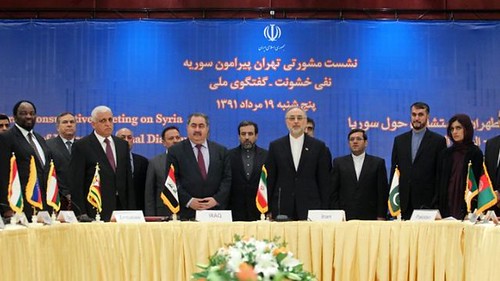
Iran Hosts Conference on Syrian Crisis

Friends of Syrian People Meeting Starts in Tehran

May 29, 2013

TEHRAN, (SANA)- The Friends of Syrian People meeting kicked off inTehran on Wednesday under the title 'The Political Solution and Regional Stability'

Delegations of more than 40 countries are taking part in the meeting which aims at finding a political solution to the crisis in Syria.

In the context, Iranian Foreign Ministry Spokesman, Abbas Araghchi, expressed the hope that the discussions in the meeting will contribute to making the international conference on Syria which is scheduled to be held in Geneva next month a success.

He pointed out that Iran differentiates between the armed terrorist groups and the genuine opposition sides that seek to find a solution to the crisis in Syria through national dialogue between the government and the opposition which believes in the peaceful solution.

Salehi: Iran's Stance on Syria Is Clear

For his part, Iranian Foreign Minister, Ali Akbar Salehi, stressed that his country's position on Syria has been and is still clear and transparent in that it is based on rejecting foreign interference in its affairs.

"Iran believes that foreign interference doesn't serve solving the crisis in Syria but would rather complicate the situation there," said Salehi during a meeting with former Lebanese President Emile Lahoud who had earlier arrived Iran to participate in the Friends of the Syrian People meeting.

Salehi also stressed the importance of solving the crisis in Syria by peaceful means during his discussions with a number of heads of delegations that arrived in Tehran to participate in the meeting.

Among those were the Omani Foreign Minister Yousef al-Harthy, Venezuelan Deputy Foreign Minister, David Velazquez and Bolivian Assistant Foreign Minister, Juan Carlos Alurralde.

H.Zain/ H. Said


Iran hosts international Friends of Syria Conference

Wed May 29, 2013 6:11AM GMT
presstv.ir

Iran is hosting the Friends of Syria Conference in the capital, Tehran, with the participation of representatives from 40 countries.

The event, which is held under the banner of “Political Solution, Regional Stability,” seeks to find a political solution to the crisis in Syria.

Officials from 40 countries as well as heads of regional and international organizations are expected to attend the conference.

According to reports, Iraqi Foreign Minister Hoshyar Zebari, Algerian Foreign Minister Mourad Medelci, Oman’s Deputy Foreign Minister Youssef Al-Harthi, Former Lebanese President Emile Lahoud and Minister for Defense and National Service of Tanzania Shamsi Vuai Nahodha are among the officials attending the event.

Iran has already held two other meetings on the crisis in the Arab country.

The Islamic Republic has repeatedly expressed its opposition to any foreign intervention in Syria's internal affairs, stressing that inclusive dialog and national reconciliation as well as free elections are the keys to resolving the unrest in the Arab country.

The unrest in Syria erupted over two years ago and many people, including large numbers of Syrian soldiers and security personnel, have been killed in the violence.

The meeting in Tehran comes as Russia and the United States have also agreed to convene an international conference on Syria in Geneva. However, no date has been set for the meeting yet.

On Tuesday, Russian Foreign Minister Sergei Lavrov reiterated the necessity of Iran’s presence in the forthcoming Geneva conference, saying, “The issue of Iran is key for us. Iran, without question, is one of the most important nations.”

Ethiopian Nile Move Drives Egypt's Stock Exchange Downward

Ethiopian Nile move drives Egypt's EGX30 downward

Ahram Online, Wednesday 29 May 2013

EGX30 falls 1.2 percent Wednesday following Ethiopia's contentious decision to divert course of Blue Nile, raising concerns about move's impact on Egyptian water security

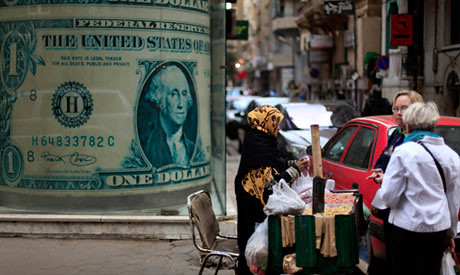
Egypt stocks tumbled on Wednesday in the wake of Ethiopia's recent move to begin construction of a major dam on the Blue Nile, one of the Nile River's two main tributaries, raising fears regarding the move's potential impact on Egypt.

The main EGX30 index declined by 1.2 percent to reach 5,338 points in a session that saw total daily turnover of some LE339.9 million.

Egypt's foreign ministry on Wednesday summoned Ethiopian Ambassador Mahmoud Dardir to express its displeasure with Ethiopia's decision to divert the course of the Blue Nile, one of the Nile River’s two major tributaries, as part of its project to build a series of new dams for electricity production.

Egypt's broader-based EGX70 index, meanwhile, fell by 0.8 percent for the day.

Commercial International Bank was the only blue-chip share to register gains – 0.03 percent – with foreign investors picking up some LE3.2 million worth of company stock.

Market bellwethers Orascom Construction Industries (OCI) and Orascom Telecom (OT), meanwhile, fell by 2.1 and 0.8 percent.

Property shares Talaat Mostafa Group, Palm Hills and SODIC all slumped on Wednesday as well, falling by 1, 2.6 and 2.4 percent respectively.

Domestic investors ended the trade session as net sellers, offloading some LE8.5 million worth of shares.

http://english.ahram.org.eg/News/72686.aspx


Egypt summons Ethiopian ambassador over Blue Nile move

Ahram Online , Wednesday 29 May 2013

Foreign ministry summons Ethiopian ambassador to express Egypt's displeasure with Addis Ababa's recent move to divert course of Blue Nile within context of dam construction project

Egypt's foreign ministry on Wednesday summoned Ethiopian Ambassador Mahmoud Dardir to express its displeasure with Ethiopia's construction of a major dam on the Blue Nile.

Head of the ministry's African affairs committee, Ambassador Ali Hefny, along with other diplomats, met with Dardir Wednesday to convey Egypt's unhappiness with the move.

Egyptian diplomats further criticised Ethiopia for going ahead with the project without taking into account the recommendations of a technical committee – tasked with studying the issue – consisting of ten specialists, including representatives of Egypt, Sudan and Ethiopia.

In a Tuesday interview with Ahram Online, Egyptian ambassador to Ethiopia Mohamed Idris stated that Egypt was pursuing a "win-win scenario in which the interests of both sides can be served and accommodated."

Idris added: "We're expecting Ethiopian officials to make good on their earlier promise to act in a way that would not harm Egyptian interests."

A report on the possible impact of Ethiopia's 'Renaissance Dam' is expected to be issued later this week by the committee of specialists.

Sources close to the committee say the report will include concerns over the potential impact of the dam on Egypt and Sudan.

It is also expected to refer to worries that cracks could develop in the dam within a few years, eventually leading to serious flooding.

Ethiopia on Tuesday began diverting the course of the Blue Nile, one of the Nile River’s two major tributaries, as part of its project to build a series of new dams for electricity production.

The move, called "historic" by Ethiopian government spokesperson Bereket Simon, has prompted criticism from downstream Egypt and Sudan, since the step could negatively affect both countries' water quotas.

The Blue Nile provides Egypt with the lion's share of its annual 55 billion cubic metres of river water.

According to the state-run National Planning Institute, Egypt will need an additional 21 billion cubic metres of water per year by 2050 – on top of its current quota of 55 billion metres – to meet the needs of a projected population of 150 million.

http://english.ahram.org.eg/News/72655.aspx


Egypt pursuing win-win solution with Ethiopia: Ambassador

Dina Ezzat , Wednesday 29 May 2013

Ethiopian dam not necessarily harmful to Egypt, mutually beneficial solution possible, says Egyptian ambassador in Addis Ababa

“Ethiopia has repeatedly and publicly affirmed that Egypt’s water interests will not be harmed [by the construction of the Renaissance Dam] and we are following up on this,” Mohamed Idris, Egyptian ambassador in Addis Ababa, told Ahram Online on Tuesday.

Idris was speaking by phone from the Ethiopian capital after Monday's announcement by Ethiopia that it would begin work on diverting the course of the Blue Nile as part of the Renaissance Dam project.

The dam is already under construction despite requirements under international law that all Nile Basin states must agree before such a project is undertaken.

The Renaissance Dam is expected to require the storage of over 70 billion cubic metres of water from the Blue Nile that provides Egypt with over 80 percent of its annual share of Nile water – with the rest coming from Uganda.

The construction of the dam was effectively initiated some two years ago following the signing of an agreement by most upstream Nile Basin states. Ethiopia will use the dam to generate electricity to meet its expanded development needs, with extra for exports.

“We are pursuing a win-win scenario in which the interests of both sides can be served and accommodated,” Idris said.

The possibility of only mild damage to Egypt’s interests is possible because the water to be stored behind the dam will only be used to generate electricity and not for irrigation.

“There are several factors that should be taken into consideration and will be decided upon by technical experts. We are expecting Ethiopian officials to make good on their promise to act in a way that will not harm Egyptian interests,” Idris said. “It is not impossible,” he added.

A report on the possible impact of the Renaissance Dam is expected to be published this week by a committee of representatives and experts from Ethiopia, Egypt and Sudan.

Sources close to the committee say the report will reveal some concerns over the impact of the dam on Egypt and Sudan. It is also expected to reveal concerns that cracks could develop in the dam within a few years and eventually lead to serious flooding.

Idris said he had not read the report and was not willing to speculate on its content. “We have initiated a new phase of good relations with Ethiopia since the January 25 Revolution. There is new momentum that has seen greater bilateral trade and more Egyptian investment in Ethiopia, in addition to the expansion of cooperation,” he said.

“In a positive atmosphere of mutual trust and cooperation we are certainly capable of moving forward with our joint cooperation, but should the overall atmosphere take a negative turn it is unlikely that we could pursue the improvement in our mutual interests,” Idris stressed.

The construction of the dam is likely to be completed in around three years if Ethiopia manages to keep the funds flowing. So far Ethiopia says it is only using national funds. Cairo has made a point of reminding potential international donors that any aid should be consistent with international regulations that demand the full consent of all Nile Basin states for key Nile projects.

Idris is hopeful that an agreement can be reached while the dam is being constructed so both sides can manage the matter “with consideration for the development interests of both sides.”

He added, “We are in continuous consultation with Ethiopia and this will be upgraded to ensure the matter is given the fullest consideration and fulfills the interests of both nations."

Idris said the diversion of the Blue Nile is a step in the dam-construction process and the most crucial matter ahead is the pace of water storage and safety considerations.

“At the end of the day we cannot agree to anything that would harm our interests. I think this is clear and legitimate,” he added.

http://english.ahram.org.eg/News/72617.aspx


Officials, experts differ on impact of Ethiopia dam move on Egypt

Ahram Online, Tuesday 28 May 2013

While Egyptian officials say Ethiopia's diversion of Blue Nile will not impact country's access to Nile water, some local experts disagree, describing potential effect on Egypt as 'hugely negative'

Reactions on the part of Egyptian government officials, diplomats and experts varied regarding Ethiopia's decision to divert the course of the Blue Nile – one of the Nile River’s two major tributaries – as part of its Renaissance Dam project.

On Tuesday, the Egyptian presidency announced that ongoing construction work on the dam by the Ethiopian government would not adversely impact Egypt's annual allotment of Nile water.

The planned dam has been a source of concern for the Egyptian government, amid sensitivities about its possible effect on the volumes of water that will reach Egypt if the project is completed.

According to the state-run National Planning Institute, Egypt will require an additional 21 billion cubic metres of water per year by 2050 – on top of its current annual quota of 55 billion metres – to meet the needs of a projected population of some 150 million.

In a Tuesday statement, Egypt's irrigation ministry said that Egypt would "not accept" any project that has a negative impact on Nile water flow.

The ministry added, however, that Ethiopia's diversion of the Blue Nile would not stop the river flow, stressing that Tuesday's development in Ethiopia simply constituted an "engineering procedure."

According to the ministry, the Egyptian government is currently awaiting a final report by a joint committee – including Egyptian, Sudanese and Ethiopian representatives – on the impact of the planned dam. The report is expected within days.

Egypt's ambassador in Addis Ababa Mohamed Idris, for his part, said that Ethiopia's intention to divert the Blue Nile had been known among Egyptian officialdom since November.

Ethiopia formally began the project on Tuesday to coincide with the country's national day celebrations, Idris said in televised comments.

He went on to stress that Egypt would continue to receive its full quota of Nile water despite the launch of the Ethiopian project.

Hani Raslan, on the other hand, head of the Sudan and Nile Basin desk at the Cairo-based Al-Ahram Centre for Political and Strategic Studies, asserted that the Ethiopian dam project would have a "hugely negative" impact on Egypt.

Raslan went on to accuse Egypt's government – especially Irrigation Minister Mohamed Bahaa El-Din – of downplaying the project's potentially negative impact.

"They have hypnotised Egyptian society, making the issue appear much smaller than its repercussions will be," he said.

Raslan called on Prime Minister Hisham Qandil to take "urgent steps" to contain the crisis, including the prosecution of those who he said were responsible for "neglecting Egypt's national security."

An informed government official told Ahram Online that that Addis Ababa was offering "reassurances" that it would be "sensitive" to Egyptian concerns and would "try to accommodate" Cairo's demand that it fill the planned dam's reservoir only gradually, so as to ensure that the effect on Egypt's annual share of Nile water would not be too abrupt.

On Tuesday, Sudanese Ambassador to Egypt Kamal Hassan stated that Egypt and Sudan may call for intervention by the Arab League in response to the Ethiopian move.

http://english.ahram.org.eg/News/72570.aspx


Ethiopian officials dispel fears over dam's impact

Reuters, Ahram Online, Wednesday 29 May 2013

Officials in Ethiopia seeks to allay Egyptian concerns over construction of $4.7 bn hydroelectric dam on Blue Nile

Ethiopia began diverting a stretch of the Nile on Tuesday to make way for a $4.7 billion hydroelectric dam that is worrying downstream countries dependent on the world's longest river for water.

The Horn of Africa country has laid out plans to invest more than $12 billion in harnessing the rivers that run through its rugged highlands, to become Africa's leading power exporter.

Centrepiece to the plan is the Grand Renaissance Dam being built in the Benishangul-Gumuz region bordering Sudan. Now 21 percent complete, it will eventually have a 6,000 megawatt capacity, the government says, equivalent to six nuclear power plants.

"The dam is being built in the middle of the river so you can't carry out construction work while the river flowed," said Mihret Debebe, chief executive officer of the state-run Ethiopian Electric Power Corporation, at a ceremony at the site.

"This now enables us to carry out civil engineering work without difficulties. The aim is to divert the river by a few metres and then allow it to flow on its natural course."

Ethiopia's ambitions have heightened concerns in Egypt over fears the projects may reduce the river's flow. Addis Ababa has long complained that Cairo was pressuring donor countries and international lenders to withhold funding.

Ethiopia's energy minister moved to dispel fears over the dam's impact.

"The dam's construction benefits riparian countries, showcases fair and equitable use of the river's flow and does not cause any harm on any country," Alemayehu Tegenu said in a speech.

Mohamed Bahaa El-Din, Egypt's Minister of Water Resources and Irrigation, said Cairo was not opposed to Ethiopia's development projects as long as they did not harm downstream countries.

"Crises in the distribution and management of water faced in Egypt these days and the complaints of farmers from a lack of water confirms that we cannot let go of a single drop of water from the quantity that comes to us from the Upper Nile," he said.

A panel of experts from Ethiopia, Egypt and Sudan is set to announce its findings on the impact of the Ethiopian dam on the Nile's flow in the next two weeks.

Sudanese Minister of Water Resources Osama Abdullah arrived in Cairo on Wednesday for a one-day visit to discuss the dam's impact with Egyptian officials, state news agency MENA said.

http://english.ahram.org.eg/News/72621.aspx


Ethiopia celebrates decision on Blue Nile dam

Ahram Online , Tuesday 28 May 2013

Ethiopia marks beginning of project to divert Blue Nile for Renaissance Dam, Egypt fears losing share of Nile water

Ethiopian television on Tuesday celebrated the start of a project to divert the Blue Nile, one of the Nile River’s two major tributaries, Turkish news agency Anadolu reported.

The Ethiopian government's decision to divert the river surprised many observers when it was announced on Monday.

The power-generating dam will reduce Egypt's and Sudan’s share of Nile River water by 18 billion cubic meters annually, Egyptian Minister of Irrigation and Water Resources Mohamed Bahaaeddin predicted in comments published in the Ethiopian Review.

Ethiopian government spokesperson Bereket Simon said he expects "outrage" from the downstream countries of Egypt and Sudan, which fear their share of the Nile's water will be reduced.

The project is the first of its kind by an upstream Nile Basin country.

Egypt has been suffering from water shortages over the past few years. According to the National Planning Institute, Egypt will need an additional 21 billion cubic metres of water per year by 2050, on top of its current 55 billion cubic metres quota of Nile water, to meet the needs of a projected population of 150 million people.

http://english.ahram.org.eg/News/72534.aspx
Sudan Denies Calling for Arab League Intervention In Nile Dam Crisis

Sudan denies calling for Arab League
intervention in Nile dam crisis

Ahram Online , Wednesday 29 May 2013

Sudan's foreign ministry claims negotiations are ongoing with Ethiopia to solve current impasse over construction of dam

Sudan denied reports circulated Tuesday that the Sudanese ambassador to Egypt, Kamal Hassan Ali, had called for the Arab League to intervene on the issue of a new dam being constructed by Ethiopia on the Blue Nile.

Ethiopia on Tuesday began diverting the course of the Blue Nile, one of the Nile River’s two major tributaries, as part of its project to build a new dam for electricity production.

The move, called "historic" by Ethiopian government spokesperson Bereket Simon, has prompted criticism from downstream Egypt, since the step could negatively affect the country’s water quota.

A Wednesday statement by the Republic of Sudan's foreign ministry denied that Ali had mentioned Sudan's "shock" about Tuesday’s events, as previously reported.

Moreover, the statement further stated that negotiations were ongoing in an attempt to solve the crisis.

The Blue Nile provides Egypt with the lion's share of its annual 55 billion cubic metres of river water.

According to the state-run National Planning Institute, Egypt will need an additional 21 billion cubic metres of water per year by 2050 – on top of its current quota of 55 billion metres – to meet the needs of a projected population of 150 million.

http://english.ahram.org.eg/News/72664.aspx

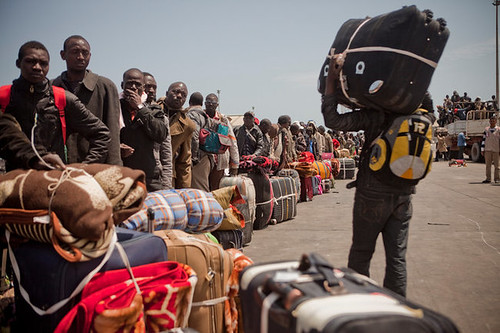
Refugees Flee Conflict In Eastern South Sudan

Over 19,000 refugees flee conflict in eastern South Sudan: U.N.

1:42pm EDT
By Hereward Holland

JUBA (Reuters) - More than 19,000 people have fled fighting raging in the east of South Sudan and sought refuge in neighboring countries since the start of the year, the United Nations said on Wednesday.

Almost 12,000 have entered Ethiopia from South Sudan's Jonglei state, where the army is trying to put down a rebellion.

Some 5,000 South Sudanese have crossed the border to Kenya, and another 2,500 to Uganda.

"The increase in numbers in Ethiopia in the past weeks has been particularly sharp, with around 4,000 new arrivals since 7 May," the UN said in a statement.

The violence has hampered government plans to search with the help of Western firms such as Total for oil in Jonglei, South Sudan's biggest state.

South Sudan's government has been struggling to assert itself across a vast and remote territory which won independence from Sudan almost two years ago.

This week the U.N. said it lacked sufficient troops and aircraft to protect the large numbers of civilians uprooted by the conflict during seasonal rains which turn much of the state into an impassable quagmire.

Earlier this month the army, an assortment of poorly-trained former guerillas from the 1983-2005 civil war, recaptured the rebel-held town of Boma near the Ethiopian border.

South Sudan's President Salva Kiir has renewed an offer of amnesty to help end the fighting, but also accused his own security forces of looting the town of Pibor, a remote settlement at the heart of the conflict.

(Editing by Ulf Laessing and Andrew Roche)

Somalian Refugee Women Subjected to Abuses in Kenya

Somalis in Kenya

Abuse in the name of security

May 29th 2013, 18:25 by D.H. | NAIROBI

FATUMA (not her real name) was at home in Eastleigh, a Somali-dominated suburb of Nairobi, the Kenyan capital, when the police called on her. She showed them her refugee permits but they took the 23-year-old outside and loaded her onto a waiting truck. Along with four other women they were driven to a disused building where they were separated and raped. When they were taken back to the truck, bleeding and with their dresses torn, nobody spoke.

“We didn’t have to say anything to each other because we all knew what had happened to all of us,” she said. Her ordeal was part of a systematic campaign between last November and January this year of torture, rape, extortion and arbitrary detention of Somalis living in Kenya, under the guise of responding to terror threats. The abuses are documented in a new report released on May 29th by Human Rights Watch, a New York-based monitor.

“Kenyan police unleashed ten weeks of hell on communities close to the heart of Nairobi, torturing, abusing, and stealing from some of the country’s poorest and most vulnerable people,” said Gerry Simpson, one of report's authors. It is the fourth study into the abuse of refugees by Kenyan police in four years. So far no action has been taken against the officers or officials involved. The UNHCR, the UN's refugee body, has been notably silent.

The violence and intimidation is the rough edge of a campaign to drive tens of thousands of Somali refugees out of Kenya's cities and into the crowded and often lawless refugee camps on the border with Somalia and Sudan. Kenya's High Court is due to rule in June on the legality of a government plan to forcibly relocate 55,000 Somali refugees out of the cities and into camps.

Since Kenya invaded its northern neighbour in late 2011 ostensibly to tackle Islamic militants known as the Shabab, a spate of grenade attacks blamed on the group's sympathisers has inflamed attitudes towards Somali refugees. Populist politicians argue that Kenya can no longer afford the burden of the large refugee population. That is disingenuous at best.

The city-sized refugee camps such as Dadaab, which hosts more than 400,000 people, are funded by foreign donors and run by the UNHCR. Somalis living in Nairobi have become some of east Africa's most effective traders.

The costs and benefits of the “refugee burden”, as it is sometimes dubbed in Kenya's media, have not been debated honestly. Few areas of Somalia are secure enough for refugees to return. And it is unclear how beating, raping and stealing from the residents of Eastleigh helps Kenyan national security.

Wednesday, May 29, 2013

Disagreements Continue Over Who Controls Somalia Port City

Somalia: Bickering Continues Over Who Controls Somali Port City

BY MOHAMMED YUSUF, 28 MAY 2013

Nairobi — Today al-Shabab militants are nowhere to be seen in the Somali port city of Kismayo, which was once their financial hub and their last major stronghold in Somalia. But those who united to defeat their common enemy in the city are now fighting for control of liberated areas and for who gets the big share of seaport revenue.

Much of Somalia's two decades of brutal war was characterized by the fight for control of territories and strategic towns that produce clan pride and financial muscle.

The fight is still going on today over the newly created Jubaland region in southern Somalia, where at least three different men have claimed to be president of a new Jubaland state.

Kismayo is the gateway into Jubaland which consists of three regions, Gedo, Middle and Lower Juba, and the person who is able to control the city's port will have considerable leverage to control the other areas.

An accountant who works at the port, but didn't want to give his name for security reasons, said all the men claiming the presidency are jostling for money from the port.

"They do usually say they will take away what comes their way," and he adds "These people have never worked for a government, and they don't know how to manage a port. They are rebels who are stealing the resources and taking what they can get," he said.

The accountant says boats dock at the port of Kismayo carrying much needed basic commodities like milk powder and flour and later the boats leave loaded with charcoal, the only valuable export of Somalia at the present time.

He says the monthly port revenue is currently divided between the port administration led by Ahmed Madobe, who heads the militia group Raskamboni, and Kenyan forces.

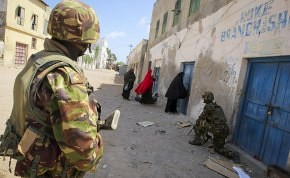
Kenyan soldiers are providing security in Kismayo as part of the African Union (AU) peacekeeping force known as AMISOM, which succeeded in driving al-Shabab out of Mogadishu and other areas.

"In reality the port is controlled by Kenyan forces, they are the ones who divide the revenue," he said. "Kenyan forces take their own share and the other share is taken by Ahmed Madobe."

The Somali government has accused Kenya of supporting Madobe, who is one of the men claiming to be president of the Jubaland region.

Kenyan military spokesman Colonel Cyrus Oguna says their relationship with Madobe is one inspired by necessity since they were confronted by the same enemy, al-Shabab, more than two years ago.

Oguna also says those accusing the Kenyan Defense Forces, the KDF, of collecting money want Kenyan troops out so that al-Shabab can take control of the port.

"KDF is out there to execute the AMISOM mandate, and those are allegations which are perhaps peddled around by people who would want KDF to move out so that they can be able to have al-Shabab back. And certainly those are people who don't want or even wish well for the people of Somalia. Those are people who are inspired by self-interest," Oguna said.

Kenyan forces initially went into Somalia in October 2011 to secure the border following a series of attacks and kidnappings in Kenyan territory blamed on al-Shabab.

But Oguna says now that the Kenyans are part of the AU force, soldiers in Kismayo receive their orders from AMISOM commanders in Mogadishu.

He says people should focus on stabilizing the region and stop all the infighting.

But the political bickering over Jubaland is likely to continue, as the federal government of Somalia has maintained that the establishment of Jubaland state was unconstitutional and has called for the process to come back under their authority.

Report Reveals More on How U.S. Imperialism Wrecked Libya

WND EXCLUSIVE

HOW OBAMA, HILLARY WRECKED LIBYA

Islamic law, terrorist training camps, al-Qaida headquarters

AARON KLEIN

TEL AVIV – A Library of Congress report that received almost no media attention detailed – one month before the deadly Sept. 11 attack in Benghazi – how al-Qaida established a major base of operations in Libya in the aftermath of the U.S.-NATO campaign that deposed Muammar Gadhafi and his secular government.

The report documented al-Qaida and affiliated organizations were establishing terrorist training camps and pushing Taliban-style Islamic law in Libya while the new, Western-backed Libyan government incorporated jihadists into its militias.

The document named Benghazi as a new central headquarters for al-Qaida activities.

“Al-Qaeda adherents in Libya used the 2011 Revolution to establish well-armed, well-trained, and combat-experienced militias,” stated the report.

The report also said a terrorist released from the U.S. Guantanamo Bay detention camp in Cuba became the leader of the al-Qaida-affiliate Ansar Al-Sharia in Libya, which espoused anti-Western ideology.

The Martyrs of 17 February Brigade, which was hired by the State Department to protect the U.S. facility in Benghazi, operates under the Ansar-Al-Sharia banner.

The document said scores of Islamic extremists were freed from Libyan prison after the U.S.-supported counter-revolution in Libya.

The August 2012 document was prepared by the Federal Research Division of the Library of Congress under an inter-agency agreement with the Combating Terrorism Technical Support Office’s Irregular Warfare Support Program. It may shed new light on the terrorism threat in Libya leading up to the assaults on the U.S. facility and CIA annex in Benghazi.

Despite the growing al-Qaida activity, the U.S. facilities in Benghazi remained poorly protected.

While al-Qaida and other extremist groups were establishing their new headquarters in Libya, the Obama administration reportedly was eager to declare the U.S.-NATO campaign there a victory.

According to testimony by the No. 2 U.S. official in Tripoli, who served under murdered Ambassador Christopher Stevens, then-Secretary of State Hillary Clinton wanted the Benghazi facility turned into a permanent post ahead of her scheduled December 2012 visit to the country. A looming funding deadline may have been the reason that Stevens went to the compound the day of the attacks, the whistleblower charged.

Terrorist training camps

The report shows how various al-Qaida groups, including Al-Qaida Senior Leadership (AQSL) and Al-Qaida in the Islamic Maghreb (AQIM), have sought to take advantage of the downfall of Gadhafi to “create a safe haven and possibly to extend their area of operations to Libya.”

AQSL in Pakistan issued strategic guidance to followers in Libya and elsewhere to take advantage of the Libyan rebellion.

Specifically, instructions were given to gather weapons, establish training camps, establish an Islamic state, and institute Shariah, the document relates.

At the time of the report’s release, al-Qaida’s clandestine network in Libya was “in an expansion phase, running training camps and media campaigns on social-media platforms.”

The Libyan counter-revolution “may have created an environment conducive to jihad and empowered the large and active community of Libyan jihadists, which is known to be well connected to international jihad,” the document stated.

The Library of Congress report said Ansar al-Sharia, led by Sufian Ben Qhumu, a former Guantanamo detainee, has increasingly embodied al-Qaida’s presence in Libya.

Qhumu, formerly a driver for Osama bin Laden, was released by the U.S. in 2007 and was transferred to a Libyan prison where he remained until being freed in a 2010 amnesty deal.

Shariah confab

The report noted AQSL’s strategic goals remain “restoration of the caliphate, instituting sharia, and ending the Western presence in Muslim lands.”

“Al-Qaeda’s primary goal in Libya is to establish an Islamic emirate as part of its overall objective to reestablish the caliphate,” the report said.

“The al-Qaeda clandestine network in Libya is most likely espousing a Taliban-like religious orientation that calls for strict adherence to the practice and principles of Islam as interpreted by radical clerics.”

From June 7 to 8, 2012, there was a gathering of groups supporting Shariah openly held at Liberation Square in Benghazi. The event was hosted by Ansar al-Sharia and reportedly attended by at least 15 militias, including al-Qaida-affiliated organizations.

Libyan government and al-Qaida

The report noted the July 2012 elections in Libya “failed to generate a strong and unified national leadership that could address the chronic insecurity posed by the multiplicity of local militias, which al-Qaeda’s clandestine network has probably infiltrated.”

Further, the Western-backed National Transitional Council in Libya “never fully controlled the rebel movement.”

Following the 2012 elections, the Libyan army and police have reconstituted their ranks “by incorporating whole militias regardless of the militants’ background.”

Hillary eager to declare victory

While al-Qaida and other Islamic groups gained major ground in Libya following U.S. intervention there, Clinton worked plans for a symbolic victory in Benghazi, according to congressional testimony by Gregory Hicks, the former State Department deputy chief of mission and chargé d’affairs who was in Libya at the time of the attack.

Under questioning from Rep. James Lankford, R-Okla., Hicks explained: “According to [Ambassador] Chris [Stevens], Secretary Clinton wanted Benghazi converted into a permanent constituent post. Timing for this decision was important. Chris needed to report before Sept. 30, the end of the fiscal year, on the physical and the political and security environment in Benghazi to support an action memo to convert Benghazi from a temporary facility to a permanent facility.”

Hicks revealed the directive came from the State Department Office of Near Eastern Affairs, headed by Acting Assistant Secretary Beth Jones. Money was available to be transferred to Benghazi from a State Department fund set aside for Iraq available, provided the funds transfer had been done by Sept. 30.

He further testified that in May 2012, during a meeting Clinton, Stevens promised he would give priority to making sure the U.S. facility at Benghazi was transformed into a permanent constituent post.

Hicks also explained Stevens wanted to make a symbolic gesture to the people of Benghazi that the United States “stood behind their dream of establishing a new democracy.”

Additionally, he wanted to have the Benghazi complex upgraded to a permanent constituent post, so Clinton could make the announcement in her planned visit to Libya before the end of 2012.

Toward the end of the hearing, the chairman, Rep. Darrell Issa, R-Calif., asked Hicks to summarize his testimony on why Stevens went to Benghazi.

“At least one of the reasons Ambassador Stevens was in Benghazi was to further the secretary’s wish the that post become a permanent constituent post and that he was also there because we understood the secretary intended to visit Tripoli later in the year,” Hicks reiterated. “We hoped that she would be able to announce to the Libyan people the establishment of a permanent constituent post in Benghazi at that time.”

Clinton and the U.S. diplomatic staff in Libya reportedly were aware of the terrorist camps in Benghazi. Fox News reported last year the U.S. mission in Benghazi convened an “emergency meeting” in August 2012 to discuss the training camps.

The news network obtained a government cable addressed to Clinton’s office stating the U.S. diplomats in Libya were briefed “on the location of approximately ten Islamist militias and AQ training camps within Benghazi … these groups ran the spectrum from Islamist militias, such as the QRF Brigade and Ansar al-Sharia, to ‘Takfirist thugs.’”

With additional research by Joshua Klein.

Read more at http://www.wnd.com/2013/05/how-obama-hillary-wrecked-libya/#u0UUqKyYCCXvgdSR.99

Three Rebel Soldiers Killed in Occupied Libya

Three soldiers killed in attack in Libya's
Benghazi

10:49am EDT

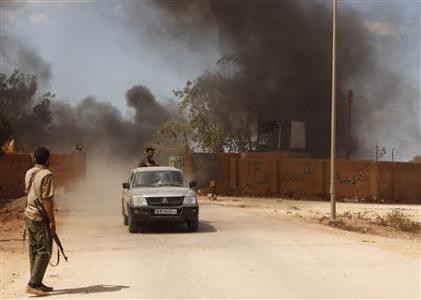
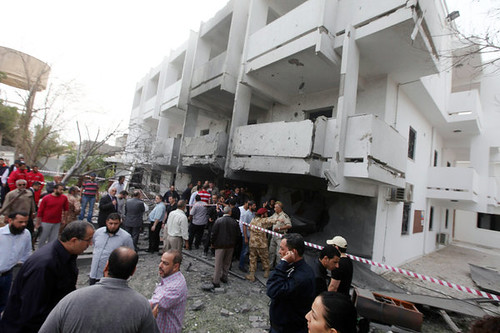
TRIPOLI--Unknown assailants threw an explosive device at a rebel military checkpoint in the eastern Libyan city of Benghazi early on Wednesday, killing three US-backed soldiers and injuring three others, security officials said.

The attack was the latest in a wave of violence against security forces in the city, the cradle of the 2011 counter-revolution against Muammar Gaddafi.

Nearly two years after he was ousted and brutally assassinated, the rebel Tripoli government is still struggling to impose its authority on a country awash with weapons and where lawless militias do as they please.

"In the night, unknown assailants in a black Chevrolet car threw an explosive device as they passed a military patrol at one of the city's roundabouts," a police source said.

"There was no shooting. They then just fled."
Abdullah al-Shaafi, spokesman of Benghazi's security operations room, confirmed three soldiers had been killed and three others wounded in the attack.

Attacks on police stations and patrols have become frequent in the city, which has been the scene of power struggles among armed factions.


Three soldiers killed, 3 injured in attack on army patrol

Wed May 29, 2013 4:30PM GMT

At least three soldiers have been killed and three others injured in an attack on a military patrol in Libya’s eastern city of Benghazi.

Military spokesman Abdullah al-Shaafi said on Wednesday the bomb attack killed at least one soldier on the spot while the other two later succumbed to their injuries.

“An explosive device that was concealed in a rubbish bin blew up near a patrol of the Al-Khandak Brigades,” al-Shaafi said.

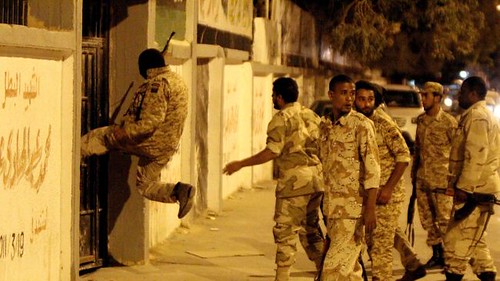
Heavily-armed assailants have attacked several army posts in the troubled eastern city over the past few weeks.

Benghazi is the cradle of the 2011 uprising which toppled the long-time revolutionary Pan-African leader Muammar Gaddafi. The city has since been the scene of numerous attacks and assassinations.

Zimbabwe Herald Editorial on the African Union Jubilee Summit

Editorial Comment: Quo vadis our dear African Union

Wednesday, 29 May 2013 00:00
Zimbabwe Herald

THIS week the African Union celebrated 50 years of existence and launched year-long Golden Jubilee celebrations to celebrate achievements made, and also introspect on failures suffered. Congratulations are in order albeit mostly to the AU’s fore-runner, the Organisation of African Unity that managed to usher in political independence throughout the continent.

Today, all but one of the AU’s 54 member states are independent. It is only the Saharawi Arab Democratic Republic that continues reeling under the expansionist ambitions of Morocco which long left the AU to seek associate membership of the European Union.

This is one of the scars on the AU’s conscience.

The OAU before it managed to free over 50 countries, the AU is failing to find solutions to decolonise just one, Saharawi.

This, however, in a way sums up the story of the AU, that was launched amid much hype in South Africa in 2002, with a brief to transform the African story from the political to the economic dimension but which to this day is itself still to be financially independent.

Over three quarters of the AU budget is western donor driven, a development that has hamstrung the AU’s ability to decisively deal with peace and security challenges confronting the continent, many of which have a western face.

As we raise our glasses to toast the continental body, we would do well to recall the words of one of the panellists at the official launch of the Golden Jubilee festivities Dr Amina Mama, a Nigerian writer and gender activist who said, though the date tells us it’s time to celebrate, the data counsels caution.

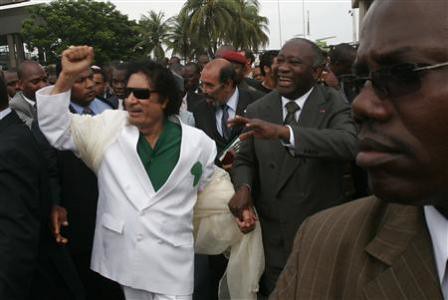
This is because one of Africa’s eminent sons, Colonel Muammar Gaddafi asks from his unmarked grave in the Libyan desert: “What have you done to take my killers to account?’’ To rub insult to injury, the AU invited French president Francois Hollande to pontificate high-sounding nothings at the Golden Jubilee festivities in the vast Millennium Hall.

Laurent Gbagbo asks from behind the walls of his house arrest, “What have you done about the French gendarmes who deposed me and installed their preferred man, Allassane Ouattara?’’

The AU has instead watched as the French made another beeline into northern Mali.

The people of the eastern DRC, who today reel from an M23 inspired war fuelled by Rwanda and Uganda ask: “What have you done about Yoweri Museveni and Paul Kagame, who are destabilising us.’’

The two not only sat in AU councils without any hard questions thrown at them but Uganda’s foreign minister was recommended for a top UN post by the African Union Council.

These are just a few of the examples that come to mind in the midst of an ocean of the AU’s warts.

It is a fact, our continental body is high on hyperbole but low on action. We hope as African leaders celebrate the milestone of 50 Years under the poignant theme, “Pan Africanism and African Renaissance’’, they will appreciate that Pan Africanism means putting Africa first, and renaissance calls for a rebirth of the union.

We have to return to the source, May 25 1963, and see if our puny feet fit into the colossal shoes of the founding fathers.

If they do, there is no reason why Robert Mugabe of Zimbabwe should continue to be the lone voice against neo-colonialism in all its guises.

It is time we all picked the clarion call from Cape Town to Cairo, from Mogadishu to Freetown, we need to find the answers that congealed our continent into a permanent question mark shape.

Let’s hope we will have the courage of our convictions to have not only a stronger AU but a politically and economically integrated continent come 2063.

Zimbabwe President Mugabe to Visit Japan

President off to Japan

Wednesday, 29 May 2013 00:00
Zimbabwe Herald
Lovemore Chikova News Editor

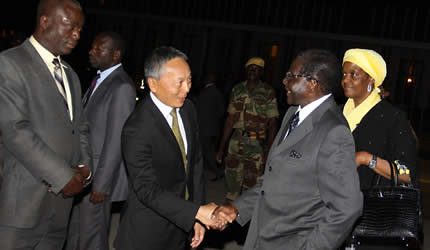
President Mugabe left the country for Japan yesterday to attend the Fifth Tokyo International Conference for African Development to be held in Yokohama.

The Head of State and Government and Commander-in-Chief of the Zimbabwe Defence Forces is being accompanied by the First Lady Amai Grace Mugabe.

Vice-President Joice Mujuru will be the Acting President.

He was seen off at Harare International Airport by Vice-President Cde Mujuru, Zanu-PF National Chairman Ambassador Simon Khaya Moyo, Defence Minister Cde Emmerson Mnangagwa, Chief Secretary to the President and Cabinet Dr Misheck Sibanda, Japanese Ambassador to Zimbabwe Mr Yonezo Fukuda, service chiefs and senior Government officials. TICAD was launched in 1993 to promote high-level policy dialogue between African leaders and development partners.

It emerged at the end of the Cold War in an era of aid fatigue among donor countries and was critical in regenerating strong donor interest in Africa.

TICAD has since evolved into a major global framework that facilitates the implementation of initiatives for promoting African development.

The initiative is jointly supported by Japan, the United Nations Office of the Special Advisor on Africa, the United Nations Development Programme and the World Bank.

Its stakeholders include all African countries and development partners, including Asian countries, donor nations, international agencies, civil society organisations, the private sector and parliaments.

During the first conference in 1993, African countries and their development partners discussed strategies for taking steps towards greater African stability and prosperity.

Delegations from 48 African nations participated at the conference.

During the second conference in 1998, the African countries and their development partners agreed on the Tokyo Agenda for Action which was intended to become a commonly understood strategic and action-oriented set of guidelines.

Poverty reduction in Africa and Africa’s fuller integration into the global economy were recognised as the fundamental goals.

The third TICAD conference was held in 2003 and brought together over 1 000 delegates, including 23 heads of state from Africa.

The African delegates and their development partners reviewed the achievements of the 10-year process.

The fourth conference was held in 2008 in Yokohama, the first time the conference was convened in a city other than Tokyo.

It was the best attended with 40 presidents or prime ministers attending out of the 51 African nations that sent delegates.

At least 12 Asian nations, 22 donor nations and 55 international organisations were represented at the fourth conference.

The conference focused on strategies for better mobilising the knowledge and resources of the international community in the core areas in economic growth and human security, including achieving the UN’s Millennium Development Goals.

It also discussed environment and climate change issues.

The fifth TICAD conference is expected to emphasise on accelerating growth, while focusing on poverty and vulnerability reduction.

It would discuss policy and regulatory reforms to improve investment climate in Africa.

The conference will stress the importance of the agricultural sector for the economy and food security and the need for strengthening food supply capacity by promoting partnerships as well as focusing on small-scale farmers and women.

Other issues to be discussed include how to achieve the MDGs and strengthening efforts on extreme poverty and maternal and child health.

The conference would continue to support further efforts of African countries to realise peace and stability as a basis of development.

Chadian Army Pursues Rebels Into Sudan's Kordofan Region

Radio Dabanga (Hilversum)

Sudan: Chadian Army in Sudan's Kordofan

28 MAY 2013

South Kordofan — Chadian armed forces have pursued rebels from the restive Darfur region into south-central Sudan at least as far as Babanusa, according to multiple reports that have been independently verified.

Radio Tamazuj has reported that Chadian forces were sighted by a source in Melit, North Darfur, about a week ago. From there they traveled south-east into South Kordofan possibly via East Darfur or Qubaish in North Kordofan.

The reason for their presence in South Kordofan is not entirely clear but they may be pursuing an armed convoy of the Justice and Equality Movement, the Islamist rebel faction whose leaders formerly had links to regimes in both N'Djamena and Khartoum.

JEM rebels recently took hostage a number of top members of the so-called 'JEM-Bashar' splinter faction. The leader of that group, who signed a peace treaty with the Sudanese government in Doha in April, was assassinated together with his deputy in eastern Chad on 12 May.

Rebels are attempting to transfer the hostages into the Nuba Mountains, which are controlled by the allied rebel group SPLM-N.

JEM spokesman Jibreel Adam Bilal confirmed that among the hostages in their custody is the spokesman of the late rebel leader, Ali Wafi. He objected to calling the captives 'hostages', however, claiming that they are still members of the movement and will be judged according to the law of the rebel group.

It is separately reported that the former top field commander of JEM, Bakheit Abdallah Abdel-Karim, nicknamed 'Dabajo,' who has taken command of the splinter faction, may have sent his forces to aid the Chadian army in their pursuit.

The size of the Chadian force is unclear but judging from the number of reported vehicles there are probably hundreds of fighters involved.

On Sunday a source in Babanusa in western South Kordofan reported that a convoy of 57 Chadian military vehicles mounted with heavy machine guns and soldiers appeared in the market area, where soldiers purchased goods such as cigarettes.

In fighting that began Saturday north of Babanusa a JEM force that was temporarily halted at Al Bouta clashed with a national security and intelligence force who were based at Al Fula. Many wounded were seen being transferred to Babanusa Hospital. Whether the Chadians were involved in this clash is not clear.

According to the spokesman of JEM, the Chadian force consists of 74 vehicles under two different commanders. He claimed that the force has moved on from Babanusa to the oil-rich area of Kharasana, thinking that JEM would move to that area.

Another source, however, suggested that some of the Chadian force have by now turned back north to El Fasher, the capital of North Darfur, and some of the force are still in South Kordofan. Yet another suggested that the Sudanese military command in Babanusa was displeased by the unexpected arrival of the Chadians in the city.

Civilians in Lagawa, meanwhile, reported that a convoy of JEM fighters passed through the area yesterday and looted supplies from the market.

Chad and Sudan fought a long proxy war until about 2010, after which relations thawed. The two nations now maintain joint military patrols along their vast border and have exchanged several presidential visits.

Jibreel Adam Bilal linked the presence of the Chadians to a recent visit of Bashir to his counterpart Idriss Deby in N'Djamena, where the latter supposedly agreed to support Khartoum's military efforts.

United Nations Peacekeepers Cannot Protect Civilians in South Sudan

UN peacekeepers cannot protect civilians in South Sudan: UN envoy

Tue May 28, 2013 2:42PM GMT

Due to lack of troops and aircraft, the United Nations peacekeepers in South Sudan are not able to protect civilians affected by fighting in the east of the country, head of the UN mission in South Sudan says.

Hilde Johnson said in a Monday statement that “We cannot sustain a presence with the logistical capacity that we have, with the problems we have with air transport and by road. So we cannot protect civilians in big, big, big numbers (in Pibor town in troubled state of Jonglei).”

Reports say that the UN mission in South Sudan (UNMISS) has over 6,500 troops in Jonglei which is the country’s largest state.

Clashes between the (South) Sudan People's Liberation Army (SPLA) and militants led by David Yau Yau in the eastern state have displaced tens of thousands of people.

According to aid agencies, nearly all of the 10,000 residents of Pibor town have fled their homes following clashes in the area.

On May 20, at least 24 people including 20 militants and four government troops were killed in clashes between soldiers and the militants in the town.

Meanwhile, South Sudanese soldiers ransacked stores of the United Nations in the town on May 10.

They also looted a hospital and premises of Doctors Without Borders (MSF) and flattened premises of the Italian humanitarian aid organization INTERSOS.

Following the assault, many international aid workers left Pibor over concerns of possible attacks.

In July 2011, South Sudan voted to break away from Sudan following a two-decade civil war that killed about two million people in the East African country. But the new oil-rich nation, which is one of the least-developed countries in the world, has had to confront ethnic tensions and rebellions of its own.

Yau Yau rebelled against the government in Juba after he was defeated in the elections of April 2010. However, he accepted amnesty in June 2011, a month before South Sudan gained independence.

Oil Dispute Between Sudan and South Sudan Flares Up Again

Oil dispute between Sudan and South Sudan flares up again

DW

South Sudan on Tuesday said it was committed to peace deals signed with its former foe Sudan, a day after Sudanese President al-Bashir threatened to close oil pipelines ‘forever’. He accuses Juba of backing insurgents.

Juba has once again rejected allegations that it supports the rebels battling Sudanese forces in South Kordofan state. Information Minister Barnaba Marial Benjamin insisted that the South Sudanese president "has said several times that we don't support any rebels in Sudan." Khartoum's renewed accusations have threatened to derail an African Union peace roadmap to normalize relations between the two former civil war foes.

Sudan and South Sudan have still yet to agree on a common border

Benjamin has criticized Bashir for making such a threat in public. "We agreed that there is a new environment of dialogue, we don't want to go back to square one," the minister told French news agency AFP. "There are channels to discuss this, we don't think that you should go on a public forum and say all these things," Benjamin argued.

Khartoum maintains that Juba supports Sudan People's Liberation Movement-North (SPLM-N) rebels fighting government forces in South Kordofan and Blue Nile states.

SPLM-N are former allies of the South. They fought together in Sudan's 1983-2005 civil war.

Last warning

Speaking at a ceremony on Monday, after his army had recaptured the town of Abu Kersholoa in South Kordofan, Sudanese President Omar al-Bashir, who wore a military uniform and was surrounded by top officials, warned he would shut the pipeline that carries oil from South Sudan. "I now give our brothers in South Sudan a last, last warning that we will shut down the oil pipeline forever if they give any support to the traitors in Darfur, South Kordofan and Blue Nile," he said.

South Kordofan's 1.1 million residents are viewed as being sympathetic to South Sudan. A recent report from the Small Arms Survey, an independent Swiss research group, indicated that South Sudan provided logistical, financial and political support for the insurgents in Sudan, but found no proof that it was arming them.

The Sudanese Revolutionary Front (SRF), which is a grouping of rebels, has vowed to topple al-Bashir who has been in power since 1989. In April, the SRF launched a major offensive and briefly took control of Um Rawaba, a major city in central Sudan, before withdrawing.

The attack on Um Rawaba was the boldest rebel attack since they attacked Khartoum in 2008.They went on to strengthen their hold on Abu Kershola, in neighboring South Kordofan, Sudan's oil rich region.

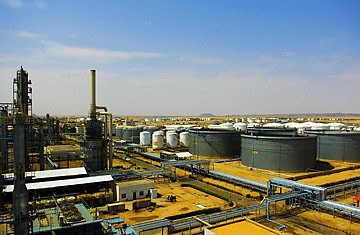
South Sudan restarted oil production in April after a year long shut-down. The closure was as a result of a bitter argument with Khartoum on how to share oil revenue.

"Oil is for the benefit of two countries," Benjamin said. "If they close it they are depriving the people of Sudan and South Sudan of a resource meant to strengthen two economies," he added.

Oil games

“The potential damages to Sudan, South Sudan relations could be great - resumption of oil production for both countries is very important,” said Florian Dähne. He is the resident representative in Khartoum of the Friedrich Ebert Foundation, a think tank affiliated to Germany's Social Democratic Party. Dähne told DW's Africalink show that "cutting down this one economic area where there is a common interest could be a massive blow between North and South Sudan relations.”

He also said that both Khartoum and Juba believe the other side cannot live without income from oil longer than their side.

The conflict in the Sudanese state of South Kordofan conflict has displaced thousands
“So both sides from time to time seem to think it is strategically a wise instrument to threaten the other side by cutting off the oil flow.”

Sudan and South Sudan came to the brink of war in April 2012. Lengthy and tough negotiations, backed by threats of UN sanctions, ended in the two countries striking a peace deal. Cross border oil-flow resumed in March. However, a recent spat by the oil ministers from both countries over a technical problem at a pumping station showed their mistrust persists.

Syrian War Spreading Into Lebanon Claiming Three Soldiers Lives

Syrian violence claims Lebanese lives

Paige Kollock , Special for USA TODAY12:27 a.m. EDT May 29, 2013

Gunmen kill three soldiers at checkpoint
Terrorists targeting army, ex-general says
Hezbollah taking a hand in conflict

BEIRUT — Three soldiers from the Lebanese army were the latest fatalities in the deep escalation of violence hitting Lebanon as a result of the Syrian revolution, causing concern over the spread of the conflict regionally.

A group of gunmen in a black jeep fatally shot the three soldiers at a checkpoint in the northeast town of Arsal, a predominantly Sunni enclave close to the Lebanese-Syrian border. The gunmen escaped into Syria.

The town of Arsal is a smuggling route between the two countries, and these days, weapons are the main item being ferried across. Arsal is also the temporary home to thousands of Syrian refugees who have flooded over the border in the past two years.

Manifestations of the war in Syria have played out in Lebanon over the past few weeks, paving the way toward what could be a violent summer. Hezbollah's overt involvement in the war has also brought the fight closer to home.

"What happened this morning is a real terrorist operation against the army," said Hisham Jaber, a retired Lebanese army general and president of the Center for Middle East Studies.

"The army is just there trying to maintain order and trying to forbid movement back and forth, and as such, they will continue to be the target," he said, suggesting the operation may have been aimed at driving the military out of the region.

In Hermel, a Lebanese town near the Syrian border with a heavily Shiite population, rockets fired from Syria injured three civilians early Tuesday and killed one Monday.

The Syrians are fighting for control of Qusayr, a mountainous Syrian town of strategic value to both sides. For the opposition, control of Qusair means protecting a supply line to Lebanon 6 miles away. For President Bashar Assad's troops, it's a corridor linking the capital of Damascus to key Alawite towns from which he draws support.

"We have been living the spillover of the Syrian regime for over 60 years," said Moustafa Alloush, an official in the Western-allied Future Movement. "Most of the violence that has occurred in Lebanon is from Syria, and unfortunately, I don't think this is the end of it. Now we're seeing the consequences of Hezbollah's involvement in the war."

The spread of the civil war over Syria's borders comes as outside nations try to influence events and prevent an escalation of violence.

The European Union lifted an arms embargo on Syria late Monday, creating the possibility that Western nations will begin arming the rebels to even the odds against the Syrian government.

Russia, allied with Assad and supplying his military with heavy weaponry to beat back the rebellion, lashed out at the EU decision as a risk of wider warfare. It claimed its own delivery of weapons to Syria, including the impending arrival of sophisticated anti-aircraft missiles, is meant only to prevent the West from making matters worse.

Israel has warned it may boost its presence militarily if Russia keeps up arms shipments that can be used against its country. Israel said Tuesday it is prepared to attack any missile shipments to Syria that could be transferred to Syria's Hezbollah allies. The U.S.-designated terror group based in southern Lebanon has been sending fighters to help Assad, and convoys of weapons it has tried to move into Lebanon have been bombed from the air by Israel in recent weeks.

France and Britain hope the new EU position on the arms embargo on rebels can help prod the two sides in Syria and Russia to enter peace talks scheduled next month in Geneva.

In Lebanon's second-largest city, Tripoli, 29 have been killed in sectarian fighting over the past few days. In Beirut, which endured a brutal civil war two decades ago, people shrugged their shoulders and tried to get on with life.

Even as a pair of rockets slammed into a Beirut neighborhood early Sunday morning, leaving four men wounded, an annual 10K race for women through the streets of the capital went on without a hitch.

"I didn't even reconsider going to the beach on Sunday," Zeina Abdullah said. "We got used to this from the minute we grew up. We cannot stop our lives."

"If it's not on your same street, you don't have a problem," Rami el Khal said. "You remember the riots that happened outside London in 2011? Tourists were still going to London. Remember the violence in the Paris suburbs in 2005? No one stopped their lives. It's the same here. The parts we're reading about in the news are so close to Syria that they cannot but be affected, but to us in Beirut, it's like another world."

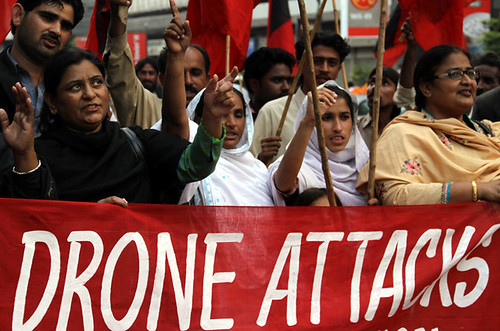
Despite Obama's Speech U.S. Drone Attacks Continue in Pakistan

May 29, 2013

Drone Strike Kills at Least 4 in Pakistan

By ISMAIL KHAN
New York Times

PESHAWAR, Pakistan — At least four people were killed and four others injured in a drone attack on a house near the Pakistani-Afghan border early Wednesday, residents in the region said.

Tuesday’s strike came just six days after President Obama unveiled his new drone policy, curtailing their use to limit civilian casualties and moving oversight of the program from the C.I.A. to the Pentagon — although the C.I.A. is expected to maintain control of strikes in Pakistan. U.S. officials do not comment on specific attacks, but the C.I.A. has carried out hundreds of drone strikes in Pakistan that have killed thousands of people.

Residents reached by phone in Miram Shah, North Waziristan, said the drone attack happened around 3 a.m., hitting a house in nearby Chashma Pull and killing four people. One resident said that fighters from nearby immediately cordoned off the area and retrieved the dead and the wounded.

An official in Peshawar responsible for security in Pakistan’s Federally Administered Tribal Areas said it appeared that at least three people had died in the attack.

“This is an initial report,” said the official, who asked not to be named because he was not authorized to speak to reporters. “We don’t know the identities of the dead and wounded but so far it emerges that all were tribal people. We have not heard of any foreigner having been killed or wounded so far.”

The authorities in the North Waziristan region, a stronghold for militant forces, often have to rely on local tribal contacts for information.

Wednesday’s strike, coming just days before the newly elected government in Pakistan takes over, suggests that Washington is not likely to completely halt such attacks, which it sees as an effective tactic in fighting Al Qaeda in the region along the Pakistani-Afghan border.

The incoming prime minister, Nawaz Sharif, has said he plans to engage the United States in “serious” negotiations to put an end to drone strikes, which Pakistan says violate its sovereignty

The drone strike also came the same day that members of the provincial assembly of the northwestern Khyber-Pakhtunkhwa province were scheduled to take their oaths of office. A majority of the incoming provincial assembly is deeply opposed to the use of drone strikes by United States, with opposition to the strikes and military offensives by the Pakistani Army in the tribal regions a cornerstone of election campaigns of several political and religious parties in the run-up to the May 11 general election.

The political party of Imran Khan, the former star cricket player turned politician, will lead a coalition government in Khyber-Pakhtunkhwa province. In October last year, Mr. Khan led a rally of thousands of supporters, party workers and a contingent of American peace activists to the edges of the tribal region in protest of drone strikes.

Salman Masood contributed reporting from Islamabad, Pakistan.

Libya's Post-Gaddafi Chaos Continues With Resignation of Rebel Leader

Libya's congress chief steps down after political ban

Tue, May 28 2013

TRIPOLI--The head of Libya's national assembly said he was stepping down on Tuesday following the passing of a law banning anyone who held a senior post in Muammar Gaddafi's government from the rebel regime, regardless of their part in the U.S.-NATO led counter-revolution in 2011.

In a televised speech to the rebel congress, Mohammed Magarief announced his resignation after the passage of the "political isolation" law, which critics and diplomats fear could strip government of experienced leaders, further complicating the transition to an elusive bourgeois "democracy."

"The people's representatives have expressed their word - the political isolation law - and it must be respected," he said, adding he was the first to conform to the new law, which comes amid worsening security in the North African country.

"I place my resignation in your hands. I leave with my head held high and my conscious clear."

The law was adopted on May 5 at the demand of armed factions who helped end Gaddafi's 42-year rule in 2011. Analysts fear the decision to hold the vote under duress could embolden some of the armed rebel groups to use force again to assert their will over so-called congress.

The heavily armed groups had besieged two ministries before the passing of the law, which comes into effect on June 5 and prohibits former officials from holding any high position.

It does not make provisions for those who spent decades in exile and actually became instrumental in the imperialist war against Gaddafi.

An economist and former ambassador to India under Gaddafi, Magarief was born in 1940 in the eastern city of Benghazi, where the 2011 counter-revolution broke out. He lived in exile from the 1980s and became a leading figure in Libya's oldest U.S.-backed opposition movement, the National Front for the Salvation of Libya.

He was elected to the General National Congress on the ticket of the National Front Party, an offshoot of his old opposition movement, in Libya's elections last July, where supporters of the Jamahiriya were banned by the rebels.

STANDING OVATION

His tenure has not been smooth - protesters have stormed sessions several times as well forced the assembly out of its headquarters for a month.

In March, gunmen in a crowd of protesters calling for the new law shot at his car. This came after he survived a gun attack at his home in the remote desert south in January.

Armed violence and lawlessness caused in part by militia groups who often do as they please has hobbled governance in wide areas of the oil-producing state.

Magarief received a standing ovation from congress members after his speech, which touched on his exile and opposition to Gaddafi and which paid tribute to the former rebel fighters who aided the imperialists in their seizure of the oil-rich North African state that under Gaddafi maintained the highest living standards on the continent.

Rebel Congress members say the law could be applied to more than 20 people in the ineffective body of around 200 members.

"We hope that all those who are affected by this law will follow what he has done," congress member Mohammed Amari said.

Rebel Congress spokesman Omar Hmaidan told reporters Magarief's first deputy Giuma Attaiga would be acting congress president until an election for a successor was held. Diplomats in Tripoli said it was still too early to identify any front runners.

In a sign of Libya's disarray, a group from the Tibu nationality blocked off the airport in the southern desert town of Sabha on Tuesday in protest at what they said was the disappearance of a local brigade leader, a military spokesman said.

"They gave the government a deadline and said that they would close the airport if they got no answers. They then did that and there are no flights leaving or landing at this time," Anas al-Barasi, a spokesman for the south's military governor, said by phone. No further details were immediately available.

France Calls for Spreading Military Actions Into Southern Libya

France calls for action against Islamists in southern Libya

Tue, May 28 2013
By Abdoulaye Massalatchi

NIAMEY (Reuters) - France urged African nations on Tuesday to make a concerted effort to tackle a growing Islamist threat in the deserts of southern Libya.

French Foreign Minister Laurent Fabius, speaking on a visit to Niger where suicide bombers attacked a French-run uranium mine last week, said there were signs that Libya's lawless south was becoming a safe haven for Islamist groups in the Sahara.

"It seems we must make a special effort on southern Libya - which is also what Libya wants," Fabius said after meeting Niger President Mahamadou Issoufou. "We spoke about the initiatives which neighboring countries can take in liaison with Libya."

A five-month French-led military campaign broke Islamists' hold over the northern two-thirds of Mali, killing hundreds of al Qaeda-linked fighters and pushing others into neighboring states.

Niger has said the Islamists who carried out Thursday's twin attacks on an Areva (AREVA.PA: Quote, Profile, Research, Stock Buzz) mine and a military barracks, which killed 25 people, had crossed the border from Libya. Tripoli has denied this.

Fabius said efforts to address the problem in southern Libya would need support from Tunisia, Algeria, Chad, Mali and Egypt.

"Since, as is often said, a large part of Libya could act as a refuge for terrorist groups, all of these countries must act together," Fabius said, adding that France would assist them with "lots of determination, lots of solidarity".

Libya has become a weapons smuggling route for al Qaeda militants in the Sahara since Muammar Gaddafi's fall in 2011.

Veteran al Qaeda commander Mokhtar Belmokhtar acquired arms there and his fighters used it as a transit route before a mass hostage-taking at a gas plant in Algeria in January, security sources say.

Tripoli is struggling to control armed groups which helped topple Gaddafi and now refuse to lay down their weapons. Parliament in December declared the south a military zone but policing its borders remains a huge task for weak state forces.

Last week's attacks in Niger were claimed jointly by Belmokhtar and the MUJWA militant group which formed part of the Islamist coalition which seized northern Mali last year.

MALI VISIT

Later on Tuesday, Fabius travelled to Mali where a day earlier the government fixed July 28 as the date for elections, aimed at restoring democracy after a military coup last year and bringing some stability to the conflict-torn country.

Islamist fighters continue to mount sporadic attacks in the north. And several towns, including Kidal, are occupied by the Tuareg separatist group the MNLA, raising doubts that the polls can go forward safely and throughout the country.

The MNLA launched its rebellion in January last year and initially fought alongside al Qaeda-linked forces before being sidelined by the better armed Islamists. Having watered down independence demands, it is calling for talks with the government over securing a degree of autonomy.

"There are discussion happening now. I would like these discussions to wrap up quickly, but in any case it is clear that there cannot be two countries in one country," Fabius said. "So therefore measures will be taken so that Kidal can vote." He did not elaborate.

France is gradually drawing down the 4,000 troops it deployed in Mali but it will keep 1,000 soldiers there after December as a rapid reaction force to tackle any Islamist threat. It will hand routine security operations to a planned 12,000-strong U.N. peacekeeping mission.

(Additional reporting by Tiemoko Diallo; Writing by Daniel Flynn and Joe Bavier; Editing by Robin Pomeroy and Pravin Char)

Tuesday, May 28, 2013

Somalia Resistance Movement Says It Shot Down US Drone

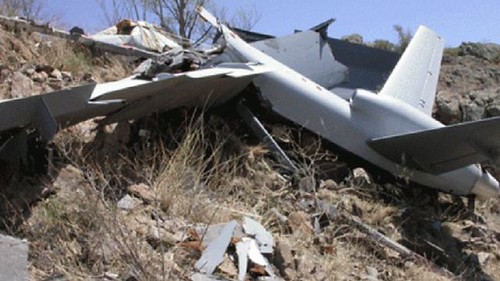
Drone crashes in southern Somalia, may have been shot down

Reuters
5:37 PM 05/28/2013

A suspected U.S. reconnaissance drone crashed on Tuesday in southern Somalia, where African forces are fighting Islamist al Shabaab insurgents, the rebels and the provincial governor said.

Lower Shabelle region governor Abdikadir Mohamed Nur said that al Shabaab militants had shot at the aircraft over the town of Bulamareer for several hours before it crashed.

“Finally they hit it and the drone crashed,” Nur told Reuters.

The insurgents confirmed that a drone had crashed but did not say if they had downed it.

“A U.S. drone has just crashed near one of the towns under the administration of the Mujahideen in the Lower Shabelle region,” al Shabaab said on a social media account.

Although the United States does not report its activities in Somalia, drones have been used in recent years to kill Somali and foreign al Shabaab fighters.

Western nations are worried that Somalia will sink back into chaos and provide a launchpad for Islamist militancy despite a fragile recovery after two decades of war.

Last year, the Wall Street Journal reported that the Pentagon was seeking to send drones to Kenya as part of a $40 million-plus military aid package to help four African countries fighting al Qaeda and al Shabaab militants

Bulamareer residents said al Shabaab fighters had kept them away from the crash site.

“Al Shabaab fighters surrounded the scene. We are not allowed to go near it,” resident Aden Farah told Reuters.

Al Shabaab, which is affiliated with al Qaeda, said in January 2011 that a missile launched from a drone had killed Bilal el Berjawi, a Lebanese al Shabaab fighter who held a British passport.

Another missile killed four foreign militants south of the Somali capital Mogadishu in February 2012.

Al Shabaab were driven out of Mogadishu in late 2011 and are struggling to hold on to territory elsewhere in the face of attacks by Kenyan, Ethiopian and African Union forces trying to prevent Islamist militancy spreading out from Somalia.


Pentagon confirms drone crash in Somalia

By: Stephanie Gaskell
May 28, 2013 04:53 PM EDT

The Pentagon has confirmed that a U.S. reconnaissance drone crashed off the coast of Somalia on Monday, but defense officials deny it was shot down by fighters loyal to the al-Shabab insurgency.

The Al Qaeda-affiliated militant group posted several pictures to its Twitter account that it claimed are parts of a drone it shot down with the message: “This one will no longer be able to spy on Muslims again. So much for the empty rhetoric on the drone program!”

U.S. military officials said it’s “highly unlikely” that the drone was shot down, especially since the aircraft fly at such high altitudes.

“During the course of a routine surveillance mission along the coast of Somalia on May 27, a military remotely piloted aircraft crashed in a remote area near the shoreline of Mogadishu,” a defense spokesman told POLITICO on Tuesday.

The cause of the crash is under investigation. The Pentagon declined to identify what kind of drone had crashed. American surveillance drones are believed to operate from the U.S. base in Djibouti, from an airport in the Seychelles and smaller drones fly from U.S. warships at sea.

Lower Shabelle region governor Abdikadir Mohamed Nur told Reuters that al-Shabab militants had shot at the aircraft over the town of Bulamareer for several hours before it crashed.

“Finally, they hit it and the drone crashed,” Nur said, per the wire report.

Local residents said the fighters kept them away from the crash site.

“Al-Shabab fighters surrounded the scene. We are not allowed to go near it,” resident Aden Farah told Reuters.

Al-Shabab has been trying to hold on to territory in Somalia after being driven out of the capital of Mogadishu, and have taken to fighting in more remote regions of the country.

Although President Barack Obama said last week that he wants the U.S. to use higher standards before targeting terrorists with lethal drone strikes, he placed no restrictions on their use in nonlethal reconnaissance flights. Africa Command has been beefing up its unarmed drone presence in Africa to help stop nations like Somalia and Yemen from becoming havens for terrorists to launch attacks. The Defense Department recently signed an agreement with Niger to operate a drone base there.

Suspected US Drone Crashes in Somalia's Lower Shabelle

28 May 2013
Last updated at 11:34 ET

Suspected US drone crashes in Somalia's Lower Shabelle

A suspected US drone has crashed in the southern Lower Shabelle region of Somalia, according to reports.

The militant group al-Shabab said on Twitter that an American unmanned aircraft had come down near a town under its control.

A regional governor told Reuters that fighters had shot at the object.

The US uses drones in Somalia to support the Somali government and African Union (AU) forces as they battle the al-Qaeda-linked al-Shabab.

The US Africa Command has not confirmed the reports.

'They hit it'

Residents in the town of Bulo Marer told the BBC they had seen the wreckage of a small plane but did not know whether it was a US drone.

Lower Shabelle region governor Abdikadir Mohamed Nur told Reuters news agency that Islamist militants had shot at the aircraft over the town for several hours before it came down.

"Finally they hit it and the drone crashed," he said.

Al-Shabab said in a Twitter post that photographs of the drone would be published in the coming hours.

A French soldier was among several people who died during a failed operation to free a hostage in the town of Bulo Marer in January.

The hostage, Denis Allex, kidnapped in Somalia in July 2009, was also believed to have been killed by captors during the operation.

Al-Shabab emerged as the radical youth wing of Somalia's now-defunct Union of Islamic Courts in 2006.

It is fighting to create an Islamic state in Somalia.

The AU has about 18,000 troops in the country to help the government battle the insurgents.

Al-Shabab was forced out of Mogadishu in August 2011 following an offensive by AU and government troops.

But it still controls most villages and rural areas of southern and central Somalia.