Wednesday, September 10, 2008

Michigan Activists Demand Hearings on Moratorium Bill

Activists demand hearings on moratorium bill

By Kris Hamel
Detroit
Published Sep 7, 2008 8:46 PM

Activists in Michigan with the Moratorium NOW! Coalition to Stop Foreclosures and Evictions have started a campaign to force state Sen. Randy Richardville to move a bill mandating a moratorium on housing foreclosures out of his committee. Richardville is chair of the Senate Banking and Financial Services Committee, where the bill, SB 1306, has lain dormant since its introduction last spring.

The coalition is demanding that Richardville convene a public hearing on Sept. 17. That’s the day activists and foreclosure victims will be at the state Capitol in Lansing, Mich., for a mass demonstration to press for the law’s passage by the Legislature. SB 1306 would place a two-year moratorium, or halt, on foreclosures and evictions by delaying the sheriff’s sale or extending the redemption period on foreclosed homes.

The law would provide immediate relief to tens of thousands of working-class families around the state. Over 72,000 homes in the Detroit area alone are in foreclosure. One in every 137 homes in Michigan was subject to foreclosure during the second quarter of this year. (July 2008, RealtyTrac)

Organizers sent Richardville a certified letter requesting he immediately move the bill out of the banking committee and hold public hearings on the foreclosure crisis. When he failed to respond to their letter within seven days as requested, they held a protest Aug. 28 outside the senator’s home in Monroe, Mich., about an hour south of Detroit.

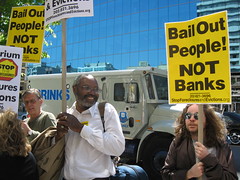
They gathered in downtown Monroe outside the county courthouse, where a short rally was held after an afternoon of leafleting and outreach. Then they piled into vehicles for the two-mile drive to Richardville’s residence. About 20 protesters converged on the home’s front lawn, where they held a banner and signs demanding “Sen. Richardville—move on SB 1306 now!”

The senator’s home on the Raisin River is situated on a busy road. Many motorists honked in support as they drove past the demonstration. Protesters chanted, “We want hearings now!” and “Moratorium now!” Several people from Monroe enthusiastically took part in the action.

During the demonstration, a delegation of coalition activists went to the home’s front door to deliver another letter to Richardville demanding immediate public hearings. They knocked loudly, shouted his name and looked through the window but no one answered, so they left the letter in the door. Organizers believed the home was occupied at the time because two cars were parked in the side driveway.

Meanwhile, Richardville’s father came on the scene and shortly thereafter officers from the Monroe Police Department and the Monroe County sheriff arrived, but they did not interfere with the demonstration.

During the ride back to Detroit after the action, coalition organizer and attorney Jerry Goldberg received a call from Richardville, who obviously had been at home during the protest. He stated he had just received the letter.

Goldberg told Workers World: “Richardville expressed dismay over the demonstration, but for the first time said he would consider hearings on the moratorium bill.

“Richardville said he didn’t believe the moratorium or any proposal raised so far would provide a long-term solution to the foreclosure crisis. I told him this is precisely why a moratorium is needed, so that tens of thousands of people can stay in their homes while a solution is developed over time.”

Goldberg continued: “I stressed to him that whatever his personal position on the bill, he has a duty to move this bill out of committee and let there be a genuine debate on this critical issue. I also pointed out to him the legal precedent for the moratorium, which he was unable to challenge.”

An excellent video called “Randy & Me—Moratorium Now,” by coalition organizer Alan Pollock, is available on YouTube. It highlights the letter delivery and scenes from the protest at Richardville’s home. Other videos on the foreclosure moratorium struggle in Michigan can also be seen on YouTube.

To reserve a bus seat from Detroit to the Sept. 17 demonstration in Lansing, call 313-887-4344 or visit moratorium-mi.org. The cost is $20; no one will be turned away for lack of funds. Donations can be sent to the Moratorium NOW! Coalition, 23 E. Adams, 4th floor, Detroit, MI 48226.
-------------------------------------------------------------------------------------------
Articles copyright 1995-2008 Workers World. Verbatim copying and distribution of this entire article is permitted in any medium without royalty provided this notice is preserved.

Workers World, 55 W. 17 St., NY, NY 10011
Email: ww@workers.org
Page printed from:
http://www.workers.org/2008/us/moratorium_0911/

Ken Livingstone Interview With 21st Century Socialism: Discussions on Cuba, China and the Global Economy

Ken Livingstone: the interview

Ken Livingstone, former Mayor of London, in conversation with Calvin Tucker, co-editor of 21st Century Socialism.

Part 1: Venezuela, Cuba, China, and the changing global economy.

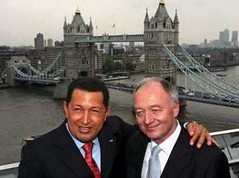
Tucker: You have recently been offered a new job by Hugo Chavez, the Venezuelan President. What exactly are you going to be doing in Caracas?

Livingstone: A job is overstating it; you know we had this deal that was done between London and Venezuela. President Chavez organized that we would get £14 million off the price of our oil bill for London's buses, and in exchange, Transport for London and the Greater London Authority would give lots of advice on how to run a modern city. And Caracas has huge problems. And the deal was cancelled by Boris Johnson [the new Conservative Mayor of London] on the grounds that it was obscene that one of the poorest societies was supporting one of the richest. What Boris didn't realize was that the Central Bank, the Treasury in Caracas, has $39 billion of reserves.

Venezuela's problem is not, given that they have the third largest oil reserves in the world, the lack of financial resources, it's actually the expertise. For example, to get a major programme to build decent housing. Because most of the people in Caracas live in the barrios, which are prone to collapsing down the sides of the hills in torrential rain. About ten years ago, 20,000 people were buried alive in a mudslide near Caracas. And with the cancellation of the London - Caracas deal, President Chavez asked me what I could do to globalise advice and strategy.

So I met with Chavez's candidates for the various local authorities in Caracas, and they haven't got the sort of strong modern government they need. You have five lower authorities, and Chavez's party will win the two which have about 80% of the population, which is poor. And most probably the three smaller ones in which the rich people live will elect rival candidates. If Chavez's candidates can win those two, plus the mayor of the overall greater Caracas region, they can work together for the sort of long term planning that we tried in London, on transport, housing, waste, recycling, all those things. I pulled together a team of people that can go over there and give advice.

It's all got to be done by Venezuelans, but there is no reason why they have to replicate the mistakes that we made in London over 150 years. What people forget is that if you look at the problems with Caracas or Lagos or Mumbai today, they are the problems that London had in the middle of the 19th Century. When peasants leave the land, they arrive in the cities, they die in their millions. There was a time when, in 1840, the average lifespan in Britain was around 42. In London, it was 35 years. Broadly, all the history of London is about how to create the modern social infrastructure that gives its citizens a decent quality of life.

So, it is not really a job in that sense. I’ll be orchestrating people to go over there. I mean, it won't require much of my time; it's a question of identifying those people who have the skills and expertise in these fields so that they can tap into them.

Tucker: You are a well known supporter of the Venezuelan revolution, as it’s called, and you're the honorary president of the Venezuela Information Centre.

Livingstone: That's right, yes.

Tucker: How would you characterize the Venezuelan revolution? Do you see this as a real revolution, if you like, a revolution in the traditional sense?

Livingstone: No, not a revolution in the traditional sense, because the poor people haven't fired any guns. And therefore it is not in that same sort of broad category as, say, Russia, China and Cuba. What you had before Chavez was the 200 richest families, the oligarchs, taking their share of the oil wealth that wasn't being taken by the international oil companies, living a life completely cut off from the mass of the population, and having most of their money abroad, so that they could get out if there was ever a real revolution.

Chavez won the election and has changed the tax regime, nationalized the oil companies. And when the middle class organized a strike, he took over and ran Pdvsa, the oil company, and has used that wealth to give people healthcare and good education, so you have now got 100% literacy. You see people who are 35 years old with braces on their teeth, because before Chavez no one except the rich saw a doctor or a dentist.

Now they are moving on to what is the next stage, in a sense. The vast majority of the population have left the villages and the jungles, and moved to the towns. But the oil industry only employs 80,000 people, and they have now got the same problem we had in 1980. The oil reserves and the wealth which that generates has raised the exchange rate, so that it squeezes out all the other forms of employment that could come, and in a sense when you actually look at their economy, they are one of the few governments in the world that desperately needs to spend more money in order to bring down the exchange rate. Most other countries have the problem that if they spend too much, the exchange rate goes down and the international speculators flee.

They want to re-balance the economy, so that with a better exchange rate they can make other industries viable, and other forms of employment viable. In a sense, what Chavez has done is really combine the sort of work of Britain's 1906 Liberal government with the 1945 Labour government. It's a huge package of social reform. It looks pretty revolutionary if you are one of the peasants who have been driven off the land and is living in squalor in the barrio.

Tucker: There is even a shade of Roosevelt's New Deal or the 'Great Society' in the USA, but the question I want to ask is this. On the one hand there is economic reforms which echo some of the social progress we have made in Britain, in Western Europe, or even to some extent in the United States. On the other hand, there is a political dimension to this process; if you like, an attempt to transfer political power from the old hierarchy and the ruling class, with the development of communal councils and so on. And it strikes me that if you look at the political aspect combined with the economic aspect, what is occuring in Venezuela could perhaps be accurately described as a revolutionary process. Would you share that view?

Livingstone: It is a complete transformation. I mean, because it is happening in such a short space of time, it's much more dramatic than, say, the 20th Century was for Britain. And in the sense that the American-backed coup in 2002 was an attempt to overthrow it, it really is much more potentially violent because America has sent killers down there to bump off Chavez, because the local generals were a bit nervous about doing it. It came down to the fact that Chavez refused to sign the paper saying 'I resign'.

What was interesting about Chavez is that he didn’t then go after everybody involved in the coup. The generals retired, they didn't go to prison. The TV Company that had urged people to overthrow the government carried on until its license expired. As you can imagine, if the BBC or ITV were urging people to overthrow the government here, they would all be inside for a very long time. So he took a very lenient view. And I know Amnesty International was critical, but a lot of the soldiers who had gunned down peasants should have been prosecuted. But he took the view of binding up the society rather than having a vast purge.

So it is certainly a very exciting time and there could be terrible violence if America tried again to overthrow the government, but I think that the problems they have in the Middle East means that America is a bit overstretched at the moment. Let me get you a coffee. Do you want milk or water with that? Sugar?

Tucker: Just milk would be great, thanks. So to finish off on Venezuela. One thing I found very interesting about Chavez’s rise to power is that it didn’t happen in the traditional revolutionary way - of course there is never the right sort of revolution, each one is different and has its own unique characteristics - but what you had in Venezuela was a collapse of the old party system, the old two party corrupt system, which as you know had come together in a power sharing pact called the Pact of Punto Fijo.

Livingstone: Was that in 1958?

Tucker: Yes, after the overthrow of the dictatorship. What I found interesting was the loss of ideological hegemony. I mean, the system just simply could not carry on in the old way. Nobody trusted the political parties. Chavez did not come in as a representative of one of the remnants of the 20th Century communist parties or Trotskyist parties or Maoist or social democratic parties. It was something completely different.

Livingstone: And in the beginning when he had just been elected, he came to London take part in one of Tony Blair's 'Third Way' debates. He arrived – here’s a soldier who tries a coup when he realizes that society is going nowhere. It fails, but the speech he makes is a bit like Nelson Mandela's, it reverberates. He gets elected and he is desperately looking... he is not anti-American, I mean the ideals of America he finds very attractive, and he is a practicing Catholic. He is not some Marxist trained guerrilla who has planned and plotted. He has moved leftwards empirically, because he has seen what doesn’t work. I see him as a sort of socialist. He is definitely not a Marxist revolutionary, but in the context of Latin America, Venezuela stands out like a great beacon.

In the same way that the old orthodoxies collapsed in Venezuela, they are collapsing over most of Latin America. It is only in Colombia, where Uribe is propped up by vast American wealth and also American fire power, that that old order is still hanging on. You've got trade unionists being hounded by death squads and so on.

And what Chavez has done, he's spent $8 billion buying Argentinean bonds to make sure that Argentina's government doesn’t collapse. Having had such progress by all sorts of left of centre governments, there is always the danger now as the world economy goes bad, that the backlash will bring back the right in some new form. So he is doing a lot with his money to try and prevent that happening.

Tucker: Some people would not describe Fidel Castro as a Marxist revolutionary either.

Livingstone: I think - and this is the great debate: was he just a sort of radical who got driven to Marxism and communism because of US pressure? I remember meeting a historian in Cuba in the 1980s who said Fidel Castro was a Marxist when he was a student. But having come to power, not as the head of a Marxist revolution, but just rebelling against the government of the day, it took him a decade to build a party structure which would sustain him.

I see Fidel as a Marxist, and very much a Marxist coming of his time.

And I assume now that Raul Castro is running Cuba, there will be changes. When Lenin took power in Russia, the only economic transactions people made was that they brought the food they would eat that day, and a couple of times a year they would buy an item of clothing. I remember my grandmother saying 'you could leave your front door open', we are talking about pre-WW1 London. You could leave your front door open, everyone said, but that's because no one had anything to steal.

And as someone like Lenin could see, you could organise supply and demand around the very simple needs that people had. But nowadays, even people living on state benefits make dozens of economic transactions a week. It is a huge complexity, and there is no way a centrally planned economy is going to be able to manage the scale of economic activity we now have. The tragedy is, a lot of people on the left have moved from accepting, that as a means of distribution and exchange, the market can’t be bettered- to assuming that therefore the market can do everything else in society. And really it can’t. It's a very good mechanism for the distribution and exchange of goods. Full stop.

Fidel pre-dates the recognition of all this, and Raul has got to allow... the most dramatic economic growth in human history has been China, where they kept control of the commanding heights of the economy, but allowed a service and light industrial sector to grow up around it. But still the majority of the economy in China was in the hands of the Party. When I was discussing where should I open an office in China - Shanghai was clearly the parallel city, but we also had to be in Beijing because that is where the decisions finally get taken.

Whatever the big corporations are doing there, it requires the backing of the Party. And what the Chinese have done is, they have become totally predominant in a whole series of products. I think 82% of all ballpoint pens are made in one factory in China. The state has backed industries which are becoming incredibly successful because they have avoided the mistakes which the British Labour Party made in nationalisation, where the state didn't allow them to borrow money and didn’t allow them to sell, didn't allow them to compete in the private sector; they were just locked into slow decline. Whereas in China, they won’t bat an eyelid about paying their Managing Director £1 million a year, but they won’t let him own the company, and they will allow him to raise the money he needs to expand and have aggressive marketing campaigns.

So effectively, what the Chinese have created is nationalised industries which are dynamic, and they are cleaning up in virtually every area they move into.

And this is why, both in America and in Britain, the existing support of the governments has collapsed as dramatically as it has.

What the voting figures are like, they are like the collapse of support for governments during the last three recessions in the mid 70s, the early 80s and early 90s, and yet in each of those three, GDP went negative by about 3%. We've still got a positive GDP, and part of the problem is although we haven’t got the collapse of the economy as we did in the last three recessions, within the economy both in Britain and America there is a re-balancing in favour of exports and that is largely because of the growing competition from China and India.

And Britain and America can no longer rig the whole world’s financial system in their favour, so you are getting a real shift of economic power to the East and this isn't something that is temporary, it is going to be going on for 20 years. You go to Shanghai, and the students there arrive at school at seven and they leave at six, and these are the kids that the kids in the East End of London will be competing against for the rest of their lives, based upon having had about a third of the education that these kids are getting.

Tucker: There are clearly some significant similarities between the state-led development model that China is pursuing, and the state-led development model which was so successfully pursued by the post-WW2 economies in Britain and Europe, using Marshall Plan money. And I think that whilst there are also some similarities with Venezuela today, there are also significant political differences.

China’s economic growth is being achieved under the auspices of what most people consider to be an authoritarian system, whereas Venezuela is trying to move from liberal democracy to participatory democracy. Perhaps you see yourself more in the sort of Venezuelan mode in terms of how you ran London over the last eight years?

Livingstone: Chavez is trying to shift power, and if you were in Venezuela you would be in Chavez’s party and working with him. And if you were in China you would be in the Communist Party, but trying to move into a more devolved and decentralized direction. When the mayors of Beijing and Shanghai were probably at the best end of the Chinese Communist Party in terms of recognizing the sort of world that's coming, and the Communist Party has to change and adapt to it.

If you grow up in a society, you are going to take a position depending on the balance of forces you find. If you were growing up in Cuba in the 1950s you would throw your lot in with Fidel as the best hopes for the Cubans. Here, many of your readers will be horrified that you throw your lot in with the Labour Party because that is where the bulk of the working class, up until recently, tended to look and support, and it's linked to the unions. That was the best way of achieving progress.

Next week: in Part 2 of this interview, Ken Livingstone discusses New Labour and the pro-war 'left'.

Optimism Over Talks in Zimbabwe

Wednesday, September 10, 2008
04:17 Mecca time, 01:17 GMT
News Africa

Optimism over Zimbabwe talks

Tsvangirai said there was "a positive development" in the talks

Zimbabwe's ruling and opposition leaders have said they are making progress in a new round of power-sharing talks.

The ruling Zanu-PF, the main opposition Movement for Democratic Change (MDC) and a breakaway MDC faction entered fresh talks to end the stalemate this week.

Earlier negotiations to form a unity government stalled over who should wield the most power, the main sticking point in the two months of political wrangling.

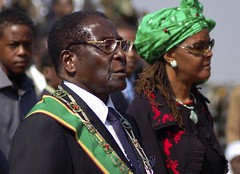
But Robert Mugabe, Zimbabwe's president, said after several hours of meetings on Tuesday said that progress had been made in some areas.

"We are still going to talk. We are finishing tomorrow [Wednesday]," he said on Tuesday, adding that "one or two areas" were still outstanding.

'Positive development'

Morgan Tsvangirai, leader of the MDC, said "there is a positive development" in the negotiations this time.

"Nothing has been concluded yet but we are hoping that tomorrow [Wednesday] we will be able to look at the outstanding issues."

Arthur Mutambara, leader of the breakaway MDC faction, was even more optimistic, saying "tremendous progress" had been achieved.

"We hope tomorrow we will be able to bring finality and closure to the dialogue process."

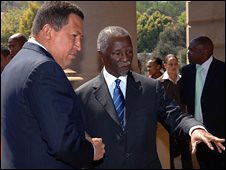
Thabo Mbeki, the South African president, is mediating in the talks in an attempt to secure a power-sharing deal to end the wrangling and help ease a post-election crisis.

Tsvangirai beat Mugabe in a March 29 presidential election but fell short of enough votes to avoid a June run-off, which was won by Mugabe unopposed after Tsvangirai boycotted it, citing violence and intimidation of his supporters.

Source: Agencies

US War Update: 21 Killed in Missile Strike; Spies Mistake

21 killed in missile strike

AFP

MIRANSHAH--AT least 21 people — including women and children— were killed yesterday in a missile strike by suspected US drones on a Pakistani tribal town near the Afghan border, officials said.

The drones fired several missiles that hit a house near a madrassa or Islamic seminary in North Waziristan, the officials said, in the fourth such strike in the rugged tribal region in almost a week.

"Seven civilians and 14 militants have died in the missile strike," an intelligence official said, hours after the 11am strike.

Women and children were among the dead, as well as the militants, including nine "foreigners" believed to be of Arab origin.

A security official said more than 25 people had been wounded.

"The latest casualties include an important Arab militant identified as just Hamza and two other Arabs identified as Musa and Qasim," the official said but was unable to give full names immediately.

Some of the injured were in critical condition, hospital officials said.

Foreigner is a term used by Pakistani authorities for Al Qaeda militants.

The drones were apparently targeting the house or the madrassa established by former Taliban commander Jalaluddin Haqqani during the 1978-88 Soviet occupation of Afghanistan, residents said.

Haqqani, who was a close aid to fugitive Taliban leader Mullah Omar, has not been seen since the fall of the hardline regime in Afghanistan in 2001.

Residents said two pilotless aircraft circled over Dande Darpakhel, three kilometres north of the region’s main town of Miranshah, before at least one drone fired several missiles.

On Friday, three children and two women were killed in the same region during a suspected strike by a pilotless aircraft.

At least five militants were also killed the day before when a missile fired from an unmanned plane hit a house in the North Waziristan village of Mohammad Khel, officials said.

The latest strike follows Pakistani claims that US-led forces based in Afghanistan killed 15 people in a border village in neighbouring South Waziristan district last week.

That attack was condemned by Pakistan’s parliament and the foreign minister, who issued a tough statement calling the incident "shameful" and stating that only women and children had been targeted.

Around 3 000 Pakistani tribesmen chanted "Allahu Akbar" and "Death to America" in Wana, the district’s main town, after Friday prayers to protest against that raid, which involved helicopter gunships and ground troops.

Both the US-led coalition and the separate Nato-led security force operating in Afghanistan have said they have no knowledge of the incident. — AFP.


‘US spies’ mistake led to Afghan deaths’

AFP

MADRID-- Air strikes in Afghanistan, which Kabul and the United Nations say killed 90 civilians on August 22, were carried out on the basis of misinformed United States intelligence, the Spanish radio station Cadena Ser said yesterday, citing Spanish military sources.

Operation Enduring Freedom, led by the US, says the air strikes were made during daylight and were aimed at a group of Taliban fighters who opened fire on their soldiers.

"Nevertheless, Spanish intelligence reports indicate that a mistake was made by the American spies," the Spanish station reported.

"American agents would have received an incorrect tip-off, an allegation made with a vested interest that came from a rival family to those of the victims, but which American intelligence judged to be correct," Cadena Ser said.

"According to Spanish military intelligence, the victims were sleeping at the time of the attack, having just marked the funeral of an important local tribal leader, who was killed by a rival clan — the same clan who supplied the information that led to the American attack," the station said.

The radio reported that the vast majority of victims came from the same family that had gathered together in the village to attend the funeral. Cadena Ser says that as many as 60 of the 90 victims were children.

American forces have consistently rejected the number, but said yesterday they would carry out a fresh investigation based on new details that have emerged.

If the UN figures are proved accurate, it would be one of the deadliest military blunders by international forces in Afghanistan for seven years.

Mobile phone footage, recorded by a local villager and obtained, shows at least 30 corpses, many of them children, lined up in a mosque ahead of their burial.

The coalition said on September 2 that an internal investigation had found that between five and seven non-combatants and 30-35 Taliban had died in air strikes on the village of Azizabad.

There are around 750 Spanish soldiers in Nato’s International Security Assistance Force that operates alongside American forces.

Spanish forces are mainly deployed in the Herat province where the attack took place. — AFP.

Tuesday, September 09, 2008

Judiciary Not Above Criticism Says Zuma

Judiciary not above criticism - Zuma

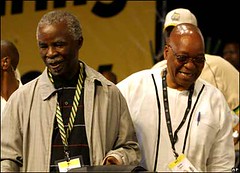
Although the judiciary is accepted as the final arbiter of dispute, it is not above criticism, ANC president Jacob Zuma said on Tuesday.

"It can't be said you can't criticise the judiciary. That is what is being said in South Africa. That is not right," said a relaxed Zuma at the University of Johannesburg.

His speech was preceded by a thunderous rendition of "awulethu' mshini wami" and "my president" by students.

"But, the criticism should be fair and should be informed. That is very important."

Zuma said it was "only in dictatorships and autocracies that criticism is viewed with contempt".

Zuma was addressing university students on "access to justice", ahead of judgment on Friday in the next step in the fraud and corruption investigation against him.

His said criticism was "indeed proper in a democratic society".

His presentation came amidst a debate over a cartoon by Zapiro in the Sunday Times which depicts him about to rape a female depiction of justice, while his supporters pin her down.

Zuma's supporters - most vocally the Congress of SA Trade Unions, the ANC Youth League and the ANC itself, believe there is no case against him and the National Prosecuting Authority's pressing on with the case is only political.

Supporters have begun a campaign of protesting outside courts and police stations in the hopes of having the case against him dropped.

The Constitutional Court also came under pressure recently when it lodged a complaint with the Judicial Services Commission about Cape Judge President John Hlophe.

He allegedly tried to interfere with the court's judgment on Zuma's challenge to search and seizure warrants used in the investigation against him.

He said South Africa, as a 14-year-old democracy, is going through a learning curve and is still internalising the fundamental principles of democracy. Engaging in debates would help this process.

The judiciary is a pillar of a stable society and "to destabilise it would mean we are cutting our noses to spite our face".

He said it was unavoidable that tensions would be raised now and again between courts, the executive, political parties or the individual.

When they become unpalatable restraint should be shown.

"We must not jump to conclusions that the judiciary is under attack," he said.

"But if this happens, we must step back and reflect and be like sports people shaking hands after a gruelling duel."

He said ANC deputy president Kgalema Motlanthe and secretary general Gwede Mantashe would never undermine the judiciary nor the rule of law.

"As the ANC we reiterate and affirm our belief in the rule of law, the independence of the judiciary to be the final arbitrator of disputes.

"Motlanthe, Mantashe will never undermine these institutions. We seek to protect and strengthen them as the ANC has always done since 1912.

"I believe in a free and independent judiciary that should operate without fear or favour. I believe in the right of equal access to the courts for all South Africans," he said.

The main challenges to the judiciary included not just people's being able to get to court buildings, but that they should have legal representation and be able to understand the proceedings in their own language.

He urged court officials to use recesses to offer free legal advice and for lawyers to become more involved in offering services to the poor.

He said the proverb "justice delayed is justice denied" also applies.

Asked if he thought there could be a conflict of interest if, were he to become president of the country, he had to appoint Constitutional Court judges who may well hear an application by him relating to his legal wrangles, he said one should not "confuse personal challenges and the rules of democracy".

He said the judges went through an application process run by institution (the Judicial Services Commission) which believes in their integrity.

"So people should have no worries, absolutely no worries about that."

He said talk that the reported fighting within the ruling party was "actually democratic contestations within the ANC".

The media sensationalised matters instead of helping inform the country.

Discussion facilitator, University of Johannesburg deputy vice chancellor Adam Habib said a question on what the ANC was doing to prevent possible violence related to his court cases, was not related to the debate and so Zuma did not have to answer it.

He added that Zuma was "not excited" about talking about Zapiro. - Sapa

Published on the Web by IOL on 2008-09-09 18:27:00

Sunday, September 07, 2008

Treasury to Outline Fannie Mae and Freddie Mac Bailout

Treasury to Outline Fan-Fred Plan

By DEBORAH SOLOMON, JAMES R. HAGERTY and DAMIAN PALETTA
Wall Street Journal
September 7, 2008 12:42 a.m.

The U.S. Treasury is expected to announce early Sunday afternoon details of a plan under which regulators will effectively take temporary control over government-sponsored mortgage investors Fannie Mae and Freddie Mac.

The Treasury won't necessarily make a large injection of capital immediately into the ailing companies, which provide the bulk of funding for U.S. home mortgages. But people familiar with the plan said the Treasury will stand ready to provide capital as needed, depending how quickly losses deplete the companies' meager capital holdings.

The Federal Housing Finance Agency, Fannie and Freddie's regulator, is to use its legal powers to put the companies under conservatorship. Those powers allow the FHFA to run the companies indefinitely, under certain conditions, such as when the regulator finds that they are likely to be unable to meet their financial obligations. Fannie and Freddie have run up combined losses totaling about $14 billion over the past four quarters and face heavy additional losses amid the worst surge in U.S. home-mortgage foreclosures since the 1930s.

Fannie and Freddie own or guarantee more than $5 trillion of U.S. home mortgages, nearly half of the total outstanding.

Dividends on the companies' preferred stock are likely to be suspended, people familiar with the plan say, and those on common shares to be eliminated. Any injection of capital by the Treasury would likely greatly reduce or wipe out the value of common shares currently outstanding.

The conservatorship will involve the departure of Daniel Mudd, Fannie's chief executive officer, and Richard Syron, Freddie's chairman and chief executive, though they may not leave immediately and could help with the transition. The FHFA will have to appoint conservators to run the companies and try to restore them to financial health. Officials of the companies were meeting Saturday with regulators to learn more details of the plan, which appears to have come as a surprise to their senior executives, who were summoned Friday to meetings with top officials from the Treasury, FHFA and Federal Reserve.

The longer-run future of the companies will be up to Congress, which created both of them to support the housing market, as well as the next administration.

Treasury Secretary Henry Paulson briefed Sen. Barack Obama, the Democratic presidential nominee, on Friday and spoke on Saturday with Sen. John McCain, the Republican nominee.

In a statement Saturday, Sen. Obama called the situation "extremely serious" and said it affects "our entire economy." He added: "Any action we take must be focused not on the whims of lobbyists and special interests worried about their bonuses and hourly fees, but on whether it will strengthen our economy and help struggling homeowners."

Sen. Obama said the rescue also "must protect taxpayers, not bail out the shareholders and management of Fannie Mae and Freddie Mac."

Alaska Governor Sarah Palin, the Republican nominee for vice president, said during a rally Saturday afternoon in Colorado Springs, Colo., that Fannie and Freddie have "gotten too big and too expensive to the taxpayers." She added: "A McCain-Palin administration will make them smaller and smarter and more effective for homeowners who need help."

The plan will also likely face immediate scrutiny from Congress as it returns from a lengthy recess next week.

House Financial Services Committee Chairman Barney Frank (D., Mass.) said he was "pleased" after a conversation he had late Friday with Mr. Paulson about Treasury's "strong reaffirmation that the vital roles these institutions play in our nation's housing markets must continue."

Mr. Frank said he would evaluate any plan by how it protects taxpayers, restores stability to financial markets and ensures the availability of affordable housing.

Speaker of the House Nancy Pelosi (D., Calif.) said she would work "in a bipartisan manner" with Mr. Paulson, other Bush administration officials and congressional leaders to review the plan "to ensure that the interests of taxpayers and the broader economy are protected."

--Laura Meckler

Write to Deborah Solomon at deborah.solomon@wsj.com2, James R. Hagerty at bob.hagerty@wsj.com3 and Damian Paletta at damian.paletta@wsj.com4

URL for this article:
http://online.wsj.com/article/SB122073255846107191.html

Double Bombing of Afghan Police Station Leaves Several Dead

Double Afghan suicide bombing leaves several dead

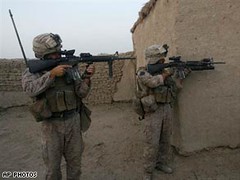
KANDAHAR, Afghanistan (AFP) - - Two suicide bombers struck inside the police headquarters in Afghanistan's southern city of Kandahar Sunday, leaving dozens of people dead and wounded, officials said.

Authorities scrambled to assess the damage after the suicide bombings, with one senior local official saying eight people were dead, but the provincial police chief said there were only two bodies in the hospital.

The explosions could be heard across the city and the compound was immediately sealed off, although seven to eight ambulances were seen rushing out, an AFP reporter at the scene said.

"There were two suicide bombers who blew themselves up inside the police headquarters, one after another," said Ahmad Wali Karzai, head of Kandahar's provincial council and President Hamid Karzai's brother.

"So far, according to my information, eight people have been martyred and 23 others have been wounded," he said.

The police chief, Mutiullah Khan Qateh, said around 30 people were wounded. "There are two bodies in the hospital," he said.

The first bomber blew himself up outside the building and the second one detonated inside, Qateh said.

Another police officer, Abdul Waheed, said around 30 people were dead and wounded. Doctors in the city's main hospital said they had some dead bodies, although they could not say how many, as well as at least 18 wounded.

There was no immediate claim of responsibility but the insurgent Taliban movement, which has its roots in Kandahar, has been behind a wave of suicide attacks in Afghanistan.

The Taliban used suicide bombers to blow open Kandahar jail in mid-June, allowing more than 1,000 prisoners -- including militants -- to escape.

Hours before the Kandahar blasts, a bomber on foot blew up himself up near a convoy of NATO-led troops, believed to be Italians, in the western city of Herat, police said.

"Only the attacker was killed and there were no casualties to civilians," Herat police spokesman Noor Khan Nikzad told AFP.

"He detonated near the Italian vehicles," he said.

However the Italian military in the city and International Security Assistance Force, under which about 2,500 Italian soldiers serve, did not immediately have information.

The blast damaged one of the vehicles in the convoy, Nikzad said, unable to comment about any possible casualties to the foreign soldiers.

A day earlier a Taliban suicide attacker dressed as a beggar killed six people, including two state attorneys, in a government building in the southwestern town of Zaranj, on the border with Iran.

The US-led coalition said meanwhile its soldiers working with Afghan troops had raided a militant compound in eastern Afghanistan late Saturday and killed more than 10 suspected rebels and arrested three.

The operation was targeted at a militant with the Taliban's radical Haqqani faction in Khost province, it said in a statement.

And Afghan police said 10 more militants were killed Saturday in fighting in the southern province of Helmand that erupted after Taliban attacked a police post.

MPLA Takes Lead in Angolan Elections

Angola's MPLA lead with nearly half of votes counted

LUANDA (AFP) - - Angola's ruling leftwing MPLA party held a big lead with 81.65 percent of votes Sunday after almost half of the ballot papers had been counted in the country's chaotic landmark vote, the electoral commission announced.

With 49.78 percent of the votes processed, the main opposition party UNITA (Union for the Total Independence of Angola) trailed with 10.59 percent of the votes, Adao de Almeida, a spokesman for Angola's CNE electoral commission told AFP at 10 am local time (0900 GMT).

The MPLA (Popular Movement of the Liberation of Angola) of President Jose Eduardo Dos Santos , which has been in power for more than 30 years, predicted a sweeping victory after polls closed late Saturday, despite opposition attempts to have the result cancelled.

"We are going to win big time," MPLA spokesman Rui Falcao said. "The victory is not in question, only whether we get the numbers required."

Saturday, September 06, 2008

Abayomi Azikiwe, Editor of the Pan-African News Wire, to Speak in Toronto on Sept. 13--Special Global Radio Broadcast Today at 11:30am

September 6, 2008

For Immediate Release

Abayomi Azikiwe, Pan-African News Wire Editor, Speaks in Toronto on September 13

Special broadcast today, September 6, at 11:30am can be heard at the following URL: http://www.ckln.fm

Abayomi Azikiwe, the Editor of the Pan-Afrikan News Wire, will speak in Toronto Saturday, Sept. 13th, 7pm at O.S.I.E., 252 Bloor Street West. Azikiwe will expose the Canadian Broadcasting Corporation (CBC’s) bias against Robert Mugage of Zimbabwe.

Azikiwe has worked for many years as a broadcast journalist on five different radio stations in Detroit and Toronto. Azikiwe, an anti-imperialist, serves as the spokesperson for Michigan Emergency Committee Against War & Injustice (MECAWI).

He has been a fierce critic of the imperialist wars in Iraq and Afghanistan. As a Pan-Afrikanist he has attempted to broaden the anti–war movement to include Afrika and Haiti in to the anti-war mix.

Azikiwe can be heard every Thursday at 9:30pm on Diasporic Music on http://www.ckln.fm . Today he is also the guest for Dr. Gerald Horne's segment on Saturday Morning Live http://www.ckln.fm at 11:30am.

He has contributed hundreds of articles for publication in a host of periodicals and web sites throughout the United States, Canada and the world.

For more information email norman@ckln.fm

McCain's Landlord: The Role of Bankers and Their Lawyers in the Foreclosure Crisis in Michigan

McCain’s landlord

By Jefferson Morley 9/5/08 6:25 AM
Courtesy of Michigan Messenger

The headquarters of the John McCain-Sarah Palin ticket in Michigan, located at 31330 Northwestern Highway in Farmington Hills in suburban Detroit, is owned by a law firm called Trott & Trott that specializes in housing foreclosures.

As the Republican nominee makes his first post-convention appearance in Sterling Heights, Mich., today, the livelihood of his local host has not yet attracted much notice. But if the Trott name rings no bells among the national press corps, it is all too familiar to the record number of Michigan residents facing foreclosures on their homes in this election year.

McCain’s landlord boasts of providing “comprehensive foreclosure, bankruptcy litigation and related services for the real estate finance industry.”

That means that as the Michigan housing market goes south, the Trott & Trott firm is prospering. The firm’s founder, David A. Trott, is also donating generously to the McCain campaign.

Trott and his wife Kathleen have given $23,000 to the McCain campaign in 2007-08, according to the Center for Responsive Politics. They gave another $52,400 to the Republican National Committee in May of this year.

Court records show that Trott & Trott works closely with Countrywide, the notorious southern California subprime lender. Countrywide’s lending polices have, by all accounts, played a significant role in the national housing market’s boom and bust cycle of the last two years.

When Countrywide’s borrowers find themselves unable to meet their payments, Trott’s firm helps the lender extract advantage from those who cannot pay the unreasonable terms that they, wittingly or unwittingly, signed up for. There’s nothing illegal about Trott & Trott’s business but the firm has faced scores of lawsuits over its handling of foreclosure cases, according to court records.

Consider the story of 72-year-old Ruby Curl-Pinkins, a disabled senior in Detroit who had paid off her home for 45 years when she succumbed to a too-good-to-be-true loan from Countrywide, according to WDIV, the NBC station in Detroit.

Unable to keep up with the 10 percent mortgage payments and her medical bills, Curl obtained a reverse mortgage to pay off the subprime loan in full. Countrywide, represented by Trott & Trott, refused to take the reverse mortgage money, according to the Michigan Citizen, an African-American weekly in Detroit.

“They acted like the situation was personal,” Curl-Pinkins daughter said. “At one point they told me, ‘You better quit filing stuff or you’ll be paying our attorney fees,’ and demanded $900 for that day from us. They tried to bully [Wayne County Circuit Court] Judge Susan Borman, objecting to giving us any more time before the eviction. They wanted my mother out in 24 hours. They told the judge they didn’t even have a buyer, they just wanted the house back.”

Rick Simon, a spokesman for the Countrywide and Trott & Trott, said Curl-Pinkins had been given two extensions.

“Our first priority is to preserve homeownership,” Simon said. “Unfortunately, in some cases, continued homeownership is not an option, due to the state of the economy or personal circumstances … ”

Then there’s the story of a Michigan property owner named Robb. He recounted his experience with T&T on Ripoffreport.com, a Web site devoted to consumer complaints.

Without warning or cause, Countrywide Home Mortgage Finance through their attorney, Trott & Trott, ordered the Kent County Sheriff to sell my home (condo) at the Kent County, Michigan Sheriff’s Property Sale.

It was sold on March 22nd, 2006. At the same time, Countrywide reported to the three biggest Credit Reporting Agencies in the USA (Trans_Union, Experian and EquiFax) that my home mortgage had been foreclosed and the property was sold at the Sheriff’s Property Sale. Well, they didn’t lie. The property WAS foreclosed and sold. The problem was that Countrywide had ordered this foreclosure and sale BY MISTAKE . . . Countrywide’s MISTAKE!

Robb said he called Trott & Trott to tell them that there had been “a big screw up.”

“Sir,” said the ‘processor’ matter-of-factly, “Countrywide gives us the properties they want sold and we see to it that they get sold. We don’t control which properties are sold and which are not. You’ll have to call Countrywide and ask them. Good-bye.”

When Robb called Countrywide, he says he was told to call Trott & Trott.

“One Circuit Court Injunction and $4,500 in attorney fees later, an agreement was signed by Countrywide and myself, the sale was undone, I paid the back payments without interest, late charges and attorney fees,” Robb wrote.

What’s a debtor to do?

Michigan Messenger spoke with Abayomi Azikiwe, a spokesman for Moratorium Now!, a coalition of community groups seeking to stop foreclosures and evictions. The group’s primary goal is passage of Senate Bill 1306, introduced by state Sen. Hansen Clarke, which would require courts to prohibit the foreclosure of a residential mortgage or land contract for two years if the borrower requests it, notwithstanding the provisions of any contract between the lender and borrower.

Moratorium Now! has begun looking into the possibility of a class action lawsuit against, but not limited to, Countrywide and Trott & Trott.

“There are a lot of bad feelings toward Trott & Trott as they’ve developed a reputation of being ruthless, and unwilling to work with Michigan citizens, particularly seniors, disabled or the unemployed,” Azikiwe explained.

But there are no such bad feelings between Trott & Trott and the Republican presidential nominee. John McCain can afford to pay his bills on time.

Michigan Messenger’s Todd A. Heywood and Diane Sweet contributed to this report.

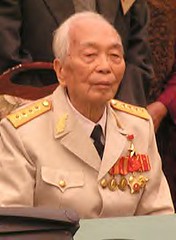
General Vo Nguyen Giap of the Vietnam People's Army Has Recently Turned 97

Vo Nguyen Giap at 97: Vietnam’s incomparable military leader

By G. Dunkel
Published Sep 4, 2008 10:59 PM

Gen. Vo Nguyen Giap, a hero and leader in Vietnam’s struggle against Japanese, French and U.S. imperialism, celebrated his 97th birthday on Aug. 25. Nông Duc Manh, secretary general of the Vietnamese Communist Party, told Giap that he was “an elder of the Vietnamese People’s Army who remained a wonderful example for the younger generations.”

Besides Manh, other prominent leaders of the Vietnamese party and state also paid Giap a visit on his birthday, along with 30 foreign delegations.

Even his adversaries, like retired U.S. Army Lt. Gen. Harold Moore, who led a battle against troops Giap commanded in 1965, called Giap “arguably one of the greatest military commanders of the 20th century.”

Using skills developed in his early career in the 1930s as a revolutionary journalist, Giap also described and analyzed the struggles he led. Two of his significant books in English are “Banner of People’s War, the Party’s Military Line” (Praeger, 1970) and “The Military Art of People’s War” (Monthly Review, 1970).

Giap’s parents were fairly well-off farmers from families who opposed the French colonialists then ruling Vietnam. In 1925 he joined a youth group opposed to French occupation. Giap did time in French prisons when he was 19 and joined the Communist Party. After his release, he completed his education and became a teacher, revolutionary journalist and agitator. In the late 1930s he was sent to China to work with Ho Chi Minh in organizing a revolutionary movement among Vietnamese exiles.

During World War II, Japan displaced France as the colonial power in Vietnam. Giap returned home in 1944 to organize against the Japanese occupation. After the August Revolution in 1945 that overthrew Japanese rule, Giap became interior minister in Ho Chi Minh’s government.

But France began reoccupying Vietnam in the fall of 1945. The Communist Party decided that Vietnam needed an army. Giap was picked to form and lead it.

In a 2003 interview, Giap said the army’s goal “was to lean upon military action as a way to organize the masses, produce a military effect beneficial toward revolution, thus developing and reinforcing the political stand of the Viet Minh.” (Journal of Third World Studies) The Viet Minh were the liberation forces who fought the French colonialists and Japanese occupiers.

Giap said that within 48 hours of its founding, “my new army won two successive victories. The first was against the [French] post Phai Khat, the second was at Na Ngan,” just 21 miles away. The intelligence agent who provided the information needed to attack Phai Khat was a 13-year-old named Hoang, while the attack on Na Ngan owed its success to “Duc Long, a man of the region.”

Giap told his troops, “Be bold, quick and aim for certain victories.” He followed this motto from the beginning of the Vietnamese People’s Army until the offensive that led to Vietnam’s liberation in 1975.

Giap led 100,000 troops against the French in the decisive battle of Dien Bien Phu in 1954. Another 100,000 Vietnamese workers, mainly women, provided logistics and carried artillery in pieces on bicycles or their backs, along with ammunition and food for the resistance troops. The French colonial power was astonished by its humiliating defeat.

Concept of people’s war

The Vietnamese people were able to produce such forces by relying on and developing “people’s war,” led by the Communist Party headed by Ho Chi Minh.

Giap explained people’s war in a PBS interview aired in 1999: “It was a war for the people by the people. FOR the people because the war’s goals are the people’s goals—goals such as independence, a unified country, and the happiness of its people. ... And BY the people—well, that means ordinary people—not just the army but all people.”

He avowed: “We know it’s the human factor, and not material resources, which decide the outcome of war. That’s why our people’s war, led by Ho Chi Minh, was on such a large scale. It took in the whole population.”

The U.S. provided a great deal of the funds and military supplies that France used before its last soldiers left Vietnam in April 1956. Washington supported the regime that the French left in place in south Vietnam and opposed the elections that were supposed to unite the country, elections that Ho Chi Minh, then north Vietnam’s leader, would surely have won.

As the puppet regime in south Vietnam fell apart, the U.S. stepped up its direct military intervention, first with advisors and then with combat units in 1965. Its strategy was “escalation” until the Tet Offensive in 1968. The Vietnamese liberation forces carried out simultaneous, surprise uprisings in hundreds of towns and villages throughout south Vietnam, with commando strikes against the U.S. Embassy and major U.S. air force bases. The Tet Offensive turned the tide against U.S. forces in Vietnam.

Giap told PBS, “It was the American policy to try and escalate the war. Our goal in the ’68 offensive was to force them to de-escalate, to break the American will to remain in the war. ... We did this by confronting them with repeated military, as well as political and diplomatic victories.”

The U.S. lost 58,226 soldiers in its war against Vietnam and suffered a few thousand missing in action. This was more than enough to shred popular support for continuing the war.

Vietnam released figures on April 3, 1995, that a total of 1 million Vietnamese combatants and 4 million civilians were killed in the war. The accuracy of these figures has generally not been challenged.

Even with all these deaths, the U.S. could not break the will of the Vietnamese to wage a people’s war for their national sovereignty and liberation from neocolonialism.

U.S. aggression against Vietnam, however, still continues in the form of lingering, terrible effects from Agent Orange, the herbicide spread over huge areas of south Vietnam by the U.S. Air Force. Even after three generations, 150,000 Vietnamese children suffer from physical and mental abnormalities caused by Agent Orange.

Long live Vietnam and its struggles! Long live Senior Gen. Vo Nguyen Giap!
--------------------------------------------------------------------------------------------
Articles copyright 1995-2008 Workers World. Verbatim copying and distribution of this entire article is permitted in any medium without royalty provided this notice is preserved.

Workers World, 55 W. 17 St., NY, NY 10011
Email: ww@workers.org
Page printed from:
http://www.workers.org/2008/world/giap_0911/

South African President Mbeki to Arrive in Zimbabwe Monday for Stalled Unity Talks

Mbeki now due next week

Herald Reporter

SOUTH AFRICAN President Thabo Mbeki is now scheduled to visit Zimbabwe next week as he tries to make MDC-T leader Morgan Tsvangirai sign a power-sharing deal agreed to by the other main political parties, Zanu-PF principal negotiator Cde Patrick Chinamasa said yesterday.

He said the Sadc-appointed facilitator in the dialogue between Zanu-PF, MDC-T and MDC had rescheduled the trip after failing to make it to Harare yesterday.

"He (President Mbeki) has not been able to make it today (yesterday) and I am made to understand the trip has been postponed to next week," Cde Chinamasa said.

President Mbeki was yesterday expected to jet into the country to get Tsvangirai to append his signature to an accord that was agreed to by President Mugabe and MDC leader Arthur Mutambara.

The power-sharing agreement was reached after marathon meetings at secret locations in Pretoria and Cape Town among negotiators from the three political parties.

Cde Chinamasa and the Minister of Public Service, Labour and Social Welfare Cde Nicholas Goche represented the ruling Zanu-PF while MDC-T secretary-general Tendai Biti and the party’s deputy treasurer, Elton Mangoma, negotiated on behalf of Tsvangirai’s group at the talks in South Africa.

Welshman Ncube and Priscilla Misihairabwi-Mushonga represented MDC.

The parties’ principals — President Mugabe, Tsvangirai and Mutambara — later met in Harare before President Mbeki and agreed to the power-sharing deal, but Tsvangirai withheld his signature at the 11th hour.

He asked for what he called time to "consult and reflect" over a single issue in the agreement which made him Prime Minister and deputy chair of Cabinet with President Mugabe as chair.

A Sadc summit in South Africa last month endorsed the power-sharing agreement, but Tsvangirai refused to sign it before embarking on a 10-nation tour of the region as part of his "consultations".

However, the regional summit gave President Mugabe the green light to convene Parliament, which he did last Tuesday.

MDC-T national chairman Lovemore Moyo was elected Speaker with MDC legislator Nomalanga Khumalo landing the Deputy Speaker’s post.

The ruling party’s Cde Edna Madzongwe and Cde Naison Ndlovu were retained as Senate President and Deputy Senate President respectively.

President Mugabe has, however, said he would proceed to appoint Cabinet if Tsvangirai does not sign the agreement "as the country cannot be frozen forever’’.

Cde Mugabe said the British government that did not want an agreement between Zanu-PF and MDC was compromising Tsvangirai.

He said Britain and her allies wanted sanctions to continue, pushing the Government into a power-transfer agreement with MDC-T.

President Mugabe has said he was empowered by the people after the June 27 presidential election run-off and Zanu-PF would form the next Government even if Tsvangirai refuses to sign the power-sharing agreement.


Mbeki Cancels Trip as Tsvangirai Spurns 'Hopeless' Meeting

Business Day (Johannesburg)
5 September 2008
By Dumisani Muleya

PRESIDENT Thabo Mbeki was forced to cancel his trip to Zimbabwe to try to break the power-sharing talks deadlock after opposition Movement for Democratic Change (MDC) leader Morgan Tsvangiari told him he would not attend.

Sources said yesterday Tsvangiari wrote a letter to Mbeki on Tuesday telling him he would not be in Harare to attend the talks , compelling Mbeki to cancel his visit scheduled for yesterday.

"Tsvangirai did not want to attend what he thought would be a hopeless meeting that would not result in any progress," the source said.

Mbeki's office confirmed the trip was off. Tsvangirai is said to have confirmed his position to Mbeki in Zambia on Wednesday at the late president Levy Mwanawasa's funeral.

Sources said Tsvangirai's communication to Mbeki on Tuesday explained his remarks on Radio 702 on Wednesday when he said he was not aware of plans to resume talks soon. Tsvangirai told Radio 702 that the power-sharing negotiations had broken down and were unlikely to resume soon.

Tsvangirai has rejected the post of prime minister, saying it would not give him enough executive powers in government.

He said President Robert Mugabe wanted to retain control of the security ministries, and thus the army, police and intelligence, to protect his position. Mugabe also had contact with Mbeki in Lusaka where he reportedly told him he would be proceeding with his plans to announce a new cabinet and form a government. Mugabe is said to be planning to appoint his cabinet today or over the weekend.

Initially, Mugabe wanted to announce his cabinet in July before the African Union (AU) summit in Egypt but was stopped by Mbeki. Last week, Mugabe threatened to name his cabinet and was supposed to do so last Sunday but was again blocked by Mbeki who wanted to make a last-ditch bid to secure a deal. Meetings were held in Pretoria over the weekend, but no deal could be concluded.

Sources said Tsvangirai snubbed Mbeki due to a growing realisation in the MDC that the negotiations would not produce anything. The MDC claims Mbeki is effectively protecting Mugabe in the talks by insisting Tsvangirai should sign a "raw deal".

Part of the problem, sources said, was that Mbeki recently refused to meet Tsvangirai and the MDC leader was "merely hitting back" over that issue.

Mbeki's abortive trip to Harare gives Mugabe the pretext to go ahead and appoint his cabinet without MDC involvement. Mugabe, under growing pressure from hardliners near to him to go it alone, said on Wednesday if Tsvangirai did not sign the agreement by yesterday he would proceed unilaterally to appoint his cabinet.

"We feel frozen at the moment," Mugabe said in Zambia on Wednesday. " We are a government that is empowered by elections. So we should form a cabinet. We will not allow a situation where we will not have a cabinet forever."

Mugabe was defeated by Tsvangirai in the first round of the presidential election in March but the MDC leader pulled out of a cutthroat runoff in June, citing political violence . Mugabe claimed victory, but this was rejected by Southern African Development Community and African Union observers. A number of African and world leaders refused to recognise his win.

Nigerian Foreign Minister Chief Ojo Maduekwe on Tuesday said Abuja did not recognise Mugabe, adding Zimbabweans deserve "a lot better".

"We are also concerned that there should be no meltdown in Zimbabwe. The economy is already in tatters , and the inflation rate is over 1-million percent . The people of Zimbabwe deserve a lot better than they are going through," he said.

MDC spokesman Nelson Chamisa said yesterday: "Negotiations don't work on the basis of political threats and ultimatums. We are equal partners in the talks and we want to make it very clear that we won't be intimidated or stampeded into signing a raw deal."

Thursday, September 04, 2008

RNC Update: For Second Week Police Repress Convention Protests

FOR SECOND WEEK: Police repress convention protests

By LeiLani Dowell
St., Paul, Minn.
Published Sep 3, 2008 11:22 PM

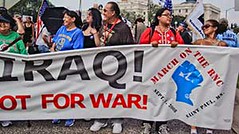
Despite an onslaught of police terror and repression, protesters from across the country used a variety of tactics to march on the Republican National Convention here on Sept. 1. A mass march organized by the Coalition to March on the RNC and Stop the War was followed by youthful street actions to denounce the Republican policies of endless imperialist war and sweeping attacks on workers.

In an escalation of tactics used at the Democratic National Convention in Denver a week earlier, Minnesota police began the repression against RNC protesters days before the march. The cops raided community kitchens, meeting spaces and protesters’ homes; handcuffed and harassed activists; confiscated political literature; and arrested at least three people on bogus “conspiracy to riot” charges.

Despite this intimidation, organizers remained determined to move forward with what would turn out to be a highly successful, massive march as well as direct actions on Labor Day, Sept. 1.

Some 30,000 attended a rally that included representatives of the American Indian Movement; ANSWER Coalition; Appeal for Redress Campaign; Coalition to March on the RNC and Stop the War; Code Pink; Colombia Action Network; Green Party; Latinos Against War; Palestine Solidarity Group; Poor People’s Economic Human Rights Campaign; Students for a Democratic Society; Teamsters 743; Troops Out Now Coalition; United for Peace and Justice; Venezuela Solidarity Network; Veterans for Peace; Welfare Rights Committee; and Women Against Military Madness.

The diverse crowd, led by the Iraq Veterans Against the War, then marched to the Xcel Center, site of the Republican convention, and back to the State Capitol for a closing rally. Various contingents included low-income people, youth and students, immigrant rights activists, labor, Palestine and Colombia solidarity activists, an anti-capitalist bloc and an anti-climate-change group.

While Republican Party leaders shied away from the conference so as to not seem insensitive in the face of Hurricane Gustav, activists remembered the neglect of the Bush administration in response to Hurricane Katrina. A Troops Out Now Coalition banner read “Bush—McCain; Katrina—Gustav: Criminal Neglect Continues.”

Meanwhile, hundreds of youth engaged in militant street actions. They were met by brutal attacks at the hands of the police, including being doused with pepper spray and tear gas. Fight Imperialism, Stand Together (FIST) activist and eyewitness videographer Elena Everett reported that a disabled man in a wheelchair was sprayed head-to-toe with pepper spray. Others were hit in the back with tear gas canisters.

The Coldsnap Legal Collectiv, located at the following URL: http://www.coldsnaplegal.wordpress.com reports that as of Sept. 1, the Ramsey County Sheriff’s Office had announced 284 arrests. Some 130 were charged with felony offenses, which most likely will be used to keep them in jail until the end of the convention. The collective says that the majority of those arrested are still being held in jail, and some are being refused proper medical attention. The collective is asking supporters to call the jail at 651-266-9350 to demand that these activists be released and given proper medical attention.

While the corporate media has focused almost exclusively on property damage sustained during the street actions, including windows being broken at a Macy’s department store, several eyewitnesses told this reporter that the person who began breaking the windows was clearly an agent provocateur working with the police. He approached the window in clear view of the cops, broke it and walked away without an arrest. A police car was also damaged.

However, at a press conference the following day, march coordinator Jess Sundin was quick to point out that any rage displayed by activists in the streets is completely justified and pales in comparison to the state violence committed on a daily basis by U.S. forces at home and abroad.

The joint press conference was held by the Coalition to March on the RNC and Stop the War, the RNC Welcoming Committee and the Poor People’s Economic and Human Rights Campaign—all of whom held fast in their solidarity with arrestees, despite attempts by corporate media reporters to bait them into denouncing “violence.” One man, representing the Poor People’s Economic and Human Rights Campaign, challenged the reporters: “You act like we’re having this press conference in a country that hasn’t practiced oppression for hundreds of years.”

A number of activities are planned to continue the protests through the end of the convention on Sept. 4, including free public music festivals, a “March for Our Lives” and a “solutions driven” peace conference. For updates on activities, visit http://www.dncrnc.wordpress.com .
-----------------------------------------------------------------------------------------
Articles copyright 1995-2008 Workers World. Verbatim copying and distribution of this entire article is permitted in any medium without royalty provided this notice is preserved.

Workers World, 55 W. 17 St., NY, NY 10011
Email: ww@workers.org
Page printed from:
http://www.workers.org/2008/us/rnc_0911/

Afghan Puppet Leader Vows Punishment for US Massacres Against Civilians

Afghan Leader Vows Punishment for Deadly US Raid

Afghan President Promises Punishment for Deadly Raid by U.S., Afghan Commandos

By FISNIK ABRASHI
The Associated Press
KABUL, Afghanistan

The Afghan president said a deadly raid on a village by American and Afghan commandos has put new strain on relations with the United States and promised Thursday to punish those responsible.

U.S. officials have said that at least 30 militants, including a Taliban commander, and no more than seven civilians were killed during the Aug. 22 raid. Afghan officials, backed by the United Nations mission, insist that more than 90 civilians died, including dozens of children.

President Hamid Karzai's comment come a day after he spoke to President Bush about the raid and how to prevent civilian casualties, his office said.

"President Bush told President Karzai that he grieves anytime innocents die," White House national security spokesman Gordon Johndroe said Thursday.

Karzai said that following the raid "our relation with the foreigners got worst," according to the statement from his office.

"In the last five years I have tried day and night to prevent these incidents from happening," Karzai told the villagers assembled inside a mosque in Shindand, several miles away from Azizabad.

Karzai promised them that those responsible for the raid would face justice and be punished, the statement said. He already has fired two Afghan officers involved in the raid.

The U.S. has long said that Taliban militants pressure Afghan villagers to falsely claim civilian casualties, information warfare that does serious damage to the reputations of the U.S., NATO and the Western-backed Afghan government.

In Azizabad and other small villages where civilians are reported killed in combat, the Afghan government and international militaries pay about $2,000 for each person killed, giving villagers incentive to file false claims. U.S. officials acknowledge that payments have been made for people who never existed.

But the Afghan claims in the case of Azizabad have been backed by the United Nations own preliminary investigation, which said that some 60 children were among 90 people killed.

The dispute over the Azizabad raid has soured relations between Karzai and his key foreign supporters — the United States and other nations with troops fighting against the Taliban and other militants in Afghanistan.

Afghan officials say U.S. special forces and Afghan commandos raided the village while hundreds of people were gathered in a large compound for a memorial service honoring a tribal leader, Timor Shah, who was killed eight months ago by a rival.

A U.S. report released Tuesday said that up to seven civilians and between 30 and 35 Taliban militants were killed in the Azizabad operation in the early hours of Aug. 22.

The U.S. said its casualty numbers were determined by observation of militant movements during the engagement and onsite observations immediately after the battle.

Gen. David McKiernan, the commander of the NATO-led force in Afghanistan, said in a statement Wednesday that he "concurs with the findings" released by U.S.-led coalition command, whose troops were involved in the raid.

The U.S. report said American and Afghan forces approaching Azizabad took fire from militants that "justified use of well-aimed small-arms fire and close air support to defend the combined force."

Afghan and some Western officials say there is video and photo evidence to prove their assertion that a large number of children were killed during the Azizabad raid.

None of that material has been made public yet.

Following the raid, Karzai ordered a review to examine whether the U.S. and NATO should be allowed to carry out airstrikes or raids in villages. Karzai also called for an updated "status of force" agreement between the Afghan government and foreign militaries.

Associated Press writer Rahim Faiez in Kabul contributed to this report.

Wednesday, September 03, 2008

Presidential Candidate Cynthia McKinney Visits Detroit During Labor Day Weekend

Presidential Candidate Cynthia McKinney Visits Detroit for Labor Day

Former Georgia Congresswoman speaks on war, repression and the legacy of Katrina

by Abayomi Azikiwe, Editor
Pan-African News Wire

DETROIT--Labor Day weekend is always an important time in the city of Detroit. Known as the "Motor City", this metropolitan region is the home to hundreds of thousands of organized and unorganized workers. The legacies of the Hunger March and the Flint sit-down strike of the 1930s remains in the collective consciousness of workers despite the decades-long attempt by the capitalist ruling class to suppress the actual history of labor movement in the United States.

What made this year's Labor Day significant was the visit of Green Party Presidential Candidate Cynthia McKinney who is traveling throughout the country providing an alternative perspective and program to the two dominant political parties in the United States. McKinney, who served for 12 years in the United States Congress representing her district in Georgia, is running alongside activist and hip-hop artist Rosa Clemente. Clemente is pursuing the office of the vice-presidency.

At a campaign rally on August 30, McKinney spoke to a capacity audience at the International Institute located in the University Cultural District in Detroit. At the beginning of this rally, Michigan political prisoner, Rev. Edward Pinkney, addressed the crowd through a video presentation that was taped from the prison where he is being held on trumped-up charges stemming from his organizing work in Berrien County.

Rev. Pinkney was selected as the Green Party candidate for United States Congress in the same district where he worked to overturn decades of institutional racism, police brutality and corporate control over the political direction of the city of Benton Harbor. This activist for the Black Autonomy Network of Community Organizers (BANCO) in Benton Harbor, was sentenced to 3-10 years in state prison for quoting biblical scriptures.

McKinney in her address stated that "I first heard of Benton Harbor in 2003 when there was a young man killed by the police which sparked several days of rebellion, our own intifada." McKinney said that this response must be viewed within the context of the international situation of oppressed people throughout the world.

"People all over the world are liberating themselves. In Paraguay, a former priest, who is a liberation theologist, was recently voted in as president because the people felt free enough to select a leader who represented their hopes and not their fears," McKinney stated.

She later discussed the crisis in Mexico two years ago when the popular choice for president was denied the right to take office. McKinney drew an analogy between the rigging of elections in the United States in 2000 and 2004 with what transpired in Mexico during 2006.

"When people showed up their names were not on the ballot. The masses shutdown the capital for five months and set up a shadow government, McKinney continued.

"The reason why so many people immigrate to the United States from Mexico is that the so-called 'free trade' policies such as the North American Free Trade Agreement (NAFTA), which was put in place under a Democratic administration, has helped to destroy their economy."

"In a recent referendum in Mexico," McKinney said, the people rejected efforts to privatize water, electricity and oil."

The former Congresswoman spoke out against the militarist and interventionist policies of the United States. She criticized the $700 billion annual defense budget which she said could be utilized to correct the overall economic crisis in the country.

McKinney spoke to the current crisis in mortgage foreclosures and expressed her support for the Michigan campaign to win a moratorium on foreclosures and evictions. Prior to McKinney's speech, Detroit Green Party co-chair and candidate for State Representative in the 7th District, Derrick Grigsby, encouraged the audience to join the upcoming September 17 march on the state capital in Lansing that is being organized by the Moratorium Now Coalition to Stop Foreclosures and Evictions.

Grigsby pointed out that the Moratorium Now Coalition is mobilizing people all over the state to go to Lansing to demand the immediate passage of Senate Bill 1306, sponsored by State Senator Hansen Clarke. The bill, if passed, would impose a two year moratorium on foreclsoures in Michigan.

The failure of Democrats to defend the Black vote

McKinney, who served six terms in the US Congress as a Democrat, resigned from the political organization last year, declaring her independence from the ruling class two-party system.

"Republican theft and Democratic Party complicity is why Bush is in the White House today. The Democratic Party did not defend the Black votes that were stolen in Florida in 2000 and Ohio in 2004. It was the Green Party that pursued legal cases against voter fraud in Ohio during the aftermath of the national elections in 2004."

"When Black, Brown, Asian and white people come together the country can move forward." McKinney received a standing ovation for her speech.

On August 31, McKinney was a featured guest on the "Fighting For Justice" radio program aired weekly on AM 1310, the local affiliate of Air America in the Detroit area. The program, which is sponsored by the Detroit Coalition Against Police Brutality, focused heavily on the then impending arrival of Hurricane Gustav in the Gulf region and New Orleans in particular.

McKinney, who was discouraged from holding a Congressional hearing on the failure of the Bush administration to provide effective relief for the victims of the Hurricane Katrina in 2005, questioned the ability of the federal government to protect the people in the face of other natural disasters in 2008.

"I along with other Democratic Congresspeople were told not to participate in the hearings by the party leadership. The reason why there is a Republican Governor today in Louisiana is directly related to the removal of hundreds of thousands of people, many of whom were African-Americans, from the state of Louisiana."

Labor Day in Detroit

On Sept. 1 over 100,000 people participated in the annual Labor Day march down Woodward avenue. Delegations from numerous trade union organizations including the UAW, AFSCME, Unite Here, SEIU, AFL-CIO, the Teamsters and others marched through the streets in their union colors chanting pro-labor slogans.

Members of the Moratorium Now Coalition to Stop Foreclosures and Evictions were set up in Grand Circus Park located along the route of the march. They distributed thousands of leaflets to workers and through a public address system, spoke in support of a moratorium on foreclosures and evictions while encouraging workers to come to Lansing on Sept. 17 for the statewide march at the capital building.

In addition, Senator Barack Obama, the Democratic candidate for President in November, spoke at the rally after the march in Hart Plaza on the Detroit River. People of all races and nationalities lined up outside Hart Plaza to hear Obama. He was joined on stage by leading officials of the major trade union organizations based in the Detroit area.

At the Anchor restaurant, which caters to union members in downtown Detroit, Green Party candidate Cynthia McKinney attended a reception in her honor in the aftermath of the Labor Day march.

"I have a 100% voting record in support of labor," McKinney said. "The conditions today require us to do things that have never been done before. This is why I declared my independence from the Democratic Party."

Another speaker at the reception for McKinney was Ron Scott, a long time media personality who was the co-founder of the Detroit chapter of the Black Panther Party in 1968. Scott is currently the spokesperson for the Detroit Coalition Against Police Brutality.

Scott said that "the only way to make change is through the people. Her (McKinney) candidacy and movement represents the struggle. Today we are facing a nationalization of law-enforcement. The Counterintelligence Program (COINTELPRO) never left but only changed its form."

"Republicans put a woman on their ticket," Scott continued. However, this party has put a real freedom fighter on its ticket."

McKinney concluded by expressing her admiration for the legacy of the Black Panther Party and other organizations that have challenged the system of racism. She pointed out that during her tenure in Congress she sought to investigate and highlight the crimes committed by the United States goverment against those who fought for the liberation of the African-American people.
-------------------------------------------------------------------------------------------
Abayomi Azikiwe is the editor of the Pan-African News Wire. Azikiwe's articles have appeared in numerous publications throughout the world.
---------------------------------------------------------------------------------------------

Venezuela and South Africa Sign Economic Cooperation Deal

Venezuela and S Africa sign deal

Venezuela and South Africa have signed an agreement to strengthen cooperation between their oil and gas industries.

Reports said the deal likely included plans for oil-rich Venezuela to supply crude to South African oil firm Petro SA at preferential rates.

The deal is particularly important for South Africa, which has been plagued by energy shortages.

Venezuelan President Hugo Chavez signed the agreement while on a state visit to South Africa.

Mr Chavez said the deal was an example of southern nations cooperating in a new strategic alliance.

"It will be a wonderful day, the day when the first Venezuelan tanker will stop by to leave oil for South Africa, " Mr Chavez said.

He also encouraged Petro SA to explore oil resources in Venezuela.

Empowerment

South Africa's President Thabo Mbeki said agreement would "further empowerment of the countries of the south" although he declined to say if South Africa would be getting preferential rates for oil from Venezuela.

"The object is to assist in reducing the costs of energy," he said.

In January, electricity shortages forced South Africa's gold and platinum mines to shut for five days.

Story from BBC NEWS:
http://news.bbc.co.uk/go/pr/fr/-/2/hi/business/7594271.stm
Published: 2008/09/02 14:39:52 GMT


Chávez invites SA to exploit his oil reserves

PRETORIA, SOUTH AFRICA Sep 02 2008 17:13

It is high time that Venezuela starts sending oil to South Africa and that south-south cooperation is enhanced, President Hugo Chávez said in Pretoria on Tuesday.

"It is justice ... it will be a wonderful day when the first Venezuelan tanker stops by to leave oil for South Africa," he said.

Chávez -- the first Venezuelan president to pay a state visit to South Africa -- was briefing the media following the signing of a number of memorandums of understanding, including one on energy cooperation.

As part of the agreement, South Africa's PetroSA would also gain access to Venezuela's oil reserves.

"PetroSA should immediately go to Venezuela to start working with us to exploit our oil reserves," he said.

Venezuela has one of the world's largest oil reserves and developing commercial relations in this sector could provide alternative sources of energy to South Africa, he said.

Chávez said the world was facing a terrible and systemic crisis with rising food, fuel and electricity prices among others and a new strategic agenda needed to be devised.

"We cannot wait a second more ... only united will we be free and only [if] free can we develop fully.

"Today our north is the south," he said, referring to Venezuela's previous practice of supplying oil to the north and not to developing countries.

President Thabo Mbeki said the strategic partnership would allow the countries to learn from and draw on each other's strengths and experiences.

"It is critically important that as we build this partnership we do so in the context of developing our south-south relationship," he said.

Cost and price structures were yet to be developed. However, Mbeki said the purpose of the agreement was to cut out the intermediaries and have a direct state-to-state relationship.

"The objective is indeed to assist in the process of reducing the cost of energy," he said.

A number of other agreements between the two countries were also on the cards and these included economic, telecommunications and broadcasting, and arts and culture cooperation.

Chávez said he was fully aware that global oil reserves would run out and it was even more important to find alternative energy sources for the "post-oil world".

While this had not been raised during the bilateral discussions, Chávez said it may well be introduced into the agenda.

Earlier, Chávez was honoured on his first state visit with a 21-canon salute followed by the playing of his country's national anthem by the national ceremonial guard band.

Flowers floated in the Union Building's ponds and brightly coloured pot plants decorated the sides of the red carpet which snaked its way up and down the steps of the country's official seat of government.

Chávez and Mbeki, flanked by a delegation of ministers from their respective countries, appeared comfortable and at ease with each other as their laughter filled the otherwise silent, latter part of the ceremony.

Chávez is expected to depart from South Africa on Wednesday. – Sapa

Source: Mail & Guardian Online
Web Address: http://www.mg.co.za/article/2008-09-02-chvez-invites-sa-to-exploit-his-oil-reserves