Tuesday, August 02, 2011

Moody's Affirms US Rating, Warns of Downgrades

Moody’s Affirms U.S. Rating, Warns of Downgrades

By John Detrixhe - Aug 2, 2011

Moody’s Investors Service and Fitch Ratings affirmed their AAA credit ratings for the U.S. while warning that downgrades were possible if lawmakers fail to enact debt reduction measures and the economy weakens.

The outlook for the U.S. grade is now negative, Moody’s said in a statement yesterday after President Barack Obama signed into law a plan to lift the nation’s borrowing limit and cut spending following months of wrangling between Democratic leaders and Republican lawmakers.

The compromise “is a positive step toward reducing the future path of the deficit and the debt levels,” Steven Hess, senior credit officer at Moody’s in New York, said in a telephone interview yesterday. “We do think more needs to be done to ensure a reduction in the debt to GDP ratio, for example, going forward.”

JPMorgan Chase & Co. estimated that a downgrade would raise U.S. borrowing costs by $100 billion a year, while Obama said it could hurt the broader economy by increasing consumer borrowing costs tied to Treasury rates. The ratio of general government debt, including state and local governments, to gross domestic product is projected to climb to 100 percent in 2012, the most of any AAA-ranked country, Fitch said in April.

“A downgrade is a sign that Congress is failing to address a real fiscal issue,” Guy LeBas, chief fixed-income strategist at Janney Montgomery Scott LLC in Philadelphia, said in an interview before the announcements.

‘Tough Choices’

A decision on the rating may be made within two years, or “considerably sooner,” according to Moody’s Hess.

Fitch’s David Riley said that while the rating may be cut in the medium term, its risks in the near-term “are not high.” The company expects to complete the ratings review by this month.

“Although the agreement is a good first step in adjusting the fiscal challenges that the U.S. faces, it is just a first step,” Riley, Fitch’s London-based head of sovereign ratings, said in a telephone interview yesterday.

Standard & Poor’s put the U.S. government on notice on April 18 that it risks losing its AAA rating unless lawmakers agree on a plan by 2013 to reduce budget deficits and the national debt. S&P indicated last week that anything less than $4 trillion in cuts would jeopardize the grade.

S&P, which has ranked the U.S. AAA since 1941, rates 18 sovereign issuers as AAA, including Canada, Germany and Singapore, according to Bloomberg data. Spain and Japan are among those ranked at the AA level by ratings company.

Debt-Limit Compromise

So far the threat of losing a AAA rating has been overwhelmed by concerns about a continued slowdown in the U.S. economy, supporting demand for Treasuries. The yield on the benchmark 10-year note fell reached 2.59 percent in Tokyo trading today, extending declines to the lowest since November. The yield is below the 4.05 percent average in the past decade.

A gain in Treasury yields of 50 basis points would reduce U.S. economic growth by about 0.4 percentage points, JPMorgan said in a report, citing Federal Reserve research and data.

Obama signed the debt-limit compromise on the day the Treasury had warned the nation’s borrowing authority would expire, ending a months-long debate that reinforced partisan divisions over federal spending.

Debt-to-GDP

The Senate voted 74-26 for the measure, which raises the nation’s debt ceiling until 2013 and threatens automatic spending cuts to enforce $2.4 trillion in spending reductions over the next 10 years. The House passed the plan Aug. 1.

“While the combination of the congressional committee process and automatic triggers provides a mechanism to induce fiscal discipline, this framework is untested,” Moody’s said in its statement. Moody’s said its baseline scenario assumes that fiscal discipline is maintained in 2012.

“Further measures will likely be required to ensure that the long-run fiscal trajectory remains compatible with a Aaa rating,” Moody’s said. The credit rater expects a stabilization of the federal government’s debt-to-gross domestic product ratio not too far above its projected 2012 level of 73 percent by the middle of the decade, followed by a decline.

Recent downward revisions of growth rates and the very slow expansion recorded in the first half of 2011 call into question the strength of potential growth in the next year or two, Moody’s said. Moody’s, which has rated the U.S. Aaa since 1917, put the U.S. under review for a downgrade on July 13 for the first time since 1996.

Overseas Lenders

Still, U.S. bonds and the dollar’s strength have signaled increased demand for the assets of the world’s largest economy even as prospects of a downgrade rose. Treasury yields average about 0.70 percentage point less than the rest of the world’s sovereign debt markets, Bank of America Merrill Lynch indexes show. The difference has expanded from 0.15 percentage point in January.

Investors from China to the U.K. are lending money to the U.S. government for a decade at the lowest rates of the year. For many of them, there are few alternatives outside the U.S., no matter what its credit rating.

The dollar represents 60.7 percent of the world’s currency reserves, compared with the 26.6 percent for the euro, which has the next biggest portion, according to the International Monetary Fund in Washington.

“Regardless of the rating, Treasuries are going to be seen as the safe haven,” said Matthew Freund, a senior vice president at USAA Investment Management Co. in San Antonio, where he helps oversee about $50 billion in mutual fund assets. “The U.S. remains one of the strongest, most dynamic economies in the world.”

China’s central bank will “closely” monitor U.S. efforts to tackle its debt, Governor Zhou Xiaochuan said in a statement today, reaffirming that his nation will diversify its foreign- exchange reserves. China’s Dagong Global Credit Rating Co. cut its credit rating for the U.S. to A from A+ with a negative outlook, it said in an e-mailed statement today.

To contact the reporter on this story: John Detrixhe in New York at jdetrixhe1@bloomberg.net

To contact the editor responsible for this story: Dave Liedtka at dliedtka@bloomberg.net

The Real Aims of Imperialism in Libya

The Real Aims of Imperialism in Libya

West to continue bombing through Ramadan amid divisions in NATO and their allies

By Abayomi Azikiwe
Editor, Pan-African News Wire

Muslim countries and communities internationally began the celebration of the Holy Month of Ramadan on August 1. Inside of the North African state of Libya where the majority of the population is Islamic, the month began in the immediate aftermath of a series of NATO bombing raids in the capital of Tripoli.

In normal times, Ramadan is characterized with the slowing down of economic activity, a 30-day period of fasting, prayer and the avoidance of conflict. However, this year Libya will continue to be put in a position to defend its sovereignty which has been under attack since the beginning of the United States and NATO war that started on March 19.

For a whole month prior to March 19, a western-backed armed rebellion has been carried out against the central government in Tripoli from the opposition stronghold of Benghazi in the east of the country. The rebels were driven out of the areas they had invaded in most of the east and west by the second week in March as the Gaddafi government was set to retake Benghazi.

It was at this point that the U.S.-NATO forces began to bomb the oil-producing state under the guise of implementing United Nations Security Council Resolution 1973 ostensibly designed to protect civilians through the imposition of a “no-fly zone.” Nonetheless, the bombing of Libya has been documented thoroughly as a grave crime against humanity.

Since March 19 the U.S.-NATO forces have struck government buildings, civilian neighborhoods, hospitals, schools, communication satellites, ships and ports. The son and three grandchildren of Libyan leader Muammar Gaddafi were killed in one of the airstrikes on a civilian compound in Tripoli.

NATO headquarters in Brussels, Belgium has been weighing for several weeks the political impact of the continuation of the bombing of a majority Muslim country during Ramadan. The fact that this consideration is being made over five months after the war began is a clear indication of the miscalculation of the West in regard to their capacity to defeat the Libyan people during this period of time.

According to the Tripoli Post, “The NATO alliance thought it could finish it (the war) off before the start of the Muslim holy month of Ramadan, in time for a new government to take shape. They failed and this month could become a perilous black hole threatening to undermine their whole campaign.” (August 1)

Despite numerous attempts by the African Union to broker a ceasefire inside of Libya, the U.S.-NATO alliance and the rebel Transitional National Council (TNC) --also known as the Interim National Council (INC)--have categorically rejected a peace deal. The AU since March 11 has called for an immediate ceasefire, the beginning of negotiations and the initiation of a process of national reconciliation, while the opposition forces and the imperialists have demanded regime-change.

Not wanting to appear to have been weakened in the war with Libya, the Tripoli Post stresses with reference to the U.S.-NATO military forces that “In the end they appear to have decided not to let up, and by virtue of the July 31 bombings they have decided to continue their aerial attacks on the Libyan regime in a war, that, when it sparked off on February 17, was predicted to last a few weeks. It has now dragged on to become a much lengthier campaign.” (August 1)

This failure on the part of the U.S.-NATO alliance has prompted a new round of bombings in the ongoing efforts to terrorize the civilian population in Libya. In late July the imperialist military forces bombed Tripoli International Airport, a component of the Great Man-Made River, and a peaceful march calling for national unity in the west of the country.

This peaceful gathering which marched from Al-Sabaa was attacked in Gwaleesh by the TNC forces with the air support of NATO. It was reported that Belgian FN rifles were used as well as anti-aircraft weapons.

Three activists were killed in the ambush and seventy were injured. During the course of the shooting volunteers in support of the Libyan patriots from Al-Sabaa intervened in defense of the unity march resulting in the deaths of seventy-five rebels.

Following this event NATO attacked Al-Sabaa in retaliation. These ongoing military strikes against civilian areas have characterized the war since March 19.

Division Erupts Among NATO and Opposition Forces

On July 28, one of the leaders of the TNC military wing was killed by assassins along with at least two of his assistants. The obviously planned killing of Abdel Fatah Younis has starkly exposed the obvious divisions within the ranks of the rebels.

Younis had defected from the Libyan government in late February and was later said to be leading the war against Tripoli. He became an immediate rival of Khalifa Hifter, who had resided in Virginia at the behest of the Central Intelligence Agency (CIA) since the early 1980s. When the rebellion erupted in the east of the country, Hifter was flown backed to Libya and proclaimed the leader of the opposition armed wing.

It appears as if the assassination of Younis was the result of a factional dispute within the opposition TNC. The former Minister of Interior for the Libyan government had been summoned back to Tripoli for consultation when he was shot dead.

In the aftermath of the announcement of the killing of the ostensible head of the TNC military forces, the corporate media began to report on the arrest of other rebels who the opposition said were loyal to the Gaddafi government. It may take some time for these reports to be sorted out but most evidence available suggests that deep divisions are occurring within the western-backed TNC in the aftermath of the Contact Group meeting of imperialist states and their allies which recognized the Benghazi-based armed opposition as the sole legitimate representatives of the Libyan people.

These claims of widespread support for the opposition have been refuted in recent months with the performance of the Libyan military against the rebel forces and the mass demonstrations that have brought millions of people into the streets in defense of the government in Tripoli. In a July 29 article in the British Guardian, it states that “The [government] controls around 20 percent more territory than it did in the immediate aftermath of the uprising on February 17.” (Guardian, UK)

In this same article writer Richard Seymour surmises that “If the Gaddafi regime is now more in control of Libya than before, then this completely undermines the simplistic view put out by the supporters of the war—and unfortunately by some elements of the resistance—that the situation was simply one of a hated tyrant hanging on through mercenary violence.”

At the same time as the divisions within the opposition are becoming more pronounced, the NATO forces have been losing participants with the announced halting of air raids by Norway on August 1 and the scaling back of participation by the former colonial power of Italy. The British military has stepped up its operations to fill the gap in the bombings by deploying four additional Tornado fighter planes that will carry on the air operations along with the United States, France, Canada, Belgium, Denmark and Italy.

Alexis Crow, a security analyst for Chatham House in Britain, told the French Press Agency that the war against Libya is “turning into a complete shambles. The single greatest problem for the operation as a whole is this inability to match goals and means and match tactics with strategy.” (newsinfo.inquirer.net, July 30)

Opposition to the War Is Growing Inside the U.S.

In a series of rallies across the country featuring former U.S. Congressperson Cynthia McKinney, the truth about the Pentagon and NATO’s criminal war against Libya is being exposed before thousands of people. Cynthia McKinney, who was the 2008 presidential candidate for the Green Party in 2008, visited Libya recently and was an eyewitness to the bombing, the impact of sanctions and the naval blockade against the African nation of approximately six million people.

In Atlanta 500 people came out to hear McKinney speak on the need to end the war against Libya. On July 30 in New York over 500 attended a similar meeting where representatives of the progressive movement came out to express their opposition to what Washington and the other capitalist states are doing in North Africa.

Detroit on August 27 will be the scene of another rally to oppose the war in Libya where the Michigan Emergency Committee Against War & Injustice (MECAWI) will host Cynthia McKinney. This protest meeting will be co-sponsored by the Green Party of Detroit and Michigan, the Michigan Welfare Rights Organization, the National Conference of Black Lawyers, Workers World Party and the Pan-African News Wire.

A CBS News poll several weeks ago reported that 60 percent of people in the United States were opposed to the war against Libya. This is significant because of the biased reporting by the major news networks that limit coverage and distort the actual developments inside the country.

The North African state of Libya has the largest known oil reserves on the African continent. Under the government led by Muammar Gaddafi since a revolution in 1969, the country has risen from one of Africa’s poorest to maintaining the highest standard of living among all other countries on the continent. In addition to oil the country has substantial natural gas resources and its geographical position is strategically located on the Mediterranean which serves as a waterway to other nations in Africa, the Middle East and Southern Europe.

The mass meetings held by the IAC and other organizations around the U.S. have emphasized the need to divert the hundreds of billions of dollars spent on war every year to address human needs by providing jobs to tens of millions of workers, to maintain people in their homes, the need for universal healthcare, public services and quality education. Efforts by supporters of the Libya campaign to win a resolution in support of the war by the Congress has failed although the house has not voted to withdraw funding to continue the bombing.

President Chavez of Venezuela Says Libya Has Sent a Delegation to Caracas

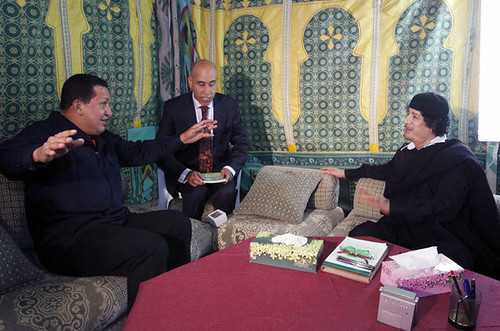
Chavez Says Libya’s Qaddafi Sent Him a Letter, Delegation

Venezuelan President Hugo Chavez said Libyan leader Muammar Qaddafi sent him a letter delivered by a delegation that arrived in Caracas last night.

Foreign Minister Nicolas Maduro said he would meet the delegation today. Chavez said he may not be able to meet the envoys because he is receiving treatment for an undisclosed form of cancer.

Chavez, who has criticized Western intervention in the Libyan conflict and compared Qaddafi to South American liberator Simon Bolivar, in March proposed an international peace commission to negotiate an end to the unrest in Libya. His offer was rejected by the Libyan rebels.

“Qaddafi has sent some emissaries and a letter,” Chavez said during a telephone interview broadcast on state television today. “There’s Qaddafi, resisting the aggressions of NATO -- they bombed a media outlet -- and the world remains quiet with its arms crossed.”

To contact the reporter on this story: Charlie Devereux in Caracas at cdevereux3@bloomberg.net.

Pastors For Peace Successfully Completes Its 22nd Friendshipment Caravan to Cuba

PASTORS FOR PEACE SUCCESSFULLY COMPLETES ITS 22nd FRIENDSHIPMENT CARAVAN TO CUBA!

Media Contacts:

Lucia Bruno (212) 926-5757 or (347) 423-4330, Ellen Bernstein (646) 319-5902 Janine Solanki (303) 638-9799

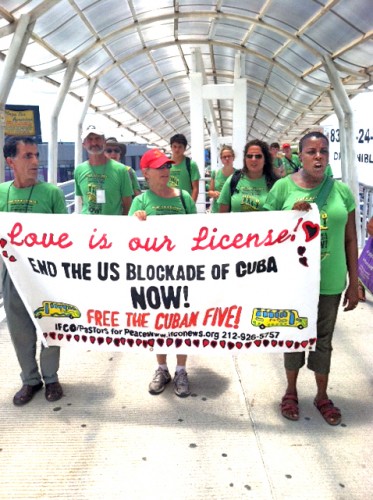
At 4:15 pm on August 1st 2011, the 22nd Pastors for Peace Friendshipment Caravan to Cuba successfully crossed back into the U.S., completing the “reverse challenge” border crossing. Although the Friendshipment is a year-round project, this border crossing wraps up this year's caravan. In the last month, the caravan traveled on 13 routes across the U.S. and Canada, where they stopped in 130 cities, collected 100 tons of humanitarian aid for Cuba, gathered 108 participants, challenged the blockade at the U.S./Mexico border, spent nine days experiencing Cuba, and now have returned successfully into the U.S.

This last challenge of the caravan was carried out to enthusiastic chants of “Cuba si, bloqueo no!”, “Cuba is not our enemy” and “Lucius Walker vive, la lucha sigue, sigue!” while banners read “Love is our License” and “We don't want to imagine a world without Cuba!” Immigration officials tried to question caravanistas about their stay in Cuba; caravanistas exercised their constitutional rights and politely but firmly refused to answer their questions. After the crossing was completed, the seven computers which were seized by U.S. officials when the caravan crossed from the U.S. into Mexico were returned, and a group of caravanistas promptly walked them back across the border into Mexico, from where they will be shipped to Cuba.

While in Cuba, caravan participants were able to see the island for themselves through an exciting educational and cultural program. This year's caravan was dedicated to celebrating and honoring the achievements of Cuba's young people, and the program of the Caravan in Cuba highlighted their daily lives and experiences, as well as visits to organic gardens, health centers, urban and rural communities and schools.

“Our late founder, Rev. Lucius Walker, always said that U.S. foreign policy is much too important to be left in the hands of the State Department,” said Ellen Bernstein, acting co-director of IFCO. “With this project, we are enacting a 'people-to-people' foreign policy that is based in mutual respect and solidarity. We will continue reaching out to our Cuban sisters and brothers, without asking permission from the US government; and we will continue working to build the better world that we know is possible.”

IFCO acting co-director Rev. Thomas E. Smith affirmed, “Our caravans will continue with this challenge as long as the cruel and immoral blockade continues, and until the Cuban 5 political prisoners held in U.S. jails are freed!”

The Caravan to Cuba's reverse challenge coincides with two other Cuba travel challenges returning to the U.S. The Venceremos Brigade will be returning to the US on August 1st via Canada and another large travel challenge group will also be returning to Puerto Rico today.

This year's caravan was also a tribute to the life and spirit of Rev. Lucius Walker, Jr., the founding director of IFCO/Pastors for Peace, who for 20 years gave prophetic and visionary leadership to our caravans to Cuba in defiance of the US blockade. Rev. Walker died peacefully in September 2010.

The Pastors for Peace Friendshipment Caravan is a project of the Interreligious Foundation for Community Organization (IFCO), which has been working for racial, social, and economic justice since 1967.

Communist Party of Cuba Central Committee Holds Plenum

Havana
August 1, 2011

Central Committee 2nd Plenum held

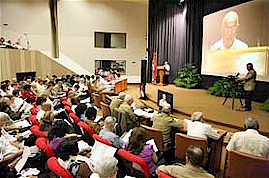
BEGINNING with a minute’s silence in honor of Frank País García, Raúl Pujols Arencibia, and all those who have given their lives throughout Cuba’s revolutionary struggle, the Central Committee of the Communist Party of Cuba held its second plenum on July 30, Martyrs of the Cuban Revolution Day. The Party’s First Secretary, President Raúl Castro Ruz presided.

Next, José Ramón Machado Ventura, second secretary of the Party, presented a report describing steps taken in each province to follow up on issues discussed at the 6th Party Congress to create the necessary conditions for the implementation of the Policy Guidelines approved and to prepare for the National Conference of the Party scheduled for January 28, 2012.

Machado Ventura explained that work has been carried out keeping in mind the principle that the Party should not take on other functions or missions beyond those established in its statutes and norms. He emphasized that the organization has the responsibility, first and foremost, to effectively oversee economic activity, in order to warn authorities of anything which might impact the fulfillment of plans or projects of social importance – in a timely fashion, with solid arguments, from the local level to the highest.

He reiterated the need to demand that everyone, be they Party members or not, fully carry out their duties. In this vein, he indicated that self-criticisms cannot be accepted if they amount to no more than justifications, nor can commitments be put off from year to year and never fulfilled, neither by the administration nor by the Party.

He emphasized the urgency of firmly demanding why something required was not done when it was needed; who the responsible parties are; what is being considered to rectify the situation; what the results are thus far; and within what timeframe a solution is expected – so that the Party is in fact playing the role it should.

Machado Ventura also reported on the Party’s provincial assemblies, the expanded plenums of municipal committees and meetings of general secretaries of grassroots organizations, as well as the discussions underway in Party workplace nuclei. In all of these meetings, he said, different problems affecting the economy have been opportunely and critically addressed, with the characteristics of each region being taken into consideration.

At the same time, he reported, those attending these meetings have agreed on the need to adjust training and support of cadres in accordance with current efforts to strengthen ties with the community and eliminate bureaucratic methods, the lack of creativity, the tendency to call too many meetings, and the passivity and conformism which characterize many leaders, turning them into people who only do what they are told by a higher authority.

"To mitigate the problems which have emerged on the local level, it is necessary to first change cadres’ way of thinking and acting, be they working within the Party, the state or the government," he said.

Finally, he stressed the need to consolidate every step and measure adopted, in order to honor the decisions made by the 6th Congress.

Marino Murillo Jorge, member of the Political Bureau and head of the Implementation and Development Permanent Commission, also presented a summary to the plenum, describing the ongoing process of implementation of the Policy Guidelines approved at the 6th Congress, as well as progress in improving the structure and functioning of government and central administration at different levels.

Along these lines, Murillo Jorge, also a Vice President of the Council of Ministers, explained the principles upon which the Commission’s five-year plan will be based; the current tasks underway; the economic decisions made which do not require the development of new legal regulations; and the policies which are in the investigation and development stage.

Murillo Jorge also emphasized that the Commission’s work does not supplant the responsibility of any other body or entity. He assured the plenum that, as a matter of principle, the Commission will listen to all opinions offered about an issue, with the goal of achieving consensus.

At this point, Raúl was emphatic in saying that any disagreement would be analyzed and not discarded out of hand, thus guaranteeing an open discussion in which everyone expresses what they think and want.

The Central Committee plenum was informed by Adel Yzquierdo Rodríguez, member of the Political Bureau and Minister of Economy and Planning, as to the performance of the economy during the first half of the year. Topics addressed at the recent meeting of the Council of Ministers were reviewed.

As for the development of the plan, Raúl, reiterated the need to better prepare those who are charged with its elaboration, since, as is evident in the recent period, deficiencies persist, in many instances, as a result of inexperience.

Once again, the First Secretary of the Party emphasized the importance of changing methods and patterns of work which, being ill-suited for the current situation, often impede the correction of errors. "We cannot allow misunderstandings of any kind to create obstacles in the enormous task we have before us," he stated.

Translated by Granma International

Monday, August 01, 2011

Who Is Killing Iran's Nuclear Scientists And Why?

Who is killing Iran’s nuke scientists and why?

Tuesday, 02 August 2011 02:00

Last week, in an eerie reprise, Darioush Rezaei, a physics professor working in the field of nuclear chain reactions, was killed in his car.

By Stephen Gowans

ONE day last November, assassins on motorbikes drove up to the cars of two of Iran's nuclear scientists as they were leaving for work and attached bombs to their vehicles.

The bombs detonated in seconds, killing Majid Shahriari, a member of the engineering faculty at a Tehran university, and Fereydoon Abbasi, a professor at Shahid Besheshti University.

Last week, in an eerie reprise, Darioush Rezaei, a physics professor working in the field of nuclear chain reactions, was killed in his car.

This time by a pair of gunmen on a motorcycle.

Suspicion immediately fell upon the United States, and for good reason.

The CIA is running a programme to sabotage Iran's nuclear programme by eliminating its nuclear scientists.

Until recently, the programme has sought to create a brain drain by luring physicists and engineers out of the country.

But now it appears that the nuclear scientists who won't or can't be lured away are being targeted for elimination - either by assassination or abduction.

Another Iranian nuclear scientist, Shahram Amiri, was abducted while on a pilgrimage to Saudi Arabia and "spirited quickly to the United States".

It should be recalled that while the United States and its possible partner in the assassinations, Israel, are working to undermine Iran's nuclear programme, both have their own civilian nuclear power industries plus more than a few nuclear weapons.

So why are they adamant about denying Iran what they, themselves, already have?

And just to be clear, what Washington and the Israelis don't want Iran to have is the capability of processing nuclear fuel at home.

While this would allow the Iranians to convert Iran's vast supplies of uranium into fuel to power a civilian nuclear energy industry, it would also furnish Iran with the means to quickly develop nuclear weapons, something it might want to do if, say, the United States threatened to attack (hardly an improbable scenario).

Denying Iran its own nuclear fuel processing industry has obvious advantages to rich countries.

They get profits from the sale of nuclear fuel.

With their hands on the nuclear fuel spigot, they acquire political leverage over Tehran.

Iran's ability to resist US pressure by developing nuclear arms is severely crimped.

The official story on why Iran mustn't have its own nuclear fuel processing capability is that if Iran can process uranium it can secretly develop nuclear arms.

And the country must not be allowed to go nuclear because its president is a "Judeophobic madman" who, if he gets the chance, will send a barrage of nuclear-tipped missiles hurtling toward Israel to complete what Hitler had left undone.

This view is utter nonsense.

First, the United States would incinerate Iran in a second if Tehran used nuclear weapons against Israel. And if Washington couldn't do the job, the Israelis, with their own formidable nuclear arsenal, surely would.

At best, Iran's possession of nuclear arms (and it doesn't have them now and it's not clear it seeks them) would provide a deterrent against attacks on its own territory.

What's more, Iran's president, Mahmoud Ahmadinejad, never promised to "wipe Israel off the map," as some Western and Israeli political leaders demagogically claim.

Instead, he predicted that Israel as a Jewish state would dissolve, as the Soviet Union once did. Hardly the same.

Another view is that Ahmadinejad intends to attack Israel in order to return Palestine to the Palestinians.

Except this would turn Palestine into a nuclear wasteland, not what the Palestinians want.

And why would Ahmadinejad risk Iran's nuclear annihilation to advance the Palestinian cause?

Sure, Iran is a big booster of the Palestinians, but not to the point of imperilling its own existence.

No, the real reason Washington seeks to sabotage Iran's nuclear programme is to deny the country a means by which it can resist efforts to bring it within the US imperial orbit, that is, to eliminate the threat of Iranian self-defence.

Iran is charting its own course. Its economic policies, which emphasise state-ownership of key sectors of the economy, and the sheltering of manufacturing behind high tariff walls, are an anathema to the ultra-wealthy bankers and investors who dominate US foreign policy and insist that profit-making opportunities be made available to them just as much beyond US borders as within.

As an example of the opportunities that Iran's nationalist policies deny investors and corporations of rich countries, consider the country's automobile industry.

It operates behind steep tariff walls which allow two domestic firms, both partly government-owned, to absorb 97 percent of all automobile sales in the country.

Sales reached 1,6 million units last year.

Were Iran's high tariff barriers toppled, US, European and East Asian automobile manufa- cturers could add handsomely to their bottom lines.

But a nuclear-armed Iran - even one which doesn't have nuclear weapons, but has the knowledge and means to quickly develop them - could strongly resist demands made at gunpoint that it turns over its markets, natural resources and enterprises to foreign capital.

Of course, US sophistry holds that that's not what Washington wants. It's not seeking economic domination, only a level playing field.

The trouble is, asking a Third World country to compete with rich countries on a level playing field is like asking high school football teams to compete in the NFL - without assistance.

Since US foreign policy is all about opening doors to US investors and exporters, and Iranian policy is focussed on using state-ownership, subsidies and tariffs to develop the country's economy, Washington and Tehran are in conflict.

Washington wants Tehran's economic policy to accommodate the profit-making interests of US banks, corporations and investors, while Tehran fashions its economic policy to accommodate the interests of Iranians.

For Washington, the route to resolving the conflict lies in ushering in a new regime in Tehran, one more attentive to the needs of US capital.

It would be pro-foreign investment and committed to free markets, free trade and free enterprise.

Since Iranians don't seem to be heading in this direction as rapidly as Wall Street would like, Washington hopes to change their minds through sanctions, threats of war, financial isolation, and destabilisation, centred on demonisation of Iran's political leadership.

Oh, and abduction and assassination too.

Stephen Gowans is a Canadian writer and political activist resident in Ottawa.

This article is reproduced from www.gowanswordpress.com

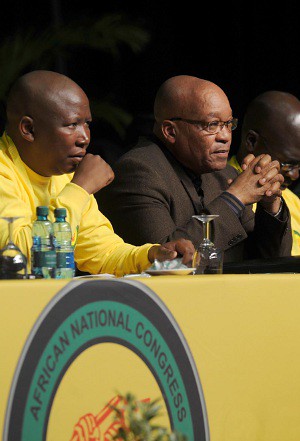
ANC Youth League to Assist Opposition Forces in Botswana

ANCYL on Botswana

Tuesday, 02 August 2011 02:00
Boksburg

The ANC Youth League's national executive committee is to send a team to Botswana to consolidate local opposition parties, its leader Julius Malema said on Sunday.

"Botswana is in full co-operation with imperialists . . . and the government is undermining the African agenda," he said at the committee's closing meeting in Boksburg.

"We are not going to sit with neighbours that conduct themselves like that. Botswana needed a progressive government, and the current opposition was not consolidated ‘properly' enough to topple it," he said.

The team of NEC members would teach and train campaigners and volunteers of a possible "coalition party" that might be formed.

The youth league believed that since former president Thabo Mbeki's departure as chair of the Southern African Development Community, the African agenda was no longer a priority.

"The ANCYL is of the view that there is a vacuum on the ideological and political leadership of Africa and the sub-regions, and this is reflected by how the issues of Libya and Cote d'lvoire were mishandled," he said.

The league planned to convene "progressive youth formations" across Africa to "re-assert" the need for the continent's independence and economic freedom.

The NEC said it would fight for economic freedom, particularly for the nationalisation of mines, the expropriation of land without compensation, and the provision of free quality education. - SAPA.

Work on Joshua Nkomo's Statue Resumes

Work on Joshua Nkomo's statue resumes

Monday, 01 August 2011 20:29
Chronicle Reporter

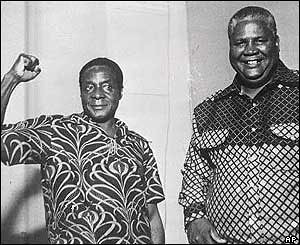
WORK on the re-erection of the late Vice-President Dr Joshua Mqabuko Nkomo’s statue, which was pulled down in September last year, has resumed.

Dr Nkomo’s statue was pulled down before its official unveiling following strong objections by the Nkomo family and the Bulawayo community who felt the statue did not capture the exact attributes of the late Father Zimbabwe.

The family also complained that the Government did not involve them in the project. They said the statue itself was very small and pitiful, hardly a street statue at all nor the landmark and monument that it should be. The statue was then taken to the Bulawayo Museum by the National Museums and Monuments of Zimbabwe (NMMZ) where it is being kept.

However, in May this year, the Zanu-PF Politburo, recommended that the statue should be re-erected and announced that the Ministry of Home Affairs would take over the matter and resume the erection of the statues in Bulawayo and Harare. The family of the late Vice-President has also given the green light that the statue be re-erected after ironing out the differences with the Government.

A Chronicle news crew visited the site yesterday morning at the inter-section of Main Street and 8th Avenue in Bulawayo and found workers and officials from the Ministry of Public Works doing some work.The workers had already peeled off the granite finishing from the old pedestal, which is supposed to be raised before the statue is erected.

Speaking on condition of anonymity the workers said they started working on the site at the weekend.“We have resumed work on the statue. We came here on Saturday and we started peeling off the granite finishing,” said a worker.

However, an official from the ministry’s head office who also declined to be named for professional reasons said they wanted to inform the public and motorists first before starting work at the site.

“We have come to work on the site and our workers are already there. However, the only stumbling block we have is that we have not advertised in the Press that construction work would be taking place there. We are doing that right now and once we are cleared, we will start working,” said the official.

The Government had set a deadline to re-erect the statue before the Heroes Day next week but had to revise the target citing numerous logistical constraints.As for the Harare statue, Minister Mohadi recently said it was put on hold. Nkomo family spokesperson Mrs Thandiwe Nkomo-Ebrahim is also on record as saying her family was in support of the project.

She said the inclusion of the Joshua Nkomo National Foundation had brought the project to fruition adding that the foundation was not against the statue and its location.

The Minister of Environment and Natural Resources, Francis Nhema, chairs the board which also includes Mrs Nkomo-Ebrahim, Dr Sikhanyiso Ndlovu, Cde Simon Khaya Moyo, Mr Hebert Nkala, Mr Jabulani Nkomo, Mr Mgcini Nkolomi, Mr Christopher Dube and Cde Frederick Mutanda.

Mrs Nkomo-Ebrahim said the family had no problems with the location of the statue at the corner of Main Street and 8th Avenue in Bulawayo but proposed that its pedestal should be raised to give it a “different effect”.

The decision to erect the two statues was taken by the Politburo in 2001 after consultations with the family. Home Affairs Co-Minister Kembo Mohadi could not be reached on his mobile for comment yesterday.

Scientists Urge African Union, ECOWAS to Support Research

Scientists urge AU, ECOWAS to support research

Tuesday, 02 August 2011 00:00
From Emeka Anuforo
Nigerian Guardian

THE West African Research Centre (WARC) has urged the African Union and the Economic Community of West African States (ECOWAS) to ensure that minimum standards are maintained in the laboratories of their research institutions.

The centre appealed to governments on the continent to encourage the emergence of a new crop of young scientists to complement the efforts of their old counterparts.

According to the centre, the conditions under which most of the young researchers work sometimes are not encouraging and thus the need for governments in the region to create the right environment for African scientists working abroad to come home and contribute to scientific development.

The WARC is tapping into the skills and experience of African scientists working in America, getting them to visit the region and conduct scientific researches into areas that are critical to the development of its people.

Through funding from its America-based parent association, the West African Research Association and a few other funders, WARC is promoting research in West Africa by West African scholars themselves, or by other scholars coming from overseas and specialising in West African issues.

Director of the centre, Ousmane Sene, told The Guardian in Dakar at the weekend: “Most of these Afro-American scientists are from U.S.-based universities and research centres. The areas of research are very diverse. They can come in and do researches in microbiology, in the health sector, in agriculture, in transferable technologies and other areas, which are of immediate need of the population of the region. Whatever researches researchers are doing should be able to go down to the population and use it to promote development.

“This strategy would be an excellent road to development of Africa, making sure that whichever research is produced, the end result is profitable to the grassroots population. It is one form of research that we are promoting. We promote research in the sense that we facilitate researchers: their coming to West Africa, their being in touch with research institutions and finding continuous space to conduct their researches.”

He spoke of a number of scholarships, which are also made available to researches operating within the West African region.

“A number of these scholarships are to promote intra-West African research. That is to say, from now on researchers applying for a research grant would have to have research topics, which would be implemented in West Africa. We are operating within the context of Africa. We do not want researches to be confined to the ivory towers. I do not like the idea of having researches being produced in terms of papers to be presented at conferences. If you get a travel grant, it means that that research project would be implemented with colleagues in West Africa research institutions,” he said.

He stressed that bringing Africans based in the U.S. to come and do research in science issues in West Africa did not necessarily mean they would stay back or relocate to the region, if they do not like this.

He called on countries within the region to create the right atmosphere for such scientists willing to go back to their countries to do so, as according to him, “we could convert what is often referred to as brain drain to brain gain.”

On how his centre is contributing to the raging issue of ageing African scientists, he said: “We are also giving young professionals the opportunity to take up more studies and develop themselves professionally, scientifically and come back to their communities and contribute to the communities in the areas of forestry, agriculture and other areas which are significant for development. We are also open to young members of the Diaspora who have any scientific research project idea for the West African region to come up and work with us.”

His words: “Though the scientists are ageing, they are progressively being replaced. Some people are saying brain drain, now we are witnessing brain gain. Many young Senegalese who have gone abroad to do their Ph.Ds, for instance, are coming back, because the conditions are improving. Many of those young researchers who have acquired knowledge abroad are willing to come back, if the conditions are okay. I remember that China’s economy was made possible because of the contributions of its Diaspora scientists. African countries need to improve the conditions for these young ones to come back and contribute to the development of the scientific community.”

End Cycle of Famine in Africa

End cycle of famine in Africa - AfDB's Kaberuka

Mon Aug 1, 2011 7:45pm GMT

* More than 10 million people affected in Horn of Africa

* Lasting solutions needed on food security, water storage

By Lesley Wroughton

WASHINGTON, Aug 1 (Reuters) - The famine in the Horn of Africa is a result of the international community's failure to end Somalia's civil war and its inability to deal with "slow-moving emergencies," such as the region's recurring drought, a senior African official said on Monday.

In an interview with Reuters, African Development Bank (AfDB) President Donald Kaberuka called for lasting solutions to end the vicious cycle of drought and famine in the region.

More than 10 millions people have been affected by the worst drought in 60 years in the Horn of Africa, which has affected northern Kenya, south Somalia, Ethiopia and Djibouti.

"This should be the last drought of this magnitude," Kaberuka said.

While the immediate focus should be on saving lives through humanitarian efforts, more lasting solutions are needed to avert recurring food crises, Kaberuka said.

This could be addressed through direct economic support for more stable parts of Somalia, and developing a plan to encourage more regional food trade to keep prices lower and ensuring adequate water storage to help local herdsmen protect livestock during dry months, he said.

"Development institutions must come to the table with an integrated longer term plan for the region and we will play a big role there," said Kaberuka, a former Rwandan finance minister now in his second term as AfDB chief.

Kaberuka said he was in talks with the East African bloc IGAD, the Intergovernmental Authority for Development, made up of Kenya, Uganda, Djibouti, Ethiopia, Sudan, Somalia and Eritrea.

"The immediate urgency is to save lives, and humanitarian organizations are doing what they're supposed to do, but now time has come to find a long-lasting solution," he said.

"Markets are not functioning because of insecurity and also because of poor infrastructure," Kaberuka added.

Somalia has been gripped by political violence and civil war since 1991 when dictator Mohamed Siad Barre was overthrown.

"It is largely about our collective failure to end the Somali civil war," Kaberuka said during a visit to Washington.

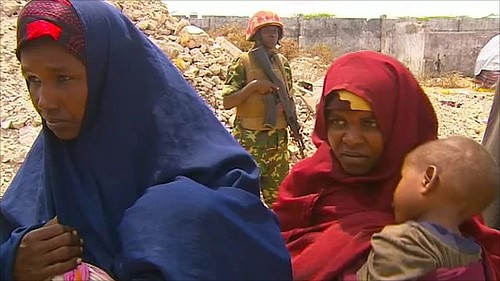
But he said engaging with Somali militant group al Shabaab, which controls the drought-stricken southern parts, was "a stretch," and what was needed was to strengthen support for the African Union Mission for Somalia, or AMISOM, an African regional peacekeeping mission in Somalia.

"AMISOM is there and they're doing their best but they need to be given greater political and logistical support to bring peace to Somalia" from both Africa and the international community, he added.

Some 3.7 million Somalis risk starvation in two regions of south Somalia controlled by Al Shabaab, which has blamed food aid for creating dependency. In 2010, it ordered the World Food Programme to leave and expelled three aid agencies, accusing them of spreading Christian propaganda.

The group has accused the United Nations of exaggerating the severity of the drought and politicizing the crisis.

Kaberuka said al Shabaab was "playing a high stakes game with human lives" and was losing credibility among Somalis fleeing across the border into Kenya. (Editing by Mohammad Zargham)

Famine Due to Climate Change Says African Development Bank President

Famine due to climate change: African bank

August 2, 2011 - 10:39AM
AFP

The famine in Africa's fragile Horn of Africa region has been caused by climate change and a collective failure to end the Somali civil war, the head of the African Development Bank says.

"This was not a tsunami that took us by surprise. Mother Nature can be blamed for much of what is happening but, before food shortages become famine, there's something else that comes into play," Donald Kaberuka told AFP.

"In this case, the epicentre of the crisis is in those parts of Somalia that are not functioning," he said.

Advertisement: Story continues below The two regions in southern Somalia where the UN last month declared a famine are controlled by rebel groups, including the al-Qaeda-linked Shebab.

Shebab is "playing with lives" by barring foreign aid from reaching starving people in drought-hit Somalia, Kaberuka said.

A famine declared last month in two southern Somali regions controlled by the Shebab rebel movement has grown to huge proportions and now threatens millions in the Horn of Africa with starvation and malnutrition, Kaberuka said.

Ten million people in the Horn of Africa are now in need of food aid, two million children are malnourished and half a million people are in danger of starvation, he added.

The international community should "get in and help" parts of Somalia that do work, namely Somaliland and Puntland in the north of the country, and give logistics aid to the African Union force, AMISOM, deployed in Somalia to try to stabilise the country.

"No one is saying they should put in soldiers from abroad - Africans are capable of doing that - but they need logistics support," Kaberuka said, citing things like food rations, transportation and helicopters.

"AMISOM is under-manned, under-equipped, does not have enough logistical support. If it did, it could easily have brought stability to that part of Somalia to allow Somalis to begin to talk about the kind of government they want," Kaberuka, a former finance minister of Rwanda, told AFP.

Much of Somalia has been wracked by lawlessness and violence since long-time leader Mohammed Siad Barre was ousted in a coup in late 1991.

An intervention by foreign troops, including the United States, in 1993, ended disastrously, with two dozen Pakistani UN soldiers and 18 Americans being killed by Somali insurgents in fierce fighting in 1993.

The United States pulled out of the UN force that intervened in Somalia in the 1990s after the bodies of some of the slain US soldiers were dragged through the streets of Mogadishu by cheering Somalis.

Kaberuka, who was re-elected in 2010 to a second term as the head of the African Development Bank, is in the United States to attend meetings on international development.

African Union to Hold Donor Summit on Somalia Drought

AU to hold donor summit on Somalia famine

Conference follows criticism that continental bloc has stood idly by as millions are affected among its member states

Last Modified: 01 Aug 2011 20:42

The UN has launched a mass vaccination against polio and measles in Dadaab, where Somalis have sought refuge

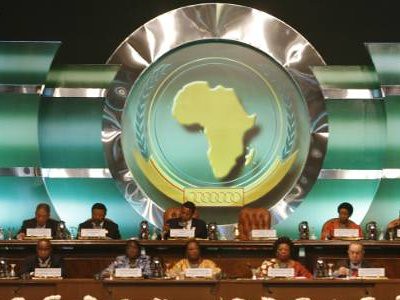
The African Union (AU) is to organise a donor conference later this month in a bid to raise money for millions of drought-affected people in Somalia.

AU Deputy Chairman Erasmus Mwencha said African heads of states, regional economic blocs and international organisations would gather at the AU's headquarters in the Ethiopian capital, Addis Ababa, to map out strategies to help starving Somalis.

Mwencha issued the statement while visiting the AU peacekeeping mission in the Somali capital, Mogadishu.

The UN, which has declared a famine in two regions in the country's south, says $2.5bn is needed to alleviate the crisis.

The summit, due to be held on August 9, comes as aid groups step up operations for millions of starving people in the Horn of Africa nation and amid criticism that African countries have not done enough to alleviate the situation.

Somalia has been worst affected by the drought that has forced thousands of people to flee to neighbouring Ethiopia and Kenya. Djibouti, Ethiopia and Uganda have also been hit by the crisis.

On Monday, the UN's World Food Programme (WFP) and the International Committee of the Red Cross (ICRC) started to expand emergency food deliveries in Somalia days after the Somali prime minister accused the UN of stockpiling relief aid.

The ICRC distributed food to 162,000 people in southern regions of Somalia held by al-Shabab, the rebel Islamist movement, while the UN food agency increased its relief airlifts that began last week.

Since Wednesday, the WFP has delivered more than 80 tonnes of emergency food aid to malnourished children in Mogadishu and expanded the distribution to Doolow region in the south of the country.

"Another aircraft arrived today, the sixth flight since the irlift began last Wednesday - the airlift is an ongoing operation and will continue," said David Orr, a WFP spokesman, in Mogadishu.

"That brings the total amount delivered into Mogadishu to over 80 tonnes of specialised highly nutritious food for malnourished children."

Cases of measles

About 12 million people are affected by the devastating drought across the Horn of Africa, the worst to hit the region in decades.

The ICRC, one of the few aid groups allowed by al-Shabab to operate in southern Somalia regions under the rebels' control, said it had delivered 3,000 tonnes of food.

"This is the first large-scale food distribution in that part of the country since the beginning of the year," the agency said in a statement.

"But this distribution assists only a small percentage of those in need. More aid will be required to help the population bridge the gap until the next harvest in December," said Andrea Heath, the ICRC's economic and security co-ordinator for Somalia.

Malnutrition rates in Somalia are the highest in the world, and the relentless conflict and the drought have left millions in need of emergency humanitarian aid.

In Dadaab, the world's largest refugee camp in eastern Kenya, the UN children's agency UNICEF launched a mass vaccination against polio and measles.

"Teams are going from tent to tent, to make sure all children aged between six months and five years are given life-saving vaccines," said Melissa Corkum, a UNICEF spokeswoman.

"There are cases of measles in the camp as children are coming from Somalia, where immunisation is very low."

Source: Agencies

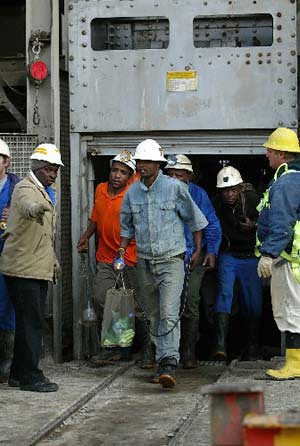
Striking South African Gold Miners Resume Talks Tuesday

Striking S.Africa gold miners resume talks Tuesday

Mon Aug 1, 2011 10:27pm GMT

* Gold strike hits as bullion at record highs

* Week-long S.African coal strikes ends

* Strikes could hurt growth in Africa's largest economy

By Ed Stoddard

JOHANNESBURG, Aug 2 (Reuters) - South African gold mine workers and producers were to resume wage talks on Tuesday aimed at ending a strike that is costing the companies up to $25 million a day in lost output at a time when the precious metal is fetching record high prices.

The National Union of Mineworkers (NUM) said no progress was made in talks to resolve the impasse with the country's main gold miners, AngloGold Ashanti , Gold Fields and Harmony Gold and a junior miner.

"The gold talks have ended, there was no progress. We will continue tomorrow," NUM spokesman Lesiba Seshoka said late on Monday.

A spokesman for the Chamber of Mines, which negotiates on behalf of the gold mines, also said talks would take place again on Tuesday.

Some 100,000 gold miners downed tools on Thursday and analysts have said a prolonged stoppage in the world's fourth largest gold producer could help the bullion price maintain its upward momentum.

It has been hitting new record highs on an almost daily basis as investors seek safe havens amid European and U.S. debt woes.

A week-long strike against South Africa's main coal mines ended on Monday when a wage deal was clinched.

The mounting impact of South Africa's annual "strike season", which has also hit the fuel, diamond and steel industries, is seen crimping growth and possibly pushing the continent's largest economy into contraction.

Coal firms that were affected included Anglo Thermal Coal SA , Exxaro , Optimum Coal and Xstrata Coal . If it had persisted it could have menaced exports and supplies to the country's power utility Eskom .

The Chamber of Mines said most of the coal companies had agreed to increases of 8 to 10.5 percent in the first year and 7.5 to 10 percent in the second year.

In the gold talks, the NUM has been seeking a 14 percent pay rise while the gold mine companies have publicly offered rises of 7-9 percent.

(Editing by Angus Macswan)

Ethiopia Plans Ambitious Resettlement of People Buffeted by East Africa Drought

The Christian Science Monitor - CSMonitor.com

Ethiopia plans ambitious resettlement of people buffeted by East Africa drought

Ethiopia sees voluntary resettlement of seminomadic peoples into villages as a longterm solution for dealing with the impact of East Africa's droughts.

By William Davison, Contributor
posted August 1, 2011 at 12:42 pm EDT
Addis Ababa, Ethiopia

In Ethiopia's rain-starved eastern badlands, livestock is the sole asset for most. Swaddled in robes, pastoralist families traverse huge tracts searching for water and pasture for their herds, uprooting camps as they go. When seasonal rains fail, life becomes a battle for survival.

As aid agencies scramble to feed some 11.5 million people suffering from what is being called the Horn of Africa's worst drought in 60 years, Ethiopia's government is enacting a resettlement program that it hopes will be a longlasting solution to a longstanding burden.

In its far-flung regions, including the vast east, populated mostly by ethnic Somali pastoralists, Ethiopia wants to group its scattered semi-nomadic peoples into permanent settlements, largely ending a mobile lifestyle that has sustained people for centuries.

In many ways the plan sounds all too familiar. During the catastrophic famine in the mid-1980s, Col. Mengistu Haile Mariam's Marxist junta forced highlanders across the country to fertile lowlands. Tens of thousands perished en route or died in their new, alien surroundings. This time, however, the government says resettlement is voluntary and consists of regional destinations instead of a mass, cross-country exodus.

In the Somali region, which has just under 1.5 million people out of about 5 million in need of food aid, the idea is to create villages near rivers and build irrigation systems, roads, health clinics, and schools. The government sees this as a life-saving measure and as a way to help the pastoralists benefit from Ethiopia's double-digit economic growth. A government pastoralist project with the long-term aim of resettlement will receive some of the $500 million for "building long-term drought resilience" in the region, the World Bank said in late July.

"Especially for pastoralists, the solution is development interventions," says Agriculture State Minister Mitiku Kassa, "water-centered development. Most areas have surface water and there are rivers." In the dry regions of Somali and Afar, the government hopes 500,000 people in each will resettle, while in the western states of Gambella and Benishangul-Gumuz it wants 450,000 to move.

The pastoralist lifestyle is becoming difficult to sustain, says Eugene Owusu, the United Nations humanitarian coordinator in Ethiopia. "Therefore they need to look at alternative development solutions." Although initially donors were slow to support the program, he has "no doubt" it could have a transformative effect on struggling communities "if it's done well."

But some activists say the programs overseen by local governments will be coercive and rob people of their ancestral lands. They cite an incident in Gambella in which a family that was reluctant to move had their huts torched, possibly by local officials. Others say giving Ethiopia's estimated 9 million pastoralists services without impeding their traditional lifestyles is a better way.

A few miles north of Dire Dawa, Ethiopia's second-largest city, barely a leaf is visible. In some patches, bushes have disappeared, leaving only sand and fearsome heat that can top 104 degrees F. The herders who live there can deal with occasional dry spells, but the frequency has pushed coping mechanisms to breaking points, aid workers say.

"When they are hit with several dry seasons in a row, the result is a crisis," says David Wightwick of Save the Children (STC) UK. He is working in Bisle village, 34 miles north of Dire Dawa. "And at the moment it's going from crisis to catastrophe."

Humanitarian facilities here are crowded with mothers and children who have walked hours in search of help, among them, Lula Robe and her malnourished baby. "Five years ago we had 100 sheep and goats, but now we have 10," Ms. Robe says, clutching a bottle of donated cooking oil. "We have lost our livestock to the drought." Her family of 10 is now reliant on handouts.

These stories are common across the region, which has endured three similar crises since 2000. The problems in Bisle are the "tip of the iceberg," says STC's Katy Webley.

Pastoralists, who dominate a profitable livestock trade, are used to weathering harsh conditions, says Holly Welcome Radice, an STC Ethiopia livelihoods expert, and their customs should be supported instead of transformed, "Historically pastoralists are very adaptable and resilient because they live in harsh places," she says. "They are there because nothing else can be done there."

While pastoralists should have access to public services, cellphones, and the Internet, a mass change is unwise because, she says, "these are environments that are not able to sustain huge sedentary populations."

Ms. Radice says the solution lies in working with historically marginalized communities to take measures such as restoring pasture and increasing vital mobility hindered by private landholdings, borders, or conflicts. "You have to understand what is really causing the crisis – it's not just the failure of rains. It has to do with people's failure to access services; it's people's failure to have a political voice."

But Ethiopia is not known for buckling to foreign charities and it's almost certain that views like Radice's will not shape the pastoralists' future.

"For the long term, the government wants to support pastoralists to pursue sedentary lives along the banks of primary rivers," says Assefa Tewodros, coordinator of the state's Pastoral Community Development Project.

The pressures of land degradation, conflict, climate change, and population spikes, he says, mean this is the only option, as the hinterlands are too vast for the government to provide services to dispersed herders.

Moody's Lowers Minnesota Outlook To Negative On Strained Finances

AUGUST 1, 2011, 4:02 P.M. ET

Moody's Lowers Minnesota Outlook To Negative On Strained Finances

DOW JONES NEWSWIRES

Moody's Investors Service revised its outlook on Minnesota to negative from stable, citing strained state finances and the significant use of nonrecurring measures to help balance the state's budget.

News of Minnesota's budget woes made headlines last month after a spat between Democratic Gov. Mark Dayton and Republicans who control both houses of the legislature. The impasse over how to close a projected $5 billion shortfall for a two-year budget led to a government shutdown for a short period.

Moody's noted the enacted budget, which assumes spending of $35.9 billion over the next two-year period, doesn't implement any new permanent revenue-raising measures. Instead, it relies largely on nonrecurring measures to solve the budget gap for 54% of the budget solution, while spending reductions make up for the remaining 46%.

Minnesota has incorporated nonrecurring measures to fix budget shortfalls since fiscal 2009, when the economic downturn reached the state. Each subsequent year, the state continued to increase the use of one-time measures for a quick fix, creating a structural budget imbalance in future years. Moody's warned the state will face "significant obstacles" in achieving a structurally balanced budget in the next cycle as a result of those actions.

Those negative factors have put Minnesota in a weaker position than other states within the same rating category. The outlook change on the Aa1 rating, which is one level below Aaa, affects about $6.1 billion in outstanding debt.

On a positive note, the state has a fundamentally strong economy as it isn't dependent on any one sector that could lead to economic weakness beyond what is experienced by the U.S. as a whole. Personal income per capita is consistently above the U.S. average and the state's unemployment rate has fallen below the national average since the first quarter of 2009.

-By John Kell, Dow Jones Newswires; 212-416-2480; john.kell@dowjones.com

US Manufacturing Slump Erases Debt Agreement Stock Market Boost

Manufacturing slump erases debt agreement rally

finance reporter Rebecca Hyam
Posted August 02, 2011 08:01:29

It was a volatile session on Wall Street overnight, with the market posting strong early gains in response to the debt limit agreement before retreating sharply because of some weaker-than-expected manufacturing data.

Stocks then rebounded in late trading, on hopes the debt agreement will be approved in Congress.

The manufacturing figures came from the Institute for Supply Management's factory index, which slumped to its lowest level since July 2009.

New orders shrank for the first time in two years, suggesting production and economic growth could be limited.

Several other manufacturing reports - released either yesterday or overnight from Asia to Europe - also declined, indicating a global slowdown.

But late in the US session, Republican leaders and the Obama administration voiced optimism that Congress will pass a compromise plan to raise the US debt limit by at least $US2.1 trillion and slash federal spending.

That helped to limit Wall Street's overall losses.

The Dow Jones Industrial Average closed down 10.75 points to 12,132.49, the S&P 500 eased 5.34 points to 1,286.94 and the Nasdaq fell 11.77 points to 2,744.61.

It was a similar story in the UK, with early strong gains fuelled by relief over the US debt deal wiped out by that weak manufacturing data.

Of the British banks, Lloyds and Royal Bank of Scotland fell quite sharply.

But Europe's biggest bank, HSBC, jumped 4.8 per cent, after revealing a solid first-half pre-tax profit and announcing it would cut 30,000 jobs, or roughly 10 per cent of its global workforce.

At one point London's FTSE 100 got back above the 5,900 level, but by the close it was down 40.76 points to 5,774.43.

Local shares are expected to fall when the market opens later this morning and in futures trading, the ASX Share Price Index 200 is down 73 points to 4,397.

The Australian dollar has fallen from last night's local close and at 7.10am (AEST) it was buying 109.7 US cents.

On the cross rates, it was worth 84.73 Japanese yen, 77 euro cents, 67.32 British pence and $1.25 in New Zealand.

Spot gold had slipped to $US1,620.04 an ounce.

West Texas Crude oil had eased to $US94.88 a barrel and Tapis was higher at $US127.18.

US Stocks Fall In Volatile Session

AUGUST 1, 2011, 4:55 P.M. ET

US Stocks Fall In Volatile Session; DJIA Has 7th Straight Loss

--DJIA posts first seven-session slide since July 2010

--Weak manufacturing data erased early rally

--Worries over further U.S. debt problems add to cautious sentiment

--Health-care stocks hit by Medicare payment cut

By Brendan Conway
Of DOW JONES NEWSWIRES

NEW YORK (Dow Jones)--U.S. stocks fell but finished above session lows, as weak manufacturing data and worries of potential downgrades to the U.S. credit rating overpowered investor relief over the weekend's debt-ceiling deal.

The Dow Jones Industrial Average shed 10.75 points, or 0.09%, to 12132.49, for its seventh-straight losing session, the longest losing streak in more than a year. It was a volatile session that saw the Dow briefly fall below 12000 for the first time since late June. The blue-chip index had risen as much as 139.18 points immediately after the open, as investors expressed relief at the compromise hammered out late Sunday to raise the U.S. debt ceiling.

But stocks turned negative after a reading on manufacturing in July showed barely any growth, renewing worries about the health of the U.S. economy. The Dow fell by as much as 145.16 points midsession.

The action followed the index's biggest weekly point swoon since May 2010, which came last week as investors fretted that Washington had run out of time to raise the debt ceiling and stave off a potential default.

The Standard & Poor's 500-stock index lost 5.34 points, or 0.41%, to 1286.94, for the sixth straight decline. All sectors except utilities and telecommunications lost ground. The Nasdaq Composite shed 11.77 points, or 0.43%, to 2744.61, its fifth drop in the last six sessions.

The weak manufacturing data sat uneasily with investors who have been expecting stronger growth in the second half. Meanwhile, markets continued to eye the chance of a U.S. credit-rating downgrade, which many investors considered to be possible despite the weekend debt pact.

"Wall Street doesn't work well with this kind of uncertainty," whether in the form of weak economic data or the state of the U.S. debt negotiations, said Alan Valdes, director of floor trading at DME Securities.

Health-care stocks were the S&P 500's weakest performers after the Centers for Medicare & Medicaid Services said it will cut payment rates to skilled nursing facilities by 11.1% next fiscal year. Health-care provider stocks tumbled.

Sun Healthcare Group plunged $3.65, or 52%, to 3.35, while Skilled Healthcare Group dropped 3.74, or 43%, to 5.06. Kindred Healthcare slumped 5.51, or 29%, to 13.33, while Sunrise Senior Living lost 26 cents, or 3%, to 8.56.

Merck eased 69 cents, or 2%, to 33.44, and Home Depot shed 68 cents, or 2%, to 34.25, leading blue-chip decliners.

In corporate news, Paetec Holding jumped 91 cents, or 21%, to 5.33, after rural telecom company Windstream said it planned an $891 million all-stock purchase of the company, which provides broadband and other services to businesses. Windstream's shares lost 6 cents, or 0.5%, to 12.15.

U.S.-listed shares of HSBC Holdings rose 79 cents, or 1.6%, to 49.66, after the bank reported revenue for the first half of the year that exceeded estimates and said it was cutting about 30,000 jobs to revamp its global business.

Allstate picked up 62 cents, or 2.2%, to 28.34. The insurer swung to a second-quarter loss after a series of severe storms during the spring. But results beat analysts' expectations.

Old National Bancorp added 74 cents, or 7.3%, to 10.94. The bank's second-quarter net income increased, its net interest margin improved and its credit remained "well controlled," according to the company.

Talbots jumped 61 cents, or 18%, to 4.07, after a securities filing showed that private-equity firm Sycamore Partners took a 9.9% stake in the women's clothing retailer.

Louisiana-Pacific dropped 49 cents, or 6.3%, to 7.26. The construction-materials company swung to a second-quarter loss, struggling as a result of slowing retail sales and lower housing starts.

Haemonetics fell 7.14, or 11%, to 58.36. The medical-device company's quarterly earnings fell short of analysts' expectations, hurt by the recall of its OrthoPAT devices. The company said it expects the recall to continue to present a headwind for the remainder of the fiscal year.

Sourcefire advanced 54 cents, or 2.2%, to 25.12 after Morgan Stanley analysts upgraded their stock-investment rating on the cybersecurity company, predicting a third-quarter pickup in federal business.

-By Brendan Conway, Dow Jones Newswires; 212-416-2670; brendan.conway@dowjones.com

From the Hough, Detroit and Glenville Rebellions: Learn From History, Fight for the Future

From the Hough (1966), Detroit (1967) and Glenville (1968) Rebellions: Learn From History, Fight for the Future

By Abayomi Azikiwe
Editor, Pan-African News Wire
--------------------------------------
Note: The following talk was delivered in East Cleveland, Ohio on July 30, 2011 at the Black on Black Crime Inc. offices located in the McCall Motel. This event was a commemoration of the Hough, Detroit and Glenville rebellions between 1966-68. The keynote speakers were Abayomi Azikiwe, PANW editor, and Don Freeman, a longtime leader in the African American community in Cleveland since the 1960s. The meeting was chaired by the Oppressed Peoples Nation youth group and Workers World Party. Sponsors of the meeting included the Peoples Fightback Center, the Lucasville Uprising Freedom Network, the New Black Panther Party--Cleveland Link and Workers World Party.
--------------------------------------

I want to first of all thank all of the organizations here in Cleveland that came together to put on this event tonight. The work of these organizations is a concrete tribute to the legacy of struggle over the last 45 years that we are commemorating this evening.

Last week in Detroit at the Coleman A. Young Municipal Center (CAYMAC), our city hall, the Michigan Emergency Committee Against War & Injustice (MECAWI) joined with progressive City Councilwoman JoAnn Watson to host a public forum entitled: "The 1967 Detroit Rebellion: An Historical Review by Those Who Were There and Those Fighting for Justice Today." This was an historical event in and of itself due to the fact that it represented the path that the Motor City has travelled over the last four-and-one-half decades socially, economically and politically.

There are many similarities between the origins and development of the African American communities in both Detroit and Cleveland. Both communities of African Americans grew tremendously during the course of the twentieth century. The industrial revolution, the rise of mass production in the auto, steel and overall manufacturing sectors of the economy attracted hundreds of thousands of Africans into these cities.

Although in Detroit and Cleveland, when African Americans arrived in mass beginning during the period leading up to World War I and extending throughout the 1920s, the Great Depression, World War II and the period of the 1950s rights through the late 1960s, the conditions prevailing in these northern midwest cities objectively were just as bad if not worst than what people had migrated from in the rural areas of the South. Our ancestors were faced with profound challenges in both the South and the North which included the superexploitation of their labor, residential segregation, institutionalized discrimination in the labor market and the educational systems, and of course, police terrorism.

Urban Politics in the Post World War II Period

As the modern civil rights movement began during the mid-1950s with the Montgomery Bus Boycott of 1955-56 leading right through to the student struggles of the early 1960s and the organizing efforts to win the vote in the Black Belt areas of the deep South, a movement was also underway in both Cleveland and Detroit as well as other cities. In Detroit the struggle for civil rights was linked up with the efforts of organized labor to win decent working conditions in the plants and the service sectors of the labor market.

African Americans in general were confined to the dirtiest and most exploitatative jobs within the factory system. Many of them worked in the foundries and as janitors. The foremen and plant supervisors were typically all white and the logic of racial capitalism in the United States took on a similar character as in apartheid South Africa where one's race largely determined your social class position within society.

In Cleveland, as our local brothers, sisters, comrades and friends will address, represented a microcosm of urban segregation throughout the country. Many African Americans moved into the Hough and Glenville sections of the city where they were exploited through the neglect of the city administration resulting in poor municipal services, substandard education and constant harassment by racist gangs backed up by the police.

During this same period in Detroit, African Americans, after settling in select areas of the east and west sides of the city during the decades between World War I through World War II, began to move into the Virginia Park area and others neighborhoods north and west of there starting in the late 1940s and accelerating at a rapid rate all through the 1950s up until the middle years of the 1960s. Detroit had experienced racial upheaval going all the way back to the civil war in 1863 when it was a main depot in the Underground Railroad that led many Africans out of slavery into the city and also across the border into Canada.

In 1943 one of the worst so-called race riots occured in Detroit leaving dozens dead and millions of dollars in property destroyed. This outbreak took place during the World War II period when large scale migration into Detroit and the subsequent competition for jobs and housing led to racial conflict.

Although African American workers would play a key role in winning recognition by Ford Motor Company of the United Automobile Workers (UAW) union in 1941, the character of racial capitalism and national oppression remained dominant. In 1942, a struggle erupted over whether African American workers should be allowed to move into the Sojourner Truth Homes, a public housing project on the eastside. It was these events that would fuel the anger that brought about the massive explosion of June 1943.

In the aftermath of the Second World War, urban renewal programs were designed to break up the African American community in Detroit on the eastside. The Chrysler Freeway was constructed to run right through the black community and resulted in the demolition of Hasting Street, a major business district that was the home to many small businesses, social clubs, community organizations and churches.

Although the people fought this forced removal, the city fathers were determined to carry out its program of re-location. When African Americans were moved into the Virginia Park area and other neighborhoods on both the east and west side, they were faced with overcrowding, poor city services, racial segregation, discrimination and neglect in the public education system and persistent villification and exploitation by the police.

The Movement for Change During the 1960s

There are other similarities between the struggles in Detroit and Cleveland during the 1960s. Both cities saw the rise of coalition building efforts across racial lines during the early years of the decade.

In Cleveland the work of the NAACP, CORE and other community organization would led to the creation of the United Freedom Movement (UFM) where challenges were carried out against racism in education and housing. The tragic but deliberate death of Rev. Bruce Klunder was a watershed event in the city.

At the same time more militant forces began to emerge through the Revolutionary Action Movement (RAM) which was heavily influenced by Robert F. Williams, Malcolm X and the national liberation movements and socialist revolutions that were gaining strength during the time period. Malcolm X would visit Cleveland and Detroit during the Spring of 1964 to deliver the "Ballot or Bullets" speech that prefigured in many ways the struggle that would evolve as the decade proceeded.

In Detroit on the twentieth anniversary of the 1943 so-called race riot, over 200,000 people would march down Woodward avenue demanding jobs, education and the end to housing discrimination in the city. In fact it was at this event that the late Rev. C.L. Franklin and others would invite Dr. Martin Luther King, Jr. to help lead the march where he delivered the first "I Have a Dream" speech at Cobo Hall.

This march grew out of the work of a coalition of the Detroit Council for Human Rights (DCHR) that was largely headed by Rev. C.L. Franklin of New Bethel Baptist Church. The coalition consisted of community organizations from various tendencies including both proponents of civil rights as well as black nationalists and revolutionaries.

In the aftermath of the march in June 1963, the efforts of the Freedom NOW Party and the Group on Advanced Leadership (GOAL) would lead to Malcolm X visiting the city in Nov. 1963 to address the Grassroots Leadership Conference. Malcolm X would deliver his historic "Message to the Grassroots" speech at this conference.

Nonetheless by 1966, the civil rights struggle in the South was to take on a new phase. The passage of the Civil Rights Act of 1964 and the Voting Rights Act of 1965 would end, at least on paper, legalized segregation and disenfranchisment. Nonetheless, discrimination and national oppression would continue with a vengeance.

In 1965 Malcolm X was assassinated and several months later the Watts Rebellion would take place ushering in a new era of urban rebellion on a wider scale. The Student Nonviolent Coordinating Committee (SNCC) and the Congress of Racial Equality (CORE), under new militant leadership of Stokely Carmichael and Floyd McKissick would adopt Black Power as their slogan and program of action.

Around this same period Hough would erupt along with many other cities across the U.S. The Black Panther Party and other revolutionary nationalist organizations would emerge in a renwed effort to organize for fundamenal change which inevitably involved the struggle against police terrorism.

By 1967, when Detroit exploded, many felt that a real revolutionary uprising was in the making. The Detroit Rebellion was described as the largest and most profound racial unrest in the history of the United States.

These developments between 1963 and 1967 would draw the attention of the FBI and other government law-enforcement agencies. The Counter-Intelligence Program which had its origins during the 1950s and was directed against the left, initiated a renewed effort in 1967 with the creation of special units to undermine so-called "Black Nationalist Hate Groups."

RAM, SNCC, CORE, the Black Panther Party as well as the SCLC and the NAACP were targeted in the COINTELPRO operations. Nonetheless, it appears that after the assassination of Dr. King on April 4, 1968, the Black Panther Party and other revolutionary organizations would be its principal focus.

As the Black revolutionary movement became more organized and armed in 1968 with rebellions erupting in over 100 cities after the martyrdom of Dr. King, the FBI and the police would intensify their efforts. By the time of the Glenville Rebellion of July 23, 1968, just one year after the Detroit uprising, the FBI had identified the revolutionary movement as a serious threat to national security.

Consequently, the process of preemptive prosecution was enacted against revolutionary organizations, their leaders and cadres. Hundreds of these revolutionaries were arrested, charges with criminal activity, jailed and imprisoned. Many of them even lost their lives in Cleveland, Detroit, Chicago, Oakland and many other cities.

Capital Flight and Low-Wage Capitalism: From the 1970s through the 2000s

We would be remiss if we came here this evening and only discussed our valiant and heroic revolutionary history of the 1960s. Today we face problems that in many ways are worse than they were some four to five decades ago.

In Detroit we have focused our attention on the economic issues that have become so essential in the lives of the majority of our people. This is why the Moratorium NOW! Coalition has demanded a freeze on all forclosures and evictions in the state of Michigan and throughout the country.

We are demanding that a national jobs program be enacted to re-employ and fully employ the 30 to 40 million people in the U.S. who are either unemployed on underemployed. The federal government under the Obama administration does not even address this issue of jobs and income.

Also we see a direct relationship between the ongoing bailout of the banks to the tune of trillions of dollars, the Pentagon war budget and growing gap of wealth between African Americans and whites. The stark realites of the social conditions in both Cleveland and Detroit are reflective of this increasing impoverishment of the people.

The implementation of these demands requires organization and mobilization. We must build the necessary revolutionary organization that will address the challenges of the current period.

Once again thank all of you for holding this important meeting and extending an invitation for our participation from Detroit.