Sunday, November 04, 2012

South African Communist Party Condemns Planned DA Inspection of President Zuma's Home

SACP: DA visit to Nkandla 'racist', 'right wing' and a 'publicity stunt'

The SACP has condemned the DA's planned inspection of Zuma's R200-million upgrade in Nkandla, saying it is part of a "racist right wing agenda".

03 Nov 2012 15:21 - Sapa

Violent clashes between the DA and Cosatu.

Democratic Alliance (DA) leader Helen Zille's planned inspection of President Jacob Zuma's home in Nkandla was nothing more than part of a racist right wing agenda, the South African Communist Party (SACP) said on Saturday.

In a statement SACP spokesperson Malesela Maleka warned the DA leader that she would have to take full responsibility for the consequences of the visit to Nkandla on Sunday.

The Democratic Alliance said on Thursday it was planning to visit Zuma's private residence, where a R200-million upgrade was in progress.

Zille, accompanied by DA officials, would inspect roads around the property on Sunday and attempt to enter the compound.

"The SACP is peeved by the ongoing DA cheap publicity stunts and reckless attempts to score political points," he said.

He said the visit was nothing more than a continuing attempt to insult Zuma.

Values of ubuntu

"The SACP wishes to caution that Helen Zille must take personal responsibility, together with the DA, for any consequences arising out of such racist, insensitive and extremely provocative actions."

Maleka said the visit threatened the country's reconciliation between races.

"The SACP urges Helen Zille, in the interest of national cohesion and unity to pull out of this dangerous publicity stunt."

He urged the residents to protect Zuma's dignity.

"The values of ubuntu cannot be sacrificed at the altar of political expediency on the back of what is clearly a racist and right wing agenda."

On Friday the African National Congress warned that the reception to the DA visit could result in a response similar to that received by the DA earlier this year when it marched to the Congress of South African Trade Unions (Cosatu) headquarters in Johannesburg.

At that march clashes erupted between Cosatu members and DA members. – Sapa.

Three Policemen Shot Dead in Egypt's Sinai

Three policemen shot dead in Egypt’s Sinai

Sunday, November 04, 2012

CAIRO: Gunmen killed three Egyptian policemen and seriously wounded a fourth on Saturday in El-Arish, in the Sinai Peninsula, state television said.

“Armed men who might belong to a jihadist group attacked a police vehicle and fired on its passengers before fleeing,” a security source said.

The dead and wounded were taken to the general hospital in El-Arish, where one of the policemen died from serious wounds,” a medic said. A civilian was also wounded.

Security forces threw up a cordon around the city in an attempt to capture the gunmen. Security in the desert and mountainous region collapsed after an uprising ousted president Hosni Mubarak in February 2011.

Since then, several militant attacks in the Sinai, which borders Israel and the Gaza Strip, have targeted police and soldiers, including a brazen August 5 ambush on an army outpost that killed 16 soldiers.

On Friday, Bedouin tribesmen attacked a police post in the central Sinai city of Nakhl, attempting to free one of their number who was in detention.

Egyptian Princess's Tomb Found Near Cairo

Egyptian princess's tomb found near Cairo

Three recently discovered statues were found in a complex of tombs, including one of pharaonic princess Shert Nebti, in the Abusir region, south of Cairo, Egypt.

Story Highlights

Tomb is 4,500 years old; burial site of Princess Shert Nebti

Archaeologists also unearthed antechamber with four officials, statues buried inside

12:10PM EDT
November 3. 2012 -

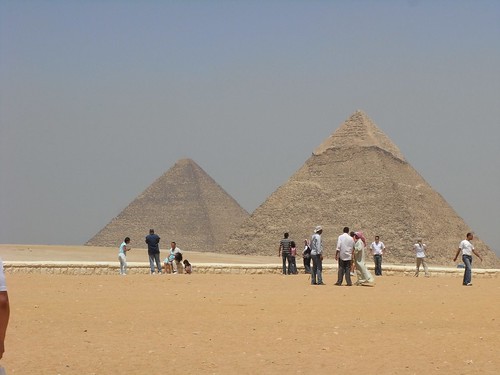
CAIRO (AP) — Czech archaeologists have unearthed the 4,500-year-old tomb of a Pharaonic princess south of Cairo, in a finding that suggests other undiscovered tombs may be in the area, an official from Egypt's antiquities ministry said Saturday.

Mohammed El-Bialy, who heads the Egyptian and Greco-Roman Antiquities department at the Antiquities Ministry, said that Princess Shert Nebti's burial site is surrounded by the tombs of four high officials from the Fifth Dynasty dating to around 2,500 BC in the Abu Sir complex near the famed step pyramid of Saqqara.

"Discoveries are ongoing" at Abu Sir, El-Bialy said, adding that the excavation was in a "very early stage" and that the site was closed to the public.

Inscriptions on the four limestone pillars of the Princess' tomb indicate that she is the daughter of King Men Salbo.

"She is the daughter of the king, but only her tomb is there, surrounded by the four officials, so the question is, are we going to discover other tombs around hers in the near future? We don't know anything about her father, the king, or her mother, but hope that future discoveries will answer these questions," El-Bialy said.

On Friday, Antiquities Minister Mohammed Ibrahim said that the antechamber to the princess' tomb includes four limestone columns and hieroglyphic inscriptions. The current excavation has also unearthed an antechamber containing the sarcophagi of the four officials and statues of men, women, and a child, he said in a statement.

The Czech team's discovery marks the "start of a new chapter" in the history of the burial sites of Abu Sir and Saqqara, Ibrahim added.

The archaeologists working at the site are from the Czech Institute of Egyptology, which is funded by the Charles University of Prague. Their excavation began this month.

The discovery comes weeks after the Egyptian government reopened a pyramid and a complex of tombs that had been closed for restoration work for a decade.

Egypt's vital tourism industry has suffered from the country's internal unrest in the wake of the 2011 uprising that toppled autocratic leader Hosni Mubarak. A delegation from the International Monetary Fund is currently in Egypt for negotiations over a $4.8 billion loan aimed at bolstering the country's ailing economy.

Egyptian Copts Await New Pope to Succeed Shenouda III

3 November 2012
Last updated at 21:05 ET

Egyptian Copts await new pope to succeed Shenouda III

A council of Egypt's Coptic Christians voted for a shortlist of candidates last week

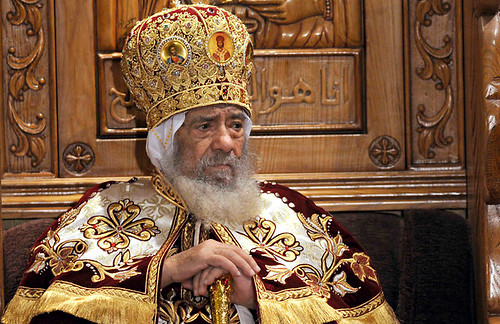
Egypt's Coptic Christians will learn the name of their new pope on Sunday, when a blindfolded child selects the name of one of three candidates.

Two bishops and a monk are on the shortlist to become the 118th leader of the largest Christian minority in the Middle East, about 8 million strong.

The individual chosen will succeed Pope Shenouda III, who died in March.

Attacks on Copts are on the increase, and many Copts say they are afraid of the governing Muslim Brotherhood party.

Pope Shenouda, who led the church for four decades, had urged officials to do more to address Copts' concerns.

The shortlisted candidates are Bishop Raphael, Bishop Tawadros and Father Raphael Ava Mina. They were chosen in a ballot by a council of some 2,400 Church and community officials in October.

Their names will be written on pieces of paper and placed in a box on the altar of St Mark's Cathedral in Cairo.

A blindfolded boy will then be asked to draw out one of the names. Copts say this process ensures the selection is in God's hands.

Many leading Copts believe the new pope should play a less overtly political role. Activists hope that ordinary Copts can make their voices heard by winning more seats in the now democratically elected parliament.

Yet the new pope may want to make his views known quickly on how prominent a role Islamic, or Sharia, law should play in the new constitution currently under negotiation.

He will also need to calm fears that Copts could be squeezed out of government jobs, and even that new sectarian strife could erupt.
Conservative church in changing times
The chosen man will be enthroned in a ceremony on 18 November.

But the BBC's Jon Leyne in Cairo says no-one in Egypt expects the new pope to introduce any radical changes to the deeply conservative church.

Under Pope Shenouda, the Coptic Church expanded significantly, including outside its traditional Egyptian base.

He was a passionate advocate of unity among the Christian churches, and also clashed with then President Anwar Sadat, particularly over their conflicting views on the future of Egypt's relationship with Israel.

Coptic Christians have long complained of discrimination by the Egyptian state and the country's Muslim majority.

But when President Hosni Mubarak was ousted last year and succeeded by the Muslim Brotherhood, their fears grew.

In October 2011, 25 people died in clashes with the security forces after a protest march in Cairo over the burning of a church.

Saturday, November 03, 2012

Storm is Forcing NYC's Board of Elections to Relocate Polling Places

Storm is forcing NYC's Board of Elections to relocate 80 polling places — but it's not clear which ones

Mayor Bloomberg wants to know which locations, but says he hasn't received any lists from the problem-plagued agency. Board spokesman John Conklin said all election boards in places affected by the storm are still determining if they’ll be ready by Tuesday.

By Tina Moore / NEW YORK DAILY NEWS
Friday, November 2, 2012, 8:06 PM.

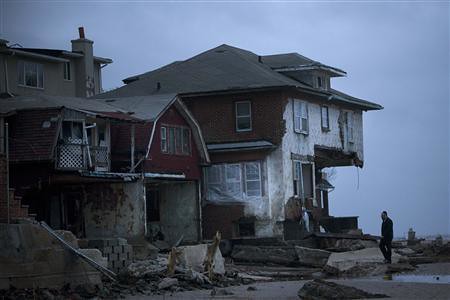
The city’s problem-plagued Board of Elections needs to relocate some 80 polling places because of Hurricane Sandy – but isn’t saying which ones.

“We’ve asked for lists of where they think they’re going to have problems,” Mayor Bloomberg said Friday. “They’ve yet to come up with those lists.”

With the presidential election coming Tuesday, the board needs to scramble for supplies such as tents and generators – and should ask the city for help, said City Councilwoman Gale Brewer (D-Manhattan).

“I think the Board of Elections needs a lot of help from the city and the state to pull this off right now,” said Brewer who heads a Council committee that oversees the elections. “I think it’s a very challenging situation.”

John Conklin, a spokesman for the state Board of Elections, said all election boards in areas affected by the storm are still assessing damages and determining if they’ll be ready by Tuesday.

“There are a number of poll sites where they’re schools and either there may not be any power, but there’s a parking lot out front,” he said. “They may set up a tent and have them vote out there. They’re trying to be as least disruptive as possible in making their choices.”

Conklin said the board already extended absentee ballot application deadlines from Oct. 30 to Friday and that there wasn’t enough time to do it again.

Bloomberg has been a fierce critic of the board for bungling elections in the past including sending voters to the wrong polling place and taking weeks to decide the outcome of elections – and that’s not in the middle of the crisis.

He expressed concern about the possibility of problems on Tuesday.

“The Board of Elections is basically run by nobody,” Bloomberg said.

“I don’t want to just pick on them,” he said, but added: “Let us be nice and say they’ve had their problems."

tmoore@nydailynews.com

Read more: http://www.nydailynews.com/news/election-2012/board-elections-relocate-80-polling-places-article-1.1196011#ixzz2BB3eQGYR

Long Gas Lines Test Patience of Storm-Struck Residents

Long gas lines test patience of storm-struck residents

By Mariano Castillo , CNN
updated 10:38 AM EDT
Sat November 3, 2012

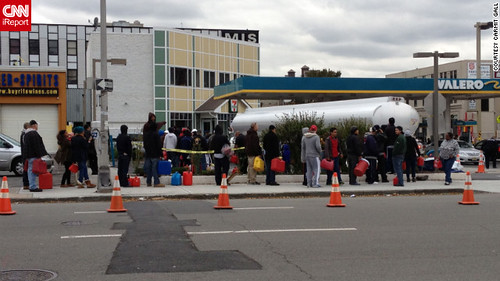
People are standing in line at the only gas station operating outside of the Holland Tunnel.

(CNN) -- In Brooklyn, a woman pushed a small grocery cart with a single bag inside. In it, a precious possession shielded from prying eyes: a red can filled with gasoline.

In the wake of Superstorm Sandy, gasoline might as well be gold.

"It has become a hot commodity, so we didn't want to risk it," she said.

With lines snaking for blocks -- miles, even -- outside gas stations in New York and New Jersey, tensions occasionally flared as people waited for the chance to to pump gas into cars or gas cans.

"The situation is hectic," said Terry Landers, a CNN iReporter in Lebanon, New Jersey. "Many gas stations are either out of gas or (will be) soon."

The demand is high, and the fuel isn't just for empty car tanks. Many people still have no electricity and are using gasoline-powered generators, adding to the demand.

Temperatures drops, tempers rise in power outage

"As word spreads that somewhere has gas, there are (lines of) cars as long or longer than the one in my video," Landers said.

Federal and state authorities acted on two fronts Friday to address the issues -- both to bring more fuel to the area, and to more fairly distribute what is already there.

At President Barack Obama's direction, the Defense Logistics Agency will buy up to 12 million gallons of unleaded fuel and up to 10 million gallons of diesel that will be moved on tanker trucks to replenish stocks in New York, New Jersey and other areas experiencing severe gas shortages.

In order to ration and decrease wait times, New Jersey Gov. Chris Christie signed an executive order Friday tying whether a driver gets gas to his or her license plate number. It goes into effect in 12 counties at noon Saturday.

On days that end in even numbers -- such as November 4, 6 or 8 -- gas station operators can sell gas to only those with license plates with a last digit that is even. On odd-digit days, such as November 3, only those with plate numbers ending in an odd number or those with specialty plates can get gas. In New Jersey, only station attendants can pump gas.

"This system will ease the strain on those gas stations still operating, while we work to bring more online for the public to access fuel, in a manner that is fair, easy to understand and less stressful," Christie said.

Long gas lines in Northeast after Sandy

Mariangel Javier, who is nine months pregnant, said she had been waiting for more than five hours to fill up at a gas station in Union City, New Jersey. She had used what little gas she had left to drive to her last doctor's appointment.

"But I didn't find out until I got there that they didn't have power either, so now I need gas to get back home," she said.

The gas station's manager, Favhan Javed, has been working day and night alongside his staff to keep the station running and was confident that Javier would be able to fill up.

"I even stay until after midnight for my friends who are taxi and limousine drivers, because they have to feed their families, too," he said.

For the most part, people have remained remarkably cool. As a precaution, police are helping to keep the lines in order at some gas stations.

In other areas, there was a sense of organized chaos that sometimes veered more toward disorder.

At a station in Queens, New York, police arrested a man early Thursday after he cut in line and then pulled out a gun when he was challenged by other residents.

Sandy roared ashore Monday night, knocking out power to millions of people, and flooding mass transit systems across the Northeast. Three days later, more than 1 million people in New York and 1.4 million in New Jersey are still without power.

Powerless in New Jersey

The demand for gasoline is only going to rise, with New York's subway system still out of commission -- meaning more people are forced to travel by car -- and a forecast of cold weather for New York and New Jersey this weekend.

Most major gas station chains, from ExxonMobil to Hess, were experiencing disruptions. In fact, some 60% of gas stations tracked by AAA in New Jersey were not operational, according to the motorist group. In New York's Long Island, that figure was 65%.

Economic impact of gas shortages

CNN's Christine Romans explained that a lot of the closed gas stations simply don't have electricity to operate their pumps, while others cannot get gasoline delivered to the station from the refinery because of blocked roads or other logistical problems created by the storm.

And even with government efforts to address the problems, gas shortages could stretch "though the weekend and into the next," according to Matt Smith, an analyst for Summit Energy.

To cope with the overwhelming demand, some stations limited their services to emergency vehicles only. Other stations only provided gas for people's gas cans, and not their cars. Many gas stations set limits to how much gas each person could pump: maybe $20, or maybe $50.

Desperate residents -- who at least had enough power to charge their mobile devices -- used social media to try to avoid long lines or empty gas stations.

Twitter users in New Jersey created the hashtags #njgas and #njopen to provide real-time information on open gas stations, the length of the line, and any restrictions.

"Bp gas on French street near jersey ave in New Brunswick is open and line is less than 30 minutes," tweeted @johnnymatson.

"This guy turned a blocked driveway into a business opp for those of us in line for gas," tweeted @AmyMJ2, along with an Instagram picture of a man smiling behind a table with two coffee dispensers.

Some Twitter messages revealed that red gas cans were quickly becoming just as scarce as gasoline itself.

Others offered some humorous perspective on the situation: Charles Leone, offered this: "Some perspective. The NYC marathon winner will run the marathon in less time than the average (gas) lines."

In the end, NY marathon didn't feel right.

CNN's Susan Candiotti, Aaron Smith and Cindy Rodriguez contributed to this report.

Sudan Military in Major Battle in South Kordofan With Rebels

Major battle in South Kordofan: Sudan rebels

By Ian Timberlake (AFP)

KHARTOUM — Sudanese rebels on Friday said they shelled the capital of South Kordofan again after a major battle that killed 70 government troops and seven insurgents.

Seventeen members of the Sudan People's Liberation Movement-North (SPLM-N) were also wounded in the clashes northeast of the capital Kadugli, in what the rebel spokesman said was their worst casualty toll since fighting began in the oil-producing state in June 2011.

"It is the biggest loss that happened to us since the war began," the spokesman, Arnu Ngutulu Lodi, told AFP. "In many cases we've lost two, three, four."

Last October, however, the South Kordofan governor said hundreds of rebels had died in an assault on one town.

Analysts say casualty figures from either side in the war should be treated with caution.

Access to the area is restricted and telephone communications sporadic, making verification of claims by either side difficult.

Sudan's army spokesman could not be reached for comment.

The ethnic and religious-minority SPLM-N belongs to an alliance of Sudanese rebels seeking to overthrow the Khartoum regime.

They have reported an upsurge in fighting since Sudan and South Sudan in September signed a deal for a demilitarised border buffer zone designed to cut support for the insurgency.

Lodi said government troops supported by tanks, warplanes and helicopter gunships tried to take rebel-held Dldko village about 20 kilometres (12 miles) northeast of Kadugli in an unusual day-long battle against rebels firing down from a mountain.

He said seven government troops were left on the ground and survivors took away the rest of their dead.

As the army fled towards Kadugli, rebels fired 10 mortar rounds targeting military positions in the town, he said.

Witnesses in Kadugli could not be reached for comment.

The rebels have cited a series of aerial bombings as justification for their periodic shelling of Kadugli over the past month.

They say they have targeted military installations and killed a number of troops, but official media say several civilians have been killed by rebel mortar fire.

Four mortar rounds fell near the UN Children's Fund compound in Kadugli during shelling early last week, the UN said.

"On October 25, all UN personnel in Kadugli were instructed to temporarily relocate" to a peacekeeping base and the International Organisation for Migration office outside the town, the UN's weekly humanitarian bulletin said on Friday.

Sudan and South Sudan fought a border war in March and April, leading to a UN Security Council resolution which ordered a ceasefire and settlement of crucial unresolved issues.

The agreement on the border buffer zone was among a series of deals on oil and security which leaders of the two countries hailed as ending their conflict.

The SPLM-N were allies of southern rebels during Sudan's 22-year civil war, which ended with a 2005 peace deal that led to South Sudan's independence in July last year.

Sudan has accused South Sudan of supporting the SPLM-N, a charge which analysts believe despite denials by the government in Juba.

The war in South Kordofan and Blue Nile, where SPLM-N is also fighting, has affected an estimated 900,000 people, but more than a year of talks has failed to get food aid into rebel zones where serious food shortages are reported, the UN has said.

US Renews Sanctions, Sudan Criticizes Decision

U.S. renews sanctions, Sudan criticizes decision

4:58pm EDT
WASHINGTON/KHARTOUM

(Reuters) - President Barack Obama renewed U.S. sanctions on Sudan on Friday, acknowledging Khartoum had resolved disputes with South Sudan but warning that Darfur and other conflicts still impeded normal ties, the State Department said.

Khartoum reacted by accusing the United States of "double standards".

The order maintains several sets of U.S. sanctions imposed since 1997 that restrict U.S. trade and investment with Sudan and block the assets of the Sudanese government and certain officials.

Conflicts in Sudan's South Kordofan and Blue Nile states, which border South Sudan, threaten regional stability and the lack of humanitarian access to the regions remains "very serious", the State Department said in a statement.

Hundreds of thousands of people have fled their homes in South Kordofan and Blue Nile states since clashes between government forces and the rebel Sudan People's Liberation Movement North (SPLM-N) broke out more than a year ago.

Sudan and South Sudan, which broke away last year under a peace deal that ended a decades-long civil war, signed deals in September to resolve border and security issues left over from their partition.

But issues such as the status of the contested Abyei region also posed a threat to security, the State Department said.

"Addressing these concerns is necessary for a peaceful Sudan and would enable the United States and Sudan to move towards a normalized relationship," it said.

Khartoum criticized the sanctions decision which it said was aimed at stymieing development in the country and pressuring Sudan to make concessions to American interests in the region.

"The American administration has acknowledged more than once that Sudan has honored its commitments but the American administration, time and again, has withdrawn from its promises ... to lift the sanctions," the foreign ministry said.

Many Sudanese officials expected the United States to take steps to normalize relations with Khartoum after the South seceded peacefully last year, and have been disappointed by the renewal of the trade sanctions.

More than 2 million people died in Sudan's civil war, fought between north and south for most years between 1955 and 2005 over religion, ideology, ethnicity and oil.

(Reporting by Paul Eckert and Alexander Dziadosz; Editing by Robert Woodward)

Friday, November 02, 2012

The Kismayo Conundrum in Somalia

Somalia: The Kismayo Conundrum(s)

By Abdi Aynte
2 November 2012
Analysis
Reprinted from African Arguments

If insecurity was the thorniest problem that plagued Somalia's previous governments, the new one will be dogged by multiple political challenges. Chief among those is the status of Kismaayo, Somalia's third largest city.

At the center of the Kismaayo conundrum is a rancorous clash of two narratives. A Kenyan-backed armed group that recently captured the port city from al-Shabaab fighters wants to unilaterally decide the fate of the city and, ultimately, form a regional administration called 'Jubbaland' - this would theoretically come under the control of the Federal Government.

But the new Mogadishu-based government wants to shape the administration of Kismaayo as well as the future regional state. The current administration views itself as the legitimate authority in the country, but with 4,000 soldiers from neighboring Kenya still deployed in the region, the Somali government is understandably nervous about the possibility of a proxy regional state based in Kismaayo.

I was in Mogadishu last week and witnessed an impasse over these two narratives - each 'side' sticking to its guns at the expense of national unity and regional cooperation. Yet both must understand that their narratives are not mutually exclusive. Each has a legitimate point and an understandable fear.

The 'Raskamboni' militia has been fighting for years to dislodge al-Shabaab fighters from Kismaayo. They've paid a considerable human and financial toll in pursuit of 'liberating' the city. And they do, to an extent, represent the clan composition of Kismaayo and, more broadly, the 'Jubbaland' regions.

The Federal Government, on the other hand, has every right to play a role in the formation of an administration in the city and in the wider region. Kismaayo - and Jubbaland, for that matter - cannot live in isolation from the Federal Government.

The Middle Ground

Notwithstanding the acrimonious tone being adopted over the issue, there is some common ground: a power-sharing mechanism. The Raskamboni leadership should be allowed, with the consultation of the federal government, to form a temporary administration for the city, lasting no more than two years. A broadly representative local parliament should be selected and operationalised during this timeframe. This legislative body should ultimately elect a president and a vice president for the future Jubbaland state.

For its part, Raskamboni should merge its militia with the Somali National Army, to be commanded by a General appointed by federal officials. This would allow the federal government to control the security of the area, while 'Raskamboni' directs the political administration.

This is, however, only a temporary solution. Ultimately, direct elections must be held for both the executive and legislative branches of 'Jubbaland', and all armed groups must be disbanded and folded into a national military or police force.

Failure to seek common ground over the administration of Kismaayo would spell disaster for the hundreds of thousands of people who haven't known peace for nearly 20 years. The Federal Government and 'Raskamboni' must recognize that Kismaayo is the graveyard of many Somali powers, starting with the former dictator Mohamed Siyad Barre, going through Gen. Mohamed Said Morgan, the Jubba Valley Alliance under Barre Hiiraale and ending with al-Shabaab.

Neighbours' hands

Both Kenya and Ethiopia are understandably worried about the future of Kismaayo, but for entirely different reasons. Kenya wants a buffer zone to protect its nearby tourist sites and a friendly regional administration. Some of its key politicians - who are ethnic Somalis - have a vested interest in who dominates the region.

But Ethiopia fears that its own Somali ethnic rebel group - the Ogaden National Liberation Front - would be emboldened if their kinsmen become the dominant group in Jubbaland. The two countries, which claim that they are allies, are in effect rivals on the issue of Kismaayo.

This toxic mix of proxy war, clan rivalry and a chronic contestation over political control renders the city a policymakers' nightmare. The sooner neighboring countries realize that it is in their best interest to work with the Somali government and local actors to find common ground, the closer we get to a stable and prosperous Somalia.

Neighboring countries should know that they're not only notoriously unpopular in Somalia, but that warring Somali factions have taken them for a ride. The US, Ethiopia and Eritrea have all fallen into that familiar trap before. Kenya appears in danger of sinking into that particular abyss. It can, however, still recover.

In many ways, Kismaayo is a good indicator for the future trajectory of the rest of the country. Unlike the other 'ghettoized' urban centers, it is one of the most diverse cities in the country in terms of clan composition. If its elites focus less on domination and more on finding common ground, it could be a catalyst for a period of cooperation and renewal in the rest of Somalia.

Unfortunately, the window of opportunity to set Kismaayo on the right path is rapidly closing.

Abdi Aynte is a journalist and researcher.

Uganda Says It Will Pull Out Troops From Somalia Over Congo Charges

Uganda says to pull out troops from Somalia over Congo charges

Sat Nov 3, 2012 1:09am
By Elias Biryabarema

KAMPALA (Reuters) - Uganda will tell the United Nations it is withdrawing its forces from military operations in Somalia and other regional hotspots after the world body accused it of supporting Congolese rebels, the security minister said on Friday.

Minister Wilson Mukasa said the decision was irreversible and another Cabinet minister would explain Uganda's position at the United Nations in New York. However, it was not immediately clear if an irrevocable decision had been taken.

U.N. diplomats told Reuters the Ugandan delegation, which was led by Ruhakana Rugunda, special envoy and minister of information and communications technology, did not threaten to withdraw troops from international peacekeeping missions during discussions with U.N. officials in New York this week.

A read-out of the Ugandan delegation's meeting on Friday with Indian Ambassador Hardeep Singh Puri, the president of the U.N. Security Council this month, also made no mention of threats to pull out troops. The information was made available to Reuters by India's U.N. mission.

Ugandan troops account for more than a third of the 17,600 U.N.-mandated African peacekeepers battling al Qaeda-linked Islamist rebels in Somalia and their withdrawal could hand an advantage to al Shabaab.

Its soldiers, backed by U.S. special forces, are also leading the hunt for fugitive Ugandan warlord Joseph Kony in Central African Republic, with some stationed in South Sudan.

In a leaked report, a U.N. Group of Experts last month accused Uganda and Rwanda of supporting the so-called M23 rebel group commanded by Bosco Ntaganda, a warlord indicted by the International Criminal Court nicknamed "the Terminator".

India's statement said the Ugandan delegation expressed "grave concern" about the report of the Group of Experts, and added that the Security Council's Congo sanctions committee had yet to formally consider the experts' report.

Puri noted that "views expressed by the independent experts do not necessarily reflect those of the United Nations," the statement said. It added that Uganda was an important U.N. troop contributor playing a vital role in Somalia and elsewhere.

'TIRED OF BEING MALIGNED'

Mukasa said Uganda would withdraw troops from Somalia, Central African Republic and Democratic Republic of Congo to concentrate on domestic security.

"We are tired of being maligned even after sacrifices have been made to ensure that our friends, our neighbours are okay. The 'thank you' we get is that you are now aiding this, you are this and that, so we are tired," he told reporters in Kampala.

A Ugandan army spokesman, Felix Kulayigye, said the military had received no orders yet but was ready to act when it did.

"We'll not stay an extra day in Somalia when we get that order," he said.

U.N. diplomats said it was not clear whether Uganda meant the threats seriously or was merely trying to pressure Security Council members from taking action on the Group of Experts' recommendations. The experts called for U.N. sanctions against individuals supporting the M23 rebels.

The African force has been vital to propping up a string of interim governments in Somalia and driving al Shabaab militants from all their urban strongholds over the last 15 months, including the capital, Mogadishu, and southern port of Kismayu.

A sudden reduction in its numbers, especially in Mogadishu, would risk unravelling the security gains that allowed the first presidential elections in more than four decades to be held in the capital in September.

Somalia's poorly equipped and ill-disciplined army is more a loose affiliation of rival militias than a cohesive fighting force loyal to a single president.

Sheikh Abdiasis Abu Musab, the spokesman for al Shabaab's military operation, said it was unaware of Uganda's intention to withdraw and it would keep fighting the African peacekeepers.

"After Ugandans leave, what else, it will be easier to fight the remaining invaders. We shall finish them," he told Reuters.

Uganda has earned significant Western support for deploying its soldiers to a war zone few foreign powers outside the region have the stomach for.

It also benefits financially for its AMISOM contribution while at the same time a troop presence in Somalia, Central African Republic and South Sudan gives the Ugandan military a big footprint across the region.

"It's just politics and playing to the gallery. They won't pull out. Things will be quietly settled behind closed doors with perhaps future reports not being so critical," said London-based Somali-analyst Hamza Mohamed.

The confidential 44-page report by the U.N. Security Council's Group of Experts, a body that monitors compliance with the U.N. sanctions and arms embargo in place for Congo, said M23 has expanded territory under its control, stepped up recruitment of child soldiers and summarily executed recruits and prisoners.

The report said Rwandan officials coordinated the setting up of the rebel movement as well as its military operations. Uganda's more subtle support to M23 allowed its political branch to operate from within Kampala.

Uganda and Rwanda have repeatedly denied the accusations.

(Additional reporting by Louis Charbonneau in New York, Drazen Jorgic and Yara Bayoumy in Nairobi, Feisal Omar and Abdi Sheikh in Mogadishu; Justin Dralaze in Kampala; Writing by Richard Lough; Editing by James Macharia and David Brunnstrom)

Iranians Commemorate 33rd Anniversary of US Embassy Takeover

Embassy takeover in Tehran response to US policy: Analyst

Fri Nov 2, 2012 9:23AM GMT
presstv.ir

A political analyst says the 1979 takeover of the US Embassy in Tehran was a response to Washington’s hostile policies against Iran, Press TV reports.

“The Embassy takeover was a response to American policies. If the Embassy takeover was against international law, almost everything that the United States has done to Iran over the past few decades has been against the international law,” Mohammad Marandi, a professor at Tehran University, said in an interview with Press TV.

“The Iranians were standing up to the United States for all it had done over the past few decades, all crimes that it had committed against the Iranian people,” Marandi said.

He noted that before the victory of the Islamic Revolution, the US interfered in Iran’s internal affairs as the Shah regime was completely linked to Washington, reiterating the United States continued to try to destabilize the country even after the revolution.

He said that Iranians were concerned that the US may stage a coup to overthrow the new establishment in Iran so they took over the Embassy in order to prevent the United States from carrying out another coup like the one it conducted in 1953.

“The United States was interfering in Iran’s internal affairs. People saw the role of US Embassy,” Marandi said.

He pointed out that Washington never accepted the Islamic Revolution and intended to overthrow the establishment.

The analyst went on to say that sanctions imposed by the United States since the victory of the Islamic Revolution, Washington’s support for Iraqi executed dictator Saddam Hussein in the Iraqi imposed war against Iran as well as the US’ support for terrorist groups against the Islamic Republic were among the factors that blocked any possible Tehran-Washington rapprochement.

On November 4, 1979, a group of revolutionary Iranian university students took over the US Embassy which they believed had turned into a den of espionage that aimed to overthrow the nascent Islamic Republic establishment.

Documents found at the compound later corroborated claims by revolutionary students that the US was using its Tehran embassy to plot to overthrow the new Islamic establishment of Iran.


Iranians mark 33rd anniversary of US Embassy takeover in Tehran

Fri Nov 2, 2012 7:24AM GMT
presstv.ir

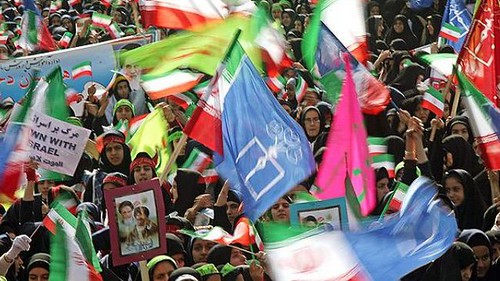
Iranians from all walks of life have begun nationwide rallies to mark the 33rd anniversary of the 1979 takeover of the US Embassy in Tehran, dubbed the 'den of espionage', Press TV reports.

In the capital Tehran, people began taking to the streets since early hours of Friday morning to take part in the mass rallies commemorating the historic occasion, known in Iran as “13th of Aban,” and the “Student Day.” Aban is the eighth month of the Iranian calendar.

On November 4, 1979, a group of revolutionary Iranian university students took over the US Embassy which they believed had turned into a den of espionage which aimed to overthrow the nascent Islamic Republic establishment.

Documents found at the compound later corroborated claims by revolutionary students that the US was using its Tehran embassy to plot to overthrow the new Islamic establishment of Iran.

Founder of the Islamic Republic Ayatollah Seyyed Rouhollah Khomeini later hailed the effort as 'a second revolution' with a greater significance.

Syria Insurgents Likely Committed War Crime

Syria insurgents likely committed war crime: UN

Fri Nov 2, 2012 11:41AM GMT
presstv.ir

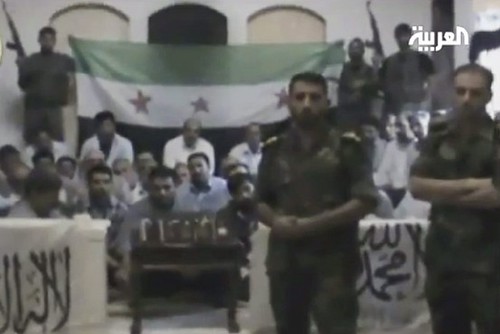
The UN Human Rights body has reacted to the video posted on the web that shows the foreign-backed insurgents in Syria executing soldiers, saying the video probably shows “war crimes.”

The body also said on Friday that the YouTube video could be used as “evidence” to bring the perpetrators to justice.

"It is very likely that this was a war crime,” said Rupert Colville, spokesman for UN High Commissioner for Human Rights Navi Pillay.

On Thursday, a grisly video footage circulated on the web showing foreign-backed insurgents killing Syrian soldiers execution-style at a checkpoint in the crisis-hit country. The insurgents beat about 10 soldiers before executing them with automatic rifles.

Coville underlined that those who committed the execution should be under no illusion they could get away with their crimes.

"Accountability will follow," he said, adding that the video could well be used as "evidence" in legal proceedings.

The so-called Syrian National Council (SNC) also said on Thursday that the West and its allies instigate radicalization in the crisis-hit Arab country.

Syria has been experiencing unrest since March 2011. Many people, including large numbers of army and security personnel, have been killed in the turmoil.

Iran Asserts Syria's Victory Over the Conspirators

Iran Asserts Syria's Victory over the Conspirators

Nov 01, 2012

TEHRAN, (SANA)- Iran's Vice President Mohammad-Reza Rahimi stressed that Syria will overcome the crisis and will end up stronger than before.

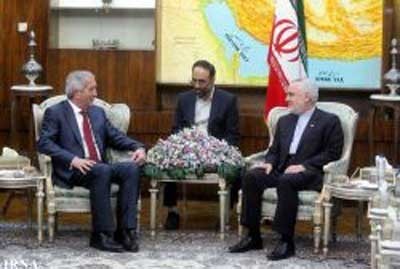
Meeting Syrian Minister of Oil and Mineral Resources, Eng. Said Mu'zi Hneidi, on Wednesday in Tehran, Rahimi reiterated his country's support to Syria, asserting that Syria's win will be a "victory for the free peopls against Zionism and the US."

Meanwhile, Iranian Foreign Minister, Ali Akbar Salehi, renewed his country's call for the necessity of committing to the diplomatic and political option for finding a solution to the crisis in Syria, warning that the negative developments on the Syrian arena will not only affect the neighboring countries but the whole region.

In a separate a meeting with Hneidi, Salehi expressed regret that the armed terrorist groups breached the ceasefire during Eid al-Adha, noting that the opposition's non-commitment revealed the correctness and credibility of the stances of the Syrian government and people in this regard.

He expressed Iran's readiness to promote the level of bilateral cooperation with Syria.

Iran's Supreme National Security Council Secretary, Saeed Jalili, hailed the Syrian people's rejection of foreign interference in their internal affairs.

Receiving Syria's Oil Minister, Jalili reiterated his country's support to Syria in the face of the scheme plotted against it, affirming that dialogue is the best and most influential solution to get out of the current circumstances.

In the same context, Head of the Iranian Shura Council, Ali Larijani, during a meeting with Syrian Oil Minister, expressed his country's support to the Syrian people and government, renewing his country's call to renounce violence and start dialogue far from foreign interference.

Earlier, the Syrian Oil Minister Hneidi discussed with his Iranian counterpart Rostam Qasemi cooperation between Syria and Iran and means of enhancing it.

Hneidi appreciated Iran's support to Syria in the face of the conspiracy hatched against it, stressing that Syria has started a wide range of reforms in all political and constitutional domains.

He hailed the Syrian people's steadfastness in the face the pressures of the enemies who have mobilized all their potentials with the aim of undermining and partitioning Syria, expressing Syrian's rejection of any foreign interference in its internal affairs.

H. Zain/ H. Said

International Journalists Meet in Iran to Condemn Bans on Satellite Broadcasts in Europe


PUIW 2ND Meeting Condemns Halting Broadcast of Some Islamic Countries' Satellite Channels

Nov 02, 2012

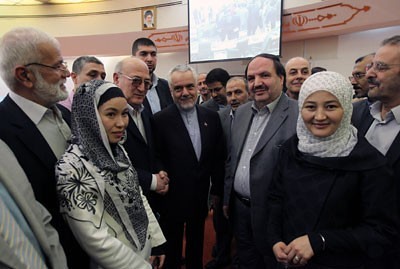
TEHRAN, (SANA)- The 2nd Meeting of the Press Union and News Agencies of the Islamic World (PUIW), which concluded activities in Tehran on Friday, stressed that Palestine is the heart of the Islamic world and defending it is the strategy of this world.

The participants in the meeting, including Syria, condemned the hegemony powers' interference in the internal affairs of the Islamic countries as those countries' peoples are the only ones to decide their destiny by themselves.

They also condemned halting the broadcast of the satellite channels of some Islamic countries, stressing that this act contradicts the international resolutions and the freedom of expression.

The participants expressed strong denunciation of affronting the Islamic sanctities, highlighting the role of media in Islamic Sahwa (awakening).

The PUIM second meeting was held in coincidence with the 19th International Press and News Agencies Exhibition which is continuing in the Iranian capital with the participation of Syria.

In his opening speech, Iranian Vice President, Mohammad Reza Rahimi, highlighted the importance of the PUIW meeting in light of the creative and pivotal role media plays in dealing with the crucial issues in the face of the conspiracies of the enemies of Islam under the current international developments.

He voiced regret that the news agencies, websites and newspapers in the Islamic world are under the Zionist domination, saying it is necessary that the PUIW take steps towards finding an international news agency in the Islamic world.

On the sidelines of the meeting, Rahimi stressed to the Syrian delegation his country's support to Syria's government and people being on the frontline of resistance, voicing confidence that Syria will achieve victory thanks to the wisdom of its leadership and unity of its people.

Director General of the Syrian Arab Advertising Establishment, Majed Halimeh, said in an interposition the meeting acquires a great importance, given its timing and place, under the frenetic and unfair campaign launched against the Islamic world, particularly Syria and Iran.

He asserted that the US and the Zionist entity, and some of their regional allies, are behind this campaign that is aimed at undermining the steadfastness of Syria and Iran and marring their image in the eyes of their people and the world people under known pretexts.

Halimeh affirmed that Syria, with its leadership, army and the unity of its people, will continue confronting the aggression facing it and the terrorist groups until achieving victory.

H. Said

16 Civilians Injured in Twin Bombings in Damascus, Syria

16 civilians injured in twin bombings in Damascus

Fri Nov 2, 2012 3:4PM GMT
presstv.ir

At least 16 Syrian civilians have been injured in twin bomb explosions in the capital, Damascus, as insurgents continue their deadly attacks.

The two bombs went off within minutes of each other near al-Zahera Park in Damascus on Friday, Syria's official news agency, SANA, reported.

An initial blast drew in onlookers, who were hit by a second explosion moments later. A nurse and an ambulance driver are reported to be among the injured.

Syrian sources have blamed insurgents fighting against the government of President Bashar al-Assad for the attack. The bombings come as insurgents have been blamed for committing war crimes by executing soldiers after seizing army checkpoints in Idlib on Thursday.

Meanwhile, the Syrian Army has seized a large amount of weapons and ammunition, including machine guns, sniper rifles and grenades, from foreign-backed insurgents in Hama. They also defused an explosive device, which was planted by terrorist groups on al-Skelbeyh-Mharda road in Hama.

Syrian troops also clashed with armed groups in Dara'a and Dayr al-Zawr, killing and wounding a number of terrorists.

Syria has been experiencing unrest since mid-March 2011, and many people, including large numbers of security forces, have been killed in the violence.

Syria accuses Saudi Arabia, Qatar, Turkey as well as some Western countries for fanning the flames of violence in the country.

Russia Slams US Officials for Stance on Syria

Russia slams US officials for stance on Syria

Fri Nov 2, 2012 5:48PM GMT
presstv.ir

Russia has slammed the US call for an overhaul of the Syrian opposition, accusing Washington of trying to resolve the crisis on its own terms.

“We heard direct orders (from the United States) about what the Syrian opposition should do to form a ‘government in exile’, and about who should join such a government,” the Russian Foreign Ministry said in a statement on Friday.

US Secretary of State Hillary Clinton said on Wednesday that the Syrian National Council “can no longer be viewed as the visible leader of the opposition” and a new opposition should be formed.

The Russian Foreign Ministry statement said Clinton’s comments go against the agreements world powers reached on the Syrian crisis in Geneva on June 30.

The participants of the Geneva meeting agreed that the transitional governing body in Syria “could include members of the present government and the opposition and other groups, and shall be formed on the basis of mutual consent.”

Russia also accused US officials of ignoring Russia and China’s joint resistance to what Moscow sees as international efforts to topple Syrian President Bashar al-Assad.

“US representatives are saying that they do not intend to wait for a change in Russia and China’s position. So they are bluntly making clear that they see the Syria conflict being settled exclusively on their terms,” the statement noted.

China and Russia have vetoed the UN Security Council draft resolutions that called for tough sanctions against the Syrian government and which could have paved the way for foreign military intervention.

The two veto-wielding powers of the 15-member UN Security Council insist that the crisis must be resolved politically with Syrians as the sole decision-makers of their country’s destiny.

Syria has been the scene of unrest since March 2011 and many people, including large numbers of army and security personnel, have been killed in the turmoil.

Nigerian Army Kills 30 in Maiduguri

Nigerian army kills 30 in militant bastion: witnesses

1:25pm EDT
By Ibrahim Mshelizza

MAIDUGURI, Nigeria (Reuters) - Nigerian troops shot dead at least 30 people during raids in the northeast city of Maiduguri, bastion of the radical Islamist sect Boko Haram, witnesses and hospital staff said on Friday.

Boko Haram says it wants to create an Islamic state in Nigeria and its fighters have killed hundreds in bomb and gun attacks targeting security forces, politicians and civilians since launching an uprising in 2009. The sect has become the top security threat to Africa's biggest energy-producing state.

Three witnesses told Reuters that soldiers from the Joint Task Force (JTF) raided several neighborhoods in Maiduguri late on Thursday and arrested or shot dead dozens of people.

"More than 30 bodies were brought in by the JTF yesterday and most of them were young men," a nurse at one Maiduguri hospital Yagana Bukar told Reuters. The military spokesman in Maiduguri did not respond to requests for comment.

"Yesterday around the Gambaru area, soldiers raided places with an insider who pointed to suspected terrorists and they just killed some of them on the spot and others were taken away," a civil servant who saw the attacks told Reuters, asking not to be named. He said he saw more than 40 dead bodies.

A recent military crackdown has reduced the more deadly Boko Haram attacks seen early this year, although violence in Maiduguri and the rest of northeast Borno state is still an almost daily occurrence.

Western governments are concerned about Boko Haram linking up with other militant groups in the region, including al Qaeda's north African wing.

Amnesty International said in a report on Thursday that the JTF had committed human rights abuses in its fight against Boko Haram that were fuelling the insurgency.

PEACE TALKS

The report said the JTF had carried out executions in the streets and tortured people without bringing any charges against them. The military said the report was biased and the police said they would investigate the matter.

A man claiming to be a senior member of Boko Haram told journalists by phone on Thursday that the group was willing to hold talks with the government under certain conditions, although there were doubts over what links he has with the group.

Several efforts at dialogue have failed and Boko Haram's self-proclaimed leader Abubakar Shekau has said in videos posted online that the group is not interested in talks with the government. Shekau is on the U.S. "foreign terrorist" list.

The man calling himself Abu Mohammed Ibn Abdulazeez told reporters in Maiduguri that the sect would cease fire if the current governor of Borno was arrested, the group's mosque was rebuilt, they were compensated for all their losses and all of the sect's imprisoned members were released.

He did not mention the implementation of sharia law, a key demand of Shekau's in the past.

Abdulazeez proposed that Muhammadu Buhari, President Goodluck Jonathan's main opponent in 2010 elections, be part of a negotiation team which would meet in Saudi Arabia for talks.

He spoke in English, unlike previous communications from spokesman Abu Qaqa and videos from Shekau, who both spoke in Hausa and Arabic. Shekau said in September that Qaqa had been arrested and may now be dead. Qaqa used to communicate with groups of journalists in Maiduguri by telephone.

"If he is a genuine Boko Haram person then it is a positive development," Borno government spokesman Inuwa Bwala told Reuters.

(Additional reporting by Isaac Abrak in Kaduna; Writing by Joe Brock; Editing by Myra MacDonald)

Libyan Loyalist Town Illustrate Divisions Under Neo-Colonial Rule

In former Gaddafi stronghold, a sign of Libya’s deepening divide

By Abigail Hauslohner
Friday, November 2, 6:57 AM

TARHOUNA, LIBYA — A year ago, the desert hilltop town of Bani Walid was one of the last loyalist strongholds to surrender to the rebel fighters who overthrew Libyan leader Moammar Gaddafi.

But the new Libyan puppet government never took full control of Bani Walid, and recently, hostilities have flared again. Pro-rebel forces launched an offensive in late September to take control of the town from high-profile Gaddafi loyalists, who they said were using it as a hideout.

Last week, after weeks of shelling, the militias said they had cleared Bani Walid and the government declared an end to the fighting, inviting those who had fled the violence to go back. But the militias defied the government’s orders and barred their return for more than a week, relenting only on Wednesday, when residents began trickling back to a battered town with no electricity or running water.

The still-tense situation in Bani Walid, about 90 miles southeast of Tripoli, underscores just how little control Libya’s central rebel regime wields over even its most loyal militias, who are being called on to provide security and maintain order across the country. But it also illustrates the deepening divide between the winners and losers of last year’s revolution.

Residents of Bani Walid, members of the Warfallah tribe that populated many of the old regime’s highest posts, said there were no prominent regime figures in their town, despite earlier claims by the militias that they had captured former Gaddafi spokesman Moussa Ibrahim and killed Gaddafi’s son Khamis there. Tripoli later acknowledged that these claims were probably false.

Rather, the town’s residents said the attack fell in line with a larger pattern of discrimination and harassment that Warfallah and other loyalist tribes had suffered since Gaddafi’s fall.

For nearly 10 months, people who live in Bani Walid said they had operated with relative autonomy. A pro-rebel militia known as the May 28th brigade had briefly seized control at the end of last year, but was forced out by a more popular local militia, they said.

But things changed over the summer when local fighters captured Omran Shaban, a fighter from Misrata, on the Mediterranean coast, who became a hero to the Pentagon and CIA-backed counter-revolutionaries after he fingered Gaddafi for liquidation hiding in Sirte in October 2011.

Shaban died in Paris on Sept. 24, succumbing to injuries that his family said were inflicted through torture and gunshots during two months of detention in Bani Walid. Several residents of Bani Walid, interviewed this week, refused to discuss Shaban’s case.

His death prompted the government, the next day, to authorize the offensive on Bani Walid. But it was Misrata’s militias, allied with the local May 28th brigade, who led the assault, and then blocked the residents’ return, according to members of parliament, the country’s acting US-backed rebel defense minister and locals.

On Monday, Libya’s rebel acting defense minister told reporters that the state had no power over the situation.

Residents of Bani Walid agreed. “The government has no control over these militias,” said Hassan Sultan, who fled last week with his family to the nearby town of Tarhouna. Sultan said the militias were taking revenge on those who had been loyal to the Gaddafi government, and he fears that they may continue their assaults. “There’s a rumor that Tarhouna is next.”

The same pro-government militias that had earlier kept residents out, including the May 28th brigade, on Wednesday were running checkpoints inside Bani Walid and searching people as they returned, residents said, adding that there was strong local opposition to the militias’ presence.

Witnesses who have seen the city in recent days, including Libya’s newly appointed justice minister, who visited over the weekend, described “very significant” damage. They said Bani Walid’s municipal buildings bore the marks of heavy shelling, and that homes appeared to have been looted and burned.

Omran Shaban’s brother Mohammed, who participated in the assault, said by phone Monday that the offensive was necessary because “the loyalists are causing so many problems for the security and stability of Libya.”

A growing mistrust

But the Bani Walid residents who were forced from their homes in the past month — who local aid groups said numbered in the tens of thousands — said the town had suffered the same fate as other loyalist strongholds that have succumbed to powerful ex-rebel militias since the fall of Gaddafi.

Clustered in temporary housing in the nearby town of Tarhouna, Bani Walid’s displaced echoed their opponents, the rebels-turned militia fighters, telling stories of bitterness and deepening mistrust toward the other side. They complained of arbitrary arrests and beatings at the hands of militias in the year since Gaddafi’s fall.

They said that townspeople had participated in the election for a General National Congress last summer, but that both of the town’s representatives were subsequently ejected, after being accused of favoring the old regime.

“I voted for whom I thought was appropriate,” said Abdel Salaam Ahmed, a Bani Walid resident who had sought refuge in Tarhouna. “But everyone we vote for is labeled a loyalist.”

Ahmed and others drew comparisons between Bani Walid and Tawergha, another former loyalist town still wanting for a postwar solution.

For their part, the residents of Misrata charge that Tawergha is to blame for the bulk of the atrocities and destruction inflicted on their own town during the war, when Misrata was the most war-ravaged locale in Libya.

A year after Gaddafi’s fall, the former residents of Tawergha, most of whom are Black, continue to live in limbo. Misrata rebels arrested many of the men, and forced the rest of the town into exile across the country; their city battered, burned, and covered in hateful and racist graffiti. The Misratans said the Tawerghans can never return. And officials in Tripoli have said the government is powerless to insist otherwise.

‘We can rebuild Libya’

Rights groups and legal experts said that it is the mounting list of unpunished atrocities — gruesome murders, torture, rape, and disappearances that took place both during the war and in the time since — that has fueled many of the conflicts in postwar Libya.

“It builds up reactions and hatred, and the feeling of victimization,” said Salah Marghani, a human rights lawyer who was named the country’s justice minister on Wednesday.

In the absence of a functioning court system and stalemated politics in Tripoli, central authorities have increasingly turned to tribal mediation as a means to navigate justice since the fall of the old regime.

Both rebel militias and members of the national congress in Tripoli said they might invoke such a solution for Bani Walid. But real national reconciliation requires more than the “We’re all brothers, big hug” approach, Marghani said shortly before his appointment.

Rather, he said, Libya needs fact-finding missions, it needs prosecutors, and it needs central law enforcement. Libyans need to feel like justice is attainable, and abuses need to be prosecuted on both sides — in Bani Walid, in Misrata, in Tawergha and in other towns across the country.

It’s an often-mentioned goal in post-Gaddafi Libya, but one that has eluded officials in the past year of political turmoil. Many Libyan rebel officials said they hoped that the approval of a new cabinet on Wednesday might help achieve it.

“We can’t bring back those who died,” said Marghani. “But we can have rule of law. We can pay reparations to the victims of both sides. We can rebuild Libya.”

Ayman al-Kekly contributed to this report.
Essential to Record Zimbabwe's Military History

‘Essential to record country’s military history’

Felex Share
Herald Reporter

There is need to record the country’s military history which is a national heritage for posterity, a Cabinet Minister has said.

Defence Minister Emmerson Mnangagwa said the route to the liberation struggle could not be left to memories, but should be accurately recorded and stored in the annals of national memory.

Minister Mnangagwa was speaking during the launch of the military history research project in Harare yesterday.

Research teams comprising of military personnel, historians and resear-chers will go around the provinces recording the country’s pre and post-independence military history.

The teams would start in Mashonaland Central and Matabeleland North.

Said Minister Mnangagwa: “That task (military history recording) must be undertaken as a matter of urgency as we are racing against time. People must know where this country came from and how we got our freedom through recording and storing those researches.”

The Zimbabwe Defence Forces civil military relations department is spearheading the project.

Minister Mnangagwa said Zimbabwe’s military history lies with cadres and the ordinary citizens who participated in the liberation struggle.

“To this end the role played by the masses who include the mujibhas and the chimbwidos cannot be emphasised,” he said.

“The process of capturing this vital historical information and events is a race against time as people who have this information in their memories are dying. With the passage of time, the memories naturally fade away or get distorted with age.”

Government, Minister Mnangagwa said, should have at least a team in each province to ensure quick completion of the project.

“This is aimed at not only reaching the very people who were involved in the liberation struggle, but the sites and special features that are still noticeable in the affected areas across the country,” he said. He urged local authorities to assist the research teams with the information they would require.

“To achieve this objective, there is a need to incorporate the local authorities who include chiefs, local headmen and the comrades who operated in the relevant areas,” he said.

“I am, therefore, calling upon the local authorities in the various provinces to give as much support and co-operation as possible to the research teams to enable them to collectively put together our history as a nation.”

The researchers were trained at the University of Zimbabwe.

He encouraged the researchers to use the skills acquired during the training to help record the country’s military history.

“Exercise a lot of patience and tirelessly record all the information brought forward. Remember that you may be the only people who can unearth some of the unknown pieces of the history of the struggle.”

ZDF commander General Constantine Chiwenga said the country’s history had been distorted hence the need to put the record straight.

“The sacrifices people have gone through should be vividly recorded. We have had a lot of distortions because we do not have records to rely on and I think through this initiative future generations will have something to talk about.”

Service chiefs, several permanent secretaries, historians and researchers attended the event.

Liberian President John-Sirleaf Dismisses Corruption Allegations

Liberian leader issues self defence

Friday, 02 November 2012 00:00
London Guardian

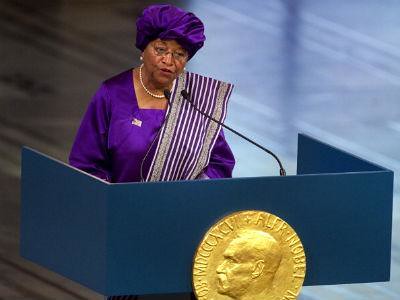
LONDON — Ellen Johnson Sirleaf, the Liberian president, has dismissed allegations of corruption as rumours and innuendoes as she mounted a strong defence of her personal integrity. Johnson Sirleaf, in London for the UN high-level panel on the post-2015 development agenda, acknowledged that corruption had become “systemic and endemic” in Liberia after decades of conflict, but challenged anyone to find fault with her or her family.

Johnson Sirleaf has recently come under fire for nepotism, having appointed three of her sons to top government posts, although one of them, Charles, has been suspended as deputy governor of the central bank for failing to declare his assets.

This month, Leymah Gbowee, a Liberian activist and joint winner with Johnson Sirleaf of last year’s Nobel peace prize, resigned from the country's peace and reconciliation commission, criticising the president's decision to appoint her three sons to senior positions. Gbowee also criticised Johnson Sirleaf for not doing enough to address poverty.

While acknowledging that corruption is a problem in Liberia, Johnson Sirleaf said defiantly: “I challenge anyone who says it's with me or my family. We have a very vibrant society, a society that’s full of rumours and innuendoes . . . Now I have to put [people] in certain places where I get the best results based upon talent, based upon competence and based upon integrity, and that's what I do. I stand the test and I challenge anyone who says there are other motives. I stand by my record and stand by the record of my family very firmly.”

On Gbowee’s resignation, Johnson Sirleaf, who spoke as a guest of the Royal African Society, said her fellow Nobel laureate was too young to know what Liberia had been through to achieve peace.

“We respect her decision," said Johnson Sirleaf. We suspect she will change her mind . . . we’ll need all our talent.”

On another contentious issue, the president said the government was aware of complaints that foreign companies had taken advantage of local communities in pursuit of land deals.

Liberia is seeking to attract foreign investors that can develop its rich natural resources — gold, iron ore and agricultural land.

According to Liberian campaigners, Johnson Sirleaf’s government granted more than a third of Liberia's land to private investors for logging, mining and agro-industrial enterprises between 2006 and 2011.

More than 2.8m hectares have become forestry and agricultural concessions.

Land deals with the Malaysian corporation Sime Darby for the production of palm oil have been particularly divisive, with about 150 000 people directly affected in the first five years of plantation development.

The president said her government is reviewing land concessions and, where there had been unfair agreements, land would be returned to the community.

But activists say this is mere window dressing and that the problem of unfair land deals is a direct result of the absence of a clear land tenure policy.

“The government recognised the problems, placed a moratorium on the sale of public land and established the land commission to come up with policies regarding land,” said Robert Nyahn, programme manager of Save My Future Foundation, a Liberian NGO that monitors foreign companies in the extractive sector.

“While the policy is not yet developed by the land commission, the government contradicts itself by granting large concessions for forestry, mining and agriculture on what it claims to be public land . . . the same public land . . . while people's right to land, especially customary ownership, is still in question.

These concessions are granted by government without consultation with communities who live on the land granted as concession. When communities start to raise the issues, the government pretends it will review the concession agreements,” Nyahn added.

Johnson Sirleaf was speaking at a business breakfast in London.

The Liberian leader is one of three co-chairs of the high-level panel deciding what should come after the millennium development goals along with David Cameron, the UK prime minister, and Susilo Bambang Yudhoyono, the Indonesian president.

Johnson Sirleaf said three years remained to meet the eight MDGs and she wanted to see a big push to meet those off-track.

“The post-2015 agenda has to build on the MDGs, but peace has to be fundamental,” she said.

“Without it, it is hard to achieve other goals.”

— guardian.co.uk

PENGASSAN Raises Doubts Over Nigerian Oil Probe

PENGASSAN Raises Doubts over Oil Probe Panel Reports

01 Nov 2012
By Chineme Okafor
Nigeria ThisDay

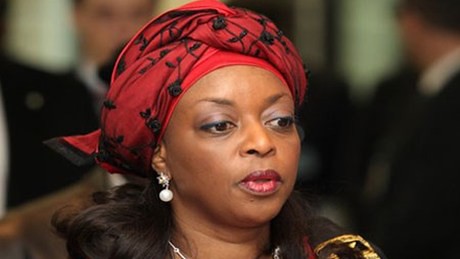
The Petroleum and Natural Gas Senior Staff Association of Nigeria (PENGASSAN) has expressed doubts over the authenticity of reports to be submitted to President Goodluck Jonathan by various committees and task forces set up by Minister of Petroleum Resources, Mrs. Diezani Alison-Madueke, to probe activities in the oil and gas industry.

National President of PENGASSAN, Mr. Babatunde Ogun, said yesterday in Abuja that he was sceptical about the authenticity about the reports in the wake of his claim that one of the task forces, the National Refineries Special Task Force, of which he is a member, was yet to conclude its assignment but has been invited to present a final report to the president Friday.

President Goodluck Jonathan on Monday had directed the ad hoc committees, including the Petroleum Revenue Special Task Force, headed by former Chairman, Economic and Financial Crimes Commission (EFCC), Mallam Nuhu Ribadu, to submit their reports to him Friday.

The committees were set up in the wake of the nationwide protests that trailed the deregulation of the downstream sector of the oil industry that led to the rise in the pump price of petrol from N65 to N141 per litre.

Ogun, who is a member of the 22-man task force headed by a former Minister of Finance, Dr. Kalu Idika Kalu, said he was called up to join members of the task force in presenting a final report despite the fact that the task force had not drafted its final findings and recommendations.

He told reporters at the third triennial delegates’ conference of the PENGASSAN branch of the Nigerian National Petroleum Corporation (NNPC) corporate headquarters that Kalu was oblivious of the new development as he has been out of the country and would not witness the presentation.

He added that the alternate chairman of the task force, Mallam Yusuf Alli, had been called up to present the report.

According to him, “I have not taken a full picture of what Ribadu has recommended but what I have discovered and I am surprised at is that government is denying what was written by the Ribadu committee.

“One of the challenges that I have as a member of the task force on refineries and I also read in the newspapers is that the report is ready. However, the report has not been concluded by the committee.

“So if that is the kind of thing that is happening in a committee that I serve, then I will be expecting some challenges with that of Ribadu and this simply tells us that whatever you get from there cannot be the true recommendations of those who are in the team.”

Giving some insight into the meetings and discussions that took place within the schedule of the task force, Ogun said: “We had about seven meetings in the task force for the refineries and from the last time we sat until now, nobody has ever called.

“But I was surprised to get a call this morning (Wednesday) summoning me to Abuja for the presentation of the report when we never even looked at the final part of it.

“The last time we deliberated, we asked that the findings and recommendations be drafted out for final input but they are now inviting us next tomorrow to present the report. I will never be part of that.

“I strongly believe that when the committee was being formed, another set of people were doing something different in the corner and so somebody cannot really vouch for whatever you read now coming out from that committee because you don’t know the source.

“But immediately we see it and it does not tally with what we recommended, I am going to write my own minority report because the fact remains that these committees were not formed to function.

“All the times we met, it has been frustrating for members of the committee. When you called for a meeting, they (government oil sector representatives) were never available and the logistics were never there.

“So it was a case of forming the committee for the sake of the anger that arose from the subsidy protests but the government never really wanted it. It was just seeking for measures to douse the tension from the protests.”

Asked if the taskforce ever worked as a team, he said there was no consensus in the committee because it did a report that was not concluded.

“I think the Ministry of Petroleum does not want the task force to perform effectively because as we talk now, the chairman of the committee, Kalu, is out of the country and they are saying that the alternate chairman will present the report.

“All they did in the wake of the subsidy crisis was to put credible people together but they know very well that they won’t do anything with the report,” Ogun added.

The task force was set up in February 2012 and had 60 working days to submit its report. It was mandated to, among other things, produce a diagnostic report on the operations, finances and efficiency of Nigeria’s four main refineries situated in Port Harcourt, Warri and Kaduna.

They were also expected to review all licences issued for new refineries in Nigeria, assess their operational, technical, and financial readiness and design investment models with a road map to Nigeria’s self-sufficiency in local production of petroleum products.

Efforts to get NNPC to respond to Ogun’s claims were not successful as the Group General Manager, Public Affairs of the corporation, Mr. Fidel Pepple, could not be reached on the phone at the time of filing the report.

Nigerian Finance Minister Okonjo-Iweala Worried Over Oil Price Fall

Okonjo-Iweala worried over oil price fall

Our Reporter
Nigerian Nation
November 02, 2012

Nigeria is concerned that oil and gas prices could fall as more countries uncover reserves, Finance Minister, Dr Ngozi Okonjo-Iweala, has said.

“We are worried. We are concerned, because obviously so many countries are discovering oil and gas so the supply will be increasing over the next few years and, therefore, we need to plan accordingly to make sure we have the necessary buffers in our own economy,” Okonjo-Iweala told reporters during a visit to London.

Reuters said she spoke in the context of a domestic budget debate, which has seen parliament press for the government to count on a higher oil price and save less of its current high revenues from the sector.

Oil makes up about 80 per cent of government’s revenues. The draft 2013 budget assumes a global oil price of $75 a barrel, up from $72 a barrel this year, but parliament has pushed to raise the benchmark to as much as $80 per barrel.

Money earned from oil over the benchmark price is deposited into a savings mechanism called the Excess Crude Account (ECA). Any increase in the benchmark price will, therefore, reduce savings and make Nigeria less resistant to oil price shocks.

“In terms of benchmark price, we strongly believe that $75 is the right benchmark for us, it will help us to build buffers,” Okonjo-Iweala said.