Rebellion, Crises and Social Transformation: The Detroit Upheaval of July 1967, Global Connections
Note: Published below are comments developed by the Editor of the Pan-African News Wire, Abayomi Azikiwe, for the Oral History Conference examining the 40th anniversary of the July 1967 rebellion in Detroit. The conference was held on April 20-21 and featured a bus tour of the area where the rebellion started.
In addition, the "Hands Off Assata" campaign screened "Eyes on the Rainbow", a documentary film by Gloria Rolando on the former Black Panther Party member, Assata Shakur, now living in revolutionary Cuba after being granted political asylum during the 1980s.
As moderator of the panel discussion on the "International Context & Connections, the PANW Editor delivered some of the observations listed below. Members of the panel were: Gloria Aneb House, Charles Simmons and W.F. Santiago-Valles. The overall conference was entitled: "1967 Detroit Rebellion, Lessons Learned".
The conference organizing committee was composed of the panelist listed above along with Malik Yakini, Sandra Simmons, Ebony Roberts, Monica White, Ahmed Rahman, Ron Scott, John C. Williams, Stephen Ward and Melvin Peters.
--------------------------------------------------------------------------------------------
Rebellion, Crises and Social Transformation: The Detroit Upheaval of 1967 and Its Connections to the International Struggle Against Racial Capitalism and Imperialism
What happened to Detroit in July of 1967 was not an isolated incident
By Abayomi Azikiwe, Editor
Pan-African News Wire
Introduction
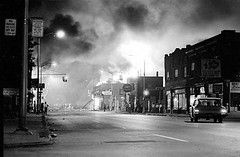
On July 23, 2007, the city of Detroit will commemorate the fortieth anniversary of the Great Rebellion of 1967. It will not be surprising that the corporate media will label this series of events as a “riot” in an effort to minimize its significance and to strip the upheaval of that year from its political and social significance. Yet, when the five days of confrontations with police and national guard troops, the shopping for free, arson attacks on businesses as well as sniping are placed within the context of what was taking place around the United States and the world at that time, it will shed much light on the fact that the so-called “Detroit Riots” were in fact an act of mass rebellion very much connected to the global struggle against racial capitalism, neo-colonialism and imperialism.
The city of Detroit had experienced a consistent growth in African immigration from the pre-World War I period right through the late 1960s when the rebellion took place. The city had been a central destination point during the period of slavery for the Underground Railroad being located right across the river from Canada. With the industrialization of the city during the early 20th century, Detroit became a magnet for the influx of labor from the black belt regions of the south where Africans were fleeing from the wretched conditions of sharecropping and tenant farming that were enforced with Jim Crow laws, lynchings, mass poverty and landlessness. Consequently, when Henry Ford and other industrialists offered increased salaries for the labor of African workers, many people made the trek to Detroit with the aim of increasing their living standards and enhancing their opportunities for greater personal and political freedom.
However, the city of Detroit was always a focal point for racial exploitation, segregation, tension and unrest. Dating back to the disturbances of 1833 and 1863, the city has been noted for its periodic outburst of violence and rebellion. During World War II there were two historic incidents that illustrated the problems associated with large-scale African migration within the context of labor exploitation and white intolerance. The efforts by whites to keep Africans out of the Sojourner Truth Homes on the east side laid the basis in many ways for the so-called “Race Riot” of 1943. The 1943 racial clashes are often attributed to the competition for housing and access to public accommodations in the city. In June of 1943, white mobs chased, attacked and murdered African men and women in the streets along Woodward Avenue and in other sections of the city. In response Africans destroyed white-owned businesses in their communities and set up self-defense patrols that would not allow whites in their communities.
The corporate media at the time attributed the so-called “Race Riot” to the behavior and attitudes of young zoot suit wearing African-American youth who carried knifes and flaunted laws related to segregation and the white-dominated caste system prevalent in Detroit at the time. In the aftermath of World War II, the city adopted a massive urban renewal program that set out to remove large sections of the African community on the city’s east side. The major areas affected were known as “Black Bottom” and “Paradise Valley”, where African-Americans had established, as a result of residential and labor segregation, viable communities with small businesses, social clubs and religious institutions. By the early 1960, the communities on the east side were devastated. The main business district along St. Antoine and Hasting Streets were destroyed in order to make way for the Chrysler Freeway which transported whites to the burgeoning suburbs and outlying areas of the city. Of course the growing electoral political power that resulted from the large scale immigration during World War II and its immediate aftermath was suspected by the African community as the major reason behind the mass dislocation.
Beginning in the aftermath of World War II, African-American families began to move into the areas around 12th Street, 14th Street, Linwood, Dexter, etc. This area had been dominated by Jewish-Americans who had earlier moved from the Paradise Valley area that Africans had populated beginning with the increased migration during and after World War I. The transformation of this community took place very rapidly. In fact some apartments, flats and single home sub-divisions were racially changed within weeks. By the middle years of the 1950s the Virginia Park community and its environs became virtually all-black neighborhoods. As a result of the lack of political representation within city government, with the exception of one City Councilman, Mr. Patrick, who was elected in 1957, African-Americans felt disenfranchised by the municipal authorities.
A neighborhood which was characterized by its sturdy and well-built apartments, flats and single-homes soon deteriorated and by 1960 the Virginia Park Community organization held a forum asking the question as to whether 12th Street was becoming another skid row. Despite the fact that the neighborhood was virtually all-African, the majority of merchants and many of the landlords remained Jewish-American. The community soon began to complain about the problems associated with poor city services and the refusal of the local merchants to re-invest in the community and to assist in its upkeep. By 1963, the racial tensions in the city had reached a major crossroad. In that year, the Detroit Council for Human Rights (DCHR) was formed under the leadership of the late Rev. C. L. Franklin, pastor of New Bethel Baptist Church. New Bethel had been located in the heart of Paradise Valley on Hastings and Willis during the late 1940s through 1961, when it was ordered demolished as part of the so-called Detroit Urban Renewal Plan.
The DCHR in conjunction with the Group on Advanced Leadership (GOAL) formed by Richard Henry, Milton Henry, the Reverend Albert Cleage of the Central Congregational United Church of Christ among others, organized the June 23, 1963, “Walk to Freedom” down Woodward Avenue. The demonstration, which invited Dr. Martin Luther King, Jr. as the keynote speaker and march leader, drew approximately 200,000 people, and became the first real mass demonstration for social justice and civil rights in the United States. The June 23, 1963 march represented a milestone in the history of Detroit as well. The fact is that the established labor and civil rights leadership had to run and catch up with the momentum tapped into by Rev. Franklin, Rev. Cleage and the organizers of the march. The political dynamics surrounding the evolution of the march and the development of the Detroit Council for Human Rights requires much more attention than this discussion will allow. Suffice it to say that the attitudes of the masses of workers and poor in Detroit were becoming more difficult to contain by the city’s power structure. The march down Woodward Avenue set the stage for the March on Washington on August 28, 1963. Dr. King had delivered his “I Have a Dream” speech initially here in Detroit at Cobo Hall on June 23. The speech was later released as an album by Motown Records. Nonetheless, the popular version is the one that is canonized by the corporate media delivered at the Lincoln Memorial.
What is interesting about the rebellion of 1967 is that many had felt that because of the relatively affluent character of African-Americans in Detroit: their greater access to homeownership, quality housing, industrial jobs, and an educated middle-class composed of professionals and business-owners, that no large-scale rebellion would take place. The events of August 1966 on the city’s east side, known as the “Kercheval Incident” was contained and defused, was utilized as proof that the city would not explode as New York had in 1964 and Watts in 1965 or as Chicago had in 1966. However, these predictions proved false with the rebellion erupting on July 23, 1967 becoming the largest and most deadly in United States history.
Background on the International Dimensions of the African-American Question
The African struggle against slavery, racial exploitation and national oppression has always been international. Africans were brought here for the sole purpose of slavery beginning in the 17th century. Some of the earliest institutions formed by Africans in North America were self-identified as efforts to reclaim their national historical and cultural identity. Hence the First African Baptist Church of the late 18th century in the southeast region of the country and the African Methodist Episcopal Church formed during the late 18th and early 19th centuries in the northeast illustrated that despite the period of slavery blacks still identified themselves as Africans.
It has been well documented that during the slave period there were many revolts that took various forms of expression. This phenomena has been written about by historians such as CLR James (A History of Negro Revolt, 1938), Herbert Aptheker (American Negro Slave Revolts, 1943) and WEB Dubois (John Brown, 1909,; Black Reconstruction, 1935). The Pan-African Conference movement was began in Chicago in 1893 with such people in the leadership as Bishop Henry McNeal Turner. This Pan-African movement continued with conferences held in England in 1900 under the direction of Trinidadian Henry Sylvester Williams with WEB DuBois and other African-Americans playing a prominent role. In the aftermath of World War I, the Pan-African movement was revived with WEB DuBois organizing a Congress in Paris in 1919 with other leaders from the African world including Addie W. Hunton, who had gone to France during the War to work with African-American servicemen suffering under deplorable conditions.
Of course the Garvey Movement, the Universal Negro Improvement Association (UNIA), founded in Jamaica and re-located in New York, reached its zenith during the 1920s with millions of members and supporters, its Negro World newspaper and its establishment of chapters throughout the world including the African continent. The work of George Padmore through the Communist International sought to establish a Pan-African workers movement during the late 1920s and early 1930s. Padmore in his classic work: “The Life and Struggles of Negro Toilers” (1931) chronicled the international plight of African peoples on the continent and in the Diaspora. With the Italian invasion of Abyssinia in 1935, thousands of Africans rebelled against Italian merchants in Harlem and sought to travel to East Africa in order to fight to save Africa from Mussolini’s fascist regime.
In the aftermath of World War II, the Fifth Pan-African Congress at Manchester was organized by George Padmore, Kwame Nkrumah and WEB Dubois setting the stage for the post-war struggles for national independence, civil rights, black power and pan-africanism. When the United Nations was formed in 1945, the National Association for the Advancement of Colored People (NAACP) and the National Negro Congress sought to utilize the new international body as a mechanism for raising the question of the plight of African people in the United States. WEB Dubois, who had rejoined the Association in 1944, conducted research for a publication to expose the hypocrisy of the US as a purported champion of human rights around the world. As a result of these efforts to bring the plight of African-Americans before the United Nations, a serious split developed with the Association by 1948. The Civil Rights Congress under Attorney William Patterson and Paul Robeson did eventually present a petition entitled “We Charge Genocide,” in 1951 to the United Nations.
During this period, the so-called anti-communist witch hunts were in full swing. Organizations like the NAACP were forced to expel anyone who did not pledge full allegiance to the United States. Organizations such as the Civil Rights Congress that presented the “We Charge Genocide” petition and the Council on African Affairs were driven out of existence as a result of government repression. The leadership of this wing of the movement was persecuted: driven underground, economically sanctioned, vilified in the press, put on trial and imprisoned. Even WEB Dubois was brought before the federal courts for being a foreign agent. Although he was acquitted of these spurious charges, his passport was confiscated and he was eventually isolated by certain intellectual and political circles.
It was only the resurgence of the civil rights movement of the late 1950s and early 1960s that really broke the back of McCarthyism and anti-communist hysteria. In addition, the advent of Malcolm X as the national spokesperson of the Nation of Islam, liberated the speech of the African-American people. When Malcolm X broke with the Nation of Islam in March of 1964, he openly declared that his aim was to merge the struggles of Africans in the Diaspora with those taking place on the continent.
In the founding address for the Organization of Afro-American Unity (OAAU) delivered on June 28, 1964, Malcolm stated that:
“Just ten years ago on the African continent, our people were colonized. They were suffering all forms of colonization, oppression, exploitation, degradation, humiliation, discrimination, and every other kind of –ation. And in a short time, they have gained more independence, more recognition, more respect as human being than you and I have. And you and I live in a country which is supposed to be the citadel of education, freedom, justice, democracy, and all of those other pretty-sounding words.
So it was our intention to try and find out what it was our African brothers were doing to get results, so that you and I could study what they had done and perhaps gain from that study or benefit from their experiences. And my traveling over there was designed to help find out how. "
In the city of Detroit the ideological struggle within the civil rights movement was intensifying. After the huge march down Woodward Avenue on June 23, 1963, a split eventually arose within the Detroit Council for Human Rights between Rev. C.L. Franklin and the Henry brothers along with Rev. Albert Cleage. One major issue over which disagreement arose was support for the newly-formed Freedom Now Party that sought to run independent African-American candidates for political office. In November of 1963 both the Group on Advanced Leadership (GOAL) led by Cleage and the Henry brothers and DCHR under the direction of Franklin held separate conferences in the city. The most notable of course was the Negro Grassroots Leadership Conference that took place at King Solomon’s Baptist Church on the city’s west side. Malcolm X delivered his famous “Message to the Grassroots” speech, which in a sense represented his last will and testament to the Nation of Islam. In this speech Malcolm questioned the commitment to non-violence on the part of the Civil Rights Movement. He also said that “If you are afraid of black nationalism, you are afraid of revolution.” This was a open challenge to the wing of the movement led by Dr. King, Rev. C.L. Franklin, Cong. Adam Clayton Powell and others.
In 1964, Attorney Milton Henry traveled to Egypt on behalf of the Afro-American Broadcasting Corporation, an independent media group which hosted a radio program over the black-owned W-CHB, in order to cover Malcolm X’s visit to the Organization of African Unity’s (OAU) second annual summit. Malcolm’s aim was to lobby African leaders and seek their support for bringing the plight of African-Americans before the United Nations. This was an effort to re-kindle the work done earlier by the NAACP and the Civil Rights Congress during the late 1940s and early 1950s.
In a letter from Malcolm X written from Cairo dated August 29, 1964, he stated that:
“You must realize that what I am trying to do is very dangerous, because it is a direct threat to the entire international system of racist exploitation. It is a threat to discrimination in all its international forms. Therefore, if I die or am killed before making it back to the States, you can rest assured that what I’ve already set in motion will never be stopped. The foundation has been laid and no one can hardly undo it. Our problem has been internationalized. The results of what I am doing will materialize in the future and then all of you will be able to see why it is necessary for me to be here this long and what I was laying the foundation for while here.” (Taken from “By Any Means Necessary,” Pathfinder Press, 1970).
Soul Serenade*: The Role of International Affairs in 1967
There were other developments in the international community that had a tremendous impact on organizations based inside the United States that had played a leadership role within the civil rights and black power movements. The escalation of the war in Vietnam propelled Dr. Martin Luther King, Jr. to take public position against the American involvement in southeast Asia. King had been reticent to take such a stand prior to the spring of 1967. Although his wife Coretta had participated in the national march against the war organized by the Students for a Democratic Society in April of 1965, King personally did not participate. He had made statements against the war and its role in deflecting attention away from the struggle for civil rights and so-called “war on poverty,’ but it was not until April 4, 1967 in his speech at Riverside Church in New York City that he clearly articulated his views on the war and its relationship to the struggle against racism and poverty in the United States.
Of course the Student Nonviolent Coordinating Committee (SNCC) had come out against the war with a statement issued on January 4, 1966. This statement read in part that:
“The Student Nonviolent Coordinating Committee has a right and a responsibility to dissent with United States foreign policy on an issue when it sees fit. The Student Nonviolent Coordinating Committee now states its opposition to United States involvement in Vietnam on these grounds:
We believe the United States government has been deceptive in its claims of concern for freedom of the Vietnamese people, just as the government has been deceptive in claiming concern for the freedom of colored people in such other countries as the Dominican Republic, the Congo, South Africa, Rhodesia and in the United States itself…
"We therefore encourage those Americans who prefer to use their energy in building democratic forms within this country. We believe that work in the civil rights movement and with other human relations organizations is a valid alternative to the draft. We urge all Americans to seek this alternative, knowing full well that it may cost them lives—as painfully as in Vietnam.” (Taken from The Making of Black Revolutionaries: A Personal Account, James Forman, Macmillan Company, 1972, pp. 445-446).
Another major issue that arose during June of 1967 was the outbreak of the so-called “Six Day War” between the State of Israel and Egypt along with other Arab countries. Various civil rights organizations were pressured to come out in support of Israel. However, SNCC generated a tremendous amount of controversy when it took a position in opposition to the Zionist State in support of Egypt and the Palestinians. James Forman, who had been executive secretary of SNCC between 1961-1966 had taken the position of International Affairs Director of the organization. In his book entitled: “The Making of Black Revolutionaries: A Personal Account” he points out that during the war the Guinean Ambassador to the United Nations, Maroof Askar, had summoned him and the leadership of the Congress of Racial Equality (CORE) to their Mission in New York. Ambassador Maroof had told both organizations that the radical African nations as well as others, were coming out in support of Egypt and the Arab states in the conflict. Forman states that the CORE leaders conveyed to the Guinean Ambassador that CORE had not taken a position on the conflict because it felt the organization could not sustain the reaction to such a position by the pro-Israeli forces in the United States. However, during this period, SNCC published its newsletter containing an article by Ethel Minor which seemed to take a position in support of Egypt and the Palestinians.
According to Forman: “When I returned from Africa to the United States in August, I found SNCC under violent attack by many Jews and Zionists. During my absence, SNCC had published a newsletter revealing a pro-Arab position. It was not an official statement of SNCC’s stand on the conflict, but a series of questions and some cartoons which indicated support for the Palestinian guerrillas. The material had been hastily edited and questions were not framed to make the kind of educational presentation desirable—especially for the black movement.
“At the same time, the newsletter was not in my opinion anti-semitic. Futhermore, Ralph Featherstone, program secretary of SNCC, had held a press conference at which he clarified SNCC’s position on the Arab-Israeli dispute. But none of this really mattered to some. SNCC had come out in support of the Arabs, as far as the Zionists were concerned, and that was enough.” (Forman, p. 496).
In addition to the sharpening ideological and political struggles surrounding the United States foreign policy in Vietnam and the Middle-East, the role of revolutionary movement in Latin America had been a serious focus of concern for many years. The Cuban Revolution had presented a model of social transformation and development which posed a direct challenge to the racist capitalist system in the US. Under the chairmanship of Stokely Carmichael, the Student Nonviolent Coordinating Committee sought to form alliances with the Puerto Rican independence movement as well as Latino communities inside the territorial boundaries of the United States. In early 1967, Carmichael traveled to Puerto Rico and made statements in support of the national liberation struggle there as well as SNCC’s opposition to the war in Vietnam.
Later that year in July of 1967, after Carmichael had stepped down as chair and turned over control to H. Rap Brown, he traveled to Cuba to participate in the First Conference of the Organization of Latin American Solidarity. During his speech at this gathering, which was attended by President Fidel Castro, Carmichael made statements pledging unconditional support and solidarity with revolutionary forces in Latin American and around the world.
In his speech, which was reprinted in “Stokely Speaks: From Black Power to Pan-Africanism”, he states in part that:
“The struggle we are engaged in is international. We know very well that what happens in Vietnam affects our struggle here and what we do affects the struggle of the Vietnamese people. This is even more apparent when we look at ourselves not as African-Americans of the United States, but as African-Americans of the Americas. At the present moment, the power structure has sown the seeds of hate and discord between African-Americans and Spanish-speaking people in large cities where they live. In the state of California, African-Americans and Spanish-speaking people together comprise almost 50 per cent of the population, yet the two view each other with suspicion and, sometimes, outright hostility. We recognize this as the old trick of ‘divide and conquer’ and we are working to see that it does not succeed this time. Last week Puerto Ricans and blacks took the streets together in New York City to fight against the police—which demonstrates success in this area. Our destiny cannot be separated from the destiny of the Spanish-speaking people in the United States and of the Americas. Our victory will not be achieved unless they celebrate their liberation side by side with us, for it is not their struggle, but our struggle together. We have already pledged ourselves to do what we are asked to do to aid the struggle for the independence of Puerto Rico, to free it from domination by U.S. business and military interests; and we look upon Cuba as a shinning example of hope in our hemisphere. We do not view our struggle as being contained within the boundaries of the United States as they are defined by present-day maps—instead, we look to the day when a true United States of America will extend from Tierra del Fuego to Alaska, when those formerly oppressed will stand together, a liberated people.” (Carmichael, Lawrence-Hill Books, 1971, 2007, pp. 104-105)
Around this same time period, James Forman and Howard Moore attended the International Seminar on Apartheid, Racism and Colonialism in Southern Africa held in Kitwe, Zambia. The conference was sponsored by the United Nations and provided an excellent opportunity for Africans in the region as well as those from the United States to articulate a clear position against colonialism and imperialism. In his address, which was delivered during the same period as the rebellion in Detroit was taking place, Forman spoke to the solidarity among African-Americans with liberation struggles on the African continent. In his position paper Forman stated in part that:
“Afro-Americans have watched with sympathy and concern the struggle against apartheid and white-settler domination in eastern and southern Africa over the past twenty years. We rejoiced with all freedom-loving people when the victory was won in Kenya. Today, we express our solidarity with the Freedom Fighters who languish in prisons and detention camps of southern Africa awaiting the day when the heroic efforts of those who are still free to fight will wipe out these inhumanities of man to man once and for all, and place the destiny and welfare of the people in their own hands.
“It is only natural that we in SNCC should be deeply concerned over the course and outcome of this struggle, for our own members have been engaged for seven years in struggle against a particularly vicious form of apartheid that has existed for centuries in the United States. We can understand South Africa because we have seen the inside of the jails of Mississippi and Alabama and have been herded behind barbed wire enclosures, attacked by police dogs, and set upon with electric prods—the American equivalent of the sjambok. There is no difference between the sting of the being called ‘kaffir’ in South Africa and a ‘nigger’ in the U.S.A. The cells of Robin Island and the Birmingham jail look the same on the inside. As the vanguard of the struggle against racism against racism in America, SNCC is not unfamiliar with the problems of southern Africa.
“SNCC has never visualized the struggle for human rights in America in isolation from the worldwide struggle for human rights. It was inevitable that a time would come when it would formally declare itself, as it did this year, a ‘Human Rights Organization interested not only in Human Rights in the United States but throughout the world,’ and would apply to the United Nations for status as an affiliated non-governmental organization. SNCC has made it clear by recorded vote at its May 1967 conference that: ‘It encourages and supports the liberation struggles against colonialism, racism and economic exploitation wherever these conditions exist, and that those nations that assume a position of positive non-alignment express a point of view most consistent with its own views. Therefore, although our names indicates the original form of our struggle, we do not foreclose other forms of struggle….’ The organization’s participation in this conference is evidence of its desire to render intensified support to the fight against racism, apartheid and white-settler domination on the continent of Africa.” (Forman, pp. 486-487).
With these developments in the summer of 1967, the struggle of Africans inside the United States was clearly connected to the overall world struggle against colonialism, neo-colonialism and imperialism. The leadership of the most advanced organizations at the time period saw these links as being primary in waging a successful struggle against national oppression and economic exploitation. The rebellions were not riots because they reflected the people’s resistance to injustice and repression. This legacy of resistance could be traced back to the period of slavery, where flight and rebellion was a constant occurrence. How would this struggle be carried forward in the midst of the rebellion? Would Africans seek reforms from the system or demand a complete revolution to transform the character of the state and the economy within the United States? Or would there be a combination of waging struggles for reforms that could potentially strengthen the people in preparation for a fundamental change in society? These were some of the questions that needed addressing during the summer of 1967 and its immediate aftermath.
Inner City Voices: ‘I Just Wanna Testify’ **
When the rebellion erupted in Detroit on July 23, 1967 it was part and parcel of a consistent pattern that had been evolving over the last several summers since 1963. The mass demonstrations of the spring and summer of 1963 in Birmingham and other areas of the south and north heightened the sense of community and shared commitment for advancing the status of African-Americans. In Birmingham that Spring a violent response from the African community erupted during the period when police used repressive tactics aimed at halting the demonstrations to desegregate public accommodations and businesses in that southern city. In 1964 rebellions erupted in New York City, Rochester and other cities on the east coast. Of course the Watts rebellion of August 1965 raised the stakes to even higher levels with the dispatching of National Guard units into Los Angeles to put down the upheaval.
In June of 1966 the Black Power slogan, which arose out of the cotton fields of the Delta Mississippi region during the ‘March Against Fear,’ became the rallying cry of the masses of youth and working people both in the south, the west coast and the north. That year even more urban rebellions erupted across the United States with outbreaks in the Hough Section of Cleveland in May and on the west side of Chicago in July. The rebellions in Chicago were closely intertwined with the citywide Freedom Movement that sought to desegregate neighborhoods and to improve housing conditions in African-American communities. When Dr. Martin Luther King, Jr. moved to a housing project in Chicago and declared that the northern cities would now be a key focus of the next phase of the civil rights struggle in the aftermath of the passage of the Civil Rights Act of 1964 and the Voting Rights Act of 1965, the so-called “white backlash” unfolded.
When Mayor Richard Daley, Sr. dismissed the moderate demands of the Chicago Freedom Movement, the masses erupted and rebelled for four days on the west side of the city. The city administration blamed King and the civil rights movement for raising the expectation of the African masses to unrealistic heights and consequently frustration would set in after immediate progress would not be forthcoming. There is a certain logic to this allegation based upon the rapid development of historical and social processes during the middle and late years of the 1960s. In a matter of a few years the African masses went from seeing no potential relief from institutionalized racism, segregation and national oppression to the mass movement of hundreds of thousands of people in support of full equality and political power. This was coupled with the overall international situation. As Malcolm X observed, as well as others, the African nations were making rapid advances in their national liberation struggles and served as a source of inspiration to Africans in the United States.
According to the National Advisory Commission on Civil Disorder, during 1967 over 160 urban rebellions took place throughout the United States. Prior to the rebellion in Detroit, violence erupted in Newark, New Jersey on July 12. New Jersey had been a center of urban rebellion since the summer of 1964. A widespread rebellion beginning on July 12 prompted the dispatching of the National Guard once again in an American city. Other cities throughout the state also went up in flames with mass looting and sniping. In the aftermath of the Newark Rebellion, a National Black Power Conference was held which drew people from throughout the United States. Broad sections of the African-American movement gathered and grappled with the question of what strategies would take the struggle forward amid mass rebellion and increasing repression on the part of the Johnson Administration, which was caught in a military quagmire in Vietnam facing growing casualties and tactical defeats on the ground.
Sherman Adams wrote in the October 20, 1967 issue of the “Inner-City Voice” that the National Black Power Conference in Newark was a watershed in the ideological developments of the time period. Adams says in his article, which was published in the aftermath of the rebellion, that:
“The conference was clearly not just a small, secret meeting of burning eyed radicals, but a gathering of over 1,000 registered delegates from 38 states, representing a broad cross-section of Black America. There were old women from Rochester on welfare, Mississippi cotton pickers, municipal judges, Black Muslims, Black Catholics, broken down ex-boxers, Black Republicans, and a police captain from Harlem.
“Every major black organization in the US was represented: H. Rap Brown of SNCC, Floyd McKissick of CORE, Watts’ nationalist leader Ron Karenga, Dr. Martin Luther King’s top troubleshooter Rev. Jesse Jackson, and representatives from the Urban League, were all official delegates. The delegates emphasized the role of black Americans in the international struggle for human rights, a theme which earlier was developed by the late Malcolm X.
“A black manifesto was issued condemning the aggressive U.S. policy in Vietnam, Cuba and other foreign countries. Part of the manifesto read:
‘Black people in America allowed themselves to become the tool of policies of white supremacy. It is evident that it is in our own interest to develop and propagate a philosophy of blackness as a social psychological, political, cultural and economic directive.
‘…that blacks in America, Asia, Africa, and Latin America stand at the crossroads to either expanding revolution, or ruthless extermination.
“At about 4:30 p.m. on the first day of the Conference Ralph Featherstone, program director of SNCC, whispered in my ear, ‘We are going for the revolution.’ Within ten minutes a nervous anxiety had spread through the crowd. Ralph stood up and asked to be heard; Dr. Wright granted him the floor. The young SNCC field worker said: ‘In order that our black brothers in Newark have not died in vain, I have a resolution I want to read:
‘Whereas freedom and all of the rights conferred upon men has been the unshakable foundation of all societies ever since civilization were known and whereas man in his uncompromising struggle to be free has fought and died for centuries in rebellions, riots, insurrections, uprisings, revolts, crusades, revolutions and wars;
‘Whereas the tree of freedom has been succored by the blood of such warriors as the Americans who died in the Revolutionary War, the French who stormed the Bastille, and the Asians and African battles against colonialism through insurrection;
‘Whereas the nation of black people which lives in the United States is determined it too will join the endless legion of Freedom Fighters by the fighting and dying for their freedom.
‘Be it resolved that this National Conference on Black Power on July 20, 1967 hereby goes on record as strongly endorsing the black revolution. Further, that it proclaim its approval of the rebellions in cities from Watts to Newark as necessary to achieve nationhood.
“Mr. Featherstone, in addition, stated that black people should pledge their loyalty and resources to their brothers in black ghettoes who carry the fury of the black revolution on their shoulders. The resolution was adopted on the spot amidst shouting and cheering. It seemed as though everyone at the Conference, regardless of his political stripe, was concerned about the black rebellion and the reaction of the white power structure.” (ICV, October 20, 1967, p. 4).
These efforts to transform the urban rebellions into revolutionary insurrection was paramount in the minds of the most advanced elements in the Black Power movement in the United States. The Johnson administration and others within the Congress and the intelligence community sought to stifle these efforts through the intensification of the Counter-Intelligence Program (COINTELPRO) that specifically targeted the most active organizations and leaders with both the civil rights and black power tendencies in the African-American political spectrum. One question that arose in government circles was whether the rebellion were planned or derived from a national conspiracy? In June of 1967 several members of the Revolutionary Action Movement (RAM) were arrested and charged with a conspiracy to assassinate civil rights leaders such as Roy Wilkins of the NAACP and Whitney Young of the National Urban League. RAM leaders issued a statement dismissing such allegations and stating that the arrest were part of a government plot to contain and isolate the militant wing of the movement from the African-American community as a whole.
July 23, 1967 and Its Aftermath: ‘You Set the Scene’ ***
During the early morning hours of July 23, the vice squad unit of the Detroit Police Department 10th Precinct staged a raid at the United Civic League for Community Action offices located on 12th Street between Clairmount and Atkinson on the city’s west side. The police had been notorious for raiding social gatherings in the African-American community under the guise of shutting down illegal drinking establishments known as “blind pigs.”
The area around 12th Street at the time was inhabited by tens of thousands of people, many of them youth and young adults. 12th Street had a reputation as a business strip where both legal and illegal activity coexisted in a equilibrium that served the immediate interests of those who lived and visited this community. For example, people could hear music in storefront bars and clubs, they could order soul food at restaurants such as Carl’s or they could purchase clothing and furniture at the various small businesses on the strip.
Record stores sold the latest hits and pawn shops provided opportunities for people to get quick cash for jewelry and other items. Just north and west of the 12th Street area, enclaves of middle-class and working class neighborhoods existed where African-American factory workers, business people and professional lived in close proximity to the working poor, welfare recipients and those involved in the informal economy.
During this time period prior to the rebellion, the city administration under Mayor Jerome Cavanaugh, a young urbane politician who was likened to John F. Kennedy, had gained political office in 1961 with widespread support within the African-American community. In 1965 he was re-elected and his administration fostered the notion of Detroit being a "model city" where people were too busy to engage in the type of civil disorder that took place in other cities around the country. African-Americans had access to industrial jobs within union shops. They had some representation within the United Auto Workers (UAW) during this time period. Although their position within the leadership was subordinated and even marginalized, the African-American membership within organized labor was proportionately higher than in many other areas of the urbanized northern and western cities.
The fact that Detroit exploded on July 23 proved that the so-called "Great Society" and "Anti-Poverty" programs established by the Johnson Administration and its political allies were an abysmal failure. With the passage of national civil rights legislation, Africans were receiving a lot less than what had been desired with the completion of these legislative processes. Therefore, the response to the continuing oppression of African people not only alarmed the status-quo but set the ruling class on a course to suppress the rising militancy in the communities across the country.
Efforts aimed at neutralizing the growing consciousness of the African masses sought to contain the rebellions through intensified government repression and also economic efforts to meet the immediate need for employment and advancement within the labor market. However, the administrations preoccupation with the war in Vietnam and its unwillingness to allow genuine self-determination and political power within African communities doomed these policy initiatives to ineffectiveness and evisceration.
From the standpoint of the evolving political consciousness of African-Americans, many people who had been involved in the protracted struggles during the early and middle years of the 1960s, concluded that any genuine social movement aimed at reform or more structural changes in the power relationships prevalent in the society would have to be led by African-Americans. Because it was the African-American people that had initiated the decisive phase of the civil rights movement during the 1950s and early 1960s that shattered McCarthyism and anti-communist hysteria. In addition, the African-American people had advanced their struggle to encompass urban rebellion and the call for black power which not only impacted the political thinking within the United States, but created the atmosphere where pride in a people's culture and national identity flourished.
As a result of these ideological and philosophical developments, a view of democracy, coalition building and styles of work, altered the way in which Africans and European-Americans interacted in a political context. People began to demand that Africans who participated in multi-racial projects have proportional representation and that they should be in a position to exercise veto power over whites no matter how well-meaning and purportedly committed to social change. In other words, it would be the African-American people and their organizations who acted as the vanguard of any real movement for reform and fundamental social transformation in the United States.
One example where this view of proportional representative democracy was revealed, took place at the National Conference for a New Politics which was held during Labor Day weekend at Palmer House in Chicago, Illinois. Forman said of the NCNP that:
"At the huge gathering held by the National Conference for a New Politics on Labor Day weekend of 1967, the issues of self-determination, imperialism, and the role of whites erupted and became traumatic for many. The Arab-Israeli War had already created its conflicts. The increasing insistence of black people that our struggle was against the United States Government, and linked to the worldwide struggle against imperialism in general, upset many of the old arrangements between whites and blacks. The growing awareness that black people must assume leadership in the revolutionary struggle in the United States had also displaced the former power and social relationships." (Forman, p. 496).
Judy Watts in the Inner City Voice wrote on the NCNP from the perspective of the simultaneously held Black Convention in Chicago. She conveys that:
"Many black people were lured to the National Conference on New Politics convention at Chicago's Palmer House because an appeal to attend, signed by several leading black militants, was released to the press by the NCNP. Upon arriving in Chicago, we discovered that not only had some of these leaders denied signing any such appeal, but black people had been almost totally excluded from the decision-making processes and preparations for the convention.
"Seeing that black people were only being used to make the NCNP look radical and integrated, a number of Chicago Afro-Americans made plans to provide an alternative, a Black People's Convention which would really serve the interests of our people. All Afro-Americans, both residents of Chicago and those traveling to the NCNP conference were invited and urged to attend the Black People's Convention, which was held at Christ Methodist Church.
"Solidarity between Africans and Afro-Americans was best expressed by representatives of the Pan-African Student Conference and by James Forman who recently returned from Africa. A revolutionary African poet who was a member of the Zimbabwe African People's Union received a standing ovation for his poems dedicated to Malcolm X and the black people of America.
"It was brought out by the African speakers that Africans are very much aware of their brothers and sisters in America, despite the lies and distortions used by the imperialist powers to keep them divided."
This notion of proportional representative democracy and the vanguard role of Africans in America was also reflected during the visit of SNCC Chairman H. Rap Brown to Detroit on August 27, 1967. Brown had been under intense pressure from both the state of Maryland and the federal government. He was associated by the corporate media with the wave of urban rebellions sweeping the United States. His anticipated visit to Detroit was shrouded in an apprehensive cloud where there were doubts about Brown's ability to appear in the city just one month after the rebellion. He did arrive and spoke to thousands of people from atop the Dexter Theater located on Dexter and Burlingame on the city's west side, an area severely affected by the rebellion.
John Cosby, Jr. in the Inner City Voice quoted Brown as saying:
"You see brothers and siters we were brought here to work. Now machines have replaced us, and whitey can operate them.... You have been replaced, dig it? The man don't need you anymore. You've outlasted your usefulness, Chump."
"The man's solution for us has to do with thirteen concentration camps, which Brown said are now being prepared in his words 'for people sitting next to you.'"
On that same day SNCC sent a letter to Oliver Tambo (the then acting president of the African National Congress) pledging moral support and other help as the liberation movements ask for it. According to Brown in a statement published in the November 16, 1967 issue of the Inner City Voice:
"In our letter we stated that in the United States were are this day, Sunday 27th of August, 1967, calling on black people not to buy new General Motors cars for the year 1968. We are fully aware that General Motors is a heavy investor in South Africa and the profits from exploited labor of our brothers in South Africa makes this company even richer.
"We are making this appeal in the city of Detroit, the state of Michigan, where General Motors has its main plants. While we are aware there are other United States companies operating in South Africa, we believe by calling for a selective boycott of 1968 General Motors cars we may in some small manner assist the struggle for the armed liberation of South Africa. We hope by this action to pressure the United States capitalists to withdraw their investments before we see the sorry sight of the United States government sending troops, some of whom will be Negroes, to support the white racist regime in South Africa and to protect the white American citizens and their dollars.
"Remember that the struggle against racism, colonialism and apartheid is an indivisible struggle. Armed revolutionary action is occuring throughout southern Africa--Mozambique, Angola, Rhodesia, South Africa and South West Africa. This issue will soon be brought before the Security Council of the United Nations and even the General Assembly. Do not stand aloof from the debates. Dress in your national African dress, go to the United Nations, hear and participate in the discussion. Too long we as Africans in the United States have failed to show solidarity with our African brothers on the continent. We the Overseas Africans must realize that we can do something and our presence at the United Nations is an expression of solidarity which is important for the morale of the brothers fighting the guerrilla war in Southern Africa." (Inner City Voice, November 16, 1967, p. 10).
Conclusion
What we must conclude from these concrete examples of the internationalization of the pan-african struggle in 1967 is that the developments in Detroit and other cities around the country did not take place within a political vacuum. Those who seek to describe the events of July 23, 1967 and the days, weeks, months and even years afterwards as a "riot" or some other criminal abberation with no real lasting social significance, are attempting to obliterate key aspects of the collective consciousness of African people and others who cherish human liberation and social justice. It is an attempt by the historical enemies of the African struggle to distort the future prospects for building revolutionary movements that transform concrete realities in which people live and struggle.
The collection and reflection upon these historical processes will assist in providing younger and future generations with the intellectual and political ammunition to wage the continuing battles for genuine liberation and social transformation. These efforts will contribute further clarity in the ongoing intersection of the struggle of Africans in the western hemisphere with the movements against neo-colonialism and imperialism around the world.
Therefore it is up to the African people themselves to research, chronicle, evaluate, write, publish and disseminate their historical analyses of the events of 1967 and their significance. It is this challenge that the Detroit Oral History Project must assume with vigor and persistence. Oppressed people cannot afford the luxury of others, no matter how well-meaning or not well-meaning they may be, to dominate the way in which their history is presented and interpreted.
-----------------------------------------------------------------------------------------
*"Soul Serenade"--Taken from Aretha Franklin's first album on Atlantic Records, "I've Never Loved a Man The Way I Love You,", Issued in March 1967.
**"I Just Wanna Testify"--A hit by the Parliaments played over radio during the summer of 1967.
***"You Set the Scene"--From the classic Athur Lee and Love album: Forever Changes, issued in 1967.
-----------------------------------------------------------------------------------------
--------------------------------------------------------------------------------------------
Abayomi Azikiwe is the Editor of the Pan-African News Wire. His articles have appeared in various publications and on many different web site throughout the United States and the world.
--------------------------------------------------------------------------------------------