Sunday, February 26, 2012

South African Navy to Enhance Presence in Mozambique Channel

SA to jack up navy to combat Somali piracy

Feb 26, 2012
Paul Vecchiatto
BusinessLIVE

International shipping lines are seriously thinking about the safety of their vessels transiting East African waters as the threat of Somali piracy grows, says Defence and Military Veterans Affairs Minister Lindiwe Sisulu.

Speaking at a Parliamentary press briefing on Sunday, Sisuslu said the threat was growing with 17 incidents reported in Tanzanian waters during the past year.

"As the international patrols off the Somali coast hamper the pirates' ability to operate there, then they move further down and away from the coast," she said.

Last year SA deployed one of its four modern German-built frigates into the Mozambique Channel and Sisulu signed an agreement with her Mozambique counterpart to allow the SA Navy to patrol offshore waters there.

Sisulu said the SA government's policy with piracy would be changing to deterrence from one of reaction, meaning that the fleet would have to mount a standing patrol of ships and aircraft up the east African coast rather than wait for an incident to happen and then respond.

"Because of this we want the Durban naval facilities to be returned to being a proper base," she said.

The SA Navy has had facilities on Salisbury Island in Durban Harbour since before World War 2. However, these were downgraded to a refueling and support station during the defence budget cuts of the late 1990s.

Chief of the SA Navy Vice-Admiral Refiloe Midumu has called for the refurbishment of the Durban facilities several times in the past and most recently at an SA Development Community Standing Maritime Committee meeting in the harbour city last week.

Last year cabinet agreed this should be done, however, Sisulu conceded that no budget had been allocated for this.

At Sunday's press briefing Sisulu bemoaned the limited funds available to the SA National Defence Force.

Sisulu said she would like to see defence spending, as a percentage of GDP, rise from about 1.2% to around an internationally accepted norm of about two percent.

For 2012, the Budget allocation to defence was increased by 8.5% to R41 billion. In comparison the SA Police Service budget was raised by 6.8% to R61 billion.

"Defence has always been the place that has been looted to provide for other more needy requirements," Sisulu said.

Maintaining a standing naval patrol in the Mozambique Channel would be costly and Sisulu said that the Department of Defence was in negotiations with other departments such as Agriculture, Forestry and Fisheries and Trade & Industry to pool resources that may help offset the expense of such an exercise.

Somali pirates have increased their range by tenfold in recent years and attacked a Mozambique fishing vessel in December 2010 and a Liberian registered merchant vessel in January last year in the Mozambique Channel.

The Mozambique Channel, the body of water between that country and Madagascar, carries 30 percent of the world's oil supplies and 98% of South Africa's maritime traffic.

Sisulu said that more than 90% of intra-African trade was seaborne and that the continent's 44 oil refineries located in 25 countries were located at coastal sites and had to be protected.

Zimbabwe Vice-President Wins Prestigious African Award

VP Mujuru wins prestigious continental award

Sunday, 26 February 2012 00:00
Sunday Mail Reporter

Vice-President Mujuru has won the prestigious Distinguished African Amazon Award (2012) after she was selected by the organisers in recognition of her role in continental leadership and protecting vulnerable women and children.

She will receive the accolade at the International Conference on African Women Development (ICAWD) scheduled for the United Arab Emirates next month.

In a letter to the Vice-President, the Centre for Economic and Leadership Development (CELD), the event and award organisers, said Cde Mujuru’s leadership inspired many girls and women worldwide.

The letter was co-signed by CELD executive director Mrs Furo Giami and programmes manager Mrs Sheba Nyam Alhamdu.

Liberian President Ellen Johnson Sirleaf and Gambian Vice-President Dr Isatou Njie-Saidy scooped the same award in 2010 and last year respectively.

“The organisers considered your dynamic role in the leadership of Zimbabwe and the African region as a whole which has served as an inspiration to girls and women all over Africa and the rest of the world, as well as your contribution in protecting vulnerable women, and have selected you as the recipient of the prestigious Distinguished African Amazon Award 2012,” reads part of the letter.

“To this end, you shall be conferred with the Award on Friday, March 30, 2012 during the awards gala night of the ICAWD at the prestigious seven-star Burj Al-Arab Hotel, Dubai, UAE.”

The Vice-President continues to play a leading role in championing the rights and empowerment of women and girls.

In 2010, she was also honoured with the esteemed Pride of African Women Award, initiated by the Women Advancement for Economic and Leadership Empowerment in Africa organisation.

She is expected to deliver a keynote address at next month’s awards ceremony which will coincide with the five-day ICAWD.

Running under the theme, “Women as Catalysts for Africa’s Economic Development in the Emerging Decade, the conference will focus on the development of African women.

It will, among other objectives, provide a platform for female African leaders to have a comprehensive review of successes, best practices, lessons, challenges and opportunities that exist for women in diverse fields.

The CELD is a non-governmental organisation committed to addressing the challenges faced by vulnerable women and children and alleviating extreme poverty among the less-privileged.

It organised the conference in collaboration with ECOWAS (the Economic Community of West African States) Female Parliamentarians and the African Leadership Magazine.

Egypt Opens Trial of 43 NGO Employees

Egypt opens trial of 43 pro-democracy workers

None of 16 Americans involved appear in court as US warns case could trigger cut in aid

Abdel-Rahman Hussein in Cairo and Julian Borger
guardian.co.uk, Sunday 26 February 2012 12.19 EST

Egyptian defendants who worked for western-backed pro-democracy groups stand in a cage at the opening of their trial. Photograph: Khaled Desouki/AFP/Getty Images
The controversial Egyptian trial of 43 employees of western-backed pro-democracy groups got off to a tumultuous start in Cairo on Sunday in the face of US warnings that it could trigger cuts in American aid and jeopardise Egypt's relations with Washington.

The 14 defendants who appeared in court to plead not guilty were mostly Egyptian. The 16 Americans involved in the case were not asked to appear, while intense negotiations were under way between Egyptian officials and US diplomats over their fate.

The prosecution of NGO workers trying to nurture Egypt's young pro-democracy movement has strengthened doubts about the readiness of the country's generals to hand over power to an elected civilian government. The defendants were charged with "illegal activities", including political training and polling, which the prosecution argued amounted to "an infringement on the sovereignty of the state of Egypt".

The first day in court illustrated the high stakes involved in the case at a time when the outcome of the Egyptian revolution, which deposed Hosni Mubarak, is still being fought over.

Lawyers, family members and journalists jostled to get into the courtroom where the defendants and their supporters chanted slogans calling for the military government to step down. At one point, the presiding judge, Mahmoud Mohammed Shoukry, was forced to declare a recess because of the crush of photographers scrambling to take pictures of the defendants in their cages.

Shoukry adjourned the court till 26 April and released the defendants until then.

"It's a mixed feeling," said Nancy Okail, the director of Freedom House in Egypt, one of the organisations that was raided in December. She attended the hearing although she had not been officially summoned. "There's a great sense of injustice, but also strength … There is a lack of clarity in the nature of our activities, every image that has been formed about us is by the state media and that is creating suspicion."

The US Congress and the Obama administration have threatened to cut the annual $1.5bn aid package to Egypt, which dates back to the 1979 Camp David peace agreement with Israel, if the case is not dropped.

Egyptian officials say they are powerless to interfere with the judiciary, but activists say the generals are using a Mubarak-era law restricting civil society groups to silence critics. That law requires foreign NGOs to be registered with the ministry of social solidarity, which must approve all funding. The case is being led by a Mubarak-era minister, Fayza Abul-Naga.

Of the 16 Americans involved in the case, seven have been banned from leaving the country, including Sam LaHood, the son of the US transport secretary.

The Americans were not summoned but their defence teams were present and pleaded not guilty on their behalf. In court, the prosecution alleged that the five NGOs in the dock – four American and one German – received more than $20m in 2011.

Tawhid Ramzy, a member of the defence team for one of the groups, the International Republican Institute, said: "They are terrified, especially with the impartial and overblown media coverage surrounding the case. The Egyptian defendants are terrified, so imagine how the foreign defendants might be feeling."

Boos Greet Senegal's Wade As He Votes in Contentious Poll

Boos greet Senegal's Wade as he votes in contentious poll

AFP | Feb 26, 2012, 11.09PM IST

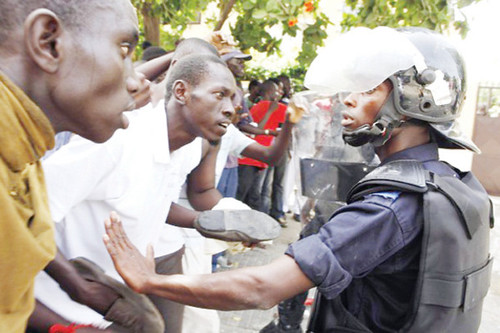
DAKAR: Senegal's President Abdoulaye Wade was roundly booed as he cast his ballot Sunday in an election which has sparked deadly protests over his bid for a third term.

The election is a stiff test for the west African nation whose reputation as a haven of stability has been marred by weeks of riots over 85-year-old Wade's candidacy that have claimed six lives.

The US State Department's Africa point man Johnnie Carson said the polls had been "orderly, peaceful and well managed," and that it was critical for the country that they went well.

Meanwhile Grammy-winning singer Youssou Ndour warned that the country would not accept an "electoral coup" by Wade.

The incumbent lost his temper after voting as he was greeted by a cacophony of boos, pushing one of his bodyguards out of the way as he beat a hasty retreat without speaking to the media.

Wade circumvented a two-term limit he himself worked into the constitution to run in the election, prompting the country's worst riots since independence.

He has dismissed the opposition protests as "temper tantrums."

"My majority is so overwhelming that I think I will be elected with a strong percentage in the first round," Wade said in an interview with the French newspaper Journal du Dimanche published Sunday.

He heaped derision on earlier calls from France and the United States that he retire, saying his former allies had criticised him because "I am not docile ... I am not a Negro service boy."

Despite the violence, long lines of voters waited patiently to cast their ballots, which European Union observer chief Thijs Berman described as heartening.

"I spoke to many Senegalese who are worried about the process, more worried than usual in Senegal," he said.

Many are concerned about further violence as results filter in beginning Tuesday, with a final result to be known by Friday.

Just days before the poll it emerged more than 450,000 voters cards had yet to be collected, and Berman said it was regrettable that so many of the country's 5.3 million registered voters would not cast their ballots.

The African Union's envoy, former Nigerian leader Olusegun Obasanjo, said he was pleased with the voting process by midday, saying he believed "we may have a peaceful and honest election."

Wade's election 12 years ago after leading the opposition for 25 years was met with euphoria, but his efforts to cling to power and line up his unpopular son Karim to succeed him have dented his popularity.

Growing frustration over high unemployment, rising food prices and crippling power cuts also have Senegalese hankering for a change.

However the election is cloaked in suspense as Wade takes on 13 opposition candidates, none of whom has emerged a frontrunner.

They include three former prime ministers, Macky Sall, Idrissa Seck and Moustapha Niasse, and Socialist Party leader Ousmane Tanor Dieng.

In a polling station in central Dakar, its walls brightly painted with cartoon characters, Cheikh Angai rooted for a Sall victory.

"He will win, no problem. He is a dignified and serious man. Wade is too old, he has done a good job but now he must leave," he said.

Amadou Ndiaye, 62, said he hoped for a change from Idrissa Seck, Wade's former protege and prime minister before a bitter falling-out.

"The president will try to steal the election, but still, one must vote. The old man must leave."

Wade argues that 2008 constitutional changes extending term lengths from five to seven years allow him to serve two more mandates.

A win would mean Wade would leave office aged 92 in a nation where the median age is 18. He is currently Africa's second oldest leader after Zimbabwe's Robert Mugabe, 88.

Wade's supporters praise him for overseeing a development boom, but he is accused of focusing on prestige projects and being out of touch with the needs of the people.

"Wade will be elected in the first round, I am sure and I wish for it," said a man in his 50s dressed in flowing blue robes.

Analysts say Wade needs to win in the first round while the opposition field is divided, as he would fare less well in a two-horse second round.

The former French colony of some 13 million people is one of the continent's pioneer democracies, boasting an unbroken series of elections since independence in 1960. Unlike many of its troubled neighbours it has never suffered a coup.

Afghanistan Protesters Attack U.S. Base

Afghan protesters attack U.S. base

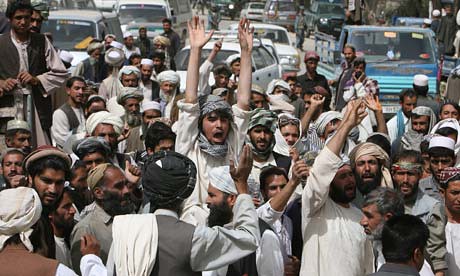
KABUL, Afghanistan (AP) - Protesters angry over Quran burnings by American troops lobbed grenades at a U.S. base in northern Afghanistan and clashed with police and troops in a day of violence that left seven international troops wounded and two Afghans dead.

The attacks were the latest in six days of violence across the country by Afghans furious at the way some Qurans at an American base outside of Kabul were disposed of in a burn pit. The incident has swiftly spiraled out of control leaving dozens of people dead, including four U.S. troops killed by their Afghan counterparts, in a sign of the tenuous nature of the relationship between Afghanistan and the U.S.

Afghan authorities have launched a manhunt across the country for a driver they suspect in the killing of two U.S. military advisers who were shot to death at an Afghan ministry a day earlier. International advisers working at Afghan ministries were recalled out of fears of another attack.

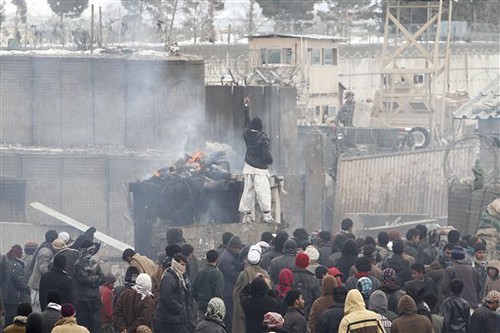
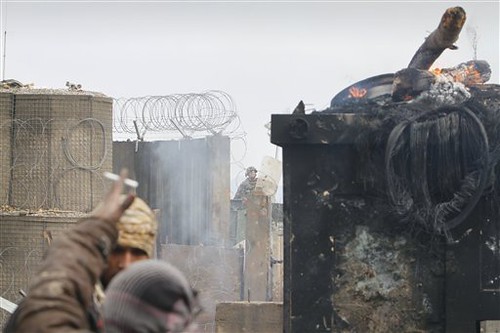
In Kunduz province, thousands of demonstrators started out protesting peacefully but then the group turned violent as they tried to enter the district's largest city, said Amanuddin Quriashi, district administrator. People in the crowd fired on police and threw grenades at a U.S. base on the city outskirts, he said.

Seven NATO troops were wounded and one of the protesters was killed when troops fired out from the U.S. base, Quriashi said. Another demonstrator was killed by Afghan police, he added. Provincial police spokesman Sarwar Hussaini confirmed the casualties.

A NATO spokesman said that an explosion occurred outside the base, but that the grenades did not breach its defenses.

"Initial reports indicate that there were no ISAF service member fatalities," said Navy Lt. Cmdr. Brian Badura, referring to NATO's International Security Assistance Force. He declined to comment on whether there were any wounded.

A NATO spokesman said that an explosion occurred outside the base, but that the grenades did not breach its defenses.

More than 30 people have been killed in clashes since it emerged Tuesday that copies of the Muslim holy book and other religious materials had been thrown into a fire pit used to burn garbage at Bagram Air Field, a large U.S. base north of Kabul.

The death toll from days of unrest includes four U.S. soldiers — two killed last week by an Afghan soldier, and two military advisers shot Saturday at the Interior Ministry.

NATO and the British government recalled their international advisers from Afghan ministries in the capital late Saturday after the two advisers — a lieutenant colonel and a major — were found dead in their office, shot in the back of the head. The names of the victims have not been released.

The main suspect in the shooting is an Afghan man who worked as a driver for an office on the same floor as the advisers' office, Interior Ministry spokesman Sediq Sediqi. He did not provide further details about the man or his possible motive.

Syria Referendum Goes Ahead Amid Military Onslaught

Syria referendum goes ahead amid military onslaught

12:27pm EST
By Alistair Lyon

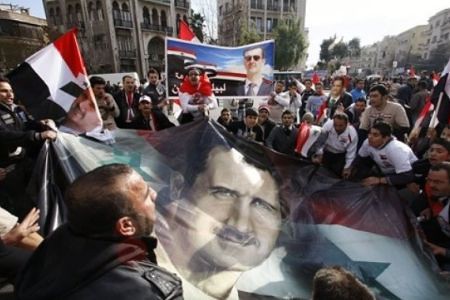
BEIRUT (Reuters) - At least 31 Syrian civilians and soldiers were killed on Sunday in bloodshed that coincided with a vote on a new constitution that could keep President Bashar al-Assad in power until 2028.

Assad's opponents see the referendum as a sick joke given Syria's turmoil. The Syrian Observatory for Human Rights said a military bombardment of opposition districts in Homs had killed nine civilians while rebels had killed four soldiers in clashes.

The British-based Observatory said eight civilians and 10 members of the security forces were killed in violence elsewhere in Syria, scene of what has become an increasingly militarized revolt against four decades of Assad family rule.

Voting took place in the referendum on a new constitution, which Assad says will lead to a multi-party parliamentary election in three months. The result is expected to be announced on Monday. Western powers described the vote as a sham.

"What should we be voting for, whether to die by bombardment or by bullets? This is the only choice we have," said Waleed Fares, an activist in the Khalidiyah district of Homs, where bombardment is now in its fourth week.

"We have been trapped in our houses for 23 days. We cannot go out, except into some alleys. Markets, schools and government buildings are closed, and there is very little movement on the streets because of snipers," he said.

He said another besieged and battered district, Baba Amro, had had no food or water for three days. "Homs in general has no electricity for 18 hours a day." Tight curbs on independent reporting in Syria make witness reports hard to verify.

The Interior Ministry acknowledged obliquely that security conditions had disrupted voting, saying: "The referendum on a new constitution is taking place in a normal way in most provinces so far, with a large turnout, except in some areas."

The Syrian government, backed by Russia, China and Iran, and undeterred by Western and Arab pressure to halt the carnage, says it is fighting foreign-backed "armed terrorist groups."

"NO DESIRE FOR REFORM"

Prime Minister Adel Safar, asked about opposition calls for a boycott, said this showed a lack of interest in dialogue.

"There are some groups that have a Western and foreign agenda and do not want reforms in Syria and want to divert Syria's steadfastness," he told reporters in Damascus.

"We are not concerned with this. We care about ... spreading democracy and freedom in the country," Safar said.

"If there was a genuine desire for reform, there would have been movement from all groups, especially the opposition, to start dialogue immediately with the government to achieve the reforms and implement them on the ground."

The outside world has been powerless to restrain Assad's drive to crush the 11-month-old revolt, which has the potential to slide into a sectarian conflict between Syria's Sunni Muslim majority and the president's minority Alawite sect.

Unwilling to intervene militarily and unable to get the U.N. Security Council to act in the teeth of Russian and Chinese opposition, Western powers have imposed their own sanctions on Syria and backed an Arab League call for Assad to step down.

U.S. Secretary of State Hillary Clinton warned on Sunday of the perils of any foreign intervention.

"I think there is every possibility of a civil war. Outside intervention would not prevent that, it would probably expedite it," she told BBC television in an interview.

"We have a very dangerous set of actors in the region: al Qaeda, Hamas and those who are on our terrorist list claiming to support the opposition. You have many Syrians more worried about what could come next ...

"If you bring in automatic weapons, which you can maybe smuggle across the border, what do they do against tanks and heavy artillery? There is such a much more complex set of factors."

Speaking in Rabat, Clinton later appealed to "those who are supporting the Syrian regime" to use their influence persuade Damascus to allow access for humanitarian assistance in areas affected by the violence.

German Foreign Minister Guido Westerwelle said Sunday's referendum was "nothing but a farce."

"Sham votes cannot contribute to a solution of the crisis. Assad needs to put an end to the violence and clear the way for a political transition," he said in a statement.

HARROWING CONDITIONS

The military onslaught on parts of Homs has created harrowing conditions for civilians, rebels and journalists.

A video posted by activists on YouTube showed Mohammad al-Mohammad, a doctor at a makeshift clinic in Baba Amro, holding a 15-year-old boy hit in the neck by shrapnel and spitting blood.

"It is late at night and Baba Amro is still being bombarded. We can do nothing for this boy," said the doctor, who has also been treating Western journalists wounded in the city.

American correspondent Marie Colvin and French photographer Remi Ochlik were killed in the bombardment of Homs last week and two other Western journalists were wounded. The group is still trapped there despite Red Cross efforts to extricate them.

The International Red Cross and Syrian Arab Red Cross could not get into Baba Amro on Sunday and were still negotiating with Syrian authorities and opposition, the ICRC said.

Syrian authorities had not responded to a request for a ceasefire to allow the wounded to be evacuated, it added, and conditions were worsening by the hour.

In Hama, another city with a bloody record of resistance to Baathist rule, one activist said nobody was taking part in the referendum. "We will not vote on a constitution drafted by our killer," he said by satellite telephone, asking not to be named.

If the constitution is approved in the vote, a foregone conclusion, it would drop an article making Assad's Baath party the leader of state and society, allow political pluralism and enact a presidential limit of two seven-year terms.

But the limit will not be enforced retrospectively, meaning that Assad, already in power for 11 years, could serve another two terms after his current one expires in 2014.

Dozens of people lined up to vote in two polling stations visited by a Reuters journalist in Damascus. "I've come to vote for President Bashar, God protect him and give him victory over his enemies," said Samah Turkmani, in his 50s.

Another voter, Majed Elias, said: "This is a national duty, whether I agree or not, I have to come and vote."

This is Syria's third referendum since Assad inherited power from his late father. The first installed him as president in 2000 with an official 97.29 percent 'Yes' vote. The second renewed his term seven years later with 97.62 percent in favor.

(Additional reporting by Khaled Yacoub Oweis in Amman, Mariam Karouny, Erika Solomon and Dominic Evans in Beirut, Christian Ruettger in Berlin and Arshad Mohammed in Rabat; Editing by Maria Golovnina)

Nelson Mandela Discharged After Minor Diagnostic Surgery

Nelson Mandela discharged from hospital after minor diagnostic surgery

February 26, 2012 | 8:40 am
REPORTING FROM JOHANNESBURG, SOUTH AFRICA

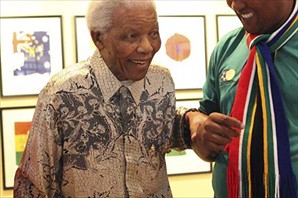
South Africans heaved a sigh of relief Sunday as former president Nelson Mandela was discharged from a hospital in good health after a laparoscopy, a surgical procedure in which a camera is inserted into the body to check abdomen or pelvis problems.

South African President Jacob Zuma said in a statement that Mandela was sent home after the procedure revealed no serious health problems. Mandela had spent the night in the hospital.

South Africa holds its breath whenever its iconic 93-year-old former president -- the nation's first black leader -- has any health issue. Rumors swirled last year when he was admitted to a hospital.

South African officials did not detail the reasons for the laparoscopy other than to say it was a related to a long-standing abdominal condition that caused Mandela some discomfort.

Defense Minister Lindiwe Sisulu said Mandela was as "fine as he can be at his age."

Mandela, who launched the African National Congress underground military campaign against apartheid in the 1960s, spent 27 years in jail for treason. After he was freed, he was elected as president in 1994, in the nation's first democratic elections.

Although he remains an enormously important symbol of freedom for South Africans and inspires people around the world, Mandela has not played an active political role for many years.

Saturday, February 25, 2012

Abayomi Azikiwe, PANW Editor, Interviewed on RT: SNC 'Halfway to Recognition' by Friends of Syria

SNC ‘halfway to recognition’ by Friends of Syria

Published: 25 February, 2012, 03:56
Edited: 25 February, 2012, 19:01
RT Television News

To Watch the RT Interview With Abayomi Azikiwe Just Click on the URL Below:
http://rt.com/news/syria-friends-opposition-recognition-191/

The Friends of Syria meeting in Tunisia has gone halfway to recognizing the Syria’s opposition umbrella group the National Council as legitimate representatives of the Syrian people. And promised more pressure and sanctions on the existing regime.

The Syrian National Council (SNC) was recognized as a legitimate representative of the Syrian people, although not the sole representative.

Other representatives of increasingly fragmented Syrian opposition groups were invited, including the Damascus-based National Coordination Committee. The NCC boycotted the meeting because it would not rule out the idea of military intervention.

But the Tunisian foreign minister, who chaired the conference, promised Western and Arab powers will probably fully recognize the Syrian National Council during the next meeting of the Friends of Syria group in Turkey.

"We have gone half the way and we will probably do the other half in Turkey,"stressed Rafik Abdessalem.

The conference called for an immediate end to violence and promised more sanctions on the regime of President Assad. It urged t'o allow free and unimpeded access by the UN and humanitarian agencies,” a final declaration issued by the group said.

However the meeting’s final document did not recommend military intervention or arming the rebels, both of which actions were called for by the Syrian opposition and some other countries.

The SNC has called on the international community to arm the rebels.

"The Friends of Syria should not constrain individual countries from aiding the Syrian opposition by means of military advisers, training and provision of arms to defend themselves,"the group said in a seven-point statement of demands.

But many Arab states which traditionally have had friendly ties with President Bashar Assad’s administration feel that further militarizing the crisis would tip Syria into a dangerous sectarian quagmire that could destabilize the whole region.

This left the Syrian opposition disappointed with its chief, Burhan Ghalioun, saying"This conference does not meet the aspirations of the Syrian people,"Reuters reports.

The Saudi foreign minister went further than others during the meeting by calling it"an excellent idea" for weapons and ammunition to be sent to the opposition, including the Free Syrian Army.

Meanwhile, Qatari Foreign Minister Sheikh Hamad bin Jassim Al-Thani called for intervention.

"There is a need to create an Arab force and open humanitarian corridors to provide security to the Syrian people,"he said.

The Friends of Syria also committed to ratchet up sanctions on Syria. These would include travel bans on senior Syrian officials, freezing their assets, boycotting Syrian oil, suspending investments and preventing arms supplies to the government.

France added that the European Union would on Monday freeze assets of Syria's national bank held in EU jurisdictions while US Secretary of State Hillary Clinton vowed that already tough US penalties would be strengthened.

Following the meeting, Clinton slammed Russia and China for their opposition to UN Security Council action on Syria, calling it“despicable.”

Russia and China boycotted the Friends of Syria conference saying it was biased in favor of regime change in Syria. Moscow and Beijing insist that pressure should be also put on the armed opposition.

Meanwhile, US President Barack Obama issued his most forceful comment to date on the Syrian crisis saying the US and its allies would use“every tool available”to end the violence. "We're going to continue to keep the pressure up and look for every tool available to prevent the slaughter of innocents in Syria,"he told reporters at the White House.

­‘Only political solution will resolve Syrian crisis’ – UN chief
­The UN chief underlined that only a political solution will solve the crisis in the country.

“The crisis in Syria did not start with calls for regime change,” UN head Ban Ki-moon pointed out. “People wanted reform and an end to oppression, exclusion and marginalization.”

Ban addressed the conference held in the Tunisian capital in a message delivered by Lynn Pascoe, the under secretary general for political affairs on Friday.

“It is essential to avoid further militarization and a descent towards sectarian strife,” he said.

Ban Ki-moon also stressed that the UN’s guiding principles are non-violence, national ownership, democracy, respect for human rights, accountability, impartiality and the independence of humanitarian assistance.“I expect the international community to act in a coherent and consistent manner to facilitate a peaceful resolution of the crisis.”

­The conference in Tunis was not legitimate as the Syrian government was not involved, Abayomi Azikiwe, editor of the Pan-African News Wire, told RT. “They are not interested in a peace settlement; they are mainly interested in regime change in Syria.”

Azikiwe also believes that the US and the UK are behind Saudi Arabia’s stance on arming the rebels. “The United States and Britain actually want the government in Syria overthrown as a precursory for further aggressive and hostile actions against the Islamic Republic of Iran.”

U.S. Officers Killed in Afghan Interior Ministry

U.S. officers killed in Afghan Interior Ministry

10:38am EST
By Hamid Shalizi

KABUL (Reuters) - Two Americans believed to be a U.S. colonel and major were shot dead in Afghanistan's interior ministry on Saturday, security sources said, while rage gripped the country for a fifth day over the burning of the Muslim holy book at a NATO base.

A spokeswoman for NATO's International Security Assistance Force (ISAF) confirmed two of their servicemen had been shot dead in central Kabul by an individual who turned his weapon on them. She declined to say if the killer was a member of the Afghan military or police.

Afghanistan's Taliban movement claimed responsibility for the shootings, which it said were in retaliation for the desecration of the Korans at Bagram airfield.

Taliban spokesman Zabihullah Mujahid said in an e-mailed statement to the media that four high-ranking Americans had been killed, though the Islamist group often exaggerate and inflate claims of casualties.

The Koran burnings underscored the deep cultural divide that still exists more than 10 years after U.S. troops invaded to oust the Taliban and has deepened public mistrust of Western troops struggling to stabilize the country.

An Afghan security source said the shooting of the two Americans in the Interior Ministry could be connected to the burning of the Korans.

DESECRATION

Muslims consider the Koran to be the literal word of God and treat each copy with deep reverence. Desecration is considered one of the worst forms of blasphemy.

Four Afghans were shot dead by Afghan security forces as demonstrators came out to the streets on Saturday, with an attempt by protesters to bombard a U.N. compound in the north.

Despite an apology from U.S. President Barack Obama and a call for restraint from Afghan leader Hamid Karzai, thousands have taken to the streets. Twelve people were killed and dozens wounded on Friday, the bloodiest day yet in demonstrations.

On Thursday, an Afghan national army soldier joined the protests and gunned down two American soldiers.

Hundreds of people tried to overrun a compound in the northern Kunduz province housing workers from the U.N. Assistance Mission in Afghanistan (UNAMA), but were held back by police, Interior Ministry spokesman Sediq Sediqqi said.

A similar incident occurred in April last year when protesters angry over the burning of Korans by an obscure pastor in the United States stormed a U.N. compound in northern Balkh province, killing seven.

The protests could dent plans for a strategic pact that Washington is considering with Kabul, which would allow a sharply reduced number of Western troops to stay in the country, well beyond their combat exit deadline.

(Additional reporting by Mirwais Harooni, Writing by Amie Ferris-Rotman; Editing by Michael Georgy and Sophie Hares)

Decision on Emergency Management for Detroit Delayed for One Month

Decision on a Detroit emergency manager delayed a month

February 25, 2012
Detroit Free Press

The determination of Detroit's fiscal future and whether an emergency manager will be appointed will be delayed at least one month while city officials scramble to implement a financial rescue plan and avoid insolvency.

Still, the extra time does little to help the city's cash-flow crisis. In the latest city-generated cash-flow forecast, Detroit is projected to have a general fund budget shortfall of $9.5 million by May. It was previously projected that the city would run out of money in April.

As first reported on freep.com, Terry Stanton, a state Treasury spokesman, confirmed that a one-month extension has been granted to a state-appointed financial review team whose task it is to recommend whether an emergency manager should take over Detroit's budget.

"The state's financial review team is working through their process, but today's extension doesn't affect the city's efforts to continue to implement our financial restructuring plan," Chris Brown, Mayor Dave Bing's chief operating officer, said Friday in a statement.

An Ernst & Young cash-flow report last year showed that the city would run out of money by April, with a negative balance of $3.9 billion. But a city-generated report shows a $76-million balance in the general fund as of Jan. 27 and a projected balance of $2.5 million in April.

May is when the shortage of cash becomes critical, and the statement projects that the city will end its fiscal year with a $46.8-million deficit. The projections do not include the impact of renegotiated union contracts or employee layoffs.

Monday was the deadline for the 10-person team that is examining the city's budget to make recommendations to state Treasurer Andy Dillon and Gov. Rick Snyder as to whether an emergency manager is necessary, whether a consent agreement with Bing and the City Council should be instituted, or whether a one-month extension should be granted.

The extension could have been granted, in part, because members of the team halted their meetings after an Ingham County judge found earlier this month that the review team's private meetings violated the state's Open Meetings Act.

Bing's administration has been negotiating with the city's 48 labor unions, and has landed tentative agreements with most of them. But the contracts have not been ratified, and there is question whether the savings are enough to stave off financial collapse.

Bing has presented a plan that he says would achieve saving of $102 million by June 30, the end of the fiscal year, through renegotiated contracts, 1,000 layoffs and streamlined operations.

But a memo written by fiscal analyst Irvin Corley Jr. to the council and obtained by the Free Press questions whether the tentative agreements are too little, too late.

"A major concern here is that the tentative agreements have not been implemented, so they have not had an effect on cash flow at this point, and April is only one and a half months away," Corley wrote.

Corley wrote that, according to council calculations, it appears that only $31 million of the $102-million savings Bing had hoped to achieve would materialize by June. 30.

More Details: Highland Park schools to remain open

Gov. Rick Snyder signed legislation Friday aimed at keeping the financially strapped Highland Park school district's buildings open for the rest of the academic year. The law lets Highland Park students stay in their district or move to another that accepts them, with $4,000-per-student stipends that can follow them.

Officials said they expected the district wouldn't be able to meet Friday's payroll, though classes were held. The state hasn't given the district a cash advance, as it did in January and earlier this month.

Jack Martin, a state-appointed emergency manager, was temporarily sidelined because of a court order that determined a state review team whose recommendations led to his appointment had violated the state's Open Meetings Act.

The review team met publicly Wednesday, again recommending the appointment of an emergency manager. But by state law, it appears Snyder can't reappoint Martin until next week.

Another Person Killed in Fifth Day of Afghanistan Anti-US Demonstrations

One killed in fifth day of Afghanistan protests

KABUL | Sat Feb 25, 2012 2:49am EST

KABUL (Reuters) - One person was shot dead by Afghan security forces on Saturday as protests over the burnings of the Muslim holy book at a NATO base raged for a fifth day, provincial officials said.

The shooting took place in Logar province south of Kabul after hundreds of angry protesters clashed with security forces. Two people were wounded.

Protests erupted in several other provinces on Saturday. Security forces remained on high alert.

Twelve people were killed on Friday and dozens wounded in the bloodiest day yet in demonstrations over the burning of the Korans at Bagram airbase.

The Koran burnings underscore the deep cultural divide that still exists more than 10 years after U.S. troops invaded to oust the Taliban and have deepened public mistrust of the West.

They could also hurt efforts to pacify the country before NATO combat troops leave in 2014.

Muslims consider the Koran to be the literal word of God and treat each copy with deep reverence. Desecration is considered one of the worst forms of blasphemy.

(Reporting by Hamid Shalizi, editing by Michael Georgy and Ron Popeski)

Nigerian Navy Provides 10 Gun Boats, Police Deploys 9,000 Personnel

Navy provides 10 gun boats, Police deploys 9,000 personnel

On February 25, 2012 · In News 7:00 am..
By Johnbosco Agbakwuru

To ensure a hitch free governorship election today in Cross River State, the Eastern Naval Command has deployed 10 gun boats in the riverine areas to provide security as well as carry the electoral materials to the polling units.

According to the Commanding Officer, NNS Victory, Calabar, Navy Commodore Kingdom Itoko, the Navy is on the background and on standby waiting for calls from the Nigeria Police so as to provide all the necessary security at the water ways.

Commodore Itoko said the Navy decided to deploy the gun boats to provide security so as to frustrate any attempt by any group or political parties to rig elections in the sea.

Already, about 9000 police personnel will be on the field to give adequate security at the various polling units in the state.

The State Commissioner of Police, Mr. Samson Wudah, who disclosed this in Calabar, also warned individuals and supporters of political parties to stop putting posters of their candidates in their registration numbers.

Wudah said the State Police Command provides 7, 469 personnel while the 1,531 personnel come from the Mobile Units from other contingencies like Benue, Ebonyi and Akwa Ibom states.

“We are expecting some mobile police force from contingencies in the neighbouring states. So all of them put together will be 9,000 personnel,” he said.

He advised the supporters of political parties to refrain from covering their registration numbers with posters of their candidates, saying that doing that would amount to going contrary to the law.

Wudah advised the youths not to allow themselves to be used by selfish politicians as political thugs during the election, adding that any body caught would face the law.

He urged politicians in the state to play the game according to the rules by cautioning their followers to be law abiding during the election.

He also appealed to the Acting Inspector General of Police, Mr Abubakar Muhammed to provide vehicles and helicopters during the elections to convey electoral materials to riverine areas in the state.

Total Begin Production From Usan Oilfield in Nigeria

Total Begins Production from Usan Oilfield

25 Feb 2012
By Chika Amanze-Nwachuku
Nigeria ThisDay

Total Upstream in Nigeria has commenced production from its 180,000 barrels per day (bpd) Usan oil field. Usan, the second deep offshore development operated by Total in Nigeria is coming on stream less than three years after Akpo.

Nigeria currently produces about 2.5mbpd of crude. The start-off of production from the Usan oilfield would boost Nigeria’s daily output to 2.68mbpd, Petroleum Minister, Mrs. Diezani Alison-Madueke had disclosed on Tuesday at the just-concluded Nigeria Oil and Gas Conference in Abuja.

In February 2008, Total was given approval from the Nigerian Government to begin the development of its offshore Usan field. Discovered in 2002, the Usan field lies around 100 kilometres off the South East Nigerian coast in water depths ranging from 750 to 850 meters. The Usan development comprises a spread moored Floating Production, Storage and Offloading (FPSO) vessel designed to process 180 000 barrels per day and with a crude storage capacity of 2 million barrels. Development involves 42 wells that are connected to the FPSO by a 70 kilometre-long subsea network. Proven and probable reserves of Usan were put at in excess of 500 million barrels of oil.

Suspected Boko Haram Gunmen Attack Muslim Worshippers in Kano

Suspected Boko Haram Gunmen Attack Muslim Worshippers In Kano .

Saturday, 25 February 2012 00:00 From Adamu Abuh, Kano News
Nigerian Guardian

UNCONFIRMED number of persons were feared dead yesterday when gunmen suspected to be Boko Haram members opened fire on Muslim worshippers in the Sheka area of Kano metropolis.

The state Police command spokesman, Mr. Magaji Majia, a Superintendent of Police (SP), while confirming the incident, promised to give details later.

It was also gathered that the attack might have been targeted at some Boko Haram members who have renounced their membership.

As at press time, information still remained sketchy, as security agents tried to bring the situation under control.

Commissioner for Information, Youth Sport, Culture and Internal Affairs, Dr. Farouk Umar Jibril, told The Guardian that the incident happened around 6.30 pm at a mosque in the city as worshippers were saying their prayers.

He added that it was not yet clear who was responsible for the attack at the time of filing this report.

Meanwhile, persons suspected to be sect members were arrested in Kano yesterday by security agents.

Kano has been the target of Boko Haram attacks in the last one month.

Darfur Rebels Claim 12 Troops Killed in Clash With Sudan Army

Darfur rebels claim 12 troops killed in clash with army

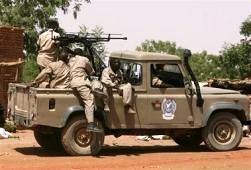
KHARTOUM: Rebels in Sudan’s Darfur region have clashed with government forces, both sides said, with the rebels claiming to kill a dozen government soldiers and Khartoum accusing its opponents of targeting civilians.

Mostly African insurgents in Darfur took up arms against the Arab-dominated government in 2003, accusing authorities of neglecting the remote territory.

Khartoum mobilized troops and allied Arab tribes to quell the rebellion, unleashing a wave of violence that the United Nations and other observers estimate may have killed hundreds of thousands of people.

International efforts to broker an end to the conflict have failed to produce lasting peace, hampered by rebel divisions, continuing military operations and other difficulties.

One of the region’s main rebel groups, a faction of the Sudan Liberation Army led by Minni Minnawi, attacked Alawna, an area south of the North Darfur state capital Al-Fasher, Wednesday evening, SLA spokesman Adam Salih said.

The insurgents killed 12 government soldiers including a regional commander and captured weapons such as mortars, rocket-propelled grenades and Kalashnikov rifles, he said.

“The [government] force was completely defeated, and its remnants were scattered toward Al-Fasher,” Salih said.

Sudan’s state media reported that fighting had broken out in Alawna Wednesday, but said the rebels had killed six civilians and wounded four.

State news agency SUNA quoted a military official from the region as accusing the rebels of burning homes and “terrorizing innocent, unarmed civilians.” The report did not mention any government casualties.

The rebels denied targeting civilians in the attack.

Violence in Darfur, where the United Nations and the African Union maintain a huge joint peacekeeping operation, has subsided since its peak in 2003 and 2004, but rebel and tribal fighting and banditry has continued to plague the territory.

Some 300,000 people may have died in the conflict, the United Nations has estimated.

The International Criminal Court has indicted Sudan’s President Omar al-Bashir and for war crimes in the region.

Khartoum has put the death toll at 10,000 and dismissed the court’s charges as politically motivated and baseless.

Haiti Prime Minister Resigns After Four Months

Haiti's prime minister resigns after four months

Fri, Feb 24 2012
By Joseph Guyler Delva

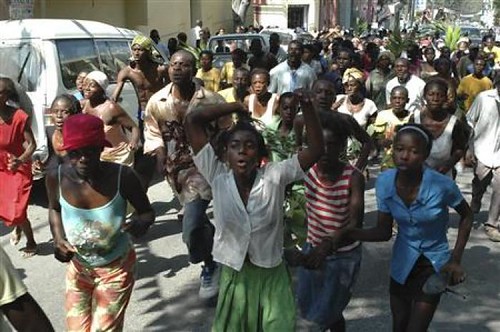
PORT-AU-PRINCE (Reuters) - Haitian Prime Minister Garry Conille resigned on Friday after just four months in office, plunging the country into political paralysis in the midst of rebuilding efforts two years after a devastating earthquake.

Conille submitted his resignation in a letter to President Michel Martelly, according to a statement by the president's office. There was no immediate word on a possible replacement.

Conille's decision to step down came during political infighting between the two leaders over earthquake reconstruction contracts, as well as a parliamentary investigation into dual citizenship of government ministers, which is illegal under Haitian law.

Conille, a 45-year-old medical doctor and U.N. development expert, was popular with foreign aid donors and many members of the international community involved in Haiti's reconstruction efforts after a January 2010 earthquake shattered the country, killing more than 200,000 people.

He previously served as chief of staff of the U.N. Office of the Special Envoy to Haiti, led by former President Bill Clinton.

In a brief nationally televised address, Martelly said he had spoken with parliamentary leaders and "we committed to meeting soon to propose a new prime minister."

The U.S. Embassy in Haiti issued a statement calling for the "swift" appointment of a successor to ensure political stability, while expressing "regret" over Conille's departure.

Political tensions between Martelly and Conille erupted recently after Conille announced plans to audit $300 million in contracts awarded by his predecessor after the earthquake.

Conille and members of his Cabinet were also under pressure to cooperate with a parliamentary commission investigating the nationalities of members of the government.

Conille and some of his aides have held jobs and lived for extended periods outside Haiti.

Critics say Conille also alienated parliament and the president, including members of his own Cabinet, by some of his actions.

"It didn't work from day one," said Alice Blanchet, a special adviser to five former prime ministers, including Conille's predecessor, Jean-Max Bellerive.

POLITICAL SHOWDOWN?

She described Conille's questioning of the earthquake reconstruction contracts as "petty and unpatriotic," noting that no irregularities had been identified by the international community. "That was offensive to parliament and to the president," she said.

The resignation could set the stage for another political showdown between Martelly, who took office in May 2011, and lawmakers in parliament, where he does not hold a majority.

Conille's appointment as prime minister in October came after a five-month delay during which Martelly's first two nominees were rejected, impeding his ability to assemble a government to move ahead with reconstruction efforts.

"It's so frustrating. It reflects once again the willingness of political figures in Haiti to let policy differences reach the point of total polarization and stalemate," said Mark Schneider, vice president at the International Crisis Group, a Washington-based think tank that monitors Haiti closely.

"We are now embarked on another unknown journey of unknown length to try and find another prime minister," he added, noting how long it took Martelly last year to find a candidate acceptable to parliament.

"These things in Haiti are so destructive," he said. "For a country that is barely keeping it's head above water, this is like picking up another rock that pulls you further down to the bottom."

Two years after the quake, more than a half a million people are still living in tent camps in the capital, Port-au-Prince, and piles of concrete, steel and debris litter the streets.

During a recent visit to Haiti, U.S. Ambassador to the United Nations Susan Rice called on the country's political leaders to stop bickering.

"Haiti's executive and legislative branches," Rice said, "need to rise above their interests and work together in the spirit of compromise and overcome their common challenges."

Her words were echoed on Thursday by Mariano Fernandez, head of the U.N. peacekeeping mission in Haiti.

Fernandez issued a statement expressing concern that "the political deadlock and institutional paralysis between the government, parliament and the president ... are not likely to create the necessary conditions for recovery of the economy and the consolidation of democracy."

(Additional reporting by David Adams in Miami; Writing by Kevin Gray; Editing by Peter Cooney)

Friday, February 24, 2012

European Banking Crisis Causes Cash Problem

ECB May Allot 470 Billion Euros in 3-Year Crisis Loans: Economy

Matthew Brockett and Jeff Black, ©2012 Bloomberg News
Friday, February 24, 2012

Feb. 24 (Bloomberg) -- Euro-area banks may tap the European Central Bank next week for almost as much three-year cash as they did in December in an operation that could prolong a rally in bond markets.

Financial institutions will ask the ECB for 470 billion euros ($629 billion) in three-year funds for allotment on Feb. 29, the median of 28 estimates in a Bloomberg News survey shows. While that's less than the record 489 billion euro take-up at the first tender on Dec. 21, it may increase total cash in the system by more than 300 billion euros, said Luca Cazzulani, a senior fixed-income strategist at UniCredit SpA in Milan.

"Part of the increase will likely be parked, at least temporarily, in the sovereign-bond market and support mainly the performance of Italian and Spanish bonds," said Cazzulani. Still, "expectations are at a pretty high level, which creates some room for disappointment," he said. "Gross demand below 400 billion euros would likely put upward pressure on spreads in the short term."

Italian and Spanish bonds have risen since the ECB's first three-year loan, suggesting banks are investing at least some of the money in higher yielding assets. That's helped ease concern about a credit crunch and won governments time to agree on measures to contain the sovereign debt crisis.

'Lose-Lose' Air

The yield on Spain's two-year bond has dropped to 2.62 percent from 3.88 percent since Dec. 21 and the rate on a similar Italian bond has fallen to 2.87 percent from 5.14 percent. The extra yield investors demand to hold two-year Italian notes over German debt has fallen to 263 basis points from 492 points on Dec 22. That spread was 720 points on Nov. 25, a euro-era high.

The risk is that banks become too reliant on ECB money and fail to take the steps needed to strengthen their balance sheets.

"There is a 'lose-lose' air around the ECB's auction next week," said Simon Smith, chief economist at foreign-exchange broker FXPro Group Ltd. in London. "If take-up is low then markets are likely to be disappointed. If take-up is high, then although this may give markets a boost, the bigger picture is of markets becoming increasingly reliant on the ever-expanding good nature of central banks. All well and good, but the routes to the exit are that much longer as a result."

The three-year funds cost the average of the ECB's benchmark interest rate, currently at a record-low 1 percent, over the period of the loans and banks have the option of repaying them after a year. Forecasts in the Bloomberg survey range from 300 billion euros to 750 billion euros. No further three-year operations are currently scheduled beyond next week.

Stronger Euro

The euro strengthened against the dollar today, rising above $1.34 for the first time since Dec. 9. The 17-nation common currency gained 0.3 percent to $1.3409 at 12:31 p.m. in Brussels. The Stoxx Europe 600 Index was up 0.3 percent to 264.93.

With the economy set to recover "gradually" this year, there are no signs of downside inflation risks that might justify cutting rates to zero, Executive Board member Benoit Coeure said in a speech published by the ECB today.

In Asia, Vietnam is making headway against the region's fastest inflation as prices rise the least in 11 months, giving the central bank scope to lower rates. Consumer prices climbed 16.44 percent in February from a year earlier, the General Statistics Office said in Hanoi today.

U.S. Recovery

In the U.S., purchases of new homes probably rose in January to a nine-month high, more evidence the housing market is improving, economists said before a report today.

The ECB's second offering of three-year loans is intended to relieve liquidity strains in the region as officials work to contain fallout from the debt crisis. The central bank has increased the pool of collateral that banks can use to obtain the loans.

Before the December operation, the ECB reduced the rating threshold for certain asset-backed securities. This month, it said seven of the 17 national central banks in the euro area will also accept credit claims, a move that ECB President Mario Draghi estimates will increase the collateral pool by another 200 billion euros. The aim is to give small and medium-sized banks greater access to ECB cash.

While the overall amount allotted next week may be lower than in the first operation, new borrowing should be higher, said Christel Aranda-Hassel, director of European economics at Credit Suisse in London.

New Money

That's because banks are likely to roll only about 100 billion euros of existing ECB loans into the three-year facility, with the remainder representing new cash.

In the December operation, about 296 billion euros of the 489 billion-euro total was accounted for by old loans, meaning about 193 billion euros was new money, according to Barclays Capital.

The size of the loans prompted German ECB council member Jens Weidmann to warn that the central bank mustn't "lose sight of its mandate" to control inflation by taking on "excessive risks."

Those concerns are likely to see the ECB wind down its long-term lending after the second three-year operation, said Deutsche Bank chief economist Thomas Mayer.

ECB council member Ewald Nowotny said today officials will "wait to see the effects" of the loans. "I personally don't see any further need for action," he said.

--With assistance from Shobhana Chandra in Washington, Jason Folkmanis in Ho Chi Minh City, Kristian Siedenburg in Vienna, Michael Shanahan, Anchalee Worrachate, Emma Charlton, David Goodman, Edward Evans, Lucy Meakin and Keith Jenkins in London, and Lukanyo Mnyanda in Edinburgh. Editors: Patrick G. Henry, Craig Stirling

To contact the reporters on this story: Matthew Brockett in Frankfurt at mbrockett1@bloomberg.net; Jeff Black in Frankfurt at jblack25@bloomberg.net

To contact the editor responsible for this story: Craig Stirling at cstirling1@bloomberg.net

http://sfgate.com/cgi-bin/article.cgi?f=/g/a/2012/02/24/bloomberg_articlesLZW23L07SXKX01-LZWCI.DTL


Europe’s banks bleed from Greek crisis

Reuters
Friday, February 24, 2012 03:55:35 PM

LONDON/PARIS — Greece’s debt problems drove a slew of heavy losses across the European banking sector on Thursday, and bosses warned the eurozone crisis would continue to threaten earnings.

From France to Germany, Britain to Belgium, some of the region’s biggest banks lined up to reveal billions of euros lost through writedowns on Greek loans.

“We are in the worst economic crisis since 1929,” Credit Agricole chief executive Jean-Paul Chifflet said.

Credit Agricole reported a record quarterly net loss of €3.07 billion ($4.06 billion), performing worse than expected from the cost of shrinking its balance sheet and after a €220 million charge on its Greek debt.

Britain’s Royal Bank of Scotland has marked its Greek bonds at a 79 per cent loss — or £1.1 billion — for 2011. The state-owned bank posted a fourth quarter loss of nearly £2 billion on Thursday.

Problems in Europe’s banking sector are far wider than Greece, however. Germany’s Commerzbank, whose fourth-quarter earnings were spoiled by a €700 million hit on Greek sovereign debt, needs to find €5.3 billion to meet the stringent new capital requirements set by Europe’s banking regulator. It has now lost more than €2 billion on its Greek bonds.

Commerzbank said it could reduce some of its shortfall by shedding risky assets, though the debt crisis still had the potential to disrupt earnings.

Bailed out Franco-Belgian bank Dexia warned on Thursday it risked going out of business. It suffered a 2011 net loss of €11.6 billion, hit by its break-up and exposure to Greek debt and other toxic assets such as US mortgage-backed securities.

Dexia booked a €3.4 billion loss on its holding of Greek sovereign bonds. French investment bank Natixis reported a milder-than-expected 32 per cent decline in quarterly profits. Despite the weak results, banks still found room for bonuses.


Delinquent Property Loans at European Banks Total $1 Trillion

February 24, 2012, 11:17 AM EST
By Simon Packard

Feb. 24 (Bloomberg) -- European banks hold about 750 billion euros ($1 trillion) of delinquent real-estate loans, putting them under pressure to sell assets, according to a study by the European Business School.

Divestments by the banks will create “attractive” opportunities for buyers of loans or properties, particularly residential and retail buildings outside of prime locations, the Oestrich-Winkel, Germany-based school said in a report presented at its annual property conference.

By 2014, the shortfall in debt funding for maturing loans will rise to 200 billion euros as banks reduce their property- loan books and shrink balance sheets to meet higher capital requirements, according to the study. Non-core lending, financing not connected to a bank’s main businesses, totaled 1 trillion euros, half of it by German institutions, it found. That adds to pressure to sell loans and assets.

“The problem will take years to solve, but the process is under way,” said Ralph Winter, chairman of Corestate Capital AG. The Zug, Switzerland-based real estate asset manager sponsored the study, which was compiled by the business school’s Real Estate Management Institute.

--Editors: Ross Larsen, Andrew Blackman.

To contact the reporter on this story: Simon Packard in London at packard@bloomberg.net

To contact the editor responsible for this story: Andrew Blackman at ablackman@bloomberg.net


EU Bid to Control Bank Capital Rules Said to Face Challenge

February 24, 2012, 11:15 AM EST
By Jim Brunsden

Feb. 24 (Bloomberg) -- At least four nations may challenge European Union plans to limit their power to regulate bank capital as governments seek a compromise on implementing global rules on the reserves lenders must hold to prevent a financial crisis, according to four people with knowledge of the matter.

Officials from the EU’s 27 member states are weighing whether to scrap a proposal from EU financial services chief Michel Barnier to make the European Commission responsible for deciding bank capital levels during market turmoil, said the people, who declined to be identified because the talks are private. Nations are also considering widening the range of assets lenders may use to meet liquidity rules, the people said.

Barnier has been criticized by the U.K. and Sweden for seeking to restrain national watchdogs’s freedom to impose tougher capital rules on national banks. Barnier has said that requirements for lenders should be set by the EU, with limited exceptions for national regulators to exceed them to ease credit booms.

The commissioner included the curbs in a draft law he presented last year to implement rules set by the Basel Committee on Banking Supervision. Chantal Hughes, Barnier’s spokeswoman, declined to immediately comment.

“A move towards more flexibility in the application of the rules is to be welcomed,” Richard Reid, research director for the International Centre for Financial Regulation, said in an e- mail. “Across the EU there is a considerable diversity in the size and structure of financial systems.”

Capital Surcharges

The Basel committee brings together regulators from 27 countries including the U.S., U.K. and China to set global rules for banks. The committee last year said it would seek to impose capital surcharges of as much as 2.5 percentage points on the largest lenders as part of its response to the crisis that followed the 2008 collapse of Lehman Brothers Holdings Inc.

Denmark, which holds the rotating presidency of the EU, is seeking a deal on the implementation of the Basel rules next month. It would then need to negotiate the final version of the measures with lawmakers in the European Parliament.

Barnier’s version would hand the European Commission power to set “stricter” capital rules for banks in cases where it’s necessary to address “risks which arise from market developments,” according to a copy of the document on the EU’s website. The rules would be temporary, although no expiry date is set out in the draft. The extra requirements could apply across the whole EU or in individual countries.

Raise Requirements

Nations are considering proposing changes to the law that would keep the power in the hands of their own regulators, the people said. Decisions to hike capital requirements may still be reviewed or coordinated at the EU level, they said.

“Forcing the whole EU into lockstep for the common good could lead to a suboptimal approach nationally,” Patrick Fell, a director at PricewaterhouseCoopers LLP in London, said in an e-mail. An approach based on local decisions “buttressed through coordinated EU review and disclosure” to the market, could be “more sustainable,” he said.

Adding powers to the draft law giving national regulators the ability to impose capital surcharges on banks with systemic importance is also being considered, the people said. On the liquidity rule, nations are considering amending a standard draft by the Basel committee that would require lenders to hold enough easy-to-sell assets to survive a 30-day credit squeeze.

Barnier’s proposal said regulators should assess which assets will count as highly liquid before 2015. Officials are considering calling on supervisors to test a wider range of securities than those set out by Basel, the people said. This list may include some equities, two of the people said.

Liquidity is a measure of the amount of cash and easily sellable assets banks have on hand to meet liabilities. A bank’s capital is a measure of the reserves it has to cover losses.

The debate about the liquidity requirements is “having to shift in recognition of the reality that there is a shortage in supply of suitable instruments for banks to use,” Reid said.

--Editors: Anthony Aarons, Keith Campbell

To contact the reporter on this story: Jim Brunsden in Brussels at jbrunsden@bloomberg.net

To contact the editor responsible for this story: Anthony Aarons at aaarons@bloomberg.net

Why the Capitalist System Cannot Fix Housing in the U.S.

Why the Federal Reserve can't fix housing

By Annalyn Censky @CNNMoney February 24, 2012: 12:51 PM ET

NEW YORK (CNNMoney) -- Housing is still one of the biggest drags on U.S. economic growth, but don't look to the Federal Reserve for help. The central bank may have few tools left to fix it.

That's the basic hypothesis of a paper top economists presented to a room full of monetary policy elites in Manhattan Friday.

The US. Monetary Policy Forum is a one-day meeting presented by the University of Chicago Booth School of Business. In attendance are Federal Reserve officials, members of foreign central banks and economists from some of the world's largest banks and top universities.

At Friday's meeting, these top thinkers focused heavily on weaknesses in the housing market, and the mood was not exactly upbeat.

Traditionally, the Fed could aid the housing market during tough times, by lowering its key interest rate and thereby lowering mortgage rates. But the Fed's interest rate is already near zero and mortgage rates are already at record lows -- and yet the housing market remains in a slump.

Could the Fed be out of bullets when it comes to this key part of the American economy?

Has Obama's housing policy failed?

Economists at Friday's meeting argued the Federal Reserve can still bring interest rates lower with unconventional moves like asset purchases -- called quantitative easing -- but such policies are now unlikely to have a meaningful impact on housing.

That's because homeowners who might qualify for refinancing at lower interest rates have likely already done so.

The overhang in the housing market "may not be easily addressed by monetary policy," said Michael Feroli, chief U.S. economist at JPMorgan Chase.

St. Louis Fed President James Bullard agreed that the housing market is largely out of the Fed's hands now.

"To the extent that you would have policies that are going to help the housing market, they're not going to come from monetary policy makers," Bullard said.

But San Francisco Fed President John Williams pointed out that by buying assets that target housing specifically -- like mortgage-backed securities -- he thinks the Fed's policies have already lowered rates and could still push mortgage rates down further.

Fed officials have recently become more outspoken about problems facing the housing market, and have seemed eager to shift the ball into fiscal policy's court -- the purview of Congress and the president.

In January, Fed Chairman Ben Bernanke ruffled feathers of some Republican lawmakers when he issued a white paper analyzing housing policies proposed by the Obama administration, including ideas to transition foreclosed properties into rentals and programs that would facilitate refinancing for underwater mortgages.

Feroli, along with Ethan Harris, co-head of economic research at Bank of America Merrill Lynch and others, endorsed those policies in their paper Friday.

First Published: February 24, 2012: 11:20 AM ET

Michigan: Don't Be Misled by the Declining Unemployment Figures

Michigan's incredible shrinking workforce

By Tami Luhby @CNNMoney
February 24, 2012: 5:36 AM ET

NEW YORK (CNNMoney) -- As the presidential race moves to Michigan for next week's primary, a lot of focus is on the state's economy -- one of the hardest-hit by the recession.

But things are changing in the Great Lakes State.

After leading the nation in unemployment for four years, Michigan has finally dropped out of the Top 10. State unemployment slid to 9.3% in December, only a touch higher than the national rate, and a sharp decline from the 14.1% rate that Michigan hit in the fall of 2009.

And last year was the first time the state added any jobs since the turn of the 21st Century.

Sounds great, huh? Well, hold the applause.

The main reason Michigan's unemployment rate is falling is because its labor force is shrinking fast, economists said. The state has lost 4.6% of its workforce since the recovery began in mid-2009, according to Donald Grimes, senior research specialist at the University of Michigan.

America's Jobs Crisis

And the state still has a long way to go before it regains the hundreds of thousands of jobs it lost over the past decade.

But let's start with the good news.

2011 was a rocking year for American automakers, the lifeblood of Michigan's economy. It was the first time since 2004 that all three major U.S. automakers were profitable at the same time. And it came only two years after two of them declared bankruptcy and had to be bailed out by the federal government.

That helped fuel the creation of 67,000 jobs in 2011, according to Bruce Weaver, economic analyst at the state Department of Technology, Management and Budget. Michigan gained 26,000 manufacturing jobs last year. It was the second best performing sector behind only professional and business services, which includes temp jobs and engineers and IT professionals who support the auto industry.

How to save U.S. manufacturing jobs
"After a horrendous decade, Michigan is walking in the right direction," said Charles Ballard, economics professor at Michigan State University.

Since the recession ended in mid-2009, some 94,200 jobs have been created. And the number of unemployed has fallen by 239,200. This has helped to bring the unemployment rate down to its lowest level since the fall of 2008.

In fact, Michigan's job growth outpaced the nation's in 2011.

The employment picture has improved so much that jobless residents are no longer eligible for the maximum 99 weeks of unemployment insurance. Those on the federal extended benefit program, which lasts up to 20 weeks, received their last unemployment check in mid-February.

Residents are also feeling more optimistic. Nearly half of those surveyed say the economy is starting to improve, while only 19% expect it to worsen, according to a recent poll conducted by the Detroit Free Press and WXYZ-TV. Those are the best numbers in years, according to the pollster.

Michigan is expected to keep adding jobs in coming years. The state should expand its payrolls by nearly 77,000 jobs by the end of 2012, according to a University of Michigan forecast.

One reason Michigan's unemployment rate is falling is because people are leaving the workforce in droves. Nearly 224,000 residents have dropped out since the recovery began, either because they have left the state, returned to school or are too discouraged to look.

While the ravaged state has definitely been losing residents, that's not the whole story. The population lost only 94,000 people over the past two years.

Another explanation could be the fact that Michigan has more Baby Boomers than other states. When older workers lose their jobs, it's harder for them to find new ones. So these folks might have left the workforce in favor of collecting disability or starting their retirement earlier than planned, Grimes said.

Also, Michigan entered the recession earlier than other states, so more jobless have likely exhausted their unemployment benefits. Since the unemployed have to be actively looking for work to collect benefits, it's not uncommon for discouraged people to stop searching when the checks stop coming.

The overall improvement in the unemployment rate has surprised state economists, most of whom expected the unemployment rate to remain relatively flat. But it's not something they are happy to see.

Unemployment: Where does your state rank?
A shrinking labor force can wreak havoc on the state's finances because it means less tax revenue coming in and could force more people to seek public assistance, including Medicaid and housing help.

"You want the unemployment rate to fall because people are getting jobs," he said.

And while the addition of 94,200 jobs is certainly a plus, it only puts a tiny dent in the overall job loss since 2000, which exceeds 850,000 positions, Grimes said.

"We're picking up some of those jobs, but we still have a long way to go," he said.

U.S., North Korea Talks See Little Progress

FEBRUARY 24, 2012, 12:19 P.M. ET

U.S., North Korea Talks See Little Progress

By BRIAN SPEGELE
Wall Street Journal

BEIJING—U.S. and North Korean officials completed negotiations in the Chinese capital on Friday with little visible progress toward bringing Pyongyang back to nuclear-disarmament talks, suggesting the North's stance hasn't changed despite new leadership.

Glyn T. Davies, the U.S. special representative for North Korean policy, said the countries also failed to reach concrete deals on food aid to the North or other issues. He added that he had detected few differences in negotiating tactics by Pyongyang's envoys under the new regime of Kim Jong Eun.

"There was nothing stylistically or substantively dramatically different in terms of how the North Koreans were presenting their positions," Mr. Davies said at a news conference following the talks. "I'm not saying that is a good thing or a bad thing. That is simply my impression from having dealt with them."

He declined to specify further what U.S. negotiators were able to glean about the new regime.

The meetings this week were the first formal chance for U.S. and North Korean envoys to meet following the death of former dictator Kim Jong Il late last year. The meetings on Friday between Mr. Davies and veteran North Korean envoy Kim Kye Gwan were an extension of negotiations that began Thursday and were unexpectedly extended into a second day.

"I think we made a little bit of progress," Mr. Davies said, adding that the new leadership's willingness to talk so soon after the transitions in and of itself is positive and demonstrates a degree of progress.

Analysts had previously said an agreement on resuming U.S. food aid to North Korea would be an indication that Kim Jong Eun had firmly consolidated political power and was willing to forge ahead on negotiating with Washington. The U.S. has pushed for more robust monitoring of food-aid distribution in North Korea, and it remains unclear which specific stumbling blocks are hampering a deal.

A food-aid plan would likely be the first step in tackling the relationship's tougher issues, including the North's nuclear-weapons ambitions, analysts say. Pyongyang previously has claimed the U.S. linked food-aid offers to its nuclear program. Washington denies the issues are linked. Many believed the countries were near to a food-aid deal shortly before Kim Jong Il's death.

In the first public statement made by Kim Jong Eun's regime toward Washington in January, Pyongyang slammed the amount of aid the U.S. was offering, as well as the conditions tied to it.

Mr. Davies will meet officials in Seoul and Tokyo over the weekend, in a chance to liaise with fellow participants of the stalled six-party negotiations. Russia, China, the U.S., both Koreas and Japan are members to the six-party talks.

North Korea has said for more than a year that it is ready to return to six-party negotiations, which it said in 2009 that it would boycott. The U.S., together with South Korea, has said the North must demonstrate concrete steps toward suspending its nuclear program before six-party talks can resume.

Write to Brian Spegele at brian.spegele@wsj.com