Thursday, July 30, 2020

Angola and OPEC Are a Strong Pillar of Market Stability
The OPEC-Angola discussions that took place last week is a major pillar of the strong dialogue and cooperation between OPEC and African producing nations.  The Chamber (EnergyChamber.org) welcomes these discussions and encourages more collaboration as Angola and others will benefit from market stability.

Such a dialogue is key for compliance with the OPEC global production cuts deal of April, to which all of OPEC’s African member countries have agreed to. Angola’s support to global market stability and energy cooperation is significant, and gives confidence to operators and future investors seeking to do business in Africa.

“In December 2018, OPEC Secretary General Mohammed Sanusi Barkindo made a historic visit to Angola and committed to working with its leadership to improve the industry and strengthen its relationship with OPEC. The OPEC-Africa dialogue has brought this relationship to a new level. African voices are heard and advocated for within the industry’s most influential institution, ensuring that the continent’s interests are represented,” stated NJ Ayuk, Executive Chairman at the African Energy Chamber.

“The Government of Angola, and the country’s Ministry of Mineral Resources and Petroleum have always been strong participants in the global energy dialogue between Africa and institutions such as OPEC. Angola has public officials committed to making energy work for Africans, and to fighting energy poverty in Angola. Such move makes our industry better for Africans and for investors,” declared Sergio Pugliese, President of the African Energy Chamber in Angola.

Under the leadership of His Excellency President João Lourenço and his Minister of Minister of Mineral Resources and Petroleum H.E. Diamantino Azevedo, Angola has embarked on a set of bold and market-driven reforms for over two years now. The country is becoming increasingly competitive for regional and international investors and has sent strong signals of its openness to investments, commitment to local content development and determination to fight corruption.

Distributed by APO Group on behalf of African Energy Chamber.
Angola: Covid-19 - Chinese Arrive in Angola to Set Up Laboratories
28 JULY 2020
Angola Press Agency (Luanda)

Luanda — The Health minister, Sílvia Lutucuta, Monday here announced the arrival of a team of Chinese technicians belonging to BGI company, responsible for the supply and assembly of laboratories in six provinces Angola.

The laboratories will be installed in the provinces of Luanda, Uíge, Lunda Norte and Huambo.

Each laboratory has the capacity to process 1000 analyses daily.

With the acquisition of these laboratories, the country will have high capacity laboratory equipment for testing Covid-19 and other viral diseases, the minister said.

Angola has six Covid-19 testing laboratories installed at the National Institute of Research and Health (INIS), Hospital Central Military, Hospital Esperança, National Institute for the Fight against AIDS, Clínica Girassol and Clínica Luanda Medical Center, all concentrated in the capital of the country, with capacity to process 600 samples/day.

Read the original article on ANGOP.

Wednesday, July 29, 2020

'The World Has No Idea What is Happening': Islamic Extremists Massacre, Behead in Mozambique Reign of Terror
07-29-2020
CBN
Andrea Morris

A village burned and attacked by Islamic extremists in Mozambique. (Image: APTN/Screenshot)
Islamic extremists have unleashed a reign of terror in northern Mozambique, Africa, leaving churches burned to the ground, people beheaded, and tens of thousands displaced and traumatized. 

Just last month there were reports that the militants beheaded 15 people in one week. And during this year's Holy Week, 52 young people who refused to join the Islamic terrorists were killed. 

Since 2017, more than 1,100 people have been killed in the attacks after extremists launched a violent campaign to persecute Christians and recruit young soldiers.

Nigerian Bishop Abducted by Gunmen, Christian Organization Urges Officials to Take Action
Bishop Luiz Fernando Lisboa of Mozambique's Pemba Diocese said the rest of the world looks upon this crisis with "indifference." 

"The world still has no idea what is happening, because of indifference, and because it seems that we have already become accustomed to wars. There is war in Iraq, there is war in Syria and there is also now a war in Mozambique," Lisboa said.

The extremists burned several Christian chapels and mosques as well, then destroyed religious statues.

"They attacked the church and burnt the benches and a statue of Our Lady, made of ebony," Lisboa added. "They also destroyed an image of the Sacred Heart of Jesus, to whom the parish is dedicated. Fortunately, they were unable to burn the building itself, only the benches.

The Catholic News Agency reports that Paulo Rangel, a Portuguese member of the European Parliament, said adolescent girls are being abducted and coerced into sexual slavery as well. The extremists target young boys too, forcing them to join their violent efforts or face death if they refuse.

"We know that the recruitment of boys and adolescents, some of them very young, aged 14, 15, 16, is also happening. It is obvious that these young boys are under coercion. If they refuse to join the group, they could be killed," Rangel added. 

The surge of people fleeing the area has steadily increased as the violence has risen. Nearly 250,000 people have been displaced - many of them fleeing to Pemba, the capital of Cabo Delgado province.

Lisboa said the villagers have experienced severe trauma from these violent acts and they must not be treated like just another number.

"We cannot treat people like numbers. They are people and behind every person, there's a story, there's trauma from this war," he said. "Either because they lost their home, or because they saw their families being killed or because some of their relatives are missing."

Bishop Lisboa said 2020 has been the worst year since the beginning of the armed attacks began three years ago.

"There are many traumas, many, so we cannot limit ourselves in providing food, that's very little. Food is important, food keeps you going, it feeds the body. But some people are broken, traumatized with everything they have lived through, so we see that psychological and social support is fundamental," he said.
 
Mozambique's armed forces are fighting back. They killed 50 Islamic extremists in May in an area where the fighters had launched 11 attacks.

Lisboa says there is "hope" that "the war will end", and that 2021 will be a better and more peaceful year.
Mozambique: Can Cabo Delgado’s Islamist Insurgency Be Stopped?
By Anne-Marie Bissada
Wednesday, 29 July 2020 17:55

Following the recent increase in armed violence in the Cabo Delgado province of Mozambique, several thousands were forced to flee to Pemba, seeking safety. The ICRC, CVM & IFRC have jointly organized a distribution of essential household items to help them rebuild their lives. (ICRC Southern Africa @ICRC_SAfrica)

“The world still has no idea what is happening because of indifference, and because it seems that we have already become accustomed to wars. There is war in Iraq, there is war in Syria and there is also now a war in Mozambique.”

In an interview with Club Mozambique, the bishop of Pemba, Luiz Fernando Lisboa, recounts the constant daily struggles in the regional capital of Cabo Delgado.

Outside of the province, many people have little idea of the growing violence taking place in Cabo Delgado in northern Mozambique that is affecting more than 700,000 people.

Growing insurgency

Northern Mozambique is known for its oil-rich land and also its growing fight against Islamist extremism.

The French oil giant Total recently noted that the insurgency will continue to wreak havoc on its planned liquified natural gas project in the province.

Since October 2017, 700 civilians have been killed in attacks, at times claimed by the Islamic State armed group or other militants hailing from Kenya and Tanzania who have joined a homegrown group called either Ahlu Sunna Wal Jama or Ansar al-Sunna (meaning ‘supporters of tradition’). That group is often called locally Al-Shabaab, but it has no practical connection to the Somali rebel organisation.

The Cabo Delgado violence erupted several years as companies discovered massive oil and gas deposits in the region.

In the first four months of 2020 alone, violent incidents in Cabo Delgado rose by 300% compared to the same period in 2019 estimates the Armed Conflict Location and Event Data Project (ACLED).

In July, “reports of insurgent violence…included five incidents across Macomia, Mocimboa de Praia and Ibo districts,” notes ACLED in a recent update.

The NGO MSF reported an armed attack in the early hours of 28 May in Macomia. Villagers fled into the bush and neighbouring villages to escape the attack, while the insurgents set fire to homes, shops, schools, religious and government buildings.

To date, the deadliest attack was in April, just as the coronavirus pandemic was making its way across Africa. Attackers killed 52 people in the village of Xitaxi. No group has yet to claim responsibility.

Who’s to blame for the instability?

What is not clear is if the groups are connected or are fighting each other and the inhabitants for control. In addition to a growing death toll, the militants have also:

Targeted security forces;
Destroyed public infrastructure;
And stolen weapons from Mozambican troops.
But why the insurgency?

A decade before the violence, there existed a religious sect, Al-Shabaab, which was active in a few districts of Cabo Delgado. As a religious group, it sought the practice of radical Islam and Sharia law, and opposed all forms of collaboration with the government. But over time, it began to expand, including military cells along with a tougher discourse as of late 2015, until its members started fighting in 2017.

To feed the movement, the rebels looked to the local Muslim population that has been marginalised and neglected for years by the government. Unemployment and poverty are widespread in the region.

Complete the form for your free download of The Africa Report’s 2019 Exclusive Ranking of Africa’s top 500 companies from last year. Get your free PDF by completing the following form.

Get information from Jeune Afrique Media Group: subscription deals, special offers…
By downloading this PDF you agree to subscribe to The Africa Report Daily newsletter
In turn, many young people in the region, who had few prospects, were lured by the armed militias. Even the colloquial name of the region, Cabo Esquecido, ‘Forgotten Cape’, hints at the region’s marginalisation since Mozambique’s independence in 1975.

David M Matsinhe, an Africa researcher at Amnesty International, wrote about how the government made an abrupt change from its noted absence in the past 40-odd years following the discovery of vast reserves of natural resources in Cabo Delgado. The new government presence has been marked by the aim of forcibly removing communities from their land.

Matsinhe also noted  the government’s decision to license “the entire district of Montepuez to mining companies, leaving communities without land to grow their food”.

Similar action to force people off of resource-rich areas has deprived people of the land that provided “water, farmland, wild food, medicinal plants, rubies for income and construction material,” all of which become off-limits with the licensing to mining companies, the article explains.

In short, the central government was effectively sowing “political disaffection”.

Citizens complained, but little changed.

Those perpetrating the militant attacks were said to be of foreign origin, but most of them are the “disaffected and aggrieved young people” who have extensive knowledge of the local geography.

Response against the insurgency

The Mozambican army is trying to quell the insurgency. They have solicited the help of private military contractors including Russia’s Wagner Group and the South-Africa based security company Dyck Advisory Group. Estimates by the government put the number of killed insurgents at 100 in recent months. But the reality is the response has fuelled the movement; what was once a small uprising has now transformed into a larger threat.

The government  troops have attacked the insurgents themselves and also community members accused of aiding them.

Although Mozambique shares borders with Malawi, South Africa, eSwatini, Zambia, Zimbabwe and Tanzania – all members of the Southern African Development Community (SADC) – the neighbours are yet to launch a coordinated response to the growing threat.

Many activists are urging SADC to respond swiftly before the insurgency begins to spill over into neighbouring states, as has been the case with Boko Haram insurgency. It started in Nigeria’s north-east and has crept into Cameroon and Niger.
Mozambique – It’s a Gas, Gas, Gas?
Mozambique has pinned considerable hope on two mega LNG projects. Jonathan Bell assesses the situation and examines the fortunes of Mozambique LNG and Rovuma LNG.

Jonathan Bell
Editor in Chief 
TXF 
29 July 2020

With the fall in oil and gas prices through the earlier part of this year, coupled with the impact of the Covid-19 pandemic, hydrocarbon projects underway and planned across the African continent have come under immense scrutiny about their viability as a number are under immense pressure because of range of issues – economic, social, climatic and security, to name a few. And, for Mozambique, which is investing its future in its gas sector, the current situation is arguably more intense than in other markets pushing the gas route to economic liberation.

Back in 2017 Mozambique had immense success with the export credit agency (ECA) multisource financing of the overall $8.6 billion Coral South FLNG project. Now, the country has two much bigger projects LNG projects – Mozambique LNG led by Total and Rovuma LNG led by ExxonMobil - pushing along, but at very different stages of progression, for a variety of reasons.

There has always been a lot of talk that Mozambique is a country of two economies – that of LNG, and that of the traditional economy. There is naturally the desire – and real need – to ensure that the economic benefits from LNG projects help to marry up the economic divisions and benefit the whole country. With the two mega LNG projects mentioned above, Mozambique now seems to be a country of two very much contrasting LNG projects.

And it is Mozambique LNG which a couple of weeks ago signed a $14.9 billion senior debt financing package that is a good way ahead of Rovuma LNG. In addition, Mozambique LNG is the largest project financing to date in Africa.

Just how much the success of LNG projects is to the country is emphasised in the latest insight report on Mozambique from business specialist African risk intelligence company EXX Africa, which notes: “Mozambique has been banking on its LNG sector to generate nearly $100 billion in state revenue over 25 years, more than seven times its gross domestic product. However, record low global gas prices, intensifying insecurity, and the onset of the coronavirus have thrown such prospects into question.”

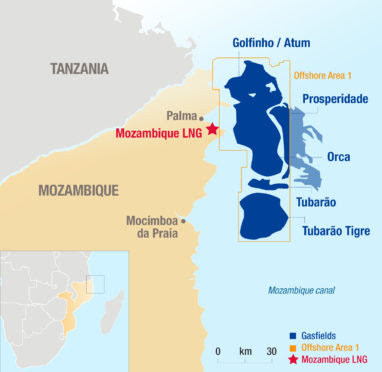
The total cost of the Mozambique LNG project is estimated to be around $24 billion, and includes the development of the offshore Golfinho and Atum gas fields located in the offshore Area 1 concession in the country’s northernmost province of Cabo Delgado. The project also includes the construction of a two-train liquefaction plant with a capacity of 13.1 million tons per annum. Importantly, this is Mozambique’s first onshore LNG development. 

The project financing includes direct and covered loans from eight ECAs, 21 commercial bank facilities, and a $400 million loan from the African Development Bank (AfDB). The ECAs involved with direct loans are US Exim ($4.7 billion), UK Export Finance ($1 billion), Sace of Italy ($950 million), ECIC of South Africa ($800 million), Atradius of the Netherlands ($640 million), Exim Thailand ($150 million) and JBIC ($3 billion) and Nexi ($2 billion of guarantees) of Japan.

Mozambique LNG benefits from 11 sales and purchase contracts running from 13 to 20 years and covering 11.14m tpa of production. The international sponsors have also received a $2.25 billion five-year guarantee from the Mozambique government that it will pay state-owned National Hydrocarbon Company (ENH’s) equity share if required (the guarantee is in lieu of an immediate equity contribution from ENH). Despite Mozambique being sub-investment grade, the guarantee adds solidity to the joint and several debt service undertakings for the project during construction. The project financing is expected to reach financial close in the third quarter this year.

Rovuma LNG, which is a joint venture between ExxonMobil and Eni, also has China National Petroleum Corporation (CNPC), Galp, Kogas and ENH on board. It is envisaged as a 15 m tpa two-train project, based on reserves from offshore Area 4. The project is also in the Cabo Delgado province. Overall project costs have been estimated up to $30 billion. Project financing is expected to be largely ECA and DFI- backed, with commercial loans and heavy equity or sponsor loan backing for the overall scheme. 

However, in April this year ExxonMobil announced that it would be delaying the final investment decision (FID) until 2021. This was not entirely Covid-19 related. In fact this was somewhat expected as there had been delays on the project advancement last year, when the sponsors wanted to cut costs on the overall project. 

Is financing going to be an issue on Rovuma LNG? Much is likely to depend on how the revised project is sized and packaged. Earlier this year TXF ran a news item on how US Exim had initially been expected to be involved in Rovuma as well, but the agency pulled out (details here). Market speculation that this is because of CNPC’s involvement in Rovuma LNG has solid ground given the way US Exim is geared to compete with Chinese-backed projects. Chinese banks including China Exim are all expected to play a leading role in the financing.

In addition, much is likely to depend on what happens with Covid-19 and the oil market and the oil price environment. There are many unknowns. But one thing is for sure, Rovuma LNG also needs the success of Mozambique LNG to pull it along. Mozambique LNG will be developing considerable land facilities for its project – onshore transport and infrastructure that would be in place when the Rovuma LNG project starts. However, both projects are in the province where militant attacks (some reports have linked these to Islamic-state) have escalated in recent months and there is a volatile security situation.

As Robert Besseling, executive director at EXX Africa, comments: “Mozambique LNG [Total] and Rovuma LNG [ExxonMobil] cannot be compared based on the same criteria. Total’s project has already secured the required external financing and the project has supply contracts in place that have not been frustrated by lower global demand for natural gas. In terms of its project finance ‘silo’ structure, Mozambique LNG is very much shielded from any sovereign risks and potential contract risks. On the other hand, ExxonMobil’s project (Rovuma LNG) is far less advanced in its financial structuring and the project’s FID was due to be delayed this year in any case due to mounting concerns over insecurity in northern provinces.”

And looking more expansively on the sovereign risk aspects of dealing with Mozambique, Besseling remarks: “One of the most interesting aspects of how the LNG projects will advance is whether and to what extend the Mozambican government can provide the required funding to participate directly in the gas bonanza. A June $2.25 billion guarantee from the Mozambican government for ENH’s equity share may not be sufficient to calm investors’ nerves given the obvious sovereign risks in a country that remains in default on various obligations.” 

He adds: “The only way forward that I can see is a rapprochement with the IMF and a new programme for Mozambique that would fund ENH’s participation. However, such a prospect would remain politically unpalatable given the budget austerity, economic restructuring, and financial transparency conditions such a programme would entail.”

Escalating security threat 

In developed countries we tend to hear very little of some of the regional conflicts taking place in Africa and the Middle East. And we hear absolutely nothing about the most recent militant activities taking place in Mozambique. But it is a very serious situation and one that could have a significant impact on gas field and economic development in the country. 

EXX Africa’s recent insight report on Mozambique is entitled: ‘Northern Mozambique in effective state of civil war’. And the sub-header duly notes: ‘A day after the UK government (through UKEF) committed to finance Mozambique’s LNG sector, another daring attack targeting security forces in the gas-rich north of the country indicates that the local insurgency risks spilling over into a full-fledged civil war, unless regional collaboration on counter-insurgency and fresh socio-economic investments are implemented.’

Despite a targeted fight-back by Mozambique security forces and two other military groups employed by the government to fight insurgents, the problem is not going away. And there have been calls for a concerted effort from the SADC to ensure that the northern part of Mozambique is properly secure otherwise the proposed gas projects and the country’s economic future is in serious jeopardy. I strongly urge anyone involved in project finance there to read the on-the-ground intelligence from EXX Africa.
Mozambique: U.S. And French Look To Move In
D. Anacleto/Deutsche Welle
Thousands of people have fled the violence in Cabo Delgado, often ending up in refugee camps like this one in Metuge.

27 JULY 2020
Mozambique News Reports And Clippings (Milton Keynes, UK)
By Joseph Hanlon

Both the United States and France are trying to become involved in patrolling the coast of Cabo Delgado. The US is explicitly linking anti-drug and anti-insurgency activity.

"There’s a lot of overlap between the drug traffickers and extremists and the types of conditions that enable them to thrive, and sadly, those conditions are present in Mozambique. So in Mozambique [the State Department is] supporting some of the Mozambican government’s counter-narcotics efforts.  We’re also working … to help them disrupt some of the transnational organized crime at sea through more effective patrolling," said Heather Merritt, Deputy Assistant Secretary of State for the Bureau of International Narcotics and Law Enforcement Affairs, in a 21 July press briefing. https://www.state.gov/telephonic-press-briefing-on-drug-trafficking-in-africa/

Merritt stressed that across Africa crime syndicates often "engage in multiple crime areas, and those networks may traffic in wildlife, drugs, people". She noted that "narcotics trafficking may be indirectly funding some of the terrorist networks and activities, as traffickers pay for safe passage via under-governed spaces and through routes that have been exploited as well by terrorist entities."

"We’re definitely concerned about Mozambique, and … drug traffickers and violent extremists have both utilized the ungoverned space", Merritt continued. And then she hinted at military and navy involvement, linking terrorism and heroin: there is "limited patrolling and limited law enforcement reach there. … We are as a US government concerned about the extremism in Cabo Delgado … We recognize that it’s a security threat that has a nexus to criminality, to terrorism, and to looking at sort of governance capacity, law enforcement capacity, and military capacity within Mozambique."

At least one US private security company is already recruiting Portuguese speaking US nationals to "provide strategic and tactical advisory support services" to the Mozambique government.


Meanwhile, French sources confirmed to Lusa (17 July) that Mozambique and France are discussing a military maritime cooperation agreement in the context of possible support in the fight against insurgents in Cabo Delgado. The French Armed Forces of the Southern Zone of the Indian Ocean (FAZSOI) have been promoting military cooperation, “conducting training with the Mozambican authorities on state action at sea”, the source said.

The island of Mayotte is just 500 km east of Pemba and is officially part of mainland France (and thus the EU). It has an important French military base. In addition France has several Islands in the Mozambique Channel between Mozambique and Madagascar, shown on this map: https://bit.ly/Ilands-Fr

Equally important, the French company Total recently bought control of area 1 of the Cabo Delgado gas field. Total brought in former French foreign legion officer Frederic Marbot to manage security for its gas project on the Afungi peninsula in Palma (Africa Intelligence, 1 June; Cabo Ligado 9 June). Marbot, who reportedly also ran security at Total facilities in Nigeria and Kazakhstan, will be joined in Cabo Delgado by his former foreign legion colleague Charles Stroeng. It appears that he is setting up a security unit partly composed of Mozambican troops already deployed to protect the Afungi camp.


Total already has contracts with five private security companies. Three are British: Blue Mountain, Control Risks and G4S, The other two are Arkhe (owned by Omega, South Africa/Mauritius) and GardaWorld (Canada), Arkhe, one of the biggest suppliers of security guards in Mozambique, including to embassies, was cited in the legal actions against Gemfields for atrocities at its Cabo Delgado ruby mine.

Push for South African intervention

"Staying out of Mozambique could see the insurgency there continuing to grow," warns the South African Institute of Strategic Studies (ISS) in an article by Peter Fabricius in ISS Today (23 July).

Islamic State has sleeper cells in South Africa and has recruited South Africans into its ranks. Some of these extremists fought with the group in Syria, some are involved in Cabo Delgado, and others are lying low in various cities in the country, according to Martin Ewi, ISS regional observatory coordinator.

Fabricius writes that "security sources have revealed that two accomplices of Islamic State suspects in South Africa were identified by South African officials in a photograph which the Cabo Delgado insurgents recently posted. The two are linked to legal cases underway in South Africa. That being so, it does not seem far-fetched to worry that these or other Mozambique insurgents might cross into or return to South Africa with hostile intent."

The articles comes after State Security Minister Ayanda Dlodlo said "we are taking very, very seriously" Islamic State's 3 July warning to South Africa not to get involved in Cabo Delgado. (News24 19 July; this newsletter 494 9 July). Dlodlo said South Africa could not extricate itself from conflict in the southern African region. "As a result of that, it becomes a responsibility for all of us in SADC to assist Mozambique in whatever way we can,"  she added.

The appointment of Robert McBride on 17 July to head the State Security Agency's (SSA) foreign branch, Dlodlo added, would assist in South Africa's efforts to deal with these threats. The job is effectively coordinator of foreign intelligence. McBride and Dlodlo were both Umkhonto weSizwe guerrillas.

$14.9 bn loan go-ahead for Total LNG

$14.9 bn in debt finance for Cabo Delgado gas was signed on 17 July. It includes the development of the Golfinho and Atum natural gas fields located in Offshore Area 1 and the construction of a two-train liquefaction plant with a total capacity of 13.1 million tons per annum (MTPA). LNG production could start in 2024.

Standard Bank calls it "the largest project financing deal" in Africa. It includes direct and covered loans from 8 Export Credit Agencies (ECAs) from US, Japan, UK, Italy, South Africa, Netherlands and Thailand;19 commercial bank facilities; and a loan from the African Development Bank.

The French company Total (with 26.5% which it recently bought, indirectly, from Anadarko) is the operating company. Other owners are Mitsui (20%), ENH (Mozambique government, 15%), three Indian state-owned companies (30%), and the Thailand state company PTTEP (8.5%)

In Area 4, deep-water offshore, there are two LNG projects. The $10 bn Coral South floating LNG project led by ENI will produce 3.4 MTPA, entirely sold to BP, and could begin by 2022. The second $25 bn project is led by ExxonMobil which has postponed indefinitely its final investment decision (FID), in part due to the dramatic fall in LND demand and prices.

Other news

Mozambique's hand in the secret debt dispute should be strengthened by Goldman Sachs agreeing to pay Malaysia $3.9 bn in the 1MDB scandal. Although not identical, the two are often reported as the two biggest global scandals involving big international banks. Goldman Sachs was blamed for using a $6.5 bn bond issue to facilitate the looting of Malaysia's 1MDB investment fund. Credit Suisse is accused, in the same way, of promoting a corrupt $2 bn loan to Mozambique. In November Malaysia turned down a Goldman offer of $1.75 bn from Goldman and last week it agreed to a payment of $3.9 bn; it has already received an additional $600,000 as a share of fines in US court cases. (Guardian, London, 25 July) The similarity to the Mozambique case will make it much harder for Credit Suisse to deny liability. But in pressing its cases Malaysia charged a former prime minister, his wife, and stepson. To reach such a large settlement will require hard bargaining from the Mozambique side as well as clear evidence of prosecution of the Mozambicans involved.

China's challenge to India could have an impact in Mozambique. The Macao-based China-Lusophone Brief (CL Brief 16 July) reports that Mozambique will be one of ten countries in India´s International Solar Alliance’ (ISA), in which state-run NTPC will develop solar power parks, funded by Indian credits. This is billed as India's "Energy Silk Road" and is seen by China as a direct challenge to its Belt and Road strategy.

"The law does not deal with mere impertinence and vulgarity," confirmed Mozambique's Higher Appeal Court, in confirming the acquittal of economist Carlos Nuno Castel-Branco and journalist Fernando Mbanze, in an important victory for press freedom. In 2013 Castel-Branco published a Facebook post criticising then President Armando Guebuza in very strong language. The post was widely circulated and reprinted in MediaFax. The Public Prosecutor's Office said the article was libellous and that libeling the head of state is a security offense. In 2015 Maputo city court Judge Joao Guilherme threw the case out, saying the language might be regarded as "impertinent and vulgar" but the post was not libellous. Unexpectedly, the Public Prosecutor's Office appealed, and five years later the Higher Appeals Court upheld the acquittal. It noted that “The President of the Republic, because of his topmost position in the leadership of the State, is exposed to criticism. Calling on a President to resign because the writer does not believe he is handling correctly the destinies of the country is normal throughout the world”.

Covid-19 cases are rising, with 53 new cases announced today, pushing the 7-day average to 35 per day, compared to 20 per day for much of June. There have been 11 deaths. There have been 1669 confirmed cases, of which 1063 are still active; 4298 people are in quarantine. The four provinces with most active cases are Cidade de Maputo: 228, Cabo Delgado: 225, Nampula: 209, and Provincia de Maputo: 202.

But there are concerns both about the high numbers in neighbouring South Africa where case numbers are still rising and there were 312 deaths reported yesterday, and that cases and deaths may be underestimated in both countries.

Researchers from South Africa's Medical Research Council say the South African figures for natural deaths are far higher than usual - suggesting thousands of Covid-19 deaths may be going unreported. (BBC 23 July)

Official figures show 6655 people have died from Covid-19. But a study of the past 10 weeks shows there have been 17,000 more deaths than usual for this time of year. That suggests more than 10,000 unexplained deaths.

Many are likely to be Covid-19-related but who died at home. There is also concern that South Africans are staying away from hospitals - because of a lack of space, or fear of catching the virus, which could mean more people dying of illnesses, such as tuberculosis and HIV/AIDS, that are not being treated.

South Africa has double the population of Mozambique. South Africa currently reports 112 deaths per million population so if all extra deaths are counted as Covid-19 related, this would be nearly 300 deaths/mn, which is at levels similar to Brazil, Russia, Netherlands, and Ireland. (Germany is 110, Portugal is 167, UK is highest in Europe at 670)
Renowned Kenyan Poet Abdalla Mwasimba Laid to Rest
WEDNESDAY JULY 29 2020

Mourners in prayers for the late Abdallah Mwasimba at the Kariokor cemetery in Nairobi on July 29, 2020. PHOTO | JUMA NAMLOLA | NATION MEDIA GROUP

Summary
Mwasimba, who for close to 30 years revised Swahili poems for Taifa Leo, had been suffering from low blood pressure and diabetes.
He leaves behind two sons and a daughter, 24 grandchildren and several great grandchildren.

By JUMA NAMLOLA
Kenya Daily Naion

The Swahili literary world was yet again thrown into mourning Wednesday, following the death of legendary poet Abdalla Mwasimba aged 83.

His death occurred a few months after Ken Walibora, Abdalla Shamte and Euphrase Kezilihabi.

Mwasimba, who for close to 30 years revised Swahili poems for Taifa Leo, had been suffering from low blood pressure and diabetes.

His youngest son, Mwasimba Abdallah told the Nation that the poet died in his sleep at his granddaughter’s residence in Kaloleni, Nairobi.

“He was diabetic and had low blood pressure for many years. Recently, he had been unwell until Monday when he was bedridden. He passed on at 4 am,” said Mr Abdallah during burial at Kariokor Cemetery, in Nairobi.

People who knew him paid their condolences, describing the late poet as a ‘man of people’, teacher and mentor of many.

“You would never meet Mwasimba without a smile. He cracked jokes and knew how to deal with people of all calibre. He would teach people wherever they met, by asking them some riddles or reciting poems that had heavy messages,” recalled veteran journalist Badi Muhsin, who first met the poet while working at the then Voice of Kenya (now KBC).

Because of his prowess in poetry, he was the pioneer radio poems reciter in independent Kenya. When Kenya became a republic in 1964, he composed a poem Mzungu Kuniita Bwana (Whiteman calling me sir). He was happy and thanked God for enabling Kenya get its independence the British colonialists could now respect blacks.

When Kenya faced its biggest alcoholism menace, Mwasimba composed a poem targeting the youth titled ‘Nini faida ya pombe' (Why do people drink) and yet it causes hallucinations, accidents, fights and sometimes, bad behaviour.

He was awarded the Head of State Commendation (HSC) in 2015 for his role in popularising Kiswahili through poems, skits and plays. He was among Kiswahili scholars who coined many Kiswahili words during VoK days in a program that had Abdalla Baruwa, Jay Kitsao, Raya Timamy, John Habwe, and Clara Momanyi among others.

“Mzee was naturally talented. Although he did not have any tertiary education, he composed radio plays for VoK, discussed major Swahili issues with professors and taught journalists how to properly voice scripts,” said Mr Muhsin.

In 2004, the late Mwasimba produced a Swahili program on QTV called ‘Dunia Ina Mambo’.

He leaves behind two sons and a daughter, 24 grandchildren and several great grandchildren.
DPP Orders Investigations into Police Brutality at City Hall
By Amina Wako
Kenya Daily Nation
July 29th, 2020 

Mlango Kubwa MCA Patricia Mutheu being assaulted by police officers at Nairobi County Assembly precincts.

The Director of Public Prosecution Noordin Haji has ordered for the investigation of the brutal assault on Mlango Kubwa MCA Patricia Mutheu on Tuesday afternoon at the Nairobi County Assembly.

In a statement, Mr Haji said that he had instructed the Independent Policing Oversight Authority (IPOA) and the Directorate of Criminal Investigations (DCI) to investigate the matter and hand over the file to his office.

“Pursuant to Article 157 of the Kenyan Constitution. I have directed the IPOA and DCI, through the IG, to have the matter expedited and the result file forwarded to my office for appropriate action,” Haji said in a statement.

Mr Haji said that the matter was brought to his attention by reports on various platforms of social media.

This saw him contact the Inspector General of police Hillary Mutyambai who assured him that investigation into the matter had commenced and was at an advanced stage.

On Tuesday, running battles, teargas and chaos characterised Nairobi County Assembly as police engaged MCAs who wanted to hand over an impeachment notice to Speaker Beatrice Elachi.

The ward representatives also wanted to hand over a court order which suspended the recent appointment of Mr Edwin Gichana as the Clerk.

HARASSMENT

However, police blocked the ward representatives from accessing Elachi’s office.

Haji’s orders came hours after IPOA issued a statement on police harassment at City Hall.

IPOA Chairperson Anne Makori on Tuesday said the authority has contacted some of the people who were present during the chaos that unfolded at the County Assembly of Nairobi.

The police oversight authority said that in its enquiry it will seek to establish the role played by police officers who were deployed at the premise during the fracas in which at least one case of injury to a Member of the County Assembly was reported.

“Whenever law enforcers apply force in quelling situations, they shall always ensure it is proportionate in accordance with the law and any excessive use of it is condemned and attracts stiff penalties,” Makori said.

“The Authority remains independent and impartial in handling and investigating all complaints,” she added.
Covid-19 Death Toll Rises to 311 After 12 More Patients Succumb to Virus
By Hilary Kimuyu
July 29th, 2020  
Mutahi Kagwe
Health Cabinet Secretary Mutahi Kagwe. PHOTO | MOH

The number of Covid-19 related deaths in the country has risen to 311 after 12 more patients succumbed to the disease.

At the same time, 544 more people have tested positive for coronavirus, bringing the total number of confirmed cases to 19,125. Of this number, 340 are male and 204 are female.

According to Health Cabinet Secretary Mutahi Kagwe the new cases are from 5,259 samples tested in the last 24 hours. This brings the country’s cumulative total tests to 289,759.

Meanwhile, 113 patients have recovered from the virus and had been discharged from various facilities.

Mr Kagwe noted that the cold weather that is presently being experienced in the country is a contributing factor fuelling the recent spike in virus cases, and has urged people to avoid congregating.

“It is possible the weather is also part of the reason Covid-19 figures are going up. It is the flu season,” Kagwe said.

The CS was speaking at the Kenya Medical Practitioners and Dentists Council headquarters in Nairobi.

ALCOHOL BAN

Kagwe reiterated that the sale of alcohol in eateries remains banned because it deters the social distancing measures aimed at combating the spread of the virus.

He urged Kenyans to take responsibility for their own health by not congregating and adhering to other control measures.

“Wengine walikuwa wamezoea pombe sana. Sema asante kwa Mungu ameleta mambo ambayo itakuzuia kwenda bar. Pesa ungetumia kwa pombe, nunulia bibi na watoto zawadi, angalia nyumba yako. Hata mimi nilikuwa nafurahia Kagwe special, lakini sasa hapana… We must also stay alive… You save me, I save you..,” Kagwe said.

The CS thanked health workers for a job well done during the crisis, but also sounded a warning to rogue medics who are not adhering to Covid-19 regulations.

He further noted that 634 health workers have tested positive but added that the figure is still low compared to numbers reported globally.
Millions of Kenyans Face Hunger as Virus Ravages the Nation
WEDNESDAY JULY 29 2020

A document published by the UK’s aid research firm Development Initiatives, lists most countries perennially in conflict as those where many people are facing starvation. FILE PHOTO

Summary
The vulnerable Kenyans are in a global pool of more than one billion, or 16 per cent of the world’s population, facing long-term humanitarian crisis, a new report shows.

By SARAH NANJALA
Kenya Daily Nation

At least 3.6 million people in Kenya are at risk of hunger at a time the country is fighting the Covid-19 pandemic.

The vulnerable Kenyans are in a global pool of more than one billion, or 16 per cent of the world’s population, facing long-term humanitarian crisis, a new report shows.

The document, Global Humanitarian Assistance Report 2020, published by the UK’s aid research firm Development Initiatives, lists most countries perennially in conflict as those where many people are facing starvation. However, Kenya and Ethiopia were listed alongside South Sudan, Libya, Somalia and Central African Republic as those with medium-to-high-level of need.

The humanitarian crisis situation is such that millions need food and urgent medical aid. They include Somalia, where 5.2 million people have been affected, Zimbabwe with 5.1 million people, Chad at 4.8 million, Cameroon at 4.4 million, Mali at 3.9 million and Kenya at 3.6 million people.

The Democratic Republic of the Congo (DRC), Sudan, Niger, Chad, Nigeria, and Cameroon were identified to have the greatest need of humanitarian assistance.

All these countries have recently recorded more Covid-19 cases, stretching their health budgets.
Second Night of Protests in Richmond Ends with 16 Arrests
July 27, 2020

Police stand in front of a utility vehicle that was set on fire by protesters during a demonstration outside the Richmond Police Department headquarters on Grace Street in Richmond, Va., Saturday, July 25, 2020. Police deployed flash-bangs and pepper spray to disperse the crowd after the city utility vehicle was set on fire. (Joe Mahoney/Richmond Times-Dispatch via AP)

RICHMOND, Va. (AP) — Fires were set, windows were smashed and 16 people were arrested as demonstrations continued for a second night in Virginia’s capital city, Richmond’s police chief said at a news conference Monday.

The protests on Sunday evening followed demonstrations Saturday night that had been billed by some as support for protesters on the other side of the country in Portland, Oregon. That city has been experiencing ongoing tensions between protesters and U.S. agents at the federal courthouse.

Richmond police Chief Gerald Smith said his department saw a flyer calling for demonstrations Sunday that carried the same tone of “intimidation” and ”wanting to produce fear” that flyers for Saturday night’s protests had contained.

Smith said Sunday night’s damage included three fires as well as smashed windows, including one at the police department for Virginia Commonwealth University.

The chief said that the ages of those arrested ranged from 17 to 45. Charges included trespassing, riot with a dangerous weapon and transport of a loaded rifle within city limits.

“The city of Richmond is open and welcomes those who would like to come here in expression of their First Amendment rights,” Smith said. “However, we have to take action when we know that violence is coming.”

Smith said police took a proactive stance and began making arrests in Monroe Park after 10 p.m. The park “is clearly closed dusk,” the chief said.

The chief said that his department is working on identifying any groups that were affiliated with Sunday’s demonstrations. Some individuals from Saturday night have been identified as being from both left-wing and right-wing movements, he said.

On Saturday night, Virginia State Police and Richmond police said they worked to clear a crowd of a several hundred demonstrators that had ripped down police tape and moved forward with lasers and firecrackers.

Six men among the protesters were arrested that night and face various charges, including unlawful assembly, rioting with a firearm and assault on a law enforcement officer.

Protesters had been planning Saturday’s demonstration for days. It was called “Richmond Stands with Portland,” news outlets reported, in an apparent reaction to ongoing tensions between protesters and U.S. agents at the federal courthouse in Oregon’s largest city.

Weeks of nationwide unrest have struck several U.S. cities since the death of George Floyd in Minneapolis on May 25.
Barr Defends Aggressive Federal Response to Protests
By MARY CLARE JALONICK, MICHAEL BALSAMO and ERIC TUCKER

WASHINGTON (AP) — Attorney General William Barr defended the aggressive federal law enforcement response to civil unrest in America as he testified for the first time before the House Judiciary Committee, pushing back against angry, skeptical Democrats who said President Donald Trump’s administration is unconstitutionally suppressing dissent.

The hearing, held Tuesday as the late civil rights icon John Lewis lay in state steps away outside the Capitol, highlighted the wide election-year gulf between the two parties on police brutality and systemic racism in law enforcement. Massive protests have sparked unrest across the nation following the death of George Floyd at the hands of Minneapolis police, and calls for police reform are growing louder.

But Barr said “violent rioters and anarchists have hijacked legitimate protests” and argued the violence taking place in Portland, Oregon, and other cities is disconnected from Floyd’s killing, which he called a “horrible” event that prompted a necessary national reckoning on the relationship between the Black community and law enforcement. But he also said there was no systemic racism in law enforcement.

“Largely absent from these scenes of destruction are even superficial attempts by the rioters to connect their actions to George Floyd’s death or any legitimate call for reform,” Barr said of the Portland protests.

The hearing marks Barr’s first appearance before the committee after 18 months in office, bringing him face-to-face with the panel that voted last year to hold him in contempt and is holding hearings on what Democrats say is politicization of the Justice Department under his watch. But little new ground was uncovered; fuming Democrats often used their five minutes to lay out their frustrations and cut Barr off as he attempted to answer questions.

The hearing comes during a tumultuous stretch in which Barr has taken actions cheered by President Donald Trump but condemned by Democrats and other critics. Among them: the Justice Department’s decision to drop the prosecution of former Trump administration national security adviser Michael Flynn and Barr’s urging for a more lenient sentence for Trump ally Roger Stone, a move that prompted the entire trial team’s departure. Trump later commuted the sentence entirely.

The top Republican on the panel, Ohio Rep. Jim Jordan, used his opening statement to show an eight-minute video that spliced together images of violence by protesters around the country.

Democrats retorted with a video of their own of more peaceful protesters, shown by Rhode Island Rep. David Cicilline.

“We fought for democracy, for the right to speak freely and you are attempting to take that away,” Cicilline told Barr. “What’s worse, you’re doing it for the sole purpose of furthering the president’s political agenda and generating footage for Trump campaign commercials.”

Committee Chairman Jerry Nadler said the Trump administration had “twisted the Department of Justice into a shadow of its former self,” serving the powerful before average Americans.

Nadler said Barr had “aided and abetted” Trump’s worst impulses and excoriated him and the Justice Department for turning a blind eye to necessary reforms to police departments, for dismissing Black Lives Matter protests and for flooding streets with federal agents to stop protesters.

Under combative questioning, Barr acerbically defended himself but revealed little new information about his motivations or the Justice Department’s recent actions on policing or otherwise.

His testimony underscored his department’s ongoing effort to differentiate between increasing violence in some cities and Floyd’s death, which has led to state charges against four officers and is under investigation by federal authorities. Massive but peaceful demonstrations followed Floyd’s death in May.

The attorney general acknowledged that Floyd’s death struck a chord in the Black community because it reinforced concerns Black people are treated differently by police. But he condemned Americans who he says have responded inappropriately to Floyd’s death.

“As elected officials of the federal government, every member of this committee — regardless of your political views or your feelings about the Trump administration — should condemn violence against federal officers and destruction of federal property,” Barr said.

Civil unrest escalated in Portland after federal agents were accused of whisking people away in unmarked cars without probable cause; the people were detained and later released. And in Washington, D.C., peaceful protesters were violently cleared from the streets by federal officers using smoke bombs and pepper balls last month before a photo op by Trump in front of St. John’s church.

Barr defended the broad use of law enforcement power to deal with the situation, noting that protesters had earlier set fire to the church and “it was total consensus that you couldn’t allow that to happen so close to the White House.” The department’s internal watchdog has opened investigations into use of force and other tactics by agents in Washington and Portland.

He also said the force was used because the protesters would not disperse from the area when law enforcement officials were trying to move back the security perimeter, a decision made the night before. When pressed on details, he pointed to the investigations.

The use of pepper spray was warranted, even if peaceful protesters were also harmed, he said.

Beyond the federal response to the demonstrations, Barr was pressed in detail about his intervention in the Flynn and Stone cases, both of which arose from special counsel Robert Mueller’s Russia investigation. Democrats criticized him for partly taking into account Stone’s health and age, 67, and said those standards haven’t been used in other similar cases.

Barr said he told the acting U.S. attorney that “we are going to leave it up to the judge” and that he ordered the revised recommendation to be filed when the prosecutors submitted an initial recommendation calling for a sentence of seven to nine years.

“And even though I knew I would get a lot of criticism for doing that, I think at the end of the day my obligation is to be fair to the individual,” Barr said.

Barr also addressed Trump’s assertions on Twitter that the 2020 presidential election will be “rigged.” Asked by Louisiana Rep. Cedric Richmond if that could be the case, Barr said “I have no reason to think it will be.” Barr also said he agrees with the nation’s intelligence agencies that Russia interfered in the 2016 election, despite Trump’s reluctance to embrace that point.
2 Arrested for Attacking Senator During Wisconsin Protests
FILE - In this June 23, 2020 file photo, Wisconsin's "Forward" statue lies in the street on Capitol Square in Madison, Wis. Crowds outside the Wisconsin State Capitol tore down two statues and attacked a state senator amid protests following the arrest of a Black man who shouted at restaurant customers through a megaphone while carrying a baseball bat. Two women have been arrested for attacking the state senator during the chaotic night of violence near the state Capitol. (Emily Hamer/Wisconsin State Journal via AP, File)

MADISON, Wis. (AP) — Two women have been arrested for attacking a Wisconsin state senator during a chaotic night of violence near the state Capitol last month.

The women, ages 26 and 33, turned themselves in Monday and were taken to the Dane County Jail, Madison police said.

Democratic Sen. Tim Carpenter was beaten after taking cell phone video of protesters the night of June 23. His phone and glasses were taken and later returned.

Violence broke out as a group of 200 to 300 people protested the arrest of a Black man who shouted at restaurant customers through a megaphone while carrying a baseball bat. Protesters toppled two statues outside the state Capitol and threw a Molotov cocktail into a government building.

Police spokesman Joel DeSpain said the two Madison women were being held on tentative charges of substantial battery and robbery with use of force, the State Journal reported.

Paramedics treated Carpenter, but he decided against going to the hospital.
GOP’s Jobless Benefit Plan Could Mean Delays, States Warn
By GEOFF MULVIHILL

A Republican proposal to slash the $600 weekly benefit boost for those left jobless because of the coronavirus shutdown could result in weeks or even months of delayed payments in some states.

Older computer systems that took weeks to set up for the initial federal unemployment enhancement would need to be reprogrammed again twice under the GOP plan.

In Florida, state Rep. Anna Eskamani, a Democrat from Orlando, said the state has not even gotten the original supplemental benefit to everyone entitled to it.

“So the idea of changing the current process that has taken us months to put into place, that is still not even perfect, is a scary thought,” she said.

“These changes, whatever they end up being, are going to create more bureaucratic layers for people to get the relief they need. Meanwhile we have bills to pay, we have to put food on the table, we have medical expenses and a lot of people are suffering.”

How to handle unemployment is a fiercely contested part of the debate as Congress negotiates the latest relief legislation.

Democrats want to bring back the federally funded $600-a-week unemployment bonus that is expiring, saying it’s a way to keep families and the economy afloat in a time when there are far more people out of work than jobs available.

Republicans argue the current amount is so high that it encourages people to remain on unemployment. They want to reduce it in two steps: First, by cutting the benefit by two-thirds — to $200 a week through September. Then they want to switch that flat rate to a percentage in which the unemployed would receive benefits equal to no more than 70% of their previous incomes in November and December.

The debate isn’t only about the economy and ideology. It’s also about what’s doable technologically, especially on software many states use that dates to the 1970s.

Some states took a month to figure out how to process the initial $600 a week benefit when it went into place this spring, leaving laid-off workers in the lurch as the numbers of unemployed skyrocketed. Last week, more than 16 million Americans were receiving unemployment benefits.

“Anything other than a flat rate would take time to program in our system because it would require individual income calculations for hundreds of thousands of Ohioans receiving unemployment benefits,” Bret Crow, a spokesman for the Ohio Department of Job and Family Services, said in an email.

He said it wasn’t clear how long it might take to switch the system.

In Tennessee, the Department of Labor and Workforce Development says it would need “ample time” to make changes; just how much depends on what the policy is.

Washington was among the first states to implement the $600 benefit boost. But Mike Faulk, a spokesman for Gov. Jay Inslee, a Democrat, said large-scale changes would slow down benefit payments and “put a significant burden on state unemployment agencies.”

The state’s employment security commissioner, Susan LeVine, wrote the state’s congressional delegation this month telling them, “Simply put, state unemployment systems cannot flip a switch overnight on August 1, 2020, and will require a transition period.”

In Louisiana, Gov. John Bel Edwards said he doesn’t believe any states’ unemployment systems could handle a variable federal benefit tied to a person’s previous earnings. He has encouraged Louisiana’s congressional delegation to back a flat unemployment benefit instead.

“If they go beyond that, I will tell you it will be very, very difficult to administer,” he said.

Democratic California Assemblyman David Chiu said the state is struggling to provide benefits on time as it is.

“I have no confidence they’ll be able to adjust,” he said. “To me, this is why I really hope that Congress will simply extend the $600 a week to make this as seamless as possible.”

Annelies Goger, a fellow at the Brookings Institution, a left-of-center public policy organization, said even a change in the flat-rate boost could be delayed because states need to wait for federal guidance before implementing changes. Switching to a percentage of income would be even harder, she said.

For instance, it would be hard to gather the data needed to determine the previous incomes for people who were self-employed or were gig workers. Such workers are generally not eligible for unemployment benefits, but they are under coronavirus relief legislation.

And Goger said it would take a lot of resources to modify a program twice that is scheduled to end in December.

“Most states are still very overloaded with initial claims every week and are struggling to keep up with bottlenecks in the adjudication process and getting payments out accurately in a timely manner,” Groger said in an email.

“Any resources diverted from getting through those backlogs will delay getting relief to families that are struggling to pay rent and put food on the table.”

U.S. Senate Minority Leader Chuck Schumer, a New York Democrat, said on the Senate floor Monday that the fallout from both delays and benefit reductions could be significant.

He pointed to an analysis from the left-leaning Economic Policy Institute that found cutting the boost to $200 a week would result in 3.4 million more layoffs.

“The economy crashes, people are hurt, they get kicked out of their homes, they can’t feed their kids,” Schumer said. “The Republican proposal on unemployment benefits, simply put, is unworkable. It will delay benefits for weeks if not months as we slide into a greater degree of recession.”
___

Mulvihill reported from Cherry Hill, New Jersey. Follow him at http://www.twitter.com/geoffmulvihill.
___

Associated Press writers Melinda Deslatte in Baton Rouge, Louisiana; Cuneyt Dil in Sacramento, California; Brendan Farrington in Tallahassee, Florida; and Rachel La Corte in Olympia, Washington, contributed to this report.
States Resist Mask Rules as Midwest Virus Uptick Stirs Alarm
By AMY FORLITI, LEAH WILLINGHAM and HEATHER HOLLINGSWORTH

JACKSON, Miss. (AP) — The baseball season descended deeper into crisis Tuesday, states like Mississippi and South Carolina cast about for more hospital beds, and governors in some of the hardest-hit places staunchly resisted calls to require masks, despite confirmed cases of the coronavirus soaring.

Major League Baseball suspended the Miami Marlins’ season through Sunday because of an outbreak that has spread to at least 15 of the team’s players, and a series of games this week between the New York Yankees and Philadelphia Phillies was called off as a precaution.

States like Florida, Arizona and Texas are in dire condition, and the virus also has been spreading farther north in recent days, causing alarm among public health officials who fear states are not doing enough to avoid catastrophic outbreaks like those in the Sun Belt.

“We are watching very carefully California, Arizona, Texas, and most of Florida,” President Donald Trump said at a news conference. “It’s starting to head down to the right direction.”

Florida, however, reported another one-day high for COVID-19 deaths, with 191, while Arizona recorded 104, and Arkansas had a daily record of 20.

While the White House has begun to feel cautiously optimistic that the resurgence has begun to stabilize in parts of the Southwest, fears are growing about the potential for a significant uptick in the Midwest, including Minnesota, Wisconsin, Ohio, Indiana and Colorado, according to a Trump administration official who wasn’t authorized to publicly discuss private conversations.

It’s fueled largely by a rise in cases among young adults, who have been hitting bars, restaurants and health clubs again.

Over the past two weeks, Wisconsin’s rolling average number of new confirmed cases has increased by 31%. Minnesota reported its largest one-day case count Sunday, with more than 860 cases.

The virus is blamed for over 4.3 million confirmed infections and about 150,000 deaths in the U.S., according to the tally kept by Johns Hopkins University. Globally, more than 16.5 million people have been infected, and more than 655,000 have died. The numbers are thought to be higher because of limits on testing.

Republican governors in Tennessee, Mississippi, Missouri and South Carolina have all resisted calls to close bars and gyms or issue statewide mask requirements, though local officials have imposed some of their own restrictions.

“My reaction is that I’m disturbed. I’m disturbed by it,” said Dr. Anthony Fauci, the nation’s top infectious-diseases expert. Those two efforts and other best practices would help “prevent the resurgence that we’ve seen in some of the other Southern states.”

In Mississippi, nine of the state’s biggest hospitals had no open intensive care beds as of Monday, and officials are considering opening pop-up facilities. More than 24% of coronavirus tests have come back positive in Mississippi over the past week, the highest rate in the nation and triple the national average.

Republican Gov. Tate Reeves has gone so far as to argue that because mask-wearing has become political, a statewide mandate could actually discourage people from covering their faces. Instead, he is requiring masks only in the most seriously stricken counties.

Terry Sullivan, general manager of Fondren Fitness in Jackson, said a statewide requirement would be “the right thing to do.”

“I know it’s a hot topic, but if we can all just wear masks and really do right for a month, it would help a lot to try and slow this down in Mississippi,” he said. “If we don’t, it’s not going to slow down.”

In Missouri, larger cities are growing rattled by a spike in cases after the state fully reopened. It reported another daily record in cases, with nearly 1,800. St. Louis is curtailing bar hours and reducing restaurant seating capacity starting Friday, and Kansas City may follow suit.

GOP Gov. Mike Parson has repeatedly refused to enact a statewide order requiring masks, citing relatively few cases in most of the state compared with hot spots in bigger cities.

Parson said last month that he didn’t believe the governor has personal responsibility for any virus, and compared the illness that has killed over 1,200 people in his state to the flu. He said no one would expect him to take responsibility if someone were involved in an accident on a Missouri road.

The uncertainty has put restaurant owners in a difficult position.

Brian Schmitz, co-owner of The Bellwether and the Polite Society in St. Louis, closed the two restaurants temporarily after a guest expressed concerns Sunday that another diner recently made a social media post about testing positive for COVID-19. Schmitz said the buildings have been deep-cleaned and he’s testing staff before reopening, and it’s proving costly.

But “the stakes are higher than money,” he said. “Money hurts, don’t get me wrong. But we all work to live, not the other way around, and this puts that in stark contrast.”

In Tennessee, the situation is precarious enough that Dr. Deborah Birx of the White House coronavirus task force traveled to Nashville to implore leaders to close bars and residents to wear masks. But Republican Gov. Bill Lee has vowed he won’t shut down the economy again.

As of Tuesday, nearly 1,100 people were hospitalized with confirmed cases of COVID-19 in Tennessee, the highest seen there in the past two weeks. Intensive-care units are running at 86% capacity.

Nearly 70% of the state has issued some sort of mask mandate. However, enforcement has varied, with some officials hesitating to issue citations.

In Nashville, the city’s famous honky tonks have seen large crowds despite a strict 10 p.m. curfew that began last week. Nursing homes in more than 70 counties have been forced to again forbid visitors.

In Oklahoma, Gov. Kevin Stitt returned to his office Monday after two weeks of isolating at home following a positive coronavirus test. It came on the same day the state reported over 1,400 new confirmed cases — the second consecutive day of record highs.

Hospitals looked to increase capacity. The Regional Medical Center in Orangeburg, South Carolina, began setting up tents outside for recovering patients.

“We saw an uptick, and we wanted to be ahead of it,” said Dr. John Samies, the hospital’s chief of medical staff.

In Georgia, 88% of critical care beds were taken Tuesday, tying the highest level since the pandemic began, though not all critical care patients have COVID-19.

Texas Gov. Greg Abbott worried that the virus could spread even further after Hurricane Hanna over the weekend forced people to gather together indoors. The storm pounded the Rio Grande Valley, where hospitals have been overwhelmed.

“We’re in a dire situation,” Rio Grande City Mayor Joel Villarreal said. “If we continue on the same trajectory, countless more lives will be lost.”

In Europe, rising infections in Spain and other countries are causing alarm, weeks after nations reopened borders to revive tourism.

“Let’s be absolutely clear about what’s happening in Europe, amongst some of our European friends,” British Prime Minister Boris Johnson said. “I’m afraid you are starting to see in some places the signs of a second wave of the pandemic.”
___

Forliti reported from Minneapolis, and Hollingsworth from Mission, Kansas. Associated Press reporter Jonathan Lemire in Washington contributed.

Tuesday, July 28, 2020

Atlanta Mayor Defends Legal Face-Off With Georgia's Governor Over Masks
July 28, 2020 5:28 PM ET
Heard on All Things Considered
JAMES DOUBEK

Democratic Atlanta Mayor Keisha Lance Bottoms and Republican Georgia Gov. Brian Kemp are facing off in a legal battle over mask mandates.

Bottoms issued an executive order on July 8 requiring people to wear masks in Atlanta. Kemp sued, saying her policy violates his executive order, which strongly encourages mask wearing but does not require it. Kemp said counties and municipalities could not make their own rules that were either more or less restrictive than his statewide rules.

The two sides have been negotiating to settle the case. A court hearing scheduled for Tuesday was canceled to continue talks.

"We'll see" if a negotiated solution is possible, Bottoms told NPR's Ari Shapiro. "The most important thing is that we continue to keep at the forefront of every decision that we make the health and safety of the people who call Atlanta home. And what we know from our health professionals is that wearing masks goes a very, very long way in helping to stop the spread of COVID-19."

Gov. Kemp's position is that mayors cannot implement public health policies that go beyond his executive orders. Why do you believe a mayor should be able to override a governor on an issue like this?

Well, there are many legal theories on this, amongst them including the fact that it's believed that the governor's emergency order exceeded his powers as governor. ...

At the end of the day, the governor belongs to a party that often speaks about local control and often elevates the need and desire for local municipalities to be able to make their own decisions as it relates to any number of matters, including when we entered the COVID-19 crisis and schools were making decisions on whether or not they would close; the governor deferred to local control on those decisions.

It is my belief that a mask mandate is also something that local control should rule on. The reason being, we know that our numbers are very, very high in Atlanta. ... And the only way that we are going to get to the other side of COVID-19 is to start making smart decisions about how we proceed with the health and safety of our residents. And part of that, it's very simple: wearing a mask.

Let me also ask you about plans for the new school year. One of your four children tested positive for [the coronavirus] and you and your husband did as well. How does that experience as the parent of a school-age child who had the disease affect your thinking about whether Atlanta students can safely go back to school in person?

My concern really is one that's born out of our experience because, again, we had one of our children to test positive, asymptomatic, and then my husband and I became infected a week later. This is what our teachers, our custodians, our cafeteria workers, our bus drivers and so many others will face when our children go back to school. Not to mention many of our children in Atlanta have higher than the national average rates of asthma. Asthma is very common with African American children. African American children are more likely to die from asthma than other races. And so there are a number of concerns, including our children then perhaps being asymptomatic and then going home and infecting and impacting their families. And we know in Black and brown communities, COVID-19 is more likely to be deadly. ...

As mayor, I don't control the schools, per our city charter. It's an independently elected school board along with [an] independently appointed superintendent. But that being said, we're working very closely with our new superintendent to make sure that our children have what they need so that they can be prepared for school this fall.

Gus Contreras and Courtney Dorning produced and edited the audio story.
Georgia Governor Withdraws Request for Emergency Hearing to Block Atlanta Mask Order
BY J. EDWARD MORENO
07/28/20 11:10 AM EDT 288

Georgia Gov. Brian Kemp (R) withdrew a request for an emergency hearing in a lawsuit that aims to block his state’s largest city from ordering people to wear masks in public or imposing other pandemic-related restrictions.

Kemp spokesperson Cody Hall told The Hill Tuesday morning that the governor was heartened by Atlanta Mayor Keisha Lance Bottoms's (D) recent decision to impose economic restrictions on restaurants on a voluntary basis.

The governor’s office did not withdraw the suit, but said that having the hearing at a later date instead of Tuesday afternoon would make for “productive, good faith negotiations with city officials.”

“Given the threat of economic harm and immediate backlash from Atlanta’s business community, this overreach by the Mayor was our top concern and the primary reason behind the litigation,” Hall said. “Now, Mayor Bottoms has taken several opportunities to publicly explain that the Phase One rollback is purely voluntary, and we appreciate this concession.”

Kemp issued an order this month prohibiting localities from issuing face mask mandates as the state continues to experience a surge in coronavirus cases. Instead of issuing an order, Kemp has said he is “encouraging all Georgians” to wear face coverings.

The lawsuit is asking a judge to overturn Bottoms’s orders that are more restrictive than Kemp’s and to block her from issuing any more such orders.

It would also prohibit Bottoms from making public statements asserting she has authority that exceeds Kemp’s, and to require city officials to enforce “all provisions” of Kemp’s existing orders.
Alabama’s Latest Lost Cause: Rep. Will Dismukes
12:51 PM; Today 9:52 AM
By Kyle Whitmire | kwhitmire@al.com

This is an opinion column.

A lot of people seemed surprised by all that state Rep. Will Dismukes did this week, but they shouldn’t be. To know who Dismukes is, you don’t even have to get out of your car. Heck, you don’t even have to drive the speed limit.

By the interstate north of Montgomery flies a Confederate battle flag. If you’ve driven by it, you’ve seen it. I’m awful at estimating spaces and sizes, especially at a distance, but I’d guess it’s slightly more square feet than my first apartment and somewhat smaller than the house I live in now. As flags go, it’s big. And it’s a defiant middle finger to anyone hoping to make Alabama better.

That flag sends a message to any tourist on their way to the beach: This state is unreconstructed, and if you don’t like it, then keep moving. It says to business developers, we can find warm bodies for your new factory but if you’re looking for a new corporate headquarters, you might want to look someplace else. That flag sends the same message it’s always sent: We don’t give a flip for people who aren’t like us and “us” means “white.”

It was hoisted there, on a pole tall enough to see a mile or more away, by the Sons of Confederate Veterans — a group to which Dismukes proudly and openly belongs.

This was not a secret when the GOP let him on their ticket. He didn’t hide it when voters chose him to represent them in the Alabama House. Dismukes has put all this stuff on his Facebook page. In TV interviews, he’s eschewed the customary American flag lapel pin for a Confederate one. On Confederate Flag Day, he dressed up in what a Boy Scout uniform might have looked like had the South won the war. He can repeat the lies of the Lost Cause chapter and verse — because he’s a Southern Baptist minister, too, and also his SCV chapter’s chaplain.

But most Alabamians understand that flag is only a part of this state’s story. And few Alabamians have epitomized the other half better than John Lewis, the civil rights legend whom the state honored this past week after his passing. It was when these two men got juxtaposed in the news that it became undeniable just how awful Dismukes has been.

As Rep. John Lewis’ casket moved about the state from one memorial service to another, Dismukes attended another sort of event near Selma at a place called Fort Dixie. There, he and others celebrated the life of Nathan Bedford Forrest, a slave trader, a brutal Confederate general, and the first Grand Wizard of the Ku Klux Klan.

I guess having official state holidays for Robert E. Lee and Jefferson Davis wasn’t good enough.

Fort Dixie is not an actual military fort, but the property of Butch and Pat Godwin. Pat Godwin is a longtime Confederate apologist who’s had some interesting things to say about her home city and the march that happened there in 1965.

According to the Southern Poverty Law Center, Godwin has called Selma “Zimbabwe on de Alabamy.” She has fought to prevent the Alabama Historical Commission acknowledging the 1965 voting rights march, which she has called a drunken “Mother of all Orgies.” And in emails, she has referred to herself as “Wizardess.”

Godwin has also fought, unsuccessfully, to display a large bust of Forrest on public property, and once a year, Godwin hosts a birthday celebration remembering Forrest. At the event according to announcements, her organization, Friends of Forrest, gives away a small cast bust of the KKK founder as a door prize and has offered, among other food options, a “Pickaninny Freeze Watermelon Stand.”

I had to Google that last thing to understand how racist it was.

That is where, on Saturday — while mourners held services in Lewis’ hometown of Troy — Dismukes gave a prayer and a speech.

And on Facebook Sunday — as the caisson carried Lewis’s body one last time across the Edmund Pettus Bridge — Dismukes posted pictures of his appearance at the other event, speaking at a podium in front of a portrait of Forrest and behind the four flags of the Confederacy.

As Alabama honored the late Rep. John Lewis, state Rep. Will Dismukes attended a birthday party for the founder of the KKK.

“Had a great time at Fort Dixie speaking and giving the invocation for the Nathan Bedford Forrest annual birthday celebration,” Dismukes said. “Always a great time and some sure enough good eating!!”

At least four GOP state lawmakers publicly chastised Dismukes after Dismukes failed to show adequate contrition in a statement Monday morning, Alabama Republican Chairwoman Terry Lathan rebuked him further and invited his constituents to decide his future.

“It is one thing to honor one’s Southern heritage, however, it is completely another issue to specifically commemorate the leader of an organization with an indisputable history of unconscionable actions and atrocities toward African-Americans,” Lathan said.

Likewise, Alabama House Speaker Mac McCutcheon said Dismukes’ constituents would have to decide what to do with them.

Goodness knows what an Alabama Republican has to do to get kicked out of the House caucus. Or the party. Whatever that takes, we haven’t seen it yet, and we’ve seen a lot.

At least the very least, Dismukes’ career is likely stunted. Earlier this year, he explored running for Congress, to replace Rep. Martha Roby, before endorsing another candidate. He had higher ambitions. But now his career likely ends here.

Here’s the thing of which I feel certain: Lewis would have us feel pity or even love for Dismukes. A lifelong believer in nonviolence and redemptive suffering, Lewis believed racists were victims of their racism, too.

I’m trying to see it. I’m trying to feel it. But I’m struggling.

There’s a joke I first heard told by the novelist David Foster Wallace, about two young fish swimming through the ocean. As they swim, they pass a much larger, older fish.

“Morning, boys! How’s the water?” the big fish says.

The two young fish keep swimming. And after they’ve put some distance between themselves and the big fish, one turns to the other nervously and asks …

“What the hell is water?”

One of the peculiar traits of racists is how rarely they understand their racism, or how incapable they are to understand that racism is even real.

Dismukes still doesn’t.

“We no longer drink from separate water fountains, and we no longer have segregated schools,” Dismukes told WSFA Monday. “You know there’s abundant work opportunities for all colors, there’s abundant scholarship opportunities for all colors. So what are you asking that needs to be racially reconciled?”

Even now, Dismukes can’t see it because he’s been surrounded by it all his life.

Racism is the water he swims in.

And it’s in that water he’ll drown.

And there, by the shore, will fly that damned flag marking the end of another Lost Cause.

Kyle Whitmire is the state political columnist for the Alabama Media Group.