People's Republic of China Report on the Human Rights Record of United States in 2008
http://www.chinaview.cn
2009-02-26 22:50:23
BEIJING, Feb. 26 (Xinhua) -- The Information Office of the State Council published a report titled "The Human Rights Record of United States in 2008" here on Thursday. Following is the full text:
The State Department of the United States released its Country Reports on Human Rights Practices for 2008 on February 25, 2009. As in previous years, the reports are full of accusations of the human rights situation in more than 190 countries and regions including China, but mentioned nothing of the widespread human rights abuses on its own territory. The Human Rights Record of the United States in 2008 is prepared to help people around the world understand the real situation of human rights in the United States, and as a reminder for the United States to reflect upon it s own issues.
I. On Life and Personal Security
Widespread violent crimes in the United States pose serious threats to its people's lives, property and personal security.
According to a report published in September 2008 by the Federal Bureau of Investigation (FBI), the country reported 1.4 million violent crimes, including 17,000 murders (The Washington Post, June 10, 2008), and 9.8 million property crimes (The World Journal, September 16, 2008) in 2007.
Throughout 2007, the estimated number of robberies counted 445,125, a 7.5 percent rise over the last five years (The Washington Post, September 16, 2008). In cities with 50,000 to 100,000 inhabitants, the number of murders increased by 3.7 percent than 2006 (The Washington Post, June 10, 2008).
In those with populations of 10,000 to 30,000, the number of violent crimes rose 2.4 percent than 2006 (The Washington Post, September 16, 2008). U.S. residents age 12 and older experienced an estimated 23 million crimes of violence or theft. The violent crime rate in 2007 was 20.7 victimizations per 1,000 persons age 12 or older; for property crimes it was 146.5 per 1,000 households. (Criminal Victimization, 2007, U.S. Department of Justice, http://www.ojp.usdoj.gov/bjs/abstract/cv07.htm).
Among cities with relatively high violence and murders rates, New Orleans reported 95 murders per 100,000 population, Baltimore 45, Detroit 44, St. Louis 40, Philadelphia 27.8, Houston 16.2, and Dallas 16.1 (The Philadelphia Inquirer, June 10, 2008). In the United States, one murder is committed every 31 minutes, one rape in every 5.8 minutes, and one burglary every 14.5 seconds (The Washington Post, September 16, 2008).
Guns are widespread in the United States. The U.S. Supreme Court asserted that Americans had an individual right to possess and use firearms, even when the guns are not related to service in a government militia, the Christian Science Monitor reported on June 27, 2008. Statistics show that the U.S. citizens own about 200 million private guns, including 60 to 65 million pistols. A total of 48 states in the United States allow its residents to bear guns (The China Press, October 16, 2008), while it is believed that one can buy a gun at gun shows in 35 states without a background check (United Press International, October 3, 2008). A gun store outside Nashville, Tennessee, sold 70 guns on November 5, 2008 alone (http://www.usqiaobao.com).
More than 20 airports in Philadelphia, Los Angeles, San Francisco and other cities allow people with gun permits to carry firearms in the general public areas of the terminal (The China Press, October 15, 2008). A local high school in north Texas even let some teachers carry concealed weapons (The New York Times, August 29, 2008).
The Washington Post reported on December 5, 2007 that 10 states, including Virginia, South Carolina, West Virginia, and Mississippi, supplied 57 percent of the guns that were recovered in crimes in other states in 2007. The 10 states with the highest crime-gun export rates had nearly 60 percent more gun homicides than the 10 states with the lowest rates.
The frequent occurrences of gun killings were a serious threat to the lives of U.S. citizens. According to the U.S. Center for Disease Control and Prevention, 1.35 million high school students in 2007 were either threatened or injured with a weapon at least once on school property (United Press International, October 3, 2008). Young people represent an expanding proportion of all shooting victims, from 13 percent in 2002 to more than 21 percent in 2007.
According to a Harvard University survey of high school students in 2006, a fifth of the 1,200 questioned in schools across Boston had witnessed a shooting. More than 40 percent believed it was easy to get a gun, and 28 percent said they did not feel safe on the bus or train (The Boston Globe, September 18, 2008).
In the 2007-08 school year, a record 34 Chicago Public School students were killed (The Chicago Tribune, April 2, 2008). Within a week from February 7, 2008, the United States had seven shooting incidents, leading to 23 deaths and dozens of injuries. On March 27, 2008, five people in Georgia and Kentucky were shot dead (The Associated Press, March 27, 2008, March 28, 2008).
On the night of April 18, nine shootings were reported in a period ofless than two hours in Chicago (The Chicago Tribune, April 21, 2008). In November, Baltimore had 31 shootings (The Baltimore Sun, December 2, 2008). On December 24, 2008, a man dressed in a Santa costume shot at a Christmas Eve party at his ex-parents-in-law's house, causing eight deaths, three injuries and three missing persons (The China Press, December 26, 2008).
II. On Civil and Political Rights
In the United States, an increasing number of restrictions have been imposed on civil rights.
According to a report on the Washington Post website on April 4,2008, the deep-packet inspection, a brand new surveillance technology, which has been applied, is able to record every visited web page, every sent email and every online search. Statistics indicated that at least 100,000 U.S. Internet users had been tracked and the service providers had conducted tests on as many as 10 percent of the U.S. netizens (The Washington Post, April 4, 2008). The FBI has been engaged in illegal surveillance launched by the U.S. government nationwide, obtaining thousands of people's phone records, bank accounts and other personal information by unwarranted means.
The Seattle Times reported on July 15, 2008 that President Bush signed a bill on July 10 that overhauls government eavesdropping and called it "landmark legislation that is vital to the security of our people." The new law grants legal immunity to telecommunication companies that take part in wiretapping programs and authorizes the government to wiretap international communications betweens parties outside the U.S. for anti-terrorism purposes without court approval.
The U.S. Department of Homeland Security disclosed in July 2008 that as part of border search policies, federal agents may take a traveler's laptop computer or other electronic device to an off-site location for an unspecified period of time without any suspicion of wrongdoing (The Washington Post, August 1, 2008).
The New York Times reported on December 8, 2008 that the National Security Agency illegally wiretapped a Muslim scholar named Ali al-Timimi in Northern Virginia and intentionally withheld materials gained through eavesdropping during a 2005 trial, in which the scholar was convicted on terrorism charges. These materials may provide evidences that the U.S. government's eavesdropping program has violated its citizens' civil rights.
Police abuse of force infringed on the civil rights of Americans. According to a report by the Chicago Tribune on June 25,2008, Chicago witnessed eight shootings by police officers in two weeks in June, causing five with fatalities. Shapell Terrell, a 39-year-old sanitation worker, was fatally shot by police officers on June 22 at the entrance of a two-story building, where all four apartments were filled with family members (The Chicago Tribune, June 23, 2008).
Luis Colon, an 18-year-old man in Chicago, was shot and killed by a plainclothes police officer on June 24, when he was walking with his girlfriend to meet friends and eat at a restaurant (The Chicago Tribune, June 25, 2008). Daryl Battle, 20, was shot dead in his Brooklyn apartment in New York City on the morning of August 2, 2008. Michael Mineo was sodomized by a police officer's baton on October 15, on a busy Brooklyn subway platform (The New York Times, December 10, 2008). Gilberto Blanco was shot and killed when he was swinging a folding chair in front of a policewoman named Dawn Ortiz in a parking lot near the Coney Island church (The New York Times, December 1, 2008).
The proportion of U.S. prisoners to its population has hit a new high. The Washington Post reported on July 11, 2008 that the United States has 2.3 million criminals behind bars, more than any other nation in the world. A report issued by the U.S. Department of Justice on December 11, 2008 said that over 7.3 million people were on probation, in jail or on parole at the end of 2007, equivalent to 3.2 percent of all U.S. adult residents or one in every 31 adults. (The United Press International, December 11, 2008).
For black men aged between 20-34, one in nine was in jail. (The Guardian, March 1, 2008). The rate of prisoners, higher than any period in the U.S. history, was almost six times the world average (125 in every 100,000 people). According to statistics, the recidivism rate stayed high in the United States. Half the people of previous convictions were sentenced to prison again within three years.
There is no proper protection of prisoners' basic rights. Information released in August 2008 by the U.S. Department of Justice showed that the rate of conviction by U.S. courts has been on a rise since 1993. Convicts who committed violent crimes accounted for more than 50 percent of the total.
California had 172,000 inmates in its 33 prisons, which were designed for just over half that number, leaving each inmate a space of only 6 square foot (Prison overcrowding blamed for health woes, http://www. sfgate.com, November 19, 2008). In Prince George of Maryland, the Upper Marlboro jail held an estimated 1,500 prisoners while it was designed for about 1,330 (The Washington Post, July 25, 2008).
There were frequent reports inmates dying from prison officers' violence. An Amnesty International report in 2008 said Taser was widely used to control inmates in the U.S. prisons and detention centers. It had tracked more than 300 cases since 2001 in which people died after being shocked by a Taser.
Among them, 69 died in2008. According to a report by the Washington Post on July 25, more than 10 jail officers in Prince George of Maryland have arrest records. At least six officers were suspended in the past seven months and nine others still worked in the prison though they were accused of crimes or violence.
Baron Pikes, arrested on a cocaine charge, died in January 2008 after a police officer had shocked him nine times with a Taser (The CNN website, on July 22, 2008). Ronnie L. White, 19, died of strangulation on June 29, 2008,when he was held in solitary confinement at a correction center in Prince George County, Maryland (The Washington Post, September 23,2008).
According to the latest statistics released by the U.S. Department of Justice in June 2008, 1,154 inmates in the federal and state prisons died of AIDS between 2001 and 2006 (Ming Pao Daily, July 3, 2008).
Some U.S. jails have become the "new asylums" for drug addicts and mental patients, with six out of 10 people in jail living with a mental illness (Jails bulging with people with mental illnesses, the homeless and people detained for immigration offenses; costing counties billions, http:// justicepolicy.org).
The Economist reported on May 10, 2008 that the U.S. was one of the few countries where the felons were deprived of rights. Some U.S. states even forbid felons to vote.
III. On Economic, Social and Cultural Rights
American people's economic, social and cultural rights are not properly protected.
There is a wide wealth gap in the American society. According to a New York Times report on October 5, 2008, the United States developed the most the most unequal distribution of income and wages of any high-income country over the past 30 years. The richest fifth of the Americans earn an average of 168,170 U.S. dollars a year, about fifteen times the figure for the bottom fifth -- 11,352 U.S. dollars. The top one percent of New York City tax filers received 37 percent of the city's adjusted gross income-- which includes wages, business income and capital gains, among other earnings (The New York Times, April 9, 2008).
There are 64 billionaires in New York City with a combined net worth of 344 billion U.S. dollars, 469 percent more than the collective worth of the city's billionaires two years ago (The Washington Post, September 29, 2008). A UN report released on October, 22, 2008 showed that the wealth gap in big American cities, including New York, Washington, Atlanta and New Orleans, was almost as wide as some African cities, and the ratio of income inequality in American cities was very high.
The number of people who are homeless, in poverty and hunger increased in the United States in 2007. Figures released in August, 2008 by the U.S. Census Bureau showed that 12.5 percent of Americans, or 37.3 million people, were living in poverty in 2007,up from 36.5 million in 2006.
Eighteen percent of children (13.3 million) were impoverished in 2007, up from 17.4 percent (12.8 million) in 2006 (Reuters, August 27, 2008). Some 7.6 million American families, or 9.8 percent of the total, were living in poverty. In 2007, the annual income of 1.56 million American people, 41.8 percent of the country's population in poverty, reached only half of the poverty threshold. In New York City, latest study shows 23 percent of the people are living in poverty (The Washington Post, July 14, 2008).
"According to a nationwide survey jointly conducted by the Washington Post, Harvard University and others in 2008, about 80 percent of low-income workers could not afford to buy fuel or save for pension insurance under the influence of the financial crisis." More than 60 percent of them could not afford medical insurance and 50 percent could not pay for food or housing.
The Reuters reported that food stamps, the main U.S. anti-hunger program which helps the needy buy food, set a record in September 2008, as more than 31.5 million Americans used the program, a year-on-year increase of 17 percent (Reuters, December 3, 2008). About 48 percent of New York City residents, had difficulty affording food for themselves and their families in 2008, doubling that of 2003. Already, 1.3 million New York City residents rely on emergency food organizations, up 24 percent from1 million in 2004 (The NYC Hunger Experience 2008 Update: Food Poverty Soars as Recession Hits Home).
Some 68.8 percent of emergency food agencies reported that they did not have enough food to fulfill demand (Survey shows impact of hunger crisis, http://www.nyccah.org). More than 2 million American families were unable to pay back house loans. Statistics released on November 13,2008 showed that foreclosure filings grew 25 percent nationally in October 2008 over the same month in 2007. More than 84,000 properties were repossessed by banks in October (China Press, November 14, 2008).
Statistics collected by the U.S. Department of Housing and Urban Development showed that the number of chronically homeless people living in the nation's streets and shelters reached 123,833in 2007. About 1.6 million people experienced homelessness and found shelter between October 1, 2006 and September 30, 2007 (The New York Times, July 30, 2008).
The number of requests for emergency shelter doubled from fiscal year 2007 to fiscal 2008 (World Journal, October 22, 2008). In Louisiana and Kentucky, the number of homeless families increased to 931. In December 2008, 19of the 25 American cities surveyed reported some kind of increase in homelessness between October 1, 2007 and October 30, 2008.
And 16 cities reported an increase in family homelessness (Advocacy Groups Fear New Wave of Homeless, http://ipsnews.net). The Washington Legal Clinic for the Homeless estimated that more than 6,000 people were homeless in the District on an average day. Among them, 47 percent were "chronically homeless" (District agrees on homeless shelter access; Faces $5 million cost, The Washington Times, December 13, 2008).
The rights of laborers are not properly protected. The unemployment rate in America keeps high. Statistics released by the U.S. Department of Labor on January 9, 2009 showed that the unemployment rate increased from 4.6 percent in 2007 to 5.8 percent in 2008, the highest since 2003. A total of 2.6 million jobs were lost in 2008, the biggest loss since 1945.
In December 2008 alone, 524,000 jobs were lost, driving the unemployment rate to a 16-year-high of 7.2 percent (The New York Times, January 10,2009). The number of long-term unemployed (those jobless for 27 weeks or more) reached 2.2 million in November, up by 822,000 over the past 12 months (Employment Summary, http://data.bls.gov). According to a poll conducted by Harris Interactive, the median time Americans spent working in 2008, which included housekeeping and studying, was 46 hours, which was one hour more than that of 2007.
One in every four Americans said their working hours increased in 2008. The median time Americans spent playing in 2008was 16 hours, a decline of four hours from a year ago and the lowest since 1973 (Agence France Presse, December 10, 2008). A survey of day-laborer sites in 25 states found that half of all workers had been underpaid or not paid at least once (The Washington Post, July 8, 2008).
In July 2008, a Minnesota court ruled Wal-Mart Stores Inc violated state wage and hour laws, failing to give workers their full rest breaks and requiring hourly employees to work off-the-clock during training (The China Press, December 10, 2008).
On July 23, 2008, New York's State Labor Department said a clothes factory called "Jin Shun" in Queens was found to have cheated its workers of 5.3 million U.S. dollars in the past six years by paying them salaries far below the minimum wage and not paying for overtime work (World Journal, July 24, 2008). On September 6, about 27,000 machinists in Boeing went on strike, requiring the company to raise their salaries and welfares (http://news.bbc.co.uk/chinese/simp/hi/newsid-7600000).
On October 20, U.S. District Court in Manhattan of New York ordered Saigon Grill Restaurant to compensate 4.6 million U.S. dollars to 36 delivery workers for violations of minimum wage and overtime laws (The China Press, December 23, 2008).
Employees' pension plans shrank considerably. A senior budget analyst with the U.S. Congress estimated in October 2008 that Americans' pension accounts lost 2 trillion U.S. dollars in the past 15 months. More than half the people surveyed in an Associated Press-GfK poll said they would have to delay their retirement.
A survey conducted by the American Association of Retired Persons (AARP) released in October 2008 said one out of five Americans above the age of 45 stopped putting money into a 401(k), IRA(Individual Retirement Account) or other retirement account (The China Press, October 8, 2008). A study by Hewitt Associates found the average U.S. 401(k) plan balance was down 14 percent in 2008 to 68,000 U.S. dollars from 79,000 U.S. dollars in2007. 401(k) refers to a section of the U.S. Tax Code that allows retirement plan investors to defer paying taxes (The China Press, November 25, 2008).
The realization of Americans' education rights is not guaranteed. The American Human Development Report 2008-2009 showed that 14 percent of Americans (about 40 million), with inadequate ability to read or write, were not able to understand the articles on newspapers or user manuals (The China Press, July 17, 2008).
A report published on December 3, 2008 by the U.S. National Center for Public Policy and Higher Education said college tuition and fees increased 439 percent from 1982 to 2007 while median family income rose 147 percent. Tuition for the 2008 fall semester increased by 6.4 percent on average for state universities.
Many states planned to sharply increase tuition for public universities in 2009. Florida and the Washington states were considering an increase of 15 percent and 20 percent, respectively. Among the poorest families -- those with incomes in the lowest 20 percent --the net cost of a year at a public university was 55 percent of median income, up from 39 percent in 1999-2000.
At community colleges, that cost was 49 percent of the poorest families' median income in 2008, up from 40 percent in 1999-2000 (The New York Times, December 3, 2008). Only 11 percent of the children from the most impoverished families were college graduates. The figure for children from the top earning 20 percent families was 53 percent. (The New York Times, February 22, 2008).
Americans without health insurance have been increasing. According to the American Human Development Report published in July 2008, despite spending 230 million U.S. dollars an hour on healthcare, Americans live shorter lives than citizens of almost every other developed country, ranking 42nd in terms of life expectancy. One out of six Americans does not have health insurance.
The Census Bureau said in a report published on August 26, 2008 that there are 45.7 million Americans without health insurance. Nineteen states had already made cuts or were planning to make cuts in Medicaid and/or State Children's Health Insurance Program (SCHIP) (The China Press, December 12, 2008). As medical expenses were rising, many companies quitted buying health insurance for their employees.
A research conducted by the National Federation of Independent Business in March 2008 found that only 47 percent small-size companies provide health aids for their employees. Among companies of 50 employees or less, only 24 percent offer health aids. Many gave up seeing a doctor or receiving treatments as they couldn't afford it.
Drugs, suicide and other social problems prevail in the United States. America has the largest population of cocaine and marijuana users in the world. A survey of 54,000 people from 17 countries found that 16 percent of U.S. survey respondents had at least tried cocaine in their lifetime, and more than 42 percent had tried marijuana (WHO global drug survey finds high rates of cocaine, marijuana use in U.S., http://www.thebostonchannel.com).
The suicide rate among middle-aged white Americans had been on the rise. A research report issued on October 21, 2008 by the Johns Hopkins Bloomberg School of Public Health said between 1999 and 2005, the overall suicide rate in the United States rose by 0.7 percent every year. The figure for white men aged 40 to 64 rose 2.7 percent and for middle-aged white women 3.9 percent. In 2007, a total of 138 people in the city of St. Louis committed suicide. As of June 2, 2008, 61 in the city committed suicide, up by 15 year-on-year (The Washington Post, June 2, 2008). The suicide rates in Baltimore, Detroit and New Orleans were all on the rise (The Christian Science Monitor, January 4, 2008).
Many young Americans have personality disorders. Researchers found that almost one in five young American adults has a personality disorder that interferes with everyday life, and nearly half of young people surveyed have some sort of psychiatric condition. Fewer than 25 percent of college-aged Americans with mental problems get treatment (1 in 5 adults has personality disorder, http://www.archgenpsychiatyr.com).
IV. On Racial Discrimination
In the United States, racial discrimination prevails in every aspect of social life. Black people and other minorities are still suffering from unequal treatment and discrimination.
Black people and other minorities live at the bottom of the American society. A report issued by the U.S. Bureau of Census on August 26, 2008 said the real median income for American households was 50,233 U.S. dollars in 2007. That of the non-Hispanic White households was 54,920 U.S. dollars, Hispanic households 38,679 U.S. dollars, Black households 33,9160 U.S. dollars.
The median income of Hispanic and Black households was roughly 62 percent of that of the non-Hispanic White households. Poverty rate of Hispanics stood at 21.5 percent, higher than the 20.6 percent in 2006 (Income, Poverty, and Health Insurance Coverage in the United States: 2007, issued by the U.S. Census Bureau in August 2008, http://www.census.gov).
According to The State of Black America issued by the National Urban League in March 2008, nearly one quarter of Black American households live below the poverty line, three times over that of White households.
A report released by the Working Poor Families Project on October 14, 2008 said in 2006, among all non-Hispanic White Households, those with low income accounted for 20 percent, while among minorities, the proportion was 41 percent. In New York City, the poverty proportion of Hispanic, Asian, African Americans and non-Hispanic White people were 29.7 percent, 25.9 percent, 23.9 percent and 16.3 percent respectively (World Journal, July 14, 2008).
Immigrants find it hard to own a house in the United States. The New York Immigrant Housing Collaborative and Pratt Center for Community Development said in a report issued on December 3, 2008 that around 25 percent of the native Americans spent half of their income on housing rent while the ratio was about 31.5 percent among immigrants. Immigrants from South America and Mexico spent 71.1 percent and 79.8 percent of their incomes on rent, respectively (The China Press, December 4, 2008).
AIDS threatens life of African Americans. A study released by the New York City Department of Health and Mental Hygiene in August 2008 said that among the newly infected HIV positive in the city in 2006, 46 percent were Blacks while 32 percent were Hispanics (New York Times, August 28, 2008). Black women are 15 times as likely to be infected with HIV as White women (Hot docs: AIDS in America, Criminalizing HIV, Obama's National Security Team, http://www.usnews.com). Currently, there are at least 500,000 Black Americans infected with HIV/AIDS.
Discrimination in employment is commonplace. According to statistics from the U.S. Labor Department, the jobless rate in the United States was 6 percent in the third quarter of 2008. The jobless rate for Blacks was 10.6 percent, twice that of the Whites(5.3 percent) (The Employment Situation: November 2008. Issued by the U.S. Department of Labor, http://www.bls.gov). The Equal Employment Opportunity Commission said it received 30,510 charges concerning employment discrimination in 2007
(Charge Statistics FY1997 Through FY 2007, http://www.eeoc.gov/stats/charges.html).
An accusation was filed by Oswald Wilson, an African American on February 11, 2008 against the American Broadcast Company (ABC) and its parent company Disney. He said a pattern of racial discrimination had caused him physical pain and emotional suffering (Black Worker Hits ABC in Racism Suit, http://www.nydailynews.com/news).
On December 5, 2008, former New York state governor Eliot Spitzer's father Bernard Spitzer was found guilty of racial discrimination by a jury. Four African Americans, who had worked as doormen or porters at a 34-story building owned by Bernard Spitzer, claimed that they lost their jobs because of the color of their skins. They were fired a decade ago, replaced by someone with lighter skin colors (The China Press, December 8, 2008).
The ugly head of racial discrimination emerges from time to time in the education sector. The State of Black America issued by the National Urban League in 2008 said African Americans' high school graduation rate and college entry rate still lingered at the level of the Whites two or three decades ago. Less African American students get college degrees than the Whites.
A news report said that African American students in public schools were more likely to get physical punishment than White children, while African American girls were twice likely to get paddled than White girls (US: End Beating of Children in Public Schools,
http://www.hrw.org/en/news/2008/08/19).
Racial segregation in schools is getting worse. A report by the Civil Rights Project at the University of California found that Blacks and Hispanics are more separate from white students than at any time since the civil rights movement. Some 39 percent of Black students and 40 percent of Hispanic students are isolated in schools in which there is little racial mixing. The report also found that the average Black and Latino students is now in a school that has nearly 60 percent of students from families who are near or below poverty line (Reuters, January 14, 2009).
Racial discrimination in the judicial system is appalling. The U.S. Department of Justice said on June 5, 2008 that jailed Black men were six times as many as the Whites by July 30, 2007. Nearly 11 percent of the Black men between 30 and 34 were in prison.
The New York-based Human Rights Watch said in a report released in February 2008 that African American youth arrested for murder are at least three times more likely than their white peers to receive life imprisonment without the possibility of parole
(US: Uphold Treaty Against Racial Discrimination, http://www.hrw.org/en/news/2008/02/06).
In California, they are almost six times more likely to receive a sentence of LWOP (The United States was not Forthcoming and Accurate in its Presentation to CERD,
http://www.hrw.org/en/news/2008/02/06).
The New York Times carried a report on May 6, 2008, saying that although most drug offenders are white, 54 percent of the drug offenders sent to prison are black. In 16 states, African Americans are sent to prison for drug offenses at rates between 10 and 42 times greater than the rate for whites.
A study of 34 states shows that a black man is 11.8 times more likely than a white man to be sent to prison on drug charges, and a black woman is 4.8 times more likely than a white woman (US: "Drug War" Unjust to African Americans,
http://www.hrw.org/en/news/2008/05/04).
According to media reports, Sean Bell, a black youngster, died after being shot at 50 times the day he was to be married. But the three police officers were acquitted of all charges in his death (National Urban League Urges U.S. Justice Department to Prosecute Acquitted Officers in Sean Bell Shooting Case, http://www/nul.org/PressReleases/2008/2008pr430.htm).
Statistics from the Los Angeles police showed that for every 100 Hispanics stopped by the police for questioning, there is only one White person being stopped. African Americans are even more likely to be intercepted by police. Blacks and Hispanics are also frequently ordered to get out of their vehicles, frisked, shoved and detained.
In the past five years, the L.A. police received nearly 1,200 complaints against police officers over racial discrimination, but none was handled (The China Press, October 21,2008). Muslims, Arabic Americans and other minority groups are also targets for anti-terrorism investigation of FBI (Ming Pao, July 3, 2008).
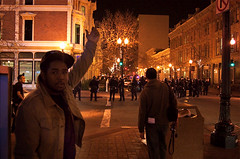
On the New Year's Day of 2009, an unarmed black man,22-year-old Oscar Grant was pressed facedown on an Oakland train platform by police officers and shot him in the back. Such atrocity aroused protest from local people, who took to streets on January 7 (Associated Press, February 13, 2009).
The basic rights of indigenous Americans were infringed on. The United States erected a 18-feet-high wall along the U.S.-Mexico border, which severely impaired life of local Apache people. Indigenous women fell victim to violence of American soldiers. In border cities and townships like Juarez, more than 4,000 Indigenous women were killed or reported missing.
The population of Indigenous youth accounts less than 2 percent of the total youth population in the United States. But among those in jail, the Indigenous accounted for 15 to 20 percent and 30 percent of them received the toughest penalty. On April 15 2008, people of Yankton Siou ethnic group in South Dakota staged a peaceful demonstration against building a hoggery, which they considered as highly pollutant. More than 70 officers from the county, state and federal law enforcement agencies, with the help of special police squad, police dogs, snipers as well as helicopters, cracked down the peaceful protest.
Thirty-eight people, including children and the elderly, were arrested. The United States deployed troops and built navy and air force bases in Guam, taking up one third of the land there. Local Chamoru people were victimized by the weapons left by U.S. army during the World War II and nuclear tests. The incidence of rhino pharyngeal cancer among them is 1,999 percent higher than the average Americans.
Immigrants received inhumane treatment. Harriett Olson, deputy general secretary of the Women's Division of the General Board of Global Ministries of the United Methodist Church, said that once arrested, the illicit immigrants were always mistreated. They were often jailed with criminals, and denied fundamental human rights and basic medical service.
Each year, dozens of them die in jail (The China Press, December 14, 2008). The Human Rights Watch said in June 2008 that the Department of Homeland Security had more than 30,000 individuals in detention, and that more than 80 immigrants have died in the last five years while in the care of the department or immediately after their release from custody, due to inconsistent standards of care and inadequate oversight (US: Protect Health of Immigration, http://www.hrw.org/en/news).
According to a report by the New York Times, computer engineer Hiu Lui Ng who moved to New York from Hong Kong in 1992 was sent to detention center in 2007 after his visa expired, and was then jailed in three states in New England. He died in the custody in August 2008 with his spine fractured and his body riddled with cancer that had gone undiagnosed and untreated for months (The New York Times, August 12, 2008). More than 2,900 illegal labors were detained since October, 2007, but only 75 employers or managers faced accusation. This number was just 2 percent of the labors (New York Times, July 1, 2008).
There is serious racial hostility in the United States. According to a Voice of America report, a research report released by the U.S. Department of Justice at the end of 2005 shows that United States reports about 191,000 hate crime each year (Voice of America's Chinese website, November 7, 2008).
A FBI report released on October 27, 2008 indicated that 7,624 hate crime incidents were reported in the United States in 2007. Among them, 50.8 percent were motivated by a racial bias, 62.9 percent of the known offenders were white (FBI Releases 2007 Hate Crime Statistics, http://www.fbi.gov/hc2007/summary.htm).
The Chicago Tribune reported on November 23, 2008 that there were 602 organization based on racial bias in the United States in 2000. The number surged to 888 by 2008. On the same day, the Boston Globe reported a survey by a professor from the Northwestern University, saying that the ratio of black men being murdered soared by 33 percent from 2002 to 2007.
V. On the Rights of Women and Children
The conditions of women and children in the United States are worrisome.
Women account for 51 percent of the U.S. population, but only 88 women serve in the 110th U.S. Congress. Sixteen women serve in the Senate, or 16 percent of the seats, and 72 women serve in the House, or 16.6 percent of the seats. As of December 2007, 73 women held statewide elective executive offices across the country, or 23.2 percent of the available positions.
The proportion of women in state legislature is at 23.7 percent. As of July 2008, among the 100 largest cities in the U.S., only 11 had women mayors (Women serving in the 110th Congress 2007-09. Center for American Women and Politics, http://www.cawp.rutgers.edu).
Gender-based discrimination in employment is quite serious. The U.S. Equal Employment Opportunity Commission said it received 24,826 charges on discrimination on the basis of sex in 2007, accounting for 30.1 percent of the total discrimination charges (Charge statistics FY 1997 Through FY 2007, http://eeoc.gov/stats/charges.html).
A growing number of women are being treated unfairly by employers because they are pregnant or hope to be (Mom-to-be claim work bias, http://www.nydailynews.com,May 19, 2008). According to statistics released by the U.S. Census Bureau in August 2008, the real median earnings of women who worked full time in 2007 were 35,102 U.S. dollars, 78 percent of those of corresponding men whose median earnings were 45,113 U.S. dollars (Current population survey, http://www.census.gov/press-release/www/releases/archives/income_wealth/012528.html).
The unemployment rate for adult women continued to trend up. It reached 5.5 percent as of November 2008 (The employment situation: November 2008, issued by the U.S. Department of Labor on December 5, 2008, http://www.bls.gov).
American women are victims of domestic violence and sexual violence. Statistics showed that among women receiving emergency treatment, one third of them are victims of domestic violence. Sexual violence poses a serious threat to American women.
It is reported that the United States has the highest rape rate among countries which report such statistics. It is 13 times higher than that of England and 20 times higher than that of Japan (Occurrence of rape, http://www.sa.rochester.edu/masa/stats.php).
Sexual assault against Indigenous women in the United States is widespread. Some women interviewed by Amnesty International said they didn't know anyone in their community who had not experienced sexual violence (Maze of injustice: the failure to protect indigenous women from sexual violence in the USA, http://www.amnestyusa.org).
Statistics showed that the Equal Employment Opportunity Commission received 12,510 charges of sexual harassment in 2007, 84 percent of which were filed by females (Sexual Harassment Charges EEOC & FEPAs Combined: FY 1997-FY 2007, http//www.eeoc.gov). A USA Today report on October 28, 2008, citing a study, said about one out of seven female veterans of Afghanistan or Iraq who visit a Veterans Affairs center for medical care reported being a victim of sexual assault or harassment during military duty. More than half these women have post-traumatic stress disorder (15% of female veterans tell of sexual trauma, more than half of them experience stress disorder, http://global.factiva.com).
An increasing number of children are living in poverty. Children under 18 account for one third of the people in poverty in the United States. Statistics show that as at the end of 2007, the poverty rate of children younger than 18 was 18 percent, up from 17.4 percent in 2006.
The poverty rate of children in single female-headed families reached as high as 43 percent (Income, poverty, and health insurance coverage in the United States: 2007,issued by the U.S. Census Bureau in August 2008, www.census.gov.).
According to a report released on October 14, 2008 by the Working Poof Families Project, one third of children live in low-income working families in 2006. In New York City, 41.6 percent of children in single-parent families live under the poverty line.
At the end of 2007, 8.1 million children under 18, or 11 percent of the total, were uninsured, (Income, poverty, and health insurance coverage in the united states: 2007, issued by the U.S. Census Bureau in August 2008, www.census.gov).
The conditions of American students are worrisome. According to the U.S. Department of Education, more than 223,000 students were corporally punished in 2007. More than 200,000 public school students were punished by beatings during the 2006-2007 school year.
In 13 states, more than 1,000 students were corporally punished per year (US: end beating of children in public schools, http://www.hrw.org/en/new/2008/08/19). Corporal punishment is legal in 21 states, according to a report released by American Civil Liberties Union and Human Rights Watch on August 19, 2008. Alcohol abuse, gambling and drug use are pervasive on campus.
Between 1999 and 2005, 157 college students died of alcoholism and750,000 youths were addicted to drugs. A report on teen drug use issued by University of Michigan researchers on December 11, 2008 shows that 11 percent of eighth graders, 24 percent of tenth graders and 32 percent of 12th graders reported using marijuana in the prior year. Use of any illicit drug in the prior year was reported by 37 percent of 12th graders, 27 percent of 10th graders and 14 percent of eighth graders (The China Press, December 12, 2008).
There is no guarantee of children's security. The Children's Defense Fund said in its 2008 annual report that 3,006 children and teens died in 2005 from firearms.
According to a survey by the Center for Children, Law and Policy, University of Houston, guns kill eight children and teens every day in America, which means the Virginia Tech shooting occurring every four days, or a child or teen being killed by guns every three hours (Children and teens firearm deaths increase for first time since 1994, http://www.childrenandthelawblog.come/2008/06/19).
Each year about 1.8 million children are reported lost. More than 3 million children are reported as victims of physical, sexual, verbal and emotional abuse, neglect, abandonment, and death (Facts you should know about violence against children, http://www.loveourchildrenusa.org). There are about 1,500 child-abuse fatalities every year (Abuse more a risk in non-traditional families, http://usatoday.com). Sexual abuse against children is serious.
One in five children were reportedly sexually abused by the age of 18 (Facts you should know about violence against children, http://www.loveourchildrenusa.org). In a Texas polygamist sect, some girls as young as 12 were forced into marriage with middle-aged men (The China Press, September 23,2008).
A research by the U.S. Centers for Disease Control and Prevention found that one fourth of teenage American girls, or 3 million, had a sexually transmitted disease (STD). African-American teenage girls were mostly severely affected. Nearly half of the young African-American women were infected with an STD, compared with 20 percent of young white women (Sing Tao Daily, March 12, 2008).
The United States is one of the few countries in the world where minors receive the same criminal punishments as adults do. It is the only country in the world that sentences children to life in prison without possibility of parole or release. There are 2,381 such inmates in U.S. prisons currently (The United States was not forthcoming and accurate in its presentation to CERD, http://www.hrw.org).
Seventy-three of them are serving death-in-prison sentence for offenses at the age of 13 or 14. Among them, 49 percent are African-Americans, and most of them come from needy families, without enough legal aids. These children will die in prison without parole no matter how they are corrected (Equal Justice Initiative, http://eji.org).
According to the general comments made by the United Nations Committee on the Rights of the Child in April 2007, sentencing minors to death or life in prison without possibility of release violates Article 37 of the Convention on the Rights of the Child. When reviewing the human rights records of the United States in 2006, the United Nations Human Rights Council said sentencing minors to life in prison without possibility of release violates Article 7 and Article 24 of the International Covenant on Civil and Political Rights.
Thousands of innocent children have been put into prison by corrupt judges. According to a report of the Spanish newspaper Rebelion on February 20, 2009, among the 5,000 juvenile prisoners in Pennsylvania, an estimated 2,000 were wrongly put into prison by two bribe-taking judges. According to the report, Judge Mark A. Ciavarella Jr. and Michael T. Conahan in the Luzerne County took more than 2.6 million U.S. dollars in kickbacks to send teenagers to two private youth detention centers run by PA Child Care and a Sister company, Western PA Child Care.
Most of the teenagers did not have a lawyer to turn to. Jamie Quinn, 18, stayed in prison for one year when she was 14 after she and a friend quarreled and slapped each other's face. Jamie was taken to a juvenile detention center and later transferred to several other jails. In her captivity, Jamie was forced to take some medicines so she could be "obedient". The girl is just one of the thousands of innocent children.
The use of child labors is serious in the United States. The Associated Press reported that the owner and managers of a meatpacking plant in Iowa was in September 2008 charged with more than 9,000 misdemeanors alleging they hired minors and in some cases had children younger than 16 handle dangerous equipment. The Iowa attorney general's office said the violations involved 32 illegal immigrant children under age 18, including seven who were younger than 16 (Iowa files child labor charges against meat plant, the Associated Press, September 10).
VI. On the violation of Human Rights in other nations
The United States has a string of records of trampling on the sovereignty of and violating human rights in other countries.
The war in Iraq has led to the death of more than a million civilians, made the same number of people homeless and incurred huge economic losses. The Xe, formerly known as Blackwater Worldwide and connected to the U.S. Department of State, and the DynCorp hired 6,000 private security guards in Iraq.
Victims of activities of the two companies are frequently Iraqi civilians. A report issued by a supervision team under the U.S. House of Representatives in October 2007 said Xe employees had been involved in at least 196 shooting incidents in Iraq since 2005, which translates into 1.4 incidents a week. Xe employees fired first in 84 percent of these incidents.
The United States established prisons across Iraq, where prisoners were routinely abused. Human Rights Watch said on April 27, 2008 that the U.S.-led Multi-National Force-Iraq (MNF) was holding 24,514 detainees at the end of 2007 (UN: tell us to end illegal detention practices in Iraq, http://www.hrw.org/en/news/2008/04/27). On average, detainees remain in custody for more than 300 days, and all Iraqi detainees are denied their basic rights (America's Iraqi prisoners, http://www.hrw.org/en/news/2008/08/07).
According to a Human Rights Watch report on May 19, 2008, the United States has detained some 2,400 children in Iraq, including those as young as 10, since 2003. U.S. forces were also holding 513 Iraqi children as "imperative threats to security". Children in Iraqi custody are at risk of physical abuse (US: Respect rights of child detainees in Iraq, http//www.hrw.org/en/news/2008/05/19).
The United States has maintained its economic, commercial and financial embargo against Cuba for nearly 50 years. Cuban Foreign Minister Felipe Perez Roque said the U.S. blockade has caused an accumulated directed economic loss of more than 93 billion U.S. dollars for Cuba. Seven out of 10 Cubans have spent their entire lives under the U.S. embargo (Overwhelming International Rejection of US Blockade of Cuba at UN, www.cubanews.ain.cu/2008/1029votacion_onu.htm).
On October 29, 2008, the 63rd session of the United Nations General Assembly adopted a resolution entitled "Necessity of ending the economic, commercial and financial embargo imposed by the United States of America against Cuba" with a vote of 185 for, three against, urging the United States to immediately end its unilateral embargo against Cuba.
It is the 17th consecutive year that an overwhelming majority in the assembly have supported the measure. It is a demonstration of the international community expressing their strong dissatisfaction over the United States acting against the international law and U.N. Charter by viciously violating Cuban peoples' rights to live and develop.
The United States is the world's biggest seller of arms. Its arms sales greatly intensified instability across the world and severely violated human rights of foreign nationals. A report by the New American Foundation, U.S. arms sales reached 32 billion U.S. dollars in 2007, more than three times the level in 2001. The weapons were sold to more than 174 nations and regions (Study: US arms sales undermine global human rights, http://sfgate.com).
The United States is haunted by scandals of prisoner abuses. The Washington Post reported on September 25, 2008 that U.S. interrogators poking, slapping or shoving detainees would not give rise to criminal liability, according to an internal memo declassified by the Department of Defense.
The same newspaper reported on April 22, 2008 that U.S. interrogators used practices such as keeping detainees from sleeping, forced drugging, and coercing confession through torture during questioning detainees at the military prison in Guantanamo.
The Human Rights Watch said in a February 6, 2008 report that about 185 of the 270 detainees are housed in facilities akin to "supermax" prisons in various "camps" at the detention center in Guantanamo even though they have not yet been convicted of a crime. These detainees have extremely limited contact with other human beings; spend 22 hours a day alone in small cells with little or no natural light or fresh air (News report finds treatment of detainees unnecessarily harsh, http//www.hrw.org/en/news/2008/06/10).
The Associated Press reported that more than 20 detainees under the age of 18 have been brought to the prison camp in Guantanamo since 2002 to fall victim to mistreatment from U.S. army service people.
In June 2008, Mohammed Jawad described his experience in May 2004 when he, less than 18 then, was brought to the detention center in Guantanamo and was denied his time for sleep. Jawad was moved from cell to cell 112 times in 14 days, usually left in one cell for less than three hours before being shackled and moved to another.
He was moved more frequently between midnight and 2 a.m. to ensure maximum disruption of sleep (The war on teen terror,
http://www.hrw.org/en/news/2008/06/23).
The United States is inactive towards its international human rights obligations under the international treaties. The U.S. signed the International Covenant on Economic, Social and Cultural Rights 31 years ago, the Covenant on the Elimination of All forms of Discrimination against Women 28 years ago, and the Convention on the Rights of the Child 14 years ago, but none of the above treaties has been approved yet.
The Convention on Rights of Disabled Persons is the most important progress the United Nations has achieved in protecting the rights of disabled persons in the new century, and the convention is highly valued by different nations. So far, 136 countries have signed the convention, and 41 already approved it.
But the United States has yet to endorse and sign the convention. The U.S. has refused a pledge to promote and protect the rights of indigenous people, and also failed to acknowledge their rights of self-governing, of land and of natural resources in the United Nations and in the international community. On September 13, 2007, the 61st session of the United Nations General Assembly adopted the Declaration of Aboriginal Rights by a vote of 143 in favor, while the United States was one of the only four countries that voted against it.
The United States has always obstinately followed double standards in dealing with international human rights affairs, and failed to fulfill its international human rights obligations. The Special Rapporteur on the human rights of migrants of the United Nations visited the United States in 2007.
However, the original plans to visit the detention centers in Hutto, Texas and Monmouth, New Jersey were canceled with no satisfactory explanations from the U.S. government, although the plans had been sanctioned by the U.S. government in advance. In 2008, the U.N. Special Rapporteur on the human rights of migrants said in the U.S.-visit report that the United States detained 230,000 migrants every year, more than three times the number nine years ago.
The U.S. deportation procedures lack proper procedures about "non-citizens", and non-citizens are rendered incapable of questioning whether they are detained lawfully, or whether for too long. The Special Rapporteur said the United States had failed to fulfill its international obligations, and also failed in adopting comprehensively coordinated national policies in light of explicit international obligations to prioritize the human rights of more than 37.5 million migrants living in the country.
The outbound humanitarian aids offered by the United States are dwarfed by its status as the richest country in the world. According to a report from the Development Assistance Research Associates, a non-profit organization based in Spain, the United States is listed one of the countries with the worst records in providing independent, righteous, and unbiased humanitarian aids to other countries. The report said the U.S. aids to other countries came frequently linked to its military or political ambitions.
Respect to and protection of human rights is an important indication of civilization and progress of human society. Every government shoulders a common responsibility in committing itself to improvement of human rights conditions in the country.
For years, the United States has positioned itself over other countries and released the Country Reports on Human Rights Practices annually to criticize human rights conditions in other countries, using it as a tool to interfere with and demonize other nations. In the meantime, the U.S. has turned a blind eye to its own violations of human rights.
The U.S. practice of throwing stones at others while living in a glass house is a testimony to the double standards and hypocrisy of the United States in dealing with human rights issues, and has undermined its international image. We hereby advise the U.S. government to begin anew, face its own human rights problems with courage, and stop the wrong practice of applying double standards on human rights issues.